Textual context
Svabhava, innate nature, gives the twelfth chapter its name, and the chapter rests on a strong claim: what rises from your own nature binds you to nothing. The Bhagavad Gita holds the same ground in its eighteenth chapter, ‘svabhava-niyatam karma’ (18.47), work fixed by one’s own nature.
In the modern age Sri Aurobindo (1872 to 1950) set svabhava at the center of The Life Divine, written between 1939 and 1940. For him the word names a universal individuality, the particular shape the one nature takes in each person, and no two shapes are alike.
Svabhava
Innate Nature · 8 shlokas
Janaka speaks all eight shlokas. Seven of them end on the same words, “evam evaham asthitah”, this is how I abide, and the eighth turns the refrain over to show both its faces. Each verse is a statement of being; doing has no part in it. A king is giving an account of himself, layer by layer, and the account grows shorter with every verse.
The chapter rests on svabhava, the atman’s own abiding quality. Shankaracharya’s svarupa-lakshana, the mark of essential nature, comes close to it, though Ashtavakra’s way of saying it is far more direct. You are free by your nature, and once that is seen there is nothing left for you to do.
So far
After pure consciousness, innate nature. Janaka’s own account of where he has come to rest.
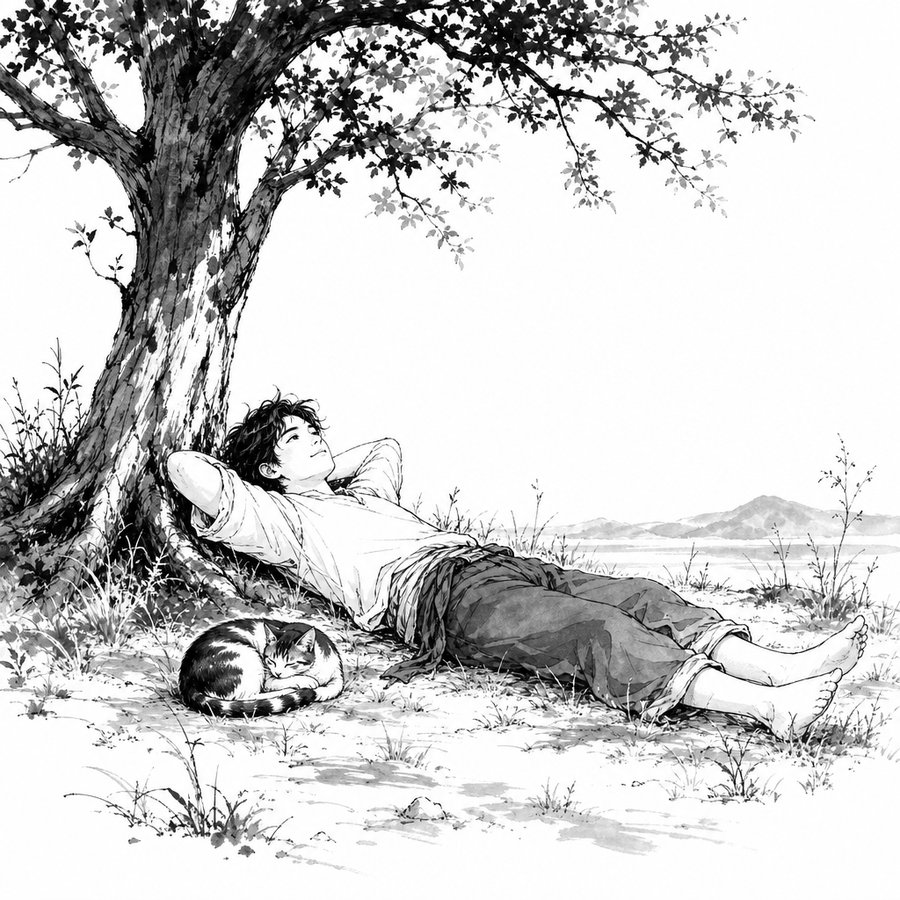
Janaka has listened through five chapters, and now he gives his own account. He describes a weariness that came in three stages. First the body’s work became more than he could bear, then speech, the long unrolling of words a court runs on, and at last thinking itself. When all three fell away, what remained was simply being, and he says, this is how I abide. The second verse opens one more layer. Delight in sound and the other sense-objects has left him, and the atman, he sees, is no object at all. With those two seen, his heart is freed of distraction and rests one-pointed, and he has not had to hold it there.
Shloka 1 · 2
First I could not bear the body’s work, then I could not bear the spread of words, and then I could not bear thought itself; thus I abide.
I take no delight in sound or in any other object of the senses, and the self is nothing that can be seen; so my heart is freed of distraction and rests one-pointed, and thus I abide.
Then Janaka states a law he has observed in himself. Effort toward samadhi arises only where there is distraction, and distraction arises from superimposition, from laying one thing over another and taking the self for what it is not. Seeing the rule, he rests just as he is. In the fourth verse he turns to the boy in front of him and calls him brahmin, the plain respectful word for a learned man, and tells him what has become of joy and sorrow. The two were fed by a single distinction, something to reject and something to accept, and when that distinction dissolved, both of them dried up at the root. Now, he says, this is how I abide.
Shloka 3 · 4
Effort toward samadhi is made only where there is distraction, born of superimposition and the like. Seeing this rule, thus I abide.
There is nothing left to reject and nothing to accept, hence no joy and no sorrow; now, brahmin, thus I abide.
Now Janaka sets aside the frame his whole life has been lived in. A stage of life or none, the householder’s or the renunciate’s, meditation, what the mind takes up and what it puts away: he sees that for him these are vikalpa, constructions of the mind. Seeing this, he stays just as he is. The sixth verse goes one step deeper. Performing action springs from ignorance, and ceasing from action springs from the same ignorance, since each of them hides inside it a doer who must do or must refrain. Having understood this fully, Janaka stands in neither camp. He is in being, and the question of doing has fallen silent.
Shloka 5 · 6
A stage of life or none, meditation, what the mind takes up and what it puts away: I see that for me these are mental constructs and nothing more, and thus I abide.
Performing action springs from ignorance, and ceasing from action springs from the same ignorance. Having understood this truth fully, thus I abide.
Last, Janaka cuts the root of thinking itself. Brahman cannot be thought, and whoever sits down to think of it takes on the form of thought, since thinking can only produce more thought. He has let even that contemplation go, and he rests just as he is. The eighth verse drops the refrain and blesses two kinds of people at once. The one who arrived here by doing exactly this is fulfilled, and the one whose nature flows this way of its own accord is fulfilled too. Eight shlokas, and a king who began by asking how liberation would come has described, in his own words, what it is like to have stopped asking.
Shloka 7 · 8
Whoever thinks of the unthinkable, even he takes on the form of thought. Therefore I have given up that contemplation, and thus I abide.
He who has done just this is fulfilled; he whose very nature is just this is fulfilled.