The Chandogya Upanishad

The Chandogya Upanishad
Sama Veda · Upanishad
The Upanishad that rose out of the tradition of Sama chant, in which a father told his son, and a sage told a king, over and over the same one thing: “That essence is you.”

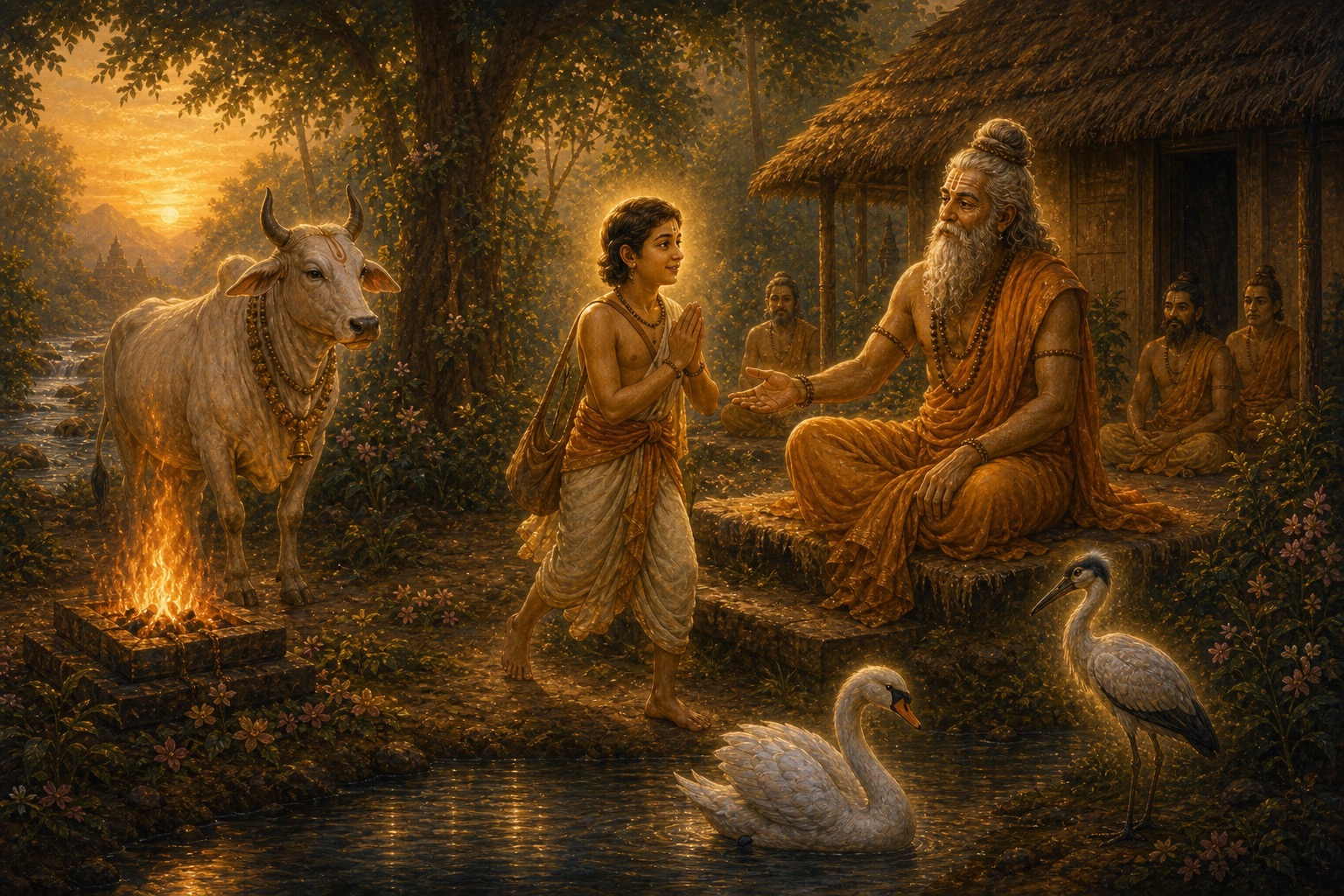
Picture a morning in northern India, some twenty-five hundred to three thousand years ago. A young man has come home after twelve years in a gurukula. His name is Shvetaketu. He has committed all four Vedas and every shastra to memory, and the pride of that learning has climbed to his head and taken over. He is so stiff with it that he barely speaks properly to his own father. His father, Uddalaka Aruni, a formidable teacher, watches all of this, and one day he seats his son beside him and asks a single question: “Son, did you ask your guru for that one thing which, once known, lets everything be known? That by which the unheard becomes heard, the unthought becomes thought, and even what will not fit into understanding comes to be understood?” And here the young man’s whole pride dissolves, because for all his study he had never once heard of such a thing. This question is the very life-breath of the entire text.
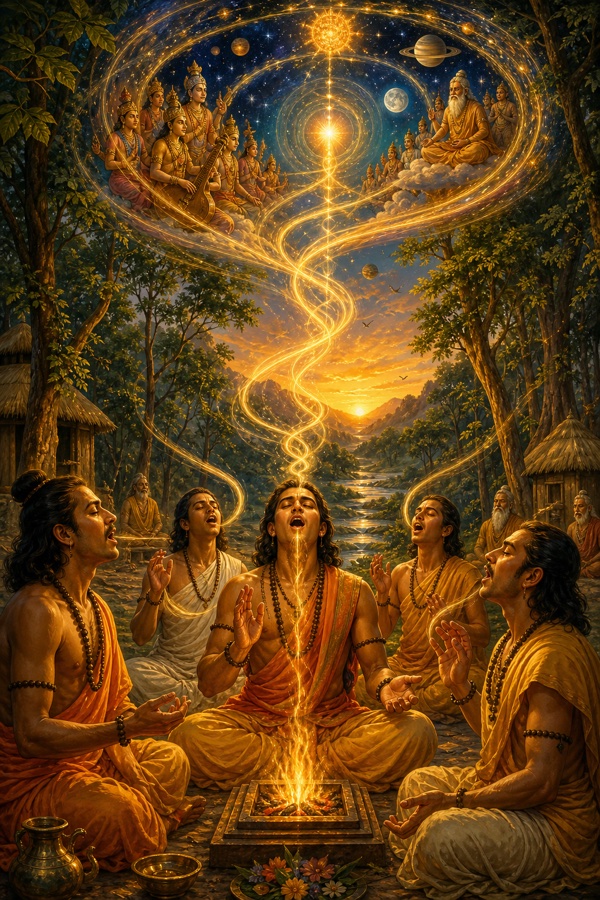
Robed Sama-Veda chanters in a dawn-lit forest gurukula raise the sacred syllable OM as the Udgitha, golden sound-waves rising from their open mouths to bind the cosmos in a luminous thread.

Its name is the Chandogya Upanishad, and the name itself opens up its temper. This Upanishad comes out of the Sama Veda, the Veda whose verses are sung rather than spoken (chandoga means, exactly, a singer of the Sama). That is why it opens with the worship of OM, called here the Udgitha (the high, supreme song to which the very thread of creation is tied). Scene after scene opens on its pages: sometimes a forest-hut gurukula, sometimes a king’s court, sometimes a dialogue between father and son, and every story carries guru and disciple toward the same one truth. Uddalaka tells Shvetaketu that in the beginning there was only Sat (pure existence, sheer being), one and without a second, with no cause and no other beside it; and from this bursts the great utterance, तत्त्वमसि (that essence is you). Further on, the rishi Sanatkumara teaches that happiness holds neither in the mind nor in any object; happiness lies only in Bhuma (the infinite in which nothing more is left to want). According to Swami Krishnananda, the whole gist of this Upanishad is that our sorrow does not arrive from anything outside us; it is born of the false feeling that “we are apart from everyone else, a small separate self”; and the work of sadhana is only this much, to lift consciousness out of that separation and join it to the One, where the whole world comes to be seen inside every single thing.

The main characters of this Upanishad

Uddalaka Aruni: A formidable teacher, Shvetaketu’s father, who used salt and a banyan seed to teach what lies beyond words.

Shvetaketu: Uddalaka’s son, a proud young man home after twelve years of study in the gurukula, whose conceit his father broke with a single question.

Sanatkumara and Narada: Sanatkumara, the divine-sage teacher; Narada, the disciple who knew every branch of learning and was still unquiet within.

Satyakama Jabala: A boy who spoke the plain truth about his own lineage, and that truth is what marked him a Brahmin.

Prajapati and Indra: Prajapati, the maker of creation, and Indra, king of the gods, who came back again and again in search of the real Self.

King Ashvapati Kaikeya: The king who explained to six great pandits the full form of Vaishvanara (the all-pervading Self).

Worship, and the far side of death

Satyakama Jabala: the one who speaks the truth is the Brahmin

A small boy stands beside his mother and asks a weighty question. His name is Satyakama, and his mother is Jabala. In those days, to go and study in a gurukula you had to state your gotra (the lineage-name of the father’s family). The boy asks his mother, “I want to go for brahmacharya (living in the guru’s house to study the Vedas). Tell me, what is our gotra?” His mother’s answer is the root of this whole passage, and it is also its true grace.

Jabala speaks plainly and without fear, “Son, I simply do not know what your gotra is. In my youth I served in many houses, and it was then that I came to have you, so I do not know which family you belong to. But my name is Jabala and yours is Satyakama, so call yourself Satyakama Jabala (Satyakama, son of Jabala).” Carrying this truth, the boy reaches the teacher Haridrumata Gautama (a distinguished master). When the guru asks his gotra, the boy does not shrink by a hair, nor does he manufacture anything. He repeats his mother’s whole answer exactly as it was, “My mother does not know which gotra I am of; she told me only that I am Satyakama Jabala.”

Hearing this, the guru is delighted and says, “Only a Brahmin could speak such guileless truth. You are fit to be a brahmachari, because you did not slip from the truth.” Swami Krishnananda presses the point right here that real nobility does not sit in birth or in the papers of lineage; it sits in staying unmoved on the truth. Brahminhood (the pure nature that leans toward Brahman) is the mark of a mind that will not reach for a lie even when shame or fear closes in. The boy had no father’s name and no pride of lineage, yet he had the truth, and that became his highest introduction.

Then the guru sets a curious test. He hands the boy four hundred lean, weak cows and says, “Take these to the forest and graze them.” Satyakama resolves that he will not come back until they number a thousand. For years he lives alone in the jungle, sunk in the service of the cows, his mind clear and his patience deep. When the herd grows to a thousand, the very nature he had been quietly watching becomes his guru.

Young cowherd Satyakama Jabala kneeling in a wilderness clearing as a noble white bull speaks to him, the four glowing directions radiating from the bull's horns like a luminous quarter of Brahman.

The story of tradition tells that four forms come before the boy one by one, and each teaches him one pada of Brahman (a quarter, a portion like the four directions). First the bull of the herd (the Rishabha) speaks, and names the four directions, east, west, south, and north, as a pada of Brahman called “the Radiant.” Then fire gives him the pada called “the Endless,” made of earth, the mid-region, the sky-world, and the ocean. Then a swan sings him the pada called “the Luminous,” made of fire, sun, moon, and lightning. And at the end a water-bird (the Madgu) tells him the pada called “the Abode-bearing,” made of breath, eye, ear, and mind. In this way the boy receives the whole of Brahman in its sixteen parts, with no human guru, straight from the mouth of creation itself.

The heart of this passage is woven from two threads. The first is that truth is the touchstone on which nobility is tested; whoever will not surrender the truth even under fear is a Brahmin within, whether or not any proof of lineage stands behind him. The second is that once the mind turns true and clear, no single mouth is needed to reveal Brahman; the bull, the fire, the birds, the directions, all become his teachers. According to Swami Krishnananda, these “deities” are not some outer spectacle; they are the very forms of the knowledge of Brahman rising up before a pure-hearted seeker, the seeker who had set himself firmly in the truth.

The gist: What makes true nobility is holding firm on the truth; the papers of lineage count for nothing. And when the mind turns that true, nature itself becomes the guru and shows the whole form of Brahman.

Raikva of the cart: the one into whom everything gathers

Here is how things stand. There is a king, Janashruti Pautrayana, a descendant of the Janashruta line, a great giver and a man of great faith. His kitchen runs day and night, rest-houses stand in place after place, and the king takes pleasure in the thought that “people eat food given in my name.” Swami Krishnananda says this king was great not only on the outside; within, too, he was an elevated soul, a man of pure mind and good heart. But one warm night the king lay on the palace roof when swans flew past overhead. The swan behind called out to the one in front, “Watch out, wide-eyes (Bhallaksha, one whose eyes are large but who does not see well), careful! Below you the splendor of Janashruti is rising all the way to the sky, do not go and burn in it.”

The swan in front laughed it off, “Who is this Janashruti, that I would burn in his splendor? You speak as though he were as great as Raikva of the cart (Sayugvan Raikva, the Raikva who stays with his cart). In the game of dice, when the throw called krita falls (the highest throw that sweeps up every point), all the other throws are gathered into it on their own; in the same way, whatever good deeds people do in the world all gather into the merit of that Raikva.” Swamiji explains that this comparison was the wound. All the king’s giving, all his goodness, were like tiny streams falling into the ocean before that one knower. The king turned from side to side all night, “If everything I do amounts to nothing before another, then what is the worth of my charity, of my goodness at all?”

The sage Raikva, a ragged hermit scratching his skin, seated beneath his rickety cart in a deserted lane while the king's servant bows low before this hidden master.

In the morning, when the bards came to sing the king’s praises, for the first time that praise pricked him like a thorn. He called his charioteer-attendant (the kshatta), repeated to him the very words of the swans, and sent him to seek out Raikva and bring him back. The servant wandered through towns and markets but found no one. The king scolded him, “Such great men do not live in the town. Search the riverbanks, the lonely places, the holy fords, where the knowers of Brahman dwell.” At last, in the corner of some village, the servant found a wretched-looking man seated beneath his cart, scratching an itch on his skin, not a soul around him. The servant bowed and asked, “Are you Raikva of the cart?” The man said carelessly, “Yes, that is who I am.”

The king arrived with six hundred cows, a gold necklace, and a chariot drawn by mules, and said, “O great one, take all of this and initiate me into the knowledge, into the deity you worship.” Raikva took nothing; instead he snapped, “Shudra, take all this back, and be gone from here with your cows.” Swami Krishnananda opens up a necessary point here. In the Brahma Sutras there was much debate over this word “Shudra,” over whether a Shudra may be given the knowledge of Brahman. But according to the commentators, Shudra here does not mean low birth; here it means one sunk in grief (from shuch, a symbol-word formed out of sorrow). The king was a Kshatriya who, stricken with grief, had come running toward knowledge, and for that he was called “Shudra.”

The king did not give up. He came a second time with even more, a thousand cows, the necklace, the chariot, and with them his own daughter, to offer to Raikva. Swamiji says something is hidden here between the lines that this Upanishad keeps quiet about. To be ready to give away one’s own daughter is no ordinary thing; in this Raikva recognized the king’s genuine longing. A man who was not genuine would have turned back at the first refusal. Raikva’s heart softened, “You have brought so much that I should speak? Very well, seeing your sincerity, I will speak.” The king gave him the very village where Raikva sat, and several villages besides (they came to be called Raikvaparna). Then Raikva initiated him into the Samvarga-vidya, the knowledge of that principle which gathers everything into itself (Samvarga, the absorber into which all things enter).

The knowledge runs this way. Swami Krishnananda explains that in the outer world this absorber is Vayu, no ordinary breeze; it is the vast life-principle called Sutratma and Hiranyagarbha. When a fire goes out it merges into Vayu; when the sun sets, into Vayu; when the moon wanes, into Vayu; when water dries, into Vayu. Put out the flame of a lamp, and where it goes no one knows. The planets, stars, and sun turn by a single law out of “fear” of this principle, as if this were the central power that drives them all. And within, inside the person, this same principle works as prana. When we sleep it is prana that draws the mind into itself; speech, eye, ear, all the senses merge into prana. Swamiji stresses that the outer Vayu and the inner prana, these two absorbers, are in truth one, a single principle of the cosmos and of the body (the great universe and this small frame); to see the two as one in meditation is the heart of this knowledge. And he adds that real initiation is not the repeating of words, it is the will-force of the guru descending into the disciple, for only then does this knowledge bear fruit.

The gist: True knowledge is weighed neither by rank nor by the count of gifts; the day we feel a deep grief at our own lack, that day we become Shudra (the grieving) and truly run toward knowledge. And the principle Raikva had grasped is this: as fire, sun, moon, and water merge into Vayu, so all our senses merge into prana; the absorber outside and the absorber within are one and the same supreme power.

King Ashvapati and the six pandits: six limbs of one Vast Being

The situation runs like this. Five great scholars, all of them meditators for years, performers of vast yajnas, sit together holding a shared perplexity. Each meditates on the Self in his own way, each has been richly rewarded, and still a thorn keeps pricking in some corner of the mind. Prachinashala Aupamanyava, Satyayajna Paulushi, Indradyumna Bhallaveya, Jana Sharkarakshya, and Budila Ashvatarashvi, these five ask one another, “What is the Self? What is Brahman? Why will our meditations not agree?” No one can give another a satisfying answer. Then they resolve to go to Uddalaka Aruni, the formidable teacher famed through the Upanishads.

Seeing so many titans coming toward his hut all at once, Uddalaka Aruni grows uneasy within. He thinks, “These are no ordinary men. Surely they come with some hard question, and it may be that I cannot answer. Better to send them to someone else.” Swami Krishnananda explains that Uddalaka’s humility was not put on; the same lack that pricked the others pricked him too in his own meditation. So he says, “Great sirs, I am in the same boat as you. Come, let us all go together to King Ashvapati Kaikeya, who is an accomplished master of the Vaishvanara-vidya (meditation on the all-pervading Vast Self).” And so the six seekers arrive at the king’s door.

King Ashvapati assumes the Brahmins have come hoping for gifts and offerings. He welcomes them with great respect and says, “In my kingdom there is no thief, no miser, no drunkard, no illiterate man, no adulterer. I am about to hold a yajna; whatever I give the ritvijas (the priests who conduct the rite), I will give as much to you as well.” But the pandits fold their hands and say, “We have not come for wealth. Whoever comes for a purpose should state that purpose. We have come to you as students of the knowledge of that Vaishvanara Self, which we do not know.” Then, though older in years than the king, they take samidha (the sacred wood of the fire-offering) in hand and bow before him like disciples.

The king asks each in turn, “On which Self do you meditate?” Aupamanyava says, “I take heaven (the Dyuloka, the supreme luminous world above) as the highest and meditate on it.” The king answers, “That is the head of the Vast Being, not the whole body. You took a part for the whole, and so there is no want of wealth and grain in your house, but had you not come in time, one day your head itself might have fallen.” Satyayajna meditates on the sun; the king says that is the eye of the Vast Being, and you could have gone blind. Indradyumna holds wind to be the highest; that is the breath of the Vast Being. Jana Sharkarakshya holds space; that is the trunk of the Vast Being. Budila holds water; that is the lower belly of the Vast Being. And Uddalaka himself meditates on earth; the king says that is the feet of the Vast Being, the lowest limb of all, and had he not come in time his very feet would have withered.

Then the king addresses them all together. According to Swami Krishnananda, the king names exactly two mistakes here. The first, they all took the limited for the limitless; the mind can only ever grasp some limited thing, however far-spread it may seem. The second, and the deeper error, they took the Self to be something outside themselves, “it is the sun, it is water, it is space.” Swamiji says the king’s question is piercing, “How can the not-Self (what is other than the Self) ever be the Self? How can your own true nature stand outside you? The Self cannot become its own object, cannot look at itself as though at another.” The king makes this clear with the tale of the elephant and the six blind men, each of whom touched one limb of the elephant and took that alone for the whole animal.

King Ashvapati Kaikeya before six bowing pandits points to a great tree being watered at its single root while the whole crown blossoms, illustrating that nourishing the root revives all.

Then the king gives the lovely illustration that Swami Krishnananda returns to again and again. “If you want to water a great tree, do you climb up and pour water and manure on each separate leaf and flower? No one does that; the wise man waters the root, and the whole tree flourishes on its own.” The king says the reward you gathered little by little by meditating on separate pieces, that same whole reward comes in a single stroke if you see the Vast Being all at once, from earth to heaven, from highest to lowest, without leaving out a single link, as your own Self. Swamiji adds that this is hard, the mind slips and slides back again and again to the pieces, but whoever manages it becomes the Self of every world, of every creature, and his every act turns into the yajna of the Vast Being itself.

The gist: Worship that takes a part for the whole does bear fruit, yet it stays incomplete, and some day it even trips you. The slip lies in searching for the Self as some outer thing, because the one you are searching for is you yourself. Stop watering leaf by leaf, water the root, know the whole Vast Being all at once as your own nature, and all the rest will flourish on its own.

The Panchagni-vidya: the two roads after death

The scene is a royal court. Shvetaketu, son of the teacher Uddalaka Aruni, deeply learned and deeply pleased with himself over it. It was his habit to fly the flag of his learning in gatherings of scholars, in the courts of kings. In just this way he arrives at the court of King Pravahana Jaivali of the Panchala country. The king receives him with honor, then asks, “Is your education complete? Did your father teach you everything?” The young man’s reply was, “Yes, I know it all.”

Then the king puts five questions. Where does the soul go after death? Coming back, from where does it return to this world? Devayana (the northern path of the gods) and Pitriyana (the southern path of the ancestors), what is the difference between these two roads? Why does the world beyond never fill up, no matter how many go there? And what is that fifth offering by which water, as it were, becomes a human being? Not one answer would come to Shvetaketu. The pride he had worn as learning slipped off, and he ran weeping to his father. Uddalaka told him the truth, “Son, we do not know these things either. Come, let the two of us go to the king as disciples.” The son’s shame stood in the way, so the teacher went alone. The king offered wealth, but the teacher asked only for this knowledge. Then the king kept him for a time (tradition says about a year), because this knowledge had until then stayed secret among the Kshatriyas, and only then did he open the mystery.

Swami Krishnananda first gives a warning. The five fires spoken of in the Panchagni-vidya are not real fires. They are devices of meditation, steps of contemplation. Here the Upanishad takes the image of the yajna and teaches you to see the whole of creation as one yajna. According to him, the birth of a child is not merely an event in the mother’s womb. When one small infant arrives, the whole cosmos stirs; the entire universe is its parent. That is why he says there is no private event at all in this world; every birth is a “point of cosmic pressure.” To know this is the key to release from bondage.

Now he lays out the five fires. The first fire is the Dyuloka, the divine world above, into which the gods offer shraddha (the oblation of faith), and from it Soma arises (the nectar-like subtle essence). The second fire is Parjanya (the god of rain), into which Soma is offered and rain is born. The third fire is this earth, into which rain is offered and food grows. The fourth fire is man himself, who eats food and forms seed, and the fifth fire is woman, from whose union the infant is born. Swamiji explains that our actions are the offerings in this great yajna. Every act leaves a subtle trace he calls apurva (a new, unseen result born of action), and it is this apurva that decides what happens to us after death.

After this come the two paths, which were the heart of the question. According to Swami Krishnananda, the first is Devayana, also called the Archiradi-marga (the road that begins with light) or the way of Uttarayana, the road of light. Those who do not merely read this knowledge but live it in their lives, who stay full of tapas and faith, at death rise to the god of fire, then day, the bright fortnight, the six months of Uttarayana, the samvatsara (the year), the sun, the moon, and at last the world of lightning (vidyut, which stands here for the flash of knowledge). There, at the threshold of the Creator, a person’s own effort halts and a superhuman being (a divine power beyond the human) comes to take his hand. Swamiji speaks of this moment with great tenderness, as if the gods cry out, “Look, the exile has returned, the lost son has come home.” This being carries him up to Brahmaloka, and from there there is no coming back.

The second road is Pitriyana, the Dhuma-marga or the southern way. According to Swamiji, those who do not live this depth of knowledge, but who perform ishta-purta (the meritorious acts of yajna and public welfare), who stay charitable and giving, pass through the god of smoke into night, the dark fortnight, the six months of Dakshinayana. But note this, they do not touch the god of the samvatsara; this is where the two roads part. Then they reach the world of the ancestors, then space, then the world of the moon. Swamiji’s poignant image is that there the soul lives as a guest, not a citizen. Every comfort is given but no right of ownership; before the gods born there he is of lower rank, as if he were their “food.” The moment the force of merit runs out, he has to return, coming back down that same road, through space, wind, smoke, cloud, rain, and at last joining with food, and from that food into some new womb. The Upanishad says this descent is very hard to halt.

At the end, Swami Krishnananda unties the knot that had been tied through the whole passage. The repeated phrase “who knows this” (य एवं वेद, that is, one who knows it in this very way) does not mean having read a book. According to him, in the Upanishad knowledge means life itself; knowledge is only what becomes your own existence. Bondage comes not from things but from our error about them. Ignorance of the law is the fetter, and the one who has known the law so completely that it has become his own nature, over him the law of karma no longer runs.

The gist: There are two roads after death. The road of merit carries you up to the world of the moon, but there you are only a guest, and once the merit is spent you come back. The road of knowledge is the one from which there is no return. Yet that knowledge is not read, it is lived; only when understanding becomes your own existence does the lightning of that road flash of its own accord.

Toward the great utterance

The Shandilya-vidya: the one in the heart, smaller than a grain and greater than the worlds

In the fourteenth section of the third chapter of the Chandogya Upanishad, the rishi Shandilya, a formidable seer (one who has seen the truth not with the eye but with inner experience), sets one of his realizations before us. This is no dry doctrine, it is the distilled essence of his meditation, and so tradition calls it the Shandilya-vidya. Vidya here is not mere information, it is an art of holding the mind on the supreme goal, a manner of worship. And Shandilya opens it with a declaration, “सर्वं खल्विदं ब्रह्म” (all of this, everything that is seen, is in truth Brahman).

With this one sentence he gives the next sutra, “तज्जलान्.” Swami Krishnananda opens it this way: this whole world is born from That, rests in That, and in the end returns into That. The source of all, the ground of all, the dissolution of all, that alone is Brahman. And since it is the cause of all, every effect, this whole creation, is held within it. We too are an effect of this creation, so we too are within it. Between cause and effect there is no crack, no gulf. For this reason Shandilya says one should worship this truth in stillness, with a settled mind, quietly.

According to Swami Krishnananda, this is the hardest thing about this meditation. We can set any object in the world outside us and think about it, we can even think about the whole cosmos, but we cannot think about the very thing we ourselves are sunk in. Here the one who meditates is himself a part of what is to be meditated on. The mind refuses to work here, because the mind can never think itself; it always thinks some other thing. That is why this is no ordinary meditation, it calls for an extraordinary purity of mind, because here you are gazing at no other, but at your own real nature.

Then comes another deep word, “kratu” (the resolve of the mind, the force of will, the determination). Swamiji pauses on this and says a person is the very embodiment of the action done through his resolve. All our lives we go on resolving in one form or another, and as we resolve with intensity, so we become. Our experiences today are the fruit of our old wishes. So a warning is hidden here: if we are to become Brahman itself, of what kind must our resolve, our thinking, be all our lives? For this Shandilya says one should keep dissolving the mind into That, with shraddha, with full trust.

Now he speaks the real secret. This Self seated within the heart (our deepest-of-deep nature) is smaller than a grain of rice or barley, subtler even than the kernel within it, finer than a mustard seed. Swami Krishnananda asks, is it then only as small as a mustard seed? And answers at once: no, that same one is at the same time as vast as this whole creation. It is greater than this earth, greater than this mid-space, greater than the sky and the heavens, greater than these fourteen worlds, so boundless that no world can measure its vastness. And still that vast, boundless one sits like a tiny flame in the heart of us, of you, of every single one.

Swamiji explains that this picture of small and great is only for meditation, so that the point sinks all the way in: that supreme being is neither only some boundlessness spread far outside us, nor only some grain seated within; it is both. This is the one thing the Upanishad hammers into our minds again and again: that being is boundless from without, and from within it is the very Self of each one. For this reason the Self is called Brahman, because it is the Self of all; alone it is the Self, spread through everything it is Brahman. So the Self within the one is the Brahman everywhere.

Sage Shandilya in deep meditation with a tiny radiant flame inside his glowing heart, that same flame simultaneously expanding to enclose earth, sky, and the fourteen worlds around him.

Shandilya binds his teaching here, “एतद् ब्रह्म” (this is Brahman), and in the tone of “अहं ब्रह्मास्मि” he says, this Brahman I am, and one should meditate with this feeling. Swami Krishnananda adds that this should become the very first thought that comes to mind on waking each morning, and it should keep running until Self-realization dawns. But one condition weighs above all the rest, shraddha. Shandilya says the one who keeps not a shred of doubt about this truth in his mind (“am I worthy of it,” “will it come to me”), who holds an unshakable trust without wavering, he attains it without fail, and of this there is no doubt.

The gist: What we think and want, deeply and without pause, is in the end what we become. So Shandilya’s teaching is this: take that supreme as boundless outside and as your own deepest nature within, and go on meditating with shraddha, with no crack of doubt; for the one you are searching for sits in your own heart, finer than a mustard seed, and, greater than the worlds, is everywhere as you yourself.

Uddalaka and Shvetaketu: that essence is you

The father takes one look at the son come home from the ashram and something troubles him. Uddalaka Aruni, a formidable teacher, had sent Shvetaketu to the gurukula at the age of twelve with this thought, that no one in their family should stay a Brahmin in name alone, but be the same within as well. Now twenty-four, the son has come back after twelve years having studied all the Vedas, but he has brought one more thing with him, a stiff pride. He sits rigid, as though he had come to know everything. The father asks, “Did you also ask your guru for that instruction (that root knowledge) by which the unheard is heard, the unthought is thought, the unknown is known?” The son falls silent. He had never heard of any such thing.

Uddalaka sets out a plain illustration. Know one lump of clay, and you have known everything made of clay, because pot, bowl, plate, these are only names, only shapes. The reality of the vessel is clay alone. Swami Krishnananda calls this vacharambhana (a thing raised up by speech alone, a name and nothing more), meaning that to say “there is a pot” is a deception; there is no pot there at all, only clay. From one nugget of gold all ornaments, from one tool of iron all iron work, are known in the same way. Swamiji draws a startling point out of this, that all the variety of the world is in truth a play of names; the root substance is one, and caught in the turn of shapes we take one for another and hold them apart.

Then the father leads him to that root. “In the beginning there was only Sat (pure being, that which always is), one alone, without a second (nothing whatever beside it).” Some say that in the beginning there was Asat (non-being) and being came out of it, but Uddalaka laughs this off. Swami Krishnananda unfolds his reasoning this way, that from nothing, something can never come; being can come only from being, so Sat is no one’s effect, it is the root cause of all, beyond which no greater cause remains. This same Sat is past the grasp of the senses and the reach of the mind, because, according to Swamiji, the very consciousness by which we know is itself this Sat; how can the knower know itself by making itself an object?

Father Uddalaka and son Shvetaketu at dawn beside a clay water-pot; the boy sips from the brim as the dissolved salt, invisible yet present in every drop, illustrates the all-pervading Sat.

Now Uddalaka shows that same Sat in every sip. He has Shvetaketu drop a lump of salt into water at night. In the morning he says, “Bring out that salt.” The son looks, the salt has dissolved, it cannot be seen. The father says, “Take a sip from the top.” Salty. “From the middle.” Salty. “From the bottom.” Salty. The salt is hidden from the eye, yet present in every drop. Swami Krishnananda takes this as the very image of that Sat which has dissolved through all of creation, unseen by the eye yet dwelling in every particle; and just as salt is known by tasting and not by looking, so this Sat is recognized not by the senses but by some other inner sight, which wakes by the grace and the pointing of the guru.

Uddalaka splitting open a nyagrodha (banyan) fruit before Shvetaketu, holding up the minute invisible seed-essence beside the towering banyan tree it gives rise to, teaching tat tvam asi.

Then he gives the banyan illustration. He has the son bring a fruit and says, “Break it.” Inside, tiny seeds. “Break one seed.” “I have broken it, father.” “Now what do you see in it?” “I see nothing.” Then Uddalaka says, this subtle something you cannot even see, from that very anima (the finest-of-fine essence) this vast banyan has risen up. Swamiji explains that this invisible subtle principle is the Self (the root nature) of the whole tree; apart from it the tree has no separate existence at all. And as in honey the juices of a hundred flowers dissolve and become one, or as the Ganga and Yamuna, joining the sea, forget their separate names yet do not perish, so all beings return into that same Sat, losing their separate identities yet undestroyed.

At the end of all these examples Uddalaka sets down the same one sentence again and again, “This finest-of-fine essence is the nature of all, it is the truth, it is the Self, and O Shvetaketu, that essence is you, तत्त्वमसि (that essence is you).” This is repeated nine times, once after each new illustration, because, says Swami Krishnananda, it is not a thing to be caught by the ears alone; it has to sink into the mind through one example after another, layer by layer. The son’s arrogance has now turned into a question, “Tell me more, father.” The one who was silent before out of the pride of knowing it all now speaks from the thirst to learn.

The gist: A pot is a name, the real thing is clay; the world is a name, the real thing is that Sat. As salt is dissolved in every sip yet hidden from the eye, and as the whole banyan is hidden in an unseen seed, so that subtle principle is the root of everything. Know it once, and you have known all; and it is nowhere far off, that essence is you, तत्त्वमसि.

The infinite within

Sanatkumara and Narada: Bhuma, the infinite where nothing is lacking

The celestial sage Narada, vina set aside, sitting humbly with folded hands before the radiant boy-master Sanatkumara, who points beyond all learning toward the infinite Bhuma.

The scene runs thus. Narada, the divine sage, who moves freely through all three worlds, for whom earth, sky, and the world of the gods all stand open, comes one day to Sanatkumara. Sanatkumara is the mind-born son of Brahma, a teacher whom this Upanishad holds to be a guru who carries one across. Narada sits down humbly and says, “Lord, teach me.” The teacher asks, “First tell me what you already know; then whatever remains beyond it, I will speak.”

Narada counts off a long list. The Rig Veda, Yajur Veda, Sama Veda, Atharva Veda, history and Purana, grammar, mathematics, the science of treasures, logic, ethics, astronomy, the science of spirits, the science of the gods, the knowledge of Brahman, and who knows how many more branches of learning. Then he adds, “Lord, I am mantra-vit (a knower of words, of formulas), not atma-vit (a knower of my own nature). I have heard from ones like you that whoever knows the Self crosses beyond sorrow. I am in sorrow. Even after all this learning my mind finds no peace. Carry me across this ocean of sorrow.” Sanatkumara wipes the dust, as it were, off the whole list and says, “All of this is only name.”

Swami Krishnananda takes this first answer to be a telling thing. According to him, Narada has the name of every thing, the information, but the thing itself is not in his power. Knowing the inner make of the sun does not make the sun our property. So it is with all bookish learning, it stays stuck on the name and never reaches the being that the name only points toward. Yet Swamiji says Sanatkumara does not throw the name away as worthless; it is the first rung of knowledge, so he says, “Worship the name itself,” meaning, first become the full master of the very world you stand in.

From here begins the search up one climbing rung after another. Each time Narada asks, “Is there something still higher than this?” and each time the teacher says “Yes” and leads him on. Above name is speech (vani, the speech that gives birth to the name), above speech is mind (which, like holding two small fruits in one fist, keeps both name and speech gathered within it), then sankalpa (resolve), then smara (self-consciousness, the awareness of one’s own being, which comes even before the awareness of space), then asha (hope, that inner call to reach beyond oneself, without which life has no worth), and prana (life, the inscrutable principle in which everything rests as the spokes rest fixed in the hub of a wheel). Swami Krishnananda points out that the moment one reaches smara the direction turns; until now the search was outward, now it turns inward, from object to subject (toward the one that sees and knows).

After prana the teacher, passing through truth, understanding, thought, shraddha, steadfastness, and action, comes to happiness. According to Swamiji a deep truth opens here: no act happens at all unless behind it there is a wish for happiness; all the movement of creation is in truth the call of happiness to find itself. But where is happiness? Not in the mind alone, because the mind stays incomplete in itself and runs outward; not in any object, because no single object pleases everyone, or even one person at all times. Swamiji’s argument is that even from the joining of two finite (limited) things only the finite is made; add up ten million limited things, and the limit still does not fall away. So happiness cannot lie in anything limited at all.

And right here Sanatkumara speaks the words that are the heart of the whole passage, “यो वै भूमा तत्सुखम्, नाल्पे सुखमस्ति।” What is Bhuma (the infinite, the fullness in which nothing is lacking, in which nothing more is left to want) is happiness; in the alpa (the small, the limited) there is no happiness at all. Narada asks what Bhuma is, and the teacher gives the definition: “Where nothing else is left to see, nothing else left to hear, nothing else left to know, that is Bhuma; and where something outside oneself is seen, heard, or known, that is alpa.” Swami Krishnananda calls this the binding of the whole matter into a single sentence: Bhuma alone is amrita (the deathless), alpa alone is martya (the perishable). “On what does it rest?” To this question of Narada the teacher answers with something like a smile, “On its own glory, and to say it truly, on nothing at all, because it is itself the ground of all. You are looking for some support for it as though for a thing of the world; it is infinite, and your very question of ‘where’ is unshaped.”

At the end the teacher lifts even that veil. Below is that same one, above the same, before and behind, to the right and the left the same; this whole universe is its form. And of the “aham,” the “I,” being spoken here, Swami Krishnananda warns that it is not the small ego, not the individual soul; it is that Self which is one with Bhuma, as the space within a pot and the space outside are truly not two, the division being a thing of our imagination. One who knows this delights in the Self, plays in the Self, rejoices in the Self, becomes his own svarat (his own master, his own emperor); and those who do not know this stay subject to outer things and drift through perishable worlds. By this knowledge Sanatkumara carries Narada across sorrow, and for this the Upanishad calls him Skanda, the one who leapt across.

The gist: What we call happiness is in truth a thirst for fullness, and fullness is never completed in any limited thing, though you add up ten million of them. Happiness is only where nothing more is left to see, to hear, to know; that infinite Bhuma is no distant thing, that Self is you yourself.

Prajapati and Indra: the search for the real “I”

The scene is a full assembly. Prajapati (the maker of creation, called here Brahma as well) stands in his court and makes a loud announcement that every being seated there hears. He says, “There is a Self (that conscious principle seated within us all) that no sin can touch, that neither ages nor dies, that has no sorrow, no hunger, no thirst; whose desire is true and whose resolve is fulfilled at once. Whoever finds this Self, knows it, gains all the worlds and all desires. This alone is to be sought, this alone is to be known.” Swami Krishnananda says this announcement was made in an open assembly, before everyone, and it woke curiosity in countless minds.

Among the listeners were two camps. The gods put forward their king Indra (the lord of the gods, chief of the divine host) and hold a council, and decide that Indra should go and learn this knowledge from Prajapati. On the other side the asuras hear the same and send their chief Virochana (the king of the asuras). The two even meet on the road, but neither tells the other his purpose, because they are enemies from birth. Swamiji tells that the two reach Prajapati with samidha (the wood of the fire-offering, the sign of coming as a disciple) in hand and live there a full thirty-two years, asking for nothing, mastering the senses, staying under discipline. Only then does Prajapati ask, “What have you been living here all these years wanting?”

Creator Prajapati gesturing to Indra and the asura Virochana as they gaze at their own reflections in a brimming water vessel, mistaking the mirrored body for the true Self.

The two state their wish, and the answer Prajapati gives is deliberately riddle-like. He says, “The being (the conscious presence) that appears to you in your eye, that is the Self. This is the deathless, this is the fearless, this is Brahman.” Swami Krishnananda reads this sentence very carefully. He says Prajapati is entirely right in his own place, but the words are such that they can be taken one way or the other. What, after all, appears in the eye? A reflection, a body. So both disciples at once understand what you and I would also understand, that the body reflected in water, in a mirror, is the Self. Prajapati has them look at their form in a vessel full of water, and, seeing their whole reflection from hair to nail, they go away content.

Virochana turns back satisfied right here. Swamiji says he teaches the asuras just this, that the body alone is real, that you should adorn and groom it, guard it, and on its strength all desires will be fulfilled. This gross hedonism (the outlook that takes the body for everything) becomes the doctrine of the asuras; so much so that they deck even a dead body in silk and gold, forgetting that the one within has already gone. Swami Krishnananda says a telling thing, “What is seen is God itself,” this statement is in one way true and in one way false. Its false side leads astray, its true side sets free. Virochana caught hold of the false side.

Indra halts halfway along the road. Something troubles him, “If this body is the Self, then when the body is blind the Self is blind, when the body is lame the Self is lame, when the body dies the Self too dies. Then where is that immortality, that fearlessness Prajapati announced?” He comes back. Prajapati has him stay another thirty-two years, then teaches, “The one who moves about in joy in dream, that is the Self.” Indra goes away content, but again on the road a doubt rises, “The dream one may be free of the body’s flaws, but he too runs in dream, weeps, is struck, suffers. This is imperfect, how can it be the Self?” A third time Prajapati leads him toward the one in deep sleep, “The one who in deep sleep is wholly at peace, knows nothing, has no sorrow, that is the Self.” But Indra’s sharp intellect catches even here, “This is as good as a void, it knows neither itself, that ‘I am,’ nor anything else. This is close to the ruin of the self. What use is such a Self?” Swamiji underlines how great the price of this knowledge is, that one as keen-minded as Indra had to do a hundred and one years of tapas in all.

Now Prajapati opens the final truth. He says, “Indra, this body is mortal, death has ringed it on every side. Pleasure and pain touch only the one who is bound to the body; the one who is ashariri (bodiless) they cannot touch at all.” Swami Krishnananda explains this bodiless principle with great care. According to him this Self is neither a person-like consciousness nor dead insentience; it is something else altogether, an impersonal being (one not confined to a single “I”), like space, which spreads through all yet is bound in no single body. This is the self-luminous supreme light, which needs no other lamp to kindle it; this is the Self of all, and this is what he calls atma-svarajya (the freedom of standing in one’s own real nature). And Swamiji adds a most beautiful thing at the end, that the one who sees through the eye is not the eye, the one who hears through the ear is not the ear; the senses are only windows, the seer is that witness seated behind them. This was Prajapati’s real meaning when he said at the start, “What appears in the eye is the Self.” He was speaking of the one who sees, not of the body’s reflection, the one who stays present through waking, dream, and deep sleep, all three, and yet is beyond all three.

The gist: The real “I” is not the one that appears in the mirror, nor the one that wanders in dream, nor the one that nearly vanishes in sleep. It is the witness that watches these three, present quietly behind the eye, behind the ear, behind every experience. Virochana stopped at the very first glimpse; Indra came back again and again, and this persistence carried him to that supreme light which is you yourself.

And in the end, toward yourself

Narada, who had studied all four Vedas and every branch of learning, stood before Sanatkumara (a supremely accomplished teacher) with folded hands and said, “I know it all, and still I cannot free myself from sorrow.” Then the teacher, raising him rung by rung, brought him up to Bhuma (the infinite in which nothing more is left to want), and said that where no other is seen, nothing else is heard, nothing else is grasped, that is the infinite, and what is alpa, small, is mortal. There too Uddalaka Aruni (a formidable teacher) repeats nine times to his son Shvetaketu, “तत्त्वमसि” (that is you). And in the eighth chapter this Upanishad speaks of that small space within the heart (the dahara-akasha), which holds the very one that fills sky and earth, fire and wind, all the worlds. According to Swami Krishnananda this is the one thread of the whole text, that the infinite you have gone searching for far off, above, outside, is your own Self, and this small space within and the vast space without are one and the same, never two.

Swamiji says the root of sorrow and fear is just this, that we took ourselves to be alpa, shut ourselves into a small body, into a small “I,” and then wandered outside, now in learning, now in wealth, now in relationships, searching for that fullness which sat within, looking back toward us. The invitation of this Upanishad is only this much, that for one moment that whole search comes to rest, and you turn toward the very one who is searching, within whom that small space of the heart is beating. However far outside you go on searching, that infinite is not one step away from you, because it is you yourself, and once you recognize it, no sorrow remains, and no other wanting.

The gist: The infinite (Bhuma) we search for outside all our lives dwells as our own Self in the small space within the heart. तत्त्वमसि, that is you, and to turn the search back from outside toward yourself is the whole call of this Upanishad.

This commentary draws chiefly on the Chandogya Upanishad commentary of Swami Krishnananda (Divine Life Society).

हिन्दी