Lulla ParivarLULLA FAMILY, HomeHindi
  1. Home
  2. Library
  3. Shrimad Devi Bhagavata

Epics and Puranas

Shrimad Devi Bhagavata

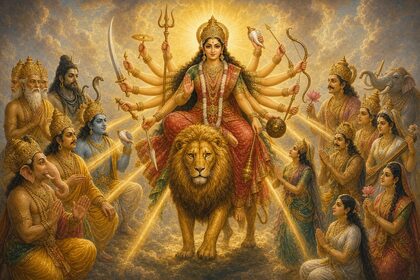
Shrimad Devi Bhagavata The eighteen-armed Devi on her lion takes form from the gods' joined radiance as Brahma, Vishnu, Shiva and Indra stand around her.
  • 27stories

The three worlds lie lost in one ocean and Vishnu sleeps; Suta tells the sages of Naimisharanya. From the Gita Press text, 27 stories, Savitri to the Devi Gita.

Where you left offRead →

Scope and main editionThe named verification set is Gita Press Shrimad Devi Bhagavata Purana with Hindi translation, Volumes 1 and 2. Sources and limits → Collection coverage map →

Shrimad Devi Bhagavata The eighteen-armed Devi on her lion takes form from the gods' joined radiance as Brahma, Vishnu, Shiva and Indra stand around her.

Where Shrimad Devi Bhagavata sits in the Living Atlas, with its neighbours

Why they connect

  • Devi: the Goddess this text worships; the character page
  • Sita · Ramayana: the third skandha's story, Rama's Navaratri vow after Sita is carried off
  • Love and devotion: Bhakti: the teaching of the Devi Gita in the seventh skandha

27 stories

First and Second Skandhas: The Lineage of Vyasa and the Origin Tales

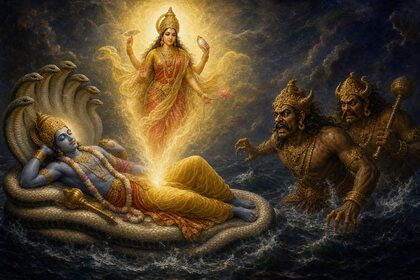
The goddess Yoganidra rises in light from Vishnu asleep on Shesha as the demons Madhu and Kaitabha advance through the waves.
Madhu, Kaitabha, and the Goddess YoganidraTwo demons are born from the wax of Vishnu’s ears as he sleeps under the spell of Yoganidra, and the moment the Goddess lifts her maya a war of five thousand years breaks out.
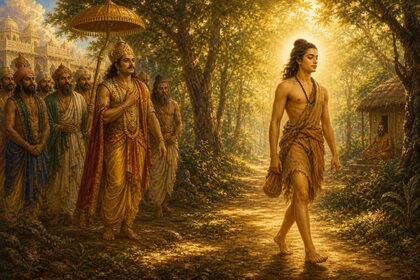
The young ascetic Shukadeva walks barefoot down a sunlit forest path as a crowned king and courtiers stand aside to watch.
The birth and renunciation of ShukadevaBorn from the fire-kindling wood, the dispassionate Shukadeva refuses to marry, and King Janaka shows him how to stay free even while living as a householder.
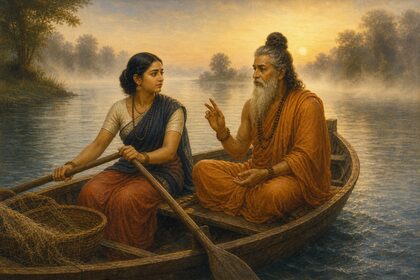
Matsyagandha rows a boat across the misty Yamuna as the sage Parashara, seated facing her, speaks.
The Birth of Matsyagandha, Parashara, and VyasaMatsyagandha is born from the womb of an apsara whom a curse had turned into a fish, and from her, with Parashara, comes the birth of Vyasa.

Third Skandha: The Tridevi, the Devotee Sudarshan, and Navaratra

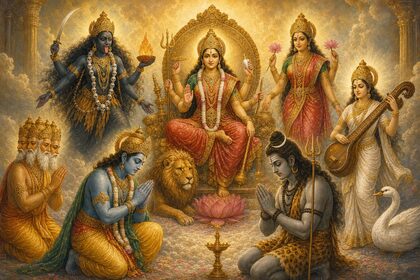
Brahma, Vishnu and Shiva kneel before the enthroned Goddess and her lion, Mahakali, Mahalakshmi and Mahasaraswati around her.
The Tridevi: Mahakali, Mahalakshmi, and MahasaraswatiCarried on the Goddess's vimana, Brahma, Vishnu, and Shiva meet another Brahma, another Shiva, and another Vishnu along the way, and Jagadamba entrusts to them Mahakali, Mahalakshmi, and Mahasaraswati.
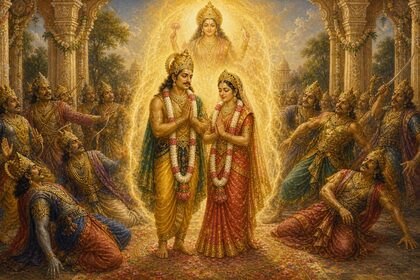
Sudarshan and Shashikala stand garlanded in a ring of light, the Goddess above them, as the hostile kings fall back.
Sudarshan the Devotee and ShashikalaThe Kamaraja seed-mantra that the forest boy Sudarshan picked up by chance as a small child bears fruit, and when the rival kings of the svayamvara block his road, Durga appears on her lion and destroys his enemies.
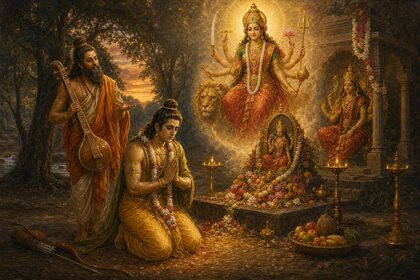
Rama kneels before a flower-heaped altar of the Goddess, Narada beside him, as the many-armed Devi appears on her lion above.
Rama’s Navaratra VowBroken by the abduction of Sita, Shri Rama is counseled by Narada to keep the Navaratra vow, and the pleased Goddess grants him the boon of victory.

Fourth and Fifth Skandhas: Nara-Narayana and the War Form of Shakti

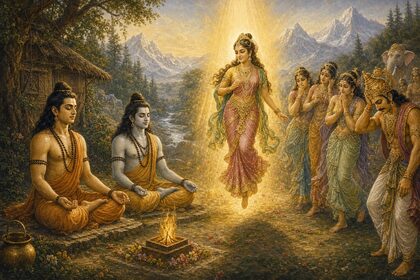
Nara and Narayana do penance on the Himalayan heights as the apsara Urvashi springs into being from Narayana's thigh.
Nara-Narayana and the Appearance of UrvashiWhen the apsaras Indra sends arrive to break the austerities of Nara and Narayana, Narayana shapes Urvashi from his own thigh, then is caught in his own pride until Nara calms him.
Durga takes form from the massed radiance of the gods
Durga Takes Form from the Radiance of the GodsThe radiance streaming from the bodies of the gods defeated by Mahishasura gathers into a single mass of light and appears as the many-armed Goddess.
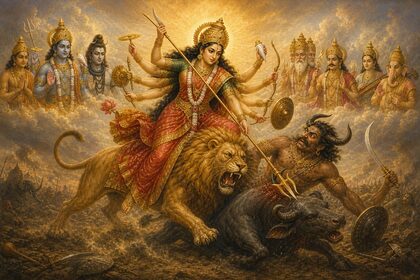
The many-armed Goddess on her lion drives her trident into the buffalo-demon Mahisha as the gods watch from the clouds.
The Slaying of MahishasuraMahishasura, wearing the shape of a buffalo, changes form again and again, yet in the end the Goddess’s thousand-spoked chakra cuts off his head.
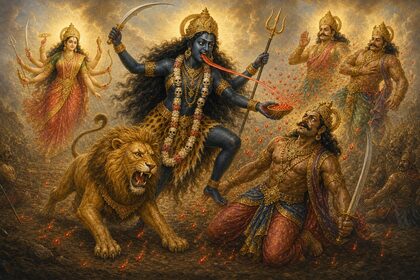
Dark Kali, tongue outstretched, catches Raktabija's blood in a bowl beside her lion while the Goddess and the gods look on.
The Slaying of Raktabija, Nishumbha, and ShumbhaFrom every drop of Raktabija’s blood a fresh demon rises, so Kali drinks his blood dry, and the end of Shumbha and Nishumbha draws near.

Sixth Skandha: Vritrasura and the Mysteries of Maya

(hub card -420, alt unchanged)
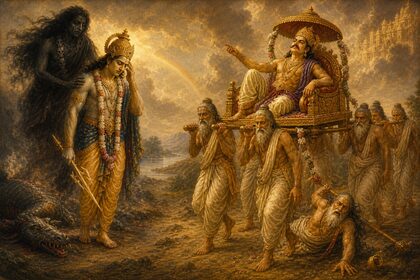
The Slaying of Vritrasura and the Fall of NahushaThe sin of slaying Vritrasura by trickery closes in on Indra, and the arrogant Nahusha who takes his throne is cursed by Agastya into a serpent.
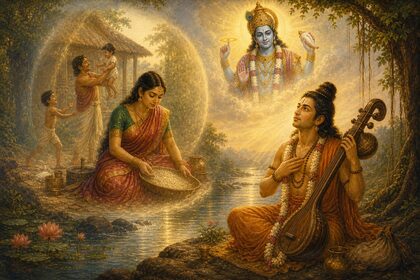
Narada sits with his vina by a river beside a vision of a woman sifting grain with her family, Vishnu appearing above.
Narada Becomes a Woman: The Secret of MayaDetermined to understand Vishnu’s maya, Narada becomes a woman, keeps a household for years, and returns to his true form weeping in grief for his lost sons.

Seventh Skandha: Tales of the Royal Sages and the Devi Gita

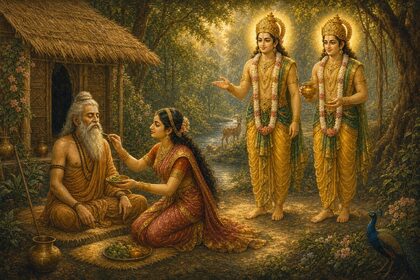
Sukanya feeds the aged sage Chyavana outside their thatched hut as the radiant Ashvini twins approach through the forest.
Sukanya and ChyavanaThe princess Sukanya, who unknowingly pierced the eyes of the aged ascetic Chyavana, serves him in penance, and the Ashvini twins restore the sage’s youth.
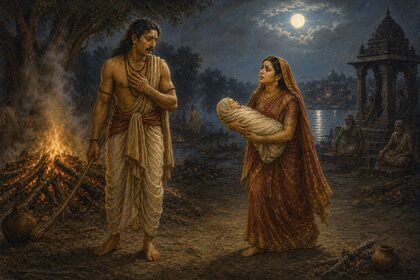
Harishchandra, staff in hand, stands by a burning pyre at night as his queen holds the shrouded body of their son before him.
The Trial of King HarishchandraHaving lost his kingdom, his wife, and his son, and now a slave to a chandala, Harishchandra is handed a sword at the cremation ground and told to kill a woman who proves to be his own queen, come to burn their son.
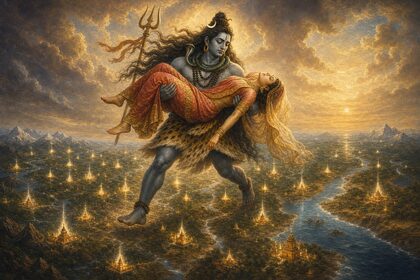
Shiva strides across the land carrying the lifeless Sati in his arms, as small shrines of light rise across the earth below.
The Origin of the Shakti-pithasWhere the limbs of Sati fall, Shakti-pithas arise, and together with other principal places of the earth they make up the one hundred and eight seats of the Goddess.
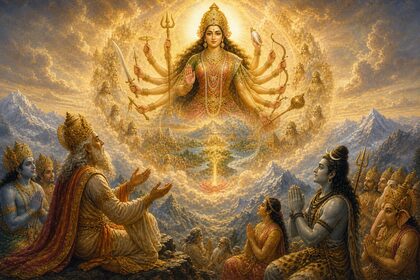
The Goddess as a radiant three-eyed maiden with four arms, teaching the gods on the summit of the Himalaya
The Devi GitaPromising to be born as the daughter of the Himalaya, the Goddess herself unveils her cosmic form, the method of yoga, and the secret of devotion, and delivers the Devi Gita.

Eighth and Ninth Skandhas: The Geography of Creation and the Legends of the Devi

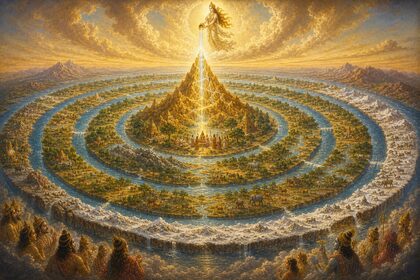
The world-sphere laid out as islands and seas around golden Sumeru, with the Ganga descending in four streams
The World-Sphere and the Descent of the GangaThe map of the world-sphere unfolds with its seven continents, its mountains, and its rivers, and the Ganga descends upon the peak of Sumeru.
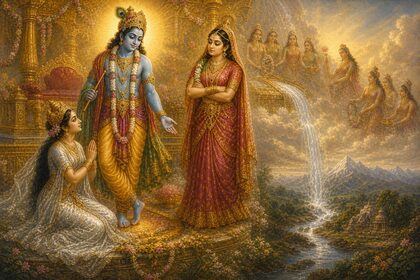
In moonlit Goloka a shy, veiled Ganga sits beside Krishna, the hem of her white cloth already flowing away as water, while Radha arrives with her gopis, eyes red as lotuses with anger.
The Descent of Ganga and the Anger of Shri RadhaIn Goloka, the Ganga, terrified by Radha’s fury, dissolves into the feet of Shri Krishna, then descends to earth and becomes the holy stream that washes away sins.
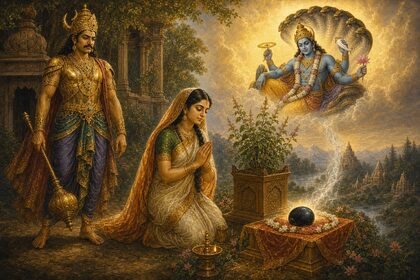
Tulsi kneels by a tulsi plant and a Shalagram stone as armored Shankhachud stands behind and Vishnu appears above.
Tulsi, Shankhachud, and the ShalagramMade unkillable by the chastity of his devoted wife Tulsi, Shankhachud dies only when Hari takes his armor by a ruse, and from the curse of the deceived Tulsi the Shalagram comes into being.
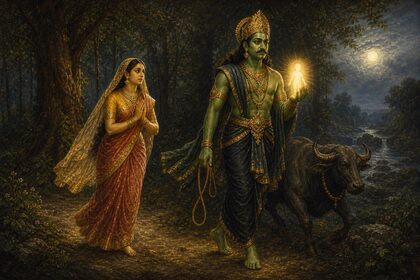
Savitri follows with joined palms as Yama leads his buffalo through the moonlit forest, Satyavan's life a small flame in his hand.
Savitri and SatyavanFollowing close behind Yama as he carries away the life of her husband Satyavan, Savitri wins back his life through her reasoning and her devotion.
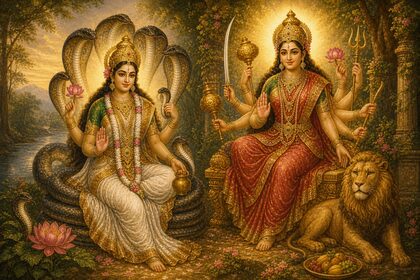
Manasa, seated on the coils of a many-hooded serpent, sits beside many-armed Mangalachandi and her lion in a garden.
Mangalachandi and the Goddess ManasaFrom portions of Prakriti arise Mangalachandi and Manasa, mother of the serpents, and Manasa’s son Astika saves the serpents from burning in the snake-sacrifice.

Tenth to Twelfth Skandhas: The Manvantaras, Worship, and Manidvipa

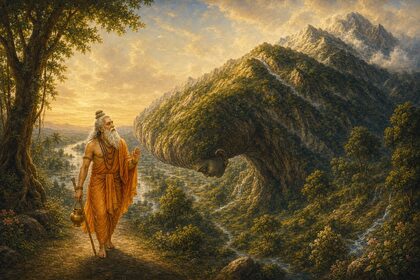
Agastya walks a mountain path with staff and water pot as the Vindhya range, shaped like a bowed head, lowers itself.
Vindhya’s Pride and AgastyaAs the Vindhya mountain rises toward the sky to block the sun’s path, Agastya takes from it a promise to stay bowed until he returns, then crosses its lowered peak and goes on to the south.
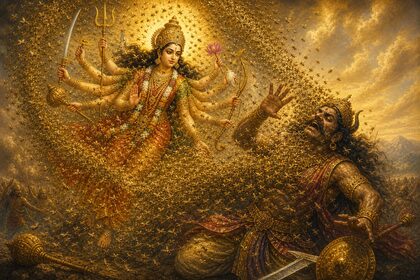
The many-armed Goddess rides a golden cloud of bees that swarms over the fallen demon Aruna.
Bhramari Devi and the Slaying of ArunasuraAgainst Arunasura, whom Brahma’s boon shielded from every two-footed and four-footed foe, the Goddess sends out countless bees and comes to be called Bhramari.
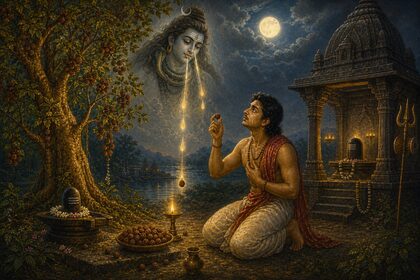
A young man kneels at night by a rudraksha tree and shrine holding up a bead as Shiva's face appears weeping in the sky.
The Glory of the Rudraksha, and GunanidhiAmid the origin and glory of the rudraksha, the story of the wayward Gunanidhi shows how even a single rudraksha can carry a soul across.
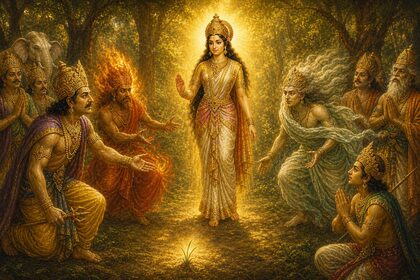
Uma Haimavati stands in a ring of light, a blade of grass glowing at her feet, as Indra, Agni, Vayu and the gods gather.
Uma Haimavati and the Humbling of the GodsWhen the gods, drunk on the pride of victory, cannot so much as move a single blade of grass, Uma Haimavati appears and reveals that all the power was ever hers.
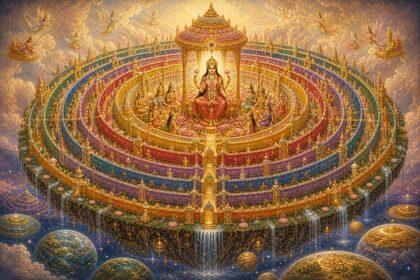
Manidvipa seen from above, the Goddess enthroned at the center of rings of jeweled ramparts, floating among the worlds.
A Description of ManidvipaAbove all the worlds, past rampart after rampart of metal and jewel, Manidvipa opens onto the supreme abode of the Goddess from which the whole of creation is run.
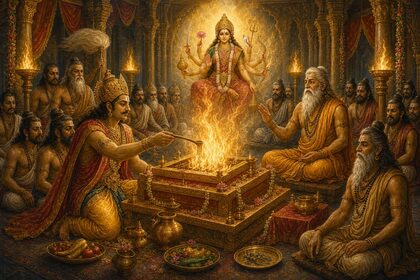
King Janamejaya pours an offering into the fire as the many-armed Goddess appears in its light, Vyasa seated among the sages.
Janamejaya’s Amba-yajna and the ConclusionKing Janamejaya performs the Amba-yajna, and Vyasa, recounting the glory of the Shrimad Devi Bhagavata, brings this Mahapurana to its close.

Reading paths

The stories of the Devi, drawn from the Gita Press edition of the Shrimad Devi Bhagavata Mahapurana.