On this page
vidyaiva tannashavidhau patiyasi na karma tajjam savirodham iritam
Ignorance alone is the root of it all, and the rite prescribed here is its removal; knowledge alone has the power to destroy it, and action, born of ignorance, is called its contrary.
Introduction
The Adhyatma Ramayana is a Ramayana of a different kind. Valmiki’s Ramayana is mainly story, and its weight falls on the greatness of Rama. The Adhyatma Ramayana is composed through the lens of Vedanta, where Rama himself is Brahman, Sita is maya, and the whole story of Rama becomes a discourse on non-duality.
By tradition the author of this text is held to be Vyasa. Its present form settled around the fourteenth and fifteenth centuries. In those same days a new flowering of Vedanta was underway, and many texts came forward under the name “Adhyatma,” of which this one is the most honored.
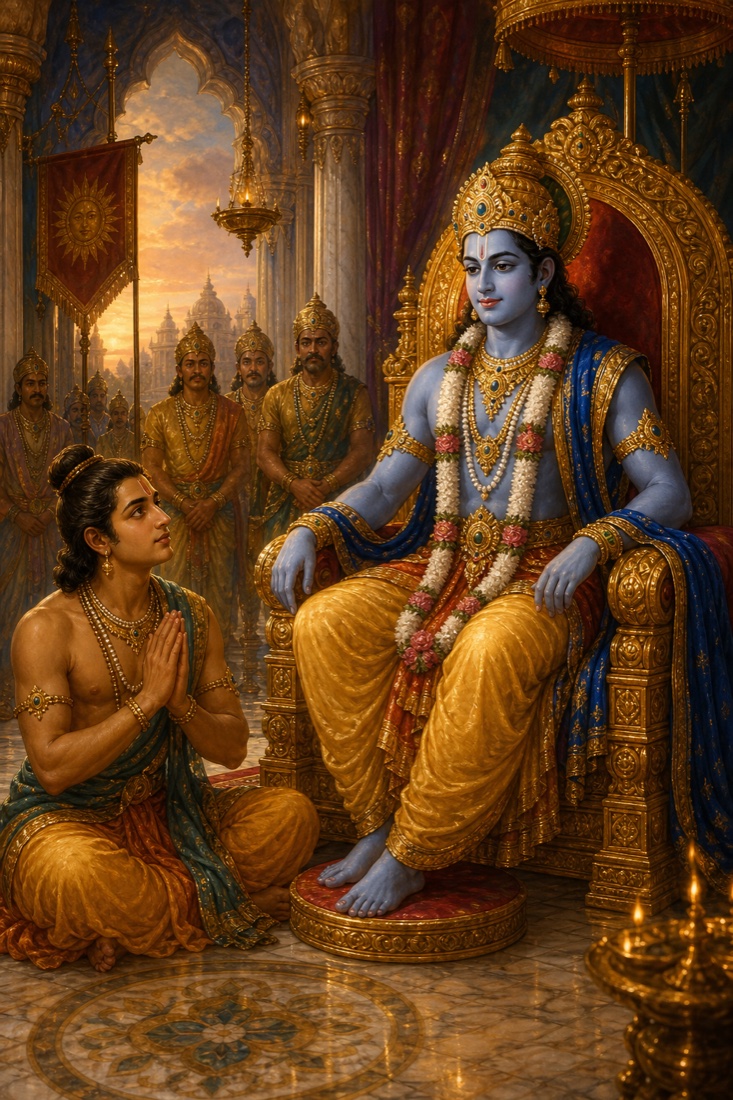
The “Rama Gita” comes in the Uttara Kanda of this same Adhyatma Ramayana. The coronation is complete. Rama is seated on the royal throne. Lakshmana sits quietly nearby. Fourteen years of exile in the forest, then war, and now this peace. Yet one question rests within him.
He goes close to his elder brother, folds his hands, and makes his appeal, “Lord, I take refuge at your lotus feet. Teach me in such a way that I cross this bottomless ocean of ignorance easily and in gladness.”
Rama, who takes away the pain of those who come to him for refuge, answers with a serene mind. Seated now as a guru, in 62 shlokas he lifts up the whole of Vedanta and sets it before Lakshmana.
Brief as it is, this Gita has drawn many commentaries. The old manuscript catalogs record commentaries on it by Mahidhara, Ramavarman, Ayyajibhatta, and several other scholars. Even today, for those who wish to hold Rama-bhakti and the knowledge of non-duality together in one heart, this is a foundational text.
We have divided this Gita into eight thematic parts, because reading shloka after shloka lets the inner current slip away. Each part rests on a single theme. Read slowly, pause at some passages, and let Rama’s simple, deep words flow within you.
Eight Parts
The 62 shlokas are arranged into eight thematic parts. Each part gives every shloka a full English meaning, with commentary.
Frequently Asked Questions
Is this “Rama Gita” in Valmiki’s Ramayana?
No. It is in the Adhyatma Ramayana, which differs from Valmiki’s Ramayana and sets out the philosophy of Vedanta in the form of the story of Rama. This Gita comes in Canto 5 of its Uttara Kanda.
How does it differ from the Bhagavad Gita?
The Bhagavad Gita is long (700 shlokas), this one is brief (62 shlokas). The Bhagavad Gita holds all three paths: karma, bhakti, and knowledge. The Rama Gita rests mainly on the path of knowledge. And the Bhagavad Gita teaches a warrior the way of karma-yoga, while the Rama Gita gives a brother the knowledge of Brahman.
Is this only the path of knowledge, with no bhakti in it?
It is mainly the path of knowledge, yet it holds a rare confluence of non-duality and bhakti. Rama himself is Brahman, so here bhakti and knowledge no longer stand apart. Surrender to Rama is itself surrender to the atman.
What does “pancha-kosha” mean?
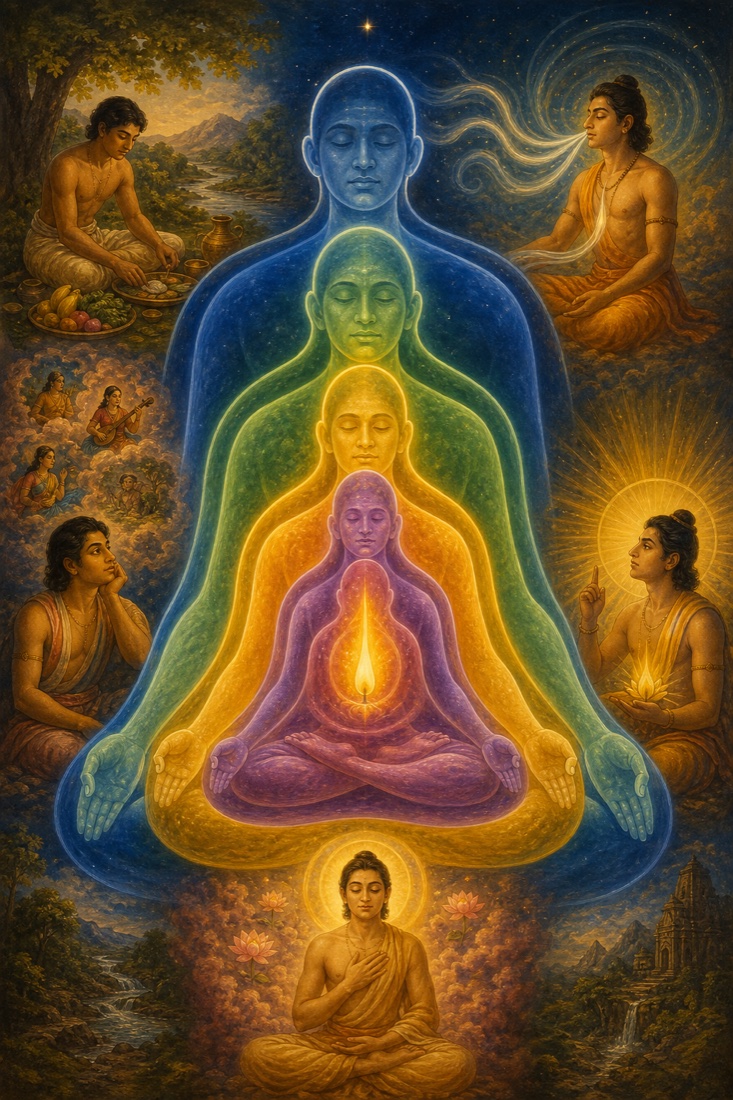
This is an idea from the Taittiriya Upanishad. The five coverings of a human being: annamaya (the body), pranamaya (prana), manomaya (the mind), vijnanamaya (the intellect), and anandamaya (the sheath of bliss). The “I” is beyond these five, the witness of them all.
If I am not a Brahmin, is it still right for me to read this?
Yes. Most of the teaching of the Rama Gita is meant for everyone. Keep only this in mind, that it was composed for the seeker who wishes, from the heart, to understand non-duality. To one in whom that longing has not awakened, it may seem dry.
In what order should I read?
In order, from Part 1 to Part 8. Each part moves forward by resting on the one before. Part 3 (the five sheaths) is the most subtle, and Part 6 (sadhana) the most practical. But before reaching these, it is necessary to have read the rest.
Read alongside
- The Vibhishana Gita A second teaching given from Rama’s own mouth, running parallel to this one.
- The Bhagavad Gita The original Gita of the Krishna and Arjuna dialogue, for comparison.
- The Ashtavakra Gita A foundational work of Advaita Vedanta.