Textual context
The fifth chapter is named Laya, dissolution, the melting of a thing back into what it was made of. The word invites the Buddhist nirvana as a comparison, and the two part company at once: nirvana is a blowing out, the end of a flame; laya is a return, salt going back into the sea. Every verse in the chapter ends with the same instruction, given to a man who has nothing left to do.
In the Bhagavad Gita yoga is a discipline, practiced on a steady seat with the gaze held at the tip of the nose. Laya here is a state the king is told he is already in. In the hatha texts laya-yoga is a method for dissolving the mind by stages. Ashtavakra hands the king the result and skips the stages.
Dissolution
Dissolution · 4 shlokas
Four verses, and each closes on the same three words, evam eva layam vraja: in just this way, dissolve. Ashtavakra gives the king four grounds and the same instruction after each. Janaka has just described the steady one from inside, and the boy’s reply takes even that description away from him.
Laya sits nearest to Patanjali’s nirodha, the stilling of the mind’s movements, which Patanjali reaches by practice and dispassion over years. Ashtavakra treats it as the king’s native state, uncovered the moment the king stops adding to it. The chapter can be read in a minute, and Janaka’s answer in the sixth takes exactly as long.
So far
Janaka has spoken for two chapters about the knower whom nothing touches. Ashtavakra hears him out, and then tells him to dissolve.
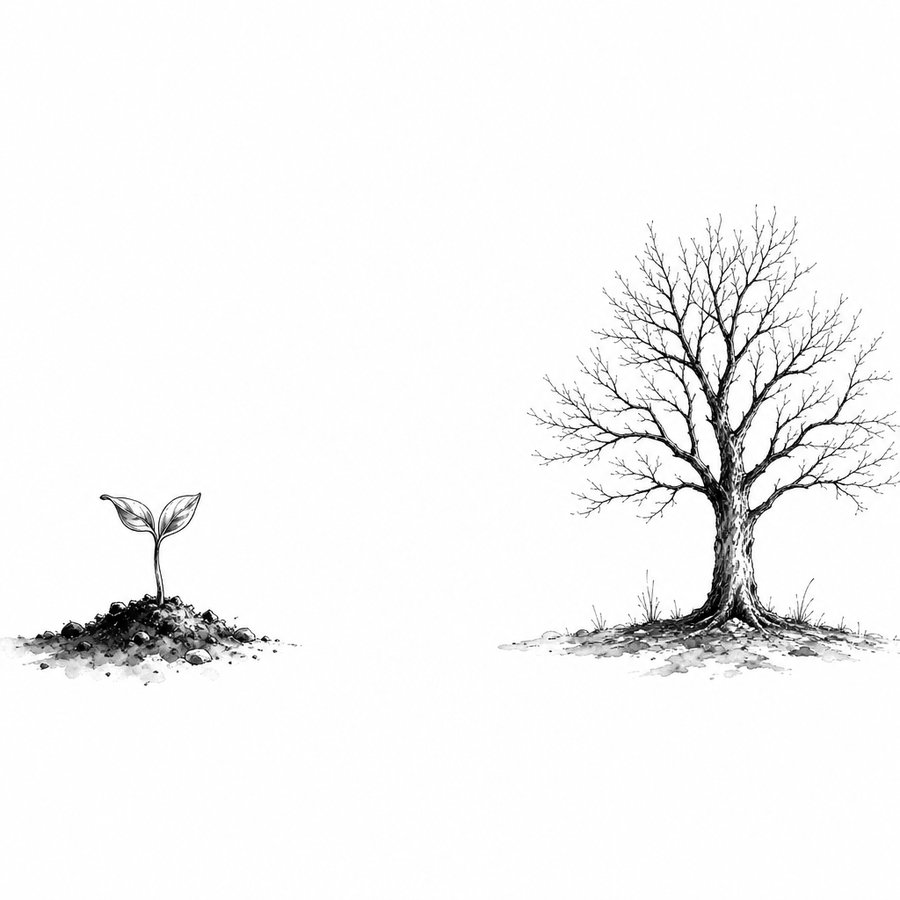
Ashtavakra speaks again, and in the first verse he takes the king at his word. For two chapters Janaka has said that nothing touches the knower and nothing is his. The court has heard its king describe the steady one who plays at enjoyment the way a child plays, the yogi who feels no elation in the state the gods long for, and the boy answers that description with a question. Ashtavakra accepts every word of it. You have no contact with anything, he says, and you are pure, so what is it you wish to give up? A man attached to nothing has nothing to put down, and a man who is pure has nothing to wash off. Whatever renunciation a king might be planning, the forest, the bark cloth, the begging bowl, is one more thing to want, and renouncing is still something one does. The boy points past all of it. Let the gathering of body and mind come apart, he says, and in just this way, dissolve.
Shloka 1
You have no attachment to anything. Pure as you are, what do you wish to give up? Undo the gathering of body and mind. In just this way, dissolve.
The second ground is a bubble. A bubble on the sea has a skin, a shape and a brief life of its own, and inside it there is nothing except seawater and air. So the whole universe, Ashtavakra says, rises out of you the way the bubble rises out of the sea. The man who knows the Self to be one has no second thing left to set beside himself. Watch one bubble form on a swell and vanish, and the sea is no larger before it and no smaller after. This asks to be seen, the way the sea is seen, and thinking can wait. Whatever is in front of you as you read, the lamp, the room, the sounds of the house, is there because it is appearing to someone, and that someone is where Ashtavakra points. Dissolving then stops being an event; the bubble closes back into water it was never apart from. Knowing the Self to be one, in just this way, dissolve.
Shloka 2
The universe rises from you as a bubble rises from the sea. Know the Self to be one. In just this way, dissolve.
The third ground is the oldest picture in Vedanta, and the king heard it from this boy in the first chapter. A rope lies across a path at dusk and a traveler sees a snake. The snake is seen, plainly, and it is not there. The universe, Ashtavakra says, is seen exactly as plainly; it is perceived, and it is no real thing, and so in you, the stainless, it has no existence. Seeing is no proof of being. A dream is seen, and so is water on hot sand. When the lamp arrives nobody asks where the snake went. The fear was real, and the thing that caused it was a rope the whole time. Ashtavakra wants Janaka to see the world the way the traveler sees the path once the lamp comes, the snake’s entire career, its appearing, its terror and its vanishing, understood at one glance. In just this way, dissolve.
Shloka 3
Though it is seen, the universe is nothing real and does not exist in you, the stainless; it is plainly the snake in the rope. In just this way, dissolve.
The last ground is sameness across the pairs, and Ashtavakra names three: pain and pleasure, hope and disappointment, life and death. A king meets the first two before breakfast and builds walls against the third. One word sits in the middle of the list, purna, full, and the whole argument rests on it. A full vessel gains nothing from what is poured in and loses nothing to what spills. Life and death the same is the hardest of the three, because the body wants to live and says so in every heartbeat. Ashtavakra leaves the body to its wanting and speaks past it, to the one who watches the heartbeat, for whom death is one more event in the watched world. Four verses, four grounds, and the same three words closing each of them like a door. Ashtavakra has told the king to let go of letting go. In the sixth chapter Janaka answers with a refrain of his own, and it carries three negations. On that the fifth chapter closes.
Shloka 4
Being the same in pain and pleasure, full, the same in hope and disappointment, the same in life and death, in just this way, dissolve.