On this page
Morning at the ashram, and there is a sound of feet on the path. Six young men have come in, one after another, and each of them carries samidha, the stick of firewood a student brings for his teacher’s fire, and by carrying it he says without speaking that from now on he belongs to this house. Sukesha Bharadvaja, Shaibya Satyakama, Sauryayani Gargya, Kausalya Ashvalayana, Bhargava Vaidarbhi and Kabandhi Katyayana. All six have set out in search of the highest brahman, and all six have arrived carrying one confidence, that this rishi holds whatever is left to be known and will hand it over today. The text gathers the whole scene into a single line, “samit-panayo bhagavantam pippaladam upasannah”, with firewood in their hands they came and sat down near the venerable Pippalada.
This Upanishad belongs to the Atharva Veda and keeps its architecture inside its own name. No long story runs through it, no sacrificial hall opens out across the page. There are six questions here and six answers, and six men with six separate names, each carrying one knot of his own. The questions themselves are laid down in a settled order, beginning at the outermost edge of creation and ending at the deepest place inside. This Upanishad asks first where all these creatures come from, and asks at the very end where that purusha lives in whom sixteen parts go and sink.
Take the names slowly, because in that world a name was an address. Sukesha Bharadvaja, Shaibya Satyakama, Sauryayani Gargya, Kausalya Ashvalayana, Bhargava Vaidarbhi, Kabandhi Katyayana. Every one of them is a given name with a line attached to it, a father’s descent or the country a family came out of, carried in the ending of a word. A man was placed by that ending before he had opened his mouth, and what he was entitled to study, whom his children could marry and where he sat at a gathering all followed from it. These six are grown men. The text calls them brahmapara and brahmanishtha, turned toward brahman and settled in it, and a description of that kind is one other people arrive at slowly and then repeat.
So the walk they have made is a real walk. Each of them left a house where he had standing and went out on foot, and the distance between two settlements was counted in days. There were no inns on that road. A traveler ate where somebody fed him and slept where he was let in. At the far end is a clearing near water: huts, cattle, a fire that has been burning longer than anyone present can remember, students already in residence with their own places in the order, and one man whose word settles when they eat, when they speak and what the afternoon will be spent on. Walking in there means setting your own standing down at the gate and picking up a smaller one.
The main figures of this Upanishad
Pippalada: the rishi the six seekers come to; he asks them to stay a year first, then answers all six questions one by one, and at the end tells them honestly where his own knowing stops.
Kabandhi Katyayana: the first to ask, whose curiosity sits at the outermost edge, where all this creation takes its birth from.
Bhargava Vaidarbhi: the second to ask, who wants to know how many deities hold the body up and which of them stands highest.
Kausalya Ashvalayana: the third to ask, whose six-part question makes Pippalada answer that these are very high questions to be asking.
Sauryayani Gargya: the fourth to ask, whose interest is in sleep, in what sleeps inside a sleeping man and what stays awake in him.
Shaibya Satyakama: the fifth to ask, who wants the accounting for meditation on omkara, where a man who holds to it all his life finally arrives.
Sukesha Bharadvaja: the sixth to ask, who once had to tell a prince honestly that he did not know, and who has brought that same unfinished question here.
Firewood in the hand, and a year of waiting
All six names arrive in the text together, and an adjective arrives with them, brahmapara and brahmanishtha, men whose whole face is turned toward brahman and whose feet are planted there. These are old hands at seeking. They are read, they are seasoned, and for that very reason a slight hurry works inside them. They feel that Pippalada holds the last thing, the one that has still to come to hand, and that asking for it today will get it today. Firewood in the hand was the plainest sentence of that age, a prayer offered without speech, take us for your students.
The firewood is also the first item of the day’s work. A house like that burns wood from before first light until well after dark, and somebody walks out every morning to bring more of it in. A student cut it, carried it, stacked it and fed it into the fire. He went out with a bowl at the hour when families were eating, called at the doors of the settlement, took whatever was put in it and brought all of it back to be shared out by the teacher. He slept on the ground. He owned the cloth he stood in. He held himself back from everything young men that age want, since that holding back is what the word brahmacharya names, and the strength saved by it was understood to be going somewhere in particular. All of that is what a man signs for when he sets a stick of wood down at a door.
The rishi’s answer stops them where they stand. Stay here one more year, he says, with tapas, with brahmacharya, with shraddha. After that ask your questions as you please, and whatever we know, all of it we will tell you. Two things sit together inside that one sentence. The first is that the answer is being postponed, and the postponing has a clear reason behind it. The second is that the man who is going to give has placed a condition on himself as well: whatever we know, that much. This modesty will come back at the close of the sixth question.
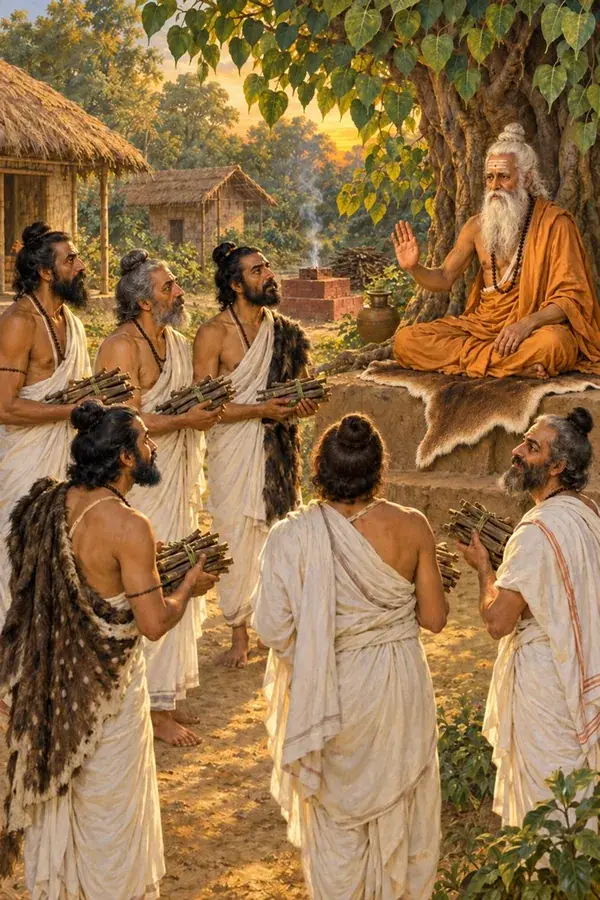
That one year is the least spoken and hardest working thing in this Upanishad. No lesson is taught in it, no sutra is drilled. There is only living in it, tending a fire, rising on time, keeping quiet. Across a year the questions stay the same, and the man asking them does not stay the same. The hurry he came with settles, and the room that has to open inside a person before he can hear anything opens. This is why the answers that follow arrive in an order, one tread above another, like a staircase.
Set that year out in months and it stops being a figure of speech. “Bhuya eva tapasa brahmacharyena shraddhaya samvatsaram samvatsyatha”, live here a year longer, with tapas, with brahmacharya, with shraddha. The rains come first, when the paths turn to water and nobody travels anywhere, the thatch has to be watched, and the days close in around smoke and a fire that will hardly catch. Then the cold, the ground hard before daylight, hands aching on the wood. Then the hot months, when the water in the wells drops, the cattle have to be walked further out for grass, and the afternoon is spent waiting for the air to move. A full turn of that, and inside it no lesson. Nobody sat them down, nobody set them a text. The questions they had carried in stayed in their mouths for twelve months, and the answering could have begun on any morning of it, since the man holding the answers was standing right there feeding the same fire.
They could have left. Nothing in that clearing held them. No fee had been handed over, no oath had been sworn in front of anybody, and each of them had a house to go back to where he was a person of consequence. Every sunrise of that year was a sunrise on which the whole thing could have been dropped, at no cost past the walk home. Staying had to be decided again every single morning, and that repeated deciding is the tapas the rishi had named.
There is something exact in the unit he chose as well. A year is the sun going out to the south and coming back to the north, the entire circuit, finishing where it started. In the first answer that arrives once the waiting is done, the year is named as Prajapati himself, with those two courses standing as the two halves of the whole arrangement. The measure these men were made to live through with their bodies is the measure the teaching then picks up to explain the world with. They learned the length of a year by walking through one before anybody told them what a year was.
Worth noticing too is that Pippalada never fixed the order of asking himself. He said, ask as you please. And still the order that formed ran from the outermost place to the innermost, as though someone had laid it out beforehand. Perhaps that is the work the year did. When the dust inside a man settles, his questions stand up in their own sequence, and the one asking has no idea which step he is setting his foot on.
In short: the answer was ready and the listeners were unready, so a year was set down in between. Pippalada also stated his own limit on the first day, that he would say whatever he knew. Those two things together fix the temper of all six answers that follow.
The first question: where does all this creation come from
The year done, Kabandhi Katyayana rises first. His question comes straight off the eye. So many creatures, so many shapes, so many breaths, where do they all issue from. The text sets down his words, “kuto ha va imah prajah prajayante”, from what, after all, do these creatures take birth. It is the question every child asks once and then gives up asking, because the ones answering get tired. Here the one answering never gets tired.
Pippalada walks backward, back to the place where there is no creature yet at all. Prajapati is there, and inside him is the desire for offspring. He performs tapas, and out of the tapas he makes a pair, rayi and prana, with this thought, that these two together will make many kinds of creature for me. Rayi means whatever fills: food, substance, form, solidity. Prana means whatever moves: breath, motion, the stir of awareness. Creation stands up only when both are present, and from that hour until this one every living thing is the sum of these two.
Then the rishi hangs this pair in the sky. The sun is prana, the moon is rayi. Everything that has a shape and everything that has none is rayi, so form in itself is rayi. The rising sun, coming down into the east, gathers all the pranas of the east into its rays, and it does the same with the south, the west, the north, the below, the above and every direction between. Whomever it gives light to, that one’s pranas rest inside its rays. For this same sun the text quotes a verse in which he is called the one of all forms, the golden one, jatavedas, and the prana of every creature.
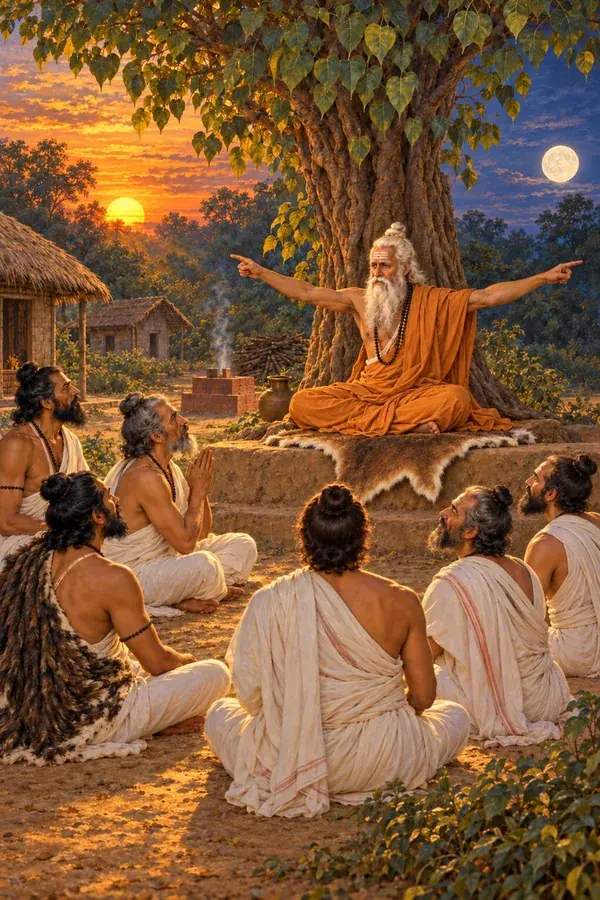
After this the definition of Prajapati goes on turning. The year is Prajapati, and the year has two courses, the southern and the northern. Those who worship taking ishta and purta, sacrifice and the digging of wells and tanks for the public good, to be the whole of it, reach the world of the moon and come back from there. The text calls this returning road the pitriyana and puts it straight into the account of rayi. Those who travel the northern road, seeking the atman through tapas and brahmacharya and shraddha and vidya, reach the sun, and from there no one returns.
Ishta and purta were the two halves of a good man’s public record. Ishta is what goes into the fire, the offerings a household makes across a lifetime, counted and remembered. Purta is what gets built and left standing for other people, a well sunk where the road runs dry, a tank cut into rock with steps going down to the water, a shaded place to rest at the edge of a village. These were the works a district pointed at when it talked about a family, and they outlasted the family. A man with both columns full could sit down in the evening satisfied that he had done everything a person is asked to do. The answer given here says that the world such a record buys has a return road attached to it.
The same pair then steps down onto smaller scales. The month is Prajapati; its dark fortnight is rayi and its bright fortnight prana. Day and night are Prajapati; day is prana and night rayi. Food is Prajapati; from food seed is made, and from seed all this creation takes birth. The year outside, the month in between, the day that fits inside a hand and the food that fits on a plate. At every scale the same two stitches show. The question asked was where creatures come from, and the answer turns out to be that they are made again and again, by one arrangement, at every scale there is.
The first answer ends on a condition. Those who keep the vow of Prajapati, who run a household with restraint, get children. The world of brahman belongs to those who carry tapas in them, brahmacharya in them, and truth settled in them. And then one last line, that the stainless world of brahman belongs to those in whom there is no crookedness, no falsehood, no trickery. The whole first answer draws the map of creation and then arrives at the end on character, which is a habit of this Upanishad.
In short: Prajapati performed tapas and made the pair of rayi and prana, and that same pair is repeated at every scale, sun and moon, the northern and southern courses, the bright fortnight and the dark, day and night. Two roads open, one that brings a man back and one that keeps him. And the last condition laid down is truthfulness.
The second question: who is holding this body up
Now Bhargava Vaidarbhi comes forward and the question slides from outside to inside. He asks how many deities hold this creature up, which of them give it light, and which of them stands highest. The text sets down his last piece this way, “kah punar esham varishthah”, which of these, then, is the greatest. In the first question the world was a map. Here the world becomes a body, and inside the body a question of authority stands up.
Pippalada gives the count first. Space, air, fire, water, earth, then speech, mind, eye and ear. These nine together surround this body, and each of them gives its own light as well. And then what happens is what happens to every company seated close to power. They fall to praising themselves and say that it is we who hold this arrow of a body braced and steady. There is a swagger in the sentence, and the text keeps it in plain view, because the scene that follows rests on that swagger.
Anybody who has stood near power recognizes the scene. Officers around one seat, each with a portfolio, each able to point at the part of the work that stops the day he stops. What begins in a room like that is a comparing of weight, and it runs on until somebody puts it to a test. The powers doing the boasting here are the five elements together with speech, mind, eye and ear, which is to say the whole of what a man would list if he were asked what he is made of. And the boast itself is precise. They say they hold this arrow of a body braced and steady, and an arrow on a drawn string is under tension from end to end, one taut thing for as long as somebody keeps pulling.
Then prana speaks, and its first word is a warning. Fall into no delusion, it says, it is I who divide myself into five and hold this arrow up. The other nine are unwilling to agree. So prana argues nothing further. It simply begins to rise, as though it were leaving the body. And the moment it rises, all of them rise, and the moment it settles, all of them settle. The text keeps a very plain simile for this, that when the king of the bees flies up the whole comb flies with him, and when he settles they all settle.
That simile seats the matter directly on experience. However sharp the eye, what will it see once the breath has stopped. However practiced the speech, on whose strength will it rise. So the quarrel ends in one stroke and the other nine forget their boasting and begin praising prana. There are nine verses in this praise and their tone carries the manner of the hymns of the Rig Veda. Prana is called fire, called the sun, called the cloud that rains, called wind and earth, and called everything that is being, and what is not being, and what is deathless.
In the middle of this praise comes the line that stands among the most repeated lines of this Upanishad, “ara iva ratha-nabhau prane sarvam pratishthitam”, as the spokes are set in the hub of a wheel, so is everything set in prana. Then comes the counting of what rests there: the ric verses rest in it, the yajus rest in it, the samans rest in it, sacrifice rests in it, the kshatra rests in it, brahman rests in it. At the end of the praise the deities ask like children, that the form of yours which is spread through speech and ear and eye and mind be kept auspicious, and do not leave us and go, protect us as a mother protects her sons.
In short: nine powers inside the body fall to boasting, and prana settles it without one word of argument, only by making as if to rise. The simile of the king of the bees seats the matter directly on experience. And at the end, in the victor’s place, what is left standing is a plea, do not leave us and go.
The third question: where prana is born, and how it divides inside
Kausalya Ashvalayana’s questions come to six in number and he sets them all down in one breath. Where is this prana born from. Then, how does it come into this body. How does it divide itself and hold. By what does it go out. How does it hold up the world outside, and how the world within. Pippalada lets him finish. He praises him afterward and says that you are asking very high questions, you are deep inside brahman, and for that reason I will tell you.
The first answer is the smallest and the largest. “Atmana esha prano jayate”, this prana is born of the atman. Then a simile, that as a man’s shadow rests on the man himself, so is this prana spread out over that atman. And how does it come into this body, by what the mind has done. The resolves the mind shaped in a former birth pull prana down into this body. In the second question prana stood highest of all. In the third, prana too turns out to be born of something, and the staircase climbs one more step.
To explain the division inside, the rishi picks up a simile from statecraft. As an emperor appoints his officers and says, you look after these villages and you after those, so the chief prana seats the other pranas each in its own place. Apana in the organs of excretion and generation, in the work that flows downward. Prana itself in the eye, the ear, the mouth and the nose. And in the middle samana, which shares out the food a man eats in equal portions, from which those seven flames in the head go on burning by which this body touches the world.
Then the text comes to the heart and says that this atman sits in the heart itself. From there a hundred and one channels go out, each with a hundred branches, and each branch with seventy two thousand branches of its own, and vyana moves through all of them. This counting is given so that the place we take for a single point may show the whole net folded inside it. Breath runs through more than the nose. It is laid out to the last corner of the body.
One of these channels goes upward, and udana lives in it. And here this answer reaches death. Udana carries a man by his merit to the worlds of merit, by his demerit to the worlds of demerit, and by the two together to the world of men. The prana outside is the sun, which on rising favors the prana that is the eye. The deity in the earth holds a man’s apana steady from below. The space in between is samana and the air outside is vyana. Whatever is divided within is divided the same way without, and both are tied on one thread.
The last thing said is the most affecting. Udana is heat, and so a man whose heat has burned low goes toward birth again as his senses gather into the mind. And going, he takes something along with him, whatever has settled inside his chitta. Whatever the mind stayed on, prana turns toward that, and prana joined with heat carries the atman to exactly the world he had been thinking of. Whatever we go on thinking about all our lives becomes our last address.
In short: prana is born of the atman and comes down into a body pulled by the resolves the mind has made. Inside, like an emperor, it hands five works to five stations, and the same division shows outside in the sun, the earth, the space between and the air. And whatever has settled in the chitta, prana at the end turns toward that.
The fourth question: who sleeps, and who stays awake
Sauryayani Gargya’s question rises out of the most ordinary event of the day. He asks what sleeps in this purusha and what stays awake in him, “kani svapanti kany asmin jagrati”. Then, who is it that sees dreams. Whose is this happiness. And who is the one in whom all of them come to rest. Every one of us goes through this door every night and wakes in the morning having forgotten that we went. This question asks for the map of that forgotten road.
Pippalada begins with the setting sun. He says, Gargya, as all the rays of the setting sun become one inside its own disc of light and scatter again as it rises, so does all of this become one in the mind, in that deity seated beyond. In that hour this purusha hears nothing, sees nothing, smells nothing, tastes nothing, touches nothing, speaks nothing, takes nothing, releases nothing, moves nowhere. Then people say that he is sleeping. The text builds sleep out of a long string of denials, and at the end of the string it leaves one corner awake.
What that corner is, the very next line opens, “pranagnaya evaitasmin pure jagrati”, in this city only the fires that are the pranas stay awake. And then the sleeping man is turned into a sacrifice already under way. Apana is the garhapatya fire, the house fire that is never let go out. Vyana is the southern fire. Prana is the ahavaniya, because it is carried over from the garhapatya and kindled there. Samana is the one that makes the two oblations of the outbreath and the inbreath equal. The mind is the sacrificer, and udana is the fruit of the sacrifice, which carries that sacrificer to brahman day after day.
Those fires are worth seeing the way a household saw them. The garhapatya is the one in the house, taken at a man’s wedding and kept alive from that day forward, carried in a pot when the family moves, and at the end of his life it is the fire his body is given to. The cooking comes off it. Every other fire on the property is lit from it. The one standing to the south is turned toward the dead of his line, the fathers and their fathers, who are fed from it on their own days. The ahavaniya stands to the east, and it gets kindled by carrying flame out to it from the household fire, which is the carrying the text names it after, and the offerings meant for the gods go into that one. A householder keeping these three has his ancestors, his gods and his family arranged around him in fire, and tending them is the frame the rest of his day is built on.
“Garhapatyo ha va esho’panah”, this apana is the garhapatya. “Mano ha vava yajamanah”, the mind is the sacrificer. Put those two lines side by side and what the text has done comes clear. A sleeping man, empty handed, with no ground laid out and no priest within a day’s walk, has the entire establishment running inside him, three fires alight, the oblations going in on time, the sacrificer present and the fee already being paid.
This picture says something large without raising its voice. To perform a sacrifice a man needs no altar, no ghee, no mantra, since it is running inside his body around the clock, and it runs most cleanly while we are asleep and nobody is awake to claim to be the doer. This is why sleep is given no empty place in this Upanishad. It is a small homecoming available every night, in which we visit the house without knowing that we went.
Beyond this the three states are opened out one by one. In dream this deity enjoys its own greatness. What it saw it sees again, what it heard it hears again, what it enjoyed in far countries and directions it enjoys over and over, and it sees the seen and the unseen, the heard and the unheard, the enjoyed and the unenjoyed, the being and the unbeing, all of it, because in that hour it has become all of it. And when it is covered over by heat, then even the dreams are gone, and then into this body comes that happiness for which no cause can be named. To explain it a simile arrives, that as birds come back in the evening to the tree they roost in, so does all of this come back and rest in the supreme atman.
And then the text lays out a long list of pairs inside which a reader has to stop for breath. Earth and the measure of earth, water and the measure of water, fire, air, space and their measures; the eye and what is to be seen, the ear and what is to be heard, the nose and what is to be smelled, taste and what is to be tasted, the skin and what is to be touched, speech and what is to be spoken, the hand and what is to be taken, the feet and what is to be walked, the mind and what is to be thought, the intellect and what is to be understood, the ego and what is to be claimed, the chitta and what is to be attended to, heat and what is to be lit, prana and what is to be held. Every faculty is bound to its object, and the two rise together and settle together.
At the head of this whole list stands the one who sees, touches, hears, smells, tastes, thinks, knows and acts, the vijnanatman purusha. And the text gives his address as well, “sa pare’kshara atmani sampratishthate”, he comes to rest in that supreme imperishable atman. Whoever knows that shadowless, bodiless, colorless, radiant imperishable becomes all knowing, becomes everything there is. The fourth question began at the door of sleep and closes having arrived at the imperishable.
In short: in sleep the senses gather into the mind the way rays gather into the setting sun, and the fires of prana alone stay awake. The body of a sleeping man is a sacrifice already running, with the mind for its sacrificer. And the causeless happiness of deep sleep says that the place we return to is kept inside us.
The fifth question: how far does meditation on omkara carry a man
Shaibya Satyakama’s question turns for the first time toward practice. He asks which world a man among men wins who meditates on omkara up to his dying breath. This question asks for an accounting, and there is no fault in that. A man who is going to spend a large part of his life on one practice has a right to know where that road leads him.
Pippalada’s first sentence is the entire answer, “etad vai satyakama param chaparam cha brahma yad omkarah”, Satyakama, that which is omkara is the higher brahman and it is the lower brahman as well. That one syllable is the door to the formed and to the formless at once. So a knowing man, taking this one support, arrives at whichever of the two he moves toward. There is one staircase, and how far to climb it is left to the one climbing.
Then the accounting of the three matras opens. A man who meditates on one matra alone is awakened by that very thing and comes back quickly to this same earth. The ric verses bring him up to the world of men, and there, filled with tapas and brahmacharya and shraddha, he enjoys his own greatness. A man who goes as far as two matras is taken up into the mind; the yajus carry him to the middle space, to the world of the moon, and having enjoyed splendor there he returns. The returning happens from both places. Only the height differs.
On the third step the picture changes. A man who with all three matras, with this same one syllable, meditates on the supreme purusha goes and joins the light in the sun. And here comes the simile that stands among the clearest pictures in this Upanishad, that as a snake comes out of its slough, so does he come out of his sin. The saman chants carry him to the world of brahman, and from there, past this whole mass of living beings, higher than the high, he sees that purusha lying asleep in the city.
Two verses bind this answer. The first says that the three matras taken separately stay inside death, and that when they are used properly in the outer, the inner and the middle acts, joined to one another and unparted, the knower does not waver. The second says that omkara is the support by which a knowing man reaches that which is at peace, without old age, without death, without fear, and beyond everything. The whole accounting of practice comes to rest on one condition, that the practice be undivided.
In short: omkara is at once the door to the lower brahman and to the higher, so how far it carries a man rests on the depth of the man. One matra as far as this earth, two matras as far as the world of the moon, and all three joined together as far as that purusha, with the slough left behind. The one condition is that the practice stay whole.
The sixth question: where does the purusha of sixteen parts live
The last question is Sukesha Bharadvaja’s, and it is the only one that comes out of an old defeat of the man asking it. He tells how a prince named Hiranyanabha Kausalya came to him and asked, Bharadvaja, do you know the purusha of sixteen parts. Sukesha had no answer to give. He told the prince plainly that he did not know this, and that had he known it, why would he have kept it from him.
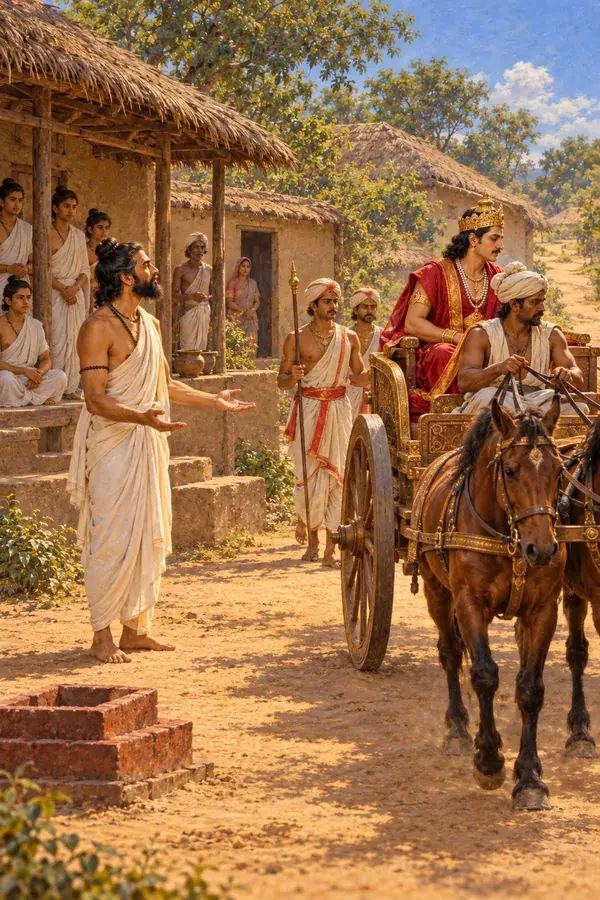
Fill in what that visit was. A king’s son arrives at a teacher’s house, which means a chariot on the path, men with him, and a settlement watching from its doorways. He has come carrying a question, and arriving with a question is a form of honor that also stands a man up for examination in front of his own students. Hiranyanabha Kausalya asks, and Sukesha has nothing to put in the space. He could have produced something. This is a subject where an answer sounds like an answer, nobody in that courtyard was in a position to check it, and a confident accounting of sixteen parts would have held together easily enough for the length of time it takes a chariot to leave.
He had joined a reason to his refusal, which the text keeps exactly as it stands, “samulo va esha parishushyati yo’nritam abhivadati”, the man who speaks untruth dries up along with his roots. That is why I could not bring myself to lie.
Stay on the word root. A tree stripped of its leaves puts out more of them the next season. A tree cut through at the root goes on standing a while, looking from the path like a tree. In a settlement where a spoken sentence was the only thing holding a contract, a boundary, a debt and a man’s descent in place, a false sentence went down past the visible part of a person into the part that keeps him upright, and every listener understood the image that way. Hearing this the prince climbed his chariot in silence and drove away. There was no insult in that silence, and there was an emptiness in it, and the emptiness stayed inside Sukesha for years. That same unfinished thing is now being set before Pippalada, tell me, where is that purusha.
Pippalada’s answer sends him nowhere far. He says that the purusha is here, inside this very body, “yasminn etah shodasha-kalah prabhavanti”, in whom these sixteen parts arise. And then he shows a very human hour of that purusha. He had thought: on whose going out shall I be gone, and on whose staying shall I stay. The beginning of creation here is a question, in the same way that this whole Upanishad runs on questions.
Out of that thought the sixteen parts came. First prana, from prana shraddha, then space, air, light, water and earth, then the senses and the mind, then food, and from food strength, tapas, mantras, action, the worlds, and in the worlds a name. The place in this list most worth stopping at is the second. Directly after prana comes shraddha, ahead of substance, ahead of even space. In the order by which this world was built, trust arrived so early that without it the remaining fifteen parts would have had no ground to sit on.
And then comes the simile on which this Upanishad lays its whole weight. As the flowing rivers go toward the sea, and reaching the sea come to their end, their name and form broken, and after that it is simply called the sea. So too do these sixteen parts of this seer go toward the purusha, and reaching the purusha come to their end, their name and form broken, and after that it is simply called the purusha. The text adds one more line to this, that he becomes partless and deathless.
A verse binds it and says that the one in whom the parts are set like the spokes in the hub of a wheel is the purusha worth knowing, know him, so that death may cause you no pain. In the second question this same simile had come for prana, and in the sixth the same simile returns for the purusha. The staircase built by the four middle answers has its last tread laid here, that the hub in which everything is set stands inside the body.
In short: Sukesha arrives carrying a question he had once honestly refused to answer. Pippalada sends him nowhere, he points inside the body itself. And the simile of the rivers meeting the sea says that what the sixteen parts give up is their separate names.
And in the end, toward yourself
Having given six answers, Pippalada says a thing that rarely leaves the mouth of any great teacher. He says, “natah param asti”, this much is all I know of that supreme brahman, and past this there is nothing. On the first day he had said that he would tell them whatever he knew, and on the last day he kept that condition. The man who has opened the accounting of the sun, of sleep, of death and of omkara stops at his own boundary, and that stopping adds weight to every earlier thing he said. All six students worship him and say that you alone are our father, who carries us across to the far shore of our ignorance.
Reading this Upanishad, one thing keeps coming back, that year. All six were learned, all six were ready, and still they were made to wait. In our days this is the hardest part, because we want the answer to every question in the same moment, and what arrives in the same moment lasts about as long. Pippalada’s way is plain: the answer comes later, first become someone who can hear. Whoever can sit with a question of his own for a year without hurrying usually finds that the question has changed.
Count what the year cost them in plain terms. Twelve months out of a working life, spent on somebody else’s firewood and somebody else’s cattle, at an age when the men they had grown up with were building houses and getting a standing in their districts. What they bought with it was the capacity to hear an answer. And the six questions that came out at the end of it run in a sequence, from the far edge of creation inward to the inside of a chest, which Pippalada had taken no hand in arranging. He had told them to ask as they pleased. The order was made by whatever the waiting had done to the men doing the asking.
The second thing that turns toward us is Sukesha’s refusal. He had no answer and he said so, and that same honesty carried him in the end to the answer. Every one of us has a Hiranyanabha, some question we have put off, or one whose answer we have guessed at and then made do with. This Upanishad calls that postponed question no bad thing. It asks only that we keep from forgetting it, and that we take it and sit down with somebody who knows where his own knowing stops.
And at the last, those rivers. All our lives we go on counting our parts, our name, our work, our breath, our trust, our food, the tapas we have saved up. By this Upanishad nothing among them is wasted, nothing among them is destroyed. There is one place only, reaching which their separate names stop being of any use, like the name of a river that has reached the sea. Pippalada placed that spot nowhere far. He said it is right here, inside this body, and that single sentence carries the whole of this Upanishad up to our door.
Source: Prashna Upanishad, all six questions, the first through the sixth; read against the Sanskrit, with Shankara’s reading noted where readings differ.