Textual context
Svasthya names the sixteenth chapter. In modern Hindi the word means bodily health, and the older sense sits underneath it: sva is one’s own, stha is standing, and svastha is a man standing in himself. Ashtavakra uses it twice, in the first verse and the last, both times in the same sentence: there is no standing in yourself without forgetting everything.
In the twentieth century Ramana Maharshi called the same condition the sahaja sthiti, the natural state, and said it needs no effort to keep, since nothing has to be held in place.
Resting in the Self
Rest in oneself · 11 shlokas
One instruction opens this chapter and closes it: forget everything. Scripture, practice, the teacher himself, all of it. Between the two statements of it Ashtavakra says what effort costs, which of three men is at rest, and why the man who leaves the world and the man who clings to it are doing the same thing.
The physicians used the word before the philosophers made much of it. The Sushruta Samhita’s definition of a healthy man, svastha, ends with a serene self, serene senses and a serene mind, and Ashtavakra takes that last clause as the whole of the matter. Health, here, is a man resting in what he is.
So far
After the knowledge of truth, the sage tells the king to forget it, along with everything else.
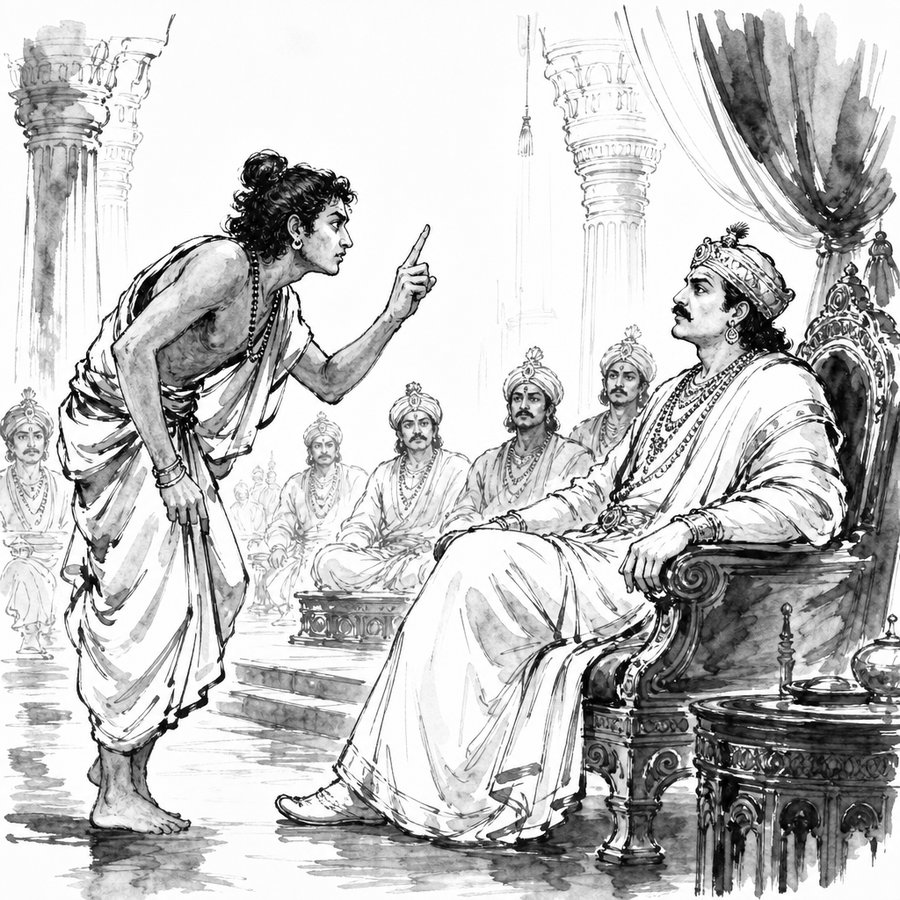
Janaka has not spoken since his four verses, and Ashtavakra goes on. The hall he is speaking in is the proudest in the land for exactly the thing he now dismisses: Mithila’s brahmins recite the scriptures before the king by the hour, and the king is known for following every line. The boy calls him child and tells him that he can recite those scriptures a hundred times, or hear them recited, and still not come to rest in himself until he has forgotten all of it. The claim is aimed at the room as much as at the throne. Knowledge that is held is still a thing in the hand, and a man holding something is not yet standing in himself.
Shloka 1
Child, you may recite the many scriptures or hear them, again and again. Even so you will not rest in yourself until you forget everything.
Then he names the three roads a man in that court might take, and shrugs at all of them. Enjoy, if Janaka likes; act, if he likes; sit in samadhi, if he likes. He calls the king wise as he says it, and the word is earned, since Janaka has already spoken of the first two as finished for him. Whatever road he takes, Ashtavakra says, the mind will go on longing for one thing, the state in which every desire has been thrown out, and no road of the three arrives there, because each is itself a wanting. Pleasure wants the next pleasure, work wants its result, and samadhi wants to be reached. The longing underneath all three is for the end of longing.
Shloka 2
Enjoy, act or sit in samadhi, wise one. Even so, your mind will long intensely for that state in which every desire has been cast off.
Now a sentence that turns the whole palace inside out. Everyone suffers because of effort, and nobody knows it. Every wall in Mithila was raised by effort, every campaign fought by it, every grain of tribute counted by it, and the court takes that strain for the price of everything good. Ashtavakra says the strain is the suffering itself, and that no one sees this because effort always points at its result and never at itself. He does not add a method. The teaching is the whole of it, and the fortunate man, the one it reaches, comes to rest on hearing it, as a man sets down a load he had forgotten he was carrying.
Shloka 3
Everyone suffers because of effort, and no one knows it. By this teaching alone the fortunate one attains release.
Then a joke, in a hall that runs on duty. Happiness belongs to the master idler, the man for whom even the opening and shutting of his eyelids is too much work, and to nobody else. There would have been laughter along the walls, and a king who rises before dawn to hear petitions may have joined it. The joke carries the teaching. Ashtavakra is describing a rest so deep that the smallest motion toward the world registers as labor, and he gives it the name of the one vice a court cannot forgive. The idler he means has stopped reaching, and that stopping is what Ashtavakra is pressing toward.
Shloka 4
Happiness belongs to the master idler, who is wearied even by the opening and shutting of his eyes, and to no one else.
The fifth verse reaches the four aims that give a king’s life its shape: dharma, wealth, pleasure and moksha, the four purusharthas, the first three of which a ruler is sworn to secure for his people. Ashtavakra starts lower down, with the mind’s daily ledger, this is done, this is still undone. When the mind is let out of that pair, he says, it stops leaning toward any of the four, liberation included. Janaka has governed by that ledger all his life. He is being told that the quiet he wants comes when the ledger closes, and that even the wish for moksha is one more entry in it.
Shloka 5
When the mind is freed from pairs like “this is done” and “this is not”, it grows indifferent to duty, wealth, pleasure and liberation.
Now three men stand side by side. The dispassionate man hates the things of the senses; the passionate man craves them; and a third neither takes nor leaves, and so is neither of the two. The first two are both in that hall, the ascetic who has come to be admired for what he refuses and the courtier who has come for the wine, and Ashtavakra puts them in the same sentence because the same object rules them both, one by pull and one by push. The third man has no quarrel with the cup and no appetite for it. A king who has spent years admiring renunciates hears that the renunciate is still bound to the thing he turned his back on.
Shloka 6
The dispassionate man hates the objects of the senses; the passionate man craves them. One who neither takes nor leaves is neither dispassionate nor passionate.
Then the world is given the shape of a tree, and Ashtavakra points to the sprout. The sprout is the sense of what to take and what to leave, the small daily choosing that every life in that court is made of, and the whole tree of samsara grows out of it. Beneath the sprout is its soil, spriha, desire, and desire is where a man’s failure to discriminate lives; so long as it is alive, he cannot tell the one who sees from what is seen, and the choosing goes on, and the tree keeps growing. The order matters. Cut the branches and the sprout returns; cut the sprout and it returns from the soil. The only thing that ends the tree is the drying of the soil.
Shloka 7
So long as desire lives, the seat of the undiscriminating state, so long remains the sense of what to reject and what to accept, the sprout of the tree of the world.
Now the picture of a child. Reach toward a thing and attachment is born; pull back from it and aversion is born; this is the pair the court lives between, and the wise man stands outside both, as he is, the way a child does. A child in the palace runs toward the fountain and away from the dog in the same hour and keeps nothing of either, no policy of fountains, no grudge against dogs. The sage who stands before Janaka is himself twelve, and the comparison is made with a straight face. The wise man’s evenness looks like a child’s from outside; the difference is that he knows what he is while he keeps it.
Shloka 8
Attachment arises from engagement and aversion from withdrawal. The wise one, beyond the pairs, stays as he is, like a child.
The ninth verse lands on the throne itself. The attached man wants to leave the world, and the reason he wants to is sorrow; renunciation, for him, is an escape route. The man free of attachment has no sorrow to escape, and so the world does not trouble him even while he sits in the middle of it. Janaka sits in the middle of it, with armies and granaries and a court full of petitioners, and a sage who has just told him to forget the scriptures now tells him there is no need to leave the palace either. Flight from the world is a symptom of the thing it is fleeing. Remove the sorrow and the question of leaving does not arise.
Shloka 9
The attached man wants to abandon the world so as to escape sorrow. One free of attachment is without sorrow and is not distressed even while in it.
Then the finest snare of all, and it is set for the man who has come furthest. Whoever takes pride even in liberation, and still feels the body as his own, is neither a knower nor a yogi; he has only found a subtler way to suffer. Two chapters ago Janaka said he no longer troubles himself about liberation. Ashtavakra now describes the man who has made that very freedom into a possession, “I am the one who is free,” and shows that the old “mine” is still working inside him, with moksha for its object now where the kingdom used to be. The verse is a test, and the king, who hears it in silence, is the one being tested.
Shloka 10
One who takes pride even in liberation and still feels the body as “mine” is neither a knower nor a yogi. He only shares in sorrow.
He ends where he began, and raises the stakes as high as they go. Let Shiva himself be Janaka’s teacher, or Vishnu, or Brahma born from the lotus; even then the king will not come to rest in himself until he has forgotten everything. A boy of twelve says this, and the sentence includes the boy. No teacher completes the work, however great, because the work is a letting go, and nobody can let go on another’s behalf. The first verse named the scriptures and this one names the gods, and between them the whole apparatus of being taught has been set down. Janaka says nothing. In the next chapter Ashtavakra describes the man who has done it.
Shloka 11
Even if Shiva is your teacher, or Vishnu, or the lotus-born Brahma, you will not rest in yourself until you forget everything.