On this page
Introduction
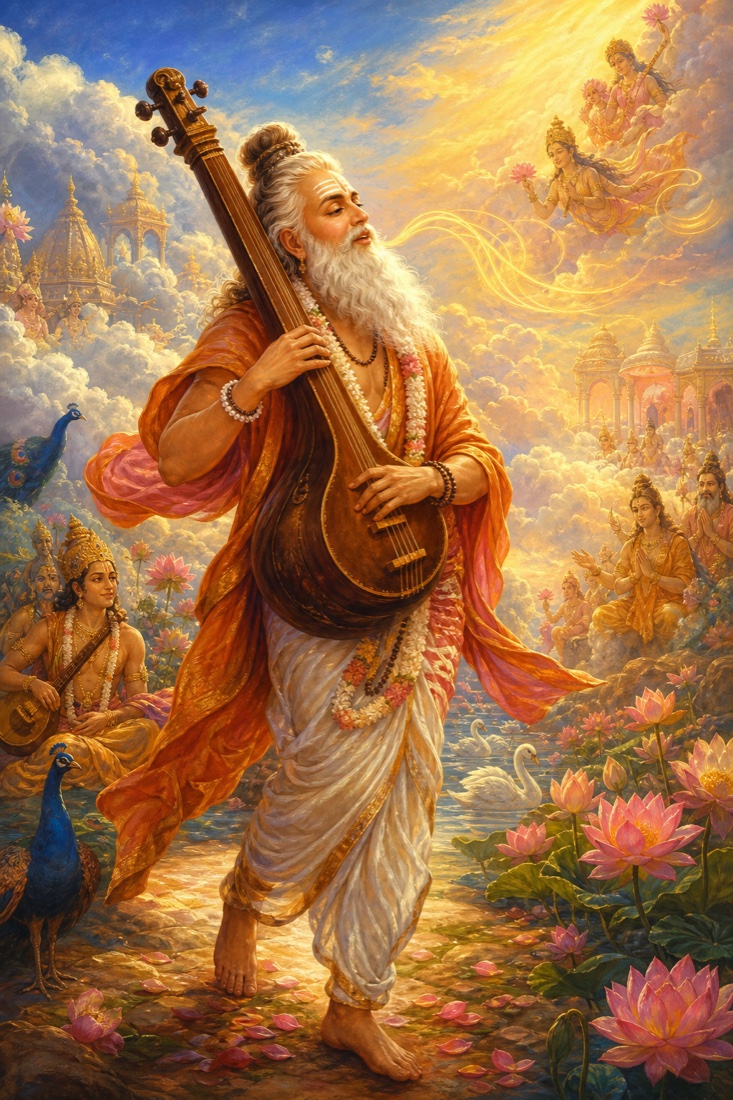
Narada is the rishi who turns up in every Purana, in every text. A vina in his hand, “Narayana Narayana” on his lips, a ceaseless coming and going through the worlds of the Lord. But who is Narada, really? He is bhakti given a body. He spent his entire life on the name of the Lord, only because that was where the rasa lay.
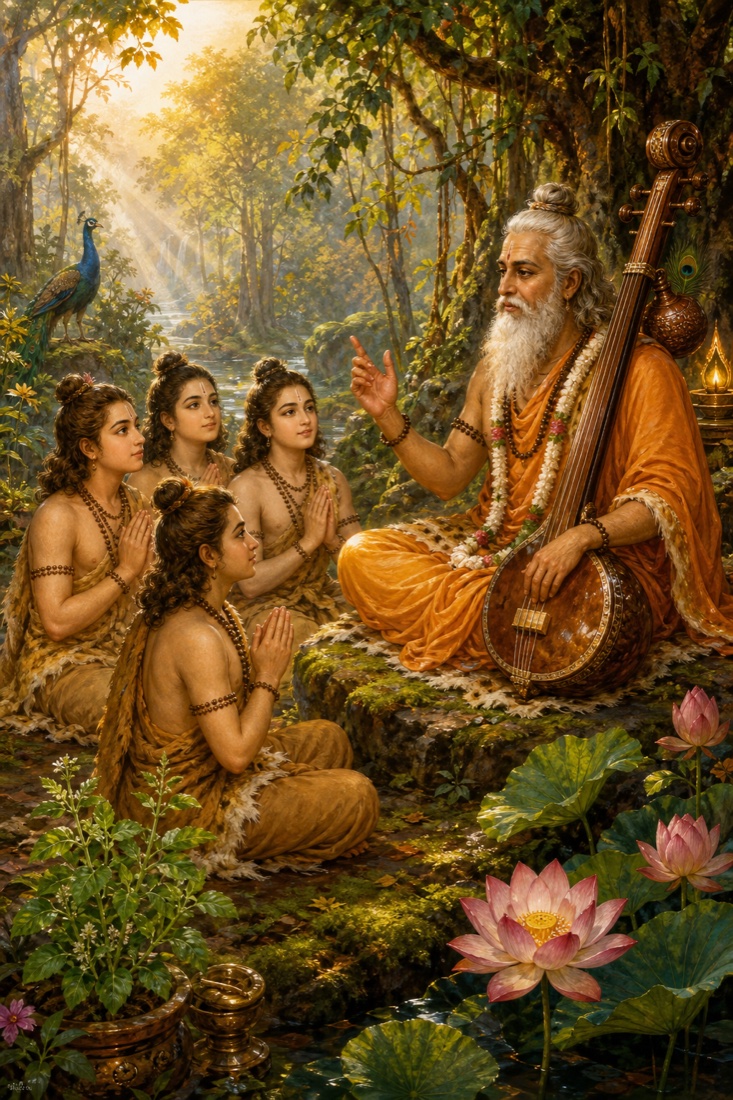
They say that one day the Sanakadi rishis asked Narada, “Devarshi, this thing called bhakti, what is it really, and how is it attained.” Narada answered. No long discourse. Eighty-four sutras. Most sutras two or three words, each one like a single note struck on the string, landing straight at the vital point.
The name “Bhakti-Sutra” is worth pausing over. A sutra means the most meaning packed into the fewest words. A sutra never spells out the whole thing; it only points, and the rest the reader has to fill from experience. The Brahma-Sutra and the Yoga-Sutra, this belongs to their tradition too, though its subject here is bhakti.
In the very first sutra Narada’s resolve is clear, “athato bhaktim vyakhyasyamah”, that is, “Now we begin the exposition of bhakti.” Inside this “now” lies the assumption that some things are already taken for granted. The seeker is expected to arrive with some acquaintance with the path of knowledge, and now the gaze narrows to bhakti.
The deepest saying comes in sutra 4, “yal labdhva puman siddho bhavati, amrito bhavati, tripto bhavati”, that is, “having attained which a person becomes perfect, becomes immortal, becomes fulfilled.” Once bhakti is complete, nothing is left to attain, nothing left to do. What Vedanta calls the ultimate state stands here as well, and here the path is love.
The text divides into five chapters. The first chapter (sutras 1 to 24), what bhakti is, and its marks. The second (25 to 33), its superiority over karma, knowledge, and yoga. The third (34 to 50), the practice. The fourth (51 to 66), the nature of love. The fifth (67 to 84), the company of devotees and the conclusion.
Five chapters
Eighty-four sutras, in five chapters.
A few questions
When was this text composed?
Its exact date is unknown. Some scholars place it between the sixth and eighth centuries, some in the twelfth. Devarshi Narada is named as its author, though who he was in history, and when, is itself uncertain. The language and feeling of the text carry a glimpse of the atmosphere of the bhakti movement (eighth to twelfth centuries).
Is this different from the Narada episode in the Bhagavatam?
Yes. The first canto of the Shrimad Bhagavatam holds the Narada-Vyasa dialogue, where Narada shows Vyasa the path of katha and kirtana. This text is a separate thing. It is an independent work of eighty-four sutras. The sutras name no listener, and the Sanakadi, the four Kumaras, appear in them as teachers of bhakti (sutras 30 and 83). Some followers hold it to be the work of Veda-Vyasa, though the text itself, in its last sutra (84), calls this teaching naradaproktam, proclaimed by Narada.
“Bhakti” and “prema”, what is the difference between the two?
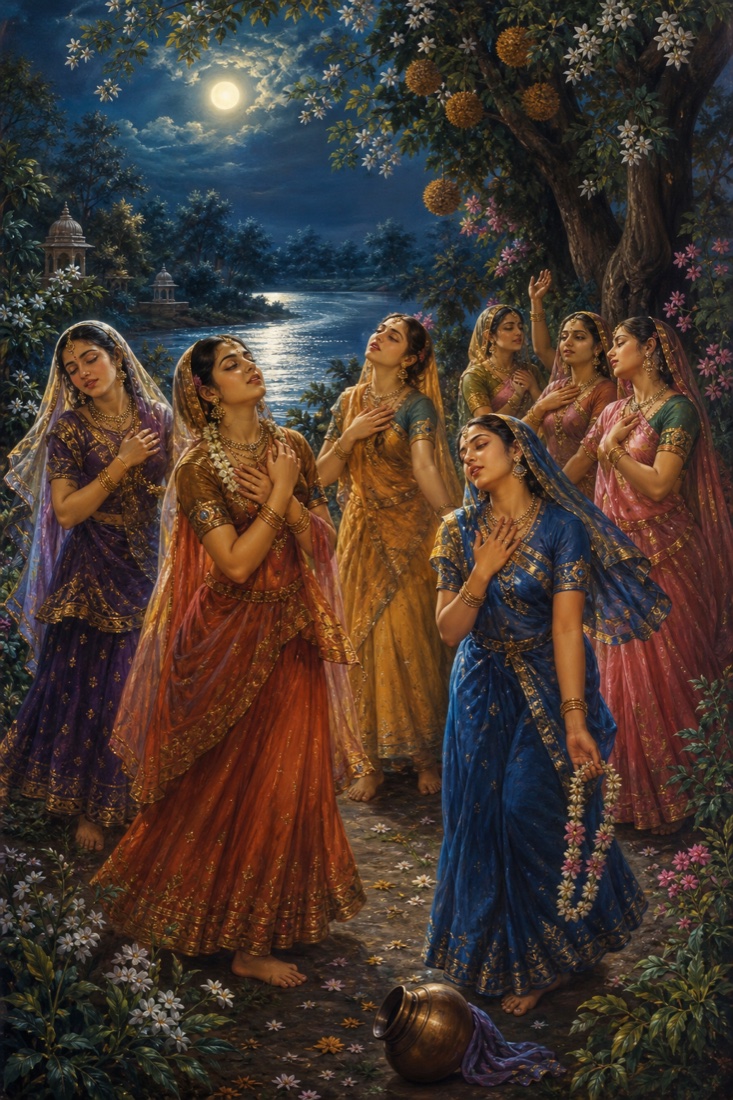
For Narada, the highest form of bhakti is love itself, and not every bhakti is love. Daily worship is bhakti, and it has not yet reached the threshold of love. Love arrives when the “I” dissolves and only “His” is left. This is Narada’s clear position.
Is knowledge necessary in bhakti?
Narada’s answer is subtle. Here he sets out the views. In sutra 28, some say knowledge is the means to bhakti. In sutra 29, others say the two rest on each other. And in sutra 30, bhakti is its own fruit. To the true devotee everything becomes known on its own, and still he has no craving for knowledge.
Does Narada give any practice for bhakti?
Yes. Sutras 35 to 37 lay it out: letting go of sense-objects, letting go of company, and the constant remembrance of the Lord. And most essential of all, mahatsanga, that is, satsanga, the company of the holy, spoken of in sutras 39 to 40.
Is this only for Hindus?
No. Bhakti is universal. Its subject is supreme love. For anyone whose heart melts in love, this text is of use.
Read alongside
- Bhagavad Gita, Chapter 12 Bhakti yoga, the Narada sutras in their Gita form.
- Hanuman Chalisa Bhakti in dense verse form.
- Vishnu Sahasranam The praise of the thousand names, bhakti in practice.