The Mahavakyas
The four great sayings of Vedanta · one from each Veda · the most concentrated statements in all of shruti
One thing first
Take the whole of the Veda and press it down. Thousands of mantras, hundreds of Upanishads, arguments and dialogues, all of it. Keep pressing, and what finally remains is four small statements. Four statements of two or three words each. These are the mahavakyas.
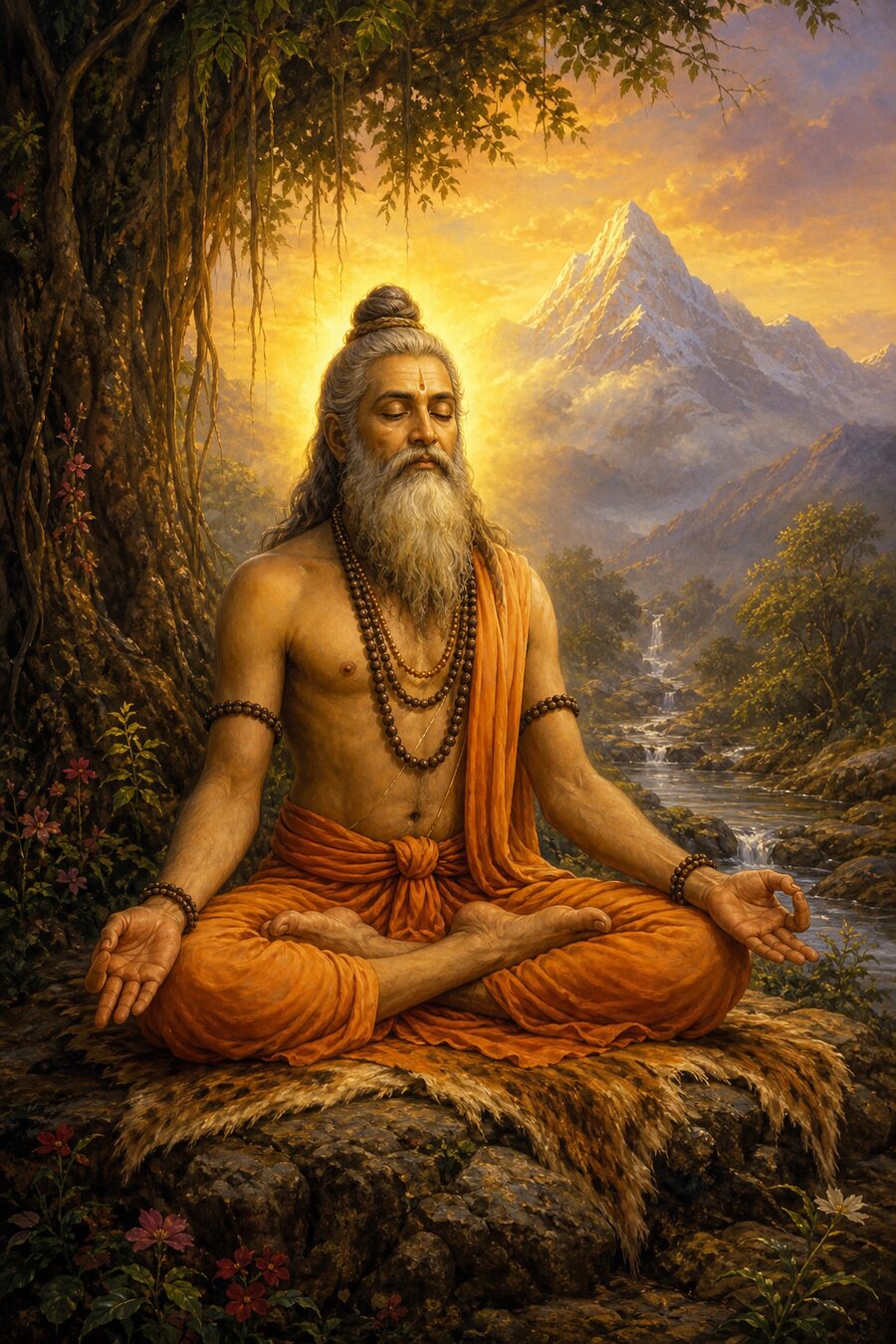
Tradition says each of the four Vedas gave one statement. One from the Rig Veda, one from the Yajur Veda, one from the Sama Veda, one from the Atharva Veda. And all four speak a single truth, only from four different directions.
A mahavakya points toward a fact, and that fact is there to be recognized. A doctrine is taken on from outside, and it can slip away again. A fact is already true; attention had simply not fallen on it. The mahavakyas are statements of this kind, and their subject is you yourself.
So this is a matter of recognizing them. After all four, a short passage will show how these four together make one complete map.
How to read this
One way is to read all four in order. The order is itself a journey, beginning at a definition and arriving at your own identity.
Another way is to stop at any single one. One mahavakya is enough, if it truly sinks in. The other three repeat that same one from different directions.
Below, the four open one by one, and at the end there is a passage that sees all four together.
The first mahavakya comes from the Aitareya Upanishad of the Rig Veda, and it is a definition, which is why it is called the statement of definition. It says plainly what that final reality, Brahman, actually is. There is the body, there are thoughts, there are feelings, there is the whole world in front of you. All of these share one thing: every one of them is an object being known. And the one who is doing the knowing stands apart from all of them. The body changes, thoughts come and go, feelings turn over, yet the one before whom all this happens stays steady. That is what is called prajnana, the consciousness by which everything is known.
Prajnanam brahma · Aitareya Upanishad 3.1.3
All of this moves by the eye of prajnana, and rests on prajnana alone. The world sees by prajnana, and prajnana is its ground. And that same prajnana is Brahman. What the scriptures call the highest, most distant, most secret reality is this very power of knowing that is reading these words this instant, so near that there is no need to look for it anywhere. It is a matter of direct experience. The mahavakya adds only one thing: do not hold that power of knowing cheap, for it is the final reality itself.
Picture a crowded evening. Jostling on every side, ten tasks in your head, attention scattered in all directions. Everything is shifting, everything is noise. Yet there is one presence watching this whole scene in silence, without moving itself. That witness was the same one this morning, is the same one now, and will be the same one at night. Among the four mahavakyas, this is the corner that speaks of the nature of reality. It makes no mention of any I or you. It states outright what the final truth is by its very nature, consciousness. The other three mahavakyas bring this same point home to the person.
Read the source Upanishad alongside: Aitareya Upanishad, where this mantra appears in its full context.
The second mahavakya is from the Brihadaranyaka Upanishad of the Yajur Veda, and it brings the first definition into the first person. The subject is no longer that consciousness is Brahman. Now it is that I am Brahman. This is why it is called the statement of experience: it is the statement that breaks open from within the seeker, and gets lived. The Brihadaranyaka says that in the beginning there was only Brahman, and it knew itself in exactly this form, and by this very knowing it became everything.
Aham brahmasmi · Brihadaranyaka Upanishad 1.4.10
Here one confusion has to be cleared. Aham brahmasmi, I am Brahman, has nothing to do with ego, with the idea that I, this person, this name, this body, am something enormous. The statement passes over the small I entirely and speaks of a deeper one, the I that sits behind every experience, that same prajnana taken up in the first mahavakya. Name, body, achievements are all objects that get known. The real I is the one that knows them, and that is Brahman. The statement shows the ego its true place. The small I dissolves, and a quiet identity is left. This identity is deeply still.
At some moment in the day, ask yourself, who am I right now. The first answer will come as name, work, position. Then ask, who is knowing all of these. In answer a stillness will come, because the knower does not come into your grasp the way another object does; the knower is the one doing the grasping. What remains in that stillness is what this statement points toward. This is the first-person direction. Seeing the truth from a distance is over; now it has become your own identity.
See the Upanishad family: the Upanishad collection.
The third mahavakya comes from the Chandogya Upanishad of the Sama Veda, and it comes out of the middle of a conversation. The father Uddalaka explains one truth to his son Shvetaketu nine times, through nine different examples, and each time he ends with tat tvam asi shvetaketo, you are that, Shvetaketu. As salt dissolves in water and spreads through every sip, so the subtlest essence spreads through everything. The father tells the son: that which is the subtlest essence, this whole world is its form, that is the truth, that is the atman, and, Shvetaketu, that essence is you yourself.
Tat tvam asi · Chandogya Upanishad 6.8.7
This is called the statement of instruction, because it is spoken from guru to disciple, from father to son. It is in the second person. The first mahavakya was a quiet definition, the second a declaration of one’s own identity, and this third one is a relationship, someone sitting across from you and telling the seeker what he truly is. Tat tvam asi, you are that, is a message spoken in trust. Beyond every idea the seeker had held about himself until now, he is himself that final reality. It needs to be heard properly, the way Shvetaketu had to hear it nine times.
At some point in life, someone has trusted you more than you trusted yourself. Someone says, you will manage this task, and their trust turns out to be larger than your own fear. Tat tvam asi is the deepest form of exactly that. Uddalaka is telling Shvetaketu, my knowledge of you runs deeper than your own knowledge of yourself, and I am telling you your real nature. One such line, if it is truly heard, changes the shape of an entire life. This is the second-person direction, one truth, once in your own voice, once in the voice of someone who loves you.
See the Upanishad family: the Upanishad collection.
The fourth mahavakya comes from the Mandukya Upanishad of the Atharva Veda, and it is the quietest of them all. In it there is no distance of a definition, no declaration of I, no call of a guru. In it there is only a single gesture, ayam, this. That which is at this very instant, right here, seated in front of you. You do not go anywhere to search for the atman; it is this.
Ayam atma brahma · Mandukya Upanishad, Mantra 2
This is called the statement of contemplation, a statement you return to again and again in meditation. And the Mandukya gives a clear path for it too, the four quarters of the atman. All day, consciousness moves through three states, waking, dream, and deep sleep. All three keep changing. Yet there is a fourth, turiya, which watches all three and is bound to none. That is the atman, that is Brahman. And the first line is the most generous of all, sarvam hyetad brahma, all this is Brahman itself. In the end no division is left, not inside and outside, not I and you, not sacred and ordinary. The fourth mahavakya gathers the first three into one quiet acceptance: all of it is that, and the one who is seeing this is also that.
Think of the night. All day there was a person, a thousand tasks, a thousand identities. Then deep sleep came, and that whole I vanished for a few hours, no name, no worry, no world. In the morning the very same one returned. So through the night, who was it that stayed present, who wakes and says, I slept well. The three states kept changing, and someone stayed quietly in place. The Mandukya points toward that fourth one. This is the direction of the atman, and it is the one that gathers all four together, this fourth simply makes a gesture and says, all of that is here, is now, and this is your own nature.
Read the source Upanishad alongside: Mandukya Upanishad, which opens the four quarters of the atman, and Om, in full detail.
What the four make together
The four are four directions of one and the same truth, and together they make a complete map. Prajnanam brahma tells you the nature of real being, consciousness. Aham brahmasmi brings it into the first person, that consciousness is I. Tat tvam asi places it in the second person, that consciousness is you. And ayam atma brahma makes a gesture and says, that consciousness is this, present right here at this instant. A definition, your own identity, another’s identity, and a direct gesture. One single truth, surrounded from all four sides.
The order is itself a journey. It begins with a definition spoken from outside, like some distant fact. Then that fact draws near and becomes I. Then it enters a relationship and takes on the warmth of you. And in the end all distance dissolves, no definition, no I, no you, only this, which was in front of you all along. The greatest truth seems the most distant at first. Then it turns out to have been the nearest of all. And in the end you understand this: it was there to be recognized, and there was never anything to attain.
At the start we said it: these are facts. The seeker already is Brahman. The mahavakyas hand you a mirror to look into properly. And there are four mirrors so that from one angle or another your own nature comes clearly into view. If even one mahavakya truly sinks in, the other three open on their own. Taking any single one and staying with it for a few days is enough.
Read alongside
- Aitareya Upanishad, the home of “prajnanam brahma”, consciousness is Brahman
- Mandukya Upanishad, the home of “ayam atma brahma”, this self is Brahman, and the four quarters of the atman
- Kathopanishad, the search for that same atman, in the dialogue of Yama and Nachiketa
- Kenopanishad, “who stands behind the senses,” a pointing toward prajnana
- the Upanishad collection, the whole family, including the Brihadaranyaka and the Chandogya
- Ashtavakra Gita, the same recognition, unfolding in the dialogue of Janaka and Ashtavakra
- Shiva Mahimna Stotra, whose 27th shloka points toward Om and turiya
The same story, elsewhere
- Chandogya Upanishad
Chandogya Upanishad: the source of tat tvam asi, you are that - Brihadaranyaka Upanishad
Brihadaranyaka Upanishad: the source of aham brahmasmi, I am Brahman - Aitareya Upanishad
Aitareya Upanishad: the source of prajnanam brahma, consciousness is Brahman - Mandukya Upanishad
Mandukya Upanishad: the source of ayam atma brahma, this self is Brahman