Vivekachudamani
Part 7 · The Five Sheaths, Second Half: Intellect and Bliss · Verses 184 to 211
Verses 184 to 211 complete the discernment of the five sheaths. Verses 184 to 191 examine the vijnanamaya kosha, the sheath of the intellect, the brightest of the five and the seat of the jiva, and say how the changeless Self comes to look like a doer in it. At verse 192 the disciple objects that the limiting adjunct is without beginning and asks, in verse 193, how his liberation can then come; the guru answers from verse 194 to 203 with the blue of the sky, the snake in the rope, the dream, and prior non-existence. Verses 204 to 206 set the intellect sheath down, verses 207 to 209 examine and set down the anandamaya kosha, the sheath of bliss, and verses 210 and 211 name what remains when all five are negated: the witness, to be known as one’s own Self.
Verse 184 names the fourth sheath. The buddhi, the intellect, the faculty that determines and decides, together with the organs of knowledge and with its own vrittis, its modes, is the vijnanamaya kosha, the sheath made of knowledge, and the verse gives it one distinguishing mark, kartri-lakshana: it bears the character of the agent, the one in whom the thought I am the doer arises. Madhavananda’s note fills the modes in with egoism and the like, a supplement of his own; the verse itself is spare, the intellect, its organs, its modes, and the mark of agency. The sheath of mind in verse 167 made the division into I and mine; this sheath lies a step beneath it and owns the act: I decide, I know, I am doing this. For that reason the verse calls it the cause of a person’s samsara, samsara-karana, the wheel of birth and death turned by the sense of being its maker. Of the five, this is the sheath that feels most like oneself, and verses 185 to 191 say how a faculty that has no consciousness of its own comes to feel that way.
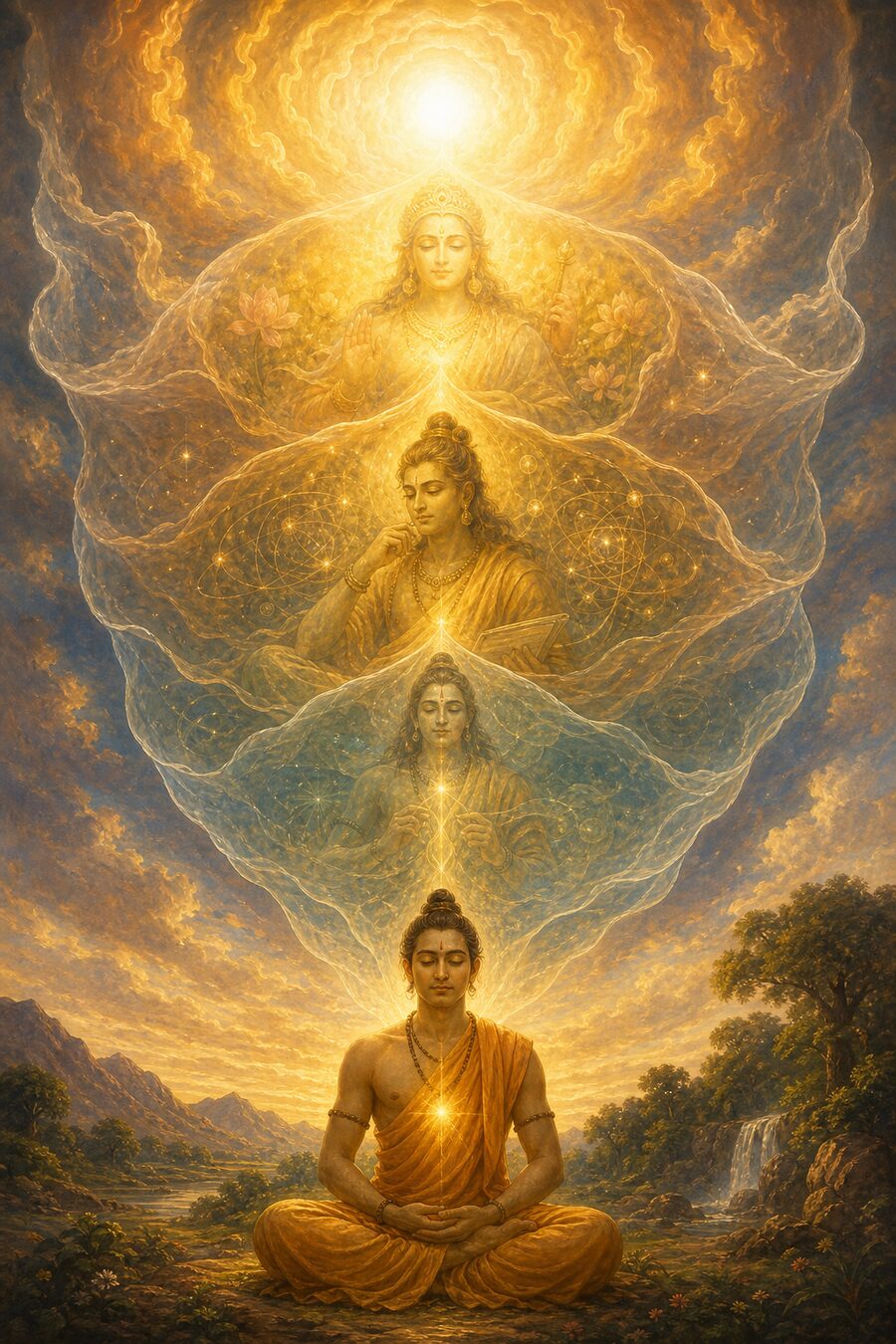
184 · The vijnanamaya kosha, the sheath of the intellect
The account begins with a reflection. Verse 185 calls the intellect a vikara of prakriti, a product of nature, and so of itself without consciousness; what makes it seem aware is the chit-pratibimba-shakti, the power of the reflected light of consciousness that accompanies it, as water in a vessel takes the moon and seems to hold a light of its own. Madhavananda’s note says it directly: the sheath is material and insentient, and the reflection of the Self makes it appear intelligent. Carrying that borrowed light, the thing called vijnana, knowledge, becomes possessed of knowing and acting, jnana-kriyavan, and the verse gives the manner of its claim in two words, ajasram and bhrisham, constantly and intensely: it identifies itself as I with the body, the senses and the rest, without a pause and with full force. The water that holds the moon’s image takes itself for a source of light; that is the error of the vijnanamaya kosha, and verse 185 traces it to a reflection.
185 · The reflection of consciousness
Verse 186 gives the carrier of this I-claim its name. This, with I-ness for its nature, aham-svabhava, and running from beginningless time, anadi-kala, is the jiva, the living being as it takes itself to be, and the verse calls it samasta-vyavahara-vodha, the bearer of all dealings, every transaction of the world of experience. Vodha is the word for one who carries a load, and the picture that fits it is a porter: the load on his head is made of old karma and old vasanas, the tendencies left behind by past acts, and birth after birth he walks under it. Driven by those prior vasanas, purva-vasana, he does acts both good and bad, punya and apunya, and the fruits of those acts, the verse adds, are his to experience. Every doing and every result, every I did this and this happened to me, is carried by this one. The jiva of verse 186 is this sheath of intellect, with the I-sense for its nature and the reflected light in it, and the load it bears is the whole of its doing and the returns of that doing.
186 · The jiva, carrier of karma and craving
Where the porter goes is the matter of verse 187. He experiences those fruits, bhunkte, passing into wombs of many kinds, vichitrasu yonishu, and he comes and goes, down and up, ayati niryati adha urdhvam, which Madhavananda’s note reads as birth and death in higher or lower bodies. The second line settles something that would otherwise be left open: to this vijnanamaya alone, asyaiva, belong waking, dream and the other states, and the experiencing of pleasure and pain, sukha-duhkha-bhoga. Every rising and falling, every passage from one body to the next, the alternation of the three states and all of enjoyment and suffering, is entered under the name of this one sheath. What is left to the Self once all of this is assigned to the sheath is the question verses 188 to 191 answer; verse 187 itself draws the line and places the traveler, the states and the experiences on the one side of it.
187 · Womb after womb, the experience of pleasure and pain
Verse 188 says why this sheath is the hardest to see through. It constantly claims as mine, satatam mameti, the ashrama, the stage of life, and the dharma, the karma and the qualities that rest on the body, so that a man says, I am a householder, this duty is mine, this act was mine, this merit is mine, and every such claim is the sheath speaking. The verse then gives the reason the claim comes so easily: this sheath of knowledge is ati-prakasha, exceedingly luminous, because of the surpassing nearness of the supreme Self, prakrishta-sannidhya. The sheaths of food and breath are plainly inert, and a man can be talked out of taking them for himself; the intellect sits so close to consciousness, and catches so clean a reflection of it, that it seems to be consciousness itself. Therefore, the verse concludes, it becomes the Self’s upadhi, the limiting adjunct through which the Self is seen, and the Self, under the notion that this is itself, atma-dhi, transmigrates through delusion, bhramena. The cloud that lies nearest the moon is the brightest cloud in the sky, and for that reason it is the one most easily taken for the moon; verse 188 names the brightness and the mistake together.
188 · The brightest layer, and the greatest illusion
The next verse quotes scripture, and the word that was the sheath’s name in verse 184 changes its referent. Verse 189 opens with the words of the Brihadaranyaka Upanishad (4.3.7), yo ‘yam vijnanamayah praneshu hridi, this one made of knowledge, among the pranas, in the heart; in the Upanishad the words name the Self itself, the person made of knowledge who is the light within the heart, and the verse uses them the same way. The light that flashes in the heart among the pranas is the Self, atma, and Madhavananda’s note takes “among the pranas” as a way of saying its great nearness to the vital and mental forces, and “in the heart” as in the buddhi, whose seat is held to be the heart. The verse then gives this Self its own name, kutastha, that which stands like an anvil, kuta, under every hammer: a thousand blows fall on it, every shape is forged upon it, and the anvil does not move. Being kutastha, changeless, the Self becomes doer and enjoyer, karta bhokta, on one condition only, upadhisthah, when seated in the upadhi, the sheath of intellect verse 188 described. The one subject of verse 189 is the Self: its light is its own, and its doing and enjoying belong to the seat.
189 · The kutastha takes itself to be the doer
Verse 190 says what the Self does to itself in that seat. Of its own accord, svayam, it takes on the limitation, pariccheda, of the buddhi, and it does so through tadatmya-dosha, the fault of identity, with a thing the verse calls param mrishatmanah, utterly of false nature. The result is stated with a figure. Though it is sarvatmaka, the Self of everything that is, it sees itself as separate from itself, svatah prithaktvena, the way a man sees pots as separate from the clay they are made of. Set ten pots in a row and the eye counts ten, this one tall, that one squat, this one cracked; from the standpoint of the pots there are ten, and from the standpoint of the clay there is one thing shaped ten ways, and the ten were never anything over and above it. Madhavananda’s note draws the moral: the difference is due to name and form, which the mind makes. The Self limited by one intellect takes itself for one pot and so sees every other being as another pot, and the whole world of separate selves stands on that one act of counting the pots and forgetting the clay, which verse 190 calls the fault of identity.
190 · Seeing the pots as separate from the clay
Verse 191 shows the limitation at work on the Self’s appearance. Through its connection with the upadhis, upadhi-sambandha-vashat, the supreme Self appears to carry the properties of the upadhis, upadhi-dharman anubhati, as though it had taken on their qualities, and the verse’s instance is fire in iron. A bar heats, glows red, bends under the hammer, cools and goes dark, and the fire in it seems to redden, bend and cool along with it; the fire did none of these things, since reddening, bending and cooling are the iron’s changes, ayo-vikaran, and the fire is avikari, without change, throughout. The intellect is the iron here: it is glad, then dejected, then tangled in a problem, then clear, and each change shows in the Self as if the Self had changed. The last words of the verse hold the ground, sadaika-rupo ‘pi parah svabhavat, though ever of one form, supreme by its own nature; Madhavananda offers for the last phrase a second rendering, transcending nature, beyond prakriti, and on either reading the Self of verse 191 is what it always was while the iron takes every change.
191 · Like heated iron, it looks changed, it is the same
At verse 192 the disciple speaks, and the doubt he raises grows out of what he has just been told. Grant, he says, that the supreme Self’s jivahood, its condition of being a jiva, comes about through delusion, bhramena, or in some other way, anyatha va; let that be. The upadhi through which it comes about is beginningless, anadi, and of what has no beginning no destruction is admitted, na anader nasha ishyate. The argument stands on what he has been given. Verse 146 called this bondage without beginning, and verse 186 called the jiva beginningless; the disciple takes the premise he was handed and draws the inference that follows from it, that what never began has no means of ending. He asks as a student should, by holding the teaching to its own words, and verse 192 is his case stated in full.
192 · The student’s doubt: the limiting adjunct is beginningless
Verse 193 draws the conclusion and turns it on the speaker. If the upadhi cannot end, then the Self’s jivahood cannot end either, and samsara becomes eternal, nitya; it would never cease, na nivarteta. The disciple then asks the question every seeker brings: “How then can there be liberation for me? Tell me, revered guru.” The word me is the turn of the verse: the argument was about the Self and the upadhi in general, and the question is about his own release. A reasoning that proves bondage eternal would take the point out of every effort described so far, viveka, vairagya, the hearing of the shruti, and the disciple states the consequence plainly and asks to be answered. Verse 193 is the question the rest of the dialogue answers.
193 · “Then how will my moksha come, revered guru?”
The teacher’s answer begins at verse 194 with his judgment of the question: “You have asked well, learned one; listen to this with attention.” He then lays down the principle the reply rests on, pramaniki na bhavati bhrantya mohita-kalpana: a notion conjured up by delusion does not become pramanika, a thing that counts as valid, a premise one may reason from. The disciple had reasoned from the jiva’s beginninglessness to its indestructibility, and the step is a fair one for a real thing; what the teacher removes is the standing of the thing reasoned about. The jivahood is a kalpana, a fancy, produced by delusion, and a fancy does not acquire the properties of a fact by being old. The praise is earned, since the doubt was drawn from the teaching’s own terms, and the correction is to the terms: verse 194 asks the disciple to listen while the teacher shows what kind of thing the upadhi is before saying how long it can last.
194 · “Well asked, listen closely”
Verse 195 gives the first illustration, the sky and its blue. Without delusion, bhrantim vina, there can be no connection with any object, artha-sambandha, for one who is unattached, asanga, actionless, nishkriya, and formless, nirakriti, as there is none between the sky and its blueness and the like. The sky looks blue to everyone who looks up, and the sky has no color of its own; Madhavananda’s note places the blueness in the mind of the one who looks, and places the Self’s limitation in the same mind. To ask how long the sky has been joined to its blue is to ask the age of a connection that was never made; a man cannot date what does not exist. The disciple’s argument depended on the upadhi’s connection with the Self being a thing with a history, and verse 195 denies it a history by denying it being, because the Self the verse describes has no attachment, no action and no form by which anything could be fastened to it, and delusion alone supplies the fastening.
195 · The blue of the sky
Verse 196 says the same of the jivahood itself. The one whose jivahood is in question is svasya drashtuh, one’s own Self, the seer; it is nirguna, without qualities, akriya, without action, and pratyag-bodhananda-rupa, inwardly of the nature of knowing and bliss, which Madhavananda’s note calls its essence, no more separable from it than heat from fire. Its condition of being a jiva was reached, the verse says, buddheh bhrantya, through the delusion of the buddhi; the intellect’s error produced it, and the verse pronounces it na satyah, not real. It then gives the consequence and the reason together: when delusion departs, mohapaye, it is not, nasti, because its nature is that of an avastu, a non-thing. A non-thing needs no destroying. It has the kind of presence a mistake has, present while the mistake is being made and absent when the mistake is seen, and the labor the disciple feared, the ending of something that had run from all time, turns out to be the seeing of a confusion for what it is. Verse 196 locates that confusion in the intellect, the sheath under examination.
196 · The jiva-sense born of illusion is not real
The rope and the snake return in verse 197 to measure how long the jivahood lasts. Its existence, satta, is yavad bhrantis tavad eva, exactly as long as the delusion and no longer, since it is a thing that sprang up from false knowledge, mithya-jnana, through pramada, inattention, which Madhavananda renders as indiscrimination: the eye that did not look closely enough. The snake in the rope, the verse says, is bhranti-kalina, a thing of the time of the delusion, and with the delusion’s destruction there is no snake at all, naiva sarpo ‘pi; so it is here, tadvat. The snake’s being and the mistake’s duration are one span. Nothing is done to the snake when the lamp is brought, since there was nothing there to kill; the rope was seen, and the span closed. The jivahood of verse 197 has that exact measure, and the disciple’s question about its age is answered by its substance, which was false knowledge from the first.
197 · The rope’s snake lasts only as long as the illusion
Verse 198 takes up the disciple’s premise directly and grants it. The beginninglessness of avidya, ignorance, is admitted, and so is that of its effect, karyasyapi tatheshyate; the teacher uses the disciple’s own verb, ishyate, it is admitted, and concedes the premise entire. Ignorance did not begin on a date, and neither did the jivahood, the bodies, the wombs and the states that come of it. The concession makes the reply stronger, because the disciple is answered on his own ground: beginninglessness is granted, and what is denied is the inference drawn from it. The verse’s second line opens the denial and leaves it hanging across the verse boundary: when knowledge has arisen, utpannayam tu vidyayam, what is born of avidya, avidyaka, though beginningless, anady api, and the predicate waits for verse 199. The night has no first moment anyone can point to, and the sun does not ask its age before ending it; the pivot of verse 198 is the small word tu, but, on which the answer turns.
198 · Ignorance is beginningless, but the moment knowledge comes…
The sentence is completed in verse 199 with two comparisons. On awakening, prabodhe, everything perishes together with its root, saha-mulam vinashyati, as a dream does, svapnavat; the root, Madhavananda’s note says, is avidya itself. A dream may hold the history of years, cities, marriages, debts and a long illness, and the opening of the eyes ends all of it at once, the years with the rest, and nothing in it has to be dismantled piece by piece. The verse then states its conclusion as a plain fact: this, though beginningless, is not eternal, anady api idam no nityam, sphutam, clearly, like prag-abhava, prior non-existence. The term is from logic. Before a pot is made, the pot does not exist, and that non-existence of the pot has no beginning; it was always the case that the pot was not. The moment the potter finishes, that beginningless non-existence ends. A thing with no beginning and a definite end stands there in plain view, known to everyone, and verse 199 sets the whole of avidya’s effect beside it: beginningless, and ended by the arising of knowledge as the pot’s absence is ended by the pot.
199 · On waking, the dream, root and all
Verse 200 presses the example, and its key word is vikshitah, observed. The destruction of a prior non-existence, a thing that had no beginning, is seen, witnessed every time a pot comes off the wheel; the teacher appeals to common experience and ordinary logic, the same court the disciple’s argument had appealed to. If one beginningless thing is seen to end, the rule that the beginningless cannot end is broken as a rule, and the disciple’s inference loses its force. The verse then names what the example is for: so too that which is imagined in the Self, parikalpitam atmani, through its connection with the upadhi of the buddhi, buddhy-upadhi-sambandhat. Parikalpita is the word for a construction, a thing fancied onto something; the jivahood is such a construction laid on the Self through the intellect, and a construction with no beginning is still a construction. What it is that is so constructed, verse 200 leaves for the first word of verse 201.
200 · Even a beginningless thing has been seen to perish
The first word of verse 201 names it: jivatvam, jivahood, the Self’s condition of being a jiva. That is what was constructed in the Self through the intellect, and the sentence begun in verse 200 ends with the verdict already given at verse 196, that it is not real and does not remain. The verse then sets the Self on the other side of the line: tato ‘nyas tu svarupena vilakshanah, the other, the Self, is by its own nature distinct from that jivahood; in its own form it is nothing the jivahood describes. The last line says what the two have to do with each other: the Self’s connection with the buddhi, sambandhas tv atmano buddhya, is mithya-jnana-purahsarah, a connection with false knowledge going before it, preceded by error and standing on error. Madhavananda’s note compares a crystal set beside a red flower, which looks red while the flower is near, and a thing watched through a widening gap in a curtain, which seems to grow while only the curtain changes: the change belongs to prakriti, of which the buddhi is a form, and is read onto the Self. The jivahood is unreal, the Self is distinct, and the tie between them is false knowledge, and verse 201 puts all three into two lines.
201 · The tie with the intellect rests on false knowledge
Verse 202 gives the disciple what he asked for at verse 193. The cessation of that connection, vinivritti, comes about through samyag-jnana, right knowledge, and in no other way, nanyatha. The reason has been built over the preceding verses: a tie made of false knowledge is undone by true knowledge, as the rope’s snake is undone by seeing the rope, and no act, however long sustained, reaches it, since acts work on things and this tie is an error. The verse then defines the knowledge, and credits the definition to the shruti, shruter matam: right knowledge is brahmatmaikatva-vijnanam, the knowledge of the oneness of Brahman and the Self. The oneness is the content; the knowing of it is the release. A seeker may know a great deal about Brahman and about the Self and still hold them as two, and verse 202 counts none of that as samyag-jnana, which is the one recognition, that Brahman and I are one. The disciple’s fear is answered at its root: bondage may be as old as he argued, and right knowledge ends it, as the arising of knowledge ended the beginningless effects of ignorance in verses 198 and 199.
202 · Through right knowledge alone
How that knowledge is reached comes in verse 203, and the answer is viveka. The knowledge is accomplished only by samyag-viveka, the right discrimination of Self and not-Self, atmanatmanoh, and therefore, the verse says, discrimination must be done, vivekah kartavyah, between the pratyag-atma and the sad-atma. Madhavananda takes the pair as the jiva, the self as it presents itself within, and the eternal Self, the real one; a variant reading joins the words differently, pratyag-atma and asad-atma, the inner Self and the unreal self, the sheaths taken for oneself. On either reading the two things to be told apart are the self a man has been taking himself to be and the Self he is, and the telling apart is the act the sheaths have been put through one after another: this is seen, this changes, this is absent in sleep. The disciple asked how his liberation could come, and the answer has arrived in three steps, by right knowledge, which is the knowledge of oneness, which is reached by discrimination; verse 203 hands him the one link in the chain he can take hold of.
203 · So, discern
Verse 204 gives the discrimination its image: muddy water. Water that is thoroughly mixed with mud, pankavad atyantam, is water still, and when the mud is removed, pankapaye, it shows clear, sphutam; so the Self, when the fault is gone, doshabhave, is sphuta-prabha, of clear radiance. The clearing is a removal, and the verse’s word for it, apaya, the going away of the mud, names something that the one who wants clear water does. Madhavananda’s note says the impurities are removed by filtration and other such work, and the Self’s seeming impurity by discrimination, and he draws from the image the conclusion that what hides the Self is ignorance, since what hides the water is a foreign thing mixed into it. The clear water under the moss of verses 149 and 150 was the same water, and the moss had to be moved aside. Verse 204 says the Self shines of itself once the fault is removed, and leaves the removing to the one who discriminates.
204 · The silt settles, the water clears
The image becomes an instruction in verse 205. When the unreal ceases, asan-nivrittau, there arises the clear cognition, sphutam pratitih, of this inner one, pratyak, as the real Self, sad-atmana; therefore, tatah, the removal, nirasa, of the thing called I and the rest, aham-adi-vastu, from the real Self is karaniya eva, must certainly be done, and done thoroughly, sadhu. The verb is active and the eva leaves no softer reading open: the removing is a task, and the task has a first item. At the head of the things to be removed stands aham, the I of the doer and the enjoyer, which verse 184 made the mark of this sheath, and after it come the rest, the mine, the my duty, the my merit of verse 188. A variant reading has the removal made from the asad-atma, the unreal self, which comes to the same instruction from the other end. The I is the item a seeker holds hardest, since it is the one doing the holding; verse 205 orders its removal all the same, and promises what follows, the inner one known clearly as the real Self.
205 · When the unreal goes, only then the real shows clearly
Verse 206 sets the fourth sheath down and gives five reasons. This thing that bears the name vijnanamaya, vijnanamaya-shabda-bhak, is not the supreme Self, nayam paratma syat: because it changes, vikaritvat; because it is insentient, jadatvat, lit only by the reflection verse 185 described; because it is limited, paricchinnatva, one intellect among many; because it is seen, drishyatvat, an object; and because it is inconstant, vyabhicaritvat, present in waking and dream and absent in deep sleep, which Madhavananda renders as not constantly present. The verse then states the principle under all five: the non-eternal is not admitted as the eternal, nanityo nitya ishyate. The reason that reaches furthest is drishyatva, being seen. A man says, I decided this, my reasoning ran that way, I was sure and then I doubted, and in saying it he has placed the intellect among the things he watches; the one who watches it stands on the other side of it, and the test that set the body, the breath and the mind aside sets this brightest sheath aside too. Verse 206 closes the examination of the intellect on that count.
206 · The vijnanamaya too is not the atman
Verse 207 names the fifth sheath and describes it in a single long sentence. The anandamaya kosha, the sheath made of bliss, is a vritti, a mode of the mind, tamo-jrimbhita, spread forth from tamas, and its body is ananda-pratibimba-cumbita, touched, the verse says kissed, by the reflection of bliss; Madhavananda renders the tamas as nescience and explains in his note why, since deep sleep, where this sheath shows most, is a state of thick ignorance. Its qualities are priya and the rest, priyadi-gunaka, the grades of enjoyment, priya, moda and pramoda, which his note traces to the second chapter of the Taittiriya Upanishad; it rises on the gaining of a desired object, sveshtartha-labhodaya; it shines of itself as bliss for the meritorious, kritinam, when their merit, punya, comes to be experienced; and in it every being that bears a body, tanu-bhrin-matra, rejoices without effort, prayatnam vina. The moment of getting what one wanted, the ease that comes over a man when a long wish is met, is this sheath at work, and the verse’s two words for its light are reflection and touched: the bliss in it is caught from the Self, as the moon was caught in the water, and verse 207 names the catch for what it is, a mode of the mind arising from tamas.
207 · The anandamaya kosha, the sheath of bliss
Where the sheath shows most is the matter of verse 208. The bliss sheath’s manifestation, sphurti, is utkata, at its height, in deep sleep, sushupti; in dream and in waking it is ishat, slight, and occasioned by the sight of a desired thing and the like, ishta-sandarshanadina, which Madhavananda’s note divides into actual perception in waking and the impressions of memory in dream. In the two states that have objects, the sheath flickers when an object pleases; in the state that has no object at all, it is at its fullest, and the sleeper wakes and says, I slept happily, with nothing to point to as the cause. The fact is entered as a fact about the sheath: its fullest showing is in the state of thick tamas, which is why verse 207 called it a mode spread from tamas. Verse 208 gives the sheath its home state, and that state is the one in which the mind, as verse 171 said, is dissolved and nothing remains.
208 · Clearest in deep sleep
Verse 209 sets the fifth sheath down with four reasons. This anandamaya is certainly not the supreme Self, naivayam paratma: because it has an upadhi, sopadhikatvat, a condition it depends on, which Madhavananda reads as changeful attributes; because it is a modification of prakriti, prakriter vikarat; because it is an effect, karya, of meritorious action, sukrita-kriya, so that the bliss in it is earned and ends when the merit that earned it is spent; and because it is placed within the aggregate of modifications, vikara-sanghata-samahitatvat, lodged inside the other sheaths, which are themselves all changing. Madhavananda’s note refers the last reason to the Taittiriya Upanishad’s second chapter, where the five sheaths lie one inside the other, the food sheath outermost and the bliss sheath innermost. A bliss that comes when merit ripens, grows on the gaining of a thing, and lives inside four changing layers is a conditioned bliss, and the Self’s bliss, as verse 196 said, is its own nature, inseparable from it as heat from fire. Verse 209 closes the fifth examination, and with it all five sheaths have been examined and found other than the Self.
209 · The anandamaya too is not the atman
What is left when the five are gone is stated in verse 210. When all five sheaths have been negated, nishedha, by reasoning upon the shruti, yuktitah shruteh, what remains, avashishyate, at the limit of that negation, tan-nishedhavadhi, is the sakshin, the witness, bodha-rupa, of the nature of knowing. Madhavananda’s note names the shruti passages as those that describe the Self by neti neti, not this, not this, and calls the limit the point past which reasoning and analysis cannot be carried. Each sheath was set aside with the same sentence, this is not I: the body, the breath, the mind, the intellect, the bliss. The one who spoke the sentence was present at every setting aside, examining each layer and finding it an object, and the negation cannot be turned on him, since he is the one conducting it; every attempt to negate him is itself his act of knowing. That one is the witness, and his being of the nature of knowing is the reason he survives a process that removed everything knowable. The five were lifted away like the moss on the water, and what was found is the one who had been looking; verse 210 names him at the limit of the negation.
210 · After all five, the witness remains
Verse 211 gives the Self its full description and says what to do with it. This Self, atma, is svayam-jyoti, self-luminous, shining by its own light and lit by nothing else; pancha-kosha-vilakshana, distinct from the five sheaths just examined; avastha-traya-sakshi, the witness of the three states, waking, dream and deep sleep, present through all three and the same in each; sat, real, existent in its own right; nirvikara, changeless, the kutastha of verse 189; niranjana, untainted, which Madhavananda’s note completes as untainted by ignorance; and sadananda, ever bliss, the bliss that verse 207’s sheath only reflected. Each epithet answers a sheath or a doubt from the verses before it, and the last words give the whole its direction: sa vijneyah svatmatvena vipashcita, it is to be known by the wise one as one’s own Self. The knowing the verse asks for is the knowing of oneself, and the Self described here is what the disciple has been all along, under the five layers the dialogue removed. The witness of verse 210 and the Self of verse 211 are one, and the wise man is told to know it svatmatvena, as what he himself is.
211 · This is the atman, know it as your own real nature
Ahead
Part 8 · The Witness and Brahman, verses 212 to 240. The disciple, hearing that the five sheaths are negated and the witness remains, raises a further doubt at verse 212, that when everything has been set aside what remains may be only an emptiness; the guru answers by showing the difference between that emptiness and the witness, and then carries the teaching on from the witness to Brahman, that this whole universe too is Brahman.
The disciple’s doubt at verse 192, that a beginningless thing cannot end, was answered by verses 198 to 201 with the dream and with prior non-existence, both beginningless and both ended; the doubt he raises at verse 212 is of another kind, about what the negation leaves, and verse 210 has already given the answer he will be led to, the witness of the nature of knowing, who conducted the negation and could not be its object.