Vivekachudamani
Part 17 · The Disciple’s Hymn · Verses 486 to 519
The disciple’s hymn runs thirty-four verses without a pause. It opens with a bow to the guru whose glance cooled the fever of samsara, then rises through one declaration after another, each closing on aham, I am: unattached, bodiless, free of the subtle body, undecaying; no doer, no enjoyer, beyond change; Narayana, slayer of Naraka, destroyer of the three cities, the Lord. Clouds never touch the sky, the doings of a house never touch the lamp that lights it, and the jar’s traits never reach the sky held inside it. At the close the disciple turns back to the guru who woke him from the great dream, and bows to him as to Brahman itself.
486
The hymn begins at the guru’s feet. Namo namaste, salutation and salutation again, the disciple says in verse 486, to the teacher, the great soul, freed of attachment, best among the good, whose nature is the rasa of eternal nondual bliss, the infinite, bhuman, and forever the seat of a boundless ocean of mercy. Every epithet in the line fits Brahman as closely as it fits the man, and the hymn will end on that fit in verse 519. For now the disciple has one thing to give for what he has received, and it is this bow, made twice because once was too little.
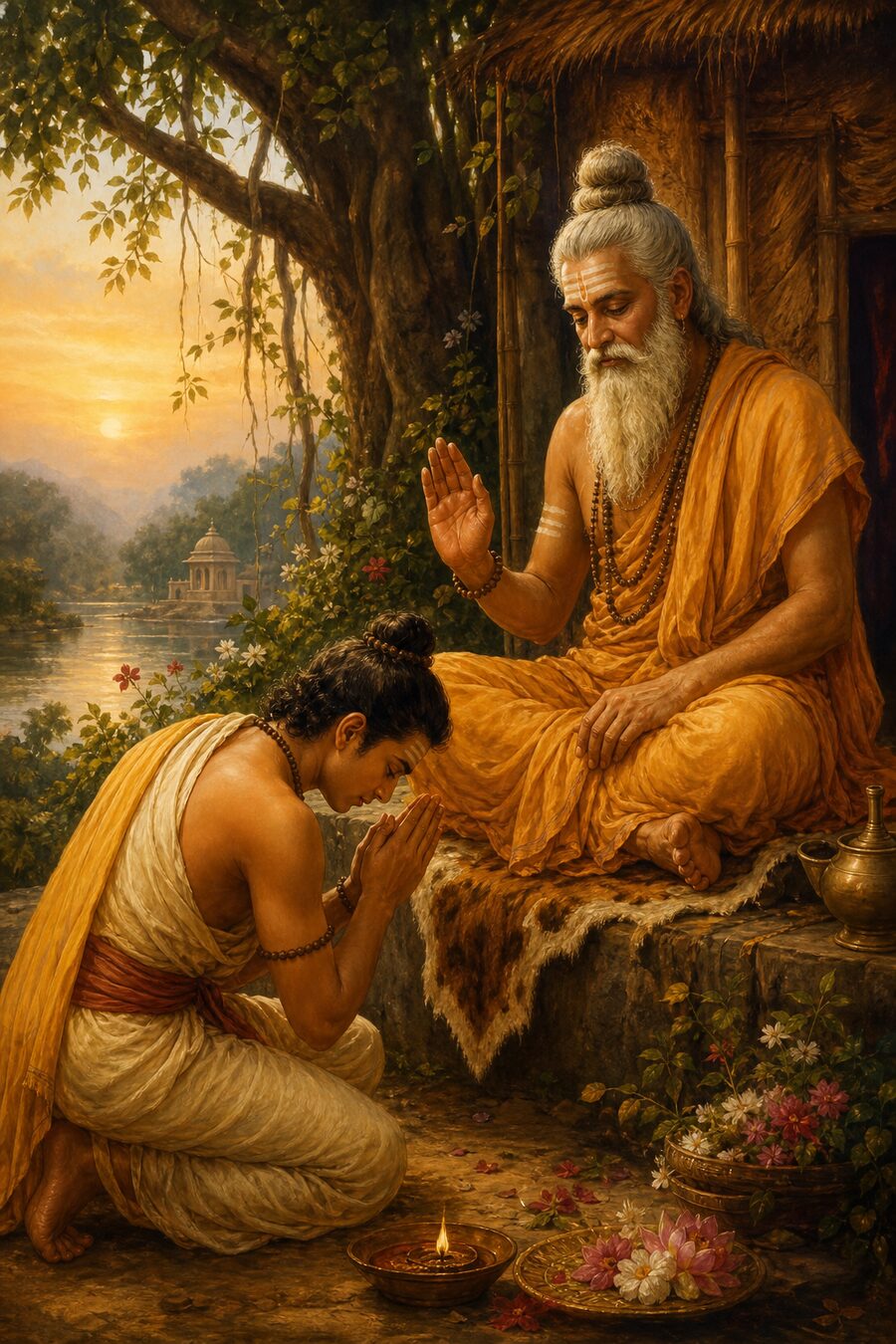
487 · 488
Verse 487 says what the guru did and how little it cost him. The dense moonlight of his glance, kataksha, the sideways look, fell on the disciple, and with it the weariness born of the fever of samsara was washed away; Madhavananda’s note takes bhava-tapa as the three afflictions, from one’s own body, from other creatures and from the forces of nature. In a moment, kshanat, the disciple reached the imperishable state of the Self, the bliss of unbroken glory. Moonlight on a fever is the whole figure: one cool glance set against years of heat. Verse 488 then gives his first declarations, five of them, each ending in aham. Blessed am I; my work is done, kritakritya; I am freed from the grip of samsara, bhava-graha; I am eternal bliss by nature; I am full. The verse ends on tvad-anugrahat, by your grace, and the five states are laid at the guru’s feet along with the bow.
489 · 490
The declarations now come without a frame, eight in verse 489 alone. I am asanga, unattached; ananga, bodiless; alinga, free of the subtle body, the linga-sharira; abhangura, undecaying. I am prashanta, at peace; ananta, endless; amala, stainless; chirantana, ancient. Each word lifts one layer that the upadhi, the limiting adjunct of body and mind, had laid over the Self, and what the words leave standing was there all along. Verse 490 continues in the same breath. I am no doer, akarta; no enjoyer, abhokta; changeless, avikara; actionless, akriya. I am pure knowledge by nature, kevala, alone, and sadashiva, the ever-auspicious. Madhavananda’s note adds that doer and enjoyer are what the deluded man takes himself to be; the disciple is reporting from the far side of that delusion.
491 · 492
Verse 491 draws the line between the Self and the figures that act. I am other than the seer, the hearer, the speaker, the doer, the enjoyer; I am the Self of knowledge, eternal, unbroken, actionless, limitless, unattached, full. Seeing, hearing and speaking each bring a figure with them, the one who sees, the one who speaks, and the disciple sets himself apart from every such figure as the knowledge in which they appear. Madhavananda’s note has him refuse identification with any act of the organs or the mind, since he is no longer finite. Verse 492 goes to the two pronouns that carry all objects. I am not this, naham idam; I am not that, naham adah; I am the supreme, pure one that lights both. The note reads this and that as what is perceived directly and what is known at a remove. The verse’s own words are these two refusals and the lighting; the Brihadaranyaka’s neti neti is kin to them and a different sentence. Void of outer and inner, full, Brahman without a second: that, the disciple says, am I.
493 · 494
Verse 493 widens the two pronouns to four. I am without compare, the beginningless reality, far from the imagining that says you, I, this, that; eternal bliss of one taste, the truth, Brahman without a second. The four small words hold a whole language of persons and objects, and the verse calls all four kalpana, imagination, and sets the Self far from it. Verse 494 then takes the great names. I am Narayana; I am narakantaka, the slayer of Naraka, the demon son of the Earth whom Vishnu killed; I am purantaka, the destroyer of the three cities, Shiva’s name from the fall of Tripura; I am the Purusha, the Lord. Madhavananda’s note supplies the two stories. The verse names Vishnu twice and Shiva once, and the disciple takes each name as his own because each is a name of the one Brahman he has found himself to be. The verse then turns the same claim inward: I am unbroken awareness, the witness of all; nirishvara, with no lord over me; niraham, with no I; nirmama, with no mine.
495 · 496
Verse 495 states where the I now stands. I alone abide in all beings as knowledge, their support within and without; I myself am the enjoyer and all that is enjoyed, everything I once saw as separate, as this. The line echoes the Gita, where Krishna calls himself the Self seated within all beings (10.20) and the enjoyer of every sacrifice (9.24); the echo lies in the stance, since the verse quotes nothing. What the disciple once set across from himself as object he now finds to be himself, the support and the supported together. Verse 496 gives the ocean. In me, the ocean of unbroken bliss, the waves of the universe rise and dissolve in many forms, stirred by the wind of maya. The water is one, the waves are its passing shapes, and the wind that raises them is maya; the ocean is the disciple’s own name for himself here, and the waves have nothing of their own to be made of.
497 · 498
Verse 497 explains how the shapes get into the water. The states called gross and the rest, the bodies, are imagined in me by delusion, through the projecting that people do; in the same way kalpa, year, ayana, the sun’s half-year course, and season are imagined within time, which has no parts and no divisions. Time itself runs whole; the cuts are ours, made for the counting of days, and the three bodies are cuts of the same kind laid on a Self that has none. Verse 498 says what such cuts do to their ground, which is nothing. What is superimposed never taints the thing it rests on, however fools defiled by great faults may take it; the great flood of a mirage’s water never wets the salt desert, ushara-bhumi, it seems to cover. Pleasure, pain, anger and desire appear on the Self as that water appears on the sand, and the sand stays dry under all of it.
499 · 500
Four likenesses in verse 499, each carrying one quality. Like the sky I am far beyond any coating, lepa; like the sun I am distinct from the things I light; like the mountain, aharya, I am ever unmoving; like the ocean I am without a farther shore. Freedom from taint, distinctness from objects, stillness, and limitlessness: the four together make one portrait, and all four likenesses stand in plain view every day. Verse 500 takes the sky again for a test. I have no tie with the body, as the sky has none with the cloud; so from where would its traits, waking, dream and deep sleep, come to be mine? The question is the verse’s own. A cloud appears in the sky, crosses it and dissolves, and the sky has gained and lost nothing; the three states cross the Self the same way, and they belong to the body and the mind.
501 · 502
Verse 501 says plainly whose the life story is. The upadhi comes, and the same upadhi goes; it does the deeds and takes their fruits; it grows old and it dies. I stand forever unmoving like the kula mountain, kuladri, one of the great ranges the Puranas name, proverbial for their stability, as Madhavananda’s note says. Birth, action, aging and death all belong to the adjunct; the disciple has placed himself where none of them arrive. Verse 502 asks the question that follows. There is no engaging in work for me, pravritti, and no withdrawing from it, nivritti, for one ever the same in form and without parts; how could what is one, dense, nibida, which the note likens to a lump of salt that is salt all through, unbroken and full like the sky, ever strive? The sky holds everything that happens and does nothing itself, and the disciple claims the sky’s condition as his own.
503 · 504 · 505
Verse 503 asks where merit and sin could settle. For me, without senses, without mind, changeless, formless, myself the experience of unbroken bliss, where are punya and papa? Shruti too says ananvagata, untouched, and Madhavananda’s note gives the passage: Brihadaranyaka 4.3.22, where the man in deep sleep is called untouched by merit and untouched by sin, the sleeper’s state being used there, as the note adds, as an illustration of the free state. Merit and sin need a doer with organs and a mind, and the disciple has set every one of those aside. Verse 504 gives a shadow. Whatever touches a man’s shadow, heat or cold, good or ill, touches nothing of the man, who is distinct from it. Let the shadow lie on hot sand or across cold stone, let mud be thrown on it, and the man stands as he was. Verse 505 draws the rule from the shadow. The traits of what is witnessed never touch the witness, who stands distinct, changeless, indifferent, as the doings of a house never touch the lamp that lights it. In the lamp’s light the household eats and quarrels and sleeps, and the flame burns on the same.
506 · 507
Verse 506 gives three likenesses for the one bond the Self does have. As the sun stands only as witness to the deeds done in its light, as fire’s part is the governing of burning, as the rope’s bond with the snake laid on it is a bond with a thing superimposed, so is the bond of me, the kutastha, the awareness-Self that stands unmoved. Madhavananda’s note draws each out: men do good and evil by daylight and the sun takes none of the fruit; the rope’s relation to the snake is wholly made up; the Self is unconcerned with the activities of the buddhi. The Sringeri variant, fire as the burner within heated iron, keeps the same sense. Verse 507 then cuts the bond of action six times, in three pairs. I am no doer, and no one who makes another do; no enjoyer, and no one who makes another enjoy; no seer, and no one who makes another see. The pairs close both the direct and the indirect route, as the note observes. I am That, self-luminous, the Self like nothing else, anidrig-atma.
508 · 509
Verse 508 names the mistake the whole hymn has been undoing. When the upadhi moves, the trembling of the reflection, which belongs to the upadhi, is carried by the dull-witted onto the original, which is actionless like the sun: I am the doer, I am the enjoyer, alas, I am killed. Madhavananda’s note makes the adjunct water: the water shakes, the reflection shakes with it, and the sun stays where it is, far off in the sky, though a watcher may think it moves. Every activity of the buddhi under the Self’s reflection is laid on the Self in just this way, and the cry of alas is the sound of the mistake. Verse 509 puts the body down. Let this inert thing roll in water or on land; I am untouched by its traits, as the sky is untouched by the traits of the jar. The note adds that the sky held in a jar is one with the whole sky and the same whether the jar breaks or stands.
510 · 511
Verse 510 reaches the two words the seeker has lived by. Doership, enjoyership, wickedness, khalatva, intoxication, dullness, bondage and freedom and the rest are fancies of the buddhi, buddher vikalpah; in reality they are absent from the Self, the supreme Brahman, alone and without a second. Bondage sits on the list, and so does freedom: the thought I am bound and the thought I am free are both constructions of the intellect, and the Self was never either. Madhavananda’s note gives the ground: the Self is knowledge that admits no change, and the buddhi, being inert, is the thing that changes, so the traits of the one are laid on the other by superimposition. Verse 511 answers all of prakriti at once. Let the changes of prakriti be tenfold, a hundredfold, a thousandfold; what are they to me, unattached awareness? Clouds never touch the sky. The note points back to verse 108 and the verses after it, where prakriti, the undifferentiated, was first set out.
512 · 513 · 514
A refrain carries the next three verses: brahmadvaitam yat tad evaham asmi, that nondual Brahman, that alone am I. Verse 512 names Brahman as that in which this whole universe, from the unmanifest down to the gross, appears as mere semblance, abhasa-matra; like the sky, subtle, without beginning or end. The universe appears on it and rests on it with no being of its own, and the disciple is the ground, which is the one thing in the figure that has being. Verse 513 heaps the marks of the ground: support of all, the light by which all things show, of every form, present everywhere, and sarva-shunya, void of all, which Madhavananda reads as devoid of multiplicity; eternal, pure, unmoving, beyond division. Every form is its form, and every place is a place where it is. Verse 514 turns inward. That in which every particular of maya has been set aside, the inmost, pratyag-rupa, the one that faces within; beyond the reach of any cognition, pratyaya-agamya; of the nature of truth, knowledge, infinity and bliss. The note calls this last line Brahman’s svarupa-lakshana, its definition by its own nature, as distinct from the indirect marks such as being the cause of the world.
515 · 516
Verse 515 gives eight epithets, six of them built on nir or nish, each naming what the Self is without. I am nishkriya, without action; avikara, changeless; nishkala, without parts; nirakriti, without form; nirvikalpa, without division; nitya, eternal; niralamba, without support, since Brahman is its own support, as Madhavananda’s note says; nirdvaya, without a second. Verse 516 then says the same Self in the widest words it has. I am the Self of all, sarvatmaka; I am all, sarva; I am beyond all, sarvatita, without a second. I am pure, unbroken awareness alone; I am bliss, unceasing, nirantara. Three sarva words set in a row carry the inner self of every being, the whole of what there is, and what lies past the whole, and the one I of the hymn is each of the three.
517 · 518
After the widest words the disciple turns back to the one who gave them. This splendor of sovereignty over myself, svarajya-samrajya, verse 517 says, I have gained through the grace of your mercy’s glory and greatness; to the noble guru, the great soul, salutation, salutation, and salutation again. Madhavananda’s note has the disciple beside himself with joy, which accounts for the heaped language. Verse 518 tells the rescue as a story. Wandering in the great dream, in the dense forest of birth, age and death that maya made, afflicted day after day by many fevers, tormented by the tiger of ego, ahankara-vyaghra, I have been woken from sleep by you, the disciple says to his guru, out of your utmost grace, and wholly saved. The sleep is nescience, the note says, and the dream is what the sleep produces; the forest is the kind that is hard to come through, and a dream of a few minutes can seem to run for years. The guru’s whole work was the waking, and the forest and its tiger went out with the sleep.
519
Verse 519 closes with a salutation whose object has no name. Salutation to that which is ever one; salutation to some greatness beyond telling, kasmaichit mahase; that which shines as this whole universe is yours, the disciple says, calling the guru guru-raja, king of teachers. Madhavananda’s note reads the epithets as Brahman’s, applied to the guru by a disciple who now sees the two as one, and he sets beside the verse the Guru Gita’s salutation, the guru as Brahma, Vishnu, Shiva and the supreme Brahman itself. The hymn began with a bow to a man and ends with a bow to Brahman, and the two bows go to the same feet.
Where to go after this
Part 18 has the guru speak again, verses 520 to 545. He opens at verse 521 with brahma-pratyaya-santati, the unbroken stream of Brahman-cognitions: as one with eyes sees form on every side, the knower’s intellect sees Brahman on every side, and the world is to be seen as that stream in every state. The part then follows the knower’s daily gait, and verse 542 gives it in a run of somewheres: kvacin mudho vidvan kvacid api maharaja-vibhavah, somewhere a fool, somewhere a scholar, somewhere with the splendor of a great king, somewhere lying still as a python, somewhere honored, somewhere scorned, somewhere wholly unknown.
Verse 518 is the one to hold: ahankara-vyaghra-vyathitam imam, this one tormented by the tiger of ego, wandering the dense forest of birth, age and death in the great dream that maya made. The guru’s act was to break the sleep itself, and with the sleep went the dream, the forest and the tiger.