Vivekachudamani
Part 10 · The Wearing Away of Vasanas · Verses 267 to 297
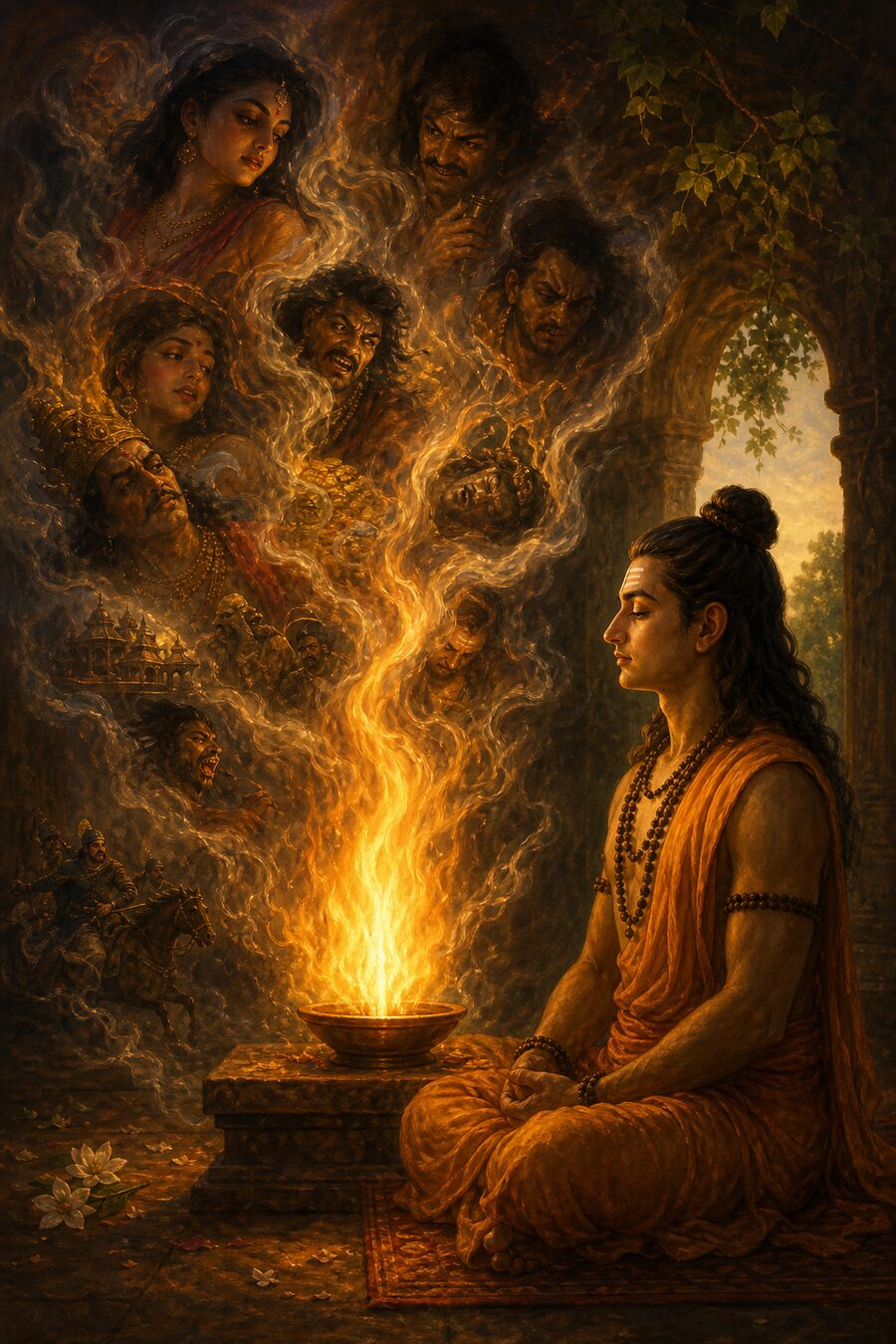
The great saying has been given: you are That. Verses 267 to 297 begin from the seeker who holds it and still feels the old habit rising from within, I am the one who acts, I am the one who enjoys, and they say how that habit is worn thin: by living in the Self, by removing the superimposition each time it returns, and by setting down every pride that rests on the body.
First, one thing
The saying tat tvam asi has been given and reasoned through, and verse 267 opens on what that understanding has not yet done. A vasana, a stored impression that keeps a habit alive beneath thought, goes on saying I am the doer, I am the enjoyer, and the verse calls it beginningless, strong and firm even when the reality is known. The verses that follow say how it is worn thin. Verses 267 to 276 give the principle, abiding in the Self, and the image of the agaru wood whose scent comes back under rubbing. Verses 277 to 285 repeat one instruction nine times without a break, svadhyasapanayam kuru, remove your own superimposition, after its first sounding in verse 270, so that it closes ten verses in all, each time on a new ground. Verses 286 to 297 carry the renunciation past the habit to the body, the cosmos, the ego and every pride that rests on the body, and verse 294 names the one thing left when all of it is set down, the witness that is present even in deep sleep. Verse 267 itself ends with the sages’ definition: the thinning of the vasanas is liberation, here, in this life.
267 · 268 · 269
Verse 267 begins with the reality known and names what remains. Even when the vastu, the reality, Brahman, is known, a vasana persists, and the verse gives it three marks: it is beginningless, it is strong, and it is firm. Its content is the sentence I am the doer and I am the enjoyer, and the verse calls that sentence the cause of samsara, the round of birth and death. The vasana has to be removed with effort, prayatnat, and the verse says who can remove it: the one who lives in the Self with inward vision, pratyag-drishti, his attention turned back from objects to the one who sees them. The sages, the verse ends, call the thinning of vasanas, vasana-tanava, liberation here, in this life. The order of the sentence carries the teaching. Knowledge has come first and the impression outlasts it, which is why a knower can still flinch like a doer; the effort that follows stands on the Self already known and works on the impression. Verse 268 names what the effort works on. The sense of I and mine in the body, the senses and whatever else is other than the Self is adhyasa, superimposition, one thing’s identity laid over another as the snake is laid over the rope, and the wise remove it by svatma-nishtha, steady abiding in their own Self. Verse 269 gives the method its positive form. Having known your own inner Self, the witness of the buddhi, the intellect, and of every movement it makes, slay the notion of self in what is other than the Self by one true thought, sad-vritti, held where the false one stood: so’ham, I am He. The old current, I am this body, is met by a truer current, and the truer one prevails by being kept up.
270 · 271 · 272
Verse 270 speaks the refrain for the first time, svadhyasapanayam kuru, remove your own superimposition, and sets three renunciations before it. Give up lokanuvartana, following the world, the shaping of one’s conduct by what people expect; give up dehanuvartana, following the body, the tending of its comfort and its looks; give up shastranuvartana, following the scriptures, which Madhavananda reads as too much engrossment in them, study carried past the point where it serves knowing. The three share the name anuvartana, a running after, a trailing behind something that leads. Verse 271 says why they must go: because of the world-vasana, the shastra-vasana and the body-vasana, knowledge does not arise as it should, yathavat. Under their pull the teaching is heard and the knowledge it should produce comes up thin or fails, like a seed in a field already full of roots. Verse 272 gives the three a single image. For the one who wishes release from the prison-house of samsara, the knowers call these three vasanas the strong iron fetter chained to his feet, ayomaya pada-nibandha-shrinkhala; whoever is freed from the fetter attains liberation. The verse puts its stress on the chain, which is the seeker’s own and can be unlocked by him. A man can long for release, know the way, and still stand where he is because of what is fastened at his ankles.
273 · 274 · 275 · 276
Verse 273 brings in agaru, aloe wood, whose scent the verse calls divine. Left in contact with water and the like, the wood takes on a strong stench that drives the scent out of notice, and when the outer smell has been shaken off by rubbing alone, the scent shines out fully again. The rubbing uncovers what the wood had all along. Verse 274 applies the image, and it turns on a word with two senses, vasana, which means a scent that lingers in a thing and also the impression a desire leaves in the mind, as Madhavananda’s note points out. The paramatma-vasana, the fragrance of the supreme Self, is smeared with the dust of endless vasanas lodged within, duranta, hard to bring to an end; purified by the intense friction of prajna, insight pressed hard and often, it is clearly perceived, like the scent of sandalwood. The friction is the whole of the practice. Verse 275 states the covering plainly: the vasana for the Self, the pull toward it, is hidden by nets of vasanas for what is other than the Self, and when those are destroyed by constant abiding in the Self, nitya-atma-nishtha, it shines of itself, clearly. The longing is already in the seeker, whole; the practice removes what covers it. Verse 276 gives the rate at which this happens. As the mind becomes established inward, in that measure it lets go of the outer vasanas, and when the vasanas are released without remainder, the experience of the Self stands free of every obstruction. The settling in and the letting go are one movement seen from two sides, and the end of the one is the end of the other.
277 · 278 · 279
Verse 277 is the second refrain and the first of nine that run without a break to verse 285, each closing on svadhyasapanayam kuru. By staying always in one’s own Self, the yogi’s mind perishes, mano nashyati, and from that comes the decay of the vasanas, their kshaya; therefore remove your superimposition. The verse means the perishing of the mind as a mind, the instrument that runs out toward objects and holds impressions of them; with nothing to stand in, the impressions wither. Verse 278 gives a method by way of the three gunas, the strands of which prakriti is made. Tamas, dullness, is destroyed by both the others, by rajas, restlessness, and by sattva, clarity; rajas is destroyed by sattva; and sattva is destroyed by the pure, shuddhena, by what is beyond every guna. Therefore, leaning on sattva, avashtabhya, taking it as the staff one climbs by, remove your superimposition. Sattva is the last rung and it is a rung; the climber leaves it too. Verse 279 answers the worry that a man who gives up the sense of doership will let his body go to ruin. Certain that prarabdha, the portion of past karma that brought this body into being and runs its course, will nourish the body, stay unmoved, nishchala, and holding to fortitude, dhairya, with effort, yatnena, remove your superimposition. The body’s upkeep is provided for by the force that produced it, and the seeker’s effort is freed for the one work the verse names.
280 · 281 · 282
Verse 280 puts the refrain in the form of a thought the seeker can hold. The thought has two halves, I am not the jiva, the self that appears bound to one body, and I am the supreme Brahman, and the verse sets the first half before the second, atad-vyavritti-purvakam, the exclusion of what is not That coming first. With that thought, remove the superimposition that has come by the force of the vasanas, vasana-vegatah, the momentum of old impressions arriving before any decision is made. The order protects the thought: the negation clears the ground, and the affirmation then stands on cleared ground. Verse 281 names the three means through which the Self is known as the Self of all, sarvatmya: Shruti, the revealed word; yukti, reasoning; and svanubhuti, one’s own experience. The verse gives the three together, Shruti teaching what no sense could reach, reasoning testing it and showing that it contradicts nothing, experience confirming it in the one who holds it, and having known the Self of all through them, remove the superimposition wherever it has come, kvachid abhasatah, even where it appears faintly, in a flicker of the old identity. Verse 282 describes the muni, the silent sage, from the side of action. Through anadana and visarga, non-taking and non-giving-up, there is not the least action for him, since action begins with the wish to acquire or the wish to be rid of, and both have left him; therefore, by one-pointed devotion to That alone, tad-eka-nishtha, always remove your superimposition. The refrain here asks for the simplest thing in the series, a staying in one place, and the superimposition thins because nothing feeds it.
283 · 284 · 285
Verse 283 ties the refrain to the saying tat tvam asi. From sentences such as that one arises the knowledge of the oneness of Brahman and the Self, and through that knowledge the seeker removes his superimposition, for one stated purpose: brahmani atmatva-dardhyaya, to make firm his selfhood in Brahman. The saying has been understood; the refrain makes the understanding hold under pressure, each return of the old identity met by what is already known, until the identity finds no room. Verse 284 says how long the work lasts and in what condition of mind. Until the I-sense in this body dissolves without remainder, nihshesha-vilaya, with savadhana, vigilance, close attention to what the mind is doing, and with a collected self, yuktatma, remove your superimposition. The term is set by the dissolution and by nothing shorter; a little understanding is a point along the way. Verse 285 gives the test by which the seeker knows the term has yet to come. As long as the perception of the jiva and the world shines even like a dream, as long as plurality presents itself at all, however faintly and however well known to be unreal, so long, without a break, nirantaram, remove your superimposition. The verse addresses the hearer as vidvan, learned one, since the one it speaks to has the knowledge and is being asked to carry it through. The series ends on that word and that condition: continuously, until no second thing appears.
286 · 287 · 288
Verse 286 names the openings through which forgetfulness of the Self enters: sleep, loka-varta, worldly talk, and shabdadi, sound and the other objects of the senses. Give forgetfulness no occasion anywhere through these, and contemplate the Self in the self, atmanam atmani, the one who contemplates and the place of contemplation both within. Each of the three is a place where attention leaves its post without noticing it has left, and the verse asks for a watch kept at all three. Verse 287 turns to the body in the hardest words of the sequence. Born of the impurities of mother and father and itself made of filth and flesh, mala-mamsa-maya: cast it far off, the verse says, as one casts off a chandala, an outcaste, the word the old social order used for the person kept at the furthest distance, and having become Brahman, brahmibhuya, be kriti, fulfilled, one whose work is done. Madhavananda’s note gives the practical sense: give up all identification with the body, which is impure through and through. The verse describes the body as it is so that the hold of I upon it loosens, and what it asks of the seeker is the giving up. Verse 288 supplies the image for what happens when that hold goes. Dissolve the self in the supreme Self by akhanda-bhava, the sense of undividedness, the way the space inside a pot passes into the great space when the pot breaks; the little space was never a second space, and the breaking shows it. Then be always silent, tushnim bhava sada, the verse says, addressing the hearer as mune, sage; the silence is the sage’s own condition, with nothing left to assert.
289 · 290 · 291
Verse 289 widens the renunciation of verse 287 from the body to everything. Becoming yourself the self-luminous adhishthana, the substratum on which all appearance rests, and being that as Sat, pure existence, give up both the brahmanda, the macrocosm, the whole universe, and the pindanda, the microcosm, this body, like a vessel of filth, mala-bhanda-vat. The two are the same not-self at two sizes, and the seeker is the ground in which both appear, so neither the small one nor the vast one is a place for him to find himself. Verse 290 says where the I belongs. The aham-dhi, the thought I, has mounted the body, deha-rudha, and rides it; settle that thought in the Self that is chit, consciousness, and sadananda, ever bliss, and discarding the linga, the subtle body of mind, intellect and senses that the I would otherwise take as its next seat, be ever kevala, alone. The aloneness is the kaivalya that verse 124 promised the one who knows the supreme Self, the word these verses use for the state in which nothing second remains. Verse 291 gives the image that fixes the relation of the world to the Self. That in which this jagad-abhasa, this appearance of a world, shows as a city shows inside a mirror, that Brahman I am; knowing this, you will be krita-kritya, one whose work is done. A city in a mirror has streets, crowds and weather, and the glass holds none of it; the city changes while the glass stays as it was, the city is dirty in places and the glass is unsoiled. The seeker is told to know himself as the mirror, with the whole world appearing in him and nothing of it touching him.
292 · 293 · 294
Verse 292 says what is reached and what is let go. That which is satya-bhuta, real, one’s own primal nature, nija-rupam adyam, consciousness, non-dual bliss, without form and without action: reaching That, one should cast off the false body, mithya-vapuh, as a shailusha, an actor, puts off the costume he had put on. The costume was worn for the play, and the actor who takes it off is the man he was before the play began; Madhavananda’s note adds that the false body here means the gross, the subtle and the causal bodies together, every covering the Self has been taken for. The casting off follows the reaching, and the verse is about that order: the knower stands in his own nature and the role falls away. Verse 293 gives the reasoning that empties the ego of its claim. This whole seen world, drishyam idam, is wholly false, mrisha; and the aham-artha, the thing meant by I in ordinary speech, the ego, is no reality either, since it is seen to be momentary, arising and dropping with each state of the mind. How then, the verse asks, could the perception janami aham sarvam, I know everything, be true of the ego and its kin, which are momentary? Madhavananda’s note reads the perception as the standing sense of the Self’s omniscience that every person carries, and a thing that lapses every night cannot be its owner. Verse 294 names the owner. The true meaning of I, aham-padartha, is the witness of the ego and the rest, and the ground for saying so is that it is seen to exist always, even in deep sleep, where the ego has lapsed and something still registers the lapse. Shruti itself says of it ajo nityah, unborn, eternal, the words of the Katha Upanishad 1.2.18 as Madhavananda’s note identifies them; therefore that inner Self, pratyag-atma, is distinct from the gross and the subtle, which is how he reads the verse’s pair sat and asat.
295 · 296 · 297
Verse 295 completes the argument of 293 and 294 with a principle. The knower of all the changes in changing things must itself be eternal and changeless, nitya-avikara, since a knower carried along by the changes would register none of them as change, the way a man drifting with a river sees no current and a man on the bank sees it plainly. The verse then points to where the two bodies show their unreality plainly and repeatedly: in manoratha, the mind’s daydreaming, in dream, and in deep sleep. Madhavananda’s note spells out the pattern: the gross body is absent in dream and in deep sleep, the subtle body is absent in deep sleep, and whatever is absent while the witness remains cannot be the witness. Verse 296 draws the conclusion as an instruction. Therefore give up abhimana, pride, the identifying claim, in the lump of flesh, mamsa-pinda, and give it up also in the one that takes pride in the lump, the ego, since both the lump and the one who says mine of it are buddhi-kalpita, imagined by the intellect; and knowing your own Self, akhanda-bodha, undivided awareness, which the three times cannot sublate, present through past, present and future without a gap, attain peace. Verse 297 names the prides one by one and says what they rest on. Give up pride in kula, family, in gotra, lineage, in name, in form and in ashrama, the stage of life, all of which rest on the ardra-shava, the wet corpse, the body that is a corpse already with the moisture of life still in it; and giving up the properties of the linga, the subtle body, such as kartrita, doership, be of the nature of undivided bliss, akhanda-sukha-svarupa.
What comes next
Part 11 · The Ego and Heedlessness, verses 298 to 328. The vasana has been thinned and the body set down, and what still rises is the ahankara, the ego, the thought I that verse 290 found mounted on the body and verse 293 showed to be momentary. Verse 298 names it the root of every remaining obstacle, verse 300 shows the Self freed from its grip as the moon comes out of Rahu’s eclipse, and the verses after it say how a single lapse of attention, pramada, lets it back in. The portrait of the one who is free while living comes later, in Part 14.
The refrain svadhyasapanayam kuru, remove your own superimposition, closes ten verses, 270 and then 277 to 285 without a break, and each of the ten gives it a new ground: the three followings, the perishing of the mind, the gunas, prarabdha, the thought in two halves, the three means, the stillness of the muni, the great saying, the term of the work and the test of its end. Verse 267 explained why one instruction has to be said ten times: the impression it works against is beginningless, strong and firm, and it yields to what is kept up. A reader who has followed the ten can name the superimposition nearest to him, the family, the name, the stage of life he says I of without noticing, and set it where verse 294 sets the ego, in front of the witness that remains when it is gone.