Vivekachudamani
Part 12 · Samadhi, the Heart’s Knot Comes Undone · Verses 329 to 366
The command that opens these verses is to give up samkalpa, the mind’s willed imagining; the command that closes them is to absorb the mind, without a break, in the inner Self. Between the two stands samadhi: the absorption in which seer and seen are told apart as distinctly as milk from water, the heart’s knot of ignorance dissolves without remainder, and the truth of Brahman is known clearly and for certain.
First, one thing
Verse 330 names the fall that waits for even the wise man: pramada, heedlessness, in which a trace of difference is seen in the infinite Brahman and fear is born at once. The verses around it are the guru’s remedy for that fall, samadhi, the absorption in which the one who sees and what is seen are told apart, and the seeing then remains alone, with no second thing in it.
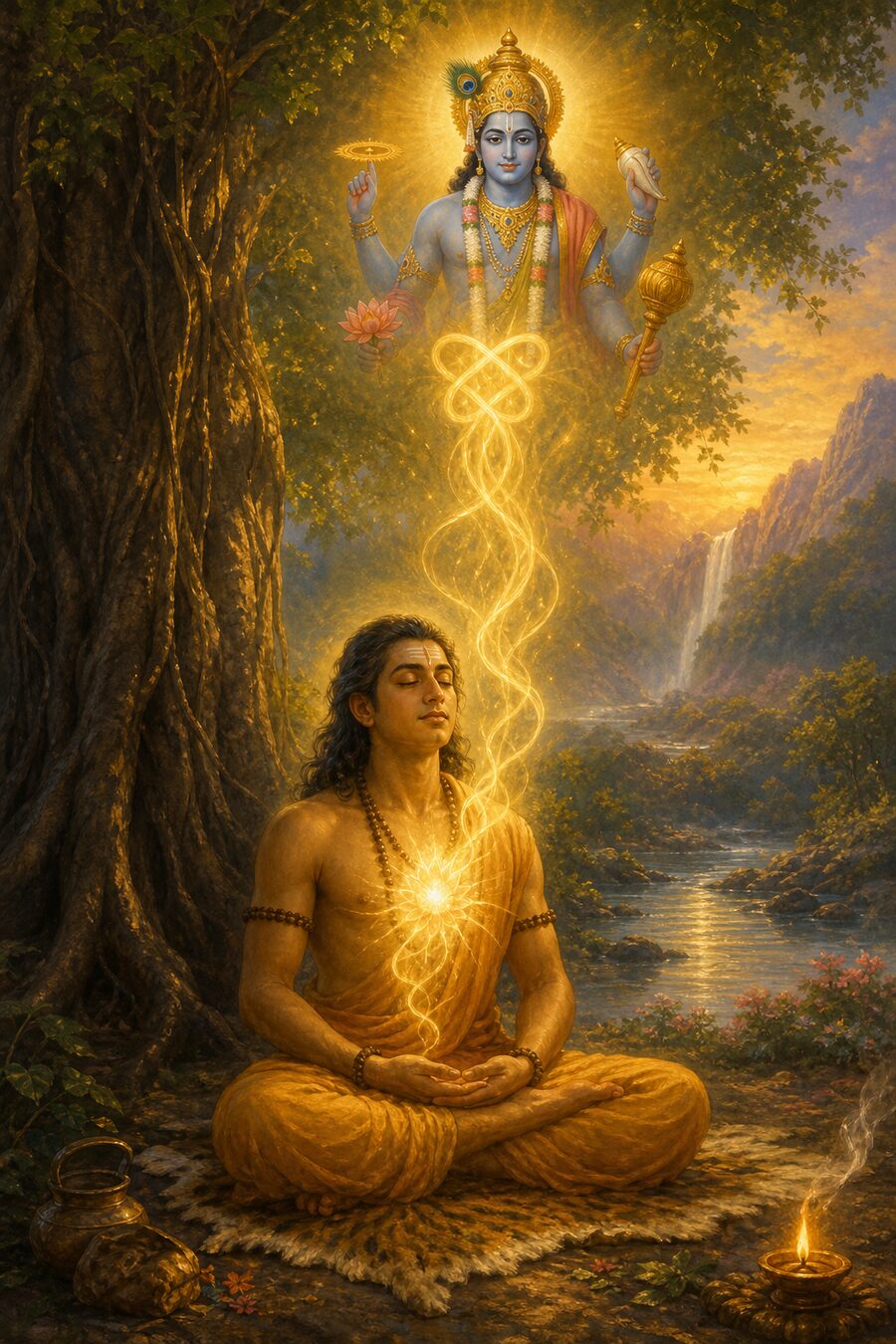
Three means run under the whole stretch and are named outright in verse 364: shravana, hearing the truth from the guru; manana, reflecting on it until the objections to it are answered; nididhyasana, dwelling on it without a break. Verse 341 takes the first as finished and prescribes samadhi for the monk who has heard. The verses on nirvikalpa samadhi, from 353 onward, describe what the third opens into.
At verse 353 the heart’s knot comes undone. The image is the Upanishads’ own: ignorance as a knot tied in the heart, hridaya-granthi, the binding that holds a person to the body and the mind he takes himself to be. Nirvikalpa samadhi, the absorption with no construction left in it, no ‘this’ set against ‘that’, is what dissolves the knot without remainder, and what the dissolving leaves is the sight of the Self without a second, advaita.
How this part runs
The stretch has three movements. Verses 329 to 340 give up samkalpa and shut out the outer: the fear in the least difference in 329 and 330, the thief and the honest man in 331 and 332, ‘I myself am this’ in 333 to 335, sleep and waking in 336 to 338, the Self as all in 339 and 340. Verses 341 to 352 give the method: samadhi prescribed in 341, the veiling and projecting powers in 342 and 343, seer parted from seen in 344 and 345, the fire of discernment in 346, the rope and the glowing iron in 347 to 349, the test of change and the definition of the Self in 350 to 352. Verses 353 to 366 are nirvikalpa samadhi: the heart’s knot in 353 and 354, the yati who lives as Brahman in 355 and 356, the adjuncts and the insect in 357 to 359, the gold in the crucible in 360 to 362, the fruit and the weights of the means in 363 to 365, the closing command in 366. The argument turns on verses 333, 344, 353 and 364.
329 · 330
Give up samkalpa: verse 329 opens on this command and gives the reason with it, that samkalpa, the mind’s willed imagining, its dwelling on objects, is the cause of every misfortune. The man whose kaivalya, his aloneness, his standing unmixed with anything, is his while he lives, is the same kevala when the body is gone; the body’s fall confers nothing he did not already have. The verse closes by citing the Yajus Shruti, and the line it has in mind, as Madhavananda’s note identifies it, is Taittiriya Upanishad 2.7: there is fear for one who sees even the least difference. Verse 330 presses the point onto the wise man himself. Whenever, at any time at all, the vipashchit, the man of discernment, sees so much as an atom of difference in the infinite Brahman, the thing he saw as separate, through pramada, turns into fear for him at once. The seeing has to be whole in each moment, however much has already been known, and the moment it admits a second, the second is dread.
331 · 332
A thief knows the act is forbidden and does it anyway, and verse 331 puts the man who identifies himself with the seen world in the thief’s place. Shruti, smriti and hundreds of reasonings have denied that world any claim to be him; he forms the notion ‘this is myself’ about it all the same, and so, like the doer of a forbidden act, he meets sorrow upon sorrow. Verse 332 brings in the other man, the one who is no thief. The one who is rata, given over, to satya-abhisandhana, to joining himself to the real, is freed and reaches the eternal greatness that is his own; the one given over to joining himself to the false perishes. This, the verse says, is seen in the case of the non-thief and the thief, and the case it means, as Madhavananda’s note points out, is the hot-axe ordeal of Chandogya Upanishad 6.16: the accused is made to grasp a heated axe, and the one who did the deed is burned by it while the one who did not is unharmed and let go. Abhisandhana, the direction in which a man keeps binding himself, decides what the axe does to him. Bound to the real, he comes through whole; bound to the false, he is destroyed.
333 · 334 · 335
The yati, the renunciant, is told in verse 333 what to let go and where to stand. He gives up asad-anusandhi, the dwelling of the mind on the unreal, which is the cause of bondage, and he stands in the vision of the Self alone, in the words svayam ayam aham asmi: I myself am this. The verse speaks in the first person singular; the this it points to is the Self present here, doing the seeing. It adds why the standing is bearable: steadfastness in Brahman, through one’s own experience of it, gives happiness, and it carries off the sorrow that is the effect of avidya and that until now was felt as real. Verse 334 states the law that runs under this. Dwelling on the outer increases its own fruit, and the fruit is durvasana, bad tendency, worse at each return. Knowing this through discernment, the yati leaves the outer aside and cultivates svatma-anusandhi, dwelling on his own Self, without a break. Verse 335 sets out the chain that results, link by link. When the outer is shut out, the mind has prasannata, the clearness of water once the stirring stops; in that clearness the supreme Self is seen; when it is well seen, the bondage of becoming is destroyed. Shutting out the outer is therefore the padavi, the road, to release.
336 · 337 · 338
Verse 336 asks a question that has no answer. A pandita who can tell the real from the unreal, who takes Shruti as his authority, who has seen the highest truth and wants release: would such a man, knowing what he knows, lean on the unreal, which brings on his own fall, as a child does? A child puts its hand back in the fire because its understanding does not hold; the seeker who leans on the world again after seeing through it does the same. Verse 337 removes the middle ground. For one attached to the body and what belongs to it there is no liberation, and the liberated man has no identification with the body at all; the two conditions exclude each other the way sleep and waking do, since the sleeper is not awake and the waking man is not dreaming, and each state rests on qualities the other lacks. ‘I am mostly free, with a little body-identity left over’ describes nothing that exists. Verse 338 then says who the free man is. He has known his own Self within and without, in the moving and the unmoving, and has seen it as their adhara, the support on which they rest; he has dropped every upadhi, every adjunct that made him seem limited; and he stands as the undivided, as the full Self.
339 · 340
Nothing frees from bondage more surely than sarvatma-bhava, the sense of oneself as the Self of all, and verse 339 says that no greater cause of release exists. It also says how the sense arises: when the seen is not grasped, drishya-agraha, and the not grasping comes through constant steadfastness in the real Self. The seen goes on appearing; what ends is the hand that closes on it. Verse 340 raises the objection a reader raises: the seen can hardly go ungrasped for a man who stands as the body, whose mind clings to the experience of outer things, and who keeps doing this and that for their sake. The verse answers by naming who can do it. It is to be accomplished with effort, yatnatah, by knowers of the truth who have renounced all duties, all actions and all objects, who are devoted to steadfastness in the eternal Self, and who want the bliss that does not end. The effort is laid down in the Self itself, and it comes to no one by drift.
341 · 342 · 343
For the bhikshu who has completed the work of hearing, krita-shravana-karman, verse 341 says what the Shruti prescribes next: samadhi, so that the Self may be realized as all, sarvatma-siddhi. The Shruti it quotes is the line shanto danta, ‘calm, controlled’, from Brihadaranyaka Upanishad 4.4.23, as Madhavananda’s note identifies it. Hearing has done its work; the verse hands the monk on to absorption. Verse 342 explains why absorption is needed and why it takes time. The ego, once its power has climbed high, arudha-shakti, cannot be destroyed in a stroke even by the learned; the exception is those who have become unmoving in the samadhi called nirvikalpa, the absorption in which no construction remains. The reason is given in the last line: vasanas, the tendencies, are the work of countless births. Verse 343 draws the inner mechanism. Avriti, the veiling power, covers the Self; by its force the vikshepa-shakti, the projecting power, yokes the person to the deluding notion ‘I’, aham-buddhi, and then throws him about with its qualities, which Madhavananda glosses as the ideas ‘I am the doer’ and the rest. Veil first, then the false I, then the tossing; verse 344 undoes the order from the top.
344 · 345 · 346
Verse 344 says the projecting power is hard to conquer while any of the veiling power remains, and then says how the veil goes. When drig and drishya, the seer and the seen, are separated as distinctly as milk from water, the covering over the Self perishes of its own nature. The victory is then certain and free of obstruction, pratibandha-shunya, provided one condition holds: that the mind no longer swings toward unreal objects, mrisha-arthe. Verse 345 names the instrument. Samyag-viveka, right discrimination, born of clear knowing, divides the true nature of seer from the true nature of seen and cuts the bond of delusion that maya has made; for the one freed of that bond there is no more samsriti, no further passing through births. Verse 346 changes the image from a cut to a burning. The fire of discerning the oneness of the higher and the lower, para and avara, Brahman and the jiva as Madhavananda reads them, burns the dense forest of avidya entire, and for the man who has arrived at advaita-bhava, the state of nonduality, no seed of further wandering is left to sprout.
347 · 348 · 349
Three things happen in order, and verse 347 gives the order. The removal of the veil, avarana-nivritti, comes from right seeing of the reality; from that follows the destruction of false knowledge, mithya-jnana-vinasha; and from that, the end of the sorrow that projection had produced. Verse 348 shows all three in one familiar case. When the real nature of the rope is fully known, the covering that hid it is gone, the snake that was known in its place is destroyed, and the fear the snake caused stops: the three are seen there, in one instant of recognition. The wise man, the verse concludes, must therefore know the real nature of things, vastu-satattva, if his bonds are to break. Verse 349 then explains how the intellect comes to play knower at all. As iron, through contact with fire, glows and seems to burn, the buddhi, through the presence of Sat, the real, unfolds as matradi, as knower and known; Madhavananda’s note records that the word can also be split to mean the sparks the iron throws, and in either reading the glow belongs to the fire. The pair the intellect produces is false, and the verse points to where this is already seen: in bhrama, delusion, in dream, and in manoratha, the mind’s own daydreaming, where a knower and a known appear and are nothing.
350 · 351 · 352
Whatever is otherwise from one moment to the next is unreal, and verse 350 applies the test to everything prakriti makes. Its modifications, from the ego at one end to the body at the other, and all objects with them, change at every instant, and by that change they are shown to be asat; the Self is never otherwise, at any time. Verse 351 then says what the Self is, in a single sentence the reader can take one word at a time. The supreme Self is eternal; it is nondual, with no second anywhere; it is undivided, one unbroken whole; its one nature is awareness; it is the witness of the intellect and of all that follows the intellect; it is distinct from the real and the unreal; it is the lakshita-artha, the implied meaning, of the word and the notion ‘I’, what the word points to once its accidents are set aside, as Madhavananda’s note explains; it is pratyak, the inner; and it is a dense mass of eternal bliss. Verse 352 closes the movement by telling what the wise man does with this. He divides the real from the unreal; he ascertains the truth with the eye of his own knowing; he knows his own Self as undivided awareness. Freed from the three obstructions of verse 347, he becomes still of himself; the verse names no further step.
353 · 354
The heart’s knot, hridaya-granthi, is the Upanishads’ name for ignorance as it sits in a person, a binding tied in the heart, and verse 353 says when it goes. When the nondual Self is seen through samadhi that is avikalpa, free of every construction, the knot of ignorance dissolves without remainder, nihshesha. Verse 354 names what the knot was made of. The kalpana, the imagining, that runs ‘you, I, this’, tvam aham idam, arises from a defect of the intellect, buddhi-dosha, in the supreme Self, which is nondual and without any attribute that could divide it. Those three words frame every ordinary experience, a second person, a first, and a thing between them, and the verse traces the whole frame to a fault in the instrument. When the supreme Self shines forth in samadhi, every such construction, sarvo vikalpah, goes to its dissolution through the ascertainment of the truth of the reality. The seeing that undoes the knot is the seeing that empties the three words.
355 · 356
Verse 355 describes the yati at the end of the method, in four words and a practice. He is shanta, calm; danta, with the senses controlled; param uparata, wholly withdrawn from objects; kshanti-yukta, possessed of forbearance; and he practices samadhi always. Doing so he realizes, kalayati, his own being as the Self of all, sarvatma-bhava, and by that realization he burns away, completely, the constructions born of the darkness of ignorance. What is left is a man who lives happily in the form of Brahman, brahmakritya, without action and without wavering, nishkriya and nirvikalpa. Verse 356 draws the line between this man and the one who speaks like him. Those alone are freed from the snares of becoming, bhava-pasha, who, being collected in samadhi, have dissolved the outer world, the ear and the other senses, the mind, and their own ‘I’ into the Self that is awareness. The others, the paroksha-katha-abhidhayinah, are those who repeat talk of what they have only heard about, from books and from other mouths, as Madhavananda’s note says. The dissolving has yet to happen in them, and the verse counts only the dissolving.
357 · 358 · 359
Through the difference of its upadhis, its adjuncts, the Self itself seems to divide, and verse 357 says that when the adjunct is removed the Self is of itself kevala, alone and unmixed. Madhavananda’s note gives the standard picture: a rose set before a crystal makes the crystal look red, and with the rose taken away the crystal is clear again, having changed in nothing. From this the verse draws its instruction. The wise man should live always in akalpa-samadhi-nishtha, steadfastness in the samadhi without construction, which is nirvikalpa samadhi, for the dissolution of the adjuncts. Verse 358 gives the principle behind the means: a man attached to the real becomes the real through one-pointed devotion, ekanishtha. The kita, the insect, meditating on the bhramara, the large black bee, becomes fit to be a bhramara; Madhavananda records this as a popular belief, and the verse uses it as a plain picture of a mind becoming what it dwells on. Verse 359 completes the comparison on both sides. The insect, dropping its attachment to every other activity, meditates on the bee’s nature and reaches the bee’s being; just so the yogi, meditating on the truth of the supreme Self, comes to it through devotion to that alone.
360 · 361 · 362
The truth of the supreme Self is extremely subtle, verse 360 says, and gross vision cannot reach it; it is to be known by the arya, the noble, whose intellect is exceedingly pure, through samadhi of a mental mode that is exceedingly subtle. Verse 361 gives the purifying its image. Gold refined by putapaka, heating in the crucible, gives up its dross and comes to its own quality, its luster; the mind, by dhyana, meditation, gives up the dross of sattva, rajas and tamas and comes to the reality. The verse puts sattva among the dross with the other two, since even the clearest quality of the mind is still a quality of the mind. Verse 362 describes the moment the refining is done. When the mind, pakva, ripened by constant practice, merges in Brahman, samadhi is then savikalpa-varjita, free of the savikalpa stage in which constructions still stood, and of itself it gives the taste, rasa, of nondual bliss. Pakva is the verse’s own word: ripe, as a fruit is ripe when it lets go of the branch without being pulled.
363 · 364 · 365
Verse 363 lists what this samadhi does. The knot of all vasanas is destroyed; all karma comes to an end; and svarupa-visphurti, the shining forth of one’s own nature, takes place within and without, everywhere, always, and ayatnatah, without effort. Effort went into the discernment, the practice and the absorption itself; the shining forth that results asks for none, because what shines is a nature already there. Verse 364 then weighs the means against one another. Manana, reflection, is to be known as a hundred times shravana, hearing; nididhyasana, sustained contemplation, as a hundred thousand times reflection; and nirvikalpa samadhi as ananta, infinite. Verse 365 says why the top of the scale is where the truth is settled. By nirvikalpa samadhi the truth of Brahman is known clearly, sphutam, and surely, dhruvam, and never otherwise, for while the mind is moving, its knowledge gets mixed with other notions, pratyaya-antara, as a reflection in rippling water breaks at every ripple.
366
The closing command of verse 366 is addressed to the disciple and asks three things of him at once: that his senses be restrained, yatendriya; that his mind be calm, shanta-manas; and that he absorb himself, samadhatsva, in pratichi, the Self that faces inward, and do so nirantaram, without interruption. The command’s purpose follows. The darkness made by avidya that has no beginning is to be destroyed, vidhvamsaya, by sad-ekatva-vilokana, by seeing the oneness of Sat, of the one being. Darkness ends when light enters, and the verse rests the whole ending on one act of seeing, the sight toward which every verse from 329 has been moving.
What comes next
The next page, Part 13, gives the first steps of yoga, names vairagya and bodha, dispassion and insight, as the two wings that carry a man to the summit of liberation, and asks its refrain of the changeless and the formless: where could any difference be found in it.
One word recurs through these verses and carries their temper: svayam, of itself. The veil perishes of its own nature in verse 344; the wise man grows still of himself in 352; the Self, its adjunct gone, is alone of itself in 357; samadhi gives the taste of nondual bliss of itself in 362; one’s own nature shines forth without effort in 363. Effort belongs to the discernment and the practice. The result, each verse says, arrives on its own.