Vivekachudamani
Part 1 · The Rare Human Birth · Verses 1 to 13
Of all living beings, a human birth is the rarest, and whoever wins it and still does not turn toward his own liberation is named, in verse 4, the slayer of his own self. These thirteen verses carry a warning and an invitation in one breath: why liberation has to be sought at all, what will never produce it, and where certainty about the truth comes from.
First, a word
Vivekachudamani means the crest-jewel of viveka, and viveka is discrimination, the power to tell the eternal from the fleeting, the real from what only passes for it. The work is a complete treatise of Advaita Vedanta in 580 verses, held by tradition to be the composition of Adi Shankaracharya, and the name states its method: of all the means to freedom, the one worn at the crest is the act of telling one thing from another.
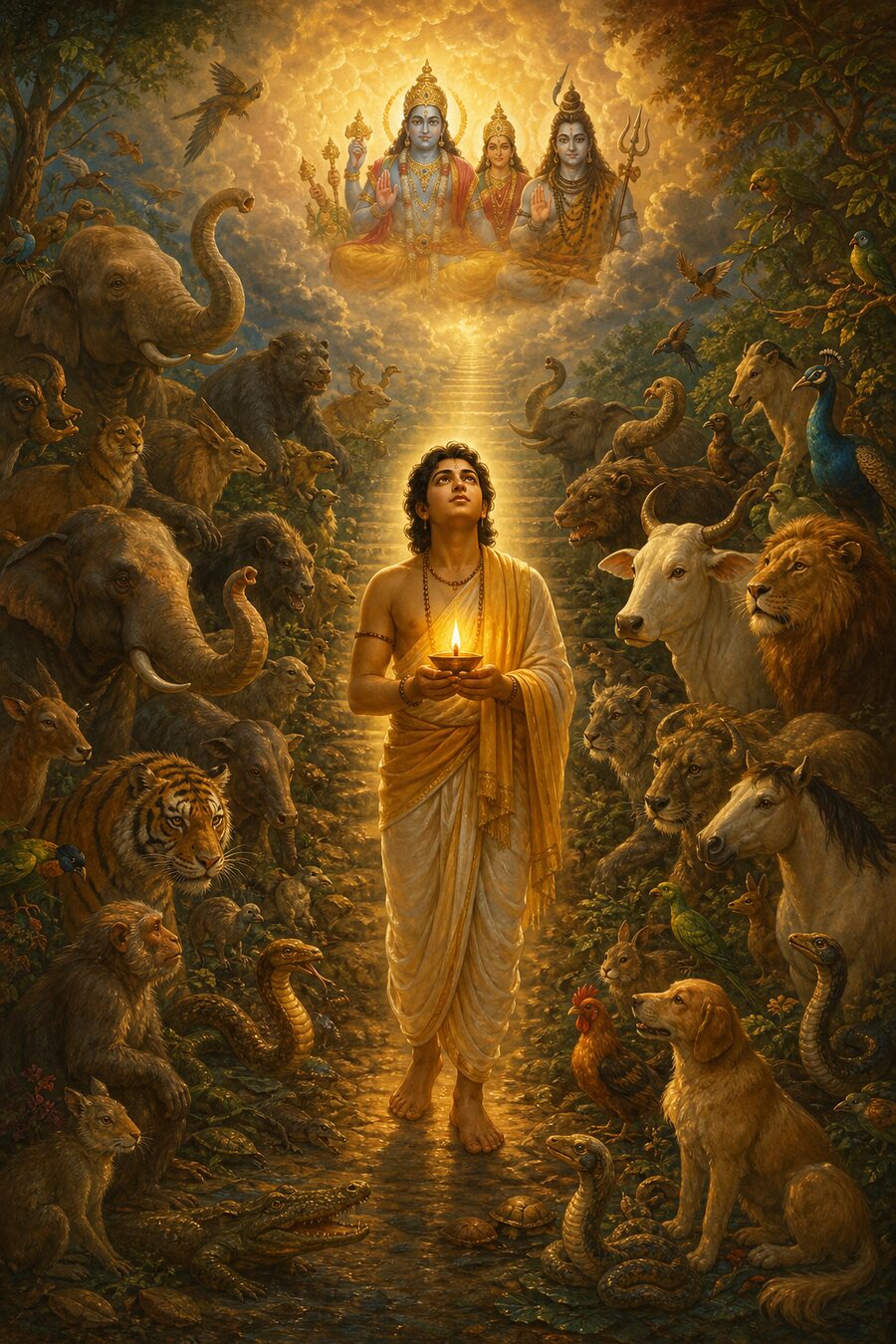
Almost all of it is a conversation between a guru and a disciple. The disciple arrives carrying an ache for liberation, and the guru leads him, verse after verse, from bondage to freedom. That conversation opens at verse 32, when the disciple comes and sits before his teacher. The thirteen verses before it stand outside the dialogue and do a prior job: they say why the search is worth a human life, what action can and cannot do for it, and where the certainty the disciple is about to ask for comes from.
Verse 1 is a bow. Shankara says: I bow to Govinda, who is within reach of the settled conclusions of all Vedanta and otherwise beyond reach, who is paramananda, supreme bliss, and who is the sadguru, the true teacher. Govinda is out of range of the eye, the ear and the reasoning mind, and the one range in which he can be reached is the conclusion the Upanishads arrive at and agree on; the work that follows will reach its object by that road. Tradition hears the name twice. Govinda is God, and Govinda was also the name of Shankara’s own teacher, Govinda Bhagavatpada, so the salutation goes to God and to the guru in a single word. The verse itself joins the two by calling one Govinda supreme bliss and true teacher in a single breath: the teacher who hands over the knowledge of Brahman and the Brahman he teaches are one.
1 · The invocation
A staircase of rarities follows in verse 2, each step rarer than the one below. Among all beings a human birth is hard to come by; harder than that is pumstva, which literally means manhood, which Madhavananda renders as a male body, and which carries the wider sense of capability, the strength to act on what one knows; rarer than that is viprata, birth as a Brahmin, which tradition reads as fitness for the path of knowledge; rarer still is devotion to the path of Vedic dharma; and above that stands learning. Beyond all of these the verse sets three more steps: the discrimination of Self from non-Self, the direct experience of one’s own being, and abiding as Brahman. The verse closes on the cost: liberation is won by no one without the merit of a hundred crore births. The staircase is drawn so that a reader can see where he stands. A human birth, the capacity to understand, and the wish to read these lines at all already place him on several of its rungs, and the verse’s point is the distance climbed and the distance left, with the three highest steps still ahead.
2 · The staircase of rarity
Verse 3 gathers the long staircase into three. Three things are rare, and all three come from the grace of God: being human; the longing for liberation, mumukshutva; and the shelter of a great soul, a mahapurusha, which Madhavananda renders as the protecting care of a perfected sage. The middle gift is the subtle one. A human birth comes to countless beings, and a teacher too can be found, yet the ache to be free is rare. Most minds want a better livelihood, better relationships, a little more pleasure, and the wish to be done with the whole round of coming and going seldom wakes. The verse counts that wish itself among the things grace gives. Whoever finds it stirring in himself has received something, and the receiving came before any effort of his own.
3 · The three rare things
The hard word of the thirteen arrives in verse 4: atmaha, the slayer of the self. Whoever has somehow, by whatever route, gained the rare human birth, and within it capability and shruti-paradarshana, a seeing to the far shore of the Veda, mastery of scripture, and still does not strive for his own liberation, is dull of understanding, and he is atmaha: he destroys himself by asad-graha, his grip on the unreal. The killing is done with no weapon. It is done by clinging, by holding on to what passes and letting the lasting go, and a life poured into what does not last is a slow suicide carried out one day at a time. The verse speaks hard and speaks out of compassion, the way a physician names the disease plainly so that the patient will wake up. The man with scripture mastered to its far shore is the one in view, because his learning has given him every means and he has left them unused.
4 · Slaying the self
Verse 5 asks the question the verse before it implied: who is a greater fool than the one who, having obtained the rare human body and capability in it, is careless about svartha, his own true end? The weight sits on svartha. In modern Indian usage the word has sunk to mean selfishness, even greed. Its sense here is sva-artha, one’s own real purpose, and Madhavananda’s note, his own supplement to the verse, glosses it as liberation. The verb is pramadyati, he is careless, he lets it slip, and that is where the blow lands. A person shows great cleverness in a thousand small matters, in money, in livelihood, in accounts and reckonings, and about the one thing that is genuinely his own he stays careless. The greatest cleverness and the greatest carelessness live side by side in the same person, and the verse names the second as the folly.
5 · Who is the greatest fool
Verse 6 counts off the familiar acts of religious life and sets them all on one side of a line. Let people recite the scriptures, sacrifice to the gods, perform rites, worship the deities; without atmaikya-bodha, the realization of the oneness of the Self, there is no liberation, not even in a hundred lifetimes of Brahma. Madhavananda’s note takes the span as an indefinite stretch of time and adds, as his own supplement, that one day of Brahma is 432 million human years; the verse itself gives only the figure of a hundred Brahmas. The reason the line holds is that all of these acts are doing, and liberation is knowing. Liberation is the ending of an error, the notion that I am other than Brahman, and an error ends when the truth is seen. Rites performed for a hundred Brahma-lifetimes add merit for a hundred Brahma-lifetimes and leave the error standing where it was.
6 · Action alone does not free you
For witness, verse 7 calls the shruti itself. There is no hope of immortality through wealth: so the revealed text declares, and from this, the verse says, it is plain that action is not the cause of liberation. The line is Yajnavalkya’s to his wife Maitreyi, in the Brihadaranyaka Upanishad, 2.4.2, and Madhavananda’s note names the place. The reasoning that joins wealth to action is the verse’s own step, and it is short. Wealth is what action earns. Sacrifice, worship, good works, all of these bear fruit, and the fruit is a wealth of one kind or another, earthly or heavenly. If wealth cannot buy immortality, then action cannot buy liberation, because action yields more of the same coin. Liberation belongs to another order of thing altogether.
7 · No immortality through wealth
Seven verses have said what fails to free a man: action, wealth, learning by itself. Verse 8 draws the consequence with its first word, therefore, and gives the prescription in full. The learned man should strive for liberation, and he should do it having renounced the craving for pleasure in outer objects, having duly approached a teacher who is good and great, and with his mind gathered on the truth that teacher sets before him. The renunciation comes first and is the renunciation of a craving, the itch for pleasure from things outside. The teacher is a deshika, one who shows the direction, and Madhavananda’s note on “duly” sends the reader to the Mundaka Upanishad, 1.2.12, for the prescribed way of approaching him, and points ahead to the verse early in Part 3 that describes such a teacher. The seeker who has approached him then does the third thing, which is to gather his mind, samahita, on what he has been taught. The three together are the one act of striving, and the whole Vivekachudamani ahead takes this shape: a guru, a disciple who has approached him, and a mind held on the teaching.
8 · So, to the shelter of a guru
Beside the teacher, verse 9 sets the seeker’s own hand. Let a man lift himself by himself, uddhared atmanatmanam, sunk as he is in the ocean of samsara, having attained the state of yogarudha, and by steadfastness in right vision, samyag-darshana. The first words are the Bhagavad Gita’s, 6.5, taken over almost unchanged, and yogarudha is the Gita’s word too, defined at 6.4 as the man attached neither to the objects of the senses nor to actions, who has given up every wish, a definition Madhavananda’s note supplies. Verses 8 and 9 are meant to be held together. A teacher is necessary, and a teacher cannot do the lifting in the disciple’s place; he shows the way, and the walking belongs to the one who walks. The verse’s grammar carries the point, since the self that is drowning and the self that lifts are the same self, and the lifting is done by a settled stance in seeing rightly.
9 · Lift yourself by yourself
Verse 10 says how far the striving reaches. For release from the bondage of becoming, let the wise and the steady, who have taken up atmabhyasa, the practice of the Self, renounce all actions and strive. The verse’s own word is sarva, all. Madhavananda’s note narrows it: by all works, he says, the verse means works done for gain, and leaves selfless work untouched. That reading fits the verse that follows, since verse 11 gives action a job to do, and the renunciation asked for here is the renunciation of the hope that action by itself will hand over liberation. Dhira, the steady one, is the word to carry. The steady one has stopped wavering; in him there is a stillness, and the practice of the Self asks for exactly that stillness, because the thing to be seen does not show itself to a mind in a hurry.
10 · Rising above action into the practice of the self
Verse 11 gives action its exact place. Action is for the purification of the mind, and the verse adds, in so many words, that it is in no way for the attainment of the Reality, vastu. The Reality is attained by vicara, inquiry, and in no way by crores of actions. The image that fits the verse is a soiled mirror. Action wipes the glass, and the wiping is necessary, since a mirror covered in grime shows nothing. Wiping and seeing are two acts. However long you wipe, nothing enters the mirror by the wiping; what the cloth removes is the film that hid an image already there. Action purifies the mind in just this way, and the truth is reached by direct examination, by going down with an honest mind into the question of what I am. The verse’s arithmetic is exact: a crore of actions does none of that work, and a single act of inquiry does it, because the two are different kinds of work.
11 · Action purifies the mind, it does not reveal the truth
The inquiry of verse 11 takes a shape in verse 12, the picture Advaita keeps returning to: the rope and the snake. By right inquiry the certainty of the rope’s true nature is gained, and that certainty destroys the fear and the grief of the great snake that delusion had raised. A rope lies on a dark path and is taken for a snake. The fear is real as fear, the heart pounds, the sweat breaks, and the snake was never there. The cure is of one kind. Light falls, the rope is seen as rope, and the fear ends with the error that produced it, because the thing feared had no being apart from the mistake. Nothing on the path changed. The verse states the single case of the rope; the fears that bind a man in samsara are built the same way, raised by taking one thing for another, and they end the same way, by seeing what is there.
12 · The rope and the snake
Verse 13 names where certainty comes from and where it does not. The settled knowledge of the truth is seen to arise through inquiry, vicara, upon hitokti, the word spoken for one’s good; and it arises from no bathing at holy fords, no giving of gifts, and no hundred rounds of pranayama. The word for the counsel is a compound of hita, benefit, and ukti, speech, the word of a well-wisher, and Madhavananda’s note fixes the speaker as the wise, the men of realization. The three acts named at the end are fine and holy acts, and the verse denies them a particular power. Certainty is understanding, and bathing, giving and breath control are doing. A problem in mathematics is solved by no amount of bathing or charity; it has to be understood. The verse returns to the inquiry of verse 11 and joins a second source to it, so that the certainty of who I am rests on two things together: one’s own true inquiry, and the sound word of someone who wishes one well and knows.
13 · Where certainty comes from
The thread ahead
Part 2 · The Fourfold Preparation, verses 14 to 31. Verse 13 has put certainty on inquiry and on the counsel of the wise, and the question that follows is who is ready to inquire. The eighteen verses ahead answer it with the sadhana-chatushtaya, the four means: viveka, the discernment of the lasting from the passing; vairagya, dispassion toward every enjoyment that passes; the six inner virtues that begin with shama, the mind coming to rest; and mumukshutva, the longing to be free. Each is defined in turn, and the part ends on a definition of bhakti as the constant seeking of one’s own true nature.