Vivekachudamani
Part 2 · The Fourfold Preparation · Verses 14 to 31
Every path has its preparation. Here Shankaracharya counts out four means: viveka, vairagya, the six inner virtues, and the longing for liberation. No magic key springs a hidden lock. This is honest groundwork, the readying of the soil until it can bear the inquiry into Brahman.
First, one thing
Part 1 made one thing clear: liberation is born of inquiry, and no amount of action can produce it. So the natural next question arises. Who is ready for that inquiry?
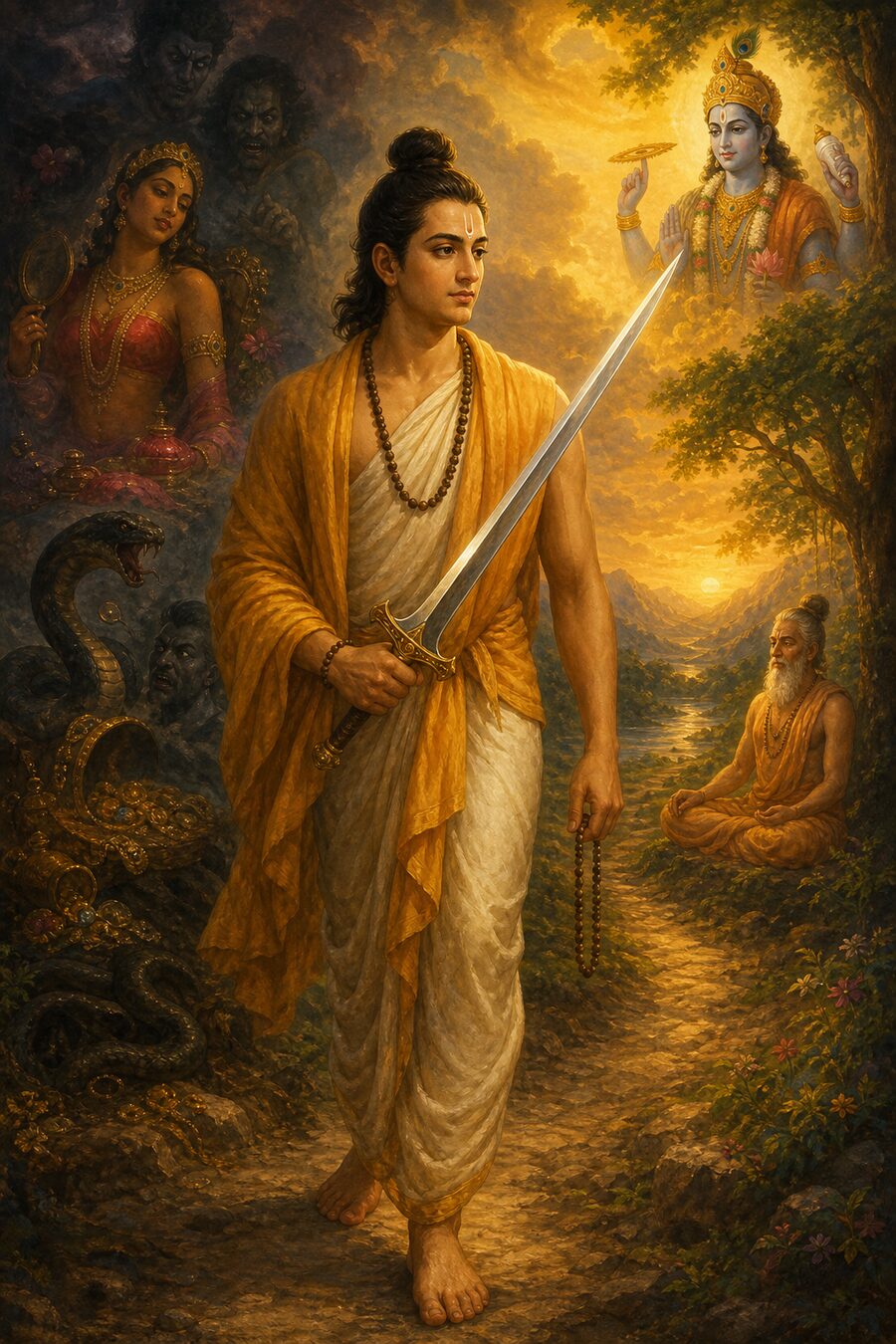
Shankaracharya answers with the sadhana-chatushtaya, the four means, the four preparations. You do not clear it like an exam to be let inside. It runs closer to a gardener’s counsel: go ahead and sow the seed, but ready the ground a little first, or the seed will simply lie there and never sprout.
The four means are these. Viveka, the discernment of the real from the counterfeit. Vairagya, the loosening of the grip on the counterfeit. The six inner virtues that begin with shama, a mind grown still and steady. And mumukshutva, the true longing to be free. Near the end of this part comes a lovely turn, a definition of bhakti that is rarely heard.
How this part runs
Shloka 19 counts all four means at once; that is your map. Then from 20 through 27 each means is defined in turn. Three pillars carry the weight: shloka 20 (Brahman is real, the world is illusory), shloka 26 (samadhana, and the coddling of the mind), and shloka 31 (the new definition of bhakti).
Shankaracharya begins with something plain and grounded. The fruit rests above all on one thing, and that is the seeker himself. The right place, the right time, the right surroundings all lend their help and are needed too, yet the true cause lies elsewhere. A good stove and a clean kitchen help the bread get made, though the bread finally rests on the one who makes it. Laying the whole burden on circumstance stops right here, because the real work is inward. And so, whoever has felt the wish to know the truth of the self should go to a guru, an ocean of compassion, the finest knower of Brahman, and inquire there. Two qualities of the guru are named here: one, that he has truly known; two, that compassion runs in him just as deeply. A man who turns cold and hard for all his learning is no guru. In a true guru, knowledge and compassion flow side by side.
14 · 15
अधिकारिणमाशास्ते फलसिद्धिर्विशेषतः ।
उपाया देशकालाद्याः सन्त्यस्मिन्सहकारिणः ॥ 14 ॥
अतो विचारः कर्तव्यो जिज्ञासोरात्मवस्तुनः ।
समासाद्य दयासिन्धुं गुरुं ब्रह्मविदुत्तमम् ॥ 15 ॥
Now the question of what the seeker should be like. Shankaracharya says: sharp of mind, discerning, and gifted with one particular strength, skilled at weighing both sides of a matter, the case for and the case against. Someone who will neither swallow a claim blindly nor reject it blindly. Advaita Vedanta asks for no blind faith; it calls the thinking, questioning person, on one condition alone, that the thinking be honest and look both ways. Then Shankaracharya names all four means in a single breath: the one who has viveka, who has vairagya, who holds the virtues that begin with shama, and who is a mumukshu, a seeker of release, such a person alone is held fit for the inquiry into Brahman. The whole weight sits on that one word, such. This sounds strict, though it holds no threat, only a plain truth: to learn to swim, you must step into the water. And these four are no ornament; the wise counted them out because firm steadfastness forms only when they are present, and in their absence nothing is accomplished. Walls can be raised on marshy ground, but they will not stand. These four are that solid ground on which the house of inquiry keeps standing.
16 · 17 · 18
मेधावी पुरुषो विद्वानूहापोहविचक्षणः ।
अधिकार्यात्मविद्यायामुक्तलक्षणलक्षितः ॥ 16 ॥
विवेकिनो विरक्तस्य शमादिगुणशालिनः ।
मुमुक्षोरेव हि ब्रह्मजिज्ञासायोग्यता मता ॥ 17 ॥
साधनान्यत्र चत्वारि कथितानि मनीषिभिः ।
येषु सत्स्वेव सन्निष्ठा यदभावे न सिध्यति ॥ 18 ॥
Now the map of all four opens, and the order matters. First the discernment of the eternal from the passing. Then dispassion toward the pleasures of both this world and the next. Then the wealth of the six that begin with shama. And at the last, the longing for release. Each descends from the one before it on its own. Until the real and the counterfeit stand apart in your sight, nothing else can happen. From viveka, vairagya arrives by itself; the grip on the counterfeit begins to loosen of its own accord. Let the grip loosen, and the mind begins to settle, and once the mind is settled, that final, clearest wish arises, the ache to be free. This is a staircase. And the very first stair, viveka, is bound up in the most famous line in all of Advaita. Brahman is real, the world is illusory: this firm conviction is itself named the discernment of the eternal from the passing. And here the confusion runs deepest. The world is illusory does not mean the world is simply absent, or that all of it is a dream. The true sense of illusory is this: whatever does not stand by its own strength, whatever keeps changing, whatever leans on something else. The ocean is real, eternal; the wave is passing, and not because the wave cannot be seen. The wave has no separate, lasting existence of its own; it cannot last a single moment without the ocean. The world is real, with a borrowed reality; it rests on Brahman. Viveka means seeing this one distinction clearly, again and again: what exists of itself, and what exists on loan.
19 · 20
आदौ नित्यानित्यवस्तुविवेकः परिगण्यते ।
इहामुत्रफलभोगविरागस्तदनन्तरम्
शमादिषट्कसम्पत्तिर्मुमुक्षुत्वमिति स्फुटम् ॥ 19 ॥
ब्रह्म सत्यं जगन्मिथ्येत्येवंरूपो विनिश्चयः ।
सोऽयं नित्यानित्यवस्तुविवेकः समुदाहृतः ॥ 20 ॥
After viveka comes the turn of vairagya, and one thing in its definition catches the eye: from the body all the way to Brahmaloka. From the smallest pleasure to the highest, most heavenly one, in every passing object of enjoyment, the wish to let go that awakens through the experience of seeing and hearing, that is vairagya. People often think vairagya means dropping worldly things to chase after better, spiritual rewards, heaven, merit, the higher worlds. Shankaracharya says those too are passing, those too are only enjoyments. Vairagya looks for no better bargain; it is the grip loosening on the whole business of bargaining, and it comes by watching closely and tasting for yourself, never by force. Then the six inner virtues begin, and the first is shama, a mind grown still. Seeing the flaws in sense-objects again and again, turning away from them, the mind holding steady on its own goal, that is shama. Shankaracharya does not bring it by force; he says, by seeing the flaws again and again. Snatch a toy from a child and he will cry, yet let him see for himself that the toy is broken and he lets it go on his own. Shama is the quiet that understanding brings. Force has no part in it. Then dama and uparati. Turning both kinds of senses, those of knowledge and those of action, back from their objects and seating them in their own places, that is dama; and the mind’s activity not leaning on outer supports is the higher uparati. Shama steadies the mind within, dama the senses without, and uparati runs deeper still: the mind needs no outer crutch, it can stand on its own feet.
21 · 22 · 23
तद्वैराग्यं जिहासा या दर्शनश्रवणादिभिः ।
देहादिब्रह्मपर्यन्ते ह्यनित्ये भोगवस्तुनि ॥ 21 ॥
विरज्य विषयव्राताद्दोषदृष्ट्या मुहुर्मुहुः ।
स्वलक्ष्ये नियतावस्था मनसः शम उच्यते ॥ 22 ॥
विषयेभ्यः परावर्त्य स्थापनं स्वस्वगोलके ।
उभयेषामिन्द्रियाणां स दमः परिकीर्तितः
बाह्यानालम्बनं वृत्तेरेषोपरतिरुत्तमा ॥ 23 ॥
The fourth virtue is titiksha, and it is easy to misread as simply gritting your teeth and enduring everything. Two words in Shankaracharya’s definition rescue it: without anxiety and without lament. Bearing all sorrows without striking back, without worry and without wailing, that is titiksha. Real titiksha is not endurance with anger pressed down inside, the kind that keeps boiling under the surface. It is the place where sorrow comes and is allowed to come, like an open palm: if the rain falls, let it fall, do not clench your fist. This is deep strength, and there is nothing weak in it. Then shraddha, which is often taken for blind belief. But Shankaracharya’s phrase is with the understanding of truth. Receiving the words of the shastra and the guru with that very understanding is shraddha, and by it the real thing is reached. A traveler sets out through an unknown city on the strength of its map. He trusts it for a plain reason: there is no arriving without walking by it, and at every turn along the way it proves true. Reverence for a sacred object has nothing to do with it. Questioning and shraddha walk together. And the sixth, the last virtue, is samadhana, where Shankaracharya adds a sharp point. Samadhana is keeping the intellect always fixed on pure Brahman. Coddling the mind is something else entirely. Petting the mind, meeting its every demand, keeping it in a counterfeit calm, that is not samadhana. Samadhana brings no ease, no comfortable rest. It is a steadiness, the intellect returning again and again, every time, to that one same truth.
24 · 25 · 26
सहनं सर्वदुःखानामप्रतीकारपूर्वकम् ।
चिन्ताविलापरहितं सा तितिक्षा निगद्यते ॥ 24 ॥
शास्त्रस्य गुरुवाक्यस्य सत्यबुद्ध्यवधारणम् ।
सा श्रद्धा कथिता सद्भिर्यया वस्तूपलभ्यते ॥ 25 ॥
सर्वदा स्थापनं बुद्धेः शुद्धे ब्रह्मणि सर्वदा ।
तत्समाधानमित्युक्तं न तु चित्तस्य लालनम् ॥ 26 ॥
Now the fourth and last means, mumukshuta. Shankaracharya calls bondage a thing shaped by ignorance, meaning this bondage is not real. The wish to be freed, through the awakening to one’s own true nature, from all the bonds shaped by ignorance, from the ego down to the body, that wish is mumukshuta. And so the manner of release is particular too: by knowing your own true nature. Bonds are not broken; they vanish once seen through, because they were never there, only an illusion. Mumukshuta means the true, burning wish for this one thing. But here Shankaracharya softens, and this is the most reassuring line in the whole part. If this longing for liberation is still weak, of a middling grade, it is no matter; through vairagya, through the virtues that begin with shama, and through the grace of the guru, it grows and begins to bear fruit. A small plant too grows once it gets water, sunlight, and a gardener’s care. Preparation does not finish before you begin; it grows as you walk, starting from wherever the seeker already stands.
27 · 28
अहंकारादिदेहान्तान् बन्धानज्ञानकल्पितान् ।
स्वस्वरूपावबोधेन मोक्तुमिच्छा मुमुक्षुता ॥ 27 ॥
मन्दमध्यमरूपापि वैराग्येण शमादिना ।
प्रसादेन गुरोः सेयं प्रवृद्धा सूयते फलम् ॥ 28 ॥
Now Shankaracharya makes a fine point. Two of the four means, vairagya and mumukshutva, are the driving force; the other six that begin with shama cannot move without them. Only in the one where these two run strong do the virtues that begin with shama become meaningful and fruitful. A person may keep practicing the discipline of the mind, yet if he does not truly want, deep down, to be free, that practice turns into just one more chore, an empty exercise. But let the longing be there inside, truly, fiercely, and that same practice comes alive. The longing is the driving force, the practice its wheels, and wheels alone carry you nowhere. The other side of this comes with a beautiful image: the desert mirage. Where these two are weak, the virtues that begin with shama stay mere show, like water in a desert. In a mirage the water does appear, it even shimmers, yet go close and there is nothing. Without a true longing inside, peace, restraint, and practice are all like that mirage: real from a distance, with nothing in them to slake a thirst. And at the end Shankaracharya gives a lovely, startling turn. In the whole store of the means to liberation, bhakti is the greatest, and what is bhakti but the seeking out of your own true nature, returning to it again and again, resting in it. The word bhakti brings to mind a temple, the lamp of aarti, a devotee full of love, tears, song. Shankaracharya does not deny any of that; he opens one more layer. If the Supreme is not apart from the seeker, if it is the seeker’s own deepest nature, then loving it, turning to it again and again, and resting in your own true nature stop being separate acts and become a single act. Here bhakti and jnana meet. And carrying this very spirit, the next part brings the disciple before the guru, where the real conversation begins.
29 · 30 · 31
वैराग्यं च मुमुक्षुत्वं तीव्रं यस्य तु विद्यते ।
तस्मिन्नेवार्थवन्तः स्युः फलवन्तः शमादयः ॥ 29 ॥
एतयोर्मन्दता यत्र विरक्तत्वमुमुक्षयोः ।
मरौ सलिलवत्तत्र शमादेर्भानमात्रता ॥ 30 ॥
मोक्षकारणसामग्र्यां भक्तिरेव गरीयसी ।
स्वस्वरूपानुसन्धानं भक्तिरित्यभिधीयते ॥ 31 ॥
The part ahead
The very next page, Part 3 · Refuge in the Guru. The preparation is done; now the disciple comes before the guru. What the guru should be, what the disciple should ask, and what bondage finally is, from here the text’s real conversation begins.
The point of shloka 26 leads exactly here, that samadhana is not the coddling of the mind. Recognizing the difference between petting the mind and samadhana is itself the beginning of viveka, and that same viveka sets the disciple at the door of Part 3.