Vivekachudamani
Part 13 · Yoga, Dispassion, and “Where Is Difference?” · Verses 367 to 407
Verses 367 to 407 carry the method of samadhi into finer work: the first door of yoga, the two wings of dispassion and knowing, the turn from thinking of the not-self to dwelling on the Self, and a refrain that sounds four times across verses 399 to 402, asking where difference could be in what is changeless, formless and without distinction.
First, one thing
Verses 367 to 407 move in four currents. The first is the opening door of yoga in verses 367 to 371: restraint of speech, taking nothing, a love of solitude, and the withdrawal of speech into mind, mind into intellect, intellect into its witness. The second, verses 372 to 378, gives dispassion and knowing as a bird’s two wings, with the chain that runs from dispassion to samadhi, from samadhi to awakening, from awakening to freedom, and cuts off desire for objects as death’s own work. The third, verses 379 to 397, lets go of thinking about the not-self and takes up dwelling on the Self, lifting one adjunct after another until what remains is undivided and full, like the great sky, and is seen to be Brahma, Vishnu, Indra and Shiva, the whole universe, with nothing apart from it.
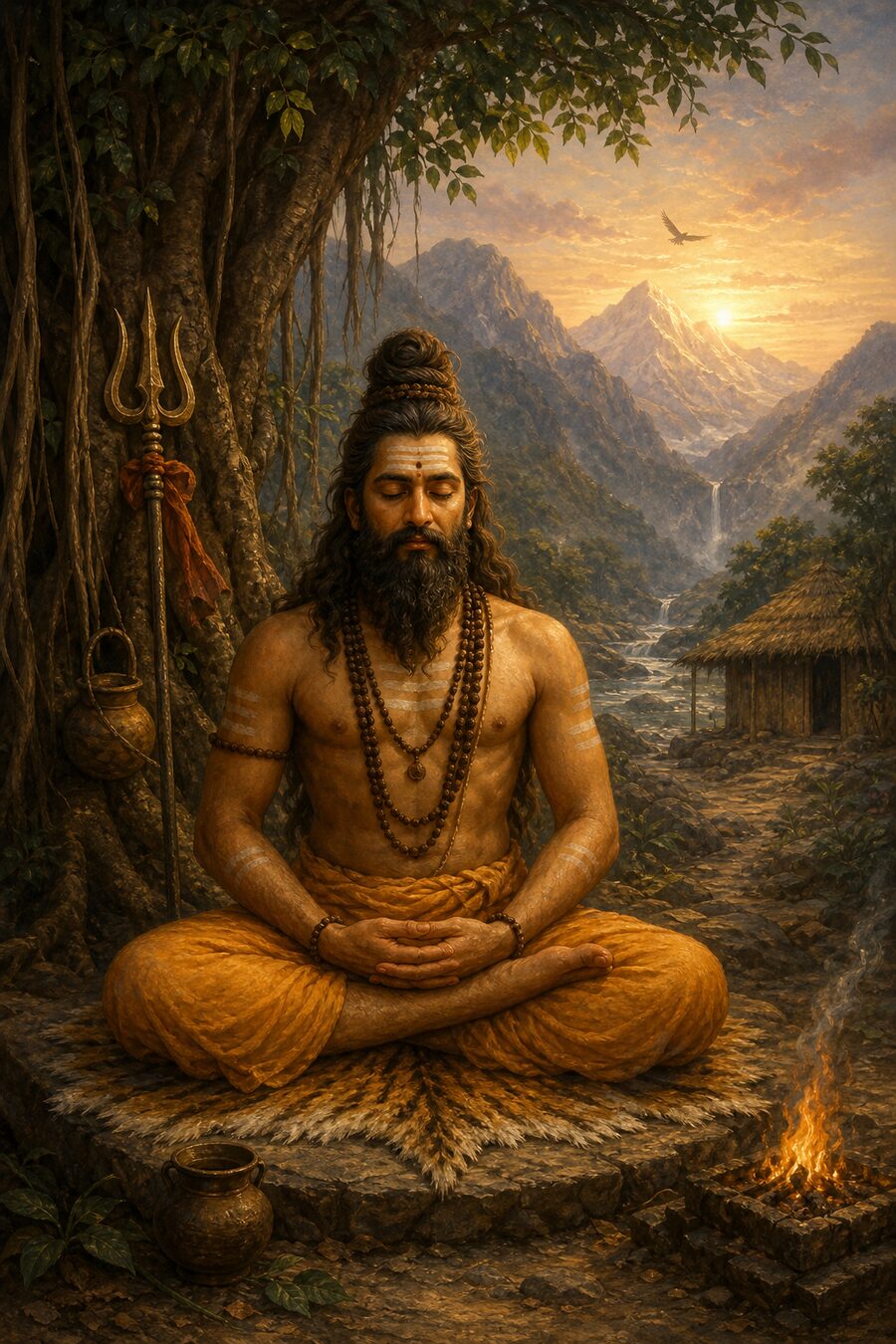
The fourth current is the refrain. Verses 399, 400 and 401 close on the same line, nirvikare nirakare nirvishese bhida kutah: in the changeless, the formless, the undifferentiated, where is difference. Verse 402 keeps the closing words, bhida kutah, and sets them in the nondual supreme reality, so the question sounds four times, each time from a new ground: the one reality in which the world is a construct, the reality empty of seer, seeing and seen, the ocean at the dissolution of the world, the light in which darkness has dissolved. The answer the verses leave standing each time is the same, nowhere. Verses 403 to 407 then give the proof of deep sleep, the snake that was never in the rope, and the mind as the root of every difference.
How this part runs
Verses 367 to 368 name the first door of yoga and the chain from solitude to the stilling of the mind. Verses 369 to 371 give the withdrawal of speech into mind, mind into intellect, intellect into the witness, and the law that the mind takes the shape of whatever it joins. Verses 372 to 373 rest renunciation within and without on dispassion. Verses 374 to 376 give the two wings, the chain of fruits, and the sovereignty that dispassion brings. Verses 377 to 378 cut off desire for objects and drink the bliss of Brahman. Verses 379 to 383 turn the mind from the not-self to the Self and bring it to stillness slowly. Verses 384 to 389 see the Self as the great sky, as the rope under the snake, as Brahma, Vishnu, Indra and Shiva, on every side. Verses 390 to 394 give water and its shapes, clay and its pots, the Chandogya’s “nothing else”, and the verdict that the jiva and the world are Brahman. Verses 395 to 397 lift the hope of the “I” out of the gross and subtle bodies and set the corpse-shaped body beside the Self in the form of Shiva. Verses 398 to 402 sound the refrain. Verses 403 to 407 close on deep sleep, the three times, and the mind as the root of difference.
367 · 368
The first door of yoga, verse 367 says, opens on five restraints: holding speech in check, taking nothing, so that gifts and possessions are refused, freedom from expectation, freedom from effort toward gain, and a constant love of solitude. Each of the five withdraws an outward reach, so the energy that went out through talk, acquisition, hope and busyness has nowhere left to go except inward. Verse 368 threads them into a single chain of causes. Living in solitude is the cause of the senses’ withdrawal; sense-control, dama, is the instrument by which the mind is restrained; through calm, shama, the lingering tendency of the ego dissolves; and from that dissolving the yogi comes to a taste of the bliss of Brahman that nothing shakes. The verse draws its conclusion in one line: the sage’s constant effort, the task that never lapses, is chitta-nirodha, the restraining of the mind.
369 · 370 · 371
Verse 369 gives the restraining of the mind as four steps, and the steps are an echo of the Katha Upanishad (1.3.13), as Madhavananda’s note observes. Restrain speech within the mind; restrain the mind within the intellect; restrain the intellect within its witness, the Self that watches the intellect’s movements; and dissolve even that witness in the full Self, where no construction remains, and rest in supreme peace. Each faculty grows quiet inside the one above it, from the gross to the fine, until nothing is left moving. Verse 370 states the law that makes the climb necessary: with whichever adjunct the mind’s movement joins, body, breath, senses, mind or intellect, the yogi takes on the condition of that adjunct. Joined to the body he says “I am the body”; joined to the breath, “I am hungry”; joined to the mind, “I am sad.” The same mind each time, a new identity each time. Verse 371 names what comes when that joining ceases: the sage finds complete withdrawal from everything, finds it with ease, and a flood of the experience of everlasting bliss rises and keeps rising.
372 · 373
Renunciation has two layers, verse 372 says, and both are fit only for the dispassionate. Outer renunciation gives up the sense-objects; inner renunciation gives up the hold of “I” and “mine”; and the dispassionate man gives up attachment within and without from one motive, the longing for freedom, with no forcing in it. Verse 373 states the condition more exactly. Outer attachment shows itself in sense-objects and is the one people see and try to drop; inner attachment, to the ego and the faculties that follow it, stays hidden and is the harder of the two to release. The one who can give up both is the dispassionate man who stands grounded in Brahman, for dispassion loosens the hold and steadiness in Brahman gives the loosened hand somewhere to rest. Verse 373 asks for both at once: without dispassion the hold never loosens, and without a ground in Brahman the hand closes again on the next object.
374 · 375 · 376
Verse 374 gives dispassion, vairagya, and knowing, bodha, as a man’s two wings, as a bird has two, and tells the discerning disciple that neither wing alone carries anyone up to the creeper of liberation; the creeper grows at the top of a mansion, out of reach from the ground, and both wings have to be working together to reach it. Verse 375 lays the chain of causes, one fruit growing from the one before: samadhi comes to the one whose dispassion is complete; firm awakening comes to the one in samadhi; release from bondage comes to the one who has awakened to the truth; and the experience of eternal joy comes to the one released. Verse 376 is the guru speaking in his own person: for the man who has his self in hand he sees no greater source of joy than dispassion, and when dispassion is joined with a still purer knowledge of the Self it yields the sovereignty of self-rule, svarajya-samrajya, an empire with no one to dispute it. Dispassion is the door to the maiden of everlasting liberation, and so, for your own good, keep yourself free of craving toward everything, everywhere, and keep your wisdom always on the Self.
377 · 378
Verse 377 is a string of commands. Cut off desire for sense-objects, which are like poison, for that desire is itself death’s work; the verse says eshaiva mrityoh kritih, this desire itself is what death does, and Madhavananda renders it as the image of death. Give up pride in caste, family and stage of life; fling actions far off; give up the notion of self in the body and the rest, which have no being of their own; and fix your wisdom on the Self. The verse closes by telling the disciple what he is: you are the seer, you are beyond the mind, and in truth you are the supreme Brahman without a second. The sentence states what already stands. Verse 378 gives the sitting itself. Fix the mind firmly on Brahman as the target; settle the outer senses in their own places, so that they stop running outward; hold the body still and take no thought for its upkeep; come to the oneness of Brahman and Self and be of one substance with it, tanmayata; and with an unbroken flow, without pause, drink joyfully the bliss of Brahman within yourself. The verse ends on a question that carries its own answer: of what use are other things, which are empty.
379 · 380 · 381
Verse 379 turns the direction of thought. Thinking of the not-self is foul and the cause of sorrow; give it up, and think of the Self, which is bliss itself and the cause of liberation. The mind is always thinking of something, and the verse changes what it thinks about: the world, the body, other people and their doings on one side, and on the other the Self whose nature is bliss. Verse 380 says where that Self is found. It is self-luminous, the witness of everything, and it shines without pause in the sheath of knowing, the vijnana-kosha, the intellect, which is its seat. Make it your target, as the one thing distinct from the unreal, and realize it as yourself through an unbroken mental movement. Verse 381 names the quality of that movement: unbroken, empty of every other notion, and clear. Keeping the Self in view by such a movement, ullekhayan, dwelling on it so that it never leaves the field of attention, one comes to know it distinctly as one’s own nature.
382 · 383
Verse 382 asks for two movements made together: firm up the sense of self in the Self, and give it up in the ego and all that follows the ego. Toward the ego and the rest, stay indifferent, as toward a pot or some such trifling thing; Madhavananda reads the word as a cracked jar. A pot stands in front of you, visible, raising neither attachment nor aversion; it is there, and that is all, and verse 382 asks the same regard toward your own ego, your own mind, the identity you have carried. Verse 383 then describes the settling: fix the purified inner instrument in its own nature, the witness that is pure knowing, and slowly, slowly, shanaih shanaih, bring it to stillness, and then see your own full Self. The repetition sets the pace. A vessel of water jostled toward stillness shakes longer; set down and left, it clears on its own, and the mind settles into the witness in the same way, stillness coming of itself, and the full Self coming into view once it has.
384 · 385 · 386
Verse 384 gives the great sky. Body, senses, breath, mind, ego: each is an adjunct, an upadhi, a limiting condition fashioned by one’s own ignorance, and the verse says to see the Self free of every one of them, undivided and full, like the great sky. Verse 385 works the image. The sky in a jar, in a pitcher, in a granary, in the eye of a needle, looks like many skies of many sizes, and freed of its hundred adjuncts it is one sky, never many; the pure supreme, freed of the ego and the rest, is one alone in the same way. The walls of the pot made the sky look small, and the adjuncts made the Self into a small “I”. Verse 386 extends the rule to the top of the scale: the adjuncts from Brahma, the creator, down to a clump of grass are wholly false; high and low, great and small, are the play of adjuncts, and the verse says to see your own full Self as abiding as the one Self.
387 · 388 · 389
Verse 387 returns to the rope and the snake with a general rule. Whatever is imagined in a thing through error is, on discrimination, that thing alone; when the error ends, the truth of the snake that was seen shines as the rope. The rope was the rope the whole time, and the snake had no being of its own to lose. The universe, the verse concludes, is the Self in the same way. Verse 388 says it without an image: the Self is Brahma, the Self is Vishnu, the Self is Indra, the Self is Shiva; the Self is all this universe; apart from the Self nothing whatever exists. Creator, sustainer, ruler of the gods and destroyer are forms of the one Self, and the disciple is that Self; the knowing that verse 394 will state as brahmaivaham, I am Brahman, carries no trace of ego, since the ego is one more form among the forms. Verse 389 lays the same Self across every direction: the Self within and the Self without, the Self in front and the Self behind, the Self to the south and the Self to the north, the Self above and the Self below. Each phrase places the one on another side, until no side is left for anything else.
390 · 391 · 392
Verse 390 draws from water. Wave, foam, whirlpool and bubble look like separate things, and in their nature all of them are water; in the same way all this, from the body up to the ego, is awareness alone, chit, of a single essence and pure. Verse 391 moves to clay. This whole world, everything speech and mind can reach, is Sat alone, pure being; for one who stands beyond the farthest bound of prakriti, nature with all its forms, nothing exists apart from Sat. Are pitcher, pot and jar known as anything apart from the clay they are made of? The deluded man, drunk on the wine of maya, is the one who says “you” and “I”. Verse 392 then names the authority. The Shruti, in the passage of the Chandogya Upanishad (7.24.1) that runs where one sees nothing else, hears nothing else, knows nothing else, declares the absence of duality through that heaping of verbs, seeing, hearing, knowing, each followed by nanyat, nothing else, and it piles them up for a purpose: to remove the false superimposition of difference. The habit of a second is old, a single hearing does not end it, and the Shruti’s repetition is measured to the habit.
393 · 394
Verse 393 piles up the marks of what you are. Like the sky, spotless, without construction, boundless, without a tremor, changeless, with nothing inside and nothing outside, with nothing other than itself, without a second: you yourself are that supreme Brahman, and the verse asks what else there could be to know. Each mark loosens one notion of “I am small”, and when the string of them has been heard to the end the search for a further object of knowledge ends there. Verse 394 closes the argument with a question of its own, what more is there to say, and answers in three short sentences. The jiva is Brahman itself; this whole spread-out world is Brahman; the Shruti teaches Brahman without a second. Those whose minds have awakened know brahmaivaham, I am Brahman; they have dropped what is outer, and they live as Brahman, their being an unbroken stream of awareness and bliss, and the verse calls this certain.
395 · 396 · 397
Verse 395 gives the order for pulling the “I” out of the bodies. First, and with force, destroy the hope that the I-notion raises in the sheath made of filth, the gross body, mala-maya-kosha, where the maya is the suffix meaning made of and carries no sense of illusion; then do the same in the subtle body, which is like air and whose hold gives way more easily. What remains when both hopes are gone is the one whose glory the Vedas sing, eternal, bliss embodied: know that as yourself and abide as Brahman. Verse 396 turns on one letter. As long as a man clings to the shava-akara, the corpse-shaped body, he is impure, he suffers at the hands of others, whom Madhavananda reads as enemies, and he is the dwelling of birth, death and disease; when he knows the Self as pure, as shiva-akara, the auspicious form, unmoving, he is free of them all, and the verse adds that the Shruti says so too, Madhavananda pointing to the Chandogya’s words to Indra on the mortal body (8.12.1). Verse 397 gives the whole method as removal: lift off every apparent thing superimposed on the Self, and what stands is oneself, the supreme Brahman, full, without a second, free of action.
398 · 399
Verse 398 returns to samadhi. When the movement of the mind is absorbed in the supreme Self, Brahman, in which no construction exists, no construction is seen at all, no “this” set against “that”; whatever construction is still spoken of remains as mere talk, prajalpa. Verse 399 opens the refrain. The construction “the world”, a vikalpa, a thing built up by the mind, is in the one reality like the unreal; and in the changeless, in the formless, in that which has no distinction within it, nirvikare nirakare nirvishese, the verse asks bhida kutah, where is difference. The ground is one and holds no mark by which one part could differ from another, so difference has nowhere to stand. The living being keeps building it anyway, and the next three verses put the same question from three further grounds.
400 · 401 · 402
Verse 400 takes the refrain into the structure of experience. Seer, seeing and seen, the three that every act of knowing seems to need, are empty in the one reality; where no “I” stands apart from its seeing and no “that” stands apart from both, the verse asks again, in the changeless, the formless, the undifferentiated, where is difference. Verse 401 gives the kalparnava, the ocean at the dissolution of a world-age, when the worlds have gone back into water: a single sea with no shore, no mountain, no island, water on every side and full to the brim, and the one reality is full in that way, utterly, with no gap for difference to sit in. Verse 402 ends the refrain with light. Where the cause of delusion has dissolved like darkness in light, in the nondual supreme reality, which has no distinction within it, where is difference. Darkness dissolves when light comes, and the cause of delusion dissolves when the supreme reality is known; what remains is the one without a second.
403 · 404
Verse 403 brings the argument down to an everyday proof. It asks how talk of difference could dwell in the supreme reality, which is one Self, and who has ever seen difference in deep sleep, which is happiness alone. Every night the living being rests in deep sleep with no second thing present, no object, no other, only happiness, and no one who has slept reports a difference seen there. Nonduality is in this sense already known to everyone; the work is to hold while awake and knowing what deep sleep gives without knowing. Verse 404 states the strong claim: in the supreme reality, Brahman, Sat, which has no construction in it, there is no world, and there was none at any time, for in none of the three times, past, present or future, is the snake in the rope, and in none of them is a drop of water in the mirage. The verse ties this to the knowledge of the highest truth, and Madhavananda reads the phrase as holding even before realization: the world’s absence from Brahman does not wait on anyone’s knowing it. What was seen lasted exactly as long as the delusion did.
405 · 406 · 407
Verse 405 rests the whole matter on two witnesses. The Shruti says directly that this duality is maya alone and that nonduality is the highest truth; and deep sleep gives the experience of it, every night, to everyone. Scripture and ordinary experience say the same thing, and the experience goes unrecognized only because it is never examined. Verse 406 gives the ground the refrain has been resting on: the wise have seen that what is superimposed is one with its ground, as the snake seen in the rope is the rope, and that the construction lives on delusion alone; it is born when the delusion is born, and when the delusion ends it has nothing left to live on. Verse 407 names where difference comes from. The construction has its root in the mind, and where there is no mind there is none of it; therefore the last instruction is to absorb the mind, to set it in samadhi, in the supreme Self that is your inmost form. The work is placed where the difference is made, in the mind, and when the mind is dissolved there, every difference goes with it.
What comes after the reading
The next page, Part 14, opens on a line that returns three times in verses 408 to 410, hridi kalayati vidvan, the wise man realizes the whole Brahman in the heart; it then gives the chain of fruits in verses 419 to 420, from dispassion to knowing to cessation to peace, and from verse 428 to the end of the part the marks of the jivanmukta, the one free while living.
Verse 374 calls dispassion and knowing the two wings. Before reading on, weigh which of the two is weaker in you today, and give that wing a little of the day’s strength.