Vivekachudamani
Part 9 · Tat Tvam Asi, You Are That · Verses 241 to 266
Two words stand far apart at the start of these verses: a you that feels small, bound to one body and one life, and a That which the verses call Brahman, the cause of everything and present in all of it. Verses 241 to 266 take the saying tat tvam asi, you are That, and show what in each word has to be set aside before the two can be seen to name one thing. Ten verses then say the same sentence ten ways, and the last three say what to do with it.
First, one thing
The saying these verses open is tat tvam asi, you are That. It is one of the four great sayings of the Upanishads, the mahavakyas, and it comes from the sixth chapter of the Chandogya Upanishad, where the sage Uddalaka speaks it to his son Shvetaketu nine times. Every discrimination made so far, the Self sorted from the body, from the sheaths and from the mind, has been clearing the ground for this one sentence.
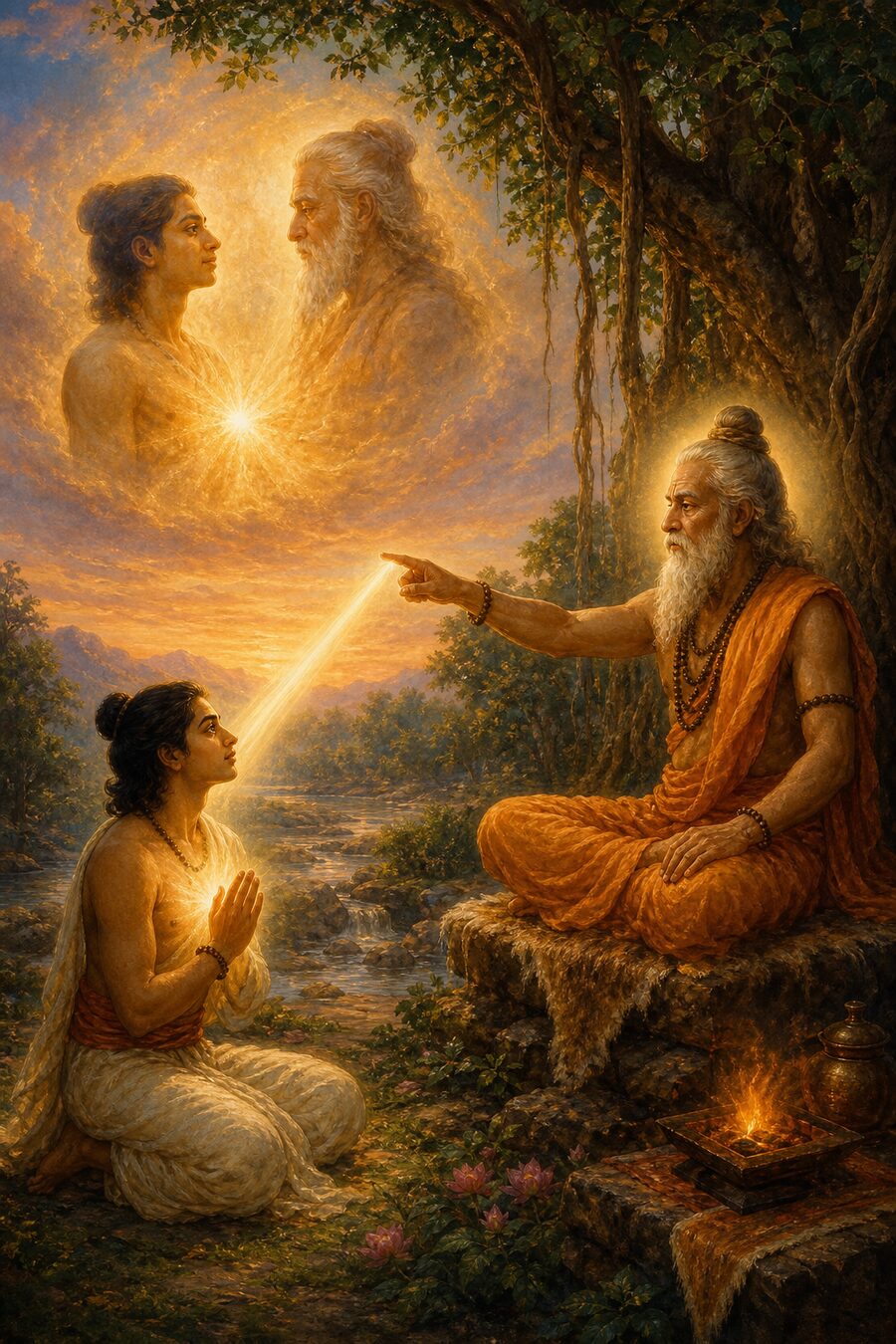
The difficulty is in the words themselves. Tat, That, means Brahman: boundless, the cause of all, pervading everything. Tvam, you, means the jiva, the self in one body, which appears limited and bound. Taken at face value the two words contradict each other, and the disciple who has followed the argument this far has earned the right to ask what the sentence can mean.
Verses 241 to 253 answer by reasoning out how the two words meet, and the answer rests on one distinction, between the literal sense of a word and its implied sense. Verses 254 to 263 then say what remains once the literal sense is set aside: ten verses, each ending on the same refrain, brahma tat tvam asi bhavaya atmani, that Brahman you are, contemplate it within yourself, and each naming a new aspect of Brahman before the refrain comes round. Verses 264 to 266 turn the saying into a practice.
How this part runs
Verse 241 names the two words and says what Shruti teaches through them. Verse 242 states the difficulty, four pairs from the firefly to the sun, and locates the identity in the implied sense. Verses 243 and 244 trace the opposition to the adjuncts, maya and the five sheaths, and strip them away with the king and the soldier. Verses 245 and 246 give the method: denial backed by Shruti, then knowledge of the one being that remains. Verses 247 and 248 say how the implied sense is reached, by the implication that keeps part and drops part, with Devadatta as the example. Verses 249 and 250 widen the ground to a hundred great sayings and give the instruction, I am Brahman. Verses 251 to 253 argue the same conclusion from clay and the pot and from the dream. Verses 254 to 263 are the ten refrain verses. Verse 264 asks for contemplation by the established arguments, and verses 265 and 266 give the king in the army and the cave. The argument turns on verses 242, 248, and the refrain.
Verse 241 is the first half of a sentence that verse 242 completes, and it opens on the two words. Tat denotes Brahman and tvam denotes the atman, the self within, and the verse says that Shruti, through tat tvam asi, establishes again and again, muhuh, the complete oneness of the two. Two conditions sit inside the sentence. The words are taken shodhitayoh, purified: each carries associations it must be cleared of before the oneness can be stated, and verses 243 and 244 name them. The teaching is repeated, because the Upanishad says it nine times, and a sentence that must settle in the hearer gets said until it settles. If Shruti does establish the oneness in this way, the verse says, then a question follows about what kind of oneness it can be, and verse 242 answers it.
241 · Two words, tat and tvam
The second half of the sentence, verse 242, says what kind of identity Shruti teaches: an identity of the two words in their implied sense, lakshita, and in no way of their literal sense, vachya, because in the literal sense the two carry attributes opposed to each other at every point. Four pairs measure the gulf. A firefly and the sun; a servant and a king; the water in a well and the ocean; an atom and Mount Meru. Set tat beside tvam in the literal sense, the all-pervading cause of the world beside one bound creature, and the distance is of that order, and no stretching of the smaller term reaches the larger. The verse uses the firefly to show how far the literal senses stand apart; a reader who takes it to mean that the jiva’s light is a small share of the sun’s has made the jiva a portion of Brahman, which the whole argument denies. The identity holds in the implied sense, in what each word points to once its attributes are set aside, and that, as verse 249 states, is awareness alone. The awareness the small word points to and the awareness the great word points to are one awareness, since awareness has no size and admits no degree. The opposition belongs to the attributes, and verse 243 says where the attributes come from.
242 · The firefly and the sun
Where the opposition comes from is the question verse 243 answers. It is imagined through the adjuncts, upadhi-kalpita, and nothing about it is real, because the adjunct itself, the upadhi, the thing laid alongside that lends its look to what it limits, is nothing real. The verse then names the two adjuncts. For Ishvara, the Lord, the adjunct is maya, the cause of mahat and of all that proceeds from it, the whole descending order of creation. For the jiva, and here the verse says listen, as if the hearer must take what follows in with care, the adjunct is the five sheaths, the koshas from food to bliss, which are maya’s effects. The one adjunct is the cause and the other its products; Brahman under the first looks like a Lord, and awareness under the second looks like a bound creature. Verse 244 draws the conclusion. These two are the adjuncts of the Supreme and of the jiva, and when both are completely removed there is neither a Supreme Lord nor a jiva. The example is the king and the soldier. A kingdom marks the king and a shield marks the soldier; take the kingdom from the one and the shield from the other and there is neither soldier nor king. Madhavananda’s note finishes the thought: what is left in each case is a man, and in the same way, when omniscience and lordship are taken from Ishvara and the limits of knowledge and power from the jiva, what is left is Brahman, the substance of both. The removal leaves no void, because the marks were all that was removed, and the one who wore them stays.
243 · The opposition, only of the adjuncts
244 · The king and the soldier
Verse 245 calls Shruti as witness for the removal. In the passage that begins, now then the teaching, which Madhavananda’s note places in the Brihadaranyaka Upanishad at 2.3.6 and which goes on, neti neti, not this, not this, Shruti itself denies the duality imagined in Brahman. The denial falls on the imagined pair, Lord and creature, and leaves Brahman standing; neti neti is read wrongly when it is taken to deny Brahman along with the rest. The verse then states the obligation and the means together. The removal of the two adjuncts must be carried out, and the instrument that carries it out is bodha, understanding, supported by the authority of Shruti. The understanding does the removing, and Shruti’s word is what it leans on, so that the seeker neither takes the Upanishad on trust without seeing nor sees on his own without the Upanishad. A variant reading has reasoning in place of understanding, and the sense is close: reasoning backed by Shruti. Verse 246 gives the two steps in order. First the denial: this, and this, being imagined, is not real, like the snake seen in the rope and like a dream. Madhavananda takes the two thises as the gross universe and the subtle, and supplies the predicate, is the Self, in a parenthesis of his own. What the denial says of the seen is what verse 20 said of the world: it appears, it is lived in, it rests wholly on Brahman, it has no being of its own, and the knowledge of Brahman negates it as the knowledge of the rope negates the snake. Having set the seen aside in this way by sound reasoning, the second step follows: afterward, one should know the one being of the two, ekabhava, the single being of the Supreme and the jiva. The order is fixed, denial first and knowledge after, because the knowledge is of what the denial leaves.
245 · Shruti itself denies both
246 · Set aside the seen, then that one
Verse 247 says how the implied sense is reached. The two terms must be carefully marked out through lakshana, implication, the way a word points past its literal sense, in order to establish that they are one undivided essence, akhanda-ekarasa. Madhavananda names the two terms as Ishvara and jiva in a parenthesis of his own; the verse says only those two, the words the argument has been handling. His note sets out three kinds of implication. In the first the literal sense is given up whole, as when a village is said to stand in the Ganges and the hearer understands on its bank. In the second the literal sense is kept whole and something is supplied to complete it, as when the white is running and the hearer supplies the horse. The verse rules out both for the great saying, since giving up the whole literal sense leaves nothing to identify and keeping it whole keeps the contradiction, and it requires the third, bhaga-lakshana, implication by part, in which each term gives up part of its sense and keeps part, a middle way between the other two. Verse 248 gives the everyday case. This is that Devadatta: a man met years ago, young, in another town, is seen today, here, aged, and the sentence identifies the two by dropping the parts that contradict, which Madhavananda’s note specifies as the differences of time and place, while the person is recognized as one. Nobody reasons it out; the mind drops the contradictory part on its own. In the sentence tat tvam asi the same thing is done. The contradictory attributes on both sides are given up, those that came with maya on the side of That and those that came with the five sheaths on the side of you, and the identity is of what is left on each side.
247 · Neither drop it all, nor keep it all
248 · “This is that same Devadatta”
What the two sides have in common once the contradictory parts are gone is the subject of verse 249. Marking both as awareness alone and nothing else, chinmatrata, the wise recognize the undivided being of Sat, Brahman, and the atman. What tat points to under its adjunct and what tvam points to under its sheaths is awareness, and awareness does not come in two. The verse then widens the ground: by a hundred great sayings, and a hundred stands for the whole of them, the oneness of Brahman and the atman, an undivided being, is taught. Tat tvam asi is one of these. Aham brahmasmi, I am Brahman, prajnanam brahma, awareness is Brahman, and ayam atma brahma, this self is Brahman, are the other three counted with it as the four, and the point of the verse is that the Upanishads say one thing from many sides. Verse 250 turns from the sayings to the seeker. By such denials as it is not gross, asthulam, the Brihadaranyaka’s description at 3.8.8 that continues, not minute, ananu, and onward, the unreal is set aside, and what remains is self-established, like space, and beyond the reach of argument, apratarkya: every proof is seen by it, and nothing makes it, as nothing makes space. Minute is the verse’s word, and the choice matters, because verse 257 will set Brahman apart from the gross and the subtle, and a reader who takes ananu as subtle has the two descriptions tangled. Then the instruction, in two parts. Give up this mere appearance which you have taken to be yourself; and with a purified intellect know your own Self, undivided awareness, as I am Brahman. Madhavananda supplies the thing eliminated as the objective world, the not-Self, and the supplement is his; the verse’s own words are the unreal, and the appearance taken as oneself, the body and mind that have been standing in for the I. The guru says you are That, and the knowing asked for is in the first person, I am Brahman, because what is known is the seeker’s own self.
249 · A hundred great sayings, one truth
250 · “I am Brahman”, know it with a clear mind
Verse 251 reaches the saying by the way of the cause. Every product of clay, the pot and the rest, is always clay and nothing besides; the pot is a name and a shape that clay has taken, and whatever is true of the pot’s substance is true of clay. In the same way all this, born of Sat, pure being, has Sat for its nature and is Sat alone. Madhavananda adds in a parenthesis that the jar is in reality clay, and the parenthesis is his. Since nothing whatever exists beyond Sat, Sat is the truth and Sat is itself the Self; therefore you are That. The conclusion is earned by three steps the verse lays in order, all is Sat, Sat is the Self, so you are That, and the verse closes by saying what That is with four qualifiers: tranquil, spotless, nondual, supreme. The four describe the you of the saying as much as the That, since the two are one, and the vastness that the literal sense made fearful is, in the implied sense, a stillness with nothing in it to fear.
251 · Everything is only Sat, you are That
Verse 252 reaches the same conclusion by the way of denial, and its closing line is word for word the closing line of verse 251. In sleep a whole set is called up, place, time, objects, and a knower who takes them in, and all of it is mithya: lived through, resting on nothing of its own, and gone when waking knowledge comes. So, the verse says, is the world experienced here in waking, and it gives the reason, that the waking world is the effect of one’s own ignorance, svajnana-karya, the product of the same not-knowing that puts the snake in the rope. The reason is the hinge of the verse, since without it the dream would be only a comparison; with it, the waking world and the dream world have the same cause and so the same standing. Because, then, this body, the organs, the prana and the sense of I are in the same way unreal, you are That, the tranquil, spotless, nondual, supreme Brahman. The limited I of waking is the dream’s knower seen in daylight, and when it is set aside what remains is the you the saying means. Verse 253 states the rule the dream has been illustrating. Whatever is imagined in a thing through error is, once the thing is discriminated, that thing alone and in no way different from it; the snake, discriminated, is rope and nothing besides. Then the one question the verse itself asks. The varied dream world vanished in the dream; on waking, is it seen anywhere as something distinct from oneself? It went nowhere, because it was never other than the dreamer, and the world of waking stands to Brahman as the dream stood to him. What knowledge removes is the error; the imagined is seen as the substrate it was imagined in, and that substrate is Brahman, which is the self.
252 · The waking world too is like a dream, you are That
253 · Where the dream world goes on waking
The ten verses that end on one refrain begin at verse 254, and the refrain is brahma tat tvam asi bhavaya atmani: that Brahman you are, contemplate it within yourself. Each of the ten fills its first three lines with a description of Brahman, and the description is a list of what the you must be seen without. The first list begins where identity sits heaviest. Brahman is far beyond caste, conduct, family and lineage; Madhavananda renders the second of these, niti, as creed, and conduct, the rule of life one is bound to, is the plainer sense of the word. It is free of name and form, free of merit and fault, and it passes beyond place, time and objects, the three coordinates everything known sits in. That Brahman you are. The verb of the refrain is bhavaya, contemplate, make it present in the mind, and it is addressed to the hearer because the knowing asked for is one he must do himself; a sentence heard is a sentence, and a sentence contemplated until the mind takes its shape is knowledge. Verse 255 answers the fear that a Brahman stripped of every mark is a blank. It is supreme, beyond the range of all speech, and it is within the range of the eye of pure awareness, so that what no sentence reaches, pure awareness sees. It is pure; it is chid-ghana, a mass of awareness, dense with knowing and empty of nothing; it is beginningless. The disciple at verse 212 feared that an emptiness remained after the sheaths were removed, and the word chid-ghana is that answer carried into the refrain. That Brahman you are.
254 · That Brahman is you (1)
255 · That Brahman is you (2)
Verse 256 names six waves, urmi, that leave Brahman untouched, and Madhavananda’s note lists them: hunger and thirst, grief and delusion, decay and death. The six fall into pairs by what they beset, hunger and thirst the prana, grief and delusion the mind, decay and death the body, and together they are the whole weather a jiva lives in. Brahman never joins them. It is contemplated in the yogi’s heart, the one place the verse gives it, the contemplating mind turned inward, which is the bhavaya of the refrain. It is not grasped by the organs, since the organs grasp objects and it is the awareness in which objects appear; it is unknowable by the intellect, which knows things by setting them before itself; and it is faultless, with nothing in it to object to. That Brahman you are. Verse 257 gives the ground of the world and then sets Brahman off from it. It is the support of the world and of all the world’s divisions, which are imagined through delusion; the universe rests on it as the snake rests on the rope. It is its own support, resting on nothing further, where every other thing rests on something, the pot on clay, the wave on water, the dream on the dreamer. It is distinct from the gross and the subtle, which is how Madhavananda reads the verse’s sat and asat. It is partless, nishkala, so that no piece of it could be the jiva and another piece the Lord. It is without any likeness, nirupamana, which is why every comparison offered for it, space, the sun, the ocean, breaks down at some point: a comparison needs two things, and Brahman has no second. That Brahman you are.
256 · That Brahman is you (3)
257 · That Brahman is you (4)
Verse 258 lists six changes and frees Brahman of all of them: birth, growth, alteration, decline, disease and death, the sequence every embodied thing passes through, which is why every embodied thing is impermanent. Brahman is imperishable, and the six happen to the body in its sight. The verse then gives Brahman a role, and the role has three parts, packed into one compound: it is the cause of the projection of the universe, of its sustaining, and of its dissolution. The still witness within is also that from which the world comes, in which it stays, and into which it goes, and a reader who keeps the witness and drops the cause has half the verse. That Brahman you are. Verse 259 describes the stillness. In it all difference has set, as stars set at dawn: I and you, this and that, mine and another’s are the lines every dealing runs on, and in Brahman the lines are gone. Its defining nature never departs, anapasta-lakshana, so that the going of difference takes nothing from it; Madhavananda renders the phrase as whose essence is never non-existent. It is still as a mass of water without a wave, a whole sea with no ripple on it. It is nitya-mukta, ever free: liberation is the recognition of a freedom that was the case the whole time, bondage was the imagined thing, and the freedom the seeker reaches is one he had, which is why the refrain can say you are, in the present. It is of undivided form, one whole, with no portion given to a jiva here and a Lord there. That Brahman you are.
258 · That Brahman is you (5)
259 · That Brahman is you (6)
Cause is the subject of verse 260. Brahman is one only, and it is the cause of the many; it is the cause that sets aside every other cause, and it is itself without a cause. The intellect asks of each thing what it came from, and of that what it came from, and the asking has no natural stop; verse 260 is where it stops, at a cause behind which there is nothing to ask after. The verse goes further. Brahman is distinct from cause and effect alike, and Madhavananda reads the pair as maya and its effect, the universe; it is by itself, svayam, which he renders independent. So Brahman is a cause in the sense that everything comes from it, and it stands apart from the whole traffic of causing and being caused, the ground on which that traffic appears, and the ground is the you of the saying. That Brahman you are. Verse 261 is the verse of happiness, and it sets a run of descriptions before the happiness. Brahman is nirvikalpaka, free of all mental construction, with no distinction of knower and known built into it; it is vast; it is imperishable; it is distinct from the perishable and the imperishable, kshara and akshara, which Madhavananda reads as the universe and maya; it is supreme and eternal. After these it is undecaying happiness, and it is stainless. Every happiness a jiva knows is had from something, lasts while the something lasts, and goes, and the going is what sends him after the next thing; the happiness the verse names is had from nothing outside and so is lost to nothing outside. The verse says Brahman is that happiness, and the refrain says the happiness is what you are. That Brahman you are.
260 · That Brahman is you (7)
261 · That Brahman is you (8)
Verse 262 gives the comparison of gold. The one reality appears as many through delusion, taking on names, forms, qualities and changes, and in itself it is always unchanging, like gold. A goldsmith’s tray holds rings, chains, bangles and a figurine, each with its name and its shape and its price, and in the tray there is one substance; ornaments are made and melted and made again, and the gold is what it was. Madhavananda supplies though One in a parenthesis, and the supplement is his; the verse’s subject is sat, the real, which appears as many. The world is the tray: countless things and countless names, and in truth one Brahman cast into many forms. That gold is what you are, the substance in every ornament, which is why no ornament’s making or melting touches you. That Brahman you are. Verse 263 is the tenth and last of the refrain verses, and it gathers the highest terms. That which shines, with nothing beyond it, anapara; higher than the highest, paratpara, which Madhavananda reads as above maya and above maya’s effect, the universe; the inmost, which is the mark of the Self; of one essence throughout, ekarasa; being, awareness and happiness, satya-chit-sukha, the verse’s form of sat-chit-ananda; infinite; imperishable. The three words say what every refrain has been circling: it is, it knows, and it is happiness, all three at once and the three one. The terms climb with each verse of the ten, boundless, supreme, higher than the highest, and each verse brings the whole height near by the same refrain. That Brahman you are, contemplate it within.
262 · That Brahman is you (9)
263 · That Brahman is you (10)
Verse 264 says what to do with the ten verses. On the truth taught above, which Madhavananda’s note takes as the ten verses just given, one must oneself contemplate in one’s own mind, with the intellect, by the established arguments, prathita-yukti, which his note explains as the arguments that are in harmony with the Vedas: the arguments laid out from verse 241 onward, implied sense and literal sense, adjunct and substrate, clay and pot, dream and waking. The contemplation is the seeker’s own, which is the verse’s svayam, by oneself, and it works with arguments that are given, which is the prathita; the seeker does not invent his own tests, and he does not take the result on another’s word either. By that means, the verse promises, the truth will be arrived at free of doubt and the rest, as plain as water held in the palm. A little water in the cupped hand is seen whole and at once, nothing hidden in it, nothing to be taken on report; the verse says the knowledge of the Self can be that plain, and that the way to it is the taught argument contemplated until it is one’s own.
264 · Clear as water in the palm
The recognition and the resting come in verse 265. Knowing the perfectly pure reality, which is awareness alone, as one knows the king in an army: the army is thousands of soldiers, horses, elephants and standards, and the king stands in it and is picked out of all that by the eye that knows him. The verse’s word for where the knowing happens is sangha, the aggregate, which Madhavananda renders in this body; the body with its sheaths, organs and thoughts is the crowd, and the awareness in its midst is the king. Then, resting on that, and standing always in one’s own Self, dissolve the whole universe in Brahman, vilapaya. The dissolving is a seeing carried through every object, that each thing is Brahman appearing under a name and a form, as every ornament in the tray was gold, so that the universe no longer stands as a crowd of separate things, and nothing in it is destroyed. A variant reading has the seen in place of the universe. Verse 266 closes with the cave. In the cave of the intellect is Brahman, distinct from the gross and the subtle, real, supreme, without a second. Whoever dwells in that cave as That, as Brahman and nothing else, for him there is no entering the cave of the body again, anga-guha, which Madhavananda renders the mother’s womb and glosses as no more rebirth. Two caves, then: the intellect, where Brahman is already present and where the seeker is to settle as Brahman, and the body, which the one who has settled is never again drawn into. The ten refrains settled the saying within; verse 266 says what the settled state comes to.
265 · Recognizing the king amid the army
266 · Settle in the cave, then no return
What comes next
Part 10 · The Wearing Away of Vasanas, verses 267 to 297. The saying has been settled within, and what remains is the old pull of the vasanas, the stored tendencies that keep saying I act, I enjoy, even after knowledge. The verses there show how those tendencies, and the ego behind them, are worn away.
Verse 266 ends on the one who dwells in the cave of the intellect as Brahman, with no return to a body, and verse 267, the first of Part 10, opens on what still troubles him: the vasana, the stored habit that says I am the doer, I am the enjoyer, stays strong even when the truth is known. Part 10 begins from the seeker who has the saying and still has the habit, and says how the habit is worn down.