Vivekachudamani
Part 3 · Refuge in the Guru · Verses 32 to 71
At verse 32 the disciple comes and sits before a guru, and from there to the end the work is their conversation. Verses 32 to 71 say what the teacher must be and how he is approached, carry the disciple’s cry from the forest fire of samsara, and give the guru’s first answer: fearlessness before any teaching, the promise of a means, praise for the disciple’s seven questions, and the insistence of verses 51 to 56 that no one other than the seeker himself can loosen his bondage.
First, one thing
Verses 1 to 13 said why liberation has to be sought and that inquiry, and no quantity of action, produces it; verses 14 to 31 described the seeker who is ready and the four means he brings. That seeker now does what verse 15 told him to do and approaches a guru, and the forty verses here are the opening of that meeting, spoken in turn by the disciple and the teacher.
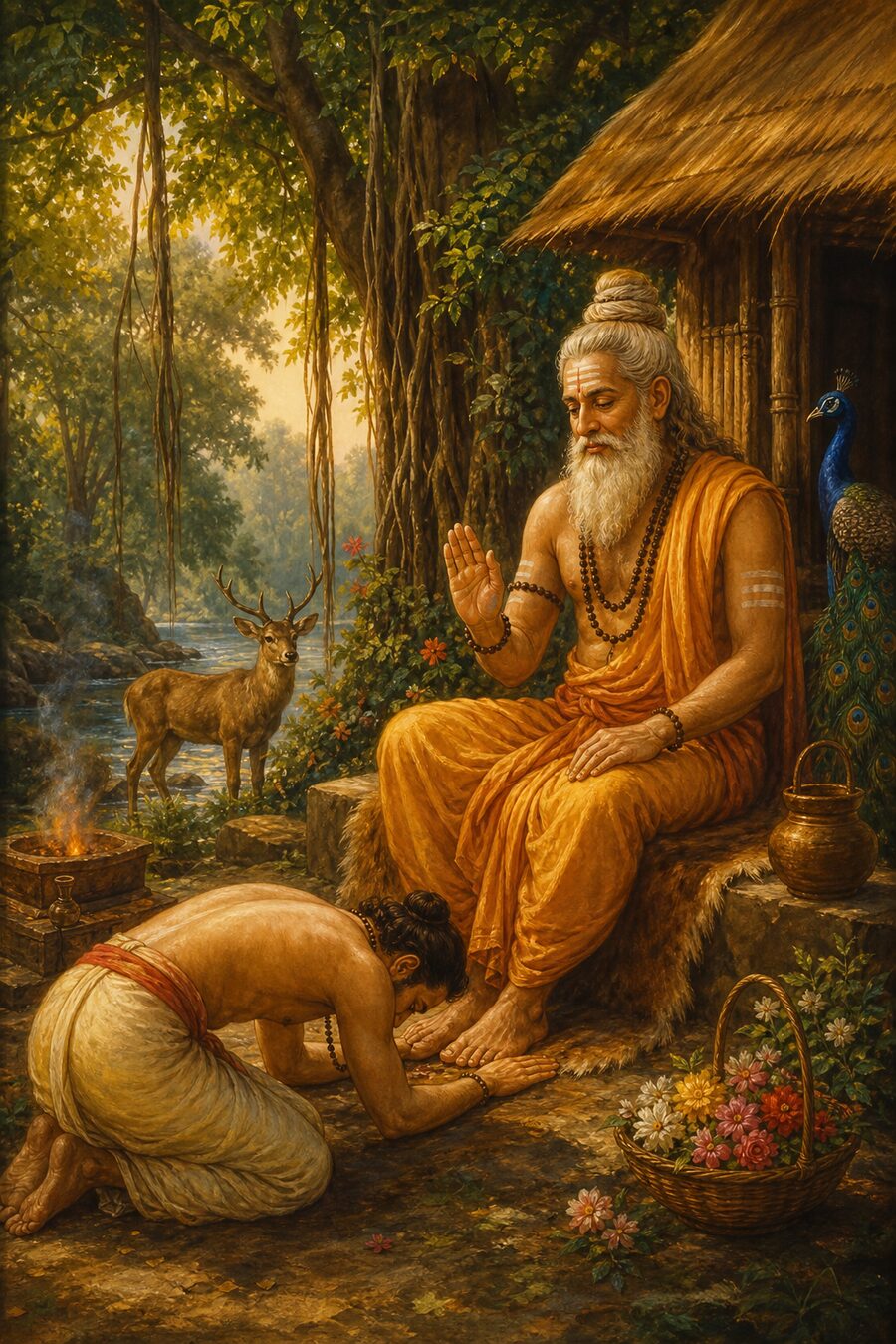
The order of the meeting is set by the verses. The disciple comes for refuge and, afraid of samsara, makes his plea across six verses, ending on the admission that he knows nothing. The guru gives him fearlessness first and tells him there is a way across, walked before. The disciple then sets down his question, which turns out to be seven questions folded into one: what bondage is, how it came, how it stays, how it ends, what the non-Self is, what the Supreme Self is, and how the two are told apart. The guru praises the question and, before answering it, settles one thing for the rest of the conversation: on this road no one can walk in the seeker’s place.
How this part runs
Verse 32 finishes the definition of bhakti begun at verse 31 and sends the seeker to a wise guru. Verse 33 describes that guru; verse 34 says how to approach him and when to ask. Verses 35 to 40 are the disciple’s plea, ending in “I know nothing.” Verses 41 and 42 give fearlessness and then the teaching; verses 43 and 44 are the guru’s first words, “do not fear,” and the promise of a great means; verses 45 to 47 name it. Verse 48 is the disciple asking leave to ask; verse 49 is the seven questions. Verses 50 to 56 are the guru’s praise and his insistence that no one else can free a man, with the debt, the load, the hunger, the patient and the moon as its images. Verses 57 to 66 say what words, learning and scripture cannot do, through the vina, the forest, the snakebite, the medicine, the king and the buried treasure. Verses 67 to 70 praise the question and give the road in outline, and verse 71 announces the discrimination of Self and non-Self that follows.
Others, verse 32 says, call bhakti the inquiry into the truth of one’s own Self, svatma-tattva-anusandhana, and with that the definition verse 31 left open is complete: verse 31 had bhakti as the constant seeking of one’s own true nature, and this is a second school’s wording for the same act. The verse then turns the seeker forward. One who is endowed with the means just described, and who wants to know the truth of the Self, should approach a wise guru, from whom comes release from bondage. The seeker is the man the previous eighteen verses prepared, and the verse sends only the man who has that preparation. The release is placed at the guru, from whom, so that the man who has done everything verses 14 to 31 asked still has somewhere to go. The verb is upasidet, from the root sad, to sit, with the prefix upa, near: he should go near and sit down. The word Upanishad is built on the same root with one more prefix, ni, and the posture is the same, the hearer seated close and below the speaker, near enough to catch every word.
32 · Refuge in the guru
Verse 33 gives the guru’s portrait in eight marks, and verse 15 had already told the disciple to look for two of them, an ocean of compassion and the best of the knowers of Brahman. He is shrotriya, versed in the Veda. He is without sin. He is unsmitten by desire, akamahata: desire has stopped striking him. He is the foremost knower of Brahman. He has withdrawn into Brahman and is calm, like a fire whose fuel is spent; Madhavananda’s note sends the image to the Shvetashvatara Upanishad, 6.19, and reads it as mergence in Brahman with all activity on the relative plane at an end. He is an ocean of compassion that has no cause, ahetuka, so that nothing has to be done to earn it and nothing done can stop it. He is a kinsman of the good who bow to him, and the disciple bows in the next verse. Verse 34 is the approach. One should worship that guru with devotion, by prostration, humility and service, and, coming to him when he is pleased, should ask him what there is to know of the Self. The order is the verse’s own, service, then his being pleased, then the question, and the teacher’s pleasure is the sign that the moment has come.
33 · 34 · What the guru should be, and the question after service
Verses 35 to 40 are the disciple’s, and he opens by addressing the guru with the marks verse 33 gave him: master, kinsman of the people who bow, ocean of compassion, the two titles the portrait ended on. He bows, and asks to be lifted. Verse 35 names where he is, fallen into the ocean of becoming, and what should lift him, the guru’s glance. The word is kataksha, a glance from the corner of the eye, and the verse adds that this glance is straight, rjvi, aimed at him, and that it rains down the nectar of a compassion past measure. Verse 36 says why. He is scorched by the forest fire of samsara, and the fire is durvara, one that cannot be held back; he is shaken by the winds of ill fortune, which Madhavananda’s note reads as the fruit of deeds done in earlier lives, a reading the verse does not spell out; he is afraid, and he has come for refuge. The plea is to be protected from death, and the last line gives its reason: he knows no other refuge. Everything the guru says from verse 41 on is said to the man of verse 36.
35 · 36 · The student’s cry
The disciple now gives his plea three images, and the first two describe the guru to himself. Verse 37 says there are good men, calm and great, who live doing good to the world as the spring does, and who, having themselves crossed the dreadful ocean of becoming, bring others across too, ahetuna, without any motive. Madhavananda’s note calls the spring’s giving unasked bounty, unobserved and unsought. Verse 38 says this is the nature of the great, of itself, to lean toward lifting the weariness of others, and gives the moon as the proof everybody knows: the moon of itself cools the earth that the harsh rays of the sun have scorched. The verse’s word for the moon is sudhamshu, the one whose rays are nectar, and the moon makes no decision to cool the earth and asks nothing about the earth’s deserving. The disciple is telling the guru that a man of his kind cannot help helping. Verse 39 is the request, and the nectar of the moon becomes the nectar of speech. Sprinkle me, he says, as one waters a scorched plant, for I am burning in the flames of the forest fire of worldly affliction; sprinkle me with the nectar of your words, steeped in the experience of the bliss of Brahman, pure, cool, pleasing to the ear, and poured from the pitcher of your speech. The plainest epithet, puta, pure, is as much the verse’s as the others: the words cool him because nothing in them is mixed. The verse ends on the glance again, blessed are those whom a moment’s passing of your eye has made its vessel and taken as your own. Madhavananda’s note strips the figure to one sentence, take pity on me and teach me the way out, and that is the sentence the three images carry.
37 · 38 · 39 · The saints, the moon, and the nectar of speech
Verse 40 ends the plea on three questions and one admission. How am I to cross this ocean of becoming; what is my course, gati, the word covering both the road and where it ends; and which of the means is there for me, in a word that asks for one to be chosen out of many, which Madhavananda’s note reads as a choice among the many and often conflicting means the scriptures prescribe, a gloss that is his. The admission follows, jane na kinchit, I know nothing. The man saying it is the seeker verses 16 and 17 required, quick in understanding, learned, skilled in argument, and he says it at the end of six verses of fluent speech: his learning has shown him everything except the way across. The verse does not stop there. He asks to be saved by grace, kripaya, and asks the guru to bring about the end of samsara’s sorrow; Madhavananda hears the last verb as a request to describe that end at length, and the seven verses the guru speaks next answer both requests, since they describe the way and in describing it begin the saving.
40 · I know nothing
The guru’s first act, in verse 41, is wordless. Seeing him speak so, come to him for refuge as his own, and scorched by the heat of the forest fire of samsara, the great soul looks at him with a glance moist with compassion and gives him fearlessness, sahasa, at once. The verse puts no condition between the look and the gift. The glance is the one the disciple asked for in verse 35, and it arrives before a single word. Verse 42 is the teaching, and here the verse describes its recipient with care. The knower should impart the truth, out of grace alone, kripaya eva, to one who has come to him for approach, upasatti, the noun of the sitting near that verse 32 asked for; who longs for release; who duly does what he is taught; whose mind is pacified; and who is endowed with calm. Madhavananda’s note says the adjectives mark a qualified aspirant, and adds that the verse adapts the language of the Mundaka Upanishad, 1.2.13. The two verses say two different things about two different gifts. Fearlessness goes at once to the burning man, with nothing asked. The teaching goes to the student the four marks describe, and grace alone says why the teacher gives, with nothing owed to him for the service, while the marks say to whom. A common reading sets the two against each other, as if grace waived the marks or the marks earned the grace; the verse holds both in one sentence, and the disciple of verses 35 to 40 is the man it describes.
41 · 42 · The guru grants fearlessness, and then the teaching
The first words the guru speaks in the whole work are ma bhaishta, do not fear, and verse 43 addresses them to the disciple as learned one. Three assurances follow. There is no apaya for you: the word means ruin, loss, falling away, and Madhavananda renders it as death, which is what the disciple in verse 36 asked to be protected from. There is an upaya, a means, for crossing the ocean of samsara, and the verse sets the two words side by side, apaya and upaya, no ruin and a way, so that the ear hears the answer fitted to the fear. The way is the one by which the strivers who renounced went to the far shore, and that path, the guru says, I will point out to you. The verse gives no reason why there is no ruin for him; the reason comes in verse 47, when the disciple is told who he is. Verse 44 repeats the promise and enlarges it. There is a certain great means, one the verse leaves unnamed, which destroys the fear of samsara; crossing the ocean of becoming by it, you will attain supreme bliss. The disciple had asked to be kept from death and lifted from the water; the guru names the destruction of fear as the first thing the means does, then names what waits on the far side, which the disciple had not asked about.
43 · 44 · “Do not fear,” and a great means
Verse 45 names the means in a chain of three links. From inquiry into the meaning of Vedanta arises the highest knowledge, which Madhavananda’s note glosses as realizing that one’s own self is Brahman; from that knowledge, following on it, comes the destruction of the sorrow of samsara, a destruction the verse calls atyantika, reaching to the end, complete and final. Verse 46 guards against taking the inquiry as dry reasoning. The voice of the shruti itself, the verse says, declares faith, devotion and the yoga of meditation to be the causes of the seeker’s release; Madhavananda’s note names the passage, Kaivalya Upanishad 1.2, and reads the compound as three items, shraddha, bhakti and dhyana-yoga, the meditation itself counted as the yoga. Whoever abides in these three is freed from the bondage of the body that ignorance has conjured, and the note adds that the bondage meant is the identification of the Self with the body. Verse 47 sets out the whole problem and the whole solution, and addresses the disciple in a way that is itself part of the answer. Through contact with ignorance, you, the Supreme Self, paramatmanah tava, are bound to the non-Self, and from that alone comes samsara. The man who said he knows nothing is addressed as the Supreme Self, and his bondage is to what he is not, brought about by ignorance and by nothing else. The fire of knowledge kindled by discriminating the two, Self and non-Self, burns the effects of ignorance together with their root. Weeds pulled by hand grow back from what was left in the soil; fire takes the root with the stalk, and the verse chooses fire.
45 · 46 · 47 · Vedanta reflection, faith, and the fire of discrimination
Verse 48 is the disciple’s again, and the Sanskrit sets a marker before it, shishya uvacha, the disciple said. He has been given fearlessness and a map, and his voice has changed from verses 35 to 40: he asks leave to ask. He addresses the guru as master and says: kindly hear this question I am putting to you, for hearing its answer from your mouth I would be kritartha, one whose purpose is accomplished. Two words carry the verse. Bhavan-mukhat, from your mouth: he wants the answer from the living man in front of him, with no text and no report standing between, which is what sitting near was for in verse 32. Kritartha names what he expects from an answer, the accomplishing of the thing he came for. The question itself is held back for one more verse: the student announces that he is about to ask, waits for leave, and then asks.
48 · The student asks
Verse 49 is the question on which the remaining five hundred and more verses hang, and it is seven questions in one. What, after all, is bondage? How did it come? How does it stay in place? How is one released from it? What is this non-Self? What is the Supreme Self? How is the discrimination between the two made? Tell me this, the disciple ends. Madhavananda supplies, in a parenthesis of his own, that the bondage came upon the Self; the verse asks only how it came. The first four follow a bondage through its life, its nature, its arrival, its persistence, its ending; the last three ask what the two things are and how they are told apart. The disciple of verse 35 said only lift me up; the disciple of verse 49 has broken his trouble into its parts, and the parts are in order, since no one can ask how a thing ends who has not asked what it is and how it holds.
49 · Seven questions
The guru’s answer begins with the disciple, and the Sanskrit marks the speaker again, the revered guru said. Verse 50 is praise, and the praise is large. You are blessed; you have done what there was to do, kritakritya; your family has been made pure by you; and the reason given is the wish itself, that you want to become Brahman by release from the bondage of ignorance. The disciple had asked, in verse 48, to be made kritartha by the answer; the guru tells him that by the asking he is already kritakritya, and the two words share their first half, krita, done. The guru hears in the seven questions a wish the disciple did not put in those words, the wish to become Brahman, and treats the rising of that wish as the attainment: the man in whom the question of his own bondage has risen has turned around, which is what purifies the family. Verse 51 draws the line the next five verses hold. A father has sons and others to free him from his debts; to free him from bondage there is no one other than himself. Debt passes from hand to hand because money can; the verse puts bondage on the other side of that fact. Madhavananda’s note reads this and the verses that follow as pressing one point, that direct realization is the only means by which ignorance is removed, and the images of verses 52 to 56 are chosen to carry it.
50 · 51 · “Blessed are you,” and bondage is loosed by yourself alone
Verse 52 takes the point to the body. The pain of a load set on the head, and of things like it, is removed by others, and the verse grants this fully: someone can lift the weight off, and the pain goes. The pain that hunger and things like it cause is ended by no one other than oneself. The verse chooses hunger because its remedy is the one act that cannot be delegated. Verse 53 stays with the body and with what everybody has seen. The patient by whom the wholesome diet is kept and the medicine taken is the one in whom health is seen to arrive, and it does not arrive by acts another performs for him. The verse names no physician; its whole attention is on the patient’s own taking, and the recovery is drishta, seen, a matter of common observation that the disciple knows from any sickroom. Verse 54 moves from the body to knowing. The true nature of a thing is to be known by oneself, through the eye of clear understanding, sphuta-bodha-chakshus, and the verse adds the words a learned disciple most needs, na tu panditena, and not by means of a scholar. The nature of the moon has to be known with one’s own eyes; can others make it known? The question is the verse’s own, and a man told for hours about the moon has heard about it and seen nothing until he lifts his own eyes. Nothing in the verse says the eye of understanding is cleared without help; verse 65 will name the knower’s instruction as the first thing the hidden treasure requires. What the verse excludes is the scholar’s seeing standing in for one’s own.
52 · 53 · 54 · The weight on the head, the patient, and the moon
Verse 55 states the matter without an image and as a question. The bondage of the nooses of ignorance, desire, action and the rest: who could loosen it other than oneself, even in a hundred crore kalpas? Madhavananda’s note draws the chain in the compound, ignorance of one’s nature leading to desire, desire to action, action to suffering, and glosses kalpa as the whole duration of the evolved universe; a hundred crore of them is the verse’s way of saying never. The question is asked because the mind keeps a different hope alive, that someone else will arrive and do the loosening. The verse does not deny the teacher, since a teacher is speaking it, out of the grace alone that verse 42 named, to a disciple whom verse 28 promised the grace of the guru. What it denies is a substitute for the seeker’s own knowing: another man can tell him where to look, and the looking cannot be done by proxy in any length of time. Verse 56 names the honored paths of its day and sets them all on one side of a line. Neither by yoga, nor by Sankhya, nor by action, nor by learning is liberation accomplished; by the knowledge of the oneness of Brahman and the Self, brahmatmaikatva-bodha, it is accomplished, and in no other way. Madhavananda’s notes read the four as practiced on their own, mechanically, and gloss them: yoga as hatha yoga, which strengthens the body; Sankhya as the discrimination of purusha from prakriti; action as work for ends such as heaven; and he cites the Shvetashvatara Upanishad, 3.8, there is no other way. Verse 11 gave action its single job, the purification of the mind, and this verse leaves that job to it.
55 · 56 · Who but yourself can free you, and the realization of oneness
Verse 57 begins a run of verses on what words and learning cannot do, and it opens with an instrument. The beauty of a vina’s form and the excellence of playing on its strings serve only to delight the people, and they do not suffice for sovereignty. Verse 58 applies the image with the word likewise. Speech of the vaikhari kind, a cascade of words, skill in expounding the scriptures, the erudition of the learned: all of it, likewise, is bhuktaye na tu muktaye, for enjoyment and not for release. Madhavananda’s note explains vaikhari as the lowest of the four grades of speech, the articulate, outward word, and reads the verse as aimed at a dabbling in terminology. Bhukti is enjoyment, and the verse’s claim is that fine speech about Brahman is a form of it: the speaker enjoys being praised, the hearer enjoys understanding, and both pleasures pass like every other pleasure. The verse is addressed to the man verse 43 called learned, and it names his particular danger, since the gifted expounder is the one person who can take his own eloquence for the far shore. The vina player who was applauded has not become king; the scholar who was admired has not been freed.
57 · 58 · The vina, and the flow of speech
Verse 59 is built as a riddle, two lines alike except for one word. When the supreme truth is unknown, the study of scripture is fruitless; and when the supreme truth is known, the study of scripture is fruitless. Madhavananda’s note divides the cases: before realization, book-learning without discrimination and renunciation gives no freedom, and after it the man has reached his end and needs no study. Nothing in the verse tells the seeker to stop reading. What it denies is fruit to study by itself. Verse 60 says what study by itself does to a mind. The net of words is a great forest, and it is the cause of the mind’s wandering: a mind among definitions walks for days, each term sending it on to another, and arrives nowhere. Therefore, the verse concludes, the truth of the Self is to be known with effort, prayatnat. The last words are read two ways. The house text has tattvajnaih, by the knowers of truth, and Madhavananda takes it as the wise man himself earnestly setting about the knowing; a variant reads tattvajnat, from the knower of truth, so that the effort is made at the feet of someone who has come out of the forest. Both readings keep the effort and the knower, and verse 65 joins them in one sentence.
59 · 60 · The study of scripture, and the forest of words
Verse 61 changes the disease. Ignorance is a serpent, and the man has been bitten; for him there is one medicine, and the verse names it, brahma-jnana-aushadha, the knowledge of Brahman as the medicine. Without it, the verse asks, what use are the Vedas and the scriptures, what use mantras, what use medicines? The four named are the remedies a snakebite was treated with, recitation, charms and herbs, and the verse lets each be excellent and still useless against this venom. Verse 62 picks up the word for medicine and turns it over. A disease does not go by the word for the medicine, without the drinking of it; and without direct experience, aparoksha-anubhava, no one is released by the word Brahman. Paroksha is what lies beyond the eye, known by report; aparoksha is what is in front of it, one’s own. The man with the bottle before him who says medicine, medicine, has named the cure exactly and remains ill, and the man who says Brahman, Brahman, with nothing drunk, is in the same condition. The verse measures every explanation of Brahman by one thing: to understand the words is to know the name of the medicine, and the word release is kept for the drinking.
61 · 62 · The snakebite, and merely saying “medicine”
Verse 63 names the two things that have to be done before the word Brahman can release anyone, and verse 64 sets the same two beside a king. Without bringing about the dissolution of the seen, drishya-vilaya, and without knowing the truth of the Self, how can men be freed by words about Brahman whose only fruit is the saying of them, ukti-matra-phala? The seen is the whole objective world as it stands before a man, solid and final; its dissolution is the vanishing of that standing in knowledge, the way the snake vanishes when the rope is known, which is what verse 20 meant in calling the world mithya. Madhavananda’s note places the vanishing in samadhi, where the division of subject and object ends; short of that, his note says, the ignorance at the root of every ill is untouched. The second condition is the knowing of the Self, and the two go together, since the seen loses its standing in the same act by which the Self is known. Verse 64 is built on the same frame, two things not done and a word that does nothing. Without destroying his enemies, and without winning the splendor of the whole land, no one becomes a king by saying I am king. Set line for line against verse 63, the destruction of enemies answers to the dissolution of the seen and the winning of the land to the knowing of the Self, so that the two verses say one thing twice, once in the language of the kingdom. A man who repeats I am Brahman with the two things undone is, by this verse, saying I am king from the roadside.
63 · 64 · Not by words alone, and “I am a king”
Verse 65 gives the method whole, in the image of a treasure buried in the ground. A buried deposit requires the word of a trustworthy person as to where it lies; then digging; then the lifting away of the stones and whatever else lies over it; then taking hold of it. It never comes out by being called from above the ground, and that clause ties the image to the three verses before it, where the word for the medicine and the word king did nothing. Likewise, the verse says, one’s own stainless truth, hidden by maya and its effects, is gained by the instruction of a knower of Brahman, by reflection, by meditation and the rest, and it is never gained by perverse arguments, duryukti. The verse lays its two lists side by side and leaves the reader to match them: the trusted word is the knower’s instruction, the digging is reflection, the clearing of stones is meditation, and the taking hold falls under the rest, the direct experience verse 62 called aparoksha. Madhavananda’s parentheses, for its extraction, finally, merely, are his own additions and do not change the sense. Two words in the second half carry the teaching: the truth is one’s own, and it is hidden. The treasure is already in the ground; what covers it has to be moved. Verse 66 draws the conclusion with its first word, therefore. With every effort, for release from the bondage of becoming, the wise must make the effort themselves, as in the case of disease and the like. The word for the wise is panditaih, and verse 54 used the same word for the scholar who cannot see on another’s behalf: the pandit cannot know it for you, and the pandit’s own work, when the disease is his, is to take the treatment with his own hands.
65 · 66 · The buried treasure, and your own effort
Before answering, the guru praises the question itself, and verse 67 gives the praise four marks. The question you have put today is excellent; it is approved by those who know the scriptures; it is sutra-praya, like a sutra, a composition cut to the fewest words with the most packed inside, a seed holding the tree; it is of hidden meaning, so that its answer will take unfolding; and it is worth knowing by those who seek release. Verse 50 praised the disciple for wanting what he wants; verse 67 praises the form the wanting took. Verse 68 asks for a particular kind of hearing. Listen attentively, avahita, to what I am going to say, the guru tells the learned one; by hearing this you will at once be freed from the bondage of becoming. The promise looks, at first, to undo everything verses 58 to 64 said about words, since there the word Brahman freed no one and here hearing frees at once. The verse’s condition is avahita, attention of the whole man, the listening of someone who has put everything else down, and that is the hearing verse 70 will place first among three practices, with reflection and long meditation after it. The hearing that frees is the hearing that goes on into those; what verses 58 to 64 refused was the word taken as the end of the matter.
67 · 68 · “Your question is excellent,” and “listen with focus”
Verses 69 and 70 give the road in outline before the detail begins, as a sequence, each step marked with the word then. The first cause of liberation, verse 69 says, is declared to be utter dispassion toward things that do not last, and the intensity is the one verses 29 and 30 made the test, where a dispassion short of intense left the virtues a mirage. After it come shama, the mind at rest in its own object, dama, the senses held at their posts, and titiksha, forbearance, which verses 22 to 24 defined, and then the thorough renunciation of all works to which one is attached. Madhavananda’s note reads all works as all works done with motive, the good ones the scriptures prescribe and the evil ones men do from their own nature alike; the reading is his, and the verse’s own word is attached. The four means of verses 19 to 30 return here under a new title: there they were the qualifications a seeker brings, here the guru calls them the causes of liberation, the first stretch of the road itself, and verse 70 continues from them without a break. After them come hearing, reflection on what was heard, and meditation on the truth, the meditation given three adjectives, long, constant and unbroken, and a subject, the muni, whom Madhavananda’s note calls the man of reflection; meditation, in his note, is the mind flowing in one unbroken stream toward one object. The verse’s three words are shruti, manana and dhyana, the hearing, thinking and meditating the Vedanta schools name as their threefold practice. From there, the verse says, the knower reaches the supreme state it calls free of every distinction, which Madhavananda names the nirvikalpa state, subject and object no longer two, the mind’s activities suspended, the aspirant one with his Self, the samadhi his note on verse 63 had in view. From there he attains the bliss of nirvana, and the verse fixes where: iha eva, here itself, in this life and this body. Nirvana, Madhavananda adds, means blown out.
69 · 70 · A glimpse of the road, and right here, in this very birth
Verse 71 closes the opening of the conversation and opens the answer. What you must now understand, the guru says, the discrimination of Self and non-Self, atma-anatma-vivechana, I will tell you fully; having heard it, settle it within yourself, atmani avadharaya. The verse answers the shape of verse 49: the seventh question there was how the two are discriminated, and the guru takes that question first, because the other six are answered inside it, since what bondage is, how it came, how it stays and how it ends all depend on which of the two a man has taken himself to be. The last words are the instruction for everything that follows. Hearing was promised a great deal in verse 68 and refused a great deal in verses 58 to 64, and verse 71 says what makes the difference: what is heard has to be made firm inside, held until it is one’s own, the drinking of verse 62 and the taking hold of verse 65. Nothing in the forty verses has yet said what the non-Self is; verse 71 is the promise that the saying begins now.
71 · “Now hear the discrimination of self and non-self”
The road ahead
Part 4 · The Not-Self, the Body, the Mind, and Maya, verses 72 to 123. The guru keeps the promise of verse 71 and begins from the coarsest end, this body: verses 72 and 73 build it from its constituents and its limbs and name it the gross body, and the answer to the disciple’s fifth question, what the non-Self is, goes on from there through the senses, the mind, the vital breath and maya, each examined in turn and set down as something the Self is aware of.
One sentence from these forty verses stands over the whole conversation to come, said in verse 51 and held through verse 66: to free a man from bondage there is no one other than himself. The guru points out the way, verse by verse, and the walking belongs to the one who walks, as verse 9 said before the conversation began.