Vivekachudamani
Part 18 · The Guru Speaks Again · Verses 520 to 545
The disciple has finished his hymn and bowed. The guru, seeing him awake to the truth and glad at heart, speaks one more time, and his word is about the life that follows knowledge: the world seen as an unbroken stream of cognitions of Brahman, a silence free of vasanas, a knowing of oneself that needs no place or hour or posture, and the knower’s daily gait, which looks like a fool’s in one place and a king’s in another.
First, one thing
Verse 520 opens with the guru looking at his disciple. He is bowed, he has gained the bliss of the Self, he is awake to the truth and glad at heart, and the lord of teachers, the great soul, speaks supreme words to him once more. The knowledge has already come; what the twenty-six verses that follow give him is the shape of the life that goes with it.
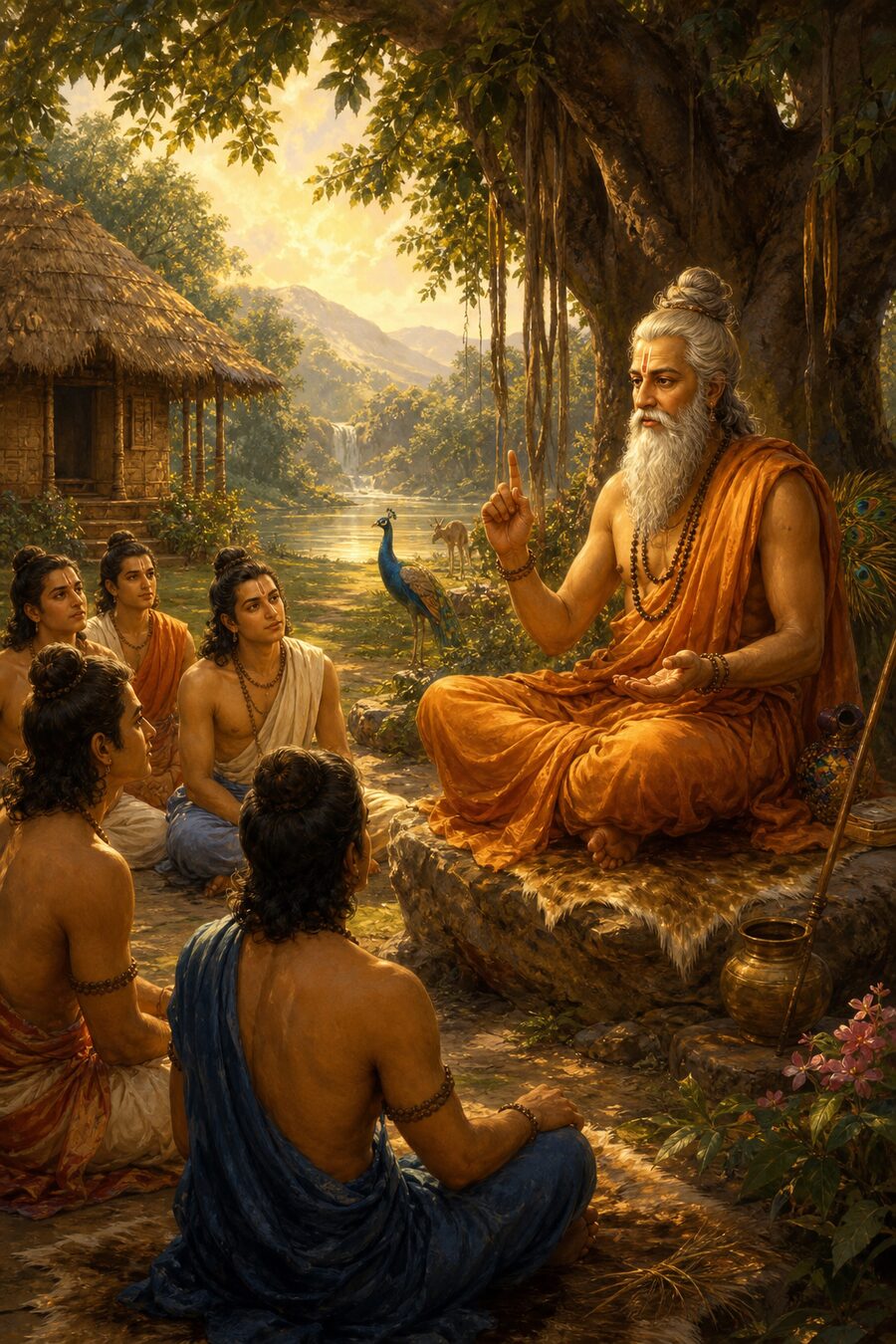
His word is one instruction and then a portrait. The instruction: in every state let the mind see Brahman alone, since the world is a continuous series of cognitions of Brahman and there is no second source of joy to go looking for. The portrait: a sage who sits, walks, eats and sleeps as the wish arises, who looks like a madman in one place and a child in another, who owns nothing and is content, whose body no pleasure or pain can reach because he never took it for himself.
How this part runs
Verses 520 to 524 bring the guru back to speech: the world as a stream of cognitions of Brahman (521), the painted moon beside the real one (522), and the instruction to abide content in the real Self (523 and 524). Verses 525 to 527 teach silence, the stilled intellect, free of vasanas. Verses 528 to 535 argue that knowing one’s own Self needs no rule: the pot known by a sound eye (530), “I am Devadatta” (532), the sun that no lamp can light (533 and 534). Verses 536 to 545 give the knower’s daily life: the child at play (537), begged food and the bare earth (538), madman, child and ghoul (540), sometimes a fool and sometimes a king (542), and the body that is never his (544 and 545).
520 · 521 · 522
The hymn is over and the guru looks at the one who sang it. Verse 520 shows the disciple bowed, having gained the bliss of the Self, awake to the truth, glad at heart, and the lord of teachers, the great soul, speaks supreme words to him again. Verse 521 is the first of them: the world is an unbroken stream of cognitions of Brahman, brahma-pratyaya-santati, and so in every respect it is Brahman alone; see this with the inward eye and a calm mind in every state. A man with eyes sees forms wherever he looks and nothing else; in the same way the intellect of one who knows Brahman has nothing to rest in except Brahman. Verse 522 asks who, being wise, would set aside the experience of supreme bliss to take delight in empty things, shunyeshu. When the moon itself shines in the sky and gladdens everything under it, no one wishes to look at a moon painted on a wall.
523 · 524
Verse 523 gives the reason behind the painted moon. The experience of unreal things brings no contentment and no end of sorrow, and the two failures belong together: what has no being of its own cannot fill anyone, so the ache goes on. The guru’s instruction follows: content with the experience of nondual bliss, abide happily in sad-atma-nishtha, steadfast in the real Self. Verse 524 turns the same instruction into a way of passing the days. Seeing yourself alone in every way, holding yourself to be nondual, enjoying your own bliss, pass your time, he says, and calls the disciple mahamate, great mind. It is an imperative, kalam naya; the guru is telling him how to spend the years that remain. The address fits the man he now speaks to, one who has just sung his own realization in a hymn.
525 · 526 · 527
Verse 525 moves the disciple toward silence. The Self is undivided awareness, free of every distinction, and to imagine distinctions in it is to imagine a city in the empty sky. So, always as the Self made of nondual bliss, reach supreme peace and keep silence, mauna, the silence Madhavananda glosses as remaining as the witness. Verse 526 says what that silence is made of. The intellect is the source of unreal imaginings, and its quiet state, tushnim-avastha, is itself the highest peace; in it the great knower of Brahman, being Brahman, has nondual bliss without a break. Verse 527 adds the one condition. For a man who has known his own nature and drinks the rasa of his own bliss, nothing gives greater joy than silence free of vasanas, nirvasana mauna; the desires have gone out of it, and what is left is the quiet of a mind that wants nothing because it lacks nothing.
528 · 529 · 530 · 531
Verse 528 opens the knower’s freedom from rule. Going, standing, sitting, lying down, or in any other way, the wise sage who delights in the Self lives as he pleases. Verse 529 gives the ground for it. The great soul who has realized the truth, whose mind moves without obstruction, depends on no place, no time, no posture, no direction, none of the yamas and their companions, no object of meditation, all of which Madhavananda lists as the beginner’s supports; what rule could there be in knowing one’s own Self? Verse 530 brings the point down to a pot. To know “this is a pot”, nothing is needed beyond a sound means of knowledge, pramana, the eye in working order and the light to see by; the cognition of the object follows on its own. Verse 531 draws the conclusion. This Self is ever established, nitya-siddha, and shines the moment the means of knowledge is present; it waits on no place, no time, and no purification.
532 · 533 · 534 · 535
Verse 532 gives the nearest example there is. The knowledge “I am Devadatta” depends on nothing outside itself; a man needs no mirror and no witness to know his own name. The knower of Brahman’s “I am Brahman” is of the same kind. Verse 533 then asks what could ever illumine the Self. By its light, as by the sun’s, the whole world appears; what non-self thing, unreal and trifling, could be its illuminator? Madhavananda hears in the line the Upanishadic “tam eva bhantam”, from the Katha and the Mundaka: it shining, all else shines after it. Verse 534 presses the same question from the side of meaning. The Vedas, the shastras, the Puranas and all living beings have their meaning through the knower; what could light up that knower? Madhavananda hears an echo of Brihadaranyaka 2.4.14 here. Verse 535 names what has been reached: this Self is self-luminous, of infinite power, beyond measure, the experience within every experience, and the one who knows it, freed from bondage, lives triumphant, jayati, the best of the best among the knowers of Brahman.
536 · 537 · 538
Verse 536 draws the knower in four negatives and two affirmations. Objects neither grieve him nor elate him; he is neither attached to them nor averse to them; he plays in the Self always and rejoices in himself, content with the unbroken rasa of bliss. Verse 537 finds the likeness in a child, who forgets hunger and the body’s aches while absorbed in a toy; so the knower delights, with no “I” and no “mine”, and is happy. Verse 538 then lays out the free life item by item. Food is begged, without anxiety and without abasement; drink is the water of rivers; the way of living is independent and unchecked, svatantryena nirankusha; sleep is fearless, in a cremation ground or a forest; clothing is whatever needs no washing and drying, or the quarters themselves; the bed is the earth; the walking is in the avenues of Vedanta, nigamanta-vithi; and the play of these knowers is in the supreme Brahman.
539 · 540 · 541
Verse 539 describes how the knower of the Self carries his body. Vimanam alambya: Madhavananda reads it as resting on this body without identification, and the compound also yields “as on a vehicle”, a carriage he uses and makes no claim on. Leaning on it so, he takes whatever sense-objects come before him, by others’ wish and like a child, which Madhavananda’s note explains as eating what friends and devotees set before him; his marks are unmanifest, avyakta-linga, and he is unattached to outer things, so that no one looking at him can tell what he is. Verse 540 lets the outside vary without limit. Clad in the quarters, or clothed, or wearing skins or bark, he stands in the sky of awareness and wanders the earth like a madman, a child or a ghoul, guises that Madhavananda calls devices for escaping worldly company. Verse 541 states the paradox at the center of it. The sage, living alone, moves among objects of desire as desirelessness itself, kaman nishkama-rupi, forever content in his own Self and present as the Self of all.
542 · 543
Verse 542 gives the knower seven guises, kvachit six times and kvapi once. Sometimes he seems a fool, sometimes a sage; sometimes he has the splendor of a great king; sometimes he wanders, sometimes he is gentle, sometimes he lies as still as a python that waits for food to come to it; sometimes he is honored, sometimes scorned, sometimes wholly unknown. So the wise one moves, ever happy in supreme bliss, and Madhavananda notes that the seven are the impressions others form of him, since he holds no picture of himself that the world could confirm or spoil. Verse 543 sets four pairs that would contradict each other in anyone else. Without wealth, he is always content; without help, he is of great strength; eating nothing, he is ever satisfied; matchless, asama, without an equal anywhere, he sees all with an equal eye.
544 · 545
Verse 544 adds four more pairs. He acts, and does nothing; he experiences the fruits of past action, and is no enjoyer of them; he has a body, and is bodiless; he is limited, and goes everywhere. Each pair holds because the first half describes what others see and the second what he is: the body walks, eats, and reaps what earlier action sowed, while he, who never took the body for himself, stays the witness of all of it. Verse 545 says what follows from that. This knower of Brahman is always bodiless, ashariram sada santam, and so the pleasant and the unpleasant never touch him, and the good and the bad never touch him either, since each of those needs a body to land on. Madhavananda points out that the verse reproduces Chandogya 8.12.1, where pleasure and pain do not touch the one who is bodiless.
The page ahead
Part 19 closes the Vivekachudamani: the knower who sheds the body, the fire of knowledge, the image of the broken pot (verse 565), where the space it enclosed is the one space again, and the image of milk poured into milk (verse 566), oil into oil, water into water. Verse 574 then denies even bondage and liberation, in a line that is also Gaudapada’s karika 2.32 on the Mandukya: na nirodho na chotpattih, no dissolution and no origination, no one bound and no one striving, no seeker of liberation and no one liberated. The last verse (580) ends with shankara-bharati vijayate, Shankara’s teaching is victorious, the teaching that shows travelers scorched on the road of samsara, wandering a desert in search of water, the ocean of nectar that lies at their feet.
The line to carry away is from verse 542: kvachin mudho vidvan kvachid api maharaja-vibhavah, sometimes a fool, sometimes a sage, sometimes with the splendor of a great king. The knower wears every one of these and holds to none, and that absence of any grip on “this is what I am” is his freedom.