Vivekachudamani
Part 11 · The Ego and Heedlessness · Verses 298 to 328
The vasanas have been thinned, and verses 298 to 328 name what still stands behind them: the ahankara, the ego, the I that says I alone act and I alone enjoy, which the verses call the seeker’s own enemy and the root of every remaining obstacle. They say how it is cut, how it grows back from a moment’s thought, how the wearing away of vasana is itself liberation while living, and they end on one warning: heedlessness in steadfastness to Brahman is death, and a mind that slips from its mark goes down like a ball dropped on a staircase.
First, one thing
Family, lineage, name and form were set down in verse 297, and verse 298 opens on the one thing underneath them. Other obstacles are seen in a person and cause samsara, and all of them have one root, the ahankara, the ego, the sense of being a separate I, which the verse calls the first modification, prathama-vikara; Madhavananda supplies the words of ignorance, avidya, as the thing it modifies. Every later identification, with body, mind or standing, is built on this first one.
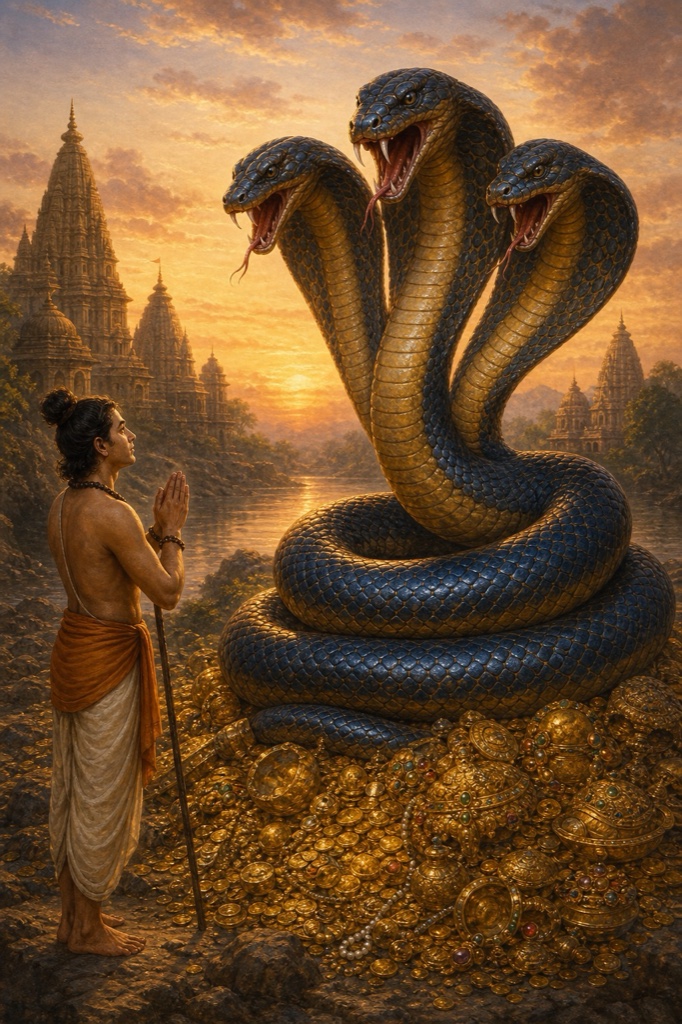
Verse 302 gives the ego its shape. A treasure lies within, the bliss of Brahman, and coiled around it is a serpent, mighty and dreadful, with three fierce heads made of the gunas, sattva, rajas and tamas, the three strands of which prakriti is made. The heads have to be cut off with the great sword called vijnana, knowledge of the Self known directly, wielded in accord with Shruti, and the serpent torn out by the root before the treasure can be enjoyed.
The last eight verses turn to pramada, heedlessness, the lapse of attention through which the ego, once cut, grows back. Verse 321 quotes the saying of Sanatsujata, the son of Brahma, from the Sanatsujatiya of the Mahabharata: pramado mrityuh, heedlessness is death. Verse 325 gives the warning its picture, a ball at play dropped on a flight of stairs, falling from step to step.
How this part runs
Verses 298 and 299 name the ego as the root of the remaining obstacles and rule out liberation while any relation with it lasts. Verse 300 shows the Self freed from its grip as the moon freed from eclipse, and verse 301 says what is destroyed. Verse 302 is the serpent on the treasure. Verses 303 and 304 give the trace of poison and the three conditions of knowing. Verses 305 and 306 say what the ego is and what the seeker is without it. Verses 307 and 308 give the thorn in the throat and the silence after it is out. Verses 309 and 310 warn that the ego revives from a moment’s thought. Verses 311 to 316 trace the wheel of vasana, thinking and action and give the one means that breaks it, seeing everything as Brahman. Verses 317 to 320 define liberation while living, jivanmukti, and say how the liberated one passes his time. Verses 321 to 328 are the warning against pramada: the saying of Sanatsujata, the chain of the fall, the moss on the pond, the ball on the stairs, and the command to be collected and watchful. The argument turns on verses 302, 309, 317, 321 and 325.
298 · 299
Verse 298 begins by widening the field. Other obstacles, pratibandha, are seen in a person and cause samsara, the round of birth and death, and the verse says that the root of all of them, as the reasoning so far has shown, is the ahankara, the ego, the first modification, prathama-vikara; Madhavananda’s supplement names what it is a modification of, avidya, ignorance. Desire, anger, greed and the rest grow from it, because each of them needs an I to want, to be crossed and to grasp, and the I they need is this first one. Verse 299 draws the line with no margin. As long as a person has any relation at all with this ego, which the verse calls duratman, wicked, of evil nature, there is not the least trace of talk of liberation, and the liberation it means is vilakshana, unique, different in kind from everything the ego could offer. The two verses together give the measure of what follows: the ego has to go whole, since a relation with the least of it is a relation with it.
300 · 301
Verse 300 says what the seeker becomes when the ego is gone, and it says so through an eclipse. Freed from the graha of the ego, he comes into his own nature, like the moon: vimala, pure, purna, full, ever blissful, self-luminous. The word graha means both a seizure and a planet, as Madhavananda’s note observes, and the planet meant is Rahu, who in the old account seizes the moon and holds it dark in eclipse until it slips free; the moon freed is the moon as it always was, and the ego’s hold on the Self is a seizure of the same kind, with nothing of the Self lost while it lasts. Verse 301 names what is destroyed. In the pura, the city, which is the body, something is perceived as so’ham, I am such and such, the ego’s description of itself, I am strong or weak, learned or ignorant, happy or wretched, in the examples Madhavananda’s note gives; it is fashioned by a buddhi, an intellect, deeply deluded by tamas. The so’ham here is the reverse of the so’ham of verse 269, I am He; this one fills the I with a person. When it is destroyed without remainder, the sense of the Self as Brahman stands free of obstruction.
302
Verse 302 is a single long verse built around one image. The treasure, nidhi, is the bliss of Brahman, and it lies within oneself, atmani. Coiled round it and guarding it is a serpent, the ego, mighty and dreadful, ghora-ahi, and it guards with three fierce heads, mastaka, made of the gunas; Madhavananda’s note names them, sattva, rajas and tamas, the strands of balance, activity and inertia, so that the ego has a head to raise in every state of mind, calm included. The one who can take the treasure is the dhira, the steady one, and the verse gives him both his weapon and his method: the great sword called vijnana, knowledge of the Self known directly, and the condition shrutimata, in accord with Shruti, so that the stroke falls where the revealed word directs it. He cuts off the three heads, tears the serpent out by the root, nirmulya, and then is able to enjoy the treasure that gives happiness.
303 · 304
Verse 303 says why the root has to come out. As long as even the slightest stirring of poison’s taint remains in the body, how can there be recovery? The question is the verse’s own, and its answer is that there cannot be, since a trace of venom spreads. So it is, the verse says, with the yogi’s ahanta, his I-ness, and his liberation: a trace of it left in him is a poison still at work. Verse 304 gives the three conditions under which the reality is found, and the verse joins them as one movement. The complete cessation of the I, aham, at its utmost, atyanta; the withdrawal of the many vikalpas it has made, the constructions of doubt and wrong notion that Madhavananda’s note instances; and viveka of the inner reality, the discrimination of what is innermost from what is laid over it. Through these one finds the reality as idam aham asmi, this I am, where the this is the reality itself and the I is at last its own. The sentence of verse 304 answers the sentence of verse 301: there the I was filled with a person, here it is found to be the reality, and the difference between the two is the whole of the work.
305 · 306
Verse 305 tells the seeker what to give up and describes the thing in three phrases. Give up at once, sahasa, the notion I in the ego, the one that says it is the doer, karta. The ego is vikara-atman, a modification by its very nature, and so impermanent; it is atma-pratiphala-jushi, wearing the reflection of the Self, which is what makes it look alive and aware; it is sva-sthiti-mushi, the robber of your standing in yourself, since while it speaks you do not rest where you are. By superimposing yourself on it you have come by this samsara, full of birth, death, old age and sorrow, and the verse says this to one it addresses as pratyak, the inner one, chin-murti, awareness embodied, sukha-tanu, whose body is bliss. The theft is of the standing, and the borrowed reflection is the means. Verse 306 states what you are without the ego and draws the conclusion. Ever of one form, the Self that is awareness, vibhu, all-pervading, bliss embodied, of blameless glory, anavadya-kirti, changeless: for you, in no way and nowhere, is there samsara, apart from the superimposition of this I.
307 · 308
Verse 307 gives the command and its reason. Cut down this ego, the verse says, your own enemy, sva-shatru, which is felt like a thorn stuck in the throat of a man at his meal; the meal is the bliss of the empire of the Self, atma-samrajya-sukha, and every mouthful of it catches on the thorn of I act, this is mine. The sword is the same great sword of vijnana as in verse 302, and the cut is to be clean, sphutam; after it, enjoy that bliss openly and as you will, yatheshtam. Verse 308 says what comes after the cut, in two steps before the stillness. Turn back the vritti, the activity, of the ego and the rest, so that the modifications that ran out from the I stop running; and give up attachment, raga, through the gain of the supreme reality, paramartha-labha, since attachment loses its object when the reality is gained. Then sit silent, tushnim samassva, in the experience of the Self’s bliss, as the full Self, purnatman, in Brahman, nirvikalpa, with no alternative left to weigh.
309 · 310
Verse 309 warns that the cutting does not end the matter. The great I, mahan aham, even when cut out root and all, samula-kritta, if it is traced over again, vyullekhita, by the mind for a single moment, comes back to life and works a hundred vikshepas, distractions, scatterings of attention, as a cloud is gathered up by the wind in the rainy season and in a moment covers a sky that was clear. Verse 310 says how it is kept down. Holding this enemy under, give it no opening anywhere, kvachit na, through vishaya-anuchinta, thinking on sense objects; that thinking is itself the cause of its revival, as water is to a jambira, a citron tree, that has nearly withered. The seeker who tells himself that he is only thinking of an object and taking nothing has, in the verse’s terms, watered the tree.
311 · 312
Verse 311 traces craving to its seat. Only one established in the body as his self is a kami, a craver; how could one who is vilakshana, apart from the body in kind, be a desirer at all? The question is the verse’s, and its answer is that he could not, since every want is a want felt for the body or for the person built on it. So, the verse concludes, artha-sandhana-paratva, devotion to the pursuit of objects, is the cause of bondage to samsara, because it brings in bheda, difference, the sense of a wanting I here and a wanted thing there. Verse 312 gives the law by which the pursuit is stopped. As the effects, karya, grow, the seed is seen to grow; as the effects are destroyed, the seed is destroyed; therefore check the effects. Madhavananda’s note says what the terms stand for: the effects are actions done for oneself, the seed is desire. The verse puts the point of attack where the seeker can reach it, in the act, since a desire starved of its acts dies while a desire fed by them ripens. Verse 313 shows the two feeding each other.
313 · 314
Verse 313 states the wheel. From the growth of vasana comes karya, action; from the growth of action comes vasana; and so a person’s samsara grows in every way, sarvatha, and never ceases. Each turn deepens the groove: an impression prompts an act, the act stamps the impression deeper, and the next prompting is stronger. Verse 314 tells the yati, the renunciant, what to do with the two. To cut the bondage of samsara he should burn them, pradahet, to ashes, and the verse then says which two it means: chinta, thinking on objects, and kriya, action directed outward, bahih, because the growth of vasana comes from these two. The pair is named from the inside and the outside of a person, the dwelling in the mind and the doing with the limbs, and the fire has to reach both, since either one left burning will relight the other.
315 · 316
Verse 315 begins a sentence that verse 316 completes. Swollen by these two, thinking and action, the vasana gives birth to the self’s samsara; so the three to be destroyed are the vasana and the two that feed it, and Madhavananda’s note lists them as dwelling on sense objects, action done for oneself, and the hankering itself. The means of their destruction, the verse says, holds in all states and always, sarvavasthasu sarvada, and verse 316 names it: seeing everything, everywhere, in every way, as Brahman alone, sarva-brahma-matra-avalokana. The practice is a way of looking: the person met, the work in hand, the meal eaten are each seen as Brahman, and the seeing is kept up until it has the force of habit. That habit is what the verse calls the sad-bhava-vasana, the impression of true being, and by its firmness, dardhya, the three come to dissolution. One vasana is set to work against the rest, and it prevails because the thing it dwells on is real.
317 · 318
Verse 317 sets the sequence in order and names its end. When action ceases, thinking on objects ceases; from that comes the decay of vasana, vasana-kshaya; and the complete decay of vasana is moksha, liberation, which the verse says is called jivanmukti, liberation while living. The definition places liberation in the person as he stands, in this body and this life, at the moment the impressions are gone, and gives it no other date. Verse 318 describes how the last impressions go. When the sad-vasana, the impression toward the real, flares up and spreads, the vasana of I and the rest, ahamadi-vasana, dissolves, even when it is atiprakrishta, very strong, grown through many births; it dissolves as the deepest darkness, tamisra, dissolves fully in the aruna-prabha, the red glow before sunrise. A light arrives and the darkness has nowhere to be; the seeker’s effort goes into the one impression, and the old ones end as a consequence.
319 · 320
Verse 319 carries the dawn through to full day. Darkness and the whole net of troubles that darkness breeds, anartha-jala, are not seen when the sun has risen; so, in the experience of the rasa of non-dual bliss, advaya-ananda-rasa, there is no bondage and no duhkha-gandha, no whiff of sorrow, the faint trace that lingers after a thing has gone. The verse measures the end of sorrow by its smell, the finest thing a sense can detect, and says that even that is absent. Verse 320 says how the liberated one passes the time that remains. Dissolving the perceived world, drishyam pratitam, as it appears, outside or within; contemplating Sat alone, sanmatra, dense with bliss, ananda-ghana; samahita, collected: so pass your time while the bond of karma lasts, that is, while prarabdha, the portion of past karma that holds this body here, runs out its course. The verses give the jivanmukta a daily shape, with the dissolving and the contemplating as his occupations and the body’s remaining span as their term.
321 · 322
Verse 321 states the warning that the remaining verses develop. Pramada, heedlessness, the lapse of attention in brahma-nishtha, steadfastness in Brahman, is never to be allowed, and the verse gives an authority for its weight: pramado mrityuh, heedlessness is death, said the revered son of Brahma. The saying is from the Sanatsujatiya in the Udyoga Parva of the Mahabharata, where Sanatsujata speaks it to Dhritarashtra; Madhavananda’s note gives the speaker’s name as Sanatkumara, and the Sanatsujatiya itself gives the words to Sanatsujata. Death is the word because the knower who lets his attention lapse loses what he had come to, the one thing for which the body was being kept. Verse 322 traces what follows a lapse. For the knower there is no harm, anartha, greater than heedlessness about his own nature, and from it the chain runs in four steps: from heedlessness, moha, delusion; from delusion, aham-dhi, the I-thought; from the I-thought, bondage; from bondage, vyatha, pain. The chain is the one the earlier verses cut, now shown re-forming from a single unguarded moment.
323 · 324
Verse 323 says that learning is no protection. Seeing even a vidvan, a learned man, turned toward sense objects, vismriti, forgetfulness, distracts him through dhi-dosha, the faults of his intellect, as a woman does the lover who dotes on her, yosha jaram iva priyam; Madhavananda’s note reads the image through the lover’s own mind, which her memory haunts so that he can settle on nothing else. The forgetfulness works the same way: a single object held in mind keeps returning, and the intellect, with its faults as the opening, supplies reasons for the return. Verse 324 gives the speed of the covering. As shaivala, the moss on a pond, pushed aside by the hand does not stay apart for a moment, so maya covers even the prajna, the wise man, if he is paranmukha, turned away. Madhavananda’s note adds that the moss has to be kept off with a bamboo, and that meditation is what keeps maya off; the parting of the water is a thing done, and done again, with the surface closing the instant the hand withdraws.
325 · 326
Verse 325 gives the fall its picture. If the chitta, the mind, slips even slightly from the lakshya, the target, which is Brahman, the mark the Mundaka Upanishad sets for the arrow of the self in the passage Madhavananda’s note cites, 2.2.3 to 4, and turns outward, bahirmukha, it falls down and down, tatas tatah, from there to there, as a keli-kanduka, a ball at play, dropped through heedlessness on a flight of stairs falls from step to step with nothing on any step to hold it. The slip the verse names is slight, ishat; the fall it describes is the whole staircase. Verse 326 gives the steps of the fall as they happen inside a person. The mind entering objects imagines their qualities, sankalpayati tad-gunan, how pleasant, how desirable; from full imagining comes kama, desire; and from desire comes a person’s pravartana, his setting out to act. Four moments from a glance to a deed, the entering, the dwelling on qualities, the wanting, the reaching, and each begins while the one before it still feels like nothing.
327 · 328
Verse 327 draws the warning to its conclusion and gives the command in two words. Hence, for the discerning knower of Brahman, there is no death greater than heedlessness in samadhi, the settled absorption in which knowledge is held; the samahita, the collected one, reaches full attainment, siddhi; therefore be samahitatma, one whose self is collected, and savadhana, watchful. The pair belongs together, the gathering in and the keeping watch, since a mind gathered without watch drifts and a watch without gathering strains. Verse 328 says what heedlessness costs, in the verse’s own measure. From it comes svarupa-vibhramsha, the fall from one’s own nature; the fallen falls further down; and for the one who has fallen the verse sees ruin, nasham, and sees no rising again, which Madhavananda renders as the fallen man invariably coming to ruin and never being seen to rise.
What comes next
Part 12 · Samadhi, the Heart’s Knot Comes Undone, verses 329 to 366. The ego has been named and the warning given, and the verses there turn to the method by which what has been known is held without a break: samadhi, the deep absorption in which the knot of ignorance in the heart loosens and Brahman shows of itself. The portrait of the one who is free while living comes later, in Part 14.
The warning of verses 321 to 328 rests on one picture, the ball of verse 325 slipping from the hand on a high stair, and on one claim, that the ego cut by the root in verses 302 and 307 revives from a moment’s thought, as verse 309 says. Verse 317 defined liberation while living as the complete decay of vasana, and the collected and watchful self asked for in verse 327 is the condition under which that decay holds: the definition says what is gained, and the warning says how quickly it is lost.