Vivekachudamani
Part 8 · The Witness and Brahman · Verses 212 to 240
The five sheaths are gone, and the disciple finds that the method which removed them has left him, as far as he can see, with nothing. Verse 212 puts that fear to the guru. Verses 213 to 222 answer it with the witness, the one who saw even the emptiness, and verses 223 to 240 carry the witness over into Brahman, until the universe itself is shown to be Brahman and the argument closes in the first person: I am that full Brahman.
First, one thing
Verse 211 closed the examination of the sheaths with the Self described in full, self-luminous, distinct from the five sheaths, the witness of the three states, real, changeless, untainted, ever bliss, and with the instruction to know it as one’s own Self. The disciple heard the description and, when he looks for the thing described, finds nothing he can point to. His question at verse 212 is the one a careful student asks at exactly this point, and Madhavananda’s note says what it amounts to: the position of the shunyavadin, the thinker for whom the final analysis leaves nothing positive, set out here as a view to be refuted.
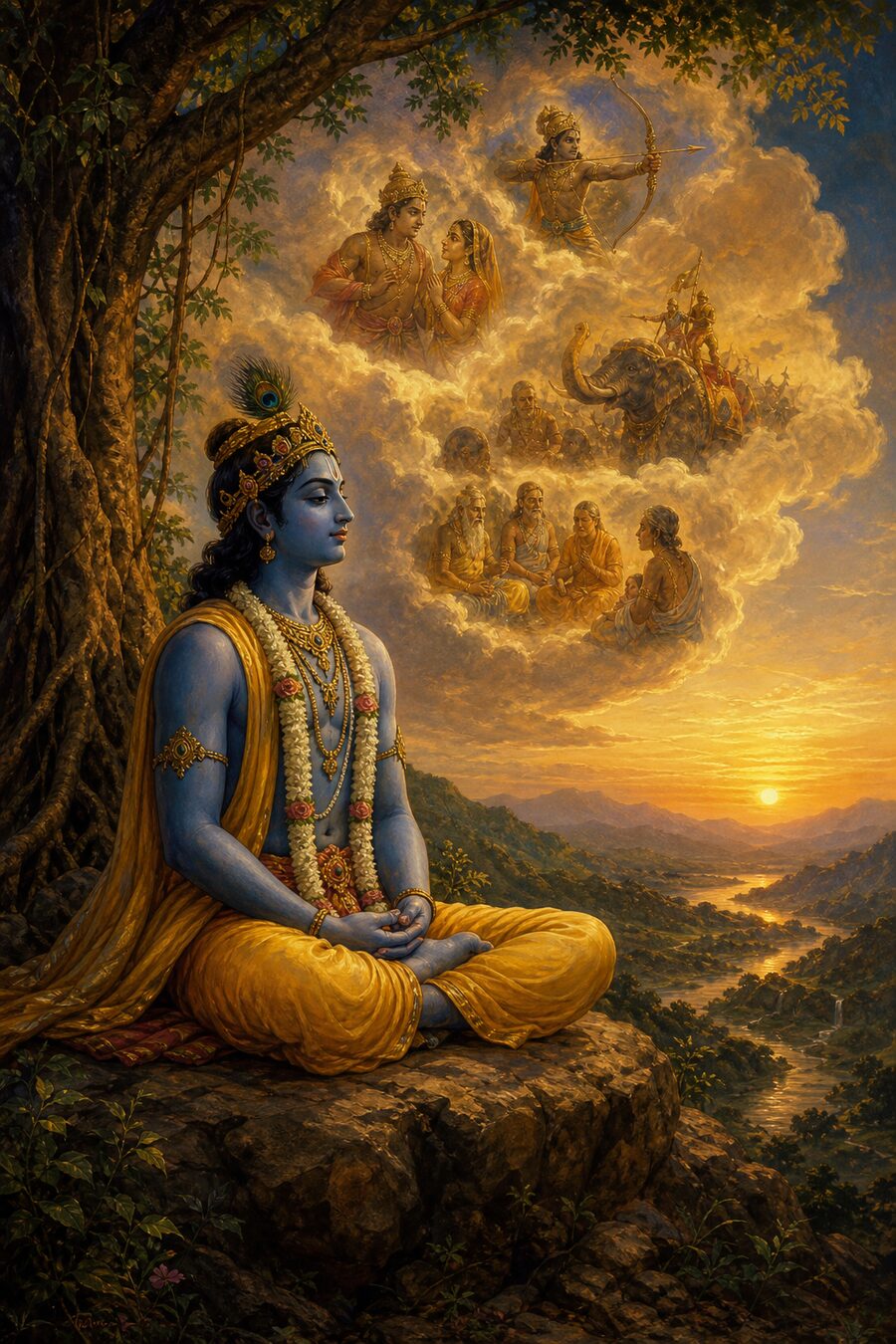
The reply, verses 213 to 222, turns the disciple’s own sentence back on him. The emptiness he reports is something he saw, and whatever is seen has a seer; the seer is known as the knower, and is witness to itself, which makes the inner Self directly the Supreme. Verses 218 to 220 put the whole error into one picture, the sun reflected in a pot of water and a fool who takes the reflection for the sun, and verses 221 and 222 give the fruit of knowing the Self: freedom from sin, stain and death, a mass of bliss, and a man who fears nothing from anywhere.
From verse 223 the word Brahman enters, and the argument from there to verse 240 is that the witness and Brahman are one and that the universe is Brahman as well. The instrument is the potter’s clay: a pot is clay through and through, and its pot-ness is a name. Verses 230 to 236 apply the clay to the world, calling the shruti, the Gita, deep sleep, the rope and the snake, and the shell taken for silver as evidence, and verses 237 to 240 describe the Brahman that remains when the universe has been returned to it, a mass of knowing and bliss with no second thing beside it.
How this part runs
Verse 212 is the disciple’s doubt. Verses 213 to 216 answer it: the absence too is experienced, the knower is to be known as the knower, whatever is experienced has a witness, and the witness of itself is the Supreme. Verse 217 describes the “I, I” that shines through waking, dream and deep sleep. Verses 218 to 220 give the sun in the pot’s water and apply it to body, intellect and reflection. Verses 221 and 222 state the fruit and say there is no other path. Verse 223 names knowledge of non-difference from Brahman as the cause of liberation, verse 224 says there is no return, verse 225 defines Brahman, and verses 226 and 227 state nonduality and that the universe is Brahman. Verses 228 and 229 give the pot and the clay; verses 230 to 236 apply them, with the Atharva shruti at 231, the three consequences at 232, the Gita at 233, deep sleep at 234, the rope and the snake at 235, the shell and the silver at 236. Verses 237 to 239 describe Brahman, and verse 240 ends on the knower’s I.
212
The disciple speaks at verse 212, and the verse has him address the guru by that word. When these five sheaths have been negated as unreal, he says, he sees nothing here apart from the absence of everything, sarvabhava; what entity is there, then, for the wise knower of the Self to know as his own self? Each sheath was set aside with the sentence this is not I, and the disciple carried the sentence out honestly five times; what the honesty has left him is a negation with nothing visible behind it, and his question asks whether the method ends in a void. Madhavananda’s note names the view the verse states: the shunyavadin’s, that the final analysis leaves nothing positive, which the verses that follow refute. The disciple reports what he sees and asks what remains, and the asking is itself the opening the guru uses.
213
The reply begins at verse 213 with praise. The guru says, “Truly spoken; you are learned, and you are skilled in inquiry.” The skill lies in the question itself, and the rest of the verse starts to show why. The modifications beginning with the ego, and this absence of them too that follows, tad-abhava, are both named as things that are experienced, and Madhavananda places the absence in deep sleep, in a parenthesis of his own; the sentence runs on into verse 214 to say by what they are experienced. The disciple said he saw the absence of everything, and verse 213 enters that absence on the list of the experienced. An empty room does not know that it is empty; the disciple knew, and his knowing is the fact the whole answer rests on.
214
Verse 214 completes the sentence. All these are experienced by one, and that one is itself never experienced; know that Self, the verse says, the knower, veditr, with the subtlest intellect. The disciple went looking for one more thing to be known and found none, and verse 214 says why the search came back empty: the Self is the knower of every object and is never among the objects. The eye sees the whole room and never appears in its own field of view, and the Self’s absence from the field of the known is its nature as the one who knows. It is known all the same, since the verse commands it, and the manner of knowing is the manner proper to a knower, as oneself, with an intellect made fine enough to stop treating the seer as one more thing seen. Madhavananda’s note draws the argument out: the Self as the eternal subject must always remain, since without a subject knowing itself would be impossible, and even deep sleep needs the subject behind it to carry the memory of its rest.
215
Verse 215 states the rule the answer has been using. Whatever is experienced by something has that something for its witness, sakshin; where nothing experiences a thing, witnessing does not arise, and a variant reading says witnessing is not established. Experience without an experiencer is a contradiction, since the word experience names a thing’s being known by someone. The rule settles onto the doubt of verse 212 by itself. The disciple experienced emptiness; what is experienced has a witness; the witness of that emptiness is the entity he asked about. His own report answered his question, and the guru’s work in verses 213 to 215 was to make him hear the answer inside it.
216
A reader meets a question here before verse 216 asks it: if the witness knows everything, who knows the witness, and who knows that knower, and so on up an endless staircase? Verse 216 stops the staircase on its first step. This Self is witness to itself, sva-sakshika, because it is experienced by itself; a second witness is as unnecessary as a second lamp, since a lamp lights every object in the room and lights itself in the same act. The conclusion follows in the same verse, and it is an identity: therefore the inner Self, pratyag-atma, is itself, directly, the Supreme, param, and nothing else. Madhavananda’s rendering says that the soul within is itself and directly the Supreme Brahman. The witness the disciple found inside his own doubt is the Supreme, with no distance, no intermediary and no third thing standing between the two names.
217
Verse 217 gives the disciple something to find, and tells him where. That which shines with full clarity in waking, dream and deep sleep, as the inner form, is ever flashing within as “I, I,” aham aham, and the house text says it flashes naikadha, in more than one way, which Madhavananda renders as in various forms, while another reading has ekadha, in one unbroken way; on either reading the I is the same through every form it flashes in. It watches these things that share in the many-formed modifications, the I-notion and the rest, and it shines as the Self of eternal bliss and consciousness. Know that, the verse ends, as your own self, in the heart. The waking day changed, the dream replaced it, deep sleep replaced the dream, and across all three the awareness that says I stayed the same, watching the I-notion rise and change without rising or changing itself. The disciple’s fear was of ending as nothing; verse 217 points him to the one thing in his experience that has never once been absent, and places it in the heart, where he already is.
218
Verses 218 to 220 put the error into one picture. In verse 218 the sun’s disc is reflected in the water of a pot, and the fool, looking at the reflection, takes it for the sun itself. In the same way the dull man, through delusion, takes as I the cid-abhasa, the reflection of consciousness, lodged in the upadhi, the condition that holds it, which Madhavananda renders as the buddhi and verse 220 names as the intellect. The sun stands overhead; the water in the pot catches a small quivering image of it; and the mistake is to stand in the courtyard calling the image the sun. The real consciousness is the sun, the intellect is the water, and the quivering I with its borrowed light is the reflection, and the whole of the error the sheaths produced is contained in taking the reflection for the source.
219
The same picture shows the way out, and verse 219 gives it. The wise man leaves aside all three, the pot, the water and the sun’s image in the water, and sees the sun itself, which stands apart, tatastha, lights these three, and shines by its own light, svayam-prakasha; one reading has the sun seen in the sky. Staring harder at the water will never reach the sun. The gaze is lifted off the three things together, and what it finds was there the whole time, untouched by the pot, lighting the pot, the water and the image alike and depending on none of them. Madhavananda’s note adds that the three are the sun’s reflections, which serve to suggest the real sun; the error that began in the water is also the clue that leads out of it. Verse 219 ends on as this, so that, and verse 220 supplies the that.
220
Verse 220 names the three. Discard in this way the body, the intellect and the reflection of consciousness, and find the seer, the Self, placed in the cave within the intellect, undivided knowing, akhanda-bodha, the light of all, and sad-asad-vilakshana, distinct from sat and asat, which Madhavananda renders as distinct from the gross and the subtle. His note reads the cave as the purified intellect, in which the glimpse of the Self is caught. The last phrase invites a misreading, that the Self neither is nor is not; the Self is sat, being itself, as verses 226 and 237 say outright, and what it stands apart from is everything gross and everything subtle, the manifest and the unmanifest, the body at one end and the reflection at the other, all of which it knows and none of which it is. The three discardings end in a positive: a seer, undivided, lighting everything, found in the quiet of the intellect’s cave the moment the gaze leaves the water.
221
The description continues in verse 221, and the fruit comes with it. The Self is eternal, all-pervading, present everywhere, most subtle, empty of inside and outside, and not other than oneself. Having fully known this, one’s own form, a man is vipapma, free of sin, viraja, free of stain, and vimrityu, free of death. The three freedoms arrive with the knowing and by it, because sin, stain and death were all properties of the sheaths, deeds of the body, passions of the mind, the body’s end, and the Self the verse describes was always on the far side of them. Knowing oneself as that is the release; verse 221 lists no further step between the knowing and the freedom, and the next verse says there is none.
222
Verse 222 finishes the sentence that began at verse 220. The knower is free of sorrow, a mass of bliss, ananda-ghana, and wise, and he himself fears nothing from anywhere. The disciple feared that the end of the inquiry would be an emptiness; the end the verse describes is dense, a mass, and the mass is bliss. Fear needs a second thing to come from, and where everything is known as one Self the second thing is gone; that is why the fearlessness follows from the knowing and from nothing added to it. The verse closes the first argument with a plain sentence: for the seeker of liberation there is no other path to freedom from the bondage of becoming than sva-tattva-avagama, knowing the truth of one’s own Self. Bathing, giving and breath-control were ruled out as causes of liberation in verses 11 to 13; verse 222 states the one cause, and verse 223 gives it its name.
223
The word that governs the rest enters at verse 223. Knowledge of one’s non-difference from Brahman, brahma-abhinnatva, is the cause of liberation from becoming, and by it the wise attain Brahman, advitiya, without a second, and bliss. The verses before this spoke of knowing the Self; this one speaks of knowing oneself as not different from Brahman, and the two are one knowledge, since the inner Self of verse 216 was already declared directly the Supreme. What verse 223 adds is the name and the scale. The witness of verses 213 to 216 carries no private measure; it is the one without a second, and knowing oneself as that is what liberation from the round of becoming consists in.
224
Verse 224 says the knowledge holds. The knower who has become Brahman, brahma-bhuta, does not return again to samsara; therefore one’s non-difference from Brahman must be fully known. The word become asks for care. The knower was never other than Brahman; what changes in him is the knowing, and brahma-bhuta names a man in whom the knowing has done its whole work and left no corner of ignorance where the old identity could regrow. Samsara ran on ignorance of the Self, the bonds imagined by ignorance that verse 27 described, and a bond that ignorance made ends when knowledge comes, as the snake ends when the rope is known, and the snake has no road back. The river that reaches the sea is one picture of it: the water is seawater now, and it was water all along. The verse closes on its command, know this non-difference fully, because a knowing that stops short leaves the return open.
225
The definition of Brahman comes at verse 225, and its first three words are the Taittiriya Upanishad’s, 2.1.1: satyam jnanam anantam, truth, knowledge, infinite. Brahman is, further, pure, supreme, self-established, of the one taste of eternal bliss, pratyag-abhinna, not different from the inner Self, and nirantara, without break, which Madhavananda renders as devoid of interior or exterior; it prevails. Each of the three opening words answers a doubt. Truth is what is, without change; knowledge means that Brahman is awareness itself; infinite means no limit, in time or in place. The weight of the verse for the disciple sits in the phrase not different from the inner Self: the Brahman so defined is at no distance from the “I, I” of verse 217, since the two are declared one without break, and Madhavananda adds the words in reality in a parenthesis of his own, to mark that the oneness holds whether or not it is known.
226
Verse 226 names the oneness. This existent, sat, is the supreme nonduality, because of the absence of any thing other than itself; nothing else exists at all in the state of full awakening to the supreme truth. Advaita, a-dvaita, is the word for what the verse states: a second never was, the count was always one, and the state of awakening finds nothing else because nothing else was there. What is seen meanwhile, the world of many things, appears, is lived in, rests wholly on Brahman and has no being of its own; Madhavananda’s note puts it as everything but the Self being an appearance, and knowledge of Brahman negates that appearance as knowledge of the rope negates the snake. The verse’s subject is the existent, and the Self of verse 220 that stands apart from the gross and the subtle is this existent, which verse 226 declares the whole of what is.
227
The oneness reaches the universe in verse 227. This whole universe, which appears many-formed through ignorance, is all Brahman alone, with every fault of imagining, bhavana-dosha, cast off. Madhavananda takes that last compound as describing Brahman, free of all the limitations of thought; read for the seeker it says the universe is seen as Brahman once the fault of imagining is set aside, and the two readings meet, since the fault is the seeker’s and Brahman never had it. The universe the verse means is the one in front of the eyes, in its many forms; of that universe it says that it is Brahman and that the many forms come of ignorance. The seeing in pieces is the habit, and when the habit falls the same universe stands as Brahman; verses 228 and 229 give the habit and its cure a shape, a potter’s clay.
228
Verse 228 begins with the pot. The pot, though an effect of clay, is not different from clay; everywhere it is clay by nature. There is no pot-form existing apart, and the verse asks where the pot could then come from, and answers: it is false, an imagined name only, nama-matra, and Madhavananda’s note traces the phrase to the sixth chapter of the Chandogya Upanishad, 6.1.4, where the modification is a name and the clay is what is true. Run a finger over the pot at any point, the rim, the belly, the base, and the finger touches clay, since every part of the pot is clay and there is no part that is pot in addition. The world is the pot. Every thing in it, each tree, each creature, is a name and a form, and what is in all of them, as the clay is in the pot, is Brahman.
229
The pot becomes a test in verse 229. No one can show the pot’s own form as other than clay; therefore the pot is imagined only, through delusion, and clay alone is real, mrid eva satyam, the supreme reality in respect of it. The test is whether a thing can stand on its own. Clay stands with no pot anywhere, as a lump; a pot with the clay removed is nothing at all, since there was nothing to it besides the clay shaped so. Of the two, the one that stands by itself is the real one, and the one that borrows its whole being from the other is a name. Every thing in the world is a pot in this sense, and the ground that stands by itself under all of them, the clay of the world, is Brahman alone.
230
Verse 230 applies it. All this that is the effect of the real Brahman is real, sat, and is That alone; nothing exists other than it. Whoever says of anything, it is, asti iti, meaning that it is on its own, apart from Brahman, has a delusion that has not left him, and his talk is the babble of a sleeper, nidritavat prajalpa. The word real is given to the effect, and given in the same breath as the ground: the universe is real as Brahman, as the pot is real as clay, and the reality it has is the ground’s. A man who mutters in his sleep speaks words with nothing behind them, and the one who speaks of a separate world speaks in that condition; the comparison names the condition and the remedy together, because a sleeper’s talk ends the moment he wakes. Waking here is knowing that the whole of this, every thing, is the one existent, which verse 231 says with the shruti’s authority.
231
At verse 231 the shruti speaks as witness. This universe is Brahman alone, brahmaivedam vishvam: so says the voice of the shruti, the revealed word, seated in the Atharva and foremost among voices, and Madhavananda’s note gives the source as the Mundaka Upanishad, 2.2.11, one of the Upanishads of the Atharva Veda. Therefore this universe is Brahman only, since what is superimposed, aropita, has no separateness from its ground, adhishthana. The last line is the logic of the whole argument. The snake was superimposed on the rope and had nowhere else to be; it was the rope the whole time, under a wrong name, and the knowledge of the rope found it exactly where the rope was. The universe is superimposed on Brahman in the same way, and so it has nowhere to be apart from Brahman; its being is the ground’s, and the name is what delusion added. Verse 232 says what would follow if the superimposed were real on its own.
232
Verse 232 argues from consequences. If this world were real, three things would follow: the loss of the Self’s infinity, anantatva-hani, the scriptures’ loss of authority, and the Lord’s being a speaker of untruth; and none of these three is right or good in the eyes of the great-souled. The first follows because a second real thing marks a boundary where the Self ends and the world begins, and a bounded Self is finite; Madhavananda renders this limb as the dualistic element never ceasing, since a world real as it is could never be destroyed. The second follows because the shruti declared the universe Brahman at verse 231 and would be proven wrong. The third follows because the Lord declared the same, and his note allows the Lord to be either the revealer of the shruti’s truth or Krishna in the Gita, whose words verse 233 quotes. The verse argues; it sets the opposite view beside its results and lets the results condemn it.
233
At verse 233 the Lord speaks. Ishvara, who knows the truth of things, settled it in these words: “And I am not in them,” and “the beings are not in me,” which Madhavananda’s note refers to the fourth and fifth verses of the Gita’s ninth chapter, 9.4 and 9.5. The lines surprise a reader who expects Advaita to say that everything is in the Lord. The word in requires two things, one inside the other, and where there are two there is a container and a thing contained, each with a being of its own. The Lord’s denial removes the two. The beings are Brahman, as the snake is the rope, and a snake is in the rope only in the way the rope is in the rope; so the universe is Brahman itself, through and through, and the preposition has nothing left to join. Verse 233 makes the Lord’s words the warrant for the third consequence of verse 232, and verse 234 adds a proof from every night’s sleep.
234
Verse 234 gives the proof from deep sleep. If the universe were real, let it be perceived in deep sleep; since nothing at all is perceived there, it is unreal, asat, and false like a dream, svapnavat mrisha. The verse’s conclusion is stated in its own words, unreal and false like a dream, and the ground of it is plain: whatever is real on its own would be there whether or not a mind was awake to it, and every night the whole universe is absent, and the sleeper rests. Asat here is the dream’s kind of being, the sense verse 20 gave to mithya: the world appears, is lived in while it appears, rests wholly on Brahman, and has no being of its own apart from Brahman, which verse 235 states as the ground appearing through delusion. What remained through the deep sleep in which the universe went absent was the witness of verse 215, and the witness is Brahman; what is present in all three states is the real, and what comes and goes with one of them is the appearance.
235
The conclusion comes at verse 235. The world is not apart from the supreme Self; its separate appearance is false, like the qualities and the rest, gunadivat, which Madhavananda’s note reads as the blueness in the sky, the illustration of verse 195, while a variant reading, gunahivat, gives the snake in the rope. What meaning or worth, the verse asks, does a superimposed thing have of its own? It is the ground, adhishthana, that appears so, through delusion. The rope and the snake return with their full weight. In the dark the rope appeared as a snake; the snake’s shape, its length, its coil were all the rope’s, seen wrongly; and when the light came the rope was found where the snake had been, with the snake’s whole being accounted for by it. The universe appears in the same way: Brahman, the ground, seen through delusion as a world of many forms, and the many forms, examined, turn out to be the ground every time, which is the sense in which the world is the Self and in no way apart from it.
236
Verse 236 adds the shell. Whatever a deluded man perceives through delusion is Brahman alone; the silver is in fact shell. As this, idantaya, it is always Brahman that is figured, and a variant reading has the existent alone in place of always; what is superimposed on Brahman is a name only, nama-matra. A piece of shell glints on the shore, and from a distance it is silver; a man runs, picks it up, and his hand holds shell. The silver was seen, and the thing seen was the shell the whole time, so that even the error reached only the shell. The pointing finger is the verse’s second lesson. Whenever a finger is raised at some thing and says this, this tree, this creature, this body, the thing the finger falls on is Brahman, since Brahman is what every this is made of, and the name laid over it is what the finger added.
237
Brahman itself is described from verse 237, now that the universe has been returned to it. Therefore the supreme Brahman is real, sat, one without a second, a mass of pure knowing, vijnana-ghana, untainted, wholly at peace, without beginning and end, actionless, and of the nature of unbroken bliss. Madhavananda carries the universe over from verse 236 as the subject, whatever manifests is the supreme Brahman itself; the verse states the predicates of Brahman, and his rendering adds the subject the argument has reached. One word answers verse 212 directly. The disciple feared that after the sheaths an emptiness remained; verse 237 says what remains is a mass, and the mass is knowing, and verse 222 had already called the knower a mass of bliss. The room emptied of everything was full the whole time, of consciousness and of bliss, and the emptying was what let it be seen.
238
Verse 238 continues the description with the divisions gone. Every division made by maya is removed; it is eternal, where a variant reads dhruva, fixed; it is happiness, which Madhavananda renders as ever beyond the reach of pain; partless, nishkala; immeasurable, formless, unmanifest, nameless, imperishable; and this something shines as light itself, jyotih svayam. Most of the verse’s words are negations, because every positive description would set Brahman in a slot, this shape, this name, this size, and Brahman has no slot. The negations clear the slots, and the verse keeps two positive words for what is left, happiness and light, with a third, the indefinite something, for the thing the words cannot close on. The light it shines with is its own, as the lamp of verse 216 needed no second lamp, and verse 239 says what kind of knowing such a light allows.
239
The wise are the subject of verse 239, and the verse says what they know and how. They know as the supreme reality that which is empty of knower, known and knowing, infinite, nirvikalpa, free of all distinction, and only undivided pure consciousness, kevala-akhanda-cin-matra. Every ordinary act of knowing has three parts, a knower, a thing known, and the knowing that joins them, and the three parts are a division, so that whatever is known in that way is known as an object standing apart from its knower. Brahman is the consciousness in which all three parts appear, and the wise know it as that, as themselves, in a knowing without a second term; the Self of verse 214 was to be known as the knower, and verse 239 says the knower, known as he is, has no partition in him. Nirvikalpa names the knowing with no distinction left in it, and the verse calls the one so known undivided consciousness alone.
240
Verse 240 ends on the first person. That which is aheya, not to be rejected, and anupadeya, not to be taken up; beyond the range of mind and speech; immeasurable; without beginning and end: that Brahman, the full, purna, I am, that light; a variant reads the full, the great light. Madhavananda’s note gives the reason for the first two words, that Brahman is one’s own real Self, which is why there is nothing to throw away and nothing to pick up. The disciple’s question at verse 212 asked what entity remained for the knower to know as himself; verse 240 answers in the grammatical person the question used, I. What remained is full, with mind and speech unable to reach its edge because it has none, and the one who began by seeing only an absence ends the argument saying of the whole that he is it, since the verses from 213 onward showed him the seer inside the absence, the Supreme as the seer, and the universe as Brahman, nowhere apart from it.
What comes next
Part 9 · Tat Tvam Asi, You Are That, verses 241 to 266. The great saying of the Vedanta, tat tvam asi, you are that, is opened there into its two words, tat, Brahman, and tvam, the self within, and the verses show how the two words, once purified of what is laid over them, name one thing.
Verse 240 speaks in the first person, aham, I, and the saying that follows is addressed in the second, tvam, you; the knower’s I of verse 240 is the you that Part 9 begins from. Verse 242 puts the difficulty the saying raises, that the two terms differ in every literal attribute, as the sun differs from a firefly, and the verses after it find the identity in the implied sense of the two words, with the opposition confined to the adjuncts.