Vivekachudamani
Part 5 · The Nature of the Self, and the Knot of Bondage · Verses 124 to 145
Verses 72 to 123 laid the not-Self down piece by piece, body, senses, breaths, mind, maya and her gunas, until verse 123 called the whole heap unreal as a mirage. Verses 124 to 145 turn to the one who was doing the laying down. The guru says what the Self is, the witness of the three states that lends its light to the intellect and does nothing, and asks the disciple to know it as “this I am”; then, from verse 137, he lays open how the knot was tied, the single notion by which so near a truth has stayed hidden.
124 · “Now hear the nature of the Self”
The promise comes first. Verse 124 announces that the guru will now set out the svarupa, the real nature, of the paramatman, the supreme Self, and ties a result to the hearing: knowing it, a man is freed from bondage and attains kaivalya, which Madhavananda’s note takes at its root, extreme aloofness, and which the verse uses for liberation itself. The subject is named at the outset, so that what follows is description, and the freeing is joined to the knowing, with no act set between them. Verse 123 had ended on viddhi tvam, know this, you, with the heap of the not-Self in front of the disciple. Verse 124 turns him from the heap to the knower, and the sixth of his seven questions in verse 49, what the supreme Self is, begins to receive its answer.
125 · 126
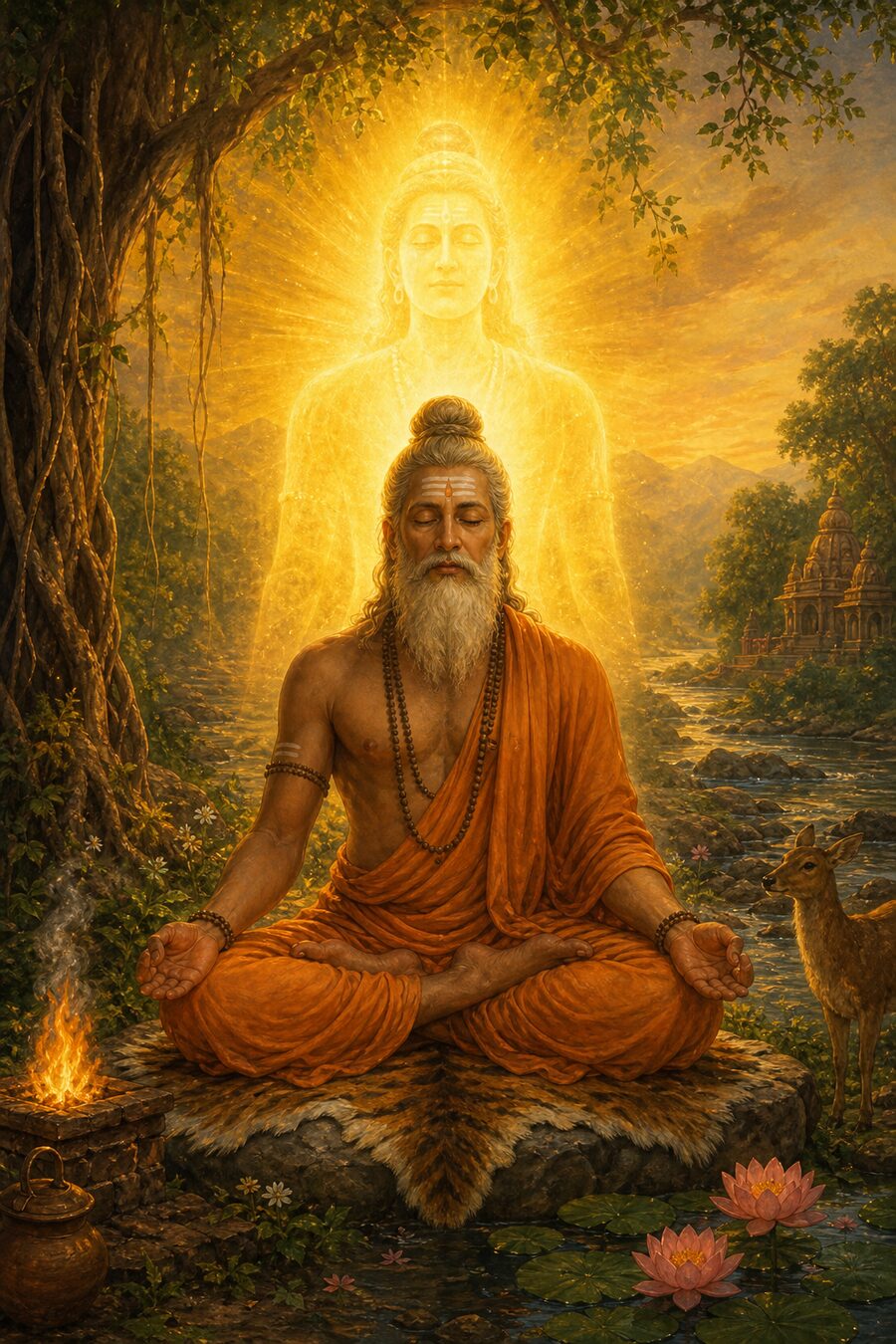
Verse 125 begins the description without a name. There is a certain something, asti kashchit, and the verse gives its marks: it exists by itself, it is eternal, it is aham-pratyaya-lambana, the ground on which the notion “I” rests, and it is the witness of the three states, waking, dream and deep sleep, standing apart from the five sheaths, which the verses from 146 onward will open one by one. Madhavananda renders kashchit as “some Absolute Entity”; the verse itself only points. Verse 126 supplies the recognition out of the hearer’s own nights. This something knows everything in waking, in dream and in deep sleep, and knows, as “I”, both the presence of the intellect and its modes and their absence. In deep sleep the intellect and its activity are gone, and in the morning a man says, I knew nothing, the saying verse 121 made the proof of that state; whoever can report the absence was present through it, and whatever knows both the intellect at work and the intellect withdrawn cannot be the intellect. When the lamp goes out, something still knows that it is dark, and that knower of light and dark alike is what the verse means by “I”. Verses 126, 127 and 128 each close on the word ayam, this one, the teacher’s finger held toward what is already present.
127 · 128
Four pairs of claims follow in verses 127 and 128, each setting the Self on one side and everything else on the other. Verse 127: it sees all by itself, and no one sees it; it makes the intellect and the rest conscious, and they do not make it conscious. The eye is the nearest likeness, seeing every object in the room and never itself. Verse 128 widens the claim to the whole of things: by it this universe is pervaded, and nothing pervades it; all this is abharupa, of the nature of a reflected shine, and when it shines, everything shines after it. Madhavananda’s note hears in the second half the line of the Katha Upanishad (2.2.15), that everything shines after him who shines, and by his light all this is lit. The universe is lit the way a room is lit by the sun, by borrowed light, and the verse names the lender, the awareness that no other light reaches.
129 · 130
Verse 129 says how the Self acts on the body, and the answer is that it does nothing. By its sannidhi-matra, its mere presence, the body, the senses, the mind and the intellect go about their own objects prerita iva, as if impelled; Madhavananda adds “like servants”, his own image for the as-if. The sun rises and the countryside wakes, and the sun has given no order; the stir is the world’s own answer to its presence. Verse 130 turns from the instruments to the knowing. Everything from the ego down to the body, and the objects of sense, and pleasure and the rest, are known by this Self, whose nature is nitya-bodha, eternal knowing, and the verse measures the knowing with a pot: known as plainly as a jar in front of one. The ego heads the list: the sense of being a doer and an enjoyer stands before the knower as the pot stands on the table, an object to a seer, and a man who takes his ego for himself has picked up the pot and called it the eye.
131 · 132
The witness is now given its names. Verse 131 calls it the antaratma, the inner Self, and the purana purusha, the ancient person, and gives its nature as nirantara-akhanda-sukha-anubhuti, the experience of bliss without interruption and without division, ever of one form; the happiness a man hunts through a lifetime of objects is, by the verse, his own nature. The verse adds pratibodha-matra, awareness and nothing besides, which Madhavananda reads with the Kena Upanishad (2.12) as the awareness that shows itself through every cognition; and it closes with yeneshita, impelled by whom speech and the vital breaths go about their work, the answer to the question with which the Kena opens, by whom willed does the mind go out to its object. Verse 132 says where to find it, and the where is close. Right here, atraiva, in the sattvic mind, in the cave of the intellect, dhi-guha, in the space called the unmanifest, avyakrita akasha, which Madhavananda’s note takes for the causal body, the innermost of the three, beyond which the Self is to be sought; there it shines like the sun high in the sky, lighting this universe by its own radiance. Madhavananda renders the word for its light as charming splendor, ushat-prakasha; a variant reading, uru-prakasha, makes the light vast. Either way the figure is the sun, which is lit by nothing.
133 · 134
Verse 133 settles what the Self does while the instruments move: it knows. It is the jnata, the knower, of the changes of mind and ego and of the actions done by body, senses and breaths, and it follows them, anuvartamana, as fire follows iron, ayo-agnivat, yet it neither acts nor changes in the least. The direction of the likeness matters. Fire has no shape of its own; in a bar heated red it seems to have taken the bar’s shape, bent where the bar is bent, and Madhavananda’s note draws the application, that the Self, without form, seems to take the form of the intellect and the rest. The bar bends under the hammer, the fire in it seems to bend, and nothing has happened to fire. Verse 134 then lays down five denials in a row. It is not born, it does not die, it does not grow, it does not decay, it does not change, being eternal; Madhavananda’s note sets these against the six modifications Yaska counted for everything that comes to be. The opening words echo the Gita (2.20) and the Katha Upanishad (1.2.18), which say the same of the Self in nearly the same words. The second half gives the figure of the jar, which is the verse’s own. When this body dissolves, the Self does not dissolve, as the space in a jar does not when the jar goes; the words Madhavananda adds in parentheses, “after it is broken”, are his, and the verse’s last word is svayam, by itself. The jar lent the space a name and a seeming boundary, and when the jar breaks the same space is there, having lost nothing because it was never enclosed.
135 · 136
Verse 135 brings the description to the nearest experience a man has. The paramatman, distinct from prakriti and its modifications, of the nature of pure knowing, nirvishesha, without any particular mark, lighting up all this without remainder, the gross and the subtle, as Madhavananda renders the verse’s sat and asat, shines directly in waking and the other states as “I, I”, as the witness of the intellect. The “I am” that persists under every changing content is the Self showing itself, sakshat, with nothing between. Verse 136 turns the description into an instruction. With a controlled mind, know this your own Self in yourself, directly, as ayam aham, this I am, buddhi-prasadat, through the clarity of the intellect. Prasada is the intellect’s own settledness; Madhavananda renders it as the purified intellect, a condition of the instrument with no giver behind it, and renders atmani as “in the body”, where the word says in yourself. Then the result: cross the shoreless sea of samsara whose waves are birth and death, and, established in the form of Brahman, be kritartha, one whose purpose is accomplished. The mahavakya tat tvam asi, you are that, waits for verse 241 and the verses after it; the knowledge verse 136 asks for is spoken in the first person, this I am. Madhavananda’s note on the last phrase: we are ever Brahman by nature and through ignorance take ourselves for limited, so that nothing new is made by being established there.
137
What bondage is, the first of the disciple’s questions in verse 49, is answered in verse 137 in one line: the notion “I” in the not-Self, anatmani aham iti matih, is this man’s bondage. It has come from ignorance, and it is the cause of the downpour of the afflictions of birth and death. The second half shows the notion at work. Through this notion a man takes this body, which appears and is lived in with no being of its own, as real, vapur idam asat satyam iti, and as himself; and so he nourishes it, bathes it and guards it with sense-objects, pushyati ukshati avati, three verbs for a lifetime of care. The objects gathered for the body’s sake become the threads, and by them he is bound as the koshakrit, the cocoon-maker, is bound by its own: the silkworm draws the thread from its own mouth, winds it round itself, and is shut in by nothing except its own spinning. Madhavananda supplies “agreeable” before sense-objects in a parenthesis of his own, and his note adds the inference the verse leaves to the reader, that the worm must cut through the cocoon and the man give the objects up wholly. The verse ends at the binding; every day’s care of the body for its own sake adds a turn of thread.
138
Verse 138 states the error in its barest form and then gives it an image, and the image runs the opposite way from the one most readers expect. In a man deluded by tamas, the notion “that” arises in what is not that, atasmin tad-buddhih; for want of discrimination, the notion of a rope flashes up in a snake, bhujage rajju-dhishana; and a great host of calamities falls on the one who takes hold of it, samadatuh. The familiar story has a rope mistaken for a snake and a man frightened of nothing; verse 138 has a snake mistaken for a rope and a man who reaches down and picks it up. The fear story explains needless suffering; the verse explains bondage, and bondage comes of grasping. So the conclusion: whatever grasping of the unreal there is, asad-graha, the taking hold of what has no being of its own as if it were real, that is bondage, and the verse closes on the address that gives it its tone, shrinu sakhe, listen, friend. The body of verse 137 is the snake taken for a rope, and the sense-objects are the hand closing on it.
139 · 140
The knot has two strands, and verses 139 and 140 name them in the order they work. Verse 139: this veiling power, avriti-shakti, made of tamas, covers the Self, which flashes with the power of undivided, eternal, nondual awareness and whose glory is without end, as Rahu covers the orb of the sun. The figure is the eclipse: the sun loses nothing of its light while Rahu stands before it, and the covering moves off. Verse 140 says what happens under the covering. When his own Self, of utterly stainless radiance, is hidden, a man through delusion takes the body, the not-Self, as “I”; and then the great power of rajas called vikshepa, projection, torments him with desire, anger and the rest, which the verse calls binding qualities, ropes that hold. The sequence is the teaching. First the covering, then in the dark the wrong identification, and only then the torment, so that projection has its force where the veil has already done its work. Verses 111 and 113 introduced the two powers; here they are shown in order on one man, tamas the root and rajas the thorned growth from it.
141
Verse 141 draws the man so bound, and its verb for him is abhinayan, acting out. His knowledge of the Self swallowed by the graha of great delusion, the water-monster that in verse 79 seized the half-dispassionate seeker by the throat, he himself acts out the many states of the intellect as if they were his own qualities, tad-gunataya. He plays each mood of the intellect as himself, I am happy, I am broken, I am afraid, an actor so far into the part that he has forgotten he is the actor. Madhavananda’s note puts the mechanism in a sentence: the Self is the real nature of every being, and the mistaken identification with the intellect makes it appear active. The rest of the verse is the result. In the shoreless sea of samsara, filled with the poison of sense-objects, he wanders, sinking and rising, nimajya unmajya, this man of poor understanding, kumatih, and the verse ends by calling his course wretched, kutsita-gatih. Madhavananda reads the sinking and rising as the bodies taken in turn by one’s deeds; the verse’s own picture is a swimmer in a poisoned sea that has no shore.
142 · 143
Verses 142 and 143 say where the ego comes from and what the covering costs, and both look up at the sky. Verse 142: as a bank of clouds, generated by the sun’s own rays, hides the sun and spreads itself out, so the ego, arisen from the Self, atma-udita, hides the reality of the Self and spreads out by itself. The sun’s heat makes the cloud, and the cloud climbs to stand in front of the sun that made it. The ego stands up by borrowing the Self’s awareness, the “I” that rests on the witness of verse 125, and once up it fills the sky as if there were nothing behind it, which is how Madhavananda’s note reads “by itself”; his note adds that the clouds pass, and the ego with them, a hope the verse leaves unspoken. Verse 143 gives the cost. As on a foul day, when the lord of day is swallowed by dense clouds, a fierce icy gale torments the people out in it, so, when the Self is covered by unceasing tamas, the fierce power of projection wears down the man of deluded understanding with many sorrows. The cloud over the sun is the veil of verse 139, the gale is vikshepa, and the gale has its bite because the sun is gone, covering first and torment after, as verse 140 had it. Madhavananda’s note hears in the verbs for tormenting and wearing down a second sense, to make a man wander, and takes the wandering as the low births he is driven into.
144
Verse 144 ties the account into a single sentence. From these two powers alone, etabhyam eva shaktibhyam, has a man’s bondage come; deluded by them he takes the body for the Self and wanders. The whole machinery of bondage, as verses 137 to 143 have described it, is two powers and one result: avarana covers the Self, vikshepa throws up the body and its moods in the covered place, and the man takes what has been thrown up for what has been covered. Madhavananda’s parenthesis, “from body to body”, is his gloss on the wandering. Two causes, both powers of maya described in verses 111 to 116, and one effect, a mistaken identity; the verses from 146 onward turn to how a bondage so made is cut.
145
Verse 145 closes the account with a tree, every member of it named. Of the tree that grows on the soil of samsara, tamas is the seed; the notion deha-atma-dhi, I am the body, is the sprout; raga, attachment, is the new leaf; karma is the water; the body is the trunk; the vital breaths are the branches; the group of senses is the tips of the twigs; the sense-objects are the flowers; sorrow of many kinds, arising from the many actions, is the fruit; and the jiva, the living being, is the bird on it, bhokta, the one that eats. The order is the order of growth, from the seed hidden in the dark to the fruit the flowers set, and a man who wonders why his life keeps bearing the same fruit is sent by the verse to the seed. The verse ends on the eater and gives the bird no other act; Madhavananda’s note points to the two birds of the Mundaka Upanishad (3.1.1 to 2) as the image’s companion, and verse 145 has one bird only, the jiva on its branch, taking the sorrow its own tree has grown.
The next page
Part 6 · The Five Sheaths, First Half: Food, Breath, Mind, verses 146 to 183. Verse 125 set the Self apart from the five sheaths without naming the five; the verses ahead name them and begin to lift them. Verse 146 says that this bondage, rooted in ignorance, is without beginning and, left to itself, without end, and verse 147 names the one thing that cuts it, the sword of the knowledge born of discrimination. Verses 149 and 150 give the image the method rests on, clear water hidden under layers of moss, and verse 153 the reed drawn out of munja grass; then the sheaths are taken in order, food in verses 154 to 164, the vital breaths in 165 and 166, and mind from 167 to 183, where the verses say that the mind itself is ignorance and that the same mind binds and frees.
The tree of verse 145 and the pond of verse 149 are two pictures of one condition. In the tree the jiva eats sorrow on a growth that rose from a hidden seed; in the pond the water is clear in itself and the layers that hide it grew, the verse says, from its own power. The seed has to be seen and the layers lifted, and the verses ahead say by what: viveka alone, the discrimination of Self from not-Self, which verse 152 calls the one thing the wise must do to be free.