Vivekachudamani
Part 16 · The Guru’s Summing Up, the Disciple’s Awakening · Verses 471 to 485
The guru closes the long answer he began at verse 213 with the settled statement of Vedanta: the living being is Brahman, the whole world is Brahman, and to abide as the undivided is itself liberation. The disciple hears it, falls still, and stays for a while with his mind held in Brahman. When he rises he speaks, and his first words confess that speech has failed him: kim va kiyad va sukham asty aparam, what the bliss is, or how much, he cannot tell, for it has no shore.
471
The great renouncers come first, the yatis, as a picture of where this teaching ends for those who hold it. Verse 471 names their marks in order. Attachment has fallen from them and enjoyment has been set aside, the two outer signs of a finished renunciation. Two words then give the inner state: shanta, the mind pacified, and sudanta, the senses well reined, which Madhavananda’s note reads as control of the mind and control of the senses in turn. Such men know this supreme truth, and at the end, which the same note takes as the fall of the body, they reach the highest peace, para nirvriti, through atma-yoga, union with the Self. The verse describes them from the outside, as a man might describe a far shore; the next verse turns the picture toward the one listening.
472 · 473
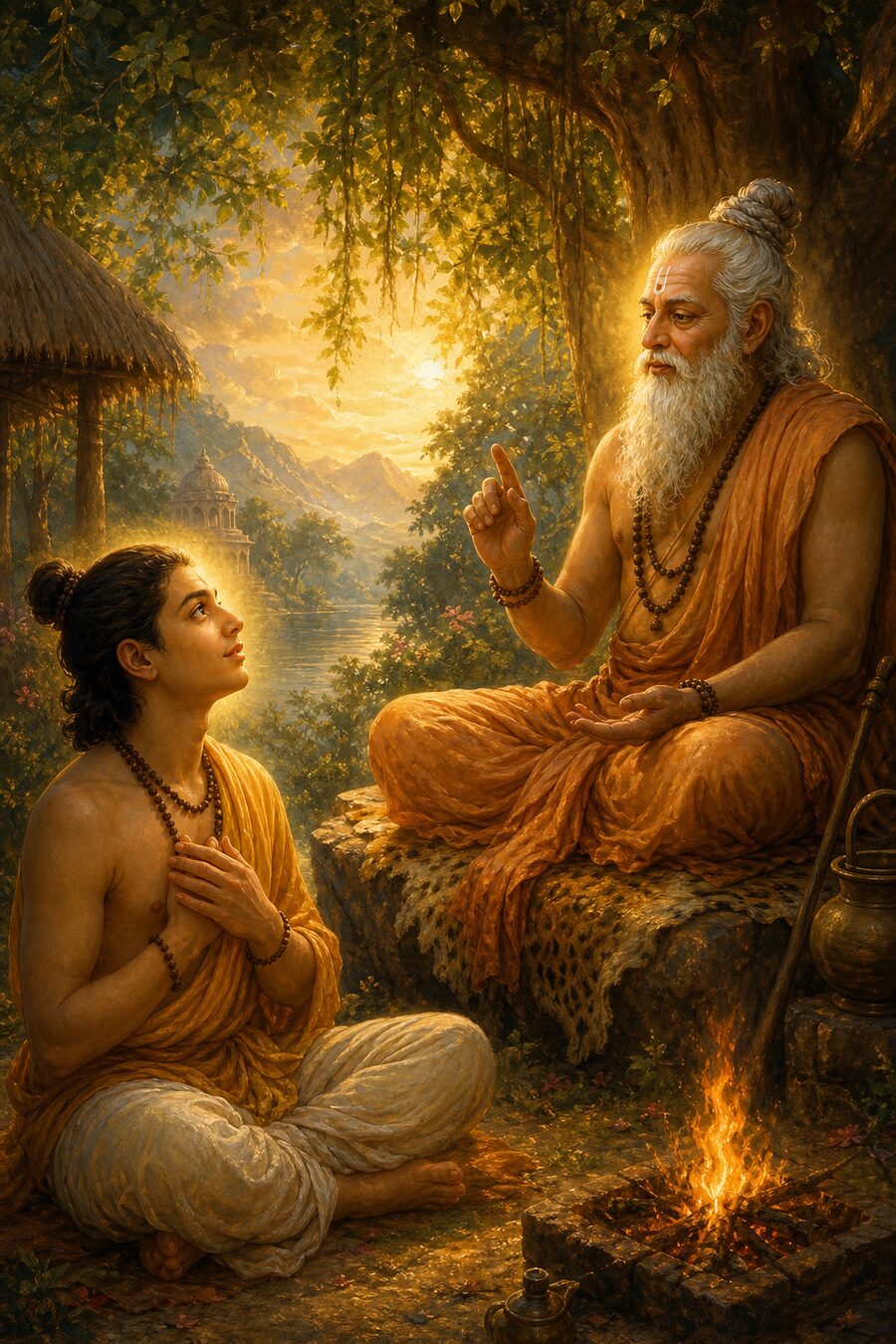
Bhavan api, you too: verse 472 turns from the great renouncers to the one man sitting before the guru. You too, reflecting on this supreme truth, the Self’s own nature, dense with bliss, shake off the delusion your own mind has built, and be free, fulfilled, awake, muktah kritartho prabuddhah. The three words come in order: released from the bondage, with the purpose of a life accomplished, and awake from the dream of duality. Verse 473 says how the reflecting is done. Through samadhi, with the mind made wholly still, see the truth of the Self with the eye of clear knowledge. Hearing has carried the disciple this far; the words heard, which Madhavananda’s note takes as the scriptural sentences such as tat tvam asi, still wait on sight. Once the sense of a heard word has been seen rightly and beyond doubt, it is never raised as a doubt again.
474 · 475
What counts as proof, pramana, when the matter is one’s own freedom? Verse 474 answers for both ends of the work at once: release from the bondage that one’s own ignorance has tied, and the gaining of the Self whose nature is truth, knowledge and bliss. Scripture is a pramana. Reasoning upon scripture is a pramana. The guru’s word is a pramana. One’s own experience, antah-siddha svanubhuti, made firm within, is a pramana as well, and Madhavananda’s note calls it the final test, since without it no one is fully satisfied. Verse 475 shows why with the plainest cases. Bondage and liberation, contentment, worry, recovery from illness, hunger and the rest are known by the one whose they are; everyone else reads them from signs and infers. The man who is hungry knows his hunger, and his neighbor guesses it from his face. Liberation belongs to the same class of facts. Its proof is yours to have, and no one else can hand it to you.
476 · 477
Verse 476 fixes where the teachers stand. The gurus and the Shrutis instruct tata-sthita, standing on the bank, and the crossing is left to the one who learns. The wise man crosses by prajna alone, his own insight, and that insight, the verse adds, is graced by Ishvara. Madhavananda’s note draws the line: instruction is paroksha, indirect, and the aspirant’s own experience in samadhi is aparoksha, direct, the first being the means to the second. Verse 477 gives the standing order. Having known his own undivided Self by his own experience, the one so perfected, samsiddha, should stand face to face in the Self, sammukham, with a mind in which no second thing is imagined. The note reads face to face as living in the Atman.
478
Verse 478 states the conclusion of Vedanta, vedanta-siddhanta-nirukti, in a form a reader can hold whole. The jiva is Brahman alone. The whole world is Brahman alone. Abiding in the undivided form, akhanda-rupa-sthiti, is itself liberation. For Brahman being without a second, the Shrutis are the pramana. With this the answer the guru began at verse 213, when the disciple asked what remains once the five sheaths are set aside, comes to its close, and Madhavananda’s note marks the point. He speaks again from verse 520, after the disciple’s hymn, so what closes here is one long answer, and what opens is the silence into which the disciple now goes.
479 · 480
Iti, so: verse 479 steps back and tells what the words did. Knowing the supreme truth in its own nature through the guru’s words, through the authority of Shruti, and through his own reasoning, the disciple’s senses were quieted and his mind gathered, and at a blessed moment, kvacit in Madhavananda’s rendering, he became motionless in form, established in the Self. The verse gives a still body and a mind that has gone where it was pointed; no speech and no question are recorded. Verse 480 measures the stay. For some time he held his mind in the supreme Brahman; then he rose, which the note reads as a return to the ordinary plane of the senses, and out of the highest bliss spoke the words that follow.
481 · 482
His first words, in verse 481, report what has happened to his instrument of knowing. My buddhi is destroyed, its activity has melted away, through the knowing that Brahman and the Self are one. I do not know this; I do not know not-this either, and Madhavananda’s note reads the pair as every relative idea whatever. What the boundless bliss is, or how much, kim va kiyad va, I cannot say. Verse 482 reaches for a measure and gives up the measuring. The glory of the ocean of supreme Brahman, filled to the brim with the nectar of the Self’s own bliss, cannot be spoken by speech and cannot be thought by mind. Into a fraction of a fraction of a fraction of it, amsha-amsha-lava, my mind has dissolved, as a hailstone that falls with the rains into the sea dissolves and is the sea, and now it rests at peace as bliss itself. The note on the fractions names the descending measures the tradition gives, the Unmanifest, the cosmic mind, the cosmic body, and says the bliss of even the last is enough to melt the finite mind.
483 · 484
Verse 483 turns the same wonder outward. Where has this world gone, who has taken it away, where has it merged? Only now I saw it, and is it no longer? A great wonder, mahad adbhutam: the disciple’s own phrase, said without any excess, since the thing he describes is the disappearance of everything he had ever looked at. Verse 484 draws out what such a disappearance leaves. In the great ocean of Brahman, full of the nectar of unbroken bliss, what is there to be shunned, what to be taken up, what is other, what is different? The four questions had organized a whole life, and each of them depended on a second thing. Madhavananda’s note gives the ground of their falling: there is nothing besides the one Atman, and the one asking is that.
485
Verse 485 closes the first utterance. I see nothing here, I hear nothing, I know nothing. Madhavananda’s note takes here as this state of realization and the three denials as the ceasing of every finite idea, so what the verse describes is a cessation in which seeing, hearing and knowing have all gone quiet together. I exist as my own Self, ever of the nature of bliss, vilakshana, distinct from everything else, which the note explains as the subject’s distinctness from every object. The disciple stops there, and the hymn to the guru that follows rises from the same ground.
What to read next
Part 17 is the disciple’s hymn, verses 486 to 519. It opens with salutation, namo namaste, to the teacher freed of attachment and boundless in mercy, and from verse 489 rises into the declarations of identity: asanga, unattached; ananga, without a body; alinga, without the subtle body; abhangura, undecaying; prashanta, pacified; ananta, infinite; amala, taintless; chirantana, eternal; then in verse 490 akarta, no doer; abhokta, no enjoyer; avikara, changeless; akriya, beyond action; and in verse 494 Narayana, narakantaka, slayer of the demon Naraka, purantaka, destroyer of the three cities, each followed by aham, I am that. Verse 496 gives the ocean: in me, the ocean of unbroken bliss, the waves of the world rise and dissolve on the wind of maya.
Verse 481 is the one to hold in memory: buddhir vinashta, galita pravrittih, the mind destroyed and its working melted away, and at its close kim va kiyad va sukham asty aparam, what or how much the boundless bliss is, I cannot tell. It is the first verse in which the disciple speaks from inside the state, and the whole of Part 17 grows out of it.