Vivekachudamani
Part 6 · The Five Sheaths, First Half: Food, Breath, Mind · Verses 146 to 183
Verses 146 to 183 begin the discernment of the five sheaths, the koshas, the layers that lie between the living being and its true nature. Verse 146 first says what kind of thing the bondage is and verse 147 what alone cuts it; verses 149 and 150 give the image of clear water hidden under moss; then the sheaths are taken in order, food, the vital breath and mind, each examined and each found to be other than the Self.
First, one thing
The method is panch-kosha viveka, the discernment of the five sheaths. A kosha is a sheath or casing, the scabbard around a sword, and the verses treat body, breath, mind, intellect and bliss as five such casings, each finer than the one outside it, over a Self that shows through them all.
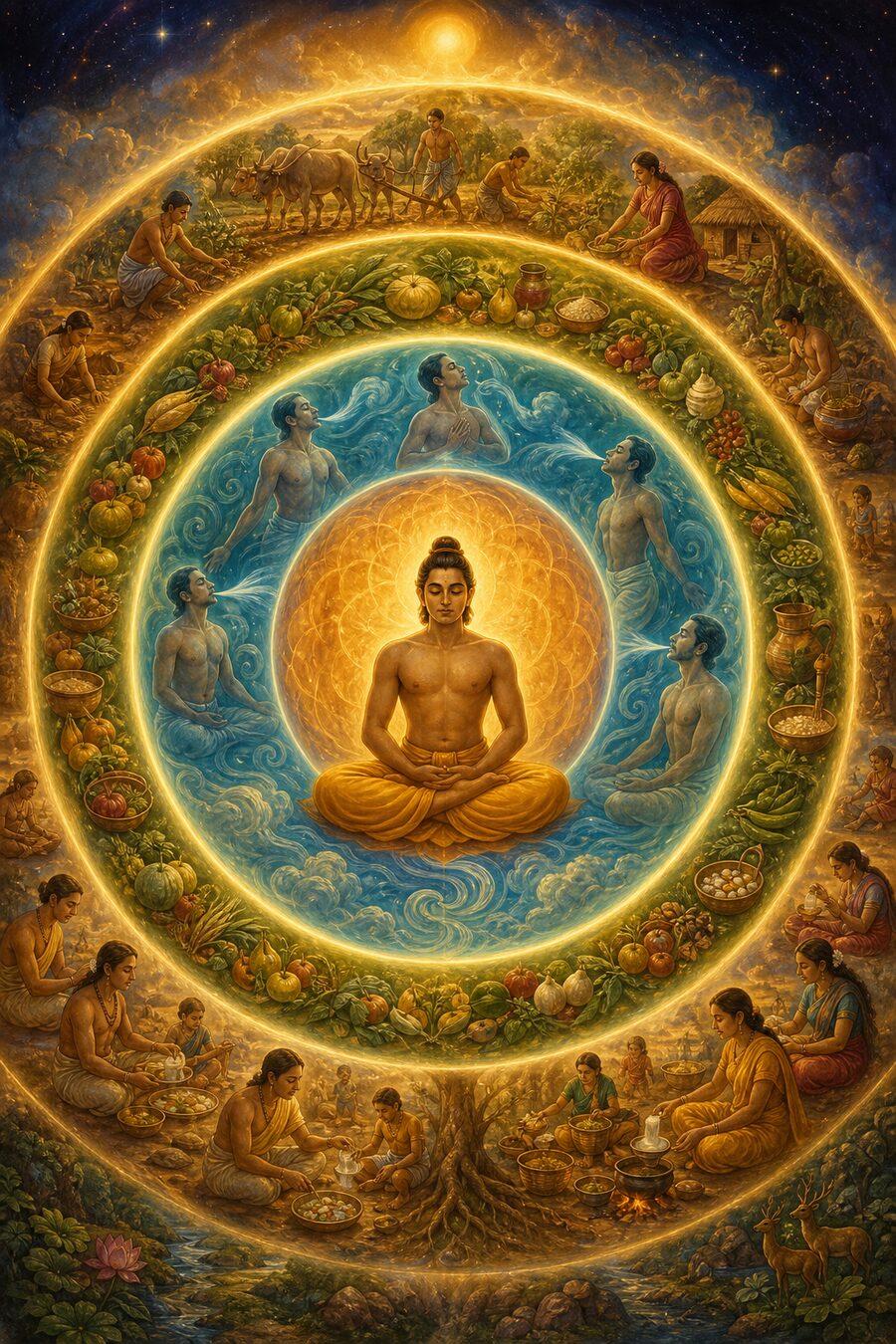
The five sheaths are described in the second chapter of the Taittiriya Upanishad, to which Madhavananda’s note on verse 165 refers the reader, and verse 125 had already set the witness of the three states apart from them without listing them. The examination runs from the outermost inward, beginning with the body a man can touch, and at each sheath the same question is put, whether this is the Self, and the same kind of answer is given, with the reason stated: this too is seen, this too is ruled, this too has a beginning and an end.
The living being’s true nature is sat-chit-ananda, being, consciousness and bliss, and verse 152 says that knowing oneself as that is what the discernment yields. Over it lie five sheaths: annamaya, made of food, the body; pranamaya, made of the vital breath; manomaya, made of mind; vijnanamaya, made of intellect; and anandamaya, made of bliss. Verses 146 to 183 take the first three, and verses 184 to 211 the remaining two.
How this part runs
Verse 146 states the nature of bondage and verse 147 the one thing that cuts it; verse 148 gives the ladder from steadiness in one’s own dharma to the end of samsara. Verses 149 to 153 give the method and its images, the water under the moss and the reed drawn from munja grass. The food sheath takes verses 154 to 164, the sheath of the vital breath 165 and 166, and the sheath of mind 167 to 183. The argument turns on verses 146 to 148, on 149 and 150, and on 169 to 174, where the mind is called ignorance itself and the cause of both bondage and release.
Verse 146 names the bondage before anything is said about cutting it. This bondage to the not-Self, anatma-bandha, is rooted in ignorance; it is naisargika, natural to a man, which Madhavananda renders as self-caused, depending on no other cause; and it is declared anadir ananta, without beginning and without end. It brings on the stream of sorrows, birth, death, disease and old age, falling one after another. The second epithet is the hard one, and the verse means it: left to itself the bondage runs on and does not wear out, and no length of time ends it. Madhavananda’s note adds the qualification the verses that follow work toward, that it is endless relatively speaking and disappears on the realization of the Self. A night of any length ends at the first light, though no one can name the night’s first moment, and the disciple will raise exactly this difficulty in verse 192, how a thing without beginning can come to an end.
146 · Bondage, beginningless and, on its own, endless
Verse 147 says what cannot cut it and then what can. Weapons thrown and weapons held, wind, fire, and karma by the ten million, karma-koti, cannot cut this bondage; the one thing that can is the great sword of viveka-vijnana, the knowledge born of discrimination, sharpened and bright, shita and manju, by the grace of the Lord, dhatuh prasadena. Madhavananda’s note hears in that phrase an echo of the Katha Upanishad (1.2.20) and records the Katha’s other reading, dhatu-prasadat, through the clarity of the mind and the senses, and takes both senses to be present: the sword is sharpened by grace and by a cleared instrument. Acts, however many, stand on the list the verse rejects, and the one thing it admits is knowing. Verse 148 then lays the road out in four steps, each the sole cause of the next. One who holds the shruti as his single standard of truth, shruti-pramana-eka-mati, gains svadharma-nishtha, steadiness in his own dharma; by that alone comes the purification of his mind; the man of purified intellect knows the supreme Self; and by that knowledge alone comes samsara-samula-nasha, the destruction of samsara with its root, which Madhavananda’s note identifies as ignorance. Steadiness, purity, knowledge, the end: the words “by that alone”, tayaiva and tenaiva, join the steps so that none is skipped and none does the next one’s work. Purity of mind is the hinge, and the verses from 167 onward say why, since the mind is where the bondage is made.
147 · Only the sword of discernment
148 · A small map of the road
Verse 149 gives the image the whole method rests on. Covered by the five sheaths beginning with the one made of food, which are nija-shakti-samutpanna, produced by its own power, the Self does not shine forth, as the water in a tank is hidden by layers of moss, shaivala, Madhavananda’s sedge. Three things in the image carry the teaching. The water is covered and is clean the whole time; the moss grew from the pond’s own power, so the sheaths are the Self’s own products and no stranger’s; and moss can be lifted. Verse 150 lifts it. When the moss is removed, the water appears clearly, pure, samyak shuddham, and it takes away thirst and heat and gives a man the highest happiness sadyah, at once. The last word is the one the verse leans on. The removing may take time; the appearing takes none, because the water was there the whole while and had nothing to do to become water. Madhavananda’s note says the same in his own words, that the water is not fetched from anywhere, only the obstructions are removed, and that the case of the Self is the same. The happiness the living being hunts in the world is, by verse 150, under the moss, its own, and whole the moment the covering lifts.
149 · The water under the algae
150 · Remove the algae, the water appears
Verse 151 says what is found when all five are lifted, so that the seeker knows the goal before the peeling begins. On the apavada of all five sheaths, this Self shines pure, of one taste of eternal bliss, nitya-ananda-eka-rasa, pratyag-rupa, the inner one, supreme, self-luminous. Apavada is negation by discrimination, and Madhavananda’s gloss gives its working sense: each sheath is discriminated as other than the Self. The body remains, the breath remains, the mind remains; what is negated is the claim of each to be the Self, and the verse’s word for the result is shining, since a light with nothing in front of it does nothing new. Verse 152 draws the rule. To be free of bondage the wise man must do atma-anatma-viveka, the discrimination of Self from not-Self; by that alone, knowing himself as sat-chit-ananda, being, consciousness, bliss, he becomes anandi, one who is in bliss. The whole method is the one word viveka, and the fruit named is release and bliss together. Verse 153 gives the discrimination its picture, the reed drawn out of munja grass, an image Madhavananda’s note traces to the Katha Upanishad (2.3.17). Whoever separates the inner Self, pratyancham, which is asanga, unattached, and akriya, actionless, from the whole class of things seen, drishya-varga, as the slender inner stalk is drawn from the grass that sheathes it, and then merges all of that into it, pravilapya, and stands as That alone, tad-atmana, he is free. The two adjectives are the test for the reed: whatever joins, acts and is seen belongs with the grass, and the one that only witnesses is what is drawn out. The merging is the second movement, after the separation: the seen is known to have no being apart from the Self it was drawn from, name and form through which, as Madhavananda’s note puts it, the Self alone appears.
151 · When all five lift, the pure atman
152 · Discernment, and bliss
153 · Drawing the reed from munja grass
The first sheath is the body, and verse 154 names it by what it is made of. This body, anna-bhavana, produced from food, is the annamaya kosha, the sheath made of food; it lives by food and perishes without it; and being a heap of skin, hide, flesh, blood, bone and filth, it cannot be the ever-pure Self itself, nitya-shuddha. Madhavananda’s note reads “produced from food” as the food that built the parents’ bodies, so that the body is food twice over. A thing that must be fed every few hours to go on existing has its being on loan, and the Self of verse 151 is self-luminous and of one taste. Verse 155 adds the marks of time. The body does not exist before birth or after death; it lasts a moment, jata-kshana, its qualities are fleeting, its nature unsteady; it is naika, many, a composite of parts with no single thing in it; it is jada, inert; and it is paridrishyamana ghatavat, seen all round like a pot. The verse ends on its own question, how such a thing can be one’s own Self, the knower of the changes of all that is, bhava-vikara-vetta, and the question answers itself in the last word: what is seen like a pot is on the side of the pot, and the knower of changes is on the other side, watching the body’s beginning, its moment, and its end.
154 · The annamaya kosha, a body made of food
155 · Not there before, not there after
Verse 156 argues from the body’s own parts. This body with its hands and feet is not the Self, since a man goes on living when a limb is gone, vyange ‘pi jivanat, and the other powers of the organism remain, tat-tat-shakter anashat; and what is ruled, niyamya, cannot be the ruler, niyamaka. A man who has lost a hand has lost nothing of his I, which is as whole as before, so the I was never lodged in the hand, and the same holds for every other part. The body takes orders, from hunger, from the will, from the breath, and a thing that takes orders is on the side of the instruments. Verse 157 then states the ground on which the whole examination stands. The Self is the witness, sakshi, of the body, of its properties, dharma, of its acts, karma, and of its states, avastha, and the rest, and its distinctness from them is svatah-siddha, established of itself, with no demonstration needed. Madhavananda’s note gives the properties as stoutness and leanness and the states as boyhood and youth. The evidence is in ordinary speech. A man says my body is tired, my body has aged, and the one who says it has watched tiredness come and youth go and is the same across both; the witness of a change stands apart from what changed, and this is known the moment it is attended to.
156 · A limb cut off, and still life
157 · The witness of the body
Verse 158 returns to the heap and asks its question outright. How can this pack of bones smeared with flesh, full of filth, utterly impure, be the knower, vetta, which is itself wholly distinct from it? The verse’s severity is a measure of the grip it is loosening, and its argument is of kind: a knower and a heap of material are two orders of thing, and flesh does not know. Verse 159 sets two men before the same heap. In this mass of skin, flesh, fat, bone and filth the deluded man, mudha-jana, makes his notion of I; the man given to reflection, vichara-shila, knows his own nature, nija-svarupa, the highest truth, paramartha-bhuta, as distinct from it. The difference between the two is the reflecting, vichara, the inquiry verse 11 made the sole means of reaching the real thing; one man has put the question to the heap, is this I, and one has never put it.
158 · A heap of bones, how could it be the knower
159 · The deluded and the reflective
Verse 160 grades the notion of I in three steps. “I am the body” is the understanding of the dull, jada; “I am the body together with the jiva”, dehe cha jive cha, is the understanding of the learned, vidvan, who takes himself for the two acting as one, which Madhavananda calls the mixture of body and soul; and “I am Brahman”, brahma aham, about the eternal Self, is the settled conviction of the great soul who has viveka-vijnana, the knowledge born of discrimination. The middle step is the one most thoughtful people stop at, and the verse keeps the body in it: the learned man has added a soul to the body and has not taken the body out of his I. Verse 161 speaks to the disciple directly, addressing him as one of deluded mind, mudha-buddhe, and tells him to give up the notion of Self in this heap of skin, flesh, fat, bone and filth, to place it in Brahman, the Self of all, nirvikalpa, beyond every distinction, and so to enjoy the highest peace, shantim paramam. The instruction has two halves and both are acts of the understanding: the notion is withdrawn from the heap and placed where it belongs. The body stays where it was; what is lifted off it is the stamp of I.
160 · Three kinds of “I”
161 · “Drop the ‘I’ in this heap”
Verse 162 closes the door on learning as a substitute. As long as the learned man does not give up the I-sense, ahanta, that delusion has raised in the unreal body, senses and the rest, so long there is not even talk of liberation for him, vimukti-varta api, be he one who has seen to the end of Vedanta’s reasoning, vedanta-naya-anta-darshi; Madhavananda renders the phrase as erudite in the Vedanta and morals, and his note says plainly that mere book-learning is meant. The verse puts the whole of Vedanta on one side of the scale and the I-sense in the body on the other, and the I-sense outweighs it; a man can hold the entire argument in his head while fear and craving go on acting as if he were the body, and the argument has done no work. Verse 163 gives him a way to feel the change asked for. Just as you have no notion of Self in your shadow-body, in your reflection in water, in the body you have in a dream, or in a body imagined in the heart, so let there be none in the living body either, jivat-sharire. Four bodies are named that look like a person and that no one takes for himself, and the living body is set down as the fifth of the same kind; the solidity it has over the others is a difference in the seen, and the seer stands to it as he stands to his shadow.
162 · While this confusion lasts, there is no talk of liberation
163 · Shadow, reflection, the dream body
Verse 164 closes the food sheath on the word seed. The notion that the body is the Self, deha-atma-dhi, is itself the seed, bija, of the sorrow of birth and the rest for men of false understanding, asad-dhi; therefore, the verse says, destroy it with effort, prayatnat; and when the mind has given it up, tyakte chitte, there is no more expectation of rebirth, na punar-bhava-asha. The verse asks for effort against a notion, and the effort is the inquiry the verses have been conducting, held to until the notion goes. The seed is small and the tree that grows from it is the whole of samsara, as verse 145 drew it, with the same sprout, I am the body; pull the seed and the tree has nothing to grow from. With that the first sheath is set down, and verse 165 opens the second.
164 · The body-as-self idea, the seed of suffering
Verse 165 names the second sheath. Prana, the vital breath, joined to the five organs of action, karma-indriya, is the pranamaya kosha, the sheath made of breath; filled with it, the food sheath becomes atmavan, as if possessed of a self, and goes about all its actions. The body without breath lies where it is, and with breath moves, speaks, grasps and walks, so that the breath looks for a moment like the self the body lacked. Verse 166 takes the look away. The sheath of breath is not the Self either: it is vayu-vikara, a modification of air, and like air it goes in and comes out, ganta aganta; it knows nothing at all, anywhere, of good or ill, of its own or another’s, kinchit kvapi na vetti; and it is nityam paratantra, always dependent, under another’s control. Two marks settle it, and they are the marks the whole examination uses: the breath does not know, and the breath is not its own master. Madhavananda’s note adds that the life the breath lends the body is itself a borrowed one, as the last line shows, so that the lender is still to be found.
165 · The pranamaya kosha, the sheath of the vital breath
166 · Prana too is not the atman
Verse 167 names the third sheath and gives it its powers. The five organs of knowledge, jnana-indriya, together with the mind, manas, make the manomaya kosha, the sheath made of mind. It is the cause of the division of things into mine and I, mama aham iti vastu-vikalpa-hetu; it is fitted with the making of differences of name and the rest, samjna-adi-bheda-kalana; it is stronger, baliyan, than the sheath before it, and it fills that sheath, abhipurya, and spreads beyond it. Every “I” and every “mine” a man utters is made here, and every name by which one thing is marked off from another. Verse 168 shows the sheath at work as a fire. Fed by the five senses as the five priests, hotri, with the stream of sense-objects as the ghee poured in, blazing high with the fuel of many vasanas, the stored tendencies, the fire that is the sheath of mind dahati prapancham, consumes the world. Madhavananda reads the verb as bringing the world about, the fire that produces the whole phenomenal universe, and his note explains the figure: as the sacrificial fire brings the sacrificer the enjoyments of heaven, the mind brings the jiva the pleasures of the objective world, which is to say the mind projects it, as verse 170 will state. On either reading the fire is kept going from outside and from within, the priests casting in what is seen and heard and the fuel of old desire catching with each offering, so that it burns higher the more it is fed.
167 · The manomaya kosha, the sheath of mind
168 · The mind, a yajna fire
Verse 169 makes the strongest claim about the mind. There is no avidya, ignorance, apart from the mind; the mind itself is avidya, the cause of the bondage of becoming, bhava-bandha-hetu; when it is destroyed, all is destroyed, and when it spreads out, all spreads out. The sentence places the whole of ignorance inside the instrument a man uses to think about it, and the two clauses at the end give its measure: the world of bondage expands and contracts with the mind. Madhavananda’s note reads the destruction as what takes place in nirvikalpa samadhi, the absorption with no distinction left, and reads the mind’s thorough purification as the condition under which the Self’s glory shows; the verses from 172 onward say which of the two the seeker is to work at. Verse 170 proves the claim from dream. In dream, where no object is present, artha-shunye, the mind by its own power, sva-shaktya, creates the whole world of enjoyer, enjoyed and enjoyment, bhoktr-adi-vishva, and it is just so in waking, no visheshah, no difference; all this is the mind’s spreading out, vijrimbhana. The dreamer does not doubt his dream while it lasts, and the verse points him to the waking world, built by the same builder. Verse 171 proves it from sleep. In deep sleep, when the mind is dissolved, pralina, nothing at all remains, and this is known to everyone, sakala-prasiddheh; therefore a man’s samsara is manah-kalpita, fashioned by the mind, and has no being in itself, na vastuto ‘sti. Madhavananda’s note refers back to verse 121, where the sleeper’s report, I knew nothing, was first entered as evidence. The three states are now a single argument: with the mind, a world, in dream and in waking; without the mind, no world; and what goes when the mind goes was standing on the mind.
169 · The mind itself is ignorance
170 · Like a dream, and in waking too
171 · The proof of deep sleep
Verse 172 turns the finding around. The wind brings the cloud, and the same wind drives it away; bondage is fashioned by the mind, and liberation is fashioned by the same mind, tenaiva. The agent that made the covering is the agent that removes it, and a seeker who has just heard that his mind is ignorance is told in the next breath that it is also his instrument of release. Verse 173 shows both motions. The mind fashions attachment, raga, to the body and to every other object, and by that attachment binds a man as a beast is bound by a rope, pashuvad gunena, where guna, Madhavananda’s note observes, means both the rope and the quality that does the binding; afterward the same mind fashions in him a distaste for those objects as for poison, vairasyam vishavat, and frees him from the bondage. The rope is made of attachment and is undone by its opposite, and both are the mind’s work. Verse 174 draws the conclusion and the condition. Therefore the mind is the cause in the making of a man’s bondage and of his liberation both; stained by the quality of rajas, the restless strand of maya, it is the cause of bondage, and pure, free of rajas and of tamas, it is the cause of liberation. Madhavananda’s note hears in the three verses the second verse of the Amritabindu Upanishad, which says the same of the mind. Verse 169 spoke of the mind’s destruction and verse 174 speaks of its purity; the remedy set before the seeker from here to verse 182 is the purifying, the stained mind made clean, and the destruction Madhavananda places in nirvikalpa samadhi belongs to the end of that road.
172 · Bondage too is the mind, liberation too is the mind
173 · The same mind binds, the same mind frees
174 · A stained mind binds, a pure mind frees
Verse 175 says how the mind comes clean. Through the abundance, atireka, of viveka and vairagya, discrimination and dispassion, the mind attains purity and makes for liberation; therefore the intelligent seeker of freedom must first, agre, make these two firm, dridha. The word agre fixes the order: the two qualities verse 19 named as the first of the means come before every other practice, since practices laid on a mind still full of rajas have nothing to stand on. Verse 176 warns where the unready mind goes. A great tiger named mind, mano nama maha-vyaghra, prowls the forest-lands of sense-objects, vishaya-aranya; let good seekers of liberation never go there. The tiger is at its most dangerous on its own ground, and the forest named is the whole field of sense-pleasure; the verse’s instruction is about where the seeker walks while discrimination and dispassion are still being made firm.
175 · Discernment and dispassion, make these firm first
176 · The mind, a great tiger
Verse 177 lists what the mind makes. The mind brings forth continually, nityam, for the experiencer, bhoktuh, every sense-object without exception, in gross form and in subtle form, which Madhavananda’s note assigns to waking and to dream; and it brings forth the differences of body, of varna, the class, of ashrama, the stage of life, and of jati, the group of one’s birth, and the varieties of quality, action, means and result, guna-kriya-hetu-phala. Every partition by which a man knows his place in the world, and every scheme of what he does and what he gets for it, is entered here as the mind’s production. Verse 178 says what this does to the one it is done to. Deluding this one whose nature is unattached consciousness, asanga-chid-rupa, binding him with the qualities of body, senses and breath, deha-indriya-prana-gunaih, the mind makes him wander without pause, ajasram, among its own doings and the enjoyment of their fruits, with the thought I and mine. Madhavananda’s note adds, strictly speaking, that it is our attachment to body, senses and breath that binds. The one bound is named in the first word as unattached, and the binding is called a deluding, vimohya, so that the whole of the wandering is the Self’s mistaken taking of itself for the tied.
177 · The mind alone composes every division
178 · The mind deludes the unattached consciousness
Verse 179 gives the mistaken taking its technical name. From the fault of adhyasa, superimposition, the laying of one thing over another, comes a man’s samsara; this bondage of adhyasa is fashioned by this alone, amunaiva, by the mind of the preceding verses, where Madhavananda renders the pronoun as by himself and none else; and it is the root cause, nidana, of the sorrow of birth and the rest for the undiscriminating man tainted by rajas and tamas. The snake laid over the rope in verse 138 is the stock case of adhyasa, and the largest case is the body and mind laid over the Self; the whole bondage is a superimposition, and a superimposition is removed by seeing what is under it. Madhavananda’s note calls it the favorite theme of Vedanta and a mistaken identity. Verse 180 names the agent. Therefore the learned who have seen the truth, tattva-darshinah, call the mind itself avidya, by which alone the universe is whirled about, bhramyate, as a mass of clouds is whirled by the wind. The verse closes the argument begun in verse 169 with the same word, avidya, and with the figure the wind and clouds gave verse 172: the clouds have no motion of their own, and the stir of the whole world of experience is the mind’s.
179 · Adhyasa, a superimposed identity
180 · The mind itself is ignorance, wind and clouds
Verse 181 returns the seeker to his task. Therefore the seeker of liberation must purify this mind with effort, prayatnena; and when it is purified, liberation kara-phalayate, becomes like a fruit in the palm of the hand, present, visible, needing no further search. The image measures distance: a fruit on the palm is already held, and the purified mind stands to liberation in that relation. Verse 182 gives the recipe for the purifying. He who, by moksha-eka-sakti, attachment to liberation alone, roots out his attachment to sense-objects; who renounces all karma, sarva-karma, which Madhavananda’s note limits to actions done with selfish motive; and who, with true faith, sat-shraddha, stands steady in shravana and the rest, shravana-adi-nishtha, hearing the truth from the guru and then, as the note fills in the rest, reflecting on it and meditating on it: he shakes off, dhunoti, the rajas-nature of the intellect. The verb is for dust shaken from a cloth, and it says what rajas is to the intellect, a settled covering with nothing permanent in it. The first phrase is the one that moves the others: when the many attachments gather into the single attachment to freedom, the attachment to objects loses its hold and the hearing has a mind to work in.
181 · The mind clean, and liberation in the palm
182 · How to shake off rajas
Verse 183 sets the third sheath down for four reasons. The sheath made of mind cannot be the supreme Self because it has a beginning and an end, adyanta-vattvat, appearing in waking and dream and gone in sleep; because it undergoes modification, parinami-bhavat, changing from moment to moment; because it is of the nature of pain, duhkha-atmakatvat; and because it is an object, vishayatva-hetoh, a thing known. The last reason is the one the verses have used throughout, and the verse states its principle in the final line: the seer is never seen in the form of the seen, drashta hi drishya-atmataya na drishtah. A man says my mind is restless today, my mind is calm, and in saying it has placed the mind among the things he watches; the mind is seen the way the pot of verse 155 was seen, and what sees it is on the other side. Three sheaths are examined and set down; two remain, the sheath of intellect and the sheath of bliss, and verse 184 takes up the first of them.
183 · The manomaya too is not the atman
What comes after this
Part 7 · The Five Sheaths, Second Half: Intellect and Bliss, verses 184 to 211. Verse 184 opens the vijnanamaya kosha, the sheath of the intellect, the brightest of the five and the seat of the jiva, the carrier of karma and craving who passes from womb to womb; the verses say how the reflection of consciousness in it comes to take itself for the doer. At verse 192 the disciple raises the doubt these verses have prepared, that the limiting adjunct is without beginning, and asks in verse 193 how his liberation can then come; the guru’s answer begins at verse 194.
Verse 146 called the bondage without beginning and verse 169 placed it in the mind; the disciple’s question in verse 192 joins the two, asking how what has no beginning can have an end. Verses 172 to 174 have already given the shape of an answer, that the mind which fashioned the bondage fashions the release, and the guru’s reply from verse 194 onward takes the question up in full.