Vivekachudamani
Part 19 · Videha-Kaivalya and the Conclusion · Verses 546 to 580
A leaf falls from a tree and the tree stands as it was. A pot breaks and the space it held is the one space again. Milk poured into milk becomes milk. The last thirty-five verses of the Vivekachudamani use images like these to show what the knower’s death amounts to, then go past death to the supreme truth, that no one was ever bound and no one is ever freed, and close with the disciple’s leave-taking, the guru’s wandering, and the victory of Shankara’s word.
First, a word
The guru’s last words run from verse 546 to verse 575. They settle the one question a disciple might still ask after realization: what happens to this body, and does its fate touch me? The answer comes through the eclipse, the snake’s slough, driftwood on a current, an actor’s costume, a leaf and its tree, a broken pot, milk into milk, and then, in verse 574, a sentence that removes the question itself. Verses 576 to 580 are the author’s: the disciple goes free, the guru wanders on, and the work names the readers it was written for.
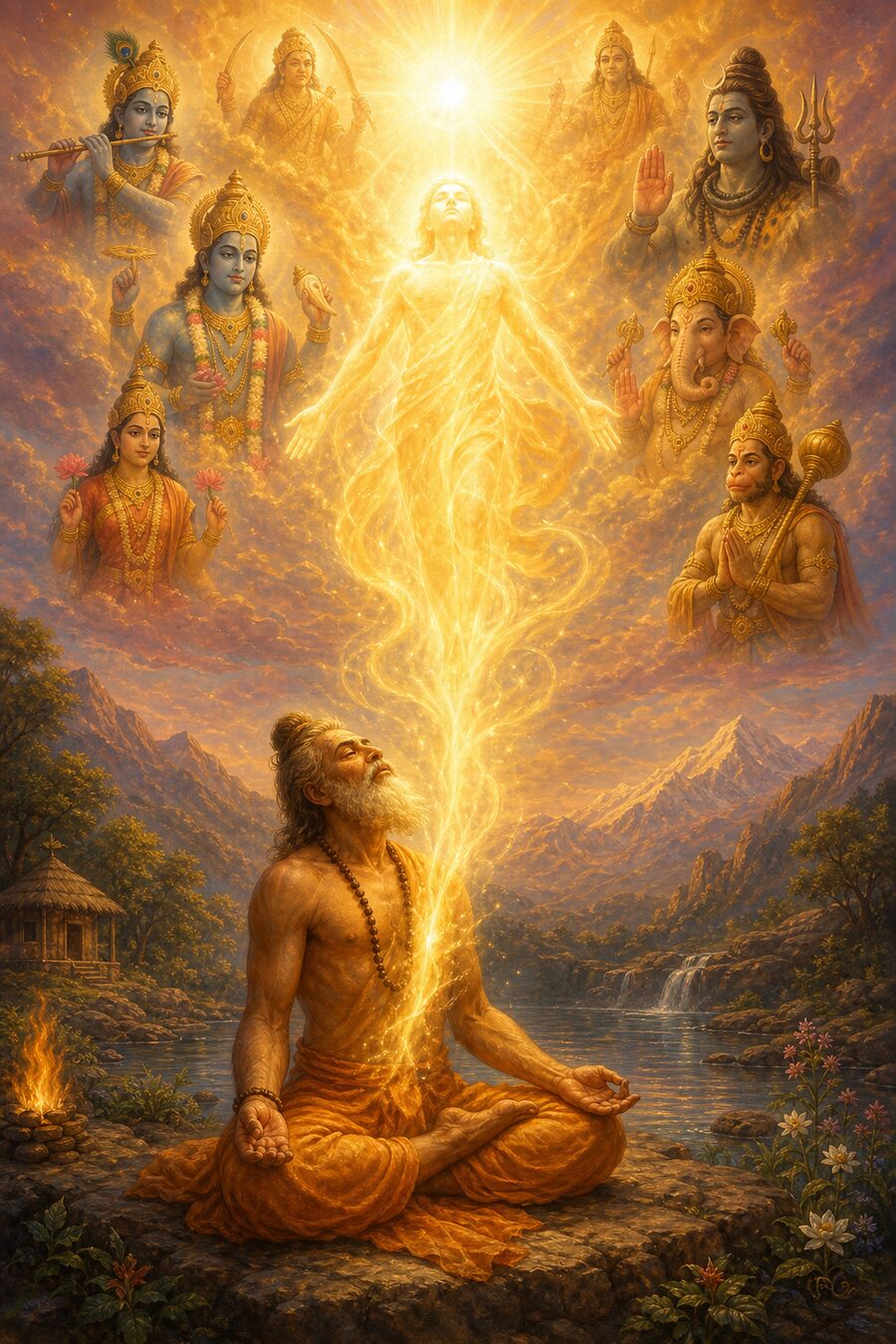
Two things hold the verses together. The first is that the knower is Brahman already, brahmaiva san in verse 554, so that nothing happens to him when the body falls, any more than something happens to space when a pot breaks. The second is that bondage and liberation themselves are made by maya, ideas the intellect has about the Real, with no more hold on the Self than a snake has on a rope. From the first follows a death without ceremony: let the body drop anywhere, at any time. From the second follows the supreme truth of verse 574, paramarthata, in which there is no one bound, no one striving, no one seeking release and no one released.
546 · 547
Verse 546 separates two men by one habit. Pleasure and pain, good and evil, come to the one who is tied to the gross body and what goes with it and who identifies with them, abhimanin, the one who says “I” of the body. The sage whose bondage has been shattered and who is the real Self receives no good fruit and no evil one; the verse asks how either could reach him, and leaves the question standing. Verse 547 answers with the sun. In an eclipse people say the sun has been swallowed, and the verse names the swallower as darkness, Rahu in the old telling; the sun is never swallowed. People say so in delusion, because they do not know the sun’s own nature, which is light through and through. The knower is seen the same way: something dark seems to lie across him, and those who do not know what he is call him caught.
548 · 549
Verse 548 completes the comparison. The deluded look at the best of the knowers of Brahman, who is free of every bond of body and the rest, and see an embodied man, because an appearance of a body is all their eyes take in. Verse 549 gives the knower’s own relation to that appearance. He stays as he is, having left the body as a snake leaves its slough, and the slough lies where it fell, moved this way and that by the wind of prana, the breath that still stirs it. Madhavananda hears in the line an echo of Brihadaranyaka 4.4.7. The skin keeps the snake’s shape for a while and is moved by any wind; the snake is elsewhere.
550 · 551
Verse 550 says who decides where the body goes. A current carries a piece of wood over high ground and low; destiny, daiva, which is prarabdha, the ripened share of past action, carries the knower’s body to the experiences that fall due to it in their time. Verse 551 describes the man inside that drift. Through the vasanas that prarabdha has shaped, he moves among enjoyments like someone still in samsara, though the body-idea has left him; he himself stays silent, like a witness, like the pivot at the center of the potter’s wheel, which keeps still while the wheel turns, and he is empty of conception and doubt, kalpa-vikalpa-shunya. Madhavananda notes that the resemblance to a man in samsara is appearance only; prarabdha has no meaning for the one who knows himself as the Self.
552 · 553
Verse 552 takes the senses out of his hands. He neither sets them on their objects nor pulls them back; he stays as a mere onlooker, upadarshana, and gives the fruit of action no regard at all, since his mind is drunk on the dense rasa of his own bliss. The senses go on moving and resting on their own while he looks on. Verse 553 then says who such a man is. Whoever gives up the movement between “this is a fit object of meditation” and “this is not”, lakshya-alakshya-gati, and abides as the Self alone, is Shiva himself, shiva eva svayam sakshat, in person and without remainder, and he is the best of the knowers of Brahman. The verse states an identity: the liberated one is Shiva.
554 · 555
Verse 554 tells the knower’s whole story in one line. The best of the knowers of Brahman is free while still alive, kritartha, his purpose fulfilled, with nothing left to do; and when the limiting adjuncts perish, being Brahman already, brahmaiva san, he enters the nondual Brahman. Madhavananda’s note draws out the phrase: he enters what he had been all along, so that the death of the body adds nothing to him and takes nothing away. Verse 555 gives the image. An actor in the costume of his role and the same actor with the costume off is one man throughout; so the best of the knowers of Brahman is always Brahman and nothing else, in a body and out of one.
556 · 557
Verse 556 lets the body go. Let the body of the renouncer who has become Brahman wither and fall anywhere, like a leaf from a tree; it was burned long ago in the fire of consciousness, chid-agni, so that even its cremation, as Madhavananda notes, is no concern of his. Verse 557 removes the last ceremony. The sage who abides in the real Self, in Brahman, as full nondual bliss, waits for no fitting place and no fitting hour to set down this lump of skin, flesh and filth; the words are the verse’s own, chosen so that no fondness for the body survives them. Where the body falls and when, he leaves to the body.
558 · 559
Verse 558 says what liberation is. Giving up the body is not liberation, and giving up the staff and the water-pot, the renouncer’s insignia, is not liberation either; liberation is the loosing of the knot of ignorance in the heart, avidya-hridaya-granthi, and that loosing alone. The body can fall and the knot stay tied; the knot can open while the body walks about for years. Verse 559 returns to the tree. If a leaf falls into a channel, into a river, into a place sacred to Shiva, or at a crossroads, what good or ill is that to the tree? The four places are of four degrees of purity, as Madhavananda observes, and the tree is indifferent to all of them; so is the knower to the place where his body drops.
560 · 561
Verse 560 says what perishes and what endures. Leaf, flower and fruit perish, and so do body, senses, prana and intellect; one’s own Self, real, of the form of bliss, does not perish, and it endures as the tree endures after its leaves have gone. Verse 561 answers the scriptural worry that follows. The Shrutis give the Self’s defining mark as prajnana-ghana, a solid mass of knowing, the phrase Yajnavalkya uses in Brihadaranyaka 4.5.13, and when they speak of destruction they speak of the destruction of the adjunct alone, the upadhi that lent the Self its passing names. Madhavananda recalls that the Brihadaranyaka passage confused Maitreyi herself, and that Yajnavalkya had to explain he meant the end of the adjuncts and never of the Self.
562 · 563
Verse 562 quotes the Shruti outright. “This Self is imperishable, my dear”, avinashi va are ayam atma, Yajnavalkya tells Maitreyi in Brihadaranyaka 4.5.14, and the line declares the Self’s imperishability in the midst of things that perish and change on every side. Verse 563 shows the perishing as a return. Stone, tree, grass, grain and husk, when they are burned, become earth, the element they came from; in the same way body, senses, prana, mind and the whole visible world, burned in the fire of knowledge, jnana-agni, become the supreme Self. What looked like many separate things turns out to have been the Self wearing names.
564 · 565
Verse 564 gives the first image of merging. Darkness is unlike light in every way, and still it dissolves in the sun’s radiance, leaving light alone; so the whole visible world dissolves in Brahman. Verse 565 gives the second, the one the Vivekachudamani is remembered by. When a pot breaks, ghate nashte, the space that was inside it is plainly space, as it always was; the walls had made it look enclosed. So when the adjuncts dissolve, the knower of Brahman is Brahman itself, svayam, and the dissolving removes an enclosure while the space stays what it was.
566 · 567
Verse 566 adds three more. Milk poured into milk, oil into oil, water into water: each becomes one with what received it, and no one can afterward point to the part that was poured. So the sage who knows the Self becomes one in the Self. Verse 567 names the state reached. Having come to videha-kaivalya, the aloneness that belongs to the bodiless, which is pure Being undivided, sanmatratva akhandita, the state of Brahman, this renouncer does not return. His liberation is complete, and the round of birth has no further claim on him.
568 · 569
Verse 568 gives the reason he cannot return. His bodies of ignorance and the rest, the causal, subtle and gross bodies in Madhavananda’s note, have been burned by the knowledge of his oneness with the real Self; he is Brahman, and the verse asks how Brahman could be born again. Brahman has no birth, and so there is none for him. Verse 569 then goes further than any verse before it. Bondage and liberation are made by maya and do not really exist in one’s own Self, just as the snake’s appearing and leaving do not happen in the rope, which lies motionless through both. The rope was rope while the snake was seen and rope after it was gone; nothing came and nothing went.
570 · 571
Verse 570 argues the point. Bondage and liberation could be spoken of only where a covering, avriti, is present or absent; Brahman has no covering of any kind, since there is no second thing to cover it, and so it is forever uncovered. Grant it a covering and nonduality fails, and the Shruti does not allow duality; Madhavananda cites the Chandogya’s “one only, without a second” and a line from the Katha. Verse 571 says where the two ideas come from. The deluded falsely impose bondage and liberation, which are traits of the intellect, on the Real, as a man whose eye is covered by a cloud puts the covering on the sun; this Imperishable, akshara, is nondual, unattached awareness.
572 · 573
Verse 572 locates the ideas themselves. The idea “it exists” and the idea “it does not exist”, held about the Real, are both traits of the intellect and never of the eternal Real; Madhavananda reads the two as “bondage exists” and “bondage does not exist”, the thoughts a mind has when it worries about its own freedom. The Real itself is Being, sat, as verse 567 said; the intellect’s yes and no are about bondage, and they rise and fall in the intellect. Verse 573 draws the conclusion. So bondage and liberation are made by maya and are not in the Self; in the partless, actionless, peaceful, faultless, stainless, nondual supreme Reality, there is no more room for imagining than there is in the sky.
574 · 575
Verse 574 is the summit, and it is six negations in a line. No cessation, no origination; no one bound, no one striving; no seeker of liberation, no one liberated: this is the supreme truth, paramarthata. The verse is Gaudapada’s, karika 2.32 on the Mandukya Upanishad, taken over almost word for word; Madhavananda notes that the Amritabindu Upanishad carries the same verse. At the level of everyday dealing there was a seeker, a guru, a path and a release; at the level of the ultimate none of these ever came to be, because the Self they would have happened to was never anything other than Brahman. Verse 575 closes the guru’s speech. This supreme and most secret teaching, the settled conclusion that crowns all the Vedas, I have shown you today, he says, regarding you again and again as my own son, a seeker of liberation, free of the taints of the Kali age, your mind released from desire. Madhavananda marks the spot: the teacher’s address ends here, and what follows is the author speaking.
576 · 577
Verse 576 tells what the disciple did. Hearing the guru’s words, he bowed in reverence and, with the guru’s leave, went his way, free of bondage. He had come as a seeker; he leaves with nothing to seek. Verse 577 follows the guru. With his mind immersed in the ocean of being and bliss, he wandered on, purifying the whole earth as he went, nirantara, free of every sense of difference. Two departures end the dialogue, the disciple’s into freedom and the guru’s into a wandering that blesses the ground it crosses.
578 · 579
Verse 578 is the author’s own voice, and it says what the whole has been. Through the dialogue of teacher and disciple the nature of the Self has been set out, so that seekers of liberation may understand it with ease; the dialogue form was chosen for that ease. Verse 579 names the readers. May renouncers who seek liberation, whose faults of mind have been removed by the prescribed practice, who have turned from worldly pleasure, whose minds are at peace, who delight in the Shruti, welcome this beneficial teaching. The five marks describe the qualified seeker of the opening verses, now addressed at the close; Madhavananda adds that yati here may mean anyone striving for realization.
580
Verse 580 ends the Vivekachudamani with a desert. On the road of samsara travelers are exhausted, scorched by the burning that rises from the sun’s rays, which Madhavananda reads as the threefold misery, of body and mind, of nature, of other creatures; in their delusion they wander a desert in search of water. For them this word of Shankara, shankara-bharati, shows the ocean of nectar that lies within reach, the nondual Brahman that gives joy, and the word is victorious, nirvana-sandayini, the bestower of nirvana. The ocean was never far; the travelers had only to stop running toward the mirage. Om tat sat.
The Vivekachudamani, whole
With verse 580 the 580 verses of the Vivekachudamani are complete. Its course runs: the rare human birth and the fourfold means (verses 1 to 31), refuge in the guru and the disciple’s questions (32 to 71), the refutation of the not-self, the nature of the Self and the five sheaths (72 to 211), the witness and Brahman (212 to 240), the resolving of tat tvam asi (241 to 266), the wearing away of vasanas (267 to 297), the ego and heedlessness (298 to 328), the method of samadhi (329 to 407), living liberation and the three kinds of karma (408 to 470), the disciple’s awakening and his hymn (471 to 519), the guru’s last word and the knower’s daily gait (520 to 545), and videha-kaivalya, bondage and liberation shown to be imagination, and the victory of Shankara’s word (546 to 580).
A few lines stay with the reader after the whole has been read. Ekam eva advayam brahma, neha nanasti kinchana: Brahman is one alone, without a second, and there is no manifold here, the refrain of verses 464 to 470. Hridi kalayati vidvan brahma purnam samadhau: the knower realizes the full Brahman in the heart in samadhi, the refrain of verses 408 to 410. Vairagyasya phalam bodho, bodhasyoparatih phalam: the fruit of dispassion is knowledge, and the fruit of knowledge is withdrawal, from verse 419. Buddhir vinashta, galita pravrittih: the intellect has dissolved, its activity has fallen away, the disciple’s words in verse 481.
The highest statement belongs to verse 574: na nirodho na chotpattih, na baddho na cha sadhakah, na mumukshur na vai mukta, ity esha paramarthata. No cessation, no origination, no one bound, no one striving, no seeker of liberation, no one liberated: this is the supreme truth. The path led here, and the one who walked it finds at the end that he was Brahman at every step, so that there was no one to bind and no one to free.
Read once, the Vivekachudamani gives its argument. Read again, it gives its images, the rope and the snake, the pot and the space, the leaf and the tree, and one of them stays with the reader and begins to shape how he spends his days.