On this page
Vasishtha’s teaching: how the soul comes to think itself bound
Yudhishthira’s question came with a plea inside it. “What is the thing called undeteriorating, which a man reaches and never comes back from? And what is the thing called deteriorating, from which he must return once more? I ask so that I may truly understand the difference between the two. The Brahmins who know the Vedas call you an ocean of knowledge, Grandfather, and so do the rishis and the ascetics. You have very few days left to live. When the sun turns from his southern road to his northern you will go to your high end, and when you have left us, from whom shall we hear what is good for us? You are the lamp of the Kuru line, burning always with the light of knowledge. I want to hear this from you. Your words are sweet as nectar, and the more I listen the more I want to know.” Bhishma answered with an old account, the talk between Vasishtha and King Karala of Janaka’s line. The great rishi, whom they also call Maitravaruni, was seated at his ease, bright as the sun, a master of the knowledge that concerns the Self and settled in every conclusion of that science. King Karala came up to him with joined hands and spoke humbly, in words well pronounced and sweet, with nothing of the disputant in them. “I want to hear,” he said, “of the supreme and eternal Brahman, which the wise reach and do not return from. I want to know also what is called destructible, and That into which this universe goes when it is destroyed. What is it that men call indestructible, auspicious, beneficial, and free of every evil?”
“Hear,” said Vasishtha, “how this universe is destroyed, and hear of That which never has been destroyed and never will be. Twelve thousand years, by the measure of the gods, make a yuga. Four such yugas taken a thousand times make a kalpa, and a kalpa is one day of Brahma. His night is as long. When Brahma himself comes to his end, Shambhu wakes, whose soul is formless and in whom the powers of yoga, the power to become minute, the power to become light, and the rest, are inborn. He creates once more the first and eldest of all creatures, vast in size, infinite in deeds, having form, the one who is the universe. That Shambhu is also called Ishana, the lord of everything. He is pure light and beyond all decay. His hands and feet reach in every direction, his eyes and head and mouth are everywhere, his ears are in every place, and he stands covering the whole universe. The eldest-born being is called Hiranyagarbha. He is called the Understanding, and in the yoga scriptures the Great, and Virinchi, and the Unborn. The Sankhya scriptures give him many names and hold that infinity is his soul. He has many forms and is the soul of the universe, and he is held to be one and indestructible. He made the three worlds without help from any quarter and covers them, and because his forms are so many he is said to have the universe for his form. Changing himself, he creates himself by himself. He first creates ahankara, the sense of I, and the great being called Prajapati who has it. The Manifest is created from the Unmanifest, and the learned call that the creation of knowledge. The creation of mahat and of ahankara by Hiranyagarbha is the creation of ignorance. The creation of the subtle elements out of ahankara is the third. The fourth flows from the third by change, and it takes in wind and light and space and water and earth, with their properties of sound, touch, form, taste, and smell. Those ten arose together. The fifth creation comes from the combination of the elements: the ear, the skin, the eyes, the tongue, and the nose, with speech, the two hands, the two legs, the lower duct, and the organs of generation. The first five are the organs of knowledge and the last five the organs of action, and all of them arose at one time along with the mind. These are the twenty-four principles that exist in the forms of all living creatures, and Brahmins who understand them properly and see into the truth never have to give way to sorrow. In the three worlds every embodied creature has a combination of them, called a body. Gods have it, and men and Danavas, Yakshas and spirits, Gandharvas and Kinnaras and great snakes, Charanas and Pishachas, celestial rishis and Rakshasas. Biting flies have it, and worms, gnats, vermin born of filth, rats, and dogs. Shvapakas, Chaineyas, Chandalas, and Pukkasas have it, and elephants, horses, asses, tigers, trees, and cattle. Whatever other creatures exist in water, in space, or on earth have it, and we have heard of no other place where creatures exist. All of these belong to the Manifest, and all of them are seen to be destroyed day after day. That is why every creature produced by the union of the twenty-four is said to be destructible. Since the universe, made of the Manifest and the Unmanifest, meets destruction, it is called destructible, and the very being called mahat, the eldest-born, is always given as an instance of it. Beyond the twenty-four is the twenty-fifth, called Vishnu. Having no attributes, he is no principle, though the wise have called him one because he pervades them all. Prakriti, the twenty-fourth, is said to preside over everything that has sprung from her. The twenty-fifth is formless and cannot be said to preside. Eternal consciousness has no attributes and no form, and by union with prakriti it takes on every form. Joined with prakriti, who has birth and death for her marks, it takes on birth and death, becomes a thing that can be perceived, and is clothed in attributes it does not have. Through forgetfulness, and through waiting on ignorance, it joins itself to sattva, rajas, and tamas and is identified with creatures of every order. Three colors there are in all, white, red, and dark, and all three belong to prakriti. Through tamas a creature goes to hell, through rajas it reaches the human state and stays in it, and through sattva it rises to the worlds of the gods and shares their great happiness. In this way, the wise say, the twenty-fifth, akshara, the indestructible, is changed by union with unmanifest prakriti into kshara, the destructible. By knowledge the indestructible is shown again in its true nature.
“So it is through his own forgetfulness that the Self follows ignorance and takes thousands of bodies, one after another. Joined to this guna or that and driven by its power, he is born thousands of times among the lower orders of being, and sometimes among the gods themselves. From the human state he goes to heaven, from heaven he comes back to the human state, and from the human state he sinks into hell for many long years. The worm that makes a cocoon shuts itself in completely, on every side, with threads it spins out of itself. The Self does the same. He is in truth beyond every guna, and he wraps himself in gunas on every side. He is beyond happiness and misery, and this is how he makes himself subject to both. He is beyond all disease, and he takes himself to be suffering from headache, from sore eyes and toothache and affections of the throat, from dropsy of the belly, burning thirst, swollen glands, cholera, vitiligo, leprosy, burns, asthma, consumption, epilepsy, and whatever other diseases are seen in the bodies of embodied creatures. In error he counts himself born among thousands of creatures of the lower orders and now and then among the gods, and he endures misery and enjoys the fruits of his good deeds. Wrapped in ignorance he sees himself dressed in white cloth, or in the full dress of four pieces. He sees himself lying on the floor, or with hands and feet drawn in like a frog’s, or sitting upright in the posture of meditation, or clad in rags, or lying and sitting under the open sky, or inside mansions of brick and stone, or on rough stones, on ashes, on bare rock, on bare earth, on beds, on battlefields, in water, in mire, on wooden planks. Hoping for the fruit of it, he sees himself wearing a scant cloth of grass, or stark naked, or robed in silk, in the skin of the black antelope, in flax, in sheepskin, in tiger skin or lion skin, in hemp, in birch bark, in cloth made from thorny plants, in the thread that worms weave, in torn rags, and in more kinds of cloth than can be listed. He sees himself wearing ornaments and gems. He sees himself eating once at intervals of a night, or once at the same hour each day, or at the fourth or the sixth or the eighth hour, or once in six nights or seven or eight, or once in ten days or twelve, or once in a month. He sees himself eating only roots, or only fruits, or living on air or on water alone, on cakes of sesame husk, on curds, on cow dung, on the urine of the cow, on potherbs, flowers, moss, raw food, fallen leaves, or fruit that has dropped and lies scattered on the ground, all in the hope of ascetic success. He sees himself keeping the Chandrayana fast by the rule, and other vows, and following the duties of the four stations of life, and failing in them, and following the lesser stations that fall under the four, and even the practices that mark the wicked and sinful. He sees himself enjoying secluded places: the pleasant shade of mountains, the cool beside springs and fountains, lonely riverbanks, hidden forests, spots sacred to the gods, lakes and waters far from the haunts of men, and solitary mountain caves that give the shelter a house gives. He sees himself reciting hidden mantras of different kinds, keeping vows and rules, practicing austerities, and performing sacrifices and rites of many sorts. He sees himself going the way of traders and merchants, following the practices of Brahmins and Kshatriyas and Vaishyas and Shudras, and making gifts to the destitute, the blind, and the helpless. Wrapped in ignorance, the Self takes on sattva and rajas and tamas, and righteousness and wealth and pleasure. Under the sway of prakriti he undergoes change himself, performs all these things, and believes he is what he performs. He sees himself uttering the sacred Svaha, Svadha, and Vashat and bowing to those he counts his superiors, officiating at the sacrifices of others, teaching pupils, giving gifts and accepting them, sacrificing and studying the scriptures, and doing every act and rite of that kind. He sees himself concerned in birth and death, in disputes and in slaughter. All of this, the learned say, is the path of acts, good and bad.
“It is the goddess Prakriti who brings about birth and death. When the hour of universal destruction approaches, the supreme Self draws in everything that exists and every quality, and then exists alone, like the sun at evening drawing in all his rays. When the hour of creation comes he makes them again and spreads them out, as the sun at morning sheds his rays abroad. In just this way the Self, for the sake of play, again and again regards himself as clothed in all these conditions, which are his own forms and qualities, countless in number and pleasing to him. So the Self, who is in truth beyond the three gunas, becomes attached to the path of acts. Once he is on that path he takes particular acts to have particular characters and to lead to particular ends. The whole of this universe has been blinded by prakriti, and everything in it has been overwhelmed, through her, by rajas and tamas. Because the Self is wrapped in prakriti, the pairs of opposites that bring happiness and woe keep coming around. Because of this ignorance the jiva, the soul living in a body, takes these sorrows for his own and imagines them hunting him. He imagines he must somehow get across them, and go to the worlds of the gods to enjoy the happiness that waits for his good acts. ‘I must secure my happiness,’ the soul thinks. ‘If I keep doing good acts I may be happy until this life closes, and happy in all my lives to come. Yet the evil I do in this life may bring me sorrow without end. The human state is full of misery, for from it a man sinks into hell. From hell it will be many long years before I can return to the human state. From the human state I shall reach the state of the gods, and from that height I shall have to come back to the human state again, and from there sink into hell once more.’ One who always regards this compound of the elements and the senses, with the reflection of chit in it, as having the character of the Self, has to wander again and again among gods and men and sink into hell. Wrapped always in the idea of mine, the soul must make that round of births, millions upon millions of them, in forms that are every one liable to death. It is prakriti that causes acts loaded with good and bad fruit, and it is prakriti that enjoys and endures that fruit in the three worlds. The state of the lower creatures, of men, and of the gods, these three fields, are to be known as rising in prakriti. Prakriti is said to have no attributes, and her existence is affirmed only from her acts, beginning with mahat. In the same way purusha, the Self, has no attributes, and his existence is affirmed from the acts the body does when it receives his reflection. The Self is subject to no change of any kind and is the active principle that sets prakriti moving. Yet when he enters a body joined to the senses of knowledge and the senses of action, he regards every act of those senses as his own. The five senses of knowledge, beginning with the ear, and the five of action, beginning with speech, join with sattva, rajas, and tamas and busy themselves with countless objects. The soul imagines that it is he who does the acts of his life and that the senses belong to him, though in truth he has no senses. He has no body, and he imagines he has one. He has no attributes, and he regards himself as having them. He is beyond time, and he imagines himself under time’s control. He has no understanding, and thinks himself endowed with it. He stands beyond the twenty-four principles and counts himself among them. He is deathless and thinks he is liable to death, motionless and thinks he moves. He has no material case and thinks he has one. He is unborn and regards himself as born. He is beyond austerities and regards himself as engaged in them. He has no end to strive for and regards himself as bound for ends of many kinds. He is beyond fear and regards himself as afraid. He is indestructible and regards himself as destructible. Wrapped in ignorance, this is how the Self thinks of himself.”
A key to reading this (the concept): Vasishtha counts by number, and the numbers come back throughout his teaching. Unmanifest prakriti, mahat, ahankara, which is the sense of I, and the five subtle essences of sound, form, touch, taste and smell make eight, and these eight are called prakriti. Their modifications are sixteen: the five gross elements, the ten senses of knowledge and of action, and the mind. Eight and sixteen make the twenty-four principles, and every body, from a god’s to a gnat’s, is a combination of them. The twenty-fifth stands beyond them. It is the Self, which Vasishtha here calls Vishnu. Further on he speaks of a twenty-sixth, the supreme Self, pure knowledge without a second, which knows the twenty-fifth and the twenty-fourth alike.
Vasishtha went on, “It is in this way, through his own ignorance and through keeping company with others who are wrapped in ignorance, that the soul comes to millions upon millions of births, every one of which ends in dissolution. Changed into chit wrapped in ignorance, he takes up millions of dwellings among the lower creatures, among men, and among the gods, and each of them is bound to end in destruction. Through ignorance the soul, like the moon, has to wax and wane thousands and thousands of times. This is truly the nature of the soul when ignorance is on him.
“Know that the moon has in truth sixteen full portions. Only fifteen of them grow and shrink. The sixteenth, the portion that stays unseen and appears on the night of the new moon, remains constant. The soul is made like the moon and has sixteen full portions too. Only fifteen of them appear and disappear: prakriti with the reflection of chit upon her, the ten senses of knowledge and action, and the four inner faculties. The sixteenth, chit in its purity, undergoes no change. Wrapped in ignorance, the soul takes birth again and again in those fifteen portions, and again and again the primal essence joins itself to the eternal and unchanging portion of the soul.
“That sixteenth portion is subtle. It should be known as Soma, eternal and unchanging. The senses never hold it up, and it is by it that the senses are held up. Because these sixteen portions are the cause of the birth of creatures, no creature can be born without them. They are called prakriti. The destruction of the soul’s liability to be joined with prakriti is what is called liberation. The mahat-soul, which is the twenty-fifth, has to take on that body of sixteen portions called the Unmanifest again and again, for as long as he looks on it as his. The Self is in truth pure. Because he does not know That which is stainless and pure, and because he gives himself to what is a compound of pure and impure, he becomes impure. Through his devotion to ignorance, the soul, whose mark is knowledge, is joined to ignorance over and over. He is free of every kind of error, and through his devotion to the three gunas of prakriti he comes to be endowed with those gunas.”
The gist: The Self is beyond qualities, disease, time and death. Entering a body, it takes every act and condition of that body for its own, and so spins itself into prakriti as the worm spins itself into a cocoon: the garment, the fast, the rite and the birth are all taken for self. That is the bondage. The moon shows what is left untouched. Fifteen of its portions wax and wane, and the sixteenth stays constant. In the soul that sixteenth is pure consciousness, and liberation is the end of its being joined to the other fifteen.
Janaka’s question: if prakriti and purusha are joined forever, what can moksha mean?
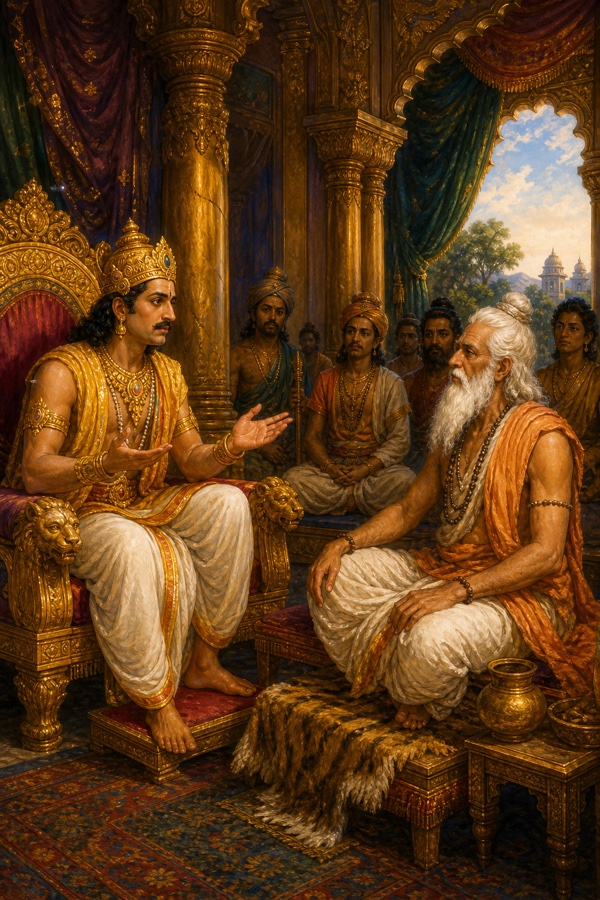
Janaka said, “It has been said that the relation between the indestructible and the destructible, between purusha and prakriti, is like the relation between male and female. Without a male a female can never conceive. Without a female a male can never create form. Through their union, each depending on the qualities of the other, the forms of living creatures are seen to flow, and it is so in every order of being. Through the union of the two in the season of conception, each leaning on the qualities of the other, forms come forth. I will tell you the signs of it. Hear what belongs to the father and what belongs to the mother. Bones, sinews, and marrow, we know, come from the father. Skin, flesh, and blood, we hear, come from the mother. This is what may be read in the Vedas and in other scriptures. What is read there is accepted as authority, and the authority of the Vedas, and of the scriptures that do not contradict them, is eternal.
“If prakriti and purusha are always joined in this way, each opposing the other and each depending on the other’s qualities, then I do not see that liberation can exist. You have the sight of the spirit, and you see all things as if they stood before your eyes. If there is any direct evidence that liberation exists, tell me of it. We long for liberation. We wish to reach That which is auspicious, bodiless, untouched by old age, eternal, beyond the reach of the senses, and with nothing above it.”
Vasishtha said, “What you say of the signs given in the Vedas and the other scriptures is so, and you take those signs in the way they ought to be taken. What you carry in your understanding, though, is only the texts. You do not truly know what the texts mean. A man who holds in his mind the bare words of the Vedas and the scriptures, without their true sense, holds them to no purpose. One who keeps the contents of a work in memory without grasping its meaning is said to carry a useless burden, and one who knows the true meaning of a treatise is said to have studied it to some purpose. Asked what a text means, a man ought to give the meaning he has reached by careful study. The dull man who refuses to explain the meaning of texts before a gathering of the learned never succeeds in explaining it correctly. An ignorant man who sets out to explain the true meaning of treatises earns ridicule, and even men who have knowledge of the Self earn it on such occasions, if what they try to explain was never won by study.
“Listen now to how the question of liberation has been explained, teacher to disciple, from the old days, among the great men who know the Sankhya and the Yoga systems. What the yogis see is exactly what the Sankhyas strive to reach. He who sees Sankhya and Yoga as one and the same is the man of intelligence. Skin, flesh, blood, fat, bile, marrow, and sinews, and the senses of knowledge and of action you spoke of, exist. Objects flow from objects, and senses from senses. A body is got from a body as a seed is got from a seed. The Supreme Being has no senses, no seed, no matter, and no body. He must then be without any attribute at all, and being so, how can he have attributes of any kind?
“Space and the other attributes arise from sattva, rajas, and tamas and disappear into them in the end. So the attributes arise from prakriti. Skin, flesh, blood, fat, bile, marrow, bones, and sinews, these eight that are made of prakriti, may sometimes be produced by the male seed alone. The soul in the body and the universe are both said to partake of prakriti with her three gunas. The supreme Self is different from both. The seasons have no forms of their own, and yet we infer them from the fruits and flowers that appear. In the same way prakriti, though formless, is inferred from mahat and the other attributes that spring from her. And in the same way the supreme Self, bare of every attribute and perfectly stainless, is inferred from the presence of consciousness in the body.
“That Self is without beginning and without destruction, without end, the overseer of all things, and auspicious. Only because it identifies itself with the body and the other attributes does it come to be taken as having attributes. Those who truly understand attributes know that only things which have attributes can have them, and that That which is beyond all attributes can have none. When the soul conquers every attribute born of prakriti, attributes it took on in error, then and only then does it see the supreme Self. Only the highest rishis who know the Sankhya and the Yoga systems know that supreme Self. Sankhyas, yogis, and the believers of every other system say of it that it is beyond the understanding, and that it is the knower, having the highest wisdom because it has cast off all sense of identity with prakriti. They say that it is beyond ignorance and error, that it is unmanifest, beyond all attributes, and called the Supreme. They say that it ordains all things, is eternal and unchanging, and overrules prakriti and every attribute born of her, and that, standing beyond the twenty-four principles, it makes the twenty-fifth. When men of knowledge who fear birth, the several conditions of living consciousness, and death come to know the Unmanifest, they come to understand the supreme Self in the same moment. An intelligent man holds the oneness of the soul with the supreme Self to be in keeping with the scriptures and perfectly correct, and the man without intelligence looks on the two as different. That is the distinction between them. The marks of kshara and akshara, the destructible and the indestructible, have now been told to you. Akshara is oneness, and manyness is said to be kshara. When a man begins to study the twenty-five principles and understands them properly, he sees that the oneness of the Self agrees with the scriptures and that its manyness is what they oppose. The wise have said that the count of principles is twenty-five. That which is beyond the principles is beyond that number and makes the twenty-sixth. To study created things, twenty-five in number, by their groups, is to study the principles. Beyond these is That which is eternal.”
A key to reading this (the concept): Kshara is the destructible and akshara the indestructible. Vasishtha joins a second pair to them: kshara is manyness and akshara is oneness. The intelligent man holds the soul and the supreme Self to be one, and counts that the teaching of scripture. The man without intelligence sees two. The twenty-five principles can be studied group by group, and what stands beyond their number is the twenty-sixth, the eternal.
The gist: Janaka argues from the body: father and mother, bone and flesh, each needing the other as purusha and prakriti need each other, and so no room left for liberation. Vasishtha tells him he has the texts by heart and has missed their meaning. Bodies come from bodies and senses from senses, yet the supreme Self has neither, and it can be known only by inference, as a season is known by its fruit. The soul sees it when it has conquered the attributes it took on in error. Kshara is the many, akshara is the one, and beyond the count of twenty-five stands the twenty-sixth.
The practice of Yoga: dhyana, breath-control, and samadhi
Janaka said, “You have told me that oneness is the mark of akshara, the indestructible, and that manyness is the mark of kshara, the destructible. I have not clearly understood the nature of the two, and doubts are still lurking in my mind. Ignorant men look on the Self as many, and men of knowledge and wisdom hold it to be one and the same. My own understanding is very dull, and I cannot see how all this comes about. The reasons you gave for the oneness and the manyness of akshara and kshara I have almost forgotten already, so restless is my mind. I want to hear you speak again of that oneness and manyness, of the one who knows and of what is without knowledge, of the soul, of knowledge and ignorance, of akshara and kshara, and of the Sankhya and the Yoga systems, in detail, each by itself, and according to the truth.”
Vasishtha said, “I will tell you what you ask. First, though, hear me set out the practices of yoga by themselves. Contemplation is the obligatory practice of yogis and their highest power. Those who know yoga say it is of two kinds: the concentration of the mind, and pranayama, the regulation of the breath. Pranayama is said to have substance, and concentration of the mind to be without it. Except for the three times when he passes urine, passes stool, and eats, a man should give the whole of his time to contemplation.
“Let the intelligent man make himself pure and draw his senses back from their objects with the help of the mind. Then, by the twenty-two ways of sending the breath of life upward through the body, let him join the soul to That which stands beyond the twenty-fourth principle, which the wise hold to dwell in every part of the body and to be beyond decay and destruction. By those twenty-two methods, we have heard, the Self can always be known. This practice of yoga belongs to the man whose mind is never touched by evil passions, and to no other.
“Free of all attachments, sparing in his food, with every sense subdued, he should fix his mind on the Self during the first part of the night and the last, after he has stilled the working of the senses, quieted the mind by the understanding, and taken a posture as motionless as a block of stone. When men of knowledge who know the rules of yoga become as fixed as a stake of wood and as immovable as a mountain, then they are said to be in yoga. When a man does not hear, or smell, or taste, or see; when he is conscious of no touch; when his mind is perfectly free of every purpose; when he is conscious of nothing and holds no thought; when he has become like a piece of wood, then the wise say he is in perfect yoga.
“At such a time he shines like a lamp burning where there is no wind. At such a time he is freed even from his subtle form and perfectly united with Brahman. One who has come so far no longer has to rise or to fall among the lower orders of being. When the knower, the known, and knowledge have become completely one, then the yogi is said to see the supreme Self. In yoga the supreme Self shows itself in the yogi’s heart like a blazing fire, or like the bright sun, or like the flash of lightning in the sky.
“That supreme Self is unborn and is the essence of nectar. Brahmins of great soul who have intelligence and wisdom and know the Vedas see it, subtler than the subtle and greater than the great. It lives in all creatures and they do not see it. It is the creator of the worlds, and it is seen only by a person rich in intelligence, with the lamp of the mind to help him. It dwells on the far shore of thick darkness, beyond even him who is called Ishvara, the Lord. Those who know the Vedas and know all things call it the dispeller of darkness, stainless, beyond darkness, without attributes and with them. This is what is called the yoga of the yogis. What other sign of yoga is there? By such practices yogis come to see the supreme Self that is beyond destruction and decay.”
A key to reading this (the terms): Vasishtha’s contemplation has two parts. Pranayama, the regulation of the breath, is the one he says has substance, because it is performed with the help of a mantra repeated in the mind. Concentration of the mind is without substance, being made with no such help. The twenty-two ways are the stages by which the breath of life is sent from the toe of the foot to the crown of the head. In perfect yoga the knower, the thing known, and knowledge have become one.
The order of Sankhya: the unfolding of creation and the reverse order of dissolution
Vasishtha went on, “So much, in detail, for the science of yoga. Now I will speak of the Sankhya philosophy, by which the supreme Self is seen through the gradual destruction of errors. The Sankhyas, whose system is built on prakriti, say that prakriti, the Unmanifest, comes first. From prakriti, they say, the second principle is produced, which is called mahat. From mahat, we have heard, flows the third, ahankara. The Sankhyas, who are blessed with sight of the Self, say that from ahankara flow the five subtle essences of sound, form, touch, taste, and smell. All these eight they call prakriti. The modifications of the eight are sixteen: the five gross elements of space, light, earth, water, and wind, and the ten senses of action and of knowledge together with the mind. Wise men who follow the Sankhya path and know all its ordinances regard these twenty-four principles as taking in the whole range of Sankhya inquiry.
“Whatever is produced is merged again in what produced it. Created by the supreme Self one after another, these principles are destroyed in the reverse order. At every new creation the gunas start into existence in the forward order, and when destruction comes each merges into its parent in the reverse order, like the waves of the ocean disappearing into the ocean that gave them birth. That is how the creation and the destruction of prakriti take place. The Supreme Being is all that remains when universal destruction comes, and it is he who takes on many forms when creation starts into life. So men of knowledge have determined.
“It is prakriti who causes the presiding purusha to take on manyness in this way and to go back to oneness. Prakriti herself bears the same marks. One who fully knows the principles knows that she too takes on manyness and oneness, for when destruction comes she returns to unity and when creation flows she takes on diversity of form. The Self makes prakriti, who holds the principles of growth, take on her many forms. Prakriti is called the kshetra, the field. Beyond the twenty-four principles is the Self, which is great, and it presides over that prakriti, that field. For this reason the leading ascetics say that the Self is the Presider, and we have heard that he is so called because he presides over every field. And because he knows that unmanifest field, he is also called kshetrajna, the knower of the field. And because the Self enters the unmanifest field, which is the body, he is called purusha.
“The field is a thing quite different from the knower of the field. The field is unmanifest. The Self, which is beyond the twenty-four principles, is called the knower. Knowledge and the object known are different from each other. Knowledge, again, has been said to be unmanifest, and the object of knowledge is the Self that is beyond the twenty-four. The Unmanifest is called the field, and sattva, and also Ishvara, the Lord, while purusha, the twenty-fifth, has nothing above it and is called a principle only by convention. That much is the account of the Sankhya philosophy. The Sankhyas merge all the grosser principles into chit and see the supreme Self. Rightly studying the twenty-four principles along with prakriti, and determining their true nature, they succeed in seeing That which is beyond the twenty-four. The soul is in reality that very Self which is beyond prakriti and beyond the twenty-four. When he comes to know that supreme Self by parting himself from prakriti, he becomes one with it. Those who know this philosophy come to tranquility and have direct knowledge of Brahman. Those who reach that state never come back to this world when their bodies have dissolved, and those who are said to be liberated in this life have power, and the happiness of samadhi that no words reach, and changelessness, because they have come to the nature of the indestructible. Those who see this universe as many are said to see wrongly. They are blind to Brahman, and they have to come back into the world again and again and take up bodies. Those who know all that I have said come to know everything, and when they pass from this body they are no longer under the control of any physical frame. All things are said to be the outcome of the Unmanifest. The Self, which is the twenty-fifth, is beyond all things, and those who know the Self have no fear of returning to the world.”
The gist: Vasishtha gives two roads and treats them as one. Yoga is contemplation, by regulating the breath and by concentrating the mind, pursued until a man sits like a block of wood and shines like a lamp out of the wind, and knower, known and knowledge are one. Sankhya counts: eight principles called prakriti, sixteen modifications, twenty-four in all, each merging back into its parent in reverse order when destruction comes. The field is one thing and the knower of the field another, and the one who knows himself to be the knower does not return.
Vidya and avidya, and the soul’s waking
Vasishtha went on, “So far I have spoken to you of the Sankhya philosophy. Now hear what vidya, knowledge, is, and what avidya, ignorance, is, one after the other. The learned say that prakriti, who is charged with creation and destruction, is called avidya, and that purusha, who is free of creation and destruction and stands beyond the twenty-four principles, is called vidya. Hear first what is vidya within each successive pair of things, as the Sankhya philosophy sets it out. Between the senses of knowledge and the senses of action, the senses of knowledge are vidya. Between the senses of knowledge and their objects, the senses are vidya, as we have heard. Between the objects of the senses and the mind, the wise have said the mind is vidya. Between the mind and the five subtle essences, the five subtle essences are vidya. Between the five subtle essences and ahankara, ahankara is vidya. Between ahankara and mahat, mahat is vidya. Between all the principles that begin with mahat, and prakriti, it is prakriti, unmanifest and supreme, that is called vidya. Between prakriti and that Supreme which is called Vidhi, the latter is to be known as vidya. Beyond prakriti is the twenty-fifth, purusha, who should be known as vidya. Of all knowledge, the object of knowledge has been said to be the Unmanifest. Again, knowledge has been said to be unmanifest and its object to be that which is beyond the twenty-four. And again, knowledge has been said to be unmanifest and the knower to be that which is beyond the twenty-four. That is the true meaning of vidya and avidya.
“Listen now to all that has been said of the indestructible and the destructible. Both the soul and prakriti have been called indestructible, and both have been called destructible. I will give you the reason as I have understood it. Both prakriti and the soul are without beginning and without end, and both are held to be supreme in the work of creation. Men of knowledge say that both are to be called principles. Because creation and destruction, repeated without end, are her attributes, the Unmanifest is called indestructible. She is changed over and over for the purpose of creating the principles. And because the principles that begin with mahat are produced by purusha as well, and because purusha and the Unmanifest depend on each other, purusha, the twenty-fifth, is also called the field, and so indestructible too.
“When the yogi draws in all the principles and merges them into the unmanifest Self, the twenty-fifth too disappears into it along with them. When each principle has merged into its parent, the one that remains is prakriti. And when the knower of the field also, son, is merged into the cause that produced him, then prakriti with all the principles in her becomes kshara, the destructible, and, parted from all the principles, comes to be without attributes. So it is, we have heard, that the knower of the field, when his knowledge of the field disappears, becomes by his nature bare of attributes. When he becomes kshara he takes on attributes. When he comes to his own real nature he understands that he is in truth without them.
“By casting off prakriti and beginning to see that he is different from her, the intelligent knower of the field comes to be regarded as pure and stainless. When the soul ceases to exist in union with prakriti, he becomes one with Brahman. When he exists joined to prakriti, he seems to be different from Brahman. When the soul shows no affection for prakriti and her principles, he sees the Supreme, and having once seen him has no wish to fall from that happiness. When the knowledge of truth dawns on him, the soul begins to lament. ‘How foolishly I have acted,’ he says, ‘falling through ignorance into this frame made of prakriti, like a fish caught in a net! Through ignorance I have gone from body to body, as a fish goes from water to water thinking that water is the only element it can live in. A fish knows nothing else than water to be its own, and I have never known anything else than children and wives to be mine. Shame on me, that through ignorance I have gone from body to body again and again, forgetting the supreme Self! The supreme Self alone is my friend, and I am capable of friendship with him. Whatever my nature and whoever I may be, I am able to be like him and to become one with him. I see my likeness to him. I am like him. He is stainless, and it is plain that I am of the same nature.
“‘Through ignorance and stupor I became joined to lifeless prakriti. I am in truth without attachments, and I have passed all this long time attached to her. She had me subdued for so long, and I never knew it. The forms prakriti takes are many, high, middling, and low. How shall I live in those forms? How shall I live together with her? It was only my ignorance that sent me to her company. Now I will be fixed, in Sankhya or in yoga, and I will keep her company no longer. Having passed so long with her, I ought to think that I was deceived by her all that time, for I am in truth free of change, and how could I keep company with one who is subject to change? She cannot be held to answer for this. The fault is mine, since I turned away from the supreme Self and attached myself to her of my own accord. Through that attachment I, who am in truth formless, had to live in form after form. Formless by nature, I took on forms through my sense of mine, and was insulted and distressed through it. Through my sense of mine in what prakriti produces, I am forced to be born in one order of being after another. I am in truth without any sense of mine, and by affecting it, what evil acts I have committed in those orders, while I lived in them with a soul that had lost all knowledge! I have nothing more to do with her whose essence is ahankara, who divides herself into many fragments and tries to join me to them. Only now have I been woken. I have understood that I am by nature without any sense of mine and without that ahankara which creates the forms of prakriti that wrap me round. I cast off the sense of mine that I have always had toward her, and I cast off prakriti herself, and I will take refuge in him who is auspicious. I will be joined with him and never again with lifeless prakriti. To be joined with him is for my good. I have no likeness of nature to prakriti.’ When the twenty-fifth comes in this way to understand the Supreme, he is able to cast off the destructible and become one with what is indestructible and is the essence of everything auspicious. The soul is without attributes in his true nature and in reality unmanifest, and he becomes clothed in what is manifest and takes on attributes. When he sees That which is without attributes and is the origin of the Unmanifest, Karala, he becomes the same. I have now told you the marks of the indestructible and the destructible, as far as my knowledge goes and as the scriptures set them out. The science taught in the Sankhya treatises is the same as what is laid down in the yoga scriptures. The knowledge the Sankhyas preach can wake anyone, and it is set out very clearly in their scriptures for the good of disciples. The learned say this Sankhya system is very wide, and yogis hold it in great regard, as they hold the Vedas. The Sankhya system admits no principle beyond the twenty-fifth. The yoga philosophy says that Brahman, which is the essence of knowledge without a second, becomes the soul only when it is wrapped in ignorance, and so the yoga scriptures speak of both Brahman and the soul.”
The gist: Prakriti, who creates and destroys, is avidya, and purusha beyond the twenty-four is vidya. In each pair up the ladder, senses and objects, mind, subtle essences, ahankara, mahat, prakriti, the higher is the knowledge of the lower. When the soul wakes it speaks its own indictment: a fish in a net, wandering from water to water, taking children and wives for its own. It clears prakriti of blame, takes the fault on itself, drops the sense of mine, and takes refuge in the supreme Self, whose nature it finds to be its own.
The awakened and the unawakened: the twenty-sixth principle, and to whom this knowledge should be given
Vasishtha said, “Hear me now on the buddha and the abuddha, the awakened one, who is the supreme Self, and the unawakened, who is the soul, and on how the gunas of sattva, rajas, and tamas are dealt out. The supreme Self takes on many forms and, becoming the soul, regards all those forms as real. Because he identifies himself with those changes, the soul fails to understand the supreme Self, for he carries the gunas, and creates, and draws back into himself what he creates. Without a pause, for the sake of play, the soul goes through change after change, and because he is able to understand the working of the Unmanifest, he is called budhyamana, the one who comprehends.
“The Unmanifest, prakriti, can never at any time comprehend Brahman, which is in truth without attributes even when it shows itself with them. That is why prakriti is called the unintelligent. The Shrutis declare that if prakriti ever does come to know the twenty-fifth, she then becomes one with the soul who is joined to her. The supreme Self, which is forever unjoined and stands beyond the twenty-fifth, she can never comprehend. Through his attachment to prakriti, the soul, who is unmanifest and in his real nature subject to no change, comes to be called the unawakened, the ignorant. Because the twenty-fifth can comprehend the Unmanifest, he is called budhyamana. He cannot readily comprehend the twenty-sixth, which is stainless, which is knowledge without a second, which is immeasurable and eternal. The twenty-sixth, for its part, knows both the soul and prakriti, the twenty-fifth and the twenty-fourth. Only men of wisdom come to know that Brahman, which is unmanifest, which is present in its own nature in all that is seen and unseen, and which, son, is the one independent essence in the universe.
“When the soul takes himself for something other than he truly is, when he counts himself fat or lean, fair or dark, a Brahmin or a Shudra, it is then that he fails to know the supreme Self, and himself, and the prakriti he is joined to. When he comes to understand prakriti and to know that she is something different from him, he is said to be restored to his true nature, and he reaches that high understanding, pure and stainless, which is concerned with Brahman. When the soul reaches that understanding, he reaches the pure knowledge that is called the twenty-sixth. He then casts off the Unmanifest, prakriti, who is charged with creation and destruction. When he knows prakriti, who is unintelligent and subject to the action of sattva, rajas, and tamas, he becomes bare of gunas himself. By understanding the Unmanifest in this way he gains the nature of the supreme Self. The learned say that when he is freed from sattva, rajas, and tamas and joined in nature with the supreme Self, the soul becomes one with that Self. The supreme Self is called tattva, a principle, and also not-tattva, and it is beyond decay and destruction. The Self has the manifest principles, the body, for its resting place, and yet it cannot be said to have taken on their nature. The wise say that with the soul there are twenty-five principles in all. The Self, son, is not to be thought of as possessing any of the principles, mahat and the rest. It has intelligence and is beyond the principles, and it quickly casts off even that principle which is the mark of the awakened one. When the soul comes to regard himself as the twenty-sixth, which is free of decay and destruction, then without doubt, by his own force, he reaches likeness to the twenty-sixth. Though he is awakened by the twenty-sixth, which is pure intelligence, the soul still falls under ignorance, and this, as the Shrutis and the Sankhya scriptures explain, is the cause of his many forms. When the soul, who has both consciousness and unintelligent prakriti, loses all sense of a separate self, he loses his manyness and takes back his oneness. The soul is found joined to happiness and misery and is seldom free of the sense of self. When he reaches likeness to the supreme Self, which the understanding cannot reach, he is freed from virtue and vice. When he reaches the twenty-sixth, which is unborn and powerful and unattached to anything, and comprehends it thoroughly, he gains power himself and casts off the Unmanifest entirely, and from then on the twenty-four principles seem to him without substance and of no value.
“I have told you, according to the Shrutis and according to the truth, the nature of the unintelligent prakriti, of the soul, and of that pure knowledge which is the supreme Self. With the scriptures to guide you, manyness and oneness are to be understood in this way. The difference between the gnat and the udumbara fig it lives in, or between the fish and the water, shows the difference between the soul and the supreme Self. So their manyness and their oneness are understood. This is what is called liberation: this knowledge of oneself as something distinct from unintelligent, unmanifest prakriti. The twenty-fifth, who lives in the bodies of living creatures, is to be set free by being made to know the Unmanifest, the supreme Self that is beyond the understanding. In this way only can he reach liberation, and by no other means. That is certain.
“He is really different from the field he lives in for the time, and through his union with it he takes on the nature of that field. Joined with what is pure, he becomes pure. Joined with the intelligent, he becomes intelligent. By joining with one who is liberated, he becomes liberated. By joining with one who is free of every attachment, he becomes free of all attachments. By joining with one who strives for liberation, he takes on the nature of his companion and strives for it himself. By joining with one of pure deeds, he becomes pure, and of pure deeds, and blazing with light. By joining with one whose soul is unstained, his own soul becomes unstained. By joining with the one independent Self, he becomes one and independent, and by joining with one who depends on his own Self alone, he takes that nature and comes to independence.
“All this that I have told you is perfectly true. I have spoken to you candidly of the eternal, stainless, primeval Brahman. You may impart this high knowledge, which can wake the soul, to a person who does not know the Vedas, provided he is humble and keenly wishes to gain the knowledge of Brahman. It should never be given to one who is wedded to falsehood, to one who is cunning or a rogue, to one without strength of mind, to one of crooked understanding, to one who is jealous of men of knowledge, or to one who gives pain to others. Hear who may safely be given it. It should be given to one who has faith, to one who has merit, to one who always keeps from speaking ill of others, to one devoted to austerities from the purest motives, to one who has knowledge and wisdom, to one who knows the sacrifices and other rites laid down in the Vedas, to one of a forgiving disposition, to one inclined to take compassion on all creatures and do them good, to one who is fond of living in privacy and solitude, to one who is fond of discharging every act the scriptures lay down, to one who is averse to quarrels and disputes, to one of great learning, to one with wisdom, to one who has forgiveness and self-restraint and tranquility of soul. It should never be given to one who lacks these qualifications. It has been said that when this knowledge is given to one who is no fit vessel for it, no good can come of the giving. To a man who keeps no vows and restraints it should never be given, even if he offers in exchange the whole earth full of gems and wealth of every kind. To one who has conquered his senses, it should be given without doubt.
“Karala, let fear be yours no longer, since today you have heard all this from me concerning the high Brahman. I have spoken to you duly of the high and holy Brahman, which is without beginning or middle or end and which can dispel every kind of grief. Look on Brahman, the sight of which dispels both birth and death, which is full of auspiciousness and removes all fear, and having gained this essence of all knowledge, cast off all error and stupor today. I had this knowledge from the eternal Hiranyagarbha himself, who gave it to me because I had taken care to please him. Asked by you today, I have given you the knowledge of the eternal Brahman just as I had it from my teacher. This high knowledge, the refuge of all who understand liberation, has come to you exactly as I had it from Brahma himself.”
Bhishma said, “So I have told you of the high Brahman as the great rishi Vasishtha told it to King Karala of Janaka’s line, that Brahman from which the twenty-fifth, once he reaches it, never has to return. The soul comes back into the world again and again because he does not truly know the supreme Self, which is beyond decay and death. When he gains that high knowledge he comes back no more. I heard it from the celestial rishi, son, and I have given it to you, a knowledge that leads to the highest good. Vasishtha had it from Hiranyagarbha. Narada had it from Vasishtha, and from Narada I received this knowledge, which is one with the eternal Brahman. Now that you have heard it, a discourse of high meaning and well spoken, give way to grief no longer. The man who knows kshara and akshara is freed from fear, and it is the man without this knowledge who has cause to fear. Through ignorance of Brahman the man of foolish soul comes back into this world again and again. Leaving this life, he has to be born in thousands upon thousands of orders of being, every one of which has death at its end, now in the world of the gods, now among men, now among the lower creatures. If in the course of time he crosses the ocean of ignorance he is sunk in, he escapes rebirth altogether and becomes one with the supreme Self. That ocean is terrible. It has no bottom, and it is called the Unmanifest. Day after day, Yudhishthira, creatures are seen to fall into it and sink. You have been freed from that eternal and limitless ocean of ignorance, and so you are free of rajas and of tamas as well.”
The gist: The twenty-sixth knows the soul and prakriti both, and the soul, the twenty-fifth, does not readily know it. The soul can comprehend prakriti, which is why he is called budhyamana, and when he knows her as other than himself he puts her off and comes to the likeness of the twenty-sixth, as the gnat is other than the fig it lives in. He takes the nature of whatever he joins: the pure makes him pure, and the free makes him free. Vasishtha ends by naming who may be given this knowledge and who may never have it at any price, and Bhishma gives its line of descent: Hiranyagarbha, Vasishtha, Narada, himself.
A sub-tale: a sage of Bhrigu’s line teaches King Vasuman dharma
A sub-tale: Bhishma told Yudhishthira of another king of Janaka’s line, named Vasuman. He was ranging an uninhabited forest after deer when he saw a rishi of Bhrigu’s line, a Brahmin of the highest standing, seated at his ease. The king bowed his head to him, sat down near him, and with the sage’s leave asked his question. “A man has an unstable body and is the slave of his desires. What does such a man the most good, here and hereafter?” The king had honored him properly, and the rishi, a man of great soul and ascetic merit, gave him an answer that did him great good.
The rishi said, “If you want what pleases your mind, here and hereafter, then hold your senses in and do nothing that any creature finds disagreeable. Righteousness is the benefit of the good, and righteousness is their refuge. From righteousness the three worlds have flowed, with everything in them that moves and that stands still. You are greedy for every pleasant thing. How is it that you have not yet had your fill of the objects of desire? You see the honey, man of little understanding, as the honey gatherer on the mountainside sees it with his eyes on the bees, and you are blind to the fall beneath it. A man who wants the fruits of knowledge must set himself to gain knowledge, and in the same way a man who wants the fruits of righteousness must set himself to gain righteousness.
“If a wicked man, wishing for virtue, tries to do an act that is pure and stainless, he cannot bring it off. If a good man, moved by the wish to earn virtue, tries to do an act that is even difficult, it becomes easy for him. If a man living in the woods acts so as to enjoy all the pleasures of life among men in towns, people come to look on him as a townsman, whatever he calls himself. And if a man living in a town acts so as to enjoy the happiness that belongs to the forest recluse, people come to look on him as a forest recluse.
“Determine the merits of the religion of acts and of the religion of abstention from acts, and then, with your senses gathered, give yourself to the practices of righteousness that belong to thought, to word, and to deed. Judge the fitness of time and place, purify yourself by vows and cleansing rites, and when good people ask it of you, make large gifts to them without malice. Wealth should be earned by righteous means and given away to those who deserve it. Give with anger put aside, and having given, never grieve over the gift and never proclaim it with your own mouth. The Brahmin who is full of compassion, who keeps to candor, and whose birth is pure has been held a fit person to receive gifts. A man is said to be pure in birth when he is born of a mother who has only one husband and who belongs to the same order as her husband. Such a Brahmin, knowing the three Vedas, Rig, Yajus, and Saman, a man of learning who duly keeps the six duties, which are to sacrifice on his own account, to officiate at the sacrifices of others, to learn, to teach, to give gifts, and to receive them, has been held deserving of gifts.
“Righteousness becomes unrighteousness, and unrighteousness becomes righteousness, according to the character of the doer, of the time, and of the place. Sin is cast off like the dirt on the body, a little with a little effort and more when the effort is greater. A man who has purged his bowels should take ghee, which then works on his system to the greatest good. In the same way, when a man has cleansed himself of all faults and sets himself to gain righteousness, that righteousness yields the highest happiness in the next world. Good thoughts and evil thoughts exist in the minds of all creatures. The mind should be drawn away from the evil ones and always directed toward the good. A man should always revere the practices of his own order. Strive, therefore, to act in such a way that you come to have faith in the practices of yours.
“Your soul is impatient, so take up the practice of patience. Your understanding is foolish, so seek intelligence. You are without tranquility, so seek to be tranquil, and without wisdom, so seek to act wisely. He who moves in the company of the righteous succeeds, by his own energy, in gaining the means to what is good for him in this world and the next. The root of that good is firmness that does not waver. The royal sage Mahabhisha fell from heaven for want of that firmness. Yayati, when his merits were exhausted and he was thrown down from heaven for his boasting, won back the worlds of happiness through his firmness. You are sure to reach great intelligence, and what is for your highest good, by paying court to virtuous and learned people who have ascetic merit.” King Vasuman had a good disposition. He heard the sage out, drew his mind back from the pursuit of desire, and set it on the gaining of righteousness.
The gist: A king out hunting asks a forest sage what does a man the most good, and gets conduct for an answer: restrain the senses, harm no creature, earn by right means, give to the deserving without anger or boasting, turn the mind from its evil thoughts toward its good ones, and keep the practices of one’s own order. The root of all of it is firmness. Mahabhisha fell from heaven for lack of it, and Yayati climbed back by it.
Yajnavalkya and Janaka: the counting of the principles and the ninefold creation
Yudhishthira said, “Grandfather, speak to me now of that which is free of duty and its opposite, free of every doubt, beyond birth and death and beyond virtue and sin, which is auspicious, which is eternal fearlessness, which is eternal and indestructible and unchanging, which is always pure, and which is forever free of the toil of exertion.” Bhishma said, “For that I will recite to you the old account of what passed between Yajnavalkya and Janaka. Once the famous King Daivarati of Janaka’s line, who understood the bearing of every question, put this one to Yajnavalkya, the great rishi.”
“How many kinds of senses are there?” Janaka said. “How many kinds of prakriti are there? What is the Unmanifest, the highest Brahman? What is higher than Brahman? What is birth, and what is death? What are the limits of age? I ask for your grace, and you must speak to me on all of this. I am ignorant, and you are an ocean of knowledge. That is why I ask. I want to hear you on every one of these subjects.” Yajnavalkya said, “Hear what I have to say in answer. I will give you the high knowledge that yogis value, and above all the knowledge the Sankhyas possess. Nothing is unknown to you, and still you ask me. One who is asked should answer, though. That is the eternal practice. Eight principles are called prakriti, and sixteen are called modifications. Of the manifest there are seven. These are the views of those who know the science of adhyatma.
“The Unmanifest, which is original prakriti, and mahat, ahankara, and the five subtle elements of earth, wind, space, water, and light: these eight go by the name of prakriti. Now hear the count of those called modifications. They are the ear, the skin, the eye, the tongue, and the nose; and sound, touch, form, taste, and smell; and speech, the two arms, the two feet, the lower duct of the body, and the organs of pleasure. Among these, the ten that begin with sound, which have their origin in the five great principles, are called vishesha. The five senses of knowledge are called savishesha, Janaka. Those who know the science of adhyatma count the mind as the sixteenth. This agrees with your own views, and with the views of other learned men who know the truths about the principles.
“From the Unmanifest springs the mahat-soul. The learned call this the first creation, the one that relates to pradhana, which is prakriti. From mahat ahankara is produced. This has been called the second creation, which has the understanding for its essence. From ahankara has sprung the mind, which is the essence of sound and the other properties of space and the rest. This is the third creation, said to relate to ahankara. From the mind have sprung the five great elements. Know this for the fourth creation, called mental. Those who know the elements say that sound, touch, form, taste, and smell are the fifth creation, which relates to the great elements. The creation of the ear, the skin, the eye, the tongue, and the nose is the sixth, held to have multiplicity of thought for its essence. The senses that come after the ear and the others, the senses of action, arise next, and this is called the seventh creation, relating to the senses of knowledge. Then come prana, the breath that rises upward, and the breaths that move across. This is the eighth creation, called arjava, the straight. Then come the breaths that run across the lower parts of the body and apana, the breath that moves downward. This is the ninth, also called arjava. These nine kinds of creation, and these principles, twenty-four in number, I have declared to you as the scriptures lay them down. After this, hear me tell the spans of time that the learned assign to these principles.”
A key to reading this (the lineage): Daivarati is a king of Janaka’s line, and Yajnavalkya addresses him as ruler of Mithila. Bhishma calls him famous and says he understood the bearing of every question, and Yajnavalkya tells him to his face that nothing is unknown to him. The king asks all the same, calling himself ignorant and the sage an ocean of knowledge, and the sage answers because one who is asked should answer. What he promises to teach is the knowledge the yogis value and the Sankhyas possess.
The durations of the principles and the dissolution of the world
Yajnavalkya said, “Hear me on the span of time that belongs to the Unmanifest, the Supreme Purusha. Ten thousand kalpas are said to make a single day of his, and his night is as long. When his night is over he wakes, and first he creates the herbs and plants that are the sustenance of all embodied creatures. Then he creates Brahma, who springs from a golden egg. That Brahma, we have heard, is the form of all created things. He lived inside the egg for one whole year, and then the great ascetic Brahma, who is also called Prajapati, the lord of creatures, came out of it and created the whole earth and the heaven above. Then, as it is read in the Vedas, the Lord set the sky between heaven and earth, which were parted from each other. Seven thousand five hundred kalpas measure the day of Brahma, and those who know the science of adhyatma say his night is of equal length.
“Brahma, who is called mahat, then creates ahankara, which is called bhuta and has an excellent essence. Before he made any physical body out of the great elements, mahat, by the power of his austerities, created four others who are called his sons. They, we have heard, are the fathers of the first fathers. We have heard also that the senses of knowledge and the four inner faculties sprang from the five great elements, which are called the pitris, the fathers, and that the whole universe of moving and unmoving beings has been filled with those elements. Ahankara, who is powerful, created the five bhutas: earth, wind, space, water, and light for the fifth. This ahankara, a great being from whom the third creation springs, has five thousand kalpas for his night, and his day is as long.
“Sound, touch, form, taste, and smell are the five called vishesha, and they belong to the five great bhutas. All creatures are pervaded by these five without a break. Because of them they desire one another’s company and become subject to one another, and they challenge and outdo one another. Led on by those unchanging and seductive principles, creatures kill one another and wander through this world, entering one order of being after another. Three thousand kalpas are the length of their day, and their night is the same.
“The mind roves over all things, led on by the senses. The senses perceive nothing. It is the mind that perceives through them. The eye sees forms when the mind helps it and never by itself, and when the mind is distracted the eye fails to perceive even what is fully before it. People commonly say that the senses perceive. That is untrue, for it is the mind that perceives through the senses. When the activity of the mind ceases, the activity of the senses ceases, and the ceasing of the one is the ceasing of the other. So the senses are to be regarded as under the rule of the mind, which is called the lord of them all. These are all the twenty bhutas in the universe.”
Yajnavalkya said, “I have told you, one after another, the order in which the principles are created, their full number, and how long each endures. Hear now of their destruction. Hear how Brahma, who is eternal and undecaying, without beginning and without end, again and again creates and destroys all created things. When his day is over and night comes, he wishes to sleep. At that hour the unmanifest and holy one urges on the being called Maharudra, who knows his own great powers. Urged by the Unmanifest, that being takes the form of the sun with his hundreds of thousands of rays and divides himself into twelve parts, each like a blazing fire. Then, losing no time, he burns up with his energy the four kinds of created beings: those born from the womb, those born from eggs, those born of filth, and the plants. In the time it takes an eye to close, everything that moves and everything that stands still is destroyed, and the earth is left on every side as bare as a tortoise shell.
“When he has burned everything on the face of the earth, Rudra, whose might has no measure, quickly fills the bare earth with water of great force. Then he creates the fire of the yuga’s end, which dries that water up. The water goes, and the great element of fire burns on fiercely. Then comes the mighty wind, of force beyond measuring, in his eight forms, and quickly swallows that blazing fire with its seven flames, the fire that is one with the heat in every creature. Having swallowed the fire, the wind courses in every direction, upward, downward, and across. Then space, which has no measure, swallows that wind. Then the mind cheerfully swallows space. Then ahankara, the lord of all creatures and the soul of everything, swallows the mind. Ahankara in his turn is swallowed by the mahat-soul, who knows the past, the present, and the future. And the mahat-soul, the universe, is swallowed by Shambhu, the lord of all things, in whom the yoga powers of becoming minute, becoming light, reaching anything, and the rest are inborn, and who is held to be the supreme and pure light that does not change. His hands and feet reach to every part. His eyes and head and face are everywhere, his ears reach every place, and he stands covering all things. He is the heart of all creatures, and his measure is a digit of the thumb. That infinite and supreme Self, the lord of all, swallows up the universe in this way. After this what remains is the undecaying and the unchanging, the one without defect of any kind, who is the creator of the past, the present, and the future, and who is perfectly faultless. I have now told you duly of destruction. Next I will speak of adhyatma, adhibhuta, and adhidaivata.”
A key to reading this (the numbers): Yajnavalkya gives each principle a day and a night of equal length, counted in kalpas: ten thousand kalpas for the Unmanifest, seven thousand five hundred for Brahma, five thousand for ahankara, and three thousand for the five called vishesha. The spans grow shorter at each step down from the Unmanifest. Vasishtha, earlier, measured by another rule: twelve thousand years of the gods to a yuga, four yugas taken a thousand times to a kalpa, and one kalpa to a single day of Brahma.
The gist: Yajnavalkya lays out the order of creation with the span of each principle, and then runs it backward. At the end of Brahma’s day Maharudra, as a sun in twelve parts, burns every creature and leaves the earth bare. Water covers it, fire dries the water, wind swallows fire, space swallows wind, mind swallows space, ahankara swallows mind, mahat swallows ahankara, and Shambhu swallows mahat. What is left is the undecaying and the unchanging.
Adhyatma, adhibhuta, and adhidaivata; and the marks of the three gunas
Yajnavalkya said, “The Brahmins who know the principles speak of every organ under three heads: the organ itself, which is adhyatma, what it does or deals with, which is adhibhuta, and the deity that presides over it, which is adhidaivata. The two feet are adhyatma, the act of walking is adhibhuta, and Vishnu is the adhidaivata of those limbs. The lower duct is adhyatma, its work of throwing out waste is adhibhuta, and Mitra is its adhidaivata. The organ of generation is adhyatma, its pleasure is adhibhuta, and Prajapati is its adhidaivata. The hands are adhyatma, their work in the form of acts is adhibhuta, and Indra is their adhidaivata. The organs of speech are adhyatma, the words they utter are adhibhuta, and Agni is their adhidaivata. The eye is adhyatma, form is its adhibhuta, and Surya, the sun, is its adhidaivata. The ear is adhyatma, sound is adhibhuta, and the quarters of the horizon are its adhidaivata. The tongue is adhyatma, taste is its adhibhuta, and water is its adhidaivata. The sense of smell is adhyatma, odor is its adhibhuta, and earth is its adhidaivata. The skin is adhyatma, touch is its adhibhuta, and the wind is its adhidaivata.
“The mind has been called adhyatma, what the mind is busy with is adhibhuta, and Chandramas, the moon, is its adhidaivata. Ahankara is adhyatma, the conviction of being one with prakriti is its adhibhuta, and mahat, which is buddhi, is its adhidaivata. Buddhi is adhyatma, what is to be understood is its adhibhuta, and the kshetrajna, the knower of the field, is its adhidaivata. So I have set out for you truly, since you know the original principles so well, one detail at a time, the power of the Supreme to show himself in different forms in the beginning, the middle, and the end.
“Prakriti, cheerfully and of her own accord, as if for play, changes herself and so produces thousands upon thousands of combinations of her original transformations, which are called the gunas. Men can light thousands of lamps from a single lamp. In the same way prakriti, by changing, multiplies into thousands of existing things the three gunas of purusha, sattva, rajas, and tamas.
“Patience, joy, prosperity, satisfaction, brightness of every faculty, happiness, purity, health, contentment, faith, generosity, compassion, forgiveness, firmness, benevolence, equanimity, truth, the discharge of obligations, mildness, modesty, calmness, outward purity, simplicity, the keeping of obligatory practices, dispassion, fearlessness of heart, disregard for whether good or evil appears and for acts that are past, taking things only when they come as gifts, absence of greed, regard for the interests of others, and compassion for all creatures: these have been called the qualities that go with sattva.
“The count of the qualities that go with rajas is this: pride in personal beauty, the assertion of lordship, war, unwillingness to give, absence of compassion, the enjoying and enduring of happiness and misery, pleasure in speaking ill of others, indulgence in quarrels and disputes of every kind, arrogance, discourtesy, anxiety, indulgence in hostilities, sorrow, taking what belongs to others, shamelessness, crookedness, disunion, roughness, lust, anger, pride, the assertion of superiority, malice, and slander. Now for the gathering of qualities that springs from tamas. They are stupefaction of judgment, the darkening of every faculty, darkness, and blind darkness. By darkness is meant death, and by blind darkness is meant anger. Besides these, the marks of tamas are greediness for every kind of food, an appetite for food and drink that never stops, pleasure in scents and robes, in sports, in beds and seats, in sleeping by day, in slander, and in every act that comes of heedlessness, pleasure taken out of ignorance in dancing and in music played and sung, and aversion to every kind of religion.”
A key to reading this (the concept): Sattva, rajas and tamas are the three gunas of prakriti, and they are present in everything in the universe. Yajnavalkya gives each a list of marks, sattva by patience, joy and compassion, rajas by pride, quarrel and lust, tamas by stupor, appetite and aversion to religion. Then he gives each a place: sattva high, rajas in the middle, tamas low. A being joined with sattva alone goes to the worlds of the gods, one joined with sattva and rajas is born among men, and one joined with rajas and tamas is born in the orders between.
The motion of the gunas, and Janaka’s deep question: why is prakriti inert and purusha conscious?
Yajnavalkya said, “These three, sattva, rajas, and tamas, are the gunas of prakriti. They attach to all things in the universe and are always in them. The unmanifest purusha, who has the six attributes of yoga, changes himself by himself into hundreds and thousands and millions upon millions of forms by taking up these three. Those who know the science of adhyatma say that sattva is given a high place in the universe, rajas a middle one, and tamas a low one. By righteousness unmixed a being reaches a high end, that of the gods and the other dwellers in heaven. By righteousness mixed with sin it reaches the human state. By sin unmixed it sinks to a vile end.
“Hear me now on the mixtures of the three. Rajas is sometimes seen with sattva. Tamas also exists with rajas. Sattva may be seen with tamas. And sattva, rajas, and tamas may be seen all together and in equal proportions, and they make up the Unmanifest, prakriti. When the unmanifest purusha is joined with sattva alone, he reaches the worlds of the gods. Joined with sattva and rajas, he is born among human beings. Joined with rajas and tamas, he is born among the intermediate orders of being. Joined with all three, he comes to the human state. Those great souls who pass beyond both righteousness and sin reach, it is said, the place that is eternal, unchanging, undecaying, and immortal. Men of knowledge reach births that are very high, and their place is faultless and undecaying, beyond the reach of the senses, free of ignorance, above birth and death, and full of the light that dispels every kind of darkness.
“You asked me about the nature of the Supreme who resides in the Unmanifest. I will tell you. Listen. Even when he resides in prakriti, he is said to reside in his own nature and to take on nothing of hers. Prakriti is lifeless and unintelligent. Only when purusha presides over her can she create and destroy.”
Janaka said, “Prakriti and purusha are both without beginning and without end. Both are without form. Both are undecaying, and both are beyond comprehension. How then can it be said that one of them is lifeless and unintelligent? How is the other said to be living and intelligent? And why is that other called kshetrajna, the knower of the field? You know the whole religion of liberation, and I want to hear it whole and in detail. Speak to me of the existence of purusha and his oneness, of his separateness from prakriti, of the deities that attach to the body, of the place to which embodied creatures go when they die, and of the place they may reach at last in the course of time. Tell me of the knowledge described in the Sankhya system, and of the Yoga system by itself. And speak of the signs that give warning of death. All these things are as well known to you as a myrobalan fruit lying in your hand.”
Yajnavalkya said, “That which is without attributes, son, can never be explained by giving it attributes. Still, hear me explain what has attributes and what is without them. The sages who know the truth about all the principles say that when purusha takes hold of attributes, like a crystal catching the reflection of a red flower, he is said to have attributes, and that when he is freed from attributes, like the crystal freed from the reflection, he is seen in his real nature, which is beyond them all. Unmanifest prakriti has attributes by her very nature. She cannot pass beyond them. Without intelligence by nature, she becomes attached to attributes. Unmanifest prakriti cannot know anything, and purusha, by his nature, has knowledge. ‘There is nothing higher than myself’: this is what purusha is always conscious of. For this reason the Unmanifest, though by nature lifeless and unintelligent, becomes living and intelligent through her union with purusha, who is eternal and indestructible.
“When purusha, through ignorance, joins himself to attributes again and again, he fails to understand his own real nature, and so he fails to reach liberation. Because he is lord over the principles that flow from prakriti, he is said to share the nature of those principles. Because he is the agent in creation, he is said to have the attribute of creation. Because he is the agent in yoga, he is said to have the attribute of yoga. For his lordship over the particular principles known as prakriti, he is said to have the nature of prakriti. For his agency in creating the seeds of all unmoving things, he is said to share the nature of those seeds. And because he causes the several principles to start into life, he is said to be subject to decay and destruction, as they are. Yet because he is the witness of everything, and because there is nothing else than he, and also for his sense of identity with prakriti, the ascetics who have won success, who know adhyatma and are free of every fever, regard him as existing by himself without a second, unchanging, unmanifest in the form of cause, and unstable and manifest in the form of effects. This is what we have heard.
“Those Sankhyas, however, who rely on knowledge alone and on compassion for all creatures say that it is prakriti who is one and that the purushas are many. In truth purusha is different from prakriti, which, unstable as she is, appears stable. A blade of reed is different from its outer sheath, and purusha is different from prakriti in the same way. The worm that lies inside the udumbara fig is to be known as different from the fig. It exists with the fig, and it is no part of the fig. The fish is distinct from the water it lives in, and the water is distinct from the fish. They exist together, and the fish is never soaked by the water. The fire held in an earthen pan is distinct from the pan, and the pan is distinct from the fire it holds. The fire exists in the pan and with it, and is no part of it. The lotus leaf that floats on a stretch of water is distinct from the water it floats on, and its being there with the water does not make it a portion of the water. Ordinary people never correctly understand how these things exist forever in and with the others. Those who see prakriti and purusha in any other light are said to have a vision that is wrong, and it is certain that they must sink again and again into terrible hell. I have now told you the philosophy of the Sankhyas, that excellent science by which all things have been correctly determined. Determining the nature of purusha and prakriti in this way, the Sankhyas reach liberation. I have told you also the systems of those others who know the great principles of the universe. Now I will speak to you of the science of the yogis.”
The gist: Janaka’s question is how two things that are equally without beginning, end or form can differ, one lifeless and one living. Yajnavalkya answers with the crystal: it shows red while the flower is near and is clear when the flower is gone, and purusha has attributes only in that way. Prakriti knows nothing and seems to live because purusha is joined to her. The reed and its sheath, the worm in the fig, the fish in water, the fire in the pan and the lotus leaf on the pond are all together and are never part of each other, and to know purusha and prakriti so is liberation.
The science of the yogis and the marks of samadhi
Yajnavalkya said, “I have spoken of the science of the Sankhyas. Hear me now speak truly of the science of the yogis, as I have heard it and seen it. There is no knowledge to compare with that of the Sankhyas, and there is no power to compare with that of yoga. The two ordain the same practices, and both are held able to lead to liberation. Men who lack intelligence regard the Sankhya and the Yoga systems as different. We look on them as one and the same, and that is the conclusion we have come to after study and reflection. What the yogis have in view is the very thing the Sankhyas have in view, and he who sees the two systems as one is the man who truly knows the principles that order the universe. Know that the breaths of life and the senses are the chief means for the practice of yoga. By regulating those breaths and the senses and nothing more, yogis wander everywhere at their will.
“When the gross body is destroyed, yogis in their subtle bodies, which have the eight yoga powers of becoming minute, becoming light, reaching anything, and the rest, wander over the universe and enjoy every kind of happiness in that body. The wise have said in the scriptures that yoga confers eight kinds of power. They have spoken of yoga as having eight limbs, and they have spoken of no other kind of yoga. It has been said that the practices of yogis, excellent as they are in what they bring, are of two kinds, those with attributes and those free of attributes. To concentrate the mind on the sixteen objects that are named, while regulating the breath, is one kind. To concentrate the mind so that every difference is destroyed between the one who contemplates, the thing contemplated, and the act of contemplation, with the senses subdued, is the other. The first kind of yoga is said to be the one that has attributes, and the second the one that is free of them.
“Regulation of the breath, then, is yoga with attributes. In yoga without attributes the mind, released from its workings, is to be held fixed. It is the regulation of the breath, the kind with attributes, that should be practiced first, Janaka, because if the breath is let out with no definite image held in the mind the while, the wind in the beginner’s body will increase, to his great injury. In the first watch of the night twelve ways of holding the breath are recommended. After sleep, in the last watch of the night, twelve more have been laid down. A man who is tranquil, whose senses are subdued, who lives in retirement, who takes his joy in his own self, and who fully knows the meaning of the scriptures should without doubt regulate his breath in these twenty-four ways and fix his soul on the supreme Self.
“Let him drive off the five faults of the five senses, which are sound, form, touch, taste, and smell, and drive off the conditions called pratibha and apavarga, and then fix all the senses on the mind. The mind should then be fixed on ahankara, ahankara on buddhi, and buddhi on prakriti. Merging these one into another in that order, yogis contemplate the supreme Self, which is one, which is free of rajas and stainless, unchanging and infinite and pure and without defect, who is the eternal purusha, who cannot be altered or divided, who is without decay and death, who is everlasting and beyond all lessening, and who is the unchanging Brahman.
“Hear now the marks of one who is in yoga. Every sign of glad contentment that is seen in a man sleeping in contentment is seen in the person who is in samadhi. The wise say he looks like the steady, upward flame of a lamp that is full of oil and burns in a place with no breeze. He is like a rock that even a heavy downpour from the clouds cannot move in the slightest. The din of conches and drums does not move him, nor songs, nor the sound of hundreds of instruments beaten and blown together. That is the mark of one in samadhi. A man of cool courage and determination, climbing a flight of steps with a vessel full of oil in his hands, does not spill a drop of it even if men with weapons frighten and threaten him. In the same way the yogi, when his mind has been gathered and he sees the supreme Self in samadhi, does not move in the slightest, because the working of his senses has entirely stopped.
“While he is in samadhi the yogi sees Brahman, supreme and unchanging, set like a blazing light in the midst of thick darkness. By this means, after many years, he casts off this lifeless body and reaches liberation. So the eternal Shruti declares. This is called the yoga of the yogis. What else is it? Knowing it, the wise regard themselves as having succeeded.”
Where the soul goes when it dies, and the omens that precede death
Yajnavalkya said, “Listen to me now with attention, and I will tell you the places to which those who die have to go. If the soul escapes through the feet, it is said that the man goes to the region of Vishnu. If through the calves, we have heard, he goes to the regions of the Vasus. If through the knees, he reaches the company of the gods called Sadhyas. If through the lower duct, he reaches the regions of Mitra. If through the buttocks, he returns to the earth, and if through the thighs, he goes to the region of Prajapati. If through the flanks, he reaches the regions of the Maruts, and if through the nostrils, the region of Chandramas, the moon.
“If through the arms, the man goes to the region of Indra, and if through the chest, to that of Rudra. If through the neck, he goes to the excellent region of the great ascetic known by the name of Nara. If through the mouth, he reaches the region of the Vishvedevas, and if through the ears, the region of the deities of the several points of the horizon. If through the nose, he reaches the region of the wind god, and if through the eyes, the region of Agni. If through the brows, he goes to the region of the Ashvins, and if through the forehead, to that of the pitris, the ancestors. If through the crown of the head, he reaches the region of Brahma, the first of the gods. Those, Janaka, are the places men go to according to the way their souls leave their bodies.
“Now I will tell you the warning signs, as the wise have laid them down, of those who have only one year to live. One who used to see the fixed star called Arundhati and can no longer see it, or cannot see that other star called Dhruva, the pole star, or one who sees the full moon or the flame of a burning lamp as broken toward the south, has only one year to live. Those men who can no longer see their own image reflected in the eyes of others have only one year to live. One who had luster and loses it, or had wisdom and loses it, one whose nature within and without is changed in that way, has only six months more to live. He who disregards the gods, or quarrels with Brahmins, or one who is naturally of dark complexion and turns pale, has only six months more to live.
“One who sees the disc of the moon full of holes like a spider’s web, or sees the disc of the sun with holes of the same kind, has only one week more to live. One who smells fragrant scents in a place of worship and finds them as offensive as the smell of corpses has only one week more to live. The sinking of the nose or of the ears, the discoloring of the teeth or of the eye, the loss of all consciousness, and the loss of all bodily heat are signs that point to death that very day. If a stream of tears suddenly flows from a man’s left eye without any cause that can be seen, and if vapor is seen rising from his head, that is a sure sign he will die before the day is over.
“Knowing all these warning signs, the man of cleansed soul should join his soul with the supreme Self day and night, and go on so until the day of his dissolution comes. If he does not wish to die and wants to live on in this world, he gives up all enjoyments, all scents and tastes, and lives in abstinence. He conquers death in that way, by fixing his soul on the supreme Self. The man who is blessed with knowledge of the Self practices the course of life the Sankhyas recommend and conquers death by joining his soul with the supreme Self. At last he reaches what is entirely indestructible, what is without birth, what is auspicious and unchanging and eternal and stable, and what men of uncleansed souls cannot reach.”
The gist: Yajnavalkya calls Sankhya and yoga one science. The yogi begins with the regulation of the breath, twelve ways in the first watch of the night and twelve in the last, and merges the senses into the mind, the mind into ahankara, ahankara into buddhi and buddhi into prakriti, until he sits in samadhi like a lamp flame out of the wind. The soul goes to one world or another according to the part of the body it leaves by, from the feet for Vishnu’s region to the crown of the head for Brahma’s. The signs of a year, of six months, of a week and of a single day are given so that a man can spend what is left joined to the supreme Self.
Source: the Mahabharata of Krishna-Dwaipayana Vyasa, Shanti Parva, Apaddharma and Mokshadharma sub-parvas, Sections 129 to 365; this part, 4a, covers Sections 303 to 318. The Sanskrit e-text, the Gita Press Hindi edition, and Kisari Mohan Ganguli’s complete English translation were used to verify names, sequence, and principal events. Where the recensions differ, this English retelling follows Ganguli, and the Hindi edition follows Gita Press.
Based on: The Mahabharata, Vyasa (K. M. Ganguli’s English translation; Gita Press, Gorakhpur)