On this page
Yajnavalkya receives the Yajurveda from the sun; and the twenty-five questions of Vishvavasu
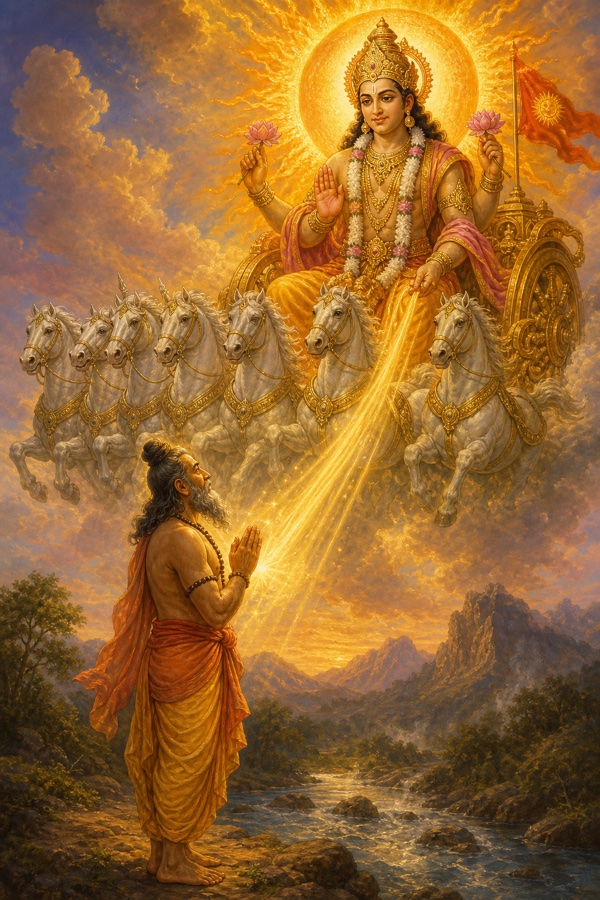
Yajnavalkya had been teaching King Janaka for a long while. He had taken the king of Mithila through the Sankhya count of the principles, through the disciplines of yoga, and through the signs by which a man can tell that his death is a year away, or a week, or a day. Janaka had also asked about the supreme Brahman that lives hidden inside the unmanifest, and the sage now turned to that question. He told the king that it touched a deep mystery and asked for his whole attention. Then, before he taught a word of it, he told the king how the knowledge had come to him. “I kept the humility the rishis lay down,” he said, “and I went to the sun for the Yajus mantras. I worshiped that giver of heat with the hardest austerities I knew, and in time he was pleased with me. ‘Choose the boon your heart is set on,’ he said. ‘However hard it is to win, I will give it gladly. My grace does not come easily.’ I bowed my head and told him the truth. ‘I know nothing of the Yajus mantras. I want to know them, and I do not want to wait.’ ‘Then you shall have them,’ he said. ‘Sarasvati, the goddess who is speech itself, will enter your body.’ He ordered me to open my mouth. I opened it, the goddess went in, and I began to burn. The pain was more than I could stand. I ran and threw myself into a stream. I had no idea that the sun had done this for my good, and I was angry with him.
“While I burned with the goddess’s energy the sun spoke again. ‘Bear it a little longer. It will pass, and you will be cool.’ It passed, and I was cool. When he saw me at ease, the maker of light told me what I had been given. ‘The whole of the Vedas will rise in you by a light from within, with the parts counted as their appendix and with the Upanishads. You will put the entire Shatapatha in order. After that your mind will turn toward the path of liberation, and you will reach the end that the followers of Sankhya and the yogis both long for.’ He said that and went down behind the western hills. I walked home happy, and at home I thought of Sarasvati. She stood before my eyes that same moment, wearing every vowel and every consonant as her ornaments, with the syllable Om in front of her. I made her the guest’s offering of water, the arghya, as the rite requires, and set out a second for the sun, and then I sat down with my heart given to those two. The whole Shatapatha Brahmana came up before my inner sight by itself, with its mysteries, its summaries and its appendices, and I was filled with joy.
“I taught it to a hundred good disciples, and my mother’s brother Vaishampayana, who sat with disciples of his own around him, took it badly. After that, with my students about me like rays about the sun, I took charge of your father’s great sacrifice. A quarrel broke out there between my uncle and me over which of us should take the dakshina, the fee paid for reciting the Vedas. I took half of it in front of the sage Devala, and my uncle had the other half. Your father agreed to that division, and so did Sumantu, Paila, Jaimini and the rest.
“So the fifty Yajuses came to me from the sun. Afterward I studied the Puranas with Romaharshana. Then, with those first mantras and the goddess Sarasvati before me and the sun’s inspiration carrying me, I set to work compiling the Shatapatha Brahmana, a task nobody had attempted before, and I finished it. I had chosen my road and I walked it, and I taught it to my disciples. They have the whole of those Vedas from me, with the summaries, and they are clean in body and mind and glad of what they learned. This knowledge of fifty branches, which I had from the sun, I have set on its feet for others to use. These days I meditate on what all of it is for, which is Brahman.
“Then Vishvavasu came to me, the Gandharva king, who knows the Vedanta well. He wanted to find out what in this knowledge is of use to the Brahmins, what truth it holds, and what its highest object is. He asked me twenty-four questions on the Vedas, and then a twenty-fifth that belongs to the science of reasoning. These were his questions. What is the universe, and what is other than the universe? What is ashva, and what is ashva? What is Mitra? What is Varuna? What is knowledge, and what is the thing to be known? What is without intelligence, and what has it? Who is Kah? Who is subject to change, and who is free of it? What devours the sun, and what is the sun? What is vidya, and what is avidya? What stands still, and what moves? What is without beginning, what cannot be destroyed, and what can? I asked him to wait a little while I thought his questions over. ‘So be it,’ he said, and sat without speaking. I turned my mind to Sarasvati once more, and the answers came up in me the way butter comes up out of curds. I kept the science of reasoning in view and churned the Upanishads in my mind, and the scriptures that supplement the Vedas, and out of that churning I gave him the fourth science, whose subject is liberation and whose ground is the twenty-fifth principle, the jiva, the living soul. It is the same science I have been setting before you.
“I took his questions in order. ‘You ask what the universe is and what is other than the universe,’ I said. ‘The universe is prakriti, unmanifest and original, carrying in herself the principles of birth and death that terrify anyone who wants to be free. She is made of the three gunas, sattva, rajas and tamas, since everything she brings forth is steeped in them. What is other than the universe is purusha, who has no qualities at all. The two you call ashva and ashva are the female and the male. The first is prakriti and the second is purusha. Mitra, likewise, is purusha, and Varuna is prakriti. Knowledge is prakriti, and what is to be known is purusha. The ignorant one and the knowing one are both purusha without qualities, since it is purusha who becomes the jiva when ignorance covers him. You ask who Kah is, who changes and who does not. Kah is purusha. What changes is prakriti, and the one free of change is purusha. What is called avidya is prakriti, and what is called vidya is purusha. As for the moving and the unmoving, prakriti moves, since by changing she becomes the cause of creation and destruction, and purusha is unmoving, since he helps creation and destruction along and is himself unchanged. Another school puts it this way: what can be known is prakriti, and what cannot be known is purusha.
“‘Those who study the science of the inner self conclude that prakriti and purusha are both steady, indestructible, unborn and eternal. Prakriti is unborn, and because the work of creation never destroys her she is counted as free of decay. Purusha is indestructible and changeless, having no change in him. The qualities that live in prakriti perish. Prakriti herself does not, and so the learned call her indestructible. By changing she works as the cause of creation, and what she creates appears and disappears while the original prakriti stays. These are the conclusions of the fourth science, which rests on reasoning and has liberation for its end. Learn the Rig, the Saman and the Yajus, Vishvavasu, by that science and by sitting with teachers. Keep every obligatory rite, and study the Vedas with reverence. Yet hear this as well. There are men who study the Vedas with all their branches and never come to know the supreme Self, from which everything is born and into which everything sinks back when destruction comes, the one thing the Vedas exist to teach. Such men study to no purpose and carry the weight of their learning for nothing. A man who wants butter and churns the milk of a she-ass misses what he wanted and is left with something that stinks like dung. A man who has studied the Vedas and cannot say what prakriti is and what purusha is has only shown how dull his mind is, and the load he carries is useless. Give your whole attention to prakriti and purusha together, so that you may be done with being born and dying again and again. Think about those repeated births and deaths, leave the religion of rites, whose best results still perish, and take up yoga, whose results do not. Whoever reflects without a break on the nature of the jiva and its bond with the supreme Self sheds every quality and sees the supreme Self. Men of dull understanding take the eternal, unmanifest supreme Self to be something other than the twenty-fifth, the jiva. The wise see the two as truly one and the same. The followers of Sankhya and the yogis, frightened by birth after birth and death after death, hold the jiva and the supreme Self to be one.’
A key to reading this (the concept): Vishvavasu’s questions come mostly in pairs, and Yajnavalkya opens each pair with one key. Whatever moves, changes and is made of the three gunas is prakriti. Whatever stays unchanged and has no qualities is purusha. The second round of questions begins from the twenty-fifth principle, the jiva, and asks how it can be one with the supreme Self.
“Vishvavasu had more to ask. ‘You say the jiva is indestructible and in truth no different from the supreme Self,’ he said. ‘That is hard to understand, and I ask you to go over it again. I have heard this subject taught by Jaigishavya, by Asita, by Devala, by the sage Parashara, by the wise Varshaganya, by Bhrigu, Panchashikha, Kapila, Shuka, Gautama, Arshtisena, Garga, Narada, Asuri, the wise Paulastya, Sanatkumara, Shukra and my own father Kashyapa. Later I heard Rudra teach it, and the wise Vishvarupa, and several of the gods, and the ancestors, and the Daityas. I have taken in all they say, since each of them speaks of that eternal object of all knowledge. Now I want to hear what you make of it with your own understanding. You are a learned teacher of the scriptures, and nothing is unknown to you. In the worlds of the gods and of the ancestors they call you an ocean of the Shrutis, and the great rishis who live in Brahma’s world say that Aditya himself, the eternal lord of all the lights, is your teacher in this knowledge. You have the whole science of the Sankhyas, and the scriptures of the yogis above all. You know this universe through, what moves in it and what does not. I want to hear from you the knowledge that is like clarified butter with the solid grains still in it.’
“‘You are able to grasp any knowledge there is,’ I told him. ‘Since you ask, hear it the way I had it from my own teacher. Prakriti has no intelligence, and the jiva knows her. She cannot know the jiva. Because the jiva is reflected in her, the Sankhyas and the yogis who know the first principles set out in the Shrutis call her pradhana, the chief. The one who sees, sees the twenty-fourth, which is prakriti, and the twenty-fifth, which is the soul. When that seeing of two falls away, he sees the twenty-sixth. The twenty-fifth believes that nothing stands higher than itself. It sees, and still it fails to see the twenty-sixth, which is seeing it. A wise man never takes the twenty-fourth, inert prakriti, for the twenty-fifth, the soul, which has a real existence of its own.
“‘A fish lives in water. Its own nature takes it there. The fish lives in the water and is still something other than the water, and the twenty-fifth should be understood the same way. It lives in contact with the twenty-fourth, and in its real nature it is separate from her and free of her. While the sense of I and mine overwhelms it, the jiva cannot understand that it is one with the twenty-sixth. The illusion that wraps it, its life alongside prakriti, and its own way of thinking keep it sinking. Freed of that sense, it rises. Only when the jiva understands that it is one thing and the prakriti it lives with is another does it come to see the supreme Self and reach oneness with the universe.
“‘The supreme is one, and the twenty-fifth, the jiva, is another. Because the supreme overlies the jiva, the wise count the two as one and the same. For that reason the yogis and the followers of Sankhya, who dread birth and death, who are clean in body and mind and blessed with the sight of the twenty-sixth, give themselves to the supreme Self and do not hold the jiva to be the indestructible one. When a man sees the supreme Self, loses all sense of being a separate someone, and becomes one with the supreme, he knows everything, and a man who knows everything is released from having to be born again. So I have told you truly, as the Shrutis indicate it, about prakriti, who has no intelligence, the jiva, who has intelligence, and the supreme Self, who knows all. The man who sees no difference between the knower and the known is both kevala, the one who stands alone, and other than kevala. He is the first cause of the universe. He is both the jiva and the supreme Self.’
“Vishvavasu said, ‘You have taught, fully and properly, the source of all the gods and the thing that brings liberation. What you have said is true and excellent. May blessings that never run out go with you always, and may your mind stay joined to understanding.’ With that the prince of the Gandharvas set off for heaven, splendid in his beauty. Before he left he honored me by walking around me in the customary way, and I watched him go with great pleasure. He taught the science he had from me to the gods who live in the worlds of Brahma and the other deities, to those who live on earth, to those who live in the regions below, and to those who had taken the path of liberation. The Sankhyas keep to the practices of their system and the yogis to theirs. There are others who simply long to be free, and for them this science bears fruit they can see. Liberation comes from knowledge, Janaka. Without knowledge it is never reached. The wise have said so. A man should therefore work with everything he has to gain true knowledge in all its detail, since by it he can free himself from birth and death. Let him take it from a Brahmin, or a Kshatriya, or a Vaishya, or even from a Shudra of low birth, and if he has faith let him always honor that knowledge. Birth and death cannot touch a man of faith. All the orders of men are Brahmins. All have sprung from Brahman, and all utter Brahman. With an understanding that comes from Brahman and turns toward Brahman I have taught this science of prakriti and purusha. This whole universe is Brahman. The Brahmins came from Brahma’s mouth, the Kshatriyas from his arms, the Vaishyas from his navel and the Shudras from his feet, and orders that came into being in that way should never be thought of as stealing from one another. Ignorance drives all men to death and on to a birth that breeds more action. Men of every order who lack knowledge are dragged by that terrible ignorance into one form of existence after another, forms that flow from the principles of prakriti. So everyone should seek knowledge by every means. I have told you that every person has the right to strive for it. A man who has knowledge is a Brahmin, and the others, Kshatriyas and Vaishyas and Shudras, have knowledge too, so this science of liberation is always open to all of them. The wise have said this. I have answered every question you asked me, according to the truth. Put away all grief, then. Go on to the far shore of this inquiry. Your questions were good ones. May blessings rest on you always.”
That was the teaching, Bhishma told Yudhishthira, and the king of Mithila was filled with joy by it. Janaka honored Yajnavalkya by walking around him and gave him leave, and the sage left the court. Then King Daivarati, who now had the knowledge of liberation, took his seat and gave away a million cows, with gold and a measure of gems and jewels, to a company of Brahmins, touching each gift as it went. He set his son on the throne of the Videhas and, old as he was, began to live as the renouncers live. He studied the sciences of Sankhya and Yoga from end to end, weighing the ordinary duties and their breaches as the scriptures give them. He thought of himself as infinite and gave his mind to the eternal and independent One alone. Ordinary duty and its breach, virtue and vice, truth and falsehood, birth and death, everything that belongs to the principles prakriti brings forth, he put away. “The Sankhyas and the yogis,” Bhishma said, “each following their own science, hold that this universe is the work of the manifest and the unmanifest. The learned say that Brahman is free of good and evil, depends on itself alone, is higher than the highest, eternal and pure. Become pure in that way yourself, Yudhishthira. The giver, the one who receives, the gift, and the thing ordered to be given should all be seen as the unmanifest Self. The Self is the only thing the Self owns. Who, then, can be a stranger to you? Think this way always, and never any other way. A man who does not know prakriti with her qualities and purusha beyond all qualities has no knowledge, and he is the man who travels to sacred waters and performs sacrifices. Study of the Vedas does not bring anyone to the state of Brahman, and austerities do not, and sacrifices do not. A man is honored only when he comes to know the supreme, the unmanifest. Those who serve mahat reach the worlds of mahat. Those who serve the sense of I reach the place that belongs to it. Those who serve what is higher reach places higher than these. And those learned in the scriptures who come to know the eternal Brahman, which is higher than unmanifest prakriti, gain what lies beyond birth and death, what has no qualities, what both is and is not. I had all this from Janaka, and Janaka had it from Yajnavalkya. Knowledge stands far above sacrifice, and sacrifice cannot be compared with it. Knowledge carries a man across the ocean of this world with all its hardships and dangers. Sacrifices never carry anyone across. Those who know say that birth and death and the other obstacles cannot be passed by ordinary effort. Sacrifices, austerities, vows and observances take men to heaven, and from heaven they fall to earth again. So give your reverence to what is supreme, most pure, blessed, stainless and sacred, to what is beyond every state. Know the kshetra, the field, and perform the sacrifice that consists in gaining knowledge, and you will be truly wise. Long ago Yajnavalkya gave King Janaka the good that comes of studying the Upanishads. The eternal and unchanging supreme was what the great rishi taught the king of Mithila, and it brought him to that Brahman which is auspicious and deathless and beyond every sorrow.”
The gist: Yajnavalkya’s conclusion: the twenty-fourth, prakriti, is inert; the twenty-fifth, the jiva, is conscious; the twenty-sixth, the supreme, knows all. The jiva comes to oneness by seeing the twenty-sixth. Knowledge may be taken from a person of any varna and is the one means of liberation. Sacrifice and austerity lead to a heaven from which men fall again.
A sub-tale: Panchashikha and Janaka on death
A sub-tale: Yudhishthira then asked about death. “Suppose a man has won great power and great wealth and has been given a long life,” he said. “How does he escape death? By austerity, by performing the many rites the Vedas lay down, by knowledge of the Shrutis, or by medicines? Which of these lets a man escape old age and death?” Bhishma answered with an old account of Panchashikha, who lived as a wandering mendicant, and Janaka, ruler of the Videhas. Panchashikha stood first among those who knew the Vedas, and no doubt remained in him about the purpose and meaning of any duty. Janaka once asked him, “By what conduct can a man get past old age and death? By austerity, by understanding, by religious acts, or by study and knowledge of the scriptures?”
Panchashikha, who knew the things that cannot be seen, answered him. “Nothing prevents those two, old age and death. And yet it is untrue that they can never be prevented under any circumstances. The days do not stop, nor the nights, nor the months. Only the man who, short-lived as he is, takes the eternal path of nivritti, of ceasing from action, escapes birth and death. Destruction overtakes every creature. All of them are carried without rest down the endless river of time. No raft floats on that river, and two great crocodiles live in it, old age and death. Those the current carries go under, and nobody comes to help them.
“A man swept down that river finds no friend to help him, and he comes to care for no one else. He meets his wife and his other companions on the road only. He has never before kept such company with any of them for long. Creatures carried on the current of time are drawn to each other again and again, the way banks of cloud pushed by the wind run together with a great noise. Old age and death eat every creature, like wolves. They eat the strong and the weak, the short and the tall. Among creatures as passing as these only the Self lasts forever. Why then should a man rejoice when creatures are born, and why grieve when they die? Where have I come from? Who am I? Where am I going? Whose am I? What do I rest on? What will I become? For what reason, then, do you grieve, and over what? Who but you will see the heaven or the hell your acts lead to? So keep hold of the scriptures, and go on giving gifts and performing sacrifices.”
The gist: Panchashikha tells Janaka that old age and death come to every creature, and that the one way past birth and death is nivritti, the path of ceasing from action. Everything is carried down the river of time, with no raft and two crocodiles in the water. Only the Self lasts, so joy at a birth and grief at a death have no ground, and the gifts and sacrifices the scriptures ask for should go on.
Sulabha’s Entry into Mithila and Janaka’s Rebuff
Yudhishthira’s next question was a householder’s and a king’s. “Has anyone ever reached liberation without leaving the householder’s life?” he asked. “I mean liberation itself, where the understanding and the other faculties come to rest. Tell me who. Tell me how the gross body and the subtle body are put off. And tell me, grandfather, what the highest excellence of liberation is.”
Bhishma answered with an old story, the exchange between Janaka and Sulabha. Long ago in Mithila, he said, there was a king of Janaka’s line named Dharmadhvaja. He lived by the practices of renunciation while he ruled. He knew the Vedas, the scriptures on liberation, and the scriptures that set out a king’s own duties. He governed his senses and he governed his land, and the report of his conduct traveled. Wise men who heard it wanted to live as he did.
In that same Satya Yuga there was a woman named Sulabha, a mendicant, who practiced yoga and wandered over the whole earth. On her wanderings she kept hearing the same thing from staff-carrying renouncers in one place after another: the ruler of Mithila was devoted to the path of liberation. She wanted to know whether the report was true, and she decided to see Janaka in person. By the power of her yoga she put off the form and features she had and took on a faultless face and a beauty no one could rival. Then, in the time an eyelid takes to close, with the speed of the fastest arrow, the woman with eyes like lotus petals and a lovely brow was in the capital of the Videhas. Mithila was a great city, crowded with people. She took on the look of a mendicant there and presented herself before the king.
Janaka looked at that delicate form and was astonished. He asked who she was, whose she was, and where she had come from. He welcomed her and gave her an excellent seat, had water brought to wash her feet, and saw that she was well fed. When she had eaten and received every courtesy due a guest, Sulabha turned to the king where he sat among his ministers with learned scholars all around him, and pressed him to say where he stood on the path of liberation. She doubted that nivritti had really carried Janaka to freedom. So, with the power yoga had given her, she entered the king’s understanding with her own. With the rays of light from her eyes she held in check the rays from his, and she bound King Janaka in the bonds of yoga, wanting the truth. The king was proud that no one could overcome him. He beat back her intention and took hold of her resolve with his own. In his subtle form he had neither the royal umbrella nor the scepter, and she in hers had no triple staff. Lodged in that way in the one body, the two of them spoke, and this is what passed between the king and Sulabha.
A sub-tale: Sulabha’s entry is an entry of one understanding into another, an act of yoga and a test of Janaka’s claim to be free. The two meet in their subtle forms, the king without his umbrella and scepter, the mendicant without her triple staff, and they speak while lodged in the one body. No hand touches anyone. Janaka will nevertheless describe the act before his whole court, and Sulabha will name that as one of his faults.
“What way of life do you follow?” Janaka said to her. “Whose are you? Where have you come from, and when your business here is done, where will you go? Nobody can know another person’s learning, or age, or birth without asking, and since you have come to me you should answer. Understand that I am truly free of vanity about my umbrella and my scepter. I want to know you thoroughly, and I hold you worthy of my respect. Listen while I speak to you about liberation, since there is no one else in this world who can teach you that subject. And hear who it was that gave me, long ago, the knowledge that sets me apart.
“I am the beloved disciple of the venerable Panchashikha, a mendicant of Parashara’s line. He cleared away my doubts. I know the Sankhya system and the Yoga system thoroughly, and the rules for sacrifices and other rites, and these are the three known paths to liberation. Panchashikha wandered the earth by the road the scriptures mark out, and once he stayed contentedly in my house through the four months of the rains. He is the first of the Sankhyas, and he taught me the several means of reaching liberation truthfully and in terms I could follow. He never ordered me to give up my kingdom. So I have lived free of attachments, my soul fixed on the supreme Brahman, unmoved by the company around me, keeping in full the threefold conduct that the treatises on liberation lay down.
“Renunciation of every attachment is the highest means to liberation. The renunciation that frees a man comes out of knowledge. Knowledge leads to the effort of yoga, and that effort brings a man to knowledge of the Self. Knowing the Self, he passes beyond joy and grief, and that takes him beyond death to the highest success. I have that understanding. I have passed beyond every pair of opposites. In this very life I am free of delusion and of all attachment. Soil that is soaked and softened with water makes a sown seed sprout, and in the same way a man’s acts make him be born again. A seed that has been roasted in a pan will never sprout, though the power to sprout was once in it. My understanding is like that seed. The holy mendicant Panchashikha taught me, and the desire that makes an understanding bear fruit was taken out of mine. It no longer puts out attachment to the objects of the senses.
“I feel no love for my wife and no hatred for my enemies. I stay clear of both, having seen how little comes of attachment and anger. If one man rubs sandal paste on my right hand and another wounds my left, I regard the two alike. I have what I was really after, and I am happy. A clod of earth, a stone and a lump of gold are the same to my eye. I rule a kingdom and I am free of attachments of every kind, and that sets me above all those who carry the triple staff.
“Some who know this subject well say liberation has a threefold path, knowledge, yoga, and sacrifices with their rites. Some say the means is knowledge that takes in all the things of the world. Some say it is the complete giving up of action, outward and inward. One group who know the scriptures of liberation hold that knowledge is the single means. Others, the renouncers with their subtle sight, hold that action is the means. Panchashikha set aside both those opinions, the one about knowledge and the one about action, and held the third to be the only means. If men who live as householders keep yama and niyama, the restraints and the observances, they are the equals of sannyasins. And if sannyasins carry desire and aversion, wives, honor, pride and affection, they are the equals of householders.
“If knowledge can bring liberation, then liberation can be found with the triple staff, since nothing stops the men who carry it from getting the knowledge they need. Why then should it not be found with the umbrella and the scepter too? A man has the same kind of reason for taking up the one as the other. Everyone grows attached to the things and the acts he needs for his own purposes. Suppose a man sees the faults of the householder’s life, throws it over, and adopts another way of life that seems to him full of merit. He cannot be called free of all attachment for that. All he has done is leave one way of life and attach himself to a new one. Kingship means rewarding some people and punishing others. A mendicant’s life means the same, since mendicants also reward and punish those they can. If mendicants are like kings in this, why should mendicants alone reach liberation, and kings never?
“So a man who holds sovereignty is still cleansed of every sin by knowledge alone, as long as he lives in the supreme Brahman. The brown cloth, the shaven head, the triple staff and the water pot are the outward signs of a way of life. They do nothing to help anyone toward liberation. If knowledge alone frees a person from sorrow even after he has put on those emblems, then putting on emblems is plainly useless. Or perhaps you took up the emblems of a sannyasin because you saw some easing of sorrow in them. Then why should the same easing of sorrow not be seen in the umbrella and the scepter I have taken up? Liberation does not live in poverty, and bondage does not live in wealth. A man reaches liberation through knowledge alone, whether he is poor or rich. Know, then, that I live in freedom. To the eye I am busy with dharma, wealth and pleasure, with a kingdom and wives, which for most men are a field of bondage. I have cut the bonds of kingdom and wealth, and the bond of attachment itself, with the sword of renunciation, sharpened on the whetstone of the scriptures of liberation. That is how I became free.”
A key to reading this (the concept): the tridanda and the royal staff. The tridanda is the triple staff a renouncer carries, the outward sign of his way of life. The umbrella and the scepter are the outward signs of a king. Janaka argues that liberation depends on knowledge alone, so that neither set of emblems helps or hinders. A householder who keeps the restraints and the observances equals a renouncer, and a renouncer who still carries desire equals a householder.
Then the king turned from his own case to hers. “You are a mendicant, and I feel affection for you. That will not keep me from telling you that your behavior does not fit the way of life you have adopted. You are delicately made. Your figure is very fine. You are young. You have all that, and you claim niyama as well, the mastery of the senses. I doubt it. You have blocked up my body, entering me by the power of your yoga, to find out whether I am really liberated. That act sits badly with the emblems you carry. The triple staff is no fit thing for a yogi who still desires, and you do not keep to your staff. Even those who are free should guard themselves against a fall.
“Hear what your offense has been, in making this contact with me and entering my body by means of your understanding. What reason did you have for coming into my kingdom, or my palace? At whose sign did you enter my heart? You belong to the first of the orders, since you are a Brahmin woman, and I am a Kshatriya. There can be no union between us two. Do not help to bring about a mixing of the orders. You live by the duties that lead to liberation, and I live as a householder. That makes a second wrong, since this act of yours unnaturally joins two opposite ways of life.
“I do not know whether you are of my gotra, my clan line, or of another, and you do not know mine. If you are of my gotra, then by entering my person you have done another wrong, an unnatural union. And if your husband is alive and living somewhere far away, your union with me is a fourth wrong, a sin, since you are no woman I may lawfully be joined to. Are you doing all these sinful things to gain some end? Are you doing them out of ignorance, or because your understanding is perverse? Or has an evil nature made you so independent that nothing restrains you? If you know the scriptures at all, you will see that everything you have done leads to harm. A third fault clings to you from these acts, one that destroys peace of mind. In your effort to show yourself superior, the mark of a wicked woman is on you. You want a victory, and I am not the only one you want it over. You plainly mean to defeat my whole court. The way you turn your eyes on all these learned and worthy Brahmins shows that you want to humble every one of them and glorify yourself. Pride in your yoga power has clouded your mind, a pride born of jealousy, and so you have joined your understanding to mine and mixed nectar with poison. When a man and a woman each desire the other, their union is as sweet as nectar. When a woman desires a man who does not desire her, the meeting has no merit in it. It is a fault, and it harms like poison. Stop touching me. Know that I am righteous. Act as your own scriptures tell you. The inquiry you wanted to make, whether I am liberated or not, is finished. You should hide none of your secret motives from me. You have come in disguise, and you should tell me plainly what you are after, whether you came for some purpose of your own or to serve the purpose of some other king. No one should ever come in a false guise before a king, or before a Brahmin, or before a wife who has every virtue of a wife. Those who deceive these three are soon destroyed. A king’s power is his sovereignty. The power of Brahmins who know the Vedas is in the Vedas. Women have great power in their beauty, their youth and their good fortune. Whoever wants to gain his end with any of these three should come with sincerity and candor, since insincerity and deceit fail with all of them. So tell me what order you were born in, what your learning is, your conduct, your disposition and your nature, and what you had in view in coming here.”
A key to reading this (the moral complexity): Janaka has just called himself free of attachment, anger and vanity. A moment later he charges Sulabha with mixing the orders, with a possible fault of gotra, with a possible living husband, with jealousy and a hunger for victory, and he calls her a wicked woman before his court. Bhishma himself describes these words as unpleasant, improper and badly aimed. The king who claims liberation is counting differences of birth and body, and Sulabha’s answer starts from exactly there.
The gist: Sulabha, a wandering mendicant, hears that the king of Mithila is devoted to liberation and comes to test the report. She enters his understanding by yoga. Janaka tells her of his teacher Panchashikha and argues that knowledge alone frees a man, so that a king under his umbrella can be as free as a renouncer with his staff. Then he turns on her, charges her with mixing the orders and with seeking a victory over his court, orders her to stop touching him, and demands her birth, her learning and her purpose.
Sulabha’s Answer: The Thirty Principles, the Flux of the Body, and the True Mark of Release
Bhishma said that the king’s words were unpleasant, improper and badly aimed, and that Sulabha was not shaken by them at all. She waited until he had finished. Then that beautiful woman began her answer, and what she said was lovelier than she was.
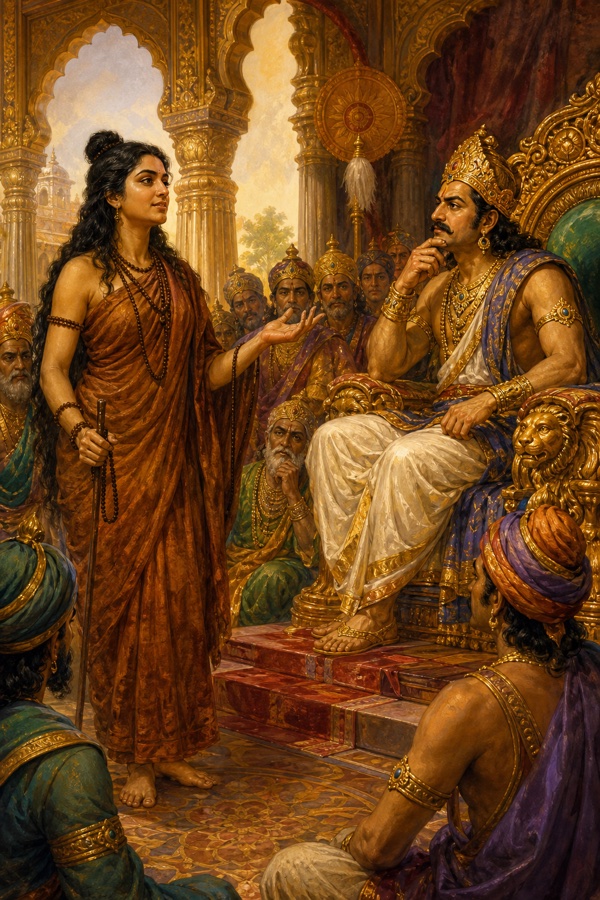
“Speech,” Sulabha said, “should always be free of the nine faults of wording and the nine faults of judgment. It should set out its meaning clearly, and it should have the eighteen well-known merits too. Five things that belong to its sense give a statement its authority: ambiguity; the sorting out of what is faulty and what is sound in the premises and the conclusions; the weighing of how strong or weak those faults and merits are; the settling of the conclusion; and whatever in the conclusion persuades or fails to persuade. Hear what each of the five is, beginning with ambiguity, as I take them one after another.
“When the things to be known differ from one another, so that knowing them depends on drawing distinctions, and the understanding has to rest first on one point and then on another before it grasps the subject, the string of words in which that happens is said to suffer from ambiguity. Ascertainment, which is called sankhya, means fixing by elimination what is faulty and what is sound in premises and conclusions, with meanings adopted provisionally for the purpose. Krama, order, is the weighing of the relative strength or weakness of the faults and merits so found, and it comes to settling which words in a sentence rightly stand earlier and which later. That is the meaning those who interpret texts give the word. Conclusion is the final determination, once everything said about dharma, pleasure, wealth and liberation has been examined, of what in particular has been stated. And the sorrow that is born of wanting a thing or wanting to be rid of it grows very great. The course a person takes to end that sorrow is called prayojana, purpose. Take my word for it, Janaka: when ambiguity and the other four are all attended to together, the result is a complete and intelligible sentence.
A key to reading this (the concept): the marks of speech. Before she answers a single charge, Sulabha lays down what sound speech is, so that her answer can be measured against the standard. She names five things that give a statement its authority: the handling of ambiguity, the sorting of faults and merits that she calls sankhya, order, conclusion and purpose. Then she lists the qualities her own words will have and the motives that will have no part in them.
“What I am about to say will have sense in it. It will be free of ambiguity, each word standing for one thing. It will be logical, free of repetition, smooth, definite, free of bombast, pleasant, truthful, and consistent with the three ends of dharma, wealth and pleasure. It will be refined, with nothing left out, nothing harsh, and nothing hard to follow. It will keep its proper order, it will not strain for its sense, its parts will hang together as cause and effect, and each part will have its own object. I shall say nothing to you out of desire, or anger, or fear, or greed, or meanness, or deceit, or shame, or pity, or pride. I answer because what you have said ought to be answered.
“When the speaker, the hearer and the words all agree with one another, the meaning comes through plainly. A speaker who ignores what his hearer can understand, and uses words whose meaning is clear to himself alone, cannot be followed, however good the words are. A speaker who lets go of his own meaning and uses words of fine sound and fine sense leaves only false impressions in the hearer’s mind, and such words, so used, are faulty. The one who uses words that carry his own meaning and that the hearer can understand deserves to be called a speaker. Nobody else deserves the name. So give your whole attention, Janaka, to what I say. There is meaning in it, and no shortage of words.
“You asked who I am, whose I am, and where I come from. Listen with an undivided mind while I answer. Lac and wood, grains of dust and drops of water, lie mingled once they are brought together, and the existence of every creature is a mingling of that kind. Sound, touch, taste, form and scent, and the senses that go with them, differ in their essence and still exist stuck together like lac and wood. Everyone knows that nobody asks any of these, ‘Who are you?’ None of them knows itself, and none knows the others. The eye cannot see itself. The ear cannot hear itself. The eye cannot do the work of any other sense, and no sense can do any work except its own. Even if all of them combine, they do not come to know themselves, any more than dust and water mixed together know each other.
“To do their work they wait for contact with things outside them. Seeing needs three things, the eye, a form, and light, and it is the same with the working of the other senses and the ideas that result. Between the working of the senses, which is seeing, hearing and the rest, and the ideas that result, which are form, sound and the rest, stands the mind. It is something other than the senses and has an action of its own. By it a person tells what exists from what does not and arrives at certainty about what the senses bring in.
“The five senses of knowledge, the five organs of action, and the mind make eleven. The twelfth is the understanding. When there is doubt about what is to be known, the understanding steps forward and settles it. After the twelfth comes sattva, the thirteenth, and creatures are told apart by having more of it or less of it in their makeup. After that comes the sense of self, the fourteenth, by which a person grasps what is himself as against what is other. The fifteenth is desire, and the whole universe hangs on it. The sixteenth is avidya, ignorance, and in it lie the seventeenth and the eighteenth, which are called prakriti and vyakti. Happiness and sorrow, old age and death, gain and loss, the pleasant and the unpleasant make up the nineteenth, which is called the pairs of opposites. Beyond the nineteenth is time, the twentieth. Know that the births and deaths of all creatures are the work of this twentieth.
“These twenty exist together. Add the five great elements, and being and non-being, and the count comes to twenty-seven. Beyond those are three more, called vidhi, shukra and bala, which bring it to thirty. Whatever holds these thirty principles is called a body. Some say that unmanifest prakriti is the source of the thirty. The followers of Kanada, whose sight is coarser, say that their cause is the manifest, the atoms. Whether the cause is the unmanifest, or the manifest, or the two together, which is to say purusha and the atoms, or, fourth, the four together, purusha with his maya, the jiva and ignorance, those who know the science of the inner self see prakriti as the cause of all creatures.
A key to reading this (number): Sulabha’s thirty principles. The five senses of knowledge, the five organs of action and the mind (eleven); the understanding (twelve); sattva (thirteen); the sense of self (fourteen); desire (fifteen); ignorance (sixteen); prakriti (seventeen); vyakti (eighteen); the pairs of opposites (nineteen); time (twenty); the five great elements with being and non-being (twenty-seven); and vidhi, shukra and bala (thirty). A body is these thirty come together, and Sulabha goes on to ask what, in such a gathering, the question “Who are you?” could be addressed to.
“That unmanifest prakriti becomes manifest as these principles. I, you, and everyone else who has a body are her products, as far as our bodies go. Conception and the stages after it come from the mingling of seed and blood. The first thing to form is called the kalala. Out of the kalala comes the budbuda, the bubble. Out of the bubble comes the peshi, the lump of flesh. From that comes the stage in which the limbs show, and after the limbs come the nails and the hair. When the ninth month is over the creature is born, its sex is seen, and it is called a boy or a girl.
“When it comes out of the womb, its nails and fingers are the color of burnished copper. The next stage is called infancy, and by then the form seen at birth has already changed. After infancy comes youth, and after youth old age, and at each stage the form of the stage before is gone. The elements that make up the body, each serving its own function, change in every creature at every moment. The changes are too fine to be noticed. Particles are born and particles die in each condition as it follows the last, and nobody can mark it, just as nobody can mark the changes in the flame of a burning lamp.
A sub-tale: A lamp flame in still air looks like one steady thing. It is oil burning away particle by particle, each burning ending as the next begins, so that the flame of this moment is a different flame from the last. Sulabha says the body is the same, its particles born and dying at every instant, too finely for anyone to see. A king who asks such a body where it came from and whose it is will find nothing there to answer him.
“That is how it stands with the body of every creature. What is called the body changes without a pause, as fast as a good horse runs. So who has come from where, or from nowhere? Whose is it, or whose is it not? Where does it not come from? What connection is there between creatures and their own bodies? Fire is produced when flint strikes iron, or when two sticks are rubbed together, and in the same way creatures are produced when the thirty principles combine. You see your own body in your body and your own soul in your soul. Why do you not see your own body and your own soul in the bodies and souls of others? And if you truly see that you and others are the same, why did you ask me who I am and whose?
“If you are truly free of the dualism that says, ‘This is mine and that is not,’ what use are questions like ‘Who are you? Whose are you? Where do you come from?’ What mark of liberation is there in a king who deals with enemies, allies and neutrals, and with victory, truce and war, exactly as other kings do? What mark of liberation is there in a man who does not know the real nature of the three ends, dharma, wealth and pleasure, which show themselves in every act in seven ways, singly, in pairs and all together, and who is attached to those three ends for that reason? What mark of liberation is there in a man who cannot look with the same eye on what pleases him, on the weak, and on the strong? You have no right to it, and your counselors ought to put a stop to this pretense of liberation. With so many faults in you, your striving for liberation is like the medicine of a patient who goes on with every forbidden food and habit. A man should look at his wives and the other sources of attachment and see them in his own soul. What else could be called the mark of liberation?
“Now hear me go through the finer attachments one by one, the ones that belong to the four familiar acts of lying down to sleep, taking pleasure, eating and dressing. You are still tied by them, though you say you have taken up the path of liberation. A man who rules the whole earth must be one king, with no second. He can live in only one palace. In that palace he has one bedchamber. In that chamber there is one bed for him to lie on at night, and half of that bed he must give to his queen. That shows how small the king’s share is of everything he is said to own. It is the same with what he enjoys, with the food he eats, and with the robes he wears. He is attached to a very small portion of things, and he is attached besides to the business of rewarding and punishing.
“A king always depends on others. He enjoys a small part of what he is supposed to own, and he clings to that small part as other men cling to what is theirs. He is no free agent in making peace or war. In women, in sport, and in his other pleasures, what he may incline to is narrowly hemmed in. What independence does he have when he takes counsel, sitting among his counselors? When he gives orders to other men he is called completely free. A moment later the very men he ordered are back to bar his freedom, each about the order he was given. If the king wants to sleep, he cannot, since the people with business before him will not allow it. He sleeps when they let him, and they wake him when something is urgent. Bathe. Touch. Drink. Eat. Pour the offering into the fire. Perform the sacrifice. Speak. Listen. Those are the words a king hears from others, and when he hears them he must do as he is told. People come to him in crowds asking for gifts. He is the keeper of the treasury that belongs to all, and he cannot give even to those who most deserve it. If he gives, the treasury is emptied. If he refuses, the disappointed look at him with hostile eyes. It wears on him, and before long he has turned against his fellow men. If many wise, brave and wealthy men live in one place, the king begins to distrust them. He fears the people who are always at his side honoring him, even when there is nothing to fear. And those same people find fault with him. See how a king can come to be afraid even of them.
“Then again, every man is a king in his own house, and every man in his own house is a householder. Like kings, Janaka, all men punish and reward at home. Like kings they have sons, wives, their own persons, treasuries, friends and stores. In all this the king is no different from other men. The country is ruined. The city has burned. The finest of the elephants is dead. At such news the king gives way to grief like anyone else, and it hardly occurs to him that every one of these impressions comes from ignorance and error. He is seldom free of the griefs of the mind that desire, aversion and fear bring. Headaches trouble him, and other ailments of the kind. Every pair of opposites works on him. Everything alarms him. A kingdom is full of enemies and obstacles, and the king who enjoys one lies awake at night. So sovereignty holds a very small share of happiness and a very large share of misery. It has as much substance as flames fed with straw, or the bubbles of froth on water. Who would want to gain sovereignty? Who, having gained it, could hope for peace? You think this kingdom and this palace are yours. You think this army, this treasury and these counselors belong to you. Whose are they really, and whose are they not?
A key to reading this (the concept): the seven limbs of the state. Sulabha counts seven limbs of a kingdom: allies, ministers, the capital, the provinces, punishment, the treasury and the king. They stand by leaning on one another, like three staffs propped together, and whichever serves the need of the moment is counted first for that moment. Her point is that Janaka owns none of them outright. The king is one limb among seven, as dependent as any householder, and his umbrella is no evidence of his freedom.
“Allies, ministers, capital, provinces, punishment, treasury and king are the seven limbs of a kingdom, and they exist by depending on one another, like three sticks that stand because each holds up the others. The merits of each are brought out by the merits of the rest. Which of them can be called better than the others? At any given time the ones through which some important end is being served are held to stand above the rest, and for that time the highest place is given to the limb whose usefulness is being seen. The seven limbs, with three more, growth, decline and stability, that make ten, hold one another up and are said to enjoy the kingdom just as the king does. A strong king who holds firmly to the Kshatriya’s way should be content with a tenth part of what his subjects’ fields produce. Other kings are seen to be content with less than a tenth. No one holds the office of king without someone else holding it too somewhere in the world, and there is no kingdom without a king. If there is no kingdom there can be no dharma, and if there is no dharma, where would liberation come from? Whatever merit is holiest and highest belongs to kings and kingdoms. A king who rules his kingdom well earns the merit of a horse sacrifice in which the whole earth is given away as the fee. How many kings are there who rule their kingdoms well? I could name hundreds and thousands of faults like these that go with kings and kingdoms, Janaka. And since I have no real connection even with my own body, how can I be said to have touched the body of anyone else? You cannot charge me with trying to bring about a mixing of the orders. Did you hear the dharma of liberation whole from Panchashikha’s lips, with its means, its methods, its practices and its conclusion? If you have overcome every bond and freed yourself of every attachment, then let me ask you why you still keep your tie to this umbrella and the other trappings of a king.
“I think you have not listened to the scriptures. Or you listened and got nothing from it. Or perhaps what you listened to was some other set of treatises that only look like the scriptures. It seems to me that worldly knowledge is all you have, and that touch, wives, fine houses and the rest bind you like any ordinary man of the world. If it is true that you are free of every bond, what harm have I done you by entering your person with my understanding alone? Among all the orders of men it is the custom of renouncers to lodge in empty or deserted houses. What harm have I done, then, and to whom, by entering an understanding that is empty of real knowledge? I have not touched you with my hands, or my arms, or my feet, or my thighs, or with any other part of my body.
“You were born into a high family. You have modesty, and you have foresight. Whether what I did was good or bad, my entering you was a private matter between the two of us. Was it proper for you to announce that private matter in front of your whole court? These Brahmins all deserve respect. They are the first among teachers. You deserve respect from them too, as their king, and you earn their reverence by showing them yours. With all that in mind, if you really know what may properly be said, you should never have proclaimed before these men a meeting between a man and a woman.
“I am staying in you without touching you at all, the way a drop of water rests on a lotus leaf and leaves it dry. If Panchashikha the mendicant taught you and your knowledge still has not come loose from the objects of the senses, then it is plain where you are. You have dropped out of the householder’s life, and you have not reached liberation, which is so hard to reach. You are standing between the two and pretending you have arrived. When one liberated person meets another, or when purusha meets prakriti, no mingling of the kind you dread can follow. Only people who take the soul to be the same thing as the body, and who believe the orders and the ways of life really differ from one another, can make the mistake of thinking a mingling possible.
“My body is different from yours. My soul is no different from your soul. Since I am able to see that, I have not the slightest doubt that my understanding is not really lodged in yours, though I have entered you by yoga. A pot is held in the hand. There is milk in the pot. On the milk there is a fly. Hand and pot, pot and milk, milk and fly are together, and each remains distinct from the others. The pot does not take on the nature of the milk. The milk does not take on the nature of the fly. What each one is depends on itself and cannot be changed by the condition of the thing it happens to be with for a time. In the same way, the color of an order and its practices can be present with a liberated person and in that person, and they do not really attach to him. How then could this union of mine with you bring about a mixing of the orders?
A sub-tale: A pot in the hand, milk in the pot, a fly on the milk. The hand does not become the pot, the pot does not turn to milk, and the milk does not turn into a fly. Each stays what it is, whatever it happens to be resting in. From this Sulabha argues that her stay in Janaka’s understanding changes neither of them. Their bodies are two, and their soul is one.
“Then again, I am not above you in the order of my birth. I am no Vaishya, and no Shudra either. I am of the same order as you, Janaka, and of a clean line. There was a royal sage named Pradhana. You have certainly heard of him. I was born in his family, and my name is Sulabha. Indra himself, the chief of the gods, used to come to the sacrifices my ancestors performed, and Drona, Shatashringa and Chakradvara, the spirits of the great mountains, came with him. Born into such a family, I found that no husband fit for me could be had. So I was taught the dharma of liberation, and I wander the earth alone, keeping the practices of an ascetic. There is no hypocrisy in my life of renunciation. I am no thief who takes what belongs to others. I do not confuse the practices of the different orders. I hold firmly to the practices of the way of life that is properly mine. I am steady in my vows, and I never speak a word without considering whether it is right to speak it.
“I did not come to you without thinking it over. I heard that the dharma of liberation had purified your understanding, and I came here hoping to gain something by it. I came to ask you about liberation. I say this out of sincerity alone, with no wish to raise myself or to lower those who oppose me. A liberated person never takes up the wrestling of wits that arguing for victory amounts to. The one who is really liberated gives himself to Brahman, the one seat of peace. A mendicant stays a single night in an empty house and leaves in the morning. In the same way I shall stay this one night in your person, which is, as I said, like an empty room, having no knowledge in it. You have honored me with your words and with the other things a host owes a guest. I shall sleep this one night in your person, Janaka, as if it were my own room, and tomorrow I shall go.”
Janaka heard those words, Bhishma said, with all their sense and all their reasoning, and he found nothing to say in reply.
A key to reading this (the moral complexity): the mark of release. Sulabha locates liberation in an equal eye for the pleasant, the weak and the strong, and in giving oneself to Brahman. Dress, a throne and a won argument are no evidence of it, and she says outright that a liberated person does not argue for victory. Her last act is to tell the king, in his own court, that his understanding is an empty house in which she will pass one night. Bhishma ends the story on Janaka’s silence.
The gist: Sulabha begins by setting the standard for sound speech and then meets it. From the thirty principles and the body’s change at every moment she shows that “Who are you?” has nothing to point at. A king, she says, owns half a bed, obeys the people he commands and lies awake at night, as bound as any householder. Soul is one and bodies are many, so no mixing of the orders has occurred. She names her family, the line of the royal sage Pradhana, promises to leave in the morning, and Janaka has no reply.
Vyasa’s teaching to Shuka: death is near, gather dharma
Yudhishthira asked for the story of Shuka. “How was Vyasa’s son won over to renunciation, long ago? I want to hear it told, and I cannot hold my curiosity back. And tell me, as far as your understanding reaches, the conclusions about the unmanifest cause and the manifest effects, about the truth that is in them and unattached to them, and about the acts of the self-born Narayana.” Bhishma began with a father watching his son. Vyasa saw that Shuka was living as ordinary men live, unafraid, in ways they consider harmless. He taught the boy the whole of the Vedas, and then one day he spoke to him.
“Master your senses, my son,” Vyasa said. “Bring extreme cold and extreme heat under you, and hunger and thirst, and the wind too, as the yogis do, and then practice dharma. Keep to truth and sincerity. Keep free of anger and malice. Keep self-restraint, austerity, kindness and compassion. Stand on truth, hold to dharma, and drop every kind of insincerity and deceit. Live on the food that is left after the gods and the guests have been fed. Your body lasts as long as froth on water. The jiva sits in it unattached, like a bird on a tree. The company of everything pleasant is very short. Why then, my son, do you sleep in such forgetfulness? Your enemies are wide awake and watchful, always ready to spring, always looking for their chance. How can you be so foolish as to miss this?
“Day follows day and your life gets shorter. It is being cut down without a pause, so why are you not running to teachers to learn how to save yourself? Only people who do not believe in a life after this one set their hearts on the things of this world, which do nothing except add flesh and blood, and such people give no thought at all to the next world. Men whose understanding has gone wrong show a hatred for dharma, and whoever follows those lost men down their crooked paths suffers what they suffer. There are others who are contented, devoted to the scriptures, large in soul and strong, and they take the road of dharma. Wait on them with reverence. Ask them to teach you, and then do as those wise men tell you, whose eyes are fixed on dharma. When their lessons have cleaned and raised your understanding, use it to hold back your heart, which is always ready to leave the right way. Some men think only of the present, look at tomorrow without fear as something far off, and eat whatever they please. They are senseless. They have not understood that this world is a field where acts are sown. Go to the stairway dharma has built and climb it step by step. At present you are like a worm spinning a cocoon around itself and closing off every way out. Keep the unbeliever on your left and pass him by without a qualm. He breaks every restraint, he stands like a house on the bank of a river that is eating the bank away, and to others he looks like a tall bamboo with its head lifted in pride. Cross the ocean of this world on the raft of yoga. Its waters are your five senses, its monsters are desire, anger and death, and its whirlpool is birth. Cross on the raft of dharma this world that death strikes and old age wears down, where days and nights fall without a pause like thunderbolts.
“Death is looking for you at every moment, whether you are sitting or lying down, and it is certain that he may take you at any time. Where will your rescue come from? Death carries off a man who is still busy earning and still unsatisfied with his pleasures the way a she-wolf carries off a lamb. You are bound to go into the dark. Hold up the lamp of a righteous understanding, and see that its flame has been well tended. A creature falls into one form after another in the world of men and reaches the status of a Brahmin only with great difficulty. You have reached it, my son. Try to keep it. A Brahmin was never born to satisfy desire. His body is meant for hardship and austerity in this world, so that happiness beyond compare may be his in the next. Long, hard austerities win the status of a Brahmin, and a man who has won it should waste no time indulging his senses. Live and act for your own good, always at austerity and self-restraint, devoted to peace.
“The span of every man’s life is like a horse. The nature of that horse is unmanifest. The sixteen elements are its body, and it is fine beyond seeing. Kshanas, trutis and nimeshas, the smallest measures of time, are the hairs on its hide. The twilights are its shoulder joints. The bright fortnight and the dark are its two eyes, equal in strength. The months are its other limbs. That horse is running without a stop. If your eyes are not blind, watch it run on along its unseen course, listen to what your teachers say about the next world, and set your heart on dharma. Those who fall away from dharma and live recklessly, who are always malicious toward others and keep to evil ways, have to take on bodies in Yama’s realm and suffer many torments for what they did. A king who is devoted to dharma, and who protects the good and punishes the wicked with discernment, reaches the worlds that belong to men of righteous deeds. By his many good acts he gains a faultless happiness that thousands of births could not win.
“A man who disobeys his parents and his teachers goes to hell when he dies, and there savage dogs of terrible appearance set on him, and crows with iron beaks, flocks of ravens and vultures and other birds, and worms that suck blood. The Self-born himself fixed ten boundaries. The sinner who recklessly crosses them passes his time in torment in the wild wastes of the realm of the king of the ancestors. A man stained with greed, in love with untruth, who delights in deception and cheating and injures others by hypocrisy and fraud, goes down to the deep hell and suffers there for his wickedness. He is made to bathe in the broad river Vaitarani, whose waters scald. He is driven into a forest where the leaves are as sharp as swords. Then he is laid on a bed of battle-axes. That is how his days pass in that terrible place. You look only toward the worlds of Brahma and the other gods, and you are blind to what is highest, which is liberation. You have long been blind as well to what brings death behind it, to decay and old age.
“Go. Why are you waiting? A terror that will destroy your happiness is standing in front of you. Act at once to win your liberation. Soon after you die you will be brought before Yama at his order. Work toward dharma through hard and severe vows, for the sake of happiness in the next world. Yama has no regard for anyone’s suffering. He will soon take every life, yours and your friends’, and nobody can stop him. Very soon the wind of Yama will blow in front of you. Very soon you will be taken, quite alone, into his terrible presence. Do what will help you there. Where is that wind of death now, which will so soon be blowing before you? Very soon, when the moment comes, the directions will begin to spin before your eyes. Very soon your Vedas will slip from your sight as you go helpless into that presence. So set your heart on the absorption of yoga, which is the highest of practices. Seek that one treasure, so that after death you need not grieve at the memory of what you did, good and bad, all of it marked by error. Very soon old age will weaken your body and take your strength, your limbs and your beauty. Seek that one treasure. Very soon the Destroyer, with Disease driving his chariot, will pierce and break your body with a strong hand to take your life. Practice hard austerity. Very soon the terrible wolves that live inside your body will attack you from every side. Work at acts of dharma. Very soon you will see a thick darkness, all alone, and very soon you will see the golden trees on the hilltop, the sight that comes to a man when death is near. Hurry to acts of dharma. Very soon those evil companions and enemies of yours, the senses, dressed up as friends, will turn you away from seeing rightly. Strive, my son, for the highest good. Earn the wealth that has nothing to fear from kings or thieves and need not be left behind even at death. A man earns it by his own acts, and it never has to be divided among co-owners. In the next world each enjoys what each has earned. Give others, my son, what will let them live in the next world, and set yourself to gain the wealth that cannot be destroyed and lasts. Do not tell yourself that you will enjoy every pleasure first and turn to liberation afterward. Death may reach you before your dish of barley and ghee has finished cooking. Hurry, with that in view, to do good. Mother, son, relatives, dear friends: none of them goes with the man who dies, however he honored them and however he begs. He travels to Yama’s realm by himself, with no one beside him. Only what he did before death, good and bad, goes with him to the other world. The gold and the gems he earned by good means and bad are of no use to him once his body is dissolved. Of the acts a man did and left undone in life, there is no better witness in the other world than his own soul. Yogis who enter the sky of their own hearts see, by the understanding yoga gives, that the body’s destruction comes when the acting consciousness, the jiva, passes into the witnessing consciousness. Even here the god of fire, the sun and the wind live in the body, all three. They watch everything a man does in his life and become his witnesses. Day, whose nature is to show all things, and night, whose nature is to hide them, run on without a stop, touching everything and shortening its time. So keep the duties of your own order. The road in the other world is full of enemies, and of repulsive and terrible insects and worms. Look to your own acts, since only your acts will go down that road with you. Nobody shares his acts with another. Each man enjoys or suffers the fruit of what he himself has done. The apsaras and the great rishis reach fruits of great happiness, and in the same way men of righteous deeds receive in the other world, as the fruit of what they did, chariots of surpassing brightness that go wherever the rider wishes. Men whose deeds are stainless, whose souls are clean and whose birth is pure receive in the next world fruits that match their righteous acts in this one. By keeping to the high road of a householder’s duties men come to a happy end and reach the world of Prajapati, or of Brihaspati, or of Indra of the hundred sacrifices.
“I could give you thousands and thousands of instructions. Know, though, that dharma is the powerful cleanser, and that fools stay in the dark however much they are told. You have lived twenty-four years. You are now a full twenty-five. Your years are going by. Start laying in your store of dharma. The Destroyer, who lives inside error and heedlessness, will soon take from your senses the powers they have. Before that happens, hurry to keep your duties, relying on your body alone. The road you must travel is one where you alone are in front and you alone behind. What use to you, on that road, is a body, or a wife, or children? Men go to Yama’s realm one by one, without companions. With that terror ahead you should seek the one treasure. Yama has no regard for anyone’s suffering. He tears up a man’s friends and the relatives of his line by the roots, and nobody can stop him. So lay in a stock of dharma. These lessons of mine all agree with the scriptures I follow. Keep them by acting on what they mean. A man who supports his body by the duties laid down for his order, and who gives gifts for whatever fruit such acts may bear, is freed from the consequences that ignorance and error breed. The knowledge a man of righteous deeds draws from the words of the Vedas leads him to know all things, and that knowing of all things is the science of the highest human end, liberation. Teaching does good when it is given to the grateful. The pleasure a man takes in living among the houses of men is a cord that binds fast. Men of righteous deeds break that cord and go on to worlds of great happiness. The wicked cannot break it. What do you want with wealth, my son, or with relatives, or with children, when you have to die? Spend yourself in seeking your soul, which is hidden in a cave. Where have all your grandfathers gone? Do today what you would leave for tomorrow. Do in the morning what you would leave for the afternoon. Death waits for no one, to see whether his work is finished or unfinished. A man’s relatives and kinsmen and friends follow his body when he is dead, throw it on the funeral pyre, and come back. Avoid without a qualm the men who believe nothing, who have no compassion, and who are devoted to wicked ways, and seek your highest good without sluggishness or indifference. The world is struck down by death in this way, so bring dharma about with your whole heart and with a patience that does not waver. A man who knows the means to liberation and does the duties of his order as he should is certain of great happiness in the other world. You do not see death in the taking of another body, and you do not leave the path the righteous have walked. For you there is no destruction.
“The man who adds to his store of dharma is truly wise, and the man who falls away from dharma is called a fool. One who does good deeds reaches heaven and the other rewards of those deeds, and one who is given to wicked deeds sinks into hell. Human birth is hard to win, and it is the step from which heaven is reached. A man who has won it should fix his soul on Brahman, so that he does not fall again. When a man’s understanding is set on the path to heaven and never leaves it, the wise call him truly righteous. A man whose understanding is steady and turned toward Brahman, and who has reached heaven, is free of the great terror, which is hell. Those who are born in the hermitages of ascetics and die there earn little merit by doing without pleasures and desires all their lives. The man who has pleasures within his reach, throws them off and takes up austerity gains everything, and the fruit of his austerity, I think, is much the higher. Every one of us has had mothers and fathers and sons and wives in this world by the hundred and the thousand, and will have them again. Who were they, and whose are we? I am quite alone. I have no one I can call mine, and I belong to no one. I do not see the person whose I am, and I do not see anyone I can call mine. They have nothing to do with you, and you have nothing to do with them. Every creature is born according to the acts of its past lives, and you too will have to go from here to whatever your own acts decide. In this world the friends and followers of a rich man serve him devotedly, and the friends and followers of a poor man fall away while he is still alive. A man does many evil things for the sake of his wife and children, and those acts bring him great distress here and hereafter. The wise man sees the world of the living laid waste by what every living being does. So act, my son, on everything I have taught you. A man who sees truly, who knows this world to be a field of action and wants happiness in the next, should do good acts. Time, whose strength nothing resists, cooks all creatures in his pot. The months and the seasons are his ladle, the sun is his fire, and the days and nights are his fuel, the same days and nights that witness the fruit of every act of every creature. What is wealth for, if it is neither given away nor enjoyed? What is strength for, if it is never used to resist an enemy or subdue him? What is knowledge of the scriptures for, if it does not drive a man to deeds of dharma? And what is a soul for, if it does not master the senses and keep away from evil?” Bhishma said that Shuka listened to these wholesome words of the island-born Vyasa, and then he left his father and went to look for a teacher who could teach him the dharma of liberation.
The gist: Vyasa presses his son with a father’s urgency. Life runs like an unseen horse, death hunts at every moment, the road to Yama is walked alone, and only a man’s own deeds go with him. Shuka is already twenty-five. A Brahmin’s birth is hard won and meant for austerity and the search for the Self, so pleasure is a waste of it. After hearing this, Shuka leaves his father to find a teacher of liberation.
Karma’s pursuit: what is done follows like a shadow
Yudhishthira asked whether gifts, sacrifices, austerities well performed, and dutiful service to teachers and other elders had any power in them, and if they had, he wanted to hear of it. Bhishma began from the other end. “An understanding joined to evil makes the mind fall into sin. In that state a man stains his own acts, and then he falls into great distress. Those who act sinfully are born very poor. They pass from famine to famine, from pain to pain, from fear to fear, and they are more dead than the dead. Those who have faith, who restrain themselves and are devoted to righteous deeds, pass in prosperity from joy to joy, from heaven to heaven, from happiness to happiness. Unbelievers have to feel their way with their hands through country full of beasts of prey and elephants, through pathless tracts crawling with snakes and robbers and other terrors. What more is there to say about them? As for those who revere the gods and their guests, who are generous, who respect good people and give gifts at sacrifices, theirs is the path that belongs to men who have cleansed and mastered their souls.
“Those who are not righteous should no more be counted among men than grains without a kernel are counted as grain, or cockroaches as birds. What a man has done follows him even when he runs fast. It lies down with him when he lies down. His sins sit when he sits and run when he runs. They act when he acts, and they follow him like his shadow. Whatever he does, by whatever means and in whatever circumstances, he is certain to enjoy and suffer its fruit in his next life. Time is always dragging all creatures in from every side, and he keeps the rule of the distance each was thrown, a distance measured by its acts. Flowers and fruit never let their season pass without appearing, and nobody has to urge them. The acts of a past life appear at their own time in the same way.
“Honor and dishonor, gain and loss, ruin and growth are seen to come, and nobody can hold them off when they do. None of them lasts, since whatever has appeared must disappear. The sorrow a man suffers is the result of his acts, and the happiness he enjoys comes from his acts. From the time he lies in his mother’s womb he begins to enjoy and suffer what he did in a past life. Whatever he does, good or bad, in childhood, in youth or in old age, he enjoys and suffers its results in his next life at the same age. A calf knows its mother even when she stands among thousands of cows, and the acts of a past life find the man who did them in his next life, among thousands of his kind, without a mistake. A dirty cloth is washed white in water. The righteous are cleansed in the same way by long exposure to the fire of fasts and austerities, and they come at last to happiness without end. The wishes and purposes of those whose sins have been washed away by long austerities well performed are fulfilled. The track of the righteous cannot be made out, any more than the track of birds in the sky or of fish in the water. There is no need to speak ill of others, or to recite the times that others have stumbled. A man should always do what is pleasing, agreeable and good for his own self.”
The gist: What a man has done stays with him like his shadow. It lies down when he lies down and runs when he runs, and in the next life it finds him as surely as a calf finds its mother among thousands of cows. Its fruit comes in its own season, at the age at which the act was done, and nobody can hold it off. Fasts and austerities wash the righteous clean. So there is no call to speak ill of others. Do what is good for your own self.
A sub-tale: the birth of Shuka, and the journey to Mithila
A sub-tale: Yudhishthira wanted the story from its beginning. “Tell me how Shuka, that ascetic of hard austerities, came to be born as Vyasa’s son, and how he reached the highest success. On what woman did Vyasa beget him? We do not know who Shuka’s mother was, and we know nothing of his birth. How did his mind turn toward the knowledge of the subtle Brahman while he was still a boy? No second person in this world has shown such a leaning so young. I want to hear all of it in order, grandfather, his greatness, his knowledge and his union with the supreme Self. Your words are like nectar, and I never have enough of them.” Bhishma said that the rishis did not measure worth by years, or old age, or wealth, or friends. Among them the great one was the one who had studied the Vedas. Everything Yudhishthira was asking about had austerity for its root, and austerity grows out of mastering the senses. A man who gives his senses the reins is at fault, and success comes only by holding them in. A thousand horse sacrifices or a hundred Vajapeyas do not earn a sixteenth part of the merit that yoga earns. He would now tell of Shuka’s birth, of what his austerities won him, and of the end he reached, things that people of unclean soul cannot understand.
Once Mahadeva was amusing himself on a summit of Mount Meru, where the karnikara trees were in flower, with the terrible spirits who attend him. Parvati, the daughter of the king of the mountains, was there too. Close by that summit Vyasa, the island-born sage, was performing extraordinary austerities for the sake of a son. He had drawn himself by yoga into his own soul and held his mind fixed, and what he asked of the great god was a son with the strength of fire, of earth, of water, of wind and of space. He made the request by the resolve of his yoga, without speaking a word, to a god whom people of unclean soul cannot come near. For a hundred years Vyasa stayed there, living on air alone, worshiping Mahadeva of the many forms, the lord of Uma. The Brahmin rishis came to that place, and the royal sages, the guardians of the worlds, the Sadhyas with the Vasus, the Adityas, the Rudras, the sun and the moon, the Maruts, the oceans, the rivers, the Ashvins, the gods, the Gandharvas, Narada and Parvata, the Gandharva Vishvavasu, the Siddhas and the apsaras. Mahadeva, who is also called Rudra, sat there in a garland of karnikara flowers, bright as the moon among its rays. In that lovely forest of the gods, full of deities and heavenly rishis, the great rishi stayed sunk in yoga, wanting a son. His strength did not lessen and he felt no pain, and the three worlds were amazed. As he sat in yoga, his matted hair was seen to blaze like flames with the force that was in him. “I heard this from Markandeya,” Bhishma said. “He used to tell me the deeds of the gods. That is why the matted locks of the island-born Krishna have looked the color of fire ever since.”
Mahadeva was pleased with such austerity and such devotion, and made up his mind. The three-eyed god smiled and said, “You shall have the son you want. He will be great, and as pure as fire, as wind, as earth, as water, as space. He will know himself to be Brahman. His understanding and his soul will be given to Brahman, and he will rest in Brahman so completely as to be one with it.”
With that high boon granted, Satyavati’s son was one day rubbing his fire sticks together to kindle a fire. As he worked he saw the apsara Ghritachi, whose own radiance made her very beautiful just then. The sight of her in those woods struck the rishi with sudden desire. Ghritachi saw that his heart was troubled, changed herself into a she-parrot, and came near. He saw the apsara in her changed form, and the desire in him did not fade. It spread through every part of his body. He called up all his patience and tried to master it, and for all his effort he could not steady his mind. What was to happen could not be turned aside, and his heart went out to Ghritachi’s beauty. He worked the harder at kindling his fire, to put the feeling down, and in spite of everything his seed fell. He went on rubbing his stick without a qualm over what had happened, and from the fallen seed a son was born to him. Because of the way he was born he was called Shuka, the parrot. So that great ascetic and supreme yogi was born from the two sticks his father used to make fire. A sacrificial fire blazes up and throws its light all around when ghee is poured on it, and Shuka was born blazing like that with his own radiance.
He had his father’s fine form and coloring, and he shone like a fire without smoke. The river Ganga came to the slope of Meru in her own bodily form and bathed the newborn in her waters. An ascetic’s staff and a dark deerskin dropped from the sky for him. The Gandharvas sang again and again, the companies of apsaras danced, and the kettledrums of heaven boomed. The Gandharva Vishvavasu was there, and Tumburu and Varada, and the Gandharvas called Haha and Huhu, all praising Shuka’s birth. The guardians of the worlds came with Indra at their head, and the gods, and the rishis of heaven and of the Brahmin order. The wind god rained heavenly flowers on the place. Everything in the universe that moves and everything that does not was filled with joy. Mahadeva himself came with the Goddess, out of affection, and soon after the birth he invested the sage’s son with the sacred thread. Indra, the chief of the gods, gave him out of affection a heavenly water pot of fine shape and heavenly robes. Swans, shatapatras and cranes wheeled over his head in thousands, with many parrots and chashas. And Shuka, born of the two fire sticks, brilliant and intelligent, went on living there, attentive to many vows and fasts.
The moment Shuka was born the Vedas came to live in him, with all their mysteries and all their summaries, just as they live in his father. He chose a teacher anyway, as custom everywhere requires, and the teacher was Brihaspati, who knew all the Vedas with their branches and commentaries. Shuka studied all the Vedas with their mysteries and summaries, and all the histories, and the science of government. He paid his teacher’s fee and came home. Then he took the vow of a brahmachari and gave his whole attention to the hardest austerities. Even as a child he was respected by the gods and the rishis for his knowledge and his austerity. His mind was on the dharma of liberation, and he took no pleasure in the three ways of life that begin with the householder’s.
With liberation in his thoughts, Shuka went to his father. He was humble, and he wanted his own highest good. He bowed to his great teacher and said, “You know the dharma of liberation well. Teach it to me, so that I may have the highest peace of mind.” The great rishi answered, “Study the dharma of liberation, my son, and all the many duties of life.” At his father’s command Shuka mastered every treatise on yoga and the science that Kapila taught. When Vyasa saw his son shining with the splendor of the Vedas, strong with the energy of Brahman and fully at home in the dharma of liberation, he said, “Go to Janaka, the ruler of Mithila. The king of Mithila will tell you everything you need for your liberation.”
Shuka set out to ask the king about the truth of duties and the refuge that liberation is. Before he left, his father gave him the rules of the road. “Go by the path ordinary people take. Do not use the power of your yoga to travel through the sky.” Shuka was not surprised at that. “Go simply,” Vyasa said, “and do not go looking for pleasure. Do not seek out friends or wives along the way, since friends and wives are what tie a man to the world. The ruler of Mithila is a king at whose sacrifices we officiate. Even so, you must not let yourself feel superior while you live with him. Live under his direction and obey him. He will clear away all your doubts. That king knows every duty and knows the scriptures on liberation well. I am his priest. Do whatever he tells you, without a qualm.”
So instructed, Shuka walked to Mithila, though he could have crossed the whole earth and her seas through the sky. He crossed hills and mountains, rivers, lakes and waters, and forests full of beasts of prey and other animals. He crossed the two regions of Meru and Hari one after the other, and then the region of Himavat, and came to the region known as Bharata. He saw many countries where the Chinas and the Hunas live, and so reached Aryavarta. He carried his father’s commands in his mind the whole way and passed over the earth like a bird through the air. Pleasant towns and crowded cities lay on his road, and gardens and plains and sacred waters, and he did not stop to look. Before long he reached the country of the Videhas, which the virtuous Janaka protected: crowded villages, plenty of food and drink, cowherds’ settlements full of people and cattle, fields of rice and barley, lakes with swans and cranes and lotuses. He went through that prosperous country to the gardens of Mithila, with their many kinds of trees, their elephants and horses and chariots, their men and women, and he passed through without pausing over anything his eyes met. One thing weighed on his mind and he kept it there, the wish to master the dharma of liberation. He came to the city gate, cheerful, his delight all turned inward, and sent word in by the gatekeepers.
They gave him leave, and he entered the city and went up its main street to the king’s palace. The doorkeepers stopped him with rough words. Shuka felt no anger. He stood where he was and waited, as fresh as if the sun, the long road, hunger and thirst had never touched him. One of the doorkeepers pitied him, standing there bright as the sun at noon, greeted him with joined palms, and led him to the first court of the palace. Soon the king’s minister came and took him on through a second court into a wide garden of pools and flowering trees, a second Chaitraratha, where companies of very beautiful women were in attendance. The minister told them to give the ascetic a seat, and left him there.
There were fifty of them, courtesans of the highest rank, young, dressed in red with ornaments of gold, skilled in dance and song and as lovely as apsaras. They gathered around him, brought water for his feet, fed him well on the food of the season, and led him through the grounds to show him everything worth seeing, laughing and singing as they went. Shuka, born of the fire sticks, master of his senses and of his anger, was neither pleased by any of it nor angered. At evening he said his prayers, took the seat they gave him, and thought about what he had come for. He spent the first part of the night in yoga, slept through the middle part, woke early, and gave himself to yoga again with the women still around him. That was how Vyasa’s son passed that night in King Janaka’s palace.
In the morning Janaka came to him with his minister and his whole household, his priest walking in front, and he carried the things for the arghya on his own head, since this was the son of his revered teacher. With his own hands the king took a jeweled seat from his priest and offered it to Shuka with deep reverence. When Shuka had sat down, the king honored him as the rites prescribe, with water for his feet, the arghya, and a gift of cows. Shuka accepted them, greeted the king, and asked after his welfare and that of his followers. With Shuka’s leave Janaka and his people sat. The king, for all his high birth, sat on the bare ground with joined palms and asked whether all was well with Vyasa’s son. Then he asked what had brought him.
A key to reading this (lineage and place): Shuka is Vyasa’s son, born on Mount Meru from the fire sticks, with the Vedas in him from the moment of his birth. Mithila is the capital of the Videha country and the city of King Janaka, at whose sacrifices Vyasa officiates as priest. A king owes reverence to every member of his priest’s family, and Vyasa warns his son against presuming on it. He sends Shuka on foot, by the road ordinary people use, with orders to live under Janaka’s direction and obey him.
The gist: Vyasa wins a son from Mahadeva by a hundred years of austerity on Mount Meru, and Shuka is born from the fire sticks when the apsara Ghritachi appears as a parrot. Ganga bathes him, Mahadeva gives him the sacred thread, and the Vedas are in him from birth. He studies with Brihaspati, masters yoga and Kapila’s science, and is sent on foot to Janaka of Mithila. He waits at the palace door without anger, spends a night in yoga among fifty courtesans, and in the morning the king comes to him carrying the arghya on his own head.
Shuka’s going to Mithila, and his questions to Janaka about the law of release
Bhishma, lying on his bed of arrows with Yudhishthira seated close beside him, told the journey to Mithila once more, from Vyasa’s command onward. Vyasa had told his son that Janaka, king of the Videha country, knew the dharma of liberation thoroughly, and that Vyasa himself served as priest at Janaka’s sacrifices. Shuka was to ask the king about the truth of duties and about liberation, and to do whatever Janaka told him, holding nothing back.
Shuka could have crossed the whole earth with its oceans by way of the sky. He took his father’s command to heart and set out for Mithila on foot. Mountain after mountain went by under his feet, river after river, lake after lake, and forests where beasts of prey lived. He passed through the regions of Meru and Hari and then the region of Himavat, and came down at last into the region of Bharata. The countries of the Chinas and the Hunas lay on his way, and after them he entered Aryavarta. His father’s words stayed in his mind at every step, and he moved over the earth as a bird moves through the air. The towns he passed were pleasant and the cities crowded, and riches of many kinds were there to be seen. He did not wait to see them.
Then the Videha country opened before him, the land Janaka guarded. Its villages were full of people. Food and drink were plentiful. The cowherds’ stations swelled with men and herds. The fields stood thick with rice and barley and other grain, and swans and cranes moved on lakes bright with lotuses. He walked through that well-fed country to the gardens of Mithila, rich in trees of every kind, and into a place full of elephants, horses, chariots, men and women, and his eyes did not rest on any of it. The one burden he carried was the wish to learn the dharma of liberation, and he turned it over without stopping. At the gate he sent in word by the keepers. Neither the sun nor the long road had tired him, and neither hunger nor thirst had weakened him. He stood at the palace door like the sun at midday.
The doorkeepers of the palace had ordered him back with rough words, and he had simply stopped and waited, without anger. One of them felt compassion for him. He honored Shuka in the proper form, greeted him with joined palms, and led him to the first court. Shuka sat there and thought only of liberation. Shade and sunlight were the same to him. In a little while the king’s minister arrived, palms joined, and took him to the second court. It opened on a wide garden that was part of the inner apartments, a second Chaitraratha, with pools set at even distances and every tree in flower. The minister brought him into it, where fifty women of great beauty were waiting, ordered them to seat the young ascetic, and went away.
They were young, with fine features and full hips, dressed in thin red cloth and ornaments of burnished gold. They were skilled at pleasant conversation and at revelry that turns the head, accomplished in dance and song, always smiling when they spoke, and as beautiful as apsaras. They knew every art of love and could read the thoughts of any man they attended. These fifty courtesans of the highest rank surrounded the ascetic. They washed his feet, paid him the customary honors, and served him the good food of the season. After he had eaten they led him through the grounds one after another and pointed out everything worth seeing, and all the while they played and laughed and sang for him, these women who understood men so well. Shuka had been born from the fire sticks. His soul was clean, his senses were entirely under his control, and he had mastered his anger. None of this pleased him and none of it angered him. The women set out an excellent seat. He washed his feet and his limbs, said the evening prayers, took the seat, and turned his mind to the purpose of his journey. The first part of the night he gave to yoga. In the middle part he slept. He woke soon, performed the rites of cleansing, and returned to yoga with the women still around him. So the son of the island-born Krishna spent the last of that day and all of that night in Janaka’s palace.
A key to reading this (the characters): Shuka is Vyasa’s son, born from the fire sticks, with no taste from boyhood for any way of life except the path of liberation. Vyasa is called here the island-born Krishna. He is the priest at Janaka’s sacrifices, which is why the king receives Shuka as his teacher’s son. Janaka is the king of Mithila in the Videha country, known across the world for his knowledge of the dharma of liberation. The night in the garden: the king’s minister leaves Shuka among fifty courtesans, and Bhishma’s report of the result is that he was neither pleased nor angered.
The next morning King Janaka came to Shuka. His priest walked ahead, and his minister and his entire household came with him. Costly seats were carried along, and jewels of many kinds, and the king bore the materials of the arghya on his own head as he approached the son of his revered teacher. He took a seat from the priest’s hands with his own, a seat set with many gems, covered with a fine cloth, handsome in every part and very costly, and with great reverence he presented it to Shuka. Once Shuka was seated, the king honored him in the prescribed way. He gave water for the feet first, then the arghya, then cattle. Shuka received all of it, offered with the proper rites and mantras, and greeted the king in return. He asked after Janaka’s health and fortunes and after the well-being of his followers and officers. When Shuka gave him leave, Janaka sat down with his people. This high-born king sat on the bare ground with his palms joined and asked whether Vyasa’s son was well and prospering. Then he asked his guest why he had come.
“Blessings on you,” Shuka said. “My father told me that the ruler of the Videhas, known through the whole world as Janaka, the king whose sacrifices he performs, knows the dharma of liberation well. He ordered me to come to you without delay if I had any doubt that needed settling, whether about pravritti, the way of action, or nivritti, the way of ceasing from action. He gave me to understand that the king of Mithila would clear away all my doubts. So I have come at my father’s command to learn from you, and I ask you to teach me. What are the duties of a Brahmin? What is the essence of those duties whose aim is liberation? And how is liberation won, by knowledge or by austerity?”
“Hear what a Brahmin’s duties are from the time of his birth,” Janaka said. “After he is invested with the sacred thread, my son, he should give himself to the study of the Vedas. By practicing austerity, by serving his teacher faithfully and by keeping the rules of brahmacharya, he should pay the debt he owes the gods and the ancestors, and rid himself of all malice. When he has studied the Vedas with close attention, mastered his senses and paid his teacher’s fee, he should go home with his teacher’s permission. At home he should take up the householder’s life, marry and keep to his wife, set up his household fire, and live free of every kind of malice. As a householder he should beget sons and grandsons. After that he should retire to the forest, go on tending the same fires, and receive guests warmly. Living rightly in the forest, he should at last set up the fire within his own soul. Then, free of all the pairs of opposites, with every attachment put out of his soul, he should pass his days in the way of life called sannyasa, which is also called the way of Brahman.”
Shuka said, “Suppose a man has an understanding cleansed by study of the scriptures and a true conception of all things, and suppose his heart has freed itself for good from the working of every pair of opposites. Must such a man still pass, one after another, through the three ways of life called brahmacharya, the householder’s life and the forest life? This is what I am asking. Answer me according to the true meaning of the Vedas.”
“Liberation cannot be reached,” Janaka said, “without an understanding cleansed by study of the scriptures and without that true conception of all things which is called vijnana. And it is said that such an understanding cannot be had without a tie to a teacher. The teacher is the helmsman, and knowledge is the boat. A man who has gained that boat succeeds, and once he has crossed the ocean he may leave both behind. The wise of old practiced the duties of the four ways of life so that the worlds would not be destroyed, and so that action, on which the worlds depend, would not be destroyed. A man who gives up acts, good and bad, in the order those ways of life lay down comes to liberation in the course of many births. A man who, through austerities performed over many births, has come to possess a cleansed mind, understanding and soul can certainly reach liberation in the very first way of life, brahmacharya. And when he has a cleansed understanding, and liberation is his, and he sees all visible things for what they are, what would he gain by keeping the other three ways of life?
“A man should always throw off the faults that are born of rajas and tamas. He should keep to the path of sattva and know the Self by the Self. He should see himself in all creatures and all creatures in himself, and live as the animals of the water live in water, never soaked by it. One who gets beyond every pair of opposing qualities and withstands their pull drops all his attachments and comes to endless happiness in the next world, rising to it like a bird flying up into the sky. There is a saying about this that King Yayati sang long ago, and everyone who knows the scriptures of liberation keeps it in memory. The shining ray, the supreme Self, is in one’s own soul and nowhere else. It is in all creatures equally. A man whose heart is given to yoga can see it for himself.
“When a man lives in such a way that nobody is frightened at the sight of him, and he is frightened at the sight of nobody, when he no longer cherishes desire or hatred, he is said to have reached Brahman. When he no longer bears ill will toward any creature in thought, word or deed, he is said to have reached Brahman. When he restrains mind and soul, throws off the malice that clouds the mind, and rids himself of desire and delusion, he is said to have reached Brahman. When everything he hears and sees, and every living creature, is the same to him, and he is past all the pairs of opposites, he is said to have reached Brahman. When praise and blame, gold and iron, happiness and misery, heat and cold, good and evil, the pleasant and the unpleasant, life and death are all one in his eyes, he is said to have reached Brahman. A man keeping the duties of the mendicant orders should draw in his senses and his mind as a tortoise draws in its limbs. A house sunk in darkness can be seen with a lighted lamp, and in the same way the soul can be seen with the lamp of the understanding.
“I see that all the knowledge I am giving you is in you already. Whatever else a man must know to learn the dharma of liberation, you already know. I am convinced that by your teacher’s grace and by what he taught you, you have already passed beyond the objects of the senses. By the grace of that same father of yours I have come to know all things, and so I have been able to know you. Your knowledge is much greater than you think. Your insight is much greater than you think. Your power is much greater than you are aware of. Perhaps it is your youth, or the doubts you have not been able to clear away, or the fear that comes of not having reached liberation yet. Whatever the cause, you are not aware of the knowledge that has already arisen in your mind. When people like me have cleared away a man’s doubts, the knots of his heart come loose, and then by rightful effort he arrives at that knowledge and becomes aware of it. You already have knowledge. Your understanding is steady and calm. You are free of greed. Even so, nobody reaches Brahman, the highest thing there is to win, without effort. You make no distinction between happiness and misery. You are not greedy. You have no longing for dance or song. You have no attachments. You do not cling to friends. Frightening things do not frighten you. I see that a lump of gold and a clod of earth are the same in your eyes. I, and the other wise men here, see you standing on the highest and imperishable path of peace. You are living in those duties which bring a Brahmin the fruit that should be his, the fruit that is liberation itself. What else do you have to ask me?”
The gist: Shuka asks Janaka what a Brahmin’s duties are and whether liberation comes by knowledge or by austerity. Janaka lays out the four ways of life in order, from student to renouncer. Shuka asks whether a man whose understanding is already clean must still go through them all. Janaka answers that such a man, prepared by the austerities of many births, can be free in the very first, and describes the one who has reached Brahman: he frightens no one, fears no one, and sees gold and iron alike. Then he tells Shuka that this knowledge is already in him.
Shuka’s return, the boon given to Vyasa’s disciples, and the teaching of the seven winds
Shuka heard Janaka out, and his conclusions were settled. His soul was clean. He rested in the Self by the Self, having seen the Self by the Self. He had what he had come for, and he was happy and at peace. He asked Janaka nothing more. He set off north toward the mountains of Himavat, moving like the wind and as fast as the wind. Those mountains were full of apsaras of many tribes and rang with great sounds. Kinnaras lived there in thousands, and bhringarajas, madgus and wagtails, and bright-colored jivajivakas. There were peacocks in their gorgeous colors with their shrill, sweet cry, flocks of swans, and flights of happy kokilas. Garuda, the king of birds, lived on that summit always. The four guardians of the worlds, the gods, and rishis of every class used to come there, wishing the world well. It was there that Vishnu had performed the hardest austerities to obtain a son.
A sub-tale: On that mountain, as Bhishma told it, Kumara, the general of the gods, in his young days held the three worlds and everyone in them in contempt, and he threw down his spear so that it pierced the earth. “If there is anyone stronger than I am,” Skanda called out to the universe, “anyone who holds the Brahmins dearer, anyone who can match my devotion to the Brahmins and the Vedas, anyone with energy like mine, let him pull this spear out, or at least shake it.” The three worlds were filled with anxiety at the challenge, and all creatures asked one another who would raise the spear. Vishnu saw that gods, Asuras and Rakshasas alike were shaken in mind and sense, and he considered what would be best. He could not let the challenge pass. He looked at Skanda, the son of the fire god, took hold of the blazing spear with his left hand, and shook it, and the whole earth shook with it, mountains, forests and seas. He could have lifted the spear and he chose only to shake it, which left Skanda’s honor whole. Then he said to Prahlada, “See the strength of Kumara. No one else in the universe can raise this spear.” Prahlada could not bear that and resolved to raise it. He seized the spear and could not move it at all. With a loud cry the son of Hiranyakashipu fell senseless on the hilltop. On the northern side of those mountains Mahadeva, whose emblem is the bull, performed the hardest austerities. His hermitage is ringed with blazing fire. The mountain is called Aditya, and a belt of fire ten yojanas wide runs around it, so that Yakshas, Rakshasas and Danavas cannot come near. The god of fire lives there in person, clearing every obstacle from Mahadeva’s side, and Mahadeva stood there on one foot for a thousand years of the gods, and the heat of his austerities scorched the gods themselves.
At the foot of those mountains, in a quiet place, Vyasa, the son of Parashara, was teaching the Vedas to his disciples: Sumantu, Vaishampayana, the wise Jaimini, and Paila the ascetic. Shuka made for that pleasant hermitage where his father lived among his students. Vyasa, sitting there, saw his son coming like a fire with its flames spread wide, or like the sun itself. He did not seem to touch the trees or the rocks of the mountain as he came. He was withdrawn from every object of the senses and absorbed in yoga, and he came on like an arrow from the bow. Shuka went up to his father and touched his feet, and greeted the disciples with the proper courtesies. Then, very cheerfully, he told his father everything that had passed between him and King Janaka. After his son’s return Vyasa went on living there on Himavat, teaching his disciples and his son.
One day, as Vyasa sat, his disciples took their places around him. They had mastered the Vedas with all their branches. They kept their senses in hand, their minds were calm, and they practiced austerities. With joined palms they said to their teacher, “By your grace we have gained great strength, and our fame has spread. There is one favor we humbly ask of you.” “Tell me, my sons,” the rishi said, “what boon you want from me.” The disciples were glad. They bowed their heads low again, joined their palms, and spoke with one voice. “If our teacher is pleased with us, we are certain to succeed. We all ask you for one boon. Let no sixth disciple come to fame. We are four, and our teacher’s son is the fifth. Let the Vedas shine in the five of us alone. That is the boon we ask.” Vyasa knew the meaning of the Vedas, and his mind was always on what does a person good in the world to come. He answered them with words of dharma. “The Vedas should always be given to a Brahmin, or to one who truly wants to hear them, by anyone who hopes to live in the world of Brahma. Increase. Let the Vedas spread through you. Never pass them to someone who has not formally become a disciple, or to someone who does not keep good vows, or to someone of unclean soul. Those are the tests of a person fit to be taken as a disciple. Teach no science to anyone until you have examined his character. Pure gold is tested by heating, cutting and rubbing, and a disciple should be tested by his birth and his accomplishments. Never put your disciples to work they ought not to do, or to work that is dangerous. A man’s knowledge always matches his understanding and his diligence in study. May all disciples get past every difficulty, and may all of them meet with good fortune. You are fit to teach the scriptures to people of every order. Only, when you teach, seat a Brahmin in front and address him. These are the rules for the study of the Vedas, and it is a high task. The Self-born created the Vedas so that the gods could be praised with them. A man who, out of a clouded mind, speaks ill of a Brahmin who knows the Vedas well is certain to be humbled for it. One who asks for knowledge in disregard of what is right, and one who gives it in disregard of what is right, both fall away, and in place of the affection that should exist between teacher and disciple such asking and such giving breed distrust and suspicion. I have now told you everything about how the Vedas should be studied and taught. Keep it in mind, and treat your own disciples accordingly.”
A key to reading this (the concept): Pravritti is the way of action in the world, and nivritti is the way of ceasing from action. Shuka went to Janaka with his doubts about both. Devayana, the path of the gods, is what Vyasa calls the path of the supreme Self, and by it people go to heaven. Pitriyana, the path of the ancestors, he calls the path made of tamas, and by it people go to hell. These are the two paths in the world hereafter, and Vyasa names them to his son when a great wind breaks in on their recitation.
The disciples were filled with joy at their teacher’s words and embraced one another. “What our teacher has said for our future good will live in our memory,” they told each other, “and we will certainly act on it.” Then those masters of words spoke to him again. “If it pleases you, we wish to go down from this mountain to the earth, to divide the Vedas into their branches.” Vyasa answered them with words of dharma and good sense. “Go to the earth, or to the worlds of the gods, as you like. Be careful always. The Vedas are easily misunderstood.” With that leave from a teacher who spoke only truth, the disciples walked around him, bowed their heads to him, and left. They came down to the earth and performed the Agnishtoma and other sacrifices, and they officiated at the sacrifices of Brahmins, Kshatriyas and Vaishyas. They lived happily as householders, and the Brahmins treated them with great respect. They had fame and prosperity, and their work was teaching and officiating at sacrifices.
When his disciples had gone, Vyasa stayed in the hermitage with only his son for company. He spent his days in anxious thought and kept silent, sitting in a quiet corner of the place. Then Narada came there to see him, and spoke in his sweet voice. “You are a rishi of Vasishtha’s line. Why are the sounds of the Vedas silent here? Why do you sit silent and alone, in thought, like a man absorbed by one idea? This mountain has lost its beauty without the echo of the Vedas, like the moon when Rahu seizes it or dust covers it. The celestial rishis live here, and still, without the sound of the Vedas, the mountain looks like a hamlet of Nishadas. The rishis, the gods and the Gandharvas no longer shine as they did, now that the sound is gone.” Vyasa answered, “You know what the Vedas declare. All that you say is welcome to me, and you are right to say it. You know everything, and you have seen everything. Your curiosity reaches everywhere, and whatever has happened in the three worlds is known to you. Give me your command. Tell me what I should do now. I am parted from my disciples, and my spirits are very low.” Narada said, “The stain on the Vedas is that their recitation is stopped. The stain on Brahmins is that they do not keep their vows. The stain on the earth is the Vahlika people. The stain on women is curiosity. Recite the Vedas with your wise son, and with the echo of them drive away the fear of Rakshasas.”
Vyasa, who knew every duty and was firmly given to reciting the Vedas, was glad to hear it. “So be it,” he told Narada. He and his son Shuka began to recite the Vedas in loud, ringing voices, keeping every rule of pronunciation, and the sound seemed to fill the three worlds. One day, while father and son were reciting, a violent wind rose, driven, it seemed, by the gales that blow over the open sea. Vyasa understood from it that this was no hour for sacred recitation, and at once he told his son to stop. Shuka, checked by his father, was full of curiosity. “Where does this wind come from?” he asked. “Tell me everything about the ways of the wind.” Vyasa was astonished at the question. He told his son that the wind was an omen that the recitation of the Vedas should be suspended, and went on, “You have gained the sight of the spirit. Your mind has cleared itself of every impurity. You are free of rajas and tamas and stand in sattva. You see your soul with your soul as a man sees his own image in a mirror. Stay on your own soul and reflect on the Vedas. The path of the supreme Self is called devayana, the path of the gods. The path that is made of tamas is called pitriyana, the path of the ancestors. These are the two paths in the world hereafter. By one people go to heaven, and by the other they go to hell.
“The winds blow over the surface of the earth and through the sky, and there are seven courses along which they blow. Listen while I go through them one by one. The body with its senses is ruled by the Sadhyas and by many great and powerful beings. To them an invincible son was born, named Samana. From Samana came a son called Udana. From Udana came Vyana, from Vyana came Apana, and last, from Apana, came the wind called Prana. Prana, whom no enemy could withstand, had no child. I shall tell you the work each of these winds does. The wind is the cause of everything living creatures do, and since it is by the wind that they live, the wind is called prana, life.
“The first wind in that count, Samana, is known as Pravaha. Along the first course it drives the masses of cloud that are born of smoke and heat. It passes through the sky, meets the water in the clouds, and shows itself in brilliance among the flashes of lightning. The second wind is called Avaha, and it blows with a loud noise. This is the wind that makes Soma and the other lights of the sky rise and appear. Inside the body the wise call it Udana. The third wind draws up water from the four oceans, gives it to the clouds in the sky, and then presents the clouds to the god of rain. Its name is Udvaha. The fourth is Samvaha. It holds the clouds up and parts them into separate masses. It melts them to pour down rain and makes them solid again. It is heard as the roaring of the clouds. For the world’s preservation it takes on the form of the clouds itself. It carries the chariots of the gods across the sky, and it is strong enough to break mountains. The fifth wind has great force and speed. It is dry, and it uproots trees and breaks them. The clouds that travel with it are called valahaka. It brings disasters of many kinds and fills the sky with roaring. Its name is Vivaha. The sixth wind holds up all the waters of heaven in the sky and keeps them from falling. It bears the sacred waters of the heavenly Ganga and will not let them run downward. Checked by that wind from afar, the sun, which is the source of a thousand rays and lights the world, appears as a body of a single ray. By the action of that wind the moon, after waning, grows again until it shows its full disc. Its name is Parivaha. The seventh wind takes the life of every living creature when its hour comes. Death walks in its track, and Yama, the son of the sun. It is the source of the immortality that yogis of subtle sight reach by constant meditation. With its help, long ago, the thousands of grandsons of Daksha, the lord of creatures, born of his ten sons, reached the ends of the universe. Its touch brings liberation and frees a man from having to return to the world. That wind is called Paravaha. It is first among all the winds, and no one can withstand it. These winds are wonderful, all of them sons of Diti. They can go anywhere and they hold everything up, and they blow all around you without ever clinging to you. This, though, is a great wonder, that this mountain should suddenly be shaken by the wind that has begun to blow. This wind is the breath from Vishnu’s nostrils. When it is driven out with speed it blows with great force, and the whole universe is shaken. That is why those who know the Vedas do not recite them when the wind blows hard. The Vedas are a form of wind. If they are uttered with force, the outer wind is tormented.”
Having said this, Parashara’s son told Shuka to take up the recitation again once the wind had dropped, and went off himself to bathe in the waters of the heavenly Ganga.
The gist: Shuka returns to his father on Himavat and tells him all that passed with Janaka. Vyasa’s four disciples ask that the Vedas shine in them and Shuka alone, receive his rules for teaching, and go down to the earth to divide the Vedas into branches. Narada finds Vyasa silent and tells him to recite with his son. A great wind stops the recitation, and Vyasa names the seven winds, from Pravaha, which drives the clouds, to Paravaha, which carries off the living, and calls the wind then blowing the breath of Vishnu.
Sanatkumara’s teaching: knowledge, the shedding of attachment, and the road to release
After Vyasa had gone, Narada came through the sky to Shuka, who was busy with his study of the scriptures. The celestial rishi had come to ask Shuka the meaning of certain passages of the Vedas. Shuka saw him arrive at the hermitage and honored him with the arghya, as the rites of the Vedas lay down. Narada was pleased with the welcome. “Tell me, dear child,” he said, “how I can bring about what is best for you.” Shuka answered, “Teach me whatever will do me good.”
“Long ago,” Narada said, “Sanatkumara spoke these words to certain rishis of clean soul who had come to him to ask about the truth. There is no eye like knowledge. There is no austerity like renunciation. To hold back from sinful acts, to practice dharma steadily, to conduct oneself well, and to keep every religious duty as it should be kept: these are the highest good. A man who has gained human birth, with all its sorrow, and grows attached to it is bewildered, and he never frees himself from sorrow. Attachment is the mark of sorrow. The understanding of an attached man is caught more and more tightly in the net of delusion, and a man caught in that net comes to sorrow both here and hereafter.
“Anyone who wants his own good should hold back desire and anger by every means he has. Those two arise only to destroy a man’s good. Guard your austerities from anger and your prosperity from pride. Guard your knowledge from honor and dishonor, and your soul from error. Compassion is the highest virtue. Forgiveness is the highest strength. Knowledge of the Self is the highest knowledge. Nothing is higher than truth. It is always right to speak the truth, and it is better still to speak what does good. I hold that to be truth which brings the greatest good to all creatures.
“A man is truly learned and truly wise when he gives up every act, never gives way to hope, stands entirely apart from his worldly surroundings, and has renounced everything that belongs to the world. A man becomes free and soon reaches the highest good when he enjoys the objects of the senses without attachment, with senses wholly under his control; when his soul is calm, when neither joy nor sorrow moves him, when he is given to the meditation of yoga; when he lives in the company of the gods who preside over his senses and is separate from them too; and when, though he has a body, he never takes himself to be the body. One who never looks at others, never touches others and never talks with others soon reaches his highest good. Injure no creature. Behave with perfect friendliness to all. A man who has gained human birth should never act as an enemy to any being. Complete disregard for worldly things, perfect contentment, the giving up of every hope, and patience: these are the highest good of one who has mastered his senses and knows the Self. Put away all attachments, child, and master your senses, and you will have happiness here and hereafter. Those who are free of greed never have to suffer. So cast all greed out of your soul, and you will be free of sorrow and pain. Anyone who wants to conquer the unconquerable should live given to austerity, to self-restraint, to silence, and to mastery of the soul. Such a man should live in the midst of attachments and be attached to none of them. A Brahmin who lives so, and who always lives in seclusion, soon reaches the highest happiness. The man who lives happily by himself among creatures who delight in coupling should be known as one whose thirst has been quenched by knowledge. And it is well known that a man whose thirst knowledge has quenched never has to grieve. By good acts one reaches the state of the gods. By acts that are good and bad together one reaches the human state. By acts that are purely wicked one falls helplessly among the lower animals. A living creature is forever attacked by sorrow, old age and death, and is being cooked in this world. Do you not know it? Again and again you take what harms you for something good, what is uncertain for something certain, and what is undesirable and bad for something desirable and good. Why do you not wake up and see these things as they are?
A sub-tale: Narada gave Shuka the silkworm. “You are like a silkworm shutting itself up in its own cocoon. You keep wrapping yourself in a cocoon made of your own countless acts, which are born of delusion and error. Why do you not wake up and see where you are? There is no need to attach yourself to the things of this world. Attachment to them brings harm. The silkworm that spins a cocoon around itself is destroyed in the end by what it has made. People who grow attached to sons and wives and relatives come to ruin at last, the way wild elephants sunk in the mud of a lake grow weaker and weaker until death takes them. Look at them. Every creature that lets the net of affection drag it comes to great grief, like fish hauled onto dry land in a wide net.”
“Relatives, sons, wives, the body itself, and all the possessions a man stores up with such care are without substance and are no use in the next world. Only his acts, good and bad, follow him there. It is certain that you will have to go helpless to the other world and leave all these things behind. Why then do you let yourself be attached to things so empty and worthless, and pay no attention to what is your real and lasting wealth? The road you will have to travel has no resting places. There is nothing along it to hold on to. The country it runs through is unknown and unexplored, and it is wrapped in thick darkness. How will you go down that road without provisions for the journey? When you go, nobody will follow behind you. Only your acts, good and bad, will follow when you leave this world for the next. A man seeks the highest of all objects by learning, by action, by purity outward and inward, and by great knowledge. When he gains it he is free. The wish to live among the dwellings of men is like a cord that binds. Those whose acts are good tear that cord and free themselves. Only men of wicked deeds fail to break it.
A sub-tale (the river of the world, an allegory): “The river of life is terrible. Beauty of form makes its banks. The mind is the speed of its current. Touch is its island, taste its current, scent its mud, and sound its water. The reach of it that leads toward heaven is beset with great difficulties. The body is the boat in which a man must cross. Forgiveness is the oar that moves it. Truth is the ballast that steadies it. The practice of dharma is the towrope, fastened to the mast, that draws it through hard water. Giving is the wind in its sails. That boat is swift, and the river of life must be crossed in it.”
“Give up both virtue and vice, and truth and falsehood too. When you have given up truth and falsehood, give up the thing by which you gave them up. Give up virtue by giving up all purpose. Give up sin by giving up all desire. Give up truth and falsehood by means of the understanding, and at last give up the understanding itself by knowledge of the highest, the supreme Self. Give up this body. Its pillars are bones. Sinews are its binding cords. Flesh and blood are its outer plaster and skin is its casing. It is full of urine and excrement and smells foul. Old age and sorrow attack it. It is the seat of disease, and pain weakens it. Rajas rules it. It does not last, and it serves the creature that lives in it as a lodging for a while.
“This whole universe of matter, and that which is called mahat, or buddhi, are made of the great elements. Mahat comes from the action of the supreme. The five senses and the three gunas, tamas, sattva and rajas, with those already named, make a count of seventeen. These seventeen are known as the unmanifest. Add to them what is called the manifest, the five objects of the five senses, which are form, taste, sound, touch and scent, along with the sense of self and the understanding, and you have the well-known count of twenty-four. One who carries these twenty-four is called jiva, or puman. A man who knows the three ends, dharma, wealth and pleasure, and knows happiness and sorrow and life and death, truly and in all their detail, is said to know growth and decay. Whatever can be known should be learned step by step, one thing after another. Everything the senses take in is called manifest. Whatever lies beyond the senses and is grasped only by its signs is called unmanifest. A man who holds his senses in wins a deep contentment, like a parched and thirsty traveler when sweet rain falls. When he has mastered his senses he sees his own soul spread out to embrace all things, and all things in his soul. The power of a man who sees the supreme in his soul in this way, who always sees all creatures in all their conditions there, has its roots in knowledge and is never lost. One who by knowledge gets beyond every pain that error and delusion breed comes to no harm from his contact with any creature. His understanding is fully open, and he finds no fault with the ways of the world.
“One who knows liberation says that the supreme Self has no beginning and no end, that it is born as all creatures, that it lives as a witness in the jiva, that it does nothing and has no form. It is only the man who has come to grief through his own misdeeds who kills numbers of creatures to ward that grief off. Such sacrifices bring those who perform them to rebirth, and they must then perform countless acts on every side. A man like that, blinded by error, takes what is really a source of grief for happiness and is made unhappy over and over, like a sick man who eats what is bad for him. His acts press him and grind him like something being churned. Bound by his acts, he is born again, and the kind of life he gets is decided by the kind of acts he did. He suffers many torments and goes round and round the circle of rebirth like a wheel that never stops turning. You, though, have cut through all your bonds. You hold back from all acts. You know all things and are master of all things. May you succeed, and may you be freed from everything that exists. Many before now, by mastering their senses and by the power of their austerities, have destroyed the bonds of action and reached high success and unbroken happiness.”
A key to reading this (the numbers of Sankhya): Narada reaches the twenty-four principles in two steps. Seventeen are counted as the unmanifest: the five senses and the three gunas, with those he has already named. Seven are counted as the manifest: the five objects of the senses, the sense of self and the understanding. One who carries all twenty-four is called the jiva, or puman. The supreme Self, without beginning or end, lives in that jiva as a witness, does nothing and has no form. Mahat, which is also called buddhi, is said to come from the action of the supreme.
The gist: Narada gives Shuka the teaching Sanatkumara once gave the rishis. Attachment is the mark of sorrow. Hold back desire and anger, keep to compassion, forgiveness and truth, and live among attachments without being attached. The silkworm dies in the cocoon it spins. The world is a river, the body is the boat, and forgiveness, truth, dharma and giving carry it across. At the last even virtue, truth and the understanding are to be given up, and the body with them. Narada closes by telling Shuka that he has already cut through all his bonds.
The giving up of grief, and Narada’s teaching on the harshness of the world
Narada went on. “A man who listens to scriptures that are blessed, that bring peace, that drive away grief and bring happiness comes to a clean understanding, and with it to great happiness. A thousand causes of sorrow and a hundred causes of fear press every day on the man who has no understanding. They do not press on the wise and learned. So listen while I tell you some old sayings that will drive your griefs away. A man who can master his understanding is sure of happiness.
“Only men of small understanding fall into grief of mind when something unwelcome arrives or something pleasant is taken away. When things are past, a man should not grieve by thinking over how good they were. One who thinks of the past with affection never frees himself. When he feels an attachment beginning, he should look for the faults in the thing and regard it as full of harm, and then he will soon be free of it. A man who grieves over what is gone gains no wealth by it, no merit and no fame. What no longer exists cannot be had. When such things go they do not come back, however keenly they are regretted. Creatures sometimes gain worldly things and sometimes lose them. No man in this world can be grieved by every event that falls on him. Whether a thing is dead or lost, the man who grieves for it only gets sorrow for sorrow. He had one sorrow, and now he has two.
“Those who watch the course of life and death in the world with understanding, and shed no tears, are the ones who see rightly. They never have cause for tears. When a calamity of body or mind arrives that a man’s best efforts cannot turn away, he should stop brooding on it. That is the medicine for sorrow: to leave it unthought. Thinking about sorrow never drives it off. Thinking about it makes it grow. Griefs of the mind should be killed by wisdom, and griefs of the body by medicines. That is the power of knowledge, and a man should not behave in such matters like those of small understanding. Youth, beauty, life, stored wealth, health, and the company of those we love are all exceedingly short-lived, and a wise man should not hunger after them. A man should not lament by himself over a sorrow that belongs to a whole community. When grief comes, the thing to do is to look for a way of averting it and to apply the remedy as soon as the chance appears. There is no doubt that in this life the measure of misery is much greater than the measure of happiness. There is no doubt that all men are attached to the objects of the senses, and that death is unwelcome to them. A man who casts off both joy and sorrow is said to reach Brahman, and when he leaves this world the wise do not grieve for him. There is pain in spending wealth, pain in protecting it, and pain in earning it, so no one should grieve when his wealth is destroyed. Men of small understanding climb from one level of wealth to the next, never find contentment, and die miserable. The wise are always content. Everything that is put together is bound to come apart. Everything high is bound to fall. Meeting ends in parting, and life ends in death. Thirst is never quenched. Contentment is the highest happiness, and so the wise count contentment the most precious wealth. A man’s allotted time runs on without a moment’s halt. When his own body does not last, what else in this world should he reckon lasting? Some men reflect on the nature of all creatures, conclude that it is beyond the mind’s grasp, and turn their attention to the highest path. They set out and make good progress on it, and they have no need to grieve.
“Death seizes a man who is still busy with his useless occupations, still unsatisfied with the objects of his desire, and runs off with him the way a tiger seizes its prey and runs. A man should always look for a way out of sorrow. He should begin what he has to do cheerfully, without giving way to sorrow, and once he is free of a particular sorrow he should keep it at a distance by avoiding every fault of conduct. Rich and poor alike find nothing left of sound, touch, form, scent and taste once the moment of enjoyment is over. Before creatures are joined to things they know no sorrow. So a man who has not fallen from his original nature does not grieve when the joining ends. He should restrain his sexual appetite and his stomach by patience. He should protect his hands and feet with his eyes, his eyes and ears and other senses with his mind, and his mind and speech with wisdom. He should put aside love and affection for people he knows and people he does not, and conduct himself humbly. Such a man is called wise, and such a man certainly finds happiness. One who is pleased with his own soul, who is given to yoga, who depends on nothing outside himself, who is free of greed, and who goes his way with no help except his own self comes to happiness. When happiness and sorrow come and go in their turns, neither wisdom nor policy nor effort can prevent the change. A man should keep to his own true nature and do everything he can to protect his own self. One who takes that care and makes that effort never has to languish. Holding the self dear, a man should always try to rescue himself from old age, death and disease. Diseases of mind and body strike the body like sharp arrows shot by a strong archer. The body of a man who is tortured by thirst, shaken by pain, entirely helpless and still wanting to live longer is dragged toward destruction. Days and nights run on without ceasing and carry off in their current the lifetimes of all human beings. They flow like the currents of rivers and never turn back. The bright fortnights and the dark follow one another without end and waste all mortal creatures without a moment’s pause. The sun rises and sets day after day, himself undecaying, and cooks the joys and sorrows of all men. The nights go by without stopping and take with them the good and the bad that befall a man, things that depend on destiny and that he did not expect.
A key to reading this (a moral complexity): Narada shows Shuka plainly how unfair the world is. In what follows, the cheat lives in comfort, the idle man prospers, and the one who works hard misses what was almost in his hand. Children come to those who dread them and are denied to those who pray for them. Disease takes kings and physicians along with everyone else. Narada tells Shuka to count such things among the faults of man, and to keep his mind clear at the sight of them.
“If the fruit of a man’s acts did not depend on other things, he would get whatever he wanted. Men who are self-controlled, clever and intelligent earn nothing if they do not act. Others who have no intelligence and no accomplishment of any kind, the lowest of men, are seen to have every wish fulfilled without even longing for success. One man is always ready to injure every creature and is busy deceiving the whole world, and he is seen to wallow in happiness. One man sits idle and gains great prosperity. Another works in earnest and misses the reward that was almost within his reach. Put it down as one of the faults of man. The seed that rises in a man at the sight of one woman goes to another. Placed in the womb, it sometimes produces a child and sometimes fails, and when it fails it is like a mango tree that puts out a great many flowers and bears no fruit. Some men want offspring and strive with all their hearts for them, and no child is conceived. Another man fears the birth of a child as he would fear a deadly snake, and a long-lived son is born to him, who seems to be the man’s own self come back to walk through the stages he has passed. Many people who long for children and are miserable for lack of them sacrifice to many gods and practice hard austerities, and at last have children, carried the full ten months, who turn out the disgrace of their family. Others, who came by the same blessed rites, step at once into the wealth and grain and other comforts their fathers earned and stored.
“When a man and a woman come together, the child takes shape in the womb like a calamity falling on the mother. Very soon after the breath stops, other bodies take possession of the embodied creature whose gross body has been destroyed, the body of flesh and phlegm with which all its acts were done. When one body dissolves, another, just as perishable, is kept ready for the burned and ruined creature, the way one boat comes alongside another to take on its passengers. In the act of union a drop of seed, a lifeless thing, is cast into the womb. I ask you, by whose care, or by what care, is the embryo kept alive? It lies in the very part of the body where the food that is eaten goes to be digested, and it is not digested there. Its stay in the womb, among urine and excrement, is ruled by nature. The creature is no free agent in the matter of staying there or getting out. It is entirely helpless. Some embryos fall from the womb. Some come out alive. Some are destroyed in the womb after life has quickened in them, since other bodies stand ready for them. A man who gives his seed gets from it a son or a daughter, and that child, when its time comes, does what its father did. When the time allotted to a person is at its end, the five elements of his body pass through the seventh stage of life and the ninth, old age and the stopping of the breath, and then are no more. The person himself undergoes no change.
“When diseases close in on men the way hunters close in on small animals, they lose the strength even to get up and move about. If they are willing then to spend great wealth, physicians doing their best still cannot ease their pain. And physicians themselves, skilled men, learned in their own scriptures and well supplied with excellent medicines, are struck down by disease like animals attacked by hunters. Men drink many astringent draughts and many kinds of medicated ghee, and old age breaks them anyway, as strong elephants break trees. When animals and birds and beasts of prey and poor men fall ill, who treats them with medicines? They are seldom seen to be ill at all. Yet illness attacks even terrible kings, fierce and unbeaten in war, the way larger animals attack smaller ones. All men, robbed of the power even to cry out in pain, overwhelmed by error and grief, are seen being carried away down the fierce current into which they have been thrown. Embodied creatures who try to conquer nature cannot do it with wealth, or with a king’s power, or with the hardest austerities. If everything men attempted succeeded, no one would grow old, no one would meet anything unwelcome, and every wish of every man would be fulfilled.
“All men want to rise step by step to a higher place and strive for it as hard as they can. The result does not match the wish. Men who are careful, honest, brave and able are seen paying court to men drunk on the pride of wealth and drunk on liquor as well. Some men’s calamities vanish before they have even noticed them. Others own nothing and are free of every kind of misery. The fruits that follow on men’s acts are very unequal. Some carry a conveyance on their shoulders, and some ride in it. All men want wealth and prosperity, and only a few have chariots and elephants and horses in their train. Some cannot find a single wife when their first is dead, and others have wives by the hundred. Misery and happiness exist side by side. Men have the one or the other. Look at it. It is a wonder. Do not let the sight confuse you. Give up both dharma and sin. Give up truth and falsehood too, and when you have given them up, give up the thing by which you gave them up. I have now told you of the great misery of this world. With teachings like these the gods, who were all once human beings, left the earth and became dwellers in heaven.”
The gist: Narada’s medicine for grief is to stop brooding on it, since thought feeds sorrow, and to hold contentment as the most precious wealth. Then he sets out how unevenly the world deals with people: the helplessness of the embryo, the certainty of disease and old age, the prosperity of cheats, the failure of honest effort. He tells Shuka to look at all this without being confused by it, and to give up dharma and sin, truth and falsehood, and at last the very thing by which they are given up.
Shuka’s Resolve on Yoga, and the Supreme Attainment on Kailasa
Shuka was intelligent and calm of mind, and he thought over what Narada had taught him. He could not arrive at certainty. He understood that children and wives bring a man great misery, and that learning the sciences and the Vedas costs great labor. So he asked himself, “What state is there that lasts forever, that is free of every misery, and that holds great prosperity too?” He thought for a moment about the course laid down for him. He knew the beginning and the end of every duty, and he resolved to reach the highest end, the one of greatest happiness. “How am I to tear through every attachment, become perfectly free, and reach that excellent end?” he asked himself. “How am I to reach the place from which there is no coming back into the ocean of births of every kind? I want the state from which there is no return. I shall cast off every attachment, reach certainty by thinking it through, and arrive at that end, where my soul will have peace and I can live for all time, untouched by old age or change. It is certain, though, that the high end cannot be reached without yoga. One who has come to perfect knowledge and light takes on no more low attachments through action.
“So I shall turn to yoga. I shall cast off this body I now live in, change myself into wind, and enter the mass of brilliance that is the sun. A jiva who has entered that brilliance does not suffer as Soma does, the moon, who falls to the earth with the gods when his merit is used up and goes back to heaven when he has earned enough again. The moon is always seen to wane and to wax once more. I have watched that waning and waxing go on and on, and I do not want an existence with such changes in it. The sun warms all the worlds with his fierce rays. His disc never grows smaller. He stays as he is and drinks energy from all things. So I wish to go into the sun, into that blazing brilliance. I shall live there, past all defeat, with every fear gone from my inner soul, once I have cast off this body in the sun’s own region. With the great rishis I shall enter the sun’s unbearable energy. I declare it to all creatures, to these trees, these elephants, these mountains, the earth herself, the points of the compass, the sky, the gods, the Danavas, the Gandharvas, the Pishachas, the Uragas and the Rakshasas: I shall enter every creature in the world. Let all the gods and the rishis see the power of my yoga today.”
With those words Shuka told Narada, whose name is known through all the worlds, what he meant to do. Narada gave his permission, and Shuka went to his father. He came before the great sage, the island-born Krishna, walked around him, and made the customary inquiries. Vyasa heard what his son intended and was greatly pleased. “My son,” he said, “my dear son, stay here today, so that I may look at you a while and satisfy my eyes.” Shuka was unmoved by the request. He was free of affection and free of every doubt. He thought only of liberation, and his heart was set on the journey. He left his father and went on to the broad slopes of Kailasa, where crowds of ascetics who had reached success were living.
Vyasa’s son climbed to the summit and sat down on a level place, bare of grass and far from the paths of other creatures. He followed the direction of the scriptures and the rules laid down. He knew the steps of yoga in their order, and he fixed his soul in one part of his body after another, starting at the feet and moving through every limb. The sun had not long risen. Shuka sat facing east with his hands and feet drawn in, in a humble posture. Where he sat prepared for yoga there were no flocks of birds, no sound, and no sight to disgust or frighten. Then he saw his own soul, free of every attachment. Looking on that highest of all things, he laughed for joy. He set himself to yoga again, to gain the path of liberation, and became a great master of it, and he passed beyond the element of space. Then he walked around the celestial rishi Narada and told him that he had given himself to the highest yoga. “I have seen the path,” Shuka said. “I have set out on it. Blessings on you, whose wealth is austerity. By your grace I shall reach an end that is greatly to be desired.”
Narada gave his leave. Shuka bowed to him, entered yoga once more, and passed into the element of space. He rose from the slope of Mount Kailasa and soared into the sky, and there, his mind made up, he became one with the element of wind. He was as radiant as Garuda, and he crossed the heavens with the speed of wind or of thought, and every creature raised its eyes to him. Bright as fire or the sun, Shuka looked on the three worlds entire as the one Brahman and went on along that very long path. Everything that moves and everything that stands still watched him go, intent, calm and unafraid. All creatures paid him reverence, each as custom directs and as it was able. The dwellers in heaven rained down heavenly flowers on him. The tribes of the apsaras and the Gandharvas were filled with wonder at the sight, and so were the rishis who had reached success. “Who is this,” they asked one another, “who has gained success by his austerities? His gaze is drawn away from his own body and turned upward, and his look fills us all with gladness.” Shuka, whose righteousness was known in all three worlds, went on in silence, his face to the east and his eyes on the sun, and as he went he seemed to fill the whole sky with one pervading sound. The apsaras saw him coming and were awestruck. Panchachuda and the others stared at him with eyes wide in wonder. “What god is this who has reached so high an end?” they asked each other. “He is surely coming this way free of every attachment and loosed from every desire.”
A sub-tale: Shuka went on to the Malaya mountains, where Urvashi and Purvachitti always lived. The two apsaras saw the energy of the great rishi’s son and were filled with wonder. “How wonderful is this concentration in a young Brahmin who was raised on the recitation and study of the Vedas! He will soon cross the whole sky like the moon. He gained this excellent understanding by serving his father dutifully and waiting on him humbly. He is firmly attached to his father, he is hard in his austerities, and his father loves him dearly. Why has that inattentive father let him go, down a road from which there is no return?” Shuka heard what Urvashi said and took in its meaning. He looked around him on every side and saw once more the whole of the sky and the whole earth, with her mountains and waters and forests, her lakes and her rivers. The deities of all these, gods and goddesses, joined their palms and paid him reverence, gazing at him in wonder and respect. Shuka spoke to them all. “If my father follows me and calls after me by name again and again, answer him for me, all of you together. Do this for me out of the affection you bear me.” The points of the compass, the forests, the seas, the rivers and the mountains answered him from every side. “We accept your command. It shall be as you say. This is how we answer the words the rishi speaks.”
Having said this, Shuka the ascetic stood firm in his success. He cast off the four kinds of faults. He cast off the eight kinds of tamas and dismissed the five kinds of rajas. Then, in his great understanding, he cast off sattva too, and all of it was a wonder to see. He came to rest in the eternal station that has no qualities and no mark of any kind, which is Brahman, blazing like a fire without smoke. Meteors began to fall. The horizons seemed to be on fire. The earth shook. The trees threw off their branches and the mountains their peaks. Crashes like thunder were heard that seemed to split the Himavat range. The sun seemed to lose its light in that moment, and fire would not blaze. Lakes, rivers and seas were all stirred up. Indra sent down showers of rain that tasted and smelled sweet, and a clean breeze began to blow, carrying fine scents.
As he crossed the sky, Shuka saw two beautiful peaks, one belonging to Himavat and one to Meru, standing pressed close together. One was made of gold and was yellow. The other was white, being made of silver. Each was a hundred yojanas high and as many across. Shuka was traveling north when he saw them, and with a fearless heart he drove straight at the two joined peaks. They could not bear the force and split in two, a wonderful thing to see. He passed through, since they had no power to stop him. A great shout went up in heaven from those who live there, and from the Gandharvas and the rishis and all who dwelt on that mountain, at the sight of it split in two and Shuka going through. “Well done! Well done!” was heard on every side. The Gandharvas and the rishis honored him, and crowds of Yakshas and Rakshasas, and all the tribes of the Vidyadharas. The whole sky was strewn with heavenly flowers, showered down in the moment when Shuka pierced that barrier which no one could pass.
From high above, Shuka saw the heavenly river Mandakini, very beautiful, running below him through a country of flowering groves and woods. Many lovely apsaras were playing in its waters, unclothed. Shuka had no body now, and his passing did not disturb them. Vyasa learned that Shuka had set out on his great journey. Full of love for him, he followed along the same road through the air. Shuka meanwhile had passed into the part of the sky that lies above the region of wind. He showed the power of his yoga there and became one with Brahman. Vyasa, a man of hard austerities, took the subtle path of high yoga and reached, in less than a moment, the spot from which Shuka had set out. Going on by the same way, he saw the mountaintop split in two where Shuka had passed through. The rishis who met him there began to tell him what his son had done. Vyasa broke into lamentation. He called his son loudly by name, and the three worlds rang with his voice. Shuka by then had entered the elements, had become their soul and was present everywhere. He answered his father with the single syllable “Bho,” in the form of an echo. At that the whole universe, everything that moves and everything that does not, took up the syllable and echoed Shuka’s answer. From that day to this, when a sound is made in a mountain cave or on a mountainside, the mountain echoes it back, as if it were still answering for Shuka.
Shuka had cast off sound and every other quality of the elements, and had shown the power of his yoga in the manner of his vanishing. In that way he reached the highest station. Vyasa saw the glory and the power of his son. He sat down on the slope of the mountain and thought of him with grief. The apsaras playing on the banks of the Mandakini saw the rishi sitting there and were thrown into confusion and shame. Some plunged into the stream to hide their nakedness. Some ran into the groves nearby. Some snatched up their clothes. None of them had shown the least disturbance when his son went by. The rishi watched them and understood. His son had been free of every attachment, and he himself was not. He was filled with joy and with shame together.
While Vyasa sat there, the god Shiva came to that place, carrying his bow Pinaka, with gods and Gandharvas all around him and the great rishis doing him honor. Vyasa was burning with grief for his son, and Mahadeva comforted him. “You once asked me for a son with the energy of fire, of water, of wind and of space. Your austerities brought him into being, and the son born to you was of that very kind. He came by my grace, and he was pure and full of the energy of Brahman. He has reached the highest end, an end that no one wins who has not wholly mastered his senses, an end that even the gods cannot win. Why then do you grieve for that son? As long as the hills last, as long as the ocean lasts, your son’s fame will last undiminished. And by my grace you will see in this world a shadow in the likeness of your son, moving at your side, that will never leave you for a single moment.” So Rudra himself favored him. The rishi saw a shadow of his son beside him, and he came back from that place full of joy.
“I have now told you everything about the birth and the life of Shuka that you asked me,” Bhishma said to Yudhishthira. “The celestial rishi Narada and the great yogi Vyasa told it to me many times, long ago, when the subject came up in conversation. Anyone given to peace of mind who hears this sacred history, which bears directly on liberation, is sure to reach the highest end.”
The gist: Shuka resolves to leave his body by yoga, become wind, and enter the sun, whose disc never wanes, so as to reach the state from which there is no return. He refuses his father’s plea to stay one more day. On Kailasa he sees his own soul and laughs for joy, rises into the sky, casts off the three gunas, splits the joined peaks of Himavat and Meru, and becomes one with Brahman. Vyasa follows, calling his name, and the whole world answers “Bho,” which is why the mountains echo. Shiva comforts the grieving father with a shadow of his son that will never leave his side.
Source: the Mahabharata of Krishna-Dwaipayana Vyasa, Shanti Parva, Apaddharma and Mokshadharma sub-parvas, Sections 129 to 353. The Gita Press Hindi edition is the controlling witness. The Sanskrit e-text and an independent complete translation were used to verify names, sequence, and principal events. Where recensions differ, this retelling follows Gita Press.
Source: the Mahabharata of Vyasa (Gita Press, Gorakhpur)