On this page
Yudhishthira’s Question and the Start of the Narayaniya: Narada Meets Nara and Narayana
Yudhishthira had listened to the whole history of Shuka, the son who rose out of the world while his father called after him, and when Bhishma finished it he did not ask for another story. He asked the question that all his earlier questions had been leading toward. “A man may be a householder or a student under his vow of celibacy, a recluse in the forest or a wandering mendicant. Whichever of the four he is, if he wants to succeed, which god should he worship? How can he be sure of heaven, and how does he reach what is better than heaven, the release that is the highest good of all? By what rule should he pour his offerings into the fire for the gods and for the ancestors? When a man is released, where does he go? What is release, in its essence? And what must a man do so that, having reached heaven, he is never made to fall from it again? Who is the god of the gods? Who is the ancestor of the ancestors? And is there one who stands above even him, above the god of the gods and the father of the fathers? Tell me all of this, Grandsire.”
“You know how to ask a question,” Bhishma said from his bed of arrows, “and this one reaches into a deep mystery. Argument will not open it. A man could work at it with logic for a hundred years and come away with nothing. Without the grace of Narayana, or a great increase of knowledge, it cannot be answered at all. I will answer it for you all the same, and I will do it with an old history, the conversation that Narada once had with the rishi Narayana. I have it from my father.” It began, he said, in the Krita age, the first of the ages, when righteousness still stood whole, in the epoch of the self-born Manu. In that time the eternal Narayana, who is the soul of the universe, took birth as the son of Dharma, and he was born as four: Nara, Narayana, Hari, and the self-created Krishna.
A key to reading this (the characters and places): Nara and Narayana are two of the four forms in which the one Narayana was born in the house of Dharma; Hari and Krishna are the other two. Badari is the retreat in the Himalaya where Nara and Narayana practice their austerities. Narada, the celestial rishi who comes to question them, is the son of Parameshthi. The White Island, Shvetadvipa, lies to the north in the Ocean of Milk, more than thirty-two thousand yojanas from Mount Meru, and the people who live on it are devoted to Narayana alone. Kshetrajna, the knower of the field, is the name Narayana gives to the soul that dwells inside every creature.
Two of the four, Narayana and Nara, went up into the Himalaya to the retreat called Badari and gave themselves to the hardest austerities. They traveled there in golden chariots, and each chariot ran on eight wheels and was built out of the five primal elements, a beautiful thing to look at. The austerities wore the two sons of Dharma thin. Their bodies wasted, and the energy that came off them grew so fierce that the gods themselves could not look in their direction; a god could see them only if the two were pleased with him. Narada wanted to see them. His heart was given to them, and the longing brought him down from a summit of the high mountains of Meru onto Gandhamadana, and from there he wandered through all the worlds. He was a fast traveler, and at last he came to the place where Badari lay. Curiosity took him inside, and he entered at the hour when Nara and Narayana were at their daily rites. He stood and watched, and he talked to himself. “This is the retreat of the Being in whom all the worlds rest, the gods and the Asuras, the Gandharvas, the Kinnaras and the great serpents. He had one form once. That one form took birth as four, to make the line of Dharma grow, the line he himself has nourished. What an honor for Dharma, to have these four great gods for his sons, Nara, Narayana, Hari and Krishna. Krishna and Hari lived on this spot in earlier days. The other two are living here now, deep in penance, adding to their merit. These two are the highest refuge the universe has. What kind of daily rite can such beings keep? They are the fathers of every creature and the gods of all that lives. Whom, then, do they worship? Who are the ancestors that these ancestors of all beings honor?”
With that question turning in his mind, and with his heart full of devotion to Narayana, Narada stepped into their sight. The two gods finished what they were doing first. They completed the worship of their gods and of the rishis, and only then did they look up at the celestial rishi who had come to their retreat, and they received him with the old rites of welcome that the scriptures lay down for a guest. Narada took the seat he was given. He was pleased with the honor, and he was astonished by what he had just seen, two primal gods bowing in worship to other gods and to ancestors. He looked at Narayana with a glad heart, bowed to that great god, and said what he had come to say.
“The Vedas sing of you with reverence, and so do the Puranas, the limbs of the Veda and the lesser limbs,” Narada said. “You are unborn and you are eternal. You are the Creator, and you are the mother of the universe. You are deathlessness given a body, and you stand first among all things. The past rests on you, and the future, and this whole universe. The four orders of life, beginning with the householder’s, never stop sacrificing to you in your many forms. You are the father and the mother of the world and its eternal teacher. And today we find you sacrificing. We do not know who that god is, or who that ancestor is, to whom you make your offering.”
Narayana answered him. “This is a subject on which nothing ought to be said. It is an ancient mystery. Your devotion to me is very great, Narada, and because of it I will tell you the truth of the matter. There is that which is minute, which cannot be conceived, which is unmanifest, unmoving and lasting, which has no connection with the senses or with the things the senses reach for, and which stands apart from the five elements. That is called the indwelling soul of every creature that exists. Its name is Kshetrajna, the knower of the field. It passes beyond the three qualities of sattva, rajas and tamas, and the scriptures speak of it as Purusha. From him came the unmanifest, which carries those three qualities. She is truly unmanifest, and yet she is called indestructible Prakriti, and she lives in every form that is manifest. Know that she is the source from which the two of us have sprung. And that all-pervading soul, who is made of everything that exists and everything that does not, is the one we adore. In every rite that we perform for the gods and for the ancestors, he is the one we are worshiping. There is no god higher than he is, and no ancestor. He should be known as our own soul, and it is to him that we bow.
“The whole course of duty that men follow was set going by him. It is his ordinance that we should perform, in due form, every rite laid down for the gods and for the ancestors. Brahma, Sthanu, Manu, Daksha, Bhrigu, Dharma, Yama, Marichi, Angiras, Atri, Pulastya, Pulaha, Kratu, Vasishtha, Parameshthi, Vivasvat, Soma, the one called Kardama, Krodha, Avak and Krita: these twenty-one, who are called the Prajapatis, were the first to be born, and every one of them obeyed the eternal law of that supreme god. They kept each of the rites ordained for the gods and the ancestors, down to its details, and they gained everything they sought. The bodiless dwellers in heaven bow to him too, and by his grace they reach the fruits and the end that he assigns them. And this is the settled conclusion of the scriptures: those who are freed from the seventeen, which are the five senses of knowledge, the five organs of action, the five breaths of life, the mind and the understanding, who have put down all action, and who are rid of the fifteen elements that make up the gross body, are the ones called released. The end they come to is named Kshetrajna. He is held to possess every quality and to be free of every quality, and he can be reached by knowledge alone. The two of us have sprung from him, and knowing him so, we adore that eternal soul of all things. The Vedas and the orders of life differ among themselves in their opinions, and all of them worship him with devotion, and he, who is quickly moved to grace, gives them high and happy ends. Yet there are those in this world who are filled with his spirit and devoted to him wholly and finally, and their end is higher by far, for they enter him and are merged in his own self. I have told you a great mystery, Narada, out of the love I bear you for your devotion to me. Your devotion is what has let you hear it.”
The gist: Yudhishthira asks which god a man in any of the four orders of life should worship, what release is, and who stands above the god of the gods and the ancestor of the ancestors. Bhishma answers with a history he had from his father. In the Krita age Narayana was born as the son of Dharma in four forms, Nara, Narayana, Hari and Krishna. Narada finds Nara and Narayana at Badari in the middle of their daily rites and asks whom such gods can be worshiping. Narayana tells him: the Kshetrajna, the indwelling soul beyond the three qualities, from whom Prakriti came and the two of them after her, whose law the twenty-one Prajapatis obeyed, and into whom the wholly devoted enter.
The White Men of Shvetadvipa and King Uparichara Vasu’s Chitrashikhandi Shastra
Narada had what he had come for, and it made him want more. He spoke again, and Bhishma said that what he asked next he asked for the good of the world. “Self-born one, may the purpose be accomplished for which you took birth in four forms in the house of Dharma. I am going now to the White Island, to look on your original nature. I have always honored my elders. I have never given away another’s secret. I have studied the Vedas with care and gone through hard penances. I have never told a lie. I have guarded the four that the scriptures say a man must guard, my hands, my feet, my belly and my loins. I have behaved the same toward friend and enemy. I am devoted wholly and finally to that first of gods, the supreme soul, and I worship him without a break. I have cleaned my soul by these means. Why should I fail to win a sight of the infinite lord of the universe?” Narayana, who keeps the scriptures, heard out the son of Parameshthi and gave him leave with two words: “Go, Narada.” Before he let him go, the great god honored the celestial rishi with the rites that he himself had laid down in the scriptures, and Narada paid the ancient rishi Narayana the same honors in return. When each had given and each had received, the son of Parameshthi left that place.
Narada had the full power of yoga, and he used it. He rose straight into the sky and came down on the summit of the mountains of Meru. He found a quiet spot on that summit and rested there a short while. Then he turned his eyes toward the northwest and saw something wonderful. To the north, in the Ocean of Milk, lies a great island called the White Island, and the learned say that it stands more than thirty-two thousand yojanas from Meru. The people of that realm have no senses. They live without food of any kind. Their eyes never blink, and a sweet scent comes from their bodies at all times. Their skin is white, and they are clean of every sin. A sinner who looks at them is struck blind. Their bones and their bodies are as hard as the thunderbolt, and honor and dishonor are the same to them. To look at, they seem born of the gods, and all of them carry the auspicious marks and are very strong. Their heads are shaped like umbrellas and their voices are as deep as the voice of the clouds. Each of them has four mushkas. The soles of their feet are marked with hundreds of lines. They have sixty teeth, large and white, and eight smaller ones, and they have many tongues, and with those tongues they seem to lick the sun itself, whose face is turned in every direction. They look as if they could swallow that god, the one from whom the whole universe has come, and the Vedas, and the gods, and the sages who live in peace.
Yudhishthira stopped him there. “Grandsire, you say these beings have no senses. You say they eat nothing to keep themselves alive, that their eyes never blink, that a sweet scent always comes from them. Then how were they born? And what is the high end they come to? When men are released, do they carry the same marks as the people of the White Island? Clear this up for me. My curiosity is very great. You hold every history and every discourse there is, and we have no one but you to learn from.”
“The account I had from my father is a long one,” Bhishma said, “and I will give it to you now. It is counted the essence of all accounts.” There was once a king on earth named Uparichara, and he was known as the friend of Indra, the chief of the gods. He was devoted to Narayana, whom men also call Hari. He kept every duty the scriptures lay down, he was always devoted to his father, and he was watchful and ready to act. The rule of the world came to him through a boon from Narayana. In his worship he followed the Satvata rite, which Surya himself had declared in ancient days. He would worship the god of gods first. When that was done he offered what remained to the ancestors, and after the ancestors he honored the Brahmins. Then he divided the offerings among those who depended on him, and whatever was left after all of them had been served, the king ate. He was devoted to truth, and he would not injure any living creature. With his whole soul he belonged to Janardana, the god of gods, who has no beginning, no middle and no end, who made the universe and who never decays. Indra saw that devotion and shared his own seat with him, and his own bed. The king looked on his kingdom, his wealth, his wives and his animals as things he had received from Narayana, and so he offered everything he owned back to that great god. He performed all his sacrifices and observances by the Satvata rite, with a collected mind, the ones a man may choose and the ones he is bound to. In his palace many Brahmins who knew the Pancharatra ritual ate before anyone else the food that had been offered to Narayana. For as long as he ruled, no untruth passed his lips and no evil thought entered his mind, and with his body he never committed even the smallest sin.
A sub-tale (the origin of the Chitrashikhandi shastra): The king’s rule of life came out of a book. Marichi, Atri, Angiras, Pulastya, Pulaha, Kratu and Vasishtha, the seven celebrated rishis who are known as the Chitrashikhandins, came together on the breast of Mount Meru and composed a treatise on duty that agreed with the four Vedas. It was spoken by seven mouths, and it was the best compendium of human duty there has been. Those seven stand for the seven elements of nature, Mahat, Ahankara and the rest, and the self-born Manu, counted eighth, stands for original Prakriti; these eight uphold the universe, and these eight brought out the treatise. With senses and minds held in check, always given to yoga, knowing past, present and future, and devoted to the religion of truth, they weighed each thing, saying, “This is good, this is Brahman, this is of the highest benefit,” and so they made the worlds and the science of duty that governs them. The treatise dealt with religion, with wealth and with pleasure, and afterward with release, and it set the limits meant for earth and for heaven. They composed it after worshiping Narayana with penances for a thousand years of the gods, in the company of many other rishis. Narayana was pleased, and he ordered Sarasvati, the goddess of speech, to enter into them, and for the good of the worlds she did. With her inside them the rishis produced a work that was first of its kind in its words, in its meaning and in its reasoning. They hallowed it with the syllable Om and read it to Narayana before anyone else, and what he heard delighted him. A bodiless voice spoke to them. “This treatise of yours, in a hundred thousand verses, is excellent. The duties of all the worlds will flow from it. It agrees with the four Vedas, with the Yajus, the Samans and the Atharvans of Angiras, and it will be an authority in every world on both roads, the road of action and the road of abstention. I made Brahma out of my grace and Rudra out of my wrath, and I made you, Brahmins, to stand for the elements of nature. The sun and the moon, wind, earth, water and fire, the stars, the planets and the constellations, everything that is called a creature, and those who utter the Veda, all live and act in their own spheres and all are respected as authorities. This treatise will be held in the same regard. That is my command. The self-born Manu will be guided by it when he declares to the world its course of duties. When Ushanas and Brihaspati arise, they too will bring out treatises on morality and religion, guided by yours and quoting from it. And after Manu’s work, and the work of Ushanas, and the work of Brihaspati, this science of yours will come to King Vasu, who is also called Uparichara. He will learn it from Brihaspati. He will be full of good thoughts and deeply devoted to me, and he will carry out all his religious acts by this treatise. It will stand first among all treatises on morality and religion. It teaches the winning of both wealth and merit, and it is full of mysteries. Because you have made it, you will be the fathers of a great race, and King Uparichara will grow great and prosperous. When that king dies, this eternal treatise will vanish from the world. I tell you all of this now.” Having said it, the unseen Narayana left them for a place they did not know. The seven fathers of the world then published the treatise, the eternal source of every duty and observance. Later, when Brihaspati was born in the line of Angiras in the Krita age, the first age, they charged him with spreading it, a work that agreed with the Upanishads and with the several branches of the Vedas, and they themselves went away to a place of their choosing to give themselves to penance.
When the great kalpa had run out and Brihaspati, the priest of the gods, was born in the line of Angiras, all the gods were glad. The three words brihat, brahma and mahat carry the same sense, and the priest of the gods had every quality those words name, which is how he came to be called Brihaspati. King Uparichara, whose other name was Vasu, became his disciple and before long stood first among his disciples, and at his teacher’s feet he began to study the science that the seven Chitrashikhandins had composed. Sacrifices and other rites cleaned every kind of evil out of him, and he ruled the earth the way Indra rules heaven. Then he performed a great horse sacrifice. His teacher Brihaspati served in it as the hotri, the priest who pours the offerings into the fire. Three sons of Brahma himself, Ekata, Dvita and Trita, sat as sadasyas, the assessors who watch that every rule of the rite is kept. Others sat with them in that office: Dhanusha, Raivya, Arvavasu, Paravasu, the rishi Medhatithi, the great rishi Tandya, the blessed rishi Shanti, who was also called Vedashiras, Kapila, the father of Shalihotra, the one called the first Kalpa, Tittiri, the elder brother of Vaishampayana, Kanva and Devahotra, and the assembly was reckoned at sixteen. Everything the sacrifice required was gathered. No animal was killed in it. The king had ordered it so, for he was full of compassion, pure and generous of mind, free of every desire, and expert in all the rites. Everything used in that sacrifice was the produce of the wilderness.
The ancient god of gods, Hari, was greatly pleased with the king for that sacrifice. No one else there could see him, and to his worshiper he showed himself. He took the share that was offered to him by taking its scent, and he himself took up the purodasha, the cake of ground barley steeped in clarified butter. He took the offerings and not one person saw him do it. Brihaspati grew angry. He seized the ladle and flung it at the sky with all his strength, and he wept with rage. Then he turned to King Uparichara. “Here. I set this down as Narayana’s share of the offerings. He shall take it in front of my eyes, and there will be no doubt of it.”
Yudhishthira broke in. “At that great sacrifice of Uparichara all the gods came in their own forms to take their shares, and everyone saw them. Why did Hari alone do otherwise? Why did he take his share unseen?”
Bhishma went on. When Brihaspati gave way to his anger, the great king Vasu and all his sadasyas tried to calm the rishi. They spoke to him with cool heads. “You should not give way to anger. This is the Krita age, and in this age anger ought to be no one’s nature. The great god for whom you set that share aside is free of anger himself. We cannot see him, Brihaspati, and neither can you. The only one who can see him is the one to whom he chooses to be gracious.” Then Ekata, Dvita and Trita, who knew well the science of duty that the seven rishis had compiled, spoke to the assembly, and what they told was their own story. “We are sons of Brahma, born from an act of his will. Once we went to the north to gain what was best for us. We did penance there for thousands of years and earned great merit, and then we stood again on one foot each, as still as wooden stakes driven into the ground. The country where we practiced those hardest of austerities lies north of the mountains of Meru, on the shore of the Ocean of Milk. We had one thing in mind, which was how to see the divine Narayana in his own form. When the penances were finished and we had taken the closing bath, a bodiless voice reached us, as deep as the voice of the clouds and very sweet, a voice that filled the heart with joy. It said, ‘Brahmins, you have done these penances well and with glad hearts. You are devoted to Narayana, and you want to know how you may see that powerful god. On the northern shore of the Ocean of Milk there is an island of great brightness called the White Island. The men who live on it are as white as the rays of the moon, and they are devoted to Narayana. They worship that first of all beings with their whole souls, and they all enter that eternal god of a thousand rays. They have no senses. They live on no food of any kind. Their eyes never blink, and a fragrance comes always from their bodies. The people of the White Island believe in one god and worship one god. Go there, ascetics. That is where I have shown myself.’
A sub-tale (Ekata, Dvita, and Trita’s journey to Shvetadvipa): “We heard those bodiless words, all three of us, and we took the road the voice had pointed out. We wanted to see him, and our hearts were full of him, and at last we reached that great island. And there we saw nothing. The energy of the god blinded us, and he stayed hidden from our eyes. By his own grace a thought came to us then: a man who has not done penance enough cannot quickly see Narayana. So we set ourselves to hard austerities once more, suited to that time and that place, and we kept them up for a hundred years. When the vow was finished we saw a number of men with auspicious features. All of them were white, the color of the moon, and all of them carried every mark of blessedness. Their hands were always joined in prayer. Some faced the north and some faced the east, and they were silently meditating on Brahman. Their recitation was a recitation of the mind, with no word spoken aloud. Their hearts were set wholly on Hari, and he was highly pleased with them. The light that came from each of those men was like the splendor the sun puts on when the hour comes for the universe to dissolve. We thought that island must be the home of all energy. Every one of its people was equal to every other in energy, and no one there stood above or below anyone else. Then, all at once, we saw another light rise, a light like a thousand suns gathered into one. The people came together and ran toward it with their hands joined in reverence, full of joy, and saying the one word, ‘Namas,’ we bow to you. We heard a very loud sound that all of them raised together. It seemed that they were offering a sacrifice to the great god. As for us, his energy took our senses from us in a moment. We lost our sight and our strength and every sense we had, and we could see nothing and feel nothing. We only heard the great volume of sound, and this is what it said: ‘Victory to you, whose eyes are like lotus petals. We bow to you, Creator of the universe. We bow to you, Hrishikesha, first of beings, firstborn.’ That was the sound, and every syllable of it was given clearly and by the rules of right utterance. A breeze was blowing all the while, pure and fragrant, carrying the scents of the flowers of heaven and of certain herbs and plants that were used in that rite. Those men, greatly devoted, their hearts full of reverence, who knew the ordinances laid down in the Pancharatra, were worshiping the great god with mind, word and deed. Hari surely appeared in the place the sound came from. We were dazed by his illusion and did not see him. When the breeze had dropped and the sacrifice was over, we grew troubled and anxious. We stood among those thousands of men, every one of pure descent, and not one of them gave us a glance or a nod. They were glad and devoted, each of them holding his mind in the likeness of Brahman, and they showed no feeling toward us of any kind. We were very tired. Our penances had wasted us. Then a bodiless being spoke to us out of the sky. ‘These white men, who have no outward senses, are able to see Narayana. Only those Brahmins on whom these white men have turned their eyes become able to see the great god. Go back, sages, to the place you came from. No one who lacks devotion can ever see him. His blazing light hides him, and he is seen only by those who, in the course of long ages, come to devote themselves to him wholly and to him alone. And you have a great duty waiting for you. When this Krita age is over and the Treta age arrives, in the cycle of Vivasvat, a great calamity will come upon the worlds. You will have to stand as allies of the gods when it does.’ Those were wonderful words, as sweet as nectar. When we had heard them, his grace soon carried us back to the place we wished to reach.”
Ekata had spoken for the three of them, and he closed by turning on the priest. “We had penances as hard as those behind us, and offerings given in sacrifice with devotion, and we still failed to get a sight of that great god. How do you expect to see him so easily? Narayana is a great being. He made the universe. He is worshiped in sacrifices with clarified butter and other food offered with the mantras of the Veda. He has no beginning and no end, and he is unmanifest. The gods worship him and so do the Danavas.” Dvita and Trita stood by what Ekata said, and the other sadasyas added their pleas, and Brihaspati relented. He paid the gods their usual worship and brought the sacrifice to its close. King Uparichara, with his great sacrifice completed, ruled his subjects righteously, and when at last he put off his body he rose to heaven. Some time afterward the curse of the Brahmins brought him down out of heaven, and he sank deep into the bowels of the earth. King Vasu had always been devoted to the true religion, and that devotion did not weaken underground. He stayed devoted to Narayana. He kept reciting the sacred mantras that have Narayana for their god, and by Narayana’s grace he rose to heaven a second time. He came up out of the bowels of the earth, and the end he reached was the very highest, a place that stands above even the realm of Brahma.
The gist: Narada flies to Meru and sees the White Island in the Ocean of Milk, whose white, fragrant people have no senses, eat nothing and never blink. Asked how such beings come to be, Bhishma tells of King Uparichara Vasu, who lived by the Satvata rite and offered everything he owned to Narayana. His guide in every observance was a treatise of a hundred thousand verses that the seven Chitrashikhandins composed after Sarasvati entered them, and that reached the king through his teacher Brihaspati. At the king’s horse sacrifice, where no animal was killed, Hari took his share unseen and Brihaspati flung the ladle at the sky in anger. Ekata, Dvita and Trita then told how even they, after thousands of years of penance, stood on the White Island and could not see Narayana, who shows himself only to the wholly devoted.
King Vasu’s Fall and Rescue: The Dispute Over the Aja Sacrifice
One thing in that ending troubled Yudhishthira, and he said so. “The great king Vasu was wholly devoted to Narayana. Then why did he fall from heaven? And why, having fallen, did he have to sink below the surface of the earth?”
“There is an old account of that,” Bhishma said, “a dispute between the rishis and the gods.” The gods once spoke to a company of leading Brahmins and told them that sacrifices were to be performed by offering up ajas as victims, and that the word aja meant the goat and no other animal. The rishis would not have it. “The Vedic Shruti declares that the offerings in a sacrifice are to be of seeds. Seeds are what the word aja names. You should not kill goats. A religion that lays down the slaughter of animals cannot be the religion of good and righteous people. And this is the Krita age. How can animals be slaughtered in the epoch of righteousness?”
A key to reading this (the dispute over a word): The whole quarrel hangs on aja, one word with two readings. The gods take it to mean the goat, and no other animal, and so they call for a victim. The rishis take it to mean seed, on the authority of the Vedic Shruti, and so they call for an offering of grain, herbs and plants. The rishis add a second argument from the calendar of the world: the age is Krita, the epoch of righteousness, and in such an age the slaughter of animals has no place. Each side holds its ground, and the judge they choose between them will pay for his verdict.
While the gods and the rishis were still arguing, Vasu came into view. He was at the height of his prosperity, and he was traveling through the sky with his troops, his vehicles and his animals around him. The Brahmins saw him coming and said to the gods, “This man will settle our doubt. He performs sacrifices. He gives freely. He seeks the good of every creature. How could the great Vasu speak otherwise?” Both sides agreed, and gods and rishis hurried to meet him and put the question. “What should a sacrifice be performed with? With the goat, or with herbs and plants? Clear this doubt of ours. We make you our judge in the matter.” Vasu joined his hands humbly before them. “Tell me truly, Brahmins, which opinion is yours?” The rishis told him. “Our opinion is that sacrifices should be performed with grain. The gods hold that they should be performed with animals. Judge between us, and tell us which opinion is right.”
So Vasu learned which side the gods were on, and he leaned toward the gods. Out of partiality for them he gave his answer: sacrifices should be performed with animals. The rishis blazed up like the sun. He was still seated in his chariot when they spoke to him, the king who had taken the side of the gods against what was right. “You have taken the side of the gods. Fall from heaven for it. From this day you lose the power to travel through the sky, and by our curse you will sink deep below the surface of the earth.” The words were hardly out when King Uparichara fell. He dropped out of the air and went down into a hole in the ground. Narayana gave one command in that moment, and by it the king’s memory stayed with him.
It was Vasu’s good fortune that the gods felt the curse as their own doing. They were pained by it, and they began to think anxiously about how it could be undone. “This king was cursed for our sake,” they said. “He did us a service. We who live in heaven ought to join together and do him good in return.” They made up their minds quickly and went to the place where King Uparichara lay. “You are devoted to Narayana, the great god of the Brahmins,” they told him. “That lord of gods and Asuras alike is pleased with you, and he will lift you out of this curse. Still, it is right that the Brahmins should be honored. Their penance must bear its fruit, and you have fallen from the sky to the earth as they said you would. In one thing, though, we wish to do you a kindness. For as long as you live in this hole you will be fed, by our boon. When Brahmins pour clarified butter in their sacrifices with a steady mind and the sacred mantras, the streams of it are called Vasudhara. Those streams will be yours. We will see to it. No weakness and no distress will touch you. In this hole in the earth neither hunger nor thirst will trouble you, for you will drink the streams of Vasudhara, and your energy will stay as it was. And because of this boon of ours the god of gods, Narayana, will be pleased with you, and he will carry you from here to the realm of Brahma.” When they had given the king these boons, the gods went back to their own places, and so did the rishis whose wealth is their penance.
Down in the pit Vasu began to worship the Creator of the universe. He recited in silence the sacred mantras that had come out of Narayana’s own mouth in ancient days. He was living in a hole in the earth, and he still worshiped Hari, the lord of all the gods, in the five sacrifices that are performed five times every day. That worship pleased Narayana greatly. Here was a man who had mastered his senses, who relied on him as his only refuge and was devoted to him entirely. Vishnu, the giver of boons, turned to Garuda, the swift bird who waits on him as a servant, and spoke to him. “Listen to me, blessed one. There is a great king named Vasu, a righteous man who keeps his vows. The anger of the Brahmins has dropped him into a pit in the earth. The Brahmins have been honored enough. Go to that king now. Go at my command, Garuda, to Uparichara, who lies in a hole in the ground and can no longer travel the sky, and bring him up into the air without delay.” Garuda spread his wings and went with the speed of the wind. He plunged into the hole where King Vasu was living, snatched him up, and climbed into the sky, and there the son of Vinata let the king go from his beak. In that moment King Uparichara had his heavenly form again, and he entered the realm of Brahma once more. “That is how it went with that great king,” Bhishma said. “The curse of the Brahmins brought him down for a fault of speech, and the command of the great god raised him to heaven again. He worshiped Hari and no one else, and worshiped him with devotion, and that is why he escaped the curse so soon and won back the happy realm of Brahma. I have now told you everything about the mind-born sons of Brahma. Give me your whole attention, for I am going to tell you how the celestial rishi Narada made his journey, long ago, to the White Island.”
The gist: The gods said that the aja to be offered in sacrifice is the goat; the rishis said that the Shruti means seed, and that no animal should be killed in the Krita age. Both sides made King Vasu their judge as he traveled past through the sky. Out of partiality he ruled for the gods and for animal sacrifice, and the rishis cursed him to fall and sink into the earth. The gods granted him the streams of clarified butter called Vasudhara to live on in the pit. He went on worshiping Hari five times a day, and Vishnu sent Garuda to lift him out and return him to the realm of Brahma.
Narada’s Vision of Shvetadvipa, His Hymn of Praise, and Narayana’s Universal Form
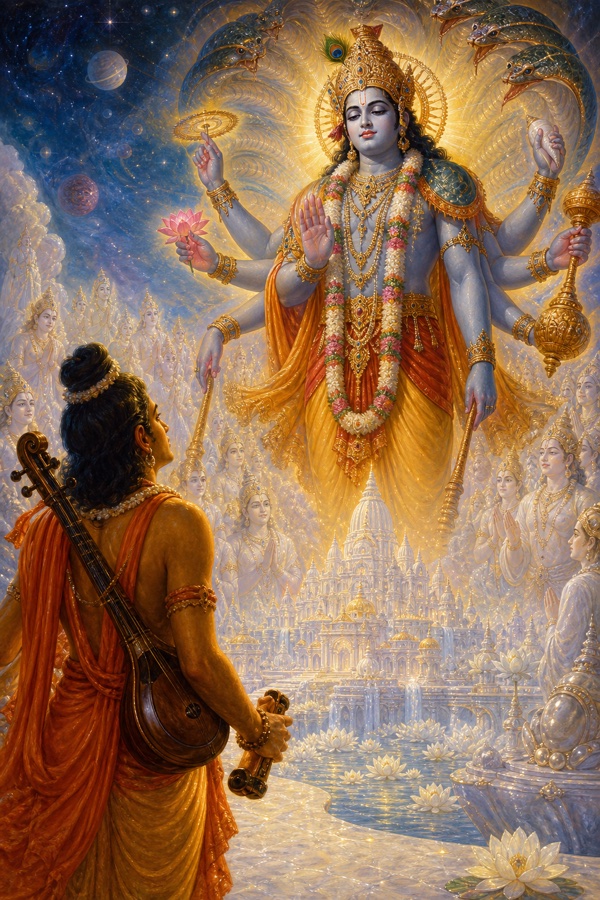
Narada reached the wide realm called the White Island, and the first thing he saw was its people, the same white men Bhishma had described, shining with the light of the moon. They honored him. He honored them in return, bending his head to them and bowing to them in his mind. He had come to see Narayana, and he settled down there to wait for that sight in the only way that might earn it. He gave himself to the silent recitation of the mantras sacred to the god, and he took on vows of the hardest kind. Then, with his mind gathered to one point, he stood in yoga with his arms raised above his head, and he sang a hymn to the lord of the universe, to him who is the soul of every quality and is himself without any quality at all.
“I bow to you, god of gods, who are free of all action,” Narada sang. “You are the one without qualities, the witness of all the worlds. You are called Kshetrajna. You stand first among all beings. You are the infinite one, the one called Purusha, the great Purusha, the highest of all persons, the soul of the three qualities. You are called the First. You are amrita, the nectar; you are called the deathless; you are Ananta, whom they also name Shesha; you are space; you are without beginning. You are the manifest and the unmanifest, everything that is and everything that is not. Your home is said to be in truth. You are the first of gods. You are the giver of wealth, and you are one with Daksha and the other lords of creation. You are the ashvattha and the other great trees. You are Brahma of the four heads. You are the lord of all created beings, the lord of speech, the lord of the universe, the soul that pervades everything. You are the sun, and the breath called prana. You are the lord of the waters, and the emperor, and the guardians of the several quarters of the sky. You are the refuge of the universe when it dissolves in the final destruction. You are the unrevealed one, the one who gave the Vedas to Brahma. You are the sacrifices and the Vedic study that Brahmins accomplish with their bodies. You are the four chief orders of the gods, and each one of the four. You are light, and great light. You are the one to whom the seven greatest offerings of the sacrifice are presented with the Gayatri and the other sacred mantras. You are Yama, and Chitragupta and the other attendants of Yama, and the one called Yama’s wife. You are the order of gods called Tushita and that other order called Mahatushita. You are Death, who grinds down everything. You are desire, and you are every disease that was made to help Death arrive, and you are health and freedom from disease. You are the one in the grip of desire and passion, and the one whom desire and passion cannot reach. You are infinite in the kinds and forms you show. You are the one who is punished, and you are the one who punishes.”
A sub-tale (the array of names in the hymn): The hymn went on, and its middle part belongs to the sacrifice and to the Veda. Narada called the god all the lesser sacrifices, the Agnihotra and its kind, and all the greater ones, and all the ritvij priests who perform them. He called him the Vedas, the origin of every sacrifice; the fire; the mantras and hymns that are the heart of the sacrifice; the one who is hymned in it, and the one who takes the share of the offering that is set before him. He called him the body of the five sacrifices, and the maker of the five divisions of time, which are day, night, month, season and year. He said that the god cannot be understood except through the scriptures called Pancharatra. He called him the one who never shrinks from anything, the unvanquished, the one who is mind alone and known only by name, the lord of Brahma himself, the one who has taken the closing bath of every vow and observance the Vedas mention. He called him the Hamsa, who carries the triple staff, and the Paramahamsa, who has put the staff down; the highest of all sacrifices; Sankhya-yoga, and the Sankhya philosophy in a body. He said that the god dwells in every living soul, lives in every heart and resides in every sense; that he floats on the waters of the ocean, lives in the Vedas, and lies on the lotus; that he is the lord of the universe, and that his troops go everywhere to protect those who worship him. “You take birth as every creature,” the hymn went on. “You are the origin of the universe. Your mouth is fire. You are the fire that runs through the waters of the ocean, pouring from the mouth of the horse’s head, and you are that horse’s head. You are the clarified butter poured into the sacrificial fire, and you make that butter holy. You are the charioteer. You are Vashat. You are the syllable Om. You are penance, and mind, and the moon, and the sun. You are the elephants stationed at the four quarters, and you light the quarters and the points between them. You are the first three mantras of the Rig Veda. You are the protector of the four orders of men. You are the five fires that begin with the Garhapatya, and you are the one who has three times kindled the sacrificial fire called Nachi. You are the refuge of the six limbs of the Veda. You are the first among the Brahmins who sing the Samans at the sacrifice; you are the Saman called Pragjyotish, and you are the one who sings the first Saman. You keep the vows that rest on the Vedas and belong to the singers of Samans. You are the Upanishad called Atharvashiras in a body. You are the subject of the five great scriptures, those of the worship of Surya, of Shakti, of Ganesha, of Shiva and of Vishnu. You are called the teacher who lives on the foam of water alone. You are a Valikhilya. You are the one who has never fallen away from yoga, and you are right judgment itself. You are the beginning of the ages, their middle and their end. You are Akhandala. You are the two rishis Prachinagarbha and Kaushika. You are Purushtuta, you are Puruhuta, you are the craftsman of the universe. The universe is your form. Your motions have no limit and your bodies have no limit. You are without end, without beginning and without middle, and your middle and your end are unmanifest. Vows are your dwelling. You live in the ocean. You have your home in fame, in penance, in self-restraint, in prosperity, in knowledge, in great achievements, and in everything that belongs to the universe.”
“You are Vasudeva,” Narada sang at the last. “You grant every wish. You are Hanuman, who carried Rama on his shoulders. You are the great horse sacrifice, and you take your share of the offerings made in the great sacrifices. You are the giver of boons, of happiness and of wealth. You are devoted to Hari. You are the restraint of the senses. You are vows and observances; you are austerity, and hard austerity, and austerity of the hardest kind. You are the one who keeps every vow and every pious rite. You are free of all error. You are a brahmachari. You took birth in the womb of Prishni. All the rites and acts of the Veda have flowed from you. You are unborn. You pervade all things, and your eyes are on all things. The senses cannot grasp you. You do not decay. Your power is great, and your body is vast beyond conceiving. You are holy. You are beyond the reach of logic and argument, and you cannot be known. You are the first of causes. You are the maker of all creatures and you are their destroyer. Yours are the vast powers of illusion. You are called Chitrashikhandin. You give boons, you take your share of the sacrifice, and the merit of every sacrifice is yours. You are free of every doubt. You are present everywhere. Your form is the form of a Brahmin, and Brahmins are dear to you. The universe is your form, and your form is very vast. You are the greatest of friends, and you are kind to all who worship you. You are the great god of the Brahmins. I am your devoted disciple, and I long to see you. I bow to you, whose form is release.”
Those were names that no one else knew, and the god who has the universe for his form answered them by showing himself to Narada. His form was somewhat purer than the moon, and in some ways it was unlike the moon. In color he was partly like a blazing fire. He had something of the shape of Vishti, the conjunction that stands among the heavenly bodies. In places he was like the feathers of a parrot and in places like a mass of pure crystal. Here he was like a hill of antimony, and there like a mass of pure gold. His color was something like coral when it is first formed, and it was somewhat white; in part it had the hue of gold and in part the hue of lapis lazuli, in part the blue of that stone and in part the blue of sapphire, in part the color of a peacock’s neck and in part the color of a string of pearls. Wearing all those colors on one body, the eternal god stood before Narada. He had a thousand eyes, and he was very beautiful. He had a hundred heads and a hundred feet, a thousand bellies and a thousand arms, and the mind still could not take him in. With one of his mouths he uttered the syllable Om, and after Om the Gayatri. With his other mouths, which were past counting, the great god who is called Hari and Narayana, his mind held perfectly still, uttered many mantras from the four Vedas, the ones known as the Aranyaka. In his hands the lord of all the gods, who is worshiped in every sacrifice, carried a sacrificial altar, a water pot, a few white gems, a pair of sandals, a bundle of kusha grass, a deerskin, a toothstick, and a little blazing fire. Narada, who kept his speech under restraint, bowed to him with a glad heart and worshiped him. His head was still bent low when the first of all the gods, the one who never decays, spoke. “The great rishis Ekata, Dvita and Trita came to this realm wanting a sight of me, and their wish went unfulfilled. No one can see me except those who are devoted to me with their whole hearts. You stand first among all who are devoted to me with all their souls. The bodies that were born in the house of Dharma are mine, the best that I take on. Worship them always, and perform the rites that the ordinances lay down for that worship. Ask me, Brahmin, for the boons you want. I am pleased with you today, and I stand before you in my universal form, free of decay and of all wearing away.”
Narada wanted nothing further. “Holy one, I have seen you today. In that I count the fruits of my penances won, without any waiting, and the fruits of my self-restraint, and of every vow and observance I have kept. You have shown yourself to me, and that is the highest boon you could give. You are the eternal lord, and the universe is your eye. You are the Lion. Your form is one with everything. You are powerful, and vast, and without limit.” Having shown himself to the son of Parameshthi, the great god now gave him his dismissal, and a teaching to carry with it. “Leave this place, Narada, and do not linger. These worshipers of mine, who are the color of the moon, have no senses and live on no food of any kind. All of them are released. People should think of me with minds gathered wholly on me, and those who worship so will meet no obstacle. These men are crowned with the success of their austerities and they are highly blessed. In ancient times they became devoted to me entirely. They are free of rajas and of tamas, and there is no doubt that they are able to enter me and be merged in my self. The one they enter cannot be seen by the eye or felt by touch; the nose cannot smell him, and he lies beyond the reach of taste. Sattva, rajas and tamas do not touch him. He pervades all things and is the one witness of the universe, and he is described as the soul of the whole universe. When the bodies of all created things are destroyed, he is left undestroyed. He is unborn, unchanging and eternal, free of all qualities, undivided and whole. He passes beyond the twenty-four topics of inquiry and is counted the twenty-fifth. He is called Purusha. He does not act, and it is said that knowledge alone can reach him. The highest among the twice-born enter him and are released. He is the eternal supreme soul, and he is known by the name Vasudeva. See the greatness and the power of God, Narada. No act, good or bad, ever touches him. Sattva, rajas and tamas are called the three original qualities, and they live and act in the bodies of all creatures. The living soul, which is called Kshetrajna, enjoys the working of those three and gives it his assent. He passes beyond them all the same, and they cannot touch him. He is free of the qualities, and he is the one who enjoys and assents to them. He made them himself, and he stands above them all.
“Celestial rishi, the earth is the refuge of the universe, and when the hour of dissolution comes the earth merges into water. Water merges into light, and light into wind. Wind merges into space, and space into mind. Mind is a great creature, and it merges into unmanifest Prakriti. Unmanifest Prakriti, Brahmin, merges into Purusha, who does not act. There is nothing higher than Purusha, who is eternal. Among all the things of this universe that move and that stand still, nothing is changeless except Vasudeva, the eternal Purusha. Vasudeva is very powerful, and he is the soul of all creatures. Earth, wind, space, water, and light for the fifth, are the primal elements, and they are powerful. When they mingle, they form what is called the body. Then Vasudeva, whose strength is subtle and whom no eye can see, enters that combination of the five elements. That entering is called his birth. Once born, he makes the body move about and act. Without a combination of the five elements no body can ever be formed, and without the entry of the living soul the mind that dwells in the body cannot make it move or act.
“The one who enters the body is very powerful, and he is called Jiva. He has other names as well, Shesha and Sankarshana. From that Sankarshana, by his own acts, rises Sanatkumara, in whom all creatures merge when the universal dissolution comes. He is the mind of all creatures, and he is called Pradyumna. From Pradyumna rises the one who is the Creator, who is both cause and effect, and from him comes everything, the whole universe of moving and unmoving things. This one is called Aniruddha. His other name is Ishana, and he is manifest in all acts. Vasudeva, who is called Kshetrajna and is free of qualities, is to be known as the powerful Sankarshana when he takes birth as the living soul. From Sankarshana comes Pradyumna, who is called ‘the one born as mind.’ From Pradyumna comes Aniruddha, who is consciousness, and who is Ishvara, the supreme lord. The whole universe of moving and unmoving things springs from me. From me flow the destructible and the indestructible, what is and what is not. Those who are devoted to me enter me and are released. I am known as Purusha. I am without acts, and I am the twenty-fifth. I pass beyond the qualities, and I am whole and undivided. I stand above every pair of opposites and I am free of every attachment. This, Narada, you will fail to understand. You see me now as one who has a form. If the wish came to me I could dissolve this form in a moment. I am the supreme lord and the teacher of the universe. What you are looking at is only an illusion of mine. I seem at this moment to wear the qualities of all created things, and you are not able to know me. I have shown you my fourfold form in its right order. I am the doer, Narada. I am the cause, and I am the effect. I am the sum of all living creatures, and all living creatures have their refuge in me. Do not let yourself think that you have seen the Kshetrajna. I pervade all things, Brahmin, and I am the living soul of all creatures, and when the bodies of all creatures are destroyed I am not destroyed with them. Those highly blessed men who have won success in their austerities and become wholly devoted to me are freed from both rajas and tamas, great ascetic, and for that reason they succeed in entering me.
A key to reading this (the order of dissolution and the vyuhas): The order of dissolution, as Narayana gives it to Narada: earth merges into water, water into light, light into wind, wind into space, space into mind, mind into unmanifest Prakriti, and Prakriti into Purusha, who does not act and above whom there is nothing. The fourfold form runs the other way, from the source outward. Vasudeva is the supreme soul, the Kshetrajna, free of qualities. When he enters a body as the living soul he is Sankarshana, also called Shesha. From Sankarshana comes Pradyumna, the mind of all creatures. From Pradyumna comes Aniruddha, also called Ishana, who is consciousness and the supreme lord, and from whom the whole moving and unmoving universe rises. Narada later repeats this teaching in the house of Brahma, and there it carries the name of the Pancharatra scriptures.
“The one called Hiranyagarbha, who is the beginning of the world, who has four faces, whom the Nirukta cannot make understood, whose other name is Brahma, is an eternal god, and he is kept busy attending to many of my concerns. The god Rudra was born of my wrath, and he sprang from my forehead. Look. On the right side of my body the eleven Rudras are swelling with strength. On the left side are the twelve Adityas. In front of me are the eight Vasus, the first of the gods, and behind me, see, are Nasatya and Dasra, the twin Ashvins, physicians of heaven. See in my body all the Prajapatis, and see the seven rishis. See the Vedas there, and the sacrifices in their hundreds, and the amrita, and all the healing herbs and plants, and penances, and vows and observances of every kind. See in me the eight attributes of power, the ones that are called the attributes of lordship, living together in my body in one gathered form. See Shri there, and Lakshmi, and Kirti, and the Earth with her hump, and the goddess Sarasvati, the mother of the Vedas. See Dhruva, Narada, the first among the lights that range the sky, and all the oceans that hold the waters, and the lakes and the rivers, living in me. See the four chief ones among the ancestors in their embodied forms, and see the three qualities, sattva, rajas and tamas, which have no form, living in me too. What is done in honor of the ancestors is of higher merit than what is done in honor of the gods. I am the ancestor of the gods and of the ancestors alike, and I have existed from the beginning. I become the one with the horse’s head, and in that form I rove through the western ocean and the northern, and I drink the libations that are poured with the proper mantras and eat the solid food of the sacrifice that is offered with reverence and devotion.
“In ancient days I created Brahma, and he worshiped me in sacrifices. I was pleased with him for it, and I granted him many excellent boons. I told him that at the beginning of the kalpa he would be born to me as my son, and that the lordship of all the worlds would rest with him, along with the giving of their several names to the several things that would arise once Ahankara had come into being. I told him that no one would ever cross the limits and boundaries he set, and that he would be the giver of boons to those who asked them of him. I assured him that the gods and the Asuras, the rishis and the ancestors, and all the varied creatures of creation would hold him in worship. And I gave him to understand that I would always show myself to accomplish the business of the gods, and that in such business I would let him command me, as a father commands a son. When I had granted Brahma these boons and others as welcome, I took once again to the course of Nivritti, the road of abstention. The highest Nivritti is the ending of all duties and all acts, and so a man who takes that road should live in complete happiness. Learned teachers whose convictions are settled on the truths of the Sankhya philosophy have spoken of me as Kapila, who has the power of knowledge, who dwells within the light of the sun, and who is gathered in yoga. In the Vedas I have been hymned again and again as Hiranyagarbha. In the scriptures of yoga, Brahmin, I am spoken of as the one who delights in yoga. I am eternal. I have taken a form that is manifest, and for the present I dwell in the heavens. At the end of a thousand ages I will draw the universe back into myself. When I have drawn in every creature, moving and unmoving, I will exist all alone, with knowledge for my only companion. After ages have passed I will create the universe again with the help of that knowledge. The fourth of my forms creates the indestructible Shesha, and that Shesha is called Sankarshana. Sankarshana creates Pradyumna. From Pradyumna I myself take birth as Aniruddha, and so I create myself again and again. From Aniruddha comes Brahma, who is born from Aniruddha’s navel, and from Brahma come all creatures, moving and unmoving. Know that creation arises in this way, over and over, at the beginning of every kalpa. Creation and destruction follow one another as sunrise and sunset follow one another in this world. And as Time, whose energy cannot be measured, forcibly brings back the sun after it has disappeared, so will I bring back the earth. When she is sunk under the waters I will take the form of a boar, put out my strength, and set her in her own place again with her belt of seas, for the good of all creatures. Then I will kill the son of Diti named Hiranyaksha, who will be swollen with pride in his strength. Next I will take the form of a man-lion and, for the benefit of the gods, kill Hiranyakashipu, another son of Diti, who will be a great destroyer of sacrifices. To Virochana, the son of Prahlada, a mighty son will be born named Bali. No one in the whole universe of gods, Asuras and Rakshasas will be able to kill that great Asura. He will throw Indra down from the lordship of the universe. When he has routed the husband of Shachi and taken the rule of the three worlds for himself, I will take birth in the womb of Aditi, by Kashyapa, as the twelfth Aditya. I will take the three worlds from Bali and restore them to Indra, and I will set the gods again in their own stations, Narada. As for Bali, whom all the gods together cannot kill, I will make him live in the regions below.
“In the Treta age I will take birth as Rama in the line of Bhrigu, and I will exterminate the Kshatriyas, who will have grown proud of their strength and their possessions. Toward the close of Treta and the beginning of Dvapara I will take birth as Rama, the son of Dasharatha, in the royal line of Ikshvaku. In that time the two rishis Ekata and Dvita, the sons of Prajapati, will have to be born as apes, losing the beauty of the human form, because of the injury they did to their brother Trita. The apes born in the line of Ekata and Dvita will be very strong and full of energy, a match for Indra himself in prowess, and all of them will be my allies in accomplishing the business of the gods. Then I will kill Ravana, the terrible lord of the Rakshasas, that fierce wretch of the line of Pulastya, the thorn of all the worlds, together with all his children and followers. Toward the close of Dvapara and the beginning of Kali I will appear in the world again. I will take birth in the city of Mathura in order to kill Kamsa. When I have killed there Danavas beyond counting, who will be thorns in the side of the gods, I will make my home in Kushasthali, in the city of Dwarka. While I live in that city I will kill the Asura Naraka, the son of the Earth, who will do an injury to Aditi, and with him other Danavas named Muru and Pitha. I will kill another chief of the Danavas too, the lord of Pragjyotisha, and I will carry his delightful city, with all its varied wealth, away to Dwarka. Then I will subdue two gods whom all the gods worship, Maheshvara and Mahasena, who will have grown fond of the Danava Bana and done him many services and who will exert themselves hard for that worshiper of theirs. After I have defeated Bana, the son of the Danava Bali, who will have a thousand arms, I will destroy all the people of the Danava city called Saubha. Next, Brahmin, I will bring about the death of Kalayavana, a Danava who will be very mighty because he carries the energy of Gargya. A proud Asura named Jarasandha will appear as a king at Girivraja and quarrel with every other king in the world, and his death will be brought about by me through another man, guided by my thought. Next I will kill Shishupala at the sacrifice of King Yudhishthira, the son of Dharma, the sacrifice to which all the kings of the world will bring tribute. In some of these feats Arjuna, the son of Vasava, and he alone, will be my helper. I will set Yudhishthira and all his brothers in the kingdom of their ancestors. People will call the two of us Narayana and Nara when we put out our strength together and consume a great number of Kshatriyas for the good of the world. When we have lightened the burden of the earth as far as we please, I will remember my all-embracing knowledge and draw the chief Satvatas into my own self, and Dwarka with them, my favorite city. So, in four forms, I will accomplish many feats of great prowess, and at the end I will reach those happy worlds that I created and that all Brahmins honor. After appearing in the forms of a swan, a tortoise and a fish, I will show myself as a boar, then as a man-lion, then as a dwarf, then as Rama of the line of Bhrigu, then as Rama the son of Dasharatha, then as Krishna of the Satvata line, and last as Kalki. When what is heard in the Vedas vanished from the world, I brought it back; I created the Vedas again, with all that is heard in them, in the Krita age. They have vanished once more, or can be heard only in part, here and there in the Puranas. Many of my best appearances in the world are already events of the past. Having done the good of the worlds in those forms, they have gone back into my own Prakriti. Brahma himself has never had a sight of me in this form, which you have seen today, Narada, because your devotion to me is entire. I have now told you everything, Brahmin, because you are wholly mine. I have laid open to you my appearances of old and my appearances to come, with all their mysteries.” The god of the universal and changeless form said this to Narada and vanished on the spot. Narada had the high favor he had asked for. He left at great speed for the retreat of Badari, to see Nara and Narayana. And this great Upanishad, which agrees perfectly with the four Vedas and is in harmony with Sankhya and yoga, which Narayana recited with his own mouth and which Narada called by the name of the Pancharatra scriptures, Narada repeated in the house of his father Brahma before many hearers, exactly as Narayana had recited it and as he had heard it from the god’s own lips.
Yudhishthira caught at the last thing he had heard. “Did Brahma, the Creator of all things, not know this wonderful account of the glory of Narayana, that he had to hear it from the lips of Narada? Is the Grandsire of all the worlds in any way different from the great Narayana, or less than he is? How could he be ignorant of Narayana’s power?” Bhishma answered that hundreds and thousands of great kalpas, hundreds and thousands of creations and dissolutions, have come and gone and are things of the past, and that at the beginning of every cycle of creation Narayana calls Brahma to mind, the powerful one who makes all things. “Brahma knows very well that Narayana is far above him,” he said. “He knows that Narayana is the supreme soul and the supreme lord, and the creator of Brahma himself. Narada did not recite his account to Brahma. He recited it to the company of rishis, crowned with the success of their austerities, who had come to Brahma’s house, and it is a very old account and agrees perfectly with the Vedas. Surya heard it from those rishis, and he repeated it to the sixty-six thousand rishis of clean soul who follow in his train. Surya, who gives heat to all the worlds, repeated it also to those beings of clean soul who were created to travel always in front of him. The rishis who follow the sun repeated that excellent account to the gods gathered on the breast of Meru. The ascetic Asita heard it from the gods and repeated it to the ancestors. My father Shantanu recited it to me, and I, having heard it from my father, have repeated it to you. The gods and the sages who have heard this old account, which is a Purana, all adore the supreme soul. It belongs to the rishis, and it has come down from one to another in this way, and you must not pass it on to anyone who is not a worshiper of Vasudeva. It is the essence of the hundreds of other accounts you have heard from me. In ancient days the gods and the Asuras joined together, churned the ocean and raised the amrita. In the same way the Brahmins joined together in ancient days, churned all the scriptures, and raised this account, which is like nectar. A man who reads it often, or listens to it often, in a quiet place, with his attention gathered and his heart full of devotion, becomes a dweller on the wide White Island, with a body the color of the moon, and there is no doubt that such a man enters Narayana of the thousand rays. A sick man who listens to it from the beginning is freed from his sickness. A man who only wishes to read it or hear it has all his wishes fulfilled, and a devoted worshiper who reads or hears it reaches the high end that is kept for devoted worshipers. You too should always adore and worship that first of all beings. He is the father and the mother of all creatures, and the whole universe reveres him. May Janardana, the eternal god of the Brahmins, be pleased with you, Yudhishthira. I have now repeated to you what Narada recited to the rishis in the house of Brahma. It has come down from one person to another from very ancient times, and I heard it from my father, who repeated it to me.”
The gist: On the White Island Narada stands with raised arms and praises Narayana in a long hymn of names, and the god appears to him in a form of many colors with a thousand eyes and a thousand arms. Narayana teaches him that the supreme soul is Vasudeva, the Purusha counted twenty-fifth, beyond the three qualities and reached by knowledge alone; he gives the order in which the elements dissolve and the fourfold form of Vasudeva, Sankarshana, Pradyumna and Aniruddha; and he shows Brahma, Rudra, the Adityas, the Vasus and all creation inside his own body. He then foretells his appearances, from the boar and the man-lion to Rama, Krishna and Kalki. Bhishma closes with the line of tellers through whom the account came down to his father Shantanu and so to Yudhishthira.
Krishna’s secret to Arjuna: I am Kapila, I am the Veda
Yudhishthira the just had listened to that account with all his brothers around him, and when it ended every one of them belonged to Narayana. From that day they took up the practice of meditating on him in silence, and they praised him aloud with the words, “Victory to that holy Being.” The island-born Krishna, whom the world calls Vyasa, a man given to penance, sang the high mantra that is meant for silent recitation, uttering the name Narayana as he sang it. He traveled through the sky to the Ocean of Milk, which is always the home of nectar, worshiped the great god there, and came back to his own hermitage. Among the brothers who heard Bhishma was Arjuna, and Arjuna had at one time put a question of his own to the other Krishna, Keshava, who protected him through the great battle, about the names under which the rishis praise him. The answer was a long one. Toward its end it reached the names that the philosophers and the Vedas give, and there Krishna spoke of himself without any veil. “Those who know the science that Kapila taught call the supreme soul Virincha. That Virincha has another name, the great Prajapati. I am one with him, the one called Virincha, because I give life to all living creatures, for I am the Creator of the universe. The teachers of the Sankhya philosophy, whose conclusions are settled on every subject, call me the eternal Kapila, who stays in the midst of the disc of the sun with knowledge alone for his companion. On earth I am known to be one with him who is sung in the verses of the Veda as the shining Hiranyagarbha, and whom the yogis always worship.
“I am regarded as the Rig Veda in a body, the Rig Veda of twenty-one thousand verses. Those who know the Vedas call me also the embodiment of the Samans with their thousand branches, and that is how learned Brahmins who are my devoted worshipers, and such men are very rare, sing of me in the Aranyakas. Among the Adhvaryu priests I am sung as the Yajur Veda of fifty-six branches, and eight, and thirty-seven. Learned Brahmins who know the Atharvans regard me as one with the Atharvans, which have five kalpas and contain all the krityas, the rites of incantation. Every division of the different Vedas into branches, and every verse that makes up those branches, and every vowel that occurs in those verses, and every rule of pronunciation: know, Arjuna, that all of it is my work. And the one who rises from the Ocean of Milk at the beginning of creation, when Brahma and all the gods call on him in earnest, and who gives the several gods their several boons, is no one else. He is myself.
“I am the storehouse of the science of syllables and pronunciation, which is treated in the supplementary parts of the Vedas. The rishi Panchala followed the path that Vamadeva pointed out, and through my grace he obtained from that eternal Being the rules for the division of syllables and words by which the Vedas are read. He is Galava, born in the line of Babhravya. He reached high success in his austerities and won a boon from Narayana, and he compiled the rules for dividing syllables and words, and the rules of emphasis and accent in utterance, and he shone as the first scholar to master those two subjects. Kundarika and the energetic King Brahmadatta thought again and again about the sorrow that attends birth and death, and through my favor, in the course of seven births, they reached the prosperity that is won by those who are devoted to yoga.
“In ancient days I was born, for a certain reason, as the son of Dharma, and because of that birth I was celebrated under the name Dharmaja. I took birth in two forms, as Nara and as Narayana. Riding the vehicle that carries a man through his scriptural duties and his other duties, I practiced in those two forms undying austerities on the breast of Gandhamadana. In that same period the great sacrifice of Daksha took place. Daksha refused to give Rudra a share of the offerings in that sacrifice of his, and Rudra, urged on by the sage Dadhichi, destroyed it. He hurled a dart whose flames blazed up afresh at every moment. The dart consumed everything that had been made ready for Daksha’s sacrifice, and then it came on with great force toward the two of us, Nara and Narayana, at the retreat of Badari, and fell with great violence on the chest of Narayana. Under the energy of that dart the hair on Narayana’s head turned green. From that change in the color of my hair I came to be called Munjakesha.
“Narayana drove the dart off with a cry, the syllable Hun, and it lost its energy and went back to the hands of Shankara. Rudra was furious at that, and he rushed at the two rishis, Nara and Narayana, who had behind them the power of hard austerities. Narayana caught the rushing Rudra by the throat with his hand. Under the grip of Narayana, the lord of the universe, Rudra’s throat changed color and went dark, and from that time Rudra has been called Sitikantha. Nara, meanwhile, meant to destroy Rudra. He took up a blade of grass and charged it with mantras, and the blade of grass became a mighty battle-axe. Nara flung the axe at Rudra, suddenly, and it broke into pieces. Because that weapon broke into pieces, I came to be called Khandaparashu.”
Arjuna asked, “That was a battle that could have destroyed the three worlds. Who won it, Krishna? Tell me that.”
“When Rudra and Narayana were locked in battle like that,” Krishna said, “the whole universe was suddenly filled with dread. The god of fire stopped accepting libations, even libations of the purest clarified butter, poured in sacrifice in due form with the mantras of the Veda. The Vedas no longer shone by their inward light in the minds of the rishis of clean soul. Rajas and tamas took possession of the gods. The earth trembled. The vault of the sky seemed to split in two. All the lights of heaven lost their brightness. Brahma, the Creator, fell from his seat. The ocean itself went dry. The mountains of Himavat were riven. When omens as terrible as these were showing on every side, Brahma came quickly to the place where the battle was raging, with all the gods and the great rishis around him.
“Brahma of the four faces, who can be understood only with the help of the Niruktas, joined his hands and spoke to Rudra. ‘Let good come to the three worlds. You are the lord of the universe. Throw down your weapons out of a wish to benefit the universe. There is that which is unmanifest, indestructible and changeless, the supreme, the origin of the universe, always the same, the supreme actor, which passes beyond every pair of opposites and does not act. It has chosen to be displayed, and it has been pleased to take this one blessed form, for though they are two, the two stand for the same form. This Nara and this Narayana, who are the displayed forms of the supreme Brahman, have taken birth in the line of Dharma. They stand first among all the gods, they keep the highest vows, and their penances are of the hardest kind. For a reason best known to him, I myself sprang from his quality of grace. You are eternal, for you have existed through all the past creations, and you too sprang from him, from his wrath. Join me, then, and these gods, and all the great rishis, and worship this displayed form of Brahman, and let there be peace in all the worlds without delay.’
A key to reading this, the battle of Nara-Narayana and Rudra: Three names come out of the fight, and each records a moment of it. Munjakesha is Narayana with his hair turned green under the heat of Rudra’s dart. Sitikantha is Rudra with his throat darkened in Narayana’s grip. Khandaparashu is the name left by the battle-axe that Nara made from a blade of grass and that broke into pieces on Rudra. Brahma ends the fight with an argument about origins: Nara and Narayana are the displayed form of the one supreme Brahman, Brahma himself sprang from that Being’s grace, and Rudra sprang from that Being’s wrath. The seizing of the throat is mentioned at one other point in Krishna’s answer, where it is dated to the epoch of the self-born Manu.
“So Brahma spoke, and Rudra at once threw off the fire of his wrath and set himself to please the god Narayana. He soon put himself at the disposal of that adorable giver of boons. And Narayana, who holds his wrath and his senses under control, was soon pleased, and reconciled with Rudra. The rishis worshiped him well, and Brahma, and all the gods, and then that great god, the lord of the universe, who is also called Hari, spoke to Ishana. ‘The one who knows you knows me. The one who follows you follows me. There is no difference between you and me, and you must never think otherwise. The mark your lance has made on my chest will take, from this day, the form of a beautiful whorl. The mark of my hand on your throat will take a beautiful shape as well, and because of it you will be called, from this day, Shrikantha.’
“When they had left those marks on each other’s bodies, the two rishis Nara and Narayana made friends with Rudra. They dismissed the gods and went back, with quiet minds, to their penances. I have told you now how the victory in that ancient battle between Rudra and Narayana went to Narayana. I have told you the many secret names by which Narayana is called, and the meaning of the names that the rishis have given the great god. In this way, taking many forms, I roam at will over the earth, through the realm of Brahma himself, and through that other realm, high and eternal and happy, which is called Goloka. You have won a great victory in the great battle, and you won it under my protection. In all your battles you saw a being striding ahead of you in the front of your army. Know that he was no other than Rudra, the god of gods, who is also called Kapardin. He is known by the name Kala too, and you should know him as one who sprang from my wrath. The enemies you killed were all killed first by him. Bow your head to that god of gods, the lord of Uma, whose power cannot be measured. Gather your mind and bow to that lord of the universe, that indestructible god, who is also called Hari. He is the same god who, as I have told you again and again, sprang from my wrath. You have heard before this, Arjuna, of the power and the energy that live in him.”
The gist: Among the brothers who hear Bhishma is Arjuna, to whom Krishna once declared that he is Virincha, the eternal Kapila of the Sankhya teachers, Hiranyagarbha, and the four Vedas with every branch, verse and vowel in them. Krishna tells him how, as Nara and Narayana at Badari, he was struck by the dart that had burned Daksha’s sacrifice, seized the charging Rudra by the throat, and saw Nara’s axe break. Brahma stopped the battle by declaring Nara and Narayana the displayed form of the supreme Brahman, from whose grace he himself was born and from whose wrath Rudra was born. Hari and Rudra were reconciled, each carrying the other’s mark, and Krishna adds that the figure Arjuna saw striding before him in every battle was Rudra.
The Secret of Hari’s Names: Janamejaya’s Question and Vaishampayana’s Answer
What Bhishma told from his bed of arrows was told again. Vaishampayana, a disciple of Vyasa, recited it to King Janamejaya, the son of Parikshit, and the king, having heard the glory of Narayana, was left with a doubt. “All beings, Brahma and the gods, the Asuras and men, are seen to be deeply attached to action, which is said to bring prosperity. You have called release the highest happiness, and you say that those who are freed of merit and demerit alike enter the great god of a thousand rays. That eternal religion of release must be very hard to keep, for the gods have all turned from it to enjoy the clarified butter poured for them with mantras on the sacrificial fires. Brahma and Rudra, Indra, the sun and the moon, the gods of wind and fire and water: are they ignorant of the way to that ending, that they have taken the road of action, where every reward runs out? This doubt is planted in my heart like a dagger. Why are the gods called the takers of shares in the sacrifice? And to whom do those takers of shares make their own offerings, when they perform great sacrifices?” Vaishampayana answered with what his teacher had once said. Vyasa had five disciples, Sumanta, Jaimini, Paila, Vaishampayana himself, and Shuka, and he taught them the Vedas with the Mahabharata for a fifth. They were studying on the breast of Meru when the same doubt rose in them, and they put it to him. Vyasa answered that his penances on the shore of the Ocean of Milk had pleased Narayana, and that the god had given him knowledge of past, present and future, so that he had seen with the eye of knowledge what happened at the beginning of the kalpa. From the supreme soul came the unmanifest, and from the unmanifest the manifest, who is called Aniruddha, and Aniruddha created Brahma. The five elements arose, and then the eight on whom all the worlds rest, Marichi, Angiras, Atri, Pulastya, Pulaha, Kratu, Vasishtha and the self-born Manu; and Rudra sprang from wrath and made ten others like himself. All of these came to Brahma and asked what each was to govern and with what strength. Brahma had been asking himself the same thing, and he led them to the northern shore of the Ocean of Milk, where they stood for a thousand years of the gods, still as posts, eyes turned up and arms raised, in the penance called Mahaniyama. Then a voice told them to perform a sacrifice and to give him a share of it. They did, Brahma first, and the unseen god said that every offering had reached him. He would reward them, he said, with rewards from which there is a return. In every age men would sacrifice to them and give them shares; fed by those sacrifices they would uphold the worlds, and strengthened by them they would strengthen him. He named the seven rishis who were made for the road of action and for the begetting of offspring, Marichi and the six with him, and the seven mind-born sons of Brahma whose knowledge comes of itself and who keep to the road of abstention: Sana, Sanatsujata, Sanaka, Sanandana, Sanatkumara, Kapila and Sanatana. “The path of those who are wedded to action leads back again,” he told them. “Some creatures are made for the one road and some for the other, and as the road is, so is the reward.” He laid down the ages too. In the Krita age no living creature is to be killed in sacrifice, and righteousness stands whole. In Treta it loses a quarter, and animals dedicated with mantras will be killed. In Dvapara it loses two quarters, and in Kali, under the constellation Tishya, three. The gods asked where they should go in such an age, and he told them to go wherever the Vedas, sacrifice, penance, truth and self-restraint still flourish, together with compassion for all creatures. When the others had left, Brahma stayed behind, wanting to see the god in the form of Aniruddha, and the god came to him wearing a great horse’s head, carrying a water pot and the triple staff and reciting the Vedas. He embraced Brahma, laid on him the burden of ordering the acts of all creatures, and promised to appear in bodily forms whenever the business of the gods grew too hard for him. That, Vyasa said, is why the god with the lotus in his navel takes the first share of every sacrifice: he took the road of abstention for himself, and he ordained the road of action for others, to give the universe its variety. Then Vyasa told his disciples to bow to that god, and he named him as he did so: the unborn one who is beyond the three qualities, the lord of the Adityas, the Vasus, the Ashvins and the Maruts, Hari who lives in the ocean and whose hair is like blades of munja grass, the lord of speech and of the rivers, Kapardin, the great boar, the one-horned one, the sun, the one who took the horse’s head, the one always displayed in a fourfold form. Teacher and disciples, Shuka among them, worshiped him then with verses drawn from the four Vedas.
The names stayed with Janamejaya, and he asked for them. “Holy one, the great rishi Vyasa and his disciples praised the slayer of Madhu under many names. Tell me what those names signify. I want to hear the names of Hari, the supreme lord of all creatures. Listening to them will make me clean and holy, like the bright moon of autumn.”
“Then listen,” Vaishampayana said. “Hari has many names. Some come from his qualities and some from his acts, and I will give you their meanings as Hari himself, in a glad mood, once explained them to Phalguna. For Phalguna, whom you know as Arjuna, at one time questioned Keshava and asked what was meant by some of the names under which Keshava is adored.”
Arjuna had put it to him in this way. “Holy one, you are the supreme ordainer of the past and the future. You are the creator of all beings, the changeless one, the refuge of all the worlds, the lord of the universe, the one who drives out the fears of all men. The great rishis have spoken many names of yours in the Vedas and the Puranas, and each of them comes from some act of yours. I want to hear from you, Keshava, in detail, what all those names mean. No one except you is able to explain them.”
“The great rishis have spoken many names of mine,” Krishna answered. “They are in the Rig Veda and the Yajur Veda, in the Atharvans and the Samans. They are in the Puranas and the Upanishads, in the treatises on astrology, in the scriptures of Sankhya and the scriptures of yoga, and in the treatises on the science of life. Some of those names can be drawn from my qualities, and some of them relate to my acts. Give me your whole attention, Arjuna, and hear the meaning of each of the names that refer to my acts. I will go through them for you. It is said that in ancient days you were half of my body.
“I bow to him of great glory, who is the supreme soul of all embodied creatures. I bow to Narayana, who is one with the universe, who passes beyond the three qualities of sattva, rajas and tamas, and who is also the soul of those qualities. From his grace Brahma arose, and from his wrath Rudra arose. He is the source from which all creatures have sprung, the moving and the unmoving. The quality of sattva, Arjuna, consists of eighteen qualities. It is supreme Nature, whose soul is the sky and the earth, and who upholds the universe by her creative forces. That Nature is one with the fruit of all acts. She is pure consciousness. She is deathless and unconquerable, and she is called the soul of the universe. Every change that belongs to creation and to destruction flows from her. That one, without sex, whom we may call She or He, is the penance that people undergo. He is the sacrifice that is performed, and he is the sacrificer who performs it. He is the ancient and infinite Purusha. His other name is Aniruddha, and he is the source of the creation and the destruction of the universe.
“When the night of Brahma wore away, a lotus appeared first of all, by the grace of that Being whose energy cannot be measured. Brahma was born inside that lotus, and he sprang from the grace of Aniruddha. Toward the evening of Brahma’s day Aniruddha filled with wrath, and out of that wrath a son sprang from his forehead, called Rudra, who has the power to destroy everything when the hour for destruction comes. These two, Brahma and Rudra, stand first among all the gods, and they sprang, the one from the graciousness and the other from the wrath of Aniruddha. They create and they destroy as Aniruddha directs. They are able to grant boons to all creatures, and yet, in the business they attend to, they are only instruments in his hands.”
A key to reading this (the vyuhas): Krishna places one name at the root of both creation and destruction: Aniruddha, the ancient and infinite Purusha. Brahma is born from Aniruddha’s grace, in a lotus, when the night of Brahma ends. Rudra is born from Aniruddha’s wrath, out of his forehead, toward the evening of Brahma’s day. The two of them create and destroy, and they do it as his instruments. Aniruddha is the last of the four forms that Narayana set out for Narada on the White Island, in the order Vasudeva, Sankarshana, Pradyumna, Aniruddha.
“Rudra has another name, Kapardin,” Krishna went on. “He wears matted locks on his head, and sometimes he shows a head that is bald. He loves to live among the burning grounds, and they are his home. He keeps the hardest of vows. He is a yogi of great power and energy. He is the one who destroyed the sacrifice of Daksha and tore out the eyes of Bhaga. You should know, Arjuna, that Rudra always has Narayana for his soul. When that god of gods, Maheshvara, is worshiped, Narayana is worshiped as well. I am the soul of all the worlds and of the whole universe, and Rudra is my soul. That is why I always adore him. If I did not adore Ishana, the auspicious giver of boons, no one would adore my own self. All the worlds follow the ordinances that I set. Those ordinances should always be adored, and therefore I adore them.
“The one who knows Rudra knows me, and the one who knows me knows Rudra. The one who follows Rudra follows me. Rudra is Narayana. The two are one, and the one is displayed in two different forms. Rudra and Narayana, forming one person, pervade everything that is displayed and cause it to act. No one except Rudra is able to grant me a boon. I settled that in my mind, and in ancient days I adored the ancient and powerful Rudra to obtain the boon of a son. In adoring Rudra I adored my own self. Vishnu never bows his head to any god except his own self, and that is the reason I adore Rudra. All the gods, Brahma and Indra among them, and the great rishis, adore Narayana, the first of the gods, who is also called Hari. Vishnu stands first among all beings, past, present and to come, and so he should always be adored and worshiped with reverence. Bow your head to Vishnu. Bow your head to him who gives protection to all. Bow, Arjuna, to that great giver of boons, who eats the offerings made to him in sacrifices.
“I have heard that there are four kinds of worshipers: those who are eager for a religious life, those who inquire, those who strive to understand what they learn, and those who are wise. Among them all, the first place goes to those who are devoted to realizing the self and who adore no other god. I am the end they seek, and though they are engaged in acts, they never seek the fruits of those acts. The three other kinds of my worshipers want the fruits of what they do. They reach worlds of great happiness, and when their merit is used up they have to fall from those worlds. So it is those among my worshipers who are fully awakened who obtain the first and priceless thing, which is release. Men who are awakened, and whose conduct shows it, may be engaged in adoring Brahma, or Mahadeva, or the other gods who live in heaven, and they still succeed at last in reaching me. I have now told you, Arjuna, how my worshipers differ from one another.
“You and I are known as Nara and Narayana. The two of us have taken human bodies for one purpose, to lighten the burden of the earth. I have the knowledge of the self in full. I know who I am and where I come from. I know the religion of abstention, and I know everything that makes for the prosperity of creatures. I am eternal, and I am the one refuge of all men. The waters are called by the name Nara, because they sprang from him who is called Nara, and since the waters were my refuge in former times, I am called Narayana. Taking the form of the sun, I cover the universe with my rays, and because I am the home of all creatures I am called Vasudeva. I am the end of all creatures and I am their father. I pervade the whole sky above and the earth, and my splendor passes beyond every other splendor. I am he whom all creatures wish to reach at the time of death. And because I pervade the whole universe, I have come to be called Vishnu. People who want to succeed through the restraint of their senses seek to reach me, who am heaven and earth and the sky between the two, and for that I am called Damodara.
“The word prishni takes in food, the Vedas, water and nectar. Those four are always in my belly, and so I am called Prishnigarbha. The rishis tell that once, when Ekata and Dvita had thrown the rishi Trita into a well, Trita in his distress called on me with the words, ‘Prishnigarbha, rescue the fallen Trita!’ That great rishi, a mind-born son of Brahma, called on me so, and he was rescued from the pit. The rays that come from the sun, who gives heat to the world, and from the blazing fire, and from the moon, are my hair, and so learned Brahmins call me by the name Keshava.
A sub-tale: “Utathya had made his wife pregnant, and then, through an illusion of the gods, he vanished from her side. His younger brother Brihaspati came to that great man’s wife, wanting to lie with her. The child in the womb of Utathya’s wife, whose body had already been formed from the five primal elements, spoke to him. ‘Giver of boons, I have already entered this womb. You should not assail my mother.’ Brihaspati heard the unborn child and was filled with wrath, and he cursed him. ‘You stand in my way when I have come here in desire. By my curse you will be visited with blindness. There is no doubt of it.’ Through that curse the child of Utathya was born blind, and blind he remained for a long time, and that is how, in ancient days, that rishi came to be known by the name Dirghatamas. He acquired the four Vedas all the same, with their eternal limbs and their subsidiary parts. After that he called on me often by this secret name of mine. Following the ordinance as it is laid down, he called again and again on the name Keshava, and through the merit of uttering that name over and over he was cured of his blindness, and then he came to be called Gotama. So this name of mine, Arjuna, brings boons to those who utter it, among all the gods and the great rishis.
“The god of fire, who is appetite, and Soma, who is food, combine and pass into one and the same substance. That is why the whole universe of moving and unmoving creatures is said to be pervaded by those two gods. In the Puranas Agni and Soma are spoken of as completing each other. The gods are said to have Agni for their mouth. Because the natures of these two lead toward union, they are said to be worthy of each other, and to be the upholders of the universe.”
The gist: Janamejaya, who has heard how Vyasa and his five disciples praised Hari under many names, asks Vaishampayana what the names mean, and Vaishampayana repeats what Krishna told Arjuna. Brahma arose from the grace of Aniruddha and Rudra from his wrath, and the two create and destroy as his instruments. Rudra has Narayana for his soul and Narayana has Rudra for his, so that to worship either is to worship both. Of the four kinds of worshipers, the one devoted to the self alone stands first. Krishna then explains Narayana from the waters that were his refuge, Vasudeva as the home of all creatures, Vishnu as the one who pervades, Damodara, Prishnigarbha, on whom Trita called from the well, and Keshava, the name that cured the blind Dirghatamas.
Agni and Soma Made One, and the Root of the Brahmin’s Power
Arjuna stopped him on that last point. “How did Agni and Soma, in ancient days, come to be of one nature at their origin? This doubt has risen in my mind. Clear it away for me, Krishna.”
“I will tell you an old story,” Krishna said, “a story of things that came out of my own energy. Listen to it closely. When four thousand ages have gone by, counted by the measure of the gods, the dissolution of the universe arrives. The manifest disappears into the unmanifest. All creatures, the moving and the unmoving, are destroyed. Light, earth and wind all vanish. Darkness spreads over the universe, and the universe becomes one endless expanse of water. When nothing exists except that endless waste of water, alone like Brahman without a second, there is no day and there is no night. Nothing that is exists, and nothing that is not; there is no manifest and no unmanifest. At that time only undivided Brahman exists.
“When the universe is in that state, the first of beings rises out of tamas. He is the eternal and changeless Hari, in whom all the attributes of Narayana are joined. He cannot be destroyed and he does not die. He has no senses. He cannot be conceived, and he is unborn. He is truth itself, and he is full of compassion. His form of being is like the rays of the gem called Chintamani. He makes inclinations of many kinds flow in many directions. He is free of hostility, of wearing away, of death and of decay. He is formless and he pervades everything, and he carries in himself the principle of universal creation and of an eternity that has no beginning, no middle and no end. There is authority for what I say. The Shruti declares, ‘Day was not. Night was not. What is was not. What is not was not. In the beginning there was only tamas in the form of the universe, and she is the night of Narayana of the universal form.’ That is the meaning of the word tamas. And from that Purusha, who is called Hari, who was born of tamas in this way and who has Brahman for his parent, the Being called Brahma came into existence.
“Brahma wished to create creatures, and he made Agni and Soma spring from his own eyes. Afterward, when creatures came to be created, the created persons came out in their due order as Brahmins and as Kshatriyas. The one who came to life as Soma was none other than Brahma, and those who were born as Brahmins were all Soma in reality. Those who came into being as Kshatriyas were none other than Agni. The Brahmins had more energy than the Kshatriyas, and if you ask why, the answer is that their superiority is something the whole world can see. It came about in this way. Among men the Brahmins are the eldest creation. No one was created before them who stood above them. A man who offers food into the mouth of a Brahmin is regarded as pouring libations into a blazing fire. Brahma ordered things in that manner, I tell you, and so completed the creation of creatures, and having set all created beings in their own places he upholds the three worlds. The mantras of the Shruti say the same. ‘You, Agni, are the hotri in sacrifices and the benefactor of the universe. You are the benefactor of the gods, of men and of all the worlds.’ And there is other authority. ‘You, Agni, are the hotri of the universe and of sacrifices. You are the source through which gods and men do good to the universe.’ Agni is truly the hotri and the performer of sacrifices, and Agni is the Brahman of the sacrifice. No libation can be poured into the sacrificial fire without the utterance of mantras. There can be no penance without a person to perform it. The worship of the gods, of men and of the rishis is accomplished by the libations poured with mantras. That is why Agni is addressed as the hotri in sacrifices, and as all the other mantras that have been declared for the fire rites of men. Now the duty of officiating for others in the sacrifices they perform is ordained for the Brahmins. The two other orders that are counted among the twice-born, the Kshatriyas and the Vaishyas, have no such duty prescribed for them. So the Brahmins are like Agni, and they uphold the sacrifices. The sacrifices strengthen the gods, and the gods, when they are strengthened, make the earth bear fruit. Yet whatever the highest of sacrifices can achieve may be accomplished as well through the mouth of a Brahmin. The learned man who offers food into the mouth of a Brahmin is said to pour libations into the sacred fire to please the gods. In this way the Brahmins have come to be regarded as Agni. Those who have learning adore Agni. And Agni is Vishnu, who enters all creatures and upholds their breaths of life.
“On this subject there is a verse that Sanatkumara sang. Brahma, when he created the universe, created the Brahmins first. The Brahmins become immortal by studying the Vedas, and by the help of that study they go to heaven. The understanding of the Brahmins, their speech, their acts and observances, their faith and their penances uphold both the earth and heaven, as slings of cord hold up a vessel of milk. There is no duty higher than truth. There is no elder more worthy of reverence than the mother. There is no one more able than the Brahmin to confer happiness both here and hereafter. The people of those realms where the Brahmins have no settled means of support become very miserable. There the oxen do not carry the people or draw the plow, and no vehicle of any kind bears them. There the milk that is kept in jars is never churned into butter. The people of such a place lose every kind of prosperity, and they take to the ways of robbers.
“The Vedas, the Puranas, the histories and the other writings of authority say that the Brahmins, who are the souls of all creatures, who are the makers of all things and who are one with all that exists, sprang from the mouth of Narayana. It is said that the Brahmins came first, at the time when the great giver of boons had restrained his speech as a penance, and that the other orders had their origin from the Brahmins. The Brahmins stand above the gods and the Asuras, because I created them myself, in my indescribable form as Brahman. As I created the gods, the Asuras and the great rishis, so I have set the Brahmins in their own places, and from time to time I have to punish them.”
A key to reading this (Agni and Soma): Agni is fire and appetite, the mouth of the gods and the hotri of every sacrifice; the Kshatriyas come into being as Agni. Soma is food; the one who comes to life as Soma is Brahma, and the Brahmins are Soma. Yet the Brahmins are also said to be like Agni, because they alone officiate at the sacrifices of others, and because food placed in a Brahmin’s mouth counts as a libation poured into the fire. Krishna says both. Tamas, in this passage, is the primeval darkness before creation, which the Shruti calls the night of Narayana, and out of which Hari rises.
The gist: Arjuna asks how Agni and Soma came to be of one nature. Krishna begins from the dissolution: after four thousand ages of the gods everything sinks into the unmanifest, darkness covers an endless water, and only undivided Brahman remains. Hari rises out of that tamas, and from Hari comes Brahma, who makes Agni and Soma spring from his own eyes. The Brahmins are Soma and the Kshatriyas are Agni. The Brahmins are the eldest of men, they alone officiate at sacrifices, and a verse of Sanatkumara says that their study, speech, faith and penance hold up earth and heaven.
The Power of a Brahmin’s Curse: Indra, Ahalya, and the Tale of Vishvarupa and Vritra
Krishna had said that the Brahmins stand above the gods. He did not leave the claim bare. He gave Arjuna the cases, one after another, and the first of them concerned the king of the gods himself.
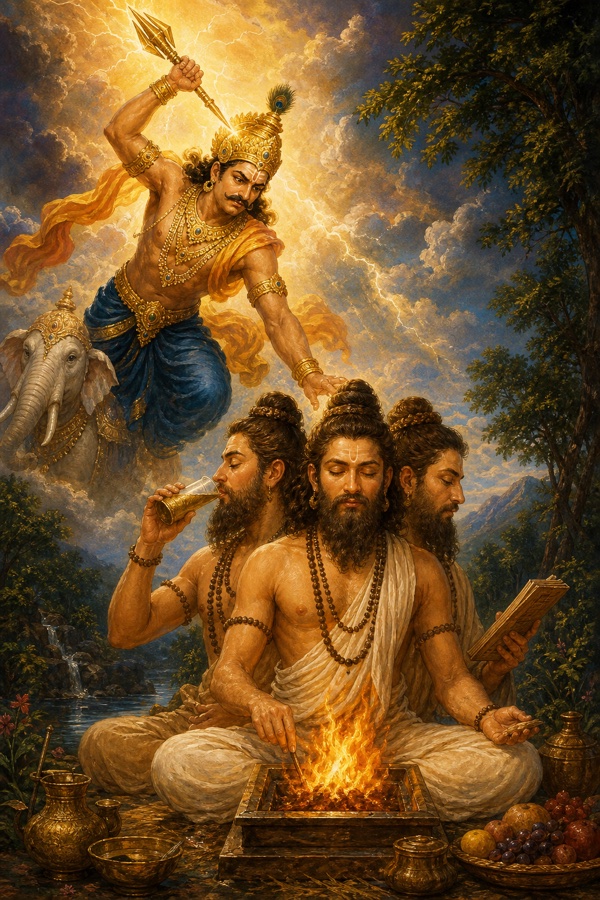
“Indra made a lustful assault on Ahalya,” Krishna said, “and her husband Gautama cursed him for it, and through that curse a green beard grew on Indra’s face. Through the curse of Kaushika, Indra lost his testicles as well, and the loss was afterward made good, by the kindness of the other gods, with the testicles of a ram. At the sacrifice of King Sharyati the great rishi Chyavana wished to make the twin Ashvins sharers in the offerings. Indra objected. Chyavana insisted, and Indra made ready to hurl his thunderbolt at him, and the rishi paralyzed Indra’s arms.
“Daksha was enraged at the destruction of his sacrifice by Rudra. He set himself once more to hard austerities, and when he had reached high power by them he made something like a third eye appear on Rudra’s forehead, for the destruction of Tripurasura. Later, when Rudra made ready to destroy the triple city that belonged to the Asuras, their teacher Ushanas was provoked past bearing. He tore a matted lock from his own head and flung it at Rudra. Many serpents sprang from that lock of Ushanas. They began to bite Rudra, and his throat turned blue. It is also said that in a bygone time, the epoch of the self-born Manu, Narayana seized Rudra by the throat, and that this is how Rudra’s throat became blue.
A sub-tale: “When the ocean was churned to raise the amrita, Brihaspati of the line of Angiras sat down on its shore to perform the rite of purashcharana. He took up a little water for the first rinsing of the mouth, and the water looked very muddy to him. Brihaspati grew angry and cursed the ocean. ‘I came to you to touch you, and you go on being so dirty. You have not made yourself clear and transparent for me. From this day, then, you will be tainted with fishes and sharks and tortoises and the other creatures of the water.’ From that time the waters of the ocean have been infested with sea animals and monsters of many kinds.
“Vishvarupa, the son of Tvashtri, was once the priest of the gods. Through his mother he was kin to the Asuras, for she was the daughter of an Asura. In public he offered the gods their shares of the sacrifice, and in private he offered shares to the Asuras. The Asuras, with their chief Hiranyakashipu at their head, went to their sister, the mother of Vishvarupa, and asked a boon of her. ‘Your son by Tvashtri, Vishvarupa, who is also called Trishiras, is now the priest of the gods. He gives the gods their shares of the offerings openly and gives us ours in secret. Because of that the gods are growing great and we are growing weak. You should prevail on him to take up our cause.’ His mother went to her son, who was staying at that time in the woods of Nandana, and said to him, ‘How is it, my son, that you are building up the cause of your enemies and weakening the cause of your mother’s brothers? You should not act this way.’ Vishvarupa thought that he ought not to disobey his mother. He paid her his respects and went over to the side of Hiranyakashipu. When Trishiras arrived, King Hiranyakashipu dismissed his old hotri, Vasishtha, the son of Brahma, and appointed Trishiras to the office. Vasishtha was enraged, and he cursed Hiranyakashipu. ‘You dismiss me and appoint another man as your hotri. For that, this sacrifice of yours will never be completed, and a being whose like has never existed will kill you.’ That curse is the reason Hiranyakashipu was killed by Vishnu in the form of a man-lion.
“Having taken the side of his mother’s people, Vishvarupa gave himself to hard austerities to make them great. Indra wanted to make him break his vows, and he sent him many beautiful Apsaras. Vishvarupa saw those nymphs of heaven in their surpassing beauty, and his heart was shaken. In a very short time he was deeply attached to them. They understood that he was, and one day they said to him, ‘We will not stay here any longer. We are going back to the place we came from.’ The son of Tvashtri answered, ‘Where will you go? Stay with me. I will do you good.’ The Apsaras replied, ‘We are the nymphs of heaven, the Apsaras. Long ago we chose Indra, the powerful giver of boons.’ Then Vishvarupa said to them, ‘This very day I will bring it about that all the gods, with Indra at their head, cease to be.’ With that, Trishiras began to recite in his mind certain sacred mantras of great force, and by the power of those mantras his energy began to grow. With one of his mouths he began to drink all the Soma that Brahmins engaged in sacrifices poured on their sacred fires with due rites. With a second mouth he began to eat all the food that was offered in sacrifices. With his third mouth he began to drink up the energy of all the gods, with Indra at their head.
“The gods saw him swelling with energy in every part of his body, made strong by the Soma he was drinking, and all of them, Indra with them, went to the Grandsire Brahma. ‘All the Soma that is duly offered in the sacrifices performed everywhere is being drunk by Vishvarupa,’ they told him. ‘We no longer get our shares. The Asuras are growing great and we are growing weak. You should ordain what is good for us.’ When the gods had finished, the Grandsire answered them. ‘The great rishi Dadhichi, of the line of Bhrigu, is at this time engaged in hard austerities. Go to him, gods, and ask a boon of him. Arrange it so that he casts off his body. Out of his bones let a new weapon be made, called the thunderbolt.’ So instructed, the gods went to the place where the holy Dadhichi was at his austerities, and with Indra at their head they greeted him. ‘Holy one, we hope your austerities go well and without interruption.’ Dadhichi said to them, ‘Welcome to all of you. Tell me what I should do for you. Whatever you say, I will certainly do.’ And they told him, ‘You should cast off your body for the benefit of all the worlds.’ Dadhichi was a great yogi, and happiness and misery were the same to him. He heard what they asked, and without any sorrow at all he gathered his soul by the power of his yoga and cast off his body. When his soul had left that body, Dhatri took his bones and made of them an irresistible weapon called the thunderbolt. It was made from the bones of a Brahmin. No other weapon could pierce it, nothing could stand against it, and the energy of Vishnu ran through it. With that thunderbolt Indra struck Vishvarupa, the son of Tvashtri, and when he had killed him he cut his head from his body. Yet energy was still living in the lifeless body of Vishvarupa, and when the body was pressed, that energy gave birth to a mighty Asura named Vritra. Vritra became the enemy of Indra, and Indra killed him too with the thunderbolt.
“So the sin of killing a Brahmin was doubled on Indra. A great fear overcame him, and because of it he had to abandon the lordship of heaven. He went into a cool lotus stalk that grew in the Manasa lake. By the power of yoga that is called anima he made himself very minute, and he entered the fibers of that lotus stalk.”
A key to reading this (the killing of a Brahmin): The killing of Vishvarupa, the priest of the gods, lays the sin of killing a Brahmin on Indra, and the killing of Vritra, who is born from the energy left in that priest’s body, doubles it. The thunderbolt that does the killing is itself made from the bones of a Brahmin, Dadhichi, who gives up his body when the gods ask it of him. Krishna draws the lesson himself when the story ends: Indra killed his enemy by the strength of one Brahmin’s energy, and when that act had loaded him with sin, the energy of another Brahmin rescued him.
The gist: Krishna gives Arjuna a run of cases in which a Brahmin’s word bound a god. Gautama’s curse put a green beard on Indra, Chyavana paralyzed Indra’s arms, a lock of Ushanas’s hair turned to serpents that bit Rudra’s throat blue, and Brihaspati’s curse filled the ocean with sea creatures. Then comes the story of Vishvarupa, the gods’ priest who secretly fed the Asuras and began to drink up the gods’ energy with his three mouths. Dadhichi gave his bones for the thunderbolt, Indra killed Vishvarupa and then Vritra with it, and, weighed down by the doubled sin of killing a Brahmin, he hid in the fibers of a lotus stalk in the Manasa lake.
Nahusha’s Arrogance, the Protecting of Shachi, and the Curse of Agastya
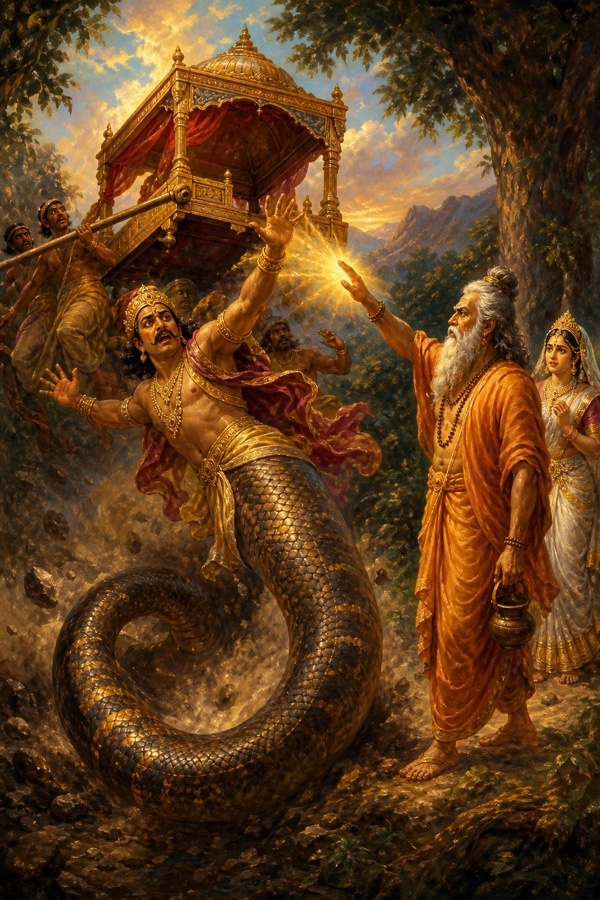
“The lord of the three worlds, the husband of Shachi, had vanished from sight for fear of the sin of killing a Brahmin,” Krishna went on, “and the universe was left without a lord. Rajas and tamas fell upon the gods. The mantras that the great rishis uttered lost all their force. Rakshasas appeared everywhere. The Vedas were close to disappearing. The people of all the worlds, having no king, lost their strength and began to fall an easy prey to Rakshasas and other evil beings. Then the gods and the rishis came together and made Nahusha, the son of Ayu, king of the three worlds, and they crowned him in due form.
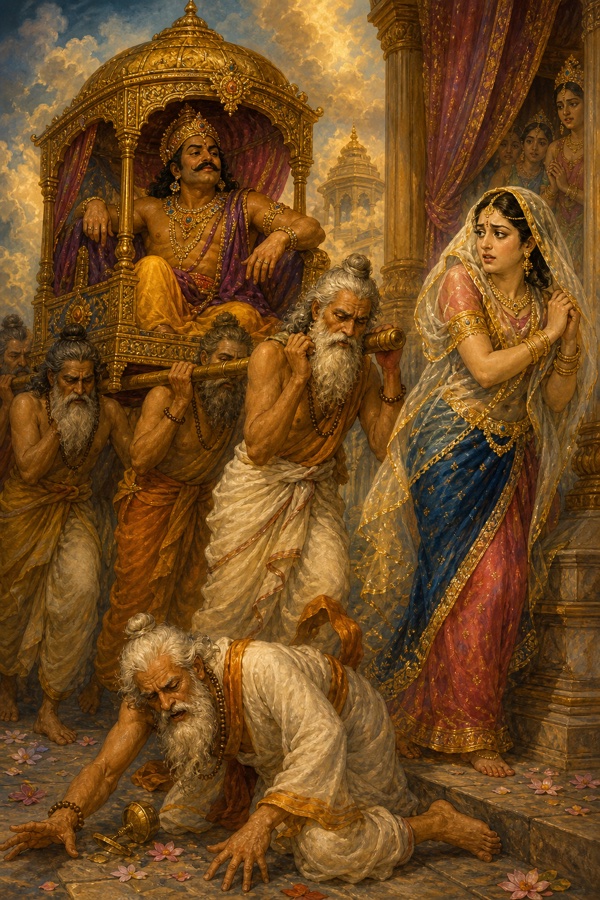
“Nahusha carried on his forehead a full five hundred lights of blazing brightness, and they had the power to strip every creature of its energy. So equipped, he went on ruling heaven. The three worlds returned to their normal state, and the people of the universe were happy and cheerful again. Then Nahusha said, ‘Everything that Indra used to enjoy is in front of me. Only his wife Shachi is missing.’ Having said it, he went to the place where Shachi was and spoke to her. ‘Blessed lady, I have become the lord of the gods. Accept me.’ Shachi answered him, ‘You are by nature devoted to right conduct, and you belong to the line of Soma. You should not assail another man’s wife.’
“Nahusha said to her, ‘I hold the place of Indra now. I am entitled to enjoy the dominions of Indra and all his precious possessions. There can be no sin in my wishing to enjoy you. You were Indra’s, and therefore you should be mine.’ Shachi said, ‘I am keeping a vow, and it is not yet completed. When I have taken the closing bath I will come to you, within a few days.’ Nahusha drew that promise from Indra’s wife and left her. Shachi was in pain and grief. She was anxious to find her husband, and her fear of Nahusha pressed on her, and she went to Brihaspati, the priest of the gods. Brihaspati saw at the first glance that she was stricken with anxiety. He turned at once to the meditation of yoga and learned that she was bent on doing whatever was needed to restore her husband to his true place. Then he said to her, ‘You have your penances, and you will have the merit of this vow that you are keeping. With those behind you, call on the goddess Upashruti, the giver of boons. When you call her she will appear and show you where your husband is living.’ Shachi was still in the keeping of that very hard vow when she called on the goddess Upashruti with the proper mantras. The goddess came and stood before her. ‘I am here at your bidding. You called me and I have come. What wish do you hold dear, that I may accomplish it?’ Shachi bowed her head to her and said, ‘Blessed lady, show me where my husband is. You are truth. You are Rita.’ The goddess Upashruti took her to the Manasa lake, and there she pointed out to Shachi her husband Indra, living inside the fibers of a lotus stalk.
“Indra saw his wife pale and wasted, and he was filled with anxiety. The lord of heaven said to himself, ‘Alas, a great sorrow has overtaken me. I have fallen from the place that is mine. And my wife, stricken with grief on my account, has found out my lost self and come to me here.’ When he had thought this, he spoke to his dear wife. ‘How is it with you now?’ She answered, ‘Nahusha calls me to him, to make me his wife. I have won a respite from him, and I have fixed the time when I am to go to him.’ Indra said to her, ‘Go and tell Nahusha that he must come to you on a vehicle that has never been used before, one to which rishis are harnessed, and that he must arrive at your door in that state to wed you. Indra has many kinds of vehicles, all of them beautiful and charming, and all of them have carried you. Nahusha must come on a vehicle such as Indra himself never owned.’ With that counsel from her husband, Shachi left the place with a joyful heart, and Indra went back into the fibers of the lotus stalk.
“When Nahusha saw the queen of Indra come back to heaven, he said to her, ‘The time you fixed is over.’ Shachi told him what Indra had directed her to say. Nahusha harnessed a number of great rishis to the vehicle he rode, and he set out from his place to come to where Shachi was living. Agastya, the great rishi who was born in a jar from the seed of Maitravaruna, saw those great rishis insulted by Nahusha in that way, and Nahusha struck him with his foot. Agastya said to him, ‘Wretch, you have taken to a deeply improper act. Fall down to the earth for it. Be changed into a snake, and go on living in that form for as long as the earth and her hills endure.’ The moment the great rishi had spoken these words, Nahusha fell from that vehicle, and the three worlds were without a master once more.
“The gods and the rishis came together then and went to the place where Vishnu was, and they appealed to him to bring about the restoration of Indra. ‘Holy one, you should rescue Indra, who is overwhelmed by the sin of killing a Brahmin.’ Vishnu, the giver of boons, answered them, ‘Let Indra perform a horse sacrifice in honor of Vishnu. He will then be restored to his former place.’ The gods and the rishis began to search for Indra, and when they could not find him they went to Shachi and said to her, ‘Blessed lady, go to Indra and bring him here.’ At their request Shachi went once more to the Manasa lake. Indra rose from the lake and came to Brihaspati. Brihaspati, the priest of the gods, made the arrangements for a great horse sacrifice, and he put a black antelope in the place of a good horse that was fit in every way to be offered. Then he had Indra, the lord of the Maruts, mount that same horse, the one that had been saved from slaughter, and led him back to his own place.
“All the gods and the rishis praised the lord of heaven with hymns. He went on ruling in heaven, clean of the sin of killing a Brahmin, which was divided into four parts and ordained to live in woman, in fire, in trees and in cattle. That is how Indra, made strong by the energy of a Brahmin, succeeded in killing his enemy, and how, when that act had left him overpowered by sin, the energy of another Brahmin rescued him. That is how Indra regained his place.”
The gist: With Indra hidden, the worlds have no king, and the gods and rishis crown Nahusha, who carries five hundred blazing lights on his forehead that drain the energy of every creature. He rules well until he demands Shachi. She pleads an unfinished vow, goes to Brihaspati, and by calling on the goddess Upashruti is led to the lotus stalk in the Manasa lake where Indra is hiding. Indra tells her to ask Nahusha to come on a vehicle drawn by rishis. Nahusha harnesses them and kicks Agastya, and Agastya’s curse throws him down to the earth as a snake. Vishnu prescribes a horse sacrifice, Brihaspati performs it with a black antelope in the horse’s place, and Indra returns to heaven, his sin divided among woman, fire, trees and cattle.
Shrivatsa, Martanda, the Waning of Soma, and the Meaning of More Names
Krishna had more of these, and he gave them to Arjuna one after another: the marks that a rishi’s hand or a rishi’s word had left on a god, on the sun, on the moon, on the sea and on the mountains.
“In ancient days the great rishi Bharadvaja was saying his prayers beside the celestial Ganga,” Krishna said, “when one of the three feet of Vishnu, who had taken his three-footed form, reached that spot. Bharadvaja saw that strange sight and struck at Vishnu with a handful of water, and Vishnu’s chest received a mark from it, the mark that is called Shrivatsa. Agni was cursed by the great rishi Bhrigu, and because of that curse he was obliged to become a devourer of all things.
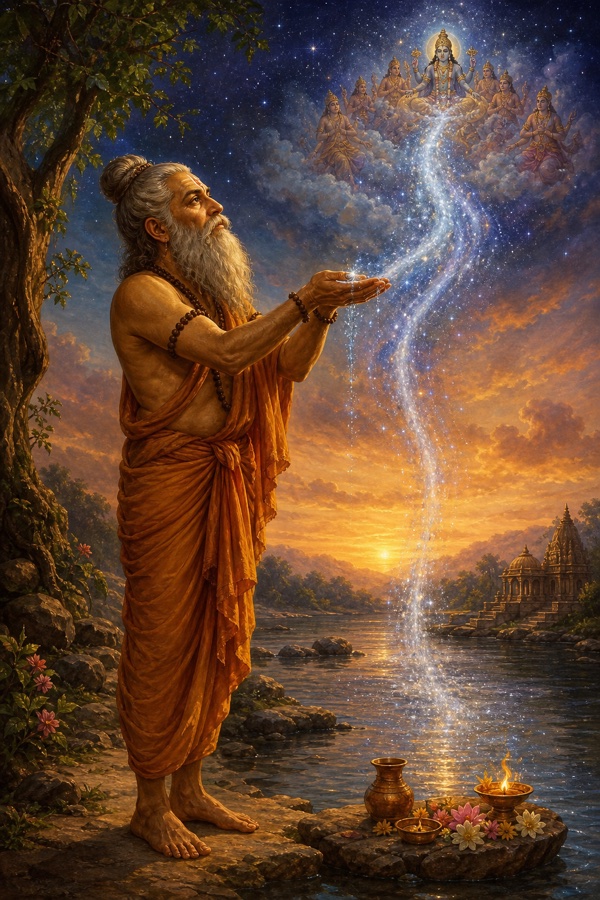
A sub-tale: “Aditi, the mother of the gods, once cooked some food for her sons. She thought that when they had eaten it and been strengthened by it, the gods would succeed in killing the Asuras. When the food was cooked, Budha, the god who presides over the planet of that name, came and stood before Aditi. He had just completed a hard vow, and he said to her, ‘Give me alms.’ Aditi gave him none. She thought that no one ought to eat of the food she had cooked before her sons, the gods, had taken it first. Budha, who had become one with Brahman through the vow he had completed, was enraged that she refused him, and he cursed her. Because she had denied him alms, he said, she would have pain in her womb when Vivasvat, at his second birth in her womb, was born in the form of an egg. Aditi reminded Vivasvat of the curse of Budha at that time, and that is why Vivasvat, the god who is worshiped in the rites for the dead, came to be called Martanda when he came out of the womb of Aditi.
“Daksha the Prajapati became the father of sixty daughters. He gave thirteen of them to Kashyapa, ten to Dharma, ten to Manu, and twenty-seven to Soma. The twenty-seven who were given to Soma are called the Nakshatras, and all of them were equal in beauty and in accomplishments. Even so Soma grew more attached to one of them, Rohini, than to the others. The rest of his wives, full of jealousy, left him and went to their father and told him how their husband behaved. ‘Holy one, all of us are equal in beauty, and yet our husband Soma is attached to our sister Rohini alone.’ Daksha was enraged at what his daughters told him, and he cursed Soma: from that time on the wasting disease would attack his son-in-law and live in him. Through that curse the wasting disease attacked Soma and entered his body. So stricken, Soma came to Daksha, and Daksha said to him, ‘I cursed you because you did not treat your wives equally.’ Then the rishi told him, ‘The wasting disease that has seized you is wearing you away. There is a sacred water in the western ocean called Hiranyasaras. Go to that sacred water and bathe there.’ On the rishi’s advice Soma went. He reached Hiranyasaras and bathed in that water, and by his ablutions there he cleansed himself of his sin. And because Soma lit up that sacred water, made it abhasita, it has been called Prabhasa from that day.
“Yet the curse that Daksha pronounced on him in those old days still holds. To this day Soma begins to wane from the night of the full moon and goes on waning until he disappears altogether on the night of the new moon, and from then he begins to wax again until the night of the full moon. The brightness of his disc took a stain at that time too, for since then the body of Soma has shown certain dark spots. From that day the splendid disc of the moon has carried the mark of a hare.
A sub-tale: “A rishi named Sthulashiras was once practicing very hard austerities on the northern slopes of the mountains of Meru. While he was at them a pure breeze began to blow there, loaded with every kind of delicious scent, and it fanned his body. His body was scorched by those very hard austerities, and he was living on air alone and taking no food of any kind, and the breeze that blew around him gave him great pleasure. While he was enjoying it, the trees around him put out their flowers, out of jealousy, to make a display and to force his praise. The rishi was displeased with the trees, because jealousy had moved them, and he cursed them. ‘From now on you will not be able to put out your flowers at all times.’
“In ancient days Narayana took birth, for the good of the world, as the great rishi Vadavamukha. While he was practicing hard austerities on the breast of Meru, he summoned the ocean to come before him. The ocean disobeyed the summons. The rishi was enraged, and with the heat of his body he made the waters of the ocean as salt to the taste as human sweat. He said more. ‘From now on your waters will cease to be drinkable. Only when the horse’s head, roving inside you, drinks your waters will they be as sweet as honey.’ Because of that curse the waters of the ocean are salt to the taste to this day, and no one drinks them except the horse’s head.
A sub-tale: “Rudra desired Uma, the daughter of the mountains of Himavat, in marriage. After Himavat had promised the hand of Uma to Mahadeva, the great rishi Bhrigu came to him and said, ‘Give this daughter of yours to me in marriage.’ Himavat answered, ‘Rudra is the bridegroom I have already chosen for my daughter.’ Bhrigu was angry at that answer. ‘You refuse my suit for the hand of your daughter, and you insult me by it. For that, you will abound no longer in jewels and gems.’ To this day, because of the rishi’s words, the mountains of Himavat have no jewels and no gems. Such is the glory of the Brahmins. It is through the favor of the Brahmins that the Kshatriyas are able to possess the eternal and undecaying earth as their wife and to enjoy her. The power of the Brahmins is made up of Agni and Soma. The universe is upheld by that power, and therefore it is upheld by Agni and Soma joined together.
“It is said that the sun and the moon are the eyes of Narayana. The rays of the sun are my eyes. The sun and the moon, each in its own way, give the universe warmth and give it strength, and because they do so they have come to be regarded as the harsha, the joy, of the universe. On account of these acts of Agni and Soma, which uphold the universe, I have come to be called Hrishikesha. I am Ishana, the giver of boons, the Creator of the universe. By virtue of the mantras with which libations of clarified butter are poured on the sacred fire, I take for my own the chief share of the offerings made in sacrifices. And my color is the color of the precious gem called harit. For these reasons I am called Hari.
“I am the highest abode of all creatures, and those who know the scriptures regard me as one with truth, or nectar. For that reason learned Brahmins call me Ritadhama, the abode of truth or nectar. In ancient days, when the earth was sunk under the waters and lost to sight, I found her and raised her from the depths of the ocean, and for that the gods adore me by the name Govinda. Shipivishta is another name of mine. The word shipi means one who has no hair on his body, and the one who pervades all things in the form of shipi is known as Shipivishta. The rishi Yaska, with a quiet soul, called on me by the name Shipivishta in many a sacrifice, and that is how I came to bear this secret name. Yaska was a man of great understanding. Having adored me under the name Shipivishta, he succeeded in restoring the Niruktas, which had disappeared from the face of the earth and sunk into the regions below.
“I was never born. I do not take birth, and I never shall be born. I am the Kshetrajna of all creatures, and so I am called Aja, the unborn. I have never spoken anything base and never anything obscene. The divine Sarasvati, who is truth itself, who is the daughter of Brahma and is also called Rita, is my speech, and she lives always on my tongue. I have merged what is and what is not in my soul, and the rishis who live at Pushkara, which is regarded as the abode of Brahma, called me by the name Truth. I have never swerved from the quality of sattva, and you should know that sattva has flowed from me. In this birth of mine too, Arjuna, my ancient sattva has not left me, so that in this life as well I stand on sattva and set myself to acts without ever wishing for their fruits. Sattva is my nature, and through it I am clean of all sins, and I can be seen only by the help of the knowledge that comes from taking up sattva. I am counted, too, among those who are wedded to that quality. For these reasons I am known by the name Satvata. I till the earth, taking the form of a great plowshare of black iron, and because my color is black I am called Krishna. I have joined earth with water, space with mind, and wind with light, and so I am called Vaikuntha. The ending of separate conscious existence by becoming one with the supreme Brahman is the highest condition that a living being can reach. I have never swerved from that condition, and so I am called Achyuta.”
A key to reading this (the etymology of names): Krishna sorts his names at the start of his answer into those that come from his qualities and those that come from his acts, and each derivation follows that division. An act stands behind Govinda, the finding and raising of the sunken earth. A quality stands behind Hari, the color of the gem called harit, behind Aja, the unborn, and behind Achyuta, the one who has never swerved. The name Krishna has one of each: he tills the earth as a plowshare of black iron, and his color is black. Several of the names are credited to those who used them: learned Brahmins for Ritadhama, the rishis of Pushkara for Truth, and Yaska, who worshiped him as Shipivishta and by that worship recovered the lost Niruktas.
The gist: Krishna gives Arjuna more instances of what a rishi’s act can leave behind: the Shrivatsa on Vishnu’s chest from Bharadvaja’s handful of water, Bhrigu’s curse that made Agni devour everything, Budha’s curse on Aditi and the name Martanda, Daksha’s curse that makes the moon wane and marked its disc with a hare, the trees that may no longer flower at all times, the salt of the ocean from Vadavamukha, and the Himavat stripped of its gems by Bhrigu. He then explains the names Hrishikesha, Hari, Ritadhama, Govinda, Shipivishta, Aja, Truth, Satvata, Krishna, Vaikuntha and Achyuta.
More Names: From Adhokshaja to Vrishakapi, and Oneness with the Vedas
“The earth and the sky are known to stretch away in every direction,” Krishna continued, “and I hold up both of them, and so I am called Adhokshaja. Those who know the Vedas, and whose work is to interpret the words used in those scriptures, call on me by that same name when they adore me in sacrifices. In ancient days the great rishis, in the midst of their hard austerities, said, ‘No one in the universe except the powerful Narayana can be called by the name Adhokshaja.’ Clarified butter sustains the lives of all the creatures in the universe, and it is my radiance. For that reason Brahmins who know the Vedas and whose souls are gathered call me Ghritarchis. The body has three well-known constituents. They have their origin in action, and they are called bile, phlegm and wind, and the body is said to be the union of the three. All living creatures are upheld by these three, and when the three grow weak, living creatures grow weak with them. That is why all who know the scriptures that bear on the science of life call me Tridhatu.
“Holy Dharma is known among all creatures by the name Vrisha. So it is that in the Vedic lexicon called the Nighantuka I am named the excellent Vrisha. The word kapi means the first of boars, and Dharma is known as Vrisha, and for that reason Kashyapa, the lord of all creatures, who is the common father of the gods and the Asuras, called me Vrishakapi. The gods and the Asuras have never been able to find out my beginning, my middle or my end, and so I am sung as Anadi, Amadhya and Ananta, the one without beginning, without middle and without end. I am the supreme lord, and I am powerful, and I am the eternal witness of the universe, watching its creations and its destructions as they follow one another. I always hear words that are pure and holy, Arjuna, and I never hold to anything sinful, and so I am called Shuchishravas.
“In days of old I took the form of a boar with a single tusk and raised the sunken earth from the bottom of the ocean, and for that I am called Ekashringa. When I took the form of that mighty boar for that purpose I had three humps on my back, and from that feature of my form at that time I have come to be called Trikakud, the three-humped. Those who know the science that Kapila set out call the supreme soul by the name Virincha. That Virincha is also called the great Prajapati. I am one with him, with the one called Virincha, because it is I who give life to all living creatures; I am the Creator of the universe. The teachers of the Sankhya philosophy, who have reached definite conclusions on every topic, call me the eternal Kapila, who stays in the middle of the sun’s disc with knowledge and nothing else for his companion.
“On earth I am known as one with him whom the verses of the Veda sing as the radiant Hiranyagarbha and whom the yogis worship always. I am regarded as the embodied form of the Rig Veda, which consists of twenty-one thousand verses. Those who know the Vedas call me too the embodiment of the Samans of a thousand branches, and it is in that way that learned Brahmins who are devoted worshipers of mine, and who are very rare, sing of me in the Aranyakas. Among the Adhvaryus I am sung as the Yajur Veda of fifty-six and eight and thirty-seven branches. Learned Brahmins who know the Atharvans regard me as one with the Atharvans, made up of five kalpas and all the krityas. All the divisions of the different Vedas by branches, all the verses that make up those branches, all the vowels that occur in those verses, and all the rules of pronunciation are my work, Arjuna. Know that. And he who rises from the Ocean of Milk at the beginning of creation, at the earnest call of Brahma and all the gods, and gives the different gods their different boons, is no other than myself.
A sub-tale: “I am the storehouse of the science of syllables and pronunciation that is set out in the supplementary parts of the Vedas. Following the path that Vamadeva pointed out, the great rishi Panchala obtained from that eternal Being, through my grace, the rules for the division of syllables and words in the reading of the Vedas. That rishi is Galava, born in the Babhravya line. He reached high success as an ascetic, obtained a boon from Narayana, and compiled the rules for the division of syllables and words and the rules of emphasis and accent in utterance, and he shone as the first scholar who came to know those two subjects. Kundarika and King Brahmadatta, a man full of energy, thought again and again of the sorrow that goes with birth and with death, and in the course of seven births, through my favor, they reached the prosperity that is gained by those devoted to yoga.”
The gist: Krishna explains Adhokshaja, the upholder of earth and sky; Ghritarchis, whose radiance is clarified butter; Tridhatu, from the bile, phlegm and wind that make the body; Vrisha, which is Dharma, and Vrishakapi, the name Kashyapa gave him; Anadi, Amadhya and Ananta; Shuchishravas; and Ekashringa and Trikakud, from the one-tusked, three-humped boar that raised the earth. He is Virincha to the followers of Kapila, the eternal Kapila to the teachers of Sankhya, and Hiranyagarbha in the verses of the Veda. He is the Rig Veda of twenty-one thousand verses, the Samans of a thousand branches, the Yajur Veda and the Atharvans, with every branch, verse, vowel and rule of pronunciation, and it was by his grace that Galava framed the rules of Vedic recitation.
The War of Rudra and Narayana, and Each Giving the Other a Mark
“In ancient days I was born, for a certain reason, as the son of Dharma,” Krishna said, “and from that birth I was known by the name Dharmaja. I took birth in two forms, Nara and Narayana. In those two forms, mounted on the vehicle that helps a man perform the duties of scripture and his other duties, I practiced undying austerities on the breast of Gandhamadana. It was then that Daksha held his great sacrifice. Daksha would not give Rudra a share of the offerings of that sacrifice, and Rudra, at the urging of the sage Dadhichi, destroyed it. He hurled a dart, and its flames blazed up at every moment. When the dart had burned up everything prepared for the sacrifice of Daksha, it came with great force toward us, toward Nara and Narayana at the retreat of Badari. It fell with great violence on the chest of Narayana. The energy of the dart struck him, and the hair on Narayana’s head turned green. Because of that change in the color of my hair I came to be called Munjakesha.
“Narayana uttered the cry Hun and drove the dart away. Its energy was gone, and it returned to the hands of Shankara. Rudra grew very angry at this, and in his anger he rushed toward the rishis Nara and Narayana, who were armed with the power of hard austerities. As Rudra came on, Narayana seized him by the throat with his hand. In the grip of Narayana, the lord of the universe, the throat of Rudra changed color and became dark. From that time Rudra came to be called Sitikantha. Nara, meanwhile, wanting to destroy Rudra, picked up a blade of grass and filled it with mantras. The blade of grass, so filled, was changed into a mighty battle-axe. Nara hurled the battle-axe at Rudra without warning, and it broke into pieces. Because that weapon broke into pieces in that way, I came to be called Khandaparashu.”
Arjuna asked, “Who had the victory in that battle, Krishna, a battle that could have brought the three worlds to destruction? Tell me this.”
“When Rudra and Narayana were engaged in battle in that way, the whole universe was suddenly filled with anxiety,” Krishna said. “The god of fire ceased to accept libations, even of the purest clarified butter, duly poured in sacrifices with the help of Vedic mantras. In the minds of the rishis of clean soul the Vedas no longer shone by their inward light. The qualities of rajas and tamas possessed the gods. The earth trembled. The vault of the sky seemed to divide in two. All the lights of the sky were stripped of their splendor. The Creator, Brahma himself, fell from his seat. The ocean itself became dry. The mountains of Himavat were split.
“When such dreadful omens appeared everywhere, Arjuna, Brahma soon arrived at the place where the battle was raging, with all the gods and the great rishis around him. Brahma of the four faces, whom only the Niruktas can make understood, joined his hands and spoke to Rudra. ‘Let good come to the three worlds. You are lord of the universe; throw down your weapons, out of a wish to do the universe good. That which is unmanifest, indestructible and changeless, which is supreme, which is the origin of the universe, which is uniform and is the supreme actor, which passes beyond all pairs of opposites and is inactive, has chosen to be manifested and has been pleased to take this one blessed form; the form is double, and the two stand for one. This Nara and Narayana, the displayed forms of the supreme Brahman, have taken birth in the line of Dharma. They stand first among all the gods. They keep the highest vows, and they have the hardest penances. For some reason best known to him, I myself have sprung from his quality of grace. You are eternal, for you have existed ever since all the past creations, and you too have sprung from him, from his wrath. With me, then, and with these gods and all the great rishis, adore this displayed form of Brahman, and let there be peace for all the worlds without any delay.’
“Brahma spoke to him so, and Rudra at once cast off the fire of his wrath and set himself to please the powerful god Narayana. He soon placed himself at the disposal of that adorable god, the giver of boons. And the god Narayana, who has his wrath and his senses under control, was soon pleased and was reconciled with Rudra. Well adored by the rishis, by Brahma and by all the gods, that great god, the lord of the universe, who is also called Hari, then spoke to Ishana and said these words. ‘He who knows you knows me. He who follows you follows me. There is no difference between you and me. Never think otherwise. The mark that your lance made on my chest will take, from this day, the form of a beautiful whorl, and the mark of my hand on your throat will take a beautiful shape too, and because of it you will be called, from this day, by the name Shrikantha.’
“Having each left such a mark on the body of the other, the two rishis Nara and Narayana made friends with Rudra, and they dismissed the gods and once more set themselves, with quiet souls, to the practice of penances. I have now told you how, in that battle which took place in ancient days between Rudra and Narayana, it was Narayana who got the victory. I have told you too the many secret names by which Narayana is called, and what those names signify, the names that the rishis, as I have said, have bestowed on the great god.
“In this way, Arjuna, taking various forms, I rove at will through the earth, through the realm of Brahma himself, and through that other high and eternal realm of happiness that is called Goloka. Protected by me in the great battle, you have won a great victory. At the time of all your battles you saw a being stalking in front of you, at the head of your army. Know that he is no other than Rudra, the god of gods, who is also called Kapardin. He is known also by the name Kala, and you should know that he sprang from my wrath. The enemies you have killed were all killed, in the first place, by him. Bend your head to that god of gods, the lord of Uma, whose power cannot be measured. With a gathered soul, bend your head to that lord of the universe, that indestructible god, who is also called by the name Hari. He is none other than the god who, as I have told you many times, sprang from my wrath. You have heard before now, Arjuna, of the power and the energy that live in him.”
A key to reading this (Shrivatsa and Shrikantha): The two gods end their battle by marking each other. The mark of Rudra’s lance on the chest of Narayana becomes a beautiful whorl, and the mark of Narayana’s hand on the throat of Rudra becomes a thing of beauty too, and gives Rudra the name Shrikantha. Krishna’s answer has already named the whorl once: it is the Shrivatsa, which in that earlier account Vishnu received from the handful of water that Bharadvaja threw. The dark throat has more than one history as well. It is the throat that Narayana seized, which made Rudra Sitikantha, and it is also the throat that the serpents of Ushanas bit blue. Hari’s own words to Rudra close the matter: whoever knows the one knows the other, and there is no difference between them.
The gist: Krishna tells Arjuna how, as Nara and Narayana at Badari, he was struck on the chest by the dart that had consumed Daksha’s sacrifice, so that his hair turned green and he was called Munjakesha; how Narayana seized the charging Rudra by the throat, which made him Sitikantha; and how the axe that Nara made from a blade of grass broke on Rudra and left the name Khandaparashu. The worlds shook, Brahma came and declared Nara and Narayana the displayed form of the supreme Brahman, and Rudra laid down his wrath. Hari and Rudra exchanged marks and became friends. Krishna ends by telling Arjuna that the figure who went before him in every battle was Rudra, born of Krishna’s own wrath, who had already killed the enemies Arjuna killed.
Source: the Mahabharata of Krishna-Dwaipayana Vyasa, Shanti Parva, Apaddharma and Mokshadharma sub-parvas, Sections 129 to 353; this part draws on Sections 335 to 343. The Gita Press Hindi edition is the controlling witness. The Sanskrit e-text and an independent complete translation were used to verify names, sequence, and principal events. Where recensions differ, this retelling follows Gita Press.
Source: the Mahabharata of Vyasa (Gita Press, Gorakhpur)