On this page
Where death came from: King Anukampaka and the goddess of Death
Yudhishthira’s eyes went past his grandfather to the field, where the dead still lay the way the war had left them, and the question he asked came out of what he saw there. “These lords of the earth,” he said, “are lying on the ground in the middle of their own armies. Every one of them had the strength of ten thousand elephants, and every one of them was killed by men whose strength was the same, and I cannot think of anyone else in the world who could have done it. They had power, they had fire in them, they had wisdom, and now they lie on the bare earth with the life gone out of them, and the one word we use for all of them is that they are dead. That word has raised a doubt in me that I cannot put down. Where does life come from, and where does death come from? Who is it that dies? Why does death carry the living away at all? Grandfather, tell me this.”
Bhishma answered him with a king from the first age of the world. “In the Krita age,” he said, “there was a king named Anukampaka. A war went against him. His chariots, his elephants, his horses, and his men were cut down until too few were left to hold anything, and he passed into the power of his enemies. His son Hari, a young man with the strength of Narayana himself, was killed in that same battle along with every follower and every soldier who had gone in with him. So the king lost his son and his freedom in one day, and after that he gave himself to a quiet life. One day, walking with no purpose in mind, he met the sage Narada on the earth, and he told him everything, the death of the boy in the battle and his own capture. Narada, whose wealth was the wealth of austerity, heard him out, and to lift the grief for the son he told the king this story.”
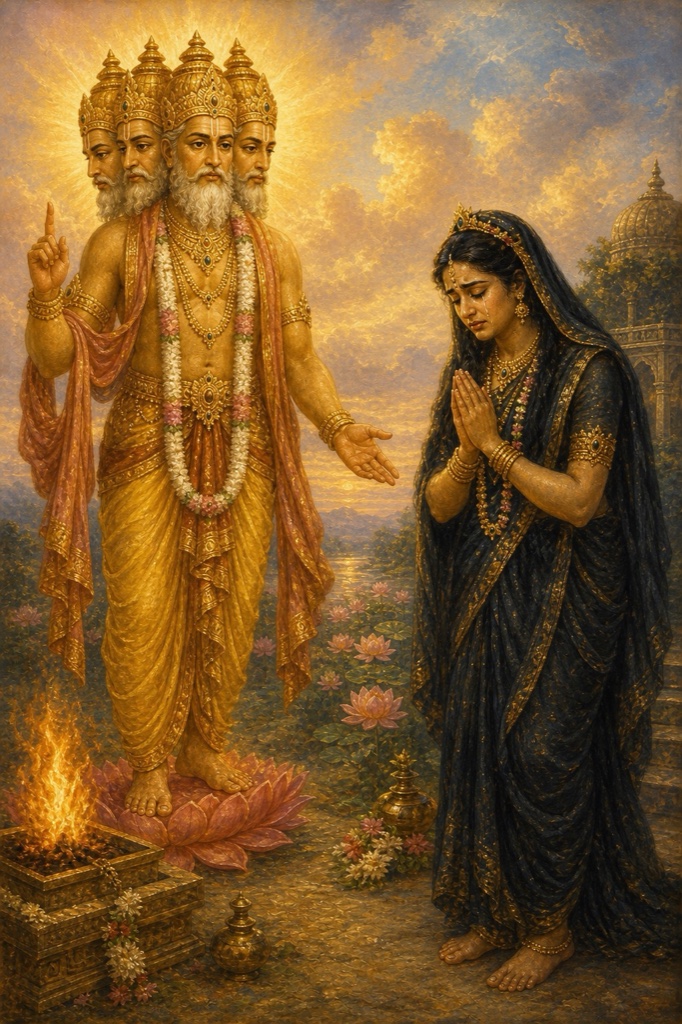
Narada began by warning him that it was a long story, and that he was telling it as it had happened, because he had heard it himself in an earlier time. “At the creation of the world,” he said, “the Grandsire Brahma made living beings in great numbers. They multiplied, and none of them died. There was no corner of the universe that was not crowded with the living. The three worlds seemed to swell with them, until it was as if nothing could draw breath. Brahma began to think about how this overgrown population was to be brought down, and for all his thinking the Self-born could not find the means by which it should be done. And then anger took him. A fire came out of his body, born of that anger, and with it the Grandsire burned every quarter of the universe. Heaven burned, and the earth, and the space between them, and everything in them that moves and everything that stands still, all of it was being eaten by the energy of that one passion.”
“It was Sthanu who came to him, the compassionate one, the lord of the Vedas and the scriptures, the killer of enemy heroes, and he came only to soothe him. Brahma, still burning, saw who had come and spoke first. ‘You deserve a boon from me,’ he said. ‘What is it you want? Whatever is in your heart, I will do it for you.’ Sthanu said, ‘Know that what I am asking is for the beings of the universe. You made them. Do not be angry with them, Grandsire. The fire born of your energy is eating every creature you created, and when I see them in that state I am filled with pity for them. Do not be angry with them, lord of the universe.’”
“Brahma answered him plainly. ‘I am not angry,’ he said, ‘and I have no wish that the beings I made should cease to exist. It is only that the earth’s burden has to be lightened, and for that a destruction is wanted. The goddess Earth came to me, Mahadeva, weighed down by the creatures on her, and asked me to destroy them, because she was sinking under their weight into the water. I used my mind on it for a long time and could find no way of doing it, and it was then that anger got hold of my heart.’ Sthanu pressed him again. ‘Do not give way to anger over this, lord of the gods. Be gracious. Do not let everything that moves and everything that stands be destroyed. The lakes are burning, every kind of grass and herb, all the rooted things, and the four kinds of moving creatures. The whole universe is about to be stripped of life. This is the boon I am asking: if these creatures are destroyed, they will not come back. Let your own energy cancel this energy of yours. Out of compassion for them, find some way for the living not to burn, and not to perish with their descendants unborn. You appointed me to preside over the consciousness of every living being, and all of this living universe came out of you. What I ask of you, god of gods, is that living creatures should come back into the world again and again, dying again and again.’ Brahma heard him, and the divine one whose speech and mind were under his own control drew that energy back inside his own heart. He put out the fire that was devastating the universe, and then, adored by all and limitless in power, he arranged birth and death for every living thing.”
A key to reading this (lineage / names): Swayambhu, the Self-born, is Brahma, who came into being from no parent. Sthanu is a name of Shiva, the one who stands unmoving, steady as a pillar; in this story he speaks as the one Brahma had set over the consciousness of every living creature, which is why the burning of those creatures is his to plead about. Narada tells this to Anukampaka, and Bhishma tells it to Yudhishthira, for the same reason: death was made on purpose, by Brahma himself, to carry the earth’s burden, and a son who dies has gone the way every living thing was arranged to go.
Death’s refusal and Brahma’s solution
Narada went on. “When the Self-born had drawn the fire back and put it out, a woman came out of him, from every opening of his body at once. She was dressed in black and red, with black eyes and black palms, a pair of fine earrings, and ornaments that belonged to heaven. She had come out of Brahma’s body, and she took her place at his right hand, and the two greatest of the gods looked at her. Then the Self-born, the first cause of all the worlds, greeted her and said, ‘O Death, kill the creatures of this universe. I was full of anger and set on their destruction when I called you. Begin now. Destroy every creature, the foolish and the learned alike. Make no exception for anyone. It is my command, and by carrying it out you will win great prosperity.’”
“The goddess wearing a garland of lotuses heard him and began to weep. The tears came freely, but she would not let them fall; she caught them in her joined palms and held them there. What she wanted was the good of living things, and it was with that in her heart that she began to plead with the Self-born. She took hold of her grief, folded her hands, and bent before the Grandsire like a creeper bending. ‘How can a woman like me,’ she said, ‘a woman who came out of you, go and do a thing so terrible that every living creature will dread it? I am afraid of doing what is wrong. Give me work that is righteous. You can see that I am frightened. Look at me with some compassion. I will not be able to cut down the living, infants and the young and the old, who have done me no harm. Lord of all creatures, I bow to you; be pleased with me. I will not be able to cut off dear sons and beloved friends and brothers and mothers and fathers. If they die by my hand, the relatives they leave behind will curse me, and I am afraid of that. The tears of the people they leave grieving will burn me forever. I am terrified of those people. I want your protection. And all the sinful creatures I kill will go down into hell. Boon-giver, be gracious to me. Powerful lord, give me your grace. Grandsire of all the worlds, this is the one thing I am asking: through your grace, let me go and undergo severe austerities.’”
“The Grandsire said, ‘O Death, I made you for the destruction of all creatures. Go and set yourself to killing them. Do not weigh it. This has to be; it cannot be otherwise. Woman of faultless limbs, do what I have told you to do.’ The woman called Death said nothing. She stood there humbly with her eyes raised to the powerful Lord of all creatures. Brahma spoke to her again, and again, and she stood as if the life had gone out of her. Then the god of gods, seeing her like that, fell silent. By an effort of his own will he made himself calm. He smiled, and the lord of all the worlds turned his eyes out over the universe, and his anger was gone. What we have heard is that when that unconquered lord had mastered his wrath, the woman left his side without having promised anything.”
“She went straight to the holy place called Dhenuka, and there she stood on one foot and practiced the severest austerities for fifteen billion years. When she had done that, Brahma came to her once more and said, ‘Do what I told you to do, O Death.’ She paid the command no attention and stood on one foot for twenty billion more years. Then she went and lived in the forest with the deer for ten thousand billion years. Then for twenty thousand years she lived on air and nothing else. Then she kept a vow of silence for eight thousand years, and spent all of it in water. Then the girl went to the river Kaushiki and took up another vow there, living on water and air alone. From there she went to the Ganga, and from the Ganga to Mount Meru, and there, wanting only good for every living thing, she stood as still as a piece of wood. From Meru she climbed to the summit of the Himalaya, to the place where the gods had once performed their great sacrifice, and she stood there on the tips of her toes for a hundred billion years, carrying her whole weight on them, so that by an austerity of that size she might win the Grandsire over.”
“The Creator and Destroyer of the universe came to her there. ‘What are you doing, daughter?’ he said. ‘Carry out my words.’ And the girl said to him again what she had said before: ‘I cannot cut down living creatures, god. I am trying to win your grace so that I may be excused.’ She was frightened of the sin of it, and she begged him to release her from his command, and the Grandsire silenced her and spoke again. ‘No sin will come to you from it, O Death. Set yourself to destroying the living. What I have said cannot be made untrue. Eternal righteousness will take its refuge in you. I and all the gods will always be working for your good. And the other wish that is in your heart I grant you as well: the living will be worn down by disease, and when they die they will lay the blame on you. You will be male in every male creature, female in every female, and neither in those of the third sex.’ The girl folded her hands before that great and undecaying lord of the gods and said once more, ‘I am unable to obey your command.’ The great god did not relent. ‘O Death, kill men. I will arrange it so that no sin touches you for doing it. Those tears I see fallen from your eyes, the ones you are still holding in your joined hands, will become terrible diseases, and it is the diseases that will destroy men when their hours come. When a creature’s end arrives, you will send Desire and Wrath against it together. The merit of it will be beyond measure, and no wrong will attach to you, because you will be perfectly even toward all. Do this and you will be keeping righteousness, and you will never sink into sin. Set your heart on the work, and send out Desire and Wrath, and kill the living.’”
“Then the woman called Death grew afraid of Brahma’s curse, and she answered him, ‘Yes.’ From that time she has sent Desire and Wrath to the living as their last hours, and through those two she stops the breath of life. And the tears she shed are the diseases that afflict the bodies of men.”
“So when living creatures are destroyed, a person who understands the cause of it does not give way to grief. When a creature sinks into dreamless sleep its senses vanish, and when it wakes they come back; in the same way, when their bodies dissolve, human beings go into the other world and return from it to this one. Even the gods, when their merit runs out, have to be born on earth as mortals, and mortals who gather enough merit rise to the rank of gods. So do not grieve for your son. Your son has reached heaven and is happy there. That is how Death was made by the Self-born, and that is how she cuts off every living thing, in proper order, when its hour comes; and the tears she shed become the diseases that take the living away at the end.”
A sub-tale (wind is life): In this same telling Narada says that the wind, the element of terrible energy and immense strength and deafening roar, is what does the work of life in every living creature. When a body is destroyed, that wind leaves the old body and goes to work at its many tasks in new ones. That is why the wind is called the lord of the senses and is set above the other elements that make up the gross body. Anukampaka’s son, on this account, has gone where the wind went, and the shape that lay on the battlefield was only the body it left.
The gist: Brahma made too many creatures and could not think how to thin them, and the fire of his anger began to burn the three worlds until Shiva pleaded for them. The woman who came out of his body when he put the fire out was Death, and she refused the work: she wept, held her own tears in her palms, and did austerities for billions of years in the hope of being excused. Brahma would not excuse her. He made her tears into disease, gave her Desire and Wrath as her instruments, promised her that no sin would attach to a killer who is even toward everyone, and let the dying lay their blame on her. Narada tells Anukampaka all this so that he will stop grieving for Hari: the living sleep and wake, leave the body and return, and a son in heaven is happy there.
What Dharma Is: Conduct in a Time of Distress, and the Place of Truth
Yudhishthira’s next question was the plainest one he had, and he asked it like a man who has heard the word all his life and never been sure of it. “Everyone who lives on this earth is full of doubt about what dharma is,” he said. “What is this thing that is called dharma, and where does it come from? Is it for use in this world, or in the next, or in both? Tell me that, Grandfather.”
Bhishma said, “The conduct of the good, the smritis, and the Vedas are the three marks by which dharma is known, and the learned have added a fourth, the purpose for which an act is done. The rishis of old declared which acts are dharma and ranked them, higher and lower, by the merit in them, and the rules were laid down so that the affairs of the world could be carried on. In both worlds, here and hereafter, dharma bears happiness as its fruit. A sinful man who cannot find merit by the subtle ways is left with his sin and nothing else, and there are those who hold that such a man can never be cleansed. But in a time of distress a person who speaks an untruth earns the merit of truth, just as a person who does an unrighteous act in that hour earns, by that very act, the merit of a righteous one. Conduct is where dharma lives. Look to conduct, and by conduct you will know what dharma is. A man does not see his own faults, and does not announce them; the faults of others he sees and announces readily. The thief who steals what belongs to others spends what he stole on acts that look like virtue. When there is no king, the thief takes great pleasure in helping himself to other men’s goods; when other men rob him of what he robbed, he wants a king at once, to punish them. And at that very moment, with his indignation at the violated rights of property at its height, he is secretly coveting the wealth of people who are content with their own. He walks into the king’s palace without a doubt in his mind, with a heart he believes to be clean of every sin. Inside his own heart he cannot see the stain of a single wrong act.”
“To speak the truth is the highest merit. Nothing stands above truth. Everything is held up by truth, and everything rests on it. Even the sinful and the savage, when they swear to keep truth with one another, set their quarrels aside and go about their work depending on truth alone, and if they dealt falsely with one another they would be destroyed, there is no doubt of it. Never to take what belongs to another is an obligation that has no end. Powerful men treat it as a rule invented by the weak, and when their own fate turns against them the rule suddenly meets with their approval. And the men who surpass others in strength do not, by that, become happy. So never set your heart on anything wrong. A person who lives that way has nothing to fear from cheats or thieves or from the king. He has injured no one, and so he lives without fear, with a clean heart.”
“A thief is afraid of everyone, like a deer driven out of the forest into the middle of a village. He assumes that other people are as sinful as he is. A person of pure heart is always cheerful and fears nothing from any direction, and such a person never sees his own misconduct in other people. Those who spend their lives doing good to all creatures have said that giving is another high duty. Men who have wealth think it was laid down by the poor, and when a turn of fortune brings them to poverty, giving suddenly recommends itself to them; and men of great wealth do not, by that, meet with happiness. Knowing how a thing hurts when it is done to him, a person should never do it to another. What can a man who has taken another man’s wife say to a man guilty of the same offense? And yet that same man, when he sees his own wife with another lover, finds he cannot forgive it. A man who wants to draw breath himself, how can he think of stopping another man’s breath by murder? Whatever you want for yourself, want it for the other man too. Out of surplus wealth, relieve the wants of the poor; it was for this that the Creator ordained the increase of wealth by trade and by lending. Walk the one road along which you may hope to meet the gods, and when wealth comes, sacrifice and giving are the right things to do with it. The sages have said that to reach your ends by gentle means is dharma, and that, Yudhishthira, is the test that was kept in view when the marks of dharma and of its opposite were declared.”
“In the beginning the Creator ordained dharma and gave it the power to hold the world together. The conduct of the good is a fine thing, and it is hedged with many restraints, because the dharma it wins depends on many delicate judgments. I have now told you the marks of dharma. Never, at any time, set your understanding on an act that is wrong.”
A key to reading this (statecraft and moral law): Apad-dharma is the dharma of a time of calamity. What is forbidden in ordinary times can, in a real crisis and for a right purpose, carry the merit of the right act, and Bhishma says so here in the plainest terms: an untruth spoken in distress earns the merit of truth. He hands Yudhishthira four marks of dharma, conduct, smriti, Veda, and purpose, and then spends most of his answer on the thief, the adulterer, the rich man, and the strong man, because each of them approves of the rule exactly when it protects him. Purpose and circumstance decide the shape of the act, and Yudhishthira, who has just been told that dharma rests on delicate judgments, presses on that word next.
The gist: Dharma is known by four marks: the conduct of the good, the smritis, the Vedas, and the purpose behind an act. It gives happiness in both worlds. In a time of distress an untruth spoken for a right purpose carries the merit of truth. Truth holds everything up, and even thieves depend on it among themselves. The strong call the rule against theft an invention of the weak, and the rich call giving an invention of the poor, until fortune turns and each finds the rule dear. Never do to another what you would find hateful done to you; what you want for yourself, want for him.
Yudhishthira’s Deep Doubt: Dharma Subtle as a Razor’s Edge
Yudhishthira had listened, and the answer had settled nothing in him. “You tell me that dharma turns on delicate judgments,” he said, “that it is known by the conduct of those who are called good, that it is hedged with restraints, and that its marks are set down in the Vedas. And it seems to me that there is a kind of light inside me by which I can reason out right from wrong for myself. Most of the questions I meant to ask you have already been answered. There is one more, and I am not asking it for the pleasure of argument.”
“Every embodied creature, as far as I can see, is born, lives, and leaves its body by its own nature. If that is so, dharma and its opposite cannot be settled by reading the scriptures alone. The duties of a man who is well off are of one kind, and the duties of a man who has fallen into distress are of another. How is the dharma of a time of distress to be learned from a book? You have told me that the acts of the good are dharma. But the good are known only by their acts. The definition rests on the very thing it was meant to define, and what the conduct of the good is remains unsettled.”
“You can see an ordinary man doing wrong in the very act of appearing to do right, and you can see an extraordinary man achieving dharma through acts that look like its opposite. And the proof of what I am saying comes from the people who know the scriptures best. We have heard from them that the ordinances of the Vedas fade a little in every age. The duties of the Krita age are one thing, the Treta’s are another, the Dvapara’s are different again, and the Kali age’s are something else entirely. It looks as if duties were laid down for each age to fit the strength of the people living in it. If the declarations of the Vedas do not apply equally in every age, then to say that the Vedas are true is only a way of speaking that keeps ordinary people satisfied.”
“The smritis grew out of the shruti, and their reach is very wide. If the Vedas are the authority for everything, then the smritis carry authority too, since they rest on the Vedas; and when the shruti and the smritis contradict each other, which of them is the authority? Then again, when powerful and wicked men stop some part of a righteous practice, that part is destroyed for good. Whether we know it or not, whether we can make it out or not, the path of duty is finer than the edge of a razor and grosser than a mountain. At first dharma, the dharma of sacrifices and rites, looks like those castles that vapor builds in the far sky, and when a learned man examines it, it vanishes. Like the small ponds the cattle drink at and the shallow channels along the fields, which dry up in no time, the eternal practices of the smritis fall out of use and at last disappear altogether. Among men who are not good, some turn hypocrite about dharma because desire drives them, some because other people wish it, and many more for motives of the same kind, and it cannot be denied that the acts they do are dharma. Fools say that dharma is an empty sound among the people called good, and laugh at them as men without reason. Great men turn away from the duties of their own order and take up the duties of kings. Nowhere can I see a conduct that is good for everyone. The course of conduct that makes one man meritorious blocks another man’s merit, and a third follows it as he pleases and is not changed by it at all, so that every course of conduct is seen to lose its single purpose and its single character. It seems to me that what the learned of ancient times called dharma is dharma still, and that it is through the conduct they settled that the distinctions and limits which govern the world became permanent.”
The gist: Yudhishthira turns Bhishma’s marks over and finds each one giving way. “The conduct of the good” is a circle, since the good are known only by their conduct. The Vedas’ ordinances fade age by age, so to call them true is a manner of speaking. The shruti and the smritis clash, and a strong wicked man can end a righteous practice for good. Dharma is finer than a razor’s edge and grosser than a mountain, a cloud-castle that vanishes on inspection, a cattle pond that dries. What holds, in the end, is the settled judgment of the ancient wise and the limits their conduct set.
Tuladhara and Jajali: A Vaishya at His Scales Teaches Dharma
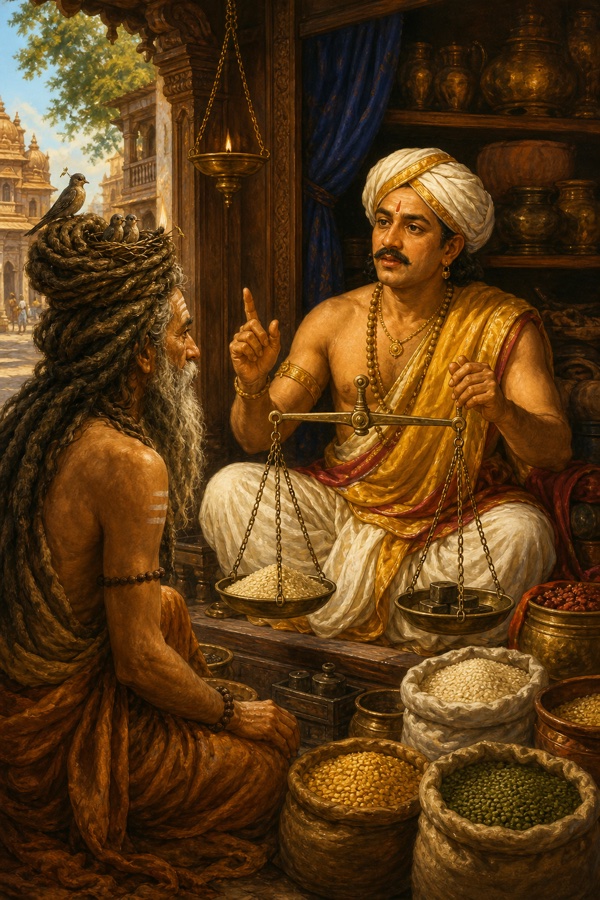
To that question Bhishma answered with the old story of Tuladhara and Jajali. “There was a Brahmin named Jajali,” he said, “who lived in a forest as a hermit lives, and who was given to austerity. One day he went down to the seashore and began the severest penances there. He kept many vows and restraints, his food was ruled by fasts, he wore rags and animal skins, his hair was matted, and his whole body was smeared with filth and clay. He passed years there without speaking, in the meditation of Yoga, and he became so full of power that, living under the waters of the sea, he could range through every world with the speed of a mind that wants to see everything. When he had seen the whole earth ringed by the ocean, with its rivers and lakes and woods, he sat down under the water one day and thought, ‘In this world of things that move and things that stand still, there is no one equal to me. Who else can roam with me among the stars and the planets and then come back and live in the sea?’ He was saying it to himself, and unseen beings heard him. They were pishachas, and they said, ‘You should not say that. There is a man named Tuladhara, a man of great fame, whose business is buying and selling. Even he would not think himself fit to say what you have just said.’”
“Jajali answered them out of his austerity. ‘Then I will go and see this famous Tuladhara who is so wise.’ At those words the beings lifted him up out of the sea and said, ‘Go along this road, best of Brahmins.’ He went, and his heart was heavy the whole way. He reached Varanasi and found Tuladhara there, a shopkeeper among his goods, and as soon as Tuladhara saw a Brahmin arriving at his door he stood up gladly and honored his guest with the proper greetings.”
“Tuladhara spoke before Jajali could. ‘I know without being told that you have come to me, Brahmin. Listen, though, to what I am going to say. You lived on the low ground by the seashore and did very hard penance there, and you never once felt that you had won any merit by it. Then, when your austerities finally bore fruit, some birds were born on your head. You looked after the little creatures with great care. And when at last they had their wings and began to leave your head and go out looking for food, it was then, because you had stood there while those birds came into the world, that pride began to move in you, Brahmin, and you thought you had won great merit. Then you heard a voice in the sky, and it spoke of me. What you heard filled you with anger, and the anger is why you are standing here. Tell me what wish of yours I can fulfill, best of Brahmins.’”
Yudhishthira stopped him there. He wanted to know what the hard feats were that Jajali had done before this, to earn success of that size, and Bhishma told him. “Jajali gave himself to the severest austerities. He bathed morning and evening, tended his fires carefully, and studied the Vedas, and he knew the duties of a forest hermit so well that he seemed to blaze with them. He lived in the woods and did penance without pause, and never once counted himself a man who had earned any merit. In the rains he slept under the open sky; in autumn he sat in water; in summer he stood out in the sun and the wind; he slept on painful beds of every kind and on the bare earth, and still he did not count himself a man of merit. One rainy season, standing under the sky with the clouds emptying themselves on his head again and again, going back and forth through the forest, his hair grew so wet and so filthy that the locks tangled and wound into one another. Then, taking no food at all and living on air, he stood in the forest like a post of wood, unmoved at heart, not stirring an inch. And while he stood there a pair of kulinga birds built their nest on his head. The great rishi was moved to pity and let the pair build among his matted locks with shreds of grass, and the two birds lived on his head in perfect confidence. The rains passed and autumn came. Desire moved the pair, they came together as the Creator has ordered it, and trusting him completely they laid their eggs on the rishi’s head. He knew it, and he did not move; he had set himself to earn merit, and no act that did the smallest injury to another could recommend itself to him. The parents came and went from his head every day and lived there happily. In time the eggs ripened and the chicks came out and began to grow in that nest, and Jajali still did not move; firm in his vows and rapt in meditation, he stood on that spot and kept those eggs safe. The chicks grew and got their wings, and the sage knew it, and one day he looked at the young birds and was filled with pleasure. Their parents were happy too, and went on living on his head with them. He watched the young ones take to the air every evening and come back without having gone far, and he stood still. He watched them go out on their own, without their parents, and come back on their own, and he did not move. Then they were gone all day and came back to the nest at dusk. Then they stayed away five days at a time and returned on the sixth, and he did not move. Then, their strength fully grown, they left him and did not come back for many days, and at last they went and did not come back even after a month. Then Jajali left that spot. When the birds were gone for good, he was full of wonder at himself, and he thought that he had reached the success an ascetic aims at, and pride entered his heart. He bathed in a stream, poured his offerings on the sacred fire, saluted the rising sun, and then, having raised birds on his own head, this foremost of ascetics began to slap his armpits and shout up into the sky, ‘I have won great merit.’ And a voice with no body behind it answered him from the sky: ‘Jajali, in dharma you are not the equal of Tuladhara. That Tuladhara, who is very wise, lives at Varanasi, and even he would not be fit to say what you have just said.’ Jajali was filled with anger. He set out to find Tuladhara and wandered the whole earth under a vow of silence, sleeping wherever the evening overtook him, and after a long time he came to the city of Varanasi and saw Tuladhara selling his odds and ends, and the shopkeeper, seeing a Brahmin at his shop, stood up gladly and honored him.”
Jajali asked his question standing in the shop, among the jars. “You sell juices and scents, son of a trader, and bark and leaves off the big trees, and herbs, and their fruits and roots. How did you come by a mind so settled? Where did this knowledge come from? Tell me all of it.” And Tuladhara, a Vaishya who understood what dharma really rests on and was content with what he knew, began to teach that Brahmin who had done such penance. “Jajali, I know the dharma that is eternal, with all its secrets. It is the old dharma that everyone knows: friendship toward all, and the good of every creature. A way of living that does no harm at all to any living thing, or, where some harm cannot be avoided, does the least harm it can, is the highest dharma, and that is the way I live.”
“This house of mine was built with wood and grass that other people’s hands cut. Lac dye, lotus roots and lotus filaments, good scents of many kinds, and many kinds of liquids except wine, I buy from other people’s hands and sell without cheating anyone. The man who knows dharma, Jajali, is the man who is always a friend to every creature and always at work for the good of every creature, in thought, in word, and in deed. I beg from no one. I quarrel with no one. I hold no dislike for anyone, and I want nothing. I look on all things and all creatures with an equal eye; that is my vow. My scales weigh exactly the same for every living being. I neither praise the acts of others nor blame them, since the variety in this world looks to me like the variety in the sky. I see no difference between a clod of earth, a piece of stone, and a lump of gold. The blind, the deaf, and those with no reason are perfectly consoled for the senses they have lost, and their example consoles me for the pleasures I do without; the old, the sick, and the wasted have no appetite for enjoyment of any kind, and in the same way I have stopped having any appetite for wealth or pleasure. When a man fears nothing and is feared by no one, when he wants nothing and hates nothing, he is said to have reached Brahman. When he does no wrong to any creature in thought, word, or deed, he is said to have reached Brahman.”
“A man whom no creature has any reason to fear reaches a state in which there is no fear. A man whose harsh tongue and hard temper make him a torment to every creature, like death itself, reaches a state that is full of fear. I follow the ways of the large-hearted and kindly men of earlier days, who lived with their children and their children’s children under the ordinances of the scriptures. In this world, as in a river, a piece of driftwood carried along by the current meets another piece for a while and then parts from it; grass and sticks and cakes of dung come together on the water, and the meeting is chance, and no design. The man of whom no creature is afraid is never afraid of any creature. The man everyone fears as they fear a wolf is himself full of fear, like the fish that leap for the shore when the Vadava fire roars under the sea. This dharma of harmlessness grew up from that, and a man should follow it by every means in his power; a man with followers and a man with wealth can take it up, and it leads to prosperity and to heaven. Whatever fruit is won by austerity, by sacrifice, by giving, by truthfulness, and by courting wisdom, all of it is had by the practice of doing no harm. The man who gives every creature the assurance that it has nothing to fear from him wins the merit of every sacrifice and, at the end, fearlessness for himself. There is no duty higher than that. The man everyone fears as they fear a snake in their sleeping room earns no merit in this world or the next, and the gods themselves lose the track of the man who has made himself the soul of all creatures and looks on every creature as himself. Of all gifts, the assurance of safety is the highest, and I am telling you the truth, Jajali. Now look at what is done. Why do you not burn the men who castrate bulls and bore their noses and load them with weights and bind them and pen them, and who kill living creatures and eat their flesh? Men own other men as slaves and beat them and chain them and make them work day and night, and they are not ignorant of what a beating and a chain feel like. In every creature with five senses all the gods live, Surya, Chandramas, the wind, Brahman, Prana, Kratu, and Yama, and there are men who make their living trading in those creatures; when a man earns his bread that way, what scruple will he feel about selling carcasses? The goat is Agni. The sheep is Varuna. The horse is Surya. The earth is Virat. The cow and the calf are Soma. The man who sells these never prospers. But what fault can there be in selling oil, or ghee, or honey, or medicines, Brahmin? Animals that grow up in ease, in places free of gnats and biting flies, animals whose mothers love them, men drive into mud full of insects; they crush the draft animals under loads, and other creatures they wear down in ways no scripture sanctions, and I can see no difference between that kind of injury and the killing of an unborn child. People call farming a sinless trade, and it is a cruel one: the iron face of the plow wounds the soil and the many creatures that live in it. Look at the bullocks yoked to that plow. The shruti calls the cow unslayable, and the man who kills a bull or a cow commits a great sin. These are some of the wicked and dreadful practices that are current in the world, Jajali, and you follow them because all men have followed them since ancient times, and for no reason your own cleansed understanding has given you. A man should do what his reason tells him is his duty, and he should never follow the world blindly. And here is how I treat the man who injures me and the man who praises me: I treat them exactly alike. There is no one I like and no one I dislike. The wise have praised this conduct as agreeing with dharma, the yatis follow it, and the righteous keep it with eyes that see farther than other men’s.”
A key to reading this (a name and a concept): The name Tuladhara means the one who holds the scales, and the story turns on what those scales weigh. Jajali is a Brahmin ascetic who has stood like a post through rains and hatchings; Tuladhara is a Vaishya, a shopkeeper in Varanasi who buys lac dye and lotus root from other people’s hands and sells them without cheating, and the voice from the sky ranks the shopkeeper above the ascetic in dharma. What the trader has is a vow of even weight toward every creature, no begging, no quarrel, no liking and no disliking, and a refusal to harm anything that lives. Dharma, on this showing, is a matter of conduct and evenness of mind; birth and austerity do not decide it.
A sub-tale (Nahusha and the cow-slaying): Condemning the killing of animals, Tuladhara reminds Jajali of King Nahusha. Rishis with their senses under control went to Nahusha and told him that he had killed a cow, which the scriptures call a mother, and a bull, which they call the Creator himself, and that he had done a terrible thing which pained them deeply. To cleanse him they divided his sin into a hundred and one parts, turned the fragments into diseases, and scattered them among all living creatures; and having found by their ascetic power that the king had not sinned on purpose, they still told him, since he was guilty of the death of a creature not yet born, that they would not be able to pour the offerings at his sacrifice.
The True Meaning of Yajna: Jajali’s Challenge and Tuladhara’s Answer
Jajali had his answer ready, and it was the answer of a man who has kept the fires all his life. “This dharma you preach, holder of the scales, shuts the door of heaven on every creature and cuts off the very means by which they stay alive. Food comes from farming. That food feeds even you. It is with animals and crops and herbs that human beings keep themselves in existence, trader, and it is out of animals and food that sacrifices flow. Your doctrine smells of atheism. If the means by which life is supported have to be given up, the world will come to an end.”
Tuladhara said, “Then let me speak about the means of sustenance and what they are for. I am no atheist, Brahmin, and I do not blame sacrifice. It is only that the man who truly understands sacrifice is very rare. I bow to the sacrifice that was ordained for Brahmins, and I bow to the men who understand it. What grieves me is that the Brahmins have given up the sacrifice ordained for them and taken up the sacrifices that were meant for Kshatriyas. Many men of faith who were greedy and fond of wealth, who never grasped what the shruti actually says, and who proclaimed things that were false under the appearance of truth, have brought in sacrifice after sacrifice, saying, ‘This is to be given away in this rite, and that other thing in that one, and this first kind is the most praiseworthy.’ And what has come of all of it, Jajali, is theft, and evil acts of many kinds.”
“Understand that only an offering acquired by righteous means gives the gods any satisfaction. The scriptures say in a hundred places that the gods can be worshiped with vows, with offerings poured into the fire, with the recitation and chanting of the Vedas, and with plants and herbs. Unrighteous men get wicked children from their rites; from the greedy come greedy children, and from the content, children who are content. If the sacrificer and the priest let themselves be moved by desire for the fruit, their children take the stain of it, and if they do not, the children born to them are of their own kind. Children come from sacrifice the way clear water comes down out of the sky. The offering poured on the fire rises to the sun; from the sun comes rain; from rain comes food; from food, living creatures are born. In earlier days men who gave themselves to sacrifice in the right spirit got everything they wished from it. The earth bore crops without being tilled, and the blessing of the rishis was enough to make the herbs grow. Those men never sacrificed out of desire for fruit and never thought themselves entitled to enjoy the fruit. The men who go through with a sacrifice while doubting whether it does anything are born in their next lives as dishonest, cunning, and greedy men who cannot get enough of wealth. The man who uses false reasoning to make out that the authoritative scriptures are full of evil goes, for that sin, to the regions of the sinful, and while he is here he lives without wisdom. The man who treats the daily acts laid down in the Vedas as binding, who is afraid if he misses them for a day, who takes every essential of sacrifice to be Brahman itself, and who never thinks of himself as the doer, is a Brahmin in truth. If that man’s acts are left incomplete, or unclean animals get in the way of their completion, we have heard that the acts still carry their full power; it is only when acts are done out of desire for fruit, and such a thing interrupts them, that an expiation becomes necessary.”
“The men who want the highest thing there is, moksha, who have no greed for wealth of any kind, who lay nothing by for the future, and who are free of envy, make truth and self-restraint their sacrifice. Those who know the body from the soul, who are devoted to Yoga, and who meditate on the pranava never fail to satisfy others. The universal Brahman, which is that pranava, the soul of the gods, lives in the man who knows Brahman, so that when such a man eats and is satisfied, all the gods, Jajali, are satisfied and content. A man who has tasted every flavor wants no particular flavor, and in the same way a man who is satisfied with knowledge has a satisfaction that lasts, and that is perfect bliss to him. The wise, who are dharma’s refuge and whose delight is dharma, know for certain what is to be done and what is to be left undone, and such a man sees everything in the universe as having come out of his own self. Some of these men of knowledge, who strive for the far shore and have faith, reach the region of Brahman, which is full of blessing and holy and lived in by the righteous, a place with no sorrow, no return, and no agitation or pain. Such men do not covet heaven. They do not worship Brahman with costly sacrifices. They walk the path of the righteous, their sacrifices harm no creature, and they know trees and herbs and fruits and roots as the only sacrificial offerings. Greedy priests, who want wealth, will not officiate for men so poor. And these men, though every act of theirs is already complete, go on sacrificing out of the wish to do good to every creature, and they make themselves the offering. That is why grasping priests officiate only for the misguided, who seek heaven without ever trying for moksha, while the truly good, by doing their own duties, help others up to heaven. I have looked at both kinds of conduct, Jajali, and it is because of that that I harm nothing and look on every creature with an equal heart.”
“Many of the best Brahmins, men of wisdom, perform sacrifices of two kinds, some that lead to moksha, from which there is no coming back, and some that lead to regions of bliss from which one does come back, and by those sacrifices they travel the roads the gods travel. For the man who sacrifices out of desire for fruit there is return from the region he reaches; for the truly wise, who sacrifice with no desire driving them, there is no return. Both walk the path of the gods, Jajali, and that is the difference between where they end. And the purposes such men form in their minds succeed so completely that bulls, without being forced, set their shoulders to the plow for the tilling and to the yoke for the pulling of chariots, and cows let down their milk from udders no human hand has touched. Making the sacrificial stakes and the rest by a simple act of will, these men perform sacrifices of many kinds, brought to completion with abundant gifts. A man whose soul is that clean may kill a cow as an offering. Those who are not of that kind should sacrifice with herbs and plants. It is because renunciation has merit of that size that I have kept it in front of my eyes in speaking to you. The gods know that man for a Brahmin who has given up all desire for fruit, who makes no effort at worldly acts, who bows his head to no one and sings no one’s praises, and who is strong even though his acts have all been weakened. What will become of the man who does not teach the Vedas to others, who does not perform sacrifices properly, who gives nothing to Brahmins who deserve it, and who follows a calling in which every desire is indulged? By reverencing the duties of renunciation, a man is sure to reach Brahman.”
Jajali said, “We had never before heard, son of a trader, these hidden doctrines of the ascetics who sacrifice only in the mind. They are very hard to understand, and that is why I am asking you about them. The sages of old did not follow these doctrines of Yoga, and so the sages who came after them never put them forward for everyone to accept. If you say it is only men with the minds of animals who fail to make their sacrifice in the soil of the Soul, then tell me, son of a trader, by what acts are those men to reach happiness? I have great faith in your words.”
Tuladhara said, “There are sacrifices performed by certain men that never become sacrifices at all, because the men performing them have no faith, and men like that are fit for no sacrifice, inner or outer. For the man of faith, one creature alone is enough to uphold every sacrifice: the cow, with full libations of her ghee, her milk, and her curds, and the hair at the end of her tail, her horns, and her hoofs. The Vedas say that an unmarried man cannot sacrifice; well, a man who sacrifices in the way I have described, giving up the killing of animals and offering only ghee and the like, may take Faith herself for his wedded wife and dedicate those innocent offerings to the gods with her at his side. By reverencing sacrifices of that kind a man is sure to reach Brahman. Leave out the animals altogether; the rice-ball is a worthy offering. Every river is as holy as the Sarasvati and every mountain is holy, and the Soul, Jajali, is itself a tirtha. Do not go wandering over the earth to visit sacred places. A person who keeps these duties, which harm no creature, and who seeks merit according to what he is able to do, is certain of the blessed regions hereafter.” Those, Bhishma told Yudhishthira, were the duties Tuladhara praised, duties that agree with reason, and that the good and the wise have always kept.
A key to reading this (the concept): Pranava is Om, the root sound, which Tuladhara calls the soul of the gods and says lives inside the man who knows Brahman, so that feeding such a man feeds every god. The manasa-yajna, the sacrifice made in the mind, is what Jajali calls a hidden doctrine of the ascetics: truth, self-restraint, and knowledge offered within, with trees, herbs, fruits, and roots as the only outward offerings, and the Self itself for the tirtha. Tuladhara never denies yajna; he bows to it, and then shows Jajali what it was for.
The gist: Jajali accuses the trader of atheism, since without farming and animals there is no food and no sacrifice. Tuladhara answers that he bows to sacrifice and blames only the greedy men who invented rite after rite until theft grew out of them. The gods are satisfied by an offering earned by dharma, by vows, oblations, recitation, and herbs; children and rain and food all come down out of sacrifice done without craving. The men who want moksha make truth and restraint their sacrifice and themselves the offering, and only the rare man whose soul is that clean may offer a cow. A cow’s milk, curds, ghee, hair, horns, and hoofs uphold every yajna without her death; the rice-ball replaces the animal; every river is the Sarasvati; and the Self is the pilgrimage place.
The Glory of Shraddha, and the Testimony of the Birds
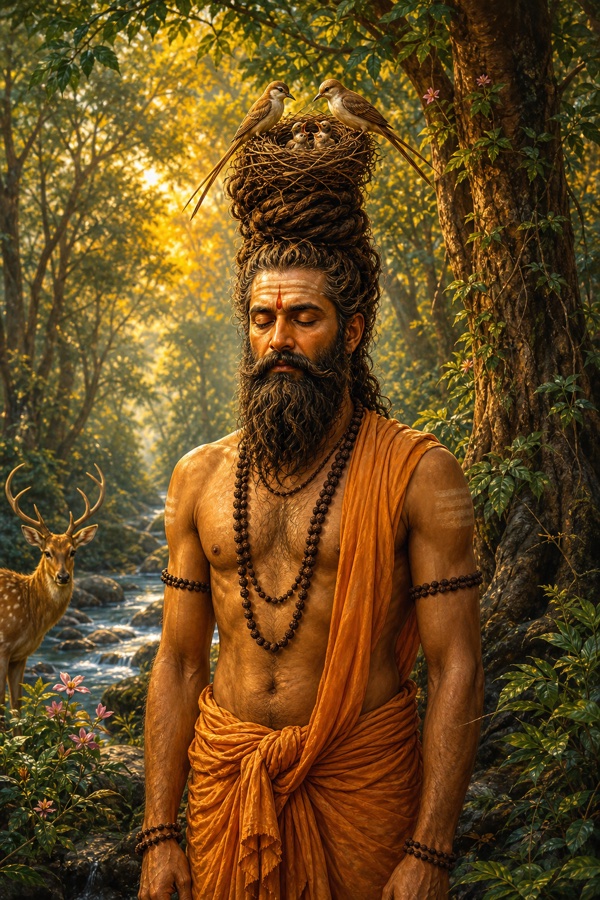
Then Tuladhara pointed upward. “See for yourself, Jajali,” he said, “who has taken up this dharma I have been describing, the good or the others, and then you will understand how the truth stands. Look. There are birds everywhere in the sky, and among them are the ones that were reared on your head, and many hawks, and many of other kinds. Look, Brahmin, they are drawing in their wings and their legs to go into their nests. Call them. Those birds, whom you treated with such affection, are showing their love for you, and you are their father. There is no doubt about it, Jajali. You are their father. Call your children.”
Bhishma said, “Jajali called, and the birds came, and what they said was said according to the dharma that harms no creature. Every act done without injuring any creature serves the one who does it, here and hereafter. Acts that injure others destroy faith, and once faith is destroyed, the destroyer is destroyed with it. The sacrifices of the men who treat gain and loss alike, who have faith, who are self-restrained and calm of mind, and who sacrifice because it is their duty, those are the sacrifices that bear fruit.”
“Faith in Brahman is the daughter of Surya, Brahmin. She is the protectress, and she gives good birth. Faith stands higher than the merit of Vedic recitation and meditation. An act spoiled by a fault of speech is saved by faith, and an act spoiled by a fault of mind is saved by faith, but an act spoiled by want of faith, neither speech nor mind can save.”
“Men who know what happened in the past recite a verse that Brahma himself sang about this. The gods were once weighing the offerings of a man pure in body and act who had no faith against the offerings of an impure man, and the food of a Vedic scholar who was a miser against the food of a moneylender who was generous, and after careful consideration they held the two pairs equal, each as acceptable as the other. Then the Supreme Lord of all creatures told them they had made a mistake. The food of a generous person is made holy by faith, and the food of a person without faith is lost, precisely for that want of faith. The food of a generous moneylender may be accepted; the food of a miser may not. There is exactly one person in the world unfit to make offerings to the gods, the man without faith, and his is the only food unfit to be eaten. That is the opinion of those who know their duties. Want of faith is a great sin, and faith is a cleanser of sins; like a snake sloughing its skin, the man of faith sloughs off everything he has done wrong. The dharma of abstention joined to faith stands above everything held sacred. The man who gives up every fault of conduct and takes refuge in faith is sanctified, and what use has a man like that for penances, or for conduct, or for endurance?”
“Every man has faith. Faith is of three kinds, as sattva, rajas, or tamas colors it, and a man is named for the kind of faith he has. That is how men of goodness, who see into what dharma means, have laid down the subject of duties, and everything I have told you we got, by our own inquiries, from the sage Dharmadarshana. Take refuge in faith, Jajali, and you will obtain what is higher. The man who has faith in what the shruti declares, and acts on it believing it to be good for him, is righteous in his soul; and the man who holds to his own path under the guidance of faith is a superior man.”
Bhishma said, “A little while after this, Tuladhara and Jajali, both men of great wisdom, went up to heaven and enjoyed themselves there, each in the place his own acts had earned him. Tuladhara spoke many truths of this kind; he understood the dharma of harmlessness completely, and it was he who proclaimed those eternal duties. And Jajali, hearing words of such power, came to peace. That is how Tuladhara taught, with examples set beside every truth of weight. What else do you want to hear?”
The gist: Tuladhara makes Jajali call the birds he raised on his own head, and they come, and they answer according to the dharma of harmlessness: acts that injure nothing serve the doer in both worlds, and acts that injure destroy faith and the doer with it. Faith is the daughter of the sun; she saves an act spoiled by a slip of speech or mind, and nothing saves the act of a man who has none. Brahma corrected the gods on this point: a generous moneylender’s food may be eaten and a miserly scholar’s may not. Then the ascetic and the trader both went up to heaven.
King Vichakhnu: Compassion at a Cow-Slaying Sacrifice
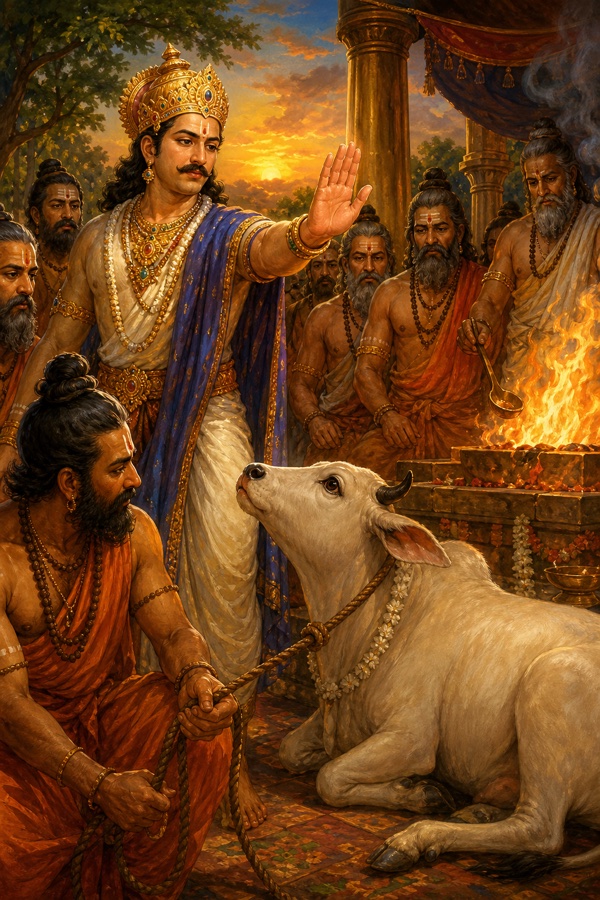
Bhishma had another old story ready, and it was short. “What I am going to tell you,” he said, “is what King Vichakhnu once said out of compassion for every living thing. He was at a sacrifice at which cows were killed. He saw the torn body of a bull, he heard the cows groaning in pain, and he looked at the cruel Brahmins gathered there to help with the rites, and he said, ‘Prosperity to every cow in the world.’ The slaughter had just begun when he said it, and it was a blessing spoken over animals that could not help themselves.”
“The king went on. ‘The only people who speak well of killing animals in sacrifice are the ones who have gone past every limit, who have no intelligence, who deny and doubt, and who want a reputation out of their rites. Manu, whose soul was righteous, praised harmlessness in every act, and men kill animals in sacrifice only out of desire for the fruit. So a man who knows the scriptures should take his guidance from them and follow the true path of duty, which is very subtle. Harmlessness to every creature is the highest duty of all. Living near a settled place, holding himself to hard vows, and paying no attention to the fruits that the Vedic acts promise, a man should give up his household and take up the life of renunciation. It is only the low who are driven by desire for fruit.’”
“‘Wine, fish, honey, meat, spirits, and the dishes made of rice and sesame were brought in by cheats. The Vedas nowhere lay down their use in sacrifice; the craving for them comes from pride, from a mistake of judgment, and from greed. The true Brahmins see Vishnu present in every sacrifice, and it is laid down that he is to be worshiped with sweet payasa, the milk and rice cooked together. The leaves and flowers of the trees the Vedas name, every act that is counted worthy, and everything that people of pure heart and cleansed nature, people foremost in knowledge and holiness, hold to be pure, all of that is fit to be offered to the Supreme Deity, and none of it is beneath his acceptance.’”
Yudhishthira had a practical difficulty with it. “The body and its dangers and calamities are at war with each other without end,” he said. “A man who is wholly free of the wish to harm, and who for that very reason cannot act at all, how is he to keep his body alive?”
Bhishma said, “A man should, whenever he can, earn merit and act in such a way that his body does not waste and suffer, and that death does not come.”
The gist: Watching a bull cut up at a cow-sacrifice, King Vichakhnu blessed every cow in the world and said that only men without limits, intelligence, or belief praise the killing of animals in sacrifice; Manu praised harmlessness, the craving for meat and wine was brought in by cheats, and Vishnu in the sacrifice is to be given sweet payasa, leaves, and flowers. To Yudhishthira’s question of how a man who will harm nothing is to stay alive, Bhishma answers that he should act, as far as he is able, so that his body does not waste and death does not come.
Chirakari: The Son Who Acted Only After Long Thought
Yudhishthira’s next question was about obedience, and about the moment obedience and cruelty pull in opposite directions. “Grandfather,” he said, “you are our highest teacher in the matter of acts that are hard to carry out, when an elder has commanded them on one side and there is cruelty inside them on the other. How should a person judge such an act, whether he is bound to do it or bound to leave it alone? Should he judge quickly, or should he take his time?”
Bhishma said, “On that there is the old story of Chirakari, who was born in the line of Angiras. Twice blessed is the man who thinks long before he acts. A man who thinks long before he acts has great intelligence, and a man like that never goes wrong in anything he does. There was once a very wise man named Chirakari, the son of Gautama, who turned over every consideration touching a thing before he did it. He got the name because he thought long about everything: he stayed awake a long time, he slept a long time, and he took a long time to set his hand to whatever he had to do. So the name of an idler stuck to him, and every light-minded man without foresight took him for a fool.”
“One day Gautama saw some grave fault in his wife, and in his anger he passed over his other sons and gave the order to this Chirakari: ‘Kill this woman.’ He said it without much thought, and then the learned Gautama, that master of Yoga and blessed ascetic, left for the forest. A long while later Chirakari said, ‘So be it,’ and then, being what he was, a man who never did anything without long reflection, he began to think about it, and he thought for a long time. How was he to obey his father and yet not kill his mother? How was he to keep from sinking into sin like a wicked man, caught between two obligations dragging him opposite ways? Obedience to a father’s command is the highest merit; the protection of a mother is a plain duty; and a son’s position is one of dependence. Who could be happy after killing a woman, and that woman his own mother? And who could win prosperity and fame by disregarding his own father? A father’s word has to be respected; a mother has to be protected. How could he arrange his conduct so that both debts were paid? The father, he thought, puts his own self into the mother’s womb and is born again as the son, so that his practices and his conduct and his name and his line will go on. I was begotten as a son by my mother and my father both; I know where I came from; why should I not know what I owe to each of them? The words the father speaks at the rite after a son’s birth, and again at the rite when the son comes home from his teacher, settle the reverence that is owed him and confirm the reverence that is paid.”
“‘Because he brings the son up and teaches him,’ Chirakari thought, ‘the father is the son’s first superior and his highest dharma. The Vedas say plainly that a son must take what his father says as his highest duty. To the father a son is one source of joy; to the son the father is everything. His body and all that he owns have the father alone for their giver, so a father’s commands are to be obeyed without the smallest question, and the very sins of a son who obeys his father are cleansed by the obedience. The father is the giver of food, of instruction in the Vedas, and of all other knowledge about the world; before the son is even born, the father has performed the rites of conception and of the parting of the hair. The father is dharma. The father is heaven. The father is the highest austerity. When the father is pleased, every god is pleased, and whatever words he speaks become blessings that stay with the son, and the words of joy he utters cleanse the son of all his sins. The flower falls from the stalk and the fruit falls from the tree, and the father, whatever his own distress, never lets go of the son. To a son a father is no ordinary thing. Now let me think about the mother. In this joining of the five elements that is my human birth, the mother is the chief cause, as the fire-stick is the cause of fire. She is the cure for every calamity. While the mother lives a man is protected; without her he has no protection at all. The man who has lost everything and comes home saying “Mother” has no cause for grief, and old age does not lay hold of him. A man whose mother is alive, though he has sons and grandsons and has counted a hundred years, looks like a child of two. Able or disabled, thin or strong, the son is always protected by the mother, and by the ordinance no one else is his protector. It is when a man loses his mother that he grows old, that grief takes him, that the world looks empty in his eyes. There is no shade like a mother, no refuge like a mother, no defense like a mother, and no one so dear as a mother. The mother is one’s own body. What man in his right mind would kill his mother, when it is owing to her care alone that his head did not lie by the roadside like a dried gourd?’”
“‘When husband and wife come together to get a child,’ he thought, ‘the wish for the son is in both of them, but its fruit depends more on the mother than on the father. The mother knows the family the son is born into and the father who begot him, and from the moment of conception she loves the child and delights in it; and yet the scriptures declare that the child belongs to the father alone. Men who take a wife’s hand in marriage, and pledge themselves to earn merit with her and never be parted from her, and then go after other men’s wives, stop being worthy of respect. And a woman commits no fault. It is the man alone who commits faults. In an act of adultery it is the man who is stained. The husband, it has been said, is the highest object a wife has and her highest deity, and my mother gave her sacred body to a man who came to her in the form and the dress of her husband, because Indra had come to her looking like Gautama. Women can commit no fault; it is the man who is stained. By the natural weakness of the sex that shows in every act, and by their openness to persuasion, women cannot be counted as offenders. And the sin here is plainly Indra’s own, whose act recalled the request that women made of him in ancient days, when a third part of his sin of killing a Brahmin was laid on their sex. There is no doubt that my mother is innocent. The one I have been told to kill is a woman, and that woman is my mother, and so she stands in a place of even greater reverence.’”
“Thinking in this way, as was his habit, Chirakari let a long time pass without doing the thing his father had ordered. When many days had gone by, Gautama came back. Medhatithi of Gautama’s line, that wise man given to austerity, returned to his hermitage convinced, after all that time of reflection, that the punishment he had ordered for his wife was wrong. He was burning with grief and the tears were pouring down his face, because the calm that comes from knowing the scriptures had brought him to repentance, and he said, ‘Purandara, lord of the three worlds, came to my hermitage in the guise of a Brahmin asking for hospitality. I received him with the proper words and welcomed him with honor. I gave him water for his feet in due form, and the guest-offering, and the rest he asked for. I told him that I had found a protector in him, and I thought that treating him so would make him behave toward me as a friend. When, after all of that, he misbehaved, no fault can be laid on my wife Ahalya. It seems to me that neither my wife, nor I, nor Indra himself, who caught sight of her as he passed through the sky and lost his senses at her beauty, can be said to have offended. The blame lies with the carelessness of my own Yoga power.’”
“‘The sages have said that every calamity springs from envy, and envy from a mistake of judgment, and it is envy that dragged me from where I stood and plunged me into an ocean of sin. I have killed a woman, and the woman was my wife, she who is called Vasita because she shares her husband’s misfortunes, and Bharya because it is my duty to support her. Who is there who can rescue me from this sin? I gave the order to my great-souled Chirakari without thinking. If today he proves true to his name, he can rescue me from this guilt. Twice blessed are you, Chirakaraka! If this once you have delayed the work I gave you, then you truly deserve your name. Rescue me, and your mother, and the austerities I have won, and your own self, from grave sins. Be a Chirakaraka in earnest today. You always take a long time to think before you do anything; do not let your conduct be different this once. Your mother waited a long time for you to come, and carried you in her womb a long time. Let your habit of thinking long before you act bear fruit today. Perhaps my son is delaying because of the sorrow it would cause me to see him do it. Perhaps he is sleeping on the order, carrying it in his heart with no intention of hurrying. Perhaps he is delaying because he is weighing the grief it would bring to both of us.’ And as he went on repenting like this, the great rishi Gautama saw his son Chirakari sitting near him.”
“When he saw that his father had come back, Chirakari, overwhelmed with grief, threw down the weapon he was holding and bowed his head and began to soothe him. Gautama saw his son prostrate before him with his head bent, and he saw his wife almost turned to stone with shame, and he was filled with joy. From that day on the great rishi never again lived apart from his wife or from his careful son in that lonely hermitage. After giving the order for his wife’s death he had gone off from the hermitage on some business of his own, and all that time his son had stood there humbly, with the weapon in his hand, ready to carry it out on his mother. Seeing the boy at his feet, the father took it that he was frightened, and was asking pardon for the offense of having taken up a weapon against his own mother. He praised his son for a long time, and breathed in the scent of his head for a long time, and held him a long time in his arms, and blessed him with the words, ‘Live long!’ And then, full of joy and content with what had happened, Gautama said to him, ‘Blessed are you, Chirakaraka. Always think long before you act. By delaying my order, you have made me happy for the rest of my days.’”
“Then that learned and best of rishis spoke verses on the merit of the cool-headed men who think a long time before they put their hands to anything. ‘If the matter is the death of a friend, do it after a long while. If it is the giving up of something already begun, give it up after a long while. A friendship formed after a long examination lasts a long time. In giving way to anger, to arrogance, to pride, to quarrels, to sinful acts, and in every unpleasant task, the man who delays a long time deserves praise. When the offense is not clearly proved against a relative, a friend, a servant, or a wife, the man who thinks long before he punishes wins praise.’”
“So Gautama was pleased with his son for delaying the thing he had been told to do. In every act a man should think for a long time in this way and only then settle what he will do, and a man who conducts himself so is spared grief for a long time. The man who never nurses his anger for long, and who thinks a long time before he sets himself to any act, never does anything he has to repent of.”
A sub-tale (Indra, Ahalya, and the sharing-out of the curse): Behind this story stands Indra’s affair with Ahalya, which Gautama himself tells at his return: the king of the gods came to the hermitage dressed as a Brahmin guest, was given foot-water and the guest-offering, and then, having caught sight of Ahalya from the sky and lost his senses, took the form and dress of her husband. Chirakari’s reasoning points to an older bargain, the day a third part of the sin of Brahmin-killing that Indra had incurred was laid on womankind, and from that comes his talk of the sex’s natural weakness and its openness to persuasion. Three people weigh the blame in this story and none of them lays it on Ahalya: the son holds the woman blameless and the man at fault, the father takes it onto the carelessness of his own Yoga, and both of them name Indra.
A key to reading this (the names): Chirakari is the one who acts slowly, and Gautama calls him Chirakaraka when he blesses him for it; Gautama is also called Medhatithi here, Medhatithi of Gautama’s line. Purandara is a name of Indra. The story turns on a command given in anger to the one son who could be trusted to take his time over it: in grave and irreversible acts, above all where guilt is not proved, delay and long thought are themselves the dharma.
The gist: Gautama, angry at a fault in his wife, ordered his slow son Chirakari to kill her and walked off to the forest. Chirakari said “so be it” and then thought: the father is dharma, heaven, and austerity, and his word is the highest duty; the mother is the fire-stick of one’s birth, the only shade and refuge, one’s own body; a woman commits no fault in adultery, the man does, and here the man was Indra in Gautama’s shape. Days passed and he did nothing. Gautama came back repenting, took the blame on his own carelessness, and prayed aloud that his son had been slow; he found him sitting with the weapon still unused, threw his arms around him, and blessed his slowness in verses that praise every man who takes his time over anger, punishment, and the giving up of a friend.
The Close of Chirakari’s Tale, and Praise for Those Who Think Long
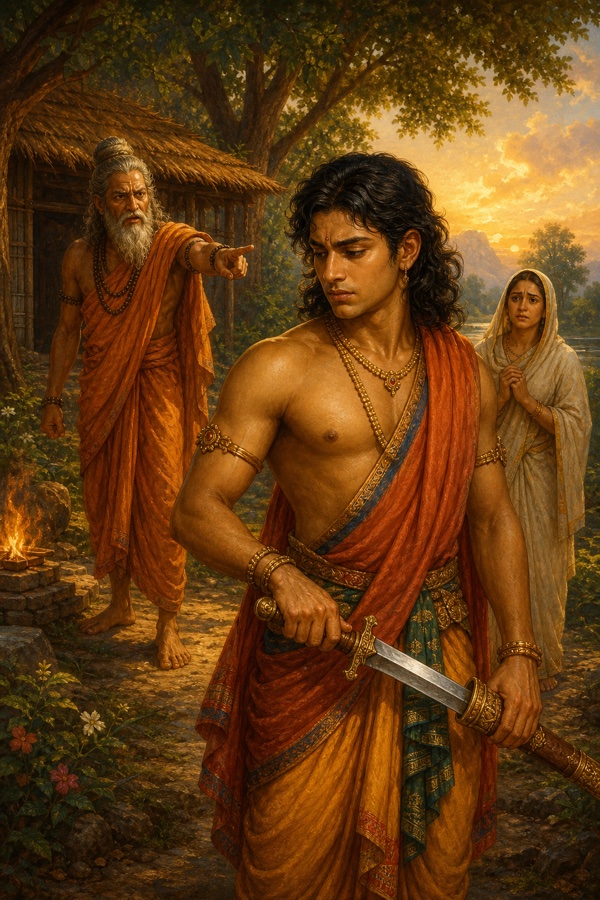
Bhishma, on his bed of arrows, did not hurry past the boy’s thinking, because the thinking was the point of the story. His father had told him to kill his mother, and Chirakari, who weighed every task a long time before he touched it, and who had his name from that habit, kept turning the matter over. A woman, he kept thinking, commits no fault; it is the man who offends, and in adultery the stain falls on the one who did the deed. A husband is a woman’s highest refuge and her highest deity, and his mother had given her sacred body to a man who came in his father’s form and his father’s dress; the woman was blameless, and the fault of Indra, who had done that vile thing, was plain for anyone to see. And he thought of what a husband is called. Because he supports his wife he is called Bhartri, and because he protects her he is called Pati, and when a man stops doing those two things he stops being either. He thought of what a mother is called. Because she carried him in her womb she is his Dhatri; because she was the chief cause of his birth she is his Janani; because she nursed his young limbs into growth she is called Amba; because she bore a child with courage in him she is called Virasu; and because she nurses and watches over the son she is called Sura. The mother, he thought, is one’s own body.
Chirakari thought on. The woman he had been ordered to kill was his mother, and that a mother is not to be killed, even the beasts without reason know. A father must be understood as all the gods together; but to a mother belong all mortal creatures and all the gods together. In this long reflection, as one day slipped into the next, he did not do the killing.
Meanwhile his father, Medhatithi Gautama, came home. That rishi, deep in austerity, had thought for the whole of his absence, and had come to see that the punishment he had ordered for his wife was wrong, and he came back burning with grief and shedding tears. “Purandara, the lord of the three worlds, came to my hermitage in the guise of a Brahmin asking for hospitality,” he said. “I received him with the right words and honored him with a welcome. I gave him water for his feet in due form and the guest-offering, and I gave him the rest he asked for. I told him that I had found a protector in him, and I thought that would make him treat me as a friend. When he misbehaved after all that, my wife Ahalya cannot be held to have done any wrong. Not my wife, not I, and not that Indra who saw her as he crossed the sky and was robbed of his senses by her beauty. The blame belongs to the carelessness of my own Yoga power.”
Reproaching himself, he said that the sages trace every calamity to envy and envy to a mistake of judgment, and that it was envy that had dragged him out of his place and drowned him in an ocean of sin. “I have killed a woman, and that woman my wife, she who is called Vasita because she shares her husband’s troubles and Bharya because it is my duty to support her. Who is there who can pull me out of this sin? It was I who, without thinking, gave my great-souled Chirakari the order. If today he is being true to his name, he can rescue me from this guilt. Twice blessed are you, Chirakaraka! If this once you have put off the work I gave you, then you are worthy of your name. Rescue me, and your mother, and the austerities I have earned, and yourself, from grave sin. Be a Chirakaraka in earnest today. Your great wisdom always makes you take a long time to think before you act; do not let it be otherwise today. Your mother waited a long time for you to come, and carried you a long time in her womb. Let your habit of long thought bear fruit today. Perhaps my son is delaying out of regard for the sorrow it would cause me. Perhaps he is sleeping on the order, holding it in his heart with no intention of carrying it out quickly. Perhaps he is delaying because he has weighed the grief it would bring to both of us.”
And as he repented in this way, Gautama saw his son Chirakari sitting close by. Seeing his father back, the son, overwhelmed with sorrow, threw down the weapon he had taken up and bowed his head to soothe him. Gautama looked at his son bent low in reverence and at his wife nearly turned to stone with shame, and he was filled with joy. After he had given the order for his wife’s death he had gone off from the hermitage on some business of his own, and all that time his son had stood there humbly, weapon in hand, to carry out that order on his mother; seeing the boy at his feet now, the father took it that fear had brought him there, to ask pardon for having lifted a weapon against her at all. From that day the great rishi never again lived apart from his wife or from his careful son in that lonely hermitage.
The father praised his son for a long time, breathed in the scent of his head for a long time, held him for a long time in his arms, and blessed him: “Live long! Blessed are you, Chirakaraka. Always think a long time before you act. By your delay today you have made me happy for good.” Then he spoke verses on the qualities of the cool-headed men who think long before they reach out a hand: “If the matter is the death of a friend, do it after a long while. If it is the abandoning of something already begun, abandon it after a long while. A friendship formed after long examination lasts a long time. In anger, in arrogance, in pride, in quarrels, in sinful acts, and in every disagreeable task, the man who delays a long time deserves praise. When the guilt of a relative, a friend, a servant, or a wife is not clearly proved, the man who thinks long before he punishes wins praise.” So Gautama was gladdened by his son’s slowness. In every act, Bhishma said, a man should think for a long time and only then decide, and he will be spared grief for a long time. The man who never nurses anger long, and never acts without long thought, never does anything he must repent. A man should wait a long time on the aged and sit near them in reverence. He should attend to his duties for a long time and spend a long time finding out what they are. Waiting long on the learned, serving long those whose conduct is good, and keeping his soul a long time under restraint, he enjoys the respect of the world for a long time. And a man who teaches others about dharma and duty, when someone asks him a question about them, should take a long time to think before he answers, so that he never has to repent of an answer whose consequences lead into sin. As for Gautama of the hard austerities, he worshiped the gods in that hermitage for a long time and at last went up to heaven with his son.
A key to reading this (apad-dharma, the dharma of a time of distress): Yudhishthira asked this question as a question about distress: what a person owes when an elder’s command and the cruelty inside it pull opposite ways. Bhishma’s answer refuses to choose between the father and the mother. Chirakari pays both debts by the one thing that was in his power, the pace at which he acted, and Gautama, coming home cured of his anger, finds that the delay has rescued him, his wife, his austerities, and his son at once. In the hard and irreversible decisions, the story says, haste itself is the ruin, and the verses at the end make a rule of it for anger, punishment, the ending of a friendship, and the abandoning of anything begun.
The gist: In anger, in punishment, and in acts that cannot be undone, delay and deep thought are the wisdom. Gautama’s verses praise the man who takes his time over the death of a friend, the giving up of a task, the forming of a friendship, and the punishing of a relative or a wife whose guilt is not proved. The man who never nurses anger long and never acts without long thought has nothing to repent.
The Dialogue of Dyumatsena and Satyavan: How a King Protects Without Harming Anyone
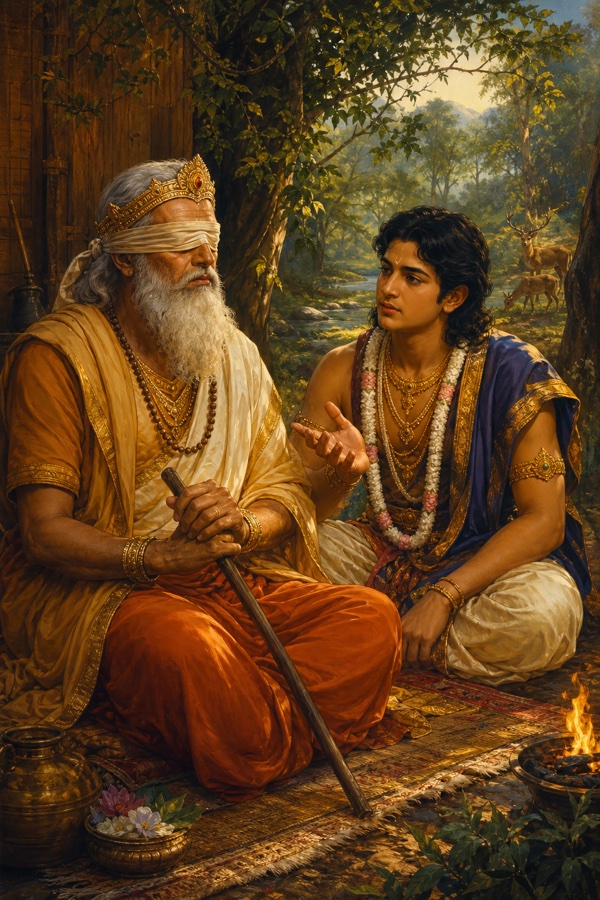
Yudhishthira asked, “Grandfather, how is a king to protect his people without harming anyone? I am asking you this, best of good men. Tell me.”
Bhishma said, “On that there is the old story of the talk between Dyumatsena and King Satyavan. We have heard that certain men had been brought out to be executed at the order of his father, and that Prince Satyavan, looking at them, said something no one had ever said before. ‘Sometimes,’ he said, ‘dharma takes the shape of adharma, and adharma takes the shape of dharma. But it can never be that the killing of men is an act of dharma.’”
Dyumatsena said, “If sparing men who deserve to die is dharma, if robbers are let go, Satyavan, then every distinction between right and wrong disappears. ‘This is mine’ and ‘that is not his’: ideas like those, about property, will not survive in the Kali age if the wicked go unpunished. The affairs of the world will come to a standstill. If you know how the world can go on without the wicked being punished, then explain it to me.”
Satyavan said, “Let the three other orders, the Kshatriyas, the Vaishyas, and the Shudras, be placed under the control of the Brahmins. If those three are held within the bounds of dharma, the mixed classes that have sprung from them will copy their ways. Whoever among them defies the Brahmins’ commands is to be reported to the king: on a Brahmin’s complaint that this man does not heed his word, let the king punish the offender. But without destroying the offender’s body, let him do to him what the scriptures direct, and nothing else; the king should never act without reflecting on the character of the offense and on the science of dharma. By killing a wicked man the king kills a large number of innocent people. Look: kill a single robber, and his wife, his mother, his father, and his children are all killed with him, because they have lost the means of staying alive. So when a king has been wronged by a wicked man, he should think deeply about the punishment.”
Satyavan went on. “Sometimes a wicked man takes on good conduct from a righteous one, and from wicked parents good children are sometimes seen to come. So the wicked should never be torn up by the roots; wiping them out is against the eternal practice. Struck gently, they can be made to atone for their offenses: by the loss of all their wealth, by chains and dungeons, by a mark on the body. Their relatives should not be made to suffer by death sentences on them. And if, in the presence of the priest and the others, they give themselves up and ask for protection and swear, ‘Brahmin, we will never again do a sinful act,’ then they deserve to be released without punishment. That is the command of the Creator himself. Even a Brahmin who wears the deerskin and carries the mendicant’s staff and has shaved his head should be punished when he goes wrong. When great men offend, their punishment should be in proportion to their greatness. And men who offend again and again do not deserve to be sent away unpunished as they were the first time.”
Dyumatsena said, “As long as the fences within which men are to be kept stand unbroken, they go by the name of dharma. If the men who break those fences were not punished with death, the fences would soon be gone. The men of the far past were easy to govern. They were truthful in speech and in conduct, they had little taste for disputes and quarrels, and they seldom gave way to anger, and when they did, their anger never got out of hand. In those days it was punishment enough to cry ‘shame’ at an offender. After that came the punishment of harsh words and censure. Then came fines and confiscation. And in this age the punishment of death has come into use, because wickedness has grown to the point where killing one man does not keep the others in check. A robber has no bond with men, with the gods, with the gandharvas, or with the ancestors. What is he to anyone? He is nobody to anybody; that is what the shruti says. He strips the ornaments off corpses in the cremation grounds and the clothes off men who have been possessed by spirits and do not know it. A man is a fool who makes any agreement with wretches like that, or takes an oath from them and relies on it.”
Satyavan said, “If you cannot turn those rogues into honest men and save them by means that have nothing to do with slaughter, then put an end to them by performing a sacrifice. Kings practice hard austerities so that their subjects may prosper in their callings, and when thieves and robbers multiply in their kingdoms they are ashamed, and so they take up penances to put down the theft and robbery and make their subjects live in peace. Subjects can be made honest simply by being made afraid of the king. Good kings never kill the wicked out of a wish for retribution; if they kill, they kill in sacrifice, and then the motive is the good of the one killed. Good kings succeed in ruling their subjects by good conduct. If the king acts properly, the higher subjects copy him, and the lower copy those directly above them, because men are so made that they imitate the people they take for their superiors.”
He said that a king who tries to restrain other men without restraining himself becomes a laughingstock to everyone, since he is the slave of his own senses and lives in the enjoyment of every worldly pleasure. A man who offends against the king through arrogance or a mistake of judgment should be restrained by every means, since that is how he is kept from offending again; but the king who wants to restrain offenders should first restrain himself, and he should punish heavily, when it is necessary, even friends and close relatives, because in a kingdom where a vile offender meets no heavy affliction, offenses increase and dharma shrinks, there is no doubt of it. “A learned Brahmin of a merciful temper taught me this long ago,” Satyavan said, “and I was taught the same, father, by our grandsire of the old days, who out of pity gave the people his assurance of harmlessness. This is what they said: ‘In the Krita age kings should rule their subjects by ways that do no harm at all. In the Treta age kings conduct themselves by ways that fit a dharma fallen by a fourth from its full measure. In the Dvapara they go by ways that fit a dharma fallen by half, and in the age that follows, by ways that fit a dharma fallen by three-fourths. And when the Kali age has fully set in, through the wickedness of kings and the nature of the epoch itself, fifteen parts of even that last fourth of dharma disappear, and a sixteenth part of it is all that remains.’”
“‘If, Satyavan, disorder sets in when the first method is followed, the method of harmlessness, then the king should award punishments with an eye to the length of human life, the strength of human beings, and the nature of the time that has come. Manu, the son of the Self-born, out of compassion for human beings, has shown the way by which men may hold to knowledge, and turn from harm, for the sake of liberation.’”
A key to reading this (the decline of dharma across the yugas, in figures): Satyavan gives the figures as his forefathers gave them to him. In the Krita age dharma stands at its full measure and a king may rule by wholly harmless means; in the Treta it has lost a fourth; in the Dvapara, half; in the age after that, three-fourths; and when the Kali age has fully set in, fifteen parts of even that remaining fourth are gone and a sixteenth of the fourth is all that is left. The source states this in fractions and says nothing of a four-legged bull. It is Dyumatsena, on the other side of the argument, who gives the matching history of punishment: a cry of shame was enough in the earliest days, then harsh words, then fines, and in this age death.
The gist: Satyavan, watching men led out to die at his father’s order, argues that a king’s dharma is to reform: kill one robber and you kill his wife, parents, and children with him, so strike gently, fine, chain, mark, and release the man who swears before the priest never to sin again. Dyumatsena answers that the fences of dharma fall if their breakers are not put to death, and that a robber is nobody to anyone. Satyavan concedes the hard cases: kill, if you must, in sacrifice and for the good of the killed; punish even friends and kin; restrain yourself before restraining others; and let punishment fit the age, the strength of men, and the gravity of the crime.
Kapila and Syumarasmi: The Path of Action and the Path of Knowledge, and the Question of Killing Animals in Sacrifice
Yudhishthira asked, “Grandfather, you have already explained to me how the dharma of Yoga, which leads to the six well-known powers, can be taken up and practiced without harming any creature. Now tell me about the dharma that leads to both results, enjoyment and moksha. Of these two, the duties of the householder and the duties of Yoga, both of which lead to the same end, which is the higher?”
Bhishma said, “Both courses are highly blessed. Both are very hard to carry through. Both bear high fruit, and both are followed by men everyone acknowledges to be good. I will tell you now about the authority of each, so that your doubt about their true meaning is cleared, and you must listen with your whole attention. What is told on this is the old story of the talk between Kapila and the cow.”
“We have heard that long ago, when the god Tvashtri came to the house of King Nahusha, the king, to do the duty a host owes his guest, was about to kill a cow, in obedience to the true and ancient and eternal injunction of the Vedas. Kapila saw the cow tied for the slaughter. He was a man of large soul, always keeping to the duties of sattva, always at work restraining his senses, a man of true knowledge and sparing diet, whose understanding was marked by faith, fearless, kindly, firm, and fixed on truth, and he said one thing, once: ‘Alas, you Vedas!’ At that moment a rishi named Syumarasmi entered the body of that cow by the power of Yoga and spoke to the yati Kapila out of it. ‘Hush, Kapila,’ he said. ‘If the Vedas are to be blamed for the declarations in them that sanction the killing of living creatures, then where did those other duties, the ones of complete harmlessness toward every creature, get their authority from? Men given to austerity, men of intelligence, who have the shruti and knowledge for their eyes, hold the injunctions of the Vedas, which the rishis declared and compiled, to be the words of God himself. What can anyone say, in censure or in praise, about the contents of the Vedas, when they are the words of the Supreme Being, who wants no fruit, who has no fever of envy or aversion in him, who is attached to nothing, and who makes no effort, since every wish of his is fulfilled the moment it is formed?’”
Kapila said, “I do not censure the Vedas, and I have no wish to say anything against them. We have heard that the different courses of duty laid down for the different modes of life all lead to the same end. The sannyasi reaches a high end, and so does the forest hermit, and the other two, the householder and the celibate student, reach the same end. All four modes of life have always been counted ways of the gods, and their relative strength and weakness, their higher and lower standing, has been declared in the character of their ends. Now, ‘knowing these, do the acts that lead to heaven and the other blessings’ is a declaration of the Vedas. ‘Do no acts’ is another declaration of the Vedas, and a binding one. If abstaining from acts carries merit, then doing them must be highly blameworthy. When the scriptures stand like that, the strength or weakness of any particular declaration is very hard to make out. If you know of any course of duty that is higher than the dharma of harmlessness, and that rests on direct evidence in place of the evidence of scripture, then tell me about it.”
Syumarasmi answered him out of the cow. “ ‘One should sacrifice out of desire for heaven.’ We hear that shruti constantly. A man thinks first of the fruit to be had, and then he makes ready for the sacrifice. The goat, the horse, the cow, every species of bird, tame or wild, and the herbs and plants are the food of other living creatures; that too we have heard, and we are told to take food day after day, morning and evening. The shruti says that animals and grain are limbs of the sacrifice. The Lord of the universe created them together with the sacrifice, and the mighty Lord of all creatures made the gods themselves perform sacrifices with their help. Seven domestic animals and seven wild ones are named as fit for sacrifice, and each one after the first is lower than the one before it. The Vedas declare that the whole universe was appointed for sacrifice, and that even the one who is called Purusha was appointed for the same purpose, and men of the remotest times sanctioned it. What learned man does not choose, according to his means, creatures from among the living for sacrifice? The lower animals, human beings, trees, and herbs all wish to reach heaven, and there is no means except sacrifice by which that wish can be fulfilled.”
Syumarasmi then counted the limbs of the sacrifice. The herbs that die back, the animals, the trees and creepers, ghee, milk, curds, meat, and the other approved things that are poured on the fire; the ground, the points of the compass, faith, and time, which bring the count to twelve; the Rik, the Yajus, the Saman, and the sacrificer himself, bringing it to sixteen; and the fire, which is to be known as the householder: these seventeen, he said, are the limbs of sacrifice, and sacrifice, the shruti declares, is the root of the world and of its course. With her ghee, her milk, her curds, her dung, her curds mixed with milk, her hide, the hair of her tail, her horns, and her hoofs, the cow alone can furnish everything a sacrifice needs. The particular things laid down for particular sacrifices, together with the officiating priests and the gifts to them and to the other Brahmins, sustain the sacrifices, and by collecting all of this people accomplish them. That shruti, which agrees with the truth, says that all things were created for the performance of sacrifice, and that is how every man of ancient times set himself to it. And the man who sacrifices because he is convinced that sacrifice ought to be performed, with no thought of fruit or reward, injures no creature, bears no hostility to anything, and sets his hand to no worldly task at all. The limbs that have been named, and the other things the ordinances require, hold one another up when they are used according to the approved ritual. “I see the smritis too,” he said, “which the rishis compiled and into which the Vedas have been brought, and learned men hold them authoritative because they follow the Brahmins. The sacrifices have the Brahmins for their parent and rest on them; the whole universe rests on sacrifice, and sacrifice rests on the universe. The syllable Om is the root from which the Vedas sprang, so let every rite begin with it. The man for whom the syllables Om, Namas, Svaha, Svadha, and Vashat have been uttered, and who has performed sacrifices and the other rites to the extent of his means, has no fear for his next life anywhere in the three worlds. So say the Vedas, and the sages crowned with success, and the foremost of the rishis. The man in whom the Rik, the Yajus, the Saman, and the sounds that fill out the rhythm of the Saman by the rules of the Vedic grammars all live, he is a Brahmin. You know, adorable Brahmin, what the fruits are of the Agnihotra, of the Soma sacrifice, and of the other great sacrifices, and so I say that a man should sacrifice, and help at the sacrifices of others, without scruple of any kind. The man who performs the sacrifices that lead to heaven, the Jyotishtoma and the rest, wins high rewards hereafter, in the form of heavenly bliss. This much is certain: the men who do not sacrifice have neither this world nor the next. And the men who really understand the declarations of the Vedas hold both kinds of declaration, the ones that call for acts and the ones that preach abstention, to be equally authoritative.”
A sub-tale: The rishi who argues out of the cow’s body is arguing for the cow’s death, and he says so himself later in the exchange: he is Syumarasmi, he has come for knowledge and for his own good, he has no taste for dispute, and a dark doubt has taken hold of his mind. Kapila, for his part, never takes back his one cry against the Vedas, and never adds to it. What follows is a weighing of the path of ritual action against the path of knowledge in which each man grants the other’s ground: Kapila bows to the Vedas and the daily rites, and Syumarasmi ends by sitting at Kapila’s feet.
Kapila went on. “Seeing that every fruit that can be reached by acts comes to an end and is not eternal, the yatis take up self-restraint and tranquility and reach Brahman by the path of knowledge. There is nothing in any of the worlds that can stand in their way, since by a simple act of will they bring every wish to success. They are free of every pair of opposites. They bow their heads to nothing and to no one. They are above every bond of want. Wisdom is theirs. They are cleansed of every sin, and pure and spotless they live and go where they please, in great happiness. In their own understanding they have settled the question between perishable things and a life of renunciation by weighing the two against each other. Devoted to Brahman, already grown like Brahman, they have taken their refuge in Brahman; they have gone past grief and are free of rajas, and what they have won is eternal. When that high end is within a man’s reach, what need has he of the duties of the household?”
Syumarasmi answered that if that was indeed the highest thing to be won, if that was truly the highest end, then the importance of the household became obvious, because without the household no other mode of life is possible at all. Every living creature lives by depending on its mother, and in the same way the three other modes of life exist by depending on the householder’s. It is the householder who performs the sacrifices and practices the austerities; whatever anyone does from a desire for happiness has the household for its root. Every creature counts the getting of children as a great happiness, and children cannot be had in any other mode of life. Every kind of grass and straw, all the plants and herbs that bear grain, and the others of their kind that grow on the hills and mountains, have the household for their root, and on those the lives of all creatures depend; and since nothing in the universe can be seen except life, the household may be looked on as the refuge of the entire universe. “Who, then, is speaking the truth,” he said, “when he says that the household cannot lead to moksha? It is only men without faith or wisdom or discernment, men without reputation, the idle and the worn out with toil, men whose past acts have given them misery for their portion, men without learning, who see the fullness of peace in a beggar’s life. The eternal and certain distinctions laid down in the Vedas are what sustain the three worlds, and the man of the highest order who knows the Vedas is worshiped from the day he is born.”
Syumarasmi said that beyond the rite of conception, Vedic mantras are needed for a twice-born man to accomplish every act of his, for this world and the next. In the burning of his body after death, in his gaining of a second body, in his food and drink after he has gained it, in the giving away of cows and other animals to help him across the river that divides the region of the living from the region of Yama, and in the sinking of the funeral cakes in water, Vedic mantras are needed. The three classes of the ancestors, the Archishmats, the Barhishads, and the Kravyads, approve the need of mantras for the dead, and mantras are allowed to be the efficient causes of everything those rites are performed for. “When the Vedas say this so loudly,” he said, “and when human beings are said to owe debts to the ancestors, the rishis, and the gods, how can anyone reach moksha? This false doctrine of a bodiless existence called moksha, dressed in the colors of truth and cutting against the real meaning of the Vedas, was brought in by learned men who had lost their prosperity and were eaten up with idleness. The Brahmin who sacrifices as the Vedas declare is never led into sin. Through his sacrifices he reaches the high regions of felicity along with the animals he killed in them, and, satisfied himself by the fulfillment of all his wishes, he satisfies those animals by fulfilling theirs. By disregarding the Vedas, by trickery, or by deception, no one ever reaches the Supreme; it is by practicing the rites the Vedas lay down that a man reaches Brahman.”
Kapila answered, “If acts are obligatory, then for the man of intelligence there are the Darsha, the Paurnamasa, the Agnihotra, the Chaturmasya, and the other acts, and in performing them there is eternal merit. Why, then, acts of cruelty? The men who have taken up the sannyasa mode of life, who abstain from all acts, who are patient, who are cleansed of anger and every fault, and who know Brahman, pay off by that knowledge of Brahman the debts you speak of, to the gods and the rishis and the ancestors who are said to be so fond of the libations poured in sacrifice. The very gods lose the track of that trackless man who makes himself the soul of all creatures and looks on every creature with an equal eye. From the teacher’s instruction a man learns that what lives inside this frame is fourfold, with four doors and four mouths; because of the two arms, the organ of speech, the stomach, and the organ of pleasure, even the gods are said to have four doors, and a man should do his utmost to keep those four doors under control.” Then Kapila said how. “A man should not gamble with dice. He should not take what belongs to another. He should not help at the sacrifice of a man of low birth, and he should not, giving way to anger, strike anyone with his hands or his feet: the intelligent man who conducts himself so is said to have his hands and feet well controlled. He should not shout abuse or censure. He should not speak empty words. He should keep away from knavery and from slander, hold to the vow of truthfulness, be sparing of speech, and stay always heedful: conducting himself so, he has his organ of speech well restrained. He should not go entirely without food, and he should not eat too much; he should give up covetousness and always seek the company of the good, and eat only as much as keeps him alive: conducting himself so, he has the door of the stomach under control. He should not, when he has a wedded wife with whom to perform all his religious acts, take another woman out of lust. He should never call a woman to his bed except in her season, and he should confine himself to his own wife and go after no other: conducting himself so, he is said to have the organ of pleasure under control.”
Kapila said, “The wise man who has all four doors properly controlled, the organ of pleasure, the stomach, the two arms, and the organ of speech, is a twice-born man in truth. For the man whose doors are not controlled, everything goes to waste: what can his austerity do, what can his sacrifices bring about, what can his body achieve?” Then he gave the marks by which the gods know a Brahmin. The gods know him for a Brahmin who has thrown off his upper garment, who sleeps on the bare ground, who makes his arm his pillow, and whose heart is at peace. The man who, given to contemplation, enjoys alone all the happiness that wedded couples enjoy, and pays no attention to the joys and sorrows of others, is to be known for a Brahmin. The man who rightly understands all this as it really exists, with its many transformations, and who knows what the end is of all created things, the gods know for a Brahmin. The man who has no fear of any creature and of whom no creature is afraid, and who makes himself the soul of all creatures, is to be known for a Brahmin. “Without purity of heart,” Kapila said, “which is the true result of all pious acts such as gifts and sacrifices, men of foolish understanding never come to know what makes a man a Brahmin, even when their teachers explain it; lacking that knowledge, they want fruit of another kind, heaven and its joys. Unable to practice even a small part of that good conduct which has come down from the remotest times, which is eternal, which is marked by certainty, which runs like a thread through all our duties, and by which men of knowledge in every mode of life turn their duties and austerities into terrible weapons against ignorance and the evils of worldliness, these foolish men look on the acts that bear visible fruit, that carry the highest power, and that are deathless, as fruitless after all, as deviations the scriptures never sanctioned. The truth is that this conduct, which is the very opposite of what is done in seasons of distress, is the essence of heedfulness itself, and lust and anger and the other passions of that kind never touch it. As for sacrifices, it is very hard to find out all their particulars; if you find them out, it is very hard to observe them in practice; and if you practice them, the fruits they lead to come to an end. Mark that well, and take the path of knowledge.”
Syumarasmi asked how the Vedas could be the authority when they support acts and oppose them at once, since the renunciation of acts, which brings great benefit, is set out in the Vedas along with the acts themselves, and he asked Kapila to explain it. Kapila answered, “Take up the path of the good, which is Yoga, and you will realize its fruits in this very life, by the direct evidence of your own senses. Where are the visible results of those other objects that you men of acts pursue?” Syumarasmi said, “Brahmin, my name is Syumarasmi. I have come here to gain knowledge. I began this conversation with an open heart, for my own good and with no wish for argument, and a dark doubt has taken possession of my mind. Illustrious one, resolve it for me. You have said that the men who take the path of the good, by which Brahman is reached, realize its fruits by the direct evidence of their senses. What is this thing that can be realized by the direct evidence of the senses and that you yourselves pursue? I have avoided every science whose main object is dispute, and I have studied the Agama until I mastered its true meaning; by Agama I mean the declarations of the Vedas, and with them the sciences of reasoning whose object is to bring out the Vedas’ real sense. Without shirking the duties of his own mode of life, a man should follow the practices the Agama lays down, and following them crowns him with success; and because the conclusions of the Agama are certain, the success it leads to may almost be called a thing of direct evidence. A boat tied to another boat that is bound for a different port cannot carry its passengers where they want to go, and we, dragged along by acts that come out of past desires, can never cross the endless river of birth and death. Speak to me on this, illustrious one. Teach me as a teacher teaches a pupil. No one can be found among men who has completely renounced all worldly objects, or who is perfectly content in himself, or who has gone beyond grief, or who is perfectly free of disease, or wholly free of the wish to act for his own benefit, or who has an absolute distaste for company, or who has entirely given up acts of every kind. Even men like yourself are seen to give way to joy and to grieve, as people like us do. Your senses have their functions and their objects like those of every other creature. Tell me, then, if we are to look into the question of happiness, what does pure felicity consist of, for all four orders of men and all four modes of life, whose inclinations rest on the same ground?”
Kapila answered that whatever the shastra according to which a man does the acts he is inclined to do, the ordinances it lays down for regulating those acts never become fruitless; and whatever the school of opinion by which a man conducts himself, he reaches the highest end only by keeping the duties of self-restraint that belong to Yoga. Knowledge helps the man who pursues knowledge across the endless river, and the conduct men pursue after leaving the path of knowledge afflicts them with the evils of life and death. “It is clear,” he said, “that you men possess knowledge and have parted from every worldly thing that can produce distress. But has any one of you ever gained the knowledge by which everything can be seen as one with a single Universal Soul? There are men who, without a correct grasp of the scriptures, and loving nothing except dispute, are so overwhelmed by desire and aversion that they become slaves of pride and arrogance; without ever understanding what the scriptures actually say, these robbers of the scriptures, these plunderers of Brahman, driven by arrogance and error, refuse to seek tranquility or practice self-restraint. They see fruitlessness on every side, and if by chance they gain the power of knowledge, they never pass it on to rescue anyone else. They are made entirely of tamas, and tamas is their only refuge. A man takes on every quality of the nature he absorbs, and so in the man whose refuge is tamas, envy, lust, anger, pride, falsehood, and vanity go on growing, since a man’s qualities have his nature for their spring. Thinking in this way, and seeing these faults with the help of the instruction they have had from their teachers, the yatis who want the highest end take up Yoga and leave both good and ill behind.”
Syumarasmi said, “Everything I have said about the praiseworthy character of acts and the opposite character of renunciation agrees with the scriptures, Brahmin. And yet it is quite true that without a correct grasp of what the scriptures mean, a man does not feel inclined to obey what they really declare. Whatever conduct agrees with evenness of mind agrees with the scriptures, and that is what the shruti says; whatever conduct is against evenness of mind is against the scriptures, and the shruti says that too. No one can do a scriptural act by transgressing the scriptures, and what goes against the Vedas is unscriptural; the shruti declares it. Many men who believe only what their senses show them see only this world, and never what the scriptures address to faith; they do not see what the scriptures declare to be faults, and so, like us, they have to grieve. The objects of the senses that men like you deal with are the same ones every other creature deals with, and yet, because you know the soul and they do not, how vast the difference between you and them! All four orders of men and all four modes of life, however different their duties, seek the same single end. You have talents no one questions, and by speaking to me of the Infinite you have filled my soul with peace as to which of all these courses of conduct is the one fit to reach that end. As for us, because we cannot understand the Soul we have no correct grasp of reality; our wisdom is taken up with low things, and we are wrapped in thick darkness. Only the man who is devoted to Yoga, who has discharged every duty, who can go anywhere depending on nothing except his own body, who has brought his soul under perfect control, who has gone beyond the requirements of the science of dharma and pays no regard to the whole world and everything in it, can set aside what the Vedas declare about acts and say that there is moksha. For a man who lives among his relatives, that course of conduct is exceedingly hard to follow. Gifts, study of the Vedas, sacrifices, the begetting of children, plain dealing: if no one reaches moksha by practicing even these, then shame on the man who seeks it, and on the moksha he seeks! All the labor spent on it looks fruitless. A man becomes chargeable with atheism if he disregards the Vedas by leaving undone the acts they direct. Illustrious one, I want to hear at once about the moksha that comes in the Vedas after their declarations in favor of acts. Tell me the truth, Brahmin. I sit at your feet as a pupil. Teach me, and be kind. I want to know as much about moksha as you know yourself.”
A key to reading this (the deva-yana, and the four gates): Kapila calls all four modes of life, the student’s, the householder’s, the forest hermit’s, and the sannyasi’s, ways of the deva-yana, the road that leads toward the gods, and says their ranking shows in where each one ends. The four gates he speaks of are the body’s four groups of action-organs through which sin gets in: the arms and feet, which gamble, steal, and strike; the speech, which abuses and lies; the stomach, which starves or gorges; and the organ of generation, which wanders. A man who keeps all four shut is the twice-born man in truth, and a man who keeps none of them shut wastes his austerities and his sacrifices alike.
The gist: Kapila does not condemn the path of action. He bows to the Vedas and names the daily and seasonal rites that carry eternal merit, and he asks only why cruelty should be added to them, since every fruit that acts can win comes to an end and knowledge alone does not. Syumarasmi defends the household as the mother of the other three modes, the root of every grain and every child, and the place where the debts to gods, rishis, and ancestors are paid. Both point at one goal, and Syumarasmi, his soul quieted, asks to be taught the moksha that the Vedas speak of after their call to acts.
Kapila’s Final Answer: The Word-Brahman and the Supreme Brahman, and Purity of Heart as the True Fruit
Kapila said, “Everyone holds the Vedas to be the authority, and no one disregards them. Brahman is of two kinds: Brahman as it is represented by sound, and Brahman as the Supreme, beyond all touch. The man who knows the Brahman of sound reaches the Supreme Brahman. Beginning with the rite of conception, the body that the father makes with the help of Vedic mantras is cleansed, after birth, by Vedic mantras. When the body has been cleansed by the purifying rites, its owner comes to be called a Brahmin and becomes a vessel fit to hold the knowledge of Brahman. Know that the reward of acts is purity of heart, and that purity of heart alone leads to moksha. I will tell you about that now. Whether purity of heart has been reached by the performance of acts is a thing that only the man who has reached it can know. It can never be known by the Vedas, and it can never be known by inference.”
Kapila described the people of the old days. Men who expected nothing, who threw off wealth of every kind by laying nothing up for the future, who were not greedy, and who were free of every attachment and every aversion, performed their sacrifices out of the conviction that performing them was a duty. Giving to those who deserve it was the right use of all wealth. Never given to sinful acts, faithful to the rites the Vedas laid down, able to bring every wish of theirs to fruit, sure in their conclusions through pure knowledge, never giving way to anger, never to envy, free of pride and malice, firm in Yoga, of unstained birth and unstained conduct and unstained learning, and devoted to the good of every creature: there were many such men in the old days living the life of the household and wholly given to their own duties, and many kings of the same qualities who were devoted to Yoga, and many Brahmins of the same character. They behaved alike to every creature and were perfectly sincere. Contentment was theirs, and certainty of knowledge; the rewards of their righteousness could be seen, and they were pure in behavior and pure in heart, with faith in Brahman of both kinds. They made their hearts pure first, and then they kept every high vow. They held to the duties of dharma even in distress and difficulty, without falling short in anything. Joined together, they did meritorious acts and found great happiness in them, and since they never stumbled, they never had an expiation to make. Relying on the true course of dharma, they came to have energy nothing could resist. In the matter of earning merit they never followed their own understanding; they followed the scriptures alone, and so they were never guilty of any guile in their acts of dharma. Because they kept, all together, to the absolute ordinances of the scriptures and never fell back on the rites laid down as alternatives, they never had to atone for anything, and there is no expiation for men who live by the ordinances; the shruti says that expiation exists only for the weak, who cannot follow the absolute and substantive provisions of the sacred law.
Kapila said that there were many Brahmins of this kind in the old days, given to sacrifice, deep in the Vedas, pure in conduct and famous, who worshiped Brahman in their sacrifices and were free of desire, and whose learning carried them past every bond of life. Their sacrifices, their knowledge of the Vedas, their acts done in obedience to the ordinances, their study of the scriptures at the fixed hours, and the wishes they held, free as they were of lust and anger, faithful to pious conduct through every difficulty, renowned for the duties of their own order and mode, purified in soul by their very nature, wholly sincere, devoted to tranquility, and mindful of their own practices, all of it was one with the Infinite Brahman; that, he said, is the eternal shruti we have heard. The austerities of men so large in soul, whose conduct was so hard to follow and whose wishes were fulfilled by the strict discharge of their duties, became weapons for the destruction of every earthly desire. The Brahmins say that this Good Conduct, which is a wonder, whose origin lies in the remotest time, which is eternal and whose marks never change, which differs from what even the good resort to in distress, which is heedfulness itself, over which lust and anger and the other evil passions never prevail, and under which there was once no transgression anywhere among mankind, was afterward divided into four parts, matching the four modes of life, by people unable to practice it whole and in every detail. The good who keep that conduct after taking up sannyasa reach the highest end; those who keep it in the forest mode reach the same high end; those who keep it in the household reach it; and those who keep it as celibate students reach it too. Those Brahmins can be seen shining in the sky, luminaries pouring kindly light on every side; myriads of them have become the stars and constellations set in their fixed tracks, and through contentment, which is renunciation, they have all reached the Infinite, as the Vedas declare. And if such men have to come back into the world through the wombs of living creatures, they are never stained by the sins that have the unexhausted residue of earlier acts for their cause. “The man who has lived as a celibate student and waited dutifully on his teacher,” Kapila said, “who has come to settled conclusions about the soul, and who has given himself to Yoga in this way, is a Brahmin in truth, and who else would deserve the name? When acts alone decide who is a Brahmin and who is not, then acts, good or bad, must be held to show a man’s happiness or misery. Of those who have conquered every evil passion and won purity of heart we have heard the eternal shruti, that through the Infinity they reach by seeing the universal soul, and the knowledge of Brahman they gain from the declarations of the shruti, they see everything as Brahman. The duties of tranquility, self-restraint, abstention from acts, renunciation, devotion, and the absorption of samadhi, which those pure-hearted men freed of desire follow with moksha as their only object, for the sake of the knowledge of Brahman, are laid down equally for all four orders of men and all four modes of life, and that knowledge is always won by Brahmins of pure heart and restrained soul. The man whose soul is set on a renunciation grounded in contentment is the refuge of true knowledge. Renunciation, in which lies the knowledge that leads to moksha, and which a Brahmin needs above everything, is eternal, and it comes down from teacher to pupil forever. Sometimes it exists mixed with the duties of the other modes, and whether it exists in that state or by itself, a man practices it according to the measure of his strength, which depends on how far he is free of worldly desires. Renunciation is the cause of the highest benefit to every kind of person. Only the weak man fails to practice it. The pure-hearted man who seeks to reach Brahman is rescued from the world and its misery.”
Syumarasmi asked, “Among the men given to enjoyment, the ones who make gifts, the ones who perform sacrifices, the ones who devote themselves to the study of the Vedas, and the ones who take to renunciation after they have acquired wealth and enjoyed all its pleasures, which of them, when they leave this world, reaches the foremost place in heaven? I ask you this, Brahmin. Tell me truly.” Kapila said, “Those who live the life of the household are certainly blessed, and they win excellence of every kind. They are unable, though, to enjoy the felicity that belongs to renunciation. You can see that much yourself.” Syumarasmi said, “You rely on knowledge as the means; the householders have planted their faith in acts. But it has been said that the end of every mode of life is moksha. Then no difference can be seen between them as to the superiority or inferiority of their power. Illustrious one, tell me how the matter truly stands.” Kapila said, “Acts only cleanse the body. Knowledge is the highest end, the thing a man strives for. When acts have cured all the faults of the heart, and the felicity of Brahman has been established in knowledge, then benevolence, forgiveness, tranquility, compassion, truthfulness, candor, abstention from injury, absence of pride, modesty, renunciation, and abstention from work are attained. These are the path that leads to Brahman, and by these a man reaches what is highest. That the cure of every fault of the heart is the result of acts becomes clear to the wise man when these are attained. That, indeed, is regarded as the highest end, and it is reached by Brahmins of wisdom who have withdrawn from all acts and who possess purity and the certainty of knowledge.”
Kapila gave the mark of the man who knows the Vedas. The man who has gained a knowledge of the Vedas, of what the Vedas teach, which is Brahman as it is represented in acts, and of the minute particulars of acts, is said to know the Vedas, and any other man is only a bag of wind. The man who knows the Vedas knows everything, because everything is established on the Vedas; the present, the past, and the future all exist in them. One conclusion can be drawn from all the scriptures, that this universe exists and does not exist; to the man of knowledge all that is perceived is both sat and asat, and to him it is both the end and the middle. And this truth rests on all the Vedas, that when renunciation is complete a man obtains what is enough, and then the highest contentment follows and rests on moksha, which is absolute, which exists as the soul of all mortal and immortal things, which is known as that universal soul, which is the highest object of knowledge because it is one with everything that moves and everything that stands still, which is full, which is perfect felicity, which is without duality, which is the foremost of all things, which is Brahman, which is the unmanifest and also the cause from which the unmanifest sprang, and which never decays. “The power to subdue the senses, forgiveness, and abstention from work through the absence of desire, these three are the cause of perfect felicity,” he said. “With the help of these three qualities, men who have understanding for their eyes reach that Brahman which is uncreated, which is the first cause of the universe, which is unchangeable, and which is beyond destruction. I bow to that Brahman, which is one with the man who knows it.”
A key to reading this (the Word-Brahman and the Supreme Brahman): Kapila says Brahman is of two kinds, Brahman as it is represented by sound, in the Veda and the mantras that shape a Brahmin’s body from the rite of conception onward, and Brahman as the Supreme, beyond the reach of the senses, and that the man who knows the first reaches the second. His test for whether the rites have done their work is severe: purity of heart is their reward, and only the man who has it can know that he has it, since neither the Vedas nor inference can tell him. The sentence that this universe both exists and does not exist is Kapila’s own summary of all the scriptures: to the knower, what is perceived is at once sat and asat, real and unreal, and at once the middle and the end.
The gist: Acts cleanse the body; knowledge frees the soul. The true fruit of action is purity of heart, and when the heart’s faults have been cured, benevolence, forgiveness, compassion, truth, harmlessness, humility, and renunciation arise of themselves, and those are the road to Brahman. The householders of the old days walked it without leaving their homes, and now shine as stars; the man who has conquered his passions sees everything as Brahman, and Kapila bows to the Brahman that is one with whoever knows it.
Kundadhara’s Boon: The Joy of Dharma Above Wealth
Yudhishthira asked, “Grandfather, the Vedas speak of dharma, of wealth, and of pleasure. Which of the three, when a man has won it, is held to be the highest?”
Bhishma answered with the old story of the kindness that Kundadhara once did to a man who was devoted to him. “There was once a Brahmin with no wealth,” he said, “who wanted to acquire merit, and who wanted it for the fruit it would bring. He set his heart on wealth, so that he could spend it on sacrifices, and to get it he gave himself to the hardest austerities and worshiped the gods with great devotion. No wealth came of it. So he began to think. ‘Which god is there,’ he asked himself, ‘whom men have not yet worshiped, and who might be kindly disposed toward me without delay?’ And while he was thinking it over with a cool mind, he saw standing in front of him a servant of the gods, the cloud called Kundadhara. The moment he saw that strong-armed being, devotion rose in the Brahmin’s heart, and he said to himself, ‘This one will surely give me prosperity. His whole form says so. He lives close beside the gods, and no other man has worshiped him yet. He will give me wealth in plenty, and quickly.’ Having settled that, he worshiped the cloud with incense and perfumes and garlands of the finest flowers, and offerings of many kinds.”
Worshiped like that, the cloud was soon pleased with his worshiper, and the first words he spoke to the Brahmin were for the Brahmin’s good. “The wise have laid down an expiation for the man who kills a Brahmin, for the man who drinks, for the thief, and for the man who neglects his vows. For the ungrateful man there is no expiation at all. Expectation has a child, and the child’s name is Adharma. Anger is the child of envy. Greed is the child of deceit. Ingratitude is barren; it has no children.” After that the Brahmin lay down on a bed of kusha grass, and Kundadhara’s power entered him, and in a dream he saw all living beings. Because he was free of passion, and because of his austerities and his devotion, that Brahmin of cleansed soul, who stood aloof from every bodily pleasure, saw in the night what his devotion to Kundadhara had earned him. He saw Manibhadra, blazing with light, standing among the gods and giving out their orders, and the gods were busy giving kingdoms and riches to men for their good deeds and taking them away again when men fell off from goodness.
Kundadhara, blazing too, bent low and lay flat on the ground before the gods, in front of all the Yakshas, and at the gods’ command Manibhadra spoke to him where he lay. “What does Kundadhara want?” Kundadhara answered, “If the gods are pleased with me, then there is a Brahmin over there who reverences me greatly. I ask for some favor to be shown him, something that will make him happy.” Manibhadra, at the gods’ command, said to him, “Rise, rise up, Kundadhara. Your suit has succeeded. Be happy. If this Brahmin wants wealth, let wealth be given him, as much wealth as this friend of yours desires. At the command of the gods I will give him wealth beyond counting.”
But Kundadhara had been thinking about how fleeting and how unreal the human condition is, and he set his heart on turning the Brahmin toward austerity in place of riches. “Giver of wealth,” he said, “I do not beg for wealth on this Brahmin’s behalf. I want another favor for him. I am not asking for mountains of pearls and gems for this devotee of mine, or for the whole earth with all her riches. I want him to be righteous. Let his heart find its pleasure in dharma. Let dharma be his support. Let dharma be the first of all objects with him. That is the favor I would approve of.” Manibhadra said, “The fruits of dharma are always sovereignty and happiness of many kinds. Let this man enjoy those fruits, and be free of every bodily pain.”
Kundadhara, famous as he was, went on asking for dharma and nothing else for that Brahmin, and the gods were greatly pleased with him. Then Manibhadra said, “The gods are pleased with you, and with this Brahmin too. He shall become a man of righteous soul. He shall give his mind to dharma.” The cloud was delighted at having got what he asked, since the boon he had won was one no one else could have obtained. And the Brahmin then saw, scattered all around him, fine fabrics of many kinds; costly as they were, he paid them no attention, and a distaste for the world came over him. “If this one sets no value on anything except good deeds,” he said, “who else should? I had better go to the forest and lead a life of dharma.”
With that distaste for the world in him, and by the grace of the gods as well, that best of Brahmins went into the forest and began the hardest austerities. He lived on the fruits and roots that were left over after the gods and his guests had been served, and his mind was set firmly on dharma. Little by little he gave up the fruits and roots and took to eating the leaves of trees; then he gave up the leaves and lived on water alone; and after that he passed many years living on nothing except air, and through all of it his strength did not fail, which seemed a very marvelous thing. Devoted to dharma and given to the severest austerities, after a long time he gained the spiritual sight. And he thought, ‘If I am pleased with anyone and give him wealth, my word will never prove untrue.’ With his face lit up by smiles he took up severer austerities still, and when he had won a higher success he came to feel that he could create the very highest things by a simple act of will. ‘If I am pleased with any person at all,’ he thought, ‘and give him even a kingdom, he will be a king that instant, because my words will never be untrue.’
He was still turning that thought over, a man who could now make a king with a sentence, when Kundadhara stood in front of him again. Friendship had brought the cloud back, and so had the news of what his friend’s austerities had achieved. The Brahmin gave him the worship the observances prescribe, incense and flowers and the rest, and under the worship there was a flicker of surprise, because nothing in the years of leaves and water and air had prepared him for a visit. Kundadhara did not waste it. “You have an eye now that the body never gave you,” he said. “Use it. Look at the end that kings come to, and while you are looking, survey the other worlds as well.” The Brahmin looked, and far off, at the bottom of everything, he saw kings sunk in hell, thousands of them, men who had ruled the earth and had gone down into the dark with their wealth left behind them. “Suppose you had worshiped me with all that devotion,” Kundadhara said, “and sorrow had been your share of it. What good would I have done you then? What would my favor have been worth? Look, and look again, at what men want when they want the pleasures of the body, and at where the wanting takes them. For such men the door of heaven is shut.” And the Brahmin turned the new eye on the living world and saw men wrapped in lust and anger and greed, in fear and pride, in sleep and delay and the slack refusal to act at all.
“Those are the chains,” Kundadhara said, “and every human being wears them. The gods are afraid of men, and so these faults, at the gods’ own command, go about the world unsettling and undoing on every side. No man becomes righteous unless the gods permit it. They permitted it for you, and that is why your austerities have made you a man who can hand out kingdoms and wealth with a word.” The Brahmin bent his head to the cloud and went down on the ground before him. “What you did for me was a great kindness,” he said, “and I did not know it. I was so full of wanting, so busy with greed, that I never saw the affection behind it and never showed you any goodwill in return.” “I have forgiven you,” Kundadhara said, and he took the Brahmin in his arms, and was gone. The Brahmin, with the power that the cloud’s grace had helped him win, went out and roamed through all the worlds. That, Bhishma said, is what dharma and austerity buy a man: the freedom to travel the skies, the ripening of every wish and purpose he holds, and at the end of it the highest end there is. The gods and the Brahmins and the Yakshas, the good men and the Charanas, honor the righteous man; they have never once honored a man for being rich or for chasing his desires. “The gods are kind to you,” he told Yudhishthira, “because your mind is set on dharma. In wealth there may be a little happiness. In dharma the measure of it is very great.”
A key to reading this (Kundadhara and Manibhadra): Kundadhara is a cloud, one of the attendants who wait on the gods, and a Brahmin picks him because no one has ever thought to worship a cloud. Manibhadra is the lord of the Yakshas, and in the Brahmin’s dream he stands among the gods giving out their orders: kingdoms and riches to men who have done good, and the taking away of both when men fall from it. The friend who could have asked for any of that for his devotee asks for one thing only, that the man be steady in dharma, and the story turns on why that was the larger gift.
The gist: A poor Brahmin who wanted wealth for sacrifices worships an unworshiped cloud, and the cloud, offered boundless riches for him by Manibhadra, asks for dharma in their place. The Brahmin goes to the forest, lives on fruit and then leaves and then water and then air, gains the divine eye, and is shown thousands of kings sunk in hell. Ingratitude is the one sin with no expiation; in wealth there is a little happiness, in dharma a great deal.
The Brahmin Named Satya and the Dharma Who Became a Deer: A Sacrifice Without Violence
Yudhishthira asked, “Grandfather, there are many kinds of yajna, and all of them are said to serve the one purpose. Among them, which is the yajna ordained for dharma alone? I mean the one that is performed neither to win heaven nor to gain wealth.”
Bhishma answered with a story that Narada had told long before, about a Brahmin who performed his sacrifices while living by the unchha rule, feeding himself only on the grain left lying in the fields after the harvest was taken. The Brahmin lived in one of the foremost kingdoms of the earth, a kingdom known for its dharma, and he had given himself to austerity. In his sacrifices it was Vishnu he worshiped. His food was shyamaka millet, suryaparni, suvarchala, and other potherbs so bitter and harsh that no one else would have eaten them, and his austerity had made them sweet in his mouth. He hurt no living creature. He lived the life of a hermit of the forest, and he reached the success that austerity gives. With roots and fruits, in sacrifice after sacrifice, he worshiped Vishnu, and the sacrifices he chose were the kind that are meant to carry a man to heaven.
The Brahmin’s name was Satya. His wife was Pushkaradharini, a woman pure in mind, worn thin by the many hard vows she kept. Her nature was gentle, and her husband was given to sacrifices in which animals died, and she did not approve of what he did. When he summoned her to sit beside him as the wife must at a sacrifice, she was afraid of his curse, so she reconciled herself to his way, and came. Her only garment was made of the feathers that peacocks had shed. She did not want to be there, and she performed her part in that sacrifice all the same, because her husband commanded it and because he had made himself its Hotri, the priest who pours the offerings into the fire.
In that forest, close to Satya’s hermitage, lived a neighbor of his, the virtuous Parnada of Shukra’s line, who had taken the form of a deer. The deer came to the Brahmin and spoke to him in clear human words. “If this sacrifice of yours were completed with its mantras and its rites left flawed,” he said, “you would be doing a very wrong thing. So I ask you: kill me, cut me into pieces, and make your offerings with them on your fire. Do that, and go up to heaven without blame.” Then Savitri herself, the goddess who presides in the disk of the sun, came to the sacrifice in her own body and pressed the Brahmin to do what the deer was asking. He answered her plainly. “I will not kill this deer,” he said. “He lives here beside me.”
At that the goddess Savitri let it go. She entered the sacrificial fire, wanting to look over the nether world, and wanting also to spare herself the sight of whatever other flaws that sacrifice might hold. The deer came again, hands joined, and begged Satya once more to cut him up and pour him into the fire, and Satya embraced him as a friend embraces a friend and sent him away. “Go,” he said. The deer seemed to go. He took eight steps, and turned, and came back. “Kill me. I mean it. I am telling you the truth: if you kill me I am sure to reach a righteous end. And here, I give you sight beyond your own. Look at the Apsaras of heaven, and the beautiful chariots of the great-souled Gandharvas.”
Satya looked, for a long time, with longing in his eyes. There was the deer in front of him asking to be sacrificed, and there was heaven in front of him too, and the thought came that a home in heaven is won by killing and by nothing else. He agreed to what the deer had told him. Now, the deer was Dharma himself; he had lived in those woods as a deer for years. He saw the Brahmin caught by the prospect, and he set about saving him. “This,” Dharma said, “the killing of a living creature, does not agree with the ordinances of sacrifice.” And the austerity of that Brahmin, which had been of a very large measure, shrank greatly, and what shrank it was the single thought of killing the deer, before any hand had been raised. Injury to living creatures forms no part of sacrifice.
Then Dharma showed himself in his own form, took the priest’s office on himself, and helped the Brahmin perform a sacrifice. After that, by austerity taken up again, Satya arrived at the state of mind his wife had held all along. Abstaining from injury is the dharma whose reward is complete. The dharma of cruelty is useful this far and no farther: it takes a man to heaven, and heaven comes to an end. “That,” Bhishma said, “is the dharma of truth I have told you of. It is the dharma of those who utter Brahman.”
A key to reading this (the unchha life): A man living by the unchha rule owns no field and begs at no door; he gathers the grains that fell when the harvest was carried away and lives on those. In this story the deer who begs to be killed is Parnada of Shukra’s line, and he is also Dharma, who had worn that shape in those woods for years. Dharma and the goddess Savitri press the Brahmin toward the killing, and the moment his mind consents, Dharma himself pulls him back, so that the lesson is learned on a wish and never on a wound.
The gist: Satya lives on gleaned grain, worships Vishnu, and offers sacrifices in which animals die, which his wife Pushkaradharini quietly deplores. A deer, Dharma in disguise, begs to be killed for the fire, shows him the chariots of heaven, and the wish alone diminishes the Brahmin’s austerity. Dharma reveals himself, serves as priest, and the Brahmin comes round to his wife’s mind. Non-injury is the dharma with a whole reward; the sacrifice of cruelty buys a heaven that ends.
How Sin, Dharma, Renunciation, and Moksha Come, and the Means of Moksha
Yudhishthira asked, “By what does a man become a sinner? By what does he gain dharma? By what does he come to renunciation, and by what does he win moksha?”
Bhishma said, “You know every duty there is. You are asking this to have your own conclusions confirmed, so listen, and I will take sin and dharma and renunciation and moksha down to their roots. There are five objects the senses reach for: form, taste, smell, sound, and touch. A man perceives one of them, and at once desire runs after it. When the thing comes within reach of the senses, liking springs up, or aversion. For the sake of that thing, to get what he likes and keep off what he does not, he begins to strive, and the striving is hard work. He does his utmost to enjoy again and again those forms and scents and the rest that seem so pleasant to him. Little by little attachment grows, and aversion, and greed, and errors of judgment. A mind that greed and error have overwhelmed, a mind pulled this way and that by attachment and aversion, never turns toward dharma. So he begins to do good acts out of hypocrisy. With hypocrisy he sets out to acquire dharma, and with hypocrisy he likes to acquire wealth, and when the hypocrisy succeeds and the wealth comes, he fixes his whole heart on getting more. Then he starts on acts that are plainly sinful. His well-wishers warn him, the wise warn him, and he has an answer for every warning, reasoned, plausible, and dressed in the language of scripture.”
His sins, Bhishma went on, are born of attachment and error, and they are of three kinds, because he thinks sinfully, speaks sinfully, and acts sinfully, and all three grow fast. Once he is well started on that road, the good take note of his wickedness and turn from him, and the only friends he keeps are men of his own disposition. He wins no happiness even here, in this life. Where would he find it in the next? That, Bhishma said, is how a man becomes a sinner.
Then Bhishma described the other man. “Now listen to the righteous one. Because he seeks the good of others, he finds good for himself, and by living out the duties that carry other people’s welfare in them, he comes at last to a very pleasant end. He is the man who, with his own wisdom, sees those faults coming before they arrive; who knows what happiness is and what sorrow is and how each of them is brought about; who waits with reverence on the good. Out of that habit, and out of that company, he makes progress in dharma. His mind takes delight in dharma, and dharma is what he leans on to live. If he sets his heart on wealth, he wants only the wealth that comes by righteous means; he waters only the roots in which he sees merit. That is how a man becomes righteous and gathers good friends, and with friends and wealth and children he lives in happiness both here and afterward. The mastery a living creature gains over sound and touch and taste and form and smell, the power to enjoy them at will, that is the fruit of dharma. Remember it. But the man who has won that fruit does not surrender himself to joy. He is unsatisfied with those visible rewards, and the eye of knowledge leads him on toward renunciation. When that eye has opened in him and he no longer takes pleasure in gratifying desire, in taste and smell, when he no longer lets his mind run after sound and touch and form, then he has freed himself from desire, and even then he does not cast off dharma or righteous acts. Then he sees that every world there is will be destroyed, and he strives to lay down dharma itself, with its reward of heaven and heaven’s happiness, and to reach moksha by the means that are known. Gradually he gives up all sinful acts, takes up renunciation, and, righteous in soul, wins moksha at the last.”
The gist: Sin begins with desire running after one of the five sense objects and hardens through attachment, greed, error, and hypocrisy into acts that no warning can stop. Dharma begins with seeking the good of others and keeping the company of the good, and its fruit is mastery over the senses. The man who has that fruit and is still unsatisfied is led by the eye of knowledge into renunciation, and from there, laying down even dharma and its heaven, he reaches moksha.
Then Yudhishthira asked about the means themselves. Bhishma had said that moksha is won by means and in no other way; what were they? Bhishma said the question was worthy of him, since Yudhishthira had always gone about his objects by way of means, and he began with a potter. The state of mind that is present while a man is making an earthen jar for himself disappears once the jar is made. In the same way, the motive that drives men who hold dharma to be the root of advancement and prosperity ceases to work in those who seek moksha. The road that leads to the eastern ocean is not the road by which anyone reaches the western ocean, and there is a single road to moksha. He set out its stages in order. “Root out anger by practicing forgiveness, and root out desire by giving up every purpose. Conquer sleep by cultivating sattva. Keep fear off by watchfulness, and conquer the breath by contemplation of the Self. Desire, aversion, and lust are dispelled by patience; error, ignorance, and doubt by the study of truth. By the pursuit of knowledge, keep off carelessness and idle inquiry into things of no interest. Drive off disorder and disease with food that is frugal and easy to digest. By contentment dispel greed and the stupefying of judgment, and by knowledge of the truth stay clear of the world’s concerns. Conquer wrongdoing by kindness, and earn dharma by regard for all creatures. Avoid expectation by reflecting that it lives in the future; cast off wealth by abandoning the desire itself. Give up affection by remembering that everything here passes. Subdue hunger by yoga. By kindness keep off all sense of self-importance, and by contentment drive away every craving. By exertion overcome procrastination, by certainty every doubt, by silence the itch to talk, and by courage every kind of fear.”
Bhishma went on. “Speech and mind are to be subdued by the understanding, and the understanding in its turn is kept under control by the eye of knowledge. Knowledge is controlled by acquaintance with the Self, and at the last the Self is controlled by the Self. That last step is open only to men of pure acts whose souls are tranquil, and the way to it is the subduing of those five obstacles of yoga that the learned speak of. Casting off desire and anger and greed and fear and sleep, and restraining speech, a man should practice what is favorable to yoga: contemplation, study, giving, truth, modesty, candor, forgiveness, purity of heart, purity in food, and the subjugation of the senses. By these his energy grows, his sins are dispelled, his wishes ripen, and knowledge of many kinds comes to him. Cleansed of sin, full of energy, frugal in what he eats, master of his senses, having conquered desire and anger both, he sets out to reach Brahman. The avoidance of ignorance, the absence of attachment, freedom from desire and anger, the power that yoga wins, the absence of pride and haughtiness, freedom from anxiety, and no clinging to anything like home and family: these make up the path of moksha. That path is delightful, stainless, and pure. And the restraining of speech and body and mind, when it is practiced out of the absence of desire, is that same path.”
A key to reading this (mastering the self by the Self): The ladder Bhishma sets out runs upward in four steps: speech and mind are subdued by the understanding, the understanding by the eye of knowledge, knowledge by acquaintance with the Self, and the Self, at the top, by the Self. Readers of the Gita will hear its “let a man raise himself by himself” in it. The five obstacles of yoga he names are desire, anger, greed, fear, and sleep, and every virtue on his list is matched to the particular fault it is meant to conquer.
The gist: There is one road to moksha, and it is walked by setting each virtue against the fault it undoes: forgiveness against anger, sattva against sleep, watchfulness against fear, contentment against greed, courage against fear, and so up the ladder from speech and mind to the understanding, to knowledge, to the Self. These are Bhishma’s aphorisms of the dharma of liberation.
Narada and Asita Devala: The Sankhya Account of Creation and the Nature of the Soul
Bhishma reached for another old conversation, this one between Narada and Asita Devala. Narada had found Devala, that most intelligent of men, old by then and sitting at his ease, and had put to him the largest question there is. “Brahmin, from what was this universe of moving and unmoving things created? And when the destruction comes that swallows everything, into what does it all dissolve? You are learned; tell me.”
Asita answered, “Those from which the Supreme Self, when the time comes, moved by the desire to exist in many forms, creates all creatures, are what people who understand these things call the five great elements. After that, Time, driven by the understanding, creates other things out of those five. Anyone who says there is anything besides these, the five elements, Time, and the understanding, is saying what is untrue. Know, Narada, that these five are eternal and indestructible, without beginning and without end. With Time as their sixth, the five are naturally full of enormous energy. Water, space, earth, wind, and heat are the five. Nothing is higher or stronger than they are, and neither the Vedas nor reasoning will let anyone affirm the existence of anything else; if a man asserts it, the assertion is idle. Know that these six go into the making of every effect there is.”
Then Asita counted out the eight eternal principles that are the cause of every birth and every death: the five elements, Time, which is also named the jiva, the embodied self, the latent force of past acts, and ignorance. When creatures are destroyed, it is into these that they go, and when they are born, it is out of these that they come. After death a creature resolves itself back into the five elements. Its body was made of earth; its ear had its origin in space; its eye had light for its cause; its motion, the life in it, was of wind; and its blood was of water. The two eyes, the nose, the two ears, the skin, and the tongue are the senses, and the learned know that each exists to perceive its own object: seeing, hearing, smelling, touching, and tasting are what they do. Form, smell, taste, touch, and sound are the five properties the five senses take hold of, each in its own way. And yet, Asita said, the senses do not really apprehend them, because the senses are inert. It is the Self that apprehends those five, and it does so through the senses.
Asita then set out the ranks of what lies behind the senses. “Above the crowd of the senses is the chitta. Above the chitta is the manas. Above the manas is the buddhi, and above the buddhi is the kshetrajna, the knower of the field. A living creature first perceives its objects through the senses. With the manas it reflects on them, and then with the buddhi it arrives at certainty about them.” The five senses, the chitta, the manas, and the buddhi, eight in all, are what the science of adhyatma counts as the organs of knowledge. The organs of action are five: the hands, the feet, the anus, the organ of generation, and the mouth, which counts as an organ of action because it holds the apparatus of speech and of eating; the feet are for moving and the hands for work, and the two lower organs exist for evacuation, the one for stools and the other for urine and for the seed when desire moves a man. Beyond these five there is a sixth organ of action, and the treatises call it muscular power.
Asita went on to the three states. When the organs grow tired and stop doing their work, their owner, because of that suspension, is said to sleep. If the organs are suspended and the mind does not stop, if it goes on busying itself with its objects, that condition of consciousness is called dream. In waking there are three states of the mind, one of sattva, one of rajas, and one of tamas, and in dream the mind runs through the same three; whatever a creature experiences in its waking acts comes back in memory when it dreams, and the dream-states that go with pleasant acts are the ones people applaud. Happiness, success, knowledge, and the absence of attachment are the signs of sattva in a waking man. The passing of our notions from waking into dream and from dream into waking becomes directly visible in the state called dreamless slumber, and that state is eternal, and that is the one to be desired. Then he counted. Five organs of knowledge and five of action; muscular power, mind, understanding, and chitta; and the three qualities, sattva, rajas, and tamas: the count comes to seventeen. The eighteenth is the one who owns the body, and he who lives in this body is eternal. All the seventeen, with ignorance making eighteen, live in the body attached to its owner, and when the owner leaves, the eighteen stop living together in it; the body, made of the five elements, was only ever a combination that must come apart. Those eighteen, with the owner of the body, and with the heat of the belly counted as the twentieth, form what is known as the combination of the five. And there is a being called Mahat which, with the help of the wind that is prana, holds that combination of twenty together, so that when the body is destroyed the wind is only the instrument in Mahat’s hands.
Asita said, “Whatever creature is born dissolves once more into the five elements when its merit and its demerit are spent, and, urged on by the merit and demerit it earned in that life, it enters another body that its acts have made. Its dwellings come from ignorance and desire and acts, and it migrates from body to body, dropping one after another, driven by Time, like a man leaving house after house in turn. The wise, certain in their knowledge, do not grieve when they see it. Only fools grieve at those changes of house, because they imagine relationships where there are none. This jiva is no one’s relation, and no one belongs to it. It is always alone, and it makes its own body and its own happiness and misery by itself. This jiva is never born and never dies. Freed from the bond of the body, it sometimes reaches the highest end. Deprived of body because the exhaustion of its acts has freed it from the bodies that merit and demerit build, the jiva attains Brahman at the last. For that exhaustion of merit and demerit the Sankhya school names knowledge as the cause, and when merit and demerit are spent and the jiva comes to the state of Brahman, those who know the scriptures see, with the scriptures’ eye, the jiva reaching the highest end.”
A key to reading this (the Sankhya reckoning): Asita Devala lays out the frame that the Sankhya teachers use. Five great elements (water, space, earth, wind, heat), Time, the force of past acts, and ignorance make the eight causes of birth and death. The inner ladder climbs from the senses to the chitta, to the manas, to the buddhi, to the kshetrajna, the knower who owns the field of the body. His count of the body’s parts runs to seventeen, then to twenty with ignorance, the owner, and the belly’s heat, all held together by Mahat through the breath, and the whole assembly is what he calls the combination of the five.
The gist: The universe is made from the five great elements with Time as their sixth, and nothing else can be affirmed. The jiva that lives in the body is distinct from all its parts, unborn and undying; it moves from body to body like a man changing houses, driven by its own acts, and it is no one’s kin. Knowledge exhausts merit and demerit, and then the jiva reaches Brahman.
The King of Videha and Mandavya: How the Thirst for Wealth Is Stilled
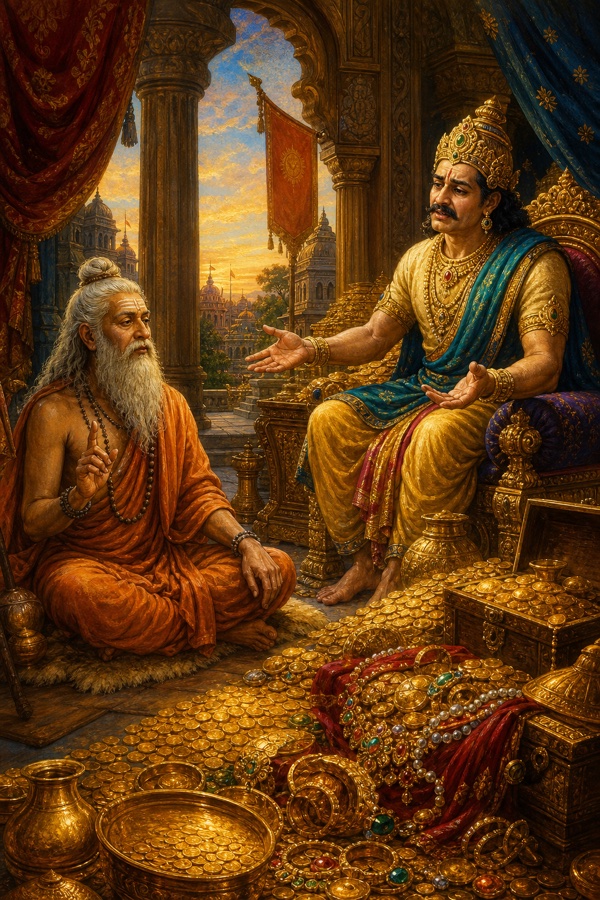
Yudhishthira’s next question came out of the thing he could not put down. “How cruel we are, and how sinful. We have killed brothers and fathers and grandsons, kinsmen, friends, and sons. Grandfather, how are we to be rid of this thirst for wealth? It was for wealth that we did so many sinful things.”
Bhishma answered with what the ruler of the Videhas once said to Mandavya, who had come to him with questions. “I have nothing in this world,” the king of Videha said, “and I live in great happiness. If the whole of Mithila, which people call my kingdom, were to go up in one blaze, nothing of mine would burn. To a man of knowledge, possessions, however valuable, are a source of sorrow; the foolish are bewitched by possessions of hardly any value at all.” All the happiness that exists here from the gratification of desire, he said, and all the high happiness of heaven besides, do not come up to one sixteenth part of the joy that comes when desire disappears altogether. “As the horns of a cow grow as the cow grows, the thirst for wealth grows with every increase in wealth.”
The king of Videha went on. “Whatever a man fixes his attachment on becomes a source of pain when it is lost. So desire should not be cherished; attachment to desire leads to sorrow. When wealth has been won, put it to the purposes of dharma, and even then let the desire go. The man of knowledge looks on every other creature as he looks on himself. Having cleansed his soul and reached success, he casts off everything here. By casting off truth and falsehood both, grief and joy, the agreeable and the disagreeable, fearlessness and fear, a man arrives at tranquility and is free of every anxiety. That thirst which fools cannot let go of, which does not wane as the body wanes, which men of knowledge call a fatal disease: the man who casts it off is sure to find happiness. A man of virtuous soul, seeing his own conduct grown bright as the moon and free of every evil, wins great fame both here and afterward, and wins it happily.” Hearing the king, Mandavya was filled with joy, applauded what he had heard, and took himself off down the road to moksha.
The gist: The thirst for wealth is a fatal disease that grows with every acquisition, the way a cow’s horns grow with the cow. All the happiness of desire fulfilled and of heaven itself falls short of a sixteenth of the joy that comes when desire ends. The king of Videha, who could watch Mithila burn and lose nothing of his own, gives Yudhishthira the answer to the guilt he carries out of the war.
The Father and His Son Medhavi: A Warning About Death
Yudhishthira asked, “Time runs its course, and every creature is afraid of it. What is the good that a man should strive for while he has the chance? Tell me that.”
Bhishma answered with a conversation between a father and a son. There was once a Brahmin who gave his whole life to the study of the Vedas, and he had a very intelligent son named Medhavi. The son understood the dharma of moksha, and the father, who was busy following the precepts of the Vedas, did not. One day the son asked him this: “Father, a man of intelligence knows that the span of life allotted to men is running out fast. What should such a man do? Tell me truly and in proper order, so that with your guidance I can set myself to winning dharma.” The father gave the answer the Vedas had taught him. “Study the Vedas while keeping the vows of a student. Then desire children, for the rescue of your ancestors. Then set up your sacred fire and perform the sacrifices that are ordained. Then go to the forest and, having lived as a hermit there, become a muni.”
The son said, “When the world is being attacked on every side and besieged, and bolts that nothing can turn aside are falling in every direction, how can you speak so calmly?” The father was startled. “How is the world attacked? What besieges it? What are these bolts that fall on every side? Are you trying to frighten me?” “The world is attacked by death,” the son said. “It is besieged by old age. The days and the nights keep falling on it like bolts, and they never stop. Why do you not take heed of them? I know that death waits here for no one; it snatches everyone away without warning. Knowing that, how can I wait for it, wrapped in a coat of ignorance and attending to my own affairs?”
Medhavi went on. “Every night that passes wears away a piece of every life. We are in the position of a fish in a shallow puddle. Who can be happy? Death meets a man in the middle of his affairs, before he has reached what he was reaching for, as unprepared as a man who is off gathering flowers. What is kept for tomorrow should be done today, and what a man means to do in the afternoon should be done in the morning. Death does not wait to see whether a man has finished his acts or left them undone. Do today what is for your good. See to it that death, which nothing resists, does not overtake you before your acts are complete. Who knows that death will not come this very day? Death drags a man off before his acts are done. So a man should begin to practice dharma while he is still young, without waiting for old age, because life is uncertain, and by winning dharma he is sure of happiness both here and afterward.”
Medhavi gave his father the pictures the fear needed. “A man driven by folly girds himself to act for his sons and his wives, and by acts fair and foul he keeps them satisfied. That man, with his sons and his cattle and his mind fastened on them, death seizes and runs off with, the way a tiger carries off a sleeping deer. A man still busy winning the things he wants, still unsatisfied with what he has enjoyed, death seizes and carries away like a she-wolf making off with a sheep. ‘This is done,’ a man says to himself, ‘this remains to be done, this other thing is half done,’ and death, with no regard for his wish to finish, takes him and drags him away. The man who has not yet tasted the fruit of what he did, busy with his field or his shop or his house, death carries away. The weak, the strong, the wise, the brave, the fool, the learned, the man who has not yet had one of his desires met: death takes them all. Death, old age, disease, sorrow, and a hundred things like them no mortal can avoid. How then, father, can you sit so much at your ease? The moment a creature is born, old age and death take possession of it and set about destroying it; every form of existence, moving and unmoving, belongs to those two. When the soldiers of death’s army are on the march, nothing can stand against them except one thing, the power of truth, because immortality lives in truth alone. The delight a man feels in living among people is death’s own house. The Shruti says that what is called the forest is the true fold for the gods, and that the pleasure of living among people is the cord that binds the one who lives there. The righteous cut that cord and get free. The sinful cannot cut it.”
Medhavi said, “A man who does no injury to other creatures in thought, word, or deed, and never injures them by taking away what they live on, is never injured by any creature. So a man should practice the vow of truth, hold to it steadily, and want nothing but the truth; restraining all his senses and looking on every creature with an equal eye, he should defeat death with the help of truth. Immortality and death are both planted in the body. Death comes from folly, and immortality is won by truth. Rising above desire and anger, abstaining from injury, I will take up truth, and, happily gaining what is for my good, I will avoid death like one of the immortals. I will perform the sacrifice that is peace, and the sacrifice of Brahman, and with my senses restrained, the sacrifices I perform will be of speech, of mind, and of act, when the sun turns into his northward course. How could a man like me perform the sacrifice of animals, which is full of cruelty? How could a man with wisdom in him perform, like some cruel Pishacha, a sacrifice of slaughter of the kind laid down for Kshatriyas, a sacrifice whose rewards run out? I was begotten in myself by my own self. Without seeking to beget children, father, I will rest on my own self; I will perform the sacrifice of the Self, and I need no offspring to rescue me. The man whose words and thoughts are always well restrained, who has austerity and renunciation and yoga, gains everything through those. There is no eye equal to knowledge. There is no reward equal to knowledge, no sorrow equal to attachment, no happiness equal to renunciation. For a Brahmin there is no wealth like living in solitude, an equal regard for every creature, truth in speech, steady good conduct, the total laying down of the rod of punishment, simplicity, and a gradual withdrawing from all acts. What do you need with wealth, with relatives and friends, with wives? You are a Brahmin, and you have death to meet. Search out your own Self, the one that is hidden in the cave. Where have your grandfathers gone, and where has your father gone?” Bhishma said that when the father heard his son, he did as his son had pointed out, and he told Yudhishthira to do the same, devoted to the dharma of truth.
A key to reading this (the inner yajna, and the uttarayana): The sacrifice of the Self that Medhavi promises is an inward one, the restraining of speech, mind, and act, offered in place of the outward sacrifice in which animals die. He times it to the sun’s northward course, the uttarayana, the half of the year held auspicious for a good death and for release, and it is the same turning of the sun that Bhishma, speaking these words from his bed of arrows, is himself waiting for.
The gist: Medhavi tells his father that death and old age besiege the world and that days and nights fall on it like bolts, so dharma must be begun in youth. The tiger and the sleeping deer, the she-wolf and the sheep, the man off gathering flowers: death takes each in the middle of his business. Only truth stands against death’s army, and the true yajna is the inner one of speech, mind, and act. The father listened, and did as his son said.
The sannyasi’s rules of conduct, the path of Harita
Yudhishthira asked what a man’s conduct must be, and his acts, and his knowledge, and what he must be devoted to, if he is to reach the place of Brahman that lies beyond nature and never changes. Bhishma answered that the man devoted to the dharma of moksha, frugal in his food, and master of his senses reaches that high, unchanging place. He should leave his home, look on gain and loss with the same eye, hold back his senses, disregard the objects of desire even when they stand ready in front of him, and take up the life of renunciation.
Bhishma set out the sannyasi’s rules in detail. “He should not disparage anyone, with his eye, with a word, or in his thought. He should not speak evil of any man, in his hearing or out of it. He should injure no creature, and he should conduct himself by the course of the sun. Having come into this life, he should behave with unfriendliness toward no creature. He should pass over abusive words, and never, out of arrogance, count himself above another man. When someone tries to make him angry, he should still speak pleasantly, and when he is slandered, he should return no slander. Among human beings he should be neither friendly nor unfriendly. He should not go about visiting many houses on his round for alms, and he should never go to a house because he was invited there beforehand. Even when others spatter him with filth, he should stand firm in his duties and say nothing disagreeable back. He should be compassionate. He should return no injury. He should be fearless, and he should never praise himself.”
The man of restrained senses, Bhishma said, should go for his portion of alms to a householder’s door only when the smoke has stopped rising from it, when the sound of the husking rod is hushed, when the hearth-fire is out, when everyone inside has finished eating, or when the hour for setting out the dishes is over. He should be content with just enough to keep body and soul together, and he should not covet even the amount of food that gives pleasure. When he fails to get what he wants, he should not let discontent grow in him, and success in getting it should not make him glad. He should never wish for the things ordinary men covet, and never eat at a house where he was respectfully invited; gains that come with honor attached are the very ones a man like him should refuse. He should never fault the food set before him, for staleness or anything else, and never praise it either. For his bed and his seat he should want places far from the haunts of men: a deserted house, the foot of a tree, a forest, or a cave. Without letting his practices be known, and without hiding them behind practices that look hateful or repellent, he should enter his own Self. Joined to yoga and cut off from company, he should be perfectly even, steadily fixed, and uniform, and by his acts he should earn neither merit nor demerit.
He should be always gratified, Bhishma said, well content, cheerful in face and cheerful in his senses, fearless, always at the silent recitation of sacred mantras, quiet, and wedded to renunciation. Watching his own body form and dissolve again and again, with its senses that come out of the elements and go back into them, and watching other creatures arrive and depart, he should become free of desire and learn to look on everything with an equal eye, living on food cooked or uncooked as it comes. Frugal in his fare and master of his senses, he reaches the tranquility of the Self by the Self. He should control the rising impulses of speech, of the mind, of anger, of envy, of hunger, and of lust. Devoted to austerities for the cleansing of his heart, he should never let the censure of others wound it. He should live in a state of neutrality toward every creature and count praise and blame the same. “This,” Bhishma said, “is the holiest and highest path of the sannyasi’s life. High-souled, he should hold his senses back from everything and keep himself clear of every attachment. He should never go back to the places he visited or the men he knew in his earlier stages of life. Pleasant to every creature, with no fixed home, he should be devoted to the contemplation of the Self, and never mix with householders or with hermits of the forest. He should eat what he gets without effort and without having thought of it beforehand, and he should never let joy take possession of his heart.” To the wise, such a life of renunciation is the means of moksha; to fools these duties are a crushing burden. The sage Harita declared that this is the path by which moksha is reached, and that the man who sets out from his home, having assured every creature of his perfect harmlessness, arrives at many bright regions of happiness that never end.
The gist: The sannyasi slanders no one, injures nothing, answers provocation with kind words, and begs at a door only when the smoke has stopped and the household has eaten, taking just enough to live, without joy or grief, without praising or faulting what he is given. He sleeps in a deserted house or under a tree, keeps clear of the places and people of his old life, and holds praise and blame the same. Harita called this the path of moksha, and Yudhishthira, who asked how a man reaches the unchanging place, has now been told.
The beginning of Vritra’s tale, the colors of the soul and the fruit of karma
Yudhishthira spoke out of the same pain. “Everyone speaks of us as men of the greatest fortune. In truth no one is more wretched. The whole world honors us, we were born among men, the gods themselves begot us, and even so, when this much sorrow has fallen to us, it seems that being born in a body at all is the cause of every sorrow. When will we take up the life of renunciation that destroys sorrow? Sages of hard vows, freed from the seventeen, freed from the five faults of yoga that bind a man to birth after birth, and freed from the other eight, the five sense objects and the three qualities, never have to be born again. Grandfather, when will we be able to lay down the kingdom and take up that life?”
Bhishma said, “Everything has an end. Everything has bounds set to it. Even rebirth, as everyone knows, comes to an end; there is nothing in this world that does not change. You think that this prosperity you are wrapped in is a fault. You know dharma, and you are ready, so it is certain that in time you will reach the end of your sorrow, which is moksha.” Then he told Yudhishthira how it is that a soul takes on the look of its acts. The jiva in its body is not the author of its merit and demerit, or of the happiness and misery they bring; it becomes wrapped in the darkness that is born of them, a darkness whose substance is attachment and aversion. He gave the image. Wind that has taken up a dust of black antimony seizes next on the red bloom of realgar, and though the wind has no color of its own it takes on the colors of what it has seized and paints them across the quarters of the sky. In the same way the jiva, colorless in itself, takes on a hue from the darkness that wraps it and from the varied fruit of its acts, and travels from body to body wearing it. When the jiva dispels that darkness by knowledge, the unchanging Brahman stands revealed. The sages say that the return to that Brahman cannot be achieved by acts, and that the men who have achieved moksha deserve reverence from Yudhishthira, from everyone in the world, and from the gods themselves; the great rishis never stop cultivating Brahman.
In that connection, Bhishma said, there was a discourse sung in the old days by the guru of the Daityas, and he asked Yudhishthira to listen closely to how the Daitya Vritra conducted himself after every scrap of his prosperity was gone. Stripped of his kingdom and surrounded by his enemies, Vritra leaned on nothing except his own intelligence, and he did not grieve. His guru Ushanas came to him in that condition and asked, “I hope, Danava, that this defeat has left you with no grief?” Vritra said, “By the help of truth and austerity I have understood how living creatures come and how they go, and I have stopped indulging in grief or in joy. Driven by Time, creatures sink helplessly into hell; some, the sages say, go to heaven. All of them pass their allotted time there in contentment, and then, with some of their merit and demerit still unspent, they take birth again, pushed by Time. Chained by desire, creatures pass through myriads of lives as animals and fall helpless into hell. I have seen them come and go like that. The scripture’s lesson is that what a creature gets answers to what it did. Creatures are born as men, or as animals, or as gods, and they go to hell, and having acted in past lives so as to deserve it, all of them, under the ordinances of the Destroyer, meet happiness and misery, the pleasant and the unpleasant. When they have enjoyed the exact measure of weal or woe their acts earned, they come back by the old road, which is measured by the measure of acts.”
Ushanas heard the defeated Asura talking about the highest refuge of creation, and his answer was a teacher’s. “Intelligent Daitya, child, why are you pouring out these foolish rhapsodies?” Vritra told him why. “You know the severe austerities I went through out of greed for victory, and so do the other sages. I took for myself the scents and the tastes that other creatures had for their enjoyment, I swelled up with my own energy, I tormented the three worlds. Wreathed in myriads of rays I used to range through the skies, unbeatable by any creature and afraid of none. I won great prosperity by austerity and lost it again by my own acts, and relying on my fortitude I do not grieve for the change. But in the old days, wanting to fight the great Indra, the high-souled ruler of heaven, I saw in that battle the illustrious Hari, the mighty Narayana, the one who is called Vaikuntha, Purusha, Ananta, Shukla, Vishnu, Sanatana, Munjakesha, Harishmashru, and the grandsire of all creatures. Some remnant of the reward of that austerity, the sight of the great Hari, is still mine to enjoy, and it is because of that unspent remnant that I want to ask you about the fruit of acts. On which order of men has the high prosperity of Brahman been established? How does that high prosperity fall away? From whom do creatures spring, and by whom do they live, and through whom do they act? What is the high fruit by winning which a creature lives forever as Brahman, and by what act or what knowledge is that fruit won? You are learned. Explain these to me.” Bhishma told Yudhishthira and his brothers to listen with the whole of their attention to what the sage Ushanas said then.
A sub-tale: Vritra is the Asura whom Indra will kill with the thunderbolt, and the killing is told a little further on in this very chapter. Here, before that, he is a king who has lost everything, sitting among his enemies, and the teacher who comes to console him finds that he needs no consoling. What he wants is an answer to a question about the fruit of acts, and it is the same question Yudhishthira has just asked from the far side of a war.
Ushanas began. “I bow to that divine and mighty being who holds this earth and the sky in his arms. I will tell you, best of the Danavas, the greatness of that Vishnu whose head is the infinite place.” While the two of them were talking, the great sage Sanatkumara, righteous in soul, came to them to clear away their doubts. The prince of the Asuras worshiped him, and so did Ushanas, and that foremost of sages sat down on a costly seat, and when he was settled Ushanas asked him to speak to the chief of the Danavas on the surpassing greatness of Vishnu.
A key to reading this (Vritra, Ushanas, Sanatkumara): Vritra is Indra’s great Asura enemy, and in this stretch he is a devotee of Vishnu with a philosopher’s questions. Ushanas, the guru of the Daityas, is also called Shukra. Sanatkumara is a mind-born son of Brahma and a sage of the highest knowledge, and both Vritra and his guru rise to worship him when he comes in. Vritra’s question about the final course of the soul mirrors Yudhishthira’s own.
The gist: The jiva is colorless in itself and takes its color from the darkness of ignorance and the fruit of its acts, as wind takes color from the dust it carries. Vritra, stripped of his kingdom, keeps his evenness because truth and austerity have shown him the wheel of birth and death. He asks his guru about the fruit of acts, and Sanatkumara arrives to answer him.
Sanatkumara’s praise of Vishnu, the six colors of souls and the order of release
Sanatkumara turned to the Danava king. “Listen, Daitya, and I will tell you everything about the greatness of Vishnu. Know that the entire universe rests on Vishnu. It is he who creates every creature, moving and unmoving. In the course of Time it is he who withdraws them all into himself, and in Time it is he who casts them out of himself again. Into Hari everything merges at the universal destruction, and out of him everything comes forth once more. Men who own the learning of the scriptures cannot reach him by that learning. He cannot be reached by austerity, and he cannot be reached by sacrifice. The one means of reaching him is the restraint of the senses. That does not make sacrifice useless toward the end. A man who relies on outward acts and inward acts and on his own mind can purify them by his own understanding, and by that means he comes to enjoy infinity in the world.”
He gave the Danava two comparisons. “A goldsmith purifies his metal of its dross by throwing it into the fire again and again, with persistent effort of his own, and in the same way the jiva succeeds in cleaning itself by its course through hundreds of births. Here and there a man is seen to purify himself in a single life by tremendous effort. As a man should wipe the stains off his body before they thicken, so he should scrub off his faults with vigorous effort. And think of sesame seeds. Mix a few flowers with them, and they cannot be made to give up their own smell and take on fragrance. In the same way a man who cleanses his heart only a little cannot come to see the Self. But when the seeds are perfumed again and again with a great quantity of flowers, then they lose their own odor and take on the odor of the flowers they lie among. In that manner the faults, which are attachments to everything around us, are dispelled by the understanding over the course of many lives, with a large dose of sattva and with the efforts that practice breeds.”
Then Sanatkumara told the Danava how creatures take to action and how they give it up, and he began with the one who creates them. “The Supreme Lord creates every creature, moving and unmoving. He is without beginning and without end. He has no qualities of any kind, and he takes on qualities when he chooses to create. He is the universal destroyer, the refuge of all things, the supreme ordainer, and pure consciousness. In every creature it is he who lives as the changing and the changeless; he who, with eleven modifications for his essence, drinks up this universe with his rays. Know that the earth is his feet, and heaven is his head. His arms, Daitya, are the several points of the horizon, and the space between is his ears. The light of his eye is the sun, and his mind is in the moon. His understanding lives always in knowledge, and his tongue is in the waters. The planets, best of Danavas, lie between his brows, and the stars and constellations come from the light of his eyes. The qualities of rajas and tamas and sattva are his. He is the fruit of every mode of life and the fruit of every pious act, and he, the highest and unchanging, is also the fruit of abstaining from all work. The Vedic meters are the hair on his body, and the syllable Om is his word. The orders of men and the modes of life take refuge in him. His mouths are many, and dharma is planted in his heart. He is Brahman; he is the highest righteousness; he is the real and the unreal; he is the Shruti and the scriptures and the sacrificial vessel; he is the sixteen priests and all the sacrifices; he is the Grandsire, he is Vishnu, he is the twin Ashvins, he is Purandara, he is Mitra and Varuna and Yama and Kubera, lord of treasures. The priests seem to see him as many, and they know him as one and the same. This entire universe is under the control of one divine being. The Veda within the soul sees the unity of all creatures, and when a living creature realizes that unity through true knowledge, it is said to have reached Brahman.”
Sanatkumara gave the Danava the measure of a kalpa. The span for which one creation exists, or for which it ceases to exist, is called a kalpa, and living creatures exist for a thousand million such kalpas; unmoving creatures exist for an equal span. Then he measured a single creation with lakes. “Picture a lake one yojana wide, one krosha deep, and five hundred yojanas long. Picture many thousands of such lakes. Now set about drying them, taking from them once a day, and only once, as much water as clings to the tip of one hair. The number of days it would take to dry them out completely by that method is the span of a single creation, from its first start to its destruction.”
Then Sanatkumara set out the six colors of the soul. “The highest evidence says that creatures have six colors: dark, tawny, blue, red, yellow, and white, and the colors come from the three qualities of rajas, tamas, and sattva mixed in different proportions. Where tamas predominates, sattva falls below the mark, and rajas keeps to the mark, the color is dark. Where tamas predominates as before but sattva and rajas change places, the color is tawny. Where rajas predominates, sattva falls below the mark, and tamas keeps to the mark, the color is blue. Where rajas predominates as before and sattva and tamas change places, the color is the intermediate one called red, which is more agreeable than the one before it. Where sattva predominates, rajas falls below the mark, and tamas keeps to the mark, the color is yellow, and it produces happiness. Where sattva predominates and rajas and tamas change places, the color is white, and it produces great happiness. White is the foremost color. It is sinless, because it is free of attachment and aversion; it is without grief, and free of the toil that goes with a life of action. So it is white, prince of Danavas, that leads to moksha. The jiva, Daitya, comes to that success after thousands of births through the womb. That success is the very end which the divine Indra declared after studying many auspicious spiritual treatises, and its essence is the apprehension of the Self.”
The end a creature reaches, Sanatkumara said, depends on its color, and its color depends on the character of the Time that sets in. The stages of existence a jiva must pass through are not unlimited; they number fourteen hundred thousand, and through them the jiva climbs, or stays, or falls. He traced the whole circuit. The end that a jiva of the dark color reaches is very low: it takes to acts that lead to hell, and it rots in hell, and the learned say that its stay in that condition, because of its wickedness, is measured in many thousands of kalpas. After many hundreds of thousands of years there it takes on the tawny color and is born among the animals, and it lives in that helplessness for a long time. At last, when its sins are spent, when it has suffered all the misery they can bring, its mind lets go of attachments and turns toward renunciation. When sattva enters the jiva, it dispels everything of tamas by its intelligence and begins to work for its own good, and it takes on the red color. If sattva is not gained, the jiva goes round and round in rebirths in the world of men, wearing the blue color. Having reached humanity and been afflicted for the length of one creation by the bonds its own acts have made, it takes on the yellow color and becomes a god, and it lives in that state for a hundred creations, then leaves it to become a man, and returns to it again. As a yellow jiva it exists for thousands of kalpas, sporting as a god, and even then, unfreed, it has to endure the fruits of its acts from past kalpas and wander through nineteen thousand courses. Know that the jiva gets free of the hell of acts that heaven and godhood represent, and in the same way it gets free of each of the other births. It sports for many long kalpas in the world of the gods, falls, and is a man again, and stays a man for a hundred and eight kalpas, and rises to be a god once more; and if, in that second human life, it falls through the evil acts that Time in the form of Kali breeds, it sinks into the dark color and occupies the lowest of all the stages of existence. Then he told the Asura how a jiva wins moksha. “Wanting moksha, the jiva relies on seven hundred kinds of acts, every one of them marked by a predominance of sattva, and courses gradually through red and yellow and comes at last to white. Arriving there, it travels through several most adorable regions that have the eight well-known regions of happiness below them, and all the while it pursues that stainless and radiant form of existence which is moksha itself. Know that the eight, which are the same as the sixty subdivided into hundreds, are for the highly radiant nothing more than creations of the mind.”
Sanatkumara went on. “The highest thing a white jiva can win is the state called turiya, which goes beyond the three other states of consciousness: waking, dream, and dreamless sleep. As for the yogin who cannot give up the joys that the power of yoga brings, he has to live in one and the same body for a hundred kalpas in auspiciousness, and after that in four other regions, Mahar, Jana, Tapas, and Satya. Even that is the highest end of one who belongs to the sixth color and is unsuccessful though crowned with success, though he has gone beyond all attachments and passions. The yogin who falls away from his practices after reaching the eminence I have described lives in heaven for a hundred kalpas with the unspent remnant of his past acts and with the seven, the five senses of knowledge and the mind and the understanding, purged of every stain by their leaning toward sattva; when that period expires he has to come to the world of men, where he attains great eminence, and turning back from the world of men he departs for forms of existence that run higher and higher, coursing through seven regions seven times, his power always growing through samadhi and the reawakening from it. The yogin who wants final moksha suppresses the seven by the knowledge of yoga and goes on living in the world of life free of attachments, and taking those seven for sure causes of grief, he casts them off and attains afterward the state that is indestructible and infinite. Some say that is the region of Mahadeva; some, of Vishnu; some, of Brahma; some, of Shesha; some, of Nara; some, of the radiant consciousness; and some, of the all-pervading. When the universal destruction comes, those who have completely consumed by knowledge their gross and subtle and causal bodies always enter Brahman, and all their senses, whose essence is action, merge into the same. The jivas who have reached the position of gods and still have fruit left to enjoy or endure go back, in the next kalpa, to the stations that were theirs in the last one, because every kalpa is like the kalpa before it; those whose acts have been exhausted fall from heaven and are born among men in the next kalpa, since without knowledge no one can destroy his acts in even a hundred kalpas. Every superior being, with like powers and like forms, returns to its own destiny at a new creation, rising and falling exactly as in the creation that dissolved. And the man who knows Brahman, as long as he enjoys and endures the unspent remnant of his acts from earlier kalpas, is said to carry all creatures and the two stainless sciences in his body; when his chitta is cleansed by yoga and he practices samyama, this visible universe appears to him as nothing except his own five senses. Inquiring with a cleansed mind, the jiva reaches a high and stainless end, and from there a place that knows no decline, and from there the eternal Brahman that is so hard to win. So, mighty one, I have told you the greatness of Narayana.”
Vritra said, “I see that these words of yours agree perfectly with the truth, and if that is so, I have no cause for grief. Listening to you has freed me from sorrow and from sin of every kind. Illustrious rishi, holy one, I see the wheel of Time, charged with tremendous energy, of the most radiant and infinite Vishnu, and it has been set in motion. Eternal is that station from which every kind of creation springs. That Vishnu is the Supreme Soul, the foremost of beings, and in him this whole universe rests.” Bhishma said, “Having said that, Vritra cast off his life-breaths, joining his soul in yoga to the Supreme Soul, and he attained the highest station.”
Yudhishthira asked whether this Janardana, Krishna, was the illustrious and mighty lord of whom Sanatkumara had spoken to Vritra in the old days. Bhishma said, “The highest deity, the one with the six attributes, is at the root. Staying there, the Supreme Soul creates all these varied existing things by his own energy. Know that this Keshava, who knows no decline, is from his eighth portion. It is this Keshava, endowed with the highest intelligence, who creates the three worlds with an eighth portion of that energy. Coming immediately after the one who lies at the root, this Keshava, eternal when set against everything else that exists, changes at the end of each kalpa. But the one at the root, supreme in might and power, lies down in the waters when the universal destruction comes, as the potential seed of all things. Keshava is the creator of pure soul who courses through all the eternal worlds. Infinite and eternal, he fills all space with emanations of himself and moves through the universe as everything that composes it. Free of every limitation that qualities would imply, he lets himself be clothed in ignorance and awakened to consciousness, and so Keshava of supreme soul creates all things, and in him this wondrous universe rests entire.”
Then Yudhishthira reasoned it through, and there was fear in the reasoning. Vritra, he said, must have seen beforehand the excellent end that waited for him, and that was why he was happy and did not give way to grief with death in front of him. One who is white in hue, born in a pure line, and risen to the rank of a Sadhya does not come back into the world for rebirth; such a one is free of hell and of every animal birth alike. But a soul that has reached only the yellow or the red is sometimes seen to be overwhelmed by tamas and to fall among the animals. “As for us,” he said, “we are exceedingly afflicted, and we are attached to things that bring sorrow, or indifference, or joy. What will our end be? Will it be the blue, or the dark, the lowest of all the hues?” Bhishma reassured him. “You are Pandavas. You were born in a stainless line, and you keep hard vows. You will sport in joy in the regions of the gods, and you will come back to the world of men. You will live happily for as long as this creation lasts, and at the next creation all of you will be admitted among the gods, and after enjoying every kind of happiness you will be numbered at last among the Siddhas. Have no fear. Be cheerful.”
A key to reading this (the six colors, turiya, kalpa): The color here is the soul’s own, formed from the proportion of sattva, rajas, and tamas in it: dark is the lowest, then tawny, blue, red, and yellow, and white is the highest, the hue that leads to moksha. Turiya is the fourth state, beyond waking, dream, and dreamless sleep, the same fourth that the Mandukya Upanishad names, and it is the highest thing a white soul can win. A kalpa is the whole lifespan of one creation, and Sanatkumara gives its length with the image of the thousands of lakes emptied one hair-tip of water a day.
The gist: Vishnu holds the universe and takes it back and sends it out again, and he is reached by restraint of the senses. Souls carry six colors by their mix of the gunas and climb through hundreds of births from dark to white, at which turiya and moksha lie open. Vritra hears this, sees the wheel of Time turning, and gives up his life in yoga. Bhishma tells the Pandavas their own course runs through heaven, back to men, and on to the gods and the Siddhas.
The tale of Vritra’s slaying, the birth of Fever and the protecting of Indra
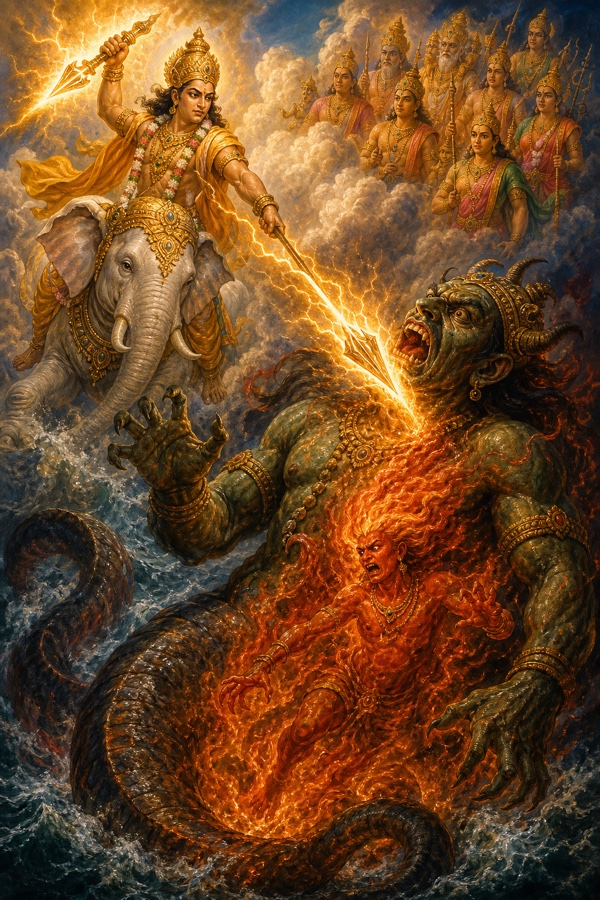
Yudhishthira had one thing he could not fit together. “Vritra loved dharma. He was devoted to Vishnu. He knew the truth that comes from a right understanding of the Upanishads and the Vedanta, and Vishnu’s station, as you have said, is very hard to grasp; how did an Asura grasp it so well? I have listened to all of it in full faith, and one point stays dark to me. How was such a man defeated by Indra? Tell me in detail how that battle between the chief of the gods and the foremost of the Asuras was fought. I very much want to hear it.”
Bhishma said that in the old days Indra rode out on his chariot with the whole army of heaven behind him and saw the Asura Vritra standing in front of him like a mountain. He was a full five hundred yojanas tall and three hundred yojanas around. The three worlds together could not have beaten that form, and the sight of it went into Indra as fear and worry; it struck him so suddenly that his legs went weak under him. On the eve of that great battle between gods and Asuras loud shouts rose from both sides, and drums and the other instruments of war began to beat and blow. Vritra looked at Indra standing before him and felt no awe and no fear, and he was in no hurry to gather all his strength for the fight. Then the battle began, and it put terror into the three worlds. The whole sky was filled with the fighting of both sides, with swords and axes, lances and darts and spears, heavy clubs and rocks of every size, loud-twanging bows, celestial weapons of many kinds, fires, and burning brands. All the gods with the Grandsire at their head came to watch, and the great rishis on their finest chariots, and the Siddhas, and the Gandharvas with the Apsaras, on beautiful chariots of their own.
Vritra, foremost of the virtuous, quickly covered the sky and the chief of the gods with a thick rain of rocks, and the gods, in a fury, broke that downpour apart with showers of arrows. Then Vritra, whose strength was enormous and whose powers of illusion were vast, fought with illusion alone, and Indra, the god of a hundred sacrifices, was stupefied by it and sank into a kind of swoon. The sage Vasishtha brought him back with the sacred chant. “You are the foremost of the gods, chief of the deities, slayer of Daityas and Asuras,” Vasishtha said. “The strength of the three worlds is in you. Why do you droop like this? There stand Brahma and Vishnu and Shiva, the lord of the universe, and the divine Soma, and all the highest rishis, and they are watching you. Do not give way to weakness like an ordinary man. Set your mind on battle and kill your enemies. There, the master of all the worlds, the three-eyed god whom all the worlds adore, has his eye on you. Cast off this stupor. There, the rishis with Brihaspati at their head are singing celestial hymns for your victory.”
While Vasishtha was bringing him back to himself with those words, Indra’s strength grew greatly. Relying on his own intelligence, he took recourse to high yoga and with its help scattered Vritra’s illusions. Then Brihaspati, son of Angiras, and the foremost of the rishis, men of great prosperity, saw the might of Vritra for what it was and went to Mahadeva, and for the good of the three worlds they urged him to destroy the great Asura. The energy of that illustrious lord of the universe took the form of a fierce fever and went into the body of Vritra, lord of the Asuras. And the divine Vishnu, whom all the worlds adore, bent on protecting the universe, entered Indra’s thunderbolt. Then Brihaspati, and Vasishtha, and all the other foremost rishis went to Indra, the boon-giving god of a hundred sacrifices, and said to him, “Kill Vritra, mighty one, and do not delay.”
Maheshvara spoke to him too. “There stands the great Vritra, with a great force around him. He is the soul of the universe. He can go anywhere, his powers of illusion are vast, and his fame is great; the three worlds together could not defeat this foremost of Asuras. So kill him with the help of yoga, chief of the gods, and do not underrate him. For a full sixty thousand years Vritra practiced the severest austerities to gain strength, and Brahma gave him the boons he asked for: the greatness that belongs to yogins, great powers of illusion, excess of might, and energy beyond measure. I give you my energy. The Danava has lost his coolness now. Strike him with your thunderbolt.” Indra said, “Before your eyes, foremost of gods, and by your grace, I will kill this invincible son of Diti with my thunderbolt.”
When the great Asura was taken by that fever born of Mahadeva’s energy, the gods and the rishis raised loud cheers, and in the same instant drums and loud-blaring conches and kettledrums and tabors began to sound by the thousand. Every Asura on the field was suddenly stricken with a loss of memory, and in a moment their powers of illusion were gone. The rishis and the gods, seeing the enemy possessed, sang the praises of Indra and of Ishana and urged Indra not to wait, and the form Indra took then, seated on his chariot with the hymns of the rishis rising around him, was one that no one could look at without awe. Bhishma told Yudhishthira what the fever did to Vritra’s body. Flames came out of the hero’s mouth. He went very pale. His whole body shook, his breath came hard and thick, and his hair stood on end. His memory left him through his mouth in the form of a fierce, dreadful, ill-omened jackal. Burning meteors fell on his right and on his left, and vultures and kankas and cranes gathered and wheeled over his head with harsh cries. Indra, adored by the gods, the thunderbolt in his hand, looked hard at the Daitya where he sat on his chariot. Possessed by that violent fever, the mighty Asura yawned and let out inhuman cries, and while he was yawning Indra hurled the thunderbolt. Charged with enormous energy, like the fire that destroys creation at the end of a yuga, it overthrew the gigantic Vritra in an instant. The gods shouted again on every side when they saw him fall, and Indra, having killed Vritra, entered heaven with that thunderbolt in which Vishnu dwelt.
It was just then that the sin of killing a Brahmin came out of the dead Vritra’s body in a body of her own, fierce and awful, a thing that put dread into all the worlds. Her teeth were terrible; she was hideous with ugliness, dark and tawny, her hair loose, her eyes dreadful, a garland of skulls around her neck, so that she looked like an incantation of the Atharvan given flesh, covered all over in blood and dressed in rags and the bark of trees. In that shape she went looking for the wielder of the thunderbolt. A little while later Indra was on his way to heaven on some business for the good of the three worlds, and she saw him going, and seized the chief of the gods, and from that moment she stuck to him. Possessed by her and terrified, Indra crept into the fibers of a lotus stalk and stayed there for many long years, and still the sin of brahmanicide pursued him closely. In her grip Indra lost all his energy. He made great efforts to drive her off, and every one of them failed. At last, still held by her, he presented himself before the Grandsire and worshiped him with his head bowed low.
Brahma understood that Indra was possessed by brahmanicide and set himself to think how to free his suppliant. Then he spoke to her in a sweet voice, as though to calm her. “Gentle one, let the chief of the gods go; he is a favorite of mine. Tell me what I shall do for you. What wish of yours shall I fulfill?” Brahmanicide said, “When the creator of the three worlds, the god the universe adores, is pleased with me, I count my wishes fulfilled already. Now appoint me a dwelling. It was you who made this rule for the preservation of the worlds, you who introduced this weighty ordinance, and since you are gratified with me, righteous lord, master of all the worlds, I will certainly leave Indra. Only grant me a place to live.” “So be it,” Brahma said, and he found the means of taking her off Indra’s body. He called Agni to mind, and Agni came at once and asked what he was to do. “I am going to divide this sin of brahmanicide into several portions,” Brahma said. “To free Indra, take a fourth of it on yourself.” Agni asked how he in his turn would be rescued from her, and Brahma told him. “When a man overcome by tamas sees you in your blazing form and does not offer you seeds and herbs and juices, your portion of brahmanicide will leave you at once and go into him and live there. Carrier of oblations, let the fever of your heart be dispelled.”
Agni accepted the command, and a fourth of the sin went into him. Then the Grandsire summoned the trees, the herbs, and every kind of grass, and asked them to take a fourth of the sin on themselves. They were as shaken as Agni had been. “How will we ourselves be rescued from this sin, Grandsire of all the worlds? Do not afflict us who are afflicted already by the fates. We already endure heat and cold and the showers the winds drive at us, and the cutting and the tearing at the hands of men. We are willing, lord of the three worlds, to take a portion of this sin at your command. Only show us the means of our rescue.” Brahma said, “The sin you take will possess the man who, with his judgment stupefied, cuts or tears any of you when the parva days come.” The trees and herbs and grasses worshiped the creator and went away without delay. Then the Grandsire summoned the Apsaras, gratified them with sweet words, and told them that this foremost of ladies, brahmanicide, had come out of Indra’s person, and asked them to take a fourth of her into their own bodies to save the chief of the gods. The Apsaras were willing, and they too asked how they would be freed of the bargain. “Let the fever of your hearts be dispelled,” Brahma said. “The portion of this sin you take will leave you at once and possess the man who goes to a woman in her season.” The many tribes of the Apsaras went off to their own places in high spirits and began to sport in delight. Last the creator of the three worlds called the Waters to mind, and they came and bowed and asked what they were to accomplish. “This dreadful sin has taken hold of Indra because he killed Vritra. Take a fourth part of brahmanicide.” The Waters agreed, and asked, as the others had, to be told the means of their own rescue, since Brahma was the lord of all the gods and the refuge of the universe and there was no one else to whom they could turn. Brahma said, “When a man of stupefied understanding, holding you in contempt, throws phlegm and urine and excrement into you, this sin will go at once into him and live there from then on. That, I tell you truly, is how your rescue will be accomplished.” So the sin of brahmanicide left the chief of the gods and went to the dwellings the Grandsire had ordained for her. With the Grandsire’s permission Indra then resolved on a horse-sacrifice, and it is heard that the sacrifice cleansed him of her. He regained his prosperity, killed thousands of enemies, and knew great joy.
From the blood of Vritra, Bhishma said, were born the high-crested cocks, and for that reason those fowls are unclean as food for the twice-born and for ascetics who have gone through the rite of initiation. He told Yudhishthira always to do what pleases the twice-born, since they are known as the gods on earth. That, he said, was how the mighty Asura Vritra was killed by Indra of immeasurable energy, with subtle intelligence and by the application of means. “You too, son of Kunti, unconquered on this earth, will become another Indra and the killer of all your enemies. Men who recite this sacred story of Vritra among Brahmins on every parva day will never be stained by any sin. I have told you one of the greatest and most wonderful of Indra’s feats, the one that concerns Vritra. What else do you wish to hear?”
A key to reading this (the division of brahmanicide): The sin of killing a Brahmin walks out of Vritra’s corpse as a woman in rags and a garland of skulls, and she fastens on the killer. Brahma cannot simply dismiss her; he divides her into four and settles each quarter on a taker who then needs a way out: Fire, freed by the man who offers a blazing fire no seed, herb, or juice; the trees and herbs and grasses, freed by the man who cuts them on a parva day; the Apsaras, freed by the man who goes to a woman in her season; and the Waters, freed by the man who fouls them. Each of the four escapes is also a rule for the living, and the story is where those rules keep their reason.
The gist: Indra falters at the sight of Vritra until Vasishtha revives him; the rishis go to Mahadeva, whose energy enters Vritra as a fever while Vishnu enters the thunderbolt, and in the moment of Vritra’s yawn Indra strikes him down. Brahmanicide comes out of the corpse, clings to Indra for years, and is divided by Brahma among Fire, the plants, the Apsaras, and the Waters. Indra is cleansed by a horse-sacrifice, and from Vritra’s blood come the cocks that the twice-born do not eat.
The origin of Fever, and the wrecking of Daksha’s sacrifice
Yudhishthira wanted the one piece still missing. “You said that Vritra was first stupefied by a fever, and only then killed by the thunderbolt. How did that fever arise? Tell me its origin in full.”
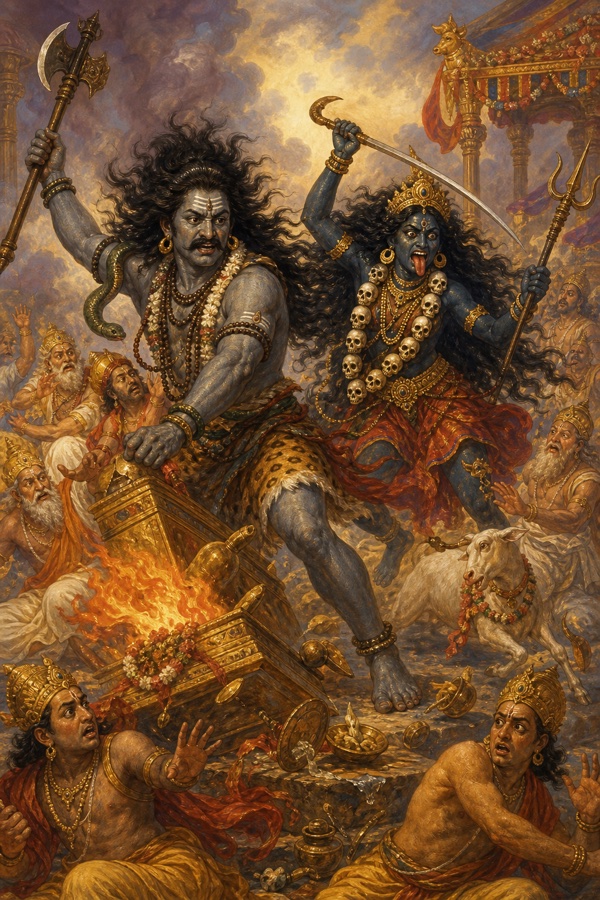
Bhishma said that in the old days there was a summit of Mount Meru named Savitri. All the worlds worshiped it. It shone, it was set with every kind of jewel and gem, it was immeasurable in extent, and no one could go there. On that summit the divine Mahadeva used to sit in splendor as though on a couch of gold, and the daughter of the king of mountains sat at his side and shone beside him. The Vasus of immeasurable energy waited on him there, and the high-souled Ashvins, the foremost of physicians, and King Vaishravana, lord of the Yakshas, who has his home on the summit of Kailasa, attended by his Guhyakas. The great sage Ushanas came, and the foremost of the rishis with Sanatkumara at their head, and the other celestial rishis led by Angiras, and the Gandharva Vishvavasu, and Narada and Parvata, and the many tribes of the Apsaras, all to wait on the master of the universe. A pure breeze blew there carrying scents of every kind, and the trees carried the flowers of every season at once. Vidyadharas and Siddhas and ascetics came up to serve Mahadeva, lord of all creatures, and so did many ghostly beings of strange shapes and aspects, dreadful Rakshasas and mighty Pishachas, drunk with joy and armed with every sort of raised weapon, the train of Mahadeva, each one of them blazing like a fire. Nandi stood there at the great god’s command, blazing with his own energy, holding a lance like a tongue of flame. And Ganga, foremost of rivers, born of every sacred water in the universe, waited on the god in her own bodily form. So Mahadeva lived on that summit of Meru, adored by the celestial rishis and the gods.
After some time had passed, the Prajapati Daksha began a sacrifice according to the ancient rites laid down in the Vedas, and all the gods with Indra at their head gathered and resolved to go to it. With Mahadeva’s permission, so it is heard, they mounted their celestial chariots, bright as fire or the sun, and set off for that place on Himavat where the Ganges is said to come out of the mountains. The daughter of the mountain king watched them go and turned to her husband. “Illustrious one, where are those gods going, with Indra at their head? You know the truth; tell me truly, because a great doubt has filled my mind.” Maheshvara said, “The excellent Prajapati Daksha is worshiping the gods at a horse-sacrifice, and that is where those dwellers in heaven are going.” Uma said, “Why do you not go to that sacrifice, Mahadeva? What is there to stop you?” Maheshvara said, “Long ago the gods made an arrangement among themselves, and under it no share of the offerings in any sacrifice was assigned to me. By the custom that came out of that arrangement, they give me nothing of the sacrificial offering to this day.”
Uma said, “Of all beings you are the foremost in power. In merit, in energy, in fame, and in prosperity you yield to no one; you are above all of them. And because of this one disability, this share that is withheld from you, I am filled with grief, and a trembling runs through me from head to foot.” She said that to her divine husband, the lord of all creatures, and then she fell silent, with her heart burning. Mahadeva understood what was in her heart and what she was thinking about that disgrace. He said to Nandi, “Wait here, by the goddess.” Then, summoning all his force of yoga, that lord of all the lords of yoga, that god of gods, the wielder of the Pinaka, went swiftly to the place where Daksha was sacrificing, with all his terrible followers behind him, and destroyed that sacrifice.
Some of his followers howled and some laughed horribly. Some put out the sacrificial fires with blood. Some, with dreadful faces, pulled up the sacrificial posts and whirled them about, and others began to devour the men who were ministering at the rite. The sacrifice, attacked from every side, took the form of a deer and tried to escape through the sky, and when Mahadeva saw it running in that shape he took up his bow and arrow and went after it. Anger had filled the heart of that foremost of gods, and in the anger a dreadful drop of sweat appeared on his forehead. When it fell to the earth a blazing fire sprang up at once, like the conflagration at the end of a yuga, and out of that fire came a dreadful being, very short in stature, with blood-red eyes and a green beard. His body was covered all over with hair like a hawk’s or an owl’s, and the hair stood erect. He was dark of complexion and dressed in blood red. Like a fire going through a heap of dry straw, that being of great energy consumed the embodied sacrifice, and then he turned on the gods and rishis who had gathered there. The gods fled in every direction, and under his tread the earth shook, and cries of grief and alarm went up through the whole universe.
Seeing that, the Grandsire showed himself to Mahadeva and spoke to him. “From now on the gods will give you a share of the sacrificial offerings. Lord of all the gods, take back this anger of yours. There, the gods and the rishis are in agony because of your wrath. This being that has sprung from your sweat will wander among creatures under the name of Fever. But if his energy stays gathered in one place, the whole earth will not be able to bear him. So let him be divided into many parts.” When Brahma had said this, and when Mahadeva’s proper share of the sacrificial offerings had been appointed, Mahadeva answered, “So be it.” Bhava, the wielder of the Pinaka, smiled a little, and was filled with joy, and accepted the share the Grandsire had appointed him. Then, knowing the properties of everything, he divided the Fever into many portions for the peace of all creatures.
Bhishma told how the division was made. The heat felt in the heads of elephants; the pitch that oozes from mountains; the moss that floats on water; the skin that a snake sloughs; the sores that appear on the hooves of bulls; the barren tracts of earth full of salt; the dimness of sight in all animals; the disease that appears in the throats of horses; the crests on the heads of peacocks; the eye-disease of the koel: each of these the high-souled Mahadeva named Fever, so it has been heard. The liver disease of sheep and the hiccup of parrots are also forms of Fever, and so is the weariness that tigers suffer. And among men, Bhishma said, Fever enters every body at the time of birth, at the time of death, and on other occasions besides. What is called Fever, then, is the dreadful energy of Maheshvara, who has authority over every creature and should be respected and worshiped by all. It was Fever that overtook Vritra, foremost of the virtuous, when he yawned, and then Indra hurled his thunderbolt; the thunderbolt went into Vritra’s body and split him in two, and the mighty Asura, split in two, with his great powers of yoga, went to the region of Vishnu of immeasurable energy. It was through his devotion to Vishnu that he had once overwhelmed the whole universe, and it was through his devotion to Vishnu that, once killed, he rose to Vishnu’s region. “Whoever reads this account of the origin of Fever with close attention and a cheerful heart,” Bhishma said, “will be free of disease and always have happiness for his share, and every wish he sets his heart on will be fulfilled.”
Here Janamejaya, who had been listening to the whole recital, stopped Vaishampayana with a question of his own. How, in the age of Vaivasvata Manu, was the horse-sacrifice of the Prajapati Daksha, son of Prachetas, destroyed? Mahadeva, the soul of all things, understood that the goddess Uma was full of rage and grief and gave way to wrath himself; but how, by his grace, was Daksha afterward able to reunite the divided limbs of that sacrifice? Vaishampayana told him as it happened. Daksha made his arrangements for a sacrifice on the breast of Himavat, in the sacred region where rishis and Siddhas live and where the Ganges comes out of the mountains, a place overgrown with trees and creepers of every kind and thick with Gandharvas and Apsaras. Crowds of rishis surrounded him, and the inhabitants of the earth, the sky, and heaven waited on that foremost of virtuous men with their hands joined. The gods came, and the Danavas, the Gandharvas, the Pishachas, the snakes, the Rakshasas, the two Gandharvas Haha and Huhu, Tumburu and Narada, Vishvavasu and Vishvasena, the Adityas, the Vasus, the Rudras, the Sadhyas, and the Maruts, all with Indra, for their share in the sacrifice, and with them the drinkers of Soma, the drinkers of smoke, the drinkers of ghee, the rishis, and the Pitris with the Brahmins. Creatures of all four kinds were invited, the womb-born, the egg-born, the sweat-born, and the plants. The gods came with their wives, respectfully invited, on their celestial chariots, and sitting on them they shone like so many fires.
The rishi Dadhichi looked at them and filled with grief and anger. “This is no sacrifice and no meritorious rite of religion,” he said, “since Rudra is not worshiped in it. You are all laying yourselves open to death and to chains. How wrong the course of time has gone. Stupefied by error, you do not see that destruction is waiting for you. A terrible calamity stands at your door in the middle of this great sacrifice, and you are blind to it.” Then that great yogin looked into the future with the eyes of contemplation. He saw Mahadeva on the summit of Kailasa with the goddess who gives excellent boons beside him, and the high-souled Narada sitting by the goddess, and understanding what was about to happen, he was deeply gratified. Every god and every other guest there was of one mind about the omission to invite the lord of all creatures. Dadhichi alone, wanting to leave the place, said, “By worshiping one who should not be worshiped, and by refusing to worship the one who should be, a man incurs the sin of killing, and incurs it forever. I have never spoken an untruth, and I never will. Here, in the midst of the gods and the rishis, I tell you the truth: the protector of all creatures, the creator of the universe, the lord of all, the mighty master, the taker of sacrificial offerings, will soon come to this sacrifice, and all of you will see him.”
Daksha said, “We have many Rudras, armed with lances, with matted locks on their heads. They are eleven in number. I know all of them, and I do not know who this Maheshvara is.” Dadhichi said, “The counsel of everyone here, it seems, is that Maheshvara should not be invited. As for me, I see no god who can be called higher than he is, and I am sure that this sacrifice of Daksha’s is going to be overtaken by destruction.” Daksha said, “Here, in this vessel of gold, is the offering meant for the lord of all sacrifices, sanctified by mantras and by the rites the ordinance prescribes. I intend to make it to Vishnu, who is beyond compare, the mighty master of all, to whom sacrifices ought to be performed.” Meanwhile, Vaishampayana went on, the goddess Uma was sitting with her lord, and she asked him what gifts she should make, what vows she should keep, and what austerities she should undergo, so that her illustrious husband might obtain a half or a third of the offerings in sacrifices. She was shaken with grief, and she asked it more than once, and Mahadeva answered her with a joyful face. “You do not know me, goddess. You do not know what words are fit to be addressed to the lord of sacrifices. I know that it is only the sinful, the men with no contemplation in them, who do not understand me. It is by your own power of illusion that the gods with Indra at their head and all three worlds are stupefied. It is to me that the chanters address their praises in sacrifices. It is to me that the Saman-singers sing their Rathantaras. It is for me that Brahmins learned in the Vedas perform their sacrifices, and it is to me that the Adhvaryu priests dedicate the shares of the offerings.”
The goddess said, “Even men of quite ordinary ability praise themselves and put on airs in front of their wives. There is no doubt of that.” The holy one said, “Queen of all the gods, I am certainly not praising myself. Watch what I do now. Watch the being I am going to create to deal with this sacrifice that has displeased you.” Having said that to Uma, who was dearer to him than his own life, the mighty Mahadeva created from his mouth a terrible being, a thing whose mere sight could make the hair stand up on a man’s body. Flames poured from him and made him dreadful to look at. He had many arms, and in each of them was a weapon that struck fear into whoever saw it. He stood before the great god with his hands joined and asked, “What commands am I to carry out?” Maheshvara said, “Go and destroy the sacrifice of Daksha.”
That being of lion-like prowess, who had come out of Mahadeva’s mouth, resolved to destroy Daksha’s sacrifice without putting out all his energy and without anyone’s help, and to do it to dispel Uma’s wrath. And the wife of Maheshvara, driven by that wrath, took on the dreadful form that is known by the name Mahakali and went with him to watch with her own eyes the destruction that was her own, since it was she who had moved her lord to it for her sake. With Mahadeva’s permission, and having bowed his head to him, the mighty being set out. In energy, in strength, and in form he was the equal of Maheshvara who had made him; he was the living embodiment of Mahadeva’s anger, of immeasurable might and courage, and he came to be called by the name Virabhadra, the dispeller of the goddess’s wrath. From the pores of his body he created a great number of spirit-chiefs known as the Raumyas, and those fierce bands, terrible in energy and prowess and like Rudra himself on that account, rushed with the force of thunder toward the place where Daksha was preparing his sacrifice, set on destroying it. Dreadful and gigantic, they came by the hundreds and thousands.
They filled the sky with their confused cries and shrieks, and the noise put fear into the dwellers of heaven. The mountains split and the earth trembled. Whirlwinds blew, the ocean rose in a surge, the fires that had been kindled would not blaze, the sun dimmed, and the planets and stars and constellations and the moon stopped shining. The rishis and the gods and the human beings all turned pale, and a universal darkness spread over earth and sky. The insulted Rudras began to set fire to everything. Some of them, terrible in form, struck and felled; some tore up the sacrificial posts; some ground, and some crushed; some, with the speed of wind or thought, rushed near and far; some broke the sacrificial vessels and the celestial ornaments, and the scattered fragments lay across the ground like stars across the sky. There were heaps of the finest food, bottles of drink, eatables piled like mountains. Rivers of milk ran on every side, with ghee and rice-pudding for their mud, creamy curds for their water, and crystallized sugar for their sand, rivers that held all six tastes, and there were lakes of treacle that were very beautiful. Meat of every kind and of the best quality, other dishes of every sort, excellent drinks, foods to lick and foods to suck, that army of spirits ate with its many mouths and then threw about and scattered in every direction. Every one of those gigantic beings looked, in Rudra’s wrath, like the fire that ends a yuga. They set the celestial troops shaking and running, seized the celestial women and shoved and hurled them about, and very soon, for all the care with which every god had guarded it, they had burned that sacrifice. Their roars struck dread into every living creature. Then they tore off the head of the sacrifice, and exulted, and shouted.
Then the gods with Brahma at their head, and Daksha, the begetter of creatures, joined their hands in reverence and asked that mighty being, “Tell us who you are.” Virabhadra said, “I am neither Rudra nor his wife, the goddess Uma. I have not come here to eat the fare of this sacrifice. Knowing that Uma is angry, the mighty lord who is the soul of all creatures has given way to anger himself. I have not come here to see these foremost of Brahmins, and I have not come out of curiosity. Know that I have come to destroy this sacrifice of yours. My name is Virabhadra, and I have sprung from the wrath of Rudra. This lady beside me is Bhadrakali, and she has sprung from the wrath of the goddess. We were both sent by that god of gods, and so we have come. Foremost of Brahmins, seek the protection of that lord of the gods, the husband of Uma. It is better to earn the anger of that foremost of gods than to earn boons from any other deity.”
Hearing Virabhadra, Daksha, that most righteous of men, bowed down to Maheshvara and set himself to win him over with a hymn. “I throw myself at the feet of the radiant Ishana, who is eternal, unchanging, and indestructible, the foremost of all the gods, high of soul, the lord of the whole universe.” When his praises had been sung, the great god Mahadeva, holding in the two chief breaths, prana and apana, by closing his mouth properly, and casting kindly glances on every side, showed himself there. Many-eyed, the vanquisher of every foe, the lord of the gods of the gods, he rose suddenly out of the pit that held the sacrificial fire. He had the radiance of a thousand suns, he looked like a second Samvartaka, the fire that ends the world, and he smiled gently at Daksha and said, “Brahmin, what shall I do for you?”
At that moment the preceptor of all the gods worshiped Mahadeva with the Vedic verses contained in the sections on moksha. Then Daksha, begetter of all creatures, joined his hands in reverence, full of dread and fear, badly shaken, his face and eyes bathed in tears, and spoke to the great god. “If the great god has been gratified with me, if I have indeed found favor with him, if I have deserved his kindness, if the great lord of all creatures is disposed to grant me boons, then let all these articles of mine, gathered over many long years with great care and effort, everything that has been burned and eaten and drunk and swallowed, destroyed and broken and defiled, be of use to me still. Let none of it go for nothing. That is the boon I ask.” Hara, the one who tore out Bhaga’s eyes, that god of three eyes and protector of righteousness, answered, “Let it be as you say.” Having won that boon from Bhava, Daksha knelt to him and worshiped the god whose emblem is the bull with his thousand and eight names.
A sub-tale: The wrecking of Daksha’s sacrifice is told twice here, one telling inside the other. Bhishma tells it to Yudhishthira from the summit of Meru, with the gods departing, the goddess’s grief, the deer, and the drop of sweat that becomes Fever. Then Janamejaya, hearing the recital, asks Vaishampayana how it happened in the age of Vaivasvata Manu, and the fuller telling follows: Dadhichi’s warning, Daksha’s eleven Rudras, the golden vessel meant for Vishnu, Uma’s taunt, the being made from Mahadeva’s mouth, and Bhadrakali beside him. The two tellings agree on the cause, the old arrangement among the gods that left Mahadeva without a share, and on the end, the god rising from the fire-pit to ask Daksha what he wants.
A key to reading this (Daksha, Virabhadra, the share of the sacrifice): Daksha is a Prajapati, one of the begetters of creatures, and here the son of Prachetas. The share of the sacrifice is the portion of the offering that goes to a god, the sign that he is recognized, and to withhold it from Mahadeva was the insult that the goddess could not bear. Virabhadra is the destroyer born of Mahadeva’s anger, and Bhadrakali is born of the goddess’s. Fever is that same anger in another form, the drop of sweat that fell from Mahadeva’s brow while he chased the fleeing sacrifice.
The gist: Fever was born from a drop of Mahadeva’s sweat when he wrecked Daksha’s sacrifice, and Brahma had it divided among elephants, mountains, snakes, cattle, peacocks, parrots, tigers, and men. In Vaishampayana’s fuller telling, Dadhichi warns the assembly, Virabhadra and Bhadrakali burn the rite and tear off its head, and Mahadeva rises from the fire-pit to restore to Daksha everything that was ruined. Daksha then worships him with a thousand and eight names, and the hymn itself comes next.
Daksha’s Hymn: The Thousand Names and Forms of Mahadeva
Yudhishthira said, “Father, tell me the names by which Daksha, the begetter of creatures, worshiped that great god. A reverent curiosity moves me to hear them.” Bhishma said, “Then hear the names, the secret ones and the proclaimed ones, of that god of gods, that deity of extraordinary feats, that ascetic of secret vows.”
Daksha said, “I bow to you, lord of all the gods, destroyer of the armies of the Asuras. You are the one who paralyzes the strength of the chief of the gods himself. Gods and Danavas alike adore you. You are thousand-eyed, you are fierce-eyed, and you are three-eyed. You are the friend of the ruler of the Yakshas. Your hands and feet reach in every direction to every place. Your eyes and your head and your mouth are turned on all sides. Your ears are everywhere in the universe, and you yourself are everywhere.”
Daksha went on. “You are shaft-eared, you are large-eared, you are pot-eared. You are the receptacle of the ocean. Your ears are like an elephant’s, like a bull’s, like outspread palms. Salutations to you. You have a hundred stomachs, a hundred revolutions, a hundred tongues, and I bow to you. Those who utter the Gayatri sing your praise when they utter it, and those who worship the sun adore you when they adore the sun. The rishis take you for Brahma, for Indra, and for the boundless sky above. You of the mighty form, the ocean and the sky are your two shapes. All the gods live in your form as cattle live inside the fold. In your body I see Soma and Agni and the lord of the waters, Aditya and Vishnu, Brahma and Brihaspati.”
“You, illustrious one, are the cause and the effect, the act and the instrument, of everything unreal and everything real, and you are creation and you are destruction. I bow to you who are called Bhava and Sarva and Rudra. I bow to you who give boons. I bow always to you, the lord of all creatures. Salutations to you, the slayer of Andhaka. Salutations to you who wear three matted locks, who have three heads, who carry the excellent trident; to you who have three eyes and are called for that reason Tryambaka and Trinetra. Salutations to you, the destroyer of the triple city. Salutations to you who are called Chanda and Kunda, to you who are the universal egg and the one who bears the egg, to you who hold the ascetic’s staff, whose ears are everywhere, and who are called Dandimunda.”
A key to reading this (the meanings of some names): Tryambaka and Trinetra are both names for the god with three eyes. Bhava, Sarva, and Rudra are older names of the same god, and Ishana, Hara, and Maheshvara appear alongside them in the hymn. Danda is the rod of punishment, and the god is praised as its very embodiment. The hymn also calls him the sound that is not perceptible to the ear, the sender of rain, and the one who wears Nandi’s form. The Pinaka is the bow he carries, and Andhaka, Tripura, and Vala are enemies he crushed.
Daksha’s worship moved through the god’s many forms. “Salutations to you whose teeth and hair are turned upward, who are stainless and white and stretched across the whole universe; to you who are red, to you who are tawny, to you whose throat is blue. Salutations to you of incomparable form, of dreadful form, of the most auspicious form. You are Surya, you wear a garland of suns around your neck, and your standards and flags carry the sun’s device. Salutations to you, lord of spirits and ghosts, bull-necked, armed with the bow; to you who crush all enemies, who are chastisement itself in a body, and who are dressed in the leaves of trees and in rags.”
“Salutations to you who carry gold in your belly, who are cased in golden mail, whose crest is of gold, who are lord of all the gold in the world. Salutations to you who have been adored, who deserve to be adored, and who are being adored still; to you who are all things, who devour all things, and who are the soul of all things. Salutations to you who are the Hotri at the sacrifice, who are the Vedic mantras uttered there, and whose flags and standards are white. Salutations to you who are the navel of the universe, who are cause and effect both in the form of the five elements, and who cover every covering. Salutations to you who are called Krishanasa, who are thin of limb and thin. Salutations to you who are always cheerful and who are the embodiment of confused sounds and voices. Salutations to you who are about to be stretched on the earth, who are stretched already, and who stand upright; to you who are fixed, who are running, who are bald, and who wear matted locks.”
“Salutations to you who love the dance and who strike your puffed cheeks and make a drum of your mouth. Salutations to you who love the lotuses that bloom in rivers, and who forever love singing and the playing of instruments. Salutations to you who were born first, who are the foremost of all creatures, and who crushed the Asura Vala. Salutations to you, master of Time, the embodiment of the kalpa, the shape of every kind of destruction, great and small. Salutations to you whose laugh is dreadful and as loud as the beat of a drum, and who keep dreadful vows. Salutations forever to you who are fierce and have ten arms. Salutations to you who are armed with bones and who love the ashes of funeral pyres, who are awful, terrible to look at, an observer of fearful vows and practices; to you of the ugly mouth, the tongue like a scimitar, the great teeth; to you who love meat cooked and uncooked, and who hold the gourded vina dear. Salutations to you who send the rain, who help the cause of righteousness, who wear the form of Nandi, and who are righteousness itself.”
Daksha went on. “You are desire, and the giver of every desire, and the killer of every desire, and the one who tells the satisfied from the unsatisfied. You are all things, the giver of all things, and the destroyer of all things. You are the hues that appear in the evening sky. Salutations to you who are of mighty strength and mighty arms, a mighty being of great radiance; to you who look like a great mass of clouds and who are the embodiment of eternity. You always discourse on dharma, pleasure, profit, and moksha. You are a Sankhya, the foremost of Sankhyas, the one who introduced the Sankhya-Yoga. Salutations to you who have a chariot and who have none, to you whose chariot is the crossing of four roads, who wear the black deer’s skin for an upper garment and a snake for a sacred thread. You are Ishana, of a body as hard as the thunderbolt, of green matted locks. Salutations to you of three eyes, lord of Ambika, who are manifest and who are unmanifest.”
“You are food, you are the eater of food, you are the giver of food, the grower of food, the maker of food. Salutations to you who cook food and eat the cooked food, and who are both wind and fire. Lord of all the lords of the gods, you are the four orders of living creatures, the womb-born, the egg-born, the sweat-born, and the plants. You are the creator of the moving and unmoving universe and you are its destroyer. Those who know Brahman take you for Brahman; the utterers of Brahman say you are the supreme source of mind and the refuge on which space and wind and light rest. You are the Riks and the Samans and the syllable Om, and the singers of the Samans are singing you when they utter the syllables Hayi-Hayi, Huva-Hayi, and Huva-Hoyi. You are made of the Yajus and the Riks and the offerings poured on the fire, and the hymns of the Vedas and the Upanishads adore you. You are the Brahmins and the Kshatriyas, the Vaishyas and the Shudras, and the other castes born of their mixing. You are the masses of cloud in the sky, you are lightning, you are the roar of thunder. You are the year, the seasons, the month, and the fortnight. You are the yuga, the instant of a blink, the kashtha, the constellations, the planets, and Time itself. You are the tops of all trees and the highest summits of all mountains. You are the tiger among beasts, Garuda among birds, Ananta among snakes; the ocean of milk among oceans, the bow among the instruments that hurl weapons, the thunderbolt among weapons, and truth among vows.”
Daksha’s praise reached the most hidden truth. “You are the fire on which the sacrificial butter is poured, and the one who pours it, and the one in whose honor it is poured, and the butter itself, and the mighty lord of all. You are the sections of the Brahmins called Trisuparna, you are all the Vedas, and you are the Shatarudriya in the Yajus. You are the holiest of the holy, the auspicious in every auspicious thing. You animate the inanimate body. You are the Chit that dwells in the human form. Clothed in the qualities, you become subject to destruction; you are the jiva, which is never subject to destruction when it is unclothed of them. You are full, and yet in the form of the body that keeps the jiva company you become liable to decay and death. You are the breath of life, and you are sattva, rajas, and tamas, and you are not subject to error. You are the breaths called prana, apana, samana, udana, and vyana. You are the opening of the eye and the shutting of it, you are the sneeze and the yawn. Your eyes are red and forever turned inward; your mouth is large and your stomach is large; the bristles on your body are like needles, your beard is green, your hair turns upward, and you are swifter than the swiftest.”
A sub-tale (the simile of the fish): In the middle of the hymn Daksha calls the god “a fish roving in the waters” and “a fish entangled in the net,” and the two fish stand beside the hymn’s other pairs: the Chit in human form and the jiva clothed in the qualities, the god who is full and the body that decays. The free fish and the caught fish are both him, the one who moves at will through the water and the one who is held.”
Daksha said, “You are a fish roving in the waters, and you are a fish entangled in the net. You are full, you are fond of play, and you are the form of every quarrel and dispute. You are Time, and bad time, and time that comes too early, and time that comes too late. You are the killing, the razor that kills, and the thing that is killed. You are the ally and the adversary, and the destroyer of both. You are the season when the clouds appear, you are large-toothed, you are Samvartaka and Valahaka. You are aversion and you are desire; you are attachment and you are the stupefying of judgment; you are forgiveness and you are its absence. You are exertion and you are patience; you are greed, you are lust, you are anger; you are victory and you are defeat. You carry the mace, the shaft, the bow, the khatvanga, and the jharjhara. You are the one who cuts down and pierces and strikes, who leads all creatures and who gives them pain and grief. You are dharma with its ten marks, you are profit of every kind, and you are pleasure. You are Ganga, you are the oceans, the rivers, the lakes, and the tanks. You are the thin creepers and the thick ones, every kind of grass, and the herbs that die back with the season. You are all the lower animals and you are the birds, the origin of every object and act, and the season that yields fruit and flowers. You are the beginning and the end of the Vedas; you are the Gayatri and you are Om. You are green, you are red, you are blue, you are dark, you are the color of blood, you are the color of the sun, you are tawny, you are brown, you are deep blue; and you are without color, of the finest color, the maker of colors, and beyond compare. You are Indra, you are Yama, you are the giver of boons, the lord of wealth, and Agni. You are the eclipse, the fire called Chitrabhanu, Rahu, and the sun.”
The hymn came at last to the god’s own evenness, and to Daksha’s confession. “You are manifest in the form of splendor, and hidden because you are clothed in maya. You are the one who joins creatures to the fruits of their acts. You are Swaha and Swadha and Vashat, you are the form of salutation and the words namas namas that every worshiper says. Your observances and your austerities are known to no one else. You are earth, sky, and heaven; you are eternal, self-restrained, and the great god. You are male, you are female, you are neither; you are an infant, a youth, and an old man with his teeth worn away. The sun and the moon are your two eyes, and the Grandsire is your heart. Neither Brahma nor Govinda nor the ancient rishis can truly understand your greatness, and those subtle forms of yours are invisible to us. Rescue me, protect me as a father protects the son of his loins; I deserve your protection. I bow to that soul of yoga whom men of controlled senses and steady breath, full of sattva, with sleep conquered, see in the form of a radiant light. I bow to the Rudras who live in rivers and oceans, in hills and mountain caves, in the roots of trees, in cow-pens and inaccessible forests, at the crossings of roads and in open squares, on the banks of waters, in elephant-sheds and stables, in deserted gardens and houses, in the five elements and in every direction; to those who dwell in the space between the sun and the moon and in their rays, to those in the nether regions, to those who have taken to renunciation for the sake of the supreme; and to the Rudras who are unnumbered, unmeasured, and formless, with infinite attributes. Rudra, since you are the creator of all creatures, Hara, since you are their master and the soul that lives within them, that is why I did not invite you: since you are the one adored in every sacrifice with abundant gifts, since you are the maker of all things, I did not invite you. Or perhaps, stupefied by your subtle illusion, I failed to. Be gratified with me, Bhava, a man possessed by the quality of rajas. My mind, my understanding, and my chitta all dwell in you.”
When Mahadeva, lord of all creatures, heard those adorations, he stopped thinking of doing Daksha any further injury. Highly gratified, the illustrious god said to him, “Daksha of excellent vows, I have been pleased by these adorations of yours. You need praise me no further. You shall have my companionship. By my grace, begetter of creatures, you shall earn from this one unfinished sacrifice of yours the fruit of a thousand horse-sacrifices and a hundred Vajapeyas.”
Then Mahadeva, that master of words, spoke to Daksha again, and the words were full of consolation. “Be the foremost of all creatures in the world. You should feel no grief, Daksha, for these injuries done to your sacrifice. It has been seen that in earlier kalpas too I had to destroy your sacrifice. And I will grant you some more boons, you of excellent vows; take them from me. Clear away the gloom that has settled on your face and listen closely. With arguments addressed to reason, the gods and the Danavas have drawn out of the six-branched Vedas and out of the systems of Sankhya and Yoga a creed by which they have practiced the severest austerities for many long years. The dharma that I have drawn out is unequaled, and it yields benefit on every side. It is open to men in every mode of life. It leads to moksha. It can be won over many years, or through merit by men who have restrained their senses. It is shrouded in mystery, and men without wisdom hold it worthy of censure. It runs against the duties laid down for the four orders and the four modes of life and agrees with them in only a few particulars; the men skilled in drawing conclusions from premises can see its rightness, and those who have gone beyond all the modes of life are fit to take it up. In the old days, Daksha, I drew out this auspicious dharma called Pashupata, and its proper observance brings immense benefit. Let that benefit be yours, blessed one. Cast off this fever of your heart.” With that, Mahadeva, with Uma and with all his attendants, vanished from the sight of Daksha. Bhishma added what the hymn does for the one who uses it: whoever recites it, or listens while another recites it, never meets the smallest evil and lives long; as Shiva is the foremost of the gods, so this hymn, in agreement with the Shruti, is the foremost of hymns. The sick, the pained, the melancholy, the man afraid of thieves or of the king’s displeasure, all are freed from fear by it. Neither Rakshasas nor Pishachas nor ghosts nor Vinayakas trouble the house where it is recited, and the woman who listens to it in faith while keeping the vow of a student is honored as a goddess in her father’s family and her husband’s. And the man who, with his senses restrained, makes his offerings by the due rites to Mahadeva, Guha, Uma, and Nandi, and then says their names in order with devotion, wins everything he wishes for, and when he leaves this life he rises to heaven and is never again born among animals or birds. So said the mighty Vyasa, the son of Parashara.
The gist: Daksha’s hymn of a thousand and eight names sees Mahadeva as Tryambaka and Trinetra, as the founder of Sankhya-Yoga, as food and its eater, as the fire and the butter and the one who pours it, as Chit and jiva, as the free fish and the netted one, as every color and as no color, and it ends with Daksha’s confession that he failed to invite the god who is the soul of every guest. Pleased, Mahadeva grants him the fruit of a thousand horse-sacrifices, tells him of the Pashupata dharma, and vanishes with Uma.
Source: the Mahabharata of Krishna-Dwaipayana Vyasa, Shanti Parva, Apaddharma and Mokshadharma sub-parvas, Sections 129 to 365; this third part covers Sections 256 to 285. The Gita Press Hindi edition is the controlling witness. The Sanskrit e-text and an independent complete translation were used to verify names, sequence, and principal events. Where recensions differ, this retelling follows Gita Press.
Source: the Mahabharata of Vyasa (Gita Press, Gorakhpur)