On this page
Do not let the mind stay mere mind: the formula for passing beyond the senses
Bhishma lay where the war had left him, on a bed of arrows on the field of Kurukshetra, and the king who had won that war sat close beside him and kept asking. The old man had finished with the law for hard times, the rules a ruler lives by when everything around him is breaking. What he taught now was how a person gets free. Creatures who fasten themselves to the things the senses reach for, he told Yudhishthira, end up helpless, because those things always carry harm inside them. The ones who stay unfastened reach the highest state there is. Anyone with intelligence has only to look at the world as it stands, buried under birth, death, old age, grief, sickness and worry, to see why he should put his whole strength into moksha, the release from all of it.
He described the life that leads there. The seeker keeps his speech, his thought and his body clean. He drops pride. With a quiet mind and real knowledge he lives as a mendicant, on what he is given, and looks for happiness without tying himself to any object in the world. There is one tie that passes for a virtue, and Bhishma named it: pity for other creatures can take hold of the mind and become an attachment in its own right. When that happens the seeker should remember that the whole universe is the working out of deeds, and hold himself level even toward his own compassion. Whatever a person does, good or evil, the doer is the one who tastes the result, so in word, thought and act he should do only what is good. Happiness comes to the one who harms nobody, speaks the truth, deals honestly with every creature, forgives, and is never careless. Having trained his mind, he should settle it in peace toward everything that lives, and whoever holds these virtues to be the highest duty, the thing that makes all creatures happy and wears every sorrow away, already has the highest knowledge. Let him never plan harm to another. Let him not crave what lies far beyond his power to reach, or send his thoughts after things that do not exist. Let him turn his mind toward knowledge with the kind of steady effort that cannot fail, and with that effort and the words of the Vedas to guide it, knowledge will come.
Then Bhishma spoke of the tongue. A person who wants to say what is good, and to keep a faith with no dross in it, should speak only truth, and truth that carries no malice and no blame. Words from a sound heart are free of dishonesty, harshness, cruelty, evil and chatter, for the whole world is bound in speech. And if a man is leaning toward renunciation, he should say his own wrong acts aloud, with a humbled mind and a clear understanding. The one who goes into action driven by passion earns great misery here and sinks into hell at the end, so restraint is owed in body, in speech and in mind alike. Bhishma gave Yudhishthira a picture for it. The ignorant, carrying the loads of the world, are like robbers hauling off stray sheep they have cut out of a herd at pasture: every road is dangerous to them, because the king’s watch is posted on it, and if they want to come through alive they have to throw the plunder down. A person who wants his own good throws down every act that passion and darkness dictate, in exactly that way. Free of desire, loosed from the world’s ties, content to live alone, eating little, given to austerity, his senses in hand, his sorrows burned up by knowledge, taking pleasure in every part of the discipline of yoga, such a person finds his mind drawn back into itself, and that is how Brahman is reached.
From there the old warrior laid out the steps in order. With patience and a cleansed heart, a person first takes command of his understanding, the buddhi. With the understanding he takes command of the mind. With the mind he overpowers the things the senses want. Once the mind is held and the senses are quiet, the senses themselves grow luminous and go gladly into Brahman; when they have been drawn back into the mind, Brahman shows itself there, and when the senses are stilled altogether and the soul returns to pure existence, it is counted as having become Brahman. One warning came with this. A yogi must never put his powers on show. He uses the rules of yoga to hold his senses down and does whatever makes his conduct and his temper pure, and he never turns what he has gained into a living. He eats what comes in alms: broken grains, ripe beans, the dry cake left when oil has been pressed from seeds, pot-herbs, half-ripe barley, flour of parched pulse, fruits and roots. He weighs the place and the season, examines himself, and then takes on the vows and fasts that suit him, and what he has once begun he does not break off. A man making fire nurses it slowly; in the same way the seeker enlarges, little by little, the practice that knowledge prompts, and Brahman rises in him by degrees like the sun. Bhishma added what stands in the way. Ignorance rests on knowledge itself and spreads across all three states of a person’s life, waking, dreaming and dreamless sleep, and the knowledge that follows the understanding is forever under attack from it. The man of crooked heart never comes to know the soul, because he takes it to be bound up with those three states, though it stands beyond them all. When he sees where the binding ends and the separation begins, attachment falls from him. He passes beyond age, beyond decay and death, and gains Brahman, which is eternal, deathless, changeless and never wears away.
A key to reading this (the three gunas): Bhishma keeps returning to three qualities, and the teachers he quotes give their marks. Sattva, goodness, shows as rapture, satisfaction, joy, happiness and tranquility of mind. Rajas, passion, shows as discontent, regret, grief, greed and vindictiveness. Tamas, darkness, shows as wrong judgment, stupefaction, heedlessness, dreams and sleepiness. Goodness, Bhishma says, is the quality of the gods, and the other two belong to the Asuras; Brahman stands beyond all three, and is pure knowledge, deathless and undimmed.
The gist: A person bound to the objects of the senses is helpless, and freedom begins with letting them go. Bhishma’s order is exact: the understanding first, then the mind by means of the understanding, then the senses by means of the mind. Around that he sets a clean life of truthful speech, harmlessness, forgiveness and food taken in alms, with no display of yogic power and no vow abandoned halfway. Practice is fed slowly, the way a fire is built, until Brahman rises within like the sun.
The secret of dreams and the four objects: the manifest and the unmanifest
Sleep was the next thing Bhishma took from the seeker. A yogi who means to keep a spotless brahmacharya, the discipline of continence, and who has understood what is wrong with dreams, should try with his whole heart to give up sleeping. In a dream the embodied soul, under the pull of passion and darkness, seems to put on a second body, and in that body it moves about and acts as desire drives it. The yogi stays awake by another road. He applies himself to knowledge, turns it over without a break, goes back through it again, and that devotion alone keeps him wakeful through the night.
Here Bhishma stopped on a puzzle that people before him had raised. A sleeper’s senses are shut down. Yet the sleeper believes himself in the middle of things and busy among them, with a body, with organs to know by and organs to act by. What state is that? The answer, Bhishma said, is truly understood by Hari, the master of yoga, and the great rishis hold that Hari’s account is correct and sits well with reason. The learned give it this way. Dreams come to every creature because the senses are worn out with fatigue and drop away, while the mind never goes dark, and from a mind still at work the dream arises. A waking man’s daydreams, as he goes about his business, are made by the mind’s own creative power and by nothing else; the impressions of a dream belong to the mind in the same way. A person full of desire and attachment gets his dream-pictures from the impressions of countless lives already lived, for nothing that has once stamped the mind is ever lost, and the soul, which knows every one of those impressions, calls them up out of the dark. Whichever of the three qualities a person’s past deeds have brought forward, goodness or passion or darkness, the fine elements shape their images to match, and once the images stand, that same quality rises in the mind and carries it to the end it was always making for, happiness or misery. The pictures that have wind, bile and phlegm for their chief causes, the ones that men take in through ignorance and through leanings steeped in passion and darkness, are hard to throw off. And whatever a man perceives clearly through his senses while awake, his mind takes hold of again in dreams, when the senses can no longer do their work. The mind moves through all things unobstructed, and it owes that freedom to the nature of the soul. The soul is what has to be understood, since every element, and everything the elements compose, exists within it.
Dreamless sleep, sushupti, he explained next. In that state the visible human body, which is the door through which dreams come, disappears into the mind. The mind, still occupying the body, enters the soul, on which everything that exists and everything that does not exist depends, and there it turns into a wakeful witness whose grasp is certain. Resting in pure consciousness, the soul of all things, it is held by the learned to stand beyond consciousness and beyond everything in the universe. A yogi who still wants one of the divine attributes, knowledge or renunciation, should look on a pure mind as the very thing he wants, since all things rest in a pure mind; that much is the reward of austerity. The yogi who has crossed the darkness of ignorance goes further and shines with a light that surpasses every other, and when that darkness is behind it the embodied soul becomes the supreme Brahman, the cause of the universe. The gods have their austerities and their Vedic rites. The Asuras took up darkness, the pride and cruelty that destroy both. Brahman, whose only attribute is knowledge, is hard for god and Asura alike to reach, and it can be known in one way only, by drawing the senses and the mind back from outward things into the soul.
No one can be said to know Brahman, Bhishma went on, who does not know four matters: dreams, dreamless sleep, Brahman as it is pointed to by attributes, and Brahman beyond every attribute. With these the seeker must know two more, the manifest, which is the body, and the unmanifest, which is the conscious soul. The great rishi Narayana described these under the name Tattva. Whatever is manifest is liable to death. The unmanifest, the conscious soul, is beyond death’s reach.
Narayana, he said, set out the religion of pravritti, of engagement in action, and on it rests the whole universe with everything in it that moves and everything that stands still; Brahma the Creator taught the same religion. Pravritti means return, birth after birth. Nivritti, the turning back from action, leads to the unmanifest and eternal Brahman and means the highest end. The ascetic who wants to tell good from evil exactly, who is always bent on understanding the soul, and who gives himself to nivritti reaches that end. To do it he must know both the unmanifest and Purusha, the conscious person, and he must look with particular care for what is different from both, passes beyond both, and is set apart from all beings. Prakriti, primal nature, and Purusha are alike in this much: both are without beginning and without end, neither can be known by anything of its own kind, both are eternal and indestructible, and both are greater than the greatest of beings. Here the likeness stops. Prakriti carries the three qualities and is busy with creation. The kshetrajna, the knower of the field, which is another name for Purusha or the soul, has a different nature: he perceives every change that Prakriti goes through and cannot himself be perceived, and in his original nature he stands beyond all the qualities. Purusha and the supreme soul are both past comprehension, and because neither has attributes by which it could be marked out, both stand apart from everything else there is.
A key to reading this (prakriti and purusha): Bhishma’s picture for the two is a man in a turban. Three folds of cloth circle his head, and nobody takes the man for the cloth. The embodied soul is wound about in the same way with the three qualities, goodness, passion and darkness, and remains something other than what is wound around it. Prakriti has the qualities and creates. Purusha, the kshetrajna, knows every change in her and is never himself an object of knowing.
Whoever understands this is never at a loss when a conclusion has to be drawn. A person who wants real prosperity makes his mind pure, takes up hard disciplines of body and senses, and gives himself to yoga with no desire for its fruits. Yoga, said Bhishma, is a power that runs hidden through every part of the universe and lights it; it is by that power that the sun and the moon shine in the sky of the heart. Its result is knowledge, and the world speaks of it very highly. Any act that destroys passion and darkness is yoga in the true sense. Brahmacharya and harming no creature are the yoga of the body. Holding mind and speech in proper restraint is the yoga of the mind. Food begged from the twice-born who know the ritual is set apart from all other food, and by eating it sparingly a yogi finds the faults born of passion fading and his senses drawing back from their objects, so he takes only what the body needs to stay alive. Whatever knowledge he has gathered slowly, with a mind given to yoga, he should cheerfully make his own in his last moments by one forceful effort. Freed from passion, the embodied soul takes a subtle form, with all its senses of perception, and moves about in space; when the mind is no longer touched by acts, it merges into Prakriti; and the one who, after the gross body is destroyed, slips free of all three bodies through sheer unbroken heedfulness wins release. Birth and death hang on the first ignorance, and when knowledge of Brahman rises, necessity stops pursuing a person. Men come at Brahman differently. Some worship it in images. Some worship it as possessing attributes. Some know again and again the highest divinity that is described as a flash of lightning and yet cannot be destroyed, and others, having burned their sins in austerity, reach it at the last; all of them arrive. The whole universe, bound up in desire, turns like a wheel. The fibers of a lotus stalk run through every part of the stalk, and the fibers of desire, which have no beginning and no end, run through every part of the body in the same way; a weaver drives his threads into cloth with a shuttle, and the threads of this world are driven in by the shuttle of desire. Whoever truly knows Prakriti, her changes, and Purusha is free of desire and is released. It was the divine rishi Narayana, the refuge of the universe, who out of compassion for every creature made these means to immortality plain.
The gist: A dream is the mind still working after the senses have dropped from fatigue, shaped by impressions from lives without number, and in dreamless sleep the body itself disappears into the mind. Bhishma asks for four things to be known, dreams, dreamless sleep, Brahman with attributes and Brahman beyond them, together with the mortal manifest and the deathless unmanifest. Pravritti brings a creature back to birth; nivritti carries it to the highest end. Prakriti has the three qualities and creates, while Purusha knows her changes and wears the qualities as a man wears a turban.
Janaka and Panchashikha: the king of Mithila and the teacher of Sankhya
Yudhishthira wanted an example, a king who had actually done it. “You know every course of conduct there is,” he said to Bhishma. “Janaka, the ruler of Mithila, understood the religion of release. By what way of living did he put aside every enjoyment of the world and win his freedom?”
Bhishma answered with an old story about that royal house. There was once a king in Mithila named Janadeva, of Janaka’s line, whose mind was always at work on one question: which way of living leads to Brahman? He kept a hundred teachers in his palace. They lived there permanently, and they lectured him on the many courses of duty followed by people who had taken up many different ways of life. Janadeva was a student of the Vedas, and none of it settled him. What his instructors guessed about the nature of the soul left him unsatisfied. So did their two rival doctrines of what follows death, that a person is simply extinguished when the body breaks up, or that he is born again.
Into this city, after roaming the whole earth, came a great ascetic named Panchashikha, called the son of Kapila. He had reached sound conclusions on every question touching the duties of renunciation. Heat and cold, happiness and misery, the pairs that pull other men back and forth, had no hold on him, and he had no doubts left. The rishis ranked him first among themselves. He lived wherever he pleased, and what he wanted was to put within every person’s reach the lasting happiness that is so hard to win. As he went about astonishing the world, it seemed that the great rishi and lord of creatures whom the followers of Sankhya know as Kapila had taken this form and no other. He was the first among the disciples of Asuri, and he was called the undying. He had performed a sacrifice in the mind alone that lasted a thousand years. His mind was firm, and he had completed every rite and sacrifice the scriptures lay down for reaching Brahman. He knew fully the five sheaths that cover the soul, he was given to the five acts that belong to the worship of Brahman, and he had the five qualities that begin with tranquility and self-restraint. This Panchashikha had once come before a great gathering of rishis who followed the Sankhya teaching and asked them about the highest thing a human being can gain: the unmanifest, on which the five sheaths rest.
A sub-tale: Bhishma also told how Panchashikha came to be called Kapila’s son. Asuri, wanting knowledge of the soul, had put his questions to his own teacher, and through that teacher’s instruction and his own austerities he came to understand the difference between the body and the soul and gained a sight that sees past the human. It was Asuri who, in that gathering of ascetics, expounded the one changeless and indestructible Brahman that is seen in many forms, and Panchashikha became his disciple. He was reared on human milk. Asuri had a wife, a Brahmin woman, and her name was Kapila. She took Panchashikha as her son and he was suckled at her breast, and so he came to be known as Kapileya, the son of Kapila, and his understanding fixed itself on Brahman. Bhishma said he had all of this, the circumstances of the birth and how Panchashikha became Kapila’s son, from a divine rishi, who had also told him that Panchashikha knew all things.
Having gained that knowledge for himself, and knowing every course of duty, Panchashikha came to Janadeva’s court. He understood that the king held all his teachers in equal reverence, and he set out his own doctrine before the hundred of them with reason piled on reason until they sat amazed. Janadeva watched what the son of Kapila could do, and his heart went over to him entirely. He left his hundred teachers and followed this one.
The king bowed his head to him in the way the rule requires of a disciple, and he was a pupil fully able to take in what a sage could give. So Kapileya began to teach him the high religion of release as the Sankhya treatises explain it. He started with the sorrows of being born. From there he went to the sorrows that come with ritual acts. When that was done he laid out the sorrows of every state of life, up to and including life in the high world of the Creator himself. And he spoke of the delusion for whose sake people practice religion, perform their acts and chase the fruits of them, a delusion that cannot be trusted at all, that perishes, that will not hold still and that promises nothing sure.
A key to reading this (the five sheaths): The five sheaths said to cover the soul are named annamaya, pranamaya, manomaya, vijnanamaya and anandamaya. Panchashikha is said to know all five fully, and the question he carried to the Sankhya rishis was about the unmanifest on which they rest. Two Kapilas stand in this story. One is the great rishi and lord of creatures known to the followers of Sankhya, whose form Panchashikha seemed to wear. The other is the Brahmin wife of his teacher Asuri, who nursed him, and it is from her that he is called Kapileya.
Is the body itself the Self? Panchashikha’s refutation
Panchashikha gave the doubters their full say before he answered them. The skeptics argue from what everybody can see. The death of the body is witnessed directly, by all, and against that plain evidence the people who hold, out of faith in the scriptures, that something called a soul exists apart from the body are bound to lose the argument. For the skeptic, a man’s death is the extinction of his soul, and sorrow, old age and disease are that soul dying by parts. To say that the soul is separate from the body and lasts after the body is gone is, in his eyes, an error with no reason behind it. If a thing is to be counted as existing though nothing in the world shows it, he says, then the king, counted in that way, would never be subject to age or death. Is he on that account really to be believed beyond them? When the question is whether a thing exists, and the thing shows every sign of not existing, what do ordinary people go by in settling the business of their lives? Direct evidence is the root of inference and of scripture both. Scripture can be contradicted by what is directly seen, and inference proves little. Whatever the subject, the skeptic says, stop reasoning on inference alone. There is nothing called a living soul other than this body.
The skeptics have examples, and Panchashikha recited them. A banyan seed holds within it the power to produce leaves, flowers, fruit, roots and bark. A cow eats grass and drinks water, and out of them come milk and butter, substances whose nature is nothing like what produced them. Different materials left to break down in water for a time turn into liquor, which is again quite unlike the things it came from. In the same way, they say, the vital seed produces the body and everything the body has, understanding, consciousness and mind included. Two pieces of wood rubbed together give fire. The stone called suryakanta gives fire when the rays of the sun touch it. A lump of solid metal heated in a flame dries up the water it meets. So the material body, on this account, gives rise to the mind and its powers of perception, memory and imagination, and the mind governs the senses the way a lodestone moves iron. That is the whole of their reasoning.
“The skeptics are wrong,” said Panchashikha, and he gave his proofs one at a time. When a body becomes lifeless, the only thing that disappears is the force that animated it. The body does not vanish in that same moment. If body and soul were one thing, both would be gone at the same instant; what actually happens is that the corpse can be seen for some time after the death. Death, then, is the flight from the body of something that is different from the body. His second proof came from the skeptics’ own practice. The very men who deny the soul a separate existence pray to the gods, and the gods they pray to cannot be seen or touched. They are believed to exist in subtle form. If believing in gods without gross bodies does their reason no violence, why should a soul without a gross body offend it? His third proof was that their position destroys acts: if body and soul die together, the deeds of this life perish with them, and then nothing is left to explain the unequal conditions into which creatures are plainly born. The things the skeptics point to, the seed and the wood and the heated metal, all have material form. Such things cannot be the causes of what has no material form, the soul and what goes with it, perception and memory and the rest, and no one can make sense of an immaterial existence being the same thing as a material object.
He turned to a second school. Some teach that there is rebirth, and that its causes are ignorance, the desire for action, greed, heedlessness and the clinging to other faults. In their account ignorance is the soil. Deeds are the seed laid in that soil, and desire is the water that makes the seed grow. Because the ignorance is lodged too deep to be noticed, when one mortal body is destroyed another starts up from it at once; and when the ignorance is burned away by knowledge, existence itself is destroyed, which they call reaching nirvana. This is the doctrine the Buddhists hold, and Panchashikha called it mistaken too. The being that is reborn, on their telling, is a different being, different in nature, in birth, and in the aims that go with virtue and vice. Then why should anyone regard it as identical with the being that was? The only conclusion open is that the chain of a creature’s existences is no chain of joined links at all, and that each life stands loose from the one before. If the one who is reborn is truly another person, what satisfaction can a man take in giving, or in gaining knowledge, or in building up ascetic power, when the fruits of what he does will land on someone else, in some other life, and he will not be there to enjoy them? The same teaching would let a person here be made wretched by what another did in a former life, or be made happy again after his wretchedness by no deed of his own. One has only to watch what actually happens in the world to draw the right conclusion about what cannot be seen.
A sub-tale: Panchashikha pressed the doctrine of the passing consciousness further. On that theory the consciousness that arises at rebirth is a different one from the consciousness of the earlier life. The earlier one was a passing thing; it lasted only until the body dissolved. A thing that has ended cannot be the cause of a second thing that appears after its end. And if the very loss of the first consciousness is said to produce the second, then when a man is killed with a heavy club a second body ought to rise from the one just struck lifeless. Their extinction, too, would turn into something that keeps coming round, like the seasons, the year, the yuga, heat and cold, the pleasant and the unpleasant. If, to escape all this, they grant a lasting soul to which each new consciousness attaches itself, that soul is still worn by age and by the death that brings destruction, and may in time be weakened and destroyed; when the props of a mansion are eaten away by time, the mansion comes down. The senses, the mind, the breath, blood, flesh and bone go the same way, one after another, each back into what it was made from.
There was a third position still, and Panchashikha did not spare it. Suppose one asserts an eternal soul that never changes, that is the refuge of understanding and consciousness and the other faculties, and that is at the same time cut off from every one of them. A serious objection meets that as well. Everything people ordinarily do in the world would lose its meaning, above all whatever is done to win the fruits of charity and other religious acts. Every declaration in the Vedas that urges people to such acts would be empty, and so would all the ordinary dealings of human life, for a soul severed from understanding and mind leaves nobody to enjoy the fruit of a good deed or a Vedic rite. So one speculation after another rises in the mind, and there is no means of settling whether this opinion is right or that one. Men take up a line of thought and follow it; their understanding is absorbed in the theory they have chosen and is finally lost inside it; and all of them, in pursuits good and bad alike, are made miserable. Only the Vedas bring them back to the right road and lead them along it, the way keepers lead their elephants.
He closed on the body itself. Many people, their minds grown weak, long for things that seem loaded with happiness. Before long they meet a far larger measure of sorrow, and then, torn by force from the meat they coveted, they come under the rule of death. What use are kinsmen and friends and wives and such possessions to a creature marked for destruction, whose life will not stand firm? The man who casts all of them off before he meets his death passes easily out of the world and never has to return. Earth, space, water, heat and wind are all that hold the body up and feed it. Knowing that, how can anyone feel affection for his own body? It is subject to destruction, and there is no joy in it. King Janadeva heard these words, which had no deceit in them and nothing of delusion, which were wholesome and concerned the soul, and he was filled with wonder. He had one more thing to ask.
The gist: Panchashikha answers three positions in turn. Against the skeptics, for whom the body is all there is, he points to the corpse that stays behind when life has left it, to their own prayers to unseen gods, and to the deeds that would be lost. Against the teaching of ignorance, deed and desire that ends in nirvana, he asks who would then reap what a man sows. Against a soul cut off from understanding and mind, he asks who would be left to enjoy the fruit of any rite. He ends where the king must begin, with a body held up by five elements, bound for destruction and empty of joy.
If nothing remains, what is the gain of knowledge? Janaka’s second question
What the king asked next went to the root of the whole matter, existence or its absence after death. “If nobody keeps any knowledge once he has left this life,” Janadeva said, “if that is really so, then where is the difference between ignorance and knowledge? What do we gain by knowing, and what do we lose by not knowing? Look at where it leads. If release is like that, every religious act and every vow ends in annihilation. What would it matter then whether a man lived carefully or carelessly? And if release means being cut off from everything pleasant, or being joined to things that do not last, why would anyone go on wanting to act, or, once he had begun, keep working out the means to reach what he wanted? What is the truth of this?”
Bhishma said the king sat wrapped in thick darkness, dazed by his own error and helpless in it, and that the learned Panchashikha quieted him by speaking again. “The end reached in release is no extinction,” he said, “and it is no kind of existence that you could readily picture either. What we see here is a union of body, senses and mind. Each stands on its own and each governs the others, and so they keep acting. The materials of the body are water, space, wind, heat and earth. They come together according to their own nature to form a body, and according to their own nature they come apart again. Space and wind and heat and water and earth, these five joined are the body; the body is no single element. Intelligence, the heat of the stomach and the vital breaths, which are all wind, are called its three organs of action. From those three flow the senses, the objects of the senses such as sound and form, the power in those objects that lets them be perceived, the faculty in the senses that perceives them, the mind, the breaths called prana and apana and the others, and the juices and humors that digestion produces.
“Hearing, touch, taste, sight and smell are the five senses, and they draw their powers from the mind, which is their cause. The mind, as an attribute of consciousness, has three states: pleasure, pain, and the absence of both. Sound, touch, form, taste and smell, together with the things in which they are lodged, go on producing knowledge in a person until the moment of his death. On the senses rest all the acts that lead to heaven, and renunciation, which leads to Brahman, and the settling of the truth in every question that is asked. The learned say that the settling of truth is the highest purpose of existence and the seed of release, and that intelligence carries a person to release and to Brahman. Whoever takes this joining of perishable parts, the body and the objects of its senses, to be the soul suffers a misery that has no end, and it comes from that flaw in his knowing. Those who see every object in the world as something other than the soul, and so stop loving such things and clinging to them, never have to suffer, because sorrow needs some ground to stand on and in them it finds none. There is a branch of knowledge without a rival that treats of renunciation; it is called Samyagradha, and I will teach it to you. Listen, for the sake of your own release. Renouncing acts is laid down for everyone who strives in earnest to be free, and those who have been wrongly taught on this carry a heavy load of sorrow. Vedic sacrifices and the other rites exist so that wealth and possessions may be given up. Vows and fasts of many kinds exist so that enjoyments may be given up. Austerity and yoga exist so that pleasure and happiness may be given up. The giving up of everything is the highest renunciation of all, and the learned point to a single road that leads to it. Those who take that road drive every sorrow away. Those who leave it reap distress.
“First come the five organs of knowledge, with the mind as their sixth, all of them housed in the understanding. Now hear the five organs of action, which have strength for their sixth. The two hands are the organs of work. The two legs are the organs for moving from one place to another. The organ of sex exists for pleasure and for carrying the species on. The lower passage, leading down from the stomach, exists to expel whatever has been used up. The organs of speech exist to give sounds their expression. These five belong to the mind, and with the five of knowledge and the mind itself they make eleven. A person should cast off the mind quickly, by means of the understanding. In the act of hearing three things must be present together, the two ears, sound, and the mind, and it is the same with touch, the same with form, the same with taste and with smell. Fifteen factors in all are needed for the several kinds of perception, and through them every person becomes aware of three separate things in each: the bodily organ, the work that organ does, and the mind on which that work falls.
“Every perception of the mind falls again into three classes, those that belong to goodness, those that belong to passion and those that belong to darkness, and into these run three kinds of awareness that take in all feeling and emotion. Rapture, satisfaction, joy, happiness and tranquility, whether a cause for them can be seen or none appears, belong to goodness. Discontent, regret, grief, greed and vindictiveness, caused or causeless, are the signs of passion. Wrong judgment, stupefaction, heedlessness, dreams and sleepiness, however they arise, belong to darkness. Any state of body or mind that comes joined with joy is the work of goodness; any state joined with discontent has passion entering the mind; any state joined with error or carelessness shows darkness, which can be neither grasped nor explained. The organ of hearing rests on space and is space itself, and sound takes refuge in that organ. When a sound is perceived, the ear and space may escape notice for a moment, though they do not stay unknown for long. It is so with the skin, the eyes, the tongue and the nose, the fifth: they exist in touch, form, taste and smell, they are the faculty of perception, and they are the mind. Each at its own task, the five organs of action and the five of knowledge exist together. On the ten of them joined dwells the mind as the eleventh, and on the mind the understanding as the twelfth. If someone says these twelve do not exist together, then a person would die every time he fell into dreamless sleep. Nobody dies of dreamless sleep. So it must be granted that the twelve exist together among themselves and apart from the soul, and when ordinary speech joins them to the soul, that is only a way of talking for the common business of the world. The dreamer, as old impressions of the senses rise up, grows aware of his senses in their subtle forms, and having the three qualities in him already, he takes those senses to be at work on their objects and moves and acts in an imagined body, just as he does awake. The parting of the soul from understanding, mind and senses that sleep brings passes quickly and has nothing stable in it. The mind produces it only under the sway of darkness, and the learned call it a happiness that belongs to darkness and is felt in this gross body alone. The same darkness, which hides the truth and cannot be described, appears to spread over the happiness of release as well, the happiness awakened by the inspired teaching of the Vedas, in which no one finds the least trace of sorrow. As in dreamless sleep, so in release: everything inward and outward that springs from a person’s acts is put off. In some people, sunk in ignorance, these things stay firmly grafted. To others, who have passed beyond ignorance and gained knowledge, they never come again.
A key to reading this (the field and the knower of the field): Those who have thought hard about the soul and what is other than the soul give two names here. The whole sum of senses, mind and understanding they call the kshetra, the field, which is the body. That which rests upon the mind they call the kshetrajna, the knower of the field, which is the soul. Creatures exist joined to bodies through ignorance, desire and acts whose beginning cannot be traced. Panchashikha’s question to the king follows from that: of the two, which one is destructible, and how could the soul, which is called eternal, ever be destroyed?
“Small rivers fall into larger ones and lose their shapes and their names. The larger rivers roll into the ocean and lose their shapes and names in turn. The extinction of a life that is called release happens in that way. When the living soul, which is marked by attributes, is taken into the universal soul and all its attributes disappear, how could it be pointed out any longer as a separate thing? The person who has the understanding that aims at release, and who carefully seeks to know the soul, is never soiled by the evil fruits of his acts, just as a lotus leaf dipped in water is never soaked. A man gets loose from the many strong bonds that love of children and spouses makes, and love of sacrifices and other rites; he puts off both joy and sorrow and goes past every attachment; then he reaches the highest end, enters the universal soul, and can no longer be told apart from it. When he has understood the words of the Vedas that lead to right conclusions about Brahman, and has practiced the virtues that those scriptures and others teach, he may lie down at his ease and think nothing of old age and death. When merit and sin are both gone, and the joy and sorrow that are their fruits have been destroyed with them, men attached to nothing take refuge first in Brahman as a person, and afterward they see the impersonal Brahman in their own understanding.
“The living soul, on its way down under the weight of ignorance, lives here inside a cell built of its own acts, the way a silkworm lives inside the cocoon of threads it has spun out of itself. The freed silkworm abandons its cell, and the soul abandons the house its acts have made. Then its sorrows are destroyed like a clod of earth flung hard against a mass of rock. The ruru deer drops its old horns and the snake sheds its skin, and each goes on its way without anyone noticing; a person without attachments drops his sorrows as quietly. A bird leaves a tree that is about to topple into the water and settles on another perch, cut loose from the first. The person freed from attachments leaves joy and sorrow behind in that fashion, parts even from his subtle and subtler forms, and comes to the end that holds the highest good.”
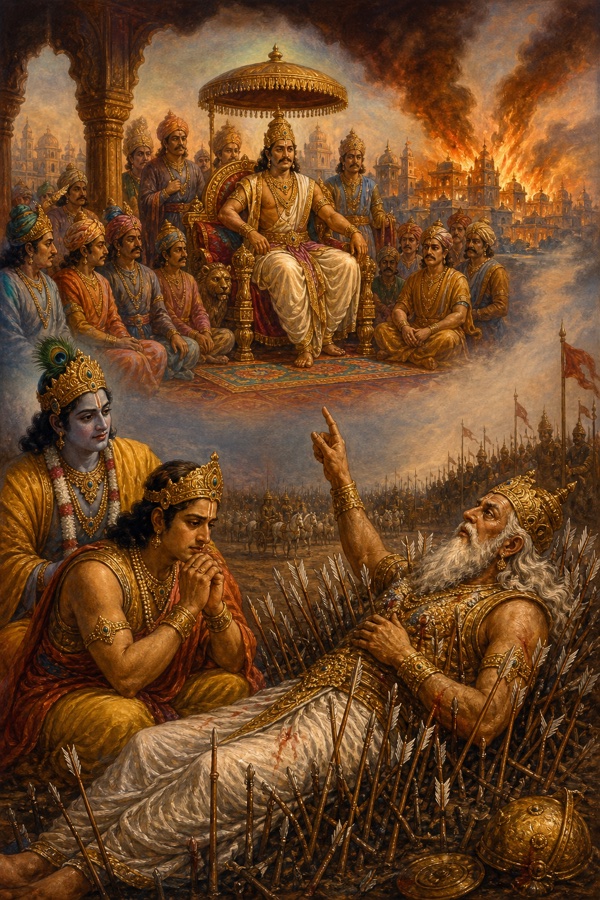
A sub-tale: Panchashikha gave Janadeva one more thing to hold, and it came out of the king’s own family. Their ancestor Janaka, lord of Mithila, once stood watching his city burn in a great fire, and he himself declared: “In this fire nothing of mine is burning.” King Janadeva listened to these words, which have the power to give deathlessness. He thought carefully through everything the sage had said and arrived at the truth of it. Then he put his sorrows down and lived on in great happiness. Bhishma added a promise for Yudhishthira: whoever reads this discourse on release and keeps reflecting on it is never hurt by any calamity, and, freed from sorrow, wins his release as Janadeva of Mithila did after he met Panchashikha.
The gist: Release, as Panchashikha teaches it, is neither extinction nor any existence that can be readily pictured. The body is five elements joined by their own nature; the ten organs, the mind and the understanding make twelve that exist together and apart from the soul. A river entering the ocean gives up its name and shape, and the freed soul enters the universal soul in the same way, leaving its cocoon of acts as a silkworm does. Janaka said it in one line while Mithila burned.
Self-restraint: the root of freedom from pleasure, pain, and fear
Yudhishthira’s next question was plainer. “What must a person do to be happy? What is it that brings him to grief? And what should he do to be free of fear and go through this world with his purposes fulfilled?”
Bhishma gave him one word for all three: restraint. The ancients, whose understanding was fixed on the Vedas, praised self-restraint as the duty of every order of society, and of the Brahmins above all. Without it no rite succeeds. Rites, austerities and truth all stand on that one footing. Restraint adds to a person’s energy, and it is called sacred. The restrained man is free of sin and free of fear, and he wins large results. He goes to sleep happy and wakes happy. He moves through the world happily, and his mind stays bright. Every kind of agitation is quietly brought under control by restraint, and the man who lacks it fails at the same attempt. The restrained man looks at his own enemies, lust and desire and anger and the endless others of that kind, as though they lived in somebody else’s body. Unrestrained people are like tigers and the other beasts that eat flesh: every creature near them lives in dread. It was to hold such people in check that the Self-born made kings. In each of the four stages of life restraint stands above every other virtue, and what it yields is far greater than what all four stages yield together.
Then he gave the marks by which those who prize restraint are known. They are nobility, a calm disposition, contentment, faith, forgiveness, an unvarying simplicity, freedom from chatter, humility, reverence for elders, benevolence, compassion for every creature, and frankness. Such a man keeps out of talk about kings and people in power. He keeps out of false and useless conversation, and he neither applauds others nor runs them down. He wants release. He bears the joys and griefs of the present quietly, and the ones still to come neither lift him nor lower him. There is no vindictiveness in him and no guile, praise and blame do not move him, his conduct and manners are good, his heart is clean, he is steady, and he is fully master of his passions. He is honored in this world and goes to heaven after it. He helps every creature to what it could never have obtained without him, and that is his joy. Given to goodwill toward all, he holds a grudge against no one. He is as still as the ocean in a dead calm, and wisdom fills him. Being intelligent, and worthy of everyone’s respect, he fears no creature and no creature fears him. The man who feels no elation at a great gain and no sorrow when calamity overtakes him is said to have a contented wisdom. He is the one called self-restrained, and he is the one truly called twice-born. Knowing the scriptures and clean of heart, he does everything the good do and enjoys the high fruits of it.
The wicked never set foot on the road marked out by benevolence, forgiveness, tranquility, contentment, sweetness of speech, truth, generosity and ease. Their road is lust and anger, greed, envy of other people, and boasting. A Brahmin should master lust and anger, keep the vow of brahmacharya, and take complete command of his senses. He should throw himself, with endurance, into the hardest austerities and keep the strictest restraints. And he should live in this world waiting calmly for his time, a man who appears to have a body and knows perfectly well that he himself cannot be destroyed.
The gist: Happiness, grief and fear all turn on one thing in Bhishma’s answer, restraint of the self. On it rest rites, austerity and truth, and its fruit outweighs the four stages of life together. Its marks are forgiveness, contentment, simplicity, compassion and silence about kings and about other people’s faults. Lust, anger, greed, envy and boasting are the road of the wicked, and kings exist to hold those who walk it in check.
Is fasting tapas? And what true tapas is
From conduct Yudhishthira turned to the table, and to a practice he had plainly seen. “The three twice-born orders are given to sacrifices and rites,” he said, “and sometimes, wanting children and wanting heaven, they eat what is left of the sacrifices made to the gods, and those leavings include meat and wine. Grandfather, what is the character of that act?”
“Those who eat forbidden food without keeping the sacrifices and vows the Vedas lay down are willful men, and they are counted as fallen even here,” Bhishma said. “Those who eat such food while keeping the Vedic sacrifices and vows, drawn on by the wish for heaven and for children, do rise to heaven. They fall from it again when their merit is used up.”
“Ordinary people say that fasting is tapas,” Yudhishthira said. “Is fasting really austerity, or is austerity something else?” People do take a fast for austerity, Bhishma told him, and measure it out in months, in fortnights, in days. In the judgment of the good it is nothing of the kind, and worse, a fast gets in the way of coming to know the soul. The highest austerity is made of two things. One is the giving up of acts, which is so hard for everyone. The other is humility, which means honoring all creatures and having regard for them. That stands above every other kind of austerity. A man who takes to it is regarded as always fasting and always living in brahmacharya. Such a Brahmin is a sage at all times, a god at all times, forever wakeful and wholly given to virtue, even if he lives in the bosom of a family. He is always a vegetarian and always pure. He is always an eater of amrita, the food of the immortals, always one who lives on the remnants of sacrifice, always devoted to hospitality, full of faith, and always honoring the gods and his guests.
Yudhishthira could not see it. How could a man practicing that austerity be called always fasting, or always vowed to continence, or always living on sacrificial remnants, or always mindful of guests? Bhishma gave him the household rules one by one. A man is regarded as always fasting if he eats once in the day and once in the night, at the fixed hours, and takes nothing in between. A Brahmin who always speaks the truth and always holds to wisdom, and who goes to his wife only in her season and never at other times, is a brahmachari. By never eating the meat of an animal that was not killed for sacrifice he becomes a strict vegetarian. By always giving he becomes always pure, and by keeping from sleep during the day he becomes always wakeful. “Know this, Yudhishthira: the man who eats only after his servants and his guests have been fed is always eating amrita. The Brahmin who never eats until gods and guests are fed wins heaven itself by that abstention. And the one who eats only what remains after the gods, the ancestors, the servants and the guests have been fed is the one said to live on the remnants of sacrifice. Such men win worlds of happiness without number in the next life. The gods come to their houses, with Brahma himself and the apsaras, the dancers of heaven. Those who share their food with the gods and the ancestors pass their days in unbroken happiness among their sons and grandsons, and when at last they leave this body they come to a very high end.”
The gist: Eating forbidden food under Vedic vows wins heaven only until the merit is spent. Going hungry by the month or the fortnight is no austerity in the judgment of the good, and it hinders knowledge of the soul. The highest austerity is the giving up of acts together with humility toward every creature. Two meals at fixed hours, truthfulness, the wife approached only in her season, no meat outside sacrifice, constant giving, no sleep by day, and food taken last, after gods, ancestors, servants and guests: by these a householder is called a faster, a brahmachari and an eater of amrita.
Prahlada and Indra: who is the doer?
Something under all these rules still troubled the king. “In this world,” Yudhishthira said, “acts good and bad fasten onto a man, and their fruits come to him to be enjoyed or endured. Is the man to be regarded as the doer of those acts, or is he not? My mind is full of doubt about this. Grandfather, I want to hear it from you at length.”
Bhishma answered with the old account of a conversation between Prahlada and Indra. Prahlada was the chief of the Daityas, the sons of Diti who are the gods’ old enemies, and he was attached to nothing in the world. His sins had been washed away. He came of honored parents and had great learning. There was no confusion in him and no pride; he kept to the quality of goodness, held to many vows, and took praise and blame as the same thing. He knew how every created thing begins and how it ends, the moving and the unmoving alike, and so he was never angry at what displeased him and never glad when something pleasant arrived. Gold and a clod of earth looked the same to him. He was steadily engaged in the study of the soul and the winning of release, firm in knowledge, his conclusions about the truth all settled. He knew what is highest among things and what is lower, and his sight took in everything. At the time of this story he was passing his days in an empty room, his senses entirely in hand.
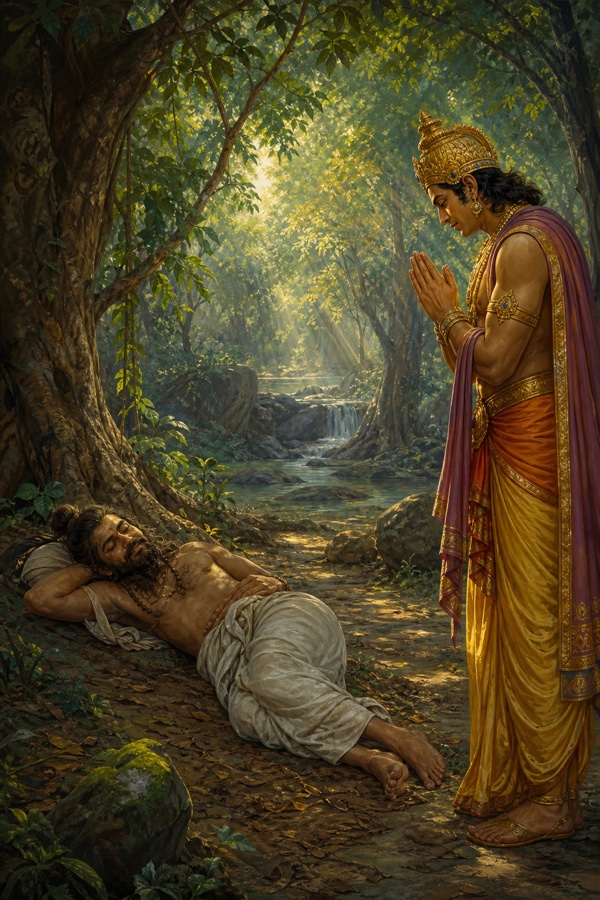
Indra, the king of the gods, who is also named Shakra, came to him there one day, meaning to rouse him and hear what he would say. “King,” Shakra began, “I see lodged in you, for good, every quality by which a person wins the esteem of all. Your understanding seems like a child’s, free of liking and of loathing. You know the soul. What do you think is the best means of coming to know it? You are bound with cords now. You have fallen from the place you held, you are under the heel of your enemies, and your prosperity is gone. Your circumstances are the kind that call for grief. How is it, Prahlada, that you do not grieve? Does this come from wisdom, or from sheer fortitude? Look at your calamities, and yet you sit like a man who is happy and at peace.”
The chief of the Daityas had long since made up his mind about the truth, and he answered in mild words that had great wisdom in them. “The one who does not know how created things begin and end is bewildered, and his ignorance is the reason. The one who knows both is never bewildered. Everything that is, and everything that is said not to be, comes into being and passes away by its own nature. No effort by any person is needed to bring that about. Where no personal effort is at work, it is plain that no personal agent stands behind all this that we perceive. The person within, the conscious self, never does anything at all; yet ignorance spreads over it the feeling that it acts. Anyone who looks on himself as the doer of acts, good or bad, has a spoiled wisdom, and in my judgment he does not know the truth.
“If the being we call a person were really the actor, Shakra, then everything he undertook for his own benefit would certainly succeed. None of it would be defeated. Yet look at those who struggle with all their strength: we do not see the things they dread held off or the things they want arriving. What becomes of personal effort then? And there are others who make no effort whatever, and the thing they dread is held off and the thing they want is done. That can only be the work of Nature. Some people present a strange spectacle. They have the better intelligence, and still they have to ask for money from men who are coarse in feature and have very little sense. When every quality a person has, good or bad, enters him at Nature’s urging, what ground is there for anyone to boast of what he possesses? All of it flows from Nature. That is my settled conclusion. Even release, and the knowledge of the self, as I see it, flow from the same source.
“In this world every fruit that fastens on a person, good or bad, is taken to be the result of acts, so let me speak fully about acts. A crow that has found something to eat tells the other crows the food is there by cawing over and over. In the same way all our acts do no more than announce what Nature has marked out. The man who knows only Nature’s changes and does not know Nature herself, who is supreme and exists of herself, is bewildered through his ignorance. The man who understands the difference between Nature and her changes is never bewildered. Everything that exists has its origin in Nature, and a person who is certain of that can never be touched by pride or arrogance. I know where all the rules of right conduct come from, and I know that nothing among objects is stable, and so, Shakra, I am not able to grieve. All of this has an end. Without attachments, without pride, without desire or hope, loosed from every bond and separate from everything, I pass my time in great happiness, watching created things appear and disappear. For one who has wisdom and self-command, who is content, who wants nothing and hopes for nothing, and who sees all things by the light of self-knowledge, there is no trouble and no anxiety. I feel neither affection nor aversion toward Nature or toward her changes. I see no one now who is my enemy and no one who is my own. At no time do I covet heaven, or this world, or the regions below. There is happiness in understanding the soul. But the soul, being separate from everything, cannot enjoy happiness, and so I want nothing.”
“Tell me the means, Prahlada,” Shakra said. “How is this kind of wisdom gained, and how is this kind of peace made one’s own? I ask it of you.” Prahlada told him. “By simplicity, by carefulness, by cleansing the soul, by mastering the passions, and by waiting on the old, Shakra, a person comes to release. Know this as well: wisdom is acquired from Nature, and the gaining of peace is owed to the same cause. Everything else you perceive is owed to Nature too.” The lord of the three worlds was filled with wonder at this. He praised what he had heard with a glad heart, paid his worship to the lord of the Daityas, took his leave, and went back to his own dwelling.
A key to reading this (the sense of doership and nature): Prahlada’s position is that the conscious person never acts. Things come into being and cease by their own nature, and ignorance lays over the self the feeling “I am the doer.” His evidence is failure and luck: effort that gains nothing, and gain that follows no effort. From it he concludes that every quality a person has is Nature’s, so that no one has ground for boasting, and he does not exempt wisdom, peace, or release itself.
The gist: Asked whether a man is the doer of his deeds, Bhishma lets Prahlada answer. The person does nothing; everything flows from Nature, and acts only announce her, as a crow’s cawing announces food. Knowing that, the bound and fallen Daitya king watches things appear and disappear and feels no grief. Indra, who came to probe him, leaves after paying him worship.
Vasava and Bali: how a king should live when prosperity is stripped away
The next question came from a king who had watched other kings ruined. “Tell me, grandfather,” Yudhishthira said, “what kind of understanding lets a king go on living on this earth after he has been stripped of his prosperity and crushed under the heavy club of Time?”
For that Bhishma had an old story, a conversation between Bali, the son of Virochana, and Indra, who goes in it by all his names: Shakra, Vasava, Purandara, Maghavan. Indra had beaten the Asuras, all of them. One day afterward he went to Brahma, the Grandfather of the worlds, joined his hands, bowed, and asked where Bali had gone. “Tell me where I can find him now. His wealth never grew less however lavishly he gave it away. He was the god of wind. He was Varuna. He was the sun and he was the moon. He was the fire that warms every creature, and he became water for the use of all. I cannot find where he is. It was Bali who used to light every quarter of the sky and then set at evening. It was Bali who shook off idleness and poured rain on all creatures in the proper season. I do not see him anywhere. Tell me where I may find the chief of the Asuras.”
“It does not become you, Maghavan, to go asking after Bali now,” Brahma said. “But a person who is asked a question should not answer with an untruth, so I will tell you where he is. Bali may have taken birth among camels, or bulls, or asses, or horses. Having become the first of his kind, he will be staying in some empty house.” Indra had a second question ready. “If I come upon Bali in an empty house, do I kill him or do I spare him? Tell me how to act.” The Creator’s answer left no room. “Do not harm Bali, Shakra. Bali does not deserve death. What you should do, Vasava, is ask him to teach you about right conduct, in whatever way you please.”
So Indra mounted Airavata, his elephant, and ranged over the earth in all his splendor. He found Bali where the Creator had said he would be, living in an empty house, wearing the body of an ass. “So, Danava,” said Shakra, “you are born an ass now, with chaff for your food. This is certainly a low order of birth. Do you grieve over it, or do you not? I am looking at something I never saw before: you, brought under the power of your enemies, without prosperity, without friends, your energy and your prowess shorn away. You used to travel through the worlds with a train of vehicles in the thousands and kinsmen in the thousands, scorching everyone with your splendor and counting us gods as nothing. The Daityas looked up to you as their protector and lived under your rule. Through your power the earth gave crops without waiting to be tilled. And today I find you overtaken by this calamity. Do you grieve for it, or do you not?
“There was a time when you stood on the eastern shore of the ocean, pride showing in your face, and divided your vast wealth among your kinsmen. What was the state of your mind then? For many years, when you blazed with splendor and took your pleasure, thousands of the women of heaven danced before you, every one garlanded with lotuses, every one with companions bright as gold. What was your mind then, lord of the Danavas, and what is it now? You had a very large umbrella made of gold and set with jewels and gems. Full forty-two thousand Gandharvas used to dance before you in those days. At your sacrifices the stake was huge and made entirely of gold, and on those occasions you gave away cattle by the million and the million again. What was your mind then, Daitya? Once, in the course of a sacrifice, you went round the whole earth by the rule of the hurled shamya, throwing the wooden rod and sacrificing wherever it fell. What was your mind then? I do not see your golden jar now. I do not see that umbrella, or those fans. King of the Asuras, I do not even see the garland the Grandfather gave you.”
“You do not see my jar, Vasava, or my umbrella, or my fans,” Bali said. “You do not see my garland, the Grandfather’s gift. The precious things you ask about are buried now in the darkness of a cave. When my time comes round again, you will certainly see them again. But this conduct of yours suits neither your fame nor your birth. You are in prosperity, and you want to mock me while I am sunk in adversity. Those who have gained wisdom and taken their contentment from it, the calm of soul, the virtuous and good among creatures, never grieve in misery and never rejoice in happiness. You are led by a vulgar understanding, Purandara, and so you brag. When you become what I am, you will not make speeches like these.”
A key to reading this (Bali): Bali is the son of Virochana and the chief of the Asuras. By Indra’s own account he once did the work of the wind, of Varuna, of the sun, the moon, fire and water, and Bali will say himself that gods, men, ancestors, Gandharvas, snakes and Rakshasas were all under his sway. Bhishma tells Yudhishthira further on that Bali became king after the war between the gods and the Asuras, that he was deceived by Vishnu, and that Indra was then installed again as king of the gods. Brahma forbids Indra to kill him and tells him to ask Bali for instruction.
Time is the doer: Bali’s answer
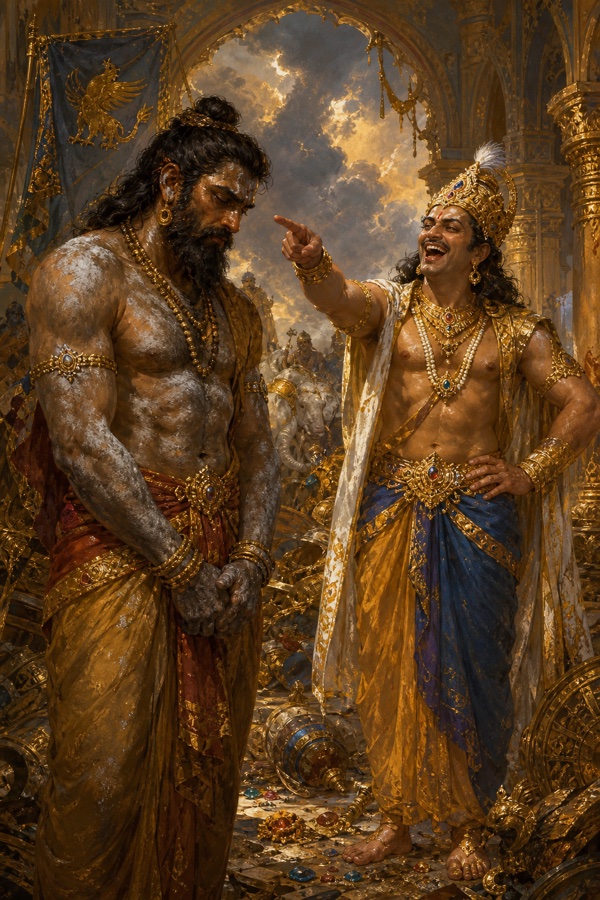
Bali was sighing like a snake, and Shakra laughed at him again and set himself to say something more cutting than before. “You used to make your progresses with a train of vehicles and kinsmen in the thousands, scorching all the worlds with your splendor and holding us for nothing. Now kinsmen and friends alike have deserted you. When you look at the miserable state that has overtaken you, do you grieve or do you not? All the worlds were under your rule once, and great was your joy. I am asking you: do you grieve now for this fall from all your outward splendor?”
“I look on all of this as passing, as the work of the course of time, and so, Shakra, I do not grieve,” Bali said. “These things have an end. The bodies that creatures wear are all passing things, and for that reason I do not grieve over this ass’s shape. Nor did any fault of mine bring it on me. The principle that gives life and the body it lives in come into existence together, by their own nature. They grow together and they meet destruction together. I have taken on this form of existence, and it has not made a slave of me for good. Knowing that much, I have no cause for sorrow. The last resting place of every river is the ocean, and the end of every embodied creature is death. People who know this well are never bewildered. Those who are swamped by passion and have lost their judgment do not know it, and with their understanding gone they sink under the weight of misfortune. A person who gains a keen understanding destroys all his sins. A sinless person gains the quality of goodness, and having gained it he is cheerful. Those who fall away from goodness and are born again and again are bound to sorrow and grief, led on by desire and by the objects of the senses. Success or failure in getting what I want, life or death, the fruits of action that come as pleasure or as pain: I neither like these nor dislike them.
“When one man kills another, he kills only that other’s body. The man who thinks it is he who kills is himself killed, and the two of them, the slayer and the slain, are equally ignorant of the truth. Whoever has killed or conquered someone and brags of his manhood, Maghavan, should know that he is no actor in the matter; the deed he boasts of was carried out by the real agent, who is someone else. When people ask who it is that brings about the creation and the destruction of things in this world, they generally fix on some person who was himself created. Know that the person they fix on has a creator. Earth, light, space, water, and wind for the fifth: from these all creatures spring. Knowing that, what sorrow can I feel at this change in my condition?
“The very learned and the barely learned, the strong and the strengthless, the beautiful and the very ugly, the fortunate and the unblessed, are all swept away by Time, which is too deep to be sounded and acts by its own energy. When I know that it is Time that has beaten me, what sorrow can I feel? Whoever burns a thing burns what was already burnt. Whoever kills, kills a victim already killed. What is destroyed was destroyed before. What a person gains is what had already arrived and was meant for him. This Time is like an ocean. There is no island in it. Where is its farther shore? Its boundary cannot be seen. However deeply I reflect, I do not find the end of that unbroken stream, which ordains all things and is surely divine. If I did not understand that it is Time that destroys every creature, then perhaps I would have felt joy, and pride, and anger.
“Have you come here to pass sentence on me, now that you have learned I wear the form of an ass that lives on chaff and passes its days in a lonely place far from where men live? If I wished, I could take on, even now, shapes so dreadful that at the sight of any one of them you would get yourself out of my presence in a hurry. It is Time that gives everything, and Time that takes everything away again. It is Time that ordains all things. Do not brag of your manhood, Shakra. There were days, Purandara, when everything shook if I grew angry. But I know the lasting nature of all things in the world. Learn the truth yourself, and stop being amazed. Wealth and the source of wealth are in nobody’s control. Your mind seems to me like a child’s; it is what it always was. Open your eyes, Maghavan, and take up an understanding that rests on certainty and truth. Gods, men, ancestors, Gandharvas, snakes and Rakshasas were all under my sway in days gone by, as you know, Vasava. Creatures, their wits clouded by ignorance, used to flatter me with the words, ‘Salutations to that quarter of the sky where Virochana’s son Bali may now be staying!’ I feel no grief when I think of that honor, and none for this fall. On one point my understanding is firm: I will live obedient to the Ordainer. One sees a man of noble birth, handsome and of great prowess, living in misery with all his counselors and friends. That happens because it was ordained. One sees another man, born in a low family, without knowledge, with a stain on his very birth, living in happiness with all his counselors and friends, and that too was ordained. A lucky and beautiful woman is seen to pass her whole life in misery, and an ugly woman with every unlucky mark passes her days in great happiness. That we are what we are now is due to no act of ours, Shakra. That you are what you are is due to no act of yours, wielder of the thunderbolt. You of the hundred sacrifices have done nothing that earned you this wealth, and I did nothing that stripped me of mine. Wealth and its opposite come one after the other. I see you blazing with splendor, prosperous, beautiful, set at the head of all the gods, and roaring at me. That could never be if Time, having struck me down, were not standing close by. If Time had not struck me, I would have killed you today with a blow of my bare fists, thunderbolt and all. But this is no hour for showing my strength. The hour that has come is one for peace and stillness. It is Time that sets all things in their places, works on them, and brings them to their final end. I was the worshiped lord of the Danavas. I burned everything with my energy and roared in my strength and pride. When Time has struck even me, whom will it not strike? Once I carried alone the energy of all twelve Adityas, and you were one of them. It was I who drew the water up and showered it down as rain, Vasava. It was I who gave light and heat to the three worlds. I protected and I destroyed. I gave and I took. I bound and I set loose. In all the worlds I was the one master. That sovereignty of mine is gone. The forces of Time have come upon me, and those things no longer shine in me. I am not the doer. You are not the doer. No one else is the doer either. It is Time, Shakra, that protects all things or destroys them.
“Those who know the Vedas say that Time, which is eternity, is Brahman. The fortnights and the months are its body. Days and nights are the robes that body wears. The seasons are its senses, and the year is its mouth. Some people, out of their finer intelligence, say that all of this, the whole universe, should be thought of as Brahman. The Vedas teach that the five sheaths that wrap the soul should be regarded as Brahman. Brahman is deep and hard to reach, like a vast ocean of waters. It is said to have neither beginning nor end, and to be both indestructible and destructible. In itself it has no attributes, yet it enters every existing thing and in that way takes attributes on. Those who know the truth regard it as eternal. Through the action of ignorance Brahman lets the attributes of matter wrap the conscious soul, whose only attribute is knowledge; that wrapping is no essential part of the soul, because when knowledge of the true cause of everything appears, it falls away. Brahman in the form of Time is the refuge of all creatures. Where would you go to get beyond it? Time cannot be escaped by running or by standing still. None of the five senses can perceive it. Some have said that Brahman is fire. Some have said Prajapati, some the seasons, some the month, some the fortnight, some the days, some the hours, some the morning, some the noon, some the evening, and some the moment. In this way different people speak differently of what is single. Know that it is eternity, and that all things are under its sway.
“Many thousands of Indras have passed away, Vasava, and each of them had great strength and prowess. You will pass in the same manner. You too, Shakra, with your swelling might, chief of the gods as you are, will be put out by all-powerful Time when your hour comes. Time sweeps everything away. For that reason, Indra, do not brag. Time cannot be quieted by you, or by me, or by those who went before us. This royal prosperity that you have reached, and that you think beyond comparison, was mine before it was yours. She has no substance and she is not real. She does not stay long in one place. She lived in thousands of Indras before you, and every one of them was far greater than you. She is unstable, and so she has left me and come to you, chief of the gods. Do not brag like that again, Shakra. Be still. She knows how full of vanity you are, and she will leave you very soon.”
The gist: Bali’s answer to mockery is that Time is the doer. Body and life arise together and end together; whoever kills, kills what was already killed; wealth and ruin come by turns to the noble and the base, and no act of Bali’s or of Indra’s earned either one. The knowers of the Veda, he says, call Time Brahman, with fortnights and months for its body and the year for its mouth. Thousands of Indras, each greater than this one, held the same prosperity, and she left them all.
Shri leaves Bali and comes to dwell in Indra
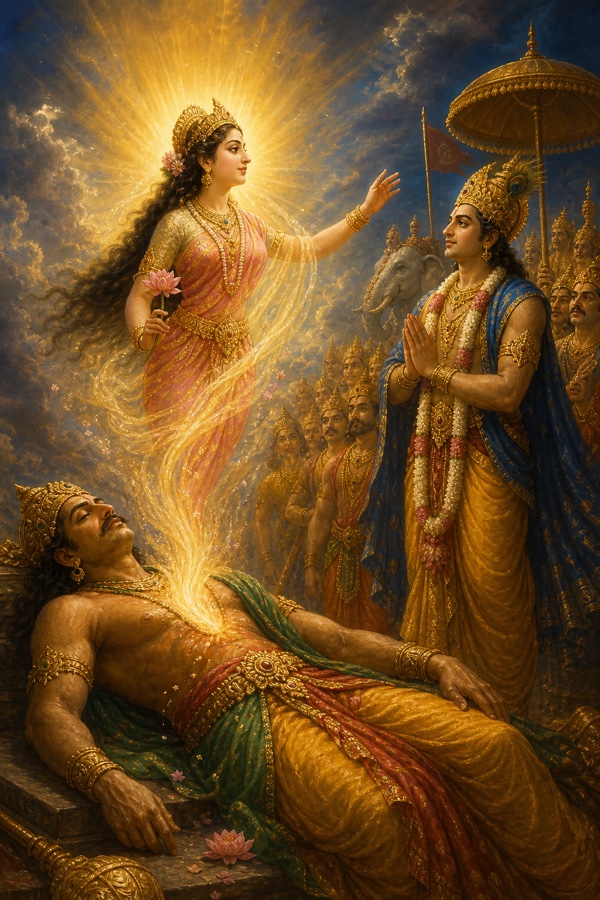
What happened next Indra saw with his own eyes. Out of Bali’s body came the goddess of prosperity in her own form, blazing. Indra, the god of the hundred sacrifices, stared at her with his eyes stretched wide. “Bali,” he said, “who is this? She shines with such splendor. She wears plumes on her head and golden bracelets on her upper arms, and a halo of glory spreads from her on every side by the force of her own energy, and she is coming out of your body.”
“I do not know whether she is a woman of the Asuras, or of the gods, or of humankind,” Bali said. “Ask her yourself. Do whatever pleases you.” So Shakra spoke to her directly. “Lady of the sweet smile, who are you, with this radiance and these plumes, coming out of Bali’s body? I do not know you. Be kind enough to tell me your name. Who are you, standing here like Maya herself, ablaze with your own light, after deserting the lord of the Daityas? Tell me, since I ask.”
“Virochana did not know me,” she said, “and this Bali, Virochana’s son, does not know me either. The learned have called me Duhsaha, the one who is hard to bear. Some have known me as Vidhitsa. I have other names too, Vasava: Bhuti, Lakshmi and Shri. You do not know me, Shakra, and no one among the gods knows me.” Indra asked what he most wanted to hear. “Lady who is hard to bear, you lived in Bali for a long time. Why do you desert him now? Is it because of something I have done, or something Bali has done?” Shri would allow neither. “The Creator does not rule me, and the Ordainer does not rule me. It is Time that moves me from one place to another. Do not look down on Bali, Shakra.”
He pressed her. “Goddess of the plumes, for what reason do you leave Bali? And why do you come to me, to live in me? Tell me, you of the sweet smile.” This time she gave reasons. “I live in truth, in gifts, in good vows, in austerities, in prowess and in virtue. Bali has fallen away from all of these. He used to be devoted to the Brahmins. He was truthful, and he had his passions under control. Later he began to nurse hostility toward the Brahmins, and he touched clarified butter with hands still soiled from eating. He used to be engaged in sacrifices always. In the end, blinded by ignorance and struck by Time, he took to boasting before everyone that his worship of me never ceased. For that I am leaving him, and from now on, Shakra, I will live in you. You must carry me without carelessness, with austerities and with prowess.”
Indra did not flatter himself. “You who dwell among the lotuses, there is not one person among gods, men and all creatures who can bear you forever.” She agreed with him. “That is true, Purandara. Among gods, Gandharvas, Asuras and Rakshasas there is none who can bear me forever.” “Then tell me, auspicious lady,” he said, “how I should conduct myself so that you may live in me always. I will certainly do what you say. Answer me truly.” And Shri told him: “Chief of the gods, I will tell you how I can be made to live in you always. Divide me into four parts, according to the ordinance laid down in the Vedas.”
“I will assign the dwelling places according to the strength each has to bear you,” said Shakra. “For my own part, Lakshmi, I will always take care never to offend you in any way. Among men it is the earth, the mother of all things, who bears them all. She shall bear a fourth part of you. I think she has the strength for it.” “Here, I give up a quarter of myself,” said Shri. “Let it be set upon the earth. Now make a proper arrangement, Shakra, for my second quarter.” “The waters, in their flowing form, do many services to human beings. Let the waters bear a fourth part of you. They have the strength.” “I give up another quarter, to be set in the waters. Now find a proper place for my third.” “The Vedas, the sacrifices and the gods are all established in fire. Fire will bear your third quarter when it is placed there.” “Here I give up my third quarter, to be placed in fire. Now, Shakra, a proper place for my last.” “The good among men, those devoted to the Brahmins and truthful in speech, may bear your fourth quarter. The good have the power to bear it.” “Here I give up my fourth quarter, to be placed among the good. My portions are assigned now among different creatures. Go on protecting me, Shakra.” “Hear what I say,” Indra answered. “I have distributed you among different creatures, and those among creatures who offend against you I will punish.”
A sub-tale: Bali, deserted now by Shri, had words of his own for the god. “At present the sun shines as much in the east as in the west, and as much in the north as in the south. But when the sun draws itself in from every side and shines only on the world of Brahma, which stands at the middle of Sumeru, then there will be a great battle again between the gods and the Asuras, and in that fight I shall certainly defeat you all.” He said it twice. Shakra answered him: “Brahma has commanded me never to kill you. That is the reason, Bali, that I do not throw my thunderbolt at your head. Go wherever you wish, chief of the Daityas. Great Asura, peace to you. But no time will ever come when the sun shines from the meridian alone. The Self-born settled the laws of the sun’s motion long ago. Giving light and heat to all creatures, he goes on without a pause, six months on his northward course and six months on his southward, and by those two courses he makes winter and summer for everything that lives.” After that, by Bhishma’s telling, Bali went away toward the south and Purandara toward the north. Indra of the thousand eyes had heard Bali out, a speech with no pride in it anywhere, and he rose into the sky.
The gist: Prosperity walks out of Bali’s body as a goddess and gives her names: Duhsaha, Vidhitsa, Bhuti, Lakshmi, Shri. Neither the Creator nor the Ordainer rules her; Time moves her. She lives in truth, gifts, good vows, austerities, prowess and virtue, and she leaves Bali for his enmity toward the Brahmins, for unwashed hands on the clarified butter, and for his boasting. Since no one can bear her forever, Indra sets a quarter of her on the earth, a quarter in the waters, a quarter in fire and a quarter among the good, and undertakes to punish whoever offends against her.
Namuchi’s teaching: grief mends nothing
Bhishma had a second witness to call, and he named him to Yudhishthira at once: the Asura Namuchi, questioned by the same god of the hundred sacrifices. Namuchi knew how every creature is born and how it dies. He had lost his prosperity, and he sat with a heart as untroubled as the great ocean when it lies perfectly still. Purandara said to him, “You have fallen from your place, Namuchi. You are bound with cords, you have been brought under the power of your enemies, and your prosperity is gone. Do you give yourself up to grief, or do you pass your days cheerfully?”
“Grief that cannot be warded off does only two things,” Namuchi answered. “It wastes a man’s body and it delights his enemies. And no one can lighten another person’s sorrow by taking a share of it on himself. For those reasons, Shakra, I do not grieve. Everything you see here comes to one end. Giving way to sorrow destroys a person’s good looks, his prosperity, his life, and his very virtue. A man of true knowledge puts down the sorrow that comes over him, which is born of a mind badly disposed, and turns his thought to what yields the highest good and lives in the heart itself. Once the mind is set on that highest good, every purpose he has is accomplished. There is one Ordainer and no second. His control reaches even the being that lies inside the womb. Governed by that great Ordainer, I go as he sets me going, like water running down a slope. I know what existence is and I know what release is, and I understand that release is the higher of the two; all the same I do not strive to reach it. I do the acts that tend toward virtue and the acts that tend the other way, and I go on as he sets me on. A person gets the things he was ordained to get. What is to happen, happens. He has to live, time after time, in whatever womb the Ordainer places him in, and he has no choice in it. The one who is put into some condition and accepts it as the condition ordained for him is never bewildered.
“Pleasure and pain come to men by turns in the course of Time, and no person brings either one about. The sorrow lies exactly here, that the man who hates sorrow takes himself for the actor. Among rishis, gods, great Asuras, men who know the three Vedas through and through, and ascetics in the forest, who is there that calamity does not visit? Those who know the soul from what is other than the soul have no fear of calamities. The wise person stands by nature as unmoving as Himavat. He never gives way to anger and never lets himself be tied to the objects of the senses. He does not waste away in sorrow or exult in happiness, and when great afflictions pour over him he still does not grieve. That is a very superior person, whom the greatest success cannot gladden and the worst calamity cannot wound, who bears pleasure and pain and whatever lies between them with a heart unmoved. Whatever condition a man falls into, he should call up cheerfulness and refuse to yield to sorrow; that is how to drive off the grief that swells up in one’s own mind and is certain to hurt if it is left there. A gathering of learned men who discuss duties founded on the Vedas and on the remembered law is no good gathering, and does not deserve the name, if a wicked man can walk into it and feel no fear on account of what he has done. The finest man is the one who dives into the question of what is right and then manages to act on the conclusions he reaches. The acts of a wise man are not easy to understand. He is never bewildered when afflictions come. Even if he is thrown down from his place in old age by the worst of calamities, as Gautama was, he does not let it bewilder him.
“Mantras, strength, energy, wisdom, prowess, behavior, conduct, great wealth: can a person, by any one of these, get what he was not ordained to get? Then what sorrow is there in failing to get the thing on which he had set his heart? Before I was born, those who have this matter in their hands ordained what I am to do and what I am to suffer. I am carrying out what they ordained. What can death do to me, then? A person obtains only what it was ordained that he obtain. He goes where it was ordained that he go. The sorrows and the joys that come to him are the ones ordained to come. The man who knows this fully and does not let himself be bewildered, and who is content in happiness and in sorrow alike, is regarded as first among men.”
The gist: Namuchi, bound and stripped like Bali, tells Indra why he does not grieve. Sorrow that cannot be warded off wastes the body, pleases one’s enemies, and destroys beauty, prosperity, life and virtue, and nobody else can carry a share of it. There is one Ordainer, whose control reaches the child in the womb, and Namuchi moves as that Ordainer sets him moving, like water running downhill. The wise person stands as firm as Himavat and summons cheerfulness in any condition.
Patience is the highest good: the second meeting of Bali and Vasava
Yudhishthira brought the question home. “When a man is sunk in terrible distress, when he has lost his friends or lost his kingdom, what is actually good for him? In this world you are the first of our teachers. I am asking you, and I need you to tell me.”
“For one who has been deprived of sons and wives, of every pleasure and of his wealth, and who has been plunged into terrible distress, fortitude is the highest good,” Bhishma said. “The body of a man who always keeps his fortitude never wastes. Freedom from grief carries happiness inside it, and health as well, which is a better possession still, and through a healthy body a man may win prosperity again. The wise man who holds to righteous conduct while distress is on him gains prosperity, patience, and perseverance in whatever he sets out to do.” Then he said there was more to hear of Bali and Vasava, and he went back to them.
The war between the gods and the Asuras was over, and a great many Daityas and Danavas had fallen in it. Bali had become king. Then Vishnu deceived him and set his own sway over all the worlds once more, and the god of the hundred sacrifices was again invested as sovereign of the gods. Their rule was restored. The four orders of men went back to the practice of their own duties, the three worlds swelled with prosperity, and the Self-born was glad at heart. In those days Shakra made a royal progress through all the worlds, seated in splendor on Airavata, the four-tusked prince of elephants, with the Rudras, the Vasus, the Adityas, the Ashvins, the rishis of heaven, the Gandharvas, the Siddhas and other high orders of beings in his train. One day on that progress he caught sight of Bali, the son of Virochana, inside a cave in a mountain on the seashore, and he rode up to him. The prince of the Daityas saw the king of the gods on Airavata’s back with all the orders of heaven around him, and showed no sorrow and no agitation.
Indra saw him standing there unmoved and unafraid, and spoke down to him from the elephant. “How is it, Daitya, that you are so unmoved? Is it your heroism? Is it that you waited reverently on the old? Is it that austerities have cleansed your mind? Whatever the cause, this is a frame of mind very hard to come by. You have been hurled from the highest place there was. You have lost everything you owned, and your enemies have you in their power. Son of Virochana, what is it you lean on, that you do not grieve when the occasion is one for grief? When you held the sovereignty of your own kind, pleasures without rival were yours. Now your wealth is gone, and your jewels, and your sovereignty. Tell us why you are so unmoved. You were a god before this, seated on the throne of your father and your grandfathers. Seeing yourself stripped by your enemies today, why do you not grieve? You are bound in Varuna’s noose. You have been struck by my thunderbolt. Your wives have been taken, and your wealth with them. Tell us why you do not grieve. Robbed of prosperity, fallen from affluence, and you do not grieve: that is a remarkable thing. Who but one like you, Bali, could endure the burden of going on living after being shorn of the sovereignty of the three worlds?” He said this and more, all of it cutting, all of it asserting how far above Bali he now stood. Bali heard it without any pain, and answered without any fear.
“Calamity has pressed me down, Shakra. What do you gain by bragging now? Today I see you standing in front of me, Purandara, with the thunderbolt raised in your hand. There was a time when you could not have carried yourself so. Now, by some means or other, you have come by the power. Who else but you could bring himself to speak so cruelly? A person who is able to punish, and who shows compassion to a brave enemy he has beaten and brought under his power, is a very superior person indeed. When two fight, the outcome is always in doubt. One of them wins and the other is beaten. Do not let your temper be what it is now, chief of the gods. Do not imagine that you became sovereign of all creatures by conquering everyone with your own might and prowess. That we have become what we are is the result of no act of ours, Shakra. That you have become what you are is the result of no act of yours. What I am now, you will be hereafter. Do not despise me in the belief that you have accomplished something extremely difficult. Happiness and misery come to a person one after the other in the course of Time. You obtained the sovereignty of the universe in the course of Time, and through no special merit in yourself. It is Time that leads me along in its course, and the same Time leads you. That is why I am not today what you are, and why you are not what we are.
“Dutiful service to one’s parents, reverent worship of the gods, the proper practice of any good quality: none of these can make anyone happy. Knowledge cannot rescue the one whom Time has struck, and neither can austerities, or gifts, or friends, or kinsmen. Men cannot turn aside a calamity that is coming on them, though they try a thousand means. Intelligence and strength count for nothing there. For those whom the course of Time afflicts there is no rescuer. That you look on yourself as the actor, Shakra, lies at the root of all sorrow. If the apparent doer of an act were its real doer, he would not himself be the work of someone else. Since the apparent doer is the product of another, that other is the Supreme Being, above whom there is nothing higher. With Time’s help I once defeated you. With Time’s help you have defeated me. Time is what moves every being that moves, and Time is what destroys every being. Your intelligence is of the vulgar kind, Indra, and so you do not see that destruction is waiting for all things. Some people think highly of you as one who won the sovereignty of the universe by his own acts. Even so, how could someone like us, who know the way the world runs, grieve at being struck by Time, or let our understanding be dazed, or give way to error? Shall my understanding, or the understanding of anyone like me, break up at the touch of calamity like a wrecked ship at sea, merely because Time has overwhelmed us? I, and you, and all who will be chiefs of the gods in the future will have to go the way that hundreds of Indras have gone before you. When your hour ripens, Time will destroy you as surely as it has destroyed me, invincible as you are now and blazing with a splendor nobody matches. In the course of Time many thousands of Indras and of gods have been swept away, age after age. Time cannot be resisted. Having reached the place you hold, you think very highly of yourself, as highly as if you were the Creator of all beings, the divine and eternal Brahma. Many held that place before you. It proved stable for none of them and endless for none. Only you, in your foolish understanding, take it to be unchanging and eternal. You trust what does not deserve trust. You take for eternal what is not eternal. That is how a person thinks of himself when Time has overwhelmed and dazed him. Led by folly, you regard this royal prosperity as yours. Know that it is never fixed, in your case or mine or anyone’s. It belonged to people past counting before you, and after passing them all by it has now become yours. It will stay with you for a while, Vasava, and then it will show how unsteady it is. A cow leaves one drinking place and goes to another, and this prosperity will leave you for somebody else in just that way. So many sovereigns have gone before you that I will not attempt to count them, and in the future, Purandara, sovereigns without number will rise after you.
“I do not see them now, those rulers who once enjoyed this earth with her trees and plants, her gems and living creatures, her waters and her mines. Prithu, Aila, Maya, Bhima, Naraka, Shambara, Ashvagriva, Puloman, Svarbhanu, whose standard rose to a height nobody could measure, Prahlada, Namuchi, Daksha, Viprachitti, Virochana, Hrinisheva, Suhotra, Bhurihan, Pushavat, Vrisha, Satyepsu, Rishabha, Bahu, Kapilashva, Virupaka, Bana, Kartasvara, Vahni, Vishvadamshtra, Nairriti, Sankocha, Varitaksha, Varaha, Ashva, Ruchiprabha, Vishvajit, Pratirupa, Vrishanda, Vishkara, Madhu, Hiranyakashipu, and Kaitabha the Danava: these, and many others who were Daityas and Danavas and Rakshasas, and many more left unnamed, belonging to ages remote and more remote, great Daityas and leading Danavas whose names have come down to us, have all gone away and left the earth behind. Time struck every one of them. Time proved stronger than all of them. All of them had worshiped the Creator in hundreds of sacrifices; you are not the only one who has done that. All of them were devoted to righteousness, and all of them performed great sacrifices always. All could travel through the sky, and all were heroes who never showed their backs in battle. All had very strong bodies and arms like heavy clubs. All were masters of hundreds of illusions and could take any shape they chose. We have never heard that any one of them, once he had entered a battle, was ever defeated. All kept the vow of truth firmly, and all took their pleasure as they wished. Devoted to the Vedas and the Vedic rites, all of them had great learning. With their great might, all had won the highest prosperity and affluence. And among all those sovereigns there was not the smallest stain of pride in their sovereignty. All were open-handed and gave to each person what he deserved. All behaved properly and duly toward every creature. All of them were born of the daughters of Daksha. Strong as they were, all were lords of the creation, and all of them blazed, scorching everything with their energy. Time swept away every one.
“As for you, Shakra, it is clear that when the day comes for you to leave this earth after enjoying her, you will not be able to master your grief. Throw away this craving for things to love and things to enjoy. Throw away this pride that is born of prosperity. If you do, you will be able to bear the grief that comes with the loss of sovereignty. When the hour of sorrow comes, do not give way to sorrow, and when the hour of joy comes, do not rejoice. Let the past and the future alone, and live content with the present. I was always careful of my duties, and Time, which never sleeps, came upon me anyway. Turn your heart to the ways of peace, Indra, for that same Time will come over you very soon. You pierce me with your words. You seem bent on making me afraid, and finding me collected, you think very well of yourself. Time struck me first, and it is behind you even now. I was beaten by Time before anything else happened, and that is why you were able to beat me afterward, the feat over which you roar so proudly. In the old days, when I happened to grow angry, what person on earth could stand in front of me in battle? Time is stronger. It has overwhelmed me, and that is the only reason, Vasava, that you are able to stand before me. The thousand years of the gods that are the measure of your reign will certainly come to an end. Then you will fall, and your limbs will be as wretched as mine are now, for all my mighty energy. I have fallen from the high seat that belongs to the sovereign of the three worlds, and you are the actual Indra in heaven today. In this pleasant world of the living it is you whom everyone adores, and that is the course of Time. Can you say what it was you did that made you Indra today, and what it was we did that threw us down from the place we had? Time is the one creator and the one destroyer. Nothing else in the universe is the cause of anything. Decline, fall, sovereignty, happiness, misery, birth, death: a learned person who meets any of these neither rejoices nor grieves. You know us, Indra, and we know you, Vasava. Then why do you brag like this in front of me, shameless as you are, forgetting that it is Time that made you what you are? You saw for yourself what my prowess was in those days. The energy and might I showed in all my battles are evidence enough. The Adityas, the Rudras, the Sadhyas, the Vasus and the Maruts were all defeated by me. You know very well, Shakra, that in the great encounter between the gods and the Asuras the assembled gods were quickly routed by the fury of my attack. We tore up mountains, with their forests and everything that lived in those forests, and hurled them again and again. Many a mountain summit with a jagged edge I broke on your head. But what can I do now? Time cannot be resisted. If it were otherwise, do not suppose I would have hesitated to kill you, thunderbolt and all, with a single blow of my fist. This is not my hour for showing prowess. The hour that has come to me is one in which I must keep still and put up with everything, and that is the reason, Shakra, that I put up with all this insolence of yours. Know that I bear insolence far worse than you do. You are bragging before one whose time has ripened, who is ringed on every side by the fire of Time and tied fast in the cords of Time. Over there stands that dark one whom the world cannot resist. Fierce in form, he stands there, having bound me the way a beast is bound with ropes. Gain and loss, happiness and misery, lust and anger, birth and death, captivity and release: a person meets all of these in the course of Time.
“I am not the actor. You are not the actor. The actor is the one who is truly all-powerful. That Time is ripening me, to bring me down, like a fruit that has appeared on a tree. There are acts by which one man gains happiness in the course of Time, and by doing those very same acts another man gains misery. I know the properties of Time, and it would not become me to grieve when it is Time that has struck me. That is why I do not grieve, Shakra. Grief can do us no good. The grief of the one who grieves never removes his calamity. What grief does is destroy a person’s power, and for that reason I keep clear of it.”
Indra was the god of the hundred sacrifices and the thousand eyes, the killer of Paka, and he was angry. He held his anger down and answered. “Who is there whose understanding would not be shaken by the sight of this raised arm of mine with the thunderbolt in it, and of these nooses of Varuna? Even the Destroyer, who brings about the death of all beings, would be shaken. Your understanding has not been shaken, so firm it is and so able to see the truth. Your prowess cannot be overcome, and it is fortitude that keeps you unmoved today. Seeing that everything in this universe passes, what embodied being would dare to put his trust in his body or in any of the things he desires? I know as well as you do that this universe is not eternal. It has been thrown into the fire of Time, which is dreadful though hidden from sight, which burns continuously, and which has truly no end. Everyone here is under attack by Time. Nothing among beings, subtle or gross, is exempt from its sway. All things are being cooked in Time’s cauldron. Time has no master. Time is always watchful, and it is forever cooking all things within itself. No one who has once entered the domain of Time, which goes on without ceasing, can get out of it. Embodied beings may be careless of Time; Time is careful of them, and wide awake behind them. No one has ever been seen to drive Time away from himself. Ancient and eternal and the embodiment of justice, Time is the same toward every living creature. It cannot be avoided, and it never runs backward. A moneylender adds up his interest, and Time adds up its own small portions, its kalas and lavas and kashthas and kshanas, its months and days and nights. The current of a river washes away the tree whose roots it has reached, and Time, getting at the man who says ‘This I will do today, and that other thing tomorrow,’ sweeps him off. Time carries a man away and people cry out, ‘I saw him only a little while ago. How can he be dead?’ Wealth, comforts, rank and prosperity all fall prey to Time. Time comes up to every living creature and snatches its life. Everything that proudly lifts its head high is fated to fall. What exists is only another form of what does not exist. All things are passing and unstable, and yet that conviction is hard to arrive at. Your understanding, firm and clear-sighted, is unmoved; you do not, even in your thoughts, dwell on what you were a little while ago. Time, which is strong, falls on the universe, cooks it within itself and sweeps everything away, taking no account of who is older and who is younger. And still the one being dragged along by Time does not feel the noose around his neck. People given to jealousy, vanity and greed, to lust, anger and fear, to desire, heedlessness and pride, let themselves be dazed. You know the truth of existence. You have learning, wisdom and austerity. You see Time as clearly as a man sees a myrobalan fruit lying on the palm of his hand.
A key to reading this (Time): In these two meetings Time is the power both speakers bow to. Bali calls it the one creator and the one destroyer, says the learned identify it with Brahman, and tells Indra that looking on himself as the actor lies at the root of all sorrow. Indra, the victor, ends by agreeing: Time has no master, it cooks all things within itself, and it adds up kalas, lavas, kashthas and kshanas the way a moneylender adds up interest.
“Son of Virochana, you understand fully how Time behaves. You are versed in every branch of knowledge. Your soul is cleansed and you are complete master of your passions, and for that all who have wisdom hold you dear. With your understanding you have taken in the whole universe. You have tasted every kind of happiness and are attached to none of it, and so nothing has stained you. Passion and darkness do not soil you, for you have conquered your senses. You wait only on your soul, which is free of joy and of sorrow. You are the friend of all creatures, without enmity, your heart set on peace, and seeing you so, my own heart leans toward compassion. I have no wish to torment an enlightened person like you by keeping him in chains. Harming no one is the highest religion. I feel compassion for you. These nooses of Varuna that bind you will come loose in the course of Time, through the misconduct of men. Blessings on you, great Asura. When the daughter-in-law sets her aged mother-in-law to work; when the son, in his delusion, orders his father to labor for him; when Shudras have their feet washed by Brahmins and go without fear to the women of twice-born families; when men spill their seed in forbidden wombs; when the sweepings of houses are carried out on plates and vessels of white brass, and offerings meant for the gods are borne in forbidden vessels; when all four orders break every restraint: then these bonds of yours will begin to loosen, one by one. You have nothing to fear from us. Wait quietly. Be happy. Be free of all sorrow. Let your heart be cheerful, and let no illness touch you.” Having said this, Indra left the place on his great elephant. He had beaten all the Asuras, and he rejoiced, the single lord of all the worlds. The great rishis sang his praises. The god of fire took up again the offerings of clarified butter that were poured into his visible form, and the great god took charge of the nectar entrusted to him. Praised by Brahmins busy at their sacrifices, blazing with splendor, his anger quieted and his heart at rest, Indra went back to his own dwelling in heaven and passed his days there in great happiness.
The gist: For the man who has lost sons, wives, pleasures and wealth, Bhishma names fortitude as the highest good, since freedom from grief brings health and health can win prosperity back. Bali, bound in Varuna’s noose in a cave by the sea, tells Indra that hundreds of Indras have gone the same road, recites the vanished rulers of the earth by name, and says that neither of them is the actor. Indra answers that Time has no master and cooks all things in its cauldron, declares that harming no one is the highest religion, and tells Bali his bonds will loosen as the conduct of men decays.
Shri and Shakra: the signs of prosperity coming and going
“Tell me, grandfather,” Yudhishthira said, “how can one know beforehand that a person is going to rise, and how can one know he is going to fall?” Bhishma told him that the mind itself gives the first signs of a man’s coming prosperity and of his coming ruin, and that there was an old story which showed it, a conversation between Shri, the goddess of prosperity, and Shakra.
The story began with the great ascetic Narada, whose energy shines as boundlessly as Brahman itself, whose sins were all burned away, and whose austerities had given him sight of this world and the next together. He was the equal of the rishis who live in the Creator’s own realm, and he wandered through the three worlds as he pleased. One morning he rose at dawn wanting to bathe, and he went to the river Ganga where she comes out through the pass called Dhruva, and plunged into the stream. Indra of the thousand eyes, who carries the thunderbolt and killed Shambara and Paka, came down to that same bank. The rishi and the god, each fully master of himself, finished bathing, completed their silent recitations, and sat down together. They passed the hour telling and hearing the fine old accounts that the great rishis of heaven give of good and high deeds, the two of them intent on that pleasant talk of ancient history. As they sat, the sun rose in front of them and cast out his thousand rays. They stood up at the sight of the full disk and sang his praise. At that moment they saw something luminous in the sky on the side opposite the rising sun, bright as a blazing fire, like a second sun, and it was moving slowly toward them. It rode on Vishnu’s own vehicle, adorned with Garuda and with Surya himself, and it blazed with a splendor nothing could rival and seemed to light the three worlds. What they were looking at was Shri, attended by many apsaras of shining beauty. She was like a great solar disk herself, with the brilliance of fire. Her ornaments looked like actual stars, and she wore a wreath like a string of pearls. Indra saw before him the goddess called Padma, whose home is among the lotuses. She stepped down from her splendid chariot and came toward the lord of the three worlds and the rishi Narada, and Maghavan went forward to meet her with Narada behind him. He joined his hands and offered himself to her, and, knowing what was due, he worshiped her with a reverence and a sincerity that have never been surpassed. When the worship was done, the king of the gods spoke.
“Lady of the sweet smile, who are you, and on what business have you come here? You of the fair brows, where do you come from, auspicious one, and where will you go?” Shri answered him. “In the three worlds, which are full of the seeds of good fortune, every creature that moves and every creature that stands still strives with its whole heart to be joined with me. I am that Padma, that Shri decked with lotuses, who sprang for the prosperity of all creatures from the lotus that opens at the touch of the sun’s rays. I am called Lakshmi, Bhuti and Shri. I am faith. I am intelligence. I am affluence, I am victory, and I am changelessness. I am patience, I am success, I am prosperity. I am Svaha, I am Svadha, I am reverence, I am fate, and I am memory. I live at the head of the armies of victorious and virtuous kings and on their standards, and in their homes, their cities and their realms. I stay always with the finest of men, the heroes who pant for victory and never retreat from battle. And I stay forever with those who are firmly attached to virtue, who have great intelligence, who are devoted to Brahman, truthful in speech, humble and generous. I used to live with the Asuras, because my nature binds me to truth and merit. I have seen the Asuras take on the contrary nature, and so I have left them and wish to live in you.”
“Lady of the fair face,” Shakra said, “what was the conduct of the Asuras that kept you with them? And what did you see there that made you desert the Daityas and the Danavas and come here?” Shri told him first whom she holds to. She fastens herself to those who keep to the duties of their own order, who never fall away from patience, and who take pleasure in walking the road to heaven. She lives always with those marked by generosity, by study of the scriptures, by sacrifices and the other rites the scriptures lay down, and by worship of the ancestors, the gods, their teachers, their elders and their guests. Then she described the Danavas as they once were. They kept their houses clean and their women under control. They poured offerings on the sacred fire, waited dutifully on their teachers, restrained their passions, obeyed the Brahmins and spoke the truth. They were full of faith. They kept their anger in check, gave in charity, and never envied others. They supported their friends, their advisers and their wives, and they were never jealous. They never fell on one another in anger. All of them were content, and the sight of another’s wealth never pained them. They were charitable and thrifty, respectable in conduct and compassionate, strongly inclined to kindness, simple in their ways, steady in faith, their passions entirely in hand. They kept their servants and counselors content, they were grateful, and their speech was sweet. They served each person as his position and honor deserved. They had a sense of shame, and they were strict in their vows. On every sacred day they bathed. They anointed themselves properly with perfumes and auspicious unguents and adorned their bodies as was fitting. They kept fasts and austerities, were trustful, and recited the Vedic hymns. The sun never rose on them asleep, and they never outslept the moon. They always abstained from curds and pounded barley. Every morning they looked on clarified butter and other auspicious things, and with their senses drawn in they recited the Vedas and honored Brahmins with gifts. Their talk was always virtuous, and they never accepted gifts themselves. They went to sleep at midnight always and never slept by day. They delighted in showing compassion to the distressed, the helpless, the old, the weak, the sick, and to women, and they enjoyed what they owned by sharing it with them. They reassured and comforted the agitated, the dejected, the anxious, the terrified, the diseased, the weak and wasted, the robbed and the afflicted. They followed the dictates of virtue and never injured one another. They were ready and well disposed for every action worth doing. They served their elders and the aged and waited on them with reverence. They duly worshiped the ancestors, the gods and their guests, and ate each day what was left after satisfying these. They were firmly devoted to truth and to austerity. None of them ate any good food alone, and none went to another man’s wife. In compassion they behaved toward all creatures as toward their own selves. They never spilled their seed into empty space, or into lower animals, or into forbidden wombs, or on sacred days. They were known always for gifts, for cleverness, for simplicity, for hopeful effort, for humility, for friendliness and for forgiveness. Truth, charity, austerity, purity, compassion, soft speech and loyalty to friends were always in them. Sloth, procrastination, fretfulness, envy, want of foresight, discontent, melancholy and greed never came near them. “Because the Danavas had these good qualities,” the goddess said, “I lived with them from the beginning of the creation, for many ages together.”
“Then the times changed,” said Shri, “and the change of the times changed the character of the Danavas. I saw virtue and right conduct desert them, and I saw them come under the rule of lust and anger. People of small attainments began to hate elders who had more to their credit, and when those worthy elders spoke on proper subjects in the assemblies, the lesser people ridiculed them or laughed. When revered elders arrived, the young sat on at their ease and would not rise to greet them. In the presence of their fathers, sons began to exercise power. Men who received no wages took service all the same and shamelessly proclaimed it. Those who piled up great wealth by wrong and blameworthy means came to be held in esteem. At night they took to loud screams and shrieks. Their sacred fires stopped sending up bright flames. Sons lorded it over fathers, and wives dominated their husbands. Mothers, fathers, aged elders, teachers, guests and guides no longer commanded respect for their standing. People stopped rearing their own children with affection and began to abandon them.
“They ate whatever they had without first giving away the set portion in alms and keeping back the fixed portion for the gods. They offered nothing to the gods in sacrifice and shared nothing with the ancestors, the gods, their guests or their revered elders, and took it all for their own use without shame. Their cooks no longer cared for purity of mind, deed or word. They ate food that had been left uncovered. Their grain lay scattered in the yards, open to the crows and the rats. Their milk stood exposed, and they began to touch clarified butter with hands unwashed after eating. Their spades, kitchen knives, baskets, dishes and cups of white brass and other utensils lay strewn about their houses, and the housewives gave up looking after them. They no longer saw to the repair of their houses and walls. They tethered their animals and then gave them neither food nor drink. While the children only looked on, and with their dependents still unfed, the Danavas ate what they had. They prepared the rich dishes, payasa and krisara, meats and cakes and shashkuli, for their own slaves, and they started eating the flesh of animals not killed in sacrifice. They slept on after the sun had risen and made a night of their mornings. Day and night, quarrels and disputes grew in every house. Those among them who deserved no respect showed none to those who did, even when the worthy were seated before them. Fallen from their appointed duties, they stopped honoring those who had gone to the forest to live in peace and contemplation. The orders began to mix freely. They no longer attended to cleanliness of body or of mind. Brahmins learned in the Vedas ceased to command respect among them, and those who knew no Vedic verse were neither blamed nor punished; the two were treated as equals. Their servant girls turned wicked, took to wearing gold necklaces and other ornaments and fine robes, and stayed in the house or left it before their masters’ very eyes. They began to take great pleasure in games in which their women dressed as men and their men as women. Ancestors of theirs who had been rich had made gifts of wealth to deserving people, and the descendants of those givers, though prosperous themselves, lost their faith and took the gifts back. When some purpose was in difficulty and a friend asked a friend for advice, the friend wrecked the purpose if he had the smallest interest of his own to serve by it. Even among their better classes there appeared traders and dealers in goods, intent on getting other people’s wealth. The Shudras among them took to austerities. Some began to study without any rule for their hours and their food, and others studied by rules that were useless. Disciples stopped obeying and serving their teachers, and teachers came to treat their disciples as friendly companions. Fathers and mothers were worn out with work and kept no festivals. Parents in old age, having lost all power over their sons, were forced to beg their food from them. Even wise men who knew the Vedas, and who were as grave in bearing as the ocean, turned to farming and pursuits of that kind. The illiterate and ignorant were fed at the rites for the dead. Every morning it was the teachers who waited on the disciples, asking what was to be done and taking the errands. Daughters-in-law, in front of their husbands’ mothers and fathers, scolded and punished the servants and maids, and summoned their husbands and lectured them too. Fathers took great pains to keep their sons in a good humor, or divided their wealth among their children out of fear and lived on in misery. When a man lost his property to fire, to robbers or to the king, even those who had enjoyed his friendship laughed at him in mockery. They became ungrateful, unbelieving and sinful, and went even to the wives of their teachers. They took to forbidden food. They broke every bound and restraint, and the splendor that had marked them left them. For these signs of wicked conduct, and others, and for the turning of their nature into its opposite, chief of the gods, I will live among them no longer.
“So I have come to you of my own accord. Receive me with respect, and honored by you I shall be honored by all the other gods. Where I live, seven other goddesses wish to live, with Jaya for the eighth; they love me, they are never parted from me, and they depend on me. They are Hope, Faith, Intelligence, Contentment, Victory, Advancement and Forgiveness, and Jaya, the eighth, holds the first place among them. All of them have deserted the Asuras with me and come into your domains. From now on we shall live among the gods, who are devoted to righteousness and faith.” When the goddess had spoken, Narada and Vasava, the killer of Vritra, gave her a joyful welcome to make her glad. The god of wind, the friend of fire, began to blow softly through heaven, carrying delicious scents, refreshing every creature he touched and pleasing every one of the senses. All the gods gathered in a pure and pleasant place and waited to see Maghavan seated with Lakshmi beside him. Then the thousand-eyed king of the gods, with Shri and with his friend the great rishi, came into that assembly on a splendid chariot drawn by green horses, and received the honor of all. Narada, whose power every god knew, caught a sign from Indra that Shri herself approved, and he welcomed the goddess’s coming and proclaimed it most auspicious. The sky of heaven turned clear and bright and rained nectar on the realm of the self-born Grandfather. The drums of heaven sounded though no one struck them, and every quarter of the horizon cleared and seemed ablaze with light. Indra poured rain on the crops, each as it came up in its proper season. No one strayed from the path of righteousness. The earth was adorned with many mines full of jewels and gems, and the chant of Vedic recitation and other sweet sounds swelled for that triumph of the gods. Human beings, firm of mind and keeping to the auspicious road the righteous walk, took pleasure in Vedic rites and other holy acts. Men and gods and Kinnaras and Yakshas and Rakshasas all grew prosperous and cheerful. Not a flower fell from a tree before its time, let alone a fruit, even when the wind shook the tree hard. The cows gave sweet milk whenever they were milked, and nobody spoke a cruel or harsh word. Those who, wishing to advance, go before assemblies of Brahmins and read this account of how the gods with Indra at their head glorified Shri win great prosperity. “These, chief of the Kurus, are the first signs of prosperity and of adversity,” Bhishma said. “You urged me, and I have told you all of it. Reflect on it carefully, understand it, and carry yourself accordingly.”
The gist: The mind gives the first signs of a rise or a fall, and Shri’s account to Indra shows what those signs look like in a whole people. She lived with the Danavas for many ages while they kept clean houses, tended their fires, honored teachers, elders and guests, shared what they had and rose before the sun. She left when the young stopped rising for the old, when ill-gotten wealth was esteemed, when food was eaten unshared and parents begged from their sons. With her came Hope, Faith, Intelligence, Contentment, Victory, Advancement, Forgiveness and Jaya, and the rains fell in their season.
Jaigishavya, Narada, and Vyasa-Shuka: on time and the supreme reality
Yudhishthira came back to the goal itself. “What disposition, what course of duties, what knowledge and what energy bring a person to Brahman, which never changes and lies beyond the reach of primal nature?” Bhishma’s answer was short. The one who practices the religion of nivritti, who eats sparingly, and who has his senses completely under control can reach that Brahman. And he recalled an old exchange between two sages, Jaigishavya and Asita Devala. Jaigishavya had great wisdom and knew fully the truths of duty and right conduct, and it was Devala who spoke first.
“You are not pleased when you are praised,” Devala said. “You do not give way to anger when you are blamed or run down. What is this wisdom of yours? Where did you get it? And what does it rest on?” Jaigishavya, a pure man of hard austerities, answered with words full of faith and deep in meaning. “I will tell you what all people of righteous acts hold to be the highest end, the supreme goal, and peace itself. Those who behave the same toward the people who praise them and the people who blame them; who keep their own vows and good deeds hidden; who never answer accusation with accusation; who will not say even a good thing when it is likely to wound; who have no wish to return an injury for an injury: these are the ones called wise. They never grieve over what has not yet come. They concern themselves with what is in front of them and act as they should. They do not sorrow over what is past, or even call it to mind. Having power and a disciplined mind, they do what is waiting to be done, in the way it ought to be done and at their own pleasure, when they are asked with respect. Ripe in knowledge, great in wisdom, with their anger and their passions held under, they never injure anyone in thought, in word or in deed. They have no envy, and the sight of another’s prosperity never pains them. They do not exaggerate, they do not busy themselves praising others or speaking ill of them, and what others say of them in praise or blame leaves them untouched. They are calm in all their desires and occupied with the good of every creature. They do not flare into anger or burst into joy, and they hurt nothing that lives. Having untied every knot in their hearts, they go on their way very happily. They have no friends and are no one’s friend; they have no enemies and are no creature’s enemy. People who can live this way pass their days in happiness always. Those who learn the rules of right conduct and keep them win joy, and those who fall from that road are worn by anxiety and sorrow. I have taken that road. If others run me down, why should I be annoyed with them, and if they praise me, why should I be pleased? Let people get whatever they like out of whatever they pursue. Praise and blame can neither advance me nor set me back. The one who has understood the truth of things is as satisfied by disregard as if it were nectar, and the wise man is as troubled by regard as if it were poison. A person free of every fault sleeps without fear, here and hereafter, even when others insult him, and it is the one who insults him who comes to ruin. The wise who seek the highest end reach it by conduct of this kind. The man who has conquered all his senses is counted as having performed every sacrifice. He reaches the highest rung, that of Brahman, which is eternal and beyond the reach of primal nature. The gods themselves, the Gandharvas, the Pishachas and the Rakshasas cannot climb to the rung that is his.”
“Is there a man,” Yudhishthira asked, “who is dear to all, who gladdens everyone, and who has every merit and every accomplishment?” Bhishma repeated what Krishna once said when Ugrasena asked him much the same thing. Everyone seemed eager to speak of Narada’s merits, Ugrasena had observed, so the rishi of heaven must really possess every kind of merit, and he wanted Krishna to tell him of it. “Chief of the Kukuras,” Krishna said, “listen while I tell you in brief the good qualities of Narada that I know.” Narada is as learned in the scriptures as he is good and devout in his conduct, and still he never harbors the pride that makes a man’s blood run hot. Discontent, anger, levity and fear have no place in him. He does not put things off, and he has courage. He never goes back on his word through desire or greed. He knows the principles that lead to knowledge of the soul; he is disposed to peace, strong in energy, master of his senses, free of guile and truthful. He is distinguished by energy, by fame, by intelligence, by knowledge, by humility, by birth, by austerities and by years. His behavior is good. He dresses and lodges himself well, eats pure food, and loves everyone. He is clean in body and mind, sweet in speech, and free of envy and malice. He is always busy doing good to all people; no sin lives in him, and he never rejoices at another’s misfortune. He works to conquer every earthly desire by listening to the Vedas recited and by attending to the Puranas. He is a great renouncer, and he slights no one. He looks on all with an equal eye, so there is no one he loves and no one he hates, and he always says what is agreeable to the person listening. His learning in the scriptures is great, his conversation varied and delightful, his knowledge and wisdom large. He is free of greed and of deceit, large-hearted, and has conquered anger. He has never quarreled with anyone over profit or over pleasure, and every fault has been torn out of him. His devotion is firm and his soul blameless. He knows the Vedas well, is free of cruelty, and is beyond delusion. He is unattached to all the things others cling to, and for all that he appears attached to everything. No doubt holds him for long. He has no craving for profit or pleasure, never glorifies himself, bears no malice, and speaks mildly. He observes the hearts of all men, each different from the next, and blames none of them. He understands everything that concerns the origin of things. He neither slights nor hates any branch of learning. He lives by his own standard of right, never lets his time pass without fruit, and keeps his soul in hand. He has labored at the subjects that deserve labor and has earned knowledge and wisdom. He never has enough of yoga, and he is always attentive, ready for effort and careful. He has no shortcoming to be ashamed of. Others are always employing him in what is for their good, and he never gives away another’s secrets. He is not carried off by joy when he gains something valuable, and losses do not pain him. His understanding is firm and steady, and his soul is tied to nothing. After each of these Krishna gave the same result, that for this Narada is honored everywhere. He closed with a question of his own: “Who would not love a man who has every merit and accomplishment, who is skillful in all things, pure in body and mind, wholly auspicious, who knows the course of time and the right moment for each act, and who knows everything that pleases?”
At last Yudhishthira asked for the largest thing. “I want to know where all creatures come from and where they end; what their meditation is and what their acts are; how time is divided, and how long life lasts in each of the ages. I want the whole truth about how the world arose and how it goes on, the coming of creatures into it and their way of continuing. From what do creation and destruction come? If you are willing to favor us, tell us. I heard the discourse of Bhrigu to the sage Bharadvaja that you recited before, and my understanding, cleared of ignorance, has become deeply attached to yoga and has drawn back from worldly things. So I ask you about it once more.” Bhishma said he would tell him what the divine Vyasa once told his son Shuka. Shuka had studied the boundless Vedas with all their branches and the Upanishads, and his merit had ripened into a wish to live in brahmacharya. He brought these very questions to his father, the island-born rishi, who had long since cleared away every doubt about the true meaning of duty. “Tell me,” Shuka said, “who the Creator of all beings is, as a knowledge of time determines him, and what duties a Brahmin should perform.” His father knew the past and the future, knew all duties, and knew all things, and he answered.
“Before the creation,” said Vyasa, “only Brahman exists: without beginning and without end, unborn, blazing with light, beyond decay, changeless, indestructible, inconceivable, and past the reach of knowledge. The rishis who measured time gave names to its portions. Fifteen winks of the eye make what is called a kashtha. Thirty kashthas make a kala. Thirty kalas, with the tenth part of a kala added, make a muhurta. Thirty muhurtas make one day and night. Thirty days and nights are called a month, and twelve months a year, and those who know the science of numbers say that a year is made of the sun’s two courses, the northern and the southern. The sun makes day and night for the world of men. Night is for the sleep of all living creatures and day is for the doing of work. A month of human beings equals a day and a night of the ancestors, divided so: the bright fortnight is their day, in which they act, and the dark fortnight is their night, in which they sleep. A year of human beings equals a day and a night of the gods. The half of the year in which the sun travels from the spring equinox to the autumn equinox is the gods’ day, and the half in which he travels back is their night.
“Counting by those human days and nights, I will tell you the day and the night of Brahma, and his years, and the number of years reckoned for the Krita, the Treta, the Dvapara and the Kali ages. Four thousand years of the gods is the length of the first age, the Krita. Its morning is four hundred years and its evening four hundred. In each of the ages that follow, the body of the age and its twilights shrink by a quarter. The Treta lasts three thousand years, with a morning of three hundred and an evening of three hundred. The Dvapara lasts two thousand, with two hundred and two hundred. The Kali lasts one thousand, with one hundred and one hundred. These periods uphold the worlds, which are eternal and without end, and those who know Brahman regard this as the changeless Brahman. In the Krita age all duties exist whole, and truth with them; in that age no knowledge and no object came to men by unrighteous or forbidden means. In the ages after it, the duty ordained in the Vedas declines by a quarter in each, and sin grows through theft, untruth and deception. In the Krita everyone is free of disease, everyone succeeds in his purposes, and everyone lives four hundred years. In the Treta the span of life is less by a quarter, and we have heard that in the ages that follow, the words of the Vedas, the length of life, the blessings spoken and the fruits of Vedic rites all keep diminishing. The duties laid down for the Krita are of one kind, those for the Treta of another, those for the Dvapara different again, and those for the Kali different still, in keeping with the decline that marks each succeeding age. In the Krita, austerity holds the first place. In the Treta, knowledge is first. In the Dvapara it is said to be sacrifice. In the Kali only giving is laid down. The learned say that these twelve thousand years of the gods make what is called a yuga, and a thousand such yugas make a single day of Brahma. His night is of the same length. When his day begins, the universe starts into life. Through the time of universal dissolution the Creator sleeps, sunk in yoga, and when the time of sleep runs out he wakes. Those who know this are said to know the day and the night. At the end of his night Brahma wakes and overlays the indestructible spirit with ignorance; then he causes consciousness to spring up, and from it comes mind, which is one with the manifest.”
A key to reading this (the divisions of time, modern equivalents): The count starts from a single wink of the eye. Fifteen winks make a kashtha, thirty kashthas a kala, and thirty kalas with a tenth of a kala a muhurta. Thirty muhurtas fill one day and night, so a muhurta comes to forty-eight minutes by the clock. Thirty days make a month and twelve months a year, which on this reckoning has 360 days. Since a human year is one day and night of the gods, a year of the gods is 360 human years. With their twilights the four ages run 4,800, 3,600, 2,400 and 1,200 years of the gods, twelve thousand together, and a thousand of those twelve thousands make one day of Brahma, followed by a night as long.
The gist: Jaigishavya stays level under praise and blame, and says the conqueror of his senses reaches a rung of Brahman that the gods cannot climb. Narada, in Krishna’s account to Ugrasena, is learned without pride and honored everywhere. Then Vyasa begins his answer to Shuka with Brahman alone before the creation and with time measured upward from the wink of an eye to the day of Brahma. Across the four ages, duty and the span of life fall by quarters, and each age has its leading practice: austerity, knowledge, sacrifice, giving.
The yogi’s climb: mastery over the five elements and entry into the unmanifest
Bhishma went on with what Vyasa had told his son, and Yudhishthira sat beside the bed of arrows and listened. “If release is what you want,” the island-born rishi had said to Shuka, “then knowledge has to be acquired. A man is carried now up and now down on the stream of time, and knowledge is the raft that brings him to the bank. The wise who have reached sure conclusions can help the ignorant across on that raft; the ignorant can save neither themselves nor anyone else. One who has freed himself from desire and every other fault, and from all his attachments, should attend to twelve requirements of yoga: the place, the acts, affection, the objects, the means, destruction, certainty, the eyes, food, suppression, the mind, and survey. Whoever wants the higher knowledge restrains speech and mind by his understanding, and whoever wants peace restrains his soul by his knowledge. Let a man be compassionate or cruel, master of all the Vedas or ignorant of a single verse, righteous and given to sacrifice or the worst of sinners, eminent for prowess and wealth or sunk in misery: if he turns his mind this way he is sure to cross the ocean of life, which is so hard to cross. Even the one who does no more than inquire after the soul passes beyond the need to perform the acts the Vedas lay down. The body, with the living soul inside it, is an excellent chariot. Let sacrifices and rites be the driver’s seat and shame the guard-rail; let means and renunciation be its pole, the breath called apana its wheel and the breath called prana its yoke; let knowledge and the allotted span of life be the points where the horses are tied, heedfulness the handsome boss of the yoke, good conduct the rim of the wheel; let sight, touch, smell and hearing be the four horses, wisdom the platform, all the scriptures the goad, sure knowledge of what they declare the driver, the soul the rider firmly seated, faith and self-restraint the runners in front, renunciation the faithful companion behind, purity the road, and meditation the goal. Then that chariot may reach Brahman and shine there.”
“Now I will tell you the quick means,” Vyasa said, “for one who would fit out his chariot like that to pass through the wilderness of this world and reach Brahman, which is beyond decay and destruction. To set the mind on one thing at a time is called dharana. The yogi, keeping the proper vows and restraints, practices seven kinds of dharana in all, and as many more arise out of these, on things near and things far. Through them he gains mastery by degrees over earth, over wind, over space, over water, over fire, over the sense of self, and over the understanding. After that he gains mastery, by degrees, over the unmanifest.
“I will describe in order what those who practice yoga by the rules come to perceive, and the success that attends the yogi who looks within himself. Following his teacher’s instructions, the yogi who leaves his gross body behind sees his soul take on certain forms, so subtle has it become. In the first stage the sky seems to him filled with a fine substance like misty vapor. That is the form the soul has when it is freed from the body. When the mist clears a second form appears: he sees within himself, in the sky of his heart, the form of water. When the water is gone the form of fire shows itself. When that disappears, the form he perceives is that of wind, as bright as a well-tempered weapon highly polished. By degrees the form that wind displays grows as thin as the finest gossamer. Then it takes on whiteness, and the subtlety of air, and the soul is said to reach the supreme whiteness and subtlety of space.
“Hear what follows from each of these when it comes. The yogi who has conquered the element of earth gains, by that lordship, the power of creation. Like a second Prajapati, with a nature nothing can disturb, he can bring forth every kind of creature out of his own body. The one who has won lordship over wind can, alone, make the whole earth tremble with his toe, or with a hand or a foot; that is the property of wind as the Veda declares it. The yogi who has won lordship over space becomes one with that element, so that he can exist shining in space and can also vanish at will. By lordship over water a man can drink up rivers, lakes and oceans, as Agastya did. By lordship over fire the yogi grows so brilliant that his form cannot be looked at, and he becomes visible only when he puts out his sense of being a separate self. In this way the five elements come under his command.
“The understanding is the soul of the five elements and of the sense of self. When it too is conquered, the yogi attains all-power, and perfect knowledge comes to him, perception freed from every doubt and uncertainty. Then the manifest merges for him into the unmanifest, the supreme soul, from which the world flows out and becomes what is called manifest.”
A key to reading this (the concept): Vyasa defines his two chief terms himself. The manifest is whatever has four attributes: birth, growth, decay and death. Whatever lacks them is the unmanifest. He says also that Yoga and Sankhya treat twenty-five topics of knowledge in nearly the same way, and that release as each describes it differs only when a speaker chooses to treat the two as different.
“Now hear the science of the unmanifest in detail,” Vyasa went on. “But first hear everything about the manifest as the Sankhya system explains it. Two souls are spoken of in the Vedas and in the sciences founded on them. The first, the living soul, has those same four attributes and longs for the four aims, which are dharma, wealth, pleasure and release. This soul is called manifest, and it is born of the unmanifest supreme soul. It is both conscious and unconscious. So I have told you of matter and of the knower of the field. Both kinds of soul, the Vedas say, become attached to the objects of the senses, and the teaching of the Sankhyas is that a person should hold himself apart from those objects.
“The yogi who is free of attachment and pride, who has passed beyond the pairs, pleasure and pain, heat and cold, who never gives way to anger or hatred, who never speaks an untruth, who still shows friendship to the man who has slandered or struck him, who never thinks of doing harm to others, who restrains the three, speech and act and mind, and who behaves alike toward all creatures, comes into the presence of Brahma. Take the person who cherishes no desire for earthly things and is willing to accept what comes; who leans on such things only as far as keeping alive requires; who is free of greed, has driven off all grief and has his senses in check; who goes through every necessary act; who is careless of his looks and his dress; whose senses are gathered and whose purposes are never left undone; who bears himself with the same friendliness toward every creature; who looks on a clod of earth and a lump of gold with an equal eye; who is the same to friend and to enemy; who has patience; who takes praise and blame alike; who longs for no object of desire; who practices brahmacharya and is firm and steady in every vow and observance; who has no malice or envy toward any creature in the universe. That person is a yogi who, according to the Sankhya system, wins release. As for the way of Yoga, the one who moves and acts after passing beyond the powers that the practice of yoga brings wins release. I have told you these two, which are unlike if a speaker wishes to treat them as unlike. By this a person passes beyond all the pairs of opposites, and by this he reaches Brahman.”
The gist: Knowledge is the raft, and the body is a chariot whose rider is the soul and whose goal is meditation. By fixing the mind on one thing at a time the yogi masters earth, wind, space, water and fire, then the sense of self and the understanding, and last the unmanifest. Each mastery has its fruit, from creating creatures out of his own body to a brilliance no eye can bear. What Sankhya asks for is an equal eye toward gold and clay, friend and enemy, praise and blame.
The boat of knowledge: what to call knowledge, and who is truly a Brahmin
Vyasa gave his son the picture once more, in a single sentence. “Carried up and down on the ocean of life, the one who is able to meditate seizes the raft of knowledge, and to win his release he holds to knowledge alone, without flinging out his arms on this side and that for some other support.”
Shuka wanted the word pinned down. “What is that knowledge? Is it the learning by which, once error is cleared away, the truth is discovered? Is it the course of duties made up of acts to be done, by whose help the thing sought may be understood or reached? Or is it the course of duties called abstention from acts, by which an enlargement of the soul is to be sought? Tell me which it is, so that by its help both birth and death may be avoided.”
Vyasa began with what knowledge excludes. “There is the fool who believes that all this exists by its own nature, with no real ground or foundation under it. He fills his disciples with that teaching and scatters with clever argument whatever reasons they bring against it, and he arrives at no truth at all. There are those who firmly believe that every cause lies in the nature of things. They gain no truth either, even when they listen to wiser men or to the rishis. Men of small intelligence who stop their thinking at one or the other of these doctrines, and take Nature to be the cause, never win any good for themselves. The belief in Nature comes from a mind working under error, and it brings the person who holds it to destruction. Hear the truth about both views, the one that says things exist by their own nature and the one that says they flow, by their nature, from other things that came before them.
“Wise men give themselves to farming and tillage and so get crops. They get vehicles to travel in, seats, carpets and houses. They lay out pleasure gardens, build roomy mansions, and prepare medicines for diseases of every kind. It is wisdom, the application of means, that brings purposes to fruit and wins good results. It is wisdom that lets kings hold sovereignty and enjoy it, though in their attributes they are equal to the people they rule. By wisdom the high and the low among beings are told apart, and the better and the worse among created things. Wisdom is the highest refuge of all things. Created beings have four kinds of birth: from the womb, from the egg, from the soil as plants, and from filth. Those that move are to be known as superior to those that do not, for intelligent energy, which draws distinctions, stands above matter. Moving creatures are past counting and of two kinds, the many-legged and the two-legged, and the two-legged are the higher. The two-legged are again of two kinds, those that live on the ground and the birds, and those on the ground are the higher; they eat cooked food of many kinds. Among these, those who keep the duties of their order are placed above the rest. They in turn are of two kinds, those who understand duties and those who do not, and the first are higher because they can tell what should be done from what should not. Of those who understand duties, some know the Vedas and some do not, and the knowers are higher, for the Vedas are said to live in them. Of those who know the Vedas, some teach them and some do not; the teachers, who know fully the duties and rites the Vedas lay down and the fruits of those duties and rites, are higher because they make all of it known, and the Vedas with their duties are said to flow from them. Teachers of the Vedas are of two kinds as well, those who know the soul and those who do not, and the knowers of the soul are higher, since they know what birth and death mean. Duties, too, are of two kinds, pravritti and nivritti. The man who knows duties is said to know all things. He is a renouncer. He is firm in carrying out his purposes, truthful, pure outwardly and inwardly, and possessed of power. The gods know that man for a Brahmin who is devoted to the knowledge of Brahman, who is versed in the Vedas besides, and who gives himself in earnest to the study of the soul.
“Those who have true knowledge see their own soul as existing both within and without. Such men, my child, are truly twice-born, and such men are gods. On them this world of beings rests. In them the whole universe lives. Nothing equals their greatness. They have passed beyond birth and death, beyond distinctions and acts of every kind; they are lords of the four kinds of creatures and the equals of the Self-born himself.”
A key to reading this (the concept): Dvija means twice-born, and Vyasa uses the word here for one kind of person only. Above those who keep the duties of their order he sets those who understand duties, above them the knowers of the Vedas, above them the teachers of the Vedas, and above the teachers those who know the soul. Duties he divides into pravritti, engagement in acts, and nivritti, abstention from them. The man the gods know for a Brahmin is the one devoted to knowledge of Brahman, who sees his own soul within and without.
The gist: Knowledge is the raft, and Vyasa refuses the doctrine that everything arises by its own nature: crops, houses, medicines and kingship are all won by wisdom, the application of means. He then ranks all beings, from the unmoving up through the two-legged, the dutiful, the knowers and teachers of the Vedas, to the knowers of the soul. Those who see the soul within and without are the truly twice-born, and the equals of the Self-born.
Karma, the yugas, and time: the Brahmin’s required acts and the wheel of time
“These, then, are the obligatory acts ordained for Brahmins,” Vyasa continued. “A person who has knowledge always reaches success by going through the acts prescribed for him, and where no doubt arises about acts, the acts done are sure to lead to success. The doubt I mean is this: are acts obligatory, or are they optional? On that it must be said that if acts are ordained for a man in order to bring knowledge, and it is by knowledge alone that Brahman is reached, they are still to be regarded as obligatory. I will speak of them now by the light of inference and of experience. Listen.
“About acts men say different things. Some say that effort is their cause. Others say necessity. Others again hold that Nature is the cause. Some say that acts come of effort and necessity together, some that they flow from Time, effort and Nature, some that one of the three alone is the cause, and some that all three combined are the cause. There are people busy with acts who say of every object that it exists, or that it does not exist, or that it cannot be said to exist, or that it cannot be said not to exist, and so on through the turns of that argument. The yogis see Brahman as the cause of everything. The men of the Treta, the Dvapara and the Kali ages are full of doubts. The men of the Krita age are given to austerity, quiet in soul, and observant of what is right. In that age all men regard the Rik, the Saman and the Yajus verses as one and the same, whatever the outward differences among them. They examine desire and aversion and honor austerity alone. Devoted to it, steady in it, strict in keeping it, a person gains the fruit of every desire by austerity alone. By austerity he reaches that which, when a being becomes it, creates the universe, and that by which he becomes master of all things. That Brahman has been set out in the declarations of the Vedas, and all the same it cannot be conceived even by those who know those declarations. It has been declared again in the Vedanta. Acts will never bring it into view.
“The sacrifice ordained for Brahmins consists in japa, which is meditation and recitation. That for Kshatriyas consists in the slaughter of clean animals to please the gods. That for Vaishyas consists in raising crops and keeping domestic animals, and that for Shudras in service of the other three orders. By keeping the duties laid down for him and by studying the Vedas and the other scriptures, a man becomes a dvija, one of the twice-born. And whether or not he does any other act at all, a man becomes a Brahmin by becoming the friend of all creatures.
“At the beginning of the Treta, the Vedas, the sacrifices, the divisions of the orders and the several stages of life all existed whole. In the Dvapara, because the span of life grows shorter, decline overtakes them. In the Dvapara and in the Kali alike the Vedas are overtaken by confusion, and toward the close of the Kali it is doubtful whether they are even to be seen. In that age the duties of each order disappear and men are afflicted by iniquity. The sap goes out of cattle, out of the earth, out of water and out of herbs. Through iniquity the Vedas vanish, and with them all the duties they teach and the duties of the four stages of life. Those who go on keeping the duties of their own order suffer for it, and everything that moves and everything that stands still changes for the worse. The showers of heaven make all the produce of the earth grow, and in every age the Vedas make all the observances grow in the same way.
“There is no doubt that Time takes on many shapes. It has neither beginning nor end. It is Time that brings forth all creatures and Time that devours them again; I have told you of it already. Time is the origin of all creatures. Time is what makes them grow. Time is their destroyer, and Time, at the last, is their ruler. Subject to the pairs of opposites, creatures in endless variety rest on Time, each according to its own nature.”
A key to reading this (lineage / time): Vyasa tells the four ages apart by what survives in each. The men of the Krita age are given to austerity and treat the three Vedas as one. At the opening of the Treta the Vedas, the sacrifices, the orders and the stages of life still stand whole. In the Dvapara the shortening of life brings their decline. By the close of the Kali the Vedas can scarcely be seen, and cattle, earth, water and herbs have lost their sap.
The gist: Acts ordained to bring knowledge remain obligatory, though Brahman itself is never seen by means of acts. Each order has its sacrifice, japa for the Brahmin, animal sacrifice for the Kshatriya, crops and herds for the Vaishya, service for the Shudra, and above all of it stands one rule, that a man becomes a Brahmin by being the friend of every creature. Time brings creatures forth, makes them grow, destroys them and rules them.
The making of the body and the seventeenth principle: seeing the Self by the lamp of the mind
Shuka praised what his father had taught him, Bhishma said, and then asked about the duties that lead to release. “Take a man who is wise, who knows the Vedas, who keeps the sacrifices and bears no malice. By what means does he reach Brahman, which cannot be grasped by direct evidence or by inference, and which the Vedas themselves cannot point out? Is it by austerity, by brahmacharya, by renouncing everything, by intelligence, by the help of the Sankhya philosophy, or by Yoga? And by what means can the mind and the senses be brought to a single aim? Explain all of this to me.”
“No one ever succeeds,” Vyasa said, “by any means other than the gaining of knowledge, the practice of austerity, the subduing of the senses, and the renunciation of everything. The five great elements are the first creation of the Self-born, and they have been set in large measure in every embodied creature of the living world. The bodies of all embodied creatures come from earth. Their fluids come from water. Their eyes are said to come from light. Prana, apana and the other breaths rest on wind, and all the empty openings within them, the nostrils, the hollows of the ears and the rest, are of space. In the feet of living creatures is Vishnu. In their arms is Indra. In the stomach is Agni, eager to eat. In the ears are the quarters of the sky, which stand for the sense of hearing. In the tongue is speech, which is Sarasvati.
“The ears, the skin, the eyes, the tongue and the nose, the fifth, are called the senses of knowledge, and they exist to take hold of their several objects. Sound, touch, form, taste and scent, the fifth, are those objects, and they are always to be regarded as separate from the senses. A charioteer sets his well-broken horses along whatever road he pleases, and the mind sets the senses in whatever direction it pleases. The mind in its turn is put to work by the understanding that sits in the heart. The mind is lord over all the senses, employing them, guiding them and holding them back; and the understanding is lord over the mind in the same way. The senses, their objects, the attributes of those objects, the understanding, the mind, the vital breaths and the living soul dwell in the bodies of all embodied creatures. The body in which the understanding dwells has no real existence, so the body cannot be its refuge. Its refuge is primal nature, with her three qualities. The soul is not its refuge either. It is desire that creates the understanding, and desire never creates the three qualities.
“The man of wisdom, who is able to subdue his senses, sees the seventeenth, the soul, ringed by its sixteen attributes; he sees it in his own understanding, with the help of the mind. The soul cannot be seen with the eye, or with all the senses together. It stands beyond them all and becomes visible only by the light of the lamp of the mind. It has no sound, no touch and no form, no taste and no scent. It cannot be destroyed. It has no body, gross or subtle, and no senses, and still it is seen within the body. Unmanifest and supreme, it lives in every mortal body. Whoever sees it, following the lead of his teacher and of the Vedas, becomes Brahman itself hereafter.
“Those who have wisdom look with an equal eye on a learned Brahmin with his disciples around him, on a cow, on an elephant, on a dog, and on a Chandala. The soul passes beyond all things and lives in all creatures, those that move and those that do not; everything is pervaded by it. When a living creature sees his own soul in all things and all things in his own soul, he is said to reach Brahman. Whoever can always know all things to be one with himself attains deathlessness without fail. The gods themselves are bewildered on the track of that trackless man who has made himself the soul of all creatures, who works for the good of all beings, and who wants only the last refuge of all things. The path of those who know leaves no more mark than the path of birds across the sky or of fish through water. Time, by its own power, cooks all things within itself. No one knows That in which Time itself is cooked. It is not above, or in the middle, or below, or off to any side. It is no tangible thing, and it is to be found in no place. All these worlds are within it, and nothing in these worlds exists outside it. A man could travel without stopping at the speed of an arrow sprung from the bowstring, or at the speed of the mind itself, and he would never come to the end of that which is the cause of all this. It is so vast that nothing is vaster. Its hands and feet reach everywhere. Its eyes, its head and its face are everywhere. Its ears are everywhere in the universe. It stands covering all things. It is smaller than the smallest thing, and it is the heart of all that exists. It exists beyond any doubt, and still it cannot be perceived.”
A sub-tale: Vyasa adds that the supreme soul has two forms of existence. In all the things that move and all that stand still, the existence it shows is perishable; in pure consciousness its existence is divine, deathless and imperishable. It is lord of every being, it does nothing and it has no attributes, and yet it enters the mansion of nine doors, the body, and becomes engaged in action there. The soul that is said to act and the soul that is said to be inactive are one and the same imperishable soul, and the person of knowledge who reaches it has done with life and birth for good.
The gist: Vyasa names four means and no others: knowledge, austerity, mastery of the senses, renunciation of everything. The body is built of the five elements; the mind drives the senses as a charioteer drives his horses, and the understanding in the heart drives the mind. The soul is the seventeenth, unseen by any eye and visible only by the lamp of the mind. Whoever sees his own soul in all things and all things in his soul has reached Brahman, in which even Time is cooked.
The path of Yoga: five obstacles, restraint of the senses, and six months of practice
“My good son,” Vyasa said, “you asked, and I have told you truly what the answer is according to the teaching of knowledge that the Sankhya system sets out. Now hear from me everything that should be done toward the same end according to Yoga. The joining together of the understanding, the mind, all the senses and the all-pervading soul is said to be knowledge of the highest kind. It is to be gained, with a teacher’s help, by one who is calm in disposition, who has mastered his senses, who can turn his gaze upon the soul in meditation and takes pleasure in doing so, who is intelligent, and whose acts are pure.
“To gain it, a person gives up the five obstacles to Yoga that the wise know of: desire, anger, greed, fear and sleep. Anger is conquered by calmness of disposition. Desire is conquered by giving up every purpose. A patient man gets the better of sleep by turning his understanding to subjects worth reflecting on. By steady endurance he restrains the organs of generation and the stomach. He protects his hands and feet with his eyes, his eyes and ears with his mind, and his mind and speech with his acts. He keeps off fear by heedfulness and pride by waiting on the wise. Putting procrastination under, he masters these obstacles by these means. He should pay his reverence to fire and to the Brahmins and bow his head to the gods. He should avoid every kind of inauspicious talk, speech loaded with malice, and words that hurt other minds. Brahman is the shining seed of everything, and the essence of that seed from which all this comes. Meditation, study, giving, truth, modesty, simplicity, forgiveness, cleanness of body, purity of conduct and mastery of the senses increase a person’s energy, and that energy destroys his sins. By behaving alike toward all creatures and living content on what comes easily and without effort, he gains every purpose and gets knowledge. Cleansed of sin, full of energy, sparing in what he eats, his senses entirely in hand, with desire and anger both put down, he should seek to reach Brahman.
“In the still hours of evening, or in those before dawn, he joins the senses and the mind firmly together, turns his gaze inward, and sets the mind upon the understanding. If even one of a man’s five senses is left unrestrained, all his wisdom can be seen running out through it, like water through an unstopped hole in the bottom of a leather bag. The mind is what the yogi tries to restrain first. A fisherman begins by making powerless the one fish that is the greatest danger to his nets, and the yogi begins with the mind. Having subdued it, he goes on to subdue his ears, then his eyes, then his tongue, and then his nose. Having restrained these five he fixes them on the mind, and then, drawing the mind away from every purpose, he fixes it on the understanding.
“When the five, with the mind for their sixth, are gathered into the understanding and stay there steady and untroubled, Brahman becomes perceptible, like a smokeless fire in full blaze or like the sun in its radiance. A man then sees his soul within himself like a flash of lightning in the sky. Everything appears in it, and it appears in everything, because it has no bounds. Brahmins who have wisdom, fortitude and high knowledge, and who work for the good of all creatures, come to see it. The yogi who keeps hard vows and lives in this manner for six months, seated alone in a lonely place, attains equality with the Imperishable.
“Yoga brings powers with it: vanishing and expansion, the showing of many forms in the same body, scents and sounds and sights of heaven, the most pleasant sensations of taste and touch, comfort in coolness and in warmth, the swiftness of the wind, the ability to understand by an inward light the meaning of the scriptures and of every work of genius, and the company of the women of heaven. The yogi who acquires all these should disregard them and sink them all in the understanding. With speech and senses restrained he should practice in the hours after dusk, the hours before dawn, and at daybreak, seated on a mountain peak, or at the foot of a fine tree, or with a tree before him. Holding all his senses within the heart, he should think on the eternal and imperishable with his faculties gathered, the way a man of the world thinks about wealth, and never let his mind slip from it. For his practice he should go to empty caves in the mountains, to temples of the gods, and to empty houses, and keep company with no one in speech, in act or in thought. Eating very little and careless of everything else, he should look alike on what is gained and what is lost, and bear himself in the same way toward the one who praises him and the one who blames him. The same in his dealings with all beings, he should be like the wind. To the one who lives so, pure in life and equal in his regard, for as little as six months, Brahman as sound appears very vividly. Seeing all men tormented by the anxiety of getting wealth, the yogi should look on a clod of earth, a piece of stone and a lump of gold with the same eye, and turn away from that road. A person of the lowest order who follows this track will surely reach the highest end, and so will a woman. Whoever has subdued his mind sees within his own self, by his own understanding, the unborn, ancient, undecaying and eternal Brahman, subtler than the subtlest thing and vaster than the vastest, which is release itself.”
Bhishma added a word of his own for Yudhishthira. “The wise learn these words of the great rishi from the mouths of their teachers and then reflect on them in their own minds. In that way they attain the equality with Brahma of which the scriptures speak, and they keep it until the universal dissolution that swallows up all existing beings.”
The gist: In the manner of Yoga, the highest knowledge is the joining of understanding, mind, senses and soul. Desire, anger, greed, fear and sleep are the five obstacles. The mind is tamed first, as a fisherman deals first with the fish most dangerous to his net, and then the ear, the eye, the tongue and the nose. Six months of solitary practice bring equality with the Imperishable; the powers that arrive on the way are to be disregarded. Vyasa says that a person of the lowest order, or a woman, who follows this track will reach the highest end.
The two roads of karma and knowledge: the perishable and the imperishable
Shuka had found a contradiction in scripture and laid it before his father. “The Vedas speak in two ways. Once they lay down the command, ‘Do all acts.’ And then they say the opposite, ‘Give up acts.’ Where do people go by the help of knowledge, and where do they go by the help of acts? I want to hear it. Tell me. These two declarations, about knowledge and about acts, are unlike each other and even opposed.”
Bhishma told how Vyasa, the son of Parashara, answered. “I will explain to you the two paths, the perishable and the imperishable, which rest on acts and on knowledge. Listen with your whole attention, child, while I tell you the place a person reaches by knowledge and the other place he reaches by acts. The difference between those two places is as great as the limitless sky. The question you have asked has given me the kind of pain a man of faith feels on hearing an atheist talk. These are the two paths on which the Vedas are founded: the duties of pravritti, and the duties of nivritti, which have been treated so well.
“By acts a living creature is destroyed. By knowledge he is set free. For that reason the yogis who see the far shore of the ocean of life never take to acts. Through acts a person is forced, after death, to be born again with a body made of sixteen ingredients. Through knowledge he is changed into that which is eternal, unmanifest and changeless. There is a class of people of small intelligence who praise acts, and as a result they must put on bodies one after another without end. Those whose perception is keen in matters of duty, and who have reached the high understanding that leads to knowledge, never praise acts, just as people who draw their drinking water from flowing streams never praise wells and tanks.
“The fruit a person gets from acts is pleasure and pain, existing and ceasing to exist. By knowledge he reaches the place where there is no occasion for grief; where he is freed from birth and from death; where old age does not touch him; where he passes beyond the condition of conscious existence; where Brahman is, supreme, unmanifest, changeless, ever existing, imperceptible, beyond the reach of pain, deathless and beyond destruction; where all are freed from the pairs of opposites and from wish and purpose. Having reached that stage, they look on everything with equal eyes, they are friends to all, and they give themselves to the good of every creature. There is a wide gulf, my son, between the one devoted to knowledge and the one devoted to acts.
“Know that the man of knowledge does not undergo destruction and exists forever, like the moon on the last day of the dark fortnight, which goes on existing in a subtle form. The great rishi Yajnavalkya has said this at greater length. As for the man devoted to acts, his nature can be judged from the new-born moon, which shows in the sky like a bent thread.”
A key to reading this (the concept): The man of acts, Vyasa says, is reborn with a body of eleven ingredients and a subtle form that makes sixteen in all. The deity that takes shelter in that form, as a drop of water rests on a lotus leaf, is the kshetrajna, the eternal soul, which by Yoga passes beyond both mind and understanding. Tamas, rajas and sattva are attributes of the understanding; the understanding is an attribute of the living soul lodged in the body; and the living soul comes from the supreme soul. Those who know the field and its knower say that he who created the seven worlds stands above the living soul.
The gist: The Vedas say both “do all acts” and “give up acts,” and Vyasa answers that these are two paths with two destinations as far apart as the sky is wide. Acts bring rebirth in body after body. Knowledge brings a person to Brahman, where there is no grief, birth, death or old age. The knower lasts like the moon on the final night of the dark fortnight, unseen and undestroyed; the man of acts is the thin new moon, bound to wax and wane.
The four ashramas: the dharma of the celibate student and the householder
Shuka said he now understood that there are two kinds of creation, and he asked to hear once more of the course of right conduct that runs in this world, governed by Time, on which all good men model their lives. “The Vedas contain both declarations, do acts and avoid acts. How am I to settle which is proper? Once I have learned from you the whole course of human conduct, and purified myself by the practice of righteousness alone, and cleansed my understanding, I shall cast off this body and see the indestructible soul.” Vyasa answered, “The course of conduct that Brahma himself first established was duly kept by the wise and devout of old, the great rishis of ancient times. The great rishis conquer all the worlds by the practice of brahmacharya. A person reaches Brahman by seeking his own true good with his mind fixed on the understanding; by hard austerities, living in the forest on fruits and roots; by walking to the sacred places; by goodwill toward every creature; and by going his rounds for alms at the proper hour, to the huts of the forest dwellers when the smoke has ceased to rise from them and the thud of the husking pestle is hushed. Flatter no one and bow your head to no one. Leave both good and evil alone, and live in the forest by yourself, satisfying hunger with whatever comes your way.” Shuka pressed him. In the opinion of ordinary people those two declarations contradict each other; when they conflict, how can both be authoritative, and how can release be won without breaking the rule that acts are obligatory? The rishi, the son of Gandhavati, praised his son’s words and replied.
“The brahmachari, the householder, the forest hermit and the wandering mendicant all reach the same high end by duly keeping the duties of their own stage of life. Or one and the same person, free of desire and aversion, may practice all four stages one after another according to the ordinances, and by doing so he is certainly made fit to understand Brahman. The four stages of life are a ladder, a flight of steps, and that flight is fixed to Brahman. By climbing it a person arrives at Brahman’s world.
“For the first quarter of his life the brahmachari, who knows the distinctions of duty and is free of malice, should live with his teacher or his teacher’s son. In the teacher’s house he goes to bed after the teacher has gone to his, and rises before the teacher rises. Every task that belongs to a disciple, and every task that belongs to a household servant, he performs, and when they are done he takes his stand humbly at the teacher’s side. Skilled in every kind of work, he carries himself like a servant and does everything for his teacher. Only when all the work is finished, with nothing left undone, does he study, sitting at his teacher’s feet and eager to learn. He should behave with simplicity always, avoid evil speech, and take his lessons only when the teacher calls him to them. Clean in body and mind, and growing in skill and the other virtues, he may now and then say something agreeable. With his senses subdued he looks at his teacher without eager curiosity in his eyes. He never eats before the teacher has eaten, never drinks before the teacher has drunk, never sits down before the teacher has sat, and never goes to bed before the teacher has gone to bed. He touches the teacher’s feet gently with upturned palms, the right foot with the right hand and the left with the left.
“Saluting him with reverence, he should say, ‘Teach me, sir. I will do this work. This other work I have already done. I am ready to do whatever else you may be pleased to command.’ Having said that and offered himself in that way, he does whatever of his teacher’s business is waiting, and reports to him again when it is finished. Whatever scents and tastes the brahmachari gives up while he lives under the vow he may use after he has returned from the teacher’s house; the ordinance allows it. Every observance laid down for brahmacharis is to be kept regularly, and he should always stay near his teacher, ready when called. Having pleased his teacher in this way as far as his powers allow, and having passed a quarter of his life in the study of the Vedas and the keeping of vows and fasts, he gives the teacher the final fee, takes his leave according to the ordinance, and returns home. Then he takes wives in the ways the ordinances allow, carefully establishes the household fire, and, keeping his vows and fasts all the while, becomes a householder and passes the second period of his life.”
“Four kinds of conduct have been laid down by the learned for the householder,” Vyasa said. “The first is to keep a store of grain enough to last three years. The second is to keep a store for one year. The third is to provide for the day with no thought for tomorrow. The fourth is to gather grain as the pigeon does. Each of these is higher in merit than the one before it, as the scriptures have laid down. A householder of the first kind may practice all six of the well-known duties: sacrificing for himself, sacrificing for others, teaching, learning, giving and accepting gifts. One of the second kind should practice three of them, learning, giving and accepting. One of the third kind should practice two, learning and giving. The householder of the fourth kind keeps a single duty, the study of the scriptures.
“The duties of the householder are all said to be full of merit. He should never cook food for himself alone, and he should kill no animal except in sacrifice. If he means to kill an animal for food, or to cut down a tree for fuel, he should do it by the ritual the Yajus formulas lay down, for that much is owed to living and to lifeless things alike. He should not sleep by day, or in the first part of the night, or in the last. He should not eat twice between morning and evening, and should not call his wife to bed except in her season. No Brahmin should be left in his house unfed or unhonored, and he should always honor guests who bring sacrificial offerings, who are cleansed by Vedic learning and by good vows, who are well-born and versed in the scriptures, who keep the duties of their order, and who are self-restrained and given to austerity. What is offered to the gods and the ancestors in rites is meant, the scriptures say, for the service of guests like these. They say also that in this stage of life a share of the cooked food is owed to every creature, to the man who keeps his nails and beard for show, to the man who parades his own religious practices out of pride, to the man who has wrongly abandoned his sacred fire, even to the man who has injured his teacher; and the householder should give food to brahmacharis and to sannyasis. Every day he should be an eater of vighasa and an eater of amrita. He should be content with his own wedded wife, restrain himself, avoid malice and subdue his senses. He should never quarrel with his sacrificial priest, his family priest or his teacher, with his maternal uncle, his guests or his dependents, with the old or the very young, with the sick, with physicians, with kinsmen, relatives and friends, with his parents, with the women of his father’s family, with his brother, his son or his wife, with his daughter, or with his servants. By avoiding disputes with these the householder is cleansed of all sins, and by getting the better of such disputes he wins all the worlds of happiness hereafter. The teacher, duly honored, can lead him to the world of Brahma, the father to the world of Prajapati, the guest to the world of Indra. The eldest brother is like the father himself. Wife and son are his own body, his servants are his own shadow, and his daughter is the object of his deepest affection, so from these last he should bear every annoyance, and even blame, without heat or anxiety of heart. The man who cheerfully lives the householder’s life in the keeping of these duties sanctifies ten generations of his ancestors above him and ten generations of his descendants below.”
A key to reading this (the concept): Vyasa defines the householder’s two foods himself. Amrita is what remains of the food offered in sacrifice, mixed with clarified butter. Vighasa is what remains after the servants have been fed. The householder who eats daily of both has fed the gods and his whole household before himself.
The gist: The four stages of life are a flight of steps fixed to Brahman. The brahmachari spends a quarter of his life in his teacher’s house, last to bed and first to rise, doing a servant’s work before he sits down to study. The householder may store grain for three years, for one year, for a single day, or glean like a pigeon, and each is better than the one before. He cooks for others before himself, honors his guests, and quarrels with no one in his house, and by that he sanctifies ten generations above him and ten below.
Vanaprastha and sannyasa: the austerity of the forest and the supreme renunciation
“You have been told what the duties of the householder are, as the wise have ordained them,” Bhishma said. “Listen now, Yudhishthira, to the duties that were spoken of next: the third stage, in which a person leaves the household by degrees and lives as a hermit in the forest.” Vyasa had put it to his son like this. “When the householder sees wrinkles on his body and white hair on his head, and the children of his children, he should withdraw to the forest. He should pass the third part of his life in the vanaprastha stage. He tends the same fires he tended as a householder, and since he still wishes to sacrifice, he worships the gods by the proper rituals. Keeping his vows and eating sparingly, he takes food only once, at the sixth part of the day. He is always heedful. Along with his fires he keeps a few cows and waits on them dutifully, and he attends to every ritual of the sacrifice. He lives on rice that grows wild, on wheat that grows wild, and on other grain that grows of itself and belongs to no one. He eats what is left after feeding his guests, and in this third stage he offers clarified butter in the five well-known sacrifices.
“Four courses of conduct are laid down for the vanaprastha stage. Some gather only what is needed for the day. Some lay in stores to last a month. Some store grain and other necessities enough for twelve years. Forest hermits may do any of these in order to honor guests and perform sacrifices. In the season of the rains they expose themselves to the rain, and in autumn they stand in water. In summer they sit in the middle of four fires with the sun burning overhead. All through the year they eat sparingly. They sit and sleep on the bare ground, and they stand on their toes alone. The bare earth and small mats of grass are all the seat and bed they own. They bathe at morning, noon and evening before their rites. Some of them use only their teeth to husk their grain, and others use only stones. Some drink thin gruel of lightly boiled wheat during the bright fortnight only, and many drink the same gruel during the dark fortnight only. Some eat only what happens to come their way. Some, keeping strict vows, live on roots alone, some on fruit alone, some on flowers alone, duly following the method of the Vaikhanasas. These and many other observances are taken up by those wise and devout men.
“The fourth stage, renunciation, is founded on the Upanishads, and the duties laid down for it may be kept in every stage of life alike. It comes after the household and the forest. In this very age, my son, many learned Brahmins who knew the truth of all things are known to have kept this stage: Agastya; the seven rishis, who are Atri, Angiras, Pulastya, Pulaha, Vasishtha, Narada and Kratu; Madhucchandas; Aghamarshana; Sankriti; Sudivatandi, who lived wherever he pleased and was content with whatever came; Ahovirya; Kavya; Tandya; the learned Medhatithi; Karmanirvaka, whose energy was mighty; and Shunyapala, who had striven greatly. These were the authors of this course of duties. They kept the duties themselves, and all of them went to heaven. Many great rishis who had the power to see the fruits of their austerities at once, the many ascetics known as the Yayavaras, many rishis of very hard austerities who knew the distinctions of duty exactly, and other Brahmins too many to name took up the forest life. The Vaikhanasas, the Valakhilyas and the Saikatas, all devoted to hard austerity, steady in virtue, masters of their senses, took it up and at last ascended to heaven. Freed from fear, and counted neither among the stars nor among the planets, they have become visible in the sky as shining bodies.
“When the fourth and last part of life is reached, and a man is weakened by old age and afflicted by disease, he should give up the forest life for the fourth stage. He performs a sacrifice that can be completed in a single day, in which the fee he gives away is everything he owns, and he himself performs his own shraddha. Withdrawn from every other object, he gives himself to his own self, takes his pleasure in his own self, and rests on his own self. He sets up all his sacrificial fires within himself from that day on, and gives up every tie and attachment. When the sacrifice in the self has grown out of the ordinary sacrifices, he sacrifices to the three fires in his own self for the sake of his release. Finding no fault with his food, he eats five or six mouthfuls, offering them duly to the five vital breaths with the mantras of the Yajurveda. The hermit who has practiced his austerities should shave off his hair and the hair of his body, pare his nails, and, cleansed by his acts, pass into the fourth and last stage, which is full of holiness. The twice-born man who enters it after pledging safety to all creatures earns many worlds of blazing light hereafter and in the end reaches the Infinite. Good in disposition and conduct, his sins all washed away, the one who knows his own self has no wish to do any act for this world or the next. Free of anger and of error, without anxiety and without friendships, he lives in this world like one who has no interest in its concerns. He should not be reluctant to discharge the duties of yama and the duties of niyama that walk behind them. He should live with energy by the ordinances of his own stage, and throw away the study of the Vedas and the sacred thread that shows the order of his birth. Devoted to righteousness, his senses completely under control, possessing knowledge of the self, he reaches without doubt the end he strives for. After the third stage comes the fourth. It is far above the others, it is full of high virtues, and it is said to hold the highest place. Listen while I tell you its duties.”
A key to reading this (the concept): The shraddha is the rite of offerings for the dead, and the man entering the fourth stage performs it for himself. He gives away all he owns as the fee of a one-day sacrifice, sets his fires within his own self, and lays aside Vedic study and the sacred thread. Vyasa names two sets of duties he still keeps, those of yama and those of niyama, which follow behind them.
The gist: When a householder sees wrinkles, white hair and his grandchildren, he goes to the forest for the third part of his life. There he keeps his fires and a few cows, eats once a day of wild grain, stands in the rains, and sits among four fires under the summer sun. Agastya and the seven rishis are named among those who lived so and now shine in the sky. In the last part of life he gives away everything, performs his own shraddha, pledges safety to all creatures, and enters the fourth stage.
The marks of the sannyasi: ahimsa, the essence of all dharma
“A person who is living by the duties of that highest stage,” Shuka asked, “and who seeks to reach That which is the highest object of knowledge: how should he set his soul to Yoga, as far as his power allows?” Vyasa answered, “Having gained purity of conduct and of body in the first two stages of life, brahmacharya and the household, he should set his soul to Yoga in the third. Now listen closely to what must be done to reach the highest thing a person can gain. When he has subdued every fault of mind and heart, by easy means, in the practice of the first three stages, he should pass into the most excellent and eminent of them all, sannyasa, renunciation. Pass your own days, then, having won that purity. And hear this. A person should practice Yoga alone, with no one to help him and no one to keep him company. The one who practices without companionship, who sees everything as a repetition of his own self, and who casts nothing aside, never falls away from release. He keeps no sacrificial fires and has no fixed dwelling, and he enters a village only to beg his food. He provides for the day and stores nothing for tomorrow. He gives himself to austerity with his heart fixed on the supreme. He eats little, under the proper rules, and never more than once a day.
“The other marks of the mendicant are the human skull he drinks from, shelter under trees, rags for clothing, a solitude that no companion breaks, and indifference toward all creatures. The man into whom words go as frightened elephants go into a well, never coming back out to the one who spoke them, is fit to lead this life, whose object is release. The renouncer should never take note of anyone’s evil acts. He should never listen to what is said against others. Above all he should avoid speaking evil of a Brahmin, and should say only what is agreeable to Brahmins. When something is said against himself, he should stay perfectly silent. That silence is the medicine prescribed for him.
“The gods know that man for a Brahmin who clothes himself in whatever comes his way, lives on whatever he gets, and sleeps on whatever spot he finds. The gods know that man for a Brahmin who is as afraid of company as of a snake, as afraid of eating his fill of sweet food and drink as of hell, and as afraid of women as of a corpse. The gods know that man for a Brahmin who is never glad when honored and never angry when insulted, and who has given every creature his pledge of compassion. A man in this last stage of life should not look on death with joy, and he should not look on life with joy. He should only wait for his hour, as a servant waits for his master’s order. He should cleanse his heart of every fault, cleanse his speech of every fault, and wash himself of every sin. He has no enemies, so what fear can reach him? The one who fears no creature and whom no creature fears, free as he is of every kind of error, has nothing to fear from any quarter.
“The footprints of every other creature that walks on legs are swallowed up inside the footprints of the elephant, and in the same way all ranks and conditions are contained within Yoga. In the same way every other duty and observance is held to be swallowed up within the one duty of harming no creature. The person who avoids injuring others lives a life of happiness that never ends. He who harms nothing, who looks on all creatures with an equal eye, who is devoted to truth, who has fortitude and has mastered his senses, and who gives protection to all beings reaches an end beyond compare. Death does not get past such a person, content with knowledge of the self, free of fear, and rid of desire and expectation; it is he who gets past death. The gods know that man for a Brahmin who is free of every attachment and keeps his austerities, who lives like space, which holds everything and clings to nothing, who has nothing he calls his own, who lives alone, and whose soul is at peace. The gods know him for a Brahmin whose life is for the practice of righteousness, whose righteousness is for the good of those who wait on him, and whose days and nights exist only to gather merit. The gods know him for a Brahmin who is free of desire, who never exerts himself in the acts that worldly men do, who never bows his head to anyone and never flatters. All creatures are pleased by happiness and filled with fear at the prospect of grief, so the man of faith, who would be distressed to fill other creatures with grief, must keep from acts of every kind. The gift of a pledge of harmlessness to all creatures surpasses every other gift in merit. Whoever forswears the way of injury at the outset attains release.”
A sub-tale: One sentence of Vyasa’s holds the renouncer’s inward state. The gods, he says, regard as a true Brahmin the man by whose single presence the place he occupies becomes like the eastern sky, and who can make a spot teeming with thousands of people and things appear to himself perfectly empty.
The gist: The renouncer practices Yoga alone, without fire or fixed home, begging one sparing meal a day and storing nothing. He drinks from a skull, sleeps under trees, and answers insult with silence. He fears company as he would a snake and waits for death as a servant waits for an order, glad of neither death nor life. As every footprint fits inside the elephant’s, every duty fits inside the one duty of harming no creature, and the pledge of safety to all beings is the greatest of gifts.
The order of the supreme reality and crossing the river of life
“The living soul comes furnished with everything that Prakriti changes into,” Vyasa said. “Those things do not know the soul, and the soul knows them all. A good driver travels the roads he chooses with strong, well-broken, spirited horses, and the soul acts by means of the senses, with the mind for their sixth, in the same way. The objects of the senses are higher than the senses. The mind is higher than those objects. The understanding is higher than the mind. The soul, which is also called Mahat, is higher than the understanding. Higher than Mahat is the unmanifest, and higher than the unmanifest is Brahman. Nothing is higher than Brahman. It is the last limit of excellence and the final goal. The supreme soul lies hidden in every creature and is not shown to ordinary sight; only yogis of subtle vision see it, with an understanding made keen and fine. The yogi merges the senses, the mind and all their objects into the inner soul by means of the understanding. He reflects on the three states of consciousness, the thing thought of, the act of thinking and the thinker. Through contemplation he abstains from every kind of enjoyment, fills his mind with the knowledge that he is Brahman itself, lays aside all sense of his own power, and makes his soul perfectly still. In that way he gains that in which deathlessness lives. The man who is the slave of all his senses, whose ideas of right and wrong are confused, is already liable to death, and by that surrender he actually meets it.
“Having destroyed every desire, a person should merge the gross understanding into the subtle understanding, and once he has done so he is sure to become a second Kalanjara mountain. By purifying his heart the yogi passes beyond righteousness and its opposite both, and living in his own true nature he reaches the highest happiness. The sign of that purity is this: he knows, awake, the unconsciousness of everything around him that others know only in dreamless sleep. The yogi who has reached that state lives like the steady flame of a lamp burning where the air is perfectly still. Eating sparingly, his heart made clean, he applies the soul to the soul and comes to see the soul within the soul.
“This discourse, my son, which is meant for your instruction, is the essence of all the Vedas. The truths in it cannot be understood by inference alone or by the mere study of scripture; a person has to understand it himself, by the help of faith. By churning the wealth contained in every work on dharma and every discourse founded on truth, and the ten thousand verses of the Rik besides, this nectar has been raised. As butter is drawn from curds and fire from wood, this has been drawn out for my son’s sake, and it is the knowledge of all the truly wise. It is meant to be given to those who have completed their studentship. It should never be imparted to one whose soul is not calm, or who lacks self-restraint, or who has not undergone austerities. It should not be given to one who does not know the Vedas, or who does not wait humbly on his teacher, or who is not free of malice, or who lacks sincerity and candor, or whose conduct is reckless. It should never be given to one whose intellect has been eaten up by the science of disputation, or to one who is vile or low. To a person of good fame, or one who deserves praise for his virtues, to one of calm soul and ascetic merit, to a Brahmin of that kind, to one’s own son or a dutiful disciple, this discourse, which holds the very essence of duties, may be given, and on no account to others. If someone made a gift of the whole earth with all her treasures to a man who knows the truth, that man would still count the gift of this knowledge as far the greater. Now I will speak to you of a subject that is a deeper mystery than this one, that concerns the soul, that passes ordinary human understanding, that the greatest rishis have seen and the Upanishads have treated. Tell me what is in your mind after all this. Tell me where you still have any doubt. Here I am, my son, seated before you. On what shall I speak to you once more?”
Shuka asked him to speak again, and at greater length, of adhyatma, the knowledge that concerns the self. What is it, and where does it come from? “Earth, water, light, wind and space,” Vyasa said, “are the great elements that make up every creature. They are really one, and they are counted as different in the way the waves of the ocean are. A tortoise stretches out its limbs and draws them in again, and these great elements, dwelling in numberless small forms, go through the changes called creation and destruction. The whole universe of moving and unmoving things is made of the five, and the Creator has distributed them unequally among things to serve different ends.” Shuka asked how that unequal distribution was to be understood, which of them are the senses and which the attributes. “Sound, the sense of hearing, and all the hollows within the body have space for their origin,” his father said. “The vital breaths, the action of the limbs, and touch belong to wind. Form, the eyes, and the fire of digestion in the stomach come from light. Taste, the tongue, and all the fluids are from water. Scent, the nose, and the body itself belong to earth. Touch is the attribute of wind, taste of water, form of light. Sound has its origin in space, and scent is the property of earth. Mind, understanding and nature spring from their own earlier states. As the tortoise puts out its limbs and takes them back, the understanding creates the senses and withdraws them again into itself. The sense of being oneself, which takes in everything above the soles of the feet and below the crown of the head, is chiefly the work of the understanding. It is the understanding that is changed into the five attributes, form and scent and the rest, and into the five senses with the mind for the sixth. Where the understanding is absent, where are the attributes?
“In man there are five senses. The mind is called the sixth, the understanding the seventh, and the soul is the eighth. The eyes and the other senses exist only to receive impressions of form and the rest. The mind exists to doubt them. The understanding settles those doubts. The soul is said only to witness every operation, without mingling in any of them. Rajas, tamas and sattva arise from their own counterparts, they exist equally in all creatures, and they are to be known by the actions they bring about. Every state in which a person is aware of himself as joined with cheerfulness or joy, and which is calm and pure, is owed to sattva. Every state of body or mind that is joined with sorrow is to be put down to rajas. Every state of stupefaction whose cause cannot be found and which cannot be comprehended is the action of tamas. Delight, cheerfulness, joy, equanimity and contentment of heart, whether they have a known cause or arise without one, are effects of sattva. Pride, untruthful speech, greed, bewilderment and vindictiveness, caused or uncaused, are signs of rajas. Clouded judgment, heedlessness, sleep, lethargy and indolence, from whatever cause, are to be known as signs of tamas.”
Shuka asked what the highest of all duties is, the one above which there is none in this world. Vyasa told him it is the drawing back of the mind and the senses from unworthy objects and their gathering upon worthy ones. The senses madden a person, and the understanding should hold them in check as a father holds back his own inexperienced children. “When the senses and the mind come home from the pastures where they usually run loose, you will see in your own self the eternal and supreme soul. A great tree with many branches, full of flowers and fruit, does not know in which part its flowers are and in which its fruit, and the soul as it is altered by birth does not know where it has come from or where it is going; there is an inner soul, though, that sees everything. A person sees the soul himself, by the lighted lamp of knowledge. This river of life is frightful. Its current spreads in many directions and it bears the world along. The five senses are its crocodiles. The mind and its purposes are its banks. Greed and clouded judgment are the grass and straw that float on it and cover its surface. Lust and anger are the fierce reptiles that live in it. Truth is the bathing place on its muddy bank, falsehood its surge, anger its mire. It rises from the unmanifest, its current is swift, and those whose souls are uncleansed cannot cross it. Its alligators are desires. The world and its concerns are the ocean toward which it runs, kind and species are its depth that no one can sound, a person’s birth is the spring where it starts, and speech makes its eddies. Cross it, with the help of the understanding. Only people of learning, wisdom and understanding manage to cross. When you have crossed you will be free of every attachment, calm in heart, a knower of the soul, and pure in every way, and relying on an understanding purged and lifted up, you will become Brahman itself. Then look on the world as a man on a mountain top looks down on the creatures creeping over the ground below. To cross this river is held by the wise, and by ascetics who know the truth, to be the highest act a person can accomplish. This knowledge of the all-pervading soul is meant to be given to one’s own son, and taught to one whose senses are restrained, whose conduct is honest, and who is willing to be led. It is a mystery, the greatest of all mysteries.
“Brahman has no sex, male, female or neuter. It is neither sorrow nor happiness. Its essence is the past, the future and the present. Whatever a person’s sex, male or female, the one who attains knowledge of Brahman never has to undergo rebirth.”
A key to reading this (the concept): The ladder Vyasa gives has seven rungs. The senses stand lowest. Above them are their objects, above the objects the mind, above the mind the understanding, above the understanding the soul called Mahat, above Mahat the unmanifest, and above the unmanifest Brahman, beyond which there is nothing. The three qualities are told apart by what they produce: sattva by joy and calm, rajas by sorrow, pride and greed, tamas by stupefaction, sleep and sloth.
The gist: Senses, objects, mind, understanding, Mahat, the unmanifest, Brahman: that is the ascending order, and Brahman is its limit. Vyasa calls this teaching the nectar churned from all the Vedas, to be grasped by faith and given only to a calm and worthy hearer. Life is a river with the senses for crocodiles and truth for its bathing place, and it is crossed by the understanding. Brahman has no sex, and whoever knows it, man or woman, is not born again.
The tree of desire and the city that is the body
“A wonderful tree grows in a man’s heart,” Vyasa said, “and its name is Desire. It is born of the seed called Error. Anger and pride make its great trunk. The wish for action is the basin dug round its foot to hold the water that feeds it. Ignorance is its root, and heedlessness is the water that sustains it. Envy makes its leaves. The evil acts of past lives give it vigor. Loss of judgment and anxiety are its twigs, grief its large branches, and fear its sprout. Thirst after the many things that seem agreeable makes the creepers that twine round it on every side. Men of excessive greed sit around that tree, bound in chains of iron, and pay it their worship in the hope of getting its fruit. The one who masters those chains, cuts the tree down, and tries to cast off sorrow and joy alike comes to the end of both. The fool who feeds the tree by indulging in the objects of the senses is destroyed by the very things he indulges in, as a pill of poison destroys the patient who swallows it. A skillful person, by the help of Yoga, tears up the far-reaching root of this tree by force and cuts it with the sword of samadhi. Whoever knows that every act undertaken purely from desire of its fruit ends in rebirth, in the chains that bind, passes beyond all sorrow.
“The body is said to be a city. The understanding is its mistress. The mind, living within the body, is the minister of that mistress, whose own chief work is to decide. The senses are the citizens, whom the mind employs in her service. To keep those citizens fed, the mind shows a strong leaning toward acts of many kinds, and in the matter of those acts two great faults are seen, tamas and rajas. On the fruits of the acts the citizens depend, and the chiefs of the city with them. The two faults live on the fruits of acts carried out by forbidden means. Then the understanding, which of itself cannot be conquered, sinks to the level of the mind and is as stained as the mind that serves it. The senses, shaken by the stained mind, lose their steadiness. The things the understanding strives to get, thinking them good, turn into sources of grief and are at last destroyed. Once destroyed they are remembered by the mind, and so they torment the mind even after they are lost, and the understanding is tormented with it, since the mind is called something different from the understanding only with regard to its work of receiving impressions, and is in reality one with it. The rajas in the understanding then overwhelms the soul itself, which rests on that stained understanding like an image on a mirror. It is the mind that first makes friends with rajas. Having joined it, the mind seizes the soul, the understanding and the senses and hands them over to rajas, the way a false minister conspires with an enemy and then seizes the king and the citizens.”
The gist: Desire is a tree sprung from the seed of Error, with ignorance for its root, anger and pride for its trunk and fear for its sprout, and greedy men sit chained around it waiting for fruit. Its root is cut with the sword of samadhi. The body is a city ruled by the understanding, with the mind as her minister and the senses as citizens. The danger lies in the minister: the mind befriends rajas and delivers soul, understanding and senses into its hands.
The fifty qualities of the elements: Yudhishthira’s question
“Listen once more, my son, and with pride,” Bhishma said, “to the words that fell from the lips of the island-born rishi when he counted out the elements. The great rishi was like a blazing fire, and he spoke to a son who was like a fire still wrapped in smoke. Taught by his words, I will set that sure knowledge before you again. The properties of earth are immobility, weight, hardness, fruitfulness, scent, density, the capacity to absorb scents of every kind, cohesion, fitness to be lived on by plants and animals, and that quality of the mind called patience, the capacity to bear. The properties of water are coolness, taste, moisture, liquidity, softness, agreeableness, the tongue, fluidity, the capacity to be frozen, and the power to melt many products of the earth. The properties of fire are irresistible energy, inflammability, heat, the capacity to soften, light, sorrow, disease, speed, fury, and a motion that is always upward. The properties of wind are a touch that is neither hot nor cool, the capacity to assist the organ of speech, independence of motion, strength, swiftness, the power to assist every kind of emission and discharge, the power to raise other objects, the breaths drawn in and let out, life, and birth, with death included. The properties of space are sound, extension, the capacity to be enclosed, the absence of any refuge to rest on, the absence of any need for such a refuge, the state of being unmanifest, the capacity for modification, the incapacity to offer resistance, being the material cause of the sense of hearing, and the unoccupied parts of the human body. These are the fifty properties, as they have been declared, that make up the essence of the five elements.
“Patience, reasoning, remembrance, forgetfulness, imagination, endurance, the leaning toward good, the leaning toward evil, and restlessness: these are the properties of the mind. The destruction of both good and evil thoughts, which is dreamless sleep, perseverance, concentration, decision, and the ascertaining of all things that rest on direct evidence make up the five properties of the understanding.”
Yudhishthira caught at the numbers. “How can the understanding be said to have five properties? And how can the five senses be spoken of as properties of the five elements? Grandfather, all this seems very hard to grasp. Explain it to me.”
“The understanding is said to have sixty properties altogether,” Bhishma answered, “because the understanding includes the five elements. All of those properties exist in union with the soul. The Vedas declare, my son, that the elements, their fifty properties, and the mind and the understanding with their nine and their five, were all created by Him who is beyond all decay. These seventy-one are therefore not eternal, as the soul is. The theories that contradict the revealed word, which were set before you earlier, are all faulty in the eye of reason. Attend carefully, in this world, to everything I have told you about the supreme Brahman, gain the power that the knowledge of Brahman gives, and then seek to win peace of heart.”
A key to reading this (the numbers): The sixty are reached by taking the five elements, their fifty properties, and the understanding’s own five. The seventy-one are the five elements and their fifty properties, the mind and its nine, and the understanding and its five. Bhishma’s point about the total is that every one of them was created, and so none is eternal in the way the soul is.
The gist: Vyasa counts ten properties each for earth, water, fire, wind and space, fifty in all, then nine for the mind and five for the understanding. Yudhishthira asks how the understanding can have only five, and Bhishma answers that with the elements it holds sixty, and that all seventy-one created things are perishable beside the soul. The counting ends in an instruction: gain the knowledge of Brahman and seek peace of heart.
Source: the Mahabharata of Krishna-Dwaipayana Vyasa, Shanti Parva, Apaddharma and Mokshadharma sub-parvas, Sections 129 to 353. The Gita Press Hindi edition is the controlling witness. The Sanskrit e-text and an independent complete translation were used to verify names, sequence, and principal events. Where recensions differ, this retelling follows Gita Press.
Source: the Mahabharata of Vyasa (Gita Press, Gorakhpur)