On this page
Shaunaka’s praise and Janamejaya’s question: why did Narada return to Badari
The Narayaniya had been coming to the sages of the Naimisha forest from the mouth of Sauti, and when he paused, Shaunaka spoke for every ascetic seated around him. “Sauti, this narrative is excellent. Every hermit here has listened to it in wonder. It is said that a discourse which has Narayana for its subject earns more merit than a journey to every sacred retreat on earth and a bath in every one of its holy waters, and having heard yours, which is sacred and able to wash away every sin, all of us have surely been made clean. That foremost of gods, whom all the worlds adore, cannot be seen by the gods themselves, Brahma among them, nor by all the sages together. That Narada won a sight of the god Narayana, whom men also call Hari, was owed to the special grace of that divine and powerful lord and to nothing else. Yet here is what puzzles us. Narada had already gained the sight of the supreme lord of the universe, resting in the form of Aniruddha. Why, then, did he hurry so quickly back to the hermitage of Badari on the breast of the Himalaya, to see those two foremost of godly sages, Nara and Narayana? Tell us the reason for that conduct of his.”
Sauti answered him. During the snake sacrifice of Janamejaya, the royal son of Parikshit, there came a pause in the rites, an hour when all the learned Brahmins were resting, and the king used it. He turned to the grandfather of his own grandfather, the island-born Krishna whom the world calls Vyasa, that ocean of Vedic learning, that foremost of ascetics, and put a question to him.
Janamejaya asked, “After the celestial sage Narada came back from Shvetadvipa, the White Island, turning over in his mind the words the holy Narayana had spoken to him, what did that great ascetic do next? He arrived at the hermitage called Badari on the breast of the Himalaya and found the two sages Nara and Narayana there at their severe austerities. How long did he stay with them, and what did the three of them talk about? This discourse on Narayana is truly an ocean of knowledge, and your keen mind raised it by churning that vast history called the Bharata, which runs to a hundred thousand verses. Butter is raised from curds, sandalwood from the mountains of Malaya, the Aranyakas from the Vedas, and nectar from all the healing herbs. In the same way you have raised this discourse, which is like nectar and has Narayana for its object, out of the many histories and Puranas that exist in the world.
“Narayana is the supreme lord. Illustrious and endowed with great power, he is the soul of every creature, and his energy cannot be resisted. At the end of the kalpa all the gods with Brahma at their head, all the sages together with the Gandharvas, and everything that moves and everything that stands still enter into Narayana. So I think there is nothing holier on earth or in heaven, and nothing higher, than Narayana. A journey to every sacred retreat on earth and a bath in every sacred water do not yield as much merit as a discourse that has Narayana for its subject, and having listened to this discourse on Hari, the lord of the universe, the destroyer of every sin, from its beginning, we feel cleansed of all our sins and wholly sanctified. That my ancestor Dhananjaya won the great battle at Kurukshetra was no wonder, for he had Vasudeva for his ally, and a man with Vishnu himself beside him, the great lord of the universe, could find nothing in the three worlds beyond his reach. My ancestors were fortunate beyond measure, and worthy of praise, since Janardana himself looked after their welfare in this world and the next. The holy Narayana, adored by all the worlds, can be seen only with the help of austerities, and yet they saw him, with the beautiful whorl on his chest. More fortunate even than my ancestors was the celestial sage Narada, the son of Parameshthi. I think the energy of that sage, who stands beyond all destruction, was no small thing, for he went to the White Island and saw the person of Hari with his own eyes, and it is plain that the sight was granted him by the grace of that Being alone. Fortunate was Narada, to have seen Narayana as he exists in the form of Aniruddha. And having seen him in that form, why did he hasten back to the hermitage of Badari to see Nara and Narayana? What was the reason for that step? After his return from the White Island, after he reached Badari and met those two sages, how long did Narada, the son of Parameshthi, live there, and what did he talk of with them? What did those two high-souled and foremost sages say to him? You should tell me all of it.”
Vaishampayana answered, “Salutation to the holy Vyasa of immeasurable energy. By his grace I tell this narrative that has Narayana for its subject. Narada reached the White Island and saw the changeless Hari, and when he left that place he went quickly toward the mountain of Meru, carrying in his mind the weighty words the supreme Self had spoken to him. At Meru a kind of wonder came over him at what he had done, and he said to himself, ‘How strange this is. The journey I have made is a long one. I went out to such a distance, and I have come back safe and whole.’ From Meru he went on toward Gandhamadana, and traveling through the sky he came down swiftly onto that wide hermitage known by the name of Badari.
“There he saw those two ancient gods, the foremost of sages, Nara and Narayana, engaged in their austerities, keeping their high vows, given over to the worship of their own selves. On the chest of each was the beautiful whorl called the Shrivatsa, and on the head of each the matted locks of an ascetic, and the light with which the two of them lit the world seemed to outshine the sun. The palm of each hand bore the mark of a swan’s foot; the sole of each foot bore the mark of the discus. Their chests were very broad and their arms reached down to their knees. Each of them had four mushkas. Each had sixty teeth and four arms, and the voice of each was as deep as the rolling of clouds. Their faces were exceedingly handsome, with broad foreheads, fair brows, well-formed cheeks and aquiline noses, and their heads were large and round, like open umbrellas. By every one of these marks they were plainly beings of a higher order, and Narada, seeing them, was filled with joy. He saluted them with reverence and they saluted him in return; they welcomed him and asked him the ordinary questions a host asks a traveler. And as he looked at them, a thought formed in him: these two sages look very much like those beings whom everyone reveres, the ones I saw on the White Island. Thinking this, he walked around them both in the direction of the sun and sat down on the excellent seat of kusha grass that had been offered to him.
“The two sages, who were the home of austerities, of famous deeds, and of energy, and whose hearts were tranquil and restrained, then went through their morning rites. When those were done they worshiped Narada with controlled hearts, bringing him water to wash his feet and the ingredients of the arghya that a guest is offered, and having finished both their morning rites and the observances that receiving a guest requires, they sat down on two seats of wooden planks. As they took their seats the place began to shine with a peculiar beauty, the way a sacrificial altar shines when the fires on it are fed with libations of clarified butter. Then Narayana, seeing that Narada was rested from his fatigue, seated at his ease, and pleased with the hospitality he had received, spoke to him.
“Nara and Narayana said, ‘Did you see, on the White Island, the supreme Self, who is eternal and divine, and who is the high source from which the two of us have sprung?’ Narada said, ‘I saw that beautiful Being, who is changeless and who has the universe for his form. In him dwell all the worlds and all the gods with the sages. And even now, looking at the two of you, I am seeing that changeless Being again. The marks and signs that belong to Hari in his undisplayed form belong also to you two, who stand displayed before the senses; truly I see you both at the side of that great god. He dismissed me, and so I have come here today. In energy, in fame, and in beauty, who else in the three worlds can equal him, except you two, who were born in the house of Dharma? He told me the whole course of the duties that concern the kshetrajna, the knower of the field, and he told me of all the descents he will make into this world in time to come. The dwellers of the White Island whom I saw are all without the five senses that ordinary people own. All of them have awakened souls, for they possess true knowledge, and all of them are wholly devoted to the foremost of beings, the supreme lord of the universe. They worship that great god without pause, and he plays with them.
“‘That holy and supreme Self is always fond of those who are devoted to him, and fond of the Brahmins too, and being fond of his devotees he plays among his worshipers. Madhava, the enjoyer of the universe, who pervades everything, holds his worshipers in unfailing affection. He is the doer. He is the cause, and he is the effect. He is all-powerful and his splendor cannot be measured; he is the source from which all things spring, the embodied form of every scriptural ordinance and of every subject that can be known, and his fame is great. Joined to his austerities, he has lit himself with a splendor that is said to be an energy higher than the energy of the White Island. His soul cleansed by those austerities, he has ordained peace and tranquility in the three worlds, and with that auspicious understanding he keeps a very high vow which is the embodiment of holiness. In the realm where he lives, engaged in the severest austerity, the sun does not warm and the moon does not shine, and there the wind does not blow. He has built an altar eight fingers wide, and on it the illustrious maker of the universe stands on one foot, his arms raised above his head, his face turned to the east, reciting the Vedas with all their branches, and in that posture he practices the severest austerity. Whatever libation of clarified butter or of flesh is poured on the sacrificial fire by the rules of Brahma, whether by the sages, by Pashupati himself, by the other chief gods, by the Daityas, the Danavas, or the Rakshasas, all of it reaches the feet of that great divinity. And whatever rites and religious acts are done by those whose souls are entirely given to him, that great god receives upon his own head. No one in the three worlds is dearer to him than those who are awakened and high of soul; and dearer even than those is the one who is entirely devoted to him. Dismissed by him who is the supreme Self, I am coming here. This is what the illustrious and holy Hari himself said to me. From this day I will live with the two of you, devoted to Narayana in the form of Aniruddha.’”
A sub-tale: Notice where this story sits before going on. The conversation runs in three layers. At the top, Shaunaka is hearing it from Sauti in the Naimisha forest. Within that, Sauti is retelling what Vaishampayana told at Janamejaya’s snake sacrifice. Within that again, Vaishampayana is repeating what he received from his guru Vyasa, and what Vyasa himself heard from Narada in the presence of the Pandavas, of Krishna, and of Bhishma. The devotional secret of the Narayaniya reaches us down this chain of teacher and pupil, and every speaker in it names the one he heard it from; that habit of naming the source is what the text offers as its own warrant.
The gist: Narada comes back from the White Island by way of Meru and Gandhamadana and lands at Badari, where Nara and Narayana, marked with the Shrivatsa, the swan’s-foot palms, sixty teeth and four arms, receive him with water for his feet and a seat of kusha grass. Asked whether he saw the supreme Self, he answers that he is seeing him again now, in the two of them, and describes the god at his austerity on the eight-finger altar, standing on one foot with his arms raised, receiving every libation in the three worlds at his feet. Narada resolves to stay with them as a devotee of Narayana in the form of Aniruddha.
The road to release: through the sun-door and the four vyuhas to Vasudeva
Nara and Narayana said, “You deserve the highest praise, Narada, and you have been highly favored, for you have seen the powerful Narayana himself in the form of Aniruddha. No one else has been able to see him, not even Brahma, who sprang from the first lotus. That foremost of persons, full of power and holiness, has an unmanifest origin, and he cannot be seen. What we tell you now is true: there exists no one in the universe dearer to him than the one who adores him with devotion, and it was for this reason, and no other, that he showed himself to you. No one can go to that realm where the supreme Self is engaged in his austerities, no one except the two of us. Because he adorns that spot, its splendor is like the light of a thousand suns gathered together.
“From that illustrious Being, from him who is the origin of the creator of the universe, springs the quality of forgiveness, which lodges in the earth. From that Being who seeks the welfare of every creature, rasa, taste, has arisen; taste lodges in water, and that is why water flows. From him has arisen heat, which is also light, which carries the quality of form and of sight; it lodges in the sun, and by it the sun is able to shine and to give warmth. From that illustrious and foremost of beings, touch has arisen; it lodges in the wind, and because of it the wind moves through the world carrying the sensation of touch wherever it goes. From that powerful lord of the whole universe, sound has arisen; it lodges in space, and because of it space stands open and unconfined. From that illustrious Being has arisen mind, which pervades all beings; it lodges in the moon, and because of it the moon carries the quality of showing all things to the eye. And the spot where the divine Narayana, the one who receives the libations and the other offerings made in sacrifice, lives with knowledge alone for his companion, is called in the Vedas the productive cause of all things, or Sat, that which is.
“The path that belongs to those who are stainless, and who are freed from both virtue and sin, is full of blessing and of joy. Aditya, the sun, who drives the darkness from all the worlds, is said to be the door through which the freed must pass. Entering the sun, their bodies are consumed by its fire. After that they become invisible, and no one can see them again at any time. Reduced to atoms no eye can find, they enter Narayana in his manifest form, residing at the center of the region the sun covers, which is the form of Aniruddha. They lose every physical attribute and are transformed wholly into mind, and so they enter Pradyumna. Passing out of Pradyumna, those foremost of the twice-born, both those who know the Sankhya and those who are devoted to the supreme god, enter Sankarshana, who is also called the Jiva. After this, stripped of the three primal qualities of sattva, rajas, and tamas, those foremost of beings pass swiftly into the supreme Self, who is also called the kshetrajna and who himself stands beyond the three qualities. Know that when he is called the kshetrajna he is Vasudeva, and know surely that Vasudeva is the abode and the original refuge of everything in the universe. Only those whose minds are concentrated, who keep every kind of restraint, whose senses are governed, and who are devoted to the One, succeed in entering Vasudeva.
A key to reading this, the ladder of release and the four vyuhas: In the Pancharatra teaching the freed soul rises by stages. First it leaves the body through the door of the sun. Then it enters Aniruddha, whom the first half of the Narayaniya identified with consciousness, the sense of I. Then it enters Pradyumna, who is mind. Then Sankarshana, who is the Jiva and is also called Shesha. At the last, released from the three qualities, it merges in Vasudeva, the kshetrajna, the supreme Self. These four, Vasudeva, Sankarshana, Pradyumna, and Aniruddha, are the four vyuhas, the four arrayed forms of Narayana, and the road of release climbs them one step at a time from the lowest to the highest.
“We two have taken birth in the house of Dharma. Living in this delightful and spacious hermitage, we undergo the severest austerities, and we do this because we wish to benefit those descents of the supreme god, dear to all the celestials, that will take place in the three worlds, for the accomplishing of feats no other being could accomplish. By ordinances that are uncommon, and that apply to the two of us alone, we keep excellent and high vows full of the severest austerity. You, rich in the wealth of austerities, were seen by us on the White Island while you were there, and the particular resolution you made after meeting Narayana is known to us. In the three worlds of moving and unmoving things there is nothing that is unknown to us. Of the good or the evil that will happen, that has happened, or that is happening now, that god of gods has told you.”
Vaishampayana said, “When he had heard these words from Nara and Narayana, both of them engaged in the severest austerities, the celestial sage Narada joined his hands in reverence and gave himself wholly to Narayana. He spent his time in the silent recitation, with every due observance, of countless sacred mantras approved by Narayana. Worshiping the supreme god Narayana, and adoring as well those two ancient sages who had taken birth in the house of Dharma, the illustrious Narada, rich in energy, went on living in that hermitage called Badari, on the breast of the Himalaya, which belonged to Nara and Narayana, for a thousand years as the celestials measure them.”
The gist: Nara and Narayana open the stepped order of release. From the supreme Being flow forgiveness into the earth, taste into water, light and form into the sun, touch into the wind, sound into space, and mind into the moon. The freed soul goes out through the sun-door, is burned invisible, enters Aniruddha, becomes pure mind and enters Pradyumna, passes into Sankarshana, and at the last, stripped of the three qualities, merges in Vasudeva; only the single-minded and self-governed reach that far. Narada joins his hands, takes up the silent recitation of mantras, and stays in that hermitage for a thousand years by the reckoning of the gods.
Where the pindas came from: three clods of earth from the Varaha’s tusk
Vaishampayana said, “One day, while he was living in the hermitage of Nara and Narayana, Narada, the son of Parameshthi, finished the rites and observances owed to the gods and set himself to perform, after them, the rites owed to the pitris, the ancestors. Nara, the elder son of Dharma, watched him make ready and asked, ‘Whom are you worshiping with these rites and observances for the gods and the ancestors? Tell me according to the scriptures. What is this that you are doing, and what fruit do you hope for from the rites you have set yourself to perform?’
“Narada said, ‘You told me once before that the rites and observances owed to the gods must be carried out, and that they are the highest sacrifice, the equal of the worship of the eternal supreme Self. Taught by that, I always sacrifice to the eternal and changeless Vishnu through these rites with which I worship the gods. It was from that supreme god that Brahma, the grandfather of all the worlds, rose in the old days, and that Brahma, whom men also call Parameshthi, in a glad hour brought my father Daksha into being. I was Brahma’s own son, created before all others by a resolve of his will, though afterward, through a curse, I had to take birth again as the son of Daksha. I perform these rites for the ancestors for the sake of Narayana, and according to the ordinances he himself laid down. The illustrious Narayana is the father, the mother, and the grandfather of every creature, and in every sacrifice offered to the ancestors it is that lord of the universe who is adored.
“‘There was an occasion, long ago, when the gods, who were fathers, taught the shrutis to their sons. Later the fathers lost their knowledge of the shrutis, and they had to get it back from the very sons to whom they had given it. Because of that, the sons who had to teach the mantras back to their fathers gained the standing of fathers, and the fathers, who received the mantras from their sons, gained the standing of sons. What the gods did on that occasion is surely known to the two of you. Sons and fathers had to worship each other. So they first spread blades of kusha grass, and the gods and the pitris, who were their own children, placed three pindas on the grass, three round offerings, and in that way each side worshiped the other. What I want to know is why, in those old days, the pitris came to be called by the name of pinda.’
“Nara and Narayana said, ‘In the old days the earth, with her belt of seas, vanished from sight. Govinda took the form of a gigantic boar and raised her on his tusk. When he had put the earth back in her former place, that foremost of persons, his body smeared with water and mud, set about doing what the world and its creatures needed. The sun climbed to the meridian, and with it came the hour for saying the morning prayers, and at that hour the powerful lord suddenly shook three balls of mud from his tusk and placed them on the earth, having first spread blades of grass on the spot. The powerful Vishnu dedicated those three balls of mud to his own self according to the rites laid down in the eternal ordinance. Regarding them as pindas, he sat facing the east and himself performed the rite of dedication, with sesame seeds of oily kernel that had risen from the heat of his own body. Then that foremost of gods, moved by the wish to establish rules of conduct for the dwellers of the three worlds, spoke.
“‘Vrishakapi said, “I am the creator of the worlds. I have resolved to create those who are to be called the pitris.” As he said this he began to think of the high ordinances that should govern the rites done in honor of the ancestors, and while he was thinking he saw that the three balls of mud shaken from his tusk had fallen toward the south. He said to himself, “These balls, shaken from my tusk, have fallen on the earth toward the southern quarter. Guided by that, I declare that from now on they shall be known by the name of pitris. Let these three, which have no particular shape and are only round, be regarded in the world as the pitris. In this way I create the eternal pitris. I am the father, the grandfather, and the great-grandfather, and I should be regarded as dwelling in these three pindas. There is no one superior to me. Who is there whom I myself might worship or adore with rites? Who in the universe is my father? I myself am my own grandfather. I am the grandfather and the father both. I am the one cause of everything.” Having said this, that god of gods whose name is Vrishakapi offered those pindas with elaborate rites on the breast of the Varaha mountains. By those rites he worshiped his own self, and when the worship was finished he vanished from the place. That is how the pitris came to be called by the name of pinda, and that is the whole foundation of the name.
“‘In keeping with the words Vrishakapi spoke that day, the pitris receive the worship that everyone offers them. Those who sacrifice to and adore, in thought, in word, and in deed, the ancestors, the gods, the preceptor and every other reverend elder who arrives as a guest at the house, the cows, the best of the Brahmins, the goddess Earth, and their own mothers, are said to be adoring and sacrificing to Vishnu himself. Pervading the bodies of every existing creature, the illustrious lord is the soul of all things. Happiness and misery leave him unmoved, and his attitude toward everyone is the same. Great, and of great soul, Narayana has been called the soul of everything in the universe.’”
The gist: Narada, turning from the rites for the gods to the rites for the ancestors, is asked by Nara whom he is worshiping, and answers that in every rite it is Narayana, and then asks his own question: why are the ancestors called pinda? The answer goes back to the boar. After lifting the drowned earth, Vishnu shook three balls of mud from his tusk onto spread grass, dedicated them to himself with sesame from the heat of his own body, saw that they had fallen toward the south, and declared them the pitris, naming himself father, grandfather, and great-grandfather in one. Whoever honors ancestors, gods, elders, cows, Brahmins, the earth, or a mother honors Vishnu, since he is the soul that lives in every body.
Narada’s farewell, and Janamejaya’s next question: the horse-headed form
Vaishampayana said, “When he had heard these words of Nara and Narayana, the sage Narada was filled with devotion toward the supreme Being; with his whole soul he gave himself to Narayana. He lived in the hermitage of Nara and Narayana for a full thousand years, and having seen the changeless Hari and heard this excellent discourse that has Narayana for its subject, the celestial sage went home to his own hermitage on the breast of the Himalaya. Nara and Narayana, those foremost of ascetics, stayed on in their delightful retreat at Badari, engaged in the practice of the severest austerities.
“You were born in the line of the Pandavas, and your energy cannot be measured. Having listened to this discourse on Narayana from its beginning, you have surely been cleansed of every sin, and your soul has been made holy. Neither this world nor the next belongs to the man who, when he should love and revere the changeless Hari, hates him instead. The ancestors of a man who hates Narayana, the foremost of gods, whom the world also calls Hari, sink into hell for eternity. Vishnu is the soul of every creature; how then can Vishnu be hated, when in hating him a man hates his own self? Our preceptor, the sage Vyasa, the son of Gandhavati, himself recited to us this discourse on the glory of Narayana, that glory which is the highest and which does not change. I heard it from him, and I have recited it to you exactly as I heard it. This teaching, with its mysteries and its abstract of details, Narada obtained from the lord of the universe, Narayana himself, and such are the particulars of it. I set it before you once already, in the Hari-Gita, with a brief reference to its ordinances.
“Know that the island-born Krishna, whom men call Vyasa, is Narayana on earth. Who else could have compiled such a work as the Mahabharata? Who else but that powerful sage could discourse on so many kinds of duty and so many teachings, for men to observe and adopt? You have resolved to perform a great sacrifice. Let that sacrifice of yours go forward as you have determined. You have listened to the many kinds of duty and the many teachings; now let your horse-sacrifice proceed.”
Sauti said: When he had heard this great discourse, Janamejaya began all the rites the ordinance lays down for the completion of his great sacrifice. And you asked me, Shaunaka, and so I have duly recited to you, and to all these sages who live in the Naimisha forest, this great discourse that has Narayana for its subject. In an earlier time Narada recited it to my guru in the hearing of many sages and of the sons of Pandu, and in the presence of Krishna and of Bhishma.
“The supreme god Narayana is the lord of all the foremost sages and of the three worlds. He upholds the vast earth herself. He is the home of the shrutis and of the quality of humility, and the great home of all those ordinances that must be practiced to reach tranquility of heart, as well as of those that go by the name of yama, the restraints. He is always accompanied by the foremost of the twice-born. Let that great god be your refuge. Hari always does what is agreeable and beneficial to the dwellers of heaven, and he is always the slayer of those Asuras who trouble the three worlds. He is the home of austerities, and his fame is great. He killed the Daityas known by the names of Madhu and Kaitabha. He ordains the ends that are reached by those who know the duties of scripture and keep them, and he drives fear out of everyone. He takes the foremost of the offerings dedicated in sacrifice. He is your refuge and your protection. He has attributes, and he is free of attributes. He has a fourfold form. He shares in the merit that comes from the dedication of tanks and from the observance of similar religious acts. Unvanquished and mighty, it is he who always ordains for the sages of righteous deeds that end which the soul alone can approach. He is the witness of the worlds. He is unborn. He is the one ancient Purusha. He has the complexion of the sun, he is the supreme lord, and he is the refuge of everyone. Bow your heads to him, all of you, since even the one who rose from the waters bends his head to him. He is the origin of the universe. He is the Being who is called Amrita, the deathless. He is minute; he is the refuge on which all things depend; he is the one Being to whom changelessness belongs. The followers of Sankhya and the yogis, their souls restrained, hold that eternal one in their understanding.”
Janamejaya said, “I have heard from you the glory of the divine and supreme Self. I have heard of the birth of the supreme god in the house of Dharma, in the form of Nara and Narayana, and I have heard how the pinda originated from the mighty boar, the form the supreme god took to raise the earth when she had sunk. I have heard from you about those gods and sages who were appointed to the dharma of engagement and those appointed to the dharma of withdrawal, and you have spoken to us of other things besides. You also told us of that vast form of Vishnu, the receiver of the libations and other offerings made in sacrifice, the form with the head of a horse, that appeared in the great ocean of the northeast and that the illustrious Brahma, whom men call Parameshthi, saw. What were the exact features of that form, and what was its energy, the like of which had never appeared among all great things before, which Hari, the upholder of the universe, displayed on that occasion? What did Brahma do after he had seen that foremost of gods, whose likeness had never been seen before, whose energy could not be measured, who had the head of a horse and who was holiness itself? A doubt has risen in our minds about this ancient matter of knowledge. For what reason did the supreme god take that form and show himself in it to Brahma? You have sanctified us already by discoursing on these many sacred subjects.”
Sauti said: I will recite to you that ancient history, which agrees with the Vedas in every part, and which the illustrious Vaishampayana recited to the son of Parikshit on the occasion of the great snake sacrifice. When the royal son of Parikshit had heard the account of the mighty form of Vishnu with the horse’s head, the same doubt rose in him, and he put the same questions to Vaishampayana.
The gist: Narada goes home to his own hermitage after a thousand years, and Vaishampayana closes the story of Narayana with a warning against hating Hari, which is hating one’s own self, and with the declaration that Vyasa is Narayana on earth. Janamejaya turns to the rites of his sacrifice. Sauti tells Shaunaka that the story came to his guru from Narada before the Pandavas, Krishna, and Bhishma, and lays out Narayana’s names. Then the king’s next question rises: the horse-headed form Brahma saw in the northeastern ocean, what it looked like, and why it was taken.
The tale of Hayagriva: Madhu and Kaitabha stole the Vedas, the horse-headed Hari brought them back
Janamejaya said, “Tell me for what reason did Hari appear in that mighty form with the head of a horse, which Brahma the creator saw on the shores of the great northern ocean, on the occasion you yourself have mentioned?”
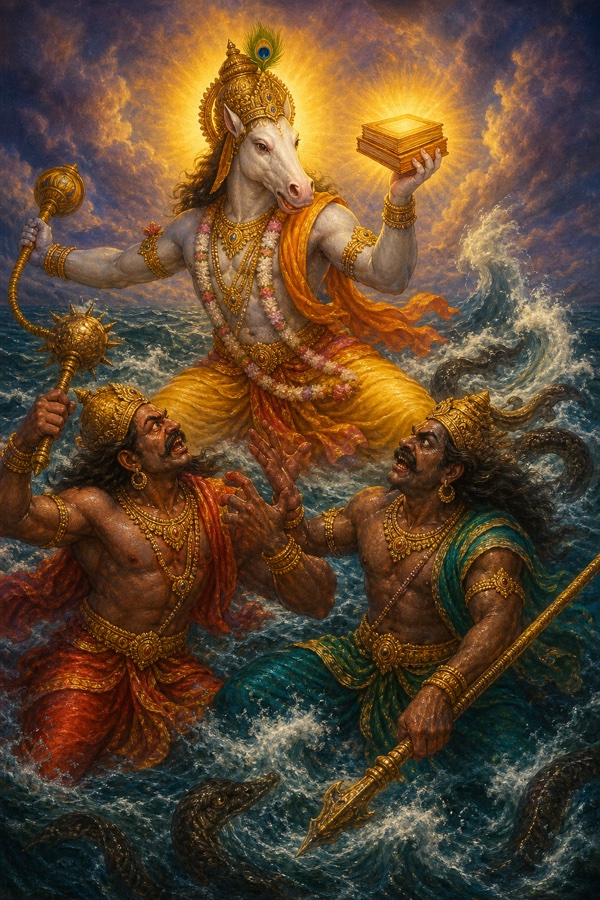
Vaishampayana said, “Everything that exists in this world is the result of a combination of the five primal elements, and that combination is the work of the supreme lord’s intelligence. The powerful Narayana, who is infinite, is the supreme lord and creator of the universe. He is the inner soul of everything, and he is the giver of boons. He is without attributes, and again he possesses them. Listen now while I tell you how the dissolution of all things comes about. First the element of earth merges into water, and after that nothing is seen except one vast expanse of water on every side. Water then merges into heat, and heat into wind. Wind merges into space, and space in its turn merges into mind. Mind merges into the manifest, which is consciousness, the sense of I. The manifest merges into the unmanifest, which is prakriti. The unmanifest merges into the purusha, the soul that lives in a body, and the purusha merges into the supreme Self, which is Brahman. Then darkness spreads over the face of the universe, and nothing at all can be perceived.
“From that primal darkness Brahma arises, endowed with the principle of creation. The darkness is primeval, and it is charged with immortality. The Brahma who arises from it develops, by his own power, into the idea of the universe, and takes the form of a Purusha, and that Purusha is called Aniruddha. Because it has no sex, it is also called by the name of Pradhana, the primary, and it is known too as the manifest, the combination of the three qualities. It lives with knowledge alone for its companion, and that illustrious and powerful Being is called by another name, Vishvaksena, or Hari. Yielding to the sleep of yoga, he lays himself down upon the waters, and there he thinks of the creation of a universe of many-sided phenomena and immeasurable attributes, and as he thinks of it he recalls his own high attributes. From this springs the four-faced Brahma, who represents the consciousness of Aniruddha. That illustrious Brahma, also called Hiranyagarbha, the golden womb, is the grandfather of all the worlds. His eyes are like the petals of a lotus, and he takes birth inside the lotus that grows from the navel of Aniruddha. Seated on that lotus, the illustrious, powerful, and eternal Brahma, wonderful to look upon, saw that there was water on every side, and taking up the quality of sattva, Brahma, whom men call Parameshthi, began to create the universe.
A key to reading this, the reverse order of dissolution: The order in which creation unfolds is exactly reversed in dissolution, and things merge from the gross toward the subtle. Earth sinks into water, water into heat, heat into wind, wind into space, space into mind, mind into the sense of I, that into prakriti, prakriti into the purusha, and the purusha into the supreme Self, until only darkness is left. The next creation reverses the order again, opening out from Aniruddha asleep on the waters to the four-faced Brahma on the lotus, and from Brahma to the worlds. This up-and-down movement between the one and the many is the axis of the Pancharatra account of time.
“In that primeval lotus, which had the splendor of the sun, Narayana had cast two drops of water, and they were charged with great merit. The illustrious Narayana, who has no beginning and no end and who stands beyond destruction, cast his eyes on those two drops. One of them, very beautiful and bright of form, looked like a drop of honey, and from that drop, at Narayana’s command, sprang a Daitya named Madhu, made up of the quality of tamas, of dullness. The other drop of water inside the lotus was very hard, and from it sprang the Daitya Kaitabha, made up of the quality of rajas. Endowed in this way with tamas and rajas, the two Daityas, mighty and armed with maces from the moment of their birth, began to rove about inside that vast primeval lotus.
“There inside it they saw Brahma of immeasurable splendor, engaged in creating the four Vedas, each of them with the most delightful form. The two foremost of Asuras looked at the four Vedas, and they seized them, suddenly, in the very sight of their maker, and having laid hold of the eternal Vedas those two mighty Danavas dived quickly into the ocean of water they saw around them and made for its bottom. Brahma watched the Vedas carried off from him by force, and grief filled him. Robbed of the Vedas, he spoke to the supreme lord.
“Brahma said, ‘The Vedas are my great eyes. The Vedas are my great strength. The Vedas are my great refuge. The Vedas are my high Brahman. And all the Vedas have been taken from me by force by the two Danavas. Deprived of the Vedas, the worlds I have created are wrapped in darkness. Without the Vedas beside me, how am I to bring my excellent creation into being? The grief I suffer at the loss of the Vedas is great; my heart is in pain, and it has become the home of a great sorrow. Who is there to rescue me from this ocean of grief into which I have sunk? Who is there to bring me back the Vedas I have lost? Who is there to take pity on me?’ While Brahma was saying this, a resolve rose suddenly in his mind: he would sing the praises of Hari. So the powerful Brahma, with his hands joined in reverence and his arms around the feet of his progenitor, sang this highest of hymns to Narayana.
“Brahma said, ‘I bow to you, heart of Brahman. I bow to you who were born before me. You are the origin of the universe. You are the foremost of all abodes. You are the ocean of yoga with all its branches. You are the creator of what is manifest and of what is unmanifest. You walk a path whose auspiciousness cannot be conceived. You are the consumer of the universe. You are the inner soul of every creature. You have no origin. You are the refuge of the universe. You are self-born, for you have no origin that is other than yourself. As for me, I have sprung through your grace; from you I took my birth. My first birth from you, which all the twice-born hold sacred, came from a resolve of your mind. My second birth, in the old days, was from your eyes. Through your grace, my third birth was from your speech. My fourth was from your ears. My fifth, excellent in every way, was from your nose. My sixth, through you, was from an egg. And this is my seventh birth; it has taken place inside this lotus, and it is meant to wake the intellect and the desires of all beings. At each creation I take birth from you as your son, you who are free of the three qualities; truly I take birth as your eldest son, made up of sattva, the foremost of the three. Your nature is supreme. You spring from yourself, and I have been made by you. The Vedas are my eyes, and because of them I stand beyond time itself. Those Vedas, which are my eyes, have been taken from me, and so I have gone blind. Wake from this sleep of yoga. Give me back my eyes. I am dear to you, and you are dear to me.’
“Praised in this way by Brahma, the illustrious Purusha, whose face is turned toward every side, shook off his slumber, resolved to recover the Vedas from the Daityas who had snatched them. Applying the power of his yoga, he took on a second form. His body, with its excellent nose, grew as bright as the moon, and he took on a horse’s head of great splendor, which was the abode of the Vedas. The sky, with all its lights and constellations, became the crown of his head, and his locks of hair, long and flowing, had the brightness of the rays of the sun. The regions above and the regions below became his two ears. The earth became his forehead. The two rivers Ganga and Sarasvati became his two hips. The two oceans became his two eyebrows, and the sun and the moon his two eyes. The twilight became his nose. The syllable Om became his memory and his intelligence. Lightning became his tongue. The soma-drinking pitris, it is said, became his teeth, and the two regions of bliss, Goloka and Brahmaloka, became his upper and lower lips. The terrible night that follows the universal destruction, the night that stands beyond the three qualities, became his neck.
“Wearing this form with the head of a horse, with these many things for its many limbs, the lord of the universe vanished from that place and went down to the nether regions. When he reached them he set himself to high yoga. In a voice governed by the rules of the science called Shiksha, the discipline of right pronunciation, he began to utter the Vedic mantras aloud. Every syllable was distinct, every sound was sweet, and the whole nether region, from one end to the other, filled with his voice, which carried the properties of all the elements and worked great good. The two Asuras had fixed an hour with the Vedas at which they would come back to take them up again, and now they threw them down in the nether region and ran toward the place the sounds seemed to be coming from. Meanwhile the supreme lord with the horse’s head, whom men call Hari, and who was himself in that nether region, gathered up all the Vedas. He went back to where Brahma was staying and gave the Vedas to him, and having restored them, the supreme lord returned to his own nature. He also established his horse-headed form in the northeastern region of the great ocean, and having established there the one who was the abode of the Vedas, he became once more the horse-headed form that he had been.
“Madhu and Kaitabha could not find the person the sounds had come from, and they hurried back to the spot where they had left the Vedas. They looked around them, and the place where they had thrown the Vedas was empty. Then those two foremost of mighty beings rose out of the nether region at great speed and came back to the primeval lotus that had given them birth, and there they saw the powerful Being, the original creator, resting in the form of Aniruddha, fair of complexion and shining like the moon. His prowess beyond measure, he lay under the sleep of yoga, his body stretched out upon the waters and filling a space as vast as itself; that body, radiant, and made of stainless sattva, lay on the excellent hood of a snake that seemed to give off flames of fire from its own brightness. The two foremost of Danavas looked at the lord lying there and burst into loud laughter. Full of rajas and tamas, they said, ‘This is that Being of the white complexion. He is asleep now. There is no doubt he is the one who carried the Vedas away out of the nether region. Whose is he? Whose is he? Who is he? Why is he asleep like this on the hood of a snake?’ And with these words the two Danavas woke Hari out of his sleep of yoga.
“Waking, the foremost of beings understood that the two Danavas meant to fight him. He saw those two foremost of Asuras ready for battle, and he set his own mind to grant them what they wanted, and so the fight began, the two of them on one side and Narayana on the other. Madhu and Kaitabha were rajas and tamas made flesh, and Narayana killed them both to please Brahma, and from that he came to be called Madhusudana, the killer of Madhu. Having destroyed the two Asuras and given the Vedas back to Brahma, the supreme Being took Brahma’s grief away. Then, with Hari to help him and the Vedas to guide him, Brahma created all the worlds with their moving and unmoving creatures, and Hari, having granted the grandfather the highest intelligence for the work of creation, vanished from that place and went back to where he had come from. That is how Narayana, in the form with the horse’s head, killed the two Danavas Madhu and Kaitabha and passed out of Brahma’s sight. And once more, later, he took the same form, so that the dharma of engagement might flow through the universe.
A sub-tale: The text attaches a fruit to this story. Whoever listens often to the history of Narayana’s taking of the horse-headed form, or recites it within his mind, will never forget his Vedic learning or any other learning he has. And it names one man who proved it: the sage Panchala, also called Galava, who worshiped the horse-headed god with the severest austerities and, following the path the god Rudra pointed out to him, gained the science of krama, the ordered recitation of the Veda.
“So it was that the blessed Hari took, in the old days, that grand form with the horse’s head, and of all his forms endowed with power, this one is celebrated as the most ancient. I have recited to you now the old story of Hayashiras, the horse-head, which agrees with the Vedas and about which you asked me. Whatever forms the supreme god wishes to take for the ordering of the universe’s affairs, he takes them at once, within himself, by his own inherent powers. That supreme god, endowed with every prosperity, is the home of the Vedas. He is the home of austerities as well. The powerful Hari is yoga. He is the Sankhya philosophy in bodily form. He is that supreme Brahman of which we hear. Truth has Narayana for its refuge. Rita, the cosmic order, has Narayana for its soul. The dharma of withdrawal, from which there is no return, has Narayana for its high abode, and the other dharma, whose basis is engagement, has Narayana for its soul just the same. Smell is the foremost of the attributes that belong to the element of earth, and smell has Narayana for its soul. The attributes of water are the tastes, of their various kinds, and the tastes have Narayana for their soul. The foremost attribute of light is form, and form has Narayana for its soul. Touch, the attribute of wind, is said to have Narayana for its soul, and sound, the attribute of space, has Narayana for its soul like the rest. Mind, the attribute of the unmanifest prakriti, has Narayana for its soul. Time, which is reckoned by the motion of the lights in the sky, has Narayana for its soul in the same way, and so do the presiding gods of fame, of beauty, and of prosperity. Both the Sankhya philosophy and yoga have Narayana for their soul.
“The supreme Being is the cause of all this as Purusha. He is the cause of everything, again, as Pradhana, which is prakriti. He is svabhava, the basis on which all things rest. He is the doer, the agent, and the cause of the variety that is seen in the universe. He is the many kinds of energy that act in the universe. In these five ways he is that all-controlling, invisible influence of which people speak, and those who investigate the several subjects of inquiry with the help of reasons of wide application regard Hari as identical with those five causes and as the final refuge of all things. Truly, the powerful Narayana, endowed with the highest power of yoga, is the one subject of inquiry. The thoughts of everyone who lives in all the worlds, Brahma included, of the high-souled sages, of those who follow Sankhya and yoga, of the yatis, and of everyone who knows the soul in general, are fully known to Keshava, and none of them can know what his thoughts are. Whatever acts are done in honor of the gods or the ancestors, whatever gifts are made, whatever austerities are practiced, all have Vishnu for their refuge, who rests upon his own supreme ordinances. He is named Vasudeva because he is the abode of all creatures. He is changeless. He is supreme. He is the foremost of sages. He is endowed with the highest power, and he is said to stand beyond the three qualities. Time runs smoothly and without any sign, yet it takes on marks when it shows itself in the shape of the seasons that follow one another; in the same way he, who is truly without attributes, takes on attributes in order to appear. Even the high-souled do not succeed in following his motions. Only those foremost of sages who have knowledge of their own souls succeed in seeing, in their hearts, that Purusha who stands beyond every attribute.”
The gist: Dissolution runs from earth up through water, heat, wind, space, mind, the sense of I, prakriti, and the purusha into the supreme Self, and then Aniruddha, asleep on the waters, dreams the next Brahma onto the lotus. From two drops Narayana cast into that lotus spring Madhu, of tamas, and Kaitabha, of rajas, who seize the four Vedas from Brahma’s hands and dive with them to the bottom of the waters. Brahma, blinded without the Vedas that are his eyes, sings Hari awake with the account of his own seven births. Hari takes the horse-headed form, whose limbs are the earth, the rivers, the oceans, the sun and moon, and the night after the end of the world, chants the Veda in the nether region to draw the two Danavas away, carries the Vedas back to Brahma, and then kills Madhu and Kaitabha when they come looking for him, earning the name Madhusudana. This is the most ancient of all his forms, and Vaishampayana closes with the litany of what has Narayana for its soul: truth, order, engagement and withdrawal, the five elements, mind, time, and both Sankhya and yoga.
The dharma of bhakti higher than knowledge, and the descent of the Satvata dharma
Janamejaya said, “The illustrious Hari becomes gracious to those who are devoted to him with their whole souls, and he accepts as well every worship that is offered to him according to the ordinance. Those who have burned off their fuel, who have shed both merit and demerit, and who have received the knowledge as it is handed down from teacher to teacher, always reach that end which is called the fourth, the essence of Purushottama, of Vasudeva, and they reach it by way of the three others, Aniruddha, Pradyumna, and Sankarshana. But those who are devoted to Narayana with their whole souls reach the highest end at once. Without doubt the dharma of devotion seems to stand above the dharma of knowledge, and it seems very dear to Narayana, for these devotees, without passing through the three stages one after another, go straight to the changeless Hari. The end reached by Brahmins who, attending to every observance, study the Vedas with the Upanishads by the rules laid down for such study, and the end reached by those who take up the dharma of the yatis, are lower, I think, than the end reached by those who are devoted to Hari with their whole souls. Who first set this dharma of devotion going? Was it some god or some sage who declared it? What are the practices of those who are said to be devoted with their whole souls, and when did those practices begin? I have doubts on these points. Remove them for me; my curiosity to hear you explain them is very great.”
Vaishampayana said, “When the divisions of the Pandava and Kaurava armies stood drawn up in their arrays for battle, and Arjuna lost heart, the holy one himself explained which end is reached and which is not reached by people of different characters. I have already recited to you the words the holy one spoke. The dharma he taught on that occasion is difficult to grasp; people whose souls have not been cleansed cannot take hold of it at all. Having created this dharma in the old days, in the Krita age, in perfect agreement with the Samans, the supreme lord Narayana himself carries it. This very subject was raised by the highly blessed Partha before Narada, in the midst of the sages and in the presence of Krishna and of Bhishma, and my guru, the island-born Krishna, heard what Narada said. Having received it from the celestial sage, my guru gave it to me in exactly the form in which he had received it, and I will recite it to you now in the same way it came from Narada. So listen.
“In that kalpa when Brahma the creator took his birth in the mind of Narayana and came forth from Narayana’s mouth, Narayana himself performed his rites to the gods and to the ancestors according to this dharma. Then those sages who live on the froth of water received it from Narayana. From the froth-eating sages it went to the sages who are known by the name of Vaikhanasas. From the Vaikhanasas, Soma received it. And after that it disappeared from the universe. At the second birth of Brahma, when he sprang from the eyes of Narayana, the grandfather received this dharma from Soma, and having received it, Brahma gave it, this dharma that has Narayana for its soul, to Rudra. In the Krita age of that ancient kalpa Rudra, devoted to yoga, passed it on to all those sages who are known by the name of Valakhilyas. Then, through the illusion of Narayana, it disappeared from the universe once more.
“At the third birth of Brahma, which came from the speech of Narayana, this dharma sprang up again from Narayana himself. This time a sage named Suparna received it from that foremost of beings. The sage Suparna used to recite this excellent dharma, this foremost of teachings, three times a day, and because of that it came to be called Trisauparna in the world. This dharma is referred to in the Rigveda, and the duties it lays down are exceedingly hard to keep. From the sage Suparna this eternal dharma was obtained by the god of wind, who sustains the lives of every creature in the universe, and the god of wind gave it to those sages who live on what remains of the sacrificial offerings after guests and others have been fed. From those sages it was received by the great ocean. Then it disappeared from the universe again and merged into Narayana.
“At the next birth of the high-souled Brahma, when he sprang from the ear of Narayana, listen to what happened in that kalpa. When the illustrious Narayana, whom men also call Hari, resolved on creation, he thought of a being who would be powerful enough to create the universe, and as he was thinking of it, a being sprang from his ears who was competent to the work. The lord of all called him by the name of Brahma, and addressing him, the supreme Narayana said, ‘Son, create every kind of creature from your mouth and your feet. I will do what is good for you; I will give you the energy and the strength that will make you competent for this task. Receive from me as well this excellent dharma that is known by the name of Satvata. With its help create the Krita age and set it in order as it should be.’ So addressed, Brahma bowed his head to the illustrious Hari, the god of gods, and received from him that foremost of teachings, with all its mysteries and its abstract of details, together with the Aranyakas, the teaching that had sprung from the mouth of Narayana. When Narayana had instructed Brahma, whose energy cannot be measured, in that teaching, he said to him, ‘You are the maker of the duties to be observed in each of the ages.’ And having said this to Brahma, Narayana vanished and went to that place which lies beyond the reach of tamas, where the unmanifest resides, and which is known to those who act without desire for the fruit of their acts.
A sub-tale (the lineage of the dharma): The Satvata or Pancharatra dharma of devotion rises and vanishes again and again, and each new birth of Brahma takes it up afresh. The chain runs like this. At the first birth: the froth-eating sages, then the Vaikhanasas, then Soma. At the second: Brahma, then Rudra, then the Valakhilyas. At the third: Suparna, whose thrice-daily recitation gave it the name Trisauparna, then Vayu, then the sages who live on the leavings of the sacrifice, then the ocean. At the fourth: Brahma, then Svarochisha Manu, then his son Sankhapada, then Suvarnabha, the regent of the quarters. At the fifth: Sanatkumara, then the Prajapati Virana, then Raivya, then Kukshi. At the sixth: Brahma, then the Varhishada sages, then the Samaveda-singer Jyeshthya, then King Avikampana. At the seventh, which is the present kalpa: Brahma, then Daksha, then Aditya, then Vivasvat, then Manu, then Ikshvaku, from whom it spread across the whole world. Vaishampayana draws the conclusion himself: a dharma that returns at every birth of Brahma is older than any age, and when the dissolution comes it will go back into Narayana, from whom each time it came.
“After this the boon-giving Brahma, the grandfather of the worlds, created the different worlds with their moving and unmoving creatures. The age that began first was highly auspicious, and it came to be called by the name of Krita. In that age the dharma of sattva existed, pervading the entire universe, and all creatures were righteous and compassionate. With the help of that primeval dharma of righteousness, Brahma, the creator of all the worlds, worshiped the lord of all the gods, the powerful Narayana, whom men also call Hari. Then, for the spread of that dharma and out of a wish to benefit the worlds, Brahma instructed in it the Manu who is known by the name of Svarochisha. Svarochisha Manu, that lord of all the worlds, that foremost of powerful persons, gladly gave the knowledge of it to his own son, who was known as Sankhapada, and Sankhapada, the son of Manu, gave the knowledge of it to his own son Suvarnabha, who was the regent of the cardinal and the intermediate points of the compass. When the Krita age ended and the Treta came, that teaching disappeared from the world again.
“At a later birth of Brahma, the one that came from the nose of Narayana, the illustrious and powerful Narayana himself, Hari with his lotus-petal eyes, sang this dharma in the presence of Brahma. Then Sanatkumara, the son of Brahma created by a resolve of his will, studied it. From Sanatkumara the Prajapati Virana received it at the beginning of the Krita age, and Virana, having mastered it, taught it to the ascetic Raivya. Raivya in his turn gave it to his son Kukshi, a man of pure soul, good vows, and great intelligence, the righteous regent of the cardinal and the intermediate points. After that, the teaching born of the mouth of Narayana disappeared from the world once more.
“At the next birth of Brahma, the one that came from an egg sprung from Hari, this teaching issued once again from the mouth of Narayana. Brahma received it and practiced it duly in all its details, and then he gave it to those sages who are known by the name of Varhishadas. From the Varhishadas it was obtained by a Brahmin well versed in the Samaveda and known by the name of Jyeshthya, and because he was so versed in the Samans he was known also as Jyeshthya-Samavrata Hari. From the Brahmin called Jyeshthya the teaching was obtained by a king named Avikampana. And after that, the teaching that had come from the powerful Hari disappeared from the world once more.
“At the seventh birth of Brahma, which came from the lotus that grew from the navel of Narayana, this teaching was declared once more by Narayana himself, in the beginning of this present kalpa, to the grandfather of pure soul, the creator of all the worlds. The grandfather gave it, in the old days, to Daksha, one of the sons created by a resolve of his will. Daksha gave it to the eldest of all the sons of his daughters, to Aditya, who is senior in age to Savitri. From Aditya, Vivasvat obtained it. At the beginning of the Treta age Vivasvat gave the knowledge of it to Manu, and Manu, for the protection and support of all the worlds, gave it to his son Ikshvaku, from whom the solar line of kings descends. Promulgated by Ikshvaku, that teaching spreads over the whole world, and when the universal destruction comes it will return once more to Narayana and be merged in him.
“The dharma that the yatis follow and practice I told you before in the Hari-Gita, with all its ordinances in brief. The celestial sage Narada got it from the lord of the universe, Narayana himself, with all its mysteries and its abstract of details. So this foremost of teachings is primeval and eternal. It cannot be grasped with ease and it is exceedingly hard to practice, and it is always upheld by people wedded to the quality of sattva. It is by acts that are well performed, done with full knowledge of one’s duties and holding no injury to any creature, that Hari the supreme lord is pleased.
“Some adore Narayana as having only one form, that of Aniruddha. Some adore him as having two forms, Aniruddha and Pradyumna. Some adore him as having three, Aniruddha, Pradyumna, and Sankarshana. And a fourth class adores him as made up of four forms, Aniruddha, Pradyumna, Sankarshana, and Vasudeva. Hari is himself the kshetrajna, the soul. He is without parts, being forever full. He is the Jiva in every creature, standing beyond the five primal elements. He is the mind that directs and governs the five senses. Endowed with the highest intelligence, he is the ordainer of the universe and its creator. He is both active and inactive, both the cause and the effect. He is the one changeless Purusha, who plays as he likes.
“So I have recited to you the dharma of the desireless devotees. People whose souls have not been cleansed cannot grasp it, and I gained it through the grace of my guru. People devoted to Narayana with their whole souls are very rare. If the world were full of such people, full of compassion for everyone, endowed with knowledge of the soul, and always employed in doing good to others, then the Krita age would have set in, and everyone would have given themselves to acts done without desire for the fruit. It was in just this way that the foremost of the twice-born, the illustrious Vyasa, my guru, who knows every duty in full, discoursed on this dharma of devotion to King Yudhishthira the just, in the presence of many sages and in the hearing of Krishna and of Bhishma; he had received it from the celestial sage Narada, who is rich in the wealth of austerities. Those who are devoted to Narayana with their whole souls and who are without desire succeed in reaching the region of that highest of gods, a region one with Brahman, pure in color, radiant like the moon, and beyond all change.”
A key to reading this, bhakti and knowledge: Janamejaya’s question contains the reading. The seeker who travels by knowledge climbs through Aniruddha, then Pradyumna, then Sankarshana, and only then reaches Vasudeva, whom the text calls the fourth because the three stand below him. The one who is devoted to Narayana with his whole soul skips the three stages and enters the changeless Hari directly. The king draws his own conclusion, that the dharma of devotion must stand above the dharma of knowledge and be dearer to Narayana, and Vaishampayana, answering, does not correct him; he tells the king where that dharma came from and how few can carry it.
The gist: The Satvata dharma of devotion is primeval and eternal. Narayana himself first performed his rites by it, and through the seven births of Brahma, from his mind, his eyes, his speech, his ears, his nose, an egg, and the navel lotus, it was handed down each time through a fresh chain of sages, Manus, and kings, vanished, and rose again, until in the present kalpa it reached Ikshvaku and spread over the earth. Some worship Narayana in one form, some in two, three, or four. Whole-souled devotees, who go straight to Hari without the three stages, are very rare; if the world were full of them, the Krita age would return. Vyasa taught this dharma to Yudhishthira, having received it from Narada.
The three gunas and the grace of Hari, and the unity of Sankhya, Yoga, and Pancharatra
Janamejaya said, “I see that the twice-born whose souls have been awakened practice many different kinds of duty. Why is it, then, that other Brahmins leave those duties aside and give themselves to other kinds of vows and rites?”
Vaishampayana said, “Three kinds of disposition have been created in all embodied creatures: the disposition that belongs to the quality of sattva, the one that belongs to rajas, and lastly the one that belongs to tamas. Among embodied creatures the foremost is the one wedded to sattva, for it is certain that he will win emancipation. It is by the help of this same quality of sattva that a man who has it comes to understand the Being who knows Brahman. Emancipation depends entirely on Narayana, and that is why those who strive for emancipation are held to be made of sattva. By thinking of Purushottama, the foremost of beings, the man who is devoted to Narayana with his whole soul gains great wisdom. Those wise people who have taken up the practices of the yatis and the dharma of emancipation, those people whose thirst is quenched, always find that Hari favors them with the fulfillment of their desire, which is release itself.
“The man, subject to birth and death, on whom Hari casts a kind eye should be known as endowed with sattva and set on winning emancipation. The dharma followed by a person devoted to Narayana with his whole soul is held to be equal in merit to the system of the followers of Sankhya, and by adopting it a man reaches the highest end, the emancipation that has Narayana for its soul. The person on whom Narayana looks with compassion succeeds in becoming awakened. No one becomes awakened through his own wishes alone. The nature that partakes of both rajas and tamas is said to be mixed. Hari never casts a kind eye on a person subject to birth and death who has that mixed nature, and who on that account has the principle of engagement in him. On such a person, his mind overwhelmed by the two lower qualities of rajas and tamas, only Brahma, the grandfather of the worlds, looks. The gods and the sages are without doubt wedded to sattva; but the sattva they have is of the gross kind, and those who are without sattva in its subtle form are always regarded as beings of a changing nature.”
Janamejaya said, “How can one who is full of the principle of change succeed in reaching that Purushottama, the foremost of Purushas? Tell me all of this, for you surely know it. And explain to me as well the order of engagement, step by step.”
Vaishampayana said, “That which is the twenty-fifth in the reckoning of the Sankhya system, the purusha, the soul that lives in a body, reaches Purushottama when it becomes able to abstain entirely from acts; and that Purushottama is exceedingly subtle, invested with sattva in its subtle form, and charged with the essences that the three letters A, U, and M stand for. The Sankhya system, the Aranyaka Veda, and the Pancharatra scriptures are all one and the same, and they form parts of one whole. This is the dharma of those who are devoted to Narayana with their whole souls, the dharma that has Narayana for its essence. Waves rise from the ocean and rush away from it only to return to it in the end; in the same way the many kinds of knowledge that spring from Narayana return to Narayana at the last.
“I have now explained to you what the dharma of sattva is. If you are competent for it, practice it as it should be practiced. This is what the highly blessed Narada explained to my guru, the island-born Krishna: the eternal and changeless course called Ekanta, which ends in the One, and which is followed by those who wear white as well as by the yellow-robed yatis. Vyasa, pleased with Dharma’s son Yudhishthira, gave this dharma to that king of great intelligence, and having received it from my guru I have passed it on to you. For these reasons this dharma is exceedingly hard to practice, and others who hear it are as confounded by it as you have let yourself be. It is Krishna who is the protector of the universe and its beguiler. It is he who is the destroyer, and he who is the cause.”
The gist: Every embodied being is made of one of three dispositions, sattva, rajas, or tamas, and only the one wedded to sattva is certain of release, for release depends on Narayana, and no one wakes by wishing to. On the mixed nature of rajas and tamas Hari does not look; Brahma does, and even the gods and sages, whose sattva is of the gross kind, remain beings of change. The purusha, the twenty-fifth of the Sankhya reckoning, reaches Purushottama once it can abstain from acts entirely. Sankhya, the Aranyaka Veda, and the Pancharatra are parts of one whole, and every knowledge that rises from Narayana returns to him the way waves return to the sea.
The birth of Vyasa from Narayana: the tale of Apantaratamas
Janamejaya said, “The Sankhya system, the Pancharatra scriptures, and the Aranyaka Vedas, these different systems of knowledge, are all current in the world. Do they all teach the same course of duties, or are the courses of duty they teach different from one another? And since I have asked, explain to me the order of engagement as well.”
Vaishampayana said, “I bow to that great sage who drives away darkness, whom Satyavati bore to Parashara in the middle of an island, who possesses great knowledge and is endowed with great generosity of soul. The learned say that he is the origin of the grandfather Brahma; that he is the sixth form of Narayana; that he is the foremost of sages; that he is endowed with the power of yoga; that, being the only son of his parents, he is an incarnate portion of Narayana; and that, born under extraordinary circumstances on an island, he is the inexhaustible home of the Vedas. In the Krita age Narayana, of great power and mighty energy, created him as his own son. Truly the high-souled Vyasa is unborn and ancient, and the inexhaustible home of the Vedas.”
Janamejaya said, “It was you who told me before that the sage Vasishtha had a son named Shakti, that Shakti had a son named Parashara, and that Parashara begot a son named the island-born Krishna, of great ascetic merit. Now you tell me that Vyasa is the son of Narayana. Was there some former birth in which Vyasa of immeasurable energy sprang from Narayana himself? I want to hear it.”
Vaishampayana said, “Wanting to understand the meaning of the shrutis, my guru, that ocean of austerities, who is wholly given to the observance of every scriptural duty and to the gaining of knowledge, lived for some time in a certain region of the Himalaya. For all his great intelligence, he had grown weary from his austerities, so heavy was the strain on his energies of composing the Mahabharata. At that time Sumanta and Jaimini and Paila of firm vows, and I myself as the fourth, and Shuka, his own son, attended on him. Seeing how tired our guru was, all of us waited on him dutifully, doing whatever was needed to lift that weariness from him, and surrounded by these disciples of his, Vyasa shone on the breast of the Himalaya the way Mahadeva, the lord of the ghostly beings, shines among the ghostly attendants of his. One day, having gone over the Vedas with all their branches and the meanings of all the verses in the Mahabharata, we approached our guru together, with rapt attention. He had drawn in his senses and was absorbed in thought, and taking advantage of a pause in the conversation, we asked that foremost of the twice-born to expound to us the meanings of the Vedas and of the verses of the Mahabharata, and to tell us as well the story of his own birth from Narayana. Master of every subject of inquiry, he discoursed first on the interpretation of the shrutis and the Mahabharata, and then he set himself to tell us what follows about his birth from Narayana.
“Vyasa said, ‘Listen, disciples, to this foremost of narratives, this best of histories, which tells once more of the birth of a sage. It belongs to the Krita age, and it became known to me through my austerities. On the occasion of the seventh creation, the one that came from the primeval lotus, Narayana, endowed with the severest austerities, standing beyond both good and ill, and possessed of a splendor no one can rival, first created Brahma from his navel. When Brahma had come into being, Narayana said to him, “You have sprung from my navel. You have the power to create; set yourself to creating creatures of every kind, the reasoning and the unreasoning.” Brahma heard this from the author of his being, and anxiety went through his mind. He felt the difficulty of the task, and he was unwilling to begin what he had been told to begin. Bowing his head to the boon-giving and illustrious Hari, the lord of the universe, Brahma said, “I bow to you, but I ask you: what power have I to create creatures of every kind? I have no wisdom for it. Ordain, yourself, whatever should be ordained in view of this.” So addressed by Brahma, Narayana, the lord of the universe, vanished from Brahma’s sight, and then he began to think.
“‘At once the goddess of Intelligence appeared before the powerful Narayana. Though he himself stands beyond all yoga, Narayana, by the power of yoga, applied the goddess of Intelligence to her proper place, and the illustrious, powerful, and changeless Hari said to her, who was endowed with activity and with goodness and with all the power of yoga, “For the accomplishing of the task of creating all the worlds, enter into Brahma.” Commanded in this way by the supreme lord, Intelligence entered Brahma at once, and when Hari saw that Brahma had become united with Intelligence, he addressed him again: “Now create creatures of every kind.” Brahma answered Narayana with the single word “Yes,” and reverently accepted the command of his progenitor. Then Narayana vanished from Brahma’s presence and went in a moment to his own place, which is known by the name of Deva, of light, and returning to his own disposition, the unmanifest, Hari remained in that state of oneness.
“‘After Brahma had accomplished the task of creation, another thought rose in the mind of Narayana. He reflected on it in this way: “Brahma, whom men call Parameshthi, has created all these creatures, the Daityas and the Danavas, the Gandharvas and the Rakshasas. The helpless earth has become burdened with the weight of creatures. Many among the Daityas and Danavas and Rakshasas on the earth will grow very strong. Possessed of austerities, they will at various times succeed in winning many excellent boons, and swelling with pride and strength because of those boons, they will oppress and afflict the gods and the sages who are rich in ascetic power. It is right, then, that I should now and then lighten the burden of the earth by taking one form after another as the occasion requires. I will do this by chastising the wicked and upholding the righteous, and looked after by me in that way, the earth, who is the embodiment of truth, will be able to bear her load of creatures. Taking the form of a mighty snake, I myself have to hold the earth up in empty space; upheld by me, she will uphold the whole creation, the moving and the unmoving. So I must take birth on the earth in different forms and rescue her at such times from peril.” Having reflected in this way, the illustrious killer of Madhu created in his mind the many forms in which he would appear from time to time to accomplish the task he had in view. “Taking the form of a boar, of a man-lion, of a dwarf, and of human beings,” he said, “I shall quell or kill those enemies of the gods who become wicked and ungovernable.”
“‘After this the original creator of the universe uttered the syllable “Bho,” and the atmosphere rang with it. From that syllable of speech, which is Sarasvati, arose a sage named Sarasvata. That son, born of the speech of Narayana, came to be called also by the name of Apantaratamas. Endowed with great power, he knew the past, the present, and the future in full; he was firm in the observance of vows and truthful in speech. When that sage, once born, had bowed his head to Narayana, Narayana, the original creator of all the gods, whose nature does not change, said to him, “Give your attention to the distribution of the Vedas. Carry out what I command you.” In obedience to that command of the supreme lord, from whose speech he had sprung, the sage Apantaratamas, in the kalpa named after the self-born Manu, distributed and arranged the Vedas.
“‘For that act the illustrious Hari was pleased with him, and pleased as well with his well-performed austerities, his vows and observances, and his restraint of the senses and the passions. Narayana said to him, “In each manvantara, son, you will act in this same way with the Vedas. Because of this act of yours you will be changeless, and no one will surpass you. When the Kali age sets in, certain princes of the line of Bharata, who will be called the Kauravas, will take their birth from you, and they will be celebrated over the earth as high-souled princes ruling powerful kingdoms. Dissensions will break out among those who are born of you, ending in their destruction at one another’s hands, and you alone will be left. In that age also, endowed with severe austerities, you will divide the Vedas into their several classes. In that dark age your own complexion will become dark. You will cause many kinds of duty to flow, and many kinds of knowledge. Though endowed with severe austerities, you will never be able to free yourself from desire and from attachment to the world. Your son, however, through the grace of Madhava, will be freed from every attachment, like the supreme Self, and it will not be otherwise.
“‘“He whom the learned Brahmins call the mind-born son of the grandfather, Vasishtha, of great intelligence, an ocean of austerities, whose splendor surpasses the sun’s, will be the progenitor of a line in which a great sage named Parashara will take birth, mighty in energy and prowess. That foremost of persons, that ocean of the Vedas, that home of austerities, will become your father when you take birth in the Kali age. You will be born as the son of a maiden living in her father’s house, through an act of union with the great sage Parashara. You will have no doubts about the meaning of things past, present, or to come. Endowed with austerities and instructed by me, you will see the events of thousands upon thousands of ages long gone by, and you will see through thousands upon thousands of ages to come. In that birth you will see me, who am without birth and without death, come down to the earth as Krishna of the Yadu line, armed with the discus. All of this will come to you through the merit that will be yours from your unceasing devotion to me, and these words of mine will never be otherwise. You will be one of the foremost of creatures, and great will be your fame. Surya’s son Shani, whom men call Saturn, will in a future kalpa take birth as the great Manu of that period, and during that manvantara, son, you will be superior in merit even to the Manus of the several periods; without doubt you will be so, through my grace. Whatever exists in the world is the result of my effort. The thoughts of others may fail to match their acts. As for me, whatever I think, I ordain, and nothing stands in its way.”
“‘Having said this to the sage Apantaratamas, whom men also call Sarasvata, the supreme lord dismissed him with the one word “Go.” I am he who was born as Apantaratamas by the command of Hari. And I have taken birth once more as the celebrated Krishna-Dvaipayana, a delighter of the line of Vasishtha. So I have told you, my dear disciples, the circumstances of my own former birth, which came about by the grace of Narayana, so much so that I was a very portion of Narayana himself. I practiced the severest austerities in the old days, with the help of the highest abstraction of the mind. Sons, moved by my great affection for you who are devoted to me with reverence, I have told you everything you wished to know from me: my first birth in the remote past, and that other birth which followed it, the present one.’”
Vaishampayana said, “So I have told you the circumstances of the former birth of our revered guru, Vyasa of the stainless mind, as you asked me to. Now listen to me once more. There are many kinds of teaching that go by many names: Sankhya, Yoga, the Pancharatra, the Vedas, and the Pashupata. The promulgator of the Sankhya teaching is said to be the great sage Kapila. The primeval Hiranyagarbha, and no one else, is the promulgator of the system of Yoga. The sage Apantaratamas is said to be the preceptor of the Vedas, and some call that sage by the name of Prachinagarbha. The teaching known as the Pashupata was promulgated by the lord of Uma, that master of all creatures, the cheerful Shiva, whom men also call Shrikantha, the son of Brahma. And the illustrious Narayana is himself the promulgator of the teaching, in its entirety, that the Pancharatra scriptures contain. In all these teachings it is seen that the powerful Narayana is the one sole object of exposition, and according to the scriptures of each and the measure of knowledge each holds, Narayana is the one sole object of the worship each of them inculcates.
“Those people whose vision is blinded by darkness fail to understand that Narayana is the supreme Self pervading the entire universe. Those people of wisdom who are the authors of the scriptures say that Narayana, who is himself a sage, is the one object of reverent worship in the universe, and I say that there is no other being like him. The supreme god called Hari lives in the hearts of those who have succeeded, with the help of the scriptures and of inference, in dispelling all their doubts. Madhava never lives in the hearts of those who are under the sway of doubt and who would dispute everything away with false dialectics. Those who know the Pancharatra scriptures, who observe the duties laid down in them as they should be observed, and who are devoted to Narayana with their whole souls, succeed in entering into Narayana. The Sankhya and the Yoga systems are eternal, and all the Vedas are eternal too. The sages of all these systems of teaching have declared that this universe, which has existed from ancient times, is Narayana’s own self. You should know that whatever acts, good or bad, are laid down in the Vedas, and whatever happens in heaven and on earth, between the sky and the waters, all of it is caused by, and flows from, that ancient sage Narayana.”
A key to reading this, the five doctrines and their founders: The founder of Sankhya is Kapila; of Yoga, Hiranyagarbha; of the Veda, Apantaratamas, whom some call Prachinagarbha; of the Pashupata, Shrikantha Shiva, the son of Brahma; and of the Pancharatra, Narayana himself. Vaishampayana’s claim is that these five, different as they look, all expound one object, Narayana, and that each worships him according to the measure of knowledge its scriptures hold. He draws the line elsewhere: between the seeker who has settled his doubts by scripture and inference, in whose heart Hari lives, and the disputer who argues everything away, in whose heart Madhava never comes to live.
The gist: Asked whether Sankhya, Pancharatra, and the Aranyaka Veda teach one path or several, Vaishampayana first bows to Vyasa, the sixth form of Narayana, and tells the story of his guru’s birth as Vyasa himself told it in the Himalaya to Sumanta, Jaimini, Paila, Vaishampayana, and Shuka. In the seventh creation Narayana gave Brahma the goddess of Intelligence so that he could create, then resolved to lighten the earth in the forms of the boar, the man-lion, the dwarf, and men, and with the syllable “Bho” brought forth from his own speech the sage Sarasvata, or Apantaratamas, who arranged the Vedas and was promised rebirth in the Kali age as the son of Parashara and the father of the Kauravas, and who would see Krishna with the discus with his own eyes. Vyasa is that sage reborn. The five doctrines have five founders, and one object: Narayana.
One Purusha or Many: The Dialogue of Brahma and Mahadeva
Janamejaya said, “Are there many Purushas, or is there only one? Who in the universe is the foremost of Purushas? And what, again, is said to be the source of all things?”
Vaishampayana said, “In the speculations of the Sankhya and the Yoga systems many Purushas have been spoken of, and those who follow these systems do not accept that there is only one Purusha in the universe. Yet in the same way that the many Purushas are said to have one origin in the supreme Purusha, it may be said that this entire universe is identical with that one Purusha of superior attributes. I will explain this now, after bowing to my guru Vyasa, that foremost of sages, who knows the soul, who is endowed with austerities and self-restraint, and who deserves reverent worship. This speculation on the Purusha occurs in all the Vedas, and it is well known to be identical with rita and with truth. Vyasa, the foremost of sages, has thought upon it, and many sages besides, with Kapila the first among them, having occupied themselves with reflection on what is called adhyatma, the science of the self within, have declared their opinions on it both in general and in particular. Through the grace of Vyasa of immeasurable energy, I will expound to you what Vyasa has said in brief on this question of the oneness of the Purusha. In this connection an old narrative is cited, the discourse between Brahma and the three-eyed Mahadeva.
“In the middle of the ocean of milk there is a very high mountain, splendid as gold, known by the name of Vaijayanta. Going there all alone from his own abode of great splendor and bliss, the illustrious god Brahma used very often to pass his time engaged in thought on the course of adhyatma. One day, while the four-faced Brahma of great intelligence sat there, his son Mahadeva, who had sprung from his forehead, came upon him in the course of his wanderings through the universe. The three-eyed Shiva, endowed with power and with high yoga, was traveling along the sky when he saw Brahma seated on that mountain, and he dropped down quickly onto its top. With a glad heart he presented himself before his progenitor and worshiped his feet, and Brahma, seeing Mahadeva prostrate before him, raised him up with his left hand. Having lifted him, Brahma, that powerful and single lord of all creatures, spoke to the son he was meeting after so long a time.
“The grandfather said, ‘You are welcome. It is by good luck that I see you come to me after such a long time. I hope, son, that all is well with your austerities and your Vedic studies and recitations. You are always engaged in the severest austerities, and so I ask you about the progress and the welfare of those austerities of yours.’
“Rudra said, ‘Through your grace all is well with my austerities and my Vedic studies, and all is well with the universe too. I saw your illustrious self a long while ago in your own home of bliss and radiance, and I have come from there to this mountain, which is now the abode of your feet. A great curiosity has risen in my mind at this withdrawal of yours into so lonely a spot from your usual region of bliss and splendor. The reason for such an act on your part must be great, grandfather. Your own foremost abode is free from the pains of hunger and thirst, and it is inhabited by both gods and Asuras, by sages of immeasurable splendor, and by Gandharvas and Apsaras. Leaving a place of such bliss, you live alone on this foremost of mountains. The cause of this can only be grave.’
“Brahma said, ‘This foremost of mountains, called Vaijayanta, is always my residence. Here, with my mind concentrated, I meditate on the one universal Purusha of infinite proportions.’
“Rudra said, ‘You are self-born. Many are the Purushas you have created, and others, Brahma, you are creating still. Yet the infinite Purusha of whom you speak is one and single. Who is that foremost of Purushas, Brahma, on whom you meditate? Great is the curiosity I feel on this point. Be kind enough to dispel the doubt that has taken hold of my mind.’
“Brahma said, ‘Son, many indeed are those Purushas of whom you speak. The one Purusha of whom I am thinking, however, transcends all Purushas, and he cannot be seen. The many Purushas that exist in the universe have that one Purusha for their basis, and since that one Purusha is said to be the source from which all the innumerable Purushas have sprung, all of the latter, if they succeed in divesting themselves of attributes, become able to enter into that one Purusha, who is identified with the universe, who is supreme, who is the foremost of the foremost, who is eternal, and who is himself free of all attributes and above them.’
A key to reading this, one Purusha over many: Sankhya and Yoga count the Purushas as many, one for each living being, and Brahma does not deny the count. He adds a floor beneath it. The many are real at the level where they are counted, and every one of them rests on, and came from, a single Purusha who cannot be seen. A soul that strips off its attributes, the three qualities of sattva, rajas, and tamas, becomes able to enter that one. That entry is what Brahma sits alone on Vaijayanta to meditate on, and it is the point at which the two ways of counting meet.
“Brahma said, ‘Listen, son, to how that Purusha is indicated. He is eternal and changeless. He does not decay and he cannot be measured, and he pervades all things. That Purusha cannot be seen by you, or by me, or by others. Those who have understanding and senses but lack self-restraint and tranquility of soul cannot obtain a sight of him; the supreme Purusha is said to be one who can be seen with the help of knowledge alone. Though he has no body, he dwells in every body, and though he dwells in bodies, he is never touched by the acts those bodies perform. He is my inner soul. He is your inner soul. He is the all-seeing witness who lives inside every embodied creature, marking its acts, and no one can grasp or comprehend him at any time. The universe is the crown of his head. The universe is his arms. The universe is his feet. The universe is his eyes, and the universe is his nose. Alone and single, he roves through all the kshetras, which is to say all bodies, with no limit on his will, as he pleases. Kshetra is another name for the body, and because he knows all the kshetras, and all deeds good and bad, he, who is the soul of yoga, is called by the name of kshetrajna, the knower of the field. No one succeeds in perceiving how he enters embodied creatures or how he goes out of them.
“‘Following the way of Sankhya, and with the help of Yoga and the due observance of the ordinances it prescribes, I am engaged in thinking on the cause of that Purusha, and I am unable to comprehend that cause, excellent as it is. Still, according to the measure of my knowledge, I will discourse to you on that eternal Purusha, on his oneness and his supreme greatness. The learned speak of him as the one Purusha, and that one eternal Being deserves the name Mahapurusha, the great supreme Purusha. Fire is a single element, yet it can be seen blazing up in a thousand places under a thousand different circumstances. The sun is one and single, yet his rays reach over the whole wide universe. Austerities are of many kinds, yet they have one common origin from which they all have flowed. The wind is one, yet it blows in many forms through the world. The great ocean is the one parent of all the waters that are seen in the world under so many different circumstances. In the same way, that one Purusha, free of attributes, is the universe displayed in its infinity. Flowing out from him, the infinite universe enters into that one Purusha again, who transcends all attributes, when the time of its destruction comes.
“‘By casting off the consciousness of body and senses, by casting off all acts good and bad, by casting off both truth and falsehood, a person succeeds in divesting himself of attributes. The person who realizes that inconceivable Purusha and comprehends his subtle existence in the fourfold form of Aniruddha, Pradyumna, Sankarshana, and Vasudeva, and who, in consequence of that comprehension, attains perfect tranquility of heart, succeeds in entering into that one auspicious Purusha and becoming one with him. Some people of learning speak of him as the supreme soul. Others regard him as the one soul. A third class of the learned describe him simply as the soul. The truth is that he who is the supreme soul is always free of attributes. He is Narayana. He is the universal soul, and he is the one Purusha. The fruits of acts never touch him, just as the leaf of the lotus is never drenched by the water thrown upon it.
“‘The acting soul is a different thing. That soul is sometimes engaged in acts, and when it succeeds in casting off acts it attains emancipation, which is identity with the supreme soul. The acting soul is furnished with seventeen possessions: the five vital breaths, the mind, the intelligence, and the ten organs of sense and action. So it is said that there are innumerable kinds of Purushas, in due order; in reality, however, there is only one Purusha. He is the abode of all the ordinances that govern the universe. He is the highest object of knowledge. He is at once the knower and the object to be known, at once the thinker and the object of thought. He is the eater and the food that is eaten. He is the smeller and the scent that is smelled. He is at once the one who touches and the object that is touched, the agent who sees and the object that is seen, the hearer and the object that is heard, the conceiver and the object that is conceived. He has attributes, and he is free of them.
“‘What was earlier named Pradhana, son, the mother of the mahat principle, is nothing other than the effulgence of the supreme soul, for it is he who is eternal, beyond destruction, without end, and forever changeless. It is he who frames the first ordinance for Dhatri, the ordainer, himself, and the learned Brahmins call him by the name of Aniruddha. Whatever acts of excellent merit and blessing flow into the world from the Vedas have all been caused by him. All the gods and all the sages of tranquil soul, taking their places on the altar, dedicate to him the first share of their sacrificial offerings. I, who am Brahma, the primeval master of all creatures, came into being from him, and you took your birth from me. From me have flowed the universe with all its moving and unmoving creatures, and all the Vedas, son, with their mysteries. Divided into four portions, as Aniruddha, Pradyumna, Sankarshana, and Vasudeva, he plays as he pleases. Such is that illustrious and divine lord, awakened by his own knowledge. I have answered you, son, according to your questions, and according to the way in which the matter is expounded in the Sankhya system and in the philosophy of Yoga.’”
The gist: Asked whether the Purushas are many or one, Vaishampayana cites the meeting of Brahma and his forehead-born son Mahadeva on the golden mountain Vaijayanta in the ocean of milk. Rudra wants to know why his father sits alone there; Brahma answers that he is meditating on the one Purusha from whom the many spring, who has no body and lives in every body, the witness who marks every act, visible to knowledge alone, one as fire, sun, wind, and ocean are one under their thousand appearances. The acting soul, with its seventeen possessions, is a separate thing until it drops its acts and merges in him. Pradhana itself is his effulgence; the Brahmins call him Aniruddha; the gods offer him the first share; and in his four portions he plays as he pleases.
Back to the bed of arrows: the question of the four modes of life, Indra’s curiosity before Narada, and the Brahmin of Mahapadma who could not choose his own duty
Sauti took up the thread again. Vaishampayana, he told the sages, had by now set the whole glory of Narayana before Janamejaya, and once that was done he turned to another matter. He repeated a question Yudhishthira had once put to his grandfather, and the answer Bhishma had given it, an answer spoken in the hearing of all the Pandavas, of the assembled sages, and of Krishna himself. The story, which had been climbing through the heights of the Narayaniya, comes down now onto the trampled ground of Kurukshetra, where Bhishma lies on the bed of arrows Arjuna made for him, waiting for the sun to turn north before he lets his life go, and where the sons of Pandu sit around him with the war still fresh on their hands and their questions not yet exhausted. This is how Vaishampayana began.
Yudhishthira said, “Grandfather, you have set before us in full the duties that belong to the dharma of release. Now be kind enough to tell us what the foremost duties are of people who live in the several modes of life, the student, the householder, the forest dweller, and the renouncer.” Bhishma gathered himself to answer, and he began where a teacher begins, with the ground under the question. The duties laid down for each mode of life, he said, can carry a man to heaven and to that high fruit which is truth, provided they are performed well. Every one of them is a door onto great sacrifices and great gifts, and none of the practices they prescribe is wasted when the consequences come due. A man who takes up one set of duties with steady and firm faith praises the duties he has chosen above all the rest, and that is as it should be. But the very thing Yudhishthira wanted to hear about had been, long ago, the subject of a conversation between the sage Narada and Indra, the chief of the gods, and Bhishma chose to answer through that conversation. Narada, revered by the whole world, is a siddha, he said, a man whose practice has come to its fruit. He goes through every world with nothing to stop him, the way the wind goes everywhere. Once he came to Indra’s home. The lord of the gods honored him as a guest should be honored, and Narada sat down close beside his host, and when Indra saw the sage settled and at ease, the road gone out of his limbs, the husband of Shachi put a question to him. “Is there anything wonderful that you have seen? You are crowned with the success of austerity, and curiosity carries you through the whole universe of things that move and things that stand still, and you witness everything. There is nothing in creation you do not know. So tell me some marvelous thing you have seen, or heard of, or felt.” Questioned like that, Narada, the best of all speakers, began to recite to the chief of the gods the long history that follows. “Listen now,” Bhishma said, “while I tell you the very story that Narada told before Indra. I will tell it exactly as he told it, and with the same purpose he had in mind.”
Bhishma said, “On the southern bank of the river Ganga there stood a fine town called Mahapadma, and in it lived a Brahmin whose mind was gathered to a single point. He was born in the line of Atri, and gentleness was his nature. Faith and reflection had cleared away every doubt he had, and he knew the road he was meant to walk. He kept the religious duties without fail, and he held his anger in perfect check, which in a house full of children and kin is a daily discipline and no small one. He was always content, and he was the complete master of his senses. Given to austerities and to the study of the Vedas, he was honored by all good men. He earned his wealth by righteous means, and in everything he did his conduct matched the mode of life he was living and the order into which he had been born. His family was large and famous. He had many kinsmen and relations, many children, and several wives. His behavior was always respectable and without fault. Seeing that he had so many children, this Brahmin threw himself into religious works on a large scale, and his observances followed the customs of his own house, which in a house like his are kept with as much care as the ordinances of the scriptures. And yet something gnawed at him, and it gnawed hardest in the quiet hours after the rites were done. He reflected that three kinds of duty had been laid down for a man to follow. There were, first, the duties the Vedas ordain for the order in which he was born and the mode of life he was living, that is, for a Brahmin keeping a household. There were, second, the duties set out in the scriptures, and especially in those called the Dharmashastras. And there were, third, the duties that eminent and revered men of former times had practiced, though they appear neither in the Vedas nor in the scriptures. Which of these should I follow? Which of them, if I follow it, is likely to lead to my good? Which of them, in truth, should be my refuge? Thoughts like these troubled him constantly, and turn them over as he might, he could not resolve his doubt.
“While he was caught in these reflections, a guest came to his house: another Brahmin, likewise of gathered mind, and an observer of a very superior dharma. The householder honored his guest according to the ordinances of worship laid down in the scriptures, water for the feet, a seat, food, the whole sequence a good house performs without being asked, and when he saw the man refreshed and seated at ease, he spoke to him. ‘The sweetness of your conversation has made me exceedingly attached to you,’ he said. ‘You have become my friend. Listen to me, for there is something I wish to say. I want to hand the duties of a householder over to my son and take up the highest duties of a man. What should my path be? Relying on the soul that lives in this body, I wish to attain existence in the one supreme soul. But tied as I am with the cords of attachment, I do not find in myself the heart to actually set about that task. And since the best part of my life has already passed in the keeping of a household, I want to spend what remains of it in earning the means of paying for my journey in the time that is still to come. The desire has risen in my mind to cross the ocean of the world. Where shall I find the raft of dharma with which to do it? I have heard that even the gods are harried and made to endure the fruits of their deeds, and I have seen the rows of Yama’s standards and flags flying over the heads of every creature, and now my heart takes no pleasure from the many objects of pleasure it meets. And seeing that the yatis depend for their food on the alms they collect on their rounds, going from door to door with a bowl, I have no respect for the dharma of the yatis either. With the help of that dharma which rests on the foundation of intelligence and reason, set me on one definite course of duty and observance.’”
A key to reading this (a story in four layers): This episode runs inside four voices. On the outside is Sauti, reciting to the sages of the Naimisha forest. Inside him is Vaishampayana, reciting to Janamejaya. Inside him is Bhishma, answering Yudhishthira from the bed of arrows. And at the center is Narada, telling Indra the strange thing he once saw. Everything from the town of Mahapadma onward is Narada’s story, and Bhishma has promised to carry it forward in Narada’s own manner and for Narada’s own purpose; each time the story pauses on the words “Bhishma said,” it is that promise being kept.
The gist: With the Narayaniya finished, Vaishampayana returns to the bed of arrows, where Yudhishthira asks Bhishma about the duties of the several modes of life. Bhishma answers with the story Narada told Indra when the god asked him for a marvel. In Mahapadma, on the south bank of the Ganga, a pious, wealthy Brahmin of Atri’s line, rich in children and rites, cannot decide among three kinds of duty: those of the Vedas, those of the scriptures, and those practiced by the great men of old. A learned guest arrives, and the householder opens his heart to him. He wants to cross the ocean of the world, but the pleasures of the senses have gone flat for him, the sight of Yama’s flags over every head has frightened him, and the begging life of the yatis earns none of his respect. He asks his guest for one path founded on intelligence and reason.
A thousand open doors to heaven: the guest admits his own confusion, the Naga Padmanabha of the Gomati, and a night that passed like a day
Bhishma said, “The householder’s speech was in keeping with righteousness, and the guest, a man of great wisdom, answered it in a melodious voice and with gentle words, and the first of those words was a confession. ‘I myself am confounded on this very subject,’ he said. ‘The same thought occupies my mind, and I cannot come to any settled conclusion. Heaven has many doors. There are some who applaud release. There are twice-born men who praise the fruits that come from performing sacrifices. Some take refuge in the forest mode of life, and some remain in the mode of the householder. Some rely on the merit that comes from discharging the duties of kings, and some on the fruit of that discipline which consists in restraining the soul. Some hold that the merit earned by dutiful obedience to teachers and elders is what works. Some take up restraints laid upon speech. Some have gone to heaven by waiting faithfully upon their mothers and fathers. Some have risen to heaven by the practice of compassion, and some by the practice of truth. Some have rushed into battle, laid down their lives, and reached heaven that way. Some, again, won success by keeping the vow called Unccha, living on the grain left lying in the fields after the harvest has been carried, and by it they set foot on the road to heaven. Some gave themselves to the study of the Vedas, and those men, marked with auspiciousness and wedded to their study, intelligent, tranquil of soul, their senses under complete control, attained heaven. Others still, men of simplicity and truth, were killed by the wicked, and being pure of soul, those truthful and simple men became honored citizens of heaven. It is seen in this world that men go to heaven through a thousand doors of duty, and every one of them stands wide open. That is the trouble. Your question has shaken my understanding the way the wind shakes a fleecy cloud.
“‘And yet, for all that, I will try to instruct you properly. Listen while I recite to you what I heard from my own teacher. There is a place where, in the course of a former creation, the wheel of righteousness was first set turning: the forest called Naimisha, on the banks of the Gomati, and in it stands a city named after the Nagas. In that region, in the old days, all the gods gathered together and performed a grand sacrifice, and there Mandhata, the foremost of earthly kings, defeated Indra, the chief of the gods. In the city that stands in that region there lives a mighty Naga of righteous soul. That great Naga is known as Padmanabha, or Padma. He walks the triple path, of works, of knowledge, and of adoration, and he gratifies every creature in thought, in word, and in deed. Weighing everything with great care, he protects the righteous and chastises the wicked, and for this he uses the fourfold policy of conciliation, of sowing dissension, of gifts and bribes, and of force, the four instruments a king keeps in his hand. Go there, and put to him the questions you want to ask. He will show you truly what the highest dharma is. That Naga is always fond of guests. He is highly intelligent and thoroughly versed in the scriptures. He possesses every desirable virtue, in a combination not to be seen in any other person. By disposition he keeps those duties that are performed with water or in water. He is devoted to the study of the Vedas. He has austerity and self-restraint. He has great wealth. He performs sacrifices, he makes gifts, he refrains from injuring anyone, and he practices forgiveness. His conduct in every respect is excellent. Truthful in speech and free of malice, his behavior is good and his senses are under proper control. He eats only after he has fed all his guests and attendants. His speech is kind. He knows what is beneficial, what is simple and right, and what deserves blame. He keeps account of what he has done and what he has left undone. He never acts with hostility toward anyone. He is always engaged in doing good to all creatures. And he belongs to a family as pure and stainless as the water of a lake in the middle of the Ganga. That is the man to ask.’
“The host replied, and what he had felt while he listened poured out of him in one long breath. ‘I have heard these consoling words of yours with as much gratification as a heavily loaded man feels when the load is lifted from his head or his shoulders. The gratification a traveler feels when, after a long journey on foot, he lies down on a bed; the gratification a man feels when he finds a seat after standing a long while for want of room; what a thirsty man feels when he finds a cup of cool water, or a hungry man when savory food is set before him; what a guest feels when a dish he wanted is placed before him at the proper hour; what an old man feels when, after long coveting one, he gets a son; what a man feels on meeting a dear friend or relative about whom he had grown exceedingly anxious: that is the feeling these words of yours have filled me with. Like a man gazing upward, I have listened to what fell from your lips, and I am turning over its meaning. With these wise words you have truly instructed me. Yes, I will do what you have commanded. Pass the night happily with me and rest away your fatigue, and go tomorrow at dawn. Look, the rays of the divine Surya have already dimmed a little, and the god of day is on his downward road.’”
Bhishma continued, “Hospitably attended by that Brahmin, the learned guest passed the night in the company of his host, and in truth both of them passed it happily, talking cheerfully with each other about the duties of the fourth mode of life, which is sannyasa, renunciation, the mode neither of them had yet entered and both of them were circling. So absorbing was their talk that the night went by as if it had been day. When morning came, the householder, whose heart was now set eagerly on gaining what the guest’s discourse had shown him to be for his good, worshiped his guest with the proper rites, and having sent the guest on his way, the righteous Brahmin, resolved to accomplish his purpose, took leave of his kinsmen and relations, of the many wives and the many children and the large famous house, and set out in due time for the dwelling of that foremost of Nagas, his heart fixed steadily upon it.”
A key to reading this (the Unccha vow, and the fourfold policy): Unccha, or Unchavritti, is the life of gleaning, living on the grains left on the ground after the reapers have passed; the guest counts it as one of heaven’s thousand doors, and by the end of the story it will be the door the householder chooses. Conciliation, dissension, gifts, and force are the four classical instruments of statecraft. To praise the Naga Padmanabha for knowing how to use all four is to describe him as a ruler as well as a saint, one who both shelters the righteous and puts down the wicked, and it prepares the ground for a Naga who drags the chariot of the sun and has a temper of his own to master.
The gist: The guest begins with the truth: he is confused himself, because heaven has a thousand open doors, from release to sacrifice, the forest life, the household, the duties of kings, self-restraint, service to teachers and to parents, silence, compassion, truth, death in battle, the Unccha vow, Vedic study, and even the simple truthful men killed by the wicked. Then he passes on what his teacher told him: in the city of the Nagas on the Gomati, in the Naimisha forest where Mandhata once defeated Indra, lives the righteous Naga Padmanabha, hospitable, learned, sacrificing, generous, forgiving, and possessed of every virtue; ask him, and the highest dharma will be shown. The householder is as relieved as a man whose burden has been lifted. The two talk of renunciation until the night passes like a day, and in the morning the Brahmin sends his guest off, takes leave of his family, and sets out for the Naga’s house.
A call at a door in the city of the Nagas: the Naga’s wife, six days of fasting on the Gomati, the distress of the Nagas, and the questions Padmanabha asks when he comes home from dragging the chariot of the sun
Bhishma said, “Passing through many delightful forests, past lakes and sacred waters, the Brahmin came at last to the retreat of a certain ascetic. There he asked, in fitting words, about the Naga of whom his guest had spoken, and with the directions the ascetic gave him he went on his way. With the purpose of his journey clear in his mind, he reached the house of the Naga. He entered it in the proper manner and announced himself in the proper words, the words any guest calls at a threshold: ‘Is anyone there? I am a Brahmin, come here as a guest.’ At the sound of his voice the Naga’s wife came out, a chaste woman of great beauty, devoted to the observance of every duty. Always mindful of the obligations of hospitality, she worshiped the guest with the due rites, welcomed him, and asked what she could do for him. ‘The sweet words you have spoken are honor enough for me,’ the Brahmin said, ‘and the fatigue of my journey is already gone. I wish to see your excellent husband. Seeing him is my high purpose and the single object of my desire, and for that alone I have come today to the house of the Naga, your husband.’ The Naga’s wife answered, ‘My husband has gone away to drag the chariot of Surya for a month. He will be back in fifteen days, and he will certainly show himself to you then. I have told you the reason for his absence from home. Be that as it may, what else can I do for you? Tell me.’ The Brahmin said, ‘I have come here for the purpose of seeing your husband. I shall stay in the forest nearby and wait for his return. When he comes back, be kind enough to tell him that I have arrived, moved by the wish to see him, and let me know as well when he has returned. Until then I shall live on the bank of the Gomati, waiting for him and living on frugal fare.’ He said this more than once to the Naga’s wife, so that nothing of it could be forgotten, and then that Brahmin went down to the bank of the Gomati, to live there until the Naga should come home.”
Bhishma went on. Word travels quickly in a city of serpents, and the Nagas of that city soon learned that a Brahmin given over to austerity had taken up residence in the forest outside it, waiting for their chief to come home, and that in all that time he had eaten nothing at all. The news distressed them beyond measure. Every kinsman and relation of the great Naga, his brother, his children, his wife, gathered together and went out to the place where the guest was staying. On the bank of the Gomati they found the twice-born man seated in a secluded spot, abstaining from food of every kind, keeping strict vows, and reciting certain mantras under his breath. They approached him, offered him the worship due to a guest, and spoke to him with nothing held back. “Brahmin rich in the wealth of austerity,” they said, “this is the sixth day since you arrived here, and you have not said one word about food. You are devoted to righteousness, and you have come to us, and here we all stand in attendance on you. It is absolutely necessary that we discharge the duties of hospitality toward you. Every one of us is a relation of the Naga chief with whom you have business. Roots or fruits, leaves or water, rice or meat, you ought to accept something to eat. Because you are living in this forest under a total fast, the whole community of Nagas, young and old, is in anguish, since a guest who starves at our door means that we have failed in our duty as hosts. There is no one among us guilty of killing a Brahmin. None of us has ever lost a son in the days right after its birth. No one has ever been born in our race who ate before serving the gods, or his guests, or the relatives who had come to his house.” The Brahmin heard them out, and his answer gave them what he could and kept what he had to keep. “Since all of you have pressed me so,” he said, “you may consider my fast already broken. Eight days remain before the day on which the chief of the Nagas is to return. If the eighth night from now passes and he has not come back, then I will break this fast and eat. In truth, this vow of taking no food is something I keep out of my regard for the Naga chief. You should not grieve over what I am doing. Go back, all of you, to where you came from. This vow of mine is on his account, and you should do nothing that might cause it to be broken.” Dismissed by the Brahmin in these words, the assembled Nagas, the best of those who walked that city, went back to their homes, and the man on the riverbank went on counting the nights.
When the full fifteen days had run out, the Naga chief Padmanabha finished his task of dragging the chariot of Surya, took the sun’s leave, and came home to his own house. His wife saw him at the door and hurried to him, washed his feet, and performed the other services a wife performs for a husband back from a long labor, and when they were done she took her seat at his side. The weariness went out of him, and the first thing he did was question her, as a man questions the one he left in charge. “I hope, my dear,” he said, “that while I was away you have not been careless in the worship of the gods and of guests, according to the instructions I gave you and the ordinances of the scriptures. I hope that you have not given way to that unclean understanding which is said to be natural to those of your sex, and that in my absence from home you have stood firm in the duties of hospitality. I trust you have not crossed the bounds of duty and righteousness.” She answered him with a recital, and the recital was her defense, for she laid out the duty of every order of beings before she came to her own. “The duty of disciples,” the Naga’s wife said, “is to wait with reverence on their teacher and to carry out his bidding. The duty of Brahmins is to study the Vedas and hold them in memory. The duty of servants is to obey the commands of their masters. The duty of the king is to protect his people by cherishing the good and punishing the wicked. It is said that the duties of a Kshatriya include protecting all creatures from wrong and oppression. The duty of the Shudra is to serve with humility the three twice-born orders, the Brahmins, the Kshatriyas, and the Vaishyas. The religion of the householder, chief of the Nagas, consists in doing good to all creatures. Frugal fare and the keeping of vows in their proper order constitute merit for people of every class, because there is a bond between the senses and the duties of religion: a man whose senses run loose can keep no vow and eat no sparing meal. Who am I? Where have I come from? What are others to me, and what am I to them? These are the thoughts to which the mind should always be turned by one who leads the life that leads to Emancipation. Chastity and obedience to her husband are the highest duty of a wife. Through your teaching, chief of the Nagas, I have learned all this well. So why should I, who know my duty and who have you for a husband, you who are devoted to righteousness, swerve from the path of duty and walk the path of disobedience and sin? While you were away from home, the worship of the gods did not fall short in any respect. And I have attended, without the slightest negligence, to the duties of hospitality toward everyone who came as a guest to your house. Fifteen days ago a Brahmin arrived here. He has not told me his purpose. He wants to see you. He is living on the bank of the Gomati and waiting anxiously for your return, a man of rigid vows, sitting there reciting the Vedas. Chief of the Nagas, I gave him my word that I would send you to him the moment you came home. Now that you have heard this from me, best of Nagas, you should go to him. You who hear with your eyes, it is right that you grant that twice-born man the thing that brought him here.”
A key to reading this (one who hears with his eyes, and the Naga’s suspicion of women): The Naga’s wife calls her husband “you who hear with your eyes.” That is an old epithet of the Nagas, whom the epic imagines as a superior order of beings living in the regions below the earth: serpents have no ears, the belief ran, and use their eyes for hearing as well as for seeing. The first question Padmanabha puts to his wife when he comes home carries a hard suspicion about the understanding of women, and the text lets him say it. Her answer is also an answer to that suspicion. She recites the duty of every order and every mode of life before she comes to her own, to show exactly how well she has understood what was left in her hands, and how completely she has kept it. The fifteen days she names are the half of the month that remained when the guest arrived; the Naga’s turn at the sun’s chariot ran a full month.
The gist: Through forests and holy waters, with directions from an ascetic, the Brahmin reaches Padmanabha’s house in the city of the Nagas. The Naga’s wife receives him and explains that her husband has gone for a month to drag the chariot of the sun and will be back in fifteen days. The Brahmin settles on the bank of the Gomati and waits, fasting. On the sixth day the whole Naga family comes to him in distress and begs him to eat, since a guest starving at their door shames their hospitality; he tells them to count the fast as broken, keeps it all the same until the chief returns, and sends them home. When the fifteen days are up, Padmanabha comes back and asks his wife whether the gods and the guests were neglected while he was away. She answers by reciting the duties of every order and mode of life and her own duty as a wife, and tells him that a Brahmin has been waiting fifteen days on the riverbank, and that she has promised to send her husband to him the moment he returned.
The Naga comes home: is the stranger a man or a god in disguise, a wife’s answer, and an anger burned to ash by a single speech
Bhishma went on. Padmanabha was home, his month at the sun’s chariot behind him, and the first thing his wife had told him was that a Brahmin had been sitting on the bank of the Gomati for days, eating nothing, waiting for him. The chief of the Nagas did not answer that. He asked questions instead, and the questions tell you exactly what a Naga thinks of the world above him. “Who have you taken this Brahmin to be, you with the sweet smile?” he said to her. “Is he truly a human being, or is he some deity who has come here wearing a Brahmin’s shape? Consider it, you whose fame is wide. Which human being would even want to see me, and which one would be capable of it? Could a mortal, wanting a sight of me, leave word with you that I am to be sent along to wherever he happens to be staying, to pay him a visit? Among the gods, among the Asuras, among the celestial sages, the Nagas are known for their fire. We move with great speed. A fine fragrance rises from our bodies. We are the ones who deserve worship. We are the ones who grant boons. If anything, we are the sort that others ought to follow in procession, and I tell you plainly, lady: human eyes cannot see us at all.” It was pride talking, and pride of a particular kind, the pride of a race that had never had to wait at anyone’s door.
His wife answered him, and her answer had a steadiness in it that did not bend to the temper she knew so well. “By his simplicity and his candor,” she said, “I know that this Brahmin is no god who lives on air. And I know something else, you who are so quick to wrath: he honors you with his whole heart. His mind is fixed on some purpose that cannot be accomplished without your help. You know the chataka, the bird that loves the rain and sits with its beak lifted, waiting in earnest for the shower that will slake its thirst. That is how this Brahmin is waiting for a meeting with you. Let no calamity fall on him because he could not get a sight of you. No man born into a respectable family, as you were, can remain respectable while he neglects a guest who has arrived at his house. Set aside the anger that is natural to you and go and see him. To let yourself be consumed by disappointing him would be beneath you. The king or the prince who refuses to wipe the tears of those who come to him hoping for relief takes on the sin of killing a child in the womb.” She was speaking to a being who had just told her that human eyes could not see him, and she was telling him that a human being’s tears could still find him.
Then she gave him the sayings the righteous have always given each other, one after another, the way a careful housewife sets out what the house holds when a guest is at the door. By keeping silence a man comes to wisdom. By the practice of giving he acquires great fame. By holding to truth in his speech he wins the gift of eloquence and is honored in heaven. By giving away land he reaches the high end that is set aside for sages who live the sacred life. By earning wealth through righteous means he comes into many desirable fruits. And by doing, in its entirety, whatever is beneficial for himself, he keeps himself out of hell. That, she said, is what the righteous say, and she let the sayings do the rest of her arguing for her.
What Padmanabha said in reply was a confession and a release in the same breath. “I had no arrogance born of pride,” he said. “Because of my birth, though, the measure of my arrogance was not small. Of wrath, the kind that grows out of desire, I have none left, blessed lady. All of it has been consumed in the fire of your excellent instruction. I see no darkness thicker than wrath. It is because the Nagas have so much of it that they have become objects of reproach to everyone. It was by giving way to wrath that the ten-headed Ravana, for all his prowess, set himself up as Indra’s rival and was killed for it by Rama in battle. When the sons of Kartavirya heard that the sage Rama of Bhrigu’s line had gone into the inner rooms of their palace to bring back the calf of their father’s sacrificial cow, they gave way to wrath, took his entry as an insult to their royal house, and met their destruction at Rama’s hands as a consequence. And Kartavirya himself, strong as he was, the equal of thousand-eyed Indra, yielded to wrath and was killed in battle by Rama of Jamadagni’s line. Truly, gentle lady, at your words I have reined in my anger, that enemy of austerity, that destroyer of everything that is good for me. I praise myself, large-eyed one, for having the fortune to call you my wife, you who possess every virtue and whose merits never run dry. Now I will go to the place where the Brahmin is staying. I will speak to him in the right words, and he will leave this place with what he came for.” The chief of the Nagas had walked into his house as the master of it, and he was about to walk out of it as a host.
A key to reading this (the chataka, and three examples of wrath): The chataka is the bird the poets say drinks only raindrops, and so sits with its beak lifted toward the clouds and waits; the Naga’s wife uses it as the picture of the Brahmin’s patience, and the Brahmin will shortly use it for himself. Padmanabha’s three examples are all deaths brought on by anger: Ravana, who made himself Indra’s rival and was killed by Rama in battle; the sons of Kartavirya, who took the sage Rama’s entry into their palace, to recover the calf of their father’s sacrificial cow, as an insult and died for their rage; and Kartavirya himself, whom the text compares to thousand-eyed Indra in strength, killed in battle by Rama of Jamadagni’s line. Two different Ramas appear in the same speech, and the text keeps them apart: the first is the prince who killed Ravana, the second is the Brahmin warrior of Bhrigu’s line, Jamadagni’s son.
The gist: Padmanabha returns and asks his wife whether the Brahmin waiting by the Gomati is a man or a god in disguise, since Nagas, in their own estimation, are beyond the reach of human eyes. She answers that he is a plain man waiting like the chataka for rain, that a well-born host cannot neglect a guest and stay well-born, and that whoever leaves a hopeful visitor’s tears unwiped takes on the sin of killing an unborn child; then she gives him the sayings of the righteous, silence for wisdom, gifts for fame, truth for eloquence, land for the end that sages reach. The Naga admits that nothing is darker than wrath, names Ravana, the sons of Kartavirya and Kartavirya himself as its casualties, declares his own anger burned away by her words, and sets out to meet the Brahmin.
The meeting on the Gomati: a Naga who asks his guest not to be angry, a Brahmin named Dharmaranya, and a question that has to come before the errand
Bhishma continued. Having said this to the wife he loved, the chief of the Nagas set out for the spot where the Brahmin sat waiting to see him. He walked, and he thought about the man as he walked, turning over what possible business could have drawn a human being to the city of the Nagas, and finding no answer that satisfied him. When he came into the Brahmin’s presence, that foremost of Nagas, righteous by his very nature, spoke to his guest in gentle words, and the first thing he did, before he had asked a single question, was to ask him not to lose his temper. It was a strange opening for a being whose own wrath had been burned to ash such a little while before. “Do not give way to anger, Brahmin,” he said. “I am speaking to you in peace. Do not be angry. After whom have you come here? What is your purpose? I come to you and ask you in affection, twice-born one: whom are you worshiping in this lonely place on the banks of the Gomati?”
The Brahmin looked at the stranger and answered him openly, with no idea who was standing in front of him. “Know that my name is Dharmaranya,” he said, “and that I have come here to obtain a sight of the Naga Padmanabha, best of the twice-born. I have some business with him. I have heard that he is not at home, and that is why I am not staying near his quarters just now. Like the chataka waiting for the clouds, I am waiting for him, and I count him dear to me. To drive every evil away from him and to bring him whatever is good, I am reciting the Vedas until he comes, and I sit in yoga, and I pass my time happily.” He was describing, to the Naga’s face, the prayers he had been saying for the Naga’s welfare, and he did not know it.
The person he was describing stood listening, and now made himself known. “Truly your conduct is very fine,” the Naga said. “You are pious and devoted to the good of all righteous people. Every praise is owed to you, most blessed Brahmin. You look on the Naga with the eyes of affection. I am that Naga, learned sage, the one you are seeking. Command me as you wish in whatever pleases you and whatever I should do for you. I heard from my wife that you were here, twice-born one, and I came to this spot to see you. Since you have come all this way, it is certain that you will go back with your purpose fulfilled. Employ me in any task with complete confidence, foremost of the twice-born. All of us have been bought by you with your merits, since you set aside your own good and spent your time seeking ours.” It was the language of a man declaring himself another man’s servant, and it came from the being who had told his wife, so short a time before, that human eyes could not see him.
The Brahmin did not name his errand yet. “Most blessed Naga,” he said, “I came here moved by the wish to see you. Ignorant as I am of all things, I have come to ask you about something. Withdrawn from worldly things and relying on the jiva, the soul within, I want to reach the Supreme Soul, which is the end and goal of that soul. I am neither attached to the world nor cut off from it. You shine with the radiance of your own merits, and pure fame lies over that radiance like the pleasant light of the moon. You who live on air alone, first answer one question I wish to put to you. After that I will tell you what has brought me here.” The errand could wait. The question could not.
A key to reading this (Dharmaranya, and the twice-born): The Brahmin who has been nameless through the whole story gives his name here for the first time, Dharmaranya, and it is the man’s own name. The Naga addresses him as twice-born, the ordinary term for a Brahmin, who is born once of his mother and a second time at his initiation. Notice the shape of the encounter: the guest describes his long wait for Padmanabha to Padmanabha’s face without recognizing him, and the Naga reveals himself only after he has heard the man’s purpose and found it sincere. When the Naga says that all of them have been bought by the Brahmin’s merits, he is using a form of words that means we are your slaves.
The gist: Padmanabha walks to the riverbank turning over what business a human being could have in the city of the Nagas, and asks his guest, gently and in peace, not to be angry, and whom he seeks and why. The Brahmin gives his name as Dharmaranya and says he is waiting for the Naga Padmanabha as the chataka waits for rain, reciting the Vedas and sitting in yoga for the Naga’s welfare. The Naga reveals who he is, says the Brahmin’s merits have bought them all, and asks to be commanded freely. The Brahmin says he wants to reach the Supreme Soul by way of the soul within, that he is neither attached to the world nor cut off from it, and that before he states his errand he has one question to ask.
The one-wheeled chariot of the sun: the wonders a Naga sees from the traces, a blazing figure that tore through the noon sky and vanished into the solar disc, and Surya’s answer to who he was
The Brahmin put his question, and it was a traveler’s question to another traveler. “You go away,” he said, “to draw the one-wheeled chariot of Vivasvat when your turn comes round. Describe to me anything wonderful you have noticed in the regions you pass through.”
The Naga did not have to search for an answer; he had been carrying it for a long time. “The divine Surya,” he said, “is the refuge and the home of wonders beyond counting. Every creature that lives in the three worlds has flowed out of Surya. Sages without number, crowned with the success of their austerities, live in the rays of Surya along with all the deities, the way birds perch on the branches of a tree. What could be more wonderful than this, that the mighty Wind, which comes out of Surya, takes refuge in one of his rays and from there yawns out over the whole universe? What could be more wonderful, twice-born sage, than that Surya, wanting to do good to all creatures, divides the Wind into many portions and so creates the rain that falls in the rainy season? What could be more wonderful than that the Supreme Soul, from inside the solar disc, bathed in blazing light, looks out upon the universe? What could be more wonderful than that Surya has one dark ray, which turns itself into clouds heavy with rain and pours down showers when the season comes? What could be more wonderful than that he drinks up for eight months the rain he has poured down, and then pours it down again in the rainy season? In certain rays of Surya, it is said, the Soul of the universe resides. From him comes the seed of all things, and it is he who holds up the earth with all her moving and unmoving creatures. And what, Brahmin, could be more wonderful than this, that the foremost of Purushas, eternal and mighty-armed, of surpassing radiance, without beginning and without end, lives in Surya?” Every wonder he had named was a wonder of the sun’s ordinary day, and the guest had asked for something he had noticed.
Then he leaned toward the thing he had actually been asked. “Listen, though, to one thing I will tell you now,” he said. “It is the wonder of wonders. I saw it in the clear sky, because of my nearness to Surya. Long ago, one day at the hour of noon, while Surya was shining in his full glory and giving heat to everything, we saw a Being coming toward Surya, and he seemed to shine with a radiance equal to Surya’s own. Setting all the worlds ablaze with his glory and filling them with his energy, he came on toward Surya, as I have told you, and it looked as though he were tearing the firmament open to make his path through it. The rays that came off his body looked like the blazing flare of clarified butter poured into a sacrificial fire. Because of his energy and splendor he could not be looked at. His form seemed to be beyond describing. To us he appeared to be a second Surya. As soon as he came near, Surya stretched out both his hands to receive him with honor. And to honor Surya in return, he too extended his right hand. Then, piercing through the firmament, he entered Surya’s disc. Mingling with Surya’s energy, he seemed to be transformed into Surya’s own self. When the two energies met like that we were so confounded that we could no longer tell which was which. We could not make out who was the Surya we were carrying on his chariot and who was the Being we had seen coming through the sky. Bewildered, we spoke to Surya. Illustrious one, we asked, who is this Being who has mixed himself with you and been changed into your second self?” The serpents in the traces of the sun’s chariot had put the question because they could not answer it, and the answer, when it came, was not about a god.
Surya answered them, and the Naga repeated the answer word for word. “This Being is not the god of fire,” Surya said, “and he is not an Asura. Nor is he a Naga. He is a Brahmin who has reached heaven because he was crowned with success in observing the vow called Unccha. This person lived on fruits and roots and on the fallen leaves of trees. Sometimes he lived on water alone, sometimes on air alone, and he passed his days with his soul concentrated. He had gratified the god Mahadeva with constant recitation of the Samhitas. He strove to do the acts that lead to heaven, and through the merit of those acts he has now attained it. Without wealth and without desire of any kind, he kept the vow called Unccha in the matter of his food. This learned Brahmin, you Nagas, was devoted to the good of all creatures. Neither gods nor Gandharvas nor Asuras nor Nagas can be regarded as superior to those creatures who reach this excellent end of entering the solar disc.” The Naga let the words settle before he finished. “Such, twice-born one, was the wonderful incident I witnessed that day. That Brahmin, crowned with success by the observance of the Unccha vow, who won the end that people perfected in austerity win, to this day goes round the earth, staying in the disc of Surya.” A man who had gleaned fallen grain in the fields was now riding the sun, and the being telling it had once thought no human could even see him.
A key to reading this (the one-wheeled chariot, and Unccha): Vivasvat is a name of the sun, and his chariot is imagined with a single wheel; in this story the Nagas take turns drawing it, which is why Padmanabha was away from home for a month. Unccha is the way of life in which a person survives on the grain left lying in the fields after the reapers have carried off the harvest, neither storing nor begging, one of the hardest vows there is, which is why its merit is counted so high. The guest earlier in this part named it among the roads by which people have reached heaven, and now its fruit is shown from the mouth of the sun himself. Note who does the identifying: the Naga reports only what he saw, and it is Surya who says who the blazing figure was.
The gist: Asked what wonder he saw while drawing the sun’s chariot, Padmanabha first names the wonders of Surya himself: the sages and gods perched in his rays, the Wind and the rain he makes, his one dark ray, the water he drinks for eight months and gives back, and the Supreme Soul who lives inside the disc. Then he tells of the wonder of wonders: at noon a figure as bright as the sun tore through the sky, Surya opened both hands to him, he offered his right hand, and he passed into the solar disc until the two lights could not be told apart. Asked who he was, Surya said he was no fire god, no Asura and no Naga. He was a Brahmin who had lived on fruit, roots and fallen leaves, sometimes on water and sometimes on air alone, who had pleased Mahadeva with constant recitation of the Samhitas, kept the Unccha vow, and won heaven by it, and he circles the earth in the sun’s disc to this day.
“You have shown me the way I must take”: a guest asking leave, a Naga refusing to let him go unfulfilled, the vow of Unccha chosen, initiation at Chyavana’s hands, and a story that passed from Narada to Indra and from the Vasus to Bhishma
The Brahmin had heard what he came to hear, though he had not yet said so. “Without doubt this is very wonderful, Naga,” he said. “I have been deeply gratified by listening to you. With these words of yours, so full of subtle meaning, you have shown me the way I am to follow. Blessings on you. I wish to leave now, best of Nagas. Remember me from time to time, and send your servant to ask after me.” He spoke as if the visit were over, and the Naga, who had heard no errand named, was not finished with him.
Padmanabha would not let him go like that. “The purpose that brought you here is still in your breast,” he said, “for you have not yet disclosed it to me. Where, then, will you go? Tell me, twice-born one, what I should do, and what the object is that brought you here. When your business is done, whatever it is, spoken or left unspoken, then you may depart, saluting me and dismissed by me gladly, you of excellent vows and foremost of the twice-born. You have conceived a friendship for me. It is not right, twice-born sage, that you should leave this place having only looked at me, sitting here under the shade of this tree. You have become dear to me and I have become dear to you, there is no doubt of it. Everyone in this city is yours. What objection can there be, sinless one, to passing some time in my house?” The being who had asked which human could possibly want to see him was now asking a human to stay.
So the Brahmin opened what he had held back behind his first question. “It is even so,” he said, “you of great wisdom, Naga who has come to know the soul. It is entirely true that the gods are in no respect superior to you. He who is yourself is truly myself, as he who is myself is truly yourself. Myself, yourself, and every other creature, all of us will have to enter the Supreme Soul. Doubt had entered my mind, chief of Nagas, about the best means of winning righteousness, of earning merit. That doubt has been dispelled by your discourse, for I have learned the value of the Unccha vow. From now on I will follow that, which is so effective in bringing good consequences. That, blessed one, has become my settled conclusion, resting on excellent reasons. I take my leave of you. Blessings on you. My object has been accomplished, Naga.” The errand had been a doubt, and the story of a gleaner riding the sun had answered it before it was ever spoken.
Bhishma drew the threads together for the king on the bed of arrows. Having saluted that foremost of Nagas in this way, he said, the Brahmin named Dharmaranya, firmly resolved to follow the Unccha mode of life, went to Chyavana of Bhrigu’s race, wanting to be formally instructed and initiated in that vow, because no vow, no rite, no sacrifice bears fruit without the diksha performed at a preceptor’s hands. Chyavana performed the rites for him and initiated him into the Unccha way of living. And then Bhishma gave the story’s own pedigree, the hands it had passed through before it reached his. Bhrigu’s son recited this history to King Janaka at his court. King Janaka in his turn told it to the celestial sage Narada, that high-souled one. Narada, whose acts are stainless, went once to the house of Indra, chief of the gods, and gave Indra this history when Indra asked him for it. The chief of the celestials, having received it from Narada, recited this blessed history to a gathering of all the foremost Brahmins. And on the occasion of Bhishma’s own dreadful encounter with Rama of Bhrigu’s race, on the field of Kurukshetra, the celestial Vasus recited this history to him. “You asked, foremost of righteous men,” he told Yudhishthira, “and I have recited it to you, this history that is excellent and sacred and full of great merit. You asked me what constitutes the highest duty. This history is my answer. A brave man he was who took up the practice of the Unccha vow in this way, expecting no fruit from it. Firmly resolved, that Brahmin, instructed in his duty by the chief of the Nagas, took up the practice of yama and niyama, and living the while on such food as the Unccha vow permits, went on to another forest.”
Here the Shanti Parva ends.
A key to reading this (the chain of transmission, and yama and niyama): Bhishma himself lists the line along which this story traveled: from Chyavana to Janaka, from Janaka to Narada, from Narada to Indra, from Indra to an assembly of Brahmins, and from the Vasus to Bhishma during his battle with Parashurama, the fight that grew out of his carrying off the three princesses of Kashi for his brother, and out of what became of the eldest of them, Amba, whom no one would then take. That is how he is able to tell it to Yudhishthira from the bed of arrows. Yama and niyama are the first two limbs of yoga: yama the restraints kept toward others, such as non-injury and truthfulness, niyama the disciplines kept toward oneself, such as purity and contentment. The Brahmin’s final destination is another forest, and the text does not name it: the man named Dharmaranya, forest of dharma, walks into a forest that is left nameless.
The gist: The Brahmin says the Naga’s words have shown him his road and asks to leave; Padmanabha objects that the errand that brought him has never been spoken, and invites him to stay in his house. The Brahmin then discloses that his doubt was about the best means of earning merit, that learning the value of the Unccha vow has dissolved it, and that his purpose is fulfilled. Dharmaranya goes to Chyavana for initiation into the Unccha way, practices yama and niyama, and departs for another forest. Bhishma recounts how the story came down through Chyavana, Janaka, Narada, Indra and an assembly of Brahmins, and how the Vasus told it to him during his battle with Rama of Bhrigu’s line, and offers it as his answer to the question of the highest duty. With that the Shanti Parva closes.
Pravritti and Nivritti: The Road of Action and the Road of Renouncing Action
Bhishma, lying on his bed of arrows, had not finished with Yudhishthira when the Naga’s story ended. On the earlier days of this same long teaching, before he ever came to the Narayaniya, he had laid out for the king the whole architecture of moksha-dharma, and what follows gathers that teaching: the supreme reality he had spoken of, and the difference between the two roads that lead toward it and away from it.
Bhishma said that those who want virtue practice the many rites the scriptures prescribe, and that they do not reach Emancipation by them. What they gain are good qualities, and he named them: purity of speech, of body and of mind, forgiveness, truth, steadiness and intelligence. Righteous people on either road display those qualities, so the follower of nivritti, the road of withdrawing from action, loses nothing the follower of pravritti wins, and goes beyond it. The Creator himself set out the religion of pravritti, the road of acts, of sacrifice, giving and household life, and the whole universe with its moving and unmoving creatures rests on it; and pravritti means return, for every fruit of action comes back to bind its doer in this same wheel of birth and death, since it is action that decides the shape of the life the soul takes on next. Nivritti means the highest end. It carries a person toward the unmanifest and eternal Brahman, and the ascetic who wants to tell good from evil exactly, who is always bent on understanding the nature of the soul, and who gives himself to nivritti, arrives there.
The road to Brahman, he went on, is the vow called brahmacharya, and it is exceedingly hard to keep. One who keeps it fully reaches Brahman; one who keeps it half and half reaches the condition of the gods; one who keeps it carelessly is born again among learned Brahmins and rises to eminence there. The one who takes it up must subdue passion the moment it stirs, must not converse with women, must never let his eyes rest on a woman undressed, because even an indifferent glance fills a weak mind with desire. If desire for a woman rises in his heart all the same, he performs the kricchra vow of severe fasting as his expiation and passes three days standing in water up to the chin; if desire visits him in a dream, he goes down into the water and silently repeats, three times over, the three rics of Aghamarshana, the mantras that begin with ritam and satyam and that every Brahmin knows from his morning and evening prayers, and so burns away the sins that passion planted in his mind. Yet even this vow and this expiation belong to the road of action. Higher than the man who keeps them is the one who, with the help of the mind, cuts his activity down to what merely keeps the body alive, who does no act that is not strictly needed to sustain life, and who in this way is freed of every propensity that leads outward toward the objects of the senses.
A key to reading this (the concept): The difference between pravritti and nivritti is the spine of this second half. Pravritti means going on acting: sacrifice, giving, household duty. Its fruit is heaven and a good rebirth, and when the fruit runs out, birth comes again. Nivritti means withdrawing from action and from the desire for its fruit, and it is the direct road to moksha. Keep in mind what nivritti asks in practice: the seeker still does the acts that keep the body alive, and gives up everything beyond them and every wish for their fruit. Bhishma’s own gloss on the two roads is that the good qualities the man of rites earns come to the man of renunciation as well.
Bhishma said that such a seeker, with the help of the mind, brings the three qualities, sattva, rajas and tamas, into an even state, and at his last moments draws the life-breaths into the manovaha channel, the sushumna, the subtle path along which the breaths flow inward, and by that escapes the obligation of rebirth. Though drawing the breaths there is a bodily act, it can be mastered only when long tapas has drawn the mind away from outer objects; and bringing the three qualities to uniformity is the arrival at nirvikalpa, the knowledge that stands free of the senses.
The knowledge spoken of here is a knowledge free of the senses, and Bhishma was firm that it is no myth: the mind is sure to gain it, for it is the mind that takes the form of all things. When it dawns, the one who holds it comes to know that this whole outer world is only the mind transformed, just as the sights seen, the sounds heard, and the thoughts turned over in a dream are only the play of the mind. The minds of all high-souled people, attaining success through meditation, become mantra-perfected, having won through the meditation on Om; they become eternal, so that though they are the product of maya they are no longer subject to rebirth; they become viraja, free of desire and passion; and they become luminous, all-knowing and all-able. What the earlier verse had called liberation after death is here liberation while still alive, jivanmukti, in which the mind as mind is dissolved into the soul and the soul remains with knowledge as its only attribute.
He went on: to destroy the mind as mind, a person should do only sinless deeds, and by freeing himself from the qualities of rajas and tamas, that is, by walking the road of renouncing action, he is sure to reach an end that is greatly to be desired. Knowledge acquired in younger days weakens with age. The person of ripe understanding, though, through the auspicious effects of past lives, cuts away his desires and his mental resolves, and the knowledge he gains that way does not fade with age; it stands higher than the knowledge learned in the ordinary way. Such a person crosses the bonds of the body and the senses like a traveler crossing a path full of obstacles, passes every fault he sees, and tastes the nectar of Emancipation.
Then Bhishma turned to attachment, the thing that undoes seekers who have done everything else right. Living creatures who cling to the objects of the senses, which are always shot through with evil, become helpless; those who do not cling to them reach the highest end. An intelligent man, seeing the world overwhelmed by birth, death, decrepitude, sorrow, disease and anxiety, should strive for Emancipation, pure in speech, thought and body, free from pride, tranquil, and living by alms. And here Bhishma gave a warning that surprises: if attachment is seen to take hold of the mind through compassion for creatures, the seeker should remember that the universe is the result of acts, and hold himself indifferent even toward his own compassion. The example that stands behind the warning is King Bharata and the little deer he loved.
A sub-tale: Compassion may lead to an excess of attachment, and the case that stands behind the warning is Bharata and his little deer. His whole care, and at the end his whole mind, came to rest on that animal, and since the universe is the result of acts, and acts decide the character of the life the soul takes on next, Bharata was obliged in his next life to take birth as a deer, because all his thoughts in this one had been centered on a deer. It is the hardest warning in this stretch of the teaching, because the thing that undid Bharata was pity, the last thing a seeker expects to be undone by. The point of it is that even compassion, once it hardens into attachment, becomes a cause of bondage.
Bhishma said that whatever good acts are performed and whatever sin is committed, the doer tastes the consequences, and so in speech, thought and deed a person should do only what is good. Happiness comes to the one who practices non-injury, truthfulness of speech, honesty toward all creatures and forgiveness, and who is never heedless. So, with an intellect cleansed by the scriptures and a mind trained, freed of anger and malice, a person should settle that mind on peace toward all creatures, and should never think of doing evil to another. He should not covet what lies far above his power to attain, the thrones and kingdoms ordinary men dream of, and he should not turn his thoughts toward things that do not exist at all, such as sons and wives who are dead, or unborn, or never wed. With persistent effort of the kind that is sure to succeed, and with the help of what the shrutis declare, that knowledge is sure to flow.
The gist: The road of action yields good qualities and heaven, and then it turns back and binds one in birth and death. The road of renouncing action leads straight to moksha, and its follower keeps every good quality the man of rites earns. Brahmacharya is the means, with the kricchra fast and the three rics of Aghamarshana as its expiations. The seeker brings the three qualities into balance, draws the life-breaths into the sushumna at the end, and comes to know that the whole world is only the mind transformed. Remember Bharata’s deer: even compassion, once it hardens into attachment, binds.
The imperishable power of speech, and the force of self-disclosure
Bhishma said that the universe is bound in speech. Whoever wants to say good words, or to keep a religion refined of all dross, should utter only truth that carries no malice and no censure; a sound heart speaks words that are not dishonest, not harsh, not cruel, not evil, and not many. The reason for the severity is that samsara, this world and the next together, is held inside speech: whatever is spoken never perishes, and it leaves its mark on speaker and listener alike, so that across the long journey of countless births the words that leave your mouth keep pressing their effect on you, whether fair or foul. That is the sanction under which harsh speech is forbidden, and it is no fancy.
He went on. If a person is disposed to renunciation of all worldly things, then with a mind full of humility and a cleansed understanding he should proclaim his own evil acts, because owning them destroys the effects of those deeds and keeps them from recurring. Whoever is driven to action by the propensities of passion earns much misery in this world and sinks into hell at last, so a person should practice self-restraint in body, speech and mind. He offered a comparison. Ignorant people carrying the burdens of the world are like robbers laden with sheep they have stolen from the herds taken out to pasture, forever watching the roads where the king’s watch might be; and as robbers must throw away their spoil if they want to be safe, so a person must cast off every act dictated by passion and darkness if he is to reach felicity.
A key to reading this (the concept): The claim is that a spoken word never fades. It leaves a lasting imprint on the deep impressions, the samskaras, of both the one who spoke it and the one who heard it, and those impressions travel with them from birth to birth. This is what makes the restraint of speech a limb of the path to moksha, and what makes the honest disclosure of one’s own wrongs, said aloud with humility, a way of cutting off their fruit.
Bhishma then described the life such restraint takes in practice. A person without desire, free of the world’s bonds, content to live alone, sparing in diet, devoted to tapas, with the senses under control, who has burned his sorrows in knowledge and takes pleasure in every particular of the discipline of yoga, attains Brahman because his mind is withdrawn into itself. With patience and a cleansed soul he should first control the understanding, with the understanding the mind, and with the mind the objects of the senses; when the senses are withdrawn into the mind, Brahman becomes manifest in it. He should never make a display of his yoga power or live by it. He should live on what alms bring: broken grains of corn, kulmasha, the ripe beans of the field, pinyaka, the dry cake of mustard or sesame seed left after the oil has been pressed out, pot-herbs, yavaka, half-ripe barley, raw and pounded and boiled in hot water, the flour of fried pulses, fruits and roots. Weighing the time and the place, he should take up vows and rules about fasts after proper examination, and never suspend an observance once begun; like a man slowly building a fire, he should gradually extend an act prompted by knowledge, and by doing so Brahman gradually shines in him like the sun. Before creation, the soul had only one attribute, knowledge. When the ignorance that proceeds from the supreme Brahman took possession of it, the soul became an ordinary creature, and consciousness and mind arose. That ignorance settled itself upon knowledge and altered the soul’s original nature, and it now spreads its influence over all three states, waking, dream and dreamless sleep; and the ordinary knowledge that follows the lead of the understanding is assailed by it, so that the soul takes the things sprung from itself to be separate from it and independent.
The gist: A spoken word follows its speaker from birth to birth, so restraint of speech is essential, and the honest disclosure of an offense cuts away its fruit. The seeker controls understanding, then mind, then senses, lives on gleaned grain, pressed cake and barley, and builds his practice the way one slowly builds a fire. The soul was originally pure knowledge; ignorance settled upon that knowledge and turned it into an ordinary being, and then it took the things sprung from itself to be foreign.
Dream and deep sleep: where the atman comes to rest
Bhishma said that the yogi who wishes to practice sinless brahmacharya without a break, and who has understood the faults that attach to dreams, should with his whole heart seek to give up sleep, for in dreams the embodied soul, touched by passion and darkness, seems to take on another body and to move and act under desire; by devotion to knowledge, reflection and recapitulation the yogi can keep himself continually awake. The learned say that dreams come to all creatures when the senses are worn out with fatigue, since the mind never stops working even when the senses are suspended, and that this is their acknowledged cause. Whatever rises up in a dream is built of deep impressions, either of this life or of the countless births the mind has already passed through. Nothing that once impresses the mind is ever lost; all those impressions are known to the soul, though memory does not hold them, and their resurfacing in dream is the soul’s own action, summoning them out of the obscurity in which they were hidden.
He explained that whichever of the three gunas, sattva, rajas or tamas, past acts of this life or of some earlier one bring before the mind, that guna affects the mind in a fixed way, and under its influence the subtle elements shape images that answer to it; and once the images have been produced, the same guna rises in the mind and works out its final result, happiness or misery. Those images, which have wind, bile and phlegm for their chief causes, and which people apprehend through ignorance and through propensities steeped in passion and darkness, cannot easily be discarded: nothing less than yoga removes them, because they truly spring from the desires that past acts generated. And whatever objects a waking person perceives clearly through the senses, the mind apprehends in dreams while the senses’ functions are darkened.
Bhishma said that the mind exists without obstruction in all things, and that this is owing to the nature of the soul: both the outer world and the inner arise from consciousness, consciousness rises from the delusion that overspreads the soul, and what we call mind is itself a product of the soul, so that the whole world, outer and inner, is the mind’s own result. The soul should be comprehended. All the elements, and the objects they compose, exist in the soul; the soul is all-knowing, and whoever comes to know the soul wins that omniscience.
A key to reading this (the concept): Follow here the sequence of three states. In waking, the senses stay turned outward. In dream, the senses fold back into the mind, and the mind shapes images out of old impressions. In deep sleep, sushupti, dreamless slumber, the mind too returns into the atman. The body is called the door of dreams, because the body is the fruit of past deeds, and until the soul is encased in a body through those deeds no dream can occur at all. That is why Vyasa tells the yogi who wants unbroken brahmacharya to give up sleep itself as far as he can: in dream the embodied soul seems to take another body and act under desire, and knowledge, reflection and recapitulation are what keep him awake.
Bhishma said that in dreamless sleep the manifest human body, the door of dreams, disappears into the mind, so that the mind holds no awareness of the body; and the mind, having gathered the body into itself, enters the soul, which is manifest and on which all existent and non-existent things depend, and becomes there a wakeful witness with certainty of apprehension. Dwelling in pure consciousness, which is the soul of all things, it is regarded by the learned as transcending both consciousness and everything in the universe. In that moment only the atman remains, resting in its original purity, in its own consciousness, and all the things sprung from it dissolve away. The yogi who out of desire covets any of the divine attributes, knowledge or renunciation or the rest, should regard a pure mind as identical with the object of his desire, since all things rest in a pure mind; and when the mind is purified in this way, the seeker gains omniscience and complete power. The yogi who has crossed darkness comes to possess a transcending radiance, and when ignorance is crossed the embodied soul becomes the supreme Brahman, the cause of the universe.
Bhishma set the gods and the Asuras side by side to say what Brahman is not. The gods have tapas and Vedic rites; darkness, pride and cruelty, which destroy those, is what the Asuras have adopted; sattva is the quality of the gods and the other two belong to the Asuras; and Brahman, which has knowledge alone for its attribute, is hard for either gods or Asuras to reach, because it transcends all three qualities. It is pure knowledge, deathlessness, pure radiance, undecaying. The cleansed souls who know it attain the highest end. Then he made it clear that Brahman cannot be seized by the horns like some animal. One who has knowledge for his eye can say this much with the aid of reasoning and analogy, and the indestructible Brahman can be grasped only by withdrawing the senses and the mind into the soul, the path of pratyahara. No one can be said to know Brahman, he added, who does not know four things, dream, dreamless sleep, Brahman as marked by attributes, and Brahman as beyond all attributes, together with what is manifest, the body, and what is unmanifest, the chit-soul, which the great sage Narayana, the companion of Nara, whose retreat lay on those heights of Badari where Vyasa would later settle, described as tattva. Tattva is that which abides in its own original purity and takes its color and form from no mind.
The gist: Dream is the play of old impressions, which only yoga can destroy. In deep sleep the senses return into the mind, the mind into the atman, and the atman rests alone in its own purity as a wakeful witness. Brahman is beyond the sattva of the gods and the darkness of the Asuras, and it is reached through pratyahara, by turning the senses inward. Force never wins it.
The analysis of Sankhya: prakriti, purusha, and the supreme purusha, in four views
Bhishma said that what is manifest, the body, should be known as liable to death, and what is unmanifest, the chit-soul, as beyond death. Whoever wants the high end of nivritti should know both the Unmanifest (avyakta), meaning prakriti, primal matter both gross and subtle, and purusha, and should look with particular care at that which is different from both, which transcends both, and which is marked off from every being by its own attributes: the supreme Self, Brahman, called vishesha, the distinct one. Prakriti and purusha are alike in this: both are without beginning and without end, both are beyond being known by their like, both eternal and indestructible, both greater than the greatest. They differ in this: prakriti carries the three qualities and is engaged in creation, while purusha creates nothing and stands beyond the three qualities, apprehending every transformation of prakriti without ever being apprehended himself. Purusha and the supreme Self are both beyond comprehension, and because neither has attributes by which it could be told from the other, both stand utterly distinguished from everything else; the two purushas, the chit-soul and the supreme Soul, are wholly distinct, and yet at root there is no division between them.
A key to reading this (the concept): Four inquiries are set out here, on which the whole discernment of Sankhya-Yoga rests. First, what prakriti and purusha share and where they differ. Second, what purusha and the Lord (Ishvara) share and where they differ. These are tested against four measures: the absence of beginning and end, existence as consciousness and as animation, distinctness from every other thing, and the sense of agency. Prakriti has a beginning and an end and is inert; purusha is beginningless, endless and conscious, yet a non-doer. The text’s own picture is a turban: a head is circled with three folds of cloth, and the man is not the turban; so the embodied soul is wrapped in sattva, rajas and tamas, and is none of them.
Bhishma said that whoever understands these four topics is never confused when he has to draw conclusions, and that the one who wants high prosperity should become pure in mind, austere in body and senses, and devote himself to yoga without desire for its fruits. The universe is pervaded by the power of yoga, secretly circulating through every part of it and lighting it; the sun and the moon shine in the firmament of the heart by yoga’s power; the result of yoga is knowledge, and this, he said, is what people always say of yogis: they see the eternal Lord. Whatever acts destroy passion and darkness are yoga in its true character. Brahmacharya and non-injury are the yoga of the body; the proper restraint of mind and speech is the yoga of the mind. Food received as alms from Brahmins versed in the ritual is set apart from all other food; taken sparingly, it makes the sins born of passion fade, and the yogi who lives on it finds his senses gradually drawn back from their objects, so he should take only what the body strictly needs. Some yogis, with minds cleansed by yoga, proceed by the stages the scriptures lay down and reach the highest by way of the understanding, and dwell in that which rests on nothing else. The stages run like this: higher than the senses are their objects, higher than the objects is the mind, higher than the mind is the understanding, higher than the understanding is the Self, higher than the Self is the Unmanifest, and higher than the Unmanifest is purusha, or Brahman; above purusha there is nothing at all. It is the ladder the Gita climbs in its own words, indriyebhyah para hy arthah, the objects stand higher than the senses.
He said that the embodied soul, when divested of rajas, when it is released from the senses and the propensities that come of indulging them, does not at once reach Emancipation: it takes on a subtle form with all the senses of perception and moves about in space, and when its mind is no longer affected by acts it loses that form too and merges in prakriti, which still lies short of Brahman. Only after the fall of this gross body does the one who through heedfulness escapes from all three bodies, the gross, the subtle (linga), and the causal, which is subtler than the subtle and abides within prakriti itself, attain Emancipation. The birth and death of creatures always depend on the cause that is original ignorance. When the knowledge of Brahman arises, necessity, the blind force under which the jiva goes through an endless wheel of existences, pursues the person no longer; those who accept the reverse of the truth, taking the body and the senses, which are not the Self, to be the Self, keep their understandings forever occupied with the birth and death of things and never dream of release.
Bhishma spoke of patience, and of the many roads that yogis take. Some yogis support their bodies by patience, without leaving their seats or changing their posture, withdraw their hearts from all outer objects with the help of the understanding, and, withdrawing themselves from the world of the senses, come to a state fully independent of the senses and of every outer thing. Some worship Brahman in images. Some worship it as existing with attributes. Some realize again and again the highest divinity, which has been described as a flash of lightning and which is also indestructible, so that the flash repeatedly realized gathers into a single mass of blazing light. Others burn away their sins by tapas and reach Brahman in the end. All these high-souled people reach the highest end, and the yogi who has passed beyond dependence on the body, who has cast off every attachment, and whose mind is given to yoga abstraction, should himself be known as another instance of the Infinite, of the supreme Divinity, of the Unmanifest. Those whose hearts are devoted to knowledge first free themselves from the world of mortals, and then, by casting off attachments, come to share the nature of Brahman.
He said that the whole universe, bound up in desire, turns like a wheel; as the fibers of a lotus stalk run through every part of the stalk, so the fibers of desire, without beginning or end, run through every part of the body, and as a weaver drives his threads into cloth with a shuttle, so the threads that make the fabric of the universe are woven by the shuttle of desire. Whoever properly knows the transformations of prakriti, meaning its effects; prakriti herself, meaning their cause; and purusha, is freed from desire and attains Emancipation. The divine sage Narayana, the refuge of the universe, out of compassion for all creatures, clearly set out these means for winning immortality.
The gist: The order is this: higher than the senses are their objects, then the mind, then the understanding, then the Self, then the Unmanifest, and above all purusha, or Brahman. Prakriti is inert and finite; purusha is conscious, a non-doer, and endless; the supreme Self lies beyond both. The soul freed of rajas still passes through a subtle body and through prakriti before Emancipation. To know the distinction among prakriti’s effects, prakriti, and purusha is itself to be freed from desire, and the universe is a cloth woven on the shuttle of desire.
The first teacher of Sankhya: Kapila, Asuri, and Panchashikha
Bhishma took up the thread of this knowledge and its lineage, because Yudhishthira had asked him how Janaka, the ruler of Mithila, versed in the religion of Emancipation, came to attain it after casting off all worldly enjoyments. There was a ruler of Mithila, he said, named Janadeva, of Janaka’s line, who was always reflecting on the courses of conduct that might lead to Brahman. A hundred preceptors lived in his palace and lectured him on the duties of the various modes of life, and, given as he was to the study of the Vedas, he was not satisfied with their speculations about the soul or their doctrines of extinction at the body’s dissolution or of rebirth after death. Then one day a great ascetic named Panchashikha, called the son of Kapila, came to Mithila after roaming the whole world. He had settled conclusions on every question of renunciation, stood above all pairs of opposites, heat and cold, happiness and misery, and had no doubts at all; he was the foremost of Asuri’s disciples and was called the undying; he had performed a mental sacrifice that lasted a thousand years; he knew the five sheaths that cover the soul, annamaya, pranamaya, manomaya, vijnanamaya and anandamaya, and the five-streamed mind, the mind said to have five currents; and he had once put to a great gathering of Sankhya sages the question of the highest object of human attainment, the Unmanifest on which those five sheaths rest.
Bhishma told the king how that knowledge had come down. Asuri had questioned his own teacher for a knowledge of the soul, and through those instructions and his own tapas he had understood the distinction between body and soul and acquired celestial vision; in a gathering of ascetics Asuri expounded the immutable, indestructible Brahman that is seen in so many forms, and Panchashikha became his disciple. He lived on human milk. Asuri’s wife was a Brahmin woman named Kapila, a kutumbini, the matron of a householder’s home, and she accepted him as a son and suckled him at her breast, and that is why he came to be called the son of Kapila, and why his understanding became fixed on Brahman. Bhishma said he had all of this from the divine sage who told it to him, and from that sage also the account of Panchashikha’s omniscience. The doctrine Panchashikha carried proceeds on this ground: that in every condition of life sorrow lies hidden, and that to find a lasting remedy for it, to be released from all suffering forever, is the aim of the philosophy. This is sarva-nirveda, complete withdrawal from every object of sense.
Bhishma said that Janaka, watching the talent of Kapila’s son, grew so attached to him that he abandoned his hundred preceptors and followed him alone, bowing his head to him as a disciple should, and that Panchashikha then discoursed to him on the high religion of Emancipation the Sankhya treatises explain: first the sorrows of birth, then the sorrows of religious acts, then the sorrows of every state of life up to the region of the Creator himself, and then the marks of that delusion for whose sake religion and acts and their fruits are pursued, a delusion untrustworthy, destructible, unsteady and uncertain, under whose sway a person is born into this world and goes on living and dying until he has conquered all sorrow for good.
A sub-tale: Panchashikha laid out the skeptics’ arguments exactly as they stood, so that they could be answered. The skeptics held that death is seen by everyone and is a matter of direct evidence, so that whoever maintains on the strength of scripture that a soul distinct from the body exists is beaten in argument; that a person’s death is the extinction of the soul, and sorrow, decrepitude and disease its partial death; that grass and water in a cow become milk and butter, that rotting substances become liquor, that rubbed sticks and the sun-stone make fire, and that in the same way the vital seed produces the body with its understanding and mind; and that only what is seen and touched is real. Then came the answer. When a body dies, only the animating force departs and the body does not vanish with it, which shows that something other than the body was there. The very men who deny the soul pray to gods they can neither see nor touch. And if body and soul died together, every act of this life would perish with them, and nothing could explain the inequalities of condition seen everywhere in the world.
A key to reading this (the lineage): The lineage of Sankhya as this text gives it runs from Asuri’s own teacher to Asuri, from Asuri to Panchashikha, and from Panchashikha to Janaka’s line; Panchashikha’s name Kapileya, son of Kapila, comes from the Brahmin woman Kapila, Asuri’s wife, who nursed him, and the sage whom the Sankhya followers know as Kapila is the one whose form Panchashikha seemed to wear as he went about the world. The five sheaths are the five wrappings of the body: annamaya, made of gross food; pranamaya, of vital breath; manomaya, of mind; vijnanamaya, of understanding; and anandamaya, of bliss. Each sheath within is subtler than the last, and within them all is the pure atman.
The gist: Asked how Janaka won Emancipation, Bhishma tells of Janadeva of Mithila, his hundred unsatisfying preceptors, and the coming of Panchashikha, Asuri’s foremost disciple, nursed by Asuri’s wife Kapila and so called Kapila’s son. Sankhya’s founding principle is that sorrow lies in every condition of life, and that lasting release from all sorrow is the goal. Within the five sheaths the pure atman lies hidden, and the skeptic who says only the body exists is answered from the body’s own death.
Refuting the Buddhist and Lokayata views: the atman is imperishable
Bhishma set out the doctrine of rebirth held by the Sugatas, the Buddhists, as Panchashikha had set it out for Janaka, and then the refutation. The Buddhists explain rebirth by ignorance as the seed and desire as the water that makes it grow; ignorance being ingrained imperceptibly, when one mortal body is destroyed another starts up from it at once, and when ignorance is burned by knowledge, existence itself is destroyed and the person attains what they call nirvana, extinction. This too, said Bhishma, is an error, because ignorance and karma by themselves cannot account for rebirth. There must be an imperishable atman.
He said that the being who arises through rebirth is, on that theory, a different being in its nature, its birth and its purposes, so why should it be regarded as identical with the being that was? The only inference is that the whole chain of a being’s existences is no chain at all, only a succession of unconnected lives. And if the reborn being is truly different, what satisfaction can a person take in charity, in the acquisition of knowledge, or in ascetic power, when the acts he performs will settle on someone else in another existence, and he himself will not be there to enjoy them? By the same doctrine a person in this life could be made miserable by another’s acts in a previous life, or made happy again after misery. Ignorance and karma cannot fashion the atman, though they can shape the atman’s surroundings in a new birth. He offered a plain test. Nowhere in the world are one person’s deeds seen to affect another for good or ill: if Chaitra stands out in the night air, Maitra never catches cold for it. What is seen settles the dispute about the unseen, whether one birth’s deeds can touch some other being in another birth, when the beings of the two births share no identity at all.
Bhishma went on. The consciousness that follows rebirth is, by the Buddhist account, different from the consciousness that preceded it; but the earlier consciousness was the reverse of eternal, lasting only until the body dissolved, and what has ended cannot be the cause of a second consciousness that appears after its end. If instead the very loss of the previous consciousness is made the cause of the next, then a body beaten to death with a bludgeon would produce a second body out of the corpse. And if a second consciousness arises precisely out of the destruction of the first, then destruction is no annihilation, and their extinction would become a recurring event, like the seasons, the year, the yuga, heat and cold, or things pleasant and unpleasant: after nirvana was once attained, a new consciousness or a new birth would remain possible, and after nirvana was attained again the same would follow. So the nirvana of the Buddhists cannot lead to the final liberation the Brahmanical scriptures describe.
A key to reading this (the concept): Three positions are answered in this stretch of the teaching. The skeptics, whose Lokayata view is that only the body seen and touched exists. The Sugatas, meaning the Buddhists, who deny the atman and take nirvana to be extinction. And the position, held even by some who accept the scriptures, that the atman carries qualities such as understanding and consciousness. The text’s answer to the last is that to grant the atman qualities is itself to prove it perishable, for a substance is a conjunction of its qualities and falls with them, as a mansion falls when its supports are worn by time; the atman is without qualities, eternal, changeless and free of all gunas.
Bhishma said that if, to escape these objections, the Buddhists assert a permanent soul to which each new consciousness attaches, they expose themselves to a new one: that permanent substance, worn by decrepitude and by death, would itself be weakened and destroyed in time, as a mansion whose supports time has weakened is sure to fall at last. The senses, the mind, wind, blood, flesh and bones, one after another, meet destruction and enter each into its own productive cause, and from this one might infer that even when qualities perish, the substance beneath them can remain; the Buddhists would save their view by just that reasoning. Bhishma argued that the comparison does not hold: substance is only a combination of qualities, and once the qualities perish, the substance perishes too. He probed the opposite view as well, that of an eternal, immutable atman that is the refuge of understanding, consciousness and the rest and yet dissociated from them all, and showed that it too invites a serious objection, for then everything done in the world would be without meaning, the charity and rites the shrutis urge included, since a soul cut off from understanding and mind would leave no one to enjoy their fruits. So speculations multiply, one theory or another takes hold of a person’s understanding and finally swallows it, and everyone is made miserable by pursuits good or bad; the Vedas alone bring people back to the right path and guide them along it, the way grooms guide their elephants.
He then described the body Panchashikha had analyzed for Janaka: water, space, wind, heat and earth, which unite by their own nature and part by their own nature, so that the body is no single element; understanding, stomachic heat and the vital breaths, the three organs of action from which the senses, their objects, the mind, the breaths and the juices and humors all flow; and the five senses, hearing, touch, taste, sight and smell, which take their attributes from the mind. The learned say that the ascertainment of truth is the highest object of existence and the seed of Emancipation, because it leads to Emancipation, and that the understanding is called avyaya, imperishable, because it leads toward the moksha which is imperishable, and mahat, the great, because it holds the power to carry one to the Brahman which is great. And the path there is yoga. Renunciation of acts is laid down for everyone who strives for Emancipation: Vedic sacrifices exist for the renunciation of wealth, vows and fasts for the renunciation of enjoyments, tapas and yoga for the renunciation of pleasure, and the renunciation of everything is the highest. Whoever renounces the mind renounces the five organs of action; whoever renounces the understanding renounces the mind along with all the organs of knowledge.
The gist: The nirvana of the Buddhists denies the atman, yet the fruit of deeds, the fact that one birth’s deeds do not touch another, and the impossibility of an ended consciousness causing a new one, all combine to prove an imperishable atman. A soul that carried qualities would fall with them like a mansion with worn supports; the atman is without qualities, eternal and changeless. The body is five elements in union, and the ladder of renunciation ends in renouncing the understanding itself.
The difference between the peace of deep sleep and the peace of moksha
Bhishma opened up a subtle distinction. The ten organs, with the mind as the eleventh and the understanding as the twelfth, exist together, for if they did not, dreamless sleep would be death, and there is no death in dreamless sleep; they exist together as regards themselves and apart from the soul, and their supposed union with the soul is only the common speech of ordinary people for the ordinary purposes of the world. In dreamless sleep the soul’s association with understanding, mind and senses breaks off all at once, and this release feels like a kind of liberation. But it is fleeting, it has no stability, the mind produces it only under the influence of tamas, and the learned call it a felicity of the nature of darkness, experienced within this gross body alone; the felicity of moksha, which is eternal and is never experienced inside this gross body, differs from it.
He said that on the surface the same indescribable, truth-concealing darkness seems to spread itself even over the felicity of Emancipation, the felicity the inspired teaching of the Vedas awakens, and that this is an illusion. In truth the peace of moksha is untouched by darkness; in it no one sees the faintest tincture of sorrow. Sorrow here means the sorrow of duality, the split between knower and known, and in moksha no consciousness of duality remains at all.
Bhishma showed one more side of the resemblance between deep sleep and moksha. In both, the whole range of subjective and objective existences, from consciousness down to the objects of the senses, all of which have their origin in one’s own acts, is discarded. In those overwhelmed by avidya these existences stay firmly grafted; to those who have crossed avidya and won knowledge they never come again. That is the thread of rebirth: gunas, the whole expanse from consciousness to gross matter, manifesting because past deeds are their cause.
A key to reading this (the concept): In deep sleep the atman is freed from mind and understanding for a moment, but that freedom is the fruit of tamas and it breaks off. In moksha the atman is freed forever, and it stands beyond even sattva, of the nature of pure light. One holds the peace of darkness, the other the peace of light, and the text’s proof that the twelve organs outlast sleep is that no one dies of sleeping.
He said that those who speculate about soul and not-soul call the sum of the senses and the rest the field, kshetra, and the existent thing that rests on the mind the knower of the field, kshetrajna. All beings appear to exist, and that existence comes of the well-known cause whose beginning cannot be conceived, ignorance, desire and karma, and of their primary nature, which is a union of soul and body. The question then arises: of the two, which is destructible, and how can the atman, which is called eternal, perish? The answer is in the rivers. As small rivers falling into larger ones lose their forms and their names, and the larger ones rolling into the ocean lose theirs, so the gross body dissolves into the subtle, the subtle into the causal form, and the causal at last into the supreme Self; and once the jiva with its attributes is received into the universal Soul and every attribute disappears, there is nothing left to name by way of difference.
Bhishma offered the image of the silkworm. The jiva, on its downward descent under avidya, lives here inside a cell formed by its acts, as the urnanabha, the worm that spins thread from its own belly, lives inside a cell of threads it wove itself; and like the freed silkworm leaving its cell, the jiva leaves the house its acts built, and its sorrows are destroyed like a clod of earth flung against a rock. As the Ruru deer sheds its old horns and the snake its slough and goes on unnoticed, so an unattached person sheds all his sorrows; as a bird leaves a tree that is about to fall into the water, he cuts himself off from what is falling. When a person is freed from the many strong bonds of affection for children and spouses and love for sacrifices and rites, casts off joy and sorrow alike, and passes beyond all attachment, he enters the universal Soul and can no longer be told apart from it. When merit and sin disappear, and their fruits, joy and sorrow, are destroyed, people who are unattached to everything take refuge first in Brahman invested with personality and then come to see the impersonal Brahman in their own understandings, and the text adds that the soul in the body is never soaked by what it rests in, the way a lotus leaf dipped in water is never wet.
The gist: The peace of deep sleep belongs to darkness and is fleeting; the peace of moksha belongs to light, eternal, free of duality. Rivers losing their names in the ocean are the picture of the bodies dissolving into the Self. Like the silkworm, the living being is bound in the thread of its own deeds, and leaves it as the deer sheds horns and the snake its slough. Once one grows detached and practices withdrawal, merit and sin and their fruits are destroyed in both worlds.
The ban on violence: both the sacrificial animal and self-torment are condemned
Yudhishthira had a doubt of the kind that comes to a man who has just been told that deeds bind. The three twice-born orders, he said, given to sacrifices and rites, sometimes eat the remnants of meat and wine from sacrifices offered to the gods, in the hope of children and of heaven; what is the character of that act? And is fasting, which common people call tapas, really tapas, or is penance something else? Bhishma gave two answers, and both came to the same point. Those who eat forbidden food without keeping the sacrifices and vows the Vedas ordain are wilful men, fallen even here; those who eat it in the observance of Vedic sacrifices and vows, desiring heaven and children, rise to heaven and fall again when their merit is spent. And as for fasting: people do count fasts measured by months and fortnights and days as penance, and the good do not, because a fast is an obstacle to the knowledge of the soul. The renunciation of acts, so hard for everyone, and humility, which is reverence and consideration for all creatures, are the highest penance. Pain given to others, the animal on the sacrificial post, and pain given to one’s own body are condemned together.
He said, drawing on what Prahlada once told Indra, that all entities and non-entities come into being and cease by their own nature. Existence arises and passes away; non-existence too arises and passes away. This is only the rising and settling of appearances of many kinds, and no personal exertion is needed to produce them, so no personal agent stands behind all that we perceive. It accords with the principle stated earlier, that the atman, amid all its surface activity, is in truth a non-doer, and that only ignorance spreads a consciousness of agency over it.
Bhishma said, in Prahlada’s words, that whoever regards himself as the doer of acts, good or bad, has a vitiated wisdom and does not know the truth, for if the person were really the actor, every act undertaken for his own benefit would succeed and none would ever be defeated. The person who takes himself to be the doer sinks into grief; the one who knows he is not the doer is freed from it. The wise never take themselves for the doer, and so they watch whatever sorrow befalls them without flinching and bear it as the fruit of what was ordained. The fool takes himself for the doer, reads his sorrow as the fruit of his own deeds, and so cannot watch it unmoved. The true view is that a person, far from being an actor, is an instrument in the hand of the great Ordainer, with no agency of his own.
A key to reading this (the concept): The pride of agency is the very root of grief. Once you accept what happens as the fruit of deeds that follow you like a shadow, and as the Ordainer’s decree, then sorrow no longer shakes you. Bhishma reaches this teaching through two fallen kings of the Daityas, Prahlada and Bali, each questioned by a victorious Indra and each calmer than his questioner. It is the same thread the Gita voices when it calls the atman one that neither kills nor dies.
Bhishma carried the thread into the words Bali spoke to Indra. Success or failure in the objects of desire, life or death, the fruits of action that show themselves as pleasure or pain, Bali said, he neither disliked nor liked. When one slays another, one slays only that other’s body. The man who thinks it is he who slays another is himself slain, and both are ignorant of the truth, the one who slays and the one who is slain; whoever, having killed or vanquished anyone, brags of his manliness should know that he is not the actor, and that the act he boasts of was accomplished by a real agent who is someone else. The meaning is that the one who considers himself a killer is sunk in ignorance, because the atman is never a doer at all; by taking himself for the doer, a person binds his atman to the qualities of the body and the senses, and such a person is hata, slain, that is, slain in ignorance. The atman neither kills nor is killed.
The gist: Eating the meat and wine of sacrifice for heaven’s sake wins heaven and loses it again; fasting is no penance; renunciation and humility are. Pain to others and pain to oneself are condemned together. From Prahlada and Bali, two defeated kings, comes the teaching that the pride of agency is the root of grief: the atman is a non-doer, and whoever counts himself a slayer or the slain is the one sunk in ignorance.
Time cooks all beings: the dialogue of Indra and Namuchi
Bhishma said that it is Time that cooks everything, that Time works on all things and carries them to their consummation, and that what has been ordained for a person comes to pass without fail: a man of noble birth, handsome and strong, lives in misery with all his friends and counselors because it was ordained, and a man of ignoble birth, with a stain on his very origin, lives in happiness because it was ordained. He had heard this from the mouth of Bali, the fallen king of the Danavas, answering Indra; and in the same connection he told the king an old dialogue between Indra and another Asura, Namuchi.
A sub-tale: Indra had defeated the asura Namuchi, and Namuchi, who understood the birth and the death of all creatures, sat stripped of his prosperity and untroubled at heart, like the vast ocean in perfect stillness. Indra asked him: fallen from your place, bound with cords, under the sway of your foes and stripped of prosperity, do you grieve, or do you pass your days cheerfully? Namuchi answered that grief which cannot be warded off only wastes the body and gladdens one’s enemies, that no one can lighten another’s sorrow by taking a portion of it on himself, and that everything Indra saw had one end. Sorrow destroys comeliness, prosperity, life and virtue itself; the wise man puts it down and turns his mind to the highest good, which lives in the heart. There is one Ordainer and no second, and his control reaches even the being in the womb; controlled by him, Namuchi went on as he was set, like water running down a slope. Pleasure and pain come to people by turns in the course of Time, and there is no personal agency in either; the only sorrow lies in the man who hates sorrow and takes himself for the actor. Calamities come to rishis, gods, great asuras and forest ascetics alike, and those who know soul and not-soul never fear them. Even if a man falls from his position like Gautama in his old age, struck by a direct calamity, he does not let himself be stupefied, and there was a hard edge on that name: Gautama’s calamity was his wife Ahalya, and Indra himself had been the wrong done to her, so Namuchi was telling the god that he, the bound asura, was Gautama’s kind, master of his senses and of his bow, and Indra was not.
Bhishma went on to how the dialogue ended. Indra, before he left, told Namuchi to wait quietly, to be happy and free of sorrow, to keep a cheerful heart and know no illness, and then, riding the prince of elephants, he went away. Having vanquished all the Asuras, the chief of the gods rejoiced and became the one sole lord of all the worlds. The great rishis hymned him. The god of fire once more began to carry the libations of clarified butter that were poured into his visible form, and Indra took charge of the nectar committed to his care, and with his wrath pacified and his heart tranquil he returned to his abode in heaven and passed his days in great happiness; for the wickedness of the Asuras had long kept the sacrifices from being performed, and with Indra’s victory the sacrifices returned, and with them peace everywhere.
The gist: Time cooks all beings; what is ordained comes to pass. Namuchi stayed calm even in bonds, because there is one Ordainer and no second, and because sorrow lives only in the man who takes himself for the actor. By naming Gautama, who was not stupefied by the calamity of Ahalya, he made plain that the true conquest is of the senses, and that Indra, who had wronged Ahalya, had not made it. When the fire carried libations again, the Asuras’ long interruption of sacrifice was over.
The descent of Ganga, Bali’s shamya-yajna, and the durations of creation
Yudhishthira asked Bhishma for the signs by which a person’s coming greatness or coming fall can be read, and Bhishma said that the mind itself gives the warning, and told him of a meeting between Sree, the goddess of prosperity, and Indra. The great ascetic Narada, whose radiance is as immeasurable as Brahma’s own and who can see this world and the other at once, rose one day at dawn to bathe and went to the Ganga where she comes out of the pass called Dhruva, and plunged into the stream. Thousand-eyed Indra, the slayer of Samvara and Paka, came to the same bank. The rishi and the god finished their ablutions and their silent recitations and sat together, passing the hour in reciting and hearing the narratives of the celestial rishis; and when the sun rose with his thousand rays before them they stood and hymned him, and at that moment they saw, in the sky opposite the rising sun, a luminous form coming toward them. It was Sree, leaving the Danavas for the gods, and she told them why: the Danavas’ virtue had deserted them, the young mocked the old, sons lorded it over their fathers and wives over their husbands, no one gave the gods or the guests their portion before eating, corn lay scattered for crows and rats, and men touched clarified butter with hands unwashed after their meals.
Bhishma also recounted, from Indra’s own reproach to Bali after his fall, the splendor Bali had known. Thousands of celestial damsels had danced before him, garlanded with lotuses; forty-two thousand Gandharvas had danced before him; he had owned a great umbrella of gold set with jewels, a sacrificial stake of solid gold, and had given away millions of cows at his sacrifices. And engaged in sacrifice he had gone round the whole earth, following the rule of the hurling of the shamya.
A sub-tale: The shamya is a small wooden rod, about thirty-six fingers in length. When a strong man throws it from one spot, it travels a fixed distance and falls. The ground marked out by that throw is called a devayajana, a place of sacrifice to the gods. King Bali, circling the whole earth, threw the shamya again and again and performed a sacrifice at every devayajana. In this way he covered the entire earth with sacrifices, and Indra’s question to him was what the state of his mind had been then, and what it was now, with his golden jar and umbrella and fans and the garland the Grandsire gave him all gone. Bali’s answer was that they were buried in the darkness of a cave, and that when his time came round again Indra would see them.
Bhishma laid out the arithmetic of the reach of Time as Vyasa once gave it to his son Shuka, who had asked who the Creator of all beings is as fixed by a knowledge of time. Before creation, Vyasa said, only Brahman exists, without beginning or end, unborn, blazing, beyond decay. The rishis, measuring time, gave its portions names: fifteen winks of the eye make a kashtha, thirty kashthas a kala, thirty kalas and a tenth part more a muhurta, thirty muhurtas a day and night. The Krita age lasts four thousand years of the gods, with a morning of four hundred and an evening of four hundred, four thousand eight hundred in all; the Treta three thousand with three hundred on either side; the Dwapara two thousand with two hundred on either side; the Kali one thousand with a hundred on either side, twelve hundred. These are the years of the gods. Added together they make twelve thousand years, and this span is called one devayuga. In the Krita age all the duties exist whole, with truth, and people live four hundred years free of disease; in each age after it, duty declines by a quarter and so does the length of life, and sinfulness grows through theft, untruth and deception. In the Krita, penance is foremost; in the Treta, knowledge; in the Dwapara, sacrifice; in the Kali, gift alone is laid down. A thousand devayugas together make one day of Brahma, and his night is as long.
A key to reading this (the numbers, a modern equivalent): The divine years of the four ages add up like this: Krita 4800, Treta 3600, Dwapara 2400, Kali 1200, together 12,000 divine years, one devayuga. 1,000 devayugas make one day of Brahma, and 1,000 more make his night. Put as one modern figure, a single day of Brahma holds twelve million divine years, and the whole of creation rises and settles inside it like one breath. With the dawn of his day the universe starts into life; through the night of dissolution the Creator sleeps in yoga-meditation, and when the night is spent he wakes, overlays the indestructible chit with avidya, and from that consciousness springs, and from consciousness the mind, which is the Manifest itself. Vyasa’s own words are that these periods sustain the never-ending worlds, and that those who know Brahman regard this as the immutable Brahman.
He explained that the outer world is truly a transformation of the mind. This is why the mind is called vyaktatmaka, the atman of all that is manifest, that between which and the manifest there is no difference. Brahman is the effulgent seed from which, existing by itself, the whole universe of moving and unmoving beings has sprung, and it is tejomaya, which is to say vasanamaya, holding within it the principle of desire, without which no creation could occur. At the dawn of his day, waking, Brahma creates this universe with the help of avidya; first springs up mahat, the pure and subtle intellect, and that mahat is quickly transformed into mind, the soul of the Manifest.
Bhishma spoke of seven great entities: mahat; that same mahat soon turned into mind; and the five elements, which the mind, overwhelming the radiant chit with avidya and urged by the desire to create, brings forth by modifications of itself. First space, whose property is sound; from space the pure and mighty wind, bearer of all scents, with the attribute of touch; from wind, light, called also shukra, with the attribute of form; from light, water, with taste; from water, earth, with scent; and each succeeding one carries the attributes of all that came before it, so that earth has all five. In their gross form these seven, each on its own, can create nothing. So they join with one another. Joined in this way they first form the components of a body, its limbs. Then these components combine to fashion the complete body of sixteen elements, the five gross elements and the eleven senses of knowledge and action with the mind. At that point the subtle mahat, the subtle elements, and the unexhausted residue of deeds enter into that body, and the original Creator, having divided himself by his maya, enters that subtle form to survey everything, and for that reason is called the Lord of all beings.
A key to reading this (the concept): Consider the residue of deeds. Every being reaps the fruit of its good and bad deeds. If all the fruit of deeds were spent, there would be no rebirth at all. So a remainder stays behind, and by it rebirth becomes possible. Creation and dissolution have been turning from beginningless time; this creation is one link in that endless chain, and the beginning of the first creation lies beyond imagining. The same mahat, entering each different form, seems to become many, which is why the text speaks of it in the plural.
The gist: Narada and Indra meet at dawn at the Ganga where she leaves the Dhruva pass, and watch Sree cross the sky from the Danavas to the gods because virtue had left the Danavas. Bali, throwing the shamya over and over, performed sacrifices across the whole earth. The four ages together make one devayuga, a thousand devayugas make one day of Brahma, and his night is as long. The outer world is a transformation of the mind, and seven great entities join to fashion the body of sixteen parts, into which the residue of deeds enters and keeps the thread of rebirth alive.
The Vedas are sound: utterance before creation
Bhishma carried forward what Vyasa said next: that some who study the nature of things say exertion is supreme in producing effects, some say destiny, some say nature, and some say all three together, and that those whose vision is turned to truth regard Brahman as the cause. Penance is the highest good for living creatures, and its roots are tranquility and self-restraint; by penance one obtains whatever one wishes, reaches the Being who creates the universe, and becomes master of all beings, and it is by penance that the rishis are able to read the Vedas without cease. Then Vyasa said something deep: that all things are contained in the Vedas. Taken literally this seems impossible, and here is the meaning. The Vedas are speech, they are sound. At the outset the Self-born caused those excellent Vedic sounds, embodiments of knowledge with neither beginning nor end, to spring up and flow from preceptor to disciple, and from those sounds sprang all actions; the names of the rishis, all created things, the varieties of form, and the courses of action have their origin in the Vedas, because before fashioning any object the Creator had to utter the words that carried his intentions. The shruti itself tells it that way: Brahma uttered “Bhuh,” and the earth came into being.
He said that the four ashramas and the duties of each, and the ways of worship, were all signaled in the Vedas as well, so that all rites too are in the Vedas, since the Vedas are the very form of Brahma’s words. At the end of his night the uncreate Brahma creates, from the prototypes that existed before, all things, which are sujata through him, that is, well-fashioned.
Bhishma unlocked the meaning of the technical terms by which the text says that in the Vedas the soul’s Emancipation is indicated along with ten means. In plain words they are the study of the Vedas, the household mode of life, penances, the duties common to all the modes of life, sacrifices, the acts that lead to pure fame, meditation of three kinds, and that Emancipation which is called siddhi, success won in this very life. In the verse’s own terms: nama means the Rig Veda, and by it the study of all the Vedas is signaled. Bheda means the half, the wife, who should be joined with her husband in every religious rite. Tapa means penance, and so vows like the chandrayana and ways of life like the forest hermit’s. Karma means the daily twilight worship and the like. Yama means sacrifices like the jyotishtoma. Akhya means the deeds that bring good renown, such as digging tanks and laying roads. Aloka means meditation of three kinds. And siddhi means the liberation that is won in this very life.
He said that the incomprehensible Brahman declared in the words of the Vedas, and indicated more clearly in the Upanishads, which come after the Vedas, by those who have insight into them, can be realized by gradually following those practices. Then he set out the dharma of the ages. In the Krita age the Vedas stood compact; with the shortening of life in the Dwapara that compactness falls away, and in the Kali age the Vedas grow so scarce that men may not even see them, and, afflicted by iniquity, they perish along with the rites laid down in them. The righteousness that was seen in the Krita age is now visible only in Brahmins of cleansed souls, devoted to penance and to the study of the scriptures. In the other ages, people, without at once giving up the duties consistent with righteousness, are led by the authority of the scriptures to take up sacrifices and vows and pilgrimages to sacred waters from motives of advantage and gain. As the showers of the rainy season bring forth new plants, so each age brings forth new kinds of duty, and as the same phenomena return with the seasons, the same attributes appear in each new Brahma and each new Hara at every creation; and it is Time, without beginning or end, that ordains this variety, creates all creatures, and swallows them up.
The gist: The Vedas are sound, and the Creator had to utter words before creating, and in this sense everything is in the Vedas. Ten means of Emancipation are named there: Vedic study, the household life, penance, the common duties, sacrifice, deeds of renown, meditation of three kinds, and liberation in this life, which the verse’s terms nama, bheda, tapa, karma, yama, akhya, aloka and siddhi encode. The people of the Krita age kept the Vedas whole; in the later ages the motive for rites shrinks to gain, and in the Kali the Vedas themselves grow scarce.
The chariot of yoga: the seven dharanas and the limbs of practice
Bhishma described, in Vyasa’s words to Shuka, the twelve requirements of yoga for one who has freed himself from desire and every attachment: place, acts, affection, objects, means, destruction, certainty, eyes, food, suppression, mind and survey. The place of practice should be level, unpolluted, that is, free of cremation grounds and the like, clear of pebbles, fire and sand, secluded, and free of noise and other disturbances. The acts are abstentions: from food, from shows and amusements, from every kind of work that has only a worldly end, and from sleep and dream as well. His affection should be only for good pupils or for progress in yoga. His objects should be sacred kindling, water, and the curbing of hope and anxiety; his means should be his seat, his manner of sitting, and the posture of the body; his destruction should be the conquest of desires and attachments, that is, the renouncing of all attractive things. His certainty should be the unshakable conviction that what the Vedas and the teachers have said about yoga is true. His eyes, and with them the other senses, should be reined in; his food should be pure; his suppression should be the subduing of nature’s leaning toward earthly objects; his mind should be the regulation of the will against irresolution; and his survey should be reflection on birth, death, decrepitude, disease, sorrow and faults. Knowledge, Vyasa said, is the raft by which a person carried up and down the stream of Time reaches the shore, and the wise who have reached settled conclusions can carry the ignorant across on it, while the ignorant can save neither themselves nor anyone else.
Bhishma unfolded the metaphor of the chariot of yoga as Vyasa gave it. The body with the jiva inside it is an excellent chariot, and this is how it is fitted out: sacrifices and religious rites are its upastha, the place where the driver sits; shame, the feeling that draws us back from wrongdoing, is its varutha, the wooden guard that shields a chariot in a collision; upaya and apaya, means and destruction, are its kubara, the pole to which the yoke is fastened; the breath called apana is its aksha, the axle, and the breath called prana its yuga, the yoke; knowledge and the allotted span of life are the points where the horses are tied; heedfulness is its handsome vandhura, the middle of the yoke where it joins the pole; good behavior is its nemi, the rim of the wheel; sight, touch, scent and hearing are its four horses; wisdom is its nabhi, the center on which the rider sits; all the scriptures are its pratoda, the goad; certain knowledge of what the scriptures declare is its driver; the soul is its firmly seated rider; faith and self-restraint run before it; renunciation follows behind it, bent on its good; purity is the road it travels and meditation, union with Brahman, its goal. Fitted out like that, the chariot reaches Brahman and shines there. Jiva-yukta, the text’s word for the chariot, means carrying a living being who longs for moksha.
A key to reading this (the concept): Dharana means setting the mind on one thing at a time. This is the very first power the yogis train. Seven dharanas are set out here, relating in turn to earth, wind, space, water, fire, consciousness, and understanding, with as many again arising from them on subjects near and remote. By concentrating the mind on these seven one by one, the yogi gains mastery over each in turn, and after them over the Unmanifest.
Bhishma said that the seeker should practice according to the rules of yoga, in due order, looking within, and that Vyasa described the forms a yogi sees as he does: first the sky seems filled with a subtle substance like fog, which is the form of the soul freed from the body; when the fog clears, the form of water shows in the firmament of the heart; then fire, and so on through the elements. With the lordship of the wind a yogi can shake the whole earth with a toe; with the lordship of space he can exist brightly in it and vanish at will; with that of water he can drink up rivers, lakes and oceans, as Agastya did; with that of fire he grows too radiant to look at. The one who sees his own atman, who draws his mind back from the outer world and turns it on his own nature, is the one whose samadhi is accomplished. The understanding is called the atman of the five elements and of the ego, because all six rest upon it, and when it is conquered the yogi attains omnipotence and a knowledge free of doubt. And from the Unmanifest, the supreme Self, the whole manifest world arises; because of his superior knowledge, the yogi sees all that is manifest as that very Unmanifest.
He set out the marks of the yogi who wins Emancipation by the Sankhya way. He stands above the pairs of opposites, pleasure and pain, heat and cold; he never gives way to wrath or hate, never speaks an untruth, and shows friendship even to the one who slanders or strikes him; he wants nothing earthly and refuses nothing that comes, depends on earthly things only as far as life requires, and has driven off grief. He gives no thought to dress or appearance; he has neither friend nor foe, that is, he looks on all beings with an even eye, showing no special favor to any and no hatred toward any, an equal and impartial compassion with no hardness of heart in it; he regards a clod of earth and a lump of gold with the same eye; he treats praise and blame alike, taking no joy in praise and no sorrow in blame; he keeps brahmacharya, is steady in every vow, and bears no malice toward any creature in the universe.
Bhishma repeated a warning once more, for the yoga way. In the early stages of yoga, whether he wishes it or not, certain extraordinary powers come to the yogi. The yogi who is swept away after these powers falls into hell, that is, he misses moksha, and beside moksha even the rank of Indra is a kind of hell. So the one who moves and acts after passing beyond the puissance that yoga brings is the one who is freed. Vyasa said the Sankhya way and the yoga way are two only if the speaker wishes to treat them so, and are in reality one; by them a person crosses all the pairs of opposites and reaches Brahman. Dhira means one given to meditation, and shanti means that same moksha, which alone can give true rest.
The gist: Twelve requirements govern the practice: a quiet, pure place, abstentions, affection only for pupils and progress, kindling and water, seat and posture, the destruction of attachments, certainty, restrained senses, pure food, suppression of worldly leanings, a governed will, and reflection on birth and death. The seeker’s body is a chariot whose parts are virtues: rites its seat, shame its guard, means and destruction its pole, the breaths its axle and yoke, the four senses its horses, the soul its rider. By the seven dharanas concentration ripens into mastery. To be swept away after the powers that come in yoga is to miss moksha.
Vidya, pravritti, nivritti, and seeing the atman in all
Bhishma unlocked the distinction among three words, vidya, pravritti and nivritti, through a question Shuka put to his father. What is that Knowledge, Shuka asked, by which birth and death can be avoided: the learning that discovers truth when error is dispelled; or the course of duties made of acts, by which the object sought is attained; or the course called abstention from acts? Vidya is that sequence of teaching by which delusion is cleared away and truth is attained. He gave the well-known illustration of the rope and the snake: in the dark a rope is taken for a snake, and the moment the delusion lifts, correct knowledge arrives. Pravritti is the path of action, discussed earlier. And nivritti, in this one verse, stands for the view of those voidists and Lokayatikas who take annihilation, extinction, to be the true moksha.
Vyasa’s answer began with the fools. The fool who believes that all this exists by its own nature, without any existent refuge or foundation beneath it, and who fills his disciples with that teaching, dispelling by dialectical cleverness whatever reasons they urge against him, attains no truth at all. Here the reference is to the voidists. Those who firmly believe that all cause is owed to the nature of things gain no truth even by listening to wiser men or to the rishis who could instruct them; those are the Lokayatikas. The voidists take the world to be the illusory appearance of some existing reality, and the Lokayatikas take it to be a real existence that flows and manifests by its own nature. Bhishma said that both views are false, and that belief in nature as the producing cause, born of a mind acting under error, destroys the person who holds it.
He argued that all fruits come from buddhi, from the wisdom that applies means to ends. Wise men give themselves to agriculture and tillage and gather crops by them, and vehicles, seats, carpets and houses; they lay out pleasure gardens, build commodious mansions, and prepare medicines for diseases of every kind. Nature does not raise a palace by itself, nor build a chariot, nor gather the other goods of comfort. Whoever sits waiting for these, relying on nature alone, will never obtain them however long he waits. It is wisdom that enables kings to rule people who are their equals in every attribute, wisdom by which the high and the low among beings are told apart, and wisdom that is the highest refuge of all things. The need for mental and physical effort, and the success that effort meets with, is the plain answer to both the voidist and the Lokayatika.
A key to reading this (the concept): Para means chit, or the atman, and avara means all the rest, that is, the non-atman or inert matter. Prajna, jnana, and vidya are used here in one and the same sense. Cheshta here is more than mere motion. It is the intelligent energy that joins mental and physical effort together and discriminates among things, and it is the ground on which the text ranks the moving above the unmoving.
Bhishma then gave the ladder by which Vyasa ranked all created things, because the top of it is the answer to Shuka’s question. Creatures are of four births, born alive, born from eggs, sprung from the soil as plants, and born of filth; the moving are superior to the unmoving; among the moving, the two-legged to the many-legged; among bipeds, those on land to the rest; among those, the ones who keep the duties of their order to the ones who do not; among them, those who know the Vedas, in whom the Vedas are said to dwell; among them, those who teach the Vedas; and among teachers, those who know the soul, because they know what birth and death are. Whoever knows both kinds of duty, pravritti and nivritti, is called omniscient; he is a renouncer, firm in purpose, truthful, pure within and without. The gods know him for a Brahmin who is devoted to the knowledge of Brahman, and those with true knowledge see their own soul both within and without: such men are truly twice-born, and such men are gods, on whom this world of beings rests, lords of the four kinds of creatures and equals of the Self-born himself.
The gist: Vidya clears away delusion and yields truth, as when the illusion of a snake in a rope breaks. The naturalism of both the voidist and the Lokayatika is refuted by effort and its success, since nature raises no palace on its own. Vyasa’s ladder of creatures climbs from plants to the knower of the soul, and whoever sees his own atman in all is a god on the earth.
Where sattva rests, and the all-pervading form of the atman
Bhishma raised a hard question, the one Shuka put next: by what means is Brahman apprehended, which neither direct evidence nor inference reaches and the Vedas cannot indicate, by penance, by brahmacharya, by renunciation of everything, by intelligence, by Sankhya, or by yoga? Vyasa answered that no one ever succeeds except by knowledge, penance, the subjugation of the senses, and the renunciation of everything, the four words that name the four modes of life. Then he laid out what dwells in a body. The five great entities are the Self-born’s first creation, placed largely in embodied creatures: bodies come from earth, the humors from water, the eyes from light, the breaths, prana and apana and the other three, from wind, and every empty cavity, the nostrils and the ears, from space. In the feet is Vishnu, in the arms Indra, in the stomach Agni wanting to eat, in the ears the quarters of the horizon, in the tongue speech, which is Sarasvati. On what ground, then, does knowledge, or sattva, finally rest? He first said that sattva has no support. This does not mean that knowledge is groundless. The point is that the body in which knowledge appears to dwell has no real existence; it is like a dream image. What, then, is the true support of knowledge? The answer is the gunas: the primal prakriti, with its three gunas, is its true support.
He said that consciousness, that is, the atman, is not the support of knowledge, because the atman is unconnected to every thing and beyond any transformation. A doubt then arises: might the gunas be the very attributes of knowledge? To dispel this doubt it was said that sattva is a product of tejas, of desire, while the gunas are not products of desire. The gunas have a different origin, so they cannot be attributes of sattva. The gunas exist independently of desire. In this way knowledge, whose root cause is desire, rests upon the gunas and makes them its support. Vyasa also gave the order of command inside a body: as a charioteer sets his well-broken horses along the roads he chooses, the mind sets the senses, and the mind in its turn is employed by the knowledge that sits in the heart; the mind is lord of the senses, and knowledge is lord of the mind.
Bhishma said that the yoga view of the atman, that it is an enjoyer only, with no agency, is not entirely correct. The true Sankhya view is that the atman is neither enjoyer nor doer. It is the deities seated in the senses, Vishnu in the feet and Indra in the arms and the rest, who act and enjoy. Through ignorance alone does the atman take their action and enjoyment for its own. The man of wisdom, subduing his senses, sees the seventeenth, the soul, surrounded by sixteen attributes, in his own knowledge with the help of the mind; the soul cannot be seen by the eye or by all the senses together, and becomes visible only by the light of the mind’s lamp, without sound or touch or form, without taste or scent, without a body of either kind, and yet beheld within the body.
He said that just as space pervades everywhere, so the atman pervades all things and dwells in all creatures moving and unmoving, and that the wise therefore look with an equal eye on a Brahmin possessed of knowledge and disciples, a cow, an elephant, a dog and a Chandala. The Vedas teach that everything is one’s own atman. When a living creature sees his own soul in all things, and all things in his own soul, he is said to attain Brahman, and as far as a person realizes this, so far does he attain it: realize it fully and he attains the whole of Brahman; realize it in part and he attains a part. Whoever can always realize the identity of all things with himself attains immortality. The path of such a man stays invisible, like the track of birds in the sky or of fish in water, and the very gods are stupefied on the track of that trackless man who makes himself the soul of all creatures and works for the good of all.
A key to reading this (the concept): The nature of three things opens up here: the body, knowledge, and the gunas. The body has no real existence; it is like a dream image. The root cause of knowledge is desire, and it rests upon the gunas. The gunas are independent of desire, parts of the primal prakriti. And the atman, beyond these three, is the unconnected, changeless witness, the seventeenth thing in a body of sixteen.
Bhishma said that Time of its own power cooks all entities within itself, and that no one knows That in which Time itself is cooked. Brahman is not found above, or in the middle, or below, or in any direction, and is not bound to any single place, however holy, because Brahman is infinite: all these worlds are within it and nothing exists outside it, and one who went on forever with the speed of an arrow from the bowstring, or the speed of the mind itself, would never reach its end. It is so gross that nothing is grosser, its hands and feet everywhere, its eyes and heads and faces everywhere, and it is minuter than the minutest, the heart of all entities. It has two forms, destructible and indestructible: in moving and unmoving things the existence it displays is destructible, and in consciousness it is celestial and immortal. Though lord of all beings, inactive and without attributes, it enters the well-known mansion of nine doors and becomes engaged in action, and the indestructible soul said to be active is the same indestructible soul said to be inactive. The atman seated in the body is identical with the supreme Self, and only the wise know this. Brahman is tejomaya and shukra, radiant and pure, and the sap, the essence, of this whole world is that same Brahman.
He recalled that saying of the shruti: that Brahman, as it were, opened its eyes in order to become many, and at once it became many. With a single glance Brahman became the atman of all that moves and all that is still, the eye of every entity that took birth.
The gist: Knowledge rests on the gunas, and the body is no support at all; the atman is the unconnected witness, neither doer nor enjoyer, for the deities seated in the senses do the acting. Like space, the atman pervades all, and to see one’s own atman in all, with an equal eye on a cow, a dog and a Chandala, is itself to attain Brahman, in the measure one realizes it. Time cooks everything, and Brahman is that in which Time is cooked; with a single glance it became many.
The ideal of yoga, and the yoga-path for all, the shudra included
Bhishma described the ideal of yoga as Vyasa gave it after the Sankhya. The uniting of intellect, mind, all the senses and the all-pervading soul is knowledge of the foremost kind, to be acquired from a teacher by one who is tranquil, master of his senses, able to turn his gaze on the soul, and pure in his acts. Five impediments stand in the way, desire, wrath, cupidity, fear and sleep, and each has its conquest: wrath by tranquility, desire by giving up all purposes, sleep by reflection on what deserves reflection, fear by heedfulness, pride by waiting on the wise. Through the practice all the extraordinary powers can be gained: annihilation and extension, the power to present varied aspects in one body, celestial scents and sounds and sights, the most agreeable sensations of taste and touch, coolness and warmth at will, equality with the wind, which means swiftness of motion, the power to vanish at will and to range through the sky, the understanding of scriptures by inward light, the companionship of celestial women. But the yogi who is swept away after these precious acquisitions falls, in effect, into hell, because such enjoyment is itself a hell beside the high goal for which yogis should strive, and he should disregard them all and merge them in the knowledge. Pramoha, brahma, and avarta are technical terms of that yoga.
He said that the yogi should practice in the hours after dusk, the hours before dawn, and at dawn, seated on a mountain summit, or at the foot of a goodly tree, or in the shade of the spreading branches of a chaitya tree, a sacred or great tree that stands firm on its roots with an earthen platform built around it; that he should think on the Eternal the way a worldly man thinks about wealth; and that he should go for his practice to empty mountain caves, to temples of the gods, and to empty houses, associating with no one in speech, act or thought. Let him imitate the wind, that is, stay detached from all things, and be aniketa, without any fixed home or lodging. To one whose mind is turned to itself in this way for even six months, Brahman as represented by sound appears vividly, and such a yogi rises above even shabda-brahman, that is, above the syllable Om and the injunctions of the Veda; seeing all men harried by anxiety for wealth, he looks on a clod of earth, a stone and a lump of gold with an equal eye.
Bhishma said something remarkable, in Vyasa’s own words. Even if a person belongs to the inferior order, even if the person is a woman, both of them, by following the track just laid out, will surely attain the highest end. Though the three higher varnas alone may be held fit to study the Sankhya and shrutis like tat tvam asi, on the path of yoga Vyasa lays down that all are fit to take it up.
A key to reading this (the concept): This passage is one of the Mahabharata’s generous and important declarations. Whatever divisions the tradition has held about the right to study scripture, on the path of yoga, the path of training the mind, turning it inward, and reaching Brahman, Vyasa names the shudra and the woman together and says that both reach the highest end by it. The text says it plainly, and it stands beside the caste rankings of the same discourse without softening either.
Bhishma said that when the senses grow steady upon the mind and the mind upon the intellect, the seeker attains that essence which is ajara, unaging, that is, changeless, and utterly subtle and infinite. By subtlety he means the nature that cannot be grasped, and by the greater he means infinitude. Then Shuka asked his father the question that pained him: the Vedas say do all acts, and the Vedas say give up acts; where does a person go by knowledge and where by acts? Vyasa said the question gave him the pain an atheist’s discourse gives a man of faith, and answered that these are the two paths on which the Vedas stand, pravritti and nivritti, the destructible and the indestructible, and that the distance between the places they reach is as great as the limitless sky. By acts a living creature is destroyed; by knowledge he is freed. Through acts he is forced to take rebirth with a body of sixteen ingredients; through knowledge he becomes what is eternal, unmanifest and immutable. The Vedas proclaim the greatness of both action and knowledge, yet for those who possess knowledge there is no rule of action, and those whose perceptions of duty are keen never applaud acts, just as people who drink from streams never applaud wells and tanks. To see one’s own atman through yoga is itself the highest dharma.
He gave again that same comparison: the atman, though it dwells in the body, takes on none of the body’s qualities, exactly as a drop of water resting on a lotus leaf does not cling to it and rolls away without wetting the leaf. That is the kshetrajna, the knower of the field, eternal, which by yoga passes beyond both the mind and the knowledge. The man of knowledge, undestroyed, exists forever in a subtle form like the moon on the last night of the dark fortnight, which is there though no one sees it, as the great rishi Yajnavalkya said more fully in the Brihadaranyaka; the man of acts is like the new-born moon, a bent thread in the sky, forever waxing and waning. Tamas, rajas and sattva are the attributes of knowledge; knowledge is the attribute of the jiva in the body; and the jiva comes from the supreme Soul.
The gist: Five impediments, desire, wrath, cupidity, fear and sleep, each have their cure. The attainments of yoga are precious, yet to be swept away after them is hell. Let the yogi practice at dusk and before dawn, under a chaitya tree or in an empty cave, detached and homeless like the wind, rising above even shabda-brahman. On the path of yoga all have an equal right, the shudra and the woman included. The atman rests like a drop of water on a lotus leaf, untouched though it dwells in the body, and the man of knowledge is the unseen moon of the dark fortnight’s last night.
The householder’s four modes of living, and clearing the three debts
A question had risen in Shuka’s mind, and Bhishma gave it to Yudhishthira as Vyasa’s son had put it: the Vedas hold both declarations, do acts and avoid acts; in the opinion of the vulgar they contradict each other, and if one is authoritative and the other not, how can both be scripture, and how can Emancipation be won without violating the rule that acts are obligatory? Shuka had already understood that there are two kinds of creation, the one that begins with kshara and comes from the universal Soul, and the one made of the senses and their objects that comes from the power of the knowledge and overlies the first; what he wanted now was the course of righteousness that runs in this world, regulated by Time, by which good men frame their conduct. Vyasa, the son of Gandhavati, applauded the question.
Bhishma laid out the breadth of the householder’s dharma as Vyasa gave it. A Brahmin pays off the three debts he is born owing: by begetting children he clears the debt to the ancestors; by acquiring the Vedas, the debt to the rishis; and by performing sacrifice, the debt to the gods. The rituals for which fees are enjoined, from the birth-rite to the homecoming, depend on a preceptor competent in the Vedas. The jatakarma is the rite performed with Vedic mantras immediately after a child’s birth, and many such sacraments continue up to the samavartana, that is, until the pupil returns home from the teacher’s house with his schooling complete. The four modes of life are a ladder attached to Brahman, and one who climbs it reaches Brahman’s region: for the fourth part of his life the brahmacharin lives with his preceptor or the preceptor’s son, going to bed after him and rising before him, doing the work of a disciple and of a servant, never eating or drinking or sitting or lying down before his teacher has, taking lessons only when the teacher invites him, and touching his teacher’s feet with upturned palms, the right foot with the right hand.
Bhishma explained that in this land no fee was charged for education. On completing his studies the pupil gives the teacher a final offering, whose measure the teacher fixes at his own will according to the pupil’s means, and then, with the teacher’s leave, returns home to take a wife in the ways the ordinances indicate, establish the domestic fire, and pass the second period of life as a householder. He also said that wealth which comes from a daughter’s father-in-law or her marriage connections, or from a pupil, or from one assisted at a sacrifice, must be spent on sacrifice or gifts and never enjoyed by a Brahmin for himself; that to take anything from a daughter’s in-laws for one’s own use is a grave sin, and that those who sell their daughter in marriage are counted fallen everywhere.
A sub-tale: Bhishma’s teaching on the final fee points to the story of Galava from the Udyoga Parva. The dakshina is only a token of the pupil’s gratitude. It carries no price for the teacher’s service. Even so, the scriptures hold stories of pupils who, through their own stubbornness in giving a dakshina, fell into calamity. Galava pressed his teacher Vishvamitra again and again to accept a dakshina, and the teacher, out of irritation, set a near-impossible demand: eight hundred moon-white horses, each with a single black ear, a demand for which Galava had to endure a hard journey and great peril. Vyasa’s rule in this discourse is that the fee is the teacher’s to fix, according to the pupil’s means, and Galava’s calamity came of refusing to let his teacher fix it at nothing. The point is that even the insistence on a dakshina, carried to excess, becomes a bond.
Bhishma set out the householder’s four modes of living, four ways of subsistence, as Vyasa laid them down. The first is kusuladhanya, in which a store of grain sufficient for three years is kept. The second is kumbhadhanya, in which a store for one year is kept. The third is ashvastana, also called unchhashila, in which one provides for the day without thinking of the morrow. And the fourth is kapoti, or unchha, in which, like a pigeon, one gleans only the scattered grains that lie fallen where the reapers left them in the field. The householder of the first kind may practice all six duties, sacrificing for himself and for others, teaching and learning, giving and accepting; the second kind, three of them, learning, giving and taking; the third, two, learning and giving; and the fourth, one alone, the learning of the scriptures.
A key to reading this (the concept): In these four modes the order of merit is reversed. The less one hoards, the greater the merit. So the fourth, kapoti, is the highest of all, and the first, kusuladhanya, the lowest; each succeeding one is superior to the one before it, as the scriptures lay down. The point is that as hoarding shrinks, non-possession and trust in God grow, and it is this that turns the householder toward moksha. Vyasa adds that a kingdom prospers where householders of the kumbhadhanya, unchha and kapoti kinds live, and that a man who keeps these duties cheerfully sanctifies ten generations of ancestors above him and ten of descendants below.
Bhishma said that the householder should never cook food for his own use alone, nor kill an animal except in sacrifice; that the one who, having cooked a meal, eats it all himself without giving a share to a brahmachari, a yati, or any guest, in effect devours the portion of a Brahmin, and this is a grave sin; and that what is left after the household has eaten is called vighasa, and what is left after the offerings to the gods is called amrita. He should be content with his wedded wife, subdue his senses, and never quarrel with his ritvik, his purohita or his preceptor, with his maternal uncle, his guests and dependants, the old and the young, the sick and the physicians, kinsmen, relatives and friends, his parents, the women of his father’s line, his brother, son, wife and daughter, or his servants, for by avoiding disputes with these he is cleansed of every sin, and each of them, duly honored, can carry him to a region of felicity: the preceptor to Brahman’s, the father to Prajapati’s, the guest to Indra’s. The eldest brother is like a father; the wife and the son are one’s own body; the servants are one’s shadow; the daughter is an object of the greatest affection. Every householder should also, before eating, offer five small morsels to the five vital breaths, prana, apana, samana, udana, and vyana, and only then eat himself.
The gist: A person is born owing three debts, and by children, Vedic study, and sacrifice he clears the debts to the ancestors, the rishis, and the gods. The brahmacharin serves his teacher for a fourth of his life and returns home with a fee the teacher fixes. The householder’s four modes of living, from a three-year store to gleaning like a pigeon, follow the rule that the less one hoards, the greater the merit. To eat without giving a share to a guest is to devour the portion of a Brahmin, and a house without quarrels is a house cleansed of sin.
The parable of Sudivatandi and the supreme road of renunciation
Bhishma described the forest life, the third part of a man’s years, which begins when the householder sees wrinkles on his body, white hair on his head, and children of his children. The forest ascetic tends the fires he tended as a householder, eats once a day at the sixth part of the day, and keeps cows, because the cow is a sacred animal and he performs his oblations with the ghee drawn from its milk; he lives on rice and wheat and other grain that grows wild and belongs to no one, eats what is left after feeding guests, and offers clarified butter in the five great sacrifices: the Agnihotra, the Darsha-Purnamasa, the Chaturmasya, the animal sacrifice, and the Soma sacrifice. Some forest ascetics gather only what the day needs, some store for a month, some for twelve years; in the rains they stand in the rain, in autumn in water, in summer among four fires with the sun overhead; they sleep on the bare earth and clean their grain with their teeth or with stones.
A sub-tale: The fourth mode, renunciation, rests on the Upanishads, and Vyasa names the sages who were its authors and who, having kept it themselves, went to heaven: Agastya; the seven rishis, Atri, Angiras, Pulastya, Pulaha, Vasishtha, Narada and Kratu; Madhucchandas; Aghamarshana; Sankriti; Sudivatandi, who lived wherever he pleased and was content with whatever came, yathavasa, stopping where night found him, and akritashrama, making no effort for the necessities of life; Ahovirya, Kavya, Tandya, the learned Medhatithi, Karmanirvaka of mighty energy, and Sunyapala, who labored greatly for ascetic power. Many great rishis whose blessings and curses took effect at once, the ascetics called Yayavaras, and the Vaikhanasas, Valakhilyas and Saikatas, sunk in vows like the kricchra and the chandrayana and so called joyless, took up the forest way, and, freed from fear and not counted among the stars and planets, they have become visible in the sky as luminous bodies. That is all the text says of Sudivatandi: a name in the roll of those who first walked the road of renunciation, and two words for how he walked it.
Moving toward the subtle meaning of sacrifice, Bhishma said that when the fourth and last part of life is reached and a man is weakened by age and disease, he leaves the forest for renunciation: he performs a sacrifice that can be completed in a single day, giving everything he owns as its dakshina, performs his own shraddha himself, and so becomes atmayaji, one who has offered his own funeral rites; atmakrida, whose joy lies in no woman and no child, only in his own atman; and atmashraya, resting on his own support without depending on kings or anyone else. He establishes all his sacrificial fires upon his own self. Ordinary sacrifices are those in which direct oblations are made to the gods and which are performed with Vedic mantras. When the mind is purified by these, the seeker becomes fit for yoga. Then, setting aside the outward rite of the three fires and the chanting of mantras, let him offer his oblation into his own atman for the sake of moksha, that is, seek in yoga the dissolution of mind and knowledge. This is atmani ijya, the sacrifice within the atman, and until it is reached he goes on performing the sacrifices that can be finished in a day, eating five or six mouthfuls offered to the five vital breaths with the mantras of the Yajurveda.
Bhishma described the road of renunciation. To enter sannyasa, the shaving of the head comes first; with hair and nails cut and himself cleansed by his acts, the man passes into the fourth mode. The sannyasi gives abhaya, freedom from fear, to all beings, that is, he takes the full vow of harming nothing, holding compassion and goodwill everywhere, and by that pledge he earns many regions of blazing radiance and at last the Infinite. This is the supreme dharma of the fourth ashrama. Freed from wrath and error, without anxiety and without friendship, he lives in the world like one wholly uninterested in its concerns. He counted the limbs of yama and niyama. Under yama fall universal goodwill, truth, faith, celibacy, and detachment. Under niyama fall purity of body and mind, contentment, study of the Vedas, and meditation on the supreme essence.
He said that the sannyasi should show energy in the sutras of his own discipline, that is, in the duties of the renunciation he has taken up, chief among them the search for the atman. Throwing away Vedic recitation and the sacred thread that marks the order of his birth, let him search ceaselessly for the atman. Devoted to righteousness and master of his senses, with knowledge of the self, he attains without doubt the end he strives for, whether a gradual moksha or the moksha that is won all at once. This fourth mode, Vyasa said, comes after the third, is superior to the other three, and holds the highest place.
A key to reading this (the concept): Vyasa answered Shuka’s question this way: having gained purity of body and conduct in the first two modes, brahmacharya and the household, a man sets his soul on yoga in the third, the forest, and then passes into the most excellent mode, sannyasa. The two declarations of the Veda stand in no opposition, because they belong to different rungs: first act and sacrifice, and purify the mind by them; then offer your oblation within the atman. The four modes are a single ladder, and it is attached to Brahman.
The gist: The forest ascetic tends his fires, keeps cows, eats once a day and offers ghee in the five sacrifices; Sudivatandi stands in the roll of the sages who authored the way of renunciation, a man without dwelling or labor. When age and disease come, the man offers everything in a one-day sacrifice, performs his own shraddha, and becomes an atmayaji whose joy lies only in his own atman. Ordinary sacrifices purify the mind; then let the seeker offer his oblation within the atman. Let the sannyasi grant freedom from fear to all, practice yama and niyama, and stay diligent in the search for the atman. Action and knowledge are rungs of one ladder.
A vow of non-harm, and the figure of the wheel of time and the golden bird
Bhishma set out the marks of the mendicant as Vyasa gave them when Shuka asked how a man in the highest mode should set his soul on yoga. He practices alone, with no one to assist him or keep him company, seeing everything as a repetition of his own self and discarding nothing, since the universal Soul pervades all; he keeps no sacrificial fires and no fixed dwelling, enters a village only to beg, provides for the day and stores nothing for the morrow, eats little and no more than once a day. His other marks are the human skull, used as his drinking vessel; shelter under trees; kuchela, rags, meaning old reddish-brown cloth that age has faded; solitude unbroken by any companion; and indifference toward all creatures. He must be gathered in feeling, his mind settled in absorption. Bhishma illustrated this with the elephant.
A sub-tale: An elephant dropped into a well goes utterly helpless and cannot climb out. So it is with the man inside whom the harsh words of others sink like frightened elephants into a well and never come back out to the speaker, the man who does not answer the abuse of others. Only such a patient, forbearing man is fit for the begging bowl and for renunciation. The mendicant should never take note of anyone’s evil acts, never listen to another’s dispraise, and never speak ill of a Brahmin; when he is dispraised himself he keeps perfect silence, and that silence, Vyasa said, is the medicine prescribed for him.
Bhishma said that a renunciant should never eat all the way to the full measure of gratification; he should leave off eating before his hunger is entirely gone, fearing the pleasure of sweet food as he fears hell, company as he fears a snake, and women as he would a corpse. The gods know him for a Brahmin who clothes himself in whatever comes, eats whatever he gets, and sleeps wherever he finds himself; who is never glad when honored and never angry when insulted; who neither welcomes death nor clings to life, and waits for his hour like a servant waiting for his master’s word. He opened the meaning of kaunjara, the yogi absorbed in samadhi: as the footprints of every creature that walks on legs are swallowed within the footprint of an elephant, so every rank and condition is absorbed within yoga. The point is that the fruit of yoga gathers into itself the fruit of every other act. Indra’s rank and dominion are also gathered into what yoga wins. There is no pleasure that does not merge into the pleasure of moksha, and that pleasure of moksha yoga alone can give.
He said that in the same way the single vow of non-harm, the vow of causing no creature pain, gathers into itself every other vow and observance. The fourth ashrama, renunciation, is able on its own to yield as much merit as all the remaining stages of life yield together. Whoever avoids injuring other creatures lives an everlasting life of felicity; whoever abstains from injury, looks on all with an equal eye, holds to truth, has fortitude and self-command, and grants protection to all beings, reaches an end beyond compare, and death cannot pass over a man who is content with self-knowledge, free of fear, and emptied of desire and expectation. Every act injures some creature or other, whether ordinary acts or religious ones, and all creatures are pleased by happiness and filled with fear at the prospect of grief, so the man of faith, who cannot bear to fill other creatures with grief, must abstain from acts of every kind. The sharp-bodied way, the dharma of violence, is the dharma of yajna and of works. The gift of assurance of harmlessness to all creatures surpasses every other gift, and the one who forswears the religion of injury at the outset is the one who wins moksha, because giving safety is what wins the endless.
At the end Bhishma opened a grand figure of the supreme Self, cast in the language of the Upanishads. Whoever sees in the soul within his own body that foremost of beings, the gods themselves seek to worship as the foremost of all. It is not attached to the earth. It is immeasurable even in the measureless sky, vaster than the firmament and endless. It is made of gold, that is, its nature is pure consciousness, whose one quality is knowledge. It is born of an egg, that is, of this cosmos, and it lies within the egg, that is, it can be felt in the heart. It has many feathers, that is, it has many limbs, and over each limb a god presides. It has two wings, like a bird: one is complete detachment from every thing, and the other is the capacity for joy, delight, and enjoyment. And it blazes with many rays, that is, it is turned by the eye, the ear, and the rest into a living, active presence.
A key to reading this (the concept): Understand the wheel of time. The gods worship the man in whose understanding that wheel is set, turning without cease and never decaying, swallowing the span of every creature’s life: the six seasons are its naves, the twelve months its twelve spokes, and toward its gaping mouth this whole universe moves, ready to be devoured. The finest joints of that wheel, its junctures, are the parva-days, the sacred dates on which religious acts are performed. And the one in whom time itself is cooked, the one who gathers even time into himself, that one is Brahman.
Bhishma opened the thread of samprasada, that deep serenity of dreamless sleep which the Upanishads call a very form of Brahman. Brahman is spoken of again and again as sushupti, the unconsciousness of deep, dreamless sleep. The world flows out of Brahman, so this unconsciousness is as if the root, the source, and the body of the world. That same unconsciousness pervades all things, gross and subtle. The living being, finding its place within that unconsciousness, satisfies the gods, the vital breath, and the senses, and these, once satisfied, in the end satisfy the open mouth of that root unconsciousness, which stays forever open to gather them back into itself. The jiva itself, radiant and eternal in principle, is without beginning, and by particular paths it wins infinite regions of everlasting happiness; he of whom no creature is afraid has never to fear any creature.
At the last he said that only yogis of subtle vision see the supreme Self, merging the senses with the mind as their sixth and all their objects into the inner soul by the understanding, reflecting on the three states of consciousness, the object thought of, the act of thinking, and the thinker, and equipping the mind with the knowledge that it is Brahman’s own self. Smriti means memory, and the one whose smriti is lost is the one whose sense of good and bad becomes muddled; the slave of his senses, already liable to death, meets death outright by handing his own soul over to his own desires, and that surrender is the fall itself. Chitta is the gross intellect, occupied with the images the senses bring, and sattva the subtle intellect, occupied with ideas of Brahman; destroying all desires, the yogi merges the gross into the subtle and becomes a second Kalanjara mountain, immovable, a man who subdues Time in place of being subdued by it. By purifying his heart he passes beyond both righteousness and its reverse, lives like the steady flame of a lamp where no wind blows, and, applying the soul to the soul, sees the soul in the soul. Vyasa told his son that this discourse was the essence of all the Vedas, churned from every work of truth and the ten thousand rics as butter is churned from curds and fire drawn from wood, and that it was never to be given to one who was not tranquil, not self-restrained, or untried by tapas.
The gist: The mendicant’s marks are the skull, the tree’s shelter, faded rags and silence under abuse. The single vow of non-harm gathers all vows into itself, and renunciation alone yields merit equal to all the stages of life together. Giving safety is itself the road to moksha. The supreme Self is like a golden bird, vaster than the sky, its two wings detachment and joy. To know the wheel of time, with the seasons for its naves and the months for its spokes, and to recognize the Brahman in whom even time is cooked, this is the heart of this teaching of the law of liberation.
Source: the Mahabharata of Krishna-Dwaipayana Vyasa, Shanti Parva, Apaddharma and Mokshadharma sub-parvas, Sections 129 to 365; this seventh part covers Sections 344 to 365, the second half of the Narayaniya and the tale of the Naga Padmanabha, and its closing summary of the teaching gathers Sections 214 to 247. The Gita Press Hindi edition is the controlling witness. The Sanskrit e-text and an independent complete translation were used to verify names, sequence, and principal events. Where recensions differ, this retelling follows Gita Press.
Source: the Mahabharata of Vyasa (Gita Press, Gorakhpur)
The same story, elsewhere
- Chapter 34 · Bhishma on the Bed of Arrows: the Law of Kings
The Mahabharata (Shanti Parva): Bhishma’s law of kings from the bed of arrows - Chapter 36 · Bhishma: the Law of Giving and the Last Teaching, and Bhishma’s Ascent to Heaven
The Mahabharata (Anushasana Parva): Bhishma’s law of giving and his ascent to heaven - Bhishma’s Last Teaching
Srimad Bhagavatam (Canto 1): Bhishma’s hymn to Krishna from his deathbed - Bhishma
Character profile: the whole life of Bhishma