On this page

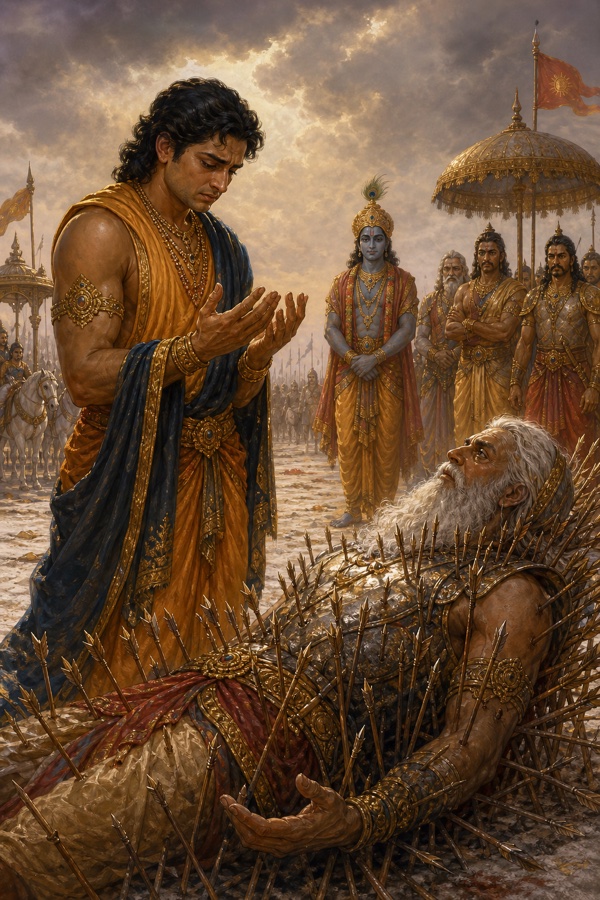
From his bed of arrows, the voice of the grandfather Bhishma now crossed the border of war and statecraft and entered the country where a king’s duty and the road to release are strung on a single thread. Yudhishthira sat close, his hands folded, and Bhishma began the story from the first morning of creation. What follows is a journey that rises out of the law of distress into the law of liberation, and it opens, in order, the talk between Bhrigu and Bharadvaja, the origin of the four varnas, the four stages of a life, the rules of right conduct, the secret of the inner Self, the four rungs of meditation and yoga, the road walked by those who murmur the sacred syllable, and the form of Narayana, the supreme reality. We stay near and tell it to you exactly as Vyasa told it.
Bhrigu and Bharadvaja: How the Four Varnas Arose

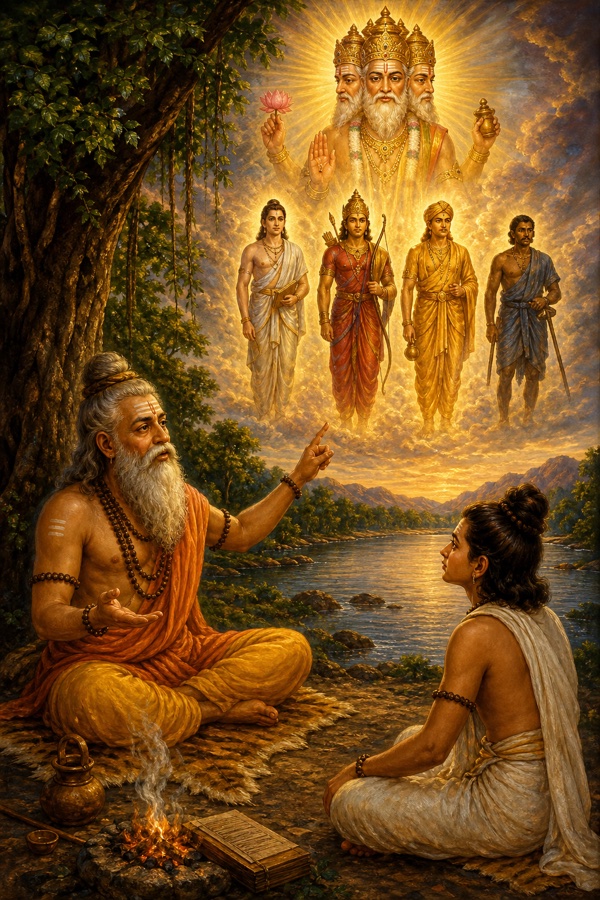
The great rishi Bhrigu told Bharadvaja that in the beginning Brahma created certain brahmanas who were called Prajapatis, the lords of creation. Their energy was like fire and the sun, and they were born from the energy of that first-born supreme Person. Then that able Lord created truth, dharma, tapas (austerity), the eternal Veda, sacred acts of every kind, and purity, so that living beings, practicing these, might reach heaven.
After this came the gods and the Danavas, the Gandharvas, the Daityas, the Asuras, the great serpents, the Yakshas, the Rakshasas, the Nagas, the Pishachas, and human beings in their four divisions, meaning the brahmanas, kshatriyas, vaishyas, and shudras, along with every other kind of creature. Bhrigu said something strange: that the varna (color) given to the brahmanas was white, to the kshatriyas red, to the vaishyas yellow, and to the shudras black.
Bharadvaja at once raised a question. If the four groups differ only by color, then all the groups seem thoroughly mixed together. Desire, anger, fear, greed, grief, worry, hunger, and toil settle on all human beings alike. How then are people to be told apart by their qualities? Every body gives off sweat, urine, feces, phlegm, bile, and blood. On what basis, then, are people to be divided into groups?
Bhrigu’s answer went deep. He said there is truly no fundamental difference between the groups. In the beginning the whole world was brahmana. Brahma had created everyone equal, and it was through their own deeds that people split into different groups. Those who gave themselves to desire and enjoyment, who grew harsh and full of anger, who were bold and neglected the worship of dharma, these brahmanas, marked by the rajas guna, became kshatriyas. Those who paid no heed to their duties, who carried both the sattva and the rajas guna and took to cattle-herding and farming, became vaishyas. Those who delighted in falsehood and violence, greedy, fallen from pure conduct, bound by the tamas guna, became shudras. In this way, divided by their own deeds, brahmanas became members of the other three groups.
Bhrigu added that all four groups always have the right to perform every sacred act and yajna (fire-rite). Brahma had created everyone the same and had fixed the words of the Veda for all. It was greed alone that made so many fall and sink into ignorance. Those who cannot grasp that every created thing is itself the supreme Brahman cease to be brahmanas. Losing the light of knowledge and falling into unrestrained conduct, they are born among the Pishachas, Rakshasas, Pretas, and the many kinds of Mleccha tribes.
A key to reading this (the concept): The word varna carries two senses, one of color and one of social group. Bhrigu speaks first of color, then, at Bharadvaja’s objection, overturns his own point: the distinction is drawn by deed and quality, and color has nothing to do with it. The three gunas are the backbone of Sankhya philosophy: sattva (purity, light, happiness), rajas (activity, desire, pain), and tamas (darkness, inertia, delusion). The whole teaching ahead turns around these three gunas.
Bharadvaja then asked which deeds make a person a brahmana, which a kshatriya, a vaishya, or a shudra. Bhrigu answered that a brahmana is one purified by the birth-rites and the other sacraments, whose conduct is pure, who is devoted to the study of the Veda, who keeps the six daily rites, who never eats without first offering to the gods and to guests, who holds his guru in reverence, and who stands firm in his vows and in truth. A brahmana, he said, is one in whom you find truth, charity, non-violence, compassion, modesty, generosity, and tapas.
One who takes up the business of war, studies the Veda, gives gifts to brahmanas, and draws wealth from the people is a kshatriya. One devoted to cattle-tending, farming, and the earning of wealth, pure in conduct and a student of the Veda, is a vaishya. One who finds pleasure in eating food of every kind, who turns his hand to work of every kind, impure in conduct and no reader of the Veda, is a shudra. And then Bhrigu spoke the words that are the soul of this whole passage: if these marks appear in a shudra and are missing in a brahmana, then that shudra is no shudra and that brahmana is no brahmana.
Bhrigu handed over the practical end of the teaching too: by every means one should hold back greed and anger. This, together with self-restraint, is the highest fruit of knowledge. These two urges are worth restraining with the whole heart, for they rise up only to destroy a person’s highest good. Guard your prosperity against anger, your tapas against pride, your knowledge against honor and insult, and your own soul against delusion. The wise one who does all his acts without craving their fruit, whose every possession is meant for giving, and who performs the daily fire-offering, he is the true renunciant.
A key to reading this (the six daily rites): A brahmana’s six daily acts were the morning and evening bath, the silent murmuring of mantras, the offering of oblations in the fire, the worship of the gods, the welcoming of guests, and the offering of food to the Vishvedevas. These acts return later in the passage on conduct.
The gist: The four varnas were created equal in the beginning; the distinction is drawn by deed and quality, and color plays no part. Conduct proves brahminhood; birth does not. Restraint of greed and anger is the highest fruit of knowledge, and the one who acts without craving the fruit is the true renunciant.
Truth and Falsehood, Happiness and Sorrow
Bhrigu went on: truth is Brahman, truth is tapas, truth creates all beings. On truth the whole universe rests, and by the support of truth a person goes to heaven. Falsehood is only another form of darkness, and darkness drags a person downward. It is said that heaven is light and hell is darkness. In this world too, truth and falsehood give rise to opposite conduct and opposite marks, as do dharma and adharma, light and darkness, happiness and sorrow. What is truth is dharma, what is dharma is light, and what is light is happiness. In the same way, what is falsehood is adharma, what is adharma is darkness, and what is darkness is grief.
Bhrigu set down a startling principle: there is nothing higher than happiness. Happiness is a quality of the soul. Both dharma and wealth are sought for its sake, and dharma is the root of happiness. The final aim of all action is the winning of happiness.
Bharadvaja could not digest this. He said he did not understand it. The rishis, who are held to be engaged for some higher reward, do not seek this happiness. It is heard that Brahma, the maker of the three worlds, lives alone, in the vow of celibacy, and never gives himself to the happiness that comes from satisfying desire. Shiva, the lord of Uma, burned Kama, the god of desire, to ashes. So happiness does not seem acceptable to high souls.
Bhrigu made it clear that darkness is born of falsehood. Those wrapped in darkness do only adharma, overcome by anger, greed, malice, and untruth. They find happiness neither here nor in the world beyond. They are worn down by disease, bondage, hunger and thirst, and the torments of cold, heat, and wind, and by the mental grief of lost wealth and separation from loved ones. Only those untouched by all this know what happiness is. In heaven these torments are absent; there is no hunger there, no thirst, no old age, no sin. This world holds both happiness and sorrow, and hell holds only sorrow. So happiness is the highest aim of attainment. The earth is the mother of all beings, and each being, shaped by its own deeds, reaps happiness or sorrow.
A key to reading this (the concept): Here “happiness” points to the spiritual health that rises from dharma and truth, well beyond any pleasure of the senses. Bharadvaja was thinking of the pleasure of enjoyment; Bhrigu was speaking of the lasting welfare of the soul. This is the same tension that returns later as “shreya versus preya,” the beneficial and the merely pleasant.
Bharadvaja asked about the fruits of charity, dharma, conduct, tapas, Vedic study, and the fire-offering. Bhrigu explained in brief: offering oblations in the fire burns away sin, study of the Veda brings peace, charity brings the objects of enjoyment, and tapas brings heaven. Charity is of two kinds, for the next world and for this one. What is given to a worthy recipient goes with you into the next world; what is given to an unworthy one bears its fruit here.
The gist: Truth is Brahman, dharma, light, and happiness; falsehood is darkness, adharma, and grief. True happiness is a quality of the soul, and dharma is its root. Charity, tapas, and Vedic study each bear their own fruit, and the fruit of charity depends on the worth of the recipient.
The Four Ashramas of Life
Bharadvaja asked about the four ashramas (stages of life) that Brahma had laid out, and about their conduct. Bhrigu said that in ancient times Brahma set out four ashramas for the good of the world and the protection of dharma. The first of these, in order, is residence in the guru’s house. One who is in this ashrama should cleanse his soul with pure conduct, Vedic rites, restraint, vows, and humility. He should worship at the morning and evening twilights, and worship the sun, his own fire, and the gods, and give up sloth and delay. Let him keep celibacy, serve his guru, go out for alms, and offer to the guru, without resentment, all that he receives.
The second ashrama is the householder’s. It is made for those who complete their residence in the guru’s house and return, pure in conduct, wishing with a wife for the fruits of dharma. In it all three, dharma, wealth, and desire, can be found. Bhrigu said this ashrama is the root of all the ashramas, because those in the guru’s house, those who live on alms, and those under vows all draw the support of their lives from it. He quoted the saying: if a guest turns away from a man’s house with his expectations unmet, he carries off the householder’s merit and leaves his own sins behind with him.
In the householder’s ashrama the gods are satisfied by yajnas, the ancestors by the shraddha rites, the rishis by Vedic learning and the recitation of the scriptures, and the Creator by the begetting of offspring. Bhrigu added that in this ashrama one should show affection to all beings and speak kind words. To cause pain, to insult, to speak harsh words, all are worthy of blame. Arrogance and deceit are to be abandoned too. Non-violence, truth, and freedom from anger yield the fruit of tapas in all four ashramas. In this ashrama the enjoyment of flower garlands, ornaments, clothes, perfume, dance and music, and food and drink of many kinds is not forbidden.
The third ashrama is the life of the forest. Those who take to the vanaprastha life keep no store of wealth. These good men eat simple food, stay devoted to the study of the Veda, and wander the earth on pilgrimage to holy places. The fourth ashrama Bhrigu describes at length in the passage that follows.
A key to reading this (the four ashramas): Brahmacharya (study in the guru’s house), garhasthya (the householder), vanaprastha (forest-dwelling), and sannyasa (the renouncing life of the wanderer). Bhrigu calls the householder the root of them all, because the support of the other three ashramas comes from him.
The gist: The four ashramas were made to protect dharma; the householder’s ashrama is the root of all, because the others are sustained by it. Non-violence, truth, and freedom from anger yield the fruit of tapas equally in all four ashramas.
The Vanaprastha, the Parivrajaka, and That Land of the North
Bhrigu described the conduct of the forest-dwellers in detail. Forest ascetics who seek dharma go to sacred waters, rivers, and springs, and do their tapas in lonely forests full of deer, buffalo, boar, tigers, and wild elephants. They give up the tasty food and comforts of society and get by on a spare life of wild herbs, fruit, roots, and leaves. The bare ground is their seat; they lie on earth, rock, gravel, sand, or ash. They cover their limbs with grass, deerskin, and bark, and never shave their heads or beards or cut their nails. They bear cold, heat, rain, and wind without a second thought, so their skin cracks and their flesh, blood, and bone waste away. With great patience and endurance they live, always practicing the sattva guna.
Then Bhrigu described the way of the parivrajakas, the sannyasis. These break their attachment to fire, wealth, wife, children, clothes, seat, and bed, cut the bonds of affection, and wander, looking on a clod of earth and a lump of gold with the same eye. They fix their minds on none of the three, dharma, wealth, and desire, see enemy, friend, and stranger as equal, and harm no creature by thought, word, or deed. They have no home; they live on mountains, on riverbanks, in the shade of trees, and in the temples of the gods. In a town they stay no more than five nights, in a village no more than one. They are free of desire, anger, pride, greed, delusion, meanness, deceit, slander, arrogance, and violence.
Bhrigu gave a subtle image: the learned one who kindles no outer fire and performs the agnihotra with the fire of his own body, who offers oblations into his own mouth and into the fire within, wins happiness in many worlds by the power of that fire. The parivrajaka who keeps this ashrama with liberation as his aim, with a pure heart and a mind free of willful designs, reaches Brahman like that quiet ray of light which is fed by no burning fuel.
Bharadvaja voiced a curiosity: beyond this land of ours there is a land that we have heard of yet never seen. Bhrigu said that to the north, past Himavat, there is a sacred, blessed, and deeply longed-for land called “the world beyond.” Its people are devoted to dharma, pure of heart, free of greed and delusion, and subject to no suffering. That land is like heaven. There death comes at its proper time, disease touches no one, no one desires another man’s wife, and everyone is devoted to his own. There no one torments or kills another, no one covets another’s goods, no sin is done, no doubt arises.
This land of ours, by contrast, is the field of action. Here some are devoted to dharma and some to deceit; some happy, some in sorrow; some poor, some rich. Here toil, fear, delusion, and hunger appear, and the greed for wealth bewilders even the learned. Here, by doing good and evil deeds, a person reaps the good of good deeds and the evil of evil ones. The northern land is deeply auspicious and pure; those of this land who do the acts of dharma or honor yoga are born in that northern land. The rest are born in the middling wombs, and some, their span run out, are left wandering on the earth.
Bhishma said that in this way Bhrigu recounted to Bharadvaja at length the origin of creation, and Bharadvaja, filled with wonder, began to worship that great rishi.
A key to reading this (the place): Himavat is the old name for the Himalaya. “The land of the north beyond Himavat” here works as a symbol of a realm of merit where sin and sorrow never reach, like heaven itself. Parivrajaka means a wandering sannyasi, one who never stays bound to a single place.
The gist: The vanaprastha reaches Brahman by tapas, the parivrajaka by renunciation, and the yogi who offers oblations into the inner fire reaches it by that inner offering. This field of action is a mix of good and bad; those with merit and yoga are born in that pure northern realm.
The Rules of Right Conduct
Now Yudhishthira wished to hear from his grandfather the rules of conduct. Bhishma said that those of bad conduct, bad deeds, wicked mind, and great rashness are called the wicked; and those known by the purity of their conduct and their ways are the good. He counted out many fine rules of daily life, which mirror the daily round of that age.
Bhishma said that one should not pass urine or feces on the great roads, in cattle-pens, or in fields full of grain. After finishing the necessary acts, to bathe in river water and offer water to the gods is the dharma of all people. One should always worship the sun, should not sleep after sunrise, and should say the morning and evening prayers facing east and west. Washing the five limbs, one should eat facing east, in silence; one should never speak ill of the food, and after eating should wash the hands and rise. At night one should not sleep with wet feet. Bhishma said that the divine rishi Narada named these the marks of right conduct.
Every day one should walk in reverence around some sacred spot, a bull, an image of a god, a cattle-pen, a crossroads, a holy brahmana, and a sacred tree. In feeding, one should make no difference between guest, servant, and kinsman; equality with servants is worthy of praise. Two meals a day, morning and evening, are the ordinance of the gods; eating again in between is not sanctioned, and one who eats by this rule gains the merit of a fast. Bhishma said that the food left in a brahmana’s dish is like nectar, like a mother’s breast-milk; good men who eat it attain to Brahman.
Bhishma gave a gentle picture of table courtesy: when you serve someone food, ask, “Is it enough?”; when you give water, ask, “Are you satisfied?”; and when you give a sweet gruel of honey, milk, and rice or barley, ask, “Is it good?” On the matter of meat he counseled restraint: one who has given up meat under some vow should not eat even the meat purified by the mantras of the Yajur Veda, and should also give up the meat near the spine and the meat of an animal not slain in a yajna.
Bhishma spoke the moral heart of it: one should not pass urine facing the sun, should not look at one’s own feces, should not lie on one bed with a woman, should not eat with her. He said that addressing one’s elders by name or with slighting speech is worthy of blame, though to do so with equals or juniors is no fault. The hearts of sinners give away their sins; those who hide their known sins from good men come to ruin. When one sin is hidden by another, new sins are born, but when one merit is covered by another merit, merit grows. As Rahu comes upon the moon at his appointed time, so sins come back to the foolish person.
Bhishma said at the end that the wise have declared the righteousness of all beings to be a quality of the mind; so one should think in one’s mind of the good of all. Dharma can be practiced alone, and needs no helper in it. Dharma is the very source of a person, dharma is the nectar of the gods; after death, people enjoy lasting happiness through dharma alone.
A key to reading this (the concept): Rahu is held to be the cause of eclipses; as Rahu swallows the moon at its fixed time, so a sin returns to its doer at its own time, a comparison that comes back again and again. Arghya is the water and offering given in honor to a guest or a god.
The gist: Right conduct is built of small daily rules, from bathing and twilight prayer to food and speech. Sin grows when it is hidden, and so does merit; and dharma is the root of a person and the lasting happiness of the world beyond.
Adhyatma: Creation, the Senses, Buddhi, and the Atman
Yudhishthira asked: what is it that they call “adhyatma” (the inner science of the Self)? From what was this universe of moving and unmoving things made, and into what does it return at the dissolution? Bhishma said this subject is deeply pleasant and full of good. Earth, air, ether, water, and fire, these are called the five great elements (mahabhutas), and they are the origin and the dissolution of all created things. From whatever they arise, into that they return, like the waves of the sea that grow calm again in the very thing from which they rise. As a tortoise stretches out its limbs and then draws them in, so the supreme Self creates all things and then draws them back into itself.
Bhishma drew a fine map of the senses: sound, hearing, and all the openings belong to ether; touch, action, and the skin to air; form, the eyes, and digestion to fire; taste, moisture, and the tongue to water; and smell, the nose, and the body to earth, three qualities apiece. Five great elements, the sixth mind, the seventh buddhi (the deciding faculty), the eighth the atman (the Self). The senses are for perception, the mind raises doubt among them, the buddhi turns all into certainty, and the atman stands as witness, doing nothing.
Bhishma opened the subtle difference between the atman and the buddhi with comparisons. As a gnat and the fig it sits on may appear together yet stay separate, or a fish and water stay separate while living together, so the buddhi and the atman, though they always appear joined, are separate by nature. The gunas do not know the atman, while the atman knows all the gunas and stays their witness. As a covered lamp throws its rays through a gap in the covering and reveals things, so the atman knows things through the senses, the mind, and the buddhi, though these are themselves inert and without consciousness.
Bhishma counted out the fruits of the three gunas again: from sattva comes happiness, from rajas comes sorrow, and from tamas comes delusion. Joy, contentment, gladness, and peace are the marks of sattva. Discontent, heartburn, grief, greed, and vengefulness are the marks of rajas. Disgrace, delusion, confusion, sleep, and inertia are the marks of tamas. As a water-bird moves over the water and does not get wet, so the wise one, living among beings in the world, stays unstained. Such a person creates the gunas yet is untouched by them, as a spider spins its threads yet does not get caught in them.
Bhishma gave a beautiful image: one who must cross a wide river takes no joy from merely seeing the far bank; but for the knower of truth the case is reversed, for the mere knowledge of truth gives him happiness, and the moment that knowledge begins to bear fruit, the person has, as it were, reached the far bank. Those who know the atman to be free of all worldly things and alone attain the highest knowledge.
A key to reading this (the elements of adhyatma): Adhyatma means the science of the Self, the knowledge of the atman seated within the body, the senses, the mind, and the buddhi. The order of the eight principles is worth remembering: the five great elements (earth, water, fire, air, ether), then manas (the seat of desire and doubt), buddhi (which decides), and the atman (the witness alone, the non-doer). The images of the spider and the water-bird are meant to convey detachment.
The gist: The five great elements are the source of creation and dissolution; the mind, the buddhi, and the atman are the levels of doubt, certainty, and witnessing. The atman knows the gunas, while the gunas do not know it; the wise one stays unstained in the world like a water-bird. The knowledge of truth is itself the crossing to the far bank.
The Rungs of Meditation-Yoga
Bhishma said he would now speak of meditation-yoga. Great rishis who gain its knowledge win lasting perfection in this very life. Longing for liberation, knowers of yoga, freed from the faults of the world, they do not return to be born again. Free from the sway of the pairs of opposites, cold and heat, happiness and sorrow, always resting in their own true nature, they live in solitude where there is no quarrel with anyone, in places suited to complete peace of heart.
Bhishma described the yogi’s posture: holding back speech, sitting like a block of wood, pressing down all the senses, he joins his mind, through meditation, inseparably to the supreme Self. He no longer perceives sound with the ear, touch with the skin, form with the eye, taste with the tongue, or smell with the nose. The wise yogi gathers the five senses into the mind, and then fixes the wandering mind, senses and all, in the buddhi.
Bhishma gave two images of the mind’s restlessness. The mind, set for the first time on the path of meditation, flashes like a fickle lightning playing among the clouds, and rolls in every direction like a drop of water on a lotus leaf. It steadies for a moment, then strays again into the path of the wind and grows as restless as the wind. Without losing heart at this, without fretting over the waste of effort, giving up sloth and malice, the yogi should set the mind again on meditation.
Bhishma gave one more illustration: as a heap of dust, ash, or burnt cow-dung stays dry after one sprinkling of water and needs sprinkling again and again to be fully soaked, so the yogi must, slowly and by repeated practice, draw all his senses back from their objects, one by one, and bring them under control. For one who has mastered the mind and the senses, happiness comes neither from effort nor from fate. Such yogis attain to the most blessed nirvana.
A key to reading this (the yoga concept): Here meditation means drawing the senses back from their objects (pratyahara), fixing the mind on a single point (dharana), and at last dissolving into that very point (samadhi). Nirvana here means the stilling of all afflictions, the supreme peace of merging in Brahman, with no sense of being snuffed out.
The gist: The yogi in solitude holds back the senses and fixes the mind on the supreme Self. The mind is as restless as lightning and as a drop on a lotus leaf, yet by patient practice, like soaking ash by sprinkling it again and again, it comes under control, and then comes the peace of nirvana that no effort or fate can bring.
The Path of Those Who Murmur the Mantra: Sankhya and Yoga
Yudhishthira said that his grandfather had told him of the four ashramas, of the dharma of kings, of many tales and much moral counsel, yet one doubt remained. He wished to know what fruit comes to those who silently murmur the mantras, and what path they take after death. Should such a murmurer be counted a follower of the rules of Sankhya, or of Yoga, or of action, or of the mental yajna?
Bhishma said that in this connection an old history is cited, of Yama, Time, and a certain brahmana. The rishis who know the means of liberation have set out two paths, Sankhya and Yoga. Of these, Sankhya, also called Vedanta, teaches renunciation (sannyasa) in the matter of murmuring, and its Vedic words concern withdrawal from action, peace, and Brahman. On both paths, as in murmuring, restraint of the senses and the drawing of the mind back from outer objects into stillness are necessary, along with truth, tending the fire, dwelling in solitude, meditation, tapas, self-restraint, forbearance, generosity, spare eating, and non-attachment.
Bhishma expanded on the vow of the murmurer: the celibate murmurer who walks the path of withdrawal should sit on kusha grass, kusha in hand, his tuft bound with kusha, ringed with kusha, and with kusha for his very garment. Bowing to all worldly cares, he should send them away, then, gaining evenness through the mind, fix the mind within the mind itself. Murmuring the deeply blessed Gayatri, he should meditate with the buddhi on Brahman alone, and then, letting go of even that, dissolve into one-pointed samadhi. By the power of the Gayatri this samadhi comes of itself. Such a seeker holds himself to be neither the doer nor the enjoyer; at the last, casting off the vital breaths, he enters the body of Brahman, or goes straight to the world of Brahman and is not born again.
Yudhishthira asked whether this is the only path of the murmurers, or whether there is another. Bhishma opened a hard truth: no, many murmurers fall even into hell. One who does not act by the rule at the start, who cannot complete the ordinance, who is without faith, who is discontent with his own work and takes no joy in it, or who keeps the rule with pride in his heart, or who insults others, goes to hell. One who murmurs out of delusion or a craving for a fruit gets exactly what his mind was fixed upon, and liberation stays beyond him.
Yudhishthira asked: when the murmurer touches that supreme principle which rests in its own nature, which is beyond description and beyond thought, and which dwells in the syllable “Om,” why then do they take on a body and are born again? Bhishma said that in the absence of true knowledge and wisdom, murmurers reach hells of many kinds; the ordinance of murmuring is certainly the highest, and these are its faults.
Yudhishthira asked what the “hell” of the murmurer is like. Bhishma’s answer was deeply subtle and radiant. He said that the worlds of the high-souled gods, adorned with colors and forms of every kind, gardens set with golden lotuses, the abodes of the four Lokapalas, of Sukra, Brihaspati, the Maruts, the Vishvedevas, the Sadhyas, the Ashvins, the Rudras, the Adityas, and the Vasus, all of these, set against the world of the supreme Self, are called hell. That supreme world is free of fear, uncreated (resting in its own nature), free of any pain and of the pull of the pleasant and the unpleasant, beyond the three gunas, free of happiness, sorrow, and disease. There Time rises in its forms of past, present, and future only for use, but there Time is no ruler; that supreme land is the ruler of both Time and heaven. The murmurer who gathers all into his own soul and reaches there is touched by no sorrow again.
A key to reading this (Sankhya and Yoga): Sankhya is the path of knowledge, where liberation comes from knowing the difference between prakriti (nature) and purusha (spirit); here it is joined to Vedanta and withdrawal (turning away from action). Yoga is the path of action and practice. Japa means the silent repetition of a mantra, above all the Gayatri mantra. Worth noting: even the worlds of the gods are called “hell,” meaning that against the supreme moksha even heaven is incomplete and changeful.
The gist: There are two paths to liberation, Sankhya (knowledge and withdrawal) and Yoga (practice). The one who murmurs the Gayatri, in the spirit of the non-doer and the non-enjoyer, dissolves into Brahman; but the murmurer without faith, or full of pride, or craving a fruit, reaches hell. Set against the supreme world, all the worlds of the gods are hell-like, for they are subject to Time.
The Tale of Ikshvaku and the Murmuring Brahmana

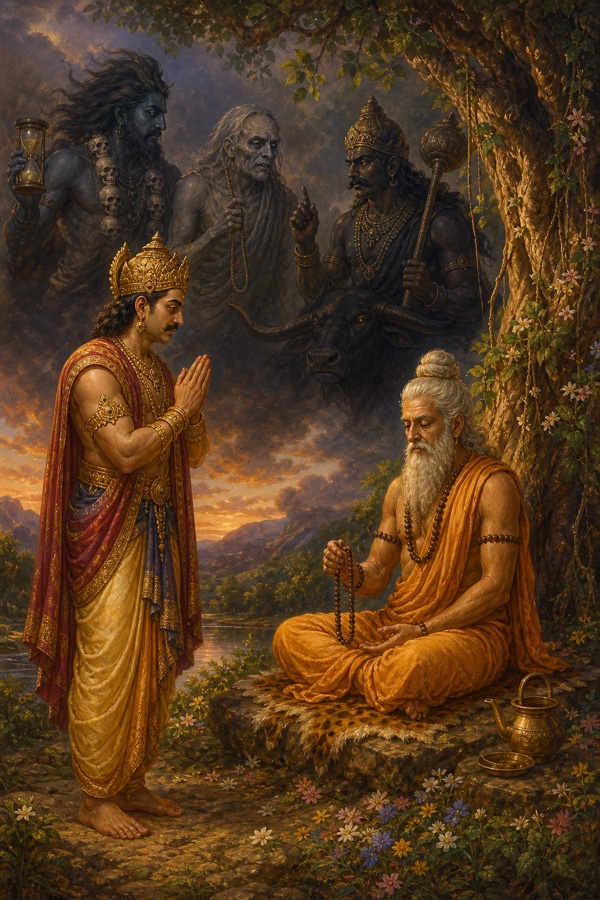
Yudhishthira asked him to tell in full the dispute that had taken place between Time, Death, Yama, Ikshvaku, and a brahmana. Bhishma began the tale. There was a very famous brahmana of pious conduct, a murmurer, a master of the six Vedangas, of the Kushika line and the son of Pippalada. Living at the foot of Himavat, he did severe tapas while silently murmuring the Gayatri. A thousand years passed over his head. Then the goddess Gayatri, Savitri, showed herself and said, “I am pleased with you.” But the brahmana stayed absorbed in his murmuring and did not speak a single word to the goddess. The goddess felt compassion for him and was pleased.
Finishing his murmuring, the brahmana rose and bowed his head at the goddess’s feet. He said that by good fortune the goddess was pleased and had shown herself; if she was truly pleased, the boon he asked was that his heart might always take joy in the murmuring. Savitri said, “Ask what you wish; all will be as you ask.” The brahmana said that his desire to murmur might grow with every moment, and that the absorption of his mind in samadhi might become complete. The goddess spoke sweet words, “Let it be so.” And as she left she granted a boon: that he would not go to the hell where great brahmanas go; he would go to that world of Brahman which is uncreated and without fault. She also made a prophecy: that Dharma himself would come to him, and Time, Death, and Yama as well; and that a dispute over a question of dharma would arise between him and them.
The goddess returned to her own abode. The brahmana stayed at his murmuring for a thousand celestial years, holding back anger, firm in truth, free of malice. When his vow was complete, Dharma, pleased, appeared in person and said that he was Dharma, come to see him; that he had won the fruit of his murmuring, and could rise above all the worlds of the gods; and that now he should cast off his vital breaths and go wherever he wished.
Here the tale takes an unexpected turn. The brahmana said, what use were those worlds to him? Let Dharma go wherever he pleased, but he would not give up this body, the seat of both happiness and sorrow. Again and again Dharma said the body must be cast off, ascend to heaven. Again and again the brahmana held firm: he did not wish to live in heaven without this body of his; the joy he found in murmuring was enough. When Dharma could not persuade him, he said, look, Yama, Time, and Death are coming.
Yama, the son of Vivasvan, and Time and Death, the three, came to the brahmana. Yama said that a high reward for his well-performed tapas and pious conduct awaited him. Time said that he had won a high reward to match his murmuring, and now was the time to ascend to heaven; I am Time and I have come to you. Death said, know me as Death in my true form; urged by Time, I have come to bear you away.
The brahmana said, with wonderful calm, that Yama the son of the sun, high-souled Time, Death, and Dharma were all welcome; what should he do for them? He honored them with water for their feet and with the arghya. At that very moment King Ikshvaku, who had set out on a pilgrimage to holy places, arrived at the spot where all these deities were gathered. The royal sage Ikshvaku bowed his head to them all and asked after their welfare. The brahmana gave the king a seat, water for his feet, and the arghya, and said, welcome, great king; tell me all your wishes, what may I do for you by the power of my tapas?
From here begins the subtle war of words that is the heart of this tale. The king said that he was a king and the brahmana a keeper of the six rites; he could give some wealth, so tell me how much I should give. The brahmana said that brahmanas are of two kinds and dharma too is of two kinds, engagement in action and withdrawal from action; he had taken up the withdrawal from accepting gifts, and so would take nothing. Instead he asked the king in return: where does your good lie, what may I give you by my tapas?
The king said that he was a kshatriya and did not know how to say the word “give me”; a kshatriya can say only “give me battle.” The brahmana said with a smile that just as the king was content with his own dharma, so was he with his; there is little difference between us, do as you please. The king then caught hold of what the brahmana had himself said, “ask for whatever I may give by my power.” So the king asked: give me the fruit of your murmuring.
The brahmana at once turned it around: you were saying that your speech asks only for battle; then why do you not ask me for battle? The king said that brahmanas are armed with the thunderbolt of speech and kshatriyas with the strength of their arms; and so this war of words has broken out between us. The brahmana said that today this was his resolve too; so tell me, what shall I give you by my power, do not delay. The king again asked the same thing: give me the fruit of a thousand years of murmuring.
The brahmana said, take it, the highest fruit of my murmuring; take half without hesitation, or take the whole fruit if you wish. The king’s answer opens the heart of this tale. He said that he no longer needed the fruit he had asked for; he was leaving, but tell me, what is that fruit? The brahmana said that he had no knowledge of the fruit at all; he had never murmured out of any desire for a fruit, so how could he know it? But whatever fruit he had earned, he had given to the king, and Dharma, Time, Yama, and Death were the witnesses of this gift.
Now both were caught in a dilemma of dharma. The king said, what will he do with an unknown fruit; if the brahmana would not name the fruit, let it stay with him, he did not want it. The brahmana said that he would now accept no other word; he had given the fruit, and let the words of both the king and the brahmana stay true. And then the brahmana sang a long, radiant hymn to truth. He said that one given to falsehood has neither this world nor the next; he cannot rescue his own ancestors, so how will he do good for his offspring? Yajna, charity, fasting, and vows do not guard a person from sin and hell as much as truth does.
The brahmana said that truth is the one imperishable Brahman, truth the imperishable tapas, truth the imperishable yajna, truth the imperishable Veda. From truth alone rise dharma and self-restraint. By truth the wind blows, by truth the sun burns, by truth the fire flames, on truth heaven rests. Once truth and all the acts of dharma were set on the two pans of a balance, and the pan that held truth proved the heavier. He said to the king, why do you wish to be stained by falsehood; you said “give me,” do not make it false. The one who promises and does not give, and the one who asks and does not take, are both stained by falsehood.
Still the king held firm: a kshatriya’s dharma is battle and protection, it is to give and not to take; so how can he take from a brahmana? The brahmana said that he had never forced the king, never gone to his house; the king had come of his own will and begun to ask, so why now does he not take? In this very crisis Dharma appeared and said, let both know that I am Dharma himself; let there be no dispute between you; let the brahmana have the fruit of the gift and the king the fruit of truth. Heaven too came in its embodied form and said, let this dispute end; you are both equal in merit. But the king said he had no use for heaven; let heaven return whence it came.
A sub-tale: In the midst of this dispute two extremely ugly men in torn clothes came along, their hands on each other’s shoulders, quarreling with one another, “I owe you nothing; if anything, I am in your debt.” They came to the king. One was named Virupa, the other Vikrita. Virupa said that he wished to repay Vikrita the merit of the gift of a cow, because Vikrita had earlier, with a pure heart, given him the fruit of a cow-gift; with it he had bought two brown cows and given them to a poor brahmana, and now he wished to repay Vikrita double the fruit. But Vikrita said that what he had given he had given, and he would take nothing back now. The king said Vikrita deserved punishment: one who will not take from a man ready to give does wrong. Yet in the end, when the king had sent them both to their goals, Virupa revealed the secret: that the two of them were in truth Desire and Anger; it was they who had driven the king to this conduct; and Time, Dharma, Death, and these two had together tested the king through this friction. This sub-tale mirrored the very dilemma of “giving and taking” in which the king and the brahmana were caught.
Hearing that sub-tale, the king’s crisis was resolved. He thought that if he did not take what the brahmana had given, how would he escape a great sin. He said, a curse on the kshatriya dharma, whose principle brings on such a crisis; but he would take, only so that the two dharmas of giving and taking might become equal. He held out the hand that had never once opened to accept a gift. The brahmana said that if he had won any fruit by murmuring the Gayatri, let the king accept it all. The king too let drops of water fall on his own hand and gave his own earned fruit to the brahmana, so that there might be equality between them.
Bhishma said that in this way he had told Yudhishthira what fruit and what path come to the murmurer. The one who murmurs the Gayatri goes to the supreme Brahma, or enters the world of fire or of the sun. If he stays there with attachment, he takes on the qualities of those worlds; but if he stays free of attachment, holding even that enjoyment in mistrust, wishing only for that supreme and imperishable principle, then he enters into it, into the nectar of even the nectar, in a state free of desire and free of separate consciousness. He becomes of the very form of Brahman, free of the pairs of opposites, happy, at peace, and free of pain.
Yudhishthira asked for the rest of the ending. Bhishma said that the brahmana worshipped Dharma, Yama, Time, Death, and Heaven, all of them, and said to the king, having won the fruit of my murmuring, rise to a high place; with your leave let me begin my murmuring again, for the goddess Savitri had granted the boon that my devotion to murmuring should stay unbroken. The king said that if the brahmana’s fruit of murmuring had become fruitless by his giving it away, and he wished to murmur again, let the two of them go half and half. The brahmana said, let us both become equal in our fruits and reach that final path which is ours.
Learning of their resolve, Indra, the lord of the gods, came there with the gods and the Lokapalas. The Sadhyas, the Vishvedevas, the mantras, the rivers, the mountains, the seas, the sacred waters, the tapas, the ordinances of yoga, the Vedas, the sounds of the Saman chants, Sarasvati, Narada, Parvata, Vishvavasu, the Hahas and Huhus, the Gandharva Chitrasena with all his family, the Nagas, the munis, the Prajapatis, and the inconceivable, thousand-headed Vishnu himself came there. Drums and trumpets sounded in the sky, celestial flowers rained down, and the apsaras danced all around. Heaven came in embodied form and said to the brahmana that he had attained perfection, that he was blessed; and to the king it said that he too had attained perfection.
Then the two of them, having done good to each other, drew the senses back from their objects. They fixed the five breaths, prana, apana, samana, udana, and vyana, in the heart, concentrated the mind on prana and apana, then held the two breaths in the abdomen and turned their gaze to the tip of the nose, and then to the point between the brows. Bringing the breath very slowly to the point between the brows, holding the body perfectly still, they were absorbed with fixed gaze. Mastering the soul, they set it within the brain. Then, piercing the crown of the brahmana’s head, a flame of great splendor rose toward heaven. The cries of grief of all beings were heard on every side, and amid hymns of praise that splendor entered into Brahma.
The great grandsire Brahma came forward and welcomed that splendor, which had taken a form a span in height, and said, “Come.” Then he said that murmurers indeed reach the same path as yogis. The path of the yogi is seen directly before all these gathered gods; for the murmurers there is this special thing, that for them Brahma himself comes forward to receive them. “Dwell in me,” he said, and Brahma once more filled that splendor with consciousness, and the brahmana, freed of all cares, entered the mouth of the Creator. King Ikshvaku too entered into Brahma in the same way.
The gathered gods bowed to the self-born Brahma and said that a very high path is indeed set for the murmurers; you have made these two equal, given them equal honor, and an equal path. The supreme path that belongs to yogis and murmurers we have seen today; these two can cross beyond all the worlds and go wherever they wish. Brahma said that whoever reads the great Smriti (the Veda) and the auspicious Smritis of Manu and the rest, and whoever stays engaged in yoga, will likewise attain my world after death. Saying this, that best of gods vanished on the spot, and all the gods, honoring dharma, returned to their own abodes with glad hearts.
A key to reading this (lineage and characters): Ikshvaku is the first king of the solar line, an ancestor of Rama; here he appears as a royal sage. Savitri-Gayatri is held to be the mother of the Vedas, the presiding goddess of the Gayatri mantra. Virupa and Vikrita were in truth the disguised forms of Desire and Anger, brought to test the king. The five breaths, prana, apana, samana, udana, and vyana, are the five divisions of the body’s life-force; fixing them in turn in the heart, the tip of the nose, and the point between the brows is the yogis’ method of leaving the body.
The gist: The brahmana murmured without any craving for a fruit, and so had no knowledge of the fruit either; the king, in his devotion to truth, accepted the gift. Desire and Anger tested them both in disguise. In the end the two attained an equal path and dissolved into Brahma, proving that desireless murmuring gives the same supreme path as yoga.
Manu and Brihaspati: The Debate of Knowledge and Action
Yudhishthira asked about the fruits of knowledge-yoga, of the Vedas, and of vows, and how the individual soul is to be known. Bhishma told the ancient tale of the dialogue between the Prajapati Manu and the great rishi Brihaspati. Brihaspati, who was Manu’s disciple, bowed to his teacher and asked what is the cause of the universe, from where the ordinances of yajna and the rest flowed, what are said to be the fruits of knowledge, and what is that which even the Vedas could not reveal. He said that he had studied the Rik, the Saman, the Yajus, prosody, astronomy, etymology (Nirukta), grammar, the ritual code (Kalpa), and phonetics (Shiksha), yet had no knowledge of the nature of those five great elements which enter into the making of everything.
Manu’s answer opens the difference between the beneficial and the pleasant. He said that what is dear is called happiness, what is unwelcome is sorrow. “Let me gain happiness by this and ward off sorrow,” from this feeling all acts of dharma flow. But the effort for knowledge rises from the wish to escape both happiness and sorrow. The ordinances of yajna and the rest in the Vedas are all tied to desire; and the one who becomes free of desire attains Brahman. The one who walks the many paths of action out of a desire for happiness must go to hell.
Brihaspati said that a person’s longings stay fixed on gaining the pleasant (which ends in happiness) and warding off the unpleasant (which brings sorrow), and this gaining and warding is done through actions alone. Manu answered that only by becoming free of actions does a person enter Brahman. The ordinances of action tempt only those whose hearts are not free of desire. Outer actions give fleeting fruit; and for the fruit that is everlasting, the mental renunciation of the fruit is the one means.
Manu explained the excellence of knowledge with a beautiful comparison. He said that as, when the night ends and the veil of darkness lifts, the eye shows its master the way, so the buddhi, when joined with knowledge, sees all the evils to be avoided. A snake, the sharp point of kusha grass, a pit, a person avoids these once he sees them; whoever steps on them or falls in does so from ignorance. This is the excellence of the fruits of knowledge over the fruits of ignorance.
Manu pointed toward that supreme principle: it is free of taste, smell, sound, touch, and form, ungraspable by the senses, unmanifest, without color, and one. It made the five kinds of sense-objects for its creatures. It is neither woman, nor man, nor neuter; neither being, nor non-being, nor being-and-non-being. Only those who know Brahman see it.
A key to reading this (shreya and preya): The root of the debate here is that action binds one in the wheel of happiness and sorrow, while knowledge draws one out of that wheel. Brihaspati holds the side of action, Manu the side of knowledge. This is the same distinction the Katha Upanishad calls shreya (the beneficial) and preya (the pleasant but fleeting). Manu says that desireless action purifies the soul and at last opens the door to the path of knowledge.
The Nature of the Atman: The Parable of the Moon and Rahu
Manu described the order of creation: from that eternal, imperishable One first came ether, from ether air, from air fire, from fire water, from water the world, and from the world all the things within it. At the dissolution all things return first into water, then into fire, then into air, then into ether. Those who seek liberation do not have to return from ether; they attain Brahman. That Brahman is neither hot nor cold, neither soft nor sharp, neither sour nor astringent, neither sweet nor bitter; without sound, smell, or form, and without dimension.
Manu gave the rule of sense-restraint: only by drawing the skin back from touch, the tongue from taste, the nose from smell, the ear from sound, and the eye from form does a person come to see his own soul, free of the senses, the mind, and the gunas. He opened the difference between the soul and the body with illustrations. As fire lives in wood yet is not seen when the wood is split, and shows itself when one piece is rubbed against another, so the soul dwells in the body yet is not seen when the body is cut open; only by joining the senses and the soul through yoga does the supreme Self become visible. As in a dream a person sees his own body lying on the ground, separate from himself, so after death he leaves his body and passes into another form.
Manu gave a touching image: as a thing set before a blazing fire takes on a color from its heat and light, so the form of the soul appears to take its color from the body, though in truth it is not so. At death a person leaves the body among the five great elements and takes on a new form in the same way; each element merges into its own kind, the ear into ether, the sense of smell into earth, form into fire, taste into water, touch into air.
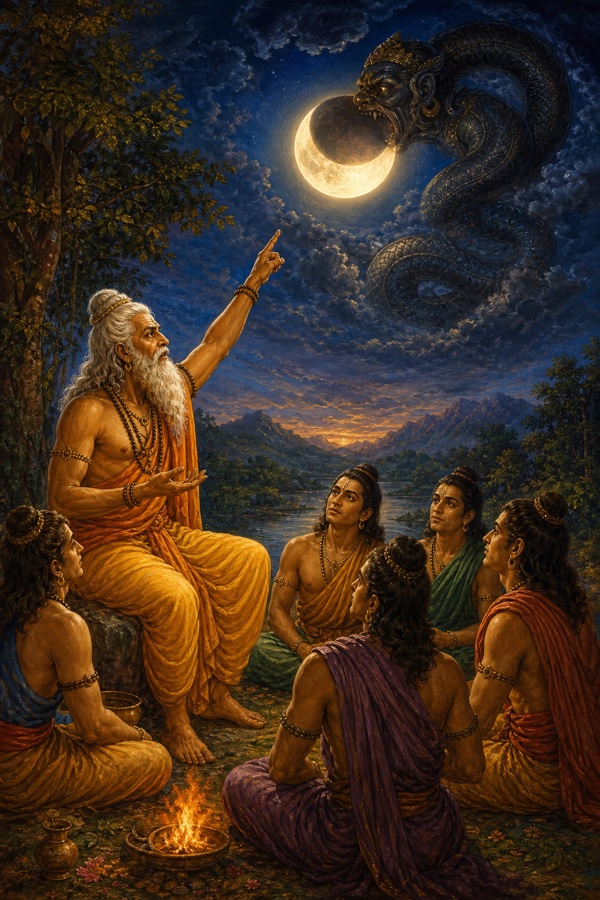
Manu explained the invisibility of the soul through the moon. As no one can see the far side of Himavat or the back of the moon, yet does not call them unreal, so the soul, though ungraspable by the senses, is not unreal. As on the new-moon night the moon’s gross form becomes invisible yet is not destroyed, and then, finding a new place, begins to shine again, so the soul, freed of the body, though it becomes invisible, is not destroyed, and finds a new body and appears again. As the coming and going of Rahu near the moon is not clearly seen, so the soul’s passing from one body into another is not seen. And as the moon, invisible on the new-moon night, is still not parted from the stars, so the soul, parted from the body, is still not parted from the fruit of its deeds.
A key to reading this (the concept): The soul has been explained now as fire hidden in wood, now as the moon on the new-moon night, now as the moon swallowed by Rahu. All three carry one meaning: being unseen does not make a thing absent. The return of the five senses into the five great elements shows that the body is only a joining of elements, and the soul lies beyond it.
The gist: Creation rises in order from ether down to earth and returns in reverse order at the dissolution. The soul is ungraspable by the senses yet eternal, present even while invisible like the moon; at death it leaves the elements and takes a new form, yet is never parted from the fruit of its deeds.
Mind, Buddhi, and the Cure for Grief
Manu set out the ladder of mind and buddhi: above the senses is the mind, above the mind the buddhi, above the buddhi the soul, and above the soul the supreme (the great). From the unmanifest came the soul, from the soul the buddhi, from the buddhi the mind. When the mind joins with the senses, it grasps sound and the other objects. The one who lets go of these objects and of all that is manifest, and becomes free of all things born of the root nature (prakriti), enjoys immortality.
Manu gave the cure for grief, which is of special value to a king in a time of distress. He said that when grief of body and mind rises, yoga does not hold, and so one should not dwell on grief again and again. The cure for grief is to keep from brooding on it over and over; when it is thought of again and again, it grows aggressive and swells. Mental grief should be driven off by discernment, and bodily grief by medicine. In grief a person should not behave like a child. The wise should not long for youth, beauty, long life, hoarded wealth, health, or the company of loved ones, for all these are fleeting.
Manu added that for a grief that touches a whole community one should not grieve alone; without grieving, if a chance appears, one should apply a remedy. In life the measure of sorrow is far greater than that of happiness. The person who guards himself from both happiness and sorrow attains Brahman, and such wise ones never have to grieve. Worldly possessions bring grief; there is pain in all three, the earning, the keeping, and the losing, and so one should not grieve even at their ruin.
Manu gave the method of attaining Brahman: when the buddhi, free of the qualities of action, drawn back from outer objects, turns toward the mind, then, absorbed in samadhi, it knows Brahman. The buddhi driven by ignorance runs toward outer objects like a river flowing down from a mountain peak; but gathered into the mind and absorbed in thought of the formless, it gains the knowledge of Brahman like gold touched to the touchstone. Closing the doors of the senses, one should gather the buddhi into the mind. As in deep, dreamless sleep (sushupti) the five senses stay free of their work, so the supreme Brahman stands above prakriti, free of all its qualities.
A key to reading this (the cure for grief): Bhishma is giving Yudhishthira, who was filled with grief after the war, this rule: grief grows when it is turned over in the mind again and again. The cure for mental pain is discernment, for bodily pain, medicine. This is the key to keeping a king’s mind steady in a time of distress. Sushupti is deep, dreamless sleep, in which the senses stay quiet, here an image for the formless state of Brahman.
The gist: Senses, mind, buddhi, soul, the supreme, this is the ascending order. Grief grows when it is dwelt on again and again; mental grief is stilled by discernment and bodily grief by medicine. The one who rises above both happiness and sorrow attains Brahman.
From Action to Knowledge, and Vishnu Beyond Time
Manu opened the roots of the tree of knowledge: from knowledge rises desire, from desire resolve, from resolve action, and from action fruit. So the fruit rests on action, action on the buddhi, the buddhi on knowledge, and knowledge on the soul. When knowledge, fruit, buddhi, and action are destroyed, the supreme result that comes is called the knowledge of Brahman. He set out the gradation of the elements: water is greater than earth, fire than water, air than fire, ether than air, mind than ether, buddhi than mind, and Time than buddhi. And the divine Vishnu, whose this universe is, is greater even than Time. He is without beginning, middle, or end, and so unchanging; he is beyond all grief, for grief has its bounds.
Manu said that this same Vishnu is called the supreme Brahman. The discerning ones who know him and become free of everything that has the power of Time attain liberation. All that we see is manifest in the gunas; what is Brahman, being free of the gunas, is beyond all of these. Withdrawal from action is the highest dharma, and it leads to immortality. The Rik, the Yajus, and the Saman have the body for their support, they flow from the tip of the tongue, they are not gained without effort, and they are perishable; but Brahman is not earned in this way. The Rik, the Saman, the Yajus all have a beginning, and what has a beginning has an end; but Brahman is said to be without beginning, and so endless and unchanging.
Manu gave the final teaching: as the wind stays away from the fire that dwells in wood, so those troubled by the desire for sense-objects stay far from the supreme principle. The one who sets himself to destroy all worldly things dissolves into the body of Brahman. The sun, rising and spreading its rays, becomes possessed of qualities (saguna), and setting, drawing in its rays, becomes without qualities (nirguna); in the same way a person, casting off all attachments and engaging in tapas, enters at last into that imperishable, quality-less Brahman, which is unborn, the refuge of all, self-existent, without beginning, middle, or end, and the supreme truth. Knowing it, a person attains immortality.
A key to reading this (beyond time): Here Time (kala) is set even above the buddhi, and Vishnu above Time itself. This means the supreme principle stands outside the wheel of time’s change. The nirguna Brahman and the saguna Vishnu are here two aspects of one supreme being, the quality-less and the quality-bearing.
The gist: There is a chain of knowledge, desire, resolve, action, and fruit; from its destruction comes the knowledge of Brahman. At the peak of the gradation of the elements stands Vishnu, who is beyond even Time, without beginning or end, and the supreme Brahman. Withdrawal from action is the highest dharma, and it gives immortality.
Krishna-Narayana: the source of creation and the boar avatar
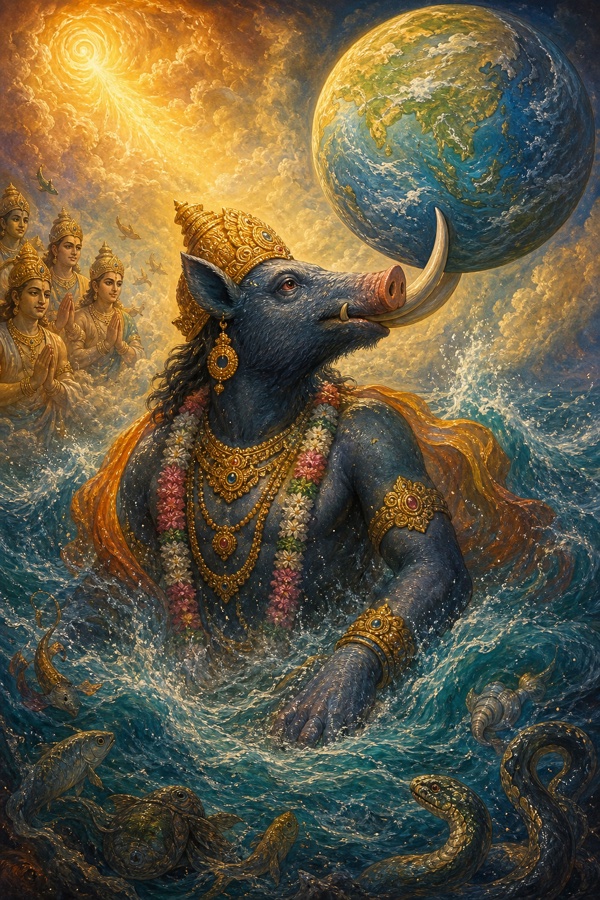
Yudhishthira wished to hear in full about that lotus-eyed, imperishable maker of all, himself made by none, Vishnu, whom people call Narayana, Hrishikesha, Govinda, and Keshava. Bhishma said he had heard of this from Rama the son of Jamadagni (Parashurama), from the celestial sage Narada, and from Krishna-Dvaipayana (Vyasa); Asita-Devala, Valmiki, and Markandeya call Govinda the supreme and most wondrous of beings.
Bhishma recounted the order of creation. That supreme Person, by his own will, fashioned the five great elements: air, fire, water, ether, and earth. Having made the earth, he lay down upon the surface of the waters. Floating there, he first brought forth “consciousness” (the principle of ahamkara, the I-sense), which is the ground of all beings, and along with it the mind. Then from the navel of that supreme Person rose a lotus of surpassing beauty, radiant as the sun, and from that lotus, filling the quarters with his splendor, emerged the divine Brahma, grandfather of all creatures.
The moment Brahma appeared, a fearsome asura named Madhu was born out of the strand of tamas, and he set himself to the terrible work of killing Brahma. For Brahma’s sake that supreme divinity slew the savage asura, and from this killing he came to be called Madhusudana, the slayer of Madhu.
After this, Brahma by an act of will brought forth seven sons, counting Daksha: that is, Marichi, Atri, Angiras, Pulastya, Pulaha, Kratu, and Daksha. Marichi’s son was Kashyapa. Daksha first had thirteen daughters, the eldest of whom was Diti, and Kashyapa became the husband of those thirteen. Daksha then gave ten daughters to Dharma, from whom came the Vasus, the Rudras, the Vishvedevas, the Sadhyas, and the Maruts. He then gave twenty-seven daughters to Soma. From Kashyapa’s other wives came the gandharvas, horses, birds, cattle, kimpurushas, fish, and the trees and plants. From Aditi came the Adityas, among whom Vishnu took birth in the form of the dwarf Vamana and was called Govinda. From Diti came the Asuras, and from Danu the Danavas.
Bhishma told the order of the ages. Madhusudana fashioned day and night, the seasons, dawn and dusk, the clouds, and all things fixed and moving. Then Krishna created from his mouth a hundred excellent brahmanas, from his two arms a hundred kshatriyas, from his thighs a hundred vaishyas, and from his two feet a hundred shudras. Having made the four varnas, he set Brahma (Dhatri) as lord over all creatures. He made Yama the ruler of the ancestors and of sinners, Kubera the lord of treasures, Varuna the lord of the waters, and Indra the chief of the gods. In those days men lived as long as they wished and had no fear of Yama; offspring came into being by an act of will alone. In the Treta age generation began through touch, in the Dvapara through the practice of union, and in the Kali age men married and lived in couples.
Bhishma said that the celestial sage Narada, who is witness to all the worlds, has declared that Krishna is himself the supreme Lord. That lotus-eyed one is no ordinary man; he is beyond thought.
A sub-tale: Yudhishthira asked why Vishnu had taken the form of a beast. Bhishma told the story of the Varaha (boar) avatar, which he had heard from Kashyapa in the hermitage of Markandeya. In ancient times the foremost Danavas, drunk with pride, and asuras in their thousands, grew envious of the prosperity of the gods. Tormented by the Danavas, the gods and the sages fled in every direction. The earth, pressed down under the weight of the fearsome Danavas, seemed to sink into the depths below. The Adityas went to Brahma. Brahma told them he had already made his arrangement: Vishnu, whose form is unseen, had taken the shape of a boar and would slay those Danavas who had settled in their thousands beneath the earth. Then Vishnu in his boar form plunged into the nether world and fell upon the sons of Diti. The Danavas together surrounded the boar and dragged at him from every side, but with all their vast strength they could not so much as move him, and fear filled them. Then that Supreme Self, sunk in yoga, began to roar so terribly that the ten directions rang and every creature trembled. At that roar the Danavas fell lifeless, and the boar tore them apart with his hooves. Because of that roar Vishnu came to be called Sanatana, the eternal. When the gods learned of it, they came to Brahma to ask what this sound was that had stunned them all; and Brahma told them that this was the supreme Lord himself, the soul of all creatures, the highest of yogins, Krishna, destroyer of every obstacle; that he is Time itself, the Ordainer, and the upholder of all.
A key to reading this (lineage and number): The seven sons of Brahma (Marichi, Atri, Angiras, Pulastya, Pulaha, Kratu, and, in some accounts, Vasishtha or Daksha) are called the Saptarshi, the seven seers, the root of all the Prajapatis. Across the four ages, Satya (Krita), Treta, Dvapara, and Kali, human beings are said to come into being by will, by touch, by union, and by marriage in turn, a sign of dharma steadily thinning. The Varaha is counted as Vishnu’s third avatar, the one who lifts the earth out of danger.
The gist: Krishna-Narayana is the root of creation; his sleep upon the waters, the lotus from his navel that bears Brahma, the slaying of Madhu, the seven seers, and the making of the varnas all come from him. Taking the boar’s form, he raised the earth out from under the weight of the Danavas. He is the supreme Lord beyond time, and no ordinary man.
The Prajapatis, the seven seers, and a guru and disciple on liberation
Yudhishthira asked about the first Prajapatis and the sages who dwell in the several quarters. Bhishma named the seven original sons of Brahma, Marichi, Atri, Angiras, Pulastya, Pulaha, Kratu, and Vasishtha, who are called in the Puranas the Saptarshi. He recited the names and lineages of the twelve Adityas, the Ashvins, the Vasus, the Rudras, and the Maruts. Then he told which sages dwell in which quarter: in the east the sons of Angiras and the seven seers; in the south Agastya and others; in the west Ekata, Dvita, and Trita, and the Sarasvatas and others; and in the north Atri, Vasishtha, Kashyapa, Gautama, Bharadvaja, Vishvamitra, and Jamadagni. He said that whoever rises at dawn and calls these gods and sages to mind is cleansed of all his sins, witting and unwitting.
Then Yudhishthira asked about that supreme yoga which grants liberation. Bhishma told an ancient tale of the moksha-dialogue between a guru and his disciple. There was a guru, luminous, firm in truth, master of his senses. A wise disciple touched his feet and, with folded hands, asked: where am I from, and where are you from; what is the final cause; and if the root material in all beings is one and the same, why do their births and destructions come about in such different ways?
The guru said that this matter is unrevealed even in the Vedas and is the highest object of contemplation; it is called adhyatma, the inner science of the Self. Vasudeva is the supreme cause of the universe, the source of the Vedas (OM), the very form of truth, knowledge, yajna, renunciation, self-restraint, and dharma. Vasudeva is the wheel of Time, without beginning or end; resting on him, this universe turns like a wheel. From prakriti, he said, arise in order buddhi, consciousness (the I-sense), ether, air, fire, water, and earth; these, with prakriti as their unmanifest root, are the eight primordial natures on which the universe stands. From these eight arose the five organs of knowledge, the five organs of action, the five objects, and the sixteenth, the mind.
The guru opened the nature of the Self with similes. This sacred dwelling of nine gates (the body) is built of these very elements, and above them all the Self pervades it; for this reason it is called the purusha, the one who dwells in the city. As a lamp reveals things large and small alike, so the Self abides in all creatures as the principle of awareness. The Self is the true agent; it prompts the ear to hear and the eye to see, while the senses only carry out what it moves them to do. As fire lies within wood but is not seen when the wood is split, and shows itself only when the wood is rubbed, so the Self lies within the body and becomes visible only through the discipline of yoga. As in a dream the Self, together with the subtle senses, leaves the body and wanders, so at death it leaves one body and enters another, bound by its own deeds.
Bhishma went on to say that all creatures, sorted into four classes, have an unmanifest birth and an unmanifest death. As a whole great tree lies hidden in a small, unopened flower of the ashvattha and shows itself only when it comes forth, so birth proceeds from the unmanifest. As dull iron runs toward the magnet, so the tendencies born of one’s nature run, in a new life, toward the Self. The Self is eternal, imperishable, present in every creature, the cause of the mind, and free of the gunas.
Bhishma gave a fine image of the wheel of worldly existence. The unmanifest buddhi, with its desires, is the nave of that wheel; the manifest body is the mass of its spokes; and perception and action are its rim. The Self, urged by rajas, presides over it, standing as witness to its turning. As oil-pressers grind their seeds in the press, so the results born of ignorance, soaked in rajas, grind this wheel of the world. Yet as the wind raises dust and is not itself soiled by it, the Self stays untouched by these tendencies. The wise should know that the bond between a life and the Self is as separate as that between wind and dust.
Bhishma gave the final formula. As seeds scorched by fire put out no sprout, so, if every cause of sorrow is burned away in the fire of true knowledge, the Self is freed from the bondage of rebirth. In this way that divine sage cleared the doubt from his disciple’s mind.
A key to reading this (the nine gates and the wheel of existence): The body is called a “city of nine gates”, that is, the two eyes, the two ears, the two nostrils, the mouth, and the two lower gates that pass waste and water. The image of the wheel of existence, its nave the unmanifest buddhi, its spokes the manifest body, its rim the fruit of action, shows how a being turns bound in the wheel of karma and desire, while the Self is its unstained axle.
The gist: The seven seers are the root of all the Prajapatis and the witnesses of the quarters. Vasudeva is the wheel of Time and the supreme cause; the eight primordial natures and the sixteen modifications spring from him. The Self is the unstained axle in the city of nine gates; the moment the seeds of sorrow burn in the fire of knowledge, rebirth falls away.
The three gunas, man and woman, and the path of brahmacharya
Bhishma compared the path of action with the path of knowledge. Those given to action hold action to be highest; those given to knowledge hold knowledge to be highest. The more discerning hold the turning away from action to be highest in both realms, heaven and moksha. Only the truly wise take up this withdrawal, and that way of life alone is praiseworthy. As gold mixed with iron loses its purity and no longer shines, so knowledge that keeps company with faults like worldly attachment does not spread its own light. Whoever, in the grip of greed, desire, and anger, does wrong meets with utter ruin.
Bhishma drew a plain picture of the body and its food. When every body is made of the five great elements and the three gunas, whom shall one worship, and whom shall one blame, and in what words? Only fools cling to the objects of the senses, unaware that their own bodies are mere modifications. As a house of clay is plastered with clay, so this body, made of earth, is sustained by food that is itself a modification of earth. Honey, oil, milk, butter, meat, salt, jaggery, grain, fruit, and roots are all modifications of earth and water. The forest sage gives up the wish for tasty food and takes only plain, savorless fare to keep the body going; in the same way, one who lives in the forest of the world should take food as a sick man takes his medicine, for the mere sustaining of life.
Bhishma counted again the fruits of the three gunas. From sattva come contentment, joy, resolve, wisdom, and memory; from rajas come desire, anger, delusion, greed, infatuation, fear, and fatigue; and from tamas come gloom, grief, discontent, arrogance, pride, and cruelty. He said that one should weigh the balance of these gunas and reflect on each fault in turn, seeing which fault is strong, which is faint, which has fallen away, and which remains.
Yudhishthira asked which faults the seeker of moksha gives up, which he thins out, which return again and again and so cannot be driven off, and which he should weigh with his reason. Bhishma gave a sharp image. As a steel axe cuts a steel chain and is itself broken in the cutting, so the pure-souled man destroys all the faults born of tamas and born with the Self, and severs his bond with the body. He said that sattva is the very quality by which the pure of soul reach moksha, so all the gunas born of rajas and tamas should be given up; and when sattva is freed of rajas and tamas it grows more radiant still.
Bhishma spoke a passage that is morally intricate and delicate, best kept in his own terms. He traced the chain of birth and rebirth. Wrapped in maya, men fall from knowledge and give way to anger; from anger comes desire, from desire greed, delusion, pride, and self-interest, from self-interest action, from action the bonds of affection, from bondage grief, and from all this the compulsion of birth and death. From the compulsion of birth comes the dwelling in the womb, fouled with waste and water, phlegm and blood. Overcome by craving, the living soul is bound by anger and the rest, and still it longs to escape these torments.
In this connection Bhishma spoke in the technical vision of Sankhya. As a means of carrying the flow of creation forward, woman is called the field (kshetra) and man the knower of the field (kshetrajna), spoken of in terms of the gunas. For this reason the discerning man should not become attached in the matter of women in particular. The shastras say that women, sunk in rajas, are the eternal embodiment of the senses, and that they beguile those without discernment. From the standpoint of rebirth he said also that, just as a man casts off the parasites that arise in the body yet are no part of it, so the discerning man should not give even to his children, who are counted his own yet are truly not his own, so tight a bond of possessive love, since these too come into being according to deeds done before.
Bhishma named brahmacharya the supreme means to moksha. Among men, he said, the twice-born are best, and among the twice-born, those who know the Vedas. As a blind man without a guide meets many griefs on the road, so one without knowledge meets many obstacles in the world. Brahmacharya (the discipline of restraint, the dharma of yoga) is the means to the attaining of Brahman, the highest of all dharmas. It stands free of the bond of the five pranas, the mind, the buddhi, and the ten senses, and so lies beyond the reach of the senses; it can be heard only through the word, seen in no form, and reached by the buddhi alone. One who keeps it wholly attains Brahman; one who keeps it by halves attains godhood; and one who keeps it with neglect is born among the brahmanas and wins eminence through learning.
Bhishma told the hardship of this restraint and its remedies. One who takes it up should suppress rajas the moment it rises; he should not speak with a woman, nor let his gaze fall on an unclothed woman, for the sight of a woman fills the weak of mind with desire. If desire wakes in the mind during the time of the vow, let him perform the Krichchhra penance in expiation and stay three days in water; if the desire wakes in a dream, let him plunge into water and repeat within his mind, three times, the three Rik verses of the Aghamarshana hymn. The wise man, with a broad and awakened mind, should burn away within himself all the sins born of rajas.
Bhishma gave a fine account of the body’s workings. The chyle born of food passes through the net of the arteries and nourishes wind, bile, and phlegm, the blood, skin, flesh, bone, marrow, and the whole body. There are ten principal channels that aid the work of the five senses, and from them branch thousands of subtle channels. One channel, called the manovaha, runs toward the heart and draws from every part of the body the seed born of desire. He said that the chyle of food, the manovaha channel, and the desire born of imagination are the three causes of seed, whose presiding deity is Indra, and it is from this that the urge is called “indriya”.
Bhishma gave the closing formula. Whoever acts only to sustain the body, brings the three gunas into balance with his mind, and at the last moment draws the vital airs into the manovaha channel, is freed from rebirth. It is the mind that gains knowledge, and the mind that takes on the form of every object; so, to undo the mind as mere mind, one should do only blameless deeds. The man of ripened understanding destroys his desires by the good fruit of former lives, and, crossing the bonds of the body and the senses, tastes the nectar of moksha like a traveler who has passed a road full of hazards.
A key to reading this (the field and the knower of the field): In the vocabulary of Sankhya the kshetra is the “field” in which creation grows, and the kshetrajna is its “knower”. Here they are taken as symbols of the process of creation. This passage is a teaching on dispassion, and no measure of a person’s worth; its sense is that one who walks the road to moksha should not grow deeply attached to any object of the senses, however dear. The manovaha is the channel joined to the mind through which imagination and desire act upon the body. The Krichchhra is a severe penitential vow.
The gist: Knowledge stands above action, and withdrawal above knowledge. Sattva alone is the stair to moksha; rajas and tamas are to be set aside. The chain of birth and death is bound by anger, desire, greed, and action. Brahmacharya is the supreme means, beyond the reach of the senses and grasped by the buddhi alone; it is won only through patient restraint and desireless action.
The conquest of the senses and the last stair of moksha
In the end Bhishma told, from the vision of the shastras, the way to conquer the senses. He said that creatures who cling always to the ever-corrupting objects of the senses become helpless, while those who do not cling reach the highest goal. The wise man, seeing the world overwhelmed by birth, death, old age, grief, disease, and worry, should strive for moksha. Pure in speech, mind, and body, free of pride, tranquil of soul, wise, and unattached in his life of alms to any worldly thing, let him seek his ease.
Bhishma gave a subtle warning. If out of compassion the mind begins to fall back into attachment, then, seeing that the world is only the result of deeds, one should hold even compassion at a distance. Whatever deed is done, good or ill, its fruit is tasted by the doer alone; so one should do only good deeds in speech, mind, and act. Whoever practices non-violence, truthful speech, honesty toward all creatures, and forgiveness, and is never careless, is the one who finds ease. Therefore a man should, by his reason, train his mind and set it firm in a spirit of peace toward all creatures.
Bhishma told the dharma of speech. One who desires auspicious words or a faultless dharma should speak only that truth which is free of malice and slander; nothing harsh, nothing cruel, nothing wicked, nothing full of idle chatter. He said that the whole world is bound up in speech. One who acts driven by the tendencies of rajas suffers in the world and sinks at last into hell; so one should practice self-restraint in body, speech, and mind.
Bhishma gave a sharp image. The ignorant, who bear the burden of the world, are like robbers laden with the weight of stolen sheep, always in dread of the king’s guarded roads; and as the robbers, wanting safety, must throw down their plunder, so a man who wants his own good must give up all deeds driven by rajas and tamas.
Bhishma laid out the last stairs of moksha in order. The steadfast, pure-souled man should first bring his buddhi under control, then the mind by the buddhi, then the objects of the senses by the mind. As soon as the mind is mastered and the senses are reined in, the senses grow radiant and enter Brahman. When the senses are gathered into the mind, Brahman shows itself within it; and when the senses are dissolved and the Self returns to the state of pure being, it is held to be of the form of Brahman.
Bhishma told the bounds of the practice of yoga. A yogin should never make a display of his yogic power, nor turn it into a means of livelihood; instead let him live on broken grains, ripe pods, the cake left after oil is pressed, greens, half-cooked barley, and the fruits and roots he receives as alms. According to place and time, and after proper testing, let him keep his vows and fasts; a vow once begun let him not abandon midway. As one who kindles a fire slowly, so let him increase, step by step, the action prompted by knowledge, so that Brahman may dawn within him slowly, like the sun.
Bhishma spoke a final truth. Ignorance, whose ground is knowledge, spreads its effect over all three states, waking, dream, and deep sleep. The man of corrupt heart does not gain knowledge of the Self, because he takes it to be joined with these three states, though in truth it stands beyond them all. But when he recognizes the bounds within which union and separation from the three states appear, he is freed of attachment and reaches moksha. Once he wins such awareness, a man rises above the effects of old age and death and attains that eternal, deathless, changeless, imperishable Brahman.
A key to reading this (the three states): Jagrat (waking), svapna (dream), and sushupti (deep sleep) are the three states of consciousness. The vision of moksha is that the Self is the witness of all three and is none of them; whoever recognizes this difference is set free. This points to the very fourth state (the “turiya”) that the Mandukya Upanishad opens.
The gist: Detachment from the objects of the senses, non-violence, truth, and restrained speech are the doors of moksha. As soon as the mind is mastered by the buddhi and the senses by the mind, the senses dissolve into Brahman. Let the yogin make no display of his power, live plainly, and, recognizing the Self beyond all three states, attain the eternal, deathless Brahman.
Do not let the mind stay mere mind: the formula for passing beyond the senses
Bhishma, the grandsire lying on his bed of arrows, had turned his words now from the dharma of distress toward the dharma of liberation. He was telling Yudhishthira that the creature who clings always to the objects of the senses, which bring ruin, becomes helpless, while the great souls who do not fall into them reach the highest state. The wise man should look at the world and see it crowded with birth, death, old age, grief, disease, and worry, and for this very reason should strive for moksha (liberation, release from bondage).
The grandsire said that the seeker should live on alms, pure in speech, mind, and body, free of pride, tranquil of soul, and full of knowledge, without any worldly attachment. If, out of pity for creatures, attachment binds the mind, then, seeing that the whole world is only the fruit of deeds, he should stay indifferent even in the matter of pity. The fruit of every deed, good or ill, is tasted by the doer alone, so let him do only good in speech, mind, and act. Ease comes to the one who practices non-violence, truthful speech, guilelessness toward all creatures, forgiveness, and vigilance. Having mastered the buddhi, let him set the mind in peace toward all creatures; let him wish ill to none, crave nothing beyond his power, turn his mind not toward non-being, and by firm effort fix the mind on knowledge.
Bhishma spoke a moving comparison. As a thief who has taken up plundered sheep slinks along, avoiding the king’s guarded roads, and, if he wishes to escape, drops the plunder, so a man who wishes his own good should give up all deeds prompted by rajas and tamas. The world is bound in speech. One who leans toward the renunciation of all objects should, with humility and a clear mind, own up to his own faults.
Then he told the stair of yoga. The steadfast, pure-souled man should first bring his buddhi under control, then the mind by that buddhi, and then the objects of the senses by the mind. As soon as the mind is mastered, the senses grow radiant and enter Brahman with joy. When the senses are absorbed into the mind, Brahman shows itself within. Let him never display his yogic power; instead let him rein in the senses by it. The grandsire went so far as to say that the yogin, making no livelihood of his yogic power, should live on the broken grains he receives as alms, ripe pods, the cake left when oil is pressed, greens, half-cooked barley, the flour of parched grain, fruits, and roots. Weighing place and time, let him keep his rules of vow and fast, and what he has once begun let him not leave midway. Like one who kindles a fire slowly, let him increase the action prompted by knowledge, so that Brahman may shine within him like the sun.
A key to reading this (the three gunas): Sankhya thought holds prakriti (the root substance) to have three gunas: sattva (purity, light, the source of ease and peace), rajas (passion, restlessness, the source of discontent and anger), and tamas (darkness, delusion, the source of sloth and sleep). Moksha lies in rising above all three. Brahman is beyond these gunas, pure knowledge itself.
The gist: The dharma of liberation begins with detachment from the objects of the senses. Master the mind with the buddhi and the senses with the mind; practice good deeds, truth, non-violence, and forgiveness; do not make yoga a livelihood; and, like a slow-kindling fire, increase your knowledge until Brahman rises within you like the sun.
The secret of dreams and the four objects: the manifest and the unmanifest
Bhishma spoke on the matter of dreams. The yogin who wishes to practice a faultless brahmacharya always, and who knows the faults of dreaming, should try with his whole heart to give up sleep; for in a dream the embodied Self, worked upon by rajas and tamas, seems, as if taking on a second body, to wander and act at the pull of desire. Through the study of knowledge, unbroken contemplation, and repetition, the yogin stays ever awake.
He raised this question: what is the state in which the embodied one thinks himself hemmed in by objects and deeds, while the senses in truth lie still and inactive? The grandsire said that the lord of yoga, the god named Hari, truly knows how this comes about, and the great sages hold his answer to be sound. The learned say that the senses grow still from fatigue, but the mind is never quenched, and from this dreams arise. As the fancies of a waking man rise only from the creative power of the mind, so the impressions of a dream too are of the mind alone. The man of passion and attachment finds these fancies built upon the impressions of countless past lives. Whatever is once stamped upon the mind is never lost, and the Self, knowing them all, brings them out of the darkness.
The grandsire explained deep sleep (sushupti, sleep without dreams) as well. In it this manifest human body, which is the gate of dreams, is absorbed into the mind. The mind, still within the body, enters the Self on which all things, real and unreal, rest, and becomes the waking witness endowed with certain knowledge. Resting thus in pure consciousness, which is the Self of all things, it is held to be beyond both consciousness and the world.
Then he counted the four objects (the four things without knowing which no one knows Brahman): dream, deep sleep, Brahman with qualities (saguna), and Brahman beyond qualities (nirguna). Along with these one must also know the manifest (that is, the body) and the unmanifest (the conscious Self), which the great Rishi Narayana called “tattva”, the essence. What is manifest is mortal; what is unmanifest, the conscious Self, is beyond death.
The grandsire said that the great Rishi Narayana taught the dharma of engagement (pravritti, centered on action, in which the world and all moving and unmoving creatures abide), and that the dharma of withdrawal (nivritti, the turning back from action, renunciation) leads to the unmanifest and eternal Brahman. Pravritti means rebirth, a coming back; nivritti means the highest state. Then he told the difference between prakriti and purusha. Both are without beginning and without end, both eternal and imperishable, both higher than the highest. So far they are alike. Their difference is this: prakriti has the three gunas and is busy in creation, while the marks of the kshetrajna (the purusha, the Self) are otherwise. The purusha is the knower of all the modifications of prakriti, yet is himself not known; in his own root nature he stands beyond all the gunas.
A key to reading this (prakriti and purusha): In Sankhya, prakriti is the unconscious root substance from which the whole world is made, bearing the three gunas and active. Purusha is the conscious Self, the witness, without qualities, no doer. The kshetra is the body, senses, and mind together; the kshetrajna is the Self that knows that field. The image of the turban: as the wearer of a turban is other than the turban, so the Self, wrapped in the three gunas, is other than those gunas.
He opened yoga again: the yoga of the body is brahmacharya and non-violence; the yoga of the mind is the restraint of mind and speech; the fruit of yoga is knowledge, and the moment the knowledge of Brahman rises, the compulsion of birth and death lets go its hold. Some worship Brahman in an image, some in a form with qualities, and some feel that supreme divinity like the flash of lightning; all these great souls, their sins burned away by austerity, reach the highest state. In the end the grandsire said that this same divine Rishi Narayana, out of compassion for all creatures, made these means of immortality plain.
The gist: A dream is only the mind’s making and the play of past impressions; in deep sleep the body is absorbed into the mind. To know Brahman, four objects must be known. Pravritti brings one back, nivritti sets one free. Prakriti is active and has qualities, purusha is witness and without qualities; to know the difference between the two is itself the formula for release.
Janaka and Panchashikha: the king of Mithila and the teacher of Sankhya
Now Yudhishthira put a direct question: “You who know all courses of conduct, by what conduct did Janaka, the king of Mithila, skilled in the dharma of liberation, give up all worldly enjoyments and attain moksha?”
Bhishma told an old story. In Mithila there was a king of Janaka’s line named Janadeva, who was forever reflecting on the paths to the attaining of Brahman. In his palace lived a hundred teachers, who instructed him in the dharma of many different ways of life. Though a student of the Vedas, he was not fully satisfied, either by his teachers’ words on the nature of the Self or by the doctrine that all ends when the body perishes, or that there is a rebirth after death.
One day a great ascetic named Panchashikha, the son of Kapila, came to Mithila in the course of wandering the whole world. Settled in his conclusions on every matter touching renunciation, risen above all the pairs (the couples of cold and heat, pleasure and pain), and free of doubt, he was reckoned foremost among the sages. Bhishma told his story too. He was the chief among the disciples of Asuri and was called “the immortal”; he had performed a sacrifice of the mind that ran a thousand years. He was the perfect knower of the five sheaths that cover the Self.
A sub-tale: The grandsire told also why Panchashikha was called the son of Kapila. Asuri had asked his own teacher for the knowledge of the Self, and by his teacher’s instruction and his own austerity had grasped the difference between body and Self and won a divine vision. Asuri’s wife was a brahmani named Kapila. She accepted Panchashikha as her son, and he suckled at her breast; from this he was called “the son of Kapila”, and his understanding grew steady upon Brahman. All of this had been told to the grandsire by the divine Rishi Narayana.
Panchashikha came before Janaka and, knowing that the king held all his teachers in equal honor, astonished that assembly of a hundred teachers with an instruction rich in argument. Seeing the brilliance of Kapileya (the son of Kapila), Janaka was drawn to him utterly, and, leaving his hundred teachers, began to follow him alone.
Then Kapileya, with Janaka bowing his head like a disciple, began to expound to him the dharma of liberation set forth in the books of Sankhya. First he told the sorrows of birth, then the sorrows of deeds, then the sorrows of every state up to the highest world of Brahma. He described also that maya for whose sake dharma, deeds, and their fruits are pursued, a maya utterly untrustworthy, perishable, unsteady, and uncertain.
A key to reading this (the five sheaths): In the Vedanta-Sankhya tradition the Self is held to be covered by five wrappings: the annamaya (the body), the pranamaya (the vital breath), the manomaya (the mind), the vijnanamaya (the intellect), and the anandamaya (bliss). Panchashikha is said to be the perfect knower of all five, and of the Self beyond them. Asuri and Kapila are counted the first teachers of the Sankhya tradition.
Is the body itself the Self? Panchashikha’s refutation
Panchashikha set before Janaka the views of those who deny a separate existence to the Self. The materialists say that when the death of the body is seen plainly by all, those who, on the faith of the shastras, hold that some Self exists apart from the body are beaten in argument. They hold that death is the very destruction of the Self, and that grief, old age, and disease are partial deaths of the Self.
He told the materialists’ examples too. In the seed of the banyan lies the power to bring forth leaves, flowers, fruit, root, and bark. The grass and water a cow eats become milk and butter, whose nature is other than their source. Various substances, left to ferment in water for a time, make wine, whose nature is wholly other than those substances. In the same way, the materialists say, from the seed of semen arise the body and all its qualities, the intellect, consciousness, and mind. Rubbing two sticks together, fire rises; the sun-crystal gem brings forth fire at the touch of a sunbeam. As a loadstone stirs iron, so the mind moves the senses, and that is all.
“But,” said Panchashikha, “the materialists are in error.” The proof is this: when the body is emptied of life, only consciousness flies off, and the body does not at once dissolve. If body and Self were one and the same, both would vanish in a single instant. Yet after death the dead body is seen for a time; so death means the going out from the body of something other than the body. A second argument: the very people who deny a separate Self pray to gods who are neither seen nor touched and are held to be of subtle form. If their reason is not troubled by granting gods without a gross body, why should it be troubled by granting a Self without a gross body?
Then he refuted one doctrine of rebirth. Some say that ignorance (the root nescience) is the Self, that karma is the seed sown in that ground, and desire the water that makes the seed grow; that the moment one body perishes another springs up at once, and when it is burned away by knowledge there is the ending of existence, or nirvana. Panchashikha said plainly that this doctrine too is mistaken. If the reborn creature is wholly different in nature, in birth, and in merit and demerit, why call it one with the earlier one at all? And if it is truly different, then the fruit of gift, knowledge, or austerity will fall to someone of another birth, so what satisfaction is there for the doer? That one should suffer for another’s sin does not hold together either.
A sub-tale: Ganguli’s commentary makes clear here that this doctrine of momentary consciousness belongs to the Buddhists. Panchashikha argues that if the earlier consciousness was impermanent and ended with the body, how could that very thing, which ends, be the cause of a second consciousness that arises after its own ending? And if the destruction of the earlier consciousness is itself taken as the cause of the second, then striking a man’s body with a heavy staff should raise a second body from that slain body, which does not happen.
Panchashikha raised an objection also against the doctrine of an eternal, changeless Self that holds the Self to be wholly unconnected with the intellect, consciousness, and all the rest: for then all the deeds of the world, the promptings of scripture, and the fruits of gifts and the like would be pointless, since a Self unconnected with intellect and mind would have no one to enjoy the fruit of good deeds. In this way many doctrines rise in the mind, and there is no means to settle whose doctrine is right. Panchashikha said that the Vedas alone, turning such strayed men back to the right road, lead them along like a mahout guiding an elephant.
In the end he gave the formula of dispassion: to one whose life is unsteady and moving toward ruin, what are kin, friends, wives, and wealth? Whoever gives up all these and faces death crosses easily beyond the world and does not come back. Earth, ether, water, fire, and wind forever hold and feed this body; how should anyone love such a body, which is perishable and holds no joy? Hearing these words of Panchashikha, free of trickery and delusion, wholesome and touching the Self, King Janadeva was filled with wonder.
The gist: Panchashikha refuted three doctrines in turn: the materialist view that holds the body alone to be the Self, the Buddhist view of momentary consciousness, and the view of an over-detached Self. His proof lies in the body’s remaining even after death, which shows that something other than the body has gone out. The conclusion: the body is perishable, and attachment to it is in vain.
If nothing remains, what is the gain of knowledge? Janaka’s second question
Janadeva asked again: “Lord, if no knowledge remains after death, then what difference is there between ignorance and knowledge at all? What do we gain by knowledge, and what do we lose by ignorance? If moksha is such a thing, then all dharma, deeds, and vows end only in destruction. And if moksha means separation from all pleasant enjoyments, why should a man wish for action, or, once he has begun, gather the means of it? What is the truth in this matter?”
Seeing the king in thick darkness, dazed and helpless with confusion, the learned Panchashikha calmed him. He said that the end that moksha comes to is neither destruction nor any existence that can be readily imagined. What we see is the joining of body, senses, and mind, which, though existing independently, keep acting and controlling one another. The materials of the body are water, ether, wind, fire, and earth; by their own nature they meet and make the body, and by their own nature they scatter again. The body is no single principle.
Then Panchashikha told in detail the distinctions of the elements, the senses, and the mind. Hearing, touch, taste, sight, and smell are the five organs of knowledge, which have taken their qualities from the mind. The mind, as a quality of consciousness, has three states: pleasure, pain, and the absence of both. Sound, touch, form, taste, smell, and the substances that hold them are, up to the moment of death, the causes of the rise of knowledge. The learned say that the certainty of truth is the highest purpose of existence and the seed of moksha.
He counted also the five organs of action: the two hands for work, the two feet for going, the organ of generation for pleasure and offspring, the lower gate for the passing of waste, and speech for the utterance of words. Thus there are eleven organs of knowledge and action, counting the mind. In hearing, three causes are needed together: the two ears, sound, and the mind; and so too in touch, sight, taste, and smell. These fifteen instruments are needed for the several perceptions.
Then the marks of the three gunas: joy, contentment, delight, ease, and calm are the marks of sattva; discontent, remorse, grief, greed, and the spirit of revenge, of rajas; false judgment, delusion, heedlessness, dream, and sleep, of tamas. He set the twelfth, the buddhi, over the eleven senses, and said that these twelve keep company with one another, not with the Self; the Self stands apart from them. If these twelve were not together, death would come in deep sleep; but death does not come in deep sleep, so they are together, yet apart from the Self.
A key to reading this (the field and the knower of the field): The knowers of the science of the Self call this whole gathering of the senses, mind, and buddhi the kshetra (the body). The being that rests upon the mind they call the kshetrajna (the Self). The Self is eternal and imperishable; the body is perishable. Panchashikha’s argument: when the Self is said to be eternal, how can its destruction be possible?
Panchashikha gave wondrous examples of release. As small rivers merge into a great one and lose their form and name, and great rivers merge into the sea and lose their form and name, so occurs the merging of the individual life that is called moksha. When the being with its qualities merges into the world-Self and all its qualities are lost, how can it remain an object of separate recognition? One whose understanding is turned toward moksha, who seeks with care to know the Self, is no more stained by the ill fruit of deeds than a lotus leaf sunk in water is wetted.
He gave the fine example of the silkworm: as the silkworm lives in the house of threads it has spun and, on being freed, leaves that house behind, so the being, through ignorance, lives in the house of its own deeds and then leaves it; then its griefs shatter like a clod of earth falling on rock. As the ruru deer sheds its old antlers, or a snake its slough, and goes off without any commotion, so the unattached man casts off all his griefs.

A sub-tale: Panchashikha reminded Janadeva of the story of his own ancestor Janaka. When the king of Mithila saw his city burning in the flames, he declared for himself: “In this fire nothing of mine is burning.” This is the height of non-attachment. Hearing these nectar-like words, and after weighing every point well and reaching the truth, King Janadeva gave up his griefs and lived his life in great joy.
The gist: Moksha is neither utter destruction nor ordinary existence. The body is only a joining of five elements and eleven senses; the Self stands apart, the eternal witness. Release is like a river merging into the sea and losing name and form. Janaka’s “nothing of mine is burning” is the very formula of this non-attachment.
Self-restraint: the root of freedom from pleasure, pain, and fear
Yudhishthira asked: “Descendant of Bharata, by what deed does a man find ease, and by what does he find sorrow? And by what does he live free of fear and succeed in the world?”
Bhishma said that the ancients called self-restraint, the reining-in of the senses, the highest dharma for all the varnas, and above all for the brahmanas. For one who is not restrained, dharma and deeds bear no fruit. Dharma and deeds, austerity and truth, all rest on self-restraint. The restrained man, sinless and fearless, wins a great reward; he sleeps in ease and wakes in ease and lives with a glad mind in the world. Every agitation is stilled by restraint.
He counted the marks of the restrained man: nobility, a calm temper, contentment, faith, forgiveness, simplicity, an absence of chatter, humility, respect for elders, mercy to all creatures, plainness, and a turning away from kings and men of power and from false and idle talk and from the praise and blame of others. The restrained man desires moksha, bears present pleasure and pain with calm, and is neither elated by the imagining of what is to come nor cast down by it. Calm as the sea, full of understanding, he neither fears any creature nor makes any creature fear him. Whoever is not glad even at a great gain and not grieved in misfortune is called of contented understanding and restrained.
The evil-souled, by contrast, do not walk the road of kindness, forgiveness, calm, contentment, sweet speech, truth, and generosity; their road is one of desire, anger, greed, envy, and self-praise. A brahmana should conquer desire and anger, keep brahmacharya, become the full master of his senses, and stay at the hardest austerities with endurance, awaiting his time in the world with this feeling: that he has a body, yet knows he is not subject to destruction.
The gist: The root of freedom from pleasure, pain, and fear is self-restraint. The marks of the restrained are forgiveness, contentment, simplicity, mercy, and indifference to praise and blame. The road of desire, anger, and greed leads to sorrow; the road of restraint leads to peace.
Is fasting tapas? And what true tapas is
Yudhishthira raised a practical question: the three twice-born varnas sometimes, from a wish for offspring and heaven, eat the remnants of the gods’ sacrifices, in which there is even meat and wine; what is the nature of this deed?
Bhishma said that those who eat forbidden food without keeping the sacrificial vow laid down in the Vedas are counted wayward and fallen. But those who eat such food according to the sacrifices and vows the Vedas prescribe, and only from a wish for heaven and offspring, rise to heaven, though they fall the moment their merit runs out.
Then Yudhishthira asked: ordinary people call fasting tapas; is fasting truly tapas, or is tapas something else? Bhishma made it clear that people take fasting measured in months, fortnights, or days to be tapas, but in the view of the good it is no tapas; it is an obstacle in the way of the knowledge of the Self. The renunciation of deeds and humility, the worship of all creatures and thought for them, is the highest tapas. One given to such tapas is held to be forever fasting and forever a brahmachari, and, though he lives as a householder, a sage, a god, ever watchful, and walking the road of dharma alone.
Yudhishthira asked how such a householder could be called forever fasting, a brahmachari, one who lives on the remnants of sacrifice, and a server of guests. Bhishma gave practical rules: one who eats only once by day and once by night at fixed times, and nothing between, is forever fasting; one who always speaks the truth, follows knowledge, and goes to his wife only in her season is a brahmachari; one who eats no meat of a beast not slain for sacrifice is a strict vegetarian; one who is always giving is forever pure; one who gives up sleep by day is ever watchful. One who eats only after feeding his servants and guests is an eater of nectar; one who eats what is left after satisfying the gods, the ancestors, servants, and guests is an eater of the remnants of sacrifice. Such people win countless worlds of ease in the life to come.
The gist: Going hungry, on its own, is not tapas, and can even stand in the way of the knowledge of the Self. The true tapas is the renunciation of deeds and humility toward all creatures. Fixed-hour meals, truth, restraint in season, non-violent food, giving, and watchfulness: by these even a householder is called a faster, a brahmachari, and an eater of the remnants of sacrifice.
Prahlada and Indra: who is the doer?
Yudhishthira raised a deep question: in the world, good and ill deeds join a man so that he may taste their fruit; is a man then their doer, or not? “Grandsire, my mind is full of doubt on this; I wish to hear it in full.”
Bhishma told the old dialogue of Prahlada and Indra. Prahlada, lord of the Daityas, was unattached to all worldly things, his sins washed away; free of delusion and pride, settled in sattva, given to many vows, he counted praise and blame as one. In a lonely chamber he passed his time in self-restraint. Looking on gold and a clod of earth with the same eye, he stood firm in the study of the Self and the pursuit of moksha.

One day Shakra (Indra) came to him and, wishing to draw him out, said: “King, I see in you all those qualities by which a person wins the honor of all. Your understanding seems as free of liking and loathing as a child’s. You know the Self. You are now in bondage, fallen from your former place, in the power of your enemies, and stripped of prosperity. Your state is one to draw grief. Yet, Prahlada, why do you not grieve? Is this from knowledge, or from fortitude?”
Prahlada answered in words sweet and full of wisdom. He said that only the one who does not know the rise and fall of all created things is deluded; the one who knows both is never deluded. All things real and unreal come into being and pass away by their own nature; no human effort is needed for it. So it is plain that this coming-into-being has no personal doer. Though in truth the purusha (consciousness) does nothing, still, by the power of ignorance, the awareness “I am the doer” settles over it. Whoever takes himself to be the doer of good and ill deeds has a tainted understanding and is a stranger to the truth.
Prahlada set out his argument: “Shakra, if the purusha were truly the doer, then all his deeds for his own good would surely succeed, and none would fail. Yet look: even those who strive hardest do not ward off what they dread or gain what they wish; so what of human effort? And some, without any effort at all, have their dread turned aside and their wish fulfilled. This is the fruit of nature (prakriti). A man of fine understanding, and still ugly and dull-witted, must beg wealth of others. When all qualities, good or ill, come into a person at the urging of nature, what ground is there to be proud of one’s own eminence? All of this flows from nature. This is my settled conviction. Moksha and the knowledge of the Self too, in my view, flow from this same nature.”
He gave a sharp example: as a crow, while it eats, announces by its repeated cawing the presence of that food, so all our deeds only announce the signs of nature. One who knows only the modifications of prakriti, and not that supreme and self-existent prakriti, is deluded through ignorance. Prahlada said: “Knowing that all things are unsteady, and knowing the root of all the codes of right conduct, I am unable, Shakra, to grieve. Without attachment, without pride, without desire or hope, free of all bonds, I watch the rise and fall of created things and pass my time in great ease.”
Shakra asked humbly by what means this knowledge and this peace are won. Prahlada said: “By simplicity, by care, by purifying the Self, by conquering the senses, and by the service of aged elders, Shakra, a person attains moksha. But know this too: the understanding itself comes from nature, and the winning of peace comes from it as well. Whatever else you see is all of nature.” Hearing this, Shakra was filled with wonder, praised those words with a glad mind, did honor to the lord of the Daityas, and returned to his own abode.
A key to reading this (the sense of doership and nature): In the vision of Sankhya the purusha (the Self) is a witness that does nothing; all deeds are done by the gunas of prakriti. The pride “I am the doer” springs from ignorance. Prahlada’s teaching asks a person to give up the ego of doership and the anxiety over fruit while still acting, so that the mind does not waver in pleasure and pain.
The gist: To the question of who the doer is, Prahlada’s answer is that the purusha does nothing; all of it flows from the nature of prakriti. By this very conviction, even bound and fallen, Prahlada stays free of grief. Knowledge, peace, and moksha too come from nature.
Vasava and Bali: how a king should live when prosperity is stripped away
Yudhishthira asked after the heart of the dharma of distress: “Grandsire, on what understanding should a king, robbed of prosperity and crushed under the heavy mace of Time, go on living upon this earth?”
Bhishma told the old dialogue of Vasava (Indra) and Bali, the son of Virochana. One day Indra, having conquered all the asuras, went to the Grandsire (Brahma) and, with folded hands, asked where Bali now was, that Bali whose wealth never lessened however much he gave away, who was the wind, was Varuna, was the sun, was the moon, was the fire that warms all creatures, who became the water that serves all. “I cannot find where he now is; Brahman, tell me.”
Brahma said: “Maghavan, it does not become you to ask thus about Bali at this hour. Yet when asked, one should not speak an untruth, so I will tell you. Lord of Sachi, Bali now dwells in some empty place, born as a camel, a bull, an ass, or a horse, foremost of his kind.” Indra asked whether, on finding him in that empty place, he should kill him or leave him. Brahma said plainly: “Shakra, do not kill Bali; he is not fit to be slain. Instead, ask him for the teaching of dharma.”
Indra, mounted on Airavata, ranged over the earth and found Bali in an empty place, in the form of an ass. Indra said: “Danava, now you are an ass and eat husks. This birth is surely a low one. Do you grieve for it, or not? Today I see what I never saw before: you in the power of your enemies, bereft of prosperity and friends, without splendor or valor. Once you moved through the worlds with thousands of chariots and thousands of kin, scorching all with your splendor and counting us as nothing. Today I see you in this dire distress; do you grieve, or not?”
Indra counted over his vanished glory: his vast wealth shared out on the eastern shore of the sea; the thousands of celestial apsaras who danced before him, decked with lotus garlands, bright as gold; his jeweled golden umbrella; the forty-two thousand gandharvas who danced before him; the sacrificial post of his rite, wrought all of gold; his gift of cattle by the million; his circuit of the whole earth in the rite of the hurling of the Shamya. “Now I do not see that golden jar of yours, that umbrella, those fans; lord of the asuras, I do not see even the garland the Grandsire gave you.”
Bali answered calmly: “Vasava, you no longer see my jar, umbrella, fans, and the garland the Grandsire gave me. Those precious things of mine now lie buried in the darkness of some cave. When my time comes again, you will see them once more. But this conduct of yours does not befit your fame or your birth. You are in prosperity and wish to mock me who am fallen into distress. Those who have won wisdom, and contentment from it, who are calm of soul, virtuous, and good, neither grieve in misfortune nor rejoice in ease. Led by a vulgar understanding, you brag, Purandara. When you come to a plight like mine, you will not speak such words.”
A key to reading this (Bali): Bali, son of Virochana and descendant of Prahlada, was a mighty king of the Daityas who ruled the three worlds. In the Puranic story, Vishnu took the Vamana avatar and sent him down to the nether world. Here the Shanti Parva shows him, even in distress, as an unshaken knower, one who understands the law of Time and keeps his patience until prosperity returns.
Time is the doer: Bali’s answer

Indra, laughing again and hissing like a snake, spoke to Bali more sharply than before. Once more he counted over his vanished glory and his present solitude, and asked whether he grieved or not.
Bali opened the vision of Time: “Shakra, holding all this to be impermanent, knowing it the fruit of the course of Time, I do not grieve. These bodies of creatures are all fleeting. In this asinine form there is no fault of mine. The life-breath and the body come into being together by their own nature, grow together, and perish together. As the sea is the final resting-place of all rivers, so death is the end of all embodied beings. Those who know this well are not deluded.”
Bali said that when one kills another, one kills only his body; and the one who thinks “it is I who kill” is himself slain, for both, the killer and the killed, are strangers to the truth. Whoever, having conquered another, brags of his own prowess, should know that he is not the doer; the deed was done by some other, the real doer. From the five, earth, fire, ether, water, and wind, all creatures arise; so over this change of state, what should I grieve for?
“Learned or ignorant, strong or weak, comely or ugly, fortunate or luckless, all are carried off by Time with its own energy, a Time so deep it has no bottom. When I know that Time has conquered me, what is there to grieve? Whoever burns another burns what is already burned; whoever kills another kills what is already dead. This Time is like a sea with no island in it, no farther shore, no bound. If I did not understand that it is Time that destroys all creatures, then perhaps I would feel the stirrings of joy, of pride, and of anger.”
Bali challenged Indra too: “You have come to revile me, thinking that I pass my days in an empty place in the form of a husk-eating ass? If I wished, I could take on even now such terrible shapes that the sight of any one of them would send you running. It is Time that gives everything, Time that takes everything away, Time that ordains all. Shakra, do not brag of your prowess.” Then he said that one man, though of good birth, comely, and valiant, lives in sorrow with his ministers and friends, because it was so ordained; and another, of low birth, without knowledge, with a stain upon his birth, lives in ease, because it was so ordained. “What we have become is by no deed of ours, Shakra; and what you are is by no deed of yours. Prosperity and its opposite come by turns.”
Bali called Time Brahman: “The knowers of the Veda say that Time, eternity itself, is Brahman. The fortnights and months are its body, day and night its garments, the seasons its senses, the year its face. Some call this whole universe Brahman; but the Vedas teach that the five sheaths that cover the Self should be held to be Brahman. Brahman is deep and hard to reach, like a vast sea of water. It is said to have neither beginning nor end, to be imperishable and also perishable. Though without qualities itself, it enters all things and takes on qualities.”
Bali counted the line of Indras: “Thousands of Indras have passed away, Vasava, each of great strength and valor. You too will pass in the same way. Time carries all away; so, Indra, do not brag. This royal prosperity that you hold beyond compare was once mine; it is unsteady and without substance, and does not stay long in one place. It dwelt in thousands of Indras before you, all greater than you. Being unsteady, it has left me and come now to you. So do not brag; be calm. Knowing you full of pride, it will very soon leave you.”
The gist: Bali’s highest truth is that neither he is the doer, nor Indra, nor anyone else; Time is the doer, Time is Brahman, Time both guards and destroys. Prosperity is unsteady, coming and going among all by turns. By this knowledge a king stays unshaken in distress: no grief, no pride.
Shri leaves Bali and comes to dwell in Indra

After this, Indra of the hundred sacrifices saw the goddess of prosperity coming out of the body of the great Bali in her own radiant, embodied form. Adorned with a headdress, wearing golden armlets on her arms, spreading a splendor all around, she was such that Indra, his eyes wide with wonder, asked Bali who this was that was coming out of his body.
Bali said: “I do not know whether she is a daughter of the asuras, a daughter of the gods, or a woman. Ask her yourself; do as pleases you.” Indra asked the goddess her name and her story.
Shri answered: “Virochana did not know me, and this Bali, son of Virochana, does not know me either. The learned call me Duhsaha; some call me Vidhitsa. I have other names as well, Vasava: Bhuti, Lakshmi, and Shri. Shakra, neither you know me, nor any among the gods.” Indra asked why, having dwelt in Bali so long, she was now leaving him; whether it was by some deed of hers or some deed of Bali’s. Shri said: “Neither Brahma rules me, nor the Ordainer; it is Time that carries me from one place to another. Shakra, do not slight Bali.”
Indra asked again why she was leaving Bali and coming to him. Shri gave her plain reasons: “I dwell in truth, in giving, in noble vows, in austerity, in valor, and in virtue. Bali has fallen away from all these. Once he was devoted to the brahmanas, truthful, and master of his senses. Later he began to bear enmity toward the brahmanas and to touch clarified butter with unwashed hands. Once he was ever at his sacrifices; at the last, blind with ignorance and stricken by Time, he began to brag before all that his worship of me was unceasing. For these faults I leave him, and now, Shakra, I will dwell in you. Keep me by vigilance, by austerity, and by valor.”
Indra said honestly that among gods, men, and all creatures there was none who could keep her forever. Shri too admitted that none among gods, gandharvas, asuras, or rakshasas could hold her forever. Indra asked how he should conduct himself that Shri might dwell in him always. Shri told the way: “Best of gods, divide me into four parts by the rule the Vedas prescribe.”
Then Indra divided Shri into four parts according to the capacity of each to bear the burden. He said: “Among the things of men, the earth, mother of all, bears all; she will bear one fourth of you.” Shri set one fourth upon the earth. The second part he set in water, since water, by its fluid nature, serves men in a hundred ways. The third in fire, since the Vedas, the sacrifice, and the gods abide in fire. And the last fourth in those good people who are devoted to the brahmanas and truthful, since the good have the strength to bear her. Shri gave her four parts into their keeping and asked Indra to protect her. Indra gave his word that whoever offended against Shri in any of these parts he would punish.
A sub-tale: Even when Shri had gone, Bali stayed unshaken and said that for now the sun shines the same in east and west, north and south; but when it draws in from every quarter and shines only over Brahma’s world at the center of Meru, then there will be a great war once more between the gods and the asuras, and in it he will conquer them all. Indra answered that Brahma had forbidden him to kill Bali, and for that reason he would not loose his thunderbolt; let Bali go where he pleased and find peace. But the sun will never shine from the noon point alone, for the Self-born long ago fixed the laws of the sun’s motion: six months to the north, six months to the south, from which come cold and heat. Then Bali went off toward the south, Purandara toward the north, and Indra, hearing Bali’s words free of pride, rose into the sky.
The gist: Prosperity (Shri-Lakshmi) never stays with anyone forever; Time carries her from one to another. She dwells in truth, giving, vows, austerity, and devotion to the brahmanas, and leaves when these fall away. Indra makes her steady by dividing her among earth, water, fire, and the good. The lesson for a king: share out prosperity and hold it by dharma, and it stays.
Namuchi’s teaching: grief mends nothing
Bhishma told also the old dialogue of Indra and the asura Namuchi. Namuchi, who knew the birth and death of all creatures, sat unshaken as a vast, still sea, though fallen from his place, bound, and stripped of prosperity. Purandara asked him: “Namuchi, fallen from your place, bound in ropes, in the power of your enemies, and bereft of prosperity, do you grieve, or do you pass your days content?”
Namuchi answered: “By sinking into a grief that cannot be turned aside, a person only wears down his own body and gladdens his enemies. Besides, no one can take some share of another’s grief and so lighten it. For these reasons, Shakra, I do not grieve. All that you see has one and the same end. Grief destroys even beauty, prosperity, life, and dharma.” Then he set out the doctrine of the one Ordainer: “There is one Ordainer, and no second; his rule reaches even to the creature lying in the womb. Moved by him, I move, as water moves down a slope. I know existence and I know moksha, and I know too that moksha is the higher; yet I make no special effort for it. Doing deeds toward dharma and against it both, I move as he moves me.”
Namuchi said: “People are worked upon by the pleasure and pain that come by turns in the course of Time; in this there is no personal doership of anyone. The grief is just this, that the one who loathes grief takes himself to be the doer. Among sages, gods, great asuras, knowers of the three Vedas, and forest ascetics, who is there to whom misfortune does not come? But those who know the Self and the not-Self do not fear misfortune. The wise man stands unmoved as Himavat, keeps his anger in check, does not fall into the objects of the senses, and is neither dimmed in grief nor elated in ease.” Then he gave the example of Gautama, that a wise man, even fallen from his place by sheer misfortune in old age, is still not deluded.
Namuchi gave the last formula of destiny: “By mantra, strength, energy, wisdom, valor, conduct, or the wealth of prosperity, can anyone win what was not destined for him to win? Then why grieve over failing to get the thing on which the mind was set? Those in whose hands this lay before my birth settled what I must do and bear; I am only carrying it out. So what harm can death do me? What is destined to be gained is gained; where one is destined to go, there one goes. Whoever knows this fully and is not deluded, and stays content in both pleasure and pain, is the best of men.”
The gist: Namuchi’s teaching is a practical jewel of the dharma of distress: grief mends nothing, and instead wears down the body, prosperity, life, and dharma. There is one Ordainer; what is destined will be. The knower of the Self stands unmoved as Himavat, content in both pleasure and pain.
Patience is the highest good: the second meeting of Bali and Vasava
Yudhishthira asked: “When friends are lost or a kingdom is gone, what is the highest good for a person sunk in such dire distress? You are the foremost of our teachers; tell me.”
Bhishma said that for one whose sons, wives, all enjoyments, and wealth have been taken away, and who has fallen into dire distress, patience is the highest good. The body of the patient man does not waste; in freedom from grief lie ease and the fine wealth of health, and by this health of the body prosperity can be won again. Whoever holds firm to the practice of dharma even in distress gains prosperity, patience, and the fulfillment of all his aims.
Then Bhishma told the second meeting of Bali and Vasava. After the war of the gods and asuras, Bali became king, but was tricked by Vishnu, and Indra became lord of the gods once more. The four varnas were set again each in its own dharma, and the three worlds brimmed with prosperity. Then Indra, ringed by the Rudras, the Vasus, the Adityas, the Ashvins, the sages, the gandharvas, and the Siddhas, mounted on the four-tusked Airavata, ranged through the worlds. One day, in a mountain cave by the shore of the sea, he saw Bali, the son of Virochana.
Seeing Bali fearless and unshaken, Indra asked from the back of Airavata: “Daitya, how are you so unshaken? Is it from your valor, or from the service of elders, or from a mind made pure by austerity? Whatever it is, such a temper is very hard to hold. Fallen from the highest place, stripped of all your wealth, in the power of your enemies, and with cause enough for grief, still you do not grieve. Once you were a god, seated on the throne of your fathers. Today, plundered by your enemies, bound in Varuna’s noose, struck by my thunderbolt, your wives and wealth gone, still you do not grieve; this is the highest wonder.”
Bali answered without fear: “Shakra, when distress has me pinned down, what do you gain by this bragging? Today you stand before me with your thunderbolt raised; but once you could not do so, and now by some means you have won that power. He who, though able to punish, has mercy on a brave enemy brought under his sway, is the truly noble man. When two fight, victory is uncertain; one wins, one loses. Best of gods, do not think that by your own strength you conquered all and became lord of all. What we have become is by no deed of ours; what you have become is by no deed of yours. What I am today, you will be tomorrow.”
Bali opened the doctrine of Time more deeply: “The service of mother and father, the worship of the gods, the practice of any virtue, none of these can give ease. Neither knowledge, nor austerity, nor giving, nor friend, nor kin can save one stricken by Time. Distress, once it comes, is not turned aside by a thousand remedies; wisdom and strength are useless there. Your taking yourself to be the doer is the very root of all grief. If the seeming doer were the real doer, he would himself be no one else’s making; but since he is made by another, that other is the supreme power, above which there is nothing. With Time’s help I conquered you once; with Time’s help you have conquered me.”
Bali counted a vast roll of the daitya-kings of the past, over whom Time proved the stronger: Prithu, Aila, Maya, Bhima, Naraka, Samvara, Ashvagriva, Puloman, Svarbhanu, Prahlada, Namuchi, Daksha, Viprachitti, Virochana, Hrinisheva, Suhotra, Bhurihan, and many more; down to Hiranyakashipu and the Danava Kaitabha, all these and many nameless great daityas, danavas, and rakshasas of far and farther ages. All were devoted to dharma, performed great sacrifices, could range through the sky, never turned their backs in battle, were firm in their vows of truth, knew the Vedas and their branches, and had great strength and prosperity; yet none of them was proud of his sovereignty, all were generous, and all bore themselves rightly toward others. Yet all of them were swept away by Time. Time proved the conqueror of all.
Bali warned Indra: “Shakra, it is plain that when you too must give up this earth after enjoying it, you will not be able to hold back your grief. Give up this craving for enjoyments and dear things; give up the pride born of prosperity; only then will you be able to bear the loss of sovereignty. Do not grieve in the hour of sorrow, do not rejoice in the hour of ease. Setting aside the past and the future, live content in the present. Those thousand divine years of your reign too will end; then you will fall, and your limbs will grow feeble like mine. I and you, and all the kings of the gods to come, will go the road that hundreds of Indras before you have already gone. Time is not to be resisted.”
In the end Bali said plainly: “I am not the doer, you are not the doer, and no one is the doer; the one who is truly all-powerful is the doer. That Time is ripening me to fall like a fruit ripened on a tree. When its hour comes, it will ripen you too. Knowing well the ways of Time, when it is Time itself that has fallen upon me, I should not grieve. Grief does us no good; on the contrary, grief destroys our strength. For this reason I do not grieve.”
Hearing these words of the lord of the Daityas, Indra of the hundred sacrifices and the thousand eyes held back his anger and said that, at the sight of his own raised arm armed with the thunderbolt and Varuna’s nooses, the understanding of even the Destroyer would waver, yet Bali’s truth-seeing understanding stayed unshaken by its patience. Indra allowed that he too knew this world to be impermanent and set in the hidden, ever-burning, endless flame of Time. Time has no master; it is ever awake and ripens all within itself; the one who says “this I will do today, that tomorrow” it carries off like the current of a river; wealth, ease, rank, and prosperity are all the prey of Time.
A key to reading this (Time): In these Bali-Vasava dialogues “Time” is more than passing hours; it is the all-powerful ordaining principle, which Bali makes one with Brahman. The political lesson is that victory and defeat, wealth and want, are the play of Time; so the victor should stay humble and the vanquished patient. The Mahabharata here names the pride of doership itself as the root of sorrow.
Indra, praising Bali and calling non-violence the highest dharma, out of compassion wished to free him from his bonds. He said that these nooses of Varuna would slacken of themselves in the course of Time through the misconduct of men: when the daughter-in-law sets her mother-in-law to work, when the son in delusion orders his father to labor for him, when the four varnas break all their bounds, then these bonds of yours will slacken one by one. “You have nothing to fear from us; be calm, be happy, be free of grief, let your mind be glad, let no disease touch you.” Saying this, Indra returned to his abode, and fire once more received its offerings of clarified butter.
The gist: In distress the highest good for a king is patience; from patience comes health, and from health prosperity again. The sum of the Bali-Vasava dialogue: hundreds of Indras and daitya-kings were swept away by Time; the pride of doership is the root of sorrow. Even Indra the victor at last takes up non-violence and compassion and sets his enemy free.
Shri and Shakra: the signs of prosperity coming and going
Yudhishthira asked what the signs are of a person’s coming rise and coming fall. Bhishma said that the mind itself gives the early signs of a person’s coming prosperity and fall, and told the old dialogue of Shri and Shakra.
The great ascetic Narada went one dawn to bathe in the Ganga, where she comes out by the path called Dhruva. Thousand-eyed Indra came there too. The sage and the god, both self-restrained, sat down together after their bath and their silent prayer, and began to tell and hear the stories of ancient history. Just then they saw in the sky, facing the rising sun, a radiant thing, like a second sun, drawing slowly toward them. Riding the mount of Vishnu, adorned with Garuda and the sun, that splendor was Shri herself, ringed by many apsaras, like a great disk of the sun.
Indra did her reverence and asked who she was and on what errand she had come. Shri said: “The three worlds are full of the seeds of good fortune, and all creatures long with their whole hearts to be joined with me. I am that Padma, that Shri, who arose for the prosperity of all creatures from the lotus that opens at the touch of the sun’s rays. I am called Lakshmi, Bhuti, and Shri. I am faith, I am understanding, I am wealth, I am victory, I am steadiness, I am patience, I am success, I am prosperity; I am Svaha, Svadha, Shraddha, fortune, and memory. I dwell on the banners of victorious and righteous kings, in their homes and cities. I stay with those heroes who long for victory and do not turn from battle, and with those who are firm in dharma, wise, truthful, humble, and generous. Once I dwelt with the asuras, for they were bound to truth and merit; but now they have turned to the opposite nature, and so I leave them to dwell in you.”
Indra asked by what conduct of the asuras she had dwelt with them, and what she had now seen to make her leave. Shri counted the old virtues of the danavas: they kept their houses clean, gave offerings into the sacrificial fire, served their teachers, were masters of their senses, obedient to the brahmanas, and truthful; full of faith, conquerors of anger, giving freely, without envy, grateful, and sweet of speech; on the holy days they bathed, wore fragrances, and kept their vows and fasts; taking pity on the poor, the aged, the weak, the sick, and on women, they shared out all they had; they ate only what was left after satisfying the ancestors, the gods, and their guests; they did not go to the wives of others; they showed mercy to all as to themselves; they led all in giving, simplicity, humility, and forgiveness. For these virtues Shri dwelt with them from the beginning of creation through many ages.
“But the time changed,” said Shri, “and the character of the danavas changed with it. Dharma left them; they fell under the sway of desire and anger. The base began to bear enmity toward their worthy elders and to laugh at them in the assemblies; the young no longer rose to greet their elders; sons began to assert their rights before their fathers and to rule over them, and wives over their husbands. The bright flames of the sacred fires went out, and the cries in the night grew. Mother and father, the aged, the teacher, and the guest began to lose their honor.”
Shri counted the whole roll of decline: they ate up everything themselves without giving the gods and ancestors their offerings and the share due in charity; the cooks kept no purity; grain lay scattered in the courtyard, left to crows and rats; they touched clarified butter with unwashed hands; the mistresses of the house gave up the care of home and cattle; they cooked for their own servants and not for the gods and guests; they ate the meat of beasts not slain in sacrifice; they slept on past sunrise; there was quarreling in house after house; shudras took to austerities, and the unworthy were fed at the rites for the dead; disciples gave up the service of their teachers, and teachers treated their disciples as mere friends; aged parents were driven to beg of their sons; and people, grown thankless and sinful, took to adultery with their teachers’ wives, forbidden food, and the breaking of every bound. Seeing these evil signs, Shri left them and came to Indra.
Shri said also that wherever she dwells, seven other goddesses wish to dwell as well, with Jaya as the eighth, goddesses who love her and depend on her: Asha, Shraddha, Dhriti, Santosha, Vijaya, Unnati, and Kshama; and the eighth, Jaya, who is foremost among them. All these have left the asuras and come to the world of Indra. Then Narada and Indra welcomed Shri with joy; the wind blew softly, carrying a sweet fragrance; the gods gathered in an auspicious place; nectar rained from the sky; kettledrums sounded though none struck them; Indra sent rain upon the crops in each season; none strayed from the road of dharma; the earth was decked with mines of jewels; the cows gave sweet milk; and harsh words fell silent. Those who read and hear this hymn to the glory of Shri in the assemblies of the brahmanas win great prosperity.
The gist: The signs of prosperity and fall lie in the mind and in conduct. Shri dwells in a society of truth, restraint, service, giving, and right bounds; and where the disrespect of elders, wealth got by unrighteousness, the breaking of bounds, and ingratitude spread, she departs. This tale of the rise and fall of the daityas is a mirror for every king and every society.
Jaigishavya, Narada, and Vyasa-Suka: on time and the supreme reality
Yudhishthira asked by what nature, what conduct, what knowledge, and what energy a person reaches the imperishable Brahman that lies beyond the grip of prakriti (nature, matter). Bhishma answered that the one who follows the path of withdrawal (nivritti), who eats little and has mastered the senses, reaches that Brahman, and he told the dialogue of Jaigishavya and Asita.
Asita Devala asked the deeply wise Jaigishavya: “Praise does not please you, and blame does not anger you. What is this wisdom of yours? Where did you find it? And what does it rest on?” Jaigishavya answered that the truly wise are those who stay the same toward the one who praises and the one who blames, who conceal their own vows and good deeds, who level no accusations, who withhold even a well-meant word when it would do harm instead of good, and who never wish to repay a kindness with harm. They do not grieve over the future; they stay bound only to the duty of the present moment, and they neither mourn nor dwell on what is past. Why be cast down by blame or lifted by praise? For the one who has grasped the truth of things, dishonor satisfies like nectar and honor stings like poison. Whoever has conquered all the senses has, in effect, performed every yajna (fire-rite), and reaches that Brahman which is eternal and beyond the grip of prakriti.
Yudhishthira asked who the person is that everyone loves, that gladdens everyone, and that is filled with every virtue and skill. Bhishma repeated the words that Keshava (Krishna) had spoken about Narada’s qualities when Ugrasena asked him. Vasudeva counted off Narada’s virtues: as learned in the shastras as he was, he was just as good and pure in conduct, and still free of pride; discontent, anger, fickleness, and fear had no place in him; free of sloth, courageous, never breaking his word out of desire or greed; versed in the principles of self-knowledge, a lover of peace, without guile, truthful; seeing all with an equal eye, and so favoring and hating no one; speaking words the listener finds dear; sweet of speech, clean of body, free of envy; never sated with yoga, always watchful and industrious; never betraying another’s secrets; unmoved to joy by a great gain and unmoved to sorrow by a loss. For these qualities Narada is honored everywhere.
At last Yudhishthira expressed his wish to know the beginning and end of all beings, their meditations and acts, the divisions of time, and the span of life in each yuga. Bhishma told the dialogue between Vyasa and his son Suka. Having studied all the Vedas, their limbs, and the Upanishads, Suka, who longed for a life of celibacy (brahmacharya), put the same questions to his father, Vyasa, the island-born. Suka asked who the creator of all beings is, how he is known through the knowledge of time, and what the duties of a brahmin are.
Vyasa said: “Before creation, only Brahman exists, without beginning or end, unborn, made of light, undecaying, unchanging, imperishable, beyond thought, and past all knowing.” Then he laid out the divisions of time as the rishis had measured them: fifteen nimeshas (blinks of an eye) make one kashtha; thirty kashthas make one kala; thirty kalas and a tenth of a kala make one muhurta; thirty muhurtas make one day and night; thirty days and nights make one month; twelve months make one year, formed of two ayanas (the northern course, uttarayana, and the southern, dakshinayana). A month of humans is one day and night of the Pitris (the ancestors); a year of humans is one day and night of the gods.
Vyasa gave the measure of the yugas: four thousand god-years are the length of the Krita age, with a twilight (sandhya) of four hundred and a twilight-remainder (sandhyansa) of four hundred, four thousand eight hundred in all. In each following age the span falls by a quarter: Treta is three thousand (with twilight and remainder of three hundred each), Dvapara two thousand (two hundred each), Kali one thousand (one hundred each). In the Krita all of dharma stands whole, truth and all; in each later age dharma wanes by a quarter, and sin grows through theft, falsehood, and fraud. In the Krita all are free of disease and live four hundred years; after it the lifespan keeps shrinking. In the Krita, tapas (austerity) leads; in the Treta, knowledge; in the Dvapara, yajna; and in the Kali, only charity. These twelve thousand god-years are called one yuga; a thousand such yugas make one day of Brahma, and his night is just as long. At the dawn of Brahma’s day creation rises; at the dissolution (pralaya) the creator sleeps in yoga-slumber, and when that sleep passes he wakes again.
A key to reading this (the divisions of time, modern equivalents): A nimesha is the blink of an eye. Fifteen nimeshas = one kashtha; thirty kashthas = one kala; roughly thirty kalas = one muhurta (about 48 minutes); thirty muhurtas = one day and night. A god-year = 360 human years. The four ages (Krita, Treta, Dvapara, Kali) together make twelve thousand god-years = one mahayuga; one thousand mahayugas = one day of Brahma (a kalpa). This symbolic science of time shows creation as a cycle that rises, dissolves, and rises again, a turning wheel.
The gist: The supreme reality is Brahman, without beginning or end and without qualities, dwelling alone before creation. Time is measured from the nimesha up to the kalpa; creation is cyclical, rising and dissolving with Brahma’s days and nights. Across the sequence of yugas, dharma and lifespan both diminish, and each age has its own chief practice: tapas, knowledge, yajna, charity. The lives of Jaigishavya and Narada show that evenness in praise and blame, together with mastery of the self, is the practical road to that Brahman.
The yogi’s climb: mastery over the five elements and entry into the unmanifest
Bhishma lies on his bed of arrows, and Yudhishthira sits beside him, listening. Here Bhishma is telling an old story in which Dvaipayana Vyasa instructs his son Suka. Through that teaching Bhishma is leading Yudhishthira toward the law of liberation, the moksha-dharma.
Vyasa says, “Walking the path his guru has shown him, the yogi slowly gains command over the five elements. First over earth, then over air, then over space (the empty room in which sound rests), then over water, then over fire. After this he gains mastery over the ego (the sense of I-ness) and the intellect as well, and at last he reaches the unmanifest (that which lies beyond birth, growth, decay, and death, which no sense can know).
“The yogi who practices leaving his gross body behind sees within himself, in order, the subtle forms of the soul. In the first stage it seems to him as though space has filled with a fine substance like a thin mist; this is the first form of the body-freed soul. When the mist clears, the form of water appears within the heart, then of fire, then of air, which shines like a whetted and polished blade; this air-form thins into something like a delicate cobweb until it reaches the utter whiteness and subtlety of space.
“Now hear the fruits of these stages. The one who has conquered the earth-element gains the power of creation, like a second Prajapati, and can bring forth many beings from his own body. The one who has mastered air can shake the whole earth with only his big toe or a hand or foot. The one who has won command over space can dwell in the sky in radiant form and vanish at will. The master of water (like Agastya) can drink up rivers, lakes, and seas. The master of fire grows so blazing that his form cannot be looked upon; he becomes visible only when he quenches his sense of I-ness.
“When the intellect, which is like the soul of these five elements and the ego, is conquered, the yogi gains all-power and a full knowledge free of doubt. Then the manifest (all that is seen, all that forms and unforms) dissolves into the unmanifest supreme Self, the same unmanifest out of which this world comes forth and is called the manifest.”
A key to reading this (the concept): The manifest is whatever carries four marks: birth, growth, decay, and death. The unmanifest is whatever carries none of these, whatever stays always the same. Sankhya is the philosophy of counting (knowledge through the enumeration of twenty-five principles), and Yoga is the path of practice. Vyasa says the twenty-five subjects are laid out in nearly the same way in both; the difference that appears is a difference in the manner of telling, and at the root both lead the same way.
Vyasa speaks in the manner of Sankhya: “The Vedas speak of two souls. The first is the living soul (jiva), which carries those same four marks and holds the longing for the four aims of life, dharma, artha, kama, and moksha; it is born from the unmanifest supreme Self. Sankhya holds that a person should keep himself apart from the objects of the senses.
“The yogi who is free of attachment and pride, who has passed beyond all the pairs of opposites like pleasure and pain, cold and heat, who gives no room to anger and hatred, who does not lie, who keeps friendship even toward one who blames or strikes him, who does not so much as think ill of anyone, who holds speech, act, and mind under restraint, and who looks with an equal eye on all beings, draws near to Brahman. The one who sees a clod of earth and a lump of gold with the same eye, who is the same toward friend and foe, who takes praise and blame alike, who keeps brahmacharya and stands firm in his vows, wins liberation, according to Sankhya.”
The gist: The yogi gains command in order over earth, air, space, water, and fire, then over the ego and the intellect, and at last over the unmanifest; mastery of each element brings its own fruit, and the final goal is the dissolving of the manifest into the unmanifest Brahman. Sankhya and Yoga are two names for one road.
The boat of knowledge: what to call knowledge, and who is truly a brahmin
Vyasa says, “The seeker who can hold to meditation while he tosses up and down on the sea of life takes hold of the boat of knowledge and leans on knowledge alone for his liberation, reaching out for no other support on any side.”
Suka asks, “What is that knowledge? Is it the learning by which, once delusion is wiped away, truth stands revealed? Or is it the sequence of acts whose performance brings what one desires? Or is it turning away from action, through which one searches out the expanse of the soul? Tell me, so that both birth and death may be escaped.”
Vyasa answers, “The fool who holds that everything is made by its own nature alone, resting on nothing, and pours this into the minds of his pupils, crushing their opposing questions with his skill in argument, finds no truth at all. Those who hold firmly that every cause lies only in the nature of things find no truth even after hearing wise men or rishis. This belief that nature alone is the cause, born of delusion, destroys a person.
“It is the intellect (gathering means through discernment) that brings purposes to fulfillment. By the intellect kings rule and enjoy, though their subjects share the same qualities as they. Beings are born in four ways: from the womb (jarayuja), from the egg (andaja), from the earth as plants (udbhijja), and from damp and sweat (svedaja). Those that move rank above the unmoving, the two-footed above the many-footed, and those that walk the ground above the rest. Among these, those who keep the dharma of their varna rank higher; among them, those who know their duties; among them, those who know the Vedas; among them, those who teach the Vedas; and above them all, those who know the soul, for they know the meaning of birth and death.
“Those who hold true knowledge see their own soul both within and without. Such men, my son, are twice-born (dvija, born a second time) in the truest sense, and such men are gods. On them the world of living beings rests; in them the whole universe abides. Nothing equals their greatness.”
A key to reading this (the concept): Dvija means “twice-born”: the first birth from the mother, the second from initiation (the sacred thread) and the study of the Vedas. Vyasa is deepening the word here: knowing the rites does not make the real dvija; knowing the soul does. Pravritti = staying engaged in action; nivritti = withdrawing from action. The Vedas teach both roads.
The gist: Knowledge is the boat of liberation. Whoever takes nature as the sole cause finds no truth. Among all beings, the one who sees the soul within and without is the true dvija and a god.
Karma, the yugas, and time: the brahmin’s required acts and the wheel of time
Vyasa continues, “These are the required acts laid down for the brahmin. The wise man, doing the acts ordained for him, meets with success. When no doubt remains about an act, the acts one performs are sure to succeed. The doubt is this: are these acts obligatory, or a matter of choice? To this one must say that even if the acts are ordained so that knowledge may arise from them (and only through knowledge does one reach Brahman, or moksha), they must still be counted as obligatory, never as optional.
“People hold different views on the cause of action. Some name human effort as the cause, some fate (niyati), some nature, some time; some name a mixture of these. But the yogis see Brahman as the cause of all. The people of the Treta, Dvapara, and Kali are full of doubts, while the people of the Krita age are devoted to austerity, calm of mind, and firm in dharma. In that age everyone holds the Rik, the Saman, and the Yajus to be one and the same, however different they may look on the surface.
“The brahmin’s yajna lies in japa (silent reflection and recitation), the kshatriya’s in the slaughter of animals for the gods, the vaishya’s in farming and the keeping of cattle, and the shudra’s in the service of the other three varnas. By keeping his appointed duties and studying the Vedas and the rest, a man becomes a dvija. But whatever a man does or leaves undone, it is by becoming the friend of all beings that he becomes a true brahmin.
“At the beginning of the Treta the Vedas, the yajnas, the varnas, and the ashramas stood whole. In the Dvapara, as lifespans shrank, they declined; in the Kali the Vedas fall into confusion, and by the close of the Kali it is uncertain whether they can even be seen with the eye. Then the dharma of the varnas fades, men are wracked by sin, and the very sap of cattle, earth, water, and herbs runs thin.
“Time takes on many forms. It has no beginning and no end. Time brings forth all beings and then swallows them again. Time is the source of beings, time makes them grow, time is their destroyer, and time is their ruler.”
A key to reading this (lineage / time): Four ages, the Krita (Satya) full of dharma, then Treta, Dvapara, and Kali, in which dharma keeps waning. In each age lifespan and the strength of dharma fall by stages, which is why each age is given its own duties. This will become the root of Yudhishthira’s coming question: how can dharma be held to be fixed?
The gist: Acts are ordained for the sake of knowledge, and so they are obligatory. Each varna has its own yajna, yet becoming the friend of all beings is the essence of what it means to be a brahmin. Time is the source, the nourisher, the destroyer, and the ruler.
The making of the body and the seventeenth principle: seeing the Self by the lamp of the mind
Suka asks, “The one who is wise, versed in the Vedas, devoted to yajna, and free of hatred, how is he to reach that Brahman which can be known by neither direct perception nor inference, and which even the Vedas can only point toward by a sign? Through austerity, through brahmacharya, through renouncing everything, through the intellect, through Sankhya, or through Yoga?”
Vyasa says, “By no means other than the winning of knowledge, tapas, restraint of the senses, and total renunciation does anyone succeed. The five great elements are the first creation of the Self-born. The body is made of earth, the body’s fluids of water, the eyes of fire. The breaths, prana and apana and the rest, depend on air, and all the body’s hollow openings (the nostrils, the cavities of the ears, and so on) belong to space.
“The ear, the skin, the eye, the tongue, and the nose are the five organs of knowledge, each to seize its own object (sound, touch, form, taste, smell). These objects are to be understood as distinct from the organs. As a charioteer drives well-trained horses along the road he wants, so the mind drives the senses. The mind in its turn is driven by the knowing faculty (the intellect) seated in the heart. The mind is the master of the senses, and the intellect is the mistress of the mind.
“The discerning man sees the seventeenth principle, the soul, ringed by the sixteen principles (the five elements, the five organs of knowledge, the five objects, and the mind), seeing it in his own understanding with the mind’s help. The soul is seen by no eye and no sense; standing beyond them all, it is seen only by the light of the lamp of the mind. Without sound, touch, form, taste, or smell, imperishable, bodiless and senseless, it is yet seen within the body itself. Unmanifest and supreme, it dwells in all mortal bodies. Whoever sees it by the guidance of guru and Veda goes on to become the very form of Brahman.
“The wise look with an equal eye on a learned brahmin, a cow, an elephant, a dog, and an outcaste alike. When a being sees his own soul in all things and all things in his own soul, he is said to have reached Brahman. Time by its own strength cooks all beings within itself; but who it is in whom time itself is cooked, no one knows. That supreme reality has hands and feet on every side, eyes and heads and faces on every side, ears on every side; it covers everything. It is subtler than the subtle and is the heart of all beings.”
A sub-tale: Here Vyasa draws the picture of the “mansion of nine gates.” The body is called a city with nine gates: two eyes, two ears, two nostrils, the mouth, and the two lower gates. Though the soul is without qualities and does nothing, it enters this nine-gated mansion and seems to take part in action. One and the same soul, in its imperishable form, is the non-doer, and in its acting form seems to be the doer; whoever grasps this distinction is freed from birth and death.
The gist: The body is made of the five elements; the master of the senses is the mind, and the master of the mind is the intellect. The soul is the seventeenth principle, hidden from the senses, seen only by the lamp of the mind. Whoever sees the soul in all and all in the soul reaches Brahman.
The path of Yoga: five obstacles, restraint of the senses, and six months of practice
Vyasa says, “My fine son, now I will tell you the same thing in the manner of Yoga. The joining together, all at once, of the intellect, the mind, all the senses, and the all-pervading soul is the highest knowledge. This knowledge comes to the one who is calm of mind, who has conquered the senses, who can turn his gaze toward the soul in meditation, who takes joy in meditation, and who is pure in action.
“The five obstacles of Yoga must be given up: desire, anger, greed, fear, and sleep. Anger is conquered by a calm temper, desire by dropping every intention, sleep by turning the intellect to matters worth pondering. The hands and feet are to be guarded by the eyes, the eyes and ears by the mind, the mind and speech by action. Fear is conquered by watchfulness, and pride by serving the learned.
“In the quiet of dusk or before dawn, drawing the senses and mind back from outer things and fixing the gaze within, one should rest the mind upon knowledge. If even one of the five senses is left open, all of one’s understanding pours away through it, like water through the uncovered hole at the bottom of a leather waterbag. A fisherman first masters the fish that most threatens his net; in the same way the yogi first tames the mind, then the ear, then the eye, then the tongue, then the nose.
“When these senses and the mind, the sixth, grow steady and unshaken in knowledge, then Brahman stands revealed like a smokeless blazing fire or a radiant sun. Then a man sees his own soul within himself, like lightning in the sky. The yogi who lives this way in solitude for six months under a firm vow becomes like the imperishable Brahman.
“Yoga brings many powers: growing infinitely small, spreading vast, showing many forms in a single body, divine smell and sound and sight, the pleasures of taste and touch, evenness in cold and heat, motion swift as wind, the inner knowledge of the shastras, the nearness of celestial apsaras. But the yogi should turn away from all of these and dissolve them into knowledge itself. Even one of a low varna or a woman, walking this same path, reaches the supreme goal.”
Bhishma adds, “By hearing from the mouths of their gurus and pondering it in their minds, the wise reach that oneness with Brahman which lasts until the dissolution of creation.”
The gist: The five obstacles of Yoga are desire, anger, greed, fear, and sleep. Taming the senses in order and steadying them in knowledge makes Brahman stand revealed. Six months of solitary practice make the yogi imperishable; if powers come, he should give them up too. This path is open to women and to those of low varna as well.
The two roads of karma and knowledge: the perishable and the imperishable
Suka says, “The Vedas speak in two ways. One time they command, ‘Perform all acts’; another time they say, ‘Give up action.’ I ask: by knowledge, to what state do men go, and by action, to what state? These two proclamations seem to stand against each other.”
Bhishma tells how Vyasa, son of Parashara, said to his son, “I will show you two roads, the perishable and the imperishable, resting on action and on knowledge in that order. The gap between the place reached by knowledge and the place reached by action is as wide as the boundless sky. This question of yours gave me the same pain that a devout man feels at the words of an unbeliever.
“By action a being is destroyed again and again; by knowledge he is set free. This is why the yogis who see the far shore of the sea of life take no support from action. By action a man, after death, must be born again with a body of sixteen parts; by knowledge he turns into the eternal, the unmanifest, and the unchanging. Men of small understanding praise action, and so take on a body again and again. Those whose sight is keen in matters of duty do not praise action, just as those who have the water of rivers do not praise wells and ponds.
“The fruit of action is pleasure and pain, being and non-being. By knowledge a man reaches the place where there is no occasion for grief, where there is release from birth and death, where there is no old age, where Brahman is, supreme, unmanifest, unchanging, ever present, unseen, beyond pain, deathless. Having reached that state, they cast an equal gaze on all, friends to everyone and given over to the good of all beings.
“Know that the man of knowledge lasts forever without perishing, the way the moon on the last day of the dark fortnight survives in subtle form (the sage Yajnavalkya has laid this out at length in the Brihadaranyaka). And the man of action is in the state of the new moon, which shows in the sky like a bent thread.”
A key to reading this (the concept): Kshetrajna = the soul, which knows the body, its “field.” Tamas, rajas, and sattva are the qualities of the knowing faculty (the intellect); the intellect is a quality of the living soul seated in the body; and the living soul comes from the supreme Self. Those who know the maker of these seven worlds say he stands even above the living soul.
The gist: The road of action is perishable and gives birth again and again; the road of knowledge is imperishable and leads to Brahman. Between them lies a gap as wide as the sky. The man of knowledge survives like the moon on the last day of the fortnight; the man of action rises again and again like the new moon.
The four ashramas: the dharma of the celibate student and the householder
Suka says that the Vedas hold both proclamations, perform action and give up action; which of them, then, should he settle on as right? Vyasa answers, “The conduct that Brahma first established is the conduct the ancient rishis followed. The great sages conquer all the worlds by keeping brahmacharya, living in the forest on fruit and root, wandering among the sacred fords, working for the good of all, and begging alms at the forest huts at the proper hour, when the smoke there has died down and the sound of the grinding pestle has stopped.
“The celibate student, the householder, the forest-dweller, and the renunciant, all four, by rightly keeping the dharma of their own ashrama, reach the same supreme goal. Or a single man, freed from desire and hatred, may keep all four ashramas in order, and so become fit to understand Brahman. The four ashramas are like stairs that climb to Brahman.
“In the first quarter of life the celibate student should live with his guru or his guru’s son. He should sleep only after the guru has slept and rise before the guru wakes. Every task that falls to a pupil and every task that falls to a servant, he should do. He should live simply, keep clear of harsh speech, and take up his lesson only when the guru calls him. He should not eat before the guru eats, not drink before the guru drinks, not sit before the guru sits, not sleep before the guru sleeps. With his palms turned upward he should touch the guru’s feet, the right foot with the right hand and the left with the left.
“He should say respectfully, ‘Teacher, instruct us. We will finish this task; this other task we have already finished. Whatever you command, we are ready to do it.’ Passing a quarter of his life this way in the study of the Vedas and in vows and fasting, giving the guru his final gift (dakshina), and taking formal leave, he should return home and enter the householder’s life, bringing home wives by the proper rite and establishing the household fire.”
Vyasa speaks on the householder’s dharma: “Four kinds of conduct are laid down for the householder. One, keeping a store of grain for three years; another, for one year; a third, arranging only for the day without a thought for tomorrow; a fourth, gathering grain like a pigeon, a single seed at a time. Each later one is better than the one before it.
“The householder should not cook only for himself, and should kill no animal except for a yajna. He should not sleep in the daytime, nor in the first or the last watch of the night. No brahmin in his house should go without food or honor. He should become an eater of vighasa and an eater of amrita, taking only what food is left over. He should be content with his wedded wife, keep his senses in check, and never quarrel with his ritual priest, his family priest, his guru, his maternal uncle, his guests, his dependents, the old, children, the sick, the physician, his kinsmen, his parents, brothers, sons, wife, daughter, and servants. By avoiding disputes with these, the householder is freed from all sins.”
A key to reading this (the concept): Two special words for the householder: amrita = the food left after it has been offered in a yajna (mixed with ghee), which is held to be pure to eat; and vighasa = the food left after all one’s dependents and servants have been fed. Eating only these is the householder’s discipline: feeding others before himself.
The gist: The four ashramas are stairs to Brahman. The celibate student should pass a quarter of his life serving the guru and studying the Vedas. The householder should serve his guests, eat what is left after feeding others, and quarrel with no one; by this he is freed from sin.
Vanaprastha and sannyasa: the austerity of the forest and the supreme renunciation
Bhishma says, “Yudhishthira, you have heard the householder’s dharma. Now hear the dharma of the forest-dweller.” Vyasa tells it: “When the householder sees the wrinkles on his own body, the white hair on his head, and the sons of his own sons, he should turn toward the forest. He should pass the third part of his life in the vow of the vanaprastha. He should tend the same fires he tended as a householder, worship the gods, keep his vows and eat sparingly, take food only once in the sixth part of the day, and eat what is left after feeding his guests.
“For the forest-dweller too, four practices are named: some gather only for the day, some for a month, some for as long as twelve years. They stay out in the open during the rains, stand in water in autumn, and sit beneath the sun among four fires in summer (the penance of the five fires). Some strip their grain with only their teeth, some with only a stone. Some live on roots alone, some on fruit alone, some on flowers alone, keeping the method of the Vaikhanasas.
“The fourth ashrama is renunciation (sannyasa), founded on the Upanishads. In this very age many brahmins have kept it: Agastya, the seven Rishis (Atri, Angiras, Pulastya, Pulaha, Vasishtha, Narada, and Kratu), Madhucchandas, Aghamarshana, Sankriti, Sudivatandi, Ahovirya, Kavya, Tandya, the learned Medhatithi, Karmanirvaka of great energy, and Sunyapala who strove hard, all of them the framers of these duties, who kept them themselves and went to heaven.
“In the last part of life, when the body is worn thin by age and disease, he should leave the dharma of the forest-dweller and take up sannyasa. Performing a one-day yajna in which he gives away everything as dakshina, he should carry out his own shraddha. He should set all his fires within his own soul, and let go of every bond and attachment. He should give up even the recitation of the Vedas and the sacred thread that marks his birth, and keeping the duties of yama and niyama, knowing the soul, he should reach his goal.”
A key to reading this (the concept): Yama = outward restraint (ahimsa, truth, non-stealing, and the rest); niyama = inner discipline (purity, contentment, tapas, and the rest). A shraddha is performed for dead ancestors; when taking sannyasa the seeker performs his own shraddha, as though the old social “I” has died and only the soul is left.
The gist: In old age the householder should go to the forest, eat sparingly, and practice the penance of the five fires. At the end he should take sannyasa, set all his fires within the soul, perform his own shraddha, and, knowing the soul, reach the supreme goal.
The marks of the sannyasi: ahimsa, the essence of all dharma
Suka asks how a seeker who lives in the highest ashrama should set his soul to Yoga. Vyasa says, “Having found purity through the first two ashramas, brahmacharya and the householder’s life, he should set his soul to Yoga in the third, then enter the highest, sannyasa. He should practice Yoga alone, without any companion. Without fire and without a fixed home, he should go into the village only for alms, gather nothing for tomorrow, and keep his heart fixed on the supreme. He should eat only once a day, and even then sparingly, by rule.
“The other marks of the renunciant are these: a human skull for a begging bowl, shelter in the shade of trees, ragged clothes, solitude with no one for company, and indifference toward all beings. The one within whom sounds fall and do not return, like frightened elephants fallen into a well, is fit for this ashrama. He should pay no heed to anyone’s evil deeds, listen to no one’s slander, and above all keep clear of slandering a brahmin. Even when he hears himself slandered, he should stay silent; that is his cure.
“The gods count as a brahmin the one who covers his body with whatever he finds, lives on whatever he finds, and sleeps wherever he finds a place; who fears company as he would a snake, fears a full meal as he would hell, and fears a woman as he would a corpse; who takes no pleasure in honor and no anger at insult, and who has given all beings his word of safety. He should look on death with no gladness, and on life with none; like a servant, he should only wait for his time.
“As the footprints of every walking creature vanish into the footprint of the elephant, so all conduct is gathered into Yoga; and every duty is gathered into the one dharma of ahimsa (harming no living thing). Whoever does no harm to any being stays happy always. To give all beings the gift of safety is the highest of all gifts. Whoever gives up the way of harm at the very outset is the one who wins moksha.”
A sub-tale: Here Vyasa gives a sharp image: the renunciant is the one who can make any place so solitary that even a spot crowded with thousands of people and things seems to him wholly deserted, and who becomes as alone as the empty sky of the east. Solitude even while living in a crowd: this is his inner state.
The gist: The renunciant should live on alms, keep to solitude, stay even in slander and praise, and give all beings his word of safety. Every duty is gathered into ahimsa; the gift of safety is the highest gift, and giving up harm is the door to moksha.
The order of the supreme reality and crossing the river of life
Vyasa lays out the order: “Higher than the senses are their objects, higher than the objects is the mind, higher than the mind is the intellect, higher than the intellect is the soul (also called mahat, the great one), higher than mahat is the unmanifest (prakriti), and higher than the unmanifest is Brahman. Nothing stands higher than Brahman; it is the last limit of excellence and of every goal. The supreme Self is hidden in every being, unseen by ordinary eyes; only the yogis of subtle vision see it with their keen intellect.
“Destroying all desires, one should dissolve the gross intellect into the subtle intellect; then the seeker becomes as unmoving as a second Kalanjara mountain. By the purity of his heart the yogi passes beyond both dharma and adharma. The mark of that purity is this: the unconsciousness one finds in deep, dreamless sleep stays with him toward the outer world even while he is awake. Such a yogi holds as steady as a lamp-flame burning in a place of perfectly still air.
“This teaching, my son, is the essence of all the Vedas. It cannot be grasped by inference or the reading of scripture alone; one has to grasp it for oneself, through faith. Churning the whole wealth of the dharma-texts and the words of truth, and ten thousand rik-verses, I have drawn out this nectar for you, as butter from curds and fire from wood. This teaching should be given only to one who is calm of soul, restrained, given to tapas, versed in the Vedas, devoted to the guru, and full of faith, and never to one caught up in argument and dispute, or of low character.”
At Suka’s next question Vyasa explains the adhyatma (the inner science of the Self): “Earth, water, fire, air, and space, these five great elements are the limbs of all beings, and though they are one, they are counted separately, like the waves of the sea. As a turtle stretches out its limbs and then draws them in again, so these great elements dwell in countless small forms and keep changing into creation and destruction. The quality of space is sound, of air touch, of fire form, of water taste, and of earth smell. The mind (whose nature is doubt), the intellect (which decides), and prakriti, these three arise from their own earlier state.
“In a person there are five senses, the mind is the sixth, the intellect the seventh, and the soul the eighth. The eye and the rest only take in form and the rest; the mind raises doubt about them, the intellect settles the doubt, and the soul is only the witness, seeing without joining in. Sattva, rajas, and tamas, these three gunas are known by their own workings. Joy, cheer, evenness, and contentment belong to sattva; pride, falsehood, greed, and vengeance to rajas; and the clouding of the intellect, heedlessness, sleep, and sloth are the marks of tamas.”
Vyasa gives the image of the river of life: “This river of life is terrible. The five senses are its crocodiles, the mind and its intentions its two banks, greed and delusion the grass and straw floating on it, desire and anger the dreadful snakes that live in it. Truth is the sacred ford on its muddy bank, falsehood its waves, anger its mire. It springs from the unmanifest, its current runs fast, and those of impure soul cannot cross it. Cross this river by the help of the intellect, this river in which desires are the alligators. Once across, you will be free of every attachment, calm of heart, knowing the soul, and pure, and you will look on the world the way one looks from a mountain peak at the creatures crawling below.
“Brahman has no masculine gender, no feminine, and no neuter. It is neither sorrow nor joy. Whether one is woman or man, whoever comes to know Brahman does not have to be born again.”
A key to reading this (the concept): The order of the principles: sense < object < mind < intellect < soul (mahat) < the unmanifest (prakriti) < Brahman. This ladder is the backbone of Sankhya. The three gunas: sattva (light, calm), rajas (motion, craving, sorrow), tamas (inertia, delusion, sleep), are known by their own workings, and are not seen directly.
The gist: The rising order of the principles ends in Brahman. This teaching is the churned nectar of the Vedas, grasped only through faith. Cross the river of life in the boat of the intellect; Brahman is beyond gender, and whoever knows it, woman or man, is not born again.
The tree of desire and the city that is the body
Vyasa gives an image: “In the human heart there is a strange tree named Desire. It grows from a seed named Delusion. Anger and pride are its great trunk, the craving for action the basin that waters its root, ignorance its root, and heedlessness its water. Envy is its leaves, the evil deeds of past lives feed it, the ruin of discernment and anxiety are its twigs, grief its great branches, and fear its shoot. The thirst for the many objects of sense is the creepers that climb it. Men of great greed sit around this tree, bound in chains of iron, and worship it in the hope of its fruit. Whoever breaks those chains and cuts the root of this tree with the sword of samadhi passes beyond both pleasure and pain.
“The body is called a city. The intellect is the mistress of this city, the mind her minister whose work is to decide, and the senses the citizens the mind sets to their tasks. To feed these citizens, the mind leans toward many kinds of action. In these actions two great flaws show themselves, tamas and rajas. The mind is the first to make friends with rajas, and then, seizing the soul, the intellect, and the senses, it hands them over to rajas, the way a treacherous minister joins the enemy and takes the king and his people captive.”
The gist: The tree of Desire grows from Delusion, ignorance is its root, and the greedy worship it for its fruit; cut its root with the sword of samadhi. The body is a city, the intellect its mistress, the mind its minister; but the mind can join with rajas and take king and people captive.
The fifty qualities of the elements: Yudhishthira’s question
Bhishma says, “My son, hear once more the words of Dvaipayana Vyasa on the counting of the principles, the words he spoke to his own son. The qualities of earth are steadiness, weight, hardness, fertility, smell, density, the power to soak up scent, cohesion, the power to hold, and endurance. The qualities of water are coolness, taste, moisture, fluidity, softness, and the power to freeze and to dissolve, among others. The qualities of fire are unyielding energy, flammability, heat, light, speed, and the tendency to rise. The qualities of air are a touch that is neither cold nor hot, freedom of motion, strength, speed, and the coming and going of the breath. The qualities of space are sound, extent, and no need of any support. These fifty qualities are the essence of the five elements.
“The qualities of the mind are patience, reasoning, memory, forgetting, imagination, endurance, a leaning toward good, a leaning toward evil, and restlessness. The five qualities of the intellect are dreamless sleep (the absence of good and evil thoughts), firmness, concentration, decision, and judgment that rests on direct evidence.”
Yudhishthira asks, “Grandfather, how does the intellect have only five qualities? And how are the five senses said to be qualities of the five elements? This seems very deep to me; explain it to me.”
Bhishma answers, “The intellect is said to have sixty qualities in all, because the five elements too are held within the intellect (the fifty qualities of the elements, plus the nine of the mind, plus the intellect’s own five, and the one that drives them all). All these qualities stay bound to the soul. The Vedas say that these elements and their qualities, together with mind and intellect, were made by that same imperishable one; and so all of them, these seventy-one principles, are not eternal in the way the soul is eternal. Understanding all these rightly, and gaining the strength of the knowledge of the supreme Brahman, seek the peace of the heart.”
A key to reading this (the numbers): The count runs like this: the fifty qualities of the five elements, the nine qualities of the mind, the five qualities of the intellect, and the one that binds and drives them, which is how the intellect is said to have sixty qualities in all. The full list comes to seventy-one principles, all of them made and therefore perishable; the soul alone is eternal.
The gist: Fifty qualities of the five elements, nine of the mind, five of the intellect are counted out. All of them are made and perishable; the soul alone is eternal. Knowing them, find peace through the knowledge of the supreme Brahman.
Where death came from: King Anukampaka and the goddess of Death

Now Yudhishthira looks toward the battlefield and says, “These lords of the earth, who lie on the ground among their own armies, these mighty kings, are now without breath. Each of them had the strength of ten thousand elephants, and still they were killed. Of all of them it is being said that they have ‘died.’ A doubt has risen in my mind: where do the life-breaths come from, and where does death come from? Who is it that dies, and why does death carry beings away? Grandfather, tell me this.”
Bhishma says: “In the ancient Krita age there was a king named Anukampaka. In battle his chariots, elephants, horses, and soldiers were cut down, and he fell into the power of his enemies. His son Hari, strong as Narayana himself, was killed in that battle along with all his followers. Stricken with grief for his son, and a captive himself, the king gave himself over to a life of quiet. One day, wandering, he met the celestial sage Narada on the earth. The king poured out all his sorrow. Then Narada, to lift away his grief, told him this tale.”
Narada said: “O king, at the beginning of creation the Grandsire Brahma made a great many beings. They multiplied so far that none of them met with death. No part of the world was left empty of living creatures; the three worlds began to swell as though they had no room even to breathe. Then a worry rose in Brahma’s mind: how was this growing population to be thinned? For all his thinking no way came to him, and the Self-born gave way to anger, and from that anger a fire broke out of his body. That fire began to burn heaven, earth, the middle air, and the whole world of moving and unmoving things.
“Then the compassionate Sthanu (Shiva), lord of the Vedas and the scriptures, came to soothe Brahma. Brahma said to him, ‘You deserve a boon. Which of your wishes shall I grant?’ Sthanu said, ‘Grandsire, my plea is for the beings you have made. Do not be angry with them. The fire born of your fierce energy is burning all beings; seeing them in this state, I am filled with compassion. Once these beings are destroyed they will not return. Cool this energy of yours with your own energy. Find some way for these beings not to burn, and instead to die and return, again and again.’
“Brahma said, ‘I am not given to anger, and I have no wish for all beings to be wiped away. This is only to lighten the earth’s burden. Weighed down, the goddess Earth begged me for a culling, as though she were sinking into water. For all my thinking no way came to me, and then anger closed around me.’ Then, at Sthanu’s plea, Brahma pressed that fire down into his own heart, and arranged both birth and death for all beings.”
A key to reading this (lineage / names): Swayambhu = the self-born Brahma. Sthanu = a name of Shiva (the unmoving one, steady as a pillar). This tale is the answer to Yudhishthira’s grief. Death is a built-in part of the order of creation, something Brahma himself fashioned to carry the earth’s burden.
Death’s refusal and Brahma’s solution
Narada goes on: “After the fire was pressed down, a goddess appeared from all the openings of Brahma’s body, dressed in black and red, with black eyes and black palms, adorned with fine earrings and heavenly ornaments. She took her place on Brahma’s right. Then Brahma bowed to her and said, ‘O Death, destroy these beings. I have called you out of anger and the wish for their destruction. Foolish or learned, favor no one; destroy all beings, and by this you will win the highest prosperity.’
“Hearing this, the goddess, wearing a garland of lotuses, began to reflect in sorrow and to weep. But she did not let the tears fall; she held them in her cupped palms. Then, with joined hands, bowing like a creeper, she said, ‘Best of speakers, how is a woman like me, born from you alone, to do this terrible work that would fill all beings with dread? I am afraid to commit sin. Give me some task that agrees with dharma. I will not be able to cut down beloved sons, friends, brothers, mothers, fathers. Their kin will curse me; the tears of the grief-stricken will burn me forever. Boon-giving lord, be gracious to me, and grant me leave to perform hard austerities.’
“Brahma said, ‘O Death, I made you for the very purpose of destroying beings. Go, set yourself to the killing of all. Do not weigh right against wrong; this must be.’ But the goddess stood silent, as though herself without breath. Brahma spoke again and again, and she said nothing. Then Brahma, smiling, grew calm, and the goddess went away from his side.
“She went to the sacred place called Dhenuka and, standing on one foot, performed fierce austerities for fifteen billion years. Brahma commanded her again, but she stood on one foot for another twenty billion years of penance. Then in the forest among the deer, then living on air alone, then in water under a vow of silence, then at the river Kausiki, then the Ganga, then Mount Meru, and then on the summit of the Himalayas, where the gods had held their great sacrifice, she stood on the tips of her toes and did penance for a hundred billion years.
“Again and again Brahma came, and each time she said the same thing: ‘I cannot cut down living beings; forgive me.’ At last Brahma reassured her: ‘O Death, no sin will touch you for this. These tears fallen from your eyes, which you have held in your cupped palms, will take the form of terrible diseases, and it is these that will kill beings when their time comes. You will send Desire and Wrath toward beings; by this you will gain boundless merit, and no sin, because you will stay equal toward all. Beings will die worn down by disease, and they will lay the blame on their own condition, and not on you.’
“Then, in fear of a curse, Death said, ‘As you command.’ From that time she began to send Desire and Wrath at the last hour of beings, and through them to stop their life-breaths. The tears she let fall are the very diseases that afflict the bodies of men.
“So, O king, one should not grieve at the destruction of beings. As the senses vanish in deep sleep and return on waking, so men leave the body and go to the other world and return again. The gods too, when their merit runs out, are born on earth as mortals, and men who gather merit reach the state of gods. So, O king, do not grieve for your son; he has reached heaven and is enjoying great happiness there.”
A sub-tale (wind is life): In this same passage Narada says that the wind-element, with its terrible energy and its roar, is what works as “life” in all beings. When a body is destroyed, this same wind leaves the old body and takes up new tasks in a new one. This is why the wind is called the lord of the senses and is held above the other elements of the gross body.
The gist: Brahma made the goddess Death to lift the earth’s burden, but out of compassion she refused to destroy and did penance for ages. In the end Brahma set the order: her tears would become diseases, and she would carry beings away with Desire and Wrath, staying impartial so no sin would touch her. Grief for the dead is useless; this is the natural wheel of birth and death.
What Dharma Is: Conduct in a Time of Distress, and the Place of Truth
Yudhishthira asks, “Grandfather, this thing we call dharma, what is it, and where does it come from? Is it meant for this world, for the world beyond, or for both?”
Bhishma says, “The conduct of the good, the smritis, and the Vedas are three sources of dharma; and the learned have named a fourth, the purpose for which an act is done. Dharma gives happiness in both worlds. In a time of distress a person may speak an untruth and still earn the merit of truth, just as one may do a deed that looks like adharma and still earn the merit of dharma. Conduct is the ground on which dharma rests; look to conduct, and by it you will know what dharma is.
“To speak the truth is the highest thing; nothing stands above truth. Everything rests on truth. Even the sinful and the cruel carry on their affairs only by swearing truth to one another; the moment they lie to each other, they are destroyed. Never to take what belongs to another is an eternal duty. The strong take it for a rule invented by the weak, yet when their own fortune turns, that same rule grows dear to them as well.
“A thief is afraid of everyone, like a deer driven from the forest into a village. He imagines that others are as sinful as himself. A person of pure heart is always cheerful and fears nothing from any quarter. Whatever pain you would find hateful done to you, never do it to another. The man who becomes the lover of another’s wife, what can he say to a fellow offender of the same kind? And that same man, when he sees his own wife with another lover, cannot forgive it. Whatever a person desires for himself, let him desire the same for others. Out of his own surplus wealth, let him relieve the want of the poor.
“In the beginning the Creator endowed dharma with the power to hold the world together. I have told you the marks of dharma. So never turn your mind to any act of adharma.”
A key to reading this (statecraft and moral law): Apad-dharma = the dharma of a time of calamity. What is forbidden in ordinary times (an untruth, say) can, in an extraordinary crisis and for a right purpose, be forgiven. The Mahabharata refuses to hand you a flat rule of morality here. It holds that dharma is as subtle as the edge of a razor, and that purpose and circumstance decide its shape. This very complexity gives rise to Yudhishthira’s next question.
The gist: The sources of dharma are the conduct of the good, the smriti, the Vedas, and the purpose behind an act. Truth is the ground of everything. In a time of distress even an untruth spoken for a right purpose can yield the fruit of dharma. Whatever you would find hateful, do not do it to others.
Yudhishthira’s Deep Doubt: Dharma Subtle as a Razor’s Edge
Yudhishthira says, “You tell me that dharma rests on subtle reasoning, that it is known by the conduct of the good, that it is hedged about with many restraints, and that its marks are set down in the Vedas. Yet within me I feel a kind of light, and by it, by inference, I can tell right from wrong.
“Every embodied creature seems to be born, to live, and to shed its body by its own nature. How, then, can dharma and adharma be settled by scripture alone? The dharma of a prosperous man is one thing, the dharma of a man fallen into calamity another. How is the dharma of a time of distress to be learned merely by reading scripture? You say the deeds of the good are dharma, yet the good themselves are recognized only by their deeds; so the same question has circled back to where it began.
“You see an ordinary man do adharma in the very act of doing dharma, and an extraordinary man accomplish dharma through deeds that look like adharma. And in every age the ordinances of the Vedas fade away, one after another: the dharma of the Krita age is one thing, the Treta’s another, the Dvapara’s another, and the Kali’s altogether different. It looks as though the rules of dharma were set to match the human strength of each age.
“From shruti came smriti; if the Vedas are proof of everything, then smriti too must be proof. But when shruti and smriti contradict one another, which is to be taken as authority? Dharma is finer than the edge of a razor and grosser than a mountain. Rites such as sacrifice look at first like lovely mansions of smoke far off in the sky, yet when the learned man examines them closely, they vanish. It seems that what the ancient wise called dharma is dharma still, and that by their conduct the boundaries of the world have been kept eternal.”
The gist: Yudhishthira argues that the test of dharma, “the conduct of the good,” collapses into a circle (it hands the same question back); that the Vedas fade age after age; that shruti and smriti clash; and that dharma is as subtle as a razor’s edge. In the end only the settled judgment of the ancient wise holds firm.
Tuladhara and Jajali: A Vaishya at His Scales Teaches Dharma

On this question Bhishma tells the old story of Tuladhara and Jajali. “A Brahmin named Jajali once practiced fierce tapas (austerity) on the seashore, clothed in rags and deerskin, his body caked with mud and filth, holding to many vows and fasts, his speech reined in for years on end. One day, seated under the water, he began to think, ‘In this whole world of moving and unmoving things there is none like me. Who else can range among the stars and planets and then dwell in the sea?’ At that, unseen spirits said to him, ‘Do not speak so. In Varanasi there lives a famous trader named Tuladhara, a man of buying and selling. Even he does not think himself fit to say the words you are saying.’
“Hearing this, Jajali said, ‘I shall go and see this Tuladhara.’ Then those beings lifted him from the sea and showed him the road. With a heavy heart Jajali walked to Varanasi and met Tuladhara. Seeing a Brahmin arrive, the shopkeeper Tuladhara rose and received his guest with proper courtesy.
“Tuladhara said, ‘Brahmin, I know why you have come. On the seashore you practiced fierce tapas, yet you had no sense of having gained any merit by it. When your austerities bore fruit, certain birds were born upon your head. You cared for those small creatures with great tenderness. When they grew their feathers and went off in search of food, a pride rose in you at having helped these little sparrows into life, a pride that you had won some great merit.’
Bhishma pauses to tell the earlier part of Jajali’s story. “Jajali lived under the open sky in the rains, in water in autumn, in the sun and wind in summer, and still he did not count himself a man of merit. Once he stood in the forest, motionless as a wooden post. A pair of kulinga birds (sparrows) built a nest in his matted hair. Out of compassion the sage let them stay and did not so much as stir. The birds laid eggs, the chicks hatched, grew, and feathered; Jajali stood unmoving still. The young ones began to fly, returning at dusk; then they stayed out five days at a time and came back on the sixth; at last they were gone for months. Only then did Jajali leave that spot, thinking he had won the fruit of his austerities, and pride settled into his mind. He slapped his arms and cried out to the sky, ‘I have won great merit.’ At once a voice from the sky answered, ‘Jajali, in dharma you are not the equal of Tuladhara.’ It was on hearing this that Jajali came in anger to Varanasi.”
Jajali asks Tuladhara, “You deal in juices and scents, in bark and leaves of trees, in fruits and roots. Where did you come by this steady mind and this knowledge?” Tuladhara answers, “Jajali, I know that eternal dharma with all its mysteries, the dharma of friendship toward all and of the good of every creature. A life grounded in complete harmlessness toward every living thing, or, where harm is unavoidable, in the least possible harm, is the highest dharma. That is the mode by which I live.
“This house of mine is built of wood and grass that others cut. The dye of lac, lotus roots, fragrant substances, and many liquids, all but liquor, I buy from others and sell again without cheating. I beg from no one, quarrel with no one, and bear no one either malice or craving. I look with an even eye on all creatures; my scales weigh alike for every living thing. I neither praise nor blame the deeds of anyone; the world’s variety looks to me like the variety of the sky.
“I see no difference between a clod of earth, a lump of stone, and a nugget of gold. When a person fears no creature and makes no creature fear him, when he neither craves nor hates, then he attains Brahman.”
A key to reading this (a name and a concept): The very word Tuladhara means “one who holds the scales.” This story is one of the Mahabharata’s deep reversals: a dharma higher than the fierce Brahmin ascetic Jajali’s was won by a vaishya trader through nothing more than honest dealing and non-injury toward every creature. Dharma turns on conduct and inner evenness of mind. Birth and outward show have nothing to do with it.
A sub-tale (Nahusha and the cow-slaying): Condemning the killing of animals, Tuladhara cites the example of King Nahusha. Rishis told Nahusha that he had slain a cow (which is like a mother) and a bull (which is like the Creator himself), and that this was a grievous sin. To cleanse Nahusha, the rishis split that sin into a hundred and one parts and, turning the fragments into diseases, distributed them among all creatures, for by the power of their tapas they had learned that Nahusha had not sinned knowingly.
The True Meaning of Yajna: Jajali’s Challenge and Tuladhara’s Answer
Jajali objects, “Your dharma shuts the door of heaven to everyone and cuts off the very means of livelihood. Grain comes from farming, and your own sustenance from grain; men live by animals, crops, and herbs. Sacrifices are kept up by animals and grain. Your words carry the scent of atheism. If the very means of living are given up, the world will come to an end.”
Tuladhara says, “Brahmin, I am no atheist, nor do I condemn yajna (the fire-rite). But rare is the one who truly knows what a yajna is. I bow to the yajna ordained for Brahmins, and to those who understand it. It grieves me that Brahmins have abandoned their own appointed yajna (of prayer and austerity) and taken up the yajnas of the Kshatriyas, the yajnas of slaughter. Many greedy men, without grasping the true sense of the shruti, dress falsehood in the garb of truth and invent all sorts of sacrifices, and from this spring theft and every kind of evil deed.
“Know that only the offering earned by dharma truly satisfies the gods. The gods can be worshipped with vows, with oblations poured in the fire, with recitation of the Vedas, and with herbs and plants. From yajna offspring are born after their own kind: from the unrighteous the unrighteous, from the greedy the greedy, from the contented the contented. The yajnas done without any craving for fruit yield fruit as clear as pure water. The oblation rises to the sun, from the sun comes rain, from rain grain, from grain living beings; so the wheel turns. In olden days people did not sacrifice for the sake of fruit; the earth gave grain unplowed, and the mere blessing of the rishis made the plants grow.
“Those who, free of greed, free of hoarding, and free of envy, seek the supreme goal (moksha), make truth and self-restraint their yajna. Those who know the difference between body and Self, who are steady in Yoga and meditate on the pranava (Om), give satisfaction to others as well. Such true men take trees, herbs, fruits, and roots for their sacrificial offering, and perform yajna without injuring any creature.
“Both kinds of sacrificers walk the path of the gods, but their fruit differs: those who sacrifice out of craving for fruit must return, while those who are truly wise need not return. Only a person of pure soul is fit to offer a cow (which is to say, such a vessel is rare); so let those who are not of that measure sacrifice with trees and plants alone.”
Jajali says, “Son of a trader, these hidden doctrines of ascetics who sacrifice within the mind we had never heard before. They are exceedingly hard to grasp. If you say that only those with the minds of beasts cannot make their yajna in the field of the soul, then by what deeds are they to find happiness? Tell me; I have great faith in your words.”
Tuladhara answers, “The yajnas of a person without shraddha (faith) never become yajnas at all; such people are fit for no sacrifice. For the one who has faith, the cow alone is enough to carry every yajna, through her milk, curds, ghee, hair, horns, and hoofs, without her being killed. Leaving off the slaughter of animals and offering only ghee and the like, taking faith herself for his wife, a seeker can perform yajna. In place of animals, a pinda (a ball of rice) is a fit offering. Every river is holy as the Sarasvati, every mountain is holy; and, Jajali, the Self is the true tirtha (place of pilgrimage). Do not wander the earth in search of holy fords.”
A key to reading this (the concept): Pranava = Om, the root sound that is the very soul of all the gods. The manasa-yajna = offering truth, restraint, and knowledge within, in place of outward animal slaughter, and taking the Self itself for the altar and the tirtha. Tuladhara does not deny yajna; he opens its inner, non-injuring meaning.
The gist: Tuladhara is no atheist; he says the animal sacrifices invented out of greed only spread sin. A true yajna is earned by dharma, free of any craving for fruit, and non-injuring: an offering of truth, restraint, and knowledge. The Self is the true tirtha.
The Glory of Shraddha, and the Testimony of the Birds

Tuladhara says to Jajali, “See with your own eyes who has taken up this path of dharma, the good or others. Look, many birds are wheeling in the sky, and among them are the very ones raised upon your head. They are returning toward their nests. Call to them. Without doubt you are their father, Jajali; call your children.”
Bhishma says, “Then, at Jajali’s call, those birds came, answering according to that same dharma of non-injury. Every act done without violence is a benefit in this world and the next; but acts of violence destroy shraddha, and when shraddha is destroyed, the doer is destroyed. Only the yajnas of those who are even in gain and loss, full of faith, self-restrained and calm of mind, and who sacrifice out of pure duty, bear fruit.
“Shraddha in Brahman is the daughter of the sun, Brahmin; she is a protector, a giver of good birth. Faith is higher even than the merit of recitation and meditation. Faith rescues an act stained by a fault of speech, and rescues too an act stained by a fault of mind; but an act without faith neither speech nor mind can save.
“The ancient wise tell a story. The gods once asked Brahma: between the offering of a pure man who has no faith and the offering of an impure man, and between the food of a Vedic scholar who is a miser and the food of a generous usurer, which is fit to be accepted? At first they held these equal, but Brahma said they were mistaken: the food of the generous is made pure by faith, while the food of the faithless is made worthless by its want of faith. The food of the generous usurer may be accepted, though the miser’s may not. In all the world the only person unfit to make an offering to the gods is the one without faith.
“Faith is of three kinds, shaped by sattva, rajas, and tamas; and a person becomes what his faith is. Jajali, take refuge in faith, and you will attain the highest.”
Bhishma says, “Not long after, Tuladhara and Jajali, both great in knowledge, reached the stations earned by their own deeds, went to heaven, and roamed there in happiness. So Tuladhara spoke many hidden truths with their illustrations, and Jajali came to peace.”
The gist: The birds Jajali had raised became living witnesses to the dharma of non-injury. Non-injuring acts benefit both worlds. Shraddha (the daughter of the sun) covers over the faults of speech and mind, though nothing saves the man without faith. In the end both ascetics went to heaven.
King Vichakhnu: Compassion at a Cow-Slaying Sacrifice

Bhishma tells another old story. “King Vichakhnu, at a cow-slaying sacrifice, saw the mangled body of a bull and heard the piteous cries of the cows, and saw the cruel Brahmins gathered there. Then the king said, ‘May it be well with all the cows in the world.’ As the slaughter began, he spoke this blessing over those helpless creatures.
“The king went on, ‘Only those who trespass the bounds of right, who are dull of understanding, who deny and doubt, and who seek fame from sacrificial rites, praise the killing of animals in yajna. The righteous Manu praised non-injury in every act of dharma. Men slaughter animals in their sacrifices only out of craving for fruit. Non-injury toward all creatures is the highest dharma.
“‘Liquor, fish, honey, meat, wine, and dishes of rice and sesame, these were set in fashion by cheats; the Vedas nowhere ordain their use in yajna. The desire for them springs from pride, from confusion of judgment, and from greed. True Brahmins see Vishnu present in every yajna, and he should be worshipped with sweet payasa (rice pudding). The leaves and flowers of the trees named in the Vedas, and whatever a man pure of heart, foremost in knowledge and purity, holds to be clean, that alone is fit to be offered to the Supreme.’”
Yudhishthira asks, “The body and its many perils and calamities war against one another without end. Then how is a man who is wholly free of any wish to harm, and who for that very reason can do no act at all, to keep his body alive?”
Bhishma answers, “A person should, when he can, earn such merit and do such deeds that his body does not waste, does not suffer, and does not die.”
The gist: King Vichakhnu condemned the cow-slaying sacrifice and called non-injury the highest dharma; the killing of animals comes only from a craving for fruit, and the Vedas never sanction it. To Yudhishthira’s practical question, Bhishma answers that one should act, within what is possible, only so far as the body’s survival requires.
Chirakari: The Son Who Acted Only After Long Thought
Yudhishthira asks, “Grandfather, when the command of an elder pulls one way and the cruelty within that command holds one back the other way, how is a person to decide about an act, whether to do it or leave it, quickly or slowly?”
Bhishma says, “On this there is the old story of Chirakari, born in the line of Angiras. Twice blessed is the person who thinks long before he acts. Gautama’s son Chirakari did every task only after long deliberation, and from this he got the name Chirakari, ‘the slow one.’ People even called him lazy and dull.
“One day Gautama, seeing some grave fault in his wife, passed over his other sons and in his anger commanded this very Chirakari, ‘Kill this woman.’ Having said this without much thought, the yogi Gautama went off to the forest. Chirakari said, ‘As you command,’ yet, true to his nature, he fell to thinking for a long while: ‘How shall I obey my father’s order, and how shall I turn aside my mother’s death? Caught between these opposing duties, how am I to keep from sinking into sin? A father’s command is the highest dharma, yet to guard one’s mother is a plain duty too.
“‘A father, for nourishing and teaching us, is the highest guru and the highest dharma; the father is dharma, the father is heaven, the father is the highest tapas; when the father is pleased, all the gods are pleased. Now let me consider the mother. In this joining of the five elements that is my human birth, the mother is the chief cause, as the fire-stick is the cause of fire. The mother is the cure for every calamity. There is no shade like a mother, no refuge like a mother, no protector like a mother, none so dear as a mother. The mother is one’s own body. What man of sense would kill his own mother?
“‘And a woman commits no offense; the man is the one who offends. It is the man who becomes stained with sin by adultery. My mother gave her pure body to one who came in the form and dress of her husband (for Indra had come disguised as Gautama). The woman is blameless. And in that affair the fault is Indra’s own. My mother is surely innocent. The one I am told to kill is a woman, and that woman is my mother, and so worthy of even greater reverence.’
“Thinking on in this way, Chirakari let much time pass and did not do the killing. When many days had gone by, Gautama returned. By then his own mind too had turned; out of remorse, and the peace that scripture brings, he wept and said, ‘Purandara (Indra), lord of the three worlds, came to my hermitage as a guest in the guise of a Brahmin. I received him with all due honor, and still he did me wrong. In this there is no fault of my wife Ahalya, nor of mine, nor even of that Indra who lost his senses at the sight of my wife as he passed through the sky. The fault is the carelessness of my own yogic power.
“‘Alas, I have had a woman killed, and that woman my own wife. Who will lift me out of this sin? If today my son proves true to his name, if he has been slow and left the deed undone, then let him rescue me from this sin. Blessed are you, Chirakari! Today you have truly proved worthy of your name.’ As he grieved so, Gautama saw his son seated nearby.
“Seeing his father returned, Chirakari, overcome with sorrow, threw down his weapon and bowed his head to calm him. Seeing his son fallen at his feet, and his wife as if turned to stone with shame, the rishi was filled with great joy. From that day he never again lived apart from his wife and his careful son. He praised the boy long, breathed in the scent of his head long, held him long in his arms, and blessed him: ‘Live long! Always act only after long thought. By this very slowness of yours you have made me happy forever.’
“Then Gautama spoke verses in praise of those who act only after long thought: ‘If a friend is to be given up, or a task once begun abandoned, it should be done slowly. Friendship tested long lasts long. In anger, in pride, in quarrels, in sinful deeds, and in unpleasant acts, the one who takes his time is the one to be praised. When the guilt of a relative, a friend, a servant, or a wife is not clearly proved, the one who is slow to punish is the one who wins praise.’
“So, Bharata, Gautama was gladdened by his son’s slowness. In every act a person should decide only after long thought. He who does not nurse anger long in his mind, and who thinks long before acting, does nothing that he must later repent.”
A sub-tale (Indra, Ahalya, and the sharing-out of the curse): Behind this story lies Indra’s affair with Ahalya. Chirakari’s reflection hints that a third share, the sin of brahmanicide of which Indra himself was guilty, had earlier been laid upon womankind; and from this comes the talk of a woman’s “natural weakness” and her leaning toward entreaty. Here the Mahabharata weaves a complex web of moral responsibility: Chirakari holds the woman blameless and lays the fault on the man, while Gautama himself takes it on his own carelessness. The question of justice is never left flat.
A key to reading this (the names): Chirakari = “the one who acts slowly”; Gautama is also called Medhatithi here. Purandara = a name of Indra (“the breaker of cities”). The heart of the story: a command given in anger, obeyed at once, can bring ruin; in grave and irreversible acts, above all where guilt is not proved, patience and long thought are themselves dharma.
The gist: In anger Gautama ordered his son Chirakari to kill his mother. Chirakari, slow by nature, weighed the glory of the father against the glory of the mother, found the woman blameless, and put off the killing. The father returns, repents, and blesses his son’s slowness. The heart of it: in heavy and doubtful acts, patient reflection is the higher dharma.
The Close of Chirakari’s Tale, and Praise for Those Who Think Long

Lying on his bed of arrows, Bhishma told Yudhishthira the story of Gautama’s son Chirakari, saying that the youth stayed lost in just this deliberation. His father had ordered him to kill his mother, but, true to his nature, he weighed every task long before acting, and from this he got the name Chirakari. He kept thinking that a woman commits no fault; the man is the one who offends. The stain of adultery falls on the one who does the deed. He said in his heart that a husband is a woman’s highest refuge and highest deity. Our mother gave her pure body only to one who came in our father’s form and dress. The woman is blameless. And Indra’s fault, who did that vile deed, is plain to see.
Chirakari reflected further that the woman he was ordered to kill is his mother. That a mother is not to be killed, even dumb beasts know. A father is the sum of all the gods, yet in a mother there is the union of all living beings and all the gods. In this long reflection many days slipped by, and he could not do the killing.
Meanwhile his father Medhatithi Gautama returned. Deep in tapas, that great-minded rishi, having reflected so long, saw that the order to punish his wife had been wrong. Burning with sorrow and shedding tears, he said, “Purandara, lord of the three worlds, came to our hermitage in the guise of a Brahmin asking hospitality. We honored him with fitting words, gave him water for his feet and the guest-offering, gave him rest, and told him we had found in him a protector. Even so he did us wrong, and in that there is no fault of our wife Ahalya. Not ours, not our wife’s, not that Indra’s who saw her beauty as he crossed the sky. The fault is the carelessness of our own yogic power.”
Reproaching himself, he said that all calamities spring from envy, and envy from an error of judgment. “Alas, we have had a woman killed, and that woman our own wife, she who is called ‘vasita’ because she shares her husband’s distress, and ‘bharya’ because she must be maintained. Who will lift us out of this sin? It was we who, in our carelessness, gave Chirakari the order. If today he is being slow, true to his name, then let him save us from this sin. Blessed are you, Chirakaraka! If today you have put off this deed, then you are truly worthy of your name.”
As he repented so, Gautama saw his son Chirakari seated nearby. Seeing his father returned, the son, overcome with sorrow, cast down the weapon he had raised and bowed his head to calm him. Seeing his son bow low in reverence, and his wife almost as still as stone with shame, the rishi was filled with great joy. From that day the great rishi never again lived apart from his wife and his careful son in that lonely hermitage.
The father praised his son long, breathed in the scent of his head long, held him long in his arms, and blessed him: “Live long! Blessed are you, Chirakaraka! Always weigh every task long before acting. By your slowness today you have made us happy forever.” Then he spoke verses on the qualities of those cool-minded men who reflect long before they reach out a hand: “If the matter is the killing of a friend, it should be done only after long delay. In anger, arrogance, pride, dispute, sinful deeds, and unpleasant acts, the one who takes his time is worthy of praise. When guilt is not clearly proved against a relative, a friend, a servant, or a wife, the one who reflects long before punishing wins praise.” So Gautama was gladdened by his son’s slowness, and in the end departed to heaven together with his son.
A key to reading this (apad-dharma, the dharma of a time of distress): From here Bhishma’s teaching runs in two streams. The first is apad-dharma, the rules of conduct for king and commoner in a crisis. The second is moksha-dharma, the path of liberation, the analysis of Sankhya and Yoga and the supreme reality. The lesson of Chirakari’s story is that haste in hard and irreversible decisions can be ruinous.
The gist: In anger, in punishment, and in irreversible acts, delay and deep thought are wisdom. The one who acts only after long reflection is spared regret.
The Dialogue of Dyumatsena and Satyavan: How a King Protects Without Harming Anyone

Yudhishthira asked, “Grandfather, how is a king to protect his people without harming anyone? Foremost of the good, tell us this.”
Bhishma said, “On this the old dialogue of Dyumatsena and King Satyavan is told. We have heard that when, at his father Dyumatsena’s order, certain men were brought to be put to death, Prince Satyavan spoke words no one had spoken before. He said, ‘Sometimes dharma takes on the shape of adharma, and adharma the shape of dharma. It can never be that the killing of men is an act of dharma.’”
Dyumatsena said, “Satyavan, if to spare the guilty is dharma, if robbers are let go, then the very line between dharma and adharma is erased. ‘This is mine,’ ‘this is not his,’ such notions will not hold in the Kali age. If the wicked go unpunished, the world’s affairs will come to a halt. If you know how the world can go on without punishing the wicked, tell us.”
Satyavan said, “Let the three varnas, that is, Kshatriya, Vaishya, and Shudra, be kept under the guidance of the Brahmins. If these three hold to the bounds of dharma, the mixed classes too will follow them. Whoever among them defies the Brahmins’ word, let word of it be brought to the king. On a Brahmin’s complaint that ‘this man does not obey our word,’ let the king punish the offender, yet without destroying his body, punish him according to the shastras. By killing a wicked man the king in truth kills many innocent people. Look: kill one robber, and his wife, his mother, his father, and his children are all killed, for they are cut off from their living.”
Satyavan went on, “Sometimes a wicked man learns good conduct from a righteous one. And even from the wicked good children may be born. So it is not right to tear up the wicked by the roots. By light punishment, by seizing their wealth, by fetters and prison, by marking the body, they can atone for their offense. Let their relatives not be tormented with the death penalty. And if they surrender themselves before a priest or the like, seeking shelter, and swear, ‘Brahmin, we will never again do a sinful deed,’ then they deserve to be released unpunished. This is the very command of the Ordainer. Those of high standing who offend should be punished in proportion to their greatness. And those who offend again and again do not deserve to be released unpunished as at the first.”
Dyumatsena said, “As long as the bounds within which people should be held are not broken, they are called dharma. If those who break those bounds are not put to death, the bounds will soon be destroyed. The people of the old and older times were easy to govern. They spoke the truth and kept far from dispute and strife. In those days to say ‘shame on you’ to an offender was punishment enough. Then came the punishment of harsh words and reproach. Then of fines and seizure of property. And in this age the death penalty has come into use. Wickedness has grown so great that even killing one does not stop another. A robber has no bond with men, with gods, with gandharvas, or with the ancestors. So the shruti says. The fool is the one who takes some word or oath from such men and trusts it.”
Satyavan said, “If you cannot reform and save those wicked men by means short of killing, then make an end of them by a sacrifice. Kings undergo hard tapas to keep their people in prosperity. When robbers and thieves multiply in their realm, they feel shame, and they practice tapas to crush the robbery and make the people happy. The people can be set straight only by being made to fear. Good kings do not kill the wicked out of vengeance. And if they do kill, they do it in a sacrifice, when the aim is the good of the one who is killed. If a king behaves rightly, the better people imitate him, and the lower people imitate those above them.”
He said that a king who would restrain others without restraining himself becomes a laughingstock to all, for he is the slave of his own senses and revels in every pleasure. One who would restrain others must first restrain himself. If need be, let him give even friends and close kin a hard punishment. Then Satyavan repeated the teaching he had received from a compassionate Brahmin and an ancient forefather: “In the Krita age let a king govern his people by wholly non-injuring means. In the Treta, when dharma has lost a quarter, let him act to match it. In the Dvapara, when dharma has lost half, and in the age after, when dharma has lost three quarters, let him act to match each. When the Kali age comes, then through the wickedness of kings and the nature of the age, fifteen parts even of that last remaining quarter are lost, and only a sixteenth is left.”
“Satyavan, if disorder spreads from adopting the first way, that is, non-injury, then let the king punish with regard to the human lifespan, to human strength, and to the nature of the age. Out of compassion for men, the self-born Manu has shown the path by which men may take refuge in knowledge in place of violence for the sake of liberation.”
A key to reading this (the decline of dharma across the yugas, in figures): The source here pictures dharma as a bull on four legs. In the Krita age all four legs are whole (16 of 16), in the Treta 12 of 16, in the Dvapara 8 of 16, and in the Kali age only 1 of 16 of dharma remains. This is why Bhishma says the severity of punishment rose with the ages.
The gist: A king’s dharma is to reform. Slaughter is no part of it. Let punishment fit the age and the gravity of the crime. The death penalty is the last resort, and a king must first hold himself in check. Here the Mahabharata’s moral complexity shows itself, for Satyavan too grants that at times punishment becomes unavoidable.
Kapila and Syumarasmi: The Path of Action and the Path of Knowledge, and the Question of Killing Animals in Sacrifice
Yudhishthira asked, “Grandfather, you have told me how the dharma of Yoga, which leads to the six famous powers, is to be taken up without harming any creature. Now tell me of the dharma that gives both fruits, enjoyment and moksha. Between these two, the householder’s dharma and the dharma of Yoga, both of which reach the same goal, which is the higher?”
Bhishma said, “Both paths are deeply blessed, both are hard, both give high fruit. I will now speak, to clear your doubt about the authority of the two. On this the old dialogue of Kapila and the cow is cited.”
“In olden days, when the deity Tvashtri came to the house of King Nahusha, Nahusha, to discharge the duty of hospitality, was about to slay a cow according to the true, ancient, and eternal injunction of the Vedas. Seeing that cow tied for the slaughter, Kapila, a man of sattva, master of his senses, possessed of true knowledge, uttered these words once: ‘Alas, you Vedas!’ At that moment a rishi named Syumarasmi, entering by the power of Yoga into the form of that cow, spoke: ‘Ah, Kapila! If the Vedas are authority because they carry declarations sanctioning the slaughter of living creatures, then how did those other duties, which are marked by complete harmlessness toward all creatures, come to be held as authority too? Those who have the shruti and knowledge for their eyes regard the injunctions of the Vedas as the very words of God. How, then, can anyone censure or praise those Vedas, when they are the words of that supreme Person?’”
Kapila said, “We do not censure the Vedas. We have heard that the differing paths of dharma laid down for the different ashramas all reach one and the same goal. The sannyasi attains a high state, and so does the forest-dweller; the householder and the celibate student attain that same state. The four ashramas have always been counted paths of the gods. On one side the Vedas say, ‘Do such acts as give heaven,’ and on the other, ‘Do no acts.’ If withdrawal from action is merit, then action must be highly blameworthy. When the scriptures conflict so, whose authority is to prevail? If you know some dharma higher than the dharma of non-injury, one that rests on direct evidence in place of scripture, then tell us.”
Syumarasmi answered that the shruti says again and again, “Sacrifice out of desire for heaven.” The goat, the horse, the cow, birds, herbs, and plants are all food for other creatures. The shruti calls animals and grain limbs of the yajna. The Lord of creation made them along with the yajna. Seven domestic and seven wild animals were named fit for sacrifice, each later one lower than the one before. The Vedas say the whole universe is appointed for yajna, and that even the being called man was appointed for this same end.
Syumarasmi counted the seventeen limbs of yajna: the perishable herbs, animals, trees, creepers, ghee, milk, curds, meat, earth, the directions, faith, the time that brings the number twelve, the Rik, the Yajus, the Saman, the sacrificer, and the fire as householder. He said the cow alone can give every material for yajna, through her ghee, milk, curds, dung, hide, tail-hair, horns, and hoofs. Yet he also said that the one who sacrifices in the faith that sacrifice is simply a duty, with no craving for fruit, harms no creature and bears no enmity toward any. From Om the Vedas sprang, so let every act begin with Om. Whoever has uttered Om, namas, svaha, svadha, and vashat, and performed yajnas to the best of his power, has no fear in the three worlds for the life to come.
A sub-tale: The debate of the cow-formed rishi Syumarasmi was not for the sake of argument alone. He himself owned that he was no lover of dispute but a seeker of knowledge, with a deep doubt lodged in his mind. This dialogue is a finely balanced weighing of the path of ritual action against the path of knowledge, where each side honors the other.
Kapila went on, “Seeing that all the fruits won by action are perishable and not eternal, the yati takes up self-restraint and peace and reaches Brahman by the path of knowledge. Such men are free of the dualities, bow their heads to no one, and stand above every bond. When this supreme goal is within reach, what need is there of the householder’s dharma?”
Syumarasmi answered that if that is indeed the supreme goal, then the worth of the householder’s dharma is self-evident, for without it no other ashrama is possible at all. As every creature lives in dependence on its own mother, so the three other ashramas depend on the householder’s. The householder performs yajna and practices tapas. All creatures count the getting of offspring their greatest joy, and offspring cannot come without the householder’s dharma. Then who speaks truly who says the household cannot give moksha? Only those void of faith, intelligence, and discernment, the lazy and the worn out with toil, see the fullness of peace in a beggar’s life.
Syumarasmi said that from the rite of conception to the burning of the corpse, the pinda-offering for the ancestors, and the gift of a cow, Vedic mantras are needed in every act. The three ranks of ancestors, the Archishmats, the Barhishads, and the Kravyads, all acknowledge the need of mantras for the dead. When the Vedas say this in so high a voice, and when a man owes debts to the ancestors, the rishis, and the gods, how shall anyone attain moksha? This false doctrine of a liberation through inaction was set going by scholars who were shut out from prosperity and gripped by sloth.
Kapila answered, “If acts are unavoidable, then for the wise there are acts such as the darsha, the paurnamasa, the agnihotra, and the chaturmasya, which hold eternal merit. Why, then, do acts of cruelty? Those who are in the dharma of sannyasa, withdrawn from all acts and knowers of Brahman, discharge by that knowledge alone their debts to the gods, the rishis, and the ancestors.” Then Kapila described the body with its four gates, that is, the two arms, speech, the belly, and the organ of generation. He said these gates must be controlled. Let a man not play at dice, not take another’s wealth, not aid at the sacrifice of the base, not strike anyone with hand or foot in anger, and so his hands and feet stay in check. Let him not abuse or slander, not speak idle words, and keep the vow of truth, and so his speech stays in check. Let him neither fast wholly nor eat too much, but eat only what is needed to guard his life, and so the belly stays in check. Let him not take another woman out of lust while he has a wedded wife, nor call a woman to his bed outside her season, and so the organ of generation stays in check.
Kapila said, “The one whose four gates are well guarded is the true twice-born. In one whose gates are not in check, everything is wasted; what will his tapas do, what will his yajnas bring?” He gave the marks of a Brahmin: the one who fears no creature and whom no creature fears, who holds himself the Self of all beings, he is the Brahmin. He said too that the ordinances of yajna are very hard; if they are exact, they are hard to keep, and if kept, their fruits are perishable. So the path of knowledge should be taken up.
Syumarasmi asked how the Vedas can be authority when they both support action and oppose it. Kapila answered, “By taking up the path of the good, that is, Yoga, gain its fruit in this very life through the direct evidence of your own senses. Where are the visible fruits of the other goals of the men of action?” Syumarasmi said humbly, “I am Syumarasmi. I have come for knowledge, not for dispute. Instruct me as a guru instructs a pupil.” Then he granted that no man has ever been able to renounce all things wholly, nor is wholly content, nor beyond sorrow. Even men like you fall into joy and grief.
Kapila answered that the ordinances of the scripture by which a man acts do not go without fruit. But whatever the doctrine, a man reaches the supreme goal only by keeping the self-restraint of Yoga. Knowledge carries across this river of birth and death only the one who follows knowledge. He condemned the guna of tamas: in the one whose refuge is tamas, envy, lust, anger, pride, falsehood, and arrogance grow without end, for the source of the gunas is in one’s nature. It is for this that the yati leaves off all good and evil and takes refuge in Yoga.
Syumarasmi said at last, humbly, “The conduct that agrees with evenness of mind is the conduct that agrees with the scripture. Only the man absorbed in Yoga, who has fulfilled every duty, who can wander everywhere depending on his body alone, who has brought the self wholly under control, only he may set aside the Vedic ordinances of action and speak of moksha. But for one who lives among relatives, this path is exceedingly hard. Brahmin, now tell me of that moksha without delay. I sit at your feet as a pupil.”
A key to reading this (the deva-yana, and the four gates): The deva-yana is the path that leads toward the world of the gods, as against the pitri-yana that leads toward rebirth. The “four gates” Kapila speaks of are the body’s four groups of action-organs through which sin enters: the arms (action), speech, the belly (greed for food), and the organ of generation (lust). To restrain these is the key to being a Brahmin.
The gist: Kapila does not condemn the path of action, yet he holds knowledge to be supreme, since the fruits of action are perishable. Syumarasmi defends the householder’s dharma, showing that all the ashramas rest on it. Both point toward one goal, the purity of the heart and moksha.
Kapila’s Final Answer: The Word-Brahman and the Supreme Brahman, and Purity of Heart as the True Fruit
Kapila said, “The Vedas are held by all to be authority. Brahman is of two kinds: the Word-Brahman, and the Supreme Brahman, which is highest and beyond the senses. The one who knows the Word-Brahman attains the Supreme Brahman. The body that a father shapes with Vedic mantras through the rites of conception is purified after birth with Vedic mantras. When the body is purified by the rites, it is called a Brahmin and becomes a vessel for the knowledge of Brahman. Know that the fruit of all acts is the purity of the heart, and that alone leads toward moksha. Whether the heart is pure or not is known only to the one who has attained it, and not from the Vedas or from inference.”
Kapila described the householders of ancient times who sacrificed with no expectation, without hoarding wealth, free of liking and aversion, holding it simply their duty. To give to a worthy recipient is the right use of all wealth. There were many such kings too, like Janaka, who were absorbed in Yoga, and Brahmins like Yajnavalkya. They behaved alike toward all creatures, were truthful, content, and settled in knowledge. First they purified their hearts, then kept every high vow. In calamity and hardship they did not swerve from dharma. Together they did works of merit and found in them a great joy. Since they never fell, they had no atonement to make.
Kapila said that those Brahmins became like the infinite Brahman, and after death they shine in the sky as stars and constellations. And if such men must take birth again, they are not stained by the leftover sins of former acts. He held renunciation, sannyasa, and knowledge to be the same for all ashramas: “Renunciation is the one thing needful for the Brahmin, and it is eternal, passing from guru to pupil. Renunciation is a blessing to all; only the weak fail to keep it.”
Syumarasmi asked: among those given to enjoyment who make gifts, perform sacrifices, and study the Vedas, and among those who enjoy wealth and at last take sannyasa, who wins the foremost place in heaven after death? Kapila said the householders are blessed and win every kind of excellence, though they cannot taste the joy of renunciation. Then Syumarasmi asked: since the end of all the ashramas is moksha alone, how can there be higher and lower among them? Kapila answered, “Acts only purify the body. Knowledge is the supreme goal. When all the faults of the heart are washed away by acts, then compassion, forgiveness, peace, truth, simplicity, non-injury, freedom from pride, humility, renunciation, and freedom from action arise. This is the path that leads to Brahman.”
Kapila gave the mark of the knower of the Vedas: the one who knows the Veda, the subject of the Veda, and the subtlety of action, he is the true knower of the Veda; the rest are only bags of wind. He said this whole world both is and is not; to the knower it is both real and unreal. When renunciation is complete, a man finds enough, and then comes the highest contentment, which rests on moksha. That moksha is supreme, the Self of all that moves and does not move, without duality, the highest bliss, Brahman, the unmanifest, and also the cause. “Restraint of the senses, forgiveness, and withdrawal from action through the absence of desire, these three are the causes of the highest bliss. By these three qualities, men with the eye of knowledge reach the unborn, undying, unchanging Brahman. I bow to that Brahman, which is not other than the one who knows it.”
A key to reading this (the Word-Brahman and the Supreme Brahman): The Word-Brahman is Brahman as it shows itself in the sound of the Veda and in the mantras, the beginning stage of practice. The Supreme Brahman is the highest, imperceptible, formless being beyond it. Kapila says that the practice of the Word-Brahman is the ladder to the Supreme Brahman. The real and the unreal here mean the manifest and the unmanifest, what shows itself plainly and what is yet to come forth.
The gist: Acts purify the body; knowledge frees the soul. The true fruit of action is the purity of the heart, from which the qualities of compassion, forgiveness, and renunciation break forth. This is the path to Brahman.
Kundadhara’s Boon: The Joy of Dharma Above Wealth

Yudhishthira asked, “Grandfather, the Vedas speak of dharma, artha, and kama. Which of these, when won, is held to be the highest?”
Bhishma told the old story of how Kundadhara did a kindness to his devotee. A poor Brahmin, wishing for wealth so that he might perform sacrifices, wanted to earn merit. He did hard tapas and worshipped the gods, and still no wealth came. Then he thought, “Which god is there, worshipped by no one yet, who will quickly be pleased with me?” At that he saw standing before him a servant of the gods, a cloud named Kundadhara. The Brahmin thought that this one would surely give him prosperity, for he dwelt near the gods and no one had yet worshipped him. With incense, scents, garlands of flowers, and many offerings, he worshipped Kundadhara.
Pleased, Kundadhara said, “For the killing of a Brahmin, for drinking, for theft, for breaking a vow, the wise have laid down an atonement, but for ingratitude there is none. Adharma is the child of expectation. Anger is the child of envy, greed the child of cunning; ingratitude alone is barren and has no offspring.” Then the Brahmin lay on a bed of kusha grass, and by Kundadhara’s power he saw in a dream all living beings. He saw Manibhadra giving commands among the gods, where the gods gave men kingdoms and wealth for their good deeds and took them away for their bad.
Kundadhara bowed his head before the gods. Manibhadra asked, “What does Kundadhara wish?” Kundadhara answered, “If the gods are pleased with me, there is a Brahmin who worships me greatly. Let some grace fall on him, something that will give him happiness.” Manibhadra said, “Rise, Kundadhara, your errand has succeeded. If this Brahmin wishes for wealth, then as much wealth as he wishes will be given, boundless.”
But Kundadhara reflected on how fleeting the human condition is, and thought it better to turn the Brahmin toward tapas. He said, “Giver of wealth, I do not ask wealth for him. I want no mountains of pearls, no jewels, not the whole earth. I want him to be righteous, his heart set on dharma, dharma his refuge, dharma his highest goal. That is the boon I accept.” Manibhadra said, “The fruit of dharma is ever sovereignty and happiness. Let him enjoy that fruit, freed of every bodily pain.”
The gods were pleased. Manibhadra said the Brahmin would be a man of dharma, his mind set on dharma. Then the Brahmin saw costly garments scattered all around him, but he paid them no heed and turned away from the world. He said, “When this one does not himself value the worth of good deeds, who else will? I will go to the forest and live a life of dharma.”
By the grace of the gods he went to the forest and did the hardest tapas. First on fruits and roots, then on leaves, then on water alone, then on air alone, his strength did not fail. After a long while he gained divine sight. He thought, “If I am pleased with someone and give him wealth, my word will never prove false.” And by hard tapas he gained the power to create the highest things by the mere resolve of his will.
Then Kundadhara appeared again. The Brahmin worshipped him, yet felt some wonder. Kundadhara said, “Now you have gained an excellent divine eye. With this sight, look and see what end kings come to.” With his divine sight the Brahmin saw, far off, thousands of kings sunk in hell. Kundadhara said, “If, after your worship and devotion to me, you had gained only sorrow, what would my grace be worth? See to what end men crave enjoyment. For them the door of heaven is shut.” The Brahmin saw men bound in lust, anger, greed, fear, pride, sleep, sloth, and idleness.
Kundadhara said, “By these very faults all men are held fast. The gods fear men, and by the command of the gods these faults lead men astray on every side. Without the leave of the gods no one can become righteous. It is by their leave that you have become fit, through tapas, to bestow kingdoms and wealth.” Then the Brahmin bowed his head and said that he had erred before in failing to recognize Kundadhara’s affection. Kundadhara said, “I have forgiven you,” and embracing him, vanished. Bhishma said, “There may be a little happiness in wealth, and a very great measure of it in dharma.”
A key to reading this (Kundadhara and Manibhadra): Kundadhara is a cloud-deity, a servant of the gods, a figure of the rain. Manibhadra is the lord of the Yakshas, who by the command of the gods deals out to men the fruits of their deeds. The heart of the story: a true friend gives his devotee something greater than wealth, the boon of steadfastness in dharma.
The gist: Wealth gives a passing happiness, dharma a lasting one. Kundadhara asked dharma for his devotee in place of wealth, and that proved the highest boon. For ingratitude there is no atonement.
The Brahmin Named Satya and the Dharma Who Became a Deer: A Sacrifice Without Violence

Yudhishthira asked, “Grandfather, among the many kinds of yajna, all of which have one and the same object, which is the yajna ordained for dharma alone, not for heaven and not for wealth?”
Bhishma told the story, first recited by Narada, of a Brahmin who lived by the unchha mode, that is, by gleaning grains that had fallen in the fields. In a foremost kingdom, famed for its dharma, there lived a Brahmin absorbed in tapas who lived by the unchha mode. In his sacrifices he worshipped Vishnu. He ate the shyamaka grain, suryaparni, suvarchala, and other potherbs bitter and harsh to the taste, yet by the power of his tapas they tasted sweet. Harming no creature and living the life of a forest recluse, he attained the fruit of tapas.
The Brahmin’s name was Satya, and his wife was Pushkaradharini. She was pure of mind and worn thin by many hard vows. Being tender by nature, and seeing her husband given to cruel sacrifices, she did not approve of his conduct. But for fear of a curse, when she was called to sit beside him at the sacrifice, she reconciled her mind to her husband’s ways. Her garment was made of the cast-off plumes of peacocks. Unwilling though she was, at her husband’s command she performed that sacrifice in which he had become the Hotri.
In that forest, near the Brahmin’s hermitage, lived the righteous Parnada of Shukra’s race, who had taken the form of a deer. He said to Satya in clear speech, “If this sacrifice of yours is left flawed in its mantras and rites, you will be doing wrong. So I beg you to kill me, cut me in pieces, and offer me in the fire. Do this, and, made blameless, ascend to heaven.” Then Savitri herself, the presiding goddess of the solar disk, came in her own form to that sacrifice and pressed the Brahmin to do what the deer wished. But the Brahmin said, “I will not kill this deer who lives here as my neighbor.”
At this the goddess Savitri desisted, and, wishing not to see the other flaws of the sacrifice, entered the fire to survey the nether world. The deer again begged Satya with joined hands to be cut in pieces and cast into the fire. But Satya embraced him in friendship and sent him off, saying, “Go.” The deer went eight steps, then turned back and said, “Truly, kill me. Slain by your hand I will surely reach a righteous end. I give you divine sight. Behold the beautiful chariots of the celestial apsaras and gandharvas.”
Gazing long at that sight with longing eyes, and thinking that a dwelling in heaven is won only by the killing, the Brahmin agreed to the deer’s words. But that deer was in truth Dharma himself, who had lived in those woods for years. Seeing the Brahmin caught in this temptation, Dharma, for his rescue, said, “This, the killing of living beings, does not agree with the ordinances of yajna.” The vast tapas of the Brahmin whose mind had wished to kill the deer diminished greatly at that thought alone. To torment living beings is no part of yajna.
Then Dharma took on his true form, himself did the office of priest, and completed the Brahmin’s sacrifice. After this, by tapas again, the Brahmin reached the same state of mind that his wife had held. Non-injury is the dharma that is whole in its fruit. The dharma of cruelty is of use only so far as to carry a man to heaven, and heaven has an end. Bhishma said, “This is the story of the dharma of that Satya, the dharma of those who chant Brahman.”
A key to reading this (the unchha life): The unchha life is an extremely pure way of living in which a person subsists by gleaning grains fallen in fields and markets, without begging or hoarding. In this story Dharma himself takes the form of a deer to test the Brahmin. The temptation offered by Parnada and Savitri was, in truth, meant to show that a true yajna is one without violence.
The gist: The yajna of non-injury gives a whole fruit; the yajna of violence gives only a perishable heaven. The mere wish to kill diminishes tapas. Dharma himself becomes a deer to guard this truth.
How Sin, Dharma, Renunciation, and Moksha Come, and the Means of Moksha
Yudhishthira asked, “By what does a person become a sinner, by what does he gain dharma, by what does he reach renunciation, and by what does he win moksha?”
Bhishma said, “You know all dharma, and this question is only to confirm your own conclusions. Of the five objects, that is, form, taste, smell, sound, and touch, a person first sees one, and desire runs after it. Getting them within reach of the senses, liking or aversion arises. Then the person begins toilsome acts to get the thing. Little by little attachment, aversion, greed, and errors of judgment arise. A mind overcome by greed and error never turns toward dharma. Then the person begins to do good deeds by deceit, wishing to gain dharma and wealth by deceit. When he wins wealth by deceit, he fixes his whole mind on it. Then, though the good try to counsel him, he does sinful deeds, and answers with arguments dressed up to look like scripture.”
Bhishma said that his three kinds of sin, born of attachment and error, that is, of mind, of speech, and of deed, grow swiftly. The good condemn such a sinner, and only the wicked like himself befriend him. He finds no happiness even here; how will he find it in the world beyond? So a person becomes a sinner.
Then Bhishma described the man of dharma: “The one who wishes the good of others finds his own good. The one who by his intelligence sees faults ahead of time, who recognizes pleasure and pain and their causes, and who serves the good with reverence, advances in dharma. His mind delights in dharma. Even if he wishes for wealth, he wishes only for such as comes by dharma. Such a person gains the fruit of dharma, that is, mastery of the senses over sound, touch, taste, form, and smell. Yet even in gaining it he is not drowned in delight. Unsatisfied with those visible fruits, moved by the eye of knowledge, he advances toward renunciation. Then, seeing all the worlds to be perishable, giving up dharma too along with its fruit of heaven, he strives to win moksha by the proper means.”
The gist: The seed of sin is desire running toward the objects of the senses, which turns into attachment, greed, and deceit. The root of dharma is the good of others and the company of the good. Having enjoyed the fruit of dharma, one rises above it into renunciation, and then wins moksha.
Then Yudhishthira asked what those means are by which moksha is won. Bhishma said that as the resolve to make a pot dissolves once the pot is made, so the impulse that holds dharma to be the root of advancement does not remain in the one who longs for moksha. He gave many aphorisms of moksha in order: “Anger should be quenched by forgiveness, and desire uprooted by giving up resolve. Sleep should be conquered by the guna of sattva. Fear should be driven off by watchfulness, and the breath conquered by contemplation of the Self. Lust, aversion, and greed should be removed by steadiness. Delusion, ignorance, and doubt should be cleared by the study of truth. Carelessness and idle inquiry should be given up by the search for knowledge. Illness should be driven off by measured eating. Greed and folly should be cleared by contentment. Adharma should be conquered by compassion. Dharma should be earned by an even eye toward all creatures. Attachment should be given up by considering that all is fleeting. Hunger should be conquered by Yoga. Sloth should be conquered by effort, and doubt by resolve.”
Bhishma went on, “Speech and mind should be mastered by the intellect, and the intellect by the eye of knowledge. Knowledge should be mastered by knowledge of the Self, and at last the self should be mastered by the Self. This last is won only by those who are pure in deed and calm in soul. Conquering the five obstacles of Yoga, that is, lust, anger, greed, fear, and sleep, restraining the speech, one should practice contemplation, study, giving, truth, humility, simplicity, forgiveness, purity of heart, purity of food, and restraint of the senses. By these the inner fire grows, sins are washed away, and knowledge comes. The giving up of ignorance, non-attachment, freedom from lust and anger, the power won by Yoga, the absence of pride, freedom from anxiety, and non-attachment to bonds like home and family, this is the path of moksha. That path is full of bliss, clear, and pure.”
A key to reading this (mastering the self by the Self): This chain resembles the Gita’s “let a man raise himself by himself.” The senses are mastered by the mind, the mind by the intellect, the intellect by knowledge, and at last the pure Self masters the self gripped by ego. The five obstacles of Yoga = lust, anger, greed, fear, and sleep.
The gist: There is one path to moksha, and it is an ordered conquest of the self, in which the opposing virtue conquers each fault. These are Bhishma’s aphorisms of the dharma of liberation.
Narada and Asita Devala: The Sankhya Account of Creation and the Nature of the Soul
Bhishma recalled the dialogue of Narada and Asita Devala. Narada asked the aged Devala, “Brahmin, from what was this universe of moving and unmoving things fashioned? When does the universal destruction come, and into what does this dissolve?”
Asita answered, “That from which the supreme Self, out of the wish to exist, fashions all beings in their many forms, is called the five great elements. Then Time, moved by intelligence, fashions other things out of those five root elements. Whoever claims the existence of anything besides these speaks in vain. These five, that is, water, space, earth, air, and fire, are eternal, undying, without beginning or end. Counting Time as a sixth, they are by nature possessed of great power.”
Asita counted the eight eternal principles that are the cause of the birth and death of all beings, that is, the five elements, Time (or the individual soul), the latent force of past actions, and ignorance. When beings perish they dissolve into these, and when they are born they come from these. The body is made of earth, the ears of space, the eyes of fire, the movement of breath of air, and the blood of water. The two eyes, the nose, the two ears, the skin, and the tongue, these are the five organs of knowledge. Form, smell, taste, touch, and sound, these five objects are grasped in five ways by these five organs. But in truth it is the Self that grasps the objects through the senses, for the senses themselves are inert.
Asita set out the ranks of the inner instrument: “Higher than the group of senses is the chitta, higher than the chitta the manas, higher than the manas the buddhi, and higher than the buddhi the kshetrajna. First the being sees the objects with the senses, then reflects on them with the mind, then reaches decision with the intellect.” He counted the eight organs of knowledge, that is, the five senses, the chitta, the manas, and the buddhi. Then the five organs of action, that is, the hands, the feet, the anus, the organ of generation, and the mouth, and a sixth organ of action, that is, the muscular power.
Asita explained the waking, the dreaming, and the deep-sleep states. He gave the number seventeen, that is, the five organs of knowledge, the five organs of action, the muscular power, the manas, the buddhi, the chitta, and the three gunas, sattva, rajas, and tamas. The eighteenth is the one who is lord of the body, that is, the embodied Self. Adding ignorance, these eighteen, together with the embodied Self, and counting the fire of the belly as the twentieth, are called the aggregate of the pentad. There is a principle named Mahat which, with the help of the vital air, holds together this twenty-fold aggregate.
Asita said, “Whatever being takes birth, when its merit and sin are spent, dissolves again into the five elements, and, driven by the merit and sin of that same life, enters another body born of its acts. Ignorance, desire, and action make its dwellings, and it wanders, casting off one body after another, driven by Time, like a man moving from house to house. The wise, seeing this wandering, do not grieve. This soul is the kinsman of no one, and no one is its kin. It is always alone, and by itself it makes its own body and its own pleasure and pain. This soul is never born and never dies. Freed from the bondage of the body, it attains at last the supreme goal.”
A key to reading this (the Sankhya reckoning): Here Asita Devala gives the framework of the Sankhya darshana. The five great elements (earth, water, fire, air, space) + Time + latent impression + ignorance = eight causes. The ladder of the inner instrument: sense to chitta to manas to buddhi to kshetrajna (the Self). The embodied Self, lord of the body, is beyond all these. This “aggregate of the pentad” is the Sankhya diagram of the body’s structure.
The gist: Creation is fashioned from the five great elements and Time. The soul is distinct from these, unborn, undying, and it wanders body to body driven by the force of its acts. Only by knowledge are merit and sin spent, and the soul attains Brahman.
The King of Videha and Mandavya: How the Thirst for Wealth Is Stilled

Yudhishthira said in his anguish, “How cruel and sinful we are, that we killed brothers, elders, grandsons, kinsmen, friends, and sons. Grandfather, how are we to be rid of this thirst for wealth, for whose sake we did so many sins?”
Bhishma told the dialogue of the king of Videha and the seeker Mandavya. The king of Videha said, “I have nothing in this world, and still I live in great happiness. If all my Mithila were to burn in fire, nothing of mine would burn. Precious things are a source of sorrow to the wise, while things of little worth bewitch even the fool.” He said that all the happiness of desire fulfilled, and even the happiness of heaven, is not worth a sixteenth of the bliss that comes from the total ceasing of desire. “As the horns of a cow grow with the cow, so the thirst for wealth grows with the getting of wealth.”
The king of Videha said, “Whatever you grow attached to becomes a source of pain when it is lost. Desire should not be fed. If wealth comes, it should be set to dharma, and even then desire should be given up. The wise man sees all creatures as himself. Giving up truth and untruth, sorrow and joy, the pleasant and the unpleasant, fear and fearlessness, a person finds peace. That thirst which fools cannot give up, which does not fade even as the body fades, which the wise count a deadly disease, the one who gives it up finds happiness.” Hearing this, the Brahmin Mandavya was filled with joy and set out on the path of moksha.
The gist: The thirst for wealth is a deadly disease that grows with getting. The total ceasing of desire is the highest happiness, sixteen times greater than the happiness of heaven. The king of Videha’s detachment, “let Mithila burn, nothing of mine burns,” is the answer to Yudhishthira’s grief.
The Father and His Son Medhavi: A Warning About Death
Yudhishthira asked, “Time, dreadful to all creatures, keeps to its course. What is that source of good after which a person should strive?”
Bhishma told the dialogue of a father and son. The very wise son, Medhavi, of a Brahmin given only to the study of the Vedas, was a knower of the dharma of moksha. He asked his father, “Father, when a person’s span of life is running out fast, what should the wise man do?” The father said, “Keeping the vow of celibacy and studying the Vedas, then desiring sons for the rescue of the ancestors, establishing the fires and performing yajna, then going to the forest and becoming a muni.”
The son said, “When the world is being hemmed in on every side and irresistible thunderbolts are falling in every direction, how can you speak so calmly?” The father asked in surprise what thunderbolts these were. The son said, “The world is being hemmed in by death, ringed round by old age. Day and night keep falling like thunderbolts, without end. Why do you not mark them? When I know that death waits for no one but carries all away without warning, how am I to wait, wrapped in the veil of ignorance?”
Medhavi said, “When our span wears thin with every passing night, when our state is that of a fish in shallow water, who can be happy? Death seizes a person in the very midst of his tasks, before his aim is reached, like one taken off guard while gathering flowers. What is to be done tomorrow should be done today. What is planned for the afternoon should be done in the morning. Death does not stop to see whether a person has finished his work. Who knows that death will not come this very day?”
Medhavi gave many images of death: “As a tiger carries off a sleeping deer, so death carries off the person whose mind clings to children and cattle. As a wolf carries off a sheep, so death bears away the person unsated with enjoyment. In the very moment of saying, ‘this is done,’ ‘this remains to be done,’ ‘this is half finished,’ death seizes him.” He said that against the army of death only one thing holds firm, the strength of truth, for immortality dwells in truth alone. “The sweetness of dwelling among people is the abode of death. The Sruti says the forest is the pasture of the gods, while the sweetness of dwelling among people is a binding rope. The righteous cut it and escape; the sinful cannot cut it.”
Medhavi said, “Rising above lust and anger, keeping clear of violence, taking up truth, I will escape death as one who does not die. I will make the yajnas of speech, mind, and act when the sun is in its northward course. How should a man like me make a cruel yajna of animals? There is no eye like knowledge, no reward like knowledge, no sorrow like attachment, and no happiness like renunciation. I have no need of wealth, of kinsmen, or of a wife. You are a Brahmin, and you have death to face. Seek the Self hidden in the cave of the heart. Where have your grandfathers gone, and where your father?” Bhishma said that hearing this, the father did as his son had counseled.
A key to reading this (the inner yajna, and the uttarayana): The “yajna of the Self” of which Medhavi speaks is an inner sacrifice, the restraint of speech, mind, and act, as against the outward yajna of animals. The uttarayana is the season of the sun’s northward journey, held auspicious and favorable to liberation (the very season for which Bhishma himself was waiting).
The gist: Death does not wait, so dharma should be begun in youth and never put off. Truth is the victory over death, and the inner yajna is the true yajna. The son’s warning showed the father his path too.
The sannyasi’s rules of conduct, the path of Harita
Yudhishthira asked how a man’s conduct, action, knowledge, and devotion should be shaped to reach that changeless seat of Brahman which lies beyond nature. Bhishma answered that the one absorbed in the law of liberation, moderate in food, and master of the senses reaches that supreme seat. Leaving home behind, seeing gain and loss as the same, holding back the senses, and turning away from pleasures even when they present themselves, a man should take up the life of renunciation.
Bhishma set out the sannyasi’s rules in detail. “Slander no one with the eye, the word, or the thought. Speak no ill of anyone, present or absent. Torment no living creature, and follow the course of the sun. Bear enmity toward no one, pass over insulting words, and never, out of pride, count yourself above another. When someone tries to provoke your anger, answer even then with kind words. When slandered, return no slander. Do not wander from house to house to beg, and do not go to any house on a prior invitation.”
Bhishma said the sannyasi should beg at a householder’s door only when the smoke has stopped rising, the pestle has fallen silent, the hearth-fire has died, and all the residents have finished eating. He should take only as much as keeps life going. If he gets nothing, he should feel no discontent; if he gets something, no elation. He should neither fault the food (calling it stale and the like) nor praise it. He should choose an empty house, the foot of a tree, a forest, or a cave for his bed and seat. Joined to Yoga and cut off from company, he should stay even and steady. By his acts he should earn neither merit nor sin.
Bhishma said the sannyasi should stay always content, cheerful of face, fearless, absorbed in the murmur of his mantra, silent, and firm in renunciation. Watching his own body form and break down again and again, and other creatures come and go, he should free himself from desire and look on all with an equal eye. He should hold back the surges of speech, mind, anger, envy, hunger, and desire. He should give slander no place in his heart. Standing neutral toward all creatures, treating praise and blame as one, he lives. This is the supreme, most sacred path of renunciation. “He should not go to the places he saw in his earlier stages of life, nor near the people he once knew. Without a fixed home, dear to all creatures, he should stay absorbed in contemplation of the Self.” The sage Harita called this the path of liberation.
The gist: The sannyasi’s conduct should be free of slander, even-eyed, unattached, and silent. He should take alms only after the householders have eaten, without joy or grief, without praising or faulting the food. This is Harita’s path. Here the passage completes its full crossing from the law of distress to the law of liberation.
The beginning of Vritra’s tale, the colors of the soul and the fruit of karma
Yudhishthira spoke out of pain. “Everyone calls us fortunate, yet in truth no one is more sorrowful than we are. Though we were born from gods, when so much grief fell to our lot, it seems that taking on a body, birth itself, is the root of all sorrow. When will we take up the life of renunciation? And what will our final course be?”
Bhishma said, “Everything has an end, everything has a limit. Even rebirth has an end. You think this prosperity is a flaw. You know dharma, so surely, in time, you will reach the end of sorrow, which is moksha.” Then Bhishma said that the embodied soul does not author its own merit and sin; it stays wrapped in the darkness of ignorance. He gave a comparison: as air laden with the dust of collyrium, colorless in itself, lifts particles of red arsenic and paints the quarters of the sky, so the colorless soul, wrapped in ignorance, takes on the color of the fruits of its acts and wanders from body to body.
Bhishma told the story sung by Shukra, the guru of the Daityas, of how Vritra conducted himself once he had lost all his prosperity. Stripped of his kingdom, surrounded by enemies, he did not sink into grief. His guru Ushanas (Shukracharya) asked, “Danava, does this defeat bring you no sorrow?” Vritra said, “By the strength of truth and tapas I have understood the coming and going of all creatures, and so I have let go of both grief and joy. Driven by Time, helpless creatures fall into hell, and some go to heaven. When a portion of their merit and sin still remains, Time drives them to take birth again.”
Ushanas asked Vritra, who was speaking of the supreme refuge of creation, why he spoke of such things. Vritra told his own story: out of a hunger for victory he had performed harsh tapas, swelled with his own energy until he tormented the three worlds, ranged fearless through the sky, and then lost that prosperity through his own acts. Yet he did not grieve. He said that in his wish to fight Indra he had seen that supreme Person, Narayana, who is called Vaikuntha, Purusha, Ananta, Shukla, Vishnu, Sanatana, Munjakesha, Harishmashru, and the grandsire of all creatures. Some fruit of the tapas of that vision still remained, and for that reason he wished to ask about the fruit of karma. “On what class does the prosperity of Brahman rest? How does it wane? From what do creatures arise and live? What is that supreme fruit, gaining which the soul lives forever in the form of Brahman?”
A sub-tale: Vritra, who in tradition is Indra’s demon enemy, appears here as a detached sage. His evenness even in defeat and the ruin of his kingdom shows that the Mahabharata never paints even its “villains” in a single color. Vritra’s devotion to Vishnu and his detachment at the hour of death are the hinge of this whole passage.
Then Ushanas began to recite to Vritra the supreme glory of Vishnu. Just then the sage Sanatkumara arrived to clear his doubts. Ushanas prayed that he tell the Danava king the supreme glory of Vishnu.
A key to reading this (Vritra, Ushanas, Sanatkumara): Vritra = Indra’s famous Asura enemy, here a Vishnu-devoted sage. Ushanas = Shukracharya, guru of the Daityas. Sanatkumara = a mind-born son of Brahma, a sage of the highest knowledge. Vritra’s question, “what is the soul’s final course,” is in truth a mirror of Yudhishthira’s own question.
The gist: The soul is colorless in itself, yet it takes on color from ignorance and the fruit of karma. Vritra keeps his evenness even in defeat, because through truth and tapas he has understood the wheel of birth and death. His question opens the next thread of the law of liberation.
Sanatkumara’s praise of Vishnu, the six colors of souls and the order of release
Sanatkumara said to the Danava king, “Daitya, listen. The whole universe rests on Vishnu. He shapes all creatures, moving and unmoving, gathers them all back in Time, and brings them forth again in Time. In Hari all dissolve at the hour of dissolution, and from him all come forth once more. He cannot be reached by knowledge of the scriptures, by tapas, or by yajna. There is one means alone to reach him, the mastery of the senses. Yet yajna is not wholly wasted, for by leaning on outer and inner acts and on his own mind, a man can purify himself with his own understanding.”
Sanatkumara gave comparisons. “As a goldsmith burns metal in the fire again and again to clean off its dross, so the soul purifies itself through the journey of hundreds of births. Some are purified in a single birth by great effort. As sesame seeds take no scent from a few flowers, yet when scented again and again by many flowers give up their own smell and take on the flowers’, so the soul’s faults are erased over many births by a large measure of the sattva guna and by practice.”
Sanatkumara described Vishnu’s cosmic form. “The earth is his feet, heaven his head, the directions his arms, the sky his ears, the sun the light of his eye, his mind in the moon, his tongue in the waters. The planets lie between his brows, the stars and constellations in the light of his eyes. He is the lord of sattva, rajas, and tamas, the fruit of all the ashramas, the fruit of all acts. He is Brahman, the supreme dharma, the real and the unreal. He himself is Mitra, Varuna, Yama, and Kubera. This entire universe is under the sway of a single divine being.”
Sanatkumara gave the measure of a kalpa: the span of one creation’s existence is called a kalpa, and souls last for billions of kalpas. Then he explained one creation-span with the image of many lakes. “Picture a lake one yojana wide, one krosha deep, and five hundred yojanas long. Picture thousands of such lakes. Now begin to empty them, once a day only, taking out water enough to wet the tip of a single hair. The number of days it would take to dry them completely, that is the lifespan of one creation.”
Sanatkumara set out the six colors of the soul. “The highest authority says that creatures have six colors, Dark (black), Smoky (tawny), Blue, Red, Yellow, and White. These colors come from the mixing of sattva, rajas, and tamas in varying proportions.” He explained the proportion of each color. “Where tamas is high, sattva is low, and rajas is in the middle, there is the Dark color. The White color is the highest of all; being free of longing and hatred, it is sinless and free of sorrow. So the White color leads toward moksha. The soul reaches perfection after thousands of births in the womb.”
Sanatkumara said the soul’s course depends on its color, and its color on the nature of Time. The classes of birth are not without number; they are fourteen hundred thousand, and through them the soul climbs, halts, or falls. He described how a soul of Dark or Blue color rots in hell, then takes on the Smoky color and becomes a middling creature, then, as sattva rises, gains the Red color, then becomes Yellow (a god), and at last, gaining the White color, comes near release. A soul that longs for moksha, leaning on seven hundred kinds of acts each marked by a predominance of sattva, passes through Red and Yellow to White, and then reaches that pure, radiant state that is moksha itself.
Sanatkumara told of the turiya state, the state that lies beyond all three of waking, dream, and deep sleep, the supreme goal of the White-colored soul. He described the subduing of the seven (the five senses, the mind, and the intellect) through the knowledge of Yoga, and their renunciation, by which the soul reaches the indestructible, endless state that some call the seat of Mahadeva, some of Vishnu, some of Brahma, some of Shesha, Nara, consciousness, or the all-pervading. “Those who by knowledge burn away completely their gross, subtle, and causal bodies enter into Brahman at the hour of dissolution. So, great Danava, I have told you the glory of Narayana.”
Vritra said, “These words of yours agree fully with the truth. Hearing them, I am freed from every kind of sorrow and sin. Sage, I see the wheel of Time of the supremely radiant, endless Vishnu turning with great force. That Vishnu is the Supreme Soul, first among all creatures, in whom this whole universe rests.” Bhishma said, “Having said this, son of Kunti, Vritra gave up his life, joining his own soul to the Supreme Soul through Yoga, and reached the supreme seat.”
Yudhishthira asked whether this same Janardana (Krishna) is that supreme Person of whom Sanatkumara had spoken to Vritra. Bhishma answered, “The supreme deity, endowed with six attributes, abides in the source. Dwelling there, the Supreme Soul creates all these varied things by his own power. Know that this indestructible Keshava is from his eighth portion. Keshava, from his eighth portion, creates the three worlds. That same supreme being who abides in the source lies down in the waters at the hour of dissolution, as the potential seed of all things.”
Then Yudhishthira asked, in some fear, how it was that Vritra had been White-colored and of a pure line and even so was freed, while they were attached to and sorrowful over things that bring grief, indifference, and joy. What would their final course be, Blue or Dark? Bhishma reassured him, “You are Pandavas, born in a spotless line, holding to hard vows. After enjoying happiness in the worlds of the gods, you will return to the world of men, and in the next creation you will be counted among the gods, and at last among the Siddhas. Have no fear; be glad.”
A key to reading this (the six colors, turiya, kalpa): here “color” does not mean caste; it is the soul’s inner color, formed from its proportion of the gunas (sattva, rajas, tamas). Dark is the lowest, White the highest. Turiya = the “fourth” state, the supreme state of consciousness beyond waking, dream, and deep sleep (the famous formula of the Mandukya Upanishad). Kalpa = the whole lifespan of one creation, its unimaginable length shown through the image of the lakes.
The gist: The soul divides into six colors by its proportion of the gunas, and through acts dominated by sattva it climbs slowly to White and gains moksha. Vritra, being White-colored, dissolved into Vishnu. Bhishma reassures the Pandavas that their final course is good.
The tale of Vritra’s slaying, the birth of Fever and the protecting of Indra

Yudhishthira asked, “Vritra, who loved dharma, was devoted to Vishnu, and knew the truth of the Upanishads and the Vedanta, how was he defeated by Indra? How did that battle unfold? Tell it in full.”
Bhishma said that Indra rode out on his car with the army of the gods and saw Vritra standing like a mountain. He was five hundred yojanas tall and three hundred yojanas around. Seeing that form, which even the three worlds could not conquer, Indra filled with fear and worry, and his legs began to tremble. But Vritra felt no fear at the sight of Indra, no eagerness, no wish to ready himself for battle. Then conches and drums sounded on both sides, and a terrible war broke out between the gods and the Asuras. The sky filled with swords, axes, spears, maces, boulders, and celestial weapons. The gods with Brahma at their head, the sages, the Siddhas, the Gandharvas, and the Apsaras came to watch the battle.
Vritra covered the sky and Indra with a rain of stones. The gods scattered that rain with showers of arrows. Then Vritra bewildered Indra with his maya. When Indra fell into a kind of swoon, the sage Vasishtha brought him back to his senses with a sacred chant. Vasishtha said, “Lord of the gods, you are first among the gods, the strength of the three worlds is in you, so why do you grow faint? Brahma, Vishnu, Shiva, Soma, and the highest sages are watching you there. Do not show weakness like an ordinary man. Kill your enemy with a firm resolve.”
Vasishtha’s words strengthened Indra. Taking the support of Yoga, he cleared away Vritra’s maya. Then Brihaspati and the foremost sages, seeing Vritra’s might, went to Mahadeva and prayed for the destruction of that Asura for the good of the three worlds. Mahadeva’s energy then took the form of a terrible Fever and entered Vritra’s body. And Vishnu, to protect the universe, entered Indra’s thunderbolt. Then Brihaspati, Vasishtha, and the sages said to Indra, “Best of men, kill Vritra without delay.”
Maheshvara said, “Shakra, there stands the great Vritra, the soul of the universe, able to go everywhere, holder of a great maya. By sixty thousand years of hard tapas he won from Brahma the boons of the glory of yogins, great maya, vast strength, and vast energy. I give you my energy. Now the coolness has left that Danava; strike him with your thunderbolt.” Indra said, “Best of the gods, by your grace, in your presence, I will kill this unconquerable son of Diti with my thunderbolt.”
Bhishma said that when that great Asura was seized by the Fever, the gods and sages rejoiced and raised a shout of victory, and thousands of drums and conches sounded. The Asuras were suddenly struck with a loss of memory, and their maya melted away. Seized by the Fever, Vritra began to yawn and to loose inhuman screams. In the moment he was yawning, Indra hurled the thunderbolt. Like the fire of dissolution at the end of an age, that thunderbolt felled the vast Vritra in an instant. The gods raised another shout of victory. Taking up that thunderbolt, filled with Vishnu, Indra set off for heaven.
But just then, from the body of the slain Vritra, the sin of brahmanicide (the guilt of killing a brahmana) came forth in bodily form, grim, dreadful, ugly, black and tawny, with disheveled hair, terrible eyes, wearing a garland of skulls, smeared with blood, wrapped in rags and bark. She ran to seize Indra, and as he was going to heaven she caught him and clung to him from that very moment. The frightened Indra hid for years in the fibers of a lotus stalk, but brahmanicide did not let go. In her grip Indra lost all his energy. At last he went to Brahma.
Brahma soothed brahmanicide with sweet words. “Fair one, release my beloved lord of the gods. Tell me, what shall I do for you?” Brahmanicide said, “When the maker of the three worlds is pleased with me, my wishes are fulfilled. Now fix my dwelling place.” Brahma said, “So be it,” and looked for a way to remove her from Indra. He called Fire to mind and said, “I will divide this brahmanicide into several parts. To free Shakra, take a quarter of her.” Fire asked how he would be freed of it. Brahma said, “The man who, gripped by tamas, sees you blazing and yet offers you no seed, herb, and sap, into him will that portion of yours pass.”
In the same way Brahma asked the trees, herbs, and grasses to take a quarter, and named their release: the fool who cuts them on the festival days, into him that sin will pass. Then the Apsaras took a quarter, and their share was set to pass into the man who lies with a woman in her season. Last, the waters took a quarter, and their share was set to pass into the man who casts phlegm, urine, and filth into them. So brahmanicide left Indra and went to her appointed dwellings. With Brahma’s leave, Indra purified himself by performing a horse-sacrifice, and regained his prosperity.
Bhishma said that from Vritra’s blood sprang high-crested cocks, and for this reason those birds are unfit food for the twice-born and for consecrated ascetics. He said, “Son of Kunti, you too will become unconquerable on this earth, a second Indra and a slayer of enemies. Those who tell this sacred tale of Vritra among brahmanas on every festival day will not be stained by any sin.”
A key to reading this (the division of brahmanicide): Indra incurred the sin of brahmanicide by killing Vritra, because Vritra was a knower of Brahman. This sin is drawn as a goddess in bodily form. Brahma divides her into four parts: Fire (in the one who offers no libation), trees and herbs (in the one who cuts them on festival days), the Apsaras (in the one who couples out of season), and the waters (in the one who defiles them). This tale is the mythic root of many folk prohibitions, that is, not cutting trees on festival days and not fouling water.
The gist: Vritra was unconquerable, but the Fever born of Mahadeva seized him, and in the moment of a yawn Indra killed him with the thunderbolt. Brahma freed Indra by dividing the brahmanicide of that killing into four parts. Even here, in Vritra’s death, the glory of his devotion to Vishnu and of his course endures.
The origin of Fever, and the wrecking of Daksha’s sacrifice
Yudhishthira asked, “How did that Fever arise, which first left Vritra in a swoon? Tell its origin in full.”
Bhishma said that in ancient times there was a summit of Mount Meru called Savitri, studded with jewels, of vast extent, where no one could reach. On that summit Mahadeva shone as if on a couch of gold, and the daughter of the mountain king (Parvati) sat beside him. The Vasus, the Ashvins, the Yaksha king Vaishravana, the sages with Ushanas and Sanatkumara, the Gandharva Vishvavasu, Narada, Parvata, and the Apsaras all came there to wait upon Mahadeva. Nandi stood holding a lance with a flame-like blade, and Ganga in bodily form gave her service.
After some time the Prajapati Daksha began a horse-sacrifice by the ancient Vedic rite. All the gods with Indra were ready to go, and with Mahadeva’s leave they mounted their cars and set off toward the source of the Ganges. Seeing the gods depart, Parvati asked where they were going. Maheshvara said that Daksha was worshiping the gods at a horse-sacrifice. Parvati asked, “Why do you not go there?” Maheshvara said, “Devi, in old times the gods made an arrangement that I should be given no share in any sacrifice. By that old rule the gods give me no share of the offering.”
Parvati said, “Mahadeva, of all creatures you are the most mighty. In merit, energy, fame, and prosperity you stand below no one; you are above all, supreme. Even so, this denial of your share of the sacrifice has filled me with great grief, and I tremble from head to foot.” Saying this, the goddess fell silent, her heart burning with grief. Mahadeva understood what was in her mind and said to Nandi, “Stay by the goddess.” Then, gathering all his power of Yoga, Mahadeva, bearer of the Pinaka, came with his terrible attendants to Daksha’s sacrificial ground and wrecked that sacrifice.
His attendants raised a fearful din; some put out the sacrificial fires with blood, some tore up the sacrificial posts and whirled them, some tried to swallow the priests. Then the sacrifice took the form of a deer and fled into the sky. Mahadeva took bow and arrow and chased it. In his anger a terrible bead of sweat appeared on his brow, and when it fell to the earth, a blazing fire sprang up like the fire of dissolution at the end of an age. From that fire came a fearful being, short of stature, with red eyes and a green beard, covered with hair like a hawk’s or an owl’s, with hair standing on end, dark in color, clad in red. It swallowed the body of the sacrifice and ran at the gods and sages. The gods fled in terror, and the earth shook under its tread.
Then Brahma appeared to Mahadeva and said, “Mahadeva, from now on the gods will give you a share of the sacrifice. Draw back this anger of yours. Tamer of enemies, this being born of your sweat will wander among creatures under the name of Fever. But if all its energy stays in one place, the earth cannot bear it. Divide it into many parts.” Mahadeva said “So be it,” accepted his share of the sacrifice, and for the peace of all creatures divided the Fever into many parts.
Bhishma told how Mahadeva divided the Fever into these forms: the heat in the heads of elephants, the mineral pitch of mountains, the scum floating on water, the sloughed skin of snakes, the sores on the hooves of oxen, salt barren ground, the dim sight of cattle, the throat disease of horses, the crest of peacocks, the eye disease of the cuckoo, the liver disease of sheep, the hiccup of parrots, and the weariness of tigers. Among men the Fever enters the body at birth, at death, and on other occasions. This Fever is the terrible energy of Maheshvara, and is worthy of everyone’s respect. Bhishma said, “Whoever reads this tale of the Fever’s origin with a steady and glad mind will be free of disease and live in happiness.”
Then Janamejaya asked Vaishampayana how, in the age of Vaivasvata Manu, Daksha’s horse-sacrifice was destroyed, and how, by Mahadeva’s grace, Daksha rejoined the scattered limbs of the sacrifice. Vaishampayana said in full that Daksha held his sacrifice on the breast of Himavat, where the Ganges issues. The gods, Danavas, Gandharvas, Pishachas, Nagas, Rakshasas, the Haha and Huhu Gandharvas, Tumburu, Narada, Vishvavasu, the Adityas, the Vasus, the Rudras, the Sadhyas, and the Maruts all came with Indra.
Seeing them, the sage Dadhichi filled with grief and anger and said, “This is no sacrifice and no act of dharma, for there is no worship of Rudra in it. You are all inviting death and bondage. How harsh is the course of Time. Deluded, you do not see that ruin stands at your door.” Dadhichi looked into the future with the eye of Yoga. He said, “The one who worships the unworthy and fails to worship the worthy always earns the sin of killing. I have never spoken falsehood, nor will I. Among gods and sages I speak the truth: the protector of all creatures, the maker of the universe, the lord of all, will come soon to this sacrifice.”
Daksha said, “We have eleven Rudras, and I know them all, but who this new Maheshvara is, I do not know.” Dadhichi said, “I see no god higher than Maheshvara, and so I am certain that this sacrifice of Daksha’s will come to ruin.” Meanwhile Parvati asked Mahadeva by what vows and austerities her husband might win half or a third of the share of the sacrifice. Mahadeva laughed and said, “Devi, you do not know me. In sacrifices the singers of praise give their praise to me alone, the singers of the Saman chant their Rathantara to me alone, the brahmanas learned in the Vedas perform the sacrifice for me alone, and the adhvaryu priests offer the share of the sacrifice to me alone.”
The goddess said that even ordinary men praise themselves before their wives. Mahadeva said he was not praising himself; he would now create a being and show her the wrecking of that sacrifice which had angered her. He shaped from his mouth a terrible being, flames pouring from its body, weapons in its many arms. It asked, “What is your command?” Mahadeva said, “Go and destroy Daksha’s sacrifice.”
To clear away the goddess’s anger, that being of lion-like prowess resolved to wreck the sacrifice without putting forth his full strength and without help. Uma herself resolved to take the form of Mahakali and watch that destruction with her own eyes, for that destruction was her own. That being, in energy, strength, and form the equal of Maheshvara, became famous under the name Virabhadra, the queller of the goddess’s anger. From the pores of his body he created bands of spirit-chiefs called the Raumyas, who rushed with the speed of the thunderbolt toward Daksha’s sacrificial ground.
Those fearful bands of spirits filled the sky with screams; mountains split, the earth shook, whirlwinds blew, the ocean surged, fires went out, the sun dimmed, the planets, stars, and moon lost their light, and darkness spread on every side. The enraged Rudra-hosts burned everything, tore up the sacrificial posts, and broke the sacrificial vessels. Rivers of milk, ghee, and rice-pudding flowed, and lakes of molasses formed. At last they cut off the head of the sacrifice and roared in triumph.
Then the gods with Brahma, and Daksha, joined their hands and asked that being, “Who are you?” Virabhadra said, “I am not Rudra, nor the goddess Uma. I have not come to eat the sacrifice, nor out of curiosity. Knowing Uma’s anger, the supreme lord, the very soul of all creatures, has grown angry. I have come to destroy this sacrifice of yours. I am Virabhadra, born of Rudra’s anger. This is my companion Bhadrakali, born of the goddess’s anger. Take refuge in that god of gods, the lord of Uma. The anger of that supreme god is higher than the boon of any other god.”
Hearing this, Daksha bowed to Maheshvara and praised him. “I give myself to the feet of that radiant Ishana, who is eternal, changeless, indestructible, first among all the gods, high of soul, lord of the whole universe.” Hearing the praise, Mahadeva rose from the pit of the sacrificial fire, with the splendor of a thousand suns, and said to Daksha with a smile, “Brahmana, what shall I do for you?”
Then the preceptor of the gods praised Mahadeva with the Vedic verses of the section on liberation. Daksha, filled with fear and tears, said, “If Mahadeva is pleased with me, if I am worthy of his grace, then let all my things that were burned, eaten, drunk, swallowed, destroyed, broken, and defiled be of use to me. This is the boon I ask.” Hara, destroyer of Bhaga’s eyes, said, “So be it.” Having won the boon, Daksha bowed and praised that god of the bull emblem with a thousand and eight names.
A sub-tale: This account of Daksha’s sacrifice is a central myth of the Shaiva tradition. Notice that the Mahabharata does not hide the jealous arrangement among the gods that had kept Mahadeva from his share of the sacrifice, nor does it soften Mahadeva’s fierce anger. Parvati’s grief, Mahadeva’s proud answer, and the destruction wrought by Virabhadra and Bhadrakali are all kept in their full complexity.
A key to reading this (Daksha, Virabhadra, the share of the sacrifice): Daksha = a Prajapati, a begetter of creatures. The share of the sacrifice = the portion of the offering that goes to a god, the mark of his recognition. To deny Mahadeva a share was to insult him. Virabhadra = the destroyer born of Mahadeva’s anger, and Bhadrakali of the goddess’s. The Fever is born from Mahadeva’s bead of sweat, the physical form of that same anger.
The gist: The Fever sprang from Mahadeva’s anger-sweat and was divided among creatures and things. Denied his share of the sacrifice, Mahadeva destroyed Daksha’s sacrifice through Virabhadra, then, well pleased, gave everything back to Daksha and was worshiped with a thousand and eight names. Here Bhishma’s section on the law of distress and the law of liberation turns toward Daksha’s hymn of the names of Shiva.
What adhyatma is, Yudhishthira’s first question and Bhishma’s answer
Bhishma lay on his bed of arrows, and after Yudhishthira had heard the law of kings and the law of distress, he now turned toward the depths of the mind and asked. The law of distress was the rule that kept a king’s conduct sound in a time of calamity; now his curiosity turned inward. Yudhishthira said, “Grandsire, tell us, what is adhyatma with respect to man, and where does it arise?”
Bhishma answered, “With the help of the science of adhyatma a man can know everything. This science stands above all things. With the help of our own understanding we will explain to you the very thing you ask about. Listen closely, my son.
“Earth, air, ether, water, and the fifth, energy (fire-light), these are the five great elements (the primary elements from which creation is made). These are the cause of the birth and destruction of all creatures. Bull of the Bharata line, the bodies of living beings, whether subtle or gross, are the result of the joining of the qualities of these five. These qualities arise again and again and again and again return and dissolve into their root cause, the Supreme Soul. From these five primary elements all creatures are shaped, and into these same five they return again and again, as the countless waves of the sea rise from the sea and settle back into it. As a tortoise stretches out its limbs and then draws them in again, so countless creatures come forth from these five great elements and merge back into them.
“Sound arises from ether. All solid matter is the quality of earth. Life (prana) comes from air. Taste comes from water. Form is said to be the quality of light. This whole world of moving and unmoving things is these same five great elements dwelling together in varying proportions. When dissolution comes, the endless variety of creatures returns into these five, and when creation begins again, it comes forth from these five. The creator sets these five great elements in all creatures in whatever proportion seems fitting to him.
“Sound, the ear, and all empty space, of these three the parent is ether. Taste, all watery or juicy substances, and the tongue, these are called the qualities of water. Form, the eye, and the digestive fire of the belly, these are of the nature of light. Smell, the organ of smelling (the nose), and the body, these are the qualities of earth. Life, touch, and motion, these are called the qualities of air. So, king, we have explained to you all the qualities of the five primary elements.
“Having made these, the supreme god joined six more to them: sattva, rajas, tamas (the three gunas: light and calm, motion and restlessness, and inertia and darkness), Time, the awareness of acts, and the sixth, the mind. What is called the intellect dwells within all that you see from the soles of the feet upward and from the crown of the head downward, that is, in the whole body.
“In man the senses of knowledge are five. The sixth sense is the mind. The seventh is called the intellect. The eighth is the knower of the field, or the Self (the one who knows the field that is the body). The senses are only for catching the impressions of their own objects. The work of the mind is to doubt. The work of the intellect is to decide. The knower of the field is called only the passive witness; it merely watches the workings of all the rest.
A key to reading this, the frame of adhyatma: the five great elements (earth, water, energy, air, ether) are the raw material of the body. Above them the three gunas (sattva, rajas, tamas) make the states of the mind. Then the five senses of knowledge and the sixth, the mind, and the seventh, the intellect, and beyond all of these the eighth, the Self (the knower of the field), which does nothing and only watches. The whole teaching turns on this one distinction: the intellect makes the gunas; the Self only sees them.
“It is the intellect that, when it sees, is called the eye; when it hears, the ear; when it smells, the nose; when it tastes flavors, the tongue; when it feels touch, the skin. The intellect itself changes again and again into many forms. When the intellect desires some object, it becomes the mind. These five senses, together with the mind, are the making of the intellect; these are called the senses. When they are stained, the intellect too is stained.
“The intellect dwelling in a creature stays in three states. Sometimes it finds pleasure, sometimes it endures pain, and sometimes it stays in a state that is neither pleasure nor pain. When rajas wakes, the intellect is cast into rajas. The welling up of joy, delight, gladness, pleasure, and the heart’s contentment, these are the marks of sattva. Burning, grief, pain, discontent, and the lack of forgiveness, when these rise from some particular cause, are the fruit of rajas. Ignorance, attachment and delusion, carelessness, infatuation and fear, meanness, dejection, sleep, and the putting off of work, these are the qualities of tamas.
“Whatever state, of body or mind, is bound up with pleasure, know it to be of sattva. Whatever is full of pain and displeasing to oneself, know it to be born of rajas. Whatever is joined with delusion or infatuation, unaccountable and mysterious, know it to be joined with tamas. So we have told you that all the things of the world dwell in the intellect. Knowing this, a man becomes wise. And what other mark of wisdom could there be?
“Now learn the difference between these two subtle things, the intellect and the Self. Of these, one, the intellect, makes the gunas; the other, the Self, does not make them. Though they differ in nature from each other, they always stay joined. A fish differs from the water it lives in, yet fish and water must live together. The gunas cannot know the Self; the Self knows them. The ignorant think the Self is mingled with the gunas, as the gunas dwell with their holder. It is not so, for the Self is truly only the passive witness of everything.
“As a spider spins its threads out of its own nature, so the intellect makes all these gunas out of its own nature. Know the gunas to be those same threads that the spider spins. Knowing this, a man should live with a glad heart, carried away neither by grief nor by joy. Such a man is said to be beyond the reach of pride. As those who do not know the bed of a river are thrown into confusion when they fall into that river of the earth swollen with the waters of delusion, so the man is stricken who falls from this oneness with the intellect. But the knowers of adhyatma, endowed with fortitude, are never confused, for they are able to reach the far shore of those waters. Truly, knowledge is the raft that carries one across that river.”
The gist: Bhishma opened the door of the law of liberation with adhyatma. The body is made of the five elements; mind, intellect, and the senses arise from it; and behind all these is the Self, which does nothing and only watches. The intellect, like a spider, spins the threads of the gunas; the one who grasps this distinction wins the boat of knowledge and crosses beyond sorrow.
How grief and the fear of death are stopped, Narada and Samanga
Yudhishthira said, “Living creatures always stand in fear of grief and death. Grandsire, tell us how the coming of these two may be stopped.”
Bhishma said, “Bharata, on this subject the old dialogue between Narada and Samanga is told.”
Narada said to Samanga, “Other men bow to their betters with only a bend of the head, but you bow so low to the ground that your chest touches the earth. You seem to be crossing the river of life with your own hands. You seem always free of grief and full of cheer. We see not a particle of anxiety in you. You are always content and happy, and you seem to play in delight like a child.”
Samanga answered, “Giver of honors, we know the truth of past, present, and future, and so we are never cast down. We know too what the beginning of acts is in this world, how their fruits come, and how varied those fruits are; and so we never fall under the sway of grief. Look: the unlettered, the poor, the prosperous, the blind, the fool, the madman, and we ourselves, all live. All of them live by the strength of the acts of their former lives. Even those gods who are free of disease are in that state by the strength of their former acts. The strong and the weak, all live by the strength of former acts.
“The masters of thousands live; the masters of hundreds live too. Those crushed by grief also live. Look, we too are living. Narada, when we do not fall under the sway of grief, what can the keeping or not keeping of the acts of dharma do to us? And since all pleasures and pains have no end, they can never shake us. That for which men are called wise, the very root of wisdom, is the freedom of the senses from delusion. It is the senses that fall into delusion and grief. One whose senses are in the grip of delusion can never be called wise.
“One should remember that griefs do not last forever and that happiness cannot always be had. A man like me will never take up this worldly life, with all its ups and downs and pains. One who can rest in his own Self never longs for the things of others, never worries over unearned gain, feels no delight even at winning vast wealth, and does not fall under the sway of grief at the loss of wealth.
“Neither friends, nor wealth, nor high birth, nor knowledge of the scriptures, nor mantras, nor energy can rescue a man from grief in the world beyond. By conduct alone does a man find happiness there. The understanding of a man ignorant of Yoga can never turn toward moksha; the man ignorant of Yoga never finds happiness. Fortitude and the resolve to cast off grief, these two are the signs of the coming of happiness. Any pleasant thing gives pleasure; pleasure gives birth to pride; and pride, in turn, is the parent of grief. For this reason we keep clear of all these. Grief, fear, pride, which make the heart foolish, and pleasure and pain as well, we watch like an indifferent witness, as long as this body has life and moves about.
“Casting off wealth and enjoyment, thirst and delusion, we wander the earth, free of grief and every anxiety of the heart. Like men who have drunk nectar, we have no fear here or hereafter of death, or sin, or greed. Brahmana, we have won this knowledge as the fruit of our hard and unfailing tapas. For this reason, Narada, even when grief comes near us, it cannot torment us.”
The gist: Samanga’s teaching is simple: pleasure and pain are both fleeting, and everything is the fruit of former acts. The one who keeps his senses from delusion, casts off wealth and enjoyment, and treats himself as only the witness of all that happens finds that grief, even when it comes, returns to him empty.
What benefits a man sunk in doubt, Galava and Narada

Yudhishthira asked, “Grandsire, for one who does not know the truth of the scriptures, who stays always in doubt, and who is far from the means of self-knowledge, such as self-restraint and the rest, tell us what is of benefit.”
Bhishma said, “Serving the guru, waiting with respect upon the elders, and hearing the scriptures from the mouths of worthy brahmanas, these are called the highest benefit for such a man. On this subject the old dialogue between Galava and the celestial sage Narada is told.
“Once, for his own good, Galava said to Narada, who was free of delusion and weariness, skilled in the scriptures, filled with knowledge, complete master of his senses, and absorbed in Yoga, ‘Sage, all the qualities by which a man is honored in the world dwell permanently in you. You are free of delusion; so clear away the doubts of ones like us, who are in the grip of delusion and do not know the truth of the world. We do not know what we ought to do, for the scriptures urge us at once toward knowledge and toward action. The different ashramas praise different ways of conduct. Seeing the followers of the four ashramas, and finding ourselves content with our own scriptures too, we cannot make out what is truly of benefit. If all the scriptures were alike, then what is truly of benefit would stand plain; but because the scriptures are so many, the good has hidden itself in mystery. Instruct us on this.’
A key to reading this, the four ashramas: the four steps of life, brahmacharya (the student), grihastha (the householder), vanaprastha (the turning toward the forest), and sannyasa (full renunciation). Each ashrama has its own rules, and Galava’s doubt is just this: when every step says a different thing, how is one to know the true good.
“Narada said, ‘My son, the ashramas are four. All serve their own ends, and the dharmas they teach differ from one another. First learn them for certain from worthy teachers, Galava, and then reflect on them. The claims made for the merits of these ashramas differ in form, differ in matter, and are at odds with one another in conduct. Seen coarsely, none of the ashramas makes plain its true aim, which is self-knowledge. But those of subtle sight see their supreme goal.
“‘What is truly of benefit, and about which there is no doubt, that is, doing good to friends, subduing enemies, and gaining the three of dharma, artha, and kama, the wise have called the highest excellence. Keeping clear of sinful acts, steadiness in dharma, and fair dealing with the good, these are excellence beyond doubt. Gentleness toward all creatures, truth in dealings, and sweet speech, these too are excellence. The fair sharing of what one has among the gods, the ancestors, and guests, and the care of one’s servants, these too are excellence. Truth of speech is excellence. But the knowledge of truth is very hard. We say that truth is that which is of the greatest benefit to creatures.
“‘The giving up of pride, the mastery of carelessness, contentment, and living by one’s own strength, these are called the highest excellence. The study of the Vedas and their branches according to rule, and all the search made for the gaining of knowledge, these are excellence beyond doubt. One who would win excellence should not overindulge in sound, form, taste, touch, and smell, nor should he enjoy them for their own sake alone. Wandering at night, sleeping by day, sloth, cunning, arrogance, overindulgence, and the complete turning away from the objects of the senses, all these the one who longs for excellence should cast off.
“‘One should not seek his own rise by pulling others down. By one’s own qualities alone should one win distinction among people of standing, never over those beneath one. Flowers spread their pure, sweet fragrance without trumpeting their own excellence; so too the radiant sun spreads its light across the sky in complete silence. In the same way, those men win fame in the world who by the strength of their own understanding cast off these faults and do not proclaim their own qualities. The fool who broadcasts his own praise never shines in the world; but the truly worthy and learned man wins fame even when hidden in a pit. Harsh words, however loudly spoken, die out at once; good words, however softly spoken, blaze up in the world.
“‘One should not speak until asked; and even when asked in an improper way, one should not speak. Though possessed of intelligence and knowledge, one should sit silent like a fool until asked in the proper way. He who lives among the good, who are engaged in dharma, in generosity, and in the duties of their varna, earns sacred dharma; as the touch of water, fire, or the moon’s rays makes one feel cold or heat at once, so the impressions of dharma and adharma become the parents of pleasure or pain.
A key to reading this, the vighasa-eater: those who take the food left over from a sacrifice or from feeding a guest, without a thought for its taste, are called vighasa-eaters, free of attachment. Those who eat while judging the flavors of the food are still to be known as bound in the chains of karma. From this Narada draws the difference between the attached and the unattached eater.
“‘A righteous man should leave the place where a brahmana teaches self-knowledge to disciples who do not seek that knowledge with respect. But who would leave the place where the conduct laid down by scripture holds in its fullness between disciple and guru? Like a garment with a burning hem, who would not leave the place where greedy men are bent on breaking the bounds of dharma? One should live only among the good, where the humble follow dharma without fear.
“‘A righteous man should leave the kingdom where the king and the king’s men claim equal rights, and where people are in the habit of eating first, before feeding their kinsmen who come as guests. One should live in the land where brahmanas learned in scripture are fed first, where the sounds of svaha, svadha, and vashat ring out steadily and by rule. Like poisoned meat, one should leave the kingdom where brahmanas pressed by want of livelihood are forced into impure acts.
“‘One should live without hesitation in the land whose king is absorbed in dharma, who rules by dharma with his desires cast off, and where heavy punishment falls on those who loose their anger on the self-controlled, who act wickedly against the righteous, who do violence, and who are greedy. Kings of such a nature bring back the prosperity of their people even when it is about to depart. So, my son, in answer to your question, we have told you what is of benefit or excellence. As for what is best for the Self, no one can describe it, because of its very great loftiness.’”
The gist: Narada located the good in conduct, in doing good to friends, subduing enemies, dharma, artha, and kama, truth, gentleness, the giving up of pride, and the company of the good; the quarrels of the scriptures do not decide it. He also taught how to choose well: which place, which teacher, which kingdom to live in, for a man takes on the color of the company he keeps.
A king’s conduct in crisis and the longing for moksha, Arishtanemi and Sagara
Yudhishthira asked, “Grandsire, how should a king like us conduct himself in this world, keeping before him the great aim of the supreme gain, moksha? And what qualities should he always hold, so that he may stay free of attachments?”
Bhishma said, “On this subject we will tell the old tale that Arishtanemi told to Sagara, when Sagara asked him for counsel.
“Sagara said, ‘Brahmana, what is that good which a man may do so that he may find happiness here? Truly, how is one to escape grief and distress? We wish to know all this.’
“Bhishma went on: when Sagara asked this, Arishtanemi, of the line of Tarkshya, skilled in all the scriptures, judging the questioner worthy in every way of instruction, spoke these words. ‘The happiness of moksha is the true happiness in the world. The ignorant man does not know it, for he stays attached to children and cattle and to wealth and grain. An understanding bound to worldly things, and a mind tormented by thirst, these two defeat any skillful remedy. The ignorant man bound in the chains of affection cannot win moksha. Now we will speak to you of all the bonds that spring from affection; listen closely.
“‘Begetting children at the proper time, marrying them when they are grown, and making sure that they can earn their own living, free yourself of all attachments and wander in happiness. When you see your beloved wife grown old with the years and attached to your son, then, keeping the supreme gain (moksha) before you, leave their company while there is still time. Whether you have won sons or not, after enjoying the objects of the senses in the early years of life, free yourself of attachments and wander in happiness. Content with what comes without effort and without prior reckoning, and looking on all creatures and things with an equal eye, wander in delight, free of attachment.
“‘Those who stay free of attachment and fear in this world find happiness. But those attached to worldly things come, beyond doubt, to ruin. Even worms and ants, like men, are busy earning food, and are seen to die in that very search. If you wish to win moksha, never worry over your kinsmen with the thought, “How will they live without us?” A creature is born by itself, grows by itself, and finds pleasure, pain, and death by itself.
“‘When your kinsmen are carried off by death before your eyes, and in spite of your utmost efforts, that very event should wake you. Whether you live or die, when your kinsmen make their way in this world by the fruit of their own acts, then, knowing this, you should do good to your own Self. When this is so, who in the world is to be counted as whose? So fix your heart on moksha.
“‘That firm-souled man is surely free who has conquered hunger, thirst, and the other such states of the body, and anger, greed, and delusion. He is always free who does not lose himself in gambling, drink, the company of others’ wives, and hunting. That man is called a knower of the flaws of life who is truly pained by the daily and nightly need to eat in order to keep life going. He who knows with discernment that his repeated births come only from the company of women is held to be free of attachments.
“‘That man is surely free who counts, out of crores of carts filled with grain, only a handful worth taking to keep life going, and who overlooks the difference between a hut of reeds and a splendid mansion. He is surely free who sees the world afflicted by death, disease, and famine. He who is content with little is held to be free. He is free who sees pleasure and pain as the same, and gain and loss as equal, in whose sight there is no difference between victory and defeat, for whom liking and dislike are one, and who stays unmoved in fear and worry.
“‘He is free who counts this body, with all its many flaws, as only a heap of blood, urine, and filth, and of disorders and diseases. He is free who always remembers that this body, when old age comes, will be seized by wrinkles, white hair, thinness, a yellow tinge, and a bent frame. He is free who knows that even the sages, the gods, and the Asuras are creatures passing from their own worlds to other worlds. He becomes free who knows that thousands of kings of great strength and might have departed from this earth.
“‘Keeping just these words in mind, whether you live the householder’s life or follow moksha without letting your understanding be confused, conduct yourself like a free man.’ Hearing these words closely, Sagara, lord of the earth, gained the qualities that are the parents of moksha, and with their help went on ruling his people.”
A key to reading this, Sagara: a famous king of the Solar line, whose name is joined to the very word ‘sagara’ (the ocean). Here, caught between crisis and the duty of a king, he asks how to stay free of grief. The answer is that a king can carry out the duties of a householder and still stay inwardly unattached, like a free man.
The gist: Arishtanemi’s teaching is the practical path of moksha for a king: carry out your duties (children, marriage, the care of your people), but let go of attachment within. Know the body as a heap of disorders, see pleasure and pain as the same, and remember that kinsmen live and die by the strength of their own acts. This knowledge makes Sagara a king free of grief.
How Ushanas came to be called Shukra, Kubera’s wealth, Mahadeva’s anger, and a journey through the belly

Yudhishthira said, “Grandsire, this question dwells always in our mind. We wish to hear all of it from the grandsire of the Kurus. Why did the celestial sage, the great Ushanas, who is also called Kavi, stay set on doing what pleased the Asuras and displeased the gods? Why did he keep sapping the energy of the gods? And though he was as radiant as an immortal, how did Ushanas come by the name Shukra? How did he reach such high excellence? Though he was so radiant, why can he not travel to the midpoint of the sky? Grandsire, we wish to know all of this.”
Bhishma said, “King, listen to all of this closely, as it truly happened. Sinless one, as we have heard and understood it, so we tell it to you. Firm in his vows and honored by all, Ushanas of the line of Bhrigu set himself, for a sufficient reason, to do what displeased the gods.
“King Kubera, lord of the Yakshas and Rakshasas, is the keeper of the treasury of Indra, the lord of the universe. Ushanas, a great ascetic possessed of the powers of Yoga, entered Kubera’s body by the strength of Yoga, brought the lord of wealth under his power, and carried off all his wealth. Seeing his wealth stolen, the lord of treasures was greatly displeased. Filled with worry, and his anger awake as well, he went to Mahadeva, the best of the gods.
A sub-tale: Kubera told the whole matter to Shiva, of boundless splendor, of both fierce and gentle forms, taker of many shapes. “Ushanas, having perfected himself by Yoga, entered my body, brought me under his power, carried off all my wealth, and then came out of my body by Yoga.” Hearing this, Maheshvara, of the highest power of Yoga, filled with anger. King, his eyes turned red, and taking up his lance he stood ready to strike Ushanas down.
“Lifting that fine weapon, Mahadeva began to say, ‘Where is he? Where is he?’ Meanwhile Ushanas, knowing Mahadeva’s purpose from afar by the power of Yoga, kept silent. Learning the truth of Maheshvara’s anger, the mighty Ushanas wondered whether to go to Maheshvara, or flee, or stay where he was. By the strength of his hard tapas, meditating on the high-souled Mahadeva, Ushanas, possessed of the powers of Yoga, went and sat on the very tip of Mahadeva’s lance.
“Rudra, bearer of the bow, learned that Ushanas, whose tapas had borne fruit and who had turned into pure knowledge, was resting on the tip of the lance, and finding that he could not throw the lance at the one seated upon it, he bent that weapon with his hand. When the fierce-armed Mahadeva of boundless splendor bent his lance in this way (into the form of a bow), from that time the weapon came to be called the Pinaka. The lord of Uma, seeing the Bhargava brought onto his palm, opened his mouth, and putting the Bhargava into his mouth, swallowed him at a single gulp. Then the high-souled Ushanas of the line of Bhrigu, having entered the belly of Maheshvara, began to wander there.”
A key to reading this, the name and the weapon: Ushanas, that is, the preceptor of the Asuras, also called Kavi, of the line of Bhrigu (hence Bhargava). The Pinaka, that is, Shiva’s famous bow; here the tale says it was first a lance that Shiva bent into a bow, and from that time it took this name.
“Yudhishthira asked, ‘King, how could Ushanas wander inside the belly of that supremely wise one? And while that brahmana was in his belly, what did the radiant god do?’
“Bhishma said: having swallowed Ushanas, the hard-vowed Mahadeva entered the waters and there, like a fixed post of wood, king, stayed absorbed in the meditation of Yoga for crores of years. When his very hard Yoga and tapas were complete, he rose from that vast lake. Then the first of the gods, the eternal Brahma, came to him and asked after his tapas and his welfare. The god of the bull emblem answered, ‘Our tapas is well accomplished.’ Shankara, of unthinkable soul, great understanding, and ever absorbed in the dharma of truth, saw that within his belly Ushanas had grown even greater through his tapas.
“After this the Pinaka-bearing Mahadeva, that embodiment of Yoga, once more sat in the meditation of Yoga. But the worried Ushanas began to move about here and there in Mahadeva’s belly. Wishing to find a way out, that great ascetic began from there to sing the god’s praise. But Rudra blocked all his exits and would not let him come out. Tamer of enemies, from within Mahadeva’s belly the great ascetic Ushanas said again and again to the god, ‘Have mercy on me.’ Then Mahadeva said to him, ‘Come out by my urinary passage.’ He had closed all the other doors of the body.
“Hemmed in on all sides and finding no exit but the one named, that ascetic, burning everywhere from Mahadeva’s energy, wandered here and there. At last he found that passage and came out by it. For this reason he was called Shukra, and for this reason he could not, in his course, reach the midpoint of the sky. Seeing him come out of his belly and shine with energy, Bhava filled with anger and stood with his lance in hand. Then the goddess Uma stepped between them and kept her husband, the angered lord of all creatures, from killing the brahmana. And because Uma stopped him in this way, from that day the ascetic Ushanas became the son of the goddess.
“The goddess said, ‘This brahmana is no longer fit to be killed by your hand. He has become my son. God, whoever comes out of your belly is not fit to be killed by your hand.’
“Bhishma went on: soothed by these words of his wife, Bhava smiled and said again and again, king, ‘Let him go wherever he wishes.’ Bowing to the boon-giving Mahadeva and to his wife, the goddess Uma, the supremely wise great ascetic Ushanas went off to the place of his choosing. So, best of the Bharatas, we have told you the tale of the high-souled Bhargava that you asked about.”
A key to reading this, the sense of ‘Shukra’: the tale joins the name ‘Shukra’ to Ushanas coming out through Shiva’s urinary passage (medhra), a cause that also keeps him from reaching the very middle of the sky. Here the Mahabharata tells the origin-tale of a preceptor caught in the enmity of gods and Asuras with all its strangeness and without moral smoothing: Ushanas stole wealth (a fault), Shiva swallowed him (a punishment), yet Uma’s compassion saved him as a son.
The gist: Ushanas carried off Kubera’s wealth by the strength of Yoga; the angered Shiva lifted his lance, which became the bow ‘Pinaka’ when Ushanas sat upon it; Shiva swallowed him, and Ushanas wandered in his belly for crores of years. At last, coming out by the urinary passage, he was called ‘Shukra’ and could not reach the middle of the sky; Uma’s mercy saved him from death and gave him the rank of a son.
Where the good lies here and hereafter, Janaka and Parashara, on dharma and the fruit of karma
Yudhishthira said, “Mighty-armed one, tell us what is of benefit to us after this. Grandsire, we are never sated with your words, which taste to us like nectar. Best of men, what are those good acts by which a man may find his highest good both here and in the world beyond?”
Bhishma said, “On this subject we will tell what the famous king Janaka asked in old times of the high-souled Parashara: ‘What is of benefit to all creatures in this world and the next? Tell us what is worth knowing in this matter.’ Asked in this way, the great ascetic Parashara, knower of the bounds of every dharma, wishing the king’s welfare, spoke these words.
“Parashara said, ‘The dharma won by acts is the highest good in this world and the next. The ancient sages have said that there is nothing higher than dharma. By doing the acts of dharma a man is honored in heaven. Best of kings, the dharma of embodied beings, in the matter of acts, dwells within the bounds set by scripture. All the good, though they belong to different ashramas, keep faith with that same dharma and do their own duties.
“‘In this world four means of living are laid down: for the brahmana, the receiving of gifts; for the kshatriya, the gathering of taxes; for the vaishya, farming; and for the shudra, the service of the other three varnas. Wherever men live, the means of living come to them of themselves. Doing acts of merit or of sin in many ways, creatures, when they dissolve into their root elements, come to different courses. As vessels of bronze, dipped into molten gold or silver, take on the color of those metals, so a creature, wholly dependent on the acts of former lives, takes its color from the nature of those acts. Nothing grows without a seed. No one can find happiness without having done acts that bring happiness.
“‘The doubter, my son, argues: “I do not see that anything in this world is the fruit of fate or of the merit and sin of former lives. Inference cannot prove the existence of fate. The gods, the Gandharvas, and the Danavas are what they are by their own nature, and former acts have no part in it. People in later births do not remember the acts done in earlier births.” But this view is false. In truth a man reaps the fruit of four kinds of acts, that is, of acts done with the eye, the mind, the tongue, and the body. King, as the fruit of his own acts, a man sometimes finds full happiness, sometimes full pain, and sometimes happiness and pain mixed. Whether merit or sin, acts are never destroyed until their fruit is reaped.
“‘Sometimes, my son, the happiness of good acts stays so hidden and covered that it does not show itself until a man’s pains are used up. When his pains are spent, a man begins to reap the fruit of his acts of merit. And know, king, that when the fruits of his acts of merit are spent, the fruits of his acts of sin begin to show. Self-restraint, forgiveness, fortitude, energy, contentment, truth of speech, modesty, non-violence, freedom from vices, and cleverness, these are the parents of happiness. No creature stays forever under the fruit of its acts of merit or of sin. The wise man should always strive to hold his mind in check. No one reaps the fruit of another’s merit or sin; a man reaps the fruit only of the acts he himself has done.’”
A key to reading this, the doubter’s (the unbeliever’s) argument: here Parashara first sets out the view that denies fate and the fruit of former acts and says that everything happens by nature alone. Then he refutes it: acts, whether of the eye, the mind, speech, or the body, are not destroyed until their fruit is reaped. The Mahabharata does not hide the opposing view here; it sets it out and answers it.
“Parashara went on, ‘Know him to be wise who, having won this chariot of the body, drives forward while holding back with the reins of knowledge the horses that are the objects of the senses. King, one should not waste in the enjoyment of the senses a lifespan won with such difficulty. A man should always strive by acts of dharma for his own step-by-step rise. Of the six colors the soul takes on in the different times of its existence, the one who falls from a higher color is worthy of blame.
“‘All acts of sin done unknowingly or in ignorance are destroyed by tapas. But sin done knowingly gives much pain. So never do such acts of sin as bring only pain for their fruit. The wise man never does an act of sin, however great the gain from it, as a pure man does not touch a chandala. Water poured into an unbaked vessel slowly wanes and at last runs out entirely; but water kept in a baked vessel stays without wasting. In the same way, acts done without the reflection of the intellect are of no benefit; but acts done with discernment stay undying and give happiness.
“‘A king should bring his enemies and those who claim superiority under his sway, and should rightly rule and protect his people. A man should kindle his sacred fires and pour libations in various sacrifices, and in middle or old age should go to the forest and dwell there. Self-controlled and given to the conduct of dharma, he should look on all creatures as his own self. Then he should honor his betters. By the practice of truth and good conduct, king, a man surely finds happiness.’”
A sub-tale: Janaka asked further where the difference of color among the different varnas came from, when all sprang originally from Brahma. Parashara answered that when the supreme creator set himself to make the worlds, some creatures came from his mouth, some from his arms, some from his thighs, and some from his feet. Those born from the mouth were called brahmanas, those from the arms kshatriyas, those from the thighs vaishyas, and those from the feet the serving varna, the shudras. But Parashara also said that a man is stained more by his acts than by his birth: one who, though of high birth, does blameworthy acts is stained by those very acts; and one who, though of low birth, does no sin is saved from sin in spite of both birth and station.
“Janaka asked, ‘Great sage, is a man stained by his acts or by the varna in which he is born? A doubt has risen in my mind.’ Parashara said, ‘King, beyond doubt both, acts and birth, are sources of stain. But hear the difference between them. He who, though stained by birth, does no sin is saved from sin in spite of both birth and acts. But if a man of high birth does blameworthy acts, those acts stain him. So, of these two, it is acts that stain a man more than birth.’”
The gist: Parashara taught Janaka the doctrine of dharma and the fruit of karma: acts, whether of merit or of sin, are not destroyed until reaped, and every creature reaps the fruit of its own acts, never another’s. Refuting the doubter, he also said that acts stain or save a man more than birth; the wise man is the one who drives the chariot of the body with the reins of knowledge.
Vasishtha’s teaching: how the soul comes to think itself bound
Bhishma, stretched on his bed of arrows, is teaching Yudhishthira the law of liberation. Here he takes up the thread of an old story, in which the great sage Vasishtha once taught the highest truth to Karala Janaka, a king of Janaka’s line.
Vasishtha says: King, the purusha, the Self, is in itself free of all qualities. Yet because the body performs one act after another, we infer that the Self exists from those very acts. No change of any kind touches the Self, and it is the Self that is the active principle setting prakriti in motion, prakriti being the root, inert cause from which the whole visible world is made. And still, when the Self enters a body furnished with the organs of knowledge and the organs of action, it takes all the work of those organs to be its own.
The five organs of knowledge, the gates of perception, from the ear onward, and the five organs of action, the gates of doing, from speech onward, joined with sattva, rajas, and tamas, the three strands of prakriti, fasten themselves upon a host of objects. The soul imagines that it is the one performing every act of life, and that these organs belong to it. In truth it has no organ at all. Bodiless, it assumes it has a body. Free of qualities, it thinks itself endowed with them. Standing beyond time, it believes itself held in the grip of time.
Without intellect, it takes itself for an intelligent being; standing beyond the twenty-four principles, it counts itself as one of them. Deathless, it thinks itself subject to death; motionless, it thinks itself in motion; unborn, it thinks itself born; beyond fear, it sits down afraid. Imperishable, it takes itself for a perishing thing. Veiled by avidya, primal ignorance, the Self goes on thinking of itself in this way.
A key to reading this (the concept): In the Sankhya philosophy the count runs like this. Prakriti (1) + mahat, the great intellect (1) + ahankara, the I-sense (1) + the five tanmatras, the subtle elements = the eight basic prakritis. Their sixteen modifications = the five gross elements + the ten organs + the mind. This makes twenty-four principles. Beyond them stands purusha, the Self, as the twenty-fifth. And the witness of all these, the non-dual supreme Brahman, is called the twenty-sixth. This same count will return again and again through the whole teaching.
Vasishtha goes on: Through its own ignorance, and through the company of others who are ignorant, the soul falls into millions of births, and each birth ends in destruction. Becoming a consciousness wrapped in avidya, it goes to dwell in the hundreds of thousands of houses of gods, of men, and of the creatures between, and every one of those houses is destined at last to perish. As the moon waxes and wanes a thousand times, so the soul veiled by avidya waxes and wanes again and again.
The moon in truth has a full sixteen digits. Fifteen of them wax and wane. The sixteenth digit, which stays unseen on the night of the new moon, remains forever fixed. In the same way the soul too has a full sixteen digits. Fifteen of them (that is, prakriti carrying the shadow of consciousness, the ten organs, and the four faculties of the inner instrument) rise and set. The sixteenth digit, pure consciousness, undergoes no change. Veiled by avidya, the soul is born again and again into these fifteen digits. And with the sixteenth, the eternal and changeless digit, the soul’s own root principle is joined again and again.
This sixteenth digit is subtle. It is this that should be known as Soma, the eternal and changeless. The organs do not hold it; rather it holds the organs. These sixteen digits are the very cause of the birth of living beings; without them none takes birth. These are what we call prakriti. When the soul’s tendency to bind itself to prakriti is destroyed, that is what we call moksha. The great Self is the twenty-fifth principle; when it takes the unmanifest body of sixteen digits to be its own, it must wear that body again and again. Because it does not know the pure and the stainless, and because it stays caught in the mixture of pure and impure, the pure Self in truth becomes impure. Though it is knowledge itself, its attachment to avidya joins it again and again to ignorance.
The gist: The pure Self is without change, but the moment it joins with the organs and the body it takes all their acts and all their limits to be its own. This is bondage. Like the moon’s sixteenth digit, one digit of the Self stays forever changeless; to recognize that digit is the direction of freedom.
Janaka’s question: if prakriti and purusha are joined forever, what can moksha mean?

Janaka asked: Holy one, it is said that the bond between woman and man is like the bond between the imperishable and the perishable, that is, between purusha and prakriti. Without man a woman cannot conceive, and without woman a man can shape no form. From the union of the two, each depending on the qualities of the other, the forms of living beings appear. Let me tell you their marks. Hear what comes from the father and what from the mother. Learned one, bone, sinew, and marrow come from the father, this we know; and skin, flesh, and blood from the mother, this we have heard. So it is read in the Vedas and the other scriptures, and the authority of the Vedas and of the scriptures that do not contradict them is eternal.
If prakriti and purusha, each depending on the qualities of the other, are joined together forever in this way, then, holy one, I cannot see how moksha can exist at all. You have divine sight; everything lies plain before your eyes. If there is any direct proof that moksha exists, tell me. We wish to attain moksha, to reach that blessed principle, bodiless, free of old age, eternal, beyond the senses, higher than which there is nothing.
Vasishtha answered: What you say about the marks laid down in the Vedas and the scriptures is correct. But you are taking those marks only as the words say them. You hold only the recited texts of the Vedas and scriptures in your mind; king, you are not acquainted with the real meaning of those texts. One who merely memorizes the recitation and does not know its meaning carries a useless burden. Only one who knows the true meaning of a text has read it to any purpose. When asked for the meaning in an assembly of the learned, the dull-witted man who shrinks from opening it can never give the right sense.
Listen, king, to how the matter of moksha has been explained among the great ones who know the heart of Sankhya and Yoga. What the yogis see, the followers of Sankhya too reach in the end. Whoever sees Sankhya and Yoga as one is the truly wise man. Skin, flesh, blood, fat, bile, marrow, and sinew, and these organs you were speaking of, all of these do exist. Objects arise from objects, organs from organs. Body comes from body, as seed comes from seed. But when the supreme purusha is without organs, without seed, without substance, and without body, then it must be free of all qualities; how then could any quality belong to it?
The properties of space and the rest rise from the qualities of sattva, rajas, and tamas, and dissolve back into them at the last. So all qualities rise from prakriti. The living soul and this world are both said to be portions of prakriti with its three strands. The supreme Self is other than both. Just as the seasons, formless in themselves, are inferred from the coming of flowers and fruit, so prakriti, formless in itself, is inferred from its own modifications, mahat and the rest. And it is only from the presence of consciousness in the body that we infer the supreme Self, wholly free of qualities and utterly stainless.
That which is without beginning or end, the overseer of all, the blessed one, that Self is thought to possess qualities only because it takes itself to be one with the body and the rest. When the living soul conquers all those qualities born of prakriti and adopted through delusion, then and only then does it behold the supreme Self. Only the sages who know the heart of Sankhya and Yoga know that supreme Self, which lies beyond the intellect, the knower, the highest discerner, unmanifest, free of all qualities, eternal and changeless, which rules over prakriti and all the qualities born of prakriti, and which, standing beyond the twenty-four principles, is the twenty-fifth.
A key to reading this (the concept): Kshara means the perishable, the many, the manifold, that is, prakriti and its modifications. Akshara means the imperishable, the one, that is, the Self. The wise man holds the oneness of the living soul and the supreme Self to be the teaching of scripture; the dull man sees the two as separate. Awareness of the twenty-four principles is the science of the principles; what lies beyond them is the eternal.
The gist: Vasishtha checks Janaka: to memorize the text of scripture is not enough; one must know its meaning. Moksha lies in this, that the soul stop taking the qualities of prakriti to be its own and recognize itself as the twenty-fifth, and then the twenty-sixth, the supreme principle.
The practice of Yoga: dhyana, breath-control, and samadhi
Janaka spoke again: Best of sages, you have described the oneness of the imperishable and the manyness of the perishable, but I still do not clearly grasp their nature. My understanding is dull. So I want you to teach me once more, at length and one by one, according to the truth: about oneness and manyness, about the knower and the ignorant, about the living soul, knowledge, ignorance, the imperishable, the perishable, and about Sankhya and Yoga.
Vasishtha said: I will tell you. First hear this, for I will open the practice of Yoga on its own. Meditation, the indispensable discipline of the yogis, is their highest power. Those who know Yoga say meditation is of two kinds. One is the concentration of the mind, and the other is pranayama, the regulation of the breath. Pranayama is called salamba, resting on a support, and the concentration of the mind is niralamba, resting on none. Setting aside the three times of relieving the body and of eating, one should devote all the rest of one’s time to meditation.
With the help of the mind, drawing the senses back from their objects, and having purified himself, the wise man should drive the vital breath in twenty-two ways and join the living soul to that principle which lies beyond the twenty-fourth (avidya, or prakriti), which dwells in every limb of the body and stands beyond age and decay. By these same twenty-two methods the Self can always be known, so we have heard. This Yoga is achieved only by one whose mind is untouched by evil thoughts, by no one else.
Free of all attachments, eating little, holding all the senses in check, a man should fix his mind upon the Self in the first watch and the last watch of the night. Lord of Mithila, checking the movement of the senses, quieting the mind with the intellect, holding his seat as still as a chip of stone, this is what he should do. When those who know Yoga become as inert as a wooden peg and as unmoving as a mountain, then they are said to be in Yoga. When a man neither hears, nor smells, nor tastes, nor sees; when no touch is felt; when the mind is emptied of every intention; when he is aware of nothing at all; when he has become like a block of wood, then he is said to be in perfect Yoga.
At that moment he shines like a lamp burning in a windless place; at that moment, freed even from his own subtle form, he becomes wholly one with Brahman. Reaching such a state, he need not rise higher, nor fall among the creatures between. When knower, known, and knowledge become perfectly one, then the yogi beholds the supreme Self. In Yoga the supreme Self appears in the yogi’s heart like a blazing fire, or like the brilliant sun, or like a streak of lightning across the sky.
That supreme Self is unborn, the essence of the nectar of immortality, subtler than the subtle and greater than the great. Dwelling in all beings, it is yet not seen by them. The maker of the world, it is visible only to one who is rich in the wealth of the intellect and aided by the lamp of the mind. It dwells beyond the deepest darkness and lies even beyond what men call the Lord. Those who know the Veda call it the destroyer of darkness, stainless, beyond darkness, both free of qualities and endowed with them. This is the Yoga of the yogis.
A key to reading this (the terms): Salamba Yoga = practice that rests on a support, such as holding to the breath or to some sacred image. Niralamba Yoga = practice with no support, emptying the mind of all its activity. Samadhi = the deep absorption in which the distinction between knower, known, and knowledge disappears.
The order of Sankhya: the unfolding of creation and the reverse order of dissolution
Vasishtha says: Now I will tell the Sankhya philosophy, by which the supreme Self is seen through the gradual undoing of error. The followers of Sankhya, whose system rests on prakriti, say that unmanifest prakriti comes first of all. From prakriti springs the second principle, mahat. From mahat flows the third principle, ahankara. From ahankara come the five subtle tanmatras: sound, form, touch, taste, and smell. These eight are called prakriti. These eight have sixteen modifications, that is, space, fire, earth, water, and wind, the five gross elements, together with the ten organs and the mind. The learned in the way of Sankhya hold these twenty-four principles to be the whole field of Sankhya reflection.
Whatever is produced dissolves back into what produced it. Fashioned one after another out of the supreme Self, these principles perish in the dissolution in the reverse order. In each new creation the qualities rise one after another, and when the dissolution comes each one merges into its parent, as the waves of the sea vanish into the very sea that gave them birth. King, in this way the creation and dissolution of prakriti take place. What remains in the great dissolution is the supreme purusha, and in creation it is that same one who takes on many forms.
It is prakriti that makes the presiding purusha take on this manyness and then draws it back into oneness. Prakriti is called the kshetra, the field in which fruits grow. The great Self beyond the twenty-four principles is the overseer of that prakriti, or field. This is why those devoted to restraint call it the overseer. And because it knows that unmanifest field, it is called the kshetrajna, the knower of the field. And because the Self enters the unmanifest field, that is, the body, it is called the purusha.
The field is wholly other than the knower of the field. The field is unmanifest; the Self beyond the twenty-four principles is the knower. Knowledge and the object of knowledge are also distinct. In this way the followers of Sankhya dissolve all the gross principles into consciousness and behold the supreme Self. Having studied the twenty-four principles rightly, prakriti included, and known their true nature, the Sankhyas behold that principle which lies beyond the twenty-four. The soul in truth is that same Self which stands beyond prakriti, past the twenty-four principles. When it separates itself from prakriti and knows the supreme Self, it becomes one with the supreme Self. Those who know this philosophy find peace; those of deluded understanding return again and again to wear a body.
The gist: The path of Yoga gathers the senses inward through meditation and breath-control and carries them to samadhi, where knower, known, and knowledge become one. The path of Sankhya dissolves the principles of creation back into their source in the reverse order and so reaches the supreme Self. Vasishtha sees the two paths meeting at one goal.
Vidya and avidya, and the soul’s waking
Vasishtha says: Now hear what vidya, knowledge, is, and what avidya, ignorance, is. The learned say that prakriti, endowed with the qualities of creation and dissolution, is avidya; and that purusha, free of the qualities of creation and dissolution and standing beyond the twenty-four principles, is vidya. In every pair of principles the higher is what is called vidya. Between the organ of knowledge and the organ of action, the organ of knowledge is vidya; between the organ and its object, the organ is vidya; between the object and the mind, the mind is vidya; between the mind and the five tanmatras, the tanmatra is vidya; between the tanmatra and ahankara, ahankara; between ahankara and mahat, mahat; between mahat and the rest and prakriti, the unmanifest supreme prakriti is vidya. And the purusha who is the twenty-fifth, beyond them all, is to be known as vidya itself.
Now hear about the perishable and the imperishable. Both the soul and prakriti are spoken of as imperishable, and also as perishable. Both are without beginning or end, both are held to be supreme. Because its nature is to make creation and dissolution over and over, unmanifest prakriti is called imperishable. And because the principles, mahat and the rest, spring from purusha as well, and because purusha and the unmanifest depend on each other, the twenty-fifth, purusha, is also called a field, and for that reason imperishable as well.
When the yogi gathers all the principles into the unmanifest Brahman, then the twenty-fifth, the soul, together with all those principles, dissolves into it as well. When the principles merge each into its own parent, what remains is prakriti. And when the knower of the field too dissolves into the cause that produced it, then prakriti, together with all the principles, becomes perishable, that is, it comes to destruction, and, separated from all the principles, attains the state free of qualities. So, when the knower of the field loses its knowledge of the field, it becomes by its own nature free of qualities. When it becomes perishable, it takes on qualities; and when it returns to its true form, it knows itself to be truly free of qualities.
Casting off prakriti, and understanding that it is other than prakriti, the wise knower of the field is called pure and stainless. When the soul stops binding itself to prakriti, it becomes one with Brahman; and while it stays bound to prakriti, it seems distinct from Brahman. When the knowledge of the truth dawns, the soul cries out: Alas, in my ignorance what folly I committed, that like a fish caught in a net I fell into this frame of prakriti! As the fish knows nothing beyond water, so I too could know nothing as my own beyond children and wife! The supreme Self alone is my one friend. I am like it, I am its equal; it is stainless, and clearly I am the same.
The soul goes on: Out of ignorance and delusion I bound myself to inert prakriti. Though in truth I am free of all attachment, I spent all this time in attachment. Alas, for so long she held me in her power, and I never knew it. None of this was her doing. Of my own accord I turned my face from the supreme Self and fastened myself to her, so the fault is mine. Now I have woken. Casting off that sense of possession, and casting off prakriti as well, I will take refuge in the blessed one. I will unite with him, and never with inert prakriti. I share no likeness of nature with prakriti at all! In this way the twenty-fifth, the soul, having understood the supreme, becomes able to cast off the perishable and become one with the imperishable.
The gist: Prakriti is avidya, purusha is vidya. As long as the soul takes prakriti to be its own it is bound; on waking, it recognizes that prakriti is inert and that it is itself a portion of the supreme Self. This recognition is freedom.
The awakened and the unawakened: the twenty-sixth principle, and to whom this knowledge should be given
Vasishtha says: Now hear about the awakened (the supreme Self) and the unawakened (the soul), and the ordering of the qualities of sattva, rajas, and tamas. Taking on many forms under the sway of maya, the supreme Self, become the soul, holds all those forms to be real. Because it takes itself to be one with such changes, the soul cannot understand the supreme Self, for it takes on all three qualities, creates, and draws back into itself what it has created. For the sake of its own play the soul endures ceaseless change, and because it is able to understand the workings of the unmanifest, it is called the one who understands, budhyamana.
The unmanifest, or prakriti, can never understand the quality-free Brahman, and so prakriti is called the unintelligent one. The Sruti says that if prakriti were ever to know the twenty-fifth, the soul, then it would no longer stay apart from the soul but would become one with it. But the supreme Self, which is forever unattached and beyond them both, prakriti can never know. It is through its bond with prakriti that the soul, or purusha, though in truth unmanifest and changeless, comes to be called unawakened or ignorant. But because the twenty-fifth can understand the unmanifest, it is called the one who understands. Even so, it does not readily understand that twenty-sixth which is stainless, non-dual knowledge, immeasurable and eternal. Yet the twenty-sixth knows both the soul and prakriti, that is, the twenty-fifth and the twenty-fourth.
When the soul takes itself to be what it is not, that is, stout or lean, fair or dark, a Brahmana or a Shudra, then it fails to know the supreme Self, itself, and the prakriti it is bound to. When the soul understands prakriti to be other than itself, it returns to its true form and attains that pure, stainless, high understanding of Brahman which is called the twenty-sixth, or Brahman. Then it casts off unmanifest prakriti with its qualities of creation and dissolution. When the soul, freed from sattva, rajas, and tamas, becomes one with the form of the supreme Self, then it is undivided from that very Self.
The difference between the gnat and the fig, or between the fish and the water, is an image of the difference between the soul and the supreme Self. The manyness and the oneness of these two are understood in just this way. This is moksha, that is, to know oneself as other than inert, unmanifest prakriti. The twenty-fifth that dwells in the bodies of living beings can be set free only by being given the knowledge of the unmanifest supreme Self, and by no other means.
Though it is other than the field it dwells in, its bond with that field makes it take on the nature of that same field. Joined to the pure it becomes pure, joined to the wise it becomes wise, joined to the free it becomes free, joined to the unattached it becomes unattached. And when it joins that one free Self, it becomes itself one and free.
Vasishtha says: King, I have given you the true teaching on the eternal, stainless, primal Brahman. Give this high knowledge only to one who is humble and burns with the desire for the knowledge of Brahman, even if he is not learned in the Veda. Never give it to one who is bound to falsehood, who is cunning, weak of mind, crooked in understanding, who envies the wise, or who torments others. Give this knowledge only to one who has faith, who is virtuous, who keeps clear of slandering others, who practices tapas with a pure heart, who is forgiving, who shows mercy to all creatures, who loves solitude, and who has conquered the senses.
Karala Janaka, let no fear remain in you now, for today you have heard from me this teaching on the supreme Brahman. I received this knowledge from the eternal Hiranyagarbha, whom I won over by my service. At your asking, I have given you the very teaching I received from my own guru.
Bhishma says: What the great sage Vasishtha said to Karala Janaka, I have now told to you. Once he receives it, the twenty-fifth, the soul, never returns. This knowledge Vasishtha received from Hiranyagarbha, Narada received it from Vasishtha, and I received it from Narada. Best of the Kurus, having heard this high teaching, grieve no more. Whoever knows the perishable and the imperishable is freed from fear. This ocean of ignorance is called fearful, fathomless, and unmanifest; Bharata, day after day living beings fall and drown in it. You have crossed that ocean, and so you are freed from rajas and tamas as well.
The gist: The twenty-sixth, the supreme principle, knows both the soul and prakriti, yet the soul does not readily know it. The law of company is that the soul becomes whatever it joins; so freedom comes from the company of the pure and the free. This high knowledge is fit to be given only to a worthy person.
A sub-tale: King Vasuman and a sage of Bhrigu’s line teach dharma
A sub-tale: Bhishma says: Once, King Vasuman of Janaka’s line, chasing a deer, was wandering lost in a deserted forest when he came upon an eminent sage of the line of Bhrigu. Bowing his head, he saluted the sage, sat down near him, and with his leave asked: Holy one, for a man with this unstable body who is the slave of his desires, in what does the highest good lie, in this world and the next?
The sage answered: If in this world and the next you want fruits that suit your heart, then hold your senses in check and do nothing that is hateful to any living being. Dharma alone works the good of the righteous, dharma alone is their refuge. From dharma have flowed the three worlds with all that moves and stands still. Man of little understanding, you see the honey but not the pit beneath it. Just as one who wants the fruit of knowledge must earn knowledge, so one who wants the fruit of dharma should earn dharma.
If a wicked man, wanting merit, wishes to perform some pure act, his desire is not fulfilled; but if a good man, wanting merit, wishes to perform even a hard act, it is easily accomplished. If a man lives in the forest yet enjoys the pleasures of the town, the world counts him a townsman. And if a man lives in a town yet keeps the restraint of a forest recluse, the world counts him a recluse.
Understanding the merits of pravritti-dharma (the way of action) and nivritti-dharma (the way of turning from action), gather your senses and devote yourself to dharma in thought, word, and deed. Weighing time and place, purified by vows, without malice give large gifts to the good. Wealth earned by dharma should be given to a worthy person; it should be given with anger set aside; and having given, one should neither grieve over it nor sing the praise of that gift with one’s own mouth. A Brahmana who is compassionate, upright, and pure of birth is held to be worthy of a gift. Pure of birth is he who is born of a mother who has only one husband and who is of the same varna as her husband.
According to the doer, the time, and the place, dharma becomes adharma and adharma becomes dharma. Sin is shed like the body’s dirt, a little with a little effort and more with more effort. Just as a man, after cleansing his bowels, takes ghee, which does him good, so when a man washes himself clean of all faults and sets himself to gather dharma, that dharma yields the highest happiness in the world to come. Good and evil thoughts alike live in every mind; the mind should always be turned away from the evil and toward the good. One should always honor the dharma of one’s own varna.
Man of impatient soul, practice patience. Man of dull understanding, strive to grow wise. If you are restless, strive for calm, and if you lack discernment, strive to walk by discernment. Whoever moves in the company of the good works out, by his own strength, the good of this world and the next. The root of that good is unshakable firmness. The royal sage Mahabhisha, for want of this firmness, fell from heaven. And Yayati, though his merits had run out and his pride had cast him down from heaven, won back the world of joy again by his firmness. You too will surely gain the highest understanding and the highest good by serving people who are virtuous, learned, and given to tapas. Hearing this, King Vasuman withdrew his mind from pleasures and set it upon the gathering of dharma.
The gist: In the midst of the law of liberation, Bhishma sets down a plain lesson in conduct, close to the law of distress: restraint of the senses, non-violence, earning wealth by dharma, giving to worthy people without pride, and above all unshakable firmness; by this the good of both this world and the next is secured.
Yajnavalkya and Janaka: the counting of the principles and the ninefold creation
Yudhishthira said: Grandsire, teach me that principle which lies beyond duty and the failure of duty, free of every doubt, above birth and death and merit and sin, which is blessed, eternal, imperishable, changeless, and forever pure. Bhishma said: On this, hear the old dialogue of Yajnavalkya and Janaka. Once, the famous king Daivarati of Janaka’s line, who knew the heart of every question, put this to Yajnavalkya, best of sages.
Janaka asked: Brahmarshi, how many kinds of organs are there? How many kinds of prakriti? What is the unmanifest, and what is the supreme Brahman? What is higher than Brahman? What are birth and death? What is the measure of a lifespan? You are an ocean of knowledge and I am ignorant; that is why I ask. Yajnavalkya said: Hear it, king. I will give you the high knowledge that the yogis honor and that the followers of Sankhya hold above all. Eight principles are called prakriti, sixteen are called modifications, and seven belong to the manifest; such is the view of those who know the science of adhyatma.
The unmanifest (root prakriti), mahat, ahankara, and the five subtle tanmatras of earth, wind, space, water, and fire, these eight are called prakriti. Now hear the modifications: the ear, the skin, the tongue, and the nose; sound, touch, form, taste, and smell; and speech, the two hands, the two feet, the anus, and the organ of generation. Among these, the ten beginning with sound, which arise from the five gross elements, are called the specials. The five organs of knowledge are called those possessed of the special. And the mind is counted as the sixteenth.
King, from the unmanifest springs the great Self, mahat; this is the first creation, bound up with the primordial. From mahat springs ahankara; this is the second creation, of the nature of intellect. From ahankara sprang the mind; this is the third creation. From the mind sprang the five gross elements; this is the fourth, the mental creation. Sound, touch, form, taste, and smell are the fifth creation, bound up with the gross elements. The making of the ear, the skin, the tongue, and the nose is the sixth creation. Then spring the organs of action; this is the seventh creation. Then the upward-moving prana and the winds that move crosswise are the eighth creation, called arjava. And the downward-moving apana and the winds that move in the lower body are the ninth creation, also called arjava. These nine kinds of creation and the twenty-four principles I have declared to you according to scripture.
A key to reading this (the lineage): Daivarati Janaka is a king of the line of Janaka, the rulers of Mithila. Yajnavalkya is the same great sage who received the Yajurveda and the Satapatha Brahmana from the sun. This dialogue carries the tone of the Brihadaranyaka tradition.
The durations of the principles and the dissolution of the world
Yajnavalkya says: Now hear the durations of the unmanifest supreme purusha. One day of his lasts ten thousand kalpas, and his night is as long. When the night ends he wakes and first creates the herbs and plants that are the food of living beings. Then he creates Brahma, born from a golden egg, who is the very image of all that has been made. Staying a full year within that egg, the great ascetic Brahma, also called Prajapati, came forth and made all the earth and the heaven above, and set the sky between them. Brahma’s day is seven thousand five hundred kalpas, and his night is as long.
The great Brahma next creates ahankara, which is called bhuta. Before shaping bodies from the gross elements, he created four sons endowed with tapas, who are the fathers of the first fathers. Then the organs of knowledge and the four faculties of the inner instrument sprang from the five gross elements, and the world of moving and unmoving things was filled with those same gross elements. Ahankara made the five elements, that is, earth, wind, space, water, and fire. The night of this ahankara is five thousand kalpas, and its day as long.
Sound, touch, form, taste, and smell are called the five specials and dwell in the five gross elements. All living beings, pervaded by these five, seek one another’s company, fall under one another’s power, challenge and overreach one another, and, driven by these fixed and alluring principles, do violence to each other and wander through many wombs. Their day is three thousand kalpas, and their night as long.
The mind ranges over all things by means of the senses. On their own the senses perceive nothing; the mind perceives through them. The eye sees form only with the mind’s help. When the mind is distracted, the eye does not see even a thing set right before it. So the senses are to be understood as subject to the mind; the mind is the lord of all the senses. Taken all together, these are twenty bhutas.
Yajnavalkya goes on: Now hear the dissolution. When Brahma’s day ends and his night comes on, he desires to sleep. Then the unmanifest urges the great Rudra to destroy the world. Urged on, Rudra takes the form of a sun of a hundred thousand rays and divides into twelve portions, each like a blazing fire. In an instant he burns to ash, with his own heat, the four kinds of living beings, that is, those born of the womb, of the egg, of sweat, and of the sprouting seed. In the blink of an eye all that moves and stands still is destroyed, and the earth is left as bare as a tortoise’s back.
Having burned everything, Rudra floods the earth with mighty waters. Then he creates the fire of the age, which drinks up those waters. When the water dries, the element of fire blazes fiercely. Then wind of measureless force comes in its eight forms and swallows that fire of seven flames. Having swallowed the fire, the wind blows upward, downward, and crosswise on every side. Then space swallows the wind. Then the mind swallows space, then ahankara the mind, then the great Self, mahat, swallows ahankara. And at the last that immeasurable great Self, or world, dissolves into Sambhu, the lord of all things, in whom the yoga-powers of becoming minute and light and the rest dwell freely, and who is the supreme, pure, changeless light. His hands and feet, his eyes and head and face and ears are on every side; he pervades all, he is the heart of every living being, and he is held to be no larger than the joint of a thumb. In this way that supreme Self swallows up the world, and what remains is the imperishable and the changeless.
A key to reading this (the numbers): A kalpa is a segment measured against one day of Brahma, an age as vast as billions of human years. Here the days and nights of the various principles are measured in different counts of kalpas (the unmanifest: ten thousand kalpas; Brahma: seven thousand five hundred; ahankara: five thousand; the specials of the gross elements: three thousand). The meaning is this: the more subtle a principle and the nearer to the source, the vaster its span of time.
The gist: Yajnavalkya lays out the order in which the principles are created and their colossal spans of time, and shows that in the dissolution each principle merges in the reverse order into its parent until all is taken up at last into the supreme Sambhu; what remains is the imperishable Brahman.
Adhyatma, adhibhuta, and adhidaivata; and the marks of the three gunas
Yajnavalkya says: The Brahmanas who know the principles give three aspects to every organ: adhyatma (the organ in the body), adhibhuta (its object or function), and adhidaivata (its presiding deity). The two feet are adhyatma, walking is adhibhuta, and Vishnu is adhidaivata. The anus is adhyatma, the voiding of waste is adhibhuta, and Mitra (the sun) is adhidaivata. The organ of generation is adhyatma, its pleasure is adhibhuta, and Prajapati is adhidaivata. The hands are adhyatma, their work is adhibhuta, and Indra is adhidaivata. Speech is adhyatma, sound is adhibhuta, and Agni is adhidaivata. The eye is adhyatma, form is adhibhuta, and the sun is adhidaivata. The ear is adhyatma, sound is adhibhuta, and the directions are adhidaivata. The tongue is adhyatma, taste is adhibhuta, and water is adhidaivata. The nose is adhyatma, smell is adhibhuta, and earth is adhidaivata. The skin is adhyatma, touch is adhibhuta, and wind is adhidaivata.
The mind is adhyatma, its object is adhibhuta, and the moon is adhidaivata. Ahankara is adhyatma, the sense of its oneness with prakriti is adhibhuta, and mahat, or the intellect, is adhidaivata. The intellect is adhyatma, the knowable is adhibhuta, and the knower of the field is adhidaivata. In this way I have told you the power of the supreme to appear in its various forms at the beginning, the middle, and the end.
Prakriti, well pleased, as if for play, working change upon herself, fashions thousands upon thousands of combinations of her own root modifications, which are called the gunas. Just as thousands of lamps can be kindled from a single lamp, so prakriti through change multiplies the three gunas of sattva, rajas, and tamas into thousands of things.
These are the marks of the guna of sattva: steadiness, joy, prosperity, contentment, clarity of the senses, happiness, purity, health, satisfaction, faith, generosity, mercy, forgiveness, firmness, goodwill, evenness of mind, truth, the discharge of debts, gentleness, modesty, calm, outward cleanliness, uprightness, the keeping of one’s appointed duties, freedom from conflicting extremes, fearlessness of heart, indifference to good and bad and to deeds gone by, taking only what comes as a gift, absence of greed, care for the welfare of others, and compassion for all living beings.
These are the marks of the guna of rajas: pride in one’s looks, the claim of ownership, war, distaste for giving, absence of mercy, the pursuit of pleasure and pain, delight in slandering others, quarrels and disputes, arrogance, rudeness, anxiety, delight in enmity, grief, seizing the wealth of others, shamelessness, crookedness, discord, harshness, lust, anger, egotism, the claim of superiority, malice, and the leveling of blame. And these are the marks of the guna of tamas: confusion of the intellect, the dimming of every power, darkness and deep darkness (that is, death and wrath), greed for food of every kind, an unfed hunger for eating and drinking, addiction to perfume and clothing and games and beds and seats and sleep by day, slander, deeds done in heedlessness, delight through ignorance in dance and song, and a turning away from every dharma.
A key to reading this (the concept): Sattva = the guna of light, calm, and knowledge; rajas = the guna of action, desire, and restlessness; tamas = the guna of inertia, delusion, and sloth. All three are always present in prakriti; a being takes the course set by whichever guna dominates its bond: from pure sattva to the world of the gods, from sattva mixed with rajas to human birth, from rajas and tamas to the wombs of beasts.
The motion of the gunas, and Janaka’s deep question: why is prakriti inert and purusha conscious?
Yajnavalkya says: Sattva, rajas, and tamas are the gunas of prakriti, and they dwell forever in every thing of the world. The unmanifest purusha, endowed with the six powers of Yoga, takes on these three gunas and changes itself into hundreds and thousands and millions of forms. Those who know adhyatma say that sattva holds the high place, rajas the middle, and tamas the low. By pure dharma a being reaches a high course, that of the gods and the like; by dharma mixed with sin, human birth; and by unmixed sin, a low womb.
Sometimes rajas keeps company with sattva, sometimes tamas with rajas, sometimes sattva with tamas; and sometimes all three are mixed in equal measure, and this is unmanifest prakriti. Joined with sattva alone, a being reaches the world of the gods; with sattva and rajas, human birth; with rajas and tamas, a womb in between; and with all three, human birth. The great ones who rise above both merit and sin reach that eternal, changeless place, free of age and death.
You asked about the nature of the supreme purusha that dwells in the unmanifest. Hear it. Dwelling within prakriti, it still keeps to its own nature and does not take on the nature of prakriti. Prakriti is inert and without consciousness; only when purusha presides over it can it create and destroy.
Janaka asked: Most intelligent one, prakriti and purusha are both without beginning or end, formless, imperishable, and beyond reach. Why then is the one called inert and unconscious and the other conscious and intelligent? And why is the other called the knower of the field? You are a full master of the law of liberation; I want to hear at length: the existence of purusha and its oneness, its difference from prakriti, the deities that dwell in the body, the place living beings go to when they die, the knowledge of Sankhya and Yoga, and the omens that precede death.
Yajnavalkya said: That which is free of qualities cannot be explained by hanging qualities upon it; still, hear this. The sages who know the principles say that when purusha catches hold of the gunas as a crystal catches the reflection of a red flower, then it is called endowed with qualities; but when it is free of the gunas, like the crystal free of that reflection, it is seen in its true, quality-free form. Unmanifest prakriti is by nature possessed of qualities and cannot pass beyond them. Being without intellect, it stays wrapped in the gunas. Prakriti knows nothing, but purusha is by nature full of knowledge, and always knows that there is nothing higher than itself. For this reason unmanifest prakriti, inert though it is by nature, seems conscious once it is joined to purusha.
But when purusha, out of ignorance, joins itself again and again to the gunas, it fails to understand its own true form and cannot reach moksha. Because it presides over the principles born of prakriti, it seems to take on the nature of those principles. And for these reasons the sages who know the principles, skilled in adhyatma and free of every fever, hold it to be one without a second, changeless, unmanifest as cause and manifest as effect.
But some followers of Sankhya, who hold that moksha comes through knowledge alone and mercy toward all beings, say that prakriti is one but the purushas are many. Purusha is other than prakriti, which, unsteady though it is, seems steady. Just as the stalk of the reed is other than its outer sheath, so purusha is other than prakriti. The worm that sits within the fig is other than the fig. The fish is other than the water it lives in, and the water other than the fish; sharing one place, the water does not wet the fish. Fire held in an earthen pot is other than the pot. The lotus leaf floating on water is other than the water. Ordinary people do not rightly grasp how these coexist. Those who see prakriti and purusha in any other way see falsely, and they must sink again and again into fearful hells. Knowing in this way the difference between prakriti and purusha, the followers of Sankhya attain moksha.
The gist: Prakriti is inert by nature, purusha conscious; but from the company of purusha, prakriti seems conscious and purusha seems endowed with qualities. Through the images of the crystal and the flower, the reed and its sheath, the fish and the water, and the lotus leaf, Yajnavalkya shows that even while they share one place the two are forever distinct; this knowledge of their difference gives moksha.
The science of the yogis and the marks of samadhi
Yajnavalkya says: Now hear the science of the yogis, as I have heard and seen it. There is no knowledge like the knowledge of Sankhya, no power like the power of Yoga. Both teach one and the same discipline, and both lead to moksha. The dull hold Sankhya and Yoga to be different, but we see the two as one. Know, king, that the vital breath and the senses are the chief instruments of Yoga. Mastering these alone, the yogis wander wherever they wish.
When the gross body is destroyed, the yogis roam the whole world in a subtle body endowed with the eight yoga-powers, the gaining of minuteness and lightness and the rest, and taste every pleasure. Yoga is of two kinds: with qualities and without qualities. To fix the mind upon sixteen objects while regulating the breath is one kind. And to concentrate the mind so that the distinction of meditator, object of meditation, and meditation disappears, while conquering the senses, is the other kind. The first is with qualities, the second without.
Pranayama is the Yoga with qualities. One should first practice only pranayama with qualities, because, lord of Mithila, if the breath is loosed without holding some sacred image in the mind, the wind swells in the beginner’s body and does great harm. In the first watch of the night twelve methods of restraining the breath are taught, and after sleep, in the last watch, twelve more. A man who is calm, restrained, a dweller in solitude, content within himself, and versed in scripture should master the breath by these twenty-four methods and fix his own self upon the supreme Self.
The five faults of the five senses, that is, straying toward sound, form, touch, taste, and smell, and the states called pratibha and apavarga, are to be set aside, and all the senses fixed upon the mind. Then the mind is to be fixed upon ahankara, ahankara upon the intellect, and the intellect upon prakriti. Dissolving them one into another in this way, the yogis meditate on that one supreme Self which is free of rajas, stainless, changeless, endless, pure, faultless, eternal, indivisible, free of age and death, and the changeless Brahman.
Now hear the marks of samadhi. As contentment shows on the face of a man asleep in contentment, so the same contentment shows in one settled in samadhi. A man settled in samadhi is like the steady, upward-rising flame of an oil-filled lamp burning in a windless place. He is like the rock that not even a driving rain can stir in the least. The blare of conches and drums, or the sound of a hundred instruments played at once, does not move him. Just as a steady, brave man climbing a stair with a vessel full of oil in his hand does not spill a single drop even when armed men try to frighten him, so the yogi, beholding the supreme Self in samadhi, does not waver in the least, for his senses have wholly come to rest.
In samadhi the yogi beholds that supreme, changeless Brahman which stands like a blazing light amid the deepest darkness. By this, after many years, he casts off this inert body and attains moksha. So the Sruti says. This is the Yoga of the yogis; what is there higher than this?
Where the soul goes when it dies, and the omens that precede death
Yajnavalkya says: Now hear the places the dying go to. If the soul departs through the feet, it goes to the world of Vishnu. Through the calves, to the world of the Vasus; through the knees, to the company of the Sadhya gods; through the anus, to the world of Mitra; through the buttocks, it returns to earth; through the thighs, to the world of Prajapati; through the sides, to the world of the Maruts; through the nostrils, to the world of the moon.
Through the arms, to the world of Indra; through the chest, to the world of Rudra; through the throat, to the high world of that great ascetic Nara; through the mouth, to the world of the Vishvedevas; through the ears, to the world of the gods of the directions; through the nose, to the world of the wind-god; through the eyes, to the world of Agni; through the brows, to the world of the Ashvins; through the forehead, to the world of the fathers; and through the brahmarandhra at the crown of the head, it goes to the supreme world of Brahma, the best of gods.
Now hear the omens for those with only a single year of life left. One who has seen the star Arundhati before but can no longer see it, or can no longer see the pole star, or sees the full moon or a lamp’s flame as though broken toward the south, has one year of life left. One who can no longer see his own reflection in the eyes of others has one year of life left. One who, being full of luster, loses his luster, or being intelligent loses his intelligence, so that his whole nature within and without is thus changed, has six months of life left. One who slights the gods, quarrels with the Brahmanas, or, being dark, turns pale, has six months of life left.
One who sees the disc of the moon pierced with holes like a spider’s web, or sees the disc of the sun so, has one week of life left. One who smells the fragrance of a place of worship as the stench of a corpse has one week of life left. The sinking of the nose or the ear, a change in the color of the teeth or the eyes, the loss of consciousness and of the body’s warmth, are marks of death that same day. If tears run without cause from the left eye and a vapor seems to rise from the head, death is certain before that day is out.
Knowing all these omens, the pure of heart should keep his own self joined to the supreme Self, day and night, to the very end. But if he wishes to go on living, then, casting off all pleasures and all scents and tastes, let him live in restraint, and, fixing his self upon the supreme Self, let him conquer death. The man who knows the Self, by the way of life the Sankhyas teach, conquers death and reaches at last that imperishable, unborn, blessed, changeless, and steady principle, which those of unclean heart never reach.
The gist: Yoga begins with pranayama and dissolves the mind, ahankara, and intellect one by one into prakriti until it reaches samadhi, where the yogi stands as unmoved as a steady lamp. The soul takes its course according to the gate of the body it departs by; and the scriptures give the omens that precede death, so that the seeker may keep his self joined to the supreme in his final hour.
Yajnavalkya receives the Yajurveda from the sun; and the twenty-five questions of Vishvavasu

Yajnavalkya says: You asked about the supreme Brahman that dwells in the unmanifest, which is a deep mystery. Hear it. Conducting myself with humility in the manner of the sages, I received the Yajuses (the mantras of the Yajurveda) from the sun. By hard tapas I worshipped that heat-giving god. Pleased, the sun said: Brahmarshi, ask whatever boon you wish, however hard it may be to win. Bowing my head, I said: I have no knowledge of the Yajuses; I wish to know them at once. The sun said: I will give you the Yajuses. Sarasvati, the goddess who is the essence of speech, will enter your body. Then he told me to open my mouth. I did so, and Sarasvati entered my body. At this I began to burn. Unable to bear the pain, I plunged into a stream, and, not understanding that the sun had done this for my own good, I even grew angry with him.
The sun said: Bear this burning a little longer, and then you will grow calm. And I became cool. Then the maker of light said: The whole of the Vedas, with the Upanishads, will appear in you by an inner light, and you will compile the entire Satapatha; after that your mind will turn toward the path of liberation, and you will reach that goal which is dear even to the followers of Sankhya and Yoga. So saying, the sun went down behind the western hills. Returning home, I called Sarasvati to mind, and the auspicious goddess, adorned with all the vowels and consonants and with Om set before her, appeared before me at once. As the rite requires, I offered the arghya to the goddess and to the sun. Then the whole Satapatha Brahmana, with all its mysteries and appendices, appeared of itself before my inner sight, and I was filled with great joy.
I taught it to a hundred fine disciples, which displeased my maternal uncle Vaishampayana. Then, shining like the sun in the midst of my disciples, I took charge of your father’s yajna. At that yajna a dispute arose between me and my uncle over who should take the fee for the recitation of the Vedas. In the presence of Devala I took half the fee (the other half going to my uncle); your father, Sumantu, Paila, Jaimini, and the rest all agreed to this arrangement.
In this way I received fifty Yajuses from the sun. Then I studied the Puranas with Romaharshana. Setting those mantras and Sarasvati before me, and moved by the sun’s inspiration, I composed the Satapatha Brahmana, a work no one had done before, and taught it to my disciples.
The Gandharva Vishvavasu, a knower of the Vedanta, eager to learn what benefit and what truth this knowledge holds for the Brahmanas, came to question me. He put twenty-four questions to me, and then a twenty-fifth that touched the science of reasoning. The questions were these: What is the universe and what is the non-universe? What are asva and asva, the male and the female? What are Mitra and Varuna? What are knowledge and the object of knowledge? What are the unconscious and the conscious? Who is Kah? Who is subject to change and who beyond change? Who devours the sun, and what is the sun? What are vidya and avidya? What are the immobile and the mobile? What is without beginning, imperishable, and perishable? Reflecting a while, I called Sarasvati to mind, and the answers rose of themselves in my mind, like butter from curds.
I said: The universe is that unmanifest, root prakriti which is endowed with birth and death and the three gunas; and the non-universe is quality-free purusha. Asva, the female, is prakriti, and asva, the male, is purusha; in the same way Varuna is prakriti and Mitra is purusha. Knowledge is prakriti, the object of knowledge is purusha. The ignorant soul and the knowing one are both quality-free purusha (for it is purusha that, veiled by ignorance, becomes the soul). Kah is purusha. The changeful is prakriti, the changeless is purusha. Avidya is prakriti, vidya is purusha. The mobile is prakriti, which by undergoing change becomes the cause of creation and dissolution; the immobile is purusha, which, staying changeless itself, assists at creation and dissolution.
Prakriti and purusha are both said to be unborn, steady, imperishable, and eternal. The qualities of prakriti are perishable, but prakriti herself is not; and so she is called imperishable. Purusha too is imperishable and beyond change, for in him there is no change at all. Those who study the Veda with all its branches yet do not know that supreme Self from which all things spring and into which all things dissolve carry a useless burden. Just as one who churns the milk of a she-ass gets, in place of butter, a foul-smelling thing, so one who studies the Veda yet does not understand prakriti and purusha only lays bare his own folly.
A key to reading this (the concept): Vishvavasu’s twenty-five questions come in pairs, and Yajnavalkya opens every pair with a single key: whatever is inert, changeful, endowed with qualities, and many is prakriti; and whatever is conscious, changeless, quality-free, and one is purusha. This is the root dualism of Sankhya.
Vishvavasu spoke again: You have said that the soul is imperishable and undivided from the supreme Self; but this is hard to grasp, so explain it again. I have heard on this from Jaigishavya, Asita, Devala, Parashara, Varshaganya, Bhrigu, Panchashikha, Kapila, Suka, Gautama, Garga, Narada, Asuri, Pulastya, Sanatkumara, Shukra, and my own father Kashyapa; I have heard it too from Rudra, from Vishvarupa, from the gods and the fathers; but I wish to hear it from your own understanding.
Yajnavalkya said: The soul knows inert prakriti, but prakriti does not know the soul. It is because the soul is reflected in prakriti that the followers of Sankhya and the yogis call prakriti the pradhana, the primordial. The one who sees, the discerning one, sees the twenty-fourth (prakriti) and the twenty-fifth (the Self); and, ceasing to see, that is, giving up the notion of difference, he sees the twenty-sixth. The twenty-fifth thinks there is nothing higher than itself; but even while seeing, it does not see that twenty-sixth which sees it. The wise should never take the inert twenty-fourth, prakriti, to be one with the twenty-fifth, the Self.
The fish lives in the water and goes there by its own nature; yet living in the water, it is other than the water. In the same way the twenty-fifth, dwelling in the company of the twenty-fourth, is in its true form other than it and free. When it is full of the sense of possession and cannot grasp its oneness with the twenty-sixth, it slips downward; and when it is freed of that sense, it rises upward. When the soul understands that it is one thing and the prakriti it dwells in another, then, beholding the supreme Self, it attains oneness with the world.
The supreme is one, and the twenty-fifth, the soul, another; but because the supreme overspreads the soul, the wise regard the two as one. And so the yogis and the followers of Sankhya, afraid of birth and death, made pure of heart by the vision of the twenty-sixth, stay absorbed in the supreme Self. When one beholds the supreme Self and, losing the sense of being separate, becomes one with the supreme, then one becomes all-knowing and free of the bondage of rebirth. One who sees no difference between the knower and the known is both the alone and the not-alone, the root cause of the world, and both the soul and the supreme Self.
Vishvavasu said: Best of men, you have given a true and excellent teaching on the source of all the gods and the principle that grants liberation; may it be well with you. Yajnavalkya says: So saying, the king of the Gandharvas walked around me in reverence and went to heaven, and he taught this knowledge to the gods, to the dwellers on earth, to the dwellers in the netherworld, and to those who walk the path of liberation. Moksha comes from knowledge, and never without it. Whether from a Brahmana, a Kshatriya, a Vaishya, or even a Shudra of low birth, the man of faith who receives knowledge should honor it; birth and death do not torment the man of faith. All the varnas spring from Brahman, all utter Brahman; this whole world is Brahman. From Brahma’s mouth sprang the Brahmana, from his arms the Kshatriya, from his navel the Vaishya, and from his feet the Shudra; yet none is stolen from another. The man of knowledge is the true Brahmana, and this science of liberation is open to all.
Bhishma says: So taught by Yajnavalkya, the king of Mithila was filled with joy, walked around the sage in reverence, and sent him on his way. King Daivarati gave the Brahmanas millions of cows, gold, and jewels, handed the kingdom to his son, and, taking up the dharma of the ascetic, studied Sankhya and Yoga while meditating on nothing but the eternal, independent supreme. Casting off merit and sin, truth and untruth, birth and death, and all that is born of prakriti, he came to rest in that Brahman which lies beyond good and evil, self-dependent and utterly pure. Knowledge is the highest of all; yajnas cannot equal it. It is by knowledge that the ocean of the world is crossed; yajnas do not carry one over. This knowledge I received from Janaka, and Janaka received it from Yajnavalkya.
The gist: Yajnavalkya’s conclusion: the twenty-fourth, prakriti, is inert; the twenty-fifth, the soul, is conscious; the twenty-sixth, the supreme, is all-knowing. The soul attains oneness by beholding the twenty-sixth. Knowledge may be received from any varna and is the one means of liberation; yajnas and tapas cannot equal it.
A sub-tale: Panchashikha and Janaka on death
A sub-tale: Yudhishthira asked: even with great power, great wealth, and a long life, how can a man escape death? Through tapas (austerity), through the Vedic rites, through the knowledge of the Shruti, or through medicines? Bhishma said: on this, hear the old dialogue of Panchashikha and Janaka. Once Janaka, king of the Videhas, asked the great sage Panchashikha, who kept the life of a mendicant: holy one, how are old age and death to be crossed?
Panchashikha said: these two, old age and death, can neither be wholly cured nor held off by any means at all. Day, night, and month do not halt. Only the man who, mortal though he is, takes up the dharma of Nivritti (the eternal road of giving up action) escapes birth and death. Destruction closes in on all beings; all seem to drift in the endless current of time. In that current there is no raft, and it is filled with two dreadful crocodiles named old age and death; beings sink in it with nothing to hold.
The man swept along in it finds no true friend; wife and kin meet him only along the way. As masses of cloud driven by the wind roar and merge into one another, so beings in the current of time are drawn again and again toward each other. Old age and death, like wolves, devour all beings, strong and weak, small and great alike. Among so many perishable beings, the atman (the Self) alone is eternal. Why then rejoice at birth and grieve at death? Where did I come from, who am I, where will I go, whose am I? What is there in this to grieve over? So do not abandon the scriptures; keep performing charity and yajna (the fire-rite).
The gist: Panchashikha says that old age and death cannot be wiped out, yet by the path of Nivritti and self-knowledge one can cross beyond them. All drift in the current of time; the atman alone is eternal, so joy at birth and grief at death are wasted.
Sulabha and Janaka: freed while still a householder?
Yudhishthira asked: who has attained moksha (liberation) without leaving the householder’s life? How are the gross and the subtle body given up, and what is the supreme excellence of moksha? Bhishma said: on this, hear the old dialogue of Janaka and Sulabha. In an earlier age there was a king of Mithila named Dharmadhvaja, of Janaka’s line, steadfast in the dharma of renunciation, versed in the Vedas and in the scriptures of moksha, and, having mastered his senses, ruling the earth. Hearing of his fame, many wise men wished to imitate him.
In that same Satya Yuga there was a woman named Sulabha, who wandered the whole earth practicing the discipline of Yoga in the way of a mendicant. From the Dandis (staff-bearing ascetics) of many places she heard that the king of Mithila was steadfast in the dharma of moksha. To learn whether this was true, she sought a face-to-face meeting with Janaka. By the power of Yoga she gave up her own form and took on one of matchless beauty, and in the blink of an eye, swift as an arrow, lotus-eyed Sulabha reached the capital of Videha. In the guise of a mendicant she came before the king. Struck by her delicate beauty, the king wondered who she was, whose she was, and where she had come from. He welcomed her, gave her a fine seat, and honored her with water to wash her feet and with excellent food.
Refreshed, Sulabha asked the king, who was surrounded by his ministers and learned men, to state his own view on the dharma of moksha. Doubting whether Janaka had truly reached moksha through the dharma of Nivritti, Sulabha, by the power of Yoga, entered the king’s understanding with her own. Fixing the rays of her eyes upon the rays of his, the woman bound Janaka in the bonds of Yoga. But the king too, proud of his own invincibility, held her resolve fast with his own. In his subtle form the king was without royal parasol and scepter, and Sulabha in her subtle form was without her triple staff. Then, dwelling in a single gross form, the two began to converse.
Janaka said: virtuous one, in what conduct are you steadfast? Whose are you? Where have you come from? When your work here is done, where will you go? Without asking, one cannot know another’s learning, age, or birth-class; so answer me. Know that I am wholly free of any pride in my parasol and scepter. I wish to know you truly; you are worthy of my honor. Hear from whom I gained this special knowledge. I am a beloved disciple of the revered Panchashikha, of the mendicant order, of Parashara’s line. My doubts have been dispelled, and I know the three roads to moksha: Sankhya, Yoga, and the rites of yajna. For the four months of the rains Panchashikha lived happily in my house and explained to me the means of moksha, yet he did not tell me to give up my kingdom.
Free of attachment, resting the atman in the supreme Brahman, I have kept up that threefold practice. Renunciation (of every attachment) is the supreme means of moksha, and renunciation springs from knowledge. From knowledge comes the effort of Yoga, and from that comes self-knowledge; through self-knowledge a man crosses beyond joy and grief. This high understanding I have gained, and so I have risen above all the pairs of opposites. I feel no love for a wife and no hatred for an enemy; I stay apart from both. The one who smears my right arm with sandal-paste and the one who wounds my left, I see them the same. A clod of earth, a stone, and a lump of gold are the same to me. Even while running a kingdom I am free of every attachment; that is why I stand above all who carry the triple staff.
As earth moistened with water sprouts the sown seed, so a man’s deeds bring on rebirth. But as a seed roasted on a griddle does not sprout, so, through Panchashikha’s teaching, my understanding is freed of the productive element of desire and yields no fruit of attachment. Some say the road to moksha is threefold (knowledge, Yoga, and the rites of yajna); some hold knowledge alone to be the means; some the complete giving up of action; some ascetics hold to action. Panchashikha set aside the one-sided views of knowledge and of action alike and held the third alone to be the sole means.
If householders are joined to the restraints of yama and niyama, they are the equals of the renouncers; and if renouncers are joined to desire, hatred, a wife, honor, ego, and affection, they are the equals of householders. If moksha comes through knowledge alone, then it can be had even while holding the triple staff; why then not while holding the parasol and scepter? Ochre robes, a shaved head, the triple staff, and the water-pot are only outward marks, no help toward moksha. Freedom does not lie in poverty, and bondage does not lie in wealth; moksha comes through knowledge alone, whether one is poor or rich. So know that though I appear amid kingdom and pleasures, I live in the state of the free; I have cut the bonds of kingdom and attachment with the sword of renunciation, sharpened on the whetstone of the scriptures of moksha.
Mendicant, I hold you in affection, yet I must say that your conduct does not match the path you have taken. Your form is very soft and shapely, your age is young, and you claim restraint of the senses; in this I have doubt. By the power of Yoga you entered me and held my body still, to learn whether I am free. That does not suit your path. Then the king counts several faults against Sulabha: that a Brahmana woman entering a Kshatriya brings the fault of mixing the varnas; that separate paths have been unnaturally joined; that her gotra is unknown; and, if her husband is alive, the fault of another man’s wife. He adds that by casting her gaze over the best Brahmanas of the assembly she means to defeat them all and glorify herself; that out of pride in Yoga-power and out of envy she has mixed poison into nectar. The king says: do not touch me; know that I am firm in dharma. Conduct yourself by your own scriptures. Those who come by deceit before a king, a Brahmana, or a chaste woman are soon destroyed. Tell me the true purpose of your coming, and give an account of your birth-class, your learning, your conduct, and your nature.
A key to reading this (the concept): The triple staff (tridanda) is the renouncer’s three-jointed staff, the outward mark of restraint in thought, word, and deed. The parasol and scepter are the king’s royal emblems. Janaka’s argument is that moksha lies in no garb and no ashrama (stage of life), only in knowledge; so a king can be free even in a householder’s dress. This is the familiar moral pull of the Mahabharata: claim and conduct are being tested, and each side charges the other with pride.
Sulabha’s answer: the nature of true speech, and the body made of thirty principles

At the king’s unkind and improper words Sulabha felt not the least shame. She answered in words even more beautiful than her form. Sulabha said: O king, speech should be free of the nine verbal faults and the nine faults of judgment, and, keeping its sense clear, should carry the eighteen well-known virtues. Obscurity; the deciding of the merits and faults of a position’s conclusion; the weighing of their strength and weakness; the establishing of the conclusion; and conviction in the conclusion or its absence: these five marks make speech sound. Then, one by one, she explains their nature: when a single word yields many meanings and the mind halts point by point on each, that speech is said to be marred by the fault of obscurity; Sankhya, that is, the deciding of a truth, is that in which the alternatives are sifted and merits and faults are fixed; sequence (krama) is that in which the order of earlier and later words is set right; the conclusion is the final settling of what is said upon dharma, artha, kama, and moksha; and conduct that removes the grief born of desire or hatred is called the purpose (prayojana).
Sulabha says: my words will be meaningful, free of obscurity, reasoned, free of needless repetition, sweet, definite, without ostentation, true, in keeping with dharma, artha, and kama, polished, complete, and joined to cause and effect. I answer you free of desire, and free of anger, fear, greed, meanness, deceit, shame, pity, and pride; I answer only because answering is fitting. When speaker, listener, and the words spoken all agree, only then does the meaning come out clear. The speaker who ignores the listener’s grasp and utters only the words of the sense he himself has understood may speak well, and still the listener cannot catch it. The true speaker is the one who, in stating his own meaning, can also make the listener understand.
Now hear who I am, whose I am, and where I have come from. As lac and wood, or grains of dust and drops of water, brought together, stay mingled, so is the existence of all beings. Sound, touch, taste, form, and smell, these and the senses, though each differs in its own nature, stay mingled like lac and wood. No one asks them who they are; they know neither themselves nor another. The eye does not see itself, the ear does not hear itself; no sense can do the work of another. Even all together they do not know themselves, as mingled dust and water do not know each other.
The eye, form, and light: these three are the instruments of the act of seeing; and so it is with the other senses. Between the action of the senses and its result stands the mind, a separate principle with its own work; with its help what is true and untrue is decided. The five senses of knowledge, the five senses of action, and the mind make eleven; the twelfth is the intellect, which clears away doubt; the thirteenth is sattva, by which the greater or lesser in beings is recognized; the fourteenth is the ego, which gives the sense of “I”; the fifteenth is desire, in which the whole world abides; the sixteenth is ignorance (avidya); the seventeenth and eighteenth are prakriti (nature) and the manifest individual; the nineteenth is the pair of opposites (pleasure and pain, old age and death, gain and loss, the pleasant and the unpleasant); the twentieth is time, from which come the birth and death of all. With these go the five great elements, and, adding the true and the untrue, twenty-seven; and with Vidhi, Shukra, and Bala added, they come to thirty principles. That in which these thirty principles dwell is what is called the body.
Sulabha says: this whole creation comes from prakriti; I, you, and all embodied beings are products of this same prakriti. Conception comes from the union of seed and blood. First the kalala (the first film) forms, then the bubble, then the flesh, then the limbs appear, then nails and hair. In the ninth month the being is born and, by its sex, is called a boy or a girl. At birth the nails and fingers look like burnished copper. Then infancy, then youth, then old age; at each stage the form of the earlier stage is lost. The body’s parts change at every moment, yet so subtly that, like the changing flame of a burning lamp, the change cannot be seen.
When the body is changing without pause, like the gait of a swift horse, then who has come from where, whose is he, whose is he not? As fire springs from the touch of flint and iron, or from the rubbing of two sticks, so beings spring from the joining of these thirty principles. O king, when you see your own body in your body and your own atman in your atman, why do you not see yourself in the bodies and selves of others? If you see your oneness in all, why did you ask me who I am and whose I am? If you are truly free of the dual knowledge of “this is mine, that is another’s,” what use are such questions?
A key to reading this (the concept): Sulabha first shows, by the science of speech (the rules of logic and reasoning), that she speaks in flawless, sound language; then, by an enumeration of principles (here up to thirty), she proves that the body is only a moment-by-moment shifting assembly of principles. Her thrust is this: if Janaka is truly free of duality, then the very act of asking “who are you” is proof that his knowledge is incomplete.
Sulabha goes on: what marks of freedom are there in a king who, toward foe, friend, and the neutral, and in victory, treaty, and war, behaves just as an ordinary king does? Where is freedom in one who does not know the truth of the sevenfold aggregate of dharma, artha, and kama, and is attached to it? What freedom is there in one who cannot look on the weak and the strong with an equal eye? With so many faults present, your claim to moksha is like a sick man taking his medicine while going on eating all the forbidden foods.
Now hear how the subtle sources of attachment (sleep, pleasure, food, and clothing) still bind you, though you claim the dharma of moksha. Even the sole king of the whole earth lives in one palace, one bedchamber, one bed, and half of that bed he must give to the queen. In pleasure, food, and clothing too his share is just this limited. The king depends always on others; in treaty and war, in women, in games, in counsel, his freedom is bound at every turn. When he gives a command he seems free for a moment, and the very next moment he is bound by the men he commanded.
If the king wishes to sleep, those with business wake him; only when granted leave may he sleep, and on waking he must take up affairs. For bathing, touching, drinking, eating, offering oblations, performing yajna, speaking, and listening, in all these he must heed the words of others and give himself over to their service. Petitioners gather in crowds to beg for gifts, and as keeper of the treasury he cannot give even a worthy man as he pleases; if he gives, the treasury empties; if he does not, the petitioners look on him with an enemy’s eye. When many brave, rich, and clever men live together, doubt rises in the king’s mind; even without cause he stays afraid of the very men who serve him.
Then again, in their own homes all men are kings, householders; each has sons, a wife, a treasury, friends; by this measure the king is no different from the rest. When a country is laid waste, a city burns, or a fine elephant dies, the king grieves like the rest, not seeing that all this is born of ignorance. The king is struck by desire, hatred, and fear, by ailments like headache, and by every pair of opposites, just as all men are. Enjoying a kingdom filled with enemies and obstacles, he passes sleepless nights. In a kingdom the portion of happiness is very small and the portion of sorrow very vast; it is as fleeting as a flame fed by straw or a bubble on water. And the seven limbs of the state (friend, minister, treasury, king, and the rest) with three others, these ten stand propped on one another, like three staffs held up by mutual support; who then can be called greater than whom?
Sulabha says: when I have no real bond even with my own body, what bond could I have with the body of another? You cannot charge me with mixing the varnas. Have you heard from Panchashikha the whole dharma of moksha, with its means, its method, its practice, and its conclusion? If you are free of all bonds, why are you still tied to this parasol and these royal emblems? It seems to me you have not heard the scriptures at all, or heard them without profit, or heard some other books that merely look like the scriptures. You have only worldly knowledge, and like an ordinary man you are bound in the bonds of touch, of a wife, and of a palace.
If you are free, what harm did I do by entering you with my understanding alone? Ascetics dwell in empty, forsaken places; your understanding, empty of knowledge like a vacant room, what did I spoil by entering it? I have not touched you with hand, arm, foot, thigh, or any limb. You are high-born, modest, and far-seeing; my entry was hidden, a matter for the two of us alone; to lay it open before the whole assembly did not become you. O lord of Mithila, I rest within you untouching, like a drop of water on a lotus leaf, which does not wet it at all.
Sulabha says: the contact of the free with the free, or of purusha (the conscious Self) with prakriti, does not make the joining you imagine. Only those fall into this confusion who take the atman to be one with the body and the ashramas and varnas to be separate from one another. My body is separate from your body, and my atman is not separate from your atman. Knowing this, I have no doubt that even after entering by Yoga my understanding does not rest in your understanding. As a bowl in the hand, milk in the bowl, and a fly on the milk stay together and are yet all separate and take on none of each other’s nature, so, even while dwelling with a free man, varna and conduct do not cling to him; how then could my meeting with you make a mixing of varnas?
I am not above you in varna, and I am neither a Vaishya nor a Shudra; I am of your own order, born in a pure line. There was a royal sage named Pradhana, of whom you have surely heard; I was born in his line, and my name is Sulabha. At the yajnas of my ancestors, Indra used to come, together with the presiding spirits of the mountains Drona, Shatashringa, and Chakradvara. Born in such a line, I still found no husband worthy of me, and so, initiated into the dharma of moksha, I wander the earth alone, keeping the vows of tapas. I practice no deceit in renunciation, I am no thief taking what belongs to another, I do not confound the dharmas of the varnas; I am firm in my path and speak not one word without thought.
I did not come to you without thought; hearing that your understanding had been purified by the dharma of moksha, I came, wishing some good, to ask about moksha. I do not speak to praise myself or to shame opponents, but only in truth: the one who is free does not step into the intellectual wrestling of debate for the sake of victory; truly free is the one who stays absorbed in Brahman, the sole refuge of peace. As a mendicant stays one night in an empty house and moves on at dawn, so I, having stayed this one night in your knowledge-empty, vacant-seeming room of a body, will leave tomorrow at dawn. You honored me with speech and with the rites of hospitality; after this one night I will take my leave.
Bhishma says: hearing these words, full of substance and reason, King Janaka could give no answer.
The gist: Sulabha shows that in a kingdom the portion of happiness is small and the portion of bondage vast; the king depends on others in everything. Then she proves that though bodies are separate, the atman is one, so her entry by Yoga made no mixing of varnas and no fault. Before her flawless reasoning Janaka is left without a reply. This dialogue leaves the tension between the claim of knowledge and living attachment open, without smoothing it away.
Vyasa’s teaching to Suka: death is near, gather dharma
Yudhishthira asked: how did Suka, the son of Vyasa, turn toward detachment in earlier days? Bhishma said: seeing his son Suka move about fearlessly like ordinary men, Vyasa taught him all the Vedas and then, one day, gave him this teaching.
Vyasa said: my son, become the master of your senses; conquer cold and heat, hunger and thirst, and the wind, and practice dharma. Keep to truth, straightness, freedom from anger and hatred, restraint, tapas, kindness, and compassion. Feed the gods and guests first, and sustain your body on what is left. Your body is as fleeting as foam on water; the living being sits within it, unattached, like a bird perched on a tree. The company of dear things lasts a very short while; why then do you sleep in such a stupor? Your enemies, old age, disease, and death, are alert and awake, always watching for their chance; why are you so dull that you do not know this?
The days pass one by one, and your life shrinks; why then do you not run to the teachers to learn the means of your rescue? Only those who have no faith in the world to come set their minds on the things of this world, which only build up flesh and blood. Keep climbing the steps of dharma. Right now you are like the insect that spins silk around itself and blocks its own way out. With the raft of Yoga cross that ocean of the world whose water is your five senses, in which lurk fearful creatures like desire, anger, and death, and the whirlpool of birth.
When death is hunting you even as you sit or lie down, it can take you at any moment. As a wolf snatches a lamb, so death snatches the man still earning wealth and unsated in his pleasures. Wandering through many wombs, a man wins the rank of a Brahmana only with great difficulty; you have won it, so guard it. A Brahmana’s body is given for tapas and restraint, so that in the world to come one may find measureless happiness; enjoyment is not its purpose.
Life is like a horse: its nature is unmanifest, sixteen principles are its body, the moment, the instant, and the blink are its hairs, the twilights are its shoulder-joints, the bright and dark fortnights are its two matched eyes, and the months are its other limbs; and that horse gallops on without stopping. If your eyes are not blind, then, seeing that horse run at an unseen speed, set your mind on dharma. Those who fall from dharma and walk on heedless, who hate others and take the crooked road, put on bodies in Yama’s realm and suffer many torments. The king who keeps to dharma and, with discernment of good and bad, punishes and protects, wins the worlds of merit.
Vyasa goes on: the one who oversteps the command of mother, father, and teachers is, at death, surrounded in hell by fearful dogs, by crows and vultures with iron beaks, and by blood-drinking worms. The one who oversteps the ten bounds set by the Self-born suffers great anguish in the wastes of Yama’s kingdom. The greedy man, the lover of falsehood, given to fraud and deceit, bathes in the boiling water of the Vaitarani in deep hell, enters a forest whose leaves are like swords, and lies on a bed of axes. You see only the worlds of Brahma and the other gods, and you are blind to the supreme (moksha); and you are blind to old age and death as well.
Come, move onto the road of dharma; why the delay? A dreadful terror, the destroyer of your happiness, stands before you. Strive quickly for moksha. At death you will be led alone before Yama; secure now what will help you there. Yama takes the lives of all, yours and your friends’, caring nothing for anyone’s pain; no one can stop him. Soon the wind of Yama will blow before you and drag you alone toward him. Neither mother, nor son, nor kin, nor friend goes with the dying; Yama’s realm must be entered alone. Only the good and bad deeds one has done go along. Gold and jewels gained by fraud give no benefit once the body is destroyed.
Vyasa says: you have passed twenty-four years and are now a full twenty-five; life is slipping by, so begin to gather dharma. Death does not wait, for the man who puts off today’s work to tomorrow and the morning’s to noon, to ask whether he has finished it. Having laid the corpse on the pyre, the kin turn back. Leave the doubters, the cruel, and those on crooked roads without hesitation, and seek your own supreme good without sloth. For the sake of wife and child a man does many sins and suffers in both worlds. Mothers, fathers, sons, and wives have met all of us thousands of times and will again; yet who were they, and whose are we? I am alone; no one is mine, and I am no one’s. Time, with its unconquerable power, cooks all beings with the ladle of month and season, the fire of the sun, and the fuel of day and night.
Wealth that is neither given away nor enjoyed, what use is it? Strength that is not spent in holding off an enemy, what use is it? Knowledge of the scriptures that does not move one toward the works of dharma, what use is it? And an atman that does not conquer the senses and does not turn back from sin, what use is it? Bhishma says: hearing these salutary words of Dvaipayana Vyasa, Suka left his father and set out in search of a teacher who could give the teaching of the dharma of moksha.
The gist: Vyasa warns Suka with the urgency of the law of distress: life gallops on like an unseen horse, death lies in wait at every moment, and only one’s own deeds go along. Put the rare birth of a Brahmana to dharma and the search for the Self; enjoyment is a waste of it. Moved by this, Suka sets out in search of the road of moksha.
Karma’s pursuit: what is done follows like a shadow
Yudhishthira asked: grandfather, if there is any fruit in charity, yajna, well-performed tapas, and service to the teacher, then tell it to me. Bhishma said: an understanding joined to sin drags the mind down into sin; then a man’s deeds turn foul and he falls into deep sorrow. The sinful are born in very poor houses, and they wander from famine to famine, from pain to pain, from fear to fear; they are more dead than the dead. And those who are faithful, restrained, and devoted to the works of dharma rise, with prosperity, from happiness to happiness, from heaven to heaven. The deniers must grope their way through roads full of beasts of prey, elephants, snakes, and robbers.
Those who are not righteous should be counted among men no more than empty husks are counted among grain or cockroaches among birds. A deed once done runs even with the man who runs fast; when he lies down the deed lies down too, when he sits it sits, when he walks it walks, and it stays behind him like a shadow. Whatever deed is done, by whatever means and in whatever circumstance, its fruit is surely borne in the next life. Time draws all beings from every side according to their deeds. As flowers and fruit appear in their own season without being urged, so the deeds of a past life come forward in their own time.
Honor and dishonor, gain and loss, ruin and increase keep coming; no one can hold them off. The pleasure and pain a man tastes are the fruit of his deeds. While still in the mother’s womb he begins to taste his past deeds. Just as one acted in childhood, youth, or old age, so one tastes the fruit in the next life in those same stages. As a calf finds its mother even among thousands of cows, so a deed once done finds its doer without fail even among thousands. As a soiled sheet, washed in water, comes out clean, so the righteous, forever burning in the fire of vows and tapas, at last find endless happiness. The path of the righteous is as unseen as the path of birds in the sky or of fish in the water. There is no need to blame others or count their faults; a man should always do what is dear, beneficial, and wholesome for his own self.
The gist: Karma stays behind the doer like a shadow and does not leave him until the next life; as a calf finds its mother among thousands of cows, so karma finds its doer. So leave off blaming others and act in ways that are wholesome and full of dharma for yourself.
A sub-tale: the birth of Suka, and the journey to Mithila
A sub-tale: Yudhishthira asked: how did the ascetic Suka come to be Vyasa’s son, and from what woman was he born? Bhishma said: the sages did not measure merit by age, old age, wealth, or friends; the one who had studied the Vedas was the greatest among them. All this springs from tapas, and tapas from restraint of the senses. The merit of a thousand Ashvamedhas or a hundred Vajapeyas is not equal to a sixteenth part of the merit of Yoga.
Once, on the peak of Meru bright with karnikara flowers, Mahadeva was at play with his fearsome hosts; Parvati, daughter of the mountain-king, was there too. Near that peak Dvaipayana Vyasa was performing hard tapas, longing for a son. Absorbed in himself through Yoga, fixed in deep concentration, he prayed: lord, may I have a son who holds the might of fire, earth, water, wind, and sky. For a hundred years he lived on wind alone and worshiped Mahadeva of many forms; his strength did not fail and he felt no pain, so that the three worlds were struck with wonder. As the sage sat in Yoga, his matted locks blazed like tongues of fire with his energy. This I heard from Markandeya; for this reason the locks of Krishna Dvaipayana seem the color of fire to this day.
Pleased by such tapas and devotion, the three-eyed god smiled and said: Dvaipayana, you will have just such a son as you wish. He will be pure as fire, wind, earth, water, and sky, endowed with the knowledge of the form of Brahman, his understanding and his atman absorbed in Brahman.
One day Vyasa, son of Satyavati, was churning the arani sticks for fire when he saw the apsara Ghritachi, lovely with her own radiance. At the sight of her the sage was suddenly overcome with desire. Seeing the sage’s heart troubled, Ghritachi took the form of a shuka bird (a parrot) and came there. Though she had changed her form, the desire that had risen in the sage’s heart spread through his whole body. He tried to hold himself with resolve, and could not master his restless mind. By the force of what had to be, the sage’s mind was drawn to Ghritachi’s lovely form; he bent harder to the churning, and even so his seed fell. Without any distress he went on churning the wood, and from that fallen seed a son was born to him, who was called Suka, for the name came from the circumstance of his birth (in the presence of the shuka bird). So that best of sages and supreme yogi was born from the arani sticks, as though fire had blazed up from an offering of ghee in a yajna.
Suka shone forth like smokeless fire, bearing the form and energy of his father. Ganga, best of rivers, came in bodily form to Meru and bathed Suka with her waters. From the sky fell an ascetic’s staff and a black deerskin for Suka. The gandharvas began to sing, the apsaras danced, and divine drums sounded. The gandharvas Vishvavasu, Tumburu, Varada, and Haha and Huhu sang the praise of Suka’s birth. Indra and the other guardians of the worlds, the gods, and the sages came; the Wind rained down flowers. Mahadeva came with the Goddess and had the sacred-thread rite performed for Suka; Indra gave him a divine water-pot and divine garments.
The moment he was born, the Vedas, with all their secrets, settled into Suka just as they had into his father. Even so, mindful of the ways of the world, Suka chose Brihaspati as his teacher. Having studied all the Vedas, the histories, and statecraft, and given the teacher’s fee, he returned home, took up the vow of the celibate student, and gave himself to hard tapas. Even as a boy he became worthy of the honor of the gods and sages for his knowledge and tapas. With his mind on the dharma of moksha, he found no delight in any of the three ashramas of householder and the rest.
Longing for moksha, Suka went to his father and said: you are the knower of the dharma of moksha; teach me, that I may find supreme peace. Vyasa said: my son, study the dharma of moksha and all the duties of life. At his father’s command Suka studied all the texts of Yoga and the Sankhya-shastra taught by Kapila. Seeing his son bright with the fire of the Vedas, filled with the energy of Brahman, and knowing the dharma of moksha, Vyasa said: go to Janaka, king of Mithila; he will tell you all there is about moksha.
Vyasa said further: go by the road of ordinary men; do not take the sky-road by the power of Yoga. Go plainly, and not out of any wish for pleasure. On the way do not seek out friend or wife, for these are the causes of attachment in the world. Though we are the priests at Janaka’s yajnas, hold no sense of superiority before him; stay under his direction, under his command; he will clear away all your doubts.
Taking the command on his head, Suka, though he could have flown through the sky over the whole earth with its seas, went to Mithila on foot. Crossing many mountains, rivers, lakes, and forests full of beasts of prey, passing the two regions of Meru and Hari and then the region of Himavat, he reached Bharata-varsha. Passing through the lands of China and the Hunas, he came to Aryavarta, and, holding his father’s command in his mind, moved over the earth like a bird. He saw many cities, gardens, and holy places and did not stop at them, and at last reached the land of Videha, guarded by the righteous Janaka, with its fields full of rice and barley, its lotus-lakes with swans and cranes, and its prosperous villages and towns. Through the lovely gardens of Mithila, his mind set on moksha, Suka reached the city gate and sent word by the gatekeepers.
Given leave, he entered the city and came to the palace. The gatekeepers stopped him with harsh words, and Suka halted and waited without anger; neither the sun’s heat, nor the long journey, nor hunger and thirst had wearied him. A kindly gatekeeper bowed properly to Suka, radiant as the noonday sun, and brought him to the first chamber. Then a minister led him from a second chamber into a lovely garden, a second Chaitraratha. There were beautiful lakes and flowering trees, and in attendance were serving-women of matchless beauty.
Dressed in red garments and gold ornaments, skilled in dance and song, fifty serving-women lovely as apsaras surrounded Suka, honored him with water to wash his feet and with excellent food suited to the season, and showed him the sights of the garden. But Suka, born of the arani sticks, master of his senses and lord of his anger, was neither pleased nor angered. Having performed the evening rite, he sat on a fine seat and pondered the purpose of his coming. Through the first watch of the night he stayed absorbed in Yoga, slept a little in the middle, and, waking soon, performed his cleansing rites and gave himself again to Yoga. So he passed that night in Janaka’s palace.
The next morning Janaka came to Suka with his minister, his whole household, and his priest, bearing on his head a costly seat, gems, and the materials of welcome-offering. Taking the jewel-set seat from the priest’s hands, the king with great reverence gave it to his teacher’s son, Suka. When Suka had taken the seat, the king honored him in due form with water for the feet, the welcome-offering, and a gift of cows. Suka accepted the worship and the cows with the recitation of mantras, greeted the king, and asked after the welfare of the king and his followers. Given leave, Janaka sat on the ground with his followers, folded his hands, asked after the welfare and prosperity of Vyasa’s son, and then sought to learn the purpose of his coming.
A key to reading this (lineage and place): Suka is the son of Vyasa, born from the churning of the arani sticks, a knower of Brahman from birth; later the supreme yogi who attains moksha. Mithila is the capital of the land of Videha, Janaka’s city, the center of the whole moksha-dharma episode. Vyasa sends Suka to Janaka on foot by the ordinary road, not the sky-road, and with no sense of superiority, so that detachment may be joined to humility.
The gist: By Mahadeva’s boon, in the episode of Ghritachi, at the time of the arani-churning, Suka is divinely born to Vyasa; gods and gandharvas keep festival. A knower of Brahman from birth, Suka goes to Mithila on foot at his father’s command to learn the dharma of moksha, stays unmoved even among the serving-women in Janaka’s palace and passes the night in Yoga, and in the morning Janaka honors him and asks the purpose of his coming.
Suka’s going to Mithila, and his questions to Janaka about the law of release
Grandfather Bhishma lay on his bed of arrows, and Yudhishthira sat close by, listening. The grandsire began to tell an ancient story. Vyasadeva had told his son Suka that Janaka, king of the land of Videha, was accomplished in the dharma of moksha (the road of release), and that Vyasa himself served as priest at Janaka’s yajnas. His father’s command was that Suka should conduct himself, without any reserve, as Janaka directed.
The righteous Suka, who could cross the whole earth with its oceans by the sky-road, took his father’s command on his head and set out for Mithila on foot. Crossing many mountains, many rivers, many lakes, and forests full of beasts of prey, passing the regions of Meru and Hari and then the region of Himavat, he came at last to Bharata-varsha. Through the lands of China and the Hunas he entered Aryavarta. Holding his father’s command always in his mind, he moved over the earth as a bird flies through the sky. Many charming cities and crowded towns lay on his road, and wealth of many kinds met his eyes, but Suka did not think it right to stop and look at them.
He saw the land of Videha, which the great Janaka guarded. There were villages full of wealth and grain, the homes of cowherds, fields waving with rice and barley, and lotus-lakes full of swans and cranes. Through the groves of Mithila, Suka entered that city full of elephants, horses, chariots, and men and women, and his gaze did not settle on any sight. His mind holding only the longing to know the dharma of moksha, he reached the royal gate and sent word by the gatekeepers. Neither the sun’s heat, nor the long road, nor hunger, nor thirst had been able to weary him. Standing at the gate, he looked as radiant as the noonday sun.
A kindly gatekeeper greeted him in due form and brought him to the first chamber of the palace. Suka sat there and pondered only moksha; his gaze looked on shade and sunlight alike. In a little while the king’s ministers came and led him to a second chamber, which opened onto a vast garden. That garden was like a second Chaitraratha (the forest of Kubera), with flowering trees, lovely pools, and most beautiful attendants. The minister ordered fifty serving-women of great beauty to wait on the young sage, and himself went away.
Those serving-women were fair-limbed, young, dressed in red, adorned with gold ornaments, skilled in playful talk, dance, and song; like apsaras, able to read the feelings in men’s minds. They washed Suka’s feet, honored him fittingly, and served him excellent food suited to the season. After the meal they led him about the garden by turns, singing and laughing, entertaining the young sage. But Suka, born of the fire-sticks, holding full command over all his senses and master of his anger, was neither pleased nor annoyed by any of it. When evening came he performed the evening rite, sat on his seat, and pondered the purpose of his coming. Through the first watch of the night he stayed at Yoga, slept in the middle watch, and passed the rest of the night again in Yoga. So the son of Vyasa passed that day and night in Janaka’s palace.
A key to reading this (the characters): Suka is the son of Vyasadeva, born from the fire-sticks (the churning-wood), detached from birth. Vyasa is Krishna Dvaipayana, the composer of the Mahabharata, son of Parashara, here called “Krishna, the island-born.” Janaka is the royal sage of Mithila (Videha), famed for the knowledge of release. The test of detachment: Janaka placed Suka among fifty beauties and so tried his freedom from desire.
The next morning King Janaka came to Suka with his minister, his whole household, and his priest before him, bearing on his head a costly seat, gems and jewels, and the materials of welcome-offering. With his own hands the king took that jewel-set seat from the priest’s hands and, with deep reverence, offered it to his teacher’s son, Suka. When Suka had taken the seat, the king honored him in due form with water for the feet, the welcome-offering, and a gift of cows. Suka accepted the worship and the cows with their mantras, greeted the king, and asked after the welfare of the king and his followers. Then Janaka sat on the bare ground, folded his hands, and asked Suka the purpose of his coming.
Suka said, “My father told me that Janaka, king of Videha, is skilled in the dharma of moksha; that if I had any doubt in the dharma of Pravritti (the way of action) or of Nivritti (the giving up of action), I should go to him. So I have come to take instruction from you. Tell me: what are the duties of a Brahmana, what is the essence of those duties whose aim is moksha, and how is moksha to be won? Does it come through knowledge or through tapas?”
Janaka answered, “Hear the duties of a Brahmana from birth onward. After the upanayana (the sacred-thread rite), let him set his mind on the study of the Vedas, practice tapas, serve his teacher, keep the vow of the celibate student, and, having paid his debt to the gods and the ancestors, give up all hatred. Having studied the Vedas, conquered his senses, and given the teacher his fee, let him return home at the teacher’s leave. Then let him enter the householder’s dharma, take a wife and keep to her alone, set up the fire of the agnihotra, and beget sons and grandsons. After that let him go to the forest and live there in dharma, tending the fires and honoring guests. At last, setting the fire within his own atman, free of all the pairs of opposites (pleasure and pain and the rest) and of all attachments, let him take the road of renunciation, which is also called the road of Brahman.”
Suka asked, “If a man, through the study of the scriptures, gains a purified understanding and the true knowledge of all things, and his heart is freed forever of the pairs of opposites, must he still pass one by one through the three ashramas of the celibate student, the householder, and the forest-dweller? Tell me according to the true meaning of the Veda.”
Janaka said, “Without an understanding purified by the study of the scriptures and without vijnana (the true grasp of all things), moksha is impossible. And that purified understanding does not come without the bond of a teacher. The teacher is the helmsman, knowledge is the boat; with these two the ocean of the world is crossed. Once across, both may be let go. It was to guard the worlds and their works that the wise of old kept the dharma of the four ashramas. Giving up good and bad deeds in turn, a man finds moksha across many births. But one who, through the tapas of many births, has already gained a purified mind, understanding, and atman is able to find moksha in a new birth in the very first ashrama. When moksha is won by a purified understanding and the knowledge of all visible things is had, what remains to be won by keeping the other three ashramas?”
Janaka went on, “Give up forever the faults born of the gunas of rajas and tamas. Walking the road of sattva, know the atman by the atman. See yourself in all beings and all beings in yourself, and, as the creatures that live in water are not wetted by it, live without attachment to anything. The one who crosses beyond all the pairs of gunas and resists their pull gives up every attachment and finds endless happiness in the world beyond, as a bird flies up from below into the sky. On this an old saying of King Yayati is well known: that effulgent supreme atman is in one’s own atman, nowhere else; it is equally in all beings; if the heart is set on Yoga, it can be seen for oneself.
“When a man so lives that no one fears his glance and he fears no one at the sight of them, when he gives up longing and hatred, then he is said to have reached Brahman. When in thought, word, and deed he holds no sinful feeling toward any being, restrains his mind and atman, casts off the hatred that clouds the understanding, and gives up desire and delusion, then he wins Brahman. Let him keep an even mind toward all the objects of hearing and sight and toward all beings, and cross beyond the pairs of opposites: praise and blame, gold and iron, pleasure and pain, cold and heat, good and bad, the pleasant and the unpleasant, life and death, let him look on them with an equal eye, and then he reaches Brahman. Let the renouncer draw in his senses and mind like a tortoise. As a house full of darkness is seen by a lamp, so the atman is seen by the lamp of the understanding.
“Best of the wise, all the knowledge I am giving you I see already present in you. Whatever else there is to know of the dharma of moksha, you know it. By your father’s grace and the teaching you have received, I am sure you have crossed beyond all the objects of the senses. Your knowledge is far greater than you suppose, and your inner sight is greater too. But because of your few years, or unsettled doubts, or the fear that moksha may go unattained, you do not recognize the knowledge that has already risen within you. When our doubts are cleared by others like us, the knots of the heart come loose, and then, by effort full of dharma, that knowledge wakes. You see no difference between pleasure and pain, you are free of greed, you take no interest in dance and song, you are free of attachment, you look on a lump of gold and a clod of earth with the same eye. We see you settled in the supreme and undying road of peace. What more, then, is there for you to ask of me?”
The gist: Suka came to Janaka to learn the dharma of release. Janaka set out the order of the Brahmana’s four ashramas, then opened this secret: for one whose understanding is already purified, the order of ashramas is not required; to know the atman by the atman, to cross the pairs of opposites, and to give up longing and hatred is itself the winning of Brahman. Janaka recognized that Suka was already full of knowledge.
Suka’s return, the boon given to Vyasa’s disciples, and the teaching of the seven winds
Hearing these words of Janaka, Suka, pure of soul and settled in understanding, resting in the atman by the atman and seeing the atman by the atman, grew happy and calm. Without asking anything more, he set out with the speed of the wind toward the north, toward Mount Himavat. That mountain was graced with apsaras, kinnaras, bhringarajas, madgus, wagtails, jivajivakas of many colors, peacocks, swans, and cuckoos. Garuda, king of birds, dwelt there; the four guardians of the worlds and the sages came there, wishing the good of the world.
A sub-tale: On that same mountain, Skanda (Kumara), in his youth, scorning the three worlds, drove his spear into the earth and challenged: “Let anyone stronger than I, or as devoted as I to the Brahmanas and the Vedas, lift this spear, or at least stir it!” The three worlds grew anxious. Seeing everyone’s distress, Vishnu, to guard the honor of Skanda, the son of Agni, though able to lift it, only stirred the spear with his left hand; the earth trembled with its mountains, forests, and seas. Then Vishnu said to Prahlada, “See the strength of Kumara!” Prahlada took hold of the spear and could not stir it at all, and fell down in a faint. In the north of those same mountains, Mahadeva, on a peak called Aditya ringed about with blazing fire, stood on one foot and did fierce tapas for a thousand divine years; Agni, the fire-god, stayed there and cleared away his obstacles.
At the foot of those same mountains, in a solitary place, Vyasadeva was teaching the Vedas to his disciples (Sumantu, Vaishampayana, the wise Jaimini, and the ascetic Paila). Suka came to that hermitage, radiant as blazing scattered tongues of fire or as the sun, without touching tree or stone, coming with the speed of an arrow. He touched his father’s feet, greeted the disciples, and gladly told his father all that had passed with Janaka. Vyasa dwelt on Himavat, teaching his disciples and his son.
One day the disciples, accomplished in the Vedas, restrained and calm of soul, sat around their teacher and, with folded hands, said, “By your grace we have grown radiant and our fame has spread. We ask a boon.” Vyasa said, “Ask what you wish.” The disciples said with one voice, “We are four, and your son is the fifth. Let no sixth disciple win fame besides us; let the Vedas shine in these five alone.” Vyasa gave an answer full of dharma: “The Vedas should be given to one who is a Brahmana or who wishes to hear the Vedas and to dwell in the world of Brahman. Grow, all of you, and spread the Vedas. The Vedas must never be given to one who has not become a disciple in due form, who is not of good vows, who is impure of soul. As pure gold is tested by heat, cutting, and rubbing, so let a disciple be tested by his birth and his qualities. Do not set disciples to tasks that are improper or full of danger. Knowledge is always in keeping with the understanding and the labor of study. The Vedas may be taught to all the varnas, and in teaching keep the Brahmana foremost. The one who out of folly reviles a Brahmana learned in the Vedas is disgraced. The one who scorns the rules of dharma in asking for knowledge or in giving it falls, and in place of affection distrust arises between teacher and disciple.”
A key to reading this (the concept): Pravritti is the way of action, keeping dharma while active in the world. Nivritti is the way of giving up action, toward moksha. Devayana is the road of the supreme atman (the path of the gods), by which one goes to heaven. Pitriyana is the road of the guna of tamas (the path of the ancestors).
The disciples embraced one another in joy and said they would always keep their teacher’s words in mind. Then they said, “We wish to go down to the earth to divide the Vedas into branches.” Vyasa gave leave: “Go to the earth or to the world of the gods, wherever you wish; and be always watchful, for the Vedas are ever open to being misread.” The disciples circled him in reverence and went down to the earth, performed the Agnishtoma and other yajnas, became priests at the yajnas of Brahmanas, Kshatriyas, and Vaishyas, and passed their householder lives in fame and prosperity.
When the disciples had gone, Vyasa was left in the hermitage with his son Suka alone, and, troubled at heart, he sat in silence in a solitary place. Then Narada came and said in a sweet voice, “Sage of Vasishtha’s line, why are the sounds of the Veda now silent? Why do you sit alone in silence, as if sunk in thought? This mountain, emptied of the Veda’s echo, has lost its splendor like the moon seized by Rahu or veiled in dust, like a village of the Nishadas.” Vyasa answered, “All-knowing sage, whatever you say is mine to do; my mind is low, parted from my disciples; give me your command.” Narada said, “The fault of the Vedas is the halting of their recitation, the fault of Brahmanas the lack of kept vows, the fault of the earth the Vahlika tribe, the fault of women their curiosity. Recite the Veda with your wise son, and with the Veda’s echo drive away the fear born of the rakshasas.”
Vyasa was pleased, and with his son Suka he began to recite the Veda in a high voice, keeping all the rules of pronunciation, filling the three worlds with that sound. One day, during the recitation, a wind rose fierce as the waves of the sea. Vyasa took this as a sign to halt the recitation and told his son to stop. The curious Suka asked, “Sage, where does this wind come from? Tell me all about the nature of the wind.” Vyasa was struck with wonder and said, “You have gained the sight of the Self; your mind, freed of rajas and tamas, is settled in sattva; you see your own atman by the atman, like your reflection in a mirror.”
Vyasa told the nature of the wind: “The body, with its senses, is under the Sadhyas. From them was born a son named Samana, from Samana came Udana, from Udana Vyana, from Vyana Apana, and from Apana the wind named Prana. The wind is the cause of all the actions of beings, and by it beings live, and so it is called Prana. Through the sky the wind blows by seven roads; hear them:
“First, Pravaha (Samana), drives the mass of cloud born of smoke and heat and brings out the flash in lightning. Second, Avaha, blows with a roar and raises Soma and the other lights; in the body it is called Udana. Third, Udvaha, draws water from the four oceans, gives it to the clouds, and hands it to the god of rain. Fourth, Samvaha, holds the clouds and divides them into portions, makes them rain and then freeze, takes the form of thundering cloud and guards the world, and bears the chariots of the gods; it is strong enough to make an end of mountains. Fifth, Vivaha, dry and of fierce speed, uproots and breaks the trees; the clouds that go with it are called Valahaka, and it makes thunder and calamity in the sky. Sixth, Parivaha, holds the sacred waters of the heavenly Ganga and keeps them from falling; it is by this wind’s check that the thousand-rayed sun appears one-rayed and the moon wanes and again grows full. Seventh, Paravaha, when the time comes, takes away the life of all beings; behind it move Death and Yama, son of the Sun, and by its touch yogis of subtle sight win immortality and moksha. It is the supreme of all the winds, not to be resisted. These are all the children of Diti. The wind that blew upon you is the breath of Vishnu’s nostrils; when it blows with force the whole universe is shaken. That is why, when the wind is fierce, those who know the Veda do not recite, for the Veda is the very form of the wind; forced utterance would trouble the outer wind.”
Saying this, Vyasa told his son to continue the recitation when the wind grew calm, and himself went to bathe in the waters of the heavenly Ganga.
The gist: Suka returns and tells Vyasa everything. The disciples ask the boon that the fame of the Veda be theirs, the five alone; Vyasa gives them the bounds of spreading the Veda and sends them to the earth. At Narada’s urging, Vyasa and Suka recite the Veda; in the middle of it a fierce wind rises, and Vyasa tells the nature of the seven vital winds (from Pravaha to Paravaha), explaining that the wind is the very breath of Vishnu.
Sanatkumara’s teaching: knowledge, the shedding of attachment, and the road to release
When Vyasa had gone, Narada came by the sky-road to Suka, who was at his study of the Veda, to ask the meaning of some passages of the Veda. Suka honored him with the welcome-offering. Pleased, Narada said, “Righteous one, tell me, what shall I do for your supreme good?” Suka said, “Teach me whatever is for my good.”
Narada said, “In ancient days Sanatkumara said this to the pure-souled sages who came in search of truth: there is no eye like knowledge, no tapas like renunciation. Turning away from sinful deeds, the firm practice of dharma, good conduct, the keeping of all the duties of dharma, this is the supreme good. Gaining this human life full of sorrow, the one who grows attached to it is deluded and is never freed from sorrow. Attachment is the very mark of sorrow. The understanding of the attached sinks deeper into the net of delusion, and the deluded man suffers in this world and the next alike.
“For your own good, hold back desire and anger by every means; these two rise only to destroy your good. Guard your tapas from anger, your prosperity from pride, your knowledge from honor and dishonor, and your atman from error. Compassion is the supreme dharma, patience the supreme strength, self-knowledge the supreme knowledge, and nothing is higher than truth. It is right to speak truth always, and higher than truth is the word that does good; I hold that to be truth which is of the greatest good to all beings.
“The one who gives up every deed, keeps no hope, stands apart from all worldly surroundings, and lets go of everything bound to the world, he is truly wise. The one who, free of attachment, with fully governed senses tastes the objects of sense, calm of soul, unmoved by joy and grief, set on the meditation of Yoga, dwelling in the body and not taking himself to be one with the body, is freed and finds the supreme good. The one who does not look at, touch, or speak to anyone soon finds the supreme good. Let him harm no being and deal in friendship with all. To pass over all worldly things, full contentment, the giving up of every kind of hope, and patience, this is the supreme good of the one who has conquered the senses and knows the atman.
A sub-tale: Narada gave the parable of the silkworm: “As the silkworm shuts itself in the cocoon of its own making and is destroyed at last by its own act, so you bind yourself, coil upon coil, in the cocoon of your own countless deeds born of delusion and error. Those attached to sons, wife, and kin are destroyed in the end, as wild elephants sunk in the mire of a lake waste away and fall to death. Beings drawn into the net of affection meet great sorrow, like fish dragged onto land in a great net.”
“Kin, sons, a wife, this body, and the wealth one gathers, all are without substance, of no use in the world to come. Only the good and bad deeds one has done go along to the world to come. When it is certain that one must leave all and go helpless to the next world, why stay attached to these things without substance, neglecting one’s own lasting wealth? The road one must travel has no rest, no support, is unknown and full of thick darkness; how will you walk it without the needed store (of merit)? On that road no one will come behind you; only your good and bad deeds will follow.
A sub-tale (the river of the world, an allegory): “The river of life (the world) is fearful. Beauty of form is its banks, the mind the rush of its current, touch its island, taste its flow, smell its mire, sound its water. The part that leads toward heaven is very hard to reach. The body is the boat by which this river must be crossed; patience is its oar, truth its ballast, the practice of dharma the rope that draws the mast-bound boat through hard water, and charity the wind that drives its sail. By this boat alone the river of life must be crossed.”
“Give up both merit and sin, give up truth and untruth too; then give up even the understanding by which these are given up. Giving up all resolves, give up merit; giving up all desire, give up sin; by the understanding give up truth and untruth, and at last, by the knowledge of the supreme principle (the Supreme Soul), give up that understanding too. Give up this body, whose bones are the pillars, whose sinews are the binding-cords, whose flesh and blood are the outer plaster, whose skin is the outer cover, which is filled with filth and urine and foul-smelling, which bears the blows of old age and grief, which is the house of disease, ruled by the guna of rajas, impermanent, and only the impermanent dwelling of the living being within.
“This whole world of elements and what is called mahat, or the intellect, is made of the five great elements. Mahat is born of the action of the supreme (purusha). The five senses, the three gunas of tamas, sattva, and rajas, together with those named before, make the number seventeen. These seventeen are called the unmanifest (avyakta); with the five objects of sense (form, taste, sound, touch, smell), the ego, and the intellect, these manifest (vyakta) added, they make the well-known number twenty-four. Joined with these twenty-four, one is called the jiva (or puman). The one who knows in their true form the aggregate of dharma, artha, and kama, and pleasure and pain and life and death, knows increase and decline. Restraining the senses, a man finds supreme contentment, like a thirsty traveler in sweet rain. Conquering the senses, he spreads his atman through all things and sees all things in his atman.
“The knower of release says that the supreme atman is without beginning or end, is born in the form of all beings, dwells as witness in the jiva-atman, is without action and without form. The one who, suffering from his own evil deeds, offers up many beings in sacrifice to ward off that suffering, gains rebirth and goes on doing countless deeds; blind with delusion, he takes sorrow for happiness and stays forever unhappy, like a sick man eating unfit food. Like a thing being churned, he is ground by his deeds; bound by his deeds he is reborn, and like a turning wheel he wanders again and again in the round of birth. But you have cut all your bonds, you are turned away from all deeds; all-knowing and lord of all, may you prevail, may you be freed from all existing things. By the strength of restraint of the senses and of tapas, many men in ancient days broke the bonds of karma and won supreme perfection and unbroken happiness.”
A key to reading this (the numbers of Sankhya): The twenty-four principles are the five great elements, the roots of the five senses of knowledge, and the combinations of mind, ego, intellect, prakriti, and the rest; Narada counts them as “seventeen unmanifest” and “seven manifest” to reach twenty-four. The jiva (puman) is the conscious being joined to these twenty-four. The Kshetrajna is the witness of them all, the twenty-fifth, the supreme principle. Mahat, or the intellect, is the first product of creation.
The gist: Narada repeats Sanatkumara’s teaching: attachment is the root of sorrow. Hold back desire and anger, take up compassion, patience, and truth, and, knowing the body to be without substance, give it up. Making the world a river and the body a boat, he gives the figure of crossing it by patience, truth, dharma, and charity, and, introducing the twenty-four principles of Sankhya and the witnessing Kshetrajna, he declares Suka free.
The giving up of grief, and Narada’s teaching on the harshness of the world
Narada went on, “Hearing the scriptures that bring good, that give peace and take away grief, a man gains a purified understanding and finds supreme happiness. The witless are pressed each day by a thousand causes of grief and a hundred causes of fear, and the wise are not. So, to drive away your grief, hear some ancient stories.
“The one who grieves when the unpleasant comes together with him and the pleasant parts from him is of small understanding. Let him not grieve, recalling the qualities of a thing now past; the one who out of affection recalls things past is never freed. Where attachment begins to form toward things, let him seek out their faults, count them as faulty, and quickly free himself of them. The one who grieves for the past gains neither wealth, nor merit, nor fame. What is no more is not regained; things past do not return however much you mourn. Beings sometimes gain, sometimes lose. The one who grieves for the past gains two sorrows in place of one.
“When a calamity comes that no effort can turn aside, let him leave off grieving over it; this is the medicine of grief, to not dwell on it. Dwelling does not end grief, it swells it. Let griefs of the mind be killed by the understanding, and griefs of the body by medicine. Youth, beauty, life, gathered wealth, health, the company of loved ones, all these are utterly fleeting; let the wise crave none of them. Every coming-together ends in parting, high things end in falling, union ends in separation, and life ends in death. Craving stays unsated; contentment is the supreme happiness, and so the wise hold contentment to be the supreme wealth. Life is slipping by without pause and does not halt even a moment; when the body itself does not last, what else will last? The one who gives up both joy and grief wins Brahman; at the death of such a one the wise do not grieve. In the spending of wealth, in its guarding, in its earning, in all there is pain; so let one not grieve at the loss of wealth.
“As the tiger seizes its prey and runs off, so death seizes and carries away the man who is unsated with the objects of the senses and busy with useless tasks. Holding the atman dear, let a man always strive to guard himself from old age, death, and disease. Griefs of the mind and of the body pierce the body like the sharp arrows of a strong archer. Day and night, flowing on unbroken like the currents of rivers, carry off the life of all beings and never return. The ceaseless round of the bright and dark fortnights wears down all beings. The undying sun, rising and setting, cooks day by day the pleasures and pains of all men.”
A key to reading this (a moral complexity): Here Narada keeps the harshness of the world without smoothing it over: the violent and the deceitful look happy, the good suffer; the idle man grows rich, the hard worker misses the fruit within his reach. There is no simple rule of reward for goodness here; this is the hard-to-fathom harshness of the fruit of deeds, which Narada sets aside only by calling it “a fault in man.”
“See the harshness: some, though restrained, clever, and wise, gain no fruit when they lack the deeds for it; some witless, worthless, base men win the fulfillment of all their desires without even seeking it. One who spends his life harming all beings and cheating everyone stays sunk in pleasure. One gains great prosperity while sitting idle, and another, laboring hard, misses the fruit within his reach. Count this a fault in man. The seed that springs from the sight of one person reaches another; on reaching the womb it sometimes becomes an embryo and sometimes does not, as the mango tree gives countless flowers and not a single fruit. Some who long for children worship the gods and do fierce tapas and still remain childless; another, dreading the embryo like a venomous snake, gains a long-lived son. Many, after worship and tapas, gain sons carried ten months in the womb who turn out the basest of the line; and another finds children gained by deeds of merit who take up the father’s wealth and grain with ease.
“From union a lifeless drop of seed falls into the womb. I ask: whose care keeps that embryo alive? In the very place where eaten food is digested the embryo lies, and is not digested. Its dwelling amid filth and urine in the womb is fixed by nature; in staying there or coming out the being has no freedom, but is wholly helpless. Some embryos fall away undeveloped, some come out alive, some are destroyed in the womb itself, all according to their deeds. When the span is full, the five great elements of the body reach the seventh and ninth states and dissolve, and in the jiva (purusha) there is no change.
“When diseases surround men like small beasts harried by a hunter, they cannot rise or move. Then, though they spend great wealth, even skilled physicians cannot ease the pain; even after fine medicine and draughts of ghee, men are broken by old age as trees are broken by a strong elephant. When beasts, birds, wild creatures, and the poor fall sick, who gives them medicine? Diseases surround even fierce, unconquerable kings as large beasts surround small ones. All men, unable even to cry out their pain, sunk in grief and delusion, are seen drifting in the dreadful current into which they have been cast. Embodied beings who try to conquer nature cannot conquer it even with wealth, kingdom, or fierce tapas. If all a man’s efforts came out right, none would ever meet old age or the unpleasant, and all desires would be fulfilled.
“All wish for a higher state in turn and strive as they can, and the fruit does not come as they wish. Even careful, honest, brave men are seen bowing to those drunk with wealth and pride. One man’s calamities are cleared away without his even knowing; another, though poor, stays free of every sorrow. One carries a conveyance on his shoulders, another rides on that same conveyance; one, at the death of his first wife, finds not even one more, and another has hundreds. Sorrow and happiness live side by side; see, this is the wonder of it! But do not be deluded by this sight. Give up both merit and sin, and truth and untruth too; and then give up even that by which these are given up. Best of sages, I have told you this great sorrow; by these very teachings the gods (who were once men) left the earth and became dwellers in heaven.”
The gist: Narada gives the medicine of grief: leaving off dwelling on calamity, and holding contentment to be the supreme wealth. Then he keeps the harsh unevenness of the world unsoftened: the helplessness of the womb, the certainty of disease and old age, and the hard-to-fathom justice of the fruit of deeds; and at last he gives the giving up of merit and sin, truth and untruth, as the thread of release.
Shuka’s Resolve on Yoga, and the Supreme Attainment on Kailasa
When Shuka, calm of mind and keen of intellect, had heard these words of Narada, he turned the teaching over and over, and still no certainty came to him. He saw plainly that a wife and children bring great sorrow, and that the long labor of mastering the Vedas and every branch of learning brings sorrow too. He asked himself: “What is the one state that lasts forever, that is free of every grief, and that holds within it a vast abundance?” Then he made up his mind to reach that supreme end where the highest joy lives. “Cutting away every attachment, wholly free, how am I to reach that finest of ends, the place from which there is no falling back into the ocean of birth after birth? I want the condition from which no one returns. Without yoga it cannot be done.
“So I will take refuge in yoga. I will lay down this body, become wind, and enter the blazing mass of the sun. When a living being enters that fire, it escapes the sorrow of Soma, the moon, who falls to earth with the gods when his store of merit runs out and climbs back to heaven only after earning merit again. The moon wanes and waxes, over and over; I do not want a condition that keeps changing like that. The sun scorches all the worlds with his fierce rays, and his disc never thins; so it is the sun, with his burning splendor, that I wish to enter. There I will be beyond defeat, my inmost self past all fear, once I have given up this body inside the sun’s orb. Alongside the great seers I will pass into the sun’s unbearable radiance. I proclaim to all creatures, to these trees, to the elephants, the mountains, the earth, the directions, the sky, the gods, the Danavas, the Gandharvas, the Pishachas, the Uragas, and the Rakshasas, that I am about to enter into every living being. Let the gods and the rishis witness today the power of my yoga!”
With that, Shuka announced his resolve to Narada, took his leave, and went to his father Vyasa. He circled him in reverence and asked after his welfare. When Vyasa heard his son’s resolve he was pleased, and said, “My son, my dear son, stay here today, so that I may fill my eyes with the sight of you a little longer.” But Shuka was indifferent to the plea. Free of tenderness and free of doubt, his mind fixed only on liberation, he set his heart on the journey, left his father behind, and started toward the broad summit of Kailasa, where bands of perfected ascetics live.
Reaching the peak, Shuka sat down in a level, grassless, solitary spot. Following the rule of the scriptures, that ascetic, who knew the graded stages of yoga, fixed his soul first in his feet and then, step by step, throughout all his limbs. A little after sunrise, facing east, hands and feet drawn in, he sat in a posture of humility. There were no birds in that place, no terrible sound, no fearful sight. He saw his own soul freed from every attachment, and at the sight of that supreme thing he laughed aloud for joy. Then he set himself to yoga for the road to liberation; becoming a great yogin, he crossed beyond the element of space. Circling Narada in reverence, he declared his resolve: “I have seen the road to liberation, and I have set out on it. By your grace, master of austerity, I will reach the end I have longed for most.”
With Narada’s leave, Shuka bowed to him, settled once more into yoga, entered the element of space, and flew up from Kailasa into the sky. He became one with the element of wind. Blazing like Garuda, he moved through the air with the speed of wind or of thought; every creature’s eyes turned to follow him. Shining like fire or the sun, Shuka saw the three worlds as one seamless form of Brahman, and pressed on along that long road. All beings, moving and unmoving, watched him go. The gods began to rain celestial flowers upon him. Apsaras and Gandharvas were amazed; even the perfected rishis marveled and asked one another: “Who is this, who has won perfection through austerity? Lifting his gaze from his own body and looking upward, he gladdens us with his presence.”
A sub-tale: Shuka came to Mount Malaya, where Urvashi and Purvachitti lived. Seeing the radiance of that young son of a rishi, they were astonished, and said: “What a wonder! This young brahmin, bent on his study of the Veda, holds his yoga with such single-mindedness that soon, like the moon, he will cross the whole sky. It was through service to his father and humble, devoted care of him that he won this fine understanding. He loves his father dearly and is dearly loved in turn; yet why has his heedless father sent him down a road from which there is no coming back?” Hearing these words of Urvashi, Shuka looked out over all the directions, the earth, the mountains, the forests, the lakes, and the rivers, and said to all the gods: “If my father comes after me and calls my name again and again, answer him on my behalf. Grant me this out of your love for me.” Then all the directions, the forests, the seas, the rivers, and the mountains spoke up: “Brahmin, we accept your charge. So it shall be!”
With that, the ascetic Shuka settled into his perfection. He cast off the four kinds of fault, the eight forms of tamas and the five forms of rajas, and at last he let go even of the guna of sattva. Then he stood fixed in that eternal state which is without gunas, stripped of every mark, resting in Brahman, blazing like a smokeless fire. Meteors began to fall, the horizons seemed to catch fire, the earth shook, trees shed their branches and mountains their peaks; a roar went up as if to split Himavat itself. The sun dimmed, fire held back from burning, and lakes, rivers, and seas churned. Indra poured down a rain of fine tastes and fragrances; a pure, sweet-scented wind began to blow.
Moving through the sky, Shuka saw two beautiful peaks pressed against each other, one of Himavat and one of Meru. One was golden and yellow, the other silver and white; each stood a hundred yojanas high and as many broad. Pressing north, Shuka struck those joined peaks with a fearless heart; they could not bear the force and suddenly split apart down the middle. Shuka passed straight through them. In heaven a cry rose up, “Well done, well done!” Gandharvas, rishis, Yakshas, Rakshasas, and Vidyadharas began to hail him; celestial flowers rained down.
From above, the righteous Shuka saw the celestial river Mandakini, flowing between flowering groves, its waters alive with apsaras at play. Seeing Shuka pass bodiless through the air, those unclothed apsaras felt shame. Learning of his son’s great journey, Vyasa followed after him along that same sky-road, out of love. Meanwhile Shuka, having climbed past the region of wind into the sky beyond it, showed the full power of his yoga and became one with Brahman. Vyasa, by the subtle road of yoga, reached in the blink of an eye the place from which Shuka had begun his flight, and saw the split peaks through which his son had gone. The rishis told him of his son’s attainments. But Vyasa fell to lamenting, calling his son’s name, making the three worlds ring with it. By now Shuka had entered the elements, become their very soul, and spread through everything; and in the form of an echo he answered his father with the syllable “Bho.” At once the whole world, moving and unmoving, rang out with “Bho.” From that time on, a sound raised in the caves and on the peaks of mountains still comes back, to this day, as the echo “Bho.”
Shuka let go of sound and all the other qualities of the elements, showed the power of his yoga in his very vanishing, and reached the supreme state. Seeing his son’s glory, Vyasa sat down on the mountain and grieved, his mind on the boy. The apsaras at play on the bank of the Mandakini, seeing the rishi seated there, were overcome with deep embarrassment: one dove into the water, one hid in the thickets, one snatched up her clothes. (At the sight of the son, Shuka, they had shown no such shyness.) Seeing this, Vyasa understood that his son had freed himself from every attachment while he himself had not, and it left him both glad and ashamed.
Then Shiva, bearer of the Pinaka bow, surrounded by many gods and Gandharvas and honored by the great seers, came there. Consoling Vyasa, who burned with grief for his son, Mahadeva said: “You asked me for a son with the splendor of fire, water, wind, and space; the son born of your austerity turned out just so. By my grace he was pure and full of the radiance of Brahman. He has reached the supreme end that only one who has conquered his senses can reach, an end the gods themselves do not reach. Why grieve, then? As long as the mountains and the seas endure, your son’s fame will never fade. By my grace you will see in this world a shadow-image shaped like your son, one that will not leave you even for an instant.” By this favor of Rudra, Vyasa saw his son’s shadow at his side, and went home glad.
Bhishma, the grandsire, said, “Best of the Bharatas, I have told you the whole account of Shuka’s birth and life, just as you asked. Narada and Vyasa told it to me long ago, in the course of other talk. Whoever, calm of mind, listens to this holy history bound up with liberation reaches the supreme end.”
The gist: Shuka resolved to lay down his body, become wind, dissolve into the sun’s splendor and then into Brahman, a place from which there is no return. Fixed in yoga on Kailasa, casting off the four faults and all three gunas, he split the joined peaks of Himavat and Meru and merged into the attributeless Brahman. To Vyasa’s lament the all-pervading Shuka answered with the echo “Bho,” the origin of the echo among the mountains. Shiva consoled Vyasa with the gift of a shadow-image of his son.
Yudhishthira’s Question and the Start of the Narayaniya: Narada Meets Nara and Narayana
Yudhishthira asked, “Grandsire, whether a man is a householder or a celibate student, a forest-dweller or a renunciant, which god should the one who seeks perfection worship? How does he win heaven and the highest good, which is liberation? By what rite should he make offerings into the fire for the gods and for the ancestors? When he is freed, to what world does he go? What is the essence of liberation? What should he do so that, having won heaven, he does not fall from it? Who is the god of the gods? Who is the ancestor of the ancestors? And who is greater still than both, the god of the gods and the ancestor of the ancestors? Tell me all of this.”
Bhishma said, “You who are skilled in the art of asking and free of sin, your question touches a deep secret. A man might strain at it for a hundred years with the tools of logic and still find no answer. Without the grace of Narayana, or a higher knowledge, the answer is impossible. Even so, I will open it for you. On this subject an ancient history is handed down, the dialogue between Narada and the rishi Narayana, which I heard from my own father. In the Krita age, in the time of the self-born Manu, Narayana, the eternal soul of the universe, took birth as the son of Dharma in four forms: Nara, Narayana, Hari, and the self-arisen Krishna.
A key to reading this (the characters and places): Nara-Narayana = the sons of Dharma, supreme rishis who practice austerity at the hermitage of Badari; Narayana is the highest form of Vishnu. Svetadvipa = the White Island in the north of the Ocean of Milk, home to single-minded devotees; thirty-two thousand yojanas from Meru. Badari (Vadari) = the Himalayan hermitage where Nara-Narayana practiced austerity. The Narayaniya = this part of the Shanti Parva, which opens the secret of worshiping Vishnu, or Narayana, as the supreme reality.
“Of these, Nara and Narayana went to the hermitage of Badari in the Himalayas, arriving on golden chariots of eight wheels made of the five great elements, and there they practiced fierce austerity. They grew so lean with it that even the gods could not see them; only the god they chose to favor could see them. Longing to see them, Narada came down from Mount Gandhamadana, wandered through all the worlds, reached the hermitage of Vadari, and stepped inside during Nara and Narayana’s daily rites. He thought to himself: This is the very hermitage that holds all the worlds within it, the gods, the Asuras, the Gandharvas, the Kinnaras, and the Nagas. Once this great being had a single form; to spread the line of Dharma it took birth in four. What a wonder, that Dharma should be honored by these four gods, Nara, Narayana, Hari, and Krishna! Krishna and Hari lived here before; now Nara and Narayana practice austerity to increase their merit. These are the supreme refuge of the universe. Which god do they worship? Which ancestors do they honor?
“Thinking this, and full of devotion to Narayana, Narada showed himself before the two gods. They had finished their worship of their own gods and rishis, and they received the visiting sage with the courtesy the scriptures prescribe. Amazed to see two primeval gods worshiping other gods and ancestors, Narada looked with pleasure toward Narayana, folded his hands, and spoke:
“Narada said, ‘In the Vedas and the Puranas, in their limbs and their sub-limbs, you are sung with reverence; you are unborn and eternal, the maker of creation, the mother of the universe, the very shape of deathlessness, and the highest of all things. Past and future, the whole universe, rest upon you. All four ashramas offer their sacrifices to you alone. You are father, mother, and the eternal teacher of the world. We do not know which god or which ancestor you are offering sacrifice to today.’
“Narayana said, ‘This is a matter almost past telling, an ancient secret. Your devotion to me runs very deep, so I will tell you the truth of it. That which is subtle, unthinkable, unmanifest, unmoving, and lasting, which stands apart from the senses and their objects, which lies beyond the five great elements, that is the inmost soul of all beings, and it is called the Kshetrajna, the knower of the field. Rising past all three gunas, sattva, rajas, and tamas, it is named in the scriptures the purusha. From it came the unmanifest, prakriti, which carries the three gunas; though unmanifest, it is called imperishable nature, and it dwells in every manifest form. Know that it is the source of us both. That all-pervading soul, made of all that is and is not, is the one we worship. Whatever rites we perform for the gods and the ancestors, it is that one we are worshiping. There is no god or ancestor higher than it. It is our own soul, and it is that we adore.
“‘This whole order of human duty was set in motion by that one; it is by its command that we perform every rite for the gods and the ancestors in due form. Brahma, Sthanu, Manu, Daksha, Bhrigu, Dharma, Yama, Marichi, Angiras, Atri, Pulastya, Pulaha, Kratu, Vasishtha, Parameshthi, Vivasvat, Soma, Kardama, Krodha, Avak, and Krita, these twenty-one Prajapatis were the first to be born. Every one of them kept the eternal law of that supreme god. Those who free themselves from the seventeen attributes (the five senses of knowledge, the five of action, the five vital breaths, mind, and understanding) and from the fifteen elements of the subtle body, and who cast off all action, are called the liberated. What the liberated reach as their supreme end is the Kshetrajna; it holds all the gunas and is free of them at once, and it is known by knowledge alone. We two were born of it, and it is that eternal soul we adore. The Vedas and all the ashramas, for all their differences, worship it through devotion. Those who fill themselves with it and give themselves over to it entirely enter into it and are dissolved. Narada, it is only because of your devotion that you have been able to hear this hidden secret.’”
The gist: Yudhishthira asked for the secret of the god of the gods and the ancestor of the ancestors. Opening the Narayaniya, Bhishma told how Narayana took birth as the son of Dharma in four forms (Nara, Narayana, Hari, and Krishna). At Badari, Narada saw Nara and Narayana themselves making sacrifice to someone; Narayana revealed the secret, that the one they worship is the attributeless Kshetrajna-purusha from whom prakriti, and they themselves, arose.
The White Men of Svetadvipa and King Uparichara Vasu’s Chitrashikhandi Shastra
When Narada had heard these words of Narayana, he spoke for the good of the world: “Self-born one, may the purpose for which you took birth in four forms in the house of Dharma be fulfilled. Now I will go to Svetadvipa to see your original form. I have always served my elders; I have never given away another’s secret; I have studied the Veda with great care, practiced fierce austerity, never spoken a lie, always guarded the four things that must be guarded, and stayed even-minded toward friend and foe. As the one undivided devotee of that supreme soul, I worship it without pause. With my soul purified by these holy acts, why should I not win the sight of that endless lord of the worlds?” Narayana honored him in due form and sent him on his way.
By the high power of yoga Narada flew up into the sky, reached the peak of Meru, rested a while, and saw a strange sight to the northwest. In the north, in the Ocean of Milk, lies a vast island called Svetadvipa, more than thirty-two thousand yojanas from Meru. Its people have no organs of sense, they take no food of any kind, their eyes never blink, they give off a fine fragrance, they are white in color, and they are cleansed of every sin. The eyes of sinners who look their way are destroyed. Their bones and bodies are hard as diamond; they treat honor and dishonor alike; they seem born of the divine, marked with auspicious signs and gifted with great strength. Their heads are like parasols, their voices deep as thunderclouds; they have many tongues, with which they seem to lick the sun that faces every way, as if they could swallow the very god from whom the whole universe, the Vedas, the gods, and the calm sages arose.
Yudhishthira asked, “Grandsire, you said they have no organs of sense, take no food, never blink, and give off fragrance. How did they come to be? What is their supreme end? Are the marks of those who reach liberation the same as the marks of the dwellers on Svetadvipa? My curiosity is great.”
Bhishma said, “This account, which I heard from my father, is a long one, and it is held to be the essence of all stories. In ancient days there was a king on earth named Uparichara, a friend of Indra, a devotee of Narayana, who is Hari, and a keeper of all the duties the scriptures lay down. By a boon he had from Narayana, he won the rule of the world. Keeping the Satvata rite that the Sun had proclaimed in an earlier age, he would worship Narayana first, then share what was left with the ancestors, the brahmins, and his dependents, and only at the end quiet his own hunger with what remained. Devoted to truth, the king never harmed a living creature. Seeing his devotion to Narayana, Indra himself shared his own seat and even his own couch with him. Kingdom, wealth, wives, cattle, all of it he took as gifts from Narayana and gave back to that same god.
A sub-tale (the origin of the Chitrashikhandi shastra): Seven famous rishis, Marichi, Atri, Angiras, Pulastya, Pulaha, Kratu, and Vasishtha, who came to be called the Chitrashikhandins, gathered on Meru and set about composing a treatise on dharma in keeping with the four Vedas, the supreme compendium of human duty spoken through seven mouths. These seven rishis are the seven elements of activity (Mahat, Ahankara, and the rest), and the eighth, the self-born Manu, is primal prakriti; these eight uphold the universe. After a thousand celestial years of austerity they pleased Narayana, who ordered the goddess of speech, Saraswati, to enter them, so that they might compose a supreme treatise in word, meaning, and reasoning. Hallowed by the syllable Om, they recited to Narayana that shastra of a hundred thousand shlokas. Pleased, Narayana declared that the treatise would stand as authority for all the worlds in both the path of action and the path of withdrawal; that the self-born Manu, then Ushanas (Shukra) and Brihaspati, would draw on it to compose their own shastras, and that in the end this knowledge would pass from Brihaspati to King Vasu, who is Uparichara. On the king’s death, this eternal shastra would vanish from the world.
“After the Krita age, when Brihaspati was born in the line of Angiras, the gods rejoiced. The words vrihat, brahma, and mahat all carry a single meaning; because he held these qualities, he came to be called Brihaspati, the priest of the gods. King Uparichara, who is Vasu, became Brihaspati’s pupil, studied the treatise the Chitrashikhandi rishis had composed, and ruled the earth like Indra ruling heaven. He performed a great horse-sacrifice in which Brihaspati served as Hota, and the sons of Brahma, Ekata, Dvita, and Trita, served as members of the assembly; with them there were sixteen members in all: Dhanusha, Raivya, Arvavasu, Paravasu, Medhatithi, Tandya, the sage Santi also called Vedasiras, Kapila the father of Salihotra, Tittiri, Kanva, and Devahotra. In that sacrifice no animal was killed; the compassionate, desireless king had ordered that all the materials be things grown in the wild.
“The ancient god Hari was greatly pleased with that sacrifice, and while remaining unseen by anyone, he showed himself only to the king who worshiped him, and by scent alone accepted his share and the purodasha, the sacrificial cake, taking them invisibly. Seeing this, Brihaspati grew angry, snatched up the sruva, the offering-ladle, hurled it into the sky in his wrath, and began to weep. He said to Vasu: ‘I am keeping this share for Narayana; let him come before me and take it in plain sight.’”
Yudhishthira asked, “In that sacrifice all the other gods came in their own forms to take their shares, and everyone saw them; why then did Hari alone take his share unseen?”
Bhishma said, “King Vasu and the members of the assembly tried to calm Brihaspati’s anger, and said: ‘Do not be angry; in the Krita age anger should not be anyone’s nature. The god for whom you set aside a share is himself free of anger; he is seen neither by us nor by you. Only the one he favors sees him.’ Then Ekata, Dvita, and Trita told the story of their own experience:
A sub-tale (Ekata, Dvita, and Trita’s journey to Svetadvipa): “‘We are sons born of Brahma’s will. Once, in search of the highest good, we went north, and on the shore of the Ocean of Milk, north of Meru, we stood on one foot for thousands of years in fierce austerity, hoping to see Narayana’s own form. When the austerity was complete, a bodiless voice, deep and sweet as thunder, spoke: Brahmins, on the northern shore of the Ocean of Milk lies Svetadvipa, where devotees of Narayana live, white as the moon, without organs of sense, their eyes unblinking, their bodies fragrant, worshiping one god and one god only; go there, for there I am present. We reached it, but the god’s radiance blinded us and we could see nothing. Then we understood that without enough austerity Narayana does not show himself quickly. We practiced austerity a hundred years more. Then men appeared, white as the moon, marked with auspicious signs, hands folded, some facing north, some facing east, sunk in silent meditation on Brahman; their prayer was made in the mind alone. Just then a light like a thousand suns blazed out; all the dwellers ran toward it crying Homage, and shouted, Victory to the lotus-eyed one! Homage to the maker of creation! Homage to Hrishikesha, the first purusha! We lost the use of our senses in that light and could see nothing. A fragrant wind blew, and the worship was complete. Among those thousands of pure-born men, not one honored us with so much as a glance or a sign. Then the bodiless voice said: Only these white men without organs of sense can see Narayana; only the one they honor with their own gaze can see him. Go back; the man without devotion can never see that god. In the Treta age, when a great calamity falls on the worlds, you will have to become the helpers of the gods. Hearing this, we returned to our own places.’”
“At these words of Ekata, and at the urging of Dvita and Trita and the other members, Brihaspati completed the sacrifice. King Vasu too finished his sacrifice, went on protecting his people in accordance with dharma, and at last laid down his body and went to heaven.
The gist: The senseless, food-free, unblinking white men of Svetadvipa are single-minded devotees of Narayana who dissolve into the supreme radiance. Seven rishis called the Chitrashikhandins composed, through Saraswati’s entering them, a treatise on dharma of a hundred thousand shlokas, which passed from Brihaspati to King Uparichara Vasu. At Vasu’s harmless sacrifice Narayana took his share unseen; Ekata, Dvita, and Trita told how even fierce austerity rarely wins a direct sight of Narayana, which comes only through single-minded devotion.
King Vasu’s Fall and Rescue: The Dispute Over the Aja Sacrifice
Yudhishthira asked, “If King Vasu had given himself over entirely to Narayana, why did he fall from heaven and sink into the earth?”
Bhishma said, “On this there is an old account of a dispute between the rishis and the gods. Once the gods told a number of brahmins that in their sacrifices an aja should be offered, and by aja they meant a goat. The rishis said: ‘The Veda’s own words say that the offering in a sacrifice should be of the seeds of plants; seeds are what are called aja. Do not have goats killed. Gods, a dharma that involves the killing of animals cannot be the dharma of the good. And this is the Krita age, the age of dharma; how are animals to be killed in it?’
A key to reading this (the dispute over a word): Aja = the word carries two meanings: “goat” and “that which does not sprout,” that is, old seed that will not grow when sown. The rishis take this second sense from scripture and argue for non-violence; the gods take the sense “goat” and argue for animal sacrifice. The story sets out the deep moral dispute over violence and non-violence in sacrifice without smoothing it over.
“While this dispute was still going on, King Vasu was seen coming that way through the sky with his army, his vehicles, and his animals. The brahmins said to the gods: ‘This king will settle our doubt; he is a performer of sacrifices, a giver of gifts, a friend to all, and he will not speak an untruth.’ Both sides went to the king and asked: ‘King, should the sacrifice be made with a goat or with plants? You are the judge.’ Vasu folded his hands and asked what the view of each side was. The rishis said the sacrifice should be made with grain; the gods said with an animal. ‘You decide.’
“Knowing the gods’ position, and out of partiality toward them, Vasu declared that the sacrifice should be made with an animal. At this the rishis, blazing like the sun, grew furious, and said to the king seated on his chariot: ‘You have taken the gods’ side against justice, so fall from heaven. From this day you will lose the power to travel through the sky; by our curse you will sink into the earth.’ The moment they spoke, King Uparichara dropped into a chasm in the earth. But by Narayana’s command his memory was not destroyed.
“By Vasu’s good fortune, the gods, grieved by the brahmins’ curse, began to plan his rescue: ‘This king was cursed for our sake; in return we should do him good.’ They went to the chasm and said: ‘You are a devotee of Narayana, the great god of the brahmins; pleased with you, he will lift this curse. But it is right that the brahmins be honored, that their austerity bear fruit. You have already fallen to the earth; even so, we grant you one favor. As long as you remain in this chasm, our boon will feed and sustain you. The streams of clarified butter that brahmins pour in their sacrifices along with the mantras, which are called the Vasudhara, will come to you; hunger, thirst, and weakness will not touch you, and your strength will stay whole. Pleased by this boon of ours, Narayana will carry you from here to the world of Brahma.’ Having granted this boon, the gods and the rishis went back.
“Even in the chasm Vasu went on worshiping the maker of creation and silently reciting the holy mantras that had come from Narayana’s own mouth; five times a day he performed five sacrifices. Pleased by this single-minded devotion, Vishnu said to his servant Garuda: ‘Best of birds, King Vasu has fallen into a chasm in the earth through the anger of the brahmins; the brahmins have been honored enough, and their curse has borne its fruit. At my command, bring him up into the sky without delay.’ Garuda shot into the chasm with the speed of wind, lifted the king, carried him up into the sky, and freed him from his beak. In that instant King Uparichara regained his divine form and entered the world of Brahma. So this king, who fell under a curse for a single fault of speech, was quickly rescued by his devotion to Narayana and returned to the high station of the world of Brahma.”
The gist: The gods argued for offering an aja (goat) in sacrifice, the rishis for a harmless sacrifice with aja (seed). Out of partiality King Vasu sided with the gods and ruled for animal sacrifice, and by the rishis’ curse he sank into a chasm in the earth. The gods granted him the boon of the Vasudhara; pleased by his devotion, Vishnu had Garuda draw him out and carry him to the world of Brahma.
Narada’s Vision of Svetadvipa, His Hymn of Praise, and Narayana’s Universal Form

Bhishma said, “Now hear how, in an earlier age, Narada reached Svetadvipa. Coming to the vast White Island, the sage saw those same men, white and bright as the moon. They honored Narada, and Narada honored them in turn with a bow of the head and with his heart. Longing to see Narayana, he stayed there, keeping the hardest of vows, given over to reciting mantras, and standing in yoga with his arms raised high, he began to praise the lord of the universe, who is both with attributes and without them.
“Narada said: ‘Homage to you, god of gods, free of all actions! You are without attributes, the witness of all the worlds, the Kshetrajna, the highest of all beings, the endless one, the purusha, the great purusha, the soul of the three gunas, the nectar, the deathless, the infinite one who is Shesha, the sky, the beginningless, the manifest and the unmanifest, the one who dwells in truth, Narayana first among the gods, the giver of fruits. You are the great tree, the ashvattha and the rest; you are four-faced Brahma; you are the lord of all beings, the lord of speech, the lord of the universe, the all-pervading soul, the sun, the breath of life, Varuna, the sovereign, the master of the directions, the refuge of the universe at its dissolution. You are Yama, Chitragupta, the Tushita and Mahatushita hosts of gods, universal death, and the desire and the disease shaped to help death do its work; and you are health and freedom from disease as well. You are in the grip of desire and free of it; endless in your castes and forms; both the punished and the one who punishes.
A sub-tale (the array of names in the hymn): Narada’s hymn counts off the thousand forms of Narayana: you are all the small sacrifices (the agnihotra and the rest) and the great ones, all the officiating priests, the root of the sacrifices, which is the Veda, the fire, the heart of the sacrifice, which is the mantra, and the receiver of the sacrificial share; the embodiment of the five sacrifices, the maker of the five divisions of time (day, night, month, season, and year); knowable only through the Pancharatra shastra. You are the hamsa, who carries the triple staff, and the paramahamsa, who has no staff, the highest of all sacrifices, the embodiment of Sankhya-Yoga and of the Sankhya vision, dwelling in every living thing, in every heart, in every sense. You are Hanuman, who carried Rama on his shoulder, the great horse-sacrifice, the giver of boons, the one devoted to Hari. You are Vashat, Om, austerity, the mind, the moon, the sun, the guardian-elephants of the four directions; you are the first three mantras of the Rig Veda, the protector of the four varnas, the five fires, the embodiment of the Atharvashiras Upanishad. You are the beginning, the middle, and the end of the ages, Akhandala who is Indra, the much-praised, the much-invoked, the craftsman of the universe; the universe is your form, your motions and bodies are endless, and you are without beginning, middle, or end.
“‘You are Vasudeva, the fulfiller of every wish, the embodiment of restraint of the senses, of vows, of fierce austerity, free of all delusion, a celibate, born from the womb of Prishni. You are unborn, all-pervading, all-eyed, beyond the reach of the senses, imperishable, endowed with great power, of a body past thought, pure, beyond logic, unknowable, first among causes, the maker and unmaker of all beings, the great weaver of maya, Chitrashikhandin, the giver of boons, the taker of the sacrificial share. You are free of all doubt, all-pervading, in the form of the brahmin, dear to brahmins, the shape of the universe, the great friend, gracious to all who worship you, the great god of the brahmins. I am your devoted pupil, longing for your sight. Homage to you, who are liberation itself.’
“Praised with these little-known names, Narayana, whose form is the universe, granted Narada his sight. His form was somewhat purer than the moon, and yet unlike it; here it blazed like fire, here it shone like a parrot’s wing, here like clear crystal, here like a mountain of dark collyrium, here like pure gold, here like fresh coral, here the color of lapis, sapphire, a peacock’s throat, or a string of pearls. With a thousand eyes, a hundred heads, a hundred feet, a thousand bellies, and a thousand arms, he was past the mind’s power to conceive. From one mouth he uttered Om and the Gayatri, from many other mouths the Aranyaka mantras of the four Vedas. In his hands he held a sacrificial altar, a water pot, white beads, a pair of wooden sandals, a bundle of kusha grass, a deerskin, a tooth-stick, and a blazing fire. His speech held in check, Narada bowed and hymned that great god with a glad heart.
“To Narada, who stood with bowed head, the imperishable ancient god said: ‘The great seers Ekata, Dvita, and Trita came here longing to see me, and could not. Only the one who gives himself to me with his whole heart sees me. You are the best of my undivided devotees. These are the highest bodies I bear; they were born in the house of Dharma. Worship them always. Brahmin, ask a boon; today, pleased with you, I have shown myself in my universal form, free of age and decay.’ Narada said: ‘Lord, today I have won the sight of you, and this is the highest fruit of my austerity, my restraint, and all my vows. You have shown yourself, and that is the highest boon. Eternal lord, the universe is your eye; you are the lion, you are all forms, you are endless and vast.’
“Having shown his universal form, Narayana said to Narada: ‘Go, do not delay. These worshipers of mine, moon-colored, without organs of sense and taking no food, are all liberated; with a mind at one point let a man meditate on me alone. These perfected ones, most blessed, mine from ancient times and free of rajas and tamas, are fit to enter me and be dissolved in me.
“‘That which cannot be seen by the eye, touched by the hand, smelled by the nose, or tasted by the tongue, which sattva, rajas, and tamas cannot touch, which is all-pervading, the one witness of the universe, the soul of the whole universe; which is not destroyed when all bodies are destroyed, unborn, unchanging, eternal, without attributes, indivisible, whole; which, rising past the twenty-four elements, is counted the twenty-fifth, is called the purusha, is without action, and is known by knowledge alone, into that the finest of men enter and are freed. That eternal supreme soul is known by the name Vasudeva. See, Narada, the glory and the power of that god; good and evil deeds never touch him.
A key to reading this (the order of dissolution and the vyuhas): The order of dissolution = earth dissolves into water, water into fire, fire into wind, wind into space, space into mind, mind into unmanifest prakriti, and prakriti into the actionless purusha; nothing is higher than the purusha, who is Vasudeva. The four vyuhas = Vasudeva (the supreme), Sankarshana (the jiva, or Shesha), Pradyumna (mind), and Aniruddha (the ego, or the Lord), the four manifest forms of Narayana in the Pancharatra teaching.
“‘Narada, when dissolution comes, earth dissolves into water, water into fire, fire into wind, wind into space, and space into mind; mind is the great being, and it dissolves into unmanifest prakriti, and prakriti into the actionless purusha. Nothing is higher than the purusha, who is eternal. Among all things moving and unmoving, nothing but Vasudeva is unchanging. Earth, wind, space, water, and fire as the fifth, these five great elements together make the body. Vasudeva, subtle in power and unseen, enters that gathering of five elements, the body; that entering is called his birth, and once born he drives the body and makes it act. Without the joining of the five great elements no body forms; and without the entering of the jiva, the mind within cannot drive the body.
“‘The one who enters the body is the mighty jiva, also called Shesha and Sankarshana. From that Sankarshana there rises, through its own acts, the one who is the mind of all beings and into whom all dissolve at the dissolution: that is Pradyumna. From Pradyumna is born the creator, both cause and effect, and from him rises the whole world of moving and unmoving things; that is Aniruddha, also called Ishana, made manifest in all actions. That same attributeless Kshetrajna, Vasudeva, when he takes birth as the jiva, is Sankarshana; from Sankarshana comes Pradyumna, birth as mind; from Pradyumna comes Aniruddha, who is the ego and the Lord. From me alone comes the whole world of moving and unmoving things, perishable and imperishable, real and unreal. My devotees enter me and are freed. I am the purusha, without action, the twenty-fifth; beyond the gunas, whole, indivisible, above all pairs of opposites, free of attachment. This you will not be able to grasp. You see me with a form, but if I wish I can dissolve this form in an instant. What you see as me is only my maya.’
“Showing Narada his fourfold array, Narayana said that he himself is the doer, the cause, and the effect, the yoga of all beings and the refuge of all. Then he showed all creation within himself: Hiranyagarbha, the four-faced Brahma, busy at his works; Rudra born of wrath from his brow; on his right the eleven Rudras, on his left the twelve Adityas, before him the eight Vasus, behind him the two Ashvins; all the Prajapatis, the seven rishis, the Vedas, hundreds of sacrifices, the nectar, the healing herbs, austerity, and vows; the eight qualities of lordship; Shri, Lakshmi, Kirti, the Earth, and Saraswati the mother of the Vedas; Dhruva, all the seas, lakes, and rivers; the four supreme classes of ancestors and the three formless gunas. Narayana said: ‘The rites done for the ancestors are higher than the rites done for the gods; I am the ancestor of both the gods and the ancestors, and I am before them. In the form of the horse-headed one I move through the western and northern seas and take the offerings poured with the mantras. In an earlier age I made Brahma, who worshiped me in his sacrifices; pleased, I gave him many boons, that at the beginning of the kalpa he would be born as my son, would be lord of all the worlds, and that for the gods’ work I would appear at his bidding like a son.
“‘After these boons I took again to the path of withdrawal. The highest withdrawal is like the dissolving of all acts and duties; taking to withdrawal, let a man rest in perfect bliss. Learned men, firm in the doctrines of Sankhya, call me Kapila, endowed with the power of knowledge, dwelling in the sun’s splendor, fixed in yoga. In the Vedic hymns I am sung as Hiranyagarbha; in the science of yoga I am called the lover of yoga. I am eternal; wearing a manifest form, I dwell for now in heaven. At the end of a thousand ages I will gather the universe back into myself, and gathering in all things moving and unmoving, I will remain alone, with knowledge for my only companion.’”
The gist: Narada, reaching Svetadvipa, hymns Narayana with a thousand names and wins the sight of his universal form. Narayana opens the secret: the supreme reality is that attributeless, knowledge-borne purusha, Vasudeva, who is the twenty-fifth beyond the twenty-four elements; he explains the order of dissolution and the four vyuhas (Vasudeva, Sankarshana, Pradyumna, Aniruddha); he shows all creation, Brahma, Rudra, the Adityas, the Vasus and the rest, within himself, and declares that he alone is the maker, doer, cause, and final refuge of all.
The Greatness of the Brahmins and the Secret of Fire
The grandsire Bhishma, lying on his bed of arrows, had not yet fallen silent, and this latter half of the dharma of liberation turns toward the deep narrative that the wise call the Narayaniya. Here Krishna himself opens for Arjuna the meaning of his many secret names, and between them come those ancient tales of rishis, gods, and demons that sit at the root of the names. It begins with the greatness of the brahmins, because in the order of creation Brahma made them before all others.
It is said that a man who offers food into the mouth of a brahmin is as one pouring an oblation into the blazing fire for the pleasure of the gods. Brahma upheld the three worlds by setting every creature in its fitting place, and the mantras of scripture proclaim the same. Fire, you are the Hota of the sacrifices, the priest who pours the oblation; you are the benefactor of the universe, of the gods, of men, and of all the worlds.
Without the uttering of a mantra no oblation can fall into the sacrificial fire, without an ascetic there is no austerity, and it is only through oblations poured with the mantras that the gods, men, and rishis are worshiped. For this reason fire is held to be the Hota of the sacrifices. For brahmins the office of priest at others’ sacrifices is ordained; for kshatriyas and vaishyas, who also belong to the twice-born, this duty was not laid down. So brahmins are like fire, which upholds the sacrifice. The sacrifices of brahmins give strength to the gods, and the strengthened gods make the earth fruitful, and by this all creatures are nourished. This verse of Sanatkumara too is sung: that when Brahma made creation, he made the brahmins before all others; through study of the Veda they become deathless and go to heaven.
A key to reading this (the Hota): The Hota is the chief officiating priest, the one who pours the oblation into the fire and recites the mantras of the Rig Veda. Here fire itself is called the Hota of the universe, and the brahmin is called the equal of fire, because both carry the oblation up to the gods.
Tales That Even the Gods Can Be Punished
Narayana says that there is no dharma higher than truth, no one more worthy of worship than a mother, and no one abler than a brahmin to give happiness in this world and the next. In lands where brahmins have no settled livelihood, the people fall into misery, the oxen will not pull the plow, the milk set in pots will not churn into butter, and people lose their prosperity and take to the roads of robbers. The Vedas, the Puranas, and the histories say that the brahmins arose from the mouth of Narayana, and that the other varnas came out of those same brahmins.
Narayana goes on to remind us that it was he who made the gods, the Asuras, and the great seers, that he set the brahmins too in their places and punished them from time to time. Then he pours out a string of old episodes in which even the greatest gods were punished by the curses of rishis, to show that nothing is untouched before the power of Brahman.
For his wrongful assault on Ahalya, Indra was cursed by her husband Gautama, and a green beard came over his face; by that same curse of Kaushika, Indra also lost his testicles, which were later replaced, through the favor of the other gods, with the testicles of a ram. At King Sharyati’s sacrifice, when the great seer Chyavana wanted to make the Ashvins sharers in the sacrificial portion and Indra objected and moved to hurl his thunderbolt, the rishi froze Indra’s arms in place.
Furious that Rudra had wrecked his sacrifice, Daksha performed harsh austerity again, gained great power, and caused a kind of third eye to appear on Rudra’s brow, as if for the destruction of the demon Tripura. When Rudra was busy destroying Tripura, the city of the Asuras, the Asuras’ teacher Ushanas, who is Shukra, in his anger tore out a lock of his own matted hair and flung it at Rudra; from that lock came many serpents that fell to biting Rudra, and his throat turned blue. In the age of Svayambhuva Manu, Narayana too had seized Rudra by the throat, and it was from this that Rudra’s throat turned blue.
A sub-tale: At the churning of the ocean, Brihaspati of the line of Angiras sat down on the shore for a preparatory rite. When he lifted a little water to sip, it came up muddy. Angry, Brihaspati cursed the ocean: that even when he had come to touch it, it had not turned clear, so from that day it would fill with fish, sharks, turtles, and other water-creatures. From that time on, the waters of the ocean have been full of many water-creatures.
Trishiras Vishvarupa and the Slaying of Vritra

Vishvarupa, the son of Tvashta, also called Trishiras, became the priest of the gods. On his mother’s side he was kin to the Asuras, for his mother was a daughter of the Asuras. Openly he gave the gods their share of the sacrifice, but in secret he passed a share to the Asuras as well. Led by Hiranyakashipu, the Asuras asked their sister, Vishvarupa’s mother, for a boon: that she win her son over to their side. At his mother’s word, Vishvarupa, unwilling to disobey her, went over to Hiranyakashipu’s side.
When Trishiras came, Hiranyakashipu removed his old Hota, Vasishtha, a son of Brahma, and appointed Trishiras in his place. Enraged, Vasishtha cursed Hiranyakashipu: that this sacrifice would not be completed, and that a creature such as had never been before would kill him. It was as the fruit of this curse that Hiranyakashipu was killed by Vishnu in the form of Narasimha, the man-lion.
Vishvarupa began fierce austerity for the rise of his mother’s people. To break him from his vow, Indra sent many lovely apsaras. Vishvarupa grew attached to them. But one day the apsaras said they must go, since in an earlier age they had chosen Indra himself. At this Trishiras said that this very day he would see to it that Indra and all the gods were no more. With that he began to recite in his mind certain very powerful mantras, and to swell with power.
With one mouth he began to drink all the soma poured in the sacrifices, with a second to eat all the food, and with a third to drink down the whole splendor of Indra and the gods. The alarmed gods went to Brahma. Brahma said that the great seer Dadhichi, of the line of Bhrigu, was just then deep in austerity; they should beg him to give up his body, so that from his bones a new weapon called the vajra might be made.
The gods came to Dadhichi. Dadhichi welcomed them and asked what he could do for them. The gods said that for the good of all the worlds he should give up his body. The great yogi Dadhichi, who saw pleasure and pain as one, without a trace of resentment, gathered his soul by the power of yoga and gave up his body. Dhata made the vajra from his bones, a weapon no other could pierce and steeped in the splendor of Vishnu. With that vajra Indra killed the son of Tvashta and cut his head from his body.
But when Vishvarupa’s lifeless body was pressed, the splendor left in it gave birth to a mighty Asura named Vritra. Vritra became Indra’s enemy, and Indra killed him too with the vajra. Terrified by the sin of a double brahmin-killing, Indra gave up the kingship of heaven. He hid inside a cool lotus-stalk that grew in Lake Manasa, and by the power of anima he shrank until he entered the very fibers of that stalk.
A key to reading this (anima): Anima is the first of the eight powers of yoga, by which the adept can grow so subtle that he takes on the size of an atom. By it Indra fit inside the fine fibers of a lotus-stalk. Soma here carries both meanings at once: the moon and the soma-juice offered in sacrifice.
The Rise of Nahusha and the Protection of Shachi

With Indra vanished, the three worlds were left without a lord. Rajas and tamas settled over the gods, the mantras of the great seers began to fail, Rakshasas appeared everywhere, and the Vedas were on the point of being lost. Then the gods and rishis together made Nahusha, the son of Ayu, king of the three worlds, and duly consecrated him. On Nahusha’s brow were five hundred fires that had the power to drain the splendor of every creature. Under Nahusha’s rule the three worlds returned to their ordinary state and creatures grew happy again.
Then Nahusha said that everything Indra had enjoyed lay before him now, all but Indra’s wife, Shachi. He went to Shachi and said that he was lord of the gods now, and that she should accept him. Shachi answered that he was by nature devoted to dharma and born of the line of Soma, and that it did not become him to assault another man’s wife. Nahusha said that Indra’s place was his now, so he had the right to enjoy all that had been Indra’s, and that since she had been Indra’s she should be his, and there was no sin in it. Shachi asked for a few days’ grace on the pretext of an unfinished vow.
Wretched with grief and fear, Shachi went to Brihaspati, the teacher of the gods. By meditation Brihaspati saw that she was making her vow only to bring her husband back, and he said that by the strength of her austerity and her vow she should summon the boon-granting goddess Upashruti, who would show her where her husband lived. Summoned with mantras, Upashruti appeared, and at Shachi’s prayer led her to Lake Manasa, where she showed her Indra lodged in the fibers of a lotus-stalk.
Seeing his wife so pale and weak, Indra was deeply troubled. He told Shachi to tell Nahusha to come to her on a vehicle that had never been used before, one drawn by yoked rishis. Indra had had every beautiful vehicle, and she had ridden them all, so let Nahusha take a vehicle that Indra himself had never owned. Glad, Shachi returned, and Indra sank once more into the lotus-stalk.
When Shachi came back, Nahusha spoke of her time being up. Shachi repeated what Indra had told her. Nahusha yoked a number of great seers to his vehicle and set out. Agastya, born in a jar from the seed of Mitra and Varuna, saw this insult to the rishis. Nahusha kicked him. Agastya cursed him: that for so gross an act he would fall to earth, become a serpent, and stay in that form as long as the earth and the mountains endured. The moment the words were spoken, Nahusha fell from his vehicle.
Again the three worlds were left without a lord. The gods and rishis went to Vishnu and prayed for Indra’s restoration. Vishnu said that Shakra, who is Indra, should perform a horse-sacrifice in Vishnu’s honor, and then he would return to his station. Not finding Indra, the gods went to Shachi, and Shachi went once more to Lake Manasa. Indra came out and went to Brihaspati. Brihaspati arranged a great horse-sacrifice, setting a black antelope in place of a fine horse, and, seating Indra on the horse he had saved, brought him back to his place. Cleansed of the sin of brahmin-killing, Indra ruled in heaven once more. That sin was divided into four parts and ordained to live in woman, fire, trees, and the cow.
The gist: Indra’s double brahmin-killing and his rescue from it show that the power of one brahmin (Dadhichi) killed the enemy, and the power of another (through the horse-sacrifice) cleansed Indra. The dividing of the sin into four places is its social explanation. All these tales serve the one point, that the power of Brahman stands above even the gods.
A Chain of Curse-Tales: Bharadvaja, Soma, and Uma

In ancient days, while the great seer Bharadvaja was at prayer on the bank of the celestial Ganga, one of the feet of Vishnu in his three-striding form reached that spot. At that strange sight Bharadvaja threw a handful of water at Vishnu, and a mark called the Srivatsa appeared on Vishnu’s chest. By the curse of Bhrigu, fire had to become the devourer of all things.
Once Aditi, the mother of the gods, cooked food for her sons, thinking that by eating it the strengthened gods could kill the Asuras. Budha, the planet-deity, came to beg for alms after completing a harsh vow. Aditi gave him no food, thinking that her sons the gods should eat first. Angry, Budha, who through his completed vow had become Brahma himself, cursed her: that when Vivasvat came into Aditi’s womb in his second birth, in the form of an egg, there would be pain in her womb. So Vivasvat, coming out of the womb, was called Martanda.
The Prajapati Daksha had sixty daughters; thirteen were given to Kashyapa, ten to Dharma, ten to Manu, and twenty-seven to Soma. These twenty-seven, the constellations, were equal in beauty and gifts, but Soma stayed fonder of Rohini alone. His other wives complained to their father, Daksha, out of jealousy. Angry, Daksha cursed Soma that the wasting disease would seize him. Stricken with the disease, Soma came to Daksha. Daksha said he had cursed him for his unequal conduct; there is a sacred ford called Hiranyasarah in the western ocean, and he should bathe there.
Soma went there and, by bathing and sipping the water, was freed of the sin. Because the ford was lit up by Soma, from that day it was called Prabhasa. But by Daksha’s old curse, Soma to this day wanes from the night of the full moon until he vanishes at the new moon, then begins to wax again. From that time too a stain fell on the brightness of the moon’s disc, and the mark of a hare came to show in it.
A rishi named Sthulashiras was practicing fierce austerity on the northern peaks of Meru, living on air alone. A soft, fragrant breeze began to please him. Moved by jealousy, the trees around him put out flowers in every direction to gather his praise. Displeased by this jealous behavior, the rishi cursed them: that from now on they would not be able to flower at all seasons.
For the good of the world, Narayana took birth as the rishi Vadavamukha. Practicing austerity on Meru, he summoned the ocean, but the ocean ignored him. Angry, the rishi made the ocean’s waters salty as human sweat with the heat of his body, and said that from now on its water would not be fit to drink; only when Vadavamukha moved through it and drank its water would that water be sweet as honey. This is why the ocean’s water is salty to this day.
Rudra desired Uma, the daughter of the mountain Himavan, for his wife. After Himavan had already given his word to give Uma’s hand to Mahadeva, the great seer Bhrigu came and said, Give this daughter to me. Himavan said that Rudra had already been chosen as the bridegroom. Angry, Bhrigu cursed him: that since he insulted him, his mountains would never be full of jewels and gems. From that day there are no jewels or gems in the mountains of Himavan. Such is the greatness of brahmins; it is by their grace that kshatriyas enjoy the imperishable Earth as their wife.
The gist: These curse-tales are mythic explanations of natural facts, the phases of the moon, the saltness of the sea, the Srivatsa mark, and the lack of jewels in the Himalayas, and they repeat the point that the power of Brahman never fails. There is a moral shadow too: both gods and rishis are punished for lust, jealousy, and anger.
The Secret Names of Narayana and Their Meanings
Now Krishna opens for Arjuna the secret of his many names. The sun and the moon are called the eyes of Narayana; both, scorching and watering the universe, became the joy of the world. Because fire and Soma uphold the universe by these very acts, he came to be called Hrishikesha. He takes the chief share of the clarified butter poured with the mantras, and because his color is like the gem called harit, he came to be called Hari. Because he is one with truth, or nectar, he is called Ritadhaman.
When the Earth had sunk into the waters and been lost from sight, he found her and raised her from the ocean floor, and so came to be called Govinda. Shipi is the name for one whose body has no hair; because he pervades everything in the form of Shipi, he is called Shipivishta, and it was by this secret name that the rishi Yaksha called on him in many sacrifices. I was never born, and I will never be born; I am the Kshetrajna of all beings, and so I am called Aja, the unborn.
Because I never swerve from the guna of sattva, and because sattva flows from me, I am called Satvata; in this birth too, Dhananjaya, resting on sattva, I act without desire for the fruit. Because I take the form of a great plough of black iron and till the earth, and because my color is dark, I am called Krishna. Because I join earth with water, space with mind, and wind with light, I am called Vaikuntha. Because I never swerve from the state in which separate conscious existence is dissolved into the supreme Brahman, I am called Achyuta.
Because I uphold both earth and sky, I am called Adhokshaja. The clarified butter that gives life to all creatures is my splendor, and so brahmins call me Ghritarchis. The three humors of the body, which are wind, bile, and phlegm and arise from action, I uphold, and so I am called Tridhatu. Dharma is known by the name vrisha, and kapi is the name for the great boar, and so Kashyapa called me Vrishakapi. The gods and the Asuras could not find my beginning, my middle, or my end, and so I am sung as beginningless, middleless, and endless.
Because I raised the Earth from the ocean floor in the form of a one-tusked boar, I was called Ekasringa, and because in that form I had three humps on my back, Trikakud, the three-humped. Those who know the Sankhya science of Kapila call me Virincha, and the teachers of Sankhya call me the eternal Kapila, seated in the sun’s disc with knowledge alone for his companion. What the Vedas sing as Hiranyagarbha, whom the yogins worship, is myself.
I am the embodiment of the Rig Veda with its twenty-one thousand verses, the form of the Sama Veda with its thousand branches, the equal of the Yajur Veda with its fifty-six, fifty-seven, and thirty-seven branches, and of the Atharva Veda with its five kalpas. The branches, the verses, the accents, and the rules of pronunciation are all my work. Walking the path shown by Vamadeva, the rishi Panchala won by my grace the rules for dividing the syllables in reciting the Veda, and Galava, born in the Babhravya line, having won a boon from Narayana, gathered the rules of syllable, word, accent, and stress.
A key to reading this (the Kshetrajna): Kshetra means the body (the field of experience); the Kshetrajna is the one who knows that field of the body, the witnessing self seated within. Narayana calls himself the Kshetrajna of all beings, and on this ground he is unborn (aja). Hiranyagarbha means the golden womb, the first seed of creation.
The War of Nara-Narayana and Rudra
Narayana goes on to tell how, for some reason, he took birth as the son of Dharma and was called Dharmaja; he appeared in the two forms of Nara and Narayana and practiced undying austerity on Mount Gandhamadana. At that time the great sacrifice of Daksha took place, in which Daksha gave Rudra no share. At Dadhichi’s urging, Rudra destroyed that sacrifice and hurled a blazing trident, which burned Daksha’s offerings to ash and came with great speed toward the hermitage of Badari, toward Nara and Narayana, and fell on Narayana’s chest.
The splendor of that trident turned the hair on Narayana’s head green, and so he came to be called Munjakesha. At Narayana’s uttering of the syllable “Hum,” the trident lost its power and returned to Shankara’s hands. Enraged, Rudra rushed at Nara and Narayana. Narayana seized the rushing Rudra by the throat with his hand, and Rudra’s throat turned dark, and from that time he was called Sitikantha. Meanwhile Nara took up a blade of grass to destroy Rudra and charged it with a mantra; the blade became a great battle-axe. Nara hurled it at Rudra, but it broke to pieces, and from this Narayana came to be called Khandaparashu.
Arjuna asked, “In that war that could have destroyed the three worlds, Janardana, tell me, who won the victory?”
Krishna said that when Rudra and Narayana clashed, the whole universe filled with dread. Fire would not take even the purest offering of butter, the Vedas stopped shining with their inner light in the minds of the rishis, rajas and tamas settled over the gods, the earth shook, the sky seemed to split, the lights of heaven lost their splendor, Brahma himself fell from his seat, the ocean began to dry, and the mountains of Himavan began to crack.
Seeing such terrible signs, Brahma came to the field of battle with the gods and the great seers. Four-faced Brahma, who can be grasped only through the Niruktas, folded his hands and said to Rudra that the three worlds should have peace, and that he should lay down his weapon. That which is unmanifest, imperishable, unchanging, supreme, the source of the universe and its supreme maker, has out of a wish to appear taken on this one auspicious form, though it looks like two. These, Nara and Narayana, the manifest forms of the supreme Brahman, are born in the line of Dharma. I myself arose from their gracious side, and you, eternal one, were born of their wrathful side. Worship this manifest form of Brahman, together with me and with these gods and great seers.
So addressed, Rudra at once put down the fire of his anger and began to please Narayana. Pleased in turn, Narayana made his peace with Rudra. Then the great god named Hari said to Ishana that whoever knows you knows me, and whoever follows you follows me; never think there is any difference between you and me. From this day the mark of your trident on my chest will become a beautiful whorl, and the mark of my hand on your throat will take a lovely shape, by which you will be called Shrikantha.
So, marking each other, Nara and Narayana made friendship with Rudra, sent off the gods, and settled again with calm minds into austerity. Krishna says, son of Kunti, the being you saw walking before you in your battles was Rudra himself, who is also called Kapardin and Kala and is born of my wrath. The enemies you killed had already been killed by him beforehand. Bow your head to that god of gods.
A key to reading this (the moral complexity): Here Krishna gives the credit for Arjuna’s victory at Kurukshetra to Rudra, who is Kala, and who himself springs from Narayana’s wrath. This does not soften the reality of the killing. It presses the point further: the enemies had already fallen to Kala, and Arjuna was only the instrument through whom they died. Nirukta is the science that gives the etymology of Vedic words.
The gist: This war of Nara-Narayana and Rudra is a proclamation of the oneness of Shiva and Vishnu: both are manifest forms of one supreme reality, one sprung from grace and one from wrath. The Srivatsa and Shrikantha marks are the tokens of that friendship.
Shaunaka’s Question and Narada’s Vision of Svetadvipa
Now the outer shell of the story opens. In the Naimisha forest, Shaunaka said to the bard Ugrashravas that this account of Narayana is holier than every bathing at every sacred ford, and that in hearing it they had all been made pure. Shaunaka’s question was this: since Narada had already won the sight of the supreme lord seated in his Aniruddha form on Svetadvipa, why then did he go so quickly afterward to the hermitage of Badari to see Nara and Narayana?
The bard gave the thread of the answer: that Janamejaya, the son of Parikshit, had asked the same question of his ancestor Krishna-Dvaipayana Vyasa, the island-born, during a break in his snake-sacrifice. Janamejaya said to Vyasa that after returning from Svetadvipa, turning Narayana’s words over in his mind, what did Narada do next, and how long and what sort of talk did he have with Nara and Narayana at Badari? He said, too, that by churning the vast Bharata of a hundred thousand shlokas, Vyasa had drawn out this nectar of the Narayaniya, as butter is drawn from curds, sandal from the Malaya hills, the Aranyaka from the Vedas, and nectar from the healing herbs.
Vaishampayana bowed to Vyasa and began the account. Having seen the imperishable Hari on Svetadvipa, Narada came to Mount Meru, carrying the weighty words of the supreme soul in his mind. On Meru he marveled that he had made so long a journey and come back safe. Then he moved toward Gandhamadana and, coming down along the sky-road, reached the vast hermitage called Badari.
There he saw those ancient gods, Nara and Narayana, deep in fierce austerity, in high vows, and in worship of the Self. On the chest of each was the beautiful whorl of the Srivatsa, and matted locks on their heads; in splendor they seemed to outshine the sun. On their palms was the mark of a goose’s foot, on their soles the mark of a wheel; their chests were broad, their arms reached to their knees, each had sixty teeth and four arms; their voices were deep as thunderclouds; their faces very beautiful, their brows broad, their noses high, and their heads large and round like open parasols. Seeing such wonderful beings, Narada was glad, bowed to them, and received their bow in return.
Narada thought to himself that these two rishis were like the very rishis he had seen on Svetadvipa. Circling them in reverence, he sat down on a seat of kusha grass. The two rishis finished their morning rites, welcomed their guest, offered him water for his feet and the guest-offering, and sat down on two seats of wooden planks. The moment they were seated, that place shone as bright as a sacrificial altar lit up with an offering of clarified butter.
Nara and Narayana asked whether he had seen on Svetadvipa that eternal and divine supreme soul from whom the two of them arose. Narada said that he had seen that beautiful, imperishable being whose form is the universe, in whom all the worlds and all the gods and rishis dwell; and that now, seeing the two of them, he was seeing that same imperishable one, for the marks that belong to the unmanifest Hari are the very marks that are in the two of them in their manifest form.
Narada described the dwellers of Svetadvipa: that they are without the five senses of common people, their souls awake, filled with true knowledge, and absorbed in the worship of the supreme lord; and that the lord sports with them. He told how that supreme being, where no sun burns, no moon shines, and no wind blows, builds an altar eight fingers wide and stands on one foot, arms raised, facing east, reciting the Veda with its branches, deep in fierce austerity. Whatever offerings the rishis, Pashupati, the gods, the Daityas, the Danavas, and the Rakshasas pour, all of it reaches the feet of that great god.
A sub-tale: Nara and Narayana say that no one but the two of them can reach as far as Svetadvipa, where the supreme soul is absorbed in austerity; that place is bright as a thousand suns with his very presence. From that supreme being, patience descended into the earth, taste into water, form into the sun, touch into wind, sound into space, and mind into the moon. So the five subtle elements flowed from that one alone.
Dissolution into the Four-Fold Vyuha: The Subtle Road of Release
Nara and Narayana called Narada blessed, that he had himself won the sight of the supreme lord in his Aniruddha form, which even Brahma, born of the first lotus, could not see. They said that from that supreme purusha all the subtle elements came forth, and that the place where Narayana practices austerity with knowledge alone for his companion is called in the Vedas the productive cause of all things, or the Real.
They told him the path of the liberated. For those who are free of both merit and sin and without stain, the road is a blessed one. Aditya, the sun, destroyer of the darkness of all the worlds, is the gate through which the liberated must pass. Entering the sun, their bodies are burned to ash by its fire, and then they are never again seen by anyone. Turned into subtle atoms, they enter Narayana in his Aniruddha form, manifest in the center of the sun’s orb.
Casting off all material qualities and becoming pure mind, they merge into Pradyumna. Coming out of Pradyumna, both the followers of Sankhya and the devotees enter Sankarshana, who is also called the jiva. Then, free of the three gunas, sattva, rajas, and tamas, they swiftly enter the supreme soul, which is called the Kshetrajna and is beyond the three gunas. Know that it is Vasudeva when it is called the Kshetrajna; that same Vasudeva is the refuge of all things in the universe. Only those whose minds are at one point, who are restrained and masters of their senses and devoted to the One, can enter Vasudeva.
Nara and Narayana said that the two of them were born in the house of Dharma and practice fierce austerity in this lovely hermitage for the sake of the supreme god’s coming avatars, who will do wonderful things in the three worlds. They told Narada that nothing that has happened, is happening, or will happen, good or evil, is untouched by them, and that the god of gods had told him everything. Hearing this, Narada folded his hands and gave himself over to Narayana, and stayed on in that same hermitage of Badari for a thousand years by the reckoning of the gods.
A key to reading this (the four-fold vyuha): In the Pancharatra vision the supreme reality appears in four vyuhas, and the liberated soul passes through them in order. Aniruddha (the cause of the manifest creation), then Pradyumna (pure mind), then Sankarshana (the jiva), then Vasudeva (the attributeless supreme soul, the Kshetrajna). These are the rungs of the climb; those who are perfect devotees dissolve straight into Hari without climbing any rung.
The gist: The subtle map of liberation opens here: passing through the gate of the sun, the atom-sized soul climbs the rungs of the four-fold vyuha and dissolves into the attributeless Vasudeva. One-pointedness, restraint, and single-minded devotion are its necessary conditions.
The Origin of the Pindas: The Tale of Varaha

One day, while staying at the hermitage of Badari, Narada finished his offering to the gods and began his offering to the ancestors. Nara, the elder son of Dharma, asked whom he was worshiping by these rites for the gods and the ancestors, and what fruit he sought from them.
Narada said that Nara himself had once told him that the rites for the gods are the supreme sacrifice and are the equal of worshiping the eternal supreme soul; by that teaching, through these rites of god-worship, he always worshiped the imperishable Vishnu. He recalled that from that supreme god arose Brahma, from Brahma his own father Daksha, and that he himself was the first son of Brahma’s will, though a curse had later made him a son of Daksha. He told a curious tale, that once the gods, who were the fathers, having forgotten the scripture, learned it again from their own sons, and so the sons who gave the mantra became like fathers and the fathers who received it became like sons; then the two set three pindas on kusha grass and worshiped each other. Then Narada asked why the ancestors came to be called pinda.
Nara and Narayana answered that in ancient days, when the earth with its girdle of seas had sunk into the waters, Govinda took a vast boar’s form and lifted her on his tusk. Setting the earth back in her place, that supreme purusha, smeared with water and mud, went about the work of the world. When the sun reached noon and the time for the midday prayer came, he shook three balls of mud from his tusk, spread kusha grass first, and set them on the earth.
He offered those three balls of mud for the sake of his own self, and taking sesame born of the heat of his own body, faced east and performed the rite of offering. Then, wishing to set a rule for the worlds, Vrishakapi said that he was the maker of the worlds and resolved to make those who would be called the ancestors. Just then he saw that the three balls had fallen from his tusk toward the south.
Then he said that since these balls had fallen to the south, from this day they would be called the ancestors; formless and merely round, these three alone would be counted the ancestors. In just this way I make the eternal ancestors. I am the father, the grandfather, and the great-grandfather, and I dwell in these three pindas; there is none higher than I, so whom should I worship, and who is my father? I am my own grandfather, father, and sole cause. With that, on the Varaha mountain he offered those pindas with elaborate rite, worshiped his own self, and vanished. This is how the ancestors came to be called pinda.
A key to reading this (the pinda and the tarpana): The round balls of rice and sesame offered to the ancestors in the shraddha rite take their name from this very source, from the three mud balls of the primeval boar that fell to the south, the direction of the ancestors. The boar here is called Vrishakapi, and he declares that in the ancestral rite it is truly Vishnu who is worshiped, since he is the father and grandfather of all.
Hayashiras: Madhu, Kaitabha, and the Rescue of the Vedas

After Narada’s thousand years of austerity, the story turns to Hayashiras, the horse-headed form of Vishnu. Janamejaya asked Vyasa about the vast horse-headed form Brahma had seen over the northeastern ocean, its cause and its nature. The bard told that same ancient history, which Vaishampayana had told the son of Parikshit at the snake-sacrifice.
Vaishampayana told the order of dissolution. First the element of earth dissolves into water, then water into fire, fire into wind, wind into space, space into mind; mind into the manifest, which is the ego, the manifest into the unmanifest, which is prakriti, the unmanifest into the purusha, which is the individual soul, and the purusha into the supreme soul. Then darkness spreads everywhere. From that primeval darkness rises Brahma, who holds the principle of creation. This darkness is joined with the beginningless and with deathlessness.
The Brahma born of that darkness, by his own power, holds the thought of the universe and takes on the form of a purusha, who is called Aniruddha. Being without mark, he is also called the pradhana, and being the union of the three gunas, he is called the manifest. In the sleep of yoga he lies on the waters and ponders the creation of the manifold universe, and the moment he recalls his own high qualities, from his consciousness rises the four-faced Brahma, who is called Hiranyagarbha. Brahma is born in the lotus that rises from Aniruddha’s navel.
Seated on the lotus, Brahma saw water all around and, taking on the guna of sattva, began creation. Narayana had let two drops of water fall into that lotus. From one, a lovely drop like honey, rose a Daitya named Madhu, full of tamas, and from the other, a hard drop, Kaitabha, full of rajas. Mace in hand, the two Daityas moved through the lotus and saw Brahma composing the four Vedas. Before the maker’s very eyes they seized the Vedas, dove deep into the ocean, and hid them at the bottom.
Grief-stricken at the theft of the Vedas, Brahma said that the Vedas were his great eyes, his strength, his refuge, his supreme Brahman; without them his creation had sunk into darkness. Then he folded his hands, clasped Narayana’s feet, and sang a supreme hymn: that Narayana is the heart of Brahman, born before him, the source of the universe and its supreme refuge; that his own births came from Narayana, and that his eyes, the Vedas, had been stolen away, so that he had gone blind, and that Narayana should wake from the sleep of yoga and give him back his eyes.
Woken by the hymn, the purusha took on a second form by the power of yoga. His body grew bright as the moon, and he wore a horse’s head that was the resting-place of the Vedas. The sky with its stars was his crown, the rays of the sun his hair, the worlds above and below his two ears, the earth his brow, the Ganga and the Saraswati his two hips, the two seas his brows, the sun and moon his two eyes, twilight his nose, Om his memory and understanding, lightning his tongue, the soma-drinking ancestors his teeth, the world of cows and the world of Brahma his lips, and the night of dissolution his throat.
In this form he went down into the netherworld and, fixed in high yoga, began to recite the mantras of the Veda by the rules of the science of pronunciation, clear and sweet, until the sound filled the netherworld from end to end. The two Asuras, having set a time to come back for the Vedas and left them in the netherworld, ran toward the sound. Meanwhile the horse-headed Hari, present in the netherworld, took up all the Vedas and gave them back to Brahma. Having returned the Vedas, he went back into his own form and set the horse-headed form in the northeast of the great ocean.
Not finding the Vedas, Madhu and Kaitabha came back and saw the place empty. They returned to the first lotus, where they saw the moon-bright primeval maker in his Aniruddha form, asleep in the sleep of yoga on the hood of a serpent. Laughing loudly, the Asuras full of rajas and tamas asked who this white being was, sleeping on the hood of a serpent, and said he must be the one who had stolen the Vedas from the netherworld. They woke Hari.
Waking, Narayana understood that the Asuras wanted a fight, and he set his mind on granting their wish. Battle broke out between Narayana and the two Asuras. Narayana killed Madhu and Kaitabha, the embodiments of rajas and tamas, for Brahma’s sake, and from this came to be called Madhusudana. Giving the Vedas back to Brahma, he lifted his grief. Then, with the help of Hari and the Vedas, Brahma made all the worlds, with all things moving and unmoving.
A sub-tale: Whoever hears or ponders this horse-headed form of Narayana again and again never forgets his learning, Vedic or otherwise. By fierce austerity to the god Hayashiras, the rishi Panchala, who is also called Galava, walking the path shown by Rudra, won the krama-vidya, the method of reciting the Veda in its ordered sequence.
Narayana in All Beings: The Dharma of Sattva and the Supremacy of Bhakti
Vaishampayana says that the supreme god Hari is the refuge of the Vedas, of austerity, of Yoga, and of Sankhya; that truth, cosmic order, the dharma of withdrawal, and the dharma of action all have Narayana for their soul. The smell of earth, the taste of water, the form of fire, the touch of wind, the sound of space, the mind of prakriti, and time itself all have him for their soul. As purusha, pradhana, nature, and doer, he is the cause; in these five forms he is the unseen ruler of all.
Janamejaya asked who first revealed this dharma of devotion, by which fully surrendered people dissolve straight into Hari, a god or a rishi. Vaishampayana said that when the armies of the Pandavas and the Kauravas stood ready for war and Arjuna sank into gloom, Hari himself spoke this dharma, which is hard to grasp and which the impure of mind cannot understand. In the Krita age Narayana composes it in tune with the Samans and himself upholds it. This was the very subject Partha raised before Narada, among the rishis, Krishna, and Bhishma, and it was from Narada that Vyasa received it.
Then Vaishampayana told the lineage of this Satvata dharma, how in each kalpa, whenever Brahma was born in turn from the mind, the eyes, the speech, the ears, the nose, the egg, and the navel-lotus of Narayana, it appeared and then vanished again. It passed in turn to the foam-drinking rishis, the Vaikhanasas, Soma, Brahma, Rudra, the Valakhilyas, Suparna, Vayu, the great ocean, the Barhishad rishis, the Jyeshtha brahmins, King Avikampana, Daksha, the Aditya, Vivasvat, Manu, and Ikshvaku. From Ikshvaku it spread through the whole world, and at the dissolution it will merge again into Narayana.
He went on to say that some worship Narayana in one form alone, Aniruddha, some in two forms (Aniruddha and Pradyumna), some in three (Aniruddha, Pradyumna, and Sankarshana), and a fourth group in four forms (Aniruddha, Pradyumna, Sankarshana, and Vasudeva). Hari himself is the Kshetrajna, without parts, the jiva in all beings, beyond the five elements, the mind that governs the five senses, the ordainer and maker of the universe, active and inactive at once, cause and effect at once, one imperishable purusha who sports at will.
He made it clear that those who pass through the three stages (Aniruddha, Pradyumna, Sankarshana) to reach Purushottama have their road, but those who give themselves to Narayana with their whole mind reach the supreme station at a single step; so the dharma of devotion is higher than the dharma of knowledge and is very dear to Narayana. Such fully surrendered people are very rare; if the world were full of such compassionate, self-knowing, and generous people, the Krita age itself would come down.
Janamejaya asked why awakened brahmins do many different works, and why other brahmins take up different vows and observances. Vaishampayana named three natures: sattvic, rajasic, and tamasic. The one fixed in sattva is the highest, since he alone will reach moksha. Moksha depends entirely on Narayana, so seekers of moksha are held to be full of sattva. Only the one on whom Hari casts his gracious eye awakens; no one can awaken by his own wish alone. On those of a mixed nature of rajas and tamas, only Brahma casts his eye, and Hari does not.
Janamejaya then asked how a man of a changeable nature can reach Purushottama. Vaishampayana said that the twenty-fifth element in the Sankhya count, the purusha, when it withdraws entirely from action, reaches Purushottama, who is very subtle, endowed with subtle sattva, and whose essence is the three syllables A, U, and M. Sankhya, the Aranyaka-Veda, and the Pancharatra shastra are limbs of one whole. As waves that rise from the sea return in the end to the sea, so the various knowledges that spring from Narayana return in the end to Narayana.
A key to reading this (the twenty-fifth element): Sankhya counts twenty-four elements (prakriti, mahat, ego, mind, the ten senses, the five subtle elements, the five great elements); the twenty-fifth is the purusha, the conscious self. Here the Narayaniya points beyond this purusha to a twenty-sixth supreme purusha (Purushottama), into whom this purusha withdraws from action and dissolves. A, U, and M are the three parts of the syllable Om.
The gist: This is the central teaching of the Narayaniya: from smell, taste, form, touch, and sound to Sankhya, Yoga, and the Vedas, the soul of everything is one Narayana. Knowledge has a three-runged road, but single-minded devotion is higher than it and more direct. Without a fixing in sattva and the gracious eye of Hari, this road does not open.
Vyasa’s Birth from Narayana
Janamejaya said that Kapila set forth Sankhya, Hiranyagarbha set forth Yoga, the rishi Apantaratamas set forth the Vedas, Shrikantha Shiva set forth the Pashupata, and Narayana himself set forth the Pancharatra; and that across all these schools the one being worshipped is Narayana. Then he asked to know the secret of Vyasa’s birth from Narayana, since Vyasa is held to have been born in the line of Vasishtha, Shakti, and Parashara.
Vaishampayana told that Vyasa lived in a region of Himavat in order to grasp the meaning of the shrutis. He had been worn out by the heavy labor of composing the Mahabharata. Sumantu, Jaimini, the steadfast Paila, I (Vaishampayana) fourth, and Vyasa’s own son Suka were in his service. One day we asked Vyasa to recite the meaning of the Vedas, the meaning of the shlokas of the Mahabharata, and the story of his birth from Narayana. He first expounded the shruti and the Mahabharata, and then told this story of his birth.
Vyasa said that in the seventh creation, the one that arose from the primal lotus, Narayana of fierce tapas (austerity), beyond good and evil, first created Brahma from his navel and said, “You have sprung from me; now fashion the various creatures.” But Brahma, troubled, said he had neither the power nor the knowledge for creation, and asked Narayana himself to ordain it. Saying this, Narayana vanished and fell to reflecting. Then the goddess Buddhi (Intelligence) appeared. By the power of yoga Narayana told the goddess Buddhi to enter Brahma for the work of creation. The moment Buddhi entered Brahma, Brahma began to create, and Narayana settled into his unmanifest form.
When creation was complete, another thought came to Narayana: Brahma had made the Daityas, Danavas, Gandharvas, and Rakshasas, all of them; the earth was pressed under their weight; through tapas these beings would win great and far-reaching boons, and in their arrogance would torment the gods and rishis. So from time to time I must take various forms, punish the wicked, uphold dharma, and lighten the earth’s burden. Taking the form of the great serpent (Shesha) I must hold the earth in the sky. As the Varaha (Boar), the Narasimha (Man-lion), the Vamana (Dwarf), and in human form, I will slay the wicked enemies of the gods.
Then the primal creator uttered the syllable “Bho,” and the air rang with it. From that speech (Saraswati) sprang a rishi named Saraswata, who, being born of Narayana’s speech, was also called Apantaratamas. He knew past, present, and future, was firm in his vows, and spoke the truth. Narayana commanded him to divide the Vedas. In the kalpa of Svayambhuva Manu he divided and arranged the Vedas.
Pleased with this work, this tapas, and this self-restraint, Narayana said that in every manvantara he would divide the Vedas and remain imperishable. When the Kali age comes, he said, princes of the line of Bharata called the Kauravas will be born from you, who will destroy one another in slaughter, and only you will survive. In that dark age your complexion will be dark; you will pour forth various dharmas and knowledge, yet you yourself will not be free of passion and attachment; your son, by Madhava’s grace, will be free of all attachment, like the Supreme Soul.
Narayana said that in the line of Vasishtha, the mind-born son of Brahma, the great rishi Parashara will be born, who will be your father; you will be born in the home of a maiden’s father, from Parashara’s union. You will see me too, who am free of birth and death, descended into the Yadu line as Krishna the wielder of the discus. These words will never prove otherwise. Saying this, Narayana dismissed him. Vyasa said, I was once Apantaratamas; now I am born as Krishna-Dvaipayana, the delight of the line of Vasishtha.
A key to reading this (Apantaratamas): “Ap-antar-tamas,” meaning one who has dispelled the inner darkness. This same Saraswata rishi is born in every manvantara as the divider of the Vedas, and in this succession he became Krishna-Dvaipayana Vyasa in the Kali age. Thus Vyasa, the author of the Mahabharata, is himself a portion of Narayana, and this is the root of the Narayaniya’s authority.
The Dialogue of Brahma and Rudra: One Purusha
Janamejaya asked whether the purushas are many or one, and what is the root of all. Vaishampayana said that Sankhya and Yoga speak of many purushas, but just as those many purushas find their root in one Supreme Purusha, so this entire universe is one with that single purusha of highest quality. In this connection comes the ancient dialogue of Brahma and the three-eyed Mahadeva.
In the middle of the Ocean of Milk stands a golden, radiant mountain named Vaijayanta. Brahma would often go there alone from his realm of light to spend his time in contemplation of the adhyatma (the inner science of the Self). One day Mahadeva, the son born from Brahma’s forehead, wandering through the world, saw Brahma seated on that mountain, swiftly descended to its peak, and with a glad heart worshipped his feet. Brahma raised Mahadeva with his left hand and, meeting his son after a long time, asked after his welfare and his tapas.
Rudra said that by Brahma’s grace his tapas, his Vedic study, and the world were all well. He said he had seen Brahma long ago in his realm of light; now he was curious why Brahma had left that blissful realm to come to this lonely peak. Brahma said this mountain Vaijayanta was his eternal dwelling; here, with concentrated mind, he meditated on one all-pervading purusha of boundless measure.
Rudra said that Brahma was self-born, that he had made and was still making many purushas, but the boundless purusha Brahma spoke of was one and alone; who was that one whom Brahma meditated on? Brahma said the many purushas Rudra spoke of all existed, but the one he meditated on was beyond all purushas and unseen. The world’s many purushas take that one as their support, and when freed of the gunas they become fit to enter that one purusha, who is one with the universe, supreme, best of the best, eternal, and beyond all gunas.
Brahma pointed to that purusha: he is eternal, imperishable, immeasurable, and all-pervading. Those with senses but without self-restraint and with restless minds cannot see him; he is seen by knowledge alone. Though bodiless, he dwells in every body, yet he stays untouched by the body’s deeds. He is my inmost Self and yours too; the all-seeing witness seated in every body, who marks their deeds.
The universe is his crown, the universe his arms, his feet, his eyes, and his nostrils. Alone, one only, he moves freely through all the fields (bodies) without any bond. “Field” is the name of the body, and because he knows all fields and all good and evil deeds, that Self of yoga is called kshetrajna (the knower of the field). No one can know how he enters bodies and how he leaves them.
Brahma said that by the method of Sankhya and the rules of Yoga he pondered the cause of that purusha, yet could not grasp that supreme cause; still, as far as his understanding reached, he would speak of its oneness and supreme greatness. Fire is one element yet burns in a thousand places; the sun is one yet its rays spread through the world; tapas takes many forms yet has one root; the wind is one yet blows in many forms; the ocean is one yet holds many waters. So too that one purusha, free of the gunas, appears as the boundless universe, and at the time of dissolution that boundless universe returns into that guna-transcending purusha.
He said that by giving up the consciousness of body and senses, giving up good and evil deeds, giving up both truth and falsehood, a person becomes free of the gunas. Whoever knows that inconceivable purusha, and understanding his subtle existence in the fourfold form of Aniruddha, Pradyumna, Sankarshana, and Vasudeva attains supreme peace, enters that one auspicious purusha. Some call him the Supreme Soul, some the one Soul, some the Soul; the truth is that the Supreme Soul is ever free of the gunas, that is Narayana, that is the Self of the universe and the one purusha; as a lotus leaf is not wetted by water, so he is untouched by the fruit of deeds.
Brahma explained the distinction that the doer-soul (the karta) is separate; it is sometimes engaged in deeds, and on giving up deeds it attains moksha or union with the Supreme Soul. This doer-soul has seventeen properties. Thus, in order, countless purushas are spoken of, but in truth the purusha is one. He is the knower and the known, the thinker and the thought, the enjoyer and the enjoyed, the smeller and the smell, the toucher and the touch, the seer and the seen, the hearer and the heard; he is both endowed with the gunas and free of them.
He said that what is called Pradhana, the mother of the Mahat principle, is in truth the splendor of the Supreme Soul, for that alone is eternal, boundless, and ever imperishable. From it comes the first ordinance concerning the Dhatri (Brahma); learned brahmins call it Aniruddha. I, Brahma, was born from it, and you from me; from me flowed the moving and unmoving universe and all the Vedas with their mysteries. Divided into four parts, he plays at will. Thus I have answered your questions according to Sankhya and Yoga.
A key to reading this (one and many purushas): Sankhya holds that purushas are many, a separate conscious self in each being. The Narayaniya gathers these into one Supreme Purusha: the many purushas are portions of that one, and the moment the gunas fall away they return into it. The distinction between the doer-soul (which acts) and the witness-soul (the kshetrajna) is the meeting point of Vedanta and Sankhya. The Mahat principle, in Sankhya, is the first modification (the principle of intellect) born of prakriti.
The gist: The Brahma-Rudra dialogue is the philosophical summit of the Narayaniya: behind all multiplicity stands one guna-transcending purusha, who dwells in every body as the kshetrajna-witness yet stays untouched by the fruit of deeds, and the four vyuhas are his play. This is Narayana.
Bhishma Again: The Dharma of the Ashramas and the Question of the Brahmin and the Serpent
The Suta said that after reciting the glory of Narayana, Vaishampayana began another episode, that of Yudhishthira’s question and Bhishma’s answer, spoken before all the Pandavas, the rishis, and Krishna himself. Yudhishthira said that Bhishma had already told the dharma of moksha; now let him tell what the supreme duties of the various ashramas (stages of life) are.
Bhishma said that the ordained duties of each ashrama, if done well, lead to heaven and the high fruits of truth; none of them is without fruit. Whoever with firm faith takes up one particular dharma praises it and slights the others. On this matter, in ancient times, a dialogue took place between Narada and Indra, king of the gods. Narada, being a Siddha, one whose practice has borne its fruit, moves unhindered like the wind through all the worlds.
Once Narada went to Indra. Received with honor and seated, Narada was asked by Indra, “Great rishi, if you have seen anything wonderful, tell me; you move through all the worlds, and nothing is unknown to you.” Narada then began the long tale that Bhishma now recites to Yudhishthira in the same form.
Bhishma said that on the southern bank of the Ganga, in an excellent city named Mahapadma, in the line of Atri, there lived a brahmin of concentrated mind. He was without guile, master of anger, content, master of his senses, devoted to tapas and Vedic study, and honored by all. His family was large and famous; he had many relatives, children, and wives. Seeing his many children, he began works of dharma on a great scale.
That brahmin reflected that three kinds of dharma are spoken of: first, that ordained by the Vedas according to one’s birth and ashrama (for the householder brahmin); second, that laid down in the dharma-shastras; and third, those practiced by the honored men of old, though they are found neither in the Vedas nor in the shastras. Which of these should I follow, which will be for my good and my refuge? These thoughts left him troubled, and he could not resolve his doubt.
In such an unsettled time, a brahmin of concentrated mind, a keeper of the highest dharma, came to his house as a guest. The householder honored the guest by the rites laid down. When the guest had rested, the householder said to him, “Your sweet speech has made me love you greatly, and you have become my friend; listen, I wish to hand the householder’s dharma to my son and practice the supreme dharma of a human being; what should my path be? Through the refuge of the living soul I seek a footing in one Supreme Soul, but bound by the bonds of attachment I cannot find the courage to begin that work.”
He said that he had heard that even the gods are forced to reap the fruits of their deeds, and that the banners of Yama seem to fly over the heads of all beings, so his mind does not settle in enjoyment; yet seeing the yatis (renunciants) depend on wandering for alms, he has no respect for their dharma either. So, he asked, show me some sure path from a dharma grounded in reason and reflection.
The guest said in a sweet voice that he too was confused on this matter; the same worry troubled his own mind, and he could reach no certainty. Heaven has many doors: some praise moksha, some the fruit of yajna, some the forest ashrama, some the householder’s, some the king’s dharma, some self-restraint; some hold the service of the guru highest, some restraint of speech, some the service of mother and father, some compassion or truth. Some reached heaven by giving up their lives in battle, some by the uncha vow of gleaning, some by Vedic study. Men go to heaven through a thousand open doors; your question has left even my mind unsettled, like a wisp of cotton cloud before the wind.
Yet the guest said he would tell what he had heard from his own guru. In the forest named Naimisha, which lies on the bank of the Gomati and where in an earlier creation the wheel of dharma turned, there is a city settled in the name of the Nagas. There dwells a righteous and great Naga named Padmanabha, or Padma, who, walking the threefold path of action, knowledge, and devotion, satisfies all beings in thought, word, and deed. By the policy of conciliation, gift, punishment, and division he protects the righteous and curbs the wicked. Ask him about the supreme dharma; he will show you the true path.
The householder said that hearing the guest’s comforting words, he felt as light as if a heavy load had slipped from his shoulders, as a tired traveler after a long walk finds a bed, as one long standing finds a seat, as the thirsty find cool water, as the hungry find savory food, and as one who has long yearned finds a son. “I will do as you have said; rest tonight and go in the morning. The sun’s rays are dimming now, and the lord of day is moving toward his setting.”
Bhishma said that the guest, having received hospitality, stayed with the householder that night; the two talked of the dharma of renunciation with such absorption that the night passed like day. In the morning the brahmin saw the guest off and himself, firm in the resolve of his own good, took leave of his relatives and set out toward the dwelling of that best of Nagas.
Crossing many lovely forests, lakes, and tirthas on the way, the brahmin reached the hermitage of an ascetic, learned the Naga’s whereabouts from him, and went on. Reaching the Naga’s house, he called out, “Who is here? I have come as a brahmin guest.” The Naga’s chaste and virtuous wife appeared, and after receiving him with due honor she asked what she could do for him.
The brahmin said that her sweet words had honored him and lifted his weariness; he wished to see her noble husband, and that was his purpose. The Naga’s wife said her husband had gone for a month to draw the chariot of the sun; he would return in fifteen days and would surely grant a meeting. The brahmin said he would wait for him in the nearby forest, on the bank of the Gomati, on light fare, and asked her to inform him when the Naga returned.
Bhishma said that the brahmin, waiting for the Naga, stayed in the forest keeping a complete fast, which brought distress to the whole Naga community. The Naga’s kinsmen, brothers, children, and wife came together to the bank of the Gomati, where he sat in solitude, refusing food, keeping a high vow, absorbed in mantra-repetition. They bowed and said, “Six days have passed with you, and you have spoken no word of eating; you are a guest devoted to dharma, and to host you is our highest duty; take root, fruit, leaf, water, grain, or meat, whatever there is, for by your fast the whole Naga community, young and old, is pained. In our line there is no slayer of a brahmin, none whose son died at birth, and none who has eaten without first serving the gods, guests, and kin.”
The brahmin said, “Take my fast as good as broken by your prayer. Eight days remain until the Naga chief returns; if he has not returned even after the eighth night, then I will break my vow with food. This fast is out of my respect for the Naga; do not grieve, return each to your places, and do nothing that would break my vow.” So saying, he dismissed them all, and they returned to their dwellings.
Bhishma said that when the full fifteen days had passed, the Naga chief Padmanabha, having finished the task of drawing the sun’s chariot and received the sun’s leave, returned home. Seeing him come, his wife went forward to wash his feet and serve him, then sat beside him. Rested from his weariness, the Naga said to his chaste wife that he hoped that in his absence she had not been careless in the worship of the gods, guests, and kin, according to the teaching he had given and the rites of the shastras, and had not overstepped the bounds of dharma.
A sub-tale: This Naga Padmanabha is no ordinary serpent; for a month he performs the divine task of drawing the sun’s chariot, and he is endowed with Vedic study, tapas, self-restraint, yajna, charity, non-violence, and forgiveness, and he does not eat before serving a guest. His line is said to be as pure as the lake-water in the middle of the Ganga. The brahmin’s fifteen-day fast is a vow of respect toward him.
The gist: After the philosophical heights of the Narayaniya, Bhishma turns the story back toward the dharma of the ashramas and right conduct. Among the many open doors to heaven, the householder’s doubt, the guest’s humble uncertainty, and the pointing toward the righteous Naga show that the answer to the supreme dharma will come in the form of a story, in the coming chapters, from the mouth of the Naga Padmanabha.
Shaunaka’s Question: Why Did Narada Return to Badari?
The rishis of the Naimisha forest were hearing this tale, and Shaunaka said to the Suta, “Son of the Suta line, the tale you have told is excellent. Hearing it, all these ascetics are filled with wonder. It is said that an instruction whose subject is Narayana gives more merit than journeying to all the tirthas of the earth and bathing in all its holy waters. Hearing this holy, all-sin-destroying passage that takes Narayana for its subject, we have all surely been made pure.
“Those foremost gods worshipped by all the worlds cannot be seen even by the gods with Brahma or by all the rishis. Yet Narada could see that Narayana, whose other name is Hari, and this was the fruit of that god’s special grace. But there is one thing to ask. When Narada had already seen the Lord of all worlds in the form of Aniruddha, why did he then go so quickly for the darshan of those two great rishis, Nara and Narayana (in the Badari hermitage on the breast of Himavat)? Suta, tell us the reason for Narada’s conduct.”
A key to reading this (the concept): This is the “Narayaniya” tale, that part of the moksha-dharma where Shvetadvipa (a divine island), Nara-Narayana, and the Supreme Purusha are spoken of. Aniruddha, Pradyumna, Sankarshana, and Vasudeva are the four vyuhas (forms) of the Lord, by which the seeker rises step by step and unites with the Supreme Soul. This tale is told in several layers: the Suta to the Naimisha rishis, Vaishampayana to Janamejaya, and within it Vyasa to his disciples.
The Suta answered, “At the time of his snake-sacrifice, in a break in the sacrificial rites, when all the learned brahmins were resting, Shaunaka, King Janamejaya, son of Parikshit, said these words to the grandfather of his great-grandfather, the island-born Krishna, that is Vyasa, that ocean of the Vedas, that mighty and foremost ascetic.”
Janamejaya said, “After returning from Shvetadvipa, reflecting along the way on Narayana’s words, what did the great ascetic Narada do next? Reaching the hermitage named Badari on the breast of Himavat, and seeing there the two rishis named Nara and Narayana engaged in fierce tapas, how long did Narada stay, and on what subjects did he and those two rishis speak?
“This ocean-of-knowledge instruction that takes Narayana for its subject, your mind has churned out of that vast history named Bharata, which has a hundred thousand shlokas. As butter comes from curds, sandal from the Malaya mountain, the Aranyakas from the Vedas, and nectar from all the healing herbs, so, ocean of austerity, you have drawn from the many histories and Puranas of the world this nectar-like instruction whose subject is Narayana.
“Narayana is the supreme Lord. At the end of this kalpa, with Brahma at their head, all the gods, all the rishis with the Gandharvas, and all things moving and unmoving enter into Narayana. So I hold that on earth or in heaven there is nothing more holy than Narayana, and nothing higher.”
Janamejaya said further, “That my ancestor Dhananjaya (Arjuna) won victory in the great war of Kurukshetra is no wonder, for his helper was Vasudeva himself. For one whose helper is Vishnu, lord of the three worlds, nothing in the three worlds can remain beyond reach. Fortunate were those ancestors of mine, whose welfare in this world and the next Janardana himself was tending. But more fortunate than those ancestors was Narada, son of Parameshthi, who could go to Shvetadvipa and gain the darshan of Hari. Yet even after seeing Narayana in the form of Aniruddha, why did Narada go so quickly toward the Badari hermitage for the darshan of Nara and Narayana? Ascetic, tell me all this.”
The gist: Shaunaka in Naimisha and Janamejaya at his snake-sacrifice both ask one question: Narada had already gained the darshan of the Supreme Purusha in the form of Aniruddha at Shvetadvipa, so why did he return so quickly to see Nara-Narayana at the Badari hermitage in the Himalayas? Narayana’s glory is repeated here again and again: he is supremely holy, and at the end of the kalpa all return into him.
Narada’s Coming to Badari and the Form of Nara-Narayana
Vaishampayana said, “Salutations to the holy Vyasa of immeasurable splendor. By his grace I tell this tale whose subject is Narayana. Reaching Shvetadvipa, Narada saw the imperishable Hari. Leaving that place, he set out at once toward Mount Meru, holding in his mind the weighty words the Supreme Soul had spoken to him. Reaching Meru, he was filled with wonder at the thought of what he had done. He said to himself, ‘How marvelous! The journey I made was very long. Having gone so far, I have come back safe.’
“From Mount Meru he went toward Gandhamadana. Traveling by the path of the sky, he soon came down at that vast hermitage named Badari. There he saw those ancient gods, those two great rishis (Nara and Narayana), engaged in tapas, holding high vows, absorbed in the worship of their own Self.”
On the breast of each of the two revered ones was the beautiful mark named Shrivatsa, and on the head of each were matted locks. In the splendor with which they lit the world they seemed brighter than the sun. On the palm of each was the mark of a swan’s foot, and on the soles the mark of a discus. Their chests were broad, their arms reached to the knees. Each had sixty teeth and four arms. The voice of each was as deep as the thunder of a cloud. Their faces were most beautiful, their foreheads broad, their brows shapely, their cheeks well formed, and their noses high. The heads of the two gods were large and round, like open parasols. By these marks they seemed surely to be foremost among purushas.
Seeing them, Narada was filled with joy. He bowed to them with reverence, and in return they too greeted Narada. Saying “Welcome,” the two honored the divine rishi and asked after his general welfare. Seeing those two foremost purushas, Narada thought within himself, “These two great rishis look just like those all-worshipped rishis I saw at Shvetadvipa.”
Thinking this, Narada circled the two and then sat on the fine seat of kusha grass they gave him. Then the two ascetic-rich rishis, full of fame and splendor, calm of heart and self-controlled, began to complete their morning rites. Then with concentrated mind they worshipped Narada with the ordinary materials of foot-washing water and arghya. Having completed their morning rites and the rules of hospitality, they sat on two seats made of wooden planks. When the two rishis were seated, that place shone with special beauty, as a sacrificial altar shines with the holy fires when oblations of ghee are poured into them.
Then Narayana, seeing Narada recovered from his weariness, seated at ease, and content with the hospitality, said these words to him.
Nara and Narayana said, “Did you see at Shvetadvipa that Supreme Soul, who is eternal and divine, and who is the high source from which the two of us have sprung?”
Narada said, “I saw that beautiful purusha, who is imperishable and whose very form is this whole universe. In him dwell all the worlds and all the gods with the rishis. Even now, looking at the two of you, I am seeing that same imperishable purusha. The marks and signs that are on the unmanifest Hari himself are the very marks on the two of you, who have taken a manifest form before the senses. Surely I see the two of you at the side of that great god. Taking leave of the Supreme Soul, I have come here today. In splendor, fame, and beauty, who in the three worlds could be equal to the two of you, born in the line of Dharma? He has told me the full order of the dharmas concerning the kshetrajna. He has also told me of all the avatars he will take in this world in time to come.
A key to reading this (terminology): Kshetrajna means “the knower of the field”; the field is the body, and the kshetrajna is the Soul or Supreme Soul who, seated as witness within every body, knows all. Shrivatsa is the auspicious curl-mark on Vishnu’s breast. Arghya is the material of respect offered to a guest.
“Those dwellers of Shvetadvipa whom I saw are all without the five senses that ordinary people have. They are all awakened of soul, endowed with true knowledge. They are wholly devoted to that foremost purusha, the Lord of all worlds. They are ever engaged in the worship of that great god, and that god ever sports with them. That holy Supreme Soul ever loves his devotees. The enjoyer, the all-pervading Madhava, ever holds tenderness toward his worshippers. He is the doer, he is the cause, and he is the deed too. He is all-powerful and of immeasurable splendor. He is the embodied form of all the ordinances of the shastras.
“That field where he dwells engaged in tapas is neither heated by the sun nor lit by the moon. There not even the wind blows. Making an altar eight inches wide, the creator of the universe performs tapas there, standing on one foot, arms raised, face to the east, reciting the Vedas with their branches, engaged in the fiercest tapas. Whatever oblations of ghee or meat are poured into the fire, according to Brahma’s ordinance, by the rishis, by Pashupati himself, by the other chief gods, by the Daityas, the Danavas, and the Rakshasas, all reach the feet of that great god. In the three worlds there is none dearer to him than the awakened, high-souled purushas. Dearer even than they is one who is wholly devoted to him. Taking leave of that Supreme Soul, I am coming here. This is what the holy Hari himself told me. Now I will stay with the two of you, devoted to Narayana in the form of Aniruddha.”
The gist: Narada reaches Badari, sees Nara-Narayana marked with the signs of Vishnu (Shrivatsa, discus, four arms, sixty teeth), and recognizes them as the manifest forms of the same Supreme Purusha he saw at Shvetadvipa. He describes the Siddha dwellers of Shvetadvipa, who are beyond the senses, awakened, and devoted to the one Lord alone. Then he resolves to stay there.
The Source of the Five Elements and the Ladder of Release
Nara and Narayana said, “You are worthy of praise and of great favor, for you have yourself seen that mighty Narayana (in the form of Aniruddha). No one else, not even Brahma born of the primordial lotus, could see him. That foremost purusha, endowed with might and purity, is of unmanifest root and unseen. The words we speak to you are true, Narada. In the world there is none dearer to him than one who worships him with devotion. It is for this, best of brahmins, that he gave you his darshan. No one but the two of us can reach that field where the Supreme Soul is engaged in tapas. From his seat the radiance of that place is like the splendor of a thousand suns gathered together.
“From that same splendid purusha, brahmin, who is the root of the creator of the universe, arises the quality of forgiveness, which dwells in earth. From him arises rasa (taste), which dwells in water. From him arises heat, or light, having the quality of form, which dwells in the sun, by which the sun shines and burns. From him arises touch, which dwells in the wind, by which the wind moves and gives the sense of touch. From that same Lord of all worlds arises sound, which dwells in space, by which space stays uncovered and boundless. From him arises mind, which dwells in the moon.
A key to reading this (the concept): Here the relation of the five great elements to their five tanmatras (subtle qualities) is set out: the smell (forgiveness) of earth, the rasa (taste) of water, the form of fire-light, the touch of wind, the sound of space; and the root of all these is Narayana. This chain of principles from Sankhya returns again ahead in the path of release.
“The place where the divine Narayana dwells with only knowledge as his companion is called in the Vedas the productive cause of all things, or ‘Sat’ (Being). Best of brahmins, the path of those spotless purushas, free of both merit and sin, is auspicious and full of bliss. The Aditya (the sun), who dispels the darkness of all worlds, is called the door (through which the freed purusha must pass). Entering the Aditya, the bodies of such purushas are burned to ash by its fire. Then they become invisible, for after that no one can see them at any time.
“Turned into invisible atoms, they enter the form of Aniruddha (the manifest Narayana dwelling in the middle of the solar disc). Casting off all material qualities and becoming mere mind, they enter Pradyumna. Issuing from Pradyumna, those foremost purushas, whether knowers of the Sankhya system or devotees of the Supreme God, enter Sankarshana, whose other name is Jiva. After this, free of the three primal gunas, sattva, rajas, and tamas, those foremost purushas swiftly enter the Supreme Soul, who is also called kshetrajna and who is himself beyond these three gunas. Know that when Vasudeva is called the kshetrajna, it is he who is meant. Know surely that Vasudeva is the refuge and root-shelter of all things in the universe. Only they whose minds are concentrated, who observe every kind of restraint, whose senses are mastered, and who are devoted to the One are able to enter Vasudeva.
A key to reading this (the ladder of release): The order of the freed purusha’s journey is: the Aditya (the door), then the body’s burning to ash and the invisible atoms, then Aniruddha (the manifest form), then, become mere mind, Pradyumna, then, the gunas given up, Sankarshana/Jiva, and then, free of the three gunas, the Supreme Soul/kshetrajna, that is Vasudeva. These four vyuhas are the pillars of the Pancharatra tradition. Devotees who are directly devoted escape this four-step order and merge straight into Hari, as will be said ahead.
“Best of brahmins, the two of us have taken birth in the house of Dharma. Dwelling in this lovely and vast hermitage, we perform the fiercest tapas. Brahmin, we are moved by the wish to serve the good of those forms of the Supreme God that are dear to all the gods and that will appear in the three worlds (for deeds no other can do). According to the extraordinary rules that are ours alone, we keep excellent and high vows joined to fierce tapas. Divine rishi, rich in the wealth of tapas, we saw you at Shvetadvipa when you were there. Meeting Narayana, you made a certain resolve, which we know. In the three worlds with their moving and unmoving beings, nothing is unknown to us. Whatever is good or ill, whatever will be, has been, or is now, great ascetic, of all that the God of gods has given you word.”
Vaishampayana continued, “Hearing these words of Nara and Narayana, engaged in the fiercest tapas, the divine rishi Narada joined his hands in reverence and became wholly devoted to Narayana. He passed his time in the mental repetition of countless holy mantras duly sanctioned by Narayana. Worshipping the Supreme God Narayana, and adoring too those two ancient rishis born in the house of Dharma, the mighty Narada stayed thus for a thousand years by the reckoning of the gods in that Badari hermitage of Nara-Narayana on the breast of Himavat.”
The gist: Nara-Narayana tell Narada that the qualities of the five great elements issued from Narayana alone. Then they open the ladder of release: passing through the door of the Aditya to enter Aniruddha, Pradyumna, Sankarshana, and at last Vasudeva, the Supreme Soul. Narada, devoted, stays there a thousand years by the reckoning of the gods.
The Secret of the Pinda: Varaha and the Origin of the Ancestors
Vaishampayana said, “On one occasion, while staying in the hermitage of Nara-Narayana, Narada, son of Parameshthi, having duly completed the rites and observances in honor of the gods, set about performing rites in honor of the Pitris (the ancestors). Seeing him thus intent, Nara, the eldest son of Dharma and full of might, said to him, ‘Best of brahmins, whom do you worship with these rites and observances concerning the gods and the Pitris? Best of the wise, tell me this according to the shastras. What is it that you do? What fruits do you desire from these rites?’
“Narada said, ‘You yourself told me earlier that rites and observances should be done in honor of the gods. You said that rites in honor of the gods are the highest yajna and are the same as the worship of the eternal Supreme Soul. Moved by that teaching, I offer yajna in honor of the ever-eternal and imperishable Vishnu through these rites of worship of the gods. From that Supreme God, Brahma, grandfather of all the worlds, arose in ancient time. That same Brahma, whose other name is Parameshthi, being pleased, gave birth to my father (Daksha). I was Brahma’s son by his will alone, created before all beings (though by the curse of a certain rishi I had later to be born as the son of Daksha).
“‘Righteous one, I perform these rites in honor of the Pitris for Narayana and by the rites he has laid down. The lord of the three worlds is worshipped in all Pitri-yajnas. Once the gods, who were fathers, taught the shrutis to their sons. Later, when the shruti-knowledge of those fathers was lost, they had to learn it again from the very sons to whom they had given it. Because of this event, the sons who taught their fathers those mantras gained the rank of fathers (and the fathers, receiving the mantras from their sons, gained the rank of sons). What the gods did on that occasion is surely known to both of you. Father and son (on that occasion) began to worship one another. First spreading blades of kusha grass, the gods and the Pitris (who were their sons) placed three pindas upon them and thus worshipped one another. But I wish to know why in ancient time the Pitris received the name “pinda.”‘
“Nara and Narayana said, ‘In ancient time the earth, with her girdle of seas, had passed out of sight. Govinda, taking the form of the vast Varaha (the Boar), lifted her up with his powerful tusk. Setting the earth back in her former place, that foremost purusha, his body smeared with water and mud, set about doing what was needful for the world and its dwellers. When the sun reached midday and the time of the morning prayer came, the mighty Lord suddenly shook three balls of clay from his tusk and, Narada, first spreading some kusha grass, set them on the earth.
A sub-tale: This root of the word “pinda” is a fascinating one. When Vishnu in the form of the Varaha was raising the earth, three lumps of clay fell from his tusk toward the southern direction. He declared those three round, shapeless lumps to be the Pitris, and offered them oblations with sesame. This is why in the shraddha the Pitris are called “pinda,” and their oblation is given facing the south.
“‘The mighty Vishnu, by the eternal ordinance, dedicated those balls of clay to his own Self. Taking the three lumps of clay shaken from his tusk as pindas, and then, with sesame oily-kerneled from the heat of his own body, facing the east, he himself performed the tarpana rite. Then that foremost god, wishing to establish rules of conduct for the dwellers of the three worlds, spoke these words.
“‘Vrishakapi said, I am the creator of the worlds. I have resolved to create those who will be called the Pitris. Saying this, he pondered the high ordinances that would govern the rites for the Pitris. Thus engaged, he saw that the three balls of clay shaken from his tusk had fallen toward the south. Then he said to himself, These pindas, shaken from my tusk, have fallen on the surface of the earth toward the south. Moved by this, I declare that from now they shall be known by the name of Pitris. Let these three, which have no particular shape and are merely round, be held the Pitris of the world. In this way I create the eternal Pitris. I myself am the father, the grandfather, and the great-grandfather, and let me be understood to dwell in these three pindas. There is none greater than I. Who is there whom I should worship with rites? And who in this universe is my father? I am my own grandfather. I am both grandfather and father. I am the one cause (of the whole universe).
“‘Saying these words, that God of gods Vrishakapi, learned brahmin, offered those pindas with elaborate rites on the breast of the Varaha mountains. By those rites he worshipped his own Self, and having completed the worship, he vanished there. This is why the Pitris are known by the name of pinda. This is the root of the name. According to the words Vrishakapi spoke on that occasion, the Pitris receive the worship of all. Those who worship and offer yajna in thought, word, and deed to the Pitris, the gods, the guru, or other revered elders come to the house, to cows, to foremost brahmins, to the earth-goddess, and to their own mothers, are said to worship and offer yajna to Vishnu himself. Pervading the bodies of all beings, that splendid Lord is the Self of all things. Unmoved by pleasure or pain, he holds an equal regard for all. The great and great-souled Narayana is said to be the Self of all things in the universe.’”
A key to reading this (Vrishakapi): “Vrishakapi” here is a name of Vishnu in the form of the Varaha. Note the moral and philosophical turn of the tale: the Lord declares himself father, grandfather, and great-grandfather and worships his own Self, for there is none above or beyond him. This paradox of self-worship is set deliberately, to show that he is the one root-cause.
The gist: After the rites for the gods, Narada performs the rites for the Pitris, and when Nara asks, he says he does this for Narayana alone. Then the root of the word “pinda” is opened: three lumps of clay fell from the tusk of Vishnu in the form of the Varaha, dropped toward the south, and the Lord declared them the Pitris and dedicated them to his own Self. Worship of the Pitris is in truth worship of Vishnu.
The Sin of Reviling Hari and the Question of the Horse-Headed Form
Vaishampayana said, “Hearing these words of Nara and Narayana, the rishi Narada was filled with devotion to the Supreme God. Staying a full thousand years in the hermitage of Nara-Narayana, gaining the darshan of the imperishable Hari, and hearing the fine instruction that takes Narayana for its subject, the divine rishi returned to his own hermitage on the breast of Himavat. Those foremost ascetics Nara and Narayana stayed on in their lovely Badari hermitage, performing the fiercest tapas.
“King, you are born in the line of the Pandavas, of immeasurable splendor. Protector of the Pandava line, hearing this instruction concerning Narayana from the beginning, you have surely been freed of all your sins and your soul has been made pure. Best of kings, for the man who, in return for the love and honor of the imperishable Hari, bears him hatred, there is neither this world nor the next. Whoever hates Narayana, who is the foremost god and whose other name is Hari, sees his ancestors sink forever into hell. Foremost of men, Vishnu is the Self of all beings. How then can one hate Vishnu, since in hating him a man hates his own Self.
“Our teacher, the rishi Vyasa, son of Gandhavati, gave us this instruction on the glory of Narayana, that glory which is supreme and imperishable. I heard it from him and have told it to you as I heard it, sinless one. This tradition, with its mysteries and in its fullness, came to Narada, king, from that same Lord of all worlds, Narayana. Know that the island-born Krishna, that is Vyasa, is Narayana himself on earth. Who else, foremost king among men, could have composed a text like the Mahabharata? Who else, what other mighty rishi, could have discoursed on the various dharmas and traditions for the guidance and acceptance of men? You have resolved to perform a great yajna. Let that yajna proceed as you have ordained. Having heard the various dharmas and traditions, let your ashvamedha yajna now proceed.”
The Suta continued, “That foremost king (Janamejaya), hearing this great instruction, began all the rites laid down for the completion of his great yajna. Shaunaka, at your asking I have duly recited to you and to all these rishis dwelling in the Naimisha forest that great instruction concerning Narayana. Narada first recited it to my teacher, before many rishis and the sons of Pandu, and in the presence of Krishna and Bhishma. The Supreme God Narayana is the lord of all foremost rishis and of the three worlds. He is the bearer of the vast earth. He is the treasury of the shrutis and of the quality of humility. He is the great treasury of all the disciplines that should be observed for peace of heart, and of all those known by the name of the yamas. May he be your refuge and shelter. He is with gunas, he is without gunas. He is of four forms. Unconquered and mighty, he ordains the goal that can be reached by the soul alone. He is the witness of the worlds. He is unborn. He is an ancient purusha. Of the color of the sun, he is the supreme Lord and the shelter of all. Bow your heads to him, all of you, for even he who was born of the waters (Narayana himself) bows to him. The self-controlled Sankhyas and yogis hold that same eternal one in their minds.”
A key to reading this (the Hari-Gita): Vaishampayana tells that this dharma of devotion was first spoken by Krishna to Arjuna at Kurukshetra (in the Bhagavad Gita), then the same question was raised by Arjuna before Narada, and through the tradition it came from Vyasa down to Vaishampayana. In the text this Gita-teaching is called the “Hari-Gita.”
Janamejaya said, “I have heard from you the glory of the divine Supreme Soul. I have heard too of the birth of the Supreme God as Nara and Narayana in the house of Dharma. I have heard too of the origin of the pinda from that mighty Varaha (the Boar), the form the Supreme God took to raise the sunken earth. I have heard too of those gods and rishis ordained for the dharma of pravritti (engagement) and those for the dharma of nivritti (withdrawal). Brahmin, you have discoursed to us on other subjects too.
“You have told us too of that vast form of Vishnu whose face was that of a horse, which appeared in the great ocean to the northeast. That form was seen by the splendid Brahma, who is also known by the name of Parameshthi. But what were the exact marks of that form, and what was that splendor, the like of which had never before appeared in any of the great things, that the world-bearing Hari showed on that occasion? Seeing that foremost god, whose likeness had never been seen before, of immeasurable splendor, whose face was that of a horse, and who was purity itself, what did Brahma do? Brahmin, on this ancient matter of knowledge a doubt has risen in our minds. Best of the wise, for what reason did the Supreme God take that form and appear in it before Brahma?”
The gist: Vaishampayana counts the sin of reviling Hari: whoever hates Vishnu hates his own Self, and his ancestors sink into hell. This whole instruction came through the Gita tradition down to Vyasa, and Vyasa is Narayana on earth. Then Janamejaya raises the next question: why did Hari take the horse-headed (Hayasiras) form in the northeast of the great ocean, which Brahma saw?
The Hayagriva Tale: Madhu, Kaitabha, and the Recovery of the Vedas
The Suta said, “I recite to you that ancient history, wholly in keeping with the Vedas, which the splendid Vaishampayana told the son of Parikshit at the great snake-sacrifice. Hearing the account of that mighty horse-faced form of Vishnu, the son of Parikshit felt the same doubt, and put the same questions to Vaishampayana.”
Janamejaya said, “Foremost of men, tell me, for what reason did Hari take that mighty horse-faced form, which the creator Brahma saw on the shore of the great northern ocean?”
Vaishampayana said, “King, all existing things in this world are the fruit of the combination of the five primal elements, and this combination comes about by the will of the Supreme Lord. The mighty Narayana, joined with infinity, is himself the supreme Lord and creator of the universe. He is the inmost Self of all things, and the giver of boons. Free of the gunas, he is again joined with the gunas too. Now hear how the dissolution of all things comes about.
“In the beginning the earth-element dissolves into water, and then nothing is seen all around but one vast expanse of water. Then water dissolves into heat, and heat into wind. Wind dissolves into space, which in its turn dissolves into mind. Mind dissolves into the Manifest (also called consciousness, or the ego). The Manifest dissolves into the Unmanifest (that is, prakriti). The Unmanifest (prakriti) dissolves into purusha (the individual soul), and purusha into the Supreme Soul (that is, Brahman). Then darkness spreads over the face of the universe and nothing is known. From that primal darkness Brahma arises (endowed with the principle of creation). The darkness is primeval and full of immortality.
A key to reading this (the ladder of dissolution): In dissolution the principles dissolve in reverse order: earth, then water, then heat, then wind, then space, then mind, then the Manifest/ego, then the Unmanifest/prakriti, then purusha/the individual soul, then the Supreme Soul. This is the dissolution-form of Sankhya’s chain of principles. Aniruddha is the primal purusha-form that appears after this darkness.
“Brahma, rising from the primal darkness, unfolds by his own power into the thought of the universe and takes the form of a purusha. Such a purusha is called Aniruddha. Being without gender-mark, his other name is Pradhana (the supreme, or the chief). Best of kings, he is also called the Manifest, or the combination of the three gunas. He dwells with only knowledge as his companion. The other name of that splendid and mighty purusha is Vishvaksena, or Hari. Falling into yoga-sleep, he lies upon the waters. Then he ponders the creation of a universe of manifold events and immeasurable qualities. Pondering creation, he calls to mind his own high qualities. From this arises the four-faced Brahma, who represents the consciousness of Aniruddha.
“The splendid Brahma, whose other name is Hiranyagarbha, is the grandfather of all the worlds. Lotus-petal-eyed, he takes birth within the lotus that has sprung (from the navel) of Aniruddha. Seated upon that lotus, the splendid, mighty, eternal Brahma of wondrous form saw that all around was water, and only water. Taking on the sattva guna, Brahma, whose other name is Parameshthi, set about the creation of the universe. Into that primal lotus, radiant with the splendor of the sun, Narayana had dropped two drops of water, full of great merit. Narayana, without beginning or end and beyond destruction, cast his gaze on those two water-drops. One of them, of very beautiful and shining form, looked like a drop of honey. From that drop, at Narayana’s command, arose a Daitya named Madhu, endowed with the guna of tamas (inertia). The second water-drop within the lotus was very hard. From it arose a Daitya named Kaitabha, endowed with the guna of rajas.
“Endowed with the gunas of tamas and rajas, those two strong Daityas, wielding maces, began, the moment they were born, to roam through that vast primal lotus. Within it they saw Brahma of immeasurable splendor, engaged in composing the four Vedas, each Veda of most beautiful form. Those two foremost Asuras in bodily form, seeing the four Vedas, suddenly snatched them away before the very eyes of their creator. Snatching the eternal Vedas, those two strong Danavas leapt into the mass of water they saw and went down to its bottom. Seeing the Vedas thus carried off by force, Brahma was filled with grief.
“Brahma said, ‘The Vedas are my great eyes. The Vedas are my great strength. The Vedas are my great refuge. The Vedas are my high Brahman. But those two Danavas have carried off all my Vedas by force. Without the Vedas, the worlds I have made have sunk into darkness. Without the Vedas, how shall I begin my fine work of creation? Alas, at this loss of the Vedas (by such a means) great grief comes upon me. Who will lift me out of this ocean of grief in which I am sunk? Who will bring me back my lost Vedas? Who will show me mercy?’ As Brahma spoke these words, king, a sudden resolve rose in his mind to praise Hari with these words. Then the mighty Brahma, joining his hands and clasping the feet of his father, sang this highest praise in honor of Narayana.
“Brahma said, ‘Heart of Brahman, salutations to you. You who were born before me, salutations to you. You are the root of the universe. You are the best of all refuges. Mighty one, you are the ocean of yoga with all its branches. You are the creator of both the Manifest and the Unmanifest. You are without cause. You are the refuge of the universe. You are self-born. My first birth, held holy by all brahmins, was from the resolve of your mind. My second birth was from your eyes. By your grace, my third birth was from your speech. My fourth birth, mighty Lord, was from your ears. My fifth birth was from your nostrils. Lord, my sixth birth was from you, from an egg. This is my seventh birth. It has come about within this lotus. The Vedas are my eyes. Those very Vedas, which are my eyes, have been snatched from me. So I have become blind. Wake from this yoga-sleep. Give me back my eyes.’
A key to reading this (Madhu and Kaitabha): Madhu and Kaitabha are Daityas born from the two water-drops dropped into the navel-lotus of Narayana: Madhu is tamas (inertia), Kaitabha is rajas (passion). They carry off the Vedas, which stands for the loss of knowledge. Brahma’s seven births (from the mind, the eyes, the speech, the ears, the nostrils, an egg, and the lotus) point to the various kalpas of creation.
“Thus praised by Brahma, the splendid purusha, whose face was on every side, shook off his sleep and awoke, resolved to recover the Vedas (from the Daityas who had carried them off). Applying his yoga-power, he took a second form. His body, endowed with a fine nose, grew bright as the moon. He took on a great splendid horse-face, the treasury of the Vedas. The sky with all its planets and stars became the crown of his head. His hair was long and flowing, joined with the splendor of the sun’s rays. The upper and lower worlds became his two ears. The earth became his forehead. The two rivers Ganga and Saraswati became his two hips. The two oceans became his two brows. The sun and the moon became his two eyes. Twilight became his nose. The syllable Om became his memory and understanding. Lightning became his tongue. The Pitris who drink the soma became his teeth. The two worlds of bliss, Goloka and Brahmaloka, became his upper and lower lips. That fearful night which comes after the dissolution of the universe, and which is beyond the three gunas, became his neck.
“Taking that form with the horse-face and with diverse things made into its diverse limbs, the Lord of the universe vanished there and set out toward the nether world. Reaching it, he engaged in high yoga. Adopting the tones fixed by the rules of the science of phonetics, he began to utter the Vedic mantras in a high voice. His utterance was clear and rang in the air, and was sweet in every way. The sound of his voice filled the nether world from one end to the other. The two Asuras, having made a fixed appointment with the Vedas that they would return to take them, set them down in the nether world and rushed toward the place from which those tones were coming.
“Meanwhile, king, the horse-faced supreme Lord, whose other name is Hari, and who was himself in the nether world, carried off all the Vedas. Returning to where Brahma stood, he gave them to him. Having given the Vedas back to Brahma, the supreme Lord returned again to his own form. The supreme Lord set his horse-faced form in the northeastern region of the great ocean. Having thus established the treasury of the Vedas, he became once more that same horse-faced form.
“The two Danavas Madhu and Kaitabha, not finding the purusha from whom those tones had come, quickly returned to that place. They looked all around and saw that the place where they had set the Vedas was empty. The two strong ones rose from the nether world and returned to their birthplace, the primal lotus, where they saw the mighty purusha, the primal creator, in the form of Aniruddha, fair of complexion and splendid as the moon. Of immeasurable might, he was under the sway of yoga-sleep, his body spread upon the water and covering a space as vast as himself. Endowed with great splendor and spotless sattva, the body of the supreme Lord lay upon the fine hood of a serpent, which seemed by its splendor to give off flames of fire.
“Seeing the Lord thus lying, the two foremost Danavas broke into loud laughter. Endowed with the gunas of rajas and tamas, they said, ‘This is that same fair-complexioned purusha. He now lies asleep. Surely it is he who stole the Vedas from the nether world. Whose is this? Whose is this? Who is this? Why does he lie thus asleep on the hood of a serpent?’ Saying these words, the two Danavas woke Hari from his yoga-sleep. Thus wakened, the foremost purusha (Narayana) understood that the two Danavas wished to fight him. Seeing those two foremost Asuras ready for battle, he made up his mind to grant their wish. Then a struggle broke out between the two of them and Narayana. The Asuras Madhu and Kaitabha were the embodied forms of the gunas of rajas and tamas. Narayana, to satisfy Brahma, slew them both. From this he became known by the name Madhusudana (the slayer of Madhu).
“Having destroyed the two Asuras and returned the Vedas to Brahma, the supreme purusha dispelled Brahma’s grief. Then, with Hari’s help and the strength of the Vedas, Brahma created all the worlds with their moving and unmoving beings. After this, Hari, having given the grandfather fine understanding for creation, vanished there to go back where he had come from. Thus Narayana, taking the horse-faced form, slew the two Danavas Madhu and Kaitabha. Once again he took that same form to set flowing in the world the dharma of pravritti (engagement).”
A sub-tale: The greatness of the Hayagriva form: whoever hears this tale again and again, or repeats it in his mind, never forgets his Vedic or other learning. By the fiercest tapas, worshipping that splendid horse-faced god, the rishi Panchala (whose other name is Galava) obtained the krama-knowledge (by following the path shown by Rudra).
Vaishampayana said, “Thus in ancient time the holy Hari took that vast form whose face was that of a horse. Among all his forms, joined with might, this is held the most ancient of all. King, I have told you that ancient tale of the Hayasiras (the horse-face), which is in keeping with the Vedas and about which you asked me. Whatever forms the Supreme God wishes to take to ordain the various works of the universe, he takes them at once within himself by the use of his own inherent powers.
“The mighty Hari is Yoga itself. He is the embodied form of the Sankhya system. He is that Parabrahman of which we hear. Narayana is the refuge of truth. Narayana is the Self of rita. The dharma of nivritti, in which there is no return, has Narayana for its high shelter. The second dharma, whose basis is pravritti, has Narayana too for its Self. Smell is the finest quality of the earth-element, and Narayana is the Self of smell. The qualities of water are called rasa (the various tastes), and Narayana is the Self of rasa. The finest quality of light is form, and Narayana is the Self of form too. The quality of wind, touch, is also held to have Narayana for its Self. The quality of space, sound, like the others, has Narayana for its Self. The quality of the Unmanifest (prakriti), mind, too has Narayana for its Self. Time, measured by the motion of the lights in the sky, has Narayana for its Self. The goddesses who preside over fame, beauty, and prosperity also have that Supreme God for their Self. Narayana is the Self of both the Sankhya system and Yoga.
A key to reading this (pravritti/nivritti, rita): Pravritti is the dharma centered on action, of staying engaged in the world; nivritti is the dharma of giving up action, turned toward release, in which there is “no return,” that is, no rebirth. Rita is a Vedic word, the eternal law of truth of the cosmos.
“The Supreme Purusha is the cause of all this, in the form of purusha. He is again the cause of everything, in the form of Pradhana (or prakriti). He is svabhava (the ground on which all rest). He is the doer, or agent, and the cause of the diversity seen in the world. He is the various kinds of powers at work in the world. In these five forms he is that all-governing unseen influence people speak of. Those who examine various subjects with the help of far-reaching arguments hold Hari to be one with these five causes and the final refuge of all things.
“Surely the mighty Narayana, joined with the highest yoga-power, is the one and only subject (of inquiry). The thoughts of all the dwellers of the worlds, with Brahma and the high-souled rishis, of the Sankhyas and yogis, of the yatis, and generally of all who know the soul, are fully known to Keshava, but none of them can know what his thoughts are. Whatever rites are done in honor of the gods or the Pitris, whatever gifts are given, whatever tapas is done, Vishnu is the refuge of them all, established upon his own supreme ordinances. Because he is the dwelling of all beings, he is called Vasudeva. He is imperishable. He is supreme. He is the best of rishis. He is joined with the highest might. It is said that he is beyond the three gunas. As Time (which flows on smoothly without any mark) takes on marks when it appears in turn as the seasons, so he, though in truth free of the gunas, takes on marks for his manifestation. Even the high-souled cannot grasp his course. Only those foremost rishis who have knowledge of their own soul can see in their hearts that purusha who is beyond all gunas.”
The gist: The Hayagriva tale: in dissolution all principles merge into Narayana, then Brahma appears in the form of Aniruddha and from the navel-lotus. From Narayana’s two water-drops are born tamas-Madhu and rajas-Kaitabha, who carry off the Vedas. Narayana takes the vast horse-faced form (whose limbs are all the worlds), sings the Vedic mantras to lead the Daityas astray, recovers the Vedas, and on returning slays Madhu and Kaitabha, from which he is called “Madhusudana.” In the end Narayana is the Self of the five elements, of pravritti and nivritti, of Sankhya and Yoga, and of Time.
Solitary Devotion: When and by Whom This Dharma Was First Set Forth
Janamejaya said, “The splendid Hari is pleased with those who are devoted to him with all their heart. He accepts every worship done by the rite. Those who have burned up their fuel, who are free of both merit and sin, who have gained the knowledge that comes down through the line of gurus, such men ever attain that goal which is called the fourth, that is, the essence of Purushottama or Vasudeva, and that too by way of the other three (Aniruddha, Pradyumna, Sankarshana). But those who are devoted to Narayana with all their heart attain the highest goal at a single stroke.
“Surely the dharma of devotion (bhakti) seems higher than the dharma of knowledge and is very dear to Narayana. These reach the imperishable Hari at a single stroke, without going through the three successive stages (Aniruddha, Pradyumna, Sankarshana). Those brahmins who, keeping the rite, study the Vedas with the Upanishads according to the fixed rules, and who take up the dharma of the yatis, the goal they reach is, I think, lower than that of those who are devoted to Hari with all their heart. Who first set forth this dharma of devotion? Did some god or some rishi proclaim it? What are the practices of those who are said to be devoted with all their heart? When did those practices begin? On these matters I have doubts. Clear them for me.”
Vaishampayana said, “When the various divisions of the Pandava and Kuru armies stood arrayed for battle, and when Arjuna lost heart, the holy Hari himself explained this question, of what goal purushas of various natures attain and what they do not. I have recited to you before those words of the holy Hari. The dharma spoken by the holy Hari on that occasion is hard to grasp. Those of impure soul cannot receive it. In ancient time, that is, in the Krita age, having composed this dharma in full accord with the Samans, king, the supreme Lord Narayana himself upholds it.
“This same subject the greatly fortunate Partha raised before Narada (for Narada’s discourse), among the rishis and in the presence of Krishna and Bhishma. My teacher, the island-born Krishna, heard what Narada said. Best of kings, receiving it from the divine rishi, my teacher gave it to me exactly as he had received it from the divine rishi. Now I recite it to you exactly as it came from Narada.
“In that kalpa when the creator Brahma, king, arose in the mind of Narayana and issued from his mouth, then Narayana himself, Bharata, performed his divine and ancestral rites according to this dharma. The rishis who live on the foam of the water received it from Narayana. From the foam-eating rishis this dharma was received by the rishis named Vaikhanasas. From the Vaikhanasas, Soma received it. After this it vanished from the world. After Brahma’s second birth, that is, when he arose from Narayana’s eyes, king, the grandfather (that is, Brahma) received this dharma from Soma. Having received it, Brahma gave this dharma, whose Self is Narayana, to Rudra. In the Krita age of that ancient kalpa, Rudra, engaged in yoga, king, gave it to all those rishis known by the name Valikhilyas. By Narayana’s maya it vanished again from the world.
A key to reading this (the chain of transmission): The “ekanta” dharma is that path of devotion which ends in the “One” (Narayana) alone. Its line of gurus rises and vanishes again and again with the successive births of Brahma. Note: this is the same teaching Arjuna received in the Bhagavad Gita, and here it is joined to the tradition under the name “Hari-Gita.”
“In Brahma’s third birth, which came from Narayana’s speech, this dharma once more arose from Narayana himself. Then a rishi named Suparna received it from that foremost purusha. The rishi Suparna would utter this fine dharma, this excellent tradition, three times a day. From this it became known in the world by the name Trisuparna. This dharma is found in the Rigveda. The duties it lays down are very hard to observe. From the rishi Suparna this eternal dharma, foremost of men, was received by the wind-god, sustainer of the life of all beings. The wind-god gave it to those rishis who live on the remnants of yajna left after feeding guests and others. From those rishis this fine dharma was received by the great ocean. Then it vanished again from the world and merged into Narayana.
“In the high-souled Brahma’s next birth, when he arose from Narayana’s ear, hear, foremost of men, what happened in that kalpa. The splendid Narayana, whose other name is Hari, when he resolved on creation, thought of a purusha capable of creating the universe. As he thought this, from his ears arose a purusha capable of creating the universe. The Lord of all called him by the name of Brahma. Narayana said to Brahma, Son, create all kinds of beings from your mouth and feet. One of excellent vows, I will do for you what is beneficial, for I will give you the splendor and strength to make you fit for this work. Receive from me too this fine dharma named Satvata. With the help of that dharma, create the Krita age and duly ordain it.
“Thus addressed, Brahma bowed his head to the God of gods Hari and received from him that fine tradition, with all its mysteries, its full extent, and its Aranyakas, that tradition which arose from Narayana’s mouth. Then Narayana instructed Brahma of immeasurable splendor in that tradition and said, You are the creator of the duties to be observed in the various ages. Saying this, Narayana vanished and went to that place beyond the reach of tamas, where the Unmanifest dwells. After this the boon-giving Brahma created the various worlds with their moving and unmoving beings. The first age that began was most auspicious and was known by the name Krita.
“With the help of that primal dharma, Brahma worshipped the mighty Narayana. Then, for the spread of that dharma and out of a wish for the good of the worlds, Brahma instructed in that tradition the Manu known by the name Swarochisha. Swarochisha Manu, being pleased, gave the knowledge of it to his son, king, known by the name Sankhapada. Sankhapada, son of Manu, gave the knowledge of it to his son Suvarnabha, who was the regent of the quarters. When the Krita age passed and the Treta came, that tradition vanished again from the world.
A key to reading this (the Satvata dharma): The “Satvata” is that same Pancharatra/Bhagavata dharma which keeps devotion to Narayana at its center. The text shows again and again that this dharma reaches some foremost rishi or Manu in every age, then in time vanishes and rises again from Narayana, which is the very sign of its imperishability.
“In Brahma’s next birth, best of kings, which came from Narayana’s nostrils, Bharata, the splendid and mighty Narayana, or Hari, lotus-petal-eyed, himself sang this dharma before Brahma. Then Brahma’s will-born son Sanatkumara studied this tradition. From Sanatkumara, Prajapati Virana, at the beginning of the Krita age, best of Kurus, received this tradition. Virana, having studied it thus, taught it to the ascetic Raibhya. Raibhya in turn gave it to his son of pure soul, excellent vows, and great intelligence, Kukshi, the righteous regent of the quarters. After this, that tradition, born of Narayana’s mouth, vanished again from the world.
“In Brahma’s next birth, which came from an egg sprung from Hari, this tradition once more issued from Narayana’s mouth. King, Brahma received it and duly kept it with all its extent. Then Brahma gave it, king, to those rishis known by the name Barhishads. From the Barhishads it was received by a brahmin skilled in the Sama-Veda and known by the name Jyeshthya. Because he was skilled in the Samans, he was also known by the name Jyeshthya-Samavrata Hari. From the brahmin named Jyeshthya this tradition was received by a king named Avikampana. After this, that tradition, issuing from the mighty Hari, vanished again from the world.
“In Brahma’s seventh birth, king, which came from the lotus that rose from Narayana’s navel, this tradition was once more proclaimed by Narayana himself, at the beginning of this kalpa, to the pure-souled grandfather, creator of all the worlds. The grandfather gave it in ancient time to Daksha (one of his will-born sons). Daksha gave it to the eldest of all the sons of his daughters, king, that is, Aditya, who is senior in age to Savitri. From Aditya, Vivasvat received it. At the beginning of the Treta age, Vivasvat taught this tradition to Manu. Manu, for the protection and support of all the worlds, gave it to his son Ikshvaku. Set flowing by Ikshvaku, this tradition spread through the whole world. When the dissolution of the universe comes, it will return again into Narayana and merge in him.
A sub-tale: The gradation in the worship of Narayana’s four forms is opened thus in the text: some worship Narayana in only one form (Aniruddha); some in two forms (Aniruddha, Pradyumna); some in three forms (Aniruddha, Pradyumna, Sankarshana); and a fourth class in four forms (Aniruddha, Pradyumna, Sankarshana, Vasudeva). Hari himself is the kshetrajna (the Soul), without parts, the Jiva in all beings, beyond the five elements.
“The dharma taken up and kept by the yatis, best of kings, has already been recited to you in brief with all its rules in the Hari-Gita. The divine rishi Narada received it from that same Lord of all worlds, Narayana, king, with all its mysteries and extent. Thus, king, this fine tradition is primeval and eternal. Not easily grasped and very hard to observe, it is upheld by purushas ever engaged in the sattva guna. Only by rites well done, joined with full knowledge of duty, and hurting no being, is the supreme Lord Hari made content.
“Hari himself is the kshetrajna (the Soul). He is without parts (being ever whole). He is the Jiva in all beings, beyond the five primal elements. King, he is the mind that governs the five senses. Endowed with the highest understanding, he is the ordainer and creator of the universe. He is both active and inactive. He is both cause and effect. He is one imperishable purusha, who sports at his own will, king. Thus I have recited to you the dharma of the desireless devotees, which cannot be grasped by purushas of impure soul, but which I received by the grace of my teacher.
“King, purushas devoted to Narayana with all their heart are very rare. Kuru prince, if the world were full of such purushas, endowed with compassion for all, knowers of the soul, and ever doing good to others, the Krita age would come. All men would set about acting without desire for the fruit. In this same way, king, that best of brahmins (that is, the splendid Vyasa), my teacher, who knows all duties, discoursed on this dharma of devotion to King Yudhishthira, among many rishis and in the presence of Krishna and Bhishma. He had received it from the divine rishi Narada, rich in the wealth of tapas. Those purushas who are devoted to Narayana with all their heart and are without desire attain the field of that foremost god, who is one with Brahman, of pure hue, splendid as the moon, and imperishable.”
The gist: Janamejaya asks who first set forth solitary devotion. Vaishampayana tells that this same dharma reached Arjuna in the Gita, and this “Satvata” dharma rose and vanished again and again with the successive births of Brahma (from the mind, the eyes, the speech, the ears, the egg, the navel-lotus). The chain runs: Narayana, then Brahma, then Rudra, then Soma, then Suparna, then the wind, then Sanatkumara, then Virana, Raibhya, and Kukshi, then Jyeshthya, then Daksha, Aditya, Vivasvat, Manu, and Ikshvaku. The gradation of worship of the four vyuhas is also opened. Devotion is said to be higher than knowledge, yet very rare.
The Three Natures: The Unity of Sankhya and Pancharatra
Janamejaya said, “I see that those brahmins whose souls are awakened observe duties of various kinds. Why is it that other brahmins, instead of keeping those duties, take up other kinds of vows and rites?”
Vaishampayana said, “King, three kinds of nature have been created in all embodied beings: that which belongs to the sattva guna, that which belongs to the rajas guna, and lastly that which belongs to the tamas guna, Bharata. Protector of the Kuru line, among embodied beings the purusha engaged in the sattva guna is the best, for, foremost of men, it is certain that he will attain release. It is with the help of this same sattva guna that the purusha endowed with it comes to understand the knower of Brahman. Release depends wholly on Narayana. This is why the purusha striving for release is held to be made of the sattva guna. Meditating on Purushottama, the foremost purusha, the man who is devoted to Narayana with all his heart gains great discernment.
“On those purushas who are endowed with discernment, who have taken up the conduct of the yatis and the dharma of release, such purushas with their thirst stilled, Hari ever bestows the grace of fulfilling their wishes. The purusha subject to birth and death on whom Hari casts his grace-glance should be known to be endowed with the sattva guna and engaged in the attainment of release. The dharma taken up by the purusha devoted to Narayana with all his heart is held equal in merit to the way of the Sankhyas. Taking up that dharma, a man attains the highest goal and that release whose Self is Narayana. That purusha alone on whom Narayana casts his glance of compassion is able to be awakened. King, no one can be awakened by his own will.
“That nature which holds a share of both rajas and tamas is called mixed. Hari never casts his grace-glance on the purusha subject to birth and death who is endowed with such a mixed nature and in whom, for this reason, lies the principle of pravritti. Only Brahma, grandfather of the worlds, casts his glance on the purusha subject to birth and death whose mind is overcome by rajas and tamas, those two lower gunas. Surely, best of kings, the gods and rishis are engaged in the sattva guna. But those who are without the subtle form of that guna are held to be of ever-changing nature.”
Janamejaya said, “How can the purusha endowed with the principle of change attain that Purushottama (the foremost purusha)? Tell me all this, which is surely known to you. Explain to me too, in order, the matter of pravritti.”
Vaishampayana said, “The twenty-fifth (in the count of subjects in the Sankhya system), when he is able to become wholly free of deeds, attains that Purushottama who is most subtle, who is endowed with the sattva guna (in its subtle form), and who is full of the essence signified by the three letters of the alphabet (that is, a, u, and m). The Sankhya system, the Aranyaka-Veda, and the Pancharatra scripture are all one and parts of one whole. This is the dharma of those purushas who are devoted to Narayana with all their heart, that dharma whose essence is Narayana.
A key to reading this (the twenty-fifth principle, Om): In Sankhya, twenty-four principles belong to the side of prakriti; the “twenty-fifth” is the purusha/individual soul, which, freed of deeds, merges into the Supreme Soul (Purushottama). A-u-m are the three letters of Om (the pranava), held to signify the supreme principle. Here it is said that Sankhya, the Aranyaka-Veda, and Pancharatra are one, all parts of a single truth.
“As the waves of the sea, rising from the sea, run away from it only to return into it in the end, so the various kinds of knowledge that rise from Narayana return in the end into Narayana himself. Thus, Kuru prince, I have explained to you the dharma of sattva. If you are fit for it, Bharata, observe that dharma by the rite. In this same way the greatly fortunate Narada explained to my teacher, the island-born Krishna, that eternal and imperishable path called ekanta (that which ends in the One), observed by the white-hued Siddhas and by the yellow-robed yatis. Vyasa, pleased with Yudhishthira, son of Dharma, gave this dharma to the wise King Yudhishthira. Having received it from my teacher, I have recited it to you as well. Best of kings, for these reasons this dharma is very hard to observe. And others, hearing it, become as troubled as you have become. Krishna is the protector of the universe and its enchanter. He is the destroyer and the cause, king.”
The gist: Vaishampayana explains that beings have three natures: sattva (turned toward release, worthy of Hari’s grace) and the mixed rajas-tamas (caught in pravritti, worthy only of Brahma’s glance). The twenty-fifth principle (purusha), freed of deeds, merges into the Om-formed Purushottama. Sankhya, the Aranyaka-Veda, and Pancharatra are parts of one truth, and all knowledge, like waves, rises from Narayana and returns into Narayana.
The Secret of Vyasa’s Birth: From Apantaratamas to Krishna-Dvaipayana
Janamejaya said, “Rishi, the Sankhya system, the Pancharatra scripture, and the Aranyaka-Veda, these different bodies of knowledge or dharma are current in the world. Do they all teach one order of duties, or are the orders of duty they lay down different from one another? At my asking, ascetic, explain to me in order the matter of pravritti.”
Vaishampayana said, “I bow to that great rishi who is the destroyer of darkness, and whom Satyavati bore from Parashara in the middle of an island, who is of great knowledge and great generosity of soul. The learned say that he is the root of the grandfather Brahma; that he is the sixth form of Narayana; that he is the best of rishis; that he is joined with the might of yoga; that as the only son of his parents he is an embodied portion of Narayana; and that, born in extraordinary circumstances on an island, he is the inexhaustible treasury of the Vedas. In the Krita age, Narayana of great might and unfailing splendor created him as his own son. Surely the high-souled Vyasa is unborn and ancient, and the inexhaustible treasury of the Vedas.”
Janamejaya said, “Best of brahmins, you said earlier that the rishi Vasishtha had a son named Shakti, and Shakti a son named Parashara, and Parashara gave birth to the island-born Krishna of great tapas and great qualities. Now you tell me again that Vyasa is the son of Narayana. I ask, was Vyasa of immeasurable splendor born from Narayana in some earlier birth? Great in wisdom, tell me about that birth of Vyasa which came from Narayana.”
Vaishampayana said, “Out of a wish to grasp the meaning of the shrutis, my teacher, that ocean of tapas, who is deeply engaged in the observance of all the duties of the shastras and in the gaining of knowledge, stayed for some time in a certain region of the Himavat mountain. Great in wisdom, he had grown weary of his tapas because of the great burden that the composition of the Mahabharata had laid on his powers. At that time Sumantu, Jaimini, the steadfast Paila, I the fourth, and his own son Suka were in his service. King, seeing our teacher’s weariness, we all served him with reverence, doing what was needful to lift that weariness of his. Surrounded by these disciples, Vyasa shone on the breast of Himavat like Mahadeva, lord of all the hosts of spirits, among those hosts of his.
“Having repeated the meaning of the Vedas with all their branches and of all the shlokas of the Mahabharata, one day we all went with concentrated minds to our teacher, who, his senses mastered, was then absorbed in contemplation. In a break in the talk, we begged that best of brahmins to explain to us the meaning of the Vedas and of the shlokas of the Mahabharata and to recite the account of his birth from Narayana. Knower of all subjects, he first spoke on the exposition of the shrutis and the Mahabharata, and then began to recite this account concerning his birth from Narayana.
“Vyasa said, ‘Disciples, hear this fine tale, this excellent history that concerns the birth of a rishi. This tale of the Krita age has come to me through my tapas, brahmins. On the occasion of the seventh creation, that is, the one that arose from the primal lotus, Narayana, endowed with the fiercest tapas, beyond both good and evil, and of matchless splendor, first created Brahma from his navel. When Brahma was born, Narayana said to him, You have sprung from my navel. Endowed with might for creation, set about creating the various kinds of beings, reasoning and unreasoning.
“‘Thus addressed by his creator, Brahma’s mind filled with anxiety; he felt the difficulty of his task and grew unwilling to do what he had been asked. Bowing his head to the boon-giving and splendid Hari, Lord of the universe, Brahma said to him, I bow to you, Lord of the gods, but I ask, what might have I to create the various beings? I have no discernment. Ordain in this matter whatever is fitting. When Brahma had spoken thus, Narayana, Lord of the universe, vanished there from Brahma’s sight.
“‘The supreme Lord, God of gods, chief of the wise, then fell to thinking. The goddess Buddhi (Intelligence) at once appeared before the mighty Narayana. Narayana, who is beyond all yoga, by the power of yoga duly appointed the goddess Buddhi. The splendid, mighty, and imperishable Hari said these words to the goddess Buddhi, endowed with all the might of activity, virtue, and yoga: Enter Brahma to complete the work of creating all the worlds. Thus ordered by the supreme Lord, Buddhi at once entered Brahma. When Hari saw that Brahma had been endowed with Buddhi, he said to him again, Now create the various kinds of beings. Answering Narayana with the word “Yes,” Brahma reverently accepted his creator’s command.
“‘After the work of creation was done, another thought rose in Narayana’s mind. He fell to thinking thus: Brahma has created all these beings, with the Daityas, the Danavas, the Gandharvas, and the Rakshasas. The helpless earth has grown heavy with the burden of beings. On earth many of the Daityas, Danavas, and Rakshasas will be endowed with great strength. Joined with tapas, they will win many fine boons at various times. Swelling with pride and strength from those boons, they will torment and oppress the gods and the rishis mighty in tapas. So it is fitting that I, from time to time, one after another, take various forms and lighten the burden of the earth. By punishing the wicked and upholding the righteous I will do this work.
“‘Thinking thus, the splendid slayer of Madhu created in his mind the various forms in which he would appear from time to time. Taking the form of a vast serpent, I must myself hold the earth in the empty sky. The earth so held by me will hold all that creation, moving and unmoving. Then the primal creator uttered again the syllable “Bho,” and the air rang with it. From that syllable of speech (Saraswati) arose a rishi named Saraswata. That son, born thus of Narayana’s speech, was also known by the name Apantaratamas. Endowed with great might, he was the full knower of past, present, and future. Firm in the keeping of vows, he was true of speech.
A key to reading this (Apantaratamas): “Apantaratamas” (or Saraswata) is that primal rishi born of Narayana’s speech who was given the charge of dividing and arranging the Vedas. Narayana grants him the boon that he will do that same work again in every Kali age. This same rishi is later born as Krishna-Dvaipayana Vyasa, who is himself the teller of this tale.
“‘To that rishi, who after his birth had bowed his head to Narayana, he, the primal creator of all the gods and of imperishable nature, said these words: Best of the wise, set your mind on the division of the Vedas. So, ascetic, do what I command. Obeying this command of the supreme Lord, from whose speech the rishi Apantaratamas had sprung, that rishi divided and arranged the Vedas in the kalpa named after Svayambhuva Manu. Pleased with the rishi’s work, and with his well-done tapas, his keeping of vows, and his restraint of the senses, the splendid Hari said to him, Son, in every manvantara you will do thus with the Vedas. As the fruit of this work you will remain imperishable, brahmin, and unassailable by any.
“‘When the Kali age comes, certain princes of the line of Bharata, who will be known by the name Kaurava, will be born from you. They will be famed as high-souled princes ruling mighty kingdoms on earth. Among those born from you a discord will fall, which, sparing you, will end in their destruction at one another’s hands. Best of brahmins, in that age too, joined with fierce tapas, you will divide the Vedas into various classes. Surely, in that dark age your complexion will be dark. You will pour forth various duties and various kinds of knowledge. Though joined with fierce tapas, you will never be able to free yourself of desire and attachment for the world. Your son, however, by the grace of Madhava, will be free of all attachment, like the Supreme Soul. This will not be otherwise.
A sub-tale: Note the moral layer of this prophecy about the line: Narayana tells Vyasa that even with fierce tapas he will “never be able to free himself of desire and attachment for the world,” while his son (Suka) will be wholly detached. This is a true, unsoftened word about the teller of the tale himself; this gap between knowledge and detachment is not hidden.
“‘He whom the learned brahmins call the will-born son of the grandfather, that is, the wise Vasishtha, ocean-like in tapas, whose splendor surpasses even the sun, will be the founder of the line in which the great rishi named Parashara, of great might and majesty, will be born. That foremost purusha, that ocean of the Vedas, that treasury of tapas, will be your father (when you are born in the Kali age). You will be born as the son of a maiden who lives in her father’s house, from the union of the great rishi Parashara. On the meanings of past, present, and future you will have no doubt. Joined with tapas and taught by me, you will see the events of thousands upon thousands of ages past. You will see too beyond thousands upon thousands of ages to come. Ascetic, in that birth you will see me, who am free of birth and death, descended on earth (as Krishna of the Yadu line) wielding the discus. All this will come to you, ascetic, as the fruit of your unbroken devotion to me. These words of mine will never be otherwise.’
“Vyasa continued, ‘Saying these words to Apantaratamas, who was also known by the name Saraswata, the supreme Lord dismissed him, saying, Go. I am he who was born as Apantaratamas at Hari’s command. Once more I have taken birth as the famed Krishna-Dvaipayana, the delight of the line of Vasishtha. Dear disciples, I have recited to you the circumstances of that earlier birth of mine, which came about, by Narayana’s grace, so far that I was myself a portion of Narayana. Wise ones, in ancient time, with the help of the highest concentration of mind, I performed the fiercest tapas. Sons, out of my great love for you who are devoted to me with reverence, I have recited to you all that you wished to know from me, that is, my first birth in the far ancient time and my second birth after it (that is, this present birth).’”
Vaishampayana continued, “King, thus I have recited to you, at your asking, the circumstances concerning the earlier birth of our revered teacher, the pure-minded Vyasa. Hear me once more. Royal sage, there are various traditions known by various names, such as Sankhya, Yoga, Pancharatra, the Vedas, and the Pashupata. The great rishi Kapila is said to be the founder of the Sankhya tradition. The primal Hiranyagarbha, and no other, is the founder of the Yoga system. The rishi Apantaratamas is said to be the teacher of the Vedas; some call that rishi by the name Prachina-garbha. The tradition named Pashupata was set forth by the pleased Shiva, lord of Uma, lord of all beings, who is also known by the name Shrikantha, son of Brahma. The tradition contained in the Pancharatra scripture, in its fullness, was set forth by the splendid Narayana himself.
A key to reading this (the five schools): The text counts five schools of dharma and names the founder of each: Kapila of Sankhya; Hiranyagarbha of Yoga; Apantaratamas (Prachina-garbha) of the Vedas; Shiva (Shrikantha) of the Pashupata; and Narayana himself of the Pancharatra. The conclusion is that in all of these the one subject and the one being worshipped is Narayana alone.
“In all these traditions, best of kings, it appears that the mighty Narayana is the one subject. According to the scriptures of these traditions and the measure of the knowledge they hold, Narayana is the one being worshipped whom they teach. King, those purushas whose sight is blinded by darkness cannot understand that Narayana is the Supreme Soul pervading all the universe. The wise purushas who are the authors of the scriptures say that Narayana, who is a rishi, is the one being in the universe worthy of reverence. I say there is none equal to him. The Supreme God named Hari dwells in the hearts of those purushas who have succeeded (with the help of the scriptures and of inference) in clearing away all doubt. Madhava never dwells in the hearts of those purushas who are under the sway of doubt and who cut down everything with false reasoning.
“Those who know the Pancharatra scripture, who duly observe the duties it lays down, and who are devoted to Narayana with all their heart, succeed in entering Narayana. The Sankhya and Yoga systems are eternal. King, all the Vedas too are eternal. In all these traditions the rishis have proclaimed that this universe, existing from ancient time, is the very form of Narayana. You should know that the good or evil deeds spoken of in the Vedas, coming to pass between heaven and earth, sky and water, all arise and flow from that same ancient rishi Narayana.”
The gist: Vaishampayana opens the secret of Vyasa’s birth: after creation Narayana resolves to take avatars to lighten the earth’s burden, and from his own speech (“Bho”) creates the rishi Apantaratamas/Saraswata, who is given the charge of dividing the Vedas. This same rishi, doing that same work in every age, is at last born from Parashara and Satyavati as Krishna-Dvaipayana Vyasa, and will see the Krishna avatar with his own eyes. Then the founders of the five schools (Sankhya, Yoga, the Vedas, Pashupata, Pancharatra) are counted, the one being worshipped in all of them being Narayana.
One Purusha or Many: The Dialogue of Brahma and Rudra
Janamejaya said, “Brahmin, are the purushas many, or is there only one? Who in the world is the best of purushas? And what is said to be the source of all things?”
Vaishampayana said, “Jewel of the Kuru line, in the reflection of the Sankhya and Yoga systems the purushas are said to be many. The followers of these systems do not accept that there is only one purusha in the world. Just as those many purushas are said to have one root in the Supreme Purusha, so it can be said that this whole universe is one with that single purusha of highest quality. This I now explain, bowing to my teacher Vyasa, who is the best of rishis, a knower of the soul, joined with tapas, self-controlled, and worthy of reverent worship.
“King, this reflection on the purusha runs through all the Vedas. It is known to be one with rita and truth. Vyasa, best of rishis, has pondered it. Pondering the subject called adhyatma, king, with Kapila at their head, various rishis have proclaimed their views on this subject, in general and in particular. By the grace of Vyasa of immeasurable splendor, I will explain to you what Vyasa has said in brief on this question of the oneness of the purusha. In this connection is cited the ancient tale between Brahma and the three-eyed Mahadeva.
“In the middle of the Ocean of Milk stands a very high mountain, of great splendor like gold, king, known by the name Vaijayanta. Going there alone from his realm of great majesty and bliss, the splendid god Brahma would often pass his time engaged in contemplation of the order of the adhyatma. When the four-faced Brahma of great wisdom was seated there, his son Mahadeva, who had sprung from his forehead, met him one day in the course of his wandering through the world. In ancient time the three-eyed Shiva, joined with might and high yoga, going by the path of the sky, saw Brahma seated on that mountain, and swiftly came down on its peak. With a glad heart he presented himself before his creator and worshipped his feet. Seeing Mahadeva bowed at his feet, Brahma raised him with his left hand. Raising Mahadeva thus, Brahma, the mighty and one Lord of all beings, said these words to his son, whom he met after a long time.
“The grandfather said, ‘Welcome, mighty-armed one. By good fortune I see you before me after so long a time. Son, I hope all is well with your tapas, your Vedic study, and your recitation. You are ever the keeper of the fiercest tapas. So I ask after the progress and welfare of those tapas of yours.’
“Rudra said, ‘Splendid one, by your grace all is well with my tapas and Vedic study. All is well with the world too. I saw your splendid form long ago in your realm of bliss and splendor. From there I am coming to this mountain, which has now become the realm of your feet. Seeing you gathered thus into this lonely solitude, away from your usual realm of bliss and splendor, great curiosity has risen in my mind. Grandfather, the cause of this conduct of yours must be a great one. Your own fine realm is free of the pains of hunger and thirst, and is peopled by gods and Asuras, rishis of immeasurable splendor, and Gandharvas and Apsaras. Leaving such a realm of bliss, you dwell alone on this fine mountain. The reason must be grave.’
“Brahma said, ‘Among the finest of mountains, this one, called Vaijayanta, is ever my dwelling. Here with concentrated mind I meditate on that one all-pervading purusha of boundless form.’
“Rudra said, ‘You are self-born. You have created many purushas. And still more, Brahma, are being created by you. But that boundless purusha of whom you speak is one and alone. Brahma, who is that foremost purusha whom you meditate on? On this matter I have great curiosity. Please clear away this doubt seated in my mind.’
“Brahma said, ‘Son, the purushas of whom you speak are many. But the one purusha on whom I meditate is beyond all purushas and unseen. Of the many purushas existing in the world, that one purusha is the support of all; and since that one purusha is said to be the source from which these countless purushas have sprung, all these latter, if they succeed in freeing themselves of the gunas, become fit to enter that one purusha, who is one with the universe, who is supreme, best of the best, eternal, and himself free of the gunas and above all gunas.’
A key to reading this (Vaijayanta, adhyatma): Vaijayanta is the golden mountain in the middle of the Ocean of Milk, Brahma’s place of meditation. Adhyatma means contemplation concerning the soul and the Supreme Soul. Here the root philosophical question stands: Sankhya and Yoga hold that purushas are “many,” but Brahma says that all those many purushas rest on that one unseen great purusha, and, freed of the gunas, merge into it.
“Brahma continued, ‘Son, hear how that purusha is indicated. He is eternal and imperishable. He is undecaying and immeasurable. He pervades all things. Foremost of beings, that purusha cannot be seen by you, by me, or by others. Those who have understanding and senses but lack self-restraint and peace of soul cannot gain his sight. The Supreme Purusha is said to be seen with the help of knowledge alone. Though bodiless, he dwells in every body. Though dwelling in bodies, he is never touched by the deeds those bodies do. He is my inmost Self. He is your inmost Self. He is the all-seeing one who dwells within all embodied beings and is the witness of their deeds. No one can grasp or understand him at any time.
“‘The universe is the crown of his head. The universe is his arms. The universe is his feet. The universe is his eyes. The universe is his nostrils. Alone and one, he moves through all the fields (bodies) at his will, unchecked by any bound, as he pleases. “Field” is another name for the body. And because he knows all fields and all good and evil deeds, he, who is the Self of yoga, is known by the name kshetrajna. No one understands how he enters embodied beings and how he leaves them. According to the method of Sankhya, and with the help of the due observance of Yoga and its fixed rules, I am engaged in pondering the cause of that purusha, but alas, I cannot grasp that supreme cause.
“‘Yet, according to the measure of my knowledge, I will discourse to you on that eternal purusha, and on his oneness and supreme greatness. The learned call him one purusha. That one eternal being is worthy of the title Mahapurusha (the great Supreme Purusha). Fire is one element, yet it is seen burning in a thousand places under a thousand different conditions. The sun is one and alone, yet its rays are spread over the vast universe. Austerities are of various kinds, yet they have one common root from which they flow. The wind is one, yet it blows in various forms through the world. The great ocean is one parent of all the waters of the world, which are seen under various conditions. Free of the gunas, that one purusha is the universe spread out in infinity.
“‘The boundless universe flowing from him, when the time of its destruction comes, enters again into that one purusha who is beyond all gunas. Giving up the consciousness of body and senses, giving up all good and evil deeds, giving up both truth and falsehood, a man succeeds in freeing himself of the gunas. The purusha who realizes that inconceivable purusha and understands his subtle existence in the fourfold form of Aniruddha, Pradyumna, Sankarshana, and Vasudeva, and who by such understanding gains full peace of heart, succeeds in entering that one auspicious purusha and becoming one with him.
A key to reading this (kshetrajna, the four vyuhas): “Field” means the body; “kshetrajna” is that Supreme Soul who knows every body and every good and evil deed, yet stays untouched by deeds (like water on a lotus leaf). The practical formula of release stands here: give up the gunas, deeds, and the pull between truth and falsehood, recognize the Supreme Purusha in the four vyuhas (Aniruddha, Pradyumna, Sankarshana, Vasudeva), and gain peace of heart.
“‘Some learned purushas call him the Supreme Soul. Others hold him to be the one Soul. A third class of the learned call him the Soul. The truth is that he who is the Supreme Soul is ever free of the gunas. He is Narayana. He is the universal Soul, and he is one purusha. He is never affected by the fruits of deeds, as a lotus leaf is never wetted by the water poured on it. The doer (the soul that acts) is different. That soul is sometimes engaged in deeds, and when it succeeds in giving up deeds it attains release or union with the Supreme Soul. The doer-soul is endowed with seventeen properties. Thus it is said that there are, in order, countless kinds of purushas. But in truth there is only one purusha.
A key to reading this (the seventeen properties): The doer (Jiva) soul is said to be endowed with “seventeen properties,” that is, the five senses of knowledge, the five organs of action, the five vital airs, the mind, and the intellect, the components of the subtle body. This Jiva is bound in deeds; giving up deeds, it becomes one with the Supreme Soul. Note: the text keeps the subtle distinction between “many purushas” and “one purusha,” and does not flatten it.
“‘He is the treasury of all the ordinances concerning the universe. He is the highest object of knowledge. He is at once the knower and the known. He is at once the thinker and the object of thought. He is the enjoyer and the food that is enjoyed. He is the smeller and the smell that is smelled. He is at once the toucher and the thing touched. He is the seer who acts and the thing seen. He is the hearer and the thing heard. He is the holder and the thing held. He is endowed with the gunas, and free of them too.
“‘Son, what was earlier called Pradhana, and what is the parent of the Mahat principle, is nothing other than the splendor of the Supreme Soul; for that alone is eternal, free of destruction and end, and ever imperishable. That alone makes the first ordinance concerning the Dhatri (Brahma). The learned brahmins call it by the name Aniruddha. Whatever deeds, endowed with fine qualities and full of auspiciousness, flow from the Vedas into the world, all have come about by his cause. All the gods and the calm-souled rishis, seated in their places on the altar, dedicate the first portion of their sacrificial offerings to him alone. I, who am Brahma, primal lord of all beings, was born from him, and you were born from me. From me has flowed the universe with its moving and unmoving beings, and all the Vedas, son, with their mysteries. Divided into four parts (that is, Aniruddha, Pradyumna, Sankarshana, and Vasudeva), he sports as he pleases. Such is that splendid and divine Lord, awakened by his own knowledge. Thus I have answered you, son, according to your questions, and according to the way this subject is explained in the Sankhya system and the Yoga darshana.’”
The gist: Janamejaya asks, one purusha or many? Vaishampayana cites the Brahma-Rudra dialogue (on Mount Vaijayanta). Brahma says: Sankhya and Yoga hold that purushas are many, yet all rest on one unseen great purusha, who is seen by knowledge alone, the kshetrajna-witness of every body, untouched by deeds (water on a lotus leaf). The doer-Jiva has seventeen properties. That great purusha is Narayana/Pradhana/Aniruddha, divided into four vyuhas. The seeker who recognizes him in the fourfold form, gives up gunas and deeds, and gains peace merges into him.
The Secret of Hari’s Names: Janamejaya’s Question and Vaishampayana’s Answer
Bhishma, lying on his bed of arrows, had given Yudhishthira the vast instruction on the dharma of moksha, and its thread now runs on. The Narayaniya tale, the last and deepest part of this instruction, enters its latter half. Here the frame of the story opens one within another: Vaishampayana is telling Janamejaya, and within what he tells, Krishna himself is explaining to Arjuna the meaning of his names.
King Janamejaya said, “Revered one, those many names by which Vyasa and his disciples praised that Lord, the slayer of Madhu, tell us the meaning of those names. I wish to hear the names of that Hari who is the supreme Lord of all beings. Hearing them, I shall become as pure and clear as the bright moon of the autumn season.”
Vaishampayana said, “King, listen to what the meanings are of those names, born of the qualities and deeds of Hari, just as the glad-hearted Hari himself explained them to Phalguna (Arjuna). That Phalguna, slayer of enemy heroes, once asked Keshava what the meaning was of the names by which the high-souled Keshava is worshipped.”
Arjuna had asked, “Revered one, supreme ordainer of past and future, creator of all beings, imperishable one, refuge of all the worlds, Lord of the universe, dispeller of the fears of all, I wish to hear from you in detail the meaning of all your names, which the great rishis have spoken in the Vedas and the Puranas for your various deeds. No one but you can unfold the meaning of these names.”
The Lord answered, “Arjuna, in the Rigveda, in the Yajurveda, in the Atharvan and the Saman, in the Puranas and the Upanishads, in the treatises on astrology, in the scriptures of Sankhya and Yoga, and in the treatises on the science of life (medicine), the great rishis have spoken many names of mine. Some names come from my qualities, some from my deeds. Listen with concentrated mind, and I will speak the meaning of the names bound to my deeds.
“It is said that in ancient time you were half of my body. Salutations to him of great splendor, who is the Supreme Soul of all embodied beings. Salutations to Narayana, who is one with the universe, who is beyond the three primal gunas of sattva, rajas, and tamas, and who is again the Self of those very gunas. From his grace (favor) arose the manifestation of Brahma, and from his wrath, of Rudra. He is the source of all beings, moving and unmoving.
“Arjuna, when the night of Brahma ended, by the grace of that Aniruddha of immeasurable splendor a lotus first appeared. Within that lotus Brahma was born, sprung from the grace of Aniruddha. Toward the evening of Brahma’s day, Aniruddha filled with wrath, and as a result from his forehead appeared a son named Rudra, who held the power to destroy all things (at the time of dissolution). These two, Brahma and Rudra, are the foremost of all the gods, and arose respectively from the grace and the wrath of Aniruddha. These two create and destroy at the sign of Aniruddha alone; though able to grant boons, in the work of creation and destruction they are only instruments in the hand of Aniruddha.”
A key to reading this (the vyuhas): In the Narayaniya the supreme principle is held to be manifest in four forms, called the “vyuhas.” Vasudeva is the root Supreme Soul; from him issue in order Sankarshana (the Jiva), then Pradyumna (the mind), and then Aniruddha (the ego, action). Brahma and Rudra are born of the grace and the wrath of Aniruddha; that is, the visible work of creation and destruction is done through these two, though the real doer is the supreme principle itself.
The Lord continued, “Rudra is also called Kapardin. He has matted locks on his head, and sometimes wears a bald head too. The crematorium is his home, and he keeps the fiercest vows. He is a yogi of great splendor and power, the destroyer of Daksha’s yajna and the destroyer of Bhaga’s eyes. Son of Pandu, know that the Self of Rudra is ever Narayana. If that God of gods Maheshvara is worshipped, then, Partha, the mighty Narayana is worshipped by it. Son of Pandu, I am the Self of all the worlds, of all the universe. Rudra too is my Self, and for this reason I ever worship him. If I did not worship that auspicious, boon-giving Ishana, then no one would worship my own Self. The ordinances I have made are followed by all the worlds; those ordinances should ever be honored, and for this I honor them myself.
“He who knows Rudra knows me; and he who knows me knows Rudra. Rudra is Narayana. The two are one; one is manifest in two different forms. Rudra and Narayana, becoming one person, pervade all manifest things and set them to work. Son of Pandu, no one but Rudra can grant me a boon. Settling this in my mind, in ancient time I worshipped that ancient and mighty Rudra for the sake of a son. In worshipping Rudra I worshipped my own Self. Vishnu bows his head to no god but his own Self.”
“I have heard,” the Lord said, “that there are four kinds of worshippers: those who long for a life of dharma, those who are inquirers, those who strive to understand what they have learned, and those who are wise. Among them all, those who are absorbed in realizing the self and worship no other god are the best. I am the goal they seek; and though engaged in action, they never crave its fruit. The worshippers of the other three classes crave the fruit of their deeds. They attain the worlds of great bliss, but when their merit is spent they must fall from there. So those worshippers of mine who are fully awakened attain the supreme and priceless thing.”
Then the Lord began to unfold the meaning of the names. “Partha, you and I are known by the names of Nara and Narayana. We have both taken human bodies only to lighten the burden of the earth. I fully know the knowledge of the self; I know who I am and whence I am. Water is called ‘Nara,’ for it sprang from me who am called Nara; and since in ancient time water was my refuge, I am called Narayana. Taking the form of the sun, I cover the universe with my rays. Because I am the home of all beings, I am called Vasudeva. I am he whom all beings wish to attain at the time of death. Because I pervade (vish) the whole universe, I am called Vishnu. That which is heaven, earth, and the sky between them, which people seek to attain through restraint of the senses, for this I am called Damodara.”
“The word ‘Prishni’ includes food, the Vedas, water, and nectar; these four are ever in my belly, and so I am called Prishnigarbha. The rishis have said that once, when Ekata and Dvita threw the rishi Trita into a well, the distressed Trita called on me, ‘Prishnigarbha, save the fallen Trita!’ That Trita, the mind-born son of Brahma, having called on me thus, was rescued from the pit. The rays that come from the sun which heats the world, from the blazing fire, and from the moon are my hair, and so the learned brahmins call me Keshava.”
A sub-tale: The high-souled Utathya, having made his wife pregnant, disappeared through an illusion of the gods. Then his younger brother Brihaspati came to the pregnant woman. The child in the womb, whose body was already formed of the five elements, spoke: “Boon-giver, I am already in this womb; do not assail my mother.” The wrathful Brihaspati cursed the child to be born blind. For this reason that rishi was called Dirghatamas. He acquired the four Vedas with their limbs and subsidiary parts, and repeatedly recited this secret name of mine, Keshava; by it his blindness was wiped away and he came to be called Gautama. This is why the name gives boons to those who recite it.
The Lord continued, “Agni (hunger) and Soma (food) combine and pass into one and the same substance. For this reason it is said that the whole universe of moving and unmoving things is pervaded by these two gods. In the Puranas, Agni and Soma are said to be complementary to one another. The mouth of the gods too is said to be Agni. Because their natures lead toward unity, these two are worthy of each other and are the upholders of the universe.”
The gist: At the question of Janamejaya and Arjuna, the Lord unfolds the meaning of Hari’s names. He tells that Brahma and Rudra arose from the grace and the wrath of Aniruddha, that Rudra and Narayana are two forms of one principle, and that among the four kinds of worshippers the one absorbed in the self is the best. Then he explains the meaning of the names Narayana, Vasudeva, Vishnu, Damodara, Prishnigarbha, Keshava, and others on the basis of deed and quality.
Agni and Soma Made One, and the Root of the Brahmin’s Power
Arjuna asked, “Slayer of Madhu, how did Agni and Soma, in ancient times, become one in their very nature? This doubt has risen in my mind. Clear it away for me.”
The blessed Lord said, “Son of Pandu, let me tell you an ancient story, one that grew out of events born from my own power. Listen closely. When four thousand ages have passed by the reckoning of the gods, the world dissolves. The manifest sinks back into the unmanifest. Every creature that moves and every thing that stands still is destroyed. Light, earth, wind, all melt away. Darkness spreads across the whole world, and it becomes one boundless expanse of water. When only that endless flood remains, like Brahman without a second, there is no day and no night, nothing that is and nothing that is not, neither the manifest nor the unmanifest. Only the undifferentiated Brahman abides.
“In such a state, the first of all beings, imperishable and immortal, that Hari appears out of tamas: without senses, beyond thought, unborn, the very form of truth, filled with compassion, his form like the rays of the wish-granting chintamani gem, and without beginning, middle, or end. Scripture says, ‘There was no day and no night; nothing that was, and nothing that was not. In the beginning there was only tamas, in the form of the universe, and that is the night of Narayana.’ This is how the word ‘tamas’ is understood. From that Hari born of tamas, whose father is Brahman, arose the being called Brahma.
“Wishing to create, Brahma brought forth Agni and Soma from his own eyes. Then, when living beings were fashioned, the brahmins and the kshatriyas came out, each in its own order. What appeared in the form of Soma was Brahma himself; and those born in the form of brahmins were in truth Soma itself. Those who came as kshatriyas were Agni itself. The brahmins came to hold more power than the kshatriyas. If you ask why, the answer is this: among human beings the brahmins are the first creation; none greater was fashioned before them. Whoever places food in the mouth of a brahmin is as one who offers an oblation into blazing fire.
“On this there is a verse sung by Sanatkumara. In creating the world Brahma fashioned the brahmins first of all. Brahmins become immortal through the study of the Vedas, and by the strength of that same study they go to heaven. The intellect, the speech, the deeds, the conduct, the faith, and the tapas (austerity) of the brahmins uphold both the earth and the sky. No dharma is greater than truth; no one is more worthy of honor than a mother; and in giving happiness in this world and the next, no one is more able than a brahmin. In those lands where the brahmins have no settled livelihood, the people fall into deep misery; there the oxen neither carry loads nor draw the plow, the milk kept in the pot yields no butter, and the people, stripped of prosperity, take to the roads of thieves.
“The Vedas, the Puranas, and the histories declare that the brahmin, who is the soul of all beings and the maker of all things, was born from the mouth of Narayana. And all the other varnas (the social orders) sprang from the brahmins. The brahmins are set apart even from the gods and the Asuras, for I created them in my own indescribable form as Brahman. Just as I made the gods, the Asuras, and the great rishis, so I placed the brahmins in their appointed stations, and now and then I must even punish them.”
A key to reading this (Agni and Soma): Read “Agni” and “Soma” here as the two root principles of creation, well beyond their identity as two deities. Agni is the consumer, the element that burns (hunger, heat, the kshatriya); Soma is the consumed, the nourishing element (food, nectar, the brahmin). The whole world is sustained by the joining of the two. At the dissolution everything merges into this “tamas” (the undifferentiated root-nature, prakriti, the night of Narayana), and at the dawn of creation it emerges again.
The gist: The Lord lays out the sequence of dissolution and creation: after four thousand divine ages everything merges into the unmanifest, then Hari appears out of tamas, from him Brahma, and from Brahma’s eyes Agni and Soma. From these the brahmin (Soma) and the kshatriya (Agni) arise, and the glory of the brahmin’s power is sung.
The Power of a Brahmin’s Curse: Indra, Ahalya, and the Tale of Vishvarupa and Vritra
To prove this glory of the brahmin’s power, the Lord told several ancient events in order, in which even the gods had to bow before the curse and the power of a brahmin. The Mahabharata does not hide its moral complexity here: the faults of Indra, king of the gods himself, are spoken plainly.
“For his lustful assault on Ahalya,” the Lord said, “Indra was cursed by her husband Gautama, and a green beard came upon Indra’s face. By that same curse of Kaushika, Indra also lost his testicles, a loss the other gods later made good by fitting him with the testicles of a ram. At the sacrifice of King Sharyati, when the great rishi Chyavana wished to make the Ashwins sharers in the sacrificial offering, Indra objected. When Chyavana pressed the point, Indra moved to hurl his thunderbolt at him, but the rishi held Indra’s arms rigid where they were.
“Stung by Rudra’s wrecking of his sacrifice, Daksha performed severe tapas once again, and with the higher power he gained he caused something like a third eye to appear on Rudra’s forehead for the destruction of Tripurasura. When Rudra set himself to destroying the Tripuri, the triple city of the Asuras, Ushanas, the preceptor of the Asuras, provoked past all endurance, tore a matted lock from his own head and flung it at Rudra. From that lock sprang many serpents, which began to bite Rudra, and his throat turned blue from it. (Another account says that in the age of the Self-born Manu, Narayana had seized Rudra by the throat, and that this is why his throat turned blue.)
A sub-tale: At the time of the churning of the ocean, Brihaspati of the line of Angiras sat down on the seashore to perform the rite of purashcharana. When he took up a little water for the sipping-rite of achamana, it came up very muddy. In anger Brihaspati cursed the ocean: “Even when I came to touch you, you stayed foul. So from this day let you be filled with fishes, crocodiles, turtles, and every other creature of the water.” From that time the waters of the ocean have teemed with living things of every kind.
Then the Lord told the long story of Vishvarupa and Vritra, which shows at once the power of a brahmin and the sin of killing a brahmin. “Vishvarupa, son of Tvashtri, who was also called Trishira, became the priest of the gods. But his mother was the daughter of an Asura, and so at the sacrifice he gave the gods their share openly and the Asuras their share in secret. Led by Hiranyakashipu, the Asuras begged their sister, Vishvarupa’s mother, to win her son over to their side. At his mother’s word Vishvarupa went over to his uncles. Then Hiranyakashipu removed his old Hotri, Vasishtha the son of Brahma, and appointed Trishira in his place. The angry Vasishtha cursed him: ‘This sacrifice of yours shall not be completed, and a being such as never existed before shall slay you.’ It was by this curse that Vishnu, in the form of a man-lion, slew Hiranyakashipu.
“Vishvarupa took up severe tapas for the prosperity of his uncles. To shake him from his vow, Indra sent Apsaras. Vishvarupa’s mind grew attached to them. One day the Apsaras said they would go back, since they belonged to Indra. Hearing this, Vishvarupa declared that this very day he would make an end of Indra and all the gods. So saying, Trishira began the silent, mental recitation of secret mantras. With one mouth he began to drink all the Soma of the sacrifices, with a second to eat all the food, and with the third to drink the energy of the gods and of Indra.
“The gods went to Brahma. Brahma told them that the great rishi Dadhichi of Bhrigu’s line was performing severe tapas; they should entreat him to give up his body, so that from his bones a new weapon called the vajra might be made. The gods went to Dadhichi. That great yogin, who looked on pleasure and pain with the same eye, without any grief concentrated his soul by the power of Yoga and gave up his body. Dhatri made the invincible vajra from his bones. With that vajra, filled with the energy of Vishnu, Indra slew Trishira and struck his head from his body. But in the lifeless body of Vishvarupa the energy that remained, when it was pressed, burst forth as a mighty Asura named Vritra. Vritra became Indra’s foe, but Indra slew him too with that same vajra.
“Having thus earned the doubled sin of killing a brahmin, Indra was overcome by great fear, and he had to give up the kingship of heaven. He went and hid in a cool lotus stalk that grew in the Manasa lake; by the power of Anima he made himself very small and entered the fibers of that stalk.”
A key to reading this (the killing of a brahmin): Vishvarupa (Trishira) was a brahmin, so Indra incurred the sin of killing a brahmin by slaying him; the killing of Vritra doubled that same sin. The burden was so heavy that the king of the gods had to leave his throne and hide. The episode shows that in the Mahabharata even the gods are not beyond sin and its consequences; and that Indra’s fall was made possible only by the power of a brahmin (Dadhichi), and his rescue too will come only from a brahmin’s power.
The gist: To prove the glory of the brahmin’s power, the Lord tells one story after another: Gautama’s curse on Indra, Chyavana’s freezing of Indra’s arms, and above all the tale of Vishvarupa and Vritra, in which Dadhichi gives up his bones to make the vajra and Indra, weighed down by the doubled sin of killing a brahmin, leaves heaven and hides in a lotus stalk.
Nahusha’s Arrogance, the Protecting of Shachi, and the Curse of Agastya

“When the lord of the three worlds, Shachi’s husband Indra, vanished for fear of the sin of killing a brahmin,” the Lord said, “the world was left without a master. Rajas and tamas settled over the gods. The mantras of the great rishis lost their force. Rakshasas appeared everywhere. The Vedas were on the point of vanishing. Then the gods and the rishis together made Nahusha, the son of Ayu, king of the three worlds and crowned him with full rites.
“On Nahusha’s forehead were five hundred blazing points of power, which stripped every creature of its energy. Equipped in this way, Nahusha ruled over heaven, and the three worlds returned to their normal state. But one day Nahusha said, ‘Everything Indra used to enjoy is before me; only his wife Shachi is not here.’ So saying, Nahusha went to Shachi and said, ‘Blessed lady, I have become the lord of the gods; accept me.’ Shachi answered, ‘By nature you are devoted to dharma, and you are of the line of Soma; it does not become you to assail another man’s wife.’
“But Nahusha insisted that Indra’s place was now his, and so everything of Indra’s was his to enjoy. Shachi, pleading a vow, asked for a few days’ respite, and then, grieving and distraught, went to Brihaspati, the guru of the gods. Through the sight of Yoga, Brihaspati understood that she wished to restore her husband to his place. He told Shachi to invoke the boon-granting goddess Upashruti. At Shachi’s call the goddess appeared and said, ‘I have come at your summons; what wish shall I fulfill for you?’ Bowing her head, Shachi said, ‘Blessed lady, show me my husband’s place; you are Truth, you are Rita.’ The goddess Upashruti led Shachi to the Manasa lake, and there showed her Indra, dwelling in the fibers of the lotus stalk.
“Seeing his wife, pale and wasted, Indra was thrown into anguish and said within himself, ‘Alas, a great sorrow has fallen on me. I have fallen from my place; and here is my wife, sunk in grief on my account, come searching for me.’ Then Indra asked his wife about her state. Shachi said that Nahusha wished to make her his wife, and that she had asked for a respite by setting a time. Then Indra told her a stratagem: ‘Say to Nahusha that he must come on a vehicle never used before, one to which rishis are yoked; let him come to marry you in that state. Indra has had many beautiful vehicles, and all of them have carried you; let Nahusha come on a vehicle that even Indra never had.’
“Shachi returned with a glad heart. She said to Nahusha exactly this. Nahusha yoked many great rishis to his vehicle and set out toward Shachi. Just then Agastya, foremost among the rishis born in a jar from the seed of Mitra and Varuna, saw Nahusha insulting the great rishis in this way. Nahusha struck Agastya with his foot. Agastya said, ‘Wretch, you have done a most improper thing; so fall to the earth, become a serpent, and remain in that form as long as the earth and its mountains endure.’ The moment these words left the rishi’s mouth, Nahusha fell from that vehicle, and the three worlds were again left without a master.
“Then the gods and rishis went to Vishnu and prayed for Indra’s rescue. The boon-granting Vishnu said, ‘Let Indra perform a horse-sacrifice in honor of Vishnu; then he will return to his place.’ Searching for Indra and not finding him, the gods went to Shachi, and she went to the Manasa lake and brought Indra to Brihaspati. Brihaspati arranged a great horse-sacrifice, putting a black antelope in the place of a fine horse. Setting Indra on that very horse, the one that had been spared, Brihaspati led him back to his place. All the gods and rishis worshipped Indra with hymns of praise.
“Indra ruled over heaven again, cleansed of the sin of killing a brahmin, which was divided into four portions and set to dwell in woman, fire, tree, and cow. In this way Indra, having slain his foe by the power of one brahmin (Dadhichi) and then been rescued from sin by the power of another, regained his place once more.”
The gist: The moment Indra hides, Nahusha becomes king of the gods, but in his arrogance he grasps after Shachi. With the help of the goddess Upashruti, Shachi finds Indra, and by his stratagem she summons Nahusha on a vehicle yoked with rishis. Agastya’s curse turns Nahusha into a falling serpent; Indra, by performing the horse-sacrifice and dividing the sin of killing a brahmin into four portions (woman, fire, tree, cow), is cleansed and returns to heaven.
Shrivatsa, Martanda, the Waning of Soma, and the Meaning of More Names
The Lord told still more ancient events, which open up the source of his many names and of the world’s many laws.
“In ancient times, while the great rishi Bharadvaja was praying on the bank of the celestial Ganga, one of the three steps of Vishnu in his Trivikrama form reached that spot. Seeing that strange sight, Bharadvaja threw a handful of water at Vishnu, and a mark (‘Shrivatsa’) formed on Vishnu’s chest. By the curse of Bhrigu, Agni had to become the devourer of all things.
A sub-tale: Once Aditi, the mother of the gods, cooked food for her sons, thinking that by eating it the gods would be able to slay the Asuras. When the food was cooked, Budha (the deity presiding over the planet of that name), having completed a severe vow, came to Aditi and said, “Give me alms.” Aditi gave him none, thinking that no one should eat the food before her sons, the gods, had eaten first. The angry Budha, who through his vow had become Brahman itself, laid a curse: that when Vivasvan should be born a second time from Aditi’s womb, in the form of an egg, Aditi would suffer the pains of the womb. It was for this reason that the god who came out of Aditi’s womb was called “Martanda.”
“Prajapati Daksha had sixty daughters,” the Lord went on. “Of them he gave thirteen to Kashyapa, ten to Dharma, ten to Manu, and twenty-seven to Soma. Though the twenty-seven given to Soma, who came to be called the Nakshatras, were equal in beauty and in every gift, Soma grew more attached to one, Rohini, than to the rest. His other wives, filled with jealousy, went to their father and complained. In anger Daksha cursed Soma, that the wasting disease (rajayakshma, consumption) should seize him. Seized by that disease, Soma came to Daksha. Daksha said, ‘In the western ocean there is a sacred water called Hiranyasaras; go there and bathe.’ Soma bathed there and was cleansed of his sin. And because that water was lit up (abhasita) by Soma, from that day it was called ‘Prabhasa.’
“But because of Daksha’s old curse, Soma to this day wanes from the night of the full moon until the new moon, and then waxes again to the full; and from that time certain dark marks fell on the disc of the moon, so that the figure of a hare can be seen in it.
A sub-tale: A rishi named Sthulashiras was performing severe tapas on the northern peak of Meru. A fragrant, cool breeze began to caress his body, and since he lived on air alone he was greatly pleased by it. Then the trees around him, moved by jealousy, put out flowers out of season to draw praise to themselves. Displeased by this conduct born of jealousy, the rishi cursed them: “From now on you shall not be able to flower at all times.”
“In ancient times, for the good of the world,” the Lord said, “Narayana took the form of a rishi named Vadavamukha. Performing tapas on Meru, he summoned the ocean, but the ocean disobeyed. The angry rishi, with the heat of his body, made the ocean’s water as salty as human sweat and said, ‘From now your water shall not be fit to drink; only when the equine-head (the vadavanala) roves within you and drinks your water will it be sweet as honey.’ It is by this curse that the ocean’s water is salty to this day.
A sub-tale: Rudra desired Uma, the daughter of Himavan, in marriage. Himavan gave his word to give Uma’s hand to Mahadeva. Just then the great rishi Bhrigu came to Himavan and said, “Give me this daughter in marriage.” Himavan said that the bridegroom, Rudra, had already been chosen. The angry Bhrigu cursed him: “You spurn my suit and insult me, so from now you shall have no gems or jewels.” By these words of the rishi, to this day there are no gems or jewels in the mountains of Himavan. Such is the glory of a brahmin.
The Lord went on to open up the meaning of more of his names. “The sun and the moon are said to be the eyes of Narayana. The rays of the sun are my eyes. These two, in turn, warm and water the world, and so they are called the ‘harsha’ (the joy) of the world. It is by these very acts of Agni and Soma, which uphold the world, that I am called ‘Hrishikesha.’ I am the boon-granting Ishana, the maker of the world. Through the mantras by which offerings of ghee are poured into the fire, I take the principal share of the oblations. My complexion is like that of the fine gem called ‘harit,’ and for this I am called ‘Hari.’
“I am the supreme refuge of all beings and am held to be like truth or nectar, and so learned brahmins call me ‘Ritadhama.’ When the earth sank into the waters and was lost to sight, I found her and raised her from the depths of the ocean, and so the gods call me ‘Govinda.’ ‘Shipi’ means one who has no hair on his body; the one who pervades all things in the form of Shipi is called ‘Shipivishta.’ The rishi Yaska, with a tranquil heart, called me by the name ‘Shipivishta’ in many sacrifices, and by worshipping that name he recovered the Niruktas that had been lost from the earth.
“I was never born, I do not take birth, and I never shall; I am the knower of the field (kshetrajna) in all beings, and so I am called ‘Aja’ (the unborn). I have never spoken a base or vulgar word; the divine Saraswati, who is the very form of truth, who is Brahma’s daughter and is called ‘Rita,’ is my speech and dwells forever on my tongue. I take the form of a great plow of black iron and till the earth, and my complexion is black, and so I am called ‘Krishna.’ I have joined earth to water, sky to mind, and wind to light, and so I am called ‘Vaikuntha.’ The merging of the separate conscious being into the supreme Brahman is the highest state of the living soul, and I never swerve from that state, and so I am called ‘Achyuta.’”
A key to reading this (the etymology of names): “Nirukti” means unfolding the derivational meaning of a word or a name. This part of the Narayaniya is a kind of “name-etymology”: behind every name (Hari, Govinda, Aja, Krishna, Achyuta, and the rest) there is either an act (the raising of the earth, the tilling with a plow) or a quality (a dark complexion, a color like the harit gem, being unborn). This method comes from the Nirukta science of the Vedas.
The gist: The Lord tells more events: the Shrivatsa mark from Bharadvaja, the birth of Martanda from Budha’s curse, the waxing and waning of Soma and the stain on the moon from Daksha’s curse, the saltiness of the ocean from Vadavamukha, and the loss of the Himalaya’s gems from Bhrigu’s curse. Along with these he opens the meaning of the names Hrishikesha, Hari, Ritadhama, Govinda, Shipivishta, Aja, Krishna, Vaikuntha, and Achyuta.
More Names: From Adhokshaja to Vrishakapi, and Oneness with the Vedas
“The earth and the sky spread out in all directions, and I uphold them both, and so I am called ‘Adhokshaja.’ The ghee that sustains the life of all beings is my energy, and so learned brahmins call me ‘Ghritarchis.’ The three well-known elements of the body, which arise from action, are called bile, phlegm, and wind; the body is the meeting of these three, and by them all beings are sustained, and so those who know the science of medicine call me ‘Tridhatu.’
“Bharata, holy dharma is known among all beings by the name ‘Vrisha,’ and so I am called the excellent ‘Vrisha’ in the Vedic lexicon Nighantu. The word ‘kapi’ points to the foremost of boars, and dharma is called ‘Vrisha’; from this, Kashyapa, the lord of all beings, gave me the name ‘Vrishakapi.’ The gods and the Asuras have never been able to know my beginning, my middle, or my end, and so I am sung as ‘Anadi,’ ‘Amadhya,’ and ‘Ananta.’ I am the mighty supreme lord and the eternal witness of the world, watching its creation and destruction in turn. I always hear pure words and hold nothing sinful, and so I am called ‘Shuchishravas.’
“In ancient times, taking the form of a boar with a single tusk, I raised the sunken earth from the ocean floor, and so I am called ‘Ekashringa.’ In that boar-form there were three humps on my back, and so I am called ‘Trikakud’ (the three-humped). The supreme Self, known to those learned in the science founded by Kapila, is called ‘Virincha’; that same Virincha is also called the great Prajapati (Brahma). I am one with that Virincha, for I give consciousness to all beings and am the maker of the world. The teachers of Sankhya, with their settled conclusions, call me the eternal ‘Kapila,’ who stands in the middle of the solar disc with only Knowledge for a companion.
“On earth I am known to be one with the being sung in the Vedic mantras as the shining ‘Hiranyagarbha,’ worshipped forever by the yogins. I am the embodied form of the Rig Veda with its twenty-one thousand verses. Those who know the Vedas also call me the form of the Sama Veda of a thousand branches. Among the Adhvaryus I am sung as the Yajur Veda of many branches. Brahmins who know the Atharvan hold me to be one with the Atharva of five kalpas and all its rites. Know, Dhananjaya, that all the branches of the various Vedas, all their verses, all their tones, and all the rules of pronunciation, are my work.”
A sub-tale: Kundarika and the great and mighty king Brahmadatta, dwelling again and again on the sorrow that comes with birth and death, attained by my grace, over the course of seven births, the supreme prosperity (the wealth of moksha) that comes to those steadfast in Yoga. This shows that the constant remembrance of the sorrow of birth and death is itself what leads toward detachment and Yoga.
The gist: The Lord opens the meaning of the names Adhokshaja, Ghritarchis, Tridhatu, Vrisha, Vrishakapi, Anadi-Amadhya-Ananta, Shuchishravas, Ekashringa, Trikakud, Virincha, Kapila, and Hiranyagarbha, and declares himself one with all four Vedas, their branches, their verses, and their tones; that is, the whole body of sacred speech is his work.
The War of Rudra and Narayana, and Each Giving the Other a Mark
“Partha,” the Lord said, “in ancient times, for a certain reason, I was born as the son of Dharma, and so I was called ‘Dharmaja.’ I took birth in two forms, Nara and Narayana. In those two forms I performed undying tapas on the breast of Gandhamadana. At that time the great sacrifice of Daksha took place, in which Daksha gave Rudra no share of the offering. Urged on by Dadhichi, Rudra destroyed that sacrifice. He hurled a blazing dart that flung out flames at every moment. Having burned all the materials of Daksha’s sacrifice to ash, that dart came with great speed toward us (Nara and Narayana), to the retreat of Badari, and fell with great force upon the chest of Narayana. From the energy of that dart the hair on Narayana’s head turned green; and from this change of color I came to be called ‘Munjakesha.’
“At Narayana’s utterance of ‘Hum,’ that dart lost its energy and returned to Shankara’s hands. At this Rudra, in great anger, rushed at the rishis Nara and Narayana, who were endowed with the might of severe tapas. Then Narayana seized the rushing Rudra by the throat with his hand. Held by Narayana, the lord of the world, Rudra’s throat changed color and turned dark; from that time Rudra was called ‘Sitikantha.’ Meanwhile Nara, to destroy Rudra, took up a blade of grass and charged it with a mantra. That blade became a great axe (parashu). Nara suddenly hurled that axe at Rudra, but it broke to pieces. From that weapon breaking so, I came to be called ‘Khandaparashu.’”
Arjuna asked, “Janardana, in that war able to destroy the three worlds, who won the victory? Tell me this.”
The blessed Lord said, “When Rudra and Narayana were joined in battle in this way, all the world was suddenly filled with dread. The god of fire ceased even to take the offering of the purest ghee poured with Vedic mantras. In the minds of the pure-hearted rishis the Vedas stopped shining with their inner light. Rajas and tamas took hold of the gods. The earth shook. The vault of the sky seemed to split. All the lights lost their brightness. Brahma the creator himself fell from his seat. The ocean nearly dried up. The mountains of Himavan began to crack.
“Seeing such terrible omens everywhere, son of Pandu, Brahma, surrounded by all the gods and the high-souled rishis, quickly came to where the battle was raging. The four-faced Brahma joined his hands and said to Rudra, ‘Let good come to the three worlds. Lord of the world, for the world’s sake lay down your weapons. That which is unmanifest, imperishable, unchanging, supreme, the source of the world, and uniform, has chosen to be manifested and taken this one blessed form. This Nara and Narayana (the manifest forms of the supreme Brahman) are born in the line of Dharma. They are the foremost of all the gods, keepers of the highest vows, and masters of the severest tapas. By some hidden reason of theirs I have arisen from their grace, and you, eternal one, have arisen from their wrath. With me, with these gods, and with all the great rishis, worship this manifest form of Brahman, and let there be peace in all the worlds without delay.’
“When Brahma had spoken thus, Rudra at once gave up the fire of his wrath and set himself to please the mighty Narayana. Narayana too, whose anger and senses are under control, was pleased and reconciled with Rudra. Well worshipped by the rishis, by Brahma, and by all the gods, that great god, Hari, the lord of the world, said to Ishana, ‘One who knows you knows me. One who follows you follows me. There is no difference between you and me; never think otherwise. The mark your trident made on my chest will from this day take the shape of a beautiful whirl (the Shrivatsa), and the mark of my hand on your throat will also take a beautiful shape, so that from this day you shall be called “Shrikantha.”‘
“Having made such marks on each other’s bodies, Nara and Narayana became friends with Rudra, and dismissing the gods they set themselves once more, with tranquil hearts, to tapas. Son of Pritha, I have told you how, in that ancient war between Rudra and Narayana, Narayana won the victory.
“In this way, son of Kunti, taking many forms, I roam at will through the earth, the world of Brahma, and that other high, eternal world of bliss called ‘Goloka.’ Guarded by me in the great war, you won a great victory. That being whom you saw walking before you in every battle, son of Kunti, was no other; it was Rudra himself, the god of gods, who is called Kapardi. He is known also by the name ‘Kala,’ and know him to have arisen from my wrath. All the foes you killed had already been killed by him. Bow your head to that god of gods, the husband of Uma, whose power has no measure.”
A key to reading this (Shrivatsa and Shrikantha): The fruit of this war is the turning of the marks each left on the other into things of beauty. The mark of Rudra’s trident on Narayana’s chest became the “Shrivatsa” (an auspicious, whirl-like mark), and the mark of Narayana’s hand on Rudra’s throat gives him the name “Shrikantha.” The heart of the story is that Rudra and Narayana are two forms of one and the same reality; their “war” in the end reveals only their oneness.
The gist: The dart from Daksha’s sacrifice falls on Nara and Narayana; Narayana’s hair turns green (Munjakesha), he seizes Rudra by the throat (so Rudra becomes Sitikantha), and Nara’s axe breaks (Khandaparashu). At Brahma’s plea Rudra gives up his wrath; the two become friends, giving each other the marks of Shrivatsa and Shrikantha. The Lord reveals that the one who walked before Arjuna in battle was Rudra in the form of Kala, arisen from Narayana’s wrath.
The Tale-Frame Returns: Shaunaka, Janamejaya, and the Question of Narada’s Journey to Badari
Now the story returns to its outer frames. First Shaunaka speaks to the suta (bard) Ugrashrava, who is telling this account to the rishis in the Naimisha forest.
Shaunaka said, “Sauti, excellent is this account you have told. Hearing it, all these ascetics are surely filled with wonder. It is said, Sauti, that the teaching whose subject is Narayana brings more merit than a pilgrimage to all the sacred places of the earth and baths in all their holy waters. Hearing this account, we have all surely been made pure. Those foremost gods, worshipped by all the worlds, cannot be seen even by the gods with Brahma at their head, nor by all the rishis; and yet Narada was able to have the darshan of that Narayana, which happened by the special grace of that divine lord alone.
“But when Narada had already had the darshan of the lord of the world in his form as Aniruddha, why did he then go so quickly, toward the retreat of Badari on the breast of Himavan, for the darshan of those two foremost rishis, Nara and Narayana? Tell us the reason, Sauti.”
Sauti said, “During his snake-sacrifice, Janamejaya, the royal son of Parikshit, in an interval of the sacrificial rite, when all the learned brahmins were resting, spoke these words to his grandfather’s grandfather, the island-born Krishna-Dvaipayana Vyasa, who was an ocean of Vedic learning.”
Janamejaya asked, “After returning from Svetadvipa, pondering on the road the words spoken by Hari Narayana, what did the great ascetic Narada do next? Reaching the retreat called Badari on Himavan, and seeing the two rishis Nara and Narayana engaged in severe tapas, how long did Narada stay there, and what passed in talk between him and the rishis? This teaching whose subject is Narayana, which is truly an ocean of knowledge, your skilled mind has churned out of that vast history of Bharata, which runs to a hundred thousand shlokas. As butter comes from curds, sandal from the Malaya hills, the Aranyaka from the Vedas, and nectar from all the herbs, so, ocean of tapas, this teaching whose subject is Narayana, which is like nectar, you have drawn out of the many histories and Puranas that exist in the world.
“Narayana is the supreme lord. Full of energy and great power, he is the soul of all beings. At the end of the kalpa all the gods with Brahma, all the rishis with the Gandharvas, and everything that moves and stands still, enter into Narayana alone. I hold that nothing in earth or heaven is purer than Narayana, nor higher than Narayana. The victory my ancestor Dhananjaya (Arjuna) won in the great war of Kurukshetra is no wonder, for his helper was Vasudeva himself. For one whose helper is the great lord of the world, Vishnu himself, nothing in the three worlds remains beyond reach.
“But, ascetic, though Narada had seen Narayana in his form as Aniruddha, why did he then go so quickly toward the Badari retreat for the darshan of Nara and Narayana? What was the reason for this? After returning from Svetadvipa, reaching Badari and meeting the two rishis, how long did Narada, the son of Parameshthi, stay there, and what talk passed between them? What did those two high-souled, foremost rishis say to him? Tell me all this.”
A key to reading this (the frames of the tale): The Narayaniya runs in several nested “frames” (layers of listener and speaker). On the outside the suta Ugrashrava is telling it to Shaunaka and the other rishis in the Naimisha forest. Within that, Vaishampayana is telling it to Janamejaya, and Janamejaya is asking all of this of Vyasa. Within all of these, Bhishma is telling it to Yudhishthira, and in the innermost layer Krishna is explaining the meaning of the names to Arjuna. Here the tale returns to the outer frames and picks up again the thread of Narada’s journey to Badari.
The gist: Shaunaka praises the suta and asks why Narada, who had already seen Narayana on Svetadvipa, went back to Badari. Sauti explains that in an interval of the snake-sacrifice Janamejaya had asked Vyasa this same question, saying that nothing is purer or higher than Narayana, and that at the end of the kalpa everything merges into him.
Narada’s Journey to Badari: The Darshan of Nara and Narayana, and a Description of Svetadvipa
Vaishampayana said, “Honor to the revered Vyasa of immeasurable power; by his grace I tell this account whose subject is Narayana. Reaching Svetadvipa, Narada had the darshan of the imperishable Hari. Setting out from there, holding in his mind the weighty words spoken by the supreme Self, he moved quickly toward the mountains of Meru. Reaching Meru, thinking of what he had attained, he was filled with wonder and said to himself, ‘What a marvel! I have completed so long a journey; going so far, I have come back safe and well.’
“From Meru he moved toward Gandhamadana, and, traveling through the sky, quickly came down at the great retreat called Badari. There he saw those ancient gods, Nara and Narayana, engaged in tapas, keepers of high vows, absorbed in the worship of their own Self. On the chests of both revered ones were beautiful Shrivatsa marks, and on the heads of both were matted locks. By the splendor with which they lit the world, they seemed to surpass even the sun. On their palms was the mark of a swan’s foot, and on their soles the mark of a wheel. Their chests were broad, their arms reached to their knees. Their faces were very beautiful, their foreheads wide, their brows lovely, their cheeks well formed, and their noses sharp. Their heads were large and round, like open umbrellas. With such marks they seemed indeed to be the foremost of beings.
“Seeing them, Narada was filled with joy. He bowed with respect and received a greeting in return. The two rishis said ‘Welcome’ and asked the usual questions after his health. Looking at those two foremost beings, Narada thought to himself, ‘These two foremost rishis seem, in their form, like those most venerable rishis I saw on Svetadvipa.’ Thinking this, he walked around them both and sat on the kusha seat they offered him.
“Those two rishis, storehouses of tapas, fame, and splendor, tranquil-hearted and masters of their senses, having done their morning rites and keeping the rules of hospitality, honored Narada with water for his feet and the guest-offering, and then sat on seats of two wooden boards. As soon as they sat, that place shone with a special beauty, as an altar shines when ghee is offered into the sacred fires. Then Narayana, seeing Narada rested from his weariness, seated at ease and pleased by the welcome, spoke these words.
“Nara and Narayana asked, ‘Did you have the darshan on Svetadvipa of that eternal and divine supreme Self, the high source from which we two have arisen?’
“Narada answered, ‘I had the darshan of that beautiful being, who is imperishable and whose form is the whole world. In him dwell all the worlds and all the gods with the rishis. Even now, seeing you two, I am seeing that same imperishable being. The marks and signs that distinguish the unmanifest Hari himself distinguish you two as well, present here before the senses. Surely I am seeing you both near that great god. Taking my leave of the supreme Self, I have come here today.
“‘The dwellers of Svetadvipa whom I saw are all free of the five senses that ordinary people have. They are all awakened souls, endowed with true knowledge. They are absorbed in the worship of the supreme lord of the world, and that great god plays with them always. That holy supreme Self keeps his love always upon his devotees. He is the enjoyer, the cause, and the effect, all-powerful and of immeasurable energy. He is the very cause from which all things arise. He is the embodied form of all the ordinances of the scriptures. In the world where he dwells, engaged in the severest tapas, the sun does not warm, the moon does not shine, and the wind does not blow. Making an altar eight fingers wide, the maker of the world performs tapas there, standing on one foot, arms raised, face turned to the east, reciting the Vedas with their branches.
“‘Whatever offerings of ghee or meat are given into the sacrificial fire by the rishis, by Pashupati, by the other chief gods, by the Daityas, the Danavas, and the Rakshasas, all reach the feet of that great god. The deeds of those whose souls are wholly given to him, that great god receives upon his head. In the three worlds none is dearer to him than those awakened, high-souled beings; and dearer even than they is the one who is wholly given to him. Taking my leave of the supreme Self, I am coming here. This is what the holy Hari himself said to me. From now I shall live with you two, devoted to Narayana in the form of Aniruddha.’”
A key to reading this (the dwellers of Svetadvipa): The dwellers of Svetadvipa are called “free of the senses,” meaning they are beyond the grip of the five senses that ordinary people have, awakened souls (buddha, the enlightened). This is a picture of the height of single-hearted devotion: devotees given to the one supreme reality alone, whose every act reaches straight to the supreme Self.
The gist: Narada travels from Svetadvipa by way of Meru to the Badari retreat on Gandhamadana and has the darshan of Nara and Narayana, marked with the Shrivatsa, the swan’s foot, and the wheel. When asked, he says that the darshan of the unmanifest Hari on Svetadvipa and the darshan of the manifest Nara and Narayana are of one and the same being; he describes the awakened-souled devotees of Svetadvipa and the single-hearted love between them and the supreme Self.
The Order of Entry into Vasudeva: Through the Vyuhas to the Supreme Self
“Nara and Narayana said,” Vaishampayana went on, “‘Narada, you are worthy of the highest praise and have been greatly favored, for you have had the darshan of the mighty Narayana himself in his form as Aniruddha. Even Brahma, born of the first lotus, could not see him. That foremost being, endowed with power and holiness, is of unmanifest origin and cannot be seen. What we tell you is wholly true, Narada. None in the world is dearer to him than one who worships him with devotion. It was for this that he gave you his darshan. Foremost of the twice-born, no one but us two can go to that world where the supreme Self is engaged in tapas. From his dwelling there, that place is as radiant as a thousand suns shining together.
“‘From that shining being, brahmin, who is the very source of the maker of the world, arose the quality of forgiveness, which dwells in the earth. From that same being, who wishes the good of all creatures, arose rasa (taste), which dwells in liquid water. From him, taking the quality of form or sight, arose heat or light, which dwells in the sun, by which the sun can shine and give warmth. From him arose touch, which dwells in the wind, by which the wind moves through the world and gives the sensation of touch. From that same lord of the world arose sound, which dwells in space, by which space stays open and boundless. From that shining being arose mind, which pervades all beings and dwells in the moon, by which the moon has the power to reveal all things.
“‘That place where the divine Narayana, the enjoyer of the offerings of sacrifice, dwells with Knowledge alone for his companion, is called in the Vedas the productive cause of all things, or “Sat.” Foremost of the twice-born, the path of those spotless beings, who are freed from both merit and sin, is full of blessing and joy. Aditya (the sun), the destroyer of the darkness of all the worlds, is said to be the door through which the freed must pass. Entering Aditya, the bodies of such beings are burned by his fire; then they become invisible, and are never seen by anyone again. Turned into invisible atoms, they enter the form of Aniruddha. Casting off all material qualities and turned into mind alone, they enter Pradyumna. Passing out of Pradyumna, those foremost beings, whether knowers of Sankhya or devotees of the supreme god, enter Sankarshana, who is also called Jiva. After this, freed from the three root-qualities of sattva, rajas, and tamas, they quickly enter the supreme Self, who is called the kshetrajna and who is himself beyond the three qualities.
“‘Know that when he is called the kshetrajna, he is that same Vasudeva. Know for certain that that Vasudeva is the refuge, the original shelter, of all things in the world. Only those whose minds are concentrated, who keep every kind of restraint, whose senses are mastered, and who are devoted to the One, gain entry into Vasudeva. Foremost of the twice-born, we two were born in the house of Dharma. Dwelling in this lovely and spacious retreat, we perform the severest tapas. We are set to this, brahmin, moved by the wish that good come to those avatars of the supreme god, dear to all the gods, that will appear in the three worlds.
“‘Rishi, rich in the wealth of tapas, you were seen by us on Svetadvipa. Having met Narayana, you made a particular resolve, which is known to us. In the three worlds, with their moving and unmoving beings, nothing is unknown to us. Whatever will be good or ill, has been, or is now happening, that god of gods has told you all of it, great ascetic.’”
Vaishampayana went on, “Hearing these words of Nara and Narayana, who were both engaged in the severest tapas, Narada joined his hands in faith and gave himself wholly to Narayana. He began to spend his time in the proper silent, mental recitation of the countless sacred mantras approved by Narayana. Worshipping the supreme god Narayana, and honoring also those two ancient rishis born in the house of Dharma, the great and shining Narada, so engaged, stayed on in that Badari retreat of Nara and Narayana on the breast of Himavan for a thousand years by the reckoning of the gods.”
A key to reading this (the order of liberation): The path of the freed soul is given here in stages: Aditya (the sun) is the “door” of liberation; passing through it, the gross body is burned away, then the soul enters Aniruddha (the ego), then Pradyumna (the mind), then Sankarshana (the principle of the individual soul), and at last, freed from the three qualities, it merges into Vasudeva (the kshetrajna, the supreme Self). This is the reverse of the vyuha order (the descending series of divine emanations) by which creation comes down; in liberation the soul climbs the same ladder back to its source. The qualities of the five elements (forgiveness/earth, rasa/water, form/fire, touch/wind, sound/space, mind/moon) are also held to arise from that same supreme reality.
The gist: Nara and Narayana explain that the darshan of the unmanifest Narayana is the rarest of all, possible only through devotion. The qualities of the five elements arise from that same supreme reality. The freed soul passes through the door of the sun and, by way of Aniruddha, Pradyumna, and Sankarshana, at last merges into the quality-less Vasudeva (the kshetrajna). Narada, given wholly to Narayana, stays at Badari for a thousand years by the reckoning of the gods.
The Secret of the Pinda: The Shraddha of the Ancestors and the Tale of Vrishakapi the Boar
Vaishampayana said, “On one occasion, while living in that retreat of Nara and Narayana, Narada, the son of Parameshthi, having completed the rites for the gods, set himself to perform the shraddha rites for the ancestors. Seeing him so intent, Nara, the elder son of Dharma, of great power, asked, ‘Foremost of the twice-born, whom are you worshipping with these rites for the gods and the ancestors? Best of the wise, tell me this according to the scriptures. What are you doing, and what fruit do you seek by these acts?’
“Narada said, ‘On an earlier occasion you yourself told me that rites should be performed for the gods and the ancestors. You said that the rites for the gods are the highest sacrifice and are the same as the worship of the eternal supreme Self. Moved by that teaching, I always perform, through these acts of worship of the gods, a sacrifice for the eternal and imperishable Vishnu. From that supreme god, in ancient times, Brahma the grandfather of all the worlds arose. That same Brahma, glad at heart, who is also called Parameshthi, brought forth my father (Daksha). I myself was Brahma’s son, created before all others by his mere wish (though by a rishi’s curse I later had to be born as Daksha’s son). Righteous one, I am performing these ancestral rites for Narayana, and according to the ordinances he himself made. Narayana is the father, the mother, and the grandfather of all beings. In all the rites for the ancestors it is that lord of the world who is worshipped.
“‘But there is one thing I wish to know: why, in ancient times, were the ancestors called “Pinda”?’
“Nara and Narayana said, ‘In ancient times, the earth, girdled by the seas, was lost to sight. Then Govinda, taking the form of a great boar, raised her up with his powerful tusk. Setting the earth back in her former place, that foremost being, his body smeared with water and mud, began the work of doing good to the world and its dwellers. When the sun reached midday and the hour of the morning prayer had come, the mighty lord suddenly shook three balls of mud from his tusk and set them on the earth, Narada, having first spread some kusha grass there. The mighty Vishnu offered those balls of mud, according to the eternal ordinance, to his own Self. Taking those three balls of mud shaken from his tusk as Pindas, and taking oil-rich sesame seeds born of the heat of his own body, he faced the east and himself performed the tarpana rite.
“‘Then, wishing to set down rules of conduct for the dwellers of the three worlds, that foremost god said these words: “I am the maker of the worlds. I ordain the creation of those who shall be called the ancestors.” So saying, he began to reflect on the high ordinances that would govern the rites for the ancestors. Just then he saw that the three balls of mud shaken from his tusk had fallen toward the southern quarter. Then he said within himself, “These balls, shaken from my tusk, have fallen in the southern quarter of the earth. Moved by this, I declare that from now they shall be known by the name of ancestors. These three, which have no special shape and are merely round, shall be held to be the ancestors in the world. In this way I create the eternal ancestors. I am myself the father, the grandfather, and the great-grandfather, and I shall be held to dwell in these three Pindas. There is none higher than me. Whom, then, should I worship or adore with rites? Who is my father in the world? I am my own grandfather. I am the grandfather and the father. I am the one cause of all.”
“‘Having spoken these words, Vrishakapi, the god of gods, offered those Pindas on the breast of the Varaha mountains with elaborate rites. By those rites he worshipped his own Self, and having finished the worship, he vanished there. It is from this that the ancestors came to be called “Pinda.” This is the source of the name. It is according to the words Vrishakapi spoke on that occasion that the ancestors receive the worship offered by all. Those who worship the ancestors, the gods, an honored guru or elder guest come to the house, the cow, the foremost brahmins, the earth-goddess, and their own mothers, with mind, word, and deed, are said to worship Vishnu himself. Present in the bodies of all living beings, that foremost lord is the soul of all things. Unmoved by pleasure or pain, his regard is equal toward all. The great and high-souled Narayana is called the soul of all things in the world.’”
A key to reading this (the Pinda): The round balls of rice or barley (Pinda) offered to the ancestors in the shraddha rite are traced here to the boar avatar. “Vrishakapi” is a name of Vishnu in his boar form (“Vrisha” = dharma, “Kapi” = the foremost boar). The three balls of mud that fell from his tusk while he raised the earth became the first Pindas, and because they fell toward the southern quarter (the quarter of the ancestors), the link of “ancestor = Pinda” was made. The heart of it is that the worship of the ancestors is in the end the worship of Narayana, for he is the father, the grandfather, and the great-grandfather of all.
The gist: Narada asks why the ancestors are called “Pinda.” Nara and Narayana explain that Vishnu in his boar form (Vrishakapi), after raising the earth, took the three balls of mud shaken from his tusk as Pindas and offered tarpana to his own Self; they fell toward the south, and so the ancestors came to be called Pinda. The conclusion is that the worship of the ancestors, the gods, the guru, the cow, the brahmins, and the mother is truly the worship of Narayana, the soul of all.
Pravritti and Nivritti: The Road of Action and the Road of Renouncing Action
Bhishma, lying on his bed of arrows, is telling Yudhishthira this latter half of the teaching of moksha-dharma. Carrying forward the thread of the supreme reality he had spoken of before, he opens up the difference between two roads.
Bhishma said, King, two roads of dharma are spoken of. One is pravritti-dharma (the road of action, on which the rites of sacrifice, giving, and household life are performed), and the other is nivritti-dharma (the road of withdrawing from action). Those who walk the road of action gain good qualities, but they do not gain moksha. The good qualities they gain from action come to the followers of nivritti as well, but the follower of nivritti goes beyond them and touches the supreme state. All the fruit of action comes back to bind one in this same wheel of birth and death, for it is action that decides the shape of the life the soul takes on next. Nivritti, the withdrawing from action, carries a person toward moksha, toward Brahman.
He went on: One who performs the kricchra vow (the vow of severe fasting), who stands for three days in water up to the neck and does tapas, who recites the three rics (Vedic mantras) that begin with ritam, satyam, and so on, sees his old sins worn away. But this vow and this tapas are a part of the road of action. Higher than this is the one who, with the help of the mind, that is, with the help of Yoga, cuts all his activity down to what merely keeps the body alive. Such a person does no act that is not strictly needed to sustain life, and in this way he becomes free of all the activities that lead outward toward objects of the senses.
A key to reading this (the concept): The difference between pravritti and nivritti is the spine of this second half. Pravritti means going on acting: sacrifice, giving, household duty. Its fruit is heaven and a good rebirth, but when the fruit runs out, birth comes again. Nivritti means withdrawing from action and from the desire for its fruit. This is the direct road to moksha. Keep in mind what nivritti means here: giving up the desire for the fruit of action. It is not an excuse to avoid work.
Bhishma said, Such a seeker, with the help of the mind, draws the life-breaths into the manovaha channel (the sushumna, the subtle path along which the breaths flow inward). Though this is a bodily act, it can be mastered only when, through long tapas, the mind has been drawn away from outer objects. Then he brings the three qualities (sattva, rajas, tamas) into an even state, that is, he attains the nirvikalpa (the knowledge that is free of the senses) samadhi.
The knowledge spoken of here is a knowledge free of the senses. This knowledge is real, and it surely dawns. When it dawns, the one who holds it comes to know that this whole outer world is only a transformation of the mind, just as the sights seen, the words heard, and the thoughts turned over in a dream are only the play of the mind. The mind of such a great soul becomes mantra-perfected, that is, it gains success through the meditation on Om; that mind becomes eternal, and though it is a product of maya, it is no longer subject to rebirth; it becomes viraja, that is, free of desire and passion; and it becomes full of light, that is, all-knowing and all-able. What was called liberation after death before is here liberation while still alive, the state of jivanmukti.
He went on: By freeing oneself from the qualities of rajas and tamas, that is, by walking the road of renouncing action, a person gains the knowledge that does not fade with age. This knowledge stands higher than the knowledge learned in the ordinary way. The ripe and wise person cuts away his mental resolves, and by this he attains the imperishable knowledge.
Here Bhishma gave a warning. Compassion sometimes turns into too great an attachment. He gave the example of King Bharata, whose whole mind became fixed on the little fawn he had raised.
A sub-tale: King Bharata was doing tapas in the forest. When a doe’s newborn fawn was orphaned, Bharata out of pity began to raise it. Little by little his whole care, his whole mind, came to rest on that fawn. Even in his final moment his thoughts stayed fixed on the young deer. Since the world is the fruit of deeds and thoughts, and the thought at the end decides the next course, Bharata had to take on the body of a deer in his next birth. The point is that even compassion, once it becomes attachment, turns into the cause of bondage.
Bhishma said, So, with an intellect cleansed by the scriptures, with a mind freed of anger and hatred and well disciplined, a person should move toward the supreme state. He should not covet such things as a royal throne, and he should not grieve for things that do not exist at all, such as dead or unborn sons and wives.
The gist: The road of action gives good qualities and heaven, but it turns back and binds one in birth and death. The road of renouncing action leads straight to moksha. The seeker turns the life-breaths into the sushumna with the mind, brings the three qualities into balance and reaches nirvikalpa samadhi, and then comes to know that the whole world is only a transformation of the mind. Remember Bharata’s fawn: even pity, once it becomes attachment, binds.
The imperishable power of speech, and the force of self-disclosure
Bhishma said that the world, meaning both this life and the next, is bound up in speech. Whatever is spoken never perishes; it leaves its mark on speaker and listener alike, forever. Its reach extends past a single lifetime, across the long journey of countless births: the words that leave your mouth keep pressing their effect upon you, whether fair or foul. This is why the ban on harsh speech is so severe, and it is no mere fancy.
He went on. If you commit an offense, disclosing it yourself, owning it with a sincere heart, destroys the fruit of those deeds and keeps them from recurring. He offered a comparison. Just as thieves loaded with stolen goods live in constant fear of capture, so do foolish people, hauling the burdens of life, live always close to ruin.
A key to reading this (the concept): Just as science holds that force or energy once expended is never wholly destroyed, so the claim here is that a spoken word never fades. It leaves a lasting imprint on the surrounding air and on the deep impressions (samskaras) of both speaker and listener. This is what makes the restraint of speech a limb of the path to moksha.
Bhishma also gave a hint about food and diet. Kulmasha (a cooked grain like beans or lentils), pinyaka (the pressed cake of mustard or sesame, its oil already drawn off), and yavaka (the meal of unripe barley, boiled in hot water): the seeker who subsists on such plain, dry fare is practicing restraint. Before creation, the atman had only one quality, knowledge. When the nescience (avidya) born of the supreme Brahman, that is, delusion, brought the atman under its sway, the atman became an ordinary creature, and consciousness and mind arose. This nescience made its home upon knowledge and altered the atman’s original nature. As a result, the atman began to regard the things sprung from itself as separate from it and independent.
The gist: A spoken word follows its speaker from birth to birth, so restraint of speech is essential, and the honest disclosure of an offense cuts away its fruit. The atman was originally pure knowledge; nescience settled upon that knowledge and turned it into an ordinary being, and then it took the things sprung from itself to be foreign.
Dream and deep sleep: where the atman comes to rest
Bhishma said that whatever experiences rise up in a dream are the deep impressions either of this life or of the countless births the mind has already passed through. All those impressions are fully known to the atman, though memory does not hold on to them. Their resurfacing in dream is the fruit of that very action of the atman which summons them out of hidden darkness and sets them before us.
He explained that one of the three gunas, whether sattva, rajas, or tamas, comes before the mind through the influence of deeds done in this life or in some past one. That guna colors the mind in a fixed way. Under this influence the subtle elements shape images that answer to that guna. Without yoga these impressions can neither be removed nor destroyed, for they are truly born of the desires that arose from past deeds.
Bhishma said that the outer world and the inner world both arise from consciousness, and that consciousness rises from the delusion that envelops the atman. What we call mind is itself a product of the atman. The whole world, outer and inner, is the mind’s own result. This is why the mind dwells in all things, and all things dwell in the atman; the atman is all-knowing, and whoever comes to know the atman attains that omniscience.
A key to reading this (the concept): Follow here the sequence of three states. In waking, the senses stay turned outward. In dream, the senses fold back into the mind, and the mind shapes images out of old impressions. In deep sleep (sushupti), that is, dreamless slumber, the mind too returns into the atman. The body is called the doorway of dream, because the body is the fruit of past deeds, and without being bound to a body no dream occurs at all.
Bhishma said that in dreamless sleep the body seems to dissolve into the mind, so that the mind holds no awareness of the body; and the mind, having gathered the body into itself, then returns into the atman and folds away there. In that moment only the atman remains, resting in its original purity, in its own consciousness, and all the things sprung from it dissolve away. When the mind is purified in this way, the seeker attains omniscience and complete power.
Bhishma made it clear that Brahman cannot be seized by the horns like some animal. Its nature can be conveyed only through reasoning and analogy, and it can be grasped only along the path of pratyahara (drawing the senses back from their objects and turning them inward). He pointed to the sage whose name is Narayana, the companion and friend of Nara, whose refuge lay on those same heights of Badari where Vyasa would later make his own dwelling. Tattva, the essence, is no matter for debate here. It is that which abides in its own original purity and takes its color and form from no mind.
The gist: Dream is the play of old impressions, which only yoga can destroy. In deep sleep the senses return into the mind, the mind into the atman, and the atman rests alone in its own purity. Brahman is reached through pratyahara, by turning the senses inward. Force never wins it.
The analysis of Sankhya: prakriti, purusha, and the supreme purusha, in four views
Bhishma said that the Unmanifest (avyakta), meaning prakriti, the primal inert matter, whether gross or subtle, is the lowest ground of everything. That which lies beyond both prakriti and purusha is the supreme Self, or Brahman. It is called vishesha, the distinct one, because by its qualities it is marked off from every other thing. Purusha is a non-doer and stands beyond the three gunas. The two purushas, the conscious Self and the supreme Self, are utterly different, and yet at root there is no division between them.
A key to reading this (the concept): Four inquiries are set out here, on which the whole discernment of Sankhya-Yoga rests. First, what prakriti and purusha share and where they differ. Second, what purusha and the Lord (Ishvara) share and where they differ. These are tested against four measures: the absence of beginning and end, consciousness versus inertness, distinctness from every other thing, and the sense of agency. Prakriti has a beginning and an end and is inert; purusha is beginningless, endless, and conscious, yet a non-doer.
Bhishma said that this is the eternal Lord whom the yogis behold. He also gestured toward the teaching found in the celebrated lines of the Gita that open with indriyebhyah para hy arthah, the objects of the senses stand higher than the senses. The order runs like this: higher than the senses are their objects, higher than the objects is the mind, higher than the mind is the intellect (buddhi), higher than the intellect is the Self, higher than the Self is the Unmanifest, and higher than the Unmanifest is purusha, or Brahman. Above purusha there is nothing at all.
He said that when the seeker becomes free of rajas, that is, released from the senses and their enjoyments, then, at the fall of the body, he is freed from the bondage of all three bodies: the gross, the subtle, and the causal. The destruction of the gross body means release from the compulsion of rebirth. The causal body, subtler even than the subtle (linga) body, abides within prakriti itself. Only with the dawning of the knowledge of Brahman does the living being escape that endless wheel of births, in which necessity, the force of the inevitable, keeps it bound.
Bhishma spoke of the greatness of patience. The yogis who, without abandoning their posture and yogic seal, draw themselves out of the world of the senses through patience, that is, reach a state fully independent of the senses and outer objects, arrive at Brahman by the sequence the scriptures lay down, walking those very steps. He offered a comparison: the flash of lightning that comes again and again into experience finally gathers into a single blaze of light. In the same way, the glimpse that rises again and again from meditation turns into a steady radiance.
He said that maya, meaning the effect; prakriti, meaning its root cause; and the supreme Self, meaning the essence beyond both: whoever comes to know the distinction among these three crosses over. The yogi recognizes them in order, and the one who watches himself without pause is the one whose samadhi is accomplished.
The gist: The order is this: higher than the senses are their objects, then the mind, then the intellect, then the Self, then the Unmanifest, and above all purusha, or Brahman. Prakriti is inert and finite; purusha is conscious, a non-doer, and endless; the supreme Self lies beyond both. To know the distinction among these three, maya, prakriti, and the supreme Self, is itself to cross over.
The first teacher of Sankhya: Kapila, Asuri, and Panchashikha
Bhishma took up the thread of this knowledge and its lineage. The five-streamed mind, that is, the mind said to have five motions, and the five sheaths, annamaya, pranamaya, manomaya, vijnanamaya, and anandamaya: he laid out an analysis of all of these. This knowledge was given by the sage named Asuri to his pupil Panchashikha, and in answer to Panchashikha’s well-framed questions the teaching carried forward.
He touched on the episode of a kutumbini, the wife of a certain householder, and of the sage who was either Markandeya or Sanatkumara. The doctrine of Sankhya proceeds on this ground: that in every condition of life sorrow lies hidden. To find a lasting remedy for this sorrow, that is, to be released from all suffering forever, is the aim of that philosophy. This is sarva-nirveda, complete withdrawal from every object of sense.
Bhishma set out the marks of that delusion under whose sway a person is born into this world and goes on living and dying until they have conquered all sorrow for good.
A sub-tale: Bhishma laid out the atheists’ arguments exactly as they stood, so that they might be refuted. The atheists held that the death of the atman is the non-atman, meaning that what we call death is the very snuffing out of the atman; that there is nothing beyond the body, and that only what is seen and touched is real. These were arguments couched in words so terse and scattered that they seemed built to baffle even Ganesha. Having set them down, Bhishma answered them: word and deed, once done, never perish, so the claim that everything ends with the body is hollow.
A key to reading this (the lineage): The teacher-lineage of Sankhya runs like this. The first teacher is Kapila, his pupil Asuri, Asuri’s pupil Panchashikha, and from Panchashikha the knowledge reached down to the line of Janaka. The five sheaths are the five wrappings of the body: annamaya, made of gross food; pranamaya, of vital breath; manomaya, of mind; vijnanamaya, of intellect; and anandamaya, of bliss. Each sheath within is subtler than the last, and within them all is the pure atman.
The gist: The stream of Sankhya flows from Kapila to Asuri, from Asuri to Panchashikha. Its founding principle is that sorrow lies in every condition of life, and that lasting release from all sorrow is the goal. Within the five sheaths the pure atman lies hidden.
Refuting the Buddhist and Lokayata views: the atman is imperishable
Bhishma set out the doctrine of rebirth held by the Sugatas, that is, the Buddhists, and refuted it. The Buddhists held that rebirth can be explained by nescience and karma alone, with no need for any imperishable atman, and that nirvana, meaning extinction, is possible. Bhishma argued that nescience and karma by themselves cannot account for rebirth. There must surely be an imperishable atman.
He said that the being who arises through rebirth looks, on the surface, like a different being. What right, then, do we have to take it for one and the same as the earlier being? Nescience and karma cannot fashion the atman, though they can certainly shape the atman’s surroundings in a new birth. He offered a plain test: nowhere in the world do we see one person’s deeds affect another for good or ill. If Chaitra stands in the cold night wind, Maitra feels no chill. This direct evidence settles the dispute over whether one birth’s deeds can touch some other being in another birth, when the beings of the two births share no unity at all.
Bhishma went on. If a second consciousness arises precisely out of the destruction of the first, then destruction does not mean total annihilation. In that case, even after nirvana is once attained, a new consciousness or a new birth would remain possible, and even upon reaching nirvana the same cycle would continue. So the nirvana of the Buddhists cannot lead to that final liberation which the Brahmanical scriptures describe.
A key to reading this (the concept): Four views are refuted here. The Sugatas, meaning the Buddhists, who deny the atman and take nirvana to be extinction. The Shunyavadins, the voidists, who take the world to be the illusory appearance of some real existence. The Lokayatikas, who take the world to be a real existence that manifests of itself by its own nature, and who deny any next world. And those who hold the atman to have qualities. Bhishma says the atman is without qualities, eternal, changeless, and free of all gunas; to grant the atman qualities would itself become the proof of its perishability.
Bhishma said that when the senses perish, they return into their producing causes, that is, into those elements or primal substance. From this one might infer that even if qualities perish, their underlying substance can remain. The Buddhists wanted to save their view by just this reasoning. But Bhishma argued that the comparison does not hold. Substance is only a combination of qualities; once the qualities perish, the substance perishes too. He also probed the view of those who hold the atman to have qualities, and showed that this view too makes the atman perishable.
He said that the intellect is called avyaya, imperishable, because it leads toward that moksha which is itself imperishable; and it is called mahat, the great, because it holds the power to carry one to that Brahman which is great. The firm ascertainment of truth is called the seed of moksha, because it is what leads to moksha. And that path is the path of yoga. Whoever renounces the mind renounces the five organs of action; whoever renounces the intellect renounces the mind along with all the organs of knowledge.
The gist: The nirvana of the Buddhists and the views of the voidists and the Lokayatikas deny the atman, yet rebirth, the fruit of deeds, and the fact that one birth’s deeds do not touch another all combine to prove an imperishable atman. The atman is without qualities, eternal, and changeless; the moment you grant it qualities, it stands proven perishable.
The difference between the peace of deep sleep and the peace of moksha
Bhishma opened up a subtle distinction. In dreamless deep sleep the atman’s union with intellect, mind, and senses breaks off all at once, and this release feels like a kind of liberation. But it is fleeting, the fruit of tamas, of darkness. It is indeed a sort of restful ease, yet it differs from the peace of moksha, which is eternal and is never experienced within this gross body.
He said that on the surface the peace of moksha and the peace of deep sleep can seem the same, but this is an illusion. In truth the peace of moksha is untouched by darkness. Not the faintest shadow of sorrow appears in it. Sorrow here means the sorrow of duality, the split between knower and known. In moksha no consciousness of duality remains at all.
Bhishma showed one more side of the resemblance between deep sleep and moksha. In both, those gunas dissolve away which manifest by taking one’s own deeds as their cause. Guna here means the whole expanse from consciousness down to gross matter, and their manifestation happens on account of past deeds; this is the thread of rebirth.
A key to reading this (the concept): In deep sleep the atman is freed from mind and intellect for a moment, but this is the fruit of tamas and it breaks off. In moksha the atman is freed forever, and it stands beyond even sattva, of the nature of pure light. One holds the peace of darkness, the other the peace of light.
He said that all beings appear to exist. This existence is formed from the meeting of three things: nescience, desire, and karma. Beings appear as though they were a joining of body and atman. The question then arises: which of the two is perishable, the body or the atman? The wise call the atman eternal, so how can it perish? The answer is that the gross body dissolves into the subtle, the subtle into the causal form, and the causal at last into the supreme Self.
Bhishma offered the image of the silkworm. Just as the urnanabha, the creature that spins thread from its own belly, wraps itself in its own thread and becomes bound in it, so the living being binds itself with the thread of its own deeds. And when it grows detached from all things and practices the dharma of withdrawal (nivritti), then merit and sin, and their fruits in the form of pleasure and pain, are destroyed in both this world and the next.
The gist: The peace of deep sleep belongs to darkness and is fleeting; the peace of moksha belongs to light, eternal, free of duality. Like the silkworm, the living being is bound in the thread of its own deeds. Once one grows detached and practices withdrawal, merit and sin and their fruits are destroyed in both worlds.
The ban on violence: both the sacrificial animal and self-torment are condemned
A doubt rose in Yudhishthira’s mind: if it is deeds that bind, then what of animal sacrifice in the yajna, and what of tormenting one’s own body in harsh austerity? Bhishma gave two answers, and both came to the same point. To cause pain to others, that is, to sacrifice animals, is blameworthy; and to cause pain to one’s own body is just as blameworthy.
He said that existence arises and passes away; non-existence too arises and passes away. This is only the rising and settling of appearances of many kinds. And all of it accords with the principle stated earlier, that the atman, amid all its surface activity, is in truth a non-doer.
Bhishma said that the person who takes himself to be the doer sinks into grief; the one who realizes that he is not the doer is freed from grief. The wise never take themselves for the doer, and so they watch whatever sorrow befalls them without flinching and bear it as the fruit of the Ordainer’s decree. The fool takes himself for the doer and reads his sorrow as the fruit of his own deeds, and so he cannot watch it unmoved. The true view: a person is only an instrument in the hand of that great Ordainer, with no agency of his own.
A key to reading this (the concept): The pride of agency is the very root of grief. Once you accept what happens as deed that follows you like a shadow, and as the Ordainer’s decree, then sorrow no longer shakes you. This is the same thread that the Gita voices when it calls the atman one that neither kills nor dies.
Bhishma opened this thread further. Whoever kills another has himself been killed. The meaning is that the one who considers himself a killer is sunk in ignorance, because the atman is never a doer at all. By taking himself for the doer, a person binds his atman to the qualities of the body and the senses. Such a person is hata, slain, that is, slain in ignorance. He recalled that saying of the Gita which calls deluded both those who hold the atman to be a slayer and those who hold it to be slain. The atman neither kills nor is killed.
The gist: To harm others and to harm oneself are both condemned. The pride of agency is the root of grief. The atman is a non-doer, so whoever considers himself a slayer or the slain is the one sunk in ignorance.
Time cooks all beings: the dialogue of Indra and Namuchi
Bhishma said that it is Time that cooks everything, that is, Time ripens all beings and then devours them. Whatever is written in a person’s fate comes to pass without fail. In this connection he told an old dialogue, that of Indra and Namuchi.
A sub-tale: Indra had defeated the asura named Namuchi, and still Namuchi stayed calm and unshaken within. Indra asked, Namuchi, your fortune has been stripped away, you have been bound, and yet why do you not grieve? Namuchi answered that grief accomplishes nothing; what was to be had come to pass by the decree of Time. He landed a sly remark on Indra, as if reminding him that Indra himself had lived a slave to his own senses. Indra had stolen, by deceit, the chastity of Ahalya, the wife of the sage Gautama, and Gautama had been forced to punish his wife by turning her to stone, a punishment whose ill effect fell on Gautama’s own married life as well. Even so, Gautama did not let the gladness of his heart depart. Namuchi’s point was plain: Indra was a slave to his senses, while he himself, like Gautama, was master of his senses and his bow. When Namuchi said “we” in this dialogue, it was the “we” of dignity, meant for himself alone, and not for Indra.
Bhishma went on. Because of the wickedness of the asuras, no sacrifices had been performed for a long time. With Indra’s victory the sacrifices returned, and with them peace returned everywhere. The cows again gave milk in greater quantity and sweeter, the earth grew fertile once more, the waters turned sweet again, and the healing herbs and edible plants recovered their disease-curing power and their flavor.
The gist: Time cooks all beings; what fate writes comes to pass. Namuchi stayed calm even in bonds, because he was master of his senses, and by reminding Indra of his Ahalya story he made plain that the true conquest is of the senses, and it outweighs any conquest of an enemy.
The descent of Ganga, Bali’s shamya-yajna, and the durations of creation
Bhishma described the stream that descends from the Dhruva gate. This is perhaps some Himalayan pass, or the place called the realm of the Pole Star. Dhruva is also a name of Brahma, so this may be the river that issues from Brahma’s realm. The Puranic story is that, springing from the foot of Vishnu, this stream first enters Brahma’s water-pot (kamandalu), and from there descends to the earth.
He recounted the episode of King Bali. Bali was so rich in splendor that Gandharvas danced before him. He made an extraordinary sacrificial journey.
A sub-tale: The shamya is a small wooden rod, about thirty-six fingers in length. When a strong man throws it from one spot, it travels a fixed distance and falls. The ground marked out by that throw is called a devayajana, a place of sacrifice to the gods. King Bali, circling the whole earth, threw the shamya again and again and performed a sacrifice at every devayajana. In this way he covered the entire earth with sacrifices.
Bhishma laid out the arithmetic of the reach of Time, which also appears in the Manusmriti. The Krita age lasts four thousand eight hundred years, the Treta three thousand six hundred, the Dwapara two thousand four hundred, and the Kali twelve hundred. These are the years of the gods. Added together they make twelve thousand years, and this span is called one devayuga. A thousand devayugas together make one day of Brahma.
A key to reading this (the numbers, a modern equivalent): The divine years of the four ages add up like this: Krita 4800 + Treta 3600 + Dwapara 2400 + Kali 1200 = 12,000 divine years, one devayuga. 1,000 devayugas = one day of Brahma. In modern terms, this number conveys the unimaginable vastness of time in which the whole of creation rises and settles, like a single breath.
He explained that the outer world is truly a transformation of the mind. This is why the mind is called vyaktatmaka, that is, the atman of all that is manifest, or that between which and the manifest there is no difference. From mahat, the pure and subtle intellect, the manifest world rises and takes the mind itself for its atman. Tejomaya means vasanamaya, that is, holding the seed of desire or will, without which no creation can occur at all.
Bhishma spoke of seven great entities: mahat; that same mahat soon turned into mind; and the five elements, space and the rest. In their gross form these seven, each on its own, can create nothing. So they join with one another. Joined in this way they first form the components of a body. Then these components combine to fashion the complete body of sixteen elements. At that point the subtle mahat, the subtle elements, and the residue of deeds enter into that body.
A key to reading this (the concept): Consider the residue of deeds. Every being reaps the fruit of its good and bad deeds. If all the fruit of deeds were spent, there would be no rebirth at all. So a remainder stays behind, and by it rebirth becomes possible. Creation and dissolution have been turning from beginningless time; this creation is one link in that endless chain, and the beginning of the first creation lies beyond imagining.
The gist: Ganga descends from the foot of Vishnu, by way of Brahma’s water-pot. Bali, throwing the shamya over and over, performed sacrifices across the whole earth. The four ages together make one devayuga, a thousand devayugas make one day of Brahma. The outer world is a transformation of the mind, and seven great entities join to fashion the body, into which the residue of deeds enters and keeps the thread of rebirth alive.
The Vedas are sound: utterance before creation
Bhishma said something deep: that all things are contained in the Vedas. Taken literally this seems impossible, but here is the meaning. The Vedas are speech, they are sound. Before fashioning any object, the Creator had to utter the words that signaled his intentions. It is worth noting how deep a resemblance runs between what the shrutis say about creation and the creation stories of other traditions. The shruti says: uttering “bhuh,” Brahma fashioned the earth.
He said that then the four ashramas and the duties of each, and the ways of worship, were all signaled in the Vedas as well. So all rites too are in the Vedas, because the Vedas are the very form of Brahma’s words. All things are sujata through him, that is, well-fashioned.
Bhishma unlocked the meaning of the technical terms by which it is said that everything is in the Vedas. Nama means the Rig Veda, and by it the study of all the Vedas is signaled. Bheda means the ardhangini, the wife, who should be joined with her husband in every religious rite. Tapa means vows like the Chandrayana and ways of life like that of the forest hermit. Karma means the daily twilight worship and the like. Yama means sacrifices like the Jyotishtoma. Akhya means the deeds that bring good renown, such as digging tanks and laying roads. Aloka means meditation of three kinds. And siddhi means the liberation that is won in this very life.
He said that the profound Brahman is sought in the words of the Vedas and in the Upanishads, which come after the Vedas. Then he set out the dharma of the ages. In the Krita age people, without letting go of dharma and following the scriptures, performed good deeds as a preparation for moksha. In the remaining three ages, people, without abandoning dharma entirely, yet desiring some small gain, perform the Vedic sacrifices and vows. So even in the Kali age the Vedic rites are not wholly forgotten, though their motive stays tied to some petty gain.
The gist: The Vedas are sound, and the Creator had to utter words before creating, and in this sense everything is in the Vedas. Nama, bheda, tapa, karma, yama, akhya, aloka, and siddhi, these technical terms signal study, the household companion, vows, daily rites, sacrifice, deeds of renown, meditation, and liberation-in-life. The people of the Krita age performed desireless deeds; in the later ages the motive grew smaller.
The chariot of yoga: the seven dharanas and the limbs of practice
Bhishma described the place and materials for the practice of yoga. The place of practice should be level, unpolluted, that is, free of cremation grounds and the like, clear of pebbles, fire, and sand, secluded, and free of noise and other disturbances. The seeker should hold back from food, shows and amusements, and deeds meant only for worldly ends, and from sleep and dream as well. His affection should be only for good pupils or for progress in yoga. His materials should be sacred kindling, water, and the curbing of hope and anxiety; his means should be his seat, his manner of sitting, and the posture of the body; his “destruction” should be the conquest of desires and attachments, that is, the renouncing of all attractive things. His resolve should be the unshakable conviction that what the Vedas and the teachers have said about yoga is true. Let the eye and the rest of the senses be reined in, the food be pure, and nature’s leaning toward worldly objects be brought under control.
Bhishma unfolded the metaphor of the chariot of yoga. The way of life of a seeker who wishes to reach moksha or Brahman is like a chariot, in which different virtues are its different parts. The upastha is the place where the charioteer sits. The varutha is the wooden guard around the chariot that protects it from collision, and it stands for modesty, the feeling that holds us back from wrongdoing. The kubara is the pole to which the yoke is fastened, and it stands for upaya and apaya, means and discernment. The aksha is the wheel, the yuga is the yoke, the vandhura is the middle part of the yoke where it joins the pole, the nemi is the wheel’s rim, the nabhi is the chariot’s center on which the warrior sits, and the pratoda is the goad with which the charioteer drives the horses. Jiva-yukta means a living being who longs for moksha.
A key to reading this (the concept): Dharana means the power to hold the mind fixed on a single form or idea. This is the very first power the yogis train. Seven dharanas are set out here, relating in turn to earth, air, space, water, fire, consciousness, and intellect. By concentrating the mind on these seven one by one, the yogi ripens his own power of concentration.
Bhishma said that the seeker should practice according to the rules of yoga, that is, in due order, looking within. The one who beholds his own atman, that is, who draws his mind back from the outer world and turns it upon his own nature, is the one whose samadhi is accomplished. The intellect is called the atman of the five elements and of the ego, because all six rest upon it. And from the Unmanifest, the supreme Self, the whole manifest world arises. Because of his superior knowledge, the yogi sees all that is manifest as that very Unmanifest supreme Self.
He set out the marks of the yogi. He gives no thought to dress or appearance; he has neither friend nor foe, that is, he looks on all beings with an even eye, showing no special favor to any and no hatred toward any. This is equal and impartial compassion for all, with no hardness of heart. He treats praise and blame alike, taking no joy in praise and no sorrow in blame.
Bhishma repeated a warning once more. In the early stages of yoga, whether he wishes it or not, certain extraordinary powers come to the yogi. The yogi who is swept away after these powers falls into hell, that is, he misses moksha, and before moksha even the rank of Indra is a kind of hell. So the yogi who rises above these attainments (siddhis) is the one who is freed. Dhira means one given to meditation, and shanti means that same moksha, which alone can give true rest.
The gist: Let the place of yoga be quiet and pure, and let the seeker stay above attachment and the lure of attainments. His life is a chariot whose parts are virtues: modesty the guarding rail, means and discernment its pole. By the seven dharanas concentration ripens. To be swept away after the powers that come in yoga is to miss moksha.
Vidya, pravritti, nivritti, and seeing the atman in all
Bhishma unlocked the distinction among three words: vidya, pravritti, and nivritti. Vidya is that sequence of teaching by which delusion is cleared away and truth is attained. He gave the well-known illustration of the rope and the snake: in the dark a rope is taken for a snake, but the moment the delusion lifts, correct knowledge arrives. Pravritti is the path of action, discussed earlier. And nivritti, in this context, is the view of those voidists and Lokayatikas who take annihilation, or extinction, to be the true moksha.
He said that the unconscious man who, without granting any underlying reality, holds that everything manifests merely by its own nature, gains nothing. Here the reference is to the voidists. The voidists take the world to be the illusory appearance of some existing reality, and the Lokayatikas take it to be a real existence that flows and manifests by its own nature. Bhishma says both views are false.
He argued that all fruits come from buddhi, that is, from the understanding that carries a means to its end. Nature does not raise a palace by itself, nor build a chariot, nor gather the other goods of comfort. Whoever sits waiting for these, relying on nature alone, will never obtain them. The need for mental and physical effort, and the success that effort meets with, is the plain answer to both the voidist and the Lokayatika.
A key to reading this (the concept): Para means chit, or the atman, and avara means all the rest, that is, the non-atman or inert matter. Prajna, jnana, and vidya are used here in one and the same sense. Cheshta here is more than mere motion. It is the intelligent energy that joins mental and physical effort together and discriminates among things.
Bhishma said that the person who comes to see every thing in the world as his own atman attains the highest longing of the righteous. It is yoga that carries a person to this supreme ideal. Whoever realizes it directly is called a true Brahmana, a genuine twice-born, a god upon the earth. He said that the Vedas proclaim the greatness of both action and knowledge, but for those who possess knowledge, no rule of action remains.
The gist: Vidya clears away delusion and yields truth, as when the illusion of a snake in a rope breaks. The naturalism of both the voidist and the Lokayatika is refuted by effort and its success, since nature raises no palace on its own. Whoever sees his own atman in all is the god of the earth.
Where sattva rests, and the all-pervading form of the atman
Bhishma raised a hard question: on what ground does knowledge, or sattva, finally rest? He first said that sattva has no support. This does not mean that knowledge is groundless. The point is that the body in which knowledge appears to dwell has no real existence; it is like a dream image. What, then, is the true support of knowledge? The answer is the gunas: the primal prakriti, with its three gunas, is its true support.
He said that consciousness, that is, the atman, is not the support of knowledge, because the atman is unconnected to every thing and beyond any transformation. A doubt then arises: might the gunas be the very attributes of knowledge? To dispel this doubt it was said that sattva is teja, a product of desire, while the gunas are not products of desire. The gunas have a different origin, so they cannot be attributes of sattva. The gunas exist independently of desire. In this way knowledge, whose root cause is desire, rests upon the gunas and makes them its support.
Bhishma said that the Sankhya statement about yoga, that the atman is an enjoyer only, with no agency, is not entirely correct. The true Sankhya view is that the atman is neither enjoyer nor doer. It is the deities seated in the senses who act and enjoy. Through ignorance alone does the atman take their action and enjoyment for its own.
He said that just as space pervades everywhere, so the atman pervades all things. The Vedas teach that everything is one’s own atman. As far as a person realizes this, so far does he attain Brahman. Realize it fully and he attains the whole of Brahman; realize it in part and he attains a part. The path of such a man stays invisible, like space. As for the Brahman he seeks, even the gods are left astonished.
A key to reading this (the concept): The nature of three things opens up here: the body, knowledge, and the gunas. The body has no real existence; it is like a dream image. The root cause of knowledge is desire, and it rests upon the gunas. The gunas are independent of desire, parts of the primal prakriti. And the atman, beyond these three, is the unconnected, changeless witness.
Bhishma said that Brahman is that in which Time itself is cooked. Brahman is not found bound to any single place, however holy, because Brahman is infinite. The atman seated in the body is identical with the supreme Self, and only the wise know this. Between the individual soul and the supreme Soul there is no difference; the two are one. Brahman is tejomaya and shukra, meaning radiant and pure, and the sap, the essence, of this whole world is that same Brahman.
He recalled that saying of the shruti: that Brahman, as it were, opened its eyes in order to become many, and at once it became many. With a single glance Brahman became the atman of all that moves and all that is still.
The gist: Knowledge rests on the gunas, and the body is no support at all; the atman is the unconnected witness, neither doer nor enjoyer. Like space, the atman pervades all, and to see one’s own atman in all is itself to attain Brahman. The individual soul and the supreme Soul are identical; with a single glance Brahman became many.
The ideal of yoga, and the yoga-path for all, the shudra included
Bhishma described the ideal of yoga. Through the practice of yoga all these extraordinary powers can be gained. But the yogi who is swept away after these precious acquisitions falls, in effect, into hell, because such enjoyment is itself a hell before that high goal for which yogis should strive. Pramoha, brahma, and avarta are technical terms of yoga. To become like the wind means swiftness of motion, the power to vanish at will and to range through the sky.
He said that the yogi may sit in the shade of the spreading branches of a chaitya tree, a sacred or great tree that stands firm on its roots with an earthen platform built around it. Let him imitate the wind, that is, stay detached from all things, and be aniketa, without any fixed home or lodging. Such a yogi rises above even shabda-brahman, that is, above the syllable Om and the injunctions of the Veda.
Bhishma said something remarkable. Though the three higher varnas may be held fit to study the Sankhya and shrutis like tat tvam asi, on the matter of the path of yoga Vyasa lays down the rule that all are fit to take it up, even the shudra.
A key to reading this (the concept): This passage is one of the Mahabharata’s generous and important declarations. Whatever divisions tradition may have held over the right to study scripture, on the path of yoga, that is, the path of training the mind, turning it inward, and reaching Brahman, every human being is said to have an equal right. This is a moment of moral complexity that we set before you without flattening it.
Bhishma said that when the senses grow steady upon the mind and the mind upon the intellect, the seeker attains that essence which is ajara, unaging, that is, changeless, and utterly subtle and infinite. By subtlety he means the nature that cannot be grasped, and by the greater he means infinitude. He said the Vedas proclaim the greatness of both action and knowledge, yet for those who possess knowledge there is no rule of action. To behold one’s own atman through yoga is itself the highest dharma.
He gave again that same comparison: the atman, though it dwells in the body, takes on none of the body’s qualities, exactly as a drop of water resting on a lotus leaf does not cling to it and rolls away without wetting the leaf. The one who has stilled his mind through yoga becomes like this. The person of action is like the new moon, forever waxing and waning; the person of knowledge stays changeless.
The gist: The attainments of yoga are precious, yet to be swept away after them is hell. Let the yogi stay detached and homeless like the wind, rising above even shabda-brahman. On the path of yoga all have an equal right, the shudra included. The atman rests like a drop of water on a lotus leaf, untouched though it dwells in the body.
The householder’s four modes of living, and clearing the four debts
A question rose in Yudhishthira’s mind: are the two teachings of the Vedas, one of action and one of knowledge, opposed to each other? Bhishma took up the thread of the dialogue between Vyasa and Suka. Suka had asked his father Vyasa this very thing: if the two teachings are opposed only on the surface, and according to the Gita are truly one, then how is that oneness to be clearly known? Suka wanted his father to make the matter clearer.
Bhishma laid out the breadth of the householder’s dharma. A person is born owing four debts. By begetting children he clears the debt to the ancestors; by studying the Vedas, the debt to the rishis; and by performing sacrifice, the debt to the gods. He discussed the sacraments (samskaras) from the birth-rite (jatakarma) to the homecoming (samavartana). The jatakarma is the rite performed with Vedic mantras immediately after a child’s birth, and many such sacraments continue up to the samavartana, that is, until the pupil returns home from the teacher’s house with his schooling complete.
Bhishma explained that in this land no fee was charged for education. On completing his studies the pupil gives the teacher a final offering (dakshina), whose measure the teacher fixes at his own will, according to the pupil’s means. He also said that to take anything from a daughter’s father-in-law or her marriage connections is a grave sin, and that those who sell their daughter in marriage are counted fallen everywhere.
A sub-tale: Bhishma pointed to the story of Galava from the Udyoga Parva. The dakshina is only a token of the pupil’s gratitude. It carries no price for the teacher’s service. Even so, the scriptures hold stories of pupils who, through their own stubbornness in giving a dakshina, fell into calamity. Galava pressed his teacher Vishvamitra again and again to accept a dakshina, and the teacher, out of irritation, set a near-impossible demand: eight hundred moon-white horses, each with a single black ear, a demand for which Galava had to endure a hard journey and great peril. The point is that even the insistence on a dakshina, carried to excess, becomes a bond.
Bhishma set out the householder’s four modes of living, that is, four ways of subsistence. The first is kusuladhanya, in which a full year’s grain is stored. The second is kumbhadhanya, in which only a few days’ grain is kept, a jarful. The third is ashvastana, also called unchhashila, in which nothing is kept for the morrow. And the fourth is kapoti, or unchha, in which, like a pigeon, one gleans only the scattered grains that lie fallen where the reapers left them in the field.
A key to reading this (the concept): In these four modes the order of merit is reversed. The less one hoards, the greater the merit. So the fourth, kapoti, is the highest of all, and the first, kusuladhanya, the lowest. The point is that as hoarding shrinks, non-possession and trust in God grow, and it is this that turns the householder toward moksha.
Bhishma said that the householder who, having cooked a meal, eats it all himself without giving a share to a brahmachari, a yati, or any guest, in effect devours the portion of a Brahmana, and this is a grave sin. Every householder should, before eating, offer five small morsels to the five vital breaths, prana, apana, samana, udana, and vyana, and only then eat himself.
The gist: A person is born owing four debts, and by children, Vedic study, and sacrifice he clears the debts to the ancestors, the rishis, and the gods. The householder’s four modes of living, from kusuladhanya to kapoti, follow the rule that the less one hoards, the greater the merit. To eat without giving a share to a guest is to devour the portion of a Brahmana.
The parable of Sudivatandi and the supreme road of renunciation
Bhishma described the forest ascetics who kept cows, because the cow is a sacred animal, and who performed their oblations and sacrifices with the ghee drawn from its milk. He pointed to the five great sacrifices: the Agnihotra, the Darsha-Purnamasa, the Chaturmasya, the animal sacrifice, and the Soma sacrifice.
A sub-tale: Bhishma spoke of the sage named Sudivatandi, an ascetic of the fiercest severity. He had no fixed dwelling, and he made not the slightest effort for the necessities of life. He was yathavasa, meaning he stopped wherever night found him, and akritashrama, meaning he did no labor for his sustenance. His blessings and his curses both took effect at once. He was so absorbed in harsh discipline that he was called joyless, for he stayed sunk in vows like the Krichchhra and the Chandrayana. He was anakshatra, meaning that though set apart from the stars and planets, he was free of darkness and luminous by his own light; and anadhrishya, meaning fearless. He was atmayaji, performing his own shraddha himself; atmakrida, whose joy lay in no woman and no child, only in his own atman; and atmashraya, resting on his own support without depending on kings or anyone else.
Moving toward the subtle meaning of sacrifice, Bhishma said that ordinary sacrifices are those in which direct oblations are made to the gods and which are performed with Vedic mantras. When the mind is purified by these, the seeker becomes fit for yoga. Then, setting aside the outward rite of the fires and the chanting of mantras, let him offer his oblation into his own atman for the sake of moksha, that is, seek in yoga the dissolution of mind and knowledge. This is atmani ijya, the sacrifice within the atman.
Bhishma described the road of renunciation. To enter sannyasa, the tonsure comes first. The sannyasi gives freedom from fear to all beings, that is, he takes the full vow of ahimsa, holding a feeling of compassion and goodwill everywhere. This is the supreme dharma of the fourth ashrama. He counted the limbs of yama and niyama. Under yama fall universal goodwill, truth, faith, celibacy, and detachment. Under niyama fall purity of body and mind, contentment, study of the Vedas, and meditation on the supreme essence.
He said that the sannyasi should show diligence in the sutras of his own discipline, that is, in the duties of the renunciation he has taken up, chief among them the search for the atman. Letting go of attachment to marks like Vedic recitation and the sacred thread, let him search ceaselessly for the atman. His desired goal is a gradual moksha, or the moksha that is won all at once.
A key to reading this (the concept): Vyasa answered Suka’s question this way: the two teachings of the Veda are truly the gradual paths of two ashramas, the householder’s and the renouncer’s, and they stand in no opposition. First become a householder and purify the mind through sacrificial action; then take up renunciation and offer your oblation within the atman. Action and knowledge are two rungs of a single ladder.
The gist: Sudivatandi was an ascetic without dwelling or labor, an atmayaji and atmakrida whose joy lay only in his own atman. Ordinary sacrifices purify the mind; then let the seeker offer his oblation within the atman. Let the sannyasi grant freedom from fear to all, practice yama and niyama, and stay diligent in the search for the atman. Action and knowledge are gradual paths on one road, standing in no opposition.
A vow of non-harm, and the figure of the wheel of time and the golden bird
Bhishma set out a special rule for the mendicant. The renunciant should use a skull as his begging bowl, and wear kuchela, meaning old, faded reddish-brown cloth. He must be gathered in feeling, his mind settled in absorption. Bhishma illustrated this with the elephant.
A sub-tale: An elephant dropped into a well goes utterly helpless and cannot climb out. So it is with the man inside whom the harsh words of others sink like that elephant into a well and never come back out again, the man who does not answer the abuse of others. Only such a patient, forbearing man is fit for the begging bowl and for renunciation.
Bhishma said that a renunciant should never eat all the way to a full belly; he should leave off eating before his hunger is entirely gone. He opened the meaning of kaunjara, the yogi absorbed in samadhi. The point is that the fruit of yoga gathers into itself the fruit of every other act. Indra’s rank and dominion are also gathered into what yoga wins. There is no pleasure that does not merge into the pleasure of moksha, and that pleasure of moksha yoga alone can give.
He said that the single vow of non-harm, the vow of causing no creature pain, gathers into itself every other vow. The fourth ashrama, renunciation, is able on its own to yield as much merit as all the remaining stages of life yield together. He said that every act injures some creature or other, whether ordinary acts or religious ones. The sharp-bodied way, the dharma of violence, is the dharma of yajna and of works. The one who grants safety to living beings is the one who wins moksha, because giving safety is what wins the endless, which is moksha.
At the end Bhishma opened a grand figure of the supreme Self, cast in the language of the Upanishads. The supreme Self is vaster than the sky and endless. It is made of gold, that is, its nature is pure consciousness, whose one quality is knowledge. It is born of an egg, that is, of this cosmos, and it lies within the egg, that is, it can be felt in the heart. It has many wings, that is, it has many limbs, and over each limb a god presides. It has two wings: one is complete detachment from every thing, and the other is the capacity for joy, delight, and enjoyment. It blazes with many rays, that is, it is turned by the eye, the ear, and the rest into a living, active presence.
A key to reading this (the concept): Understand the wheel of time. The one who knows the wheel of time is the man worthy of all reverence. The finest joints of that wheel, its junctures, are the parva-days, the sacred dates on which religious acts are performed. And the one in whom time itself is cooked, the one who gathers even time into himself, that one is Brahman.
Bhishma opened the thread of samprasada, that deep serenity of dreamless sleep which the Upanishads call a very form of Brahman. Brahman is spoken of again and again as sushupti, the unconsciousness of deep, dreamless sleep. The world flows out of Brahman, so this unconsciousness is as if the root, the source, and the body of the world. That same unconsciousness pervades all things, gross and subtle. The living being, finding its place within that unconsciousness, satisfies the gods, the vital breath, and the senses, and these, once satisfied, in the end satisfy the open mouth of that root unconsciousness, which stays forever open to gather them back into itself.
At the last he said that smriti means memory, and the one whose smriti is lost is the one whose sense of good and bad becomes muddled. To hand one’s own soul over to one’s own desires is the fall itself. Chitta is the gross intellect, and sattva the subtle intellect; only by mastering these does the living being move toward the supreme station.
The gist: The single vow of non-harm gathers all vows into itself, and renunciation alone yields merit equal to all the stages of life together. Giving safety is itself the road to moksha. The supreme Self is like a golden bird, vaster than the sky, its two wings detachment and joy. To know the wheel of time, and to recognize the Brahman in whom even time is cooked, this is the heart of this teaching of the law of liberation.
Krishna’s secret to Arjuna: I am Kapila, I am the Veda
Narayana sent Narada away from Shvetadvipa and explained the order of dissolution and his own four vyuhas; that story has just been told. Now the next thread of the same law of liberation reaches Arjuna from the mouth of Vasudeva Krishna. Krishna said, “I am Virinchi (the great Prajapati, one of Brahma’s names); I give life to all beings, so I am the maker of the world. The teachers of the Sankhya shastra, whose conclusions are firm on every subject, call me the eternal Kapila, who dwells at the center of the solar sphere with knowledge alone for his companion. On earth I am that Hiranyagarbha whom the hymns of the Veda sing and whom yogis forever worship.
“I am held to be the embodied form of the Rigveda of twenty-one thousand hymns. Those who know the Veda call me the form of the Samaveda with its thousand branches. My devotees, who are very rare, sing me in this form in the Aranyaka mantras. Among the adhvaryus (the priests of the Yajurveda) I am the Yajurveda with its fifty-six, and eight, and thirty-seven branches. Those who know the Atharvaveda hold me to be one with the Atharvan of five kalpas and all its rites. Dhananjaya, know that all the branches of the Vedas, all their hymns, all the tones of those hymns, and all the rules of their utterance are my own works. Partha, the one who at the beginning of creation rises from the ocean of milk at the prayer of Brahma and the gods and grants the gods their many boons, that one is no other than me.
“I am the very storehouse of the science of syllables and utterance (the Shiksha) that lies in the appended parts of the Vedas. Following the path shown by Vamadeva, the great sage Panchala, through my grace, received from that eternal Being the rules for dividing syllables and words. Galava, born in the Babhravya line, having won Narayana’s boon through high tapas, framed for the recitation of the Vedas the rules of junction and separation, of stress and of tone, and became the first scholar of these two subjects. Kundrika and the mighty king Brahmadatta, by pondering again and again on the sorrow of birth and death, won through my grace, across seven lives, the wealth that comes to yogis.
“Partha, in a former age, for a certain reason, I became the son of Dharma, and so became famous by the name Dharmaja. I took two forms, Nara and Narayana. Mounting a chariot that aids the keeping of dharma, in those two forms I performed deathless austerities on the breast of Gandhamadana. At that same time Daksha held his great yajna; but Daksha gave no share of the offering to Rudra. Goaded by the sage Dadhichi, Rudra destroyed that yajna. He hurled a spear whose flames flared up moment by moment. Having burned all of Daksha’s offering materials to ash, that spear came with great speed toward us, Nara and Narayana, at the Badari hermitage, and with great speed fell upon Narayana’s chest. From the heat of that spear the hair of Narayana’s head turned green; from this I came to be called Munjakesha.
“At Narayana’s utterance of ‘hun’ the spear lost its heat and returned to Shankara’s hand. At this Rudra, in a great fury, rushed at Nara and Narayana. Narayana seized the charging Rudra by the throat; from that grip Rudra’s throat changed color and turned dark, and from then he was called Sitikantha. Meanwhile Nara, to strike Rudra down, took up a blade of grass and read mantras over it, and that blade became a huge parashu (an axe). Nara threw that axe at Rudra, but it broke into pieces; from this I came to be called Khandaparashu.”
Arjuna asked, “Janardana, tell me who won victory in that battle that could have destroyed the three worlds.”
The Lord said, “When Rudra and Narayana clashed, the whole universe fell into distress. Agni no longer took even the pure clarified butter offered to him with the Veda mantras. In the minds of the pure-hearted sages the inner light of the Veda went out. Rajas and tamas settled over the gods. The earth shook, the dome of the sky seemed to split, all the lights lost their brightness, Brahma himself fell from his seat, the ocean dried up, the mountains of the Himalaya cracked apart. Seeing such terrible omens, Brahma came swiftly to the battlefield with the gods and the great sages.
“Four-faced Brahma, who can be grasped only through the niruktas, joined his hands and said to Rudra: ‘Let the three worlds prosper. Lord of the universe, for the good of the universe lay down your weapons. That which is unmanifest, imperishable, unchanging, supreme, the root of the world, of one form, the supreme doer, which is beyond all pairs of opposites and inactive, that One has taken this single auspicious form out of a wish to appear, and though the two are two, both are one and the same form. These Nara and Narayana (the manifest forms of the supreme Brahman) are born in the family of Dharma; they are the highest of the gods, of the highest vows and the fiercest tapas. For a certain reason I sprang from his quality of grace; you, who have always existed from all the earlier creations, sprang from his anger. Along with me, these gods, and the great sages, may you too worship this manifest form of Brahman, so that without delay there may be peace in all the worlds.’
A key to reading this, the battle of Nara-Narayana and Rudra: This is the same story of the wreck of Daksha’s yajna told earlier from Shiva’s side, now told in the Narayaniya from Narayana’s side. The returning spear, Munjakesha, Sitikantha, Khandaparashu, these are all names that fell in that struggle. The underlying sense is that Narayana and Rudra are at root two manifest forms of one and the same supreme Brahman, so their conflict is only play; Brahma steps in and reconciles the two.
“At Brahma’s words Rudra at once let go the fire of his anger and set about pleasing Narayana; he placed himself under the boon-giving Narayana. Narayana too, master of his anger and his senses, grew pleased with Rudra and made peace. Well worshipped then by the sages, by Brahma, and by all the gods, that Mahadeva Hari said to Ishana: ‘Whoever knows you knows me. Whoever follows you follows me. There is no difference between you and me; never think it otherwise. The mark your spear made on my chest will from today take the form of a lovely whorl (the Shrivatsa); and the mark of my hand will take a lovely shape on your throat as well, so that from today you will be called Shrikantha.’
“Marking each other in this way, Nara and Narayana made friendship with Rudra, sent the gods off, and with quiet minds returned to their tapas. Son of Pritha, I have told you how Narayana won that ancient battle. I have also told you the many secret names of Narayana, and the meaning of one name, which the sages gave to that Mahadeva. Taking many forms in this way, I roam at will over the earth, the world of Brahma, and that supreme, eternal abode of bliss, Goloka. It was through my protection that you won your great victory in that great war. In all your battles, the one you saw going before you was no other than Rudra, god of gods, Kapardin, whose name is also Time, sprung from my anger. The enemies you struck down had already been struck down by him. Bow your head to that lord of Uma, that god of gods of boundless splendor; with a one-pointed mind salute that imperishable lord of the universe, Hari, who is sprung from my anger. Of his strength and splendor you have heard before.”
The gist: Vasudeva Krishna reveals to Arjuna that he himself is Kapila, Hiranyagarbha, and the whole of the Veda. The clash of Rudra and Narayana at Daksha’s yajna, and Brahma’s coming between to reconcile the two, shows that Rudra and Narayana are two forms of one supreme Brahman, so that the marks of the Shrivatsa and the Shrikantha became tokens of mutual friendship.
Shaunaka’s praise and Janamejaya’s question: why did Narada return to Badari
This story of the Narayaniya is being heard in the Naimisha forest from the mouth of the Suta. Shaunaka said, “Suta, this narrative is excellent. Hearing it, all these ascetics were filled with wonder. It is said that a story whose subject is Narayana yields more merit than going to all the pilgrimage places of the earth and bathing in all its sacred waters. Hearing this holy story about Narayana, which strips away all sin, we have surely all been made pure. That highest god, revered by all the worlds, cannot be seen even by the eyes of Brahma and the great sages together with the gods; so how could Narada win the sight of Hari? It happened only through the special grace of that divine lord. But after gaining the sight of the supreme lord in the form of Aniruddha, why did Narada then go so quickly to Badari to see Nara and Narayana? Son of a Suta, tell us the reason for Narada’s conduct.”
The Suta said: during a break in the snake sacrifice, when all the brahmanas were resting, King Janamejaya, son of Parikshit, spoke these words to the grandfather of his grandfather, the island-born Krishna, that is, Vyasa, who was an ocean of Vedic knowledge and the foremost of ascetics.
Janamejaya asked, “As he returned from Shvetadvipa, brooding on Narayana’s words, what did that great ascetic Narada do next? Reaching the hermitage called Badari on the breast of the Himalaya, seeing those two sages Nara and Narayana at their fierce tapas, how long did Narada stay there, and what passed between them? This story of Narayana, which is truly an ocean of knowledge, you drew out by churning that vast history, the Bharata, of a hundred thousand shlokas. As butter is drawn from curds, sandal from Mount Malaya, the Aranyakas from the Vedas, and nectar from all the herbs, so, ocean of tapas, this nectar-like story of Narayana you have drawn from the many histories and puranas of the world.
“Narayana is the supreme lord, the Self of all beings, of unbroken splendor. At the end of the kalpa all the gods beginning with Brahma, all the sages together with the gandharvas, and everything moving and unmoving dissolve into Narayana alone. So there is nothing on earth or in heaven more holy and more high than Narayana. That my ancestor Dhananjaya won the victory he did in the great war at Kurukshetra is no wonder, for Vasudeva was his friend; for the man whose helper is Vishnu himself, nothing in the three worlds is out of reach. Fortunate were my ancestors, for whose happiness and welfare Janardana himself took thought. But more fortunate than my ancestors was Narada, son of Parameshthi, who could go to Shvetadvipa and win the sight of Hari. After Narada had seen Narayana in the form of Aniruddha, why did he go so quickly to Badari to see Nara and Narayana, and how long did he stay, and what did those two say to him? Tell us all of this.”
Vaishampayana said, “Salutation to Vyasa of boundless splendor; by his grace I tell this story of Narayana. Reaching Shvetadvipa, Narada gained the sight of the imperishable Hari. From there he set out swiftly toward Mount Meru, holding in mind the weighty words the supreme Self had spoken. Reaching Meru, he marveled at what he had done and said within himself, ‘What a wonder! The journey was very long; having gone so far, I have come back safe.’ From Meru he moved on toward Gandhamadana, and by the path of the sky came down swiftly onto that vast Badari hermitage.
“There he saw those two ancient gods, Nara and Narayana, absorbed in fierce tapas, holders of high vows, engaged in the worship of their own Self. On the chest of each was the lovely whorl called the Shrivatsa, and matted locks on the head; with their own splendor they lit up the world and seemed brighter than the sun. On the palm of each was the mark of a swan’s foot, on the soles the mark of a wheel; their chests were broad, their arms reached to the knees, each had four testicles, each sixty teeth and four arms, and the voice of each was deep as the thunder of a cloud. Their faces were very beautiful, their foreheads broad, their brows lovely, their cheeks well shaped, their noses high; their heads large and round, like open parasols. With such marks they clearly seemed the very highest of men. Seeing them, Narada rejoiced, made his bow to them, and in return was himself honored with a ‘welcome.’ Narada thought within himself, ‘These two sages look just like those revered beings of Shvetadvipa.’ So thinking, he circled the two of them and sat on the kusha seat that was given him.
“Those two sages, treasuries of tapas, having done their morning rites, with gathered minds honored Narada with water to wash his feet and with an offering, and then sat on two wooden seats. When they sat, that place shone as a sacrificial altar shines with the sacred fires when the clarified butter is poured. Then, seeing Narada recovered from his weariness, seated at ease and pleased by their welcome, Narayana spoke.
“Nara and Narayana said, ‘Did you see, in Shvetadvipa, that eternal, divine supreme Self from whom the two of us have sprung?’ Narada said, ‘I saw that beautiful, imperishable Being whose very form is the universe; in it dwell all the worlds and all the gods together with the sages. Even now, looking on the two of you, I am seeing that same imperishable Being. The marks that belong to the unmanifest Hari are the very marks that you two, manifest before the senses, also bear. I see the two of you as being right beside that Mahadeva. Taking my leave of the supreme Self, I have come here today. In splendor, fame, and beauty, who else is there in the three worlds equal to you two, born in the family of Dharma? He told me all the dharma relating to the kshetrajna, and told me too the descents he will take in this world in time to come. The dwellers of Shvetadvipa are without the five senses of ordinary people, awakened in Self, endowed with true knowledge, and full devotees of the supreme lord; they forever worship that Mahadeva, and he sports with them.
“‘That holy supreme Self forever holds affection for his devotees and for the brahmanas, and sports with those devotees. The enjoyer of the universe, the all-pervading Madhava, forever holds love for his worshippers. He is the doer, he the cause, he the effect; all-capable, of boundless splendor, the birthplace of all things, the embodied form of all the ordinances of scripture and of all subjects. Joined with tapas, he has lit himself with a splendor said to be higher even than the splendor of Shvetadvipa. His Self made pure by tapas, he has set peace in the three worlds. In the world where he does his fierce tapas, the sun gives no heat, the moon does not shine, the wind does not blow. Making an altar eight fingers wide, standing on one foot, arms raised, face turned to the east, reciting the Vedas with all their branches, that maker of the universe is engaged in fierce tapas. Whatever offering of clarified butter or of flesh the sages, Pashupati, the other chief gods, the Daityas, the Danavas, and the Rakshasas give into the fire by the rule, all of it reaches the feet of that Mahadeva. All the acts of those who give themselves at his feet he receives upon his own head. In the three worlds none is dearer to him than the awakened and great-souled; and dearer still than they is the one who gives himself to him with his whole soul. Taking my leave of that supreme Self, I am coming here. This Hari himself said to me. Now I will stay with the two of you, living as a devotee of Narayana in the form of Aniruddha.’”
A sub-tale: Note where this story sits. This conversation runs in three layers: at the top Shaunaka is hearing it from the Suta in the Naimisha forest; within that, the Suta is retelling what Vaishampayana told at Janamejaya’s snake sacrifice; and within that again, Vaishampayana is repeating what he received from his guru Vyasa, and Vyasa from Narada. The supreme devotional secret of the Narayaniya comes down to us through these links of teacher and pupil; this many-layered frame of the story is itself the mark of its authority.
The gist: Returning from Shvetadvipa, Narada reaches Badari and, seeing Nara and Narayana, recognizes that they are the manifest forms of the supreme Self of Shvetadvipa. Narada recounts to them his sight of the supreme reality and resolves to stay there as a devotee of Narayana in the form of Aniruddha.
The road to release: through the sun-door and the four vyuhas to Vasudeva
Nara and Narayana said, “Narada, you deserve the highest praise and have been greatly favored, for you have yourself seen the purusha in the form of Aniruddha, whom even Brahma, sprung from the first lotus, could not see. That supreme purusha, joined with splendor and purity, has an unmanifest root and is invisible. This word of ours is true, Narada: in the universe there is none dearer to him than the one who worships him with devotion; and it was for this that he showed himself to you. Save the two of us, none can reach the world where the supreme Self is absorbed in tapas; because it is lit by him, the radiance of that place is like the massed splendor of a thousand suns.
“From that Being, brahmana, sprang the quality of forbearance, which is joined to the earth. From that all-benefiting Being sprang rasa (taste), which lodged in water, and it is by this that water is fluid. From him sprang the quality of form or sight, in the shape of heat and light, which lodged in the sun, and it is by this that the sun shines and gives heat. From him sprang touch, which lodged in the wind, and it is by this that the wind blows and conveys the sense of touch. From him sprang sound, which lodged in space, and it is by this that space stays open and boundless. From him sprang mind, which pervades all beings, which lodged in the moon, and it is by this that the moon gains the quality of revealing all things. The place where Narayana dwells with knowledge for his companion is called in the Vedas the productive cause of all things, or ‘the real.’
“The place that is theirs, brahmana, of those who are without stain and freed from both merit and sin, is auspicious and full of bliss. Aditya (the sun), remover of the darkness of all the worlds, is called the door through which the freed must pass. Entering the sun, the bodies of such people are burned by its fire; then they become invisible, and none can ever see them again. Turned into invisible atoms, they enter into the form of Aniruddha. Casting off all material qualities, becoming mind alone, they enter into Pradyumna. Coming forth from Pradyumna, those excellent people, both the knowers of Sankhya and the supreme devotees, enter into Sankarshana, who is also called the Jiva. After this, freed from the three root qualities of sattva, rajas, and tamas, they swiftly enter into the supreme Self, who is also called the kshetrajna and is beyond these three qualities. Know that when he is called the kshetrajna he is Vasudeva; and that same Vasudeva is the refuge of all the things of the universe. Only those whose minds are one-pointed, who keep vows of every kind of restraint, who have conquered their senses and are single in devotion, can enter into Vasudeva.
A key to reading this, the ladder of release and the four vyuhas: In the Pancharatra teaching the freed soul rises by stages: first it leaves the body through the sun-door; then it enters Aniruddha (ego / the Lord), then Pradyumna (mind), then Sankarshana (the Jiva / Shesha); and at the last, released from the three qualities, it merges in Vasudeva (the kshetrajna, the supreme Self). These four, Vasudeva, Sankarshana, Pradyumna, and Aniruddha, are the four vyuhas of Narayana, and the road of release runs up these four steps to the supreme.
“The two of us, brahmana, are born in the house of Dharma. Living in this lovely, vast hermitage, we do fierce tapas. We do this so that benefit may reach those manifest forms of the supreme god that will go before the three worlds, works that can be accomplished by no one else. According to the extraordinary ordinances that are for the two of us alone, we are keeping high vows of fierce tapas. Narada, treasury of tapas, when you were in Shvetadvipa we saw you there; the resolve you made after meeting Narayana we know. In the three worlds, moving and unmoving, nothing is unknown to us. Whatever good or ill will be, has been, or is now happening, all of it that god of gods has told you.”
Vaishampayana said, “Hearing these words of Nara and Narayana absorbed in fierce tapas, Narada joined his hands and gave himself wholly to Narayana. He began to pass his time in the proper mental repetition of countless sacred mantras approved by Narayana. Worshipping the supreme god Narayana and those two ancient sages born in the house of Dharma, the splendid Narada stayed in that Badari hermitage of Nara and Narayana on the breast of the Himalaya for a thousand years by the reckoning of the gods.”
The gist: Nara and Narayana open the stepped order of release: the freed soul goes out through the sun-door and, passing through Aniruddha, Pradyumna, and Sankarshana, merges in Vasudeva (the supreme Self); only the single-minded, sense-conquering few attain it. Narada joins his hands in surrender and stays a thousand years by the divine reckoning in that hermitage, repeating mantras.
Where the pindas came from: three clods of earth from the Varaha’s tusk
Vaishampayana said, “Once, while living in the hermitage of Nara and Narayana, Narada, son of Parameshthi, having finished the rites owed to the gods, made ready to perform the rites owed to the pitris. Seeing this, Nara, the elder son of Dharma, asked, ‘Brahmana, whom are you worshipping with these rites to the gods and the pitris? Tell me by the scripture. What are you doing, and what fruit do you seek by it?’
“Narada said, ‘You yourself said before that rites should be done for the gods, and that these are the supreme yajna, the same as the worship of the eternal supreme Self. By that very teaching, in these rites that worship the gods, I worship the eternal, imperishable Vishnu. From that supreme god sprang Brahma, the grandfather of all the worlds; and he, being pleased, gave birth to my father Daksha. I was Brahma’s very first son, made by his will, though later, through a curse, I had to take birth as the son of Daksha. For Narayana, and by the ordinance he laid down, I do these rites to the pitris. That same Narayana is the father, mother, and grandfather of all beings; in all the yajnas offered to the pitris it is that lord of the universe who is worshipped.
“‘Once the gods, who were fathers, taught the shruti to their sons. Then, having lost their knowledge of the shruti, those fathers had to get that knowledge back again from their sons. By this event, the sons who returned the mantras to their fathers gained the rank of fathers, and the fathers, receiving the mantras from their sons, gained the rank of sons. On that occasion the gods and the pitris ended up worshipping one another. Spreading kusha grass, they set three pindas upon it and so worshipped one another. I wish to know why in ancient times the pitris came to be known by the name pinda.’
“Nara and Narayana said, ‘In ancient times the earth, girdled by the oceans, went out of sight. Govinda, taking the form of a huge Varaha (a boar), lifted her with his vast tusk. Setting the earth back in her place, that supreme purusha, smeared with water and mud, set about the good of the world and its dwellers. When the sun reached its noon and the time of the morning prayer came, that capable lord shook three clods of earth from his tusk, and, first spreading kusha grass, set them on the ground. By the eternal ordinance Vishnu offered those clods of earth to his own self; treating them as pindas, with oil-rich sesame seeds sprung from the heat of his own body, seated facing the east, he did the rite of offering.
“‘Then that supreme god, wishing to set the rules of conduct for the dwellers of the three worlds, said this: “I am the maker of the worlds; I resolve to create those who will be called the pitris.” Saying this, he began to think of the high ordinances of the rites for the pitris. Just then he saw that the three clods shaken from his tusk had fallen toward the south. Then he said, “These clods have fallen toward the southern quarter of the earth; therefore I declare that from now they shall be called the pitris. These three, which are of no fixed shape but only round, shall be held to be the pitris in the world. In this way I create the eternal pitris. I am myself the father, the grandfather, and the great-grandfather, and I shall be understood to dwell in these three pindas. There is none higher than me; whom shall I worship? Who in the universe is my father? I am my own grandfather; I am the grandfather and the father; I am the one cause of the whole universe.” Saying this, that god of gods, Vrishakapi, offered those pindas with elaborate rites on the breast of the Varaha mountains. Worshipping his own self by those rites, and finishing the worship, he vanished there. From this the pitris came to be known by the name pinda; this is the origin of the name.
“‘By that word of Vrishakapi the pitris receive the worship of all. Those who worship and honor, in thought, word, and deed, the pitris, the gods, the guru or other honored guests, cows, the best of brahmanas, the earth-goddess, and their own mothers, are said to be worshipping Vishnu himself. That supreme god, who pervades the bodies of all beings, is the Self of all things. Unmoved by pleasure and pain, his regard for all is equal. The great and great-souled Narayana is called the Self of all the things of the universe.’”
The gist: After lifting the earth, Vishnu in the form of the Varaha declared the three clods shaken from his tusk to be the pitris, and, proclaiming himself father, grandfather, and great-grandfather, performed the first shraddha. From this the pitris came to be called pinda, and all worship of the pitris is in the end worship of Vishnu, for he is the Self of all beings.
Narada’s farewell, and Janamejaya’s next question: the horse-headed form
Vaishampayana said, “Hearing these words of Nara and Narayana, Narada was filled with devotion to the supreme reality; he gave himself wholly to Narayana. Having stayed in that hermitage a full thousand years, having gained the sight of the imperishable Hari and heard the excellent story about Narayana, that Narada returned to his own hermitage on the breast of the Himalaya. Nara and Narayana stayed on in their lovely Badari hermitage, engaged in fierce tapas.
“Janamejaya, born in the line of the Pandavas, of boundless splendor, by hearing this story of Narayana from the beginning you have surely been cleansed of all sins. For the one who, in return for love and honor, bears hatred toward the imperishable Hari, there is neither this world nor the next. The ancestors of the one who hates Narayana, best of the gods, called Hari, sink forever in hell. Best of men, Vishnu is the Self of all beings; how then can there be hatred of Vishnu, since to hate him is to hate one’s own self? Our guru, Vyasa, son of Gandhavati, is the one who told us this glory of Narayana, which is supreme and imperishable; I heard it from him and have told it to you just as I heard it, sinless one. This tradition, with its mysteries and its full detail, came to Narada from the lord of the universe, Narayana, himself. I explained it to you before in the Hari-Gita, with a brief account of its ordinances.
“Know that the island-born Krishna, that is, Vyasa, is Narayana on earth. Who else could compose a text like the Mahabharata? And what other capable sage could give teaching on so many kinds of dharma and traditions for the guidance of men? You have resolved on a great yajna; let that sacrifice proceed by your resolve. Having heard of many kinds of dharma and tradition, let your ashvamedha now go forward.”
The Suta said: hearing this great teaching, that excellent king Janamejaya set about all the rites laid down by the rule for the completion of his great sacrifice. Shaunaka, at your asking, I have duly told you and all these sages of the Naimisha forest this great story of Narayana. In ancient times Narada told it to my guru in the presence of many sages, of the sons of Pandu, and of Krishna and Bhishma.
“The supreme god Narayana is the lord of all the great sages and of the three worlds; the bearer of the vast earth, the treasury of the shrutis and of humility, the great storehouse of all the restraints called yama that are to be practiced for the sake of peace. May that Mahadeva, forever surrounded by the best of brahmanas, be your refuge. Hari forever does good to the gods, and is the slayer of the asuras who torment the worlds; a treasury of tapas, of great fame, the slayer of the Daityas named Madhu and Kaitabha, the one who fixes the goal for those who keep the dharma of scripture, the remover of all fear. May he who receives the finest offering of the sacrifices be your refuge and protector. He is both with qualities and without qualities; of the form of the four vyuhas; the one who shares out the merit of building tanks and such acts of dharma; unconquered, of great strength; the ordainer of the goal that sages reach by Self alone; the witness of the worlds, unborn, one ancient purusha, sun-colored, the supreme lord, the refuge of all. Bow your heads to him, all of you, for even Brahma, sprung from the waters, bows his head to him. He is the root of the universe, the being called nectar, subtle, the support of all, the one imperishable. The followers of Sankhya and the yogis, with self-restrained souls, hold that eternal One in their intellect.”
Janamejaya asked, “I have heard from you of the glory of the divine supreme Self, of the birth of the supreme god in the house of Dharma in the form of Nara and Narayana, and of the rise of the pinda from the great Varaha, the form the supreme god took to lift the sunken earth. I have heard about the gods and sages appointed to the dharma of engagement and the dharma of withdrawal. You also spoke of that vast horse-headed form of Vishnu, the enjoyer of the sacrificial offering, which appeared in the ocean of the northeast and which Brahma (Parameshthi) saw. What were the exact marks and splendor of that form, the like of which no great thing had ever been seen before? Why was that form taken, and what did Brahma do when he saw it? This ancient matter of knowledge stirs doubt in our minds; you of the finest understanding, tell us.”
The Suta said: I tell that same ancient history, which accords with the Vedas and which Vaishampayana told to the son of Parikshit at the great snake sacrifice. Hearing the account of that vast horse-headed form of Vishnu, the son of Parikshit too felt this same doubt and put this same question to Vaishampayana.
The gist: Narada returns to his hermitage and the story of the Narayaniya is complete here. The Suta reminds us that Vyasa is Narayana on earth and that this chain of story came down from Narada to Vyasa, and from Vyasa to Vaishampayana. Janamejaya then asks why Vishnu took the horse-headed (Hayagriva) form, a question that becomes the thread of the next story.
The tale of Hayagriva: Madhu and Kaitabha stole the Vedas, the horse-headed Hari brought them back
Janamejaya asked, “Best of men, tell me, for what reason did Hari appear in that vast horse-headed form, which the creator Brahma saw on the shore of the northern ocean?”
Vaishampayana said, “King, all the things of the world are the result of the union of five root elements, and this union comes about through the intelligence of the supreme lord. The endless Narayana is the supreme lord and maker of the universe, the inner Self of all things, and the giver of boons. He is both without qualities and with qualities. Now hear how the dissolution of all things comes about. First the earth-element merges into water, and only a spread of water remains on every side. Then water merges into heat, heat into wind, wind into space, space into mind. Mind merges into the manifest (ego), the manifest into the unmanifest (prakriti), prakriti into the purusha (the individual Self), and the purusha into the supreme Self (Brahman). Then darkness settles over the universe, and nothing can be seen.
“From that primal darkness Brahma arises, joined with the creative principle. That darkness is primeval and full of immortality. The Brahma who springs from it, unfolding by his own power into the thought of the universe, takes the form of a purusha; such a purusha is called Aniruddha. Being without any distinguishing sign, he gains the name pradhana (the supreme or primary), and is also called the manifest, or the union of the three qualities. With knowledge alone for his companion he is called Vishvaksena or Hari. Lying on the water in the sleep of yoga, he thinks over a creation of varied and endless qualities, and recalls his own high qualities. From this arises four-faced Brahma, the representative of the consciousness of Aniruddha. That Brahma, named Hiranyagarbha, is the grandfather of all the worlds; lotus-petal-eyed, he takes birth in the lotus that has grown from the navel of Aniruddha. Seated on that lotus, the wondrous Brahma sees water on every side, and, taking up the quality of sattva, begins the work of creation.
A key to reading this, the reverse order of dissolution: The order in which creation unfolds is exactly reversed in dissolution: things merge from the gross toward the subtle. From the earth upward, each element sinks into its own prior cause, until at the end all merge into prakriti, and prakriti into the purusha, and the purusha into the supreme Self. Then the next creation reverses that order again and opens out from Aniruddha down to Brahma. This is the axis of creation and dissolution in the Pancharatra.
“In that primal lotus, which was splendid as the sun, Narayana had placed two drops of water, joined with great merit. Narayana, beginningless and endless and beyond destruction, cast his gaze on those two drops. One of them, very beautiful and bright, looked like a drop of honey; by Narayana’s command there sprang from it a Daitya named Madhu, endowed with the quality of tamas (inertia). The other drop within the lotus was very hard; from it sprang a Daitya named Kaitabha, endowed with the quality of rajas. Joined with tamas and rajas, those two powerful Daityas, at once upon their birth, took up maces in their hands and began to roam about in that vast primal lotus.
“There, within it, they saw Brahma of boundless splendor, who was fashioning the four Vedas in most lovely forms. The moment those two great asuras saw the Vedas, they seized them right in front of their maker, and, taking the eternal Vedas, plunged into the sea of water and hid at its bottom. Seeing the Vedas seized by force, Brahma was filled with grief and spoke to the supreme lord:
“Brahma said, ‘The Vedas are my great eyes; the Vedas are my great strength; the Vedas are my great refuge; the Vedas are my high Brahman. Yet all those Vedas the two Danavas have seized from me by force. Robbed of the Vedas, the worlds I have made have sunk into darkness. Without the Vedas, how am I to begin my excellent creation? At this seizing of the Vedas I have great grief; my heart is in pain. Who will lift me out of this ocean of grief? Who will bring back my lost Vedas? Who will show me mercy?’ As he was saying this, the resolve to praise Hari rose suddenly in Brahma’s mind. Joining his hands, clasping the feet of his father, he sang this high praise of Narayana.
“Brahma said, ‘Heart of Brahman, salutation to you; to you who were born before me, salutation. You are the root of the universe, the highest refuge, the ocean of Yoga with all its branches. You are the maker of both the manifest and the unmanifest. You walk an unimaginable path of blessing; you are the devourer of the universe, the inner Self of all beings, without root, the refuge of the universe, self-born; there is no root of yours apart from yourself. I sprang by your grace; from you alone came my birth. My first birth, by the resolve of your mind, which all brahmanas hold sacred; my second birth from your eyes; my third from your voice; my fourth from your ears; my fifth from your nostrils; my sixth from an egg; and this seventh birth in this lotus, which is meant to wake the intellect and the desires of all beings. In every creation I take birth as your son, you who are without the three qualities. The Vedas are my eyes, and by this I am beyond time. Those Vedas, which are my eyes, have been seized, and so I have gone blind. Wake from this sleep of yoga; give me back my eyes. I am dear to you, and you are dear to me.’
“Pleased by this praise of Brahma, that excellent purusha, faced in all directions, shook off his sleep and made ready to bring the Vedas back from the asuras. By the power of yoga he took on a second form. His body, with its fine nose, grew bright as the moon; he took on a splendid horse-head, which was the home of the Vedas. The upper and lower worlds became his two ears, the earth his forehead, the Ganga and Sarasvati his two hips, the two seas his two brows, the sun and moon his two eyes, twilight his nose, the syllable Om his memory and intellect, lightning his tongue, the soma-drinking pitris his teeth, Goloka and Brahmaloka his upper and lower lips, and the terrible night after the dissolution, beyond the three qualities, his throat. All the lights of the sky and the constellations became the crown of his head, and his long matted locks were like the rays of the sun.
“Taking this horse-headed form, the lord of the universe vanished from there, reached the underworld of Patala, and set himself to high yoga. In a voice controlled by the rules of the Shiksha he began to chant the high Veda mantras; his clear, sweet utterance filled Patala from end to end. Those two asuras, having fixed a time to come back for the Vedas, set them down in Patala and ran toward the sound they were hearing. Meanwhile the horse-headed Hari, waiting in Patala, took up all the Vedas, returned to Brahma, and gave them back to him. Having returned the Vedas, the supreme lord took his own form again; and he set the horse-headed form in the ocean of the northeast. Having thus established that home of the Vedas, he became once more the horse-headed form itself.
“When Madhu and Kaitabha could not find the source of the chanting, they returned at once to that place, and saw that where the Vedas had been set, the place was empty. Rising with great speed from Patala, they came back to that same primal lotus from which they had been born, and saw that the first creator, in the fair-complexioned form of Aniruddha, with the brightness of the moon, lay in the sleep of yoga on the water, his body spread out in a vast expanse like his own, and resting on the hood of a serpent that flung out flames like fire in its splendor. Seeing him lying so, the two Danavas laughed aloud and, joined with rajas and tamas, said, ‘This is that same fair purusha, and now he is asleep. Without doubt it was he who stole the Vedas from Patala. Whose is he? Who is he? Why is he sleeping on the serpent’s hood?’ Saying this, they woke Hari from the sleep of yoga.
“Narayana understood that the two Danavas wished for war, and made himself ready to grant their wish. Then war broke out between the two of them and Narayana. Madhu and Kaitabha, the embodied forms of rajas and tamas, Narayana slew to please Brahma, and from then he was called Madhusudana (the slayer of Madhu). Having destroyed the two asuras and returned the Vedas to Brahma, the supreme reality took away Brahma’s grief. With the help of Hari and the strength of the Vedas, Brahma fashioned all the worlds with their moving and unmoving creatures. After this Hari, giving Brahma the fine intelligence for creation, returned to the place from which he had come. In this way Narayana took the horse-headed form and slew Madhu and Kaitabha; and once again he took that same form to send the dharma of engagement flowing through the world.
A sub-tale: One fruit of the glory of this horse-headed (Hayagriva) form is joined to the story: the man who hears again and again, or repeats within his mind, the story of Narayana’s taking of this horse-headed form never loses his knowledge, Vedic or other. By worshipping this horse-headed god with fierce tapas, the sage Panchala (Galava) walked the path shown by Rudra and gained the science of the krama recitation. From this the guardians of Vedic recitation hold that the horse-headed Hari presides over memory and purity of speech.
“In this way, in ancient times, Hari took that vast horse-headed form; among all his forms this is held to be the most ancient and the most full of splendor. King, I have told you the ancient history of the horse-headed one, which accords with the Vedas and about which you asked. Whatever forms the supreme god wishes for the carrying on of his works, he fashions within himself at once by his own inherent power. That same supreme god is the treasury of the Vedas and the treasury of tapas; that same Hari is Yoga, that same the embodied form of Sankhya, that same the supreme Brahman of which we hear discussion. The refuge of truth is Narayana, the Self of cosmic order is Narayana. The supreme abode of the dharma of withdrawal, in which there is no returning, is Narayana; and the Self of the dharma of engagement, whose ground is action, is also Narayana. The finest quality of earth is smell, and the Self of smell is Narayana. The quality of water is rasa, and the Self of rasa is Narayana; the quality of light is form, and the Self of form is Narayana; the quality of wind is touch, and its Self is Narayana; the quality of space is sound, and its Self is Narayana; the quality of prakriti is mind, and its Self is Narayana; time, measured by the motion of the lights, has for its Self Narayana. He is the Self of the gods who preside over fame, beauty, and wealth. The Self of both Sankhya and Yoga is Narayana.
“The supreme reality, in the form of purusha, is the cause of all this; in the form of pradhana (prakriti) it is also the cause of all; it is svabhava (that on which all rests), it is the doer, and the cause of the variety of the world; it is the many powers that work in the universe. In these five forms it is that all-ordaining unseen influence of which people speak. Those who search out the many subjects hold Hari to be the same as these five causes and the final refuge of all things. Narayana alone, of supreme power in yoga, is the one subject worthy of search. The thoughts of all the dwellers of the worlds beginning with Brahma, of the great sages, of the followers of Sankhya, of the yogis, of the ascetics, and of the knowers of the Self, are fully known to Keshava, but his thoughts none can know. Whatever acts, gifts, and austerities are done for the gods or the pitris have Vishnu for their refuge, who rests on his own supreme ordinances. He is called Vasudeva because he is the abode of all beings; he is imperishable, supreme, the highest of sages, endowed with supreme power, beyond the three qualities. As time, which flows evenly and without any mark, gains a mark when it appears in the shape of the seasons, so he, though truly without qualities, takes on qualities in order to appear. Even the great-souled do not grasp his way; only the best of sages, knowers of the Self, see in their hearts that purusha beyond the qualities.”
The gist: At the beginning of creation, from the two drops in the primal lotus sprang Madhu, of tamas, and Kaitabha, of rajas, and they carried off the four Vedas. Waking at Brahma’s praise, Narayana took the horse-headed (Hayagriva) form, chanted the Veda mantras in Patala to lure the two Danavas away, brought back the Vedas, and, slaying Madhu and Kaitabha, was called Madhusudana. This form is the most ancient of all his forms, and it proves that Narayana is the Self of the five elemental qualities, of Sankhya and Yoga, of engagement and withdrawal, and of all things.
The dharma of bhakti higher than knowledge, and the descent of the Satvata dharma
Janamejaya asked, “The excellent Hari is pleased with those who give themselves to him with their whole soul; he also receives all the worship offered by the rule. Those who have burned up their fuel, who are free of both merit and sin, and who have received knowledge through the line of gurus, reach that fourth and final goal, the essence of Purushottama or Vasudeva, by way of three steps (Aniruddha, Pradyumna, Sankarshana). But those who give themselves to Narayana with their whole soul reach the supreme goal at once. Surely the dharma of bhakti seems higher than the dharma of knowledge, and very dear to Narayana; these devotees reach the imperishable Hari directly, without passing through those three graded stages. The brahmanas who study the Vedas by the rule, together with the Upanishads, and who take up the dharma of the yatis, reach a goal that, it seems to me, is lower than the goal of those who give themselves to Hari with their whole soul. Who first set this dharma of bhakti going, and which god or sage declared it? What are the practices of these wholly devoted people, and when did they begin? Clear these doubts of mine.”
Vaishampayana said, “When the Pandava and Kaurava armies stood in battle array and Arjuna lost heart, the Lord himself explained which final goal people of different natures reach and which they do not. I have already told you those words of the Lord. The dharma taught on that occasion is hard to grasp; people of impure soul cannot understand it at all. In ancient times, in the Krita age, having framed this dharma in full accord with the Samaveda, the supreme lord Narayana himself upholds it. This is the very matter that the most fortunate Partha asked of Narada in the midst of the sages, in the presence of Krishna and Bhishma. My guru, the island-born Krishna, heard what Narada said; having received it from the celestial sages, he gave it to me exactly as he received it. Now I tell it to you, as it came from Narada.
“In the kalpa when Brahma was born in the mind of Narayana and came forth from his mouth, in that kalpa Narayana himself did his rites to the gods and the pitris by this very dharma. The sages who lived on the foam of the water received this dharma from Narayana. From the foam-eating sages the Vaikhanasa sages received it; from the Vaikhanasas, Soma; then it disappeared from the world. At Brahma’s second birth, when he sprang from the eyes of Narayana, the grandfather Brahma received this dharma from Soma and gave it to Rudra. In the Krita age of that ancient kalpa, Rudra, settled in yoga, gave it to all the sages named Valikhilya; then, through the maya of Narayana, it disappeared from the world.
“At Brahma’s third birth, which was from the voice of Narayana, this dharma sprang once more from Narayana. Then a sage named Suparna received it from that excellent Being. The sage Suparna would recite this excellent dharma three times a day, and from this it came to be called Trisauparna in the world; it is referred to in the Rigveda, and the duties it lays down are very hard to keep. From the sage Suparna this eternal dharma was received by the god Vayu, the life-bearer of all beings. Vayu gave it to the sages who lived on what remained of the yajna after the service of guests; from those sages it was received by the ocean; then it disappeared from the world and merged in Narayana.
“At Brahma’s next birth, when he sprang from the ear of Narayana, hear what happened. Resolving on creation, Narayana thought of a being capable of making the world; from his ear sprang a being capable of making the world, whom the lord of all named Brahma. Narayana said to him, ‘Son, with your mouth and feet fashion all kinds of beings. Best keeper of vows, I will give you the splendor and strength fit for this work. Receive from me this excellent dharma called Satvata; with its help fashion the Krita age and establish it by the rule.’ Brahma bowed his head and received from Hari that dharma with all its mysteries and detail, together with the Aranyaka, which had come from the mouth of Narayana. Narayana, having initiated Brahma into that dharma, said, ‘You are the maker of the duties to be kept through the ages.’ Saying this, Narayana went to that place beyond the reach of tamas, where the Unmanifest dwells and which the doers of desireless works know.
A sub-tale (the lineage of the dharma): The Satvata or Pancharatra dharma of devotion arose and vanished again and again, and each time some new birth of Brahma takes it up once more. The chain ran roughly so: foam-eating sages, then Vaikhanasas, then Soma, then Brahma, then Rudra, then Valikhilyas; then Suparna (Trisauparna), then Vayu, then the sages who lived on the yajna’s remains, then the ocean; then Brahma, then Svarochisha Manu, then Sankhapada, then Suvarnabha; then Brahma, then Sanatkumara, then Virana, then Raivya, then Kukshi; then Brahma, then the Varhishada sages, then the Samaveda-versed brahmana Jyeshthya, then King Avikampana; and at the last, Brahma, then Daksha, then Aditya, then Vivasvat, then Manu, then Ikshvaku. From Ikshvaku it spread over the whole world. This chain shows that the dharma of bhakti is primeval and eternal, older than any age, and that in the dissolution it will merge again in Narayana.
“After this the boon-giving Brahma fashioned the many worlds with their moving and unmoving creatures. The first age that came was highly auspicious and was called the Krita; in that age the dharma of sattva pervaded the whole world. With the help of that primeval dharma Brahma worshipped the supreme god Narayana. Then, for the spread of that dharma and the good of the worlds, Brahma initiated into it the Manu named Svarochisha. Svarochisha Manu, being pleased, gave this knowledge to his son Sankhapada; Sankhapada gave it to his son Suvarnabha, who was the regent of the quarters. When the Krita age passed and the Treta came, this dharma disappeared once more.
“At Brahma’s next birth, which was from the nostrils of Narayana, the lotus-petal-eyed Narayana himself sang this dharma in Brahma’s presence. Then Sanatkumara, the son born of Brahma’s will, studied it. From Sanatkumara, at the beginning of the Krita age, the Prajapati Virana received it; Virana gave it to the ascetic Raivya; Raivya gave it to his pure-souled son Kukshi, the dharma-regent of the quarters. Then this dharma disappeared.
“At Brahma’s next birth, which was from an egg sprung from Hari, this dharma issued once more from the mouth of Narayana. Brahma received it and kept it in full detail, and gave it to the sages named Varhishada. From the Varhishadas it was received by a Samaveda-versed brahmana named Jyeshthya, who, being skilled in the Samaveda, was also called Jyeshthya-Samavrata Hari. From Jyeshthya it was received by King Avikampana; then it disappeared.
“At Brahma’s seventh birth, which was from the lotus grown from Narayana’s navel, at the beginning of this kalpa, this dharma was once more declared by Narayana himself to the pure-souled grandfather. The grandfather gave it to his will-born son Daksha; Daksha gave it to Aditya, the eldest among the sons of his daughters, who is senior to Savitri. From Aditya, Vivasvat received it; at the beginning of the Treta age, Vivasvat gave this knowledge to Manu; Manu, for the protection of all the worlds, gave it to his son Ikshvaku. Promulgated by Ikshvaku, this dharma spread over the whole world. When the universal dissolution comes, it will return once more and merge in Narayana.
“The dharma kept by the yatis I told you before in brief in the Hari-Gita. The celestial sage Narada received it, with all its mysteries and detail, from the lord of the universe, Narayana, himself. King, this excellent dharma is primeval and eternal; not easily grasped, very hard to keep, and always upheld only by people of the quality of sattva. It is by such well-accomplished acts, done with full knowledge of duties and doing no harm to any creature, that the supreme lord Hari is pleased.
“Some worship Narayana as one form alone, Aniruddha. Some as two forms, Aniruddha and Pradyumna. Some as three forms, Aniruddha, Pradyumna, and Sankarshana. And a fourth class worship him as four forms, Aniruddha, Pradyumna, Sankarshana, and Vasudeva. Hari is himself the kshetrajna (the Self), without parts (ever full), the Jiva in all beings, beyond the five elements. He is the mind that drives and checks the five senses; joined with the highest intelligence, the ordainer and maker of the universe; both active and inactive; both cause and effect; that one imperishable purusha who sports at will.
“In this way I have told you the dharma of the desireless devotees, which is beyond the understanding of people of impure soul, but which came to me by the grace of my guru. King, those who give themselves to Narayana with their whole soul are very rare. If the world were full of such people, universal in compassion, knowers of the Self, and forever doing good to others, then the Krita age would come and all would take up desireless action. In this same way that best of brahmanas, Vyasa, my guru, in the midst of many sages and in the hearing of Krishna and Bhishma, explained this dharma of bhakti to King Yudhishthira. He had received it from the celestial sage Narada, that treasury of tapas. Those who give themselves to Narayana with their whole soul and are without desire reach the world of that excellent god, which is like Brahman, pure in color, of the moon’s brightness, and imperishable.”
A key to reading this, bhakti and knowledge: The freed soul on the path of knowledge passes through the three steps of Aniruddha, then Pradyumna, then Sankarshana, and at the end reaches Vasudeva (Purushottama). But the wholly devoted bhakta leaps over these three steps and enters the imperishable Hari directly. This is why the dharma of bhakti is called higher than the dharma of knowledge and dearer to Narayana, and this is the central teaching of the Narayaniya.
The gist: The Satvata dharma of bhakti is primeval and eternal; through the seven successive births of Brahma it arose and vanished again and again, and in the end spread over the whole world through Ikshvaku. The wholly devoted bhakta leaps over the three vyuha-steps and merges directly in Vasudeva, so the dharma of bhakti is higher than the dharma of knowledge. Vyasa told this same dharma to Yudhishthira, having received it from Narada.
The three gunas and the grace of Hari, and the unity of Sankhya, Yoga, and Pancharatra
Janamejaya asked, “I see that brahmanas whose souls are awake keep many kinds of dharma. Why then do other brahmanas take up other vows and acts in place of those dharmas?”
Vaishampayana said, “King, three kinds of nature are fashioned in all embodied beings: the one endowed with sattva, the one endowed with rajas, and the one endowed with tamas. Guardian of the Kuru line, among embodied beings the best is the one joined with sattva, for surely he will win release. It is by the help of this sattva that a man comes to understand the Being that is the knower of Brahman. Release depends wholly on Narayana; and so those who long for release are held to be joined with sattva. Thinking on Purushottama, the man who gives himself to Narayana with his whole soul wins great intelligence. Those wise ones who take up the conduct of the yatis and the dharma of moksha, whose thirst is quenched, find that Hari shows them grace in fulfilling their wish.
“Know the man on whom Hari casts a glance of grace, though bound to birth and death, to be joined with sattva and given to release. The dharma of the one who gives himself to Narayana with his whole soul is held to be equal in merit to the doctrine of the followers of Sankhya. Taking up that dharma, a man wins the supreme goal, and wins the release whose Self is Narayana. Only the one on whom Narayana pours his compassion can wake; king, none can wake by his own wish alone. The nature that is mixed of both rajas and tamas is called mixed. On such a man of mixed nature, bound to birth and death, who by this very cause has the element of engagement in him, Hari does not cast a glance of grace. On such a man, his mind overcome by rajas and tamas, only the grandfather of the worlds, Brahma, casts a glance. Surely the gods and the sages are joined with sattva; but those who are without the subtle form of that sattva are held to be forever changing.”
Janamejaya asked, “How can the one who is joined with the element of change reach that Purushottama? Tell me all this that you know. And explain the order of engagement too, step by step.”
Vaishampayana said, “The one who is the twenty-fifth in the reckoning of Sankhya (that is, the purusha or the Jiva), when he becomes able to withdraw fully from all works, then reaches that Purushottama, who is very subtle, joined with the subtle form of sattva, and whose essence is the three syllables A, U, M (Om). The Sankhya shastra, the Aranyaka Veda, and the Pancharatra shastra are all one and are limbs of one whole. This is the dharma of those who give themselves to Narayana with their whole soul, the dharma whose essence is Narayana. As the waves that rise from the sea return in the end into the sea, so the many kinds of knowledge sprung from Narayana return in the end into Narayana.
“In this way I have explained to you the dharma of sattva. Bharata, if you are fit for it, keep it by the rule. This is what the most fortunate Narada explained to my guru, the island-born Krishna, that eternal, imperishable path, called ekanta (the one that merges at the last in the One), which is followed by the white-hued and yellow-robed yatis. Being pleased with the son of Dharma, Yudhishthira, Vyasa gave this dharma to the great-minded Yudhishthira; and having received it from my guru, I have told it to you. For these reasons this dharma is very hard to keep; and those who hear it are as troubled by it as you have been. That same Krishna is the protector and enchanter of the universe; that same one is the destroyer and the cause.”
The gist: The three natures of beings (sattva, rajas, tamas) decide who will turn toward release; release depends on the grace of Narayana, and none wakes by his own wish alone. Sankhya, the Aranyaka Veda, and the Pancharatra are limbs of one whole, and all the kinds of knowledge sprung from Narayana return, like waves, into Narayana at the last.
The birth of Vyasa from Narayana: the tale of Apantaratamas
Janamejaya asked, “Sage, Sankhya, Pancharatra, and the Aranyaka Veda are different dharmas of knowledge current in the world. Do they all teach one and the same path of dharma, or are the paths they teach different from one another? Explain the order of engagement too.”
Vaishampayana said, “I bow to that great sage who is the destroyer of darkness, whom Satyavati bore on an island by Parashara, who is joined with great knowledge and great generosity. The learned say that he is the very root of the grandfather Brahma; that he is the sixth form of Narayana; the highest of sages; endowed with the power of yoga; being the only son of his parents, a partial descent of Narayana; and, born under extraordinary circumstances on an island, an inexhaustible treasury of the Vedas. In the Krita age the splendid Narayana made him as his own son. Truly the great-souled Vyasa is unborn, ancient, and the inexhaustible treasury of the Vedas.”
Janamejaya asked, “You said before that the sage Vasishtha’s son was Shakti, Shakti’s son Parashara, and Parashara’s son the island-born Krishna (Vyasa). Now you say that Vyasa is the son of Narayana. Was Vyasa sprung from Narayana in some earlier birth? Tell me that birth which was from Narayana.”
Vaishampayana said, “Out of a wish to understand the meaning of the shrutis, my guru, that ocean of tapas, lived for a time in a region of the Himalaya. He had grown weary with tapas from the heavy labor of composing the Mahabharata. At that time Sumanta, Jaimini, the firm-vowed Paila, myself the fourth, and his own son Shuka were in his service. Seeing his weariness, we all set about removing it. Surrounded by these pupils, Vyasa shone on the breast of the Himalaya as Mahadeva shines among his hosts of spirits. One day, having gone over the meaning of the Veda and the Mahabharata, we all went to our guru, who, having drawn in his senses, was absorbed in some thought. In a pause in the talk we asked him to tell us the meaning of the Veda and the Mahabharata, and the story of his own birth from Narayana. Vyasa, who knew all subjects, first explained the meaning of the shruti and the Mahabharata, and then told this story of his birth from Narayana.
“Vyasa said, ‘Disciples, hear this excellent tale, which concerns the birth of a sage. This tale of the Krita age became known to me through my tapas. On the occasion of the seventh creation, which was from the primal lotus, Narayana of fierce tapas, beyond good and ill, of matchless splendor, first fashioned Brahma from his own navel. At Brahma’s birth Narayana said, “You have sprung from my navel; being able to create, fashion all kinds of beings.” Hearing this, Brahma’s mind was filled with anxiety; the task seemed hard to him, and he was unwilling. Clasping Hari’s feet, Brahma said, “Lord of the gods, salutation to you; but where in me is the strength to fashion the many kinds of beings? I have no intelligence for it; you yourself make the fitting ordinance.” Hearing this, Narayana vanished there and fell to thinking.
“‘Just then the goddess Buddhi (intelligence) appeared before Narayana. Narayana, who is beyond all yoga, by the power of yoga set that goddess Buddhi, who was joined with activity and with sattva, in her fitting place, and said, “For the work of making all the worlds, enter into Brahma.” Receiving the command, Buddhi entered into Brahma. When Hari saw that Brahma was now joined with intelligence, he said again, “Now fashion the many kinds of beings.” Saying “So be it,” Brahma obeyed the command with reverence. Narayana, vanishing from before him, went in an instant to his abode of light, and, returning to his unmanifest nature, stood established in oneness.
“‘After Brahma had finished the work of creation, another thought rose in the mind of Narayana: “Brahma has fashioned all beings, the Daityas, the Danavas, the gandharvas, and the Rakshasas. The helpless earth is pressed down by the burden of beings. Many among these Daityas, Danavas, and Rakshasas will be very strong; winning many boons through tapas, swollen with arrogance and strength, they will torment the gods and the sages who are treasuries of tapas. So it is fitting that from time to time I take on many forms to lighten the burden of the earth, to punish the wicked and protect the righteous. Given such protection, the true-natured earth will be able to bear her burden. Taking the form of a huge serpent, I myself must hold the earth in the void. Taking the forms of a boar, a man-lion, a dwarf, and a man, I will crush or kill those wicked and unconquerable enemies of the gods.”
“‘Thinking this, the slayer of Madhu fashioned in his mind the many forms in which he could appear from time to time. Then the first creator uttered the syllable “bho,” and the sky rang with it. From that utterance of speech (Sarasvati) sprang a sage named Sarasvata. That son, born of Narayana’s speech, was also called Apantaratamas; joined with great splendor, he was the full knower of past, present, and future, firm in vows and truthful. To that sage, who bowed his head to Narayana after his birth, the first creator, the unchanging Narayana, said, “Fix your mind on the division of the Vedas; best of the intelligent, carry out this command of mine.” By this command Apantaratamas, in the kalpa of Svayambhuva Manu, divided and arranged the Vedas.
“‘Pleased with this act, and with his tapas, his vows, and the restraint of his senses, Narayana said, “Son, in every manvantara you will do just this with the Vedas. By this act you will remain imperishable and unconquered. When the Kali age comes, there will be born from you princes of the line of Bharata called the Kauravas, who will be known on earth as great-souled and lords of powerful realms. Among those princes born from you a feud will break out, and, save you, all will fight among themselves and perish. Even in that age, joined with fierce tapas, you will divide the Vedas into many classes; in that age of darkness your color will be dark; you will send many kinds of dharma and many kinds of knowledge flowing. Despite your fierce tapas, you will not be freed from attachment to the world; but your son, by the grace of Madhava, will be free of every attachment, like the supreme Self, and this will not be otherwise.
“‘”The grandfather’s will-born son Vasishtha, whose splendor is greater than the sun, will be the progenitor of a line in which the mighty Parashara will be born. That same ocean of the Vedas, Parashara, when you take birth in the Kali age, will become your father. You will take birth from a maiden living in her father’s house, through union with the great sage Parashara. Of the meaning of past, present, and future you will have no doubt. Joined with tapas and taught by me, you will see the events of thousands of ages past and to come. In that birth you will see me, free of birth and death, come down to earth (as Krishna of the Yadu line, bearing the discus). All this will come to you by the merit of your unbroken devotion to me; these words of mine will never be otherwise. You will be the highest of beings, and your fame will be great. Surya’s son Shani (Saturn) will be the Manu of some age to come; in that manvantara, by my grace, you will be higher in merit than even the Manus. Whatever is in the world is the fruit of my effort. The thoughts of others do not match their acts; but what I think, I ordain without any hindrance.”
“‘Saying this, Narayana dismissed the sage Apantaratamas (Sarasvata) with the word “Go.” I am the one who, by the command of Hari, was born in the form of Apantaratamas; and now once more I am born in the form of Krishna-Dvaipayana, the delight of the line of Vasishtha. Dear disciples, I have told you the story of my former birth, which came about by the grace of Narayana, so much so that I am myself a portion of Narayana. Out of affection for all of you, who give yourselves to me with reverence, I have told you all that you wished to know, that is, my ancient first birth and this present one after it.’”
Vaishampayana said, “King, in this way I have told you the story of the former birth of my revered guru, the pure-minded Vyasa. Now hear more. Royal sage, Sankhya, Yoga, Pancharatra, the Veda, and Pashupata are many doctrines that go by many names. The founder of the Sankhya doctrine is said to be the great sage Kapila. The founder of the Yoga shastra is the primeval Hiranyagarbha himself, and no other. The teacher of the Veda shastra is said to be the sage Apantaratamas, whom some also call Prachina-garbha. The founder of the Pashupata doctrine is the lord of Uma, the lord of beings, the son of Brahma, Shrikantha Shiva. And the founder of the dharma that stands in its full form in the Pancharatra shastra is Narayana himself. In all these doctrines, king, the supreme Narayana is the one subject to be searched out; and, according to the measure of knowledge in their shastras, Narayana is the one to be worshipped.
“Those whose sight is blinded by darkness do not understand that the supreme Self who pervades the whole universe is Narayana. The wise makers of the shastras say that Narayana, who is himself a sage, is the one to be worshipped in the universe; there is none like him. Hari dwells in the hearts of those alone who have cleared all doubt by scripture and by reason. Madhava does not dwell in hearts that are sunk in doubt and that cut everything down by false reasoning. Those who know the Pancharatra shastra, who keep its duties, and who give themselves to Narayana with their whole soul, gain entry into Narayana. Sankhya and Yoga are eternal; the Vedas too are eternal. The sages of all these doctrines have declared that this universe, standing from ancient times, is the very form of Narayana. Know that whatever good and ill acts are named in the Vedas, and whatever happens between heaven and earth, between sky and water, all of it springs and flows from that ancient sage Narayana.”
A key to reading this, the five doctrines and their founders: The founder of Sankhya is Kapila; of Yoga, Hiranyagarbha; of the Veda, Apantaratamas (Prachina-garbha); of Pashupata, Shrikantha Shiva; and of Pancharatra, Narayana himself. The argument of the Narayaniya is that these five, different as they look, all point toward one and the same supreme reality, Narayana; the difference is only one of reach and measure, and the goal is one.
The gist: Vyasa opens his secret to his disciples: he is Krishna-Dvaipayana, the rebirth of Apantaratamas (Sarasvata), born of Narayana’s speech, a portion of Narayana. Narayana charged him with the division of the Vedas and foretold his birth as the son of Parashara in the Kali age. Though Sankhya, Yoga, the Veda, Pashupata, and Pancharatra have different founders, the one subject to be searched out and worshipped in all of them is Narayana.
One Purusha or Many: The Dialogue of Brahma and Mahadeva
Janamejaya asked, “Sage, are the Purushas in the world many, or is there only one? Who among the Purushas of the universe is the highest? And what is said to be the root of all things?”
Vaisampayana said, “Jewel of the Kuru line, the doctrines of Sankhya and Yoga speak of many Purushas; the followers of these schools do not hold that there is a single Purusha in the universe. Yet just as the many Purushas are said to have their one root in a supreme Purusha, so this whole universe may be called the equal of that one Purusha of highest quality. Bowing to my teacher Vyasa, who knows the Self, who is rich in tapas, who has conquered his senses and is worthy of worship, I now explain it. This idea of the Purusha runs through all the Vedas, and by rita and by truth it is reckoned one. The foremost of sages, Vyasa, has pondered it. Meditating on adhyatma, the inner science of the Self, Kapila and many other sages have given their views on this subject in general and in particular. By the grace of the boundlessly radiant Vyasa I now recount, in brief, what Vyasa said on the oneness of the Purusha. On this there is an ancient dialogue between Brahma and the three-eyed Mahadeva.
“In the middle of the ocean of milk stands a very high mountain, radiant as gold, named Vaijayanta. Coming there alone from his own great abode of bliss, Brahma would often spend his time in contemplation of the Self. Once, as the four-faced Brahma sat there, his son Mahadeva, who had sprung from his forehead, met him in the course of wandering the worlds. Traveling by the path of the sky, the three-eyed Shiva saw Brahma seated on that mountain, quickly descended to its peak, and with a glad heart worshipped his father’s feet. Brahma raised Mahadeva, who bent low at his feet, with his left hand, and spoke to the son he was meeting after so long.
“The Grandsire said, ‘Mighty-armed one, welcome. It is my good fortune that after so long a time you have come to me. Son, I trust your tapas, your study of the Vedas, and your recitation are all well. You always practice fierce austerities, and so I ask after the welfare of your tapas.’
“Rudra said, ‘By your grace, my tapas and my study of the Vedas go well; the universe too is in order. Long ago I saw you in your abode of bliss, and from there I have come to this mountain, which is now the seat of your feet. Why you have left your abode of bliss and radiance to come away to such a solitary place, this stirs a great curiosity in my mind. That excellent abode of yours is free from the pain of hunger and thirst, thronged with gods and Asuras, with sages of measureless power, with Gandharvas and Apsaras. Leaving such a place of bliss, you dwell alone on this high mountain; the reason for this must surely be a deep one.’
“Brahma said, ‘This excellent mountain called Vaijayanta is always my residence. Here, with concentrated mind, I meditate on the one universal Purusha of infinite reach.’
“Rudra said, ‘You are the self-born. You have fashioned many Purushas, and you fashion them still. Yet the infinite Purusha of whom you speak is one and alone. Who is that highest Purusha, Brahma, on whom you meditate? My curiosity is great; kindly dispel this doubt from my mind.’
“Brahma said, ‘Son, the many Purushas of whom you speak are indeed many; but the one Purusha on whom I meditate is beyond all Purushas and is invisible. All the Purushas in the universe take that one Purusha as their ground; and since that one Purusha is said to be the source from which all the countless Purushas have sprung, they, if they divest themselves of the attributes, become able to enter into that one Purusha, who is identical with the universe, who is supreme, the foremost of the foremost, eternal, himself free of the attributes and above them all.’
A key to reading this, one Purusha over many: Sankhya holds that the Purushas are many, one for each living being. The Narayaniya does not refute this. It carries it further: the many Purushas are a working truth, yet their single root is that great Purusha. When a living soul is freed of the gunas (sattva, rajas, and tamas), it dissolves into that one. This is where the two doctrines meet, and it is also the object of Brahma’s meditation.
“Brahma went on, ‘Listen, son, to what that Purusha is like. He is eternal and unchanging, undecaying and immeasurable, pervading all things. Best of beings, that Purusha can be seen neither by you, nor by me, nor by any other. Those who possess intellect and senses but lack restraint and calm of soul do not win sight of him. That supreme Purusha can be seen by knowledge alone. Though bodiless, he dwells in every body; and though dwelling in bodies, he is never touched by the acts of those bodies. He is my inner Self. He is your inner Self. He is the all-seeing witness who dwells within every embodied creature and marks its deeds. No one can ever grasp or comprehend him. The universe is his crown, the universe his arms, the universe his feet, the universe his eyes, the universe his nostrils. Alone and single, he roves through all the fields, that is, all bodies, unhindered and at his will. Kshetra is a name for the body; and because he knows all the fields and all deeds good and bad, he, the soul of Yoga, is called Kshetrajna, the knower of the field. No one can know how he enters embodied creatures or how he goes out of them.
“‘By the way of Sankhya, and by Yoga and the keeping of its ordinances, I meditate on the cause of that Purusha; yet that supreme cause is beyond my grasp. Still, according to the measure of my knowledge, I will tell you something of that eternal Purusha, of his oneness and his supreme greatness. The wise call him the one Purusha; that eternal being deserves the name Mahapurusha, the great supreme Purusha. Fire is one element, yet it is seen to blaze in a thousand places in a thousand forms. The sun is one, yet his rays spread over the whole universe. Penances are of many kinds, yet their root is one. The wind is one, yet it blows through the world in many forms. The great ocean is the one parent of all the waters, though water is seen in many conditions. Divested of the attributes, that one Purusha is the universe spread out in infinity. Flowing from him, the infinite universe returns, when the time of its destruction comes, into that same one Purusha who transcends all attributes.
“‘By casting off the consciousness of body and senses, by casting off all deeds good and bad, by casting off both truth and falsehood, a man becomes free of the attributes. He who recognizes that inconceivable Purusha and grasps his subtle existence in the fourfold form of Aniruddha, Pradyumna, Sankarshana, and Vasudeva, and through this understanding attains the highest peace of heart, enters into that one auspicious Purusha and becomes one with him. Some of the learned call him the supreme Self, some the one Self, some simply the Self. The truth is that he who is the supreme Self is forever free of the attributes; he is Narayana, he is the universal Self, he is the one Purusha. The fruits of deeds never touch him, as water poured on a lotus leaf does not wet it.
“‘The acting Self, the Jiva, is other than this. It sometimes engages in deeds, and when it gives up deeds it wins release, or oneness with the supreme Self. This acting Self is furnished with seventeen possessions: the five organs of knowledge, the five organs of action, the five vital breaths, the mind, and the understanding. In this way, in due order, countless kinds of Purushas are described; yet in truth there is only one Purusha. He is the abode of all the ordinances of the universe; he is the highest object of knowledge; he is both the knower and the known; both the thinker and the thought; both the eater and the eaten; both the smeller and the smelled; both the toucher and the touched; both the seer and the seen; both the hearer and the heard; both the bearer and the borne. He is possessed of the attributes and free of them alike.
“‘What was earlier named Pradhana, the mother of the Mahat principle, is nothing other than the Effulgence of the supreme Self; for it is he who is eternal, without destruction, without end, and forever unchanging. It is he who frames the first ordinance for Dhatri; learned Brahmanas call him Aniruddha. Whatever acts of high merit and blessing flow into the world from the Vedas have all sprung from him. All the gods and the tranquil-souled sages, taking their places at the altar, dedicate to him the first share of their offerings. I, Brahma, the first lord of creatures, was born from him, and you were born from me. From me flowed the universe with all that moves and does not move, and all the Vedas with their mysteries. Divided into four portions, as Aniruddha, Pradyumna, Sankarshana, and Vasudeva, he plays as he pleases. Such is that supreme and divine Lord, awakened by his own knowledge. I have answered you, son, according to your questions, and as this matter is expounded in Sankhya and in Yoga.’”
The gist: The Brahma-Mahadeva dialogue is the philosophical summit of the Narayaniya. Against Sankhya’s many Purushas, Brahma meditates on one supreme Purusha, visible by knowledge alone, the Kshetrajna who dwells in every body, untouched by the fruit of deeds as water leaves a lotus leaf dry. The acting Jiva, furnished with seventeen possessions, is separate, yet when it lays down its deeds it dissolves into that same one. That one Narayana plays in the fourfold vyuha: knower and known, eater and eaten, all of it him.
Back to the Bed of Arrows: The Dharmas of the Ashramas, and the Start of the Search for the Atri Brahmin
Sauti said: having explained to Janamejaya the glory of Narayana in this way, Vaisampayana now opened a fresh subject, repeating the question of Yudhishthira and the answer of Bhishma, which had passed in the presence of all the Pandavas, the sages, and Krishna himself. Vaisampayana spoke as follows.
Yudhishthira said, “Grandsire, you have explained to us the duties of the religion of Emancipation. Now tell us, please, what the highest duties are of people belonging to the different ashramas, the stages of life.”
Bhishma said, “The duties fixed for each ashrama, if well performed, are able to lead to heaven and to the high fruit of truth. These duties are like so many doors to great sacrifices and gifts, and none of their ordinances is fruitless in its result. One who takes up certain duties with steady and firm faith praises those and sets the rest aside, best of the Bharatas. This very subject, on which you now ask me to speak, was in ancient times the theme of a conversation between the celestial sage Narada and Indra, king of the gods. The great sage Narada, revered by all the world, is a siddha, that is, his sadhana has reached fulfillment; like the all-pervading wind he wanders through every world, unhindered by anything. Once he went to Indra’s abode. Indra honored him and seated him nearby, and to Narada, resting at his ease and free of fatigue, the lord of Sachi said, ‘Great sage, sinless one, have you seen anything wonderful? Crowned with the success of your practice, you rove through the moving and unmoving universe out of curiosity and behold all things; nothing in the world is unknown to you. Tell me of some wonderful event you have seen, heard of, or felt.’ Hearing this, Narada, foremost of speakers, began to recite to Indra the long history that follows. Listen now as I tell that same story in the same form in which Narada told it to Indra, and to the same end that Narada had in view.
“Narada said: in an excellent city called Mahapadma, set on the southern bank of the Ganga, there lived a Brahmana of concentrated mind. Born in the line of Atri, he was gentle; all his doubts had been dispelled by faith and reflection, and he knew well the path he was to follow. Ever devoted to religious acts, his anger wholly mastered, content, and complete master of his senses, absorbed in tapas and in the study of the Vedas, he was honored by all good men. He earned his wealth by righteous means, and in everything his conduct matched his ashrama and his varna. His family was large and renowned; he had many kinsmen, many children, and wives; his conduct was always honorable and blameless. Seeing that he had many children, the Brahmana took up religious observances on a great scale, following the customs of his own family.
“The Brahmana reflected that three kinds of duty are laid down to be followed. First, the duties the Vedas prescribe for his varna and his ashrama, a Brahmana living as a householder. Second, the duties prescribed in the scriptures, above all in the Dharmasastras. And third, those that the revered great men of former times observed, though they stand neither in the Vedas nor in the scriptures. Which of these should I follow? Which of them, if I follow them, will be to my benefit? Which should be my refuge? Such thoughts troubled him always, and he could not resolve his doubts.
“While the Brahmana was sunk in such worry, one day a guest came to his house, a man of concentrated mind and of a very high religion. The householder received him by the rule of the scriptures, and to the guest, his fatigue eased and seated at his ease, he spoke.
“The Brahmana said, ‘Sinless one, the sweetness of your talk has drawn me strongly to you; be my friend. Listen, for I wish to say something. Best of Brahmanas, having handed the duties of a householder to my son, I wish to fulfill the highest duties of man. Brahmana, what should my path be? Leaning on the Jiva soul, I wish to find existence in the one supreme Self. But bound in the ties of attachment, I cannot set my heart to that task. The best part of my life has passed in householding; I wish to spend the rest earning the provisions for the journey ahead. The desire has arisen in me to cross the ocean of the world; but where shall I find the raft of dharma? Hearing that even the gods are afflicted and eat the fruits of their own deeds, and seeing the banners of Yama fly over the heads of all creatures, my mind finds no joy in objects of enjoyment. Seeing ascetics living on alms, my mind holds no reverence even for the ascetic’s way. Revered guest, set me on some path of dharma grounded in reason and thought.’
“Bhishma went on: hearing this righteous speech of his host, the very wise guest answered in a sweet voice with these fine words.
“The guest said, ‘I too am in doubt on this matter; this very thought besets my own mind. I can reach no certainty. The doors of heaven are many. Some praise Emancipation; some Brahmanas praise the fruits of sacrifice; some take refuge in the forest life; some in the householder’s life; some rely on the merit of a king’s dharma; some on the discipline of self-restraint; some hold that the merit of serving elders bears fruit; some the restraint of speech; some have gone to heaven by serving mother and father; some by practicing compassion, some by keeping to truth. Some leaped into battle and won heaven by laying down their lives. Some, gaining success through the uncha vow, gleaning the grains left in the fields for their living, went on the road to heaven. Some set their minds on the study of the Vedas, and those calm-souled, sense-conquering, wise men won heaven. Others, straight and true, were killed by the wicked; yet those pure, honest men became honored dwellers in heaven. In this world one sees men going to heaven by the thousand open doors of dharma. Your question has set my mind trembling like a cloud of cotton before the wind.’
“The guest went on, ‘Still, Brahmana, I will teach you as best I can. Listen to what I heard from my own teacher. In the forest called Naimisha, on the bank of the Gomati, where the wheel of dharma turned in a former creation, there stands a city named for the Nagas. There in ancient times all the gods gathered and performed a grand sacrifice; there the foremost of earthly kings, Mandhata, conquered Indra, king of the gods. In a city of that region there lives a righteous great Naga named Padmanabha, or Padma. Walking the threefold path of works, knowledge, and worship, he pleases all creatures in thought, word, and deed. Weighing every matter with care, he protects the righteous and punishes the wicked by the fourfold policy of conciliation, gift, sowing dissension, and force. Go to him and put your questions; he will show you truly what the highest dharma is. That Naga loves his guests, knows the scriptures, and holds all the virtues one finds in no one else. By his nature he keeps the religious acts that are done in water or with water; rich in the study of the Vedas, in tapas, and in self-restraint, he is greatly wealthy; he sacrifices, gives gifts, refrains from harm, and is forgiving. His conduct is excellent in every way; truthful, free of malice, well-mannered, master of his senses. He feeds all his guests and servants before he himself eats; he speaks sweetly; he knows what is beneficial, what is plain and right, what is blameworthy; he keeps the reckoning of what he has done and left undone; he holds enmity toward none and works always for the good of all creatures. He is of a line as pure and clear as the water of the lake in the middle of the Ganga.’
“The householder answered, ‘I have heard these comforting words of yours with as much relief as one feels when a heavy load is lifted. The ease a traveler finds after a long walk when he lies down on a bed, or a man long standing finds when he gains a seat, or a thirsty man finds in a cup of cool water, or a hungry man in tasty food set before him, or a guest in a welcome meal at the right hour, or a father in a grown son long desired, or one finds in meeting a dear friend or kinsman he had worried about, such ease your words have brought me. Like a man gazing upward, I have heard your words and turn their meaning over in my mind. With these wise words you have truly taught me. Yes, I will do as you have said. Pass this night here in comfort, and in the morning you may go.’”
A sub-tale (an echo of Naimisha forest): Notice how the stage of the story turns again to Naimisha forest, the very wood where the Narayaniya is being recited to Shaunaka. The guest sends the Brahmana toward that same Naimisha, to the Nagas’ city and the great Naga Padmanabha. This is one more layer of story within story: Bhishma to Yudhishthira, Indra to Narada through Bhishma’s mouth, and inside Narada a householder Brahmana and his guest. This later stretch of the religion of Emancipation uses these nested tales to show dharma’s many doors and the one supreme goal behind them.
The gist: With the Narayaniya finished, Vaisampayana returns to the scene of the bed of arrows, where Yudhishthira asks Bhishma about the dharmas of the ashramas. Within a dialogue of Narada and Indra, Bhishma begins the story of a householder Brahmana of the line of Atri who wishes to leave household life for the supreme goal. His guest sends him to the Nagas’ city in Naimisha, to the great Naga Padmanabha, who will show him the true and highest dharma.
Everything Has a Single End: Yudhishthira’s Cry and Bhishma’s Answer
Yudhishthira questioned Bhishma again as he lay on the bed of arrows, and this time the weight inside him spilled over. He said, “Grandsire, all the world calls us fortunate. But in truth no one is more wretched than we are. Every world honors us, we were born among men, our very fathers were gods, and yet when so much grief has fallen to our share, it seems that to take on a body and be born is itself the root of all sorrow. When will we take up that sannyasa, the life of renunciation that destroys grief?”

He goes on to say that sages of stern vows are freed from the seventeen, and are then not born again. The five vital breaths, the mind, the understanding, and the ten organs of knowledge and action make seventeen; there are also the five faults of Yoga (desire, wrath, greed, fear, and sleep), and the remaining eight (the five objects of the senses and the three gunas). “Scorcher of foes, when will we be able to give up the kingdom and take up the life of renunciation?”
A key to reading this (the seventeen): In the Sankhya reckoning, the seventeen that bind the soul are the five vital breaths (prana, apana, samana, udana, vyana), the mind, the understanding, and the ten organs (the five of knowledge: eye, ear, nose, tongue, skin; the five of action: speech, hands, feet, anus, and the generative organ). To be freed of these, and of the three gunas, is the direction of release.
To this Bhishma said, “Great king, everything has an end. Every thing has its fixed limit. Rebirth too has an end, as is well known. Nothing in this world is fixed. As for your thought that this royal splendor that surrounds you is a flaw, that reasoning does not hold in our case. But you know dharma and you are earnest in it. Be sure that when the time comes, you will reach the end of your grief, that is, Emancipation.”
Then Bhishma opened the deep truth that is the ground of all the teaching to come. The embodied soul, he says, is not the doer of its merit and sin, nor of their fruits, its pleasure and pain. It is covered over by that darkness, the ignorance whose essence is craving and aversion, which is born of its own merit and sin. As air stained by the dust of collyrium then takes on the color of red arsenic, and though itself colorless takes on the color of those things and seems to tint the quarters of the sky (which are its own colorless mother, the ether), so the soul, itself colorless, is covered by darkness and painted by the fruit of deeds until it takes on a color, wandering from one body to another, staining and altering its own pure and unmoving mother, Chit.
A key to reading this (Chit and Jiva): Chit is pure consciousness, changeless and knowing by nature. When this Chit is covered by ignorance, it is called the Jiva, like colorless air that catches the colors around it and makes its own colorless source look colored. Release means the destruction of that ignorance, so that the unmoving Brahman stands out once more in its full glory.
When the soul, by the power of knowledge, wipes out the darkness that ignorance had wrapped around it, he says, the unmoving Brahman stands out in its full glory. The sages say that a return to that unmoving Brahman is not achieved by deeds. You, and others in the world, and the gods as well, should worship those who have won release. All the great sages never turn away from the pursuit of Brahman.
Then Bhishma said, “On this point the teaching is recited that the preceptor of the Daityas sang in ancient times. Listen with a still mind to how the Daitya named Vritra behaved when he had lost all his splendor. Relying on his own understanding alone, in the midst of his enemies, his kingdom torn from him, he did not grieve.” When Vritra was stripped of his kingdom, his teacher Usanas, that is Shukracharya, asked him, “Danava, I trust you nurse no grief over your defeat?”
The gist: Answering Yudhishthira’s grief, Bhishma sets down the root truth: everything, birth and death included, has an end; the embodied soul is no doer but a witness stained by ignorance; when knowledge wipes out that ignorance, the unmoving Brahman shines forth. In this connection the story of Vritra, king of the Daityas, begins.
Vritra’s Fearlessness and the Manifestation of Sanatkumara
Vritra answered Usanas, “Without a doubt, by the power of truth and tapas I have understood the coming and going of all creatures, and so I have given up both grief and joy. Driven by time, creatures sink helplessly into hell. Some, the sages say, go to heaven. All of them pass their appointed span there. Having spent their time in heaven or in hell, and with some merit or sin still left over through unspent enjoyment or suffering, they are driven by time to be born again and again. Bound in the ties of desire, creatures pass through countless intermediate wombs and fall helpless into hell. I have seen how creatures come and go in just this way. The scripture teaches that a soul’s gains match its deeds.”
Vritra goes on to say that creatures are born as human beings, or as intermediate animals, or as gods, and go to hell. As they earned in past lives, so, under the ordinance of the Destroyer, all creatures meet pleasure and pain, the welcome and the unwelcome. Having enjoyed or endured the measure of pleasure or pain their deeds allot them, creatures return once more along that same old road, which is measured by the quantity of their deeds.
Then the radiant Usanas said to Vritra, who spoke this way of the supreme refuge of creation, “Wise Daitya, child, why do you utter such foolish laments?”
Vritra said, “The fierce austerities I practiced out of longing for victory are well known to you and to the other sages. Taking to myself the many scents and many tastes that others were meant to enjoy, I swelled with my own splendor and scorched the three worlds. Adorned with thousands of blazing rays, I ranged the sky on my chariot, unconquered by any and unafraid. By my tapas I won great sovereignty, and by my own deeds I lost it again. Even so, by the strength of my patience, I do not grieve for this change. In the old days, longing to fight Indra, king of the gods, I saw in that battle the radiant Hari, the mighty Narayana.”
Vritra names that supreme Purusha by many names: Vaikuntha, Purusha, Ananta, Sukla, Vishnu, Sanatana, Munjakesa, Harismasru, and the Grandsire of all creatures.
A key to reading this (the names of Hari): Vaikuntha, he who binds all creatures together. Purusha, the full one, in whom nothing is lacking. Sukla, the pure. Vishnu, the all-pervading. Sanatana, the fixed and unmoving. Munjakesa, the one whose hair is yellow as Munja grass. Harismasru, the one with the tawny beard.
Vritra says, “Beyond doubt some fruit of that tapas, bound up with the sight of the great Hari, still remains for me to enjoy. It is because of that unspent remnant, radiant one, that the wish has risen in me to ask you about the fruits of deeds. On what class of men does the high prosperity of Brahman rest? How does that high prosperity fall away? From what are creatures born and by what do they live? By what do they act? What is that high fruit which, once won, lets a creature live forever in the form of Brahman? By what deed or by what knowledge can that fruit be gained? Learned Brahmana, explain all this to me.”
Bhishma says, “Best of men, listen with a still mind, together with all your brothers, to this story I now recite again, to what the sage Usanas said when he was addressed in this way.”
Usanas said, “I bow to that divine, radiant, and mighty being who holds this earth, together with the sky, in his arms. Best of the Danavas, I will tell you the matchless glory of that Vishnu whose head is that infinite place, Emancipation itself.”
While they were talking together in this way, the righteous great sage Sanatkumara arrived to clear their doubts. Honored by the Daitya king and by the sage Usanas, that foremost of sages took a costly seat. When he was seated, Usanas said to him, “Teach this chief of the Danavas the matchless glory of Vishnu.” Hearing this, Sanatkumara spoke weighty words on the glory of Vishnu to the wise chief of the Danavas.
The gist: Even stripped of his kingdom, Vritra is free of grief, for he has understood the cycle of deeds and their fruits and of birth and death. He had seen Narayana in battle, and now he asks his teacher Usanas the secret of the fruit of deeds. At that very moment Sanatkumara appears and begins to teach the glory of Vishnu.
Sanatkumara’s Teaching: The Glory of Vishnu and Self-Purification
Sanatkumara said, “Daitya, hear the whole glory of Vishnu. Scorcher of foes, know that the entire cosmos rests on Vishnu. Mighty-armed one, it is he who creates all creatures moving and unmoving. In the course of time it is he who gathers them all in again, and in time it is he who once more sends them out from himself. When the all-embracing dissolution comes, all things merge into Hari, and from him all come forth again.”
He says that men who know the scriptures cannot reach him by such knowledge. Neither by tapas nor by sacrifice is he won. The one means is the restraint of the senses. This does not mean that sacrifices are wholly useless. Relying on outer and inner acts, and on his own mind, a man can purify them with his understanding. By such means he comes to enjoy the infinite in the world.
Sanatkumara offered fine comparisons. As a goldsmith cleans the dross from his metal by putting it into the fire again and again, so the soul purifies itself over the course of hundreds of births. A rare few purify themselves in a single birth, by great effort. As stains on the body should be carefully wiped away before they set, so one’s faults should be washed off by vigorous effort.
A sub-tale: The simile of sesame and flowers: mixing in only a few flowers does not make grains of sesame give up their own scent, or turn fragrant at once. In the same way, by cleansing the heart only a little, no one comes to see the soul. But when those grains are perfumed again and again with a great mass of flowers, they give up their own scent and take on the scent of the flowers. Just so, the faults that are our attachments to all our surroundings are wiped out over many births by the understanding, through efforts born of a large measure of the quality of sattva and of practice.
Then Sanatkumara unfolded the nature of that supreme Lord who creates all creatures moving and unmoving, who is without beginning or end, who, though free of every attribute, takes on the attributes when he wishes to create. He is the universal Destroyer, the refuge of all, the supreme Ordainer, and pure Chit. In all creatures he dwells as the perishable and the imperishable. He it is who, having eleven modifications, drinks in this cosmos with his rays.
A key to reading this (the eleven modifications and the rays): The eleven modifications are the ten organs (five of knowledge, five of action) and the mind. The “rays” are those same organs. Furnished with these eleven, the supreme Purusha enjoys the cosmos through the senses.
He describes the vast form: the earth is his feet, heaven his head, the quarters of the sky his arms, the middle air his ears. The light of his eye is the sun, and his mind is in the moon. His understanding rests always in knowledge, and his tongue is in the waters. Between his brows are the planets, and from the light of his eyes come the stars and constellations. The qualities of rajas, tamas, and sattva are his as well. He is the fruit of all the ashramas, and the fruit of all pious deeds. The meters are the hairs of his body, and the syllable, the Pranava, is his word. He is Brahma, he is the highest dharma, he is the real and the unreal; he is the Shruti, he is the scriptures, he is the sacrificial vessel, he is the sixteen Ritwiks, he is all the sacrifices; he is the Grandsire, he is Vishnu, he is the twin Ashvins, he is Purandara; he is Mitra, Varuna, Yama, and Kubera, lord of wealth.
A sub-tale (the length of a kalpa): Sanatkumara measures out the life of one creation. Picture a lake one yojana wide, one krosha deep, and five hundred yojanas long. Imagine many thousands of such lakes. Now suppose they must be dried up, but only once a day, by drawing off no more water than clings to the tip of a single hair. The number of days it would take to dry them all completely is the span of one creation, from its first start to its destruction.
The gist: Sanatkumara taught that Vishnu is the root of creation and dissolution, and that he is won only by restraint of the senses, the gradual cleansing of the heart, and the sattva-practice of many births, with sacrifice serving to purify the mind. He then unfolded Vishnu’s vast cosmic form and the staggering length of a single kalpa.
The Six Colors of Souls and the Road to Release
Sanatkumara opened the deep doctrine that is the heart of this teaching. He says that the highest evidence declares creatures to have six colors: Dark, Tawny, Blue, Red, Yellow, and White. These colors arise from mixtures, in varying proportions, of the three gunas: rajas, tamas, and sattva.
A key to reading this (the arithmetic of the six colors): Where tamas predominates, sattva falls low, and rajas holds the middle, the color is Dark. Where tamas predominates but sattva and rajas are reversed, Tawny. Where rajas predominates, sattva falls low, and tamas holds the middle, Blue. Where rajas predominates but sattva and tamas are reversed, Red, the more agreeable. Where sattva predominates, rajas falls low, and tamas holds the middle, Yellow, which brings happiness. Where sattva predominates but rajas and tamas are reversed, White, which brings great happiness.
White, he says, is the foremost color. Because it is free of craving and aversion, it is sinless. It is without grief, and freed from the toil of Pravritti. And so, chief of the Danavas, White leads to success, to Emancipation. Daitya, the soul wins that success after passing through thousands of births taken from the womb. That success is the very end that Indra declared after studying many auspicious spiritual treatises, and its essence is the knowing of the soul. The end that creatures reach depends on their color, and color, in turn, on the character of the Time that sets in.
The states through which the soul must pass, he says, are not endless; they number fourteen hundred thousand. Through them the soul rises, stays, or falls. The end of a soul of Dark color is very low, for it takes to deeds that lead to hell and then rots in hell. The learned say that because of its wickedness, the endurance of such a soul in that form is measured in many thousands of kalpas.
He tells it in order: after spending many hundred thousand years in that state, the soul reaches the Tawny color, taking birth as an intermediate creature. In that state it lives many years in utter helplessness. At last, when its sins are exhausted, having endured all the misery they can bring, its mind, casting off all attachments, turns toward renunciation. When the soul is endued with the quality of sattva, it uses its understanding to drive off everything tied to tamas and works for its own good. As the fruit of this, the soul reaches the Red color. But if it does not gain the quality of sattva, it takes the Blue color and turns in the round of rebirths in the world of inert matter.
Having reached that state of humanity, and afflicted for the length of one whole creation by the bonds of its own deeds, the soul reaches the Yellow color and becomes a god. Living in that state for a hundred creations, it leaves it to become human again, only to return. Having reached the Yellow color, the soul sports as a god for thousands of kalpas. Yet without being freed, it must dwell in hell, enduring the fruits of its deeds from past kalpas, wandering through nineteen thousand courses.
Then Sanatkumara opened the road to release. “Best of the Asuras, now I will tell you how the soul achieves its Emancipation. The soul that longs for release, leaning on seven hundred kinds of deeds each marked by a predominance of sattva, passes step by step through Red and Yellow and at last reaches White. Arriving here, the soul travels through many most adorable worlds, beneath which lie the eight well-known regions of felicity, and all the way it follows that stainless, radiant existence which is Emancipation itself.”
A key to reading this (Turiya): The supreme goal of the White soul is that state, Turiya, which transcends the three other states of consciousness: waking, dream, and dreamless sleep. For the radiant, those eight (which spread into sixty subdivisions) are only creations of the mind, with no independent existence of their own.
He describes two conditions of yogins. The yogin who cannot give up the pleasures born of yoga-power must dwell in one body for a hundred kalpas in a state of blessing, and after that in four other worlds: Mahar, Jana, Tapas, and Satya. This is the highest end of that person of the sixth color, White, who is unsuccessful though crowned with success, and who has passed beyond all attachment and passion. And the yogin who, after reaching such eminence, falls away from yoga dwells in heaven for a hundred kalpas, and after that period comes to the world of men, where he wins great eminence.
The yogin who longs for final release, he says, suppresses those seven by the knowledge of yoga and lives on in the world of life, free of attachment; taking those seven for a sure source of grief, he casts them off and then reaches that state which is indestructible and infinite. Some call it the region of Mahadeva; some, of Vishnu; some, of Brahma; some, of Shesha; some, of Nara; some, of the radiant Chit; and some, of the all-pervading.
Sanatkumara drew to a close. “Being of great power, in this way I have taught you the glory of Narayana.”
Vritra said, “These words of yours, I see, agree entirely with the truth. Since it is so, I have no grief. Hearing your words, great-minded one, I am freed of every kind of grief and sin. Radiant sage, I see that this wheel of time of the boundless and infinitely radiant Vishnu, charged with great energy, is set in motion. That place is eternal, from which every kind of creation springs. That Vishnu is the supreme Self. He is the highest of creatures. In him this whole cosmos rests.”
Bhishma went on, “Son of Kunti, having spoken these words, Vritra gave up his life, joining his soul in yoga to the supreme Self, and reached the highest place.”
The gist: By the proportion of the gunas the soul takes on six colors; Dark is the lowest of all, White the door to release. Through fourteen hundred thousand states and countless kalpas, by sattva-dominant deeds, the soul climbs to White and then to Turiya. Hearing this, Vritra was freed of grief and, giving up his life in yoga, reached the supreme place.
Is He the Same Janardana? Keshava and the Root Supreme Being
Yudhishthira asked, “Grandsire, tell me whether this Janardana, Krishna, is that same radiant and mighty Lord of whom Sanatkumara spoke to Vritra in ancient days.”
Bhishma said, “The supreme Deity, endowed with the six sovereign powers, is at the Root. Staying there, the supreme Self, by his own energy, creates all these many existent things. Know that this Keshava, who knows no decay, is from his eighth portion. Endowed with the highest intelligence, it is this Keshava who creates the three worlds with an eighth portion of his energy. Coming immediately after him who lies at the Root, this Keshava, eternal compared with all other existent things, changes at the end of each kalpa.”
He says that the one who lies at the Root, endowed with supreme might and power, reposes in the waters, as the potential seed of all things, when the universal dissolution comes. Keshava is that creator of pure soul who ranges through all the eternal worlds. Infinite and eternal, he fills all space with emanations from himself and ranges through the cosmos in the form of everything that makes it up. Free of every limitation, he yet lets himself be veiled by ignorance and awakened to consciousness. The supreme Self, Keshava, creates all things. In him this wondrous cosmos rests entire.
A key to reading this (the Root and Keshava): The supreme Deity “who lies at the Root” is that attributeless, undecaying supreme being. Keshava is his eighth portion, which changes at the end of each kalpa yet is called eternal. This distinction is between God’s unmanifest root and his manifest, world-creating form.
Yudhishthira said, “Knower of the highest object of knowledge, I think that Vritra had seen his excellent end beforehand. That is why, Grandsire, he was happy and did not yield to grief as he watched his coming death. He who is of White color, who is born in a pure line, and who has reached the rank of the Sadhyas does not, sinless one, come back to the world for rebirth.”
He goes on to ask: such a person is freed both from hell and from the state of all intermediate creatures. But one who reaches the Yellow or the Red color is sometimes seen to be overwhelmed by tamas and fall into the ranks of intermediate creatures. “As for us, we are sorely afflicted, and attached to things that breed grief, indifference, or joy. What end shall we reach? Will it be Blue, or Dark, the lowest of all the colors?”
Bhishma gave comfort. “You are Pandavas. You are born in a spotless line. You keep stern vows. After sporting in delight in the worlds of the gods, you will return to the world of men. Living happily as long as this creation lasts, you will all be counted among the gods in the next new creation, and, having enjoyed every kind of pleasure, will at last be counted among the Siddhas. Have no fear. Be glad.”
The gist: Bhishma tied Krishna to Keshava, the eighth portion of that same supreme being, and drew the distinction between the unmanifest Root and the manifest creator. Yudhishthira voiced his worry over his own future, and Bhishma assured him that the Pandavas would in the end win godhood and then the rank of the Siddhas.
The Tale of Vritra’s Slaying: Indra, Vasishtha’s Warning, and the Fire of Maheshvara
Yudhishthira put a question that nagged at him. “How great was the love of dharma in Vritra of boundless energy, whose knowledge was without equal and whose devotion to Vishnu was so deep. Then how was that Vritra, righteous, devoted to Vishnu, filled with the true understanding of the Upanishads and the Vedanta, conquered by Indra, best of men? Best of the Bharatas, clear away this doubt. Tell me how Vritra was defeated by Shakra. Describe that battle in full.”
Bhishma said, “In ancient times Indra advanced on his chariot with the army of the gods and saw the Asura Vritra standing before him like a mountain. He was a full five hundred yojanas in height, scorcher of foes, and three hundred yojanas around. Seeing that form of Vritra, unconquerable even by the three worlds joined as one, the king of the gods filled with fear and worry. At the sudden sight of his enemy’s huge form, king, Indra’s thighs trembled.”
Then, on the eve of that great battle, loud roars rose from both sides, and kettledrums and other instruments began to sound. Seeing Shakra before him, scion of the Kurus, Vritra felt no fear, no dread, nor did he gather all his energy for the fight. Then began the clash that threw the three worlds into fear. Swords, axes, spears, arrows, lances, heavy maces, boulders of every shape, high-twanging bows, many celestial weapons, fires, and blazing torches covered the whole sky.
With the Grandsire at their head, all the gods and all the most blessed sages came on their fine chariots to watch the battle; the Siddhas too, and the Gandharvas with the Apsaras on their lovely chariots. Then Vritra, foremost of the righteous, quickly buried the sky and the king of the gods under a dense rain of boulders. At this the gods, filled with wrath, began to scatter Vritra’s hail of rocks with their volleys of arrows. Then the mighty Vritra, master of great illusion, fought Indra by the power of illusion alone and left him senseless. When Indra of the hundred sacrifices, so tormented by Vritra, sank into a swoon, the sage Vasishtha brought him back to his senses by chanting the Saman, the Vedic hymn of praise.
Vasishtha said, “King of the gods, you are the foremost of the gods, the destroyer of Daityas and Asuras! The strength of the three worlds is in you! Why then, Shakra, do you falter so? There stand Brahma, and Vishnu, and Shiva, lord of the worlds, and the radiant divine Soma, and all the great sages, watching you! Best of the gods, do not give way to weakness like some ordinary man! Set your will firm on the battle and kill your enemies! There the lord of all the worlds, the three-eyed Shiva, revered by all the worlds, is watching you! Cast off this swoon! There, led by Brihaspati, the Brahmana sages are praising you with divine hymns for your victory.”
A sub-tale (two tellings): This account of the Vritra-Indra war differs greatly from the one in the Vana Parva, and is harsher too. In the Vana Parva, Indra, terrified of Vritra, hurls the thunderbolt without taking proper aim, and does not believe his enemy dead until all the gods reassure him. Here, Vasishtha, Brihaspati, and the other sages seem to work openly for Indra’s victory. This is where the Mahabharata’s moral complexity lies: sages aiding in the killing of an Asura does not sit easily, and both accounts are set side by side, with nothing hidden.
As Vasishtha was bringing Indra back to his senses, his strength grew greatly. Then, taking to high yoga, Indra wiped out Vritra’s illusions. Then Brihaspati, son of Angiras, and the most prosperous sages, seeing Vritra’s might, went to Mahadeva and, wishing the good of the three worlds, urged him to destroy that great Asura. Then the energy of the radiant lord of the worlds took the form of a raging fever and entered the body of Vritra, king of the Asuras. And the radiant divine Vishnu, revered by all the worlds, resolved to protect the cosmos and entered Indra’s thunderbolt.
Maheshvara said, “Shakra, there stands the great Vritra with his large army. He is the soul of the cosmos, able to go anywhere, master of great illusion, and of great fame. This best of Asuras is therefore unconquerable even by the three worlds joined as one. With the aid of yoga, king of the gods, kill him. Do not neglect him. For a full sixty thousand years, best of the gods, Vritra practiced the most terrible austerities. Brahma gave him the boons he asked: the glory of the yogins, great power of illusion, immense strength, and immense energy. I give you my own energy, Vasava. The Danava’s coolness is gone now. And so, strike him now with your thunderbolt!”
Shakra said, “Best of the gods, before your eyes and by your grace, I will strike this unconquerable son of Diti with my thunderbolt.”
Bhishma went on, “When that great Asura was overcome by the fever born of Mahadeva’s energy, the gods and sages, filled with joy, raised loud shouts of victory. At that moment kettledrums, loud conches, and war-drums sounded in their thousands. Suddenly all the Asuras were struck with loss of memory. In an instant their power of illusion too vanished. Knowing their enemy so seized, the sages and gods praised both Shakra and Ishana, and urged Indra on, not to delay the destruction of Vritra.”
The gist: Terrified by Vritra’s vast form and his illusion, Indra swoons; Vasishtha rouses him with the Saman chant. Brihaspati and the sages urge Mahadeva on, whose energy enters Vritra as a fever, while Vishnu enters Indra’s thunderbolt. Stripped of his power of illusion, Vritra is made ready for the kill.
The Thunderbolt, Brahminicide, and Its Dividing
Bhishma said, “King, listen to the signs that rose on Vritra’s body when the fever seized him. The mouth of that heroic Asura began to spew tongues of fire. He turned deathly pale. His whole body shook. His breath grew hard and heavy. The hairs of his body stood on end. His memory, Bharata, went out from his mouth in the form of a fierce, dreadful, and unlucky jackal. Blazing, flaming meteors fell to his right and left. Vultures, herons, and cranes gathered and wheeled over Vritra’s head with fierce cries.”
Then in that clash, Indra, worshipped by the gods and armed with the thunderbolt, looked with a hard gaze at the Daitya seated on his chariot. Seized by that raging fever, king, the mighty Asura yawned and let out inhuman screams. As the Asura was yawning, Indra hurled his thunderbolt at him. Charged with immense energy, and like the fire that destroys creation at the end of an age, the thunderbolt in an instant felled the huge Vritra. Seeing Vritra dead, the gods again raised loud shouts of victory on every side.
Having killed Vritra, Maghavat, the enemy of the Danavas, entered heaven with that thunderbolt pervaded by Vishnu. And then, scion of the Kurus, from the body of the slain Vritra the sin of brahminicide came forth in its own embodied form, fierce and dreadful, a terror to all the worlds. With dreadful teeth, hideous with ugliness, dark and tawny, her hair loose and her eyes terrible, Bharata, a garland of skulls at her throat, like an embodied Atharvan incantation, her whole body smeared with blood, wrapped in rags and bark, she came out of Vritra’s body.
With such a dreadful form and hue, king, she went searching for the wielder of the thunderbolt, to take him for her own. After a while, scion of the Kurus, the slayer of Vritra was going toward heaven on some errand for the good of the three worlds. Seeing him move that way, brahminicide seized the king of the gods and clung to him from that moment on.
A key to reading this (brahmahatya): Vritra was a descendant of the great sage Kashyapa and a person of high standing, so his killing counted as the slaying of a Brahmana, brahmahatya. The rule Brahma had made, that the killer of a Brahmana would be seized by this sin, takes bodily form here and clings to Indra. The Mahabharata does not hide this moral stain on Indra.
When brahminicide clung to his body this way and tormented him, Indra entered the fibers of a lotus stalk and stayed there for many years. But brahminicide stayed right behind him. Seized by her, Indra was stripped of all his energy. He made great efforts to drive her off, but all were in vain. At last, seized by her, the king of the gods came before the Grandsire, bowed his head, and worshipped him.
Knowing Shakra seized by brahminicide, Brahma thought over how to free the one who had come to him for refuge. At last he addressed brahminicide in a sweet voice, as if wishing to calm her, “Gentle one, release the king of the gods, who is dear to me. Tell me, what shall I do for you? Which of your wishes shall I fulfill?”
Brahminicide said, “Since the creator of the three worlds, the deity revered by the cosmos, is pleased with me, I count my wishes already fulfilled. Now fix my dwelling place.” Then Brahma sought a way to remove her from Indra’s body. He called Agni to mind and said to him, “I will divide this sin of brahminicide into several parts. To free Shakra, take a fourth part of this sin.”
Agni asked, “Brahman, how shall I be freed of it?” Brahma said, “The man who, overcome by tamas, sees you in your fierce form and yet refrains from offering seed, herbs, and juices into you, into him that portion of the sin you have taken will pass at once and leave you.”
In the same way Brahma asked a fourth part from the trees, herbs, and grasses, and promised that the sin would settle into the man who, in the confusion of his mind, cut or broke them on the days of the parvas. Then a fourth part from the Apsaras: that sin would touch the man who lay with women in their season. And last, a fourth part from the waters: that sin would enter the man who, in the confusion of his mind, dishonored water by throwing phlegm, urine, and filth into it.
Bhishma went on, “Then, Yudhishthira, the sin of brahminicide left the king of the gods and, by the Grandsire’s command, went to its appointed dwellings. In this way, king, Indra was seized by that dreadful sin, and in this way he was freed of it.” By the Grandsire’s leave, Indra then resolved on the Horse Sacrifice, and by that sacrifice he was cleansed of the sin.
He says, son of Pritha, that from the blood of Vritra were born the high-crested cocks. For this reason those birds are unclean, as food, for the twice-born orders and for consecrated ascetics. You too, son of Kunti, will become unconquerable on earth, another Indra and the destroyer of all your enemies. Those who recite this holy story of Vritra among Brahmanas on every parva day will not be touched by any sin.
The gist: As Vritra yawns, Indra hurls the thunderbolt and kills him. From the body of the slain man of high standing, brahminicide takes form and clings to Indra, who hides in a lotus stalk. Brahma divides the sin four ways, into fire, trees and herbs, the Apsaras, and water, and Indra is cleansed by the Horse Sacrifice.
The Origin of Fever: Daksha’s Sacrifice, Uma’s Grief, and the Sweat of Mahadeva
Yudhishthira asked, “Grandfather, you told me that Vritra was first overcome by fever, and that only then did Vasava strike him with the thunderbolt. How did this fever come to be, you of vast wisdom? Lord, I want to hear the story of its origin in full.”
Bhishma said, “Hear, O king, the origin of the fever that is known through all the worlds. In an age long past, great king, there was a peak of Mount Meru named Savitri. Revered by every world, charged with immense splendor, and jeweled with treasures of every kind. On that peak the radiant Mahadeva sat in a glow like a couch of gold. The daughter of the mountain-king, Parvati, seated beside him, shone with her own light.” The high-souled gods, the Vasus of boundless energy, the Ashvins who are the finest of healers, Kubera the lord of the Yakshas with his many Guhyakas, all attended Mahadeva. The great sage Ushanas, sages such as Sanatkumara, the divine sages led by Angiras, the gandharva Vishvavasu, Narada and Parvata, and the many hosts of apsaras, all had come there to serve the lord of the universe.
Some time passed, and Prajapati Daksha began a sacrifice by the ancient Vedic rite. For Daksha’s sacrifice all the gods, led by Shakra, resolved together to go. We have heard that the high-souled gods, with Mahadeva’s leave, mounted their celestial chariots, bright as fire or the sun, and went to that place on Himavat where the Ganga takes its rise.
Seeing the gods depart, the noble daughter of the mountain-king asked her divine husband, the lord of all beings, “Where are these gods going, led by Shakra, you of great splendor? Tell me truly, knower of truth, for a great doubt has filled my mind.”
Maheshvara said, “Most fortunate one, the foremost Prajapati Daksha is honoring the gods at a horse-sacrifice. It is there that these dwellers of heaven are going.” Uma asked, “Mahadeva, why do you not go to that sacrifice? What holds you back from going there?” Maheshvara said, “Most fortunate one, in the old days the gods made an arrangement by which no portion of the oblation is set aside for me at any sacrifice. By that ancient custom, O lovely one, the gods give me no share of the sacrificial offering.”
Uma said, “You of great splendor, among all beings you are supreme in prowess. In merit, in energy, in fame, and in prosperity you fall short of none; truly you stand above them all. And yet, because of this lack of a share, I am filled with deep grief, O sinless one, and a trembling seizes me from head to foot.”
Bhishma went on, “Having spoken these words to her divine husband, the goddess Parvati fell silent, her heart burning with sorrow. Then Mahadeva, understanding what was in her heart and her wish to wipe away the insult, said to Nandi, ‘Stay here, near the goddess.’ Then, gathering his yoga-power, he went swiftly to that place where Daksha was performing the sacrifice, with all his terrible attendants, and he laid that sacrifice to ruin.”
Among those attendants some raised a great uproar, some laughed a terrible laughter, some quenched the sacrificial fires with blood; some, with fearsome faces, tore up the sacrificial posts and whirled them about. Some began to devour the people engaged in the rite. Then the sacrifice, tormented in this way from every side, took the form of a deer and fled along the path of the sky. Knowing the sacrifice to be fleeing in this shape, the mighty Mahadeva took up his bow and arrows and gave chase.
Then, from the anger swelling in that foremost god’s heart, a terrible drop of sweat rose on his brow. When that drop of sweat fell to the earth, at once a blazing fire broke out there, a flame like the all-destroying fire at the end of an age. From that fire stepped a fearsome being, great king, very short of stature, with blood-red eyes and a green beard. His body was covered with hair like a hawk’s or an owl’s, and the hair stood upright. He was terrible to look upon, dark of hue, clothed in red. Like a fire burning a heap of dry grass, that being of vast energy swiftly reduced to ash the embodied form of the sacrifice.
Having done this, it rushed at the gods and the sages. The gods fled in terror in every direction. Under the tread of that being the earth began to shake. A great cry of alarm rose through the universe. Seeing this, the Grandsire appeared before Mahadeva and said, “Mighty one, the gods will now give you a share of the sacrificial oblation! Finest of gods, draw back this anger of yours! This being who has sprung from your sweat, finest of gods, will move among creatures under the name of ‘Fever.’ Mighty one, if its energy is kept gathered in one place, the whole earth will not be able to bear it. Let it therefore be divided into many parts.”
When Brahma had spoken these words and had fixed a proper share of the sacrifice for Mahadeva, Mahadeva said, “So be it.” Bhava, bearer of the Pinaka, smiled faintly and was filled with joy. He accepted that share. Then, for the good of all creatures, he divided the fever into many parts: the heat on the foreheads of elephants, the bitumen of mountains, the scum that floats on water, the sloughed skins of snakes, the sores on the hooves of bulls, the barren saline patches of the earth, the clouded sight of cattle, the throat-disease of horses, the crest on the heads of peacocks, the eye-disease of the cuckoo, the liver-disease of sheep, the hiccup of parrots, and the weariness of tigers.
The gist: Uma’s grief was that Mahadeva received no share of the oblation at Daksha’s sacrifice. With his yoga-power Mahadeva laid the sacrifice to ruin; from the sweat of his anger a being named Fever was born. At Brahma’s request Mahadeva accepted a share and distributed the fever among all creatures and things. It was this same fever that had once overcome Vritra.
Virabhadra, Bhadrakali, and the Ruin of the Sacrifice

Janamejaya asked, “O Brahmana, how was Prajapati Daksha’s horse-sacrifice ruined in the age of Vaivasvata Manu? Knowing Uma to be filled with anger and sorrow, how did the mighty Mahadeva grow wrathful? And afterward, by his grace, how was Daksha able to join together again the scattered limbs of the sacrifice? I want to know all of this truly.”
Vaishampayana said, “In ancient days Daksha arranged a sacrifice on the breast of Himavat, in that sacred region where the Ganga issues from the mountains. Filled with many kinds of trees and vines, that place was adorned with gandharvas and apsaras.” Surrounded by a throng of sages, Daksha was waited upon with folded hands by the dwellers of earth, sky, and heaven. Gods, Danavas, gandharvas, Pishachas, Nagas, Rakshasas, the two gandharvas named Haha and Huhu, Tumburu and Narada, Vishvavasu, Vishvasena, the Adityas, the Vasus, the Rudras, the Sadhyas, the Maruts, all with Indra, came for a share of the sacrifice.
Seeing them, the sage Dadhichi filled with sorrow and anger, and said, “This is no sacrifice, nor any act of dharma, for in it Rudra is not worshipped. You are surely inviting death and bondage. Alas, how cruel is the course of Time. Stupefied by delusion, you do not see the destruction that waits for you.” Saying this, that great yogi looked into the future with the eye of yoga. He saw Mahadeva and his divine wife on the peak of Kailasa, and the high-souled Narada seated near the goddess. Knowing what had come to pass, Dadhichi was deeply satisfied.
All the gods gathered there were of one mind in not worshipping the lord of the other worlds. Only Dadhichi, wishing to leave that place, said, “By worshipping one who is not worthy of worship, and by failing to worship one who is, a man takes on forever the sin of a murderer. I have never spoken a falsehood before, and I never will. Here, among the gods and the sages, I speak the truth. The protector of all creatures, the maker of the universe, the lord of all, the mighty master, the receiver of the sacrificial oblation, will soon come to this sacrifice, and you will all see him.”
Daksha said, “We have many Rudras bearing spears and wearing matted locks. They are eleven in number. All of them I know, but this Maheshvara, this other, I do not know.” Dadhichi said, “It seems to be the common view that Maheshvara should not be invited. But since I see no god greater than he, I am certain that this sacrifice of Daksha’s will meet with destruction.” Daksha said, “Here, for the lord of all sacrifices, in this golden vessel is an oblation made pure with mantras and rites. I wish to offer it to the incomparable Vishnu. He alone is mighty and the lord of all, and to him alone should the sacrifice be offered.”
Meanwhile the goddess Uma, seated with her lord, said, “What gifts, what vows, and what austerities are there that I might perform or practice, by which my splendid husband might receive a half or a third of the sacrificial oblation?” To his wife, distraught with sorrow and repeating these words, the splendid Mahadeva said with a glad face, “You do not know me, goddess. You do not know, slender one, what words are fit to be spoken to the lord of sacrifices. Wide-eyed one, I know that only those wretched people who are empty of reflection fail to understand me. It is your own power of maya by which the gods led by Indra, and the three worlds, are stupefied.”
Mahadeva said, “It is to me that the singers give praise at sacrifices. It is to me that the singers of the Saman chant their Rathantara. It is to me that Brahmanas learned in the Vedas offer their sacrifices. And it is to me that the Adhvaryus present the shares of the oblation.” The goddess said, “Even those of ordinary merit praise themselves before their life-companions. Of this there is no doubt.”
The holy god said, “Queen of the gods, I am certainly not praising myself. Slender-waisted one, watch now what I do. Lovely one, behold the being I will make, for the ruin of this sacrifice that has displeased you.” Having spoken these words to Uma, dearer to him than his own breath, the mighty Mahadeva fashioned from his mouth a fearsome being, whose very sight made the hair stand on end. That being stood with folded hands and asked, “What command shall I carry out?” Maheshvara said, “Go, and lay Daksha’s sacrifice to ruin.”
To drive away Uma’s anger, that being of lion-like prowess, without putting forth his full energy and without any help, set his will on the ruin of Daksha’s sacrifice. Driven by anger, the wife of Maheshvara herself took a terrible form named Mahakali and went with that being, to see with her own eyes the destruction that was truly her own. In energy, strength, and form he was like the Maheshvara who had made him. He was, in truth, the living embodiment of that anger. He was called Virabhadra, the one who would erase the goddess’s wrath.
From the pores of his body he fashioned many chief spirits called the Raumyas. Those spirit-hosts of fierce energy raced with the speed of the thunderbolt to the place where Daksha stood amid the preparations of his sacrifice. Mountains split, the earth shook, whirlwinds ran, the sea surged, the kindled fires ceased to blaze, the sun grew dim. The light of the planets, the stars, the constellations, and the moon failed. Darkness fell over earth and sky. The insulted Rudras set everything ablaze, tore up the sacrificial posts, and broke the vessels and the divine ornaments. Rivers of milk flowed, a mire of ghee and rice-pudding, water of curds, and sand of sugar.
Then the gods led by Brahma, and Prajapati Daksha, asked that mighty being with folded hands, “Tell us, who are you?” Virabhadra said, “I am neither Rudra, nor his wife the goddess Uma. Nor have I come here to receive the food of the sacrifice. Knowing Uma’s anger, that mighty lord who is the soul of all creatures fell under the sway of wrath. I have not come to look upon these foremost of Brahmanas, nor am I driven by curiosity. Know that I have come to lay this sacrifice of yours to ruin. I am known by the name Virabhadra, and I am born of Rudra’s anger. This goddess, my companion, who is called Bhadrakali, is born of the goddess’s anger. Finest of Brahmanas, take refuge in the god of gods, the husband of Uma. To bear even the anger of that foremost god is better than a boon received from any other.”
Hearing Virabhadra’s words, Daksha, foremost among the righteous, bowed to Maheshvara and sought to please him by singing a hymn. As he was being praised, Mahadeva, holding his prana and apana in check, closing his mouth properly, and casting his gracious gaze on every side, revealed himself. Many-eyed, conqueror of all foes, the god even of the gods, he rose all at once from that pit of sacrificial fire. With the radiance of a thousand suns, looking like the fire of universal dissolution, Mahadeva smiled faintly and said to Daksha, “O Brahmana, what shall I do for you?”
Daksha, with folded hands, filled with fear and dread, his face and eyes wet with tears, said, “If Mahadeva is pleased with me, if I have become worthy of his grace, then let all these things of mine that were burned, eaten, drunk, swallowed, destroyed, broken, and defiled, all of them, gathered over so many years and with such care, not go to waste. This is the boon I ask.” Then Hara, the splendid one who once tore out the eyes of Bhaga, said, “So be it!” Having received this boon, Daksha knelt before him and worshipped that god who bears the mark of the bull with his thousand and eight names.
The gist: At Janamejaya’s question, Vaishampayana told the tale of Daksha’s sacrifice, the ignored warning of Dadhichi, the insult to Uma, and the ruin of the sacrifice by Virabhadra, born of Mahadeva’s mouth, and Bhadrakali, born of the goddess’s anger. In the end Daksha praises Mahadeva and receives the boon of forgiveness and the recovery of his materials, and begins to worship him with a thousand and eight names.
Daksha’s Hymn: The Thousand Names and Forms of Mahadeva
Yudhishthira said, “Father, tell me the names by which Prajapati Daksha worshipped that great god. Sinless one, a reverent curiosity moves me to hear them.” Bhishma said, “Hear then, O Bharata, the names, both hidden and open, of that god of the gods, that deity of wondrous deeds, that ascetic of secret vows.”
Daksha said, “I bow to you, lord of all the gods, destroyer of the armies of the Asuras. You yourself are the one who cripples the strength of the king of the gods. You are honored by gods and Danavas alike. You are thousand-eyed, you are fierce-eyed, and you are three-eyed. You are the friend of the king of the Yakshas. Your hands and feet stretch in every direction, to every place. Your eyes, heads, and faces too are turned every way. Your ears too are everywhere in the universe, and you yourself are everywhere, O lord.”
Daksha goes on: you are arrow-eared, you are broad-eared, you are pitcher-eared. You are the storehouse of the ocean. Those who utter the Gayatri sing your praise in the Gayatri, and those who worship the sun worship you in their worship of the sun. The sages hold you to be Brahma, Indra, and the boundless sky. Great of form, the ocean and the sky are your two shapes. All the gods dwell in your form as cattle dwell in a pen. In your body I see Soma, Agni, the lord of the waters, Aditya, Vishnu, Brahma, and Brihaspati.
Daksha says, splendid one, you are the cause, the effect, the act, and the instrument of every thing false and true, and you yourself are creation and destruction. I bow to you who are called Bhava, Sarva, and Rudra. I bow to you who are the giver of boons, the lord of all creatures. I bow to you who are the slayer of Andhaka. I bow to you who wear three matted locks, who have three heads, who bear the fine trident; who have three eyes and are for that reason called Tryambaka and Trinetra. I bow to you who are the destroyer of Tripura.
A key to reading this (the meanings of some names): Tryambaka and Trinetra mean the one with three eyes, whose third eye is terrible. Vrisha is the sender of rain; Govrisha is the form of Nandi; Katankata is the ever-moving; Danda is the one who restrains. Anahata-shabda is the sound of the source-state, the sound the ear cannot grasp. The word Pinaka is derived to mean “that which gives ease to the hand.”
Daksha’s worship touches many forms. I bow to you whose teeth and hair are raised, who are spotless white and spread through the whole universe; who are red, who are tawny, who are blue-throated. I bow to you of incomparable form, of terrible form, and of the most auspicious form. You are the sun, garlanded at the throat with suns, and bearing on your flag and banner the sign of the sun. I bow to you who are the lord of the spirit-hosts, bull-necked, bearer of the bow; who grind down all foes, who are the very image of Danda, and who are clothed in the leaves of trees and in rags.
Daksha says, I bow to you who hold gold in your belly, who wear golden armor, whose crest is of gold, who are the lord of all the gold of the world. I bow to you who have been worshipped, who are worthy of worship, and who are being worshipped even now; who are all things, who devour all things, who are the soul of all. I bow to you who are the Hotri at the sacrifices, who are the uttered Vedic mantra, and who bear the white flag and banner.
I bow to you who love the dance and who, striking your puffed cheeks, make a drum of your face. I bow to you who love the lotuses that bloom in rivers, and who forever love song and music. I bow to you who are the eldest-born, the finest of all beings, and the grinder of the Asura Vala. I bow to you who are the lord of Time, the very form of the kalpa; who are the embodied shape of every kind of dissolution, great and small.
Daksha goes on, you are Kama, the giver of all desires, the slayer of all desires, and the one who discerns between the sated and the unsated. You are all things, the giver of all things, and the destroyer of all. You are the color of the twilight sky. You are Sankhya, the finest of the Sankhyas, and the founder of Sankhya-Yoga. I bow to you who have a chariot and who have no chariot, for your motion is unhindered. You are Ishana, of a body hard as the thunderbolt, and of green matted locks.
You yourself are food, you yourself are the eater of food, you yourself are the giver of food, its increaser, and its maker. You yourself cook the food and eat the cooked food, and you yourself are wind and fire. Lord of all the lords of the gods, you yourself are the four classes of beings, the womb-born, the egg-born, the sweat-born, and the seed-born. You yourself are the maker of the moving and unmoving universe, and you yourself are its destroyer. You yourself are the Rik and the Saman, and the syllable Om. You are the year, the seasons, the months, and the fortnights. You are the ages, the time of the blink of an eye, the kashtha, the constellations, the planets, and Time itself.
Daksha’s praise touches even the most hidden truth. You yourself are the imperishable Chit that dwells in human form. Joined with the gunas, you come under dissolution. You yourself are the jiva, that which, once freed of the gunas, never comes under dissolution. You are whole, and yet, in the form of the body that is the companion of the jiva, you come under decay and death. You are the breath of life, and you are sattva, rajas, and tamas, and you are not under the sway of delusion.
A sub-tale (the simile of the fish): In the hymn Mahadeva is called “the fish that moves in the water, and the fish caught in the net.” This simile opens up the condition of the jiva: the Chit is like a fish moving freely in the infinite water; but, veiled by darkness or by maya, that same jiva is forced to take birth and becomes like a fish caught in a net. Mahadeva is both, for he is the very nature of the jiva and of the Supreme.
Daksha says, you are attraction and aversion; attachment and delusion; forgiveness and its absence. You are effort and patience; greed, desire, and anger; victory and defeat. You are dharma with its ten qualities; you are wealth of every kind; and you are desire. You are the Ganga, the sea, the rivers, the lakes, and the ponds. You are the fine vines and the coarse, every kind of grass, and the herbs that wither in autumn. You are all the lowly beasts and birds. You are the beginning and end of the Vedas; you are the Gayatri and Om. You are green, red, blue, dark, blood-hued, sun-hued, tawny, brown, and deep blue, and you are colorless, of the finest color, the maker of color, and beyond compare.
The hymn arrives at the very evenness of the god of gods. You yourself are the fire on which the sacrificial ghee is poured; you yourself are the one who pours it; you yourself are the one in whose honor it is poured; and you yourself are that ghee; and you yourself are the mighty lord of all. You are the Satarudriya section in the Yajus. You are supremely pure, the auspiciousness within all auspicious things. You yourself wake the inert body to awareness. You yourself are the Chit that dwells in human form. Bhava, my mind, my intellect, and my consciousness, all dwell in you, O god.
Hearing these praises, Mahadeva, the lord of all creatures, gave up any thought of striking Daksha further. Filled with great delight, the splendid god said to Daksha, “Daksha of excellent vows, I am pleased with these praises of yours. There is no need of more. You shall have my nearness. By my grace, Prajapati, in exchange for this one unfinished sacrifice you shall gain the fruit of a thousand horse-sacrifices and a hundred Vajapeyas.”
Then Mahadeva consoled Daksha: “Do not grieve for these blows dealt to your sacrifice. It has been seen that in earlier kalpas too I had to lay your sacrifice to ruin. One of excellent vows, I grant you yet another boon.” Then Mahadeva spoke of the Pashupata dharma, the dharma he had brought forth in ancient times, which is open to people of every ashrama, which leads toward release, which is wrapped in secrecy, and which the ignorant hold to be worthy of scorn. Saying this, Mahadeva, with his wife Uma and all his attendants, passed from Daksha’s sight.
The gist: This thousand-name hymn of Daksha’s sees Mahadeva as Tryambaka, as the founder of Sankhya-Yoga, as food and the eater of food, as Chit and jiva, as attraction and aversion, and in every form moving and unmoving, the meeting of opposites in a single god. Pleased, Mahadeva grants Daksha the fruit of a thousand horse-sacrifices and points him to the Pashupata dharma, then vanishes.
Adhyatma-vidya: The Five Great Elements, the Intellect, and the Self
Yudhishthira asked, “Grandfather, tell me what adhyatma is in relation to a human being, and from where it arises.” Bhishma said, “With the help of adhyatma-vidya, the inner science of the Self, a person can know everything. It is greater, too, than all things. With the help of my own understanding I will explain the adhyatma that you ask about. Hear my account, son.”
You say: earth, wind, space, water, and light as the fifth, these are the great elements. They are the source and the undoing of all beings. The bodies of beings, subtle and gross alike, best of the Bharatas, are the result of the blending of the qualities of these five. Those qualities from which the body is made arise again and again, and again and again dissolve into their root cause, the Supreme Self. From these five great elements all beings are fashioned, and into these same five all beings again and again dissolve, as the endless waves of the sea rise from the sea and sink back into it.
A sub-tale (the simile of the tortoise): Bhishma says, as a tortoise stretches out its limbs and then draws them back into itself, so countless beings arise from these five steady great elements and merge back into them. This simile gives the endless round of creation and dissolution an easy shape to the eye.
You unfold the qualities of the five in order. Sound arises from space, and every solid substance is a quality of earth. Life, the breath, is from wind. Taste is from water. Form is called the quality of light. The whole moving and unmoving universe is the coexistence, in varying proportion, of these five great elements. At the time of dissolution the endless variety of beings merges into these five, and at the beginning of creation arises again from these same five.
You say: sound, the ear, and every orifice, these three have space as their producing cause. Taste, all watery and juicy substances, and the tongue are qualities of water. Form, the eye, and the digestive fire of the stomach are of the nature of light. Smell, the organ of smell, and the body are qualities of earth. Life, touch, and action are qualities of wind. Having made these, the supreme god joined to them sattva, rajas, tamas, Time, the sense of one’s own action, and, as the sixth, the mind.
A key to reading this (the order of the inner principles): In a human being the senses of knowledge are five. The sixth sense is the mind. The seventh is called the intellect. The eighth is the Kshetrajna, the Self. The senses take in only the impressions of their own objects; the work of the mind is doubt; the work of the intellect is certainty; the Kshetrajna is only the inactive witness.
Bhishma examines the intellect deeply. You say: that which is called “intellect” dwells within everything visible from the soles of the feet up to the crown of the head. Sattva, rajas, tamas, Time, and action, these qualities move the intellect. When the intellect sees, it is called the eye; when it hears, the ear; when it smells, the organ of smell; when it tastes, the tongue; when it touches, the skin. This same intellect takes many shapes, again and again. When the intellect desires some object, it becomes the mind.
You say: the intellect, dwelling in the jiva, remains in three states. Sometimes it finds joy; sometimes it sinks in sorrow; and sometimes it stays in a state that is neither pleasure nor pain. Joy, delight, gladness, ease, and contentment of heart, these are qualities of sattva. Burning of the heart, grief, regret, discontent, and impatience are the fruits of rajas. Ignorance, attachment and delusion, heedlessness, stupor, fear, meanness, gloom, sleep, and procrastination are qualities of tamas.
At last you come to the point that is the heart of Sankhya, the difference between the intellect and the Self. You say: learn the difference between these two subtle things. Of these, one, the intellect, makes the gunas. The other, the Self, does not make them. Though by nature they are distinct from each other, they remain always in a state of union. As the fish is distinct from the water in which it dwells, yet fish and water must stay together. The gunas cannot know the Self. But the Self knows them.
You say: the ignorant hold the Self to be in a state of union with the gunas, as though the gunas were joined to their holder. This is not so, for the Self is truly only the inactive witness of every thing. The intellect has no support of its own. The intellect makes the gunas the way a spider spins its threads out of its own nature. These gunas are the very threads the spider spins.
A sub-tale (two views): Here Bhishma lays out a philosophical dispute. Some say that even when the body is destroyed the gunas that make the body do not perish; they pass beyond the grasp of the senses, but their existence can be held to continue by inference (for if they were destroyed, rebirth would be impossible). These gunas are then held to reside in the subtle, the linga, body. The other view is that once destroyed they are destroyed forever. Untying this knot by intellect and reflection, clearing away all doubts, a person should give up sorrow and live in ease.
You explain by simile. As people who fall into a river whose depth they do not know grow frightened, so does the person grow frightened who falls away from that state of union with the intellect. But those who know the adhyatma, armed with patience, are never frightened, for they can cross to the far side of those waters of delusion. Truly, knowledge is a capable raft. The knowing man is not seized by the terrible fears that seize those without knowledge.
At the last, Bhishma says of the knowing man what Indra had already hinted at in the tale of Vritra. You say: whatever deeds the knowing man did in an earlier time, while still sunk in ignorance, and whatever deeds heavy with sin he may do after gaining knowledge, both of these he destroys by the strength of knowledge alone, as a lotus-leaf, though sunk in water, is not wetted. And then, on gaining knowledge, he gives up these two wrongs as well: the censure of others’ bad deeds, and, out of attachment, any bad deed of his own.
The gist: In the inner science Bhishma opened up the making of the body from the five great elements, the elemental ground of each sense, and the marks of sattva, rajas, and tamas. The heart of it is this: the intellect makes the gunas, the Self is only the inactive witness; the two, like fish and water, stay together though they are distinct. Knowledge is the raft that carries one across the river of delusion, and it burns up the deeds of past and future, sinful alike, keeping them unstained like a lotus-leaf.
By Which Door of the Body the Soul Departs, and Where It Then Arrives
Lying on his bed of arrows, Bhishma began to tell Yudhishthira the dialogue of Yajnavalkya of Mithila and Janaka, in which the subtlest heart of release is opened. Yajnavalkya said to the king, “O king, we will now tell you where dying beings go, and this is settled by which door of the body the breath departs. Listen with care.”
“If the jiva-soul departs through the feet, that man goes to the world of Vishnu. If through the calves, to the world of the Vasus. If through the knees, he gains the company of the gods called the Sadhyas. If through the lower orifice, to the world of Mitra, and if through the hinder part, back to this same earth. If through the thighs, to the world of Prajapati, and if through the flanks, to the world of the Maruts. If through the nostrils, to the world of the moon. If through the arms, to the world of Indra, and if through the chest, to the world of Rudra. If through the neck, to the excellent world of that foremost ascetic named Nara. If through the mouth, to the world of the Vishvedevas, and if through the ears, to the world of the gods of the directions. If through the eyes, to the world of Agni, and if through the brows, to the world of the Ashvins. If through the forehead, to the world of the Pitris. And if through the crown of the head, the Brahmarandhra, the upper opening of the skull, then that man goes to the world of the mighty Brahma, foremost of the gods.”
A key to reading this (the concept): the jivatma means the Self bound within the body, the conscious one that turns in the wheel of birth and death. In the view of yoga, the path by which the breath leaves the body at the moment of death settles the next course of the soul. To depart through the highest door, the crown, is the highest course. This is no outward reward; it is the fruit of the very cast of the mind in that moment.
Yajnavalkya went on, “Now we will tell you also the signs the wise have named for the man who has only a single year of life left. One who used to see the star Arundhati and can no longer see it, or who cannot see the pole star Dhruva, or who sees the full moon, or the flame of a burning lamp, as broken toward the south, has one year left. O king, the man who can no longer see his own reflection in the eyes of others also has only a single year left. One who, having splendor, loses his splendor, or, having intelligence, loses his intelligence, whose inner and outer nature is so changed, has only six months left. One who slights the gods, quarrels with Brahmanas, or who, dark by nature, turns pale, also has six months left. One who sees the disc of the moon or the disc of the sun as full of holes like a spider’s web has one week left. One who, smelling fragrances at a place of worship, feels them as the stench of a corpse also has one week left. A sinking of the nose or ears, a change in the color of the teeth or eyes, the loss of all awareness, and the departure of the body’s warmth, these are signs of death that very day. If, for no cause, tears suddenly flow from the left eye and vapor is seen rising from the head, know for certain that the man will die before that day is out.”
“Knowing all these forewarnings, O king, the man of clean heart should keep his soul joined to the Supreme Self in samadhi, day and night. So let him go on until the day of his casting-off of the body arrives. But if he wishes to live on in this world instead of dying, then let him give up all enjoyments, all scents and tastes, and live in restraint. So, fixing the soul on the Supreme Self, he conquers death. Truly, one endued with self-knowledge conquers death by following the path the Sankhyas taught. In the end he reaches that truth which is wholly imperishable, which is unborn, auspicious, unchanging, eternal, and steady, and which those of impure mind can never reach.”
The gist: The door of the body through which the soul departs binds its next course, and departure through the crown is the highest course. The forewarnings of death can be known, yet the true victory lies in samadhi, in joining the soul to the Supreme Self. Only the man of pure mind reaches that imperishable, unborn truth.
Yajnavalkya Received the Vedas from the Sun, and Sarasvati Entered His Body
Janaka now turned his question toward that deep mystery, toward the supreme Brahman that dwells in the unmanifest. Yajnavalkya said, “O king, what you have asked is a question of a deep mystery. Hear it with a focused mind. Walking humbly, by the rules the sages laid down, we obtained the Yajurveda from the sun. Without any very harsh austerity we worshipped that heat-giving god. The mighty sun, pleased with us, said, ‘Sage among the twice-born, ask for whatever boon your mind is set on, however hard it may be to obtain. We will give it to you gladly. We are very hard to bend to grace.’ Bowing our head, we said to that foremost of the heat-giving gods, ‘We do not have the knowledge of the Yajurveda. We wish to know it without delay.’”
“Then that holy god said, ‘We will grant you the Yajurveda. The goddess Sarasvati, made of the essence of speech, will enter your body.’ Then he commanded us to open our mouth. We did so. Sinless king, then the goddess Sarasvati entered our body. At this we began to burn. When the pain could not be borne, we leapt into a stream. We could not understand that what the high-souled sun had done was for our own good, and we grew angry with him. As we burned with the goddess’s fire, the holy sun said, ‘Bear this burning a little while. It will soon grow calm, and you will be cooled.’ And truly we were cooled.”
“Seeing us returned to ease, the maker of light said, ‘The whole of the Vedas, with those of their limbs that are counted as supplements, together with the Upanishads, will appear in you by an inner light, sage. You will also compile the whole of the Shatapatha Brahmana. After that your understanding will turn toward the path of release. You will reach that goal too which is worthy of longing and which both the Sankhyas and the Yogins desire.’ Saying this, the divine sun moved on toward the western mountain of his setting. Hearing his last words, we came home in joy and then called the goddess Sarasvati to mind. The moment we remembered her, the auspicious Sarasvati, adorned with all the vowels and consonants, appeared at once before our eyes. Placing Om at the front, we offered the goddess the arghya by rule, and a second arghya to the sun. Having completed this act, we sat down. Then the whole of the Shatapatha Brahmana, with all its secrets and all its Samhitas and supplements, appeared of itself before the eye of our mind, so that we were filled with great joy.”
A sub-tale: Yajnavalkya taught this Veda-knowledge to a hundred disciples, and by this displeased his high-souled uncle Vaishampayana, who was surrounded by his own disciples. Yajnavalkya took charge of the sacrifice of King Janaka’s father. At that very sacrifice a dispute arose between Yajnavalkya and his uncle over who should take the fee for reciting the Veda. In the presence of Devala, Yajnavalkya took half of that fee, and the other half went to his uncle. The king’s father, and Sumantu, Paila, Jaimini, and the other learned men, agreed to this arrangement.
“So we received fifty Yajur-mantras from the sun, O king. Then we studied the Puranas with Romaharshana. With those root mantras and the goddess Sarasvati before us, moved by the sun, we began the work of composing the excellent Shatapatha Brahmana and completed a work that no one had done before. The path we had wished for we have taken, and we have taught it to our disciples as well. Those Vedas, with their essence, we have given to our disciples. By our teaching all those disciples of pure mind and body have been filled with joy. Having established this knowledge of fifty branches, which we received from the sun, for the use of others, we now meditate on its great goal, that is, on Brahman.”
A key to reading this (lineage/place): the Shatapatha Brahmana is the vast prose text of the Yajurveda that examines the rites of sacrifice and their secrets. In tradition Yajnavalkya is held to be its founder. Dakshina is the offering given to the one who performs the sacrificial work. The dispute between Yajnavalkya and Vaishampayana is a famous memory of the age of the gathering of the Vedas.
The gist: Yajnavalkya pleased the sun with austerity and asked for the Yajurveda; Sarasvati came down into his body, first burning and then cooling him, and by an inner light the whole of the Vedas, the Upanishads, and the Shatapatha Brahmana appeared in him. All this acquired knowledge turns at last toward a single goal, meditation on Brahman.
The Twenty-Five Questions of the Gandharva Vishvavasu and the Difference Between Prakriti and Purusha

Yajnavalkya said to Janaka, “The gandharva Vishvavasu, skilled in the sciences of Vedanta, wishing to know what in this knowledge is of benefit to Brahmanas, what in it is true, and what its highest goal is, put questions to us. He asked in all twenty-four questions bearing on the Vedas, and at the end a twenty-fifth that belongs to the science of reasoning. These were the questions: What is the universe and what the not-universe? What is the mare and what the horse? What is Mitra, what is Varuna? What is knowledge, what is the knowable? What is the unawakened, what is the awakened? Who is Kah? Who is changing, who unchanging? Who swallows the sun, and what is the sun? What is knowledge, what is ignorance? What is the unmoving, what the moving? What is beginningless, what imperishable, and what perishable?”
“When these excellent questions had been asked, we first said, ‘Wait a little while, until we have reflected on your questions.’ ‘So be it,’ said the gandharva, and sat in silence. Then again we called the goddess Sarasvati to mind. The answers to those questions rose in our mind of themselves, like butter from curds. Keeping the high science of reasoning before us, we churned in the mind the Upanishads and the sciences that aid the Vedas. That fourth science, which examines release and rests on the twenty-fifth, that is, on the jiva, we set forth.”
“Then we gave the answers. ‘What is the universe?’ The universe is the unmanifest root nature, prakriti, endowed with the principles of birth and death that are so dreadful to those who long for release. It is also endowed with the three gunas, sattva, rajas, and tamas, for all the things it produces are full of these gunas. That which is the not-universe is the purusha, free of all gunas. By the mare and the horse are meant the female and the male, that is, the first is prakriti, the second the purusha. So too Mitra is the purusha, and Varuna is prakriti. Knowledge is called prakriti, and that which is worthy of being known is the purusha. The ignorant jiva and the knowing one are both the gunaless purusha, for the purusha veiled by ignorance is what becomes the jiva. Kah is the purusha. That which changes is prakriti, that which does not change is the purusha. That which is ignorance is prakriti, that which is knowledge is the purusha.’”
“‘The moving and the unmoving?’ That which moves is prakriti, which, undergoing change, becomes the cause of creation and dissolution. The unmoving is the purusha, for without falling into change himself he aids in creation and dissolution. Both prakriti and purusha, according to the philosophers skilled in the principles of the inner science, are called unawakened, steady, imperishable, unborn, and eternal. Being imperishable in the matter of creation, unborn prakriti does not come to decay or destruction. The purusha too is imperishable and unchanging, for in him there is no change. The gunas that dwell in prakriti are perishable, but prakriti herself is not. For this reason the learned call prakriti imperishable. Undergoing change, it is prakriti herself that becomes the cause of creation. The results born of her appear and vanish, but the root nature does not. For this reason prakriti is called imperishable.’”
A key to reading this (the concept): prakriti and purusha are the two root categories of the Sankhya philosophy. Prakriti is the unmanifest, inert root matter, made of the three gunas (sattva, the balance of light; rajas, motion and desire; tamas, inertia and darkness), which by its changes makes the whole world. Purusha is the gunaless conscious witness, present in creation and dissolution without itself changing. Each depends on the other, and for that reason both are called imperishable.
“Those who read the Vedas with all their branches but do not know the Supreme Self from whom all arise and into whom all dissolve at the time of destruction, and the knowledge of whom is the one goal of the Vedas, read the Vedas in vain and carry the burden of that study in vain. If one who wants butter churns the milk of a she-ass, he gets, in place of what he wants, only a thing foul as filth. In the same way, one who even after reading the Vedas cannot understand what prakriti is and what purusha is only shows the folly of his own understanding and carries a useless burden.”
Vishvavasu then said, “Finest of Brahmanas, you have said that the jiva-soul is imperishable and truly one with the Supreme Self. This is hard to understand. Please discourse on this topic once again. We have heard discourses on this subject from Jaigishavya, Asita, Devala, the sage Parasara, the intelligent Varshaganya, Bhrigu, Panchashikha, Kapila, Suka, Gautama, Arshtishena, the high-souled Garga, Narada, Asuri, the intelligent Pulastya, Sanatkumara, the high-souled Sukra, and our own father Kasyapa. Then from Rudra and the intelligent Vishvarupa, and from many gods, Pitris, and Daityas as well. We have taken in all of that. Even so, we wish to hear these matters from your understanding.”
Yajnavalkya said, “Finest of gandharvas, since you ask, hear it as we received it from our teacher. Inert prakriti is known through the jiva. But the jiva cannot be known through prakriti, gandharva. It is only because the jiva is reflected in prakriti that the Sankhyas and Yogins call her Pradhana. Sinless one, when that other, the Self in its true form, sees, it sees the twenty-fourth, prakriti, and the twenty-fifth, the Self; when it does not see, it sees the twenty-sixth. The twenty-fifth thinks there is nothing higher than itself. But in truth, even while seeing, it does not see that twenty-sixth which is seeing it.”
A sub-tale: The fish lives in water and moves there by its own nature. But as the fish, though living in water, is held to be distinct from the water, so the twenty-fifth, the jiva-soul, though it remains in contact with the twenty-fourth, prakriti, is in its true nature separate and free from her. When the jiva is overcome by the sense of “I” and “mine,” it slides downward; when it is freed of that sense, it rises.
“When the jiva understands that it is one thing and the prakriti in which it dwells another, then, sage, it can see the Supreme Self and attain oneness with the universe. The Supreme is one, O king, and the twenty-fifth, the jiva, is another. But because the Supreme overlays the jiva, the learned hold the two to be one. For these very reasons, the Yogins and followers of Sankhya who dread birth and death, endued with the sight of the twenty-sixth, of pure mind and body, given over to the Supreme Self, holding the jiva to be imperishable, do not welcome it. When one, seeing the Supreme Self, loses the sense of its own separate being and becomes one with the Supreme, then that one becomes all-knowing, and endued with such all-knowledge is freed from the bondage of rebirth.”
A key to reading this (number/concept): In the reckoning of Sankhya the twenty-four tattvas are prakriti and her changes (intellect, ego, mind, the senses, the subtle elements, and the great elements); the twenty-fifth is the jiva-soul; and the twenty-sixth, named in this dialogue as beyond even that, is the Supreme Self. The jiva, caught in ego, takes itself to be supreme, but in samadhi it can see that witnessing twenty-sixth which is forever watching it.
The gist: In answer to Vishvavasu’s twenty-five questions the difference of prakriti and purusha is opened, and then, among the three categories (prakriti, jiva, Supreme Self), the jiva out of ego takes itself to be the Supreme. Release comes only when the jiva knows itself apart from prakriti, sees that witnessing Supreme Self, and becomes one with it.
Knowledge Alone Is the Door of Release, and Every Varna Is Eligible for It
Vishvavasu said, “Mighty one, you have examined that which is the source of all the gods and the begetter of release. May undying blessings rest on you forever.” Yajnavalkya went on, “Saying this, that foremost of gandharvas, bright with the glow of beauty, rose toward heaven. Before leaving he honored us by walking around us in reverence. That science, which he received from us, he taught to the dwellers of the world of Brahma and the other worlds of the gods, to the dwellers of earth, to the dwellers of the nether world, and to those who walk the path of release.”
“The Sankhyas and the Yogins are each engaged in the practice of their own doctrine, and some seek their own release. For all of them this science yields its fruit directly, finest of men. Release comes from knowledge; without knowledge it is never attained, so the learned have said. Having gained knowledge from a Brahmana, from a Kshatriya, from a Vaishya, or even from a Shudra born of a low family, the man endued with faith should always hold that knowledge in honor. One who is endued with faith cannot be touched by birth and death.”
“The men of all varnas are Brahman itself. All are born of Brahman, all utter Brahman. Truly this whole universe is Brahman. From the mouth of Brahma came the Brahmanas, from his arms the Kshatriyas, from his navel the Vaishyas, and from his feet the Shudras. All the varnas thus produced should not be thought of as stealing one from another. Empty of knowledge, dragged by a terrible ignorance, the men of all varnas fall into different wombs on account of the principles born of prakriti. For this reason all should strive by every means to gain knowledge. He who has knowledge is a Brahmana, and this science of release is forever open to them all. All your questions we have answered according to the truth. So give up all sorrow. Your questions were excellent; may blessings rest forever on your head.”
Bhishma said, “Instructed thus by the wise Yajnavalkya, the king of Mithila was filled with joy. The king honored that foremost of ascetics by walking around him in reverence. Taking his leave of the king, Yajnavalkya went from his court. Having gained the knowledge of the dharma of release, King Daivarati took his seat, and touching lakhs of cows, much gold, and a portion of jewels and gems, gave them to many Brahmanas. Having consecrated his son on the throne of the Videhas, the aged king took up the conduct of the ascetics and lived accordingly.”
“Both the Sankhyas and the Yogins, according to their scriptures, hold this world to be the fruit of the working of the manifest and the unmanifest. The learned say that Brahman is free of good and evil, is self-dependent, higher than the highest, eternal, and pure. Therefore, O king, become pure. The giver, the receiver, the gift, and that which is to be given, all these are to be known as the unmanifest Self alone. The Self is the only wealth of the Self. Then for whom can anyone be a stranger? Think always in this way, and never otherwise. Not by study of the Vedas, not by austerity, not by sacrifice, O joy of the Kurus, can a man reach the state of Brahman. Only when he understands that Supreme or unmanifest does he become worthy of honor.”
“Those who worship the Mahat reach the world of the Mahat. Those who worship the ego reach the place of the ego. Those who worship what is higher than this reach a still higher place. And those learned in the scriptures who understand the eternal Brahman beyond even unmanifest prakriti reach that which is beyond birth and death, free of the gunas, and which is both being and non-being. All this knowledge we received from Janaka, and Janaka from Yajnavalkya. Knowledge is supreme; sacrifices cannot be compared to it. It is only with the help of knowledge that a man crosses the ocean of the world, which is full of hardships and dangers. By sacrifices that ocean is never crossed. Men reach heaven by sacrifice, austerity, vows, and rules, but from there they must fall again to earth. Therefore, O king, worship with faith that Supreme, most pure, auspicious, spotless, and holy one which is beyond all states, that is, which is release itself.”
A key to reading this (the concept): notice the moral complexity. Here sacrifice, austerity, and gift are not scorned. They are called fruitful but limited, for even the heaven they win is fleeting. Yajnavalkya’s saying, that one should take knowledge even from a Shudra and that every varna is eligible for knowledge, is deeply generous, of a piece with the dharma of release. The narrowness of ritual has no place in it.
The gist: Release comes only from knowledge, and that knowledge is open to every varna. Having gained it, Janaka handed the kingdom to his son and became an ascetic. Knowledge carries one across the ocean of the world; the fruits of heaven return one to earth; and so the worship of that Supreme truth is best.
Panchashikha and Janaka: Can Austerity or Medicine Turn Death Aside?
Yudhishthira asked, “Even after gaining great power and great wealth, and even after gaining a long life, how can a man escape death? By which of these means, that is, by austerity, or by the various acts named in the Vedas, or by the knowledge of the Shruti, or by the use of medicines, can anyone escape old age and death?”
Bhishma said, “On this an old tale of Panchashikha and Janaka is told. Panchashikha followed the conduct of a mendicant. Once Janaka, king of the Videhas, put a question to that great sage Panchashikha, who was foremost among the knowers of the Vedas and in whom all doubts about the purpose and meaning of every dharma had been laid to rest. The king said, ‘Holy one, by what conduct can a man cross beyond old age and death? By austerity, by intellect, by religious acts such as sacrifices and vows, or by the study and knowledge of the scriptures?’”
“Asked thus, the learned Panchashikha, who knew all unseen things, answered, ‘There is no averting these two, old age and death; and it is also not true that under any condition they cannot be checked. Neither days stop, nor nights, nor months. Only that man who, though himself fleeting, takes up the eternal path, the dharma of nivritti, of ceasing from all acts, succeeds in escaping birth and death. Destruction closes in on all beings. All beings seem to be swept along in the unbroken current of Time. Those who are swept along in that endless current of Time, in which there is no raft to save them and which is full of the two great crocodiles of old age and death, sink without finding any help.’”
“‘As one is swept along in that current, he finds no helper, nor does any interest in him arise in another. Husband and wife and other friends meet only on the way. Company of this kind has never before stayed long with anyone. Swept along in the current of Time, beings are drawn again and again toward one another, as banks of clouds driven by the wind meet one another with a great roar. Old age and death are the devourers of all beings, like wolves. Truly, they eat the strong and the weak, the small and the high, all of them. Among such fleeting beings only the soul is eternal. Why then should one rejoice at the birth of beings, and why grieve at their death? Where did I come from? Who am I? Where will I go? Whose am I? On whom do I rest? What will I become? For whom then, and for what cause, do people grieve? Who but you will see heaven or hell? Therefore, without giving up the scriptures, a man should give gifts and perform sacrifices.’”
A key to reading this (the concept): the dharma of nivritti means ceasing from all acts and attachments, and its opposite, the dharma of pravritti, is the path of action and rite. Panchashikha says that old age and death cannot be checked by outward means (austerity, medicine, sacrifice), but that by the path of nivritti one can be freed from the very wheel of birth and death. At the same time he does not tell one to abandon the gifts and sacrifices the scriptures enjoin.
The gist: Panchashikha tells Janaka that old age and death cannot be turned aside by outward means, but that the wheel of birth and death can be escaped by the dharma of nivritti. All are swept along in the current of Time; companions meet only on the way; only the soul is eternal, and so joy and grief are useless, yet the acts the scriptures enjoin are not to be given up.
Sulabha’s Entry into Mithila and Janaka’s Rebuff
Yudhishthira asked, “Royal sage of the Kuru line, who attained release, the vanishing of the intellect and its other workings, without giving up the dharma of the householder? Tell me this. How are the gross and subtle forms to be given up? And what is the highest peak of release, grandfather?”
Bhishma said, “On this an old tale of the dialogue of Janaka and Sulabha is told, O Bharata. In old times there was a king of the line of Janaka in Mithila named Dharmadhvaja. He was engaged in the conduct of the dharma of renunciation, and was skilled in the Vedas, in the sciences of release, and in the dharma of kings. Holding his senses in check, he ruled the earth. Hearing of his good conduct, many wise people, themselves rich in knowledge, wished to follow him.”
“In that same Krita age a woman named Sulabha, of the order of mendicants, wandered over the whole earth practicing the dharma of yoga. In her wanderings Sulabha heard from many staff-bearing ascetics in many places that the king of Mithila was devoted to the dharma of release. Hearing this of Janaka, and wishing to know whether it was true or not, Sulabha sought a private meeting with Janaka. By her power of yoga she gave up her former form and took on a form wholly without blemish and of matchless beauty. In the blink of an eye, with the speed of a swift arrow, that woman of lotus-petal eyes and lovely brows reached the capital of the Videhas. Coming into the chief city of Mithila, thronged with a great crowd, she took on the garb of a mendicant woman and presented herself before the king.”
“Seeing her delicate form, the king was filled with wonder and began to ask who she was, whose she was, and from where she had come. Welcoming her, the king gave her an excellent seat, honored her with water to wash her feet, and satisfied her with fine refreshment. Duly satisfied and pleased with the hospitality, the mendicant Sulabha moved the king, seated amid his ministers and among the learned, to declare his standing in the dharma of release. Doubting whether Janaka had truly gained release by the dharma of nivritti, Sulabha, endued with the power of yoga, entered the king’s understanding with her own understanding. Holding back the rays of the king’s eyes with the rays that came from her own, the woman, wishing to know the truth, bound King Janaka in the bonds of yoga.”
A sub-tale: This “entry into the understanding by yoga” is no bodily union; it is a subtle yogic act by which Sulabha could test whether Janaka’s claim to release was true. Both were in their subtle forms, the king without his parasol and staff, Sulabha without her triple staff. Even so, remaining in a single gross form, the two began to converse. Later Janaka makes this private act public in his crowded court, which Sulabha afterward names as one of his faults.
“Janaka said, ‘Holy lady, to what conduct are you devoted? Whose are you? From where have you come? Having finished your work here, where will you go? Without asking, one cannot know another’s learning in the scriptures, or age, or order of birth. So, since you have come to us, answer these questions of ours. Know that we are truly free of all pride about our royal parasol and royal staff. We wish to know you well. You are worthy of our honor. We speak to you on release; listen, for there is no other in this world who could explain it to you.’”
“The king went on, ‘Hear who it was from whom we gained this knowledge. We are a beloved disciple of the honored Panchashikha, of the line of Parasara, of the order of mendicants. Our doubts have been laid to rest, and we are fully skilled in Sankhya, Yoga, and the rules of sacrificial rite, the three famous paths of release. The wise Panchashikha stayed happily in our house for the four months of the rainy season. That foremost of the Sankhyas taught us the various means of release, according to the truth and in a way fit for our understanding, but did not command us to give up the kingdom. Free of attachments, keeping the soul fixed on the supreme Brahman, unmoved by company, we have lived in full observance of that threefold conduct laid down in the sciences of release.’”
“‘The giving up of all attachments is the highest means of release. It is from knowledge that the renunciation flows by which a man is freed. From knowledge the effort of yoga arises, and from that effort self-knowledge. By self-knowledge a man crosses beyond joy and sorrow, and, crossing beyond death, gains the highest perfection. That high understanding we have gained, and accordingly we have crossed beyond all the pairs of opposites. In this very life we have been freed of delusion and have crossed beyond all attachments. As soil, watered and made soft, brings the sown seed to sprout, so a man’s acts give birth to rebirth. But as a seed roasted on a pan cannot sprout, though the power to sprout was in it, so by Panchashikha’s teaching our understanding, freed of the productive element of desire, no longer yields the fruit of attachment to the objects of the senses.’”
“‘We feel neither love toward our wife nor hatred toward our enemies. We keep apart from both, having seen the fruitlessness of attachment and anger. We look with an equal eye on him who anoints our right hand with sandal and on him who wounds our left. Having gained our true goal we are happy, and we look with an equal eye on a clod of earth, a piece of stone, and a lump of gold. We are free of every kind of attachment, though we run a kingdom. In this we stand apart from all the bearers of the triple staff.’”
“‘Some knowers of release say the path of release is threefold: knowledge, yoga, and sacrificial rite. Some hold knowledge, which makes all the things of the world its object, to be the means. Some hold the full renunciation of acts to be the means. And some say knowledge is the only means. Others, ascetics of subtle sight, hold action to be the means. The high-souled Panchashikha, setting aside the views of both knowledge and action, held the third alone to be the means. If householders are endued with restraint and rule, they become the equals of the renunciants. And if renunciants are endued with desire, aversion, a wife, honor, pride, and affection, they become the equals of householders.’”
“‘If release can be gained by knowledge, then release can be gained by the bearers of the triple staff as well, for nothing keeps them too from gaining the needed knowledge. Then why not release in the parasol and staff as well, especially when there is the same reasoning in taking up the triple staff and in bearing the royal staff? Whoever, for some cause of his own, thinks certain things and acts needful, becomes attached to those very things. If a householder, seeing the faults of the householder’s ashrama, gives it up and takes another ashrama that he holds to be higher, then by such giving up and taking he cannot be held free of all attachments, for by freeing himself of the old ashrama he has only become attached to the new.’”
“‘Wearing brown cloth, shaving the head, bearing the triple staff and the water-pot, these are the outward signs of an ashrama of life. They have no worth in helping one to gain release. When, even with these signs present, it is knowledge alone that becomes the cause of release, then the mere bearing of the signs seems wholly useless. Release does not dwell in poverty, nor is there bondage in wealth. A man gains release by knowledge alone, whether he is poor or rich.’”
A key to reading this (the concept): the tridanda and the royal staff. The tridanda is the three joined staffs of the renunciant, the outward sign of renunciation; the royal parasol and staff are the insignia of the king. Janaka’s argument is that release rests on inner knowledge and detachment, never on outward signs of dress. A householder endued with restraint and rule is like a renunciant, and a renunciant filled with desire is like a householder.
“The king then raised questions directly against Sulabha: ‘Lady of the mendicant order, we bear you affection. But that does not keep us from saying that your conduct does not match the conduct of the ashrama of life you have taken up. Your body is very delicate, your form very shapely, your age young. All these are yours, and along with them the claim of rule, of restraint of the senses. In this we have a doubt. You have entered within us by the power of yoga and held our body in check, to know whether we are truly free or not. This act does not match the ashrama of life whose signs you bear. For a yogi filled with desire the triple staff is unfit.’”
“‘Hear what fault you have committed by your contact with us and by your entry, through the intellect, into our gross body. For what cause did you enter our realm or our palace? At whose sign did you enter our heart? You are the highest of all varnas, a Brahmani. We are a Kshatriya. Between the two of us there is no fit union. Do not become the cause of a mixture of varnas. You live in the conduct of the path of release, we in the householder’s ashrama. So this is another fault of yours, for by it there comes an unnatural union of two opposite ashramas.’”
“‘We do not know whether you are of our own gotra or not. You too do not know of what gotra we are. If you are of our own gotra, then by entering our body you have committed yet another fault, that of an unnatural union. And if your husband is alive and living in some distant place, then this union of yours with us has become the cause of a fourth fault, that of sin. Do you commit these sins with the aim of accomplishing some particular purpose? Out of ignorance, or out of a warped understanding? If out of your own bad nature you have become wholly unrestrained, then we say that if you have knowledge of the scriptures, you will understand that all you have done is harmful. A third fault, the destroyer of peace of mind, attaches to you from these acts. In your effort to display your own superiority, the mark of a wicked woman shows in you. You wish to proclaim your victory, and to conquer not only us but the whole court of these worthy and learned Brahmanas.’”
A key to reading this (the moral complexity): Notice that here Janaka, who calls himself detached and free, hurls harsh, unjust, and arrogant charges at Sulabha, counting up faults of varna and gotra, and even questioning her character. The Mahabharata does not hide this contradiction: the king who claims release appears in fact caught in pride and the habit of drawing distinctions. This very complexity becomes the ground of Sulabha’s answer.
The gist: Sulabha, testing the king said to be devoted to the dharma of release, enters his understanding by yoga. Janaka first presents himself as detached and as the champion of the view that knowledge alone is release, then heaps on Sulabha harsh charges of mixing varnas, faults of gotra, and hunger for victory. His own pride and habit of distinction stand exposed.
Sulabha’s Answer: The Thirty Principles, the Flux of the Body, and the True Mark of Release
Bhishma said, “Though scolded by the king with these unkind, unjust, and unfit words, Sulabha was not the least ashamed. After the king had spoken, the beautiful Sulabha spoke these words in answer, more beautiful even than her form.”
“Sulabha said, ‘O king, speech should always be free of the nine faults of word and the nine faults of sense. And, while setting forth its meaning with clarity, it should carry those eighteen well-known merits too. Doubtfulness, the determining of the fault or merit of the ground and the conclusion, the weighing of the relative weakness or strength of those faults and merits, the establishing of the conclusion, and the convincing element in that conclusion, these five marks of meaning make the soundness of what is said.’”
“Sulabha unfolded these marks of speech in order. ‘When knowledge rests on the difference of the various knowable objects, and when in grasping a subject the understanding halts by turns at many points, that joining of words is called flawed by doubtfulness. The determining of fault and merit, which is called Sankhya, means, taking the immediate meanings as granted, the establishing of the fault or merit in the ground and the conclusion by way of elimination. Order, that is, the weighing of the relative strength or weakness of the fault and merit fixed by the above process, is the settling of the fitness, before and after, of the words used in a sentence. By conclusion is meant, after the examination of what has been said on dharma, wealth, desire, and release, the final settling of what in particular has been said. Sorrow born of desire or aversion grows very great. The conduct a man takes up to remove it, O king, is called purpose.’”
A key to reading this (the concept): the marks of speech. Sulabha first sets out what excellent speech is, so that her own answer may be held flawless. The five parts of her speech (the absence of doubtfulness, Sankhya or the settling of fault and merit, order, conclusion, and purpose) together make a full and understandable sentence. This is the method of dialogue of the Nyaya and Mimamsa schools.
“‘O king, my words will be full of meaning, free of doubtfulness, reasoned, free of repetition, easy, definite, free of ornament, sweet, true, not out of keeping with the group of dharma, wealth, and desire, refined, not incomplete, free of harshness or obscurity, endued with proper order, not far-fetched in meaning, mutually fitting like cause and effect, and each with its own particular purpose. I will say nothing moved by desire, anger, fear, greed, meanness, deceit, shame, pity, or pride. I am giving this answer because it is fit for me to answer what you have said.’”
“‘When the speaker, the hearer, and the words spoken agree with one another, then the meaning comes out clearly. The speaker who, ignoring the hearer’s understanding, says only words whose meaning he alone grasps, however good those words may be, cannot be taken in by the hearer. And the one who says only words of pleasant sound wakes only a misleading effect in the hearer’s mind. But the one who, while setting forth his own meaning, says words that the hearer too can grasp, is the one truly fit to be called a speaker.’”
“‘You asked who I am, whose I am, and from where I have come. Listen. As lac and wood, grains of dust and drops of water, when brought together stay mingled, so is the being of all creatures. Sound, touch, taste, form, and smell, these and the senses, though distinct in their essence, stay mingled like lac and wood. It is also known that none of these asks any of the others who it is. None of these has knowledge of itself or of the others. The eye cannot see itself. The ear cannot hear itself. The eye cannot do the work of another sense, nor can any sense do the work of a sense other than itself. Even if they all come together, still they cannot know their own nature, as mingled dust and water cannot know each other though they remain in a state of union.’”
“‘To do their several works they wait for contact with things outside themselves. The eye, form, and light, these three are the means of the act of seeing. It is the same with the other senses and the thoughts born of them. Then, between the acts of the senses (seeing, hearing, and the rest) and their fruit, the thoughts (form, sound, and the rest), the mind is a being distinct from the senses, with its own act. With its help a man separates the real from the unreal, so as to reach certainty.’”
“‘The five senses of knowledge and the five senses of action, together with the mind, make eleven. The twelfth is the intellect. When a doubt arises about a thing to be known, the intellect comes forward and clears away all doubt. After the twelfth, sattva is the thirteenth principle, by whose help beings are known in their nature by its being more or less in them. Then the ego is the fourteenth principle, which helps to mark off the self from the not-self. Desire is the fifteenth principle, O king, in which the whole world is contained. The sixteenth principle is ignorance. In it are contained the seventeenth and eighteenth principles, prakriti and the individual. Pleasure and pain, old age and death, gain and loss, the pleasant and the unpleasant, these are the nineteenth principle and are called the pairs of opposites. Beyond the nineteenth, Time is the twentieth. Know that the births and deaths of all beings are from the working of this twentieth principle.’”
“‘These twenty stay together. Besides these, the five great elements, and being and non-being, bring the count to twenty-seven. Beyond these, three more, named Vidhi, Sukra, and Bala, bring the count to thirty. That in which these thirty principles reside is called the body. Some hold unmanifest prakriti to be the source of these thirty principles (this is the view of the godless Sankhya). Those of coarse sight, the followers of Kanada, hold the manifest, the atom, to be their cause. Whether the cause is the unmanifest, or the manifest, or both, or the four together (the supreme Purusha, his maya, the jiva, and ignorance), those skilled in the inner science see prakriti alone as the cause of all beings.’”
A key to reading this (number): Sulabha’s thirty principles. The five senses of knowledge and the five senses of action and the mind (11), the intellect (12), sattva (13), the ego (14), desire (15), ignorance (16), prakriti (17), the individual (18), the pairs of opposites (19), Time (20), then the five great elements and being and non-being (27), and Vidhi, Sukra, and Bala (30). This is a fuller list than the famous reckoning of Sankhya, by which Sulabha shows that the question “who are you” is itself pointless, for the body is only the joining of these principles.
“‘Unmanifest prakriti is what becomes manifest in the form of these principles. I, you, and all embodied beings are the fruit of this prakriti, as far as our bodies are concerned. Conception and the states that follow come from the mingling of seed and blood. The first fruit that comes from conception is called the kalala. From the kalala rises a bubble. From the bubble, a lump of flesh. From the lump, that state in which the various limbs appear. From this last state come the nails and the hair. On the completion of the ninth month, king of Mithila, the being takes birth, and when the sex is known it is called a boy or a girl.’”
“‘When the being comes out of the womb, its form is such that its nails and fingers look like the color of heated copper. The next state is called infancy, when the form of the time of birth changes. From infancy comes youth, and from youth comes old age. As the being moves from one state to the next, the form of the earlier state changes. The elements that make up the body, which in the ordinary course do their various works, change in every being at every moment. But those changes are so subtle that they cannot be marked. The birth of the particles, and their death, in every next state, cannot be marked, O king, as the changes in the flame of a burning lamp cannot be marked.’”
A sub-tale: The flame of a burning lamp, though it may look wholly steady in a windless place, is in truth the result of the gradual burning of the particles of oil and the gradual dying of that burning. The body is like this: at every moment particles are made and unmade. From this Sulabha says that when the body changes moment by moment, Janaka’s questions, “when did it come, whose is it,” are pointless.
“‘When such is the state of the bodies of all beings, that is, when what is called the body is changing without pause like the swift motion of a good horse, then who is there to come from anywhere or not, or whose is this or not, or from where did it rise? What relation is there between beings and their own bodies? As from the contact of flint and iron, or from the rubbing of two pieces of wood, fire is born, so beings are born from the joining of these thirty principles. Truly, as you see your own body in your body and your own soul in your soul, why do you not see your own body and soul in the bodies and souls of others? If it is true that you see oneness in yourself and in others, then why did you ask me who I am and whose I am?’”
“‘If it is true that you have been freed of that knowledge of duality which, in delusion, says, this is mine and this other is not mine, then what is the purpose of such questions as who you are, whose you are, from where you have come? What mark of release is there in a king who behaves, toward foes, friends, and the neutral, and in victory, treaty, and war, just as others behave? What mark of release is there in one who does not know the true nature of the group of three (dharma, wealth, and desire), shown in its seven forms, and who is for that reason attached to that group? What mark of release is there in one who cannot cast an equal eye on the pleasant, the weak, and the strong? Unfit as you are for release, this show of release of yours would put your own ministers below you. With so many faults present, this effort of yours at release is like a sick man devoted to all forbidden food and conduct while taking his medicine.’”
“‘Now hear, I describe those subtle sources of attachment tied to the four well-known acts (sleeping, enjoyment, eating, and the wearing of clothes), by which you are bound even now, though you claim the dharma of release. He who is to rule the whole world is only a single king, with a single palace, a single sleeping-chamber, a single bed, and even half of that bed he must give to his chief queen. This shows how small is his own portion of what is called the king’s. It is the same with his objects of enjoyment, his food, and his clothes.’”
“‘The king is always dependent on others, not free even in peace and war. In woman, in play, and in other enjoyments his tastes are very narrow. What freedom has he in the council of counsel? He is called free only when he gives a command, but the very next moment his freedom is stopped by those same men to whom he gave the command. If the king wishes to sleep, he cannot fulfill his wish, held back by people who come with urgent business; he sleeps only when they permit it, and even while sleeping he must rise. Bathe, touch, drink, eat, pour the oblation, perform the sacrifice, speak, hear, these words the king must hear from others, and hearing them must become the servant of those who say them.’”
“‘Then all people are kings in their own homes. All are householders in their own homes. Like kings, O Janaka, all give punishment and reward in their own homes. Like kings, others too have sons, wives, their own bodies, treasuries, friends, and stores. In these matters the king is no different from others. A country laid waste, a city burned in fire, a fine elephant dead, over all these the king too grieves like others, thinking little of how all these effects come from ignorance and delusion. The king is rarely free of the mental sorrows born of desire, aversion, and fear. He is afflicted, like others, by all the pairs of opposites (pleasure and pain and the rest). Enjoying a kingdom full of foes and obstacles, the king passes sleepless nights. So in sovereignty the share of happiness is very small, and the sorrow great. It is as empty as a flame fed by straw or the foam-bubbles seen on the surface of water.’”
A key to reading this (the concept): the seven limbs of the state. Sulabha counts up the seven limbs of the state: ally, minister, treasury, realm, army, capital, and king. These depend on one another, like three staffs that stand by leaning on each other. Her argument is that the king too is as attached and dependent as any other householder, so that being a king is neither a bar to release nor a help to it, and Janaka’s taking of his royal splendor as proof of release is a delusion.
“‘These seven limbs, and three others (growth, decline, and stability), making ten, depending on one another, enjoy the kingdom like the king, best of kings. When I have no true relation even with my own body, what contact can I have with the bodies of others? You cannot lay on me the charge of bringing about a mixture of varnas. If you have conquered all bonds and been freed of all attachments, then, O king, why do you still keep your relation with this parasol and these royal trappings?’”
“‘It seems to me that either you have not heard the scriptures, or heard them without profit, or that you have heard some other text that only looks like the scriptures. It seems you have only worldly knowledge, and, like a common man of the world, you are bound in the bonds of touch, wife, and palace. If it is true that you are freed of all bonds, then what harm did I do you by entering within you with my understanding alone? In all the varnas the way of the ascetics is to dwell in lonely or forsaken places. Then by entering that understanding of yours, which is like an empty house for want of true knowledge, whose harm did I do, and what? I have not touched you with my hands, arms, feet, thighs, or any limb of the body, sinless one.’”
“‘You are born in a high family, there is humility in you, and foresight. Whether the act be good or bad, my entry into your body was in private, concerning only the two of us. Was it fit for you to make that private act known before the whole court? These Brahmanas are all worthy of honor, foremost of teachers. You too are worthy of their honor, for being their king. By honoring them you become worthy of honor from them. Considering all this, it was not fit for you to proclaim this union of two persons of opposite sex before these worthy men, if you truly know the rules of the fitness of speech.’”
“‘King of Mithila, I have stayed within you without touching you in the least, as a drop of water stays on a lotus-leaf without wetting it in the least. If, even after the teachings of Panchashikha, your knowledge has not been able to part from those objects of the senses to which it is joined, then it is clear that you have fallen from the householder’s ashrama but have not gained that release which is so hard to gain. You stand between the two, showing that you have gained the goal of release. The contact of one freed with another freed, or of purusha with prakriti, cannot give birth to the kind of mixture you imagine. Only those who take the soul to be the same as the body, and hold the various varnas and ashramas of life to be truly distinct from one another, fall into this delusion that a mixture is possible.’”
“‘My body is distinct from your body. But my soul is not distinct from your soul. When I am able to know this, I have not the least doubt that my understanding has not truly stayed in your understanding, though I entered you by yoga. There is a pot in the hand. There is milk in the pot. There is a fly on the milk. Though hand and pot, pot and milk, and milk and fly are together, still all are distinct from one another. The pot does not take on the nature of the milk, nor the milk the nature of the fly. The condition of each rests on itself, and is never changed by the condition of that other with which it stays for a moment. In the same way varna and conduct, though they stay with a freed person, do not truly cling to that person. Then how can a mixture of varnas come about from this union of mine with you?’”
A sub-tale: The pot in the hand, the milk in the pot, the fly on the milk, the three are together yet the three are distinct. The pot does not take on the nature of the milk, nor the milk the nature of the fly. By this figure Sulabha shows that staying together is not mixing, and so her staying in Janaka by yoga taints neither him nor her. The souls are one and the same; only the bodies are distinct.
“‘Again, I am not higher than you in varna. I am neither a Vaishya nor a Shudra. I am, O king, of your own varna, born in a pure family. There was a royal sage named Pradhana, of whom you must have heard. I am born in his line, and my name is Sulabha. To the sacrifices of my ancestors the foremost of the gods, Indra, used to come, along with Drona, Satasringa, and Chakradwara, the presiding powers of the great mountains. Born in such a line, I found no husband fit for me. Then, initiated into the dharma of release, I wander the earth alone, in the conduct of austerity. I practice no hypocrisy in the life of renunciation. I am not the thief who takes what belongs to others. I am no confuser of the conduct of the varnas. I am firm in the conduct of my ashrama, steady in my vows. I say no word without considering its fitness.’”
“‘I did not come to you without proper thought, O king. Hearing that your understanding had been made pure by the dharma of release, I came here in the wish for some benefit. Truly, it was to ask you about release that I came. I do not say this to make myself great or to bring my opponents low. I say it moved only by truth. I say that the freed man never enters into that intellectual wrestling that is marked by disputation waged for victory. He alone is truly freed who is given over to Brahman, that one seat of peace. As one of the mendicant order stays in some empty house for only a single night (and leaves it the next morning), so I will stay this one night in your body, which, as I have said, is like an empty chamber for want of knowledge. You have honored me with speech and with the other gifts of hospitality. Sleeping this one night in your body, which is now as if my own chamber, tomorrow morning I will go.’”
Bhishma went on, “Hearing these words, full of excellent meaning and reasoning, King Janaka could give no answer.”
A key to reading this (the moral complexity): the mark of release. Sulabha ties release to an equal eye amid the pairs of opposites and to devotion to Brahman, never to outward dress, kingdom, or victory in disputation. Her word is decisive that one who argues for victory is not free. Notice that here the one who “wins” is the woman who broke no rule, while the claimant to release is left without an answer. The Mahabharata does not soften this contradiction.
The gist: Sulabha first shows the marks of flawless speech, then, from the thirty principles and the moment-by-moment flux of the body, proves that the question “who are you” is itself empty. The king too is as attached and dependent as any householder. The souls are one and the same, the bodies distinct; staying together is not mixing. She says she will stay one night and go in the morning, and Janaka is left without an answer.
Vyasa’s Teaching to Suka: The Horse of Time and the One Wealth
Yudhishthira asked, “In old times how was Suka, the son of Vyasa, turned toward renunciation? I want to hear that tale. My longing on this matter cannot be held back. Joy of the Kuru line, on the conclusions about that truth, Brahman, the unmanifest cause and the manifest effect, unattached though present in them, and on the deeds of the self-born Narayana, discourse as you know them.”
Bhishma said, “Seeing his son Suka living without fear, just as ordinary men live in acts they hold to be harmless, Vyasa taught him all the Vedas and then one day gave him this teaching. Vyasa said, ‘Son, becoming master of the senses, subdue great cold and great heat, hunger and thirst, and the wind too, and, having subdued them (as the Yogins do), practice dharma. Duly follow truth and simplicity, freedom from anger and hatred, self-restraint and austerity, and acts of kindness and compassion. Giving up all deceit, stand firm on truth, steady in dharma. On what is left after feeding the gods and guests, sustain your life.’”
“‘Your body is as fleeting as the foam on the surface of water. The jiva-soul sits unattached in it, like a bird on a tree. The company of pleasant things is very short-lived. Then why, son, do you sleep in such forgetfulness? Your enemies, the senses, are awake and watchful, always ready to pounce, always watching for an opening. Why are you so heedless that you do not know this? As the days pass, your span of life shrinks. When life is growing shorter without pause, why do you not run to the teachers to learn the means of rescue? Only those who have no faith in the next life set their minds on the things of this world that only increase flesh and blood.’”
A sub-tale: Vyasa says, “At present you are like the worm that weaves its cocoon around itself and thereby takes away all its own means of escape.” Then he explains Time by the figure of a horse: the span of each man’s life is a horse whose nature is unmanifest, the sixteen principles are its body, the kshanas, trutis, and nimeshas its hair, the twilights its shoulder-joints, the light and dark fortnights its two eyes of equal power, the months its other limbs. That horse is running without pause. If the eyes are not blind, one should watch that horse running its invisible course and set the mind on dharma.
“‘Reaching the steps that are dharma, son, climb them one by one. With the raft of yoga cross that ocean of the world whose water is your five senses, in which desire, anger, and death are dreadful monsters, and birth is the whirlpool. Death is seeking you at every moment, that is, sitting or lying down, at any time it can make you its prey. Then from where is rescue to come? As a wolf snatches a lamb, death snatches the one who is still busy earning wealth and unsated in enjoyments. When you must enter the darkness, hold up the burning lamp, made of a righteous understanding, whose flame has been well kept.’”
“‘Falling into various forms in the world of men, a being gains the state of Brahmanhood with great difficulty. You have gained that state. So, son, strive to keep it properly. The Brahmana is not born for the satisfaction of desire. His body is meant for austerity and restraint, so that in the next world he may gain matchless happiness. Brahmanhood is earned by long and harsh austerity. Having gained it, one should never waste one’s time in the enjoyment of the senses.’”
“‘Those who fall from dharma and walk in heedlessness, who bear hatred toward others and go by evil ways, must take on bodies in the worlds of Yama and bear various tortures on account of their unrighteous acts. But the king who is devoted to dharma and who protects and punishes with a knowledge of good and bad gains the worlds of the righteous and such faultless happiness as is not to be had even by taking thousands of births. Fierce dogs with terrible faces, iron-beaked crows, vultures, and blood-sucking worms fall upon the man, after death, in hell, who breaks the commands of his parents and teachers.’”
“‘The wind of the mighty Yama will soon blow before you and carry you to him. Soon you will be taken, all alone, into that dread presence. There, do now what may be for your good. You have passed four and twenty years; you are now full twenty-five years of age. The years are passing. Now begin to gather your store of dharma. The destroyer who dwells in delusion and heedlessness will soon rob your senses of their powers. Before that, relying on your body alone, set yourself to the doing of your duties.’”
“‘When you must go by that road where you alone will be in front and you alone behind, then what use is your body, or wife and children? When you must go, alone and without a companion, to the world of Yama, then, seeing such a fearful state, you should strive to gain that one wealth, dharma or the samadhi of yoga. Neither mother, nor son, nor kinsman, nor dear friend, though offered with honor, goes with the dying man. Only those acts, good and bad, done before death go with him. Gold and jewels earned by good means or bad give no profit at the casting-off of the body.’”
A key to reading this (the concept): that “one wealth.” The “one wealth” of which Vyasa speaks again and again is dharma and the samadhi of yoga, the store that has no fear from king or thief, that need not be left behind even at death, and that is not divided among co-owners. Each enjoys only the fruit that he himself has earned. The figure of the horse of Time and the parable of the wolf and the lamb together sharpen this urgency.
“‘Son, give to others that by which they may live in the next world, and set yourself to earn that wealth which is imperishable and lasting. Do not think, let me first enjoy all the enjoyments, and then set my mind on release, for death may seize you before you are sated with enjoyment. Only the soul is the witness of all acts done or undone in that world; there is no witness greater than it. When the acting jiva enters the witness-consciousness, then the destruction of the body takes place; this is seen by the yoga-understanding when the Yogins enter the space of their own heart.’”
“‘In this very world Fire, the Sun, and the Wind, these three dwell in the body and, watching all the conduct of life, become its witnesses. Day and Night run without pause and touch all, and so lessen their allotted span. Therefore do the duties of your varna. The road of the next world is full of many foes (iron-beaked birds, wolves) and loathsome worms. Care for your acts, for only acts will go with you on that road. These need not be shared with anyone; each enjoys or bears the fruit of his own deeds.’”
“‘Absorbed in the practice of your own dharma, cross beyond death. He who is skilled in the means of release and duly follows the duties of his varna surely gains great happiness in the next world. For you, who do not take the gaining of another body to be death and who do not turn from the path of the righteous, there is no destruction. He who increases his store of dharma is truly wise, and he who falls from dharma is called a fool. Having gained this rare state of humanity, which is the ladder to heaven, one should fix one’s soul on Brahman, so as never to fall again.’”
“‘Parents, sons, wives, by the hundreds and thousands, everyone had them in this world and will have them. But who were they, and whose are we? I am utterly alone. There is no one I may call mine, nor am I anyone else’s. They have nothing to do with you, and you nothing to do with them. All beings take birth according to the acts of their former lives. You too must go, by your own acts, to a fixed new womb.’”
“‘It is seen that only the friends and followers of the wealthy serve with loyalty; the followers of the poor part from them even while they live. A man does many evil acts for the sake of wife and children, and from them he gets much sorrow here and in the world beyond. One of true sight, seeing this world as only a field of action, should do good acts in the wish for happiness in the world beyond. Time, with its irresistible power, cooks all beings in its own caldron, with the months and seasons for its ladle, the sun for its fire, and days and nights for its fuel. What is the use of that wealth which is neither given nor enjoyed? What is the use of that strength which is not spent in holding off foes? What is the use of that knowledge of the scriptures which does not move one to acts of dharma? And what is the use of that soul which does not master the senses and hold back from evil acts?’”
Bhishma said, “Hearing these words of good counsel from the island-born Vyasa, Suka left his father and set out in search of a teacher who could teach him the dharma of release.”
A key to reading this (lineage): Suka is the son of Vyasa and the perfectly detached Yogin, in tradition the very model of release. Notice that here the father Vyasa himself pushes his son toward the dharma of release, away from the splendor of kingdom or the household, and Suka sets out on that very path. This stands against Janaka’s uncertain state, who claimed knowledge yet stayed bound to the parasol and staff.
The gist: Vyasa teaches his son Suka restraint of the senses, truth, and austerity, and draws the picture of the fleeting body, the ever-running horse of Time, and the loneliness of death. Again and again he pushes him toward that “one wealth,” dharma and samadhi, which goes with one even at death. Hearing this, Suka sets out to find a teacher of the dharma of release.
Source: the Mahabharata of Krishna-Dvaipayana Vyasa, Shanti Parva (the law of distress and the law of liberation); in the Gita Press, Gorakhpur tradition.
Source: the Mahabharata of Vyasa (Gita Press, Gorakhpur)
The same story, elsewhere
- Chapter 34 · Bhishma on the Bed of Arrows: the Law of Kings
The Mahabharata (Shanti Parva): Bhishma’s law of kings from the bed of arrows - Chapter 36 · Bhishma: the Law of Giving and the Last Teaching, and Bhishma’s Ascent to Heaven
The Mahabharata (Anushasana Parva): Bhishma’s law of giving and his ascent to heaven - Bhishma’s Last Teaching
Srimad Bhagavatam (Canto 1): Bhishma’s hymn to Krishna from his deathbed - Bhishma
Character profile: the whole life of Bhishma