The Final Hundred Names
Names nine hundred one through one thousand. श्रीशिवा, शिवशक्त्यैक्यरूपिणी, ललिताम्बिका.
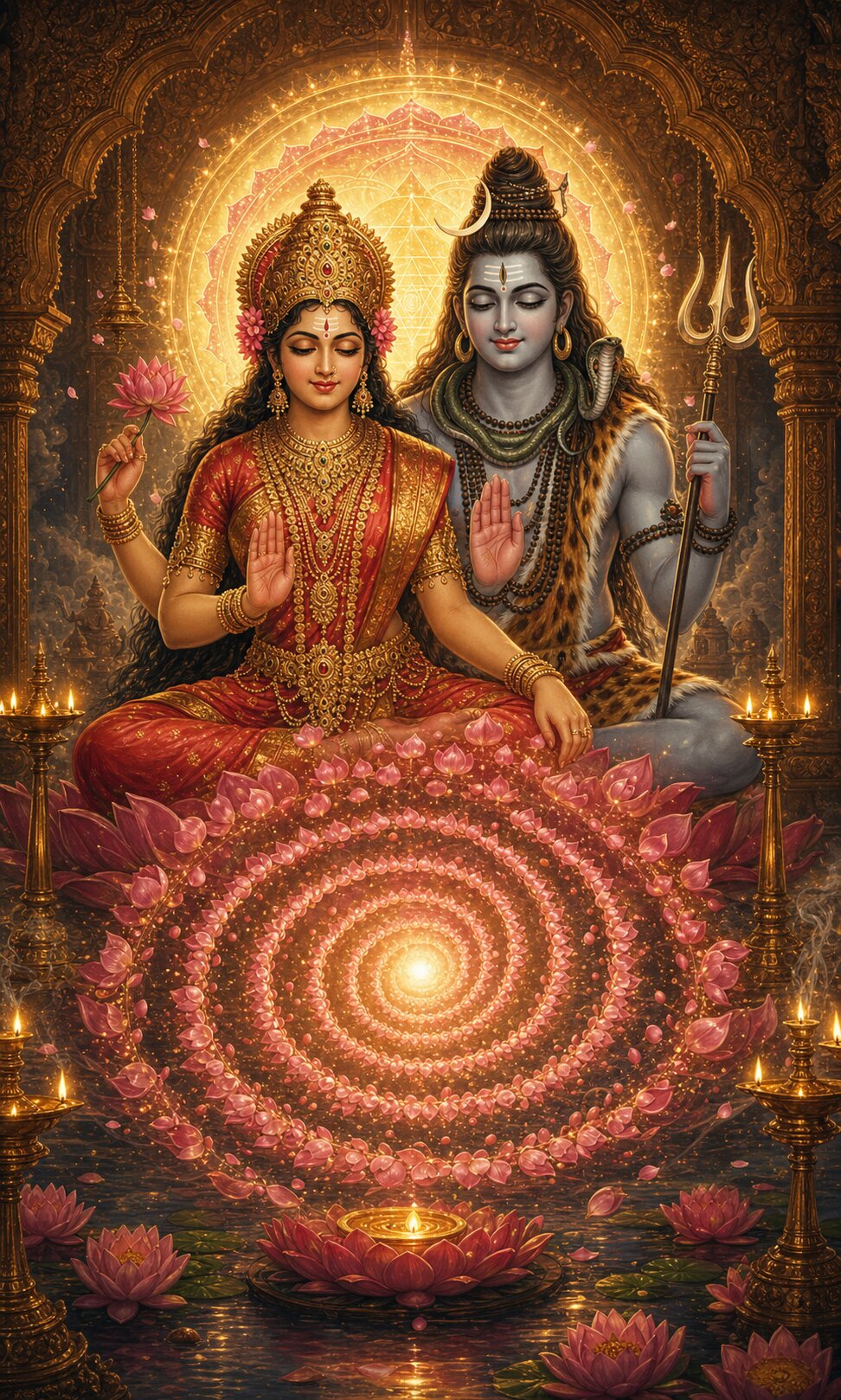
The recitation completes itself by returning to where it rose. It opened with ‘श्रीमाता’, and now it ends at ‘ललिताम्बिका’. The same Mother stands at both ends, and the thousand names between them display her countless forms before circling back to her. In this final hundred the Goddess draws in toward the single point where all her splendors dissolve into one.
The last three names deserve particular attention. ‘श्रीशिवा’, the Goddess who is herself the auspicious form of Shiva. ‘शिवशक्त्यैक्यरूपिणी’, the embodied form of the union of Shiva and Shakti, in which the whole thread of Shrividya philosophy is held. And at the close ‘ललिताम्बिका’, Lalita the Mother, the presiding name of the entire hymn. This garland of names moves like the sam of a musical cycle, where the round comes full at the very point it began, and for the seeker the ending becomes the opening of the next round.
The first names of the tenth part seat the Goddess at the root of sound and of reality itself. She abides as the primordial nada, the original vibration that is the source of all sound; she awakens the knowledge of Brahman, she holds the power to bring creation forth, and she is skilled in every discipline. Enthroned at the bindu, the central point of the Shrichakra, she stands beyond all the tattvas and is herself the supreme tattva. The meaning of the great utterance ‘तत्’ and ‘त्वम्’ opens within her, and the chant of the Samaveda is dear to her.
नाम 901-909
Next the Goddess’s nature unfolds, cool and gentle as the moon. She is the consort of Sadashiva, present in both the right-hand and left-hand paths of worship, and she wards off every calamity. She rests within her own being, free of all afflictions, sweet by her very nature. She is wisdom itself and she grants wisdom, and the wise worship her alone.
नाम 910-917
Now the mode of worship deepens. She is adored by offering pure consciousness itself as the sacred water, and the flower of consciousness is dear to her. She is forever risen, forever radiant, forever content, glowing red as the morning sun. Devotees of both the right-hand and left-hand observance worship her, and a faint smile rests on her lotus face. Seekers of the Kaula path adore her as pure consciousness; she is one, without a second, and she grants the priceless state of kaivalya, the final liberation.
नाम 918-926
Now praise itself becomes the object of praise. Her own praise is dear to her, and she is the essence of all hymns, their true subject; the Shrutis sing of her glory. Endowed with the highest power of mind, lofty in spirit, mistress of great renown, she is Maheshvari, the wife of Mahesha. Her very form is auspicious, her darshan is itself a blessing, and the radiance of her body drives all misfortune away.
नाम 927-933
Here the Goddess’s motherhood grows to encompass the whole world. She is the mother of all creation, from whose womb every world is born, is nourished, and returns; the mother who holds and sustains the universe, wide of eye. And at the same time she is dispassion itself, free of all craving, adept and full of self-assurance, supremely generous and abundant in giving, and herself the form of the highest joy.
नाम 934-940
Now the Goddess’s form grows vast and tantric. She pervades all as mind itself; her hair is the sky; she rides a celestial chariot and roams with the gods, and she bears the thunderbolt. She is the presiding deity of the Vamakeshvara Tantra, and the five yajnas are dear to her. Here comes the most hidden form of all: she who reclines on a couch built from five corpses, the five lords stretched out in death, Brahma, Vishnu, Rudra, Ishvara, and Sadashiva; she is the fifth power beyond those four, the sovereign of the five great elements, worshipped with the five offerings.
नाम 941-950
The next names rest on the Goddess’s timelessness and her good fortune. She is everlasting, and her sovereignty is everlasting; she grants happiness, and she is so beautiful that she enchants even Shambhu with her beauty. She is Dhara, the earth itself, the Earth-Mother, and at once the daughter of Himavan; supremely blessed, endowed with great sovereignty, steadfast in dharma and the one who makes dharma grow.
नाम 951-959
Now the note turns toward what lies past the senses. She is beyond all the worlds, beyond the three gunas of sattva, rajas, and tamas, beyond everything; every guna arises from her, yet none of them can bind her. Peace and bliss in form, she glows red as the bandhuka flower, forever a child, delighting in her own play.
नाम 960-966
Here the Goddess appears as the bride whose marriage never ends. She is forever fortunate, forever auspicious, the giver of happiness, adorned in beautiful garments and jewels, the eternal wife. The worship of married women pleases her, and she shines everywhere; her mind is pure and she purifies the minds of her devotees as well, and the libation offered at the bindu of the Shrichakra contents her.
नाम 967-974
The final turn descends into the deepest secrets of Shrividya. She exists before all else, born at the beginning, the mother of the three cities, worshipped through the ten mudras, and the power Tripurashri stands under her command. She abides as the jnana-mudra, reached through the yoga of knowledge, the form of both the knower and the known; she is the yoni-mudra, sovereign of the trikhanda mudra, joined with the three gunas, the mother of all living beings.
नाम 975-985
Just before the close, the Goddess comes forward as the very image of compassion and grace. She dwells in the triangle of the Shrichakra, sinless and flawless, wondrous in her deeds, the giver of every desired thing; she is known only through the most rigorous practice, and her nature lies beyond the six pathways. She is the embodied form of causeless mercy, a shining lamp that scatters the darkness of ignorance, known by everyone down to children and cowherds, and her rule no one can transgress.
नाम 986-995
And now the sahasranama reaches its summit. The Goddess dwells within the Shrichakra, the king of all chakras, the supreme beauty of the three worlds, Shrimati Tripurasundari. Then come the final three names, in which the whole essence is held. ‘श्रीशिवा’, the auspicious Shiva graced with Shri, the form that shows the Goddess to be one with Shiva, for Shakti is Shiva’s own auspicious expression. Then ‘शिवशक्त्यैक्यरूपिणी’, the embodied form of the union of Shiva and Shakti, where this thread opens: the two are a single supreme reality seen from two sides, prakasha the light and vimarsha the awareness that turns back on itself; the first shloka of Adi Shankaracharya’s Saundaryalahari rests on exactly this, and the Kanchi Kamakoti tradition holds it to be the root utterance. And at the last, ‘ললিताम्बिका’, Lalita the Mother. The journey of nine hundred ninety-nine names finds its fullness here, and the Goddess settles into one simple form of the Mother. In the traditional recitation, ‘नमः’ is joined to the end of every name, yet at this final name the seeker only calls out to the Mother, and that call is his completion.