The Form That Pervades the Cosmos
Names five hundred and one to six hundred. Maya, primordial nature, the all-pervading.
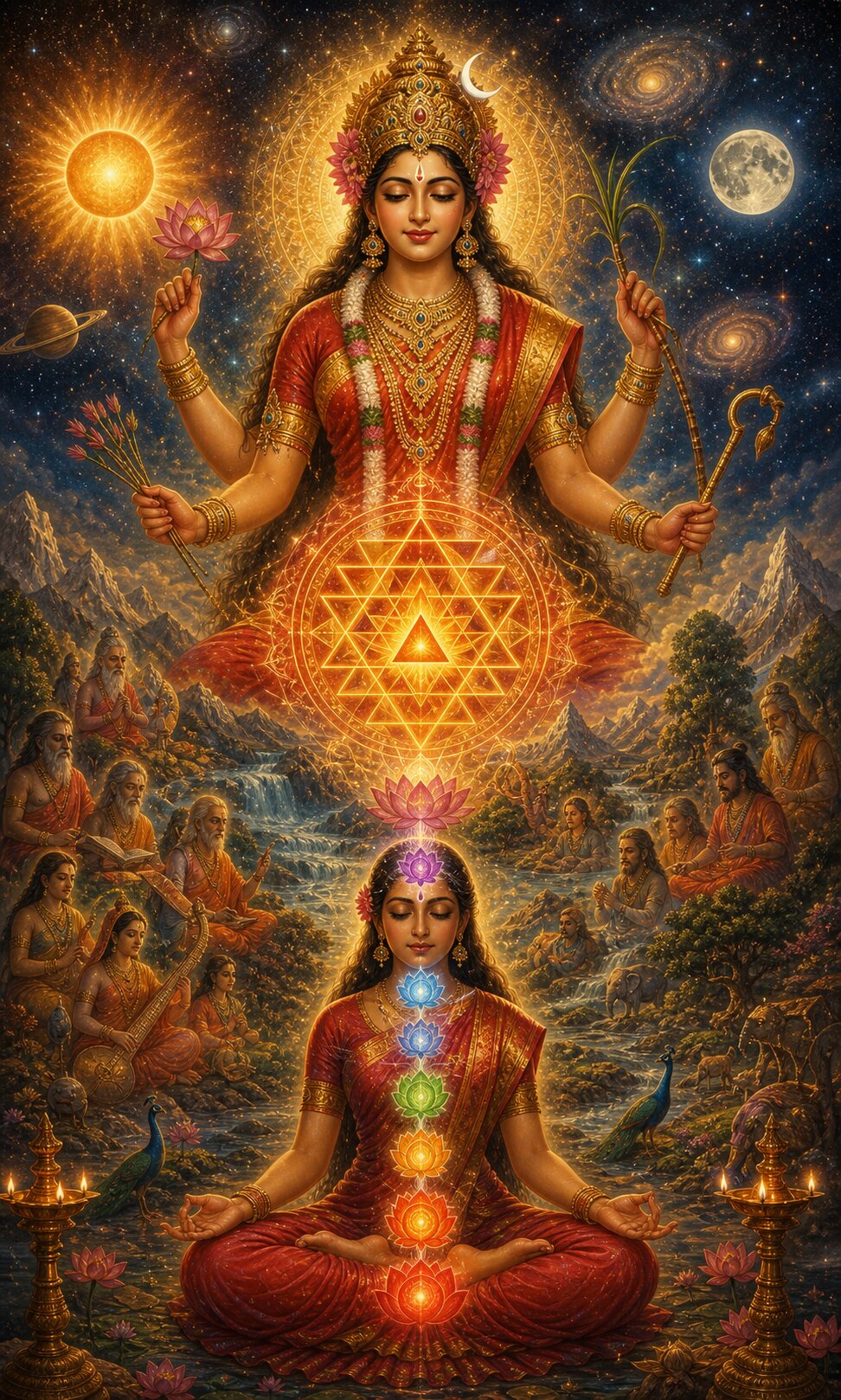
In this part the Devi outgrows any single temple, any single form. The names on either side of this hundred keep her in a body, on a throne, inside a story; here the chanting of her names becomes the chanting of the active principle behind all creation. Maya, primordial nature, the unmanifest, and the all-pervading feminine: these are the keynotes of this part.
Here the six chakras within the body open. The garland of names from five hundred and one to five hundred and thirty-four remembers the yoginis enthroned in the inner chakras: Lakini of the Manipura, Kakini of the Svadhishthana, Sakini of the Muladhara, Hakini of the Ajna, and the supreme Devi seated on the thousand-petaled lotus. Each of them is a station on a road that runs inside the seeker’s own body. The seeker’s kundalini rises from the Muladhara and meets Shiva in the thousand-petaled lotus, and this order of names touches that ascent name by name.
In the names that follow, the Devi is invoked as the imperishable syllable, as shruti, as smriti, as vidya, and as the dense mass of pure consciousness. Srividya, the sixteen-syllable vidya, Trikuta, and Kamakotika: these names point toward the secret of the mantra on which the entire tradition of this worship rests, and they point at it without unwrapping it.
Toward the end of the part the Devi is named Parashakti, Paranishtha, and the witness of the great dissolution. She who at the beginning of creation gives birth to the five great elements, from ether down to earth, remains the silent witness of their dissolution in the great cataclysm, watching what came out of her go out of existence and saying nothing. The six-hundredth name reaches the wreck of Daksha’s sacrifice and brings this part to rest.
The part opens on a gentle note, and on something a person could actually carry to her. First the Devi is invoked as the mother whose heart is gladdened by an offering of food sweetened with jaggery, and who shares that happiness out across her whole community of devotees, so that what one pair of hands brings ends up belonging to all of them. From here the garland of names turns inward, because the next name calls to mind Lakini Amba, the presiding goddess of the Manipura chakra.
Names 501 to 503 · From the offering, inward
Now the order of names descends into the six-petaled lotus of the Svadhishthana, where the yogini Kakini presides. Four lovely faces turn at once, and her hands carry a trident and other weapons, a noose, a skull-bowl, and, in the middle of all that iron, the gesture that puts fear to rest. Her color is yellow, her bearing carries a lofty pride, and she is seated in the fat-tissue of living beings. An offering made from honey delights her, and powers such as Bandhini surround her.
Names 504 to 511 · Kakini of the Svadhishthana
The Devi whose heart is drawn to an offering of food mixed with curd now appears in the form of Kakini, and then the order of names descends further and settles on the lotus of the Muladhara. The Sakini here has five faces, she is fixed in the bone-tissue, she carries a goad and other weapons, powers such as Varada attend her, and her mind takes delight in an offering of food made from green gram. Curd, honey, green gram: whatever else these yoginis hold in their hands, what pleases them stays as plain as anything on a kitchen shelf. This yogini of the Muladhara bears the name Sakinyamba.
Names 512 to 520 · Sakini of the Muladhara
Now the order of names reaches the two-petaled lotus of the Ajna chakra, between the brows. The Hakini here is white in color, she has six faces, she is the presiding goddess of the marrow-tissue, the deepest thing a body keeps, and the powers Hamsavati and Kshamavati sit in her two petals, one to each. She has a special taste for an offering of food dressed with turmeric, and in this form she is called Hakini.
Names 521 to 527 · Hakini of the Ajna
This ascent through the chakras comes to its summit. The Devi seated in the thousand-petaled lotus above the head is remembered, the lotus of a thousand petals held to lie above the six chakras, past the last of them, where the counting stops. Here the kundalini that rose from the Muladhara meets Shiva, and the seeker tastes the nectar that streams from that union. And the portrait opens as wide as the place it describes. The Devi seated in this supreme place is adorned with the glow of many colors, she holds every known weapon, she is fixed in the reproductive tissue, she faces every direction, she is pleased by offerings of food of every kind, and she presides as the yogini Yakini.
Names 528 to 534 · Yakini of the Sahasrara
As soon as the garland of yoginis is complete, the order of names turns from the body toward the fire. The Devi is that same ‘Svaha’ uttered at the close of the mantras when an oblation is poured into the fire, the syllable that closes every offering ever made that way, and that same ‘Svadha’ called out in the offering of water to the ancestors, where the living turn and speak toward their dead. She is present as ignorance and also as the wisdom that is the power of retention. She is shruti in the form of the Veda, and she is smriti in the form of the shastra that rests on the meaning of the Veda.
Names 535 to 540 · Svaha, Svadha, shruti, smriti
Now the hymn leans toward the greatness of the Devi and the merit-bearing chanting of her names. None is higher than she, her fame is holy and full of merit, and she is attained only by the pure of soul. Whoever hears and chants her name gains merit, which is a quiet promise made to the very person now reading down this list. Pulomaja, the wife of Indra, offers her worship. She is herself free of every bond and frees her devotees from bondage, her hair falls in curls, and she stands as vimarsha, the self-luminous awareness of the self.
Names 541 to 549 · Holy fame and the loosing of bonds
Here the Devi is called the mother of the entire world. She is the root mother of the world built from all the elements, from ‘viyat,’ meaning ether, onward. In the order given by the Taittiriya Upanishad, ether arises from the atman, air from ether, fire from air, water from fire, and earth from water, one thing thickening into the next until at last there is ground to stand on, and she is the womb of these five great elements and of the world fashioned from them. For this reason she stills all diseases and sorrows and saves her devotees from every kind of death.
Names 550 to 552 · Mother of the world, from ether onward
The garland of names that follows touches the Devi’s many forms and stories. She is foremost among all, her form lies beyond the reach of thought, and she destroys the sins of the Kali age. Katyayani, who appeared in the line of the sage Kata; Kalahantri, who slays death; and the one whose refuge the lotus-eyed Vishnu takes: these are all her names. Then the vast turns intimate. Her mouth is full of betel, her radiance is like the flower of the pomegranate, and her eyes are large and lovely, like the eyes of a doe.
Names 553 to 561 · From Katyayani to the doe-eyed
Now the Devi is invoked as the enchantress, as the first of all, and as Mridani, the wife of Shiva. She is the friend of the whole world, forever content, wanting nothing that anyone could carry to her, the treasure and store of her devotees, she urges all living beings onto the good path, she is the sovereign of all, and she is attained only through the practice of friendliness and the other wholesome dispositions, so the road to her runs straight through the way a person treats everybody else.
Names 562 to 570 · Mridani, sovereign of all
Here the names reach the Devi’s supreme and hidden form. When creation returns to its first principle, she remains the silent witness of the great dissolution, present while everything that can end is ending. She is the primal and supreme Parashakti, she is Paranishtha, the highest goal and the highest ground, and she stands as pure, concentrated consciousness. Languid as though from drinking mead, free of every longing, drunk on bliss, she appears in the form of the letters of the alphabet.
Names 571 to 577 · Witness of the great dissolution, mass of consciousness
Now the Devi appears dwelling on the great Kailasa, her creeper-like arms as soft and cool as the stalk of a lotus drawn up out of the water. She is worthy of worship and of homage, the very image of compassion, and she conducts the great empire of the three worlds. From here she is invoked in the forms of knowledge: the knowledge of the atman, Mahavidya as the ground of that self-knowledge, and Srividya as the Panchadashi mantra.
Names 578 to 585 · The great Kailasa, Srividya
With the secret of the Srividya mantra, the garland of names deepens further. The Devi is served by Kamadeva, she is the sixteen-syllable Shodashakshari mantra, she is Trikuta, the three segments of the Panchadashi, and she is Kamakotika, of whom Shiva himself is only a single part. Then the hymn measures her wealth the one way it can: countless Lakshmis, won over by a mere sidelong glance from her, remain in her service.
Names 586 to 590 · Shodashakshari, Trikuta, Kamakotika
Toward the close, the names return to the Devi’s stations within the body, and every station has its own light. She is placed in the head and glows like the moon, she is placed on the brow between the eyebrows and shines with the radiance of a rainbow, she is placed in the heart and blazes like the light of the sun, and she shines as a flame within the triangle of the Sri Chakra. Moon, rainbow, sun, and flame, one apiece for the places that hold her.
Names 591 to 597 · Head, brow, heart, triangle
The part comes to rest on the story of Sati and Daksha’s sacrifice. Dakshayani, the daughter of Daksha Prajapati; the slayer of the daityas; and the destroyer of that sacrifice of Daksha. Daksha gave Shiva no invitation to his great sacrifice, and in a house like that a missing name is a public judgment. Sati went there unbidden, stood among guests who had every one of them been asked, and heard her own father speak of her husband in a way she could not bear. She gave up her body in the fire of yoga. Shiva brought forth Virabhadra, who wrecked the sacrificial pavilion. In this form the Devi is called the destroyer of Daksha’s sacrifice, and the six-hundredth name brings this part to rest on this story.