Majesty and the Three States
Names one hundred sixty-six through two hundred seventy-four.
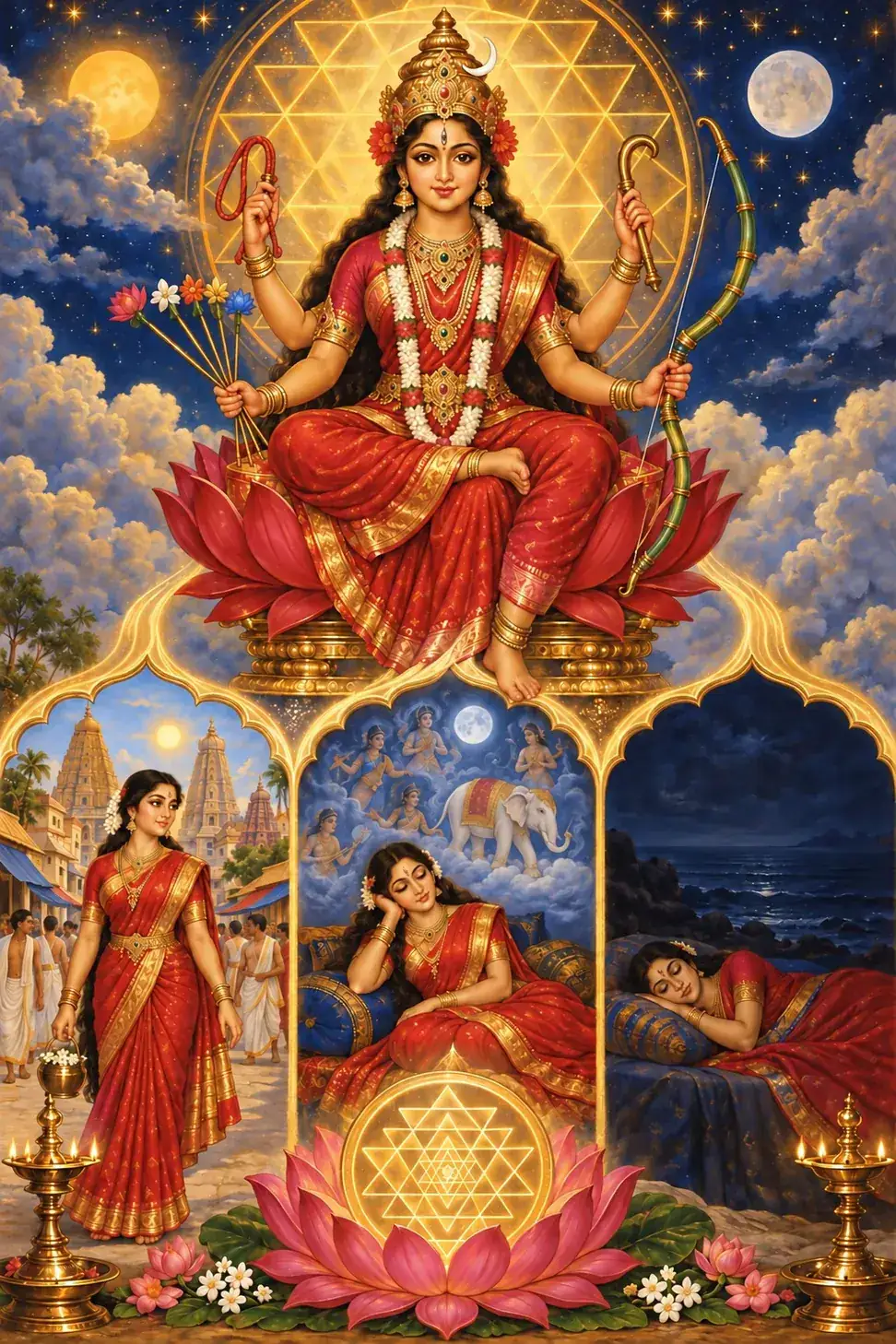
In the third part the Devi rises in the very form that Bhaskararaya, in his Saubhagya-Bhaskara, names para-samvit, the supreme awareness, free of every flaw and, in the same breath, the one who carries every flaw away. Here the names move in pairs, and the pairing is the architecture of the whole part. On one side stands a description of the Devi’s nature by negation; on the other, the undoing of that same flaw within the devotee. The first of each pair says what she is; the second says what becomes of you because of it. This is the character of Lalita: whatever she herself is not, that is what she takes from her worshiper.
The first garland moves on a single rhythm. First the Devi’s own unstained nature, then the gift of that same purity. She is utterly free of sin, and she wipes away every sin of her devotees. Not a trace of anger lives in her, and so she quiets the rage inside her worshiper. No craving for any object stirs in her, and she lets no greed remain in anyone who comes near her.
Names 166 to 171
This same pairing deepens as it goes. No doubt or division lives in the Devi, and she clears away every doubt of the devotee. She has no birth and no origin, and she cuts the bond of birth and death at a stroke. In her there is no invention of the mind, no dividing thought, and she stays unmoved by any obstacle set in her way. The sense of separateness that springs from the appetites she carries away from the devotee as well.
Names 172 to 179
Now the garland of negation reaches its summit. The Devi is imperishable, never subject to ruin, and she churns death itself to nothing. She abides without being caught in any action, she hoards nothing, she wants nothing at all. She has no equal anywhere. And then, midway through all this severity, with the naming still busy stripping her of every attribute a thing can have, a tender image surfaces and stays: her hair, dark and gleaming, with the sheen of blue lying along it.
Names 180 to 185
After this comes the song of the Devi’s unreachable height and her form as Durga. She never wastes away, her bounds are fixed, and only great effort brings anyone near her. She is Durga herself, destroyer of misfortune, the one who erases every sorrow and grants happiness in its place. The wicked cannot reach her, and she stills all corrupt conduct, herself free of every flaw.
Names 186 to 195
Now comes the garland of the syllable sa, where the Devi’s all-pervading majesty is sung. She is all-knowing. Her compassion is dense and boundless, and there is none her equal and none above her. She holds every power, she is the root of all that is auspicious, and she is the giver of the highest course. The whole world, moving and unmoving, belongs to her as its sovereign, and she pervades that same world she owns.
Names 196 to 203
Here the Devi stands as the very form of tantra, mantra, and yantra. She is the essence of all mantras, the soul of all yantras, the form of all tantras. Then Manonmani arrives, that unmani power of Shiva in which the mind rises clean above its own workings. She is Maheshvari, the power of Maheshvara; Mahadevi, the greatest among all goddesses; and Mahalakshmi, presiding over all wealth.
Names 204 to 210
Now the long garland of names beginning with the word maha opens, and it runs a long way. The Devi is the beloved of Shiva, vast in form, supremely worthy of worship, the one who erases even the most terrible sins. She is Mahamaya, the veil that underlies the whole spread of the world, and Mahasattva, the utterly pure being.
Names 211 to 216
Here the song is of the Devi’s dominion, valor, strength, intelligence, and attainment. She is the form of great power, of boundless bliss and delight, mistress of enjoyment and of splendor. Her valor is great, her strength beyond measure, her intelligence supreme, and she is complete in the highest attainments. She stands as the ruler even over the rulers of yogis.
Names 217 to 225
Now the maha garland turns toward worship. The Devi is worshiped in great tantras like the Kularnava and the Jnanarnava, she is the embodiment of the fifteen-syllabled Shrividya mantra, and she is the great yantra that stands as the Shrichakra. She is seated on a great throne, adored through the ordered rite of the great sacrifice, and worshiped by Mahabhairava Shiva himself.
Names 226 to 231
The maha garland climbs to its peak. At the close of the great kalpa, when Maheshvara performs the world-dissolving great dance, the Devi is its unmoved witness, and nothing in that dissolution moves her. She is the chief queen of Mahakameshvara Shiva, his consort, and at last Mahatripurasundari, the supreme power most beautiful across the three cities.
Names 232 to 234
Now comes the garland set with the syllable cha, where Shrividya and the Shrichakra open out. The Devi is worshiped with sixty-four offerings, she is the form of the sixty-four arts, and she is served by sixty-four crore hosts of yoginis. She is the Shrividya worshiped by Manu and the moon-god, and she dwells at the center of the lunar orb.
Names 235 to 240
Here the Devi’s beauty and her sovereignty over all are sung together. Her form is enchanting, her smile beguiling, and on her brow the lovely crescent of the moon. She is mistress of the entire world, moving and unmoving, and she makes the king of chakras, the Shrichakra, her dwelling and is seated there.
Names 241 to 245
Now a familiar form of the Devi rises, Parvati, daughter of Himavan the king of mountains, her eyes wide as lotuses, her radiance red as the ruby. Then a hidden image arrives, and it is the strangest in the part. She is seated on a throne of five corpses, and these five are Brahma, Vishnu, Rudra, Isha, and Sadashiva, stripped of their power. When those same five stand joined again with their own powers, the Devi becomes the very form of the five Brahmas.
Names 246 to 250
Now the description turns inward, toward the Devi’s pure consciousness. She is the form of pure awareness, the supreme bliss, one undivided figure of concentrated knowing. She shines in all three at once, the meditation, the one who meditates, and the object of meditation, and she stands beyond both dharma and adharma, she whose very form is the entire universe.
Names 251 to 256
Now comes the vision of the three states and the turiya. Waking, dream, and deep sleep, the three countries every person crosses between one morning and the next: through all three the Devi abides as the living self. In the waking self she is the waking one. In dream she is the ground of the taijasa with its subtle body. In deep sleep she is one with the prajna consciousness that owns that slumber. she is the supreme realization of the atman, standing beyond all these states, free of every one of them.
Names 257 to 263
At the close of the part, the Devi’s five acts gather into a single resolve. She is the maker of creation, and at the time of creation she takes the form of Brahma. Guardian of the world, she takes the form of Govinda to sustain it. The one who dissolves, she takes the form of Rudra in the great dissolution. She is the supreme goddess who draws all things into concealment. And at the last she grants grace as Sadashiva. In these five acts, creation, preservation, dissolution, concealment, and grace, she remains forever intent, and the three great gods who carry the first three are her forms while she does it.