The Bond with the Seeker
Names six hundred one through seven hundred. From the eyes that tremble with compassion to the sat-chit-ananda where Shrividya and Vedanta become one.
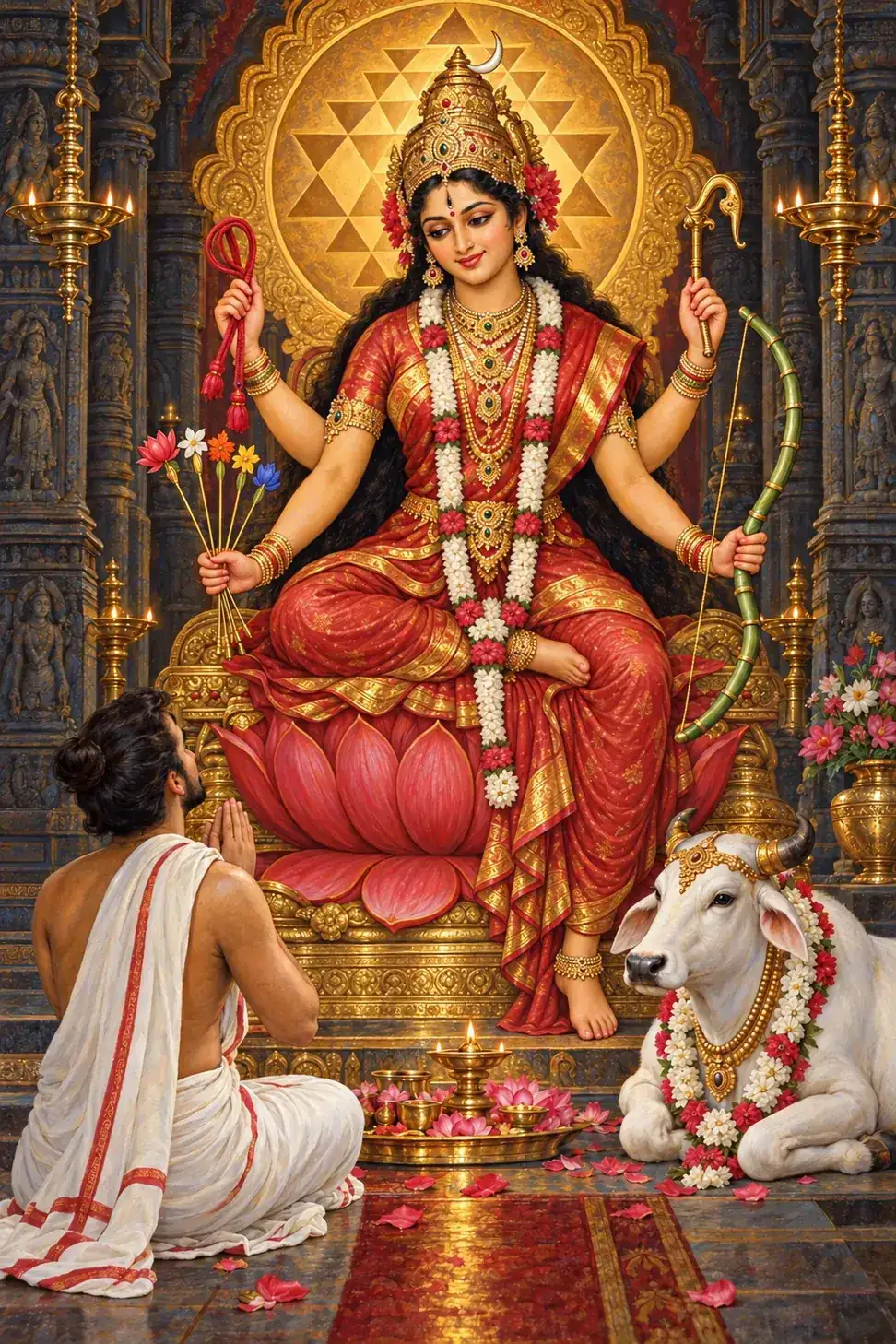
The hundred names before these described a Goddess who fills the whole cosmos; this hundred describes what happens when she turns and looks at one person. The names in this part tell you the forms in which the Goddess descends into the seeker’s experience. In one place she is Adishakti, the root cause of all creation; in another Jnanada, who gives self-knowledge; and at the end Sacchidananda-rupini, whose very nature is being, consciousness, and bliss. One name after another narrows the distance between the seeker and the Goddess.
In the Shrividya tradition this bond has been seen as a kind of love-dialogue. Here the Goddess appears in the guru-mode more than the mother-mode; the seeker sits like a disciple, and she lifts him upward one mantra-level at a time.
These same names carry words like danda-niti, mudra, yoga, and samadhi, which mark the confluence of statecraft and the science of yoga. In Indian thought, the dharma of kingship and the dharma of liberation never ran as separate currents, so a hymn that calls the same Goddess the order of justice and the space inside the heart is only saying what its first listeners already assumed. The sense these names carry follows Bhaskararaya’s Saubhagya-Bhaskara, the commentary the Shrividya tradition holds as the most celebrated on this Sahasranama.
The part opens with the face of the Goddess, as if the seeker, six hundred names into the walk, at last comes up before her gaze. Her long eyes stay restless, trembling faintly with compassion, and her face stays bright and glad with a soft smile. Nothing has been asked for yet, and nothing has been earned. This is the first grace, and it opens the whole journey that follows.
Names 601 to 602 · The first gaze
Now the Goddess comes forward in the guru-form. She takes on the very nature of the guru, she is the treasury of all auspicious qualities, and she has appeared as Surabhi, the wish-granting cow Kamadhenu who fulfills every desire. She is the mother of Kartikeya, the sovereign and protector of all the gods. Then comes a deep turn: she stands unshaken in danda-niti, the order of justice and governance. According to Bhaskararaya, the danda-niti of statecraft is the Goddess’s own form; the balance of dharma and rule runs by her measure. And at the same time she abides as that subtle space in the cave of the heart which the Chandogya’s dahara-vidya calls the atman, the self. Two names stand side by side here, and the distance between them is the distance from a throne room to the inside of a chest. Governance without, the self within, both the one Goddess.
Names 603 to 609 · Guru, justice, and the cave of the heart
After this the names turn toward time and art. The Goddess is worshiped in the circle of all the lunar days from the first to the full moon, so that no night of the waxing month falls outside her. She abides as all the arts, and she is the mistress of those same arts. She delights in hearing the recital of poetry, and in her service Lakshmi stands on the left and Sarasvati on the right, each moving a fly-whisk slowly through the air beside her. Wealth and speech both stand as her attendants.
Names 610 to 614 · The lunar days, the arts, and two attendants
Now the pitch rises and the supreme nature of the Goddess opens out. She is Adishakti, the very Parashakti who is the root cause of the whole universe, immeasurable, beyond the reach of any proof. She is the atman that pervades all beings, the supreme reality, the form that makes pure, the mother of many tens of millions of universes, and the one with a divine body. Then, after all that vastness, one syllable. She appears as ‘kleem’, the seed of desire, and still she stays kevala, that is, complete, free, and without any limiting condition. She is known in secret, like a mystery passed from the mouth of the guru, and she grants kaivalya, the state of moksha, liberation.
Names 615 to 625 · Adishakti and kaivalya
From here the glory of the number three resounds. She is Tripura, prior even to the three of Brahma, Vishnu, and Shiva; the presiding power of the three cities, the threefold principles. She is honored by all three worlds, the collective form of the trinity, the sovereign of the gods, and the form made of the three syllables of the pranava, a, u, and m. Then that same supreme reality dresses itself in a form with qualities. Six names of pure principle, and after them a fragrance and a mark of color: she is rich with divine scent, and adorned on the brow with a vermilion tilaka.
Names 626 to 632 · Tripura and the pranava
Now that same Parashakti comes into a face the listener has known since childhood. She is Uma, that is, Parvati, daughter of Himavan the king of mountains, Gauri of the fair complexion, served by the hosts of gandharvas. And at the same time her vast cosmic form opens too: the whole universe is held within her womb, she is the ground-power even of Hiranyagarbha, the destroyer of adharma, and the mistress of all speech. Daughter of the Himalaya and womb of the cosmos, both at once.
Names 633 to 640 · Gauri and the world-womb
Now the names turn inward toward knowledge. She is reached only through meditation, boundless, her limit impossible to fix. She grants self-knowledge, she is the very embodiment of knowledge, knowable through all of Vedanta, and her nature is truth and bliss. She is worshiped by Lopamudra, the rishi of one of Shrividya’s principal lineages, the same Lopamudra beside whom Agastya first asked the question that brought this hymn into the world, and by mere play she fashioned the whole array of universes. At the end comes a subtle reversal: she is not visible to the senses, she is pure seer-nature emptied of all that is seen, the knower who knows everything, and then, being knowledge itself, she passes beyond anything that could be known. First she was the knower, now she has no need of any object left to know.
Names 641 to 652 · Jnanada and the seer-nature
Now the note of yoga rings out. She is the Yogini forever joined with Parashiva, the giver of the power of yoga, the worthy refuge for every kind of yoga, and the very form of the bliss that yoga yields. For Bhaskararaya that yoga is the shared essence of Shiva and Shakti, and that alone is her bliss. She upholds the yugas, the ages, bearing the whole universe as the ox bears the yoke, and she sets the ages turning in their order. Then all of tantra fits into a single formula, and it takes one of the longest names in the hymn to hold it: she abides as the three powers of will, knowledge, and action, ichha-shakti, jnana-shakti, and kriya-shakti.
Names 653 to 658 · The Yogini and the three powers
Now the depth of Advaita opens. She is the support of everything, firmly established in her own nature, taking on the forms of both the existent and the non-existent, the eightfold embodiment, and the conqueror of maya, the ignorance. She directs all the movement of the worlds, and still she remains the one without a second. She is the Bhuma, the infinite, boundless fullness of the Chandogya’s Bhuma-vidya, in whom there is not a trace of duality, wholly free of duality. Here Shrividya and Advaita Vedanta begin to flow in one direction, and they will not part again before the seven-hundredth name.
Names 659 to 668 · The Bhuma and Advaita
Now the Goddess spreads into both sustenance and the principle of Brahman. She is Annada, who gives food to all beings, Vasuda, who gives wealth and riches, the most ancient and eternal Vriddha, and the one whose nature is the oneness of Brahman and the atman. Food first, then wealth, then what is oldest, then the identity of Brahman and the self, and all of it inside four names. She is the vast Brihati, Brahmani in whom the quality of sattva prevails, Brahmi the presiding power of speech, and forever immersed in the bliss of Brahman. She loves the offering of naivedya, she appears as all language, her army is vast, and at the end she is beyond both presence and absence.
Names 669 to 680 · From Annada to beyond being
Now the royal note of the part rises, where the Goddess dresses in the form of Rajarajeshvari. Her worship is accomplished with ease, she is Shubhakari who brings welfare, and the path to reaching her is bright and open. Then that same form of supreme sovereignty, put in the vocabulary of an actual court: she is the sovereign even of kings and emperors, the giver of kingdom and authority, the protector of all realms. Her grace stays radiant as it enchants everyone, and she seats those who take refuge in her upon the royal throne itself. She is Rajyalakshmi, the very prosperity of the kingdom, the mistress of the treasury, the sovereign of the four-limbed army, the giver of empire, and Satyasandha, true to her word, whose resolve is never false.
Names 681 to 693 · Rajarajeshvari
The part closes on the vast dominion of the Goddess and then on the supreme reality. The sea-girdled earth is her mekhala, her waist-band, the oceans lying around her the way a belt lies at the waist; she is consecrated in the vow to rescue her devotees, the queller of daityas and evil powers, the one who holds all the worlds in her sway, and the giver of every desired end. She is the creative power of the universe, Savitri in the form of the Gayatri. And exactly at the seven-hundredth place comes the formula in which Shrividya and Advaita become fully one: Sacchidananda-rupini, whose nature is being, consciousness, and bliss. Woven from the Brahmananda-valli of the Taittiriya, this name is the culmination, and the names that follow it move largely in the vocabulary of Vedanta, which is where the next part opens.