Cosmic Form, Kamakala, and the Levels of Speech
Names two hundred seventy-five through three hundred ninety-six. From the seat in the solar orb to Ardhanarishvari.
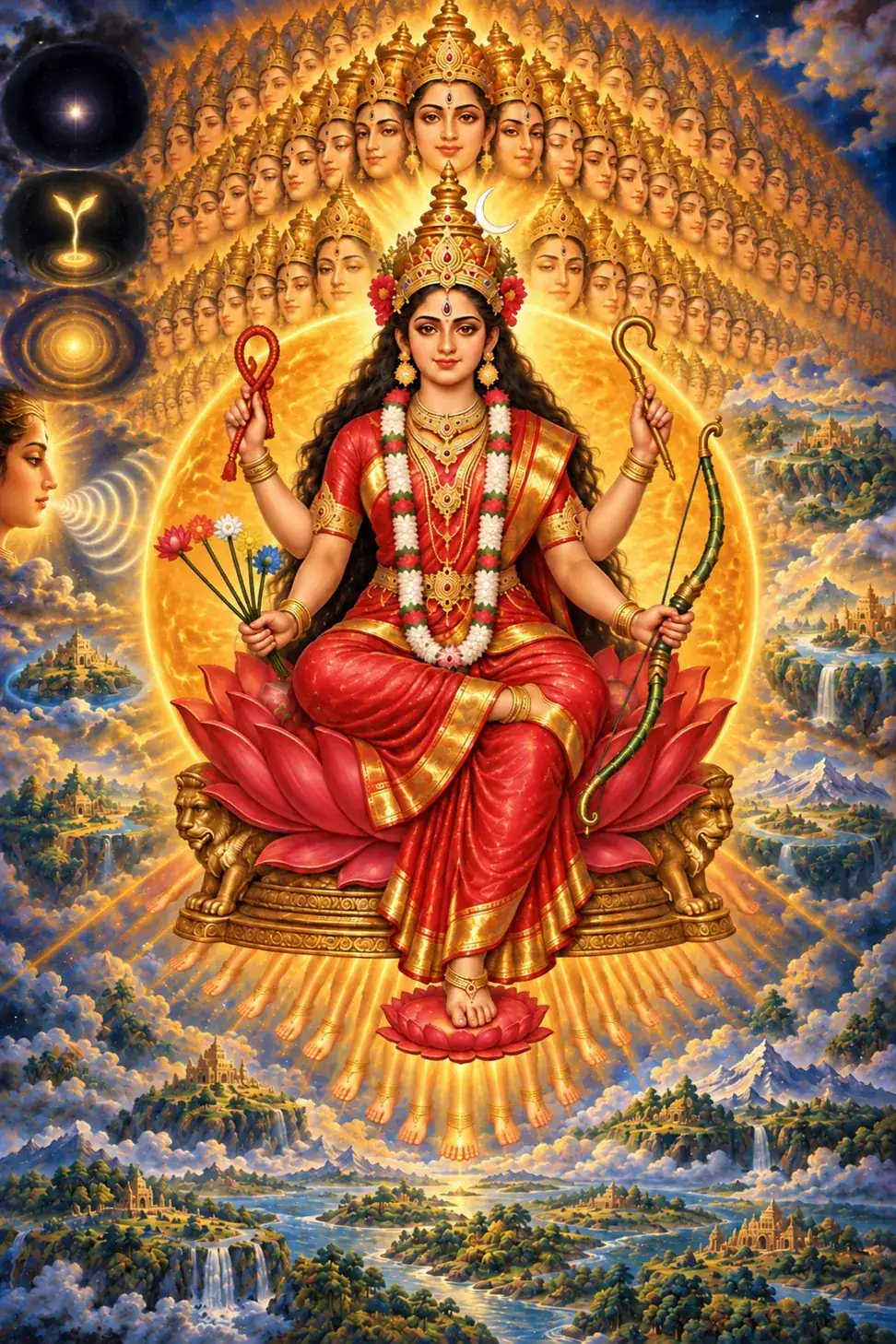
The one hundred twenty-two names of the fourth part begin by finding the Devi on her seat and end by finding her in her supreme form. She is first Bhairavi, enthroned at the very center of the solar orb, wearing the six sovereignties as a garland and guarding those who turn to her. Then her cosmic form opens, a thousand heads and a thousand feet, and whole ranks of worlds that appear when her eyes open and dissolve when they close. Then she is the mistress of the Vedas and the agamas, the pearl hidden in the shell of every scripture, and then, past even the primal sound of nada, she is the formless reality that carries no name and no shape at all. The war with Bhandasura, the purpose for which Lalita took form, has already been told in compressed form in names 64 through 84 of the first part. The names ahead have a different subject: the Devi’s sovereignty, the truth of her nature, and the secret ways she is worshiped.
This part has a texture of its own. The names run in strings threaded on a single letter, and the ear catches the pattern before the mind does. The garland opens on the seed-syllable ‘hrim’, and from there the string of ‘ra’ sings the Devi’s lovely, rasa-filled form, the string of ‘ka’ unlocks the secret of kamakala and comes to rest on an ocean of compassion, the string of ‘va’ leads toward the Vedas and the play of creation, and the string of ‘ksha’ raises the Vedantic distinction between the field and the knower of the field. Names strung on one sound become a rhythm of their own in the mouth of the one who chants them, and inside that rhythm come the names of release from bondage, of eternal youth, and of the end of darkness.
Near the three hundred sixty-third name the hymn touches its summit. The Devi is named the intended sense of the word ‘tat’ in the great saying ‘tat tvam asi’, you are that, and a single drop of her self-bliss outweighs the entire bliss of Brahma and the gods. Right after that the four levels of speech are counted in order, para, pashyanti, madhyama, and vaikhari, from the subtlest seed of sound to the word spoken aloud, and the Devi is found standing in all four at once. The whole Shrividya teaching on speech sits inside these six names.
The last stretch descends into the secret ways of worship. The Jalandhara and Odyana pithas, the bindu at the heart of the Shrichakra, the secret rite and the secret oblation, the deities of the six limbs, and the sixteen Nitya goddesses who stand for the sixteen phases of the moon: each name reminds the worshiper of an inner sequence that passes only from guru to disciple. The Sahasranama here speaks the language of the Devi’s sadhana alongside the language of her qualities.
And the part closes on Ardhanarishvari, where Shakti and Shiva are the two halves of one body. The garland that opened on Bhairavi seated in the solar orb comes to completion on Parameshvari, filled with radiance. Keep that arc in view as you read: from the seat to her nature, from her nature to speech, from speech to worship, and from worship to the supreme union.
This step of the hymn identifies the Devi by her seat and her sovereignty. She sits at the very center of the solar orb. She is Bhairavi, the consort of Bhairava, that is, of Shiva. She wears a garland of bhaga, the six sovereignties of splendor, mastery, fame, virility, dispassion, and knowledge; she is seated on a lotus flower; and, endowed with every sovereignty there is, she guards her worshipers. She is then called the sister of Padmanabha, that is, of Vishnu, because Shakti and Vishnu are two forms of one supreme reality. Bhaskararaya explains that the three names Padmasana, Bhagavati, and Padmanabhasahodari together signal the first cluster of the fifteen-syllable Shrividya mantra, the Vagbhava cluster.
Names 275 to 280 · Seat and sovereignty
Now the cosmic form of the Devi opens out. At the mere opening of her eyes the ranks of worlds appear, and at their closing they dissolve, so that the whole span of a universe is the time between one blink and the next. Hers are a thousand heads, a thousand faces, a thousand eyes, and a thousand feet, the very cosmic vision the Purusha Sukta sings. She is the mother of every creature, from Brahma down to the lowliest insect, and it was she who laid down the order of varna and ashrama. The Vedas themselves take the form of her command, and she alone grants the fruit of both kinds of deed, merit and sin.
Names 281 to 288 · Cosmic form and ordinance
Here the bond between the Devi and scripture grows deeper. The dust of her lotus feet becomes the vermilion in the parted hair of the Vedas envisioned as goddesses, laid there by nothing more than what her feet leave behind them. And she is the pearl hidden inside the shell of all the Agama scriptures. She grants all four aims of human life: dharma, artha, kama, and moksha. Her nature is then declared: forever complete, subject to neither growth nor decline, the enjoyer of every enjoyment, the sovereign of every world, Ambika the mother of the universe, she who has neither beginning nor end.
Names 289 to 296 · Scripture, the human aims, and fullness
Now the hymn turns toward sound and the formless. She whom Vishnu, Brahma, and Indra serve is Narayani, the shakti-form of Narayana, present as the primal sound of nada, and then beyond even that, without attribute or form, free of name and shape. The formless nature follows right after she is called the form of nada, and the order of the two is deliberate: name and form spread out only by descending from nada, while at her root the Devi stands beyond them all.
Names 297 to 300 · Beyond nada
From here comes a garland of names that opens with the seed-syllable ‘hrim’, the celebrated maya-bija of Shrividya. The Devi bears the very form of that ‘hrim’: endowed with modesty and grace, dwelling in the heart and dear to the heart, and, for her, nothing is to be cast off and nothing is to be seized. Then a note of royal sovereignty rises: worshiped by Kubera and the other kings among kings, she is Rajni, the crowned queen of Shiva, the lord of all kings.
Names 301 to 306 · Hrim and Rajni
Now a lovely strand is threaded on the letter ra, and in it the Devi’s charming, rasa-filled form is sung. She is supremely charming and gives delight to all. Her eyes are like lotuses. She colors the mind with joy. She is the woman who bestows delight, and, relishable herself as the very form of rasa, she also relishes rasa. A girdle of softly ringing bells is her adornment, she shines forth as Lakshmi and Sarasvati, and her face is as lovely as a night of the full moon.
Names 307 to 314 · The charming form
The garland of ra now turns to the key of love and of protection. The Devi abides as Rati, the wife of Kama; she is dear to Rati, and Rati attends her. She protects her devotees, she destroys the entire race of rakshasas, and she is Rama, the one in whom the mind takes delight, the giver of joy. She is devoted to her beloved Shiva.
Names 315 to 320 · Rati, protection, and the slaying of rakshasas
Now comes the strand of the letter ka, and within it one of the deep secrets of Shrividya opens. The Devi is the object of everyone’s longing, supremely desirable, present as Kamakala, in which the seed of creation is held to spring from the union of the bindu and the syllable, a whole world beginning where a point meets a sound. Kadamba flowers are especially dear to her; she grants welfare and blessing; she is the root tuber of the whole world, the buried thing out of which creation sprouts; and she is the fathomless ocean of the rasa of compassion.
Names 321 to 326 · Kamakala and compassion
The Devi is the embodiment of all the arts and she speaks in sweet, artful words. She is the supremely lovely beauty, fond of the sweet nectar of mead, generous with her boons, and graced with beautiful eyes. Then comes a hint of yoga: she is rapt in the joy of the divine draught called varuni, which, in the vision of yoga, is the intoxicating nectar that streams down from the sahasrara.
Names 327 to 333 · Art, sweetness, and the varuni intoxication
Now the garland of the letter va leads toward the Vedas and creation. The Devi is beyond the whole universe and greater than it, and still she is knowable through the Vedas. She dwells on Mount Vindhya. She is the ordainer who creates and sustains this universe, she is the mother of the Vedas, she is the maya-power of Vishnu, and she is Vilasini, who sports in the play of creation.
Names 334 to 340 · The Vedas and the play of creation
Now the strand of the letter ksha raises the Vedantic distinction between the field and the knower of the field. The Devi bears the form of the kshetra, the body of nature; she is the shakti of Shiva, the lord of that field; and she guards both of them, the kshetra, which is the body and nature, and the kshetrajna, which is the atman, the self. She is free of both growth and decay, changeless, and fully worshiped by Shiva in the form of Kshetrapala.
Names 341 to 345 · The field and the knower of the field
A note of victory and purity rises. The Devi is ever victorious, spotless and free of every taint, worthy of all reverence, and she holds a mother’s tenderness for the devotees who bow before her. She is the very power of speech that speaks as voice, she has beautiful hair, and she dwells in the orb of fire.
Names 346 to 352 · Victory, purity, and speech
Now the Devi’s liberating power appears. She is the wish-granting vine that fulfills the heart’s desire for her devotees, and she releases the pashu, the bound soul, from the pasha, the noose that holds it fast, the very Shaiva-Shakta triad famed as pashu, pasha, and pati. She destroys all hypocrisy and false doctrine; abiding in right conduct, she moves others toward it as well; and she is the moonlight that comes down cool on souls scorched by the fire of the three afflictions, the spiritual, the elemental, and the divine.
Names 353 to 357 · Release from bondage and cooling delight
The strand of the letter ta sings the Devi’s eternal youth and the undoing of darkness. She is forever young, eternally youthful, adored by ascetics, slender and fine at the waist, and she is the destroyer of the ignorance that is born of tamas. From here the principle of knowledge deepens: she bears the form of chiti, pure consciousness.
Names 358 to 362 · Eternal youth and the end of darkness
Now the hymn touches the summit of Vedanta. The Devi is the intended sense of the word ‘tat’, that, in ‘tat tvam asi’, you are that, the supreme Brahman toward which the word ‘tat’ points. She is the root of knowledge, bearing the form of consciousness as a single, unbroken rasa. And set beside one drop, a mere fraction, of her self-bliss, the entire bliss of Brahma and the rest counts as nothing at all.
Names 363 to 365 · The intended meaning of tat tvam asi
Here the four levels of speech are named in order, a graceful ascent of Shrividya. The Devi is the supreme para, beyond all, the subtlest seed-state of sound, bearing the form of pratyak-chiti, the inward, unmanifest consciousness. Then pashyanti, the second level, where the word begins to sprout, tied to the svadhishthana chakra. She is the supreme deity, the very form of Parashakti. Then madhyama, the subtle, unspoken speech that stirs in the intellect, standing between para and vaikhari, tied to the anahata chakra. And last, vaikhari, the gross speech uttered from the mouth and heard aloud. In this way para, pashyanti, madhyama, and vaikhari, the four levels of speech, are complete, and a single spoken word turns out to have traveled the whole distance from the unmanifest to the open air.
Names 366 to 371 · The four levels of speech
Now the Devi’s tender, devotee-loving, amorous form returns. She is the swan that plays on the Manasa lake of her devotees’ minds, the bird settling on the water that a devotee’s own thinking makes. She is the pulse of the life-breath of her husband Kameshvara, his very life-essence. She is Kritajna, who knows all our deeds the instant they happen. She is worshiped by Kamadeva and full to the brim with the rasa of shringara.
Names 372 to 376 · The heart’s swan and shringara
Now the hymn enters the Shakti Pithas and the secret order of worship of the Shrichakra. The Devi is Jaya, victorious everywhere and always. She is seated in the Jalandhara pitha, the region of the throat. She makes the Odyana pitha, the ajna chakra, her home. And she dwells in the central bindu-mandala of the Shrichakra, the very bindu that is the Devi’s supreme seat. She is worshiped through the sequence of the secret sacrificial rite and satisfied by the secret rite of oblation.
Names 377 to 382 · The pithas and secret worship
The Devi grants her grace, pleased in an instant. She is the witness of the entire universe, and still there is no other witness watching her, self-luminous as she is. She is attended by the deities of the six limbs, the heart, the head, the crest, the eyes, the armor, and the weapon, every part of her guarded by a divinity of its own, and she is filled with the six divine qualities: sovereignty, virility, dispassion, fame, splendor, and knowledge.
Names 383 to 387 · The witness and the six limbs
This part moves toward its rest. The Devi stays forever moist with compassion, she has no equal anywhere, and she grants the supreme bliss of moksha. Then comes a hidden name: she abides as the sixteen Nitya goddesses, Kameshvari, Bhagamalini, Nityaklinna, Bherunda, Vahnivasini, Mahavajreshvari, Shivaduti, Tvarita, Kulasundari, Nitya, Nilapatakini, Vijaya, Sarvamangala, Jvalamalini, Chitra, and Tripurasundari, who stand for the sixteen phases of the moon, one goddess to each phase of it.
Names 388 to 391 · Compassion and the sixteen Nityas
And at the last, the Devi’s radiant, supreme form is sung. She is half the body of Shrikantha, that is, of Shiva, bearing the form of Ardhanarishvara, the two of them standing in a single body. She is resplendent, filled with prabha, radiance itself; she bears the form of that very radiance; she is renowned everywhere; and she is Parameshvari, the supreme sovereign of all. With this radiance of victory the fourth part comes to completion.