Primal Nature and the Yoginis of the Chakras
Names three hundred ninety-seven to five hundred. Primal nature, the unmanifest, and the yoginis of the chakras.
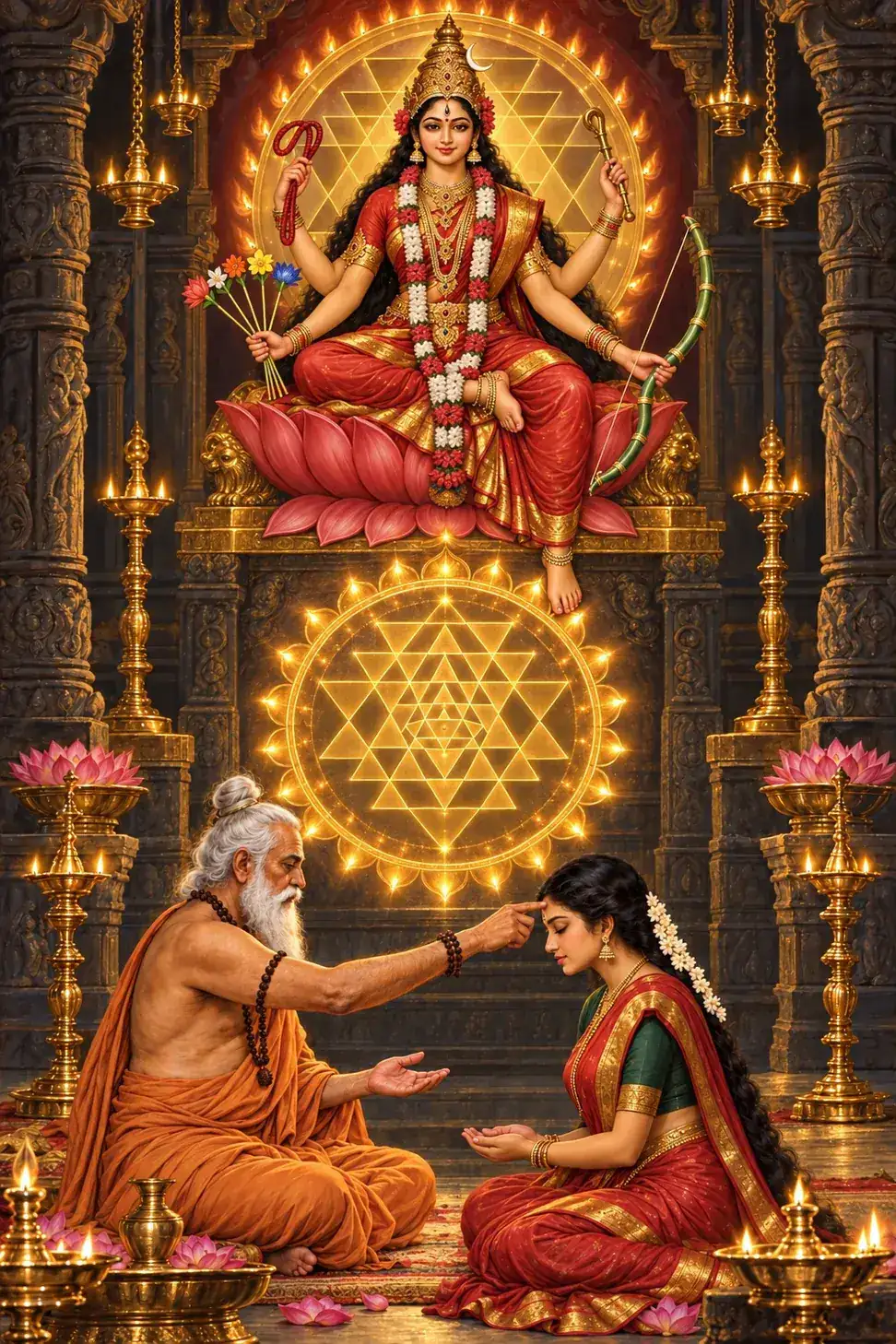
Here the remembrance of the Devi begins at the root cause of everything and descends all the way down to the chakras seated within the body. First come Mulaprakriti and Avyakta, primal nature and the unmanifest; then names such as Shivaduti, Gayatri, and Kurukulla; and at the close of the part the yoginis of the chakras, Dakini in the vishuddhi at the throat, Rakini in the anahata at the heart, and Lakini in the manipura at the navel.
Shri Vidya has two principal forms, the Panchadashakshari (the one of fifteen syllables) and the Shodashi (the one of sixteen syllables). The Panchadashakshari is public. The sixteenth syllable of the Shodashi stays hidden, and it travels from guru to disciple by oral transmission alone, one mouth to one ear. Both are remembered in the next part, in the names Shrividya (585) and Shrishodashaksharividya (587).
The fifteen syllables of the Panchadashakshari mantra fall into three clusters, the Vagbhava (five syllables), the Kamaraja (six syllables), and the Shakti (four syllables), five and six and four, and the fifteen are accounted for. Each cluster has its own consort-Devi and its own place of nyasa. Which syllable is the sixteenth of the Shodashi is still disputed among the various traditions today. The Shaiva tradition of Kashmir gives one answer, the tradition of Kanchi-Kamakoti another, and neither of them has given way.
The story of the origin of the Panchadashakshari mantra is ancient as well. Manu, Chandra, Kubera, Lopamudra, Manmatha, Agastya, Agni, Surya, Indra, Skanda, Shiva, and Krodhabhattaraka, the name Durvasa bears in this tradition: these twelve worshipers beheld this mantra in twelve distinct forms, one vision to each seer. For this reason the Panchadashi is counted as twelve vidyas.
In the Tamil land the Shri Vidya tradition of the Kanchi-Kamakoti Pitha is the most alive today. Jagadguru Chandrashekharendra Saraswati (1894-1994) gave many Tamil discourses on these names, the work of a long life, later gathered into a collection called ‘Devi Kalai’. His successor Jagadguru Shankara-Vijayendra Saraswati still spreads the practice of Shri Vidya today.
The praise rises from the root of creation. The Devi is that primal nature which is the first cause of all creation, which stays unmanifest beyond the reach of the senses, and which is present at once in both the manifest and the unmanifest. She pervades everywhere, spread through the whole cosmos, taking on countless shapes as she goes. And she becomes the very form of both vidya and avidya, knowledge and ignorance together.
Names 397 to 402
Now two vast similes arrive, and they arrive as a pair, the moon and then the sun. The Devi is the moonlight that makes the night-lotuses of Mahakameshvara’s eyes bloom. And she is that stream of sun-rays which pierces the darkness in the hearts of devotees and cuts through the gloom lying within them.
Names 403 and 404
Now a strand of names binds to Shiva, so closely that the difference between the Devi and Shiva dissolves. Her messenger is Shiva himself. Her worship is performed by Shiva himself. Her very form is Shiva made visible. She grants blessing and welfare and casts her devotees into the form of Shiva, she is the beloved of Shiva, and she is devoted to Shiva alone. Then the voice turns toward the good, those dear to the virtuous, their cherished Devi, worshiped forever by them.
Names 405 to 412
Then the names move toward the place where measure and word both fail. The Devi cannot be measured by the senses. She is self-luminous in form, radiant of her own light, and beyond the reach of mind and speech alike. She is the power of consciousness, the form of pure awareness, and by becoming maya she turns into the inert power of creation, seated as the inert world.
Names 413 to 419
Now the Devi appears as the speech of the Veda. She is the form of the Gayatri mantra, the form of the vyahritis and the presiding power of speech, present as the hour of sandhya itself, and served by the assembly of the twice-born.
Names 420 to 423
Here the strand of names turns into a great utterance. The Devi’s seat is tattva. She is the supreme truth meant by ‘tat’, that, she is Brahman, and she is the individual soul pointed to by ‘tvam’, you, and in these two names ‘tat tvam asi’, you are that, resounds, the non-difference of Brahman and the soul. Then comes a name that is itself a cry of address, Ayi, O Mother. Not every tradition divides these words the same way. And she dwells within the five sheaths.
Names 424 to 428
Now the praise turns toward the Devi’s beauty and the intoxication of bliss. Her glory is boundless, without limit of any kind, and she stays forever in the fullness of youth. She is resplendent in that intoxication of bliss, her reddened eyes turning inward as they roll in rapture, her cheeks flushed with a rosy glow. Her body is anointed with the paste of sandal, and the champa flowers are especially dear to her.
Names 429 to 435
Now the names descend straight into the kula-secret of Shri Vidya. The Devi is skilled in every act, of tender and delicate form, the Kurukulla power dwelling inside the kuruvinda gem. She is the mistress of the kula, and kula here means the triad of knower, known, and knowledge. She dwells in the kulakunda at the center of the sheath of the muladhara chakra, served by seekers absorbed in the kaula path. And she is the mother of Kumara and Gananatha.
Names 436 to 442
Now the Devi is remembered as the powers that hold a life together. She is contentment, forever satisfied. She is nourishment, the power of sustenance. She appears as the intellect, she is patience and the power to hold firm, she is peace, she is the auspicious form of welfare, she is radiance and luster, and she is the giver of joy.
Names 443 to 450
Then come the names of splendor and beauty. She destroys every obstacle. She is full of radiance, and her three eyes are the sun, the moon, and fire. Her restless eyes keep roving, and some readings after this take ‘Kamarupini’ as a separate name, the one seated as love within woman. She wears the garland, she is one with the swans, those yogis who have reached the highest spiritual state, and she is the mother of the entire universe.
Names 451 to 457
Now another cluster of sweetness of form opens. She dwells on the Malaya mountain. Her face is lovely, her body is soft as the petals of a lotus, her brows are beautiful, and she is forever luminous and radiant, the leader of the gods. She is the wife of the blue-throated Shiva, filled with luster, and she stirs a trembling in the mind, and her form is so subtle that the senses can get no hold on it at all.
Names 458 to 467
Now the Devi of the siddhas comes forward. She is Vajreshvari, the sixth Nitya-Devi, the wife of Vamadeva Shiva, free from the changes of age and of time. She is the mistress worshiped by the siddhas, she is the fifteen-syllable Siddhavidya mantra, she is the mother of the siddhas, and her fame is beyond compare.
Names 468 to 474
Now the praise descends within the body, chakra by chakra. The first stop is the vishuddhi chakra at the throat, where the Devi settles in her Dakini form. There her color is faintly reddish, she is three-eyed, arrayed with the khatvanga and the other weapons, bearing a single face, and fond of the offering of kheer. She is the presiding power of the sense of touch, terrifying to the bound creatures caught in worldly bondage, surrounded by Amrita and the other great powers, and seated there as the Dakini Devi.
Names 475 to 484
The second stop is the anahata chakra at the heart, where the Devi settles in her Rakini form. There she dwells in the anahata lotus, with the glow of a dark complexion, two faces, bright fangs, and the rudraksha garland and the rest upon her. She is the presiding power of the blood in the bodies of living beings, surrounded by the host of Kalaratri and the other powers, fond of the offering of rich food, granting boons to the great heroes, and present there as the Rakini Devi.
Names 485 to 494
The third stop is the manipura chakra at the navel, where the Devi settles in her Lakini form. She dwells in the ten-petaled lotus of the manipura, three-faced, holding the vajra and the other weapons, surrounded by Damari and the other attendant goddesses, of a red color like blood. And she is the presiding power of the flesh-element in the bodies of living beings. Here the fifth part pauses with the descent still unfinished, and the journey through the chakras moves on in the next part.