The Mantra-Body and the Ascent of Kundalini
Names eighty-five through one hundred sixty-five. The form the eye cannot reach, known through mantra and sadhana, and the movement toward the formless.
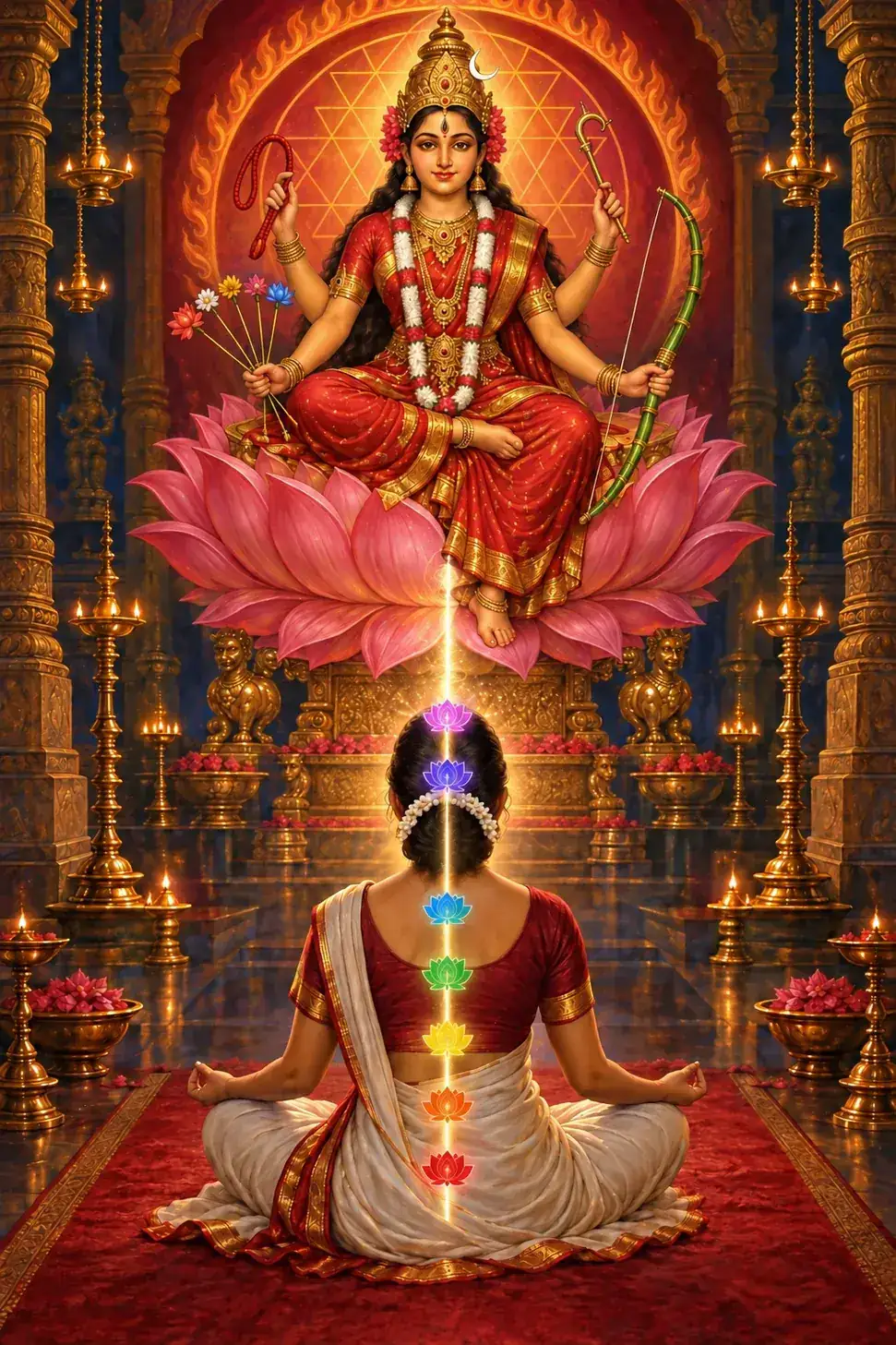
The first part held the meditation on the Devi’s embodied form, her weapons, her splendor, her face, everything an eye could rest on and a hand could point to. The second part turns its voice inward. What it describes now is the form the eye cannot reach, the one that yields to no amount of looking and opens only through mantra and sadhana.
Acharya Bhaskararaya’s Saubhagya-Bhaskara commentary reads these very names in this same order, and the reading given here follows that tradition throughout.
Names 85 to 165
The first five names open the Devi’s mantra-body. The root mantra of Shrividya is the Panchadashakshari, made of fifteen syllables, and it divides into three clusters, the three kutas. Here the Devi’s lotus-face is called the radiant Vagbhava-kuta, the region from throat to waist the middle kuta, and the region below the waist the Shakti-kuta. This is more than a head-to-toe portrait of her limbs. It lays the mantra’s three kutas onto three regions of the body, a placement (nyasa) through which the Devi and the root mantra become one thing in front of the seeker. Which is why the name that follows says the Devi is herself the form of the root mantra, and her subtle body is built out of these three kutas.
Names 85 to 89 · The Mantra-Body
Now the names descend into the current of kula. Kula here names that secret path of Shrividya whose rasa runs like nectar. The Devi delights in this kula-nectar. She guards the hidden signs by which its practice is known. She is the nobly born woman of a high kula, she dwells within the kula-lore, she presides over the kula-lineage, and she is the yogini who lives among the kulas. Six names in a row hold her inside kula, and then the seventh turns and says she is also Akula, beyond kula, holding no kula of her own, for Akula points to Shiva himself.
Names 90 to 96 · The Current of Kula
From here the inner journey of sadhana opens. The first two names lead toward the samaya path; the Devi dwells within that path and stays intent on the samayachara worship. Then the names drop straight into the ascent of Kundalini. The Devi’s chief seat is the Muladhara chakra. Waking there, she pierces the first knot, the Brahma-granthi. She rises within the Manipura and opens the Vishnu-granthi. She settles in the center of the Ajna chakra and pierces the Rudra-granthi. She mounts the thousand-petaled lotus, and from there she rains down a stream of nectar. The three granthis are the seeker’s three obstructions, and the piercing of them is the inner staircase of sadhana. From name ninety-nine through one hundred six the naming never once steps aside: one climb, told straight through, a single unbroken saga of practice.
Names 97 to 106 · From Muladhara to Sahasrara
After the climb to the Sahasrara, the names fix the subtle form of the Devi that this ascent has revealed. Her radiance flashes like a vine of lightning. She rests in the Sahasrara, above all six chakras. She is wholly absorbed in the blissful union of Shiva and Shakti. She is that same power wound in a coil. And she is as fine and as tender as the fiber inside a lotus stalk.
Names 107 to 111 · The Subtle Kundalini Form
Now the sound returns to bha, toward Bhava and bhakti. The Devi is Bhavani, the wife of Bhava, which is to say of Shiva; she is reached through the inward feeling (bhavana) of meditation alone; and she is the axe that fells the forest of samsara, laid to the root of it. The next cluster opens into blessing and devotion: she holds the auspicious dear and grants all good, she is the very image of welfare, she gives good fortune to her devotees, bhakti is dear to her, she is reached through bhakti alone, she yields to bhakti, and she drives fear away. The syllable carries the whole strand, bha after bha, until the sound and the sense arrive together.
Names 112 to 116 · Bhava and Auspiciousness
Names 117 to 121 · The Sway of Bhakti
The next strand rests on sha, on the names of Shiva’s Shakti and of peace and welfare. She is Shambhavi, the consort of Shambhu; worshiped by Sarasvati; Sharvani, the consort of Sharva; Sharmadayini, who gives joy; Shankari, the Shakti of Shankara; Shrikari, who gives Shri; and Sadhvi, the pure and devoted wife. Then three names touch form and peace again: her face shines like the spotless full moon of an autumn night, her waist is slender and shapely, and her whole being is filled with peace.
Names 122 to 126 · The Shakti of Shiva
Names 127 to 131 · Shri and Peace
From here the tone of the names turns toward negation. This long strand, its names beginning with ni and nir, points to the Devi beyond form, quality, and title, as the attributeless Brahman. She who a moment ago was made of mantra and dwelt in the chakras is now said to be bound by no limit whatsoever, and from here the naming praises her by taking things away from her, one at a time. In the first wave she rests on no support and is her own ground, unstained, free of the film of karma, spotless of every impurity, eternal and everlasting, without shape, without agitation, beyond the three gunas, and whole, without parts.
Names 132 to 140 · The First Wave of Negation
The negation moves on and deepens. She is peaceful in nature, free of desire, indestructible, forever released from worldly bonds, unchanging and free of any alteration, beyond this visible show of things, resting on no shelter of any kind, eternally pure, eternally awake, and blameless, worthy of all the praise there is.
Names 141 to 150 · Pure and Awake
The peak of this strand is Nirantara. One of its meanings is she who pervades everywhere, in whom there is no gap, in whom no division of inside and outside remains. Here the long removal turns, at the last moment, into complete pervasion: everything has been taken away, and what is left is everywhere. With that same understanding she is called free of any cause, without stain and without flaw, bound by no condition or limit, and utterly free, with no master or lord above her.
Names 151 to 155 · The Peak of Pervasion
The last cluster turns negation upon the disorders of the mind, and pairs each affliction with the name of its destroyer. She is free of passion, and she churns passion and destroys it. Free of pride, and the destroyer of pride. Free of worry. Free of ego, holding no I and no mine. Free of delusion, and the destroyer of her devotees’ delusion. Free of clinging to any thing, and the destroyer of the sense of possession and ownership. To be free of every flaw and to wipe out flaw itself, this twofold nature of the Devi brings the part to its close, and the pairing is the whole point: what she does not carry, she can take from you.