The Divine Mission and the Divine Form
Names one through eighty-four. Beginning with Shrimata; the Goddess from crown to feet, her city, and the war with Bhandasura.
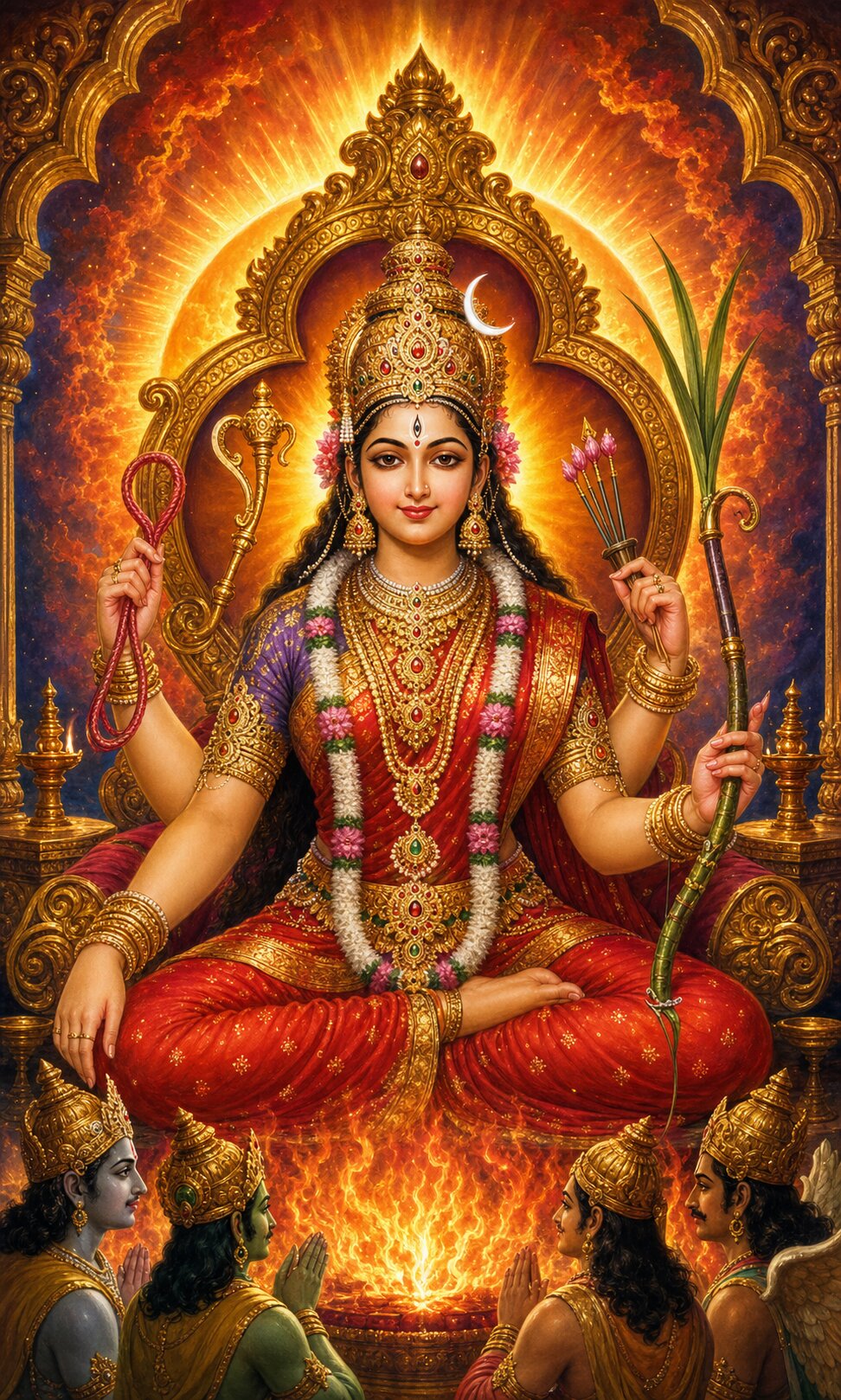
This first part of the Sahasranama holds eighty-four names, and its design unfolds on two levels. The opening names, one through eleven, declare the purpose of Lalita’s descent, and they begin where a child begins, with the mother: Shrimata, Shrimaharajni, Shrimatsimhasaneshvari. Then, from thirteen through forty-six, the naming slows and turns into portraiture, a dense account of the Goddess taken limb by limb, moving from the crown down to her feet; after that come her city of Shrinagara and, from sixty-four through eighty-four, the war with Bhandasura.
This order is more than decoration. In the Shrividya tradition the Goddess is contemplated in both directions, from the feet to the hair and from the hair to the feet, and the direction a text chooses is part of what it teaches. The Sahasranama chooses the movement from the crown toward the feet, and by the forty-sixth name that whole journey is complete.
In the traditional meditation, Lalita is seated upon a golden throne. Her four arms hold the noose, the goad, the sugarcane bow, and five flower-arrows, and those five flower-arrows stand for the five tanmatras, the subtle essences of sound, touch, form, taste, and smell. Her complexion is vermilion, the color the sun takes in the first minute of its rising. She has three eyes, a crescent moon at her crown, and a soft smile resting on her face. This form comes from the meditation verse that opens with ‘sindurarunavigraham’ (her body red as vermilion), recited before the chanting of the Sahasranama, so that the Goddess is standing in view before the first of her names is spoken.
The most authoritative commentary on the Lalita Sahasranama is Bhaskararaya’s ‘Saubhagya-Bhaskara,’ composed in Kashi in the early eighteenth century, around 1729 CE. Bhaskararaya came originally from Maharashtra, and he moved his whole life to Kashi for the sake of the Shrividya discipline and stayed there. His commentary reads these names on three levels: the gross, the subtle, and the causal. Each of the introductions below opens a group of these names through that lens.
This portrait of the Goddess across the first eighty-four names is itself a method of meditation. Rest on one name and it becomes a picture in its own right, complete in itself; take the whole group together and the pictures close over one another until the undivided form of Lalita stands there whole. where this meditation on the Goddess’s beauty unfolds from her hair to her feet. The ‘Soundarya-Lahari’ and this Lalita Sahasranama of the Brahmanda Purana are both foundational texts of Shrividya, and in both the same meditative form of the Goddess resounds alike.
Names 1 to 84
The beginning itself carries the feeling of the mother. The first name joins ‘Shri’ and ‘Mata,’ and Bhaskararaya says that this single name holds the essence of the whole Sahasranama, because the sense of the mother is the nearest of all and the most tender. In the Devi Sukta of the Rig Veda the Goddess calls herself the sustainer of the entire world, and that same sustainer stands here as the great sovereign of all creation and the mistress of the supreme divine throne. At whose command Brahma, Vishnu, and Rudra each turn to their appointed work: she is the one bowed to here in three aspects, the mother, the queen, and the presence upon the throne.
Names 1 to 3 · The threefold aspect of Shrimata
Now the story of the descent opens. When the gods performed a great yajna (a fire-rite) for the destruction of Bhandasura, Lalita rose out of that very fire-pit of consciousness. Bhaskararaya takes this fire of consciousness as a symbol of pure awareness, meaning that the Goddess has no material origin at all and rises from consciousness itself. The moment she appears her purpose is already clear: to complete the work of the gods. Her radiance is the light of a thousand suns coming up at once, the same crimson blaze that the meditation verse calls vermilion in the Goddess’s form, and which Bhaskararaya reads as a symbol of the self-luminous atman (the self).
Names 4 to 6 · Born of the fire of consciousness
Four arms hold four weapons, and Bhaskararaya links each one to a movement of the mind. In one hand is the noose of desire, which is to say the Goddess takes craving and attachment into her own grip and holds them there, brought under control on the seeker’s behalf. The second weapon, the goad, is the form of anger, and it keeps the inner corruptions in check. The third is a bow of sugarcane, the symbol of the mind, gentle to look upon, and from that gentle thing the Goddess looses the five tanmatra-arrows; this form is taken from Kamadeva, whose pride the Goddess stilled before she took up his weapons as her own. The fourth weapon is the five flower-arrows, the five tanmatras of sound, touch, form, taste, and smell, which hold the five objects of the senses under her sway. This marks the meeting of Samkhya and Tantra.
Names 7 to 11 · Four arms, four weapons
Now the meditation on the limbs begins, and it begins with the crimson splendor itself, which rises in flood until the entire cosmos lies drowned beneath it. Only after that does the gaze come to rest on her head. Her hair is adorned with champa, ashoka, punnaga, and saugandhika blossoms, four kinds of flowering worn at once, and above them sits a radiant crown studded with rows of kuruvinda gems. Her brow shines like the half-moon of the eighth lunar night, and upon that brow the musk tilak sits like the one dark mark on the moon of her face.
Names 12 to 16 · Crimson splendor, hair, and brow
Now the brows, the eyes, the nose, and the ears. The Goddess’s face is the auspicious house of Kamadeva, and her brows curve above it like the ornamental arch of that house. Her eyes are restless and lustrous, and the radiance of her face moves over them like water, so that the eyes swimming in it are fish. Her nose is lovely as a fresh champa blossom, the same flower that is already in her hair, and the ornament resting upon it puts even the brilliance of the stars to shame. One ear is graced by an ornament of kadamba blossoms, and the pair of earrings shine as though they were the orbs of the sun and the moon themselves, one hung on either side of her face.
Names 17 to 22 · Brows, eyes, nose, ears
Her cheeks outshine even a mirror cut from ruby, her lips shame the splendor of fresh coral and of the bimba fruit, and the two rows of her teeth gleam like the sprouts of pure knowledge breaking ground. The fragrance of camphor-laced betel rising from her mouth draws the very directions toward her, and the sweetness of the Goddess’s voice puts to shame even the veena in Saraswati’s hands. Then that soft smile, in whose radiance even the mind of Kameshvara Shiva goes under. And the beauty of her chin is such that no comparison can be found for it anywhere.
Names 23 to 29 · Cheeks, lips, voice, smile
Her neck is graced by the auspicious marriage-thread that Kameshvara bound there, her arms are adorned with golden armlets and bracelets, and around her throat hangs a jewel-set necklace with a pendant of pearls. What follows is described through the poet’s modest gaze. The Goddess’s breast is offered in answer to the jewel of love that Kameshvara gave her, and it appears as two fruits upon the creeper of fine hair that rises from her navel. Her waist is so slender that it nearly escapes the eye; its existence is known only by the reasoning that the creeper of hair must rest on some support. Bhaskararaya sees in this subtlety a sign of that form of the Goddess which lies beyond the grasp of ordinary sight, known by inference, the way her waist is known. The three folds on her belly are like a band that holds the waist as it bends under the weight of her breast, the region of her waist glows with a garment dyed in safflower crimson like the rising sun, and upon it rests a lovely girdle strung with jewel-set bells.
Names 30 to 38 · Neck, arms, breast, waist
Now the meditation descends toward the feet. The grace and tenderness of her two thighs are known to Kameshvara alone. Her knees are beautiful in the shape of a ruby crown, and her calves gleam like the jewel-set quiver of Kamadeva. Her ankles are hidden in their own roundness, the curve taking the joint out of sight altogether. The arch of her feet outdoes the smoothness and the beauty of a tortoise’s shell. And the light coming off her toenails covers over, wholly, the darkness of ignorance in the devotees who bow at them. The radiance of her feet defeats even the lotus in brilliance, and those blessed lotus-feet are graced by jeweled anklets that ring sweetly as she moves.
Names 39 to 46 · From the thighs to the blessed feet
Now the meditation on the limbs is complete and returns to the form as a whole. The Goddess’s gait is slow and gentle as a swan’s, she is a treasure-house of great loveliness, wholly crimson in hue, and every limb of hers is flawless and worthy of worship. Adorned with every ornament, she is seated in the lap of Shiva-Kameshvara, the conqueror of desire, and she is Shiva herself, the giver of all good, the power of Shiva. Here is a sign of non-duality, for her beloved Shiva, who conquered desire, remains forever under her own sway.
Names 47 to 54 · Gait, loveliness, the consort of Shiva
Now the description settles on the Goddess’s dwelling places, which is a meditation on the city of the Shrichakra. She is seated on the central peak of Mount Sumeru, mistress of that auspicious Shrinagara, within a mansion built of chintamani stone. Her seat is made of the five Brahmas: Brahma, Vishnu, Rudra, Ishvara, and Sadashiva. She dwells in the midst of a great lotus forest, in a grove of kadamba trees, and at the center of an ocean of nectar. And she is Kamakshi, whose eyes awaken longing, and Kamadayini, who fulfills every desire.
Names 55 to 63 · Shrinagara and the dwelling places
Now the story that opened the account returns: the war against Bhandasura. The Goddess whose own glory the hosts of gods and rishis stand praising comes down onto the battlefield, ranged with an army of Shaktis bent on the killing of Bhandasura. A herd of elephants led by the Shakti Sampatkari attends her. A host of countless horses led by the Shakti Ashvarudha surrounds her. She rides at the center of it on the chariot named Chakraraja, arrayed with every weapon. Ahead of her the minister Shyamala rides on her Geyachakra chariot, and the commander Varahi rides on her Kirichakra chariot, the two of them moving out in front of the Goddess.
Names 64 to 70 · The army of Shaktis and the three chariots
The battle grows fierce. The Shakti Jvalamalini raises a fortress of fire around the Goddess’s army, and the Goddess stands at the center of it. She rejoices in the valor of her Shaktis. She watches, eager, for the pride and courage of her Nitya goddesses. She delights in the prowess of Bala Devi as Bala sets out to slay the sons of Bhanda. When the minister Amba slays Vishanga and Varahi takes the life of Vishukra, the Goddess is pleased and satisfied by the courage of them all.
Names 71 to 76 · The fortress of fire and the courage of the Shaktis
Now the height of victory. When Bhandasura loosed the Vighna-yantra, the engine of obstacles, the Goddess turned a single glance toward the face of Kameshvara and brought forth Shri Ganesha out of it, and Mahaganesha shattered that yantra, which filled the Goddess with great joy. Against every weapon Bhandasura loosed she rained down counter-weapons, and from the nails of her fingers she brought forth the ten avatars of Narayana. Then the fire of the great Pashupata weapon reduced the army of demons to ash, and the Kameshvara weapon burned Bhandasura himself and his city Shunyaka to ash. The gods, Brahma, Vishnu, Indra, and the rest, praise her glory. And at the end of all of it she is compassion itself, becoming the life-restoring herb for Kamadeva, who had been burned to ash by the fire of Shiva’s third eye, and giving him life once more.