Consonance with the Vedanta Vision
Names 701 to 800. Being-consciousness-bliss, the knowledge of Brahman, made of pure reality.
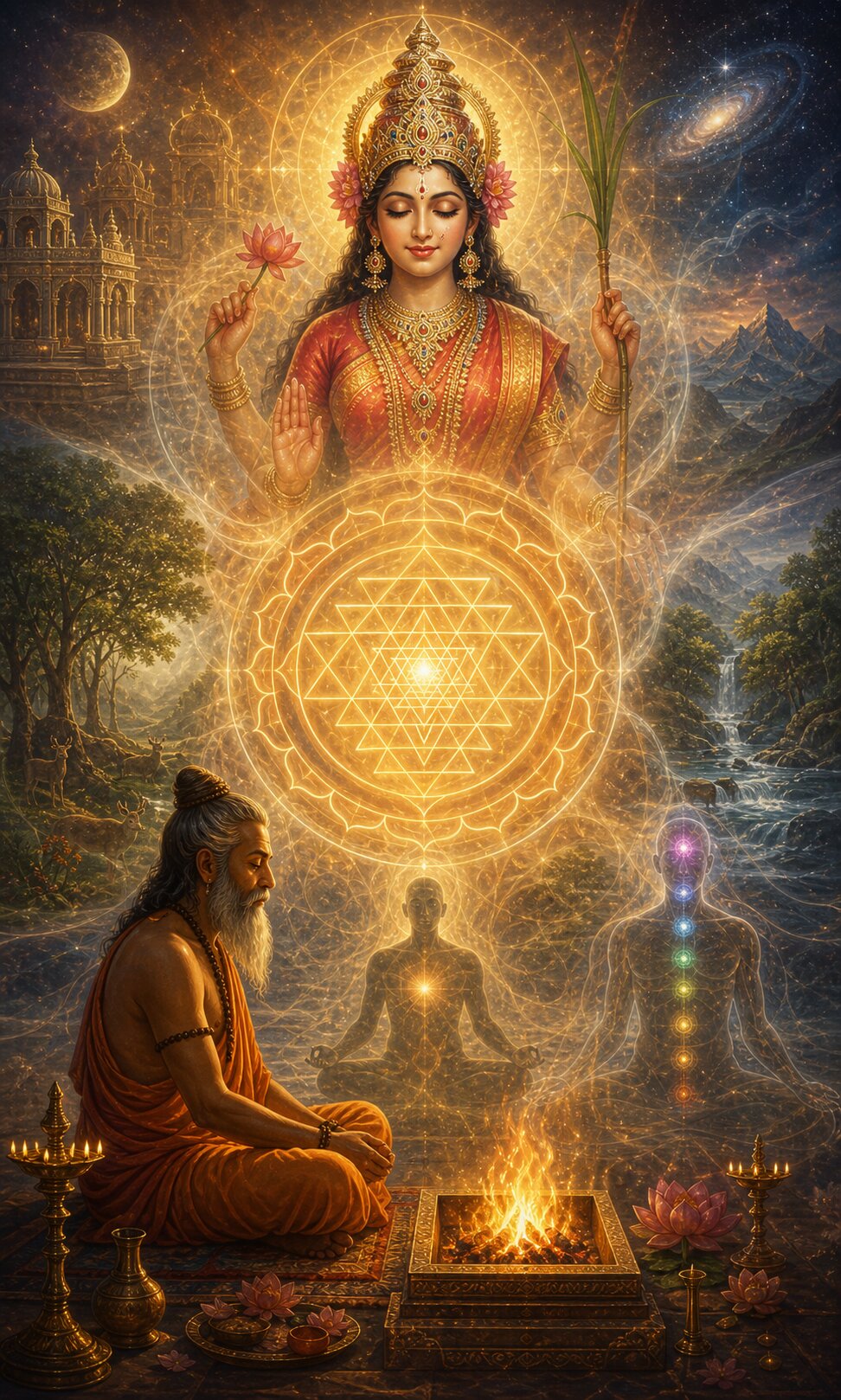
The eighth part sits where Srividya tantra and Advaita Vedanta come to the same landing on the river. Here the Devi’s true nature opens in the very vocabulary that the Upanishads reserve for Brahman. From ‘देशकालापरिच्छिन्ना’, unbounded by space or time, to ‘सत्यज्ञानानन्दरूपा’, whose form is truth, knowledge, and bliss, many of the names past seven hundred speak the language of being, consciousness, and bliss, of the atman (the self), of vijnana (deep knowing), and of chit-kala, the ray of pure awareness.
In the Srividya tradition the Devi is the para-samvit itself, the supreme consciousness that Vedanta calls Brahman, and being worshiped is only one face of her. For this reason the names in this part deliver Brahmavidya, the knowledge of Brahman, in the language of devotion, and in a name like ‘मिथ्याजगदधिष्ठाना’ the Advaita doctrine rings out directly: this visible world is mere appearance, and its ground is that one consciousness alone.
Bhaskararaya’s ‘Saubhagya-Bhaskara’ commentary opens these names from exactly this vantage, where Shiva as prakasha, pure light, and Shakti as vimarsha, self-awareness, are two sides of one truth. Below are the hundred names from seven hundred one to eight hundred, carried along by a commentary that pauses and flows again.
Names 701–800
The opening itself sets out from the boundless. The first names declare that the Devi is held by no region and gauged by no time, and even so she pervades all things, keeping every living being wrapped in delusion by her maya. She is Saraswati, the form of discernment and clear insight; she is the one whose very body is scripture, holding all of Agama and Nigama; she is the mother of Skanda; and she is the secret one seated in the cave of the heart, whose nature no easy glance can ever seize.
देशकालापरिच्छिन्ना · सर्वमोहिनी
Now comes the introduction of the supreme reality that carries no attribute. The Devi stands untouched by any limit of name or form; her devotion rests in Sadashiva alone; and as sovereign of the sacred guru lineages she guards the knowledge of the tradition. Evenness and peace are her nature. Then the hidden layer of mantra opens, where she appears as the seed-syllable ‘ई’ of the Srividya mantra, the syllable that holds the kamakala within it, and she becomes the form that contains the entire circle of gurus.
सर्वोपाधिविनिर्मुक्ता · गुरूमण्डलरूपिणी
The names that follow carry you past the senses. The Devi is beyond the kula, the assembly of the senses; she is worshiped in secret within the orb of the sun; and she is maya itself, through which the one Brahman comes to look like many. Her nature is sweet as honey, and she is also ‘मधुमती’, that honeyed stage of samadhi. Then she becomes the earth and bears all beings, she is the mother of Shiva’s ganas, and she stands as the one the Guhyaka deities adore.
कुलोत्तीर्णा · गुह्यकाराध्या
Tenderness and freedom move together here. The Devi’s limbs are delicate; the gurus are dear to her and she is dear to the gurus; and still she leans on no one, the independent one who creates all things by her own will alone. As sovereign of every tantra she appears in the form of Dakshinamurti, who imparts self-knowledge through silence alone, and as the ever-celibate rishis like Sanaka and Sanandana worship her, she is Brahmavidya embodied, whom only the wise can truly worship.
स्वतन्त्रा · सनकादिसमाराध्या
Here the heart of the part beats, the consciousness that speaks in the language of Vedanta. The Devi is the one who grants the knowledge of Shiva; she is the chit-kala, the ray of awareness set in Brahman, by which even inert matter lights up; and she is the bud of bliss ready to open, bursting forth as the bliss of Brahman. She is the form of pure love, the giver of what her devotees long for, pleased by the mere recitation of her names.
चित्कला · नामपारायणप्रीता
Now the rhythm of dance and liberation is set, and at its center shines the Advaita name on which the whole part rests. The Devi presides over the Nandi mantra; she is Natesvari, wife of the dancing Shiva; and she is ‘मिथ्याजगदधिष्ठाना’, the one truth on which this entire visible world rises like a mere appearance. She grants liberation, and she is the very form of liberation. The lasya dance is dear to her; she is the one who, at the dissolution, gathers all creation back into herself; and she dwells in living beings as modesty too.
मिथ्याजगदधिष्ठाना · लज्जा
After this comes the famous garland of metaphors, where every name turns into a picture. Worshiped by Rambha and the other apsaras, the Devi is a rain of nectar on the wildfire of worldly existence, the fire that burns down the forest of sin, and the fierce wind that carries off the cotton-wisp of misfortune. She is the ray of sun that clears away the darkness of old age, and the full-moon light that swells the ocean of good fortune.
भवदावसुधावृष्टिः · भाग्याब्धिचन्द्रिका
The garland of metaphors deepens. The Devi is the dense monsoon cloud that sets the peacocks of her devotees’ minds dancing, the thunderbolt that shatters the mountain of disease, and the axe that cuts the tree of death out by its root. Then the pitch rises, and from the supreme sovereign Mahesvari she becomes Mahakali, appearing as the destroying power of Mahakala, the one who at the dissolution swallows even the great elements, taking in all that is great as her food.
भक्तचित्तकेकिघनाघना · महाशना
Turning from the note of destruction toward story, the names touch the austerity of Parvati and the valor of Chandi. She is Aparna, who gave up even leaves as food; she is Chandika, who breaks out in fierce wrath against the wicked; and she is the slayer of the asuras Chanda and Munda and their kind. Then the gaze returns to first principles, where she holds within herself both the perishable world and the imperishable Purusha, the self of the mutable and the immutable alike, sovereign of all the worlds, and bearer of the entire universe.
अपर्णा · विश्वधारिणी
Now a line of names that grant boons and turn on threes. The Devi bestows dharma, artha, and kama, the three human aims; she is the resting place of all good fortune; she is Tryambaka, three-eyed, her eyes the sun, the moon, and fire; and she is the essence of the three gunas, sattva, rajas, and tamas. Heaven and moksha are both in her hands; she herself is supremely pure; and her body glows with a red radiance like the hibiscus flower.
त्रिवर्गदात्री · जपापुष्पनिभाकृतिः
Names of vigor, of yajna (fire-rite), and of vows arrive. The Devi is full of vital force and blazing strength; she carries brilliance and luster; she is the ground of every yajna, the form of the fire-rite itself; and she is the one who delights in steadfast vows. Her worship is not easy: she is won only by rites performed exactly as prescribed, and she is the unassailable one whom none can overpower.
ओजोवती · दुराधर्षा
Among flowers, mountains, and sound, the cosmic form rises. The Devi loves the pale red blossoms of the patali; she is the great one, appearing as the sound of Narada’s veena ‘महती’; she dwells on Mount Meru; she loves the divine flowers of the mandara; and she is worshiped by the heroic seekers. Then she becomes the vast form that makes the whole cosmos her gross body, free of rajas, the consciousness that faces every direction at once.
पाटलीकुसुमप्रिया · विश्वतोमुखी
From the vast the gaze narrows to the indwelling self. The Devi is the pratyagatman seated within everyone, and at the same time the supreme space of consciousness that is the material cause of both the body and the cosmos. She gives prana, and she is the very form of prana pulsing in every breath; she is worshiped by Martanda-Bhairava in the form of the sun; and she is the untroubled empress who has handed the burden of the realm to her minister Shyamala.
प्रत्यग्रूपा · मन्त्रिणीन्यस्तराज्यधूः
Now the part climbs toward its summit, where royal splendor and the attributeless Brahman are spoken in a single breath. The Devi is sovereign of Tripura, whose army knows only victory, and even so she is beyond the three gunas, the one who transcends every quality, both para and apara, present in form and formless alike. Here the declaration that the Upanishads repeat rings out: the Devi is the form of truth, knowledge, and bliss, resting in that equipoise where the difference between the higher and the lower dissolves and Shiva and Shakti become a single rasa.
त्रिपुरेशी · सामरस्यपरायणा
The part closes on art and on rasa. Kapardini, wife of the matted-haired Shiva, wears the sixty-four arts like a garland; like the wish-cow Kamadhenu she fulfills every desire; and she is Kamarupini, who takes on any lovely form she wishes. She is the treasury of all the arts, the very art of poetry, the connoisseur of every rasa, and at the last the inexhaustible storehouse of rasa that holds both the rasa of poetry and that supreme bliss-rasa of the Vedantic ‘रसो वै सः’, for he alone is rasa. On this treasure-house of rasa the eighth part comes to rest.