Beyond the Gunas, the Formless Nature
Names eight hundred one to nine hundred. Beyond maya, free of every construct.
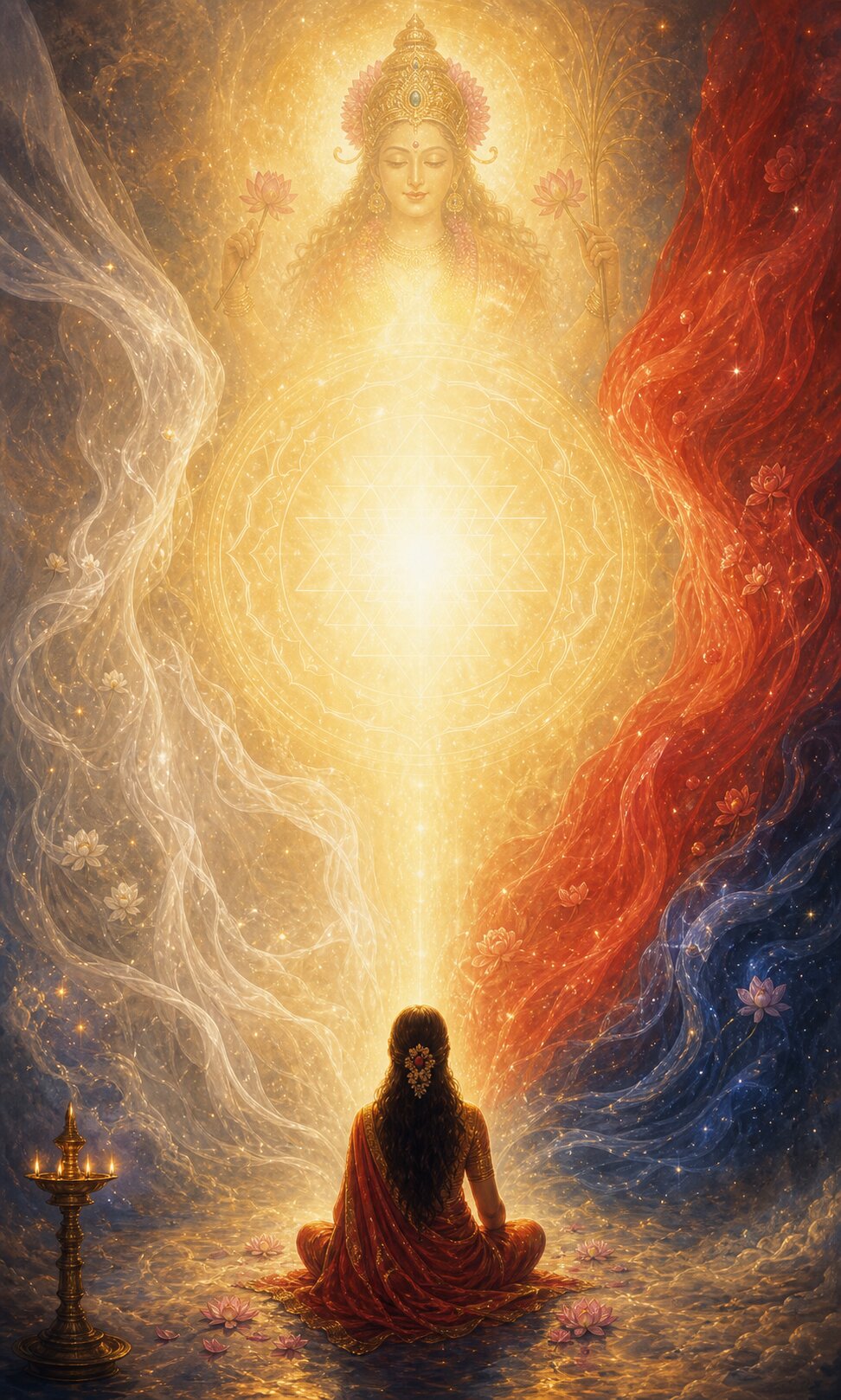
The ninth part leans toward the Goddess in her formless aspect. Here, name after name, her state of transcendence stands revealed, past maya, past the three gunas, and past every act of imagining.
This part stands very close to the turiya principle of the Mandukya Upanishad. Here is the highest summit of the Shrividya tradition, where the Goddess no longer remains a personality wearing a form and becomes the state of pure principle.
In the Shaiva philosophy of Kashmir, the doctrine of spanda underlines just this kind of harmony between the formless and the formed. Utpaladeva and Abhinavagupta understood Shrividya on exactly this philosophical ground. Even today this contemplation of first principles is alive in certain traditions of Kashi and Pune.
In the ninth part the words ‘gunatita’ (beyond the gunas) and ‘nirguna’ (without attributes) return again and again and take on a philosophical standing. Lalita is beyond all three gunas, sattva, rajas, and tamas. This state beyond the gunas was opened by Krishna in the fourteenth chapter of the Bhagavad Gita and by Shankaracharya in the Vivekachudamani.
Across the cluster of words from name eight hundred one to nine hundred, one feature emerges. The prefix ‘maha-‘ attaches again and again and becomes a marker of the Goddess’s infinity. This dense line of formless names carries the Goddess past cause and effect, past birth and death, and past imagining, past all three.
Among modern Tamil poets, Subramania Bharati (1882-1921) recalled these names again and again in his poems to the Goddess. Bharati was not a Shrividya practitioner, yet in his poetic vision this form of the Goddess beyond the gunas stayed at the center.
Names 801,900
The first wave opens the Goddess through fullness and antiquity. She is forever nourished and filled with strength, the most ancient being, present from the first age, worthy of everyone’s worship. Complete in herself, she nourishes all, and her eyes are like the petals of a lotus. Then the names rise toward the supreme principle. She is the form of the highest light, the supreme refuge and the ultimate abode, the finest of the fine and the very form of the atom, and the best among the best, higher even than the highest. A noose graces her hand, and holding that same noose she destroys our bonds and pierces the malevolent spell-mantras of enemies.
The next wave moves between the embodied and the formless. The Goddess takes on visible form, and she is also the formless one who holds no fixed shape at all. Even a fleeting offering from us satisfies her, and she wanders as the swan gliding over the mind-lake of the sages. Then comes the line of truth. She stands firm in truth, she is truth’s own form, she dwells inside all as the inner ruler, and she is the eternal being whose nature is pure existence. Here she becomes the power of Brahman and the ground of all, she is Brahman itself, she is the mother of all, and she appears in many forms.
Now the Goddess rises as the one who sets creation in motion and the mistress of the life-breaths. The wise worship her, she is the one who gives birth to the whole universe, she is the fierce one filled with a splendor that stirs awe, she is the divine command itself, and she is the establishment and the ground-foundation of all. She has appeared as the form of the universe, she is the mistress of the five life-breaths and the senses, and she is the giver of that same life-force. She stands as the fifty seats of worship, she is free in every way and bound by nothing, and she dwells in solitary, secluded places.
This wave binds together heroism, liberation, and the original nature. The Goddess is the mother of heroes, the mother of the element of sky, the one who grants liberation, and herself the dwelling place of liberation. She is the original embodied form of all creation, she knows every feeling and every movement of the mind, she destroys the disease of worldly existence that takes the shape of birth and death, and she is also the one who turns the wheel of that existence. Then comes the line of word and essence. She is the essence of all the Vedas, the essence of all the shastras, the essence of all the mantras, and she appears in an image of slender belly and slender waist.
Here the names rise from fame and splendor and cross even the boundary of peace. The Goddess’s fame is lofty and far-reaching, her splendor and power are without limit, and she stands in the form of the letters of the alphabet. She gives rest and peace to those scorched by birth, death, and old age, all the Upanishads sing her praise, and she is the one whose essence is the art that lies beyond the state of peace itself. Then comes the line of depth and sky. She is fathomless and profound, she dwells in the open space within the sky, she takes pride in her own majesty, and she delights in song.
Now the summit of the formless comes closest. The Goddess is free of imagined qualities and free of the mind’s constructions, she is the supreme final limit beyond which nothing lies, and she puts an end to all sin and sorrow. She is half of the body of her beloved, Shiva, she is released from the bondage of cause and effect, she ripples with the joy of nearness to Kameshvara, and she wears ear-ornaments of gleaming gold. Then comes the line of play and the unborn. In her play she takes on many divine forms, she is unborn, wholly free of decay and diminishment, she enchants in her own beauty, and she is quick to grow pleased.
This wave binds together the inward practice and the threefold nature. The Goddess is worshiped within the mind by those who turn inward, and she stays very hard to reach for those whose bent is outward. She is the form of all three Vedas, the dwelling of the three human aims of dharma, artha, and kama, present in all three worlds, and she is Tripuramalini, the presiding power of the inner ten-triangle chakra of the Shrichakra. Then comes the line of self-reliance and nectar. She is free of every kind of disease, she leans on no support and is her own ground, she delights in her own true self, she is the wellspring of the stream of nectar, and she is skilled at lifting out those sunk in the mud of worldly existence.
Now comes the line of yajna, dharma, and abundance. The Goddess loves the yajna (fire-rite) and the other rituals, she is herself the one who performs the act of yajna, and she is also the form of the yajaman, the patron who conducts it. She is the ground of dharma and right conduct, the overseer of all wealth, and she increases wealth and grain. The learned brahmins are dear to her, she stands in the very form of the brahmin, and by her power of maya she sets the universe turning. At the time of dissolution she swallows the whole universe, and her glow is red like coral.
The final wave closes the part on the summit of the formless. The Goddess is the power of Vishnu, she pervades the whole universe in the form of Vishnu, she is without origin and without cause, and she is also the root-place of every origin. She stays unmoved and unchanging like an anvil, she is the presiding power of the Kaula path, the assembly and fellowship of heroes is dear to her, and she is herself full of valor, the very form of prowess. At the last she is beyond action, actionless in nature, where both the sense of doership and the bondage of action fall silent. The part rests on this state of actionlessness.