On this page
Kunti begins the tale of Vidula: a mother stands over a son who has lost to the king of the Sindhus, and tells him to blaze for a moment rather than smoke forever
Krishna had come to take his leave, and Kunti had a message for her sons. She did not deliver it as a message. She reached instead for a story so old that its edges had worn smooth, and she set it in front of him the way a woman sets a lamp in a doorway, so that whoever passes will see by it. “In this connection, chastiser of foes,” she said, “an old story is told of a conversation between Vidula and her son. Whatever can be gathered from it, or anything more useful than it, you should say to Yudhishthira.” Then she told it, and everyone who has ever read the Mahabharata has understood that the queen of the Kurus was holding up a mirror and speaking into it.
There was once a woman of high birth named Vidula. She saw far ahead, she was famous, she was quick to anger and not entirely straight in her ways, and she was devoted to the duties of the warrior order. She had been well taught, every king on earth knew her name, and she had listened to the speeches and instruction of learned men of many kinds. Her son Sanjaya had gone to war against the king of the Sindhus and had lost, and he now lay on the ground with a heart flattened by despair. One day Vidula came and stood over him. What she said was not consolation. “You are not my son,” she began, “you who increase the joy of our enemies. Neither I nor your father begot you. Where have you come from? A man without anger cannot be counted a man at all. Your features betray you as a eunuch. Will you sink in despair for as long as you live? If you want your own welfare, take the burden of your affairs onto your own shoulders. Do not disgrace your soul. Do not let it be satisfied with a little. Set your heart on your own good and stop being afraid. Give up your fears. Rise, coward. Do not lie there after your defeat, delighting every enemy and grieving every friend, stripped of all sense of honor.”
Then came the images, one after another, that made this speech one of the epic’s permanent possessions. “Small streams are filled by a little water. A mouse’s palms are filled by a few grains. A coward is content with small gains. Better to die pulling the fangs from a snake than to die miserably like a dog. Put forth your strength even at the risk of your life. As a hawk ranges the sky without fear, so should you range without fear, or strike, or watch your enemy in silence for the opening. Why do you lie there like a corpse, like a man struck by lightning? Rise, coward. Do not sleep after the enemy has beaten you. Do not vanish from everyone’s sight in this wretched way. Make yourself known by your deeds. Never take the middle place, the low place, or the lowest. Blaze up like a well-fed fire. Like a brand of tinduka wood, blaze even for a moment, and never smolder without a flame like a fire of paddy chaff. It is better to burn for one moment than to smoke forever. Let no son be born in a royal house who is either too fierce or too mild. A brave man goes to the field, does every great thing a man can do, and is freed from the debt he owes to the warrior’s duty. Such a man never disgraces himself. Whether he wins his object or not, the man of sense does not grieve. He does what must be done next and does not count the cost in life. So, my son, either show your strength or go to the end that cannot be avoided. Why do you live at all, disregarding the duties of your order? Your rites are gone, eunuch, and your achievements with them. The very root of your enjoyments is cut. What are you living for? If a man must fall and sink, let him seize his enemy by the hips and take him down too. Even with his roots cut, a man should not give in to despair. Horses of good blood put out all their strength to drag or carry a heavy load. Remember them, gather all your strength and every scrap of your honor, and know what your manhood consists of. Work to raise the house that has sunk because of you.”
She did not stop. “A man who has done no great deed that people talk about only adds to the population. He is neither man nor woman. A man whose fame does not rest on charity, austerity, truth, learning, and the gathering of wealth is nothing more than his mother’s excrement. The man who surpasses others in learning, austerity, wealth, valor, and deeds is the real man. You must not take up the idle, wretched, infamous, miserable trade of begging, which suits only a coward. Friends get no joy from a weak friend whose sight delights his enemies, whom men despise, who has neither seat nor robe, who is content with little, who is destitute, who has no courage, who lies low. Alas, driven from our kingdom, driven from our home, stripped of every means of pleasure and every resource, we shall die for want of the bare means of life! You who misbehave among the good, you destroyer of your line and your family, Sanjaya, in bearing you I have borne Kali himself in the shape of a son. Let no woman bear such a son, without anger, without effort, without energy, the joy of his enemies. Do not smolder. Blaze up and show your strength. Kill your enemies. For a moment, for the smallest space of time, blaze on the heads of your foes. The man who holds his anger and does not forgive is a man. The one who forgives and feels no anger is neither man nor woman. Contentment and softness of heart, and these two, want of effort and fear, destroy prosperity. Whoever makes no effort never wins anything great. So free yourself, son, by your own exertion, from these faults that lead to defeat and ruin. Harden your heart and set out to recover what is yours. A man is called purusha because he can trouble his enemy, the para, and whoever lives like a woman wears that name falsely. A brave king of great strength who moves like a lion may go the way of all creatures, and the subjects of his realm still do not fall into misery. The king who disregards his own comfort and pleasure and seeks the prosperity of the kingdom soon gladdens his counselors and his friends.”
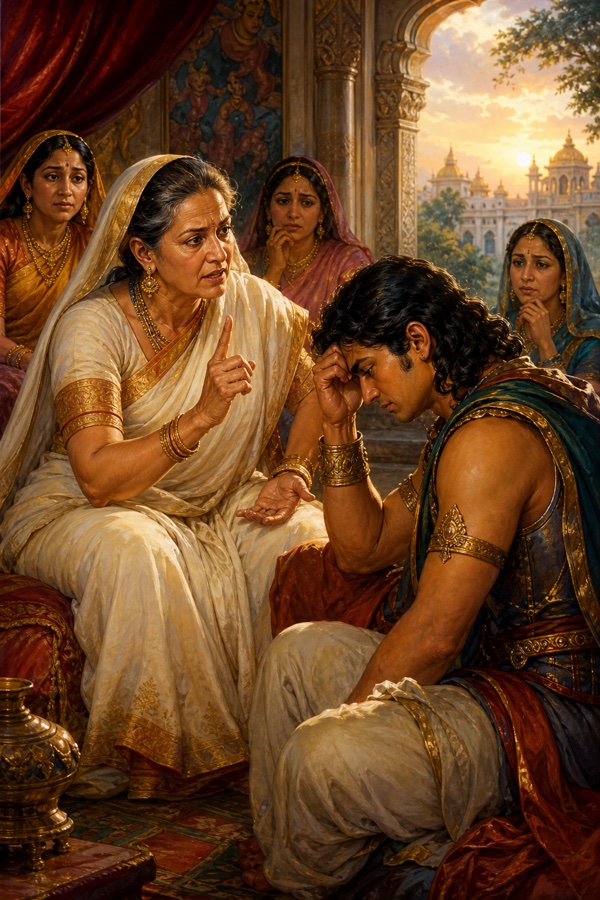
For the first time the son spoke, and what came out was the wound of a child. “If you do not see me,” he said, “what use is the whole earth to you, what use your ornaments, what use every means of pleasure, what use life itself?” His mother answered him without softening. “Let our enemies win the regions that belong to the low. Let our friends go to the regions that the honored obtain. Do not take up the way of life of those wretches who, without strength, without servants and attendants to do their bidding, live on food that others provide. As the creatures of the earth depend on the clouds, and the gods depend on Indra, let the Brahmins and your friends depend on you for their living. A man’s life is not wasted, Sanjaya, when all creatures depend on him for their sustenance the way birds gather on a tree heavy with ripe fruit. The life of a brave man is worth praising when his friends draw happiness from his strength as the gods draw happiness from the strength of Shakra. The man who lives in greatness on the strength of his own arms wins fame in this world and a blessed state in the next.”
A key to reading this (two men named Sanjaya, and a mother speaking through another mother): The Sanjaya of this tale is Vidula’s son, the prince beaten by the king of the Sindhus. He is a different person from Dhritarashtra’s charioteer Sanjaya, who has already carried messages to Upaplavya and back in this same book. Kunti chooses the story because it says, in another woman’s voice, exactly what she needs said to sons who have been driven from their kingdom and are living on what others give them. Every line Vidula speaks to her son is a line Kunti is speaking to hers.
The gist: As Krishna takes his leave, Kunti sends her message to Yudhishthira in the form of an old story. Vidula’s son Sanjaya lies broken after his defeat by the king of the Sindhus, and his mother stands over him and tells him that a man without anger is no man, that dying while pulling a snake’s fangs beats dying like a dog, that a brand of tinduka wood burning for one moment is better than paddy chaff smoking forever, and that a man nobody talks about only adds to the population. When the son asks what the earth would be worth to her without him, she answers that the only life worth living is one that others lean on the way birds settle on a tree full of fruit.
Vidula speaks a second time: “Your name is Sanjaya, do not make it a lie,” poverty as a form of death, and the warrior who may break at every joint before he bends
The son said nothing, and Vidula began again. “If, having fallen this far, you mean to give up your manhood, then in no time at all you will be walking the road that the low and the wretched walk. A warrior who, out of love for his own life, does not put out his energy to the full measure of his strength and courage is counted a thief. Alas, like medicine poured into a dying man, these words of grave import, proper and reasonable as they are, make no mark on you at all! It is true that the king of the Sindhus has many followers. They are all discontented. Out of weakness and ignorance of the proper means, they are waiting for their master to fall into trouble, since they cannot free themselves by their own effort. His open enemies will come to you with their auxiliaries the moment they see you show your strength. Join with them, take refuge now in a mountain fastness, and wait for the season when calamity overtakes him, as it must, since he is free from neither disease nor death.”
Then she turned his own name against him. “By name you are Sanjaya, the victorious. I see no sign of it in you. Be true to your name. Be my son. Do not make your name a falsehood. When you were a child a Brahmin of great foresight and wisdom looked at you and said, ‘This one will fall into great distress and win greatness again.’ Remembering his words, I hope for your victory. That is why I tell you this, son, and I will tell you again and again. The man who pursues his aims by the ways of policy, and for whose aims other people strive with their whole heart, is always sure of success. Whether what I have is kept or lost, I will not turn back: with that resolve, Sanjaya, learned one, go into the war and do not withdraw from it. Samvara has said that there is no more miserable state than the one in which a man worries about his food from one day to the next. Such a state has been called worse than the death of a husband and sons. What people call poverty is only a form of death.”
And now, for the first time, her own life came into her voice. “As for me, born in a high house, I was transplanted from one lake into another. I had every auspicious thing, my husband honored me, and my authority ran over everyone. Living among friends, our friends used to see me wearing costly garlands and ornaments, bathed, dressed in fine robes, always cheerful. When you see me and your wife grown thin from want of food, Sanjaya, you will hardly wish to live. What use will life be to you when you see all our servants, our teachers, our household priests and the priests we call for special rites, leaving us because there is nothing to feed them? If I no longer see in you the praiseworthy, famous deeds you used to do, what peace can my heart know? If I ever have to say no to a Brahmin, my heart will burst, because neither I nor my husband ever said no to a Brahmin. We were the refuge of others, and we never took refuge with anyone. Having been that, if I have to keep my life by depending on someone else, I will throw my life away. Be our means of crossing this ocean that is so hard to cross. Where there is no boat, be our boat. Where there is no ground, make ground for us. We are dead. Bring us back to life. You are equal to every enemy if you do not cling to life. If instead you choose the kind of life that suits a eunuch, then with a troubled soul and a sunken heart, it would be better for you to give up your life.”
“A brave man wins fame by killing even a single enemy,” she went on. “By killing Vritra, Indra became the great Indra and won the sovereignty of all the gods, the cup for drinking soma, and the lordship of every world. When a hero proclaims his name in battle, challenges his enemies in his steel armor, grinds down or kills the foremost warriors of the hostile ranks, and wins far-reaching fame in a fair fight, his enemies are pained and bow down to him. Cowards become helpless and, by their own conduct, hand every object of desire to the skilled and brave men who fight without regard for their lives. Whether kingdoms are overtaken by ruin or life itself is in danger, the noble never stop until they have wiped out every enemy within reach. Sovereignty is either the door of heaven or amrita itself. Regard it as one of those two, remember that the door is now shut against you, and fall among your enemies like a burning brand. King, kill your enemies in battle. Observe the duties of your order. Do not let me see you cheerless, you who increase the fear of your enemies. Do not let me see you standing in misery, with us grieving around you and your enemies rejoicing. Rejoice, son. Be happy in the possession of wealth in the company of the daughters of the Sauviras, and do not, out of weakness of heart, let the daughters of the Saindhavas rule over you. If a young man like you, with beauty of person, learning, high birth, and fame across the world, behaves in this unseemly way, like a vicious bull that will not carry its load, then to my mind that is the same as death. What peace can my heart know if I see you speaking words of praise for other men or walking behind them? No one born in this house has ever walked behind another. Son, you must not live as a dependent on anyone.”
She finished with the essence of the warrior’s law as she had learned it from the old and the older still. “I know what the eternal substance of the Kshatriya duties is, as the elders spoke of it, and the elders before them, and those who came later and later still. It is eternal and unswerving, and the Creator himself ordained it. A man born a Kshatriya in a high house in this world, who has learned the duties of that order, never bows down to anyone on earth from fear or for the sake of a living. He should stand erect with courage and never bend, because exertion is manhood. He should break at the joints before he yields to anyone in this world. A high-souled Kshatriya should always roam like an elephant in rut. He should bow to Brahmins alone, Sanjaya, and to them for the sake of virtue. Over every other order he should rule, destroying all who do evil. With allies or without them, that is how he should be for as long as he lives.”
The gist: Vidula’s second speech carries her own life inside it: the queen who wore garlands and fine robes, who never once said no to a Brahmin, and who would rather die than live on another’s charity. She turns her son’s name against him (Sanjaya means the victorious), reminds him of a Brahmin’s prophecy that he would fall and rise again, and lays out the policy for his return: gather the discontented followers and open enemies of the Sindhu king, take refuge in the mountains, and wait for his misfortune. She holds up Indra, who became great by killing Vritra, calls sovereignty either the door of heaven or amrita, and closes with the warrior’s law as the elders taught it: break at every joint before you bend to anyone, and bow only to Brahmins, and only for the sake of virtue.
The son answers back, “Your heart was beaten out of iron,” and his mother replies that effort has two possible outcomes while idleness has only one
Until now Sanjaya had asked one question and gone quiet. The second speech stung him into speech of his own, and Kunti told Krishna what the son said. “Ruthless and angry mother, you who hold the heroism of battle so high, your heart was surely made of iron beaten into that shape. Shame on the Kshatriya practices that make you push me toward war as though I were a stranger to you, and for whose sake you speak to me, your only son, as though you were no mother of mine. If you do not see me, if you are cut off from me, your son, then what use to you is the whole earth, what use all your ornaments and every means of enjoyment, what use life itself?”
His mother did not flinch. “All the acts of the wise, my son, are undertaken for the sake of virtue and profit. With my eye on those two alone, Sanjaya, I urge you to battle. The hour for showing your strength has arrived. If at such an hour you do not act, then, despised by the people, you will do the thing most hateful to me. If you are about to be stained with infamy and I, out of affection, say nothing, then that affection is worthless and senseless, like a she-ass’s love for her foal. Do not walk the road the wise reject and the fool takes. Ignorance in this world is vast, and creatures without number have taken shelter in it. If you take up the conduct of the wise instead, you will be dear to me. If you rely on virtue and profit, if with God above you trust in human effort, if your behavior becomes like that of the good, then by this means and no other you will be dear to me. The man who delights in well-instructed sons and grandsons enjoys a real delight. The man who delights in a son who is without effort, unruly, and evil in mind does not gain the very thing for which a son is wanted. Those worst of men who never do what is proper and always do what deserves blame find no happiness here or hereafter. A Kshatriya, Sanjaya, was created for battle and victory. Whether he wins or dies, he gains the realm of Indra. The happiness a Kshatriya wins by bringing his enemies under his power has no equal even in heaven, in Indra’s sacred realm. A Kshatriya of great energy, burning with anger, though defeated many times, should wait for his chance to defeat his enemies. Without either throwing away his own life or killing his enemies, by what other course could he find peace of mind? A man of wisdom regards anything small as disagreeable. The man to whom something small becomes agreeable finds that small thing turning into a source of pain. The man who lacks what he wants soon turns wretched, feels every want, and is lost like the Ganga when it enters the sea.”
The son tried once more to stop her. “Mother, you should not put such views before your son. Show him kindness now, and stay beside him like a silent, speechless creature.” She answered, “It gives me great satisfaction that you say so. I, who might have been urged by you to my duty, am being urged by you. So I will urge you further toward what you must do. I will honor you on the day I see you crowned with complete success after the slaughter of all the Saindhavas.”
Then Sanjaya said the thing that had been lying under all his silence. “Without wealth, without allies, how can success and victory be mine? Knowing my own wretched condition, I have myself given up the desire for the kingdom, the way a sinner gives up the desire for heaven. So, mother of mature wisdom, if you see any means by which all this could be done, tell it to me fully, since I ask, and I will do all that you command.” His mother said, “Do not disgrace your soul, son, by anticipating failure. Things never gained have been gained, and things gained have been lost. The accomplishment of an aim should never be sought with anger and folly. In every act, son, success is always uncertain. Knowing that it is uncertain, people still act, and so they sometimes succeed and sometimes do not. Those who abstain from action never succeed at all. Where there is no effort there is only one result, the absence of success. Where there is effort there are two, success won or success missed. The prince who has settled in advance that every act is uncertain in its result has made both success and prosperity unattainable for himself. This will come to pass: with that belief a man should throw off all sloth, exert himself, wake up, and set his hand to every task. The wise king who performs every auspicious rite, keeps the gods and the Brahmins on his side, and then engages in action soon wins success. As the sun embraces the east, the goddess of prosperity embraces him.”
And then she taught him statecraft, the lesson a king’s minister would teach. “I see that you have shown yourself fit for the suggestions, the means, and the encouraging words you have had from me. Now display your strength. It is right for you to win your object by every exertion. Bring over to your side those who are angry with your enemy, the covetous, those he has weakened, those who envy him, those he has humiliated, those who challenge him constantly out of excessive pride, and all others of that kind. With them you will break his mighty host the way a fierce, fast-rising tempest scatters the clouds. Give them wealth before it is due, look after their food, be up and doing, and speak sweetly to them all. Then they will do you good and put you at their head. When an enemy learns that his rival has stopped caring about his own life, he is troubled on that man’s account, as by a snake living in his own chamber. If, knowing a man to be powerful, his enemy does not try to subdue him, he should at least make a friend of him through conciliation, gifts, and the other arts. That amounts to subduing him. A respite gained by conciliation lets wealth grow, and when wealth grows a man is honored and his friends seek him out as a refuge. If he loses his wealth, his friends and relatives abandon him, and worse than that, they distrust him and hold him in contempt. For the man who joins himself to his enemy and lives at ease, regaining his kingdom is perfectly impossible.”
The gist: Sanjaya finally answers: his mother’s heart was beaten out of iron, and she is speaking to her only son as to a stranger. Vidula holds her ground. Every act of the wise serves virtue and profit, and a mother who keeps silent while her son is stained with infamy loves him the way a she-ass loves her foal. When he asks her to sit beside him in silence, she says his protest itself satisfies her and she will press him harder. Then he admits the real trouble, no wealth and no allies, and she gives him the method: idleness has one outcome and effort has two; gather the angry, the greedy, the weakened, the envious, and the humiliated from the enemy’s side; pay them early, feed them, speak sweetly; win over by gifts whoever cannot be subdued; and never live at ease in league with the enemy, since that man never gets his kingdom back.
A king must never show his fear: the hidden treasuries only a mother knew of, a son who rises like a horse of good blood, and the history whose name is Jaya
Something had shifted in the room where the son lay. He had spoken, he had asked for a plan, and his mother had given him one, and now she moved from the fire she had been building under him to the thing a ruler has to carry in public. The last part of Vidula’s speech was addressed to a king, and only afterward to a beaten son. “Whatever calamity a king falls into,” she said, “he must never betray it. When they see the king stricken with fright, the whole kingdom, the army, the counselors, all give way to fear, and the subjects fall apart. Some go over and join the enemy. Some simply abandon the king. Others, who were humiliated before, look for their chance to strike. Those who are his close friends stay at his side, and though they wish him well, they can do nothing, and they stand helpless like a cow whose calf has been tied up. As friends grieve for friends who have fallen into distress, so do these well-wishers grieve when they see their lord sunk in sorrow. You too have many friends whom you honored before. You have many friends after your own heart who feel for your kingdom and want to take the weight of your troubles onto themselves. Do not frighten those friends, and do not let them abandon you because they see you afflicted with fear.”
Then, for the first time, she admitted what all the harshness had been for. “I wanted to test your might, your manhood, and your understanding, and I wanted to encourage you. I said all this to raise your energy. If you have understood me, and if what I have said seems proper and sufficient to you, then, Sanjaya, gather your patience and gird yourself for victory. We have a great many treasure houses that you know nothing of. I alone know they exist, and no one else. I will place every one of them at your disposal. And you have, Sanjaya, more than one friend who shares your joys and your griefs and who, hero, never retreats from the field of battle. Allies like these, grinder of foes, always act as faithful counselors to a man who seeks his own welfare and wants to gain what is dear to him.”
Kunti, telling this in her own chamber with Krishna listening, must have known how it would land. She had raised five sons on food other men provided, in a hermitage, in Hastinapura, in a lac house, in the forest, in Virata’s kitchens. She told Krishna what happened then. “When he heard this speech of his mother’s, full of excellent words and sense, the despair that had settled on Sanjaya’s heart left him at once, though that prince was not gifted with great intelligence.” The son got up off the ground. “With you for my guide, you who watch over my future welfare like this, I will certainly either rescue my father’s kingdom from the water it has sunk in, or die in the attempt. Through your whole discourse I was nearly a silent listener. Now and then I put in a word. I did that only to draw you out, so that I could hear more on the subject. I have not had my fill of your words, like a man who cannot have his fill of amrita. With whatever allies I can find, watch me: I am girding myself to crush my enemies and win.”
Kunti brought the story to its end. “Pierced by his mother’s arrows of speech, the son roused himself like a horse of proud blood and accomplished everything his mother had pointed out to him.” And then she said what the story was for. “When a king is oppressed by enemies and overcome with despair, his minister should make him listen to this excellent history, which raises energy and inspires might. This history is called Jaya, and anyone who wants victory should hear it. Having heard it, a man may soon bring the whole earth under him and grind his enemies. This history makes a woman bring forth a heroic son. The woman heavy with child who listens to it again and again certainly gives birth to a hero. The Kshatriya woman who listens to it brings forth a brave son of irresistible prowess, first in learning, first in austerity, first in liberality, devoted to asceticism, blazing with Brahmic beauty, counted among the good, radiant with splendor, of great might, blessed, a mighty chariot warrior, of great intelligence, irresistible in battle, ever victorious, invincible, a chastiser of the wicked, and a protector of all who practice virtue.”
A key to reading this (Jaya, the name this story shares with the whole epic): Kunti says this history is called Jaya, victory. Tradition gives the same name to the Mahabharata itself, and it is no accident that she picks this story at the moment her sons stand at the door of a war for their father’s kingdom. Vidula’s last secret, the treasuries only a mother knows about, is true of Kunti as well. She too is holding something in reserve for her sons, and it comes out in the scene that follows, in the messages she now sends with Krishna.
The gist: Vidula’s closing words are for a king: never show fear, because a frightened king scatters his subjects and leaves his closest friends as helpless as a cow whose calf is tied. Then she confesses that the harshness was a test and a spur, hands her son the hidden treasuries only she knew of, and reminds him of friends who never leave a battlefield. Sanjaya’s despair lifts. He says he stayed silent only to hear more and could no more have enough of her words than a man can have enough of amrita, and he rises like a horse of good blood and does everything she said. Kunti explains that this history is named Jaya, that a minister should recite it to a defeated king, and that a pregnant woman who hears it bears a hero.
Kunti’s messages: a voice from the sky over Arjuna’s birth, “the hour has come” for Bhima, the insult to Draupadi for Madri’s sons, and Krishna’s chariot leaving the city with Karna aboard
The tale was finished, and now Kunti named her sons one by one. Arjuna first. “Say these words to Arjuna: when you were brought forth in the lying-in room, and I was sitting in the hermitage surrounded by women, a celestial and delightful voice was heard in the sky. It said, ‘Kunti, this son of yours will rival the god of a thousand eyes. He will defeat all the assembled Kurus in battle. With Bhima’s help he will conquer the whole earth, and his fame will touch heaven. With Vasudeva as his ally he will kill the Kurus in battle and recover his lost paternal share of the kingdom. Endowed with great prosperity, he will perform three great sacrifices with his brothers.’ You of unfading glory, you know how steady Vibhatsu is in truth, he who is also called Savyasachin, and how irresistible he is. Descendant of Dasharha, let it be as that voice said. If, Vrishni, there is any such thing as righteousness, those words will come true, because then, Krishna, you yourself will bring it all about. I do not doubt what that voice said. I bow to righteousness, which is above everything. Righteousness is what holds up all creatures. Say these words to Dhananjaya.”
“And to Vrikodara, who is always ready for exertion, say this: the hour has come for the thing a Kshatriya woman bears a son for. The foremost of men never lose heart when they have a war to wage. You know Bhima’s state of mind. That grinder of foes is never at peace until he has exterminated his enemies. Then, Madhava, say to the auspicious Krishnaa of great fame, the daughter-in-law of high-souled Pandu, who knows the fine detail of every duty: highly blessed one, woman of noble birth, woman of great fame, the fitting conduct you always show toward my sons is worthy of you. And say to the sons of Madri, who are always devoted to Kshatriya duties: covet, more than life itself, the enjoyments that are won by valor. What is won by valor always pleases the heart of a man who lives by the warrior’s way. You who are engaged in acquiring every kind of virtue watched the princess of Panchala addressed in cruel and abusive words before your very eyes. Who could forgive that insult?”
And then Kunti said the thing that had cut deepest in all those years. “The loss of their kingdom did not grieve me. Their defeat at dice did not grieve me. That the noble and beautiful Draupadi, weeping in the middle of the assembly, had to hear those cruel and insulting words: that is what grieves me most. Alas, the exceedingly beautiful Krishnaa, always devoted to Kshatriya virtue, found no protector on that day, though she was married to protectors so powerful. Mighty-armed one, say to that tiger among men Arjuna, the first of all who bear weapons, that he should always walk the path Draupadi points out. You know very well, Keshava, that Bhima and Arjuna, that pair of fierce and all-destroying Yamas, can send the gods themselves the way of all creatures. Is it no insult to them that their wife Krishnaa was dragged into the assembly? Keshava, call back to their memory every cruel and harsh word that Duhshasana spoke to Bhima in front of all the warriors of Kuru’s line. Ask, in my name, after the welfare of the Pandavas, their children, and Krishnaa. Tell them, Janardana, that I am well. Go on your auspicious way, and protect my sons.”
Vaishampayana said that mighty-armed Krishna, whose gait was the gait of a lion, saluted her, walked around her, and came out of Pritha’s house. He dismissed the Kuru chiefs, Bhishma at their head, who had followed him there, took Karna up onto his chariot, and left the Kuru city with Satyaki beside him. After the descendant of Dasharha had gone, the Kurus gathered and began to talk about the highly wonderful and marvelous thing that had happened in connection with him. “Overcome with ignorance,” they said, “the whole earth has been caught in the net of death.” And they said, “Through Duryodhana’s folly, all of this is doomed to destruction.” Having come out of the city, that foremost of persons rode on, deliberating with Karna for a long time. Then the delighter of all the Yadavas dismissed Karna and urged his horses to greater speed. Driven by Daruka, those swift coursers, fast as the wind or as thought, went on as if they were drinking the sky. Covering the long road quickly, like hawks in flight, they carried the wielder of the Sharnga bow to Upaplavya in very little time.
A key to reading this (the long talk with Karna, one sentence here and a whole chapter later): Vaishampayana carries Krishna from Kunti’s door to Upaplavya in a single breath, and the “deliberating with Karna for a long time” is one clause. What that talk contained, the Mahabharata tells in full in the next stretch of the book, when Dhritarashtra asks and Sanjaya answers: Krishna telling Karna who his mother is, Karna’s reply, and Kunti herself meeting him on the bank of the Ganga. That is the next chapter of this sequence, and none of it is repeated here.
The gist: After the tale, Kunti sends her messages by name. For Arjuna, the voice from the sky at his birth: he will rival the thousand-eyed god, defeat the Kurus, win back the kingdom with Vasudeva at his side, and perform three great sacrifices; and she tells Krishna that if righteousness exists, he himself will make it true. For Bhima: the hour a Kshatriya woman bears a son for has come. Praise for Draupadi, and for Nakula and Sahadeva the memory of her insult. Then the sentence that opens Kunti’s deepest wound: neither the kingdom nor the dice grieved her, only the words spoken to a weeping Draupadi in the assembly. Krishna bows, leaves, takes Karna onto his chariot, the Kurus tell one another that Duryodhana’s folly will destroy everything, and Daruka’s horses carry him to Upaplavya.
Bhishma and Drona speak to Duryodhana one last time: “Go to Yudhishthira without your bow,” a prince who stands silent with knitted brows, and a teacher who says Arjuna is dearer to him than his own son
Kunti’s words had been spoken in her own chamber, with only Krishna to hear them, and yet they reached the assembly, the way everything in Hastinapura reached the assembly. Bhishma and Drona, the two great chariot warriors, went to Duryodhana, who obeyed no one, and spoke. “Tiger among men, did you hear the fierce words of grave import, excellent and consistent with virtue, that Kunti spoke in Krishna’s presence? Her sons will act on them, all the more because Vasudeva approves of them. Kaurava, they will certainly not stop short of their share of the kingdom. You have inflicted great pain on the sons of Pritha. Draupadi too was tormented by you in the assembly. They were bound then by the bonds of truth, and that is the only reason they tolerated it. Now, with Arjuna at his side, skilled in every weapon, and Bhima of firm resolve, and Gandiva and the two inexhaustible quivers, and that chariot and that banner with the ape on it, and Nakula and Sahadeva, both of great might and energy, and Vasudeva as well, Yudhishthira will not forgive you. Mighty-armed one, you saw with your own eyes how the intelligent Arjuna defeated all of us in battle before, at the city of Virata. Before that, the ape-bannered warrior took up his fierce weapons and burned in battle those Danavas of terrible deeds called the Nivatakavachas. And on the day of the cattle raid, when the Gandharvas captured you, this Karna and all these counselors of yours and you yourself, in armor and on your chariot, were all freed from the Gandharvas’ grip by that same Arjuna. That is proof enough.”
“Therefore, foremost of the Bharatas, make peace with the sons of Pandu, you and all your brothers. Save this whole earth from the jaws of destruction. Yudhishthira is your elder brother, virtuous in conduct, affectionate toward you, sweet-spoken and learned. Give up your sinful intentions and unite with that tiger among men. If Pandu’s son sees you without your bow, without the wrinkles of rage on your brow, cheerful, that alone would be the good of our house. Go to him with all your counselors and embrace him as a brother. Repressor of foes, salute the king respectfully, as you did before. Let Yudhishthira, Kunti’s son, Bhima’s elder brother, hold you in his arms out of affection as you bow to him. Let Bhima, first of smiters, with his lion’s shoulders and his round, long, mighty arms, embrace you. Then let Kunti’s son Dhananjaya, whom they also call Partha, with eyes like lotus petals and curling hair and a neck like a conch, salute you with respect. Then let those tigers among men, the twin Ashvins, matchless on earth for beauty, wait on you with affection and reverence as on a teacher. And let all the kings, with the descendant of Dasharha at their head, shed tears of joy. Give up your pride and join your brothers. Rule the whole earth with them. Let all the kings embrace one another and go home glad. There is no need for battle, king of kings. Listen to the friends who are trying to dissuade you. In the war that will come, a great destruction of the Kshatriyas is plainly indicated. The stars are all hostile. The animals and the birds have all taken on fearful shapes. Hero, portents of many kinds are visible, every one of them pointing to the slaughter of the warrior order. And all these portents are appearing especially in our own homes. Blazing meteors are falling on your army. Our animals are all dejected and seem, king, to be weeping. Vultures are wheeling over your troops. Neither the city nor the palace looks as it did. Jackals are running through the four quarters howling their evil howl, and the quarters are ablaze with fire. Obey the counsel of your father and your mother and of us, who wish you well. War and peace, mighty-armed one, are both in your hands. If, grinder of foes, you do not act on the words of your friends, you will repent when you see your army under Partha’s arrows. When you hear in battle the terrible roars of mighty Bhima and the twang of Gandiva, you will remember these words of ours. And if what we say seems unacceptable to you, then it will be as we say.”
Vaishampayana said that when they had spoken, the space between Duryodhana’s eyebrows contracted. He turned cheerless, bent his face toward the floor, and began to cast sidelong glances. He said not one word in reply. Seeing him like that, those bulls among men, Bhishma and Drona, looked at each other and addressed him once more. Bhishma said, “What greater grief could there be for us than that we shall have to fight against Yudhishthira, who is devoted to the service of his elders, free of envy, versed in Brahma, and truthful in speech?”
And then Drona said what only a teacher could say. “My affection for Dhananjaya is greater than what I bear for my own son Ashvatthama. There is more reverence toward me, and more humility, in that ape-bannered hero than in Ashvatthama. Alas, in observance of the Kshatriya duties I shall have to fight even that Dhananjaya who is dearer to me than my son. Shame on the Kshatriya profession. That Vibhatsu, who has no equal among bowmen in the world, gained this superiority over all bowmen by my grace. The man who hates his friends, who is wicked by nature, who denies God, who is crooked and deceitful, never wins the respect of the righteous, any more than an ignorant man does at a sacrifice. A sinful man, though warned away from sin, still wants to commit sinful acts, and a righteous man, though tempted by sin, will not abandon righteousness. Though you have dealt with them in falsehood and deceit, the Pandavas still want to do what pleases you. As for you, best of the Bharatas, all your faults are of the kind that bring disaster on yourself. The eldest of the Kurus has spoken to you, and I have, and Vidura, and Vasudeva. You still do not understand what is good for you. I have a great army: with that conviction you want to pierce the Pandava host, full of heroes, like the current of the Ganga piercing an ocean full of sharks and crocodiles and makaras. Having gotten hold of Yudhishthira’s prosperity like another man’s cast-off robes and garlands, you regard it as your own. If the son of Pritha and Pandu were living in the woods with Draupadi, surrounded by his armed brothers, who, even with a kingdom behind him, could defeat him? Even in the presence of Ailavila, Kuvera himself, under whose command all the Yakshas live as servants, Yudhishthira the Just shone with splendor. Having gone to Kuvera’s realm and gathered wealth there, the Pandavas now mean to attack your swollen kingdom and win sovereignty for themselves. As for the two of us, we have made gifts, poured libations into the fire, studied the scriptures, and gratified the Brahmins with wealth. The span allotted to our lives has run out as well. Know that our work is done. As for you, if you give up happiness, kingdom, friends, and wealth to seek war with the Pandavas, your calamity will be great. How will you defeat the son of Pandu when Draupadi, truthful in speech, devoted to rigid vows and austerities, prays for his success? How will you defeat the son of Pandu who has Janardana for his counselor and, for a brother, that Dhananjaya who is foremost of all who bear weapons? How will you defeat the son of Pandu, of severe austerities, whose allies are so many Brahmins endowed with intelligence and mastery over their senses? Doing what a friend who wishes well should do when he sees his friends sinking in an ocean of distress, I tell you again: there is no need for war. Make peace with those heroes for the sake of the Kurus’ prosperity. Do not court defeat, with your sons, your counselors, and your army.”
A key to reading this (three pieces of evidence the two elders bring): Bhishma and Drona give Duryodhana three things he has seen or knows of, and all three are told in earlier chapters of this sequence: Arjuna alone defeating the whole Kuru force outside Virata’s city on the day of the cattle raid, his destruction of the Nivatakavacha demons for Indra, and his rescue of Duryodhana and Karna from the Gandharvas during the cattle expedition to the forest. The third is the bitterest for Duryodhana, because on that day Karna fled and it was Arjuna who set him free.
The gist: Having heard Kunti’s words, Bhishma and Drona make their last appeal to Duryodhana. Arjuna, Bhima, Gandiva, and Vasudeva are all on Yudhishthira’s side, and Yudhishthira will no longer forgive. Three proofs: Virata’s city, the Nivatakavachas, the Gandharvas. Go to your elder brother without your bow, let Bhima embrace you and Arjuna salute you and the twins serve you as a teacher, and let every king weep for joy. The stars are hostile, meteors fall, jackals run howling through the burning quarters. Duryodhana knits his brows, looks at the floor, glances sideways, and says nothing. Bhishma says there is no greater grief than having to fight Yudhishthira. Drona says Arjuna is dearer to him than Ashvatthama, that the eldest of the Kurus, he himself, Vidura, and Vasudeva have all spoken and Duryodhana still does not understand, that his own work and Bhishma’s is finished, and that no one can defeat the man for whom Draupadi prays and whose counselor is Janardana.
Source: the Mahabharata of Krishna-Dwaipayana Vyasa, Udyoga Parva, Bhagavat-yana sub-book. This chapter follows K. M. Ganguli, sections LXXII-CXXXIX (72-139); the Gita Press Hindi edition numbers these chapters differently. Names, order, and events were checked against Ganguli’s complete translation. Dialogue and commentary are adapted, not a verbatim translation. About the sources.
Based on: The Mahabharata, Vyasa (Gita Press, Gorakhpur)
The same story elsewhere
- The peace effort, Vidura’s counsel, Sanatsujata
The previous chapter: Sanjaya’s embassy and Dhritarashtra’s sleepless night - Karna and Kunti
The next chapter: the same day, Karna on Krishna’s chariot - The moment of the Gita
When Krishna shows his form again, at Kurukshetra