On this page
The sun had just cleared the edge of the plain at Kurukshetra, and two armies stood looking at each other across a strip of open ground, each of them so vast that Sanjaya, telling it afterward, compared them to two oceans. The host of Dhritarashtra’s sons faced west. At its head stood Bhishma, the son of Shantanu and the old grandsire of the Kurus, and everything about him was white: the umbrella held over him, his headgear, the banner on his chariot, the horses in its traces, so that from a distance he looked like a mountain under snow. The Pandava army faced east, into the light. Among its ranks stood a chariot hung with a hundred bells and drawn by white horses, with an ape on its banner, and on it Arjuna held the great bow Gandiva, a bowman who had no equal on earth. The man holding his reins was Krishna, whom the armies also knew as Keshava. That chariot was about to roll out alone into the open ground between the two armies, and what was said on it there came to be called the Bhagavad Gita.
A key to reading this (the scope of this chapter): Sanjaya gives the dialogue of Krishna and Arjuna in eighteen consecutive sections of the Bhishma Parva, and each of the eighteen has its own subject. What follows tells the hour itself, the chariot, the two armies and the man who put down his bow, and then the line Krishna’s answer takes from its first argument to its last. The Bhagavad Gita section of this library gives all eighteen in full, chapter by chapter.
Two Armies, Two Seas
Far from the field, the blind king wanted the first minutes exactly. “When the sun rose, Sanjaya,” Dhritarashtra asked, “which army went gladly at the other first, mine with Bhishma leading it, or the Pandavas’ with Bhima leading theirs? Which side had the sun, the moon and the wind against it? At whom did the beasts of prey cry out? Whose young men had bright faces?” Sanjaya told him that both armies were equally glad that morning and equally fine to look at, like two woods in blossom, each crowded with elephants, chariots and horses, each drawn up as if to conquer heaven itself. The signs, though, all fell one way. The wind blew from behind the Pandavas, into the faces of Dhritarashtra’s men, and the beasts of prey howled against the Kaurava lines.
Duryodhana rode at the very center of the Kurus on an elephant the color of a lotus, its temples split with rut, a golden housing on its back and a net of steel over its body, with bards singing his praise and a white umbrella bright as the moon held over his head. Shakuni, the ruler of Gandhara, came behind him with the hill men of his country posted all around. Bhishma stood at the head of the whole army with a bow and a sword. In his division were all the sons of Dhritarashtra, and Shala, a countryman of the Bahlikas, and the Kshatriyas called Ambashthas, the Sindhus, the Sauviras, and the fighting men of the land of the five rivers. Drona, the teacher of almost every king present, stood bow in hand on a golden chariot drawn by red horses and stayed behind all the troops, guarding them like Indra. Kripa, Sharadvat’s son, whom they also call Gautama, took the northern point of the army with the Shakas, the Kiratas, the Yavanas and the Pahlavas. Kritavarma led a large force toward the south, the chariot fighters of the Vrishnis and the Bhojas and the men of Surashtra. And ten thousand chariots of the Samshaptakas went out with the Trigartas, men made, Sanjaya said, to be either Arjuna’s death or Arjuna’s fame, who meant to be wherever on the field he was.
A sub-tale: Bhishma drew the Kaurava army up afresh as each day dawned, one morning in the array called human, another in the celestial, another in the Gandharva, another in the Asura. Crowded with great chariot fighters and roaring like the sea, that host seemed to Sanjaya to have no limit, and it was terrible to look at. The Pandava army was the smaller of the two. To Sanjaya it still looked very large, and impossible to beat, because Keshava and Arjuna were leading it.
Yudhishthira, the eldest of the Pandava brothers and their king, looked at that array and gave way to grief. He judged that it could not be pierced, and the color left his face. “Arjuna,” he said, “how are we to fight the sons of Dhritarashtra when the grandsire himself fights for them? Bhishma has drawn up this array by the rules of the scriptures, and it can be neither moved nor broken. How will victory be ours in the face of it?” Arjuna answered that a few men may beat many, even many who have every quality on their side. Long ago, when the gods fought the Asuras, Brahma the Grandsire had told Indra that truth, compassion and righteousness do more to win a war than might does, and that victory is where righteousness is. Narada had said the rest: victory is where Krishna is. “I see no cause for sorrow in you,” Arjuna told his brother, “when the lord of the universe himself wishes you victory.” Yudhishthira set his troops in counter-array against Bhishma’s divisions and urged them on with one instruction, to fight fairly and set their hearts on the highest heaven.
The gist: The two armies are equally glad and equally splendid, and the wind and the beasts of prey go against the sons of Dhritarashtra. Yudhishthira loses heart at the sight of Bhishma’s array, and Arjuna steadies him with two old sayings: victory is where righteousness is, and victory is where Krishna is. The man who says so is about to need steadying himself.
Take the Chariot Between the Two Armies
Bhishma roared like a lion and blew his conch to put heart into Duryodhana, and the conches, drums, cymbals and horns of the Kaurava army all sounded at once. Then, from a great chariot drawn by white horses, two celestial conches answered. Krishna, whom Sanjaya here calls Hrishikesha, lord of the senses, blew Panchajanya, and Arjuna blew Devadatta. Bhima blew the huge conch Paundra. King Yudhishthira blew Anantavijaya, and the twins Nakula and Sahadeva blew Sughosha and Manipushpaka. The king of Kashi, Shikhandi, Dhrishtadyumna, Virata, Satyaki, Drupada, the sons of Draupadi and the son of Subhadra each blew his own. The sound rolled back off the sky and the ground and went through the hearts of Dhritarashtra’s sons.
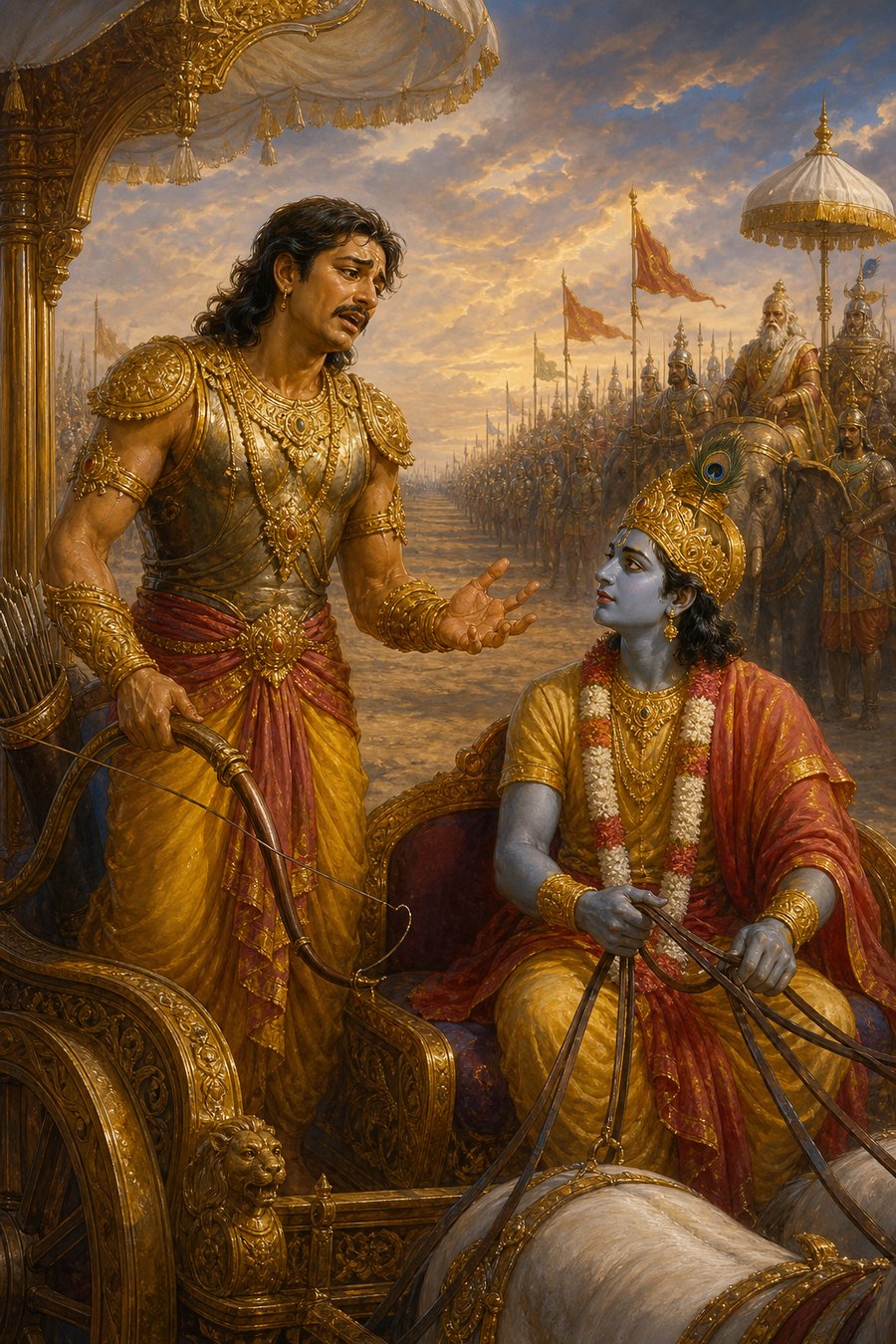
The first missiles were already in the air when Arjuna, under his ape banner, raised his bow and then spoke to Krishna. “Achyuta,” he said, “put my chariot between the two armies. I want to look at the men who stand here wanting battle, the ones I shall have to fight in this work. I want to see who has gathered here, ready to fight to please the evil-minded son of Dhritarashtra.” Krishna drove that fine chariot out into the open ground and stopped it between the armies, in full view of Bhishma and Drona and all the kings of the earth. “Partha,” he said, “look at these Kurus gathered here.”
A sub-tale: Before the conches, as the Kaurava army came on, Krishna had told Arjuna to purify himself and say his hymn to Durga for the defeat of the enemy. Arjuna stepped down from the chariot, joined his hands and praised her as the leader of the yogis, one with Brahman, as Kali and Mahakali, as the giver of victory who is victory herself, as Savitri the mother of the Vedas. He asked that victory attend him on the field through her grace. Durga appeared in the sky and spoke with Krishna standing by. “In a short time, Pandava, you will conquer your enemies. You have Narayana to help you, and no enemy can defeat you, even the wielder of the thunderbolt himself.” She vanished, and Arjuna, counting himself already successful, climbed back onto his chariot.
And there, between the armies, Arjuna looked. He saw fathers and grandsons standing in the ranks, friends, fathers-in-law, men who had always wished him well. They stood in both armies, and every one of them was his kin.
The gist: The Gita is spoken on the battlefield, with both armies drawn up and watching and the first missiles already thrown. Arjuna himself asks to be driven out between the two hosts so that he can see whom he must fight. What he sees there is his own family, on both sides.
The Gandiva Slips from His Hand
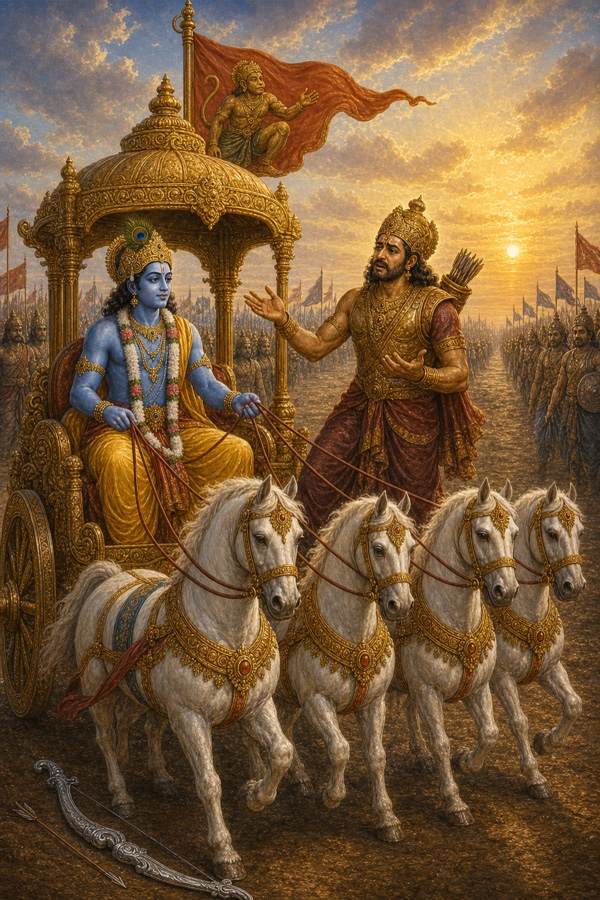
Pity took hold of him, and he spoke out of it. “Krishna, I see these kinsmen gathered here and eager to fight, and my limbs go slack and my mouth dries. My body shakes. The hair stands up on my skin. Gandiva is slipping from my hand, and my skin burns. I cannot keep standing, and my mind seems to wander. I see evil omens, Keshava. I want no victory, Krishna, no kingdom and no pleasures. What use is a kingdom to us, Govinda, or enjoyments, or life itself, when the very people for whose sake we want kingdom and enjoyment and pleasure are drawn up here ready to give up their lives and their wealth: teachers, fathers, sons and grandfathers, mothers’ brothers, fathers-in-law, grandsons, brothers-in-law, kinsmen?
“I do not want to kill them, Madhusudana, though they kill me, even for the rule of the three worlds, let alone for this earth. What joy could we have, Janardana, from killing the sons of Dhritarashtra? Count them as enemies, and sin will still overtake us if we kill them. How can we be happy after killing our own kin? Greed has warped their judgment, and they cannot see the evil in the ruin of a family. We can see it. Why should we not turn back from that sin? When a family is destroyed, its ancient customs are lost, and when the customs are lost, lawlessness takes the whole family. Then its women are corrupted, and from that the orders of society are mingled. That mingling carries the destroyers of the family and the family itself to hell, and their ancestors fall, cut off from the pinda and the water that are offered to the dead. We have heard that men whose family rites are extinguished live in hell forever. And here we stand, resolved on a great sin, ready to kill our own people out of greed for the sweets of a kingdom. It would be better for me if the sons of Dhritarashtra, with weapons in their hands, killed me on this field while I stood unarmed and did nothing to stop them.”
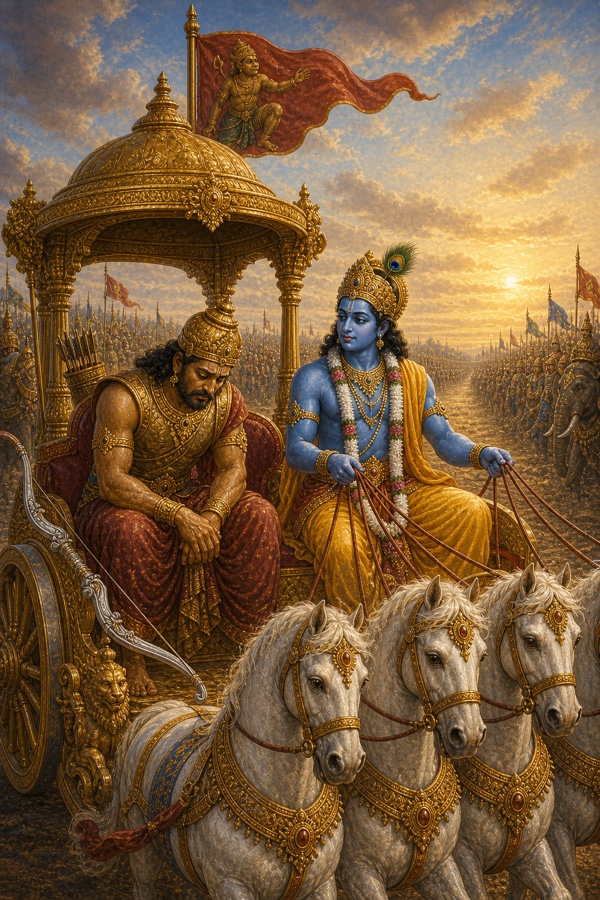
He said that on the field of battle, with both armies looking on. Then Arjuna, his mind crushed by grief, put his bow and his arrows aside and sat down in his chariot.
The gist: A bowman who has no equal on earth, and never will have, comes apart at the sight of his own kin. Gandiva slips from his hand and he sits down in the chariot. What stops him is a question of dharma: whether any kingdom can be worth the destruction of a family, when the teachers, fathers and sons to be killed are his own.
I Will Not Fight
Sanjaya told the king what Krishna said then to a man sunk in pity, with his eyes full of tears. “Where has this despondency come from, Arjuna, at such a crisis? It is unworthy of a man of noble birth. It shuts a man out of heaven, and it brings him disgrace. Do not give way to unmanliness. It does not suit you. Shake off this mean weakness of heart and get up.”
“How can I fight Bhishma and Drona with arrows, Madhusudana?” Arjuna said. “They deserve my worship. It would be better to live on alms in this world than to kill teachers of such greatness. They may be greedy for wealth, and still, if I killed them, every pleasure I enjoyed afterward would be stained with blood. We do not even know which would be better for us, to conquer them or to be conquered by them. The sons of Dhritarashtra stand in front of us, and if we killed them we would not want to go on living. Pity has tainted my nature, and my mind cannot settle what my duty is. So I ask you. Tell me what is certainly good for me. I am your disciple. Teach me, for I have come to you for help. I can see nothing that would drive off this grief that is burning up my senses, even if I won a rich kingdom on earth with no rival in it, or the lordship of the gods themselves.” Then he said to Krishna, “I will not fight,” and was silent.
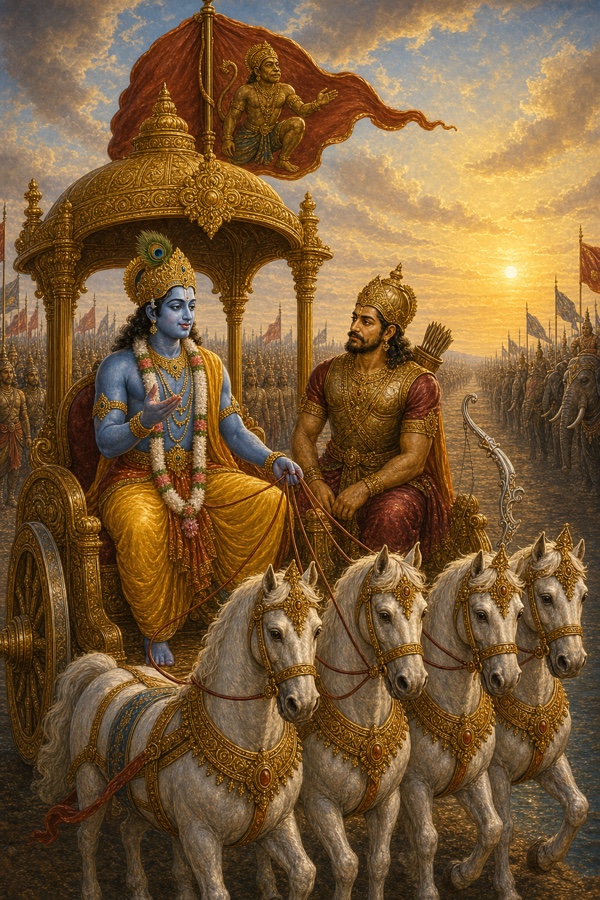
Arjuna sat silent, overcome, on a chariot that stood between two armies. There, as if with a smile, Krishna began to answer him.
The gist: Arjuna refuses the war and, in the same speech, puts himself in Krishna’s hands. “I am your disciple. Teach me,” he says, and with that the friend holding the reins becomes the teacher. Everything Krishna says from here on is an answer to a man who has asked for one.
The Self Neither Dies Nor Is Killed
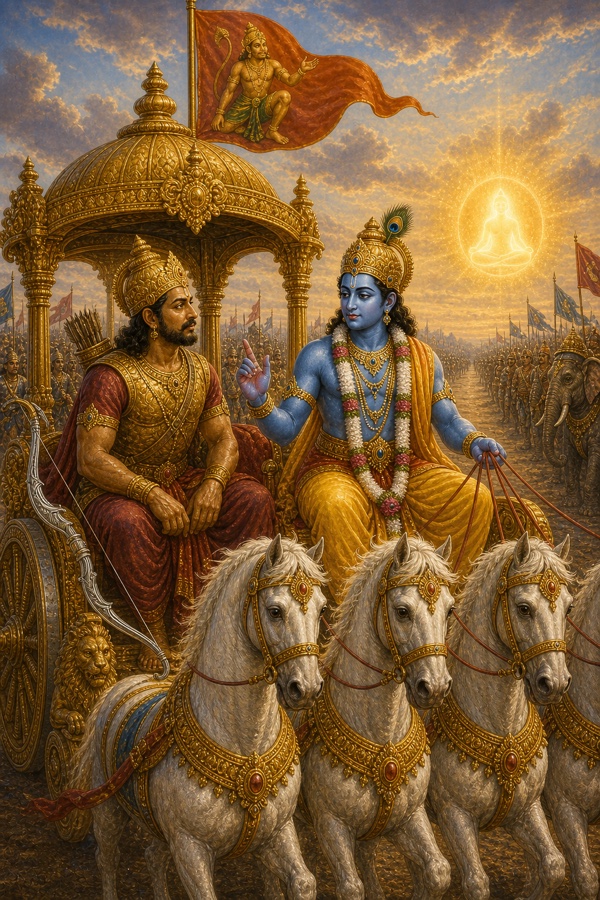
Krishna began with the grief itself. “You mourn those who do not call for mourning, and you speak as the wise are supposed to speak,” he said. “The truly wise grieve neither for the dead nor for the living. There was never a time when I did not exist, or you, or these rulers of men, and there will never be a time when any of us ceases to be. The one who lives in a body passes in it through childhood, youth and old age, and in the same way passes on to another body. A wise man is never confused by this.
“The senses touch their objects, and heat and cold, pleasure and pain follow. They come and they go, and none of them lasts. Bear them. The man they cannot shake, who is the same in pain and in pleasure and firm in his mind, is fit for freedom. Know that the thing by which this whole universe is pervaded cannot die, and no one can bring about the destruction of what is imperishable. It is these bodies that are said to end, the bodies of an embodied self that is itself eternal, indestructible and without measure. Therefore fight. The man who thinks the self a killer and the man who thinks it killed are both without knowledge, for it neither kills nor is killed. It is never born and it never dies, and having existed it will never cease to exist. Unborn, unchanging, eternal and ancient, it is not killed when the body is killed. How can a man who knows that kill anyone, or cause anyone to be killed?
“A man throws off clothes that are worn out and puts on new ones, and in the same way the embodied self throws off bodies that are worn out and enters others that are new. Weapons do not cut it. Fire does not burn it, water does not wet it, the wind does not dry it. It is unchanging, present everywhere, stable, firm and eternal, and it is said to be beyond perception, beyond thought and beyond change. Knowing it to be so, you have no reason to mourn. And suppose you take it to be forever being born and forever dying: even then you have no reason to mourn like this. Death is certain for whoever is born, and birth is certain for whoever has died, and no one should mourn over what cannot be avoided. All beings are unmanifest before birth, manifest for an interval, and unmanifest again when death comes. What is there to grieve over in that? The self in every body is beyond all harm, and so you should not grieve for any creature.”
The gist: Krishna’s first answer is that the self does not die. It is unborn and eternal, the body is a garment it puts on and puts off, and it is not killed when the body is killed. Even for someone who believes the self is born and dies over and over, death follows birth and birth follows death with certainty, and Krishna holds that no one should mourn what cannot be avoided.
Your Own Dharma, Even If Imperfect
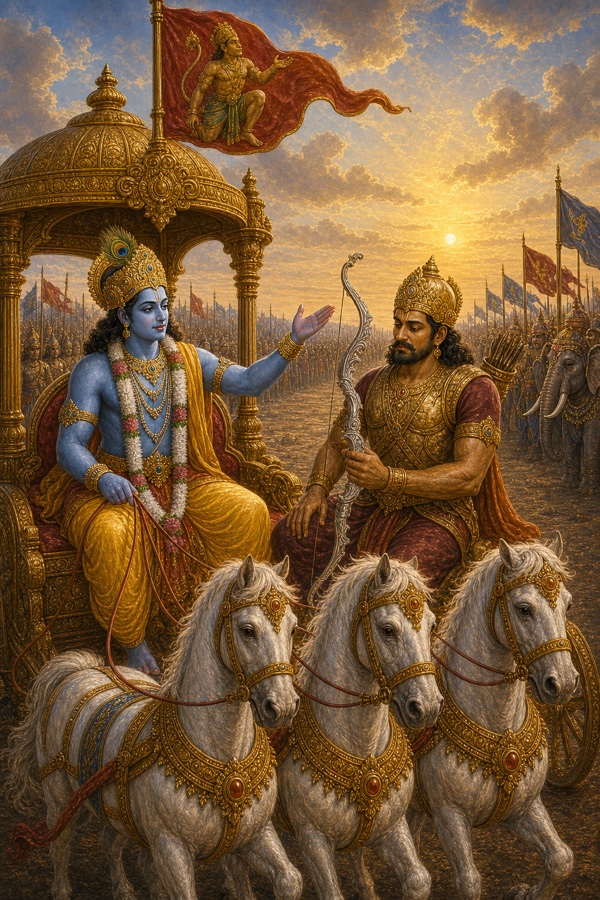
Then he turned from the self to svadharma, the duty that belongs to a man’s own order, and to the man sitting in front of him. “Look at the duties of your own order, and you will find no reason to waver,” Krishna said. “For a Kshatriya there is nothing better than a battle fairly fought. This one has come to you unsought, like a gate of heaven standing open, and the Kshatriyas who meet such a fight are fortunate men.
“If you refuse this just battle, you abandon the duty of your order and your fame together, and you take on sin. People will tell the story of your disgrace forever, and to a man who has been honored, disgrace is worse than death. The great chariot fighters will believe that fear kept you out of the battle. Men who thought highly of you will think little of you. Your enemies will run down your strength and say things that should never be said, and what could hurt more than that? Killed, you will reach heaven. Victorious, you will enjoy the earth. So get up, resolved to fight. Hold pleasure and pain, gain and loss, victory and defeat as the same, fight for the sake of the fight, and no sin will be yours.”
He came back to the same thought twice before he was done, once while he was speaking of action and once near the very end. “A man’s own duty, even imperfectly performed, is better than another man’s duty well performed,” he said the first time. “Death in one’s own duty is to be preferred. The duty of another carries fear with it.” And at the end: “A man who does the duty his own nature lays on him takes on no sin. He must never abandon the duty that is natural to him, though there is evil mixed in it, because every undertaking is wrapped in evil, as fire is wrapped in smoke.”
A sub-tale: The four orders, Krishna says, are his own creation, divided by their qualities and their work, and the duties of each are born of its nature. Those of the Brahmin are calm, self-restraint, austerity, purity, forgiveness, uprightness, knowledge, experience and belief. Those of the Kshatriya are bravery, energy, firmness, skill, standing fast in battle, generosity and the bearing of a ruler. Those of the Vaishya are farming, the tending of cattle and trade, and the natural duty of the Shudra is service. Every man who is given to his own duty reaches perfection, and Krishna says how: by doing that duty as worship of the one from whom all beings come and by whom all this is pervaded.
The gist: Svadharma is the duty of a man’s own order and nature, and Krishna holds that it is better done imperfectly than another man’s duty done well. Arjuna is a Kshatriya, a fair battle has come to him unsought, and to refuse it is to lose his duty and his name together and to take on sin.
A Right to the Work Alone
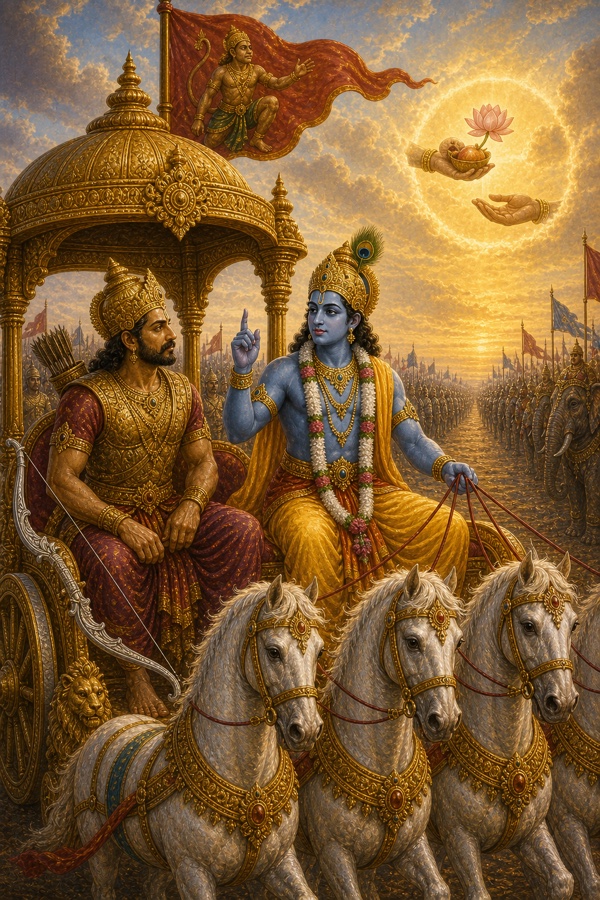
So far, Krishna told him, he had spoken as the Sankhya teaches, by way of knowledge. Now Arjuna was to hear it as yoga teaches it, by way of work, a path on which no effort is ever wasted and even a little practice saves a man from great fear. “Your concern is with the work alone, never with its fruit,” he said. “Do not let the fruit be your reason for working, and do not lean toward inaction either. Stand in yoga and do your work. Let go of attachment to it, and be the same man whether it succeeds or fails. That evenness is what is called yoga.
“Work done for the sake of its fruit is far below work done in that evenness. Take shelter there. Those who work for the fruit are wretched. A man who has this yoga puts off, even in this world, both his good actions and his bad ones, so give yourself to it. Yoga is skill in action. The wise who have it let go of the fruit their actions bear, and they are freed from the bond of rebirth and reach the place where there is no sorrow. When your mind has crossed the tangle of delusion and stands fixed and unmoving in contemplation, undistracted by all that you have heard, you will have reached yoga.”
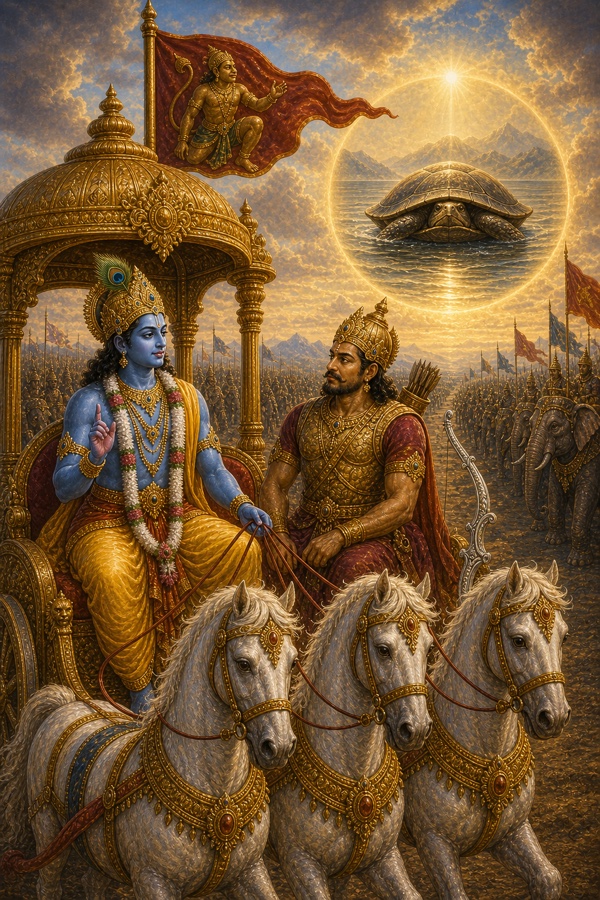
Arjuna wanted to know what such a man looks like to those around him. “Keshava, what are the marks of a man whose mind is fixed in contemplation? How does a man of steady mind speak? How does he sit? How does he move?” Krishna gave him the marks of the sthitaprajna, the man of steady wisdom. He has thrown off every desire of his heart and is content in the self with the self. Misfortune does not shake his mind, the craving for pleasure has left him, and attachment, fear and anger are gone. He draws his senses back from their objects the way a tortoise draws in its limbs from every side. Then Krishna laid out how a man is lost. Thinking about the objects of the senses breeds attachment to them. From attachment comes anger, from anger want of judgment, from want of judgment loss of memory, from loss of memory loss of understanding, and with his understanding gone the man is ruined. “Peace comes to the man into whom all desires enter as waters enter the ocean, which is filled from every side and keeps its shoreline unchanged,” Krishna said. “The man who longs for the things he desires never finds it.”
The gist: Krishna’s answer to a man who will not fight is that he must work and leave the fruit alone. Inaction is ruled out by name, and so is working for reward. He gives yoga two descriptions here, evenness in success and failure and skill in action, and when Arjuna asks what a man who has it is like, the answer comes in two pictures: the tortoise drawing in its limbs, and the ocean that all the waters enter without moving its shore.
And Then a Glimpse of the Universal Form
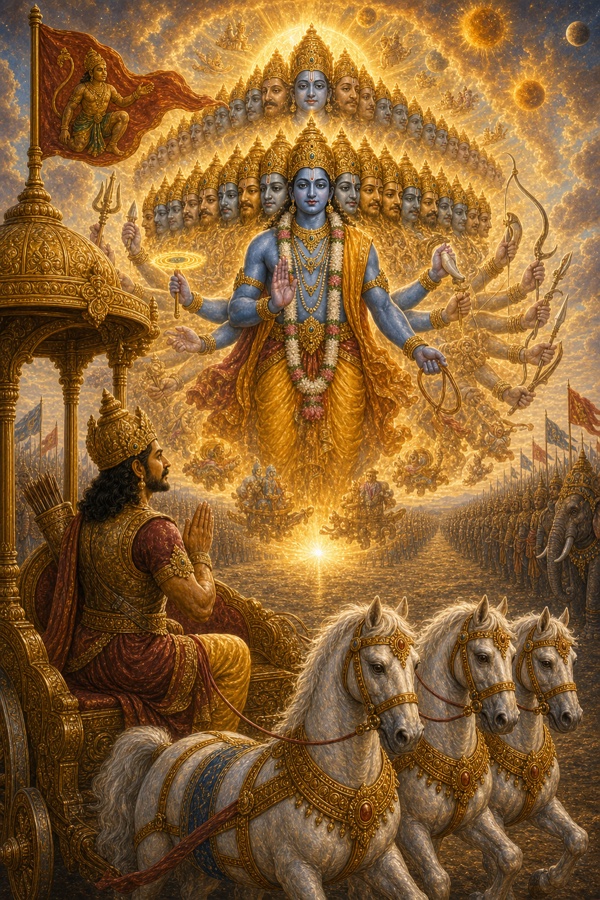
The dialogue went on a long way from there, through action and knowledge, through the training of a restless mind, through Krishna’s account of himself as the beginning, the middle and the end of every being. When he had finished naming his divine perfections, Arjuna believed all of it and wanted to see it. “I have heard from you at length how beings arise and how they dissolve, and I have heard of your greatness, which does not decay. What you have said of yourself is so. I want to see your sovereign form. If you think I am able to look at it, show me your eternal self.” Krishna said, “See my forms, Partha, by hundreds and by thousands, divine, of every color and shape. See the Adityas, the Vasus, the Rudras, the Ashvins and the Maruts. See the whole universe here in one place, in this body of mine, everything that moves and everything that stands still, and whatever else you wish to see. You cannot look at me with the eyes you have. I give you sight that is divine.”
Sanjaya told the king what Arjuna was shown. Hari, the lord of yoga, revealed his supreme sovereign form: many mouths and many eyes, many marvels to look at, celestial ornaments, celestial weapons raised, garlands and robes of heaven, the fragrance of heavenly perfumes, a shining thing without end, with faces turned in every direction. “If the light of a thousand suns broke out in the sky all at once,” Sanjaya said, “it would be like the light of that mighty one.” In the body of the god of gods Arjuna saw the whole universe, divided into its many parts and all gathered there in one. Amazement filled him. The hair stood up on his body, and he bowed his head, joined his hands and began to tell the god what he was looking at: all the gods and every kind of creature, Brahma on his lotus seat, arms and mouths and eyes without number, no beginning, no middle and no end, a mass of light on every side that filled all the space between heaven and earth.
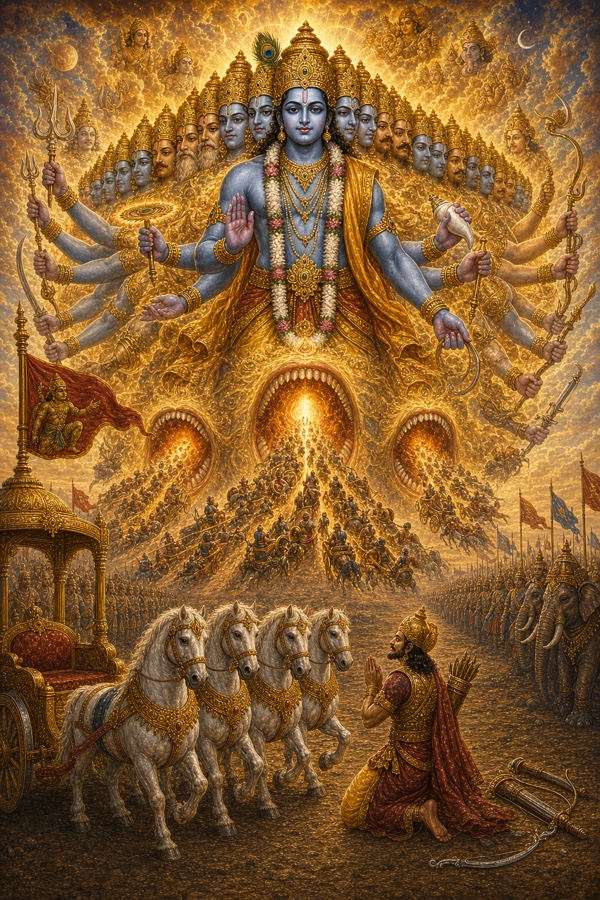
Then the vision turned to the field he was standing on. He saw all the sons of Dhritarashtra with the hosts of kings, and Bhishma, and Drona, and Karna the charioteer’s son, and the chief warriors of his own side with them, hurrying into mouths made terrible by their tusks. Some were caught between the teeth with their heads crushed. They went in as the many currents of the rivers run toward the ocean, and as moths fly faster and faster into a blazing fire to die there. “Tell me who you are, with a form so fierce,” Arjuna said. “I bow to you. Be gracious. I want to know you, the first of all, for I do not understand what you are doing.” The answer came: “I am Kala, Time, the destroyer of the worlds, grown to my full, and I am at work now killing this race of men. Even without you, all these warriors standing in their divisions will cease to be. So get up. Win glory, beat your enemies and enjoy a flourishing kingdom. I have already killed them. Be only my instrument, you who can draw the bow with your left hand too. Drona, Bhishma, Jayadratha, Karna and the other heroes are dead by my hand already. Kill them, and do not be shaken. Fight. You will conquer your enemies in this battle.”
The gist: In the vision Arjuna’s charioteer and friend stands revealed as the whole universe, and the warriors of both armies are already pouring into his mouths. Krishna names himself Kala, Time, the destroyer of the worlds, tells Arjuna that these men are dead by his hand already, and asks him only to be the instrument. Arjuna, trembling, begs pardon for every careless time he called him Krishna, or Yadava, or friend, and asks to see the familiar form again. Krishna shows it, and Arjuna says his mind is his own once more.
My Delusion Is Gone
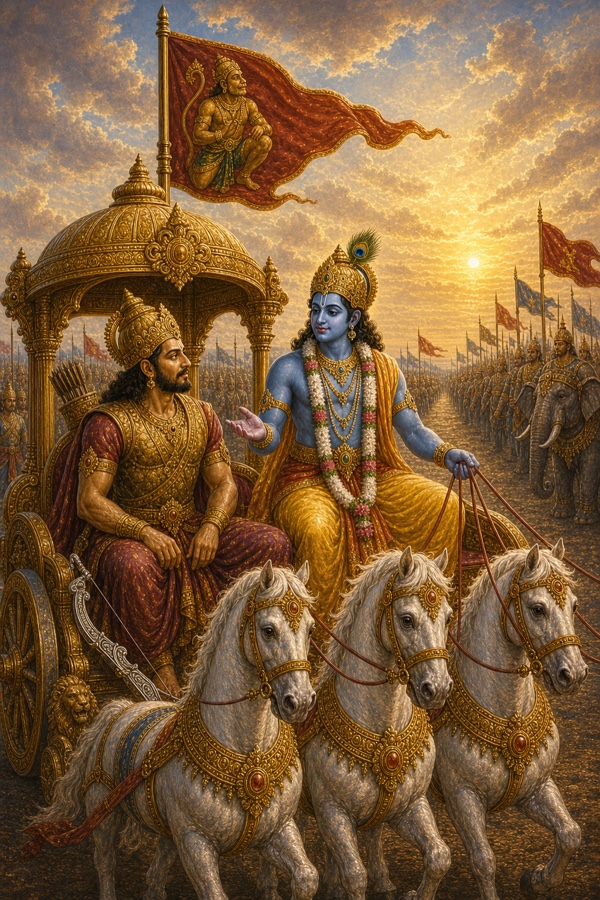
The teaching ran on through seven more sections after the vision, and at its close Krishna handed the decision back to Arjuna. “I have told you a knowledge more secret than any other. Think it over fully, and then do as you like.” Then, because Arjuna was dear to him, he said one thing more, the most secret of all. “Set your heart on me. Be devoted to me, sacrifice to me, bow to me, and you will come to me. I tell you this truly. Give up all duties and come to me as your one refuge. I will free you from every sin. Do not grieve.” It was never to be told, he added, to a man without austerity, or to one without devotion, or to one who will not wait on a teacher, or to one who speaks ill of Krishna himself. And he asked, “Have you listened to this, Partha, with your mind on nothing else? Is the delusion that came of ignorance destroyed?”
Arjuna answered, “My delusion is destroyed, Achyuta. By your grace I have got back the memory of what I am. I stand firm now. My doubts are gone, and I will do what you tell me.”
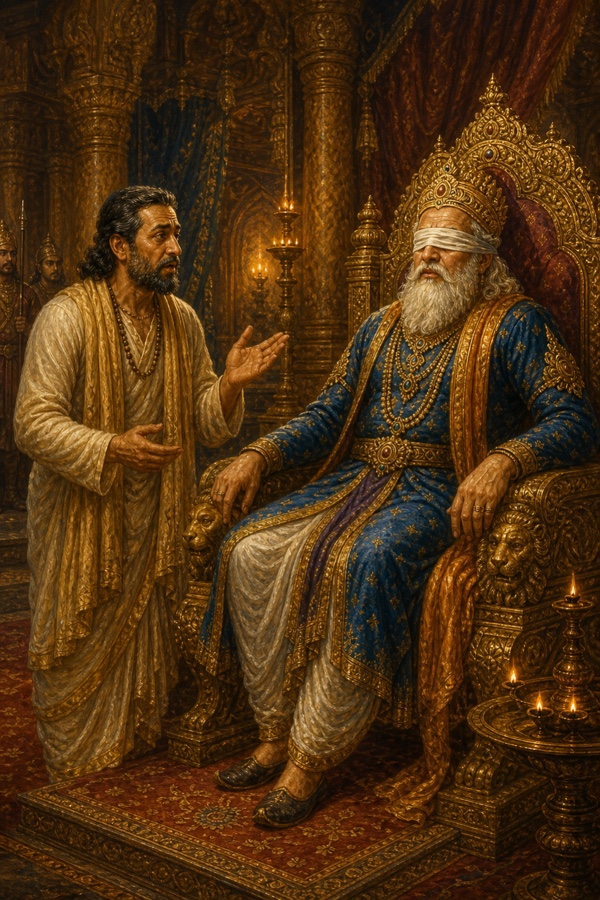
That was the whole of it, and Sanjaya, who had repeated every word of it to a blind king, stopped to say what it had done to him. He had heard this wonderful conversation between Krishna and the son of Pritha through Vyasa’s favor, he said, from the lord of yoga himself, and it made the hair rise on his body. “I remember it again and again, and each time I rejoice. I remember that form of Hari, and my amazement is great, and I rejoice again. Where Krishna the lord of yoga is, and where Partha the great bowman is, there, I hold, are prosperity, victory, greatness and justice that does not fail.”
The gist: Krishna leaves the choice with Arjuna, and then gives him the last word of the teaching: give up all duties and take refuge in him alone. Arjuna says his delusion is destroyed and that he will do as he is told. Sanjaya closes his account with the saying that prosperity, victory, greatness and justice are where Krishna and Arjuna are, and on the field Arjuna reaches for Gandiva.
The Gandiva Back in Hand
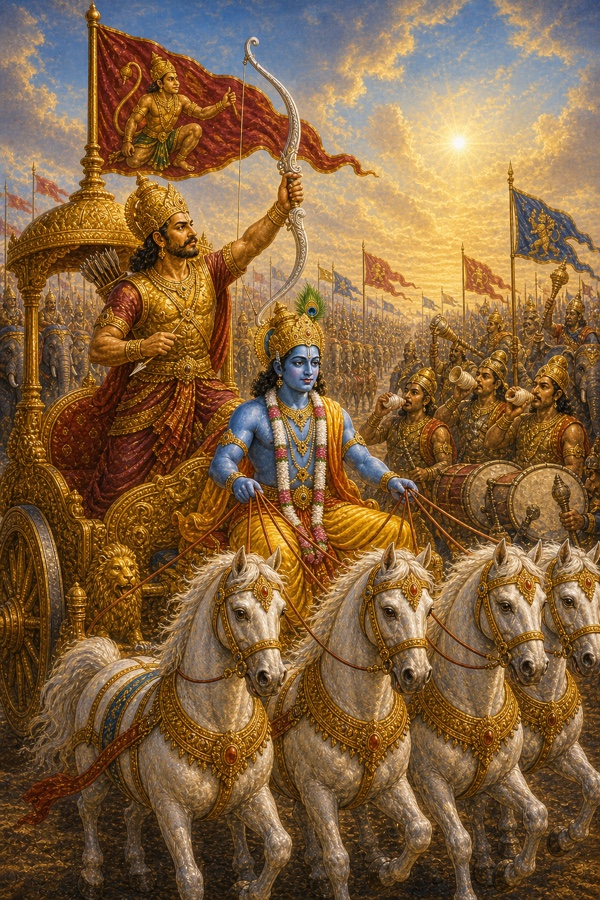
Arjuna took up his arrows and Gandiva again, and the great chariot fighters of the Pandava side let out a tremendous shout. The Pandavas, the Somakas and all who followed them blew their sea-born conches in joy. Drums, Pesis, Karkachas and cow horns were beaten and blown together, and the uproar was enormous. Then the gods came to watch, with the Gandharvas and the Pitris, the fathers of the dead, and the hosts of Siddhas and Charanas, and the blessed rishis came in a body behind Indra of the hundred sacrifices, all of them wanting to see the great slaughter.
Before the armies closed, Yudhishthira laid aside his armor and walked unarmed into the Kaurava host to ask Bhishma, Drona, Kripa and Shalya for leave to fight them; that walk, and Yuyutsu’s crossing to the Pandavas, are told in full in chapter 21.
The gist: The teaching shows first in an act: Arjuna picks up Gandiva. The Pandava conches answer him, and the gods gather over the field to watch.
A key to reading this (why this chapter is short): Sanjaya’s account of the dialogue runs eighteen sections, and this telling has followed four of its threads: the self that is not killed, a man’s own duty, work without a claim on its fruit, and the vision of the universal form, with the word of refuge that closes the whole. Between them Krishna also speaks of his own births age after age, of the seat and the posture for meditation and the mind that is as hard to hold as the wind, of his divine perfections, of devotion, of the field and its knower, of the three qualities born of nature, and of the three kinds of faith. Each of those has its own chapter in the Bhagavad Gita section of this library, where the dialogue is given whole.
Source: the Mahabharata of Krishna-Dwaipayana Vyasa, Bhishma Parva, Bhagavad Gita sub-parva, Sections 25 to 42, with the opening drawn from Sections 20 to 23 and the close from Section 43. The Sanskrit e-text, the Gita Press Hindi edition, and Kisari Mohan Ganguli’s complete English translation were used to verify names, sequence, and principal events. Where the recensions differ, this English retelling follows Ganguli, and the Hindi edition follows Gita Press.
Based on: the Mahabharata, Vedavyasa (K. M. Ganguli’s English translation; Gita Press, Gorakhpur)
The same story, told elsewhere
- The Bhagavad Gita
The full text of the Bhagavad Gita, all eighteen chapters - Chapter 1: The Yoga of Arjuna’s Despair
The Bhagavad Gita, Chapter 1: Arjuna’s despair