On this page
“I am not my own master”: Dhritarashtra confesses his helplessness, and Krishna moves his seat to sit beside Duryodhana
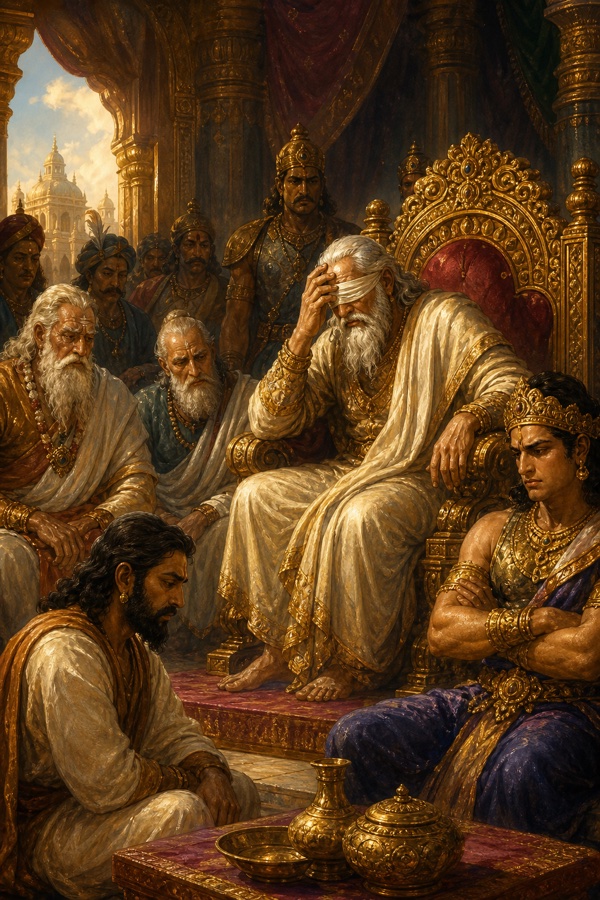
When Narada finished, the hall held the particular silence of a room in which a lamp has just gone out. Then the blind king turned his face toward the place the sage’s voice had come from. “Holy one,” he said, “it is exactly as you say, Narada. My wish is precisely the same. But I have no power to carry it out.” He let the words stand a moment, and then he turned toward Krishna, and everyone in the assembly heard what was in his voice, which was the weariness of a father who has been losing arguments inside his own house for thirty years. “Keshava, you have told me what leads to heaven, what benefits the world, what agrees with virtue and is full of reason. But I am not independent, my son. Duryodhana never does what pleases me. You are the mighty-armed one, the best of men. Try, yourself, to persuade that foolish and wicked son of mine who disobeys my commands. He does not listen to the good words of Gandhari, Hrishikesha. He does not listen to wise Vidura, or to the other friends who wish him well, Bhishma at their head. So you counsel him yourself, that crooked, senseless, wicked-souled prince with his evil disposition and his sinful heart. Do that, Janardana, and you will have done the noble thing a friend should always do.”
Krishna, who knew the truths of virtue and profit better than any man in that hall, did not answer the king. He rose from where he sat and crossed the floor to the place where Duryodhana sat perpetually simmering, and he sat down close beside him, close enough that what followed was no longer addressed to an assembly. It was addressed to one man. And he spoke to that man sweetly. “Duryodhana, best of the Kurus, listen to what I am going to say. It is spoken for your good in particular, Bharata, and for the good of the people who follow you. You were born in a line famous for its great wisdom. It becomes you to act righteously, as I will show you. You are learned, you have excellent manners, you are adorned with every fine quality. It is the men born in low families, the wicked-souled, the cruel and the shameless, who act the way that seems acceptable to you right now. In this world the inclinations of the righteous line up with virtue and profit. The inclinations of the unrighteous run crooked. And the disposition you keep displaying, bull of Bharata’s race, is of the crooked kind. To persist in it is sinful, terrible, deeply wicked, and it can lead to death itself. It has no cause, and you cannot even keep it up for long.”
“If you will leave this road, which produces nothing except grief, and do yourself some good; if you will climb out of the sinful and disgraceful deeds of your brothers and your followers and your counselors, then make peace, tiger among men, with the sons of Pandu, who have great wisdom and great courage and great energy and great learning, every one of whom has his soul under complete control. That course will please Dhritarashtra, who is wise. It will please the grandsire Bhishma, and Drona, and high-souled Kripa, and Somadatta, and wise Bahlika, and Ashvatthama, and Vikarna, and Sanjaya, and Vivimshati, and many of your kinsmen and many of your friends. The whole world will profit by that peace. You have modesty in you. You were born in a noble house. You have learning and a kind heart. Obey the commands of your father, then, and of your mother too. Good sons always take as beneficial whatever their fathers command; when calamity overtakes a man, it is his father’s instructions he remembers. Peace with the Pandavas recommends itself to your father. Let it recommend itself to you, chief of the Kurus, and to your counselors with you.”
Then Krishna laid out, one after another, the fates of men who hear and do not listen, and he laid them out the way a physician lists symptoms. “The man who hears the advice of his friends and does not act on it is consumed in the end by his own neglect, like the man who eats the kimpaka fruit. The man who out of folly refuses good counsel, unnerved by delay and unable to reach his object, is forced to repent at the last. The man who hears good counsel and accepts it at once, dropping his own opinion, always wins happiness in the world. The man who rejects the words of well-meaning friends because he thinks they go against his interest, and accepts the words that truly go against it, is soon subdued by his enemies. The man who disregards the opinion of the righteous and abides by the opinion of the wicked soon makes his friends weep for him, because he has fallen into distress. The man who forsakes superior counselors and seeks the advice of inferior ones falls quickly into great trouble and cannot save himself. And the companion of sinners who behaves falsely, who never listens to good friends, who honors strangers and hates his own, is soon cast off by the earth itself. You have quarreled with the sons of Pandu, and now you seek protection from others, from men who are sinful and incapable and foolish. Who else on this earth, disregarding kinsmen who are all mighty chariot warriors, each of them the equal of Shakra himself, would go looking for protection among strangers? You have persecuted the sons of Kunti from the day they were born. They have not been angry with you, because the sons of Pandu are truly virtuous. You have dealt deceitfully with them from their birth, and those distinguished men have dealt generously with you. It behooves you, then, to treat your principal kinsmen with the same generosity. Do not surrender yourself to anger.”
And here he said the thing that made the learned men on the benches nod. “The exertions of the wise, bull of Bharata’s race, always go with virtue, profit, and desire together. If all three cannot be had, men follow at least virtue and profit. And when the three are pursued separately, this is what one sees: those whose hearts are under control choose virtue; those who are neither good nor bad, the middle sort, choose profit, which is always what men fight about; and fools choose the gratification of desire. The fool who gives up virtue out of temptation and chases profit and desire by unrighteous means is soon destroyed by his own senses. Even the man who talks of profit and desire should practice virtue first, because neither profit nor desire is truly separate from virtue. It has been said, king, that virtue alone is the cause of all three, and that the man who wants all three grows by virtue alone the way fire grows when it meets a heap of dry grass. Yet you, my friend, are seeking by unrighteous means this vast empire, flourishing and prosperous and known to every monarch on earth. The man who deals falsely with people who live and behave righteously cuts himself down like a forest under the axe. Do not try to confound the understanding of a man whose fall you do not desire, because once a man’s understanding is confounded he can never attend to what is good for him. The man whose soul is under control never disregards anyone in the three worlds, not the commonest creature, let alone those bulls among men, the sons of Pandu. The man who gives himself up to anger loses his sense of right and wrong. Rank growth must always be cut away. Look, Bharata, here is the proof of it. At this moment, union with the sons of Pandu is better for you than union with the wicked. Make peace with them, and you may obtain everything you wish.”
A key to reading this (the kimpaka, and where Krishna sits): The kimpaka is a fruit that is beautiful to look at and poisonous to eat; Krishna uses it for the man who hears his friends out and then follows his own head anyway. Notice, too, what happens before a single argument is made. Dhritarashtra, in open court and in front of every king present, admits that he cannot control his son. Krishna does not reply to that. He gets up, crosses the hall, and sits down next to Duryodhana. Everything that had been said to the king is now going to be said to the one man who actually holds the decision.
The gist: After Narada’s tale Dhritarashtra confesses before the whole assembly that he agrees with everything Krishna has said and can do nothing about it, because Duryodhana listens to no one, not to him, not to Gandhari, not to Vidura, not to Bhishma; he asks Krishna to counsel the prince himself. Krishna moves to sit beside Duryodhana and speaks to him gently: his obstinacy is unworthy of his line; peace with the Pandavas would please Bhishma, Drona, Kripa, Somadatta, Bahlika, Ashvatthama, Vikarna, Sanjaya, Vivimshati and the whole world; a son’s duty is to obey his father and mother; the man who rejects his friends’ counsel burns like the eater of the kimpaka; virtue is the root of profit and desire alike; and alliance with the Pandavas is better than alliance with the wicked.
“Show me one man who will defeat Arjuna”: Krishna does the arithmetic of war, and offers Duryodhana the seat of heir
Krishna’s voice came down now from the high ground of virtue onto the ground Duryodhana understood best, which was force. “Best of kings, you are enjoying a kingdom that the Pandavas founded, and you look for protection to other men while disregarding the Pandavas themselves. You have laid the cares of your state on Duhshasana, on Durvishaha, on Karna, and on Shakuni the son of Subala, and on their strength you expect your prosperity to continue. These men are far below the Pandavas in knowledge, in virtue, in the capacity to gather wealth, and in prowess. Set those four aside. All these kings together, with you at their head, could not so much as look Bhima in the face when he is angry on a battlefield. Yes, this force of all the kings of the earth is standing at your elbow. Bhishma is here, and Drona, and this Karna, and Kripa, and Bhurishravas, and Somadatta, and Ashvatthama, and Jayadratha. All of them together are unable to fight Dhananjaya. Arjuna cannot be beaten in battle by all the gods and Asuras and men and Gandharvas combined. Do not set your heart on war.”
“Do you see a man in any royal house on earth who has met Arjuna in battle and come home safe and whole? What is the profit in a universal slaughter, bull of Bharata’s race? Show me a single man who will defeat Arjuna, because only by defeating him can the victory be yours. Who will meet in battle the son of Pandu who beat all the celestials, together with the Gandharvas and Yakshas and serpents, at Khandavaprastha? And then there is the extraordinary account of what happened at Virata’s city, one man against many, which is proof enough of the same thing. Do you hope to conquer in battle an Arjuna who, once his rage is up, is invincible and irresistible and always victorious and never diminished, the hero who satisfied Shiva himself, the god of gods, in combat? And when that son of Pritha rushes at an enemy with me as his second, who will be competent to challenge him then? Could Purandara himself? The man who could defeat Arjuna in battle could hold up the earth on his arms, could burn its whole population in his anger, could throw the gods down out of heaven.”
It is worth pausing on what Krishna is doing with those names. He does not say that the Kuru army is small. He says the opposite, that every king on earth is present, and then he walks down the front rank of that army one warrior at a time, Bhishma, Drona, Karna, Kripa, Bhurishravas, Somadatta, Ashvatthama, Jayadratha, and sets the whole rank against one bowman. For the men named it was an extraordinary thing to sit through. Bhishma had taught Arjuna’s father. Drona had put the first bow into Arjuna’s hands. Karna had spent his life measuring himself against him. Each of them heard himself counted, and each of them heard the sum. And Krishna, who had seen more battlefields than anyone in that hall except the grandsire, added one more figure to the total without raising his voice: himself, holding the reins.
Then the voice turned again, and this time there was an older brother’s pleading in it. “Look at your sons. Look at your brothers, your kinsmen, your other relatives. Do not let all these chiefs of Bharata’s line die on your account. Do not let the Kaurava race be exterminated or cut down. Do not let people say of you, king, that you were the destroyer of your house and of everything it had achieved. If peace is made, those mighty chariot warriors the Pandavas will install you as Yuvaraja, and they will install your father Dhritarashtra, that lord of men, as sovereign over this whole vast empire. Do not disregard the prosperity that is waiting for you and is certain to come. Give the sons of Pritha half the kingdom and win great prosperity. Make peace with the Pandavas, act on the counsel of your friends, rejoice together with them, and you are sure of your own good for ever and ever.”
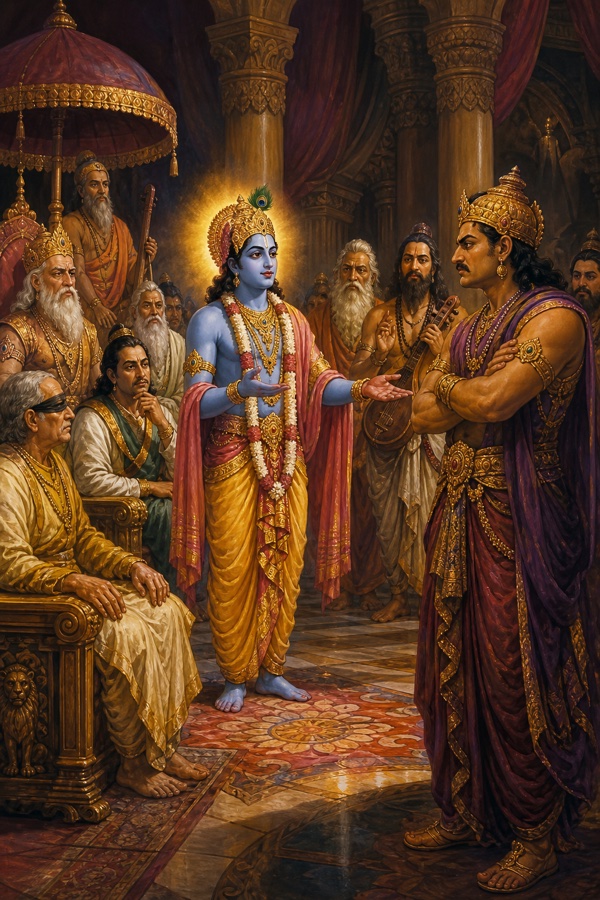
He stopped there. The men who had been listening noticed something about the long speech only after it ended: nowhere in it had Krishna asked for anything. He had not pleaded. He had counted. On one side of the ledger stood Duhshasana, Durvishaha, Karna and Shakuni, the four men who now carried the state; on the other stood a single Bhima whose face could not be looked at. On one side stood Bhishma, Drona, Karna, Kripa, Bhurishravas, Somadatta, Ashvatthama and Jayadratha, every great name in the hall; on the other stood one Dhananjaya, and behind him the burning of Khandava, the day at Virata’s city, and the Pashupata weapon taken from Shiva’s own hand. And at the bottom of the ledger, where a threat would have gone, Krishna had written a title instead: Yuvaraja. Duryodhana was being asked to give up half a kingdom, and in exchange he was being offered the one position that made the whole kingdom his after his father. The assembly looked at him. He stayed in his seat, and his breathing was heavy.
A key to reading this (Khandava and Virata’s city): The two feats Krishna holds up as evidence have both been told earlier in this sequence: the burning of the Khandava forest, where Arjuna held off the gods with Indra at their head (chapter 8), and the cattle raid at Virata’s city, where Arjuna alone drove off Bhishma, Drona, Karna and the entire Kuru army (chapter 17). Duryodhana was on the field that second day. For him this is a list of things he has seen with his own eyes.
The gist: Krishna reminds Duryodhana that he sits on foundations the Pandavas laid while trusting Duhshasana, Durvishaha, Karna and Shakuni, men inferior to the Pandavas in every respect; that all the assembled kings together could not face an angry Bhima; that Bhishma, Drona, Karna, Kripa, Bhurishravas, Somadatta, Ashvatthama and Jayadratha combined cannot fight Arjuna, who beat the gods at Khandava, routed the whole army alone at Virata’s city, and satisfied Shiva in combat, and who will have Krishna himself as his second. Then the offer: give the Pandavas half the kingdom, and they will make you Yuvaraja and Dhritarashtra emperor; do not be the man who destroyed his own house.
“While Gandiva still rests”: Bhishma, Drona, Vidura and Dhritarashtra plead with Duryodhana one after another
When Krishna fell silent it was Bhishma, the son of Shantanu, who spoke first, and he spoke straight at the vindictive prince. “Krishna has said this to you because he wants peace between kinsmen. Follow his counsel, my son. Do not give yourself up to anger. If you do not act on the words of high-souled Keshava, you will never have prosperity, or happiness, or anything that is good for you. The mighty-armed Keshava has told you what agrees with virtue and with profit. Accept it, king, and do not exterminate the population of the earth. This shining prosperity of the Bharatas, envied by every king alive, you will destroy through your own wickedness while Dhritarashtra still lives, and through this arrogance of yours you will strip yourself of life, together with your counselors and your sons and your brothers and your kinsmen, if you transgress the words of Keshava and of your father and of wise Vidura, words that agree with truth and are full of benefit to you. Do not be the exterminator of your race. Do not be a wicked man. Do not let your heart turn sinful. Do not walk the road of unrighteousness. Do not drown your father and your mother in an ocean of grief.”
Drona spoke after him, and Duryodhana by then was breathing heavily, the way a man does when he is holding down rage with his whole chest. “What Keshava has told you, my son, is full of virtue and profit, and Shantanu’s son Bhishma has said the same. Accept those words, monarch. Both of these men are wise. Both have great intelligence, both have their souls under control, both wish you well, and both are deeply learned. What they have said is for your benefit. Accept it, king. You have great wisdom; act on what Krishna and Bhishma have both said. Do not, chastiser of enemies, disregard Madhava out of some delusion of the understanding. The men who keep encouraging you cannot give you victory. When the fighting comes they will shift the burden of the quarrel onto other men’s necks. Do not slaughter the population of the earth. Do not kill your sons and your brothers. Know that an army with Vasudeva and Arjuna in the middle of it cannot be defeated. If you do not accept the truthful words of your friends Krishna and Bhishma, you will surely have to repent of it. Arjuna is even greater than Jamadagni’s son described him. As for Krishna, the son of Devaki, the gods themselves cannot resist him. What is the use, bull of Bharata’s race, of telling you any longer what truly leads to your happiness and your good? Everything has now been said to you. Do what you wish. I do not want to say anything more to you, foremost of the Bharatas.”
Then Vidura, whom men also called Kshatta, turned his eyes on Duryodhana, and what he said was the coldest thing said in that hall all day. “Duryodhana, bull of Bharata’s race, I do not grieve for you. I grieve for this old couple, for Gandhari and for your father. With a wicked-souled man like you for their protector, and soon to be deprived even of him, they will have to wander with no one to look after them, stripped of friends and counselors alike, like a pair of birds with their wings cut off. Having begotten a son like you, the exterminator of his own line, these two will have to wander the earth in sorrow, living on alms.” And after Vidura, the king himself spoke to his son, who sat there in the midst of his brothers with all the kings around him. “Listen, Duryodhana, to what high-souled Shauri has said. Accept those words. They are eternal, they are deeply beneficial, and they lead to your highest good. With the help of this Krishna, whose deeds are faultless, we among all the kings will surely gain everything we hold dear. Bound firmly together by Keshava, be reconciled, my son, with Yudhishthira. Seek this great good of the Bharatas the way one seeks a great rite of propitiation. Through Vasudeva, tie yourself closely to the Pandavas. I think the time for it has come. Do not let the opportunity pass. But if you disregard Keshava, who is asking you for peace out of a desire for your good, then victory will never be yours.”
Hearing the old king, Bhishma and Drona, who felt for him, addressed the disobedient prince once more together, and this time a single phrase kept returning through their speech like the stroke of a temple bell. “The two Krishnas have not yet put on their armor. Gandiva still rests. Dhaumya is not yet pouring libations onto the fire of war to consume the enemy’s strength. Yudhishthira, that mighty bowman who wears modesty as his ornament, has not yet cast an angry glance at your troops. So let the hostility end. That mighty bowman Bhimasena, Pritha’s son, is not yet seen standing in the middle of his division. So let the hostility end. Bhimasena is not yet stalking the field with his mace in his hand, grinding divisions to pieces. So let peace be made with the Pandavas. Bhima’s hero-killing mace has not yet sent the heads of the warriors who fight from the backs of elephants rolling across the field like palmyra fruit in the season when it ripens. So let the hostility end. Nakula and Sahadeva, Dhrishtadyumna of Prishata’s line, Virata, Shikhandi, and the son of Shishupala, all in armor and all masters of arms, have not yet driven into your ranks like great crocodiles going down into the deep, pouring out their showers of arrows. So let the hostility end. Fierce-winged shafts have not yet fallen on the delicate bodies of the kings gathered here. So let the hostility end. Terrible weapons of iron and steel, loosed without a miss by mighty bowmen skilled in arms, light of hand, able to strike at any distance, have not yet gone into the breasts of warriors smeared with sandal and fragrant unguents and adorned with golden garlands and gems. So let the hostility end.”
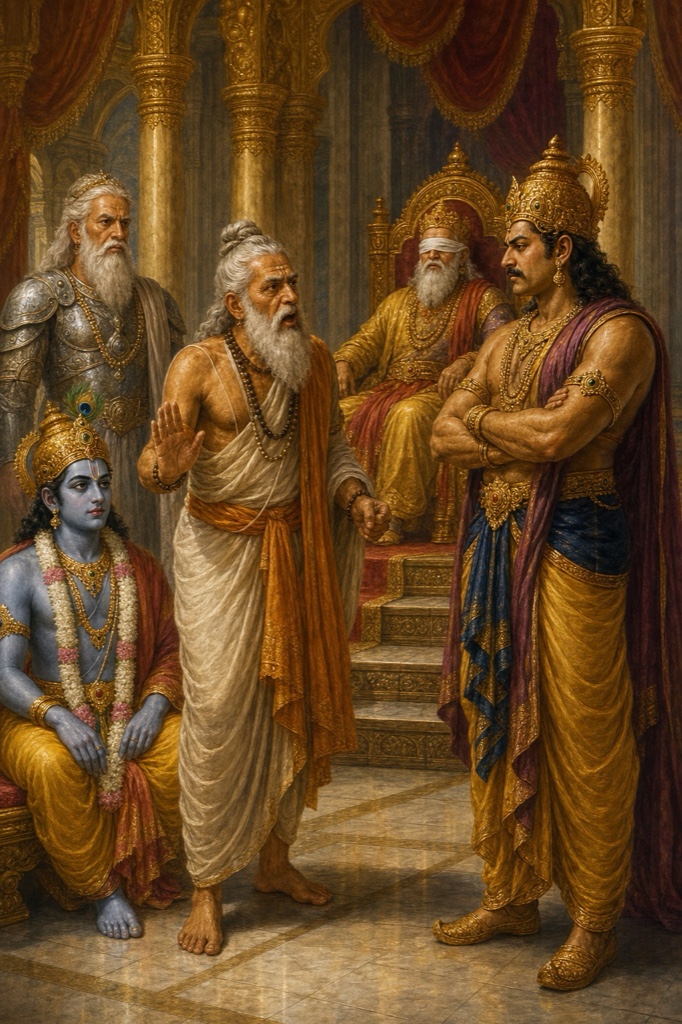
And then the two old men set before Duryodhana a picture, and it was a picture of something other than war. “Let Yudhishthira the Just, that elephant among kings, take you into his embrace as you bow your head and greet him. Let that king, famous for the generosity of his sacrificial gifts, lay his right arm across your shoulder, the arm whose palm bears the marks of the banner and the hook. Let him pat your back with his jeweled, red-palmed, finely fingered hands while you sit. Let mighty-armed Vrikodara, whose shoulders are as broad as a shala tree, embrace you, bull of Bharata’s race, and talk quietly with you about peace. And when those three, Arjuna and the twins, greet you with reverence, smell the crowns of their heads and speak to them with affection. Let all these monarchs weep tears of joy when they see you united with your heroic brothers, the sons of Pandu. Let the news of this heartfelt union be proclaimed in the cities of all the kings. Rule the earth with a brother’s love in your heart, and let your heart be freed of this fever.”
A key to reading this (the two Krishnas, and smelling the head): When Bhishma and Drona say “the two Krishnas” they mean Krishna and Arjuna, since Krishna is one of Arjuna’s own names. And an elder smelling the crown of a younger person’s head was, in that age, the tenderest gesture of affection there was, roughly what a kiss on the forehead is now. So the two old men are asking Duryodhana to imagine a scene in which Yudhishthira embraces him, Bhima speaks to him softly, and Arjuna and the twins bow before him and wait for his blessing. In that scene he is seated as the elder brother.
The gist: After Krishna, Bhishma tells Duryodhana that by defying Keshava, his father and Vidura he will lose his line’s prosperity and his own life and drown his parents in grief. Drona says the men who egg him on will shift the burden onto others once the fighting starts, that an army with Vasudeva and Arjuna in it cannot be beaten, and that he has nothing more to say. Vidura says he grieves for Gandhari and Dhritarashtra, who will wander like birds with clipped wings, and does not grieve for Duryodhana at all. Dhritarashtra pleads again. Then Bhishma and Drona together say that while Gandiva still rests and Bhima’s mace is not yet raised the hostility should end, and they show him the scene in which Yudhishthira embraces him and Arjuna and the twins bow at his feet.
“Not as much land as a sharp needle’s point could cover”: Duryodhana answers, and can find no fault in himself
Duryodhana had listened to all of it, every word of it disagreeable to him, and when he answered he did not answer any of the old men. He answered Keshava. “You ought to speak, Keshava, after reflecting on all the circumstances. You use these harsh words and you find fault with me alone, with no reason, you whom the sons of Pritha always address so respectfully, slayer of Madhu. But have you surveyed the strength and the weakness of both sides before you censure me? You, and Kshatta, and the king, and the preceptor, and the grandsire, all of you reproach me and no other monarch in this hall. I do not find the least fault in myself. And yet all of you, the old king included, hate me. Chastiser of enemies, even after thinking it over I do not see any grave fault in me, or any fault at all, Keshava, however small.”
“In the game of dice, slayer of Madhu, which they accepted joyfully, the Pandavas were beaten and their kingdom was won by Shakuni. What blame is mine in that? On the contrary, it was I who ordered that the wealth won from the Pandavas that day be returned to them. And it cannot be any fault of ours, foremost of victors, that the invincible Pandavas were beaten at dice a second time and had to go to the woods. What fault of ours are they charging us with, that they treat us as enemies? And why, Krishna, do the Pandavas, who are in truth weak, seek a quarrel with us so cheerfully, as if they were strong? What have we done to them? For what injury do the sons of Pandu, with the Srinjayas beside them, want to slaughter the sons of Dhritarashtra? We will not bow to them in fear, out of our senses, because of some fierce deed or some alarming word of theirs. We cannot bow down to Indra himself, let alone the sons of Pandu. I do not see the man, Krishna, observant of the Kshatriya virtues, who could venture to conquer us in battle. Leave the Pandavas aside, slayer of Madhu. The very gods are not able to defeat Bhishma and Kripa and Drona and Karna in battle.”
And then he reached for the oldest and highest word his house possessed. “If, Madhava, in the observance of the practices of our order, we are cut down by weapons in battle when our end comes, even that will carry us to heaven. This, Janardana, is our highest duty as Kshatriyas, that we lie down on the field of battle on a bed of arrows. If, without bowing to our enemies, the bed of arrows in battle is ours, that will never grieve us, Madhava. Who is there, born in a noble line and living by Kshatriya practice, who would bow to an enemy out of fear, wanting only to save his life? The Kshatriyas who desire their own good hold in respect this saying of Matanga: that a Kshatriya should always keep himself erect and never bow down, for exertion alone is manliness; that one should break at the knots rather than bend. A person like me should bow only to the Brahmins, for the sake of piety, and pay regard to no one else. Toward everyone other than the Brahmins, as long as one lives, one should act according to Matanga’s saying. This is the duty of Kshatriyas. This has always been my opinion.”
Then he said the last thing, and he did not say it quietly. “That share in the kingdom that my father formerly gave them will never again, Keshava, be theirs as long as I live. As long as king Dhritarashtra lives, Janardana, both we and they, our weapons sheathed, should live dependent on him. What was given away in the past out of ignorance or fear, when I was a child and dependent on others, that kingdom, Janardana, which cannot be given away a second time, shall not be obtained by the Pandavas, delighter of the Vrishni line. At present, mighty-armed Keshava, as long as I am alive, not even as much of our land as the point of a sharp needle could cover shall be given by us to the Pandavas.”
The sentence dropped into the hall and lay there. Five voices had gone in one direction before it, Krishna’s and Bhishma’s and Drona’s and Vidura’s and the king’s own; now one voice had come back, and it was the answer to all five. Those who had been listening closely noticed something about the speech that was easy to miss under its heat. Duryodhana had not denied a single event. The dice were played, he granted that. The Pandavas went to the forest, he granted that too. The kingdom had been theirs; that came out of his own mouth, in the words “that my father formerly gave them.” What he had done was lift his own name out of every one of those events. The Pandavas had accepted the game. Shakuni had won it. His father had made the gift. He himself had merely ordered the winnings returned. And in the same breath he had said that he would not bow to Indra. Krishna looked at him, and his eyes, which had been calm through the whole long afternoon, began slowly to redden.
A key to reading this (Matanga’s saying): The Matanga whom Duryodhana quotes is an ancient authority on the conduct of warriors, and his maxim about breaking at the knots rather than bending draws on the image of bamboo or timber, which can snap at a joint and cannot be bent back. It is worth noticing that Duryodhana’s speech appeals to exactly the Kshatriya dharma that Bhishma and Drona have just appealed to, in the opposite direction. Both sides in this hall are saying the same word, dharma, and drawing contrary conclusions from it. That is the tragedy of the assembly.
The gist: Duryodhana answers Krishna that everyone blames him alone and that he cannot find the smallest fault in himself: the Pandavas accepted the dice game willingly, Shakuni won the kingdom, he ordered the winnings returned, and their second loss and exile are no fault of his. He will bow to no one out of fear, not even to Indra; the gods themselves cannot defeat Bhishma, Kripa, Drona and Karna; and if a bed of arrows in battle is his lot, that is the road to heaven, because Matanga says a Kshatriya may break at the knots but never bend. Finally: the kingdom his father gave away when he was a child will not be given again; while Dhritarashtra lives both sides should live under him with sheathed weapons; and while Duryodhana lives, not as much land as a sharp needle’s point could cover will go to the Pandavas.
“You want a hero’s bed? You shall have it”: Krishna reads the charge sheet, Duhshasana warns his brother, and Duryodhana walks out of the hall
Krishna of the Dasharha line reflected for a moment. When he spoke, his eyes were red with anger, and though his voice carried to the whole assembly of the Kurus, it had a single target. “You want a bed of heroes? You shall certainly have it, and your counselors with you. Wait a little while. A great slaughter is coming. You think, man of small understanding, that you have committed no offense against the Pandavas? Let the kings assembled here be the judges. Grieved by the prosperity of the high-souled Pandavas, Bharata, you conspired with the son of Subala over the gambling match. How else could those virtuous, honest, superior kinsmen of yours have been drawn into such a wicked business with the cheat Shakuni? Gambling robs even good men of their understanding, and among the wicked it breeds division and dreadful consequences. That terrible source of calamity, the game of dice, was devised by you and your wicked counselors without consulting a single person of righteous conduct.”
“Who else is capable of insulting a brother’s wife the way you did, of dragging her into the assembly and addressing her in the language you used toward Draupadi? A woman of noble birth and excellent conduct, dearer to the sons of Pandu than their own lives, the queen of Pandu’s sons was treated so by you. Every Kaurava knows what Duhshasana said in this assembly to those chastisers of enemies, the sons of Kunti, when they were setting out for the woods. Who is capable of behaving so wretchedly toward his own honest kinsmen, men forever practicing virtue, untouched by greed, always correct in their conduct? Language that suits only the heartless and the despicable was repeated again and again by Karna and Duhshasana, and by you. At Varanavata you took great pains to burn the sons of Pandu to death with their mother while they were still children, and the attempt did not succeed. After that the Pandavas and their mother had to live for a long time in hiding in the town of Ekachakra, in a Brahmin’s house. With poison, with snakes, with cords, by every means you sought the destruction of the Pandavas, and not one of your designs succeeded. When you have always dealt with them in that spirit and with that deceit, how can you say that you have not offended against the high-souled Pandavas? You are not willing, sinful man, to give them their paternal share in the kingdom, though they are begging you for it. You will have to give it to them, and you will give it when you have been stripped of prosperity and laid low. Having done the Pandavas innumerable wrongs like a heartless man and dealt so deceitfully with them, you now try to appear in a different garb. Your parents have asked you repeatedly to make peace, and Bhishma, and Drona, and Vidura, and still, king, you do not make peace. The advantage in peace is great, to you and to Yudhishthira both. But peace does not recommend itself to you. To what can that be owed except the loss of your understanding? Transgressing the words of your friends, you can never reach what is good for you. Sinful and disgraceful is the thing you are about to do.”
While Krishna was still speaking, Duhshasana turned to his vindictive brother, there in the midst of the Kurus, and for the first time that day there was fear in his voice. “King, if you will not make peace with the Pandavas of your own will, then in truth the Kauravas are going to bind you hand and foot and hand you over to the son of Kunti. Bhishma, and Drona, and your own father, bull among men, will hand the three of us over to the Pandavas, Vikartana’s son, you, and me.” Hearing his brother say it aloud, Dhritarashtra’s son, wicked, shameless, disobedient, disrespectful and vain Suyodhana, rose from his seat in anger, hissing like a great snake, and paying no regard to Vidura, or to Dhritarashtra, or to the great king Bahlika, or to Kripa, or to Somadatta, or to Bhishma, or to Drona, or to Janardana, to none of them at all, he walked out of the court. And when they saw that bull among men leave the hall, his brothers and all his counselors and all the kings rose and followed him.
Bhishma watched him go with his brothers around him, and said, “The man who abandons both virtue and profit and follows the impulses of his anger gives his enemies the pleasure, before long, of seeing him plunged into distress. This wicked son of Dhritarashtra, who does not know the true means of reaching his ends, this fool wrongly proud of his sovereignty, obeys nothing except wrath and greed. I see too, Janardana, that the hour of all these Kshatriyas has come, because all these kings, out of delusion, have followed Duryodhana out with their counselors.”
At that the lotus-eyed hero of the Dasharha line, whose powers are great, addressed those who remained, Bhishma and Drona at their head, and what he proposed was the one thing no one else in that hall had dared to say. “This too is a great transgression, and all the elders of the Kuru line are becoming guilty of it: that they do not forcibly seize and bind this wicked king who sits enjoying the sovereignty. Chastisers of enemies, I think the time for doing it has come. If it is done, good may still come of this. Listen to me, sinless ones. What I am going to say will bear good fruit quickly, if you Bharatas accept it because it recommends itself to you. The wicked and ill-governed son of the old Bhoja king usurped his father’s sovereignty in his father’s lifetime, and by doing so brought about his own death. Kansa, the son of Ugrasena, abandoned by his own relatives, was killed by me in a great encounter, for the good of my kinsmen. Then we and our kinsmen paid due honor to Ugrasena, the son of Ahuka, and installed that extender of the Bhoja kingdom on the throne. And all the Yadavas and the Andhakas and the Vrishnis, by giving up one man, Kansa, for the sake of their whole race, have prospered and found happiness.”
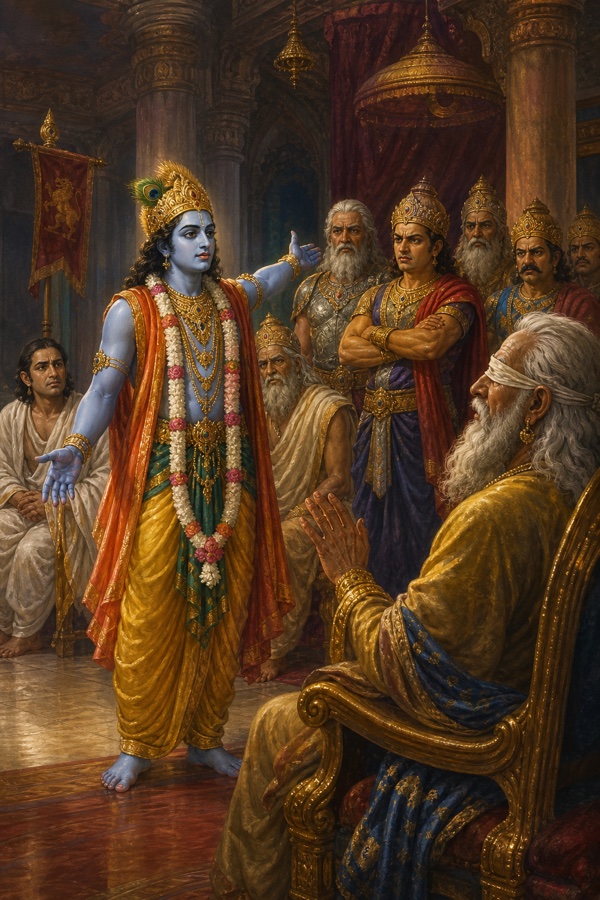
“King, when the gods and the Asuras stood arrayed for battle and the weapons were raised to strike, Parameshthin, the lord of all creatures, said something that applies to the case before us. When the population of the worlds was divided into two camps and about to be slaughtered, the divine and holy cause of the universe, the Creator, said: ‘The Asuras and the Daityas with the Danavas will be defeated, and the Adityas, the Vasus, the Rudras and the other dwellers in heaven will be victorious. In this battle gods and Asuras and men and Gandharvas and serpents and Rakshasas will slaughter one another in their rage.’ Thinking so, Parameshthin, lord of all creatures, commanded Dharma: ‘Bind the Daityas and the Danavas fast, and make them over to Varuna.’ And Dharma, at Parameshthin’s command, bound the Daityas and the Danavas and made them over to Varuna. And Varuna, lord of the waters, having bound those Danavas with Dharma’s noose and with his own, keeps them in the depths of the ocean and guards them there to this day. Bind Duryodhana in the same way, and Karna, and Shakuni the son of Subala, and Duhshasana, and make them over to the Pandavas. For the sake of a family, one man may be given up. For a village, a family. For a province, a village. And for the sake of one’s own self, the whole earth. Bind Duryodhana fast, monarch, and make peace with the Pandavas. Do not let the whole Kshatriya race be slaughtered on your account, bull among Kshatriyas.”
A key to reading this (Duhshasana’s fear, and the example of Kansa): Do not let one detail of Duhshasana’s warning slip past: he says that Bhishma, Drona and Dhritarashtra themselves will bind the three of them, Karna included, and hand them to the Pandavas. The idea was already in the air of that hall before Krishna said it openly. The two precedents Krishna offers both come from his own life and his own tradition: Kansa, whom his own clan abandoned and Krishna killed, and the command of Parameshthin by which Dharma bound the Danavas and gave them to Varuna. Both examples rest on the same rule, which Krishna states at the end like a sum: one man for a family, a family for a village, a village for a province, and the whole earth for the self.
The gist: Red-eyed with anger, Krishna reads Duryodhana his offenses one by one: the dice conspiracy with Shakuni, the words spoken to Draupadi after she was dragged into the assembly, Duhshasana’s taunts as the Pandavas left for the forest, the vile language of Karna, Duhshasana and Duryodhana himself, the fire at Varanavata, the exile at Ekachakra, the attempts by poison, snakes and cords, and now the refusal of the paternal share, which he will be forced to give when he lies in the dust. Duhshasana warns that the Kuru elders will bind Duryodhana, Karna and himself and deliver them to the Pandavas. Duryodhana walks out of the court hissing like a snake, ignoring everyone, and his brothers, counselors and all the kings follow him. Bhishma says the hour of all these Kshatriyas has come. Krishna, citing Kansa and the binding of the Danavas by Dharma at Parameshthin’s command, urges the elders to bind Duryodhana, Karna, Shakuni and Duhshasana and hand them over, because giving up one man to save a family is dharma.
Gandhari is summoned to the court: a mother who blames her husband first, and then reasons with a son whose eyes have gone the color of copper
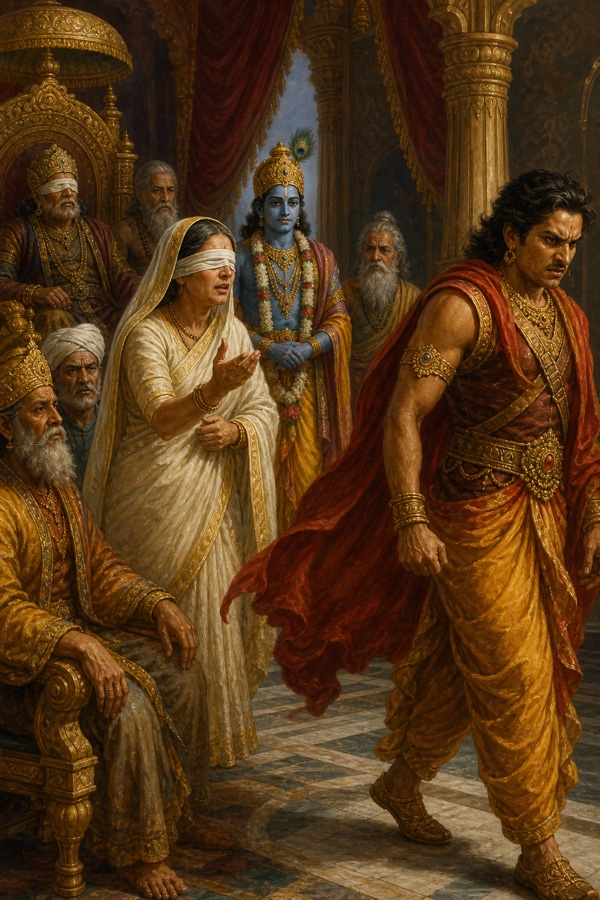
Krishna’s list of Duryodhana’s crimes was still hanging in the air of the assembly hall when Dhritarashtra turned toward the one man he trusted to carry out an order quickly. The blind king had one card left in his hand, and he knew it. “Go, my child,” he said to Vidura, “go to Gandhari, who has wisdom and sees far ahead, and bring her here. With her beside me I will plead with this wicked-hearted son of mine. If she can calm this wretch, we may still be able to act on what our friend Krishna has said. It may be that when she speaks for peace, she will show this fool the right road, sick as he is with greed and surrounded by evil companions. If she can turn aside the terrible calamity Duryodhana is bringing on us, there will be happiness and peace for ever and ever.” Vidura went, and at the king’s command he brought Gandhari into the court. Dhritarashtra addressed his wife the moment she had taken her place. “Look at him, Gandhari, this son of yours with his wicked soul. He has trampled every command of mine and is about to throw away sovereignty and life together out of lust for sovereignty. Like a man with no education at all, he has walked out of this court with his sinful counselors, showing contempt for his elders and treating the words of his well-wishers as nothing.”
Gandhari heard her husband out, and the answer she gave landed first on him. “Bring that kingdom-hungry, sick son of mine here at once,” she said. “A man whose heart has never been cultivated, who throws away both virtue and profit, does not deserve to rule a kingdom. Yet Duryodhana, who has no humility in him, has gained a kingdom by every means available. And you, Dhritarashtra, so fond of your son, are very much to blame for it, because you knew his sinfulness perfectly well and still you followed his counsel. That son of yours is possessed entirely by lust and by wrath. He has become the slave of delusion, and for that reason, king, you can no longer turn him back by force. You are reaping now what you sowed when you handed the kingdom to an ignorant fool with a wicked soul, a fool eaten by greed and surrounded by wicked counselors. Why is the king indifferent today to the rupture that is about to open between people so closely bound? When your enemies see you split from your own kin, they will laugh at you. And who reaches for force to get past a calamity that can be gotten past with conciliation and with gifts?”
So Vidura, at the king’s command and now at the mother’s too, went out once more and brought Duryodhana back into the court. The prince came in expecting to hear his mother, and the anger showed on him plainly: his eyes were red as copper, and his breath came heavy, the way a snake breathes. Gandhari watched her son walk in on the wrong road and rebuked him sharply, and then she spoke for peace. “Duryodhana, my dear son, attend to what I am going to say. It is for your good and for the good of everyone who follows you, it is something you are able to obey, and it will bring you happiness. Obey the words of your well-wishers, the words that your father, the best of the Bharatas, and Bhishma and Drona and Kripa and Vidura have spoken. If you make peace, you honor Bhishma by it, and your father, and me, and all your well-wishers with Drona at their head. Nobody, my wise son, nobody in this line of Bharata, succeeds by his own wish alone in acquiring a kingdom, or in keeping one, or in enjoying one. A man who has no control over his senses cannot hold sovereignty for long. The man who has his soul under control and great intelligence to guide it can rule a kingdom. Lust and wrath pull a man away from his possessions and from his enjoyment of them. A king conquers those two enemies first, and only then does he bring the earth under him. Sovereignty over men is a great thing. Men of wicked soul find it easy to want a kingdom. They do not have what it takes to keep one.”
“Whoever wants a wide empire has to tie his senses to both profit and virtue, because when the senses are held in check the intelligence grows, the way a fire grows when it is fed. Left unchecked, the senses can kill the man who owns them, the way unbroken and furious horses kill a driver who does not know his work. The man who tries to master his counselors without first mastering himself, and to master his enemies without first mastering his counselors, is soon mastered himself and ruined. The man who conquers his own self first, treating it as the enemy it is, does not then labor in vain to conquer counselors and enemies afterward. Prosperity waits upon the man who has conquered his senses and his counselors, who punishes those who transgress, who acts after thinking, and who has wisdom in him. Lust and wrath live in the body, and wisdom drains the strength out of them, the way two fish are held helpless in a net whose holes are too fine to slip through. Those two, on whose account the gods bar the gates of heaven even against a man who has freed himself from worldly desire and wants to enter, are stirred by lust and by wrath. The king who knows how to conquer lust, wrath, greed, boasting, and pride can own the sovereignty of the whole earth. A king who wants wealth and virtue and victory over his enemies should always be at work on controlling his passions. A man who, driven by lust or wrath, deals deceitfully with his own kin or with others will never gather many allies.”
“Join yourself, my son, to the heroic sons of Pandu, those punishers of enemies, all of them men of great wisdom, and you can enjoy the earth in happiness. What Bhishma, Shantanu’s son, and Drona, that mighty chariot warrior, have told you is entirely true: Krishna and Dhananjaya cannot be conquered. Take shelter, then, with the mighty-armed one, with the one whom no effort tires, because if Keshava is gracious, both sides will be happy. A man who will not do what his wise and learned friends want, friends who are always working for his prosperity, gives pleasure to nobody except his enemies. My son, there is no good in battle, no virtue, and no profit. How can it bring happiness, then? Even victory is never certain. Do not set your heart on battle. Bhishma and your father and Bahlika gave the Pandavas their share out of fear, my wise son. Never think of breaking with them. You are looking today at the fruit of that peaceful cession, in your own sovereignty over the whole earth, and it was those very heroes who pulled the thorns out of it. Give the sons of Pandu what is owed to them. If you want to enjoy even half the empire with your counselors, then give them their share. Half the earth is enough to support you and your counselors. Act on what your well-wishers tell you, Bharata, and you will win great fame. A quarrel with the sons of Pandu, who have prosperity on their side, whose souls are wholly under control, who are men of great intelligence and have mastered their passions, will only strip you of your own great prosperity. Put away the anger of all your well-wishers and rule your kingdom as befits you, bull of Bharata’s line, giving the sons of Pandu the share that belongs to them. Thirteen full years of persecuting them has been enough, my son. Quench that fire now, fed as it has been by lust and wrath. You covet the wealth of the Pandavas, and you are no match for them, nor is this exceedingly wrathful son of a suta, nor is your brother Duhshasana. When Bhishma and Drona and Kripa and Karna and Bhimasena and Dhananjaya and Dhrishtadyumna are all enraged at once, the population of the earth will be wiped out. Do not, in your wrath, exterminate the Kurus, my son. Do not let the wide earth be destroyed for your sake. Because your understanding is small you imagine that Bhishma and Drona and Kripa and all the rest will fight for you with everything they have. That will never happen. These are men who know themselves, and their affection for the Pandavas and for you is equal. If for the sake of the living they have received from the king they consent to give up their very lives, even then they will never be able to cast an angry glance at King Yudhishthira. Nowhere in this world has it been seen that men acquire wealth through greed. Give up your greed, then, my son, and desist, bull of Bharata’s line.”
A key to reading this (two edges on one blade): Gandhari’s speech has two halves, and they cut in different directions. The first half is aimed at her husband, and she spares him nothing: he knew his son’s sinfulness and followed the boy’s counsel anyway, and now that the boy has become the slave of his own delusion, force is no longer available to his father. The second half is aimed at her son, and she speaks to him as a teacher of statecraft rather than as a pleading mother. Gaining a kingdom and keeping one are separate capacities. Unbroken senses kill their rider. And the point she saves for last is the one that will govern the first ten nights of the war: Bhishma, Drona, and Kripa may die for Duryodhana, and still they will be unable to look on Yudhishthira with anger.
The gist: After Krishna’s reckoning of Duryodhana’s crimes, Dhritarashtra plays his last card and has Vidura bring Gandhari into the court. She blames her husband first, for following a son whose sinfulness he knew, and then Vidura fetches Duryodhana back, red-eyed and breathing like a snake. Gandhari lectures him at length: no kingdom survives an unconquered self, lust and wrath are two enemies lodged in the body, Krishna and Arjuna cannot be beaten, giving the Pandavas their half is the only way to keep sovereignty over the whole, thirteen years of persecution is enough, and Bhishma, Drona, and Kripa may give their lives for him but will never be able to turn anger on Yudhishthira.
The plot to seize Krishna: four men in a corridor, Satyaki’s eye, and Vidura’s roll of the twenty victories in which nobody ever laid a hand on Keshava
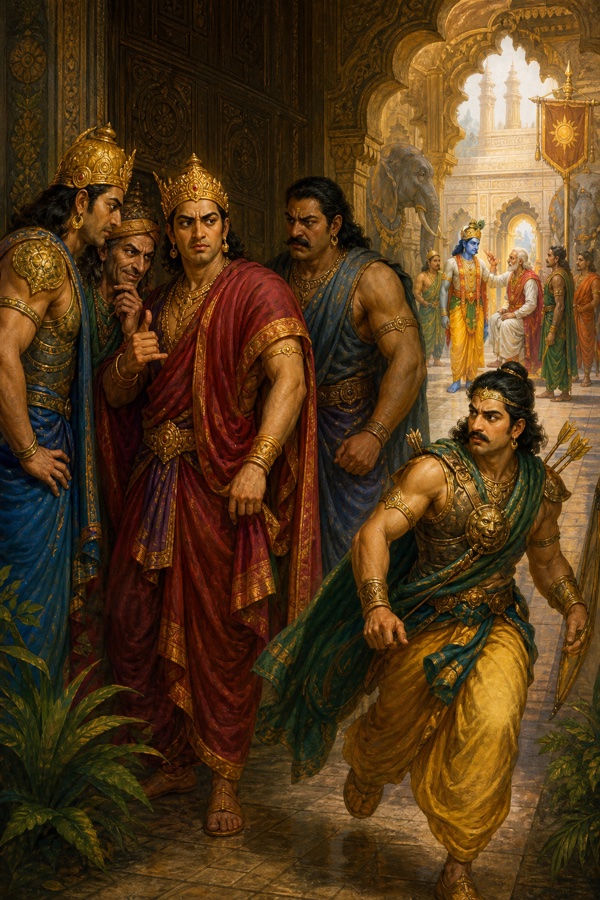
Duryodhana let his mother’s words fall to the floor without picking one of them up. He rose in his anger and walked out, straight to the company of the men who told him what he wanted to hear. Outside the court the Kuru prince began to confer with Shakuni, son of Subala, the cleverest man alive with a pair of dice. Four of them made the decision, Duryodhana and Karna and Shakuni, with Duhshasana as the fourth, and this is what they decided. “This Janardana, who moves so fast, means to seize us first, with the help of King Dhritarashtra and Shantanu’s son. We will move faster. We will take this tiger among men, this Hrishikesha, by force, the way Indra took Virochana’s son Bali. When the Pandavas hear that the Vrishni has been seized, the heart will go out of them and they will be unable to lift a finger, like snakes whose fangs have been broken. He is the refuge and the protection of all of them, this mighty-armed one. Put this granter of wishes, this bull of the Satvatas, under lock and key, and the Pandavas and the Somakas will sink into despair and be incapable of any exertion. So we will seize Keshava here, whatever Dhritarashtra cries out, and then we will fight the enemy.”
Those men of sinful soul had scarcely reached their sinful resolution when Satyaki, who was highly intelligent and could read a heart from the signs a face gave away, came to know of it. He acted on the knowledge at once. He left the court with Kritavarma, Hridika’s son, and gave him an order. “Get the troops into formation, quickly. Put your armor on, draw them up for battle, and wait at the entrance of the court until I have laid this before Krishna, whom no exertion tires.” Then the hero went back into the hall the way a lion goes back into its mountain cave. He told Keshava first, then Dhritarashtra, then Vidura, what had been resolved. And having told them, he laughed. “These wicked men intend to do something here that good men condemn on every ground there is, virtue, profit, and pleasure alike. They will never manage to actually do it. These fools with their sinful souls, gathered in a knot, these wretches drowned in lust and anger, sold to wrath and greed, are about to attempt something wholly unbecoming. Small-minded wretches who want to lay hands on the lotus-eyed one are like idiots, like children, trying to pick up a blazing fire in the folds of their clothes.”
Vidura, who saw far ahead, heard Satyaki out and then spoke to the mighty-armed Dhritarashtra in the hearing of all the Kurus. “King, punisher of enemies, the hour of all your sons has come, because they are trying to commit an act of utter infamy, however incapable they are of carrying it through. Together they want to overpower this younger brother of Vasava and seize the lotus-eyed one. They will meet this tiger among men, this invincible and irresistible one, and every one of them will perish, like insects in a blazing fire. If Janardana wished it, he could send all of them to Yama’s house even if they fought him in a body, the way an enraged lion disposes of a herd of elephants. He will never do any such sinful and censurable thing. This best of men, whose glory never fades, will never step off the path of virtue.” When Vidura had finished, Keshava let his eyes rest on Dhritarashtra and spoke in the midst of those well-meaning men, men who knew how to listen. “King, if these men wish to punish me by violence, give them leave to do it. As for my punishing them, I would dare to punish all of them at once, worked up as they are with rage, and yet I will not commit any sinful or censurable act. Your sons covet what belongs to the Pandavas, and they will lose what belongs to themselves. If they want to attempt this, Yudhishthira’s purpose will be served with no trouble at all, because this very day, Bharata, I could seize them and everyone who follows them and hand them over to the sons of Pritha. What is there that is hard for me? But I will not, in your presence, great king, do any censurable thing that could only come out of wrath and a sinful mind. Let it be as this Duryodhana wants. I give all your sons my permission.”
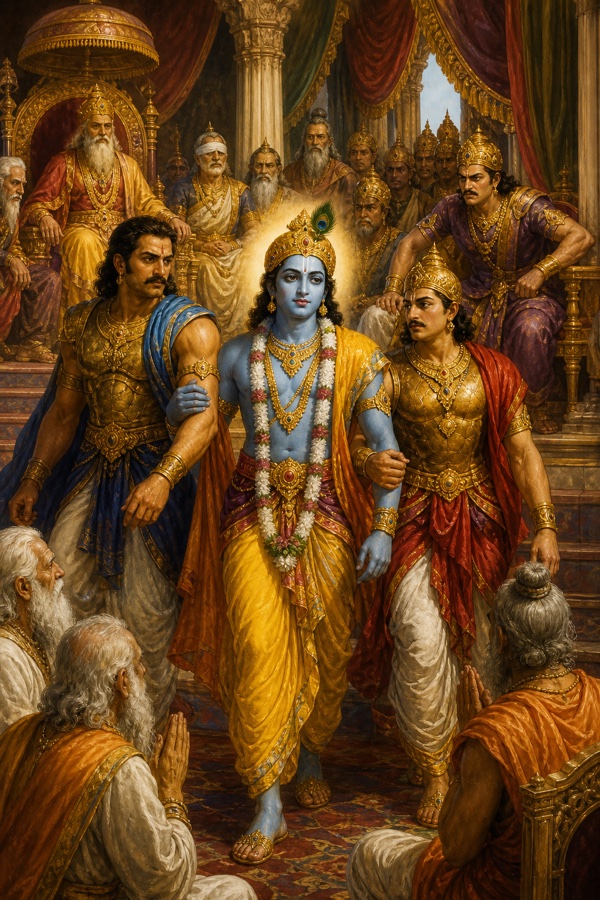
Dhritarashtra heard that and turned to Vidura. “Quickly. Bring sinful Duryodhana here, with his lust for sovereignty, and his friends and counselors and brothers and followers with him. Let me see whether one more effort can put him on the right road.” Vidura went and brought Duryodhana, unwilling, back into the court with his brothers and the kings who followed him around him. King Dhritarashtra addressed his son, standing there ringed by Karna and Duhshasana and all those kings. “You wretch, you heap of accumulated sins, with your allies whose deeds are despicable, the thing you are trying to do, in league with your sinful friends, is infamous. Your understanding is small, you are the infamy of your line, and only a man like you could even try an act so infamous and so condemned by the good, impossible as it is to carry out. In league with sinful allies, you want to lay hands on this invincible and irresistible one with eyes like lotus petals? Like a child who wants the moon in his hands, you fool, you want to do what the gods themselves could not do, with Vasava at their head and all their strength behind them? Do you not know that Keshava cannot be withstood in battle by gods or men, by Gandharvas, Asuras, or Uragas? As no one can grasp the wind in his fist, as no hand can reach the moon, as no one can hold up the earth on his head, so Keshava cannot be taken by force.”
When Dhritarashtra had said this, Vidura fixed his eyes on Duryodhana and addressed that vindictive son of Dhritarashtra himself. “Duryodhana, listen now to what I am going to tell you. At the gates of Saubha the foremost of monkeys, the one called Dvivida, buried Keshava under a shower of stones. He wanted Madhava in his grasp, he put out all his prowess and all his exertion to get him, and he still could not seize him. And you want to seize that Keshava by force? When Shauri went to Pragjyotisha, Naraka with all the Danavas behind him could not seize him there. You want to seize him by force? He killed that Naraka in battle and carried a thousand maidens away from his city and married every one of them according to the ordinance. In the city of Nirmochana six thousand mighty Asuras failed to catch him in their nooses. You want to seize that Keshava by force? While he was still a child he killed Putana, and two Asuras who had taken the shape of birds, and to protect the cattle from the rain, bull of Bharata’s line, he held up the mountain of Govardhana. He has killed Arishta and Dhenuka and Chanura of the great strength, and Ashvaraja, and Kansa, the doer of evil. He has killed Jarasandha and Vakra and Shishupala of the mighty energy and Bana in battle, and many other kings besides have died at his hands. His might is beyond measure. He defeated King Varuna, and Pavaka, and when he went to bring down the Parijata he defeated Shachi’s own lord. Floating on the vast deep he killed Madhu and Kaitabha, and in another birth he killed Hayagriva. He made everything there is, and no one made him, and every power that exists has its cause in him. Whatever Shauri wishes, he accomplishes without effort. Do you not know sinless Govinda, whose prowess is terrible and who never decays? He is like an angry snake of virulent poison, an endless spring of energy. Try violence on Krishna, with his mighty arms and his tirelessness, and you will perish with all your followers, like an insect falling into fire.”
A key to reading this (Krishna’s permission): The sharpest line in this section belongs to Krishna, and it is no threat. He tells Dhritarashtra to give his sons leave to try, and in the same breath says that he could bind every one of them today and deliver them to the Pandavas, and that he will do nothing in the king’s presence that springs from wrath. That is the discipline of an envoy: full knowledge of his own power and full restraint of it, inside a single sentence. Vidura’s roll of names (Dvivida, Naraka, the six thousand Asuras of Nirmochana, Putana, Govardhana, Kansa, Jarasandha, Shishupala, Bana, the Parijata, Madhu and Kaitabha, Hayagriva) is the other face of the same fact: so many have failed to hold this man that the mere idea of holding him is a child’s.
The gist: Duryodhana walks out on his mother and, with Shakuni, Karna, and Duhshasana, resolves to seize Krishna himself, as Indra once seized Bali, so that the Pandavas will be left like snakes with broken fangs. Satyaki, who reads hearts from faces, learns of it, posts Kritavarma at the door with the troops in armor, and comes back in to tell Krishna, Dhritarashtra, and Vidura. Vidura says the hour of the king’s sons has come; Krishna says let them try, and that he will do nothing censurable himself. Dhritarashtra has Duryodhana dragged back and calls him the infamy of his line, and Vidura recites, from Dvivida to Hayagriva, the long list of those who tried to lay hands on Krishna and failed.
Keshava laughs, and gods the size of a thumb pour out of his body: the form shown in the Kuru court, and the white chariot that carries him to Kunti’s door
When Vidura had finished, Keshava, whose energy is immense and who breaks hostile armies, spoke to Dhritarashtra’s son. “You are deluded, Suyodhana. You take me for a man alone, and that is why, in your small understanding, you think you can overpower me by violence and make me a captive. But look. All the Pandavas are here. All the Vrishnis and the Andhakas are here. Here are the Adityas, the Rudras, and the Vasus, and all the great Rishis with them.” And with that, Keshava, slayer of hostile heroes, threw back his head and laughed aloud. As the high-souled Shauri laughed, gods began to issue from his body, which had taken on the look of a blazing fire, gods in their myriads, each with the brilliance of lightning, and none of them larger than a thumb. Brahma appeared on his forehead and Rudra on his breast. On his arms the regents of the world appeared, and from his mouth came Agni, the Adityas, the Sadhyas, the Vasus, the Ashvins, the Maruts with Indra, and the Vishvedevas. Yakshas came out of him by the myriad, and Gandharvas, and Rakshasas too, all of the same measure and the same form. From his two arms came Sankarshana and Dhananjaya: Arjuna stood at his right hand with his bow, and Rama stood at his left, armed with the plow. Behind him stood Bhima and Yudhishthira and the two sons of Madri, and in front of him all the Andhakas and the Vrishnis, Pradyumna and the other chiefs, with their heavy weapons raised. In his many arms the conch was seen, and the discus, the mace, the bow called Sharanga, the plow, the javelin, the Nandaka, and every other weapon there is, all of them blazing and all of them lifted to strike. From his eyes and nose and ears and from every part of his body came fierce sparks of fire mixed with smoke, and from the pores of his skin came sparks like the rays of the sun.
The kings looked at that awful form of the high-souled Keshava and closed their eyes, their hearts sick with fright. Five did not close them: Drona, and Bhishma, and Vidura of the great intelligence, and Sanjaya, greatly blessed, and the Rishis rich in austerity, because on that occasion the divine Janardana gave those men the divine sight. As the Kuru court beheld that supremely wonderful thing, celestial drums sounded in the sky and a shower of flowers came down. The whole earth trembled, and the oceans heaved. Every creature living on the earth, bull of Bharata’s line, was filled with wonder. Then that tiger among men, that punisher of enemies, drew back into himself that divine, wonderful, endlessly varied, and auspicious form. He linked arms with Satyaki on one side and with Kritavarma, Hridika’s son, on the other, took leave of the Rishis, and walked out of the hall. In the uproar that followed, Narada and the other Rishis vanished, each to his own place, and that was one more marvel added to the rest. When the Kauravas saw the tiger among men leaving the court, they followed him out with all the kings, the way the gods follow Indra. Shauri, whose soul has no measure, gave the men behind him no thought at all. He went out of the court like a blazing fire wrapped in smoke.
At the gate Daruka was waiting with his chariot. It was a great chariot and it was white, hung with rows of small bells that rang as it moved, decked in gold and built for speed, its wheels sounding like the rolling of clouds. White tiger skins covered it from end to end, and Shaibya and the other horses stood harnessed to it. Kritavarma, Hridika’s son, the mighty chariot warrior beloved of the Vrishnis, had already mounted his own chariot beside it. Shauri’s chariot was ready, and he was on the point of leaving, when King Dhritarashtra spoke to him one more time. “You have seen, Janardana, grinder of enemies, how much power I have over my sons. You have watched all of it with your own eyes. Nothing is hidden from you now. You have seen me try to make peace between the Kurus and the Pandavas, and you know the condition I am in. It would be wrong for you to hold any suspicion against me. I have no sinful feeling toward the Pandavas, Keshava. You know what I said to Suyodhana. The Kauravas know it too, and every king on the earth knows it, Madhava, that I have made every effort for peace.”
The mighty-armed Janardana answered him, and Drona, and the grandsire Bhishma, and Vidura, Bahlika, and Kripa together. “You have all seen for yourselves what happened in the assembly of the Kurus: how wicked Duryodhana walked out in anger like a man with no training in him, and how King Dhritarashtra describes himself as powerless. With the leave of all of you, I will go back now to Yudhishthira.” He saluted them, that bull among men, and mounted his chariot and set out. The heroic bulls of the Bharata line, mighty bowmen all of them, walked after him: Bhishma, Drona, and Kripa, Vidura, Ashvatthama and Vikarna, and the mighty chariot warrior Yuyutsu. And on his great white chariot with its rows of ringing bells, in the full sight of the Kurus, Keshava went to the house of his father’s sister, Kunti.
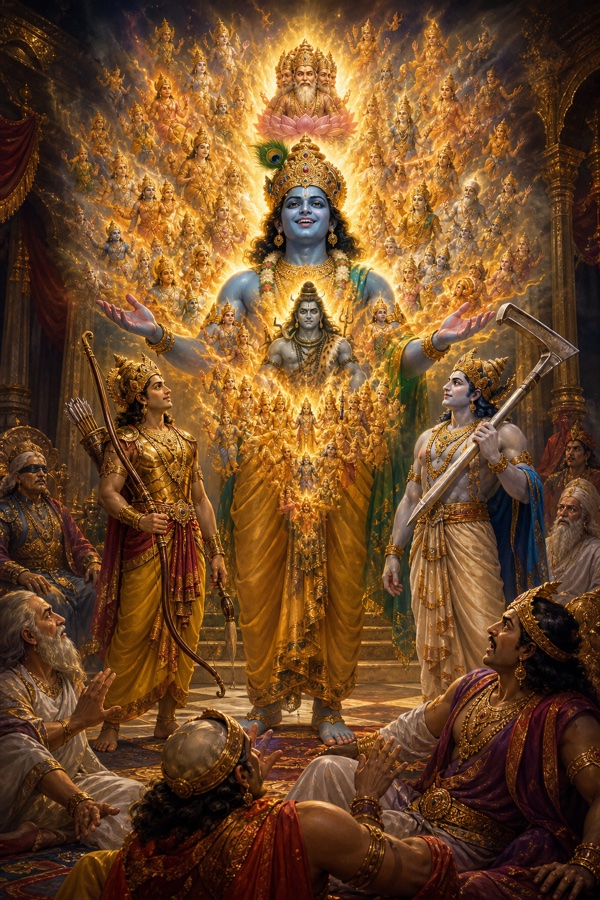
A key to reading this (this is Vyasa’s court vision, and it differs from the Gita’s): A reader is likely to think of the universal form shown to Arjuna on the chariot at Kurukshetra. This description belongs to the assembly at Hastinapura and stands on its own. It opens with a laugh. The gods are thumb-sized and come out in swarms. Brahma sits on the forehead and Rudra on the breast. And the detail worth holding onto is that Balarama and Arjuna emerge from the two arms, the four other Pandavas take their places behind him, and the Vrishnis and Andhakas stand in front, which is Krishna’s direct answer to Duryodhana’s claim that he stands alone: the divine form and the whole political alliance shown in one body. The divine sight is given to five, Drona, Bhishma, Vidura, Sanjaya, and the Rishis. Every other king in the room shuts his eyes.
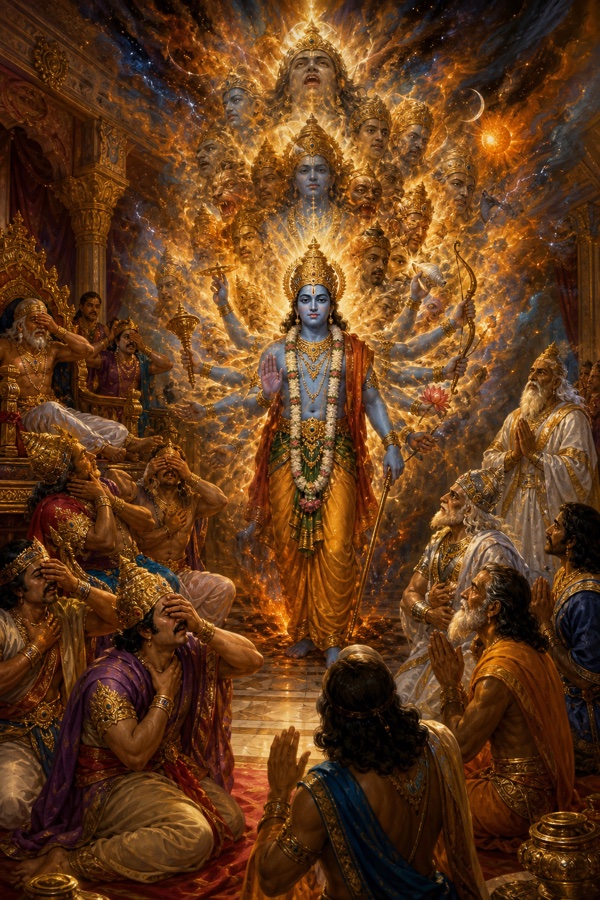
The gist: Krishna tells Duryodhana he is mistaken to think him alone, and laughs; with the laugh, thumb-sized gods pour out of his body by the myriad, Brahma on his forehead, Rudra on his breast, Balarama and Arjuna from his arms, the Pandavas behind him, the Vrishnis in front, every weapon from the conch to the Nandaka in his hands, sparks from every pore. The kings close their eyes; Drona, Bhishma, Vidura, Sanjaya, and the Rishis are given divine sight. Drums sound, flowers fall, the earth shakes. Krishna withdraws the form and walks out arm in arm with Satyaki and Kritavarma, the Rishis vanish, and Daruka waits at the gate with the white chariot. Dhritarashtra begs him to bear witness to his helplessness, Krishna takes leave of the elders, and with Bhishma, Drona, Kripa, Vidura, Ashvatthama, Vikarna, and Yuyutsu walking behind, he drives to Kunti’s house.
Keshava bows at Kunti’s feet, and a mother’s first message to Yudhishthira: Muchukunda’s answer to Kubera, the king who makes the age, and the law of living by the strength of one’s arms
Keshava entered Kunti’s house and bowed to her feet, and then he gave her, in brief, an account of everything that had happened in the assembly of the Kurus. “Many things were said,” Vasudeva told her, “by me and by the Rishis both, things worth accepting and full of reasons, and Duryodhana accepted none of them. The hour of Suyodhana and of those who follow him has come. With your leave I will go quickly now to the Pandavas. What am I to tell them from you? Tell me that, you who have great wisdom. I want to hear your words.”
Kunti gave him the message for her eldest son first. “Say this to King Yudhishthira, whose soul is virtuous. Your virtue, my son, is shrinking badly. Do not go on acting to no purpose. You have become like a reader of the Vedas who cannot catch their real meaning and who is therefore, for all his reading, an unlearned man. Your understanding has been caught by nothing but the words of the Vedas, and so it sees virtue and nothing else. Turn your eyes to the duties of your own order, the duties the Self-created one laid down. For every ruthless deed, and for the protection of the people, the Kshatriya was made from the Brahmin’s arms, and he is to depend on the prowess of his own arms. Hear an example of it, one I heard from the old people. Long ago Vaishravana, well pleased, made a gift of this whole earth to the royal sage Muchukunda. Muchukunda would not take the gift. He said, ‘I wish to enjoy the sovereignty that is won by the strength of arms.’ Vaishravana was delighted at that, and full of wonder. And King Muchukunda, keeping the duties of the Kshatriya order in full, conquered this earth by the strength of his arms and ruled it.”
“Consider this too. Of the virtue that subjects practice when a king protects them well, a sixth part comes to the king, Bharata. The virtue the king himself practices makes a god of him, and if he commits sin, he goes to hell. The penal code, properly applied by the ruler, holds the four orders to their respective duties and brings the ruler himself virtue, profit, and salvation. When the king abides by the penal code and lets no part of it become a dead letter, then the best of ages, the one called the Krita Yuga, sets in. Have no doubt on this question, whether the age makes the king or the king makes the age. Know this for certain: the king is the cause of the age. It is the king who creates the Krita, the Treta, or the Dvapara, and it is the king who is the cause of the fourth age too, the Kali. The king who brings on the Krita age enjoys heaven exceedingly. The king who brings on the Treta enjoys heaven, though not exceedingly. For bringing on the Dvapara, a king enjoys heaven in proportion to his due. But the king who brings on the Kali age earns sin exceedingly, and that king of wicked deeds lives in hell for years past counting. The king’s sins spread out into the world, and the world’s sins come back upon him. Keep to the kingly duties that suited your ancestors. The conduct you want to live in is no conduct for a royal sage. A man stained by weakness of heart, who clings to compassion and cannot hold steady, never earns the merit that comes from cherishing his subjects with love.”
“The understanding you are acting on now was never what Pandu wished for you, or I, or your grandfather, when we spoke our blessings over you in the old days. Sacrifice, gift, merit, and bravery, subjects and children, greatness of soul, might, and energy: those were the things I always prayed for on your behalf. Well-wishing Brahmins worshiped the gods and the Pitris in due form for your long life, your wealth, and your children, adding the Svaha and the Svadha. A mother and a father, and the gods as well, always want for their children generosity and gift, study, sacrifice, and rule over subjects. Whether all this is righteous or unrighteous, you are to practice it, because of the very birth you were given. And look at them, Krishna. Instead of all that, born in a high line as they are, they lack the bare means of support and live in misery. Hungry men who come to a brave and open-handed king are satisfied and live at his side. What virtue can stand higher than that? A virtuous man, once he has gained a kingdom, should make all the people of this world his own, binding some with gifts, some with force, and some with sweet words. A Brahmin should live by begging, a Kshatriya should protect, a Vaishya should earn wealth, and a Shudra should serve the other three. Begging, therefore, is forbidden to you. Agriculture does not suit you either. You are a Kshatriya, and so you are the protector of everyone in distress. You are to live by the prowess of your arms. Recover the paternal share of the kingdom that you have lost, mighty-armed one, by conciliation, or by sowing division among your enemies, or by gifts of money, or by force, or by well-directed policy. What grief could be greater than mine, that I, who brought forth a son like you, a son who adds to the joy of his friends, should live without friends on food that other people supply? Fight, as kings fight. Do not sink your ancestors into infamy. Do not, with your merit worn away, come with your younger brothers to a sinful end.”
A key to reading this (whom Kunti is arguing against): On a first hearing this sounds like a speech against Duryodhana. It is aimed at Yudhishthira, and at one thing in him: the understanding that sees virtue alone and does not see the Kshatriya’s duty. Kunti presses the point hard enough to compare her son to a man who can recite the Vedas and cannot understand them. Muchukunda’s example carries the same charge: to refuse the earth as a gift from Kubera and want only the sovereignty won by one’s arms is what a Kshatriya’s duty looks like. The passage on the ages is the message’s strongest argument. The king causes the age, and the age does not cause the king, so a king who turns away from the rod of punishment brings the Kali Yuga down on his own people. The story Kunti tells next, Vidula and her son, puts the same argument into another mother’s mouth.
The gist: Krishna reaches Kunti’s house, touches her feet, gives her a brief account of the assembly, tells her Duryodhana’s hour has come, and asks what message she has for her sons. Kunti speaks for Yudhishthira’s ears: his virtue is shrinking, he has become a reader of the Vedas who misses their meaning; the Kshatriya was made from Brahma’s arms and must live by his arms; Muchukunda refused the earth as Kubera’s gift and conquered it instead; the king is the cause of the age, from the Krita down to the Kali; a wavering king who clings to compassion earns no merit from his subjects; begging and farming are both forbidden to him; he must win back his father’s kingdom by conciliation, division, gifts, force, or policy, because to have borne such a son and still live on other people’s food is the greatest grief she knows.
Source: the Mahabharata of Krishna-Dwaipayana Vyasa, Udyoga Parva, Bhagavat-yana sub-book. This chapter follows K. M. Ganguli, sections LXXII-CXXXIX (72-139); the Gita Press Hindi edition numbers these chapters differently. Names, order, and events were checked against Ganguli’s complete translation. Dialogue and commentary are adapted, not a verbatim translation. About the sources.
Based on: The Mahabharata, Vyasa (Gita Press, Gorakhpur)