On this page
Sanjaya has come back, and Hastinapura’s answer has come back with him: there will be no land. At Upaplavya Yudhishthira turns to Krishna and says the thing a king almost never says, that he will make peace for five villages. This chapter begins with that council, in which Bhima speaks for peace and Krishna laughs at him, in which Draupadi speaks with her loosened hair in her hand, and at the end of which Krishna rides out as the envoy himself. Then Hastinapura: the decorated pavilions Dhritarashtra has built and Krishna does not so much as look at, the food of Duryodhana that he refuses, the house of Vidura where he spends the night, and Kunti, who tells thirteen years of grief in a single breath. In the assembly comes Krishna’s plea for peace, then three warning tales from three sages, each showing Duryodhana where obstinacy ends. And then everything that had to happen: the pleas of Dhritarashtra, Bhishma, Drona, Vidura and Gandhari, Duryodhana’s answer that he will not give up a needle’s point of land, the plot to seize Krishna, the form Krishna shows in the middle of the court, and finally Kunti’s message, in which a mother tells her defeated son that it is better to blaze up for a moment than to smolder like damp wood for a lifetime.
After Sanjaya leaves Upaplavya: Yudhishthira tells Krishna that even five villages were refused, and why poverty is worse than death
Janamejaya wanted to know what happened next. When that decent man Sanjaya walked out of the Pandava camp and went back to the Kurus, what did my grandfathers do, the sons of Pandu? Tell me all of it. Vaishampayana answered him, and the answer begins in a tent at Upaplavya with the dust of the envoy’s chariot still settling on the road. Yudhishthira the just turned to Krishna of the Dasharha line, the chief of all the Satvatas, and spoke to him as a man speaks when he has run out of other doors. You who are devoted to your friends, he said, the hour has come when a friend must show what friendship is. In this season of trouble I see no one besides you who can save us. It was because we relied on you, Madhava, that we dared to ask Duryodhana for our share at all, Duryodhana whose pride cannot be measured, and his counselors with him. You protect the Vrishnis in every calamity that comes to them. Protect the Pandavas now from a great danger, for they deserve your protection.
Krishna’s reply was short. Here I am, strong-armed one. Say what you want to say, and whatever you tell me, Bharata, I will do. So Yudhishthira laid the whole case out. You have heard what Dhritarashtra intends, and what his son intends. Everything Sanjaya said to me carries Dhritarashtra’s assent, that much is certain. Sanjaya is Dhritarashtra’s very soul, and he spoke Dhritarashtra’s mind. An envoy speaks according to his instructions; an envoy who speaks otherwise deserves to die. Dhritarashtra does not look on all who belong to him with an equal eye. Moved by greed and a sinful heart, he wants peace with us without returning our kingdom. At his command we spent twelve years in the forest and a thirteenth in hiding, and we did it in the firm belief that he would stand by the pledge we had made to each other. That we never once strayed from our promise is known to the Brahmins who lived with us. Now that covetous king is unwilling to keep to the virtues of a Kshatriya. Out of love for his son he listens to wicked men. Following Suyodhana’s counsel, seeking his own advantage, he deals with us falsely, Janardana.
And what could be more painful than this, that I cannot even provide for my mother and my friends? I have the Kashis, the Panchalas, the Chedis and the Matsyas for allies, and you, slayer of Madhu, for my protector, and still I asked for only five villages. Avisthala, Vrikasthala, Makandi, Varanavata, and any fifth one, Govinda, whichever they chose. Give us five villages or towns, we said, sir, where the five of us may live together, because we do not want the destruction of the Bharatas. And Dhritarashtra’s evil-minded son, who believes the lordship of the whole world sits in him, would not agree even to that. What sorrow is greater? When a man born and raised in a respectable house sets his eye on what belongs to others, that greed destroys his intelligence. Intelligence destroyed, shame is lost. Loss of shame diminishes virtue. Loss of virtue brings the loss of prosperity, and the loss of prosperity finishes a man, because poverty is a man’s death. Kinsmen and friends and Brahmins shun a poor man the way birds avoid a tree that bears neither flower nor fruit. That, sir, is death to me, that my own kin avoid me as if I were a fallen man, as if the breath of life had already left a corpse.
Then he spoke about poverty itself, at length, like a man who has had thirteen years to think about it. Samvara said that no condition of life is more wretched than the one in which a man is racked every day by the same thought, I have no food today, what will become of me tomorrow. Wealth is called the highest virtue, and everything depends on it. Those who have wealth are said to live; those without it are more dead than alive. The men who rob another of his wealth by force do worse than kill him, they destroy his virtue, his profit and his pleasure all at once. Some, overtaken by poverty, choose death. Some leave the cities for hamlets, some retire into the woods, some become religious beggars in order to wear out their lives. Some are driven mad for the sake of wealth, some live in subjection to their enemies for it, and many more take service under other men. A man’s poverty hurts him more than death does, because wealth is the sole source of virtue and pleasure. Natural death nobody counts for much; that is the eternal road of all creatures, and no creature born can step off it. But hear this, Krishna. A man poor from birth does not suffer as the man suffers who once held great prosperity, who was raised in comfort, and who is then stripped of it. Fallen into distress through his own fault, such a man curses the gods, Indra among them, and curses himself. Knowledge of the entire scriptures cannot ease his pain. He is angry with his servants one moment and full of malice toward his well-wishers the next. Under constant anger he loses his senses, and with his senses clouded he does evil. Through that sinfulness he brings about a mixing of castes, and the mixing of castes leads to hell and is the foremost of sins. If he is not awakened in time he certainly goes to hell. Only wisdom can awaken him. If the eye of wisdom is given back to him, he is saved.
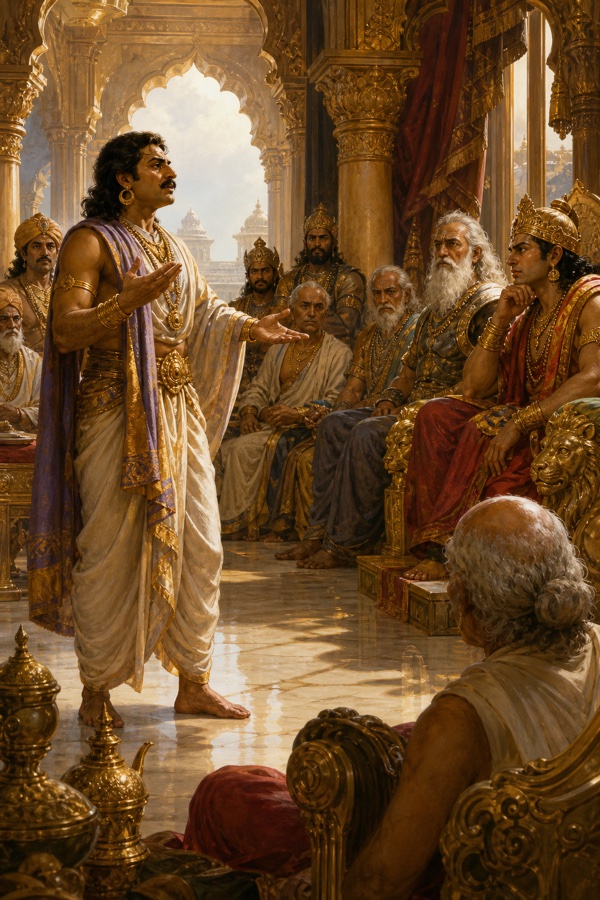
Yudhishthira ran the chain backward then, link by link, to show that the road up exists as surely as the road down. When wisdom returns, a man turns his attention to the scriptures, and attention to the scriptures strengthens his virtue. Then shame becomes his finest ornament. The man who has shame has an aversion to sin, and his prosperity grows, and the man who has prosperity truly becomes a man. One who is devoted to virtue, who keeps his mind in hand and acts only after deliberation, never leans toward unrighteousness and never engages in a sinful act. One who has neither shame nor sense is neither man nor woman; he cannot earn religious merit, and he is like a Shudra. The man who has shame gratifies the gods, the Pitris and his own self, and by that he reaches emancipation, which is the highest goal of all the righteous.
A key to reading this (five villages, and a chain of losses): This is where the five villages are named that Yudhishthira had asked for through Sanjaya: Avisthala, Vrikasthala, Makandi, Varanavata, and any fifth. Varanavata is the town where the house of lac was burned around the Pandavas years before, which gives the modesty of the request an edge. The second thread of the speech is a chain in which each link pulls the next: greed takes intelligence, intelligence gone takes shame, shame gone takes virtue, virtue gone takes prosperity, and prosperity gone takes the man. He then walks the same chain in reverse, from wisdom back up to shame as an ornament, so that the hearer can see there is a way back.
The gist: With Sanjaya gone, Yudhishthira tells Krishna that the time for friendship has come. Dhritarashtra wants peace without giving back the kingdom, though the Pandavas kept their thirteen-year pledge to the letter, and Duryodhana will not grant even five villages. Yudhishthira lays out the chain by which greed destroys a man and explains why poverty is worse than death, most of all for someone who was once rich; then he shows the chain running the other way, from recovered wisdom to shame as an ornament, by which a man becomes a man again.
Yudhishthira calls war a sin and still will not give up the kingdom: the parable of the fighting dogs, and Krishna’s decision to go as his own envoy
Yudhishthira had not finished. You have seen all of this in me with your own eyes, slayer of Madhu. You know how we have lived these years, stripped of our kingdom. We cannot lawfully abandon the prosperity that was ours. Our first effort, Madhava, will be for a settlement in which we and the Kauravas, joined in peace, quietly enjoy what belongs to each. Failing that, we will kill the worst of the Kauravas and take those provinces back. And yet success won through the blood of men so closely related to us, however despicable those men may be, is the worst of all cruel deeds. Our kinsmen are many, and many too are the revered elders who have taken one side or the other. To slaughter them would be a great sin. So what good can there be in battle? Such sinful practices are the duties of the Kshatriya order, and we were born into that wretched order. Whether those practices are sinful or virtuous, any livelihood other than arms would be a disgrace for us. A Shudra serves, a Vaishya lives by trade, the Brahmin has chosen the wooden bowl, and we are to live by slaughter. A Kshatriya kills a Kshatriya, fish live on fish, a dog preys on a dog. Look at it, Dasharha. Each one follows the peculiar virtue of his kind.
He went on into the anatomy of war itself, and it is one of the bleakest passages in the epic. Kali is always present on the battlefield, Krishna. Lives are lost on every side. Force regulated by policy is invoked, true, and still victory and defeat lie outside the will of the men who fight. The lives of creatures are not their own to keep, and neither good fortune nor misfortune can come to anyone before its time, best of the Yadus. Sometimes one man kills many; sometimes many together kill one. A coward may bring down a hero, and a man nobody has heard of may bring down a hero of renown. Both sides cannot win and both cannot lose, but the loss on both sides can be equal. The man who runs loses life and fame together. Under every circumstance, war is a sin. Who strikes another and is not himself struck? For the man who is struck, Hrishikesha, victory and defeat are the same thing. Defeat stands close to death, yes, but the victor’s loss is no smaller. Even if he is not killed himself, his enemies will kill someone dear to him, or others, and that man, drained of strength, no longer seeing his sons and brothers before him, grows indifferent to life itself. It is the quiet, the modest, the virtuous and the compassionate who are generally killed in battle, and the wicked who escape. Even after slaying his enemies, remorse takes hold of a man’s heart. Whoever survives among the enemy makes trouble, gathers a force, and sets out to destroy the surviving victor. Hoping to end the quarrel, a man tries to exterminate his foe. So victory breeds enmity, and the defeated live in sorrow. The peaceful man sleeps in happiness, having given up all thought of winning and losing; the man who has provoked a feud sleeps in misery, his heart anxious, as if a snake shared his room. The exterminator rarely wins fame. What he reaps is lasting infamy in everyone’s estimation.
Hostilities that have run this long do not simply stop, he said, because if even one man of the enemy’s family is left alive, there will never be a shortage of storytellers to remind him of the past. Enmity is never neutralized by enmity, Keshava; it is fed by it, as fire is fed by clarified butter. Therefore there can be no peace without the annihilation of one party, since flaws can always be found and used by one side or the other. Those who spend their time watching for flaws have exactly that vice. Confidence in one’s own prowess troubles the core of the heart like an incurable disease; without renouncing it at once, or without death, there is no peace. It is true that rooting out the foe entirely may lead to great prosperity, but the act is most cruel. And the peace we might buy by renouncing the kingdom is hardly different from death, since the loss of the kingdom, through the enemy’s design and our own utter ruin, is death. We do not wish to give up the kingdom, and we do not wish to see the extinction of our race. In such a case the peace obtained even through humiliation is best. When those who strive for peace by every means, without wanting war, find conciliation fail, war becomes inevitable, and then is the time to show prowess. When conciliation fails, terrible results follow. The learned have watched all this in a contest between dogs. First comes the wagging of tails, then the bark, then the bark in reply, then the circling, then the baring of teeth, then repeated growls, and at last the fight. In such a contest, Krishna, the stronger dog beats his opponent and takes the other’s meat. It is exactly the same with men; there is no difference at all. The powerful should hold back from disputes with the weak, who always bow down.
Then the question he had been circling. A father, a king, and one venerable in years always deserve regard, and so Dhritarashtra, Janardana, is worthy of our respect and worship. But his love for his son is great. Obedient to that son, he will reject our submission. What do you think best at this juncture, Krishna? How may we preserve both our interest and our virtue, Madhava? Whom besides you, slayer of Madhu, foremost of men, could we consult in so difficult a matter? What other friend do we have who is as dear to us as you are, who wants our welfare as you do, who knows the course of all actions as you do, and who is so well acquainted with truth?
Vaishampayana said that Janardana answered him plainly. I will go to the court of the Kurus for the sake of both of you. If I can obtain peace without sacrificing your interests, king, a great act of merit will be mine, with great fruits. I will then save from the meshes of death the Kurus and the Srinjayas inflamed with wrath, the Pandavas and the sons of Dhritarashtra, and in truth this entire earth. Yudhishthira did not like it. It is not my wish that you go to the Kurus, Krishna. Suyodhana will never act on your words, however well you advise him. All the Kshatriyas of the world are assembled there, obedient to Duryodhana’s command. I do not want you to walk into their midst. If any harm were done to you, Madhava, then let alone happiness, nothing would please us, not divinity itself, not sovereignty over all the gods. Krishna’s answer carried something colder underneath it. I know the sinfulness of Dhritarashtra’s son, monarch, but by going there we escape the blame of every king on earth. Like other animals before a lion, all the kings of the earth united are not able to stand before me in battle when I am enraged. If after all they do me any injury, then I will consume all the Kurus. That too is my intention. My going will not be fruitless, Partha; if our object is not fulfilled, we shall at least escape all blame.
So Yudhishthira let him go. Do as it pleases you, Krishna. Blessings on you; go to the Kurus. I hope to see you come back successful and prosperous. Make such a peace there, lord, that all the sons of Bharata may live together with cheerful and contented hearts. You are our brother and our friend, as dear to me as to Vibhatsu. Such has been our intimacy with you that we fear no neglect of our interest at your hands. Go there for our good. You know us, you know our adversaries, you know what our purposes are, and you know what to say. You will speak to Suyodhana the words that serve us, Krishna. Whether peace is to be made by what looks like sin or by any other means, Keshava, speak such words as will prove of benefit to us.
A key to reading this (a sin he will still commit): Yudhishthira holds two ends of a rope at once. He calls war a sin under every circumstance and counts even the victor’s losses, and in the same breath he says that giving up the kingdom is itself death, so that a peace bought by bowing is best, and when persuasion fails the time for prowess has come. The dogfight sequence, tail to bark to circling to teeth to growls to blows, is his picture of how war arrives, by stages, one step leading to the next. Krishna’s reply is just as unsentimental: the journey either buys peace or buys freedom from blame, and one of the two is certain.
The gist: Yudhishthira lays out the sin of war, the enmity that victory breeds and the sorrow of defeat, offers the parable of the fighting dogs, and ends by asking Krishna how both interest and virtue can be saved. Krishna says he will go to Hastinapura himself. Yudhishthira fears for him in Duryodhana’s court; Krishna answers that all the kings together could not stand before his anger and that the journey at least frees the Pandavas from blame. Yudhishthira gives his leave and tells him to say whatever serves their good.
Krishna’s answer: a Kshatriya does not live on alms, Duryodhana died the day the court’s censure failed to shame him, and the omens at dusk
The holy one spoke, and the tone of the tent changed. I have heard Sanjaya’s words, and now I have heard yours. I know his purposes and I know your own. Your heart inclines to righteousness; theirs inclines to enmity. Whatever can be had without war is worth a great deal to you. But a lifelong vow of continence is no duty for a Kshatriya, lord of the earth. Men of all four orders have said that a Kshatriya should never live on alms. Victory or death in battle, that is what the Creator ordained for him from the beginning, and that is his duty. Cowardice earns no praise in a Kshatriya. You cannot live by cowardice, Yudhishthira of the mighty arms. Show your prowess, and defeat your enemies, chastiser of foes. Dhritarashtra’s greedy son has lived a long time among many kings and has grown very powerful through their affection and friendship. There is no hope of his making peace with you. With Bhishma and Drona and Kripa and the others beside them, they think themselves strong. As long as you deal gently with them, king, they will keep your kingdom from you. Neither compassion nor mildness nor any sense of right will move Dhritarashtra’s sons to grant your wish. And here is another proof that they will not make peace: they forced you into a loincloth and put you through that depth of pain, and remorse never touched them.
Then Krishna made Yudhishthira look straight at the thing he had spent thirteen years trying not to look at. Before the eyes of the Grandsire, of Drona, of wise Vidura, of many holy Brahmins, of the king, the citizens and all the leading Kauravas, the cruel Duryodhana defeated you at dice by deceit, you who are charitable, gentle, self-restrained, virtuous and firm in your vows, and he felt no shame at his vile act. Show no compassion to a wretch of that disposition. They deserve death at the hands of everyone, and how much more at yours, Bharata. With what improper words did Duryodhana and his brothers, drunk with gladness and boasting endlessly, torment you and your brothers. He said, the Pandavas now own nothing in this wide earth. Their very names and lineage are extinct. In time, which never ends, defeat will be theirs. All their virtues have passed into me, and now they will be reduced to the five elements. And while the dice were still in play, that wretched Duhshasana of the most wicked soul seized the weeping princess Draupadi by the hair and dragged her into the assembly of kings as if she had no protectors, and in the presence of Bhishma and Drona and the others he called her, over and over, cow, cow. Your brothers, of terrible prowess, restrained by you and bound by the bonds of virtue, did nothing to avenge it, and after you had been exiled to the woods Duryodhana repeated those cruel words and others like them and boasted of them among his kinsmen.
Everyone assembled there knew you were innocent, Krishna went on, and they sat silent in the hall, weeping with choked voices. The kings and the Brahmins did not applaud him for what he did. Every courtier present censured him. For a man of noble descent, grinder of foes, even censure is death. Death is many times better than a life of blame. He died on that day, king, when he stood censured by all the kings of the earth and felt no shame. A man of such abominable character is easily destroyed, like a rootless tree standing upright on a single weak root. Sinful, evil-minded Duryodhana deserves death at every hand, like a serpent. Kill him, then, killer of foes, and do not hesitate in the least. It is right, sinless one, and I approve of it, that you should pay homage to your father Dhritarashtra and to Bhishma as well. When I go there, I will remove the doubts of all who are still undecided about Duryodhana’s wickedness. In the presence of all the kings I will recount your virtues, which are not to be found in other men, and I will recount Duryodhana’s vices. Hearing me speak words that serve both virtue and profit, the rulers of the various realms will see you as a man of virtuous soul and a speaker of truth, and they will see at the same time how greed drives Duryodhana. I will tell his vices before the citizens and the people of the country, before young and old, before all four orders gathered there. Since you ask for peace, no one will call you sinful; all the chiefs of the earth will censure the Kurus and Dhritarashtra. And when Duryodhana lies dead, abandoned by all men, there will be nothing left to do.
So do what must now be done. Going to the Kurus, I will strive to make peace without sacrificing your interests, and having marked their appetite for war and all their proceedings, I will come back quickly, Bharata, for your victory. I think war with the enemy is certain. Every omen I can read points to it. At the approach of dusk, birds and beasts raise frightful screeches and howls. The foremost of the elephants and horses take on horrible shapes, and the fire itself shows many terrible colors. None of this would happen unless the world-destroying Havoc had come in person among us. Let all your warriors make ready their weapons, their engines, their coats of mail, their chariots, elephants and horses, and let them look to the care of those elephants and horses and chariots. Collect everything you will need for the war that is coming, king. As long as he lives, Duryodhana will by no means give back to you that kingdom of yours, so rich in prosperity, which he took from you at dice.
A key to reading this (an envoy who already expects war): Krishna’s speech is the mirror image of the one Yudhishthira has just made. Yudhishthira called war a sin; Krishna calls living on alms the sin, for a Kshatriya. And before he has so much as harnessed his horses he says that war is certain, that the omens say so, and that the army should be made ready. Why go at all, then? He answers that himself: to set out the Pandavas’ virtues and Duryodhana’s vices before every king on earth, so that when the war comes the blame settles where it belongs. The attempt at peace is genuine. Its second fruit, freedom from blame, has already been counted.
The gist: Krishna reminds Yudhishthira that a Kshatriya’s duty is victory or death, never alms. He recites Duryodhana’s offenses: the rigged dice, the loincloth, the boast that the Pandavas’ name was extinct, Duhshasana dragging Draupadi by the hair and calling her a cow, and the shamelessness that survived the whole court’s censure, which is the day Duryodhana truly died. He will go to Hastinapura and put the truth before everyone while still honoring Dhritarashtra and Bhishma. He ends with the omens at dusk and an order to ready the army, because Duryodhana will never give the kingdom back while he lives.
Bhima speaks for peace, as if the hills had lost their weight and fire had gone cold: the roll of eighteen kings who destroyed their own houses, and Krishna’s laughter
Then Bhima spoke, and nobody in that tent had expected to hear what he said. Speak there in such a way, slayer of Madhu, that there may be peace with the Kurus. Do not threaten them with war. Duryodhana resents everything, his anger is always up, he is the enemy of his own good and he is arrogant; he should not be spoken to roughly. Treat him with mildness. He is by nature sinful, with a robber’s heart, drunk on the pride of prosperity, hostile to the Pandavas, without foresight, cruel in speech, always ready to blame others, wicked in his prowess, of a wrath not easily appeased, impossible to teach, evil-souled, deceitful in his dealings, and the kind of man who would sooner give up his life than give up his opinion. Peace with such a man, Krishna, is in my judgment very hard. He disregards even the words of his well-wishers, he is empty of virtue, he loves falsehood, he always acts against his counselors and wounds their hearts. Like a snake hidden in reeds he commits sinful acts by nature, trusting his own wicked disposition and obeying the push of anger. What army Duryodhana has, how he conducts himself, what his nature is, his might and his prowess, all of this you know well.
Before this, the Kauravas passed their days in cheerfulness with their sons, and we too rejoiced with our friends, like Indra’s younger brother beside Indra himself. And now, slayer of Madhu, the Bharatas will all be consumed by Duryodhana’s wrath, as forests are consumed by fire at the end of the dewy season. Those eighteen kings are well known, slayer of Madhu, who annihilated their kinsmen, friends and relations. As Kali was born among the Asuras, flourishing in prosperity and blazing with energy, when Dharma became extinct, so Udavarta was born among the Haihayas, Janamejaya among the Nepas, Vahula among the Talajanghas, proud Vasu among the Krimis, Ajavindu among the Suviras, Rushardhika among the Surashtras, Arkaja among the Valihas, Dhautamulaka among the Chinas, Hayagriva among the Videhas, Varayu among the Mahaujasas, Vahu among the Sundaras, Pururavas among the Diptakshas, Sahaja among the Chedis and the Matsyas, Vrishaddhvaja among the Praviras, Dharana among the Chandravatsyas, Vigahana among the Mukutas, and Sama among the Nandivegas. These vile men, Krishna, spring up at the end of each Yuga in their own races, for the destruction of their kin. So Duryodhana, the very embodiment of sin and the disgrace of his line, has been born among us Kurus at the end of the Yuga.
Therefore speak to him slowly and mildly, man of fierce prowess, in sweet words full of virtue and profit, with nothing bitter in them, and speak fully enough on the subject to draw his heart. All of us, Krishna, would rather follow Duryodhana submissively, in humiliation, than see the Bharatas annihilated. Act so, Vasudeva, that we may live as strangers to the Kurus and that the sin of destroying the whole race may never touch them. Let the aged Grandsire and the other counselors of the Kurus be asked to bring about brotherly feeling between brothers and to pacify Dhritarashtra’s son. That is what I have to say. King Yudhishthira approves of it too, and Arjuna also is averse to war, for there is great compassion in him.
Vaishampayana said that when Krishna heard these words from Bhima, so full of mildness and so unexpected that it was as if the hills had lost their weight and fire had turned cold, Keshava of Shura’s line, Rama’s younger brother, the wielder of the bow called Sharnga, laughed out loud. And as a breeze fans a fire, he set about goading the man who was so overwhelmed by the impulse of kindness. At other times, Bhimasena, you applaud nothing but war, wanting to crush the wicked sons of Dhritarashtra who take such delight in the destruction of others. You do not sleep, chastiser of foes; you stay awake the whole night, sitting with your face turned down. You keep letting out frightful exclamations of wrath that speak of the storm inside your heart. Inflamed by the fire of your own fury, you sigh with an unquiet heart, Bhima, like a flame mixed with smoke. You withdraw from company and lie down breathing hot sighs, like a weak man pressed down by a heavy load. People who do not know the cause take you for a madman. As an elephant tearing up fallen trees grunts with rage while he tramples them underfoot, so you run about, Bhima, breathing deep and shaking the earth with your tread. Here in this place you take no pleasure in company; you spend your time alone. Night or day, nothing pleases you so much as seclusion. Sitting apart, you sometimes burst out laughing for no reason, and sometimes you put your head between your knees and stay that way a long time with your eyes shut. At other times you knit your brows again and again, bite your lips, and stare fiercely straight ahead. All of it speaks of wrath.
Once, in the midst of your brothers, you gripped your mace and swore this oath: as the sun is seen rising in the east and displaying his radiance, and as he truly sets in the west after journeying around Meru, so do I swear that I will certainly kill insolent Duryodhana with this mace of mine, and this oath of mine will never prove untrue. How is it, then, that this same heart of yours now follows counsels of peace, chastiser of foes? When fear has entered your heart, Bhima, it is certain that the hearts of all who wanted war are overturned now that war is actually at hand. Asleep or awake you see inauspicious omens, son of Pritha. Perhaps that is why you want peace. Like a eunuch, you show no sign of manliness in you. Panic has overwhelmed you, and that is why your heart is upset. Your heart trembles, your mind is sunk in despair, your thighs shake, and that is why you want peace. The hearts of mortals, Partha, are as fickle as the down of the Shalmali pod in a strong wind. This state of your mind is as strange as articulate speech from a cow. Indeed, your brothers’ hearts are about to sink in an ocean of despair, like swimmers at sea with no raft to rescue them. That you, Bhimasena, should say words so unexpected of you is as strange as a hill shifting its place. Remember your own deeds and the race you were born in; rise, Bharata, do not give way to grief, be firm, hero. Such languor is unworthy of you, repressor of foes, for a Kshatriya never enjoys what he has not won by prowess.
A key to reading this (eighteen kings, and a goad disguised as an insult): Bhima’s roll names seventeen men with their peoples and counts Kali among the Asuras as the eighteenth; the order is the text’s own and is kept whole here. His argument is that such destroyers of their own houses are born at the close of every age, that Duryodhana is the Kurus’ specimen, and that bowing to him is a fair price for the survival of the line. Krishna’s mockery, the eunuch, the shaking thighs, the Shalmali down, reads as cruelty, but the text itself calls it a breeze fanning a fire, and in the next section Krishna will say outright that it was affection testing him.
The gist: Bhima, from whom everyone expected a demand for war, asks Krishna to speak gently to Duryodhana, who is angry and immovable and whose wrath will burn the whole Bharata race; he lists the eighteen destroyers of their own houses and says he would follow Duryodhana in humiliation to save the line. Krishna laughs aloud and goads him: the sleepless nights, the oath sworn on the mace, and now this talk of peace, as if fear had unmanned him. Rise, he says; a Kshatriya enjoys only what he wins by prowess.
Bhima answers that his arms could hold sky and earth apart, and Krishna calms him: destiny and exertion, and the first promise to drive Arjuna’s chariot
Vaishampayana said that the words of Vasudeva woke the ever-wrathful Bhima at once, the way a whip wakes a horse of high mettle, for he was a man who could not bear an insult, and he answered without losing a moment. I mean to act in a particular way, Achyuta, and you are taking me in quite a different light. That I take great delight in war, and that my prowess cannot be baffled, ought to be well known to you, Krishna, since we have lived together so long. Or it may be that you do not know me, like a man swimming in a lake who has no idea of its depth. That would be why you chide me in such unbecoming words. Who else, Madhava, knowing me to be Bhimasena, could address me the way you have? So I will tell you, delighter of the Vrishnis, about my own prowess and my unrivaled might. To speak of one’s own prowess is always an ignoble thing, but pierced as I am by your unfriendly strictures, I will speak of my strength.
Look at these, Krishna, the firmament and the earth, immovable, immense and infinite, the refuge of countless creatures and the place where they are born. If in anger these two suddenly collided like two hills, I alone, with these arms, could hold them apart, with everything in them that moves and everything that does not. Look at the joints of these mace-like arms of mine. I do not find the man who could free himself once he had come within their grasp. Himavat, the ocean, and the mighty wielder of the thunderbolt himself, the slayer of Vala, all three together with all their power could not free the man I had seized. I will trample easily underfoot every Kshatriya who comes to fight the Pandavas. You do not know, Achyuta, with what prowess I conquered the kings of the earth and brought them under subjection. If you truly do not know my prowess, which is like the fierce energy of the sun at noon, you will know it, Janardana, in the fierce tangle of battle. You wound me with cruel words; you give me the pain of a foul tumor being opened. But know me to be mightier than I have said of myself, speaking of my own accord. On the day the fierce and destructive havoc of battle begins, you will see me felling elephants and chariot warriors, horsemen and the men who ride on elephants, and slaying the foremost Kshatriya warriors in my rage. You and the others will see me do all of this and grind down the best of the fighters. The marrow of my bones has not yet decayed, and my heart does not tremble. If the whole world rushed against me in wrath, I still would not feel the touch of fear. It is only out of compassion, slayer of Madhu, that I am for showing goodwill to the enemy. I am quietly bearing all our injuries so that the race of Bharata is not torn out by the root.
The holy one answered him, and the goad was put away. It was only through affection that I said all this, wanting to know your mind, and neither from any wish to reproach you, nor from pride of learning, nor from anger, nor from a wish to make a speech. I know the greatness of your soul, and your strength, and your deeds. It was not for that reason that I reproached you. Son of Pandu, the benefit you will confer on the Pandava cause will be a thousand times greater than what you think yourself capable of. You, Bhima, with your kinsmen and friends, are exactly what a man should be who has been born into a family like yours, honored by all the kings of the earth. But here is the truth: those who, under the sway of doubt, set out to inquire into the consequences hereafter of virtue and vice, or into the strength and weakness of men, never arrive at the truth. For it is seen that whatever causes a man’s success also becomes the cause of his ruin. Human acts are therefore doubtful in their consequences. Learned men, able to judge the evils of actions, pronounce a particular course worthy of being followed, and it produces results the very opposite of what was foreseen, much like the course of the wind. Even those acts of men that come from deliberation and well-directed policy, and that agree with every consideration of propriety, are baffled by the dispensations of Providence. And in turn the dispensations of Providence that are not the fruit of human acts, heat and cold, rain, hunger and thirst, can be baffled by human exertion. Beyond the acts a man is preordained to go through as the fruit of past lives, he can always free himself from all the other acts he began at his pleasure; both the Smritis and the Shrutis attest to it.
Therefore, son of Pandu, one cannot go on in the world without acting. A man should engage in work knowing that his purpose will be achieved by a joining of both Destiny and Exertion. The one who acts in that belief is never pained by failure and never elated by success. That, Bhimasena, was what I meant by my speech. I never meant that victory in an encounter with the foe would be certain. When a man’s mind is upset he should not lose his cheerfulness, and he must give way to neither languor nor depression. That is why I spoke to you as I did. When tomorrow comes, Pandava, I will go into Dhritarashtra’s presence. I will strive to make peace without sacrificing your interests. If the Kauravas make peace, boundless fame will be mine, your purposes will be achieved, and they too will reap great benefit. But if the Kauravas refuse to listen and resolve to hold to their opinion, then there will without doubt be a formidable war. In that war the burden rests on you, Bhimasena. Arjuna should bear that burden with you, and both of you should lead all the other warriors. If war comes, I will certainly be the driver of Vibhatsu’s chariot, because that is Dhananjaya’s wish, and nobody should read into it any reluctance of mine to fight. That is why, Vrikodara, when I heard you declare your intention, I rekindled your energy.
A key to reading this (destiny and exertion, and a charioteer’s first promise): Krishna’s short lesson here is the seed of an argument that runs the length of the Mahabharata: the fruit of action is uncertain, yet no life is possible without action, so a man works on with destiny and exertion held together, unbroken by defeat and unswollen by victory. It also makes sense of Bhima. His plea for peace came from compassion, and Krishna chose to read it as fear precisely so that Bhima would say the difference aloud. And in this section, for the first time, Krishna says that if war comes he will hold the reins of Arjuna’s chariot, and gives the reason: Arjuna wants it, and it has nothing to do with any reluctance of his own to fight.
The gist: Stung by Krishna’s mockery, Bhima recites his strength: arms that could hold a colliding sky and earth apart, a grip that Himavat, the ocean and Indra together could not break; and he says he bears the insults only out of compassion, to keep the line from being uprooted. Krishna replies that the rebuke was affection testing him; the results of action are uncertain, but a man must act with both destiny and exertion in view, unmoved by loss or gain. Tomorrow he goes to Dhritarashtra. If there is no peace, the burden of the war falls on Bhima and Arjuna, and Krishna himself will drive Arjuna’s chariot.
Arjuna asks Krishna to try for peace, and Krishna answers with a farmer’s parable: wet the soil all you like, without rain nothing grows
Bhima had barely settled back onto his seat, his color still high from Krishna’s teasing, when Arjuna spoke. He did not raise his voice. He never needed to with Krishna; the two of them had a way of talking that made the rest of the hall feel like it was overhearing something. “Janardana,” he said, “the king has already said what needed saying. But listening to you, I heard something underneath your words. You do not think peace comes easily here, whether because of Dhritarashtra’s greed or because of how weak we stand at this moment. You also believe that human effort by itself bears no fruit, and yet that nothing gets done without it. All of that may be true. It may also not be true every time. Nothing should be written off as impossible. Peace looks impossible to you because of the state we are in, and yet look at them: they keep acting against us and have not yet paid for any of it. A peace that is proposed the right way can still be made. So make the attempt, Krishna. Try for peace with them.”
He leaned forward. “You are the closest friend both houses have, the Pandavas and the Kurus alike, the way Prajapati belongs to gods and Asuras both. So do whatever is good for both. I do not think that is hard for you. If you set your mind to it, Janardana, it will be done quickly. You will only have to arrive and it will be done. And if you mean to deal with Duryodhana some other way entirely, that too will happen exactly as you intend. Peace or war, whatever you decide, we will honor it.” Then the softness went out of his voice, and what was underneath it had been waiting thirteen years. “Does he not deserve destruction, he and his sons and his kinsmen? He could not bear to look at Yudhishthira’s prosperity, and finding no honest way to take it, he took our kingdom with loaded dice. What bowman born a kshatriya, once called to the field, turns his back on it even knowing he will die there? When I saw us beaten by fraud and driven into the forest, even then I decided Suyodhana would die by my hand. What you want to do for your friends is no mystery, Krishna. What I cannot see is how gentleness or its opposite gets us there. If you think their immediate destruction is the better road, then let it be done now, without more talk. You know what he did to Draupadi in the middle of the assembly, and you know how we swallowed it. I cannot believe Duryodhana will ever deal justly with us. Good counsel is wasted on him like seed thrown on stony ground. So do whatever you judge right for the Pandavas, and do it without delay, or tell us what comes next.”
Krishna’s answer began, of all places, in a field. “It will be as you say, son of Pandu. I will work for what benefits both the Pandavas and the Kurus. Of the two courses, war and peace, peace may be the one within my reach. But consider, Vibhatsu. A man can soak the soil and pull out every weed with his own hands, and still, son of Kunti, without rain it will never give him a crop. People will tell you that when the rain fails you can bring water by channels, and that this is human effort succeeding on its own. Even so, it has been seen that water brought in by hand dries up when the drought is the will of heaven. Looking at all this, the wise men of old said that human affairs move by the working together of providence and effort. I will do everything that human effort at its very best can do. What belongs to providence, I cannot command.”
Then he described the man they were sending him to, and he did it without a single softening word. “Duryodhana acts in defiance of dharma and of the world, and feels no regret for it. His counselors feed the appetite: Shakuni, Karna, and his brother Duhshasana. He will never make peace by surrendering the kingdom, Partha, until he and his kinsmen have been destroyed root and branch at our hands. Yudhishthira does not want to give up the kingdom meekly, and Duryodhana will not give it up because we ask. So I hardly think it fitting even to deliver Yudhishthira’s message to him. That sinner of the Kuru line will not do what Yudhishthira asks. And if he refuses, he deserves death at everyone’s hands, mine included, and yours, Bharata, because from your childhood he has persecuted every one of you, robbed you of your kingdom, and could not stand the sight of Yudhishthira’s good fortune. Many times he tried to pull me away from you. I never counted those attempts worth remembering. You know what Duryodhana intends, and you know I want the welfare of the king. Knowing both his heart and my dearest wish, why do you look at me with these doubts, Arjuna, like a man who knows nothing? You also know the grave work that was ordained in heaven. How then can there be peace with him? Whatever can be done by word or by deed, I will do. But do not expect peace. About a year ago, when they came for Virata’s cattle, did Bhishma not urge this very peace on Duryodhana on the way home, a peace good for everyone? Believe me, they were beaten on the day you resolved they would be beaten. Suyodhana will not part with the smallest piece of the kingdom for the shortest span of time. As for me, I am always at Yudhishthira’s command, and so I will have to turn that wretch’s sins over in my mind once more.”
A key to reading this (Virata’s cattle, and why Krishna brings it up): The episode Krishna points to is chapter 17. On the last day of the Pandavas’ year in hiding, the Kauravas raided Virata’s herds, Arjuna alone drove them off, and Bhishma, riding home with a beaten army, advised Duryodhana to make terms. Krishna’s argument is simple: if counsel given in the shadow of a defeat was ignored, a message carried from Upaplavya will be ignored too. That is why he says outright that he doubts the wisdom of even repeating Yudhishthira’s offer. He goes anyway, because what lies within human reach has to be attempted before anyone can say providence refused it.
The gist: Arjuna asks Krishna to treat peace as possible, since he is friend to both houses and his arrival alone might settle it, while admitting in the same breath that Duryodhana is stony ground for good counsel and that the Pandavas will honor whatever Krishna decides. Krishna answers with a farmer’s parable: soaking and weeding the soil is human effort, rain is providence, and the crop needs both. He promises every effort a man can make, then lays out why he expects it to fail: Duryodhana, egged on by Shakuni, Karna, and Duhshasana, will never yield the kingdom short of total destruction, and he has already ignored Bhishma’s plea after Virata’s cattle. Expect no peace, Krishna says, but I am going.
Nakula counsels soft words first and hard words after, Sahadeva and Satyaki demand war outright, and the hall answers with a lion’s roar
The roar that Krishna’s teasing had drawn out of Bhima was still settling when Nakula stood. Of the five he was the one who watched faces, and he had spent the last hour watching Krishna’s, trying to read which way the god of Dwarka was leaning and finding nothing there to read. So he spoke the way a middle son often does, with one eye on each side of the family, and he built his argument out of the one thing no one in the room could dispute: time had moved. “Madhava, the king has said a great deal, and he knows dharma and is generous by nature, and you have heard Phalguna too. As for my own view, you have stated it yourself more than once: hear first what the enemy wants, then set everything aside and do what the occasion calls for. Different questions lead to different conclusions, Keshava. Success comes to the man who does what needs doing in light of the moment. What was settled one way at one time becomes wrong when the time changes, and so no one in this world can hold to a single opinion from beginning to end.” He offered his own household as the proof, and he did it without apology, because he knew every man in the hall had felt the same shift in himself. “When we lived in the forest our hearts leaned one way. During the year in hiding we wanted something else. And now, Krishna, with no more need to hide, what we want has changed again. In the woods, Vrishni, we were not attached to the kingdom the way we are now. The exile has ended, the news of our return has gone out, and by your grace, Janardana, an army of seven full akshauhinis has gathered here. Look at these tigers among men, armed and standing ready, their strength past imagining. What man alive would not be afraid of them?”
Then he gave Krishna a formula, and anyone who reads ahead to the Kuru assembly will recognize it, because it turned out to be the exact shape Krishna’s speech there would take: honey first, then the blade. “So when you stand among the Kurus, speak first in gentleness and afterward in threat, so that the wicked Suyodhana is shaken with fear. What man of flesh and blood would meet in battle Yudhishthira and Bhimasena, the unconquerable Vibhatsu and Sahadeva, myself, yourself and Rama, Keshava, and Satyaki of terrible energy, Virata with his sons, Drupada with his allies, Dhrishtadyumna, the mighty king of Kashi, and Dhrishtaketu lord of the Chedis? He let the roll of names sit in the air a moment, seven akshauhinis condensed into a dozen men. “You will hardly have arrived before the king’s object is accomplished, there is no doubt of it. Vidura, Bhishma, Drona, and Bahlika, those men of judgment, will understand you when you speak with wisdom, sinless one. They will press Dhritarashtra, and Suyodhana of the wicked mind together with his counselors, to act on your advice. With you as the speaker, Janardana, and Vidura as the listener, what matter is there that cannot be made smooth and plain?”
It was a careful speech, and it lasted exactly as long as it took the youngest brother to open his mouth. Sahadeva undid all of it in a single sentence. “What the king has said is eternal dharma,” he began, and every head in the hall turned toward the youngest of the five, “but you, chastiser of foes, should act so that war is certain to come. Even if the Kauravas say they want peace with the Pandavas, provoke a war with them, Dasharha. I saw the princess of Panchala dragged into the middle of the assembly in that state. How can my anger be quenched by anything short of Suyodhana’s death? If Bhima and Arjuna and the king are minded to be virtuous, then I will abandon virtue, and I want to meet Duryodhana in battle.” For a heartbeat no one breathed. Sahadeva had said aloud what most of the men in the pavilion had been thinking and none of them had dared put in front of Yudhishthira. Then Satyaki was on his feet, Shini’s grandson, the Vrishni who had ridden here with Krishna and who owed the Pandavas nothing but loved them anyway. “The high-souled Sahadeva has spoken the truth, mighty-armed one. The rage I carry against Duryodhana will be satisfied by his death and nothing else. Do you not remember your own rage in the forest, when you saw the Pandavas in rags and deerskins, brought so low? Every warrior gathered here, foremost of men, stands with what Madri’s son has said, this hero who is terrible in battle.”
Vaishampayana says that at Yuyudhana’s words a lion’s roar went up from every warrior in the pavilion. They praised Satyaki’s speech to the skies, shouting ‘Excellent! Excellent!’, and in their eagerness for battle they gave their joy free rein. In that hall at Upaplavya, where minutes before Yudhishthira had spoken of five villages, the air now had iron in it. Krishna said nothing. His eyes went to the one person in the room who had not yet spoken, and she was already rising.
A key to reading this (five brothers, five opinions): Every Pandava sounds different in this council, and the epic means them to. Yudhishthira will accept five villages. Bhima, the angriest of them, unexpectedly argues for peace and gets teased for it. Arjuna leaves the decision to Krishna. Nakula argues that a changed time changes the right answer, and proposes soft words first and hard words after. Sahadeva, the youngest, is the only one who says in plain words that war should be provoked even if the Kauravas ask for peace. Satyaki backs him, and the roar of the hall shows where the fighting men stand. Krishna’s own resolution comes only after all of this, and after Draupadi has spoken.
The gist: Nakula argues that the Pandavas wanted different things in the forest, in hiding, and now that seven akshauhinis stand behind them, so Krishna should speak gently first and threateningly after, trusting Vidura, Bhishma, Drona, and Bahlika to understand him. Sahadeva overturns it: provoke war even if the Kauravas want peace, because Draupadi’s humiliation can be answered only by Suyodhana’s death, dharma or no dharma. Satyaki seconds him and reminds Krishna of his own fury at seeing the Pandavas in deerskins. The whole hall roars its agreement with the youngest brother.
Draupadi rises: the five villages by name, the roll of her own lineage, the braid lifted in her left hand, and Krishna’s oath
She had heard the king’s peaceful words, the ones so full of dharma and good sense, and she had heard Bhima, of all people, come out for peace, and something in her had gone cold and then very hot. Krishnaa, Drupada’s daughter, the woman with the long black hair, had sat through all of it with her eyes wet, and when Sahadeva and Satyaki spoke she had silently blessed them both. Now she turned to Madhava, who sat beside her. “Slayer of Madhu,” she said, “you know by what fraud Dhritarashtra’s son and his counselors stripped the Pandavas of their happiness. You know, Dasharha, what message the king gave Sanjaya in private, and you heard everything that was said to Sanjaya. The words were these: let five villages only be given to us, Avisthala, Vrikasthala, Makandi, Varanavata, and for the fifth any other. That, mighty-armed Keshava, was the message that was to be carried to Duryodhana and his counselors. And Suyodhana heard those words of Yudhishthira, a man full of modesty and anxious for peace, and did nothing. If Suyodhana wants peace without giving back the kingdom, there is no need to go there to make such a peace.”
What followed was a jurist’s argument, and she made it without once raising her voice. “The Pandavas with the Srinjayas, mighty-armed one, are more than able to stand against Dhritarashtra’s terrible host, however it burns with rage. When conciliation no longer moves them, slayer of Madhu, you should show them no mercy. Enemies who cannot be brought to peace by kind words or by gifts must be dealt with harshly by anyone who wants to keep his life. So let heavy punishment fall on them quickly, Achyuta, at your hands and with the Pandavas and Srinjayas beside you. That would become the sons of Pritha, it would add to your glory, and if it were done it would be a source of great happiness to the whole kshatriya order. A greedy man, whether kshatriya or of any other order, excepting only a Brahmin, however sinful he may be, should certainly be killed by a kshatriya who holds to the duties of his own order. The Brahmin is excepted, sire, because he is the teacher of every other order and the first sharer in everything. Those who know the scriptures say, Janardana, that sin is incurred in killing one who does not deserve to die. There is equal sin in not killing one who does. Act, then, with the forces of the Pandavas and the Srinjayas so that this sin does not touch you.”
And then she counted herself out, title by title, the way a person walks through a burned house naming what used to stand in each room. “Out of too much trust in you, Janardana, I will say again what has been said many times. What woman on earth is there like me, Keshava? I am the daughter of King Drupada, risen from the sacrificial altar. I am the sister of Dhrishtadyumna, your dear friend. By marriage I am a lady of Ajamidha’s house, the daughter-in-law of the illustrious Pandu. I am the queen of Pandu’s sons, who are like five Indras in splendor. By those five heroes I have five sons, every one of them a great warrior, and they are bound to you by duty exactly as Abhimanyu is. Being all of that, Krishna, I was seized by the hair, dragged into the assembly, and insulted in the sight of Pandu’s sons, and in your lifetime. With the Pandavas, the Panchalas, and the Vrishnis all alive, I was treated as a slave by those sinners in front of the whole court. And when the Pandavas watched it all and sat silent without giving way to anger, in my heart I called on you, Govinda: save me, save me. Then the illustrious King Dhritarashtra, my father-in-law, said to me, ask any boon, princess of Panchala, you deserve boons and honor at my hands. And I said, let the Pandavas be free men, with their chariots and their weapons. So the Pandavas were freed, Keshava, and freed only to be sent into the forest. You know all these griefs of mine, Janardana. Rescue me, lotus-eyed one, with my husbands and my kinsmen and my relatives, from this sorrow. By dharma I am the daughter-in-law of both Bhishma and Dhritarashtra. Being that, I was still made a slave by force. Shame on Partha’s bowmanship, shame on Bhimasena’s strength, if Duryodhana lives one moment longer. If I deserve any favor at your hands, if you have any compassion for me, then let your anger, Krishna, turn on the sons of Dhritarashtra.”
Having said that, the beautiful Krishnaa, her eyes black and large as lotus petals and drowned in tears, came toward the lotus-eyed Krishna with the slow, swaying walk of a cow elephant, and with her left hand she lifted her own hair: the long tresses with their curling ends, deep blue in color, scented with every perfume, marked with every auspicious sign, gathered into a braid and still as soft and glossy as a great serpent. She held it up to him and said, “Lotus-eyed one, so anxious for peace with the enemy, in everything you do remember this hair of mine, which Duhshasana’s rough hands took hold of. If Bhima and Arjuna have sunk so low that they long for peace, then my old father and his warlike sons will avenge me in battle. My five sons too, full of energy, with Abhimanyu at their head, will fight the Kauravas. What peace can this heart of mine know until I see Duhshasana’s dark arm cut from his body and ground to dust? Thirteen long years I have waited for better days, hiding my anger in my heart like a smoldering fire. And now, pierced by the arrows of Bhima’s words, that heart is about to break, because the mighty-armed Bhima has turned his eyes toward dharma.” Her voice failed her on the last word. The large-eyed Krishnaa wept aloud then, in great racking sobs, and the tears ran down her face and soaked the front of her garment, and Vaishampayana says they were as hot as liquid fire.
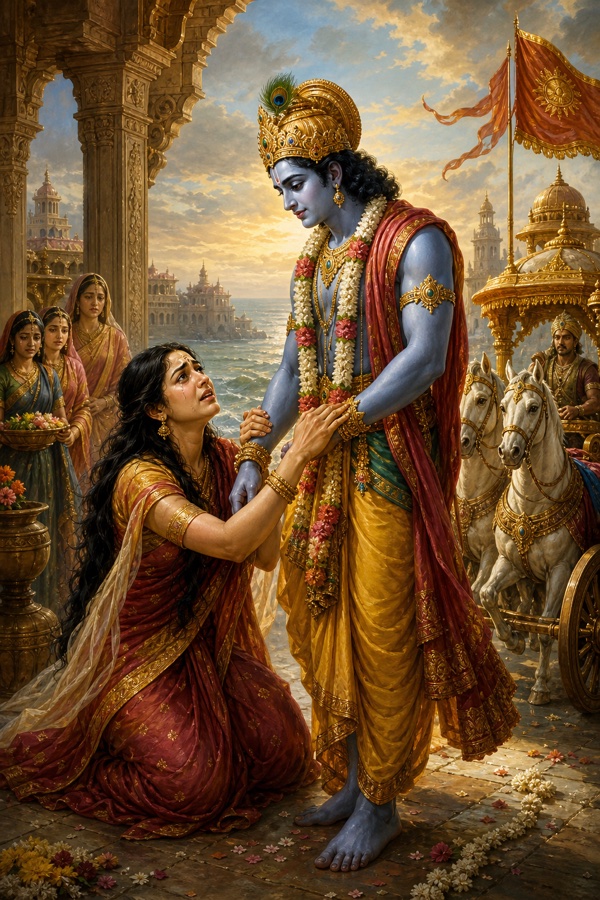
Keshava of the mighty arms spoke to comfort her, and what he said was an oath. “Soon, Krishnaa, you will see the women of Bharata’s line weep as you are weeping now. They too, timid one, will weep like you, with their kinsmen and friends dead. The men you are angry with have already lost their kinsmen and their warriors; consider them dead. With Bhima and Arjuna and the twins, at Yudhishthira’s command, in keeping with fate and with what the Ordainer has ordained, I will bring all of this about. Their hour has come. If the sons of Dhritarashtra do not listen to my words, they will lie on the earth as food for dogs and jackals. The mountains of Himavat may move from their place, the earth herself may split into a hundred pieces, the sky with its countless stars may fall, and still my words can never come to nothing. Dry your tears. I swear it to you, Krishnaa: soon you will see your husbands with their enemies slain and prosperity crowning them.”
A key to reading this (what is here, and what is often added): This is Draupadi’s most famous scene, and in the source it is quieter and sharper than the versions most people carry in their heads. There is no vow of unbound hair here, no oath to leave it loose until it is washed in Duhshasana’s blood. What the text gives is this: her hair is braided, she lifts the braid in her left hand and shows it to Krishna, and she asks him to remember it in every word he speaks about peace. She wants to see Duhshasana’s arm severed. And her sharpest blow lands on Bhima, the one husband who has just leaned toward peace. Her whole case is argued in the language of the law books, the sin of sparing one who deserves death, and she recites her lineage so that the court will remember exactly who was called a slave. Krishna’s oath is also here, in these words: the Himalaya may move, the earth may split, his word will not fail.
The gist: Draupadi reminds Krishna that Yudhishthira asked Sanjaya for only five villages, Avisthala, Vrikasthala, Makandi, Varanavata, and any fifth, and that Suyodhana refused even that, so a journey for a peace without the kingdom is pointless. Arguing from scripture, she says there is as much sin in sparing a man who deserves death as in killing one who does not. Then she recites who she is, Drupada’s altar-born daughter, Pandu’s daughter-in-law, queen of five Indras, mother of five great warriors, and reminds him that after all that she was dragged by the hair and called a slave while the Pandavas sat silent and she cried out inwardly to Govinda. Lifting her braid in her left hand, she asks him to remember it in every word about peace, says she will know no rest until Duhshasana’s arm lies severed, and says Bhima’s turn toward dharma is breaking her heart. Krishna swears that the Himalaya may move, the earth split, and the sky fall before his word fails, and that she will soon see her husbands victorious.
A Kartika morning at Upaplavya: four horses and Garuda on the flagstaff, Yudhishthira’s message for his mother, Bhima’s roar, and Parashurama on the road
After Draupadi’s tears it was Arjuna who spoke, and there was nothing left in his voice of the earlier doubt. “Keshava, you are now the best friend all the Kurus have. Related to both sides, you are dear to both. It falls to you to bring about peace between the Pandavas and Dhritarashtra’s sons. You are able, and so reconciliation is your work. Go from here for peace, lotus-eyed one, and say to our ever-angry brother Suyodhana what ought to be said: if the fool Duryodhana will not accept your counsel, so full of dharma and profit and good for him, he will surely fall to his fate.” Krishna answered simply. “Yes. I will go to King Dhritarashtra, wanting to accomplish what is right, what is good for us, and what is good for the Kurus as well.”
The night passed and a bright sun rose in the east. It was the hour called Maitra, when the rays are still mild; the month was Kartika, the Kaumuda month, under the star Revati; autumn had gone and the season of dew had come, and the earth on every side was heavy with crops. On such a morning Janardana, in perfect health, listened to the sweet, sacred, auspicious words of Brahmins who had been well pleased, the way Indra listens to the praise of the celestial sages. He performed the customary rites of dawn, purified himself in the bath, put on unguents and ornaments, worshiped the Sun and the Fire, touched the tail of a bull, bowed to the Brahmins, walked round the sacred fire, and let his eyes rest on the auspicious objects set out in his view. Then he remembered Yudhishthira’s word and turned to Shini’s grandson Satyaki, who sat beside him. “Have my chariot made ready, and have my conch and my discus placed on it, and my mace, my quivers, my darts, every weapon of attack and of defense. Duryodhana, Karna, and Subala’s son are all three of them wicked at heart, and however contemptible an enemy may be, even a strong man should never take him lightly.”
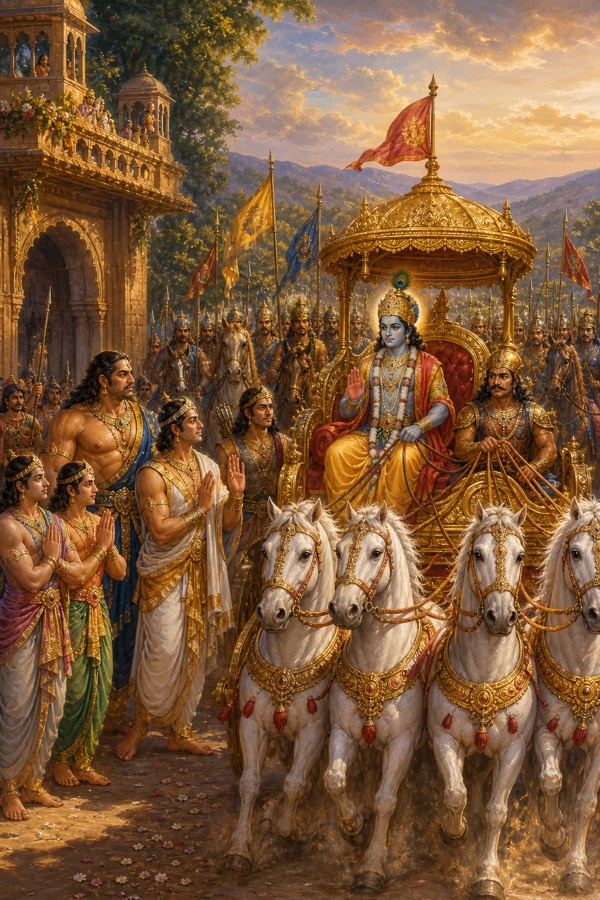
The attendants understood the wish of the wielder of the discus and the mace and set about yoking his chariot at once. It blazed like the fire that shows itself at the dissolution of the world, and it was as fast. Its two wheels shone like the sun and the moon. It carried emblems of moons, crescent and full, and of fishes and beasts and birds, and it was hung all round with garlands of many flowers and with pearls and gems of every kind. Large and beautiful, bright as the rising sun, worked in gems and gold, it bore a splendid flagstaff with handsome pennons, and it was stocked with everything a journey could need; no enemy could withstand it, it was covered with tiger skins, it took the glory from every foe, and it gladdened the hearts of the Yadavas. To it they yoked the horses Shaibya, Sugriva, Meghapushpa, and Valahaka, bathed and dressed in fine harness. And to add to Krishna’s dignity, Garuda, lord of everything that flies, came down and perched on the flagstaff of that chariot with a terrible rattling of wings. Shauri mounted the chariot, tall as the summit of Meru, deep-voiced as a kettledrum or a thundercloud, like the celestial chariot that moves at its rider’s will. He took Satyaki up with him and set out, filling earth and sky with the rumble of his wheels. The sky went cloudless. Favorable winds began to blow. The air cleared itself of dust. As Vasudeva rode out, auspicious beasts and birds wheeled to his right and followed him, and cranes and peacocks and swans came after Krishna crying good omens. The very fire, fed with libations to the sound of mantras, burned up clean and smokeless and leaned its flames to the right. Vasishtha and Vamadeva, Bhuridyumna and Gaya, Kratha and Shukra and Kushika and Bhrigu, and other Brahmarshis and celestial Rishis with them, all stood together on Krishna’s right, the delight of the Yadavas, the younger brother of Vasava. Honored by these and by other illustrious sages and holy men, Krishna set out for the dwelling of the Kurus.
Yudhishthira walked behind him, and Bhima and Arjuna, and the twin sons of Madri; and the valiant Chekitana, and Dhrishtaketu ruler of the Chedis, and Drupada, and the king of Kashi, and the great chariot warrior Shikhandi, and Dhrishtadyumna, and Virata with his sons, and the princes of the Kekayas, all those kshatriyas following Krishna to do him honor. When they had gone some distance, Yudhishthira embraced him in the presence of all those kings, this man who had never, from desire or anger or fear or hope of gain, done the smallest wrong, whose mind was always steady, who was a stranger to greed, learned in dharma, great in intelligence and wisdom, who knew the hearts of all creatures and was the lord of all, the god of gods, eternal, possessed of every virtue, bearing the auspicious mark on his breast. Holding him, the king began to tell him what to do, and the first errand was for a woman. “The lady who raised us from infancy, who is always at her fasts and her austerities and her rites of propitiation, devoted to the worship of gods and guests, always waiting on her elders, who loves her sons past all measure, who is so dear to us, Janardana, who again and again saved us from Suyodhana’s snares the way a boat saves shipwrecked men from the terrors of the sea, and who, Madhava, deserving no sorrow herself, has borne countless sorrows on our account: ask after her welfare. Greet her, embrace her, and comfort her over and over by talking of the Pandavas, because she is drowning in grief for her sons. From the day of her marriage she has suffered, through no fault of her own, from the conduct of her father-in-law, and suffering has been her portion. Will I ever see the day, Krishna, when my troubles are over and I can make my sorrowing mother happy? On the eve of our exile she ran after us in anguish, weeping bitterly, out of love for her children, and we left her behind and went into the forest. Grief does not always kill. So she may be alive, sheltered by the Anartas, grieving for her sons. Greet her for me, glorious Krishna, and greet the Kuru king Dhritarashtra, and all the kings older than ourselves, and Bhishma, and Drona, and Kripa, and King Bahlika, and Drona’s son, and Somadatta, and every one of the house of Bharata, and Vidura of the great wisdom, that counselor of the Kurus, deep in understanding and steeped in dharma: embrace them all, slayer of Madhu.” Having said this to Keshava before the kings, Yudhishthira walked round him and, with his leave, turned back.
Arjuna went a few steps farther with his friend, the unconquerable warrior of Dasharha’s line, who had cut down so many enemy champions. “All these kings know, glorious Govinda, that at our council it was settled that we should ask for the kingdom back. If they give us what we ask honestly, without insulting us and with honor to you, they will please me greatly and they will escape a terrible danger. But if Dhritarashtra’s son, who always chooses the crooked way, acts otherwise, then, Janardana, I will surely annihilate the kshatriya race.” At those words Vrikodara was filled with delight. He had been shaking with anger the whole while, and now, shaking with anger and with the joy that Dhananjaya’s words had poured into him, he let out a roar so terrible that every bowman there trembled, and horses and elephants were seen to void themselves in fear. Arjuna, having told Keshava his resolve, embraced him and, with his leave, turned back.
When the last of the kings had stopped following, Janardana went on with a glad heart behind Shaibya and Sugriva and the others, and those horses of Vasudeva, urged by Daruka, ran as if they were devouring the sky and drinking up the road. On the way Keshava came upon a company of Rishis blazing with the light of Brahman, standing on both sides of the road. He got down from the chariot at once, saluted them with reverence, worshiped them as was proper, and asked, “Is there peace in all the world? Is dharma being duly practiced? Are the other three orders obedient to the Brahmins?” And then, “Where have you gone and found success? Where are you going, and for what purpose? What may I do for you? What has brought your illustrious selves down to the earth?” Then Jamadagni’s son, the friend of Brahma, lord of gods and Asuras alike, came up to Govinda, embraced him, and answered for them all. “The celestial Rishis of holy deeds, Dasharha, and Brahmins of deep learning in the scriptures, and royal sages and venerable ascetics, these who were witnesses long ago to the deeds of gods and Asuras, wish to see all the kshatriyas of the earth gathered from every side, and the counselors seated in the assembly, and the kings, and you, Janardana, truth itself in a body. We are going there to look on that great sight, Keshava. And we long to hear, Madhava, the words full of dharma and profit that you will speak to the Kurus before all the kings. Bhishma and Drona and the others, and the illustrious Vidura, and you, tiger of the Yadavas, will all sit in one council. We want to hear the excellent, truthful, and beneficial words you will speak, Govinda, and theirs as well. Now you know our purpose, mighty-armed one. We will meet you again. Go safely, hero. We hope to see you in the midst of that gathering, seated on a fine seat, with all your energy and might gathered in you.”
A key to reading this (the date, and the sage on the road): The epic gives the departure an almanac entry: the month of Kartika, the star Revati, the Maitra hour, the first days of the dewy season. This is one of the fixed points from which the date of the war is reckoned backward. The sage who embraces Krishna on the road is Rama the son of Jamadagni, Parashurama, and he will be the one who tells Dambhodbhava’s story in the Kuru assembly a few sections on; he is a different figure from Rama the son of Dasharatha. Krishna’s question about whether the three orders obey the Brahmins is the set formula of a courtesy inquiry in that age, the equivalent of asking after someone’s health. And notice whom Yudhishthira’s first and longest message is for: the mother he left weeping on the road out of Hastinapura thirteen years before, ahead of every king and elder on his list.
The gist: Arjuna asks Krishna, as friend to both houses, to make the peace, and Krishna agrees to go. On a dewy Kartika morning under Revati, after his dawn rites, Krishna has Satyaki load the chariot with conch, discus, mace, and every weapon, because even a contemptible enemy is never to be taken lightly. Shaibya, Sugriva, Meghapushpa, and Valahaka are yoked, Garuda settles on the flagstaff, the sky clears, birds wheel to the right, and sages such as Vasishtha and Vamadeva stand at his right hand. Yudhishthira, his brothers, and all the allied kings walk a little way with him; Yudhishthira embraces Krishna and gives him messages, first and longest for Kunti, then for Dhritarashtra, Bhishma, Drona, Kripa, Bahlika, Ashvatthama, Somadatta, and Vidura. Arjuna says that if the kingdom is refused he will wipe out the kshatriya race, and Bhima’s roar frightens the horses and elephants. Daruka drives the horses off like wind, and on the road Krishna meets a company of sages, among them Parashurama, who tells him that the celestial and royal sages are all bound for the Kuru assembly to watch that sight and hear what Krishna will say.
Source: the Mahabharata of Krishna-Dwaipayana Vyasa, Udyoga Parva, Bhagavat-yana sub-book. This chapter follows K. M. Ganguli, sections LXXII to CXXXIX (72 to 139); the Gita Press Hindi edition numbers these chapters differently. Names, order, and events were checked against Ganguli’s complete translation. Where the recensions differ, this English retelling follows Ganguli, and the Hindi edition follows Gita Press. Dialogue and commentary are adapted, not a verbatim translation. About the sources.
Based on: The Mahabharata, Vyasa (K. M. Ganguli’s English translation; Gita Press, Gorakhpur)