On this page
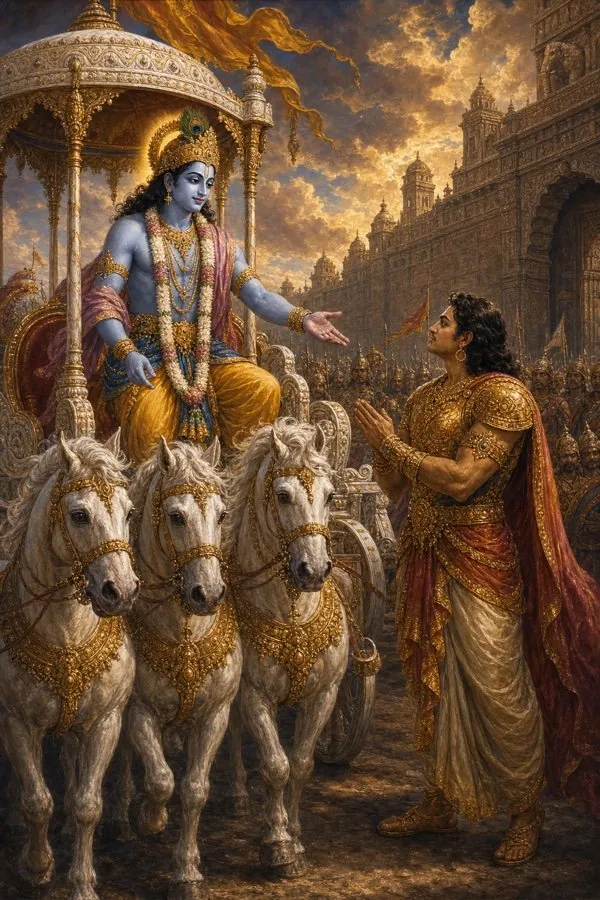
Leaving Kunti’s house in Hastinapura, Krishna took his leave of Bhishma and the other Kuru elders who had accompanied him. With Karna seated on his chariot and Satyaki traveling with him, he went out beyond the city. There he spoke with Karna at length. Within the city, the Kurus gathered and said to one another, “Ignorance has caught the whole earth in the meshes of death. Through Duryodhana’s folly all this is bound for ruin.” On the chariot, Krishna now spoke of Karna’s birth and his place in the Pandu family.
Krishna’s secret words on the chariot
Vasudeva spoke in a voice both sweet and grave. “Radheya you have served many Brahmins who know the Vedas to their depth. With a settled mind, free of envy, you have asked them again and again about the truth. And so, Karna, you know the eternal sayings of the Vedas, and you are skilled in the finest conclusions of the scriptures.
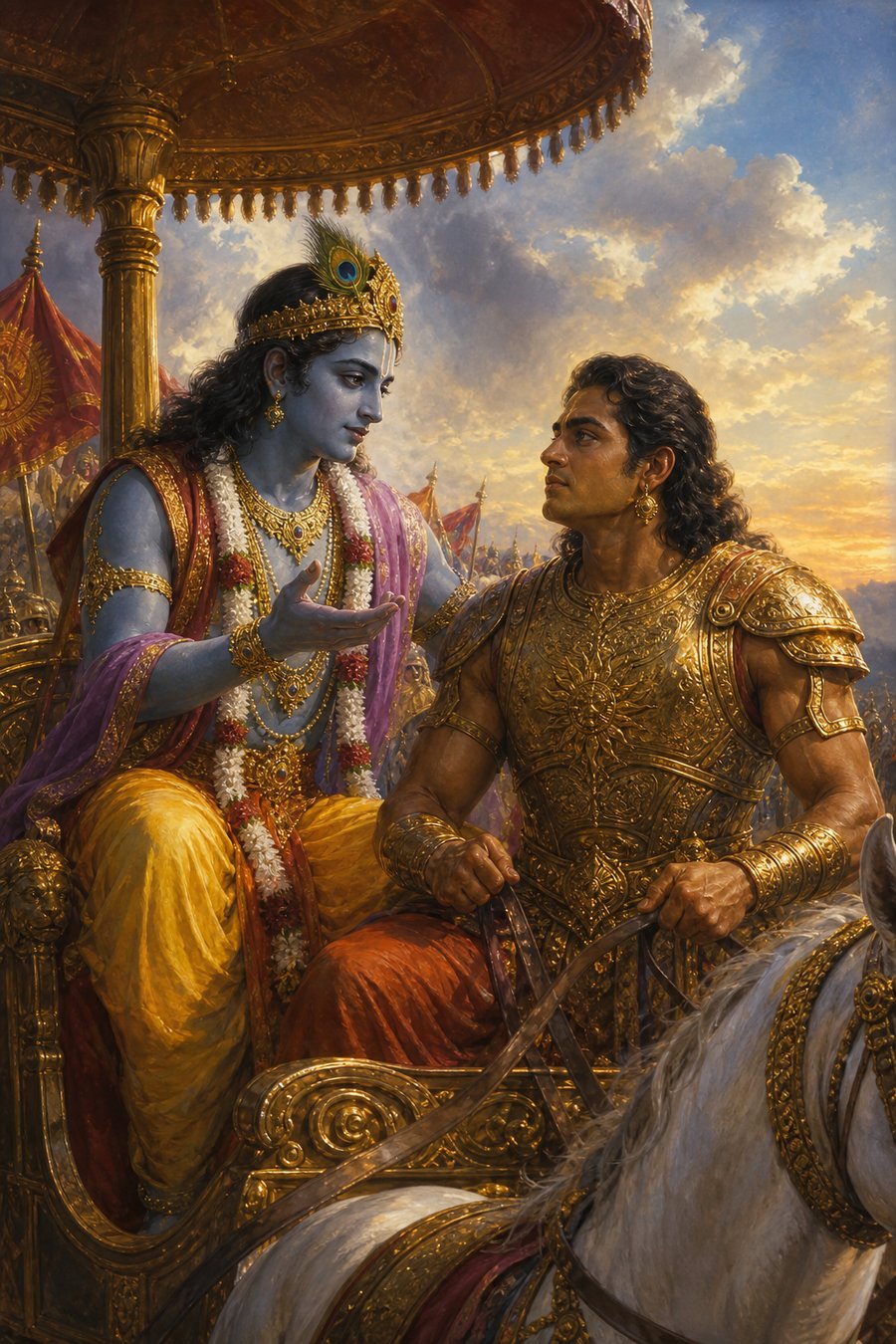
“Hear me now. Those who know the scriptures say that the two kinds of sons born of a maiden, the ones called Kanina and Sahoda, have for their father the man who later weds that maiden. You, Karna, were born in just this way. In the eye of dharma you are therefore a son of Pandu. Come, then, and be a king, as the scriptures direct. On your father’s side stand the sons of Pritha, your own blood; on your mother’s side stand the Vrishnis, your kin. Know that both these houses are yours.”
A key to reading this (Kanina and Sahoda): a kanina is a son a woman bears before marriage, in her maidenhood; a sahoda is one she carries in the womb into the marriage she then makes. The old law-books count both as the son of the man who later weds her. Krishna leans on this rule to argue that because Kunti married Pandu, Karna stands, in the eye of dharma, as Pandu’s eldest son.
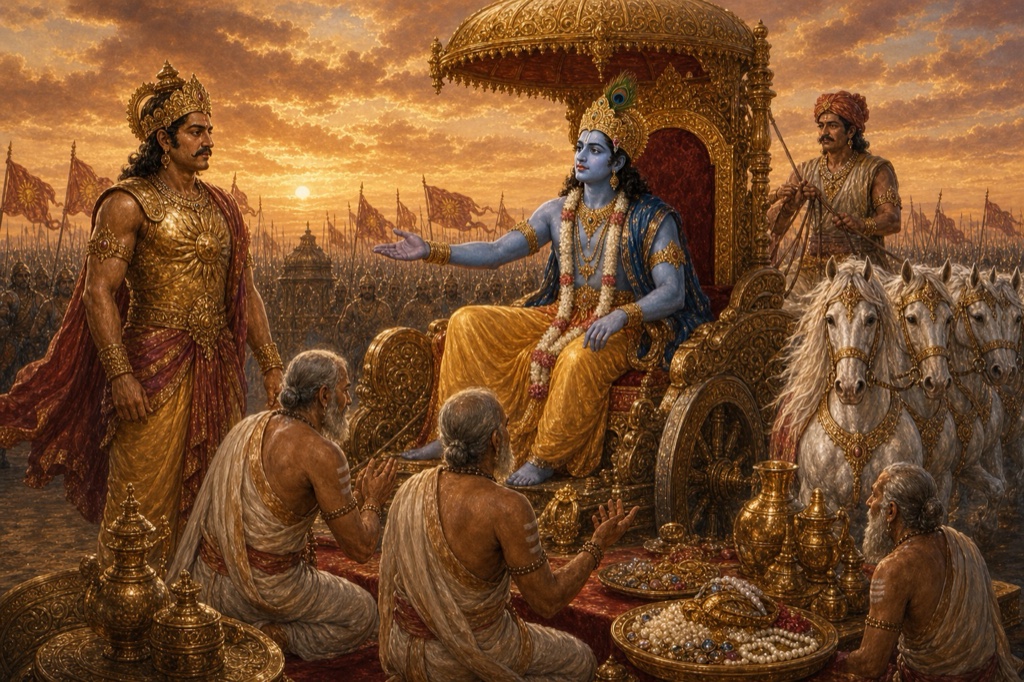
Krishna went on. “Come with me this very day and let the Pandavas learn that you are Kunti’s son, born before Yudhishthira himself. Then those five brothers, the sons of Draupadi, and Subhadra’s unconquerable son Abhimanyu, will all touch your feet. Every king and prince gathered for the Pandava cause, and all the Andhakas and Vrishnis, will bow at your feet. Queens and princesses will bring jars of gold and silver and earth, filled with water, and fine herbs, and every kind of seed, and gems, and creepers, for your anointing.
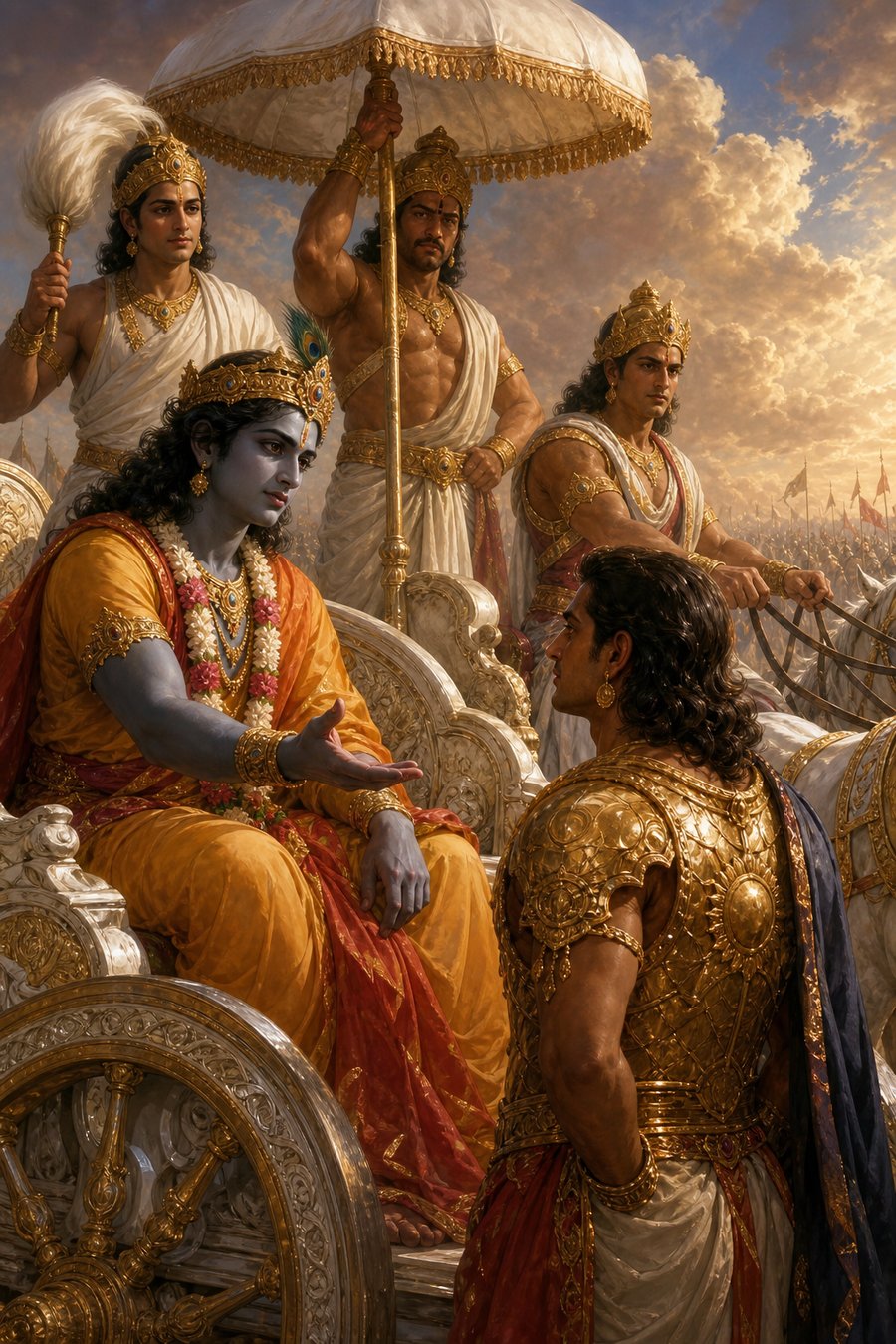
“Brahmins as great as Dhaumya, their souls held in check, will pour clarified butter on the sacred fire, and those who hold the four Vedas to be authority and serve as priests to the Pandavas will perform the rite of your crowning. The family priest of the Pandavas, the five sons of Pandu themselves, the five sons of Draupadi, the Panchalas, the Chedis, and I too will anoint you lord of the whole earth. Yudhishthira, the son of Dharma, will be your heir apparent, ruling the kingdom under you. He will hold the white chamara in his hand and ride the same chariot behind you. When the anointing is done, the strong Bhimasena will hold the white umbrella over your head. Arjuna will drive your chariot, the one hung with a hundred small bells, its sides covered with tiger skin, white horses yoked to it. Nakula and Sahadeva, the five sons of Draupadi, and the Panchalas with the great chariot-warrior Shikhandi will come behind you. I myself will walk behind you with all the Andhakas and Vrishnis.
“Enjoy the sovereignty of the earth with your brothers the Pandavas, amid japa and homa and every kind of blessing-rite done in your honor. Let the Dravidas, the Kuntalas, the Andhras, and the other peoples walk before you. Let chanters and praise-singers hymn you with countless songs. Let the Pandavas cry out, ‘Victory to Vasusena.’ As the stars ring the moon, so ringed by the Pandavas rule your kingdom and make Kunti glad. Let your friends rejoice and your enemies grieve. Let there be, this very day, a brother’s meeting between you and your brothers, the sons of Pandu.”
A key to reading this (Vasusena): Vasusena is the name Karna’s foster father Adhiratha had the Brahmins give him. Krishna chooses that very name on purpose, as if to remind Karna that whatever his father called him, by blood he is Kunti’s son and the elder brother of the Pandavas.
There was nothing half-hearted in the offer. Krishna was placing the empire of the whole earth in Karna’s hands, and with it the love of brothers, of a mother, of a whole house, all the belonging that had been kept from Karna his whole life. From Magadha down to the peoples of the south, all of it. And deeper than any of that, Yudhishthira himself was ready to sit on the chariot behind him and wave the white fan.
The gist: Krishna seats Karna on his chariot and, in private, opens the secret of his birth. He is born of Surya, Kunti’s firstborn, elder even than Yudhishthira, and so in dharma a son of Pandu. In return Krishna lays before him the kingdom of the whole earth, Yudhishthira as heir apparent under him, and the love of brothers and mother, all of it offered at once.
Karna’s answer: the bond of gratitude
Karna said, “There is no doubt, Keshava, that you have spoken these words to me out of love and affection and friendship, and out of your wish to do me good. All that you have said, I understand. In the eye of dharma, and by the rule of the scriptures too, I am a son of Pandu, just as you, Krishna, hold me to be. My mother carried me in her womb while she was still a maiden, Janardana, through her union with Surya. And at Surya’s own command, the moment I was born, she gave me up. That is how I came into this world, Krishna. So in dharma I am the son of Pandu. And Kunti gave me up without a thought for what might become of me.
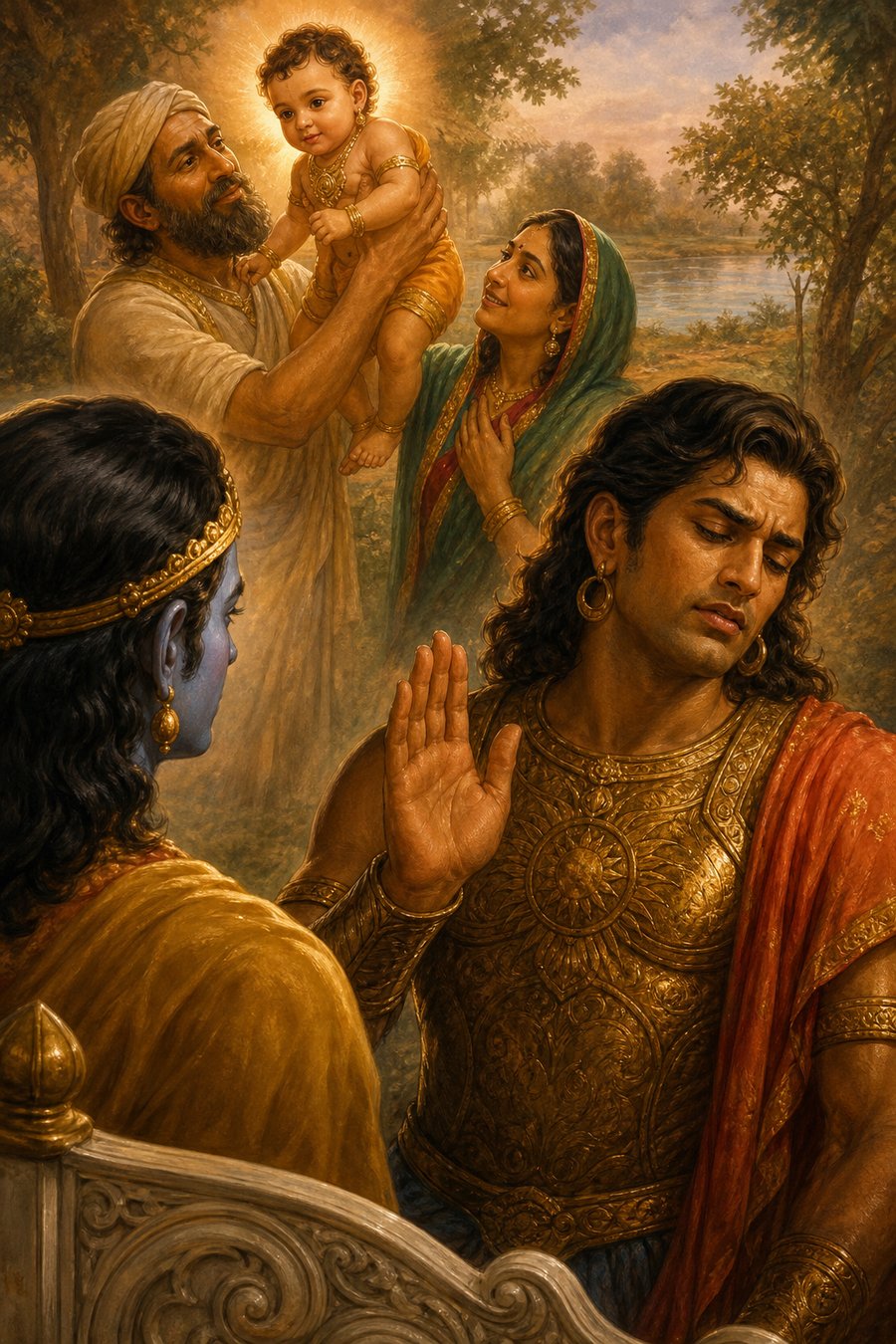
“The Suta Adhiratha, the moment he saw me, carried me to his home, and out of the love he felt for me, Radha’s breasts filled with milk that same day. Radha cleansed me, Madhava, of my own filth. How could a man like me, who knows his duties and has spent his life listening to the scriptures, deny her the support owed by a son? Adhiratha the Suta holds me for his son, and I, out of love, have always held him for my father. Out of a father’s love he had all the rites of my childhood performed by the scriptures’ own rule. It was he who had the Brahmins give me the name Vasusena. When I came to my youth I married the wives he chose for me. Through them my sons and grandsons were born, Janardana. My heart, and every bond of love and affection, is fixed on them. In joy or in fear, Govinda, I would not dare to break those bonds, not for the whole earth, not for heaps of gold.
A key to reading this (pinda): Here the Gita Press commentary understands pinda as the food and support Karna owes Radha. His birth into another family does not erase his duty to the mother who raised him.
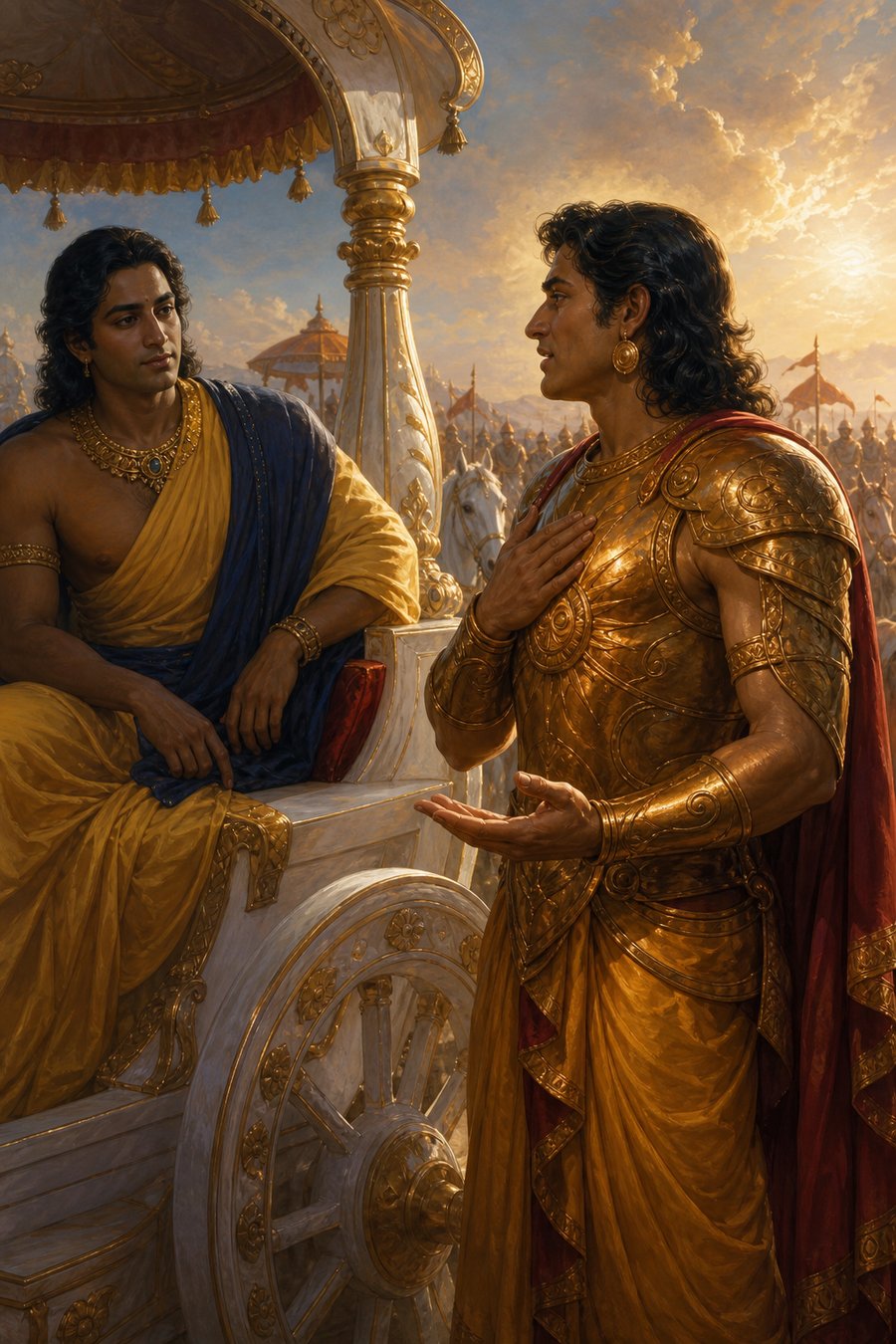
“Through my tie to Duryodhana of Dhritarashtra’s house, Krishna, I have enjoyed a kingdom for thirteen years, with nothing to prick me. I have performed many sacrifices, though always among people of the Suta caste. All my family rites and my marriage rites were done with Sutas. Having won me Duryodhana made this whole preparation for war and took up his quarrel with the Pandavas. And it is for this, Achyuta, that in the coming battle I have been chosen as Arjuna’s rival, to go against him in single combat. Not for death, not for the ties of blood, not for fear or reward, would I dare to play false with Duryodhana. If I hold back now from single combat with Arjuna, it will be a disgrace for us both, for me and for Partha.
“Beyond all doubt, Madhusudana, you have said this only to do me good. And the Pandavas, obedient to you, will surely do exactly as you have said. But I have one request, that you keep this talk of ours secret for now, Madhusudana. Our good lies in that, I believe, delight of the Yadus. If the true and self-ruled king Yudhishthira comes to know me as Kunti’s eldest son, he will never take the kingdom. And even if this vast empire were to come to me, I would hand it straight over to Duryodhana. Let Yudhishthira be king for all time. The man whose guide is Hrishikesa, whose warriors are Dhananjaya and Bhima, Nakula and Sahadeva and the sons of Draupadi, that is the man fit to rule the whole earth.”
A sub-tale: Karna reveals here a deep reading of Yudhishthira’s nature. He knows that Yudhishthira is so bound to dharma that if he learned Karna was his elder brother, the rule of the elder’s right would make him place the kingdom in Karna’s hands and step aside. And Karna would then give that kingdom to Duryodhana, since his loyalty was fixed there. In this single thought Karna sees, at once, his own fate and Yudhishthira’s, and that is why he begs that the secret be kept.
The gist: Karna accepts the truth, that he is the son of Surya and Kunti, and still turns down the kingdom. The debt he owes Radha and Adhiratha for the love that raised him, and thirteen years of gratitude to Duryodhana, hold him fast. He asks that the secret be kept, because the moment he learns it, the dharma-bound Yudhishthira would give him the throne, which he would only pass on to Duryodhana.
The sacrifice of weapons: Karna’s vision of war
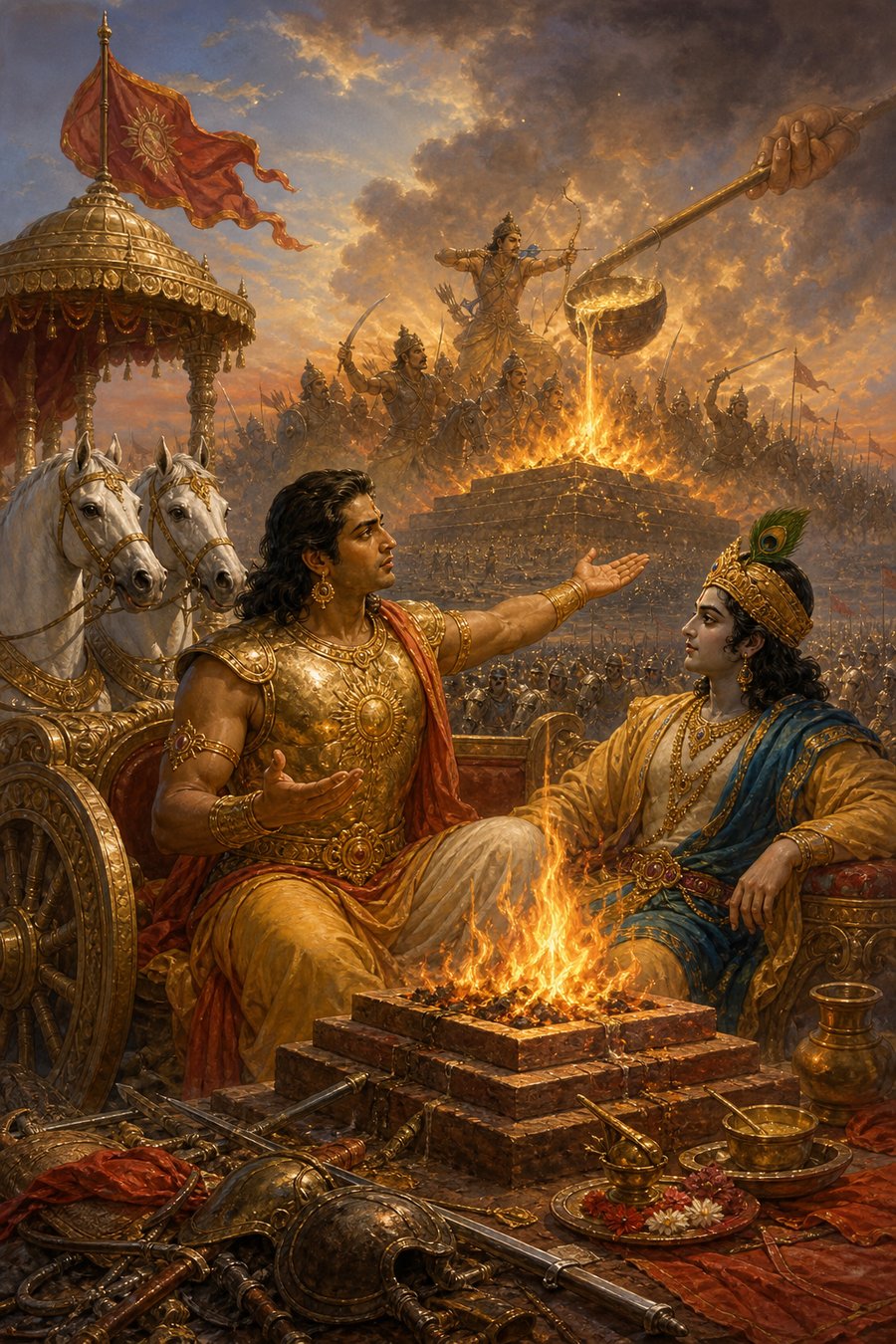
Then Karna opened a strange figure, in which he saw the coming war itself as one great sacrifice. “A great sacrifice of arms is about to be held by Dhritarashtra’s son. You, Janardana, will be the Upadrashtri, the overseeing witness, of that sacrifice. The office of Adhvaryu, the one who performs the rites, will also be yours, Krishna. The ape-bannered Vibhatsu, Arjuna in his armor, will be the Hotri, the chief officiant; Gandiva will be the sacrificial ladle; and the prowess of the warriors will be the clarified butter poured into the fire.
“The weapons Arjuna sends forth, the Aindra, the Pasupata, the Brahma, and the Sthunakarna, will be the mantras of this sacrifice, Madhava. Subhadra’s son Abhimanyu, the equal of his father or greater than him in prowess, will be the chief Vedic hymn. Bhima roarer of terrible roars in battle, mightiest of the mighty, will be the Udgatri and the Prastotri of this sacrifice. Yudhishthira, forever at his japa and homa, will himself be the Brahma of the rite. The blast of conches, tabors, and drums, and the lion-roar rising into the sky, will be the calls that summon the guests to eat.
“The two sons of Madri, Nakula and Sahadeva, will be the slayers of the sacrificial animals. The rows of bright chariots, dressed in banners of many colors, will be the stakes to which the victims are tied. Swords will be the Kapalas, the skull-bowls; the heads of slain warriors, the Purodasas, the sacrificial cakes; and the blood of warriors, the clarified butter. The disciples of Drona and of Kripa will be the Sadasyas, the assisting priests. Satyaki will be the chief helper of the Adhvaryu. The one who holds this sacrifice will be Dhritarashtra’s son, and this vast army will be his wife. When the night-rites of the sacrifice begin, Ghatotkacha will take the part of the slayer of victims. Dhrishtadyumna, the one who sprang from the sacrificial fire, will be the Dakshina, the fee, of this sacrifice, Krishna.
“For those harsh words I once spoke to the Pandavas to please Dhritarashtra’s son, for that wrong conduct of mine, Krishna, regret is burning in me. When you see me slain by Arjuna, then the renewal of this sacrifice will begin. When Bhima, the second son of Pandu, drinks the blood of the roaring Duhshasana, then the Soma-drinking of this sacrifice will be complete. When the two princes of Panchala, Dhrishtadyumna and Shikhandi, bring down Drona and Bhishma, then, Janardana, the sacrifice will halt for a while. And when Bhimasena kills Duryodhana, then, Madhava, this sacrifice of Dhritarashtra’s son will be finished. And when the wives of Dhritarashtra’s sons and grandsons, robbed of husbands and sons, without a protector, with Gandhari in their midst, weep on a field of battle crowded with dogs and vultures, then, Janardana, the final bath of this sacrifice will be taken.
A key to reading this (the final bath and the ritviks): a Brahmanical sacrifice has many offices, among them the Brahma who presides, the Adhvaryu who performs the acts, the Hotri who makes the invocations, the Udgatri who sings the Saman chants, the Prastotri, and the Sadasyas who assist. The purifying bath the sacrificer takes at the close is called the avabhritha. Karna sets all these offices on the figures and events of the war and so sees the whole great battle as one sacrifice of blood, whose final bath will be the weeping of the Kuru women.
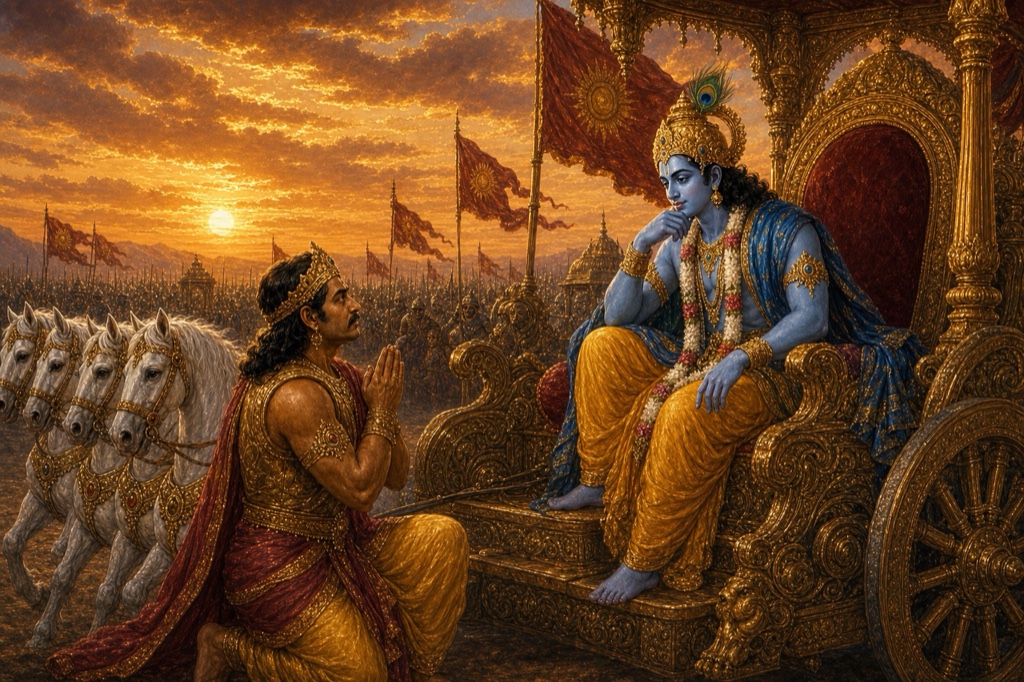
“I beg you, let not the Kshatriyas old in learning and old in years die a mean death for your sake. Let this swelling host of Kshatriyas be brought down by weapons on Kurukshetra, the most sacred spot in all the three worlds, Keshava, so that the whole order of Kshatriyas may reach heaven. As long as the hills and the rivers last, the fame of these deeds will last. The Brahmins will sing this great war of the Bharatas. Keshava, bring Kunti’s son Arjuna before me for battle, and keep this talk of ours forever secret.”
The gist: Karna sees the coming war as one vast sacrifice of arms, in which the warriors are the priests, the weapons the mantras, the blood the clarified butter, and the severed heads the sacrificial cakes. He foresees his own death, the blood of Duhshasana, the fall of Bhishma and Drona, and the killing of Duryodhana, and he calls the weeping of the Kuru women the final bath of this sacrifice.
Krishna’s smile, and Karna’s omens
Hearing these words, Madhusudana said with a smile, “Do the means of winning an empire not appeal to you, Karna? Have you no wish to rule the whole earth that I offer you? Then the victory of the Pandavas is certain, there is no longer any doubt of it. That triumph-banner of Pandu’s son, with the terrible ape upon it, seems already planted. The divine craftsman Bhaumana has worked such celestial illusion into it that it stands as high as Indra’s own flag. Strange and dreadful shapes, all signs of victory, are seen on that standard. Reaching a yojana upward and on every side, radiant as fire, Arjuna’s beautiful banner, once raised, is stopped by no hill and no tree.
“When you see Arjuna in battle on his chariot of white horses, driven by Krishna, loosing the Aindra, the Agneya, and the Maruta weapons, and when you hear the twang of Gandiva splitting the sky like a thunderbolt, then all the marks of the Krita, the Treta, and the Dwapara ages will vanish, and Kali himself will stand present. When you see in battle Yudhishthira, sunk in his japa and homa and blazing like the sun, guarding his own army and burning the army of his foes, then those marks of the three ages will vanish. When you see Bhimasena drunk on the blood of Duhshasana, dancing like a rutting elephant, then those marks will vanish. When you see the two sons of Madri in battle, churning the army of Dhritarashtra’s sons the moment weapons clash, like a pair of maddened elephants, then those marks will vanish.
“Go back, Karna, and tell Drona, and Santanu’s son Bhishma, and Kripa, that this month is a fair one, that food and water and firewood are plentiful now. Every plant and herb is green, every tree heavy with fruit, and there are no flies. The roads are free of mud, and the water is sweet. The weather is neither too hot nor too cold. Seven days from now is the day of the new moon. Let the battle begin on that day, for it is said to be presided over by Indra. And tell all the kings who have come to fight that I will grant them their desire, that every king and prince who obeys Duryodhana’s command will, meeting death by weapons, reach the highest state.”
Hearing these kind and blessing-laden words of Keshava, Karna paid his worship to Krishna and said, “Knowing all of it why do you try to lead me astray? The ruin of the whole earth is near, and its cause is Shakuni, and I, and Duhshasana, and king Duryodhana. Beyond doubt, Krishna, a terrible war between the Pandavas and the Kauravas is near, one that will cover the earth in bloody mire. All the kings and princes who follow Duryodhana will burn in the fire of weapons and go to the house of Yama.
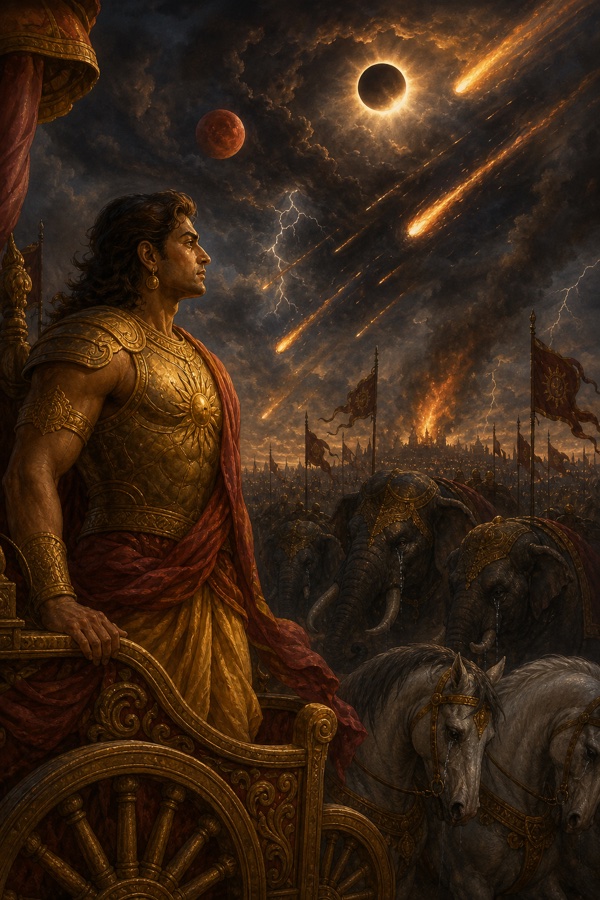
“Many fearful sights appear, Madhusudana, and many terrible omens. That planet of fierce light, Sanaischara, Saturn, is troubling the star Rohini, as if to bring great suffering on the creatures of the earth. Angaraka, Mars, wheeling toward Jeshtha, moves on toward Anuradha, which points to a savage slaughter of friends. The spot on the moon’s disc has shifted from its place, and Rahu too is closing on the sun. Meteors fall from the sky with loud noise and trembling flight. The elephants send up dreadful cries, and the horses are shedding tears, taking no pleasure in food or water. In Duryodhana’s army the elephants, horses, and men eat little and void much, and the wise call this a sign of defeat.
A sub-tale: Karna told a dream here as well. He had seen Yudhishthira and his brothers, in white robes and white turbans, climbing a palace of a thousand columns and taking their seats on white thrones. In the same dream Krishna was covering the blood-dyed earth with weapons. Yudhishthira, mounting a heap of bones, was eating buttered payasa from a golden bowl and swallowing the earth handed to him by Krishna, a sign that he would rule the earth. Bhima stood on a peak, mace in hand, as if devouring the earth. Nakula, Sahadeva, and Satyaki appeared in white ornaments, white armor, white garlands, and white robes, with umbrellas held over their heads. On the Kaurava side only three, Ashvatthama, Kripa, and Kritavarma, wore white turbans, while all the other kings wore turbans red as blood. And Bhishma and Drona, on a chariot drawn by camels, with Karna himself and Duryodhana, were going toward the quarter of Agastya, the south, the quarter of Yama, a sign that they would soon reach the house of Yama.
Krishna said, “Truly, Karna, the ruin of the earth is near, when my words find no welcome in your heart. When the destruction of all creatures draws close, wrong puts on the face of right and will not leave the heart.”
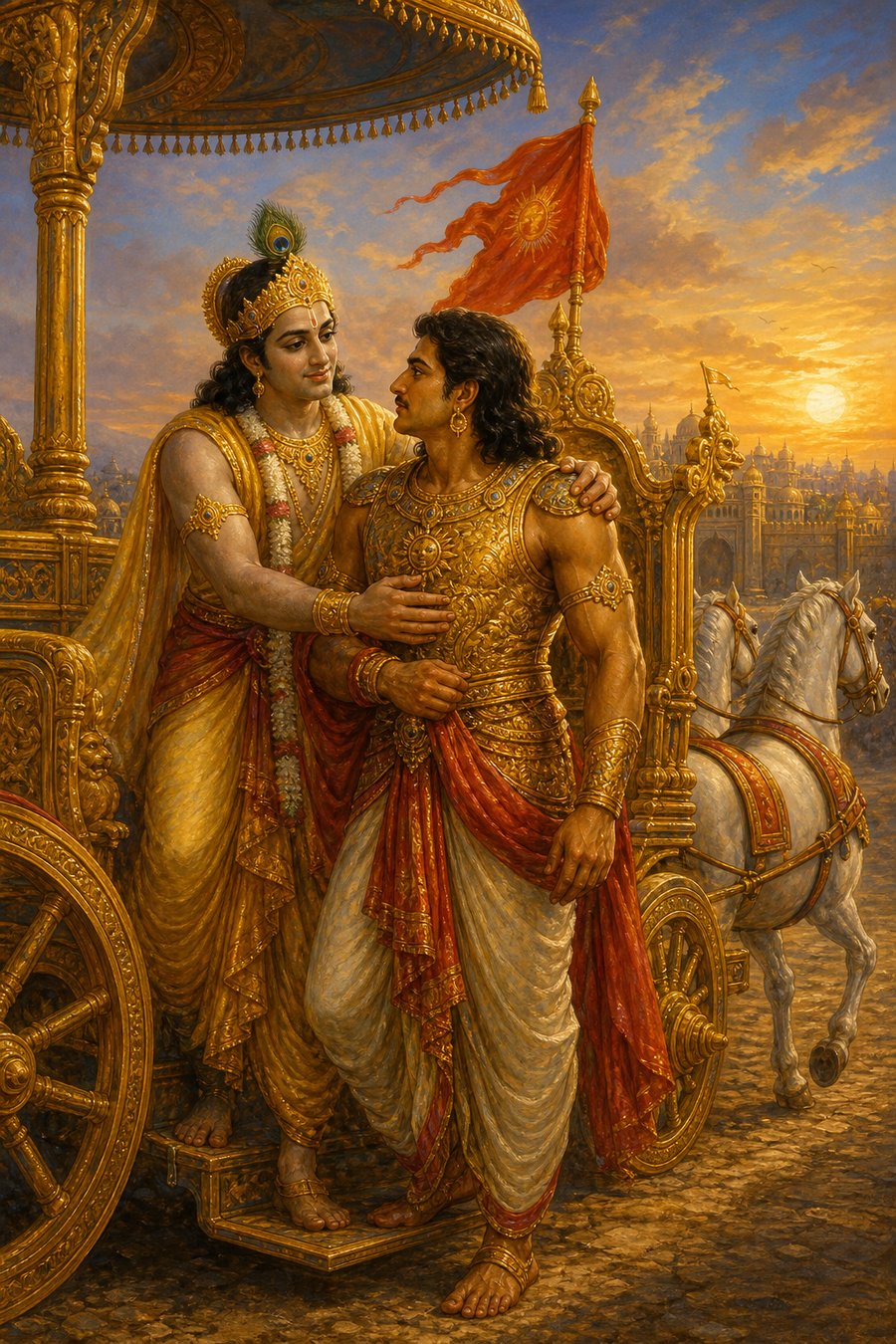
Karna said, “If, Krishna, we come alive out of this ruinous great war of heroic Kshatriyas, then we will meet here again. And if not, Krishna, we will surely meet in heaven. It seems to me now that only there is our meeting possible.” With these words Karna pressed Madhava hard to his heart. Taking his leave of Keshava, he stepped down from the chariot, and mounting his own chariot dressed in gold, sunk in dejection, he came back with us.
The gist: Krishna, with a smile, hints to Karna at the certain victory of the Pandavas and the coming of the age of Kali. Karna reads the sly turn in it, and yet, recounting many ill omens and his own dream, he holds that the Kuru house is bound for the house of Yama. Both take their leave knowing that their next meeting may come only in heaven.
Kunti’s resolve
Krishna’s plea for peace had failed, and as he set out for the Pandavas, Vidura, the Kshatta, came to Pritha, to Kunti, and said to her slowly, in grief, “You know that my leaning has always been toward peace, and however I plead, Suyodhana will not heed me. Old Dhritarashtra too, drunk on love of his sons, walks a sinful road. Through the wickedness of Jayadratha, Karna, Duhshasana, and Suvala’s son Shakuni, this house will break apart from within. When Keshava returns without a peace, the Pandavas will surely turn to war, and the sin of the Kurus will bring the ruin of heroes. Turning all this over, I get no sleep by day or by night.”
Hearing Vidura’s words, Kunti began to draw long breaths, and heavy with grief she thought within herself, “A curse on the wealth for whose sake this great slaughter of kinsmen is about to happen. In this war even those who are friends will be beaten. And yet if we do not fight, poverty and disgrace will be ours. The slaughter of one’s own kin is no victory. Bhishma, Drona, and Karna, these three, have taken Duryodhana’s side, and they have swelled my fears. Still, I think Drona will not fight his own pupils with a whole heart. And the grandsire Bhishma, why should he not keep some affection for the Pandavas? It is only this Karna, who follows the wicked lead of Duryodhana and hates the Pandavas, and who is very strong besides. This is what burns me. This very day I will go to him, tell him the truth, and try to draw his heart toward the Pandavas.”
A sub-tale: Kunti remembered the mantra that had come to her in her maidenhood. When she lived in the inner rooms of her father Kuntibhoja’s palace, the sage Durvasa, pleased with her, had given her as a boon a mantra of invocation. Long she had turned over, with a trembling heart, the power of that mantra and the force of the Brahmin’s word, and being a woman by nature and a girl of unripe years, she had weighed again and again how to draw no reproach, how to keep her father’s honor, and how good fortune might come to her without any fault. Then, guarded by a trusted nurse and ringed by her maids, out of curiosity and the folly of a child, she had recited the mantra and called down the sun god. And the one held in her womb during her maidenhood, why should he not heed his mother’s words, spoken for the good of his brothers?
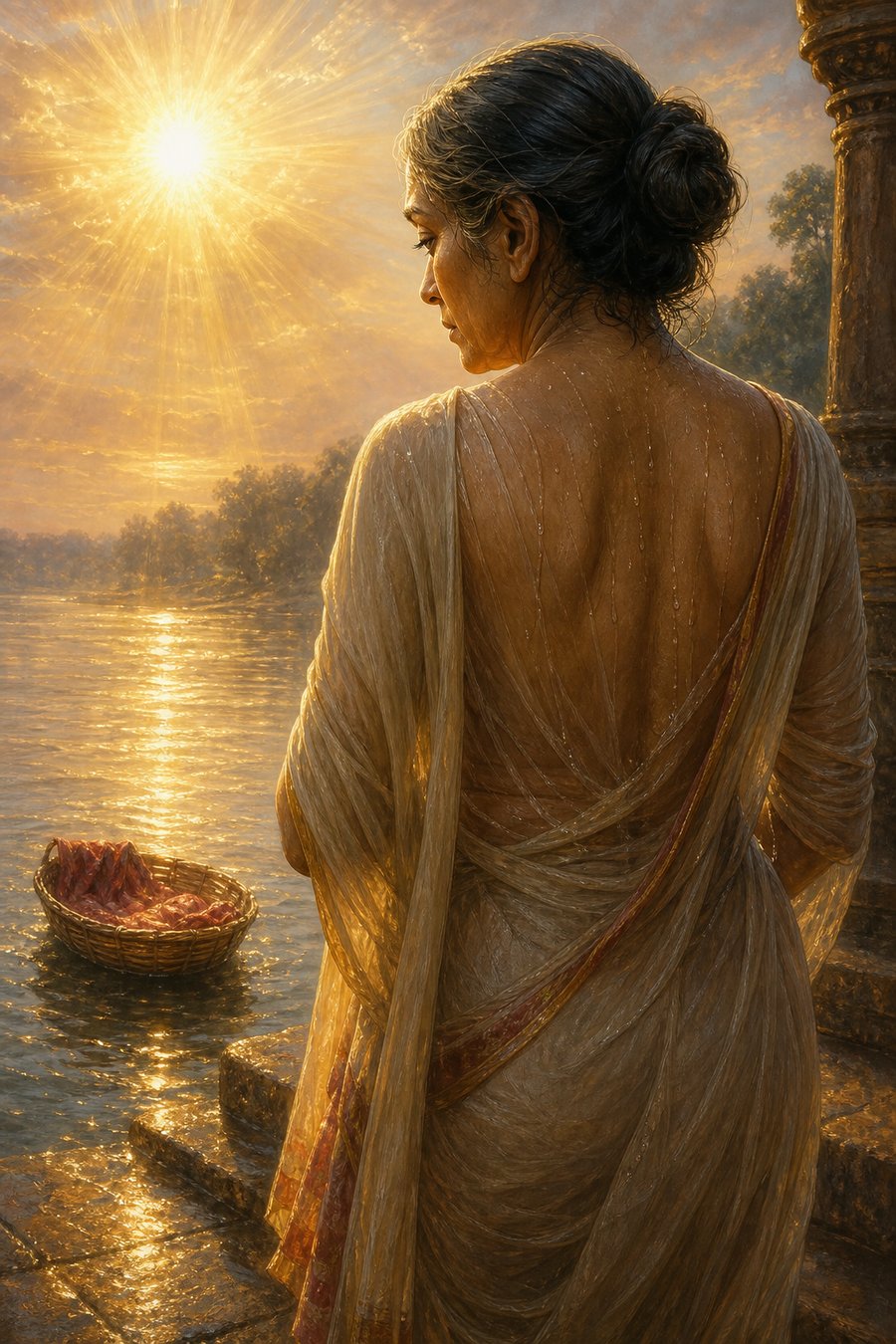
With this resolve made, Kunti went to the sacred bank of the Bhagirathi. Reaching the shore of the Ganga, Pritha heard her son, who was full of kindness and firmly set on truth, reciting the Vedic hymns. Karna stood with his face to the east and his arms raised. Then the helpless Kunti, for the sake of her errand, stood behind him and waited for his prayer to end. That daughter of the Vrishni house, that bride of the Kuru line, wilting in the heat of the sun, came to look like a faded garland of lotuses. At last she stood in the shade of Karna’s upper garment. Karna held to his vow and prayed until the sun’s rays had scorched his back. Then he turned and saw Kunti, and was filled with wonder. Joining his palms in proper form, that man of great energy and pride, Vrisha, the son of Vikartana, bowed to her and spoke.
A key to reading this (Vrisha, son of Vikartana): from one of the sun’s names, Vikartana, the one who scatters his rays, Karna is also called Vaikartana. Vrisha is another of his names, marking his firm vows and his hold on dharma. Here the story points to Karna as the son of the sun, at the very moment when the mother who bore him steps before him for the first time.
The gist: Vidura’s words of despair harden into a resolve in Kunti. She will tell Karna the truth and try to draw him to the Pandavas. Remembering how Durvasa’s mantra had summoned the sun, she goes to the bank of the Ganga, where Karna is at his worship, and stands in the shade of his upper garment, bearing the heat, waiting for his prayer to end.
The mother’s plea on the Ganga bank
Karna said, “I am Karna, son of Radha and Adhiratha. Why have you come here, lady? Tell me, what may I do for you?”
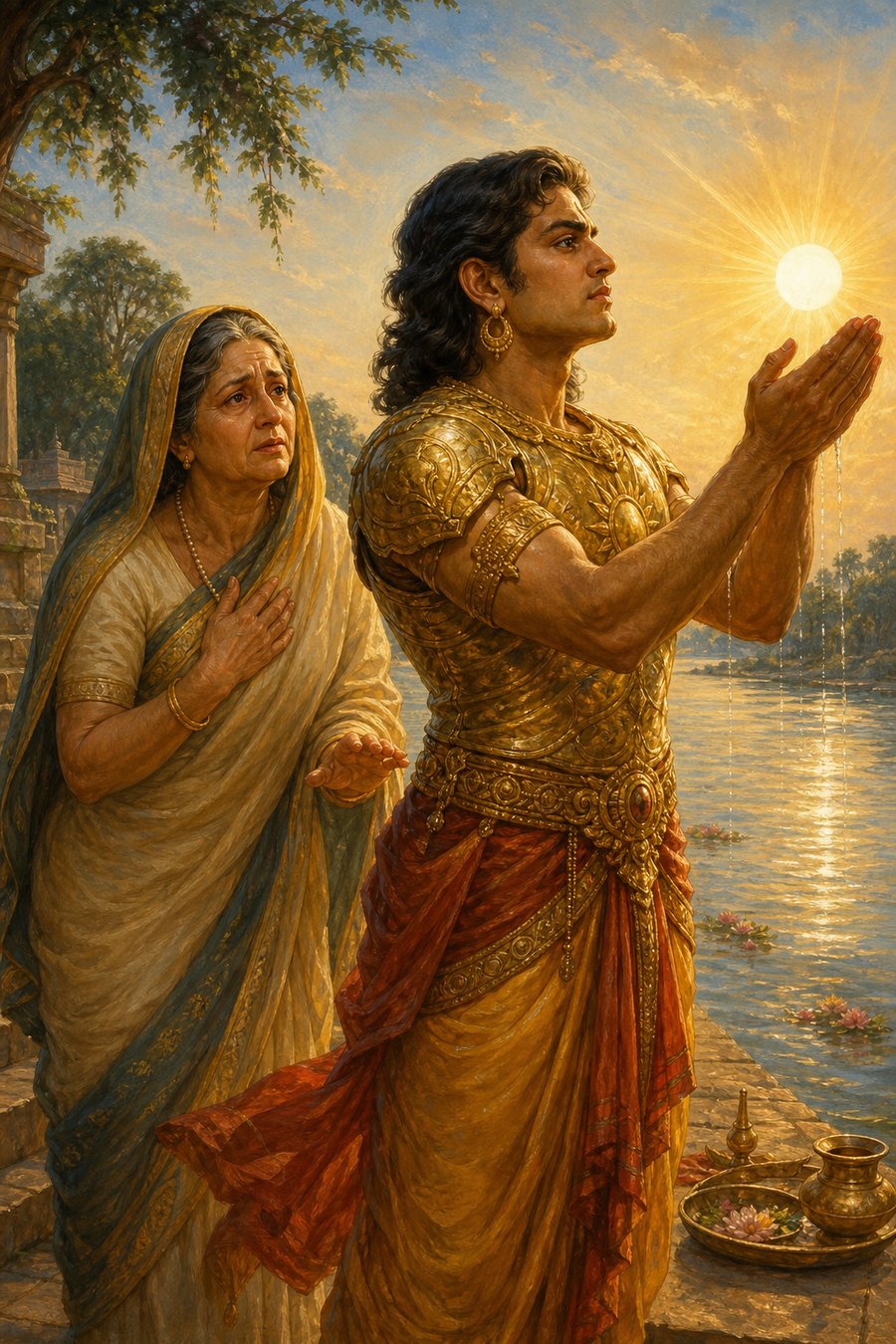
Kunti said, “You are Kunti’s son, not Radha’s. Adhiratha is not your father. You, Karna, were never born in the Suta order. Believe what I tell you. I brought you forth while I was still a maiden. It was I who first held you in my womb. You were born, my son, in the palace of Kuntiraja. That divine sun, Karna, who blazes in light and makes all things seen, it was he who begot you upon me. Unconquerable son, in my father’s house you were born, decked with earrings that grew from your body and clad in a coat of mail that grew from your body, shining with beauty.
“That you should serve Dhritarashtra’s son in ignorance, not knowing your own brothers, is not right, my son, and least of all right for a man like you. To please one’s father, and above all one’s mother, who alone is the source of a child’s every tenderness, is called the highest of all human duties. The prosperity Arjuna once won for Yudhishthira has been seized by greedy and wicked men. Snatch it back from Dhritarashtra’s sons and enjoy it yourself. Let the Kurus see today the joining of Karna and Arjuna. Seeing the two of you bound in a brother’s love, let those wicked men bow before you. Let Karna and Arjuna be named in one breath, as Rama and Janardana are. If the two of you are made one, what in the world cannot be done?
“Ringed by your brothers, Karna, you will surely blaze like Brahma ringed by the gods on the ground of a great sacrifice. Rich in every virtue, you are the first of all my kin. Let the word ‘Suta’s son’ cling to you no longer. You are Partha, filled with great energy.”
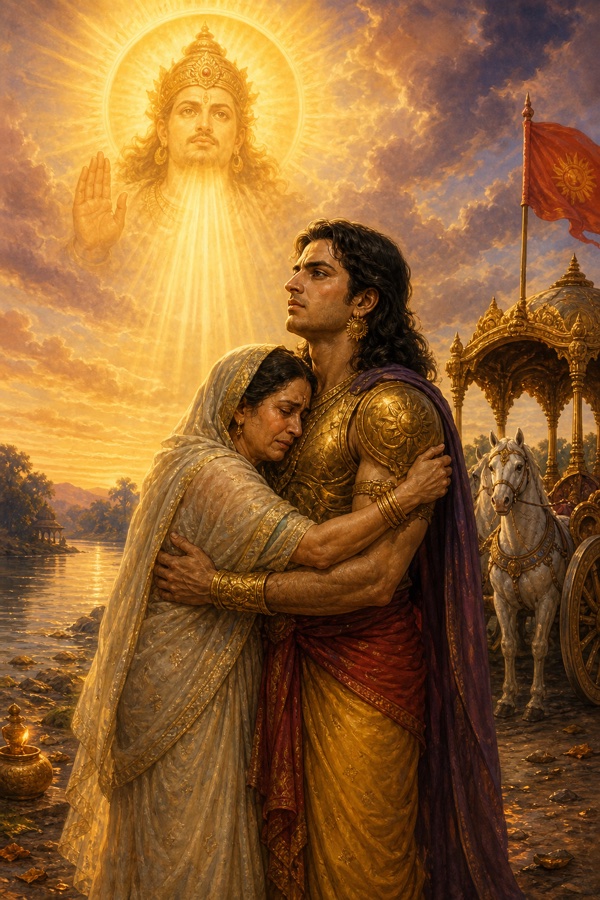
As Kunti finished, Karna heard a voice full of affection come out of the disc of the sun. From far off it came, spoken by Surya himself with a father’s love. “What Pritha has said is true. Karna, act by your mother’s words. If you follow those words to the full, great good will come to you.”
The gist: Kunti tells Karna the truth, that he is her maidenhood’s son, born of Surya, come into the world already wearing his armor and earrings. She begs him to join Arjuna and stand with the Pandavas, since to please a mother is the highest of duties. Surya himself, from the sky, says the same.
Karna’s refusal, and the pledge of safety to four brothers
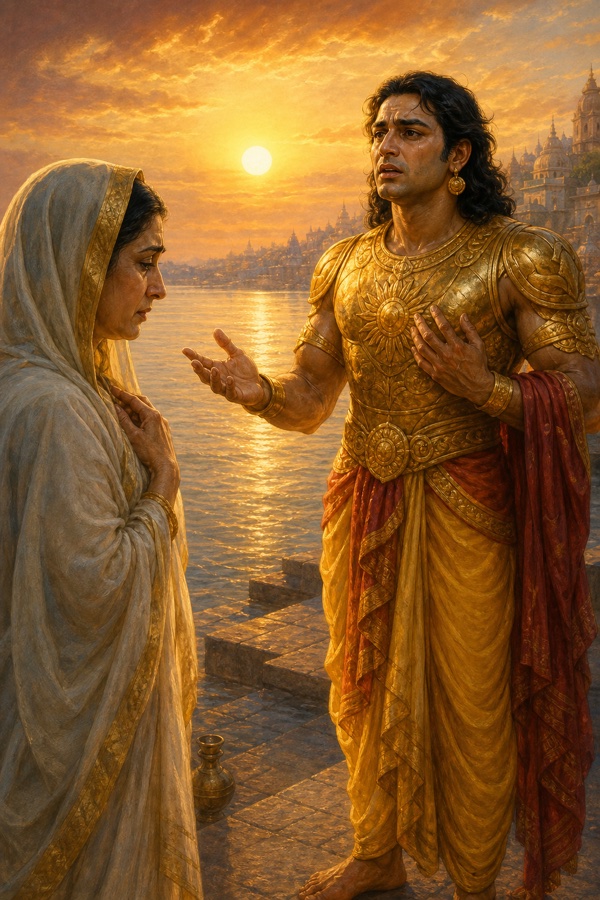
Though his mother had spoken, and his father Surya as well, Karna’s heart did not move, for he was firmly set on truth. He said, “Kshatriya lady, I cannot accept what you say, that obedience to your command is my highest duty. Mother, you gave me up the moment I was born. That great wrong you did me, one that put my very life at risk, has ruined my deeds and my fame. If I am a Kshatriya, then because of you I have gone without all the rites of a Kshatriya. What enemy could have done me a greater harm? When you should have shown me mercy you showed none, and having left me stripped of all the rites owed to the order of my birth, today you lay your command on me. You never once sought my good as a mother should. And today you speak to me, and it is your own good you seek.
“Who would not fear Dhananjaya, with Krishna for his charioteer? If I go over to the Parthas now, who will not think I do it out of fear? No one has known me until now as their brother. If, on the very eve of battle, I go to the Pandavas announcing that I am their brother, what will all the Kshatriyas say? Dhritarashtra’s sons have furnished me with every object of my desire and honored me to keep me content. How can I let that friendship come to nothing? Taking on the enmity of others, they wait on me with respect, and bow to me as the Vasus bow to Vasava, to Indra. They believe that with my strength behind them they can face the foe. How can I break the hope they have nursed? They have made me their boat, meaning to cross the impassable sea of battle. Those who wish to reach the far shore, how can I abandon them, when there is no other landing?
“This is the hour when all who are kept by Dhritarashtra’s sons should strive for their masters. I will surely act for them, with no thought even for my life. Those wicked men of unsteady heart who, well-fed and well-furnished by their masters, waste the benefit when the time comes to repay it, are thieves of their master’s food, and for them there is neither this world nor the next. I will not speak to you with any guile. For the son of Dhritarashtra I will fight against your sons with all my strength and might. And I will not throw away courtesy and the conduct that befits good men. So your words, however kind, I cannot accept now.
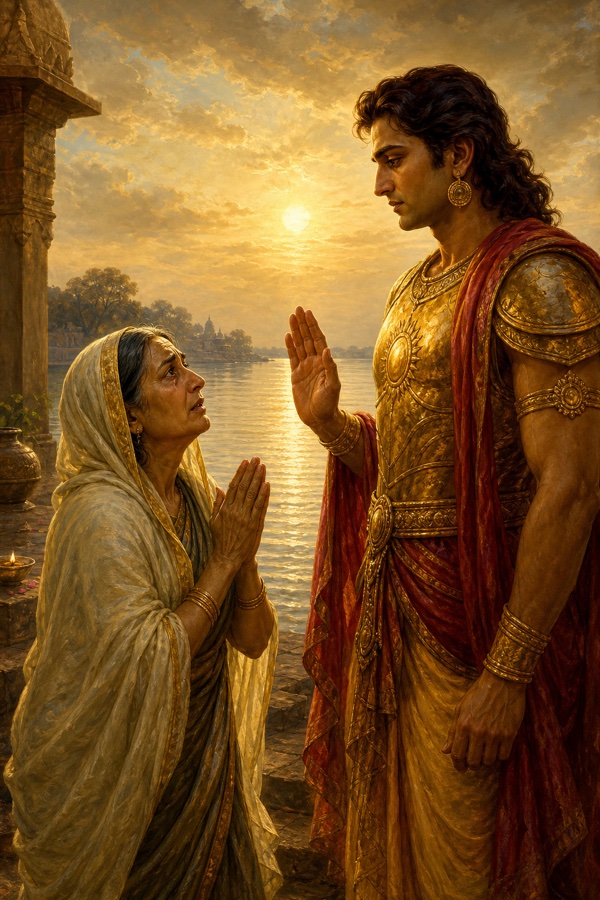
“And yet your plea will not be wasted. Except for Arjuna, your other sons, Yudhishthira, Bhima, and the twins Nakula and Sahadeva, though I could hold them off in battle and could kill them, will not be killed by my hand. Of all the warriors in Yudhishthira’s army I will fight Arjuna alone. Killing Arjuna in battle, I will win great merit; or slain by Savyasachin, I will be covered in glory. Famed lady, the number of your sons will never fall below five. Five it will always be: with me if Arjuna falls, or with Arjuna if I am slain.”
A key to reading this (the number five): Karna promises to spare Yudhishthira, Bhima, Nakula, and Sahadeva. His pledge leaves the conflict with Arjuna unresolved: if Arjuna dies, Karna remains; if Karna dies, Arjuna remains. That is the sorrowful arithmetic of the five sons.
Hearing these words, Kunti, shaking with grief, embraced the son who stayed unmoved through his own steadiness, and said, “Truly, Karna, even if what you say could come to pass, the Kauravas will surely be destroyed. Destiny is everything. And still you have given your four brothers the pledge of safety. Let that pledge stay in your memory in battle, when the weapons fly.” And having said all this, Pritha added, “May it go well with you, and may health be yours.” Karna answered, “So be it.” And then the two of them went off, each in a different direction.
The gist: Karna turns down his mother’s offer, held fast by the wound of his abandonment and his loyalty to Duryodhana, and yet he does not let her plea go for nothing. He gives his word to spare all four brothers but Arjuna, so that Kunti’s sons will always number five. Kunti, shaking with grief, embraces him, asks him to remember that pledge in the hour of war, and the two part with heavy hearts.
Source: the Mahabharata of Krishna-Dwaipayana Vyasa, Udyoga Parva. The Sanskrit e-text, the Gita Press Hindi edition, and Kisari Mohan Ganguli’s complete English translation were used to verify names, sequence, and principal events; where the recensions differ, this English retelling follows Ganguli. In the Gita Press numbering the episode is chapters 140 to 146, with the opening departure scene from 137.25 to 29. Krishna identifies Karna as Kunti’s eldest son in 140.8 to 11; Karna’s promise to Kunti appears in 146.20 to 27. Compare K. M. Ganguli, sections CXL to CXLVI, and the Sanskrit electronic text, chapters 138 to 144 (numbering differs). Dialogue and commentary are adapted, not a verbatim translation. About the sources.
Based on: The Mahabharata, Vyasa (Gita Press, Gorakhpur)