← Collection
MahabharataThe difficult ground of dharma

Mahabharata · The Embassies of Peace, Vidura’s Counsel, and Sanatsujata

On this page
The Mahabharata · Udyoga Parva
The peace embassies meant to avert the war, Sanjaya’s coming as an envoy, and the counsel of statecraft and self-knowledge that Vidura and then Sanatsujata gave Dhritarashtra in the depth of one long night.

About 110 min read · 18,599 words

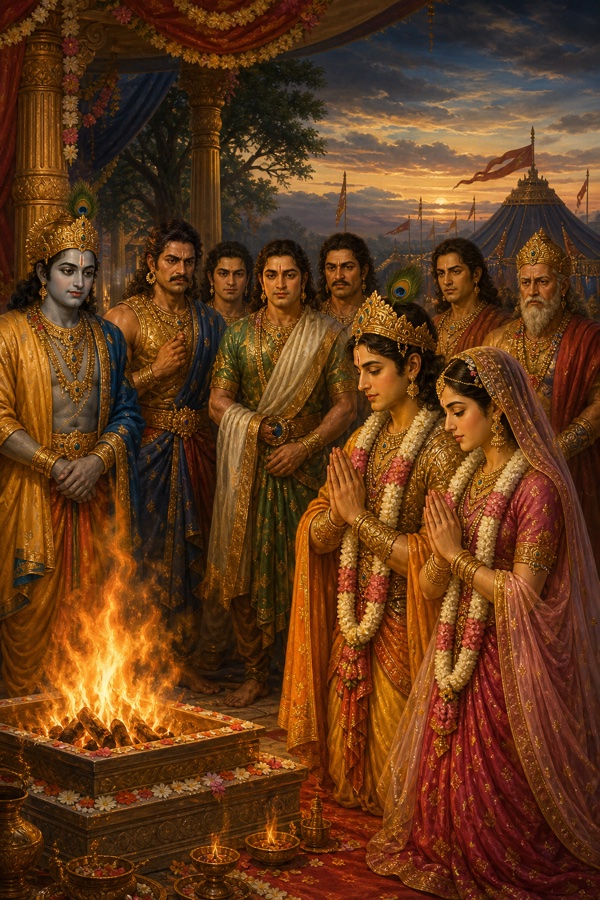
Abhimanyu and Uttara stand with folded hands before the wedding fire, Krishna and the Pandavas beside them.

The wedding of Abhimanyu was over, and in Upaplavya, a city of the Matsya king Virata, in that hall where jewels caught the morning light and the smell of flower garlands hung in the air, the great men of the Kuru line came and took their seats at dawn. On the forward seats sat Virata, king of the Matsyas, and Drupada, king of the Panchalas, and near them Balarama and Krishna with their father Vasudeva, and Satyaki, the mighty hero of the Sini line, and the sons of Pandu, Yudhishthira, Bhima, Arjuna, Nakula, and Sahadeva, and the five sons of Draupadi, who blazed with the same fire as their fathers. In that hall every eye rested on one man, and that man was Krishna of the Yadu line. When the time came to speak, it was he who rose and laid the cause of the Pandavas before all the kings.

The Council at Upaplavya: Krishna’s Address

Krishna began in a grave and lofty voice. You all know, he said, how Yudhishthira was cheated at dice by Sakuni, son of Suvala, how his kingdom was stripped from him, and how a vow of exile was wrung out of him. By force these sons of Pandu could have won the whole earth, and still they held firm to the word they had given. Through six years and then seven, twelve of the thirteen, these matchless men carried out that cruel task, and this last, thirteenth year, the hardest of all, they lived out unrecognized by anyone, bearing every kind of hardship, in service that came close to bondage.

Now it is worth considering, Krishna went on, what will be good for both Yudhishthira and Duryodhana, for the Kurus and the Pandavas alike, and what accords with dharma and with propriety and will be acceptable to all. The righteous Yudhishthira would not take even the kingdom of heaven by wrongful means, yet by righteous means he would accept the rule of one small village. How the sons of Dhritarashtra fraudulently seized his ancestral kingdom is known to every king seated here. The Pandavas are stronger than the Kauravas, he said, and even so Yudhishthira and his friends wish no harm to Dhritarashtra’s son. They ask only for what they themselves won in battle from the kings they defeated.

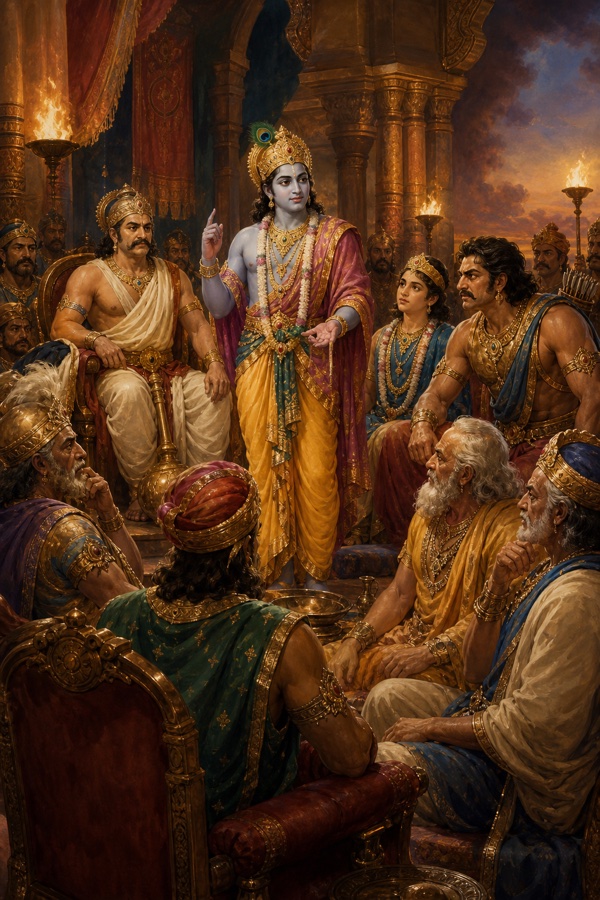
Krishna stands in an assembly full of kings, one hand raised, arguing the cause of the Pandavas.

What is in Duryodhana’s mind, Krishna said plainly, is not known for certain, nor what he will do. And when the mind of the other side cannot be read, what firm decision can be made? His view, therefore, was this: let one man, honest and righteous, truthful and careful and of good birth, a man fit to be an envoy, be sent to the Kauravas to persuade them gently to return half the kingdom to Yudhishthira. His words were full of peace and fairness. His elder brother Balarama rose and praised them warmly.

A key to reading this (place): Upaplavya was a city in the land of the Matsyas (Virata’s kingdom), where the Pandavas, having completed their year in hiding, had begun again to live openly as themselves. It is from here that all the diplomacy before the war begins.

The gist: Having kept their thirteen-year vow, the Pandavas want their half of the kingdom back. Krishna proposes to the council that a capable envoy first be sent to the Kauravas with gentle words, since what is gained through peace is what lasts.

Balarama, Satyaki, and Drupada: Three Clashing Opinions

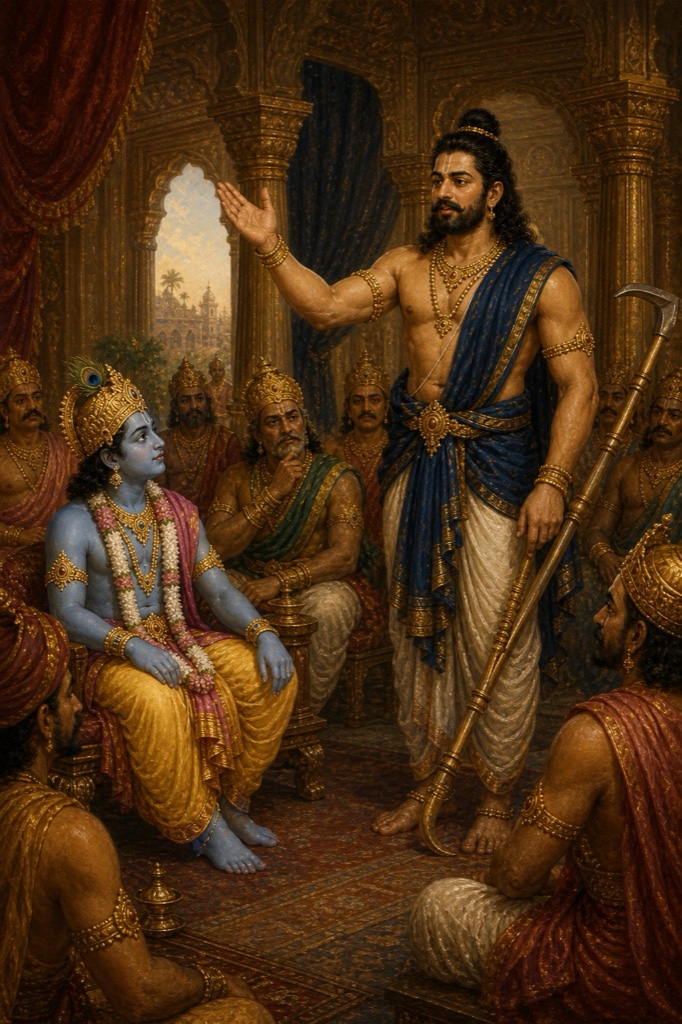
Balarama, holding his plow, stands in the assembly and gives his opinion while Krishna listens beside him.

Balarama said that these brave sons of Kunti were ready to give up half the kingdom for Duryodhana’s sake, and so the sons of Dhritarashtra ought to return the other half and settle the quarrel gladly. Let someone go from here, he suggested, to learn Duryodhana’s mind and to explain Yudhishthira’s. That man should bow with respect to Bhishma, to Dhritarashtra, to Drona and his son Ashvatthama, to Vidura and Kripa, to Sakuni the king of Gandhara, and to Karna the charioteer’s son, and speak humbly, not rousing them to anger, for they hold the kingdom with a firm grip.

But Balarama did not stop there. He spoke a hard truth about Yudhishthira as well. When Yudhishthira held the throne, he said, he lost himself in the pleasure of dice. Though he had no skill at the game, and though all his friends warned him off, this descendant of Ajamidha challenged the son of the king of Gandhara, a master of dice. There were thousands of players there whom Yudhishthira could have beaten, yet he passed over every one of them and chose Sakuni alone, and so he lost. For this, said Balarama, no blame falls on Sakuni. He advised the envoy not to seek war with the Kurus but to speak to Duryodhana only in a tone of reconciliation, since what war may fail to win, conciliation can win, and win it in a way that endures.

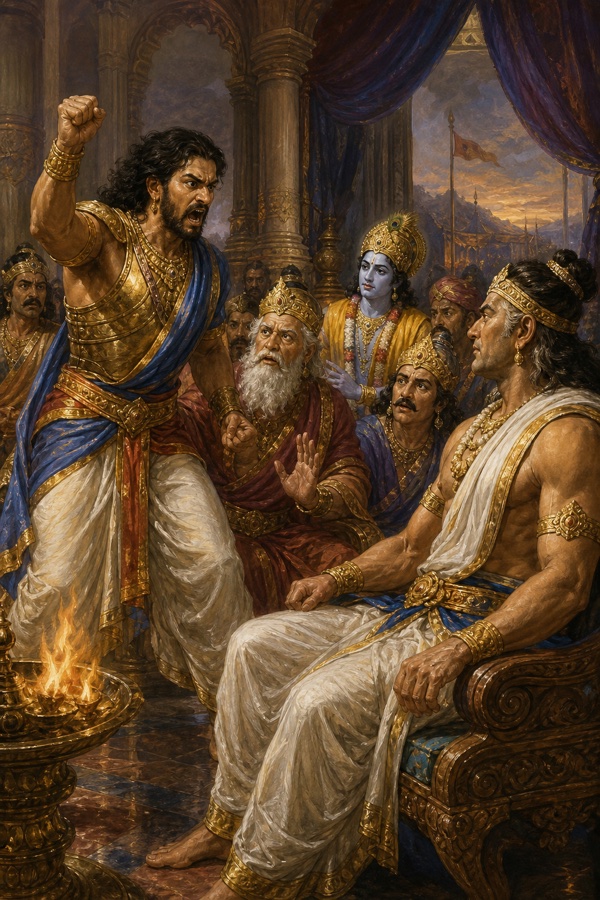
Satyaki speaks in the assembly with a clenched fist raised in anger, an aged king lifting a hand to calm him.

Balarama’s words were not yet finished when Satyaki of the Sini line sprang up in anger. As a man’s heart is, he said, so does he speak. He did not condemn Balarama’s words alone but rebuked the listeners who could sit and endure such talk. How, Satyaki asked, is anyone shameless enough to lay even the smallest blame on the righteous Yudhishthira fit to speak in this assembly? Men skilled at dice challenged an unskilled Yudhishthira, and trusting them, he lost. Can such a victory be called a victory won by dharma? Satyaki declared that he would teach the Kauravas with sharp arrows and bend them by force to Yudhishthira’s feet. If they would not bend, then they and their partisans would go to the realm of Yama. Who, he asked, could stand before Bhima, before Arjuna, before Krishna of the discus, before Satyaki himself, or before Nakula and Sahadeva, who are the equals of Death? To go begging with open hands before an enemy is against dharma and brings dishonor. Either Yudhishthira gets his kingdom this very day, he said, or all his enemies lie flat upon the earth.

Then Drupada spoke. Satyaki is right, he said. Duryodhana will never give up the kingdom in peace, and Dhritarashtra, blinded by love for his son, will follow him; Bhishma and Drona will go along out of weakness, Karna and Sakuni out of folly. Gentleness, Drupada said with a sharp figure, suits the donkey; for the ox of the herd, firmness is what fits. If anyone speaks softly to Duryodhana, that wicked man will take it for cowardice and think himself the victor. So Drupada advised that messages be sent to their friends and an army be gathered, and he counted off the names of Salya, Dhrishtaketu, Jayatsena, the king of the Kekayas, and many other kings who should be invited to their side at once. And let his own aged and wise priest, he said, be sent as envoy to Dhritarashtra.

A key to reading this (concept): Dyuta is the dice-game, gambling. The whole quarrel of the Mahabharata springs from this game. Notice that Balarama places part of the blame on Yudhishthira as well (for choosing to play a game he had no skill at), while Satyaki treats it as entirely a Kaurava fraud. This moral tangle is the signature of the Mahabharata, where no side is shown as wholly innocent.

The gist: Three voices rise on the question of peace: Balarama’s, for gentleness (and even a light reproach of Yudhishthira); Satyaki’s, for war and force; and Drupada’s, for realist strategy, that they send an envoy and raise an army at the same time. Krishna backs Drupada’s plan and returns to Dwarka.

Arjuna and Duryodhana at Dwarka: What Each One Chose

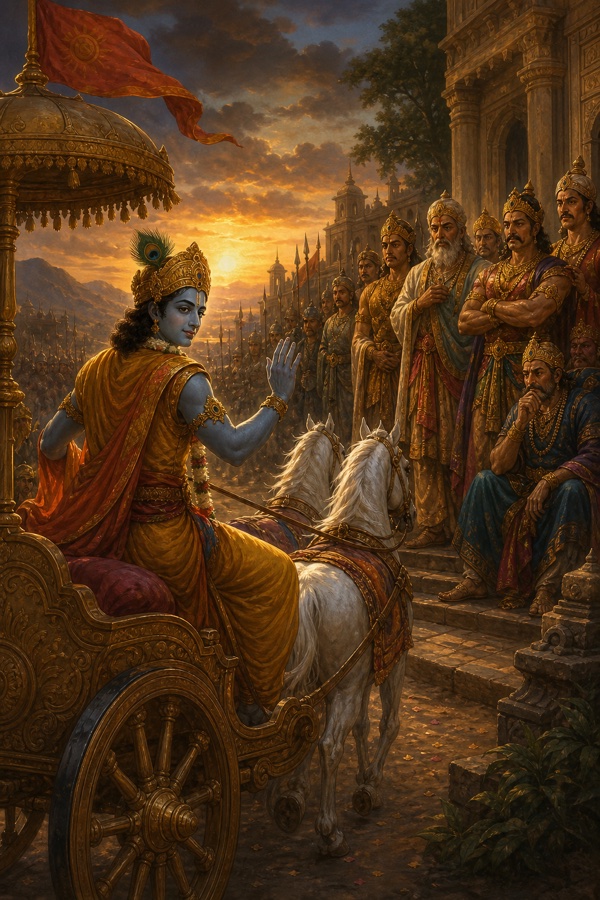
Krishna, seated on his chariot, raises a hand in farewell as kings and princes watch from the steps.

The moment Krishna set out for Dwarka, Yudhishthira, with Virata and Drupada, began preparing for war and sent messages to kings on every side. On the other side, Duryodhana learned all the Pandavas’ movements through his spies. When he heard that Krishna was going to Dwarka, he mounted horses swift as the wind, took a small force, and reached Dwarka at once. That same day Arjuna, the son of Kunti, arrived there too. Both found Krishna asleep. Duryodhana went in and sat on a fine seat placed at the head of the bed, and Arjuna, who came in behind him, stood with folded hands near the foot.

When Krishna woke, his gaze fell first on Arjuna. He asked after their welfare and their reason for coming. Duryodhana said, help me in the coming war, for Arjuna and I are both your friends, and your kinship with the two of us is equal, but I came first, and honest men take the side of the one who comes first. Krishna answered that he did not doubt Duryodhana had come first, but that he had seen Arjuna first. He would help them both, he said, and since the younger has the right to choose first, Arjuna would choose first. Krishna set out two things: on one side, an unconquerable army of cowherds ten crore strong, called the Narayanas; on the other, himself alone, who would take a vow to lay down his weapons and not fight.

Arjuna chose Krishna, the one who would not fight, and Duryodhana chose the whole Narayani army. Knowing full well that Krishna was not on his side, Duryodhana was overjoyed to have that vast host. He went next to Balarama. Balarama reminded him of what he had said at the wedding festival in Virata’s city, that his kinship with both sides was equal, but that he could not be parted from Krishna even for a moment, nor act against him, and so he had decided to fight neither for the Pandavas nor for the Kauravas. With that, Balarama told him to fight by the rules of dharma. Duryodhana embraced him, and though Krishna had slipped from his grasp, he already counted Arjuna as good as beaten. He then went to Kritavarma, who gave him an akshauhini of troops.

After Duryodhana left, Krishna, robed in yellow, asked Arjuna why he had chosen the one who would not fight. Arjuna replied that he knew Krishna could destroy them all single-handed, and that he himself could do the same alone, but Krishna was a man of glory in the world and that glory would go with him; Arjuna too longed for glory, and it had always been his wish that Krishna become the driver of his chariot. Krishna, well pleased, agreed to be his charioteer.

A key to reading this (number, in modern terms): An akshauhini is one complete army-unit, made up by tradition of about 21,870 chariots, the same number of elephants, 65,610 horsemen, and 109,350 foot-soldiers. It is like a large modern corps, or several divisions combined.

The gist: Arjuna chooses the unarmed Krishna to be his charioteer; Duryodhana chooses the vast Narayani army. Balarama stays neutral. This split between power and values sets the whole course of the war.

How Salya Was Tricked onto the Kaurava Side

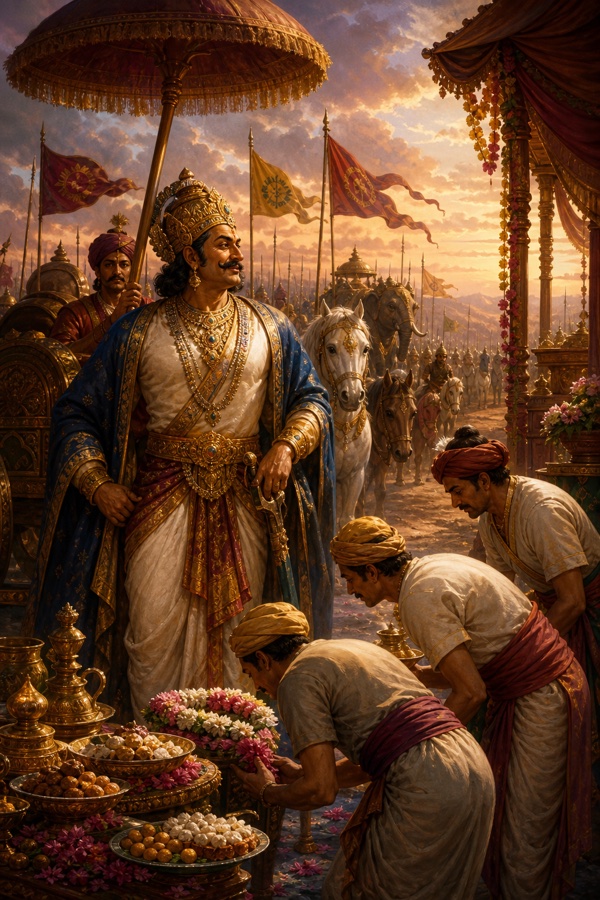
At a roadside welcome camp King Salya stands beneath a canopy admiring the laden platters as servants bow and arrange the fare.

Meanwhile Salya, king of the Madras and uncle of the Pandavas, set out toward them with his great army and his sons. Hearing along the way that he was coming, Duryodhana had beautiful rest-houses built at intervals, furnished with garlands, fine food, drink, and every comfort. Salya was so pleased with the welcome, fit for a god, that he asked the attendants which of Yudhishthira’s men had arranged all this, so that he might reward them. Then Duryodhana, who had been hidden, came forward, and Salya understood that it was Duryodhana who had made every arrangement. Delighted, he told him to ask for a boon. Duryodhana asked only this, that Salya become the commander of his whole army. Salya gave his word: so be it.

Then Salya said he would meet the Pandavas once and return quickly, for it was necessary that he see Yudhishthira. Duryodhana reminded him of the promise he had given. Reaching Upaplavya, Salya met the Pandavas, embraced Yudhishthira, Bhima, Arjuna, and his own nephews Nakula and Sahadeva, asked after Yudhishthira’s welfare, and grieved over the hardships of their exile and their year in hiding. Then he told them the whole account of his meeting with Duryodhana and the promise he had made.

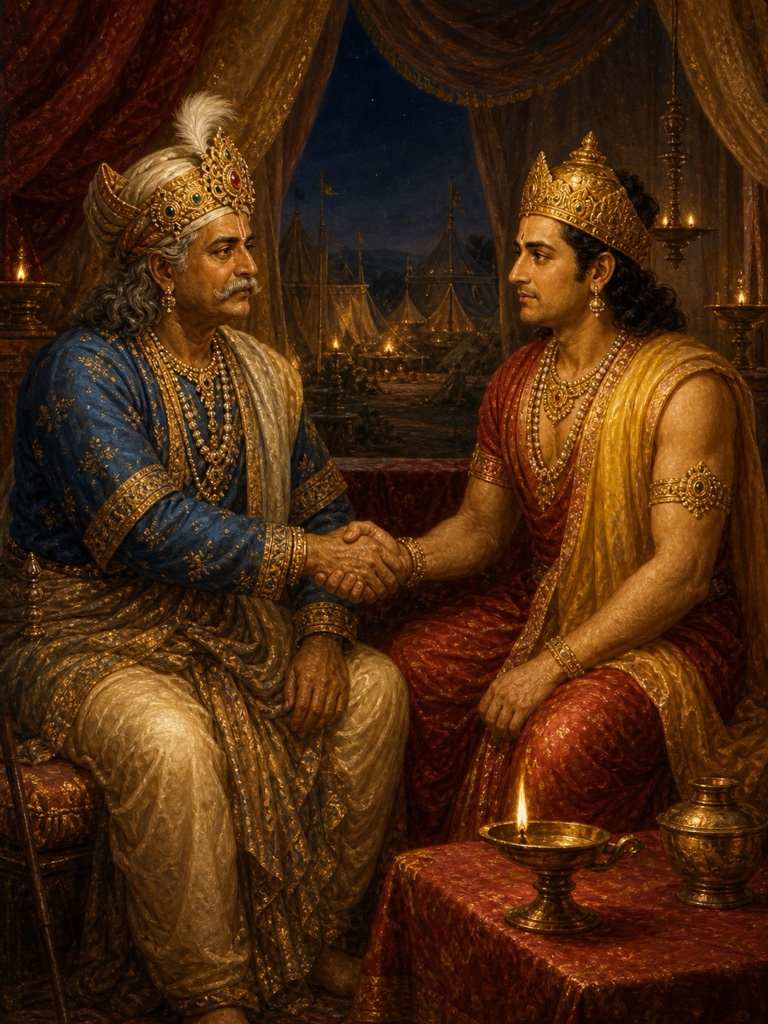
In the night camp King Salya clasps the young monarch's hand, promising to keep his word.

Yudhishthira said that it was only proper for Salya, pleased as he was, to have given Duryodhana his word, but that now he wished to ask him something that might not seem proper and yet must be done for their sake. When Karna and Arjuna meet in single combat, Yudhishthira said, Salya will surely become Karna’s charioteer, for Karna holds him equal to Krishna. At that time, let Salya speak such contrary and harmful words as will break Karna’s spirit and his strength, so that the victory falls to the Pandavas. Hearing this, Salya said that although the task might seem improper, since Yudhishthira asked it he would certainly do it; he would speak to Karna in such a way that, losing his pride and his valor, he might be easily defeated.

Salya comforted Yudhishthira, telling him not to grieve, for in this world the ordinance of fate is the strongest thing, and even high-souled men, even the gods, must bear many kinds of sorrow. Even Indra, king of the gods, he said, had to suffer great sorrow along with his wife. Yudhishthira, curious, asked to hear that ancient story.

A key to reading this (lineage): Salya was king of the Madra country and brother of Madri, and so uncle to Nakula and Sahadeva. By a trick he is bound to the Kaurava side, yet in his heart he remains a well-wisher of the Pandavas. This doubleness runs through many of the Mahabharata’s characters.

The gist: Duryodhana tricks Salya into a promise to command his army. Yudhishthira makes a secret request that Salya, as Karna’s charioteer, break his spirit, a morally clouded ask that Salya accepts.

Salya’s Tale: Indra, Vritra, and Nahusha

Salya told the old story of Indra’s victory. Once, out of hatred for Indra, the Prajapati Tvashtri fashioned a son with three heads, who was called Vishvarupa. His three faces were like the sun, the moon, and fire; with one mouth he recited the Vedas, with another he drank soma, and with the third he looked about him as though he would swallow all the directions. He was sunk in fierce austerity. Indra grew afraid that this being might take his place. First he sent celestial nymphs to tempt him with the pleasures of the senses, but Vishvarupa, master of his senses, stayed unmoved as the sea. Then Indra, in anger, hurled his thunderbolt and killed him.

Even dead, Vishvarupa still shone with radiance, and Indra found no peace. Just then a carpenter came by with his axe. Indra told him to cut off the three heads. The carpenter refused at first, afraid of the sin of killing a brahmana, but on Indra’s assurance, and on the boon that in sacrifices the animal’s head would be his portion, he cut them off. From the severed mouths flew out birds, partridges and quails and sparrows. Freed of his fear, Indra returned to heaven.

But Tvashtri, hearing that his innocent son had been killed, in his fury brought forth a terrible Asura named Vritra and ordered him to slay Indra. A savage battle followed between Vritra and Indra. Vritra seized Indra and swallowed him into his mouth. Then the gods created Jrimbhika, the yawn; when Vritra yawned and his mouth fell open, Indra drew his limbs in small and slipped out, and from that time the yawn has lived in the breath of all creatures. The fight resumed, but Vritra, made strong by Tvashtri’s power, prevailed, and Indra fell back. Then the gods went for refuge to Vishnu on Mount Mandara.

Vishnu showed them the way: let peace be made with Vritra, and he himself would enter Indra’s thunderbolt unseen. The sages went and persuaded Vritra with an offer of friendship. Vritra accepted the truce, but he asked for this boon, that he be slain neither by anything dry nor anything wet, neither by stone nor by wood, neither by weapon nor by missile, neither by day nor by night. The sages agreed. At one twilight, which was neither day nor night, Indra saw upon the sea a mountain of foam, which was neither dry nor wet, and no weapon. Into that foam he mixed his thunderbolt and hurled it at Vritra, and Vishnu entered it and made an end of Vritra.

After the killing of Vritra, Indra was seized by the guilt of brahmana-slaughter (the killing of Vishvarupa) and of falsehood (the breaking of the truce), and he went to the end of the world and hid in the waters, coiled like a serpent. The moment he vanished, the earth turned lifeless, the trees dried up, the rivers stopped, the rains failed. The heaven, left without a king, fell into crisis.

Then the sages and the gods made a human king, Nahusha, the king of heaven. Nahusha pleaded at first that he was not equal to it, but the gods granted him this boon, that whatever creature came within his sight, its energy would pass into Nahusha. Once he became king, holding so great a boon, the once-righteous Nahusha sank into indulgence and pleasure, and he sent an order to Sachi, Indra’s beloved wife, to come to him. Terrified, Sachi took refuge with Brihaspati, the preceptor of the gods. Brihaspati promised to protect her and to reunite her with Indra.

The gods pleaded long with Nahusha not to cast his eye on another’s wife, but Nahusha, blind with lust, would not listen; instead he counted off Indra’s old faults, such as the affair with Ahalya, to make himself out to be in the right. Brihaspati advised Sachi to ask Nahusha for time. Sachi went to Nahusha and asked for time to find out where Indra was; if she could not find him, she would come to Nahusha. Nahusha agreed.

Meanwhile the gods, on Vishnu’s advice, had a horse-sacrifice performed to free Indra from the guilt of brahmana-slaughter, and Indra distributed that guilt among the trees, the rivers, the mountains, the earth, and women, so that they were relieved of the fever. Yet in fear of Nahusha’s power he hid again. Sunk in grief, Sachi, by the force of her truth and her wifely devotion, worshiped Upashruti, the goddess of the divine voice. Upashruti led her across the sea to a lake on an island, to Indra, who had taken a subtle form and lay within the fibers of the stalk of a white lotus. Sachi told him of Nahusha’s outrage and begged for protection.

Indra said the time for open valor had not come; Nahusha, made mighty by the austerities of the sages, was stronger than he was, and so the work must now be done by policy, by strategy. In secret he taught Sachi to tell Nahusha to come riding on a strange palanquin borne by the sages themselves. Sachi went and said just this, and asked for a little more time. Nahusha, drunk with pride and delight, yoked the seven sages and other brahmarshis to carry his palanquin. Brihaspati, through the fire, tracked down Indra and roused him, restoring his strength with praise of his past deeds.

In the end Nahusha’s fall came from his own arrogance. The sages, worn out from carrying him, asked whether the Vedic mantras chanted at the sprinkling of cattle were authoritative or not. Nahusha, gripped by the quality of darkness, called them unauthoritative, and in the dispute he set his foot on the head of the great sage Agastya. Agastya cursed him to lose his glory, fall from heaven, and roam the earth for ten thousand years in the form of a huge python. So Nahusha was cast down, and Indra, with his wife Sachi, again received the kingdom of heaven and went on to guard the worlds.

King Salya stands in the camp speaking to a thoughtful Yudhishthira while Krishna sits and listens.

Salya gave Yudhishthira the point of the tale. Just as Indra, having borne hardship with his wife, having passed his time in hiding, at last slew Vritra and won back his kingdom, so too Yudhishthira, having borne hardship with Draupadi and his brothers, would win back his kingdom, and Karna, Duryodhana, and the other evil-souled men would soon be destroyed. This story of Indra’s victory, he said, is holy as the Veda, and a king who desires victory should hear it. Yudhishthira, pleased, honored Salya and again reminded him to become Karna’s charioteer and to wear down his spirit with praise of Arjuna. Salya said, so it shall be, took his leave of the Pandavas, and went with his army to Duryodhana.

A sub-tale: When Vritra asked for his boon, he shut off every possible manner of killing: dry and wet, wood and stone, weapon and missile, day and night. And still Indra, by taking twilight (which is neither day nor night) and the sea-foam (which is neither dry nor wet, and no weapon), slipped past every limit of the boon. This is the very theme of a promise kept to the letter but broken in spirit, one that returns again and again in the events of the Mahabharata war, and it is why the guilt of falsehood settled on Indra too.

The gist: With the story of Indra, Salya reassures Yudhishthira that victory is certain after hardship and waiting. In this tale even the king of the gods is not free of trickery and sin, which is the Mahabharata’s steady note.

The Gathering of Armies and Drupada’s Priest at Hastinapura

From a height Krishna points toward the two armies gathering on the field, kings standing with him.

After this, many kings came to the two sides with their akshauhinis. Satyaki, Dhrishtaketu the king of the Chedis, Jayatsena the king of Magadha, the Pandya, Drupada, Virata, and the hill kings, from many directions seven akshauhinis gathered for the Pandavas. On the other side, Bhagadatta, Bhurishravas, Salya, Kritavarma, Jayadratha, Sudakshina the king of the Kambojas, Nila the lord of Mahishmati, the two kings of Avanti, and the five brothers of Kekaya, all together brought Duryodhana eleven akshauhinis. Hastinapura could not hold so vast an army, so the whole broad country, the land of the five rivers, Kurujangala, the banks of the Ganga, and the border tracts along the Yamuna, filled up with the Kaurava host.

At about this time, the aged and wise priest of Drupada, king of the Panchalas, reached Hastinapura. Dhritarashtra, Bhishma, and Vidura received him with honor. In the presence of all Duryodhana’s chief commanders, the priest said that Dhritarashtra and Pandu had been sons of the same father, and so the ancestral property should belong equally to both. When the sons of Dhritarashtra received their father’s wealth, he asked, why did the sons of Pandu not receive their share? He recalled how many attempts had first been made to kill them, how their kingdom had then been taken by fraud and thirteen years of exile imposed, and how their wife had been dishonored in the assembly. And yet, forgetting all those wrongs, the Pandavas wanted a peaceful settlement, wanted their share without plunging the world into ruin. The priest warned that the Pandavas were the stronger, that seven akshauhinis stood ready for them, and that Satyaki, Bhima, and Nakula and Sahadeva were heroes each worth a thousand akshauhinis, and that above all these hung the intelligence of Arjuna and Krishna alone. So let whatever is owed by dharma and by fair settlement be given, he said, and let this chance not be lost.

Bhishma, honoring the priest, said what great good fortune it was that the Pandavas were safe, that they had found support, and that they wanted dharma and peace. He admitted that the priest’s words were true, though a little sharp, since he was a brahmana. He granted that the Pandavas had been much wronged and that by right they were the heirs to their father’s whole property, and that no one could stand before Arjuna in battle.

In the Hastinapura assembly an armored warrior raises an angry fist at the envoy's message while aged Bhishma restrains him.

At once Karna, in anger and insolence, cut Bhishma off in the middle and, looking toward Duryodhana, said that the whole world already knew these things, so what was gained by repeating them again and again. Sakuni won at dice for Duryodhana; Yudhishthira went to the forest as the terms required; now, ignoring those terms, he wants his kingdom back on the strength of the Matsyas and the Panchalas. Out of fear, said Karna, Duryodhana would not give up a finger’s breadth of land, but if it were a matter of justice he would give the whole earth even to an enemy. If the Pandavas want the kingdom, let them again pass the term of years in the forest, as the terms require, and then live as Duryodhana’s dependents.

Bhishma rebuked Karna, telling the son of Radha to remember the occasion when Arjuna alone had defeated six great warriors at Virata’s city; if they did not do as this brahmana said, they would all be killed at Arjuna’s hands. Then Dhritarashtra soothed Bhishma with gentle words, reproached Karna, and said that Bhishma’s advice was for the good of all. He announced that after due deliberation he would send Sanjaya to the Pandavas, and having sent off Drupada’s priest with honor, he called Sanjaya to the assembly.

A key to reading this (number): Seven akshauhinis on the Pandava side and eleven on the Kaurava, eighteen armies in all, gathered at Kurukshetra. It is this number eighteen that keeps returning in the Mahabharata: eighteen parvas, eighteen days of war, eighteen chapters of the Gita.

The gist: Drupada’s priest speaks plain words of dharma at Hastinapura; Bhishma agrees, Karna objects. Dhritarashtra decides to send Sanjaya as his envoy to the Pandavas.

Sanjaya Goes to Upaplavya as Envoy

Dhritarashtra ordered Sanjaya (son of Gavalgana, a suta by birth) to go to Upaplavya and ask after the welfare of Yudhishthira, whose enemy is unborn, and of all the Pandavas. Opening his heart’s fear, Dhritarashtra said he had never seen any fault in the Pandavas, that they always kept dharma and worldly good in mind, never gave in to the senses, and rained wealth and honor upon their friends as each deserved. He admitted that in the line of Ajamidha it was only this base, foolish Duryodhana, and Karna who was baser still, who hated the Pandavas.

Dhritarashtra spoke his fear openly. Arjuna, wielder of the Gandiva, seated alone on his chariot, could lay waste the whole world, he said, and Krishna, the invincible lord of the three worlds, could do the same. Among wielders of the mace there is none like Bhima, and the strength of his arms is that of ten thousand elephants. The two sons of Madri fall upon their foes like hawks. My heart trembles, said Dhritarashtra, to hear that the two Krishnas (Vasudeva and Arjuna) sit upon one chariot. He said he feared not so much Arjuna or Bhima or Krishna as the anger of the righteous Yudhishthira, whose austerity is great and who is fixed in continence, for his just wrath is certain to bear fruit.

Dhritarashtra ordered Sanjaya to ask after the welfare of Yudhishthira and Krishna and to say that Dhritarashtra wanted peace with the sons of Pandu, and that Sanjaya should say nothing there that would give offense or provoke the war.

Sanjaya, carrying Dhritarashtra's message, sits with folded hands before Yudhishthira while Krishna sits in thought nearby.

Sanjaya reached Upaplavya, bowed to Yudhishthira, and asked after the welfare of all the Pandavas and of Draupadi. Yudhishthira in turn asked after the safety of Sanjaya’s journey and asked, one by one, after Bhishma, Dhritarashtra, Vahlika, Somadatta, Bhurishravas, Drona, Ashvatthama, Kripa, and all the elders, the women, the servants, and the brahmanas of the Kurus. He also asked whether the Kurus still granted the brahmanas their former livelihood, and whether they had taken back the gifts he had once made to brahmanas, for intolerance toward brahmanas destroys a whole line.

Then Sanjaya, before delivering Dhritarashtra’s message, gave Yudhishthira something like a lesson in policy, saying that peace was best. Life is fleeting, he said, and can end in great disgrace, and so Yudhishthira should not do a ruinous deed. Sanjaya went so far as to say that it was better to live by begging in the kingdom of the Andhakas and Vrishnis than to win a kingdom by war, since a life bought with the slaughter of one’s own people is as good as death. What joy, he asked, would Yudhishthira find in killing heroes like Bhishma, Drona, Ashvatthama, Kripa, and Karna?

Yudhishthira gave a grave answer. Beyond doubt, he said, dharma is best, but Sanjaya should first make sure whether it is dharma he is doing or adharma. Sometimes adharma takes on the look of dharma, and dharma looks like adharma, and in times of distress the two exchange their forms; the learned should tell them apart by judgment. Yudhishthira made it clear that he did not want the kingdom of the earth, or even of heaven, by wrongful means. He named Krishna as the arbiter of dharma and adharma and said that Krishna alone should say whether, in giving up peace, he would be at fault, or whether, in making war, he would fall away from the dharma of his order.

In a lamplit hall Krishna extends a hand as he gives Sanjaya his answer about peace, aged sages listening.

Then Krishna spoke. He said that he wished prosperity both for the Pandavas and for the sons of Dhritarashtra, and that his desire had always been for peace. But when Dhritarashtra and his sons are so greedy, he asked, how can the enmity fail to grow? Krishna rebuked Sanjaya, telling him that he knew no more of the difference between dharma and adharma than Yudhishthira or Krishna himself, so why did he condemn Yudhishthira’s conduct? Krishna gave a long discourse on the greatness of action, that it is by action the wind blows, the sun rises, the fire burns, and by austerity and action Indra himself won the rank of king of the gods. He laid out the duties of the four orders and said that the duty of a kshatriya is to protect the people, and that when a wicked king casts a greedy eye on the wealth of others, war is born, and there is dharma in putting down robbers. Krishna reminded him that when Draupadi was dragged into the crowded assembly, though Bhishma and the others were present, only Vidura protested, and that Sanjaya had not then explained dharma, yet now he came to preach it to the son of Pandu. Krishna declared that he himself wished to go to the Kurus and untangle this hard question, and that if peace could be made without harm to the Pandavas, he would save the Kurus from the bonds of death.

At last, as Sanjaya was leaving, Yudhishthira gave him his final message, and in it he set that famous, aching demand. Tell Duryodhana, he said, that the dishonor of Draupadi in the crowded assembly, the exile, and the dragging of Draupadi by Duhshasana in disregard of Kunti, all this they would forgive, since they did not want the destruction of the Kurus. But they must have their fair share of the kingdom. And if not the whole kingdom, then let Duryodhana give these five brothers just five villages, Kusasthala, Vrikasthala, Makandi, Varanavata, and any fifth he likes, and even this much will end the quarrel. Yudhishthira said that he was as capable of war as of peace, and could meet either gentleness or hardness.

A key to reading this (concept): Ajatashatru, “one whose enemy is not born,” is an epithet of Yudhishthira, marking the freedom from hatred in his nature. The demand for five villages is the Mahabharata’s famous turning point, where Yudhishthira asks for only five villages in place of the whole kingdom, and Duryodhana refuses to give even that.

The gist: Sanjaya comes as Dhritarashtra’s envoy with a message of peace, yet also preaches to Yudhishthira to give up war. Yudhishthira and Krishna answer him in keeping with dharma, and Yudhishthira sets that humble demand for just five villages, which will later be thrown back at him.

Sanjaya Returns to Hastinapura and Rebukes Dhritarashtra

Taking his leave of the Pandavas, Sanjaya returned to Hastinapura and reached the palace gate at night. He told the gatekeeper to inform Dhritarashtra that Sanjaya had come back from the Pandavas, but only if the king was awake, since he had news of the greatest importance. Dhritarashtra had Sanjaya brought in at once. Sanjaya bowed and told him that he had found the Pandavas, and that Yudhishthira had asked after Dhritarashtra and his sons.

Then Sanjaya, holding back the message meant for the full assembly, in this lonely hour of the night gave Dhritarashtra a sharp rebuke. Yudhishthira asks only for what was once his own, he said, and wants dharma and wealth without any blamable act. For Yudhishthira, he said, non-violence stands higher even than dharma, and dharma higher than wealth. Then he turned straight to Dhritarashtra and told him to reflect on his own deeds, which went against both dharma and worldly good. Dhritarashtra had earned an evil name in this world, Sanjaya said, and would find sorrow in the next. As a snake casts off its old skin, the righteous Yudhishthira, whose enemy is unborn, leaves the burden of his sin upon Dhritarashtra and shines in his own true form.

Sanjaya said that if peace did not come, then through Dhritarashtra’s fault Arjuna would burn the Kurus like a heap of dry grass. He recalled that even at the time of the dice, in the grip of his uncontrolled son, Dhritarashtra had counted himself successful and had held back from stopping the quarrel; now let him see the fruit of that same weakness. Casting off trustworthy counselors and taking up untrustworthy men, Sanjaya said, Dhritarashtra by his own weakness was failing to hold this vast and prosperous empire together. Then, saying that he was tired from the long journey, Sanjaya asked leave to sleep, and said that the next morning, in the crowded assembly, the Kurus would hear the words of Yudhishthira.

A key to reading this (concept): Notice that Sanjaya holds back the “formal message” for the full assembly and, at night, gives only his own private rebuke. This piece of craft deliberately leaves Dhritarashtra all night in uncertainty and fear, and it is this sleeplessness that gives rise to the next passage, the Vidura-niti.

The gist: Instead of delivering the assembly’s message, Sanjaya gives Dhritarashtra a harsh private rebuke and puts off the message until morning, leaving the king sunk in worry and sleeplessness.

The Sleepless King in the Night, and Vidura’s Coming

The sleepless Dhritarashtra sits up on his bed at night holding Vidura's hand, a lamp burning nearby.

After Sanjaya went away, sleep would not come to Dhritarashtra. His body began to burn with worry. He ordered a servant to fetch the deeply wise Vidura without delay. Vidura came, folded his hands, and said that he was present as commanded, and to order whatever must be done.

Dhritarashtra said that Sanjaya had come back and rebuked him and gone; that in the morning, in the full assembly, he would deliver Yudhishthira’s message, but what that message was he had not been able to learn tonight, and this was why his body burned and his sleep had fled. He asked Vidura what is good for a man tormented by sleeplessness and grief, since Vidura alone was the master of both dharma and worldly good.

The sleepless Dhritarashtra raises a palm to send back the drink a servant has brought, two aged sages standing anxiously behind.

Vidura first set a piercing question. Sleeplessness, he said, comes to the thief, to the lustful man, to the man who has lost his wealth, to the man who has failed, and to the weak man attacked by someone strong; he hoped that none of these troubles had fallen on Dhritarashtra, and also that the king was not grieving out of greed for another’s wealth. The question struck straight at the heart, for it was the Pandavas’ wealth that Dhritarashtra was withholding.

A key to reading this (lineage): Vidura was the brother of Dhritarashtra and Pandu, but because he was born of a serving-woman he was not held eligible for the throne. He is regarded as an incarnation of Dharma himself. He is also called Kshatta. This night discourse of his is famous as the Vidura-niti, a concise essence of statecraft and of the conduct of life.

The gist: Racked by sleeplessness, Dhritarashtra calls Vidura in the middle of the night. Vidura’s very first question strikes at the king’s tender spot, whether he is burning with greed for another’s wealth.

The Vidura-niti: The Marks of the Wise and the Foolish

Dhritarashtra said that he wished to hear from Vidura words that were good and in keeping with dharma, since in this line of royal sages the learned honored only Vidura. Then Vidura said plainly that Yudhishthira, endowed with every virtue, was fit for the rule of all three worlds, and yet Dhritarashtra had driven him into exile; and Dhritarashtra himself, though he knew dharma, had lost his claim to the throne through his blindness. How, Vidura asked, could Dhritarashtra hope for prosperity after handing the burden of the kingdom to Duryodhana, Sakuni, Karna, and Duhshasana?

At night Vidura raises a finger as he counsels the sleepless Dhritarashtra on statecraft, a radiant sage standing behind.

Then Vidura counted off the marks of a wise man. The wise man, he said, is one whom anger, joy, pride, shame, delusion, and vanity cannot swerve from the high aims of life; whose deeds and planned policy stay hidden from his enemies and come to light only once the work is done; who understands quickly, listens with patience, and does not speak of others’ affairs unasked; who does not crave the unattainable, does not grieve over what is gone, and does not let his judgment be confused in calamity; who does not abandon a task he has begun without finishing it, does not waste his time, and keeps his mind in his own control.

By contrast, Vidura gave the marks of the fool: one who is proud though ignorant of the scriptures, arrogant though penniless, and who gains his ends by unworthy means; who takes an enemy for a friend, hates his friend, and does wicked deeds; who reveals his own plans, doubts everything, and takes a long time over a short task; who, being the offender himself, lays the blame on others. Vidura said that just as an archer may or may not kill a single man, so the crooked mind of one clever man can destroy a whole kingdom together with its king, and evil counsel is deadlier than poison or a weapon, since poison or a weapon kills one man, but bad counsel kills a whole realm along with its people.

Vidura sang the greatness of forgiveness. In forgiveness, he said, only one fault is counted, that people take the forgiving man for weak; but this fault should be overlooked, for forgiveness is a great strength. Forgiveness is the virtue of the weak and the ornament of the strong. He said that dharma alone is the one supreme good, forgiveness alone the one supreme peace, knowledge alone the one supreme contentment, and compassion alone the one true happiness.

Vidura spoke many maxims bound up in numbers. Three things, he said, must never be given up even in trouble: a follower, one who asks for refuge, and a guest who has come to the house. Greed, anger, and desire, he said, are the three gates of hell, and so must be given up. He counted off seven ruinous faults in a king: women, dice, hunting, drink, harsh speech, over-severe punishment, and the misuse of wealth. The body, he said, is a chariot, the soul its driver, and the senses its horses; the wise man who masters these horses completes the journey of life in comfort and stays awake in peace.

At the end, returning to the plain matter, Vidura said that those five sons of Pandu, born in the forest by the curse of a brahmana, were like five Indras; Dhritarashtra himself had reared them and taught them everything, and they were obedient. So let him return their fair share of the kingdom and, along with his own sons, be glad and content, for in this the trust of gods and men alike would be kept.

A sub-tale: Among Vidura’s numbered maxims comes a famous riddle-like saying, that you should “know the two by the one, subdue the three by the four, conquer the five, know the six, and stay away from the seven to be happy.” The traditional reading unpacks it this way: by the intellect (one) discern dharma and adharma (two); by conciliation, gift, force, and division (four) manage friend, foe, and the neutral (three); conquer the five senses; know the six royal qualities such as peace and war; and stay away from the seven vices such as women, dice, and hunting.

The gist: In the Vidura-niti, Vidura gives the marks of the wise and the foolish, the power of forgiveness, and life-maxims bound up in numbers, and he tells Dhritarashtra again and again that the welfare of the line lies only in returning the Pandavas their share.

Conquering the Self by the Self: The Teaching on Mastering the Senses

Dhritarashtra asked again what is right for a man burning with sleeplessness and worry, and also what was truly in the mind of Yudhishthira. Vidura said that to a man whose ruin one does not want, the truth should be told even unasked, whether it is pleasant or unpleasant; so he would speak what was for the good of the Kurus and in keeping with dharma.

Vidura said, do not set your mind on improper and unjust means. Before beginning any task, the wise man should consider three things: the capacity of the doer, the nature of the deed, and its purpose, and should do nothing in a moment’s heat. A king who does not know the right measure of land, of gain and loss, of the treasury, of the people, and of punishment cannot hold his kingdom long.

Then Vidura opened that deep image which returns again and again in the later Indian tradition. A man’s body, he said, is his chariot, the soul seated within is the driver, and the senses are its horses. When these horses are well trained, the wise man completes the journey of life in comfort and stays awake in peace; but horses left untrained carry an unskilled driver to ruin on the road itself. He said that one who abandons dharma and worldly good and runs after the senses loses without delay his prosperity, his life, his wealth, and his wife, all of it.

Vidura said that a man should come to know his own self by his own self, mastering the mind, the intellect, and the senses; for one’s own self is one’s own friend, and one’s own self is one’s own enemy. For the man who has conquered his own self by his own self, that self becomes a friend. He warned that lust and anger tear apart the intellect the way a great fish tears a net of thin threads.

Vidura meditates with folded hands as the sage Sanatsujata appears in a form of light, Dhritarashtra seated before them.

But here Vidura stopped himself, for he knew that the limit set on him by his birth did not give him the authority to teach the most secret knowledge of Brahman. So he pointed Dhritarashtra toward another teacher for that eternal mystery.

A key to reading this (concept): The image of “the body a chariot, the soul the driver, the senses the horses” appears also in the Katha Upanishad. Here Vidura is moving from the policy of the state toward the policy of the self, and when the subject turns to the highest self-knowledge, he humbly stops and calls upon Sanatsujata.

The gist: Vidura teaches the mastery of the senses and the conquest of the self, opens the image of the body as chariot, but at the very door of the highest Brahman-knowledge he stops and sends Dhritarashtra to Sanatsujata.

Sanatsujata’s Wisdom: Is Death Real at All

The radiant young sage Sanatsujata stands before Dhritarashtra at night, the king spreading his hands to ask his question.

Dhritarashtra’s curiosity was no longer confined to statecraft. He wished to ask Vidura the ultimate question that sleeps within every man: what is death, and can it be escaped? Vidura said humbly that, being the son of a serving-woman, he was not authorized to speak this most secret knowledge, and for it he called to mind the ancient celibate sage Sanatsujata, who stays forever in the form of a youth and who had declared that there is no death at all. At Vidura’s mere remembrance, Sanatsujata appeared there, and Dhritarashtra, having received him with due honor, laid the same question before him.

Dhritarashtra asked, I have heard that you say there is no death; yet the gods and the Asuras practice continence precisely to win immortality, so which of these two is the truth? Sanatsujata answered that death does not mean the end of the body; death is delusion, heedlessness itself. The man who falls into heedlessness and forgets his own true nature, he said, for him there is death; and the man who stays vigilant and fixed in the self, for him there is no death. Thus carelessness is death, and vigilance, the remembering of the self, is immortality.

Sanatsujata, seated, explains to Dhritarashtra the mystery of death and immortality while a servant stands holding a lamp.

Sanatsujata explained that the heedlessness born of egoism, delusion, and desire is what casts the living being again and again into the cycle of birth and death. One who by knowledge comes to know the supreme self seated within himself, he said, crosses beyond death, for that self has neither birth nor destruction. He said also that the self is not won merely by reciting many verses of the Veda; the self is known only by restraint, by truth, by austerity, and by a quieted mind. In this way Sanatsujata gave Dhritarashtra the knowledge of the self that goes beyond Vidura’s statecraft, straight into the heart of life and death, and that came to be famous as the Sanatsujatiya.

A key to reading this (concept): Pramada means carelessness, forgetfulness of the self, staying sunk in delusion. In Sanatsujata’s definition it is this that is “death,” not the falling of the body. This teaching is called the Sanatsujatiya, and in the Indian tradition it is held to be a text of self-knowledge on a par with the Gita; Shankaracharya wrote a commentary on it.

The gist: Sanatsujata tells Dhritarashtra that true death is not the end of the body; true death is heedlessness, delusion; and by self-knowledge and vigilance a man crosses beyond that death and becomes immortal. This night teaching completes the whole ascent from statecraft to self-knowledge.

The Peace That Hung in the Dark of Night

So passed that night, in which Dhritarashtra, roused by Sanjaya’s rebuke, first received from Vidura the lesson of statecraft and then from Sanatsujata the supreme secret of self-knowledge. Yet within all these teachings a single question kept beating: would Dhritarashtra give up his love for his son and return to the Pandavas their fair share, and would the war be averted? Sanjaya was to deliver Yudhishthira’s message the next morning in the crowded assembly. Vidura had warned plainly that if peace did not come, Arjuna would burn the Kurus like dry grass, and Krishna himself had already resolved to come as an envoy.

Krishna stands on a golden chariot near seaside Dwarka, his charioteer holding the reins of white horses.

Yudhishthira’s humble demand, just five villages, was moving toward Hastinapura, and Dhritarashtra’s trembling heart knew that this one decision, between love for his son and dharma, would settle the whole future of the house of Bharata. From the story of Indra to Sanatsujata’s teaching of the self, everything pointed one way: that whoever stays steady in dharma and in vigilance, even through hardship, is the one to whom victory comes in the end; and whoever falls into delusion and forgets his own true nature is certain to meet his death.

The gist: All the efforts at peace, Sanjaya’s embassy, Vidura’s counsel, and Sanatsujata’s self-knowledge, come to rest on this one question, whether Dhritarashtra, bound by love for his son, will return the Pandavas their share. The answer is left to the next morning’s assembly, and this deepest book of counsel in the Mahabharata moves on within that uncertainty.

The Aching King Who Cannot Sleep, and Vidura’s Coming

In the royal palace of Hastinapura the night was deepening, and yet sleep stayed far from the eyes of the blind king Dhritarashtra. The weight of the wrong done to the Pandavas, and the black shadow of the war moving toward him, churned his heart without rest. He summoned Vidura, who knew both dharma and worldly good, policy and profit, and whose heart was the purest in the whole Kuru line.

The king said, “Vidura, tell us what a man should do who lies awake all night burning in the fire of worry. We are afraid of the evil to come and keep looking back at our old offenses. Tell us what is truly in the mind of Yudhishthira, whose enemy is unborn, and what is good for the Kurus.”

Vidura answered, “O king, to one whose defeat no one wishes, the truth should be told even unasked, whether the words are pleasant or unpleasant, good or bad. So we shall say what is good for the Kurus and also in keeping with dharma. O son of Bharata, do not set your heart on improper and unrighteous means. The wise man should not grieve if, even after using proper means, his task is not accomplished.”

“Before laying his hand to any task, a man should weigh three things: the capacity of the doer, the nature of the deed, and its purpose. Do not begin any work in a rush of feeling. A king who does not know the measure of his realm, his gains and losses, his treasury, his people, and his punishments cannot hold his kingdom long. As the stars of the sky stay under the sway of the planets, so this world stays under the sway of the senses that run, unchecked, each toward its own object.”

“O king, this body of a man is a chariot, the soul seated within is the driver, and the senses are its horses. The wise man who masters these horses completes the journey of life in comfort and sleeps in peace. But horses left untrained and unbridled destroy an unskilled driver on the road itself. A man should first conquer himself, treating himself as his enemy, and only then can he conquer his ministers and his foes. Lust and anger, O king, break the intellect the way a great fish breaks a net of thin threads.”

“Mastery of speech is said to be the hardest of all. Speech well spoken brings much good, and speech ill spoken becomes the cause of harm. A forest pierced by arrows or cut by an axe grows again, but a heart wounded by harsh words never heals. Arrows, bullets, and spears can be drawn out of the body, but the dagger of speech sunk deep in the heart cannot be drawn out.”

“O best of the Bharatas, you do not see clearly that, through enmity toward the Pandavas, clouds have gathered over the minds of your sons. Yudhishthira, endowed with every auspicious mark and fit to rule the three worlds, is under your command. O Dhritarashtra, let him rule the earth. It is only to keep your fame alive that this righteous man has borne so much.”

A key to reading this (concept): This whole night conversation is famous in the Mahabharata as the Vidura-niti. It is the passage just before the war, when the efforts at peace are failing. As both minister and brother, Vidura teaches Dhritarashtra statecraft, self-restraint, and justice, in the hope that the king will hold back his son Duryodhana.

The gist: This night of the Udyoga Parva begins with the king’s sleeplessness. Vidura speaks under a vow to tell the truth: victory belongs only to the king who masters his senses, and the protection of the Kuru line lies in giving Yudhishthira justice.

The Tale of Kesini and a Warning Against Falsehood

Dhritarashtra’s thirst was not quenched. He said, “O deeply wise one, speak such words again, full of dharma and worldly good. What you say is delightful.”

Vidura told an ancient story, of Virochana and Sudhanva, who both wished to be the chosen husband of a maiden named Kesini. Kesini wished to choose a worthy husband at her svayamvara. When Virochana, son of Diti, arrived, Kesini asked him, “O Virochana, are the brahmanas the higher, or the sons of Diti?” Virochana said in his pride that he was descended from Prajapati and that this world was his own. Kesini said that Sudhanva too would come the next morning, and then she wished to see the two of them together.

The next day Sudhanva came. Virochana asked him to sit beside him on his golden seat, but Sudhanva said, “O son of Prahlada, we cannot claim to sit as your equal. Your father used to sit on a lower seat than us. You are a boy and understand nothing.” The two staked their very lives on the dispute and resolved to carry it to Prahlada, for Prahlada would not speak an untruth even for his own son.”

Prahlada received Sudhanva with honor. Sudhanva asked, “Are the brahmanas the higher, or Virochana?” Prahlada was caught in an awkward place, for this was his own son. Then Sudhanva named the fruit of false witness: the one who speaks falsely is tormented like a wife cast off who watches her husband asleep in the arms of a rival. He said that a man who speaks falsely for the sake of land destroys his whole line, both the born and the unborn. So never, for the sake of land, speak an untruth.”

Then Prahlada spoke the truth. “Angiras is higher than I, and Sudhanva is higher than you, O Virochana. Therefore you are defeated. Sudhanva is now the lord of your life.” But Prahlada begged for his son’s life. Sudhanva said, “O Prahlada, since even when tempted you did not abandon the truth, we grant your dear son his life. But he shall wash our feet in the presence of Kesini.”

Ending the story, Vidura said, “For this reason, O king of kings, you must not speak an untruth for the sake of land. Do not, by lying out of love for your son, run toward ruin along with all your children and ministers. The gods do not protect men by taking up a staff in hand like herdsmen; to those they wish to protect they give only understanding.”

Vidura went on, “Gold is tested by fire, a man of good birth by his conduct, and a true man by his behavior. The brave are tested in danger, the temperate in poverty, and friends and foes in adversity and crisis. Intelligence, high birth, self-restraint, knowledge of the scriptures, valor, brevity of speech, gift according to one’s means, and gratitude, these eight qualities give luster to their possessor. Where there are no elders, that is no assembly, and those who do not declare dharma are not elders. What is without truth is not dharma, and what carries deceit is not truth.”

“Sin, committed again and again, destroys the intellect, and the man without intellect commits sin again and again. Dharma, practiced again and again, increases the intellect, and the man of increased intellect practices dharma again and again. In the daytime do that by which the night passes in comfort; in youth do that by which old age is happy; and in all your life do that by which the life to come is full of ease. After laying the burden of the kingdom on Duryodhana, Sakuni, foolish Duhshasana, and Karna, how do you hope for prosperity? The Pandavas, endowed with every virtue, depend on you as on a father; O king, depend on them as on your sons.”

A sub-tale: Virochana was the son of Prahlada and the father of Bali, a distinguished line within the race of the daityas. This small story is told precisely because Prahlada, himself a king of the Asuras, did not shrink from telling the truth against his own son. It is toward this very ideal that Vidura is drawing Dhritarashtra: love for a son must not stand above truth and dharma.

The gist: Through the tale of Kesini, Vidura shows the great harm of lying for the sake of land or of a son. Giving the example of Prahlada, he tells the king to give justice to the Pandavas rather than take Duryodhana’s side.

Atri’s Son, the Sadhyas, and What Makes a Family Noble

Vidura told another old dialogue, between the son of Atri and the gods called the Sadhyas. The Sadhyas begged that sage, who lived by begging his food, to speak words of wisdom. The sage said, “Loosening in peace all the knots of the mind, and gaining mastery over all desires, a man should look on the pleasant and the unpleasant alike as his own self. Do not answer another’s abuse and insult with abuse, for the man who bears it in silence burns the reviler and takes away his merit as well.”

“Harsh and angry words scorch the very bones, the heart, and the springs of life in men. Therefore a righteous man should always keep away from harsh and angry speech. Silence is better than speech; if you must speak, speak the truth; if you must speak the truth, speak what is pleasant; and if you must speak what is pleasant, speak only what accords with dharma. A man becomes just like the one he keeps company with, or the one he honors, or the one he wishes to become.”

Then Dhritarashtra asked whom he called “high families,” those loved by the gods and the learned. Vidura answered, “Austerity, self-restraint, knowledge of the Veda, sacrifice, pure marriage, and the giving of food, the families in which these seven are present are held to be high. By the lack of sacrifices, by impure marriages, by the abandoning of the Vedas, and by the insulting of brahmanas, even high families fall and become low. Families that lack good conduct, though they have wealth, are not counted as families, and families of good conduct, though they lack wealth, are counted as high. The family short of wealth is not truly in want, but the family short of good conduct is truly in want.”

“He alone is a true friend in whom one can trust as in a father. He whose anger brings fear, or whom one must serve out of fear, is no friend. As swans leave a lake when the water dries up, so success leaves the man of fickle heart, the slave of his senses. Grief kills beauty, grief kills strength, grief kills understanding, and grief brings disease. Therefore, O king, do not fall under the sway of grief.”

Dhritarashtra revealed his pain, “We have cheated Yudhishthira, who is like the flame of fire. He will surely destroy our wicked sons in battle. Our mind is full of worry. Speak words that will drive away our worry.” Vidura said, “O sinless one, we see your welfare only in knowledge and austerity, in the restraint of the senses, and in the complete giving up of greed. Fear is driven off by self-knowledge, austerity brings a great fruit, learning comes by the service of elders, and peace comes by self-restraint.”

“As many thin threads of equal length, twisted together, gain strength, so kinsmen, when they stand together, become strong. Sticks of firewood burning apart give only smoke, but laid together they rise into a fierce flame. A tree standing alone, however great and deeply rooted, is broken by a strong wind, while trees that grow close together bear even a fierce wind by supporting one another. Therefore let your sons cherish the Pandavas, and the Pandavas your sons. O king, when Draupadi was won at dice, we said to you that honest men avoid deceit in play, so hold back Duryodhana. But you did not heed our words.”

A key to reading this (lineage): The Sadhyas are an ancient class of Vedic gods. “The son of Atri” points to the line of one of the seven sages. Vidura keeps quoting dialogues from the Puranas and old histories so that his counsel does not remain mere preaching but stands proved by tradition as well.

The gist: Keeping away from harsh speech, the worth of silence and truth, the measuring of a high family by conduct, and the strength of kinsmen who support one another, with these points Vidura shows the king the path of unity with the Pandavas.

The Marks of Fools, the Causes That Shorten Life, and the Five Kinds of Strength

Vidura went on, “O son of Vichitravirya, Manu the son of the Self-born named seventeen kinds of men who, as it were, beat empty air with their fists or try to bend the rainbow in the sky. For instance, one who tries to accomplish the impossible, one who is content with a small gain, one who flatters his enemies, one who begs a gift from a man he should never ask, one who boasts after doing a little, one who is born in a high family yet does unworthy deeds, one who, being weak, makes an enemy of the strong, and one who tries to prove falsehood true. The messengers of Yama, nooses in hand, drag such men down to hell.”

Dhritarashtra asked why, though the Vedas set a man’s span at a hundred years, not all men reach that term. Vidura said, “Excess of pride, excess of speech, excess of eating, anger, hunger for pleasure, and mutual quarrel, these are six sharp swords that cut short the lives of creatures. It is these that kill men, not death.”

“Men who speak pleasant words are found in plenty, but rare is the speaker, and rare the hearer, of words that are unpleasant yet wholesome, like medicine. He who, without regard to what pleases or displeases his master, keeps dharma before him and speaks what is unpleasant yet good, that man increases the king’s strength. For the sake of the family one man may be given up, for the sake of the village a family, for the sake of the kingdom a village, and for the sake of one’s own soul the whole earth may be given up.”

“O king, five kinds of strength are named among men. Of these, the strength of arms is held the lowest. The gaining of good ministers is the second strength. The gathering of wealth is the third. The strength of family, come down naturally from father and grandfather, is the fourth. But that by which all these are conquered, and which is supreme among all the strengths, is called the strength of intelligence.”

“Your sons are like the creeper and the Pandavas like the great sal tree. The creeper grows only when there is a great tree to cling to. O son of Ambika, your son is the forest and the Pandavas the lions of that forest. Without lions the forest is destroyed, and without the forest the lions too.” Vidura kept returning to this image of forest and lion: the sons of Dhritarashtra are the forest, the Pandavas the tigers, and without the one the destruction of the other is certain.

A key to reading this (number): The repeated use of numbers in Vidura’s counsel is a memory aid: seventeen kinds of fools, six swords that cut short life, five kinds of strength, eight auspicious qualities. In the old oral tradition such ordered maxims were easy to remember and to repeat.

The gist: After naming the many marks of fools, Vidura calls the “six swords,” such as excess of pride and quarrel, the real enemies of a man’s span, and calls the strength of intelligence supreme among the five strengths. By joining the Pandavas and Kauravas as forest and lion, he presses home his message of unity.

The Secrecy of Counsel, the Old Advice to Cast Off Duryodhana, and the Protection of Kin

Vidura spoke the deep maxims of statecraft, “The king whose counsels neither outsiders nor those close to him can learn, but who learns the counsels of others through his spies, enjoys prosperity for a long time. Never speak beforehand of what you mean to do. Whatever you do in dharma, in wealth, or in pleasure, let it not be revealed until it is done. On a mountain peak, or on a palace roof, or in a lonely place free of trees, in solitude let your counsel ripen.”

“There are six gates by which counsel leaks out: intoxication, sleep, neglect of spies, conduct born of one’s own fickle heart, trust in a wicked minister, and an unskilled envoy. He who keeps these six shut and follows dharma, wealth, and pleasure stands over the heads of his enemies. A thing dropped in the sea is lost, words spoken to one who does not listen are lost, scriptures are wasted on the man without self-restraint, and clarified butter poured on dead ashes is wasted.”

Vidura repeated his old warning, “O king, when Duryodhana was born, we said to you then, cast off this one son; by casting him off the prosperity of your hundred sons will be safe, and by keeping him the destruction of your hundred sons will come. Do not hold high the gain that leads to loss, and the loss that brings gain is in truth no loss.”

Dhritarashtra said in his helplessness, “All that you say is approved by the learned and is for our future good. Even so, we cannot cast off our son. It is well known that where there is dharma, there is victory.” Vidura answered, “One who wishes his own good should never quarrel with his kinsmen. Happiness should always be enjoyed with kinsmen, not without them. In this world it is kinsmen who save and kinsmen who ruin; those who are righteous save, and those who are unrighteous ruin.”

“O king, show mercy to the brave sons of Pandu, give them a few villages for their livelihood. By doing so your fame will spread in this world. You are old, so restrain your sons. Know us for your well-wisher. If Duryodhana has done these wrongs to the Pandavas, it is your duty to undo them. By setting them again in their place, you will be freed of all your sins.”

“There is nothing more pleasant or more fitting for a strong man than forgiveness. The weak must forgive in every circumstance, and the strong must forgive from the viewpoint of dharma. Conquer anger by forgiveness, the wicked by honesty, the miser by generosity, and falsehood by truth. Fortune dwells neither in the man of excessive virtue nor in the man wholly without virtue. Like a mad, blind cow, Fortune settles upon some ordinary man.”

The gist: The warning of the six gates by which counsel leaks out, and the memory of the advice, given at Duryodhana’s birth, to cast him off. Vidura begs for peace by giving the Pandavas a few villages, but Dhritarashtra stays caught in his love for his son.

The Householder’s Duty, the River of the Soul, and the Duties of the Four Varnas

Vidura spoke the duties of the householder, “When an aged and honored guest comes to the house, the young man’s heart overflows. Only by rising to greet him does it grow calm. A seat, water to wash the feet, and sweet words, these are never short in the house of a good man. Wives, who are holy and worthy of worship, are the very form of the household’s fortune; guard them with special care. Be sweet-spoken and loving to them, but do not become their slave.”

“Do not trust the one who should not be trusted, and do not over-trust even the one you do trust, for the danger born of trust cuts the very roots. Do not make an enemy of a wise man and then rest easy, thinking you live far from him. The arms of the wise are long, and they return the wrong done to them. Fire lies hidden in wood and is not seen from without; so men of high birth, forgiving and full of spirit, do not show their inner anger without.”

Vidura called the soul a river, “The soul is a river, its holy ford is merit, its water is truth, its banks are self-restraint, and its waves are compassion. The righteous man bathes in it and is made pure. O king, life too is a river whose water is the five senses, and whose crocodiles and sharks are lust and anger. Making self-restraint your raft, cross those whirlpools which are the repeated births.”

“When a man dies, only two things go with him, his merits and his sins. When a man dies, others enjoy his wealth, and the birds and the fire feast on the elements of his body. Only his own deeds follow the man laid upon the pyre. Therefore a man should slowly and carefully gather the merit of dharma.”

Then Vidura spoke the duties of the four orders. “By reading the Veda, by offering oblations in the fire, by performing sacrifice, by protecting the people, by taking up arms to guard cattle and brahmanas, and by giving his life on the field of battle, the kshatriya wins heaven. The vaishya, by reading the Veda, by sharing his wealth in due season among brahmanas, kshatriyas, and his dependents, enjoys happiness in the next world. The shudra, serving all in keeping with his duty, and giving up the body in peace, wins the happiness of heaven. O king, Yudhishthira is falling away from the duty of the kshatriya. Therefore set him in a place fit for the duties of kings.”

Dhritarashtra replied, “It is as you teach, and my heart too leans the way you say. And yet, the moment we come into Duryodhana’s presence, our mind turns the other way. No creature can turn aside its fate. I am certain that destiny will take its course, and that a man’s effort is in vain.”

A key to reading this (concept): The image of “the soul is a river” is among those beautiful similes of the Mahabharata that join the moral life to the bathing at a holy ford. Here Dhritarashtra’s answer, that “destiny is fixed,” touches the central moral knot of the Mahabharata: the helplessness of a man who knows the good yet, through delusion, cannot act on it.

The gist: With the householder’s duty, the welcome of guests, the image of the soul and life as rivers, and the duties of the four orders, Vidura ends his counsel. Dhritarashtra admits that his mind leans toward the Pandavas, but turns away the moment he comes to Duryodhana.

The Summoning of Sanatsujata and the Secret That There Is No Death

Dhritarashtra was still unsatisfied. He said, “If anything remains unsaid, speak that too, for this conversation is truly delightful.” Vidura said, “O son of Bharata, that ancient and immortal sage Sanatsujata, who from birth has held the vow of celibacy and who has said that there is no death at all, he will resolve all the doubts of your mind, both the spoken and the unspoken.”

Dhritarashtra asked why Vidura himself did not give that knowledge. Vidura said humbly, “We are born of a shudra womb, and so we do not dare to say more than we have said. The intelligence of that celibate sage seems to us beyond measure. Only one who is a brahmana from birth can teach the deepest mysteries without becoming an object of the gods’ censure.” Dhritarashtra asked how, with this aged body, he could meet that immortal sage. Then Vidura called to mind that sage of stern vows, and at the mere remembrance the sage appeared. Vidura received him with due ceremony.

Dhritarashtra asked in private, “O Sanatsujata, we have heard that in your view there is no death at all. But it is also said that the gods and the Asuras practice austerity to escape death. Of these two views, which is true?”

Sanatsujata said, “O kshatriya, both are true. The learned hold that death arises from ignorance. We say that ignorance itself is death, and the absence of ignorance, that is, knowledge, is immortality. It was through ignorance that the Asuras met defeat and death, and through knowledge that the gods attained the nature of Brahman. Death does not eat creatures like a tiger; its very form is undecided. Some take Yama to be death; this is a weakness of the mind. The pursuit of Brahman, of self-knowledge, is immortality.”

“Men, in the grip of egoism, always walk the path of unrighteousness. With clouds over their intellect, in bondage to their desires, they cast off the body and fall again and again into hell. Their senses always follow after them, and for this reason ignorance is called death. The desire of enjoyments first kills a man; behind it come lust and anger. These three, the desire of enjoyments, lust, and anger, lead foolish men toward death.”

“Those who conquer the self escape death by self-restraint. He who has conquered his own soul and is not stirred by ambitious desire holds these as trifling, by the strength of self-knowledge, and conquers them. Ignorance, in the form of Yama, cannot swallow such a learned man. What can death do to one whose soul is not led astray by desire? For him death is as empty as a tiger of straw. As the body is destroyed under the sway of death, so death itself is destroyed under the sway of knowledge.”

A key to reading this (concept): Here the Sanatsujata Parva begins. The Vidura-niti was of statecraft and worldly conduct; Sanatsujata’s teaching is of self-knowledge and liberation. The sage’s core statement, “ignorance is death, and knowledge is immortality,” is the center of this Upanishad-like passage. The simile of the “tiger of straw” is especially worth remembering.

The gist: Taking the modesty of his shudra birth as reason, Vidura leaves the teaching of Brahman-knowledge to Sanatsujata. At his mere remembrance the sage appears and tells Dhritarashtra that ignorance itself is death and knowledge itself is immortality.

Action, Austerity, and the Knowledge of Brahman

Dhritarashtra asked why, when the Vedas describe the winning of immortal worlds through sacrifice and prayer, the learned should not take up action. Sanatsujata said, “One who is without knowledge goes there by the very path you describe, and the Vedas too say that there are both happiness and release. But one who takes the body itself to be the soul, if he gives up desire, at once attains release. And one who seeks release without giving up desire must go by the appointed path of action.”

Dhritarashtra asked about that unborn and ancient Supreme Person, what his action and his happiness could be. Sanatsujata said that all creatures of creation come to be through the joining of conditions, but that this casts no shadow on the supremacy of that unborn Supreme Reality. This whole visible world is nothing other than that eternal Supreme Self, who, transforming himself, fashions the universe.

Dhritarashtra asked whether dharma destroys sin, or is itself destroyed by sin. The sage said, “Dharma and complete inaction are both means of release. The man of intelligence attains perfection by knowledge, and the man devoted to action earns merit and release by action, though sin also clings to him on the way. But the man of action who is endowed with intelligence destroys his sins by his meritorious deeds. Therefore dharma is strong, and it is by this that the man of action succeeds.”

Sanatsujata named the gates of that final good, which are hard to guard: truth, straightforwardness, modesty, self-restraint, purity of mind and conduct, and knowledge. These six destroy egoism and ignorance.

The gist: Sanatsujata holds both the path of action and the path of knowledge to be means of release, but calls immediate release, through the giving up of desire, the higher. Six gates such as truth, modesty, and self-restraint alone lead to the supreme good.

The Meaning of Silence, the True Brahmana, and the Faults of Austerity

Dhritarashtra asked what the purpose of silence is, and which of the two silences is higher, the restraint of speech or meditation. Sanatsujata said that since the Supreme Self can be grasped neither by the Vedas nor by the mind, that Self itself is called “silence.” The One from which the syllable Om and the ordinary sounds arose is what appears as the “Word-Brahman.”

“To one who has not restrained his senses, neither the Sama nor the Rik nor the Yajur Veda saves him from his sins. The Vedas abandon the deceitful man who lives by fraud, as young fledged birds abandon their nest. No one becomes a knower of Brahman merely by reading the scriptures. The knower of Brahman is the one who does not swerve from the truth.”

Sanatsujata named the faults of austerity, “That austerity which is not stained by faults such as desire is successful and gives release, and that which is stained by egoism and by the lack of true devotion is a failure. Anger, desire, greed, the ignorance of right and wrong, discontent, cruelty, malice, vanity, grief, hunger for pleasure, envy, and the slander of others, these twelve are the faults of men, to be given up always. Any one of them alone can destroy a man, as a hunter lies in wait for a deer.”

“Dharma, truth, self-restraint, austerity, delight in the happiness of others, modesty, endurance, kindness to others, sacrifice, gift, effort, and knowledge of the scriptures, these twelve are the callings of the brahmana. He who acquires them becomes fit to rule the whole earth. In self-restraint, renunciation, and self-knowledge lies release.”

The sage named six kinds of renunciation: not rejoicing at the coming of prosperity; the giving up of sacrifices, prayers, and rites; the giving up of desire, or withdrawal from the world; not grieving when a work fails; not begging even of a most beloved son or wife; and giving to one who asks. Of these the third, the detachment that gives up enjoyments without ever tasting them, is the hardest, and it is by this alone that victory over all the pairs of opposites is won.

A key to reading this (concept): Here “silence” does not mean merely keeping quiet. It is that Supreme Reality which neither the Vedas nor the mind can grasp. This comes very close to the philosophy of the Upanishads. Sanatsujata says again and again that the mere reader of the Veda and the knower of Brahman are not the same; the essence of knowledge lies in conduct and devotion to truth, not in recitation.

The gist: Silence is itself a name of the Supreme Self. Austerity is successful only when free of faults such as lust and anger. Naming the twelve callings of the brahmana and the six kinds of renunciation, the sage calls detachment without enjoyment the hardest and the most fruitful.

One Brahman, the Four Steps of Brahmacharya, and the Formless Form of Brahman

Dhritarashtra asked: some hold to four gods, some to three, some to two, some to one, and some hold Brahman alone to be the one Reality; who among these should be known as the true knower of Brahman? Sanatsujata said, “There is but one Brahman, which is Truth’s self. It is from ignorance of that One that the many god-heads have been imagined. A man, without knowing that one knowable thing, sets himself up as wise, and out of desire for happiness busies himself with study, gift, and sacrifice.”

Dhritarashtra said that this discourse on Brahman was most delightful and, being unconnected with worldly desires, was rare among men. Sanatsujata said, “That Brahman which you ask about with such joy is not quickly attained. When the senses are mastered and the will is dissolved into the pure intellect, then comes a state that is the complete absence of worldly thought; that is knowledge, and it is won only by the practice of brahmacharya.”

The sage named the four steps of brahmacharya. To live in the teacher’s house and win his grace and friendship, and to hold no service too low, is the first step. The pupil should devote his life and all his wealth, in mind, word, and deed, to the teacher’s pleasure, and treat the teacher’s wife and son as he treats the teacher, this is the second step. To keep the teacher’s kindness in mind and to feel, with a glad heart, “he taught me and made me great,” this is the third step. And to take up no other course of life without giving the teacher a final fee, and not even to think in the mind, “I make this gift,” this is the fourth step.

“Father and mother give birth only to the body, but the new birth that comes from the teacher’s instruction is holy, free of age, and immortal. He who, by discoursing on Brahman and bestowing immortality, clothes all in the garment of truth is to be regarded as father and mother, and, keeping his kindness in mind, one should never bring him pain.”

At the last, Dhritarashtra asked the form and color of Brahman: is it white, red, or blue, dark, or purple? Sanatsujata said, “It may seem white, red, dark, brown, or bright, yet there is nothing like it on the earth, in the sky, or in the water of the sea. It is seen neither in the stars, nor in the lightning, nor in the clouds; not in the gods, nor in the moon, nor in the sun. It is found neither in the Rik, nor in the Yajus, nor in the Atharvan, nor in the pure Sama Veda. Beyond the grasp of the intellect, fine as the edge of a razor and vast beyond the mountains, it is the ground on which everything rests. It is unchanging, it is this visible world, it is the vast, it is the blissful, and all creatures spring from it and return into it.”

A sub-tale: Sanatsujata goes on, in a chant almost like a hymn, to repeat again and again, “That eternal and divine One is seen by the yogins with the eye of the mind.” This refrain gives this part of the Mahabharata the cadence of an Upanishad, where Brahman is called the size of a thumb, dwelling in the heart, unborn, awake by day and by night, “which, once known, makes a man both wise and full of joy.”

The gist: There is one Brahman, whose nature is truth; the many gods are the imagination of ignorance. The knowledge of Brahman comes only by the four steps of brahmacharya, and the birth given by the teacher alone is immortal. Brahman has no visible form or color; it is the ground of all and the place where all dissolves.

Sanjaya Returns as Envoy and Enters the Full Assembly

So, conversing with Sanatsujata and Vidura, the king passed that night. When the night was over, all the princes and chieftains came with glad hearts to the hall, eager to see that suta, Sanjaya, who had returned from the Pandavas. Eager to hear the message of Yudhishthira, full of dharma and worldly good, all the kings, with Dhritarashtra at their head, came into that beautiful assembly.

That hall was spotless white and vast, adorned with a floor of gold, radiant as the moon, sprinkled with sandal-water. In it stood fine seats of gold, of wood, of marble, and of ivory. Bhishma, Drona, Kripa, Salya, Kritavarma, Jayadratha, Ashvatthama, Vikarna, Somadatta, Vahlika, the deeply wise Vidura, and the great warrior Yuyutsu, all these heroic kings came into the hall with Dhritarashtra at their head. Duhshasana, Chitrasena, Sakuni the son of Suvala, Durmukha, Duhsaha, Karna, Uluka, and Vivimshati, all these wrathful Kuru lords came into the hall with Duryodhana at their head, like the followers of Indra. Filled with these heroes whose arms were like iron maces, the hall looked like a mountain cave full of lions.

When all the kings had taken their seats, the warder announced the coming of the suta’s son, “The chariot that was sent to the Pandavas has returned. Our envoy has come back swiftly on the strength of horses well trained, bred in the Sindhu country.” Reaching in haste, stepping down from his chariot, Sanjaya, adorned with earrings, entered that hall full of high-souled kings.

The suta said, “O Kauravas, know that we are just returned from going to the Pandavas. The sons of Pandu have sent their respects to all the Kurus according to their age. The sons of Pritha have offered their honor in reply, and have bowed, each as is fitting, to those who are elders, to those of the same age, and to those who are younger. O kings, hear now what, first instructed by Dhritarashtra, I went from here and said to the Pandavas.”

A key to reading this (place): Sanjaya is the son of Gavalgana, Dhritarashtra’s suta (charioteer-envoy) and trusted minister. He has returned from the peace journey that Dhritarashtra had set in motion, to avert the war, at Upaplavya (the Pandava camp near Virata’s city). This assembly scene is the turn of the Udyoga Parva where the story comes back from the self-knowledge of the night to the diplomatic crisis of the day.

The gist: The night’s discourse on Brahman ends and in the morning the full assembly gathers. All the heroic kings of both sides take their seats, and the envoy Sanjaya, returned from the Pandava camp, sets the stage for his message.

Arjuna’s Message, and the Refrain “Then Duryodhana Will Repent”

Dhritarashtra asked, “O Sanjaya, before my sons and these kings, tell us what words that mighty Dhananjaya, that leader of warriors, spoke.” Sanjaya said, “Let Duryodhana hear the words that the high-souled Arjuna, eager for battle, spoke with Yudhishthira’s leave and in the presence of Kesava. Knowing the strength of his own arms, that hero Kiriti spoke to me in the presence of Vasudeva.”

Arjuna’s message was this, “O suta, say to the son of Dhritarashtra, in the presence of all the Kurus, and in the hearing of that foul-tongued, wicked-souled son of a suta (Karna), who always wishes to fight me and whose days are numbered, and in the hearing of those kings assembled to fight the Pandavas, this. And see that all these words of mine reach that king together with his ministers.”

“If the son of Dhritarashtra does not return to king Yudhishthira of Ajamidha’s line his kingdom, then surely the sons of Dhritarashtra have committed some sin whose fruit is yet to be suffered, for they seek war with Bhimasena, with Arjuna, with Nakula and Sahadeva who are like the Ashvins, with Vasudeva, with Satyaki, with Dhrishtadyumna of the unfailing weapon, with Shikhandi, and with Yudhishthira who is the equal of Indra. If he wants war with these, then all the Pandavas’ purposes will be accomplished. So do not propose peace to the Pandavas; if it pleases you, make war.”

“In the forest the bed of that righteous Yudhishthira was the sorrowful earth; now let Duryodhana’s bed be harder still, the bare ground, and let him lie upon it in his last moment, drained of life. Our king, though hurt by many deceits, forgave it all and bore great wrongs with patience. When that eldest son of Pandu looses upon the Kauravas the terrible wrath gathered over the years, then Duryodhana will repent this war.”

Arjuna repeated that refrain again and again, recalling each hero one by one. When Duryodhana sees Bhimasena mounted on his chariot, mace in hand, spewing the poison of his wrath; when he sees blood flow like the shattered pots of the split heads of elephants; when he sees his brothers cut down by Bhima’s mace as it leaps like a lion, then he will repent. When Nakula, of wondrous deeds, wounds his chariot-warriors with hundreds of arrows; when Sahadeva, riding on the free wheels of his chariot, rolls the heads of kings on the field; when the five sons of Draupadi, and Abhimanyu who is as skilled as Krishna, and the lion-like Prabhadrakas overturn his army, then he will repent.

“When the aged heroes Virata and Drupada fall upon him, each at the head of his own army; when Shikhandi advances toward Bhishma, son of Shantanu, then know for certain that all our enemies will be destroyed. When Dhrishtadyumna, who knows all the secrets of Drona’s weapons, stands at the head of the Srinjaya army, then Duryodhana will repent. And say this too: do not covet the kingdom; we have chosen for our leader that peerless Satyaki, the grandson of Shini, than whom there is no greater archer on earth.”

“When he sees my terrible chariot, gleaming with gold and gems, yoked to white horses, graced with the ape-banner, and driven by Kesava himself, then that wicked man will repent. When he hears the fearful twang of my Gandiva, drawn by fingers gloved in leather, like the roar of a cloud, then he will repent. When his army, plunged in the darkness made by my arrows, scatters like cattle in every direction; when my Sthunakarna, my Pashupata, and my Brahma weapons, and all those that Sakra (Indra) gave me, destroy those kings, then he will repent.”

A key to reading this (concept): This returning refrain of Arjuna’s message, “then the son of Dhritarashtra will repent this war,” is a powerful poetic device of the original Mahabharata. The repetition drives into the listener’s mind, like a nail, the inevitability of the coming war and the repentance of the Kaurava side. Here Arjuna explains why he chose Vasudeva Krishna, greater even than Indra, as his helper.

The gist: Arjuna’s message is not a plea for peace but a challenge to war. Counting off each Pandava hero and the greatness of Krishna, and repeating the refrain “then Duryodhana will repent,” Arjuna foretells the destruction of the Kauravas.

The Glory of Krishna and Arjuna’s Iron Resolve

Arjuna spoke the greatness of Krishna, “One who wishes to conquer Vasudeva in battle wishes, as it were, to cross the vast sea with his two arms, or to split Mount Kailasa with a single slap of his palm. One who wishes to defeat Krishna wishes to put out a blazing fire with both hands, to stop the sun and the moon, and to seize by force the nectar of the gods.”

“It is that same Vasudeva who, defeating all the princes of the Bhoja line, carried off Rukmini on a single chariot, and from whom the great Pradyumna was born. He crushed the Gandharas, conquered the sons of Nagnajit, freed king Sudarshana from bondage, killed king Pandya with the blow of his chest, and trampled the Kalingas on the field. It was this Krishna who, taking Baladeva with him, slew Kamsa, the wicked son of Ugrasena, in the assembly of the Vrishnis and Andhakas, and returned the kingdom to Ugrasena.”

“He fought with king Salva, lord of Saubha, who stood in the sky, fearless in the strength of his illusions, and at the gate of Saubha he caught in his hands the terrible Shataghni hurled at him. In Pragjyotisha, the impregnable city of the Asuras, where the mighty Naraka, son of the Earth, had seized and kept the jeweled earrings of Aditi, the gods appointed Krishna for the destruction of these Asuras. In the city of Nirmochana he slew six thousand Asuras, cut down Mura and the Rakshasas, and entered the city, and there his fierce battle with Naraka took place. Naraka, slain by Krishna’s hand, fell like a Karnikara tree uprooted by the wind.”

“Cheated by deceit at dice, we royal-born men had to live twelve years in the forest and one year in hiding. While the Pandavas live, how shall the sons of Dhritarashtra enjoy their rank and their wealth? If, even with the help of the gods and Indra, they conquer us, then sin will stand higher than dharma, and there will be nothing like dharma left on earth. If a man reaps the fruit of his own deeds, and if we are better than Duryodhana, then, with Vasudeva for my helper, I shall kill Duryodhana with all his kinsmen.”

“My Gandiva yawns without a hand upon it, its string trembles without being drawn, and arrows keep starting from the mouth of my quiver as if to leap out. My sharp sword comes out of its sheath on its own, as a snake sheds its skin, and from the top of my banner-staff a terrible voice is heard, ‘O Kiriti, when will your chariot be yoked?’ At night countless jackals howl their fearful cries, and Rakshasas descend from the sky. The moment my white horses are yoked, the deer, jackals, peacocks, crows, vultures, cranes, wolves, and gold-feathered birds follow behind my chariot.”

“Alone, with my rain of arrows, I can send all the war-loving kings to the realm of death. As the blazing fire of summer burns a forest, so with my great weapons I shall leave none alive of those who come onto the field. Only when I have done all this shall I take my rest. O son of Gavalgana, this is my firm resolve; tell it to them. See the folly of Duryodhana! He thinks of war with the very Pandavas who are invincible even with the help of the gods and Indra. Yet let it be as the aged Bhishma, Kripa, Drona, Ashvatthama, and the deeply wise Vidura say; may the Kurus live long.”

A key to reading this (number, in modern terms): “Twelve years in the forest and one year in hiding” is the term of the Pandavas’ punishment under the dice-terms, a term now completed. It is this that makes Arjuna’s anger just: the terms were kept, and still the kingdom is not returned. The old feats of Krishna, the killing of Naraka and of Kamsa, are counted off here so that the assembly may understand that Arjuna’s helper is no ordinary charioteer.

The gist: Arjuna proves Krishna invincible by counting off many of his old feats (the carrying off of Rukmini, the killing of Kamsa, the killing of Naraka), and declares the war unavoidable through the omens of his own weapons stirring to life of themselves.

Bhishma’s Secret of Nara and Narayana, and Karna’s Retort

In the midst of all those kings, Bhishma, son of Shantanu, said to Duryodhana, “Once Brihaspati and Sakra went to Brahma. The Maruts, the Vasus, the Adityas, the Sadhyas, the seven sages, the Gandharvas, Vishvavasu, and the celestial nymphs, all were seated near that first Grandsire. Just then two ancient divine sages, Nara and Narayana, as if drawing to themselves the minds and the energy of all present, left that place without bowing to Brahma. Brihaspati asked who these were. Brahma said that these were Nara and Narayana, blazing with austerity and energy, who exist only for the destruction of the Asuras.”

Bhishma went on, “Indra, with all the gods and with Brihaspati, went to them and asked for help, for a war of gods and Asuras had broken out. That Nara killed thousands of Indra’s enemies among the Pauloma and Kalakhanja Asuras. This is that same Arjuna who, mounted on his whirling chariot, cut off the head of the Asura Jambha as he was about to swallow him, who crossed the sea and conquered the sixty thousand Nivatakavachas of Hiranyapura, and who, to satisfy Agni, defeated the gods together with Indra.”

“We have heard that now these two great warriors, joined together, Vasudeva and Arjuna, are those same ancient gods, the divine Nara and Narayana. Krishna is that Narayana and Arjuna that Nara, one soul born in two forms. This is what Narada told the Vrishnis. O Duryodhana, when you see Kesava, wielder of conch, discus, and mace, and the archer Arjuna on a single chariot, then, O boy, you will remember these words of mine. You alone hold to this course, and with you are only three: Karna, Sakuni the son of Suvala, and your base, sinful brother Duhshasana.”

Karna said, “O revered grandsire, it does not become you to speak such words to us, for we have taken up the duty of the kshatriya without swerving from it. What is our offense? We have done no harm to the son of Dhritarashtra. We will kill all the Pandavas in battle. How should the wise make peace again with those who have already borne their wrongs? To do what pleases king Dhritarashtra, and above all Duryodhana, is our duty, for the kingdom is in his hands.”

Hearing Karna’s words, Bhishma said to king Dhritarashtra, “He says again and again that he will kill the Pandavas, but he is not equal even to the sixteenth part of those high-souled men. Know that the great calamity coming upon your wicked sons is the work of this luckless son of a suta. Relying on him, your foolish son Suyodhana insulted those heroes of divine lineage. When Arjuna killed his dear brother at Virata’s city, what did this one do? When the Gandharvas were carrying off your son as a prisoner, where was this suta’s son who bellows like a bull? It was Bhima, Partha, and the twins who then defeated the Gandharvas.”

Then Drona, son of Bharadvaja, having bowed to Dhritarashtra and the kings, said, “O king, do as the best of the Bharatas, Bhishma, has said. Do not follow the words of men greedy for wealth. Peace with the Pandavas, before the war breaks out, seems best. All that Arjuna said and Sanjaya repeated, the son of Pandu will carry out, for there is no archer like him in the three worlds.” But paying no heed to these words of Drona and Bhishma, the king again asked Sanjaya about the Pandavas. From that moment, when the king gave Bhishma and Drona no fitting answer, the Kauravas gave up all hope of life.

A sub-tale: This story of Nara and Narayana is a key to the philosophical frame of the Mahabharata. By naming Krishna as Narayana and Arjuna as Nara, Bhishma lifts this war above a mere political struggle and proves it a divine purpose, a means for the destruction of adharma. It is worth noting that Bhishma openly denies Karna’s self-declared valor, calling him “son of a suta” and cursed by Rama (Parashurama); here the moral complexity of the Mahabharata rises to the surface, the wrong done to Karna and his own arrogance standing side by side.

The gist: Bhishma reveals the divinity of Krishna and Arjuna through the story of Nara and Narayana, and rebukes Karna plainly, holding him not equal even to a sixteenth part. Drona supports peace, but through the king’s silence the Kauravas give up hope of life.

Sanjaya Faints, and the Roll of Heroes in the Pandava Camp

Dhritarashtra asked what the son of Dharma, Yudhishthira, had said on hearing that a vast army had gathered here, and how he was conducting himself in the face of the coming war. Sanjaya said, “All the Panchalas and the sons of Pandu look to the face of Yudhishthira, and it is he who holds them all in check. The Panchalas, the Kekayas, and the Matsyas, down to the herdsmen who tend the cows and sheep, are all as glad at their meeting with Yudhishthira, son of Kunti, as the sky is at the rising sun. Even the daughters of brahmanas and kshatriyas, and the daughters of the vaishyas, come out in joy to see Partha in his armor.”

Dhritarashtra asked about Dhrishtadyumna, the Somakas, and the other armies with which the Pandavas would fight. At this the son of Gavalgana fell for a moment into thought, drew long, deep breaths again and again, and suddenly, without any apparent cause, fainted and fell to the ground. Then Vidura said aloud in the assembly, “O great king, Sanjaya has fainted and fallen to the earth and cannot speak a single word; clouds have gathered over his understanding.” Dhritarashtra said, “No doubt his mind is filled with worry about those tiger-like men, the mighty sons of Kunti, whom he has seen.”

When his senses returned and he was calmed, Sanjaya said, “O king of kings, I have seen those great heroes, the sons of Kunti, grown a little lean in body from the restraint of their life in the Matsya king’s house. Hear now with whom the Pandavas will fight you. They will fight with that hero Dhrishtadyumna for their ally. They will fight you with that righteous Yudhishthira, who does not abandon truth even in anger, fear, greed, or dispute, and who is himself the authority in matters of dharma.”

“They will fight with that Bhimasena whose strength of arm has no equal, who conquered the Kashis, the Angas, the Magadhas, and the Kalingas, who saved his four brothers from the house of lac, who killed the Rakshasa Hidimba, who protected Draupadi as she was being carried off by Jayadratha, who entered the trackless mountains of Gandhamadana and killed the Rakshasas in his wrath, and in whose arms is the strength of ten thousand elephants.”

“They will fight with that Vijaya (Arjuna), who, to satisfy Agni, took Krishna alone with him and defeated Purandara (Indra), who pleased the trident-bearing Mahadeva by battle, and who brought all the kings of the earth under his sway. With that Nakula, who conquered the whole west, filled with Mlecchas. With that Sahadeva, who defeated the warriors of Kashi, Anga, and Kalinga. With that Shikhandi, who in a former birth was the daughter of the king of Kashi, born as a Panchala princess out of the wish for Bhishma’s destruction and later made a man, and who knows the virtues and faults of both sexes. Supported by the five Kekaya princes, by Yuyudhana (Satyaki) the lion of the Vrishnis, by Virata, by the king of Kashi, by the sons of Draupadi, by Abhimanyu who is as radiant as Krishna, by Dhrishtaketu the king of the Chedis, by Vasudeva, by Sahadeva son of Jarasandha and Jayatsena, and by the mighty Drupada, by these and by hundreds of eastern and northern kings, Yudhishthira stands ready for war.”

A key to reading this (lineage): The episode of Shikhandi touches that deep layer of the Mahabharata where Amba, dishonored by Bhishma, vows his destruction and in a later birth becomes Shikhandi. Sanjaya repeats it here so that the assembly may understand: Bhishma’s death stands in the army in the form of this very hero. This tale of a warrior “born a woman and made a man” will prove decisive on the tenth day of Kurukshetra.

The gist: Recalling the heroes of the Pandava camp, Sanjaya faints. When his senses return he counts off the feats of Bhima, Arjuna, Nakula and Sahadeva, Shikhandi, and their allied kings, and shows what invincible strength stands with Yudhishthira.

Dhritarashtra’s Trembling Fear of Bhima and Arjuna

Dhritarashtra said, “All those you have named are men of great courage, but all of them together are only equal to Bhima alone. O son, my fear of that wrathful Bhima is like a fat deer’s fear of an angry tiger. In terror of Vrikodara I pass my nights without sleep, drawing deep, hot breaths. In all this army I do not see even one who could stand before him in battle. From his very boyhood he has been like an enemy to my sons. My heart trembles to remember that even in childhood Duryodhana and my other sons, fighting him in play, were always crushed by the elephant-like Bhima.”

“Even now I see Bhima, maddened with wrath, fighting at the head of the army, devouring my whole force of men, elephants, and horses. Equal to Drona and Arjuna in weapons, swift as the wind, and terrible in anger as Maheshvara, that warrior, O Sanjaya, who on the field of battle will be able to kill him? His eight-sided mace, of steel, inlaid with gold, seems to me to be raised like the curse of a brahmana. Four cubits long and deadly to the touch, when he whirls that mace, how will my sons bear its force?”

“This is that same Bhima who long ago, with the help of Vasudeva, entered the inner apartments of Jarasandha and defeated that mighty king of Magadha. What greater wonder can there be than that he killed that king in a moment, fighting without weapons, with his arms alone? Like a serpent whose poison has been gathering for years, Bhima will pour the poison of his wrath upon my sons in battle. O Sanjaya, without mace, without bow, without chariot or armor, fighting only with his bare arms, what man will stand before him?”

“My foolish sons wish to cross without a raft that bottomless, shoreless ocean which is Bhima. Seeing only the honey before them, they do not see the terrible pit that lies ahead. Those who run to fight that death in human form have been handed over by fate to destruction, like beasts fallen under the gaze of a lion. Understanding cannot drive away grief; rather, boundless grief carries off the understanding. This is the very crisis that Vidura saw from the beginning. I am bound to the rim of the wheel of time and cannot fly free of it. O Sanjaya, where shall I go, what shall I do, and how?”

The gist: Dhritarashtra’s lament fills with fear of Bhima and Arjuna. Recalling Bhima’s mace, his strength of ten thousand elephants, and the killing of Jarasandha, he sees the destruction of his sons as unavoidable, and yet in his delusion cannot hold them back.

Sanjaya’s Blunt Rebuke and Duryodhana’s Pride

The king’s lament turned also toward the Gandiva and toward Arjuna. He said that three powers were joined together at once: on one chariot the two Krishnas (Krishna and Arjuna), and the strung Gandiva. They had no such bow, no warrior like Arjuna, no charioteer like Krishna. He said that the thunderbolt, even when it falls on the head, leaves something behind, but the arrows of Kiriti leave nothing.

Then Sanjaya rebuked the king to his face, “O great king, it is as you say. And yet it is hard to understand why, having always been wise and being especially familiar with the prowess of Savyasachin, you kept following the counsel of your sons. From the very beginning you tormented the sons of Pritha, committing sin again and again, and now, O king, is no time to grieve. He who stands in the place of a father and a friend, if he is watchful and good-hearted, wishes his children well; but he who does them harm cannot be called a father.”

“When you heard of the defeat of the Pandavas at dice, you laughed like a child: this is won, this is gained! When the harshest words were spoken to the sons of Pritha, you did not intervene, but stayed glad at the prospect of your sons gaining the whole kingdom. The tract of the Kuru country called Jangala was your ancestral realm; this whole earth was won and given to you by these very heroes. And yet, O best of kings, you think that you gained it all yourself.”

“Phalguna is the best of all archers, the Gandiva the best of all bows, Kesava the best of all beings, the Sudarshana the best of all weapons, and the chariot with the ape-banner the best of all chariots. That chariot yoked to white horses will burn us up like the risen wheel of time. By the sinful deed with which your son tormented the righteous Pandavas, that sinful man, who is none other than your own son, together with all his followers, must be restrained by every means. This lament of yours, as though you were helpless, is in vain. This is the very thing that I and the wise Vidura said at the time of the dice.”

Then Duryodhana said in his pride, “Do not fear, O king; do not grieve for us. We are fully able to conquer the enemy in battle. When the Pandavas were in the forest, the slayer of Madhu (Krishna) went to them with a great army, and the Kekayas, Dhrishtaketu, Dhrishtadyumna, and many kings went to them, and all together they abused you and all the Kurus. They told Yudhishthira to take back the kingdom and wished to kill you with all your followers. Hearing this, I in fear asked Bhishma, Drona, and Kripa what we should do: surrender, flee, or give up hope of life and fight?”

“Those heroes answered, do not fear, O crusher of foes; if the enemy fights, they will not be able to conquer us. Each one of us alone is able to conquer all the kings of the earth. With our sharp arrows we shall break their pride. This Bhishma, wrathful at the killing of his father, once conquered all the kings on a single chariot. That same Bhishma is with us today. Therefore your fear is groundless.”

“Now the Pandavas are without allies and without energy. The kingdom of the earth now rests in me, and the kings I have gathered are of one mind with me in good times and bad. They would all leap into fire or the sea for my sake. There is no one on earth like me in the mace-fight. I learned that art at great pains, living in the house of my teacher. Sankarshana (Balarama) too held it firmly that in the mace there is no equal to Duryodhana. Bhima will not be able to bear a single blow of my mace; one wrathful blow of mine will send him at once to the realm of Yama. O king, it is my long-cherished wish to see Vrikodara before me, mace in hand. Let your fear be gone. And after his killing, many chariot-warriors of equal or greater strength will soon bring down Arjuna as well. Bhishma, Drona, Kripa, Ashvatthama, Karna, Bhurishravas, Salya, the king of Pragjyotisha, and Jayadratha the king of the Sindhus, each one of these alone is able to kill the Pandavas. Together they will send Arjuna to the realm of Yama in a moment.”

A key to reading this (concept): This scene of Sanjaya shows the moral clarity of the Mahabharata, where even a king’s own envoy does not shrink from holding up a mirror to the king: Sanjaya reminds Dhritarashtra that the Pandavas won and gave him the kingdom, and that at the time of the dice it was the king himself who kept silent. Immediately after, by placing Duryodhana’s pride beside it, the story keeps its balance, arrogance and fear both speaking openly in one and the same assembly.

The gist: Sanjaya fearlessly reminds the king of his own offenses, that the kingdom was the Pandavas’ gift, and that Duryodhana is the sinner who must be restrained. In answer Duryodhana boasts of his matchless skill in the mace-fight and of the strength of great warriors like Bhishma, Drona, and Karna, and stands unshaken toward war.

Source: the Mahabharata of Krishna Dvaipayana Vyasa, Udyoga Parva; in the tradition of the Gita Press, Gorakhpur.

Based on the Mahabharata of Vedavyasa (Gita Press, Gorakhpur)

हिन्दी