On this page
From Upaplavya to Vrikasthala: thunder out of a clear sky, seven rivers running backward, and a road that filled with flowers wherever Krishna passed
He did not travel alone, and he did not travel light. When Devaki’s son set out for Hastinapura, ten great chariot warriors rode behind him, every one of them a man capable of cutting down a champion on the other side, every one of them armed from crown to heel. A thousand foot soldiers marched with them. A thousand horsemen rode with them. Servants by the hundred came after, and the wagons they drove were heavy with provisions, enough to feed the whole company for as long as the business at the other end might take. An embassy had set out, and it looked like one, and to anyone watching from the roadside it also looked like a small army on the move, and nobody watching could have said which of the two was the truer description.
Here Janamejaya stopped the storyteller. How did the famous slayer of Madhu make that journey, he wanted to know, and what signs were seen when he set out? Vaishampayana told him, and he told him in two registers at once, because that is how the signs came. Across the whole country the omens ran wrong. There were no clouds in the sky, and yet thunder rolled and lightning flashed. Then thin, fleecy clouds gathered in that clear sky and rained without pause, and they rained behind the chariot, following it. The seven great rivers, the Sindhu among them, which flow toward the east, turned that day and ran the other way. The quarters of the horizon themselves seemed to have been switched about, so that nothing could be told from anything. Fires broke out here and there with no one to light them. The earth shook, and shook again. In hundreds of wells and water vessels the water rose of its own accord and spilled over the rims. Darkness settled over everything, and the air filled with so much dust that neither the cardinal points nor the points between them could be made out. Deep roars sounded from the sky, and no creature could be seen from whom such roars might come. This was noticed everywhere, the storyteller said, across the whole land. And out of the southwest a wind rose with the hard rattle of thunder in it, tore up trees by the thousand as it went, and came down on the city of Hastinapura and broke it.
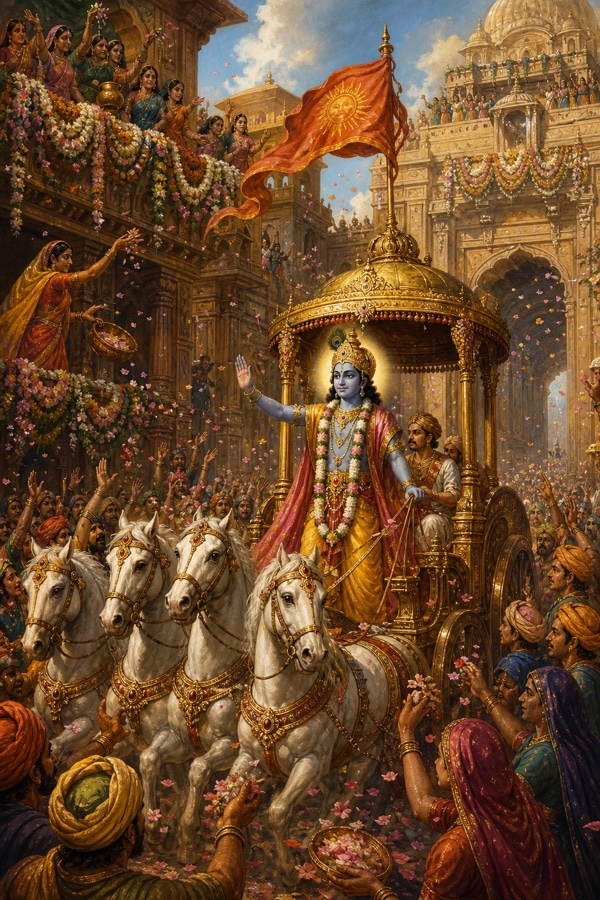
That was one register. The other belonged only to the road under Krishna’s wheels. Wherever the Vrishni hero passed, soft breezes blew and everything turned auspicious. Lotuses fell from the air, and fragrant blossoms with them. The road itself became pleasant, clear of thorns and clear of the prickly grass that cuts a traveler’s feet. At every place where he halted, Brahmins by the thousand praised him as a giver of wealth and honored him with dishes of curd, of ghee, of honey, and with gifts of their own. Women came out of their houses onto the road and scattered wild flowers, heavy with scent, over the body of the hero who wished well to every living thing. He passed through many cities and many kingdoms. He saw village after village humming with bees, lovely to the eye and easy on the heart. And so he came to a place called Shalibhavana, sacred and delightful, thick with every kind of standing crop. The people of Upaplavya, cheerful and open-hearted, well guarded by the Bharatas and so untroubled by any fear of raiders, strangers to calamity of any kind, had come out of their town in numbers and stood together along the way, because they wanted to see Krishna. When they saw him arrive among them like a blazing fire, they honored him with everything a household offers a guest at its door, and he was owed all of it.
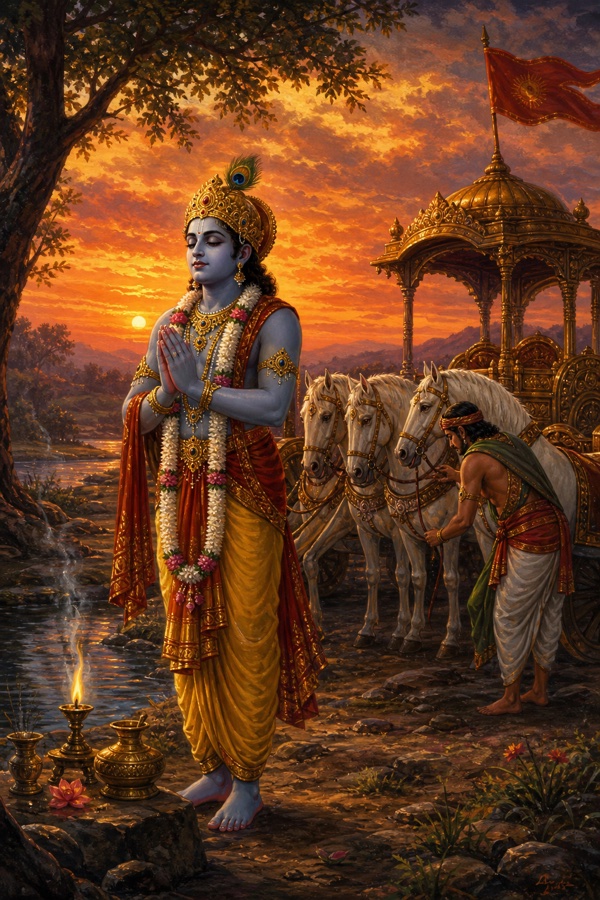
The sun was reddening the sky with its last scattered rays when Keshava, slayer of enemy heroes, reached Vrikasthala. He stepped down from the chariot, performed the purifications the hour requires, gave the order for the horses to be unyoked, and sat down to his evening prayers. Daruka meanwhile freed the team, tended each animal according to the rules of the science of horses, took off the yokes and the traces, and let them loose to graze. When that was done the slayer of Madhu said, for Yudhishthira’s sake the night would be passed here. The attendants, understanding his intention, had a temporary lodging standing in moments and excellent food and drink ready in the time it takes to say so. Now the Brahmins who lived in that village, those of high and honorable birth, modest men whose conduct followed the Vedas, came to Hrishikesha, the chastiser of foes, and honored him with blessings and words of good omen. Having paid that honor to the Dasharha whom everyone alive is bound to honor, they placed their houses at his disposal, houses full of wealth. Enough, said the glorious Krishna, and it was said kindly. He paid each of them the respect that was due to his standing, walked with them to their homes, and came back in their company to his own tent. There he fed all the Brahmins on sweetmeats, took his own meal among them, and passed the night at Vrikasthala in contentment.
A key to reading this (two sets of omens): The signs at Krishna’s departure come in two columns and the narrator leaves them side by side without comment. Everything the whole country saw was inverted and frightening, thunder with no cloud, rivers running backward, the ground shaking, and a storm that went straight for Hastinapura and struck it. Everything that happened only along Krishna’s own road was gentle, soft wind, falling flowers, a path with no thorns. The listener is left to work out for himself which city ruin is traveling toward and which chariot good fortune is riding with.
The gist: Krishna leaves Upaplavya with ten great chariot warriors, a thousand foot soldiers, a thousand horsemen, and hundreds of servants carrying provisions. Across the land the omens turn inside out and a storm out of the southwest wrecks Hastinapura, while on Krishna’s own road flowers fall, the way clears of thorns, and Brahmins and women come out to honor him. By way of Shalibhavana and the welcoming crowds of Upaplavya he reaches Vrikasthala at sunset, says his evening prayers while Daruka tends the horses, declines the villagers’ offer of their houses, and spends the night there after feeding the local Brahmins and eating with them.
Preparations at Hastinapura: jeweled pavilions along the road, and the gift list Dhritarashtra recites to Vidura, from sixteen golden chariots to Duhshasana’s palace
The spies reached Hastinapura ahead of the chariot, as spies do, and what they reported made the hair stand up on the old king’s arms. Dhritarashtra called for Bhishma and Drona, for Sanjaya, for the illustrious Vidura, and with those four in the room he turned to Duryodhana and his counselors and spoke to them with a courtesy that had fear underneath it. Strange and wonderful is the news we are hearing, he said. Men, women, and children are talking of it. Some speak of it with reverence, others gather in knots to discuss it. In the houses where people congregate and in the open squares, everyone says the same thing, that the Dasharha of great prowess is coming here for the sake of the Pandavas. Then the king said what he believed, or what he wanted the room to hear him believe. The slayer of Madhu deserves honor and worship at our hands by every measure. He is the lord of all creatures, and on him rests the course of everything in the universe. Intelligence, prowess, wisdom, energy, all of it dwells in Madhava. He is the foremost of men, honored by every righteous person, and he is eternal virtue itself. Worshipped, he gives happiness. Neglected, he gives misery. If the Dasharha, that chastiser of enemies, is pleased with what we offer him, then through his grace we may get everything we want in the council of kings. Waste no time, he told his son. Make every arrangement for his reception. Have pavilions raised along his road and furnish them with every object of enjoyment. Mighty-armed son of Gandhari, arrange it so that he is pleased with you. Then, turning his blind face toward the eldest man in the room, he asked what Bhishma thought. Bhishma and the others approved the king’s words with a single syllable. Excellent, they said.
Duryodhana understood what they wanted and gave the orders. Pleasant sites were chosen and pavilions went up at proper intervals along the way, in lovely places, and every one of them was stocked with gems of every kind. The king sent to them handsome seats of the finest quality, beautiful girls, scents and ornaments, fine robes, excellent food, drink of many sorts, and fragrant garlands of many kinds. At Vrikasthala itself the Kuru king took special care and raised for Krishna’s reception a pavilion of extraordinary beauty, full of precious stones. When all these arrangements were complete, arrangements fit for gods and far beyond what human beings ordinarily attempt, Duryodhana reported to Dhritarashtra that it was done. And Keshava of Dasharha’s race came on to the Kuru capital without letting his eyes rest for one moment on any of those pavilions or any of those heaps of jewels.
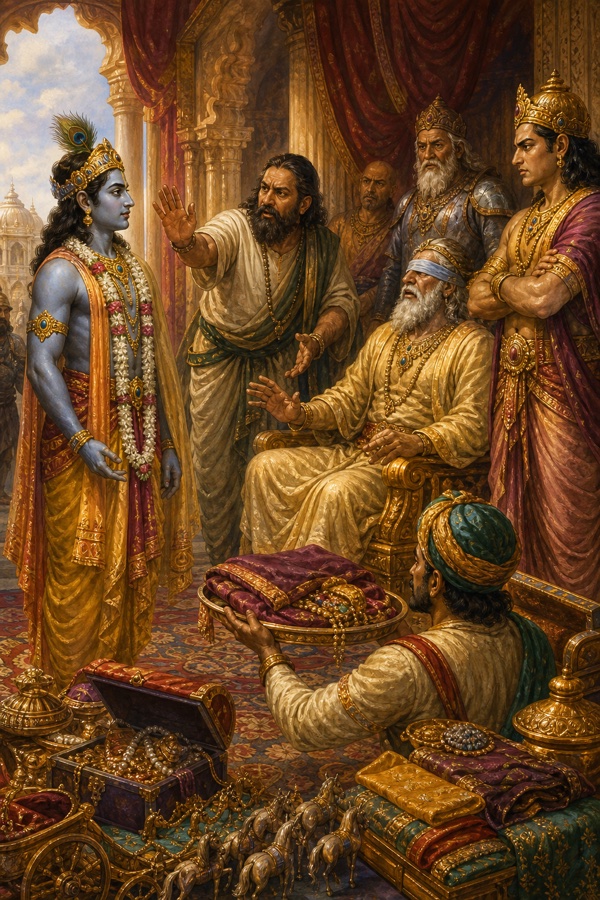
Meanwhile Dhritarashtra had sent for Vidura alone. Janardana has left Upaplavya, he told him. He is halted now at Vrikasthala and he will be here tomorrow. Then the king spoke of Krishna as a man speaks of someone whose measure he has taken and found frightening. Janardana leads the Ahukas and stands first among all the Sattvatas. He is high-souled, full of energy, full of might. Madhava guards and sustains the prosperous kingdom of the Vrishnis, and he is the illustrious great-grandsire of the three worlds. The Vrishnis revere his wisdom the way the Adityas, the Vasus, and the Rudras revere the wisdom of Brihaspati. In your presence, virtuous one, I will offer worship to that glorious scion of Dasharha, and I want you to hear what that worship will be. What followed was an inventory, and the king recited it item by item. Sixteen chariots made of gold, each drawn by four excellent, well-adorned horses of the Bahlika breed, all of one color. Eight elephants with temple juice always running down their cheeks and tusks as long as the poles of plows, animals fit to break an enemy’s ranks, each with eight human attendants. A hundred handsome maidservants with complexions like gold, every one a virgin, and as many menservants. Eighteen thousand woolen blankets, soft to the touch, the gift the hill people had once brought to the Kurus. A thousand deerskins carried from China, and other things of the same kind, whatever might be worthy of Keshava. This serene gem of the purest rays, the king went on, which shines by day and by night, I will give him too, for Keshava alone deserves it. And this chariot of mine, drawn by mules, which covers a full fourteen yojanas in a day, that also. Every day I will set before him provisions eight times greater than his animals and his attendants can need.
The list did not stop at goods. All my sons and grandsons, the king said, except Duryodhana, will ride out in their chariots, finely dressed, to receive him. Thousands of graceful dancing girls, richly ornamented, will walk out on foot to meet the glorious Keshava. And the beautiful girls who go out of the city to welcome Janardana will go out unveiled. Let every citizen with wife and children look on the slayer of Madhu with the same reverence and devotion they bring to the sight of the morning sun. At my command let the canopy on every side be crowded with pendants and banners, and let the road by which Keshava comes be watered and cleared of dust. Let Duhshasana’s residence, which is finer than Duryodhana’s, be cleaned and decorated without delay. That mansion of many beautiful buildings is pleasant and delightful and holds the wealth of every season. It is there that all my wealth is stored, and all of Duryodhana’s. Whatever that scion of the Vrishnis deserves, let it be given to him. The old king stopped, and waited for Vidura to tell him it was well done.
A key to reading this (why the list is so long): Vyasa gives Dhritarashtra’s gifts one at a time, and the counting is the point. This is a kingdom opening its treasury for inspection, and the reader is meant to add it up: sixteen chariots, eight elephants, a hundred women and a hundred men, eighteen thousand blankets, a thousand skins, one gem, one chariot, eightfold provisions, and at the end the palace where the king and the crown prince keep their money. One name is pointedly missing from the welcoming party, since Duryodhana will not ride out. And one idea is said twice, that Madhava is protector of the Vrishnis and great-grandsire of the three worlds. Dhritarashtra knows exactly whom he is trying to buy. The next scene is Vidura’s answer.
The gist: Learning that Krishna has set out, Dhritarashtra, before Bhishma, Drona, Sanjaya, and Vidura, orders Duryodhana to raise pavilions stocked with every pleasure along the road; Duryodhana builds them full of jewels, with the finest at Vrikasthala, and Krishna passes them without a glance. Dhritarashtra then recites to Vidura his whole plan of gifts: sixteen golden chariots with Bahlika horses, eight elephants with eight attendants each, a hundred maidservants and a hundred menservants, eighteen thousand woolen blankets, a thousand Chinese deerskins, a gem that shines day and night, a mule chariot that covers fourteen yojanas a day, eightfold daily provisions, a welcome by every son and grandson except Duryodhana, dancing girls and unveiled maidens, a decorated and watered city, and Duhshasana’s palace, where the royal treasure is kept, as his lodging.
Vidura’s plain answer, Duryodhana’s resolve to take Krishna prisoner, Bhishma leaving the hall in anger, and the morning Krishna rode into Hastinapura
Vidura began the way a careful man begins when he is about to say something unforgivable. The king was honored in three worlds, he said, loved and respected by everyone, so far advanced in years that nothing he said at this age could possibly run against scripture or sound reason, his mind being always calm. His subjects were as sure of the virtue in him as they were of letters cut in stone, of light in the sun, of waves in the sea. Then he asked the king to keep those virtues, to be sincere, and to avoid bringing about, out of folly, the wholesale destruction of his sons, his grandsons, his friends, his kinsmen, and everyone dear to him. Only then did he turn to the list. It is a great deal, he said, that you wish to give Keshava as your guest. Understand that Keshava deserves all of it and far more, that he deserves the whole earth. But I swear by my own soul that you do not want to give any of this to Krishna out of virtue or out of any wish to please him. Giver of great wealth, all of this is nothing but deceit, falsehood, and insincerity. From the outward acts I can read the hidden purpose. The five Pandavas ask for five villages, and you will not give them even that. So you do not want peace. What you want is to make the mighty-armed Vrishni your own with your money, to pry Keshava loose from the Pandavas by that means. I am telling you it cannot be done. Neither wealth nor attention nor worship will separate Krishna from Dhananjaya. I know Krishna’s greatness of heart, I know Arjuna’s unshakable devotion to him, and I know that Dhananjaya is Keshava’s very life and cannot be given up by him. A vessel of water, water for his feet, and the customary questions after everyone’s health: beyond those three things Janardana will accept no hospitality and will not so much as look at anything else. Offer him instead the hospitality that pleases him most, since there is no honor that may not be paid to Janardana. Give Keshava the one thing he is coming to the Kurus hoping for, since he comes wishing both sides well. He wants peace between you and Duryodhana on one side and the Pandavas on the other. Take his counsel, king. You are their father and the Pandavas are your sons. You are old and they are children beside you in years. They are ready to give you a father’s respect. Behave toward them like a father.
Duryodhana had listened, and what he took from it was the opposite of what Vidura intended. Everything Vidura says about Krishna is true, he said. Janardana is devoted to the Pandavas and can never be separated from them. Therefore all this wealth that is proposed for Janardana must never be given to him. Keshava is not unworthy of our worship, but time and place are both against it. If he receives our worship now he will conclude that we are worshiping him out of fear, and it is my fixed conviction that an intelligent Kshatriya does nothing that brings disgrace on himself. I know very well that the large-eyed Krishna deserves the most reverent worship of the three worlds. It is entirely out of place to give him anything now. War has been decided on, and a decision for war is never to be softened by hospitality. The grandsire of the Kurus answered the son of Vichitravirya. Worshipped or not worshiped, Janardana never grows angry. And no one can treat him with contempt, because Keshava is not a man who can be held in contempt. Whatever he has resolved to do, no one alive can frustrate by any means whatever. Do what mighty-armed Krishna tells you, do it without hesitating, and make peace with the Pandavas through Vasudeva. Janardana is righteous, and what he says will be consistent with both virtue and profit. You and all your friends should say to him only what is agreeable to him.
Then Duryodhana told them what he had actually decided. Grandsire, he said, there is no way I can go on living if I must share this swelling prosperity of mine with the Pandavas. Listen, for this is a great resolution I have formed. I will imprison Janardana, who is the refuge of the Pandavas. He comes here tomorrow morning, and once he is confined, the Vrishnis and the Pandavas, indeed the whole earth, will submit to me. What means we should use so that Janardana does not guess our purpose and no danger falls on us, that is for you to tell me. At those words, at the thought of Krishna in chains, Dhritarashtra and every counselor in the room felt the same pain and the same dread. Ruler of men, the king said to his son, never say this again. It is against every ancient custom. Hrishikesha comes here as an envoy. He is our kinsman and he is dear to us. He has done us no wrong. How does he deserve a prison? Bhishma did not argue. He pronounced. Dhritarashtra, this wicked son of yours has reached his hour. Begged by those who wish him well, he chooses evil over good. And you walk behind him, behind this sinful wretch with his sinful companions, who treads a path of thorns and throws away the words of the friends who love him. The moment this vicious son of yours and all his counselors come up against Krishna of the stainless deeds, they will be destroyed. I will not sit and listen to this sinner who has abandoned every virtue. And with that the aged chief of the Bharatas, Bhishma of unbaffled prowess, rose burning with anger and walked out of the hall.
Morning came, and Krishna rose at first light, performed his rites, took leave of the Bharatas at Vrikasthala, and set out for the Kuru city. The people of the village said their farewells to the long-armed hero and went back to their homes. On the road toward Hastinapura all the sons of Dhritarashtra except Duryodhana came out to meet him, dressed in their finest, and Bhishma, Drona, and Kripa came with them, and others besides. Citizens by the thousand came too, in chariots of every kind and many more on foot, wanting only to see Hrishikesha. He met Bhishma of the spotless deeds on the way, and Drona, and the Dhartarashtras, and surrounded by them all he entered the city. The city had been made beautiful for him. The principal streets were dressed with jewels and gems of many kinds. On that day, the storyteller said, not one man, not one woman, not one child stayed indoors, so eager was everyone to look at Vasudeva. They lined the streets as he passed through, bowing their heads to the ground and singing his praises. The tall mansions were so crowded with high-born women that they seemed ready to come down under the living weight. Vasudeva’s horses were the swiftest anywhere, and in that press of humanity they could barely move. So the lotus-eyed grinder of foes came at last to Dhritarashtra’s ash-colored palace, a palace of many buildings, and passed through the first three chambers to where the son of Vichitravirya sat. As the Dasharha approached, the blind king of great fame stood up, and Drona stood with him, and Bhishma, and Kripa, and Somadatta, and king Bahlika, all of them on their feet to honor Janardana. The Vrishni hero went to Dhritarashtra and lost no time in honoring him and Bhishma with the proper words. That done according to custom, the slayer of Madhu greeted the other kings in the order of their years, and then spoke with the illustrious Drona and his son, with Bahlika, with Kripa, with Somadatta. In that chamber stood a broad seat of beautiful workmanship, made of gold and set with jewels. At Dhritarashtra’s request Achyuta took it, and the king’s priests duly offered Janardana a cow, honey and curds, and water. When the rites of hospitality were complete, Govinda stayed a while among the Kurus, laughing and joking with each of them according to how they were related to him. Then, honored by Dhritarashtra and with the king’s leave, he came out, greeted all the Kurus in their assembly as was proper, and went to Vidura’s pleasant house. Vidura met Janardana at his door and honored him with every auspicious and desirable offering, and said only this: what is the use, lotus-eyed one, of my telling you the joy I feel at your coming, when you are the inner soul of every embodied creature? When the welcome was over, Vidura, who knew every principle of right conduct, asked Govinda after the welfare of the Pandavas. And the Dasharha, chief of the Vrishnis, to whom past and future are as plain as the present, knowing that Vidura loved the Pandavas and wished them well, that he was learned, firm in virtue, honest, wise, and free of any anger toward them, began to tell him everything the sons of Pandu had done, in full and in order.
A key to reading this (three kinds of water): The sharpest line in Vidura’s speech shrinks the whole gift list to three things, a vessel of water, water for the feet, and the questions one asks after a guest’s health. Janardana will take nothing more. That is why, one scene later, the hospitality that is actually accepted in the palace is a cow, honey, curds, and water, and the sixteen chariots and eight elephants are nowhere to be seen. Notice too that the idea of imprisoning Krishna is spoken aloud here for the first time, by Duryodhana, the night before Krishna arrives. It will come back in the assembly in another form.
The gist: Vidura tells Dhritarashtra to his face that the gift list is deceit, since a king who will not part with five villages is only trying to buy Krishna away from Arjuna, which cannot be done; Krishna will accept nothing beyond water, water for his feet, and a courteous inquiry, and should be given the one thing he is coming for, peace. Duryodhana agrees that the gifts are pointless, but because war is already decided, and then announces that he will imprison Krishna the next morning. Dhritarashtra forbids it in horror and Bhishma, calling the prince a doomed wretch, storms out of the hall. At dawn Krishna leaves Vrikasthala and enters a decorated Hastinapura through crowds that fill every street, welcomed by every Kaurava except Duryodhana; in the palace Dhritarashtra, Bhishma, Drona, Kripa, Somadatta, and Bahlika rise for him, he accepts the customary cow, honey, curds, and water on a golden seat, jests with the Kurus, and then goes to Vidura’s house, where he gives a full account of the Pandavas.
Afternoon at Kunti’s house: fourteen years of held-back weeping break at the embrace, and a mother asks after each son by name
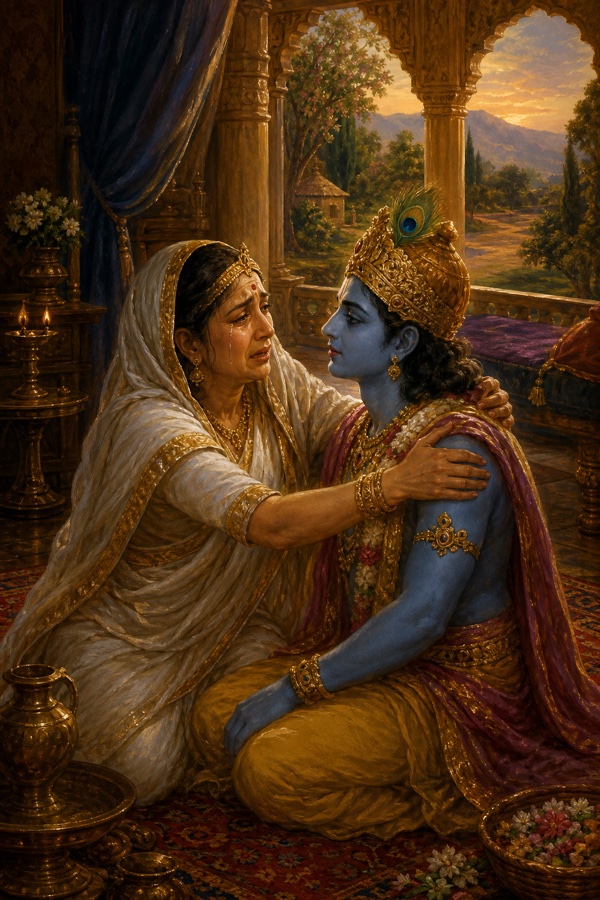
The meeting with Vidura was over. It was the third quarter of the day when Janardana crossed the city again and came to the house of his father’s sister, Pritha. She saw him from the doorway. His face had the light of the risen sun on it, and the moment she saw it she threw both arms around his neck and the weeping she had been holding for fourteen years came out of her all at once, because the man she was holding had been the companion of her sons. Govinda of the Vrishnis, arrived after so long, was the nearest thing to them she had touched in all that time, and her tears would not stop. The rites of welcome were performed. Krishna, foremost of warriors, took his seat. Then Pritha, her face fallen with grief and her voice choked, began to speak, and what came was a mother’s inventory of everything that had been taken.
“Keshava, from their earliest years they waited on their elders. They are so bound to one another in affection that one’s pain is the others’. They were cheated of their kingdom and went into hiding, when they deserved to live among friends and attendants. They have mastered both anger and joy, they are devoted to the Brahmins, they speak only the truth, and those sons of mine gave up kingdom and every enjoyment, left this miserable woman behind, and went into the forest, pulling up the very roots of my heart as they went. Pandu’s glorious sons, Keshava, who never deserved a day of this, how did they live in the deep forest with its lions and tigers and elephants? Their father was taken from them in infancy and I raised them with all the tenderness I had. How did they live in that great wilderness with neither parent in sight? From infancy, Keshava, the Pandavas were woken by conchs and drums and flutes. At home they slept in high palace chambers on soft blankets and the skins of the ranku deer, and morning came to them as the grunt of elephants, the neighing of horses, the clatter of chariot wheels, conchs and cymbals with flutes and lyres running under them. Brahmins greeted them at dawn with sacred hymns, and they in turn honored the men who deserved it with robes and jewels and ornaments, and received the blessings of those radiant twice-born as their reward. That those same sons, Janardana, could sleep in a forest ringing with the shrill, tuneless cries of beasts of prey is more than I can make myself believe. They who were woken by cymbals and drums and conchs and flutes, by the honeyed songs of women singers and the praise of bards and reciters, Madhusudana, how were they woken in the deep woods by the howling of wild animals?”
Then she began to go through them one at a time, the way a woman asks a traveler from her old country about every house on her street. “He who is modest, firm in truth, with his senses under his hand and compassion for every creature; who has conquered lust and malice and always walks the path of the righteous; who carried the heavy burden that Ambarisha and Mandhatri once carried, and Yayati and Nahusha, Bharata and Dilipa and Shibi the son of Ushinara and the other royal sages of old; who is excellent in character and disposition, learned in virtue, whose prowess no one has ever turned aside; who is fit to rule the three worlds by his accomplishments alone; who is foremost of all the Kurus by law and by learning and by nature; who is handsome and mighty-armed and has no enemy anywhere: Keshava, how is that Yudhishthira of virtuous soul, whose complexion is like pure gold? And he who has the strength of ten thousand elephants and the speed of the wind; who is the mightiest and the most easily angered of Pandu’s sons; who always does good to his brothers and is loved by them all for it; who killed Kichaka with every one of his kinsmen, who is the slayer of the Krodhavashas, of Hidimba, of Baka; who is Indra’s equal in prowess and the Wind’s in might; who is terrible, and in his anger like Madhava himself; who is the first of all who strike, and who nonetheless reins in his rage, his strength and his impatience to obey his elder brother: tell me, Janardana, how is that Bhimasena of immeasurable valor, whose very look justifies his name, that Vrikodara with arms like maces, Pandu’s mighty second son? And Krishna, that two-armed Arjuna who counts himself greater than his thousand-armed namesake of old, who looses five hundred arrows at one stretch; who is Kartavirya’s equal in weapons, the Sun’s in energy, a great sage’s in restraint of the senses, the Earth’s in forgiveness and Indra’s in prowess; through whose valor the Kurus won this vast, blazing empire among all the kings of the earth; whose strength of arm the Pandavas revere; who is first of all chariot warriors and whose prowess cannot be baffled; from whom no enemy in battle has ever gone home alive; Achyuta, who conquers all and is conquered by none, who is the refuge of the Pandavas as Vasava is of the gods: Keshava, how is that Dhananjaya now, your brother and your friend?”
“And he who is compassionate to all creatures, modest, learned in great weapons, soft and delicate and virtuous, and dear to me; that great bowman Sahadeva, that hero, that ornament of assemblies, young in years and given over to the service of his brothers, who understands both virtue and profit, whose brothers always praise the disposition of that high-souled and well-behaved son of mine: tell me, son of the Vrishnis, of that heroic Sahadeva, Madri’s son, who waits so humbly on his elder brothers and shows me such reverence. And he who is delicate and young, brave and handsome; Pandu’s son who is dear to his brothers and to everyone, who is their very life walking about in a separate body; who knows the many modes of war, who has great strength and is a great bowman: tell me, Krishna, whether my dear child Nakula, who was raised in every luxury, is well in body and in mind. Mighty-armed one, will I ever again see my Nakula, that great chariot warrior, that tender boy brought up in comfort who deserved none of this sorrow? Look at me, hero. I am alive today. I, who could not know a moment’s peace if Nakula was out of my sight for the space of one blink.”
“And dearer to me than all my sons, Janardana, is Drupada’s daughter. High-born, of great beauty, accomplished in everything, truthful in speech, she chose the company of her husbands over the company of her own sons. She left her dear children behind and followed the sons of Pandu. She who was once waited on by a whole train of servants, whom her husbands honored with every object of enjoyment, who bears every auspicious mark and every accomplishment, Achyuta, how is that Draupadi now? Five heroic husbands, every one a smiter of enemies, every one a great bowman, every one like Agni in energy, and still sorrow was the portion of Drupada’s daughter. For fourteen long years, chastiser of enemies, I have not seen the princess of Panchala, my daughter-in-law, who has herself lived in constant anxiety for children she has not seen in all that time. When a woman of Draupadi’s nature cannot keep her happiness unbroken, Govinda, it seems to me that happiness is never the fruit of what a person does. When I remember Draupadi dragged by force into the assembly, then neither Bibhatsu nor Yudhishthira, neither Bhima nor Nakula nor Sahadeva is dear to me any longer. No heavier grief ever pierced my heart than the one that came when that wretch Duhshasana, moved by anger and greed, dragged Draupadi, in her season and therefore clad in a single garment, before her father-in-law in the assembly and exposed her to the gaze of all the Kurus. It is known that among those present, king Bahlika, Kripa and Somadatta were pierced with grief at the sight. But of everyone in that assembly, Vidura is the one I worship. Neither learning nor wealth makes a man worthy of homage. By disposition alone that a man earns respect, Krishna, and the character of the illustrious Vidura, of great intelligence and deep wisdom, adorns the whole world like an ornament he wears.”
A key to reading this (the order of the visits, and the count of years): In this book Krishna reaches Hastinapura and goes first to Dhritarashtra’s court, then to Vidura’s house, and only then to Kunti; Duryodhana’s palace comes after her. Ganguli’s text has Kunti count fourteen years here, though the term of exile and concealment was thirteen. The count is the source’s and has been left as it stands.
The gist: After Vidura, Krishna goes in the afternoon to Kunti, and at the embrace fourteen years of held-back grief break out of her. She asks how sons woken by conchs and flutes could have slept in a forest of tigers, and then asks after each one by name: righteous Yudhishthira, Bhima with the strength of ten thousand elephants, Arjuna the equal of Kartavirya, Sahadeva the ornament of assemblies, and Nakula, whom she could not bear to lose sight of for a single blink. Last and above them all, Draupadi, dragged into the assembly in one garment; remembering that day she finds even her sons no longer dear to her, and of that whole assembly she worships only Vidura.
“I blame my father alone”: Kunti’s hard message to her sons, the voice in the birth chamber on the night Arjuna was born, and Krishna’s answer that the wise live at the extremes
Pritha was full of two things at once, joy that Govinda had come and grief for the sons he had come from, and she let all of it out in order. “Chastiser of enemies, can gambling and the hunting of deer, the pastimes of every wicked king of old, ever have been a pleasant occupation for the Pandavas? The thought consumes me, Keshava, that Dhritarashtra’s sons dragged Krishnaa before all the Kurus in their assembly and heaped on her insults worse than death. My sons driven from their capital, their wandering in the wilderness, these and so many other griefs, Janardana, have been mine. And nothing could have been more painful to me, or to them, Madhava, than that they had to pass a period of concealment shut up in a stranger’s house. Full fourteen years have passed since the day Duryodhana first drove my sons out. If misery burns away the fruit of sin, and happiness depends on the fruit of merit, then it seems that after so much misery some happiness may still be ours. I never made any distinction between Dhritarashtra’s sons and my own, so far as a mother’s affection goes. By that truth, Krishna, I will surely see you and the Pandavas come safely out of this struggle, with their enemies slain and their kingdom recovered. The Pandavas have kept their vow so truthfully, holding to Dharma so hard, that their enemies cannot defeat them.”
“But for the sorrows I carry now I blame neither myself nor Suyodhana. I blame my father alone. Like a rich man giving away a sum of money as a gift, my father gave me away to Kuntibhoja. I was a child with a ball in my hands, Keshava, when your grandfather gave me to his friend, the illustrious Kuntibhoja. Abandoned by my own father, chastiser of enemies, then by my father-in-law, and afflicted with griefs past bearing, what use is there, Madhava, in my staying alive? On the night Savyasachin was born, in the lying-in room, a voice with no body behind it said to me, ‘This son of yours will conquer the whole world, and his fame will reach the heavens. He will slay the Kurus in a great battle, recover the kingdom, and your Dhananjaya with his brothers will perform three great sacrifices.’ I do not doubt the truth of that announcement. I bow to Dharma, which holds up the creation. If Dharma is no myth, then, Krishna, you will surely bring about everything that voice foretold. Neither the loss of my husband, Madhava, nor the loss of wealth, nor this enmity with the Kurus ever tore at me the way this separation from my children has torn. What peace can my heart know when I cannot see before me the wielder of Gandiva, Dhananjaya, foremost of all who bear arms? For fourteen years, Govinda, I have not seen Yudhishthira, or Dhananjaya, or Vrikodara. When a man is missing for a long time, people perform his funeral rites and count him dead. For all practical purposes, Janardana, my children are dead to me and I am dead to them.”
Then her voice changed, and what had been a mother’s lament became the message of a Kshatriya woman to her sons, sentence by sentence, each one aimed. “Say this to the virtuous king Yudhishthira, Madhava: your virtue, my son, is shrinking day by day. Act so that your religious merit does not diminish. Shame on those, Janardana, who live by depending on others. Even death is better than a livelihood earned by meanness. Say also to Dhananjaya, and to Vrikodara who is always ready: the time has come, the time a Kshatriya woman bears a son for. If you let it slip past without achieving anything, then, honored as you are today by the whole world, you will be doing what the world will hold contemptible. And if contempt touches you, I will abandon you forever. When the time comes, even life, dear as it is, must be laid down. Foremost of men, say to Madri’s sons, who are always devoted to Kshatriya custom: strive, beyond life itself, to win the objects of enjoyment that prowess can win, because only what is won by prowess pleases the heart of a man who means to live by Kshatriya custom. And when you reach there, mighty-armed one, say to Arjuna, Pandu’s heroic son, first of all bearers of arms: walk the path that Draupadi points out to you. You know, Keshava, that Bhima and Arjuna, once they are inflamed, are each like the Destroyer of the universe and can slay the very gods. A great insult was offered them when their wife Krishnaa was dragged into the assembly and spoken to in those humiliating terms by Duhshasana and Karna. Duryodhana himself insulted Bhima of mighty energy in the very presence of the Kuru chiefs. I am certain he will reap the fruit of that behavior, because Vrikodara, once an enemy has provoked him, knows no peace. Once provoked, Bhima does not forget for a very long time, not until that grinder of enemies has wiped out the enemy and his allies both. The loss of the kingdom did not grieve me. The defeat at dice did not grieve me. That the illustrious and beautiful princess of Panchala was dragged into the assembly in a single garment and made to hear bitter words grieved me most. What greater grief could there be for me, Krishna? Devoted to Kshatriya custom, endowed with such beauty, the princess suffered that cruel treatment while she was unwell, and though she had powerful protectors she was as helpless in that hour as if she had none. Slayer of Madhu, with you, and with Rama, foremost of all mighty men, and with that great chariot warrior Pradyumna standing as protectors for me and my children, and with my sons the invincible Bhima and the unretreating Vijaya both alive, that I still had such grief to bear is strange indeed!”
Shauri, the friend of Partha, then set about comforting his father’s sister in her grief for her sons, and Vasudeva said, “Aunt, what woman is there in the world like you? You are the daughter of king Shurasena, and by marriage you came into the line of Ajamidha. High-born and highly married, you are like a lotus lifted out of one great lake and planted in another. Endowed with every prosperity and great good fortune, you were adored by your husband. The wife of a hero, you gave birth in turn to heroic sons. Possessed of every virtue and of great wisdom, it falls to you to bear both happiness and misery with patience. Your children have overcome sleep and languor, anger and joy, hunger and thirst, cold and heat, and they live always in the happiness that belongs to heroes. Endowed with great exertion and great might, your sons do not go after the comforts of the senses that satisfy only the low and the mean; they pursue the happiness heroes should pursue. Nor are they satisfied the way small men with small desires are satisfied. The wise enjoy or suffer whatever is enjoyable or sufferable in its full measure. Ordinary people, given over to the comforts that satisfy the low, want an even dullness with no excitement of any kind. Those who are superior want either the sharpest suffering a human being can know or the highest enjoyment given to a man. The wise always delight in extremes. They find no pleasure in the middle; they count the extreme as happiness and everything between as misery. The Pandavas and Krishnaa salute you through me. They report themselves well and ask after your welfare. You will soon see them lords of the whole world, their enemy slain and prosperity restored to them.”
Consoled by Krishna, Kunti, grieving for her sons but quickly shaking off the darkness that had clouded her judgment for a moment, answered Janardana: “Mighty-armed one, slayer of Madhu, whatever you judge proper to be done, chastiser of enemies, let it be done without sacrificing righteousness and without the least guile. I know, Krishna, what the power of your truth and of your lineage is. I know also what judgment and what prowess you bring to bear on whatever concerns your friends. In our line you are Virtue itself, you are Truth, and you are the embodiment of ascetic austerity. You are the great Brahman, and everything rests on you. What you have said, therefore, must be true.” Govinda took his leave, walked around her with reverence, and set out for Duryodhana’s mansion.
A key to reading this (two names, and who is meant): The Rama whom Kunti counts among her protectors is Balarama, Krishna’s elder brother, and Pradyumna is Krishna’s son; Rama the son of Dasharatha has no place here. “Your grandfather” is Kunti’s own father Shurasena, Krishna’s grandfather, who gave this daughter to his friend Kuntibhoja to raise; that adoption is how Pritha came to be called Kunti.
The gist: Kunti lays the root of her sorrows neither in herself nor in Duryodhana but in the father who gave her away as a child, like money handed over as a gift. She recalls the bodiless voice on the night Arjuna was born, and then the lament turns into orders: to Yudhishthira, that his virtue is shrinking and death beats a dependent’s life; to Bhima and Arjuna, that the hour a Kshatriya woman bears sons for has come, and if they let it pass she will abandon them forever; to Madri’s sons, that only what prowess wins can satisfy a Kshatriya; to Arjuna, to walk whatever path Draupadi points out. Krishna steadies her with the image of a lotus moved from one lake to another and tells her the wise want the extremes, never the dull middle; she answers that whatever he does must be done without abandoning righteousness and without guile, and he leaves for Duryodhana’s palace.
A golden seat in Duryodhana’s palace and a meal refused: “An envoy eats only when his errand is done,” and then the dish that Kunti served at Vidura’s house
With Pritha’s leave, and having walked around her, Govinda, the chastiser of enemies who is also called Shauri, went to Duryodhana’s palace. It was a house built to be looked at: furnished with great wealth, set with beautiful seats, and so splendid that it resembled the abode of Purandara himself. None of the attendants at the gates so much as moved to stop him. That hero of great fame crossed three spacious courtyards one after another and entered a mansion that stood like a mass of piled clouds, as high as a hill’s summit, blazing with its own splendor. Inside he saw Dhritarashtra’s mighty-armed son seated on his throne in the midst of a thousand kings, with all the Kurus around him. And he saw who sat nearest: Duhshasana, Karna, and Shakuni the son of Subala, each on his own seat at Duryodhana’s side. When the scion of Dasharha’s line entered the court, Dhritarashtra’s celebrated son rose from his seat with his counselors to honor the slayer of Madhu. Keshava greeted Dhritarashtra’s sons, all their counselors, and every king present, each according to his age. Then Achyuta of the Vrishnis took a beautiful seat made of gold, spread with a carpet embroidered in gold. The Kuru king offered Janardana a cow, and honey, and curds, and water, and placed at his disposal palaces and mansions and the whole kingdom. The Kauravas and all the assembled kings then worshiped Govinda where he sat, shining like the sun.
When the worship was finished, king Duryodhana invited the Vrishni, foremost of victors, to eat at his house. Keshava did not accept. Then the Kuru king, seated among the Kurus, spoke to Keshava in a gentle voice with deception lurking behind the words, and as he spoke his eyes went to Karna. “Why, Janardana, will you not accept the many kinds of food and drink, the robes and the beds that have all been prepared and kept ready for you? You have given aid to both sides; you work for the good of both parties. You are the foremost of Dhritarashtra’s kin and much loved by him. You know fully, Govinda, and down to the last detail, both religion and profit. I wish to hear, therefore, bearer of the discus and the mace, the true reason for this refusal.”
High-souled Govinda, whose eyes were like lotus petals, raised his mighty right arm, and in a voice as deep as the clouds answered the king in excellent words full of reasons, words that were clear and distinct, correctly pronounced, without a single syllable dropped. “Envoys, king, eat and accept honor only after their missions have succeeded. Therefore, Bharata, when my mission has succeeded you may entertain me and my attendants.” Dhritarashtra’s son pressed him again. “It does not become you, Keshava, to treat us this way. Whether you succeed or fail, slayer of Madhu, we are trying to please you because of your kinship with us. Yet it seems, scion of Dasharha, that all our efforts are wasted. Nor do we see the reason, slayer of Madhu, foremost of men, why you will not accept the worship we offer out of love and friendship. With you, Govinda, we have no quarrel and no war. Think it over, and you will see that words like these hardly become you.”
Janardana of Dasharha’s line let his eyes travel over Dhritarashtra’s son and all his counselors before he answered. “Not from desire, nor from anger, nor from malice, nor for gain, nor for the sake of argument, nor from any temptation would I abandon virtue. A man takes another’s food when he is in distress. At present, king, you have not inspired love in me by any act of yours, and I have not fallen into distress. Without any reason, king, you have hated your dear and gentle brothers, the Pandavas, endowed with every virtue, from the moment they were born. This unreasoning hatred of yours for Pritha’s sons ill becomes you. The sons of Pandu are devoted to virtue. Who could do them the least injury? He who hates them hates me; he who loves them loves me. Know that the virtuous Pandavas and I share one soul. The man who, following the impulses of lust and anger and the darkness of his own soul, hates and seeks to injure someone possessed of every good quality is counted the vilest of men. That wrathful wretch with no control over himself, who out of ignorance and greed hates his own kinsmen endowed with every auspicious quality, can never enjoy his prosperity long. And the man who by good offices wins over people of good qualities, even if he carries an aversion to them in his heart, enjoys prosperity and fame forever. All this food, therefore, is defiled by wickedness and does not deserve to be eaten by me. The food supplied by Vidura alone, I think, is what I should eat.”
Having said this to Duryodhana, who had never in his life been able to bear a word that went against his wishes, mighty-armed Keshava walked out of that blazing palace. The high-souled Vasudeva of mighty arms turned his steps toward the house of the illustrious Vidura, and while he was there Drona came to him, and Kripa, and Bhishma, and Bahlika, and many of the Kauravas, and they said to the heroic slayer of Madhu, “Son of the Vrishnis, we place our houses at your disposal, with all the wealth in them.” The slayer of Madhu, of mighty energy, answered them, “You may go. I am greatly honored by these offers of yours.” When all the Kurus had gone, Vidura, with great care, entertained the unvanquished hero of Dasharha’s line with every object of desire. Then Kunti set before the illustrious Keshava clean and savory food in abundance. With that food the slayer of Madhu first gratified the Brahmins: from it he gave a first portion, along with much wealth, to a number of Brahmins learned in the Vedas, and then, like Vasava among the Maruts, he sat with his attendants and dined on what remained of the clean and savory food that Vidura had provided.
A key to reading this (the rule of the refused meal): Krishna gives two reasons, and both are matters of statecraft rather than pique. The first is the envoy’s rule: an envoy accepts no honor before his errand is done, since hospitality taken binds the tongue of the man who took it. The second is the rule of food: another man’s food is eaten either out of love or in distress, and neither condition holds here. Duryodhana glancing at Karna as he speaks, and Krishna answering without dropping a single syllable, are both details from the source.
The gist: Krishna sits on a golden seat among a thousand kings in Duryodhana’s palace, accepts the worship of cow, honey and curds, and declines the invitation to dine. Duryodhana, eyes on Karna, asks sweetly for the reason. Krishna first says that an envoy eats only when his errand is done, and when pressed says it plainly: another’s food is taken out of love or in distress, and here there is neither; whoever hates the Pandavas hates him, since he and they share one soul; this food is defiled by wickedness, and only Vidura’s is fit for him. He returns to Vidura’s house, thanks Bhishma, Drona, Kripa and Bahlika for the offer of their homes and sends them away, feeds the Brahmins first from the dish Kunti serves, and then eats with his companions.
Vidura’s warning in the night: “Do not spend your breath like a singer before the deaf,” and the kings who have joined Duryodhana out of fear of Krishna
Keshava had dined and rested. Then, in the night, Vidura came to him and said what he had been holding all day. “Keshava, this coming of yours was not well judged. Janardana, Dhritarashtra’s son transgresses the rules of both profit and religion. He is wicked and wrathful, he insults others while hungering for honors himself, and he disobeys the commands of the aged. He is a transgressor of the scriptures, Madhava, ignorant, of wicked soul, already overtaken by fate, impossible to manage, and disposed to do evil to those who seek his good. Desire and lust have possession of his soul. He foolishly counts himself very wise. He is the enemy of every true friend he has. Ever suspicious, with no control over himself, and ungrateful, he has abandoned all virtue and is in love with sin. He is foolish, his understanding is uncultivated, he is a slave of his senses, forever obedient to the impulses of lust and greed, and irresolute in every act that ought to be done. These vices and many more are his. Though you point out to him what is for his good, he will disregard all of it out of pride and anger.”
“He has great faith in Bhishma, and Drona, and Kripa, and Karna, and Drona’s son, and Jayadratha, and so, Janardana, he never sets his heart on peace. Dhritarashtra’s sons and Karna firmly believe that the Pandavas cannot so much as look at Bhishma and Drona and the other heroes, let alone fight them. The foolish Duryodhana, with his short sight, has assembled a huge army and counts his purposes, slayer of Madhu, as already achieved. Dhritarashtra’s foolish son has reached the conclusion that Karna alone is competent to vanquish his enemies. He will never make peace. You, Keshava, wish to establish peace and brotherly feeling between the two parties. But know that all of Dhritarashtra’s sons have decided that they will not give the Pandavas what the Pandavas have a right to. With men so resolved your words will certainly prove vain. Where words good or bad have the same effect, slayer of Madhu, no wise man spends his breath for nothing, like a singer before the deaf. Like a Brahmin before a gathering of Chandalas, Madhava, your words will command no respect among those ignorant and wicked wretches who have no reverence for anything that deserves reverence. Foolish as he is, he will never obey your counsel so long as he has strength. Whatever words you speak to him will be perfectly useless.”
“It does not seem proper to me, Krishna, that you should go into the midst of those wicked-minded wretches seated together. It does not seem proper to me, Krishna, that you should go there and speak against those wicked-souled, foolish, unrighteous men, strong in their numbers. They have never honored the aged, prosperity and pride have blinded them, and in the arrogance of youth and anger they will never accept the good advice you lay before them. He has mustered a strong force, Madhava, and he has his suspicions of you. He will never follow any counsel you offer. Dhritarashtra’s sons, Janardana, hold the firm belief that at present Indra himself, at the head of all the gods, could not defeat them in battle. Effective as your words always are, they will have no effect on men gripped by such a conviction, men who always follow the impulses of lust and anger. Standing among his ranks of elephants, his chariots and his heroic infantry, the foolish and wicked Duryodhana, with every fear dispelled, regards the whole earth as already conquered. In truth, Dhritarashtra’s son covets a vast empire on this earth with no rival in it. Peace with him is therefore unattainable. Whatever he holds in his hand he regards as unalterably his own.”
“Alas, the destruction of the earth seems close at hand for Duryodhana’s sake, because, driven by fate, the kings of the earth with all their Kshatriya warriors have gathered in one place, eager to fight the Pandavas. Every one of those kings, Krishna, is your enemy, and every one of them has been stripped of his possessions by you before this. It is out of fear of you that those heroic monarchs have joined Karna and made alliance with Dhritarashtra’s sons. Reckless of their very lives, all those warriors have united with Duryodhana and are filled with delight at the prospect of fighting the Pandavas. Hero of Dasharha’s line, it does not commend itself to me that you should walk into their midst. How, grinder of enemies, will you go among those numerous enemies of yours, wicked of soul and seated together? Mighty-armed one, you are indeed beyond the power of the gods themselves to vanquish, and I know your manliness and your intelligence, slayer of enemies. Madhava, the love I bear you is equal to the love I bear the sons of Pandu. I say these words to you, therefore, out of affection, regard and friendship. And what need is there to tell you the delight I have felt at the sight of you, for you, lotus-eyed one, are the inner Soul of every embodied creature.”
A key to reading this (Vidura’s two arguments): The warning has two layers. The upper layer is Duryodhana’s character: speaking to a man who will not listen is singing to the deaf. The lower layer is the composition of the court itself: the kings seated there are Krishna’s old defeated enemies, allied to Karna and the Kauravas precisely because they fear him, and for a peace envoy to walk into such a room is to walk into a ring of enemies. Through the whole speech Vidura’s concern for Krishna’s safety runs deeper than his concern for the success of the message.
The gist: After the meal, in the night, Vidura tells Krishna flatly that coming was unwise. He draws Duryodhana as a man who transgresses both profit and religion, proud, ungrateful, a slave of his senses, trusting in Bhishma, Drona, Kripa, Karna, Ashvatthama and Jayadratha, and convinced that Karna alone can win his war. Speaking to such a man is singing to the deaf or reasoning before Chandalas. Worse, the kings assembled there are Krishna’s former victims, joined to Duryodhana out of fear of him; to go among them is dangerous. Vidura says all this from affection, and closes by saying that the joy of seeing the lotus-eyed one, who is the inner soul of every embodied being, needs no telling.
Krishna’s answer to Vidura: “A drowning friend is held back even by the hair,” the merit of a failed attempt, and a herd of deer before a lion
The holy one answered him, and he began by granting Vidura everything. “What a man of great wisdom would say, what a man of great foresight would say, what a man like you would say to a friend like me, what is worthy of you and consistent with virtue and profit and truth: that, Vidura, is what you have said to me, like a father and a mother. What you have told me is certainly true, deserving of approval and consistent with reason. Listen now with attention, Vidura, to the reason for my coming. Knowing well the wickedness of Dhritarashtra’s son and the hostility of the Kshatriyas who have taken his side, I have still come to the Kurus. Great will be the merit earned by the man who frees this whole earth, with her elephants and chariots and horses, from the meshes of death when so dreadful a calamity has overwhelmed her. If a man striving to the best of his ability to perform a virtuous act meets with failure, I have not the least doubt that the merit of the act is his despite the failure. Those learned in religion and scripture know this as well: that if a person intends a sinful act in his mind and does not actually commit it, the demerit of that act can never be his.”
“I will sincerely try, Vidura, to bring about peace between the Kurus and the Srinjayas, who are about to be slaughtered in battle. The terrible calamity hanging over them all has its origin in the conduct of the Kurus, because it comes directly from the actions of Duryodhana and Karna; the other Kshatriyas are only following the lead of those two. The learned count that man a wretch who does not plead with a friend who is about to sink into calamity, to save him. Striving with all his might, even to the extent of seizing him by the hair, a man should try to hold a friend back from an improper act. The one who does that reaps praise, never blame. It behooves Dhritarashtra’s son, therefore, Vidura, together with his counselors, to accept my good and beneficial counsel, which is consistent with virtue and profit and is competent to dispel the present calamity. I will sincerely try to bring about the good of Dhritarashtra’s sons, and of the Pandavas, and of every Kshatriya on the face of the earth. If Duryodhana judges me wrongly while I am working for the good of my friends, I will still have the satisfaction of my own conscience, and a true friend is the one who takes up the office of intercessor when dissension breaks out among kinsmen.”
“I have come for another reason too: so that unrighteous, foolish and hostile men may not say afterward that Krishna, though competent, made no attempt to restrain the angry Kurus and Pandavas from slaughtering one another. In truth, it is to serve both parties that I have come here. Having striven for peace, I will escape the censure of all the kings. If, after listening to my auspicious words, full of virtue and profit, the foolish Duryodhana does not accept them, he will only be inviting his own fate. If, without sacrificing the interests of the Pandavas, I can bring about peace among the Kurus, my conduct will be counted highly meritorious, high-souled one, and the Kauravas themselves will be freed from the meshes of death. If Dhritarashtra’s sons reflect coolly on the words I am going to speak, words full of wisdom, consistent with righteousness and weighty in meaning, then the peace I am aiming at will come about and the Kauravas will honor me as its maker. And if instead they try to injure me, I tell you this: all the kings of the earth united together are no match for me, like a herd of deer unable to stand before an enraged lion.” Having spoken, that bull of the Vrishni line, the delight of the Yadavas, lay down on his soft bed and slept.
A key to reading this (Krishna’s five reasons): Krishna does not call Vidura wrong. He says the answer lies in his reasons for coming, and there are five. First, the merit of a righteous act belongs to the effort, whatever its result. Second, holding a drowning friend back, even by the hair, is a friend’s duty. Third, he has come for both sides, never for one. Fourth, once the attempt is made, no one can say afterward that a capable Krishna stayed silent. Fifth, the answer to Vidura’s deepest worry, his safety: a herd of deer before a lion. The rest of this chapter reads differently once these five are in view, because in the assembly Krishna proceeds in exactly this order.
The gist: Krishna accepts Vidura’s words as the counsel of a father and mother, and then explains why he came with his eyes open: the attempt to free the earth from the meshes of death earns merit even if it fails, just as a sin only intended and never done is no sin; the root of the calamity is Duryodhana and Karna, with everyone else following; a drowning friend is held back even by the hair; he has come for both parties, so that no one can later say a capable Krishna did nothing; if Duryodhana refuses he invites his fate, and if he accepts the Kauravas are saved and will honor Krishna for it. And if they try to harm him, all the kings of the earth together are a herd of deer before a lion. Having said this, he sleeps.
The morning Hastinapura climbed onto its rooftops: the Kaustubha gem, the ride to the court, and seats for the sages standing in the sky
The night went on longer than either of them meant it to. Vidura had been listening to Krishna talk about duty, about advantage, about desire, in sentences whose every word and every syllable seemed chosen for the ear, and he found that he could not be filled. Krishna, whose strength no one had ever measured, was listening in his turn to speech of the same height coming back at him from Vidura. So the star-lit night passed, against the wishes of the illustrious Vidura, and it was still passing when the first gray came into the courtyard. Then the singers arrived, bards with sweet voices carrying conchs and cymbals, and they woke Keshava with music. The Dasharha rose, the bull of the Satvatas, and did what the morning asks of a man of his kind. He bathed. He recited the mantras. He poured the clarified butter into the sacrificial fire and watched it take. Then Madhava dressed himself, put on his ornaments, and turned to worship the sun as it came up over the city.
He was still at his devotions when two men were shown in to him, Duryodhana and Shakuni, son of Subala. Their message was polished. “Dhritarashtra is seated in his court, Govinda,” they said, “with all the Kurus around him under Bhishma, and every king on earth has come. They are all asking for you, the way the gods in heaven ask for Shakra himself.” Govinda greeted them both with kind and courteous inquiries after their welfare, and let them wait. When the sun had climbed a little higher, the chastiser of foes called in a company of Brahmins and gave them gold, and robes, and cattle, and horses, and only when that giving was done did he sit down. His charioteer, Daruka, came and bowed to him, and a short while later Daruka was back with the great chariot, blazing in the morning, hung with rows of small bells that rang as it moved, harnessed to horses of the finest kind. Its wheels made a sound like the deep rolling of massed clouds. Janardana, the joy of the Yadavas, walked once around the sacred fire and once around the assembled Brahmins, fastened the gem called Kaustubha at his throat, and stood there for a moment shining with his own beauty. Then, with the Kurus around him and the Vrishnis guarding him, he mounted.
Vidura followed on his own chariot, that master of every precept of the law, riding behind the foremost of living beings and the first of all who possess intelligence. Duryodhana and Shakuni came next, the two of them sharing one chariot. Satyaki and Kritavarma and the other great chariot warriors of the Vrishni house rode behind Krishna on chariots, on horses, and on elephants, and as the column moved off the gold on those chariots caught the light and threw it back, and every one of them rumbled like a storm coming in. Keshava came soon onto a broad avenue that had been swept and watered before dawn, a road kept for the greatest of kings. The moment the Dasharha’s wheels touched it the cymbals began, the conchs were blown, and every other instrument in the city poured its music into the air. Young heroes with the bearing of lions closed in around Shauri’s chariot, the finest in the world at the work of war. Ahead of Keshava marched soldiers by the thousand in dress of many colors, carrying swords, lances, and axes. Behind him came five hundred elephants and chariots numbered in thousands. And the people of the capital, men and women, old and young, all of them, came out into the streets to see Janardana. The terraces and the balconies were so packed with women that the houses seemed about to give way under the weight. Honored by the Kurus on every side, hearing sweet things called to him from every direction, returning each greeting in the measure it deserved, Keshava went down that road with his eyes moving over all of them.
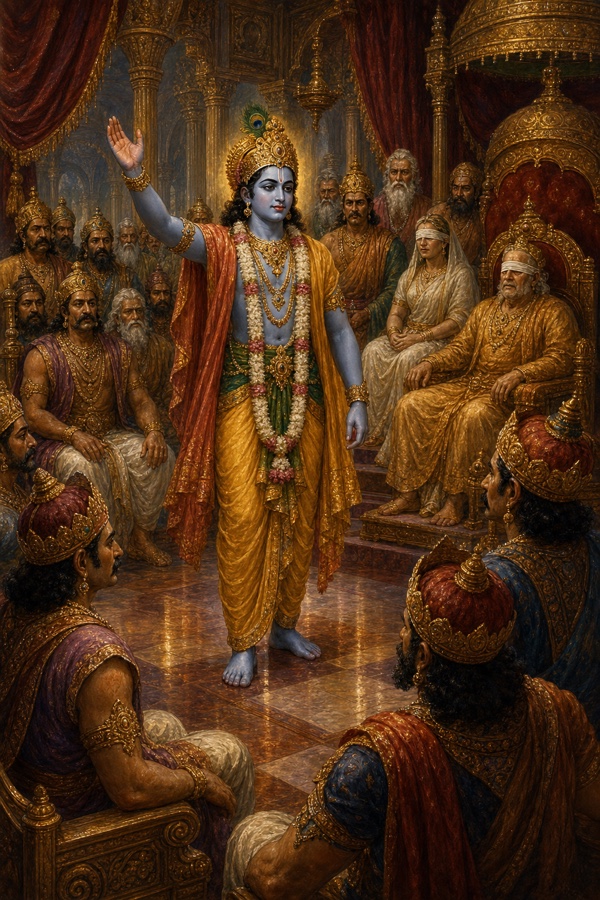
When he reached the Kuru court his attendants blew their conchs and trumpets together, and the sky filled with the blare. Inside, the whole assembly of kings, men of immeasurable strength, shivered with pleasure at the thought that they were about to set eyes on Krishna. They had heard the rumble of his chariot, that sound like rain-heavy clouds, and understood he was near, and the hair rose on their arms. At the gate Shauri, bull of the Satvatas, stepped down from a chariot that stood like the summit of Kailasa, and walked into a hall that looked like a bank of newly risen cloud, that blazed with beauty, that might have been the mansion of great Indra himself. He came in with Vidura on one arm and Satyaki on the other, and his own radiance put the radiance of all the Kurus into shadow, the way the sun puts out the lesser lights of the sky. Seated in front of Vasudeva were Karna and Duryodhana. Behind him sat the Vrishnis with Kritavarma. Bhishma and Drona and the others around Dhritarashtra were already half out of their seats to honor Janardana, and the instant the Dasharha appeared the illustrious blind king rose, and Drona rose, and Bhishma rose. When that mighty ruler of men stood, the thousands of kings around him stood too. At Dhritarashtra’s order a seat had been set out for Krishna, beautiful in every part and worked all over with gold. Madhava took it, and smiling, greeted the king, then Bhishma, then Drona, then every other ruler in the hall, each in the order of his age. All the kings of the earth and all the Kurus, seeing Keshava arrived among them, paid him the honor that was his due.
Then, seated there, the vanquisher of hostile cities looked up and saw them. The sages he had met on the road to Hastinapura were standing in the sky above the hall, Narada at their head. The Dasharha turned quietly to Bhishma, son of Shantanu. “King,” he said, “the rishis have come to look at this earthly gathering of ours. Invite them in. Offer them seats, and every courtesy that goes with seats. Until they are seated, no one here has the right to sit. Let these sages of governed souls be honored properly, and quickly.” Shantanu’s son looked and saw the rishis at the palace gate, and at once ordered the servants to bring seats for them, and the servants came back with large and beautiful seats embroidered with gold and set with gems. When the rishis had sat and accepted the water of welcome, then Krishna sat, and then all the kings. Duhshasana gave Satyaki a fine seat, and Vivimshati gave Kritavarma one of gold. Not far from Krishna, that illustrious and angry pair, Karna and Duryodhana, settled onto a single seat together. Shakuni, king of Gandhara, sat surrounded by the chiefs of his own country with his son beside him. The high-souled Vidura took a jeweled seat covered with a white deerskin, set so close that it nearly touched Krishna’s own. The kings of that assembly gazed at Janardana for a long time and were not satisfied by gazing, like men drinking amrita who empty cup after cup and are never done. In robes of yellow, with a complexion the color of the flax flower, he sat in the middle of them like a sapphire set in gold. And once Govinda had taken his seat, a perfect silence fell over the hall, because no one present there said a single word.
A key to reading this (the seating plan): Vyasa lists who sits where with unusual care, and the list pays off later. Karna and Duryodhana share one seat directly in front of Krishna; the Vrishnis are behind him; Vidura’s seat almost touches his; Shakuni has his son at his side. This is the hall in which Duryodhana will shortly plan to seize Krishna and in which Satyaki will notice it happening, so the distances matter. The second arrangement is the one in the sky. The rishis stay standing until they are given seats, and Krishna does not sit until they do.
The gist: The night at Vidura’s house is talked away. At dawn Krishna bathes, recites, and feeds the fire; Duryodhana and Shakuni come to summon him to the court; he gives gold, robes, cattle, and horses to Brahmins, puts on the Kaustubha, and rides Daruka’s chariot down a watered avenue with thousands of soldiers ahead of him and five hundred elephants behind, while the rooftops of Hastinapura sag under the crowds. He enters the court between Vidura and Satyaki; Dhritarashtra, Bhishma, Drona, and thousands of kings rise. From his golden seat he sees Narada and the other sages standing in the sky and tells Bhishma that they must be seated first. When they are, everyone sits, and the hall goes so quiet that no one speaks a word.
Krishna’s opening, in a voice like a war drum: “Peace rests on you and on me,” and the roll call of an army that even Indra could not beat
The silence held, and then Krishna broke it. He had fine teeth and a voice as deep as a drum, and though every word of what followed was addressed to Dhritarashtra, he pitched it like thunder rolling in the rainy season, so that the whole hall heard him. “I have come here, Bharata, so that there may be peace between the Kurus and the Pandavas without the slaughter of their heroes,” he said. “Beyond that I have nothing useful to tell you, king, because everything worth learning in this world you already know. This house of yours, by its learning and its conduct, by every accomplishment that adorns it, stands first among all the royal lines. Joy in another’s happiness, grief at another’s misery, the wish to relieve distress, the refusal to do harm, sincerity, forgiveness, truth: these live among the Kurus, Bharata. Because the line is so noble, it would be a pity if any of its members did something unworthy of it, and a greater pity still if the one who did it were you. Chief of the Kurus, if Kurus deal falsely with strangers or with their own, the first man whose duty it is to restrain them is you.”
He gave the king no room to answer. “Know this, son of Kuru’s line. Those wicked sons of yours, with Duryodhana at their head, have thrown away both virtue and profit, they hold morality in contempt, greed has taken their senses, and they are behaving with the worst kind of injustice toward the foremost of their own kinsmen. The terrible danger that hangs over everyone here has its root in the conduct of the Kurus. If you stay indifferent to it, it will end in universal slaughter. But if you are willing, Bharata, you can still put that danger down, because peace, bull of the Bharatas, does not seem to me hard to reach. The making of peace rests on you and on me. Set your sons right, and I will set the Pandavas right. Whatever you command, your sons and their followers ought to obey, and if they live in obedience to you that is the best thing they could possibly do. If you work for peace by restraining your sons, you profit by it, king, and so do the Pandavas. Think it through with care and then act, yourself. Let those sons of Bharata be your allies. With the Pandavas behind you, pursue both religion and profit. Strain every nerve you have and you will still never find allies like these. With Pandu’s illustrious sons protecting you, Indra himself at the head of the gods could not defeat you, and what then could mere earthly kings do against your strength?”
Then he counted them out, name by name, so that every man in the hall could hear his own place in the sum. “Picture it, slayer of foes. Bhishma, and Drona, and Kripa, and Karna, and Vivimshati, and Ashvatthama, Vikarna, Somadatta, Bahlika, the chief of the Sindhus, the ruler of the Kalingas, Sudakshina the king of the Kambojas: and standing with them Yudhishthira, and Bhimasena, and Savyasachin, and the twins, and Satyaki of mighty energy, and that great chariot warrior Yuyutsu. Who, bull of the Bharatas, has a mind so far gone that he would fight that? With both the Kurus and the Pandavas at your back, the sovereignty of the whole world is yours, and no enemy can stand before you. Every ruler of the earth who is your equal or your better will come looking for an alliance with you. Guarded on all sides by sons, grandsons, fathers, brothers, and friends, you will live in complete happiness. Keep these men in front of you, treat them with the kindness you showed them in the old days, and you will enjoy the lordship of the whole earth. With these as your supporters, and the sons of Pandu with them, you will conquer every enemy you have. This is your real advantage. United with your sons, your kinsmen, and your counselors, you will enjoy a world that they have won for you.”
Now the drum dropped lower. “In battle, great king, I can see nothing except wholesale destruction. What merit do you find in the destruction of both sides? If the Pandavas are cut down in battle, or if your own mighty sons fall, tell me, bull of the Bharatas, what happiness will be left for you to enjoy? All of them are brave. All of them are skilled with weapons. All of them want to fight, the Pandavas and your sons alike. Save them from the terrible danger that threatens them. After the battle you will see neither all the Kurus nor all the Pandavas. Chariot warriors will have killed chariot warriors, and you will look at the heroes of both sides shrunk in number and in strength. Every ruler on the earth has gathered here, best of kings. Once their anger is lit they will wipe the population of the earth away. Save the world, king. Do not let the people of the earth be exterminated. If you return to your natural disposition, son of Kuru, the earth can stay as full of life as it is now. Save these monarchs, all of them of pure descent, all of them modest, generous, and devout, all of them bound to one another by blood or by alliance, from the terrible danger that stands over them. Let them put away wrath and enmity, embrace one another in peace, eat and drink together, put on their finest robes and garlands, pay one another their courtesies, and go home. Let the affection you once had for the Pandavas wake again in your breast, and let it carry you all the way to peace. They lost their father as infants and you raised them. Cherish them now as you should, as if they were your own sons. It is your duty to protect them, and never more so than when they are in distress. Bull of the Bharatas, do not lose both your virtue and your profit together.”
A key to reading this (who the speech is for): Krishna makes the whole court listen, but he addresses one man only, Dhritarashtra, and names Duryodhana once, as the leader of the sons. The argument moves in a fixed order: praise of the Kuru house; the point that in a house so high, injustice is the king’s own shame; a proposal in which each side disciplines its own; the roll of the army the two sides would make together; and the arithmetic of war, in which even the winner is left with nothing. The Pandavas’ own message has not been delivered yet. It comes in the next scene.
The gist: Into the silence Krishna speaks to Dhritarashtra in a voice pitched for the whole hall. He has come for peace and nothing else; he reminds the king of the Kuru house’s greatness and tells him that in such a house the first duty of restraining injustice belongs to the king himself. The root of the danger is the greed of his sons, but peace is not hard: restrain your sons and I will restrain the Pandavas. He then counts out, by name, the army that Bhishma, Drona, Karna, Ashvatthama, Jayadratha, and Sudakshina would make together with Yudhishthira, Bhima, Arjuna, the twins, and Satyaki, an army Indra could not beat, and offers Dhritarashtra the whole earth on those terms. Against it he sets the account of war: both sides thinned, the earth’s people wiped out, and no happiness left for the king. He ends by reminding Dhritarashtra that he raised these fatherless boys, and asks him to treat them as sons now and lose neither virtue nor profit.
The Pandavas’ message in Krishna’s mouth: “We kept our word, now keep yours,” the arrow left in the assembly, and a hall that applauded in silence
Krishna did not pause. He changed only what he was doing with his voice. Until now he had been speaking for himself. Now he began to deliver what had traveled with him from Upaplavya, and the court understood from his first words that it was hearing the Pandavas. “Bull of the Bharatas, the Pandavas salute you, and hoping to win your favor they have said this to you: ‘At your command we and our followers have suffered great misery. For twelve years we lived in the forests, and for the thirteenth we lived unrecognized in an empty corner of the world. We did not break our pledge, because we firmly believed that our father would abide by his. That we never broke our word is known to the Brahmins who were with us. As we kept our promise, bull of the Bharata race, so keep yours. We have borne the greatest misery for a long time. Let us now have our share of the kingdom. You understand virtue and profit completely, and it is right that you should rescue us. Knowing that our obedience is owed to you, we have gone through much misery quietly. Behave toward us now as a father would, or a brother. A preceptor should act as a preceptor toward his pupils, and we are willing to act as pupils toward you, our preceptor. Act toward us, then, as a preceptor should. If we go wrong, it is a father’s duty to set us right. So set us on the road, and walk the excellent path of righteousness yourself.’”
He turned, very slightly, from the throne to the benches. “And these sons of yours have also said this, bull of the Bharatas, to the kings assembled in this court: ‘If the members of an assembly understand morality, they should permit nothing improper to happen in front of them. Where, in the presence of the virtuous members of an assembly, unrighteousness tries to overpower righteousness, and untruth to overpower truth, it is those members themselves who are defeated and slain. When righteousness, pierced by unrighteousness, comes to an assembly for protection and the arrow is not drawn out, it is the members who are pierced by that arrow. In such a case righteousness itself kills the members of that assembly, the way a river eats away the roots of the trees along its bank.’ Judge now, bull of the Bharata race. The Pandavas keep their eyes on righteousness, they have weighed everything, and they are holding themselves calm, and what they have said agrees with truth, with virtue, and with justice. Ruler of men, what can you say to them except that you are willing to give them back their kingdom? Let the rulers of the earth who are sitting here say what the answer should be. If it seems to you that what I have said, after reflecting carefully on virtue, is true, then save all these Kshatriyas from the net of death. Make peace, chief of the Bharatas, and do not give way to anger. Give the Pandavas their just share of their father’s kingdom, and then enjoy, with your sons, happiness and luxury, with every wish of yours crowned.”
Then he laid out Yudhishthira’s record in front of the very men who had watched each entry being written. “Know that Yudhishthira always walks the path the righteous walk. You know, king, how Yudhishthira has behaved toward you and your sons. You tried to burn him to death, you drove him out of the habitations of men, and still he came back and once more placed his trust in you. Then you and your sons sent him away to Indraprastha. While he was there he brought every king on earth under his sway, and still he looked up to your face, king, and never sought to slight you. Even after he had behaved like that, Subala’s son, wanting to strip him of his dominions and his wealth and his possessions, applied that very effective instrument, the dice. Brought down to that condition, and watching Krishnaa dragged into the assembly, Yudhishthira of the immeasurable soul still did not swerve from the duties of a Kshatriya. As for me, Bharata, I want your good, and I want theirs. For the sake of virtue, of profit, of happiness, make peace, king, and do not let the population of the earth be slaughtered because evil has been taken for good and good for evil. Restrain your sons, who out of greed have gone too far. As for Pritha’s sons, they are equally ready to wait on you in dutiful service or to fight. Whatever seems to you to be for your own good, chastiser of foes, do that.”
Every ruler of the earth in that hall applauded those words of Keshava, and the applause stayed where it began, inside their chests. In front of Duryodhana, not one of them ventured to say anything at all.
A key to reading this (three addresses): The Pandavas’ message comes in two pieces with two different addressees. The first is for Dhritarashtra, and its whole argument stands on one word, the pledge: twelve years in the forest, one year in hiding, and the trust that a father would keep his word too. The second is for the men on the benches, and it is a warning: an assembly that watches injustice win in front of it and says nothing has the arrow left in its own body. The third address is Krishna’s own, the record of Yudhishthira read out to people who witnessed every line of it. The court’s response does exactly what the warning described. Applause inside, silence outside.
The gist: Krishna now delivers the Pandavas’ message word for word: twelve years in the forest and a thirteenth in hiding without breaking their pledge; now let the father keep his, and give them their share; they will be pupils to him if he will be a preceptor and a father to them. Then the Pandavas’ words to the assembly: where injustice overpowers truth before virtuous members and no one draws the arrow out, the arrow pierces the members themselves, as a river eats the roots of the trees on its bank. Krishna asks the kings to say what the answer should be, and reads Yudhishthira’s record: trust after the house of lac, deference to Dhritarashtra even after conquering the earth from Indraprastha, and no departure from a Kshatriya’s duty even when Krishnaa was dragged into the hall. He closes by asking the king to restrain his sons and says the Pandavas are as ready to serve as to fight. The kings approve in their hearts, and in front of Duryodhana no one speaks.
Rama Jamadagnya tells of Dambhodbhava: the king who asked every morning who could beat him, and a fistful of grass on Gandhamadana
When Keshava finished, the hall stayed silent, and the men in it felt the hair rise along their arms. Every king there was thinking the same thing privately: there was no man alive who would dare to answer that speech. Into that silence came a voice none of them had expected, because it belonged to one of the sages who had come down out of the sky. Rama, the son of Jamadagni, looked at Duryodhana and spoke to him directly. “Listen to me with trust,” he said, “and I will make my meaning plain with an example, and if the example pleases you, act for your own good. Long ago there was a king named Dambhodbhava who was the head of the earth. We have heard that his sovereignty ran over the whole world. This great chariot warrior had a habit. Every morning, when the night had passed and he rose from his bed, he summoned the Brahmins and the Kshatriyas to him and asked them: ‘Is there anyone, be he Shudra, Vaishya, Kshatriya, or Brahmin, who is superior to me in battle, or even my equal?’ And with that question on his lips he wandered the earth, drunk on pride, thinking of nothing else. Certain high-souled Brahmins, men who knew the Vedas and feared nothing on earth, told the monarch, again and again, to curb this boasting about his own prowess. He had been forbidden, and he went on asking the same question of the same Brahmins, day after day.”
“At last some of those great Brahmins, rich in austerity and learned in the proofs of the Vedas, lost their patience. They said to that proud and boastful king, intoxicated by his own prosperity: ‘There are two persons who are the foremost of all men, and who are always victorious in battle. You, king, will be no match for either of them if you seek an encounter with one.’ The king asked, ‘Where can these two heroes be found? In what house were they born? What have they done? Who are they?’ And the Brahmins answered, ‘We have heard that they are two ascetics called Nara and Narayana, and that both have taken birth in the race of men. Go and fight them, king. That illustrious pair, Nara and Narayana, are at this moment practicing the severest penances in some hidden part of the Gandhamadana mountains.’ Hearing this, the king mustered his enormous army, all six kinds of forces, and because he could not bear the reputation of those two he marched to the place where the unconquered ascetics were. He came to the rugged and frightening mountains of Gandhamadana and searched for the rishis, and at last he found them, hidden deep in the woods. He saw two of the finest of men, wasted with hunger and thirst, their veins standing out on their limbs, tormented by cold winds and by the heat of the sun. He went up to them, touched their feet, and asked after their welfare. The two rishis received him as a guest, with fruits and roots, with a seat and water, and then asked what the king’s business was, and said, ‘Let it be done.’ So the king said to them what he was in the habit of saying to everyone. ‘The whole earth has been conquered by the strength of my arms. All my enemies are dead. I have come to this mountain wanting a battle with the two of you. Offer me that as your hospitality. I have cherished this wish for a long time.’ Nara and Narayana answered him: ‘Best of kings, wrath and covetousness have no place in this retreat. How could there be a battle here? There are no weapons here, and nothing of unrighteousness or malice. Seek your battle elsewhere. There are many Kshatriyas on the earth.’”
Rama went on. “Even after that the king kept pressing them to fight. The rishis kept soothing him and let his importunity pass. Dambhodbhava, still wanting his battle, challenged them again, and again, and then Nara, Bharata, bent down and picked up a handful of grass blades. ‘Since you want a battle,’ he said, ‘come, Kshatriya, and fight. Take up all your weapons and array your troops. I will cure you of this appetite for battle for the rest of your days.’ Dambhodbhava said, ‘Ascetic, if you think this weapon of yours fit to be used against us, I will fight you even so, for I came here to fight.’ And with that he and all his troops, meaning to kill the ascetic, covered every side with a shower of arrows. The ascetic, with those blades of grass, turned aside every one of the king’s terrible shafts, shafts that could tear the bodies of hostile warriors open. Then the invincible rishi let loose at the king his own dreadful weapon made of grass, a weapon nothing could counter, and a wonder followed, for that ascetic who could not miss his aim pierced and cut off the eyes and the ears and the noses of the enemy soldiers with grass blades alone, helped by his power of illusion. The king looked up and saw the entire sky gone white with grass, and he fell at the rishi’s feet and cried, ‘Let me be blessed!’ Nara, who was always inclined to protect anyone who sought protection, then said to the monarch: ‘Be obedient to the Brahmins and be virtuous. Never do this again. King, tiger among monarchs, conqueror of hostile towns, a Kshatriya who remembers the duties of his order should never, even in his heart, be what you have been. Never, in your pride, insult anyone on any occasion, whether he is below you or above you. Such conduct would suit you. Acquire wisdom, give up covetousness and pride, govern your soul, restrain your passions, practice forgiveness and humility, become amiable, and go, king, and cherish your subjects. Without first ascertaining the strength and the weakness of men, never insult anyone under any circumstances. Be blessed, take our leave and go from here, and never again behave in this way. At our command, always ask the Brahmins what is for your good.’ The king worshiped the feet of those two illustrious rishis and went back to his city, and from that day he began to practice righteousness.”
“That was a great feat that Nara performed in the old days,” Rama said, and now he was looking at no one but Duryodhana. “And Narayana, by many more qualities still, became greater than Nara. Therefore, king, before weapons like Kakudika, Shuka, Naka, Akshisantarjana, Santana, Nartana, Ghora, and Asyamodaka are placed on the string of that best of bows, Gandiva, go to Dhananjaya and lay your pride aside. Men struck by these weapons give up their lives. And these weapons have other forms, matched to the eight passions: lust, wrath, covetousness, vanity, insolence, pride, malice, and selfishness. Struck by those, men are confounded and rush about deprived of their senses. Under their influence people fall into heavy sleep, caper, vomit, pass urine and excrement, weep, and laugh without stopping. Arjuna is irresistible in battle because his friend is Narayana, the Creator and Lord of all the worlds, who knows the course of everything there is. Who in the three worlds, Bharata, would venture to defeat the ape-bannered Jishnu, who has no equal in battle? The virtues in Partha are countless, and Janardana is greater than he. You yourself know Dhananjaya, Kunti’s son, well enough. Those who were Nara and Narayana in days gone by are Arjuna and Keshava now. Know then, great king, who these brave and foremost of persons are. If you believe this and do not mistrust me, adopt a virtuous resolve and make peace with the sons of Pandu. If you think it is for your good that there should be no division in your family, then make peace, foremost of the Bharatas, and do not set your heart on battle. Foremost of Kuru’s line, the house you belong to is honored on the earth. Let it go on being honored. Be blessed, and think of what will serve your own welfare.”
A key to reading this (who is speaking, and why this story): The speaker is Rama the son of Jamadagni, Parashurama, one of the sages who arrived through the sky. He is the first to open his mouth after Krishna, and unlike Krishna he speaks to Duryodhana and to no one else. The story carries its weight at the end. Dambhodbhava’s fault is a single question asked every morning, and Nara’s answer is grass, with no weapon in it. Then Parashurama lifts the curtain: the same Nara and Narayana are Arjuna and Krishna today. The names of Arjuna’s weapons and the list of the eight passions are given here exactly as Vyasa gives them, in Parashurama’s own mouth, with nothing added.
The gist: After Krishna’s speech nobody in the court speaks. Rama Jamadagnya then tells Duryodhana about Dambhodbhava, a world-conquering king who asked every morning whether anyone was his superior or equal in battle, until exasperated Brahmins named Nara and Narayana, two ascetics at their penances on Gandhamadana. He marched there with his six-limbed army, found the two rishis wasted with hunger and thirst, and demanded a battle as his hospitality; they told him an ashrama has no wrath, no greed, and no weapons, and he refused to leave. Nara picked up a handful of grass, turned aside the king’s arrows with it, and cut off the eyes, ears, and noses of his soldiers, and the king fell at his feet. Nara sent him home with the instruction to give up pride, ask the Brahmins what is good, and cherish his people. Then Parashurama says plainly: before those weapons are strung on Gandiva, let Duryodhana lay down his pride and go to Arjuna, because the Nara and Narayana of old are Arjuna and Keshava now, and let him make peace so that his house is not divided.
Source: the Mahabharata of Krishna-Dwaipayana Vyasa, Udyoga Parva, Bhagavat-yana sub-book. This chapter follows K. M. Ganguli, sections LXXII-CXXXIX (72-139); the Gita Press Hindi edition numbers these chapters differently. Names, order, and events were checked against Ganguli’s complete translation. Dialogue and commentary are adapted, not a verbatim translation. About the sources.
Based on: The Mahabharata, Vyasa (Gita Press, Gorakhpur)