On this page

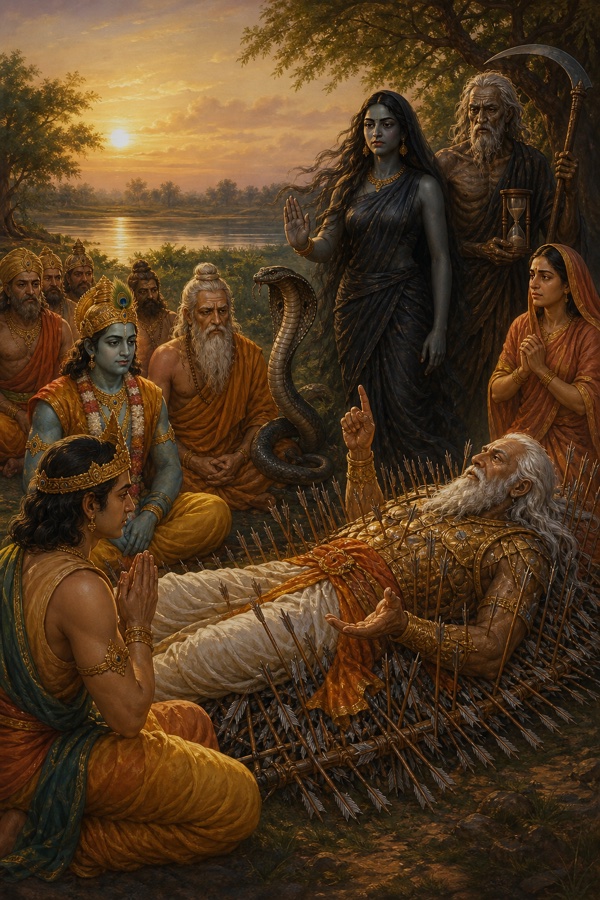
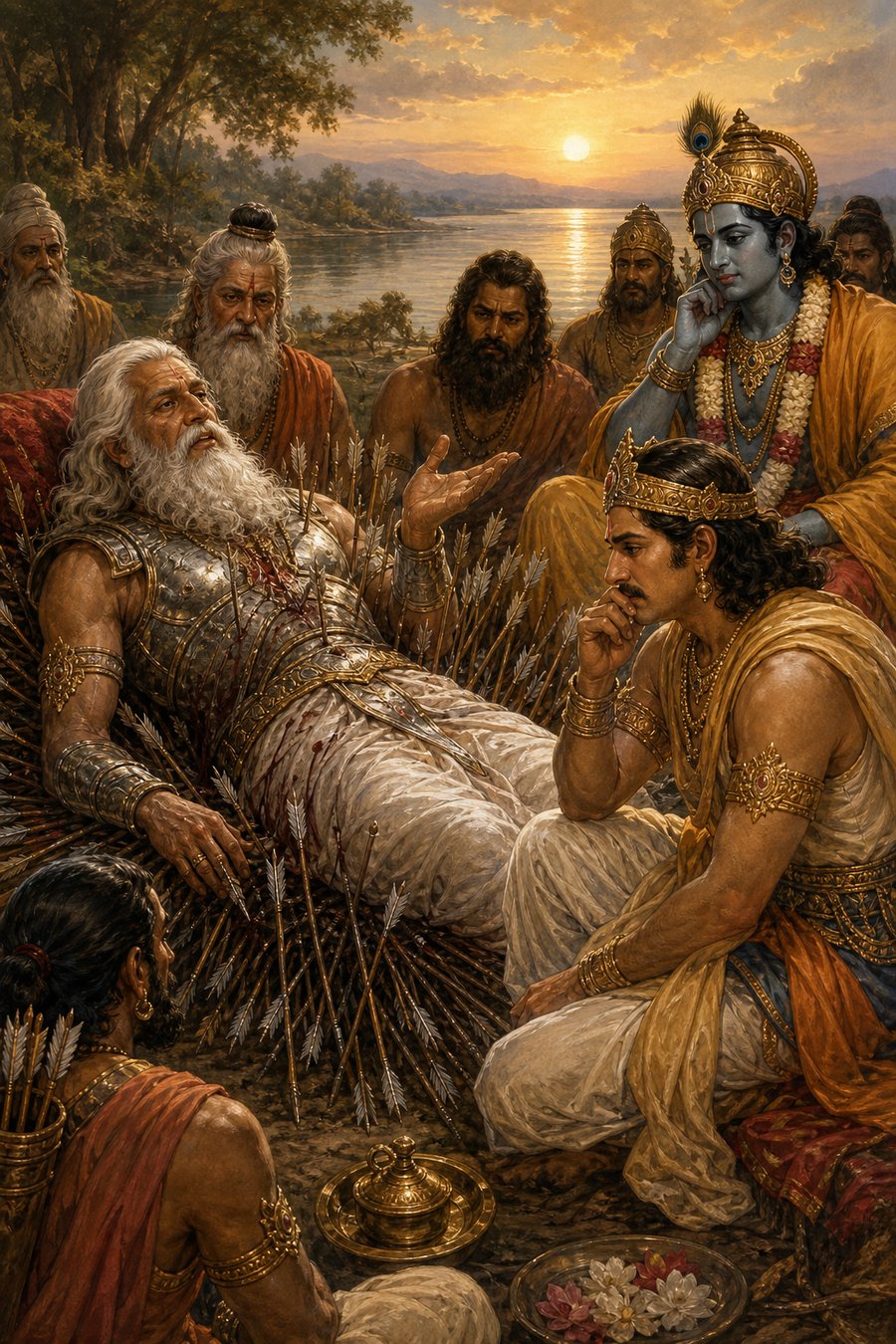
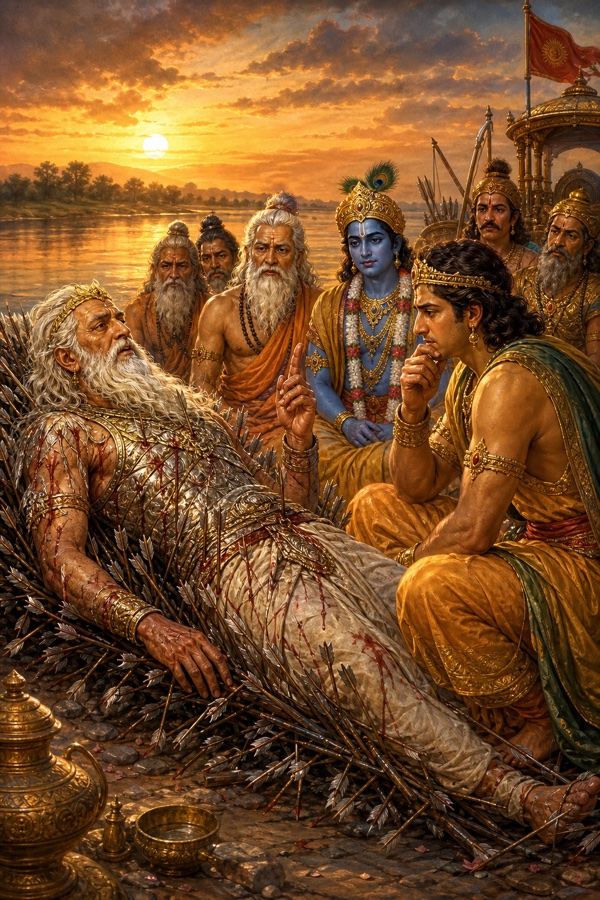
Bhishma lay on the bed of arrows, his body pierced through and weeping from its wounds, and still his voice carried that gravity which belongs only to a wise man standing at the door of death. Yudhishthira sat near him, and his heart would not come to rest. He folded his hands and said that the grandsire had already taught him many roads to peace of mind, that he had heard them all, and that peace still would not come. The war whose cause he had become had brought Bhishma to this state; countless princes with their sons and kinsmen had perished for his sake; from where, then, was the mind to find its rest. Seeing that blood-soaked body, he said, he was wilting the way a lotus wilts in the rains. If the grandsire wished him well, let him give such teaching as would wash this sin from him even in the next world. This is the Anushasana Parva, Bhishma’s last teaching from the bed of arrows, weighted toward the law of giving, in which the secret of action, the rules of charity, the greatness of the brahmin and of the cow, and the dialogue of Uma and Maheshvara open one after another.
Gautami, the snake, and death: whose fault is it
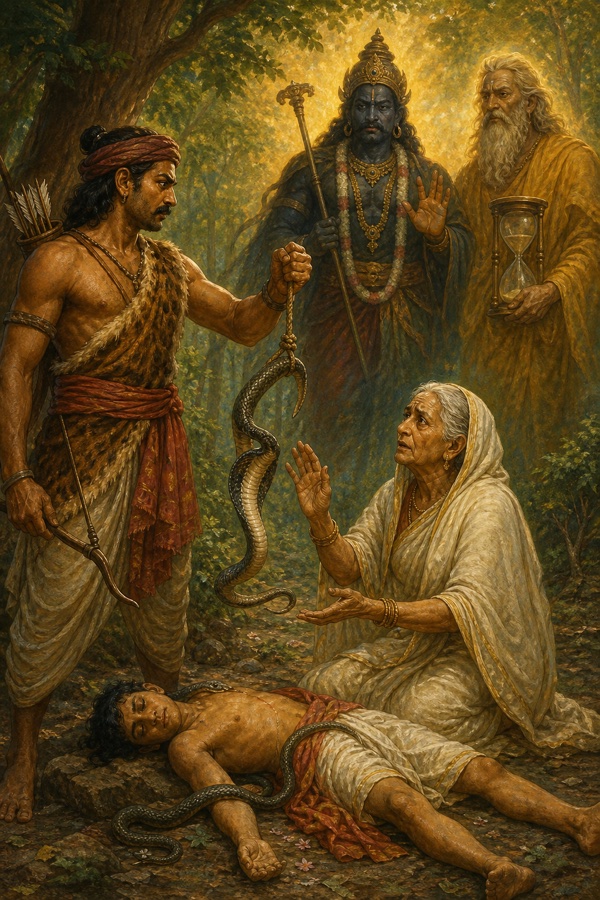
Bhishma answered that the king, whose soul stood under the sway of God, of destiny, and of Time, should not hold his own self to be the sole cause of his deeds. On this matter, he said, there is an old tale of Death, of Gautami, of Time, and of a fowler and a snake. Listen to it.

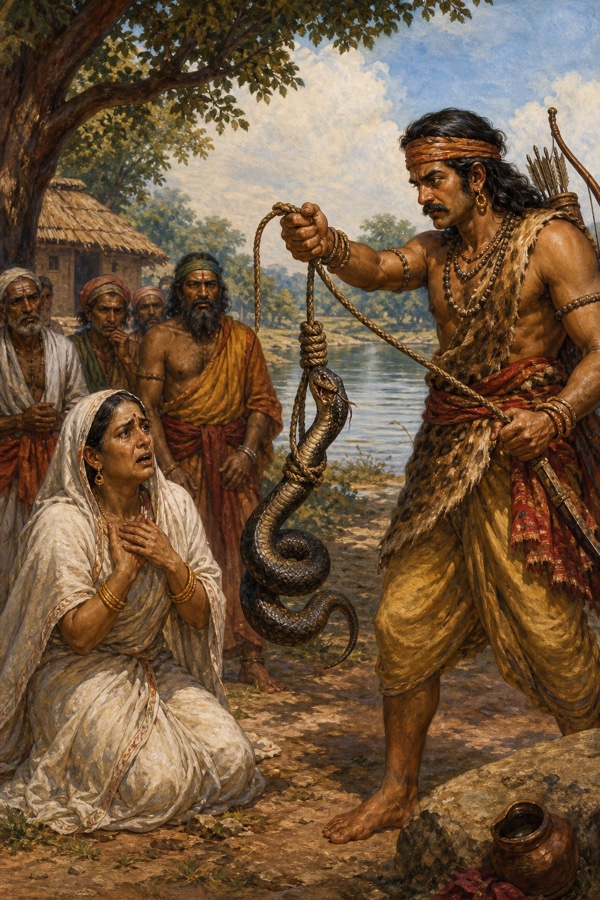
There was an old woman named Gautami, and within her lived great patience and a settled calm of mind. One day she found her son dead; a snake had bitten him. A furious fowler named Arjunaka bound the snake with a cord, brought it to Gautami, and said that this wicked serpent had killed her boy; tell him how to destroy it, throw it in the fire, or cut it to pieces, for this child-killer did not deserve to live.
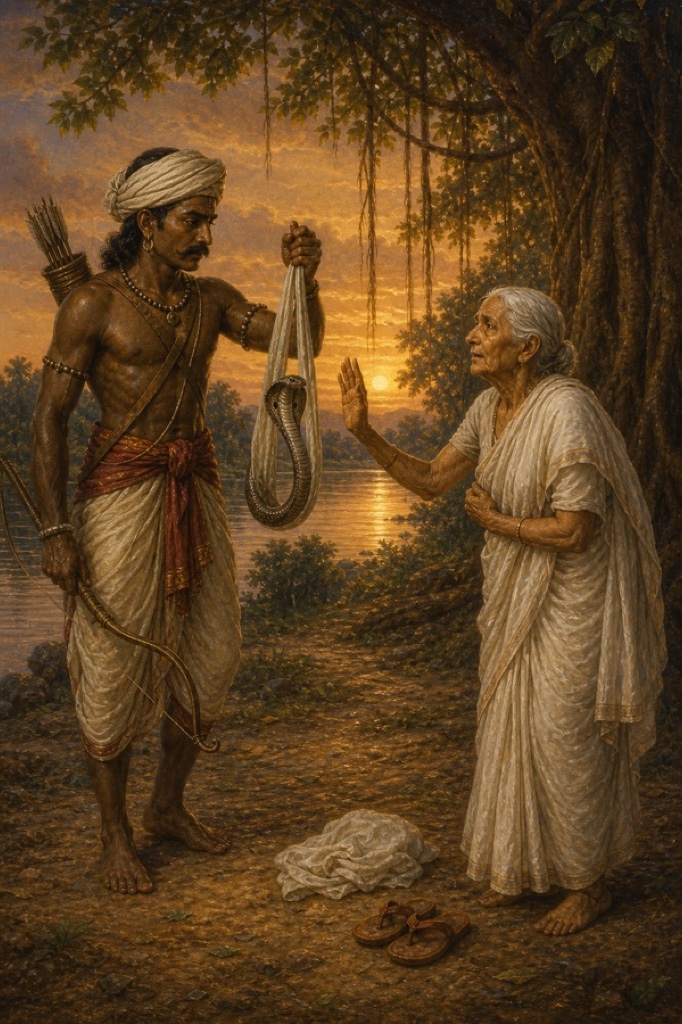
Gautami said that the fowler, poor in wisdom, should let the snake go, that it did not deserve death at his hands. Whoever forgets his own inescapable fate and takes up this burden of folly sinks into sin. Those who have made themselves light through good deeds cross the ocean of the world as if by boat, while those grown heavy with sin settle to the bottom like an arrow flung into water. Killing this snake would not bring her son back alive, and leaving it alive would cost the fowler nothing.

The fowler said that she, a noble lady, knew that great souls grieve at the suffering of every creature, but that her words were meant for one whose mind is steady, not for a man sunk in grief. As for him, he had to kill this snake. Those who seek peace leave everything to Time, he said, but men of the world quiet their grief by taking revenge. Gautami answered that people like her are not shaken by such misfortune. The boy’s death had been fixed beforehand; she could not accept the killing of this snake. Brahmins hold no malice, for malice brings pain. Let him show mercy and set it free.
The fowler offered many arguments: that killing an enemy earns merit; that to protect many creatures the killing of this one wicked thing was fitting; that Indra had gained the best share of the sacrifice by slaying Vritra, and Mahadeva his portion by wrecking a certain sacrifice. But Gautami’s mind, however he goaded it, would not lean toward that sinful act.
Then the snake, tight in the cord, holding its restraint with great effort, spoke slowly in a human voice. It said that the foolish Arjunaka should see that no fault was its own; it had no will of its own and was not free. Death had sent it upon this work, and by Death’s command it had bitten the boy, not out of anger or its own liking. If there was sin in this, the sin was Death’s.
The fowler said that even if it had done this evil deed at another’s prompting, the sin was still its own, since it had become the instrument. Just as, in the making of a pot, the potter’s wheel, the rod, and the other things are all held to be causes, so too was the snake a cause. The guilty deserved death at his hands. The snake replied that just as the wheel and the rod are not free causes, so it too was not a free cause, and therefore the fault was not its own. If there was sin at all, it lay in the whole gathering of causes. Between them there ran a long dispute over cause and effect, sin and punishment.

Then Death itself appeared there and said to the snake that at Time’s prompting Death had sent it upon this work; the cause of the boy’s death was neither the snake nor Death. As clouds are driven this way and that by the wind, so Death was driven by Time. All the states of being tied to purity, passion, and darkness rise from Time and work in all creatures. In the sky and on the earth, all things moving and unmoving stand under the power of Time. Sun, moon, Vishnu, water, wind, fire, the rivers, and the sea, all being and unbeing are made and unmade by Time alone. Knowing this, why did the snake hold Death to blame.
The snake said that it laid no blame on Death, nor cleared Death of blame; it said only this, that it had been prompted and moved by Death. If the fault was Time’s, or if it was not right to blame Time, then it was not its place to weigh that fault. Then the snake said to Arjunaka that he had heard Death’s words, and that it was not right for him to torment an innocent creature bound in a cord.
The fowler still said that he had heard the words of both, but that they did not clear the snake; both the snake and Death were causes of the boy’s death. Death answered that neither of them was free; both stood under Time and did their appointed work; if he considered the matter well, he would lay no blame on them. The fowler asked how, if they both stood under Time, the joy that rises from doing good and the anger that rises from doing evil could arise. Death said that whatever happens, happens by the power of Time; both of them did their appointed work at Time’s prompting, and so deserved no reproach of any kind from him.
Then Time itself came to the place of the dispute and said to the snake, to Death, and to the fowler that neither Death, nor this snake, nor Time itself was to blame for any creature’s death; they were only immediate, instrumental causes. As for Arjunaka, this boy’s own deeds had prompted their action. His death was the fruit of his own past deeds, and there was no other cause. As men shape whatever they wish from a lump of clay, so men gain many fruits from their own deeds. As light and shadow are joined to each other, so is a man joined to his own action. Therefore neither the fowler, nor Time, nor Death, nor the snake, nor the old brahmin woman was the cause of this boy’s death; the boy was his own cause.

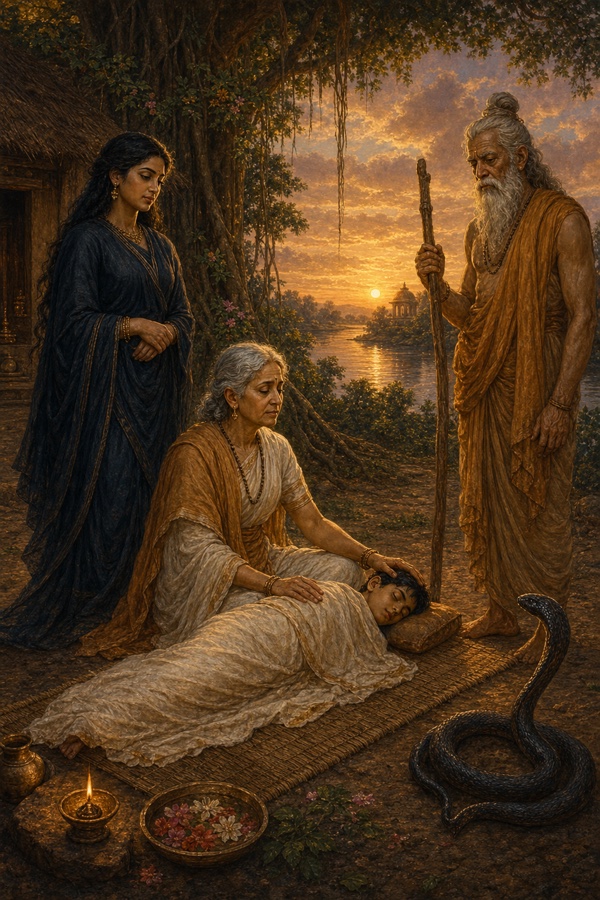
By this reasoning of Time, Gautami’s mind came to certainty that men bear according to their own deeds. She said that neither Time, nor Death, nor the snake was the cause; the boy had died of his own action. She herself must once have done something whose fruit this was. Now let Time and Death return from there, and let Arjunaka too release the snake. Time, Death, and the snake went back to their own places, and the minds of both Gautami and the fowler grew calm.
Bhishma said, O king, hearing this, let go of all your grief and gain peace of mind. Men reach heaven or hell by the fruit of their own deeds. This calamity was made neither by you nor by Duryodhana. All these lords of the earth were slain as the fruit of the deeds of Time. Hearing this, the strong and righteous Yudhishthira grew a little calmer, and asked again.
A key to reading this (the idea): The heart of this tale is the law of karma. Time, Death, and the snake are only instruments; the root cause is the boy’s own accumulated action. Gautami’s patience shows that even in grief the wise do not lean toward revenge.
The gist: Bhishma quiets Yudhishthira’s guilt with the law of karma. Every death is the fruit of its own past action, so the burden of the war’s ruin is not the king’s alone.
Sudarshana: a householder who conquered death by the duty to guests
Yudhishthira asked whether any householder had won victory over death by the practice of dharma, and asked to hear it in full. Bhishma told an ancient history. Ikshvaku was the son of the Prajapati Manu, and had a hundred sons. The tenth son, Dasasva, became king of Mahishmati. In his line came, in order, Madirasva, Dyutimat, Suvira, Sudurjaya, and then a righteous royal sage named Duryodhana. This Duryodhana was mighty like Indra; in his realm Indra rained abundantly, and among the people there was neither a wretched man nor a sick one.
The river Narmada, of pure and cool water, chose this king, and by her the king had a lotus-eyed daughter named Sudarshana. No woman as lovely as that girl had ever been before. Agni himself, taking the form of a brahmin, asked the king for her hand. The king, unwilling to count a poor brahmin his equal, was not ready to give the girl, and Agni then vanished from his sacrifice. Grieved, the king went to the brahmins, and the brahmins with one mind took refuge in Agni. Agni appeared, blazing like the autumn sun, and said that he desired the daughter of Duryodhana for himself.
The king gladly agreed to give the girl, but asked, as the bride-gift of the marriage, that Agni should dwell forever in his land. Agni consented, and for this reason fire is always present in Mahishmati, the fire that Sahadeva saw in his conquest of the south. Agni took Sudarshana by the Vedic rite, and by her he had a son named Sudarshana, beautiful as the full moon, who even in childhood came to the knowledge of the supreme and everlasting Brahman.
Now Oghavat, the grandfather of Nriga, had a daughter named Oghavati. Oghavat gave his goddess-like daughter Oghavati in marriage to the learned Sudarshana. Sudarshana settled into the householder’s life with Oghavati at Kurukshetra. This brilliant prince took a vow that even while remaining a householder he would conquer death. The son of Agni said to Oghavati that whoever came to their shelter must never be slighted; that for the welcome of a guest she must not hesitate even to give her own body, since for a householder there is no dharma greater than hospitality; that whether he was near or far, she must never neglect a guest. Oghavati folded her hands and said that nothing of his command would be left undone.
Then Death began to follow Sudarshana, watching for a lapse. One day, when the son of Agni had gone to the forest to fetch wood, a handsome brahmin asked Oghavati for a guest’s welcome. By the Vedic rite she gave him a seat and water to wash his feet, and asked what she might do for him. The brahmin said, noble lady, my need is of your body; if the householder’s dharma is dear to you, then without hesitation offer your body and satisfy me. Oghavati offered many other gifts, but the brahmin asked only for her body. Remembering the word her husband had given, filled with shame and yet steady, that chaste woman said, So be it, and going to the brahmin, gave him welcome.
Meanwhile Sudarshana returned with the wood, and terrible, unbending Death was always close beside him, as though a friend. Coming home, Sudarshana called Oghavati by name again and again, but overcome with shame and holding herself defiled, that faithful woman stayed silent. Then from within the hut the brahmin answered, son of Pavaka, know that a brahmin guest has come, and though your wife offered many other gifts, I asked only for her body, and this bright-faced woman is giving me welcome; now do what you think fit.
That very instant Death, iron mace in hand, ran behind the brahmin, thinking that now Sudarshana would swerve from his word. But Sudarshana, astonished as he was, cast off all envy and anger from sight, word, deed, and mind, and said, brahmin, take your joy; this is a great gladness for me. A householder gains supreme merit from the welcome of a guest. My life, my wife, and whatever worldly things I have are all offered for the use of guests; this is my vow. By the strength of this truth I shall gain the knowledge of the self. The five great elements, earth, water, fire, air, and space, and mind, understanding, the self, Time, direction, and the ten senses, all dwell within the bodies of men and are witnesses of their good and evil deeds. Today I have spoken this truth; if I have spoken falsely, let the gods destroy me.
Then in all directions this cry rang out again and again, this is true, this is not false. The brahmin came out of the hut and, making the three worlds resound with Vedic sounds, said, sinless one, I am Dharma; victory to you. I came to test you, and knowing you righteous, I am pleased. You have conquered the Death that forever watched for your lapse. In the three worlds no one can insult this chaste woman even with a glance, let alone touch her. She has been guarded by your dharma and by her own chastity. This knower of Brahman, for the welfare of the world, will become a great river, and you in this very body will reach all the worlds. This austere woman will go with you in half her being, and in the other half will be famed as the river Oghavati.
Then Indra, riding a chariot drawn by a thousand white horses, came to the brahmin. Death, the self, all the worlds, all the elements, understanding, mind, Time, direction, desire, and anger were all conquered. Bhishma said, therefore, best of men, remember that for a householder there is no deity greater than a guest. The learned say that the blessing of a well-honored guest bears more fruit than the merit of a hundred sacrifices. The householder who fails to honor a worthy guest, that guest carries away all his merit and leaves his own sin in its place. Whoever reads this tale of Sudarshana daily gains a good destiny.
A key to reading this (the lineage): The “Duryodhana” here is not the Kaurava Duryodhana; he is an ancient royal sage of the Ikshvaku line, lord of Mahishmati. From his daughter Sudarshana, Agni’s son too was called Sudarshana, and later the name “Sudarshana” became famous for Vishnu’s discus as well.
The gist: The householder Sudarshana conquered death through an unbending duty to guests and through truth. The tale’s force is that for a householder hospitality is the supreme dharma, and that true chastity is guarded by dharma itself.
Vishvamitra: how a kshatriya became a brahmin
Yudhishthira asked how, when brahmin-hood is so hard for the other three orders to reach, Vishvamitra, born a kshatriya, became a brahmin. Bhishma said that in the line of Bharata there was a king named Ajamidha, whose son was Jahnu, and Jahnu’s daughter was Ganga. In this same line came, in order, Sindhudvipa, Balakasva, Vallabha, Kushika, and then King Gadhi. Gadhi was childless, and while living in the forest a daughter was born to him, named Satyavati, whose beauty had no equal on earth.
Richika, the austere son of Chyavana of the line of Bhrigu, asked for the girl’s hand. Gadhi thought him poor and did not give the girl, but as the sage was leaving he said that if he brought a marriage-gift the girl was his. Gadhi asked for a thousand horses swift as the wind, colored like the moon’s rays, each with one black ear. Richika prayed to Varuna, lord of waters, and Varuna said the horses would appear wherever he wished. From the water of the Ganga a thousand such horses rose up. On the bank of the Ganga near Kanyakubja that place is famed even now as Ashvatirtha. Richika gave those horses to Gadhi as the marriage-gift, and Gadhi, astonished and fearing a curse, gave his daughter to Richika.
Richika, pleased, wished to give Satyavati a boon. Satyavati told her mother, and the mother wished that she too might have the boon of a son. Richika said, so be it, both of you shall have heroic sons. After bathing at the fertile season, let Satyavati embrace a pipal tree and her mother a cluster-fig tree, and let both eat the mantra-charged charu, the cooked oblation-food; then they would have the sons they wished. Richika had set brahmin power in Satyavati’s charu and kshatriya power in the mother’s.
But the mother, out of fondness, said to Satyavati that she was worthier of the higher, and asked her to exchange her charu and tree, since every mother wishes the finer child for her own son. The two exchanged charu and tree. Richika, learning this, said, noble woman, you have not done well; by exchanging the charu you have reversed everything; now your mother will bear a fine brahmin and you a kshatriya of fierce deeds. Grieved, Satyavati fell to the ground and prayed that he show mercy, that her son not be a kshatriya, even if her grandson should become a fearsome warrior. Richika said, so be it.
Then Satyavati bore a blessed son named Jamadagni, and Gadhi’s wife bore the Brahman-knowing Vishvamitra. Thus, though born in a kshatriya line, Vishvamitra reached the state of a brahmin and became the founder of a line of brahmins. Many of his sons became Brahman-knowing sages, Madhuchhandas, Devarata, Yajnavalkya, and many other munis, knowers of the Veda and founders of many gotras. Bhishma said that it was because supreme brahmin power had been set in Richika’s charu that Vishvamitra, though a kshatriya, could become a brahmin.
A key to reading this (the idea): Charu means the oblation-food cooked with mantras in a sacrifice, milk and rice and the like. Richika had filled two charus with two kinds of power. When mother and daughter exchanged them, the order of power was reversed, and so Vishvamitra, born in a kshatriya house, gained brahmin power and became a brahmin sage, while Jamadagni, father of Parashurama, though born in a brahmin house, carried kshatriya power.
The gist: The secret of Vishvamitra’s brahmin-hood is the brahmin power set in the charu of the womb; the mother and daughter’s exchange of charus reversed the order of the orders’ power.
The parrot and the dried tree: the greatness of compassion
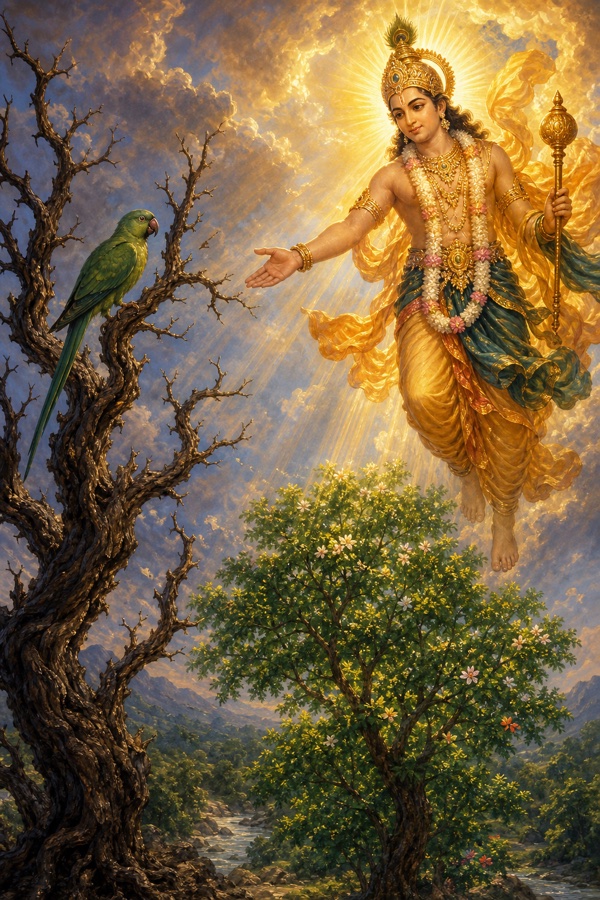
Yudhishthira asked about the greatness of compassion and the marks of devoted people. Bhishma told the tale of Vasava and a parrot. In the country of the king of Kashi a fowler went into the forest to hunt deer with poison-smeared arrows. One of his arrows missed the deer and struck a great tree. Pierced by the poison, the tree shed its leaves and fruit and dried up. A parrot that had lived its whole life in a hollow of that tree, out of love for it, would not leave its nest. Still, foodless, silent, and grieving, that grateful parrot began to wither along with the tree.
Indra, the conqueror of Paka, marveled that a feeling so human and generous, almost impossible in the lower creatures, should live in this bird. Taking the form of a brahmin, Indra asked, parrot, best of birds, why do you not leave this dried tree. The parrot bowed and said, king of the gods, by the power of my austerity I have recognized you; you are welcome. Indra silently praised its wisdom, yet, to counsel it, said that the tree was dried, without leaf or fruit, unfit for birds, that the forest was vast and full of fine trees, and that it should use its judgment and leave this dead tree.
The parrot drew a deep breath and said in a grieving voice, lord of Shachi, the command of the gods is always to be honored, but hear me. In this very tree I was born; in it all the qualities of my character were shaped; in my infancy it gave me shelter from enemies. In your kindness, why do you shake this principle of my life. I am compassionate, I am set on dharma, I am firm in conduct. Among the good, compassion is the touchstone of dharma, and this same compassion is a constant source of joy to the virtuous. When this tree was able, it carried my life; how then can I forsake it now.
Indra, pleased by these true words, said, I am pleased with your compassionate nature; ask a boon. The kindly parrot asked only this, that the tree live again. Indra, delighted, sprinkled nectar and made the tree green again, and the parrot too, by the power of its austerity, at the end came to Indra’s company. Bhishma said that in this way, through good company, men gain all their desires, as through the parrot’s company that tree was brought back to life.
The gist: The grateful parrot’s compassion and firmness brought even a dead tree back to life. Compassion is the touchstone of dharma, and by good company all one’s aims are gained.
Effort and destiny: which is stronger
Yudhishthira asked which is the stronger, human effort or destiny. Bhishma gave the example of the dialogue between Vasishtha and Brahma. In old times Vasishtha asked Brahma whether the deed done in this birth is greater, or the accumulated deeds of past births, which are called destiny. Brahma, born of the first lotus, answered in words full of meaning.
Brahma said that without seed nothing comes to be; from seed alone are fruits made. As the farmer sows good or bad seed, so is the fruit he reaps. Just as unsown ground, though plowed, gives no fruit, so without one’s own effort destiny is idle. One’s own deeds are like the ground and destiny, the sum of past deeds, is like the seed, and only from the meeting of the two does the crop grow. In the world it is seen every day that the doer reaps the fruit of his good and evil deeds, joy from good deeds and sorrow from bad. Everything can be gained by effort, but the man without effort gains nothing from destiny alone.
Brahma said further that the brahmin gains prosperity by a pure life, the kshatriya by valor, the vaishya by labor, and the shudra by service. To the miser, the impotent, and the lazy come neither wealth nor enjoyment. Even Vishnu, who made the three worlds, is absorbed in austerity in the lap of the deep ocean. If deeds bore no fruit, all deeds would be idle, and men would grow lazy, trusting to destiny. He who leaves human effort and follows destiny alone labors in vain, like a woman whose husband is impotent.
Brahma gave many examples. In old times Yayati, though he fell from heaven, reached heaven again by the merit of his virtuous grandsons. Pururavas of Ila’s line went to heaven by the favor of brahmins. Saudasa, king of Kosala, though he performed the horse-sacrifice and others, became a man-eating rakshasa by the curse of a great sage. Though they were sons of sages, Ashvatthama and Rama could not gain heaven by their deeds. Vasu, though he performed a hundred sacrifices, reached the underworld for a single lie. Bali, son of Virochana, bound by his own word, was sent to the underworld by the might of Vishnu. Janamejaya and Vaishampayana were held back by the gods for the sin of brahmin-slaying. The royal sage Nriga, though he gave gifts of cows, became a lizard. Dhundhumara, while performing sacrifices, was overtaken by old age. The Pandavas too brought back their lost kingdom by their own valor, and not by fate.
Brahma concluded that as a little fire, fed by the wind, grows fierce, so destiny, joined with effort, grows greatly. As the light in a lamp dies when the oil runs low, so the power of destiny ends when action stops. Destiny follows effort as a pupil follows his own sight. Where one’s own effort is applied, there destiny shows its hand. Only the joined support of destiny and effort bears fruit.
A key to reading this (the idea): Destiny here is the sum of accumulated deeds of past births, not blind fate. Brahma’s image is clear: one’s own action is the ground, destiny is the seed. Seed without ground is idle, so a man’s active effort is indispensable.
The gist: Effort and destiny complete each other, but a man’s effort is the root. The idle man who sits on fate alone gains nothing; the man who works finds destiny working with him.
The fruits of good deeds
Yudhishthira asked about the fruits of good deeds. Bhishma told the secret knowledge of the sages, that in whatever state creatures do their deeds, in a like state they bear the fruit in births to come. No deed done through the five senses of knowledge is ever lost; these five senses and the sixth, the deathless self, remain its witnesses.
Bhishma counted out many fruits. Whoever offers to a guest his eye, his heart, kind words, and the honor of attendance performs the fivefold sacrifice. Whoever gives food to weary travelers gains great merit. Those who sleep only on the sacrificial altar gain in the next birth fine mansions and beds. Those who wear bark and rags gain good clothes and ornaments. Yogins gain vehicles as the fruit of their austerity. Whoever gives up all savory pleasures gains prosperity, and whoever gives up meat gains children and cattle. By the vow of silence one gains obedience, by austerity all enjoyments, by chastity long life, and by non-harming beauty, prosperity, and freedom from disease. Whoever lives on fruits and roots alone gains sovereignty, and whoever lives on leaves alone gains heaven.
Bhishma said that as a calf finds its mother among a thousand cows, so a man’s past deeds follow him through every change of form. As the flowers and fruits of a tree come in their own season without any visible prompting, so the deed of a past birth bears fruit at the right time. In old age the hair grays, the teeth loosen, the eyes and ears grow dim, yet the craving for pleasures never lessens, and whoever can give up that hard-to-conquer craving alone finds happiness. Whoever does deeds that please his father, by these the Prajapati is pleased; whoever pleases his mother, by these the Earth is pleased; whoever pleases his teacher, by these Brahma. He who honors these three is honored by dharma. Bhishma also said that as a sacrifice without gifts and an offering without mantras go idle, so falsehood in speech brings sin and bad fruit.
The gist: Every deed brings its own matching fruit, and no deed of the senses is ever lost. Honoring mother, father, and teacher, these three, is the foundation of dharma.
Who is worthy of worship: the greatness of the brahmin
Yudhishthira asked, grandsire, whom should one worship, before whom should one bow the head, upon whom does your own mind rest in trouble. Bhishma said, dear to me are those brahmins whose supreme wealth is Brahman, whose heaven is the knowledge of the self, and whose austerity is the study of the Vedas. Self-controlled, gentle-spoken, learned in the scriptures, virtuous brahmins shine in assemblies like flocks of swans. Their good and beautiful words, spoken in a voice deep as thunder, win honor in the courts of kings.
Bhishma said that it is easy to fight in battle, but hard to give without pride or arrogance. In the world there are hundreds of heroes, but among them the hero of giving is held highest. He said, son of Pandu, in this world no one is dearer to me than you, yet dearer to me even than you are the brahmins, and by the strength of this truth I hope to reach all the worlds that my father Shantanu reached. Neither father, nor grandfather, nor any blood-kin is dearer to me than the brahmins. For what I have done toward brahmins in mind, word, and deed, I feel no pain even on this bed of arrows.
Bhishma gave the example of the duty of a wife and said that as a wife’s dharma rests on her husband, and the husband is her deity and highest goal, so for kshatriyas are the brahmins. If a kshatriya be a hundred years old and a virtuous brahmin boy be ten, the boy is to be counted as a father and the old man as a son, since of the two the brahmin is the higher. A brahmin is to be guarded like a son and worshipped like a father or a teacher. Brahmins are simple, truthful, and well-wishers of all creatures, but when angered they are like snakes of fierce venom, and so they must always be served with humility.
Bhishma warned that one must be wary of both prowess and austerity, and that of these austerity is the higher, since a brahmin armed with austerity, when angered, can destroy the object of his anger, however mighty. Against a brahmin who has conquered anger, both prowess and austerity fail. If prowess and austerity clash, prowess is wholly destroyed, but austerity is not wholly destroyed. As a herdsman guards the cows with a staff, so should the kshatriya guard the Vedas and the brahmins, and take care that their livelihood does not fall short.
The gist: For Bhishma the brahmin is dearer even than a son. Guarding the brahmins and the Vedas is the kshatriya’s supreme duty, and the strength of austerity outlasts the strength of prowess.
The fruit of a promise unkept: the jackal and the monkey
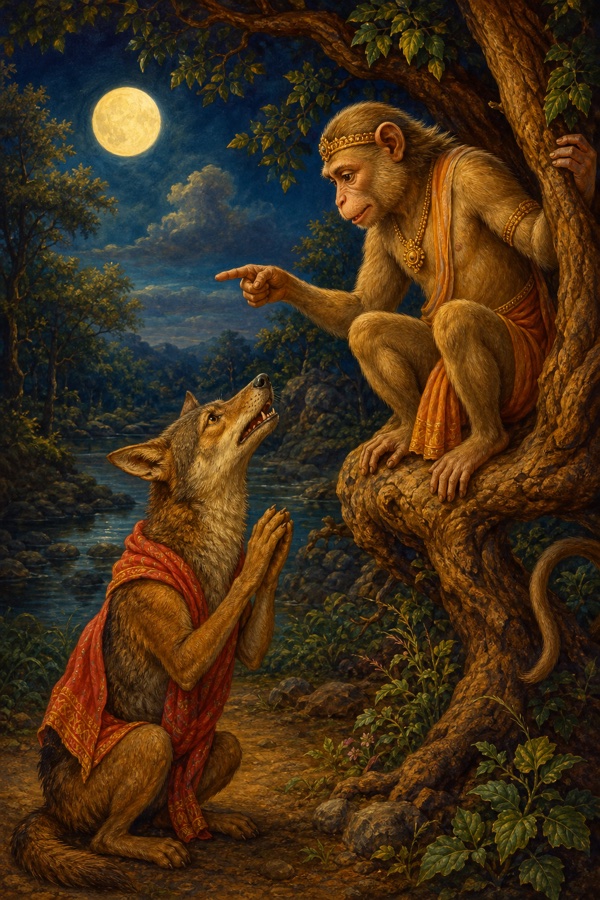
Yudhishthira asked what becomes of those who promise a gift to brahmins and then, out of folly, do not give. Bhishma said that whoever promises and gives neither little nor much, all his hopes go barren, like a eunuch’s hope of offspring. All his good deeds from birth to death, his offerings, his gifts, and his austerities go idle. The knowers of scripture say that such a man can be cleansed only by giving a thousand horses with black ears.
On this matter Bhishma told an old tale of a jackal and a monkey. In a past birth the two had been men and close friends; after death one became a jackal and the other a monkey. One day the monkey saw the jackal in a cremation ground eating the rotting corpse of some animal, and, remembering their past birth, asked what dreadful sin the jackal had done in his last life that he must now eat such vile food in a cremation ground.
The jackal answered that, having promised a gift to a brahmin, he had not given it, and by that sin he had fallen into this low birth and was forced by hunger to eat such food. Then the jackal asked the monkey what sin he had done to be born a monkey. The monkey said that in his last life he used to snatch the fruit of brahmins, and by this he had become a monkey. So it is clear, said Bhishma, that the wise should never seize the property of brahmins, never quarrel with them, and must always give the gift once promised.
Bhishma said that this he had heard from his own teacher, from many righteous men, and from Shri Krishna too, when they spoke about brahmins. The property of a brahmin must never be seized. Though a brahmin be poor, a miser, or a child, he must never be slighted. A brahmin in whose mind a hope has been kindled is like a blazing fire, and whatever he casts his hope-filled glance upon is burned to ash like a heap of straw. Giving is the highest of deeds; by a gift to a brahmin the gods and the ancestors are satisfied. Therefore the gift promised to a brahmin must surely be given.
A sub-tale: This little tale of the jackal and the monkey binds a single moral point with two examples: one’s fault was to promise a gift and not give it, the other’s to seize a brahmin’s wealth. Both, by wronging a brahmin, fell into low births, as if to mark that a promise once given becomes a debt.
The gist: A promised gift to a brahmin must be kept, or all merit goes barren and a low birth follows. Seizing a brahmin’s property is a like sin.
The fault of instructing a shudra: austerity and rebirth
Yudhishthira asked whether there is fault in instructing a low-born person out of affection. Bhishma said that the sages hold that one should not instruct the low orders, and that a teacher who does so takes on a great fault. Hear an old event on this matter.
On the lovely breast of the Himalaya was a holy hermitage where many celibate students, forest-dwellers, siddhas, charanas, and brahmins of severe vows lived. Once a shudra, compassionate to all creatures, came to that hermitage. Seeing those brilliant ascetics, a desire for austerity woke in his mind. Touching the feet of the head of the hermitage, he said that he wished to learn the duties of dharma and take the vows of renunciation, and that though he was a shudra by order, he wished to serve them there.
The head of the hermitage said that it was not possible for a shudra to live there bearing the marks of a renunciate, but that if he wished he could stay and serve, and by that service he would reach the higher worlds. The shudra thought that he would do whatever was fit for his own good. At a place far from the hermitage he built a hut of twigs and leaves, made an altar and a shrine, and, keeping silence, took up hard vows and austerity. Bathing three times a day, restrained in his food, worshipping the gods, offering into the fire, living on fruits and roots, and honoring guests, in this way he passed a very long time.
One day a sage came to the shudra’s hermitage to make his acquaintance. The shudra honored him by the rites, and that sage began to visit him again and again. Once the shudra said that he wished to perform the shraddha rite for his ancestors, and asked for guidance. The sage said, very well, and consented. The shudra bathed and brought water, kusha grass, wild roots, fruit, and a seat called a vrishi. He set the head of the vrishi toward the south, but the sage told him this was against the rule, that the head of the vrishi should be set toward the east and his own face toward the north. The shudra did all of it thus, and the sage taught him the whole procedure of spreading kusha, setting out the arghya, offering libations, and offering food. When the shraddha was done, the sage returned to his hermitage.
Having done austerity for a long time, at last the shudra ascetic gave up his body in those very forests. As the fruit of his austerity he was born in the next life in the house of a great king and was full of splendor. That sage too, when his time came, gave up his body and was reborn in a family of priests. Both grew up and became masters of learning, the brahmin skilled in the Veda and the Atharvan, in the procedure of sacrifice, in astronomy, and in the Sankhya philosophy. Meanwhile the prince, on his father’s death, performed the funeral rites and became king, and he appointed that same reborn sage as his priest.
The king ruled by dharma and protected his people. But whenever he took a blessing from the priest or had a rite performed, the king would look at him and smile faintly. Seeing this again and again, the priest grew angry. Meeting him in private, he asked for a boon, that the king tell him truthfully why he smiled at him. The king gave his word and said that he would tell him what was not fit to be revealed, but would speak the truth.
The king said that in his own past birth he had been a shudra doing hard austerity, and the priest had been a hard-doing ascetic sage. Pleased with him and wishing him well, the sage had instructed him in the shraddha rite, teaching him how to spread the vrishi and the kusha, and the procedure of the arghya and the libations. For that very offense the sage had been born into a priest’s line and he himself into a king’s line. See the strange turn of Time. What you taught me, this is its fruit, which you have borne. This is why I smile at the sight of you, not out of disrespect. You are my teacher, and my heart burns at this reversal of your state. All your austerity was destroyed by the instruction you gave me. Now give up the office of priest and strive for a better birth, and take as much wealth as you wish.
Sent off by the king, that brahmin began to give much wealth, land, and villages to men of his own order. He performed hard vows, made pilgrimages, gave cows to brahmins, and thus, gaining the knowledge of the self, returned in the end to that very hermitage and attained the supreme perfection. Bhishma said that the lesson is this, that a brahmin should not instruct a shudra or one of the low orders. Brahmin, kshatriya, and vaishya, these three are the twice-born, and there is no fault in instructing them. The path is very subtle, and for this the ascetics take the vow of silence, lest by saying something unfit they incur a fault. Instruction given in exchange for wealth defiles the giver, so the wise should give instruction only after long thought, and only such instruction as earns merit.
A key to reading this (the idea): The vrishi is a seat for the shraddha made of kusha grass or sacred material. The direction of its head and of one’s face, east and north, is a subtle rule of the shraddha rite. The logic of the tale is bound to the old severity of the law of orders, in which even instruction was regulated by the fitness of the receiver, and the Mahabharata does not flatten this complexity; even a wise sage’s austerity is said to have been thinned by this transgression.
The gist: Instruction should be given with thought, and only to the fit, since the pupil’s sins reach the teacher. A sage’s austerity itself was thinned by teaching the rite to one of the low order.
Where Shri (Lakshmi) dwells
Yudhishthira asked in what kind of man or woman Shri, the goddess of prosperity, dwells. Bhishma said that once, seeing the lotus-hued Lakshmi shining with beauty, Rukmini, the mother of Pradyumna, asked the son of Devaki out of curiosity, goddess, with whom do you dwell, and on whom do you show favor, and whom do you leave; tell me truly. Lakshmi, whose face was lovely as the moon, answered in sweet words.
Shri said that she dwells with him who is fluent of speech, active, watchful, free of anger, a worshipper of the gods, grateful, master of his senses, and generous to all. She does not dwell with him who is idle in action, faithless, who breeds mixture of order through lust, who is ungrateful, unclean of conduct, harsh of speech, a thief, hateful of elders, low in vigor, and angered at every small thing. Nor does she dwell with those who think one thing in the mind and do another in deed, nor with him who sits without effort, content with his lot.
Shri said that she dwells with those who keep the dharma of their order, who know dharma and its works, who serve elders, who are self-controlled and forgiving. She dwells with those women who are truthful, worshippers of the gods, faithful to their husbands, virtuous, adorned with ornaments and good clothes, sweet-spoken, and rich in virtue. She leaves those women who are unclean, impatient, quarrelsome, who sleep too much, and who speak against their husbands’ wishes.
Shri said further that she dwells in vehicles and in the beasts that draw them, in maidens, in ornaments and clothes, in sacrifices, in rain-filled clouds, in blooming lotuses, and in the stars of autumn. She dwells in elephants, in cow-pens, in fine seats, and in lakes graced with lotuses. She dwells in rivers that murmur sweetly, that are melodious with the cry of curlews, whose banks are lined with trees, and where brahmin ascetics live. She dwells in the house where the householder offers into the fire and worships the cow, the brahmin, and the gods. She dwells in brahmins devoted to the study of the Veda, in kshatriyas who keep dharma, in vaishyas set on farming, and in shudras set on service. But in her full and steady form she dwells only in Narayana, in her own dependent nature, since in him dharma is complete, and the qualities of devotion to brahmins and of sweetness are complete. He in whom she dwells as a settled presence grows in dharma, fame, wealth, and enjoyment.
The gist: Shri dwells in effort, truth, restraint, gratitude, and the service of gods, brahmins, and cows, and leaves behind sloth, ingratitude, and quarrel. In her full form she rests steady only in Narayana.
Bhangashvana: the pleasure of woman and of man
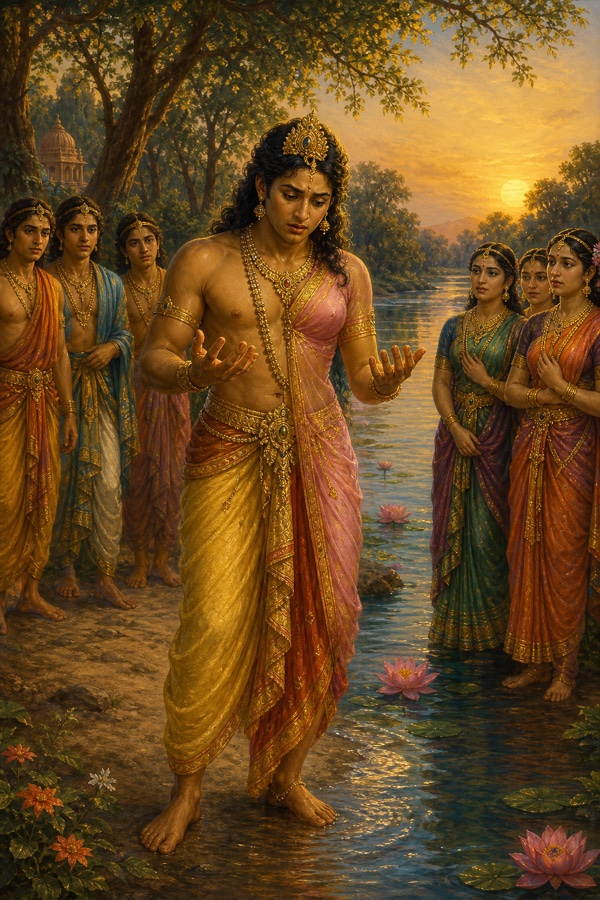
Yudhishthira asked which of the two, woman or man, gains the greater pleasure in union. Bhishma told the old example of the dialogue between Bhangashvana and Indra. A righteous royal sage named Bhangashvana was childless, and so, desiring children, he performed the sacrifice called Agnishtut, in which Agni alone is worshipped and which is displeasing to Indra. Indra began to watch for the royal sage’s lapse, so that he might punish him, but for all his care he found no lapse.
One day the king went hunting. Indra, seizing the chance, bewildered his senses. Lost, tormented by hunger and thirst, the king wandered and came to a lovely lake of clear water. Having watered his horse and tied it to a tree, the king went down into the lake to bathe, and by the power of the water was changed into a woman. Seeing this, the king was filled with shame and thought, how shall I mount the horse now, how return to the capital, what shall I say to my hundred sons, my queens, and my people. With great effort she mounted the horse and returned to the capital in a woman’s form. Telling everyone the whole matter, she called her sons and ministers and said, rule the kingdom in happiness; I go to the forest.
In the forest, reaching the hermitage of an ascetic, the king in woman’s form bore a hundred sons by that ascetic. Taking all those boys, she came to her earlier sons and said, these are my sons born in a man’s form and these born in a woman’s form; live together like full brothers and enjoy the kingdom. At her word, all the brothers ruled together in harmony.
Seeing this unity, Indra grew angry that by making the king a woman he had done him good. Taking a brahmin’s form, Indra came to the capital and sowed discord among the princes, saying that even the children of one father do not live in peace, that gods and demons, though children of the one Kashyapa, fought over the rule of the three worlds, and that they were the separate children of a royal sage and an ascetic. By this division the brothers fell to war and killed one another.
Hearing this, Bhangashvana in the form of the ascetic woman began to wail with grief. Indra came again in a brahmin’s form and asked the cause of the sorrow. The king told the whole story, that she had first been a king, become a woman, and that the hundred sons of each form had fought and died by the power of Time. Then Indra spoke harshly, saying that in the past she had performed the Agnishtut sacrifice and given him pain, and though present had not honored him; that he was the very Indra with whom she had knowingly made enmity. The royal sage laid her head at Indra’s feet and begged forgiveness, saying that the sacrifice had been done out of desire for children, not to harm him.
Indra, pleased, began to grant a boon and asked which of her sons she would have brought back to life, those born in a woman’s form or those born in a man’s form. The king folded her hands and said, Vasava, let those I bore in a woman’s form live. Astonished, Indra asked why less love for the sons of the man’s form. The king said that a woman’s love is far greater than a man’s, and for this she wished the sons of the woman’s form. Pleased, Indra said, let all the sons live, and ask one more boon; choose a woman’s form or a man’s. The king said, I wish to remain a woman. Indra asked the reason, and the answer came that in union a woman gains far more pleasure than a man, and for this she wished to remain a woman and was content in this state. Indra said, so be it, and took his leave. Bhishma said, so it is proved that in the matter you asked, a woman gains greater pleasure than a man.
A key to reading this (the idea): The Agnishtut is a sacrifice in which Agni alone is worshipped and Indra neglected, and for this Indra holds it displeasing. This tale is among the passages of the Mahabharata that think directly about gender, love, and pleasure without flattening them.
The gist: Bhangashvana, having known both, is himself the witness that a woman’s love and pleasure in union are greater than a man’s, and he chose the woman’s form.
The deeds of body, speech, and mind to be renounced
Yudhishthira asked how a man should conduct himself so as to pass happily through both this world and the next. Bhishma said that a man should renounce ten paths of action, three of the body, four of speech, and three of the mind.
The three deeds of the body to be renounced are taking the life of others, stealing or seizing the property of others, and going to another’s wife. The four deeds of speech to be renounced are wicked or idle talk, harsh words, publishing the faults of others, and falsehood. The three deeds of the mind to be renounced are craving the property of others, wishing ill to others, and disbelief in the ordinances of the Veda. So a man must do no evil deed by speech, body, or mind. The fit fruit of good and evil deeds must surely be borne; nothing is more certain than this.
A key to reading this (the number): These are the “ten paths of action,” three of the body, four of speech, three of the mind. Seen in a modern light, this is a threefold restraint that cleanses body, speech, and mind, and its echo is found in many Indian traditions.
The gist: Avoiding the ten deeds of body, speech, and mind to be renounced is the road to happiness in this world and the next.
The episode of Uma and Maheshvara, and the vision of Upamanyu
Yudhishthira said, son of Ganga, you have heard all the names of Maheshvara; recite for us all the names of that self-born one called Isha and Shambhu, who is the form of the universe, the teacher of gods and demons, and the cause of the world’s rise and dissolution. Bhishma said, I am unable to describe the qualities of Mahadeva. He pervades all things, yet is nowhere seen. From Brahma down to the goblins, all worship him. He is beyond both nature and spirit, imperishable and the supreme Brahman, both the real and the unreal. By his power he stirred nature and spirit and made Brahma. Who is able to tell the qualities of that god of gods. Only Narayana, the bearer of the discus and mace, can fully understand Mahadeva.
Bhishma said that in the hermitage of Badari, doing hard austerity for a thousand years, this Madhava (Krishna) himself won the favor of that Rudra. In every age Krishna has satisfied Mahadeva with his devotion, and it is by Mahadeva’s favor that Vasudeva gained that quality of universal sweetness. While doing austerity at Badari out of desire for a son, Hari saw the greatness of Mahadeva with his own eyes. Therefore on this matter, and on the thousand names of Shiva, Vasudeva is the one fit to speak. Bhishma then prayed to Vasudeva himself to discourse on the greatness of Shiva, as long ago the sage Tandi, born of Brahma, had spoken the thousand names of Mahadeva in the world of Brahma.
Vasudeva said that even Indra, Brahma, and the great sages cannot fully understand the deeds of Mahadeva; how then can an ordinary man. Yet, he said, I will tell some of the qualities of that slayer of demons, the lord of all sacrifices and vows. Touching water and making himself pure, Vasudeva recounted how, for the sake of Samba, the son of Krishna, he had gained through yogic trance the rare sight of Mahadeva.
Vasudeva said that twelve years after Pradyumna killed the demon Shambara, his wife Jambavati, seeing the heroic sons of Rukmini, desired a son, and asked him for a son as heroic, beautiful, and faultless as Charudeshna, Sucharu, Pradyumna, and the others born of Rukmini. He said that it was by a vow of twelve years and by the worship of Mahadeva that he had gained Rukmini’s sons, and so he asked leave. Jambavati blessed him and sent him off, praying that Brahma, Shiva, Kashyapa, the rivers, the sages, Earth, ocean, the planets, the seasons, and all the parts of Time protect him. Taking leave of his father, mother, the king, and Ahuka, and blessed by Gada and Balarama, he thought of Garuda, who carried him to the Himalaya.
On the Himalaya he saw the most lovely austere hermitage of Upamanyu of the line of Vyaghrapada. That hermitage was full of trees of many kinds of fruit and flower, of deer, peacocks, lions, tigers, and snakes, where, forgetting enmity, the mongoose played with the snake and the tiger with the deer as friends, by the power of those ascetics’ austerity. There the clear water of the Ganga flowed. Many ascetics lived there, some living on air, some on water, some on smoke, some on milk, some absorbed in muttered prayer, some in yogic trance, some clothed in rags, some in bark, some in deerskin.
There he saw Upamanyu, matted-haired, dressed in rags, blazing like fire with austerity, and yet looking young. When he bowed his head, Upamanyu said, lotus-eyed one, you are welcome; today by your coming our austerity has borne fruit. You are fit to be worshipped by us, and yet you worship us. He asked after the welfare of the creatures of the hermitage, of dharma, and of the pupils. Upamanyu said, Krishna, you will surely gain a son like yourself. Do hard austerity and win the favor of Ishana, the lord of creatures. That divine lord sports here with his wife Uma. Here the gods, by austerity, chastity, truth, and restraint, won the favor of that god of gods and gained many high desires.
Upamanyu told many examples of Mahadeva’s greatness: Hiranyakashipu, having gained from Mahadeva the strength of all the gods, enjoyed it for millions of years; his son Mandara, having gained a boon, warred with Indra for a million years, on whom neither the discus of Vishnu nor the thunderbolt of Indra had any effect; Vidyutprabha gained the rule of the three worlds; Shatamukha the power of creation; Brahma a thousand sons; the Valakhilyas the boon of making the bird (Garuda) who would seize nectar. Yajnavalkya, Vyasa, Shakalya, Savarni, and Narada too gained fame by worshipping Mahadeva. Upamanyu told his own story, how in childhood, unable to get milk and comforted by his mother, he took refuge in Mahadeva, and for a thousand celestial years did fierce austerity, sometimes on one foot, sometimes living on fruit, sometimes on leaves, water, and air.
Upamanyu recounted that to test him Mahadeva took the form of Indra and, mounted on a white elephant, appeared with all the gods and asked him to seek a boon. But Upamanyu answered that he wished no boon from any god, not even Indra; he wished a boon from Mahadeva alone. Whether by Mahadeva’s command he became a worm or a tree, or was born in a chandala family, so long as he stayed at Hara’s feet, that was his supreme desire. Without devotion to Mahadeva he would not accept the seat of Indra or even the world of Brahma, not even liberation; he wished only to be Hara’s servant.
Then Indra asked what proof he could give of the existence of that supreme lord, the cause of all causes. Upamanyu answered that he sought a boon from that same Shiva whom the knowers of Brahman call the real and the unreal, the manifest and the unmanifest, the one and the many, without beginning, middle, or end, of the form of knowledge and power, unthinkable and the supreme self; who is born of no seed, yet is the seed of all; who is the maker of fire, water, air, earth, space, mind, and the great principle. Even Brahma gains his sovereignty by worshipping Mahadeva. In Mahadeva are the marks of both woman and man, for he is the one cause of creation. His mother had told him that Shiva is the one cause of the world, that there is none greater than Isha. In the world all female beings are marked by Uma and all male beings by Shiva, and so the whole creation is Maheshvara’s. Brahma’s mark is the lotus, Vishnu’s the discus, Indra’s the thunderbolt, but the creatures of the world bear none of these, only the marks of Mahadeva and his wife.
Saying this, Upamanyu told Indra to go if he wished or stay if he wished, but that he sought only a boon or a curse from Mahadeva, and would accept no other god. Then in an instant that white elephant became a white bull like a swan, whose horns were hard as diamond and colored like gold. On the back of that bull he saw Mahadeva seated with his wife Uma. Mahadeva shone like the full moon, and by his splendor it was as though a thousand suns had risen, and for some moments no direction was clear to him. Then, when the illusion lifted, he saw the blue-throated, eighteen-armed Mahadeva, robed and garlanded and anointed in white, a half-moon on his brow, with three sun-like eyes, and Parvati beside him. Near him stood his weapons in embodied form, the serpent-bow named Pinaka, the peerless and terrible arrow named Pashupata that had burned Tripura to ash in an instant, and the trident by which the demon Lavana had been slain at the hands of Mandhata.
On Mahadeva’s left, on a swan-chariot, sat Brahma, and on Garuda, Narayana bearing conch, discus, and mace. Near Uma, on a peacock, was Skanda (Kartikeya), and before Mahadeva stood Nandi bearing a trident. Munis such as Manu, sages such as Bhrigu, and gods such as Indra came there; all the ghosts and goblins and the mothers of the gods surrounded Mahadeva and bowed. Brahma praised him with the Rathantara saman, Narayana with the Jyeshtha saman, and Indra with the Shatarudriya. Among those three Mahadeva shone like the sun risen from the clouds of autumn.
Then Upamanyu himself praised Mahadeva, bowing to him as the refuge of all, saluting him as Indra and the form of Indra, bearer of thunderbolt and Pinaka, bearer of conch and trident, of all colors white, black, red, and tawny, half man and half woman, borne by a bull, served by the ganas, three-eyed with sun, moon, and fire, the half-woman lord, the form of both Sankhya and Yoga, breaker of one of Brahma’s heads, slayer of Mahisha, burner of Tripura, wrecker of Daksha’s sacrifice, burner of Kama, Meru among mountains, Vasishtha among sages, the sun among planets, the lion and the bull among beasts, the saman among the samans, and Sanatkumara among yogins, saluting him by many names and many forms.
A key to reading this (the idea): This episode of Uma and Maheshvara is the prelude to the thousand names of Shiva, which Vasudeva (Krishna) tells through his own experience gained from Upamanyu. In it Shiva is called the root cause of creation in his half-man, half-woman form, female beings marked by Uma and male beings by Shiva. Note that here “Sudarshana” is the name of Vishnu’s discus granted by Shiva, an episode distinct from the earlier royal sage Sudarshana.
The gist: Krishna himself, out of desire for a son, gains the vision of Mahadeva at Upamanyu’s hermitage. Upamanyu’s single-minded devotion to Shiva establishes that Mahadeva is the cause of all causes and, in his half-woman form, the root of creation.
The vision of Mahadeva in Upamanyu’s words, and the eight boons Krishna gained
Vasudeva Krishna, seated in that assembly, was telling Yudhishthira and the sages the tale he had himself heard from the great sage Upamanyu. Upamanyu had told him how, by the power of austerity, he had seen with his own eyes that god of gods, Mahadeva. Upamanyu had praised Mahadeva by a thousand names, and in those names were gathered the black, the white, the red, the tawny, the half-woman lord whose body is half man and half woman, the bearer of the bow named Pinaka, the bearer of the trident, the lord of the ganas, and the form of Time, the destroyer of all.
The boon Upamanyu had asked of Mahadeva was this, that his devotion remain unshaken, that he have the knowledge of past, present, and future, and that in his hermitage there always be food mixed with milk. Mahadeva set him beyond old age and death, and said that when one kalpa, one cycle of creation of measureless years, had passed, he would gain his presence. Saying this, that Ishana, brilliant as ten million suns, vanished there.
Hearing this account of Upamanyu, a longing to see Mahadeva woke in Krishna’s mind too. He asked Upamanyu whether he too would see Shankara. Upamanyu looked with his divine sight and said that in the sixth month Krishna would see Mahadeva and Uma, and would gain twenty-four boons from them. Then Upamanyu gave Krishna certain mantras and completed his initiation, his formal entry into a discipline.
Krishna went on, “I took initiation from Upamanyu’s hands, had my head shaved, took blades of kusha, a sacred grass, in my hand, wore ragged garments, and smeared my body with ghee. For one month living only on fruit, in the second drinking only water, and in the third, fourth, and fifth months living only on air, standing on one foot with arms raised and without sleep, I did austerity. Then I saw in the sky a radiance like a thousand suns. In the middle of that radiance was a cloud like a blue mountain, on which were rows of cranes, a rainbow, and the flash of lightning. Within that cloud sat Mahadeva with his wife Uma.”
Krishna described that vision. “On his head was a crown, in his hand a trident, on his body a tiger-skin, on his head matted locks, in one hand a renunciate’s staff, and the Pinaka and the thunderbolt too. His teeth were sharp, in place of the sacred thread was a serpent, and on his chest a many-colored garland hung to his feet. All around him were the hosts of ghosts and goblins, and eleven hundred Rudras stood praising him. The Adityas, Vasus, Sadhyas, Vishvedevas, the Ashvins, Indra, Upendra, and Brahma himself were present, singing the Rathantara saman, a Vedic hymn.”
Krishna praised Mahadeva in these words: “You are goodness, passion, and darkness; you are truth. You are Brahma, Rudra, Varuna, Agni, and Manu. These three worlds have risen from you. Desire, anger, fear, greed, pride, delusion, and envy, and pain and disease, all these are your children. You are the unmanifest, you are the wind, you are the thousand-rayed sun. The sages worship you as the knower of the field, the self that knows this body-field. Your hands and feet reach everywhere, your eyes, heads, and faces are on all sides.”
At the end of the praise the whole universe roared its assent to Krishna’s words like a lion’s roar. Then Shankara, looking toward Uma and Indra, said to Krishna, “Krishna, we know that you hold supreme devotion toward us. Ask eight boons, however hard to gain, and we shall surely give them.”
A key to reading this (kalpa and Rathantara): A kalpa is a whole cycle of creation and dissolution, held to equal billions of human years. The Rathantara is an ancient saman-song, a hymn sung to a tune of the Samaveda, chanted in sacrifice and worship of the gods.
Krishna, bowing his head in joy, asked eight boons: “Firmness in dharma, the slaying of enemies in battle, supreme fame, supreme strength, devotion in yoga, your presence, and hundreds of children.” Shankara said “So be it” and repeated the very words. Then Uma, the mother of the whole universe, said that Mahadeva had given Krishna a son named Samba, and that she too would give eight boons. Krishna asked of her freedom from anger toward brahmins, the favor of father and mother, a hundred sons, supreme enjoyment, love for his family, the gaining of peace, and skill in every task.
Uma said, “So be it. We never speak falsely. You shall have sixteen thousand wives, and the love between them and you shall be boundless. Your body shall be supremely beautiful, and in your house seven thousand guests shall eat each day.” Saying this, the god and goddess vanished there with their hosts. All this Krishna told Upamanyu, and Upamanyu said, “There is no god like Sarva, no refuge, none who gives so many and such high boons, and none like him in battle.”
The gist: After the tale heard from Upamanyu, Krishna himself by hard austerity gained the vision of Mahadeva and Uma, and won sixteen boons apiece from them, chief among them the son Samba, sixteen thousand wives, and firmness in dharma. This is the first proof of Mahadeva’s greatness that Bhishma is relating to Yudhishthira.
The tale of Tandi and the origin of the thousand names of Mahadeva
Upamanyu told Krishna one more ancient account. He said, “In the Krita age, the first and most righteous of the four ages, there was a sage named Tandi. By the power of yogic meditation he worshipped Mahadeva for ten thousand years. At last he had the vision of Mahadeva, and praised him with many words of praise.”
Tandi said in his praise of Mahadeva, “You are the purest of the pure and the refuge of all. You are the keenest fire of all fires and the hardest austerity of all austerities. Brahma, Indra of the hundred sacrifices, Vishnu, the Vishvedevas, and the great sages cannot understand your true form, so how can such as we. From you alone all flows, and on you alone all rests. You are called Time, you are called the Person, you are called Brahman. The sages who know the Puranas say that you have three bodies, the three forms of Brahma, Vishnu, and Rudra.”
Tandi said further, “You are the supreme Person, the self within, the self in all beings, the self among the gods, and the self within the sacrifice. The wise who recognize you as seated within themselves are freed of all bonds and reach a state beyond all sorrow. You are the gate of heaven and of liberation. You give birth to all creatures and again gather them into yourself. You are Brahma, Bhava, Vishnu, Skanda, Indra, Savitri, Yama, Varuna, Soma, Dhatri, Manu, Vidhatri, and Kubera the lord of wealth. You are earth, wind, water, fire, space, speech, understanding, and truth; you are also the unreal; you are both the real and the unreal.”
Tandi said that whoever knows you enjoys immortality. Brahman is hidden in the cave of the heart, which even the ascetics do not easily see. He said, “In ancient times Brahma praised you by the name Nilalohita, the blue and the red, and asked you to create creatures. The knowers of the Rig praise you with its verses, the Adhvaryus with the Yajus, the knowers of the saman with the saman, and the knowers of the Atharvan call you Rita, Satya, and Brahman.”
A key to reading this (the terms adhibhuta and the rest): Adhyatma means the principle within oneself, adhibhuta the principle pervading all material things, adhidaivata the principle seated in the gods, and adhiyajna the principle seated in the sacrifice. These are the division-terms of the Gita, which show one supreme being from different points of view.
Tandi said at last that the Vedas, the shastras, and the Puranas name five supreme goals, and that men reach them by your favor alone, or fail to reach them where favor is absent. Tandi sang that same praise of Brahman that in ancient times the creator Brahma himself had sung in honor of Mahadeva.
Upamanyu said, “Pleased by this praise, Mahadeva told Tandi that he would be imperishable and everlasting, that he would gain spiritual knowledge, and that his son would be a maker of sutras. Tandi asked only this boon, that his devotion remain unshaken.” Then Upamanyu told him that Brahma had spoken ten thousand names of Mahadeva, and of these a thousand names come down in the scriptures. These names, by Brahma’s favor, came to Tandi, and Tandi gave them to Upamanyu.
The gist: The sage Tandi did austerity for ten thousand years, won Mahadeva, and pleased him with the praise of Brahman. This is the second proof of Mahadeva’s greatness, and from this tale the origin of the thousand-name hymn is established, which follows next.
The thousand names of Shiva: a hymn of one thousand and eight names
Upamanyu, fixing his mind and folding his hands, began to tell in brief, from the beginning, those names of Mahadeva. He said, “I worship that Mahadeva who is worthy of the worship of all creatures. These names are the very ones drawn as the essence from the ten thousand names spoken by Brahma, as ghee is drawn from curds, as gold from the mountain, and as honey from flowers. This sin-destroying hymn is as meritorious as the four Vedas. It should be given only to one who is a devotee of Mahadeva and has faith. Whoever hates Mahadeva goes to hell with his forefathers and his offspring.”
Upamanyu spoke the names beginning with Om. Mahadeva is unmoving, steady, powerful, terrible, foremost, giver of boons, and the highest. He is the self of all creatures, the maker of all, and is called Bhava. On his head are matted locks, he wears a beast-skin, and the whole universe is his body. He is Hara, the destroyer of all, and is the form of both engagement in action and withdrawal from action. He dwells in cremation grounds, lives in the heart of every creature, and sometimes hides his true form in the guise of a madman.
Upamanyu said further that Mahadeva is the moon, the sun, Saturn, Rahu, Ketu, Mars, Jupiter, Venus, and Mercury, all of these. He is the maker of the year, for it is he who, taking the form of the sun and the planets, turns the wheel of Time. He has ten arms, his eyes are unblinking, always watching, and his throat is blue because he held in it the poison that came from the churning of the ocean, which would otherwise have destroyed the whole world. He is the husband of Uma.
A key to reading this (Nilakantha): The gods and demons together churned the ocean of milk, and before the nectar came the halahala poison, which could have burned the three worlds. Mahadeva drank that poison and held it in his throat, which turned his throat blue. For this he is called Nilakantha, the blue-throated.
Upamanyu said that Mahadeva bears the pitcher, the bow, the arrow, the skull-cup, the thunderbolt, the Shataghni that slays a hundred, the sword, the axe, and the trident. He is a celibate who has never swerved from restraint. On his head are three matted locks, he wears rags, and he is called Rudra for his fierceness. He is the destroyer of the demon who came in the form of a mad elephant to wreck his holy city Varanasi. He is Time, that Time which destroys all. He is the yogin who transcends even Time and deceives it.
Upamanyu said that Mahadeva is that Vamana, the dwarf, who by a trick took from the demon-king Bali the rule of the three worlds and gave it back to Indra. He is the perfected yogin such as Sanatkumara, the great sage such as Vasishtha, and the renunciate such as Yajnavalkya. He is the monkey Hanuman who, in the age of Rama, helped Vishnu against Ravana. He is Vyasa, the maker of the Puranas, and he is the Mahabharata and the other histories.
A sub-tale: Among these names comes a hint that Mahadeva consoled a brahmin who, insulted by a rich vaishya, was ready to take his own life. Then Mahadeva himself took the form of a jackal and, teaching the brahmin the emptiness of the world, kept him from self-slaughter. This is one small example of his compassion, hidden in a single name of the thousand.
Upamanyu said that Mahadeva is both the real, the cause, and the unreal, the effect. He is father, mother, and grandfather. He is the gate of heaven, for he is the form of austerity; he is the gate of the birth of creatures, for he is the form of desire; and he is the gate of liberation, for he is the form of the absence of desire, which is the one road to dissolving into Brahman. He is the maker, the refuge, and the teacher of both gods and demons, for he stands as both Brihaspati and Shukra. He is in the form of the divine sages such as Narada.
Upamanyu finished this hymn by speaking the names of Mahadeva in the order of their importance. He said, “The devotee who praises that supremely gracious god with these auspicious names finds his own self. This hymn is the supreme means of gaining Brahman. Whoever reads it for a whole year with a pure heart, holding the vow of chastity and his senses in check, gains the fruit of the horse-sacrifice, the great sacrifice in which a horse is offered. No demon, yaksha, rakshasa, goblin, or serpent can do him any harm.”
Upamanyu also told the lineage of this hymn, that it first rested in the heart of Brahma. Brahma gave it to Shakra (Indra), Shakra to Death, Death to the Rudras, and from the Rudras Tandi received it. Tandi gave it to Shukra, Shukra to Gautama, Gautama to Vaivasvata Manu, Manu to Narayana, Narayana to Yama, Yama to Nachiketa, Nachiketa to Markandeya, and from Markandeya Krishna received it.
The gist: The thousand names of Shiva are in truth a hymn of one thousand and eight names, in which Mahadeva is called the doer of creation, preservation, and dissolution, the root of all gods and demons, and the gate of all three, heaven, birth, and liberation. This hymn gives merit equal to the horse-sacrifice, and its lineage runs from Brahma down through Markandeya to Krishna.
The witness of the sages: many examples of Mahadeva’s grace
When Vasudeva fell silent, Dvaipayana Vyasa said to Yudhishthira, “Son, you too recite these one thousand and eight names of Mahadeva, and may Maheshvara be pleased with you. In ancient times I did fierce austerity on Mount Meru out of desire for a son, and read this very hymn. By its fruit all my desires were fulfilled.” After this, the many sages seated in that assembly told their own experiences one by one, and the proof of Mahadeva’s grace grew deeper.
The sage Kapila, founder of the Sankhya philosophy, said, “For many births I worshipped Bhava, and in the end, pleased, he gave me the knowledge that carries one across rebirth.” A sage named Charushirsha, son of Alamban, said, “I did austerity on Mount Gokarna for a hundred years, and Sarva gave me a hundred sons without the touch of a woman, knowers of dharma and free of disease and grief.”
Then Valmiki said to Yudhishthira, “Once, in some dispute, certain ascetics declared me guilty of brahmin-slaying, and that sin fell on me at once. For cleansing I took refuge in Ishana, and I was freed of all sins. That destroyer of Tripura told me that my fame in the world would be great.”
Parashurama, the son of Jamadagni, who in that assembly shone with a splendor like the sun’s, said, “The sin of the slaying of my brothers, who were learned brahmins, had fallen on me. I praised Mahadeva by his names, and, pleased, he gave me an axe and many divine weapons, and said that I would be free of sin, unconquered in battle, and that even death could not defeat me.”
Vishvamitra said, “I was first a kshatriya. I worshipped Bhava out of desire for brahmin-hood, and by his favor I gained that rare state.” The sage Asita-Devala said that by the curse of Shakra all his merit had been destroyed, but that Mahadeva restored that merit, his fame, and long life.
A sub-tale: The sage Gritsamada told his story. At a thousand-year sacrifice of Shakra he was singing the saman. Then a sage named Varishtha rebuked him, saying he was not reciting the Rathantara rightly. In anger Varishtha cursed him to become a witless deer and suffer for ten thousand eight hundred years in a waterless forest. Gritsamada at once became a deer. He took refuge in Maheshvara, and Mahadeva freed him of all ills and granted him immortality, freedom from grief, and unbroken friendship with Indra.
Then Vasudeva spoke again, “The golden-eyed Mahadeva was pleased with my austerity. He said that I would be dearer to all creatures than wealth, that I would be unconquered in battle, and that my energy would be like fire. In a past birth I worshipped Mahadeva on Mount Manimanth for millions of years, and even then I asked only that my devotion remain unshaken.”
Jaigishavya said, “Yudhishthira, first, in the city of Varanasi, Mahadeva sought me out and granted me the eight qualities of lordship.” Garga said that he performed a mental sacrifice on the bank of the Sarasvati, and Mahadeva gave him the science of Time that has sixty-four branches, and a thousand sons learned in the Veda, and a life of millions of years.
Parashara said, “I pleased Sarva and asked for a son who would be a great ascetic, would arrange the Vedas, and would found the line of the Kurus. Mahadeva said I would have a son named Krishna, who would arrange the Vedas, become the maker of the ancient histories, and be counted among the seven sages.” This is that very Vyasa, who was present in the assembly.
A key to reading this (Mandavya and Dharma): The sage Mandavya, though no thief, was impaled on a stake on suspicion of theft. Mahadeva freed him from the stake, gave him a life of millions of years, and said that his body was born of the fourth foot of dharma, that is, truth. This shows that in the Mahabharata even the innocent sometimes suffer unjust punishment, and only then does divine grace lift them.
Mandavya told this very story. And Galava said that, having gained learning from his teacher Vishvamitra, he was returning home, but his widowed mother wept and said his father would never see him again. In despair Galava worshipped Maheshvara, and Mahadeva said that his father, his mother, and he himself would all be free of death. Galava reached home and saw his father coming out after finishing the daily sacrifice. With tearful eyes his father lifted him up and embraced him.
Hearing all these wondrous tales, Yudhishthira was filled with wonder. Then Krishna repeated the words of Upamanyu again, “Those sinners stained by unrighteousness, whose nature is defiled by passion and darkness, cannot reach Ishana. Only the pure of heart gain that supreme god. If Rudra is pleased with a man, he can give him the seat of Brahma, Keshava, or Indra, or even the rule of the three worlds. Men who worship Bhava even in the mind alone are freed of all sins and dwell in heaven with the gods.”
Krishna said that whoever, pure and restrained, reads this hymn for one month gains the fruit of the horse-sacrifice. A brahmin gains all the Vedas by it, a kshatriya victory, a vaishya wealth and skill, and a shudra happiness here and a good destiny in the world to come.
The gist: Kapila, Charushirsha, Valmiki, Parashurama, Vishvamitra, Asita-Devala, Gritsamada, Jaigishavya, Garga, Parashara, Mandavya, and Galava, all these sages gave the proof of Mahadeva’s grace from their own experience. These tales are meant to turn Yudhishthira toward the worship of Mahadeva, and among them come knotted matters like Parashurama’s guilt of brahmin-slaying, without flattening.
Ashtavakra and Disha: the meaning of “shared dharma” in marriage
Now begins the part of the Anushasana Parva in which Bhishma, from the bed of arrows, explains to Yudhishthira the subtle rules of dharma. Yudhishthira asked, “Best of the Bharatas, what is the root of that saying at a marriage, that husband and wife shall practice all their duties together? Is it only an arrangement of the sages, or an ordinance for begetting children in a spirit of dharma, or does it point only to pleasure? Great doubt is in my mind. Shared dharma ends with death. In a couple one dies before the other, so where does the other stand? The sages have called women, above all, fickle by nature. In such a case how is shared dharma possible? This matter seems beyond me. Explain it to me in full, according to the shruti.”
Bhishma said, “On this matter is told the old tale of the dialogue of Ashtavakra and the goddess Disha. In ancient times the austere Ashtavakra, wishing to marry, went to the great sage Vadanya to ask for his daughter’s hand. That daughter was named Suprabha, and in beauty she had no equal on earth. Her virtues, her dignity, her conduct, and her courtesy surpassed all other maidens. One glance of her lovely eyes stole Ashtavakra’s heart, as the blossoming grove of spring steals the heart of the beholder.”
Vadanya said to Ashtavakra, “Yes, I will give you my daughter. But first make a journey to the north. There you will see many things.” Ashtavakra asked what he would see there. Vadanya told him that he would cross the realm of Kubera the lord of wealth and pass over the Himavat mountain, then reach a plateau that is the dwelling of Rudra, where siddhas, charanas, goblins, and the dancing hosts of Mahadeva live. Then in a blue forest, lovely as a cloud, he would meet an old ascetic woman beautiful as Shri, set in her discipline. Only after worshipping her with respect and returning should he take the girl’s hand.
Ashtavakra accepted the word and set out for the north. He reached the Himavat mountain, bathed in the holy river Vahuda, offered water-libations to the gods, and passed the night on a bed of kusha. In the morning he bathed again, kindled the fire of oblation, worshipped Rudra and Uma by the rule, and went on. He saw a shining gate of gold, and Kubera’s lakes named Mandakini and Nalini.
There the rakshasas led by Manibhadra, who guard the lakes, came forward to welcome Ashtavakra. The sage asked them to carry word of his coming to Kubera. The rakshasas said that Kubera himself was coming, for he knew the purpose of the sage’s journey. Kubera took Ashtavakra’s hand and led him into his palace, honored him with a seat and water for his feet, and said, let the dance of the apsaras begin.
Ashtavakra in a sweet voice gave leave for the dance. Then Urvara, Mishrakeshi, Rambha, Urvashi, Alambusha, Ghritachi, Chitra, Chitrangada, and many apsaras began to dance, and the gandharvas played their instruments. In that excellent music and dance Ashtavakra passed, without knowing, a whole celestial year in Kubera’s palace. Then Kubera said that a little more than a year had passed, and that this music called gandharva steals both the heart and the sense of time. Ashtavakra with a glad mind asked leave, and went on to the north.
A key to reading this (a celestial year): A “celestial year” means a year of the gods, held to be far larger than the years of men. Ashtavakra’s spending a celestial year in music and dance shows how the sense of time is lost in art and pleasure, which is also a hint of the test to come.
Crossing Kailasa and Mandara and the golden peaks, Ashtavakra reached that excellent region where Mahadeva dwelt in the guise of a humble ascetic. With a fixed mind and bowed head he circled that place three times and counted himself blessed. Then going on to the north he saw a delightful forest, with fruit and flower of every season and the songs of thousands of birds.
There Ashtavakra saw a wondrous palace inlaid with gold and gems, finer even than Kubera’s. Around it were mountains of jewels, the river Mandakini full of mandara flowers, and self-shining gems. In that palace many sages lived. Reaching the door, the sage said that a guest had come, seeking shelter.
Then seven maidens came out of the palace, each lovely in a different fashion and utterly charming. On whichever maiden the sage’s gaze fell, she stole his heart. For all his best effort he could not keep his mind in check, and his heart grew restless. Then with great understanding he made a strong effort and at last held himself steady. The maidens asked the sage to come in.
Within, Ashtavakra saw a woman with the marks of old age, robed in white and adorned with every ornament. The sage gave her his blessing, and the old woman in turn wished him well and gave him a seat. Ashtavakra said that all the maidens should go to their rooms, and only the one who was wise and calm of heart should remain. Then all the maidens circled the sage and went, and only the old woman remained.
As night deepened, the sage asked the old woman to lie down to sleep. The old woman lay on an excellent bed, but soon rose, and on the pretext of shivering with cold, came toward the sage’s bed. She spread her arms and gave the sage a soft embrace. But seeing the sage still as wood, she grew sad and said that women take pleasure only from a man, and that, in the grip of desire, she wanted the sage.
Ashtavakra answered, “Noble lady, I never go to another’s wife. The knowers of scripture condemn union with another’s wife. I am wholly a stranger to pleasure. Know that I sought marriage only out of desire for children. I swear it by truth. Only through offspring gained in dharma will I reach those worlds of happiness that are not gained without it. Know dharma, and knowing it, cease from your effort.”
A key to reading this (the episode of the test): This passage is morally complex. The woman speaks in the language of desire and presses the fickleness of woman’s nature, as the scriptures of that age say. But Ashtavakra repeats the principle of keeping away from another’s wife and marrying only for the sake of children. The dialogue is a test of the meaning of “shared dharma” in marriage, not a flat sermon. The complexity of the source is kept as it is.
The woman pressed again and again, saying that even the gods of wind, fire, and water are not as dear to women as the god of desire, and that among thousands of women scarcely one is faithful. But Ashtavakra was not moved. The sage thought within himself, “Surely this woman is the presiding goddess of this palace. Has some curse made her ugly? It is not fitting to learn the reason in haste.” Thinking thus, he stayed anxious through that day, and when evening came he asked for water to bathe.
On the second day the old woman brought oil and bathing-cloths, rubbed fragrant oil on the sage’s body, and bathed him with her soft hands. In her gentle hands and the warm water the sage did not notice that a whole night had passed. Rising from the bath, the sage saw the sun risen in the east and was amazed. He worshipped the thousand-rayed sun. The old woman made food so delicious, like nectar, that the sage could not take much, and in that little the day passed.
At night the old woman came again to the sage’s bed. Ashtavakra said, “Noble lady, my mind is turned away from union with another’s wife. Leave my bed, and cease of your own accord.” The woman said, “I am my own mistress. There is no sin for you in accepting me.” Ashtavakra answered, “Women can never be their own mistresses. The creator himself holds that a woman is not fit to be independent.”
The woman pleaded many times that she was tormented by desire and that the sage should not spurn her devotion. But Ashtavakra held firm, “Many faults drag down the man who follows his own will. I can hold my urges in check by restraint. Return to your own bed.” Then the woman bowed her head and said that if the sage saw sin in union with another’s wife, then she offered her own hand to him in marriage, for she was in the vow of chastity from her maidenhood and was still a maiden.
Ashtavakra said, “As your liking for me is, so is mine for you. But this question must be settled, whether by it I go against the wish of the sage Vadanya. This is a great wonder. Here is a maiden adorned with ornaments, exceedingly beautiful; why then, for so long, did old age cover her beauty? Now she looks a lovely maiden. What form she will take next is not known. I will never swerve, by my restraint, from desire and other cravings, nor from the contentment I have in what is given me. I will hold to truth.”
The gist: At Vadanya’s command Ashtavakra journeys to the north, spends a celestial year in dance and music at Kubera’s, and then in a mysterious palace resists with restraint the repeated appeals of desire from an old woman. He holds firm to the principle of keeping away from another’s wife and marrying only for children, even as a doubt rises in him about the woman’s changing form.
The secret of Disha is revealed, and Ashtavakra’s marriage
Yudhishthira asked, “Why did the woman not fear Ashtavakra’s curse, though he was a man of great splendor? And how did Ashtavakra return from there?” Bhishma said that Ashtavakra asked the woman, “How do you change your form so? Do not speak anything false. Before a brahmin speak only the truth.”
The woman said, “Best of brahmins, in heaven or on earth, this desire for union between man and woman is seen everywhere. I myself devised this test, sinless one, to prove you fully. You did not give up your earlier resolve, and by this you have conquered all the worlds. Know that I am the form of the north, Disha. You saw the fickleness of woman’s nature, that even an old woman is tormented by the desire for union. All the gods, with Brahma and Indra, are pleased with you.”
Disha said further, “Best of sages, the father of your bride, Vadanya, sent you to me so that I might teach you, and by his wish I have taught you. You will return safe, and your journey back will not be hard. The maiden you choose will be your wife and will give you a son. I pleaded with you, driven by desire, and you gave me the finest of answers. To cross the desire for union in the three worlds is not easy. Go home to your own place.”
Hearing these words, Ashtavakra folded his hands and asked leave to depart, and, having leave, returned to his hermitage. After resting a while, and with the leave of his kinsmen and friends, he went to Vadanya by the rule. Vadanya asked after his welfare, and Ashtavakra with a glad heart told the whole journey. He said that he had gone to the Gandhamadana mountain, and to its north had met a supreme goddess, who had honored him and, naming Vadanya, had instructed him in many matters.
Vadanya said, “By the rule and the fit constellations, take the hand of my daughter. I could not choose a better groom for this girl than you.” Ashtavakra said, “So be it,” and took the girl’s hand, and, making that lovely maiden his wife, lived in his hermitage free of every mental torment.
The gist: The old woman was in truth the presiding goddess of the north, whom Vadanya had sent to test and teach Ashtavakra. Ashtavakra passed the test, and returning, married Suprabha and lived happily. The heart of this tale is that the desire for union in marriage cannot be wholly denied, but becomes dharma only within restraint and truth.
The worthy receiver of a gift: which brahmin to give to
Yudhishthira asked, “Those brahmins who keep the rules firmly, whom do they call a worthy receiver of a gift? Is he worthy who bears the marks of his order, or he who does not?” Bhishma said, “King, it is said that a gift should be given to the brahmin who keeps the duties of his order, whether he bears the marks of a celibate or not, since both are without fault.”
Yudhishthira asked what fault attaches to an unclean man who gives ghee or food to a brahmin with great devotion. Bhishma said, “Even one who is exceedingly unrestrained is surely made pure by devotion. Such a man is made pure in every act, not only in giving.”
Yudhishthira said that it is held that in a rite connected with the gods the brahmin appointed need not be examined, but in a rite connected with the ancestors the brahmin appointed must be examined. Bhishma answered, “Rites connected with the gods do not bear fruit because of the brahmin; they bear fruit by the favor of the gods themselves. Those who sacrifice gain the merit of that rite by the favor of the gods. This the sage Markandeya said in ancient times.”
A key to reading this (fit and worthy receiver): A “receiver” means one worthy of a gift. Here Bhishma explains that in rites for the gods the examination of the receiver is not needed, since the fruit comes by the favor of the gods, but in the shraddha, the rite for the ancestors, the conduct and worth of the receiver must be examined. This is a basic distinction of the law of giving.
Yudhishthira asked which five, that is, the guest, the learned man, the marriage-relation, the ascetic, and the one who performs sacrifice, are counted worthy receivers. Bhishma said, “The first three, guest, relation, and ascetic, are worthy when they have these qualities: purity of family, devotion to dharma, learning, compassion, humility, honesty, and truthfulness. The other two, the learned man and the sacrificer, are worthy when they have five of these: purity of family, compassion, humility, honesty, and truthfulness.”
Then Bhishma told the views of four great powers, the goddess Earth, the sage Kashyapa, the god Agni, and the sage Markandeya. Earth said, “As a clod of clay dissolves the moment it falls into the ocean, so every sin dissolves in these three high acts: to be a priest at a sacrifice, to teach, and to receive gifts.”
Kashyapa said, “The Vedas with their six limbs, the Sankhya philosophy, the Puranas, and birth in a high family, even these cannot protect a brahmin if he falls from good conduct.” Agni said, “The brahmin who, having studied, counts himself learned and wishes to destroy the standing of others by his learning, falls from dharma and is held cut off from truth. Such a man of destructive mind never gains worlds of happiness in the next world.”
Markandeya said, “If a thousand horse-sacrifices and truth were weighed in a balance, I do not know whether those thousand sacrifices would weigh even half of truth.” Saying this, all four, Earth, Kashyapa, Agni, and the axe-bearing son of Bhrigu, at once departed.
A sub-tale: Bhishma sets these four views as the dialogue of an ancient assembly, where Earth, Kashyapa, Agni, and Markandeya (here also called the son of Bhrigu) gathered and each spoke his aphorism on giving, good conduct, the misuse of learning, and the greatness of truth, and then vanished at once. This is an example of the Mahabharata’s manner of stringing four independent maxims on a single story-frame.
Yudhishthira asked whether, if a celibate brahmin in this world asks for the food offered in a shraddha, that shraddha is still counted proper. Bhishma said, “If a brahmin who has kept the vow of chastity for twelve years and gained mastery of the Vedas himself asks for and eats the food of a shraddha, he is held to have fallen from his vow. But the shraddha is in no way defiled.”
Yudhishthira asked, since the wise have named many ends and many gates of dharma, what are the settled conclusions in this matter. Bhishma said, “King, doing no harm to others, truth, absence of anger, that is, forgiveness, compassion, self-restraint, and honesty or guilelessness, these are the marks of dharma. There are people who praise the dharma that walks the earth but do not act by their own teaching, and secretly stay set on sin. Whoever gives such men gold, gems, or horses must sink in hell for ten years.”
Yudhishthira asked what is higher than chastity, what is the supreme mark of virtue, and what is the supreme purity. Bhishma said, “Son, the giving up of honey and meat is higher than chastity. Dharma lies in staying within bounds, that is, in restraint, and the supreme mark of dharma is renunciation, which is also the supreme purity.”
Yudhishthira asked at what times dharma, wealth, and pleasure should be pursued. Bhishma said, “In the first part of life one should earn wealth, then pursue dharma, then enjoy pleasure. But one should be attached to none of them. One should honor brahmins, serve teachers and elders, hold compassion toward all creatures, and keep a gentle nature and sweet speech.”
Bhishma said further, “To speak falsely in a court of justice, to deal deceitfully with a king, and to cheat teachers and elders are as heavy as brahmin-slaying. One must never do violence to the body of a king, nor ever strike a cow. These two are as grave as the killing of an embryo. One must never abandon one’s sacred fire, nor give up the study of the Veda, nor attack any brahmin in word or deed. All these are equal to brahmin-slaying.”
A key to reading this (the greatness of the cow): Here Bhishma calls the striking of a cow a sin equal to the killing of an embryo, an early hint of the greatness of the cow that recurs through the Anushasana Parva. The cow is held here as unslayable as the body of a king, a theme that will widen in the chapters to come.
Yudhishthira asked at last which brahmins are to be held the best, and to which brahmins a gift brings great merit. Bhishma said, “Brahmins who are free of anger, set on the works of dharma, firm in truth, and keeping restraint are held the best. A gift to them brings great merit. Those who are free of pride, able to bear everything, firm in their aim, masters of their senses, set on the good of all creatures, and friendly to all, a gift to them brings great merit.”
Bhishma said further, “Brahmins who are free of greed, pure in heart and conduct, endowed with learning and humility, truthful, and keeping the duties laid down in scripture, a gift to them brings great merit. The sages have called that brahmin a worthy receiver who studies the four Vedas with their six limbs and is set on the six acts laid down in scripture. Whoever gives to such a worthy brahmin multiplies his merit a thousandfold. One righteous, learned, Veda-knowing brahmin alone is able to save a whole line.”
Bhishma said that to such a worthy brahmin one should give cows, horses, wealth, food, and other things, and that by this great happiness comes in the next world. “As I have said, one such brahmin is able to save the whole line of the giver. What then to say of the merit of giving to many such worthy brahmins? Therefore in giving one should always choose the receiver. Hearing of a worthy brahmin, though he live far off, one should invite him, welcome him on his coming, and honor him by every means.”

The gist: Bhishma explains the subtle rules of the law of giving, that in a rite for the gods the receiver need not be examined but in a shraddha he must be, that by devotion both giver and receiver are made pure, and that only the anger-free, restrained, Veda-knowing, and virtuous brahmin is the best receiver, able to save a whole line. And by calling cow-slaying and brahmin-slaying supreme sins, the thread of the cow’s greatness in the Anushasana Parva begins.
Who is the worthy brahmin, and the dharma of giving
From the bed of arrows Yudhishthira asked Bhishma what becomes of a brahmin who, having kept the vow of chastity, the vow of restraint and Veda-study, for twelve years and gained skill in the Vedas and their limbs, then himself begs and eats the food offered in a shraddha, the rite of food-giving for the dead ancestors. Bhishma said that such a man is held to have fallen from his vow, but that the shraddha itself is in no way defiled.
Yudhishthira said that the wise have named many ends and many gates of dharma, so what are the settled conclusions in this matter. Bhishma said that non-harming, truth, absence of anger, that is forgiveness, compassion, self-restraint, and honesty are the marks of dharma. Some men walk the earth praising dharma, yet do not walk by what they teach and stay secretly set on sin. Whoever gives such pretenders gold, gems, or horses must fall into hell and stay there ten years. The fools who give the food of a shraddha to a brahmin still in the vow of chastity go to worlds of great sorrow.
Yudhishthira asked what is higher than chastity, what is the supreme mark of virtue, and what is the supreme purity. Bhishma answered that, son, the giving up of honey and meat is higher than chastity. Dharma lies in staying within bounds, that is, in self-restraint, and the supreme mark of dharma is renunciation, which is also the supreme purity.
Then Yudhishthira asked at what time dharma should be practiced, at what time wealth earned, and at what time pleasure enjoyed. Bhishma said that in the first part of life one should earn wealth, then earn dharma, then enjoy pleasure. But one should be attached to none of them. A man should honor brahmins, worship his teacher and elders, hold compassion for all creatures, and keep a gentle nature and sweet speech. To speak falsely in a court, to deal deceitfully with a king, to act falsely toward teachers and elders, these are counted sins equal to brahmin-slaying. One must never do violence to the body of a king, and never strike a cow; both are equal to the killing of an embryo. One must never abandon one’s fire of oblation, never give up the study of the Veda, and never attack any brahmin in word or deed; all these are equal to brahmin-slaying.
Yudhishthira asked what kind of brahmins are to be held excellent, to which a gift brings great merit, and which should be fed. Bhishma said that brahmins free of anger, set on the works of dharma, firm in truth, and self-restrained are held excellent, and a gift to them brings great merit. Those free of pride, able to bear all things, firm in their aim, masters of their senses, set on the good of all creatures, and friendly to all, a gift to them brings great merit. Those free of greed, pure in heart and conduct, endowed with learning and humility, truthful, and keeping the deeds laid down in scripture, a gift to them brings great merit. The sages have said that whoever studies the four Vedas with their limbs and is set on the six famous acts, study, teaching, sacrificing, aiding sacrifice, giving, and receiving, is a worthy receiver of a gift.
Bhishma said that whoever gives to a worthy brahmin multiplies his merit a thousandfold. One righteous brahmin endowed with knowledge and Veda-learning, keeping the deeds laid down in scripture, distinguished by pure conduct, is able to save a whole line. To such a virtuous brahmin one should give cows, horses, wealth, food, and other things, and by this comes great happiness in the next world. When one such brahmin can save the whole line of the giver, what to say of the merit of giving to many such brahmins. Therefore in giving one should always choose the receiver. Hearing of a worthy brahmin, though he live far off, one should invite him, welcome him on his coming, and honor him with all one’s power.
A key to reading this (the terms): Shraddha is the rite of offering food and water for dead ancestors, the pitris. Chastity here means the vow of restraint and Veda-study, of twelve years. Embryo-killing is the killing of the child in the womb, held the most grievous of sins. The six acts are the six deeds laid down for a brahmin: study, teaching, sacrificing, aiding sacrifice, giving, and receiving.
The gist: Bhishma sets the root rule of the law of giving, that one should give with an eye to the receiver. A gift to a pretender leads to hell, and one true Veda-devoted brahmin can save a whole line. The marks of dharma are non-harming, truth, forgiveness, compassion, restraint, and honesty, and above all these is renunciation.
The rule of the shraddha, the share of the rakshasas, and who is fit or unfit to be invited
Yudhishthira asked what rules are laid down for the rites connected with the gods and the ancestors on the occasion of a shraddha. Bhishma said that, having made oneself pure by bathing and doing auspicious acts, a man should do all the rites connected with the gods in the forenoon, and all the rites connected with the ancestors in the afternoon. What is given to men should be given at midday with love and honor. A gift made at the wrong time is seized by the rakshasas.
Bhishma described in detail the food and gifts that become the share of the rakshasas. Things that someone has stepped over, licked, or sucked, that are not given with a calm mind, that a woman impure by her season has looked upon, do not bring merit and become the share of the rakshasas. What is given after being announced before many people, of which a shudra has eaten a part, or that a dog has seen or licked, is the share of the rakshasas. Food in which hairs are mixed, or worms, on which spittle or drool has fallen, that a dog has stared at, in which tears have fallen, or that has been trodden by the foot, know it to be the share of the rakshasas. What is eaten by one unable to utter the Om, or by an armed man or a wicked one, is the share of the rakshasas. What another has already eaten from, or is eaten without giving a share to gods, guests, and children, is seized by the rakshasas. The food of a shraddha in which the mantras were not read, or read wrongly, or where the rule of scripture was not kept, also becomes the share of the rakshasas. Food shared out to guests without first offering into the fire to gods or ancestors, or of which a wicked or unrighteous man has eaten a part, know it to be the share of the rakshasas.
Bhishma said that now he would tell which brahmin is unfit for a gift and should not be invited to a shraddha. Those cast out of caste for grievous sins, the foolish or mad, those afflicted with white leprosy, the impotent, those with leprosy, consumption, or epilepsy, and the blind, are not fit to be invited. Those who practice medicine as a trade, who take regular pay for the worship of images set up by the rich or live by serving the gods, who keep vows out of pride or false ends, and who sell soma, are not fit to be invited. Those who by profession are singers, dancers, actors, players of instruments, reciters of holy books, warriors, or wrestlers are not fit to be invited. Those who offer into the fire for shudras, who are teachers of shudras, or servants of shudra masters, are not fit. He who takes wages for serving a teacher, or who listens to a teacher’s lectures out of greed for an allowance, is not fit, for both are counted sellers of Veda-learning. He who is set at the very outset upon the food of a shraddha, and he who has married a shudra woman, though endowed with all learning, is not fit.
Bhishma said further that those without their household fire, those who tend corpses, thieves, or those otherwise fallen, are not fit. Those whose forefathers are unknown or low, and those who are the sons of an appointed daughter, are not fit to be invited to a shraddha. He who lends money or lives on interest, or lives by selling living creatures, is not fit. Those who are ruled by women, who live as the lovers of low-born women, or who do not perform the twilight prayers of morning and evening, are not fit to be invited to a shraddha.
A sub-tale: After the long list of faults Bhishma pauses to state the exceptions, since the dharma of the Mahabharata is never one-sided. He says that in spite of the faults counted above, there are certain virtues whose presence still lets a man be a giver or receiver in a shraddha, and so, even within a hard rule, he keeps the door of compassion open.
Bhishma gave the exceptions. Brahmins who keep the rites laid down in scripture, who are virtuous, who know the Gayatri, or who keep the ordinary duties of a brahmin, may be invited to a shraddha even if they have taken up farming for a living. If a brahmin is of good family, he is fit to be invited even if he takes up the trade of arms and fights for others. But whoever takes to trade for a living should be left out, however virtuous. He who offers into the fire daily, keeps a fixed dwelling, is no thief, and honors guests who come to his house, is fit to be invited. He who recites the Savitri at morning, noon, and evening, or lives on alms and does the deeds laid down for his order, is fit. He who is rich in the morning and poor by afternoon, or poor in the morning and rich by evening, who is free of malice or stained by only a small fault, is fit. He who is free of pride and sin, does not fall into dry disputes, and lives by begging from house to house, is fit to be invited to a sacrifice.
Bhishma added this subtle point too, that one who does not keep vows, is used to falsehood, is a thief, or lives by the sale or trade of living creatures, still becomes fit for a shraddha if he first offers everything to the gods and only then drinks soma. He who has earned wealth by cruel or evil means but afterward turns it to the worship of the gods and the honor of guests becomes fit. But wealth earned by selling Veda-learning, wealth earned by a woman, or wealth gained by base means such as false witness should never be given to brahmins nor used in the offering to ancestors. A brahmin who, at the end of a shraddha done with his help, refuses to say “astu svadha,” takes on the sin of false oath in a suit over land.
Bhishma named the fit time for a shraddha, when a worthy brahmin, curds, ghee, the holy day of the new moon, and the meat of wild animals such as deer are available. At the end of a shraddha performed by a brahmin one should say the word “svadha.” When performed by a kshatriya one should say, “may your ancestors be satisfied.” When performed by a vaishya one should say, “may everything become inexhaustible.” When performed by a shudra one should say the word “svasti.” For a brahmin the declaration of “punyaha” should be with the utterance of Om, for a kshatriya without Om, and in the rites of a vaishya, in place of Om, one should say “may the gods be satisfied.”
Bhishma said further that the sacraments called the birth-rites are needful for the three twice-born orders, and should be done with mantras for brahmin, kshatriya, and vaishya. The girdle of a brahmin should be of munja grass, that of the royal order of a bowstring, and that of a vaishya of valvaja grass; so it is said in scripture. Bhishma told the merits and faults of giver and receiver too, that a brahmin who speaks falsely becomes fallen from duty and a sinner, a kshatriya four times as much, and a vaishya eight times as much. A brahmin who, having been invited by one brahmin, goes and eats at another’s, becomes debased and takes on the sin of slaying an animal outside the times of sacrifice. Invited by one of the royal or vaishya order and then eating elsewhere, he takes on half that sin. A brahmin who, at the rites for gods or ancestors performed by brahmins, kshatriyas, or vaishyas, eats without bathing, takes on the sin of lying for a cow. He who, unclean by a birth or a death, still eats at such a rite out of greed, takes on the same sin. He who lives by begging wealth on a false pretext such as pilgrimage, or asks a giver for wealth on the pretext of spending it on religious works, takes on the sin of lying. A man of the three high orders who, at a shraddha, shares food with mantras among brahmins who do not read the Veda, do not keep vows, or are not pure in conduct, surely takes on sin.
A key to reading this (the terms): The share of the rakshasas means that when a food-gift is defiled by a fault, its fruit is taken not by the gods or ancestors but by the unseen order of rakshasas, that is, it goes in vain. The son of an appointed daughter is a daughter kept in the place of a son so that her son continues her father’s line. Svadha is the auspicious word said at the offering to ancestors. Punyaha is the auspicious declaration “may this day be holy.” Savitri is the Gayatri mantra. The girdle is worn at the initiation, of a different grass for each order.
The gist: Bhishma set the fine points of the shraddha, that rites for the gods are done in the forenoon and rites for the ancestors in the afternoon. Defiled gifts become the share of the rakshasas. After a long list of the unfit he opens the exceptions too, showing that the rule is hard but not merciless. Even the closing words of a shraddha and the girdle differ for each order.
To whom giving brings supreme merit, and the deeds that lead to hell and to heaven
Yudhishthira asked to whom a gift brings the greatest fruit of the things offered to gods and ancestors. Bhishma said, feed those brahmins whose wives wait for the food left in their husbands’ plates with the same faith with which farmers wait for the timely rain. Those of pure conduct, who have grown weak by keeping away from all luxuries and even from a full meal, who are set on vows that thin the body and come to a giver out of desire for a gift, a gift to them brings great merit. Those who hold conduct itself to be their food, their wife and child, their strength, and the means of crossing this world into happiness in the next, and who ask for wealth only when wealth is utterly needed, a gift to them brings great merit. Those who have lost everything to thieves or tyrants and come to a giver, who ask for food from some poor kinsman of their own order who has just come by something, who have lost all and even their wives in a general calamity, a gift to them brings great merit. Those under vows, who by their own will live under hard rules and ask for wealth to meet the cost of finishing a vow, who stay far from the ways of sinners and are utterly poor, who have been plundered by the strong but are wholly innocent, and who wish somehow to fill their bellies, a gift to them brings great merit. Those who beg for the sake of other ascetics and are content with a little, a gift to them brings great merit.
Then Bhishma counted the deeds that lead to hell. Those who speak falsely on occasions other than for a teacher’s sake or to grant safety to one in fear of his life fall into hell. Those who rape or lie with the wives of others or help in such wickedness fall into hell. Those who plunder or destroy the wealth of others, or publish the faults of others, fall into hell. Those who break the water-troughs that quench the thirst of beasts, harm public assembly-halls, break bridges, and pull down dwelling-houses fall into hell. Those who cheat helpless women, maidens, the old, or frightened women fall into hell. Those who destroy the livelihood of others, waste settlements, seize wives, sow discord among friends, and break the hopes of others fall into hell. Those who have no faith in the Vedas, who break their own promise or make others break theirs, and who fall from their station by sin fall into hell. Those who take unbearable interest and take unfair profit in trade, who gamble, sin without shame, and kill living creatures fall into hell.
Bhishma said further that those who cause servants to be dismissed by their masters while they wait for a reward, a fixed payment, wages, or the return of past service fall into hell. Those who eat without giving a share to their own wife, their fire, their servants, or their guests, and who turn away from the rites of ancestors and gods, fall into hell. Those who sell the Vedas, find fault with the Vedas, and those who write down the Vedas all fall into hell. Those who are outside the four orders of life, do deeds forbidden by shruti and shastra, and live by sinful deeds or by deeds outside their birth-order fall into hell. Those who live by selling hair, poison, or milk fall into hell. Those who block the way of brahmins, cows, and maidens fall into hell. Those who sell weapons, forge them, make arrows or bows, and those who block roads with stones, thorns, and pits fall into hell. Those who abandon without offense their teachers, servants, and faithful followers fall into hell. Those who yoke bullocks to work before their proper age, pierce their noses, and keep them always tied fall into hell. Kings who take the sixth part of the produce of their people by force and yet do not protect them, and those who, though able, do not give, fall into hell. Those who abandon the forbearing, restrained, and wise, or lifelong companions, when they are of no more use, and those who eat without giving a share to children, the old, and servants fall into hell.
Then Bhishma told the deeds that lead to heaven. Whoever obstructs the rites of a brahmin for the gods and so offends against him is stricken with the ruin of all his offspring and cattle, and those who cause no such obstruction go to heaven. Those who keep the duties laid down in scripture and practice the virtues of giving, restraint, and truth go to heaven. Those who gain knowledge by serving a teacher and doing hard austerity, and then turn away from receiving gifts, go to heaven. Those by whom others are freed from the pains of fear, sin, obstacles, poverty, and disease go to heaven. Those who are forbearing, patient, set on the works of dharma, and of auspicious conduct go to heaven. Those who keep away from honey, meat, the wives of others, and liquor go to heaven. Those who build hermitages for ascetics, found families, open new lands for settling, and found cities go to heaven. Those who give clothes, ornaments, food, and water, and help in the marriages of others, go to heaven. Those who keep away from harming any creature, are able to bear all things, and have become the refuge of all creatures go to heaven. Those who serve father and mother with humility, conquer their senses, and love their brothers go to heaven. Those who, though rich, strong, and young, hold their senses in check go to heaven. Those who are kind even to offenders, gentle of nature, and humbly serve everyone go to heaven. Those who protect thousands, give to thousands, and lift thousands out of calamity go to heaven. Those who give gold, cows, vehicles, and animals, who give the things needed for marriages, manservants and maidservants and clothes, who build public rest-houses, gardens, wells, assembly-halls, tanks that quench the thirst of beasts and men, and fields go to heaven. Those who give houses, fields, and settled villages to those who beg, who give sweet juices, seeds, and grain of their own making, and who, born high or low, live long, gaining hundreds of children, and keep compassion while wholly holding down anger go to heaven.
A key to reading this (the idea): This double list of Bhishma is the essence of the law of dharma, on the one side the deeds that cast a man into hell, on the other those that lift him to heaven. The fault of “writing down the Vedas” is counted because the Vedas were originally shruti, that is, learning held in memory and passed by mouth from teacher to pupil. The king’s taking “the sixth part of the produce” was the royal tax of that age, in return for which the protection of the people was a binding duty.
The gist: Bhishma turned the list of worthy receivers toward compassion, that to give to the plundered, the vow-bound, and those content with little is supreme merit. Then he laid open the roads to hell and to heaven, where digging wells and giving a guest his share lead to heaven, and getting a servant dismissed or piercing a bullock’s nose lead to hell.
Brahmin-slaying even without killing a brahmin
Yudhishthira asked in what circumstances a man becomes guilty of brahmin-slaying without killing any brahmin. Bhishma said that once he himself had asked Vyasa this very question, and now he would tell the answer. Going to Vyasa, Bhishma had said, great ascetic, you are the fourth in descent from Vasishtha; explain this to me. Then Vyasa, the son of Parashara, skilled in the science of conduct, gave an excellent and settled answer.
Vyasa said, know that man to be guilty of brahmin-slaying who, of his own will, calls a righteous brahmin to his house to give him alms and then, making the excuse that there is nothing in the house, gives nothing. Know that man to be guilty of brahmin-slaying who destroys the livelihood of a brahmin skilled in the Vedas and their limbs and free of worldly attachment. Know that man to be guilty of brahmin-slaying who obstructs thirsty cows while they are drinking water. Know that man to be guilty of brahmin-slaying who, without studying the shrutis handed down from teacher to pupil through the ages, finds fault with the shrutis or with the shastras made by the sages. Know that man to be guilty of brahmin-slaying who does not give his daughter, endowed with beauty and virtue, to a worthy groom. Know that foolish and sinful man to be guilty of brahmin-slaying who gives brahmins a sorrow that pierces to the depth of their hearts. Know that man to be guilty of brahmin-slaying who plunders the all of the blind, the lame, and the foolish. Know that man to be guilty of brahmin-slaying who sets fire to the hermitages of ascetics, to forests, to a village, or to a town.
The gist: Vyasa taught Bhishma that brahmin-slaying is not done by the sword alone. To call a man for a gift and then deny it, to break a brahmin’s livelihood, to stop a thirsty cow, to plunder the helpless, to find fault with scripture without study, all these are equal to that grievous sin.
The greatness of the holy fords, the teaching of Angira
Yudhishthira said that it is told that pilgrimage brings merit, that a bath in holy waters brings merit, and that even to hear of the greatness of such waters brings merit, so let the grandsire tell the holy fords of this earth. Bhishma said that this counting of the fords of the earth was made by Angira. Once the sage Gautama of hard vows went to the calm-souled great sage Angira, who lived in the forest, and asked what merit is gained in the next world by bathing in the holy waters of the earth. Then Angira told him this.
Angira said that whoever, along with fasting, bathes for seven days in the Chandrabhaga or the Vitasta, whose waves are always dancing, is freed of all sins and gains the merit of an ascetic. Whoever bathes in the many rivers that flow from Kashmir and meet the Sindhu gains good conduct and goes to heaven. Whoever bathes at Pushkara, Prabhasa, Naimisha, the sea, the Devika, Indramarga, and Svarnavindu goes to heaven on a divine chariot, honored by the apsaras. Whoever, with a fixed mind, dives at Hiranyavindu, then bathes at Kushesaya and Devendra, is freed of all sins. Near the Gandhamadana mountain, at Indratoya and at the Karatoya of the Kuranga country, whoever bathes with a pure body after three days of fasting gains the merit of the horse-sacrifice. Whoever bathes at Gangadvara, Kushavarta, the Bilvaka of the Nita mountains, and Kanakhala is freed of all sins and goes to heaven.
Angira said further that the celibate who, having conquered anger and practiced truth and compassion for all creatures, bathes in the pool of water called Jalaprada gains the merit of the horse-sacrifice. Where the Bhagirathi-Ganga flows toward the north, that place is called the meeting of heaven, earth, and the underworld; there, at the ford dear to Maheshvara, whoever bathes after a month’s fast becomes fit to see the gods. Whoever offers water-libations to the ancestors at Saptaganga, Triganga, and Indramarga is fed with nectar if he must be reborn. Whoever, keeping body and mind pure and doing the daily fire-offering, bathes at Mahashrama after a month’s fast gains perfection in a month. Whoever, after three days of fasting and purity of mind, bathes in the great pool of Bhrigukunda is freed even of the sin of brahmin-slaying. Whoever bathes at Kanyakupa and sips water at Valuka gains fame even among the gods. Whoever bathes at the Devika, the lake Sundarika, and the ford Ashvini gains a lovely form in the next birth. Whoever, after fifteen days of fasting, bathes at Mahaganga and Krittikangaraka is freed of all sins and goes to heaven. Whoever bathes at Vaimanika and Kinkinika gains the power to go anywhere at will and is honored in the world of the apsaras.
Angira counted more fords, that whoever, with the vow of chastity, bathes for three days at the Vipasha in the hermitage of Kalika crosses the bonds of rebirth. Whoever bathes in the hermitage of the Krittikas, offers water to the ancestors, and satisfies Mahadeva becomes pure and goes to heaven. Whoever, after three days of fasting, bathes at Mahapura is freed of the fear of all creatures moving and unmoving and of the two-footed. Whoever bathes in the Devadaru forest, offers water to the ancestors, and stays seven nights in purity goes to the world of the gods. Whoever bathes at the waterfalls of Sarastamba, Kushastambha, and Dronasharmapada gains service in the world of the apsaras. Whoever, fasting, bathes in the waters of Chitrakuta, Janasthana, and the Mandakini gains royal splendor. Whoever stays fifteen days at the hermitage of Shamya and bathes there gains the power of vanishing at will. Whoever, pure of heart, stays foodless for three days at the ford Kaushiki becomes fit in the next birth for the pleasant world of the gandharvas. Whoever stays foodless for a month at the ford Gandhataraka gains the power of vanishing at will and, after twenty-one days, ascent to heaven. Whoever bathes in the lake Matanga gains perfection in a single night.
Angira told the greatness of Prayaga in particular, that whoever bathes at Analamba, Sanatana, Andhaka, Naimisha, or the ford of heaven, and, conquering his senses, offers water to the ancestors, gains the merit of the human-sacrifice. Whoever, for a month, daily offers water to the ancestors at the ford Gangahrada and Utpalavana gains the merit of the horse-sacrifice. Whoever, for a month, daily offers water to the ancestors at the meeting of Ganga and Yamuna and at the ford of the Kalanjara mountain gains the merit of ten horse-sacrifices. Ten thousand fords and three crores of other fords come together at Prayaga in the month of Magha. Whoever, restrained and with a hard vow, bathes at Prayaga in Magha is freed of all sins and goes to heaven. Asmaprishtha, the Niravinda mountain, and Krauncapadi, these three are at Gaya, and bathing in them washes away the sin of one, two, and three brahmin-slayings in turn.
Angira told at last the greatness of Himavat, that the king of mountains is holy, the father-in-law of Shankara, the mine of all gems, and the refuge of siddhas and charanas. Whoever, knowing the Veda, holds this life to be fleeting, gives up food and water by the rule of scripture, bows to the gods and ascetics, and gives up his body on those mountains, gains perfection and goes to the eternal worlds of Brahman. Those fords that are hard to reach one should recall in the mind. This teaching should be told to brahmins and to good men. Angira told this to Gautama, and Angira himself had received it from Kashyapa. Whoever reads it daily is freed of all sins and goes to heaven, and whoever hears it is born in the next birth in a good family with the memory of past births.
A key to reading this (the places): Chandrabhaga, Vitasta, Vipasha are today’s Chenab, Jhelum, and Beas rivers. Prayaga is the meeting of Ganga and Yamuna, today Prayagraj. Gaya is the ford in Bihar famed for the shraddha of ancestors. Bhagirathi is the Ganga, which Bhagiratha brought to earth. Himavat is the Himalaya, father of Parvati, and so father-in-law of Shankara. Horse-sacrifice, human-sacrifice, pundarika are names of ancient great sacrifices, whose merit is compared to the bath at a holy ford.
The gist: This treasury of fords, given by Angira to Gautama, strings the holy rivers and lakes of the whole of Bharatavarsha on one garland, where each bath has its own fruit. At the summit stand Prayaga and Himavat, and the greatest lesson of all is that even to recall the hard-to-reach fords in the mind brings merit.
The coming of the sages, and the greatness of the Bhagirathi Ganga
Vaishampayana said that Bhishma, the son of Ganga, equal to Brihaspati in wisdom, to Brahma himself in forbearance, to Indra in valor, and to the sun in splendor, whom Arjuna had felled in battle, lay on that bed of arrows which heroes long for, waiting for the auspicious time to give up his body. Many great sages came to see him. Among them were Atri, Vasishtha, Bhrigu, Pulastya, Pulaha, and Kratu. There were Angira, Gautama, Agastya, Sumati, Vishvamitra, Sthulashira, Samvarta, Pramati, and Dama. There were Brihaspati, Ushana, Vyasa, Chyavana, Kashyapa, Dhruva, Durvasa, Jamadagni, Markandeya, and Galava. There were Bharadvaja, Raibhya, Yavakrita, and Trita. Sthulaksha, Savalaksha, Kanva, Medhatithi, Krisha, Narada, Parvata, Sudhanva, Ekata, and Dvita were there. Nitambhu, Bhuvana, Dhaumya, Satananda, Akritavrana, Rama the son of Jamadagni, and Kacha, all these great sages came to see Bhishma lying on the bed of arrows.
Yudhishthira with his brothers worshipped those great sages in order, by the rule. The sages sat and began to talk among themselves, and their talk was of Bhishma, sweet to all the senses. Hearing that talk about himself, Bhishma was filled with joy and felt as though he were in heaven itself. Then those sages, taking leave of Bhishma and the Pandavas, vanished before the eyes of all. The Pandavas bowed to them again and again even after they were gone. By the fire of those sages’ austerity the directions shone bright, and the Pandavas, filled with wonder, spoke of their greatness with Bhishma. When the talk was done, Yudhishthira laid his head at Bhishma’s feet and began his questions on dharma again.
Yudhishthira asked which countries, provinces, hermitages, mountains, and rivers are supreme in purity. Bhishma said that on this matter is told an old tale of the dialogue of a brahmin who kept the vow of shila and unchha, gleaning fallen grain, and a perfected sage. Once, wandering over this whole earth graced with mountains, that perfected sage came to the house of the shila-vowed householder brahmin. The brahmin welcomed him by the rule, and the guest passed the night in comfort. The next morning, having done his daily rites and made himself pure, the brahmin gladly went to the guest, discoursed with him on the Vedas and Upanishads, and at last asked the very question Yudhishthira asked Bhishma.
The perfected sage answered that those countries, provinces, hermitages, and mountains are supreme in purity through the midst of which, or near which, the Bhagirathi, best of rivers, flows. The fruit gained by austerity, chastity, sacrifice, or renunciation is gained by living on the bank of the Bhagirathi and bathing in her holy water alone. Those on whose bodies the holy water of the Bhagirathi has been sprinkled, or whose bones have been laid in her stream, never fall from heaven. A hundred sacrifices cannot give the merit that the restrained gain by bathing in the Ganga. As the darkness of night is wiped out by sunrise, so whoever bathes in the Ganga is washed of all sins and shines with splendor. The countries and directions that are without the water of the Ganga are like a moonless night or a treeless tree.
The perfected sage went on with his praise of the Ganga, that as nectar is dear to the gods, svadha to the ancestors, and sudha to the snakes, so is the water of the Ganga dear to men. As hungry children beg food of a mother, so those who seek the supreme good serve the Ganga. As the world of Brahma is highest of all worlds, so the Ganga is highest of all rivers. A man smeared with the sand of the Ganga’s bank feels himself adorned with a divine unguent, a dweller of heaven. When the wind, wet with the drops of the Ganga’s water, touches a man’s body, he is cleansed at once of all sins. By bearing the Ganga, by touching her, and by bathing in her, a man saves his forefathers seven generations up and his descendants seven generations down. By hearing the Ganga spoken of, by the desire to go to her, by drinking her water, by touching it, and by bathing in it, a man saves both his father’s line and his mother’s.
The perfected sage said that those who, though able of body, do not wish to see the holy Ganga are like the blind from birth, or the dead, or the crippled by palsy. When that holiest of streams fell from the sky, Maheshvara held it on his head, and that same stream is worshipped in heaven. The three worlds are graced by her three streams. As in heaven there is the sun’s ray for the gods, the moon for the ancestors, and the king for men, so is the Ganga for all rivers. In the loss of mother, father, son, wife, or wealth there is not the grief that there is in the loss of the Ganga. Whoever honors the Ganga becomes dear to her, if he worships her with unshaken faith, holding that in the world nothing else is worthy of such reverence, and fixing his whole mind on her.
The perfected sage said further that the fame of the Ganga has spread through the whole world, for she carried to heaven the sons of Sagara who had been burned to ash. The Ganga is held to be like Prishni, the mother of Vishnu; she is one with speech, giver of the six qualities such as lordship, and the supreme refuge of all creatures. The Ganga held in her womb Guha, the commander of the gods’ army (Kartikeya), and holds gold too in her womb. The Ganga is the daughter of Himavat, the wife of Hara, and the ornament of both heaven and earth. Falling from the sky, she was held on Shiva’s head. She came from the feet of Vishnu, most ancient and holy. Those who by austerity satisfied all the gods and the supreme lord Vishnu, that Bhagiratha might bring the Ganga to earth, taking refuge in them a man is freed of every fear here and in the world to come.
The perfected sage ended with humility, saying that he had spoken, to the measure of his understanding, only a small part of the Ganga’s qualities, and that he was unable to tell her full greatness. One might count the stones of Meru or the waters of the sea, but the qualities of the Ganga’s water cannot be counted. Hearing this, you too, with faith and devotion, honor her in mind, word, and deed, and you will gain fame in the three worlds. My prayer is that the most blessed Ganga forever fill your heart and mine with the qualities of dharma.
Bhishma said further that the perfected sage, having told the shila-vowed brahmin the endless greatness of the Ganga, rose into the sky. That brahmin, awakened by those words, worshipped the Ganga by the rule and reached the high perfection. Son of Kunti, you too take refuge in the Ganga with great devotion, and by her fruit you will gain the highest perfection. Vaishampayana said that hearing this praise of the Ganga, Yudhishthira and his brothers were filled with great joy, and whoever reads or hears this holy passage is freed of all sins.
A sub-tale: The saving of the sons of Sagara, which the sage mentioned, is the root tale of the descent of the Ganga. The sixty thousand sons of King Sagara were burned to ash by the wrath of the sage Kapila. Their descendant Bhagiratha, by hard austerity, brought the Ganga down from heaven to earth, whose torrent Shiva held in his matted hair, and by the touch of the Ganga’s water those forefathers were saved. From this the Ganga gained one of her names, Bhagirathi.
The gist: Bhishma tells the whole greatness of the Ganga through the mouth of a perfected sage, that to live on the Ganga’s bank alone gives the fruit of austerity, sacrifice, and renunciation, and that a single bath saves seven generations. The sage humbly grants that he could tell only a fragment of her endless greatness.
The dialogue of Matanga and the she-donkey, the rarity of brahmin-hood

Yudhishthira asked how a kshatriya, vaishya, or shudra can gain the state of a brahmin, whether by hard austerity, by works of dharma, or by knowledge of scripture. Bhishma said that the state of a brahmin is beyond the reach of these three orders. It is highest of all among creatures. Taking birth again and again in countless wombs, a man at last, in some birth, is born as a brahmin. On this matter there is an old tale of the dialogue of Matanga and a she-donkey.
Bhishma told that once a brahmin had a son who, though begotten by a man of another order, had his childhood and youth sanctified by the rites of the brahmins. That boy was called Matanga and was endowed with every virtue. His father, wishing to perform a sacrifice, ordered him to gather the needed materials. At his father’s command he set out riding a swift chariot yoked to a young donkey. The donkey yoked to that chariot was very young, and, not heeding the rein, it drew the chariot toward its mother, the she-donkey. Displeased at this, Matanga struck it again and again on the nose with the goad. Seeing the marks of the blows on her foal’s nose, the mother donkey, full of tenderness, spoke.
The she-donkey said, child, do not grieve at this treatment. He who drives you is a chandala. There is no such cruelty in a brahmin. A brahmin is called the friend, the teacher, and the protector of all creatures; how could he punish any creature so mercilessly? This one is an evildoer; he has no pity even on you, of such tender years. He only proves his own birth-order. The nature he has taken from his father does not let those feelings of compassion and gentleness rise that are natural to a brahmin.
Hearing these harsh words of the she-donkey, Matanga at once got down from the chariot and said, noble one, tell me, by what fault is my mother defiled, and how do you know that I am a chandala? Tell me without delay how my brahmin-hood was destroyed; tell me from beginning to end. The she-donkey said that a shudra who did the work of a barber, out of lust, begot him upon a brahmin woman, and so he was a chandala by birth, and had no brahmin-hood at all.
Hearing these words of the she-donkey, Matanga returned home. Seeing him come back, his father asked why, having been sent on the hard task of gathering the materials of sacrifice, he had returned without finishing it, and whether all was well. Matanga said, how can one be happy who has no fixed birth-order, or who is of a very low order? Father, how can one be happy whose mother is defiled? This she-donkey, who seems more than a mere beast, says that I was begotten by a shudra upon a brahmin woman. For this I shall now do fierce austerity. Saying this, he went into the great forest and began the hardest of austerities.
By the austerity he did to gain the state of a brahmin with ease, Matanga began to torment even the gods. Then Indra, the king of the gods, appeared and said, Matanga, why do you spend your time in this grief, giving up all human joys? I grant you a boon; ask it. Matanga said that he had begun this austerity out of desire to gain brahmin-hood, and would return home only after gaining it; that was the boon he asked. Indra said, Matanga, the brahmin-hood you seek is truly beyond your reach, since those born of an impure womb cannot gain it. Fool of mind, if you hold to this effort you will come to ruin. Cease at once from this fruitless striving. One born in a chandala womb can never gain that state held purest among gods, demons, and men.
A key to reading this (the idea): This tale ties order to birth, which represents the scriptural view of that age. The Mahabharata itself elsewhere (as in the dialogue of Yudhishthira and Nahusha) ties order to conduct as well, so this should be taken as one voice of the tradition, not the single final word. Chandala is the caste held lowest, of mixed birth. Goad is the pointed stick used to drive a beast.
The gist: From the mouth of the she-donkey Matanga learned the truth of his birth, that he was the child of a brahmin woman and a shudra. Wounded, he threw himself into austerity, but Indra came and said that brahmin-hood cannot be gained by austerity, that it comes only by birth.
Matanga’s unshaken austerity, and Indra’s teaching on the order of births
Bhishma said that, though Indra counseled him, Matanga did not listen, and stood on one foot for a hundred years. Indra appeared again and said, child, brahmin-hood is beyond reach; do not dare this, for by desire of it you will come to ruin; this is not the path of dharma for you. Indra told him the order of births, that from the state of a beast a man reaches humanity, and then a man may be born as a pukkasa or a chandala. Wandering long in that sinful womb, after a thousand years he gains the state of a shudra. In the shudra womb too he must wander long. After thirty thousand years he gains the state of a vaishya. Spending long there, after a time sixty times the shudra period, he gains the order of the kshatriya.
Indra said further that after spending long in the kshatriya womb, multiplying that last span by sixty, a man is born as a fallen brahmin. Wandering there too, multiplying that span by two hundred, he is born in a family of brahmins who take to the trade of arms. Spending long there, multiplying that by three hundred, he is born in a family of brahmins who recite the holy mantras such as the Gayatri. Wandering there too, multiplying that by four hundred, he is born in a family of brahmins who know all the Vedas and shastras. Even in that state, when he wanders, joy and sorrow, love and hate, pride and evil speech enter him and try to make him low. If he conquers these enemies he gains a high state, and if they conquer him he falls from that high place like a man falling from the top of a palm tree. Knowing this for certain, Matanga, ask some other boon, since brahmin-hood is beyond reach for you, born a chandala.
A key to reading this (the number): Indra’s order of births shows vast ages of the kalpa by multiplication, which, taken in spirit rather than as literal arithmetic, wakes the sense that upward movement comes through the gradual austerity of countless births. From pukkasa to shudra, then vaishya, kshatriya, fallen brahmin, and at last the fully Veda-knowing brahmin, how long this ladder is, is what the “sixty times, two hundred times” and the rest convey.
The gist: Indra showed Matanga the long ladder of births, that to reach brahmin-hood takes an order of countless births, and that even having reached it one can fall by love and hate. Still he asked Matanga to seek some other boon.
Matanga’s last plea and boon
Bhishma said that, for all Indra’s counsel, Matanga did not accept what was said. With a restrained vow and a pure soul he stood on one foot for a thousand years, sunk in yogic meditation. When a thousand years had passed, Indra came again and said the same thing. Matanga asked why, having spent a thousand years on one foot, in deep meditation, keeping the vow of chastity, he had still not gained brahmin-hood. Indra answered that one born a chandala can in no way gain brahmin-hood, and so let him ask some other boon, that all this labor might not go in vain.
Hearing this, Matanga was filled with grief. He went to Prayaga and stood there on the tips of his toes for a hundred years. By such unbearable yogic effort he grew utterly thin, his veins and arteries stood out, and he was left only skin and bone. It is said that at Gaya, exhausted by austerity, he fell to the ground. Indra, the well-wisher of creatures, the giver of boons, seeing him fall, came at once and held him up.
Indra said, Matanga, the brahmin-hood you seek is not fit for you and is beyond reach; for you it holds many dangers. By the worship of a brahmin a man gains happiness, and turning away from it, sorrow. The brahmin is the giver of what is dear to all creatures and the guardian of what they have. By the brahmins alone are the ancestors and the gods satisfied. Taking birth again and again in countless wombs, one gains brahmin-hood in some birth; the impure of soul never gain it; therefore let it go, and ask some other boon.
Matanga said in pain, Shakra, I am already grieved; why do you grieve me more, this is to strike a dead man. You say brahmin-hood is beyond the reach of the other three orders, yet even those who have gained it by nature do not always hold to it, for what sins do brahmins not commit? Those who, having gained so rare a brahmin-hood, do not keep it by keeping its duties, are the lowest of all in the world. I am content in myself, beyond the pairs of joy and sorrow, unattached to worldly things, keeping compassion for all creatures and self-restraint; why then am I not held fit for that state? How unlucky I am, to have come to this state by my mother’s fault, though my conduct is not unrighteous. Surely destiny can neither be turned aside nor conquered by personal effort, since with such unshaken effort I could not gain the thing on which I set my heart. In such a case, righteous one, if I am fit for your favor or a little merit, give me some other boon.
Indra said, ask a boon. Then Matanga asked that he gain the power to take any form at will and to move through the sky, that he enjoy whatever pleasure he wished, and that he receive the willing worship of both brahmins and kshatriyas. God, he said, bowing his head, do this too, that my fame endure forever in the world. Indra said that he would be famed as the deity of a certain meter and would receive the worship of all women, and that his fame would be peerless in the three worlds. Granting this boon, Indra vanished there. Matanga too gave up his life and reached a high state. Bharata, thus brahmin-hood is very high, and as Indra himself said, it is beyond reach here except by the natural road of birth.
The gist: Matanga did austerity for thousands of years, made his body a frame of bones, but Indra held firm that brahmin-hood is gained only by birth. Accepting the defeat of destiny, Matanga at last asked for the boon of shape-changing, sky-travel, and undying fame, and reached a high state.
The brahmin-hood of the royal sage Vitahavya
Yudhishthira said that he had heard this great tale, and that Bhishma had said brahmin-hood is very rare. Yet it is told that in ancient times Vishvamitra gained brahmin-hood, and King Vitahavya too. How did Vitahavya gain brahmin-hood, by a boon or by the power of austerity? Tell me. Bhishma related that when the great Manu ruled his people by dharma, he had a righteous son named Sharyati. In the line of Sharyati, the two sons of Vatsa became kings, Haihaya and Talajangha. Haihaya had ten wives, and by them a hundred war-loving sons, alike in beauty and valor, mighty and skilled in battle, all masters of the Veda and the science of arms.
Bhishma said that at Kashi the grandfather of Divodasa was a victorious king named Haryashva. The sons of Haihaya, famed by the name Vitahavya, attacked Kashi, and, coming into the country between the Ganga and the Yamuna, fought Haryashva and killed him, then returned fearless to the cities of their own Vatsa country. Haryashva’s son Sudeva took the throne of Kashi. He ruled for some time, and then the hundred sons of Vitahavya attacked again, defeated him, and returned. Then Sudeva’s son Divodasa became king of Kashi. Knowing the might of the sons of Vitahavya, Divodasa, by the command of Indra, rebuilt and strengthened Varanasi. His realm was full of brahmins, kshatriyas, vaishyas, and shudras, of goods of every kind and prosperous markets. That realm stretched from the northern bank of the Ganga to the southern bank of the Gomati, and was like a second Amaravati.
Bhishma said further that the Haihayas attacked Divodasa again. The mighty Divodasa came out of the city and joined battle. That battle was fierce as the war of gods and demons. Divodasa fought the enemy for a thousand days, but, losing many followers and beasts, was worn down. Seeing his army and treasury spent, he left the capital and fled, and, reaching the lovely hermitage of the wise Bharadvaja, folded his hands and took refuge in the sage. Bharadvaja, the eldest son of Brihaspati and the king’s priest, asked the reason for his coming, saying that he would gladly do him a kindness. The king said, revered one, the sons of Vitahavya have killed all the children and men of my line; only I am left; I take refuge in you; give me a son’s affection and protect me.
Bhishma said that Bharadvaja said, do not fear, do not fear, son of Sudeva; let your fear be gone. I will perform a sacrifice by which you will gain a son able to kill thousands of the host of Vitahavya. The sage did the sacrifice, and by its fruit Divodasa had a son named Pratardana. As soon as he was born he grew like a boy of thirteen, and soon became skilled in the whole Veda and the whole science of arms. Bharadvaja, by his yogic power, entered him and gathered all the energy of the universe into Pratardana’s body. Wearing bright armor and bearing a bow, Pratardana shone like the rising sun. Mounted on a chariot, a sword at his waist, whirling a shield, he came to his father. Seeing him, Divodasa was filled with joy and counted the enemy, the sons of Vitahavya, as good as dead. He made Pratardana crown prince and, holding his purpose fulfilled, was greatly happy.
Bhishma said that the old king ordered Pratardana to march on the sons of Vitahavya and kill them. The mighty Pratardana crossed the Ganga on his chariot and moved toward the city of the Vitahavyas. Hearing the rumble of his chariot, the sons of Vitahavya came out of the city on their chariots, which were like forts, and, armored and armed, fell upon Pratardana with a rain of arrows. They poured weapons on him like clouds pouring rain on Himavat. Pratardana made their weapons idle with his own and struck them all down with arrow-shafts sharp as Indra’s thunderbolt. Cut by hundreds of broad arrows, their heads, red with blood, fell like kimshuka trees cut by axes.
Bhishma said that when all his warriors and sons had fallen in battle, King Vitahavya left the capital and fled to the hermitage of Bhrigu and asked for refuge. Bhrigu granted him safety. Pratardana, following Vitahavya, reached the hermitage and said in a loud voice, disciples of Bhrigu who are present, I wish to see the sage; inform him. Learning that Pratardana had come, Bhrigu himself came out and honored the king by the rule, then asked the purpose. The king said, brahmin, King Vitahavya has come here; hand him over to me. His sons destroyed my line and laid waste the realm and wealth of Kashi. I have killed his hundred sons; now, by killing him, I will pay the debt to my father.
Bhishma said that Bhrigu, full of compassion and righteousness, answered that in this hermitage there is no kshatriya; all who are here are brahmins. Hearing these true words of Bhrigu, Pratardana softly touched the sage’s feet and said with gladness, revered one, by this I am fulfilled, for by my valor this king has been freed from his very birth-order. Give me leave and pray for my welfare, for, founder of that line, by my strength this king has been cast out of his birth-community. Taking leave of Bhrigu, Pratardana, like a snake that returns having spat out its venom, went back to the place from which he had come.
Bhishma said that meanwhile King Vitahavya, by the words of Bhrigu alone, gained the rank of a brahmin sage, and by that gained mastery of all the Vedas too. Vitahavya had a son named Gritsamada, who was a second Indra in form. Once the demons, taking him for Indra, gave him much pain. In the verses there is a shruti about that high-souled sage, that whoever has Gritsamada with him is honored among all brahmins. Gritsamada was a brahmin sage firm in chastity.
Bhishma told the line of descent, that Gritsamada’s son was Suteja, his Varchas, Varchas’s Vihavya, Vihavya’s Vitatya, Vitatya’s Satya, Satya’s Shanta, Shanta’s the sage Shravas, Shravas’s Tama, Tama’s the excellent brahmin named Prakasha. Prakasha’s son was Vagindra, foremost among those who mutter silent mantras, and his son Pramati, master of all the branches of the Veda. Pramati had a son named Ruru by the apsara Ghritachi. Ruru had a son named the brahmin sage Shunaka by his wife Pramadvara. Shunaka’s son was Shaunaka. Thus, best of kings, King Vitahavya, though born a kshatriya, gained brahmin-hood by the favor of Bhrigu, and I have told you the line of Gritsamada too.
A key to reading this (the lineage and places): Haihaya is the kshatriya house of the line of Sharyati, whose king was called Vitahavya. Kashi is Varanasi, the capital of Haryashva, Sudeva, and Divodasa. Bharadvaja is the son of Brihaspati, priest of Divodasa, who by a sacrifice gave him Pratardana. Bhrigu is the sage by whose word alone the kshatriya Vitahavya became a brahmin sage. Kimshuka is the red-flowered palasha tree, to which the severed heads are likened.
A sub-tale: Note that in the Matanga tale Indra says brahmin-hood is beyond reach without birth, and immediately after, in the Vitahavya tale, a kshatriya becomes a brahmin sage by a single sentence of Bhrigu. The Mahabharata sets this contradiction side by side on purpose, as though to say that the rule is hard yet the grace of a sage and austerity can also cross it. Yudhishthira had raised this very tension with his question.
The gist: The line of Divodasa of Kashi was laid waste for generations by the sons of the Haihaya king Vitahavya. Then Pratardana, born of Bharadvaja’s sacrifice, killed those hundred sons. Bhrigu gave refuge to the fleeing Vitahavya and, by his word alone, made him a brahmin sage, so that even Pratardana’s feud was ended.
The dialogue of Narada and Vasudeva, who is to be worshipped
Yudhishthira asked which men in the three worlds are worthy of reverent worship. Bhishma said that on this matter there is an old tale of the dialogue of Narada and Vasudeva. Once, seeing Narada worshipping many excellent brahmins with folded hands, Keshava asked, revered one, which of these brahmins do you worship with such faith? If it is fit to hear, tell me.
Narada said, Govinda, hear whom I worship. I worship those brahmins who daily worship Varuna, Vayu, Aditya, Parjanya, Agni, Sthanu, Skanda, Lakshmi, Vishnu, the lord of speech, the moon, the waters, the earth, and Sarasvati. I worship those brahmins who are endowed with austerity, know the Veda, are set on its study, and are of high virtue. I bow to those who are free of pride, do the works of the gods on an empty stomach, are content with what they have, and are forgiving. I worship those who perform sacrifice, are forgiving, restrained, masters of their senses, worship truth and dharma, and give gifts of land and cows to worthy brahmins.
Narada said further that I bow to those set on austerity, who live in the forests, who live on fruit and root, who store nothing for the morrow, and who do all the deeds laid down in scripture. I bow to those who feed and support their servants, are always hospitable to guests, and eat only what is left after offering to the gods. I worship those made unconquerable by the study of the Veda, skilled in speaking on the shastras, keeping the vow of chastity, and set on making others perform sacrifices and on teaching pupils. I bow to those who hold compassion for all creatures and study the Veda until noon, until the back is heated by the sun. I bow to those who strive for the favor of their teacher, labor to gain the Veda, are firm in vow, obediently serve teachers and elders, and are free of envy and malice.
Narada said, I bow to those of excellent vows who keep silence, hold the knowledge of Brahman, are firm in truth, and offer ghee and oblations. I bow to those who live by begging, are thin for want of food and water, have dwelt in the houses of teachers, are turned away from all pleasures, and are poor in the wealth of this earth. I bow to those who have no love for the things of this earth, who quarrel with no one, who wear no clothes, who have no desire, who are unconquerable by their study of the Veda, and who are expounders of dharma. I bow to those who hold compassion for all creatures, are firm in truth, restrained, and calm. I bow to those who worship the gods and guests, keep the householder’s dharma, and live like a pigeon on scattered grain alone.
Narada said, I always bow to those in whom the threefold aim of dharma, wealth, and pleasure stays undiminished in all their acts, and who are set on truth and the conduct of dharma. I bow to those who live on water alone, or on air alone, or on what is left after offering to the gods and guests, and keep vows of every excellent kind. I worship those who have no wife, that is, who are in chastity, and those who have a wife and a household fire, that is, who are in the householder’s dharma, who are the support of the Vedas and, out of compassion, the refuge of all creatures. I always bow to those sages who are the makers of the world, the elders of the world, the first-born of the family, the destroyers of the darkness of ignorance, and the best of all in conduct and knowledge. Therefore, Vrishni, you too worship these twice-born daily; worshipped, they will give you happiness here and in the world to come.
Narada said at last that those who are hospitable to all guests, devoted to brahmins, cows, and truth, cross all calamities and obstacles. Those of calm conduct, free of envy and malice, and set on the study of the Veda cross all obstacles. Those who bow without partiality to all the gods, take one Veda as their refuge, and are faithful and restrained cross all obstacles. Those who worship excellent brahmins with faith, are firm in excellent vows, and give gifts cross all obstacles. Those set on austerity, keeping the vow of chastity, whose souls are purified by austerity, cross all obstacles. Those who conduct themselves toward mother, father, teacher, and elders as you do, best of the Vrishnis, cross all obstacles. Saying this, the divine sage fell silent. Bhishma said further that for this reason, son of Kunti, you too always worship with faith the gods, the ancestors, the brahmins, and the guests who come to your house, and by this you will gain the highest state.
A key to reading this (the idea): The threefold aim is dharma, wealth, and pleasure, the three ends of life that are best kept in balance. The pigeon’s livelihood is to live only on the scattered, fallen grain of the field, that is, a life without hoarding and without greed. Sthanu is Shiva. Skanda is Kartikeya. Keshava, Govinda, Madhava, Yadava are all names of Krishna (Vasudeva), whom Narada is addressing.
The gist: Narada told Krishna which brahmins he bows his head to, and in a long garland bowed to every form of restraint, austerity, truth, compassion, chastity, and greedless living. Bhishma told Yudhishthira to worship in the same way the gods, ancestors, brahmins, and guests.
The pigeon and the hawk, King Vrishadarbha’s protection of a suppliant

Yudhishthira asked what merit is gained by those who give refuge to creatures of the four orders when they beg for shelter. Bhishma said that on this matter he would tell an old tale of the great merit of protecting a suppliant. Once a lovely pigeon, chased by a hawk, fell from the sky into the lap of the most blessed King Vrishadarbha and took refuge with him. The pure-souled king, seeing the pigeon huddling in his lap out of fear, comforted it, saying, bird, do not fear; from where did such fear come upon you that your very wits have fled and you are like one dead? Your color is like a blue lotus, your eyes like the color of pomegranate or ashoka flowers. Do not fear, be at ease. Since you have taken refuge with me, know that no one dares to seize you. I will give for your sake today not only the kingdom of Kashi, but, if need be, my own life.
Just then the hawk spoke, saying, king, this bird is fixed as my food; do not try to save it from me. I have chased and caught it with great labor. Its flesh, blood, marrow, and fat will greatly satisfy me. Thirst torments me and hunger gnaws my bowels. Let it go. I cannot bear hunger any longer. See, I have wounded its body with my wings and claws; its breath is failing. King, you can save man from man, but you have no right over a hungry, thirsty bird moving in the sky. Your rule is over the disputes of enemies, servants, kinsmen, and subjects, over the whole kingdom and your own senses too, but not over the sky. If you wish to earn merit, look also to me, how my hunger may be stilled and my life saved.
Bhishma said that hearing the hawk’s words the royal sage was amazed. Not slighting the hawk, but thinking of its good too, he said, let a bull, a boar, a deer, or a buffalo be cooked for you today; still your hunger with that. Mine is a firm vow that I will never forsake a suppliant. See, this bird will not leave my lap. The hawk said, king, I do not eat the flesh of boar, bull, or any bird; what have I to do with such food? My concern is only with the food fixed for my kind from time without beginning. Hawks eat pigeons; this is the eternal ordinance. Sinless one of Ushinara, if you feel such love for this pigeon, then give me flesh from your own body, equal in weight to this pigeon.
Bhishma said that the king said, you have done me a great favor by saying this; I will do what you say. Saying this, that excellent king began to cut his own flesh piece by piece and weigh it against the pigeon. Meanwhile the queens within the palace, adorned with gems and ornaments, hearing this, cried out in grief and came out full of sorrow. From the wailing of the queens, ministers, and servants a clamor rose in the palace like the thunder of clouds. The sky that had been clear grew covered with dense clouds on every side. By the king’s deed of truth the earth trembled. The king went on cutting flesh from his sides, arms, and thighs to fill one pan of the scale, and still the pigeon weighed heavier.
Bhishma said that when the king had grown fleshless, left only a frame of blood-soaked bones, then, wishing to give his whole body, he himself climbed onto the pan where the cut flesh had been placed. That very moment the three worlds, with Indra, came there to see him. The unseen creatures of the sky sounded divine drums. Nectar rained on King Vrishadarbha, and again and again flowers of divine fragrance and touch fell in showers. The gods, gandharvas, and apsaras sang and danced around him as around the grandsire Brahma. Then the king, mounting a divine chariot bright with gold, gems, and lapis-lazuli pillars, went, by the strength of that merit, to the eternal heaven as the royal sage Shibi.
Bhishma said, Yudhishthira, you too act thus toward suppliants. Whoever protects his devotees, those bound to him by love, and his dependents, and holds compassion for all creatures, gains great happiness in the world to come. The pure-souled, wise, and unconquerably valiant Shibi, king of Kashi, became famed in the three worlds by his deeds of dharma. Whoever protects a suppliant in this way will gain the same excellent state as Shibi. Whoever tells or hears this tale of the royal sage Vrishadarbha is freed of all sins.
A key to reading this (the idea): In this tale the king is called by three names, Vrishadarbha, Ushinara, and Shibi; these are the one giving royal sage (of the country of Ushinara, of the line of Shibi). A deed of truth is the power of truth and of a kept vow, before which even nature trembles. Lapis-lazuli is the gem called the blue-stone.
The gist: King Vrishadarbha agreed to give flesh from his own body, weighed against a pigeon, to save the suppliant pigeon from the hawk, and at last climbed onto the scale-pan whole. The hawk and pigeon were in truth a test by the gods, and the king went to heaven as Shibi.
The best deed for a king, the worship of brahmins
Yudhishthira asked which of all the deeds laid down for a king is the best, doing which he gains happiness in this world and the next. Bhishma said that for a king duly seated on the throne the best deed is the worship of brahmins, if he seeks great happiness. A king should always worship with faith the righteous brahmins learned in the Veda. He should worship the great learned brahmins of his city and provinces with salutation, with words of comfort, and with the gift of every kind of enjoyment; this is the king’s best deed. A king should watch over them and protect them as he watches over himself or his own children. Those brahmins of higher purity and learning he should worship with greater faith. When such men live free of care, the whole realm shines with splendor.
Bhishma said that such brahmins are worthy of worship; the king should bow to them as to his own forefathers. On them, as on Indra for all creatures, rests the order of men’s conduct. Their prowess is unhindered and their splendor great; when angered they can, by mere will, by imprecation, or by austerity, burn a whole realm to ash. I see nothing that can destroy them. When angered, their glance falls on a forest like a flame of fire. They are of many forms and natures, some hidden as wells covered with grass, some clear as a cloudless sky. Some fierce as Durvasa, some soft as cotton like Gautama, some clever as Agastya who swallowed the demon Vatapi. Some set on austerity, some on farming, some on tending cows, some living by begging, and some who have even stolen, like Valmiki at the start or Vishvamitra in famine. Some quarrelsome like Narada, some actors and dancers like Bharata, and some like Agastya who drank the whole ocean as if it were water in the palm, able to do extraordinary deeds.
Bhishma said that in birth brahmins are older than the ancestors, the gods, men, snakes, and rakshasas. They are unconquerable by gods, ancestors, gandharvas, rakshasas, demons, or goblins. They can make the un-divine divine and the divine un-divine. Whom they wish, they can make a king; whoever displeases them comes to ruin. Those who revile the brahmins surely perish. One should never revile the brahmins; where reviling is heard, one should lower the head or leave the place. He who quarrels with brahmins and stays happy has never yet been born and never will be. As the wind cannot be seized by the hand, the moon cannot be touched, and the earth cannot be lifted on the arms, so brahmins cannot be conquered in this world. It was for want of brahmins that kshatriya peoples such as the Shakas, Yavanas, Kambojas, and the Dravidas, Kalingas, Pulindas, Ushinaras, Kolisarpas, and Mahishakas fell and became shudras.
Bhishma said further that the king of the brahmins is Soma, and it is they who give others joy and sorrow. One should guard them like one’s own forefathers and worship them with salutation, food, ornaments, and things of enjoyment. The peace and happiness of the realm flow from this honor as the happiness of all creatures flows from Indra. Let brahmins of pure conduct and the splendor of Brahman be born in the realm, and kshatriyas too of splendor that scorches enemies; so Narada told me. Nothing brings more blessing than to settle in one’s house a brahmin of good family, learned in dharma and excellent vows. The oblation given to brahmins reaches the gods. Brahmins are the fathers of all creatures. Aditya, the moon, the wind, water, earth, space, and the directions all enter the body of the brahmin and take in whatever the brahmin eats. In the house where brahmins do not eat, the ancestors do not eat, and in the house of one who hates brahmins, the gods do not eat.
Bhishma said that on this matter there is an old tale of the dialogue of Vasudeva and the Earth. Vasudeva asked, mother of all creatures, auspicious goddess, by what deed does a householder wash away all his sins? The Earth said that one should serve the brahmins; this conduct is pure and excellent. Whoever serves the brahmins with faith has all his impurities destroyed, and from this rise prosperity, fame, and the knowledge of the self. By this very conduct a kshatriya becomes a great warrior who scorches his foes, and gains great fame. Narada said this to me, that whoever seeks every prosperity should honor a brahmin of good family, firm vows, and knowledge of scripture. He who reviles brahmins perishes quickly, like a clod of raw clay thrown into the sea. Consider the dark spots on the moon, and the salt of the sea, and this too, that Indra was once marked with a thousand marks that were changed by the splendor of the brahmins into a thousand eyes. Vasudeva honored the goddess, saying, excellent, excellent. Son of Pritha, hearing this dialogue, you too always worship the excellent brahmins with a fixed mind.
A key to reading this (the lineage and the idea): The sages Bhishma names are famous: Agastya swallowed the demon Vatapi and drank the sea, Valmiki was at first a bandit, Vishvamitra in famine, Narada is called quarrelsome. This is to show that brahmins are not of one hue but of many natures. Whose king is Soma, the moon-Soma is held the presiding deity of brahmins. Indra’s thousand marks is a hint of the curse of Gautama, which opens later in the tale of Vipula.
The gist: Bhishma names the worship of brahmins as the supreme duty of a king, and describes the splendor, varied nature, and unconquerable power of brahmins. The Earth taught Vasudeva that the service of brahmins is the road by which a householder washes away sin and gains prosperity.
Brahma’s ordinance for the brahmins
Bhishma said, blessed king, the brahmin becomes worthy of the worship of all creatures by birth alone, and as a guest is entitled to the first share of all cooked food. From them flow the great aims of dharma, wealth, pleasure, and liberation. They are the friends of all creatures and the mouth of the gods, for the food put in their mouth is eaten by the gods. Worshipped with faith, they wish welfare with auspicious words. On this matter the old verses are repeated in which it is told how, at the beginning of creation, Brahma made the brahmins and fixed their duties.
Bhishma said that Brahma said that a brahmin should never do anything but his own laid-down deeds. Protected, let them protect others; by this they will gain supreme gain and win the prosperity of Brahman. They will become the model of all creatures and the rein that holds them in restraint. Let the learned brahmin never do the deeds laid down for shudras, for by this he loses his merit. By study of the Veda he gains prosperity, understanding, splendor, prowess that scorches everything, and supreme fame. By offering ghee into the fire for the gods, brahmins gain high welfare and the right, before even children, to a share of all cooked food. Endowed with compassionate faith toward all creatures, with self-restraint and Veda-study, they will gain all their desires. Whatever there is in the world of men or of the gods can be gained by austerity, knowledge, and the restraint of vows. This ordinance Brahma made out of compassion for the brahmins.
Bhishma said that among them, those set on austerity have prowess equal to the strength of kings; they are unconquerable, fierce, swift as lightning, and quick to act. Some have the strength of a lion, some of a tiger, some of a boar, a deer, or a crocodile. Some have a touch like a venomous snake, some a bite like a shark. Some can destroy an enemy by mere word, some by mere glance. Their natures are of many kinds. The Mekalas, Dravidas, Latas, Paundras, Konvashiras, Saundikas, Daradas, Darvas, Chauras, Savaras, Barbaras, Kiratas, Yavanas, and many other kshatriya peoples fell to the state of shudras by the anger of brahmins. By the slight of brahmins the demons had to take refuge in the depths of the sea, and by their favor the gods became dwellers of heaven. As the sky cannot be touched, Himavat cannot be shaken, the stream of the Ganga cannot be held with a dam, so brahmins cannot be conquered. The kshatriya cannot rule the earth without the goodwill of brahmins. If you wish to enjoy the rule of the whole sea-girt earth, always worship them with gifts and service. But mark this, that receiving gifts thins the splendor of brahmins, so guard your line from those brahmins who do not even wish to take a gift.
The gist: Bhishma tells Brahma’s root ordinance, that brahmins should keep to their own laid-down deeds and gain splendor by austerity and the Veda. And a subtle warning: receiving gifts diminishes a brahmin’s splendor, so those who do not take gifts are the more worthy of worship.
The dialogue of Shakra and Shambara
Bhishma said that on this matter there is an old tale of the dialogue of Shakra and Shambara. Once Shakra (Indra), wearing matted hair and ash on his body in the guise of an ascetic and mounted on a plain chariot, went to the demon Shambara and asked, Shambara, by what conduct have you become the foremost of your whole race, why do all hold you highest? Tell me truly and in full.
Shambara said that he never held ill-will toward brahmins. Whatever they taught, he accepted with faith and without question. When they expounded the scriptures, he listened with joy and, having heard, never slighted them, nor offended against them in any way. He always worshipped wise brahmins, sought knowledge of them, and worshipped their feet. They came to him in trust and asked with affection after his welfare. If they were careless, he stayed watchful; if they slept, he kept awake. As bees fill the cells of the comb with honey, so his teachers and rulers, the brahmins, filled him with the nectar of knowledge, him who walked the path shown by scripture, was devoted to brahmins, and was free of ill-will. Whatever they said with a glad mind, he accepted with memory and understanding. He guarded his faith and always remembered his own lowness. He licked the nectar that rested on the tip of their tongues, and by this stood in his whole race higher than the stars above the moon. The exposition of scripture from the mouth of brahmins is the nectar of the earth, and is like the best of eyes.
Shambara said that, seeing the ancient war of gods and demons and understanding the power of the teachings of brahmins, his father had been filled with wonder and joy. Seeing the prowess of the high-souled brahmins, his father asked the moon how brahmins gain perfection. Soma said that brahmins gain perfection by their austerity, that their strength lies in speech. The prowess of the royal order lies in the arms, but the weapon of brahmins is speech. A brahmin should study the Veda, or at least the Pranava, the Om, bearing the hardships of the teacher’s house. Giving up anger and attachment, let him become a yati and see all creatures with an equal eye. If, staying in his own house, he studies all the Vedas and gains an honored place, still men revile him, calling him a “stay-at-home” and a “house-hugger.”
Shambara said further the words of Soma, that as a snake swallows mice, so the earth swallows these two, a king who does not fight, and a brahmin who does not leave his house to seek knowledge. Pride destroys the prosperity of the man of little understanding. A maiden who conceives is disgraced, and a brahmin who sits in the house earns reproach. This his father heard from Soma, and for this he worshipped and served the brahmins. Like him, I too worship all brahmins of high vows. Bhishma said that hearing these words of that best of demons, Shakra took to worshipping brahmins, and by this fruit gained the lordship of the gods.
A key to reading this (the idea): Shambara is a famous demon, whom Indra went to in disguise to learn the secret of his greatness. Pranava is the sacred syllable Om. Yati is a restrained renunciate. The heart of the tale is that Indra learned from a demon that the honor of brahmins is the very root of greatness.
The gist: Indra, in ascetic guise, asked the demon Shambara the secret of his greatness, and Shambara named his honoring of brahmins as the cause. He had learned this honor from his father, and his father from Soma. Indra too gained the kingship of the gods by doing the same.
The worthy receiver of a gift, and the qualities that make one fit for honor
Yudhishthira asked which of these three is best for a gift, one wholly unknown, one long known from living together, or one who comes from afar to stand before you. Bhishma said that all these are equal. Some beg to perform a sacrifice, to pay a teacher’s fee, or to support wife and child, and by this they are worthy. Some have their worth in the vow of wandering the earth, who never ask but accept what is given. Whatever one asks, one should give, but without tormenting one’s own dependents, for by tormenting his dependents a man torments himself. The unknown who comes for the first time is a fit receiver, the known who lives with you is fit too, and the one come from afar is fit; all three are to be seen with an equal eye.
Yudhishthira said that it is true one should give without tormenting anyone and without breaking the rule of scripture, but that one must know well who is the worthy receiver, so as not to regret the gift. Bhishma said that if the ritviks, priests, teacher, preceptor, pupils, marriage-relations, and kinsmen are endowed with learning and free of malice, they are worthy of honor and worship. Those who have not these qualities are not worthy of gift or honor. So one should test with care those with whom one has dealings. Absence of anger, truthfulness, non-harming, honesty, calm conduct, absence of pride, humility, renunciation, self-restraint, and contentment, whoever has these natures and does no evil deeds is a fit receiver, whether known or newly met.
Bhishma said that whoever denies the authority of the Vedas, seeks to have the shastras slighted, or supports every breach of restraint in society, destroys himself and is not fit for a gift. The brahmin who prides himself on his learning, reviles the Vedas, is bent on the craft of idle dispute, wishes to win by denying the reasonings of dharma and policy in the assembly of the good and throwing all upon chance, who reviles others, curses brahmins, is suspicious of all, foolish, without judgment, and harsh of tongue, should be known as unpleasant as a dog. As a dog barks and is ready to bite, so he wastes his breath and seeks to destroy the authority of all the scriptures. One should attend only to those forms of conduct that uphold society, are the duties of dharma, and are for one’s own good. He who lives by such conduct always prospers. The debt to the gods is paid by sacrifice, to the sages by Veda-study, to the ancestors by begetting offspring, to brahmins by gifts, and to guests by feeding them; paying these in order and with a pure heart, the householder who keeps the rule of scripture does not fall from dharma.
A key to reading this (the idea): The five debts are the debts to gods, sages, ancestors, brahmins, and guests, which the householder pays in turn by sacrifice, self-study, offspring, gifts, and hospitality. Ritvik, priest, preceptor are the different roles of brahmins who conduct sacrifices and give teaching.
The gist: Bhishma said that the unknown, the known, and the one come from afar are equal as receivers, but one should give by looking to their qualities, not by tormenting one’s dependents. The reviler of the Veda and lover of idle dispute is as unpleasant as a dog. The householder holds to dharma by paying the five debts.
Narada and Panchachuda, a discourse on the nature of women
Yudhishthira said, best of the Bharatas, I wish to hear your teaching on the nature of women, for it is said that women are the root of all faults and exceedingly fickle. Bhishma said that on this matter there is an old tale of the dialogue of the divine sage Narada and the celestial apsara Panchachuda. Once, wandering the whole world, Narada met the peerlessly beautiful apsara Panchachuda who lived in the world of Brahma. Seeing her lovely limbs, the sage said, slender one, a doubt is in my mind; resolve it for me.
Bhishma said that when the sage spoke thus, the apsara said that if the matter was fit for her to know and he thought her fit to speak, she would surely speak. Narada said, fair-faced one, I ask nothing beyond your power; I wish to hear from you about the nature of women. Hearing this, the apsara said that, being herself a woman, she was unable to speak against women. You know, she said, what nature women are of; do not set me to this task. Narada said to her that it is true that falsehood brings fault, but that in speaking the truth there is no fault. Hearing this, the sweetly smiling Panchachuda agreed to answer Narada’s question, and began to tell the faults said to be true and eternal in women.
Panchachuda said that even born in a high family, beautiful, and guarded, women wish to overstep the bounds set for them, and this fault stains them. Though they have husbands of fame and wealth, handsome and wholly devoted, when the chance comes they are ready to slight them. This is our fault of nature, that, casting off shame, we keep company with men of crooked ways. Whoever serves them with a little honor, women lean toward him. Only for want of a man’s suit, or for fear of kinsmen, or for fear of death and prison, do fickle women not overstep the bounds set for them and stay with their husbands. They are exceedingly impatient and always desire a new companion. Their nature is beyond understanding, and so they cannot be held by gentle treatment.
Panchachuda said that as fire is not sated with fuel, the ocean with the water of rivers, and Time with the destruction of all creatures, so women are not sated with men. At the mere sight of a handsome man the marks of desire appear in them. Even to the husband who fulfills all their wishes, always does what pleases them, and guards them from every lack and danger, they do not keep enough honor. The destroyer, the wind, death, the underworld, the submarine fire that spews flame while it wanders the sea, the edge of a razor, fierce poison, the snake, and fire, all these dwell together, as it were, in women. From that same eternal Brahman from which the five great elements, the creator Brahma, and men arose, from that same root women too arose, and at that very time these faults were sown in them.
A key to reading this (the idea): This passage is a sharp, one-sided voice of the ancient text, reflecting the male viewpoint of that age, not a universal truth of women’s nature. The Mahabharata itself elsewhere gives the highest honor to fiery and righteous women such as Gandhari, Draupadi, Savitri, and Sita, so this should be read as a contested view within the tradition, not the final verdict. The submarine fire is the mythic fire that dwells in the sea, burning even in water.
The gist: At Narada’s urging the apsara Panchachuda, though herself a woman, counted the faults of women’s nature according to the view of that age, that they are eager to cross bounds, unsated, and fickle. This is a one-sided voice of the text, to be read weighed against the fiery women the Mahabharata reveres.
Vipula’s last truth, and how what he hid became his sin
On the bed of arrows the grandsire takes up the tale where he left it. He tells Yudhishthira that Vipula, filled with anger, who had guarded his teacher Devasharma’s wife Ruchi from Indra’s misconduct, now turned on that Indra. “Shakra, had my teacher seen you today, he would have burned this sinful shape of yours to ash by the strength of his austerity. Honor the brahmins. Know this, that by austerity nothing remains beyond reach.”
Hearing this, Indra, full of shame, vanished without a word. A little later Devasharma finished his sacrifice and returned to the hermitage. Vipula gave back to him his teacher’s spotless and lovely wife, whom he had guarded from Indra’s guile. Calm and faithful, Vipula bowed and stood with a fearless heart. When the teacher sat with his wife on one seat, Vipula told the whole of Indra’s attempt. Hearing this, Devasharma was greatly pleased with his conduct, his austerity, and his vow, cried “well done, well done,” and gave him the boon that he would never fall from dharma. Then Vipula went off to do hard austerity, and Devasharma too lived with his wife in that lonely forest, wholly fearless of the slayer of Vala and Vritra.
Some time passed. The mighty Vipula at last held himself sufficiently accomplished in austerity. In the pride of the deed he had done, fearless and content, he began to wander the earth, and the ascetic of the Bhargava line held that by that deed and by his hard austerity he had conquered both worlds. Meanwhile came the occasion of a gift-ceremony of Ruchi’s sister, in which much wealth and food were to be given. A few divine, fragrant flowers fell from the body of an apsara passing through the sky, near the house of Ruchi. The lovely-eyed Ruchi picked them up. Then an invitation came to Ruchi from the country of Anga, for her sister Prabhavati was the queen of Chitraratha, king of Anga. Ruchi set those flowers in her hair and went to the palace of the king of Anga. Seeing them, the queen wished for such flowers, and Ruchi passed this request to her husband.
Devasharma granted his sister-in-law’s prayer and, calling Vipula, ordered him, “Go, go, bring such flowers.” Vipula said, “As you command,” and set off for the place from which Ruchi had picked the flowers. There a few more flowers still lay scattered, as fresh as if just plucked, not one withered. By the fruit of his austerity he found those divine, fragrant flowers. Pleased, he set out for the city of Champa.
On the way he saw a couple, a woman and a man, dancing hand in hand in a ring. One of them took a quick step and the rhythm broke. At this a dispute rose between them, “You stepped too fast!” “No, never!” Each held to his own word. Then in the dispute an oath was heard, and both took Vipula’s name in it, “Whichever of us speaks false, let him gain in the next world the state that awaits Vipula.” Hearing this, Vipula’s face fell. He thought, “I did such hard austerity, and yet these two name my very fate in the world to come as the most painful of all creatures. What is my sin?”
Going a little further, he saw six men playing at dice with pieces of gold and silver, the hair on their bodies bristling with the excitement of the game. Among them too a dispute arose, and they too took the same oath, “Whoever of us acts wrongly out of greed, let him gain the state that awaits Vipula in the world to come.” Now Vipula burned like fire laid on fire. After a long remembering, at last it came to him: when he had guarded Ruchi from Indra, he had entered that woman’s body, limb set within limb, mouth set within mouth, and this he had never told his teacher. This was his sin. Reaching Champa, he gave the teacher the flowers and worshipped him by the rule.
A key to reading this (Vipula’s “sin”): Vipula committed no fault of desire in guarding Ruchi. His fault was only this, that he hid from his teacher that extraordinary yogic entry, thinking no one would learn of it. Here the Mahabharata shows a fine moral point: the act of protection was faultless, but the hiding of truth alone became its stain.
Devasharma asked his returned pupil, “Vipula, what did you see in the forest? Those you saw know you. My wife Ruchi and I also know how you conducted yourself in guarding Ruchi.” Vipula asked, “Who were those first two? Who were those later six? They all know me; of whom are you speaking?”
Devasharma said, “That first couple are day and night, who turn forever like a ring. They know your fault. Those six who were playing at dice are the six seasons. They too know. Having sinned in secret, one should never hold the comfort that his fault is known to himself alone. When a man sins in hiding, the seasons and day and night are always watching. What you did you did not tell me, thinking no one would know, and this belief kept you glad. You were wholly able to guard my wife, whose nature is easily fickle. In what you did there was no sin, and for this I was pleased with you. Had you done anything with an evil mind, I would have cursed you without hesitation. You guarded my wife with a different mind. Now that manner is known to me as though you had told me yourself. I am pleased with you; now, free of care, you will go to heaven.”
Saying this, the great sage Devasharma went to heaven with his wife and his pupil. Bhishma says, “This history was told me on the bank of the Ganga by the great ascetic Markandeya, and so I tell it to you. King, women should always be guarded. Among them are the two kinds, the faithful and the unfaithful. Those who are faithful are most blessed; they are the mothers of the world; they hold up this earth with its waters and its forests. Those who are unfaithful, destroyers of the family, of sinful resolve, can be known by the marks that show on their bodies. Only high-souled men can guard women thus, and by no other means. In the three worlds only one Vipula was able to guard a woman, and no other.”
The gist: Vipula did guard Ruchi, but hid the truth of his wondrous entry from his teacher, and day and night and the six seasons saw that secret deed; this became his stain. Seeing the purity of his intent, Devasharma forgave him and gave him the boon of heaven. The heart of the lesson is that no sin done in secret is truly done in secret.
The eight forms of marriage, and whose wife a maiden becomes
Yudhishthira asks, “Grandsire, tell me the root of all duties, the root of kinsmen, of the home, of the ancestors, and of guests. I hold the gift of a daughter to be the best of all duties. To what kind of man should a daughter be given?”
Bhishma says, “The good give their daughter to a worthy groom whose conduct, nature, learning, family, and deeds have been well examined. All righteous brahmins do so, and this is called the Brahma marriage. When a father, choosing a worthy groom, gives his daughter with many gifts, this is the eternal custom of the good kshatriyas. When a father, setting aside his own wish, weds his daughter to the man she desires and who returns her feeling, the knowers of the Veda call it Gandharva. To buy a maiden at a high price and satisfy the greed of her kin is the Asura way. To carry off a maiden by force, cutting down her weeping kinsmen, is called the Rakshasa marriage. Of these five, Yudhishthira, three accord with dharma and two with unrighteousness. The Paishacha and Asura forms should never be followed. The Brahma, the kshatriya, and the Gandharva forms accord with dharma.”
A sub-tale: In Ganguli’s text Bhishma goes on to mention the Arsha marriage too, in which the groom gives a bull and a cow and the father accepts it. Some hold this a price, some do not, but Bhishma’s final view is that whether the gift be small or large it is counted a price, and that such a gift of a daughter is to be reckoned a sale.
Bhishma gives the family rule, “A brahmin may take three wives, a kshatriya two, and a vaishya one of his own order. All the children born of these wives are held equal. Of a brahmin’s three, the one of his own order is held highest, and so of a kshatriya’s two. Some say the three high orders may take a wife of the shudra order for pleasure only, not for dharma, but others forbid it. The righteous condemn begetting offspring on a shudra woman, and a brahmin who does so must perform penance. A man of thirty should marry a maiden of ten, or a man of twenty-one one of seven. A maiden who has neither brother nor father should not be married, for she may be counted her father’s appointed daughter. If a maiden, after her season, is left unmarried, she should wait three years, and in the fourth seek a groom herself. In doing this her standing is not lowered, nor is union with her a disgrace. But if she still chooses no groom, the guilt of the Prajapati falls on her. Marry a maiden who is not a sapinda of the mother nor of the father’s gotra; this is the bound set by Manu.”
A key to reading this (the appointed daughter): A putrika is a daughter whom a sonless father appoints “in the place of a son,” so that her son gives the funeral offering to his maternal grandfather and inherits his property. Sapinda means a near blood-relation within the same line of offering; marriage with such a maiden is forbidden. These are ancient family ordinances, to be read in the context of that age’s social frame.
Yudhishthira raises a knot, “One man gives a price to a maiden’s kin out of desire to marry her, one promises to give, one says he will carry her off by force, one merely shows his wealth, and one takes her hand by the rule. Whose wife, then, does the maiden truly become?”
Bhishma answers, “If a maiden, though pledged to one, gives her hand to another, then she, her sons, the ritvik, the teacher, the pupil, and the preceptor are all subject to penance, some say; others say penance is not needed. Manu does not praise a maiden’s living with a man she does not want, for living with a husband she dislikes brings disgrace and sin. She whom her kin have duly given, or she for whom a price has been taken and accepted, may be married by force without great sin. But the true matter is this, that the mantras make the marriage binding only when the seven steps are taken. A maiden becomes the wife of him to whom she is truly given with water. The giving and taking of a price does not make the bond of husband and wife.”
On this same matter Bhishma tells his own story, “In the past I conquered Magadha, Kashi, and Kosala and carried off two maidens by force for Vichitravirya. One was married by the rule; the other was not, on the ground that a price had already been paid for her in the form of valor. My Kuru uncle Bahlika said that the maiden brought without the rite should be set free. Then a doubt rose in me. Eager to know the truth, I went to my father.” Bahlika had answered that the bond of husband and wife is not made by the giving and taking of a price, but only by taking the hand duly; those who hold this bond to come by price are ignorant of scripture. A wife should not be bought, nor should a father sell his daughter. Only those sinful souls who out of greed buy and sell slave-girls hold that a wife may be won by price.
On this, once someone asked the prince Satyavan, “If the price-giver dies before the wedding, may another marry the maiden?” Satyavan said, “Let the maiden’s kin give her to whomever they think worthy; in this let them have no hesitation. Even while the giver lives, the righteous may do this without waiting on him; and of one who has died there is no doubt at all.” Bhishma adds, “The marriage mantras fulfill their purpose at the seventh step. Let an excellent brahmin marry only a maiden who is not unwilling, who is of an equal family, and whom her brother gives, before the fire, by the rule, leading her around the fire.”
The gist: Three forms of marriage (Brahma, the kshatriya, and Gandharva) accord with dharma, and two (Asura and Paishacha) are to be shunned; the Arsha and Rakshasa forms are of mixed standing. Bhishma’s central ruling is that the giving and taking of a price does not make a wife; only the taking of the hand by the rule, with the water-gift and the seven steps, completes the marriage.
If the price-giver goes away, and the right of the daughter’s son
Yudhishthira asks, “If a man gives a price and then goes away, what should the maiden’s father do?” Bhishma says, “If the maiden is the daughter of a rich, sonless father, let the father keep her, waiting for the price-giver’s return. If the father does not return the price, the maiden is held to be the giver’s; she may even bear him offspring by the ways scripture allows, but no one else may marry her by the rule.”
Bhishma touches an old dispute, “In the past the princess Savitri, by her father’s leave, chose her own husband and was joined to him. Some praise this, some knowers of scripture blame it. Sukratu, grandson of King Janaka of Videha, holds that scripture declares a woman never fit for independence in life. The bond of husband and wife is exceedingly subtle, and is other than the natural bond of a man and woman’s mere desire.”
Yudhishthira asks, “One who has only a daughter, on what ground does his wealth pass to another? In the father’s eyes the daughter is equal to a son.” Bhishma says, “A son is one’s own very self, and a daughter is equal to a son. When a man himself lives on as his daughter, how can another take his wealth? The wealth of the mother that is called yautuka becomes the share of the unmarried daughter. If a maternal grandfather dies sonless, his daughter’s son is his heir, for the daughter’s son gives the funeral offering both to his father and to his mother’s father. When a man who has only one daughter has appointed her as a son-daughter, and afterward a son is born, that son should share with the daughter rather than take all the wealth. If the son is adopted or bought, the daughter is held higher than he; she takes three shares and the son two.”
Bhishma tells an exception, “The sons of a daughter whom the father has sold for a price belong only to their own father, not even as daughter’s sons to the maternal grandfather, for the grandfather, having taken a price, lost all his rights. Such sons often turn out malicious, unrighteous, and deceitful, for they are born of that sinful Asura marriage.” On this Bhishma quotes verses sung by Yama, “Whoever supports his life by selling his son or by taking a price for his daughter sinks, one after another, into seven fearful hells called Kalasutra, and there lives on sweat, urine, and dung alone.”
A key to reading this (daughter’s son and appointed daughter): The heart of this whole passage is that a daughter is held equal to a son, and her son, the daughter’s son, becomes the maternal grandfather’s heir and offering-giver. But only when the daughter has not been “sold.” Yama’s verses condemn the sale of a daughter (the Asura way) in the harshest terms, down to the Kalasutra hell. Note that even within the law of giving Bhishma keeps repeating that a daughter is no thing.
Bhishma adds, “No creature of other than human kind should be made an object of sale, let alone one’s own offspring. No meritorious deed can be done with wealth earned by sinful means.”
The gist: If the price-giver goes away, the maiden stays under her father’s care; if the father returns the price, she is free. A daughter is equal to a son, and her son is the maternal grandfather’s heir. But one who sells a daughter loses all rights and, by Yama, gains the Kalasutra hell. From wealth of sin no merit is possible.
The word of Daksha, and the greatness of women
Bhishma quotes a verse of Daksha, son of the Prachetas, “The maiden for whom her kin take no price is not called sold. Let the maiden whose hand is taken be given honor, gentle treatment, and everything dear. Let her father, brother, father-in-law, and brother-in-law all honor her and adorn her with ornaments, if they seek their own welfare, for such conduct brings happiness and gain. If a wife does not desire her husband or keep him glad, the husband gains no joy of increase of offspring.”
Bhishma says further, “King, women should always be honored and loved. Where women are honored, the gods are pleased; where they are not, all rites go barren. If the women of a family, grieved by their treatment, shed tears, that family soon perishes. The houses that women curse are wasted as though scorched by some rite of sorcery. Manu, on going to heaven, put women under the protection of men, saying that they are gentle and easily led astray by men. Among them are some faithful and accepting of affection, some malicious, hungry for honor, and beyond reason. Yet women are worthy of honor. Men’s righteousness rests on women, and all happiness and enjoyment too. Serve them, worship them, bend your wish before them. Women are the cause of the birth and rearing of children and of all the needful acts of society.”
On this matter comes a verse sung by a princess of the line of King Janaka of Videha, “For women no separate sacrifice is laid down, no shraddha, no vow; the service of the husband with faith and free will is their one dharma, and by it they win heaven. In childhood the father protects her, in youth the husband, and in old age the son. Women are the goddesses of prosperity; whoever seeks fortune should honor them. Bharata, to adorn a woman is to adorn Lakshmi, and to torment her is to torment Lakshmi.”
A key to reading this (the tension of two voices): In this section the Mahabharata’s voice is not of one kind, and here lies its moral complexity. On one side women are called “the mothers of the world” and “Lakshmi in the flesh,” the supreme objects of honor; on the other they are called dependent on man’s protection and unfit for independence. The text keeps both voices together; it is not right to flatten them into one. These are the bounds of that age, in whose root both the side of honor and the side of dependence are present.
The gist: By Daksha, a maiden for whom no price is taken is not sold. Bhishma says again and again that the honor of women is the prosperity of the family, that their tears destroy it, and that they are Lakshmi in the flesh. At the same time the text calls them dependent on protection; both voices are in the source.
The division of paternal wealth by order
Yudhishthira raises a doubt, “It is said a brahmin may take four wives, one of his own order, one a kshatriya, one a vaishya, and one a shudra if she desires him. Which of the sons of these wives inherits the paternal wealth, and in what order, how much each?”
Bhishma says, “Brahmin, kshatriya, and vaishya, these three are the twice-born orders; it is the dharma of a brahmin to marry within these three. The brahmin who out of delusion, greed, or lust makes a shudra woman his wife acts against scripture and must do penance; if a child is born, the penance is doubled. Now hear the division of wealth. Let the son of the brahmin wife first take a bull of excellent marks and a fine chariot. Of the rest, let ten equal shares be made. Let the son of the brahmin wife take four shares, the son of the kshatriya wife three, and the son of the vaishya wife two. The son of the shudra wife is not held an heir, yet out of compassion the one remaining share is to be given him, but only if the father himself gives it; if the father does not give, let him not take it. Compassion is among the highest of duties.”
A key to reading this (the arithmetic of ten shares): Among the sons of a brahmin’s four wives the paternal wealth is divided thus: first a special elder’s share to the son of the brahmin wife (a bull and the best chariot), then of ten shares of the rest, 4 (son of the brahmin wife), 3 (son of the kshatriya wife), 2 (son of the vaishya wife), 1 (son of the shudra wife, only out of compassion and by the father’s will). In a modern light this is a birth-based graded inheritance, not an equal division; it is to be read in the context of that age’s law of the orders.
Yudhishthira reasons, “When the sons of the kshatriya and vaishya wives are also of brahmin standing, why unequal shares?” Bhishma explains, “All the wives are called ‘wives,’ but the difference is this, that even if a brahmin married the brahmin wife last, after the wives of the three other orders, she is still held first and worthiest of all honor. Let all the things for the husband’s bath, adornment, offerings, and rites be kept in her room. If the brahmin wife is in the house, no other wife has the right to these services. If a brahmin, out of lust, acts against this, he is called a chandala among brahmins.”
Bhishma gives the reason of the order, “In the order of birth the kshatriya is not equal to the brahmin wife, and so the son of the brahmin wife is higher than the son of the kshatriya wife. The vaishya is not equal to the kshatriya. Prosperity, kingdom, and treasury belong to the kshatriya; the whole earth to the ocean is his. Without the kshatriya there is no protection. Brahmins are gods even of the gods. From thieves and the rest, the kshatriya guards the property of all; without him, wealth and women would be carried off by force. So the son of the kshatriya wife is higher than the son of the vaishya wife and entitled to a greater share.”
Then Bhishma tells the rules of the other orders, “Two wives are laid down for a kshatriya; a third, a shudra wife, is in custom but not sanctioned by scripture. Let a kshatriya’s wealth be divided into eight shares; the son of the kshatriya wife takes four, the son of the vaishya wife three, the son of the shudra wife one (only if the father gives). One wife is laid down for a vaishya, a second shudra wife in custom. Let a vaishya’s wealth be divided into five shares; the son of the vaishya wife takes four, the son of the shudra wife one (only if the father gives). A shudra has only one wife, of his own order; even if he has a hundred sons, all share equally. In all orders, the sons of the wife of one’s own order share equally. The eldest son gets one share more than all his brothers, along with the father’s best things. This is the rule declared by the great sage Kashyapa, the son of Marichi.”
The gist: Paternal wealth is divided by the order of the orders, with lessening shares to the sons of the brahmin, kshatriya, and vaishya wives, and to the son of the shudra wife only out of compassion and at the father’s will. The brahmin wife, though married last, is always first and worthiest of honor. The eldest gets one share more. These are the ancient laws of the orders declared by Kashyapa.
Mixture of order, and how the mark of birth cannot be hidden
Yudhishthira asks, “By greed, lust, ignorance, or folly there comes a mixture of the orders. What are the dharma and the deeds of those born of mixed orders?” Bhishma says, “In the beginning the Prajapati made the four orders and their deeds for the sake of sacrifice. A brahmin begets on a wife of his own order, and on one just below it, the kshatriya wife, offspring who are of his own standing, that is, they gain his state. But the standing of the offspring born of the vaishya and shudra wives is fixed not by the father but by the mother. The son of a brahmin by a shudra woman is called a parashara.”
Bhishma describes the mixed castes in detail, “The son of a kshatriya by a shudra woman is called an ugra. If a man of a lower order begets offspring on a woman of a higher order, that offspring is held outside all four orders. The son of a kshatriya by a brahmin woman is a suta, whose work is the praise-song of kings. The son of a vaishya by a brahmin woman is a vaidehaka, whose work is the guarding of the door of the inner apartments. The son of a shudra by a brahmin woman is a chandala, fierce of nature, living outside the town, whose work is that of the executioner. The son of a vaishya by a kshatriya woman is a vandin or magadha, a bard; the son of a shudra by a kshatriya woman a nishada, a fisher; the son of a shudra by a vaishya woman an ayogava, a worker in wood.”
Bhishma tells that from these mixed castes come yet further mixtures, “Thus, downward from lower to lower, fifteen mixed groups arise. From a magadha by a sairandhri woman come ayogavas, net-makers; from a vaideha by a sairandhri, maireyakas, makers of liquor; from a nishada, madgus and dasas, boatmen; from a chandala, shvapakas, corpse-keepers; from a vaidehaka, kshudras, and the town-outside andhra; from a leather-worker by a nishada woman, karavara; from a chandala, pandusaupaka, maker of bamboo baskets, and so on. All these are born of improper unions, and, whether they live hidden or open, they are known by their deeds. Scripture laid down duties only for the four chief orders; of the rest it is silent. Those groups for whom scripture named no duty need have no fear about their livelihood.”
A sub-tale: Bhishma keeps the gate of release open even for these mixed groups. He says that by helping the cow and the brahmin, by practicing non-harming, compassion, truth of speech, and forgiveness, and, when the need arises, by giving even their own lives to protect others, people of mixed order too can gain perfection. “I have no doubt,” Bhishma says, “that these virtues become the cause of their success.” That is, whatever the birth, good conduct lifts one up.
Bhishma gives a warning, “Even knowledge of scripture cannot save the low-born from low deeds; that knowledge scatters without fruit, like an autumn cloud. Whoever, though born of a high order, is without good conduct, is not worthy of honor; and if even a shudra be a knower of dharma and of good conduct, he should be worshipped. A man reveals himself by his own deeds, his nature, and his birth. If a man be of low family, yet by his deeds he can lift himself and become famous.”
Yudhishthira asks, “Of such men of mixed family who seem outwardly honored but are not truly so, by what marks is the truth of their birth known?” Bhishma says, “The nature of one born of an irregular union is of many kinds. Purity is known by conduct. Conduct worthy of dishonor, deeds against scripture, crookedness, cruelty, and turning away from meritorious deeds such as sacrifice declare the impurity of birth. A son takes the nature of his father, or his mother, or both. The impurely born can never hide his true nature, as the cub of a tiger or leopard reveals its parents by its form and stripes. However hidden the line, if it be impure, its nature shows itself more or less.”
The gist: Bhishma gives a long account of the mixture of order, fifteen mixed groups and their works. But in the end his weight is on conduct: a virtuous shudra is worthy of worship and a vicious high-born unworthy; whatever the birth, deeds lift the family, and the true nature of birth does not stay hidden. This is the ancient social frame of the text, whose conduct-first conclusion is clear even without softening its severity.
The twelve kinds of sons, and the question of seed and field
Yudhishthira wishes to know the kinds of sons laid down in scripture. Bhishma counts them, “The son born of one’s own seed is one’s own very self. He who is begotten on one’s wife by an invited man is a niyuktaja. One begotten without leave is a prasritaja. One born to a fallen man on one’s wife is a patitaja. Then the given son and the made son; and one more, the adhyudha. One born while the mother is still a maiden is a kanina. Besides these there are six apadhvamsajas and six apasadas.”
Yudhishthira asks for the detail of these six and six. Bhishma says, “The sons a brahmin begets on wives of the three lower orders, a kshatriya on the two lower, and a vaishya on the one lower, these six are apadhvamsajas. And the son of a shudra by a brahmin woman, a chandala; the son of a shudra by a kshatriya woman, a vratya; the son of a shudra by a vaishya woman, a vaidya, these three; and the son of a vaishya by a brahmin woman, a magadha; the son of a vaishya by a kshatriya woman, a vamaka; and the son of a kshatriya by a brahmin woman, a suta, these three, together are the six apasadas. It cannot be said of these six that they are not sons.”
Yudhishthira raises the deep question of seed and field, “Some say a son is he who is born in one’s own ‘field,’ the wife; some say he who is born of one’s own ‘seed,’ the semen. Are the two equal? Whose is the son?” Bhishma says, “The son belongs to him from whose seed he is born. But if the owner of the seed abandons him, he becomes the son of him in whose wife he is born. Whoever begets a son of his own seed and yet for some reason abandons him ceases to be his father, for seed alone does not make the bond of son. If a man marries a pregnant maiden, the son of his wife is his, for he is the fruit of his ‘field.’ But a son born in one’s ‘field’ of another’s seed bears the marks of his true begetter, and is known at a glance to be another’s.”
On the made son Bhishma says, “When a man raises a child abandoned on the road by its parents, and on searching cannot find its parents, then he becomes its father and the child his ‘made son.’ Such a son is held to be of the same order as his foster-father. Let his rites of purity be done by the custom of the foster-father’s line, and let a maiden of the foster-father’s order be given him, but only when his true mother’s order is unknown.”
A key to reading this (seed versus field): “Seed” is the father’s semen; “field” is the wife’s womb. Bhishma’s subtle rule is that the son belongs first to the owner of the seed, but if he abandons the child, or if the maiden is already pregnant, then to the owner of the field, the husband. Even so, the marks of the body reveal the true begetter. This is the reasoning of the ancient law of offspring, which mattered for inheritance and the rites of passage.
The gist: Bhishma counts twelve kinds of sons (niyuktaja, prasritaja, patitaja, given, made, adhyudha, kanina, six apadhvamsajas, six apasadas). In the dispute of seed versus field, the son belongs mainly to the owner of the seed, but in the case of abandonment or a prior pregnancy, to the owner of the field. An abandoned child becomes the foster-father’s made son, of his order and rites.
Chyavana and the fish, and the peerless greatness of the cow

Yudhishthira asks, “What is the nature of the compassion that wakes at seeing another’s pain, and of the fellow-feeling that comes from living together? And how great is the greatness of cows?” Bhishma says, “On this I tell the old dialogue of Nahusha and the sage Chyavana.”
The great ascetic Chyavana of the line of Bhrigu, for a vow called udavasa, resolved to stay in water for twelve years. Giving up pride, anger, joy, and sorrow, he stood in the water at the meeting of the Ganga and the Yamuna, still as a post of wood. He bore on his head the force of both streams, which was like the wind. The Ganga, the Yamuna, and the other rivers that meet at Prayaga, instead of harming him, flowed past his side with honor. All the water-creatures came near and smelled his lips without fear. In this way a long time passed.
One day some fishermen came there with a net. Broad-chested, strong, and unafraid of the water, they went in to catch fish. Joining their new, large net, they enclosed a stretch of the Ganga and Yamuna, and drawing hard, dragged out with many fish the son of Bhrigu, Chyavana. His body was covered with moss, his beard and matted hair had turned green, and shells clung to his body. Seeing him, the fishermen all folded their hands and rolled on the ground. Meanwhile the fish caught in the net began to give up their lives in agony. Seeing this slaughter, Chyavana was filled with compassion and sighed again and again.
The fishermen said, “We have done this sin in ignorance. Be pleased with us. Command us, which of your wishes shall we fulfill?” Chyavana said from amid the heap of fish, “Hear my dear wish with care. Either I will die with these fish, or sell me together with them. I have lived long in the water with these creatures, and I do not wish to leave them now.” Hearing this, the fishermen were frightened and went to King Nahusha and told him all.
Nahusha came quickly with his ministers and his priest, and, having made himself pure, stood before Chyavana with folded hands. The priest worshipped the sage. Nahusha said, “Best of brahmins, what shall we do for you? However hard it be, I will do all at your command.” Chyavana said, “These fishermen are worn out with labor. Give them what price is fit for me and these fish.”
Then a strange bargaining began. Nahusha said, “Let the priest give these nishadas a thousand gold coins.” Chyavana said, “A thousand is not my price. Give a fitting price.” Nahusha said a hundred thousand, then a crore, then half the kingdom, then the whole kingdom. Each time Chyavana said, “For so much I cannot be bought. Give a fitting price; take counsel of the sages.” Nahusha was filled with sorrow.
Just then a sage born of a cow, living in the forest on fruit and root, came there and said, “I will satisfy you soon, and the sages will be satisfied. I never speak falsely, not even in jest. Believe my word without doubt.” Nahusha prayed, “Lord, tell the price of this great sage of the line of Bhrigu. Save me, my kingdom, and my line from this danger. If Chyavana be angered, he can destroy the three worlds.”
The cow-born sage said, “King, the brahmin is highest of the four orders, and his price cannot be reckoned. Cows too are beyond price. So take a single cow to be the price of this sage.” Hearing this, Nahusha was filled with joy, and going to Chyavana said, “Rise, brahmin, you are bought for the price of a cow. In my view this is your price.”
Chyavana rose gladly, “Yes, king of kings, I rise. You have bought me rightly. I see no wealth like cows. To speak of cows, to hear of them, to give them, and to see them are all supremely holy and sin-destroying. Cows are ever the root of prosperity. In them is no fault. They give oblations to the gods. The mantras svaha and vashat rest upon them. They are the mouth of the sacrifice, they give milk like nectar, they are worshipped by all the worlds. On earth cows are splendid as fire and give happiness to all creatures. The land where cows breathe without fear shines, and its sins are washed away. Cows are the stairs to heaven; in heaven too they shine. Cows are goddesses who give everything. In the world there is nothing higher than they.”
A key to reading this (udavasa and the price of a cow): Udavasa is a hard vow in which an ascetic dwells in water. The heart of this tale is that both the brahmin and the cow are called beyond price, and so no sum, a hundred thousand, a crore, a kingdom, was enough, and at last a single cow became the “price,” since the price of one priceless thing can only be another priceless thing. This is the center of the cow’s greatness.
Bhishma says, “I have told only a fragment of the greatness of cows; I am unable to tell the whole.” Then the nishadas folded their hands and said, “Sage, you have looked upon us and spoken with us. It is said that the friendship of the good rests on but seven words. Show us favor; take this cow back from us.” Chyavana said, “I will take the cow you wish to give. Fishermen, freed of all sin, go without delay to heaven with these fish.”
By the power of the sage’s word those fishermen went to heaven with those fish. Seeing this, Nahusha was amazed. Then the two sages, Chyavana and the cow-born sage, gave Nahusha many boons. Nahusha asked for firmness in dharma and said, “Enough.” Chyavana finished his vow and returned to his hermitage, the cow-born sage to his, and Nahusha to his city.
The gist: In the udavasa vow Chyavana came to love the fish of the water so that, caught in the net, he wished to be sold with them. Nahusha’s rising price, from a thousand to the whole kingdom, was still not enough, for a brahmin is beyond price. The cow-born sage set a single cow as the price, and Chyavana sang the greatness of the cow. In the end the fishermen went to heaven with the fish, the fruit of both compassion and the love of living together.
Chyavana and Kushika, and the binding of the Bhargava and Kaushika lines
Yudhishthira’s eagerness turns to the birth of Rama, the son of Jamadagni (Parashurama), and to Vishvamitra. “How did Rama, born in a brahmin line, become of kshatriya conduct? How did Vishvamitra, a kshatriya of the line of Kushika, become a brahmin? Why did this strange exchange fall not among the sons but among the grandsons?”
Bhishma tells the dialogue of Chyavana and King Kushika. Chyavana saw with his divine sight that a stain was to fall on his own line, through some descendant’s falling into kshatriya conduct. Its root lay in the line of Kushika. So, resolved to destroy the line of Kushika, Chyavana went to King Kushika and said, “Sinless one, a wish has come to me to live with you for some time.”
Kushika said with humility, “Sage, ‘living together’ is laid down at the giving of a daughter. Yet, even were it against dharma, I will obey your command.” The king honored the sage with a seat, water for his feet, and honey and the rest, and said, “We both wait upon your command. Kingdom, wealth, cows, say what you need. This palace, this kingdom are yours. Rule the earth; I depend wholly on you.”
Chyavana said, “I want neither kingdom, nor wealth, nor cows. I wish to keep a vow; during that time let you and your wife serve me without hesitation.” The king and queen said “So be it,” and laid the sage in an excellent room. When the afternoon was over the sage asked for food, was given fit food, and then said, “I wish to sleep. As long as I sleep, do not wake me; stay awake and keep pressing my feet.” The king and queen did so all night.
The sage slept for twenty-one days without turning. The king and queen, going without food, served him gladly the whole time. On the twenty-first day the sage rose of himself and, without a word to anyone, went out of the room. The king and queen, hungry and weary, followed, but the sage did not cast a single glance on them, and going a little way vanished by his yogic power. The king fell to the ground in grief, but, recovering, went searching for the sage with the queen.
Ashamed and weary, the king returned to the palace, and going into the room saw Chyavana lying on the bed as before. The two were amazed, then set to their service. The sage slept twenty-one days more on the other side. Then rising, he said, “Rub oil on my body; I will bathe.” Hungry and weary, the king and queen rubbed the sage with costly oil boiled a hundred times. The sage did not once say “enough.” Then rising suddenly, he went to the bath-house, and using none of the things prepared, vanished there again. The king and queen’s evenness did not falter even then.
Then the sage was seen seated on the throne after his bath. With glad faces the king and queen set before him foods of many kinds, meat, vegetables, sweet dishes, and things of milk, and wild fruits too. The sage set fire to all of them and burned them to ash. The king and queen still did not grow angry. The sage vanished again. The king stood all night in the same posture with the queen, without a word, and did not grow angry.
Then the sage said, “Yoke yourselves to a chariot and take me where I say.” The king asked, “A pleasure-chariot or a war-chariot?” The sage said, “That war-chariot with which you enter the cities of your enemies, with all its weapons, banners, and pillars of gold.” The king dressed that chariot, yoked the queen on the left and himself on the right, and set in the chariot a goad with three prongs, hard as a thunderbolt and sharp as a needle.
The sage commanded, “Let the chariot go slowly, step by step. Let me not be tired. Take it through the midst of the city so that all may see. Let no one who comes near me be stopped; I will give them wealth, gems and gold to the brahmins without hesitation.” The king ordered his servants to give without fear whatever the sage said. Then gems, lovely women, sheep, gold, and mountainous elephants followed the sage. The city was filled with cries of grief.
The sage began suddenly to strike the king and queen with that sharp goad on the back and cheeks. Utterly weak from fifty nights without food, that heroic couple were still not shaken, and kept drawing the chariot. Cut again and again by the goad, they were covered in blood as though they were kimshuka trees in full flower. The townsfolk grieved, but stayed silent for fear of a curse, saying, “Blessed is the power of austerity. Even angry, we cannot look upon the sage. And see the forbearance of the king and queen.”
Seeing the king and queen wholly unshaken, Chyavana began to scatter wealth like Kubera in generosity. The king showed no displeasure even then. At last, pleased, the sage got down from the chariot, freed the king and queen of the yoke, and said in a gentle, deep, glad voice, “I am ready to give you both an excellent boon.” Their tender bodies were pierced by the goad; the sage with affection passed a nectar-like hand over them and healed them. The king said, “Neither of us felt any weariness.”
The sage said, “I have never spoken false, so what I said shall be. This place on the bank of the Ganga is lovely; I will stay here some time in my vow. Return to the city, and come here again tomorrow with your wife, and grieve not, nor be angry. The time for a great fruit has come for you.” The king answered, “Sage, I neither grieved nor grew angry. You have made us pure and young again. My queen is lovely as an apsara, and even the scars of the goad have vanished. This is all your favor.” The king returned to the city in splendor, and that night the king and queen passed happily in new youth and divine form. Meanwhile Chyavana, by his yogic power, changed that forest on the Ganga’s bank into a divine hermitage inlaid with gems.
A key to reading this (twenty-one days, the goad, and the yoke): Every act of Chyavana was a trial by fire. The twenty-one days of sleep, the burning of the food, the drawing of the chariot with bodies pierced by the goad, all were attempts to rouse the king and queen to anger, so that Chyavana might find a pretext to curse and destroy the line of Kushika. But the couple’s unshaken evenness overturned the sage’s very resolve.
The gist: Chyavana, on the pretext of a vow, stayed in Kushika’s house and devised one unbearable trial after another, service without food, wounds from the goad, the chariot-yoke, the scattering of wealth. The king and queen did not swerve once into anger or regret, and drew the chariot though soaked in blood. Seeing their evenness the sage healed them and resolved to give a boon, and asked them to come again the next day.
The dream of the golden hermitage, and the rarity of brahmin-hood

The next morning Kushika went to the forest with his wife, and there saw a golden palace of a thousand pillars, made of gems, as though it were the dwelling of the gandharvas. There were lovely valleys, lakes full of lotuses, temples full of precious things, level fields like gold, and blossoming trees, mango, ketaka, ashoka, champaka, tilaka, and jackfruit; parrots, cuckoos, peacocks, swans, cranes, and chakravakas; and here and there groups of apsaras and gandharvas. The king would see these sights, and then they would vanish. He heard sweet music too, and the voices of teachers reciting the Veda and the shastras.
The king began to think, “Is this a dream? Or a delusion of the mind? Or is it real? Have I gained heaven without leaving this earthly body? This is either the holy land of Uttara-Kuru or Indra’s Amaravati.” At last he saw the sage lying on a costly bed in the gem-pillared golden palace. The king and queen went near with glad hearts, but Chyavana vanished with the bed. Then the sage was seen in another part of the forest, sitting on a mat of kusha, muttering mantras. That very instant that divine forest, the apsaras, and the gandharvas all vanished, and the bank of the Ganga fell silent as before, covered with kusha and anthills.
The king, amazed, said to the queen, “See, these sights are found nowhere else. All this is the favor and the power of the son of Bhrigu. By austerity is gained everything a man can imagine. Austerity is higher than the rule of the three worlds; by right austerity even liberation is gained. Kingdom is easily won, but brahmin-hood is not easily won. It was by the splendor of a brahmin that we were yoked to a chariot like harnessed beasts.”
Chyavana knew the king’s thoughts. Calling him near, blessing him, and comforting him, the sage said, “King, you have brought under control the five organs of action, the five organs of knowledge, and the sixth, the mind. For this you came out of the trial by fire I devised without a wound. You honored me rightly; in you there is not the least sin. Now give me leave; I will go to my own place. I am greatly pleased with you; ask a boon.” Kushika said, “Sage, in your presence I lived as though in the midst of fire. That I have not been burned to ash is the supreme boon. That you were pleased with me, and that I saved my line from ruin, these are my best boons. This is the final fruit of my life, my kingdom, and my austerity. If you are pleased, remove the doubts of my mind.”
The gist: Chyavana, by his yogic power, showed Kushika a moment’s vision of heaven, then made it vanish, so that the fruit of austerity and dharma might be seen. In the king’s mind woke a desire for brahmin-hood and austerity above kingdom. The sage declared that the king had conquered his senses and mind and passed the whole trial by fire, and that his line was saved from ruin.
Chyavana’s revelation, and from Urva to Parashurama and Vishvamitra
Kushika set out all his doubts at once, “Why did you stay in my palace? Why did you sleep twenty-one days each time without turning? Why did you go out without a word? Why did you vanish and appear again and again? Why did you burn the food with fire? What was the purpose of the chariot-journey and the scattering of wealth? And why did you show that golden forest and golden palace and then make it vanish? Again and again I am stunned.”
Chyavana revealed the truth, “Hear. Once in the assembly of the gods the grandsire Brahma said that from the clash of brahmin splendor and kshatriya splendor a mixture would come into my Bhargava line, and that your grandson would be greatly splendid. Hearing this, I came to destroy your line to its root, resolved to burn even the children in the womb. So I made the pretext of a vow and asked your service, and searched for a fault in you. But I found no flaw in you, and so you live; otherwise you would by now be counted among the dead.”
Chyavana told the secret of each act, “I slept twenty-one days in the hope that you would wake me, and so give me a pretext for a curse, but you did not wake me. I went out without a word in the hope that you would ask something and I could curse. I kept you hungry so that hunger and weariness would make you angry. I burned the food that you might grow angry. I yoked you to the chariot, struck you with the goad, scattered your wealth, each time waiting for your anger, but not the least anger or regret rose in your heart. For this I was pleased. And that divine forest I made to give you a foretaste of heaven, to show the power of austerity and the fruit of dharma.”
Chyavana knew the wish of Kushika’s mind, “You have come to desire brahmin-hood and the fruit of austerity, giving up kingdom, even the rule of heaven. This is rare. To gain brahmin-hood is very hard; harder still to be a sage having become a brahmin; and harder yet to be an ascetic having become a sage. But your wish will be fulfilled. From you, Kushika, in your name, a brahmin will be born; in the third generation from you, brahmin-hood will come. By the splendor of the Bhargavas your grandson will be an ascetic blazing like fire, a terror to the three worlds.”
Chyavana opened the whole future lineage, “The kshatriyas always need the help of the sons of Bhrigu in sacrifice. But by the unyielding law of fate a conflict will come between the kshatriyas and the Bhargavas; the kshatriyas will destroy the line of Bhrigu, sparing not even the children in the womb. Then in the line of Bhrigu a sage named Urva will be born, splendid as fire or the sun, whose anger will be able to burn the three worlds. For a time he will cast that fire of wrath into the mare-mouthed submarine fire that wanders the sea. His son will be Richika, to whom the whole science of arms will come in embodied form, for the destruction of all the kshatriyas. Richika will give it to his son Jamadagni.”
Chyavana revealed the secret of the exchange, “Jamadagni will marry a maiden of your line, the daughter of Gadhi, your granddaughter, and will beget a brahmin son of kshatriya qualities, Rama, Parashurama. And in your line, the son of Gadhi, a kshatriya of brahmin qualities, Vishvamitra, will be born, equal in splendor to Brihaspati. The cause of this exchange of sons will be two women, and all this will be by the command of the grandsire, and not otherwise. To the third generation from you, brahmin-hood will come, and you will become the marriage-kin of the Bhargavas.”
A key to reading this (the exchange of two lines): The hidden center of the tale is this “exchange”, in the Bhargava (brahmin) line was born Parashurama of kshatriya nature, and in the Kushika (kshatriya) line was born Vishvamitra of brahmin nature. The line runs: Kushika to Gadhi to Vishvamitra (a kshatriya become brahmin sage); and Bhrigu to Urva to Richika to Jamadagni to Parashurama (a brahmin of kshatriya prowess). The hint of “two women” points to the famous episode of Richika and Gadhi’s daughter, where the exchange of charus, the holy oblation, reversed the natures of the grandsons.
Bhishma ends, “Hearing this, Kushika was filled with joy and said, ‘So be it.’ Chyavana gave a boon again, and the king asked that his line gain brahmin-hood and stay always set on dharma. The sage gave the boon, took leave, and set out on pilgrimage. All fell out exactly as Chyavana had said; the birth of Rama, the Bhargava, and Vishvamitra, the Kaushika, happened just so.”
The gist: Chyavana had come to destroy the line of Kushika, but the king and queen’s unshaken evenness turned him from destroyer into giver of boons. He opened the future, the feud of kshatriya and Bhargava, the slaughter of the Bhrigus, the birth of Urva and the submarine fire, then Richika, Jamadagni, and Parashurama, and Gadhi and Vishvamitra as the exchange of nature between two lines. The evenness of austerity is the strength that turned ruin into blessing.
The fruits of austerity, of giving, and the greatness of the hero’s bed
Yudhishthira, grieved by his own deeds of slaughter, says, “So many kings, so many hundreds of thousands of men were killed. What will become of the women whose husbands, sons, uncles, and brothers we took? Having killed our own Kuru kinsmen, we must sink head-down into hell, of this there is no doubt. I now wish to do hard austerity.”
Bhishma says, “Hear this, a most wondrous and great secret, what deed brings what fruit after death. By austerity are gained heaven, fame, long life, and all enjoyments; knowledge, science, health, beauty, prosperity, and wealth too. By the vow of silence the whole world comes under one’s sway; by giving, all enjoyable things; by initiation, birth in an excellent family. Those who live on fruit and root alone gain kingdoms; those who live on leaves and those who live on water alone gain heaven. By the reverent service of a teacher, knowledge; by a daily shraddha, offspring; by three baths a day, many wives; by water alone, the world of the Prajapati.”

Bhishma gives a long list of the fruits of giving, “The truthful sport with the gods. By non-harming, health. By the service of brahmins, kingdom and brahmin-hood. By the gift of water and food, undying fame and enjoyment. By the gift of safety, freedom from all bonds. By the gift of a lamp, excellent sight. By the gift of fragrance and garlands, fame that spreads far. Whoever gives a thousand cows with gilded horns gains heaven. Whoever gives a tawny cow with her calf, a copper milking-pail, and gilded horns dwells in heaven for as many years as there are hairs on the cow, and saves seven generations from hell. The gift of a cow saves the drowning like a boat. Whoever gives a house to a brahmin gains a dwelling in Uttara-Kuru. The gift of gold gives heaven, the gift of pure gold still more; the gift of a parasol gives a mansion, the gift of shoes a vehicle, the gift of clothes beauty, the gift of fragrance a fragrant birth.”
At the end Bhishma tells the supreme greatness of the hero’s bed, “The hero who gives up his life on the field of battle, on the bed of heroes, becomes the very equal of the grandsire Brahma. There is no higher state than this, so the great sages have declared.” Hearing this, Yudhishthira grew desirous of the hero’s death and gave up his aversion to the householder’s life. He said to his brothers, “Let your faith be in the grandsire’s word,” and Draupadi and all the Pandavas gave their “yes.”
A key to reading this (the tawny cow and the count of hairs): “Tawny” is the copper-brown cow, supremely holy in a gift. “Years in heaven equal to the hairs of the cow” is a verse of exaggeration that shows the boundless fruit of the gift; take it not as literal arithmetic but as a poetic measure of vastness. The “hero’s bed” is that death in battle like the bed of arrows, on which Bhishma himself lies, so this teaching becomes his own life-story too.
The gist: In answer to Yudhishthira’s grief over the war, Bhishma opens a vast treasury of the fruits of deeds, the separate fruits of austerity, silence, giving, non-harming, and the gift of the cow. The highest declaration is of the hero’s bed: a hero’s death in battle gives a state equal to Brahman. By this Yudhishthira’s aversion was quieted and he grew settled in the householder’s dharma.
Trees and tanks, and the supreme gift
Yudhishthira asks the fruit of planting trees and digging tanks. Bhishma says, “A tank full of water is as pleasant as a friend’s house, and dear to the sun and the gods. Whoever digs a tank becomes worthy of the honor of the three worlds. A tank fulfills all three, dharma, wealth, and pleasure. Gods, men, gandharvas, ancestors, snakes, rakshasas, and even the unmoving creatures hold a water-filled tank their refuge. Whoever has water in his tank in the rains gains the fruit of the daily fire-offering; in autumn, the fruit of the gift of a thousand cows; in summer, the fruit of the horse-sacrifice. Whoever has cows and righteous men drink from his tank saves his whole line. In the world to come, son, water is hard to get. The gift of water gives everlasting happiness. Give sesame here, give water, give a lamp in dark places. The gift of water is the best of all gifts.”
On the planting of trees Bhishma says, “There are six kinds of the fixed, trees, shrubs, creepers, climbers, plants with a hard core such as bamboo, and grasses of many kinds. Whoever plants a tree gains fame in this world and a good fruit in the next, is honored in the world of the ancestors, and his name is not lost even in the world of the gods. The planter of trees saves the forefathers and descendants of both his lines, his father’s and his mother’s. The trees a man plants are his children, for with their flowers they satisfy the gods, with their fruit the ancestors, and with their shade the guests. Trees save their planter as sons save their father. So let whoever seeks welfare plant trees on the banks of tanks and rear them like his own children.”
Yudhishthira asks which is the best of the gifts named in the scriptures beyond the Veda, “What is that gift which goes with the giver to the world to come?” Bhishma says, “The pledge of love and safety to all creatures, keeping away from every kind of harm, help to one fallen into danger, a gift given to a beggar as he wishes, and those gifts that the giver does not keep in his own mind even as ‘I gave,’ these are the supreme and best gifts. The gift of gold, of cows, and of land destroy sin and save the giver from his sins. Whoever would make a gift inexhaustible should give the best things of his house to worthy receivers. Whoever gives dear things and does what pleases others always gains dear things.”
Bhishma names the service of brahmins as the center of dharma, “Those brahmins who ask nothing of anyone, are content, and live on the alms that come without begging, are splendid as venomous snakes; one should seek them out even with spies and protect oneself by giving to them. Give them houses, servants, clothes, and all things of enjoyment, and that too as a duty, not out of desire for fruit.” Then Bhishma takes a moving oath, “Yudhishthira, dearer to me than father, mother, grandfather, or my own life are the brahmins. Nothing on earth is dearer to me than you, yet the brahmins are dearer even than you. By the truth of this oath I see the holy worlds that are Shantanu’s, where Brahma shines; there I shall go.”
A sub-tale: Bhishma likens the service of brahmins to the dharma of a wife, that as one eternal dharma of a wife is the faithful service of her husband, so the eternal dharma of a kshatriya is the service of the brahmin. In the ancient custom the kshatriya served the brahmin, the vaishya served the king (the kshatriya), and the shudra served the vaishya. The brahmin was held so splendid, so like fire, that the shudra served him from afar without touching, and only the kshatriya and vaishya could serve with touch. This is the ancient etiquette of the orders in the text.
The gist: Bhishma names the digging of tanks and the planting of trees as deeds of inexhaustible merit, the gift of water the best of gifts, and trees that save their planter like children. Then he defines the supreme gift, safety, non-harming, and the hidden, prideless gift. At the end, by his wondrous oath, he sets his love of brahmins above even his love of Yudhishthira.
The gift to one who does not ask, the king’s dharma, and the supreme greatness of the gift of land
Yudhishthira asks, “If two brahmins are equal in conduct, learning, and family, but one asks and the other does not, to which is a gift the greater merit?” Bhishma says, “A gift to one who does not ask is greater than to one who asks. The firmness of a kshatriya lies in protecting others, the firmness of a brahmin in not asking. Give to the asker out of compassion, but to those who do not ask and are sunk in poverty, invite them with honor and give them help. Hold such brahmins to be fire covered with ash, who by austerity can burn the whole earth. Honor them with fine houses, servants, clothes, and things of enjoyment.”
Bhishma lays the rule of the sacrifice of giving, “Let a sacrifice of giving run in your house at midday; feed the guests well and give cows, gold, and clothes. By the two offerings of morning and evening, and by this sacrifice of giving at midday, the gods, ancestors, and brahmins are satisfied, and the Vishvedevas are pleased. Compassion to all creatures, giving each his due, restraint of the senses, renunciation, steadiness, and truth, these are the closing bath of this sacrifice of giving.”
Yudhishthira asks which is higher, giving or sacrifice. Bhishma turns to the king’s dharma, “A kshatriya is mostly set on fierce deeds, and so sacrifice and giving cleanse him. Let a king perform sacrifices with abundant gifts. But let no wealth be used in sacrifice that has been plundered by force and cruelty; the good do not praise such sacrifices. Let a king guard the wealth of the old, of children, of the blind, and of the crippled. In drought let him take no tax on crops raised from the water of wells, nor take wealth from weeping women. Wealth taken from the poor and helpless destroys the prosperity of realm and king.”
Bhishma speaks a hard truth, “There is no sinner worse than those toward whose food children look with longing eyes but cannot eat. If in your realm a learned brahmin so writhes with hunger, the sin of embryo-slaying falls on you. King Shibi said, cursed is the king in whose realm a brahmin or anyone writhes with hunger.” Bhishma warns, “The king who, though called the protector of the people, does not protect them but only plunders their wealth, breaks the bounds, and is without compassion, is to be killed by the people together, like a mad dog. A quarter of the sins of the people climbs onto the king who does not protect them; a quarter of the merit of the people goes to him who protects.”
At last Yudhishthira asks the best of all gifts. Bhishma declares, “Of all gifts the gift of land is first. Land is unmoving and imperishable, and fulfills all the wishes of its owner, giving clothes, gems, cattle, rice, and barley. Land is prosperity in the flesh, the great goddess. Whoever gives it makes it his own master in the next birth; he is born again a man and a lord of the earth. The gift of land purifies even a grievous sinner, even the brahmin-slayer and the liar. Like a mother, land purifies both giver and receiver. It has a hidden, dear name, Priyadatta.”
A sub-tale: Bhishma recites a Vedic verse on the gift of land, hearing which Rama, the son of Jamadagni (Parashurama), gave the whole earth to Kashyapa. The verse says, “Take me as a gift; give me away; giving me away, you will gain me again.” That is, what is given in this world is regained in the next. This is the secret of the merit equal to the horse-sacrifice that lies in the gift of land.
Bhishma ends, “As a mother feeds her child with the milk of her breast, so land satisfies the giver of land with all its juices. Death, Yama, the rod, and the most grievous sins cannot touch the giver of land. Even the gift of land the size of a single cowhide washes away all the sins done in poverty, and saves ten generations of both the father’s line and the mother’s. All the wealth of a king is in truth the brahmins’. A king who knows the science of dharma is the root of the realm’s prosperity; the people of an unrighteous and godless king can never sleep or wake in peace.”
The gist: Bhishma names the gift to one who does not ask as the best, and adds the king’s dharma, that sacrifice with plundered wealth is barren, that taxing the poor ruins the realm, that the king who does not protect is a sharer of sin and worthy of death. The supreme declaration is of the gift of land, first of all gifts, land named “Priyadatta,” which like a mother purifies both giver and receiver and gives the fruit of the horse-sacrifice. Parashurama’s gift of the earth to Kashyapa is the example of this.
The gift of land, which is foremost of all gifts
From the bed of arrows the grandsire was giving Yudhishthira the teaching on the law of giving. He said, Yudhishthira, of all kinds of gifts the gift of land is called foremost. Land is unmoving and imperishable. To its owner it gives every excellent thing his mind desires, clothes, gems, jewels, cattle, rice, and barley, all these it gives. Among all creatures the giver of land grows in prosperity forever and ever. As long as this earth endures, its giver keeps prospering.
There is no gift higher than the gift of land. We have heard that all men have given a little land, and for this all enjoy a little land. Whether in this world or the next, all creatures live in a state dependent on their own deeds. Land is prosperity itself, the goddess Shri. She is the great goddess. Whoever gives her to others in this life, she makes her own master in the next birth. King, the man who gives away this imperishable earth as a gift, that is, as the offering in a sacrifice or a rite of dharma, is born in the next birth a man and a lord of land. In this life the measure of one’s enjoyment is according to the measure of one’s giving in a past life. This is the conclusion of the scriptures.

A kshatriya should either give away land or lay down his life in battle. This is the supreme source of prosperity for kshatriyas. We have heard that given land purifies and hallows the giver. The man who is a doer of sin, who is guilty even of brahmin-slaying and of falsehood, is made pure by the gift of land. Such a gift lifts even that sinner out of all his sins. The righteous accept from sinful kings only the gift of land, and no other thing. Like a mother, given land purifies both the giver and the receiver. Land has an ancient and secret name, Priyadatta, “given as a dear thing.” Whether it is given or received, the name that clings to it is dear, Priyadatta.
A king who gives land to a learned brahmin gains, by that gift, a kingdom in the next birth, and reaches a rank equal to a king’s. Only the owner of land is able to give land, and let one who is not a worthy receiver not accept it. Whoever seizes the land of a righteous man never gains land. The sins that a man does for want of shelter, for want of a livelihood, all such sins are washed away by the gift of only so much land as can be covered by a single cowhide.
The forefathers held that between one who performs the horse-sacrifice, the great royal sacrifice like the Rajasuya, and one who gives land to a righteous man, there is very little difference. The wise doubt the fruit of every other deed of dharma, but the one deed of which they have no doubt is the gift of land. The giver of land, as it were, gives away everything, gold, silver, clothes, gems, pearls, and precious jewels. Austerity, sacrifice, Veda-knowledge, good conduct, the absence of greed, firmness in truth, and the worship of elders, teachers, and gods, all these dwell in him who gives land.
As a mother nourishes her child with the milk of her breast, so land satisfies with all its juices the man who gives it. Death, the Vaikinkara who is Yama’s messenger, the rod, Yama, the most fearsome fire, and all grievous sins, these cannot touch the giver of land. The calm-souled man who gives land satisfies both the ancestors who dwell in their world and the gods who come from their world. Whoever gives land, and so a means of livelihood, to a man worn down, dejected, without a livelihood, and wasted with weakness, becomes worthy of the honor and merit of one who performs a sacrifice.
Whoever gives to a brahmin land already plowed, or sown, or standing with a crop, or a house furnished with every means, becomes in the next birth a fulfiller of all men’s wishes. As the moon waxes day by day, so the merit of the gift of land grows each time that land yields a crop.
Those who know the ancient histories sing a verse about the gift of land. Hearing that very verse, the son of Jamadagni (Parashurama) gave the whole earth to Kashyapa. This is the verse: “Take me as a gift. Give me away. Giving me away, giver, you will gain me again.” What is given in this life is gained again in the next.
A key to reading this: Dakshina is the gift given at the end of a sacrifice or rite of dharma to the priest or a worthy receiver. Shri is another name of Lakshmi, goddess of prosperity and fortune. The ancestors are those who, after leaving the body, dwell in the world of the pitris, and for whom the shraddha is performed.
The giver of land saves ten generations of both his father’s and his mother’s lines. From this the reverse is also true: whoever seizes given land casts himself and the ten generations of both his lines into hell. On this matter the grandsire told an ancient tale, the dialogue between Brihaspati, the teacher of the gods, and Indra, the king of the gods (Maghavat, Shakra, Purandara, all these are his names).
Having worshipped Vishnu in a hundred sacrifices of abundant gifts, Maghavat asked Brihaspati, foremost of the eloquent, “Lord, by what gift does a man reach heaven and supreme welfare? What is that gift which gives high and inexhaustible merit?” Brihaspati answered that whoever gives good land, full of every juice, for him the world of happiness set aside never runs out. Even if a man does many sins, if he gives land to the twice-born, those who have the initiation, he casts off all those sins as a snake casts its slough. The giver of land, as it were, gives away the sea, the rivers, the mountains, the forests, the lakes, the tanks, the wells, and the springs.
Brihaspati warned the king that a people whose king is unrighteous and godless can never be happy. By the evil deeds of such a king the people are always sunk in anxiety. But a people whose king is wise and righteous sleep in peace and wake in peace. A king should never seize land from a righteous man; rather he should give it. Given land grows, each time it yields a crop, for its giver, as a single drop of oil fallen on water spreads on every side.
Hearing these words of Brihaspati, Vasava (Indra) gave him the whole earth with all its gems, jewels, and manifold wealth. The grandsire said that if these verses on the greatness of the gift of land are read at the occasion of a shraddha, then neither rakshasa nor demon can seize any part of the oblation given in that shraddha, and the oblation given to the ancestors becomes inexhaustible.
The gist: Bhishma called the gift of land foremost of all gifts. Like a mother it purifies both giver and receiver, lifts even grievous sinners, and saves ten generations of the line. The dialogue of Brihaspati and Indra supports this, and its reading at a shraddha is enjoined.
The gift of food, and the word of Narada
Yudhishthira asked, when a king wishes to give, what gifts should he give to brahmins endowed with excellent qualities, so that they are at once satisfied, and whose fruit is gained in both this world and the next? Bhishma said, these very questions I asked long ago of the divine-formed Narada. Hear what he told me, and I will tell it to you.

Narada said, the gods and all the sages praise food. The course of the world and all the powers of the mind rest on food. There has been no gift, and there will be none, like the gift of food. In this world food is the cause of energy and strength. The breath of life rests on food. Householder, renunciate, and ascetic, all classes live depending on food. One who seeks his own prosperity, even bearing hardship for the sake of his own kin, should give food to a generous brahmin or one of the mendicant class.
A householder should never slight one who comes to his door, nor insult him by turning him away. Food given even to a chandala or even to a dog never goes in vain. Whoever gives clean food to a stranger, a traveler weary on the road, gains great merit. The brahmin is a great being. When he comes to a man’s house and asks, “give me,” then that householder, whether out of desire for merit or not, gains great merit by the mere hearing of that request. The brahmin is the guest of all creatures. He is entitled to the first share of all food.
Narada said further that food is the very life of men. The giver of food, as it were, gives life, gives everything. From food alone flow both dharma and wealth. From food comes the cure of disease or the keeping of health. In a past kalpa, a cycle of creation, the Prajapati said that food is nectar, the source of deathlessness. Food is the earth, food is heaven, food is the middle air. In the absence of food the five great elements that make the body cannot stay joined together. In the absence of food, invitations, marriages, and sacrifices all stop. If food fails, even the Vedas are lost.
Narada explained this cycle of nature: Vayu, lord of the breath of life, carries up above the clouds the water drawn up by the sun. Shakra (Indra) rains that water down on the earth. The sun draws up the moisture of the earth with its rays, and Vayu lets that moisture fall from the sun. When that water falls from the clouds onto the earth, the goddess Earth grows moist. Then men sow crops of many kinds, on whose yield the whole world of creatures depends. In that same food is the origin of the flesh, fat, bone, and seed of all creatures. Fire and Soma, the two agents within the body, make and keep that seed.
A key to reading this: Twice-born means “born twice,” that is, one whose sacrament of initiation has been performed. Kalpa is a day of Brahma, a vast cycle of the age of creation. The five great elements are earth, water, fire, air, and space, the five principles of which the body is made.
Bhishma said, after this teaching of Narada, I have always given the gift of food. You too, king, free of malice and with a glad heart, give the gift of food. Hear now the worlds set aside for the givers of food. The mansions of those high-souled men shine in heaven, bright as the stars of the sky, standing on many pillars, white as the disk of the moon, adorned with many bells, and red as the newly risen sun. In them are fruit-bearing trees, tanks, roads, halls, wells, and lakes. There rivers of milk flow, and there are mountains of food. All these are gained by those who in this world give the gift of food.
The gist: Narada named food the support of the breath of life; all creation, dharma, wealth, and even the Vedas rest upon it. To give food is to give life, and food given even to a chandala or a dog is not wasted. Bhishma himself kept this all his life and told Yudhishthira to keep it.
Gifts according to the constellations, the dialogue of Devaki and Narada
Yudhishthira said, now tell me about giving in connection with the planets and the constellations. Bhishma said, on this matter is told the old dialogue of Devaki, the mother of Krishna, and the best of sages, Narada. Once Narada came to Dvaraka, and Devaki asked him this question.
Narada named the fit gift for each constellation. In Krittika, satisfying worthy brahmins with rice-pudding mixed with ghee gains worlds of great happiness. In Rohini, to be freed of debt to the brahmins, one should give rice, ghee, milk, and the like. In Mrigashira, whose deity is Soma, whoever gives a cow with her calf goes to the most blessed worlds of heaven. In Punarvasu, giving sweetmeats and the like gains beauty and fame, and birth in a food-rich family. In Pushya, the giver of gold shines like the moon amid darkness. In Ashlesha, the giver of a silver bull is freed of every fear and gains prosperity.
In Magha, giving earthen pots filled with sesame gains children and cattle. In Purva-Phalguni, whoever fasts and gives food mixed with the juice of jaggery gains great prosperity as its fruit. In Uttara-Phalguni, giving ghee, milk, and shashtika rice gains great honor in heaven, and a gift made in this constellation is inexhaustible. In Hasta, the gift of a chariot with four elephants gives worlds of great happiness. In Chitra, whoever gives a bull and fragrances sports among the gods in the Nandana grove. In Svati, the gift of wealth gives the world of one’s wish and fame. In Vishakha, giving a bull, a milk-cow, a cart full of rice, and clothes satisfies the ancestors and the gods.
In Anuradha, the gift of clothes and food gives honor in heaven for a hundred ages. In Jyeshtha, giving the kalambi vegetable with its root gives prosperity. In Mula, giving fruit and root satisfies the ancestors. In Purva-Ashadha, giving pots full of curds gains birth in a cattle-rich family in the next life. In Uttara-Ashadha, giving water with barley mixed with ghee and sugarcane juice fulfills every wish. In the yoga of Abhijit, whoever gives milk, honey, and ghee to the wise is honored in heaven. In Shravana, giving a blanket or thick cloth lets a man travel every blessed world on a white chariot. In Dhanishtha, giving a bull-yoked vehicle or a heap of clothes and wealth gains heaven in the next life.
In Shatabhisha, giving the fragrances of aloe and sandal gains the company of apsaras. In Purva-Bhadrapada, the gift of rajamasha, a kind of pulse, gives great happiness in the next life. In Uttara, the gift of the flesh of a sheep satisfies the ancestors. In Revati, giving a cow along with a milking-pail, that cow in the next world stands ready to fulfill every wish. In Ashvini, the giver of a horse-yoked chariot is born in the next life in a family rich in elephants, horses, and chariots. In Bharani, the gift of a cow and sesame gives great fame and cattle. Hearing this, Devaki taught this teaching to her daughters-in-law, the wives of Krishna.
A key to reading this: In Indian astronomy there are twenty-seven constellations, and the joining of the moon with each marks an auspicious or inauspicious time. Each constellation has its presiding deity and quality, and from this comes the ordinance of which gift bears fruit in which constellation. “Yoga” here is the special joining of planet and constellation, such as Abhijit.
The gist: Narada told Devaki, in order, the fit gift for each of the twenty-seven constellations, from rice-pudding to cows, gold, clothes, meat, and chariots, each with its own fruit. Devaki passed this knowledge on to her daughters-in-law.
The gift of gold, water, ghee, parasol, and shoes
Bhishma cited the words of many sages and kings. Atri, the son of Brahma, said that whoever gives gold gives, as it were, everything in the world. King Harishchandra said that the gift of gold destroys sin, gives long life, and makes inexhaustible merit for the ancestors. Manu said that the gift of water is the best of all gifts, and so a man should have wells, tanks, and lakes dug. The well from which many creatures drink takes away half the sins of its digger. Whoever has cows, brahmins, and good men always quench their thirst at his well or tank saves his whole line from hell and sin.
Ghee satisfies Brihaspati, Pushan, Bhaga, the Ashvins, and Agni. Ghee is full of high medicinal virtues, is a great need of the sacrifice, and is the best of all liquids. Whoever gives ghee to brahmins in the month of Ashvina, the Ashvins, pleased, give him a lovely form. Whoever gives rice-pudding mixed with ghee, the rakshasas do not attack his house. Whoever gives away pots full of water never dies of thirst.
Whoever gives brahmins fuel for cooking and for driving off cold, all his tasks are fulfilled, and Agni is pleased with him. Whoever gives a parasol gains children and prosperity and is never afflicted with disease of the eyes. The sage Shandilya said that of all gifts the gift of a chariot is the best.
Yudhishthira asked about the gift of shoes for a brahmin whose feet are burning on the hot sand. Bhishma said, whoever gives brahmins shoes to protect their feet crosses every hardship, trampling all thorns underfoot, and stands upon the heads of all his enemies. To him come bright vehicles of gold and silver, yoked with mules.
The gist: Bhishma told the greatness and fruit of each gift, gold (sin-destroying, inexhaustible), water (best of gifts by Manu, digging wells and tanks), ghee (the root of sacrifice, giver of beauty), parasol, chariot, and shoes.
The gift of sesame, land, house, cowpen, and cow
At Yudhishthira’s asking, Bhishma told the greatness of the gift of sesame. The self-born Brahma made sesame the best food for the ancestors. So the gift of sesame greatly pleases the ancestors. Whoever gives sesame to brahmins in the month of Magha need not go to that hell which is full of terrible creatures. Sesame arose from the limbs of the great sage Kashyapa, and so it is held most effective in a gift. In ancient times, when the ghee of oblation had become unobtainable, the sage Kushika offered sesame into his three sacred fires and gained an excellent state.
After this Bhishma told a tale. Once the gods, wishing to perform a sacrifice, went to the self-born Brahma and asked for auspicious ground, since whoever has not gained ground by the proper way does not gain the merit of the sacrifice. Brahma gave them ground. The gods called Agastya, Kanva, Bhrigu, Atri, Vrishakapi, Asita, and Devala, and performed that sacrifice on the breast of the Himavat mountain, and offered a sixth part of the merit of that sacrifice to the gift of land.
Bhishma warned that one should never give as a gift land that is barren, scorched, near a cremation ground, or enjoyed by some sinner. When a man performs the shraddha of his ancestors on another’s land, the ancestors make both the gift of the land and the shraddha go in vain. So the wise should give as a gift land, even a small piece, that has been bought, for the offering given on bought land is inexhaustible. Forests, mountains, rivers, and holy fords are held to be without an owner; there one need not buy land for a shraddha.
A sub-tale: The origin of the Charmanvati river. In ancient times King Rantideva performed a magnificent sacrifice in which countless cows were offered. From the juice that flowed from the hides of those slain cows a river was made, called the Charmanvati. Bhishma said plainly that cows are now no longer animals fit for sacrifice; now they are only animals fit for a gift.
Then Bhishma told the greatness of the gift of the cow. Cows are held higher than all ascetics, and so Mahadeva did austerity in their company. Cows dwell in the world of Brahma along with Soma. Cows benefit men with milk, ghee, curds, dung, hide, bone, horn, and hair. Neither cold nor heat nor rain troubles them. The milk of the cow is nectar, its ghee the best oblation of the sacrifice. Cows are the breath of the life of creatures and their supreme refuge. Whoever gives a thousand cows need not go to hell.
Bhishma also made clear to whom a cow should not be given, not to one who will kill it, not to one who plows the field with it, not to a godless man, and not to one whose very trade is keeping cows. Whoever gives a cow to such a sinner sinks in hell for ever and ever. Let a lean cow, one that bears a dead calf, a barren one, a sick one, a maimed one, or one worn out with labor never be given to a brahmin. Whoever gives ten thousand cows sports in heaven with Indra.
A key to reading this: Havi is the oblation cast into the sacrificial fire, chiefly ghee. Havya is the oblation offered to the gods, kavya the oblation offered to the ancestors. Pinda is the ball of rice or barley offered to the ancestors in a shraddha. Self-born means arisen of himself, an epithet of Brahma.
The gist: Sesame is the best food of the ancestors (arisen from the limbs of Kashyapa); in the gift of land the rule is bought, pure land; cows are now not fit for sacrifice but for a gift (this is the turn made by the tale of the Charmanvati); and there is a fine discernment of to whom a cow may or may not be given.
The gift of water, and the dialogue of the brahmin and Yama
At Yudhishthira’s asking, Bhishma told the greatness of the gift of water and drink. The merit gained by the gift of food or water cannot be gained by any other gift. Without water nothing can stay in being. Soma, lord of the planets, arose from water. Nectar, sudha, svadha, milk, and every kind of food, and the healing herbs, all arise from water. The food of the gods is nectar, of the snakes sudha, of the ancestors svadha, of beasts grass, and of men food, and all these are born of water. So nothing is higher than the gift of water and drink.
Bhishma recalled the example of King Shibi, who by giving life to a pigeon gained the state that the giver of food gains. The giver of food, as it were, gives life itself, and in this world there is no gift higher than the gift of life.
Then Bhishma told an old dialogue of a brahmin and Yama. Between the Ganga and the Yamuna, at the foot of a hill called Yamuna, there was a lovely town named Parnashala, where many learned brahmins lived. One day Yama, lord of death, ordered one of his messengers, dressed in black, with red eyes, whose feet, eyes, and nose were like a crow’s. Yama said, “Go, and bring from that brahmin town a learned man of the line of Agastya, named Sharmin, absorbed in peace of mind, who is a teacher of the Veda. In that same neighborhood there is another man of the same line, just like him; do not bring him. Bring the first with honor, not by dragging.”
The messenger, reaching there, did exactly the reverse. He fell upon the one Yama had forbidden and brought that one. The moment the brahmin was seen, the mighty Yama rose and worshipped him by the rule. Then Yama ordered the messenger, “Take him back, and bring the other.” Hearing this, the brahmin said, “I have finished my Veda-study and have no more attachment to the world. Whatever span of my mortal life is left, I wish to spend it here.” Yama said, “I do not know exactly the span allotted to anyone by Time, and without the prompting of Time I cannot grant anyone a dwelling here. Learned one, return to your home. Tell me, what else can I do for you?”
The brahmin asked, “Tell me those deeds that bring great merit. In this matter you are the supreme authority in the three worlds.” Yama said, “Hear. The gift of sesame is best and gives inexhaustible merit; give as much sesame as you can. On the full moon of Vaishakha one should give sesame to brahmins, and whenever possible let them eat and touch sesame. So too give the gift of water, make rest-houses with water on the roads, dig wells, tanks, and lakes. Give the gift of water especially for drinking after a meal.” The messenger took him back to his home, and then brought the true Sharmin whom Yama had wished. Yama worshipped that righteous brahmin too, talked with him, and, giving the same teaching, sent him back.
Bhishma said further that, along with the gift of water, Yama praises the gift of lamps in dark places for the good of the ancestors. Whoever lights a lamp in a dark place increases the sight of the ancestors, the gods, and his own. The gift of gems too is called excellent. A brahmin who, having received a gift of gems, gives it again to brahmins gains inexhaustible merit himself and gives inexhaustible merit to the first giver too.
A key to reading this: Sudha is the nectar-like drink of the snakes. Svadha is the mantra-word and the drink offered to the ancestors, as “svaha” for the gods. Rest-house with water is a place on the road where water is given free to travelers.
The gist: Water is the root of all food and of the breath of life, so the gift of water is supreme. In the tale of Yama and the brahmin the messenger by mistake brought the wrong man, but Yama, keeping dharma, sent him back with honor and taught the gift of sesame, water, and lamps, which both brahmins kept on returning.
Cow, land, and knowledge, three equal gifts; the tale of King Nriga
At Yudhishthira’s asking, Bhishma said that there are three gifts called by one name and giving equal merit, and all three fulfill every wish, the cow, land, and knowledge. Whoever teaches his pupil the righteous words of the Vedas gains the merit equal to the gift of land and the cow. Cows are the mothers of all creatures. Let no one kick a cow or pass between cows. If cows only look upon one who keeps thirsty cows from water, that man may be destroyed with all his kinsmen.
Then Yudhishthira asked what kind of cows are fit or unfit for a gift, and to whom they may or may not be given. Bhishma said, never give a cow to the unrighteous, the sinful, the greedy, the false, or those who do not worship the ancestors and the gods. Whoever gives ten cows to a brahmin skilled in Veda-learning, poor in wealth, with many children, and keeping the fire at home, gains many worlds of happiness. Let the seizing of the property of a brahmin be shunned in every circumstance.
A sub-tale: The tale of King Nriga and the lizard. To explain the fault of seizing a brahmin’s property, Bhishma told this tale. In ancient times some young men of the Yadu race, searching for water, came upon a great well overgrown with grass and creepers. Clearing its mouth, they saw inside a huge lizard like a mountain. For all their effort with ropes and leather thongs they could not draw it out, and so they went to Janardana (Krishna).
Vasudeva himself went and drew out the lizard and asked who it was. The lizard said it was the soul of the ancient King Nriga, who had performed many sacrifices. Madhava asked, “You did many deeds of dharma and no sin. We have heard you gave brahmins millions upon millions of cows. Why then have you fallen to this?” Nriga answered, “Once a cow of a brahmin, who kept the sacred fire, strayed from his house and mingled with my herd. My cowherds counted it in a gift of a thousand cows, and in time, out of desire for the joys of heaven, I gave that cow to some brahmin.
The true owner returned, and searching for his cow reached the other’s house and said, ‘This cow is mine.’ The other disputed it, and both came to me in anger. One said, ‘You gave this cow.’ The other said, ‘You stole my cow, this is mine.’ I begged the brahmin to whom I had given it to return it for a hundred cows in exchange. But he refused, because that cow gave much milk, was very gentle, and was nursing its own weak calf just weaned. Then I begged the true owner to take a hundred thousand cows in exchange, but he said, ‘I take no gift from a kshatriya. Give me my very cow without delay.’ I offered gold, silver, horses, chariots, but he took nothing and went away.
“Then, by the inescapable prompting of Time, I had to leave this world. Yama worshipped me and said, ‘King, there is no end to your deeds of merit, but one small sin was done by you unknowingly. On gaining your kingdom you swore to protect all, and that oath was not fully kept, and you took a brahmin’s property. This is a double fault. Will you bear it now or later?’ I said, ‘Let me bear the pain of the punishment first, then the happiness.’ The moment I said this, I fell to the earth. As I fell, I heard Yama’s words that Janardana, the son of Vasudeva, would lift me up, and that after a full thousand years, when the fruit of this sin was spent, I would gain the inexhaustible worlds of happiness earned by my merit.” The memory of Nriga, fallen in the form of a lizard, had not been lost. Lifted by the favor of Shri Krishna and with his leave, Nriga mounted a divine chariot and went to heaven.
When Nriga had gone, Vasudeva spoke this word, “Let no one knowingly take a brahmin’s property. A brahmin’s property, if taken, destroys the taker as the brahmin’s cow destroyed King Nriga. And this too, that meeting with the good is never without fruit; see, Nriga was lifted out of hell by meeting a good man.”
A key to reading this: The tale of Nriga is an example of the Mahabharata’s moral subtlety. Nriga held no intent to sin; he gave away another’s cow unknowingly and could not fully keep his royal oath. Yet the law of Time and karma does not spare him, and one small, unmeant fault gives a thousand years in the lizard’s form. Here there is no flat “good and evil”; even an unintended slip must be borne in its fruit.
The gist: Cow, land, and knowledge are the three “cow” gifts of equal merit. By the tale of King Nriga, Bhishma showed that to seize a brahmin’s property even unknowingly is a grievous fault, but that meeting a good man (here Krishna) lifts one even out of that.
The tale of Nachiketa, the journey to Yama’s world, and the ordinance of cow-giving

At Yudhishthira’s repeated urging Bhishma told the old history of the sage Uddalaka and his son Nachiketa. Once Uddalaka told Nachiketa to serve him. Then one day Uddalaka said, “Absorbed in bathing and Veda-study, I have left on the riverbank the fuel-sticks, the kusha, the flowers, the water-pot, and the vegetables; bring them.” Nachiketa went there and saw that all of it had been swept away in the current. Returning, he said, “I could not find those things.” Uddalaka, tormented by hunger, thirst, and weariness, suddenly in anger cursed his son, “Meet Yama today!”
Struck by this thunderbolt of speech, Nachiketa folded his hands and said, “Be pleased with me.” But soon he fell to the ground bereft of life. Seeing his son lifeless, Uddalaka was stunned with grief and, crying, “Alas, what have I done,” fell down too. The day passed in wailing, and night came. Then, wet with his father’s tears, the signs of life returned to Nachiketa, as though a seed sprouts under blessed rain. To his son, whose body seemed anointed with fragrance and who woke as from deep sleep, the sage asked, “Did you gain blessed worlds by your deeds? Your body does not seem human.”

Nachiketa answered, “By your command I went to the vast, divinely bright world of Yama. There I saw a palace stretching thousands of yojanas, scattering the splendor of gold. Seeing me come, Yama ordered his servants to give me an excellent seat and honored me with the arghya and the rest. I said humbly, ‘I ask for the worlds fit for my deeds.’ Yama said, ‘You are not dead. Your ascetic father said, meet Yama, and I could not make his splendor false, so you have seen me. Now return. Your father, who begot you, weeps for you. You are my dear guest; ask a boon.’
“I prayed that he show me the high worlds of happiness set aside for the righteous. Then Yama seated me in a chariot bright as the sun, yoked with excellent horses, and showed me all those divine worlds. There were mansions of many stories, set with gems, bright as the moon, adorned with rows of bells, with lovely groves within, clean pools, heaps of food and clothes, and rivers of milk and mountains of ghee flowing.”
Nachiketa asked Yama for whose enjoyment those ever-flowing rivers of milk and ghee were. Yama said that they are for those righteous men who give gifts in the world of men, and that those sorrowless mansions are set aside for the givers of cows. But Yama made clear that merely to give a cow is not praiseworthy. Who is the fit receiver, what is the time, what kind of cow, and what rules are kept, all this must be considered. Fasting three nights and living only on water, sleeping on the ground, feeding the cow well, one should give it to brahmins, and after the gift live three days on milk alone. Let the cow given be with its calf, and the worthy receiver be a brahmin endowed with Veda-learning, austerity, and sacrifice.
Nachiketa also asked Yama by the gift of what thing, when cows are not to be had, one may gain the same worlds of the cow-giver. Yama said that when a cow is not to be had, let a man give a cow made of ghee, and in its absence a cow made of sesame, and in the absence of that too a cow made of water. These symbolic cows too carry the giver to the worlds of welfare. Yama told Nachiketa that the gift of a tawny cow cleanses of all sins, for the milk of the cow is highest of all juices. Yama, pleased, said again and again that one should always give cows with a pure mind, to a worthy receiver, at a fit time and place, and hold no doubt of any kind. Nachiketa bowed to Yama and, with his leave, returned to his father’s feet.
A key to reading this: Nachiketa is the same sage-boy whose meeting with Yama is told in the Katha Upanishad too, though there the dialogue turns on the knowledge of the self. Here in the Mahabharata the same tale centers on the ordinance of cow-giving. Tawny is the deep brown or copper-gold color of a cow, held supremely holy. Yojana is an ancient measure of distance, about eight to thirteen kilometers.
The gist: By his father’s curse Nachiketa met death for a moment, was honored in Yama’s world, saw the worlds of happiness, and returned to tell the subtle ordinance of cow-giving (the receiver, the time, the kind of cow, and, when no cow is at hand, the symbolic cow of ghee, sesame, or water), which Yama himself explained.
The nature of the world of cows, and the fruit of cow-giving by order
Yudhishthira wished to know in detail about the world where the givers of cows dwell. Bhishma told an old dialogue of Brahma, born of the first lotus, and Indra of the hundred sacrifices. Shakra (Indra) asked, “Grandsire, the dwellers of the world of cows surpass even the prosperity of the gods of heaven in their splendor, and seeing this a doubt rose in me. What are those worlds like? What are their fruits?”
Brahma said that there are many such worlds unseen even to Indra. They are seen only by me, and by those faithful women who cleaved to one husband, and by the sages of excellent vows and the righteous brahmins, who can reach them even in the body. In those worlds even the course of Time is stopped. There is no old age, no all-consuming fire, no disease, no weakness. Those who are forgiving to all creatures, affectionate, obedient to elders, free of pride and deceit, who give up meat, honor father and mother, are truthful, and hold no anger toward brahmins and cows, they alone gain that world of cows.
But whoever is an adulterer, a slayer of his teacher, a liar, a betrayer of friends, ungrateful, deceitful, a scorner of dharma, or a brahmin-slayer cannot see that world even in imagination.
Then Brahma told the difference by order in the merit of cow-giving. If a righteous, truthful man gives even one cow, that one cow becomes equal to a thousand cows. A kshatriya of such virtue who gives one cow has merit equal to a brahmin’s. So too the one cow of a vaishya is equal to five hundred cows, and the one cow of a humble shudra equal to a hundred and twenty-five cows in its fruit. Whoever buys a cow with wealth inherited or rightly earned and gives it gains inexhaustible worlds of happiness. Whoever sells himself and with that wealth buys a cow and gives it to brahmins gains the joy of heaven as long as cows are seen on earth.
Brahma also said that whoever follows cows in the forest, living himself on grass, dung, and leaves, free of desire for fruit, with his senses in check, dwells joyfully with the gods in my world or any world of happiness he wishes.
A key to reading this: “The world of cows” is the supreme abode of cows, held higher even than the world of the gods, where Time, old age, and disease do not reach. This order of the measure of merit by orders reflects the social order and scriptural view of that time, in which the fruit of a gift is tied to the faith of the receiver and the dharma of his order.
The gist: The world of cows is beyond Time, old age, and disease, higher even than the world of the gods, and only the forgiving, truthful, and teacher-devoted reach it, not the adulterer, teacher-slayer, or ingrate. One cow given by a righteous man equals a thousand, and Brahma told the measure of merit by orders.
The fruit of cow-theft, gold as the dakshina, and the mantra-ordinance of cow-giving
Indra asked what becomes of one who knowingly steals a cow or sells it out of greed. Brahma said, whoever kills a cow for its flesh, or sells it for wealth, or lets another kill a cow for wealth, the killer, the eater, and the one who permits it, all three rot in hell for as many years as there are hairs on the body of that slain cow. Whoever steals a cow and gives it to a brahmin gains the joy of heaven by the merit of the gift, yet by the sin of theft suffers hell for an equal span.
Brahma said that in the gift of a cow, gold is called the dakshina, and gold is the best dakshina in all sacrifices. By the gift of a cow a man saves his forefathers and descendants to the seventh generation, and by a gift of a cow together with the gold dakshina, to twice as many generations. Gold is best of all gifts, the greatest purifier, the sanctifier of the giver’s whole line.
Bhishma told that this teaching Brahma gave to Indra, Indra to Dasharatha, Dasharatha to his son Rama, and Rama of the line of Raghu to his dear brother Lakshmana. While living in the forest Lakshmana told it to the sages, and from then it came down generation to generation. Bhishma’s teacher gave it to him. The brahmin who tells it daily in an assembly of brahmins, at a sacrifice, at the time of a cow-gift, or at the meeting of two men, gains inexhaustible worlds of happiness.
Then at Yudhishthira’s asking Bhishma told in detail the very ordinance of cow-giving that Brihaspati gave to King Mandhata. Let the giver, the day before, honor brahmins and fix the time of the gift. Let the cows given be of the Rohini breed, and be addressed by the words “Samange” and “Vahule.” Entering the cowpen let him say this word of scripture, “The cow is my mother. The bull is my father. Give me heaven and earthly prosperity. The cow is my refuge.” Let the giver pass that night in the cowpen among the cows, without hindering their freedom, lying on the ground, and let him not even drive off the insects that trouble the cows. Making himself thus like the cows, he is cleansed of all his sins.
At sunrise let him give the cow with its calf and a bull. In the mantras of the gift is the greatness of cows, that cows are the elements of strength, energy, and understanding, the source of the deathlessness gained by sacrifice, the refuge of all energy, and the eternal course of creation. Let the giver say, “By giving you I give in truth myself. Today I have become what you are.” Then let the receiver say, “Now you are no longer the giver’s but mine. You who are of the nature of the sun and Soma, make both giver and receiver shine with prosperity.”
Bhishma told the ordinance of the symbolic gift too. Whoever, in place of a cow, gives its price, or clothes, or gold is also counted a giver of cows. In giving the price let him say “this upward-faced cow is given, accept it”; in giving clothes let him say “bhavitavya,” that is, hold this to be the cow’s representative; in giving gold let him say “vaishnavi,” that is, this gold is of the cow’s form and nature. The fruit of these symbolic gifts is a dwelling in heaven of thirty-six thousand, eight thousand, and twenty thousand years in turn. But whoever gives a real cow gains all this merit at the very eighth step of the receiver’s returning home.
Bhishma warned that this ordinance should not be taught to one who is not a pupil, is without vows, is faithless, or of crooked mind, for this dharma is a secret. Then he named those righteous kings who by this ordinance gave cows and gained heaven, Ushinara, Vishvagashva, Nriga, Bhagiratha, Mandhata the son of Yuvanashva, Muchukunda, Naishadha, Somaka, Pururavas, the emperor Bharata (in whose line is all of Bharata), the heroic Rama the son of Dasharatha, and King Dilipa. Hearing this, Yudhishthira did the same, giving cows, living on grains of barley and on dung, sleeping on the ground, worshipping cows, and giving up the yoking of cows to his vehicle, going instead by a chariot of fine horses.
A key to reading this: This chain of teaching runs from Brahma to Indra, then through Dasharatha, Rama, and Lakshmana, down to the Bhishma of the Mahabharata, so that the characters of the Ramayana and the Mahabharata join here in one stream of knowledge. “Rohini breed” is an excellent breed or color of cows. The order of the symbolic gift shows that the gift of a real cow is highest, but for one unable, the price, clothes, or gold is also an accepted road.
The gist: In cow-theft and cow-killing the killer, the eater, and the permitter are equally guilty; gold is the best dakshina of the cow-gift. In the ordinance of Brihaspati and Mandhata the giver passes the night among the cows and makes himself like them, then gives with mantras. Yudhishthira kept all of this.
Which cow to give and which not; the origin of the Kapila cow and the Uma-Maheshvara episode
Bhishma repeated the ordinance of cow-giving and made clear which cow should never be given, one that cannot drink or eat, whose milk has dried, whose senses are weak, one sick and worn out with age, like a dried-up pool. Whoever gives such a cow and so gives a brahmin only trouble and disappointment surely goes to the hell of darkness. Nor should one give an angry, ill-natured, sick, weak cow, or one bought without paying the fixed price. Only cows that are strong, gentle, young, and fragrant are praised in a gift. As the Ganga is foremost of all rivers, so the Kapila cow is foremost of all cows.
Yudhishthira asked why, when all excellent cows are held equal, the gift of a Kapila cow is said to bring greater merit. Then Bhishma told the tale of the origin of the Kapila cow.
A sub-tale: The birth of the cows Surabhi and Kapila, and the glance of Mahadeva. In ancient times the self-born Brahma commanded the sage Daksha, “Create creatures.” For the good of creatures Daksha first made food. As the gods rest on nectar, so all creatures live on the support Daksha gave. When creatures were born, they ran to Daksha for food as children run to a mother and father. Knowing their need, Daksha himself drank a little nectar. Satisfied, he gave a belch, and a fine fragrance spread on all sides. From that belch a cow was born, whom he named Surabhi. This Surabhi was his daughter, born from his mouth.
Surabhi bore many daughters, called the mothers of the world. Their color was like gold, and they were all Kapila. When those nectar-colored cows let their milk flow, its foam spread all around, as the waves of a flowing stream throw up foam. The foam leaping from the mouths of the suckling calves fell on the head of Mahadeva, who sat on the earth. Mahadeva was filled with anger and cast his glance on those cows. With the third eye on his brow, as the sun gives the clouds their many colors, the fire of his splendor made many colors arise in those cows. The cows that had entered the world of Soma and escaped that glance kept their own color, and in them no change came.
Seeing Mahadeva greatly angered, the Prajapati Daksha counseled him, “Mahadeva, you are steeped in nectar. The milk or foam from the mouths of calves is never held polluted or impure. The moon drinks nectar and pours it out again, yet is not called impure. Wind, fire, gold, the sea, and the nectar drunk by the gods are never impure. So too the milk of a cow born of nectar, though a calf has touched it with its mouth, is never impure. These cows will nourish all the worlds with their milk and ghee.” Saying this, Daksha offered Mahadeva a bull together with some cows. Satisfied, Mahadeva made that bull his mount, and set its likeness on his banner, for which Rudra is called Vrishabha-dhvaja, he whose sign is the bull. On that same occasion the gods together made Mahadeva the lord of beasts, that is, Pashupati.
For this reason, king, in the gift of cows the gift of Kapila cows is chiefly to be wished, cows of great energy and unchanged color. Cows are the source of the livelihood of all the worlds; Rudra is their lord; they give Soma, the nectar, in the form of milk; they are auspicious, holy, fulfillers of every wish, and givers of life. Hearing this, Yudhishthira with his brothers gave to brahmins bulls and cows of many colors.
A key to reading this: Surabhi is another name of Kamadhenu, the primal mother of all cows. Kapila is a cow of golden-copper color. Vrishabha-dhvaja and Pashupati are names of Shiva, joined here to this tale of how the bull became his mount and banner-sign and he became the lord of beasts. Note that here Mahadeva’s anger is not softened; the fire of his third eye makes a lasting difference of color among the cows, and this became the cause of the variety of the cow-race.
The gist: To give a worn-out, sick, dried-up cow leads to hell; the Kapila cow is best as the Ganga is best. The root of her supremacy is the birth of Surabhi from Daksha’s belch and her Kapila daughters, and the difference of color made among the cow-race by the fire of Mahadeva’s third eye, after which he was called Vrishabha-dhvaja Pashupati.
Vasishtha’s greatness of the cow, and King Saudasa

Bhishma told another tale. In ancient times King Saudasa of the line of Ikshvaku asked his family teacher, the best of sages Vasishtha, “Sinless one, what is that holy thing in the three worlds by whose constant praise a man gains high merit?” Vasishtha first bowed to the cows, made himself pure, and told the secret of the greatness of the cow.
Vasishtha said, cows are ever fragrant. From their bodies comes a scent like aloe and sandal. Cows are the supreme refuge of all creatures, the great source of all welfare. Cows are the past and the future, the root of eternal increase, the root of prosperity. Nothing given to cows ever goes in vain. The mantras svaha and vashat rest always in cows. Sacrifice rests on cows. Whoever has ten cows and gives one, whoever has a hundred and gives ten, whoever has a thousand and gives a hundred, all three gain equal merit.
Vasishtha told the daily rules, let no one sleep at night or rise in the morning without naming the cows. Morning and evening let him bow his head to the cows. Let him not despise the dung and urine of the cow, and never eat the flesh of a cow. If evil dreams come, let him name the cows. And Vasishtha taught this lovely prayer, “Let cows with golden horns, giving abundant milk, Surabhi and the daughters of Surabhi, come to me as rivers come toward the sea. Let me ever see the cows, and the cows see me. The cows are ours, we are theirs. We are there where the cows are.” Whether by night or day, in happiness or sorrow, even in great danger, whoever says this is freed of every fear.
Vasishtha said further that in a past age the cows that were made did fierce austerity for a hundred thousand years, wishing that they might be the best dakshina in sacrifices and be defiled by no fault, that men might be purified by bathing in water mixed with their dung, and that whoever gave them might gain the same worlds of happiness as they. At the end of their austerity Brahma appeared and gave them these boons, “So be it. Save all the worlds.” From then cows became the refuge of the world.
Vasishtha told the fruits of giving cows of different colors, that the gift of a Kapila cow gives honor in the world of Brahma, of a red cow in the world of the sun, of a spotted cow in the world of Soma, of a white cow in the world of Indra, of a dark cow in the world of Agni, of a smoke-colored cow in the world of Yama, of a foam-colored cow in the world of Varuna, of a wind-dust-colored cow in the world of Vayu, and of a golden cow with copper eyes in the world of Kubera. Giving a tall bull gains the world of the Maruts, giving a blue bull the world of the gandharvas and apsaras. Whoever gives a cow goes to heaven on a chariot bright as the sun, piercing the clouds, where a thousand divine apsaras welcome him. Hearing this, King Saudasa gave brahmins countless cows and gained many worlds of happiness.
A key to reading this: Svaha is the mantra-word with which the oblation is given to the gods; vashat is the call spoken at the offering. Saudasa is a king of the line of Ikshvaku, of the same family-line as Rama. Here the color of each cow is matched to a world of the gods, which shows the subtlety of the symbolic ordinance of cow-giving.
The gist: Vasishtha taught King Saudasa the greatness of the cow, the daily rules, and the guardian prayer “let the cows be before me”; told that the cows won by austerity the boon of Brahma to be the refuge of the world; and said which color of cow leads to which world of the gods.
The chant of ghee, the dialogue of Vyasa and Shuka, and the making of the world of cows
Vasishtha also taught a chant of ghee, “Cows are the givers of ghee and milk, the source of ghee, born of ghee, rivers of ghee and eddies of ghee. Let cows ever dwell in my house. Ghee is my heart, seated in my navel, in every limb of my body, dwelling in my mind. Cows are before me, behind me, all around me. I dwell in the midst of cows.” Whoever, touching water and made pure, chants this morning and evening is cleansed of all the sins of the day.
Then Bhishma told the dialogue of Vyasa and his son Shuka. The wise Shuka asked his father, Krishna-Dvaipayana (Vyasa), “Which is that sacrifice which seems to you the best of all sacrifices? What is that most holy deed?” Vyasa answered that cows are the support and refuge of all creatures, the very image of merit, holy and purifying to all. Cows at first were hornless. Desiring horns, they worshipped Brahma and sat in the fast of praya. Brahma, pleased, gave each what she wished, and then their horns grew and they shone in many colors.
Vyasa described the world of cows, that its trees ever give sweet fruit and flowers of divine fragrance, its ground is of gems, its sand of gold, the excellence of every season is felt at once, there is neither mud nor dust. Its rivers shine with red lotuses and gems. The righteous move there free of grief and anger, their every wish fulfilled, on lovely vehicles, and the apsaras delight their minds with song and dance. Only the giver of cows gains such worlds. Vyasa also told some hard vows based on ghee, three days of drinking warm cow’s urine, then three days of warm milk, then three days of warm ghee, then three days living on air alone. Hearing this, Shuka from that day worshipped cows daily.
Yudhishthira asked how the dung of the cow came to be blessed with Shri, prosperity. Bhishma told the tale of the dialogue of the cows and Shri.
A sub-tale: Shri asks to dwell in the cows. Once the goddess Shri, prosperity, taking a most lovely form, came to a herd of cows. The cows asked who she was. Shri said, “I am dear to all creatures, known by the name Shri. The demons who forsook me were destroyed forever. Indra, Soma, Vishnu, Varuna, and Agni are glad only having gained me. I wish to dwell in all of you.”
But the cows said, “You are fickle and unsteady, enjoyed by many. We have no need of you. We ourselves are of lovely form. Go where you will.” Shri pleaded again and again that if they forsook her she would become dishonored in the whole world, and said, “I wish to dwell in any part of you, however unpleasing it be. But I see no part in you unpleasing, for you are holy and auspicious.” Then the compassionate cows took counsel and said, “Glorious one, we wish to honor you. Dwell in our urine and dung; both are holy.” Shri, pleased, said, “So be it. You have truly honored me,” and vanished before those very cows. For this the dung of the cow is held blessed with Shri.
At last Bhishma told one more dialogue of Brahma and Indra, in which Indra asked why the world of cows is higher than the world of the gods. Brahma rebuked Indra that he had always slighted cows and so did not know their greatness. Brahma told the tale of Surabhi, that in the age of the gods, when the demons became lords of the three worlds, Aditi did fierce austerity standing on one foot to gain a son, Vishnu. Seeing her, Surabhi, the daughter of Daksha, also stood on one foot on the breast of Mount Kailasa and did fierce austerity for eleven thousand years. By the heat of her austerity the gods, sages, and even the snakes were scorched.
Brahma went to her and told her to ask a boon. Surabhi said, “I have no need of a boon. That you are pleased with me is itself a great boon.” Pleased by her greedlessness and her freedom from desire, Brahma gave her the boon of deathlessness and said, “You will dwell in a world higher than the three worlds, which will be famed as the world of cows. Your offspring, doing good deeds, will live in the world of men. Whatever happiness there is in heaven will be yours.” Brahma said that in the world of cows there is no death, no old age, no fire, no misfortune; it can be reached only by chastity, austerity, truth, restraint, giving, and good deeds. Hearing this, the thousand-eyed Indra from that day worshipped and greatly honored cows.
Bhishma said, great in splendor Yudhishthira, I have told you the whole holy, sin-destroying greatness of cows. Whoever tells this account to brahmins on the occasion of an offering to gods or ancestors, at a sacrifice, or at the worship of the ancestors, gives his forefathers inexhaustible happiness. Whoever is devoted to cows gains son, daughter, wealth, knowledge, dharma, and happiness, whatever he wishes.
A key to reading this: Shuka is the son of Vyasa, the utterly detached knower, who later became the Shukadeva who told the Bhagavata story. Praya is the fast in which one sits foodless until one’s aim is fulfilled or life is given up. The world of cows here is the fruit of Surabhi’s austerity, that supreme abode of creation that came into being by Brahma’s own boon.
The gist: The daily chant of ghee; in the dialogue of Vyasa and Shuka the cows’ gift of horns and the description of the world of cows; Shri’s asking to dwell in the cow’s dung (whence dung is blessed with Shri); and the making of the world of cows by Brahma from the fierce, desireless austerity of Surabhi, after which even Indra became a worshipper of cows.
The question of the origin of gold, and Bhishma’s memory of his father’s shraddha
Yudhishthira said, grandsire, you have told the greatness of the gift of land and of the cow. The Vedas and Upanishads say that in all sacrifices and rites of dharma the dakshina should be land, a cow, or gold, but the shruti declares that of all dakshinas gold is best. I wish to know, what is gold? How did it come to be? When did it arise? What is its essence? Who is its presiding deity? What are its fruits? Why is it held foremost of all things? Why do the wise praise the gift of gold? Why is it a greater purifier even than land and the cow?
Bhishma said, hear, I will tell in order the whole account of the origin of gold as I know it. First I tell you the event to which this matter is joined. When my father, the great-splendored Shantanu, departed this world, I went to Gangadvara to perform his shraddha. Reaching there, I began my father’s shraddha. My mother Jahnavi (Ganga) came and became my great helper. Inviting many perfected ascetics and giving them seats, I did the first rites of the water-gift and the rest.
With a fixed mind, having done all the first rites, when I began by the rule of scripture to offer the pinda, I saw a lovely arm, adorned with armlets and other ornaments, pierce up through the ground amid the kusha grass I had spread. Seeing that arm I was filled with wonder. I thought, it is as though my father himself has come to take the pinda. But considering by the light of scripture, I reached the firm conclusion that the Veda ordains that the pinda is not to be placed in the hand of him whose shraddha is being done. The ancestors do not come in their visible form to take the pinda; the ordinance is that the pinda be placed on the kusha grass spread on the ground.
Then, setting aside that arm that signaled my father’s presence, remembering the true ordinance of scripture, I offered the whole pinda on those blades of kusha. To do so was wholly in keeping with the rule of scripture. After this my father’s arm vanished before our eyes. That night, as I slept, the ancestors appeared to me in a dream. Pleased, they said, “We are pleased with you, that today you have shown your firmness toward the ordinance of scripture and have not swerved in the least from its command. By this conduct of yours the scripture, the shruti of the Veda, the ancestors, the sages, the grandsire Brahma himself, and elders like the Prajapatis, all have gained honor. You did very well today. You have given the gift of land and of the cow. Now give the gift of gold. The gift of gold is a supreme purifier. Such gifts save both forefathers and descendants.”
A key to reading this: Pinda is the ball of rice or barley offered to the ancestors in a shraddha. Kusha is a holy grass used in the rites, on which the pinda is placed for the ancestors. Gangadvara is the ford where the Ganga comes down from the mountains to the plain, today Haridwar. Jahnavi is a name of the Ganga, and, being Bhishma’s mother, she is here a helper in the shraddha. Note that even his father’s very arm did not move Bhishma from the ordinance of scripture; this is the fineness of dharma in the Mahabharata, following the rule, not the feeling.
The gist: Yudhishthira asked the origin of gold, its presiding deity, and the cause of its supremacy. In answer Bhishma recalled the shraddha of his father Shantanu, where, despite his father’s visible arm, he kept the ordinance of scripture and offered the pinda on the kusha, and the pleased ancestors in a dream prompted him to the gift of gold, from which the thread of the origin of gold opens.
The close of the greatness of cows, and Indra’s devotion to cows
On the bed of arrows the grandsire was still telling Yudhishthira the greatness of cow-giving when the thread of the tale reached the world of cows. Describing the world of Surabhi (Kamadhenu, the mother of cows), the self-born Brahma had said to Indra, thousand-eyed one, your daughters will dwell in the world of men in the form of cows. Whatever happiness you think of in the mind, divine or human, will be yours at once. In the world of Surabhi is the means of the fulfilling of every wish; there death, old age, and fire beset no one, and there is no misfortune. There are lovely groves, ornaments, and fair things, chariots that move at will. Lotus-eyed one, that world of cows can be reached only by chastity, austerity, truth, restraint, giving, many deeds of dharma, the service of holy fords, and hard austerity. This answer Brahma gave to Indra, and at the end he said, slayer of demons, never slight cows.
Bhishma went on, Yudhishthira, hearing these words of the self-born Brahma, from that day the thousand-eyed Indra daily worshipped and greatly honored cows. I have told you all the purifying nature of cows. I have opened before you the high standing and greatness of cows, which cleanses a man of every sin. Whoever, drawing his senses from their objects, tells this account of cows before brahmins at the offering to gods and ancestors, at sacrifices, or at the worship of the ancestors, gives his forefathers inexhaustible happiness that fulfills every wish. For the one devoted to cows, whether man or woman, every wish is fulfilled. Whoever wishes a son gains a son, whoever wishes a daughter a daughter, whoever wishes wealth wealth, whoever wishes dharma dharma, whoever wishes learning learning, and whoever wishes happiness happiness. Bharata, for the devotee of cows nothing is beyond reach.
A key to reading this: This is the Anushasana Parva, the “parva of teaching.” The war of the Mahabharata is over; Bhishma lies on the bed of arrows waiting for the uttarayana, the sun’s turn to the north, and meanwhile is giving King Yudhishthira, after the law of kings, the full teaching of the law of giving. Here the tale moves from the greatness of cows toward the gift of gold.
The gist: With the divinity of the world of cows and Indra’s devotion to cows, the section on the greatness of cows is complete, and Bhishma turns to the next chapter of the law of giving, the origin of gold.
The question of gold and the tale of the grandsire’s father from the bed of arrows
Yudhishthira folded his hands and said, grandsire, you have told the great fruit of cow-giving. But for a king, kingdom is always a source of sorrow; those of impure heart cannot bear it, and often kings do not gain a good destiny. It is only by giving away the earth that they are cleansed of their sins. You have recalled the ancient cow-gifts of King Nriga and the teaching of the sage Nachiketa. The Vedas and Upanishads say that in all sacrifices and rites of dharma the dakshina, the gift given in return for a sacrifice, should be earth, a cow, or gold. But the shruti says too that of all dakshinas gold is best and highest. Grandsire, I wish to hear the truth on this matter. What is gold, how did it arise, when did it come, what is its essence, who is its presiding deity, what are its fruits, why is it foremost of all things and the best dakshina in all sacrifices, why a greater purifier even than earth and the cow, all this tell me.
Bhishma said, king, hear with a fixed mind, and I will tell the whole matter of the origin of gold in detail. When my great-splendored father Shantanu departed this world, I went to Gangadvara to perform his shraddha. There I began my father’s shraddha, and my mother Jahnavi (Ganga) came and gave me great help. I invited many perfected ascetics, gave them seats before me, and did the first rites of the gift of water and the rest. Then, with a fixed mind, when I sat to offer the pinda of the shraddha, the food-ball of the offering, I saw upon the kusha grass, piercing up through the earth, a lovely arm adorned with armlets and other ornaments.
A sub-tale: A doubt rose in Bhishma’s mind that perhaps his father Shantanu had come himself to take the pinda. But in the light of scripture he remembered that the pinda is not placed in the visible hand of him whose shraddha is being done, that the ancestors do not come in visible form to take the pinda, and that the ordinance is to place the pinda on the spread kusha grass. So, setting aside that risen arm, Bhishma offered the whole pinda on the kusha. Then that arm vanished before his eyes.
That night Bhishma met his ancestors in a dream. Pleased, the ancestors said, best of the Bharatas, we are pleased with you, for today you showed your firmness toward the ordinance of scripture and did not swerve from the command of the Veda. By this conduct of yours the authority of scripture was made firmer, and you honored yourself, the scripture, the shruti of the Veda, the ancestors, the sages, the grandsire Brahma, and the Prajapatis. You have given the gift of earth and of the cow; now give the gift of gold; the gift of gold is a supreme purifier. Such gifts save both forefathers and descendants to the tenth generation. Saying this, the ancestors vanished, and Bhishma, waking, resolved in his mind on the gift of gold.
The gist: At Yudhishthira’s question about gold Bhishma tells an episode of his own life, how at his father’s shraddha he pleased the ancestors by keeping the ordinance of scripture despite his father’s visible arm, and how this ancient account of the gift of gold now goes on.
Parashurama and the origin of gold, the teaching of the sages
Bhishma said, this ancient history was first told to Parashurama, the son of Jamadagni. In old times Rama of the line of Bhrigu (Parashurama) in great anger emptied the earth of kshatriyas twenty-one times. Having conquered the whole earth, he made ready a horse-sacrifice, which fulfills every wish and is praised by brahmin and kshatriya alike. By that sacrifice Parashurama was made pure, yet he did not gain the full lightening of his heart. Full of remorse and compassion, he went to the sages and the gods and said, great and blessed ones, tell me some means still more purifying, for such as I, doers of fierce deeds.
Those great sages, knowers of the Veda and the shastra, said, Rama, by the authority of the Veda honor all learned brahmins, and after doing this for some time ask the sages again what to do for the cleansing of the self. Parashurama went to Vasishtha, Agastya, and Kashyapa and asked, best of brahmins, by what deed, what rite, or what gift shall I cleanse myself; and if by a gift, what is that thing whose giving fulfills my wish?
The sages said, son of Bhrigu, the sinful man is cleansed by the gift of the cow, of the earth, and of wealth, so we have heard. But there is one more gift held a great purifier; hear. That thing is excellent, wondrous, and born of fire. In old times Agni burned the whole world, and from his seed arose the fair-colored gold, which was called “suvarna,” the finely colored. By the gift of gold your wish will surely be fulfilled. Then Vasishtha in particular, of hard vows, addressed him and told the whole tale of the origin of gold.
A key to reading this: Parashurama is the son of Jamadagni and Renuka, a brahmin-warrior of the line of Bhrigu. After the slaughter of the kshatriyas twenty-one times, weighed down by his fierce deeds, he seeks the cleansing of the self, and in this setting Vasishtha tells him the secret of the origin of gold. Note that the epic does not hide Parashurama’s slaughter; it makes that very burden the spur of the tale.
Vasishtha’s teaching, the essence of fire and soma, and the supremacy of gold
Vasishtha said, Rama, hear how gold, splendid as fire, came to be. Know for certain that gold is made of the essence of fire and soma. In the smritis it is said, the goat is fire (by its gift the world of Agni is gained), the sheep is Varuna (the world of Varuna), the horse is the sun (the world of the sun), the elephant is the snakes (the world of the snakes), the buffalo is the demons (the world of the demons), the cock and the boar are the rakshasas (the world of the rakshasas); and the earth is sacrifice, the cow, water, and soma. Churning the whole universe, the mass of splendor that was gained is gold. So compared with all these things, gold is surely the best, the most precious, the finest. For this reason the gods, gandharvas, snakes, rakshasas, men, and goblins keep it with care, and by making crowns, armlets, and the rest of it, all creatures shine with splendor.
The gift of gold is supreme among all gifts, higher than the gift of earth, the cow, and all other things. All the gods are one in fire, and the essence of gold is fire itself, so whoever gives gold gives, as it were, all the gods. For this there is no gift higher than the gift of gold. Vasishtha said further, son of Bhrigu, hear more of the supremacy of gold; I heard it in the Purana and speak the very word of the Prajapati.
The trident-bearing Rudra was wedded to that goddess (Uma) who became his wife, and on the peak of the Himalaya that great-splendored god desired union with the goddess. Then all the gods, full of anxiety, went to Rudra. Mahadeva and his boon-giving wife Uma sat together; bowing to them and pleasing them, the gods said, lord, this union of yours is the union of one of fierce austerity with another of fierce austerity, of one of peerless splendor with another of peerless splendor. From it the offspring will surely be exceedingly mighty and will burn the three worlds to nothing. Lord of the worlds, show favor to these bowing gods; for the good of the three worlds give a boon, and hold back this high seed of yours that might become the seed of offspring. Lord, beget no son; in this is our safety.
The bull-borne Mahadeva said to the gods, “So be it,” and drew his seed upward. From then he is called Urdhvareta, he who drew his seed upward. But Rudra’s wife Uma was greatly angered by this thwarting of birth by the gods, and said, since you hindered my lord in the begetting of offspring, and opposed the birth of a child from me, you gods shall all be childless; you shall have no offspring of your own. At the time this curse was spoken, Agni was not there. By this curse the gods became childless. Rudra held his peerless seed within, but a little escaped from his body and fell to the earth, and that seed fell into a blazing fire and grew wondrously. Rudra’s seed, joining with that other great splendor, Agni, became one in essence.
A key to reading this: “Soma” here means both the moon-principle and the juice of the healing herb, and “the essence of fire and soma” means the union of the two root powers, heat and coolness. Gold is held to have arisen from the churning of these two powers. In this same tale that splendor becomes the root of both the birth of Kartikeya and the origin of gold.
The terror of Taraka and the gods’ prayer to Brahma
Meanwhile Indra and all the gods had been much scorched by a demon named Taraka. The Adityas, Vasus, Rudras, Maruts, Ashvins, and Sadhyas were all greatly tormented by the prowess of that son of Diti. The demons had seized the worlds of the gods, their lovely chariots, their palaces, and the hermitages of the sages. Then the gods and sages, sad of heart, went to the imperishable Brahma for refuge.
The gods said, lord, the demon Taraka, to whom you gave a boon, torments the gods and the sages. Ordain his death. Grandsire, we have great fear of him; we have no refuge but you. Brahma said, I am equal to all creatures, yet I cannot approve unrighteousness. Let that Taraka, the foe of gods and sages, be soon destroyed. The Vedas and eternal dharma will not end; I have made the fit ordinance; let the fever of your heart be gone.
The gods said, by the boon you gave, that son of Diti is proud of his strength and is unslayable by the gods; how then will his death come? Your boon is that he cannot be killed by god, demon, or rakshasa. And Rudra’s wife has cursed us, that we shall have no offspring. Brahma said, gods, when that curse was spoken, Agni was not there. That same Agni will beget a son for the destruction of the enemies of the gods. Passing beyond gods, demons, rakshasas, men, gandharvas, snakes, and birds, the son of Agni will kill Taraka with his unfailing spear, the spear that once cast never goes in vain, and destroy all your enemies.
Brahma said further, desire is eternal, and it is not separate from the seed of Rudra, a part of which fell into the blazing flame of Agni. That splendor, which is like a second fire, will be cast by Agni into the Ganga, that on her a son may be begotten for the destruction of the enemies of the gods. Agni does not come within the reach of Uma’s curse, for at the time of the curse he was not there. So let Agni be sought and set to this task. The splendid are not touched by the curse of the splendid; strength that clashes with greater strength is weakened. Agni dwells in the heart of every creature, goes everywhere, is in all things, and is older even than Rudra. Seek that oblation-eating Agni; he will fulfill the desire of your heart.
The gist: Tormented by Taraka, the gods take refuge in Brahma, and Brahma tells them that a son born of Agni, free of Uma’s curse, will kill Taraka, and so Agni must be found.
The search for Agni, and the curses of the frog, the elephant, and the parrot

Hearing these words of Brahma, the gods and sages set out to search for Agni with glad hearts and combed every corner of the three worlds. But Agni had hidden himself, absorbed into his own self, and was not found. Then a frog, scorched by the splendor of Agni, came up from the underworld to the surface of the water and said to the frightened gods, gods, Agni is now in the underworld beneath the water; he has made a mass of water and dwells within it, and by his splendor we are all scorched. If you wish to see him, go there; we flee from here for fear of Agni. Saying this, the frog dived into the water.
Agni learned of the frog’s betrayal. He cursed the whole race of frogs, from this day you shall be without the sense of taste, the tongue’s savor. Giving this curse, Agni went quickly to another place and did not show himself. Seeing the plight of the frogs, who had served and yet were punished, the gods showed them favor and said, though by the curse of Agni your tongue and its taste are gone, still you shall be able to speak many kinds of speech. Living in holes, hungry, senseless, dry, half-dead, still the earth shall bear you, and in deep darkness, by night, you shall be able to move.
The gods searched every corner of the earth again, but did not find Agni. Then an elephant huge as Indra’s elephant said, Agni dwells in this ashvattha, the pipal tree. In anger Agni cursed all elephants, your tongue shall be turned back. Saying this, he went away and hid for a time in the heart of a shami tree. The gods blessed the elephants, that even with the turned-back tongue you shall be able to eat everything and to speak unclearly.
Coming out of the ashvattha, Agni had gone into the heart of a shami tree, and a parrot told this. Angered, Agni cursed all parrots, from this day you shall be robbed of the power of speech, and turned their tongues. But the gods, showing mercy to the parrot, said, being a parrot you shall not be wholly without speech; though your tongue is turned back, a speech limited to the sound “ka” shall remain in you, and like the voice of a child or an old man your speech shall be sweet, unclear, and wondrous.
A sub-tale: It was because Agni was found in the heart of the shami tree that the gods made the wood of the shami the holy fuel for kindling the sacrificial fire. From then Agni was held to dwell within the shami, and men held the shami the means of lighting the fire of sacrifice. And the water that had come near Agni in the underworld is that which bursts from the springs of the mountains as hot water; by the dwelling of Agni in it, that water is still warm today.
Seeing the gods, Agni was displeased and asked the reason of their coming. The gods and great sages said, we wish to lay a task upon you; do it, and your own fame will grow by it. Agni said, tell me your task, and I will do it; I am ever ready for your command; do not hesitate.
The gist: Agni hides again and again, and whatever creature betrays his hiding place he curses, while the gods soften each curse. Found at last in the shami, Agni is ready to do the gods’ task.
Agni’s seed in the Ganga and the birth of Kartikeya

The gods said, the demon named Taraka, proud of the boon gained from Brahma, torments us. Ordain his destruction. Pavaka, protect these gods, the Prajapatis, and the sages, and by your splendor beget a heroic son who will take away our fear of that demon. The great goddess Uma has cursed us, and now we have no refuge but your splendor. Being so addressed, the peerless Agni said, “So be it,” and went to the Ganga called Bhagirathi, and, joining with her by a spiritual union, made her conceive. In the womb of the Ganga the seed of Agni grew as fire itself grows when it gains fuel and wind.
By the splendor of that god the Ganga was greatly troubled in her heart and became unable to hold that splendor. When Agni had cast his great splendor into the womb of the Ganga, a demon, for his own purpose, gave out a fearsome roar. By that roar, which was not meant to frighten the Ganga but frightened her nonetheless, the Ganga was greatly afraid; her eyes rolled with fear, and half-senseless she could not hold her body and her burden. Trembling, Jahnavi said to Agni, lord, I can no longer hold this seed of yours in my womb; this splendor has weakened me. I cast it off by necessity, not of my own will. Lord, there has been no true bodily touch of your seed with my body; this union of ours came for the danger of the gods, and was fitting, not of the body. Whatever merit or fault there is in it is yours.
Agni said, hold this seed, this splendid womb, for from it a great fruit will come; you are able to hold the whole earth. Still the Ganga cast that seed on the breast of Mount Meru, for she could not hold much longer that burning seed charged with the splendor of Rudra (Agni being one with Rudra). Agni asked, the womb you have cast off, of what kind is it, what color, what form, what splendor; tell me. The Ganga said, that womb is of the color of gold, in splendor like you, pure and bright, and it has lit up the whole mountain. Its fragrance is like the cool, mingled scent of lotuses and kadamba flowers. By its splendor everything around has become like gold, as the mountain and the earth become golden under the rays of the sun. Such is your son, like the sun or like you, a second Soma in beauty. Saying this, the goddess vanished, and Agni too, his task for the gods done, went to the place of his wish.
A sub-tale: For this fruit the sages and gods named Agni “Hiranyaretas,” of the golden seed. And because, when the Ganga cast it off, the Earth held that seed, she was called “Vasumati,” rich in gems. That womb fell in a thicket of reeds and grew and took a wondrous form. The presiding goddess of the constellation Krittika saw that infant bright as the rising sun and, holding him her own, nourished him with her breast. For this the boy was called “Kartikeya.” Born of the seed fallen from the body of Rudra, he was called “Skanda,” and, born in the loneliness of the reed-thicket hidden from all sight, he was called “Guha,” the hidden.
Thus gold arose as the offspring of Agni. For this gold is held foremost of all things and the very ornament of the gods, and for this it is called “jatarua.” It is foremost of all precious things and ornaments, the purifier among all purifiers, the most auspicious of all auspicious things. Gold is Agni himself in splendor, the lord of all things, and foremost among the Prajapatis. Best of brahmins, gold is the purest of all pure things, and its essence is fire and soma.
The gist: The splendor of Agni cast into the womb of the Ganga is set down on Meru and becomes an infant of golden color, who, nursed by the Krittikas, becomes Kartikeya, and from that same splendor gold arises.
The tale of Brahmadarshana, Rudra’s sacrifice, and the birth of Bhrigu, Angiras, and Kavi
Vasishtha said further, Rama, I heard in old times this history called Brahmadarshana too, which is joined to the gaining of the grandsire Brahma, of the form of the supreme self. In ancient times the best of gods Rudra, taking the form of Varuna, performed a sacrifice. To it came all the munis and gods, with Agni at their head. All the limbs of the sacrifice came in embodied form, the vashat mantra in embodied form, the thousands of mantras of the Sama and Yajur Vedas in embodied form. The Rig Veda came adorned with the rules of pronunciation. The marks, the accents, the etymology, the lines of the word-reading, the Omkara, the nigraha and the pragraha, all came and dwelt in the eye of Mahadeva. The Vedas, the Upanishads, learning, the Savitri, and the past, present, and future all came and were held in Shiva.
That lord of all offered oblation into his own self, and the bearer of the Pinaka made that many-formed sacrifice supremely beautiful. He is heaven, the middle air, the earth, and the sky; the lord of the earth, the lord of all obstacles, endowed with Shri, and one with the splendid Agni. That god is called by many names, Brahma, Shiva, Rudra, Varuna, Agni, and Prajapati; he is the auspicious lord of all creatures. Sacrifice in embodied form, austerity, all the sacraments of union, the goddess Diksha of hard vows, the directions with their presiding gods, the wives of the gods, their daughters, and the divine mothers, all came together to that Pashupati. Seeing the sacrifice of Varuna-formed Mahadeva, all were glad.
Seeing the supremely lovely divine apsaras, the seed of Brahma came forth and fell on the earth. Because the seed fell in the dust, Pusha (the sun) took up the seed-mingled dust in his hands and cast it into the sacrificial fire. Meanwhile the sacrifice ran on with the blazing fire, and Brahma, in the role of hota, was offering oblation into the fire. Then the grandsire was kindled with desire, and his seed came forth, which he took up with the sruva, the offering-ladle, and, with mantras, cast as a ghee-oblation into the blazing fire. From that seed Brahma made the creatures of the four orders.
That seed of the grandsire held all three qualities, goodness, passion, and darkness. From its part of passion arose all the moving creatures, set on action; from its part of darkness all the unmoving creatures; and its part of goodness entered into both. That quality of goodness is of the form of splendor or light, one with understanding, eternal, and from it is the endless space. In all creatures goodness abides, and it is the light that gives the sense of the fit and the unfit.
When the seed of Brahma fell as an oblation on that sacrificial fire, from it three persons arose, whose bodies matched their place of rising. One rose first from the flames of the fire (bhrig), and so was called “Bhrigu.” The second rose from the burning coals (angara), and so was called “Angiras.” The third rose from the heap of extinguished coals, and so was called “Kavi.” From the rays of the sacrificial fire one more arose, Marichi, and from Marichi, Kashyapa. From the spread kusha arose the Valakhilya sages and Atri. From the ash of the fire arose the Vaikhanasa sages, from the eyes of the fire the two Ashvins, from the ears the Prajapatis, from the pores the sages, from the sweat the meters, and from the strength the mind. For this Agni is called the collective form of all the gods.
A sub-tale: In this sacrifice-image the limbs of Agni become the units of Time, the sticks that keep the fire alive are the months, the juice of the fuel is the fortnights, the liver of the fire is day and night, its fierce light the muhurta, from its blood the Rudra-hosts and the golden-colored deities called Mitra, from its smoke the Vasus, from its flames the Rudras and the twelve Adityas, and the planets and stars set in their fixed courses in the sky are the embers of Agni.
The gist: In the Varuna-form sacrifice of Rudra, from the seed of Brahma arise Bhrigu, Angiras, and Kavi, three Prajapatis, from whom the whole line of creation spreads, and Parashurama himself is of this line of Bhrigu.
The claim over the three sons and the spread of the Prajapati lines
After their birth the Varuna-formed, wind-souled Mahadeva said, this excellent sacrifice is mine, and I am the householder in it, so the three beings who first arose from the fire are mine. Agni said, these arose from my limbs, and I am the cause of their life, so they are my offspring; the Varuna-formed Mahadeva errs in this matter. Then the lord of all, the grandsire Brahma, said, these children are mine; the seed was mine, which I cast on the fire; I am the doer of the sacrifice, and the fruit is always his who sowed the seed.
Then the gods bowed to Brahma and said, lord, we all and this whole world of moving and unmoving things are your offspring, so let the wish of both Agni and the Varuna-formed Mahadeva about these sons be fulfilled. Though born of Brahma, the Varuna-formed Mahadeva took the first son Bhrigu, splendid as the sun, as his own son. By the will of Brahma, Angiras became the son of Agni, and Kavi Brahma held as his own son. So the Prajapati Bhrigu is called “Varuna,” Angiras “Agneya,” and Kavi “Brahma.” Bhrigu and Angiras, arisen from the flame and the coals of the fire, became the fathers of wide lines in the world. These three Prajapatis are the root of many races and lines.
Bhrigu had seven sons, all like him in virtue and perfection, Chyavana, Vajrashirsha, Suchi, Urva, the boon-giving Shukra, Vibhu, and Savana. These, being the sons of Bhrigu, are called “Bhargava,” and, because Mahadeva-Varuna took Bhrigu as his own, “Varuna” too. Rama, you are of this line of Bhrigu. Angiras had eight sons, Brihaspati, Utathya, Payasya, Shanti, Dhira, Virupa, Samvarta, and eighth Sudhanva; these are held sons of Agni too and are set only on knowledge. Kavi, whom Brahma took, had eight sons called “Varuna,” Kavi, Kavya, Dhrishnu, the great-minded Ushanas, Bhrigu, Viraja, Kashi, and Ugra, knower of all dharmas. From the lines of these three the whole world was peopled.
At the prayer of the gods Brahma was pleased, when they said, let these lords of the world (Bhrigu, Angiras, Kavi, and their descendants) protect us all, be the fathers of creatures, be ascetics, be masters of the Vedas, do great deeds, be the friends of the gods, and at the beginning of each creation set up the lines again. Brahma said “So be it,” gave his consent, and returned to his own place. This is what happened in old times at that sacrifice of Mahadeva, when at the beginning of creation he took the form of Varuna.
A key to reading this: This lineage-tale ties Parashurama (Rama the Bhargava) directly to this tale of creation; by saying “you are of this line of Bhrigu,” Vasishtha tells the hearer that he is himself a part of that tradition, and so the tale of the origin of gold becomes personal.
The identity of fire and gold, and the fruit of the gift of gold
Vasishtha said, Agni is Brahma, Pashupati, Sarva, Rudra, and Prajapati. It is well known that gold is the offspring of Agni. When for a sacrifice Agni is not to be had, gold is made his substitute. By the hint of the shruti of the Veda, whoever knows the identity of Agni and gold places a piece of gold on the kusha and offers the oblation upon it. If oblation is given on the holes of an anthill, on the right ear of a goat, on level ground, on the water of a holy ford, or on the hand of a brahmin, Agni is pleased. So all the gods hold Agni their refuge. Agni arose from Brahma, and gold from Agni, so the righteous who give gold give, as it were, all the gods.
The giver of gold gains the highest state; his worlds shine with splendor; he becomes a king of kings in heaven. Whoever gives gold at sunrise with the rite and the mantras turns aside the evil fruits of bad dreams and is cleansed of all sins. Whoever gives gold at midday destroys the sins to come. Whoever, with a fixed mind, gives gold at twilight gains a dwelling in the worlds of Brahma, Vayu, Agni, and Soma, gains fame in the worlds of Indra, gains fame in this world too, and, freed of all sins, moves in happiness and enjoys countless worlds of happiness from which there is never a fall.
Gold is said to be like Agni, so the gift of gold gives great happiness, gives the wished qualities and perfections, and cleanses the heart. Sinless one, I have told you the origin of gold. Now hear how Kartikeya grew. After a long time Kartikeya grew, and Indra with all the gods chose him commander of the army of the gods. By the command of Indra and for the good of all the worlds, he killed the demon Taraka and many other demons. Rama, therefore give the gift of gold too.
Bhishma said, being so addressed by Vasishtha, the great and mighty Parashurama, son of Jamadagni, gave gold to brahmins and was cleansed of his sins. Yudhishthira, I have told you the whole account of the fruit of the gift of gold and its origin. You too give brahmins abundant gold, and by this you will surely be cleansed of all sins.
The gist: On the ground of the identity of Agni and gold, the gift of gold is called the gift of all the gods; the fruits of the gifts at sunrise, midday, and twilight are told separately; and the account closes with Kartikeya’s slaying of Taraka.
Kartikeya’s growth and the full account of the slaying of Taraka
Yudhishthira asked, grandsire, you have told the fruit of the gift of gold and the origin of gold. Now tell me how the slaying of Taraka came about, when he was unslayable by the gods. I long to hear it in full. Bhishma said, troubled by the prowess of Taraka and by the Ganga’s casting off of Agni’s seed, the gods and sages asked six Krittikas to nurse that infant, for among the wives of the gods only they could hold Agni’s splendor in the womb. By their readiness Agni was greatly pleased. Agni’s splendor was divided into six parts and set in the six wombs, and each of the six Krittikas nourished her own part.
But by the splendor of the growing prince within, their bodies were heated, and they found peace neither in heaven nor on earth. When the time of birth came, all six gave birth at once, and though they were in six separate wombs, all the parts, coming out, joined into one. The goddess Earth lifted the infant from a heap of gold, an infant splendid as fire, of lovely form, who grew in a lovely thicket of reeds. The six Krittikas saw that infant bright as the morning sun and, filled with love, nourished him with their breasts. From his birth and nursing by the Krittikas he was called “Kartikeya,” from the seed fallen from Rudra “Skanda,” and from his birth in the loneliness of the reeds “Guha.”
The thirty-three gods, the directions in embodied form with their presiding gods, Rudra, Dhatri, Vishnu, Yama, Pusha, Aryama, Bhaga, Amsha, Mitra, the Sadhyas, Vasava, the Vasus, the Ashvins, the waters, wind, space, the moon, all the constellations, the planets, the sun, and the three Vedas in embodied form, all came to see that son of Agni. The sages praised him and the gandharvas sang. That boy had six faces, twelve eyes, twelve arms, broad shoulders, and was exceedingly devoted to brahmins; his splendor was like fire and sun. Seeing him lying on the bushes, the gods and sages were glad and held Taraka as good as dead.
The gods brought many toys and birds for his delight. The fair-winged Garuda gave one of his sons, a many-colored peacock. The rakshasas gave a boar and a buffalo. Aruna gave a cock splendid as fire. The moon gave a sheep, the sun some of his bright rays. Surabhi, the mother of cows, gave hundreds of thousands of cows. Agni gave a virtuous goat. Ila gave abundant flowers and fruit. Sudhanva gave a chariot and a vehicle drawn by kuvara horses. Varuna gave the auspicious products of the sea and some elephants. Indra gave lions, tigers, leopards, many birds, beasts of prey, and many parasols. Rakshasas and demons in great number became the followers of that boy.
Seeing the son of Agni grow, Taraka by many means sought to destroy him, but could do nothing to that splendid god. In time the gods gave the command of their army to the son of Agni born in the thicket of reeds and told him the outrages of Taraka. The great-splendored commander grew, and Guha killed Taraka with his unfailing spear as though in play. After the slaying of Taraka he set Indra again on the throne of the three worlds. The splendor that is gold arose from the same seed as Kartikeya, and so gold is supremely auspicious, best of all, and of inexhaustible qualities. Rama, therefore give the gift of gold; this is what Vasishtha told Parashurama in old times, and by the gift of gold Parashurama was freed of all sins and went to that place of heaven which is hard for others to reach.
The gist: Kartikeya, nursed by the six Krittikas and six-faced, becomes commander of the gods’ army and kills Taraka with his unfailing spear and gives Indra back his kingdom, by which the tale of the origin of gold and the greatness of the gift are together complete.
The ordinance of the shraddha and the fruit of the lunar days
Yudhishthira said, righteous one, you have told the duties of the four orders; now tell me the whole ordinance of the shraddha, the rite done for the dead ancestors. Bhishma said, king, hear with care. This rule of the shraddha is auspicious, praiseworthy, giver of fame and offspring, and is held a sacrifice done in honor of the ancestors. Gods, demons, men, gandharvas, snakes, rakshasas, goblins, and kinnaras should all always worship the ancestors. It is seen that men first worship the ancestors and then please the gods, so one should always worship the ancestors with care.
Though a shraddha done on any day satisfies the ancestors, the special rule is that the shraddha of the ancestors should be done in the afternoon of the new-moon day. Still I tell you the fruits of the shraddha by the lunar days. A shraddha on the first day of the bright fortnight gains lovely wives of virtuous offspring; on the second, many daughters; on the third, horses; on the fourth, a flock of small beasts such as goats and sheep; on the fifth, many sons; on the sixth, great splendor; on the seventh, great fame; on the eighth, gain in trade; on the ninth, single-hoofed beasts; on the tenth, cattle; on the eleventh, wealth of clothes and metal vessels and sons of the splendor of Brahman; on the twelfth, lovely things of gold and silver; on the thirteenth, eminence among kinsmen.
A shraddha on the fourteenth brings the death of all the young men of the doer’s line and entangles him in war. A shraddha on the new-moon day fulfills all wishes. In the dark fortnight the days from the tenth to the new moon, except the fourteenth, are excellent for a shraddha. As the dark fortnight is better than the bright for a shraddha, so the afternoon is better than the forenoon.
A key to reading this: The shraddha is the rite done for the dead ancestors, the pitris, in which the pinda (balls of food) and water are offered. Here the ordinance of the fruit is given by the tithi, the lunar day, and the nakshatra, the constellation of the sky; this is the belief of that age that the reckoning of Time itself fixes the fruit.
The gist: The shraddha is a sacrifice of honor to the ancestors, its best time the afternoon of the new moon, and each lunar day gives a different fruit.
The inexhaustible offering and the shraddha by the constellations
Yudhishthira asked, mighty one, what is that thing which, offered to the ancestors, becomes inexhaustible, and what oblation lasts forever? Bhishma said, hear which oblations are held fit for the shraddha and their fruits. With sesame, rice, barley, black gram, water, roots, and fruit, the ancestors are satisfied for one month. Manu has said that a shraddha with abundant sesame is inexhaustible, and among all grains sesame is best. With fish the ancestors are satisfied for two months, with the flesh of a sheep for three, with the flesh of a hare for four, with the flesh of a goat for five, with the flesh of a boar for six, with the flesh of birds for seven months.
With the flesh of the prishata deer the ancestors are satisfied for eight months, with that of the ruru deer for nine, with that of the gavaya for ten, with the flesh of the buffalo for eleven months, and by offering beef the satisfaction lasts a full year. Rice-pudding mixed with ghee is as dear to the ancestors as beef. With the flesh of the vadhrinasa, a certain beast, the satisfaction lasts twelve years. The flesh of the rhinoceros offered on the day of death, the vegetable named kalashaka, the petals of the kanchana flower, and the flesh of a goat, all these become inexhaustible.
A sub-tale: Bhishma says, on this matter there are certain verses sung by the ancestors themselves, which Sanatkumara told me in old times. “Let one born in our line give us, in the southern course of the sun, under the constellation Magha, on the thirteenth day, rice-pudding mixed with ghee, or under Magha the flesh of a goat or the petals of the kanchana flower, or, in a place shaded by the shadow of an elephant, give rice-pudding mixed with ghee by the rule. One should wish for many sons, so that at least one may go to Gaya, where stands that world-famed banyan tree that makes inexhaustible every offering made beneath its branches.”
Bhishma told further the fruits of shraddhas by the constellations, as Yama told them to King Shashabindu. Whoever performs a shraddha under Krittika does, as it were, a fire-sacrifice with desire and goes to heaven with his offspring. Whoever wishes offspring should do the shraddha under Rohini, whoever wishes splendor under Mrigashira. Whoever does it under Ardra becomes a doer of fierce deeds, under Punarvasu grows prosperous again through farming, under Pushya gains advancement, under Ashlesha heroic offspring, under Magha eminence among kinsmen, under Purva-Phalguni good fortune, under Uttara-Phalguni many children, under Hasta the fulfillment of his wish, under Chitra lovely offspring, under Svati gain in trade, under Vishakha offspring, under Anuradha the kingship of kings.
Whoever, with humility, offers to the ancestors under Jyeshtha gains sovereign rule, under Mula health, under Purva-Ashadha excellent fame, under Uttara-Ashadha the freedom from grief to wander everywhere, under Abhijit high knowledge, under Shravana the supreme state, under Dhanishtha a kingdom, under Shatabhisha, the constellation of Varuna, success as a physician, under Purva-Bhadrapada great wealth of goats and sheep, under Uttara-Bhadrapada thousands of cows, under Revati wealth of white bronze and copper vessels, under Ashvini horses, and under Bharani long life. Hearing these ordinances, King Shashabindu did the same and easily won and ruled the whole earth.
The gist: By the various foods and flesh offered in a shraddha the length of the ancestors’ satisfaction grows in turn; the banyan of Gaya makes every offering inexhaustible; and each constellation gives a shraddha its own fruit.
The brahmin who defiles the row and the brahmin who hallows it
Yudhishthira asked, grandsire, to what kind of brahmins should the offerings of a shraddha be given? Bhishma said, a kshatriya skilled in the rule of giving should not examine the brahmins when giving to the gods, for in the worship of the gods a gift should be given to any brahmin as to a god, without distinction. But in a shraddha the wise should examine the brahmins, their birth, conduct, age, form, learning, and family. Among brahmins some defile the row and some hallow it, so hear who should be kept out of the row, the line of those seated to eat.
He who is a deceiver, guilty of embryo-slaying, a consumptive, a keeper of cattle, without Veda-study, a common village-servant, a usurer, a singer, a seller of all things, guilty of arson, a giver of poison, a pander, a seller of soma, a reader of palms, a servant of a king, a seller of oil, a false swearer, one who quarrels with his father, one who suffers his wife’s lover in the house, one under a curse, a thief, one who lives by machine-craft, one who changes his guise, a betrayer of friends, an adulterer, a teacher of shudras, one who takes to the trade of arms, one who hunts with dogs, one bitten by a dog, one who marries before his elder brothers, and one who lives by reckoning the courses of the planets and stars, all such brahmins are fit to be kept out of the row.
The knowers of the Veda say that by eating the food of the shraddha given to such brahmins it fills the bellies of the rakshasas, not of the ancestors. Whoever, having eaten at a shraddha, gives up Veda-study that day or lies with a shudra woman, his ancestors must lie a whole month on his ordure. The offering given to a soma-selling brahmin becomes ordure; to a physician, pus and blood; to one who lives by selling the gods, fruitless; to a usurer, giver of ill fame; to a trader, fruitless in this world and the next; and to one born of a widow’s second marriage, vain as an oblation cast on ashes.
A blind brahmin defiles sixty of the row, an impotent one a hundred, and one with white leprosy as many as he sees. Whoever eats the food of a shraddha with his head covered, his face to the south, or wearing shoes satisfies the demons. An offering given in malice or without honor is the share of the demon-king Bali. Let dogs and row-defiling brahmins not cast their glance on the offering, so let a shraddha be done in an enclosed or hidden place, strewing sesame. A shraddha done without sesame or in anger has its oblation plundered by rakshasas and goblins.
Now hear those who hallow the row. Those pure by knowledge, Veda-study, vows, and good conduct hallow all. Whoever knows the three Nachiketas, has set up the five sacrificial fires, knows the five Suparnas, knows the six limbs of the Veda, is born in a line of Veda-teachers ten generations deep and is himself a teacher, knows the meters, knows the Jyeshtha saman, is obedient to father and mother, and lies only with his wedded wife and only in her season, such a brahmin hallows the row.
Whoever recites the Atharvashiras, keeps the vow of chastity, is truthful, of good conduct, keeps his own dharma, has bathed at holy fords and made the sacrificial bath, who is free of anger, steady, forgiving, master of his senses, and a well-wisher of all creatures, such should be invited to a shraddha, and what is given him is inexhaustible. The yati, the knower of the dharma of release, one set on yoga, a knower of commentary, firm in grammar, a reader of the Puranas and law-books who acts by them, one who has stayed the fixed time in his teacher’s house, the truthful, the giver of a thousand cows, the knower of all the Vedas and sutras, these hallow the row. One brahmin born in a line of Veda-teachers and himself a teacher hallows all within seven kos around him.
A sub-tale: Bhishma warns that a shraddha made only a pretext to feast friends does not give heaven, as a bird whose string is cut is parted from its nest. The oblation should be given neither to a friend nor to an enemy, but only to the indifferent and worthy. As seed sown in barren ground does not grow, so a shraddha eaten by an unworthy man is fruitless. Feeding thousands of the unworthy does not give the merit that comes from feeding one knower of the Veda.
The gist: In a shraddha the examination of the brahmin is needful, for many kinds of faulty brahmins defile the row while those pure by Veda, vow, and conduct hallow it, and only the gift to the worthy is inexhaustible.
The beginning of the shraddha, the tale of the sage Nimi, and the forbidden things
Yudhishthira asked who first conceived the shraddha and when, what is its essence, and, when the world held only the descendants of Bhrigu and Angiras, which sage established the shraddha, what is forbidden in it, and which grains are to be shunned. Bhishma said, from the self-born Brahma arose Atri, in the line of Atri the sage Dattatreya, of Dattatreya the austere son Nimi, and of Nimi a most lovely son named Shrimat. After doing hard austerity for a full thousand years, Shrimat, in the grip of Time, departed this world.
Grieved by his son’s death, Nimi did the rites of purity for his son by the rule and kept brooding on his loss. On the fourteenth day he gathered many dear foods and drinks, rose the next morning in grief, and by an effort turned his mind from that one subject to other things. Then, with a fixed mind, he conceived the shraddha. Thinking of his dear fruit, root, and food, on the new-moon day he called seven honored brahmins, gave them seats of kusha, circled them in honor, and served an unsalted food of shyamaka rice. Setting the tips of the kusha toward the feet of the brahmins, toward the south, pure in body and mind, Nimi offered the pinda, naming his dead son and his gotra.
Having done this, the sage felt remorse, that he had done a deed found in no scripture, that the sages had never done before, and feared the brahmins might curse him for founding a new custom. Then he remembered Atri, the first ancestor of his line, and the moment he remembered him the austere Atri came. Comforting the grieving Nimi, Atri said, Nimi, the rite you have done is a sacrifice of honor to the ancestors; fear not. This was fixed by the grandsire Brahma himself in old times; who but the self-born could establish it? Hear, I will tell the ordinance of the shraddha.
Atri said, having made the fire with the mantras, one should first offer oblation to Agni, Soma, and Varuna. To the Vishvedevas, the constant companions of the ancestors, the self-born too gave a share of the offering. The goddess Earth, who bears the burden of the shraddha, should be praised by the names Vaishnavi, Kashyapi, and Akshaya. In bringing the water for the shraddha one should praise Varuna, then invoke Agni and Soma. The deities called the ancestors and the others called ushnapa the self-born made, and their shares of the offering are fixed. The ancestors made by the self-born are seven. Then Atri named many Vishvedevas, Vala, Dhriti, Vipapa, Punyakrit, Pavana, Parshni, and the rest, who are eternal and knowers of all the works of Time.
Atri named the forbidden things, that in a shraddha one should not give the grains called kodrava and pulka, asafoetida, onion, garlic, the drumstick vegetable, the kachnar, the flesh of beasts killed with poisoned arrows, all kinds of gourd, and black salt. The flesh of the domestic pig, the flesh of beasts killed outside a sacrifice, black cumin, vida-salt, the sitapaki vegetable, all sprouts such as bamboo shoots, water-chestnut, all kinds of salt, and the jamun fruit are forbidden too. Whatever anyone has spat on or wept over should not be offered. The vegetable named sudarshana should not be mixed into the food offered to the ancestors. Chandalas, dog-cookers, those wearing yellow, lepers, the outcaste, brahmin-slayers, mixed-caste brahmins, and the kin of the outcaste should be kept far from the place of the shraddha. Saying this, Atri returned to the assembly of Brahma in heaven.
The gist: The sage Nimi, sunk in grief for his son, first conceives the shraddha, and Atri tells him that the ordinance is made by Brahma himself, along with the order of inviting the deities and the things forbidden in the shraddha.
The indigestion of the ancestors and the shared meal of Agni
Bhishma said, after this conduct of Nimi all the great sages began to perform the shraddha of the ancestors by the rule and to offer water too. But men of all the orders offered so much that the ancestors could not digest that food and, with the gods, were afflicted with indigestion. Troubled by the heaps of food, they went to Soma and said, alas, we suffer greatly from the food given in the shraddha; ordain our comfort. Soma said, if you wish comfort, go to the self-born; he will do you good.
Then the gods and ancestors went to the grandsire seated on the peak of Meru and said, lord, we are greatly troubled by the food of the sacrifice and the shraddha; show favor. Brahma said, here beside me sits Agni; he will do you good. Agni said, ancestors, when a shraddha comes, we will sit and eat the offering together; eating with me, you will digest it with ease. Hearing this, the ancestors were at peace. For this the first share in a shraddha is given to Agni, since by the presence of Agni the creatures of the rakshasa kind cannot obstruct the shraddha, for the rakshasas flee at the sight of Agni.
The ordinance of the shraddha is this, that the first pinda be offered to the dead father, then to the grandfather, then to the great-grandfather. On each pinda let the Savitri mantra and this mantra be spoken with a fixed mind, “to Soma, who is dear to the ancestors.” Let a woman in her season, or one whose ears are cut, not be at the place of the shraddha. Let a woman of a gotra other than the doer’s not be brought to cook the rice of the shraddha. Crossing a river, let one offer water naming one’s ancestors, first the forefathers of one’s own line, then friends and kinsmen. On every new moon one should offer to the dead forefathers, and by this devotion to the ancestors come increase, long life, splendor, and prosperity. Brahma, Pulastya, Vasishtha, Pulaha, Angiras, Kratu, and the great sage Kashyapa, these great yogins are counted among the ancestors. By a shraddha done on earth the dead members of a line are freed from an evil state.
The gist: When over-offering gave the ancestors indigestion, Agni was ready to eat with them, and so the first share in a shraddha is given to Agni, whose presence keeps the rakshasas away.
The true meaning of vow, fasting, and austerity
Yudhishthira asked, if a vow-keeping brahmin eats the offering of a shraddha at the invitation of another brahmin, is he guilty of breaking his vow, or should he refuse the invitation? Bhishma said, those under a vow not laid down in the Veda may eat at will; but those under a Veda-laid vow, eating the offering at the request of the doer of the shraddha, are guilty of breaking the vow.
Yudhishthira asked, some call fasting itself austerity; is austerity truly the same as fasting? Bhishma said, people hold the fixed fasting of a month or a fortnight to be austerity, but the truth is that whoever only torments his own body is neither an ascetic nor a knower of dharma. Renunciation is the best austerity. A brahmin should always keep from over-eating, keep the vow of chastity, restrain even his speech, and recite the Veda. For the sake of dharma he should marry and live surrounded by offspring and kin, not sleep by day, keep from meat, speak truth, and eat vighasa and amrita, that is, the food left after serving the gods and guests.
Yudhishthira asked how one is called ever-fasting, ever-vowed, an eater of vighasa, and a lover of guests. Bhishma said, whoever eats only at the fixed morning and evening times and nothing between is a faster; whoever lies only with his wedded wife and only in her season is a celibate; whoever always gives is truthful; whoever gives up the flesh of a beast killed to no purpose is a meat-renouncer; by giving a man is freed of sin; whoever does not sleep by day is called ever-awake. Whoever eats what is left after serving guests and servants is an eater of amrita; whoever eats what is left after serving the gods, ancestors, kin, and dependents is an eater of vighasa. Such men gain happiness in the world of Brahma among apsaras and gandharvas.
A key to reading this: Vighasa is the food left after serving the gods and guests, and amrita is that left after the whole family, guests, and servants have eaten. Here Bhishma defines austerity not as the torment of the body but as restraint and renunciation; this is the moral depth of the Mahabharata.
The gist: A brahmin under a Veda-laid vow breaks it by eating the offering of a shraddha, and true austerity is not the tormenting of the body; it is restraint, giving, and living on the food left over.
The tale of Vrishadarbhi and the seven sages, the test of renouncing greed
Yudhishthira asked, what is the difference between the giver and the receiver of a gift? Bhishma said, a brahmin takes a gift from a righteous man and from an unrighteous one; if the giver is righteous, a little fault attaches to the receiver, but if the giver is unrighteous, the receiver sinks in hell. On this there is an old tale of Vrishadarbhi and the seven sages. Kashyapa, Atri, Vasishtha, Bharadvaja, Gautama, Vishvamitra, and Jamadagni, and the chaste wife of Vasishtha, Arundhati, all had one servant, whose name was Ganda. A shudra named Pashusakha married Ganda.
Once there came a great famine, and all creatures grew utterly weak with hunger. In old times the son of Shibi, the king of the Sauviras, had given one of his sons to the ritviks as the dakshina of a sacrifice; being short-lived, that prince died of hunger. Tormented by hunger, these sages sat down beside the dead prince, and, forced to save their lives, began to cook his body in a pot. Just then the son of Vrishadarbhi, King Sauvya, wandering, came there and saw them cooking the dead body.
The son of Vrishadarbhi said, take a gift from me and be freed at once of this danger; do not eat this food unfit to eat. The brahmin who asks of me is dear to me. I will give you a thousand mules, each with a thousand milk-cows, white-haired, swift, with their calves and bulls; a thousand white, fine-bred draft bulls; and many excellent cows in their first and second calving. And whatever else you need, excellent villages, food, barley, rare gems, all I will give; only do not eat this.
The sages said, king, a gift from a king is sweet at first but poison at the end; knowing this, why do you tempt us? A brahmin’s body is the field of the gods; it is made pure by austerity; to satisfy a brahmin is to satisfy the gods. If a brahmin takes a king’s gift, the merit of that day’s austerity is burned as a forest fire burns a wood. King, may the happiness of the gifts you make to beggars be yours. Saying this, they went off by another road, and left that flesh uncooked and went into the forest to seek food.
By the king’s order his ministers went into the forest, plucked some figs, filled them with gold, mixed them with the rest, and tried to give them to the sages. Atri picked up some figs, found them heavy, refused to take them, and said, we are not fools; we know there is gold in these; we are awake, not asleep. Taken in this life, it will give bitter fruit in the next; whoever seeks happiness should never take these.
Vasishtha said, if we took even a single gold coin, it would be counted as a hundred or a thousand in fault; then taking many, we would gain only ruin. Kashyapa said, all the barley and gold of the earth, all its cattle and women too, cannot satisfy the desire of one man, so let the wise give up greed and take to peace. Bharadvaja said, the horns of the ruru deer grow first and then grow with the beast; so a man’s greed too is without limit. Gautama said, nothing in the world satisfies even one man; man is like the sea, never filled even by the water of the rivers.
Vishvamitra said, no sooner is one desire fulfilled than another rises and pierces like an arrow. Jamadagni said, not to take a gift is the ground of austerity; to take destroys that treasure of merit. Arundhati said, some think they should gather wealth so as to spend it on works of dharma, but I hold the gathering of dharma better than the gathering of wealth. The servant Ganda said, when my great-splendored masters fear this danger so, then I, weak as I am, should fear it the more. Pashusakha said, the wealth that is in dharma is supreme; nothing is higher than it; that wealth the brahmins know, and it is to learn its worth that I serve them.
All the sages said with one voice, may the king of this country gain the happiness of his gifts, and may the gift of him who sent us figs full of gold be fulfilled. Saying this, the sages left the gold-filled figs there and set out in the direction they chose. The ministers told the king that the sages had left, knowing the gold.
A key to reading this: Here each sage’s word is a different image of the limitlessness of greed, man is the never-filled sea, the ever-growing deer-horn, one arrow-desire after another. This tale is the picture of that deep lesson of the law of giving, that even the gift of a worthy king, if taken out of greed, burns up the ascetic’s merit.
Yatudhani, Sunahsakha, and the protection of Indra

Hearing this from his ministers, King Vrishadarbhi grew angry at the sages and went to his sacrifice-chamber to take revenge. Doing hard austerity, he kept offering ghee into the fire with mantras, and from that fire arose a woman-figure that frightened all, whom the king named “Yatudhani.” Fearsome as the night of doom, she came with folded hands before the king and said, what shall I do? Vrishadarbhi said, understanding the meanings of the names of the seven sages, of Arundhati, of the servant’s husband and the servant, kill them all, then go where you will.
Saying “So be it,” Yatudhani went to the forest where Atri and the other sages wandered, living on fruit and root. As they wandered, the sages saw a well-fed mendicant, of shapely limbs, walking with a dog. Seeing him, Arundhati said, none of you looks so well-fed. Vasishtha said, his fire is not like ours; he can offer his morning and evening oblations, we cannot; for this he and his dog are well-fed. Atri said, hunger does not torment him as it does us; his splendor and Veda-knowledge have not thinned; for this he is well-fed. Vishvamitra said, he is not idle and thinned by hunger like us; his knowledge is not lost. Jamadagni said, he has not our worry of gathering yearly food and fuel. Kashyapa said, he has not, like me, four brothers wandering house to house crying “give, give.” Bharadvaja said, he has not, like us, the remorse of scolding his wife. Gautama said, he has not, like us, only clothes of kusha three years old and one skin of the ranku deer.
That mendicant came to the sages, greeted them by touching their hands in the custom, spoke of the hardship of finding food in the forest, and set off with them all. One day they saw a lovely lake full of lotuses, its banks ringed with trees, its water clear, its lotuses like the morning sun, its leaves like sapphire. That lake was guarded by that same fearsome Yatudhani, born of Vrishadarbhi’s mantras. The sages went there with Pashusakha to gather lotus-stalks, and asked the Yatudhani standing on the bank, who are you, standing alone in this lonely forest, whom do you await, what is your purpose?
The Yatudhani said, it is not fit to ask who I am; know that I am the guardian of this lake. The sages said, we are hungry, with nothing to eat; if you allow, we will take the lotus-stalks. The Yatudhani said, on one condition, let each of you tell his name one by one, and then take the stalks. Knowing that the Yatudhani had come to kill them by understanding their names, Atri, faint with hunger, first explained his own name, “I cleanse the world of sin; by reading the Veda three times a day I turn nights into day, and for this I am ‘Atri.’”
The Yatudhani said, this etymology of yours is beyond my grasp; leap into this lake. So too Vasishtha explained “Vasishtha,” Kashyapa “Kashyapa,” Bharadvaja “Bharadvaja,” Gautama “Gautama,” Vishvamitra “Vishvamitra,” Jamadagni “Jamadagni,” Arundhati “Arundhati,” Ganda “Ganda,” and Pashusakha “Pashusakha,” but each time the Yatudhani kept saying that because of the many turns of the root-word the meaning was beyond her grasp, leap into the lake. Thus she wished to know the power of their names and kill them, but, unable to grasp the meanings, she was helpless.
At last the renunciate named Sunahsakha said, I cannot explain the etymology of my name like these ascetics, but know that I am called “Sunahsakha.” The Yatudhani said, you said your name only once; I could not grasp its meaning; say it again. Sunahsakha said, since at one saying you did not grasp my name, I strike you with my triple staff, the three-rodded staff of a renunciate, and struck by it, be at once burned to ash.
That renunciate struck her on the head with the triple staff like the staff of a brahmin, and that demoness born of Vrishadarbhi’s mantras fell to the earth and was burned to ash. Having killed her, Sunahsakha buried his staff in the earth and sat on the grass. The sages gathered lotuses and stalks at will, came joyfully out of the lake, laid the heap of lotuses on the ground, and went again into the water to offer libations to the ancestors. Returning, they saw that the lotus-stalks they had laid down were nowhere.
The gist: The demoness Yatudhani, born of the angry king Vrishadarbhi’s mantras, wished to kill the sages by learning the meaning of their names, but Sunahsakha, come to protect them, burned her to ash with his triple staff, and just then the laid-down lotus-stalks vanished.
The oaths over the lotus-stalks and the revelation of Indra
The sages said, what hard-hearted sinner has stolen the lotus-stalks we gathered in hunger? Suspecting one another, they said, let us each swear our innocence. Then, faint with hunger and weariness, each in turn began to swear. Atri said, whoever took the stalks, let him touch a cow with his foot, pass urine facing the sun, and study the Veda on forbidden days. Vasishtha said, let him give up Veda-study, keep dogs, be an unrestrained mendicant, be the slayer of a suppliant, live by selling his daughter, or beg wealth of the low.
Kashyapa said, let him prate everywhere, give false witness, eat the flesh of a beast killed outside a sacrifice, give to the unworthy or, out of time, to the worthy, and lie with a woman by day. Bharadvaja said, let him be cruel and unrighteous toward wife, kin, and cow, insult brahmins in disputes, slight his teacher and study the Rig and Yajur, and offer oblation on a fire of dry grass. Jamadagni said, let him throw ordure in water, hold enmity with the cow, lie with a woman out of season, be hated by all, live on his wife’s earnings, be friendless and full of enemies.
Gautama said, let him read the Veda and throw it away, give up his three fires, sell soma, and dwell with a brahmin who lives in a one-well village and is married to a shudra woman. Vishvamitra said, let him, while he lives, see his teacher, elders, and servants live off others; let his end be evil; let him be a farmer, malicious, a king’s priest, and a ritvik at the sacrifices of the unworthy. Arundhati said, let the woman who stole the stalks slight her mother-in-law, be estranged from her husband, and eat the good food of the house alone. Ganda said, let her speak falsely, quarrel with her kin, give her daughter for a price, eat alone, and remain a slave-woman all her life. Pashusakha said, let him be the son of a slave-woman, have all worthless children, and never bow to the gods.
Sunahsakha said, whoever moved the stalks, let him gain the merit that a brahmin gains who keeps the vow of chastity, reads all the Sama and Yajus, and gives a maiden in gift; let him read the whole Atharvan and make the final bath. The sages all said, your oath is no oath, for all you named is what a brahmin desires; so, Sunahsakha, it is plain you took our lotus-stalks. Sunahsakha said, since the stalks you laid down are not to be seen, your saying is right; I made them vanish before you all. This I did to test you, and I came to protect you. That woman lying dead there was the Yatudhani, born of Vrishadarbhi’s mantras, come to kill you all; I killed her. Know that I am Vasava (Indra). You have grown wholly free of the power of greed, and by this you have won many inexhaustible, wish-fulfilling worlds; rise and come to those worlds.
The great sages, exceedingly glad, said “So be it” and went to heaven with Indra. Though faint with hunger and tempted with things of enjoyment, they did not swerve, and by this self-restraint they gained heaven. The lesson is that in all circumstances the renouncing of greed is the supreme dharma. Whoever tells this account in assemblies gains wealth and fame, comes to no evil state, and is pleased by the ancestors, the sages, and the gods.
The gist: In the oaths over the stolen stalks each sage names ill fortunes to prove his innocence, but Sunahsakha’s oath asks only for good things, by which he is caught, and turns out to be Indra himself, who was testing the greedless restraint of the sages.
Agastya’s lotus-stalks and Indra’s second test
Bhishma said, on this same matter there is an old account of the oaths taken in turn by many sages during a pilgrimage, where the theft was Indra’s and the oaths were taken by many royal sages and brahmin sages. Once the sages gathered at western Prabhasa and set out to see all the fords of the earth. Among them were Indra (Shatakratu), Angiras, the learned Kavi, Agastya, Narada, Parvata, Bhrigu, Vasishtha, Kashyapa, Gautama, Vishvamitra, Jamadagni, Galava, Ashtaka, Bharadvaja, Arundhati, the Valakhilyas, and the royal sages Shibi, Dilipa, Nahusha, Ambarisha, Yayati, Dhundhumara, and Puru. Setting Indra, the slayer of Vritra, at their head, they wandered the fords and on the full moon of Magha reached the most holy Kaushiki, then the most holy Brahmasara.
In that lake those splendid sages bathed and began to gather and eat lotus-stalks, some pulling lotus-stalks, some the stalks of the water-lily. Then it was seen that the stalks Agastya had pulled and laid on the bank had been carried off by someone. Agastya said to all, who has taken the stalks I laid down? I have a suspicion of one of you; let him who took them return them; do not do this. It is said that Time strikes at the splendor of dharma; that Time has come; dharma is oppressed by unrighteousness. Better that I go to heaven forever before unrighteousness takes root in the world.
Agastya said, before brahmins in villages and hamlets recite the Veda aloud to shudras, before kings in the name of policy go against dharma, before men forget the difference of high, middle, and low, before ignorance covers the world in darkness, before the strong make slaves of the weak and rule them, I will go to heaven forever; I cannot stay on earth to see all this. The troubled sages said, we did not steal your stalks; suspect us not; we take a fearful oath. For their innocence and the guarding of dharma the sages and royal sages began to swear one by one.
Bhrigu said, whoever took the stalks, let him curse when cursed, strike when struck, and eat the flesh of the spine of a sacrificial beast. Vasishtha said, let him give up Veda-study, keep dogs, and live as a mendicant in the town. Kashyapa said, let him sell everything everywhere, seize a deposit, and give false witness. Gautama said, let him show pride to all, look on none with an equal eye, be ruled by lust and anger, be a farmer and malicious. Angiras said, let him be ever unclean, a blameworthy brahmin, a keeper of dogs, a brahmin-slayer, and averse to penance.
Dhundhumara said, let him be ungrateful to friends, born of a shudra woman, and eat the good food alone. Dilipa said, let him fall into the hell fixed for the brahmin who lies with a shudra woman in a one-well village. Puru said, let him take to the trade of a physician, live on his wife’s earnings, and take his livelihood from his father-in-law. Shukra said, let him eat the flesh of a beast killed outside a sacrifice, lie with a woman by day, and be the servant of a king. Jamadagni said, let him study the Veda on forbidden days, feed friends at his own shraddha, and eat at the shraddha of a shudra.
Shibi said, let him die without setting up his fire, obstruct the sacrifices of others, and quarrel with ascetics. Yayati said, let him, while under a vow and matted-haired, lie with his wife out of season and slight the Veda. Nahusha said, let him take the vow of a mendicant and then set up a household, take initiation and act as he pleases, and take a fee for teaching pupils. Ambarisha said, let him be cruel and unrighteous toward wife, kin, and cow, and a brahmin-slayer. Narada said, let him hold the body to be the self, learn scripture from a blameworthy teacher, sing the Veda with faulty pronunciation, and slight all his elders.
Nabhaga said, let him speak falsely, quarrel with the righteous, and give his daughter for a price to his son-in-law. Kavi said, let him strike a cow with his foot, pass urine facing the sun, and forsake a suppliant. Vishvamitra said, let him be a servant who deceives his master, a king’s priest, and a ritvik of the unworthy. Parvata said, let him be a village headman, travel on donkeys, and keep dogs for a living. Bharadvaja said, let him have all the faults of the cruel and the liar. Ashtaka said, let him be a foolish, fickle, sinful king who rules the earth in unrighteousness. Galava said, let him be more notorious than a sinner, sinful toward his kin, and a trumpeter of his own gifts.
Arundhati said, let the woman who stole the stalks slight her mother-in-law, hate her husband, and eat the good food alone. The Valakhilyas said, let him stand on one foot at the village gate for a living, and, knowing all dharmas, transgress them all. Sunahsakha said, let him be a brahmin who gives up the daily fire-offering and sleeps in ease, or a renunciate who acts as he pleases. And the cow Surabhi said, let the cow that stole the stalks be tied by the hind legs with a rope of human hair, be milked by a stranger’s calf, and let her milk be kept in a vessel of white bronze.
After these oaths, the thousand-eyed Indra, pleased, looked toward the angry Agastya and said before all, whoever took your stalks, let him gain the merit of a brahmin who keeps the vow of chastity, or gives a maiden in gift, or reads the Sama and Yajus, makes the final bath of the study of the Atharvan, and reads all the Vedas; let him be a keeper of all dharmas, of good conduct, and go to the world of Brahma. Agastya said, slayer of Vala, you gave a blessing in place of a curse; it is plain you took my stalks. Return them by dharma.
Indra said, holy one, I removed your stalks not out of greed but out of desire to hear the talk of dharma from this assembly. Be not angry. Dharma is foremost in the shrutis; dharma is the eternal road for crossing the ocean of the world. I heard this eternal, unchanging teaching of dharma from the sages. Best of brahmins, take your stalks and forgive my offense. Being so addressed, the angered Agastya was pleased and took back his stalks. Then those forest-dwelling sages bathed at many other fords.
A sub-tale: Bhishma says that whoever reads this account with care on every holy day, his son will not be foolish or wicked, he will not be robbed of learning, no calamity will touch him, he will be freed of every grief, old age and decay will not torment him, and, free of fault, he will gain heaven. Whoever studies this scripture of the sages goes to the joy-filled world of Brahma.
The gist: Indra hides Agastya’s lotus-stalks and draws oaths on dharma from the sages and royal sages, and in the end admits he did it to hear that teaching of dharma, then returns the stalks and asks forgiveness.
The gifts of parasol and shoes, the dialogue of Jamadagni and the sun
Yudhishthira asked, grandsire, who began the custom of giving a parasol and shoes at a shraddha and the like, and why, and to what purpose; I wish to know its true meaning in full. Bhishma said, on this there is the account of the dialogue of Jamadagni and the sun. In ancient times Jamadagni of the line of Bhrigu was practicing archery, shooting arrow after arrow, and his wife Renuka would gather the fallen arrows and bring them back. One day at noon in the month of Jyeshtha, when the sun was fierce, Jamadagni, having shot all his arrows, told Renuka to bring them.
Renuka went to gather the arrows, but her head and feet scorched by the heat of the sun, she sat a moment in the shade of a tree. For fear of her husband’s curse, she gathered the arrows and returned, her mind pained and her feet burning, trembling. The angered Jamadagni asked again and again, Renuka, why so long? Renuka said, ascetic, my head and feet were scorched by the rays of the sun; tormented by the heat I sat in the shade of a tree; this is the cause of my delay; be not angry now.
Jamadagni said, Renuka, this very day I will destroy with the power of my weapons that sun that has so tormented you. Stringing his divine bow and taking many arrows, Jamadagni stood facing the sun and watched its course. Then the sun, taking the guise of a brahmin, came to him and said, what harm has the sun done you? Wandering in the sky, he draws up moisture from the earth and returns it as rain, and by this the food of men grows. The Vedas say that food is life. Brahmin, hidden in the clouds, the sun waters the seven continents with rain, and that moisture, going into plants and herbs, becomes food.
The sun said, son of Bhrigu, the birth-rites, all religious deeds, the sacred thread, the gift of cows, marriage, all the materials of sacrifice, the rules for the governing of men, giving, all kinds of union, and the earning of wealth, the root of all these is food, and the root of all food is the sun. This you know well. What then will you gain by destroying the sun? Yudhishthira asked, at this prayer of the sun what did the great-splendored Jamadagni do? Bhishma said, for all the sun’s prayers the anger of Jamadagni held. Then the sun, in the brahmin’s guise, bowed his head and folded his hands and said, sage, the sun is ever moving; how will you pierce that maker of day, forever going forward?
Jamadagni said, I know by the eye of knowledge that you are both moving and still, and today I will teach you a lesson. At noon you seem for a moment to pause in the sky; in that moment I will pierce you with my arrows; from this resolve I will not swerve. The sun said, sage, you know me indeed, best of bowmen; but if I have done an offense, see, I am a suppliant before you. Then Jamadagni smiled and said, sun, since you have taken refuge with me, now you have no fear. Whoever kills a suppliant is equal to one who transgresses his teacher’s bed, a brahmin-slayer, and a drinker of wine. Think of some means by which men may be saved from the heat of your rays.
Saying this, the best of the Bhrigus was silent for a while, and the sun at once gave him a parasol and a pair of shoes. The sun said, great sage, take this parasol to guard the head and stop my rays, and these leather shoes to guard the feet. From this day let the gift of these things become a firm custom in all religious deeds.
Bhishma said, this custom of the gift of the parasol and the shoes was begun by the sun, and in the three worlds these gifts are held to give merit. So give brahmins parasols and shoes, and by this comes great merit. Whoever gives a brahmin a white parasol of a hundred ribs gains, after death, everlasting happiness in the world of Indra, honored by brahmins, apsaras, and gods. Whoever gives shoes to a graduate brahmin, or to a righteous brahmin whose feet are scorched by the sun, gains a world hard for even the gods to reach and dwells in supreme heaven in happiness.
A key to reading this: In this account the moral complexity of the Mahabharata is plain, Jamadagni’s anger turns on the sun, but the sun’s taking refuge stops him, for the killing of a suppliant is equal to the most grievous of sins. On one side the tale does not hide the anger born of love for his wife, and on the other it holds the dharma of protecting a suppliant supreme, and from this clash is born the custom of the gift of parasol and shoes.
The gist: Seeing Renuka tormented by the sun’s heat, Jamadagni is ready to kill the sun, but the sun, by the argument that it is the root of food and by taking refuge, is saved, and gives the parasol and shoes, founding the meritorious custom of their gift.
The dialogue of Vasudeva and the goddess Earth, the householder’s dharma
Yudhishthira said, grandsire, tell me all the duties of the householder’s dharma and the means of gaining prosperity in this world. Bhishma said, on this there is an old dialogue of Vasudeva and the goddess Earth. The mighty Vasudeva praised the goddess Earth and asked this very question, what deeds should one who has taken up the householder’s life, one like me, do, and how may they give good fruit.
The goddess Earth said, Madhava, a householder should worship and sacrifice to the sages, the gods, the ancestors, and men. Know that the gods are pleased by sacrifice and men by hospitality, so let the householder satisfy them with the things they desire, and by this the sages too are pleased. Let the householder, even giving up his own food, daily tend his holy fire and the offering of the sacrifice, and by this the gods are pleased. For the satisfaction of the ancestors let him daily offer food and water, or fruit, root, and water. Let him make the Vaishvadeva offering with cooked rice and offer ghee into the fire to Agni, Soma, and Dhanvantari. Let him give a separate offering to the Prajapati.
The goddess Earth told the offerings by direction, to Yama in the south, to Varuna in the west, to Soma in the north, to the Prajapati within the house, to Dhanvantari in the northeast corner, and to Indra in the east. At the door of the house let him give food to men; these are called the bali-offerings. Let him give to the Maruts and the gods within the house, to the Vishvedevas in the open, and to the rakshasas and goblins at night. After these let him give to brahmins; if there is no brahmin let him cast the first share into the fire. After the shraddha of the ancestors let him make the bali-offering and the Vishvedeva offering, then call brahmins and satisfy guests with food.
The goddess Earth said, whoever does not tarry in the house, or comes and soon goes, is a guest. To the teacher, the father, the friend, and the guest let the householder say, “today this is in my house, it is offered to you,” and let him do so daily; let him do what they say; this is the custom. Krishna, let the householder eat last, after serving all. Let him honor with the madhuparka a king, a priest, a teacher, a father-in-law, and a graduate brahmin, even if they stay a year. Morning and evening let him give food on the ground to dogs, dog-cookers, and birds; this is the Vaishvadeva offering. The householder who does these deeds with a mind free of passion gains the blessing of the sages in this world and heaven after death. Bhishma said, Vasudeva, hearing all this from the goddess Earth, did the same; king, you too do so, and by this comes fame in this world and heaven after death.
The gist: The goddess Earth teaches Vasudeva the householder’s dharma, the worship of gods, ancestors, and guests, the bali-offerings by direction, the service of the guest, and eating last after serving all; this is the road to prosperity and heaven.
The beginning of the gift of the lamp, the dialogue of Shukra and Bali
Yudhishthira asked, grandsire, what is the gift of the lamp, how did it arise, and what are its fruits? Bhishma said, on this there is an old dialogue of the Prajapati Manu and Suvarna. In ancient times there was an ascetic named Suvarna, whose color was like gold, and so he was called “Suvarna.” Of pure family, good conduct, and excellent virtue, he knew all the Vedas. One day this learned brahmin met Manu, the lord of all creatures, and, seated on the golden peak of Meru, they discoursed on the ancient gods, sages, and demons.
Suvarna asked the self-born Manu, for the good of all creatures answer one question of mine, the gods are worshipped with flowers and fragrance, how is this, how did it begin, and what are its fruits? Manu said, on this there is a dialogue of Shukra and the great-splendored demon Bali. Once Shukra of the line of Bhrigu went to Bali, the son of Virochana, when he ruled the three worlds. The generous giver Bali honored Shukra with the arghya and a seat and asked this very question, what is the fruit of the gift of flowers, incense, and lamps?
Shukra said, first austerity arose, then dharma (the virtues such as compassion), and in the middle many creepers and herbs. Their lord is Soma. Some creepers and herbs are held nectar, some poison, and some other than both. What at once gladdens the mind is nectar, what by its smell torments the mind is poison; nectar is supremely auspicious and poison supremely inauspicious. All deciduous herbs are nectar; poison arose from the splendor of fire. Flowers gladden the mind and give prosperity, and so the good named them “sumanas,” of good mind.
Shukra said, whoever, being pure, offers flowers to the gods, the gods, pleased, give him prosperity. Flowers are of many kinds, wild, those in the midst of dwellings, those grown in plowed fields, those of the mountains, thorny and thornless. Fragrant flowers should be offered to the gods. The flowers of thornless trees are mostly white and dear to the gods. Water-flowers such as lotuses should be offered to gandharvas, snakes, and yakshas. Flowers of sharp smell, thorny, and red are named in the Atharvan for the rites of sorcery that harm an enemy. Flowers of keen splendor, of thorn-trees, blood-red or black, should be given to goblins and inhuman beings.
Shukra said, lovely flowers that gladden the mind and heart are fit to be given to men. Let flowers of a cremation ground or of the places sacred to the gods not be brought into auspicious deeds such as marriage. Let the fragrant, lovely flowers of the mountain valleys be offered to the gods by the rule, with sandal-paste. The gods are satisfied by the fragrance of flowers, the yakshas and rakshasas by their sight, the snakes by their touch, and men by all three. When flowers are offered the gods are at once pleased and fulfill the devotee’s wish; when honored they win him honor, and when insulted they destroy the insulter.
Then Shukra told the fruit of the gift of incense, that incense is of many kinds, some auspicious, some not; some made of the resin of trees, some of the burning of fragrant wood, some made by hand from many things mixed. Except boswellia (sallai), all resins are dear to the gods, and of all resins the resin of guggula is best. Among the incenses of the sari class agar is best, dear to yakshas, rakshasas, and snakes. The resins of sallai and the like are dear to the demons. The resins of sal and devadar, mixed with sharp-scented things, are for men. The fruits of the gift of these incenses are the same as those of the offering of flowers.
Shukra told the fruit of the gift of the lamp, that light is splendor and fame, and its course is upward, so the gift of the lamp increases a man’s splendor. There is a hell named Andhatamas, and the southern course of the sun, the dakshinayana, is held to be like darkness; to escape that hell and that darkness one should give lamps in the northern course, the uttarayana; so the good hold. Because of the upward course of light and the driving away of darkness, men became givers of lamps. By lamps the gods gain beauty, splendor, and brightness, and by their absence the rakshasas became of contrary qualities. By the gift of lamps come keen sight and brightness. Let no one envy a lamp, or steal one, or put out the lamps given by others; the thief of a lamp becomes blind. Of lamps the lamp of ghee is best, then that of the juice of deciduous herbs; whoever seeks advancement should not light a lamp of fat, marrow, or bone-juice. Let him give lamps on the slopes of mountains, on the hard roads of the forest, in the midst of dwellings beneath a holy tree, and at crossroads; such a giver lights up his own line, gains purity and splendor, and after death the company of the lights of the sky.
A sub-tale: Shukra told the fruit of the bali-offering too, that whoever eats without first serving brahmins, gods, guests, and children is like a rakshasa. So let the householder, with a fixed mind, first offer to the gods. The gods are nourished by the food offered by householders, and bless the houses where offering is made; yakshas, rakshasas, snakes, guests, and the shelterless all live on the householder’s food, and, satisfied, give long life, fame, and wealth. To the gods let clean, fragrant food mixed with milk and curds be given with flowers; the bali given to yakshas and rakshasas is with blood and flesh, liquor and wine.
The gist: Within the dialogue of Manu and Suvarna, Shukra explains to Bali the fruit of the gift of flowers, incense, and lamps, which flower and incense is dear to which order of beings, and that the gift of lamps, by increasing splendor and fame, saves from the hell of darkness.
The gift of flower, incense, and lamp, and to whom each is dear
We had stopped where the ancestor of Shukra, Kavi (Kavi Shukra, the teacher of the demons) of the line of Bhrigu, was telling the demon-king Bali the secret of the law of giving. The grandsire Bhishma, lying on the bed of arrows, tells this same tale on to Yudhishthira. He said, flowers are of many kinds. Some are wild, some of the trees grown in the midst of men’s dwellings, some that grow only in tilled ground, some that grow on the mountains, some thorny, some thornless. By fragrance, form, and taste too they differ.
The flowers that give fragrance are fit to be offered to the gods. The flowers of thornless trees are mostly white, and such white flowers are always dear to the gods. The wise should offer water-born flowers such as lotuses to the gandharvas, snakes, and yakshas. The plants that give red flowers, of sharp smell and thorny, are named in the Atharvan for the rites of sorcery that harm an enemy. Flowers that are keen, painful to the touch, borne on thorn-trees, and blood-red or black should be offered to the goblins and inhuman beings.
The flowers that gladden the mind and heart, that are most pleasant when pressed, and of lovely form, are said to be fit for men. Flowers grown in a cremation ground, on a place of the funeral pyre, or on places dedicated to the gods should not be used in deeds of increase and prosperity such as marriage, nor in solitary enjoyment. Flowers grown in the mountains and valleys, pleasant in scent and form, should be offered to the gods, drenched with sandal-paste, by the rule of scripture.
The gods are pleased by the fragrance of flowers; the yakshas and rakshasas by their sight; the snakes by their touch; and men by all three, fragrance, sight, and touch. Flowers offered to the gods satisfy them at once. When pleased, they fulfill the wish of their worshipper. When honored, they win their worshipper every honor; when neglected and insulted, they destroy those base men.
After this came the matter of the gift of incense. Incense is of many kinds. Some auspicious, some not. Some are made of the resin of trees, some of the burning of fragrant wood, and some made by hand from many things mixed. Their scent too is of two kinds, pleasant and foul. Except one kind of resin, all resins are dear to the gods; but of all resins guggula, a fragrant gum of the boswellia class, is best. Of the incenses of the sari (agar) class, aloe-wood is best, most dear to yakshas, rakshasas, and snakes. The resins of sal and devadar, mixed with sharp-scented liquors, are for men. The incenses that give satisfaction have the same merit in their gift as flowers.
A key to reading this (the idea): This whole section is a part of the law of giving of the Anushasana Parva. Bhishma is telling Yudhishthira which offering is dear to which creature or order of gods, and what fruit each gift brings. Mark this, that the uttarayana is called auspicious and the dakshinayana dark, and it is this same uttarayana that later becomes the time of Bhishma’s laying down of the body.
Now the matter of the gift of the lamp. Light is called splendor, fame, and upward-going. So the gift of the lamp, which is splendor, increases the splendor of a man. There is a hell named Andhatamas, deep darkness, and the sun’s southern journey, the dakshinayana, is also held to be dark. To escape that hell and that darkness one should give lamps in the uttarayana, the sun’s northern journey; so the good hold. The thief of a lamp becomes blind; one should not put out the lamp given by another. Of lamps, those in which ghee burns are best; after them those with the juice of plants. Whoever seeks advancement should never light a lamp with the flowing juice of fat, marrow, or bone. Whoever lights lamps on the slopes of mountains, on the hard paths of the forest, beneath the holy trees in the midst of dwellings, and at crossroads lights up his own line and after death gains the company of the lights of the sky.
Then the matter of the bali-offering. The wicked men who eat without first serving brahmins, gods, guests, and children should be known as rakshasas. So the first share of the cooked food should be offered with a fixed mind to the gods. The gods are nourished by the food offered by householders, and they bless such houses. Yakshas, rakshasas, snakes, guests, and all the shelterless live on the householder’s offering. To the gods should be given clean, fragrant food mixed with milk and curds, with flowers. The bali of yakshas and rakshasas should be of blood and flesh, with liquor and roasted grain. The bali dear to the snakes is with lotuses and water-lilies. To the goblins should be offered sesame cooked in jaggery.
Kavi (Shukra) told all this to Bali. Then this same teaching was told by Manu to the sage Suvarna, by Suvarna to Narada, and by Narada to us, to Bhishma.
A key to reading this (the idea): This whole section is a part of the law of giving of the Anushasana Parva. Bhishma is telling Yudhishthira which offering is dear to which creature or order of gods, and what fruit each gift brings. Note again, the uttarayana is called auspicious and the dakshinayana dark, and it is this same uttarayana that becomes the time of Bhishma’s laying down of the body.
The gist: The gift of flowers, incense, and lamps, and the bali-offering to gods, yakshas, snakes, and goblins by their nature, this is the beginning of the law of giving. Fragrance and white flowers for the gods, water-flowers for the snakes, and the gift of lamps in the uttarayana is supreme merit.
The fall of King Nahusha: Bhrigu, Agastya, and the throne of Indra
Yudhishthira said, grandsire, we have heard the merit of the gift of flowers, incense, and lamps. Why do householders make the bali-offering on the ground? Tell this again. Bhishma said, on this there is an old tale of the dialogue of Nahusha, Agastya, and Bhrigu.
The royal sage Nahusha had won the kingdom of heaven by his good deeds. Restrained, he lived in heaven and did the deeds of both the human and the divine worlds. The sacrificial fire, the gathering of fuel and kusha, the offering of flowers and roasted grain, incense and lamps, all this he did daily even while dwelling in heaven. He did the sacrifice of muttered prayer and the sacrifice of meditation. Though lord of the gods, he worshipped all the gods as before.
After some time Nahusha grew proud of his rank as king of the gods. By that pride all his religious deeds stopped. In the arrogance of the boon gained from the gods, Nahusha set the sages themselves to bear his palanquin. But by giving up his religious deeds his splendor began to wane. One day it was Agastya’s turn to bear the vehicle.
At that time the Brahman-knowing Bhrigu came to Agastya in his hermitage and said, great ascetic, why do we bear this insult from this wicked Nahusha, who has become lord of the gods? Agastya said, how shall I curse Nahusha? You know that Brahma has given him the boon that whoever comes before his gaze becomes robbed of splendor and falls under his power. For this neither you nor I can burn him to ash. Brahma also gave him nectar to drink; by this we are powerless before him. Tell me what is fit to do; whatever you say, I will do.
Bhrigu said, by the command of Brahma I have come to destroy the splendor of Nahusha, who has been made a fool by fate. Today he will yoke you to his chariot. By my splendor I will cast him from the seat of Indra, and before your eyes set the true Indra, who has done a hundred horse-sacrifices, back on the throne. That unrighteous one, made witless today by fate, will kick you. At that insult I will curse him, become a snake! And by the cries of “shame” rising on every side, robbed of splendor, I will cast Nahusha down to earth. Hearing this, Agastya grew glad and free of care.
Yudhishthira asked, how did Nahusha come to grief? How did he fall to earth? How was he cast from the rank of king of the gods? Bhishma said, when Agastya came to bear the vehicle, Nahusha laughingly told him to carry the chariot from the bank of the Sarasvati. Then Bhrigu said to Agastya, until I enter your matted hair, keep your eyes closed. Saying this, Bhrigu entered Agastya’s matted hair, and Agastya stood still as a post of wood. Knowing the secret of Nahusha’s splendor, Bhrigu took care that Nahusha’s gaze not fall on him.
Nahusha yoked Agastya to his chariot. Agastya did not grow angry. Nahusha drove him with the goad; still the sage did not grow angry. Then, angered, Nahusha struck the head of Agastya with his left foot. Bhrigu, seated in the matted hair, in anger said, since you have set your foot on the head of this great sage, become a snake and fall to earth, evil-minded one! By this curse, given without being seen, Nahusha at once became a snake and fell to earth. Had Nahusha seen Bhrigu, Bhrigu could not have cast him down by his splendor.
By his past gifts and austerities Nahusha kept his memory. He began to plead with Bhrigu, and Agastya too, out of compassion, calmed Bhrigu for the ending of the curse. At last Bhrigu, in compassion, said, on earth a king named Yudhishthira will appear; he will free you of this curse. Saying this, Bhrigu vanished. Bhishma said, king, it was you who freed Nahusha of that curse; freed, he went before your eyes to the world of Brahma.
Meanwhile Bhrigu told Brahma all. Brahma called Indra and said to the gods, by my boon Nahusha won the kingdom of heaven; by the wrath of Agastya he has fallen to earth. You cannot be without a lord, so give Indra the kingdom of heaven again. The gods gladly agreed, and Brahma set Indra again on the throne. Therefore, when it is twilight, let householders light lamps; the giver of lamps gains, after death, divine sight, and shines bright as the full moon.
A key to reading this (the lineage and place): Nahusha is the father of Yayati, a royal sage of the lunar line, who lost the rank of king of the gods by pride. Bhrigu and Agastya are two great sages. Here Bhishma tells Yudhishthira that, by the prophecy, Yudhishthira himself became the deliverer of the snake-Nahusha. This is the same deliverance that happened in the Vana Parva, and Bhishma is hinting at it here.
The gist: Though he had become king of the gods, Nahusha fell by giving up his religious deeds and by pride. In the setting of the gift of lamps Bhishma told this tale, that the gift of the twilight lamp lights up a line and gives divine sight.
The tale of the chandala: never seize a brahmin’s property
Yudhishthira asked, best of men, where do those foolish and sinful men go who steal or seize the property of brahmins? Bhishma said, on this there is an old dialogue of a chandala and a low kshatriya.
The kshatriya said, chandala, you seem old in years, yet your conduct is like a child’s. Your body is covered with the dust raised by dogs and donkeys, yet, leaving that dust aside, you are anxious to wash off a few drops of milk on your body. Why, chandala, do you wish to wash off the stains of milk?
The chandala said, king, once the cows of a brahmin were stolen. As they were driven away, milk dripped from their udders onto some soma-creepers growing by the roadside. The brahmins who drank the soma juice pressed from that soma watered with the milk, and the king who did the sacrifice with that soma, all had to fall into hell. By seizing a brahmin’s property that king and his helping brahmins went to hell. Whoever in that king’s palace ate or drank of that milk, ghee, or curds also went to hell. Those stolen cows destroyed with their milk the sons and grandsons of the thieves, and the king and queen, though the queen had served them well.
The chandala said, where those stolen cows were kept, there I lived under the vow of chastity. The food I got in alms was sprinkled with the milk of those cows. Eating that food, king, I became in this life a chandala. So the wise hold the soma-creeper unfit to be sold. Those who sell soma the wise condemn. The seller and buyer of soma both sink in the hell called Raurava. In a past life I was born in a high family, a knower of all learning and scripture. I knew the weight of faults, yet, blind with pride, I ate the flesh of the spine of a sacrificial beast. By that conduct and that food I have come to this state. See the reversal of Time! Like a man the hem of whose cloth is on fire, or one whom bees are chasing, so, frightened, covered with dust, I run.
The chandala said further, king, by some past merit I have not lost the memory of my past births. I take refuge with you; remove my doubt. By what good conduct may I gain release? How may I escape this chandala state?
The kshatriya said, chandala, hear the means of release. By giving up your life for a brahmin you may gain an excellent state. By giving your body in the fire of battle as an oblation to the beasts and birds, for the sake of a brahmin, in the guarding of his property, only by this will you gain release, and by no other means. Bhishma said, hearing this, that chandala gave his life as an oblation in the fire of battle, guarding the property of a brahmin, and gained an excellent state. Therefore, son, always guard the property of brahmins.
A key to reading this (the idea): Soma is a sacrificial creeper whose juice was drunk in the soma-sacrifice; its buying and selling is condemned. Raurava is the name of a hell. The chandala in this tale was in a past life a learned brahmin, but fell through pride and through eating food sprinkled with stolen milk; the point here is the sanctity of a brahmin’s property.
The gist: The property of a brahmin, even a single drop of milk, enjoyed even unknowingly, can bring a fall. The guarding of a brahmin’s property is the supreme dharma, and to give one’s life for it an excellent state.
Gautama and Indra: the dialogue of the elephant boy, and the many worlds of heaven
Yudhishthira asked, grandsire, it is said that all the meritorious gain one and the same world after death; is there a difference of rank among them? Bhishma said, by different deeds men gain different worlds. On this there is the dialogue of the ascetic Gautama and Vasava (Indra).
A gentle, self-restrained brahmin named Gautama saw an elephant calf that had lost its mother and was much grieved. Out of compassion the vow-keeping brahmin reared that calf. In time it became a great elephant like a mountain, with rut oozing from its torn temples. One day Indra took the form of King Dhritarashtra and seized that elephant. Seeing his elephant dragged off, Gautama said, ungrateful Dhritarashtra, do not take my elephant. I have reared it like a son. It is said that among the good friendship comes by the exchange of but seven words; keep from the sin of betraying a friend. It brings me fuel and water, guards my hermitage in my absence, is obedient as a pupil, gentle, and dear; do not take it by force.
Dhritarashtra (become Indra) said, I will give you a thousand cows, a hundred slave-girls, five hundred gold coins, and other wealth; what have brahmins to do with an elephant? Gautama said, king, keep your cows, slave-girls, gold, and gems; what have brahmins to do with wealth?
Then between the two a peerless dialogue took place. Dhritarashtra said each time, I will go to a world higher than that; Dhritarashtra will not go there. And Gautama, describing each world, said, I will come there too and win my elephant from you. Gautama named one after another many excellent worlds, the world of Yama where the righteous gain happiness and the sinners sorrow; the Mandakini-world of Kubera where gandharvas, yakshas, and apsaras dwell; the flower-groves of the peak of Meru where the voices of the kinnaris sound; the forest dear to Narada; Uttara-Kuru where creatures dwell in happiness with the gods and women are wholly free; the world of Soma; the world of the feet of the sun; the world of Varuna; the world of Indra, hard to reach; the world of the Prajapatis; the world of cows where there is never any tyranny; and at last that world where there is neither cold nor heat, neither hunger nor thirst, neither joy nor sorrow, neither friend nor foe, neither old age nor death, neither dharma nor sin, the supreme, goodness-filled world of the self-born Brahma.
At the description of each world Dhritarashtra told which doers of good deeds go there, and said he would go higher still. Then Gautama said at last, where the Rathantara saman is sung, where kusha altars are spread for the Pundarika sacrifice, where brahmins who drink soma go on chariots of excellent horses, there too I will come. It seems to me you are the slayer of Vritra, the doer of a hundred sacrifices, Indra, who wanders all the worlds! In the weakness of my mind, not knowing you, have I not done some wrong?
The doer of a hundred sacrifices said, yes, I am Maghavat (Indra). I came to the world of men to take this elephant. I bow to you; command me, and I will do what you say. Gautama said, king of the gods, give me this white elephant, only ten years old, whom I have reared as my son. Indra said, brahmin, this elephant comes to you gazing full at you; see, it smells your feet with its trunk! Pray for my welfare. Gautama said, king of the gods, I always wish you well and worship you; you too bless me. I accept the elephant you have given.
Indra said, among all those great sages firm in truth and holding the Vedas in their hearts, you alone knew me; at this I am greatly pleased. Come with me now, with this son-elephant of yours; you deserve to gain many excellent worlds without the delay of even a day. Bhishma said, saying this, the thunderbolt-bearing Indra, setting Gautama and his son-elephant before him, went to that heaven hard to reach even for the righteous. Whoever hears this tale daily, or reads it restrained, goes like Gautama to the world of Brahma.
A key to reading this (let there be no confusion of names): The Dhritarashtra here is not the Kuru king Dhritarashtra but a mere form taken by Indra; Indra took the name for a test. Maghavat, Vasava, Shatakratu (the doer of a hundred sacrifices) are all names of Indra. Rathantara is a saman-song. The device of the dialogue is that with each description of a higher world Indra unknowingly reveals his own nature.
The gist: Different deeds give different worlds. Pleased by Gautama’s compassion and recognition, Indra gave him the son-elephant and a rare heaven; and in this dialogue the good deeds of the dwellers of many heavens are counted in order.
Bhagiratha and Brahma: no austerity above fasting
Yudhishthira said, grandsire, you have taught much of giving, peace of mind, truth, compassion, and contentment. You know that nothing is higher than austerity; now tell me, what is the supreme austerity? Bhishma said, a man gains a world according to his austerity. My view is that there is no austerity above fasting. On this there is a dialogue of Bhagiratha and Brahma.
Bhagiratha reached that world which is above even the world of the gods, of cows, and of the sages. Seeing this, Brahma asked, Bhagiratha, how have you reached this world so hard to gain? Neither god, nor gandharva, nor man can come here without the hardest austerity.
Bhagiratha said, I gave brahmins millions of gold coins and kept the vow of chastity; but it is not by the merit of those gifts that I have come here. I performed the ekaratra sacrifice ten times, the pancharatra ten times, the ekadasharatra eleven times, and the Jyotishtoma a hundred times; but not by their merit did I come. For a hundred years, doing hard austerity on the bank of the holy Jahnavi (Ganga), I gave thousands of slaves; near the Pushkara lakes I gave, a hundred thousand times, a hundred thousand horses and two hundred thousand cows. I gave a thousand exceedingly lovely maidens adorned with golden crescents, and sixty thousand more adorned with pure gold; but not by their merit did I come here.
Bhagiratha counted more, in the Gosava sacrifices ten arbudas of cows, to each brahmin ten milk-cows with calves, with milking-pails of gold and bronze; in the soma-sacrifices ten cows each and hundreds of Rohini-class cows; a hundred thousand white horses of the Vahlika breed; eighty million and then a hundred million gold coins in each sacrifice; seventeen thousand elephants with tusks like ivory; ten thousand chariots with limbs of gold; in ten Vajapeya sacrifices a thousand horses each; in eight Rajasuya sacrifices, a thousand kings conquered in war offered to brahmins; but by none of their merit did he reach that world.
Bhagiratha said, the secret of the vow of fasting was known to Indra, but he kept it hidden. Shukra of the line of Bhrigu, by the divine sight gained through austerity, knew it, and Ushanas (Shukra) first told it to the world. I did that supreme vow. When it was done, a thousand sages came, and, pleased, said, go to the world of Brahma! By the merit of that vow alone I have reached this supreme world, of this there is no doubt. In my view there is no austerity higher than fasting.
Bhishma said, Brahma honored Bhagiratha. Yudhishthira, you too keep the vow of fasting and worship brahmins daily. The word of a brahmin fulfills everything in this world and the next. Giving up greed, keep this supreme vow, which not all know.
A key to reading this (the modern equivalent of the numbers): Arbuda is ten crores; prayuta is ten lakhs; padma and pataka are exceedingly great numbers (of the order of billions and beyond). These vast figures are the poetic signal for “unimaginably many.” The heart of the tale: the world that all these gifts could not gain was gained only by the vow of fasting.
The gist: Bhagiratha made countless gifts and sacrifices, yet the supreme world came to him only by the secret vow of fasting, which passed from Indra through Shukra to the world. There is no austerity above fasting.
Conduct that lengthens life: the rules of a long life
Yudhishthira asked, it is said a man is born with a life of a hundred years and great strength; why then does he die in his youth? By what does life grow, by what does it shrink? By what come fame, wealth, and prosperity? Bhishma said, by conduct come life, by conduct wealth and prosperity, and by conduct great fame. He whose conduct is bad does not gain long life; all creatures fear him. The mark of dharma is conduct.
Then Bhishma told, one by one, many rules of good conduct by which life grows. The godless, the deedless, the disobedient to teachers, the transgressors of scripture, and the ill-conducted are short-lived. Whoever is free of anger, truthful, harming no creature, free of malice and crookedness, lives a hundred years. To go on breaking clods of clay, to pull up grass, to bite the nails with the teeth, to be always unclean or very restless, shortens life.
A key to reading this (the idea): Fasting (the vow of abstaining from food) is here the sacrifice of the poor, for a sacrifice needs wealth and materials, but a fast needs only restraint. Angira is one of the seven sages, arisen of the fire. The different fruits of the twelve months and the ascending worlds of the growing fasts carry this sense, that the austerity of restraint is open to every order and every state of wealth.
The gist: Conduct gives life, and conduct is the mark of dharma. The godless, the disobedient, and the ill-conducted are short-lived, while the truthful, the non-harming, and the malice-free gain a hundred years.
The dharma of elder and younger brothers, and the fruits of fasting
Yudhishthira asked how an elder brother should behave toward the younger, and the younger toward the elder. Bhishma said, son, behave toward your younger brothers always as an elder brother. The high conduct a teacher keeps toward his pupils, keep that toward your younger brothers. Let an elder brother sometimes shut his eyes to the faults of the younger, and, though he knows, seem not to know. If the younger do wrong, let the elder correct them by indirect means, for correcting them openly gives enemies a chance to sow discord. The elder brother alone increases or destroys the prosperity of the family.
An acharya-teacher is higher than ten preceptors; a father is equal to ten acharyas; a mother is equal to ten fathers, or to the whole earth. There is no elder like a mother; she, before all, is worthy of the deepest honor. On the death of the father the elder brother is held equal to the father; let him provide for the younger and protect them. An elder sister is equal to a mother, and the elder brother’s wife too is equal to a mother, for in infancy the younger takes milk from her.
Then Yudhishthira asked why fasting is practiced in all the orders, even among the mlechchhas, and how many fasts are laid down for each. Bhishma said, this I asked of the sage Angira, who arose of the sacrificial fire. Angira said, brahmin and kshatriya may fast up to three nights, no more; for the vaishya and shudra a fast of one night. Then Angira told the fruits of the fasts of each month, in Margashirsha, by eating once a day, prosperity and food; in Pausha, good fortune; in Magha, birth in a high family; in Chaitra, wealth and gems; and so on for the twelve months. Then he told the fruits of the fasts of particular lunar days too.
After this Bhishma told a long order, that if one increases the fast day by day, from one day up to a whole month, one gains in turn ever higher worlds, divine chariots, and the joy of heaven. By a fast of one day and night, heaven with a chariot of swans; by fasts of three nights each, the fruit of the Vajapeya; by five days each, the fruit of the horse-sacrifice and forty thousand years of happiness; and rising thus, by a fast of the whole month the world of Brahma, where a man lives on the juice of nectar. He said, there is no scripture above the Veda, no elder worthy of more honor than the mother, no gain higher than dharma, and no austerity above fasting. Vishvamitra gained brahmin-hood by fasting; Chyavana, Jamadagni, Vasishtha, Gautama, and Bhrigu all went to heaven by fasting.
Yudhishthira said, the poor cannot do sacrifices, which need much material; tell me deeds giving the fruit of a sacrifice that even the poor can do. Bhishma said, these fasts told by Angira are equal to sacrifice. Even the poor, by these fasts, worshipping the gods and brahmins, can gain the supreme state.
The gist: The elder brother is like a father, the mother the highest object of honor. Fasting is for every order, and the sacrifice of the poor; the growing fasts give growing fruits of heaven, and there is no austerity above fasting.
The ford of the mind, and the monthly worship of Keshava
Yudhishthira asked, grandsire, which is the best of all fords, the supreme purifier? Bhishma said, all fords are holy, but hear the ford of the wise. Holding firm to eternal truth, one should bathe in the ford called Manasa, the mind, which is unfathomable, clear, and pure, whose water is truth and whose lake is the understanding. The fruit of bathing in that ford is greedlessness, honesty, truth, gentleness, compassion, non-harming, self-restraint, and peace.
Bhishma said, whoever has only his limbs wet with water has not bathed; he alone bathes who is washed by self-restraint. Knowledge is the special purity of the body, and purity of conduct the purity of the mind. The purity from the ford of water is lower; the purity from knowledge is higher. Yet on earth too some places and waters are holy, where by naming, bathing, and offering to the ancestors sins are washed away. Whoever bathes in both fords, the inner ford of the self and the ford of the earth, becomes wholly pure and perfected.
Then Yudhishthira asked which fast is supremely fruitful and of sure fruit. Bhishma said, whoever, fasting on the twelfth of Margashirsha, worships Krishna day and night as Keshava gains the fruit of the horse-sacrifice and is freed of all sins. Then in the same way he counted the twelve names of Krishna to be worshipped on the twelfths of the twelve months, Narayana in Pausha, Madhava in Magha, Govinda in Phalguna, Vishnu in Chaitra, Madhusudana in Vaishakha, Trivikrama in Jyeshtha (who measured the world in three steps at Bali’s sacrifice), Vamana in Ashadha, Shridhara in Shravana, Hrishikesha in Bhadrapada, Padmanabha in Ashvina, and Damodara in Kartika. Whoever thus for a whole year worships Krishna as the lotus-eyed gains the memory of past births and wealth of gold. Whoever daily worships him as Upendra becomes one with him. At the end of such worship one should give brahmins food or ghee. Vishnu himself has said there is no fast higher than this.
A key to reading this (the idea): Here the twelve names of Krishna, Keshava, Narayana, Madhava, Govinda, Vishnu, Madhusudana, Trivikrama, Vamana, Shridhara, Hrishikesha, Padmanabha, Damodara, are worshipped month by month in the vow of the twelfth. These are the same twelve names taken daily in the Vaishnava tradition, and they are the prelude to the hymn of the thousand names of Vishnu (the Vishnu-sahasranama). The ford of the mind is the inner ford whose water is truth and whose lake is the understanding.
The gist: The best ford is not outer water but the ford of the mind, in which one bathes by restraint. And supreme among fasts is the one in which through the year, month by month, Krishna is worshipped by his twelve names.
The teaching of Brihaspati: who goes with you after death
Yudhishthira asked, grandsire, when men leave this body, still as wood or a clod, and go to the next world, what goes with them? Bhishma said, see, the wise Brihaspati is coming; ask him; this matter is an eternal secret, and there is no speaker like Brihaspati. Then from the sky the teacher of the gods, Brihaspati, came there. Dhritarashtra and all rose and honored him. Yudhishthira asked, who is a man’s true friend, who goes with him even when the dead body is left behind?
Brihaspati said, a man is born alone, dies alone, crosses hardships alone, and bears sorrow alone; in these deeds he has no companion. Father, mother, brother, son, teacher, kinsman, and friend, grieving a moment over the corpse still as wood or clod, all return to their own tasks. Only dharma goes with that abandoned body. So dharma is the one friend; the man with dharma gains heaven, the man with sin, hell. The wise should earn dharma with wealth honestly gained; in the next world dharma is the creature’s only friend. Dharma, wealth, and pleasure, these three are the fruit of life; they should be earned keeping away from unrighteousness and sin.
Yudhishthira asked, the corpse becomes subtle and unseen; how then does dharma go with it? Brihaspati said, earth, wind, space, water, fire, mind, Yama, understanding, the self, and day and night, all these watch as witnesses the merit and sin of every creature. With these dharma follows the creature. When the breath leaves the body, skin, bone, flesh, blood, and seed are left behind; but the soul with its merit and sin gains another body, and there too the gods presiding over the five elements are its witnesses.
Then Brihaspati told the order of the soul’s coming into the womb, its growth, and its enjoyment by its deeds. He said, if a soul walks in dharma from birth, it gains continual happiness in rebirth; if it sins in between, it enjoys first the happiness of merit, then the sorrow of sin. Then he told in detail by what deeds a soul is born in what womb, as told in the Veda, the shastras, and the histories. In Yama’s world some places are as holy as the world of the gods, some lower than beasts and birds. The Veda-reader who takes a gift from a fallen man becomes an ass; the one who does the sacrifice of a fallen man a worm; the tormentor of his teacher a dog, then a beast of prey, then an ass; the disobedient to father and mother an ass. The seizer of a deposit suffers the worm-womb a hundred times. Thus the fruits of theft, adultery, betrayal, and many sins are counted in turn in many wombs of beast, bird, and worm, and at last, when the sin is spent, the soul gains the human womb again.
Yudhishthira asked, now tell the fruit of dharma; by what deeds does a man, even having sinned, gain a good state? Brihaspati said, whoever, having sinned, repents and sets his mind on the thought of god, does not have to bear the fruit of the sin; as great as the repentance, so great the cleansing. By confessing his sin before brahmins a man is soon made pure, as a snake casts its diseased slough. And of all gifts the gift of food is best. Food is the life of men; from food all creatures are born. King Rantideva of old went to heaven by the gift of food alone. Whoever with a glad mind feeds thousands of brahmins is never born in a low womb.
Then Yudhishthira asked, of non-harming, Vedic rites, meditation, restraint of the senses, austerity, and the service of the teacher, in which is the supreme merit? Brihaspati said, these six are separate gates of merit. But the supreme welfare of a man lies in keeping the dharma of universal compassion. Whoever sees all creatures as himself, gives up the rod, and conquers anger gains happiness. What one holds hurtful to oneself, let one never do to another; in short, this is the rule of dharma. Saying this, Brihaspati went up to heaven before their eyes.
A key to reading this (the idea): Brihaspati is the teacher of the gods. The soul is the self-principle that passes from body to body; the body falls, but the fruit of deeds stays with the soul. The “witnesses,” earth, wind, and the rest, are the image of the truth that no deed stays hidden. The long list of rebirth-wombs is a moral warning; the heart is that dharma alone is the friend that goes with one, and that repentance and the gift of food are roads of cleansing.
The gist: After death dharma alone goes with one, and nothing else. The fruit of deeds follows the soul from womb to womb; repentance, confession before brahmins, and the gift of food give cleansing. And the supreme dharma is universal compassion, to hold all as oneself.
Non-harming the supreme dharma: the matter of the renunciation of meat
Yudhishthira asked, grandsire, again and again you call non-harming the supreme dharma; yet you have also told the ordinance of meat for the ancestors in a shraddha. How is meat to be had without killing a creature? This seems a contradiction; tell me in full the faults of eating meat and the merits of renouncing it.
Bhishma said, hear the merit of the renunciation of meat. Whoever seeks beauty, fine limbs, long life, understanding, strength, and memory should keep from harming. The self-born Manu said that whoever does not eat meat, does not kill a creature, and does not cause it killed, is the friend of all creatures; none can torment him; he is trusted by all. Narada said that whoever wishes to increase his own flesh by the flesh of another meets calamity. Brihaspati said that whoever gives up honey and meat gains the fruit of giving, sacrifice, and austerity. The merit of one who eats meat and then gives it up is so great that all the study of the Vedas or all the sacrifices cannot give the like. It is exceedingly hard to give up meat once its taste is known; yet that very vow gives to every creature the gift of safety.
Bhishma said, non-harming is the supreme dharma, the supreme austerity, the supreme truth. Meat is not to be had from grass, wood, or stone; it is not to be had without killing a creature; and so there is fault in the eating of meat. Those who kill for the taste should be known as rakshasas of the quality of passion. Whoever does not eat meat has no fear anywhere, in the forest, in hard places, by day or night, amid armed men or beasts of prey; all creatures protect him. If none ate meat, none would kill; the killer kills for the sake of the eater. He who kills, he who causes to kill, he who buys, he who sells, he who cooks, and he who eats, all are counted meat-eaters.
Bhishma said too, yet the meat that has been consecrated in a sacrifice by the rule of the Veda, hallowed by mantras and offered to gods and ancestors, is of small fault in the eating; for kshatriyas the meat won by valor in the hunt is not forbidden, for in the hunt one’s own life is at equal risk, either the beast dies or the hunter. In old times Agastya dedicated all the wild beasts to gods and ancestors, and so the hunt is not condemned. But whoever eats the flesh of a beast killed to no purpose, outside a sacrifice, goes to hell. Mark this, that even while telling the boundless merit of the renunciation of meat, Bhishma does not hide the bounds of the sacrifice-hallowed meat and the kshatriya’s hunt; this complexity of dharma stays as it is.
Bhishma said, the very sense of the word “meat” (mamsa) is this, “him whom I have eaten (mam sa), he will eat me”; from this the flesh got this name. The killer is killed in the end, and the eater comes to the same end. Then in a long list he named ancient kings, Nabhaga, Ambarisha, Gaya, Dilipa, Raghu, Puru, Nahusha, Yayati, Janaka, Prithu, Ikshvaku, Sagara, Bharata, and others, who gave up meat in the month of Kartika or in its bright fortnight and gained heaven. Harishchandra, by the strength of truth, wanders in heaven like a second moon. Non-harming is the supreme dharma, the supreme restraint, the supreme gift, the supreme austerity, the supreme sacrifice, the supreme friend, the supreme happiness, and the supreme truth; its virtues would not end though one spoke for a hundred years.
A sub-tale: On this matter comes the tale of Vasu, king of the Chedis. Whether meat is fit to eat or not, the sages asked Vasu for a ruling. Vasu knew that meat is unfit, yet he called it fit. That very moment Vasu fell from the sky to the earth; and when he repeated the same, he had to sink beneath the earth. One word against the truth cast down that splendid king.
A key to reading this (the idea): Here Bhishma holds two voices together, the boundless merit of non-harming and the renunciation of meat, and the old bound of sacrifice-hallowed meat and the kshatriya’s hunt. The moral complexity of the Mahabharata lies in this: the ideal is non-harming, but the scripture does not erase the rule-hallowed and creature-dedicated exception. The etymology of “meat” (mam sa, “he to me”) is the image that harm returns to the harmer.
The gist: Non-harming is the supreme dharma; the merit of renouncing meat is above gift, austerity, and sacrifice. The killer is killed in the end. Yet Bhishma does not hide the bound of sacrifice-hallowed meat and the kshatriya’s hunt; the complexity of dharma remains.
The tale of the worm: life is dear to all
Yudhishthira asked, grandsire, many men give up their lives in the great sacrifice of battle; what state do they gain? Bhishma said, on this there is an old dialogue of the island-born sage (Vyasa) and a crawling worm. In old times Vyasa, who knew the speech of every creature, saw a worm hurrying along a chariot-road.
Vyasa said, worm, you seem very afraid and in great haste; where do you run, of what are you afraid? The worm said, I am frightened by the rumble of that great chariot coming. Its roar is terrible; it has come near. Will it not crush me? For this I run. The bulls, drawing a heavy load, pant under the whip; the voices of the drivers are heard. Death is painful to all creatures, and life is hard to gain; for this I flee in fear; I do not wish to go from a state of happiness to a state of sorrow.
Vyasa said, worm, where is your happiness? You are in a low womb; death, I think, will be a happiness for you. Sound, touch, taste, smell, the excellent enjoyments, all these are unknown to you; death will be a good for you. The worm answered, a creature clings to whatever state it is in. In this womb too I am happy, and so I wish to live; here too there is every enjoyment my body needs. I was in a past life a man, a rich shudra. I had no faith toward brahmins; cruel, base of conduct, harsh of speech, a usurer. I held deceit to be wisdom, hated all creatures, and seized the wealth of others. When hungry, I filled my own belly without feeding servants and guests; I did not offer food with faith to gods and ancestors. Those who came in fear seeking refuge I sent away without protecting them. Seeing the wealth, food, wives, and houses of others, I burned with envy and wished their poverty. Remembering those deeds, I grieve as one who has lost a dear son. Yet I did one thing, I served my aged mother, and once I honored a brahmin who came as a guest to my house.
A key to reading this (the idea): The island-born Krishna is Krishna-Dvaipayana Vyasa, who knew the speech of every creature. The heart of the worm’s tale is that even in the lowest of wombs a creature clings to life, and that from even one small merit of a past birth, the service of a mother, the honor of a brahmin, the thread of deliverance is tied. This is the very question with which Yudhishthira asked the state of those who die in battle.
The gist: Life is dear to all, even to a worm, and every creature clings to its own state. The one small merit of the past cruel shudra becomes the thread of deliverance, the mirror of the course of deeds.
The matter of the thousand names of Vishnu, and the waiting for the uttarayana
In this same course of the law of giving and of devotion Yudhishthira put to the grandsire the question whose answer is the summit of this whole parva, who in this world is the supreme god, who is the one refuge of all creatures, by whose remembrance and praise a man is freed of every bond? And Bhishma answered by speaking the thousand names of that supreme Person, Narayana-Vishnu (the Vishnu-sahasranama), the very lord of the world, the purest of the pure, the goal, the refuge, and the supreme dharma. From Keshava, Narayana, Madhava, and Govinda to the twelve names taken in the vow of the months, all are a stream of those thousand names. This is that hymn held most holy in the Vaishnava tradition, and Bhishma told it, lying on the bed of arrows, as the essence of his last teaching.
Having thus told countless matters of the law of giving, of cow-giving, of fasting, of the fords, of non-harming, of the course of deeds, and of devotion, the grandsire’s last teaching was complete. He said to Yudhishthira, king, whatever was fit to be told, the essence of dharma, wealth, liberation, and devotion, I have told. Now stand firm in dharma and protect your people, and give me leave to await my departure.
Bhishma had chosen by his own will the time of his death, for this was the boon of death-at-will given him by his father Shantanu. He had resolved that he would not give up his body in the dakshinayana; he would wait for the uttarayana, and in that auspicious time, when the sun turns to the north, would give up his life-breath. On the bed of arrows he lay fifty-eight nights, on that bed of arrows, bearing the pain by his own splendor, waiting for the uttarayana.
When the sun turned to the uttarayana, when the month of Magha came and that hour of the bright fortnight drew near for which the grandsire had watched, then he called to him the Pandavas led by Yudhishthira, Dhritarashtra, and all the sages and munis present. He said, sons, brahmins, and my dear ones, my appointed time has come. This span, like a hundred nights, has passed; now in this holy time of the uttarayana I will give up this body of mine. Give me all your leave.
The grandsire asked leave of all, gave to King Yudhishthira his last blessing to stand firm in the law of kings, and, bowing to his elders, the brahmins, and Krishna, fixed his mind on the supreme Person. He held his breath in order, and by yogic concentration let the arrows come out of his body, limb by limb, as though those limbs were being made holy. On his lips was the remembrance of that supreme god whose thousand names he had just spoken.

Then, in that very holy hour of the uttarayana for which he had lain and borne so many days on the bed of arrows, before the eyes of all, the life-breath of the grandsire Bhishma rose up and, leaving his body, dissolved into the sky. A light like a flame rose upward, and all present felt as though some deep wave of peace had come down upon that place. The son of Ganga, grandsire of the Kurus, Devavrata Bhishma with the boon of death-at-will, gave up his body, and at the end of a life lived by truth, restraint, and the dharma of his line, gained that state which such great men gain.
The Pandavas, Dhritarashtra, and all the sages were filled with grief and reverence. Then they did the whole rite of the funeral of the grandsire’s body, the cremation and the water-offering on the bank of the Ganga, and Ganga herself grieved for her son. Thus he who kept the vow of chastity all his life, gave up the throne for his line, and, lying on the bed of arrows, gave this last great teaching of dharma, wealth, liberation, and devotion, that grandsire, waiting for the uttarayana, in the moment of his own choosing, departed this world with dignity.
A key to reading this (the idea and the number): The Vishnu-sahasranama is the hymn of the thousand names of Vishnu that Bhishma told Yudhishthira, the summit of the Anushasana Parva and the essence of this course of giving, dharma, and devotion. The uttarayana is the sun’s turn to the north (about the time of Magha, around Makara-sankranti in today’s calendar), held in scripture the auspicious time for laying down the body. Death-at-will is the boon Bhishma had from his father Shantanu, that death would come only by his own wish. On the bed of arrows he waited for the uttarayana and only then gave up his body.
The gist: The teaching of giving, fasting, non-harming, and the course of deeds reached its summit in the thousand names of Vishnu. Then the grandsire Bhishma, by the strength of his boon of death-at-will, put off the dakshinayana, waited for the uttarayana, and in that holy time, remembering the supreme god, gave up his body with dignity and departed this world.
Non-harming the supreme dharma: the dialogue of the worm and Vyasa
The grandsire Bhishma, lying on the bed of arrows, spoke again, and Yudhishthira listened. The grandsire was saying that a man who from birth gives up meat of every kind gains, beyond doubt, a wide place in heaven. Those who eat the flesh of beasts that wish to live are themselves eaten by those same beasts. “Him whom I have eaten, I will eat in turn,” Bharata, this is the hidden meaning of the word “meat” (mam-sa, “he will eat me”). The killer is ever killed, and the eater who follows him gains the same fate. In whatever body a man does a deed, in that same body he bears its fruit.
Non-harming is the supreme dharma, non-harming the supreme restraint, non-harming the supreme gift, non-harming the supreme austerity, non-harming the supreme sacrifice, non-harming the supreme strength, non-harming the supreme friend, non-harming the supreme happiness, non-harming the supreme truth, and non-harming the supreme shruti, the word of the Veda. The merit gained by the gifts of all sacrifices, the baths at all the fords, and all the kinds of gift told in scripture, all these together cannot equal the merit of non-harming. The austerity of the non-harming man is inexhaustible. The non-harming man is held to be ever performing a sacrifice. The non-harming man is the mother and father of all creatures. Best of the Kurus, the virtues of non-harming are so many that they would not end though one spoke for a hundred years.
Then Yudhishthira asked, many men, wishing to die or to live, give up their lives in the great sacrifice of battle; what state do they gain? To give up life, whether in plenty or in calamity, in happiness or in sorrow, is hard for all. Bhishma said that on this he would tell an old tale, told between the island-born sage (Vyasa) and a crawling worm.
In ancient times, when that learned brahmin, the island-born Krishna (Vyasa), was wandering the world, one with Brahman, he saw a worm hurrying along a chariot-road. Knowing the ways of every creature and the speech of every beast, the all-knowing Vyasa asked it, so frightened, in such haste, where do you go? The worm said, hearing the rumble of the great chariot coming, I am afraid; the bulls pant under the whip, drawing a heavy load, and the drivers’ voices are heard. “Death is painful to all creatures; life is hard to gain. For this I flee in fear; I do not wish to go from a state of happiness to a state of sorrow.”
Vyasa said, what happiness has a worm! It lies in the tiryak womb, the middle order of beasts and worms; for it death would be a happiness; sound, touch, taste, smell, the excellent enjoyments, are unknown to it; death would be good for it. The worm answered, a creature clings to whatever state it falls into; in this womb too it is happy, and so wishes to live. Then it told its past birth, that it had been a rich shudra, faithless toward brahmins, cruel, crooked, harsh of speech, a usurer. It held deceit for wisdom, hated all creatures, seized the wealth of others. When hungry, it filled its belly without feeding servants and guests; it did not offer food with faith to gods and ancestors. Those who came in fear seeking refuge it turned away without protecting. It burned with envy at the wealth, grain, wives, and houses of others and wished their poverty. But this it had done, it had served its aged mother, and once honored a brahmin who came as a guest. By that merit even in this womb its memory was not lost. It asked Vyasa the road of its welfare.
Vyasa said, though born in a tiryak womb it is not a fool, and this is the fruit of that merit and the effect of his (Vyasa’s) sight, for there is no strength above austerity. If it wished to move toward dharma and merit, it might regain the higher. Vyasa told it that it would gain higher and higher wombs in turn and reach Brahman at last. The worm stayed on the chariot-road; the great chariot came and crushed it under the wheels, and it gave up its life. By the favor of Vyasa it was born in a kshatriya family. But before this it had to pass through many wombs, the porcupine, the lizard, the boar, the deer, the bird, the chandala, the shudra, the vaishya. At last, become a prince, it came to Vyasa, laid its head at his feet, and told the story of all its wombs.
Vyasa told it that even now it was not wholly free of the sin of its past birth. But by the merit of the sight of him and of bowing to him, it would rise from the kshatriya to the state of a brahmin, if it gave up its life on the field of battle for the sake of a cow or a brahmin. From the tiryak womb a creature becomes a shudra, a shudra a vaishya, a vaishya a kshatriya, and a kshatriya who holds his own dharma in honor gains the state of a brahmin; and by the conduct of dharma a brahmin gains heaven.
A key to reading this (the tiryak womb): “Tiryak” means one that moves crosswise, the womb of beast, bird, and worm, held below man. This vision of the Mahabharata joins deeds and rebirth: the womb is no fixed prison, but a ladder on which one rises and falls by one’s deeds.
Become a kshatriya, it took to hard austerity, though it had gone into the forest. Vyasa came again and said, the austerity of a kshatriya is the protection of all creatures; that is his laid-down austerity. Then it began to rule and protect its people by dharma, and, leaving the kshatriya body, became a brahmin. Vyasa assured it that one should fear only the loss of dharma, and never death. Become a brahmin, it marked the earth with a thousand sacrificial posts, and at last, by the deeds done according to Vyasa’s teaching, reached the eternal state of Brahman. Bhishma said, so too those kshatriyas who gave up their lives in valor on the field of Kurukshetra have gained an excellent state; therefore, king, grieve not for them.
The gist: The grandsire’s last teaching opens by naming non-harming the summit of all dharmas. By the dialogue of the worm and Vyasa it is taught that even the lowest of creatures loves life, and that by deeds and the grace of a teacher that very worm can rise step by step to Brahman; one should fear unrighteousness, and never death.
Knowledge, austerity, and giving: Vyasa and Maitreya
Yudhishthira asked which of the three is highest, knowledge, austerity, or giving. Bhishma told the old dialogue of Maitreya and Vyasa. Once Vyasa, wandering the world in a changed guise, came to Varanasi and went to Maitreya, born in a line of munis. Maitreya gave him a seat, worshipped him by the rule, and fed him excellent food. Eating that tasty and wholesome food, Vyasa was greatly pleased and laughed as he sat.
Maitreya asked the cause of his laughter, and told his own doubt too, that Vyasa was liberated even while living, and he himself was not yet liberated; yet it seemed to him there was little difference between them, though he was of a special birth. Vyasa said his wonder rose from an ordinance that seemed, at first sight, an exaggeration, yet the Veda does not speak false. It is said that a man has three supreme vows, never to harm, always to speak truth, and to give. A small gift given in a fit circumstance gives great fruit. “You gave a thirsty man a little water with faith; hungry and thirsty yourself, you gave me this food, and by it you have won worlds high as many sacrifices.” Vyasa said giving is higher even than the bath at holy fords and all the Vedic vows; the road of the givers is the road of the wise. As the well-studied Veda, as restraint of the senses, as a life of all-renunciation, so is the supreme merit of giving.
Vyasa said too that the conduct of men in the world is of three kinds, some righteous, some sinful, some neither. Whoever is fixed in Brahman, his deeds are counted in no class; whoever keeps his laid-down duties is neither meritorious nor sinful; those set on sacrifice, giving, and austerity are righteous; those who torment creatures are sinful; and those who seize the wealth of others fall into hell. “Sport, grow, take joy, give, and sacrifice; then neither the learned nor the ascetic will surpass you.”
Maitreya, in answer, granted the greatness of giving, but told also the greatness of the brahmin, that austerity, Veda-knowledge, and birth in a pure family, these three together make the state of the twice-born. When the brahmin is pleased, the ancestors and gods are pleased too. Without the Veda-knowing brahmin all would be darkness, the order of the four orders would fail, and the difference of dharma and sin, truth and falsehood, would be lost. As in plowed ground a rich crop, so from a gift to a learned brahmin great merit grows. Food given to an unlearned brahmin harms both giver and receiver; only what is given to a worthy receiver is true “food.”
Then Vyasa praised Maitreya, and spoke of what is higher even than giving, austerity and knowledge. Austerity is holy; by austerity the Veda and heaven are gained; by austerity all sins are destroyed. The drinker of wine, the seizer of another’s wealth, the slayer of an embryo, the defiler of a teacher’s bed, all can be crossed over by the strength of austerity. The man of full knowledge-vision and the ascetic of every kind are equally worthy of reverence. Vyasa taught Maitreya the householder’s dharma too, that in the house where husband is content with wife and wife with husband, all blessings dwell; as water washes the body’s dirt and the splendor of fire dispels darkness, so giving and austerity wash away sin. Saying this, Vyasa took his leave, and Maitreya circled him and bowed.
The gist: In this dialogue Vyasa sings the greatness of giving, knowledge, and austerity, all three, and sets none absolutely above the others. Maitreya’s gift of water to the thirsty and food to the hungry was itself counted equal to many sacrifices; a small gift given to a worthy receiver at a fit time gives great fruit.
The conduct of a faithful wife: Shandili and Sumana
Yudhishthira asked about the excellent conduct of good and faithful wives. Bhishma told a tale of heaven. Sumana, the daughter of the king of the Kekayas, asked the all-knowing and truthful Shandili by what conduct, by what deeds, she, freed of all sins, had reached heaven, for she shone like a flame of fire, robed in white, seated on a divine chariot bright with a thousandfold splendor.
Shandili with a sweet smile, in private, answered that she had not worn yellow robes, nor bark, nor shaved her head, nor kept matted hair; not by these outer deeds had she reached heaven. Her secret was this, that she had never in carelessness said an unkind or harsh word to her husband; she had always worshipped the gods, the ancestors, and brahmins; she had served her mother-in-law and father-in-law with care. Her resolve was never to deceive. She did not stand at the door of the house, nor talk long with anyone; she never laughed loudly, harmed no one, and revealed no secret. When her husband returned from outside, she gave him a seat and served him with honor. She ate no food that her husband did not know or that displeased him. Rising in the morning, she saw to all the needful work for kinsmen and dependents. When her husband went abroad, she stayed at home and did auspicious rites for the success of his work; in that time she used no collyrium, no ornaments, no adornment. When her husband slept in peace, she would not wake him even for a needful task; she held it a happiness to sit beside him. She never pressed her husband to labor harder for wealth; she kept his secrets and kept the house and courtyard ever clean. The woman who walks this path of duty with a fixed mind is honored in heaven as a second Arundhati.
Saying this, Shandili vanished. Bhishma added that whoever reads this tale on every full moon and new moon gains the joys of the Nandana grove in heaven.
The gist: Shandili says plainly that no outer ascetic guise won her heaven. She was won heaven by the natural conduct of truth within the household, the giving up of harsh words, the absence of deceit, service and restraint. This is the source’s account of the dharma of a wife, kept here as it is.
The power of consoling speech: the brahmin and the rakshasa
Yudhishthira asked which is the more effective, consoling speech or a gift. Bhishma said, some are pleased by consoling speech, some by a gift; each man, by his nature, is moved by one or the other. Then he told an old tale in which a brahmin was freed from the clutches of a rakshasa by the power of consoling speech.
An eloquent and wise brahmin fell into the hands of a rakshasa in a lonely forest, and the rakshasa wished to eat him. The brahmin did not panic; he resolved to use consoling speech. The rakshasa asked him respectfully, you will be saved, but tell me, why am I so pale and thin? The brahmin thought a moment and gave answer after answer, ending each with, “for this reason you are pale and thin.”
He said, you enjoy great wealth far from your home, in a country not your own, cut off from friends and kin, and for this you are thin. Your friends, though well honored, by their evil nature keep no goodwill toward you. You, though virtuous and wise, see the virtueless honored above you. Men richer but lower in virtue than you slight you. In want of means you grieve, yet in the height of your soul you scorn the means at hand. You gave yourself pain for the good of another out of dharma, and he thinks himself cheated. You grieve for men afflicted by greed and anger. Though wise, you are mocked by fools. Some enemy first behaved as a friend and righteous man, then, having cheated you, left you.
In this vein the brahmin named many human pains, the slighting of worthy words, the opposition of kinsmen, the discontent of one’s own people, a neighbor’s lust after one’s dear wife, the fruit of one’s labor snatched by another, a curse for no fault, the helplessness, in want of wealth and virtue, to remove the sorrows of friends, the grief at the rising of unrighteousness and the sinking of dharma all around, and the pain of seeing men learned in the Veda set on unfit deeds. Each time he said, “for this you are pale and thin.” Praised in this way, the rakshasa honored that learned brahmin, made him a friend, gave him ample wealth, and let him go without eating him.
The gist: This example of the power of consoling speech shows that skilled and sympathetic words can calm even the cruelest creature. The brahmin, naming every possible pain of the rakshasa, won its heart, and gained wealth along with his life.
The secret dharma of gods, ancestors, and sages: shraddha and giving
Yudhishthira asked how a poor man may work his own welfare, and what is best of all gifts, and on what occasion what should be given. Bhishma said he would tell those secret dharmas that Vyasa told him, secrets hard even for the gods. Yama had known them by the strength of vow and yoga, as the fruit of his austerity. By what deed which god, which ancestor, sage, pramatha, Shri, Chitragupta, or elephant-lord of the directions is pleased, knowing this and acting by it, a man becomes sinless.
Then Bhishma told this order of the growth of sin, ten butchers equal one oil-presser, ten oil-pressers one liquor-seller, ten liquor-sellers one harlot, and ten harlots one provincial headman; a great king is equal to half of all these. So one should take no gift from these, and should hear the law-books.
Then Bhishma told a long account of an assembly of the gods, in which a sky-going messenger who came to Indra’s court asked the secrets of the shraddha, why on the day of a shraddha union is forbidden to both the doer and the eaters, and which three pindas are to be offered to whom and in what order. The ancestors answered, whoever unites on the day of a shraddha, his ancestors must lie a month on his seed. Of the three pindas, let the first be cast in water, the second fed to the wife, and the third cast into the blazing fire. This secret heard from Vyasa Bhishma explained to Yudhishthira, the pinda cast in water satisfies the moon-god, who in turn satisfies the other gods and ancestors; the pinda eaten by the wife gives offspring; the pinda cast into the fire satisfies the ancestors directly.
A sub-tale: In the assembly of the gods sage after sage and god after god tells his own secret of dharma. The sage Vidyutprabha asked how men who out of ignorance kill worms, ants, snakes, sheep, deer, and birds and so take on grievous sin may be freed. Shakra (Indra) told him to dip the head in water with the remembrance of Kurukshetra, Gaya, the Ganga, Prabhasa, and Pushkar, and to do so for three days with fasting, and to touch the back of a cow and bow to its tail. Then Brihaspati told the faults born of passing urine facing the sun, of slighting the wind, of failing to offer into the fire, and of over-milking a cow with a small calf, for the sun, the wind, fire, and the cow were made by the self-born for the protection of all the worlds; these are the gods of men.
Then the ancestors told by what deeds they are pleased, that blue bulls should be set free, on the new moon sesame and water given, and lamps lit in the rains. The aged Gargya asked the greatness of setting free a blue bull; the ancestors said that the little water such a bull lifts with its tail satisfies the ancestors for sixty thousand years; the giver of lamps in the rains becomes splendid as Soma; and whoever on the new moon gives sesame and water mixed with honey in a copper vessel gains the whole fruit of a shraddha.
After this, at Indra’s asking, Vishnu said that the reviling of brahmins is most displeasing to him, and that when brahmins are worshipped he holds himself worshipped. The wheel formed as the dung falls, the ashvattha, the gorochana, and the cow, the worship of these he holds his own worship. At Indra’s asking Vishnu said with a smile, with the discus I killed demons, with two steps I measured the worlds, in the boar-form I killed Hiranyaksha, in the dwarf-form I conquered King Bali; those who worship these forms satisfy him.
Then Baladeva, the gods, Dharma, Agni, Vishvamitra, and the cows themselves told their secrets. The cows said that whoever worships a cow with these mantras, “Vahula, Samanga, fearless everywhere, forgiving and auspicious, friend, source of all prosperity,” is freed of all sins and gains the world of Indra. Then the seven sages led by Vasishtha asked Brahma how a poor but righteous man may gain the merit of a sacrifice; Brahma told the vow of bathing in the month of Pausha under the yoga of Rohini, wearing one cloth, and drinking the moon’s rays under the open sky, that is, gazing at the moon, by which the merit of the great sacrifices is gained.
A sub-tale: The sun (Vibhavasu), Shri, Angira, Gargya, Dhaumya, and Jamadagni, each tells a secret. Shri says that the house where pots and beds lie scattered and women are beaten is forsaken by the gods and ancestors. Jamadagni says that without purity of heart even a horse-sacrifice and a hundred Vajapeyas are vain, and that with a pure heart even a single prastha of parched barley given to a poor brahmin carried him to the world of Brahma.
Then Vayu, Lomasha, Maheshvara (Shiva), Skanda, and Vishnu told their secrets. Maheshvara told the greatness of giving grass to cows for a month while eating once a day oneself, that the cow bears the three worlds and so is worthy of worship, and that the bull is on his banner for this. Skanda told the fruit of smearing the body with the earth from the horn of a blue bull. At last Vishnu said that whoever, with faith and purity, daily hears, reads, or tells these secrets of dharma is freed of every fear and sin, and whoever recites them before brahmins on the full moon and new moon becomes firm in every vow and gains beauty and prosperity.
A key to reading this (the pramathas): The pramathas are the hosts of Shiva, unseen creatures that wander by night. When asked in the assembly before what household deeds they lose their power, they named unclean conduct, the union with the impure, the insult of elders, and, among the things that defeat them, the gorochana, the unbroken rice, the ghee, and the daily fire.
The gist: This vast section tells the greatness of giving, the rite of the shraddha, cow-giving, and the gift of sesame, water, and lamps through the mouths of gods, ancestors, sages, and the cows in turn. A road is shown for the poor too, that a little parched barley, a little water, a single lamp given with faith brings inexhaustible fruit; and the essence of all the secrets is purity of heart and non-harming.
The taking of food, penance, and the ordinances of giving
Yudhishthira asked from whom a brahmin may take food, and from whom the kshatriya, vaishya, and shudra. Bhishma said, a brahmin may take food from a brahmin, kshatriya, or vaishya, but never from a shudra. A kshatriya too may take from a brahmin, kshatriya, or vaishya. Whoever gives up his own laid-down work and does the work of a shudra, his food too is not to be taken. Physicians, hired soldiers, priests made doorkeepers of a house, and those who read a whole year for no fruit are held equal to shudras. Food given without honor or with insult should not be taken. He told in detail what harm comes of taking food from whom.
Then Yudhishthira asked the penance by which a brahmin who has taken various foods is made pure. Bhishma told, for taking ghee or sesame, a fire-offering with the Savitri; for taking meat, honey, or salt, standing until sunrise; for taking gold, the muttering of the Gayatri and holding iron in the hand; for taking grain, rice-pudding, jaggery, oil, and the like, three baths in the day; for taking rice, flowers, fruit, water, and the like, a hundred mutterings of the Gayatri. For eating three nights in a house of death, seven days of the threefold daily bath. For eating with shudras, a rite of purification; for eating with vaishyas, three nights of living on alms; for eating with kshatriyas, a bath with the clothes on. Eating from one vessel with a lower order, the shudra loses the standing of his family, the vaishya the friendship of cattle, the kshatriya prosperity, and the brahmin his splendor; in such a case penance and a fire-offering are ordained.
The gist: Here Bhishma tells the order-based bounds of the taking of food and the penances in turn for their breach. This is the source’s social and ritual ordinance, kept as it is without softening its severity.
Kings who gained heaven by giving, and the five kinds of gift
Yudhishthira asked which is higher, giving or austerity and devotion. Bhishma named the kings who by dharma, austerity, and giving gained heaven. The sage Atreya went to heaven by giving his pupils the knowledge of the supreme Brahman. King Shibi, son of Ushinara, gained heaven by offering the life of his dear son for the good of a brahmin. Pratardana, king of Kashi, gained inexhaustible fame by giving his son to a brahmin. Rantideva, son of Sankriti, gained supreme heaven by his gift to Vasishtha. Devavriddha gained heaven by giving a golden parasol of a hundred ribs. Ambarisha gained the world of the gods by giving his whole kingdom to a brahmin.
Then Bhishma counted in turn the gift-merit of many kings, Janamejaya of the solar line gave earrings, chariots, and cows; Vrishadarbhi gave gems and lovely mansions; Nimi, king of Vidarbha, gave his daughter and his kingdom to Agastya; Rama, son of Jamadagni (Parashurama), gained eternal worlds by the gift of land; Vasishtha in a drought saved all creatures; Rama, son of Dasharatha, gave wealth in his sacrifices; Kakshasena entrusted his deposited wealth to Vasishtha; Marutta, son of Parikshit, gave his daughter in marriage to Angira; Brahmadatta, king of the Panchalas, gave a precious conch; King Mitrasaha gave his dear wife Madayanti to Vasishtha; Sudyumna, son of Manu, gained supreme worlds by seeing that the sage Likhita received a just punishment. Lomapada gave his daughter Shanta to Rishyashringa; Bhagiratha gave his daughter Hamsi to Kautsa and thousands of cows to Kohala. Many such kings gained heaven by giving and austerity and came back again and again; their fame will endure as long as the world endures. “King, night has come; in the morning I will explain whatever doubts rise in your mind.”
The next day Yudhishthira asked the kinds and fruits of giving. Bhishma said, gifts are of five kinds, out of desire for merit, out of desire for gain, out of fear, of one’s own free will, and out of compassion. A gift given to brahmins with a pure mind is out of desire for merit. A gift given to a particular beggar because “he is a giver,” or “he gave to me before,” is out of desire for gain. A gift given even to a fool out of the fear “if I slight him, he may harm me” is out of fear; even the learned give thus. A gift gladly given to a friend, with the feeling “this one is dear to me, and I am dear to him,” is a gift of free will. A gift given to a poor beggar out of the thought “this beggar is poor and will be content with a little” is the fifth kind, out of compassion. The creator Brahma has said that a man should always give according to his power.
The gist: Bhishma proves the law of giving by concrete examples, naming the deeds of kings such as Shibi, Rantideva, and Ambarisha in turn. Then he opens the five inner motives of giving, desire for merit, gain, fear, affection, and compassion; the best gift is that given according to one’s power and with a pure mind.
The greatness of Vishnu, and the dialogue of Uma and Maheshvara
Yudhishthira wished to hear a teaching joined with dharma and wealth, of welfare in the next world, and wondrous to all creatures. “Here Narayana (Vasudeva) himself sits in person, and he too honors you; before all of them, give the teaching.” Bhishma, glad, said that he would tell the greatness of Vishnu that he had heard from his teachers, and the greatness of the bull-bannered Mahadeva too, and the doubt that rose in the mind of Rudra and his wife.
Once the righteous Krishna (Vasudeva) kept a vow of twelve years. Seeing him initiated in it, many sages came, Narada, Parvata, the island-born Krishna (Vyasa), Dhaumya, Devala, Kashyapa, Hastikashyapa, and others. Krishna honored them as one honors the gods. From the fuel of the fierce austerity of the vow a fire-like splendor of Narayana came from Krishna’s mouth and began to burn that mountain with its trees, creepers, birds, and beasts; then that fire returned like a pupil to the feet of Vishnu. With a glance of favor Krishna made that mountain what it was before, and it filled again with flowers and birds. Seeing this wonder all the sages were amazed.
Krishna asked the cause of their wonder. The sages said that he was the maker and destroyer of all the worlds, their mother, father, and root, and they wished to know the secret of the fire coming from his mouth. Vasudeva said that the fire from his mouth was the very splendor of Vishnu; he was keeping this vow to gain a splendid son, and the grandsire Brahma had told him that half the splendor of the bull-bannered Mahadeva would be born as his son. Then Krishna asked the sages to tell something wondrous, and all appointed Narada to tell an event he had seen on Mount Himavat.
Narada began the tale of the dialogue of Shankara and his wife Uma. On the holy peaks of Himavat, among siddhas and charanas, doing fierce austerity, sat Mahadeva; thousands of his hosts of many forms were around him, some lion-faced, some tiger-faced, some elephant-faced. A tiger-skin at his waist, a lion-skin for an upper cloth, a snake for a sacred thread, a green beard, and matted locks, so Mahadeva sat on a peak.
Then Uma, daughter of Himavat, surrounded by the wives of the hosts, smiling, came from behind and covered Mahadeva’s eyes with her two lovely hands. The moment his eyes were covered the whole world sank in darkness, all creatures were afraid, and the offering and the vashatkara stopped. Then from the brow of Mahadeva burst a fierce tongue of fire, and a third eye appeared like a second sun. The fire of that third eye began to burn the mountain; the frightened beasts came to Mahadeva for refuge. Uma, seeing this, was alarmed and could not bear to see her father Himavat destroyed. Then Mahadeva, with a glance of favor, made the mountain what it was before.
Uma asked the cause of the third eye’s appearing and of the mountain’s burning and reviving. Mahadeva said that when, by Uma’s sudden covering of his eyes, the world was darkened, he made the third eye for the protection of all creatures, whose fire burned the mountain; then, for Uma’s contentment, he made Himavat as it was.
Then Uma asked why his eastern, northern, and western faces are lovely as the moon and his southern face so terrible; why his matted locks are tawny and upright; why his throat is blue as a peacock’s; why the Pinaka is ever in his hand; and why he is always a matted-haired celibate. Mahadeva told the cause of each, that a beauty named Tilottama, made by Brahma from a particle of the beauty of every lovely thing, came to enchant him, and in whatever direction she moved, there a new face of Mahadeva appeared, and thus by yogic power he became four-faced. With the eastern face he rules creation, with the northern he sports with Uma, with the western he works the welfare of creatures, and with the southern he destroys. Out of desire for the good of creatures he stays a matted-haired celibate; the Pinaka is for the accomplishing of the works of the gods. In old times Indra, coveting his prosperity, flung the thunderbolt, which scorched his throat; from this he became blue-throated.
Uma asked why, with so many lovely mounts, Mahadeva chose the bull. Mahadeva told her that Brahma made the cow Surabhi, from whom arose many cows giving milk sweet as nectar; the foam from a calf’s mouth fell on his body, and in anger his splendor scorched the cows, whence they became many-colored; then Brahma calmed him and gave him this bull as mount and banner-sign.
Uma asked why, with all the joy-filled mansions of heaven, Mahadeva dwells in the cremation ground, which is full of bones and hair, haunted by vultures and jackals, and unclean. Mahadeva answered that he had searched the whole earth for a holy place and found none holier than the cremation ground; there his dear hosts dwell, and without his hosts he does not wish to live anywhere; so the cremation ground is to him supremely holy and dear as heaven.
A sub-tale: At Uma’s asking Mahadeva tells in full the dharma of the four orders and the three ways of life. The five marks of the householder’s dharma, the six deeds of the brahmin (doing and aiding sacrifice, giving and taking gifts, studying and teaching), the kshatriya’s protection of the people and death in battle for cow and brahmin, the vaishya’s farming, cow-keeping, and trade, and the shudra’s service of the three orders, all in order. Then the two dharmas of engagement (the householder) and withdrawal (liberation), and the four kinds of mendicants, kutichaka, bahudaka, hamsa, and paramahamsa, of whom the paramahamsa is highest.
Mahadeva then told the dharmas of the sages, the austerity of the phenapas who live on foam, the Valakhilyas of a thumb’s size who dwell in the sun’s disk, the chakracharas, samprakshalas, ashmakuttas, dantolukhalas, and the rest. Then the dharma of the forest-dwelling ascetics, the threefold daily bath, the ishti-offering, wild nivara grain, fruit and root, ingudi oil; sitting in the hero’s posture, the five-fire austerity in summer, the frog-yoga. Then the dharmas of the sages who follow the science of perfection, and the naming of non-harming and honesty as the supreme dharma.
At Uma’s questions Mahadeva also told which austerity and vow gains which state, some go to the company of gandharvas, some of snakes, some to Amaravati, some to the world of yakshas; the doer of the five-fire austerity becomes a king in the next birth; by various initiations and ways of laying down the body various divine worlds are gained; whoever keeps the vow of heroes and the hero’s yoga gains the state of heroes, the eternal world of Shakra.
Then Uma asked by what deeds a vaishya becomes a shudra, a kshatriya a vaishya, a brahmin a kshatriya, and how the three other orders may gain brahmin-hood. Mahadeva said that brahmin-hood is exceedingly rare; the orders are made from the root creation, yet by his own evil deeds even a brahmin may fall as far as a shudra, and by good deeds a shudra may rise to brahmin-hood. Telling in full the shudra’s abstention from certain food, restraint of the senses, truth, and non-harming, Mahadeva gave a deep conclusion, “Neither birth, nor sacrament, nor learning, nor offspring; conduct alone is the ground of the twice-born state. All the brahmins of this world are brahmins by conduct. Even a shudra set in conduct is held to have the standing of a brahmin. Wherever the state of Brahman stands, it is equal; this is my view.”
After this Uma asked how men are bound and freed by the three, body, speech, and mind, and by what deeds they rise to heaven. Mahadeva told the dharmas of all three, that those who torment none in mind, word, or deed, who keep away from another’s wealth and another’s wife, who look on the wives of others as mother, sister, and daughter, who speak no falsehood, who keep from harsh and divisive words, who even in anger speak calm and pleasant words, they gain heaven. Then he told the cause of long or short life, that whoever is cruel, arms himself, is a slayer of creatures, and without pity, falls into hell and is short-lived; whoever is of the “white class,” non-harming, casting off weapons, compassionate to all creatures, seeing others as himself, gains the state of the gods, and in human birth is long-lived and happy. At last, at Uma’s asking, Mahadeva described the heaven of the generous giver, that whoever gladly gives food, water, clothes, houses, wells, rest-houses, tanks, beds, vehicles, gems, cows, and land dwells in heaven, and, when his merit is spent, is born in a prosperous family.
A key to reading this (engagement and withdrawal): The dharma of “engagement” is the way of staying in action, the way of the householder; the dharma of “withdrawal” is the way of giving up all and merging in Brahman, the way of liberation. Mahadeva holds both to be dharma, by the one the world runs, by the other the bond of birth is broken.
The gist: Beginning from the matter of Krishna’s vow, this section tells through the mouth of Narada the vast dialogue of dharma of Uma and Maheshvara, the secret of the third eye, the four faces, the blue throat, the bull-mount, and the dwelling in the cremation ground, the dharma of the four orders and the three ways, and at the end that revolutionary saying, that conduct, and not birth, is the true ground of brahmin-hood.
The chanting of the names of the gods: the matter of the thousand names
From the bed of arrows Yudhishthira asked Bhishma by doing what a man’s welfare is worked in this world, from what he gains happiness, and from what all sins are washed away. Then the son of Shantanu spoke the names of those gods and sages whose recitation at the three times, morning, noon, and evening, destroys all sins. Whoever recites these names is never blind or deaf, does not go to a tiryak womb or to hell, is not born in a mixed order, and is not bewildered at the hour of death.
Bhishma named them in order, the lord of gods and demons, the unborn grandsire Brahma and his faithful wife Savitri; the root of the Vedas, the creator Vishnu, who is also called Narayana; the three-eyed lord of Uma (Rudra); the commander of the gods’ army Skanda; Vishakha; the oblation-eating Agni; Vayu; the moon; the splendid sun-god Aditya; Shakra (Indra), lord of Shachi; Yama with Dhumorna; Varuna with Gauri; Kubera with Riddhi; the auspicious cow Surabhi; the great sage Vishrava; Sankalpa, the ocean, the Ganga, and the other holy rivers; the Maruts; the perfected Valakhilyas; the island-born Krishna (Vyasa); Narada; Parvata; Vishvavasu; Haha, Huhu, Tumburu, Chitrasena; the apsaras Urvashi, Menaka, Rambha, Mishrakeshi, Tilottama, and the rest; the Adityas, Vasus, Ashvins, and the ancestors; dharma, Veda-learning, austerity, and initiation. He named the holy rivers, Shatadru, Vipasha, Chandrabhaga, Sarasvati, Sindhu, Devika, Godavari, Narmada, Kaveri, Yamuna, Kaushiki, Ganga, and the rest; the fords such as Kashi, Kurukshetra, Gaya, Prayaga, Prabhasa, and Naimisha; the mountains Himavat, Vindhya, Meru, Malaya, and the rest; the directions, the earth, the trees, the Vishvedevas, the constellations, and the planets, and said, “May all these, named and unnamed, make us pure.”
Then Bhishma counted those austere brahmin sages whose names take away all sin, of the east Yavakrita, Raibhya, Kakshivat, Aushija, Bhrigu, Angira, Kanva, Medhatithi, and Varhi; of the south Unmuchu, Pramuchu, Svastyatreya, Agastya; of the west Dirghatamas, Gautama, Kashyapa, Ekata, Dvita, Trita, Durvasa, Sarasvata; and of the north Atri, Vasishtha, Shakti, the son of Parashara Vyasa, Vishvamitra, Bharadvaja, Jamadagni, Parashurama, Auddalaka, Shvetaketu, Devala, Dhaumya, Lomasha, Ugrashravas, Chyavana. Then the chief kings, Nriga, Yayati, Nahusha, Yadu, Puru, Sagara, Dilipa, Mandhata, Harishchandra, Bhagiratha, Dasharatha, Rama, Janaka, Bharata, Kakshasena, and the rest. Whoever rises in the morning and, with a pure mind, speaks the names of these gods, sages, and royal sages gains great merit, and says, “May these lords of creation give me increase, long life, and fame; let there be no calamity, no sin, no enemy; let my victory be ever, and my end auspicious.”
A key to reading this (the matter of the thousand names): In the Shanti Parva Bhishma had told Yudhishthira the Vishnu-sahasranama, the thousand names of Vishnu, the famous hymn of the Mahabharata. In this latter part of the Anushasana Parva Bhishma again tells this vast chanting of the names of gods, sages, royal sages, fords, rivers, and mountains, in the same tradition of the sin-destroying remembrance of names.
The gist: Even knowing his death near, Bhishma tells the greatness of the sin-destroying remembrance of names. From Brahma to Vishnu, Rudra, the gods, sages, rivers, fords, mountains, and royal sages, whoever chants these names at the three times becomes fearless and sinless and gains an auspicious end.
The waiting for the uttarayana: the grandsire’s order to depart
Janamejaya asked, when that best of the Kurus, Bhishma, lay on the bed of arrows that heroes long for, and the Pandavas sat around him, and their wise great-grandfather Yudhishthira had heard all these secrets of dharma, giving, wealth, and liberation and cleared all his doubts, what did the Pandava king do next?
Vaishampayana said that when Bhishma fell silent, the whole circle of kings seated there grew still as figures painted in a picture. Then Vyasa, the son of Satyavati, after a moment’s thought, said to the son of Ganga, “King, the best of the Kurus, Yudhishthira, with his brothers and followers, has returned to his own nature; with the wise Krishna beside him, they bow their heads before you. Give them leave to return to the city.” Then the son of Shantanu gave Yudhishthira leave and said in a sweet voice, “King, return to the city; let the fever of your heart be quieted. Like Yayati, endowed with devotion and restraint, worship the gods in sacrifices rich in the gift of food and wealth; satisfy the ancestors and the gods. Please your people, establish peace among all, and honor your well-wishers as they deserve.”
Then Bhishma named the hour for which he was waiting, “When the time of my departure from this world comes, king, then you shall come here. The time of my laying down my body is that when the sun, checking its southern course, turns back to the north.” The son of Kunti said “So be it” and, bowing to the grandsire, and setting Dhritarashtra and the wholly devoted Gandhari before him, entered Hastinapura with the sages, Keshava, the townsfolk, and the ministers.

Yudhishthira honored and dismissed the townsfolk and the people as they deserved; the women who had lost their heroic husbands and sons in the war he consoled with abundant gifts of wealth. Gaining his kingdom again, the wise Yudhishthira was duly anointed on the throne, and by many deeds of goodwill reassured his people.
A key to reading this (the uttarayana): The uttarayana is the time when the sun begins to turn from the south back to the north (about the month of Magha). In the tradition of scripture it is held supremely auspicious for the laying down of the body. Bhishma, who had the boon of death-at-will, deliberately waited for this holy hour.
The gist: Bhishma’s teaching was done; the assembly grew still. At Vyasa’s word Bhishma gave Yudhishthira leave to return to the city, and said plainly that he would lay down his body only when the uttarayana came; then Yudhishthira should return. From here the tale turns toward the grandsire’s last hour.
The grandsire lays down his body and ascends to heaven

After passing fifty nights in the city, Yudhishthira remembered the hour the grandsire had named. He saw that the sun, leaving its southern course, had begun to move to the north. Then with the priests he set out from Hastinapura, taking for the cremation of Bhishma’s body abundant ghee, garlands, fragrance, silk cloth, excellent sandal, aloe, and black-aloe wood. Setting before him Dhritarashtra, the virtuous Gandhari, his mother Kunti, and all his brothers, and with Krishna, Vidura, Yuyutsu, Yuyudhana (Satyaki), and other kinsmen, hearing the praise of bards, and carrying Bhishma’s sacred fires, he came to the place where the son of Shantanu still lay on the bed of arrows.
They saw that the grandsire was being served by Vyasa, Narada, Devala, and Asita, and that the surviving kings too had gathered there; warriors kept guard on every side. Getting down from their chariots, Yudhishthira and his brothers bowed to the grandsire and to the sages led by Vyasa. Then Yudhishthira said, “King, I am Yudhishthira; I bow to you, son of Jahnavi! If you still hear me, tell me, what shall I do for you? Carrying your sacred fires, I have come at the very hour you named. The brahmins, the teachers, the ritviks, all my brothers, your son King Dhritarashtra, the ministers, and the mighty Vasudeva are all here. Open your eyes and see them.”

Then the son of Ganga opened his eyes and saw all the Bharatas standing around. Taking Yudhishthira’s firm hand, the mighty Bhishma said in a voice deep as a cloud, “Son of Kunti, Yudhishthira, by good fortune you have come with your ministers. The holy sun of a thousand rays has begun its northern course. I have lain on this bed for fifty-eight nights; lying on these sharp-pointed arrows, this span has seemed to me long as a century. The month of Magha has come; this is the bright fortnight, and by my reckoning a quarter of it must by now have passed.”
Saying this, Bhishma turned to Dhritarashtra and said, “King, you know dharma; all your doubts of the science of wealth are resolved; you have served many learned brahmins. So grieve not, son of Kuru. What was fixed before has happened; it could not have been otherwise. Yudhishthira and his brothers are as much your sons as Pandu’s; rear and protect them by dharma. Yudhishthira is pure of soul and will ever be obedient to you. Your own sons were evil of soul, filled with anger, greed, and envy, all ill-conducted; grieve not for them.”

Then Bhishma said to the mighty-armed Vasudeva, “God of all gods, worshipped by gods and demons, you who measured the three worlds in three steps, bearer of conch, discus, and mace, I bow to you! You are Vasudeva, of the golden body, the one Person, the maker of creation, the vast, the living soul, the subtle, the supreme and eternal self. Lotus-eyed one, give me leave to depart from this world, you who are the form of supreme joy. Ever protect the sons of Pandu; you alone are their refuge. Again and again I told the foolish Duryodhana that where Krishna is, there is dharma, and where dharma is, there is victory; that he should take refuge in Vasudeva and make peace with the Pandavas. But he did not heed me; making a great slaughter on the earth, he lost his own life too. Krishna, give me leave; I will give up my body and by your leave gain the supreme state.”
Vasudeva said, “Bhishma, I give you leave! Great-splendored king, gain the state of the Vasus. You have done not a single offense in this world; you are devoted to your father, and so you are a second Markandeya. For this death is subject to your will, as though your servant waited on your wish.”

Then Bhishma said to the Pandavas led by Dhritarashtra and to his other kinsmen, “I wish to give up my life; give me leave. All of you, strive for truth, for truth is the supreme strength. Keep always in the company of those brahmins who are righteous, austere, free of cruelty, and self-controlled.” Saying this, and embracing all of them to his heart, the wise Bhishma said again to Yudhishthira, “King, let all the brahmins, and especially the learned, the teachers, and the priests who aid at sacrifices, be ever worthy of your worship.”
Having said all this to the Kurus, the son of Shantanu was silent a while. Then he held his life-breaths in order in the places of the body named in yoga. His restrained breaths began to rise upward; and the parts of the body from which the breaths rose upward became, one by one, free of arrows and free of wound. Among the great sages led by Vyasa and the high-souled men led by Vasudeva, this was a wondrous sight; in a little while the whole body of Bhishma became free of shafts and whole. Seeing this, all were amazed.

Those restrained breaths, unable to go out by any opening, at last pierced the brahmarandhra at the crown of the head and rose up toward heaven. Divine drums sounded, and flowers rained down; the siddhas and the great sages, filled with joy, cried “well done, well done!” The breaths of Bhishma, piercing the crown of the head, rose in the sky like a great meteor and soon vanished. Thus, great king, the son of Shantanu, the pillar of the line of Bharata, became one with the eternal.
Then the high-souled Pandavas and Vidura made a pyre of abundant wood and fragrance; Yuyutsu and the rest stood as witnesses. Yudhishthira and Vidura wrapped Bhishma’s body in silk cloth and garlands; Yuyutsu held an excellent parasol; Bhimasena and Arjuna waved white yak-tail fans; the two sons of Madri (Nakula and Sahadeva) held two crowns; Yudhishthira and Dhritarashtra stood near the feet of the lord of the Kurus, fanning him gently with palm-leaf fans. Then the funeral rite of Bhishma was duly performed; many oblations were offered in the sacred fire; the saman-singers sang many samans. Covering the body with sandal, black-aloe, and other fragrant wood, they set it alight; Dhritarashtra and the Kurus stood to the right of the pyre.

Having thus cremated the body of the son of Ganga, those best of the Kurus went with the sages toward the holy Bhagirathi. Vyasa, Narada, Asita, Krishna, the women of the line of Bharata, and the townsfolk of Hastinapura followed. Reaching the holy river, they all offered the water-libation to the high-souled son of Ganga by the rule. Then the goddess Bhagirathi (Ganga), after the water-offering, rose up from her stream, stricken with grief and weeping. Wailing, she said to the Kurus, “Sinless ones, hear. My son, endowed with royal conduct, wisdom, and high birth, was the well-wisher of all the elders of his line; he was devoted to his father and of high vows. Even Rama, the son of Jamadagni (Parashurama), could not conquer him with his divine weapons. Alas, that hero was slain by Shikhandin! Surely my heart is made of adamant, that it does not break even at the loss of this son. At the svayamvara of Kashi he alone, on a single chariot, conquered all the assembled kshatriyas and carried off three princesses (for his brother Vichitravirya). On earth none was his equal in strength.”
Hearing this wailing of Ganga, the mighty Krishna comforted her with many consoling words, “Fair one, grieve not. Surely your son has gone to the supreme state. He was one of the great-splendored Vasus; by a curse he had to be born among men. Grieve not for him. By the dharma of the kshatriya, engaged in battle, he was slain by Dhananjaya (Arjuna), not by Shikhandin. Goddess, Bhishma standing with drawn bow, even the king of the gods himself could not have slain in battle. Your son has gone happily to heaven; let the fever of your heart be quieted.” Thus consoled by Krishna and Vyasa, that best of rivers, Ganga, gave up her grief and returned to her calm. All the kings there present, setting Krishna at their head, duly honored the goddess and, with her leave, departed from her banks.
In this way the Anushasana Parva was complete.
A key to reading this (the brahmarandhra and the Vasu): The brahmarandhra is the subtle opening at the crown of the head, through which the breaths of a yogin are held to leave in their upward course, the mark of the highest yogic death. Bhishma was in origin one of the eight Vasus, a class of gods, who by a curse had to take a human birth; on giving up his body he returned to the state of a Vasu.
The gist: After fifty nights, at the coming of the uttarayana, Yudhishthira returned with his family. Having lain fifty-eight nights on the bed of arrows, Bhishma opened his eyes, gave Dhritarashtra comfort and asked leave of Vasudeva, and by yoga drew his breaths up through the brahmarandhra and gave up his body; the body became free of arrows, and flowers rained. The Pandavas did the funeral, offered the water-libation on the bank of the Ganga; the grief of Ganga, wailing for her son, Krishna quieted by telling that her son had returned to the state of a Vasu. With this the grandsire’s tale and the Anushasana Parva both come to rest.
Uma and Maheshvara: by which deeds heaven, by which hell
On the bed of arrows the grandsire Bhishma spoke again, and his voice was still deep, as though far clouds were speaking. He said to Yudhishthira that he would tell an old tale which he had heard on the peak of Himavat from the mouth of Mahadeva. There on Kailasa a dialogue on deeds and their fruit had passed between Shankara and Uma, the daughter of Himalaya, and Narada had told that same dialogue to Bhishma.
Maheshvara said that whoever treats both friend and foe with an equal feeling of friendship goes to heaven. Whoever is endowed with learning and compassion, pure in body and mind, firm in truth, and content with what is his own goes to heaven. Whoever holds malice toward no creature, in whose mind is friendship toward all, who knows the results of good and evil deeds, and who is devoted to the gods and brahmins climbs to heaven by the fruit of his good deeds.
Then Uma raised a great doubt. She asked, Maheshvara, why is there so much difference among men? One gains long life, another dies young. One is fortunate, another crushed by ill fortune. One is born in a high family, another in a low. One is of a form ugly as wood, another lovely at first sight. One is witless, another lit with knowledge and science. One has little trouble, another the burden of heavy calamities. Sinless god, tell us the cause of this.
The god of gods said that he would speak on the ordinance of the fruit of deeds. By this ordinance all creatures bear the fruit of their own deeds. Whoever, taking a terrible form, goes out to take the lives of other creatures, whoever, taking thick clubs in hand, torments creatures, whoever wanders with raised weapons, whoever kills creatures without pity, whoever gives no safety even to worm and ant, such a cruel man sinks in hell. In hell he must bear unbearable torture. When he rises from hell, he is born in the human womb short-lived.
On the other hand, whoever is of the white class, that is, of a good, non-harming nature, who keeps from the killing of creatures, who has cast off all weapons, who punishes none, who, even when struck or when attempts are made to strike him, does not strike back, who does not even approve of harm, who is compassionate to all creatures and treats all as himself, that best of men gains the state of a god. And if he is born again in the world of men, he is long-lived and happy. This is the road of those righteous men who keep from harm, and this road is shown by the self-born Brahma himself.
A key to reading this (the white class): Here “the white class” is not the name of any caste but a class of deed and nature, where white means pure, non-harming, of a goodness-filled mind. In the ancient texts the natures of men were divided by colors (varnas), where white meant the pure, non-harming, sattvic mind. This is fixed by conduct, and not by birth.
Uma asked further, by what nature, what conduct, and what gifts does a man gain heaven. Maheshvara said, whoever is of a generous nature, who honors brahmins, who gives food, water, and clothes to the poor, the blind, and the wretched, who builds houses, sets up assembly-halls, digs wells, makes rest-houses of cool water for weary travelers in the days of heat, digs tanks, and daily arranges for giving, who gives seats, beds, vehicles, wealth, gems, food, cows, and land, such a man, giving these gifts with a glad heart, becomes a dweller of heaven. When his merit is spent, he is born in a wealthy family.
On the other side are some unable to give. Out of narrowness of mind, though they have wealth and though a brahmin begs of them, they give nothing. Seeing at their door the poor, the blind, and the guest, and set on the taste of the tongue, they turn away their faces. Such miserly, faithless men sink in hell, and are born again in poor families, ever tormented by hunger and thirst.
There are others filled with the pride of wealth. They give no seat to the worthy, no water to wash the feet, honor them with no arghya, and scorn their elders and teachers. Such men, having borne hell, are born in low castes such as the shvapaka and pukkasa. But whoever is free of pride, a worshipper of the gods and brahmins, who bows to the worthy, speaks sweet words, and honors guests goes to heaven and is born again in a high family.
Uma then asked why one is endowed with knowledge and science, and another born blind, sick, or impotent. Maheshvara said, those who always weigh their own good and ill, who ask questions of Veda-knowing brahmins, who leave bad deeds and do good ones, go to heaven and are born again of great understanding. The fools who look with evil eyes on the wedded wives of others are born blind; those who, moved by lust, gaze on naked women are lifelong sick; those who lie with women of other than their own order, and those who transgress a teacher’s bed, are born in the next life without manhood.
Uma asked the marks of dharma and unrighteousness. Maheshvara said, whoever wishes to know dharma, wishes to gain excellent virtues and perfections, and always asks brahmins for the road of his supreme welfare goes to heaven and is born again endowed with understanding, memory, and great wisdom. The Vedas have set the bounds of all the deeds of men. Those who walk by the Veda are born in the next life keeping vows. Those who, deluded, hold unrighteousness for dharma and transgress all the bounds are called brahma-rakshasas, who forget the offering and do not utter mantras such as the vashat.
The gist: This dialogue is a plain map of the fruit of deeds. Harm, miserliness, pride, and slavery to the senses are the seed of hell and of lowness in the next birth. Non-harming, giving, humility, and inquiry are the seed of heaven and of highness in the next birth. Mahadeva says again and again that this ordinance is made by the self-born Brahma; it is no outer punishment, but the natural result of one’s own deeds.
Mahadeva asks Uma: the dharma of women
Saying this, Mahadeva wished to hear. He who till now had spoken began to ask his beloved. He said, goddess, you know both the supreme and the lesser. You are versed in all the dharmas, you are the daughter of Himavat, endowed with restraint, and you see all creatures with an equal eye. He counted them, Savitri is the faithful wife of Brahma, Shachi of Indra, Dhumorna of Markandeya, Riddhi of Vaishravana (Kubera), Gauri of Varuna, Suvarchala of the sun, Rohini of the moon, Svaha of Agni, and Aditi of Kashyapa. All these hold their husbands as their gods. Mahadeva said that Uma met and talked with all these daily, and so she alone was fit to speak on the dharma of women. He said that half of Uma’s body is Mahadeva’s and half of Mahadeva’s body is Uma’s.
Uma answered that she would first take counsel of the rivers (who are of the form of women), who had come bearing the water of all the fords for the bathing of Mahadeva. She called Sarasvati foremost of all rivers, and addressed Vipasha, Vitasta, Chandrabhaga, Iravati, Shatadru, Devika, Kaushiki, Gomati, and the Ganga, who had come down from the sky to the earth. With a smile Uma asked those rivers for counsel on the dharma of women. Then the Ganga was chosen to answer.
The Ganga first honored Uma and said, whoever, though himself able, asks another or gives honor to another, is called righteous and learned. The proud man, though wise, speaking alone in an assembly on his own strength, speaks only weak words. Then Uma described in full the dharmas of women.
Uma said that the dharmas of women are made in the sacrament of marriage by the kinsfolk. Before the fire the woman becomes a sharer in all her husband’s deeds of dharma. The woman who is of sweet speech, sweet conduct, and sweet form, who looks with love on her husband’s face as on the face of her own child, who serves her husband holding him a god, who is humble and glad of heart, she alone is called truly righteous. The woman who, hearing harsh words and meeting an angry glance, still keeps a glad face before her husband, is a true faithful wife.
Uma said further that the woman who rises in the morning, is set on the service of the house, keeps the house clean, guards the fire, offers flowers to the gods, and, after giving the gods, guests, and servants their share, eats last what is left, gains great merit. She who serves the feet of her mother-in-law and father-in-law, and is devoted to her own mother and father, is called rich in austerity. The service of the husband is a woman’s merit, her austerity, her eternal heaven.
Uma said on her own part, Maheshvara, if you are not pleased with me I do not wish even heaven. If a husband, though poor, sick, or afflicted by a brahmin’s curse, tell his wife to do some unfit or life-threatening thing, then by the bound of the dharma of distress the wife should do it without hesitation. Saying this, Uma ended the account of dharma. Mahadeva praised the daughter of Himavat and dismissed all the assembly, the rivers, the gandharvas, and the apsaras, who bowed their heads to Mahadeva and returned each to their place.
The gist: The tone of this teaching is of its own age, where the husband is called god-like. Here too is a moral tension: Uma also says that in a time of distress even an unfit command should be kept, which the text itself sets within the bound of the “dharma of distress.” The Mahabharata holds these sayings between the ideal and the extremity, and simplifies nothing.
The greatness of Vasudeva: Mahadeva tells the sages the truth of Krishna
Then the sages seated on Himavat said to Maheshvara, bearer of the Pinaka, tearer of the eyes of Bhaga, worshipped by the whole world, we wish to hear the greatness of Vasudeva. Maheshvara said that Hari is higher even than the grandsire Brahma. He is the eternal Person, whom they also call Krishna. Of a splendor like gold, blazing like a second sun. On his chest is the mark of Shrivatsa, on his head curling locks. From his belly Brahma was born, from his head I (Shiva) came forth, all the lights of the sky arose from his hair, and from the pores of his body all the gods and demons came.
Maheshvara said that he is the maker of this whole earth, the lord of the three worlds, and the destroyer of the moving and the unmoving. In his belly Brahma dwells, and I too, whom they call Sarva, dwell happily in him. His eyes are like the petals of a lotus, and Shri dwells in him. The Sharnga bow and the Sudarshana discus are his weapons, with a sword too, and on his banner sits Garuda.
Maheshvara told a future lineage by which Vasudeva would take a human birth. He said Govinda would be born in the line of Manu. From Manu, Anga; from Anga, Antardhama; from him, Havirdhama; then Rachinavarhi; then ten sons of whom Prachetas was chief; then Daksha; then a daughter of Daksha; then Aditya; then Manu; then Ila and Sudyumna. From Ila, Pururavas; from Pururavas, Ayu; from Ayu, Nahusha; from Nahusha, Yayati; from Yayati, Yadu; from Yadu, Kroshta; then Vrijinivat; then Ushadgu; then Chitraratha; then Shura. In that pure line Shura would be born, who would beget Vasudeva (Anakadundubhi), and the son of Vasudeva would be Vasudeva (Krishna), four-armed, exceedingly generous, and dear to brahmins.
A key to reading this (the lineage): Manu, Anga, Antardhama, Havirdhama, Rachinavarhi, Prachetas (chief of ten brothers), Daksha, a daughter of Daksha, Aditya, Manu, Ila, Pururavas, Ayu, Nahusha, Yayati, Yadu, Kroshta, Vrijinivat, Ushadgu, Chitraratha, Shura, Vasudeva, Vasudeva (Krishna). This is that same thread of the Yadu line that reaches to the birth of Krishna.
Maheshvara said that this same Vasudeva would defeat Jarasandha, ruler of Magadha, in his capital set among the mountains, and free the imprisoned kings. Dwelling in Dvaraka, he would protect the whole earth. Then Mahadeva told the sages to worship Vasudeva together with speech, flower-garlands, and fragrant incense, as one worships the eternal Brahman. Whoever wishes to see me or the grandsire Brahma, let him first see Vasudeva, for by his sight the sight of me and of Brahma is gained, and there is no difference in it.
Mahadeva said too that Vasudeva would have an elder brother, famed in all the worlds by the name of Vala (Balarama). His weapon would be the plow, his form like a white mountain. On the banner of his chariot would be a three-headed golden palm tree. Over his head huge serpents would cast their shade. He is called Ananta, one with the imperishable Hari. Once the gods told Garuda to see whether he had an end; but the mighty Garuda could find no end of that soul of the supreme self. That same Shesha, bearing the earth on his head, dwells in the underworld. Mahadeva told the sages that these two, the one bearing the discus and the other the plow, are supremely worthy of worship; see them without fail.
The gist: Here Mahadeva himself declares Krishna the supreme principle, and calls the sight of himself and of Brahma one with the sight of Krishna. There is no rivalry between Shiva and Vishnu, but a pointing to one and the same supreme being. The description of Balarama-Shesha is a glimpse of this same vast one.
Wonder on Himavat, and Bhishma’s praise of Krishna
Narada said further that the moment Mahadeva’s words ended a great thunder rolled in the sky. Lightning flashed, dense blue clouds covered the sky, and the cloud-god rained water pure as in the rainy season. Deep darkness fell, and the directions were lost to sight. On that holy peak the goblin-hosts who dwell with Mahadeva were seen no more. In a little while the sky cleared. Some sages set out for the fords, some returned to their places. Seeing that wondrous, unimaginable sight, all were filled with wonder.
Those sages said to Krishna, that supreme Person of whom Mahadeva spoke on Himavat is you; you are the eternal Brahman. He said all this to you because you yourself asked. The sages, taking leave of Krishna, blessed him that he would gain a son like himself or greater in splendor. Then they circled him and went to their abodes. And Narayana, his vow fulfilled, returned to Dvaraka. His wife Rukmini conceived, and in the tenth month bore a son who was one with Kama, desire, who moves in the heart of all creatures.
Bhishma said to Yudhishthira that this Krishna is the four-armed Vasudeva. In love he has joined himself to the Pandavas, and the Pandavas to him. Son of Pritha, your victory over your enemies, your peerless attainments, your rule over the whole earth, all these came because Narayana took your side. This Krishna was, as it were, your great sacrificial ladle, like the fire at the end of the age, with which you cast the kings into the blazing fire of war as an oblation.
Then Bhishma said a deep thing, in which the moral complexity of the Mahabharata is hidden. He said that Duryodhana, who out of anger went to war against Hari and the bearer of the Gandiva, was most pitiable. Then, consoling Arjuna, he said that they themselves, who now gave counsel, had been men of small thought, dependent on the will of others, unlucky, and had gone knowingly upon the eternal road of death. He said to Yudhishthira that Yudhishthira grieved much over the slaying of kinsmen, but that those who fell in battle were in truth slain by Time. Time alone is all-powerful. Know that Krishna, whom they also call Hari, is that very Time, red-eyed and mace in hand.
A sub-tale: Bhishma reminds them that Vasudeva and the Gandiva-bearing Arjuna are no ordinary men. They are the ancient sages Nara and Narayana, who did hard austerity for ten thousand years, for three ages, in the hermitage of Badari. Bhishma says he learned this from Narada and Vyasa. While still a child, for the protection of his kin, Vasudeva did the great deed of slaying Kamsa. Bhishma does not dare even to count the deeds of that eternal Person.
At the end Bhishma expressed grief, even for the world to come, for Duryodhana. He said that by his fault the whole earth, with its seed and its elephants, was laid waste. By the fault of Duryodhana, Karna, Shakuni, and the fourth, Duhshasana, the line of the Kurus was destroyed.
Vaishampayana said further that while the son of Ganga spoke thus, the Kuru king Yudhishthira stayed silent. All the kings with Dhritarashtra were struck with wonder by the words of the grandsire of the Kurus. In their hearts they worshipped Krishna and folded their hands toward him. The sages led by Narada approved the words of Bhishma. After some time, when Yudhishthira saw that the grandsire, who had given abundant wealth to brahmins in sacrifices, had rested and grown well, he asked again.
The gist: Bhishma sets Krishna up as Time and the supreme principle, and gives this as the medicine against grief, that the slaying was done by Time. But he does not make it a cheap comfort: he grants his own moral lapse, saying that he and the Kuru heroes like him went “knowingly upon the road of death.” For Duryodhana too there is grief, not a flat cry of triumph in hate.
The Vishnu-sahasranama: the hymn of a thousand names
Yudhishthira asked, who is the one god in this world, who is the one supreme refuge, by whose praise a creature gains its welfare? Which dharma is best of all dharmas? And what are those mantras by whose recital the living being is freed of the bond of birth and death?

Bhishma answered that, casting off all sloth, a man should ever praise that lord of the universe, the god of gods Vasudeva, and utter his thousand names. Meditating on that imperishable one, bowing to him, sacrificing to him, and ever praising Vishnu, a man crosses beyond all grief. This, in Bhishma’s view, is the best of all dharmas, that with devotion one worship and praise the lotus-eyed Vasudeva. He is the supreme splendor, the supreme austerity, the supreme Brahman, the supreme refuge. At the beginning of the age all creatures come forth from him, and at the end of the age all are dissolved into him.
Bhishma said, hear, king, the thousand sin-destroying names of that lord of the universe, Vishnu, which arise from his qualities and which the sages have sung. They begin with Om: he who enters all things, who covers all, to whom the oblations of sacrifice are offered, lord of past, present, and future, maker and upholder of all that is, self of all, the first cause of all.
In the hymn the stream of names flows on, and each name points to a form or a play. He is the pure of soul, the supreme self, the supreme refuge of the liberated, the imperishable, the witness, the knower of the field. He is that on whom the mind rests in yoga, the leader of yogins, lord of both nature and spirit. He took the form of the man-lion (Narasimha), and is best of men. He is the first of all, the ground into which all dissolve at the dissolution, who takes birth of his own will, who gives fruit to the deeds of all beings.
The hymn says further that he is self-born, giver of happiness to his devotees, the golden presiding lord in the disk of the sun, lotus-eyed, deep-voiced, without beginning or end. He upholds the universe in his endless forms. From his navel arose the first lotus in which Brahma was born. He is the red-eyed Krishna, who at the dissolution destroys all creatures. He moves through the universe mounted on Garuda. He is day, he is the year, he is the serpent (Shesha).
The hymn strings the plays of Krishna and Rama into names. He became, as Rama, the son of Dasharatha, went to the forest at his father’s command, made a covenant with Sugriva, and, killing Ravana, freed Sita. He became the friend of the chandala Guhaka, lord of Shringaverapura, and so showed compassion even upon those called low. Taking the fish-form, in the waters of the dissolution he bound the boat of Manu to his horn and carried it safe. In the boar-form he lifted up the sunken earth. He became the dwarf (Vamana), who with three steps measured heaven, earth, and the underworld.
A sub-tale (some names and their tales): Many names carry a play with them. “Damodara” points to this, that Yashoda bound him, in the Krishna-form, with a rope, and the mark of the rope stayed on his belly. “Govardhanadhara” points to his lifting Govardhana to protect the folk of Vraja from Indra’s torrent of rain. “Hayagriva” or “Hamsa” points to his giving the Vedas to the grandsire Brahma in the swan-form. “Kurma” points to his bearing Mount Mandara on his back when the gods and demons churned the ocean. Each name is a door to a memory.
The hymn touches the vast form of the universe: he is one and (by maya) many. He is of the form of bliss, the supreme called “that,” the supreme refuge. He is of golden color, of lovely limbs, wearing armlets and anointed with sandal. He is four-armed, bearing conch, discus, mace, and lotus. He is the knower of the four Vedas, from whom arise dharma, wealth, pleasure, and liberation, the four aims of man. He divides himself into the four vyuhas, Vasudeva, Sankarshana, Pradyumna, and Aniruddha.
At the end of the hymn it comes: he is the bearer of the conch (Panchajanya), he holds the sword of knowledge and maya, he ever turns the wheel of the ages, and is armed with weapons of every kind. And then the cry rises, Om, salutation to him.
Bhishma said that thus he had told the thousand excellent names of Keshava without leaving any out. Whoever daily hears or reads these names, no ill befalls him here or in the world to come. A brahmin who does so becomes versed in the Vedanta, a kshatriya victorious in battle, a vaishya rich, and a shudra gains great happiness. Whoever wishes dharma gains dharma, whoever wishes wealth wealth, whoever wishes offspring offspring. The sick become well, the frightened fearless, the endangered freed of danger. Whoever takes refuge in Vasudeva is freed of all sins and gains the eternal Brahman. This hymn was made by Vyasa, and whoever wishes happiness and supreme welfare (liberation) should recite it.
A key to reading this (the frame of the sahasranama): “Sahasranama” means the thousand names. This is no mere list; each name binds a quality of Vishnu, a play, or a philosophical hint. Here the order and the sense of the source are kept in brief; in the original these names are counted one by one (from Om to the final salutation). In the tradition of recitation this same hymn is a part of daily worship.
The gist: To Yudhishthira’s question “who is the one supreme principle” Bhishma answers with the Vishnu-sahasranama. This is the spiritual summit of the parva of giving: behind all deeds, all gifts, all ordinances, one refuge, Vasudeva. In the names are strung together the tales of the descents, creation and dissolution, and the supreme Brahman, all at once.
The Savitri-mantra and the muttering of the names of gods and sages
Yudhishthira asked what daily muttering earns a man great merit. At setting out on a journey, at entering a new house, at the beginning of a task, or at the rites of gods and ancestors, which mantra gives success, quiets all ill, and accords with the Vedas.
Bhishma said, that mantra was spoken by Vyasa, ordained by Savitri, and able at once to wash away all sins. This mantra begins with salutation to Vasishtha, to Parashara, to Ananta (Shesha), and to the siddhas and sages. Then salutation to the thousand-headed, thousand-named Janardana. After this Bhishma named the eleven Rudras, lords of all the worlds, Aja, Ekapada, Ahirbudhnya, the unconquered Pinaki, Rita, of the form of the ancestors, the three-eyed Maheshvara, Vrishakapi, Shambhu, Harana, and Ishvara.
Then came the names of the twelve Adityas, sons of Kashyapa, Amsha, Bhaga, Mitra, Varuna lord of waters, Dhatri, Aryama, Jayanta, Bhaskara, Tvashta, Pusha, Indra, and Vishnu. Then the eight Vasus, Dhara, Dhruva, Soma, Savitra, Anila, Anala, Pratyusha, and Prabhava. Then the two Ashvins, Nasatya and Dasra, sons of Martanda and his wife Sanjna. Bhishma said that these gods are the witnesses of every sacrifice, every gift, and every auspicious deed; though unseen, they see the good and evil deeds of all.
Then Bhishma named groups of sages, held the lords of the directions. In the east Yavakrita, Raibhya, Arvavasu, Paravasu, Aushija, Kakshivan, and Bala the son of Angira; these are the priests of Indra. In the south Unmuchu, Pramuchu, Svastyatreya, Dridhavya, Urdhvabahu, Trinasoma, Angiras, and Agastya the son of Mitra and Varuna; these are the ritviks of Yama. In the west Dridheyu, Riteyu, Pariyadha, Ekata, Dvita, Trita, and Sarasvata the son of Atri; these were ritviks at the great sacrifice of Varuna. In the north Atri, Vasishtha, Kashyapa, Gautama, Bharadvaja, Vishvamitra, and Jamadagni the splendid son of Richika; these are the ritviks of Kubera.
A key to reading this (the seven sages of the directions): Bhishma counts the sages in groups of seven, set in the four directions, and some who are bound to no direction. The text says that whoever dwells in whichever direction a sage lives, let the worshipper face that way and remember him. This is, as it were, a chant-map of the sky and the directions.
Bhishma named further Samvarta, Merusavarna, Markandeya, Sankhya and Yoga, Narada, and the great sage Durvasa, famed in the three worlds. Then he named Dharma, Kama, Kala, Vasu, Vasuki, Ananta, and Kapila, who uphold the world, and Rama, Vyasa, and Ashvatthama the son of Drona. He named the famous kings too, Prithu the son of Vena, whose daughter became the earth; Pururavas the son of Ila; Bharata; Rantideva, who did the Gomedha sacrifice in the Krita age; Shveta; and Bhagiratha, who by the favor of Mahadeva brought the Ganga down from the sky and, by her water, freed from sin the ashes of the sixty thousand sons of Sagara.
Bhishma said that by naming these gods, sages, and kings a man is freed of the fear of fire and thief, bad dreams do not come, and diseases are driven off. Muttered in the house, the faults of the house are removed; in the field, the crop grows; on a journey, good fortune comes. A kshatriya who mutters these names on entering battle sees the destruction of his enemies and his own victory. Where these Savitri-mantras are read, fire does not burn the wood, children do not die, snakes do not dwell, and there is no fear of king, goblin, or rakshasa.
Bhishma added that whoever gives a brahmin a hundred cows with horns cased in gold, and whoever daily has the excellent tale of the Bharata read in his house, both earn equal merit. This teaching is the supreme view of Parashara, told long ago to Shakra (Indra) himself, and it is the form of truth, the eternal Brahman.
The gist: The Savitri-mantra is a vast muttering of the names of gods, sages, and royal sages, which, by the remembrance of the witnessing powers, gives protection and blessing. Here the hearing of the tale of the Bharata (the Mahabharata) is called equal in merit to the gift of cows, which is this very text’s own declaration of its greatness.
The greatness of the brahmin: the dialogue of the wind and Arjuna (Kartavirya)
Yudhishthira asked whom he should worship and to whom he should bow. Bhishma said that to slight brahmins is to slight the gods themselves. There is no fault in bowing to them; they should be held as one’s own sons. They uphold all the worlds; they are the bridge of dharma. Whether learned or unlearned, a brahmin is ever a high god, as fire, whether consecrated or unconsecrated, is ever a great god. Even the fire that burns in a cremation ground is not held defiled by its place; so a brahmin is ever worthy of worship.
The wind-god said that the brahmin is highest of all whom the king had counted. He gave examples. In old times the Earth, contending with the king of Anga, wished to give up her earthly form, and Kashyapa held her back. The great sage Angira, by his splendor, drank up all the waters, and, still unsatisfied, raised a great wave and filled the earth with water again. Purandara (Indra), coveting the body of Ahalya, was smitten by the curse of Gautama. The sea, once of sweet water, became salt by the curse of brahmins. The sixty thousand sons of Sagara, who came to worship the sea, were burned to ash by the golden-colored sage Kapila. The vast kingdom of Dandaka was destroyed by a single brahmin; the mighty Talajangha by the single brahmin Urva.
The wind said that Kartavirya too gained all this, kingdom, strength, dharma, and learning, only by the favor of Dattatreya; why then does he fall into delusion? Then the wind told a tale. A king named Anga wished to give the whole earth to brahmins. At this the Earth, who was the daughter of Brahma, went in anxiety to her father, and the king’s kingdom was near ruin. Then Kashyapa gave up his body and, by the power of yoga, entered the form of the Earth. For thirty thousand celestial years the Earth was filled with the splendor of Kashyapa, and everywhere there was dharma and freedom from fear. Then the Earth returned, bowed to Kashyapa, and from that day became his daughter. The wind asked, tell me, what kshatriya is higher than Kashyapa?
A sub-tale (Utathya and Varuna): The wind told the tale of Utathya. Bhadra, the daughter of Soma, was peerlessly beautiful, and Soma held Utathya the fit groom for her. Atri called Utathya and gave him Bhadra. But Varuna had loved the maiden before. One day, when she went down to bathe in the Yamuna, Varuna carried her off and kept her in his water-palace. Utathya sent Narada with a message, that Varuna return his wife; but Varuna refused. Then the angered Utathya, by his austerity, drank up and made solid all the water. Still Varuna did not yield, so Utathya commanded the Earth and the Sarasvati that the place go dry and the Sarasvati turn toward the desert. That region, which had six hundred thousand lakes, went dry. Then Varuna gave Bhadra back. Utathya, regaining his wife, saved both the world and Varuna from calamity.
The gist: To slight a brahmin is to slight the gods; a brahmin learned or unlearned is ever a high god. The wind tells Kartavirya tale after tale to show the power of the brahmin, and asks him whether any kshatriya is higher than Kashyapa.
The wind’s tales: Kashyapa, Utathya, Agastya, Vasishtha, Atri, and Chyavana
The wind told the tale of Agastya. Once the demons defeated the gods and seized their sacrifices and the svadha of the ancestors. The gods, robbed of their splendor, wandered the earth and came to Agastya for refuge. Agastya grew angry and blazed like the fire of doom. By his rays the demons began to burn, and thousands fell from the sky. The rest fled from heaven and earth to the south, and some hid in the underworld in the sacrifice of King Bali. The gods prayed that he burn the demons of the underworld too, but Agastya said that to do so would thin his austerity, and so he would not use that power.
Then the wind told the tale of Vasishtha. Once the gods were performing a sacrifice on the bank of the Vaikhanasa lake, and had chosen Vasishtha in their mind as their priest. Then the mountain-huge demons named Khalins wished to kill those weakened gods. Cast into the water of the Manasa lake, those demons rose again by a boon of Brahma. They raised the water of the lake a hundred yojanas high. In distress Indra took refuge in Vasishtha. Vasishtha, without effort, burned those Khalins to ash, and, bringing the Ganga that had gone to Kailasa, pierced the water of the lake. That divine stream began to flow by the name of the Sarayu.
Then came the tale of Atri. Once, when the gods and demons fought in darkness, Rahu pierced both the sun and the moon with his arrows. The gods, sunk in darkness, began to be beaten by the demons and took refuge in Atri. Atri took the form first of the moon and then of the sun, and by the power of his austerity lit up the battlefield, took away the darkness, and routed the demons. That sage, living on fruit alone, lit up the sun, guarded the gods, and destroyed the demons.
At last came the tale of Chyavana. Chyavana had promised the Ashvins that they should share soma with the other gods, and asked Indra for their right to drink soma. Indra refused, for the Ashvins were not counted among the gods. Then Chyavana began a sacrifice of his own and by mantras froze the gods still. The angered Indra rushed at him with a mountain and the thunderbolt, but Chyavana, with a glance of anger and a little water, fixed Indra fast with mountain and thunderbolt. Then, from the oblations cast into the fire, he made a fearsome demon named Mada, whose mouth was terrible, whose thousand teeth stretched a hundred yojanas, one cheek on the earth and the other touching the sky. Indra and all the gods stood as if in his jaws, like little fish caught in the mouth of a huge fish.
The gods standing in the mouth of Mada told Indra to bow before Chyavana. Indra bowed and obeyed their command, and then Chyavana won the Ashvins the right to drink soma with the other gods. Then he called Mada back and divided him into four, gambling, the hunt, drink, and woman. For this, the wind said, those who fall into these are ruined, and so these faults should be kept far off.
The gist: The wind proves by tale after tale that the power of austerity is beyond the power of kings. At the end of each tale he repeats one question, is any kshatriya greater than this sage, and Kartavirya falls silent. In the tale of Chyavana the four forms of “Mada,” gambling, the hunt, drink, and woman, are, as it were, a pointing to the vices that later swallowed the Kurus themselves.
The slaying of the Kapas, and the homage of Arjuna
The wind told the last tale. When Indra and the gods were caught in the mouth of the demon Mada, Chyavana took the earth from them too. Robbed of both heaven and earth, the gods went in sorrow to Brahma. They said that Chyavana had taken the earth and the Kapas had taken heaven. Brahma told them to take refuge with the brahmins, and, pleasing them, to regain both worlds. The gods went to the brahmins and asked for protection. The brahmins asked whom they must conquer; the gods said, the Kapas.
The brahmins began the rite for the destruction of the Kapas. Hearing this, the Kapas sent a messenger named Dhanin, who said that the Kapas too were like the brahmins, knowers of the Veda, set on sacrifice, keepers of truth. They never made a fruitless union, never ate the flesh of a beast not killed in sacrifice, kept the fire-offering, obeyed their elders, and ate no food without sharing it with their children. Why then did they wish to conquer such virtuous Kapas? Let them cease from this effort; in that lay their good.
The brahmins said that they were of one mind with the gods, and so the Kapas would be destroyed, and let Dhanin return. Dhanin went back and told the Kapas that the brahmins were not ready to do them good. Then the Kapas took up weapons, raised the banners of their chariots, and advanced on the brahmins. The brahmins, with Vedic mantras, made certain blazing fires that destroyed the Kapas and then shone in the sky like golden clouds. In the battle the gods too killed many demons, but did not know that the true destruction was the brahmins’ doing. Then Narada came and told the gods this truth. Hearing it, the gods were greatly glad, praised their brahmin friends, and gained the boon of immortality.
Then Kartavirya Arjuna worshipped the wind-god by the rule and said that he lived always and in every way for the brahmins alone, worshipped them, and had gained his strength only by the favor of Dattatreya. The wind said that let him, by his birth-given kshatriya dharma, protect the brahmins, guard them as his own senses. Then he gave a hint, that danger would come to him from the line of Bhrigu, but that it was the matter of a distant day.
The gist: The tale of the Kapas holds a moral turn: the Kapas were themselves virtuous and Veda-knowing, and yet the brahmins killed them for the sake of the gods. The text does not make this a plain “dharma against unrighteousness”; it lets the cruelty of war and the hardness of choosing sides stay. At the end Kartavirya bows, and the seed of the future Bhargava feud is sown.
Krishna is all: Bhishma hands Keshava to Yudhishthira
Yudhishthira asked again what is the fruit of the worship of brahmins. Bhishma said that here Keshava himself is present; he will tell all. And then the grandsire said a moving thing. He said that his strength, his hearing, his speech, his mind, his eyes, and his clear understanding were all now growing dim. It seemed to him the time was not far when he would give up this body. The sun seemed to him to move very slowly. Then he told Yudhishthira to learn the little that remained to be known from Krishna, for Bhishma truly knew Krishna.
Bhishma gave a vast account of the truth of Krishna. He said that Krishna made the earth, the sky, and the heaven; the earth arose from his body; he became the great boar and lifted the sunken earth. In his navel appeared the lotus, and in that lotus Brahma. In the Treta age he stayed as dharma, then as knowledge; in the Dvapara as strength; and in the Kali he comes to earth as unrighteousness. When the cause of dharma weakens, this Krishna takes birth in the families of gods or men, and, protecting what is to be protected, destroys the demon.
Bhishma said that he is Rahu, Soma, and Shakra; he is Vishvakarma; he is the destroyer and the maker. In Vraja, to guard the cowherds from Indra’s torrent of rain, he lifted Mount Govardhana. He is the wind-god, he is the Ashvins, he is the thousand-rayed sun. With three steps he measured the three worlds. He is the year, the season, the fortnight, day and night, and the fine divisions of Time, the kala, the kashtha, the matra, the muhurta, the lava, the kshana. The Rudras, Adityas, Vasus, Ashvins, Sadhyas, Vishvedevas, Maruts, Prajapatis, Aditi, and the seven sages all arose from Krishna.
Bhishma said further that he, being of the form of the living soul, is called Sankarshana, then becomes Pradyumna, then Aniruddha, and thus divides himself into four vyuhas. Wishing to make this world of the five great elements, he runs it in five kinds of life, gods, demons, men, beasts, and birds. Whatever is and whatever will be is Keshava. This Krishna is that Death which at the end swallows all creatures, and he too upholds the cause of dharma. Bhishma said, therefore, it is absurd even to imagine any greater than Keshava. He is Narayana, the supreme of the supreme, imperishable and unspent. Yudhishthira, take refuge in him.
A key to reading this (the four vyuhas): “Vyuha” means an expansion or manifest form. In the Pancharatra tradition the supreme being is held to appear in four forms, Vasudeva (the root), Sankarshana (the living soul, strength), Pradyumna (mind, creation), and Aniruddha (ego, action). Bhishma shows Krishna here by this order as both the root and the expansion of creation.
The gist: On the deathbed the grandsire, hinting at the fading of his senses, lays his last burden for Yudhishthira on Krishna. This is not mere praise but a sign of succession: the knowledge Bhishma cannot finish will now come from Keshava himself.
The tale of Vasudeva and Durvasa; the Shata-rudriya and the names of Rudra
Yudhishthira now asked Krishna himself the fruit of the worship of brahmins. Vasudeva said he would tell a tale. Once at Dvaraka his son Pradyumna, vexed by some brahmins, asked him this same question, what is the fruit of the worship of brahmins? Then Krishna told the son of Rukmini that in every aim, dharma, wealth, pleasure, or liberation, or fame, or the cure of disease, or the worship of gods and ancestors, one should please the brahmins. They are the givers of joy and sorrow, and the root of everything dear, in this world and the next, is in the brahmins.
Krishna told a wondrous tale. There dwelt in his house a brahmin, Durvasa, greenish-yellow in color, wrapped in rags, bearing a staff of bilva wood, long of beard, and very thin. Wandering all the worlds, he would sing in the assemblies, who is there that will make Durvasa a guest in his house, Durvasa who grows angry at the least slip? When none gave him shelter, Krishna invited him and kept him in his house.
A sub-tale (the test of Durvasa): Durvasa would sometimes eat food fit for thousands, sometimes very little. Sometimes he laughed for no reason, sometimes wept. One day he burned all the beds, sheets, and serving-maids of his room and went out. Then he asked Krishna at once for rice-pudding. Krishna gave it ready-made. Eating a little, Durvasa told Krishna to smear the pudding over all his limbs. Krishna did so without hesitation, over his body and head. Then Durvasa smeared the pudding on the body of Rukmini too, and yoked her to a chariot. Mounting that chariot, the sage set out on the highway of the city, and before Krishna’s eyes Rukmini had to draw the chariot like a beast.
Seeing this strange sight, some of the Dasharhas were filled with anger, but Krishna let not the least malice or wish to harm the sage rise in his mind. On the way Rukmini stumbled and began to fall, and the sage drove her with a whip. Then suddenly he leaped from the chariot and ran off southward on foot without a road. Krishna, still smeared with pudding, ran after him and said, be pleased.
Then Durvasa stopped and said that Krishna, by the strength of his nature, had conquered anger, and he had found not a hair’s-breadth of fault in him. He gave Krishna the boon that as long as gods and men love food, so long shall all love Krishna in like manner; as long as dharma stays in the worlds, so long shall the fame of Krishna stay; and that on the limbs where the pudding was smeared there should be no fear of death. Then, laughing, he asked why Krishna had not smeared the pudding on the soles of his feet, and said that this he had not accepted. Rukmini too the sage gave a boon, that she should be foremost among his sixteen thousand co-wives, that old age and disease should not touch her, and that at the end she should gain the unbroken company of Krishna. Then that brahmin vanished before their eyes. Krishna from that day vowed that he would fulfill every command of the brahmins, and returning home saw that all Durvasa had broken and burned stood again, new and more lasting than before.
Then Yudhishthira asked Krishna for the knowledge he had gained by the favor of Durvasa, and wished to know the name and greatness of that high one. Vasudeva said that, bowing to Kapardin (Shiva), he would tell the Shata-rudriya which he mutters every morning. He said that in the three worlds there is none greater than Mahadeva, none even his equal. When he stands in anger on the field of battle, at the mere smell of his body his enemies fall senseless.
Vasudeva told the tale of Daksha’s sacrifice. When Daksha, slighting Bhava (Shiva), made a sacrifice, the angered Shiva pierced the sacrifice-person with his terrible bow and gave a great roar. By the twang of his bowstring the whole world trembled, the sea was troubled, the mountains shook from their foundations, and all the lights grew dim. Rudra tore out the eyes of Bhaga and broke the teeth of Pusha. Then the gods bowed their heads and praised him with the Shata-rudriya mantras, and, pleased, Rudra made the limbs of the sacrifice-person whole again.
Vasudeva told the tale of the burning of Tripura. The demons had three cities in the sky, one of iron, one of silver, one of gold, which even Indra could not pierce. Then Rudra made Vishnu his arrow-head, Agni the shaft, Yama the feathers, the Vedas the bow, Savitri the bowstring, and Brahma the charioteer, and with a single shaft burned the three cities to ash. Then another tale came, in which Mahadeva was a boy of five matted locks in the lap of Parvati, and Indra out of envy wished to strike him with the thunderbolt, but the boy fixed Indra’s arm fast. Then Brahma, learning by austerity that the boy was Mahadeva himself, praised him, and Indra’s arm became as before.
Vasudeva said that this same Mahadeva dwelt a long time as Durvasa in his house at Dvaraka and did many hard things, which Krishna bore with a large heart. He is Rudra, Shiva, Agni, Sarva, Indra, Vayu, the Ashvins, the moon, the sun, Varuna, Time, Death, day and night, the seasons, and the year. He is Dhatri, Vidhatri, and Vishvakarma. In a hundred years no one could count his qualities.
Then Vasudeva told the meaning of many names of Rudra. The sages call Mahadeva Agni, Sthanu, and Maheshvara; the one-eyed, the three-eyed, the many-formed, and Shiva. He has two forms, one fierce and terrible, the other gentle and auspicious. The fierce form is one with fire, lightning, and the sun; the gentle form with dharma, water, and the moon. Half his body is fire and half soma. Because he is great and the lord of all, he is Maheshvara; because he is keen and splendid and does fierce deeds, Rudra; because he is smoke-colored, Dhurjati; because he wishes the welfare of all, Shiva; because his sign is ever steady, Sthanu; and because he nourishes and protects all creatures, Pashupati. Vasudeva said that he dwells in the body of every creature as death, and as the breaths in-going and out-going, and that the brahmins mutter in his honor the Shata-rudriya made by the Veda and by Vyasa.
A key to reading this (the Shata-rudriya): “Shata-rudriya” means the praise of the hundred forms or names of Rudra, which comes in the Veda. The heart of the tale of Durvasa is that he was a very descent of Rudra, and that Krishna, bearing his unbearable test, showed the highest ideal of the service of brahmins. This is one more thread of the oneness of Vishnu and Shiva.
The gist: The parva of giving leans here from Vishnu toward Shiva too. Krishna himself names the praise of Shiva (the Shata-rudriya) as his own daily worship, and by the tale of Durvasa shows that egoless endurance is the door of the service of brahmins and of divine grace. Here the two supreme gods sing each other’s greatness.
The waiting for the uttarayana: Yudhishthira returns
Janamejaya asked, when the best of the Kurus, Bhishma, lay on the bed of arrows and the Pandavas sat around him, and Yudhishthira, having heard all the secrets of dharma, giving, and liberation, had cleared all his doubts, what did the great Pandava king do next?
Vaishampayana said that when Bhishma fell silent, the whole circle of kings grew silent too, still as figures painted in a picture. Then Vyasa, the son of Satyavati, after a moment’s thought, said to the son of Ganga that the Kuru king Yudhishthira had returned to his nature, and, taking Krishna with him, bowed before the grandsire; now let him have leave to return to the city. Then the son of Shantanu gave Yudhishthira leave.
Bhishma said in a sweet voice to his grandson to return to the city and let the fever of his heart be quieted. Like Yayati, let him satisfy the gods in great sacrifices of the gift of food and wealth; let him, keeping the kshatriya dharma, please the ancestors and the gods; let him reassure his people and establish peace among all; let him honor his well-wishers with fit rewards. Then he said the word toward which the whole chapter was moving. He said that when the time of his departure from this world came, then Yudhishthira should come; and that time would be when the sun, checking its southern course, turned back to the north.
Yudhishthira answered “So be it” and, bowing to the grandsire, set out for the city of the elephant-name (Hastinapura) with all his kinsmen and followers. Setting before him Dhritarashtra and the ever-faithful Gandhari, and with the sages and Keshava, the best of the Kurus, Yudhishthira, entered the city of Hastinapura.
In the city Yudhishthira honored the townsfolk and sent them home, consoled with abundant wealth the women who had lost husbands and sons in the war, and, gaining his kingdom again, was duly anointed on the throne. Passing fifty nights in the capital, he remembered the time the grandsire had named. He saw that the sun, leaving its southern course, had begun to move to the north.
A key to reading this (the uttarayana): The uttarayana is the time when the sun begins to return from the south to the north in the sky (about the month of Magha). In scripture it is held auspicious and the way of light. Bhishma had the boon of death-at-will, and so he does not give up his body in the dakshinayana but waits for the uttarayana, that he may depart by the way of light.
The gist: The whole teaching of the law of giving comes here to its last turn. The grandsire has given the knowledge; now the time has come. At the sign of the uttarayana Yudhishthira does what he had promised: he sets out again, back to the grandsire, for his last moment.
The last farewell: the grandsire lays down his body
Yudhishthira took for the cremation of Bhishma ghee, garlands, fragrance, silk cloth, excellent sandal, aloe, and black-aloe wood. He took costly garlands and gems too. Setting before him Dhritarashtra, the virtuous Gandhari, and his mother Kunti, and with all his brothers, Krishna, Vidura, Yuyutsu, and Yuyudhana, hearing the praise of bards and minstrels, and carrying Bhishma’s sacred fires, he set out from the city like Indra, the king of the gods.
Soon they came to the place where the son of Shantanu still lay on the bed of arrows. They saw that he was being served by Vyasa, Narada, Devala, and Asita, and that the surviving kings from many lands were there. The warriors set to guard him kept watch on every side. Getting down from his chariot, Yudhishthira with his brothers bowed to the grandsire, the tamer of all foes; he bowed to the sages too, and they gave their blessing in return.
Then Yudhishthira said to Bhishma that he, Yudhishthira, was present, and bowed to the son of Ganga. He said that he had come, carrying the grandsire’s sacred fires, at the named time. The teachers of all the branches of learning, the brahmins, the ritviks, all his brothers, Dhritarashtra, the ministers, Vasudeva, the surviving warriors, and all the dwellers of Kurujangala were there; let the grandsire open his eyes and see them; at this occasion all was arranged.
Then the son of Ganga opened his eyes and saw all the Bharatas standing around. Taking Yudhishthira’s firm hand, the mighty Bhishma said in a voice deep as a cloud, that by good fortune the son of Kunti had come with his ministers. The thousand-rayed maker of day, the holy sun, had begun his northern course. He had lain on this bed fifty-eight nights, and these nights spent on the sharp arrows had seemed to him long as a century. The month of Magha had come, he said, this was the bright fortnight, and by his reckoning a quarter of it must by now have passed.
Then Bhishma turned to Dhritarashtra and said that he was skilled in dharma, that all his doubts of the science of wealth were resolved, and that the four Vedas were known to him; so let him not grieve. What was fixed before had happened; it could not have been otherwise. He said that Yudhishthira and his brothers were as much Dhritarashtra’s sons as Pandu’s; let him rear them. Yudhishthira is pure of soul, ever obedient, set on non-harming and compassion. Then he said a hard truth, that Dhritarashtra’s own sons were evil of soul, slaves to anger and greed, seized by envy, and ill-conducted, and so it was not right to grieve for them. The grandsire neither hid the faults of Duryodhana nor gave Dhritarashtra a false comfort.
Then Bhishma addressed the mighty-armed Vasudeva. He said, god of gods, worshipped by all gods and demons, who measured the three worlds in three steps, bearer of conch, discus, and mace, I bow to you. You are Vasudeva, of the golden body, the one Person, the maker of creation, the vast, the living soul, the subtle, the supreme and eternal self. Lotus-eyed one, of the form of supreme joy, give me leave to depart this world. Ever protect the sons of Pandu; you alone are their refuge.
Bhishma confessed that he had again and again told the foolish Duryodhana that where Krishna is there is dharma, and where dharma is there is victory, and that taking refuge in Vasudeva he should make peace with the Pandavas, and that this was the fittest time for peace. But the evil-minded Duryodhana did not heed; making a great slaughter on the earth, he lost his own life at last. Then Bhishma said that he knew Krishna to be that ancient sage who dwelt with Nara in the hermitage of Badari, and that Krishna and Arjuna were those very ancient sages Narayana and Nara born among men. Krishna, he said, give me leave; I will give up my body; by your leave I will gain the supreme state.
Vasudeva said that he gave Bhishma leave; great-splendored king, gain the state of the Vasus. He said that Bhishma had done not a single offense in this world, that he was devoted to his father, and so was a second Markandeya, and for this death was subject to his will, as though it were a servant awaiting his wish.

Then the son of Ganga said to the Pandavas led by Dhritarashtra and to his other friends and well-wishers that he wished to give up his life; let all give him leave. He taught that all should strive for truth, for truth is the supreme strength; and that they should always stay in the company of those brahmins who are righteous, set on austerity, free of cruelty, and masters of themselves. Saying this and embracing them all, the wise Bhishma said again to Yudhishthira that all the learned brahmins, all the teachers, and all the ritviks fit to aid at sacrifices should be ever worthy of honor in his eyes.
Having said this, the son of Shantanu was silent a while. Then he held his breaths in order in the places of the body named in yoga. His restrained breaths began to rise upward, and the parts of the body from which the breaths rose upward became, one by one, free of arrows and free of wound. Among the great sages led by Vyasa and among Vasudeva and the rest, this was a wondrous sight. In a little while the whole body of Bhishma became free of shafts and whole, and all were amazed.
The restrained breaths, unable to go out by any opening, at last pierced the brahmarandhra at the crown of the head and rose up toward heaven. Divine drums sounded, flowers rained, and the siddhas and the great sages, filled with joy, cried “well done, well done.” The breaths of Bhishma, piercing the crown, rose in the sky like a great meteor and soon vanished. Thus, great king, the son of Shantanu, the pillar of the line of Bharata, became one with the eternal.
Then the Pandavas and Vidura made a pyre of abundant wood and fragrance; Yuyutsu and the rest stood as witnesses. Yudhishthira and Vidura wrapped Bhishma’s body in silk cloth and garlands; Yuyutsu held an excellent parasol; Bhimasena and Arjuna held a pair of pure white yak-tail fans; the two sons of Madri held two crowns; Yudhishthira and Dhritarashtra stood near the feet of the lord of the Kurus, fanning him gently with palm-leaf fans. Then the funeral of the high-souled Bhishma was duly performed; many oblations were offered in the sacred fire; the saman-singers sang many samans. Covering the body of the son of Ganga with sandal, black-aloe, bark-wood, and other fragrant fuel, and setting it alight, Dhritarashtra and the Kurus stood to the right of the pyre. Having thus cremated the body of the son of Ganga, those best of the Kurus went with the sages toward the holy Bhagirathi. Vyasa, Narada, Asita, Krishna, the women of the line of Bharata, and the townsfolk who had come followed. Reaching the holy river, they all offered the water-libation to the high-souled son of Ganga by the rule.
Then the goddess Bhagirathi, after the water-libation offered to her son, rose from her stream, weeping and stricken with grief. Wailing, she said to the Kurus, sinless ones, hear what I say of my son. Endowed with royal conduct, wisdom, and high birth, my son was the benefactor of all the elders of his line, devoted to his father, and of high vows. Rama of the line of Jamadagni (Parashurama) could not conquer him with his great, splendid divine weapons. Alas, that hero was slain by Shikhandin. Surely my heart is made of adamant, that it does not break even at the loss of this son.
The goddess wailed on, that at the svayamvara of Kashi he alone, on a single chariot, conquered all the assembled kshatriyas and carried off three princesses for his half-brother Vichitravirya, and that on earth none was his equal in strength; yet her heart did not break at hearing of his death at the hands of Shikhandin. Then the mighty Krishna comforted that goddess of the great river with words of consolation.
The gist: The Anushasana Parva comes here to its height. The grandsire, holder of the boon of death-at-will, having waited for the uttarayana, gives up his body in the bright fortnight of Magha. He neither hides Duryodhana’s faults nor gives false comfort, holding truth to his last breath. His breaths pierce the brahmarandhra by yoga and rise; the body becomes free of arrows; divine drums sound. After the funeral the wailing of the mother Ganga gives a human touch to this dignified departure: the grief of a mother whose son fell at Shikhandin’s hand, and whose heart yet refuses to break. Here the long tale of Bhishma comes to rest.
The names of Rudra, and his twofold form
Near the bed of arrows sat the same circle that had ever gathered. Krishna, the son of Vasudeva, looked toward Yudhishthira and said, “Mighty-armed Yudhishthira, now we tell you the many names of Rudra (Mahadeva, lord of both destruction and blessing), and the supremely auspicious greatness of that high one. The sages call Mahadeva Agni; they call him Sthanu, the unmoving, ever-steady; and they call him Maheshvara, the great lord. They call him the one-eyed, the three-eyed, the universe-formed, and Shiva, the supremely auspicious.
“The brahmins who know the Veda say that this god has two forms. One form is terrible and fearsome, the other gentle and auspicious. And these two forms again divide into many forms. The form that is fierce and terrible is held to be like fire, lightning, and the sun. The form that is gentle and auspicious is like dharma, water, and the moon. So it is said that half his body is fire and half is soma, the moon. His gentle and auspicious form stays set in the vow of chastity. And his supremely terrible form stays set on all the works of destruction in the world.
“Because he is great (mahat) and the supreme lord of all (Ishvara), he is called Maheshvara. And because he burns and scorches, is keen and fierce, and, endowed with great splendor, is set on eating flesh, blood, and marrow, he is called Rudra. Because he is foremost of all the gods, and his dominion and reach are exceedingly vast, and he guards this vast universe, he is called Mahadeva. Because he is smoke-colored, he is called Dhurjati. Because by all his deeds he does sacrifice for all and wishes the good of every creature, he is called Shiva, the auspicious.
“He stays above in the sky and scorches with heat the life of all creatures, and stays fixed on a certain course from which he never swerves. His sign too is ever steady and unmoving. For these causes he is called Sthanu. He is also of many forms. He is the present, the past, and the future. He is the moving and the unmoving. For this he is called of many forms. The gods called the Vishvedevas dwell in his body, and so he is called of the universe-form. He is thousand-eyed, or of countless eyes, or has eyes in every part, on every side, of his body. His splendor bursts from those very eyes. There is no end of his eyes.
“Because he ever nourishes all creatures and sports with them, and because he is the lord of those creatures, he is called Pashupati, lord of all creatures. His sign stays ever set in the vow of chastity, and so all the worlds worship it. This worship is supremely dear to him. Of the two, he who worships him by making his image and he who worships his sign, the worshipper of the sign gains great prosperity for a long time. The sages, gods, gandharvas, and apsaras worship that ever-upward sign of his.
“He is loving to his devotees and gives them happiness with a glad mind. This great god holds it dear to dwell in the cremation ground and there burns and reduces to ash all the corpses. Those who do sacrifice on such ground gain at the end the worlds set aside for heroes. Set on his own natural work, he is held to be the death that dwells in the body of every creature. He is the in-breath and the out-breath in the bodies of all the embodied. He has many blazing and fearsome forms, and in the world all those forms are worshipped.
“Among the gods he has many names, and each name is full of deep meaning. The meanings of those names come from his greatness, or his vastness, or his deeds, or his conduct. The brahmins ever recite in his honor the excellent Shata-rudriya that comes in the Veda and that Vyasa too made. The brahmins and sages call him the eldest of all creatures. He is first among all the gods, and from his own mouth he made Agni. That righteous god is ever ready to protect all, and never forsakes one who takes refuge with him. He would rather give up his own life and bear every kind of pain himself than forsake a suppliant.
“Long life, health and freedom from disease, lordship, wealth, various happiness and enjoyments, all these he gives, and he too takes them away. The lordship and power seen in Indra and the other gods are his. Whatever good and ill happen in the three worlds, in these he is ever engaged. All enjoyable things are under his full control, and so he is called Ishvara. He is the lord of this vast universe, and so is called Maheshvara. The whole universe in its many forms is pervaded by him. He is that god whose mouth, in the form of the mare-mouthed submarine fire, roars in the sea and burns its water.”
A key to reading this (the two forms of Mahadeva): The fierce form is fire, lightning, sun, destruction. The gentle form is dharma, water, the moon, chastity. Half the body is fire, half soma. Each name (Rudra, the scorcher; Maheshvara, the great lord; Sthanu, the unmoving; Pashupati, lord of creatures; Dhurjati, the smoke-colored) comes from a deed or a nature.
The gist: Krishna told the greatness of the names and the twofold form of Rudra. Mahadeva is both destruction and blessing, both death and the breath of life; his whole nature opens through his very names.
Direct sight or scripture, which is the proof
When Krishna, the son of Devaki, had spoken these words, Yudhishthira asked the son of Shantanu again, “Wise one, foremost among the knowers of duty, of these two, direct perception and scripture, which is to be held the proof for reaching a conclusion?”
Bhishma said, “Great in wisdom, in this we see no doubt. Hear, we answer. The question you have asked is fit. It is easy to raise a doubt, but hard to resolve that doubt. In the matters of both direct perception and hearing (scripture) there are countless places where doubt may rise. Some men, who delight to call themselves reasoners and hold themselves of superior understanding, say that direct perception alone is the proof. They say that what is not directly seen, however true, has no existence, or at least they doubt its existence. Such a saying is a self-contradiction, and those who say it are men of foolish mind, however proud they be of their learning.
“And if you doubt how that one, indivisible Brahman can be the cause, we answer that he can understand it only who is aided by long practice and by yoga followed without sloth. He who lives by whatever means come, who is not bound to one fixed way of life, and who stays set on the resolving of that question, he alone can understand it; no other is truly fit. When one reaches the end of the reasonings, then one gains that excellent and all-embracing knowledge, that vast mass of splendor that lights the whole universe, which is called Brahman. King, the knowledge that comes only from reasoning or inference is scarcely worthy to be called knowledge. Such knowledge should be given up. It cannot be defined or grasped by words, and so it should be given up.”
A key to reading this (the four proofs): Direct perception (what is seen with the eyes), inference (what is drawn by reasoning), scripture (the word of the Veda), and the conduct of the good. Bhishma calls the mere perception-believer (the left-hand reasoner) a fool; the belief that only what is seen is true is incomplete. Brahman is understood only by long practice of yoga, and never by reasoning alone.
Yudhishthira asked, “Grandsire, of these four, which is the supreme proof, direct perception, the inference drawn from observation, the knowledge of scripture, and the various kinds of conduct that mark off the good from others?”
Bhishma said, “When mighty and wicked men are bent on the destruction of dharma, then for a time those good men may save it who strive with care and labor. But in the end that protection does not last, for at the last ruin encircles dharma. Again, dharma often becomes a cover for concealing unrighteousness, as grass and straw cover the mouth of a deep pit and hide it from sight. For this the conduct of the good is obstructed and destroyed by the wicked. The ill-conducted, who forsake the shruti, those dharma-hating wicked men, destroy that excellent road of conduct which might otherwise be set up as a model. For this doubt attaches to all three, direct perception, inference, and conduct.
“Therefore among the good, those whose understanding is purified by scripture and who are ever content are held the best. Let those who are troubled and whose peace of mind is taken away go to such men. Yudhishthira, you too serve them and ask them the resolving of your doubt. The conduct of such men is never corrupted or destroyed, nor their sacrifices, Veda-study, and deeds. These three, conduct as it shows in outward deeds, the practice of purity of mind, and the Veda, together make dharma.”
Yudhishthira said, “Grandsire, our understanding is again bewildered by doubt. We stand on this shore of the ocean seeking the means to cross it, but we do not see its farther shore. If these three, the Veda, direct perception (seen deeds), and conduct (purity of mind), are together held the proof, then it may be said there is a difference among them. Then dharma, which is one and indivisible, becomes in truth of three kinds.”
Bhishma said, “Dharma is sometimes seen to be destroyed by mighty and wicked men. King, if you think dharma is truly of three kinds, then your conclusion is reasonable. The truth is that dharma is one and indivisible, though it can be seen from three different points of view. The roads of the three that make the ground of dharma have been told apart. Act by the instructions you have been given. You should not dispute about dharma, nor seek again the resolving of the doubts you fall into. Best of the Bharatas, let such doubts never seize your mind. Accept what we say without any hesitation. Like a blind man, or like one who, being himself without judgment, leans on the judgment of another, follow us.
“Non-harming, truth, the absence of anger (that is, forgiveness), and generosity in giving, king who has no enemy, practice these four, for these four alone are the eternal dharma. Mighty-armed one, conduct yourself toward brahmins as your fathers and grandfathers conducted themselves toward them. These are the chief marks of dharma. The man of little wit who, denying what has ever been held the proof, wishes to cast down the weight of proof, cannot himself become a proof among men. Such a man becomes the cause of much sorrow in the world. Honor the brahmins and give them hospitality. Serve them ever thus. The world rests on them. So regard them.”
The gist: Dharma is one and indivisible, yet seen from three points of view, the Veda, direct deeds, and purity of mind. The road out of doubt is to take refuge in the good whose understanding is purified by scripture. Four things are eternal: non-harming, truth, forgiveness, and giving.
The fate of the dharma-hater and the dharma-lover, and the marks of the good
Yudhishthira said, “Grandsire, tell us the fate of those who hate dharma and of those who honor and keep it.” Bhishma said, “The men who hate dharma are said to have hearts overcome by passion and darkness. Such men must ever go to hell. And king, those who ever honor and keep dharma, who are set on truth and honesty, are called good; they ever enjoy the happiness of heaven. By serving their elders with faith their hearts stay ever turned toward dharma. Those who honor dharma gain the worlds of the gods. Those men or gods who, free of greed and malice, thin and afflict their bodies by the practice of austerity gain great happiness by the dharma that then becomes theirs. The wise have said that the brahmin, who is the eldest son of Brahma, is the representative of dharma. The righteous ever worship them, and their hearts are filled with love for them as the belly of a hungry man for ripe and sweet fruit.”
Yudhishthira said, “What is the form of the wicked, and what deeds should the good do? Pure-souled one, explain this to us. Tell us the marks of the good and of the wicked.” Bhishma said, “Those who are wicked are bad in their conduct, impossible to hold within the bounds of the rules, and foul of mouth. On the other hand, those who are good are ever good in their deeds. The deeds these men do are held the marks of that conduct which is called good conduct.
“King, the good never pass ordure on a public road, or in the midst of a cowpen, or in a rice-field. They eat their own meal only after feeding the five (guests, servants, dependents, and the rest). They do not talk while eating, and do not go to sleep with wet hands, that is, without wiping the hands. When they see any of these, they circle them to show respect, a blazing fire, a bull, an image of a god, a cowpen, a crossroads, and an old and virtuous brahmin. They stand aside and give the road to these, the old, those bearing a burden, women, those who hold high office in the rule of a village or a city, brahmins, cows, and kings.
“A good man is one who protects his guests, his servants and other dependents, his kinsmen, and all who come to him for refuge. Such a man ever welcomes these with courteous questions of their welfare. The gods have set two times for the eating of men, morning and evening. Between them one should eat nothing. By keeping this rule of eating a man is called a keeper of the fast. As the sacred fire, when the time of offering comes, waits for the oblations, so a woman, when her season is past, expects union with her husband. Whoever goes to his wife only after her season, and at no other time, is called a keeper of the vow of chastity.
“Nectar, the brahmin, and the cow, these three are held equal. So one should ever worship brahmins and cows by the rule. There is no fault or stain in eating the flesh of beasts killed in sacrifice with the help of the mantras of the Yajur Veda. But the flesh of the spine, and the flesh of beasts not killed in sacrifice, should be shunned as one shuns the flesh of one’s own son. One should never let a guest go without food, whether in one’s own country or in a foreign land.
A key to reading this (the dharma of repetition and its moral complexity): Bhishma calls the eating of flesh from a beast duly killed in sacrifice faultless, but forbids the flesh of the spine and the flesh of an unsacrificed beast. This is a part of the Vedic order of sacrifice, which the Mahabharata keeps as it is, without flattening.
“On finishing one’s study one should give the fee to one’s teacher. Seeing the teacher, one should greet him with faith, worship him, and give him a seat. By the worship of the teacher a man increases his life, fame, and prosperity. One should never revile elders, nor send them on an errand. When an elder is standing, one should not sit. By this a man guards his own life. One should not look on a naked woman or a naked man. One should never unite except in private. One should eat too unseen by others.
“The teacher is foremost of all fords; the heart is foremost of all pure things; knowledge is foremost of all things worth seeking; and contentment is foremost of all joys. Morning and evening one should hear the grave counsel of elders. By the constant service of those honored through years a man gains wisdom. In reading the Veda or eating one should use the right hand. One should ever keep well in check one’s speech, mind, and senses. With well-cooked rice, yava, krisara, and ghee one should worship the ancestors and gods in the shraddha named Ashtaka, and offer the same in the worship of the planets. One should not shave without first asking a blessing on oneself. If anyone sneezes, those present should bless him. One should bless the sick and the afflicted and pray for the increase of their life.
“One should never address a superior with the word ‘thou’ (in the disrespectful singular). Even in the greatest hardship one should not do so. To call such a man ‘thou’ is like killing him; the learned are insulted by such address. Toward those who are lower than oneself, or equal, or pupils, such a word may be used.
A key to reading this (the grammar of respect): In the source itself Bhishma forbids addressing a superior with “thou” (the disrespectful singular), and calls it equal to killing. This is the same bound of respectful address that is kept throughout the speech of this tale.
“The heart of a sinful man ever declares the sins he has done. Those who knowingly sin come to ruin in their effort to hide their sins from the good. Confirmed sinners try to hide their sinful deeds from others; they think that no man and no god is the witness of their sins. But the sinner, overcome by his sins, is born in a sorrowful womb. The sins of such a man ever grow, as the interest of a usurer grows day by day. But if a man, having sinned, wishes to cover it with dharma, then that sin is destroyed, and in place of other sins leads him toward dharma. As salt melts at once when water is poured on it, so sin melts by penance. So one should never hide a sin; by hiding it grows the more. Having sinned, one should confess it before the good; they will destroy it at once.
“If a man, in hope, does not enjoy his hoarded wealth at the fit time, the result is that after the hoarder’s death some other becomes the master of that hoarded wealth. The wise have said that the mind of every creature is the true touchstone of dharma. So all the creatures of the world have a natural bent to prove dharma. One should practice dharma alone, in the single spirit, without carrying the banner of dharma raised to declare oneself righteous for show. Those who keep dharma to enjoy its fruit are called traders in dharma. One should worship the gods without giving a place to the feeling of pride. So too one should serve one’s teacher without deceit. One should provide for oneself, in the world to come, that priceless wealth which is made only of the gifts given to the worthy in this world.”
The gist: The daily conduct of the good, hospitality, the worship of the teacher, the honor of elders, restraint of the senses, purity. Sin hidden grows; sin confessed and repented melts away. Dharma is not a thing for show; giving is the priceless wealth of the world to come.
The question of wealth, fortune, and effort
Yudhishthira said, “It is seen that if a man is unlucky, then however strong he be, he cannot gain wealth. On the other hand, if a man is fortunate, then, though weak or foolish, he gains wealth. When the time of gain has not come, then with all one’s utmost effort one gains nothing. But when the time of gain comes, then great wealth comes without any effort. Hundreds of men are seen who, doing their utmost labor, gain no fruit; and many are seen who gain without any labor at all.
“If wealth were the fruit of labor alone, then it could be gained at once by labor. Then no learned man would be seen taking refuge, for his livelihood, in one who is unlearned. Best of the Bharatas, what is not fixed to be gained among men is never gained. One man seeks wealth by a hundred means (and still does not gain it), while another rests happy in his possession of it without seeking it. One is seen ever doing evil deeds for wealth and still not gaining it; others enjoy wealth without doing any evil. And some, who keep the duties given by scripture, stay poor.
“One man reads all the books of policy and morals and yet is seen to be without the knowledge of that science; another, without reading the science of policy, is seen appointed the prime minister of a king. One learned man is seen wealthy, and one unlearned the master of wealth, and both kinds of men are seen at times wholly without wealth. If the happiness of wealth came only from gaining learning, then no learned man would live by taking refuge in an unlearned one. If from learning all desired things came as a thirsty man’s thirst is quenched by water, then none in this world would show sloth in gaining learning. If a man’s time has not come, he does not die though pierced by a hundred arrows; and if the time has come, he gives up his life when struck by a single blade of grass.”
Bhishma said, “If a man, engaged in a work of great labor, cannot earn wealth, let him do hard austerity. Without sowing seed no crop grows. Only by giving to the worthy in this life does a man gain many enjoyable things in the next, as by the service of those honored through years he gains understanding and wisdom. The wise have said that by keeping the duty of not being cruel to any creature a man becomes long-lived. So one should give, and not beg or take on being begged. One should worship the righteous. One should be sweet-spoken to all and ever do what is dear to others. One should gain purity of both mind and body. One should stay set on never harming any creature. Yudhishthira, since in the joy and sorrow even of worm and ant their own deeds (of this and past lives) and their nature are the cause, it is fitting that you stay calm.”
The gist: Wealth comes not from labor alone but also from Time and deeds; the learned may be poor and the fool rich. Yet this is no license for idleness: if labor fails, do austerity, give, and practice non-harming. The joy and sorrow of every creature are bound to its own deeds, so stay calm.
Dharma is eternal, Time is its lord, and the truth of the four orders
Bhishma said, “If a man does good deeds himself or has others do them, let him hope for the fruit of dharma. So too if a man does evil deeds himself and has others do them, let him never hope for the fruit of dharma. In every age it is Time that enters the understanding of all creatures and sets them to deeds of dharma or of unrighteousness, and then gives them joy or sorrow. When a man, seeing the fruits of dharma, holds dharma to be the higher, then he turns toward dharma and holds faith in it. But he whose understanding is not firm cannot hold that faith. To hold faith in dharma is the mark of the wisdom of all men.
“He who knows both (what should and should not be done) should, seeing the occasion, do with care and devotion what is fitting. Those righteous men who in this life are endowed with lordship walk by their own will, keeping special watch over their own soul, so that in the births to come they need not be born as men ruled by passion. Time, the supreme ordainer of all things, can never make dharma a cause of sorrow. So one should know that the soul that is righteous is surely pure, that is, free of the part of sin and sorrow. Of unrighteousness it may be said that, however great in measure it be, it cannot even touch that dharma which is ever guarded by Time and shines like a blazing fire. From dharma these two fruits come, the purity of the soul, and the state of being untouched by unrighteousness. Dharma is joined with victory. Its splendor is so great that it lights the three worlds.
“No wise man can seize a sinner and by force make him righteous. When dharma-conduct is forced, the sinners, moved only by fear, act with hypocrisy. The righteous among the shudras never, on this pretext, take to such hypocrisy, that the shudra is not allowed to live by any of the four laid-down orders of life. We tell you specially what the duties of the four orders truly are. As far as the body is concerned, the five chief elements (earth, water, fire, air, and space) are the components in men of all four orders. In this respect they are all of one substance. Yet there are differences among them, both in the manner of life and in the duties of dharma. In spite of these differences they have been given such freedom of deed that all men may reach one and the same state.
“The worlds of happiness that are the fruit of dharma are not everlasting, for they are fixed to come to an end. But dharma is everlasting. If the cause is everlasting, why is the fruit not everlasting? The answer is this: only that dharma is everlasting which is not prompted by the desire of fruit or reward. That dharma which is prompted by the desire of fruit is not everlasting. For this the unwished fruit joined with the first kind of dharma, that is, the gaining of oneness with Brahman, is everlasting; but the fruit joined with the dharma prompted by desire of fruit, that is, heaven, is not everlasting.
“All men are equal in their bodily make. All their souls too are equal in nature. When the dissolution comes, all else is dissolved. What remains is the first resolve to practice dharma; that same (in the next birth) again appears of itself. When the result is thus, that is, the enjoyment and endurance of this life come from the deeds of a past life, then the inequality of fortune seen among men can in no way be called unjust. It is seen that even the creatures of the middle wombs are bound alike in their deeds by the influence of example.”
A key to reading this (dharma with and without desire): Dharma done for the desire of fruit gives heaven, but heaven is impermanent. Desireless (nishkama) dharma gives oneness with Brahman, which is permanent. The four orders are one in the five elements of the body; the difference is only in duty and conduct, and the door of liberation is open to all.
The gist: Time is the lord that sets creatures to dharma and unrighteousness. Dharma is like a blazing fire; unrighteousness cannot touch it. The fruit of desireless dharma is eternal, of desire-prompted dharma impermanent. In the dissolution only the seed of resolve survives and sprouts in the next birth, and so the inequality of fortune is not unjust.
The sin-destroying recital of names, gods, fords, sages, and royal sages
Vaishampayana said, the son of Pandu, the guardian of the line of the Kurus, Yudhishthira, wishing the welfare that destroys sins, asked the son of Shantanu, lying on the bed of arrows.
Yudhishthira said, “What in this world is for the good of man? What is that by doing which a man gains happiness? What is that by which a man is cleansed of all his sins? What is it that destroys sins?”
Vaishampayana said, on this matter the son of Shantanu, Bhishma, told Yudhishthira, who wished to hear, the names of the gods by the rule.
Bhishma said, “Son, these names of the gods together with the names of the sages, if read by the rule at morning, noon, and evening, are the effective destroyers of all sins. Whatever sin a man does with his senses (of knowledge and of action), by day, by night, or at the two twilights, knowingly or unknowingly, by the recital of these names he becomes surely pure and wholly cleansed. He who takes these names never becomes blind or deaf; by taking these names he ever gains welfare. Such a man is never born in a middle womb, never goes to hell, and is not a man of any mixed caste. He has no fear of the coming of any calamity. At the coming of death he is never bewildered.
“The lord of all gods and demons, blazing with splendor, worshipped by all creatures, unthinkable, indescribable, the life of all beings, and unborn, is the grandsire Brahma, lord of the universe. His faithful wife is Savitri. Then the source of the Vedas, the creator Vishnu, who is also called Narayana, of immeasurable prowess. Then the three-eyed lord of Uma (Shiva); then the commander of the armies of the gods, Skanda; then Vishakha; then the oblation-eating Agni; then Vayu; then the moon; then the splendid sun; then Shakra, lord of Shachi; and Yama with his wife Dhumorna; Varuna with Gauri; the lord of treasures Kubera with his wife Riddhi; the dear and splendid Kamadhenu, Surabhi; the great sage Vishrava; Sankalpa; the sea; the Ganga and the other holy rivers; the many Maruts; the Valakhilyas perfected in austerity; the island-born Krishna (Vyasa); Narada; Parvata; Vishvavasu; the gandharvas Haha and Huhu; Tumburu; Chitrasena; and those supremely auspicious apsaras, Urvashi, Menaka, Rambha, Mishrakeshi, Alambusha, Vishvachi, Ghritachi, Panchachuda, and Tilottama; the Adityas, the Vasus, the Ashvins, the ancestors; dharma; the knowledge of the Veda, austerity, initiation, firmness in religious deeds; the grandsire; day and night; the son of Marichi, Kashyapa; Shukra, Brihaspati, the earth-born Mars, Mercury, Rahu, Saturn; the constellations, the seasons, the months, the fortnights, the years; the son of Vinata, Garuda; the many seas; and the sons of Kadru, the serpents.
“And the holy rivers, Shatadru, Vipasha, Chandrabhaga, Sarasvati, Sindhu, Devika, Prabhasa, the lakes of Pushkara, Ganga the great river, Vena, Kaveri, Narmada, Kulampuna, Vishalya, Karatoya, Ambuvahini, Sarayu, Gandaki, the great river Lohita, Tamra, Aruna, Vetravati, Parnasa, Gautami, Godavari, Vena, Krishnavena, Dvija, Drishadvati, Kaveri, Vankhu, Mandakini; Prayaga, Prabhasa, the holy Naimisha; that place holy to the great god Vishveshvara, Kashi; that lake of crystal water; Kurukshetra full of many holy waters; the best of oceans, the Sea of Milk; austerity, giving; Jambumarga, Hiranvati, Vitasta, the river Plakshavati, Vedasmriti, Vedavati, Malava, Ashvavati; all the holy places of the earth; Gangadvara, the holy Rishikulya; the river Chitravaha, Charmanvati, the holy river Kaushiki, Yamuna, the river Bhimarathi, the great river Bahuda, Mahendravani, Tridiva, Nilika, Sarasvati, Nanda, the second Nanda, and that vast holy lake; Gaya, the ford of the Falgu; the holy forest Dharmaranya full of gods; the holy Milky Way; and that holy lake made by the grandsire Brahma, famed in the three worlds, auspicious and able to wash away all sins.
“Himavat the mountain full of excellent herbs; the Vindhya mountain painted with many minerals, of many fords and covered with healing herbs; Meru, Mahendra, Malaya, the silver-clad Shveta, Shringavan, Mandara, Nila, Nishadha, Darduna, Chitrakuta, Anjanabha, the Gandhamadana mountain; the holy Somagiri; many other mountains; the directions and the intermediate directions; the earth; all the trees; the Vishvedevas; the sky; the constellations; the planets; and the gods, all these, named and unnamed, may they lift us up and make us pure. Whoever takes these names is cleansed of all his sins. By praising them and pleasing them a man is freed of every fear.
“After this recital of the gods we take the names of those learned brahmins endowed with austerity and perfection, able to cleanse of every sin. They are Yavakrita, Raibhya, Kakshivan, Aushija, Bhrigu, Angira, Kanva, the mighty Medhatithi, and Varhi endowed with every wealth. These are all of the eastern direction. And Unmuchu, Pramuchu, the splendid Svastyatreya, the mighty Agastya son of Mitra and Varuna, Dridhayu and Urdhvabahu, these dwell in the southern direction. Of the western direction are the sages Ushangu with his brothers, the splendid Parivyadha, Dirghatamas, Gautama, Kashyapa, Ekata, Dvita, Trita, the righteous son of Atri (Durvasa), and the mighty Sarasvata. In the northern direction the sages who worship the gods in sacrifices, Atri, Vasishtha, Shakti, the splendid son of Parashara Vyasa, Vishvamitra, Bharadvaja, Jamadagni, Rama the son of Richika (Parashurama), Auddalaka, Shvetaketu, Kohala, Vipula, Devala, Devasharma, Dhaumya, Hastikashyapa, Lomasha, Nachiketa, Lomaharshana, Ugrashravas, and Chyavana the son of Bhrigu. These are the ancient sages endowed with Veda-learning, O king, whose names taken cleanse of every sin.
“After this we take the names of the chief kings, Nriga, Yayati, Nahusha, Yadu, the splendid Puru, Sagara, Dhundhumara, the mighty Dilipa, Krishashva, Yauvanashva, Chitrashva, Satyavan, Dushmanta, the famed Bharata who became emperor over many kings, Yavana, Janaka, Dhrishtaratha, Raghu best of the Raghus, Dasharatha, the heroic Rama slayer of rakshasas, Shashabindu, Bhagiratha, Harishchandra, Marutta, Dridharatha, the most fortunate Alarka, Ela, Karandhama, Kashmira, Daksha, Ambarisha, Kukura, the famed Raivata, Kuru, Samvarana, Mandhata of unhindered prowess, the royal sage Muchukunda, Jahnu favored by Jahnavi (Ganga), Prithu the son of Vena, first of all kings in the reckoning of Time, Mitrabhanu, Priyankara, Trasadasyu, Shveta best of royal sages, the famed Mahabhisha, Nimi, Ashtaka, Ayu, the royal sage Kshupa, Kaksheyu, Pratardana, Devodasa, Sudasa lord of Kosala, Ela, Nala, Manu the royal sage and lord of all creatures, Havirdhara, Prishadhara, Pratipa, Shantanu, Aja, Jyeshtha Varhi, the famed Ikshvaku, Anaranya, Janujangha, the royal sage Kakshasena, and many others not named in the histories.
“Whoever, rising in the morning, takes the names of these kings at the two twilights, at sunset and sunrise, with body and mind pure and without wandering thought, gains great religious merit. Having praised the gods, the divine sages, and the royal sages, a man should say, ‘May these lords of creation ordain my increase, long life, and fame. Let me have no calamity, let no sin touch me, let me have no enemy or foe. Surely let victory ever be mine, and let my end in the world to come be auspicious.’”
A sub-tale: In this garland of names both the heroic Rama slayer of rakshasas and Parashurama (the descendant of Richika, the son of Jamadagni) are counted separately. In the eye of the Mahabharata both are characters of one and the same great tale of Time, the one in the row of royal sages, the other in the row of the Veda-knowing sages, since Parashurama was by birth a brahmin and by deed the destroyer of kshatriyas.
The gist: Bhishma gave the sin-destroying recital of names at the three twilights, the gods and goddesses, the whole holy geography of seas, rivers, and mountains, the sages of the four directions, and the ancient royal sages. Whoever takes the names with faith becomes pure, fearless, and long-lived.
The command of Vyasa, and the promise to wait for the uttarayana
Janamejaya said, “When that Bhishma, best of the Kurus, lay on the bed of arrows, that bed which heroes ever long for, and the Pandavas sat around him, my great-grandfather Yudhishthira of great wisdom heard these secret discourses on duty and cleared all his doubts. He heard too the ordinances of giving, and thus cleared all his doubts of dharma and wealth. Learned brahmin, tell me now what that great Pandava king did next.”
Vaishampayana said, “When Bhishma fell silent, the whole circle of kings seated around him grew wholly silent. They all sat still there, like figures painted on a canvas. Then Vyasa, the son of Satyavati, after a moment’s thought, addressed the son of Ganga, Bhishma, ‘King, the best of the Kurus, Yudhishthira, with all his brothers and followers, has returned to his own nature. With the wise Krishna he bows his head before you. Give them leave to return to the city.’
“When the pure-souled Vyasa said this, Bhishma, son of Shantanu and Ganga, gave Yudhishthira and his ministers leave. In a sweet voice the son of Shantanu addressed his grandson and said, ‘King, return to the city. Let the fever of your heart be gone. Like Yayati, best of kings, endowed with devotion and self-restraint, worship the gods in many sacrifices famed for the great gifts of food and wealth. Set on the keeping of the kshatriya dharma, son of Pritha, please the ancestors and the gods. Then you will gain great gain. Let the fever of your heart be gone. Please all your people. Reassure them and establish peace among all. Honor all your well-wishers with rewards they deserve. Let all your friends and well-wishers, depending on you for their livelihood, live as birds live depending on a full-grown tree laden with fruit standing in a holy place.
“‘When the time of our departure from this world comes, king, then come here. The time when we take leave of our body is that when the sun, checking its southern course, turns back to the north.’ The son of Kunti answered, ‘So be it,’ and, bowing to his grandsire with faith, set out with all his kinsmen and followers for the city of the elephant-name. Setting Dhritarashtra before him, and the wholly devoted Gandhari too, and with the sages and Keshava, the townsfolk and country-folk and his ministers, that best of the Kurus entered Hastinapura.”
A key to reading this (the uttarayana): The beginning of the sun’s northern journey. Bhishma had the boon of death-at-will from his father Shantanu, and so he lay on the bed of arrows and chose for the laying down of his body the holy hour of the uttarayana, not the dakshinayana, the less auspicious span of death.
The gist: By the command of Vyasa, Bhishma gave Yudhishthira leave, taught him sacrifice, giving, and the protection of his people, and took his word that Yudhishthira should return when the sun turned to the north, for that would be the time of his departure.
The hour has come, Yudhishthira’s return
Vaishampayana said, “Then the son of Kunti, Yudhishthira, duly honored the dwellers of the city and the provinces and sent them to their homes. The Pandava king consoled with abundant gifts of wealth the women who had lost their heroic husbands and sons in the war. Gaining his kingdom, the wise Yudhishthira had himself set duly upon the throne. That best of men reassured all his people by many deeds of goodwill. That righteous king sought to earn the firm blessing of the brahmins, of the chief officers of the army, and of the chief townsfolk.
“Having passed fifty nights in the capital, the fortunate king remembered the time his grandsire had named as the hour of his departure. Seeing that the sun, checking its southern course, had begun to move to the north, he set out with many priests from Hastinapura. The son of Kunti, Yudhishthira, took with him for the cremation of Bhishma’s body much ghee, garlands, fragrance, silk cloth, excellent sandal, aloe, and black fragrant wood. In those stores were also garlands of many kinds and precious gems.
“Setting Dhritarashtra before him, and the queen Gandhari famed for her virtues, and his mother Kunti and all his brothers, the wise Yudhishthira, with Krishna and the wise Vidura, and with Yuyutsu and Yuyudhana (Satyaki), and with the vast host of his other kinsmen and followers, moved forward amid the praise sung by bards and minstrels. Bhishma’s sacred fires too were carried in the procession. Thus attended, that king set out from his city like a second lord of the gods.
“Soon they reached the place where the son of Shantanu still lay on the bed of arrows. They saw their grandsire being served with faith by the wise son of Parashara, Vyasa, by Narada, royal sage, and by Devala and Asita, and by the surviving kings gathered from many parts of the land. The king saw that his high-souled grandsire, as he lay on his hero’s bed, was guarded on every side by the warriors set to that task. Getting down from his chariot, King Yudhishthira with his brothers bowed to his grandsire, the tamer of all foes. Setting the island-born Vyasa before them, they bowed to the sages too, and the sages bowed in return.
“With his priests, each of whom seemed like the grandsire Brahma himself, and with his brothers, Yudhishthira of undying fame came near the place where Bhishma lay on his bed of arrows, surrounded by those honored sages. Then Dharmaraja Yudhishthira, before his brothers, addressed the son of Ganga, the best of the Kurus, as he lay on that bed, ‘King, we are Yudhishthira. Son of Jahnavi, we bow to you. If you still hear us, tell us what we shall do for you. Carrying your sacred fires, king, we have come and stand in your service at the hour you named. The teachers of the learning of all the branches, the brahmins, the ritviks, all our brothers, your son the splendid King Dhritarashtra, all are here with our ministers, and the mighty Vasudeva too. The surviving warriors and all the dwellers of Kurujangala are here as well. Best of the Kurus, open your eyes and see them. At this occasion we have arranged everything. At this hour you named, all things have been kept ready.’
“At these words of the wise son of Kunti, the son of Ganga opened his eyes and saw all the Bharatas standing around. Then the mighty Bhishma took the firm hand of Yudhishthira and addressed him in a voice deep as a cloud. That master of the whole art of speech said, ‘Son of Kunti, Yudhishthira, by good fortune you have come with all your ministers. The maker of day of a thousand rays, the holy sun, has begun his northern journey. We have lain here on our bed for fifty-eight nights. Lying on these sharp-pointed arrows, this span has seemed to us long as a century. Yudhishthira, the lunar month of Magha has come. This is the bright fortnight, and by our reckoning a fourth of it must by now have passed.’”
A key to reading this (the numbers and the time): Bhishma fell on the tenth day of the war and lay on the bed of arrows for fifty-eight nights. The time of his departure is the month of Magha, the bright fortnight, the beginning of the uttarayana. Yudhishthira passed fifty nights in the capital, then, seeing the uttarayana, returned.
Bhishma’s last words to Dhritarashtra, Krishna, and the Pandavas
Having addressed Yudhishthira thus, and having spoken to the son of Dharma, the son of Ganga bowed to Dhritarashtra and said to him, ‘King, you are skilled in duties. All your doubts of the science of wealth are well resolved. You have served many great and learned brahmins. The subtle sciences bound to the Veda, all the duties of dharma, king, and the four Vedas are well known to you. So, son of Kuru, you should not grieve. What was fixed before has happened; it could not have been otherwise. You have heard the secrets of the gods from the mouth of the island-born sage (Vyasa). Yudhishthira and his brothers are, in the eye of morality, as much your sons as Pandu’s. Keeping the duties of dharma, rear them and protect them. On their part they are ever set on the service of their elders. Dharmaraja Yudhishthira is pure of soul. He will ever be obedient to you. We know that he is set on the vow of compassion, of non-harming. He is devoted to his elders and his teachers. Your own sons were all evil of soul. They were drowned in anger and greed, overcome by envy, all ill-conducted. You should not grieve for them.’
Having said this to the wise Dhritarashtra, that Kuru hero addressed the mighty-armed Vasudeva again, ‘Pure-souled one, god of gods, worshipped by all gods and demons, you who covered the three worlds with three steps, bearer of conch, discus, and mace, I bow to you. You are Vasudeva, of the golden body, the one Person (the doer), the maker of the universe, the vast one. You are the living soul. You are the subtle. You are the supreme and eternal self. Lotus-eyed one, best of all creatures, lift us up. Krishna, of the form of supreme joy, best of creatures, give us leave to depart from this world. Let the sons of Pandu be ever protected by you. You are already their only refuge.
“‘Long ago we told the foolish, evil-minded Duryodhana that where Krishna is, there is dharma, and where dharma is, there is victory. We counseled him too that, making Vasudeva his refuge, he should make peace with the Pandavas; we told him again and again that this was the fittest time for peace. But the foolish, evil-minded Duryodhana did not heed our command. Making a great slaughter on the earth, at last he lost his own life too. Splendid one, we know you to be that ancient and best of sages who dwelt with Nara many years in the hermitage of Badari. The divine sage Narada told us this, and the sage Vyasa of hard austerity too. They have told us that you and Arjuna are those very ancient sages Narayana and Nara born among men. Krishna, give us leave; we will give up our body. Having your leave, we will gain the supreme state.’
“Vasudeva said, ‘Bhishma, we give you leave. King, great-splendored one, gain the state of the Vasus. You have done not a single offense in this world. Royal sage, you were devoted to your father. So you are like a second Markandeya. For this cause death is subject to you, as though your servant waited to read your wish.’”
A sub-tale: Here Bhishma joins Krishna to that ancient tale of Nara and Narayana of Badari, told him by Narada and Vyasa. Krishna is the descent of Narayana and Arjuna of Nara, and this secret had made it easy for Bhishma to bear Krishna’s taking up a weapon at Kurukshetra (for the keeping of his vow); and now, in this hour of laying down his life, he asks release of that same Narayana.
“Having said these words, the son of Ganga addressed again the Pandavas led by Dhritarashtra, and his other friends and well-wishers, ‘We wish to give up our life. Give us leave. Strive for the gaining of truth. Truth is the supreme strength. Keep always in the company of those righteous brahmins who are set on austerity, who ever keep away from cruel conduct, and who have brought their souls under control.’ Saying these words to his friends and embracing them all, the wise Bhishma addressed Yudhishthira once more, ‘King, let all the brahmins, and especially those endowed with wisdom, and the teachers, and the ritviks fit to aid at sacrifices, be ever worthy of honor in your eyes.’”
The gist: Bhishma told Dhritarashtra to give up grief and rear the Pandavas as sons, and confessed the wickedness of his own sons without covering it. Bowing to Krishna as Nara-Narayana, he asked leave to depart, and Krishna, granting the boon of death-at-will, blessed him with the state of the Vasus. Then, taking leave of all, he gave his last teaching of truth and the service of brahmins.
The laying down of life by yoga, and Bhishma’s ascent to heaven
Vaishampayana said, “Tamer of foes, having said this to all the Kurus, the son of Shantanu, Bhishma, was silent a while. Then he held his breaths in order in those places of the body that are named in yoga. The breaths of that high-souled one, held by the rule, rose upward. Those parts of the body of the son of Shantanu from which, by the aid of yoga, the breaths rose upward became, one after another, free of pain, and the arrows that had been sunk there seemed to withdraw. Among those high-souled ones seated with the great sages led by Vyasa, this was a wondrous sight, king. In a little while the whole body of Bhishma became free of shafts and free of pain. Seeing this, all those distinguished ones standing with Vasudeva, and all those ascetics with Vyasa, were filled with wonder.
“The held breaths, unable to go out by any opening, at last pierced the crown of the head (the brahmarandhra) and moved upward toward heaven. That very moment the divine drums of the gods sounded in the sky, and showers of flowers began to fall. The siddhas and the excellent sages, filled with joy, cried, ‘Well done, well done!’ The breaths of Bhishma, piercing the crown of the head, shot up into the sky like a great meteor and soon vanished. Thus, great king, the son of Shantanu, the pillar of the line of Bharata, made himself one with the eternal.”
Then the high-souled Pandavas and Vidura took much wood and various fragrances and made a pyre. Yuyutsu and the rest stood as witnesses of these preparations. Then Yudhishthira and the high-souled Vidura wrapped the body of Bhishma in silk cloth and garlands. Yuyutsu held an excellent parasol over it; Bhimasena and Arjuna each held a pair of pure white yak-tail fans; the two sons of Madri (Nakula and Sahadeva) held two crowns in their hands. Yudhishthira and Dhritarashtra stood near the feet of the lord of the Kurus, and all, taking palm-leaf fans, stood around the body and fanned it gently. Then the funeral of the high-souled Bhishma was duly performed. Many oblations were cast into the sacred fire. The saman-singers sang many samans. Then, covering the body of the son of Ganga with sandal, black-aloe, bark-wood, and other fragrant fuel, and setting fire to it, Dhritarashtra and the Kurus stood to the right of the pyre. Having thus cremated the body of the son of Ganga, those best of the Kurus went with the sages toward the holy Bhagirathi. Behind them went Vyasa, Narada, Asita, Krishna, the women of the line of Bharata, and those townsfolk of Hastinapura who had come. All, reaching the holy river, duly offered the water-libation to the high-souled son of Ganga.
A key to reading this (yogic death): Bhishma’s death is no ordinary death; it is a yogic death. Drawing the breaths from all the gates of the senses (eyes, ears, nose, and the rest), the yogin sends them out through the brahmarandhra, the opening at the crown of the head, and this upward course joins with the “way of light” of the uttarayana, which the grandsire himself had hinted at in the matter of the gift of the lamp.
The grief of Ganga, Krishna’s consoling word, and the close of the Anushasana Parva

Vaishampayana said, “When the water-libation had been offered to her son, the goddess Bhagirathi rose from her stream, weeping and stricken with grief. Amid her wailing she addressed the Kurus, ‘Sinless ones, hear all that I say of my son. Endowed with royal conduct and nature, endowed with wisdom and high birth, my son was the benefactor of all the elders of his line. He was devoted to his father and of high vows. Even Rama of the line of Jamadagni (Parashurama) could not defeat him with his great-splendored divine weapons. Alas, that hero was slain by Shikhandin. Kings, surely my heart is made of adamant, for even at that son’s passing from my sight it does not break.
“‘At the svayamvara of Kashi he alone, on a single chariot, defeated the assembled kshatriyas and carried off three princesses (for his half-brother Vichitravirya). On earth there was none the equal of his strength. Alas, that even on hearing of that son’s death at the hands of Shikhandin my heart does not break.’ Hearing the goddess of that great river wailing thus, the mighty Krishna comforted her with words of consolation.
“Krishna said, ‘Gentle one, take heart. Do not fall under the sway of grief, fair-limbed one. Surely your son has gone to the world of supreme happiness. He was one of the great-splendored Vasus. By a curse, fair one, he had to take birth among men. You should not grieve for him. By the dharma of the kshatriya, engaged in battle, he was slain on the field by Dhananjaya (Arjuna). Goddess, he was not slain by Shikhandin. When Bhishma stood with drawn bow in hand, even the king of the gods himself could not have slain him in battle. Fair-faced one, your son has gone happily to heaven. All the gods gathered together could not have slain him in battle. So, goddess Ganga, grieve not for that son of the line of the Kurus. He was one of the Vasus, goddess. Your son has gone to heaven. Let the fever of your heart be gone.’
“When Krishna and Vyasa had thus addressed her, that best of rivers gave up her grief and returned to her calm, great king. All the kings present there, setting Krishna at their head, great king, duly honored the goddess and, with her leave, departed from her banks.” In this way the Anushasana Parva comes to its close.
A sub-tale: Ganga says again and again that her son was slain by Shikhandin, and that for this her grief is the greater, for Shikhandin was in a past birth Amba, whom Bhishma carried off at the svayamvara of Kashi, and who, vowing his death, was born again in male form. Krishna corrects this deep matter: Bhishma in truth fell by the arrows of Arjuna, and Shikhandin was only a screen, since Bhishma had vowed to raise no weapon against one of female form. This is the last thread of that old tale of Amba.
A key to reading this (one of the Vasus): The tale says again and again that Bhishma was one of the eight Vasus, who by a curse had to take a human birth. So Krishna blesses him with “the gaining of the state of the Vasus,” and reassures Ganga that her son has returned to his original divine place.
The gist: Bhishma, drawing his breaths upward by yoga through the brahmarandhra, gave up his body; the arrows and wounds vanished, divine drums sounded and flowers rained, the breaths dissolved in the sky like a meteor. After the funeral by the rule and the water-libation in the Bhagirathi, the grief of Ganga, wailing for her son, Krishna quieted by the memory of the curse of the Vasu and of the truth. With this the Anushasana Parva comes to its close.
The same grandsire on the bed of arrows, and the stream of giving still flowing
Vaishampayana said further, and so we heard it, as though the matter were happening before our very eyes on that lonely, arrow-strewn ground of Kurukshetra. The grandsire Bhishma still lay on his same bed of arrows, on which he lay stretched face upward. Around him sat the Pandavas, around him the surviving kings of the Kurus, and in the midst that old warrior who had held back his breaths by his own will, still giving the teaching of dharma and of giving. After the Shanti Parva this is the Anushasana Parva, and we are in its latter part. In the first part the grandsire told you what deed makes a man pure and what makes him foul; now he is opening in order the law of giving, the ordinances of giving and their fruits.
Yudhishthira had already asked much, and the grandsire had told the greatness of the gift of flower, incense, and lamp. He had said that the gods are pleased by the fragrance of a flower, the yakshas and rakshasas by its sight, the snakes by its touch, and men by all three. Of incense (the fragrant smoke-material) he said that guggula is dear to the gods, and aloe-wood to yakshas, rakshasas, and snakes. Of the gift of the lamp the grandsire said a deep thing. Light rises upward, and so the gift of a lamp lifts up the splendor of a man. There is a hell named Andhatamas, deep darkness, and the sun’s southern course, the dakshinayana, is held dark too. To escape that darkness a man should give a lamp in the uttarayana, the sun’s northern course. Keep this in mind now, for it is in the wait for this very uttarayana that the grandsire himself lies.
All this teaching was in truth one tale within another. The greatness of flower, incense, and lamp was told by Kavi of the line of Bhrigu (Shukracharya) to the demon-king Bali; that same teaching Manu gave to the sage Suvarna, Suvarna to Narada, and Narada to Bhishma. Thus the knowledge flowed from one generation to the next, from one mouth to another, as one lamp is lit from another.
A key to reading this, the two courses: The sun moves for six months of the year toward the north (uttarayana) and six months toward the south (dakshinayana). In scripture the uttarayana is held the time of light and of the upward course, and auspicious for death; the dakshinayana is joined with darkness. The whole wait of the grandsire is for this turn.
Yudhishthira was still unsated. As a thirsty man, though he has drunk, wishes for more water, so Dharmaraja, gaining one answer, would ask another. He folded his hands and said that of flower, incense, lamp, and the bali (the food-share offered to the gods and the rest) the grandsire had told, but now let him tell in full the greatness of the gift of food. This latter part is of wave upon wave of the law of giving, and we will flow with those waves in order.
The gist: Lying on the bed of arrows, the grandsire is opening the law of giving in order. After flower, incense, and lamp comes the matter of the uttarayana lamp, which is the thread of the whole tale to come. Yudhishthira, still unsated, asks the greatness of the gift of food.
The gift of food, the gift of water, and the gift of gold
The grandsire said that the gift of food is the supreme gift; hear it. In ancient times King Rantideva rose to heaven on the strength of the gift of food alone. Whoever gives food to the weary, worn, and hungry goes to that world of supreme happiness which is the self-born Brahma’s own. Mighty one, by the gift of gold, of clothes, and of other things a man does not reach the happiness the giver of food reaches. Food is the first thing. Food is the supreme wealth. From food the breaths come forth, and so too splendor, prowess, and strength.
The grandsire made this deeper with a sub-tale. He reminded Yudhishthira of the words that Savitri spoke on the gift of food, and of the matter of King Shibi, who by giving life to a pigeon gained the supreme world. To give food is, as it were, to give life itself, and in this world there is no gift higher than the gift of life.
Then Yudhishthira asked about the gift of drink (of water and the like). The grandsire said that the merit of the gift of food and drink no other gift can equal. Manu has called the gift of water the best of all gifts, and so a man should have wells, step-wells, and tanks dug. The well from which many creatures drink takes away half the sins of its digger. Whoever has cows, brahmins, and good men quench their thirst in summer at his well, tank, or lake saves his whole line from hell and sin.
A sub-tale: Bhishma spoke as if of an old custom. In the fiercest month of summer, the faithful set up shaded rest-stations by the roadside, where cool water, soaked chickpeas, and a little jaggery are given free to travelers. Where for miles there is no name of water, this gift brings the weary wayfarer back to life. The greatness of giving is as much in this small rest-house as in the great words of scripture.
After water came the matter of the gift of ghee (of clarified cow’s butter). By ghee Brihaspati, Pushan, Bhaga, the two Ashvins, and Agni are pleased. Ghee has great medicinal virtues, is a great need of the sacrifice, and is the best of all liquids. Whoever gives ghee to brahmins in the month of Ashvina, the Ashvins, pleased, give him beauty. Whoever gives brahmins rice-pudding mixed with ghee, no rakshasa enters his house. Whoever gives away pots full of water never dies of thirst. The giver of a parasol gains offspring and great prosperity, and no disease of the eyes ever afflicts him.
For the gift of gold the grandsire cited the word of Atri, the son of Brahma, that whoever gives gold gives, as it were, everything in the world. King Harishchandra had said that the gift of gold destroys sin, gives long life, and makes inexhaustible merit for the ancestors. The grandsire told too which gift should be given in which constellation, the gift of a chariot and a horse in Ashvini, the gift of a cow and sesame in Bharani, and so on in order. This whole ordinance Narada told Devaki, and Devaki told her daughters-in-law.
A key to reading this, the order of giving: Through this whole matter one frame returns again and again, which thing, to which receiver (worthy person), at which time or constellation, is to be given, and what fruit it brings. The grandsire sets every thing in this order, food, water, ghee, gold, and next the cow.
The gist: Food is the supreme gift, for it is the very gift of life; Manu calls the gift of water best of all gifts; ghee is dear to the gods; and the gift of gold is, as it were, the gift of the whole world. The time and receiver of every gift are laid down in scripture.
The greatness of cow-giving: the gift of the nectar of milk
Now the grandsire came to that matter which is the heart of this whole latter part, the gift of the cow. He said that cows are higher even than all ascetics, and for this Mahadeva himself did austerity in their company. Cows dwell in the world of Brahma along with Soma. That is the supreme place which the perfected sages strive to reach. The cow benefits man with milk, ghee, curds, dung, hide, bone, horn, and hair, all of these. Neither cold nor heat torments cows; the rain does not distress them; they are ever set to their work.
Here the grandsire told a sub-tale that does not hide the moral complexity which is this text’s nature. In ancient times King Rantideva made a great sacrifice in which countless cows were offered and slain. From the juice that flowed from the hides of the slain cows a river arose, named the Charmanvati. The grandsire said plainly that cows are now no longer animals for sacrifice; now they are animals for a gift. This word tells the difference between the bound of that bygone age and the bound of this age, and the grandsire does not soften it.
The king of the gods himself has said that the milk of the cow is nectar. So whoever gives a cow gives, as it were, nectar. The knowers of the Veda say that the ghee made of a cow’s milk is the best of all the oblations cast into the sacred fire, and so the giver of a cow gives, as it were, the oblation of the sacrifice. The bull is the embodied form of heaven; whoever gives a worthy brahmin a bull gains great honor in heaven. Cows are called the very breath of the life of creatures, and so the giver of a cow gives, as it were, life.
But here the grandsire set a hard bound too. Let a cow never be given for slaughter, that is, to one who will kill it. Let it not be given to one who plows the field with it, nor to a godless man, nor to one whose very trade is the keeping of cows. Whoever gives a cow to such sinners sinks in hell for ever and ever. And let a cow that is weak, or whose calves do not live, or that is barren, or sick, or maimed, or worn to exhaustion with labor, never be given to a brahmin. Whoever gives ten thousand cows dwells in heaven in happiness with Indra; whoever gives a hundred thousand cows gains many worlds of endless joy.
A key to reading this, the Kapila cow: The Kapila is the cow that gives abundant milk each time she is milked and is endowed with many virtues. The tale says that by giving even a single Kapila cow, rightly earned, a man is cleansed of all his sins.
The gist: Cows are higher than ascetics and dwellers of the world of Brahma; the gift of a cow is the gift of nectar, of the oblation of the sacrifice, and of life. But a cow is to be given only to a worthy brahmin, and never to a slaughterer, a farmer, or a godless man. Where in the bygone age the cow was a sacrifice-beast, now she is only a gift-beast.
Nachiketa, Yama, and the fruit of cow-giving even without a cow
A lovely doubt rose in Yudhishthira’s mind. He asked, one who has no cows at all, what should he give that he too may gain the worlds of the cow-givers? On this the grandsire told the old tale of the sage Nachiketa, which Nachiketa heard from the very mouth of Yama.
Nachiketa had been cursed by his father in anger, and became a guest of the world of Yama. But that curse turned out to be a boon, for by it he gained the sight of Yama, lord of death. Nachiketa asked Yama how, without a cow, a man may gain the fruit of cow-giving. The wise Yama answered that in the absence of a cow a man gains the merit of cow-giving by giving the representative (the substitute) of a cow. If, under a vow, he gives a cow made of ghee, then rivers of ghee flow toward him like a mother. If there be no ghee cow, let him give a cow made of sesame, and rivers of milk are his. And if there be no sesame cow, let him give a cow made of water, and there is his the river of cool, clear water that fulfills every wish.
Yama taught Nachiketa too that on the day of the Kamyashtami, a special eighth day of the bright fortnight, testing the worthy receiver, one should give a rightly-earned cow to brahmins. After the gift one should live ten days on the milk, dung, and urine of the cow alone, and eat nothing else. The gift of one bull has the merit of a divine vow; the gift of two cows gains mastery of the Vedas; the gift of cow-yoked carts the merit of a bath at holy fords; and the gift of a single Kapila cow the cleansing of all sins.
In another passage Indra asked this same question of Brahma. Indra said that the splendor of the dwellers of the world of cows surpasses even that of the gods of heaven, and this raised a doubt in his mind. Brahma said that there are many worlds unseen even to Indra. Those worlds are seen only by the faithful wives, by the sages of excellent vows, and by the pure-hearted brahmins. There the course of Time is stopped; there is no old age, no disease, no weakness. The cows there see their every wish fulfilled.
Brahma made clear that only he reaches that world of cows who is forgiving to all creatures, keeps away from meat, serves father and mother, speaks truth, serves brahmins, and never holds anger toward cows and brahmins. And the adulterer, the slayer of his teacher, the liar, the ingrate, the deceiver, or the brahmin-slayer cannot see that world even in imagination. Brahma told the fruit of a cow bought with wealth won at gambling too, that such a giver gains ten thousand years of happiness in divine honor. But the best cow is that gained by inheritance or by right earning.
A key to reading this, the representative cow: The heart of the tale is that a gift is made by the spirit, not by the wealth. The poor man who gives the symbolic cow of ghee, sesame, or water reaches the same world of cows, if his mind be pure. The fruit of a gift is fixed not by the price of the thing but by the worth of the giver.
The gist: Yama told Nachiketa that in the absence of a cow one gains the fruit of cow-giving by giving the symbolic cow of ghee, sesame, or water. Brahma told Indra the nature of the world of cows, where Time and disease do not reach, and which only the forgiving, truthful, and cow-and-brahmin-honoring reach.
The recital of the names of gods, sages, and royal sages
In this long flow of the law of giving Yudhishthira set a different question, which touched the root of the destruction of sin. He said, grandsire, what in this world is for the good of man? By what deed does a man gain happiness? By what is he cleansed of all his sins? What in truth is that which destroys sins?
At this the son of Shantanu told Yudhishthira, who wished to hear, the recital of the names of the gods and the sages by the rule. The grandsire said that these names, if taken with faith at all three times, morning, noon, and evening, become the supreme cleansers of all sins. Whatever sin a man does with his senses by day or by night, knowingly or unknowingly, by the recital of these names he is cleansed. He who takes these names becomes neither blind nor deaf; he is not born in a middle womb (of beast and bird), does not go to hell, and is not born of a mixed order. At the coming of death he is not bewildered.
Then the grandsire began that garland of names. First the lord of all gods and demons, blazing with splendor, the unborn grandsire Brahma, lord of the whole universe. His holy wife Savitri. Then the source of the Vedas, the maker Vishnu, who is called Narayana and whose prowess is immeasurable. Then the three-eyed Mahadeva; then the commander of the army of the gods, Skanda; then Vishakha; then the oblation-eating Agni; then Vayu; then the moon; then the splendid Aditya; then Shakra, lord of Shachi. Then Yama with his wife Dhumorna, Varuna with Gauri, and the treasurer Kubera with Riddhi. Then the holy cow Surabhi, the great sage Vishrava, Sankalpa, the sea, the Ganga and the other holy rivers, the many Maruts, the perfected Valakhilyas, the island-born Krishna-Dvaipayana, Narada, Parvata, Vishvavasu, Haha, Huhu, Tumburu, and Chitrasena.
Then the divine messengers, and the famed apsaras, Urvashi, Menaka, Rambha, Mishrakeshi, Alambusha, Vishvachi, Ghritachi, Panchachuda, Tilottama. Then the Adityas, the Vasus, the Ashvins, the ancestors; dharma, Veda-knowledge, austerity, initiation, firmness; day and night; the son of Marichi Kashyapa, Shukra, Brihaspati, the earth-born Mars, Mercury, Rahu, Saturn; the constellations, the seasons, the months, the fortnights, the years; the son of Vinata, Garuda; the many seas; and the sons of Kadru, the serpents.
Then a long garland of holy rivers, Shatadru, Vipasha, Chandrabhaga, Sarasvati, Sindhu, Devika, Prabhasa, the lakes of Pushkara, the great river Ganga, Vena, Kaveri, Narmada, and many more. Then the holy fords, Prayaga, Prabhasa, the holy Naimisha, Kashi of the great god Vishveshvara, and Kurukshetra full of all the fords. Then the mountains, Himavat, Vindhya, Meru, Mahendra, Malaya, Shveta, Shringavan, Mandara, Nila, Nishadha, Chitrakuta, Gandhamadana. To all these, named and unnamed, the grandsire said, may they lift us up and make us pure.
After the gods the grandsire took the names of the purifying brahmin sages. Of the east, Yavakrita, Raibhya, Kakshivan, Aushija, Bhrigu, Angira, Kanva, Medhatithi, and Varhi. Of the south, Unmuchu, Pramuchu, Svastyatreya, Agastya, Dridhayu, Urdhvabahu. Of the west, Dirghatamas, Gautama, Kashyapa, Ekata, Dvita, Trita, the son of Atri (Durvasa), and Sarasvata. Of the north, Atri, Vasishtha, Shakti, the son of Parashara Vyasa, Vishvamitra, Bharadvaja, Jamadagni, Rama the son of Richika (Parashurama), Auddalaka, Shvetaketu, Devala, Dhaumya, Lomasha, Nachiketa, Lomaharshana, Ugrashravas, and Chyavana the son of Bhrigu.
At the last the grandsire took the names of the chief kings, Nriga, Yayati, Nahusha, Yadu, Puru, Sagara, Dhundhumara, Dilipa, Yauvanashva, Satyavrata, Dushmanta, the emperor Bharata, Janaka, Raghu, Dasharatha, the rakshasa-slaying Rama, Bhagiratha, Harishchandra, Marutta, Alarka, Mandhata, the royal sage Muchukunda, Jahnu dear to the Ganga, Prithu the son of Vena, Pratardana, Sudasa, Manu, Pratipa, Shantanu, Aja, and Ikshvaku of great fame. Whoever, rising in the morning, with body and mind pure, takes the names of these kings at the two twilights gains great merit. And he should pray thus, may these lords of creation ordain my increase, my life, and my fame; let no calamity come to me, let no sin touch me, let me have no enemy; surely let my victory be ever, and my next world auspicious too.
The gist: The grandsire gave the simple means of the washing of sin, the recital of the names of gods, sages, and royal sages at the three twilights. This garland of names spreads from Brahma and Savitri to Vishnu, Shiva, and Skanda, to the gods, then the apsaras, rivers, fords, mountains, the sages of the four directions, and the ancient kings.
One supreme god, one supreme refuge: the matter of the Vishnu-sahasranama
Having heard all the dharmas and holy deeds, Yudhishthira set that question whose answer is the summit of this whole parva. He folded his hands and asked, who in the world is to be called the one god? What is that one refuge that is our only shelter? By whose worship or praise does a man gain the supreme welfare? In your view which is the supreme of all dharmas? And what are those mantras by whose recital a creature is freed of the bond of birth and death?
The grandsire answered that a man should ever, casting off sloth, with zeal praise that lord of the universe, the god of gods Vasudeva, by the recital of his thousand names. By worshipping that imperishable one, meditating on him, praising him, bowing his head before him, and offering him sacrifice, and ever singing the praise of Vishnu, who is without beginning or end, the supreme lord of all the worlds, a man crosses beyond all grief. This, in the grandsire’s view, is the supreme of all dharmas, that with devotion one worship and praise the lotus-eyed Vasudeva. He is the supreme splendor, the supreme austerity, the supreme Brahman, the supreme refuge, the purest of all pure things, the most auspicious of all auspicious things.
Then the grandsire began that hymn of the thousand names, which the sages had sung of the qualities of Vasudeva, manifest and hidden. He began the names with Om, he who enters all things, who covers all, to whom the oblations of sacrifice are given, lord of past, present, and future, the maker and upholder of all that is, the self of all. Then, the pure of soul, the supreme self, the supreme refuge of the liberated, the imperishable, the witness, the knower of the field (of the body).
Then the names on which the mind rests in yogic meditation, who is lord of both nature and spirit, who took the form of the man-lion (Narasimha), and is best of men. Then, the embodied form of all things, the destroyer of all, who is beyond the three qualities of goodness, passion, and darkness, who takes birth of his own will, who gives fruit to the deeds of all beings. Then, the self-born, the golden presiding lord in the disk of the sun, lotus-eyed, deep-voiced, without beginning or end.
The grandsire flowed on with this stream of names, he from whose navel the first lotus grew, lord of all the gods, the shaper of the universe, of the form of mantra, the ancient, the steady. Then, he who cannot be grasped by the senses or the mind, the eternal Krishna, the red-eyed (Lohitaksha), who at the dissolution destroys all creatures. Then, he who prompts creatures to their deeds, who moves the breaths, in whose belly is gold, in whose belly is the earth, the lord of Shri or Lakshmi, the slayer of Madhu. Then, the all-powerful, the bearer of the bow, who, mounted on Garuda, moves through the universe, the unconquered, the knower of all deeds, the form of all deeds.
Further, the lord of all the gods, the refuge of all, the embodied form of supreme joy, whose very seed is this universe, the source of all, “the day” (ahan, because from him the creature wakes from the sleep of ignorance), “the year” (samvatsara, because Time is his essence), the unborn, the lord of all creatures, perfection and the form of perfection. Then, he who in the boar-form lifted up the sunken earth, of immeasurable soul. Then, truth, whose soul rests in evenness because he is wholly impartial, who never refuses the wishes of his devotees, whose eyes are like the petals of a lotus, who is all-knowing.
In this way the grandsire set the whole garland of the thousand names before Yudhishthira. He said that whoever reads this hymn with devotion and faith quickly crosses all hardships and stays free of old age and disease. Where Krishna is, there is dharma, and where dharma is, there is victory, this the grandsire had first said to Duryodhana, and this he now said to Yudhishthira.
A key to reading this, the sahasranama: Sahasra means a thousand. This is the hymn of the thousand names of Vishnu, each name pointing to some quality or play of the lord. The grandsire calls it the essence of all the dharmas; by worship, meditation, praise, and salutation a man crosses beyond grief.
A sub-tale: Just before this thousand-name hymn the grandsire had also told Yudhishthira the essence of the dialogue of Mahadeva and Uma, the daughter of Himavat, and had told that Vasudeva and Arjuna are in truth the ancient sages Nara and Narayana, who did austerity for thousands of years on the breast of the Himalaya in the hermitage of Badari. This is why Yudhishthira, with Krishna at hand, became unconquerable. The grandsire said too that all things are under Time, and that Time is that same red-eyed, mace-bearing Hari, and so grief for the slain kinsmen is not fitting.
The gist: To Yudhishthira’s question “who is the one god” the grandsire named Vasudeva Vishnu the supreme refuge and recited his thousand names. He called this very praise the supreme dharma, by which a man crosses grief, old age, and disease. Where Krishna, there dharma; where dharma, there victory.
The grandsire’s silence, and Yudhishthira’s leave to return to the city
Hearing this, Janamejaya asked Vaishampayana, when Bhishma, best of the Kurus, lay on that bed of arrows and the Pandavas sat around him, my great-grandfather Yudhishthira of great wisdom heard these secrets of dharma and cleared all his doubts. He heard too all the ordinances of giving. Now, learned brahmin, tell me what that great Pandava king did next.
Vaishampayana said, when Bhishma fell silent, the whole ring of kings seated around grew silent too. They all sat still, like figures painted on a canvas. Then Vyasa, the son of Satyavati, after a moment’s thought, said to the son of Ganga, Bhishma, king, the best of the Kurus, Yudhishthira, with all his brothers and followers, has returned to his own nature. With the wise Krishna he bows his head before you. Now give them leave to return to the city.
At this word of Vyasa, Bhishma, son of Shantanu and Ganga, gave Yudhishthira and his ministers leave. In a sweet voice he said to his grandson, king, return to the city. Let the fever of your heart be quieted. Like Yayati, worship the gods in great sacrifices of the gift of food and wealth. Keeping the kshatriya dharma, son of Pritha, satisfy the ancestors and the gods. Reassure all your people and establish peace among all. Honor all your well-wishers with rewards they deserve. And when the time of my departure from this world comes, come here. That time is when the sun, checking its southern course, turns back to the north.
The son of Kunti answered, so be it, and, bowing to his grandsire with faith, set out with all his kinsmen and followers for the city of the elephant-name (Hastinapura). Setting Dhritarashtra before him, and the wholly devoted Gandhari too, and with the sages and Keshava, the townsfolk and country-folk and his ministers, the best of the Kurus, Yudhishthira, entered Hastinapura.
Returning to the city, Yudhishthira honored the townsfolk and the people and sent them to their homes. The women who had lost their heroic husbands and sons in the war the king consoled with abundant gifts of wealth. Gaining his kingdom, the wise Yudhishthira had himself set duly upon the throne, and reassured all his people by many deeds of goodwill. He sought to earn the true blessing of the brahmins, of the chief officers of the army, and of the chief townsfolk.
The gist: The moment the grandsire fell silent the whole assembly grew still as a picture. At Vyasa’s word Bhishma gave Yudhishthira leave to return to Hastinapura and take up the rule, and said that Yudhishthira should return at the beginning of the uttarayana, for that would be the time of his departure. Yudhishthira took up the rule and reassured his people.
The uttarayana has come: Yudhishthira’s last arrival
Having passed in the city not fifty-eight, but fifty nights, the blessed king Yudhishthira remembered the time the grandsire had named as the hour of his departure. Taking some priests with him, he set out from Hastinapura, seeing that the sun, leaving the south, had begun to move to the north.
The son of Kunti, Yudhishthira, took with him for the cremation of Bhishma’s body much ghee, garlands, fragrance, silk cloth, excellent sandal, aloe, and deep-colored black wood. In this store were also garlands of many kinds and precious gems. Setting Dhritarashtra before him, and the queen Gandhari famed for her virtues, and his mother Kunti and all his brothers, the wise Yudhishthira went forward with Krishna and the great and wise Vidura, with Yuyutsu and Yuyudhana (Satyaki), and with the great host of his other kinsmen and followers; on the way bards and minstrels sang his fame. Bhishma’s sacred fires too were carried before them on this journey. Thus attended, that king set out from his city as though he were a second lord of the gods.
Soon they came to the place where the son of Shantanu still lay on his bed of arrows. They saw their grandsire being served by the son of Parashara Vyasa, by Narada, Devala, and Asita, and by the surviving kings gathered from the different parts of the land. The king saw that his high-souled grandsire, lying on his hero’s bed, was guarded on every side by the warriors set to that task. Getting down from his chariot, King Yudhishthira with his brothers bowed to his grandsire, and bowed to the sages led by Vyasa; and they all greeted him in return.
Then, with his brothers, Dharmaraja Yudhishthira addressed the best of the Kurus, the son of Ganga, as he lay on that bed, king, I am Yudhishthira! I bow to you, son of Jahnavi (Ganga)! If you still hear me, tell me what I shall do for you. Carrying your sacred fires, king, I have come, and stand in your service at the hour you named. The teachers of all the branches of learning, the brahmins, the ritviks, all my brothers, your son the great-splendored Dhritarashtra, my ministers, and the mighty Vasudeva are all here. The surviving warriors and all the dwellers of Kurujangala are here as well. Open your eyes, best of the Kurus, and see them. At this occasion I have arranged everything.
At these words of the wise son of Kunti, the son of Ganga opened his eyes and saw all the Bharatas standing around. Then the mighty Bhishma took the firm hand of Yudhishthira and spoke in a voice deep as a cloud.
A key to reading this, the cremation-materials: The things Yudhishthira brought were all for the funeral, ghee (for the rite of fire), sandal, aloe, and black wood (fragrant fuel for the pyre), silk cloth and garlands. It was a clear sign that the hour of departure had come, and that Yudhishthira had come fully prepared.
The gist: After fifty nights Yudhishthira saw the beginning of the uttarayana and returned to Kurukshetra with the cremation-materials, his whole family, and Krishna. Bowing to the grandsire, he told of his coming and of all he had arranged. Bhishma opened his eyes and took his hand.
The grandsire’s last words: to Dhritarashtra, Krishna, and all
Bhishma said to Yudhishthira, by good fortune, son of Kunti, you have come with all your ministers, Yudhishthira! The maker of day of a thousand rays, the holy sun, has begun his northern journey. I have lain here on this bed for fifty-eight nights. Lying on these sharp-pointed arrows, this span has seemed to me long as a century. Yudhishthira, the lunar month of Magha has come. This is the bright fortnight, and by my reckoning a fourth of it must by now have passed.
Saying this, the son of Ganga bowed to Dhritarashtra and said to him, king, you are versed in the dharmas. All your doubts of the science of wealth are well resolved. You have served many great, learned brahmins. The subtle sciences bound to the Veda, the duties of dharma, and the four Vedas are well known to you. So, son of Kuru, grieve not. What was fixed before has happened; it could not have been otherwise. Yudhishthira and his brothers are, in the eye of dharma, as much your sons as Pandu’s. Keeping the duties of dharma, rear and protect them. On their part they are ever set on the service of their elders. Dharmaraja Yudhishthira is pure of soul; he will ever be obedient to you. Your own sons were evil of soul, slaves of anger and greed, seized by envy, and ill-conducted; grieve not for them.
Having said this to the wise Dhritarashtra, that Kuru hero addressed the mighty-armed Vasudeva, sinless one, god of gods, worshipped by all gods and demons, you who covered the three worlds with three steps, bearer of conch, discus, and mace, I bow to you! You are Vasudeva, of the golden body, the one Person, the maker of creation, the vast one. You are the living soul. You are the subtle. You are the supreme and eternal self. Lotus-eyed one, lift me up, best of all creatures! Krishna, give me leave to depart this world, you who are of the form of supreme joy! Let the sons of Pandu be ever protected by you; you are already their only refuge.
The grandsire said further, long ago I told the foolish, evil-minded Duryodhana that where Krishna is, there is dharma, and where dharma is, there is victory. Again and again I counseled him that, making Vasudeva his refuge, he should make peace with the Pandavas, and that this was the fittest time for peace. But the evil-minded Duryodhana did not heed. Making a great slaughter on the earth, at last he lost his own life too. Krishna, I know you to be that ancient and best of sages who dwelt with Nara many years in the hermitage of Badari. The divine sage Narada told me this, and the great ascetic Vyasa too; that you and Arjuna are those very ancient sages Narayana and Nara born among men. Krishna, give me leave; I will give up my body; by your leave I will gain the supreme state.
Vasudeva said, Bhishma, I give you leave. King, great-splendored one, gain the state of the Vasus; you have done not a single offense in this world. Royal sage, you were devoted to your father; for this you are like a second Markandeya. This is why death is subject to you, as though it were a servant awaiting your wish.
Hearing this, the son of Ganga addressed once more the Pandavas led by Dhritarashtra and his other friends and well-wishers, I wish to give up my life; give me all your leave. Strive for truth, for truth is the supreme strength. Keep always in the company of those brahmins who are righteous, set on austerity, free of cruelty, and masters of themselves. Saying this and embracing them all to his heart, the wise Bhishma said again to Yudhishthira, king, let all the brahmins, and especially those endowed with wisdom, and the teachers, and the ritviks fit to aid at sacrifices, be ever worthy of honor in your eyes.
A key to reading this, Magha and the bright fortnight: Bhishma named the exact time of his departure, the month of Magha, the bright fortnight, a fourth of it passed, and the sun already entered on its northern course. His wait of fifty-eight nights was for this very holy turn.
A sub-tale: Bhishma’s boon of “death is subject to you” is no poet’s fancy; it was the boon of his father Shantanu, that Bhishma would die only when he himself wished. This is why he could stay so many days on the bed of arrows, and why Krishna calls him “a second Markandeya,” who is held a deathless sage. This was the reward of his devotion to his father.
The gist: Bhishma proclaimed the coming of the uttarayana and the time of Magha’s bright fortnight. He told Dhritarashtra to give up grief and rear the Pandavas as sons, recognized Krishna as Nara-Narayana and asked leave to depart, and Krishna, granting the boon of death-at-will, blessed him with the state of the Vasus. Then, taking leave of all, he gave his last teaching of truth and the service of brahmins.
The grandsire lays down his body: the upward departure of the breaths
Vaishampayana said, having said this to all the Kurus, the son of Shantanu, Bhishma, was silent a while, tamer of foes. Then he held his breaths in order in those places of the body named in yoga. The breaths of that high-souled one, held by the rule, began to rise upward. Those parts of the body of the son of Shantanu from which, by the strength of yoga, the breaths rose upward became, one by one, free of pain, and the arrows sunk there seemed to withdraw.
Among all those high-souled ones seated with the great sages led by Vyasa, this was a wondrous sight, king. In a little while the whole body of Bhishma became free of shafts and free of pain. Seeing this, Vasudeva and the rest of the distinguished ones, and Vyasa and the rest of the ascetics, were filled with wonder. The held breaths, unable to go out by any opening, at last pierced the crown-part of the head (the brahmarandhra) and moved upward toward heaven.
That very moment the drums of the gods sounded in the sky, and showers of flowers began to fall. The siddhas and the excellent sages, filled with joy, cried “Well done, well done!” The breaths of Bhishma, piercing the crown-part of the head, shot up into the sky like a great meteor and soon vanished. Thus, great king, the son of Shantanu, the pillar of the line of Bharata, made himself one with the eternal.

A key to reading this, yogic death: The death of Bhishma is a yogic death. Drawing the breaths upward, he sent them out through the brahmarandhra, the subtle opening at the crown of the head. This upward course joins with the “way of light” of the uttarayana, which the grandsire himself hinted at in the matter of the gift of the lamp. As the breaths rose, the arrows and wounds vanished of themselves.
The gist: By the yogic rule Bhishma held his breaths and drew them upward; as the breaths rose, the limbs of his body became free of arrows and free of pain. At last the breaths pierced the brahmarandhra and dissolved in the sky like a meteor. Amid divine drums and a rain of flowers the pillar of the line of Bharata became one with the eternal.
The funeral, the grief of Ganga, and the consolation of Krishna
Then the high-souled Pandavas and Vidura took much wood and fragrances of many kinds and made a pyre. Yuyutsu and the rest stood as witnesses of these preparations. Then Yudhishthira and the high-souled Vidura wrapped the body of Bhishma in silk cloth and garlands. Yuyutsu held an excellent parasol over it. Bhimasena and Arjuna each held a pair of pure white yak-tail fans. The two sons of Madri (Nakula and Sahadeva) held two crowns in their hands. Yudhishthira and Dhritarashtra stood near the feet of the lord of the Kurus, and all, taking palm-leaf fans, stood around the body and fanned it gently.
Then the funeral of the high-souled Bhishma was duly performed. Many oblations were cast into the sacred fire; the saman-singers sang many samans. Covering the body of the son of Ganga with sandal, black-aloe, bark-wood, and other fragrant fuel, and setting fire to it, Dhritarashtra and all the Kurus stood to the right of the pyre. Having thus cremated the body of the son of Ganga, those best of the Kurus went with the sages toward the holy Bhagirathi.
Behind them went Vyasa, Narada, Asita, Krishna, the women of the line of Bharata, and those townsfolk of Hastinapura who had come. All, reaching that holy river, duly offered the water-libation to the high-souled son of Ganga. When they had offered the water-libation to her son, the goddess Bhagirathi rose from her stream, weeping and stricken with grief.
Wailing, the Ganga addressed the Kurus, sinless ones, hear what I say of my son. Endowed with royal conduct and nature, endowed with wisdom and high birth, my son was the benefactor of all the elders of his line. He was devoted to his father and of high vows. Even Rama of the line of Jamadagni (Parashurama) could not defeat him with his great, splendid divine weapons. Alas, that hero was slain by Shikhandin. Kings, surely my heart is made of adamant, for even at that son’s passing from my sight it does not break. At the svayamvara of Kashi he alone, on a single chariot, defeated the assembled kshatriyas and carried off three princesses (for his half-brother Vichitravirya). On earth there was none the equal of his strength. Alas, that even on hearing of that son’s death at the hands of Shikhandin my heart does not break.
Hearing the goddess of that great river wailing thus, the mighty Krishna gave her heart by words of consolation. Krishna said, gentle one, take heart. Do not fall under the sway of grief, fair-faced one. Surely your son has gone to the world of supreme happiness. He was one of the great-splendored Vasus. By a curse, fair one, he had to take birth among men. You should not grieve for him. By the dharma of the kshatriya, engaged in battle, he was slain on the field by Dhananjaya (Arjuna). Goddess, he was not slain by Shikhandin. When Bhishma stood with drawn bow in hand, even the king of the gods himself could not have slain him in battle. Fair-faced one, your son has gone happily to heaven. All the gods gathered together could not have slain him in battle. So, goddess Ganga, grieve not for that son of the line of the Kurus. He was one of the Vasus, goddess. Your son has gone to heaven. Let the fever of your heart be gone.
When Krishna and Vyasa had thus addressed her, that best of rivers, the goddess Ganga, gave up her grief and returned to her calm, great king. All the kings present there, setting Krishna at their head, great king, duly honored the goddess and, with her leave, departed from her banks. In this way the Anushasana Parva comes to its close.

A sub-tale: The grief of Ganga and the answer of Krishna open that layer of the Mahabharata which is not hidden. To console the mother, Krishna speaks a hard truth, that Bhishma in truth fell by the arrows of Arjuna, and not by Shikhandin, for Shikhandin was only a screen. This was the means by which Arjuna felled that unconquerable warrior, whom even the king of the gods could not defeat in open battle. The tale does not sweeten this sharp matter; it keeps it plain.
A key to reading this, one of the Vasus: The tale says again and again that Bhishma was one of the eight Vasus, who by a curse had to take a human birth. So Krishna blesses him with “the gaining of the state of the Vasus,” and reassures Ganga that her son has returned to his original divine place.
The gist: The Pandavas wrapped Bhishma’s body in cloth and garland, and with parasol and fans cremated it by the rule on a pyre of sandal. At the water-libation in the Bhagirathi, Ganga, stricken with grief, rose and wailed for her son slain by Shikhandin. Krishna quieted her with this hard truth, that Bhishma in truth fell by the arrows of Arjuna, that he had returned to the state of a Vasu, and that grief was not fitting. Here the Anushasana Parva comes to its close.
Source: the Mahabharata of Krishna-Dvaipayana Vyasa, Anushasana Parva (the law of giving); Gita Press Gorakhpur tradition.
Source: the Mahabharata of Vyasa (Gita Press, Gorakhpur)
The same story elsewhere
- Chapter 34 · Bhishma on the Bed of Arrows: the Law of Kings
The Mahabharata (Shanti Parva): Bhishma’s law of kings from the bed of arrows - Chapter 35 · Bhishma: the Law of Release and the Law of Distress
The Mahabharata (Shanti Parva): Bhishma’s moksha-dharma and apad-dharma - Bhishma’s Last Teaching
The Bhagavatam (Canto 1): Bhishma’s praise of Krishna on his deathbed - Bhishma
Character profile: the whole life of Bhishma